
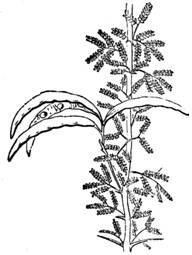
Fig. 321—Acacia Seyel
Shit′tah and Shit′tim occur in several passages of Exodus, and indicate the kind of wood which was employed in making various parts of the tabernacle while the Israelites were wandering in the wilderness. It is mentioned also as forming part of the offerings, as in Exo 25:5, ’rams’ skins dyed red, and badgers’ skins, and shittim wood;’ and in Exo 35:7; Exo 35:24. In Isa 41:19, it is mentioned as a tree worthy of planting: ’I will plant in the wilderness the cedar, the shittah tree, and the myrtle, and the oil tree,’ etc. It is exceedingly probable that the tree referred to belongs to the Acacia, found both in Egypt and in the deserts of Arabia. ’The acacia tree,’ says Dr. Shaw, being by much the largest and most common tree in these deserts (Arabia Petraea), we have some reason to conjecture that the shittim wood was the wood of the acacia, especially as its flowers are of an excellent smell, for the shittah tree is, in Isa 41:19, joined with the myrtle and other fragrant shrubs.’ Dr. Kitto says: ’The required species is found in either the Acacia gummifera, or in the A. Seyel, or rather in both. They both grow abundantly in the valleys of that region in which the Israelites wandered for forty years, and both supply products which must have rendered them of much value to the Israelites. We think the probability is, that the A. Seyel supplied the shittim wood, if, indeed, the name did not denote acacia wood in general. This tree grows from fifteen to twenty feet in height.’ Robinson and Smith frequently mention the Seyel as occurring in the same situations. It is very probable therefore that it yielded the shittim wood of Scripture.
The acacia, perhaps the