
Original Scripture Illustrations,
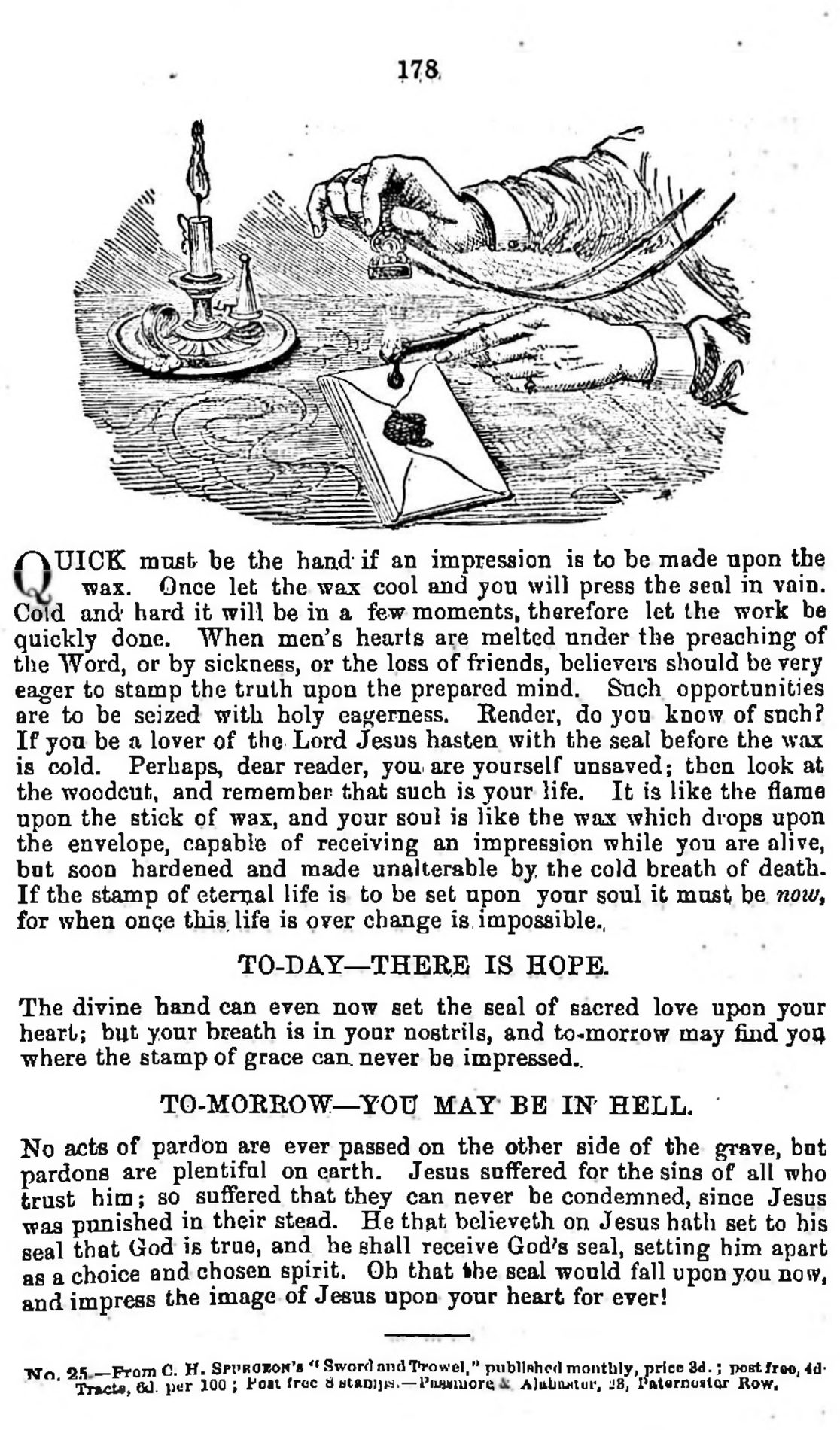
From the "Tabernacle Teacher's Manuscript Magazine."
"Ye must be born again."—John iii. 7.
A RAW countryman having brought his gun to the gunsmith for repairs, the latter is reported to have examined it, and finding it to be almost too far gone for repairing, said, "Your gun is in a very worn-out, ruinous, good-for-nothing condition; what sort of repairing do you want?" "Well," said the countryman, "I don't see as I can do with anything short of a new stock, lock and barrel; that ought to set it up again." "Why," said the smith, "you had better have a new gun altogether." "Ah!" was the reply, "I never thought of that; and it strikes me that's just what I do want. A new stock, lock and barrel; why that's about equal to a new gun altogether, and that's what we'll have."
Just the sort of repairing that man's nature requires. The old nature cast aside as a complete wreck and good for nothing, and a new one imparted.
"Ye will not come to me, that ye might have life."—John v. 40.
We are told that in stormy weather it is not unusual for small birds to be blown out of sight of land on to the sea. They are often seen by voyagers out of their reckoning and far from the coast, hovering over the masts on weary wings as if they wanted to alight and rest themselves, but fearing to do so. A traveller tells us that on one occasion, a little lark, which followed the ship for a considerable distance, was at last compelled through sheer weariness to alight. He was so worn out as to be easily caught. The warmth of the hand was so agreeable to him that he sat down on it, burying his little cold feet in his feathers, and looking about with his bright eye not in the least afraid, and as if feeling assured that he had been cast amongst good kind people whom he had no occasion to be so backward in trusting.
A touching picture of the soul who is aroused by the Spirit of God and blown out of its own reckoning by the winds of conviction, and the warm reception which the weary little bird received at the hands of the passengers conveys but a faint idea of that welcome which will greet the worn-out, sin-sick souls who will commit themselves into the hands of the only Saviour.
"And the door was shut."—Matt. xxv. 10.
Several years ago we heard an old minister relate the following incident:—He had preached the Word for many a year in a wood hard by a beautiful village in the Inverness-shire Highlands, and it was his invariable custom, on dismissing his own congregation, to repair to the Baptist Chapel in this village to partake of the Lord's Supper with his people assembled there. It was then usual to shut the gates during this service, in order that communicants might not be exposed to any disturbance through persons going out or coming in. On one occasion the burden of the Lord pressed upon his servant with more than ordinary severity, but anxious to deliver it and clear his soul, he detained his hearers a little beyond the time, and consequently had to hurry to the chapel. As he drew near he noticed the doorkeeper retire from the
outer gate, after having shut it. He called to him, quickening his pace at the same time, but his cry was not heard, the attendant retreated inside and the minister came up "just" in time to see the door put to and hear it fastened from within. He walked round the chapel looking up at the windows, but could gain no admittance; there was only one door, and that door was shut. He listened and heard the singing, and thought how happy God's people were inside, while he himself was shut out. The circumstance made an impression upon him at the time which he could never afterwards forget, and he was led to ask himself the question, "Shall it be so at the last? Shall I come up to the gate of heaven only in time to be too late, to find the last ransomed one admitted, and the door everlastingly shut?"