
EXPLANATORY NOTES AND QUAINT SAVINGS
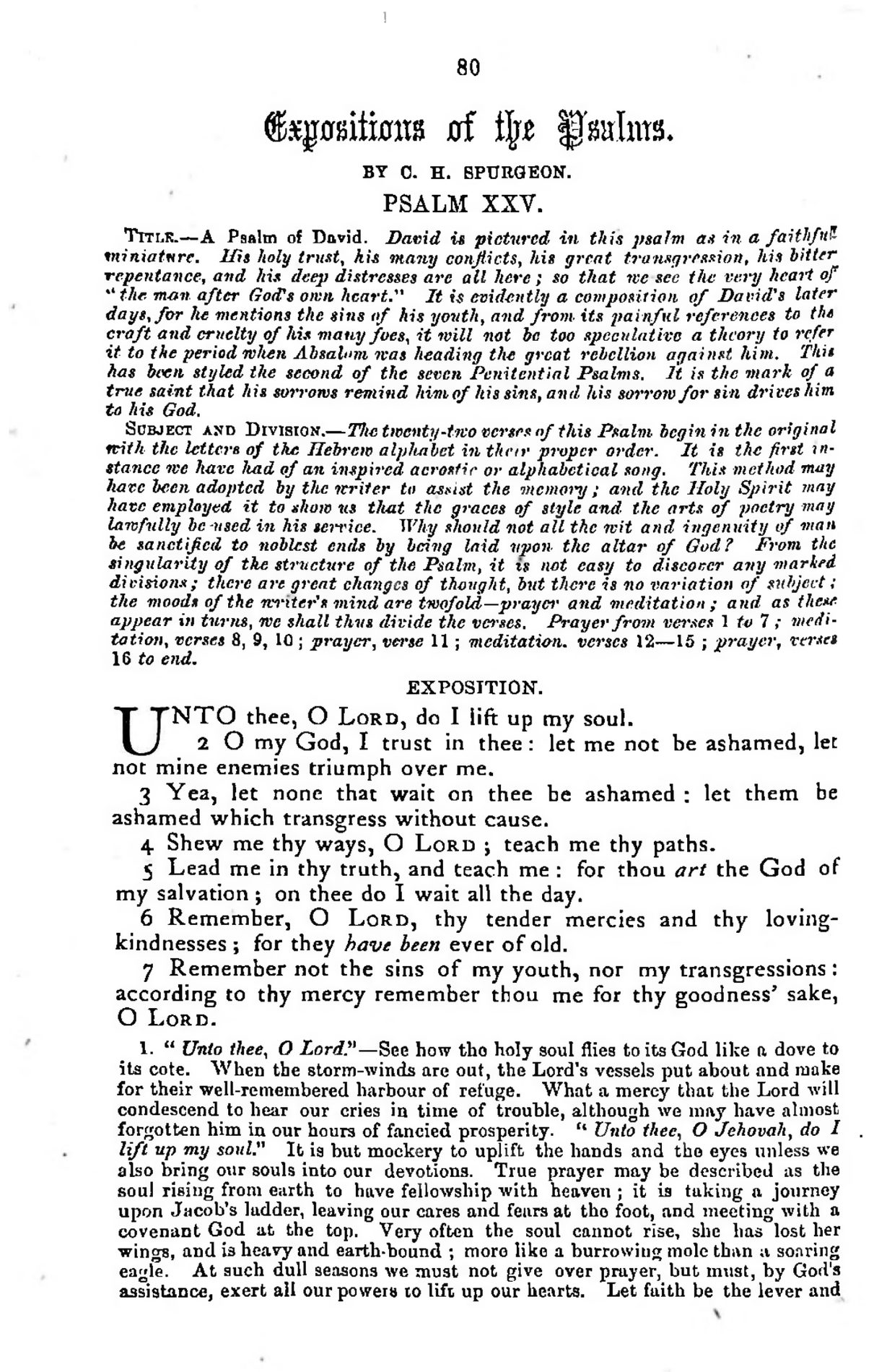
Verse 1.—Cyprian saith that in the primitive times the minister was wont to prepare the people's minds to pray by saying, "Lift up your hearts." The Jews at this day write upon the walls of their synagogues these words:—"A prayer without the intention of the affection is like a body without a soul;" and yet their devotion is more outside, saith one—a brainless head and a soulless body. "This people draw nigh to me with their lips, but their heart is far from me." (Isaiah xxix. 13.) A carnal man can as little lift up his heart in prayer as a mole can fly. A David finds it a hard task; since the best heart is lumpish, and naturally heareth downward, as the poise of a clock, as the lead of a net. Let us therefore lay aside every weight, and the sin that doth so easily beset us; and pray God to draw us up to himself as the lead stone doth the iron. —John Trapp.
Verse 3 (last clause.)—Let shame be sent to the right owner, even to those that deal disloyally, unprovoked on my part; and so it was, for Achitophel hanged himself, Absal m was trussed up by the hand of God and despatched by Joab; the people that conspired with him, partly perished by the sword, and partly fled home much ashamed of their enterprise. Oh the power of prayer! What may not the saints have for asking!—John Trapp.
Verse 9.—Never will this docility be found in any man until the heart, which is naturally elated and filled with pride, has been humbled and subdued. As the Hebrew word denotes the poor or afflicted, and is employed in a metaphorical sense to denote the meek and humble, it is probable that David, under this term, includes the afflictions which serve to restrain and subdue the frowardness of the flesh, as well as the grace of
humility itself; as if he had said, When God has first humbled them, then he kindly stretches forth his hand to them, and leads and guides them throughout the whole course of their life.—John Calvin.
Verse 9 (last clause).—Such as lie at his feet and say, "Speak, Lord, for thy servant heareth," such whose hearts are supple and soluble, tractable, and tea hable, so that a little child may lead them (Isaiah xi. 6.) Austin was such an one. Saith he, "I am here an old man ready to learn of a young man, my coadjutor in the ministry, who hath scarce been one year in the service."—John Trapp.
Verse 13.—In the reception of the gifts of God they do not devour them without feeling a sense of their sweetness, but really relish, so that the smallest competency is of more avail to satisfy them than the greatest abundance is to satisfy the ungodly. Thus, according as every man is contented with his condition, and cheerfully cherishes a spirit of patience and tranquillity, his soul is said to dwell in good.—John Calvin.
Verse 13.—The earth. The earth, or the land, to wit, Canaan; which was promised and given, as an earnest of the whole covenant of grace and all its promises, and therefore is synecdochically put for all of them. The sense is, his seed shall be blessed.—Matthew Pool.
Verse 14.—It is neither learning nor labour that can give insight into God's secrets, those Arcana imperii, "The mysteries of the kingdom of heaven." (Matt. xiii. 11.) "The mind of Christ." (1 Cor ii. 16.) These things come by revelation rather than by discourse of reason, and must therefore be obtained by prayer. Those that diligently seek him shall be of his Cabinet Council, shall know his soul secrets, and be admitted into a gracious familiarity and friendship. "Henceforth I call you not servants; for the servant knoweth not what his lord doeth: but I have called you friend:; for all things that I have heard of my Father I have made known unto you." (John xv. 15.)—John Trapp.
Verse 14.—Albeit the Lord's covenant with the visible church be open, and plain in itself to all men in all the articles thereof; yet it is a mystery to know the inward sweet fellowship which a soul may have with God by virtue of this covenant; and a man fearing God shall know this mystery, when such as are covenanters only in the letter do remain ignorant thereof; for to the fearers of God only is this promise made, that to them the Lord will show his covenant.—David Dickson.
Verse 15.—As the sense of sight is very quick, and exercises an entire influence over the whole frame, it is no uncommon thing to find all the affections denoted by the term eyes.—John Calvin.
Verse 15.—Encouraged to hope for the blessings above mentioned, the lowly suppliant still continues to fix the eyes of his understanding on their proper object, God his Saviour, beholding his glory, attending to his will, and expecting his mercy. An unfortunate dove whose feet are taken in the snare of the fowler, is a fine emblem of the soul, entangled in the cares or pleasures of the world, from which she desires by the power of grace to fly away, and to be at rest with her glorified Redeemer.—Bishop Horne.