
Notes
WHEN reading James i. l., "to the twelve tribes which are scattered abroad, greeting," we dared to observe that the Jews were not two tribes but twelve, and that there are no ten lost tribes. This has brought upon our devoted head vials of wrath from some of the Anglo-Israelites, and a great deal of profound instruction from others of them. The whole theory of Anglo-Israelism is so whimsical and unreasonable that we can hardly mention it without a smile; but as it has evidently become a belief with certain Christian people, we will try to treat it as a rational opinion. No identification between our nation and Israel which has
ever yet been set forth is worth thought; with such arguments we could prove cats to be angels. We are, however, told by several correspondents to be more accurate, and to remember that Israelites are not Jews, though Jews are Israelites. We do remember it, and pray our instructors to observe that the Israelites were the people to whom our Lord preached, "I am not sent but unto the lost sheep of the house of Israel," Matt. xv. 24, and these were the people who persecuted Paul, and of whom he said, "my prayer for Israel is that they might be saved," Rom. x. l. To these the apostle belonged, for he said,
511
"Are they Israelites? So am I." The Jews of that day were Israelites, and the Israelites of that day were Jews: the Jews of this day are the same. Enquire of any Jew, and he will tell you that he is an Israelite. Ask him to which tribe he belongs, and he may mention Naphtali or Asher quite as likely as Judah.
This foolish dream has engendered a number of other silly dotings, and has supplied fuel for the Jingo flame, or else we should have made no mention of it, but have left it for the innocent amusement of the credulous. In any case, fleshly descent is not a thing to be gloried in, or depended upon. The blessings of the covenant are not to the seed according to the flesh, but to the children by promise, born of the Spirit by faith. We deprecate with deep earnestness all reliance upon blood and birth, for that which is born of the flesh is flesh, and nothing more. Even if we were really the natural seed of Abraham, it would avail us nothing: we must be born again from above. Now in Christ Jesus there is neither Jew nor Gentile; and the attempt to restore the distinction is either ridiculous or pernicious, or a good deal of both. We know that these remarks will bring a hornet's nest about our ears; but as we are already overdone with wasps it will be a change. We shall at least enable many journals to prepare fresh articles for the defence of their crotchet, and we trust they will be duly grateful to us for our help, and be as good-tempered over it as the Lion and the Unicorn will let them be.
With the best intentions, periodicals in dealing with our Jubilee diverge very widely from the truth. We do not think that they mean to be otherwise than accurate, but they make assertions as to our private affairs which are mere fables. One of them even repeats an old worn-out story about our quoting a profane expression as to the heat of the weather. The tale was in circulation long before our birth, and so far as we are concerned there is not an atom of truth in it. No one can be more surprised at the statements made about us than we are: they are often so remote from the fact that they have much of the charm of romance. It does not matter much, but still a prejudice once excited may prevent persons from hearing a discourse by which they might be blest.
The sea-side months are very unproductive of subscriptions for our College, Orphanage, &c.; but, happily, we are not now distressed by that fact, for we have grown familiar with it by the experience of former years. When our friends return home they will think of the Lord's work, and send in their thank-offerings. The Lord is very tender in his dealings with our faith, and does not allow our brook Cherith to run dry; at the same time, he lets us see the pebbles at the bottom of the stream, and
thus gently tries our faith. The Colportage Society, and the Evangelists are scraping the bottom of the barrel very hard just now. The Evangelists especially have cause to look up for speedy aid; yet the Society of Evangelists is one of our most useful enterprizes.
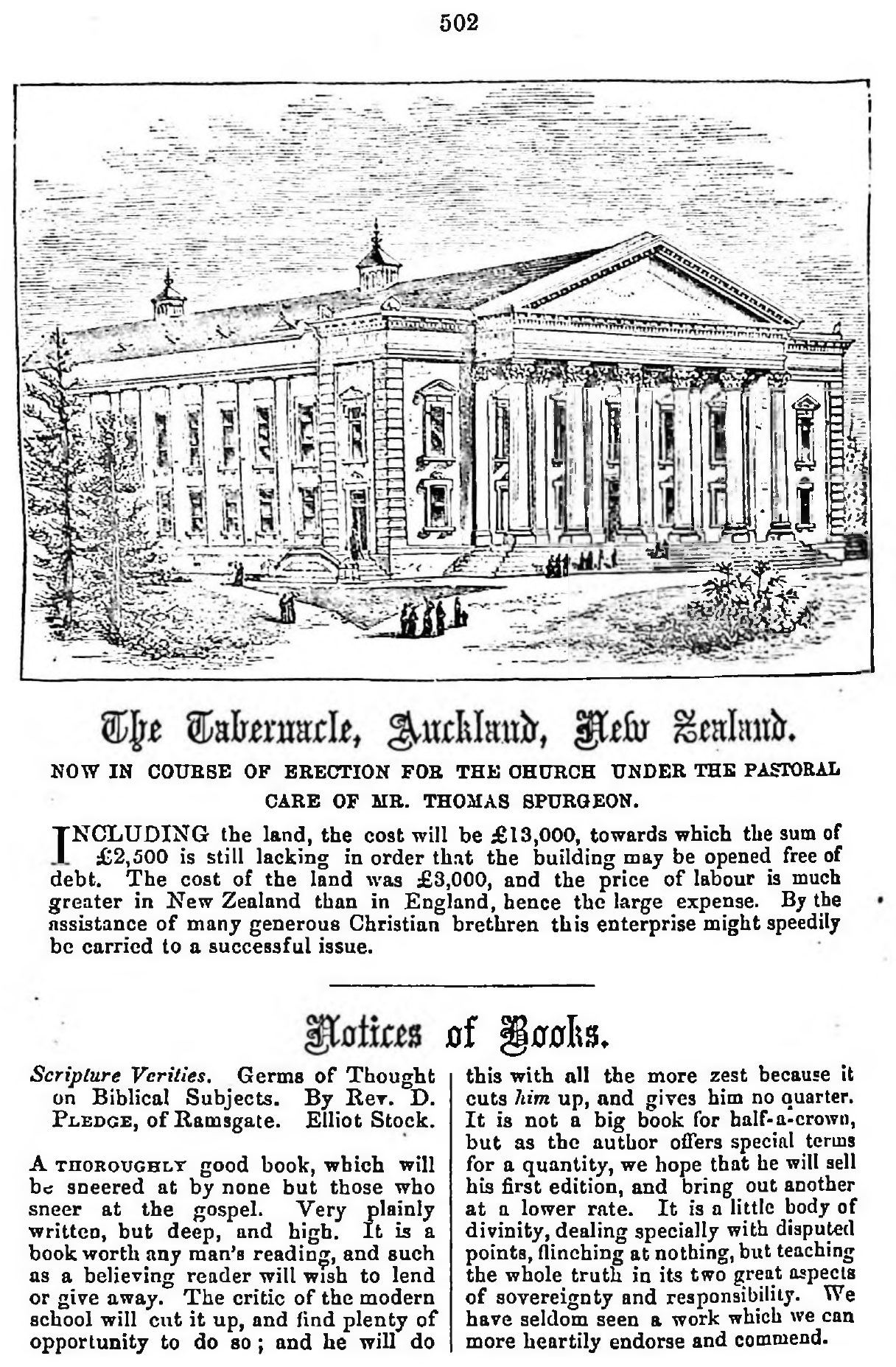
Our Prayer-meetings have of late been specially good. At one of them, our dear friend, the manager of Mr. Muller's Orphanage, strengthened our faith by the story of the Lord's present dealings with that Institution; at others, Mr Thomas Spurgeon has spoken with tender power; and at all there has been a deeper feeling and a more intense agony than ever. All this foretells the coming of a large blessing. Please pray for it. A great awakening at Tabernacle may lead the way to a wide-spread work of grace the wide world over.
Mr. Spurgeon's Visit to Southampton.—Wednesday, August 6, will not soon be forgotten by those who sat in that great stovehouse which is called the Rink, Southampton. In the afternoon, Nebuchadnezzar's furnace was mentioned by many as being, no doubt, a few degrees hotter; but the temperature in the Rink made many fall down as though lifeless, and those who were able to endure the heat pouring through the glass roof, must have been drained of their last drop of energy. Yet the attention was deep. In the evening things were cooler, and the service was therefore more likely to produce good results, for people could give their minds to that which was spoken. Many testified that the word was with power. We hope that the Portland Chapel church obtained substantial help towards their praiseworthy enlargement, which has given them school accommodation of the best kind. Our friend, Mr. Mackey, has a fine warm-hearted people around him, and he is worthy of them.
Thursday, August 7, was the opening day of a Conference, held in the Deanery grounds. Lord Radstock, Lord Mount-Temple, and Lord Lichfield were all fellow-guests with Mr. Spurgeon at the hospitable abode of Canon Wilberforce, and all took part in the gatherings, which were full of spiritual power, and free from the slightest taint of sectarianism. Men of many winds met around the cross, and testified to Christ's work for us, and the Spirit's work in us. Mr. Spurgeon addressed the assembly at 8, 11, 3, and 6, and then went back to London, happy in having had strength enough, and none to spare. If attendance at any of these Conferences implied agreement with the peculiar views of those who attend them, we should be absent; but as vital truths are not questioned, but enforced, and minor points are not made into themes of discussion, the result is the advancement of brotherly love, and the advocacy of spiritual truth. This is in pleasing contrast with assemblies wherein
the eternal verities are treated as moot matters, and agreement in some minor point is the supposed bond of union. Dear to each Christian man should be his own denomination, but dearer still the Word of God, and the doctrines of grace.
The Clue of the Maze.—Our tiny booklet, last of our works up to this date, has brought us numerous congratulations from thoughtful people, on whose behalf it was written. Certain sceptical folk, who do not care for its teachings, have yet favoured us with a kindly word, and we cannot but hope that some of our remarks have touched them more than they care to own. God grant it may have been so! This is a period of unsettlement: the whole year seems dominated by a November more dense and foggy than any which occurs in the natural season. We are therefore bound to speak on the behalf of faith, and we have done so in this pretty bijou. One lady bought five hundred copies, so high was her estimate of our effort. We printed 10,000, and hope they will soon be every one of them set agoing. Such notes as the following have come in pretty numerously:—
A country friend writes:—"Your 'Clue of the Maze' has been a great help to a cousin of mine, who was getting rather infected with infidel notions."
An American minister says:—"I thank you from my heart for the good 'The Clue of the Maze' has done me. I have enjoyed the reading of the book beyond anything that it has been my good fortune to read for months. It has deepened my devotion, and charmed my fancy, and caused me to pray earnestly that many years of active service may yet be granted to its author."
COLLEGE.—The following students have accepted pastorates:—Mr. W. G. Clow, at Sherborne, Dorset; and Mr. H. H. Pullen, at Harrow-on-the-Hill. Mr. T. A. Judd is also leaving us to take charge of the churches at Shrewdon, Chitterne, and Tilshead, Wilts. Mr. E. White, who was pastor of the church at Orpington before he came to the College, has completed his term with us, and settled at Clare, Suffolk.
Mr. E. H. Ellis has become pastor of the church at Devonshire Square Chapel, which has united with the church formerly under our brother's care at Wellington Road, Stoke Newington. Mr. G. H. Carr, who left Southport some months ago, has accepted an invitation from the church at High-street, Bow, E.
Mr. T. Hancocks has removed from Tonbridge to Clover Street, Chatham; and Mr. G. Wainwright from Stockton to Grosvenor Street, Manchester. Mr. M. Baskerville, who went recently to the United States, has settled at Lanark, Illinois. Mr. S. A. Dyke, who has been manager of the printing and publishing of The Canadian Baptist, has returned to the pastoral oversight of the College Street Church, Toronto.
Mr. H. T. Peach reports encouraging progress at Pietermaritzburg, but says that there is urgent need of a chapel, as the Government will only let the building in which the services are held from week to week, and at any time the church may be homeless.
EVANGELISTS.—Our brethren have been resting during the past month, but they will all be at work again soon. The expenses have been going on although the receipts have been very small. As the winter campaign begins we shall be glad to have "the manure of war" in good condition. It is impossible to make evangelistic efforts entirely self-supporting; indeed, it often happens that where special services are most needed there is the least ability to meet the cost of holding them.
Messrs. Fullerton and Smith are to visit Galashiels, Solkirk, and Hawick this month; and in October they go to Belfast.
Mr. Burnham is to be part of the month with our brother Cuff, at Shoreditch, and the remainder with the hop-pickers, in Kent, concerning which he writes as follows:—
"The nature and work of this mission are so well known by this time that I need do no more than just hint at its various operations, and trust to your readers for the generous response of former years.
"We visit the gardens daily, distributing tracts and talking or reading to the pickers over the bins; give shoes and clothing to such as need them, and supply medicine to the sick; hold open-air services in the villages whither the hop-pickers resort each evening; on Sunday mornings visit the camps of the 'strangers' (as the denizens of our London courts and alleys are called in the hop country), singing and talking to them of 'the old, old story'; provide free tens on Sunday afternoons, for the purpose of gathering the 'strangers' in the meadow to hold a gospel service with them.
"All this work necessarily involves us in heavy expense; but the blessing of God has so manifestly rested on it in the past that we feel it would be a sin and a shame to withdraw, or even to slacken our efforts in any direction. We commence our work in Kent, this September, with an empty exchequer, and therefore would ask kind donors to be prompt in their gifts, as the extent of our operations must, in a great measure, be determined by the income. We promise very careful and economical use of funds entrusted to us for this mission, and a balance-sheet of income and expenditure to every donor. Parcels of tracts or left-off clothing may be sent, carriage paid, to the president of the mission, Rev. J. J. Koudon, Marden Station, S. E. R.; donations to C. H. Spurgeon, Upper Norwood, London: J. J. Koudon, Goudhurst, Staplehurst, Kent; or to "Yours in the service,
"JOHN BURNHAM.
"24, Keston Road,
"Peckham Rye, London, S.E."
513
ORPHANAGE.—Mr. Charlesworth asks us to say that he hopes soon to arrange for a tour in Yorkshire with his singers and bell-ringers. He will be glad to hear from any friends who can invite the orphans for a meeting or service in aid of the funds of the Institution. It greatly lightens the expenses to have several places to go to during one visit. The Orphanage can be aided most efficiently by our friends without in the least degree entrenching upon local funds. Our Cornish friends have aided us gloriously, and we have hope that Yorkshire will be equally hearty.
By the kindness of Mr. Ross and his friends the children have enjoyed a strawberry tea again this year. They are not likely to forget their generous hosts, to whom we are also very grateful. God bless the friends at Horseshoe Wharf!
Several friends send us contributions for the Girls' Orphanage, but as we have only one fund, out of which both boys and girls are maintained, all sums are placed to the general account, unless the donors express the wish that their kind gifts should be applied to the Girls' Orphanage Building Fund, which will remain open until we have completed the buildings on the girls' side of the Stockwell home.
A young man in the country, in forwarding the amount collected for the Orphanage, sends the following note, which he asks us to insert in the magazine:—
"Respected Friends.—Having had a little book sent to me describing the working of the Stockwell Orphanage, and having been one of the worst of ragged boys myself, but now having a good suit of clothes to put on, a home to live in, and the King of heaven for my Saviour, I thought I might try what I could do for this glorious Institution. Many people tell me that they receive good from Mr. Spurgeon's sermons, so I thought they ought to give a little to God's cause to prove their gratitude. I therefore put a slip of paper into every sermon that I delivered, asking the readers to give a small donation to the Orphanage. Many were too poor to give me anything, but I collected 15s. 3d., and if all the distributors of the sermons throughout the world would do the same, a little here, and a little there, and a little everywhere would make a good lump. A good time for this is just coming on. Harvest-time is better than Christmas or New Year, as all other beggars are on the look-out then. . . ."
We shall be very pleased if our friend's suggestion bears fruit. Collecting boxes and books can always be obtained from the Secretary, Stockwell Orphanage, Clapham Road, London, S.W.
COLPORTAGE.—The following is extracted from the Tenth Annual Report of the Worcestershire Colportage Association, which employs four of our agents:—"Your agents have spent nearly 100,000 hours in our villages; they have made 379,002
visits, nearly 10,000 of which have been to the bedside of the sick and dying; the Book of God has been read 11,001 times; and 8,608 copies or portions of that sacred Book have been sold. They have held 2,373 meetings, and preached the good tidings of salvation to from 100,000 to 150,000 persons. As to a distribution of a purer literature among the people, the result is eminently satisfactory. Over 150,000 tracts have been scattered broadcast in village homes and by the wayside; and nearly a quarter of a million of periodicals have been circulated, besides a large number of good and useful books. The appreciation of the public can be best attested by the fact that they have paid upwards of £1,300 for these books and periodicals. As was well said in the report of the Baptist Foreign Mission—'Stand still you cannot, go back you dare not,' the only possible course open to you is 'forward.'
"With the ministers and delegates must rest the tremendous responsibility of arousing the members of our churches to the full prosecution of their duty in this matter; this is for the outflow and increase of our spiritual life, and the very life of many of our churches, if not all, depends upon the manner in which we throw all our energy into the aggressive work which God has opened up to us, and given us the privilege of being his co-workers in accomplishing."
PERSONAL NOTES.—A recent number of the New York Episcopal Recorder contained the following interesting paragraph concerning the usefulness of our sermons in Labrador:—"All last winter, in the little mission on the Labrador coast, Mr. Spurgeon's sermons were read in the Mission Church Sunday by Sunday by the lady teachers, who were left by themselves for eight months, through the failing health of the devoted missionary who laboured there for many years. These simple services on the Sunday and week-day evenings, when these sermons were the staple of the teaching given, were greatly blessed by God. Many sailors came from the ships anchored off the coast, and, with the resident fishermen, eagerly listened to the Word of Life, and not only were their hearts cheered and comforted, but some were brought to a knowledge of the truth as it is in Christ Jesus."
A sermon-reader writes:—"A dear friend of mine, who had so desponded that he contemplated suicide, was led to the Tabernacle one Sunday morning, many years ago, when you preached from the words 'Bring him hither to Me.' ('Hope in Hopeless Cases,' No. 821.) He has been a happy, unclouded believer from that day, and an earnest worker in the Master's vineyard."
Another friend says:—"The other Sabbath I was preaching in the village of—,
when I was pleased to learn that a flint-breaker on the turnpike-road had been brought to Christ through reading one of your sermons. His name is J—. He had a companion at work on the road with him, who was also much blessed by hearing your sermons read. He said—hard-worker as he was—that he would as soon have gone without his dinner as not hear your sermons read, for it was J—'s custom to read them on a flint-heap in their dinner-hour. Hearing of these things, I could not refrain from giving them to you for your encouragement."
One who lends our sermons to his neighbours writes:—"Nearly three years ago I had some of your sermons lent to me. I had heard of this Mr. Spurgeon, but never before had I read his sermons. Every one seemed preached upon me, for the words were suited to my case. I was leading a dreadful life of sin, and had been for years. I attended church regularly, like other so-called Christians, but not a word did the clergyman say to hurt my feelings. When you told me the truth I felt compelled to
believe it. How I wished that I had heard the truth preached so plainly before! Under God, I owe my conversion entirely to you. I have never forgotten to pray for you daily."
An aged saint, who has been bedridden for fifty years, recently informed one of our evangelists that he had read our sermons every week for many years, and he greatly loved the minister whom he had never seen. He added that friends were keeping his jubilee of suffering at the time that our Jubilee was being celebrated, and he praised the Lord for this link between us.
WANTED. — "Dickinson's Theological Quarterly" for 1878. Our set of this work needs this volume to complete it. We cannot get it for money; perhaps love may discover it. Please do not send it on, but write a note if willing to supply the lack.— C. H. S.
Baptisms at Metropolitan Tabernacle:— July 21, ten; July 31, twenty.