
In Canada
THE elegant work by the Marquis of Lorne is the fourteenth volume in the National Picture Series which was projected by the late Dr. Manning; and as regards the artistic merit of its illustrations the book even surpasses in attractiveness those that have gone before. While the pencil has been deftly handled, the pen has also done its work well, the general result being, that fireside travellers, as well as those who are thinking of turning their faces towards the great Dominion of Canada, have a manual on that magnificent colony which they can read with interest and accept as trustworthy. The late Governor-general had exceptionally good opportunities of observation, and he appears to have turned them to good account. Indeed, his pages abound with so much useful information, that a cheaper edition of the book at some future time, with the pictures reduced in size, would be welcomed by many to whom eight shillings is a prohibitive price.
The mind is quite unable to form a correct estimate of a territory like that of Canada, equivalent as it is to a continent in itself. Nova Scotia, one of the smaller provinces, has 22,000 square miles with 400,000 inhabitants, of whom a fourth part are Presbyterians, while 200,000 more belong to various Protestant denominations. Quebec has 193,355 square miles, and over a million of its people are still enveloped in the darkness of Romanism. In Ontario the outlook is much more cheering, and this is the most populous province. "Here the Protestants are greatly in the majority," remarks the Marquis, "there being about 480,000 Methodists, 370,000 Presbyterians, 340,000 Anglicans, and about 290,000 Roman Catholics." In this province alone, the Protestant bodies have seventeen colleges or universities.
In reference to Manitoba and the other provinces, the Marquis also gives a number of important facts. Of Manitoba itself we are told: "Its growth is so rapid, that there is little use in specifying its condition to-day, for to-morrow the change will have been so great that the statistics would be already stale. It has an area of about 100,000 square miles. The next two divisions which have been named, Assinibiva and Saskatchewan, have 90,000 square miles each, and nearly all is fair land. Alberta has 100,000 square miles, and Athabasca 120,000, while British Columbia has 200,000; but a great deal of this is good only for wood or minerals, whereas the names previously mentioned stand for territories of great natural fertility of soil."
Lord Lorne entertains very sanguine views in regard to the future of the Dominion; and he insists with some emphasis on the importance of diffusing, among young people especially, the truth about the country, e.g. :—
"If true information were readily obtained, and colonial life were brought as familiarly to the minds of Englishmen as their own home life, it is difficult to believe that there would remain so many here who
* Canadian Pictures, Drawn with Pen and Pencil. By the Marquis of Lorne, K.T. With numerous illustrations from objects and photographs in the possession of, and Sketches by the Marquis of Lorne, Sydney Hall, &c. Engraved by Edward Wymper. The Religious Tract Society. Price 8s.
have no occupation but the proverbial privilege of grumbling at their own fate, and at all around them. In Canada, if it were not for the constant bright sunshine, and for certain improvements in the art of government, both central and local, the Scotch and English emigrants might imagine that they had never left the Old World; so good are the schools, so orderly are the people, so easy the communication from one district to another. To many a poor English labourer, who will find that good wages can be got for a good day's work, and to many a poor English gentleman, who finds that he can procure sport at small expense among the fowl, the fish, and the deer, it would seem as though they had been set down in a better English world, and might imagine that some benevolent spirit had suddenly granted to them all their heart's most hopeful dreams. They will find that the people around them, and their own children as they grow up, remain English still in all essentials. They have become, or are becoming, part of a people who are sturdy, independent, who know their own ideas and necessities, and insist upon acting upon these."
Still, the attractions of the country are in the main for those who can put up with hard work and a country life. The Marquis has plenty to say about the attractions of Canada; but when there is need, he does not withhold timely warnings. "Young men who wish to lead a town life had best stay at home." "Fine ladies and fine gentlemen will find themselves altogether out of the race." "For women there is plenty of space and place; but the women who will succeed must be women who will work."
In the accounts he gives of the religious work that is being done in Canada, the Marquis, through wishing to be impartial, sometimes seems to speak too approvingly of the Romanists, especially of the Jesuits, whose work, taken as a whole, in all parts of the world, has certainly forwarded the cause of the devil rather than that of Christ. The Roman Catholics of the colony are still among the most needy subjects for the missionary enterprise of the church at home.
"The Presbyterians have been especially active, and the Church of England and others have manfully entered into the work," we are glad to learn, and it is then added: "Although in the long-settled portions it may be expected that the contributions of local churchmen shall suffice, yet there are not funds enough to send ministers to the scattered abodes of men in the back-woods and in the new clearings on the fringes of the provinces. Much work of the highest importance is done by the missionaries of the various churches, and such societies as the British-American Book and Tract Society, whose agents scatter copies of the Bible and New Testament, tracts, and religious books, over the widely separated villages of the maritime provinces; and this agency is largely and liberally aided by the Religious Tract Society of London, who do not confine their aid to any one channel, but also help to the full extent of their power all sections of the Protestant churches in their efforts to bring all British North America under the power of the Gospel of Christ. In the lumber-men's camp, among the great gangs of labourers on the railroads, in the isolated colonists' log-hut, the visits of the representatives of the church are eagerly looked for and warmly welcomed. It is therefore a duty on the part of Christian people in
573
Great Britain to assist in giving their countrymen in Canada that needed aid without which rural work cannot be carried on by the church in the Dominion."
Pastoral work has often to be carried on under unpleasant, or even dangerous, circumstances. "Long and weary journeys have to be undertaken," says the Marquis, "and it is not possible to visit all the numerous stations during the best time of the year for travelling. Often winter storms must be faced, and wrapped in what warm clothing he may have, the minister of the Gospel must keep his appointment, in spite of all difficulties of weather and distance. A friend of mine, a bishop in Ontario, travelling alone in a gig, and driving his horse, found himself one evening, when the cold had become intense, so benumbed, that he could not hold the reins. He got out and ran, but when again seated the numbness returned, and he finally lost consciousness, his last recollection being that he had no feeling of pain from the cold, but of great weariness. The horse pursued his way, his unconscious master retaining his seat in the half-covered vehicle. The animal stopped, after what must have been the lapse of two or three hours, at a small wooden house, and the settler coming out, found the bishop frozen and apparently dead. He was brought in and revived with great difficulty, the frozen limbs being rubbed with snow and the coldest water. My friend described his return to life as the most agonizing experience. The pain was intolerable. His face, eyes, and limbs were racked with torture, and he never quite recovered the effects of that night-drive."
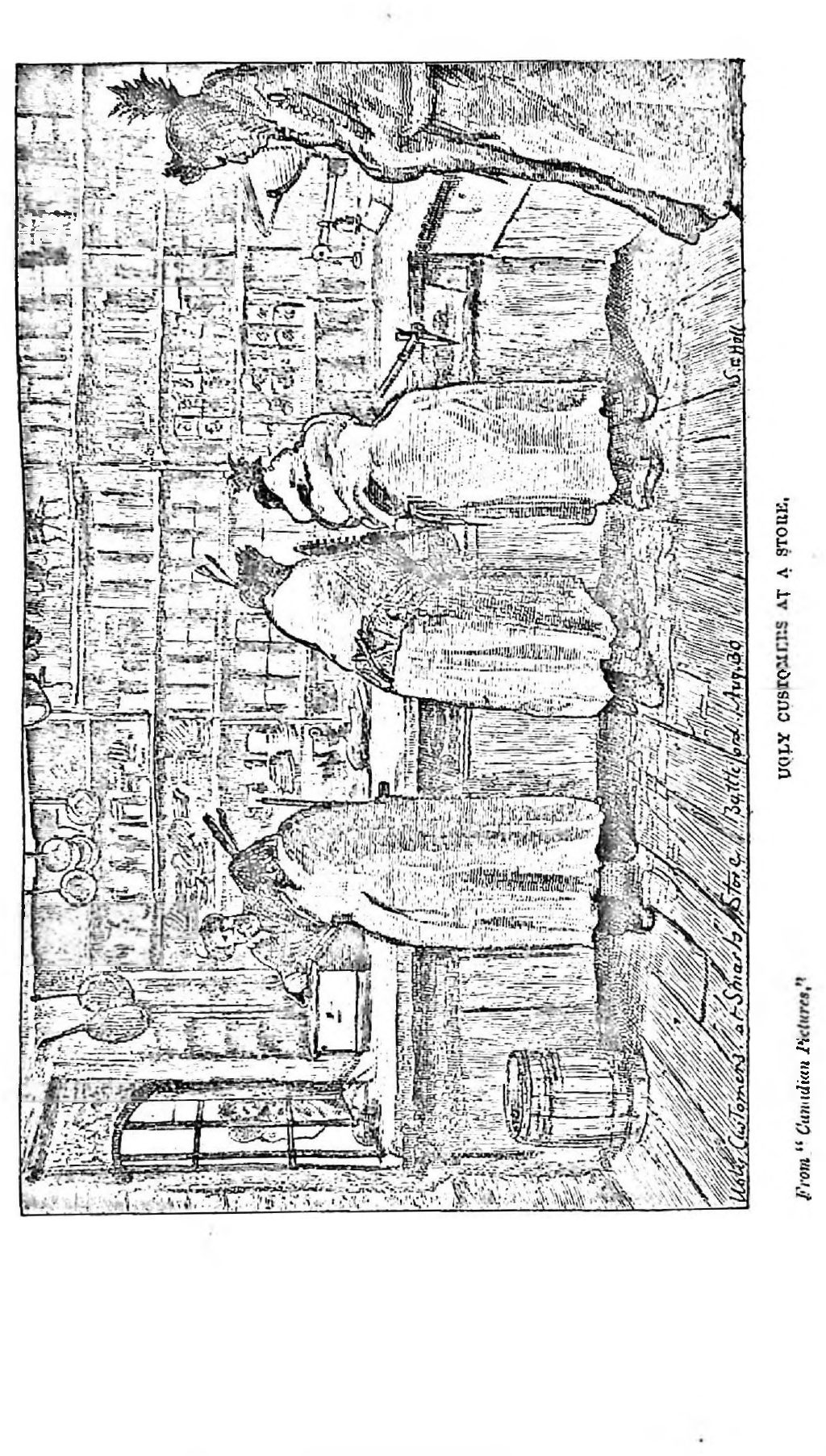
The native Indians of Canada are now put down at $5,000, the largest number being found in British Columbia. Mission and educational work is actively carried on among them by various denominations. Our engraving represents a party of the poor natives making their purchases at a store. The artist calls them ugly customers; and certainly after making all the allowances which international courtesy and Christian charity demand, we will not venture to call them handsome. It is wonderful, however, how comely the Gospel of Christ can make these long-neglected tribes, when once their hearts are touched by the grace of God.