
Religious Sites and Scenes of Edinburgh
THE wonderful way in which the printing and publication business of Messrs. Cassell and Company has developed since John Cassell came first to London, between thirty and forty years ago, is shown by the fact that at present something like forty serial works are issued from the establishment monthly, ranging in price from sixpence to half-a-crown a part. Though published at a price and in a manner which places them within the reach of all persons who purchase books at all; the works, as regards their production, are for the most part of the most costly character, differing in this respect as widely as it is possible to differ from the books in parts which are still sold by hawkers in country places at two or three times their real value. The productions sent forth from Belle Sauvage Yard are generally cheap as well as popular; and it is impossible to over-estimate the far-reaching comprehensiveness of their educational mission. Many, such as The Quiver and The Bible Educator, are decidedly religious, and the rest are pervaded by a wholesome Christian tone.
In "Old and New Edinburgh" the publishers have excelled themselves. Interesting as the Scottish capital has always been supposed to be by readers of history and fiction, these beautiful volumes will abundantly prove that the natural attractions and old-time associations of the northern metropolis cannot readily be over-estimated. Probably there is no city of its size in the whole world of which ardent topographers can tell so many stories. When, as in the volumes before us, the pencil of the artist is also enlisted to recall the past, as well as to portray the present, the reader is not likely to be disappointed with the entertainment. Scenes quaint, picturesque, or naturally beautiful, pass before the reader as in a panorama, and these are accompanied with those racy narratives which are associated with every square yard of the old city of Edinburgh. With the exception of London, there is no place of such absorbing interest to the English-speaking race, and the interest is heightened by the fact, that the scarcely semi-civilized Edinburgh of the sixteenth century became a chief centre of the Reformation in the British Isles. The city, and indeed Scotland generally, may be taken as representative of the elevating power of the gospel; for from being a backward people, or "A poorer England," the Scotch have advanced to the front as regards enlightenment, while in point of wealth Scotland occupies a higher place than England herself.
The site of Edinburgh is not supposed to have been particularly well adapted for an important centre in the first instance; yet even to the eye of a casual observer, art and nature have combined to make the city attractive. Our Scotch friends believe it to represent the acme of excellence, and we shall not question their verdict. "What the tour of Europe was necessary to see elsewhere I now find congregated in this one city," wrote Sir D. Wilkie in 1799: "Here are alike the beauties of Prague and of Saltzburg; here are the romantic sites of Orvieto and Tivoli; and here is all the magnificence of the admired bays of Genoa
* "Old and New Edinburgh: Its History, its People, and its Places." By James Grant. Illustrated by numerous Engravings. Three volumes, crown quarto, price 93. each.
171
and Naples. Here, indeed, to the poetic fancy may be found realized the Roman Capitol and the Grecian Acropolis." The city was first styled "the modern Athens" in the early part of this century, when the brilliant literary coteries of Blackwood's Magazine, The Edinburgh Review, and others were on the spot, before railways had brought the English and Scotch capitals within nine hours of each other.
Edinburgh early became a chief centre of the Reformation; and there the storm raged with a fury peculiar to the Scotland of that day. Fully to appreciate the intrepid heroism of Knox and his associates we have to take into account their stern surroundings. The representative of the old corrupt order of things was Cardinal Beaton, Archbishop of St. Andrews, the favourite of the Pope, a slave to French influence, and, consequently, the evil adviser of the ill-fated King James V., who was nephew of Henry VIII., father of Mary Queen of Scots, and husband of Mary of Guise. The violence of the rival partisans of the French, and of the cause of the Reformation as represented by England, reduced the country to a condition of anarchy. Having befooled the young king by his unpatriotic advice until James apparently died of despair, Beaton himself, in spite of the splendid fortune which had attended him in life, died even more miserably than his master, having been murdered in 1546. He was stricken down on May 29, or shortly after he had witnessed Wishart's martyrdom, the sufferer himself, as is well known, having predicted the archbishop's fate.
"Master George Wiseheart," as Foxe calls him, was a "blessed man of God," who answered well, as he stood undaunted before "the furious rage and tragical cruellness of the malignant church." Tall in stature, "polled-headed, and on the same a round French cap of the best," with black hair, a long beard, of a melancholy cast of countenance, and well-spoken, he was judged to be a comely personage. His clothing and mode of life, as referred to by Tylney, who knew him well, afford a curious insight into these rougher times. Thus as a gentleman, whose charity to the poor was always marked, he wore a frieze gown, a fustian doublet, plain black hose, shirts made of coarse canvas, the sheets of his bed having been of the same material. "He had commonly by his bed-side a tub of water, in the which (his people being in bed, the candle put out and all quiet) he used to bathe himself." It is said again, "he was a man modest, temperate, fearing God, hating covetousness, for his charity had never end, night, noon, nor day."
In times when zeal for the waning Papacy stimulated blinded fanatics like Beaton to make a last struggle against the Reformation, a man like Wishart was not likely to go long unmolested. He was arrested in Edinburgh, thrown into the castle of St. Andrew's, brought before the raging ecclesiastics by armed men, and after a sermon in which heresy was defined and condemned, a zealot who is spoken of as a "fed sow, frothing at the mouth like a boar," witnessed against him. Then came the articles of accusation, each of which commenced with such abuse as "Thou false heretic, runnagate, traitor and thief, &c." He denied the chief superstitions of popery, said that every layman was a priest, and so on. After laughing and mocking a good deal at their meek and innocent prey, the savage bishops condemned him, little thinking that the death of such a victim would do more to further the
good cause than all the efforts of the church to retard it. Wishart died praying for his enemies, and adding, "This grim fire I fear not"; but Beaton died soon after, crying, "Alas! Alas! Slay me not! I am a priest!" "And so," adds Foxe, "like a butcher he lived, and like a butcher he died, and lay seven months and more unburied, and at last like a carrion was buried in a dunghill, A.D. 1546, the last day of May."
So popular was Wishart at the time of his martyrdom, that the archbishop took care that the castle gunners were at their posts. When
THE PULPIT OF JOHN KNOX.
(From "Old and New Edinburgh.")
he was first arrested in Edinburgh, John Knox, as his disciple and attendant, desired to share his master's fortune; "but Wishart," as the most accomplished historian of those times remarks, "who had seen how precious a mind and heart lay behind the rugged features of his follower, would not allow it. 'Gang hame to your bairns,' he said to him, 'ane is sufficient for a sacrifice.'" In the good providence of God, Knox went home to abide his time, and then to preach the gospel with irresistible power.
173
Knox, Craig, and Melville, are three of the preachers who chiefly helped to make the Reformation a fact in Edinburgh. Born in 1505, Knox himself had just completed his fortieth year when Wishart was burned; and that is regarded as having been the turning-point in his religious life. From that day forward he espoused the cause of reform, and never once swerved in his allegiance. While lodged in the castle of St. Andrew's, as a place of refuge from the ferocious Romanists, he was taken prisoner in the siege which ensued, and for a year and three-quarters he served in the French galleys. In the spring of 1549 he was released, however, and on coming to London so secured the favour of Edward VI., that he might have enjoyed promotion in the English Church had he been so inclined. He settled for a time at Berwick before proceeding to Edinburgh; and while in the Border town he is supposed to have inaugurated the Puritan practice of using ordinary bread at the Lord's Supper. He retired from England after the death of the king, to minister to a congregation at Frankfort, and even spent some years with Calvin at Geneva. He returned to his native land in May, 1559, and the astonishingly rapid consummation of the Reformation was mainly owing to his efforts. The story is far too long to be repeated here; but what the Earl of Morton said at the grave of the departed pastor was as effective a funeral oration as could have been uttered: "Here lieth a man, who in his life never feared the face of man; who hath been often threatened with dagge and dagger, but yet hath ended his days in peace and honour."
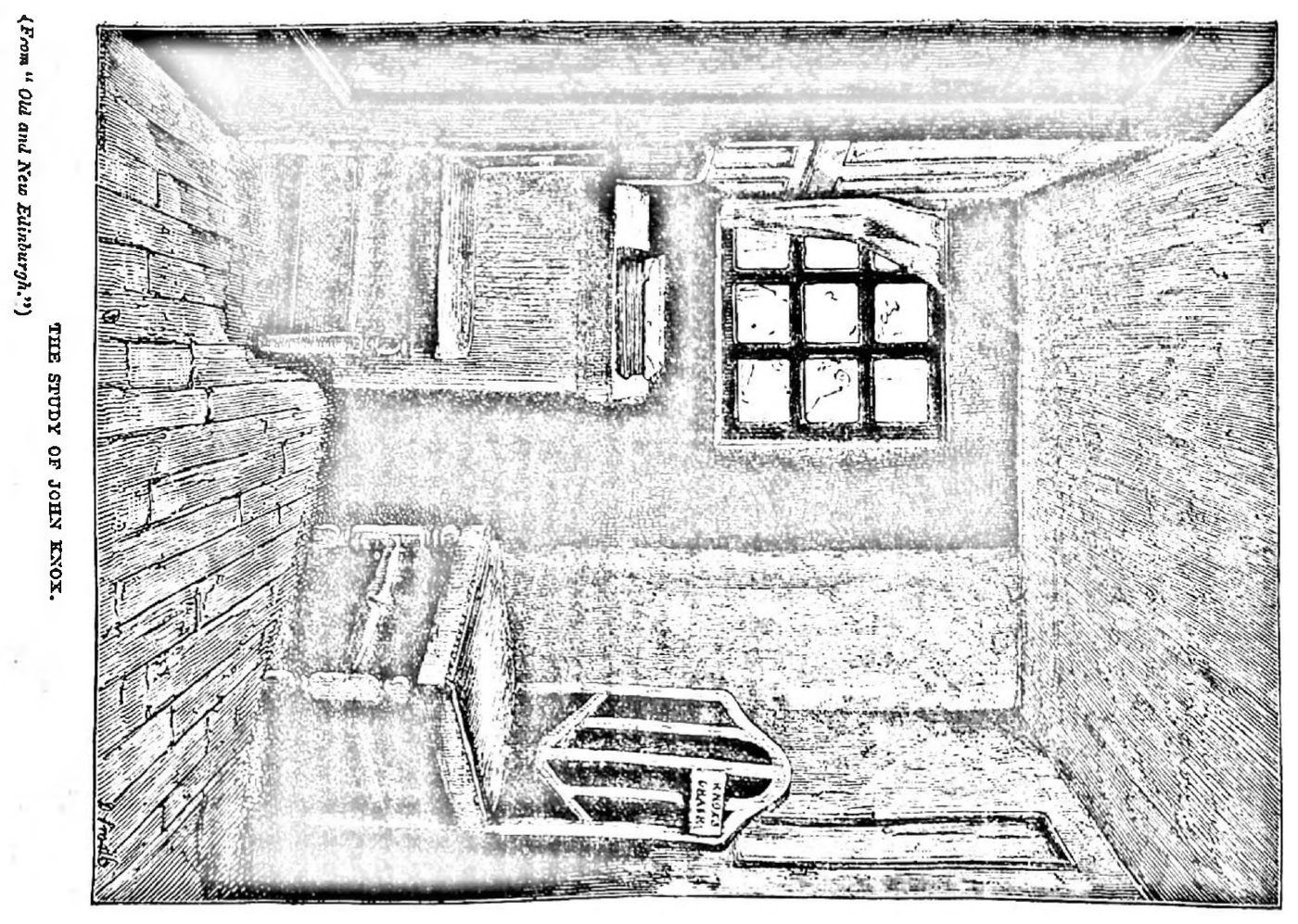
Speaking of Knox's house in Edinburgh, Mr. Grant says: "It is to the credit of the Free Church of Scotland, which has long since acquired it as a piece of property, that the progress of decay has been arrested, and some traces of its old magnificence restored. A wonderfully picturesque building of three stories above the ground floor, it abuts on the narrow street, and is of substantial ashlar, terminating in curious gables and masses of chimneys. Perched upon the corner above the entrance-door, is a small and hideous effigy of the Reformer, preaching in a pulpit, and pointing with his right hand above his head towards a rude sculpture of the sun bursting out from among the clouds, with the name of the Deity inscribed in three languages on its disc."
This house is every way deeply interesting; for it was here that the pastor did much of the work which tended towards shaping the course of the Reformation. "The First Book of Discipline," ratified by Parliament, in the drawing up of which Knox had a principal share, is supposed to have been completed here. Here, also, he lost Marjory his first wife, the like of whom, according to Calvin, was not then to be found in the wide world; and thither, when nearly sixty, he brought home the beautiful and youthful Margaret Stewart, daughter of Lord Ochiltree—a prize that, according to the Reformer's enemies, could not have been won without practice in the black art. In that superstitious age many absurd stories under this head were fabricated, and were of course believed by the people. The leading statesmen and soldiers of the time frequently assembled beneath the pastor's roof; but the more prominent the station occupied in such times, the greater the number of enemies a man was likely to have. It was so with Knox. On one occasion he was fired at through the window, and would probably have been killed
13
had he been sitting in the seat he usually occupied. Providence preserved him, and grace gave him favour in the eyes of the people. When he preached for the last time in St. Giles's he was followed by the whole congregation as he slowly walked to his home.
Second in interest to Knox alone, is John Craig, who died at nearly ninety years of age in the last year of the sixteenth century. His life-history was a truly wonderful one even for that wonderful age; and his example and teaching were well calculated to give stability to the Reformation. Educated at St. Andrew's, he became a Dominican monk, and feeling drawn towards the evangelical doctrines, he retired to the Continent, and there the reading of Calvin's Institutes completed his enlightenment. Arrested at Rome, he made the bravest possible stand before the judges of the Inquisition; and condemned to be burned, the sentence would have been carried out had not the mob broken open his prison to celebrate the death of the Pope Paul IV. After many painful adventures, he reached Scotland, laboured with Knox, and became the chief leader of the great movement after the death of that Reformer in 1572. He was mainly responsible for "The Second Book of Discipline;" and besides a catechism which was in general use throughout the country for fifty years, he composed the First Covenant, or King's Confession.
In the little chapel of St. Mary Magdalene in the Cowgate, the visitor may still see the sanctuary intact wherein Craig preached the doctrines of grace, the singularly interesting edifice having long been occupied by the Edinburgh Medical Mission. On one occasion, some years ago, we joined the Sabbath evening congregation gathered in from the Cowgate, and the associations of the place made a vivid impression on our mind. The gospel preached was of sterling quality: the window above our head had the arms of Scotland surrounded with thistles, while encircled with laurel were the arms of Mary of Guise, the ancient painted glass being the only fragments of the kind throughout all Scotland which have survived the iconoclasm of the Reformation. There Craig preached in Latin until he relearned his native tongue, which during twenty-four years' absence he had almost forgotten; and there the General Assembly of the Protestant Church of 1578 was held.
In walking about the old town of Edinburgh we find that many of the most interesting sites are exceedingly squalid; but these remind us that nearly forty years ago the city became a notable example of Ragged-School work. It is peculiarly striking, while perambulating the slums to come across old-time inscriptions which were dictated by Puritan piety. Thus, on one house on the Castle-hill, said to have once been the residence of the Earls of Bothwell, may be seen over the door, "Praised be the Lord my God, my strength, and my Redeemer. Anno Dom. 1638." A still more ancient motto is found in Baxter's Close opposite to the house where Burns the poet had "his share of a deal table, a sanded floor, and a chaff-bed at eightpence a week." The words are, "Blessit . be . the . Lord . in . all . His . giftis, now . and . evir." On another house in Manchine's Close, which has passed away, there appeared over the door, "O Lord, in the is al my traist, 1569." The Canongate had formerly its full share of these legends, e.g.: "It is an honour for man to cease from strife:" and "Blessed is he that
175
wisely doth the poor man's case consider." Such things afford us glimpses into the past of a kind which cannot be obtained from histories. They show us that these streets were formerly trodden by pilgrims who looked for a better country.
While our interest in the ancient city never flags, the truth is unpleasantly forced upon us that Edinburgh is full of anomalies. Paxton Hood says, "It is unfortunately true that the perambulator must usually pay for his explorations by winding through a world of filth. It is something astonishing that such a noble city, with a people capable of such noble things, should abide contented amid such singularly filthy highways and byeways. Never shall we forget the disenchantment which came over our minds when we first went down the Canongate. Here for many years has run down, as into a common sewer, the beggary and destitution, the dirt and drunkenness of the great city; in this street, in which the proudest nobles, the Morays, the Montroses, and the Argyles lived or moved with their cavalcades to and fro, is seen nothing but dirt and squalor now, while spirit-shops everywhere abound, where once the houses of proud nobles stood." If possible, the plight of the Cowgate is still worse, and the wonder is that some local Board of Works has not come into existence to carry out a sanitary reformation. Successful efforts may be made by missionaries to raise individuals; but to do anything on a large scale the masses need to be delivered from whisky and filthy rooms.
What Edinburgh has been, and what it is to-day, constitute a social and historical romance; and the manner in which pen and pencil have placed the matter before us in Messrs. Cassell's magnificent volumes leaves nothing more to be desired. G. H. P.