
The youngest son of Jacob, by Rachel. The mother of Benjamin had expressed her dissatisfaction in having no children. "Give me children (said she in her displeasure) or else I die." It is said in the after pages of her history, that God "remembered Rachel, and that God hearkened unto her and opened her womb; and she bare a son, and called his name Joseph;" that is, as the margin of the Bible renders it, adding; and said, " the Lord shall add to me another son." (See the interesting history, Gen. xxx. throughout. See also Joseph.) After the birth of Joseph, Rachel conceived again, and bore Benjamin, on which occasion she died. Moses gives a very affecting account of it, Gen. xxxv. 15 to 20. As the soul of Rachel was departing from her body, she named her child Ben - oni; and the margin of our Bibles hath thought it proper to mark it with some degree of emphasis; the son of my sorrow, from Ben, son; and On, grief or burden; and the pronoun I, makes it personal, my sorrow. Poor Rachel! what a mistaken judgment she made! She earnestlydesired children; but behold the event! God gave her a son; but he was, as she properly named him, a son of sorrow; a Benoni. How many Rachels have there been since, who in wrestling or wishing to take the government out of Lord’s hands, have done it to their sorrow! Jacob, though his love to Rachel was unbounded, (see Gen. 29. 18 - 20.) yet he would not suffer the child to retain the name of Benoni, but changed it to Benjamin, which is, the son of my right hand, from Ben, son; and jamin, the right hand. And his love to Benjamin is much recorded in the Scripture. Moses, the man of God, viewing, most probably, Benjamin typically in relation to the Lord Jesus Christ, makes a beautiful observation in his dying blessing, which he gave to the tribes of Israel; "And of Benjamin he said, the beloved of the Lord shall dwell in safety by him; and the Lord shall cover him all the day long, and he shall dwell between his shoulders." (Deut. 33. 12.) See gold.
the youngest son of Jacob and Rachel, who was born, A.M. 2272. Jacob, being on his journey from Mesopotamia, as he was proceeding southward with Rachel in the company, Gen 35:16-17, &c, the pains of child-bearing came upon her, about a quarter of a league from Bethlehem, and she died after the delivery of a son, whom, with her last breath, she named Benoni, that is, “the son of my sorrow;” but soon afterward Jacob changed his name, and called him Benjamin, that is, “the son of my right hand.” See JOSEPH.
Ben´jamin, youngest son of Jacob, by Rachel (Gen 35:18). His mother died immediately after he was born, and with her last breath named him Ben-Oni, ’Son of my pain,’ which the father changed into Benjamin, a word of nearly the same sound, but portending comfort and consolation, ’Son of my right hand,’ probably alluding to the support and protection he promised himself from this, his last child, in his old age.
The tribe of Benjamin, though the least numerous of Israel, became nevertheless a considerable race in process of time. In the desert it counted 35,400 warriors, all above twenty years of age (Num 1:36; Num 2:22); and, at the entrance of Israel into Canaan, even as many as 45,600. The portion allotted to this tribe was in proportion to its small number, and was encompassed by the districts of Ephraim, Dan and Judah, in central Palestine. The territory, though rather small, was highly-cultivated and naturally fertile, and contained thirty-six towns (with the villages appertaining to them), which are named in Jos 18:21-28; and the principal of which were Jericho, Bethagla, Bethel, Gibeon, Ramah, and Jebus or Jerusalem. This latter place subsequently became the capital of the whole Jewish empire; but was, after the division of the land, still in possession of the Jebusites. The lower or less fortified part had been taken by Judah (Jdg 1:8), who in this matter had almost a common interest with Benjamin; but Zion, the upper part, was not finally wrested from the Jebusites till the time of David (2Sa 5:6, sq.). In the time of the Judges, the tribe of Benjamin became involved in a civil war with the other eleven tribes, for having refused to give up to justice the miscreants of Gibeon who had publicly violated and caused the death of a concubine of a man of Ephraim, who had passed with her through Gibeon. This war terminated in the almost utter extinction of the tribe; leaving no hope for its regeneration from the circumstance, that, not only had nearly all the women of that tribe been previously slain by their foes, but the eleven other tribes had engaged themselves by a solemn oath not to marry their daughters to any man belonging to Benjamin. When the thirst of revenge, however, had abated, they found means to evade the letter of the oath, and to revive the tribe again by an alliance with them (Jdg 21:20-21). This revival was so rapid, that in the time of David it already numbered 59,434 able warriors (1Ch 7:6-12); in that of Asa, 280,000 (2Ch 14:8); and in that of Jehoshaphat, 200,000 (2Ch 17:17).
This tribe had also the honor of giving the, first king to the Jews, Saul being a Benjamite (1Sa 9:1-2). After his death, the Benjamites, as might have been expected, declared themselves for his son Ishbosheth (2Sa 2:8, sq.); until, after the assassination of that prince, David became king of all Israel. David having at last expelled the Jebusites from Zion, and made it his own residence, the close alliance that seems previously to have existed between the tribes of Benjamin and Judah (Jdg 1:8) was cemented by the circumstance that, while Jerusalem actually belonged to the district of Benjamin, that of Judah was immediately contiguous to it. Thus it happened, that, at the division of the kingdom after the death of Solomon, Benjamin espoused the cause of Judah, and formed, together with it a kingdom by themselves. Indeed, the two tribes stood always in such a close connection, as often to be included under the single term Judah (1Ki 11:13; 1Ki 12:20). After the exile, also, these two tribes constituted the flower of the new Jewish colony in Palestine (comp. Ezr 4:1; Ezr 10:9).
The youngest son of Jacob and Rachel, Gen 35:16-18 . Rachel died immediately after he was born, and with her last breath named him Ben-oni, the son of my sorrow; but Jacob called him Benjamin, son of my right hand. He was a great comfort to his father, who saw in him the beloved wife he had buried, and Joseph whose loss he mourned. He could hardly be persuaded to let him go with his brethren to Egypt, Gen 42:38 . The tribe of Benjamin was small at first and was almost exterminated in the days of the Judges, Jdg 20:1-48, but afterwards greatly increased, 2Ch 14:8 17:17. It was valiant, Gen 49:27, and "beloved of the Lord," dwelling safely by him, Deu 33:12 ; for its territory adjoined Judah and the Holy City on the north. At the revolt of the ten tribes, Benjamin adhered to the cause of Judah; and the two tribes were ever afterwards closely united, 1Ki 11:13 12:20 Ezr 4:1 10:9. King Saul and Saul of Tarsus were both Benjamites, Php 3:5 .\par
Ben’jamin. (son of the right hand, fortunate).
1. The youngest of the children of Jacob. His birth took place on the road between Bethel and Bethlehem, near the latter, B.C. 1729. His mother, Rachel, died in the act of giving him birth, naming him with her last breath, Ben-oni (son of my sorrow). This was, by Jacob, changed into Benjamin. Gen 35:16; Gen 35:18. Until the journeys of Jacob’s sons and Jacob himself into Egypt, we hear nothing of Benjamin. Nothing personal is known of him. Henceforward, the history of Benjamin is the history of the tribe.
2. A man of the tribe of Benjamin, son of Bilhan, and the head of a family of warriors. 1Ch 7:10.
3. One of the "sons of Harim," an Israelite, in the time of Ezra who had married a foreign wife. Ezr 10:32.
("son of my right hand"), as Jacob named him; first called by his dying mother Rachel Benoni, son of my sorrow (compare Jer 31:15; Mat 2:17-18). Jesus the antitype was first "a man of sorrows" (Isa 53:3), the mother’s sorrows attending tits birth also at Bethlehem; afterward "the man of God’s right hand," on whom God’s hand was laid strengthening Him (Rev 1:17; Psa 80:17; Psa 89:21; Act 5:31).
1. Rachel’s second son, the only son of Jacob born in Palestine (Gen 35:16-19), on the road between Betheland Bethlehem Ephrath, near the latter (Gen 48:7) (probably "the fertile", from
Benjamin was only 23 or 24 years old when Jacob went down to Egypt. He clearly could not then have had ten sons already (Gen 46:6-21), or eight sons and two grandsons (Num 26:38-40). It is plain that the list in Genesis 46 includes those grandsons and great grandsons of Jacob born afterward in Egypt, and who in the Israelite mode of thought came into Egypt "in the loins" of their fathers (compare Heb 7:9-10). Hence, arises the correspondence in the main between the list given in connection with Jacob’s descent to Egypt in Genesis 46, and the list taken by Moses ages afterward in Numbers 26. Benjamin’s sons, Becher, Gera, Rosh, are missing in Moses’ list, because they either died childless, or did not leave a sufficient number of children to form independent families.
After the Exodus the tribe was the smallest but one (Num 1:1; Num 1:36-37; 1Sa 9:21; Psa 68:27). On march it held the post between Manasseh and Ephraim, its brother tribes, W. of the tabernacle, which it followed (Psa 80:2) under its captain Abidan, son of Gideoni (Num 2:18-24). Palti, son of Raphu, was the spy representing it (Num 13:9). In the division of the land Elidad, son of Chislon, represented it (Num 34:21). Its predominant characteristic of warlike tastes is foretold by Jacob (Gen 49:27); "Benjamin shall ravin as a wolf, in the morning he shall devour the prey, and at night shall divide the spoil." How truly is attested by the war waged them alone (and victoriously at against all the tribes, rather give up the wicked men of Gibeah (Judges 19; 20; compare Mat 26:52). Their number was reduced thereby to 600, who took refuge in the cliff Rimmon, and were provided with wives partly from Jabesh, partly from Shiloh (Judges 21).
The period of the judges must have been a long one to admit of the increase to Benjamin’s subsequent large numbers (1Ch 7:6-12; 1Ch 7:8; 1Ch 12:1-8). The same determined spirit, but in a better cause, appears in their resisting Saul, their own kinsman’s, appeal to them to betray David’s movements (1Sa 22:7-18). Moreover Ehud, judge and deliverer of Israel from Eglon of Moab, was of Benjamin; also Saul and Jonathan, whose prowess was famed (2Sa 1:18-19; 2Sa 1:23). Also Baanah and Rechab, captains of marauding bands and murderers of Ishbosheth (2 Samuel 4). Archers and slingers, generally left handed (as also Ehud was), were the chief force of the "sons of Jacob’s right hand" (Jdg 3:15, etc.; Jdg 20:16; 1Ch 12:2; 2Ch 14:8; 2Ch 17:17).
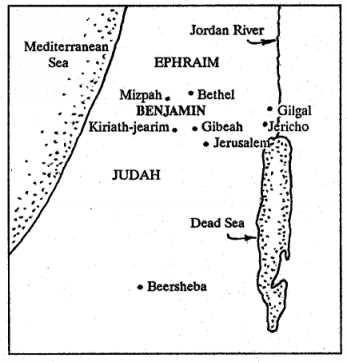
The "morning" and "night" in Jacob’s prophecy mark that Benjamin, as he was in the beginning, so he should continue to the end of the Jewish state. Similarly in Moses’ prophecy (Deu 33:12), "Benjamin, the beloved of the Lord (attached to David = beloved after Saul’s dynasty fell), shall dwell in safety by Him; the Lord shall cover him all the day long;" implying a longer continuance to Benjamin than to the other tribes. So Benjamin alone survived with Judah, after the deportation of the ten tribes to Assyria, arid accompanied Judah to and front the Babylonian captivity, and lasted until Shiloh came and until Jerusalem was destroyed. As on the march, so in the promised land, Benjamin’s position was near that of Ephraim, between it on the N. and Judah on the S., a small but rich territory, advantageously placed in commanding the approach to the valley of the Jordan, and having Dan between it and the Philistines (Jos 18:11, etc.); a parallelogram, 26 miles long, 12 broad, extending from the Jordan to the region of Kirjath Jearim eight miles W. of Jerusalem, and from the valley of Hinnom S. to Bethel N.
When the Lord rejected the tabernacle of Joseph at Shiloh He chose mount Zion, Jerusalem which chiefly belonged to Benjamin (the of the Jebusite, "Jebusi, which Jerusalem" (Jos 18:28), and all the land N. of the valley of Hinnom), and only in part to Judah, God’s chosen tribe (Psa 78:60; Psa 78:67-68). In this sense Benjamin fulfilled Moses’ prophecy in "dwelling between" Judah’s (the Lord’s representative) "shoulders," or ridges of the ravines which on the W., S., and E. environ the holy city. Primarily, however, the idea is, Benjamin as "the beloved of Jehovah shall dwell in safety with Him (literally, founded upon Him), and he (Benjamin) shall dwell between His (Jehovah’s) shoulders," as a son borne upon his father’s back (Deu 1:31; Deu 32:11; Exo 19:4; Isa 46:3-4; Isa 63:9).
This choice of Jerusalem as the seat of the ark and David’s place of residence formed a strong He between Judah and Benjamin, though Saul’s connection with the latter had previously made the Benjamites, as a tribe, slow to recognize David as king (1Ch 12:29; 2Sa 2:8-9). Hence at the severance of the ten tribes Benjamin remained with Judah (1Ki 12:23; 2Ch 11:1). The two coalesced into one, under the common name Jews, whence they are called "one tribe" (1Ki 11:13; 1Ki 11:32; 1Ki 12:20-21). Moreover, a part of Benjamin including Bethel, the seat of Jeroboam’s calf worship, went with the ten tribes. Possibly Jeroboam’s having appropriated it for the calf worship may have helped to alienate Benjamin from him and attach Benjamin to Judah. They two alone were the royal tribes.
David was connected with Saul of Benjamin by marriage with his daughter, and therefore, feeling the political importance of the connection, made it a preliminary of his league with Abner that Michal should be restored to him, though Phaltiel had her heart (2Sa 3:13-16). Above all, what knit together Benjamin and Judah most was the position fixed by God for the great national temple, which deprived Ephraim of its former glory (Psa 78:60-68); not in Judah only, or in Benjamin only, but on part of the confines of both, so that one text places it in Judah and the parallel text in Benjamin; compare Jos 15:63 with Jos 18:28. These elements of union between Benjamin and Judah are not obviously put forward in the sacred writings, but are found in them on close observation, just such seeds as would produce the ultimate union which the history records.
Such undesigned coincidences agree best with the belief that the narrative is minutely true, not forged. Benjamin occupied a plateau generally about 2,000 feet above the Mediterranean plain, and 3,000 feet above the valley of the Jordan. The hilly nature of the country is marked by the names Gibeon, Gibeah, Geba, Ramah, Mizpeh (watchtower), "the ascent of Bethhoron," the cliff Rimmon, the pass of Michmash. Torrent beds and ravines are the only avenues from the Philistian and Sharon plains on the W., and from the deep Jordan valley on the E. These ravines were frequented once by many wild beasts, as the names of places testify: Zeboim, "hyaenas" (1Sa 13:17-18); Shual and Shaalbim (Jdg 1:35), "foxes" or "jackals"; Ajalon, "gazelle." Up these western passes the Philistines advanced against Saul in the beginning of his reign, and drove him to Gilgal in the Arabah, occupying from Michmash to Ajalon. Down them they were driven again by Saul and Jonathan. Joshua chased the Canaanites down the long slopes of Bethhoron.
The regular road between Jericho and Jerusalem was another of these passes, the scene of the parable of the good Samaritan. Lod, Ono, Aijalon were westward extensions of Benjamin’s bounds beyond the original limit (Neh 11:35). The presence of the ark at Kirjath Jearim in Benjamin, the prophet Samuel’s residence in the sanctuary Ramah (1Sa 7:17; 1Sa 9:12), the great assemblies of "all Israel" at Mizpeh (1Sa 7:5), and the sanctity attached of old to Bethel, "the great high place" at Gibeon (1Ki 3:4; 2Ch 1:3), all tended to raise B. high in the nation, and to lead them to acquiesce in the choice of Saul as king, though belonging to "the smallest of the tribes of Israel" (1Sa 9:21). After Saul’s and then Ishbosheth’s death, Benjamin sent 3,000 men to Hebron to confirm the kingdom to David (1Ch 12:23; 1Ch 12:29; 2Sa 5:3), Abner having declared for him. But the Benjamite Shimei’s curses and Sheba’s rebel. lion indicate that Saul’s party among the Benjamites, even after his dynasty had ceased, cherished the old grudge against David.
Besides the causes mentioned before, which finally united Benjamin and Judah, there was Jeroboam’s setting up the calf worship in Bethel (a Benjamite city) in rivalry of the temple of Jehovah in the joint city of Benjamin and Judah, Jerusalem (1Ki 12:29); also Rehoboam’s wise policy in dispersing his children through all Judah and Benjamin, into every" fenced city" (2Ch 11:12; 2Ch 11:23); also Asa’s covenant with Jehovah, in which Benjamin took part (2 Chronicles 15); also the advancement of Benjamites to high posts in the army (2Ch 17:17). "The high gate of Benjamin" (Jer 20:2) marked the tribe’s individuality even in the joint metropolis of Benjamin and Judah; compare Ezra 2; Ezr 10:9; Nehemiah 7; Neh 11:31-35 in proof of this individuality even after the return from Babylon. The genealogy of Kish and Saul, traced to a late date, brings us down to a Kish, father of Mordecai, the savior of the Jewish nation from Haman’s intended destruction (Est 2:5).
The royal name reappears in Saul of Tarsus, whose glory was that he belonged to "the tribe of Benjamin" (Rom 11:1; Php 3:5.) His full sense of that honor appears in his reference to his forefather," Saul the son of Cis, a man of the tribe of Benjamin" (Act 13:21.) In his own person he realized some of the prominent characteristics of his tribe: fierce obstinacy when be was "exceedingly mad against Christians, and persecuted them even unto strange cities" (Act 26:11), equally persistent firmness when he declares, in spite of friends’ entreaties, "I am ready not to be bound only, but also to die at Jerusalem for the name of the Lord Jesus" (Act 21:13). Thus Benjamin had the distinction of producing one of Israel’s first judges, her first king, and the great apostle of the uncircumcision.
2. A Benjamite, head of a family of giant men; son of Bilhan (1Ch 7:10).
3. One who married a foreign wife (Ezr 10:32).
(Heb. Binyamin’,
1. Geography. — The proximity of Benjamin to Ephraim during the march to the Promised Land was maintained in the territories allotted to each. Benjamin lay immediately to the south of Ephraim, and between him and Judah. The situation of this territory was highly favorable. It formed almost a parallelogram, of about 26 miles in length by 12 in breadth. Its eastern boundary was the Jordan, and from thence it mainly extended to the wooded district of Kirjath-jearim, about six miles west of Jerusalem, while in the other direction it stretched from the valley of Hinnom, under the “Shoulder of the Jebusite” on the south, to Bethel on the north. Thus Dan intervened between this tribe and the Philistines, while the communications with the valley of the Jordan were in its own power. On the .south the territory ended abruptly with the steep slopes of the hill of Jerusalem; on the north it almost melted into the possessions of the friendly Ephraim. SEE TRIBE.
In Joshua 18, from Jos 18:12-14, is sketched the northern boundary-line (mostly repeated in chap. 16:1-5), and from 15 to 20 the southern (repeated in chap. Jos 15:6-9, in a reverse direction). Within the boundaries described in these few verses lay a district rather small, but highly cultivated and naturally fertile (Josephus, Ant. 5, 1, 22; Reland, p. 637), containing twenty-six chief towns (with their villages, in two main sections), which are named in Jos 18:21-28; and the principal of which were Jericho, Bethhogla, Bethel, Gibeon, Ramah, and Jebus or Jerusalem. This latter place subsequently became the capital of the whole Jewish empire, but was, after the division of the land, still in possession of the Jebusites. The Benjamites had indeed been charged to dispossess them, and occupy that important town; but (Jdg 1:21) the Benjamites are reproached with having neglected to drive them from thence, that is, from the upper, well-fortified part of the place Zion, since the lower and less fortified part had already been taken by Judah (Jdg 1:8), who in this matter had almost a common interest with Benjamin. The Jebusite citadel was finally taken by David (2Sa 5:6 sq.). A trace of the pasture- lands may be found in the mention of the “‘herd” (1Sa 11:5); and possibly others in the names of some of the towns of Benjamin, as hap- Parah, “the cow;” Zela-ha-eleph, “the ox-rib” (Jos 18:23; Jos 18:28). In the degenerate state of modern Palestine few evidences of the fertility of this tract survive. But other and more enduring natural peculiarities remain, and claim our recognition, rendering this possession one of the most remarkable among those of the tribes.
(1.) The general level of this part of Palestine is very high, not less than 2000 feet above the maritime plain of the Mediterranean on the one side, or than 3000 feet above the deep valley of the Jordan on the other, besides which this general level or plateau is surmounted, in the district now under consideration, by a large number of eminences — defined, rounded hills — almost every one of which has borne some part in the history of the tribe. Many of these hills carry the fact of their existence in their names. Gibeon, Gibeah, Geba or Gaba, all mean “hill;” Ramah and Ramathaim, “eminence;” Mizpeh, “Watch-tower;” while the “ascent of Beth-horon,” the “cliff Rimmon,” the “pass of Michmash” with its two “teeth of rock,” all testify to a country eminently broken and hilly. The special associations which belong to each of these eminences, whether as sanctuary or fortress, many of them arising from the most stirring incidents in the history of the nation, will be best examined under the various separate heads.
(2.) No less important than these eminences are the torrent beds and ravines by which the upper country breaks down into the deep tracts on each side of it. They formed then, as they do still, the only mode of access from either the plains of Philistia and of Sharon on the west, or the deep valley of the Jordan on the east — the latter steep and precipitous in the extreme, the former more gradual in their declivity. Up these western passes swarmed the Philistines on their incursions during the time of Samuel and of Saul, driving the first king of Israel right over the higher district of his own tribe, to Gilgal, in the hot recesses of the Arabah, and establishing themselves over the face of the country from Michmash to Ajalon. Down these same defiles they were driven by Saul after Jonathan’s victorious exploit, just as in earlier times Joshua had chased the Canaanites down the long hill of Bethhoron, and as, centuries after, the forces of Syria were chased by Judas Maccabaeus (1Ma 3:16-24). It is perhaps hardly fanciful to ask if we may not account in this way for the curious prevalence among the names of the towns of Benjamin of the titles of tribes. Ha-Avvim, the Avites Zemaraim, the Zemarites; ha-Ophni, the Ophnite; Chephar ha-Ammonai, the village of the Ammonites; ha-Jebusi, the Jebusite, are all among the — names of places — in Benjamin; and we can hardly doubt that in these names is preserved the memory of many an ascent of the wild tribes of the desert from the sultry and open plains of the low level to the fresh air and secure fastnesses of the upper district.
The passes on the eastern side are of a much more difficult and intricate character than those on the western. The principal one, which, now unfrequented, was doubtless in ancient times the main ascent to the interior, leaves the Ghor behind the site of Jericho, and, breaking through the barren hills with many a wild bend and steep slope, extends to and indeed beyond the very central ridge of the table-land of Benjamin, to the foot of the eminence on which stand the ruins of the ancient Beeroth. At its lower part this valley bears the name of Wady Fuwar, but for the greater part of its length it is called Wady Suweinit. It is the main access, and from its central ravine branch out side valleys, conducting to Bethel, Michmash, Gibeah, Anathoth, and other towns. After the fall of Jericho this ravine must have stood open to the victorious Israelites, as their natural inlet to the country. At its lower end must have taken place the repulse and subsequent victory of Ai, with the conviction and stoning of Achan, and through it Joshua doubtless hastened to the relief of the Gibeonites, and to his memorable pursuit of the Canaanites down the pass of Beth-horon, on the other side of the territory of Benjamin. Another of these passes is that which since the time of our Savior has been the regular road between Jericho and Jerusalem, the scene of the parable of the Good Samaritan. Others lie farther north, by the mountain which bears the traditional name of Quarantania; first up the face of the cliff, afterward less steep, and finally leading to Bethel or Taiyibeh, the ancient Ophrah. These intricate ravines may well have harbored the wild beasts which, if the derivation of the names of several places in this locality are to be trusted, originally haunted the district-zeboim, hyenas (1Sa 13:18), shual and shaalbim, foxes or jackals (Jdg 1:35; 1Sa 13:17), ajalon, gazelles. (See Stanley, Sinai and Palestine, ch. 4.)
Such were the limits and such the character of the possession of Benjamin as fixed by those who originally divided the land. But it could not have been long before they extended their limits, since in the early lists of 1 Chronicles 8 we find mention made of Benjamites who built Lod and Ono, and of others who were founders of Aijalon (12, 13), all which towns were beyond the spot named above as the westernmost point in their boundary. These places, too, were in their possession after the return from the captivity (Neh 11:35).
The following is a list of all the Scriptural localities in the tribe of Benjamin, with their probable modern representatives, except those connected with the topography of Jerusalem (q.v.).
Abel-mizraim. Village. SEE BETH-HOGLAH.
Ai. Town. Tel el-Hajar.
Ajephim. Village. [W. of Wady Sidr]?
Alemeth. Town. Almit.
Allon-bachuth. Oak. SEE BAAL-TAMAR.
Ammah. Hill. [Spring N.E. of el-Jib]?
Ananiah. Town. Beit-Hanina?
Anathoth. do. Anata.
Arabah. do. SEE BETH-ARABAH.
Atad. Threshing-floor: SEE ABEL-MIZRAIM.
Aven. Town. SEE BETH-AVEN.
Avim. do. See Ai.
Azmaveth. do. [Hizmeh]? Baal-hazor. do. SEE HAZOR.
Baal-perazim. Hill. [Jebel Aly]?
Baal-tamar. Town. [Erhah]?
Bahurim. do. Deir es-Sid?
Beeroth. do. El-Bireh.
Beth-arabah. do. [Kusr-Hajlo]?
Beth-aven. do. Burj-Beitin?
Beth-azmaveth. do. SEE AZMAVETH.
Beth-car. Hill. SEE EBENEZER.
Beth-el. Town. Beitin.
Beth-hoglah. do. Ain Hajla.
Bozez. Cliff. In Wady Suweinit.
Chephar-haammonai. Town. [Ain-Yebrud]?
Chephirah. do. Kefir. Cherith. Brook. Wady Kelt?
Chidon. Threshing-floor. [Khurbet el-Bistun]?
Ebenezer. Stone. . [Biddu]?
El-Bethel. Town. SEE BETHEL.
Eleph. do. [Katamon]?
Emmaus. do. El- Kubeibeh?
En-shemesh. Spring. Bir el-Khot?
Ephraim, or Ephron. Town. SEE OPHRAH.
Gaba. do. SEE GEBA.
Gallim. do. [Khurbet Haiyeh?
Geba. do. Jiba. Gebim. do. [El-Isawiyeh]?
Geliloth. do. SEE GILGAL.
Giah. Village. [Bir-Nebala]?
Gibeah. Town. Tuleil el-Ful.
Gibeon. do. El-Jib.
Gidom. Plain. [N.E. of Michmash]?
Gilgal. Town. Moharfer?
Hai. do. See Ai.
Hazor. Town. Tell Azur?
Helkath-hazzurim. Plain. E. of El-Jib?
Irpeel. Town. [Kustul]? (Town. W. of er-Riha. Jericho. — Waters. Ain es-Sultan.
Plain. [El- Wadiyeh.]
Jerusalem. City. El-Khuds.
Keziz. Valley. Wady el-Kaziz.
Menukah. Town. [Hill E. of Gibeah]?
Michmash. do. Mukmas. Migron. do. [Ruins S. of Deir Diwan]?
Mizpeh. do. Neby Samwil? Moza. do. Kulonich?
Naarath, or Naaran. do. [E-Nejemeh]?
Naioth. do. SEE RAMAH.
Nob. do. [Kurazeh]?
Ophni. do. Jifna. Ophrah. do. Tayibeh?
Parah. do. Farah. Ramah. do. Er-Ram. Rekem. do. [Deir Yesin]l?
Rephaim. Valley. Plain S.W. of Jerusalem.
Rimmon. Rock. Rummon.
Sechu. Well. SEE RAMAH.
Seneh. Cliff. In Wady Suweinit?
Shalim. Region. SEE SHUAL.
Shen. Rock. [Beit Enan]?
Shual. Region. [El-Aliya]?
Taralah. Town. [Beit Tirsa]?
Zelah or Zelzah. do. Beit Jala.
Zemaraim. City and Hill. Es-Sumrah?
2. History. — In the time of the Judges the tribe of Benjamin became involved in a civil war with the other eleven tribes for having refused to give up to justice the miscreants of. Gibeon that had publicly violated and caused the death of a concubine of a man of Ephraim, who had passed with her through Gibeon. This war terminated in the almost utter extinction of the tribe, leaving no hope for its regeneration from the circumstance that not only had nearly all the women of that tribe been previously slain by their foes, but the eleven other tribes had engaged themselves by a solemn oath not to marry their daughters to any man belonging to Benjamin. When the thirst of revenge, however, had abated, they found means to evade the letter of the oath, and to revive the tribe again by an alliance with them (Jdg 19:20-21). That frightful transaction was indeed a crisis in the history of the tribe; the narrative undoubtedly is intended to convey that the six hundred who took refuge in the cliff Rimmon, and who were afterward provided with wives partly from Jabesh-gilead (Jdg 21:10), partly from Shiloh (Jdg 21:21), were the only survivors. The revival of the tribe, however, was so rapid that, in the time of David, it already numbered 59,434 able warriors (1Ch 7:6-12); in that of Asa, 280,000 (2Ch 14:8); and in that of Jehoshaphat, 200,000 (2Ch 17:17). SEE CHENAANAH.
This tribe had also the honor of giving the first king to the Jews, Saul being a Benjamite (1Sa 9:1-2). After the death of Saul, the Benjamites, as might have been expected, declared themselves for his son Ishbosheth (2Sa 2:8 sq.), until, after the assassination of that prince, David became king of all Israel. David having at last expelled the Jebusites from Zion, and made it his own residence, the close alliance that seems previously to have existed between the tribes of Benjamin and Judah (Jdg 1:8) was cemented by the circumstance that, while Jerusalem actually belonged to the district of Benjamin, that of Judah was immediately contiguous to it. Thus it happened that, at the division of the kingdom after the death of Solomon, Benjamin espoused the cause of Judah, and formed, together with it, a kingdom by themselves. Indeed, the two tribes stood always in such a close connection as often to be included under the single term Judah (1Ki 11:13; 1Ki 12:20). After the exile, also, these two tribes constituted the flower of the new Jewish colony in Palestine (comp. Ezra 11:1; Ezr 10:9).
3. Characteristics. — The contrast between the warlike character of the tribe and the peaceful image of its progenitor has been already noticed. That fierce ness and power are not less out of proportion to the smallness of its numbers and of its territory. This comes out in many scattered notices.
(a) Benjamin was the only tribe that seems to have pursued archery to any purpose, and their skill in the bow (1Sa 20:20; 1Sa 20:36; 2Sa 1:22; 1Ch 8:40; 1Ch 12:2; 2Ch 17:17) and the sling (Jdg 20:16) are celebrated.
(b) When, after the first conquest of the country, the nation began to groan under the miseries of a foreign yoke, it is to a man of Benjamin, Ehud, the son of Gera, that they turn for deliverance. The story seems to imply that he accomplished his purpose on Eglon with less risk, owing to his proficiency in the peculiar practice of using his left hand — a practice apparently confined to Benjamites, and by them greatly employed (Jdg 3:15, and see 20:16; 1Ch 12:2).
(c) Baanah and Rechab, “the sons of Rimmon the Beerothite, of the children of Benjamin,” are the only Israelites west of the Jordan named in the whole history as captains of marauding predatory “bands” (
(d) The dreadful deed recorded in Judges 19, though repelled by the whole country, was unhesitatingly adopted and defended by Benjamin with an obstinacy and spirit truly extraordinary. Of their obstinacy there is a remarkable trait in 1Sa 22:7-18. Though Saul was not only the king of the nation, but the head of the tribe, and David a member of a family which had as yet no claims on the friendship of Benjamin, yet the Benjamites resisted the strongest appeal of Saul to betray the movements of David; and after those movements had been revealed by Doeg the Edomite (worthy member — as he must have seemed to them — of an accursed race!) they still firmly refused to lift a hand against those who had assisted him (see Niemeyer, Charakterist. 3, 565 sq.).
Several circumstances may have conduced to the relative importance of this small tribe (see Plesken, De Benjamin parvo, Wittenb. 1720). The Tabernacle was at Shiloh, in Ephraim, during the time of the last judge, but the ark was near Benjamin, at Kirjath-jearim. Ramah, the official residence of Samuel, and containing a sanctuary greatly frequented (1Sa 9:12, etc.), Mizpeh, where the great assemblies of “all Israel” took place (1Sa 7:5), Bethel, perhaps the most ancient of all the sanctuaries of Palestine, and Gibeon, specially noted as “the great high place” (2Ch 1:3), were all in the land of Benjamin. These must gradually have accustomed the people who resorted to these various places to associate the tribe with power and sanctity, and they tend to elucidate the anomaly which struck Saul so forcibly, “that all the desire of Israel” should have been fixed on the house of the smallest of its tribes (1Sa 9:21).
The struggles and contests that followed the death of Saul arose from the natural unwillingness of the tribe to relinquish its position at the head of the nation, especially in favor of Judah. Had it been Ephraim, the case might have been different; but Judah had as yet no connection with the house of Joseph, and was, besides, the tribe of David, whom Saul had pursued with such unrelenting enmity. The tact and sound sense of Abner, however, succeeded in overcoming these difficulties, though he himself fell a victim in the very act of accomplishing his purpose; and the proposal that David should be “king over Israel” was one which “seemed good to the whole house of Benjamin,” and of which the tribe testified its approval and evinced its good faith by sending to the distant capital of Hebron a detachment of 3000 men of the “brethren of Saul” (1Ch 12:29). Still, the insults of Shimei and the insurrection of Sheba are indications that the soreness still existed, and we do not hear of any cordial co-operation or firm union between the two tribes until a cause of common quarrel arose at the disruption, when Rehoboam assembled “all the house of Judah, with the tribe of Benjamin, to fight against the house of Israel, to bring the kingdom again to the son of Solomon” (1Ki 12:21; 2Ch 11:1). Possibly the seal may have been set to this by the fact of Jeroboam having just taken possession of Bethel, a city of Benjamin, for the calf- worship of the northern kingdom (1Ki 12:29). Bethel, however, was on the very boundary-line, and centuries before this date was inhabited by both Ephraimites and Benjamites (Jdg 19:16). On the other hand, Rehoboam fortified and garrisoned several cities of Benjamin, and wisely dispersed the members of his own family through them (2Ch 11:10-12). The alliance was farther strengthened by a covenant solemnly undertaken (2Ch 15:9), and by the employment of Benjamites in high positions in the army of Judah (2 Chronicles 16:17). But what, above all, must have contributed to strengthen the alliance, was the fact that the Temple was the common property of both tribes. True, it was founded, erected, and endowed by princes of “the house of Judah,” but the city of “the Jebusite” (Jos 18:28), and the whole of the ground north of the Valley of Hinnom, was in the lot of Benjamin. In this latter fact is literally fulfilled the prophecy of Moses (Deu 33:12): Benjamin “‘dwelt between” the “shoulders” of the ravines which encompass the Holy City on the west, south, and east (see a good treatment of this point in Blunt’s Undes. Coincidences, pt. 2, § 17).
Although thereafter the history of Benjamin becomes merged in that of the southern kingdom, yet that the tribe still retained its individuality is plain from the constant mention of it in the various censuses taken of the two tribes, and on other occasions, and also from the lists of the men of Benjamin who returned with Zerubbabel (Ezra 2; Nehemiah 7), and took possession of their old towns (Neh 11:31-35). At Jerusalem the name must have been always kept alive, if by nothing else, by the name of “the high gate of Benjamin” (Jer 20:2). (See below.) That the ancient memories of their house were not allowed to fade from the recollections of the Benjamites, is clear also from several subsequent notices. The genealogy of Saul, to a late date, is carefully preserved in the lists of 1 Chronicles (1Ch 8:33-40; 1Ch 9:39-44); the name of Kish recurs as the father of Mordecai (Est 2:5), the honored deliverer of the nation from miseries worse than those threatened by Nabash the Ammonite. The royal name once more appears, and “Saul, who also is called Paul,” has left on record under his own hand that he was “of the stock of Israel, of the tribe of Benjamin.” It is perhaps more than a mere fancy to note how remarkably the chief characteristics of the tribe are gathered up in his one person. There was the fierceness in his persecution of the Christians, and there were the obstinacy and persistence which made him proof against the tears and prayers of his converts, and “ready not to be bound only, but also to die for the name of the Lord Jesus” (Act 21:12-13). There were the force and vigor to which natural difficulties and confined circumstances formed no impediment; and, lastly, there was the keen sense of the greatness of his house in his proud reference to his forefather “Saul, the son of Cis, of the tribe of Benjamin.”
Benjamin (bĕn’ja-mĭn), son of the right hand. 1. The youngest son of Jacob, born in Palestine, not far from Bethlehem, after the return from Padan-aram. Rachel, his mother, died in giving him birth, and named him Ben-oni, son of my sorrow, but the father called him Benjamin. Of Benjamin’s personal character and history little is recorded. His brothers, touched perhaps with some sense of their cruel wrong to Joseph, seem to have treated him with tenderness; and, when they first went down to Egypt to buy corn, he was left at home. Gen 42:3-4; Gen 42:13. Joseph, however, required that he should be brought, and, to insure the return of the brethren, kept Simeon as a hostage. Verses 14-20, 33, 34. A prophetic blessing was pronounced by Jacob upon Benjamin. Gen 49:27. The blessing of Moses, Deu 33:12, was significant of the location of the tribe between Ephraim and Judah, on the hills where "the joy of the whole earth," "the city of the great King," was afterwards established, a safe and happy dwelling-place "between his shoulders." The territory allotted to the Benjamites extended from the Jordan eastward to the frontier of Dan in the west. The Benjamites excelled as archers, 2Ch 17:17; while among the rest of Israel archery was (at least it has been so supposed) at one time neglected, 2Sa 1:18; and their skill in slinging with either hand is particularly noted. 1Ch 12:2; Jdg 20:16. The greatest misfortune that ever befel the tribe occurred not very long after the settlement in Canaan. Their cities were burnt; and there survived of the whole tribe but 600 men, for whom the oath of the Israelites rendered it difficult to provide wives when the angry passions of the nation had settled down. Jdg 19:21. Restored to their inheritance this remnant must have been wealthy proprietors; three of the families are mentioned as supplying a large force of soldiers. 1Ch 7:6-11. The first monarch of Israel was a Benjamite; and no doubt his own tribe would be specially favored. 1Sa 22:7. But the Benjamites never showed much attachment to Saul or his family. Indeed, many of them joined David while yet an outlaw. 1Ch 12:1-7. We thus see the drawings of Benjamin towards Judah, which issued in the firm union of both the tribes when the kingdom was divided. Thenceforward the history of the two is identical: both went into captivity, and both returned. Neh 11:31-36. The name reappears with Saul of Tarsus, whose glory was that he belonged to "the tribe of Benjamin." Rom 11:1; Php 3:5. Thus Benjamin had the distinction of producing one of Israel’s first judges, Ehud, Jdg 3:15, her first king, and the great apostle to the Gentiles. 2. A Benjamite chief. 1Ch 7:10. 3. One who married a foreign wife. Ezr 10:32. 4. Benjamin is mentioned as taking part in the dedication of the wall of Jerusalem. Neh 12:34. It would seem as if an individual were intended.
[Ben’jamin]
The youngest son of Jacob by his beloved wife Rachel. She died at his birth and named him BEN-ONI, signifying ’son of my sorrow,’ but his father named him BENJAMIN, ’son of the right hand.’ Gen 35:18; Gen 35:24. Type of Christ both as exalted at God’s right hand (Benjamin), and, as rejected, the occasion of Israel’s tribulation in the last days (Ben-oni), Rachel being a type of Israel (Micah 5.). Very little is recorded of Benjamin personally: he was the father of ten sons. Gen 46:21.
Benjamin was the smallest of the tribes except Manasseh in the numbering of Num 1:37; Num 2:22-23. In Psa 68:27 it is called ’little Benjamin;’ but in the numbering before entering the land Benjamin exceeded in number four of the other tribes. Num 26:41. In Gen 49:27 Jacob prophesied of the tribe that it should "ravin as a wolf; in the morning he shall devour the prey, and at night he shall divide the spoil;" typical of Christ in judgement on the earth in a future day. In Deu 33:12, where Moses prophesied of the tribes, he said of Benjamin, "The beloved of the Lord shall dwell in safety by him; and the Lord shall cover him all the day long, and he shall dwell between his shoulders." So in the blessings of Psa 68:27 Benjamin is the first named of the four tribes; and in Psa 80:2, where God is called upon to save them, Benjamin is mentioned with Ephraim and Manasseh, being the three tribes which followed the ark. Num 2:17-24; Num 10:22-24.
The tribe did not drive out the Jebusites, but allowed them to dwell with them in Jerusalem, Jdg 1:21; this may have led to their idolatry, for when, with Judah and Ephraim, they were attacked by the children of Ammon, they confessed they had forsaken God and served Baalim. Jdg 10:9-10. It may also have led to the dreadful deed which resulted in the destruction of nearly the whole tribe. Judges 19 - 21. From this they in a measure recovered their strength. At the division of the kingdom they remained with Judah, but a large portion of their lot was seized by Israel. At times they appear to be lost sight of, for Ahijah said that God had reserved to the house of David one tribe (as if Benjamin was reckoned as cut off in judgement), 1Ki 11:36. The two tribes were constantly spoken of as ’Judah,’ whereas the ten tribes were called ’Israel.’ On the return from the captivity, Benjamin had its share of blessing with Judah. Ezr 1:5; Ezr 10:9; Neh 11:4-36. Paul relates twice that he was of the tribe of Benjamin. Rom 11:1; Php 3:5. In the future, twelve thousand of this tribe will be sealed. Rev 7:8.
The district occupied by the tribe is often simply called Benjamin. It was situated with Ephraim on its north, and Judah on its south, Dan on its west, and the Jordan on its east; it occupied about 28 miles east and west and 14 miles north and south at its widest parts. The district is mountainous with rocks and ravines, having an elevated table land. It contained the important cities of Jerusalem (in its south border), Bethel, Gibeon, Ramah, etc.
[Ben’jamin]
1. Son of Bilhan, descendant of Benjamin. 1Ch 7:10.
2, 3, 4. Three who returned from exile. Ezr 10:32; Neh 3:23; Neh 12:34.
By: Richard Gottheil, Kaufmann Kohler, Marcus Jastrow, Louis Ginzberg, Duncan B. McDonald
Table of Contents
—Biblical Data:
Youngest son of Jacob by Rachel, who died on the road between Beth-el and Ephrath, while giving him birth. She named him "Ben-oni" (son of my sorrow); but Jacob, to avert the evil omen, called him "Ben Yamin," son of the right hand; that is, of good luck (Gen. xxxv. 17, 18).
Benjamin stayed with his father when his brothers went down to Egypt to buy corn during the famine, but Joseph insisted that he should come down with them on their second visit. Jacob being afraid to let him go from his side, as he was the only remaining son of Rachel, Judah vouched for his safety, and finally obtained his father's permission to take him along (Gen. xlii., xliii. 8-10). Joseph received his younger brother with marks of special attention; but as the time came for the brothers to return to their father with the newly bought corn, he put them severely to test by laying a trap and bringing the charge against Benjamin of having stolen his silver cup, in punishment for which he wanted to keep him as a slave. Judah, faithful to his pledge, stepped before Joseph, begging to be taken as a slave instead of Benjamin, whose failure to return would cause his father to go down in sorrow to Sheol; whereupon Joseph, seeing that the brothers were not so cruel toward one of Rachel's sons as they had been to him, made himself known to them (Gen. xliii., xlv.). Benjamin, until that time spoken of as "a child" (Gen. xlii. 13, xliv. 20), moved to Egypt with his father, Jacob, himself being the father of ten sons (Gen. xlvi. 21).
The Tribe of Benjamin.
The tribe of Benjamin is described in Jacob's blessing (Gen. xlix. 27) as warlike: "Benjamin is a wolf that raveneth; in the morning he shall devour the prey, at evening he shall divide the spoil." In the desert, where Benjamin formed part of the camp of the sons of Joseph, the tribe counted 35,400 warriors, and later on 45,600 men (Num. i. 36; ii. 22, 23; x. 22-24; xxvi. 41). In I Chron. vii. 6-11, 59,434 men are given. The astute and pugnacious nature of the Benjamites is evidenced by the fact that they were drilled as left-handed warriors to attack the enemy unawares (Judges iii. 15-21, xx. 16; I Chron. xii. 2). They were known as brave and skilled archers (I Chron. viii. 40, xii. 2; II Chron. xiv. 7). A cruel act of inhospitality by the men of Gibeah, reminding one of the Sodomites, brought the whole tribe under a ban ("ḥerem"); and a war followed in which all the other tribes very nearly exterminated the little tribe; moreover, they took an oath not to give to the Benjamites any of their daughters in marriage. Only at the last moment, when all but 600 men had been slain, a way was found to provide the survivors with wives in order to prevent the tribe from dying out (Judges xix.-xxi.). Still the little tribe of Benjamin was destined to a prominent place in the history of Israel. It gave the nation its first king, in the person of Saul, son of Kish (I Sam. ix. 1); and when Saul died, his son, Ish-bosheth, reigned for two years over Benjamin and the other tribes, except Judah (II Sam. ii. 8, 9). In fact, Benjamin considered himself the younger brother of Joseph long after David had united all other tribes with his own of Judah (II Sam. xix. 21 [20]).
The Territory.
But the territory of Benjamin was so favorably situated as to give it prominence beyond its numerical proportions. Bordering on Joseph's to the north and on Judah's to the south, it touched on the Jordan; and, lying on the line leading from Jericho to the northern hills of Jerusalem, it included such cities as Gibeah, Gibeon, Beth-el, and, according to rabbinical tradition, a part of the Temple district (Josh. xviii. 11-21; Josephus, "Ant." v. 1, § 22; Sifre, Wezot ha-Berakah, 352). Reference is made to this excellent locality in the blessing of Moses: "The beloved of the Lord shall dwell in safety by him; he covereth him all the day long, and he dwelleth between his shoulders" (Deut. xxxiii. 12). At the secession of the northern tribes, Benjamin remained loyal to the house of David (I Kings xii. 21), and therefore shared the destinies of Judah at the time of the restoration (Ezra iv. 1, x. 9). Mordecai, the loyal Jew, was a descendant of Saul of the tribe of Benjamin (Esth. ii. 5); and Paul, whose Hebrew name was Saul, also claimed to be a Benjamite (Rom. xi. 1; Phil. iii. 5). On the other hand, it is hardly admissible that Menelaus and Lysimachus should have been allowed to officiate as high priests if they were descendants of the tribe of Benjamin, as II Macc. iii. 4 (compare iv. 23, 29) seems to indicate; it is much more probable that the name "Benjamin" in this place is due to a copyist's error, and the passage should read: "Simon was of the [priestly] tribe of Miniamin," if "Bilgah" is not the proper reading. Compare Suk. 56a and art. Bilgah; also Herzfeld, "Gesch. des Volkes Jisrael," 1863, i. 218.
—In Rabbinical Literature:
The name "Benjamin" is given various meanings by the Rabbis. According to some,  is equivalent to
  ("son of days"), because Benjamin was born to his father in his old age (Testament of the Twelve Patriarchs, Benjamin i.
Benjamin, Joseph's brother, took no part in the selling of Joseph (Sifre, Deut. 352); and in order to comfort Benjamin concerning his brother's fate, God showed him, while awake, Joseph's form and countenance (Testament of the Twelve Patriarchs, Benjamin x.; compare Tan., ed. Buber, Wayesheb, 8).When Benjamin was detained as the alleged thief of the cup, Joseph pretended that Benjamin had been instigated by his brothers. But Benjamin swore: "As truly as my brother Joseph is separated from me, as truly as he has been made a slave, I have not touched the cup, and my brothers did not want to make me steal." When asked for a proof that his brother's memory was so sacred that Joseph must believe this oath, Benjamin told Joseph how he had given his ten sons (Gen. xlvi. 21) names which referred to the loss of his brother. The first was called Belah ( ), because Joseph had disappeared (
 , "swallow"); the second, Becher (
 ), because Joseph was his mother's first-born (
 ); the third, Ashbel (
 ), because Joseph was made a captive (
 , "capture"); the fourth, Gera (
 ), because he lived in a foreign (
 ) land; the fifth, Naaman (
 ), on account of Joseph's graceful speech (
 , "grace"); the sixth, Eḥi (
 , "my only full brother"); the seventh, Rosh, (
 , "the older"); the eighth, Muppim (
 ), because Joseph taught Benjamin the things he himself had learned from his father (
 , "double mouth"); the ninth, Ḥuppim, "whose wedding (
 ) I have not seen"; and the tenth, Ard, because Joseph was like a rose (
 ).
).
Benjamin's oath touched Joseph so deeply that he could no longer pretend to be a stranger, and so revealed himself to his brother (Tan., ed. Buber, Wayiggash, 7; the meanings of the names are also given in Soṭah 36b; Gen. R. xciv. 8). According to another Haggadah (known to so early a work as the Testament of the Twelve Patriarchs, Benjamin ii.), Joseph makes himself known to Benjamin before his reconciliation with the other brothers. The "Sefer ha-Yashar" (Miḳḳeẓ 89) narrates that Joseph caused a kind of astrolabe to be brought, and asked Benjamin whether he could not discover by means of the instrument the whereabouts of his lost brother. To Joseph's astonishment Benjamin declared that the man on the throne was his brother, and Joseph revealed himself to Benjamin, telling him what he meant to do with the brothers. His intention was to try them and thus to learn whether they would act in a brotherly manner toward Benjamin if he were in danger of losing his liberty.
The Rabbis lay stress on the name, "beloved of the Lord," by which Benjamin is distinguished (Deut. xxxiii. 12; Sifre, l.c.). He is counted among the four men who died by the poison of the serpent in Paradise; i.e., without sin of his own, the other three being Amram, the father of Moses; Jesse, the father of David; and Kileab, the son of David (Shab. 55b). His comparison to the ravening wolf (Cant. R. to viii. 1), "who devours his enemy" (Gen. xlix. 27) is referred to the men of Shiloh who stole their wives (Judges xxi.) or to Ehud or to Saul. By others it is referred to Mordecai and Esther (Gen. R. xcix. and Tan., Wayeḥi, 14; so also in the original text of the Testaments of the Twelve Patriarchs [Benjamin ii]; whereas a Christian interpolation refers it to Paul).
One interpretation refers the blessing to the early ripening of the fruits in the territory of Benjamin, and the great fertility of the region of Jericho and Beth-el, and another refers the expression "wolf" to the altar of the Temple, which devoured the sacrifices in the morning and in the evening (Gen. R. l.c.; Targ. O. and Yer.).
G.The Tribe of Benjamin.
The erection of the Temple on Benjamitic ground is explained in several ways. It is related that Benjamin (Sifre, Deut. 352, ed. Friedmann, 146a) was privileged to have the Shekinah dwell in his territory because all the other tribes (that is, fathers of the tribes) had taken part in the selling of Joseph. For God said: "If they—the Israelites—build me a Temple in some other place and seek my mercy, I can show them as little mercy as they showed their brother Joseph." Origen ("In Genesim," xlii. 6), gives another reason, probably based on Jewish tradition (compare Esther R. on iii. 4), viz.: Because Benjamin did not bow down before Esau as did his brothers and his father (Gen. xxxiii. 3-7), nor before Joseph (ib. xlii. 6), his territory was reserved for the worship of God.
The descendants of Benjamin, it is true, did not always show themselves worthy of their ancestor, especially in connection with the incident at Gibeah (Judges xix.). In spite of their wrong-doing the Benjamites were at first victorious (Judges xx. 21-25); but this was due to God's anger against all Israel because they had attacked all Benjamin on account of the crime of an individual, and at the same time quietly tolerated the idolatry which Micah (Judges xvii.) was spreading among them (Pirḳe R. El. xxxviii.). At first the intention of the other tribes was to efface Benjamin completely, since the number of twelve tribes could be preserved through Ephraim and Manasseh; but they remembered God's promise to Jacob shortly before Benjamin's birth (Gen. xxxv. 11), that "a nation and a company of nations shall be of him"; and they decided that the existence of the tribe of Benjamin was necessary (Yer. Ta'anit iv. 69c; Lam. R., lntroduction, 33). The day on which the reconciliation took place between the tribes is said to have been the fifteenth of Ab, and for this reason it was made a festive day (ib.; compare Ab, Fifteenth Day of). On another occasion, however, the Benjamites showed themselves worthy of their pious ancestor. When, at the Red Sea, all the other tribes stood in desperation only the tribe of Benjamin trusted in God and leaped into the sea (Mekilta, Beshallaḥ, Wayiḳra 5; Sotah 36b).
—In Mohammedan Literature:
In the Koran, Benjamin is not mentioned by name. The story of Joseph is told in sura xii., and reference is made repeatedly to a particular brother of Joseph. Thus, e.g., in v. 8, the other brothers say, "Verily, Joseph and his brother are dearer to our father than we." Baidawi explains that Benjamin is so specified because he was brother to Joseph on both sides. Again, in v. 69, "And when they entered to Joseph, he took his brother to him." Baidawi explains this that he made him sit at meat with him or live with him in his dwelling. He adds, as a tradition, that Joseph made his brothers sit two by two; so Benjamin remained alone and wept and said, "If my brother Joseph had been alive he would have sat with me." Then Joseph made him sit at his table.Thereafter he assigned houses to his brothers, two by two, but took Benjamin to his own house. And he said to Benjamin, "Would you like if I were your brother in the stead of the brother who is lost?" And Benjamin replied, "Who can find a brother like to you? but Jacob did not beget you, nor Rachel bear you."
—Critical View:
The story of Benjamin in Genesis is drawn from three different sources: The Elohist, who wrote the story of Benjamin's birth (Gen. xxxv. 16-22), makes Reuben vouch for Benjamin (Gen. xlii. 37); whereas the Jahvist assigns this act to Judah (xliii.-xliv.). The latter makes Joseph give vent to his brotherly feeling at the first sight of his younger brother Benjamin, and give him five times as many presents, without, however, betraying himself (xliii. 30-34), and afterward, at the recognition scene, show his affection for him without reserve (xlv. 14); while the Elohist merely relates at the end that Benjamin was distinguished by receiving five times as many presents as the others (xlv. 22). The genealogical chapter which represents Benjamin as the father of a large family (xlvi. 21) is of a far later date than the rest. (In the older sources he appears to be a young child [xlii. 4, 15; xliv. 20].) The blessing of Jacob, in which Benjamin—who, after Joseph, was the last of the sons—is described as being warlike, as was the tribe in the time of Deborah (Judges v. 14), yet without any allusion to Saul's kingdom, is best ascribed to the time of the Judges (Dillman, Commentary). The story of the war at Gibeah (Judges xix.-xxi.), which bears evidences of very late composition and has many legendary features, such as exaggeration of numbers and modes of warfare, has been rather too rashly declared to be a late invention inserted with the intention of covering up atrocities perpetrated by the tribe of Judah under King David against the kinsmen of Saul (Güdemann, "Monatsschrift," 1869, p. 357; Geiger, "Jüd. Zeit." 1869, p. 284; Grätz, "Gesch. der Juden," i. 351 et seq.; Well-hauseu, "Komposition des Hexateuchs," p. 237; Kuenen, "Historisch-Kritische Untersuchung über die Entstehung und Sammlung der Bücher des Alten Testaments," ii. 163). Recent critics think it far more probable that it rests on a historical fact (Moore, Commentary on Judges, pp. 406-408; Hogg, in Cheyne and Black, "Encyc. Bibl."; Nöldeke, quoted by the latter on p. 536, note 3). This indeed seems to account for the sudden change in the character of the tribe (see Gibeah).
Moses' Blessing.
In the time of David the tribe of Benjamin followed the leadership of Joseph or Ephraim, considering itself closely related to the latter, and therefore jealous of Judah's rising power (II Sam. xix. 21 [20]). The blessing of Moses (Deut. xxxiii. 12), which represents Benjamin as perfectly identified with Judah's interests, is probably the product of the time of Jeroboam II. (Driver, Commentary, pp. 387 et seq.). Stade ("Gesch. des Volkes Israel," i. 161; idem. "Zeitschrift," i. 114) and Hogg ("Encyc. Bibl." s.v. "Benjamin") explain the name "Benjamin" as a derivative of "Yemini" (compare I Sam. ix. 1, "Ish Yemini," and I Sam. ix. 4, "Ereẓ Yemini"), denoting the people living to the south or right of the Ephraimite highland; the story of Benjamin's birth in Canaan being taken as reflecting in mythical form the fact of its having branched off from the tribe of Joseph after the other tribes had settled in their various territories (Judges i. 22, 23, 35). The house of Joseph, according to Moore, includes Benjamin. Stade ("Gesch. des Volkes Israel," i. 138) thinks that the account of Benjamin was lost. The report that the large number of 280,000 archers, said to be the tribe of Benjamin, belonged to King Asa (II Chron. xiv. 7; compare xvii. 17) is regarded as unhistorical. Regarding the list of Benjamite towns in Josh. xviii. 21-28, belonging to the late priestly writer (P) and the one in Neh. xi. 31-35, which belongs to the late chronicler, see Palestine.
Bibliography:
Hastings, Dict. Bible;
Cheyne and Black, Encyc. Bibl.;
Winer, B. R.;
Hamburger, R. B. T. s.v. Benjamin;
Geiger, Jüd. Zeit. 1869, pp. 284-292;
Stade, Gesch. des Volkes Israel, i. 160-163.
BENJAMIN.—1. The youngest son of Jacob by Rachel, and the only full brother of Joseph (Gen 30:22 f. [JE
The question is, What is the historical significance of these conflicting traditions? Yâmin,’ right hand,’ appears to have been used geographically for south,’ and Ben-yâmin may mean ‘son (s) of the south,’ i.e. the southern portion of Ephraim. Ben-oni may be connected with On in the tribe of Benjamin. The two names may point to the union of two related tribes, and the persistence of the traditions that Benjamin was the full brother of Joseph, whereas the other Joseph tribes (Manasseh and Ephraim) are called sons, would indicate not only a close relationship to Joseph, but also a comparatively early development into an independent tribe. On the other hand, J
The limits of the tribal territory are given by P
James A. Craig.
(Hebrew: son of my right hand) Youngest son of Jacob, and preferred with Joseph above all the other sons. Pressed by famine, Jacob would not send Benjamin with his brethren into Egypt, to seek grain, but consented when Joseph refused to give the grain unless the brothers were accompanied by Benjamin, to whom he was very devoted (Genesis, 42 and 43).
(Heb. binjamin, "son of the right hand").(1) The youngest son of Jacob born of Rachel. His original name was Ben-oni (Heb. "son of my sorrow"), given to him by his mother just before she died in child-birth, but was changed to Benjamin by Jacob (Gen. xxxv, 18). The Samaritan reading, Benjamim, i.e. "son of days", would refer to the advanced age of Jacob at the time of Benjamin’s birth. Upon the loss of Joseph, Benjamin’s full-brother, Jacob’s affections were bestowed upon Benjamin, and it was only with great reluctance that he permitted his beloved child to accompany his brethren to Egypt to purchase corn. (Gen. xlii, 36; xlii, 15). Joseph, too, showed a marked preference of Benjamin to his other brethren and puts the latter’s mind concerning him to a rather severe test (Genesis 44-46).(2) The son of Balan and grandson of Benjamin, Jacob’s son (1 Chronicles 7:10).(3) One of the sons of Herem who had married a foreign wife in the days of Esdras (I Edras, x, 32).(4) One of those who took part in the rebuilding of the walls of Jerusalem at the time of Nehemias (Nehemiah 3:23; cf. 12:33).(5) The name of the gate in the northern wall of Jerusalem (Jeremiah 36:12; Zechariah 14:10). It is not mentioned by Nehemias in his enumeration of the gates of Jerusalem (Nehemiah 3).(6) The name of the northern gate of the Temple, where Jeremias was imprisoned (Jeremiah 20:2; 38:7, 14), probably the same as "watch-gate" (Nehemiah 12:38) and as the one spoken of in Jeremiah (viii, 3, 5, 16; ix, 2).(7) Name of eastern gate of the ideal Jerusalem as drawn by Ezechiel (Ezekiel 48:32).(8) Name of one of the twelve tribes of Israel which during the sojourn in Egypt numbered 35,400 warriors, and according to a second census 45,6000 (num., i, 36; xxvi, 41). The territory assigned to it is defined in Josue, xviii, 11 sqq. It was about twenty-five miles in length and twelve in breadth, and was bounded on the north by Ephraim, on the east by the Jordan, on the south by Juda, and on the west by Dan. The nature of the territory was conducive to breed a race of hardy warriors such as the Benjamites who are depicted by Jacob as "a ravenous wolf, in the morning [he] shall divide the spoil" (Genesis 49:27). During the period of the Judges the tribe was well nigh exterminated on account of a crime committed within its territory (Judges 19-21). It was from this tribe that Saul, the first king of the monarchy, was chosen (1 Samuel 9:1, 2, 19; 10:1, 20 sqq.). After the death of Saul the tribe of Benjamin remained loyal to his son, Isboseth (2 Samuel 2:9 sqq.), until David became king of all Israel (2 Samuel 5:1-5). At the time of the revolt from Rehoboam the tribes of Benjamin, Juda, and Simeon remained true and formed the Kingdom of Juda (1 Kings 12:21), which also constituted the nucleus of the restored nation. St. Paul glories in belonging to the tribe of Benjamin (Philipp., iii, 5).-----------------------------------F.X.E. ALBERT Transcribed by Christine J. Murray The Catholic Encyclopedia, Volume IICopyright © 1907 by Robert Appleton CompanyOnline Edition Copyright © 2003 by K. KnightImprimatur. +John M. Farley, Archbishop of New York
1. The Patriarch
The youngest of Jacob’s sons. His mother Rachel died in giving him birth. As she felt death approaching she called him Benoni, “son of my sorrow.” Fearing, probably, that this might bode evil for the child - for names have always preserved a peculiar significance in the East - Jacob called him Benjamin, “son of the fight hand” (Gen 35:17). He alone of Jacob’s sons was born in Palestine, between Bethel and Ephrath. Later in the chapter, in the general enumeration of the children born in Paddan-ar am, the writer fails to except Benjamin (Gen 35:24). Joseph was his full brother. In the history where Benjamin appears as an object of solicitude to his father and brothers, we must not forget that he was already a grown man. At the time of the descent of Israel to Egypt Joseph was about 40 years of age. Benjamin was not much younger, and was himself the father of a family. The phrase in Gen 44:20, “a little one,” only describes in oriental fashion one much younger than the speaker. And as the youngest of the family no doubt he was made much of. Remorse over their heartless treatment of his brother Joseph may have made the other brothers especially tender toward Benjamin. The conduct of his brethren all through the trying experiences in Egypt places them in a more attractive light than we should have expected; and it must have been a gratification to their father (Gen 42ff). Ten sons of Benjamin are named at the time of their settlement in Egypt (Gen 46:21).
2. The Tribe
At the Exodus the number of men of war in the tribe is given as 35,400. At the second census it is 45,600 (Num 1:37; Num 26:41). Their place in the host was with the standard of the camp of Ephraim on the west of the tabernacle, their prince being Abidan the son of Gideoni (Num 2:22 f). Benjamin was represented among the spies by Palti the son of Raphu; and at the division of the land the prince of Benjamin was Elidad the son of Chislon (Num 13:9; Num 34:21).
3. Territory
The boundaries of the lot that fell to Benjamin are pretty clearly indicated (Jos 18:11). It lay between Ephraim on the North and Judah on the South. The northern frontier started from the Jordan over against Jericho, and ran to the north of that town up through the mountain westward past Bethaven, taking in Bethel. It then went down by Ataroth-addar to Beth-horon the nether. From this point the western frontier ran southward to Kiriath-jearim. The southern boundary ran from Kiriath-jearim eas tward to the fountain of the waters of Netophah, swept round by the south of Jerrus and passed down through the wilderness northern by shore of the Dead Sea at the mouth of the Jordan. The river formed the eastern boundary. The lot was comparatively small. This, according to Josephus, was owing to “the goodness of the land” (Ant., V, i, 22); a description that would apply mainly to the plans of Jericho. The uplands are stony, mountainous, and poor in water; but there is much good land on the western slopes.
4. Importance of Position
It will be seen from the above that Benjamin held the main avenues of approach to the highlands from both East and West: that by which Joshua led Israel past Ai from Gilgal, and the longer and easier ascents from the West, notably that along which the tides of battle so often rolled, the Valley of Aijalon, by way of the Beth-horons. Benjamin also sat astride the great highway connecting North and South, which ran along the ridge of the western range, in the district where it was easiest of defense. It was a position calling for occupation by a brave and warlike tribe such as Benjamin proved to be. His warriors were skillful archers and slingers, and they seem to have cultivated the use of both hands, which gave them a great advantage in battle (Jdg 20:16; 1Ch 8:40; 1Ch 12:2, etc.). These characteristics are reflected in the Blessing of Jacob (Gen 49:27). The second deliverer of Israel in the period of the Judges was Ehud, the left-handed Benjamite (Jdg 3:15).
5. History
The Benjamites fought against Sisera under Deborah and Barak (Jdg 5:14). The story told in Jdg 20:21 presents many difficulties which cannot be discussed here. It is valuable as preserving certain features of life in these lawless times when there was no details in Israel. Whatever may be said of the details, it certainly reflects the memory of some atrocity in which the Benjamites were involved and for which they suffered terrible punishment. The election of Saul as first king over united Israel naturally lent a certain prestige to the tribe. After the death of Saul they formed the backbone of Ish-bosheth’s party, and most unwillingly conceded precedence to Judah in the person of David (2Sa 2:15, 2Sa 2:25; 2Sa 3:17). It was a Benjamite who heaped curses upon David in the hour of his deep humiliation (2Sa 16:5); and the jealousy of Benjamin led to the revolt on David’s return, which was so effectually stamped out by Joab (2 Sam 19 f). Part of the tribe, probably the larger part, went against Judah at the disruption of the kingdom, taking Bethel with them. 1Ki 12:20 says that none followed the house of David but the house of Judah only. But the next verse tells us that Rehoboam gathered the men of Judah and Benjamin to fight against Jeroboam. It seems probable that as Jerusalem had now become the royal city of the house of David, the adjoining parts of Benjamin proved loyal, while the more distant joined the Northern Kingdom. After the downfall of Samaria Judah assumed control of practically the whole territory of Benjamin (2Ki 23:15, 2Ki 23:19, etc.). Nehemiah gives the Valley of Hinnom as the south boundary of Benjamin in his time (Neh 11:30), while westward it extended to include Lod and Ono. Saul of Tarsus was a member of this tribe (Php 3:5).
(4) A great-grandson of Benjamin, son of Jacob (1Ch 7:10).
(5) One of those who had married a foreign wife (Ezr 10:32, and probably also Neh 3:23; Neh 12:34).
See Tribes.
1) Son of Jacob (Israel). Ancestor of one of the tribes of Israel; 2) The tribe that bears his name.
Gen 43:5, Gen 43:13 (c) This person is a type of CHRIST in that his brothers could not see the face of Joseph unless he came with them. So it is with us; we cannot see GOD the Father unless CHRIST is with us. (See also Joh 14:6).
Deu 33:12 (a) Here is a beautiful picture of the trusting and confident Christian who dwells in the presence of his Lord, is covered by GOD’s gracious, protecting care, and like the Indian’s papoose, rests securely and happily between the shoulders of his wonderful Lord. The papoose does not care how long the journey is nor how rough the road is, neither does the "Benjamin Christian" who dwells between GOD’s shoulders.
Of all Jacob’s sons, the two born to Rachel were his favourites, Joseph and Benjamin. In giving his prophetic blessing on the future tribes of Israel, Jacob knew that the descendants of Joseph would be far more dominant than those of Benjamin (Gen 49:22-27).
Protected son
Since Rachel died while giving birth to Benjamin (Gen 35:16-19), Jacob had a special concern for Benjamin. To protect Benjamin from any possible harm, Jacob would not allow him to go to Egypt the first time his sons went to buy grain (Gen 42:4). He allowed Benjamin to go on the second journey only because he had no alternative (Gen 42:38; Gen 43:13-15). Joseph, though delighted at seeing his younger brother again (Gen 43:16; Gen 43:29-34), used Benjamin to test the sincerity of his brothers before inviting the whole of Jacob’s family to come and live in Egypt (Gen 44:2; Gen 44:12; Genesis 45).
Aggressive tribe
Little is recorded concerning Benjamin’s character, but Jacob had sufficient insight to see that the tribe to be descended from him would be fiercely aggressive (Gen 49:27). Perhaps this characteristic developed in the tribe when, after the division of Canaan, it found itself squeezed into a narrow strip of land between Israel’s two most powerful tribes, Ephraim to the north and Judah to the south (Jos 18:11-28). As a result Benjamin soon lost towns on its northern border to Ephraim (see BETHEL; GILGAL; JERICHO), and towns on its southern border to Judah (see JERUSALEM; KIRIATH-JEARIM). For other important Benjaminite towns see GIBEAH; GIBEON; MIZPAH.
The tribe of Benjamin soon became famous for its skilled fighters, many of whom were left-handed (Gen 49:27; Jdg 3:15; Jdg 20:15-16; 1Ch 8:40). On one occasion, when the men of Gibeah had committed a terrible crime that brought shame on all Israel, Benjamin chose to fight against the other tribes rather than punish its guilty citizens. As a result of the war that followed, Benjamin was almost wiped out (Judges 19; Judges 20; Judges 21).
Yet Benjamin, the smallest tribe in Israel, produced Israel’s first king, Saul (1Sa 9:21; 1Sa 10:20-24). When Saul became jealous of David, the leading men of Benjamin encouraged Saul to kill him, no doubt because they saw David, and David’s tribe Judah, as a threat to their own position (1Sa 18:22-26; 1Sa 22:7; 1Sa 24:9; 1Sa 26:19; Psalms 7). When David later became king, some of the leading Benjaminites maintained their hostility to him (2Sa 16:5-8; 2Sa 20:1-2).
Jerusalem, on the border between Benjamin and Judah, was still under enemy control when David became king. David’s conquest of Jerusalem and his decision to make it his capital probably helped to win the allegiance of the Benjaminites (Jdg 1:21; 2Sa 5:6-7). The blessing that Moses promised the tribe of Benjamin was possibly fulfilled when Israel’s temple was built in Jerusalem, which was officially in Benjamin’s territory (Deu 33:12; Jer 20:2). When, after the death of Solomon, the northern tribes broke away from Judah, Benjamin was the only tribe in Israel to remain loyal to Judah and the Davidic throne (1Ki 11:11-13; 1Ki 11:31-32; 1Ki 12:21; 1Ch 8:1; 1Ch 8:28).
Benjamin went into captivity in Babylon with Judah, and later returned from captivity with Judah (Ezr 4:1). Mordecai and Esther, who feature in a story of post-captivity Jews in a foreign land, were from the tribe of Benjamin (Est 2:5-7). The apostle Paul also was from the tribe of Benjamin (Rom 11:1; Php 3:5).