
BETROTHAL.—Betrothal among the Jews in the time of Jesus, like so many other social institutions, was in process of transition. Jewish marriage customs were in origin the same as those of other Semitic peoples, but Jewish civilization was far removed from its primitive stages. Unfortunately there is little positive information concerning the ceremony of betrothal in NT times proper. The Talmudic seder on marriage includes two tractates, Kethuboth and Kiddushin, dealing largely with the preliminaries of marriage, the latter especially with betrothal, but it is considerably later than the NT period. Accordingly, one cannot be sure that the elaborate laws therein set forth obtained in the time of Jesus. Yet it is possible by the study of betrothal customs in Hebrew and in Talmudic times to form a highly probable hypothesis as to such customs in the time of Jesus.
1. The OT betrothal ceremony perpetuated in a conventional fashion the recollection of the time when a woman was purchased from her family. This appears in the Heb. word
After the Exile the custom of the earlier period seems to have continued, although with certain modifications. The payment to the bride’s father on the part of the prospective groom had been increasingly regarded as the property, at least in part, of the bride. Such a payment during this period was often supplemented by a dowry in the true sense (To 8:21, Sir 25:22). No consent of the girl was demanded, nor do we know of the recognition of any legal age of consent, unless, as in somewhat later times, it was not expected that boys would marry before the age of eighteen or girls before twelve (Aboth v. 21). Although families undoubtedly reached some sort of early arrangement, there is no clear reference to the betrothal of children.
2. In Talmudic times proper there was a distinct tendency to combine betrothal with the wedding. At present the wedding ceremony among orthodox Jews combines the two elements of the two older ceremonies. Possibly because of Western influences the Rabbis became more insistent upon the right of the girl (at least if she had reached her majority, whenever that may have been, Kiddushin, 41a) to give consent, Rab especially urging it. As the two ceremonies were united, in addition to the former betrothal there grew up a much less permanent form of engagement similar to that which obtains among Western peoples to-day. In Jerusalem, at least, there seem to have been certain opportunities (15 of Ab and Kippurim) for young people to become acquainted before the union was determined upon. All men were supposed to marry before the age of 20, and the age of women was a few years less. Other tendencies in Talmudic times were the fixing of the amount of the dowry at not less than 50 zuz, that of the môhar at 200 zuz, and the use of a peculiarly shaped ring. It is interesting to note that the conventionalizing of the môhar is evidenced in the words which are now used for the ceremony of betrothal:
3. Thus the ceremony of betrothal in NT times probably involved the following acts: (1) A contract drawn up by the parents or by the ‘friend of the bridegroom.’ (2) The meeting of the two families concerned, with other witnesses, at which time the groom gave the bride a ring and declared his intention to observe the terms of the contract already arranged. (3) The payment of the môhar. The act of betrothal gained in importance, and the two parties seem to have been seated under a canopy during the procedure, and the company to have joined in an increasingly jovial celebration. Strictly speaking, there was no religious ceremony connected with the act, but if a priest were present he doubtless pronounced some benediction which was subsequently elaborated into that used by later orthodox Judaism. The status of the man and woman was now, as in Hebrew times, practically the same as that of married persons, although it was now generally customary for the wedding ceremony proper to be celebrated at the expiration of a year in the case of a virgin, and in thirty days in the case of a widow. As in the older times, separation of betrothed persons demanded a divorce, and there seems to have been no reason why they should not live together as man and wife without a subsequent wedding ceremony. The children of such a union would be regarded as legitimate.
So far as the relations of Mary and Joseph are concerned, it would appear from the narrative in both Matthew and Luke that in their case the custom of the Jews was followed. The description of the betrothal in the Gospel of Mary is clearly unhistorical and born of pious imagination; but we are justified in believing that Joseph drew up the customary contract, paid a môhar of approximately 200 zuz, and gave Mary a ring. After the formal betrothal (
Shailer Mathews.
( in Talmudic Hebrew):
By: Marcus Jastrow, Bernard Drachman
The term "betrothal" in Jewish law must not be understood in its modern sense; that is, the agreement of a man and a woman to marry, by which the parties are not, however, definitely bound, but which may be broken or dissolved without formal divorce. Betrothal or engagement such as this is not known either to the Bible or to the Talmud, and only crept in among the medieval and modern Jews through the influence of the example of the Occidental nations among whom they dwelt, without securing a definite status in rabbinical law.
In the Bible.
Several Biblical passages refer to the negotiations requisite for the arranging of a marriage (Gen. xxiv.; Song of Songs viii. 8; Judges xiv. 2-7), which were conducted by members of the two families involved, or their deputies, and required usually the consent of the prospective bride (if of age); but when the agreement had been entered into, it was definite and binding upon both groom and bride, who were considered as man and wife in all legal and religious aspects, except that of actual cohabitation.
The root  ("to betroth"), from which the Talmudic abstract
  ("betrothal") is derived, must be taken in this sense; i.e., to contract an actual though incomplete marriage. In two of thepassages in which it occurs the betrothed woman is directly designated as "wife" (II Sam. iii. 14, "my wife whom I have betrothed" ("erasti"), and Deut. xxii. 24, where the betrothed is designated as "the wife of his neighbor"). In strict accordance with this sense the rabbinical law declares that the betrothal is equivalent to an actual marriage and only to be dissolved by a formal divorce.
Betrothal and Home-Taking. Scene at a Betrothal of German Jews, Eighteenth Century.(From Bodenschatz, "Kirchliche Verfassung.")
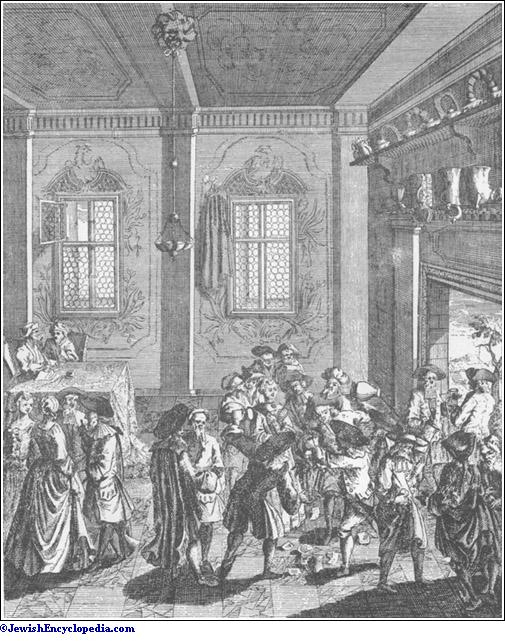
After the betrothal a period of twelve months was allowed to pass before the marriage was completed by the formal home-taking ("nissu'in," "liḳḳuḥin"). In case the bride was a widow or the groom a widower, this interval was reduced to thirty days (Ket. v. 2; Shulḥan 'Aruk, Eben ha-'Ezer, 56). After the dispersal of the Jews had brought them into contact with the Western peoples, this arrangement was felt to be inconvenient and out of harmony with the prevailing views. It therefore becamecustomary to perform the entire marriage ceremony, betrothal and home-taking ("erusin" and "nissu'in"), at one time; and an affiancing or engagement similar to that prevailing among non-Jews was introduced. This was not an entire innovation, as its roots already existed in the custom of "shiddukin" or consent to marry, which existed in the days of the Talmud and probably also in the Biblical age. It was considered indispensable by the rabbis that a man should gain the good-will and consent of his prospective bride before entering upon a contract of marriage. Rab, the Babylonian amora, was accustomed to punish severely any one who married without first having persuaded and gained the consent of his wife (Ḳid. 13a; Yeb. 52a et al.).
What was in the Talmudic age a mere personal matter became in later times a formal custom, which was celebrated with much pomp. At these occasions it was customary to make out a formal contract to marry and to stipulate that a penalty should be imposed upon either party who should fail to fulfil his or her part of it. Such agreements were known as "shiddukin" (consent to marry), and also as "tenaim" (conditions), or among German-speaking Jews "ḳenas-mahl" (penalty-feast), because of these stipulations and penalties. They are still customary in many countries in modified form.
There is now no legal duration of time between betrothal and marriage, the length of the engagement being left entirely to the option of the parties concerned, except that the marriage may not take place in less than seven days after the agreement to marry has been reached (Nid. 66a; Shulḥan 'Aruk, Yoreh De'ah, 192).
Gifts. Betrothal Scene at Nuremberg.(From Kirchner, "Judisches Ceremoniell," 1726.)
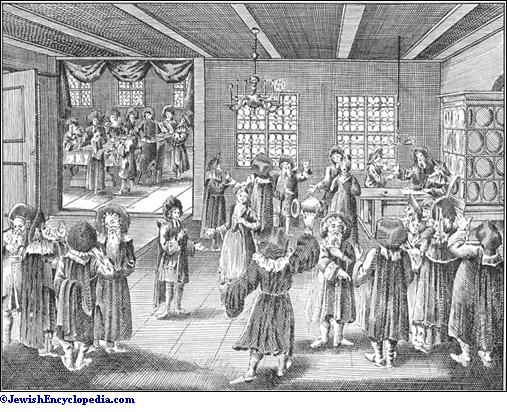
In Talmudic days, as in modern times, gifts formed an important feature of betrothal and marriage customs. These were of several kinds. The gifts which the groom sent to his bride were called "siblonot" or "sablonot," a term which Benjamin Musafia and Kohut explain as derived from the Greek  ). This derivation is corroborated by the fact that the Talmud (Ḳid. 50b) debates the question whether the sending of siblonot can be considered a proof of marriage or not. Jastrow, however ("Dict." s. v.
  ), derives the term from
  ("to carry"), corresponding to the Biblical "massa" and "masset." It was also customary for the male friends of the groom to send gifts, which sometimes took the form of money donations and were useful in assisting the groom to defray the expenses of the wedding. These presents were termed "shoshbinut" (friendship-gifts), from the Aramaic "shoshbina" (friend or neighbor),supposed by Musafia and Kohut to be derived from the Greek
  , the myrtle-bearing companions of the bridegroom.
The Legal Ceremony.
Betrothal in its legal sense ("erusin") is performed in the following manner: After the ordinary benediction over wine, the person performing the ceremony continues as follows: "Blessed art Thou, O Lord, our God, King of the universe, who hast sanctified us with Thy commandments and given us commandments concerning forbidden connections, and hast forbidden unto us those who are merely betrothed, and permitted unto us those lawfully married to us through 'canopy' ["ḥuppah"] and 'betrothal' ["ḳiddushin"]. Blessed are Thou, O Lord, who sanctifiest Thy people Israel through ḥuppah and ḳiddushin," after which the groom hands to the bride a ring or some object of value (not less than a peruṭah, the smallest current coin), saying, "Be thou betrothed unto me with this ring [or object] in accordance with the laws of Moses and Israel" ("kedat Mosheh we-Yisrael").
Silver-Gilt Betrothal Ring, Bearing Letter
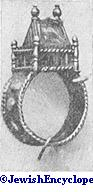
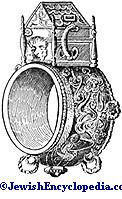
As stated above, this act of betrothal is at present combined with the rite of home-taking; and after the placing of the ring upon the finger of the bride, the marriage contract (Ketubah) is read, to form an interval between the two acts. The recitation of another benediction over wine and of the customary seven wedding benedictions forms the completion of the wedding ceremony. See Wedding.
Betrothal Ring with Box Containing Perfumes and Opening with a Key.(From the British Museum.)
Bibliography:
Perles, Die Jüdische Hochzeit in Nachbiblischer Zeit, in Frankel's Monatsschrift, ix. Leipsic, 1860; the same in English;
Jewish Marriage in Post-Biblical Times, in Hebrew Characteristics, New York, 1875;
Mielziner, The, Jewish Law of Marriage and Divorce, Cincinnati, 1884;
Coypel, Le Judaisme, Mul-house, 1876;
Duschak, Das Mosaisch-Talmudische Eherecht, Vienna, 1864;
Israel Abrahams, Jewish Life in the Middle Ages, London, 1896).
(Anglo-Saxon: treowth, truth) An agreement to marry, made by mutual promises. As a matrimonial impediment it was practically done away with by the legislation of Pius X, who ruled that such a compact, to have any effect on a proposed marriage to another, must have been made in a written and dated document, signed by both parties and by the pastor or bishop of the place, or at least by two witnesses; and even this formal pledge does not oblige one party to marry the other.
(Lat. sponsalia).The giving of one’s troth — that is, one’s true faith or promise. Betrothal, in the Catholic Church, is a deliberate and free, mutual, true promise, externally expressed, of future marriage between determinate and fit persons. It is a promise, compact, or agreement — not merely an intention; and, like all contracts, it must be entered into with deliberation proportionate to the obligation which it begets; it must be free from force, substantial error, and grave fear. The promise given must be mutual; a promise on the part of one only, with acceptance by the other, does not constitute a betrothal. The consent, of course, as in all contracts, must be true, or sincere, not feigned; it must be given with the intention of binding oneself, and this intention must be expressed verbally, by writing, or by action, in person or by proxy. Lastly, this contract, like matrimony, can exist only between two definite persons whose capacity is recognized by the Church; that is, between whom there is no matrimonial impediment, either as regards the licitness or validity of the contract. The betrothal is a promise of future marriage, and hence it differs from the marriage contract itself, which deals with that state as in the present. FORMALITIESFormal betrothal is not customary in the United States, or in English-speaking countries generally, as it is among certain nations, where the ceremony is sometimes solemn (before ecclesiastical witnesses) and sometimes private (made at home before the family or friends as witnesses). Among English-speaking peoples the betrothal, if it occurs, is generally without the presence of a third party. In Spain (S. C. C., 31 January, 1880; 11 April, 1891) and in Latin America (Acta et Decreta Conc. Pl. Amer. Lat., p. 259, in note 1) a betrothal compact is considered invalid by the Church unless written documents pass between the contracting parties. This practice obtains in other countries also, but its observance is not necessary to validate the agreement. EFFECTSA valid betrothal begets chiefly two effects. There arises first an obligation in justice, binding the contracting parties to keep their agreement; viz. to marry at the time specified; or, when the date of marriage is not agreed upon, whenever the second party to the compact reasonably demands the fulfillment of the marriage-promise. Marriage, consequently, with a third party is forbidden, though not invalid. There arises, secondly, owing to an ecclesiastical law, a diriment impediment, known as "public decency", extending to relatives in the first degree of the parties betrothed. Hence, a marriage contracted between the male party to a betrothal and the mother, sister, or daughter of the other party; and, vice versa, between the woman and the father, brother, or son of the man, would be null and void. This impediment continues to exist in all its force, even after the betrothal has been legitimately dissolved. The first of these effects, an obligation of justice, may arise, it will be seen, from a betrothal compact which has not all the essentials of the definition given above; not so, however, of the second effect. It is sometimes stated that a betrothal does not bind in English-speaking countries. This is inexact, to say the least. There is no exception at any time, or in any country, to the binding force arising from a valid betrothal, even though it be not public (S. C. S. Off., 11 Aug., 1852), or to the impediment begotten thereby. Engagements very frequently, though not always, are rather proposals of matrimony than promises as explained above, and in them an essential element of the betrothal is wanting (Sabetti, Theol. Mor., n. 838, qu. 30; Kenrick, Theol. Mor., nos. 23, 37). DISSOLUTIONA betrothal may be dissolved: (1) By the mutual and free consent of the contracting parties. (2) By a diriment impediment, which subsequently arises between said parties. In this case the innocent party is released form his or her obligation, but not the one through whose fault the impediment arose. The latter may be held to the contract, if the impediment be such that the Church can dispense from it. (3) By a valid marriage entered into with a third person. (4) By protracted delay on the part of either of the contracting parties in fulfilling the agreement to marry, in which case the innocent party is released from obligation. (5) By one of the contracting parties choosing a higher state of perfection, as for example by solemn profession in a religious order, by the reception of major orders, etc. (6) By any notable change in body or soul or worldly state of one of the parties — any grave circumstance which if it had happened or been known before the betrothal would have prevented it. To these may be added the impossibility of contracting matrimony, and a dispensation granted by the pope for just causes. PROCEDURES FOR BREACH OF PROMISEIn case of refusal to complete the contract by marriage an action before the diocesan court is permissible. Bishops, however, are counseled not ordinarily to enforce marriage in such cases, as generally it would prove unhappy. In English-speaking countries these matters are, as a rule, taken into the civil courts, where the only remedy is a breach-of-promise suit, the penalty being a fine. In the United States, before the civil law, betrothal has only the moral force of a mutual promise. Betrothal in England was once a legal bar to matrimony with another; at present the only legal remedy for the violation of the betrothal is an action for breach of promise. HISTORYJewish and Roman laws and customs must have influenced the early practice of the Church anent betrothal. The Jewish laws of marriage, and consequently of betrothal, were based in a great measure on the supposition that it was a purchase. In the law of Moses there are certain provisions respecting the state of the virgin who is betrothed, but nothing particularly referring to the act of betrothal. Selden’s "Uxor Hebraica" gives the schedule of later Hebrew contracts of betrothal. Where the contract was in writing, it was written out by the man before witnesses and delivered to the woman, who must know its import. Rome, on the other hand, at the beginning of the Christian Era, had ceased to consider marriage as a wife-purchase. Marriage, and still more betrothal, was a purely civil compact, verbally concluded. Under later Roman law, which constituted a basis for our ecclesiastical legislation, betrothal was looked upon simply as a contract of future marriage, stronger indeed than the engagement, since to enter into a second betrothal compact was held to be as infamous as bigamy itself. No legal forms were prescribed for the early Roman betrothal, but the compact was generally accompanied by the man’s sending to the woman the iron betrothal ring (annulus pronubus). As the Empire grew in importance, so did the betrothal contract, while at the same time its obligations were more frequently disregarded. Hence the practice of giving earnest-money, or pledges of fidelity (arrhoe), came into prominence; another step led to gifts being bestowed by the parties, one upon the other. The kiss, the joining of hands, and the attestation of witnesses were other elements introduced. Even in England formal engagements of this kind were common down to the time of the Reformation. As barbarian influence, however, began to affect the Empire, the betrothal took on more the semblance of wife-purchase.The Church, at the beginning of the third century at the latest, recognized betrothal as a perfectly valid and lawful contract. In the fourth century, in Africa at least, according to the testimony of St. Augustine (Sermo viii, 18; Sermo xxxvii, 7; Sermo cccxxxii, 4, etc.), espousals were contracted in writing, the instrument (tabulae), signed by the bishop, being publicly read. At the same time the dowry, if any, was given, or nuptial gifts were exchanged. Pope Benedict I (573-577), writing to the Patriarch of Gran, declares that it is connubial intercourse that makes two one, that mere betrothal would not prevent a man from entering into wedlock with the sister of his betrothed. The question of relationship, then, arising from the betrothal contract was mooted even at that early period. Gregory the Great (590-603) allowed a woman who was betrothed to dissolve her engagement in order to enter a convent (Bk. VI, Ep. xx).At the end of the ninth century betrothal had become a very frequent subject of Church legislation. From a reply of Pope Nicholas to the Bulgarians in 860 (Responsa ad Consulta Bulgarorum, c. iii) it is apparent that the preliminaries leading up to a marriage in the Church were: (1) The betrothal or espousal; the expression of consent by the contracting parties, and the consent also of their parents, or guardians, to the projected marriage. (2) The subarrhatio, or delivery of the ring by the man to the woman by way of an earnest, or pledge. (3) The documentary transfer, by the man to the woman, of the dowry, in the presence of witnesses. The marriage was to follow immediately, or after an interval more or less protracted. These rites are still recognized in modern uses. The ceremony of betrothal is found in a measure in the present nuptial service. There is a declaration of consent, which, since the marriage follows immediately after, is de praesenti. The placing of the ring on the finger of the bride by the bridegroom constitutes the subarrhatio, while in many places transferring of the dowry is represented by a medal or coin — a relic of Salic law and of wife-purchase. (See Martene, De Antiq. Ecc. Ritibus, I, ix, a. 3, n. 4, speaking of a ritual of the Church of Reims.)-----------------------------------Consult recognized authorities in canon law or moral theology for present discipline. Magani, L’Antica Liturgia Rom. (Milan, 1897), 360 sqq.; Duchesne, Christian Worship (tr. 1904), XIV; Ludlow in Dict. Christ. Antiq., s. v. ANDREW B. MEEHAN Transcribed by Susan Birkenseer The Catholic Encyclopedia, Volume IICopyright © 1907 by Robert Appleton CompanyOnline Edition Copyright © 2003 by K. KnightImprimatur. +John M. Farley, Archbishop of New York
The first part of the two-part process of Jewish marriage, which creates the legal relationship without the mutual obligations. In Hebrew, it is called "kiddushin."