
Cin´namon occurs in three places of Scripture; first, about 1600 years before the Christian era, in Exo 30:23, where it is enumerated as one of the ingredients employed in the preparation of the holy anointing oil: ’Take thou also unto thee powerful spices, myrrh, and of sweet cinnamon (kinnamon besem) half as much (i.e. 250 shekels), together with sweet calamus and cassia.’ It is next mentioned in Pro 7:17, and again in Son 4:14; while in Rev 18:13, among the merchandise of Babylon, we have ’cinnamon, and odors, and ointments, and frankincense.’
Many writers have doubted whether the kinnamom of the Hebrews is the same article that we now call cinnamon. Others have doubted whether our cinnamon was at all known to the ancients. But the same thing has been said of almost every other drug which is noticed by them. If we were to put faith in all these doubts, we should be left without any substances possessed of sufficiently remarkable properties to have been articles of ancient commerce.
Cinnamon of the best quality is imported in the present day from Ceylon, and also from the Malabar Coast, in consequence of the cinnamon plant having been introduced there from Ceylon. An inferior kind is also exported from the peninsula of India. From these countries the cinnamon and cassia of the ancients must most likely have been obtained, though both are also produced in the islands of Sumatra and Borneo, in China, and in Cochinchina. Cinnamon is imported in bales and chests—the bundles weighing about one pound each. The pieces consist of compound quills, are about three feet long, slender, and enclose within them several smaller quills. These are thin, smooth, of a brownish color, of a warm, sweetish, and agreeable taste, and fragrant odor; but several kinds are known in modern markets, as they were in ancient times.
In Ceylon cinnamon is carefully cultivated, the best cinnamon gardens being on the southwestern coast, where the soil is light and sandy, and the atmosphere moist from the prevalent southern winds. The plants begin to yield cinnamon when about six or seven years old, after which the shoots may be cut every three or four years. The best kinds of cinnamon are obtained from twigs and shoots; less than half, or more than two or three inches in diameter, are not peeled. ’The peeling is effected by making two opposite, or when the branch is thick, three or four longitudinal incisions, and then elevating the bark by introducing the peeling knife beneath it. In twenty-four hours the epidermis and greenish pulpy matter are carefully scraped off. In a few hours the smaller quills are introduced into the larger ones, and in this way congeries of quills are formed, often measuring forty inches in length. The bark is then dried in the sun, and afterwards made into bundles, with pieces of split bamboo twigs.’ Besides cinnamon, an oil of cinnamon is obtained in Ceylon, by macerating the coarser pieces of the bark, after being reduced to a coarse powder, in sea-water, for two days, when both are submitted to distillation. A fatty substance is also obtained by bruising and boiling the riper fruit, when an oily body floats on the surface, which on cooling concretes into a dirty whitish, rather hard, fatty matter. Some camphor may be procured from the roots.
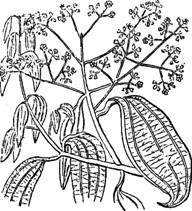
Fig. 132—Kinnamomum cassia
Cassia bark was distinguished with difficulty from cinnamon by the ancients. In the present day it is often sold for cinnamon; indeed, unless a purchaser specify true cinnamon, he will probably be supplied with nothing but cassia. It is made up into similar bundles with cinnamon, has the same general appearance, smell, and taste; but its substance is thicker and coarser, its color darker, its flavor much less sweet and fine than that of Ceylon cinnamon, while it is more pungent, and is followed by a bitter taste; it is also less closely quilled, and breaks shorter than genuine cinnamon. Dr. Pereira, whose description we have adopted, has ascertained that cassia is imported into the London market from Bombay (the produce of the Malabar Coast), and also from the Mauritius, Calcutta, Batavia, Singapore, the Philippine Islands, and Canton. Mr. Reeves says, ’Vast quantities both of cassia seeds (buds) and cassia lignea are annually brought to Canton from the province of Kwangse, whose principal city (Kweihin, literally ’cassia forest’) derives its name from the forests of cassia around it. The Chinese themselves use a much thicker bark, unfit for the European market.’ The Malabar cassia lignea is thicker and coarser than that of China. From the various sources, independently of the different qualities, it is evident, as in the case of cinnamon, that the ancients might have been, as no doubt they were, acquainted with several varieties of cassia. These, we have no doubt, are yielded by more than one species. Mr. Marshall, from information obtained while he was staff-surgeon in Ceylon, maintained that cassia, or at least a part of it, was the coarser bark of the true cinnamon. Dr. Wight has ascertained that more than one species yields the cassia of Malabar, often called cinnamon. Besides cassia bark, there is also a cassia oil, and cassia buds, supposed to be produced by the same tree. There can be no reasonable doubt, as cinnamon and cassia were known to the Greeks, that they must have been known to the Hebrews also, as the commerce with India can be proved to have been much more ancient than is generally supposed.
One of the ingredients in the perfumed oil with which the tabernacle and its vessels were anointed, Exo 30:23 Pro 7:17 Son 4:14 . It is the inner bark of a tree growing about twenty feet high, and being peeled off in thin strips curls as it is found in market. It is of a dark red color, of a poignant taste, aromatic, and very agreeable. That of the finest quality comes from Ceylon, Jer 18:13 .\par
The aromatic inner rind of the Laurus cinnamomum. A perfume only in Old Testament (Exo 30:23); a condiment with us. Imported into Judaea by the Phoenicians. It now grows best in S.W. Ceylon. From the coarser pieces oil of cinnamon is obtained, and a finer oil by boiling the ripe fruit. This last gives the delightful odor to incense when burning. Gesenius derives it from
(
Besides cinnamon, an oil of cinnamon is obtained in Ceylon, by macerating the coarser pieces of the bark, after being reduced to a coarse powder, in sea-water for two days, when both are submitted to distillation. A fatty substance is also obtained by bruising and boiling the riper fruit, when an oily body floats on the surface, which, on cooling, concretes into a dirty-whitish, rather hard, fatty matter. As this oil burns with a delightful fragrance, when receiving ambassadors and on high state occasions, the kings of Candy used to have lamps of it burning in their audience-chamber. The wood itself is pervaded by the same grateful perfume, and walking-sticks of cinnamon-wood are highly prized, as well as little articles of cabinet-work. Some camphor may be procured from the roots. Cassia bark, as we have seen, was distinguished with difficulty from cinnamon by the ancients. In the present day it is often sold for cinnamon; indeed, unless a purchaser specify true cinnamon, he will probably be supplied with nothing but cassia. It is made up into similar bundles with cinnamon, has the same general appearance, smell, and taste; but its substance is thicker and coarser, its color darker, its flavor much less sweet and fine than that of Ceylon cinnamon, while it is more pungent, and is followed by a bitter taste; it is also less closely quilled, and breaks shorter than genuine cinnamon. Its decoction gives a blue color when treated with tincture of iodine which the true cinnamon does not. “The great consumers of cinnamon are the chocolate-makers of Spain, Italy, France, and Mexico, and by them the difference in the flavor between cinnamon and cassia is readily detected. An extensive dealer in cinnamon informs me that the Germans, Turks, and Russians prefer cassia, and will not purchase cinnamon, the delicate flavor of which is not strong enough for them.
In illustration of this, I was told that some cinnamon (valued at 3s. 6d. per lb.), having been by mistake sent to Constantinople, was unsalable there at any price, while cassia lignea (worth about 6d per lb.) was in great request” (Pereira’s Materia Medica, p. 1306). From the various sources, independently of the different qualities, it is evident, as in the case of cinnamon, that the ancients might have been, as no doubt they were, acquainted with several varieties of cassia. These, we have no doubt, are yielded by more than one species. Besides cassia bark, there is also a cassia oil and cassia buds, supposed to be produced by the same tree. There can be no reasonable doubt, as cinnamon and cassia were known to the Greeks, that they must have been known to the Hebrews also, as the commerce with India can be proved to have been much more ancient than is generally supposed. (See the Penny Cyclopedia, s.v. Cinnamon; Celsii Hierobot. 2:350 sq.; Bodsei a Stapel, Comm. in Theophr. p. 984; Knox, Travels in Ceylon, p. 32; also Ritter, Erdk. VI, 4, pt. 2, p. 123 sq.; Geiger, Pharmac. Botan. 1:330’ sq.; especially Nees v. Esenbeck, De Cinnanzomo [Bonn, 1823], and Blume in Wiegmann’s Archiv fur Naturgesch. 1831, 1:116 sq.; Martius, Pharmakogn. p. 132, 141; Smith’s Dict. of Class. Antiq., Amer. ed., s.v. Cinnamomum.) SEE CASSIA.
By: Emil G. Hirsch, Gerson B. Levi
The bark of the Cinnamomum Zeylanicum, a plant so called botanically because growing best in Ceylon. A variety often substituted for it, cassia, comes from China. Cinnamon was known in early times to the Hebrews. It was used in making the anointing-oil (Ex. xxx. 23), and,further, as a mere perfume (Prov. vii. 17). In the Song of Solomon (iv. 14) it is mentioned along with other fragrant woods. Gesenius and Lagarde consider the Hebrew ("ḳinnamon") to be a loan-word from the Greek (
Cinnamon is the product of Cinnamomum zeylanicum, a laurel-like plant widely cultivated in Ceylon and Java. It has a profuse white blossom, succeeded by a nut from which the fragrant oil is obtained. The wood is the inner bark from branches which have reached a diameter of from 2 to 3 inches; the epidermis and pulpy matter are carefully scraped off before drying. In commerce the cheaper Cassia ligra of China is sometimes substituted for true cinnamon, and it is thought by some authorities that this was the true cinnamon of the ancients. See, however, CASSIA.
(êéííÜìùíïí from ÷ִðְîåֹï)
Cinnamon is mentioned in Rev_18:13 among the merchandise of ‘Babylon,’ i.e. of Imperial Rome. The name probably came with the thing from the remote east; Rödiger (Gesenius, Thes. Add., 1829, p. 111) compares it with the Malay kainamanis. It was known to the Hebrews (Exo_30:23, Pro_7:17, Son_4:14); and Hero dotus (iii. 111) speaks of ‘those rolls of bark (ôáῦôá ôὰ êÜñöåá) which we, learning from the Phœnicians, call cinnamon.’ The finest cinnamon of commerce is now obtained from Ceylon; it is the fragrant and aromatic inner rind of the stem and boughs of a tree which grows to a height of 30ft. Oil of cinnamon, which is used in the composition of incense, is got from the boiled fruit of the tree. But the cinnamon of the ancients was probably the cassia lignea of S. China.
James Strahan.
Cinnamon. A member of the laurel family, the cinnamon tree grew to be more than 9 meters (30 feet) tall with white flowers and wide-spreading branches. A native of Ceylon, the cinnamon tree produced bark and oil which was used for the anointing oil ( Exo 30:23) and as perfume ( Pro 7:17; Rev 18:13).
A spice made from the dried inner bark of several trees that come from tropical Asia. The bark has a pleasant smell. It can be ground and used as a spice. The cinnamon mentioned in Exodus 30:23, Proverbs 7:17, Song of Songs 4:14, and Revelation 18:13 is certainly from the Cinnamomum zeylanicum tree.
The cinnamon tree is relatively small, never growing taller than 9.1 meters (30 feet). It has smooth, ash-colored bark, wide-spreading branches, and white flowers. Its shiny, beautifully veined evergreen leaves grow about 22.9 centimeters (9 inches) long and 5.1 centimeters (2 inches) wide.
The Jewish people considered cinnamon a deliciously fragrant substance and valued it highly both as a spice and a perfume. It was one of the main ingredients used to make the precious ointment, or "holy oil," that Moses was commanded to use in the tabernacle. This oil was used for anointing the holy vessels and the priests who served there. Cinnamon was certainly very expensive and highly treasured.
See Food and Food Preparation.
Aquifer Open Bible Dictionary © 2026 Mission Mutual, an adaptation of the Tyndale Open Bible Dictionary © 2023 Tyndale House Publishers. Licensed under CC BY-SA 4.0.
References:
Discussion:
True Cinnamon Cinnamomum verum (or Cinnamomum zeylanicum) is a tree found mostly in Sri Lanka, India, and Burma. The Hebrew word qinnamon may ultimately derive from an early form of the Malaysian/Indonesian expression kayumanis, meaning “sweet wood.” As in the case of cassia, there is debate about whether the cinnamon mentioned in the Old Testament could have been imported from the Far East or whether there was perhaps a spice from Arabia or Africa that was named qinnamon, because this name was known at the time of writing. Some scholars believe that there was trade between India and Egypt as early as the second millennium B.C. In fact, the renowned Egyptian queen Hatshepsut is thought to have brought myrrh or frankincense trees from “Punt,” which could have been Somalia or even India, in 1490 B.C. However, she apparently did not bring cinnamon trees, nor are cinnamon and cassia among the spices found in the tombs of Egypt. So the true identity of the biblical cinnamon is still in question.
Description:
The true cinnamon tree grows to 10 meters (33 feet) in height. The stem branches plentifully. The leathery leaves are 10–15 centimeters (4–6 inches) in length and have three light-colored, radiating veins. The spongy outer bark is scraped off, revealing a fragrant pale brown inner bark. This inner bark carries the cinnamon flavor. It is cut off and dried, and the bark curls to form little scrolls. The small flowers have an unpleasant smell.
Special significance:
According to EXO 30:23, cinnamon was an ingredient of the holy oil used to anoint the Tabernacle, ark, and priests. The temptress of PRO 7:17 perfumes her bed with it, together with myrrh and aloes. Today the bark of cinnamon is ground into powder and used as a spice for food and as an ingredient in incense and perfume. Even the leaves and unripe berries (“buds”) are marketed as condiments.
Translation:
Translators in Asia will be able to use their own word for cinnamon (for example, Mandarin rou gui, xi lan rou gui; Korean kye / kyepi, sillon-gyepi; Malay kayu manis; Nepali dalchini; Tamil lavanga pattai; Thai obchoey; Vietnamese cay que / nhuc que, que ranh). They will even be able to distinguish between cassia and cinnamon. In other areas it is best to transliterate from Hebrew qinnamon or a major language (for example, English sinamon; French kanel; Spanish/Portuguese kanela; Arabic kirfa, darini, salika). Since the bark was ground into powder, the words “bark” or “powder” may be useful as classifiers. In EXO 30:23; EXO 30:24 translators will need two words for the closely related cassia and cinnamon.
Plants and Trees in the Bible © United Bible Societies. Licensed under CC BY-SA 4.0.