
In its primary import, signifies the bringing into being something which did not before exist. The term is therefore most generally applied to the original production of the materials whereof the visible world is composed. It is also used in a secondary or subordinate sense to denote those subsequent operations of the Deity upon the matter so produced, by which the whole system of Nature, and all the primitive genera of things, receive their form, qualities, and laws. There is no subject concerning which learned men have differed in their conjectures more than in this of creation. "It is certain, " as a good writer observes, "that none of the ancient philosophers had the smallest idea of its being possible to produce a substance out of nothing, or that even the power of the Deity himself could work without any materials to work upon. Hence some of them, among whom was Aristotle, asserted that the world was eternal, both as to its matter and form. Others, though they believed that the gods had given the world its form, yet imagined the materials whereof it is composed to have been eternal. Indeed, the opinions of the ancients, who had not the benefit of revelation, were on this head so confused and contradictory, that nothing of any consequence can be deduced from them.
The free-thinkers of our own and of former ages have denied the possibility of creation, as being a contradiction to reason; and of consequence have taken the opportunity from thence to discredit revelation. On the other hand, many defenders of the sacred writings have asserted that creation out of nothing, so far from being a contradiction to reason, is not only probable, but demonstrably certain. Nay, some have gone so far as to say, that from the very inspection of the visible system of Nature, we are able to infer that it was once in a state of non-existence." We cannot, however, here enter into the multiplicity of the arguments on both sides; it is enough for us to know what God has been pleased to reveal, both concerning himself and the works of his hands. "Men, and other animals that inhabit the earth and the seas; all the immense varieties of herbs and plants of which the vegetable kingdom consists; the globe of the earth, and the expanse of the ocean; these we know to have been produced by his power. Besides the terrestrial world, which we inhabit, we see many other material bodies disposed around it in the wide extent of space.
The moon, which is in a particular manner connected with our earth, and even dependent upon it; the sun, and the other planets, with their satellites, which like the earth circulate round the sun, and appear to derive from him light and heat; those bodies which we call fixed stars, and consider as illuminating and cherishing, with heat each its peculiar system of planets; and the comets which at certain periods surprise us with their appearance, and the nature of whose connection with the general system of Nature, or with any particular system of planets, we cannot pretend to have fully discovered; these are so many more of the Deity’s works, from the contemplation of which we cannot but conceive the most awful ideas of his creative power. "Matter, however, whatever the varieties of form under which it is made to appear, the relative disposition of its parts, or the motions communicated to it, is but an inferior part of the works of creation. We believe ourselves to be animated with a much higher principle than brute matter; in viewing the manners and economy of the lower animals, we can scarce avoid acknowledging even them to consist of something more than various modifications of matter and motion. The other planetary bodies, which seem to be in circumstances nearly analogous to those of our earth, are surely, as well as it, destined for the habitations of rational intelligent beings. the existence of intelligences of an higher order than man, though infinitely below the Deity, appears extremely probable. Of these spiritual beings, called angels, we have express intimation in Scripture (see the article ANGEL.) But the limits of the creation we must not pretend to define.
How far the regions of space extend, or how they are filled, we know not. How the planetary worlds, the sun, and the fixed stars are occupied, we do not pretend to have ascertained. We are even ignorant how wide a diversity of forms, what an infinity of living animated beings may inhabit our own globe. So confined is our knowledge of creation, yet so grand, so awful, that part which our narrow understandings can comprehend!" "Concerning the periods of time at which the Deity executed his several works, it cannot be pretended that mankind have had opportunities of receiving very particular information. Many have been the conjectures, and curious the fancies of learned men, respecting it; but, after all, we must be indebted to the sacred writings for the best information." Different copies, indeed, give different dates. The Hebrew copy of the Bible, which we Christians, for good reasons, consider as the most authentic, dates the creation of the world 3944 years before the Christian era. The Samaritan Bible, again, fixes the era of the creation 4305 years before the birth of Christ. And the Greek translation, known by the name of the Septuagint version of the Bible, gives 5270 as the number of years which intervened between these two periods.
By comparing the various dates in the sacred writings, examining how these have come to disagree, and to be diversified in different copies; endeavouring to reconcile the most authentic profane with sacred chronology, some ingenious men have formed schemes of chronology plausible, indeed, but not supported by sufficient authorities, which they would gladly persuade us to receive in preference to any of those above-mentioned. Usher makes out from the Hebrew Bible 4004 years as the term between the creation and the birth of Christ. Josephus, according to Dr. Wills, and Mr. Whiston, makes it 4658 years; and M. Pezron, with the help of the Septuagint, extends it to 5872 years. Usher’s system is the most generally received. But though these different systems of chronology are so inconsistent, and so slenderly supported, yet the differences among them are so inconsiderable, in comparison with those which arise before us when we contemplate the chronology of the Chinese, the Chaldeans, and the Egyptians, and they agree so well with the general information of authentic history, and with the appearances of nature and of society, that they may be considered as nearly fixing the true period of the creation of the earth." Uncertain, however, as we may be as to the exact time of the creation, we may profitably apply ourselves to the contemplation of this immense fabric.
Indeed, the beautiful and multiform works around us must strike the mind of every beholder with wonder and admiration, unless he be enveloped in ignorance, and chained down to the earth with sensuality. These works every way proclaim the wisdom, the power, and the goodness of the Creator. Creation is a book which the nicest philosopher may study with the deepest attention. Unlike the works of art, the more it is examined, the more it opens to us sources of admiration of its great Author; the more it calls for our inspection, and the more it demands our praise. Here every thing is adjusted in the exactest order; all answering the wisest ends, and acting according to the appointed laws of Deity. Here the Christian is led into the most delightful field of contemplation. To him every pebble becomes a preacher, and every atom a step by which he ascends to his Creator. Placed in this beautiful temple, and looking around on all its various parts, he cannot help joining with the Psalmist in saying, "O Lord, how manifold are thy works; in wisdom hast thou made them all!"
See ETERNITY of GOD.
See Ray and Blackmore on the Creation; art. Creation, Enc. Brit.; Derham’s Astro and Physico- theology; Hervey’s Meditations; La Pluche’s Nature Displayed; Sturm’s Reflections on the Works of God.
in its primary import, signifies the bringing into being something which did not exist before. The term is therefore most generally applied to the original production of the materials whereof the visible world is composed. It is also used in a secondary or subordinate sense, to denote those subsequent operations of the Deity upon the matter so produced, by which the whole system of nature, and all the primitive genera of things, received their forms, qualities, and laws. The accounts of the creation of the world which have existed among different nations, are called Cosmogonies. Moses’s is unquestionably the most ancient; and had it no other circumstance to recommend it, its superior antiquity alone would give it a just claim to our attention. It is evidently Moses’s intention to give a history of man, and of religion, and an account of creation. In the way in which he has detailed it, it would have been foreign to his plan, had it not been necessary to obviate that most ancient and most natural species of idolatry, the worship of the heavenly bodies. His first care, therefore, is to affirm decidedly, that God created the heavens and the earth; and then he proceeds to mention the order in which the various objects of creation were called into existence. First of all, the materials, of which the future universe was to be composed, were created. These were jumbled together in one indigested mass, which the ancients called chaos, and which they conceived to be eternal; but which Moses affirms to have been created by the power of God. The materials of the chaos were either held in solution by the waters, or floated in them, or were sunk under them; and they were reduced into form by the Spirit of God moving upon the face of the waters. Light was the first distinct object of creation; fishes were the first living things; man was last in the order of creation.
2. The account given by Moses is distinguished by its simplicity. That it involves difficulties which our faculties cannot comprehend, is only what might be expected from a detail of the operations of the omnipotent mind, which can never be fully understood but by the Being who planned them. Most of the writers who come nearest to Moses in point of antiquity have favoured the world with cosmogonies; and there is a wonderful coincidence in some leading particulars between their accounts and his.
They all have his chaos; and they all state water to have been the prevailing principle before the arrangement of the universe began. The systems became gradually more complicated, as the writers receded farther from the age of primitive tradition; and they increased in absurdity in proportion to the degree of philosophy which was applied to the subject. The problem of creation has been said to be, “Matter and motion being given, to form a world;” and the presumption of man has often led him to attempt the solution of this intricate question. But the true problem was, “Neither matter nor motion being given, to form a world.” At first, the cosmogonists contented themselves with reasoning on the traditional or historical accounts they had received; but it is irksome to be shackled by authority; and after they had acquired a smattering of knowledge, they began to think that they could point out a much better way of forming the world than that which had been transmitted to them by the consenting voice of antiquity. Epicurus was most distinguished in this hopeful work of invention; and produced a cosmogony on the principle of a fortuitous concourse of atoms, whose extravagant absurdity has hitherto preserved it from oblivion. From his day to ours, the world has been annoyed with systems; but these are now modified by the theories of chemists and geologists, whose speculations, in so far as they proceed on the principle of induction, have sometimes been attended with useful results; but, when applied to solve the problem of creation, will serve, like the systems of their forerunners, to demonstrate the ignorance and the presumption of man.
3. The early cosmogonies are chiefly interesting from their resemblance to that of Moses; which proves that they have either been derived from him, or from some ancient prevailing tradition respecting the true history of creation. The most ancient author next to Moses, of whose writings any fragments remain, is Sanchoniatho, the Phenician. His writings were translated by Philo Byblius; and portions of this version are preserved by Eusebius. These writings come to us rather in an apocryphal form; they contain, however, no internal evidence which can affect their authenticity; they pretty nearly resemble the traditions of the Greeks, and are, perhaps, the parent stock from which these traditions are derived. The notions detailed by Sanchoniatho are almost translated by Hesiod, who mentions the primeval chaos, and states
Tradidit arcano quodcunque volumine Moses. [Whatever Moses has transmitted in his mystic volume.]
We are therefore inclined to think that Ovid actually copied from the Bible; for he adopts the very order detailed by Moses. Moses mentions the works of creation in the following order: the separation of the sea from the dry land; the creation of the heavenly bodies; of marine animals; of fowls and land animals; of man. Observe now the order of the Roman poet:—
Ante mare et terras, et, quod tegit omnia, coelum, Unus erat toto naturae vultus in orbe,
Quem dixere chaos, rudis, indiffestaque moles. Hanc Deus, et melior litem natura diremit. Nam coelo terras, et terras abscidit undis;
Et liquidum spisso secrevit ab aere coelum. Neu regio foret ulla suis animalibus orba;
Astra tenent coeleste solum, formaeque deorum; Cesserunt nitidis habitandae piscibus undae: Terra feras cepit, volucres agitabilis aer. Sanctius his animal, mentisque capacius altae
Deerat adhuc, et quod dominari in caetera posset: Natus homo est.
“Before the seas, and this terrestrial ball, And heav’n’s high canopy, that covers all, One was the face of nature; if a face: Rather, a rude and indigested mass:
A lifeless lump, unfashion’d, and unframed, Of jarring seeds; and justly chaos named. But God, or nature, while they thus contend, To these intestine discords put an end;
Then earth from air, and seas from earth were driv’n,
And grosser air sunk from ethereal heav’n.
Thus when the God, whatever god was he, Had formed the whole, and made the parts agree,
That no unequal portions might be found,
He moulded earth into a spacious round.
Then, every void of nature to supply, With forms of gods he fills the vacant sky:
New herds of beasts he sends, the plains to share:
New colonies of birds, to people air; And to their oozy beds the finny fish repair.
A creature of a more exalted kind
Was wanting yet, and then was man design’d:
Conscious of thought, of more capacious breast, For empire formed, and fit to rule the rest: Whether with particles of heav’nly fire
The God of nature did his soul inspire,” &c.
DRYDEN.
Here we see all the principal objects of creation mentioned exactly in the same order which Moses had assigned to them in his writings; and when we consider what follows;—the war of the giants; the general corruption of the world; the universal deluge; the preservation of Deucalion and Pyrrha; their sacrifices to the gods on leaving the vessel in which they had been preserved;—there can scarcely remain a doubt that Ovid borrowed, either directly or at second hand, from Moses. What he says, too, is perfectly consistent with the received notions on the subject, though it is probable that they had never before been so regularly methodised. This train of reasoning would lead us to conclude that Ovid, and indeed the whole Heathen world, derived their notions respecting the creation, and the early history of mankind, from the sacred Scriptures: and it shows how deficient their own resources were, when the pride of philosophy was forced to borrow from those whom it affected to despise. With regard to the western mythologists, then, there can be little doubt that their cosmogonies, at least such of them as profess to be historical, and not theoretical, are derived from Moses; and the same may be affirmed with regard to the traditions of the east: as they were the same with those of Greece in the time of Megasthenes, whose testimony to this effect is quoted both by Clemens Alexandrinus and Strabo, we may naturally conclude that they had the same origin.
4. The Hindoo mythology has grown, in the natural uninterrupted progress of corruption, to such monstrous and complicated absurdity, that in many cases it stands unique in extravagance. In the more ancient Hindoo writings, however, many sublime sentiments occur; and in the “Institutes of Menu,” many passages are found relating to the creation, which bear a strong resemblance to the account given by Moses. They are thus given in an advertisement, prefixed to the fifth volume of the “Asiatic Researches,” and are intended as a supplement to a former treatise on the Hindoo religion:—
“This universe existed only in the first divine idea, yet unexpanded, as if involved in darkness, imperceptible, undefinable, undiscoverable by reason, and undiscovered by revelation, as if it were wholly immersed in sleep. When the sole self-existing Power, himself undiscerned, but making this world discernible, with five elements and other principles of nature, appeared with undiminished glory, expanding his idea, or dispelling the gloom. He, whom the mind alone can perceive, whose essence eludes the
external organs, who has no visible parts, who exists from eternity, even he, the soul of all beings, whom no being can comprehend, shone forth in person. He, having willed to produce various beings from his own divine substance, first with a thought created the waters. The waters are called nara, because they are the production of Nara, or the Spirit of God; and since they were his first ayana,
or place of motion, he thence is called Narayana, or moving on the waters. From that which is, the first cause, not the object of sense, existing every where in substance, not existing to our perception, without beginning or end, was produced the divine male. He
framed the heaven above, and the earth beneath; in the midst he placed the subtile ether, the eight regions, and the permanent
receptacle of waters. He framed all creatures. He, too, first assigned to all creatures distinct names, distinct acts, and distinct occupations. He gave being to time, and the divisions of time; to the stars also, and the planets; to rivers, oceans, and mountains; to level plains, and uneven valleys. For the sake of distinguishing actions, he made a total difference between right and wrong. Having divided his own substance, the mighty Power became half male, half female. He whose powers are incomprehensible, having
created this universe, was again absorbed in the spirit, changing the time of energy for the time of repose.”
In these passages we have evidently a philosophical comment on the account of creation given by Moses, or as transmitted from the same source of primitive tradition. We also see in these passages the rudiments of the Platonic philosophy, the eternal ideas in the divine mind, &c; and were any question to arise respecting the original author of these notions, we should have little hesitation in giving it against the Greeks. They were the greatest plagiaries both in literature and philosophy, and they have scarcely an article of literary property which they can call their own, except their poetry. Their sages penetrated into Egypt and India, and on their return stigmatized the natives of these countries as barbarians, lest they should be suspected of stealing their inventions.
5. The Chaldean cosmogony, according to Berosus, when divested of allegory, seems to resolve itself into this, that darkness and water existed from eternity; that Belus divided the humid mass, and gave birth to creation; that the human mind is an emanation from the divine nature. The cosmogony of the ancient Persians is very clumsy. They introduce two eternal principles, the one good, called Oromasdes, the other evil, called Arimanius; and they make these two principles contend with each other in the creation and government of the world. Each has his province, which he strives to enlarge; and Mithras is the mediator to moderate their contentions. This is the most inartificial plan that has been devised to account for the existence of evil, and has the least pretensions to a philosophical basis. The Egyptian cosmogony, according to the account given of it by Plutarch, seems to bear a strong resemblance to the Phenician, as detailed by Sanchoniatho. According to the Egyptian account, there was an eternal chaos, and an eternal spirit united with it, whose agency at last arranged the discordant materials, and produced the visible system of the universe. The cosmogony of the northern nations, as may be collected from the Edda, supposes an eternal principle prior to the formation of the world. The Orphic Fragments state every thing to have existed in God, and to proceed from him. The notion implied in this maxim is suspected to be pantheistic, that is, to imply the universe to be God; which, however, might be a more modern perversion. Plato supposed the world to be produced by the Deity, uniting eternal, immutable ideas, or forms, to variable matter. Aristotle had no cosmogony, because he supposed the world to be without beginning and without end. According to the Stoical doctrine, the divine nature, acting on matter, first produced moisture, and then the other elements, which are reciprocally convertible.
(1.) the act by which God calls into existence things not previously in being-material or spiritual, visible or invisible, Psa 148:5 Jer 4:11 ;\par (2.) the molding or reconstituting things, the elements of which previously existed; and\par (3.) the things thus "created and made," 2Pe 3:4 Jer 3:14 5:13. It is probably in the first of these senses the word "created" is to be understood in Gen 1:1, though some understand it in the second sense. In either case the idea of the eternity of matter is to be rejected, as contrary to sound reason and to the teachings of Scripture, Pro 8:22-31 Joh 1:1-3 Heb 11:3 .\par Creation is exclusively the work of God. The Father, the Son, and the Spirit are each in turn named as its author, Isa 40:28 Col 1:16 Gen 2:2 . It is a work the mysteries of which no finite mind can apprehend; and yet, as it reveals to us the invisible things of God, 1Ch 1:20, we may and ought to learn what he reveals respecting it not only in revelation, but in his works. These two volumes are from the same divine hand, and cannot but harmonize with each other. The Bible opens with an account of the creation unspeakably majestic and sublime. The six days there spoken of have usually been taken for our present natural days; but modern geological researches have given rise to the idea that "day" here denotes a longer period. The different rocks of our globe lie in distinct layers, the comparative age of which is supposed to have been ascertained. Only the most recent have been found to contain human remains. Older layers present in turn different fossil remains of animals and plants, many of them supposed to be now extinct. These layers are deeply imbedded beneath the present soil, and yet appear to be formed of matter washed into the bed of some primeval sea, and hardened into rock. Above this may lie numerous other strata of different materials, but which appear to have been deposited in the same manner, in the slow lapse of time. These layers are also thrown up and penetrated all over the world by rocks of still earlier formations, apparently once in a melted state.\par There are several modes of reconciling these geological discoveries with the statements of Scripture: First, that the six days of Gen 1.1-31 denote six long epochs-periods of alternate progressive formation and revolution on the surface of the earth. To the Lord "a thousand years are as one day," Psa 90:2,4 2Pe 3:5-10 Jer 20:1- 15. Secondly, that the long epochs indicated in the geological structure of the globe occurred before the Bible account commences, or rather in the interval between the first and second verses of Gen 1:1-31 . According to this interpretation, Gen 1:2 describes the state of the earth at the close of the last revolution it experienced, preparatory to God’s fitting it up for the abode of man as described in the verses following. Thirdly, that God compressed the work of those untold ages into six short days, and created the world as he did Adam, in a state of maturity, embodying in its rocks and fossils those rudimental forms of animal and vegetable life which seem naturally to lead up to the existing forms.\par The "Creature" and "the whole creation," in 1Ch 8:19-22, may denote the irrational and inferior creation, which shall be released from the curse, and share in the glorious liberty of the sons of God, Isa 11:6 35:1 2Pe 3:7-13. The bodies of believers, now subject to vanity, are secure of full deliverance at the resurrection-"the redemption of our body," 1Ch 8:23 .\par
Creation. (The creation of all things is ascribed in the Bible to God, and is the only reasonable account of the origin of the world. The method of creation is not stated in Genesis, and as far as the account there is concerned, each part of it may be, after the first acts of creation, by evolution, or by direct act of God’s will. The Hebrew word bara create is used but three times in the first chapter of Genesis --
(1) as to the origin of matter;
(2) as to the origin of life;
(3) as to the origin of man’s soul; and science has always failed to do any of these acts thus ascribed to God.
All other things are said to be made. The order of creation as given in Genesis is in close harmony with the order as revealed by geology, and the account there given, so long before the records of the rocks were read or the truth discoverable by man, is one of the strongest proofs that the Bible was inspired by God. -- Editor).
Science and revelation being from the same God cannot be mutually opposed. But either, or both, may be misinterpreted; and there have been as many false interpretations of the book of nature as of revelation. As the Copernican theory was ultimately found not to militate against, but to harmonize with, Scripture, when the language of the latter was better understood; so no real scientific discovery ever since has been found adverse to full belief in revelation, when the latter has been better understood. The full knowledge of both has ever advanced side by side. The Bible, having not scientific but religious truth for its object, speaks in phenomenal language, which in part even the scientific have to do, as in the phrases sunrise and sunset. Creation, in the strict sense of the first origination of being out of nothing, does not come within the scope of science.
It is by the Bible alone, and through faith we understand that the worlds were framed (fitly formed) by the word of God, so that not (as, from the analogy of things reproduced from previously existing and visible materials, one naturally would suppose) out of things which appear hath that which is seen been made" (Heb 11:3). No human being was witness of creation (Job 38:4). Geology traces ages ascending backward, marked by animal and vegetable existence, less and less highly organized the further back we go; but at last comes to a point beyond which it has no light, and I must fall back on revelation and faith for information. "In the beginning God created" the world, "the heaven and the earth" (Gen 1:1): "In the beginning the Word WAS" (Joh 1:1).
Everywhere else God "makes" (
This creation of all things out of nothing distinguishes the Bible from all pagan cosmogonies and philosophical speculations, which make matter eternal. The Creator’s mode of "creating" is not revealed, but simply the fact, that it was by the putting forth of His will. Two narratives of creation, the latter (Gen 2:4, etc.) the supplement to the former (Genesis 1-2:), appear at the forefront as the basis of the Bible revelation. That in Gen 2:4, etc., evidently continues and recapitulates that in Genesis 1-2:3, in order to prepare the way for the account of paradise and man’s fall. The first gives a clear summary of creation, man included, down to the sabbath rest from creation. The second concentrates attention on man. Accordingly, in the first
To mark the identity of this personal Jehovah with the Elohim of the previous part, the two, the personal and the generic names, are joined, Jehovah-Elohim "the Lord God." The mighty Elohim who created all things is also the Jehovah, who from the days of paradise down to the days of Moses, the writer of the pentateuch, has been in personal and unchangeable covenant relation with His people. Moreover, Jehovah, being derived from hawah, the Syriac and Chaldee for the Hebrew
Scripture’s design being to unfold redemption, only so much of the natural world is set forth as is needed for that design. Genesis 1 is not so much a full narrative of details as a revelation of the scheme in the Creator’s mind, the archetype of the actual (Gen 2:4-5; Gesenius, Targum, and Syriac). "Now no plant of the field was yet in the earth, and no herb of the field had yet sprouted forth, for the Lord God had not caused it to ram," etc. The earth already had brought forth grass (Gen 1:11); but no cultivated land and no vegetables fit for man’s use existed yet; "plant," "field," "grew," do not occur in Genesis 1. In the pattern of the tabernacle shown on the mount the description begins with the furniture of the tabernacle, then goes on to the priests, and ends with the sabbatical law. So, in creation, the process begins with the lower creatures, plants, and animals, then, man, creation’s priest, Eden, and lastly the sabbath.
Gen 1:1 teaches the religious truth needed for a right knowledge of God, that the world is not eternal, that God created it in the beginning; when that beginning was it does not state. But the high antiquity of the earth is expressly taught in Psa 90:2, where God’s formation of "the earth" in general is distinguished from that of "the (Hebrew
If the seventh day sabbath in Gen 2:2 be an ordinary day, then the six days must be ordinary days and this view is favored. But geology seems to oppose any such state of the earth intervening between the preceding age and that of man’s creation as could be described as" without form (desolate) and void." No universal convulsion (IF these words are to be pressed literally) separates the present orders of life from those preceding. No one series of stratified rocks is void of traces of life. Thus, we seem led to the conclusion (2) that the stage in the earth’s progress when it became surrounded with chaotic waters (how long after "the beginning" we know not), described in Gen 1:2, is that which existed before the arrangement of its surface took place. (But see below.) The sabbath of God is described in Hebrew 3-4, as not yet ended; it will last until He who sitteth on the throne shall say, "Behold I make all things new."
God’s creating this dark and desolate state of the earth was not in vain, but that in due time it might be "inhabited" (Isa 45:18). It was no "fortuitous concourse of atoms," or "laws of nature" acting independently of the continually active divine will of their Author. "The Spirit of God" as the Giver of life "brooded (’moved’) upon the waters." Then began organic life, at first in the lower types. Sir W. Jones (Asiatic Researches) states that the Indian philosophers similarly believed (doubtless from the primitive tradition) that water was the first element and work of the creative power. "The waters are called Nara, since they are the offspring of Nera or Iwara, and thence was Narayana named, because His first moving was upon them. THAT WHICH IS (the exact meaning of the I AM or JEHOVAH), the invisible Cause eternal, self-existing, but unperceived, is Brahma."
This address of Menu, Brahma’s son, to the sages who consulted him concerning the formation of the world, evidently corresponds with the revelation in Genesis. Then God said "Let there be light," and there was light. Light was first in a diffused state. It is not a separate, distinct body in itself, but caused by undulations of ether propagated through space with inconceivable rapidity. Hence it is not said God created, but God commanded it to be. Scientifically the Bible distinguishes between "light" (
"Day" is used often for a long period, with a beginning and’ close, like morning and evening (Gen 49:27; Deu 33:12). As the prophetic "days" at the close (Dan 12:11-12), so the historical "days" at the beginning of the Bible seem to be not literal but "days of the Lord"; compare Psa 90:4, "a thousand years in Thy sight are but as yesterday," and 2Pe 3:8, "one day is with the Lord as a thousand years and a thousand years as one day." Psalm 104 is an inspired commentary on the history of creation in Genesis 1; compare the account in Psa 104:8; Pro 8:25-28, of the upheaval of mountains from beneath the waters and depression of valleys, whereby land was severed from sea; just as we still find traces (sea shells, etc.) of their former submersion on the highest mountains.
The special phrase in the Hebrew for the first day, "one day". [or "day one"] marks it as a day unique, just as the day that shall usher in the millennium is called" one (extraordinary and unique) day" (Zec 14:7). The seventh day is not described as the previous six, "it was evening, it was morning," because the Lord’s sabbath extends over the whole present order of things, eventuating in the "sabbath rest that remaineth for the people of God" (Heb 4:9 margin). The Creator entered into the sabbath rest when He ceased from material creation, to carry on the new and spiritual creation in man (2Co 5:17; Heb 4:10). Yet God’s sabbath is not an idle one: "My Father worketh hitherto," namely, upholding all creation. Compare Jesus’ "day" (Joh 9:4; Joh 5:17); man’s present short-day-sabbath is a type of God’s and the saints’ saboatism.
The proportion of the seventh day to the previous six, of whatever length it and they be, is the ground of our seventh-day sabbath. For the "firmament" (Gen 1:6) translated "the (air) expanse," or sky overhead which supports the clouds or" waters above the heavens." Air, involved in the creation of the expanse, was the second necessity after light. Light was needed for the crystallization of inorganic forms and the molecular arrangement of the mineral matter of rocks. Light and air are needed for even the lowest types of life. Hugh Miller identifies the first day’s work with the azoic period; the second day with the silurian or palaeozoic; the third day with the carboniferous; the fourth day with the permian and triassic; the fifth day with the oolitic or cretaceous, the period when, the air and the waters having been previously prepared, the waters brought forth in swarms insects, fish, and monstrous reptiles of sea and land, and fowl flew in the air; the sixth day with the tertiary, which saw first the higher animals, the land
Plants appear before animals in Genesis 1. Geology does not directly as yet confirm this; but it may hereafter; the cellular structure of the earlier plants was not favorable to their preservation. Moreover, dependent as animals are on vegetation, it must have preceded them. Traces of life are found in the laurentian and certainly in the cambrian strata, the former the oldest rocks, whereas animal creation seemingly does not appear until the fifth day in Gen 1:20-22. But "fish" (
The narrative in Genesis does not assert simultaneous creation of all the plants on the third day, and of reptiles and birds on the fifth, and of mammals on the sixth day; the divine command and its fulfillment are narrated as distinct. What Moses narrates is, not the first appearance of each class, but the time when each came into remarkable development and prominence. The simplicity and brevity of the narrative exclude the noting of the creation of the primeval types which passed out of existence ages before man appeared. God ordered His own work on a system of law, and from time to time supplied new forces, or gave new directions to existing forces; not that He changed His design, or found His original plan defective. He contemplated the interference from the first, but did not introduce them until their time was come. In the theory of the correlation of forces, electricity, galvanism, chemical action, gravitation, light and heat, are various manifestations of the same thing, called force or energy.
Light is not a material substance, but a mode of motion, undulations of ether propagated with inconceivable velocity. Accurately Moses writes, not God made light, but said on the first day Let light be. But why at the first, before organisms needing light existed? Because, to call forth light was to call into action FORCE in its various manifestations. Matter and force are the two elements out of which visible creation is formed. Matter was already made, but it remained chaotic (Gen 1:2) until force in the form of "light" was evolved. Then gravitation would begin, light and heat would permeate the mass, elementary substances which chemistry reveals would be developed, and the whole would move toward the center of gravity. The great nebula of Orion illustrates the state of the solar system when light first appeared.
God’s dividing the light from the darkness, and calling the light Day and the darkness Night, is the Mosaic phrase which marks His communicating rotatory motion to the mass, so that the earth revolved on its axis, from whence now results the division of day and night; a result however not then ensuing until the sun concentrated the diffused light in itself on the fourth day, when accordingly again the division of day and night is mentioned. Laplace’s nebular hypothesis is possible only by supplying what revelation supplies, namely, God’s interposition to impart force and rotation to matter. The nebulae in Orion and Argo represent the state of our system on the first appearance of light; there are changes passing over nebulae, some in the purely gaseous stage, others (as the nebula Draco) in transition, others in incipient central condensation.
The 118 Andromeda nebula assumes a lenticular form resulting from rapid rotation, the mass being ready to break up into separate worlds. All the motions of the bodies of our solar system are from W. to E., proving that their motions have a common origin, all at one time existing as a single mass revolving in the same direction. Uranus’ satellites alone on the outer verge of our system retrograde, having been acted upon by some disturbing force. Bode’s law of planetary distances ceases beyond Uranus, and does not hold good in Neptune. The figure of the earth is that naturally assumed by a plastic mass revolving about its axis; also its traces of intense heat accord with the nebular theory as modified by revelation; also the sun’s state as a nebulous star which has not yet gathered up the whole of the original nebula.
At the beginning of THE SECOND DAY the earth had become separated from the gradually condensing mass of the solar system, and formed into a sphere. The "waters" mean the fluid mass of what afterward was divided into solid, fluid, and gas. The sorting of them was the work of the second day. Hydrogen and nitrogen in an incandescent state compose mainly many nebulae, as the spectroscope shows. God’s introduction of OXYGEN into active operation produced air and water in our earth, which before the second day had consisted of a fused heterogeneous mass. Almost half of the earth’s crust consists of oxygen, which enters into the composition of every rock and metallic ore. Chemical action therefore must have been most intense during the whole second day. By it the waters above the firmament were separated from that molten mass under the firmament which subsequently consolidated into rocks and ores.
Probably all the water, strictly so-called, floated above, in the condition in which Jupiter now appears. His apparent surface is crossed by alternating belts of light and shade, due to vast masses of steam ejected forcibly from the body of the fiery planet. His atmosphere being of vast depth (7,850 miles), the rotatory velocity of its upper portions is much greater than that of the planet’s surface; hence the steam arranges itself in belts parallel to its equator. The eight greater planets are divided into two groups of four by the intervening belt of minor planets. The two groups differ much; but the members of each differ little in density, size, and length of day; the moon is the only satellite of the inner group; the outer has 17 satellites. The steam of the earth floating at the second day’s commencement would soon lose its heat by radiation into space, and would descend to the surface as rain.
So the nucleus would gradually cool, and solids be formed, as granite, from the heat, moisture, and enormous pressure; and the globe internally molten would have a solid crust, covered all round with water, and surrounded by an atmosphere denser and more complex and extensive than now. The laurentian is the earliest sedimentary rock, 200,000 square miles N. of the Lawrence; the lower laurentian has been displaced from its original horizontal position before the upper was deposited above it. At this point is the first trace of upheaval and subsidence; here the Creator’s interposition is marked, "Let the waters under the heaven be gathered together into one place, and let the dry land appear," the first work of THE THIRD DAY.
The first appearance of life is not noted in Genesis In the laurentian rock the first traces of life appear, a lowly organization akin to the foraminifera, the individuals being connected together as in varieties of coral. In the cambrian, the next rocks, ripple marks occur showing that those rocks (the Harlech grit) formed a sea beach. The silurian, deposited in the bed of a sea, and the old red sandstone, afresh water formation, come next. Then the carboniferous, with the coal measures above, testifying to an uniformly high temperature (since coal is found in far N. latitudes), a moist atmosphere, and an enormous terrestrial vegetation. This answers to God’s command on the third day, "Let the earth sprout sprouts (’the herb seeding seed,’" and the fruit trees yielding fruit, etc. The majority of the vegetation then was cryptogamous, having only spores which only contain the germ; but seeds contain the germ and nourishment for it.
No traces of grasses are found. The first of the three classes in God’s words is the cryptogamous or seedless, the other are seedbearers. Not the first beginnings, but the extraordinary development, of vegetable life is here marked. The cryptogams thrive best in an atmosphere such as then existed, in which light was diffused rather than concentrated in the sun, and in which the atmosphere was full of moisture. They absorbed and decomposed the excess of carbonic acid, and so purified the atmosphere. The great heat was derived from other sources than the sun, perhaps from the interior of the earth.
On THE FOURTH DAY the concentration of light and heat in the sun was so far completed that he became the luminary of the system which heretofore had derived its light and heat from other sources; possibly the light now in the sun had existed as a nebulous ring warming the planets within it, as the nebula ring in Lyra; or as diffused luminous matter, filling a space which included the earth’s orbit. The system’s light is not even yet wholly concentrated into the sun, but a vast chromosphere or ring of light surrounds his disc. Enormous volumes of hydrogen are ejected from it, and rotate on their axis as a cyclone.
A corona, like the nebula in 4,373, extends beyond the chromosphere, reaching from 400,000 to 1,800,000 miles beyond the sun; besides gaseous hydrogen the corona contains solid or fluid particles giving a spectrum with dark lines indicating matter capable of reflecting light. The zodiacal light is thought to be a faint extension of the corona. The fourth day work was the concentration of light into the sun, "God made two luminaries" (light bearers, marking the distinction between them and light itself). The permian and triassic rocks, of which the magnesian limestone and the new red sandstone are chief representatives in England, answer to the fourth day. The earliest saurian fossils occur in very small numbers, and the first traces of mammalia, namely, small marsupials. Old forms pass away, and the barrenness of new forms of life answers to the Mosaic silence as to new forms of life on the fourth day. The great-sized saurians characterize the lias and oolite and chalk, answering exactly to Moses’ account of THE FIFTH DAY.
The
Natural selection, and sexual selection, the causes conjectured lately as accounting for change of species, are inadequate; for in each individual the concurrence of many contingent causes through ages is needed for producing the result. The probabilities against this concurrence in any one case are enormous, and in a large number of cases are out of the question. Such causes do not account for the development of a new organ, as mammary glands; or for the case of man, in whom intellectual superiority is accompanied by loss of physical power. No one case is known of natural or sexual selection altering species, and man’s molding of breeds to his mind has never been carried beyond narrow limits. The plan of creation is progressive development modified by continual superintendence and occasional interpositions of the Creator, just at the points where they were required to make the theory of Darwin possible.
God’s "breathing into man the breath of lives" marks that while his body is allied to lower animals his moral and intellectual qualities come directly from above. The facts of observation confirm Genesis, and prove that these never could have been developed by natural or sexual selection, or the struggle for life out of lower organizations. Man’s moral and intellectual superiority, while he is physically inferior, distinguishes his creation from that of all below him. (Condensed from Ackland’s Story of Creation.) Unless one abnormal variety in a species furnished both a male and a female of the new kind, the new species would cease. Even if both were produced simultaneously, unless intermixture with the original species were secured, hybrids would result, and these do not propagate. No trace in all the strata of geology occurs of intermediate links between species.
Cuvier’s principle of final causes and conditions of existence requires the coordination of each being so as to render the total possible. Every organized being has an entire system of its own, all the parts of which mutually correspond and combine by reciprocal action to the same end; no one can change in one part without a corresponding change in its other members. Thus, if the viscera be fitted only for digesting recent fish, the jaws must be constructed for devouring, the claws for seizing and tearing prey, the teeth for dividing its flesh, the limbs for pursuing and overtaking it, the organs of sense for discovering it far off, and the brain for such instincts as will enable it to plot for its prey. The Assyrian tradition of creation, discovered by G. Smith, agrees with the Bible rather than with Berosus.
The fall of an evil angel is described; the creation by the gods out of chaos (over which a goddess Tisglat, the Greek
(1) that the material world had a "beginning" the flora and fauna advancing progressively from the less perfect to the more perfect. The Greeks and Latins mark the orderly formation of the universe by expressing "order" and "world" by the same term,
(2) that fire ("light") and water were two great agents of the mighty changes on the earth (Gen 1:3; Gen 1:9; Psa 104:2-3; Psa 104:6-9); the connection of light and heat is admitted, the sun’s light being now known to come from its photosphere of incandescent hydrogen;
(3) that continents were formed under the ocean (Gen 1:9-10; Psa 104:6-9; Psa 24:2, "He founded it above (not upon) the seas"; Psa 136:6);
(4) that creation was not sudden, but progressive;
(5) that man was the last created (no fossil remains of man are found), that his appearance is comparatively recent.
Man is the crowning apex of creation; all the previous steps described are preparations for, and so silent prophecies of, his advent. Man is the summary of all preceding organizations; hence his brain in the embryo passes through the successive types of the fish’s, reptile’s, and mammal’s brain. Geology gives no support to the theory that every species grew out of some species less perfect, the lower animal developing into the higher, the stronger surviving the weaker in the struggle for existence, and by the law of "natural selection" assuming those members which it needed for its development. There is no unbroken chain of continuity. New forms appear on the stage of life, having no close affinity to the old. The marvelous instinct of the working bee has not grown by cultivation and successive inheritance. It does not inherit its cell building or honey making power from its parents; for the drone and queen bee do neither.
It does not transmit it to its offspring, for it has none. Man degenerates indeed to an almost brutish state. But, as such, the race becomes enfeebled and dies out; whereas the domesticated animal which reverts to the wild state becomes stronger and more fruitful. This proves that the wild state is natural to the brutes, the civilized to man. Civilization never conics to savages from themselves, but from without; almost all barbarous races have traditions of having sprung from ancestors more powerful and enlightened than themselves. Man retains in a rudimentary form certain muscles and organs which are fully developed in the quadrumana (apes, etc.); the tail is a remarkable instance. But man’s development has taken the form most disadvantageous (in the Darwinian view) in the struggle of life. His body unclothed, slowness of foot, lack of power in teeth, hands, and feet compared with many brutes, bluntness of smell and sight, put him at an immense disadvantage in the struggle for life.
"Man must have had human proportions of mind before he could afford to lose bestial proportions of body" (Duke of Argyll, Good Words, April 1868). Specific centers for the creation of many animals and plants are generally now supposed, since each species is confined to a certain habitat. Probably, those specific centers which are very far from man’s primitive home were the scene of the creation of animals going on during the six days, simultaneously with the creation of the animals in the region of Adam’s paradise. No clear proof of pre-Adamite man exists. If such yet be found, no physiological reason can forbid the Scripture view that God, after having formed the body of Adam on the highest type of human form," breathed into his nostrils the breath of life," so that man thenceforward "became a living soul;" thus he is distinct from the brute, of which it is not said that God so breathed into them, but only that they have body and "living soul" (Gen 1:20-21); man, besides "body and soul," has "spirit" (1Th 5:23; Ecc 3:21).
The unity of the human species is a fundamental principle of the Bible scheme of redemption (Deu 32:8; Mat 19:4; Act 17:26; Rom 5:14; Rom 5:19; 1Co 15:22). The differences of races, though hard to explain on the supposition of their unity, are not so hard as it is to account, on the opposite theory, for the close affinities, physical, intellectual, and moral, of all the human family. The germs of various characteristics were doubtless originally implanted in man by the Creator, to be manifested as the race progressed, in order to diffuse man over the earth of which he was the appointed lord under God (Gen 1:28). The subsequent confusion of tongues at
The several varieties of race are gradually shaded off from one another, so that there is no alternative between the extremely improbable theory of eleven distinct species (!) and the Bible statement of only one. All men have reason and articulate speech; general words used by all prove in all the power of abstract reasoning; the absence of the former proves the absence of the latter, in beasts. All have the sense of responsibility to unseen powers; all are capable of being Christianized and civilized. All are reducible to one original ideal type, to which the Indo European comes nearest. The cubic contents of the skull of the lowest savage is 82 inches; the highest is 94; the gorilla is only 30.
Man alone walks erect; the negro’s skull, unlike the ape’s, is as perfectly balanced on the vertebral column as the European’s skull. The lowest savage has more brain than he needs for the few wants of his crude life. Man brought death upon himself by sin (Rom 5:12; 1Co 15:21; Gen 2:17; Gen 3:19). But he did not entail death on the animal world according to any scripture; and geology proves the death of whole races of animals before man. That the lower creaturely world has a connection with man in its common present subjection to "vanity" (i.e. failure as yet of their designed end), and its future emancipation into the glorious liberty of the sons of God, appears from Rom 8:18-28. Man’s fall is only a segment of a wider circle of evil which began with Satan and his angels’ previous fall.
Creation is the absolute bringing into existence of the world by God. It is that act of God by which he, standing before and above all mundane and natural things, made and arranged the universe. It embraces everything which is not God.
I. The Idea of Creation. — In order to form a proper conception of what creation is, we must concede the absolute dependence of the world upon God. We err in limiting it to the mere beginning of the world. It is true that it was that divine act by which all objects were brought into being. It therefore stands as the beginning of all divine operation in the world, and of the universal development of the world. But that God created the universe implies not only that he gave a beginning to its existence, but that he continues that existence, and that he is the only fountain of its present being. The world is not self-derived nor self-sustained; it is only from and by God that it now exists. But creation is not a mere accident of the divine character, nor a temporary moment in the divine life, nor an impartation and manifestation of God, nor a blind, passive, and pathological evolution or emanation of the divine essence. Yet it is God’s work alone, and was as unconstrained as any other deed performed by divine power. When we say that God created the world, we not only do not affirm, but actually deny that God has imparted himself, and passed into his own work. God is the absolute founder of the world, and he has not passed into its nature, but stands high above all the conditions of created being. Nor, while the world is not God himself, can it be said to partake of any other divine nature. It is simply God’s work and manifestation; it is a creation which is from, by, and for God. Thus the full idea of creation implies that God is the absolute, impartial, and personal Spirit who, of his own free will, gave existence to the universe.
In the Mosaic account of the creation, we find that magnificent testimony of the faith which recognizes God’s creation in the surrounding world (compare Heb 11:3, Through faith we understand that the worlds were framed by the word of God, so that things which are seen were not made of things which do appear). This testimony possesses a strong religious and canonical worth, apart from our views of the peculiar character of the cosmogony of Moses, whether we shape them according to the opinions of the old Church theologians, who held that the Mosaic account was actual history; or whether we harmonize with the modern allegorists, who claim that it is prophecy reversed, or prophetic vision; or whether we take the low view of attributing to it a mythical character. The most important portion of this, as of other scriptural statements concerning the creation, is contained in the proposition that God, in his eternal, infinite love, is the only highest cause; that he is limited by no principle beyond himself; that he is the independent Founder of the world. By world we mean
It may be proper here to treat briefly of the meaning of
The examples to which Gesenius refers as sustaining this position are (in addition to the equivalent Arab. bariyun, creator, Koran, Sur. 2:51; bariyatun, creature, Abulf. Ann. 1:18’; Jauhar. Spec. ed. Schneid. p. 14; and all the other Shemitic tongues, which have the same usage), the following: “Spoken of the creation of the heaven and earth, Gen 1:1; Isa 40:26; Isa 45:18; of the bounds of the earth, Isa 40:26; of the wind, Amo 4:13; of men, Gen 1:27; Gen 5:1-2; Gen 6:7; Deu 4:32; Isa 45:12; Psa 89:48; Mal 2:10; specially, of Israel, Isa 43:1; Isa 43:15; of beasts, Genesis 21; of light and darkness, Isa 45:7, etc. Add these examples: Psa 51:12 (‘create in me a clean heart, O God’); Isa 45:7 (‘I make peace, and create evil’); Jer 31:22 (‘the Lord hath created a new thing;’ comp. Num 16:30). It is used with a double accusative, Isa 65:18 (‘I create Jerusalem a rejoicing,’ i.e. joyous); 4:5; 48:7. The participle (
From this examination, it is evident that although the word in question is etymologically connected with roots (like the Engl. pare, Lat. paro, etc.) that have a less decided import, yet its current and legitimate signification is that of creation in the modern and proper acceptation. As the Hebrews were not given to philosophical disquisition, their language is peculiarly barren in terms expressive of metaphysical or dialectical niceties, and hence they frequently employed this word in less exact applications. Moreover, as the act of creation was in the nature of the case but once performed, the term could only be used infrequently with reference to that event, just as “create” with moderns etymologically and even practically refers rather to production in a subordinate sense than to absolute origination. In both words, however, the higher and full sense is never lost sight of, and thus they appear as nearly synonymous in actual usage as any two in different and widely remote languages could well be. The translators of the Auth. Vers. have therefore done well by invariably (except in the single passage above noted) rendering
II. God’s Motive in Creation. — This motive has been ascribed by doctrinal writers to the free operation of God’s love, his bonitas communicativa. He was not affected by any compulsion or selfish desire. In the essence and volition of divine love, all the much-discussed antagonism between freedom and necessity is canceled. To suppose that the creation could have been otherwise than it was is an abstraction of no utility whatever. We only speak relatively when we declare that God could not have created otherwise than he did. But if we make the same affirmation absolutely, we degrade God’s freedom to abstract authority, and creation to accident or a mere experiment. The necessity in which God created the universe is the definitiveness of his own will, his self-determination which he possesses by virtue of his own divine character. It is not an external compulsion, but an interior impulse of the divine nature to manifest itself; a necessity of God’s love to communicate itself. The question whether God could have created any other world than he has was discussed earnestly by the Scholastics, and later by Leibnitz in his Theodicy. If we imagine that God had a number of world-plans, out of which he selected the one which he consummated, we concede too much to the Optimists. That creation which he brought into being was the only one to which he was moved by the deep inner love of his infinite divine character. The aim which God had in view was not his own glory exclusively; he was not impelled by a purely egotistical power, but by eternal love; he desired the good of his creatures; and it was only as he wished his creation to be pure that he desired to be glorified by that purity. All created beings are not solely means for an end; but they have been created for their own sake, that they might receive the communications of God and be permeated by his goodness; not that they might subsequently be absorbed in him, but rest eternally happy in and with him. Creation reached its aim relatively in personal creatures and absolutely in Christ the God-man. The kingdom of the natural creation attains its perfection in the kingdom of grace and glory; the effulgence of the glory of God appears in, and concurs with, the happiness of his creatures; and the perfection of the Church takes place, not by the overthrow, but by the renewal and illumination of the world in God (2Pe 3:13; Isa 65:17; Isa 66:22; Rev 21:1; comp. Rom 8:19, etc.; comp. Twesten, Vorles. fib. ud. Dogmatik, 2:89).
III. Time occupied in Creation. — La Place’s theory of the formation of the whole solar system is that it was originally a mass of vapory or nebulous matter, which, according to the laws of gravitation, assumed the form of an immense sphere. This sphere received from without an impulse which caused it to revolve on its axis from west to east. In consequence of the revolution, the mass became flattened at the poles and swollen in the equatorial region. In consequence of the greatness of the centrifugal force at the equator, and the contemporaneous condensation and contraction of the nebulous mass, a free revolving ring, similar to that of Saturn, detached itself in the region of the equator. This ring, not being of uniform, density, and in consequence of contraction, broke in one or more places; and these fragments, in obedience to the laws of gravitation, became spheres or planets, all revolving from west to east around the parent mass. Another ring was formed in like manner, and another planet came into existence; and so on, until the whole solar system was complete. According to this theory, not only the earth, but all the planets, existed before the sun in its present condition; and thus some of the supposed difficulties of the Mosaic cosmogony are removed (M’Caul, Aids to Faith, p. 242, 243), for it is implied in this theory that the earth existed before the sun became the luminary of the system.
In order to arrive at some conclusion harmonious at once with the results of modern science and the account of Moses, we must determine the meaning of the terms “in the beginning” and “day.” The Hebrew word for “beginning,”
Others maintain that, while it is true that, the word “day” (q.v.) is sometimes used (e.g. in relation to the whole cosmogonal period, Gen 2:4) in a vague sense for an indefinite period, or for some set occasion without regard to its length, such a signification in the first chapter of Genesis is emphatically forbidden by the following explicit circumstances subjoined in the context itself:
(1) The several demiurgic days are regularly numbered — “first,” “second,” etc., till the last — making an exact and obviously literal week.
(2) Each is divided, in the usual Hebrew style, into “night” and “morning,” constituting undoubtedly a Jewish
(3) To prevent all misconception, these alternations of light and darkness are distinctly called in the same connection “night” and “day.”
(4) The institution of the Sabbath is based upon the correspondence between this and each of the six preceding days in point of length. To these philological and exegetical considerations, requiring the word
I. The Inorganic Era.
1st Day. — Light, general.
2d Day. — The earth divided from the fluid around it or in dividualized.
3d Day. —
1. Outlining of the land and water.
2. Creation of vegetation.
II. The Organic Era.
4th Day. — Light, direct.
5th Day. — Creation of the lower orders of animals.
6th Day. —
1. Creation of mammals.
2. Creation of Man.
In addition, the last day of each era included one work typical of the era, and another related to it in essential points, but also prophetic. Vegetation, while for physical reasons a part of the creation of the third day, was also prophetic of the future Organic era, in which the progress of life was the grand characteristic. The record of Moses thus accords with the fundamental principle in history, that the characteristic of an age has its beginnings within the age preceding. So, again, man, while like other mammals in structure, even to the homologies of every bone and muscle, was endowed with a spiritual nature, which looked forward to another era — that of spiritual existence. The “seventh” “day” the day of rest from the work of creation — is man’s period of preparation for that new existence; and it is to promote this special end that, in strict parallelism, the Sabbath follows man’s six days of work.
Some interpreters contend that the whole account is to be taken together; that the days are to be understood as literal days; but that the whole, how. ever, is to be interpreted as referring to a more remote period than is commonly imagined, and as not intended to describe the existing species of plants and animals, but various other species, now extinct, which have been, by subsequent convulsions of nature, destroyed, while others have been successively, by fresh acts of creation, introduced in their place.”
“Another interpretation, that of Dr. J. Pye Smith in his volume on the Relations of Scripture to Geology, etc., is briefly this: the separation of the first verse he adopts as above: this refers to the original universal creation; and in the vast undefined interval an almost unlimited series of changes in the structure and products of the earth may have taken place. After this, at a comparatively recent epoch, a small portion of the earth’s surface was brought into a state of disorder, ruin, and obscuration, out of which the creation of the existing species of things, with the recall of light, and the restored presence of the heavenly bodies, took place literally, according to the Mosaic narrative, in six natural days.”
“Lastly, others have thought that the whole description must be taken literally as it stands; but yet, if found contradicted by facts, may, without violence to its obvious design and construction, be regarded as rather intended’ for a mythic poetical composition, or religious apologue, than for a matter of fact history.” (See Kitto’s Jour. 3, 159; v. 186; Lit. and Theol. Rev. 4:526; New Englander, 9:510; Meth. Rev. 6:292; 12:497; De Bow’s Rev. 4:177; Hitchcock’s Religion and Geology, § 2; Biblioth. Sacra. 12:83, 323; 13:743; Jour. Sac. Lit. 1855; Amer. Bibl. Repos. 6:236.) SEE GEOLOGY.
To sum up, there are three theories of creation:
1. The old orthodox view. This has been most recently defended by Keil. It claims that the world was created in six ordinary, literal days.
2. The Restitution Hypothesis. According to it, the theosophic declaration of the Tohu va Bohu is accepted. The geological epochs which extend from the first earth-formations down to the diluvium form an incalculably long period before the creation of light, and before the other creative acts recorded in Gen 1:3, etc. Therefore the Mosaic six days’ work is but the restitution of a preceding organic creation which had been previously many times disorganized and overwhelmed. Chalmers and Buckland were the first to advocate this hypothesis. They have been followed by Hengstenberg, Kurtz, Andr. Wagner, and partially by Delitzsch.
3. The view of the Harmonists or Concordists, such as Cuvier, De Serres, Hugh Miller, Ebrard, and others. They hold that the six days are periods of great indefinite length, and are therefore reconcilable with the creative epochs of geology. Parallel with these days are the long geologic formations. Schultz has just written in advocacy of this theory. His work is one of the most satisfactory and exhaustive of all the writings on this important branch of scientific theology.
See, in addition to the works already cited, Hugh Miller, Testimony of the Rocks; Dana, Manual of Geology; Riehers, Die Schoiifungsgeschichte (Leipzig, 1854, 8vo); Keerl, die Schsopfingsgeschichte u. d. Lehre vomn Parad.’es (reviewed by Warren, Bibliotheca Sacra, Oct. 1863, art. 3); Nath. Bohner, Natusforsschung u. Culturleben, 2d ed. 1863; Giov. Pianciani, Cosmogania nautrale comparata col Genesi (Roma, 1862); P, Laurent, Etudes Giologiques sur la Cosmogonie de Moise (Paris, 1863); F. H. Reusch, Bibel und Natur (Freiburg, 1862); F. Michelis, the chief advocate of the Restitution theory, in his Journal, Natur und Oqenbarung; F. W. Schultz, Die Schopfungsgeschichte nach Naturwissenschaft und Bibel (Gotha, 1865); Baltzer, Die biblische Schöpfusqsgeschichte (Leips. 1867, vol. 1); Wolff, Beduutung der Weltschopfung nach Natur und Schrift (Frankfort, 1866); Zockler, in Der Beweis des Glaubens, No. 1, translated in Meth. Quart. Rev. April, 1866, art. 2; Tayler Lewis, Six Days of Creation. SEE GENESIS; SEE MAN; SEE SPECIES.
Date. The date of creation cannot be determined. The first Statement of the book of Genesis places the time in remote and Impenetrable antiquity. Creator. The writer of Genesis offers no proof of the existence Of Jehovah or of the fact that all things were made by Him. (Gen 1:1,2; Joh 1:1-3; Col 1:15-17; Heb 1:10; Heb 11:3). Light. The process of creation had probably been going on for Ages before light was created by the fiat of Jehovah (Gen 1:1,3; 2Co 4:4). Days of Creation. The fact that the creative work had been going On for unnumbered ages, leads the reverent student to the conclusion That the "days" were ordinary periods of twenty-four hours each, and That each product of Almighty power was finished and appointed to its Sphere on its designated day. The phrase "evening and morning" occurs Six times in the first account of creation, and it cannot be understood Except in the light of the above statement. Order of Creation. Light, Firmament, Vegetation, Sun, moon, and stars, Water animals and fowls, Land animals, man--woman. Observe the steady march from the lower to the higher, from the Insensate to the intelligent, from the servitor to the sovereign. See The universe by God’s hand touched to harmony; see the march of Creative power to its culmination in the making of the companion for Man, pure and innocent, the highest image of God, and hear the stars Sing together and the sons of God shout for joy over the completion of The mighty and glorious work!
This word is principally applied to the act of bringing things into existence that did not exist before. This is expressed in Heb 11:3: "things which are seen were not made of things which do appear." It is also applied to making new things out of material already in existence, thus, though man was ’made’ of the dust of the ground, Gen 2:7, he is also said to have been created, the same Hebrew word, bara , being used in Gen 1:1 for the creation of the world, that is used in Gen 5:1-2, for the creation of man. The passage in Heb 11 is important, because as men have no idea how anything can be brought into existence from nothing, they have talked of ’the eternity of matter;’ the passage says it is ’by faith we understand’ that the worlds were made by the word of God, so that seen things were not made of what is apparent.
The discoveries made by geologists of the various strata of the earth, the fossils found therein, together with the time that would necessarily be required for the formation of those strata, raised a cry that scripture must be incorrect in saying all was done in seven days. This led Christians to compare these works of God in creation with His words in scripture; and the principal question resolved itself into this: where in scripture could be found the many thousands of years which were apparently needed under ordinary circumstances for the formation of the strata? Putting aside the theories of the geologists, the facts are undeniable. There are the various beds of different substances in layers, which any one can see for themselves.
There are two ways in which Christians who have studied the subject hold that all difficulties are overcome.
1. That a long gap, of as many thousands of years as were necessary for the formation of the earth’s crust, may be placed between verses 1 and 2 of Gen 1. That Gen 1:1 refers to the original creation of the heaven and earth out of nothing; that the different beds were formed with the varying objects that are found therein as fossils, occupying a very long period. Then in Gen 1:2 another condition is found: the earth by some means had become without form and void.
The principal objection to this is, that though there had been upheavals, depressions, earthquakes, sudden deaths, as evidenced by the contortions of fishes, in some of the early strata, there is no appearance after the various beds had been formed of what would answer to Gen 1:2, which says "the earth was without form and void."
2. The other theory is that Gen 1:1 and Gen 1:2 refer to the formation of the earth as matter, or that Gen 1:1 refers to the creation of the earth, and that Gen 1:2 refers to its being disordered by some means, as in the above theory, but that the various beds were formed with the fossils found therein during the six days recorded in Gen 1; and that the days were of any needed indefinite length. It has been shown that the first things named as on the earth were grass and herbs, and these are always found in the lowest beds; and the other things created are found exactly in the same order upwards from the lowest, until man appears. These, in short, form three divisions: plants in the lowest beds; reptiles in the middle; mammals in the highest, with man the most recent. It is also asserted that no break has been discovered, as would be the case if after the beds had been formed destruction had come in, and an entirely new work of creation had begun again in what is recorded in Gen 1. Many of the existing species are contemporaneous with those that we know have ceased to exist. It is maintained that the term ’day’ is often used for indefinite periods of time in scripture, and therefore may be so in Gen 1; that they refer to God’s days, and not to natural days, seeing that ’the evening and the morning’ are spoken of before the sun, which naturally causes the evening and morning. Also that it is not consistent to hold that God’s rest on the seventh day only alluded to 24 hours.
To this theory it is objected that the words ’the evening and the morning’ are too definite a description of the meaning of the word ’day’ to allow the idea of indefinite periods. It is also held that Isa 45:18 (translating the passage "He created it not without form, he formed it to be inhabited") proves that God did not create the world in the first instance "without form and void." The word ’created’ here is the same as in Gen 1:1; and the words ’in vain’ in the A.V. are the same as ’without form’ in Gen 1:2. As to the correspondence in the order of created things it may be admitted that if the long periods come in between Gen 1:1-2, the after order in the six days’ creation is exactly the same - God working, in the same order on the large scale (ages), and on the smaller (six days’ work).
Either of these theories sufficiently meets the supposed difficulty, and shows that God in His works does not clash with God in His word, though His word was never intended to teach science.
In the creation we read that of every living thing each was made ’after his kind;’ man was entirely separated from all others by God forming him in His own image and likeness, and breathing into his nostrils the breath of life, thus leaving no room for the modern theory of evolution. God, who knew perfectly everything which He had created, declared it to be as it left His hands very good ; and the more His works are examined the more perfection is discovered in every minute detail both as to plan and purpose, suiting everything for the place which each and every one is intended to fill. Sin has come in and spoiled God’s fair creation, but man, who has been the occasion of it, dares to ignore God, or to blame Him for the pains and penalties attached to fallen humanity. Man everywhere endorses Adam’s sin by his own individual sins.
* Some suppose this to have been the work of Satan.
† It is asserted that long before any question of geology arose there were some among the Jews, as Josephus and Philo, and some among the Christians, as Whiston, Des Cartes, and De Luc, who believed that the ’days’ of Gen 1 were long periods. - ’Creation,’ Kitto’s Cyclopaedia.
The act of creating; especially, in a theological sense, the original act of God in bringing the world or universe into existence
Everything Being Created By The Word Of GOD (Jesus Christ)
Psa_33:6; Joh_1:1-10; 1Co_8:6; Eph_3:9; Col_1:12-17; Heb_1:1-2; Heb_11:3; 2Pe_3:5-7; Rev_3:14.
The LORD Creating Everything
Gen_1:1-31; Gen_2:4-7; Gen_2:18-22; Gen_5:1-2; Exo_20:11; Exo_31:17; Deu_32:18; 2Ki_19:15; 1Ch_16:26; Neh_9:6; Job_33:4-6; Job_34:12-19; Job_35:10; Psa_8:1-3; Psa_33:6; Psa_89:8-11; Psa_90:2; Psa_95:3-5; Psa_96:5; Psa_100:3; Psa_102:24-25; Psa_104:1-13; Psa_104:24-25; Psa_115:15; Psa_119:73-75; Psa_119:89-90; Psa_121:2; Psa_124:8; Psa_136:1-9; Psa_139:13-17; Psa_146:5-6; Psa_148:1-6; Pro_3:19; Pro_8:22-31; Pro_16:4; Pro_20:12; Pro_22:2; Pro_26:10; Pro_30:4-5; Ecc_11:5; Isa_37:16; Isa_40:28; Isa_42:5; Isa_43:1; Isa_43:3-7; Isa_43:14-15; Isa_44:2; Isa_44:24; Isa_45:7-8; Isa_45:11-12; Isa_45:18; Isa_48:12-13; Isa_51:13-16; Isa_54:5; Isa_54:13-16; Isa_57:15-19; Isa_64:8; Isa_66:1-2; Jer_10:10-12; Jer_14:22; Jer_27:4-5; Jer_32:17; Jer_33:2; Amo_4:13; Amo_5:8; Jon_1:9; Zec_12:1; Mal_2:10; Mat_19:4-6; Mar_10:6; Mar_13:19; Joh_1:1-10; Act_4:24; Act_14:15; Act_17:23-25; 1Co_8:6; Eph_3:9; Col_1:12-17; Col_3:1-10; Heb_1:1-2; Heb_1:5-7; Heb_1:10-12; Heb_3:4; Heb_11:3; Jam_3:9; 2Pe_3:5-7; Rev_4:11; Rev_10:5-6; Rev_14:7.
CREATION.—The beginning of the world, as the earliest starting-point of time, is mentioned in Mat 24:21, Mar 13:19. The other Gospel references to this subject include one by an Evangelist and two by our Lord Himself. The first (Joh 1:3) teaches that the Divine Word, who afterwards became incarnate in Jesus (Joh 1:14), was the direct Agent in Creation (cf. Col 1:6, Heb 1:2; and see following art.). The second (Joh 5:17) occurs in a discussion on the Sabbath. In the words ‘my Father worketh hitherto,’ Jesus shows that the divine rest following the work of creation has been a period of continued Divine activity. His primary object is to justify His own works of healing on the Sabbath day, but He shows incidentally that the seventh ‘day,’ and therefore also the other ‘days,’ of Genesis 1 need not be understood in a literal sense. In the third allusion (Mat 19:4 ff., Mar 10:6 ff.) the words of Gen 1:27; Gen 2:24, describing the original creation of man and woman, are quoted in support of Christ’s ideal of marriage (cf. Eph 5:31).
James Patrick.
By: Kaufmann Kohler, Emil G. Hirsch
The bringing into existence of the world by the act of God. Most Jewish philosophers find in  (Gen. i. 1) creation ex nihilo (
 ). The etymological meaning of the verb
  , however, is "to cut out and put into shape," and thus presupposes the use of material. This fact was recognized by Ibn Ezra and Naḥmanides, for instance (commentaries on Gen. i. 1; see also Maimonides, "Moreh Nebukim," ii. 30), and constitutes one of the arguments in the discussion of the problem.
Whatever may be the nature of the traditions in Genesis (see Cosmogony), and however strong may be the presumption that they suggest the existence of an original substance which was reshaped in accordance with the Deity's purposes (see Dragon; Darkness), it is clear that the Prophets and many of the Psalms accept without reservation the doctrine of creation from nothing by the will of a supermundane personal God (Ps. xxxiii. 6-9, cii. 26, cxxi. 2; Jer. x. 12; Isa. xlii. 5, xlv. 7-9): "By the word of the Lord were the heavens made; and all the host of them by the breath of his mouth." To such a degree has this found acceptance as the doctrine of the Synagogue that God has come to be desinated as "He who spake and the world sprang into existence" (see Baruk She-Amar and 'Er. 13b; Meg. 13b; Sanh. 19a, 105a; Ḥid. 31a; Ḥul. 63b, 84b; Sifre to Num. § 84; Gen. R. 34b; Ex. R. xxv.; Shab. 139a; Midrash Mishle, 10c). God is "the author of creation,"  ("bereshit" having become the technical term for "creation"; Gen. R. xvi.; Ber. 54a, 58a; Ḥag. 12a, 18a; Ḥul. 83a; Ecclus. [Sirach] xv. 14).
The belief in God as the author of creation ranks first among the thirteen fundamentals (see Articles of Faith) enumerated by Maimonides. It occurs in the Yigdal, where God is called 
 , "anterior [because Himself uncreated] to all that was created "; in the Adon 'Olam; and it is taught in all modern Jewish catechisms.
Difficulties of the Conception.
Nevertheless, Jewish literature (Talmudic, pseudoepigraphic, and philosophical) shows that the difficulties involved in this assumption of a creation ex nihilo ( ) and in time, were recognized at a very early day, and that there were many among the Jews who spoke out on this subject with perfect candor and freedom. Around the first chapter of Genesis was waged many a controversy with both fellow Jews and non-Jews. The influence of Greek ideas is clearly discernible in various Midrashic homilies on the subject—e.g., those dealing with the mode of divine creation (Gen. R. i., "God looked into the Torah, and through it He created"—a Platonic idea; ib. x.); with the view of God as architect (ib. i.; Ḥag. 12; compare Philo, "De Opificiis Mundi," iv.); with the creative word or letter (Gen. R. i.; Midr. ha-Gadol, ed. Schechter, pp. 10 et seq.; Pesiḳ. R. xxi.; Yer. Ḥag. ii. 77c); with the original elements (Gen. R. x.; Ex. R. xiii., xv.; Yer. Ḥag. ii. 77a); with the order of creation, the subject of the well-known controversy between the schools of Hillel and Shammai (compare Ḥag. 12a; Taan. 32a; Pirḳe R. El. xxxvi.); with the various acts of creation assigned to various days (Charles, "Book of Jubilees," 1902, pp. 11 et seq.); with the time consumed in creation (Ber. R, xii.); with successive creations (Pes. 54a; Gen. R. i.; Ab. R. N. xxxvii.); and, finally, with the purpose of creation (Abot vi.; Sanh. 98b; Ber. 6b, 61b; see also Bacher, "Ag. Tan." and "Ag. Pal. Amor.," Indices, s.v. "Weltschöpfung," etc.). The Slavonic Enoch (xxiii.-xxxv.) contains an elaborate presentation of old Jewish cosmogonic speculations, apparently under Egyptian Orphic influences (see N. Bonwetsch, "Das Slavische Henochbuch," Berlin, 1896; "The Book of the Secrets of Enoch," ed. by W. R. Morfill and R. H. Charles, Oxford, 1896).
I.From right to left: I. Chaos; Division of Light from Darkness; Separation of Earth and Water; Vegetaion
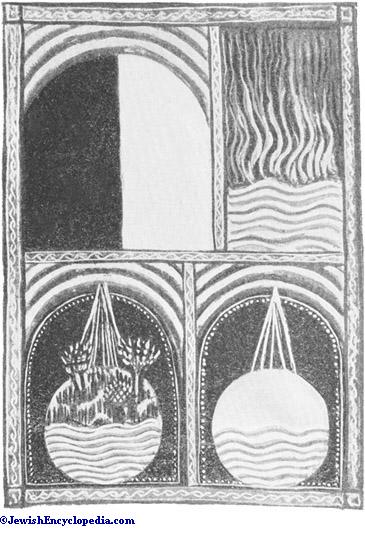
II.II. Sun, Moon, and Stars; Fishes and Birds; Animals and Man; Sabbath Rest.Stages of Creation.(From the Sarajevo Haggadah of the fourteenth century.)
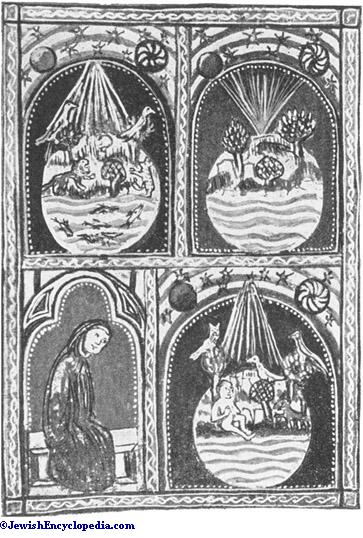
The danger lest speculation on creation might lead to Gnosticism underlies the hesitancy to leave the study of Gen. i. open to all without restriction (Sanh. 37a; Deut. R. ii.; Ḥag. 19b; Midr. Teh. to Ps. cxxxvi.; Midr. ha-Gadol, ed. Schechter, p. 4). That such speculation is of no consequence to the practical religiosity which Judaism means to foster is well expressed in the caution not to "inquire into what was before the world was" (Mishnah Ḥag. ii.; Yer. Ḥag. ii.). See Cabala.
The Alexandrian Jews, under the sway of Platonic and Neoplatonic ideas, conceived of creation as carried into effect through intermediate agencies, though still an act of divine will, while the relation of the agencies to the Godhead is not always clearly defined, so that it is possible to regard them almost as divine hypostases—subdeities, as it were, with independent existence and a will of their own (Alexandrian Philosophy). The divine
Views of Philo.
Philo proceeds to fully develop this idea. The Mosaic account of creation is not to be accepted literally (see Drummond, "Philo Judæus," i. 293). Creation was not in time. "It is folly to suppose that the universe was made in six days, or in time at all." The expression "six days" merely indicates the most perfect arrangement ("De Allegoriis Legum," i. 2: "De Opificiis Mundi," i. 3; "Quod Deus Sit Immutabilis," i. 277). To the question whether the world had no real beginning, he gives, though inconsistent with himself, a negative answer. There was a time when the parts of the cosmos "deified by the heathen" were not; God alone was never non-existent ("Dec. Orac." ii. 190). "For the genesis of anything," he says, "many things must combine: that by which, that out of which, that through which, that on account of which" (= cause, material, instrument, purpose). God is the cause of the cosmos, while the four elements are the material ("De Cherubim," i. 161, 162). Nothing suggests that he regarded this material as other than uncreated. It was there when God arranged the new order of things. God is the demiurge ("De Eo Quod Deterius Potiori Insidiatur," i. 220; "De Plantatione Noe," i. 320; his expressions are
It was not matter, but form, that God praised as good, and acknowledged thus as His creative work. Yet Philo protests that God is "not a demiurge, but a creator." What before was not, He made (
In Medieval Jewish Philosophy.
In the writings of the Jewish philosophers of the Middle Ages, creation is one of the problems most earnestly discussed. It belonged to the "four questions" (Maimonides, "Moreh," i. 71) which were regarded as fundamental. The alternative was between  , Ar.
, Ar.  ("creation"), and
  Ar.
Ar. 
 ("eternity of matter"). The Arabian thinkers and schoolmen were perplexed by the same problem (Munk, "Mélanges," p. 421). They had been moved to discuss the subject by their studies (at second hand) of Plato and Aristotle. The Greek mind could not conceive of creation out of nothing—" Ex nihilo nihil fit."
Plato's
Is the doctrine of the eternity of matter compatible with the Jewish conception of God? On three grounds this has been negatived: (1) It limits God's omnipotence and freedom. (2) It is in conflict with the Biblical account, and denies the possibility of miracles, though the Talmudic theory of miracles would not be affected. "God, when He created the sea, imposed the condition that it should divide itself before Moses' staff" (Ab. v. 9). (3) Great men, such as Moses and the Messiah, would be utterly impossible (Albo, "'Iḳḳarim," i. 12). The first point may be considered cogent, but the two others are not very profound.
In two ways do those of the Jewish philosophers who maintain the creatio ex nihilo attempt to prove their thesis: (1) by demonstrating the necessity of the Creation, and (2) by showing that it is impossible that the world was not created ("Cuzari," v. 18; "Moreh Nebukim," ii. 30). But in order to achieve this, they had first to disprove the arguments of their opponents. These were the same as those with which Mohammedan theologians (see Shahrastani, ii. 199 et seq.) had been confronted. Maimonides (l.c. ii. 14; compare also Aaron b. Elijah, "'Eẓ Ḥayyim," vi., vii.) arranges them into two groups: (1) 
 (cosmological, Schmiedl's terminology), and (2)
  (theological).
In the first group there are the arguments: (a) Motion must be eternal, without beginning. Time is an accident of motion; "timeless (i.e., changeless) motion" and "motionless (i.e., changeless) time" are self-contradictory conceptions; therefore, time has no beginning. (b) The prime arch-matter underlying the four elements must be eternal. "To become" implies taking on form. But primal matter, according to its own presupposition, implied in the concept "prime," has no form; hence it has never "become." (c) Decay and undoing are caused by contradictory elements. But spherical motion excludes contradictory principles, and is without beginningand end. (d) Suppose the world had a beginning; then either its creation was necessary—that is, eternal—or its previous existence was impossible (and thus it might not be now); but if it was possible, then possibility (potentiality) presupposes a subject carrying attributes involving the possibility. This subject could not but be eternal.
In the second group there are the arguments (a) God could not have been a creator in potentia without suffering change in Himself from potentia to reality. What caused this change? (b) The world created in time presupposes some exciting cause for God's will to create. Either God did not previously will to create, or, if He did, He had not the power. The world can not be thought eternal unless we admit defects in God. (c) The world is perfect, the product of God's wisdom. God's wisdom and His essence are coincident. God being eternal, His work must also be eternal. (d) What did God do before the world was?
How did Jewish thinkers meet these positions? They followed in the paths of the Arab Motekallamin. Especially did they lay emphasis on the proof of free determination," which the Arabic logicians had developed ( , Ar. "al-takhṣiṣ"). Admitting no "law of nature," they posited the principle of limitless possibility. Things are as they are, not because they must be so, but because a free Being outside of them wills them to be so. He might also have willed them to be otherwise. He who determines is also He who creates; that is, produces from nothing. The world is as it is because a Being determined its being, preferring its being to its non-being. Matter dependent for form upon another, even if eternal, can not exist. God is by inherent necessity. The fact that matter is as it is, shows that it was created to be as it is by the preference of the Creator.
In historical succession Saadia was the first to take up the problem, especially in his "Emunot" (i. 1-5). He argues for the creation from the irrationality of an endless limitless quantity—a favorite theme among the Motekallamin. His argumentation is extremely obscure. He enumerates thirteen theories concerning creation; among them, first, the Biblical; then that of the atomists; next the theory of emanation and dualism; finally, that in which the four elements are held to be eternal, a theory which he says had many adherents among the Jews.
Ibn Gabirol devotes a large part of his "Meḳor Ḥayyim" to the problem. He does not rely upon Biblical texts. His creation theory is as follows: The prime substance emanated out of itself Will, or the creative Word. This Will mediates between God and the world. From the Will emanated universal matter (element)  , from which came all beings. His position is a sort of pantheism, not altogether Biblical.
Baḥyaibn Pakuda, in "Ḥobot ha-Lebabot," maintains that (1) nothing is self-created; (2) there must be a highest first cause; (3) composition proves generation or creation.
Judah ha-Levi invokes the testimony of tradition in his "Cuzari" (i. 43-68; see also Maimonides' "Moreh," iii. 50; Abravanel, in his  , p. 34). He pleads for the authenticity of the Mosaic account as being corroborated by tradition; by the facts of human speech, which show the common descent of all men; by the identity of the system for counting time; etc.
Abraham bar Ḥiyya Albargeloni is another defender of creation. His "Sefer Hegyon ha-Nefesh" tries to explain the Biblical tradition on mathematical grounds. " "Form" =
  ).
).
Views of Maimonides.
Maimonides is most timid in his defense of creation. He concedes that it can not be proved. The most that can be attempted is to weaken the arguments of the opposition schools ("Moreh," i. 67, 71; see Gersonides to Gen. i.). He endeavors to disprove the eternity of the world as far as he may, and to strengthen whatever seems to favor the contrary theory ("Moreh," i. 13-30). He makes much of Aristotle's indecision concerning the point at issue. He advances "arguments that approximate demonstrations" (see Maimonides, Moses). They have contributed nothing to the solution of the perplexity.
Of his successors, Albalag, Gersonides, and Naḥmanides either reject creation ex nihilo or seriously modify it. Ḥasdai Crescas (in "Or Adonai," iii. 1, 4) criticizes most severely Gersonides' assumptions that matter and God are equally absolute; while the former is void of everything, even of form, the latter is highest perfection. Why should equally absolute and necessary matter submit to the will of God? He charges Gersonides with inconsistencies in denying special providence while assuming the power of God over and in the special particulars of archmatter. His pupil Albo regards the denial of creation ex nihilo as tantamount to the denial of God's perfection ("'Iḳḳarim," i. 23).
The Karaites as a rule accept creatio ex nihilo. It is one of their articles of faith (see "'Eẓ Ḥayyim," xii.). For the speculations of the Cabalists see Cabala. Regarding modern views see Evolution.
Bibliography:
Schmiedl, Studien zur Religionsphilosophie, Vienna, 1869;
J. Guttmann, Die Scholastik des Dreizehnten Jahrhunderts, Breslau, 1902;
idem, Das Verhältniss des Thomas von Aquino zum Judentum, Göttingen, 1891.
—In the Koran and Mohammedan Literature:
The Koran does not contain a descriptive and detailed account of the Creation; but it abounds in allusions to God's power as manifested therein, and in appeals to it in refutation of heretical assumptions (Polytheism; sura xvi.), or in support of certain dogmas (Resurrection; ib. xxii. 1-7). On the whole, these various references show that Mohammed had a general, vague, hearsay acquaintance with both the Biblical and Talmudical traditions of the Jews. "It is God," according to sura xi. 9, "that created the heavens and the earth in six days." Beforecreation "His throne [compare  ] was upon the water" (see Gen. i. 2; suras 1. 37, lvii. 4). Special emphasis is laid on the forming of the mountains, which are said to give stability to the earth (suras xxi. 22, xxxi. 9, xli. 9. lxxviii. 6). In this a reminiscence of the Biblical
  (Deut. xxxiii. 27; compare Ps. xc. 2) is suggested, while the popular conceit of the Arabs has it that the earth, when first created, was smooth and flat, which induced the angels to ask who could stand on so tottering a frame. Thereupon God next morning threw the mountains on it (Sale, "Koran," p. 215, note g, Philadelphia ed., 1876). In the space of four days God distributed nourishment to all that asked (sura xli. 9). The earth and the heavens are said to have been originally a compact mass which God divided, while water is said to be the life-giving element (sura xxi. 9, 31). Things were created after a certain preestablished measure (sura liv. 49; the word "ḳadr" may also be rendered "decree"; but see Baiḍawi, ad loc.). "One word" alone brought the world into being "like the twinkling of an eye" (sura liv. 50). As Baiḍawi remarks, this word was "Kun" (Let there be!), though the statement is also explained to imply that God accomplished His work very easily and quickly, without manual labor or assistance (compare sura l. 37, and Talmudic
 , Ber. R. xii.; see Baiḍawi, ad loc.). Nor did He create in sport (compare rabbinical
  ), but in truth, and for a definite term, to last until the day of final judgment (suras xliv. 35, xlvi. 2; Baiḍawi, ad loc.). With scant consistency, however, Mohammed speaks in another passage of a creation not in six but in two days. Baiḍawi (sura xli. 8) interprets "days" as "turns."
In Mohammedan Tradition.
Mas'udi ("Prairies d'Or," ed. Meynard and Courteille, i. 36 et seq.) gives in detail the following traditional order: "First water, which carried the divine throne, was created. From this primal water God caused a vapor to arise and form the sky. Then He dried the liquid mass, transforming it into one earth, which He split up later into seven. This earth was completed in two days—Sunday and Monday. The earth was placed on a fish that supported it [sura lxviii. 1; compare Pirḳe R. El. ix., and Ginzberg "Die Haggada bei den Kirchenvätern," p. 19, where it is shown that by this fish is meant the leviathan]. This fish and the earth God propped on blocks of stone, resting on the back of an angel, this again on a rock, and this finally on the wind. But the motions of the fish shook the earth mightily, so God put the mountains in place and rendered it stable. The mountains furnished food for earth's tenants. The trees were created during two days—Tuesday and Wednesday. Then God mounted up to the vaporous sky and made of it one heaven, which, in two more days—Thursday and Friday—He split up into seven. Hence the name for Friday, 'Jum'ah, (joining together), 'union' or 'assembly,' because on it the creation of the heavens was united to that of the earth. Then God filled the heavens with angels, seas, icebergs. Creation thus completed, God peopled the earth with the jinn, made of purest fire [sura lv. 14], among them being Iblis, the Devil. When about to create man (Adam), He informed the angels of His intention to make him His vicegerent on earth. The angels made objections [as in the rabbinical legend, Gen. R. viii.]. Gabriel was sent to bring clay from the earth, but the earth refused to supply it. Michael, also sent on the same errand, was unsuccessful. Finally the angel of death went forth, vowing that he would succeed. He brought back earth of various colors, hence the various colors among men. Adam was made of the surface ["adim"] soil. Forty years a portion of such soil was hung up to become a compact mass, and then left for another period of forty years, until the clay became corrupt. To this God then gave human shape, but left it without a soul for one hundred and twenty years. Finally, after enduring many indignities at the hand of Iblis, and being an object of terror to the angels, and at last causing Iblis' banishment, Adam was endowed with divine breath, according to some gradually; and when he was entirely permeated with this divine breath, he sneezed; whereupon God taught him to say: 'Praise be to God! may thy Master have mercy on thee, O Adam!'"
An altogether different account is found in the "Kitab Aḥwal al-Ḳiyamah," edited by Wolff ("Muhammadanische Eschatologie," Leipsic, 1872). The first object created was a tree with four thousand branches—the tree of knowledge; the second, the light of Mohammed—a pearl in the shape of a peacock, which was placed on the tree. Then God made the mirror of shame, placing it so that the peacock saw his reflected image; whereupon shame seized him and he prostrated himself five times before God. The light of Mohammed, too, blushed before God, and in consequence perspired. From the beads of perspiration taken from various parts of the body were created the angels, the upper and lower thrones of God, the tablet of revelation or of decree, the pen, Paradise and Gehenna, sun, moon, and stars, the dividing interval between heaven and earth, the Prophets, the Sages, the martyrs, the pious, the celestial and the terrestrial Ka'bah, the Temple in Jerusalem, the places for the mosques, the Moslems—men and women, the souls of the Jews, the Christians, the Magi, and, finally, the earth from east to west, and all that it contains. This apocalyptic account is comparatively late [but echoes rabbinical traditions concerning the light of the Messiah (Gen. R. i.), the  . Paradise and Gehinnon (Pes. 54a); compare also Slavonic Enoch, xxv.—xxvi.—K.]. As to the theories of creation propounded in the various philosophical schools, see Arabic Philosophy; Aristotle in Jewish Literature; Motekallamin.
Bibliography:
Munk, Mélanges, Paris, 1859;
Maimonides, Moreh Nebukim, ed. Munk, passim;
Dieterici, Ichivan Essafa, Leipsic, 1896;
Steiner, Die Mutaziliten, Leipsic, 1865;
Houtsma, De Strijd over het Dogma, Leyden, 1875.
CREATION.—One of the most convincing proofs of the composite authorship of the Pentateuch has always been found in the existence side by side of two independent and mutually irreconcilable accounts of the creation of the world. The first, Gen 1:1 to Gen 2:4 a, forms the introduction of the Priestly Code (P
In the narrative of J
Much ingenuity has been expended in the effort to bring the Biblical record of creation into accord with the facts disclosed by the modern sciences of Geology and Astronomy. Naturally such constructions confine their operations to the systematic and semi-scientific account of Gen 1:1-31; for it has probably never occurred to any one to vindicate the scientific accuracy of the more imaginative narrative of J
To form a correct estimate of the character and religious value of the first chapter of Genesis, it has to be borne in mind that speculative theories of the origin of the universe were an important element of all the higher religions of antiquity. Many of these cosmogonies (as they are called) are known to us; and amidst all the diversity of representation which characterizes them, we cannot fail to detect certain underlying affinities which suggest a common source, either in the natural tendencies of early thought, or in some dominant type of cosmological tradition. That the Hebrew cosmogony is influenced by such a tradition is proved by its striking likeness to the Babylonian story of creation as contained in cuneiform tablets from Ashurbanipal’s library, first unearthed in 1872. From these Assyriologists have deciphered a highly coloured mythological epic, describing the origin of the world in the form of a conflict between Marduk, god of light and supreme deity of the pantheon of Babylon, and the power of Chaos personified as a female monster named Ti’âmat (Heb. Tĕhôm). Wide as is the difference between the polytheistic assumptions and fantastic imagery of the Babylonian narrative and the sober dignity and elevated monotheism of Genesis, there are yet coincidences in general outline and in detail which are too marked and too numerous to be ascribed to chance. In both we have the conception of chaos as a watery abyss, in both the separation of the waters into an upper and a lower ocean; the formation of the heavenly bodies and their function in regulating time are described with remarkable similarity; special prominence is given to the creation of man; and it may be added that, while the order of creation differs in the two documents, yet the separate works themselves are practically identical. In view of this pervading parallelism, it is clear that the Hebrew and Babylonian cosmogonies are very closely related; and the only question open to discussion is which of them represents more faithfully the primary tradition on which each is based. Looking, however, to the vastly higher antiquity of the Babylonian narrative, to its conformity (even in points which affect the Biblical record) to the climatic conditions of the Euphrates Valley, and to the general indebtedness of Israel to the civilization of Babylon, it cannot reasonably be doubted that the Hebrew narrative is dependent on Babylonian models; though it is of course not certain that the particular version preserved in the tablets referred to is the exact original by which the Biblical writers were influenced.
From this point of view we are able to state the significance of the Scripture account of creation in a way which does justice at once to its unrivalled religious value and to its lack of scientific corroboration. The material is derived from some form of the Babylonian cosmogony, and shares the imperfection and error incident to all pre-scientific speculation regarding the past history of the world. The Scripture writers make no pretension to supernatural illumination on matters which it is the province of physical investigation to ascertain. Their theology, on the other hand, is the product of a revelation which placed them far in advance of their heathen contemporaries, and imparted to all their thinking a sanity of imagination and a sublimity of conception that instinctively rejected the grosser features of paganism, and transformed what was retained into a vehicle of Divine truth. Thus the cosmogony became a classical expression of the monotheistic principle of the OT, which is here embodied in a detailed description of the genesis of the universe that lays hold of the mind as no abstract statement of the principle could do. In opposition to the heathen theogonies, the world is affirmed to have been created, i.e. to have originated in the will of God, whose Personality transcends the universe and exists independently of it. The spirituality of the First Cause of all things, and His absolute sovereignty over the material He employs, are further emphasized in the idea of the word of God as the agency through which the various orders of existence were produced; and the repeated assertion that the world in all its parts was ‘good,’ and as a whole ‘very good,’ suggests that it perfectly reflected the Divine thought which called it into being. When to these doctrines we add the view of man, as made in the likeness of God, and marked out as the crown and goal of creation, we have a body of spiritual truth which distinguishes the cosmogony of Gen 1:1-31 from all similar compositions, and entitles it to rank amongst the most important documents of revealed religion.
John Skinner.
(Latin: creare, to create)
The production of something out of nothing, that is, so that prior to the production of the thing nothing whatever existed that enters into its makeup. Creation, therefore, differs essentially from all other modes of production. Before the tailor can begin his work, the cloth must exist; likewise, the chemist does not produce his new compounds out of nothing, but out of some preexisting substances. Both faith and reason teach us that the origin of the world was by creation. "In the beginning God created heaven, and earth," the Bible proclaims in its opening sentence. Reason arrives at the same conclusion. The world did not emanate from God, as pantheists claim; if it did, it would have Divine attributes. Nor can we assume (as did Anaxagoras and Plato) that the matter of the world is not created, but self-existent; matter is too imperfect for that.
(Latin creatio.) I. DEFINITIONLike other words of the same ending, the term creation signifies both an action and the object or effect thereof. Thus, in the latter sense, we speak of the "kingdoms of creation", "the whole creation", and so on. In the former sense the word sometimes stands for productive activity generally (e.g. to create joy, trouble, etc.), but more especially for a higher order of such efficiency (e.g. artistic creation). In technically theological and philosophical use it expresses the act whereby God brings the entire substance of a thing into existence from a state of non-existence — productio totius substantiâ ex nihilo sui et subjecti. In every kind of production the specific effect had as such no previous existence, and may therefore be said to have been educed ex nihilo sui — from a state of non-existence — so far as its specific character is concerned (e. g. a statue out of crude marble); but what is peculiar to creation is the entire absence of any prior subject-matter — ex nihilo subjecti. It is therefore likewise the production totius substantiæ — of the entire substance. The preposition ex, "out of", in the above definition does not, of course, imply that nihil, "nothing", is to be conceived as the material out of which a thing is made — materia ex quâ — a misconception which has given rise to the puerile objection against the possibility of creation conveyed by the phrase, ex nihilo nihil fit — "nothing comes of nothing". The ex means (a) the negation of prejacent material, out of which the product might otherwise be conceived to proceed, and (b) the order of succession, viz., existence after non-existence. It follows, therefore, that; creation is not a change or transformation, since the latter process includes an actual underlying pre-existent subject that passes from one real state to another real state, which subject creation positively excludes; it is not a procession within the Deity, like the inward emission of the Divine Persons, since its term is extrinsic to God; it is not an emanation from the Divine Substance, since the latter is utterly indivisible; it is an act which, while it abides within its cause (God), has its term or effect distinct therefrom; formally immanent, it is virtually transitive; including, as it does, no motion, and hence no successiveness, it is an instantaneous operation; its immediate term is the substance of the effect, the "accidents" (q. v.) being "con-created"; since the word creation in its passive sense expresses the term or object of the creative act, or, more strictly, the object in its entitative dependence on the Creator, it follows that, as this dependence is essential, and hence inamissible, the creative act once placed is coextensive in duration with the creature’s existence.However, as thus continuous, it is called conservation, an act, therefore, which is nothing else than the unceasing influx of the creative cause upon the existence of the creature. Inasmuch as that influx is felt immediately on the creature’s activity, it is called concurrence. Creation, conservation, and concurrence are, therefore, really identical and only notionally distinguished. Other characteristics there are, the more important of which will come out in what follows. II. HISTORY OF THE IDEA1. The idea of creation thus outlined is intrinsically consistent. Given a personal First Cause possessing infinite power and wisdom, creative productivity would a priori be necessarily one of His perfections, i.e. absolute independence of the external limitations imposed by a material subject whereon to exert His efficiency. Besides, the fecundity which organic creatures possess, and which, in the present supposition, would be derived from that First Cause, must be found typically and eminently in its source. But creative productivity is just the transcendent exemplar of organic fecundity. Therefore, a priori, we should look for it in the First Cause. How the creature is produced, how something comes from nothing, is of course quite unimaginable by us, and extremely difficult to conceive. But this is scarcely less true of any other mode of production. The intimate nexus between cause and effect is in every case hard to understand. The fact, however, of such a connexion is not denied except by a few theorists; and even they continually admit it in practice. Consequently the indistinctness of the notion of creation is no valid reason for doubting its inner coherence. Moreover, though the idea of creation is not, of course, based upon immediate experience, it is the product of the mind’s endeavour, aided by the principle of sufficient reason, to interpret experience. Creation, as will presently appear, is the only consistent solution that has ever been given to the problem of the world’s origin.2. On the other hand, though the idea of creation is self-consistent and naturally attainable by the mind interpreting the world in the light of the principle of causality, nevertheless such is not its actual source. The conception has a distinctly theological origin. The early Christian writers, learning from Revelation that the world was produced from nothing, and seeing the necessity of having a term to designate such an act chose the word creare, which theretofore had been used to express any form of production, e. g. creare consulem (Cicero). The theological usage afterwards passed into modern language. Probably the idea of creation never entered the human mind apart from Revelation. Though some of the pagan philosophers attained to a relatively high conception of God as the supreme ruler of the world, they seem never to have drawn the next logical inference of His being the absolute cause of all finite existence. The truth of creation, while not a mystery — not supernatural in its very nature (quoad essentiam) — is supernatural in the mode of its manifestation (quoud modum). Implicitly natural, it is explicitly revealed. The distinct conception of his created origin which primitive man, as described in Genesis, must have received from his Creator was gradually obscured and finally lost to the majority of his descendants when moral corruption had darkened their understanding; and they substituted for the Creator the fantastic agencies conjured up by polytheism, dualism, and pantheism. The overarching sky was conceived of as divine, and the heavenly bodies and natural phenomena as its children. In the East this gradually gave rise to the identification of God with nature. Whatever exists is but the manifestation of the One — i.e. Brahma. In the West the forces of the universe were separately deified, and a more or less esoteric conception of the Supreme Being as the father of the gods and of man was feebly held by some of the Egyptians and probably by the Greek and Roman sages and priests. The Creator, however, did not leave Himself without witness in the race of men. The descendants of Sem and Abraham, of Isaac and Jacob, preserved the idea of creation clear and pure; and from the opening verse of Genesis to the closing book of the Old Testament the doctrine of creation runs unmistakably outlined and absolutely undefiled by any extraneous element. "In the beginning God created the heavens and the earth." In this, the first, sentence of the Bible we see the fountain-head of the stream which is carried over to the new order by the declaration of the mother of the Machabees: "Son, look upon heaven and earth, and all that is in them: and consider that God made them out of nothing" (2 Maccabees 7:28). One has only to compare the Mosaic account of the creative work with that recently discovered on the clay tablets unearthed from the ruins of Babylon to discern the immense difference between the unadulterated revealed tradition and the puerile story of the cosmogony corrupted by polytheistic myths. Between the Hebrew and the Chaldean account there is just sufficient similarity to warrant the supposition that both are versions of some antecedent record or tradition; but no one can avoid the conviction that the Biblical account represents the pure, even if incomplete, truth, while the Babylonian story is both legendary and fragmentary (Smith, "Chaldean Account of Genesis", New York, 1875). Throughout the New Testament, wherein God’s creative activity is seen to merge with the redemptive, the same idea is continuous, now reaffirmed to the Greek pagan in explicit forms, now recalled to the Hebrew believer by expressions that presuppose it too obvious and fully admitted to need explicit reiteration.3. The extra-canonical books of the Jews, notably the Book of Henoch and the Fourth Book of Esdras, repeat and expand the teaching of the Old Testament on creation; the Fathers and Doctors of the early Church in the East and West everywhere proclaim the same doctrine, confirming it by philosophical arguments in their controversies with Paganism, Gnosticism and Manichæism; while the early Roman symbols, that of Nicæa and those of Constantinople repeat, in practically unvarying phrase, the universal Christian belief "in God the Father Almighty, Creator of Heaven and earth, of all things visible and invisible".4. After the controversy with Paganism and the Oriental heresies had waned, and with the awakening of a new intellectual life through the introduction of Aristotle into the Western schools, the doctrine of creation was set forth in greater detail. The revival of Manichæism by the Cathari (q. v.) and the Albigenses called for a more explicit expression of the contents of the Church’s belief regarding creation. ’This was formulated by the Fourth Lateran Council in 1215 [Denzinger, "Enchiridion", 428 (355)]. The council teaches the unicity of the creative principle — unus solus Deus; the fact of creation out of nothing (the nature of creation is here for the first time, doubtless through the influence of the schools, designated by the formula, condidit ex nihilo); its object (the visible and invisible, the spiritual and material world, and man); its temporal character (ab initio temporis); the origin of evil from the fact of free will.5. The conflict with the false dualism and the emanationism introduced into the schools by the Arabian philosophers, especially Avicenna (1036) and Averroes (1198), brought out the more philosophically elaborated doctrine of creation found in the works of the greater Scholastics, such as Blessed Albert, St. Thomas, and St. Bonaventure. The Aristotelean theory of causes is here made use of as a defining instrument in the synthesis which is suggested by the well-known distich: — Efficiens causa Deus est, formalis idea, Finalis bonitas, materialis hyle(Albert. Magn., Summa, I, Tr. xiii; Q. liv, Vol. XXXI, p. 551 of Bosquet ed., Paris, 1895). On these lines the Schoolmen built their system, embracing the relation of the world to God as its efficient cause, the continuance of creation in God’s conservation thereof and His concurrence with every phase of the creature’s activity; the conception of the Divine idea as the archetypal cause of creation; the doctrine that God is moved to create (speaking by analogy with the finite will) by His own goodness, to which He gives expression in creation in order that the rational creature recognizing it may be led to love it and, by a corresponding mental and moral adjustment thereto in the present life, may attain to its complete fruition in the life to come; in other words that the Divine goodness and love is the source and final cause of creation both active and passive. Thus the application, by a constantly sustained analogy of the three causes — efficient, final, and formal (archetypal) — results in the Scholastic philosophy of creation. There being no previously existing material cause (hyle) of creation, the application of the fourth cause appears in the Scholastic theory on potency and materia prima, the radical and undifferentiated constituent of nature.6. The idea of creation developed by the Scholastics passed without substantial change along that current of modern thought which preserved the essential elements of the Theistic-Christian world-view — that of Descartes, Malebranche, Leibniz — and of course along the continuous stream of traditional teaching within the Catholic Church. In the opposing current it disappears with Spinoza, and gives way to realistic Pantheism; with Fichte, Schelling, and Hegel, its place is taken by some phase of varying idealistic Pantheism; while in our own day Agnosticism (Spencer), materialistic Monism (Hackel), and spiritualistic Monism (Neo-Hegelianism and the New Theology) have been put forward as substitutes. Amongst recent Catholic theologians there is a practically uniform tendency to interpret the traditional and Scriptural data as postulating the creative act to account for the origin of unembodied spirits (the angels), of the primordial matter of the universe, and of the human soul. The development of the universe, the introduction of plant and animal life, the formation of the first human bodies can be explained by the administrative or formative activity of God, an activity which is sometimes called second creation (secunda creatio), and does not demand the creative act as such. Catholic philosophers develop the purely rational arguments for these same positions, except for the origin of the angelic world, which of course lies beyond the sphere of philosophy. The remainder of this article will offer a summary of the aforesaid theological and philosophical positions and their bases. III. ARGUMENTS FOR CREATION1. For the doctrine of the Church on the origin of the spiritual world the reader is referred to the article ANGEL.2. That the material of which the universe is composed was created out of nothing is the implicit, rather than specifically explicit, statement of the Bible. The Scriptural teaching on God and the relation of the universe to Him unmistakably affirms creation. God alone is declared to be underived, self-existent (Exodus 3:14), and in comparison with Him all things else are as nothing (Wisdom 11:23; Isaiah 40:17). God is said to be the beginning and end of all things (Isaiah 48:12; Revelation 1:8); all things else are from Him, and by Him, and in Him (Romans 11:36; 1 Corinthians 8:6; Colossians 1:16). God is the absolute and independent sovereign (Psalm 49:12 and Isaiah 44:24; Hebrews 1:10). That these texts equivalently assert that God is the Creator of all things finite is too obvious to call for further comment. The most explicit Scriptural statement respecting the created origin of the universe is found in the first verse of Genesis: "In the beginning God created heaven and earthy". The objects here designated evidently comprise the material universe; whether the originative act is to be understood as specifically creative, depends upon the meaning of the Hebrew verb bara. On this point the following interpretations by unimpeachable authority may be adduced. Gesenius says: "The use of this verb [bara] in Kal, the conjugation here employed, is entirely different from its primary signification (to cut, shape, fashion); it signifies rather the new production of a thing than the shaping or elaborating of the pre-existing material. That the first verse of Genesis teaches that the original creation of the world in its rude and chaotic state was from nothing while the remaining part of the chapter teaches the elaboration and distribution of the matter thus created, the connection of the whole section shows sufficiently clearly" (Thesaurus, p. 357 b). Mühlan and Volck in the new edition of Gesenius’ "Handwörterbuch" say: "Bara is used only of Divine creation and never with an accusative of the material". Dillmann (Genesis 1) notes: "The Hebrews use only the conjugation Piel (intensative) in speaking of human ’forming’ or ’shaping’, while on the other hand they use only Kal in speaking of creation of God". Delitzsch says: (Gen., p. 91) "The word bara in its etymology does not exclude a previous material. lilt has, as the use of Kal shows, the fundamental idea of cutting or hewing. But as In other languages words which define creation by God have the same etymological idea at their root, so bara has acquired the idiomatic meaning of a divine creating, which, whether in the kingdom of nature, or of history, or of the spirit, calls into being that which hitherto had no existence. Bara never appears as the word for human creation, differing in this from the synonyms asah, yatzar, yalad, which are used both of men and of God; it is never used with an accusative of the material, and even from this it follows that it defines the divine creative act as one without any limitations, and its result, as to its proper material, as entirely new; and, as to its first cause, entirely the creation of divine power." Again Kalisch observes (Gen., p. 1): "God called the universe into being out of nothing; not out of formless matter coeval with Himself" (Geikie, Hours with the Bible, I, 16).3. The patristic teaching as to the created origin of the world is too explicit and well known to require citation here. The few ambiguous expressions occurring in the works of Origen and Tertullian are more than counterbalanced by other unmistakable declarations of these same writers, while their at most exceptional divergencies are as nothing in comparison with the unanimous and continuous teaching of the other Fathers and Doctors of the Church.4. Approaching the problem of origin from the purely rational side, we find the field preoccupied almost from the beginning of the history of philosophy by two directly opposite solutions: one maintaining that the world-matter is self-existent, underived from any extraneous source, and hence eternal; the world has therefore attained its present complex condition by a gradual evolutionary process from an original, simple, undifferentiated state (materialistic Monism); the other asserting that the world is derived from an extraneous cause, either by emanation from or evolution of the Divine being (Pantheism) or by creation (Creationism). Creationism, though an essentially philosophical solution, is never found divorced from Revelation. Materialistic Monism includes a varying number of philosophies; but all agree in maintaining that the world-matter is eternal, unproduced, and absolutely indestructible. They differ in that some attribute the formation of the universe to chance (the ancient Atomists), others to a sort of ubiquitous cosmical life or world-soul (Anaxagoras, Plato, Panpsychists, Fechner, Lotze, Paulsen), others to forces essentially inherent in matter (Feuerbach, Büchner, Häckel). Against materialistic Monism Catholic philosophers (Creationists) argue thus: The world-matter is not self-existent; for what is self-existent is essentially necessary, immutable, absolute, infinite. But the world-matter is not necessary; its essence as such furnishes no reason why it should exist rather than not exist, nor why it is definitely determined as to number, extension, and space. It is not immutable, for it undergoes incessant change; not absolute, since it depends upon the natural forces which condition its states; not infinite as to extent, since, being extended, it is numerable, and hence finite; nor infinite in active power, since it is inert and essentially limited by external stimulation. The aggregate of natural forces must also be finite, otherwise there could be no change, no laws of inertia, no constancy and equivalence of energy. The world-substance is not eternal. For that substance must be conceived either as possessing eternal motion or not. If eternally active it would have passed through an infinite number of changes, which is self-contradictory. Moreover, the supposed evolutionary process would not have begun so late as geology teaches that it did, and would long since have come to an end, i. e. to a static equilibrium of forces according to the law of entropy. If the primal matter was not endowed with an eternal activity, evolution could not have begun — not from within, the law of inertia forbidding; nor from without, since the materialistic hypothesis admits no extraneous cause. Moreover, since chance is no cause, but the negation thereof, some reason must be assigned for the differentiation of the original material into the various chemical elements and compounds. That reason may be supposed. either intrinsic or extrinsic to the primary matter. If intrinsic, it does not explain why just these elements (or compounds) in kind and number become differentiated; if extrinsic, the supposition contradicts the very basis of materialism which negates transmaterial agency.A similar line of argument may be used to prove the impossibility of explaining, on the materialistic hypothesis, the order prevailing everywhere throughout the universe. To the counter argument that, given an infinite series of atomic arrangements, the present order must needs result, it may be answered: the origin of both atoms and motion still remains unexplained; an infinite series of combinations would demand infinite time, while geology indicates a limited time for the earth’s formation; some sort of order might result from a chance concurrence of atoms, but no constant and universal order; the present order presupposes some disposition of the elements for this rather than another order.Now the question still remains: Whence came precisely this disposition, and why did not the atoms concur in a way unfavourable to a continuous evolution, since the number of possible arrangements of an infinite number of atoms must be infinite?The hypothesis of a world-soul exhibits another coup of inconsistencies. If the universe were "informed" by a principle of life, there would not be that essential difference between inanimate and animate bodies which both science and philosophy establish; inanimate bodies would manifest signs of life, such as spontaneous and immanent activity, organs, etc. The materialistic principle, "No matter without force, no force without matter" (Büchner), though, with some obvious qualification, true as to its first part, is untrue as to its second. Force is the proximate principle of action, and may be or not be, but it is not of necessity conjoined with matter. The principle of action in man is not intrinsically dependent on matter. — For the development of these and more serious arguments against materialistic Monism see "Institutiones Philosophiæ Naturalis", by Willems or Pesch.Pantheistic differs from materialistic Monism in asserting a being, in some sense unitary, which unfolds itself in the material universe and in human consciousness. That such a being is called "God" is an obvious misuse of language. Moreover, God is indivisible, spiritual, eternal, necessary, immutable, omnipresent, absolute, and cannot, therefore, "evolve" into a universe of matter which possesses just the contrary attributes. For a like reason bodies cannot be modes, either real (Spinoza) or logical (Hegel), of the divine substance. Since, then, the world-material is not self-existent, but produced, and that not from some antecedent material (for such a supposition would only defer and not solve the problem); since, moreover, the world-substance has not emanated from the divine nature, it follows that it must have been produced by some extraneous cause, from no pre-existing materia, i. e. it must have been created. That that extraneous cause is God, the self-existent, necessary, absolute, infinite, and consequently personal Deity, is proved from the finality and order manifest in the cosmos that has developed from the original material, which order demands an efficient and a directive cause of supreme if not infinite intelligence; and from the further fact that the creative act can proceed only from a truly infinite and therefore personal agent, as will be shown towards the end of this article.To the question: In what condition was the world-matter created, whether homogeneous or differentiated into various specific substances? neither Revelation nor science gives answer. Until lately the practically universal opinion of Catholic philosophers favoured an original essential differentiation of the elements. Since, however, the tendency of physico-chemical experimentation and inference now points with some probability to a radical homogeneity of matter, and since philosophy is bound to reduce the world to its fewest and simplest principles, the opinion seems justified that the original matter was created actually undifferentiated, but with inherent potency toward elemental and, subsequently, compound diversification through the action, reaction, and grouping of the ultimate particles.When — probably through some such processes as are suggested by the well-known nebular hypothesis (Kant, Laplace) and by the inductions of geology — the material universe was disposed for the simplest forms of life, then God said: "Let the earth bring forth the green herb, and such as may seed, and the fruit tree yielding fruit after its kind, which may have seed in itself upon the earth. And it was so done" (Genesis 1:11) — the work of the third creative day. At a subsequent, "God created the great whales and every living and moving creature, which the waters brought forth, according to their kinds, and every winged fowl according to its kind" (ib., 21) — the work of the fifth day. And again, "God said: Let the earth bring forth the living creature in its kind, cattle and creeping things, and beasts of the earth, according to their kinds. And it was so done. And God made the beasts of the earth according to their kinds, and cattle, and every thing that creepeth on the earth after its kind" (ib., 24, 25) — part of the work of the sixth day. In these simple words the inspired author of Genesis describes the advent of life, plant and animal, on our earth. It does not fall within the scope of the present article to discuss the various meanings that have been assigned to "the days of creation". Suffice it to say that Catholic exegetes are allowed the widest liberty of interpretation compatible with the obvious substance and purport of the sacred narrative, viz., that God is "the creator of heaven and earth". Accordingly, we find some theologians following St. Augustine (In Gen. ad litt., I), that the six days signify only a logical (not a real) succession, i. e. in the order in which the creative works were manifested to the angels. Others interpret the days as indefinite cosmical periods. Others, though these are at present a vanishing number, still follow the literal interpretation. An immense amount of time, patient research, and ingenuity has been spent in the task of harmonizing the successive stages of terrestrial evolution, as deciphered by geologists from the records of the rocks, with the Mosaic narrative; but the highest tribute to the success of these efforts is that they more or less graphically corroborate what must be already a priori certain and evident, at least to the believer, that between the truth of Revelation and the truth of science there is, and can be, no discord. But whatever may be thought of the effort to vindicate in detail the parallelism claimed to exist between the geological succession of living forms and the order described in the Bible, it is certain that some general parallelism exists; that the testimony of the strata corroborates the story of the Book, according to which the lowliest forms of plant life, "the green herb", appeared first, then the higher, "the seed-bearing tree", followed in turn by the simpler animal types, the water creature and the winged fowl, and finally by the highest organisms, "the beasts of the earth and the cattle". IV. CREATION AND EVOLUTIONIf now, from the general interpretation of the Biblical account of creation, we turn to the biologico-philosophical problems which it suggests, and which revert to it for what solution it may have to offer, we find Catholic thinkers exercising an equally large liberty of speculation. "Considered in connection with the entire account of creation", says a recent eminent Jesuit exegete, "the words of Genesis cited above proximately maintain nothing else than that the earth with all that it contains and bears, together with the plant and animal kingdoms, has not produced itself nor is the work of chance; but owes its existence to the power of God. However, in what particular manner the plant and animal kingdoms received their existence: whether all species were created simultaneously or only a few which were destined to give life to others: whether only one fruitful seed was placed on mother earth, which under the influence of natural causes developed into the first plants, and another infused into the waters gave birth to the first animals — all this the Book of Genesis leaves to our own investigation and to the revelations of science, if indeed science is able at all to give a final and unquestionable decision. In other words, the article of faith contained in Genesis remains firm and intact even if one explains the manner in which the different species originated according to the principle of the theory of evolution" (Knabenbauer, "Stimmen aus Maria-Laach", XIII, 74; cf. Muckermann, "Attitude of Catholics towards Darwinism and Evolution", 78.) The two general biological problems connected with the Biblical cosmogony are the origin of life and the succession of organisms. Concerning both these problems all that Catholic Faith teaches is that the beginnings of plant and animal life are due in some way to the productive power of God. Whether, with St. Augustine and St. Thomas, one hold that only the primordial elements, endowed with dispositions and powers (rationes seminales) for development, were created in the strict sense of the term, and the rest of nature — plant and animal life — was gradually evolved according to a fixed order of natural operation under the supreme guidance of the Divine Administration (Harper, "Metaphysics of the School", II, 746); or whether, with other Fathers and Doctors of the School, one hold that life and the classes of living beings — orders, families, genera, species — were each and all, or only some few, strictly and immediately created by God — whichever of these extreme views he may deem more rational and better motived, the Catholic thinker is left perfectly free by his faith to select. It is well known that the theory of spontaneous generation of certain animalculæ, worms, insects, etc. was held by theologians and philosophers alike until comparatively recent times, until, indeed, experimental evidence demonstrated the opposite thesis. The establishment of the universal truth of biogenesis (q. v.), omne vivum ex vivo, was then seen to corroborate the teaching of the Bible, that life, plant and animal, is due to the Divine productive agency. Since the characteristics of living substance are contrary to those of the non-living substance, the characteristics of life being spontaneity and immanent activity, those of inanimate matter being inertia and transitive activity, the Divine efficiency, to which the origin and differentiation of life are ascribed, has received the distinctive name of administration. The idea conveyed by the latter term is thus explained by a philosopher who has drawn it out from the suggestion supplied by St. Thomas. (De Potentiâ, Q. iv.) Though God can operate as He does in the creative act, without the cooperation of the creature, it is absolutely impossible for the creature to elicit even the smallest act without the co-operation of the Creator. Now the Divine Administration includes this and more, two things, namely, as regards the present subject. The one is the constant order, the natural laws, of the universe. Thus, e.g., that all living things should be ordinately propagated by seed belongs to the Divine Administration. The second, which may be called exceptional, relates to the initial organisms, the first plant, fish, bird, and beast, upon which hereditary propagation must have subsequently succeeded. That these original pairs should have been evolved out of the potency of matter without parentage — that the matter, otherwise incapable of the task, should have been proximately disposed for such evolution — belongs to a special Divine Administration. In other words, God must have been the sole efficient cause — utilizing, of course, the material cause — of the organization requisite, and hence may strictly be said to have formed such pairs, and in particular the human body, out of the pre-existent matter (Harper, op. cit., 743). It need hardly be said that the distinctions between creation and co-operation, administration and formation, are not to be considered as subjectively realized in God. They are only so many aspects which the analytical mind must take note of in the fundamental and essential relation of dependence — contingency — in which the creature stands to the First Cause. For a sympathetic account of the relation of Evolutionism to Creationism, the reader may be referred to Muckermann (who has popularized Wasmann’s technical illustrations of specific transformations among the ant-guests), Harper, Mivart, Guibert, Didiot, Farges, etc., mentioned in the bibliography below. A more vigorous criticism of Evolutionism is to be found in the works of Gerard, Gutberlet, Pesch, Willems, Hunter, Thein, and Hughes. V. FINAL CAUSE OF CREATIONSince the production of something from nothing, the bridging of the chasm between non-existence and existence demands infinite power, and since the reason for the action of an infinite being must lie within that being Himself, the primary subjective motive of creation must be the Creator’s love of His own intrinsic goodness. The love of that absolute good is conceived by us as "inducing" the Creator to give it an extrinsic embodiment (creation in its passive sense, the universe). The type-idea according to which this embodiment is constructed must exist within the Creator’s intelligence and as such is called the "exemplary" or archetypal cause of creation (passive). The objective realization hereof is the absolute final objective end, or final cause, of creation. In the material universe this realization, exhibited in the purposiveness of each individual part conspiring to the purposiveness of the whole, remains imperfect and is but a vestige of the original design. In the rational creature it reaches a certain completeness, inasmuch as man’s personality, with its intellectual and volitional endowments, is a sort of (analogous) "image" of the Creator, and, as such, a more perfect realization of the creative plan. Moreover, in man’s consciousness the creative purpose comes to explicit manifestation and reflective recognition. His intelligent reaction thereon by reverential attitude and orderly conduct realizes the absolutely final purpose of creation, the actual "formal glorifying" of the Creator, so far as that is possible in the present life. But even as the orderly or normal activity of the individual organisms and subordinate parts of the universe develop and complete those organisms and parts, so man’s rational conduct perfects him and, as a consequence, results in a state of happiness, the full complement whereof is attainable, however, only in a life beyond the present. This completion and happiness of man are said to be the relatively ultimate end of creation, and thereby the creative plan is absolutely completed, the Creator finally explicitly formally glorified by the return of the creation, carried up by and in man to conscious inter-communion with the Source and End of the creative act. Lactantius thus sums up the hierarchy of finality in creation: "The world was made that we might be born. We were born that we might know God. We know Him that we may worship Him. We worship Him that we may earn immortality. We are rewarded with immortality that, being like unto the angels, we may serve Our Father and Lord forever, and be the eternal kingdom of God" (Instit., VII, vi). When man is said to be the (relatively) ultimate end of creation, this obviously does not exclude other coexistent and subordinate purposes. VI. CREATION THE PREROGATIVE OF GOD ALONEThe Fourth Lateran Council defined that "God is the sole principle of all things visible and invisible, the creator of all" [Denzinger, op. cit., 428 (355)]; and the Bible throughout ascribes the creative act to Him alone: "I am the Lord, that make all things . . . and there is none with me" (Isaiah 44:24; cf. 40:25; Psalm 135:4). As to the question, whether it is intrinsically possible for a creature to be endowed with creative power, theologians answer with a distinction.(1) No creature can possibly be a principal cause of creation. This is the unanimous teaching of the Fathers. The philosophical reasons are: the creative act, being absolutely independent of material and instrument, supposes an absolutely independent subject (agent); the term of the creative act is the complete substance of the effect (spiritual or material), and the act can extend indefinitely to whatever is intrinsically possible, while the act of the created agent reaches only to the accidents, or partial constituents, of bodies, and is definitely limited in range; the creative act produces its effects by will alone; it is immanent, while its term is extraneous; it is as unlimited as is the extent of will power; it is instantaneous. No finite cause can thus operate.(2) Some theologians (Peter the Lombard and Suarez) have thought that a creature might be used by God as an instrumental cause of creation. The general opinion, however, is to the contrary, on the ground that since creation excludes materia ex quâ there is no subject whereon the dispositive influence of an instrument could be exerted.God was absolutely free to create or not to create, and to create the present or any possible world. This is an article of Catholic Faith defined by the Vatican Council (Can., De Deo Creante, v). It is the explicit teaching of Scripture, God "worketh all things according to the counsel of his will" (Ephesians 1:11), and of the Fathers generally. It is an obvious rational deduction from the infinitude and absolute self-sufficiency of God. The creative act, as a subjective aspect of the Divine Will, is necessary, but the external positing of a term is free. This doctrine of creative freedom excludes the exaggerated optimism of Leibniz and others, who held that God was bound to create the best possible world. The Divine act must be perfect, but the effect need not, and indeed cannot, be absolutely perfect; the creature being necessarily finite, a more perfect creature is always possible and creatable by infinite power. The world is the very best possible for the Creator’s purpose; it is relatively, not absolutely, perfect. (See OPTIMISM.) VII. THE WORLD WAS CREATED IN TIME, NOT FROM ETERNITYThe Vatican Council defined that God created ab initio temporis. The opening words of Genesis, "In the beginning God created", are re-echoed in similar phrases throughout the Bible. The Fathers reiterate the same teaching. As to the question, whether eternal creation is intrinsically possible, St. Thomas, in his solicitude that infidels might have no ground to cavil with the arguments which believers assign for the temporal origin of creation (passive), says: "That the world has not always existed is held by faith alone, and cannot be demonstrated" (Summa, I, Q. xlvi, a. 2). St. Bonaventure and many others maintain that the inherent impossibility of eternal creation is demonstrable. Arguments too subtle for discussion here are adduced by both sides of the controversy. VIII. SPECULATIVE AND PRACTICAL POSITION OF THE DOCTRINE OF CREATIONFrom what has been said it follows that belief "in God the Creator of heaven and earth" is the theoretical basis of all religious and theological truth, the real foundation underlying all other truths concerning God, and the objective principle whence all other truths proceed. The Incarnation completes in the supernatural order the creative purpose and plan by the Divine Personal Idea, the Word, assuming to Himself man’s nature, wherein the natural order of creation is synthesized, and thus carrying back completely the whole creation to its origin and end. The Redemption, the Church, and the sacramental system are obviously the extension of the Incarnation, and so, through the medium of the latter mystery, follow from creation. The proposition that the Infinite is the absolutely primary source of all other reality is also the first philosophical truth, not of course in our order of attainment but in itself. All created being, truth, goodness, beauty, perfection are eminently contained in the Creator’s essence, conceptually in His creative intelligence, potentially in His creative omnipotence, and are determined to their measure of actual objective existence by the creative will. The real distinction of the finite from the Infinite opposes every form of exaggerated monism, while the entitative contingency and dependence of the creature on the Creator refutes an exaggerated dualism. A rational mediating dualistic monism is based on the truth of creation. Lastly, the end and purpose of creation sets before man the first ideal and norm of life; and thus the final reason of the distinction between right and wrong conduct is found in the conformity of the one and the difformity of the other with the orginal exemplar in the Creator’s mind. Acting up to his complete nature, man is at once self-consistent and accordant proximately with the created copy and hence mediately accordant with the original pattern in the eternal design of his Creator.(See COSMOLOGY, COSMOGONY, EVOLUTION, GOD, LIFE, MAN, SOUL, WORLD, MATERIALISM, PANTHEISM.)-----------------------------------HARPER, Metaphysics of the School (New York, 1881), II; MIVART, Lessons from Nature (New York, 1876); ID., Genesis of Species (New York, 1871); GUIBERT, Les origines, tr. In the Beginning (New York, 1901); GERARD. Evolutionary Philosophy and Common Sense (London, 1902); MUCKERMANN, Attitude of the Catholics towards Darwinism and Evolution (St. Louis, 1906); HUGHES, Principles of Anthropology and Biology (New York, 1890); CLERKE, Modern Cosmogonies (London, 1905); THEIN, Christian Anthropology (New York, 1881); VAUGHAN, Faith and Folly (London, 1901); HUNTER, Outlines of Dogmatic Theology (New York 1906), II; WILHELM AND SCANNELL, Manual of Catholic theology (New York, 1890), I; McCOSH, Realistic Philosophy (New York, 1881); WALLACE, Darwinism (New York, 1881); SHIELDS, Ultimate Philosophy (New York, 1905), III; CROLL Basis of Evolution (London, 1890); WILLEMS, institutiones Philosophiæ (Treves, 1906) II; PESCH, Welträtsel (Freiburg, 1907); Prælectiones Philosophiæ Naturalis (Freiburg, 1897); DIDIOT, Contribution philosophique à l’étude des sciences (Lille, 1902); GUTBERLET, Apologetik (Münster, 1895); Der Mensch (Münster, 1905); MERCIER, La psychologie, (Louvain, 1905); FARGES, La vie et l’évolution des espèces (Paris, 1894); PESCH, Prælectiones Dogmaticæ; De Deo Creante (Freiburg, 1895); VAN NOORT, De Deo Creante (Amsterdam, 1903); PINARD in Dict. de théol. cath., s. v. — the most thorough and best documented monograph on the subject.F.P. SIEGFRIED Transcribed by Douglas J. Potter Dedicated to the Sacred Heart of Jesus Christ The Catholic Encyclopedia, Volume IVCopyright © 1908 by Robert Appleton CompanyOnline Edition Copyright © 2003 by K. KnightNihil Obstat. Remy Lafort, CensorImprimatur. +John M. Farley, Archbishop of New York
1. Creation as Abiding
2. Mistaken Ideas
3. True Conception
4. The Genesis Cosmogony
5. Matter Not Eternal
6. “Wisdom” in Creation
7. A Free, Personal Act
8. Creation and Evolution
9. Is Creation Eternal?
10. Creation Ex Nihilo
11. From God’s Will
12. Error of Pantheism
13. First Cause A Necessary Presupposition
14. The End - The Divine Glory
Literature
1. Creation as Abiding
Much negative ground has been cleared away for any modern discussion of the doctrine of creation. No idea of creation can now be taken as complete which does not include, besides the world as at first constituted, all that to this day is in and of creation. For God creates not being that can exist independently of Him, His preserving agency being inseparably connected with His creative power. We have long ceased to think of God’s creation as a machine left, completely made, to its own automatic working. With such a doctrine of creation, a theistic evolution would be quite incompatible.
2. Mistaken Ideas
Just as little do we think of God’s creative agency, as merely that of a First Cause, linked to the universe from the outside by innumerable sequences of causes and effects. Nature in her entirety is as much His creation today as she ever was. The dynamic ubiquity of God, as efficient energy, is to be affirmed. God is still All and in All, but this in a way sharply distinguished from pantheistic views, whether of the universe as God, or of God as the universe. Of His own freedom He creates, so that Gnostic theories of natural and necessary emanation are left far behind. Not only have the “carpenter” and the “gardener” theories - with, of course, the architect or world-builder theory of Plato - been dismissed; not only has the conception of evolution been proved harmonious with creative end, plan, purpose, ordering, guidance; but evolutionary science may itself be said to have given the thought of theistic evolution its best base or grounding. The theistic conception is, that the world - that all cosmic existences, substances, events - depend upon God.
3. True Conception
The doctrine of creation - of the origin and persistence, of all finite existences - as the work of God, is a necessary postulation of the religious consciousness. Such consciousness is marked by deeper insight than belongs to science. The underlying truth is the anti-patheistic one, that the energy and wisdom - by which that, which was not, became - were, in kind, other than its own. For science can but trace the continuity of sequences in all Nature, while in creation, in its primary sense, this law of continuity must be transcended, and the world viewed solely as product of Divine Intelligence, immanent in its evolution. For God is the Absolute Reason, always immanent in the developing universe. Apart from the cosmogonic attempts at the beginning of Genesis, which are clearly religious and ethical in scope and character, the Old Testament furnishes no theoretic account of the manner and order in which creative process is carried on.
4. The Genesis Cosmogony
The early chapters of Genesis were, of course, not given to reveal the truths of physical science, but they recognize creation as marked by order, continuity, law, plastic power of productiveness in the different kingdoms, unity of the world and progressive advance. The Genesis cosmogony teaches a process of becoming, as well as a creation (see EVOLUTION). That cosmogony has been recognized by Haeckel as meritoriously marked by the two great ideas of separation or differentiation, and of progressive development or perfecting of the originally simple matter. The Old Testament presents the conception of time-worlds or successive ages, but its real emphasis is on the energy of the Divine Word, bringing into being things that did not exist.
5. Matter Not Eternal
The Old Testament and the New Testament, in their doctrine of creation, recognize no eternal matter before creation. We cannot say that the origin of matter is excluded from the Genesis account of creation, and this quite apart from the use of
6. “Wisdom” in Creation
In Old Testament books, as the Psalms, Proverbs, and Jeremiah, the creation is expressly declared to be the work of Wisdom - a Wisdom not disjoined from Goodness, as is yet more fully brought out in the Book of Job. The heavens declare the glory of God, the world manifests or reveals Him to our experience, as taken up and interpreted by the religious consciousness. The primary fact of the beginning of the time-worlds - the basal fact that the worlds came into being by the Word of God - is something apprehensible only by the power of religious faith, as the only principle applicable to the case (Heb 11:3). Such intuitive faith is really an application of first principles in the highest - and a truly rational one (see LOGOS). In creation, God is but expressing or acting out the conscious Godhood that is in Him. In it the thought of His absolute Wisdom is realized by the action of His perfect Love. It is philosophically necessary to maintain that God, as the Absolute Being, must find the end of creation in Himself. If the end were external to, and independent of, Him, then would He be conditioned thereby.
7. A Free, Personal Act
What the religious consciousness is concerned to maintain is, the absolute freedom of God in the production of the universe, and the fact that He is so much greater than the universe that existence has been by Him bestowed on all things that do exist. The Scriptures are, from first to last, shot through with this truth. Neither Kant nor Spencer, from data of self-consciousness or sense-perception, can rise to the conception of creation, for they both fail to reach the idea of Divine Personality. The inconceivability of creation has been pressed by Spencer, the idea of a self-existent Creator, through whose agency it has been made, being to him unthinkable. As if it were not a transparent sophism, which Spencer’s own scientific practice refuted, that a hypothesis may not have philosophical or scientific valuee, because it is what we call unthinkable or inconceivable. As if a true and sufficient cause were not enough, or a Divine act of will were not a vera causa. Dependent existence inevitably leads thought to demand existence that is not dependent.
8. Creation and Evolution
Creation is certainly not disproved by evolution, which does not explain the origin of the homogeneous stuff itself, and does not account for the beginning of motion within it. Of the original creative action, lying beyond mortal ken or human observation, science - as concerned only with the manner of the process - is obviously in no position to speak. Creation may, in an important sense, be said not to have taken place in time, since time cannot be posited prior to the existence of the world. The difficulties of the ordinary hypothesis of a creation in time can never be surmounted, so long as we continue to make eternity mean simply indefinitely prolonged time. Augustine was, no doubt, right when, from the human standpoint, he declared that the world was not made in time, but with time. Time is itself a creation simultaneous with, and conditioned by, world-creation and movement. To say, in the ordinary fashion, that God created in time, is apt to make time appear independent of God, or God dependent upon time. Yet the time-forms enter into all our psychological experience, and a concrete beginning is unthinkable to us.
9. Is Creation Eternal?
The time-conditions can be transcended only by some deeper intuition than mere logical insight can supply - by such intuitive endeavor, in fact, as is realized in the necessary belief in the self-existent God If such an eternal Being acts or creates, He may be said to act or create in eternity; and it is legitimate enough, in such wise, to speak of His creative act as eternal. This seems preferable to the position of Origen, who speculatively assumed an eternal or unbeginning activity for God as Creator, because the Divine Nature must be eternally self-determined to create in order to the manifestation of its perfections. Clearly did Aquinas perceive that we cannot affirm an eternal creation impossible, the creative act not falling within our categories of time and space. The question is purely one of God’s free volition, in which - and not in “nothing” - the Source of the world is found.
10. Creation Ex Nihilo
This brings us to notice the frequently pressed objection that creation cannot be out of nothing, since out of nothing comes nothing. This would mean that matter is eternal. But the eternity of matter, as something other than God, means its independence of God, and its power to limit or condition Him. We have, of course, no direct knowledge of the origin of matter, and the conception of its necessary self-existence is fraught with hopeless difficulties and absurdities. The axiom, that out of nothing nothing comes, is not contradicted in the case of creation. The universe comes from God; it does not come from nothing. But the axiom does not really apply to the world’s creation, but only to the succession of its phenomena. Entity does not spring from non-entity. But there is an opposite and positive truth, that something presupposes something, in this case rather some One - aliquis rather than aliquid.
11. From God’s Will
It is enough to know that God has in Himself the powers and resources adequate for creating, without being able to define the ways in which creation is effected by Him. It is a sheer necessity of rational faith or spiritual reason that the something which conditions the world is neither
12. Error of Pantheism
In this sense, its beginning may be said to be relative rather than absolute. God is always antecedent to the universe - its prius, Cause and Creator. It remains an effect, and sustains a relation of causal dependence upon Him. If we say, like Cousin, that God of necessity creates eternally, we run risk of falling into Spinozistic pantheism, identifying God, in excluding from Him absolute freedom in creation, with the impersonal and unconscious substance of the universe. Or if, with Schelling, we posit in God something which is not God - a dark, irrational background, which original ground is also the ground of the Divine Existence - we may try to find a basis for the matter of the universe, but we are in danger of being merged - by conceptions tinged with corporeity - in that form of pantheism to which God is but the soul of the universe.
The universe, we feel sure, has been caused; its existence must have some ground; even if we held a philosophy so idealistic as to make the scheme of created things one grand illusion, an illusion so vast would still call for some explanatory Cause. Even if we are not content with the conception of a First Cause, acting on the world from without and antecedently in time, we are not yet freed from the necessity of asserting a Cause. An underlying and determining Cause of the universe would still need to be postulated as its Ground.
13. First Cause a Necessary Presupposition
Even a universe held to be eternal would need to be accounted for - we should still have to ask how such a universe came to be. Its endless movement must have direction and character imparted to it from some immanent ground or underlying cause. Such a self-existent and eternal World-Ground or First Cause is, by an inexorable law of thought, the necessary correlate of the finitude, or contingent character of the world. God and the world are not to be taken simply as cause and effect, for modern metaphysical thought is not content with such a mere ens extra-mundanum for the Ground of all possible experience. God, self-existent Cause of the ever-present world and its phenomena, is the ultimate Ground of the possibility of all that is.
14. The End - The Divine Glory
Such a Deity, as causa sui, creatively bringing forth the world out of His own potence, cannot be allowed to be an arbitrary resting-place, but a truly rational Ground, of thought. Nor can His Creation be allowed to be an aimless and mechanical universe: it is shot through with end or purpose that tends to reflect the glory of the eternal and personal God, who is its Creator in a full and real sense. But the Divine. action is not dramatic: of His working we can truly say, with Isa 45:15, “Verily thou art a God that hidest thyself.” As creation becomes progressively disclosed to us, its glory, as revealing God, ought to excite within us an always deeper sense of the sentiment of Psa 8:1, Psa 8:9, “O Yahweh our Lord, how excellent is thy name in all the earth!” See also ANTHROPOLOGY; EARTH; WORLD.
Literature
James Orr, Christian View of God and the World, 1st edition, 1893; J. Iverach, Christianity and Evolution, 1894; S. Harris, God the Creator and Lord of All, 1897; A. L. Moore, Science and the Faith, 1889; B. P. Bowne, Studies in Theism, new edition, 1902; G. P. Fisher, Grounds of Theistic and Christian Belief, new edition, 1902; J. Lindsay, Recent Advances in Theistic Philosophy of Religion, 1897; A. Dorner, Religionsphilosophie, 1903; J. Lindsay, Studies in European Philosophy, 1909; O. Dykes, The Divine Worker in Creation and Providence, 1909; J. Lindsay, The Fundamental Problems of Metaphysics, 1910.
A basic Christian belief is that God created all things, and that all three persons of the godhead were involved in the acts of creation. God spoke and, by the power of his creative word, it happened (Gen 1:1-3; Job 33:4; Psa 33:6; Psa 33:9; Psa 102:25; Joh 1:1-3; Heb 1:1-2).
The Creator and the universe
God alone is eternal; therefore, before his initial act of creation, nothing existed apart from him. He created all things, visible and invisible. Even spirit beings, though they may have existed before the physical universe, are creatures whom God has made (Gen 1:1-2; Job 38:4-11; Psa 33:6-9; Psa 90:2; Isa 40:26-28; Isa 42:5; Joh 1:1-3; Rom 11:36; Col 1:16; Heb 11:3; Rev 4:11). Once God had created matter, he used the materials of the universe to make and develop the features of the universe. He made animals and humans, for example, out of materials he had made earlier (Gen 2:7; Gen 2:19).
Having created the universe, God did not then leave it to itself, as if it were like a huge clock that he wound up and left to run automatically. God is still active in the physical universe. He maintains what he creates. Though he is Lord of creation and distinct from it, he works through it. He is over all things and in all things (Psa 147:8-9; Act 17:24; Act 17:28; Eph 4:6; Col 1:17; Heb 1:3; see also PROVIDENCE).
The universe exists, above all, for the praise and glory of God. He created it, not as an act of necessity, but as an act of free grace; not because he had to, but because he chose to (Isa 43:7; Act 17:25; Rom 11:36; Eph 1:11; Col 1:16; Rev 4:11). It shows something of God’s love, power and wisdom (Psa 19:1-4; Jer 10:12; Rom 1:20).
God’s ‘rest’ after creation indicated that he was completely satisfied with all his created works. In his grace he gave the physical world to the people he had created and made them caretakers over it. God wanted them to enjoy his creation in fellowship with himself, and in so doing to share in his ‘rest’ (Gen 1:27-28; Gen 2:1-3; Heb 4:3-10).
But the human creatures refused to submit to their divine Creator, and as a result they ruined the relationship both with the Creator and with the physical creation. They brought disaster upon the human race as a whole and this had damaging consequences in the natural world (Gen 3:17-19; Rom 1:20-23; Rom 8:20). Only when the redeemed enters their full salvation at the end of the age will the created world enter its full glory (Rom 8:21-23; Php 3:21; see NATURE).
Story of creation
The chief purpose of the account of creation in Genesis is to provide an introduction to the story of God’s dealings with the human race. It shows that God created everything out of nothing, and that he brought the universe through various stages of development till it was a fitting dwelling place for human beings (Gen 1:1; Gen 1:5; Gen 1:8; Gen 1:13; Gen 1:19; Gen 1:23; Gen 1:31; Gen 2:4-7). Modern science may at times cause people to think they are almost insignificant in relation to the size and complexity of the universe, but the Bible takes a different view. It is concerned above all with people, and says little about how the physical universe operates (Psa 8:3-9).
God is pleased when men and women want to learn more about the wonders of his creation, but he has appointed that they do so by the hard work of study and investigation (Gen 3:19; Psa 111:2). God does not usually give such information by direct revelation. The Bible is not a textbook on science, nor is it concerned with the sort of information that scientists are concerned with. Its purpose is not to teach scientific theories, but to give a short simple account of the beginning of things, and in language that people of any era or any background can understand.
The language of the creation story, like that of the rest of the Bible, is not the technical language of the scientist, but the everyday language of the common people (cf. Gen 1:16; Gen 7:11-12; Gen 40:22). The scientist may speak of the sun as the centre of the solar system, with the earth a minor satellite of the sun, and the moon a minor satellite of the earth. The Bible, by contrast, speaks of the heavens and the earth from the viewpoint of ordinary observers. To them the earth appears stationary, and the sun ‘rises’ and ‘sets’ as it moves around the earth (1Ch 16:30; Ecc 1:5; Mal 1:11; Mat 5:45). The sun is the ‘greater light’ and the moon the ‘lesser light’ (Gen 1:16). The pictorial language of the Bible is different from the technical language of science, but the two are not necessarily in conflict.
Science may tell us much about God’s creation, though it does so from a viewpoint that is different from the Bible’s. Science can help us understand how nature works, whereas the Bible is concerned with showing that God is the one who makes nature work.
From science we may learn how the stars move, how the weather changes, or how plants grow, but from the Bible we learn that God is the one who makes these things happen (Psa 65:9-10; Psa 78:20; Psa 78:26; Psa 104:1-30; Psa 147:8; Mat 5:45; Mat 6:30). Although science may investigate how the creation developed, the Bible reveals that the development came about through the creative activity of the sovereign God. The ‘laws of nature’ are God’s laws (Gen 1:1; Gen 1:7; Gen 1:11; Gen 1:20; Gen 1:24; Heb 11:3).
Everything that exists except God himself. This includes material as well as immaterial things and time. God is the creator, (Heb 11:3) we are the creatures. The creator/creature distinction must be maintained to properly remain in humble relationship with God. We are not God, cannot create, nor can we help ourselves do good in order to be saved. Only God is God. Only He can create. And, only He has the ability to save man.