
We shall in this place confine ourselves to some notice of crocodiles strictly so called, and shall point out some leading characters in the animal coinciding with allusions to it in the Scriptures, which could not be properly noticed elsewhere.
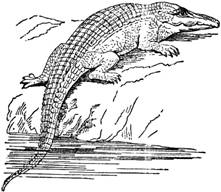
Fig. 138—Crocodile
The crocodiles which we have to notice at present consist of three varieties, or perhaps species, all natives of the Nile, distinguishable by the different arrangement of the scutæ or bony studs on the neck, and the number of rows of the same processes along the back. Their general lizard form is too well known to need particular description; but it may be remarked that of the whole family of crocodiles, comprehending the sharp-beaked gavials of India, the alligators of the west, and the crocodiles properly so called, the last are supplied with the most vigorous instruments for swimming, both from the strength and vertical breadth of their tails, and from the fingers of their paws having deeper webs. Although all have from thirty to forty teeth in each jaw, shaped like spikes, without breadth so as to cut, or surface so as to admit of grinding, the true crocodile alone has one or more teeth on each side in both jaws, exserted, that is, not closing within but outside the jaw, They have no external ear beyond a follicle of skin, and the eyes have a position above the plane of the head, the pupils being contractile, like those of a cat, and in some having a luminous greenish tinge, which may have suggested the allusion to ’the lids of the morning’ (Job 41:18). The upper jaw is not movable, but, as well as the forehead, is extremely dense and bony; the rest of the upper surface being covered with several rows of bosses, or plated ridges, which on the tail are at last reduced from two to one, each scale having a high horny crest, which acts as part of a great fin. Although destitute of a real voice, crocodiles when angry produce a snorting sound, something like a deep growl; and occasionally they open the mouth very wide, remain for a time thus exposed facing the breeze, and, closing the jaws with a sudden snap, cause a report like the fall of a trap-door. The gullet of the crocodile is very wide, the tongue being completely tied to the lower jaw; and beneath it are glands exuding a musky substance. On land the crocodile, next to the gavial, is the most active, and in the water it is also the species that most readily frequents the open sea. Of the immense number of genera which we have seen or examined, none reached to 25 feet in length, and we believe the specimen in the vaults of the British Museum to be one of the largest. Sheep are observed to be unmolested by these animals; but where they abound, no pigs can be kept, perhaps from their frequenting the muddy shores; for we have known only one instance of crocodiles being encountered in woods not immediately close to the water’s side: usually they bask on sandy islands. As their teeth are long, but not fitted for cutting, they seize their prey, which they cannot masticate, and swallow it nearly entire, or bury it beneath the waves to macerate. Having very small excretory organs, their digestion requires, and accordingly they are found to possess, an immense apparatus. They are oviparous, burying their eggs in the sand; and the female remains in the vicinity to dig them out on the day the young have broken the shell. Crocodiles are caught with hooks, and they seldom succeed in cutting the rope when properly prepared. Though a ball fired point blank will penetrate between the scales which cover the body, they may be regarded as furnishing an all but unfailing protection against such injuries and wounds as occasion death to other animals.
That crocodiles and alligators take the sea, and are found on islands many leagues distant from other land, we have ourselves witnessed; and the fact is particularly notorious at the Grand Caymanas in the sea of Mexico, which is almost destitute of fresh water. It is indeed owing to this circumstance that the same species may frequent all the rivers of a great extent of coast, as is the case with some found in Africa, whence they spread to India and the Malayan islands.
an animal doubtless referred to under the name Leviathan (
Canst thou draw out Leviathan with a hook, Or with a cord canst thou press down his tongue? Say, canst thou put a rush-[rope] in his nose, Or with a tholn-[hook] canst thou bore his jaw? Will he multiply to thee supplications; Supposest thou he will speak to thee soft [things]? Will he ratify a covenant with thee? Wilt thou take him for a servant [for] ever? Wilt thou play with him as with the sparrow, Or tie him for thy maidens? Shall there dig [a pit] for him partners, [And] share him between Canaanites [i.e. merchants]? Canst thou fill with darts his skin, Or with a fish-spear [i.e. harpoon] his head? Lay upon him [but] thy hand Thou wilt remember battle no more! Lo! his [i.e. the assailant’s] hope has been belied: At the very sight of him will he be prostrated? None [so] bold that will rouse him! (Then who [is] he [that] before Me shall take a stand? Who has anticipated me [in giving], that I should repay? Under the whole heavens to me [belongs] that!) I will not pass in silence his members, And famed strength, and beauteous armature. Who has disclosed the surface of his covering? In his double [row] of grinders who can enter? The valves of his face who has opened? The circuits of his teeth [are] frightful! A pride [are his] strong shields [i.e. scales], Shut [with] a close seal: One in [the] other will they join, And a breath cannot come between them: Each in its fellow will adhere They will cling together that they cannot be parted [At] his sneezings a light will flash, And his eyes [are] like the lashes of dawn: From his mouth will flames proceed; Sparks of fire will escape: From his nostrils a smoke will go, Like a pot blown with [blazing] reeds: His breath-coals will it kindle, And a flame from his mouth will go. In his neck force shall lodge, And before him terror shall run. The flaps of his flesh have stuck [fast]; Solid upon him, it cannot be shaken: His heart [is] solid like a stone, Even solid like [the] under mill-stone, From his rising [the] mighty shall fear, From terrors they shall stray. [One] hitting him [with the] sword, it will not at all stand [the shock] Lance, dart, or mail: He will regard as straw, iron; As rotten wood, copper: The bow-shotcannot make him flee, To chaff have sling-stones been changed for him. Like chaff clubs have been regarded [by him], And he will laugh at the brandishing of the javelin. Under him [are] points [as] of pottery, He will strew [his spiked belly like] a threshing-sledge upon [the] mud: He will cause [the] deep to boil like the poti [The] sea he will make like the unguent-kettle: Behind him lie will illuminate a path; [One] would regard [the] main as hoary. [There is] not upon [the] dust his ruler The [one] made without dismayt Everything lofty will he behold. He, [the] king over all the sons of pride [i.e. larger beasts].
“The crocodiles, constituting the order Loricata among reptiles, are distinguished pre-eminently by the character noticed in Holy Writ. They are clothed on the entire upper parts of the body with distinct series of bones, imbedded in the substance of the skin, and for the most part furnished with a ridge or crest, which greatly augments their strength, and constitutes the whole a coat of plate-mail which is able to resist the assaults of the most powerful enemy. The structure of the skull is remarkably solid, and it is surmounted by bony crests. There is a single row of teeth in each side of each jaw, locking into each other. The gape is enormous; the lips are altogether wanting, so that the teeth are visible when the mouth is closed; hence the animal, even when tranquil, seems to be grinning with rage. The tongue is fleshy, flat, but free only at the extreme edge, the inferior surface being adherent to the chin and throat; hence the crocodile has been erroneously represented as tongueless.
“All the species of this order are of huge size: not only are they the hugest of reptiles, but they are among the most gigantic of all animals. Crocodiles have been described as attaining a length of twenty-five feet, but no specimens have been brought to Europe of nearly that size. They are probably long-lived, and perhaps their increase of dimensions is commensurate with their age. Highly carnivorous and predaceous, fierce and cunning, they are greatly dreaded in all the tropical regions which they inhabit. Lurking in the dense reeds or tangled herbage that grows rank and teeming at the edges of rivers in hot climates, or under the mangroves that interweave their myriad roots in arches above the water, or concealed among the bleaching trunks and branches of trees that have fallen into the stream, these huge reptiles watch for the approach of a living prey, or feed at leisure on the putrid carcasses with which the waters daily supply them. It is even affirmed that they prefer a condition of putrescence in their prey, and that their practice, when not pressed by immediate hunger, is, on seizing a living prey to plunge into the stream in order to drown it, after which it is dragged away to some hole, and stored until decomposition has commenced.
“Among the decorations of the palace of Shalmaneser, M. Botta discovered a bas-relief continued over five slabs, and representing a great naval expedition against a maritime city. A fleet of ships transport timber along a coast washed by the sea, and studded with fortified islands-perhaps the siege of Tyre by this Assyrian monarch. The sea is represented as filled with various marine animals, such as fishes of various forms, turtles, turbinate shells, crabs, and crocodiles (Mon. de Ninive). This, it is true, may have been but a license of the artist; but Mr. Lyell, in his Principles of Geology, observes that the gavial, a larger species than the crocodile of the Nile, inhabiting the Ganges, descends beyond the brackish water of the delta to the sea. And other species of the genus Crocodilus (as restricted) are frequently known not only to haunt the mouths of rivers, but even to swim among islands, and pass from one to another, though separated by considerable spaces of open sea.” See the Penny Cyclopaedia, s.v. SEE LEVIATHAN.
“The crocodiles consist of three varieties, or perhaps species, all natives of the Nile, distinguishable by the different arrangement of the scutae or bony studs on the neck, and the number of rows of the same processes along the back. Their general lizard-form is too well known to need particular description; but it may be remarked that of the whole family of crocodiles, comprehending the sharp-beaked gavials of India, the alligators of the West, and the crocodiles properly so called, the last are supplied with the most vigorous instruments for swimming, both from the strength and vertical breadth of their tails, and from the deeper webs of the fingers of their paws. Although all have from thirty to forty teeth in each jaw, shaped like spikes, without breadth so as to cut, or surface so as to admit of grinding, the true crocodile alone has one or more teeth. on each side in both jaws, exerted, that is, not closing within, but outside the jaw. They have no external ear beyond a follicle of skin, and the eyes have a position above the plane of the head, the pupils being contractile, like those of a cat, and in some having a luminous greenish tinge, which may have suggested the comparison of the eyes of leviathan to ‘the eyelids of the dawn’ (Job 41:10 [A. V. 18]). The upper jaw is not movable, but, as well as the forehead, is extremely dense and bony; the rest of the upper surface being covered with several rows of bosses, or plated ridges, which on the tail are at last reduced from two to one, each scale having a high horny crest, which acts as part of a great fin. Although destitute of a real voice, crocodiles when angry produce a snorting sound, something like a deep growl [or rather grunt]; and occasionally they open the mouth very wide, remain for a time thus exposed facing the breeze, and, closing the jaws with a sudden snap, cause a report like the fall of a trap-door. It is an awful sound in the stillness of the night in tropical countries. The gullet of the crocodile is very wide, the tongue being completely tied to the lower jaw, and beneath it are glands exuding a musky substance. On land the crocodile, next to the gavial, is the most active, and in the water it is also the species that most readily frequents the open sea.
Of the immense number of genera examined, none reached to 25 feet in length, and the specimen in the British Museum is believed to be one of the largest. Sheep are observed to be unmolested by these animals; but where they abound no pigs can be kept, perhaps from their frequenting the muddy shores; for we have known only one instance of crocodiles being encountered in woods not immediately close to the water’s side: usually they bask on sandy islands. They rarely attack men, but women are sometimes seized by them: in Nubia they are much more dangerous than in Egypt. (See Wilkinson’s Modern Egypt and Thebes, 2:127.) As their teeth are long, but not fitted for cutting, they seize their prey, which they can not masticate, and swallow it nearly entire, or bury it beneath the waves to macerate. Having very small excretory organs, their digestion requires, and accordingly they are found to possess, an immense biliary apparatus. They are oviparous, burying their eggs in the sand; and the female remains in the vicinity to dig them out on the day the young have broken the shell. Crocodiles are caught with hooks, and they seldom succeed in cutting the rope when properly prepared. Though a ball fired point blank will penetrate between the scales which cover the body, the invulnerability of these great saurians is sufficiently exemplified by the following occurrence. One being brought well bound to the bazaar at Cawnpore on the Ganges, it was purchased by the British officers on the spot, and carried farther inland for the purpose of being baited. Accordingly, the ligatures, excepting those which secured the muzzle, being cut asunder, the monster, though it had been many hours exposed to the heat, and was almost suffocated with dust, fought its way through an immense crowd of assailants, soldiers and natives, armed with staves, lances, swords, and stones, and worried by numerous terriers, hounds, and curs; overturning all in its way, till, scenting the river, it escaped to the water at a distance of two miles, in spite of the most strenuous opposition!
“With the ancient Egyptians the crocodile was a sacred animal, not, however, one of those revered by the whole nation, but only locally held in honor. Of old it was found in Lower as well as Upper Egypt; now it is restricted to the latter region, never descending as low as Cairo, and usually not being seen until the traveler approaches the Thebais. In hieroglyphics it bears the name msuh, literally ‘in the egg,’ as though expressing surprise that so great an animal should issue from so small an egg. From this name the Coptic and Arabic names take their origin. The crocodile was sacred to the god Sebak, represented with the head of this animal and the body of a man, and of uncertain place in the Egyptian mythology. It was not only not worshipped throughout Egypt, but was as much hated in some as venerated in other parts of the country: thus in the Ombite nome it was worshipped, and hunted in the Apollinopolite and Tentyrite nomes. The worship of this animal is no doubt of Nigritian origin, like all the low nature-worship of Egypt. It is not certain that the crocodile was an emblem of the king with the Egyptians, but it seems probable that this was the case.
“There is evidence that the crocodile was found in Syria at the time of the Crusades. A reptile of this kind has lately been discovered in the Nahr el- kelb, the ancient Lycus.
“The exploit of Dieudonné de Bozon, knight of St. John, who, when a young man, slew the dragon of Rhodes, an exploit which Schiller has celebrated in his ‘Kampf mit dem Drachen,’ must be regarded as a combat with a crocodile, which had probably been carried northward by the regular current of the eastern Mediterranean; for so the picture still extant in the harem of a Turkish inhabitant represents the Hayawan Keber, or Great Beast — a picture necessarily painted anterior to the expulsion of the knights in 1480. As De Bozon died Grand Master of the Order at Rhodes in 1353, and the spoils of the animal long remained hung up in a church, there is not, we think, any reason to doubt the fact, though most of the recorded circumstances may be fabulous. SEE DRAGON. All the ancient Greek and the later Mediterranean dragons, as those of Naples, Arles, etc., where they are not allegorical or fictitious, are to be referred to the crocodile.” SEE LIZARD.
By: Emil G. Hirsch
This well-known amphibious reptile (Crocodilus vulgaris or niloticus) is not mentioned by a specific Hebrew name in the Bible. There are passages, however, in which allusions to it occur, and which give a faithful description of it (compare Brehm, "Illustriertes Thierleben," iii. i. 112). Whether Ps. lxviii. 30 (A. V. margin) refers to the crocodile in the phrase "the beasts of the reed" is still an open question. Upon these beasts destruction is invoked, which would be strange if they were meant to denote Egypt; for the crocodile is the most characteristic animal of that country, and the psalm is pervaded by a friendly spirit toward the empire of the Pharaohs. It is thus more reasonable to hold with Duhm ("Die Psalmen Erklärt," in Marti's "Kurzer Hand-Commentar zum Alten Testament") that swine are meant, as designating the population of the Jordan valley, which, at the time of the composition of the psalm, consisted largely of non-Jews. It is interesting to note in reference to EX. viii. 2 that the word ẓefardea' (A. V. "frogs") was explained as referring to crocodiles (Arabic, "timsaḥ") by all the commentators whom Ibn Ezra mentions in his commentary to this passage.
The Leviathan.
In Job (xl.-xli.) the description of the Leviathan certainly resembles that of the crocodile. Some of the particulars given—the impenetrable scales (xli. 15); the sharp scales (ib. verse 30); the teeth (verse 14); the thick armor (verse 7); the strongly marked difficulties besetting its capture; the futility of ordinary implements, as the hook, noose, and harpoon; and the impotence of the usual weapons, the spear, mace, and arrow (verses 2, 7, 26)—establish a strong presumption in favor of the identification. Against this evidence it has been urged that the other characteristics are not specific enough, as they are common to several large water-animals.
There is some possibility, however, that the writer was describing the crocodile from personal observation. "We have good evidence," says Canon Tristram in "The Natural History of the Bible" (8th ed., p. 261, London, 1889), "of its existence at the present day in the marshes of the Zerka, or Crocodile River." This fact, well known to Pliny("Historia Naturalis," v. 17) and Strabo (p. 758), and confirmed by Pococke, was corroborated, according to Tristram (l.c.), by the Arabs with whom he conversed. W. M. Thomson ("The Land and the Book," popular edition, i. 73) testifies to the presence of crocodiles in the marsh of Zerka: he believes that he heard the splashing of crocodiles making their way "through this hideous swamp in quest of prey" (ib. p. 77). The latest testimony to the same effect is that of Schumacher ("Pal. Explor. Fund Quarterly Statement," Jan., 1887, p.1), who reports having seen a crocodile in that neighborhood.
Mythological or Real?
Although these coast districts did not belong to the regions familiar to the Hebrew writers, it is not reasonable to preclude the possibility that the poet in Job wrote of what he himself had seen, or frominformation supplied to him by those who had made personal observations of the animal. Even Gunkel ("Schöpfung und Chaos," p. 48), who, with Cheyne, would probably relegate this chapter to the domain of mythology, concedes that the poet meant to describe, not a mythological creature, but a monster actually living in his day, and that some of the characteristics mentioned are those of the crocodile. According to Gunkel, however, the bulk of the chapter is an adaptation of mythological material; the monster being taken from the Babylonian creation-myth. His objections are cogent and his theory must be admitted as having great probability as regards other passages, in which the crocodile is referred to under such designations as "tannim" ("dragons," R. V., Jer. xiv. 6), "rahab" (Isa. li. 9; Ps. lxxxix. 10), and "leviathan" (Ps. lxxiv. 14; Job iii.). But with reference to Job xli. 1 all facts point to the conclusion that the word "leviathan" is probably a later emendation, influenced by the mythical passages (F. Delitzsch, "Hiob," Leipsic, 1902). The enumeration of the characteristics is too complete to admit of any other explanation.
Other Biblical References.
The Arabs call the crocodile "timsaḥ," or "waral," both of which words have passed into Syriac. At one time they must have used the flesh of the animal for food; for the eating thereof is expressly forbidden to faithful Mohammedans. This may, however, be due to a reminiscent confusion of the crocodile with the "koaḥ" (Lev. xi. 30), mentioned among the unclean animals, and which the R. V. translates "land-crocodile" (marked in the margin as uncertain); while the A. V., following the Vulgate and the Septuagint, has "chameleon." According to Bochart ("Hierozoicon," i. 1069), the land-monitor, the "waral alard" of the Arabs (Psammosaurus scincus), is meant, or perhaps even a larger monitor, the "waral al-baḥr," the Nilotic monitor. Bochart also seems inclined to make the "ẓab" of Lev. xi. 29 identical with the "koaḥ," or land-crocodile (ib. i., book iv., ch. 1). This latter is a lizard, if not a toad; and as such it is explained by the Talmudists (Ḥul. 127a). According to Ḳimḥi, the Hebrew "koaḥ" (Lev. xi. 30) is a lizard (in Linné the Lacerta stellio). The Talmud characterizes this species as not dangerous to man and as having a soft, tender skin (Ḥul. 122a), which is easily removed from the body (Shab. 107). In Arabic it is called "ḥirdhaun." This  , in the Targ. for ẓab (the Syriac "ḥardana"), is translated by "crocodile," and distinguished from a land-lizard, as the "ḥardona" of the sea. This latter name occurs in a Talmudic caution that at prayer the, curved posture of the "crocodile" (?) be not assumed (Yer. Ber. 3d). The Talmudic "ben nefilim" (Ḥul. 127a) has also been identified with the crocodile. But it seems to be the Psammosaurus scincus (Arabic, "Saḳanḳur"). The crocodile is perhaps designated by the Talmudic
  (Ned. 41a), which in B. B. 73b occurs in a fabulous connection as
  , if this be not a corruption of
  ("scorpion"). For Talmudic views on "leviathan" see the article under that title.
Bibliography:
Tristram, The Natural History of the Bible, London, 1889;
J. G. Wood, Bible Animals (London, n.d.);
Cheyne and Black, Encyc. Bibl. s.v.;
Levy, Neuhebr. Wörterb. i. 425, Leipsic, 1867, Fleischer's notes: Lewysohn, Die Zoologie des Talmuds, Frankfort-on-the-Main, 1858.
CROCODILE.—(1) livyâthân, Psa 74:14, Isa 27:1, Job 41:1 f. The last reference is almost certainly to the crocodile, which is adopted in RVm
E. W. G. Masterman.
Crocodile. The land crocodile appears as an unclean beast in the RSV rendering of (Lev 11:30). Many scholars assume that the crocodile is the mysterious "Leviathan" (whale, NEB) praised by Job (Job 41:1-34) and mentioned in (Psa 74:14; Psa 104:26); and (Isa 27:1).
Crocodiles used to live in rivers in the Holy Land, including the Jordan, but they have now disappeared from this region. A long, heavy animal, the crocodile has a tough hide covered with overlapping scales. His eyes and nostrils are high on his head; so he can float almost totally submerged. Crocodiles are extremely dangerous, with strong jaws and sharp teeth. They ordinarily eat small animals, birds, and fish, but occasionally will attack larger animals or man.