
who deserves notice here as one of the great politico-religious characters of Great Britain, was born in the town of Huntingdon, April 25, 1599. His father was Robert Cromwell, of a family possessed of a baronetcy, and his mother being a daughter of Sir Richard Stewart, efforts have often been made to show that he was connected with the royal family. He is said, by unfriendly authorities, to have spent a dissolute and extravagant youth, interrupted by serious misgivings, which brought him at last to stern self- condemnation, and resulted in a Puritanic piety. He was educated at the Huntingdon grammar-school, land was admitted, April 22, 1616, a commoner of Sidney-Sussex College, Cambridge; but on the death of his father, in June 1617, he left the university, and began the study of law in London. When twenty-one years old he married Elizabeth, the daughter of Sir Thomas Bourchier, and thus, both by descent and alliance, he was a member of the higher country-gentleman class, or of the nobility, as it would be termed in other European countries. In that age, however, refinement was only kept up by attendance at court, and Cromwell, who lived away from town and followed country pursuits, became a man of rustic deportment. Though he had been elected to the brief parliament of 1628, it was not till 1640 that he was known in the House of Commons, and Sir Philip Warwick, who observed. his rise, has left a curious notice of his personal appearance. "His apparel was a plain cloth suit, which seemed to have been made by an ill country tailor. His hat was without a hat-band. His stature was of good size; his sword stuck close to his side; his countenance swollen and reddish, his voice sharp and untunable, and his eloquence full of fervor." He had been for some years establishing an influence with the Puritan party, who frequented his house and bowed to his strong judgment. He showed his great business capacity in the struggle of the Long Parliament, but it was not until the parliament raised a military force, to which he brought a troop of horse, that his powers of organization and command were fully developed. He speedily rose to authority as lieutenant-general of the horse, and when he was specially exempted from the self-denying ordinance, so that he could both deliberate in parliament and hold command, he became the most powerful man in the country. He showed his eminent sagacity in reconstructing the army, and infusing into it high spirit along with stern discipline. At the battle of Naseby, in 1645, it was seen, in the signal destruction brought on the well- officered royal army, how effectively he could strike with the weapon he had constructed. His military policy throughout was to despise secondary means and ends, but to invest himself with overwhelming power and crush his enemy. He saw the large share which artillery must bear in warfare, and anticipated modern generals in fostering that destructive arm. His repeated victories over the royalists, his establishment of the predominance of the army over parliament, and of the Independents over the Presbyterians, his relentless exertions to bring Charles I to the block, and his dismissal of the parliament, are all great events in the history of the day, which cannot be narrated with sufficient distinctness without much detail. In 1649 he conducted an exterminating war in Ireland, instigated by the ferocious principle that whatever human being opposed him should be put to death. In Scotland, where he saw there were more suitable materials for the sort of government he desired, he was rather a pacificator than an oppressor. Dec. 16, 1653, he took the title of Lord Protector, and became virtually king of Britain, and one who submitted to very little constitutional restraint. Cromwell died September 3, 1658, and the revolution which he had conducted speedily came to an end. He was buried in Westminster Abbey, but in 1661 his remains were dug up and treated with ignominy. How far he was sincere in the religious convictions by which he professed to be led has been matter of debate, and modern writers have by turns decried him as a usurper and lauded him as a liberator. That he was under powerful religious impulses cannot be doubted; the question arises as to the extent to which, by their power alone, and by no promptings of worldliness, he was driven on in his ambitious career. He was an enlightened internal reformer, and established many ministerial improvements, and it cannot be questioned that the line of public policy which has made England famous since, was inaugurated during his administration.
(1599-1658) Congregational Puritan; member of Parliament; led Parliamentary army during Civial War; after execution of Charles I, Cromwell became Lord Protector of England; refused crown.
By: Joseph Jacobs, Victor Rousseau Emanuel
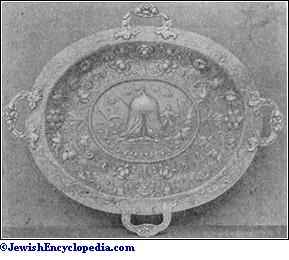
Silver Salver Bearing the "Arms of the Tribe of Judah."Said to have been presented to Oliver Cromwell by Manasseh ben Israel.(In possession of Sir Samuel Montagu.)
Petition of the Jews of England to Olivfr Cromwell, Dated March 24, 1655.(In the Record Office, London.)
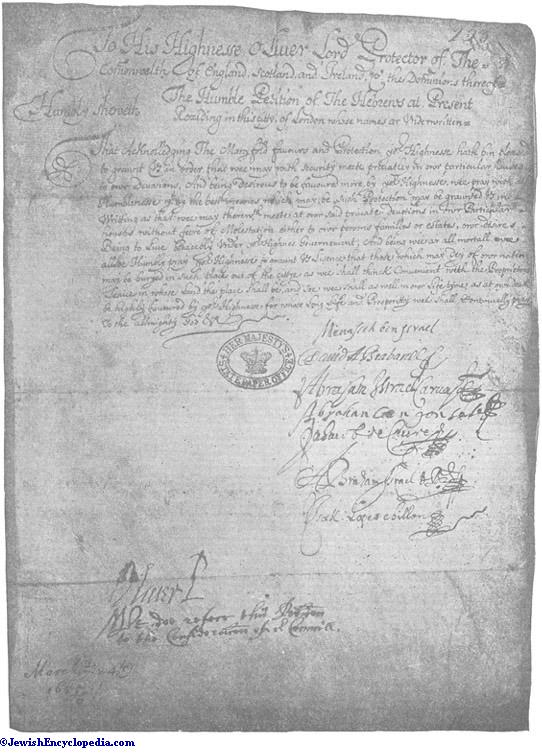
Lord Protector of England; born April 25, 1599, died Sept. 3, 1658. Cromwell favored readmission of the Jews into England, partly in the hope of thereby fulfilling the Messianic prophecy, but mainly because they had aided him as "intelligencers," and he foresaw that, with their control of the Portuguese and Spanish trade, and their large commercial interests in the Levant, the Hamburg Bank, and the Dutch East and West Indies, they would be of service to him in his expansionist policy, and would bring wealth into the country. There were at this time (1653) about twenty Marano families settled in England, who had fled from Spain through fear of the Inquisition. To all appearance Spanish merchants, and attending mass at the chapel of the Spanish ambassador, they were nevertheless known to Cromwell and a few others to be crypto-Jews. Antonio Fernandez Carvajal, a Portuguese merchant in London, had been of financial assistance to the Parliament, and had also, through a relative in Holland and a servant named Somers, or Butler, secured for Cromwell information regarding the Royalist intrigues with Spain. At the time of the Dormido mission to England to negotiate for readmission, Carvajal actively supported the petition, and it was favorably received by Cromwell. At this time, however, the anti-Jewish prejudices had become strong, and the Council would not consent (1654). Cromwell then sent for Manasseh ben Israel, and a motion was introduced in the Council in 1655, "That the Jews deserving it may be admitted into this nation to trade and traffic and dwell among us as Providence may give occasion." The motion was referred to a committee, and a conference was finally arranged to consider the question, the members being appointed by three of Cromwell's most devoted political adherents. The conference met in the Council Chamber at Whitehall, Dec., 1655. It consisted of representatives of the army, the law, the trading interests, and sixteen divines, the majority of whom Cromwell had carefully selected on account of their supposed approval of religious toleration.
The Whitehall Conference.
The first question which arose for consideration was whether there existed any law forbidding the readmission of the Jews, and this was settled by the decision that the expulsion of 1290 had never been valid. When the terms of admission were discussed, a distinctly hostile spirit manifested itself, and the mercantile interests and the clergy united in opposition. To secure a favorable vote the Protector added some more members who were thought to approve of the proposal, but they also ranged themselves with its opponents. Finally, on Dec. 18, a hostile crowd thronged into the Council Chamber, and it was obvious that Cromwell's project could not be carried except under the most extreme restrictions.
Cromwell now saw that his whole scheme would be thwarted if a vote were not prevented. With characteristic promptness he began at once to review the differences of opinion revealed by the various speakers. Protesting that he had no obligations to the Jews beyond those imposed by the Scriptures, he insisted that, "since there was a promise of their conversion, means must be used to that end, which was the preaching of the Gospel, and that could not be done unless they were admitted where the Gospel was preached." Then, turning to the objecting merchants, he said: "You say that they are the meanest and most despised of all people. But in that case what becomes of your fears? Can you really be afraid that this contemptible and despised people should be able to prevail in trade and credit over the merchants of England, the noblest and most esteemed merchants of the whole world?" Finally, having announced that nothing was to be hoped from the conference, and that he should use his own judgment in acting for the glory of God and the good of the nation, he vacated the chair and brought the proceedings to a close. The conference was cowed, and dissolved without a word of protest.
What finally precipitated the solution of the difficulty was the outbreak of the war with Spain. The Spanish Maranos were no longer able to live in England as Spanish citizens, and in 1656, relying upon the decision that the expulsion of 1290 was no longer valid, they openly threw off their disguise and assumed the position of Jews.
In the following year, probably on Feb. 4, 1657, Cromwell in a public meeting made a "seasonable benefaction" to Carvajal, perhaps a verbal assurance that the Jews would not be disturbed in the exercise of their religion. He had previously made a grant of £100 to Manasseh ben Israel. Altogether Cromwell's action enabled the Jews to live as such in England at a time when there was sufficient opposition to them on the part of the clergy and the mercantile classes to have prevented their residence, if the government had been weak or ill-disposed toward them.
Bibliography:
Manasseh ben Israel's Mission to Oliver Cromwell, edited by Lucien Wolf, London, 1901.
Lord Protector of England; born Huntingdon, England, 1599; died London, England, 1658. Because of his enthusiasm as an ardent Puritan for the party in opposition to Charles I and the church, he was elected to both the Short and Long Parliaments. During the Civil War of 1642, he attained prominence on account of the efficiency of his troops, the Ironsides, and his tactical genius. In 1645 he was appointed lieutenant-general, and decisively defeated the Royalists at Naseby. After the execution of Charles he was made a member of the council of state. The Commonwealth, when it realized the danger of the strong royal interest that was predominant in Ireland, sent Cromwell as lord lieutenant with an army of 12,000. The campaign was successful, but inhuman in its cruelty. The massacre which followed the storming of Drogheda was one of the most brutal and indefensible in history. Recalled to England, he was made commander of the army which invaded Scotland and won the submission of the Scots at Dunbar. Elected protector in 1653, his protectorate was a perpetual conflict between republican resistance and royalist risings. His foreign policy was prompted by biased religious fervor, and under him the Commonwealth became head and protectress of Protestant Europe. He realized the salvation of the Commonwealth lay in a strong executive backed by an army.