
The dunghill god of the Philistines. We have the relation concerning this idol, Judges 16. 23. and again, 1 Sam. v. 2, &c. The name seems well suited for such a purpose, being derived from Dag, fish. Some historians say, that the idol was formed like a fish.
Da´gon is the name of a national god of the Philistines at Gaza and Ashdod (Jdg 16:21; Jdg 16:23; 1Sa 5:1 sq.; 1Ch 10:10). As to the meaning of the name, it is probably derived from a word signifying fish, and there is every reason to believe that it had the body of a fish with the head and hands of a man. That such was the figure of the idol is asserted by Kimchi, and is admitted by most modern scholars. It is also supported by the analogies of other fish deities among the Syro-Arabians. Besides the Atergatis of the Syrians, the Babylonians had a tradition, according to Berosus, that at the very beginning of their history an extraordinary being, called Oannes, having the entire body of a fish, but the head, hands, feet, and voice of a man, emerged from the Erythraean sea, appeared in Babylonia, and taught the rude inhabitants the use of letters, arts, religion, law, and agriculture; that, after long intervals between, other similar beings appeared and communicated the same precious lore in detail, and that the last of these was called Odakon. Selden is persuaded that this Odakon is the Philistine god Dagon. The temple of Dagon at Ashdod was destroyed by Jonathan the brother of Judas the Maccabee, about the year B.C. 148 (1Ma 10:84).
Fish-god, a national idol of the Philistines, with temples at Gaza, Ashdid, etc., 1Ch 10:10 . The temple at Gaza was destroyed by Samson, Jdg 16:21-30 . In that at Ashdod, Dagon twice miraculously fell down before the ark of God; and in the second fall his head and hands were broken off, leaving only the body, which was in the form of a large fish, 1Sa 5:1-9 . See Jos 15:41 ; 19:27. There were other idols of like form among the ancients, particularly the goddess Derceto of Atergatis; and a similar form or "incarnation" of Vishnu is at this day much worshipped in India, and like Dagon is destined to be prostrated in the dust before the true God.\par
Da’gon. (a fish). Apparently the masculine, 1Sa 5:3-4, correlative of Atargatis, was the national god of the Philistines. The most famous temples of Dagon were at Gaza, Jdg 16:21-30, and Ashdod. 1Sa 5:5-6; 1Ch 10:10. The latter temple was destroyed by Jonathan in the Maccabaean wars.
Traces of the worship of Dagon, likewise, appear in the names Caphar-dagon, (near Jamnia), and Beth-dagon in Judah, Jos 15:41, and Asher. Jos 19:27. Dagon was represented with the face and hands of a man and the tail of a fish. 1Sa 5:5. The fish-like form was a natural emblem of fruitfulness, and as such was likely to be adopted by seafaring tribes in the representation of their gods.
Diminutive (expressing endearment) of
The tutelary goddess of the first Assyrian dynasty, the name appearing in Tiglath. Dag-on was the national god of the Philistines, his temples were at Gaza and Ashdod (Jdg 16:21-30; 1Sa 5:5-6). The temple of Dagon, which Samson pulled down, probably resembled a Turkish kiosk, a spacious hall with roof resting in front upon four columns, two at the ends and two close together at the center. Under this hall the Philistine chief men celebrated a sacrificial meal, while the people assembled above upon the balustraded roof. The half-man half-fish form (found in bas-relief at Khorsabad) was natural to maritime coast dwellers. They senselessly joined the human form divine to the beast that perishes, to symbolize nature’s vivifying power through water; the Hindu Vishnu; Babylonian Odakon.
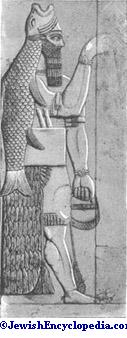
On the doorway of Sennacherib’s palace at Koyunjik there is still in bas-relief representations of Dagon, with the body of a fish but under the fish’s head a man’s head, and to its tail women’s feet joined; and in all the four gigantic slabs the upper part has perished, exactly as 1Sa 5:4’s margin describes: now in the British Museum. The cutting off of Dagon’s head and hands before Jehovah’s ark, and their lying on the threshold (from whence his devotees afterward did not dare to tread upon it), prefigure the ultimate cutting off of all idols in the great day of Jehovah (Isa 2:11-22). Beth-Dagon in Judah and another in Asher (Jos 15:41; Jos 19:27) show the wide extension of this worship. In his temple the Philistines fastened up Saul’s head (1Ch 10:10).
(Heb. Dagon’,
If Dagon is derived from
Dagon (dâ’gon), fish. The national deity of the Philistines. There was a temple of Dagon at Gaza, Jdg 16:23, and one at Ashdod, 1Sa 5:1; 1Sa 5:7; the latter was destroyed by Jonathan Maccabæus. Probably the worship of the male (Dagon) and female (Derceto) deities was conjoined in the same sanctuary. 1Sa 31:10; 1Ch 10:10. There are places called Beth-dagon, where doubtless this idolatrous worship prevailed. Jos 15:41; Jos 19:27. Dagon was represented with the face and hands of a human being, and with a fishy tail. Some representations of a fish-god have been discovered among the Assyrian sculptures.
[Da’gon]
The national god of the Philistines, whose principal temples were at Gaza and Ashdod. The name has been traced by some to dag, a fish; others however associate the fish-god with EA, the water-god; and trace Dagon to dagan ’corn’ as a god of agriculture. This was the idol that fell to pieces before the ark of Israel, and it was in its temple subsequently that the Philistines hung the head of Saul. A representation of a god found at Khorsabad has the head and hands of a man, and the body and tail of a fish. Jdg 16:23; 1Sa 5:2-7; 1Ch 10:10.
(Hebrew,  ):
):
By: Executive Committee of the Editorial Board., Eduard König
Philistine god, referred to in Judges xvi. 23; I Sam. v. 2-5; and I Macc. x. 83, xi 4; but not in Isa. xlvi. 1, where  is a corruption of
  (I Sam. xxxi. 10). The extent of the worship of Dagon is also indicated by the name "Beth-dagon," designating (Josh. xv. 41) one of the towns of the Shefela, and another on the boundary of the territory of Asher (ib. xix. 27). The inscription of the Phenician king Eshmunazar also mentions "towns of Dagon" (line 19). The significance of this god can be gathered with sufficient certainty from his name and from the plastic representations of him: for
  is most probably a derivative of
  ("fish"), just as
  (Sidon) is derived from
  ("booty") and
  (Samson) from
  ("sun"); and it is probable that "Odakon" ('
Representation of Dagon.(From a bas-relief in the Louvre.)
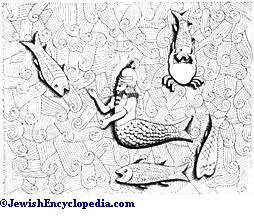
It is, furthermore, by no means certain, notwithstanding G. F. Moore in "Encyc. Bibl." i. 985, that Dagon, the Odakon just mentioned, and the Assyrian god Dakan-Dagan stood in no relation with one another. Indeed, it is quite possible, as some scholars have suggested, that the figures of Dagon found on Babylonian gems, on an Assyrian cylinder, on a piece of sculpture from Khorsabad, on a similar piece from Nimrud, and on a Babylonian cylinder (compare the reproductions of these figures, especially in H. Clay Trumbull's "Jonah in Nineveh," 1892, p. 19), combining in different ways the body of a man and of a fish, are simply different representations of the god Dakan-Dagan (see Friedrich Delitzsch in Calwer, "Bibellexikon," s.v. "Dagon"; Layard's "Nineveh," 1849, ii. 466 et seq.). Neither is it contradicted by what is said in I Sam. v. 4 about the figure of the god Dagon, for the Assyro - Babylonian images also show the head and hands of the god. In this case, Dagon personifies the idea that the ocean, with its wealth of fish, was worshiped as the chief source not only of human nourishment, but also of human culture (compare Berosus' interesting amplifications of this idea in Trumbull, l. c. pp. 8-11). The same god would naturally be worshiped both near the Persian Gulf and on the Mediterranean Sea. The El-Amarna tablets indicate an intercourse at an early period between the regions along the Euphrates and Tigris, and those of western Asia and Egypt.
Assyrian Representation of Dagon(From Layard's "Nineveh.")
As regards the worship of Dagon, very little is known. Details of the construction of his "house," mentioned in Judges xvi. 26 et seq. and in I Sam. v. 1 et seq., are likewise uncertain; and the only feature of the ritual to which reference is made (I Sam. v. 4 et seq.; compare Zeph. i. 9) is the fear of touching the threshold of his temple. Dagon's temple at Ashdod was burned by the Maccabee Jonathan (Josephus, "Ant." xiii. 4, § 5). See Threshold, Sacredness of the.
DAGON.—A god whose worship was general among the Philistines (at Gaza, Jdg 16:23, 1Ma 10:83-84; 1Ma 11:4; at Ashkelon, 1Sa 5:2; prob. at Beth-dagon [wh. see], which may at one time have been under Philistine rule). Indeed, the name Baal-dagon inscribed in Phœnician characters upon a cylinder now in the Ashmolean Museum, Oxford, and the modern place-name Beit Dajan (S.E. of Nablus), indicate an existence of his cult in Phœnicia and Canaan. An endeavour to identify the god with Atargatis (wh. see) is responsible for the explanation of the name as a diminutive (term of endearment) of dag (‘fish’), and also for the rendering of ‘only Dagon was left’ (1Sa 5:4) as ‘only the fishy part was left.’ Though there is nothing to contradict the supposition that Dagon was a fish-god, it is more probable that originally he was an agricultural deity (named from dagan = ‘grain,’ cf. 1Sa 6:4-5), from which position he developed into a war-god (1Ch 10:10) and apparently even into a national deity (1Sa 5:8 to 1Sa 6:18). An identification of this god with the Babylonian Dagan is doubtful (see Jensen, Kosmologie, 449 ff.; and Jastrow, Rel. of Bab.
N. Koenig.
A Semitic deity adopted by the Philistines as their national god. The upper part of his body was human, the lower half fish-like; the foremost deity of such maritime cities as Azotus, Gaza, Ascalon, and Arvad, where temples were built in his honor.
A Philistine deity. It is commonly admitted that the name Dagon is a diminutive form, hence a term of endearment, derived from the Semitic root dag, and means, accordingly, "little fish". The name, therefore, indicates a fish-shaped god. This the Bible also suggests when speaking of the Dagon worshipped in the temple of Azotus (1 Samuel 5:1-7): he had face and hands and a portion of his body resembled that of a fish, in accordance with the most probable interpretation of "the stump of Dagon" (verse 5). From the received text of the Septuagint it would seem that he possessed even feet, although Swete’s edition gives here a different reading; at any rate, this sentence, in the Greek translation, shows all the appearances of a gloss. With the description found in the Bible coincides that which may be seen on the coins of various Philistine or Phœnician cities, on most of which Dagon is represented as a composite figure, human as to the upper part of the body, fish-like as to the lower. From this it may well be inferred that Dagon was a fish-god, a fact not in the least surprising, as he seems to have been the foremost deity of such maritime cities as Azotus, Gaza (the early sites of which are supposed to be buried under the sand-mounds that run along the sea-shore), Ascalon, and Arvad. In the monuments -- also most probably in the popular worship -- Dagon is sometimes associated with a female half-fish deity, Derceto or Atargatis, often identified with Astarte.A few scholars, however, waving aside these evidences, consider Dagon as the god of agriculture. This opinion they rest on the following statement of Philo Byblius: "Dagon, that is, corn’ [the Hebrew word for corn is dagan]. "Dagon, after he had discovered corn and the plough, was called Zeus of the plough" (ii, 16). The same writer tells us (in Eusebius, Prœp. Evang., i, 6) that, according to an old Phœnician legend, Dagon was one of the four sons born of the marriage of Anu, the lord of heaven, with his sister, the earth. Moreover, on a seal bearing certain symbolic signs, among which is an ear of corn, but not, however, the image of a fish, may be read the name of Baal-Dagon, written in Phœnician characters. It is open to question whether these arguments outweigh those in favour of the other opinion; so much so that the etymology adopted by Philo Byblius might possibly be due to a misapprehension of the name. It should, perhaps, be admitted that, along the Mediterranean shore, a twofold conception and representation of Dagon were developed in the course of time as a result of the presumed twofold derivation of the name. At, any rate, all scholars agree that the name and worship of Dagon were imported from Babylonia.The Tell-el-Amarna letters (about 1480-1450 B.C.), which have yielded the names of Yamir-Dagan and Dagan-takala, rulers of Ascalon, witness to the antiquity of the Dagon-worship among the inhabitants of Palestine. We learn from the Bible that the deity had temples at Gaza (Judges 16:21, 23) and Azotus (1 Samuel 5:1-7); we may presume that shrines existed likewise in other Philistine cities. The Dagon-worship seems even to have extended beyond the confines of their confederacy. The testimony of the monuments is positive for the Phœnician city of Arvad; moreover, the Book of Josue mentions two towns called Bethdagon, one in the territory of Juda (Joshua 15:41), and the other on the border of Aser (Joshua 19:27); Josephus also speaks of a Dagon "beyond Jericho" (Antiq. Jud., XIII, viii, 1; De bell. Jud., I, ii, 3): all these names are earlier than the Israelite conquest, and, unless we derive them from dagan, witness to a wide dissemination of the worship of Dagon throughout Palestine. This worship was kept up, at least in certain Philistine cities, until the last centuries B.C. — such was the case at Azotus; the temple of Dagon that stood there was burned by Jonathan Machabeus (1 Maccabees 10:84; 11:4).Unlike the Baals, who, among the Chanaanites, were essentially local deities, Dagon seems to have been considered by the Philistines as a national god (1 Chronicles 10:10). To him they attributed their success in war; him they thanked by great sacrifices, before him they rejoiced over the capture of Samson (Judges 16:23); into his temple they brought the trophies of their victories, the Ark (1 Samuel 5:1, 2), the armour, and the head of Saul (1 Samuel 31:9-10; 1 Chronicles 10:10). A bronze demi-rilievo of Assyro-Phœnician workmanship would also suggest that Dagon played a prominent part in the doctrines concerning death and future life. As to the ritual of his worship, little can be gathered either from the documents or from Scripture. The elaborate arrangements for returning the Ark (1 Samuel 5:6) may have been inspired more by the circumstances than by any ceremonies of the Dagon-worship. We only know from ancient writers that, for religious reasons, most of the Syrian peoples abstained from eating fish, a practice that one is naturally inclined to connect with the worship of a fish-god.-----------------------------------CHARLES L. SOUVAY Transcribed by David M. Cheney Dedicated to Ceil Holman (1907-1996), my grandmother The Catholic Encyclopedia, Volume IVCopyright © 1908 by Robert Appleton CompanyOnline Edition Copyright © 2003 by K. KnightNihil Obstat. Remy Lafort, CensorImprimatur. +John M. Farley, Archbishop of New York
LITERATURE
Commentaries on Judges and 1 Samuel; Winckler, Altoriental. Forschungen, III, 383.
Dagon was a Canaanite Baal god, and biblical references to it are all connected with the Philistines. There were temples for the worship of Dagon in the Philistine towns of Gaza and Ashdod (Jdg 16:21-23; 1Sa 5:1-5; see also 1Ch 10:10). (For details see BAAL; PHILISTIA.)
A false god worshiped by the
Canaanites in the hope that he would
give them a good harvest of grain. When
the Philistines settled in Canaan, they
adopted Dagon as their most important
god.