
The very important figure which David, king of Israel, makes in Scripture, demands, that in a work of this kind, he should not be overlooked. His services, as a prophet of the Lord, and his labours in the Scriptural writings which come to the church with his name, render it highly needful to notice him. But added to this, as a type of the Lord Jesus, and the great Mediator bearing his name, renders him still more endearing to our view. His very name from Dud, to love, means, dear and well - beloved; and as a type of the ever - dearand well - beloved Jesus, nothing could be more suited. I only beg the reader to observe concerning types in general, and of him in particular, that it is only in this very precise instance, in which the agreement runs, that the word of God considers them; and consequently, ought to be considered by the church. The Lord Jesus Christ after the flesh, is spoken of as the seed of David; and as such, the covenant runs in his name. (See Ps. lx29. 34, 35. 2 Tim. 2: 8.)
the celebrated king of Israel, was the youngest son of Jesse, of the tribe of Judah, and was born 1085 years before Christ. The following is an abstract of his history: He was chosen of God to be king of Israel, and at his command was anointed to this dignity by the hands of Samuel, a venerable prophet, in the room of Saul; who had been rejected for his disobedience to the divine orders, in feloniously seizing, to his own use, the prey of an enemy, which God, the supreme King of Israel, had devoted to destruction. He was introduced to court as a man expert in music, a singularly valiant man, a man of war, prudent in matters, of a comely person, and one favoured of the Lord. By his skill in music, he relieved Saul under a melancholy indisposition that had seized him, was highly beloved by his royal master, and made one of his guards. In a war with the Philistines he accepted the challenge of a gigantic champion, who defied the armies of Israel, and being skilful at the sling, he slew him with a stone, returned safely with his head, and thus secured to his prince an easy victory over his country’s enemies. The reputation he gained, by this glorious action, raised an incurable jealousy and resentment against him, in the mind of the king his master; who made two unsuccessful attempts to murder him. In his exalted station, and amidst the dangers that encompassed him, he behaved with singular prudence, so that he was in high esteem both in the court and camp. The modesty and prudence of his behaviour, and his approved courage and resolution, gained him the confidence and friendship of Jonathan, the king’s eldest son, “Who loved him as his own soul,” became his advocate with his father, and obtained from him a promise, confirmed by an oath, that he would no more attempt to destroy him. But Saul’s jealousy returned by a fresh victory David gained over the Philistines; who, finding the king was determined to seek his life, retired from court, and was dismissed in peace by Jonathan, after a solemn renewal of their friendship, to provide for his own safety. In this state of banishment, there resorted to him companies of men, who were uneasy in their circumstances, oppressed by their creditors, or discontented with Saul’s tyrannical government, to the number of six hundred men. These he kept in the most excellent order, and by their valour he gained signal advantages for his country; but never employed them in rebellion against the king, or in a single instance to distress or subvert his government. On the contrary such was the veneration he paid him, and such the generosity of his temper that though it was thrice in his power to have him cut off, he spared him, and was determined never to destroy him, whom God had constituted the king of Israel. His friendship with Jonathan, the king’s son, was a friendship of strict honour, for he never seduced him from his allegiance and filial duty. Being provoked by a churlish farmer, who evil treated and abused his messengers, he, in the warmth of his temper, swore he would destroy him and his family; but was immediately pacified by the address and prudence of a wife, of whom the wretch was unworthy: her he sent in peace and honour to her family, and blessed for her advice, and keeping him from avenging himself with his own hand. Being forced to banish himself into an enemy’s country, he was faithful to the prince who protected him: and, at the same time, mindful of the interest of his own nation, he cut off many of those who had harassed and plundered his fellow subjects. When pressed by the king, into whose dominions he retired, to join in a war against his own country and father-in-law, he prudently gave him such an answer as his situation required; neither promising the aid demanded of him, nor tying up his hands from serving his own prince, and the army that fought under him; only assuring him in general, that he had never done any thing that could give him just reason to think he would refuse to assist him against his enemies. Upon the death of Saul, he cut off the Amalekite who came to make a merit of having slain him; and by the immediate direction of God, who had promised him the succession, went up to Hebron, where, on a free election, he was anointed king over the house of Judah; and after about a seven years’ contest, he was unanimously chosen king by all the tribes of Israel, “according to the word of the Lord by Samuel.” As king of Israel, he administered justice and judgment to all his people, was a prince of courage, and great military prudence and conduct; had frequent wars with the neighbouring nations, to which he was generally forced by their invading his dominions, and plundering his subjects. Against them he never lost a battle; he never besieged a city without taking it; nor, as for any thing that can be proved, used any severities against those he conquered, beyond what the law of arms allowed, his own safety required, or the cruelties of his enemies rendered just, by way of retaliation; enriching his people by the spoils he took, and providing large stores of every thing necessary for the magnificent temple he intended to erect, in honour of the God of Israel. Having rescued Jerusalem out of the hands of the Jebusites, he made it the capital of his kingdom, and the place of his residence; and being willing to honour it with the presence of the ark of God, he brought it to Jerusalem in triumph, and divesting himself of his royal robes, out of reverence to God, he clothed himself in the habit of his ministers, and with them expressed his joy by dancing and music; contemned only by one haughty woman; whom, as a just punishment of her insolence, he seems ever after to have separated from his bed. Though his crimes were heinous, and highly aggravated in the affair of Uriah and Bathsheba, he patiently endured reproof, humbly submitted to the punishment appointed him, deeply repented, and obtained mercy and forgiveness from God, though not without some severe marks of his displeasure, for the grievous offences of which he had been guilty. A rebellion was raised against him by his son Absalom. When forced by it to depart from Jerusalem, a circumstance most pathetically described by the sacred historian, he prevented the just punishment of Shimei, a wretch who cursed and stoned him. When restored to his throne, he spared him upon his submission, and would not permit a single man to be put to death in Israel upon account of this treason. He, with a noble confidence, made the commander of the rebel forces general of his own army, in the room of Joab, whom he intended to call to an account for murder and other crimes. After this, when obliged, by the command of God, to give up some of Saul’s family to justice, for the murder of the Gibeonites, he spared Mephibosheth, Micah, and his family, the male descendants of Saul and Jonathan, who alone could have any pretence to dispute the crown with him, and surrendered only Saul’s bastard children, and those of his daughter by Adriel, who had no right or possible claim to the throne, and could never give him any uneasiness in the possession of it; and thus showed his inviolable regard for his oaths, his tenderness to Saul, and the warmth of his gratitude and friendship to Jonathan. In the close of his life, and in the near prospect of death, to demonstrate his love of justice, he charged Solomon to punish with death Joab, for the base murder of two great men, whom he assassinated under the pretence of peace and friendship. To this catalogue of his noble actions must be added, that he gave the most shining and indisputable proofs of an undissembled reverence for, and sincere piety to, God; ever obeying the direction of his prophets, worshipping him alone, to the exclusion of all idols, throughout the whole of his life, and making the wisest settlement to perpetuate the worship of the same God, through all succeeding generations.
To this abstract a few miscellaneous remarks may be added.
1. When David is called “the man after God’s own heart,” a phrase which profane persons have often perverted, his general character, and not every particular of it, is to be understood as approved by God; and especially his faithful and undeviating adherence to the true religion, from which he never deviated into any act of idolatry.
2. He was chosen to accomplish to their full extent the promises made to Abraham, to give to his seed the whole country from the river of Egypt to the great river Euphrates. He had succeeded to a kingdom distracted with civil dissensions, environed on every side by powerful and victorious enemies, without a capital, almost without an army, without any bond of union between the tribes. He left a compact and united state, stretching from the frontier of Egypt to the foot of Lebanon, from the Euphrates to the sea. He had crushed the power of the Philistines, subdued or curbed all the adjacent kingdoms: he had formed a lasting and important alliance with the great city of Tyre. He had organized an immense disposable force; for every month 24,000 men, furnished in rotation by the tribes, appeared in arms, and were trained as the standing militia of the country. At the head of his army were officers of consummate experience, and, what was more highly esteemed in the warfare of the time, extraordinary personal activity, strength, and valour. The Hebrew nation owed the long peace of Solomon the son’s reign to the bravery and wisdom of the father.
3. As a conqueror he was a type of Christ, and the country “from the river to the ends of the earth,” was also the prophetic type of Christ’s dominion over the whole earth.
4. His inspired psalms not only place him among the most eminent prophets; but have rendered him the leader of the devotions of good men, in all ages. The hymns of David excel no less in sublimity and tenderness of expression than in loftiness and purity of religious sentiment. In comparison with them the sacred poetry of all other nations sinks into mediocrity. They have embodied so exquisitely the universal language of religious emotion, that they have entered with unquestioned propriety into the ritual of the higher and more perfect religion of Christ. The songs which cheered the solitude of the desert caves of Engedi, or resounded from the voice of the Hebrew people as they wound along the glens or the hill sides of Judea, have been repeated for ages in almost every part of the habitable world, in the remotest islands of the ocean, among the forests of America or the sands of Africa. How many human hearts have these inspired songs softened, purified, exalted! Of how many wretched beings have they been the secret consolation! On how many communities have they drawn down the blessings of Divine providence, by bringing the affections into unison with their deep devotional fervour, and leading to a constant and explicit recognition of the government, rights, and mercies of God!
Da´vid. The word probably means beloved. The reign of David is the great critical era in the history of the Hebrews. It decided that they were to have for nearly five centuries a national monarchy, a fixed line of priesthood, and a solemn religious worship by music and psalms of exquisite beauty; it finally separated Israel from the surrounding heathen, and gave room for producing those noble monuments of sacred writ, to the influence of which over the whole world no end can be seen. His predecessor, Saul, had many successes against the Philistines, but it is clear that he made little impression on their real power; for he died fighting against them, not on their own border, but on the opposite side of his kingdom, in Mount Gilboa. As for all the other ’enemies on every side’—Moabites, Ammonites, Edomites, and the kings of Zobah—however much he may have ’vexed them’ (1Sa 14:47), they, as well as the Amalekites, remained unsubdued, if weakened. The real work of establishing Israel as lord over the whole soil of Canaan was left for David.
The life of David naturally divides itself into three portions:—I. The time which he lived under Saul. II. His reign over Judah in Hebron. III. His reign over all Israel.
I. In the first period we may trace the origin of all his greatness. His susceptible temperament, joined to his devotional tendencies, must, at a very early age, have made him a favorite pupil of the prophets, whose peculiar mark was the harp and the psalm (1Sa 10:1-12; 1Sa 19:20-24; see also 2Ki 3:15). His hospitable reception, when in distress, by Ahimelech the priest, and the atrocious massacre innocently brought by him on Nob, the city of the priests (I Samuel 21 and 1Sa 22:9-19), must have deeply affected his generous nature, and laid the foundation of his cordial affection for the whole priestly order, whose ministrations he himself helped to elevate by his devotional melodies. At an early period he attracted the notice of Samuel; and if we are to arrange events according to their probable connection, we may believe that after David had been driven away from Saul and his life several times attempted, Samuel ventured on the solemn step of anointing him king. Whenever this took place, it must have produced on David a profound impression, and prepared him to do that in which Saul had so eminently failed, viz. to reconcile his own military government with a filial respect for the prophets and an honorable patronage of the priesthood. Besides this, he became knit into a bond of brotherhood with his heroic comrades, to whom he was eminently endeared by his personal self-denial and liberality (1Sa 30:21-31; 1Ch 11:18). This, indeed, drew after it one most painful result, viz. the necessity of enduring the turbulence of his violent but able nephew Joab; nor could we expect that of a band of freebooters many should be like David. Again, during his outlawry David became acquainted in turn not only with all the wild country in the land, but with the strongholds of the enemy all round. By his residence among the Philistines he must have learned all their arts and weapons of war, in which it is reasonable to believe the Israelites previously inferior (1Sa 13:19-23). With Nahash the Ammonite he was in intimate friendship (2Sa 10:2); to the king of Moab he entrusted the care of his parents (1Sa 22:3); from Achish of Gath he received the important present of the town of Ziklag (1Sa 27:6). That Ziklag was a strong place may be inferred from 1Ch 12:1; 1Ch 12:20. The celebrity acquired in successful guerilla warfare, even in modern days, turns the eyes of whole nations on a chieftain; and in an age which regarded personal heroism as the first qualification of a general (1Ch 11:6) and of a king, to triumph over the persecutions of Saul gave David the fairest prospects of a kingdom.
The account transmitted to us of David’s dangers and escapes in the first period is too fragmentary to work up into a history: nevertheless, it seems to be divisible into two parts, differing in character. During the former he is a fugitive and outlaw in the land of Saul, hiding in caves, pitching in the wilderness, or occasionally with great risk entering walled cities (1Sa 23:7): in the latter he abandons his native soil entirely, and lives among the Philistines as one of their chieftains (1Sa 27:1). While a rover in the land of Judah, his position (to our eyes) is anything but honorable; being a focus to which ’all who were in distress, in debt, or discontented, gathered themselves’ (1Sa 22:2). Yet as the number of his followers became large (six hundred, we read, 1Sa 23:13), and David knew how to conciliate the neighboring sheep-masters by his urbanity and kind services, he gradually felt himself to be their protector and to have a right of maintenance and tribute for them. Hence he resents the refusal of Nabal to supply his demands, as a clear injustice; and, after David’s anger has been turned away by the prudent policy of Abigail, in blessing her for saving him from slaying Nabal and every male of his family, the thought seems not to have entered his mind that the intention of such a massacre was more guilty than Nabal’s refusal to pay him tribute (1Sa 25:34). This whole narrative is characteristic and instructive. By his marriage with Abigail he afterwards probably became rich (for she seems to have been a widow at her own disposal), and on passing immediately after into the land of the Philistines, he was enabled to assume a more dignified place. Becoming possessed of the stronghold of Ziklag, he now appeared like a legitimate chieftain with fixed possessions, and no longer a mere vagabond and freebooter. This was accordingly a transition-state in which David was prepared for assuming the kingdom over Judah. In Ziklag he was joined, not, as before, by mere outcasts from Israelitish life, but by men of consideration and tried warriors (1Ch 12:1-22), not only of the tribe of Judah, but from Gad, Manasseh, and even ’from Saul’s brethren of Benjamin.’
II. Immediately upon the death of Saul the tribe of Judah invited David to become their prince.
His first step, after his election, was to fix on Hebron as the center of his administration—an ancient city, honorable by its association with the name of Abraham, and in the middle of his own tribe. He then strengthened himself by a marriage with Maacah, daughter of Talmai, king of Geshur (2Sa 3:3); a petty monarch whose dominions were near the sources of the Jordan, and whose influence at the opposite end of the land must have added a great weight into David’s scale. From Abigail, widow of the churlish Nabal, David, as we have already observed, seems to have received a large private fortune. Concerning his other wives we know nothing in particular; only it is mentioned that he had six sons by six different mothers in Hebron. The chief jealousy was between the two tribes of Benjamin and Judah, as Saul had belonged to the former; and a tournament was turned by mutual ill-will into a battle, in which Abner unwillingly slew young Asahel, brother of Joab. ’Long war,’ after this, was carried on between ’the house of Saul and the house of David.’ We may infer that the rest of Israel took little part in the contest; and although the nominal possession of the kingdom enabled the little tribe of Benjamin to struggle for some time against Judah, the skill and age of Abner could not prevail against the vigor and popular fame of David. A quarrel between Abner and Ishbosheth decided the former to bring the kingdom over to David. The latter refused to treat unless, as a preliminary proof of Abner’s sincerity, Michal, daughter of Saul, was restored to David. The possession of such a wife was valuable to one who was aspiring to the kingdom. His demand was immediately complied with. After giving her back, Abner proceeded to win the elders of Israel over to David; but Joab discerned that if this should be so brought about, Abner of necessity would displace him from his post of chief captain. He, therefore, seized the opportunity of murdering him when he was come on a peaceful embassy, and covered the atrocity by pleading the duty of revenging his brother’s blood. This deed was perhaps David’s first taste of the miseries of royal power. He dared not proceed actively against his ruthless nephew, but he vented his abhorrence in a solemn curse on Joab and his posterity, and followed Abner to the grave with weeping. Anxious to purge himself of the guilt, he ordered a public wearing of sackcloth, and refused to touch food all the day. The feeble Ishbosheth, left alone, was unequal to the government, and shortly suffered the same fate of assassination. David, following the universal policy of sovereigns, and his own profound sense of the sacredness of royalty, took vengeance on the murderers, and buried Ishbosheth in Abner’s tomb at Hebron.
III. The death of Ishbosheth gave to David supremacy over all Israel. The kingdom was not at first a despotic, but a constitutional one; for it is stated, ’David made a league with the elders of Israel in Hebron before Jehovah; and they anointed David king over Israel’ (2Sa 5:3). This is marked out as the era which determined the Philistines to hostility (2Sa 5:17), and may confirm our idea, that their policy was to hinder Israel from becoming united under a single king. Two victories of David over them follow, both near the valley of Rephaim; and these were probably the first battles fought by David after becoming king of all Israel.
Perceiving that Hebron was no longer a suitable capital, he resolved to fix his residence farther to the north. On the very border of the tribes of Judah and Benjamin lay the town of Jebus, which with its neighborhood was occupied by Jebusites, a remnant of the old Canaanitish nation so called. In spite of the great strength of the fort of Zion, it was captured, and the Jebusites were entirely expelled or subdued; after which David adopted the city as his new capital, greatly enlarged the fortifications, and gave or restored the name of Jerusalem [JERUSALEM]. After becoming master of Jerusalem, David made a league with Hiram, king of Tyre, who supplied him with skilful artificers to build a splendid palace at the new capital. That the mechanical arts should have been in a very low state among the Israelites, was to be expected; since, before the reign of Saul even smiths’ forges were not allowed among them by the Philistines. Nothing, however could have been more profitable for the Phoenicians than the security of cultivation enjoyed by the Israelites in the reigns of David and Solomon. The trade between Tyre and Israel became at once extremely lucrative to both, and the league between the two states was quickly very intimate.
Once settled in Jerusalem, David proceeded to increase the number of his wives, perhaps in part from the same political motive that actuates other Oriental monarchs, viz. in order to take hostages from the chieftains round in the least offensive mode. We know nothing further concerning his family relations, than the names of eleven sons born in Jerusalem (2Sa 5:14-15), of whom four were children of Bathsheba (1Ch 3:5), and therefore much younger than the elder sons.
Jerusalem, now become the civil metropolis of the nation, was next to be made its religious center; and the king applied himself to elevate the priestly order, to swell the ranks of attending Levites and singers, and to bring the ark to Jerusalem. The bringing of the ark from Kirjath-jearim to Jerusalem established the line of high-priests in direct service before it; and from this time we may presume that the ceremonies of the great Day of Atonement began to be observed.
When the ark entered Jerusalem in triumph, David put on a priest’s ephod and danced before it. This proved the occasion of the rupture between him and his royal spouse, Michal (2Sa 6:21). After this event, the king, contrasting his cedar palace with the curtains of the tabernacle, was desirous of building a temple for the ark; such a step, moreover, was likely to prevent any future change of its abode. The prophet Nathan, however, forbade it, on pious and intelligible grounds.
David’s further victories are narrated in the following order—Philistines, Moab, Zobah, Edom, Northern League stirred up by the Ammonites, Ammon. 1. The short notice concerning the Philistines just gives us to understand that this is the era of their decisive, though not final, subjugation. Their towns were despoiled of their wealth (2Sa 8:12), and doubtless all their arms and munitions of war passed over into the service of the conqueror. 2. The Moabites were a pastoral people, whose general relations with Israel appear to have been peaceful. The slight notice of Saul’s hostilities with them (1Sa 14:47) is the only breach recorded since the time of Eglon and Ehud. In the book of Ruth we see them as friendly neighbors, and much more recently (1Sa 22:3-4) David committed his parents to the care of the king of Moab. We know no cause, except David’s strength, which now drew his arms upon them. A people long accustomed to peace, in conflict with a veteran army, was struck down at once, but the fierceness of his triumph may surprise us. Two-thirds of the population (if we rightly interpret the words, 2Sa 8:2) were put to the sword; the rest became tributary. 3. Who are meant by the Syrians of Zobah, is still a problem [ZOBAH]. We here follow the belief that it was a power of northern Syria, then aiming at extensive empire, which had not only defeated and humbled the king of Hamath, but had obtained homage beyond the Euphrates. The trans-Jordanic tribes in the time of Saul had founded a little empire for themselves by conquering their eastern neighbors, the Hagarenes: and, perhaps, occasionally overran the district on the side of the Euphrates, which Hadadezer, king of Zobah, considered as his own. His efforts ’to recover his border at the river Euphrates’ first brought him into collision with David, perhaps by an attack which he made on the roaming Eastern tribes. David defeated not merely his army, but that of Damascus too, which came, too late, with succor; and put Israelite garrisons into the towns of the Damascenes. 4. Another victory, gained ’in the valley of salt,’ ought, perhaps, to be read, as in 1Ch 18:12, and in the superscription of Psalms 60, ’over the Edomites,’ not ’over the Syrians.’ 5. After David had become master of all Israel, of the Philistine towns, of Edom, and of Moab, while the Eastern tribes, having conquered the Hagarenes, threatened the Ammonites on the north, as did Moab on the south, the Ammonites were naturally alarmed, and called in the powers of Syria to their help against a foe who was growing dangerous even to them. The coalition against David is described as consisting of the Syrians of Bethrehob and of Maacah, of Zobah and of Tob. The last country appears to have been in the district of Trachonitis, the two first immediately on the north of Israel. In this war, we may believe that David enjoyed the important alliance of Toi, king of Hamath, who, having suffered from Hadadezer’s hostility, courted the friendship of the Israelitish monarch (2Sa 8:9-10). We are barely informed that one division of the Israelites under Abishai was posted against the Ammonites; a second under Joab met the confederates from the north, 30,000 strong, and prevented their junction with the Ammonites. In both places the enemy was repelled, though, it would seem, with no decisive result. A second campaign took place. The king of Zobah brought in an army of Mesopotamians, in addition to his former troops, and David found it necessary to make a levy of all Israel to meet the pressing danger. A pitched battle on a great scale was then fought at Helam—far beyond the limits of the twelve tribes—in which David was victorious. The Syrians henceforth left the Ammonites to their fate, and the petty chiefs who had been in allegiance to Hadadezer hastened to do homage to David. 6. Early in the next season Joab was sent to take vengeance on the Ammonites in their own home, by attacking their chief city, or Rabbah of Ammon. The natural strength of their border could not keep out veteran troops and an experienced leader; and though the siege of the city occupied many months (if, indeed, it was not prolonged into the next year), it was at last taken. It is characteristic of Oriental despotism, that Joab, when the city was nearly reduced, sent to invite David to command the final assault in person. David gathered a large force, easily captured the royal town, and despoiled it of all its wealth. His vengeance was as much more dreadful on the unfortunate inhabitants than formerly on the Moabites, as the danger in which the Ammonites had involved Israel had been more imminent (2Sa 12:31; 1Ch 20:3).
During the campaign against Rabbah of Ammon the painful and never-to-be-forgotten outrage of David against Bathsheba and her husband Uriah the Hittite took place. It is principally through this narrative that we know the tediousness of that siege; since the adultery with Bathsheba and the birth of at least one child took place during the course of it.
The latter years of David’s reign were afflicted by the inevitable results of polygamy and despotism, viz. the quarrels of the sons of different mothers, and their eagerness to seize the kingdom before their father’s death. Of all his sons, Absalom had naturally the greatest pretensions, being, by his mother’s side, grandson of Talmai, and king of Geshur; while through his personal beauty and winning manners he was high in popular favor. It is evident, moreover, that he was the darling son of his father. When his own sister Tamar had been dishonored by her half-brother Amnon, the eldest son of David, Absalom slew him in vengeance, but, in fear of his father, then fled to his grandfather at Geshur. Joab, discerning David’s longings for his son, effected his return after three years; but the conflict in the king’s mind is strikingly shown by his allowing Absalom to dwell two full years in Jerusalem before he would see his face.
The insurrection of Absalom against the king was the next important event; in the course of which there was shown the general tendency of men to look favorably on young and untried princes, rather than on those whom they know for better and for worse. Absalom erected his royal standard at Hebron first, and was fully prepared to slay his father outright, which might probably have been done, if the energetic advice of Ahithophel had been followed. While they delayed, David escaped beyond the Jordan, and with all his troop met a most friendly reception, not only from Barzillai and Machir, wealthy chiefs of pastoral Gilead, but from Shobi, the son of the Ammonite king Nahash, whose power he had destroyed, and whose people he had hewed in pieces. We likewise learn on this occasion that the fortunes of David had been all along attended by 600 men of Gath, who now, under the command of Ittai the Gittite, crossed the Jordan with all their households, in spite of David’s generous advice that they would return to their own country. Strengthened by the warlike eastern tribes, and surrounded by his experienced captains, the king no longer hesitated to meet Absalom in the field. A decisive victory was won at the wood of Ephraim, and Absalom was slain by Joab in the retreat. The old king was heart-stricken at this result, and, ignorant of his own weakness, superseded Joab in the command of the host by Amasa, Absalom’s captain. Perhaps Joab on the former occasion, when he murdered Abner, had blinded the king by pleading revenge for the blood of Asahel; but no such pretence could here avail. The king was now probably brought to his determination, partly by his disgust at Joab, partly by his desire to give the insurgents confidence in his amnesty. If Amasa is the same as Amasai, David may likewise have retained a grateful remembrance of the cordial greeting with which he had led a strong band to his assistance at the critical period of his abode in Ziklag (1Ch 12:18); moreover, Amasa, equally with Joab, was David’s nephew, their two mothers, Abigail and Zeruiah, being sisters to David by at least one parent (2Sa 17:25; 1Ch 2:13; 1Ch 2:16). The unscrupulous Joab, however, was not so to be set aside. Before long, catching an opportunity, he assassinated his unsuspecting cousin with his own hand; and David, who had used the instrumentality of Joab to murder Uriah, did not dare to resent the deed.
A quarrel which took place between the men of Judah and those of the other tribes in bringing the king back, had encouraged a Benjamite named Sheba to raise a new insurrection, which spread with wonderful rapidity. Amasa was collecting troops as David’s general at the time when he was treacherously assassinated by his cousin, who then, with his usual energy, pursued Sheba, and blockaded him in Bethmaachah before he could collect his partisans. Sheba’s head was cut off, and thrown over the wall; and so ended the new rising. Yet this was not the end of trouble; for the intestine war seems to have inspired the Philistines with the hope of throwing off the yoke. Four successive battles are recorded (2Sa 21:15-22), in the first of which the aged David was nigh to being slain. His faithful officers kept him away from all future risks, and Philistia was once more, and finally, subdued.
The last commotion recorded took place when David’s end seemed nigh, and Adonijah, one of his elder sons, feared that the influence of Bathsheba might gain the kingdom for her own son Solomon. Adonijah’s conspiracy was joined by Abiathar, one of the two chief priests, and by the redoubted Joab; upon which David took the decisive measure of raising Solomon at once to the throne. Of two young monarchs, the younger and the less known was easily preferred, when the sanction of the existing government was thrown into his scale; and the cause of Adonijah immediately fell to the ground. Amnesty was promised to the conspirators, yet it was not very faithfully observed [SOLOMON].
Numerous indications remain to us that, however eminently David was imbued with faith in Jehovah as the national God of Israel, and however he strove to unite all Israel in common worship, he still had no sympathy with the later spirit which repelled all foreigners from co-operation with Jews. In his early years necessity made him intimate with Philistines, Moabites, and Ammonites: policy led him into league with the Tyrians. He himself took in marriage a daughter of the king of Geshur: it is the less wonderful that we find Uriah the Hittite (2 Samuel 11), Gether the Ishmaelite (1Ch 2:17), and others, married to Israelitish wives. The fidelity of Ittai the Gittite, and his six hundred men, has been already alluded to. It would appear, on the whole, that in tolerating foreigners Solomon did not go beyond the principles established by his father, though circumstances gave them a fuller development.
No attempt seems to have been made in David’s reign to maintain horses or chariots for military purposes. Even chieftains in battle, as Absalom on his fatal day, appear mounted only on mules. Yet horses were already used in state equipages, apparently as a symbol of royalty (2Sa 15:1). That in the opening of Saul’s reign the Philistines had deprived the Israelites of all the most formidable arms, is well known. It is probable that this may have led to a more careful practice of the sling and of the bow, especially among the southern tribes, who were more immediately pressed by the power of the Philistines. Such weapons cannot be kept out of the hands of the rustics, and must have been essential against wild beasts. But, from causes unknown, the Benjamites were peculiarly celebrated as archers and slingers (Jdg 20:16; 1Ch 8:40; 1Ch 12:2; 2Ch 14:8; 2Ch 17:17), while the pastoral tribes beyond the Jordan were naturally able to escape all attempts of the Philistines to deprive them of shield, spear, and sword. Hence the Gadites, who came to David at Ziklag, are described as formidable and full-armed warriors, ’with faces like lions, and swift as mountain roes’ (1Ch 12:8).
The standing army which Saul had begun to maintain was greatly enlarged by David. An account of this is given in 1 Chronicles 27; from which it would seem that 24,000 men were constantly maintained on service, though there was a relieving of guard every month. Hence, twelve times this number, or 288,000, were under a permanent military organization, with a general for each division in his month. Besides this host, the register proceeds to recount twelve princes over the tribes of Israel, who may perhaps be compared to the lord-lieutenants of English counties.
The cabinet of David (if we may use a modern name) is thus given (1Ch 27:32-34) with reference to a time which preceded Absalom’s revolt:—1, Jonathan, David’s uncle, a counselor, wise man, and scribe; 2, Jehiel, son of Hachmoni, tutor (?) to the king’s sons; 3, Ahithophel, the king’s counselor; 4, Hushai, the king’s companion; 5, after Ahithophel, Jehoiada, the son of Benaiah; 6, Abiathar the priest. It is added, ’and the general of the king’s army was Joab.’
Twelve royal bailiffs are recited as a part of David’s establishment (1Ch 27:25; 1Ch 27:31), having the following departments under their charge: 1, The treasures of gold, silver, etc.; 2, the magazines; 3, the tillage (wheat, etc.?); 4, the vineyards; 5, the wine-cellars; 6, the olive and sycamore trees; 7, the oil-cellars; 8, the herds in Sharon; 9, the herds in the valleys; 10, the camels; 11, the asses; 12, the flocks. The eminently prosperous state in which David left his kingdom to Solomon appears to prove that he was on the whole faithfully served, and that his own excellent intentions, patriotic spirit, and devout piety (measured, as it must be measured, by the standard of those ages), made his reign beneficial to his subjects.
Beloved, the youngest son of Jesse, of the tribe of Judah, born in Bethlehem B. C. 1085; one of the most remarkable men in either sacred of secular history. His life is fully recorded in 1Sa 16:1 1Ki 2:46 . He was "the Lord’s anointed," chosen by God to be king of Israel instead of Saul, and consecrated to that office by the venerable prophet Samuel long before he actually came to the throne, 1Sa 16:1-13, for which God prepared him by the gift of his Spirit, and a long course of vicissitudes and dangers. In his early pastoral life he distinguished himself by his boldness, fidelity, and faith in God; and while yet a youth was summoned to court, as one expert in music, valiant, prudent in behavior, and comely in person. He succeeded in relieving from time to time the mind of king Saul, oppressed by a spirit of melancholy and remorse, and became a favorite attendant; but on the breaking out of war with the Philistines he seems to have been released, and to have returned to take care of his father’s flock. Providence soon led him to visit the camp, and gave to his noble valor and faith the victory over the giant champion Goliath. He returned to court crowned with honor, received a command in the army, acquitted himself well on all occasions, and rapidly gained the confidence and love of the people. The jealousy of Saul, however, at length drove him to seek refuge in the wilderness of Judea; where he soon gathered a band of six hundred men, whom he kept in perfect control and employed only against the enemies of the land. He was still pursued by Saul with implacable hostility; and as he would not lift his hand against his king, though he often had him in his power, he at length judged it best to retire into the land of the Philistines. Here he was generously received; but had found the difficulties of his position such as he could not honorably meet, when the death of Saul and Jonathon opened the way for him to the promised throne.\par He was at once chosen king over the house of Judah, at Hebron; and after about seven years of hostilities was unanimously chosen king by all the tribes of Israel, and established himself at Jerusalem-the founder of a royal family which continued till the downfall of the Jewish state. His character as a monarch is remarkable for fidelity to God, and to the great purposes for which he was called to so responsible a position. The ark of God he conveyed to the Holy City with the highest demonstrations of honor and of joy. The ordinances of worship were remodeled and provided for with the greatest care. He administered justice to the people with impartiality, and gave a strong impulse to the general prosperity of the nation. His wisdom and energy consolidated the Jewish kingdom; and his warlike skill enabled him not only to resist with success the assaults of invaders, but to extend the bounds of the kingdom over the whole territory promised in prophecy-from the Red sea and Egypt to the Euphrates, Gen 15:18 Jos 1:3 . With the spoils he took in war he enriched his people, and provided abundant materials for the magnificent temple he purposed to build in honor of Jehovah, but which it was Solomon a privilege to erect.\par David did not wholly escape the demoralizing influences of prosperity and unrestricted power. His temptations were numerous and strong; and though his general course was in striking contrast with that of the kings around him, he fell into grievous sins. Like others in those days, he had embittered by the evil results of polygamy. His crimes in the case of Uriah and Bathsheba were heinous indeed; but on awaking from his dream of folly, he repented in dust and ashes, meekly submitted to reproof and punishment, and sought and found mercy from God. Thenceforth frequent afflictions reminded him to be humble and self-distrustful. There were discords, profligacy, and murder in his own household. The histories of Tamar, Amnon, and Absalom show what anguish must have rent their father’s heart. The rebellions of Absalom, Sheba, and Adonijah, the famine and plague that afflicted his people, the crimes of Joab, etc., led him to cry out, "O that I had wings, like a dove; then would I fly away, and be at rest." Yet his trials bore good fruit. His firmness and decision of character, his humility, nobleness, and piety shine in his last acts, on the occasion of Adonijah’s rebellion. His charge to Solomon respecting the forfeited lives of Joab and Shimei, was the voice of justice and not of revenge. His preparations for the building of the temple, and the public service in which he devoted all to Jehovah, and called on all the people to bless the Lord God of their fathers, crown with singular beauty and glory the life of this eminent servant of God. After a reign of forty years, he died at the age of seventy-one.\par The mental abilities and acquirements of David were of a high order; his general conduct was marked by generosity, integrity, fortitude, activity, and perseverance; and his religious character eminently adorned by sincere, fervent, and exalted piety. He was statesman, warrior, and poet all in one. In his Psalms he frankly reveals his whole heart. They are inspired poems, containing many prophetic passages, and wonderfully fitted to guide the devotions of the people of God so long as he has a church on earth. Though first sung by Hebrew tongues in the vales of Bethlehem and on the heights of Zion, they sound as sweetly in languages then unknown, and are dear to Christian hearts all around the world. In introducing them into the temple service, David added an important and edification to the former ritual.\par In his kingly character, David was a remarkable type of Christ; and his conquests foreshadowed those of Christ’s kingdom. His royal race was spiritually revived in the person of our Savior, who was descended from him after the flesh, and who is therefore called "the Son of David," and is said to sit upon his throne.\par
Da’vid. (well-beloved). The son of Jesse. His life may be divided into three portions:
i. His youth before his introduction to the court of Saul;
ii. His relations with Saul;
iii. His reign.
1. The early life of David contains, in many important respects, the antecedents of his future career. It appears that David was the youngest son, probably the youngest child, of a family of ten, and was born in Bethlehem B.C. 1085.
The first time that David appears in history at once admits us to the whole family circle. The annual sacrificial feast is being held when Samuel appears, sent by God to anoint one of Jesse’s sons as they pass before him, 1Sa 16:6-10, Samuel sends for the youngest, David, who was "keeping the sheep," and anoints him. 1Sa 16:11-13.
As David stood before Samuel, we are enabled to fix his appearance at once in our minds. He was of short stature, with red or auburn hair, such as is not unfrequently seen in his countrymen of the East at the present day. In later life, he wore a beard. His bright eyes are specially mentioned, 1Sa 16:12, and generally he was remarkable for the grace of his figure and countenance ("fair of eyes," "comely," "goodly"), 1Sa 16:12; 1Sa 16:18; 1Sa 17:42, well made and of immense strength and agility. His swiftness and activity made him like a wild gazelle, his feet like hart’s feet, and his arms strong enough to break a bow of steel. Psa 18:33-34.
After the anointing, David resumes his accustomed duties, and the next we know of him, he is summoned to the court to chase away the king’s madness by music, 1Sa 16:14-19, and in the successful effort of David’s harp, we have the first glimpse into that genius for music and poetry which was afterwards consecrated in the Psalms.
After this, he returned to the old shepherd life again. One incident alone of his solitary shepherd life has come down to us -- his conflict with the lion and the bear in defence of his father’s flocks. 1Sa 17:34-35. It was some years after this, that David suddenly appears before his brothers in the camp of the army, and hears the defiant challenge of the Philistine giant Goliath. With his shepherd’s sling and five small pebbles, he goes forth and defeats the giant. 1Sa 17:40-51.
2. Relations with Saul. -- We now enter on a new aspect of David’s life. The victory over Goliath had been a turning point of his career. Saul inquired his parentage, and took him finally to his court. Jonathan was inspired by the romantic friendship which bound the two youths together to the end of their lives.
Unfortunately, David’s fame proved the foundation of that unhappy jealousy of Saul towards him which, mingling with the king’s constitutional malady, poisoned his whole future relations to David. His position in Saul’s court seems to have been first, armor-bearer, 1Sa 16:21; 1Sa 18:2, then, captain over a thousand, 1Sa 18:13, and finally, on his marriage with Michal, the king’s second daughter, he was raised to the high office of captain of the king’s body-guard, second only, if not equal, to Abner, the captain of the host, and Jonathan, the heir apparent.
David was not chiefly known for his successful exploits against the Philistines, by one of which he won his wife, and drove back the Philistine power with a blow from which it only rallied at the disastrous close of Saul’s reign. He also still performed from time to time the office of minstrel; but the successive attempts of Saul upon his life convinced him that he was in constant danger.
He had two faithful allies, however, in the court -- the son of Saul, his friend, Jonathan, and the daughter of Saul, his wife Michal. Warned by the one and assisted by the other, he escaped by night, and was, from thenceforward, a fugitive.
He at first found a home at the court of Achish, among the Philistines; but his stay was short. Discovered possibly by "the sword of Goliath," his presence revived the national enmity of the Philistines against their former conqueror, and he only escaped by feigning madness. 1Sa 21:13.
His first retreat was the cave of Adullam. In this vicinity, he was joined by his whole family, 1Sa 22:1, and by a motley crowd of debtors and discontented men, 1Sa 22:2, which formed the nucleus of his army.
David’s life, for the next few years, was made up of a succession of startling incidents. He secures an important ally in Abiathar, 1Sa 23:6, his band of 400, at Adullam, soon increased to 600, 1Sa 23:13, he is hunted by Saul from place to place like a partridge. 1Sa 23:14; 1Sa 23:22; 1Sa 23:25-29; 1Sa 24:1-22; 1Sa 24:26.
He marries Abigail and Ahinoam. 1Sa 25:42-43. Finally comes the news of the battle of Gilboa and the death of Saul and Jonathan. 1 Samuel 31. The reception of the tidings of the death of his rival and of his friend, the solemn mourning, the vent of his indignation against the bearer of the message, the pathetic lamentation that followed, will close the second period of David’s life. 2Sa 1:1-27.
3. David’s reign. -- As king of Judah at Hebron, 7 1/2 years. 2Sa 2:1; 2Sa 5:5. Here David was first formally anointed king. 2Sa 2:4. To Judah, his dominion was nominally confined. Gradually, his power increased, and during the two years which followed, the elevation of Ish-bosheth a series of skirmishes took place between the two kingdoms. Then rapidly followed the successive murders of Abner and of Ish-bosheth. 2Sa 3:30; 2Sa 4:5.
The throne, so long waiting for him, was now vacant, and the united voice of the whole people at once called him to occupy it. For the third time, David was anointed king, and a festival of three days celebrated the joyful event. 1Ch 12:39. One of David’s first acts after becoming king was to secure Jerusalem, which he seized from the Jebusites and fixed the royal residence there. Fortifications were added by the king and by Joab, and it was known by the special name of the "city of David." 2Sa 5:9; 1Ch 11:7.
The Ark was now removed from its obscurity at Kirjath-Jearim with marked solemnity, and conveyed to Jerusalem. The erection of the new capital at Jerusalem introduces us to a new era in David’s life and in the history of the monarchy. He became a king on the scale of the great Oriental sovereigns of Egypt and Persia, with a regular administration and organization of court and camp; and he also founded an imperial dominion which for the first time realize the prophetic description of the bounds of the chosen people. Gen 15:18-21.
During the succeeding ten years, the nations bordering on his kingdom caused David more or less trouble, but, during this time, he reduced to a state of permanent subjection, the Philistines on the west, 2Sa 8:1, the Moabites on the east, 2Sa 8:2, by the exploits of Benaiah, 2Sa 23:20, the Syrians on the northeast as far as the Euphrates, 2Sa 8:3, the Edomites, 2Sa 8:14, on the south; and finally the Ammonites, who had broken their ancient alliance, and made one grand resistance to the advance of his empire. 2Sa 10:1-19; 2Sa 12:26-31.
Three great calamities may be selected as marking the beginning, middle and close of David’s otherwise prosperous reign, which appear to be intimated in the question of Gad, 2Sa 24:13, "a three-years famine, a three-months flight or a three-days pestilence."
a. Of these, the first (the three-years famine), introduces us to the last notices of David’s relations with the house of Saul, already referred to.
b. The second group of incidents contains the tragedy of David’s life, which grew in all its parts out of the polygamy, with its evil consequences, into which he had plunged on becoming king. Underneath the splendor of his last glorious campaign against the Ammonites was a dark story, known probably, at that time, only to a very few -- the double crime of adultery with Bath-sheba and the virtual murder of Uriah.
The clouds, from this time, gathered over David’s fortunes, and henceforward, "the sword never departed from his house." 2Sa 12:10. The outrage on his daughter Tamar, the murder of his eldest son Amnon, and then, the revolt of his best-beloved Absalom, brought on the crisis which once more sent him forth as wanderer, as in the days when he fled from Saul. 2Sa 15:18
The final battle of Absalom’s rebellion was fought in the "forest of Ephraim," and terminated in the accident which led to the young man’s death; and, though nearly heartbroken at the loss of his son, David again reigned in undisturbed peace at Jerusalem. 2Sa 20:1-22.
c. The closing period of David’s life, with the exception of one great calamity, may be considered as a gradual preparation for the reign of his successor. This calamity was the three-days pestilence which visited Jerusalem at the warning of the prophet Gad. The occasion which led to this warning was the census of the people taken by Joab at the king’s orders, 2Sa 24:1-9; 1Ch 21:1-7; 1Ch 27:23-24, which was for some reason sinful in God’s sight. 2 Samuel 24.
A formidable conspiracy to interrupt the succession broke out in the last days of David’s reign; but the plot was stifled, and Solomon’s inauguration took place under his father’s auspices. 1Ki 1:1-53. By this time, David’s infirmities had grown upon him. His last song is preserved -- a striking union of the ideal of a just ruler which he had placed before him and of the difficulties which he had felt in realizing it. 2Sa 23:1-7. His last words to his successor are general exhortations to his duty. 1Ki 2:1-9. He died, according to Josephus, at the age of 70, and "was buried in the city of David."
After the return from the captivity, "the sepulchres of David," were still pointed out "between Siloah and the house of the mighty men," or "the guard-house." Neh 3:16. His tomb, which became the general sepulchre of the kings of Judah, was pointed out in the latest times of the Jewish people. The edifice shown as such from the Crusades to the present day is on the southern hill of modern Jerusalem commonly called Mount Zion, under the so-called "Coenaculum;" but it cannot be identified with the tomb of David, which was emphatically within the walls.
("beloved".) His outer life is narrated in the histories of Samuel, Kings, and Chronicles; his inner life is unfolded by himself in the Psalms. The verbal coincidences in Psalms and the allusions incidentally to facts which the histories detail are evidently undesigned, and therefore confirm the genuineness of both. The youngest of the eight sons of Jesse of Bethlehem (1Sa 16:11); great grandson of Ruth and Boaz, "a mighty man of wealth" (Rth 2:1; Rth 4:21;Rth 4:22). Born, according to the common chronology, 1085 B.C. Began to reign when 30 years of age. but over Judah alone, 1055 B.C. (2Sa 5:4; 1Ki 2:11; 1Ch 29:27); over all Israel, seven years and six months later, 1048 B.C. He died in 1015 B.C., 70 years old. In early life he tended Jesse’s flocks, thereby being trained for his subsequent career, for he had ample scope for quiet and prayerful meditations such as Moses had in his 40 years retirement in Midian before his call to public life, and as Paul had in the Arabian sojourn (Gal 1:17) before his worldwide ministry.
Those who are to be great public men often need first to be men of privacy. His intimate acquaintance with the beauties of nature, alike water, field, hill, and forest below, and the sun, moon, and glorious heavens above, gives coloring to many of his psalms (Psalm 29; Psalm 8; Psalm 19, etc.). His shepherd life, exposed to wild beasts, yet preserved by God amidst green pastures and still waters, furnishes imagery to Psa 22:20-21; Psalm 23; Psa 7:2. His active energies were at the same time exercised in adventures amidst the hills and dales of Judah, in one of which his courage was tested by a close encounter with a lion, and in another with a bear, both of which he slew, grasping the beast by the beard and rescuing a lamb out of his mouth. These encounters nerved him for his first great victory, the turning point of his life, the slaying of Goliath of Gath (1Sa 17:35). Moreover, his accurate acquaintance with all the hiding places in the cavern-pierced hills, e.g. the cave of Adullam, proved of great service to him afterwards in his pursuit by Saul.
The Bible authorities for his biography are the Davidic psalms and poetic fragments in the histories (2Sa 1:19-27; 2Sa 3:33-34; 2Sa 3:22; 2Sa 23:1-7); next the chronicles or state annals of David (1Ch 27:24); the book (history) of Samuel the seer, that of Nathan the prophet, and that of Gad the seer (1Ch 29:29). Jesse had a brother, Jonathan, whom David made one of his counselors (1Ch 27:32). Jesse’s wife, David’s mother, is not named; but Nahash her former husband is the one by whom she had two daughters, David’s half-sisters: Zeruiah, mother of Abishai, Joab and Asahel; and Abigail, mother of Amasa by Jether or Ithra (1Ch 2:13-17; 2Sa 17:25). Jesse was an old man when David was a mere youth (1Ch 17:12). His sisters were much older than David, so that their children, David’s nephews, were his contemporaries and companions more than his own brothers. David shared some of their war-like determined characteristics, but shrank from their stern recklessness of bloodshed in whatever object they sought (2Sa 3:39; 2Sa 19:7).
His oldest brother, Eliab, behaved unkindly and imperiously toward him when he went like a second Joseph, sent by his father to seek his brethren’s welfare (1Sa 17:17-18; 1Sa 17:28-29). Eliab’s "command," as head of Jesse’s sons, was regarded by the rest as authoritative (1Sa 20:29), and the youngest, David, was thought scarcely worth bringing before the prophet Samuel (1Sa 16:11). Hence, he had assigned to him the charge of the flock, ordinarily assigned to the least esteemed of the family, women, and servants, as was the case with Moses, Zipporah, Jacob, Rachel. When David became king, instead of returning evil for evil he made Eliab head of the tribe of Judah (1Ch 27:18), Elihu = Eliab. His brother Shimeah had two sons connected with his subsequent history, Jonadab, the subtle, bad, selfish adviser of incestuous Amnon (2Sa 13:3; 2Sa 13:32-33), and Jonathan who killed a giant of Gath (2Sa 21:21). Nahash was probably one of the royal family of Ammon, which will account for David’s friendship with the king of the same name, as also with Shobi, son of Nahash, from both of whom he received "kindness" in distress (2Sa 10:2; 2Sa 17:27).
Ammon and David had a common enemy, Saul (1 Samuel 11); besides David’s Moabite great grandmother, Ruth, connected him with Moab, Ammon’s kinsmen. Hence, it was most natural to him to repair to Moab and Ammon when pursued by Saul. At first sight, we wonder at his leaving his father and mother for safe-keeping with the king of Moab (1 Samuel 22); but the Book of Ruth shows how coincident with probability this is, and yet how little like the harmony contrived by a forger! His Gentile connection gave him somewhat enlarged views of the coming kingdom of Messiah, whose type and ancestor he was privileged to be (Psa 2:8; Mat 1:5). His birthplace was Bethlehem (as it was of his Antitype, Messiah: Luk 2:4, etc.); and of his patrimony there he gave to Chimham a property which long retained Chimham’s name, in reward for the father Barzillai’s loyalty and help in Absalom’s rebellion (2Sa 19:37-38; Jer 41:17). His early associations with Bethlehem made him when in a hold desire a drink of water from its well while the Philistines held it.
Three of his 30 captains broke through and brought it; but David, with the tender conscientiousness which characterized him (compare 1Sa 24:5; 2Sa 24:10), and which appreciated the deep spirituality of the sixth commandment, would not drink it but poured it out to the Lord, saying, "My God forbid it me: shall I drink the blood of these men that have put their lives in jeopardy?" (1Ch 10:15-19). Saul, the people’s choice, having been rejected from being king for disobedience, God manifested His sovereignty by choosing one, the very last thought of by his own family or even by the prophet; not the oldest, but the youngest; not like Saul, taller than the people by head and shoulders, but of moderate stature.
The elders trembling, lest his visit should be for judicial punishment of some sin, inquired, "Comest thou peaceably?" He answered, "Peaceably." Then inviting them and Jesse’s sons he caused the latter to pass successively before him. Seven sons passed by but were rejected, notwithstanding Samuel’s pre-possession in favor of Eliab’s countenance and stature, since Jehovah, unlike man, "looks not on the outward appearance but on the heart." David, seemingly the least likely and the youngest, was fetched from the sheep; and his unction with oil by the prophet previous to the feast was accompanied with the unction of the Spirit of the Lord from that day forward. Simultaneously, the Spirit of Jehovah left Saul and an evil spirit from Jehovah troubled him. David was "a man after the Lord’s own heart" (1Sa 13:14; Act 13:22). Moreover, he did not lack those outward graces which were looked for in a king; "ruddy," i.e. with auburn hair, esteemed to be a beauty in the South and East, where black hair is usual; with "bright eyes" (margin, 1Sa 16:12; 1Sa 16:18); goodly in countenance, and comely in person (1Sa 17:42); besides being "mighty, valiant, a man of war," and altogether "prudent."
Like his nephew, Asahel, his feet were by his God made "like hinds’ feet." David adds (Psa 18:33-34): "He teacheth my hands to war, so that a bow of steel is broken by mine arms." Nothing could be more homely than his outward attire, with a staff or wand in hand used for dogs, and a pouch around his neck for carrying a shepherd’s necessaries (1Sa 17:40-43). But God gave him "integrity of heart and skillfulness of hands," qualifying him for "feeding and guiding Israel," after that he was "taken from the sheepfolds" (Psa 78:70-72), and "from the sheepcote" (2Sa 7:8). Nor was he ashamed of his early life, but he delighted gratefully to acknowledge before God that he was "the man raised up on high" (2Sa 23:1; compare Psalm 89). The first glimpse we have of David’s taste in music and sacred poetry, which afterward appears so preeminent in his psalms, is in his having been chosen as the best minstrel to charm away the evil spirit when it came upon Saul (1Sa 16:15-23).
Thus, the evil spirit departed, but the good Spirit did not come to Saul; and the result was, when David was driven away, the evil returned worse than ever. (Compare 1 Samuel 28 with Mat 12:43-45). David doubtless received further training in the schools of the prophets, who connected their prophesying with the soothing and elevating music of psaltery, tabret, pipe, and harp (1Sa 10:5); for he and Samuel (who also feared Saul’s wrath for his having anointed David: 1Sa 16:2) dwelt together in Naioth near Ramah, i.e. in the "habitations" of the prophets there, connected together by a wall or hedge round; a school over which Samuel presided, as Elisha did over those at Gilgal and Jericho; schools not for monastic separation from life’s duties, but for mental and spiritual training with a view to greater usefulness in the world.
The use of cymbals, psalteries, and harps, in a form suitable for the temple worship, was by his command; the
The title "armor-bearer" was honorary, like our aide-de-camp, e.g. Joab had ten (2Sa 18:15). David merely attended Saul for a time, and returned to tend his father’s sheep, where he was when the war broke out in which Goliath was the Philistine champion. Saul’s question (1Sa 17:55-58), "Whose son art thou?" must therefore imply more than asking the name of David’s father. Evidently, he entered into a full inquiry about him, having lost sight of him since the time David had been in attendance. The words (1Sa 18:1) "when David made an end of speaking unto Saul, the soul of Jonathan was knit unto the soul of David," imply a lengthened detail of all concerning his father and himself. The sacred writer of 1 Samuel probably embodied in his narrative some fragments of the authoritative documents mentioned above, stamping them with divine sanction; hence arises a variation between the different documents which would be cleared up if we knew more fully the circumstances. Both are true, though the explanation of how they harmonize can only be conjectured with more or less probability.
The battle was at Ephes-Dammim in the boundary hills of Judah; Saul’s army on one side of the valley, the Philistines on the other, the brook Elah (i.e. the Terebinth) running between. Goliath’s complete armor contrasted with the ill-armed state of Israel, whose king alone was well armed (1Sa 17:38).
The meekness with which David conquered his own spirit, when Eliab charged him with pride, the very sin which prompted Eliab’s own angry and uncharitable imputation, was a fit prelude to his conquest of Goliath; self must be overcome before we can overcome others (Pro 16:32; Pro 13:10). The same principle," judge not according to the appearance" (Joh 7:24), as. at his anointing (1Sa 16:7), is set forth in the victory of this "youth" over "a man of war from his youth." Physical strength and size, severed from God; is mere beast strength, and must fall before the seemingly feeblest whose God is the Lord. This is the force of his words: "thy servant slew both the lion and the bear, and this uncircumcised Philistine shall be as one of them, seeing he hath defied the armies of the living God." Man becomes beastlike when severed from God, and is only manly when he is godly.
His armor David took first to his tent, and afterward to the tabernacle at Nob; his head David brought to Jerusalem (the city, not the citadel, which was then a Jebusite possession). At this point begins the second era of David’s life, his persecution by Saul. A word is enough to rouse the jealous spirit, especially in a king towards a subject. That word was spoken by the women, unconscious of the effect of their words while they sang in responsive strains before the king and his champion, "Saul has slain his thousands, and David his ten thousands." "They have ascribed unto David ten thousands, and to me but thousands, and what can he have more but the kingdom?" Conscience told him he had forfeited his throne; and remembering Samuel’s word after his disobedience as to the Amalekites (1Sa 15:28), "the Lord hath rent the kingdom of Israel from thee this day, and hath given it to a neighbor of thine that is better than thou," he "eyed David" as possibly the "neighbor" meant. Envy moved Saul under the evil spirit to cast his javelin at him, but twice he eluded it.
His already noted (1Sa 16:18) prudence, whereby "he behaved himself wisely in all his ways," was now brought into play; a quality which in dependence upon Jehovah, its Giver (Psa 5:8), he in Psa 101:1, by an undesigned coincidence, professes in the same words his determination to exercise, and which as it was the characteristic of Jacob, Israel’s forefather, so it has been prominent in his descendants in all ages, modern as well as ancient, especially in times of persecution; analogous to the instinctive sagacity of hunted animals. So wisely did he behave, and so manifestly was the Lord with him, that Saul the king was afraid of David his subject; "therefore Saul removed him from him and made him captain over a thousand" (1Sa 18:13). Subsequently, he was captain of the king’s bodyguard, next to Abner the captain of the host and Jonathan the heir apparent, and sat with the king at table daily (1Sa 20:25; 1Sa 22:14). Next, after Saul broke his promise of giving Merab his older daughter to be David’s wife, by giving her to Adriel instead, Michal, Saul’s second daughter, became attached to David.
Saul used her as a "snare" that David might fall by the Philistines. The dowry Saul required was 100 foreskins of the Philistines. David brought him 200, which, so far from abating his malice, seeing that the Lord was so manifestly, with David, made him only the more bitter "enemy." But God can raise up friends to His people in their enemy’s house; and as Pharaoh’s daughter saved Moses, so Saul’s son Jonathan and daughter Michal saved David. After having promised in the living Jehovah’s name David’s safety to Jonathan, and after David had "slain the Philistines with a great slaughter" from which they did not recover until the battle in which Saul fell, Saul hurled his javelin at David with such force that it entered into the wall and then would have killed David in his own house, but that by Michal’s help he escaped through a window. Jonathan, his bosom friend, he saw once again and never after. Michal was given to Phaltiel, and was not restored to him until he made her restoration a condition of peace with Abner (1 Samuel 19; 2Sa 3:13-16).
How striking a retribution by the righteous God it was, that Saul himself fell by the very enemy by whom he hoped to kill David! How evidently this and kindred cases must have been in David’s mind when he wrote of the sinner, "he made a pit and digged it, and is fallen into the ditch which he made" (Psa 7:15-16); the title of this psalm probably refers to Saul, the black-hearted son of Kish the Benjamite, enigmatically glanced at as "Cush (Ethiopia; compare Jer 13:23; Amo 9:7) the Benjamite." This first act in his long wanderings forms the subject of Psalm 59. The title states the occasion: "when Saul sent and they watched the house to kill him." The "bloody men" are Saul and his minions (Psa 59:2). "The mighty are gathered against me, not for my transgression; ... they run and prepare themselves without my fault" (Psa 59:3-4); herein he appeals to the all-knowing Jehovah, since the earthly king will not believe his protestations of innocence of the treason laid to his charge.
This psalm harmonizes with the independent history, 1Sa 18:8-30; 1Sa 20:30-31; 1Sa 22:8; 1Sa 24:9. This is the "lying" alluded to (Psa 59:12). Saul’s "pride" would not brook that David’s exploits should be extolled above his; hence flowed the "lying" and malice. His minions, "like a dog returning at evening," thirsting for prey which they had in vain sought throughout the day, came tumultuously besieging David’s house "that night" after Saul’s vain attempt to destroy him in the day. His doom answered to his sin. Greatly trembling at the Philistine hosts, war-like though he was, but cowed by a guilty conscience, he who had made David to "wander up and down" now in his turn wanders hither and there for that spiritual guidance which Jehovah withheld and at last by night in disguise was a suppliant before the witch of Endor, which sealed his destruction (1 Samuel 28; 1Ch 10:13). As David was "watched" by Saul’s messengers (1Sa 19:11) so David’s remedy was, "because of his (Saul’s) strength will I wait upon (watch unto, Hebrew) Thee."
David, seeing no hope of safety while within Saul’s reach, fled to Samuel and dwelt with him at the prophet’s school in Naioth. Saul sent messengers to apprehend him; but they and even Saul himself, when he followed, were filled with the spirit of prophecy; and they who came to seize the servant of God joined David in Spirit-taught praises of God; so, God can turn the hearts of His people’s foes (Pro 16:7; Pro 21:1); compare Act 18:17 with 1Co 1:1, especially Saul’s namesake (Act 7:58 with Acts 9). After taking affectionate leave of Jonathan, David fled to Nob, where the tabernacle was, in order to inquire God’s will concerning his future course, as was David’s custom. Herein Psa 16:7 undesignedly coincides with 1Sa 22:10; 1Sa 22:15. Ahimelech, alarmed at David’s sudden appearance alone, lest he should be charged with some unwelcome commission, asked, "Why art thou alone?" (1 Samuel 21.)
Too late David acknowledged to the only survivor, Abiathar, that he had thereby occasioned their death (1 Samuel 22); so liable are even believers to vacillation and to consequent punishment.
Surely men’s "sin will find them out" (1Sa 28:6-7; Num 32:23). The title of Psalm 52 informs us that it was composed in reference to Saul’s cruel act on Doeg’s officious tale-telling information. The "boaster in mischief, the mighty man" (the very term used of Saul, 2Sa 1:19), is not the herdsman Doeg, the ready tool of evil, but the master of hero might in animal courage, Saul. True hero might belongs to the godly alone, as Psa 18:25 saith, "with an upright hero (Hebrew for ’man’) Thou wilt show Thyself upright." Saul’s "lying and all devouring words" (Psa 5:3) are, with undesigned coincidence, illustrated by the independent history (1Sa 24:9), "wherefore hearest thou men’s words, ... Behold, David seeketh thy hurt?" Saul’s courtiers knew the road to his favor was to malign David. Saul was thus the prime mover of the lying charge. Doeg, for mischief and to curry favor, told the fact; it was Saul who put on it the false construction of treason against David and the innocent priests; compare David’s similar language, Psa 17:3-4.
Saul was "the man that made not God his strength, but trusted in the abundance of his riches and strengthened himself in his wickedness" (Psa 52:7). For in undesigned coincidence with this the history (1Sa 22:7-9) represents him saying, "Will the son of Jesse give every one of you fields and vineyards?" etc., implying that he had all these (as Samuel foretold would be "the manner of the king," 1Sa 8:14) to give, which David had not. Singularly prophetic of Saul’s own doom are the Words (Psa 52:5) hinting at his having rooted out Ahimelech’s family, "God shall likewise ... pluck thee out of try dwelling-place, and root thee out of the land of the living." Not only Saul, but all his bloody house save Mephibosheth, died by a violent death, by a righteous retribution in kind (1Sa 31:6; 2Sa 21:1-14; Psa 18:25-26). Unbelieving calculation of probabilities, instead of doing the right thing in prayerful faith, led David to flee to Israel’s enemies, the Philistines and Achish of Gath.
"Goliath’s sword" perhaps betrayed him, for Achish’s servants immediately said, "Is not this David the king of the land? Did they not sing, ... David hath slain his ten thousands?" The sword which he had dishonestly got from Ahimelech now cuts the ground from under him, before Abimelech (Num 32:23), and the song of his former triumph is the very occasion of their interpreting it to mean his kingship. The title of Psalm 56 implies he was "taken" prisoner, and only escaped by feigning madness. He now became an independent outlaw (1Sa 22:1), and gathered a band of fugitives through debt or distress, in the cave some miles S.W. of Bethlehem, the largest in the land,
Some of Canaanite origin joined him, as Ahimelech the Hittite (1Sa 26:6). Long after we read of "600 men coming after him from Gath" (2Sa 15:18). As Psalm 56 refers to his stay with the Philistine king, so Psalm 57 title, "when he fled from Saul in the cave," refers to his subsequent stay in the cave of Adullam. The "cave" symbolizes a gloomy position (Heb 11:38); and perhaps never did David’s position seem darker than at that time, as he subsequently sets forth in the maschil (spiritual instruction) Psalm 142, for the edification and comfort of God’s people when in similar cavelike positions of gloom and trial. From Adullam he went to Mizpeh ("watchtower, mountain height") of Moab, the Moabite royal residence on Mount Pisgah, and there, on the ground of kindred through Ruth the Moabitess, committed his aged parents to the charge of the king to secure them from Saul’s enmity. This was the time probably when Nahash the Ammonite king showed him kindness (2Sa 10:2). Here too his future biographer, the prophet Gad, whose acquaintance he may have made when among the prophets at Naioth, joined him.
His name makes it possible he was a Gadite, the forerunner of the 11 Gadite chieftains who crossed the then overflowing Jordan to reach David shortly afterward. But now he was on the E. side of Jordan in Mizpeh-hold. Gad’s warning, "Abide not in the hold, depart into Judah" (1Sa 22:5), implies that he was not to seek refuge outside the Holy Land, but trust in the Lord as his refuge. Tradition reports that the Moabites murdered his parents; if true, it must have been subsequently, since here it is implied David’s parents left the hold when David left it. One thing is certain, that many years afterward David treated the subjugated Moabites with extraordinary severity," making them lie down upon the ground, and then with two lines measuring to put to death, and with one full line to keep alive," i.e. killing two-thirds of their fighting men, and sparing only one third. If in the interim, in violation of the rights of hospitality and kindred, they treacherously murdered his parents, his exceptional severity is accounted for. In Psa 60:8, "Moab is my washpot," he marks their ignominious subjection to the slave’s office of washing the feet of the master.
Annually they had to pay 10,000 lambs and as many rams (2Ki 3:4; Isa 16:1). In Psalm 27 he alludes to this severance from his parents, who possibly (such is man’s selfishness in calamity) blamed him for their exile: "when my father and my mother forsake me, then the Lord will take me up" (
In undesigned coincidence with this, David at Hachilah, in his appeal to Saul, fixes on this as the chief hardship of his exile from the Holy Land; they who stirred thee up against me" have driven me out from abiding in the inheritance of the Lord, saying, Go serve other gods:" The Moabite stone of Dibon strikingly confirms the Scripture representation of the free contact carried on between Israelites and Moabites, not being impeded by difference of language; Moab, if sprung from Lot as the Bible states, would use a language not widely different from that of Lot’s uncle Abraham’s descendants; so the Dibon stone is inscribed (about 900 B.C.) with a language almost identical with the Hebrew of the Bible histories, Samuel and Kings. Next, David by Gad’s warning fled to Hareth forest.
Upon receiving a favorable response twice, probably through Gad, he went in spite of the remonstrance of his men, whose faith yielded to fears. He saved the city, killed many Philistines, and carried away their cattle. His self-devotion in behalf of Keilah was rewarded by treacherous ingratitude on the part of the citizens so saved. For, on Saul’s secretly plotting mischief against him while shut up in Keilah, he learned by inquiry of the Lord, through Abiathar with the ephod, that the men of Keilah would betray him if he stayed, a type of Him who was betrayed by those whom He came to save (1 Samuel 23). From Keilah David and his 600 men (to which number they had increased from 400 in Adullam, 1Sa 22:2,) going to a mountain in the wilderness of Ziph, dispersed in the fastnesses "wheresoever they could go." It is to this occasion that Psalm 11 refers: "in the Lord put I my trust, how say ye to my soul, flee as a bird to your mountain." Literally he did flee; but the flight from which his spiritual instincts recoiled (compare Neh 6:11) was that from trust in Jehovah; though his followers’ faith was giving way, especially when even Saul was claiming God as on his side against David (1Sa 23:3; 1Sa 23:7.)
The image of a "bird" is the very one the independent history represents him using while in the same neighborhood (1Sa 26:20): "the king of Israel is come out as when one doth hunt a partridge in the mountains." At an alarm birds flee from the open plain to the covert of a hill. "The wicked bending their bow ... that they may privily shoot at the upright" (Psa 11:2), points to the treacherous Ziphites tracking "his foot" (the margin of 1Sa 23:22), and guiding Saul and his Benjamite bowmen toward David. They "compassed" him (as Psa 17:9 expresses it, in agreement with the history) so closely at the wilderness of Maon, they on the one side while he was on the other, that David only by "making haste got away." God’s providence interposed, for just as Saul was on the verge of overtaking him the Philistines unintentionally saved David by invading Judah and so requiring Saul in haste to meet them, the very enemies by whom Saul had hoped to kill David (1Sa 18:21)!
The name Sela-hammah-lekoth, "the rock of divisions," marked the spot where David climbed down one side while Saul was surrounding the mountain on the other side. Psalm 54 was written "when the Ziphims came and said to Saul, Doth not David hide himself with us?" Twice they informed Saul (1 Samuel 23; 1 Samuel 26). The exact words corresponding in both show that 1Sa 23:19 is the occasion meant in Psalm 54 "Strangers are risen up against me" (Psa 54:3); i.e., the Ziphites, who by the ties of country ought to have been friends, are behaving as hostile "strangers"; compare Isa 25:5; Psa 120:5. So in Psa 54:5 the" enemies" are
See last paragraph for the undesigned coincidence between Psa 11:1-2 and 1Sa 26:20-25. Here Providence put Saul the persecutor in his victim David’s power. For Saul went into one of the caves with which the chalk and limestone conical hills W. of the Dead Sea abound, "to cover his feet" (to perform nature’s necessities, Jdg 3:24; i.e. to defecate) while David’s men were lurking in the sides. David silently cut off Saul’s skirt on his spreading out his long robe before and behind. But though his men regarded it as an opportunity for killing him, appointed by Jehovah, David said," Jehovah forbid that I should ... stretch forth mine hand against ... Jehovah’s anointed." Nay, his conscience even "smote him because he had cut off Saul’s skirt." After Saul had left the cave David cried after him, "wherefore hearest thou men’s words, ... Behold, David seeketh thy hurt?" So in Psa 7:3 he says, "if I have done this," namely, what my calumniators allege, "if there be iniquity in my hands." How undesignedly and naturally his words in the history coincide: "My father, see the skirt of try robe in my hand, for in that I killed thee not, know there is neither evil nor transgression in mine hand, yet thou huntest my soul."
The same favorite expressions occur in the psalm, "lest he tear my soul" (Psa 7:2; Psa 7:5), and "persecute me" (Psa 7:1), as in 1Sa 24:14, "whom dost thou persecute?" (Hebrew) Saul was astonished at David’s magnanimity as something above the mere natural man:" if a man find his enemy, will he let him go well away? Wherefore the Lord reward thee good for that thou hast done unto me this day." How natural that the charge which Saul had alleged against David as his plea for persecuting him, but which really lay at Saul’s own door, should be uppermost in David’s mind: Psa 7:4, "if I have rewarded evil unto him that was at peace with me." Moreover, the same phrases occur in 1 Samuel 26, describing the similar magnanimity of David toward Saul (1Sa 26:18), and the same allusion to men’s calumnies against David to gain Saul’s favor. In Psa 7:3-5 he defends himself against these calumnies; and the title, "concerning the words," refers to them, for the real calumniator was Saul himself, and his flatterers uttered the calumnies to please him, therefore the title attributes "the words" to "Cush the Benjamite," i.e. the Ethiopian (black) hearted son of Kish of Benjamin = Saul.
As in 1Sa 24:12; 1Sa 26:15, David says, "The Lord judge between me and thee ... but mine hand shall not be upon thee; the Lord render to every man his righteousness"; so in Psa 7:8; Psa 7:11 "Judge me, O Lord, according to my righteousness ... God judgeth the righteous." In both alike appears the same committing of his righteous cause to the righteous God (compare Psa 18:20). Jehovah’s "whetted sword" and "arrows ordained against the persecutors" literally smote Saul, in accordance with David’s prophecy in Psa 7:13, for he was smitten by the arrows of the very Philistines by whom he had hoped to smite David, and he fell by his own sword (1Sa 18:17; 1Sa 18:21; compare 1Sa 31:3-4). David, of whom Saul had said, Let the hand of the Philistines be upon him, was actually saved by them (1Sa 27:1-3), it was Saul who was slain by them. So accurately was the retributive law fulfilled; "he made a pit and digged, and is fallen into the ditch which he made.
His mischief shall return upon his own head, and his violent dealing shall come upon his own pate" (Psa 7:15-16). The last interview between Saul and David was further S. in the same region, at the hill of Hachilah before Jeshimon, where Saul lay in the camp with the usual fortification of wagons and baggage around (1Sa 26:5 margin). David abode in the wilderness, and having ascertained by spies Saul’s presence, sallied forth with Ablshai, and found Saul asleep, with his spear stuck in the ground beside him. Abishai would have smitten him with the spear, but David interposed: "Destroy him not, for who can stretch forth his hand against the Lord’s anointed and be guiltless?" adding prophetically, "the Lord shall smite him ... or he shall descend into battle and perish" (compare 1Sa 31:6). This phrase became a motto to him, "Destroy not," Altaschith, prefixed to Psalm 57; 58; 59, and copied by Asaph, Psalm 75 He could say "Destroy not" to God, when he "destroyed not" his enemy (Mat 18:32-35; Mat 26:52).
Contenting himself with taking Saul’s cruse, and the spear which had so nearly transfixed him, David appealed to the persecutor, whose heart was touched, and so David overcame evil with good. While in Maon David sought contributions from Nabal of Carmel (1 Samuel 25), of the house of Caleb but sadly degenerate from his wholehearted ancestor; David’s men had been "very good" to Nabal’s shepherds, neither hurting men nor taking property though in their power, yea "being a wall unto them both by night and day." But Nabal churlishly replied, "Shall I take my bread, my water, and my flesh (the repeated "my" marks his covetous God-forgetting selfishness, Hos 2:5), and give it to men whom I know not from whence they be? There be many servants (glancing at David) nowadays that break away every man from his master." David here was strongly tempted to that which he had abstained from in the case of Saul, personal revenge. Abigail, Nabal’s wife, by her timely present of bread, wine, sheep, and fruit, saved herself and her house when David was bent on vengeance for having been requited evil for good.
With wise unselfishness she said, "Upon me let this iniquity be ... let not my lord regard this man of Belial, for as his name is so is he; Nabal ("fool") is his name, and folly is with him." At the same time she salved over the dishonor Nabal had done to David personally:" my lord fighteth the battles of the Lord (compare 1Sa 18:17); yet a man is risen ... to seek thy soul; but the soul of my lord shall be bound in the bundle of life, ... and the souls of thine enemies shall the Lord sling out as out of the middle of a sling," with feminine tact alluding to the great achievement of David, his slaying Goliath with a sling. In ten days after Nabal’s unreasonable and drunken feast, from which he awoke only to hear of his imminent danger, the Lord struck Nabal down in such a way that he died. Then David blessed Jehovah for having" "pleaded his cause" (the phrase in the history coinciding undesignedly with that in Psa 35:1) against Nabal, and having kept David from self-revenge; compare Rom 12:19.
Another coincidence between David’s language in the independent history and that in his sacred poetry appears from comparing 1Sa 25:39, "the Lord hath returned the wickedness of Nabal upon his own head," with Psa 7:16, "his mischief shall return upon his own head." Scripture, which calls things by their right names, designates the unbelieving sinner a "fool," however wise in his own eyes and those of the world because gilded by worldly success. David could not fail to be deeply impressed with this in Nabal’s case, whose name expressed his self-indulging, unbelieving folly. Having taken Abigail as his wife, David must have often thought of the remarkable providence under which he met her. How naturally then in the psalm which was indited for private devotion in the form of Psalm 53, and for public use in the sanctuary in the form of Psalm 14, does he stigmatize godlessness as the secret spring of the FOLLY of worldlings: "the fool (Nabal) hath said in his heart, No God!" How suddenly "great fear" came upon him in the midst of his godless feasting, "when no fear was" (Psa 53:5).
For when told, in the morning after his revel, of his danger, "his heart died within him, and he became as a stone"; the same heart which just before had been so "merry within him"; like the rich man who in the midst of his self-aggrandizing and indulging plans received the awful summons," Thou fool, this night thy soul shall be required of thee" (Luk 12:16-20). The death of Saul, after he had "played the fool and erred exceedingly" (1Sa 26:21), and the utter "perishing" of Aamlek’s "memorial with them," because their "hand was against the throne of the Lord" (Exo 17:16 margin), illustrate the same principle as set forth in David’s Psalm 9, with the title Muth-Labben, i.e. an anagram for Nabal," concerning the dying of the fool," the phrase of David again in 2Sa 3:33.
Achish of Gath (son of the former Achish says tradition), according to the usage of eastern monarchs, gave him Ziklag for his maintenance, which thenceforth appertained to Judah (1 Samuel 27). So did his power grow that a band of Benjamites, of Saul’s brethren, right-handed and left-handed slingers and archers, with their captains, including Ismaiah the Gibeonite, a mighty man over the 30, joined him here (1Ch 12:1-7), and he stayed "a full year and four months." David during his stay smote the Geshurites, Gezrites, and Amalekites, the very people the sparing of whom in disobedience to God was the cause of Saul’s rejection; but he was guilty of a deception to Achish, saying his inroad was upon the Jerahmeelites and Kenites, nomadic races on the S. of Judah, allied to Israel. But for God’s providential interposition his putting himself in this false position would have been fatal to his peace of conscience, for he would have had to join with the pagan Philistines in the battle of Gilboa against his own countrymen.
He narrowly escaped by the protest of the Philistine nobles (1 Samuel 28-29). Psalm 34, referring probably to both his stays in Philistia (see title), celebrates how "the angel of the Lord encamped around" him because he "feared" God, and "delivered" him; and how "the Lord redeemeth the soul of His servants," besides "keeping all his bones" so that "not one of them is broken." On the march toward Gilboa, and as he turned back to Ziklag, several captains of the thousands of Manasseh joined him, "all mighty men of valor," so that his army increased "day by day until it was a great host, like the host of God" (1Ch 12:19-22). Upon returning, he discovered that the Amalekites had burned Ziklag with fire (1 Samuel 30), and they carried away all its inhabitants - women and children - as captives. "David was greatly distressed," for besides his own deep grief, his two wives Ahinoam and Abigail being among those carried off, the people with characteristic fickleness "bade stone him." But distress now brought out into strong relief his faith which had vacillated in his coming to Philistia, so "he encouraged himself in the Lord his God."
In undesigned coincidence with this representation, in the history of his fears silenced by his faith, in Psalm 56, which commemorates his two stays in Philistia, he says (Psa 56:3), "what time I am afraid I will trust in Thee." Consulting, as was his custom, God through Abiathar and the ephod, and receiving a favorable response, he pursued with 400 men (probably including some of the recently joined Manassites, 1Ch 12:21), leaving 200 who were faint at the brook Besor. By an Egyptian’s information he came upon the Amalekites and killed all except 400 who escaped on camels, and recovered all the captives and spoil. Besides, he took large spoil belonging to Amalek, and of it distributed "presents to all the places where David and his men were wont to haunt." This suggested his language Psa 68:18, "Thou hast received gifts for men," as explained in relation to the Antitype (Eph 4:8). The law of division of plunder equally, among those engaged in the field and those guarding the baggage, was established (1Sa 25:13; 1Sa 30:25).
David’s generosity to his fallen enemy appears in his punishment of the Amalekite, who, bringing news of Saul’s death, and carrying to David the crown and bracelet stripped from him, confessed that he had put an end to Saul. David composed the beautiful elegy on Saul and Jonathan (2Sa 1:17-27), which he bade the children of Judah to be "taught" (compare title Psalm 60) in, designated "the bow" song, not as KJV "he bade them teach the children of Judah (the use of) the bow." Having first consulted the Lord, as always, David by His direction went up to Hebron, the sacred city where the patriarchs were buried and Caleb had his inheritance, and was there anointed king over Judah, which he continued to be 7 1/2 years. His noble-heartedness appears in his thanks to the men of Jabesh Gilead for burying Saul: "Blessed be ye of the Lord, that ye have showed this kindness ... now the Lord show kindness and truth unto you... I also will requite you this kindness." What a contrast to Saul’s thanks to the Ziphites for betraying David: "Blessed be ye of the Lord (thus claiming God’s sanction to treachery, malice, and bloodthirsty persecution of the innocent), for ye have compassion of me." Ishbosheth was not made king at Mahanaim until after David had reigned five years.
Probably all the country, except Judah in the S. and part of the transjordanic tribes on the E., were under the Philistine dominion after the fatal battle of Gilboa. Gradually, Israel recovered its land, and Abner at the close of the five years made Ishbosheth king. David however "waxed stronger and stronger," while "Saul’s house waxed weaker and weaker" (2 Samuel 2-3). After a skirmish, disastrous to Ishbosheth’s cause, that weak king offended Abner by charging him with an intrigue with Rizpah, Saul’s concubine. Abner embraced David’s side and procured David’s wife Michal for him, severing her from her second husband Phaltiel. Then followed Joab’s murder of Abner, which David felt himself politically unable to punish; but left the avenging of his blood to God, "these men the sons of Zeruiah be too hard for me, the Lord shall reward the doer of evil according to his wickedness" (2Sa 3:39), in coincidence with David’s Psa 28:4. David paid every honor to his memory, following the bier, and composing a dirge on his death.
Next followed Ishbosheth’s murder and David’s punishment of the murderers, Rechab and Baanah, who thought to gratify David by bringing his enemy’s head. The coincidence between 2Sa 4:9, "as the Lord liveth who hath redeemed my soul out of all adversity," and Psa 31:5; Psa 31:7, is obvious. His sense of justice, even in the case of adversaries, his dependence continually on Jehovah, and humble ascription of all that he was to Him alone, kept him from behaving proudly in prosperity. Then he was anointed for the third time king, namely, over Israel (his reign lasting 33 years besides the previous 7 1/2 years over Judah), upon his making a league with them; and they kept a three days’ joyous feast (1Ch 12:38-40). Contingents from every tribe formed his army, which he put under Joab’s command. The men of Issachar are especially noted as "men that had understanding of the times, to know what Israel ought to do," also of Zebulun men "expert in war, with all instruments of war ... which could keep rank, and were not of a double heart."
The Aaronites Jehoiada and Zadok, then young, of the rival house of Eleazar. also joined David, in addition to Abiathar of the house of Ithamar already with him (1Ch 12:27-28; 1Ch 27:5). Prosperity now tested David. He, in conformity with the usage of eastern kings, but in opposition to Deu 17:17, multiplied wives to himself besides Abigail, Ahinoam, and Michal: Maachah daughter of Talmai king of Geshur, whom probably he took in his raid (1Sa 27:8), Haggith, Abital, Eglah. Beauty was his snare; and Ammon, Absalom, and Adonijah, the offspring of these connections, proved his subsequent curse. David’s martial achievements as king of the nation began with taking from the Jebusites the stronghold of Zion, thenceforth the city of David and the capital. The Jebusites had said that, so secure was their fort, the blind and the lame would suffice to defend it. David said, "Whosoever ... smites ... the lame and blind (i.e. all the defenders of Zion, whom David designates derisively after the Jebusites’ words) hated of David’s soul, he shall be chief and captain."
For "getteth up to the gutter" as Keil translated it, "whosoever smites the Jebusites, let him hurl into the waterfall (at the foot of the precipice) both the lame and the blind, hated of David’s soul." Thence the proverb arose, "the blind and the lame (i.e. repulsive persons) shall not come into the house." Hence, the extraordinariness of their entering the temple and being healed by Christ (Mat 21:14; compare Lev 21:17-18). Others take it as proverbial of an impregnable fort; "the blind and lame are there, let him enter if he can." The objection to this is, David did enter in spite of "the lame and the blind"; how then could the proverb originate of an impregnable house or fortress? Thus, Joab won the commander-in-chiefship (1 Chronicles 11; 2 Samuel 5). The Philistines were the first to assail David. With characteristic dependence on God, David first consulted God’s will, and then assailed them. Attributing the victory to Jehovah alone, "the Lord hath broken forth upon mine enemies as the breach of waters," he called the place Baal Perazim (the plain of breaches).
Their idols he took and burned. On their spreading themselves in the valley of Rephaim again, David once more consulted Jehovah, and on being told to "turn away from them and come upon them over against the mulberry trees," instead of the impatience and disobedience of Saul (1Sa 13:8-14; 1Sa 14:18-19; 1Sa 15:22-23) he patiently took God’s time and God’s way, and so prevailed (1 Chronicles 14). Compare Isa 28:16; Isa 28:21. The imagery of the thunderstorm in Psa 18:7-14 and Psalm 29 may allude to this breaking forth of the Lord on the flood of enemies, and so giving His people peace. Hiram of Tyre now became David’s ally, and helped with cedars toward building his palace (2Sa 5:11; 2Sa 7:2). David’s next concern was to remove the ark from the forest town, Kirjath Jearim or Baale of Judah, where it had lain mostly neglected during Saul’s reign (1Ch 13:3), to the tabernacle which David pitched for it in the city of David.
After a three months stay of the ark at Obed Edom’s house, owing to the breach upon Uzzah because of irreverent rashness (2 Samuel 6; compare 1Sa 6:19, a sad contrast to God’s breaking forth upon David’s enemies at Baal Perazim), David brought it up, stripping off his royal robe in the presence of the symbol of Jehovah’s throne, the true King, and in a linen ephod, to mark his assuming the priestly along with the kingly function, "dancing before the Lord with all his might," The sacrosanctity of the ark, thus solemnly vindicated by the breach on Uzzah, naturally suggested the stress laid on holiness as the requisite for dwelling in God’s house in Psalm 15; Psalm 24, written on this occasion. In Psalm 14 the words "when the Lord bringeth back the captivity of His people Jacob shall rejoice" give no ground for assigning the date to the Babylonian captivity. It is a Hebrew phrase for reversing misfortune. In Jdg 18:30 "the captivity of the land" means the capture of the ark by the pagan Philistines (1Sa 4:10-11; 1Sa 7:4). Psa 78:60-61 proves this, "God forsook the tabernacle of Shiloh and delivered His strength into captivity."
When this captivity was reversed by the bringing back of the ark to Kirjath Jearim, "they of Bethshemesh rejoiced to see it," just as David says "Jacob shall rejoice." The hitherto victorious Philistines were defeated by Jehovah’s thunderings, through Samuel’s intercession at Mizpeh, and so "were in great fear where no fear was," i.e. when they had supposed they had nothing to fear from the prostrated Israelites. God’s presence "in the congregation of the righteous" was the cause; so "God scattered the bones of him that encamped against" Israel (Psa 53:5). David’s "bringing again" the ark and settling it permanently on Zion amidst all "Israel’s gladness" completed the reversal of Israel’s captivity, prayed for in Psalm 14. So Psalm 15 appropriately follows. The settlement of the ark on Zion marked Jehovah’s new relation to His people, as manifesting Himself in Jerusalem, thenceforth to be the center of the nation’s devotions. Ephraim is gently warned by David’s contemporary musician, Asaph, not to resist this appointment of God for transferring the seat of worship from Shiloh of Israel to Zion of Judah (Psa 78:67-71).
David’s love for God’s abode appears in Psa 26:8, "Lord, I have loved the habitation of Thine house and the place where Thine honor dwelleth," harmonizing with the history, "I have set my affection to the house of my God" (1Ch 29:3). On the occasion of bringing up the ark David convened a national assembly, the Levites foremost (1Ch 13:2; 1Ch 13:5-6; 1Ch 15:3-4), and appointed the music, Heman, Asaph, Ethan, with cymbals, others with psalteries and harps, and Chenaniah chief of the Levites for song. David as a king priest offered burnt offerings and peace offerings and blessed the people in the name of the Lord (1Ch 16:2; 2Sa 6:17). Michal’s contemptuous reception of him when he returned to bless his house (for public piety should be followed by home piety) was the only drawback to the joy of that day (1Ch 15:29; 1Ch 16:43; 2Sa 6:16-23).
As Psalm 101 embodies David’s good resolutions, of a thankful perfect walk, in entering his new house, followed by Psalm 102 implying distress and praying for deliverance, and Psalm 103 rendering the thanksgiving here resolved on, the three forming a trilogy; so Psalm 15; Psalm 24, were composed to commemorate the bringing up of the ark to David’s tabernacle for it on Zion, while the Mosaic tabernacle and altar remained at Gibeon (1Ch 16:39). The anonymous pilgrim song, Psalm 132, was probably composed like most of the "songs of degrees" (i.e. going up to the three great feasts at Jerusalem) after the return from Babylon, pleading that Jehovah should remember David’s former zeal for His house, as a ground for remembering David’s race now in affliction (compare Psalm 89). The progress of the ark’s removal is traced; while we were "in Ephratah (Bethlehem) we heard of it," as a mere hearsay, "we found it in" Kirjath Jearim = the city of the woods.
Then the prayer: "arise, O Lord, into Thy rest; Thou and the ark of Thy strength; let Thy priests be clothed with righteousness, and let Thy saints shout for joy," is followed by God’s immediate answer exactly corresponding to the prayer: "Jehovah hath chosen Zion ... this is My rest for ever ... I will clothe her priests with salvation, and her saints shall shout aloud for joy." Fragments of David’s poetry he at this time delivered into the hand of Asaph for the tabernacle service (1Ch 16:8-36). Long afterward they were embodied in Psalm 96, which comforts Judah, when threatened by Assyria, with the prospect of Messiah’s coming kingdom; also Psalm 105; Psalm 106, which console the Jews, now probably in the Babylonian captivity, with the thought that God’s promise of Canaan to their fathers when "few and strangers" there gives hope that God will restore their covenanted possession, and pardon their unfaithfulness now that they turn to Him (Psa 105:12; Psa 105:23-44; Psa 105:45; Psa 106:3-6; Psa 106:44-48).
God overruled David’s words, which in his time applied to the captive Jews taken by Edomite invaders (Psalm 60’s title), to suit the nation in the Babylonian captivity, and at present also in their long dispersion. With David begins the widely extending Israelite monarchy. The sudden rise of Israel to power and magnificence in the reigns of David and Solomon for above 50 years, and its collapse at Solomon’s death, seem at first sight inconsistent with its position midway between the great rival powers, Egypt and Assyria. But in the East such sudden rises and falls are common, as in the case of Babylon, Media, Persia, Timur, Jenghis Khan. Moreover the monuments show that exactly at that time Egypt and Assyria were exceptionally weak. Egypt after Rameses III’s time (1200 B.C.) ceased to be aggressive in the Syrian direction, and continued until Shishak’s (Sheshonk’s) accession (990 B.C.) quiet and unwarlike. Assyria about 1100 B.C. ruled as far as the Orontes and threatened Palestine, but was defeated by an Aramaean monarch 1050 B.C. and driven again beyond the Euphrates.
Syria revolted, and Assyria declined in power until 884 B.C. when again Assur-nazir-pal crossed the Euphrates and threatened Syria. For an Israelite empire to arise it was necessary that both its powerful neighbors should be weak. Their simultaneous weakness was precisely at the time of the rise of the Israelite empire under Saul, David, and Solomon, between 1100 and 990 B.C. Solomon alone of David’s sons seems to have possessed his father’s higher qualities. Solomon’s line became united with Absalom’s daughter or granddaughter, Maachah, and so carried on the royal race. David’s strong parental affection betrayed him into too fond indulgence of his sons (2Sa 13:31-36; 2Sa 14:33; 2Sa 18:5; 2Sa 18:33; 2Sa 19:4; 1Ki 1:6). David "had not displeased Adonijah at any time in saying, Why hast thou done so?" Thus, David laid up scourges in store for himself. David’s militia was twelve divisions of 24,000 each, on duty month by month (1 Chronicles 27).
His bodyguard numbered 600 "mighty men," subdivided into three bands of 200 each with "the three" over them, and 30 bodies of 20 each with "the thirty" over them. "The captain of the mighty men" commanded the whole, namely, Abishai David’s nephew (1Ch 11:9-47; 2Sa 23:8-39). Gad "the seer" represented the old prophetic schools, and accompanied his exile. Nathan’s first appearance was to announce the continuation of his dynasty (of which he was the founder and is therefore called "the patriarch," Act 2:29) and kingdom. So there were two high priests, Abiathar and Zadok, representing the two rival Aaronic houses, Ithamar and Eleazar. Also there were the masters of music, Asaph, Heman Samuel’s grandson, and Jeduthun (1 Chronicles 25). David was the great center of all, at once himself the soldier, prophet, priest (2Sa 6:14; 2Sa 6:17-18) in acts (his sons are called so 2Sa 8:18, Hebrew for "chief rulers"), and poet musician. Such a combination was never before or since realized, and shall only be eclipsed by the divine Antitype "sitting and ruling upon His throne, and being a priest upon His throne" (Zec 6:13).
Within ten years from capturing Zion David reduced Philistia on the W., Moab on the E (2 Samuel 8; 2Sa 23:20), Syria on the N.E. as far as the Euphrates, Edom on the S., and Ammon S.E. The capture of Rubbah, at which David was present, crowned the last war, in which the ark accompanied the host (2Sa 11:11; 2Sa 12:31). The cruel punishment inflicted upon the fighting prisoners was a righteous retribution for Ammon’s own cruelties which they sought to inflict on Israel (1Sa 11:2; Amo 1:13). Solomon "the peaceful" was at this time so named in token of universal peace secured. David had now "a great name like unto the name of the great men in the earth" (2Sa 7:9). Psalm 68, modeled after Deborah’s song (Psa 68:7-8; compare Jdg 4:14; Jdg 5:4, and Psa 68:18 with Jdg 5:12), commemorates the ark’s return to Zion in triumph, after God bad scattered the Ammonites before him; compare Psa 68:1-24 with Num 10:35-36.
"Thou settest a crown of pure gold on his head" (Psa 21:3) alludes to the costly crown of Ammon (2Sa 12:31). Psalm 44 is Israel’s cry of distress sung by the sons of Korah when Edom had invaded the Holy Land during the absence of David and his warriors, who were then striving with Aram of the two floods and Aram Zobah, on the Euphrates. Israel’s slain lay unburied until Joab returned from smiting Edom. The scattering among the pagan (Psa 44:11) was only partial (2Sa 8:13; 1Ch 18:12; 1Ki 11:15-16). Psalm 60 was composed by David subsequently when he had beaten down Aram Naharaim (Syria of the two floods), 2 Samuel 8; 2 Samuel 10. Joab did not return until he had, at the head of the main army, conquered fully the Syrians. The victory over Edom in the Valley of Salt is variously attributed to David as king, Joab as commander in chief, and Abishai under Joab (2Sa 8:13; 2Sa 10:10; 1Ch 18:12). Abishai killed 6,000, and Joab slew 12,000.
Psa 60:4 alludes to the victory as the earnest that the expedition at this time setting out to occupy Edom and Petra, "their strong city" of rock, for its invasion of Israel, would succeed. "Over Edom will I cast out my shoe" in token of taking possession of Edom. The casting of the shoe implied transference of possession (Rth 4:7; Jos 10:24; compare Psa 60:8-9; Psa 60:12 with 2Sa 8:14). Psalm 108 passes from the literal Edom to the foes of God’s people in general, of which it was the type (Psa 108:9-10). The three years famine (2 Samuel 21) seems to have been chronologically earlier, and only placed where it is as no opportunity for its insertion occurred earlier. "God visits the sins of the fathers upon the children unto the third and fourth generation." Saul, who had been so little zealous in fulfilling God’s commands against Amalek (1Sa 15:20), "in his zeal to Israel" sought to slay the Gibeonites to whom the Israelites had on oath promised security (Joshua 9).
Jehovah, on David’s inquiry, declared the famine to be "because of bloodguiltiness (resting) upon Saul’s house." So on the Gibeonites’ demand, in obedience to the law (Num 35:33), David gave up to be executed and hanged on a tree Saul’s two sons by Rizpah, and the five sons of Merab (which ought to be read for "Michal"), Saul’s oldest daughter. David spared Jonathan’s son Mephibosheth because of the Lord’s oath between him and Jonathan. He had probably before this admitted Mephibosheth to his table. Mephibosheth perhaps alludes to his having been spared when the others were put to death, 2Sa 19:28; "all of my father’s house were but dead men before my lord, yet didst thou set thy servant among them that did eat at thine own table." David took this occasion to show his tenderness in giving honorable burial to Saul’s and Jonathan’s remains. The great blot of David’s life, his adultery with Bathsheba and murder of Uriah, is omitted in Chronicles, which avoided all that would tarnish the glory of the kingdom, at the time when Ezra the compiler wished to fire the patriotism of the returned captives from Babylon.
Great as is the scandal of David’s act to the cause of religion, the gain is greater; for God’s mercy shines the brighter in covering over the guilt of such a transgressor when, conscience stung at Nathan’s rebuke, he truly repented (2 Samuel 11-12). Though forgiven at once ("the Lord bath put away thy sin," or else "hath made it to pass" upon thy child: Blunt, Undesigned Coincidences), he did not at once experimentally realize his forgiveness. So in Psalm 51 he sues for that which God had already promised by Nathan; and promises, when God should "restore to him the joy of His salvation, he would teach other transgressors the way, and so sinners should be converted to God." This gives the true answer to scoffers. Believers, when left to themselves, fall, and when restored by God’s grace become more useful to the church of God than ever before. David’s fall has made many stand upright; it warns saints to walk humbly and not presume. It keeps from despair those who have deeply fallen, assuring them of pardon on repentance.
David’s sorrows ever after show how evil are the results of sin, even after sin has been forgiven. In Psalm 32, having realized his forgiveness, he fulfills his promise by teaching backsliding and other sinners the only way of peace, namely, believing, penitent confession to the Lord. God chastizes His own people especially for sin, even though He forgive it, both to vindicate His justice before the world (hence, Nathan announces "the sword shall never depart from thine house"), and in love to discipline His people themselves (Lev 10:3; Amo 3:2; 1Pe 4:17). Contrast David’s true repentance (Psa 51:4 and 2 Samuel 12) with Saul’s self excusing, reluctant, popularity seeking confession (1 Samuel 15). The words "build Thou the walls of Jerusalem" refer to David’s "building from Millo round about," while "Joab repaired the rest of the city" (1Ch 11:8). David feared his sin, in which Joab was his accomplice, might impede the work in which also Joab assisted. His prayer was heard, and the city wall completed by Solomon (1Ki 3:1; 1Ki 9:15).
Yet Psa 51:18 has been made an argument for dating the psalm after the Babylonian captivity! Trial after trial clouded his remaining days. First, Amnon’s outrage on Tamar; Absalom’s murder of Amnon, expulsion, and almost successful rebellion, in which David’s murder and adultery were repaid exactly in kind before all Israel (2Sa 16:22).
He showed his reverence for the ark, and freedom from the superstition that it would save like a charm, by desiring Zadok and Abiathar to carry it back to the city, and casting himself on Jehovah’s grace to "bring him back and show him it and His habitation." Crossing Kedron brook and ascending Olivet weeping David typifies the Man of Sorrows on the night of His betrayal. Hushai, "David’s friend," with torn coat (the Hebrew expresses a priestly garment) met him, and undertook to foil Ahithophel’s traitorous counsel by countervailing treachery. We might wonder that so brave a man as David should betray such fear when he first heard the report of Absalom’s conduct: "Arise and let us flee, for we shall not else escape from Absalom; make speed to depart, lest he overtake us suddenly." The people noticed it subsequently: "the king saved us out of the hand of the Philistines, and now he is fled out of the land for Absalom!" The fact is true to nature; for conscience can disarm the brave, while "thrice is he armed that hath his quarrel just."
Now Ahithophel’s desertion reminded David that it was his own sin with Ahithophel’s granddaughter which caused this severe chastisement from the Lord. Absalom had from the first calculated on his adhesion, and sent for him to come from his abode in the hill country of Judah, Giloh, while he (Absalom) offered sacrifices. Already Absalom had got the king’s leave to go to Hebron, a sacred seat of the nation, by the specious lie: "thy servant vowed a vow while ... at Geshur (imitating with sanctimonious hypocrisy the patriarch Jacob’s pious language), If the Lord shall bring me again indeed to Jerusalem, then I will serve the Lord" (compare Gen 28:20-21). How, with undesigned propriety, David warns the rebels (Psa 4:5), "Offer the sacrifices of righteousness," not those of parricidal rebellion! Ahithophel possibly suggested the scheme of the pretended vow and sacrifices. In the Psa 55:20-21; Psa 31:13; Psalm 69; Psalm 109, the treachery is mainly laid to his charge. Psa 3:1, "Lord, how are they increased that trouble me," coincides with the history; "the conspiracy was strong, for the people increased continually with Absalom" (2Sa 15:12).
Psalm 4 seems to refer to the evening of the first day of David’s flight, at the ford where he passed the night: Psa 4:8, "I will both lay me down in peace and sleep, for Thou Lord only," or rather "Thou Lord makest me to dwell in safety alone," i.e. separated from foes; he quotes Deu 33:28,
In Psa 25:18 David prays," Look upon mine affliction and my pain, and. forgive all my sin." So in the independent history, when Shimei east stones at David (the punishment of an adulterer), and cursed saying, "Come out thou, bloody man, The Lord hath returned upon thee all the blood of the house of Saul" (the hanging of Saul’s seven sons, 1 Samuel 21, was probably before this in time and is Shimei’s reference), and when Abishai would have punished him, David meekly (Psa 25:8-10), feeling his sin brought the chastisement, replied in unstudied coincidence with the psalm: "Let him curse, because the Lord hath said unto him, Curse David. It may be that the Lord will look on mine affliction" (2Sa 16:5-12). Again his words, "It may be that the Lord will requite me good for his cursing," answer to Psa 109:28; "Let them curse, but bless Thou." So it came to pass. Shimei the curser had the curse brought home to himself. David the object of his cursing was finally blessed, and "his throne established before the Lord for ever" (1Ki 2:44-45).
David learned from Hushai’s two messengers during the night Ahithophel’s counsel to pursue David that very night with "twelve thousand" chosen men. How naturally in Psa 3:6 he says, "I will not be afraid of ten thousands of people that have set themselves against me round about." In Psa 4:7 how naturally David says, "Thou hast put gladness in my heart more than in the time that their grain and their wine increased," when we know from the history that just before (1Sa 16:1-2) Ziba had brought him 200 loaves of bread, 100 bunches of raisins, 100 of summer fruits, and "wine," supplying David’s immediate wants, and affording an earnest of Jehovah’s continued care. His courage, which conscience had for a time robbed him of, now returned when he saw that God though chastening was not forsaking him; so he, in confidence of restoration, assigned Ziba the land. The revolters had restlessly sought their good from earthly sources, and so had lent a ready ear to the "leasing" (1Sa 16:2, compare 2Sa 10:2-6), i.e. lying promises of Absalom.
David’s cry on the contrary was, "Lord, lift Thou up the light of Thy countenance upon us" (Psa 4:6). In opposition to their ignoring of God’s appointment of David he warns them, "How long, ye sons of men" (
The highland chief Barzillai the Gileadite, Shobi son of David’s former friend Nahash, and put by David in his insolent brother Hanun’s place over Rabbah of Ammon (2Sa 12:30), and Machir son of Ammiel of Lodebar, ministered abundant supplies.
Not the will, but the wit, to carry out Ahithophel’s devilishly-wise counsel, was by God’s appointment wanting. Hushai’s picture of David as "a man of war, chafed as a bear robbed of her whelps, and hid in some pit," as when an outlaw in Saul’s days of old, is true to the life, and frightened the dastardly son, and misled him to his ruin. David’s magnanimous forgiveness of Shimet the curser, reinstatement in part of Mephibosheth whose loyalty was somewhat doubtful, and gratitude to Barzillai, all illustrate David’s noble character. His design of superseding Joab, and appointing Amasa to the chief command, offended Joab and was frustrated by Joab’s murder of Amasa. Joab crushed Sheba’s rebellion by his promptness and energy at Abel of Beth-Maachah (2 Samuel 20). So David was fully reestablished on his throne. On the Census: "God and Satan had their hand in this work: God by permission, Satan by suggestion; God as a judge, Satan as an enemy; God in just punishment for sin, Satan as in an act of sin; God in a wise ordination of it for good, Satan in a malicious intent of confusion" (Hall, Contempl., 16:6).
Satan-suggested pride was the motive and brought on David’s people, who shared in his sin, a plague which would have lasted "three days" but that the Lord interposed; as it was it lasted "from the morning to the time of assembly" (not as KJV "even to the time appointed") i.e., to the time of evening sacrifice, three o’clock. The apparition of the angel of the Lord with drawn sword over Jerusalem led David to intercede, laying all the guilt on himself: "It is I who has sinned; ... but as for these sheep, what have they done?" Unlike Saul, who laid the blame on the people (1Sa 15:21). Typifying Him who took on Himself the iniquity of us all. While David pleaded on earth the Lord interceded above; "it is enough; stay now thine hand." Jerusalem was saved, and Araunah’s threshing floor, the scene of the apparition, David bought as the site of the altar whereon he offered burnt-offerings and peace-offerings which the Lord accepted by fire from heaven consuming them. This was afterward the site of the temple altar; Mussulmen have it enclosed, as is thought by many, in their "Dome of the Rock."
Certain it is that here (and scarcely anywhere as here) the rock projects above the present level of the ground, while all around are either chambers and passages or the shifting sand and rubbish. Psalm 30 commemorates the "dedication," i.e. consecration, of the house or temple site. The words "of David" in the title do not belong to "the house," but to "a psalm and song," namely, by David. The heaven-sent fire was the consecration of the site, which is called "the house of God" even before the temple was built (compare 1Ch 22:1-2 with Gen 28:17-19). Pride through prosperity, and a sudden and severe but temporary reverse, appear alike in the psalm and in the history (2 Samuel 24; 1 Chronicles 21). Not the act, but the motive, was the sin, and was displeasing to that unscrupulous man, Joab: verse 6 (Psa 30:6; Psa 30:1 Chronicles 21). The deliverance resulted from David’s prayer (compare Psa 30:8-10 with 1Ch 21:17-18); the" sackcloth," Psa 30:11, accords with 1Ch 21:16.
The "weeping endured for a night," but "joy came in the morning," after the one day’s plague; God "put off his sackcloth, and girded him with gladness." The rest of David’s life was occupied in preparing Solomon for carrying out his cherished wish of building the temple on this spot. David’s numerous wars excluded him from building it himself, but the Lord comforted him with the assurance of his son’s carrying his design into effect (2 Samuel 7; 1 Chronicles 22; 1 Chronicles 28; 1 Chronicles 29). And to Solomon therefore David committed the vast stores which even "in his trouble" David had prepared for the house of the Lord. Adonijah’s conspiracy was the. last cloud on David’s reign. Joab and Abiathar from personal pique.
David’s last charge to Solomon directs, first as to Joab, that he should pay the penalty of double murder, that of Abner and Amasa; secondly, that Barzillai’s sons should eat at the king’s table, in grateful acknowledgment of their loyal services in Absalom’s rebellion; thirdly, that Shimei the curser on the one hand should "not be held guiltless," on the other hand, as David sware to him not to kill him with the sword, that Solomon should "not bring down his hoar head with blood to the grave." "Not" must be inserted, for in Hebrew when two prohibitions come together the negative is only put in the former clause (compare 1Sa 2:3). The fact confirms this, for Solomon did not put him to death for his cursing, but kept him under restraint and gave him a chance of life; so that it was Shimei’s own disregard of the condition that brought the penalty on him. That personal revenge did not actuate David is plain, for he restrained Abishai when he would have "taken off his head," and spared him when, as restored to the kingdom, he could have justly destroyed him.
At his dying hour least of all was such a man as David likely to harbor revenge, when about to go before the Judge whose forgiveness we all need. But justice needed that the sin of Joab’s and Shimei’s past impunity should not lie on David’s conscience; he therefore gave charge as to both before his death. Psalm 18 (2 Samuel 22) seems to have been among his latest psalms, for it was written "when the Lord had delivered him out of the hand of all his enemies" besides his earliest and deadliest enemy "Saul." To him he refers, Psa 18:17, "He delivered me from my strong enemy;" to his various pagan enemies whom he vanquished, Philistia, Moab, Ammon, Edom, Syria, Zobah (Psa 18:43), "Thou hast delivered me from the strivings of the people, Thou hast made me the head of the pagan." The various trials of David were the occasion of giving birth to those psalms which have been the comfort of God’s people in all ages, when in affliction. To Nathan’s announcement of the Lord’s promise that David’s "house, his kingdom, his throne should be established for ever" (2Sa 7:13; 2Sa 7:16), he refers in Psa 18:50; "He showeth mercy to His anointed, to David and to his seed for evermore."
The fatherly discipline through which he had passed, through the instrumentality of Saul and afterward Absalom, etc., he refers to, Psa 18:35, "Thy gentleness (P.B.V. ’loving correction’) hath made me great." So Septuagint, Vulgate, Syr., "Thy discipline." Compare as to God’s gentleness even in correcting, Isa 27:8; Isa 40:11; Hos 11:1-4. Act 13:8. margin, "He bore or fed them as a nurse beareth or feedeth her child," Deu 1:31; Deu 32:10-12; Isa 63:9; Heb 12:6-11. So the Antitype (2Co 10:1), "the gentleness of Christ" (Mat 11:28-30). His claim to "righteousness" is not inconsistent with his one or two grievous falls: "the Lord rewarded me according to my righteousness, for I have kept the ways of the Lord" (Psa 18:20-21); for his sins he sincerely repented of, and the main current of his life was one of communion with God and true striving by faith after holiness.
Not only in God’s original choice was David declared to be "a man after Jehovah’s own heart" (1Sa 13:14; Act 13:22), but also in 1Ki 15:3-5 it is written " the heart of David was perfect with the Lord his God ... he did that which was right in the eyes of the Lord, and turned not aside from anything that He commanded him all the days of his life, save only in the matter of Uriah the Hittite." The impartial truthfulness of the Bible appears in its faithful record of the sins of one of its greatest heroes. His great fall and recovery has saved thousands from despair, and warned thousands. "Let him that thinketh lie standeth take heed lest he fall." Psalm 18, "the great Hallelujah with which David retires from the theater of life" (Hengstenberg), is followed by the prophetic last will of David (2Sa 23:1.) "David ... hath said (Hebrew
Not only the first of the dynasty whose shall be the everlasting kingdom, but the one whom God has enabled to sing lovely songs of praise for edifying that kingdom (compare Balaam’s prophecy, Num 24:3; Num 24:15). This divine utterance of David through "the Spirit of God speaking by him" is the seal of those prophetic psalms (e.g. Psalm 2; Psalm 21; Psalm 110) concerning the eternal dominion of his seed, based on Nathan’s prophecy. In spirit he beholds the model Ruler ruling justly in the fear of God, under whom the sons of Belial shall be thrust away and burned, but salvation shall grow for the righteous; and the pledge of this is God’s everlasting covenant with him and his house (2Sa 23:5), "for is not my house thus with God (i.e. in such a relation to God that the Righteous Ruler will spring from it), for He hath made with me an everlasting covenant ... For all my salvation and all (God’s) good pleasure (Luk 2:14; Eph 1:9, expressed in that covenant) should He then not make it to grow?"
Solomon’s Psalm 72 (Psa 72:6) is evidently based on this his father’s last prophetic utterance which describes the coming "just Ruler," Messiah, and the effect of His government, "as the tender grass springing out of the earth by clear shining after rain." David died at the age of 70 (Josephus, Ant. 8:15). On the return from Babylon "the sepulchers of David" still existed between the pool of Siloah and the house of the mighty men (Neh 3:16). It became the general tomb of the kings of Judah. "His sepulchre is with us unto this day" (Act 2:29). The so-called "tombs of the kings" are outside the walls, and so cannot be the tomb of David which was within them. Captain Warren, from references in Josephus, thinks the entrance to the king’s tomb was outside the N. wall of Jerusalem to the E. David may have here quarried the stones for the temple, and then taken advantage of the subterranean recesses so made (called the Cotton Grotto) for the formation of his sepulchre. So unique is his character that none else is so-called in Scripture; and of him alone of men is Christ called "the Son," as the title marking His earthly kingdom, "the Son of David" (Luk 1:32.) His psalms and those with them are the only liturgy of devotion used in common by people of every denomination.
(Heb. David’,
(I.) The original Hebrew authorities:
(1.) The narrative of 1 Samuel 16, to 1Ki 2:10; with the supplementary notices contained in 1Ch 11:1 to 1Ch 29:30.
(2.) The “Chronicles” or State-papers of David (1Ch 27:24), and the original biographies of David by Samuel, Gad, and Nathan (1Ch 29:29). These are lost, but portions of them no doubt are preserved in the foregoing.
(3.) The Davidic portion of the Psalms, including such fragments as are preserved to us from other sources, viz., 2Sa 1:19-27; 2Sa 3:33-34; 2Sa 22:1-51; 2Sa 23:1-7. SEE PSALMS.
(II.) The two slight notices in the heathen historians, Nicolaus of Damascus in his Universal History (Josephus, Ant. 7:5, 2), and Eupolemus in his History of the Kings of Judah (Euseb. Praep. Ev. 9. 30).
(III.) David’s apocryphal writings, contained in Fabricius, Codex Apocryphus V. Test. p. 906-1006.
(1.) Psalms 151, on his victory over Goliath.
(2.) Colloquies with God, on madness, on his temptation, and on the building of the Temple.
(3.) A charm against fire. Of these the first alone deserves any attention.
(IV.) The Jewish traditions, which may be divided into three classes:
(1.) The additions to the Biblical narrative contained in Josephus, Ant. 6:8- vii. 15.
(2.) The Hebrew traditions preserved in Jerome’s Quaestiones Hebraicae in Libros Regum et Paralipomenen (vol. 3, Venice edit.).
(3.) The Rabbinical traditions reported in Basnage, Hist. des Juwfs, lib. v, c. 2; Calmet’s Dictionary, s.v. David.
(V.) The Mussulman traditions, chiefly remarkable for their extravagance, are contained in the Koran, 2:250-252; 38:20-24; 21:79-82; 22:15, and explained in Lane’s Selections from the Koran, p. 228-242; or amplified in Weil’s Legends, Eng. tr. p. 152-170.
(VI.) In modern times his life has been often treated, both in separate treatises and in histories of Israel. Many of the monographs on almost every point in his life will be found referred to below. In English, the best known are, Delany’s Hist. Account (Lond. 1741-2, 3 vols.), Chandler’s Life (Lond. 1766, 2 vols.; new edit. Lond. 1853), and Blaikie, David King of Israel (London, 1856); in French, De Choisi’s, and that in Bayle’s Dictionary. One of the most recent, and, in some respects, the best treatment, is that in Ewald’s Geschichte des Volkes Israel, 3, 71-257. See also Kitto, Daily Bible Illustrations, vol. 2. Other treatises on his life as a whole, or on the several incidents of it, are referred to in Darling’s Cyclopoedia, 3, 290 sq.
David’s life may be divided into the three following portions, more or less corresponding to the three old lost biographies by Samuel, Gad, and Nathan:
I. His youth before his introduction to the court of Saul.
II. His relations with Saul.
III. His reign.
I. The early life of David contains in many important respects the antecedents of his after history.
1. His family are mostly well known to us by name, and are not without bearing on his subsequent career. For an extended view of David’s lineage, SEE GENEALOGY OF CHRIST.
It thus appears that David (born B.C. 1083) was the youngest son, probably the youngest child, of a family of ten. His mother’s name is unknown. SEE NAHASH. We can only conjecture her character from one or two brief allusions to her in the poetry of her son, from which we may gather that she was a godly woman, whose devotion to God’s service her son commemorates as at once a token of God’s favor to himself, and a stimulus to him to consecrate himself to God’s service (Psa 86:16; and perhaps Psa 116:16). His father, Jesse, was of a great age when David was still young (1Sa 17:12). His parents both lived till after his final rupture with Saul (1Sa 22:3). Certain points with regard to his birth and lineage deserve special mention.
(a) His connection with Moab through his ancestress Ruth. This he kept up when he escaped to Moab and entrusted his aged parents to the care of the king (1Sa 22:3). This connection possibly gave greater breadth to his views, and even to his history, than if he had been of purely Jewish descent. Such is probably the significance of the express mention of Ruth in the genealogy in Mat 1:5.
(b) His birthplace, Bethlehem (q.v.). His recollection of the well of Bethlehem is one of the most touching incidents of his later life (1Ch 11:17). From the territory of Bethlehem, as from his own patrimony, he gave a piece of property as a reward to Chimham, son of Barzillai (2Sa 19:37-38; Jer 41:17). It is this connection of David with Bethlehem that gave importance to the place again in later times, when Joseph went up to Bethlehem, “because he was of the house and lineage of David” (Luk 2:4).
(c) His general connection with the tribe of Judah, in which the tribal feeling appears to have been stronger than in any of the others. This connection must be borne in mind throughout the story — both of David’s security among the hills of Judah during his flight from Saul, and of the early period of his reign at Hebron, as well as of the jealousy of the tribe at having lost their exclusive possession of him, which broke out in the revolt of Absalom.
(d) His relations to Zeruiah and Abigail. Though called in 1Ch 2:16, sisters of David, they are not expressly called the daughters of Jesse; and Abigail, in 2Sa 17:25, is called the daughter of Nahash. Is it too much to suppose that David’s mother had been the wife or concubine of Nahash, and then married by Jesse? This would agree with the difference of age between David and his sisters, and also (if Nahash was the same as the king of Ammon) with the kindnesses which David received first from Nahash (2Sa 10:2), and then from Shobi, son of Nahash (17:27).
2. As the youngest of the family, he may possibly have received from his parents the name, which first appears in him, of David, the darling. But, perhaps for this same reason, he was never intimate with his brethren. The eldest brother, who alone is mentioned in connection with him, and who was afterwards made by him head of the tribe of Judah (1Ch 27:18), treated him scornfully and imperiously (1Sa 17:28), as the eldest brothers of large families are apt to act; his command was regarded in the family as law (1Sa 20:29); and the father looked upon the youngest son as hardly one of the family at all (1Sa 16:11), and as a mere attendant on the rest (1Sa 17:17). The familiarity. which he lost with his brothers, he gained with his nephews. The three sons of his sister Zeruiah, and the one son of his sister Abigail, seemingly from the fact that their mothers were the eldest of the whole family, were probably of the same age as David himself, and they accordingly were to him — especially the three sons of Zeruiah — throughout life in the relation usually occupied by brothers and cousins. In them we see the rougher qualities of the family, which David shared with them, while he was distinguished from them by qualities peculiar to himself. The two sons of his brother Shimeah are both connected with his after history, and both seem to have been endowed with the sagacity in which David himself excelled. One was Jonadab, the friend and adviser of his eldest son Amnon (2Sa 13:3); the other was Jonathan (2Sa 21:21), who afterwards became the counselor of David himself (1Ch 27:32). It is a conjecture or tradition of the Jews preserved by Jerome (Qu. Heb. on 1Sa 17:12) that this was no other than Nathan the prophet, who, being adopted into Jesse’s family, makes up the eighth son, not named in 1Ch 2:13-15. But this is hardly probable.
The first record of David’s appearance in history at once admits us to the whole family circle. B.C. 1068. There was a practice once a year at Bethlehem, probably at the first new moon of the year, of holding a sacrificial feast, at which Jesse, as the chief proprietor of the place, would preside (1Sa 20:6), with the elders of the town. At this or such like feast (1Sa 16:1) suddenly appeared the great prophet Samuel, driving a heifer’ before him, and having in his hand a horn of the consecrated oil of the Tabernacle. The elders of the little town were terrified at this apparition, but were reassured by the august visitor, and invited by him to the ceremony of sacrificing the heifer. The heifer was killed. The party were waiting to begin the feast. Samuel stood with his horn to pour forth the oil, as if for an invitation to begin (1Sa 9:22). He was restrained by divine intimation as son after son passed by Eliab, the eldest, by “his height” and “his countenance,” seemed the natural counterpart of Saul, whose rival, unknown to them, the prophet came to select. But the day had gone by when kings were chosen because they were head and shoulders taller than the rest. Samuel said unto Jesse, Are these all thy children? And he said, There yet remaineth the youngest, and behold he keepeth the sheep.” The boy was brought in. We are enabled to fix his appearance at once in our minds. He was of short stature, thus contrasting with his tall brother Eliab, with his rival Saul, and with his gigantic enemy of Gath. He had red or auburn hair, as is occasional in the East; or at least a rufous complexion and sanguineous temperament. SEE RUDDY.
Later he wore a beard. His bright eyes are especially mentioned (1Sa 16:12), and generally he was remarkable for the grace of his figure and countenance (“fair of eyes,” “comely,” “goodly,” 1Sa 16:12; 1Sa 16:18; 1Sa 17:42), well made, and of great strength and agility. His swiftness and activity made him (like his nephew Asahel) like a wild gazelle, his feet like harts’ feet, and his arms strong enough to break a bow of steel (Psa 18:33-34). He was pursuing the occupation allotted in Eastern countries usually to the slaves, the females, or the despised of the family (comp. the case of Moses, of Jacob, of Zipporah, and of Rachel, and in later times of Mohammed; Sprenger, p. 8). The pastures of Bethlehem are famous throughout the sacred history. The Tower of Shepherds (Gen 35:21) was there; and there too the shepherds abode with their flocks by night (Luke 2). He usually carried a switch or wand in his hand (1Sa 17:40), such as would be used for his dogs (17:43), and a scrip or wallet round his neck, to carry anything that was needed for his shepherd’s life (1Sa 17:40). Such was the outer life of David when (as the later Psalmists described his call) he was “taken from the sheepfolds, from following the ewes great with young, to feed Israel according to the integrity of his heart, and to guide them by the skillfulness of his hands” (Psa 78:70-72). The recollection of the sudden and great elevation from this humble station is deeply impressed on his after life. “The man who was raised up on high” (2Sa 23:1) “I have exalted one chosen out of the people” (Psa 89:19 “I took thee from the sheepcote” (2Sa 7:8). The event itself prepared him to do that in which Saul had so eminently failed, viz. to reconcile his own military government with a filial respect for the prophets and an honorable patronage of the priesthood. Besides this, he became knit into a bond of brotherhood with his heroic comrades, to whom he was eminently endeared. by his personal self-denial and liberality (1Sa 30:21-31; 1Ch 11:18).
3. But there was another preparation still more needed for his office, which probably had made him already known to Samuel, and which, at any rate, is his next introduction to the history. When the bodyguard of Saul were discussing with their master where the best minstrel could be found to chase away his madness by music, one of the young men in the guard suggested David. Saul, with the absolute control inherent in the idea of an Oriental king, instantly sent for him, and in the successful effort of David’s harp we have the first glimpse into that genius for music and poetry which was afterwards consecrated in the Psalms. It is impossible not to connect the early display of this gift with the schools of the prophets, who exercised their vocation with tabret, psaltery, pipe, and harp (1Sa 10:5), in the pastures (Naioth; comp. Psa 23:2), to which he afterwards returned as to his natural home (1Sa 19:18). Whether any of the existing Psalms can be referred to this epoch of David’s life is uncertain. The 23d, from its subject of the shepherd, and from its extreme simplicity (though placed by Ewald somewhat later), may well have been suggested by this time. The 8th, 19th, and 29th, which are universally recognized as David’s, describe the phenomena of nature, and, as such (at least the two former), may more naturally be referred to this tranquil period of his life than to any other. The imagery of danger from wild beasts, lions, wild bulls, etc. (Psa 7:2; Psa 22:20-21), may be reminiscences of this time. And now, at any rate, he must have first acquired the art which gave him one of his chief claims to mention in after times — “the sweet singer of Israel” (2Sa 23:1), “the inventor of instruments of music” (Amo 6:5); “with his whole heart he sung songs and loved him that made him” (Sir 47:8).
4. One incident alone of his solitary shepherd life has come down to us — his conflict with the lion and the bear in defense of his father’s flocks (1Sa 17:34-35). But it did not stand alone. He was already known to Saul’s guards for his martial exploits, probably against the Philistines (1Sa 16:18), and when he suddenly appeared in the camp his elder brother immediately guessed that he had left the sheep in his ardor to see the battle (1Sa 17:28). To this new aspect of his character we are next introduced. B.C. 1063.
The scene of the battle is at Ephes-dammim (q.v.), in the frontier hills of Judah, called probably from this or similar encounters “the bound of blood.” Saul’s army is encamped on one side of the ravine, the Philistines on the other; the watercourse of Elah, or “the Terebinth,” runs between them. A Philistine of gigantic stature, and clothed in complete armor, insults the comparatively defenseless Israelites, among whom the king alone appears to be well armed (1Sa 17:38; comp. 13:20). No one can be found to take up the challenge. At this juncture David appears in the camp, sent by his father with ten loaves and ten slices of cheese to his three eldest brothers, fresh from the sheepfolds. Just as he comes to the circle of wagons which formed, as in Arab settlements, a rude fortification round the Israelite camp (1Sa 17:20), he hears the well-known shout of the Israelite war-cry (comp. Num 23:21). The martial spirit of the boy is stirred at the sound; he leaves his provisions with the baggage-master, and darts to join his brothers (like one of the royal messengers) into the midst of the lines. Then he hears the challenge, now made for the fortieth time — sees the dismay of his countrymen — hears of the reward proposed by the king-goes with the impetuosity of youth from soldier to soldier talking of the event, in spite of his brother’s rebuke — he is introduced to Saul — undertakes the combat. His victory over the gigantic Philistine is rendered more conspicuous by his own diminutive stature, and by the simple weapons with which it was accomplished — not the armor of Saul, which he naturally found too large, but the shepherd’s sling, which he always carried about with him, and the five polished pebbles which he picked up as he went from the watercourse of the valley, and put in his shepherd’s wallet. Two trophies long remained of the battle — one, the huge sword of the Philistine, which was hung up behind the ephod in the Tabernacle at Nob (1Sa 21:9); the other the head, which he bore away himself, and which was either laid up at Nob, or subsequently at Jerusalem. See Nos. Psalm cxliv, though by its contents of a much later date, is by the title in the Sept. “against Goliath.” But there is also a psalm, preserved in the Sept. at the end of the Psalter, and which, though probably a mere adaptation from the history, well sums up this early period of his life:
“This is the psalm of David’s own writing (?) (
David’s susceptible temperament, joined to his devotional tendencies, must, at a very early age, have made him a favorite pupil of the prophets, whose peculiar mark was the harp and the psalm (1Sa 10:11-12, and 1Sa 19:20-24; see also 2Ki 3:15). There is no small difficulty in reconciling the recommendation of David to Saul as a skillful player and warrior in 1Sa 16:14-23, with the account in the following chapter of David’s appearance in the camp of Saul, and his introduction to that monarch in consequence of his victory over Goliath. Both narratives apparently give the account of David’s first introduction to Saul, and yet it is not possible to combine them into one. Some would transpose the latter part of the 16th chap. so as to make it follow after 18:9 (Horsley, Bib. Crit. 1:332); but it is not easy to see what is gained by this; for if David was known to Saul, and accepted into Saul’s service as there narrated, how could Saul send for him to his father’s house, and receive him as a perfect stranger, as narrated in 1Sa 16:14-20? On the other hand, if David came before the notice of Saul under the circumstances mentioned in this 16th chapter, and was received into his favor and service as there narrated (21-23), how could the facts recorded in the 17th chapter, especially those in 1Sa 17:31-37, and 1Sa 17:55-58, have occurred? The Vatican MS. of the Sept. rejects 1Sa 17:12-31; 1Sa 17:55-58, and 1Sa 18:1-5, as spurious; and this Kennicott approves as the true solution of the difficulty (see his discussion of the question, Dissert. on the Hebrew Text, p. 418-432, 554-558). What gives some plausibility to this is, that 1Sa 17:32 naturally connects with 1Sa 18:11, and all between has very much the aspect of an interpolation. At the same time, it can hardly be permitted on such grounds to reject a portion of Scripture which has all other evidence, external and internal, in its favor. The old solution of the difficulty, that as David, after his first introduction to Saul, did not abide constantly with him, but went and came between Saul and his father’s house (1Sa 17:15), he may have been at home when the war with the Philistines broke out; and as Saul’s distemper was of the nature of mania, he very probably retained no recollection of David’s visits to him while under it, but at each new interview regarded and spoke of him as a stranger — still leaves unexplained the fact of Abner’s ignorance of David’s person, which appears to have been as complete as that of the king, and the fact of David’s professing ignorance of warlike weapons, though he had been for some time Saul’s armor-bearer. This last difficulty may be alleviated by the consideration that the statement in 1Sa 16:21 may be proleptical; or David, though Saul’s armor-bearer, may have had so little practice in the use of armor as to prefer, in such a crisis, trusting to the weapons with which he was familiar. The best adjustment of these passages, however, is to transpose the account in 1Sa 16:14-23, so as to bring it in between 1Sa 18:4-5, and to regard the statement in 1Sa 18:2, of David’s permanent residence at court after Goliath’s slaughter as referring merely to an attachment to the royal person as a general thing and for the present. On the breaking out of Saul’s hypochondria, David may naturally have returned home.
II. David’s History in connection with Saul. — The victory over Goliath had been a turning-point of his career. Saul inquired his parentage, and took him finally to his court. Jonathan was inspired by the romantic friendship which bound the two youths together to the end of their lives. The triumphant songs of the Israelitish women announced that they felt that in him Israel had now found a deliverer mightier even than Saul; and in those songs, and in the fame which David thus acquired, was laid the foundation of that unhappy jealousy of Saul towards him which, mingling with the king’s constitutional malady, poisoned his whole later relations to David. Three new qualities now began to develop themselves in David’s character. The first was his prudence. It had already been glanced at on the first mention of him to Saul (1Sa 16:18), as “prudent in matters;” but it was the marked feature of the beginning of his public career. Thrice over it is emphatically said, “he behaved himself wisely,” and evidently with the meaning that it was the wisdom called forth by the necessities of his delicate and difficult situation. It was that peculiar Jewish caution which has been compared to the sagacity of a hunted animal, such as is remarked in Jacob, and afterwards in the persecuted Israelites of the Middle Ages. One instance of it appears immediately, in his answer to the trap laid for him by Saul’s servants, “Seemeth it to you a light thing to be the king’s son-in-law, seeing that I am a poor man and lightly esteemed?” (1Sa 18:23). Secondly, we now see his magnanimous forbearance called forth, in the first instance, towards Saul, but displaying itself (with a few painful exceptions) in the rest of his life. He is the first example of the virtue of chivalry. Thirdly, his hairbreadth escapes, continued through so many years, impressed upon him a sense of dependence on the Divine help, clearly derived from this epoch. His usual oath or asseveration in later times was, “As the Lord liveth who hath redeemed my soul out of adversity” (2Sa 4:9; 1Ki 1:29); and the Psalms are filled with imagery taken even literally from shelter against pursuers, slipping down precipices (Psa 18:36), hiding-places in rocks and caves, leafy coverts (Psa 31:20), strong fastnesses (Psa 18:2). This part of David’s life may be subdivided into four portions: 1. His Life at the Court of Saul till his final Escape (1Sa 18:2 to 1Sa 19:18). — His office is not exactly defined. But it would seem that, having been first armor-bearer (1Sa 16:21; 1Sa 18:2), then made captain over a thousand — the subdivision of a tribe — (1Sa 18:13), he finally, on his marriage with Michal, the king’s second daughter, was raised to the high office of captain of the king’s body-guard, second only, if not equal, to Abner, the captain of the host, and Jonathan, the heir apparent. These three formed the usual companions of the king at his meals (1Sa 20:25). David was now chiefly known for his successful exploits against the Philistines, by one of which he won his wife, and drove back the Philistine power with a blow from which it only rallied at the disastrous close of Saul’s reign. He also still performed from time to time the office of minstrel. But the successive snares laid by Saul to entrap him, and the open violence into which the king’s madness twice broke out, at last convinced him that his life was no longer safe. He had two faithful allies, however, in the court — the son of Saul, his friend Jonathan — the daughter of Saul, his; wife Michal. Warned by the one and assisted by the other, he escaped by night, and was from that time forward a fugitive. B.C. 1062. Jonathan he never saw again except by stealth. Michal was given in marriage to another (Phaltiel), and he saw her no more till long after her father’s death. SEE MICHAL. To this escape the traditional title assigns Psalms 59. Internal evidence (according to Ewald) gives Psalms 6, 7 to this period. In the former he is first beginning to contemplate the necessity of flight; in the latter he is moved by the plots of a person not named in the history (perhaps those alluded to in 1Ch 12:17) — according to the title of the psalm, Cush, a Benjamite, and therefore of Saul’s tribe. SEE CUSH, 2.
2. His Escape (1Sa 19:18 to 1Sa 21:15). — He first fled to Naioth (or the pastures) of Ramah, to Samuel. This is the first recorded occasion of his meeting with Samuel since the original interview during his boy. hood at Bethlehem. It might almost seem as if he had intended to devote himself with his musical and poetical gifts to the prophetical office, and give up the cares and dangers of public life. But he had a higher destiny still. Up to this time both the king and himself had thought that a reunion was possible (see 20:5, 26). But the madness of Saul now became more settled and ferocious in character, and David’s danger proportionately greater. The secret interview with Jonathan, of which the recollection was probably handed down through Jonathan’s descendants when they came to David’s court, confirmed the alarm already excited by Saul’s endeavor to seize him at Ramah, and he now determined to leave his country, and take refuge, like Coriolanus, or Themistocles in like circumstances, in the court of his enemy. Before this last resolve he visited Nob (q.v.), the seat of the tabernacle (1 Samuel 21), partly to obtain a final interview with the high- priest Ahimelech (1Sa 22:9; 1Sa 22:15), partly to procure food and weapons. On the pretext of a secret mission from Saul, he obtained from Ahimelech some of the sacred loaves of shew-bread (q.v.) and the consecrated sword of Goliath, of which he said, “There is none like that; give it me.” The incident was of double importance in David’s career. First, it established a connection between him and the only survivor of the massacre in which David’s visit involved the house of Ahimelech. Secondly, from Ahimelech’s surrender of the sacred bread to David’s hunger (see Osiander, De Davide panes propositionis recipiente, Tubing. 1751) our Lord drew the inference of the superiority of the moral to the ceremonial law, which is the only allusion made to David’s life in the N.T. (Mat 12:3; Mar 2:25; Luk 6:3-4). It is also commemorated by the traditional title of Psalms 52. His hospitable reception, when in distress, by Ahimelech the priest, and the atrocious massacre innocently brought by him on Nob, the city of the priests (1 Samuel 21 and 1Sa 22:9-19), must have deeply affected his generous nature, and laid the foundation of his cordial affection for the whole priestly order, whose ministrations he himself helped to elevate by his devotional melodies. SEE AHIMELECH, 1.
His stay at the court of Achish (q.v.) was short. Discovered possibly by “the sword of Goliath,” his presence revived the national enmity of the Philistines against their former conqueror; and he only escaped by feigning madness, by violent gestures, playing on the gates of the city, or on a drum or cymbal, letting his beard grow, and foaming at the mouth (1Sa 21:13, Sept.). (See Ortlob, De Davidis delirio, Lips. 1706; Hebenstreit, De Dav. furorem simulante, Vit. 1711; Krafft, De Dav. in aula Getheorum, Erlang. 1768.) The 56th and 34th Psalms are both referred by their titles to this event, and the titles state (what does not appear in the narrative) that he had been seized as a prisoner by the Philistines, and that he was, in consequence of this stratagem, set freely Achish, or (as he is twice called) Abimelech. SEE ACHISH, 1.
3. His Life as an independent Outlaw (1Sa 22:1 to 1Sa 26:25). —
(1.) His first retreat was the cave of Adullam, probably the large cavern (the only very large one in Palestine), not far from Bethlehem, now called Khureitun (see Bonar’s Land of Promise, p, 244). From its vicinity to Bethlehem, he was joined there by his whole family, now feeling themselves in danger from Saul’s fury (1Sa 22:1). This was probably the foundation of his intimate connection with his nephews, the sons of Zeruiah. B.C. 1061. Of these, Abishai, with two other companions, was among the earliest (1Ch 11:15; 1Ch 11:20; 1Sa 26:6; 2Sa 23:13; 2Sa 23:18). Besides these were outlaws and debtors from every part, including, doubtless, some of the original Canaanites, of whom the name of one, at least, has been preserved, Ahimelech the Hittite (1Sa 26:6). SEE ADULLAM.
(2.) His next move was to a stronghold, either the mountain afterwards called Herodium, close to Adullam, or the fastness called by Josephus (War, 7:8, 3) Masada, the Graecised form of the Hebrew word Metsadah (1Sa 22:4-5; 1Ch 12:16), in the neighborhood of En-gedi. While there, he had deposited his aged parents, for the sake of greater security, beyond the Jordan, with their ancestral kinsman of Moab (ib. 3). The neighboring king, Nahash of Ammon, — also treated him kindly (2Sa 10:2). Here another companion appears for the first time, a school- fellow, if we may use the word, from the schools of Samuel, the prophet Gad, his subsequent biographer (1Sa 22:5); and while he was there occurred the chivalrous exploit of the three heroes just mentioned to procure water from the well of Bethlehem, and David’s chivalrous answer, like that of Alexander in the desert of Gedrosia (1Ch 11:16-19; 2Sa 23:14-17). He was joined here by two separate bands: one a little body of eleven fierce Gadite mountaineers, who swam the Jordan in flood- time to reach him (1Ch 12:8); the other, a detachment of men from Judah and Benjamin, under his nephew Amasai, who henceforth attached himself to David’s fortunes (1Ch 12:16-18).
(3.) At the warning of Gad, he fled next to the forest of Hareth (somewhere in the hills of Judah), and then again fell in with the Philistines, and again, apparently advised by Gad (1Sa 23:4), made a descent on their foraging parties, and relieved Keilah (q.v.), in which he took up his abode. While there, now for the first time in a fortified town of his own (1Sa 23:7), he was joined by a new and most important ally — Abiathar, the last survivor of the house of Ithamar, who came with the high-priest’s ephod, and henceforth gave the oracles, which David had hitherto received from Gad (1Sa 23:6; 1Sa 23:9; 1Sa 22:23). By this time the 400 who had joined him at Adullam (1Sa 22:2) had swelled to 600 (1Sa 23:13).
(4.) The situation of David was now changed by the appearance of Saul himself on the scene. Apparently the danger was too great for the little army to keep together. They escaped from Keilah, and dispersed, “whithersoever they could go,” among the fastnesses of Judah. Henceforth it becomes difficult to follow his movements with exactness, partly from ignorance of the localities, partly because the same event seems to be twice narrated (1Sa 23:19-24; 1Sa 26:1-4, and perhaps 1Sa 24:1-22; 1Sa 26:5-25). But thus much we discern. He is in the wilderness of Ziph. Once (or twice) the Ziphites betray his movements to Saul, who literally hunts him like a partridge; the treacherous Ziphites beating the bushes before him, and 3000 men being stationed by Saul to catch even the print of his footsteps on the hills (1Sa 23:14; 1Sa 23:22 [Hebrews], 24 [Sept.]; 24:11; 26:2, 20). David finds himself driven to the extreme south of Judah, in the wilderness of Maon. On two, if not three occasions, the pursuer and pursued catch sight of each other. Of the first of these escapes, the memory was long preserved in the name of the “Cliff of Divisions,” given to the cliff down one side of which David climbed, while Saul was surrounding the hill on the other side (1Sa 23:25-29), when he was suddenly called away by the cry of a Philistine invasion. On another occasion David took refuge in a cave “by the spring of the wild goats” (En-gedi), immediately above the Dead Sea (1Sa 24:1-2).
The rocks were covered with the pursuers. Saul entered, as is the custom in Oriental countries, for a natural necessity. The followers of David, seated in the dark recesses of the cave, seeing, yet not seen, suggest to him the chance thus thrown in their way. David, with a characteristic mixture of humor and generosity, descends and silently cuts off the skirt of the long robe spread, as is usual in the East on such occasions, before and behind the person so occupied and then ensued the pathetic scene of remonstrance and forgiveness (1Sa 24:8-22). The third was in the wilderness further south. There was a regular camp, formed with its usual fortification of wagon and baggage. Into this inclosure David penetrated by night, and carried of the cruse of water, and the well-known royal spear of Saul, which twice had so nearly transfixed him to the wall in former days (1Sa 26:7; 1Sa 26:11; 1Sa 26:22). The same scene is repeated as at En-gedi — and this is the 1st interview between Saul and David (1Sa 26:25). B.C. 1055. David had already parted with Jonathan in the forest of Ziph (1Sa 23:18).
To this period are annexed by their traditional titles Psalms 54 (“When the Ziphim came and said, Doth not David hide himself with us?”); 57 (“When he fled from Saul in the cave,” though this may refer also to Adullam); 63, “When he was in the wilderness of Judah” (or Idumaea, Sept.); 142 (“A prayer when he was in the cave”).
While he was in the wilderness of Maon occurred David’s adventure with Nabal (q.v.), instructive as showing his mode of carrying on the freebooter’s life, and his marriage with Abigail. His marriage with Ahinoam from Jezreel, also in the same neighborhood (Jos 15:56), seems to have taken place a short time before (1Sa 25:43; 1Sa 27:3; 2Sa 3:2).
4. His Service under Achish (1Sa 27:1; 2Sa 1:27). — Wearied with his wandering life, he at last crosses the Philistine frontier, not, as before, as a fugitive, but the chief of a powerful band — his 600 men now grown into an organized force, with their wives and families around them (1Sa 27:3-4). After the manner of Eastern potentates, Achish gave him for his support a city — Ziklag, on the frontier of Philistia — and it was long remembered that to this curious arrangement the kings of Judah owed this part of their possessions (1Sa 27:6). Here we meet with the first note of time in David’s life. He was settled therefor a year and four months (1Sa 27:7), and his increasing importance is indicated by the fact that a body of Benjamite archers and slingers, twenty-two of whom are specially named, joined him from the very tribe of his rival (1Ch 12:1-7). Possibly during this stay he may have acquired the knowledge of military organization and weapons of war (1Sa 13:19-23), in which the Philistines surpassed the Israelites, and in which he surpassed all the preceding rulers of Israel. During his outlawry, David had also become acquainted in turn not only with all the wild country in the land, but with the strongholds of the enemy all around. The celebrity acquired in successful guerilla warfare, even in modern days, turns many eyes on a chieftain; and in an age which regarded personal heroism as the first qualification of a general (1Ch 11:6) and of a king, to triumph over the persecutions of Saul gave David the fairest prospects of a kingdom. That he was able to escape the malice of his enemy was due in part to the direct help given him by the nations around, who were glad to keep a thorn rankling in Saul’s side; in part also to the indirect results of their invasions (1Sa 23:27).
He deceived Achish into confidence by attacking the old nomadic inhabitants of the desert frontier, and representing the plunder to be of portions of the southern tribes or the nomadic allied tribes of Israel. But this confidence was not shared by the Philistine nobles, and accordingly David was sent back by Achish from the last victorious campaign against Saul. In this manner David escaped the difficulty of being present at the battle of Gilboa, but found that during his absence the Bedouin Amalekites, whom he had plundered during the previous year, had made a descent upon Ziklag, burnt it to the ground, and carried off the wives and children of the new settlement. A wild scene of frantic grief and recrimination ensued between David and his followers. It was calmed by an oracle of assurance from Abiathar. It happened that an important accession had just been made to David’s force. On his march with the Philistines northward to Gilboa, he had been joined by some chiefs of the Manassites, through whose territory he was passing. Urgent as must have been the need for them at home, yet David’s fascination carried them off, and they now assisted him against the plunderers (1Ch 12:19-21). They overtook the invaders in the desert, and recovered the spoil. These were the gifts with which David was now able for the first time to requite the friendly inhabitants of the scene of his wanderings (1Sa 30:26-31). A more lasting memorial was the law which traced its origin to the arrangement made by him, formerly in the attack on Nabal, but now again, more completely, for the equal division of the plunder among the two thirds who followed to the field, and the one third who remained to guard the baggage (1Sa 30:25; 1Sa 25:13). Two days after this victory a Bedouin arrived from the north with the fatal news of the defeat of Gilboa. The reception of the tidings of the death of his rival and of his friend, the solemn mourning, the vent of his indignation against the bearer of the message, the pathetic lamentation that followed, well close the second period of David’s life (2Sa 1:1-27). B.C. 1053.
III. David’s Reign. —
(I.) As King of Judah at Hebron, 7.5 years (2 Samuel 2 :l-5:5). — Hebron was selected, doubtless, because it was the ancient sacred city of the tribe of Judah, the burial-place of the patriarchs and the inheritance of Caleb. Here David was first formally anointed king-by whom it is not stated; but the expression seems to limit the inauguration to the tribe of Judah, and therefore to exclude any intervention of Abiathar (2Sa 2:4). To Judah his dominion was nominally confined. But probably for the first five years of the time the dominion of the house of Saul, whose seat was now at Mahanaim, did not extend to the west of the Jordan, and consequently David would be the only Israelite potentate among the western tribes. He then strengthened himself by a marriage with Maacah, daughter of Talmai, king of Geshur (2Sa 3:3), a petty monarch whose dominions were near the sources of the Jordan, and whose influence at the opposite end of the land must have added a great weight into David’s scale. From Abigail, widow of the churlish Nabal, David seems to have received a large private fortune. Concerning his other wives we know nothing in particular, only it is mentioned that he had six sons by six different mothers in Hebron. The chief jealousy was between the two tribes of Benjamin and Judah, as Saul had belonged to the former; and a tournament was turned by mutual ill-will into a battle, in which Abner unwillingly slew young Asahel, brother of Joab. “Long war,” after this, was carried on between “the house of Saul and the house of David.” We may infer that the rest of Israel took little part in the contest; and although the nominal possession of the kingdom enabled the little tribe of Benjamin to struggle for some time against Judah, the skill and age of Abner could not prevail against the vigor and popular fame of David. Gradually David’s power increased, and during the two years which followed the elevation of Ishbosheth, a series of skirmishes took place between the two kingdoms. First came a successful inroad into the territory of Ishbosheth (2Sa 2:28).
Next occurred the defection of Abner (2Sa 3:12). A quarrel between Abner and Ishbosheth decided the former to bring the kingdom over to David (see Ortlob, De pacto Davidis et Abneri, Lips. 1709). The latter refused to treat unless, as a preliminary proof of Abner’s sincerity, Michal, daughter of Saul, was restored to David. The possession of such a wife was valuable to one who was aspiring to: the kingdom; and although David had now other wives, he appears not to have lost his affection for this his earliest bride. She, too, seems to have acquiesced in his claim as being greater than that of the man on whom her father had arbitrarily bestowed her, and the sincere kindness of her new husband had probably not effaced her former attachment to David, although we afterwards find her betrayed into an unworthy act by her pride of position. After giving her back, Abner proceeded to win the elders of Israel over to David; but Joab discerned that if this should be so brought about, Abner of necessity would displace him from his post of chief captain. He therefore seized the opportunity of murdering him when he had come on a peaceful embassy, and covered the atrocity by pleading the duty of revenging his brother’s blood. This deed was perhaps David’s first taste of the miseries of royal power. He dared not proceed actively against his ruthless nephew, but he vented his abhorrence in a solemn curse on Joab and his posterity, and followed Abner to the grave with weeping. SEE ABNER.
Anxious to purge himself of the guilt, he ordered a public wearing of sackcloth, and refused to touch food all the day. His sincere expressions of grief won the heart of all Israel. The feeble Ishbosheth (q.v.), left alone, was unequal to the government, and shortly suffered the same fate of assassination. David, following the universal policy of sovereigns (Tacit. Hist. 1:44), and his own profound sense of the sacredness of royalty, took vengeance on the murderers, and buried Ishbosheth in Abner’s tomb at Hebron. During this period, it is not stated against what people his marauding excursions were directed. It is distinctly alleged (2Sa 3:22) that his men brought in a great spoil at the very time at which he had a truce with Abner; possibly it may have been won from his old enemies the Amalekites (1 Samuel 30). The throne, so long waiting for him, was now vacant, and the united voice of the whole people at once called him to occupy it. B.C. 1046. A solemn league was made between him and his people (2Sa 5:3). For the third time David was anointed king, and a festival of three days celebrated the joyful event (1Ch 12:39). His little band had now swelled into “a great host, like the host of God” (1Ch 12:22). The command of it, which had formerly rested on David alone, he now devolved on his nephew Joab (2Sa 2:28). It was formed by contingents from every tribe of Israel. Two are specially mentioned as bringing a weight of authority above the others. The sons of Issachar had “understanding of the times to know what Israel ought to do,” and with the adjacent tribes contributed to the common feast the peculiar products of their rich territory (1Ch 12:32; 1Ch 12:40). The Levitical tribe, formerly represented in David’s being followed only by the solitary fugitive Abiathar, now came in strength, represented by the head of the rival branch of Eleazar, the high-priest, the aged Jehoiada and his youthful and warlike kinsman Zadok (1Ch 12:27-28; 1Ch 27:5). The kingdom was not at first a despotic, but a constitutional one; for it is stated, “David made a league with the elders of Israel in Hebron before Jehovah; and they anointed David king over Israel” (2Sa 5:3). This is marked out as the era which determined the Philistines to hostility (2Sa 5:17), and may confirm our idea that their policy was to hinder Israel from becoming united under a single king.
Underneath this show of outward prosperity, two cankers, incident to the royal state which David now assumed, had first made themselves apparent at Hebron, and affected all the rest of his career. The first was the formation of a harem, according to the usage of Oriental kings. To the two wives of his wandering life he had now added four, and including Michal, five (2Sa 2:2; 2Sa 3:2-5; 2Sa 3:15). The second was the increasing power of his kinsmen and chief officers, which the king strove to restrain within the limits of right; and thus, of all the incidents of this part of his career, the most plaintive and characteristic is his lamentation over his powerlessness to prevent the murder of Abner (2Sa 3:31-36).
(II.) Reign over all Israel, 33 years (2Sa 5:5, to 1Ki 2:11). — The reign of David is the great critical era in the history of the Hebrews. It decided that they were to have for nearly five centuries a national monarchy, a fixed line of priesthood, and a solemn religious worship by music and psalms of exquisite beauty; it finally separated Israel from the surrounding heathen, and gave room for producing those noble monuments of sacred writ, to the influence of which over the whole world no end can be seen. His predecessor, Saul, had many successes against the Philistines, but it is clear that he made little impression on their real power; for he died fighting against them, not on their own border, but at the opposite side of his kingdom, in Mount Gilboa. As for all the other enemies on every side” — Moabites, Ammonites, Edomites, and the kings of Zobah — however much he may have “vexed them” (1Sa 14:47), they, as well as the Amalekites, remained unsubdued, if weakened. The real work of establishing Israel as lord over the whole soil of Canaan was left for David.
1. The Foundation of Jerusalem. — It must have been with no ordinary interest that the surrounding nations watched for the prey on which the Lion of Judah, now about to issue from his native lair, and establish himself in a new home, would make his first spring. One fastness alone in the center of the land had hitherto defied the arms of Israel. On this, with a singular prescience, perceiving that so southerly a position as Hebron was no longer suitable, David fixed as his future capital. By one sudden assault Jebus was taken, and became henceforth known by the names (whether borne by it before or not we cannot tell) of Jerusalem and Zion. B.C. 1044. SEE JERUSALEM.
Of all the cities of Palestine great in former ages, Jerusalem alone has vindicated by its long permanence the choice of its founder. The importance of the capture was marked at the time. The reward bestowed on the successful scaler of the precipice was the highest place in the army. Joab henceforward became captain of the host (1Ch 11:6). The royal residence was instantly fixed there, fortifications were added by the king and by Joab, and it was known by the special name of the “city of David” (1Ch 11:7; 2Sa 5:9). In the account of this siege, some have imagined the Chronicles to contradict the book of Samuel, but there is no real incompatibility in the two narratives. Joab was, it is true, already David’s chief captain; but David was heartily disgusted with him, and may have sought a pretense for superseding him by offering the post to the man who should first scale the wall. Joab would be animated by the desire to retain his office, at least as keenly as others by the desire to get it; and it is credible that he may actually have been the successful hero of that siege also. If this was the case, it will further explain why David, even in the fullness of power, made no further effort to expel him until he had slaughtered Absalom.
The neighboring nations were partly enraged and partly awestruck. The Philistines had already made two ineffectual attacks on the new king (2Sa 5:17-20), both near the valley of Rephaim; and these were probably the first battles fought by David after becoming king of all Israel. A retribution on their former victories now took place by the capture and conflagration of their own idols (1Ch 14:12). Tyre, now for the first time appearing in the sacred history, allied herself with Israel; and Hiram sent cedarwood for the buildings of the new capital (2Sa 5:11), especially for the palace of David himself (2Sa 7:2). That the mechanical arts should have been in a very low state among the Israelites was to be expected, since, before the reign of Saul, even smiths forges were not allowed among them by the Philistines. Nothing, however, could be more profitable for the Phoenicians than the security of cultivation enjoyed by the Israelites in the reigns of David and Solomon. The trade between Tyre and Israel became at once extremely lucrative to both, and the league between the two states was quickly very intimate. Unhallowed and profane as Jebus had been before, it was at once elevated to a sanctity which it has never lost, above any of the ancient sanctuaries of the land. The ark was now removed from its obscurity at Kirjath-jearim with marked solemnity, B.C. 1043. A temporary halt (owing to the death of Uzzah) detained it at Obed-edom’s house, after which it againr moved forward with great state to Jerusalem. An assembly of the nation was convened, and (according to 1Ch 13:2; 1Ch 15:2-27) especially of the Levites. The musical arts, in which David himself excelled, were now developed on a great scale (1Ch 15:16-22; 2Sa 6:5). Zadok and Abiathar, the representatives of the two Aaronic families, were both present (1Ch 15:11). Chenaniah presided over the music (1Ch 15:22; 1Ch 15:27). Obed-edom followed his sacred charge. The prophet Nathan appears for the first time as the controlling adviser of the future (2Sa 7:3). A sacrifice was offered as soon as a successful start was made (1Ch 15:26; 2Sa 6:13). David himself was dressed in the white linen dress of the priestly order, without his royal robes, and played on stringed instruments (1Ch 15:27; 2Sa 6:14; 2Sa 6:20). As in the prophetic schools where he had himself been brought up (1Sa 10:5), and as still in the impressive ceremonial of some Eastern dervishes, and of Seville cathedral (probably derived from the East), a wild dance was part of the religious solemnity. Into this David threw himself with unreserved enthusiasm, and thus conveyed the symbol of the presence of Jehovah into the ancient heathen fortress (see J. E. Muller, De Davide ante arcam saltante, in Ugolini Thes. 32). SEE DANCE.
In the same spirit of uniting the sacerdotal with the royal functions, he offered sacrifices on a large scale, and himself gave the benediction to the people (2Sa 6:17-18; 1Ch 16:2). The scene of this inauguration was on the hill which, from David’s habitation, was specially known as the “City of David.” As if to mark the new era, he had not brought the ancient tabernacle from Gibeon, but had erected a new tent or tabernacle (1Ch 15:1) for the reception of the ark. It was the first beginning of the great design, of which we will speak presently, afterwards carried out by his son, of erecting a permanent temple or palace for the ark, corresponding to the state in which he himself was to dwell. It was the greatest day of David’s life. One incident only tarnished its splendor-the reproach of Michal, his wife, as he was finally entering his own palace, to carry to his own household the benediction which he had already pronounced on his people. SEE MICHAL. His act of severity towards her was an additional mark of the stress which he himself laid on the solemnity (2Sa 6:20-23; 1Ch 15:29).
A large number of psalms, either in their traditional titles, or in the irresistible evidence of their contents, bear traces of this great festival, besides those which may be referred either to this occasion, or to the dedication of Solomon’s Temple, or even to the restoration of the sacred services on the return from Babylon. The 15th, 101st; and 118th, by their contents, express the feelings of David on his occupation of his new home. The 68th, at least in part, and the 24th, seem to have been actually composed for the entrance of the ark into the ancient gates of the heathen fortress -and the last words of the second of these two psalms may be regarded as the inauguration of the new name by which God henceforth is called, The Lord of hosts. Who is this king of glory?” “The Lord of hosts, he is the king of glory” (Psa 24:10; comp. 2Sa 6:2). Fragments of poetry worked up into psalms (Psa 96:2-13; Psalms 105; Psa 106:1; Psa 106:47-48) occur in 1Ch 16:8-36, as having been delivered by David “into the hands of Asaph and his brother” after the close of the festival. SEE PSALMS.
The priests or Aaronites must, for a long time, have had little occupation in their sacred office; for the ark was at Kirjath-jearim, under the care of a private family. Indeed, during the reign of Saul, we find shew-bread to have been set forth at Nob (1Sa 21:4-6) by Ahimelech the priest; and it is possible that many other ceremonies were performed by them, in spite of the absence of the ark. But after the dreadful massacre perpetrated on the priestly order by Saul, few Aaronites are likely to have felt at ease in their vocation. To wear an ephod — the mark of a priest who is asking counsel of Jehovah — had almost become a crime; and even after the death of Saul, it is possible that the Aaronites, like the other Israelites, remained organized as bands of soldiers. At least Jehoiada (who, according to 1Ch 27:5, was high-priest at this time, and joined David at Hebron with 3700 Aaronites) was father of the celebrated warrior Benaiah, afterwards captain of David’s body-guard-a man whose qualities were anything but priest-like; and Zadok, afterwards high-priest, who joined David “with twenty-two captains of his father’s house” at the same time as Jehoiada, is described as “a young man mighty of valor” (1Ch 12:27-28). How long Jehoiada retained the place of high-priest is uncertain. It is probable that no definite conception then existed of the need of having one high-priest; and it is certain that David’s affection for Abiathar, because of his father’s fate, maintained him in chief place through the greater part of his reign. Not until a later time, it would seem, was Zadok elevated to a coordinate position. SEE ABIATHAR.
Any further remarks concerning the orders and courses of the priests will be better reserved for the article on that subject. It is enough here to add that the cruel slaughter ordered by Saul of the Aaronites of the line of Ithamar, whom Abiathar now represented, naturally gave a great preponderance of numbers and power to the line of Eleazar, to which Zadok belonged. We must also refer to the article LEVITES for further information concerning them. The bringing of the ark from Kirjath-jearim to Jerusalem established the line of high-priests in direct service before it; and from this time we may presume that the ceremonies of the great day of atonement began to be observed. Previously, it would appear, the connection between the priesthood and the tabernacle had been very loose. The priests fixed their abode at Nob, when the ark was at Kirjath-jearim, a very short distance; yet there is nothing to denote that they at all interfered with Abinadab in his exclusive care of the sacred deposit.
After this event, the king, contrasting his cedar palace with the curtains of the tabernacle, was desirous of building a temple for the ark; such a step, moreover, was likely to prevent any future change of its abode. This design, when imparted to the prophet Nathan, was received by him with warm encouragement. He had to learn, however, that the seemingly obvious fitness of a public measure did not excuse a prophet from the obligation of consulting the Lord before he ventured to utter an authoritative opinion; for the next day he had to return to the king with an intimation that he must abandon the intention of executing this great undertaking. The design is indeed commended; yet as he had been a warrior from his youth, and had shed much human blood, he was pronounced unfit for this sacred work, which was therefore to be reserved for the peaceful reign of his successor. Encouraged by the divine approbation, and by the high promises which were on this occasion given to him, David henceforth made it one of the great objects of his reign to gather means and materials for this important undertaking, the credit of which he is fairly entitled to divide with his son, by whom it was actually executed. SEE SOLOMON.
Great as might appear the advantage of establishing the same city as the religious and civil metropolis, the effect was, in one respect, most unfortunate; it offended the powerful and central tribe of Ephraim. They had been accustomed to regard Shiloh as the rightful abode of the ark. Against Kirjath-jearim no envy was felt, especially while the ark and its priests were in obscurity; but when so much honor attended it; when it became a peculiar glory to Judah and Benjamin — tribes already too much favored; when a magnificent edifice was erected to receive it, the seeds were sown of that disaffection which ended in a rending of the tribes apart. Nor was the argument unreasonable that a more central spot was needed for Israel to assemble at year by year.
2. Foundation of the Court and Empire of Israel (2 Samuel 8-12). — The erection of the new capital at Jerusalem introduces us to a new era in David’s life and in the history of the monarchy. Up to this time h: had been a king, such as Saul had been before him, or as the kings of the neighboring tribes, each ruling over his territory, unconcerned with any foreign relations except so far as was necessary to defend his own nation. But David, and through him the Israelitish monarchy, now took a wider range. He became a king on the scale of the great Oriental sovereigns of Egypt and Persia, with a regular administration and organization of court and camp; and he also founded an imperial dominion which for the first time realized the prophetic description of the bounds of the chosen people (Gen 15:18-21). The internal organization now established lasted till the final overthrow of the monarchy. The empire was of much shorter duration, continuing only through the reigns of David and his successor Solomon. But, for the period of its existence, it lent a peculiar character to the sacred history. For once, the kings of Israel were on a level with the great potentates of the world. David was an imperial conqueror, if not of the same magnitude, yet of the same kind as Rameses or Cyrus. “I have made thee a great name like unto the name of the great men that are in the earth” (2Sa 7:9). “Thou hast shed blood abundantly, and hast made great wars” (1Ch 22:8). And as, on the one hand, the external relations of life, and the great incidents of war and conquest receive an elevation by their contact with the religious history, so the religious history swells into larger and broader dimensions from its contact with the course of the outer world. The enlargement of territory, the amplification of power and state, leads to a corresponding enlargement and amplification of ideas, of imagery, of sympathies, and thus (humanly speaking) the magnificent foreshadowings of a wider dispensation in the prophetic writings first became possible through the court and empire of David.
a. In the internal organization of the kingdom the first new element that has to be considered is the royal family, the dynasty, of which David was the founder, a position which entitled him to the name of “Patriarch” (Act 2:29) and (ultimately) of the ancestor of the Messiah. Once settled in Jerusalem, David proceeded to increase the number of his wives, perhaps in part from the same political motive that actuates other Oriental monarchs, viz. in order to take hostages from the chieftains round in the least offensive mode. This explanation Will not apply to the concubines. We know nothing further concerning David’s family relations than the names of eleven sons born in Jerusalem (2Sa 5:14-15), of whom four were children of Bathsheba (1Ch 3:5), and therefore much younger than the elder sons.
Of these, Absalom and Adonijah both inherited their father’s beauty (2Sa 14:25; 1Ki 1:6), but Solomon alone possessed any of his higher qualities. It was from a union of the children of Solomon and Absalom that the royal line was carried on (1Ki 15:2). The princes were under the charge of Jehiel (1Ch 27:32), perhaps the Levite (1Ch 15:21; 2Ch 20:14), with the exception of Solomon, who (according at least to one rendering) was under the charge of Nathan (2Sa 12:25). David’s strong parental affection for all of them is very remarkable (2Sa 13:31; 2Sa 13:33; 2Sa 13:36; 2Sa 14:33; 2Sa 18:5; 2Sa 18:33; 2Sa 19:4; 1Ki 1:6).
b. The military organization, which was, in fact, inherited from Saul, but greatly developed by David, was as follows:
(1.) “The Host,” i.e. the whole available military force of Israel, consisting of all males capable of bearing arms, and summoned only for war. This had always existed from the time of the first settlement in Canaan, and had been commanded by the chief or the judge who presided over Israel for the time. Under Saul we first find the recognized post of a captain or commander-in- chief in the person of Abner; and under David this post was given as a reward for the assault on Jerusalem to his nephew Joab (1Ch 11:6; 1Ch 27:34), who conducted the army to battle in the absence of the king (2Sa 12:26). There were 12 divisions of 24,000 each, who were held to be in duty month by month, and over each of them presided an officer selected for this purpose from the other military bodies formed by David (1Ch 27:1-15). Besides this host, the register proceeds to recount twelve princes over the tribes of Israel, who may perhaps be compared to the governors of our own states in their military capacity. The enumeration of these great officers is remarkable, being as follows:
1, Of the Reubenites;
2, of the Simeonites;
3, of the Levites;
4, of the Aaronites;
5, of Judah
6, of Issachar;
7, of Zebulon;
8, of Naphthali;
9, of Ephraim;
10, of Manasseh;
11, of Manasseh beyond the Jordan;
12, of Benjamin;
13, of Dan.
Here the names of Gad and Asher are omitted without explanation. On the other hand, the Levites and Aaronites are recounted, as though they were tribes coordinate with the rest, and Zadok is named as prince of the Aaronites. It is not to be supposed that the Levites or Aaronites were wholly shut out from civil and military duties. It has already been remarked that Zadok (here chief of the Aaronites) was described in the beginning of David’s reign as “a mighty man of valor” (1Ch 12:28), and the same appellation is given to the sons of Shemaiah, a Levite (1Ch 26:6). Benaiah also, now captain of David’s body-guard, was son of the late high-priest Jehoiada (1Ch 27:5, and 1Ch 12:27). The army was still distinguished from those of surrounding nations by its primitive aspect of a force of infantry without cavalry. The only innovations as yet allowed were the introduction of a very limited number of chariots (2Sa 8:4), and of mules for the princes and officers instead of asses (2Sa 13:29; 2Sa 18:9). According to a Mussulman tradition (Koran, 21:80), David invented chain armor. The usual weapons were still spears and shields, as appears from the Psalms. For the general question of the numbers and equipment of the army, SEE ARMS and SEE ARMY.
(2.) The Bodyguard. This also had existed in the court of Saul, and David himself had probably been its commanding officer (1Sa 22:14; Ewald). But it now assumed a peculiar organization. They were, at least in name, foreigners, as having been drawn from the Philistines, probably during David’s residence at the court of Gath. They are usually called from this circumstance “Cherethites and Pelethites” (q.v.), but had also a body especially from Gath among them, of whom the name of one, Ittai, is preserved as a faithful servant of David (2Sa 15:19). The captain of the force was, however, not only not a foreigner, but an Israelite of the highest distinction and purest descent, who first appears in this capacity, but who outlived David, and became the chief support of the throne of his son, namely, Benaiah, son of-the chief priest Jehoiada, representative of the eldest branch of Aaron’s house (2Sa 8:18; 2Sa 15:18; 2Sa 20:23; 1Ki 1:38; 1Ki 1:44).
(3.) The most peculiar military institution in David’s army was that which arose out of the peculiar circumstances of his early life. The nucleus of what afterwards became the only standing army in David’s forces was the band of 600 men who had gathered round him in his wanderings. The number of 600 was still preserved, with the name of Gibborim, “heroes” or “mighty men.” It became yet further subdivided into three large bands of 200 each, and small bands of 20 each. The small bands were commanded by thirty officers, one for each band, who together formed “the thirty,” and the three large bands by three officers, who together formed “the three,” and the whole by one chief, “the captain of the mighty men” (2Sa 23:8-39; 1Ch 11:9-47). There seems to have been a second or alternate set to “the three,” and in this grade, as well as among the subaltern — “thirty,” one is apparently named as outranking his colleagues. There is considerable difficulty in adjusting their relative position, and two or three names appear to have been omitted. The sixteen additional names given in 1 Chronicles 11 may be those of alternates to “the thirty.” Of “the thirty,” some few only are known to fame elsewhere. Asahel, David’s nephew (1Ch 11:26; 2Sa 2:18); Elhanan, the victor of at least one Goliath (1Ch 11:26; 2Sa 21:19); Joel, the brother or son (Sept.) of Nathan (1Ch 11:38); Naharai, the armor-bearer of Joab (1Ch 11:39; 2Sa 23:37); Eliam, the son of Ahitophel (2Sa 23:34); Ira, one of David’s priests (1Ch 11:40; 2Sa 23:38; 2Sa 20:26); Uriah the Hittite (1Ch 11:41; 2Sa 23:39; 2Sa 11:3). See Hofmann, Geschichte der Helden David’s (in his Exeg. krit. Abhandlungen, No. 6).
The following is a corrected and classified list of the noted warriors of David’s veterans. See each name in its alphabetical place.
c. Side by side with this military organization were established social and moral institutions. Some were entirely for pastoral, agricultural, and financial purposes (1Ch 27:25-31), others for judicial (1Ch 26:29-32). Some few are named as constituting what would now be called the court or council of the king; the councilors, Ahithophel of Giloh and Jonathan the king’s nephew (1Ch 27:32-33); the companion or “friend” Hushai (1Ch 27:33; 2Sa 15:37; 2Sa 16:19); the scribe Sheva, or Seraiah, and at one time Jonathan (2Sa 20:25; 1Ch 27:32); Jehoshaphat, the recorder or historian (2 Samuel 20:24); and Adoram the tax collector, both of whom survived him (2Sa 20:24; 1Ki 12:18; 1Ki 4:3; 1Ki 4:6). The cabinet of David (if we may use a modern name) is thus given (1Ch 27:32-34) with reference to a time which preceded Absalom’s revolt:
1, Jonathan, David’s uncle, a counsellor, wise man, and scribe;
2, Jehiel, son of Hachmoni, tutor (?) to the king’s sons;
3, Ahithophel, the king’s counsellor;
4, Hushai, the king’s companion;
5, after Ahithophel, Jehoiada, the son of Benaiah;
6, Abiathar the priest.
It is added, “and the general of the king’s army was Joab.”
Each tribe had its own head (1Ch 27:16-22). Of these, the most remarkable were Elihu, David’s brother (probably Eliab), prince of Judah (1Ch 27:18), and Jaasiel, the son of Abner, of Benjamin (1Ch 27:21). Twelve royal bailiffs are recited as a part of David’s establishment (1Ch 27:25; 1Ch 27:31), having the following departments under their charge:
1, The treasures of gold, silver, etc.;
2, the magazines;
3, the tillage (wheat, etc.?);
4, the vineyards;
5, the wine-cellars;
6, the olive and sycamore trees;
7, the oil-cellars;
8, the herds in Sharon;
9, the herds in the valleys;
10, the camels;
11, the asses;
12, the flocks.
The eminently prosperous state in which David left his kingdom to Solomon appears to prove that he was on the whole faithfully served, and that his own excellent intentions, patriotic spirit, and devout piety (measured, as it must be, by the standard of those ages), really made his reign beneficial to his subjects.
d. But the more peculiar of David’s institutions were those directly bearing on religion. Two prophets appear as the king’s constant advisers. Of these, Gad, who seems to have been the elder, had been David’s companion in exile, and, from his being called “the seer,” belongs probably to the earliest form of the prophetic schools. Nathan, who appears for the first time after the establishment of the kingdom at Jerusalem (2Sa 7:2), is distinguished both by his title of” prophet,” and by the nature of the prophecies which he utters (2Sa 7:5-17; 2Sa 12:1-14), as of the purest type of prophetic dispensation, and as the hope of the new generation, which he supports in the person of Solomon (1 Kings 1). Two high-priests — representatives of the two rival houses of Aaron (1Ch 26:3)- here again, as in the case of the two prophets, also appear: one, Abiathar, who attended him at Jerusalem, companion of his exile, and connected with the old time of the judges (1Ch 27:34), joining him after the death of Saul, and becoming afterwards the support of his son; the other Zadok, who ministered at Gibeon (1Ch 16:39), and who was made the head of the Aaronic family (1Ch 27:17). Besides these four great religious functionaries, there were two classes of subordinates — prophets, specially instructed in singing and music, under Asaph, Heman, the grandson of Samuel, and Jeduthun (1Ch 25:1-31); Levites, or attendants on the sanctuary, who again were subdivided into the guardians of the gates and guardians of the treasures (1 Chronicles 26; 1Ch 1:28) which had been accumulated, since the re-establishment of the nation, by Samuel, Saul, Abner, Joab, and David himself (1Ch 26:26-28).
The collection of those various ministers and representatives of worship round the capital must have givsn a new aspect to the history in David’s time, such as it had not borne under the disconnected period of the judges. But the main peculiarity of the whole must have been that it so well harmonized with the character of him who was its center. As his early martial life still placed him at the head of the military organization which had sprung up around him, so his early education and his natural disposition placed him at the head of his own religious institutions. Himself a prophet, a psalmist, he was one in heart with those whose advice he sought and whose arts he fostered. What was still more remarkable, though not himself a priest, he yet assumed almost all the functions usually ascribed to the priestly office. He wore, as we have seen, the priestly dress, offered the sacrifices, gave the priestly benediction (2Sa 6:14; 2Sa 6:17-18); and, as if to include his whole court within the same sacerdotal sanctity, Benaiah, the captain of his guard, ways a priest by descent (1Ch 27:5), and joined in the sacred music (1Ch 16:6); David himself and “the captains of the host” arranged the prophetical duties (1 1Ch 18:17, translated “chief,” and
4. Another victory, gained “in the valley of salt,” ought, perhaps, to be read, as in 1Ch 18:12, and in the superscription of Psalms 60, “over the Edomites,” not “over the Syrians.” The difference of the Hebrew textual letters is very slight,
He is said to have slain, according to 2Sa 10:18, the men of 700 chariots, and 40,000 horsemen; or, according to 1Ch 19:18, the men of 7000 chariots, and 40,000 footmen. If we had access to the court-records of Hamath, we should probably find that Toi had assembled his whole cavalry to assist David, and that to him was due the important service of disabling or destroying the enemy’s horse. Such foreign aid may explain the general result, without our obtruding a miracle, for which the narrative gives us not the least warrant. The Syrians henceforth left the Ammonites to their fate, and the petty chiefs who had been in allegiance to Hadadezer hastened to do homage to David. 6. Early in the next season Joab was sent to take vengeance on the Ammonites in their own home by attacking their chief city, or Rabbah of Ammon. The natural strength of their border could not keep out veteran troops and an experienced leader; and though the siege of the city occupied many months (if, indeed, it was not prolonged into the next year), it was at last taken. It is characteristic of Oriental despotism that Joab, when the city was nearly reduced, sent to invite David to command the final assault in person. David gathered a large force, easily captured the royal town, and despoiled it of all its wealth. His vengeance was as much more dreadful on the unfortunate inhabitants than formerly on the Moabites, as the danger in which the Ammonites had involved Israel had been more imminent, The persons captured in the city were put to death by torture; some of them being sawed in pieces, others chopped up with axes or mangled with harrows, while some were smothered in brick- kilns (2Sa 12:31; 1Ch 20:3). This severity was perhaps effectual in quelling future movements of revolt or war; for, until insurrections in Israel embolden them, foreign foes after this remain quiet. Others, however, understand that these prisoners of war were merely put to hard labor with the various instruments named. (See Danz, De mitigata Davidis in Anmonitas crudelitate, Jen. 1710; Nimptsch, De Ammonitis a Dau. absque crudelitate sub jugum missis, Lips. 1731). The royal: crown, or “crown of Milcom,” was placed on David’s head (2Sa 12:30), and, according to Josephus (Ant. 7:5), was always worn by him afterwards. The Hebrew tradition (Jerome, Qu. Heb. ad 1Ch 20:2) represents it as having been the diadem of the Ammonite god Milcom, or Moloch; and that Ittai the Gittite (doing what no Israelite could have done, for fear of pollution) tore it from the idol’s head and brought it to David. The general peace which followed was commemorated in the name of “the Peaceful” (Solomon), given to the son born to him at this crisis.
To these wars in general may be ascribed Psalms 9, 10. To the Edomitish war, both by its title and contents, must be ascribed Psa 60:6-12 (108:13), describing the assault on Petra. Psalms 18 (repeated in 2 Samuel 22) is ascribed by its title, and appears from some expressions to belong to the day “when the Lord had delivered him out of the hand of all his enemies,” as well as “out of the hand of Saul” (2Sa 22:1; Psa 18:1). That “day” may be either at this time or at the end of his life. Psalms 20, 21 relate to the general union of religious and of military excellencies displayed at this time of his career. (Psa 21:3,” Thou settest a crown of pure gold upon his head,” not improbably refers to the golden crown of Ammon, 2Sa 12:30.)
3. David’s subsequent History. — Three great calamities may be selected as marking the beginning, middle, and close of David’s otherwise prosperous reign, which appear to be intimated in the question of Gad (2Sa 24:13), “a three years’ famine, a three months’ flight, or a three days’ pestilence.”
a. Of these, the first (the three years’ famine) introduces us to the last notices of David’s relations with the house of Saul. There has often arisen a painful suspicion in later times, as there seems to have been at the time (16:7), that the oracle which gave as the cause of the famine Saul’s massacre of the Gibeonites may have been connected with the desire to extinguish the last remains of the fallen dynasty. But such an explanation is not needed. The massacre was probably the most recent national crime that had left any deep impression; and the whole tenor of David’s conduct towards Saul’s family is of an opposite kind. It was then that he took the opportunity of removing the bodies of Saul and Jonathan to their own ancestral sepulchre at Zelah (2Sa 21:14); and it was then, or shortly before, that he gave a permanent home and restored all the property of the family to Mephibosheth, the only-surviving son of Jonathan (2Sa 9:1-13; 2Sa 21:7). The seven who perished were two sons of Saul by Rizpah, and five grandsons — sons of Michal and Adriel (2Sa 21:8), as stated in the common Hebrew and Greek text, and in our received version; and Josephus imagines that they were born of her after a second divorce from David. But it is certain, from 1Sa 18:19, that Michal is here a mistake for Merab, which name De Wette has introduced into his version. The description of the other bereaved mother, Rizpah, the daughter of Aiah, who took her station upon the rock, and watched the bodies of her sons day and night, lest they should be devoured by beasts of prey or torn by the birds of the air, is deeply affecting. It touched the heart of David when he heard of it. He would not allow public decency to be any further offended to satisfy the resentment of the Gibeonites, but directed the bodies to be taken down and honorably deposited in the family sepulchre .
b. The second group of incidents contains the tragedy of David’s life, which grew in all its parts out of the polygamy, with its evil consequences, into which he had plunged on becoming king.
(1.) Underneath the splendor of his last glorious campaign against the Ammonites was a dark story, known probably at that time only to a very few, and even in later times kept as much as possible out of the view of the people, but now recognised as one of the most instructive portions of his career — the double crime of adultery with Bathsheba, and of the virtual murder of Uriah. B.C. 1035. The crimes are undoubtedly those of a common Oriental despot. But the rebuke of Nathan, the sudden revival of the king’s conscience, his grief for the sickness of the child, the gathering of his uncles and elder brothers around him, his return of hope and peace, are characteristic of David, and of David only. If we add to these the two psalms, the 32d and the 51st, of which the first by its acknowledged internal evidence, the second by its title, also claim to belong to this crisis of David’s life, we shall feel that the instruction drawn from the sin has more than compensated to us at least for the scandal occasioned by it, (See Bebel, David peccans et poenitens, Argent. 1703.) But, though the “free spirit” and “clean heart” — of David returned, and although the birth of Solomon was as auspicious as if nothing had occurred to trouble the victorious festival which succeeded it, the clouds from this time gathered over David’s fortunes, and henceforward “the sword never departed from his house” (2Sa 12:10). The outrage on his daughter Tamar, the murder of his eldest son Amnon, and then the revolt of his best beloved Absalom, brought on the crisis which once more sent him forth a wanderer, as in the days when he fled from Saul; and this, the heaviest trial of his life, was aggravated by the impetuosity of Joab, now, perhaps from his complicity in David’s crime, more unmanageable than ever. (2.) Of all his sons, Absalom had naturally the greatest pretensions, being, by his mother’s side, grandson of Talmai, king of Geshur; while, through his personal beauty and winning manners, he was high in popular favor. It is evident, moreover, that he was the darling son of his father. When his own sister Tamar had been dishonored by her half-brother Amnon, the eldest son of David, Absalom slew him in vengeance, but, in fear of his father, then fled to his grandfather at Geshur. B.C. 1033. Joab, discerning David’s longings for his son, effected his return after three years; but the conflict in the king’s mind is strikingly shown by his allowing Absalom to dwell two full years in Jerusalem before he would see his face. SEE ABSALOM.
(3.) The insurrection of Absalom against the king was the next important event, in the course of which there was shown the general tendency of men to look favorably on young and untried princes rather than on those whom they know for better and for worse. B.C. 1023. Absalom erected his royal standard at Hebron first, and was fully prepared to slay his father outright, which might probably have been done if the energetic advice of Ahithophel had been followed. The rebellion was fostered apparently by the growing jealousy of the tribe of Judah at seeing their king absorbed into the whole nation; and if, as appears from 2Sa 11:3; 2Sa 23:34, Ahithophel was the grandfather of Bathsheba, its main supporter was one whom David had provoked by his own crimes.
It was apparently early on the morning of the day after he had received the news of the rebellion at Hebron that the king left the city of Jerusalem on foot. He was accompanied by a vast concourse, in the midst of which he and his body-guard were conspicuous. They started from a house on the outskirts of the city (2Sa 15:17, Sept.), and every stage of the mournful procession was marked by some incident which called forth a proof of the deep and lasting affection which the king’s peculiar character had the power of inspiring in all who knew him. The first distinct halt was by a solitary olive-tree (2Sa 15:18, Sept.) that marked the road to the wilderness of the Jordan. Among his guard of Philistines and his faithful company of 600 he observed Ittai of Gath, and, with the true nobleness of his character, entreated the Philistine chief not to peril his own or his countrymen’s lives in the service of a fallen and a stranger sovereign. But Ittai declared his resolution (with a fervor which almost inevitably recalls a like profession made almost on the same spot to the great descendant of David centuries afterwards) to follow him in life and in death. They all passed over the ravine of the Kedron; and here, when it became apparent that the king was really bent on departure, “the whole land wept with a loud voice” — the mountain and the valley resounded with the wail of the people. At this point they were overtaken by the two priests, Zadok and Abiathar, bringing the ark from its place on the sacred hill, to accompany David in his flight — Abiathar, the elder, going forward up the mountain, as the multitude defiled past him. Again, with a spirit worthy of the king, who was prophet as well as priest, David turned them back. He had no superstitious belief in the ark as a charm; he had too much reverence for it to risk it in his personal peril. And now the whole crowd turned up the mountain pathway; all wailing, all with their heads muffled as they went; the king only distinguished from the rest by his unsandaled feet. At the top of the mountain, consecrated by an altar of worship, they were met by Hushai the Archite, “the friend,” as he was officially called, of the king. The priestly garment, which he wore after the fashion, as it would seem, of David’s chief officers, was torn, and his head was smeared with dust, in the bitterness of his grief. In him David saw his first gleam of hope. A moment before, the tidings had come of the treason of Ahithophel; and, to frustrate his designs, Husbai was sent back, just in time to meet Absalom arriving from Hebron. It was noon when David passed over the mountain top, and now, as Jerusalem was left behind, and the new scene opened before him, two Taew characters appeared, both in connection with the hostile tribe of Benjamin, whose territory they were entering. One was Ziba, servant of Mephibosheth, taking advantage of the civil war to make his own fortunes. At Bahurim, also evidently on the downward pass, came forth one of its inhabitants, Shinmei, in whose furious curses broke out the longsuppressed hatred of the fallen family of Saul, as well perhaps as the popular feeling against the murderer of Uriah. With characteristic replies to both, the king descended to the Jordan valley (2Sa 16:14; and comp. 17:22; Joseph. Ant. 7:9, 4), and there rested after the long and eventful day at the ford or bridge (Abara) of the river. At midnight they were aroused by the arrival of the two sons of the high-priests, and by break of day they had reached the opposite side in safety.
To the dawn of that morning is to be ascribed Psalms 3, and (according to Ewald, though this seems less certain) to the previous evening Psalms 4. Psalms 143, by its title in the Sept., “When his son was pursuing him,” belongs to this time. Also, by long popular belief, the Trans-Jordanic exile of Psalms 42 has been supposed to be David, and the complaints of Psalms 55, 69 to be leveled against Ahithophel (q.v.), who, on finding his advice disregarded, committed suicide in a fit of offended pride and despair (see Schwarz, De morte Achitophelis, Wittenb. 1704).
The history of the remaining period of the rebellion is comparatively brief. Mahanaim was the capital of David’s exile, as it had been of the exiled house of Saul (2Sa 17:24; 2Sa 2:8; 2Sa 2:12). Three great chiefs of that pastoral district are specially mentioned as supporting him: one, of great age, not before named. Barzillai the Gileadite; the two others, bound to him by former ties, Shobi, the son of David’s ancient friend Nahash, probably put by David in his brother’s place (2Sa 12:30; 2Sa 10:2), and Machir, the son of Ammiel, the former protector of the child of David’s friend Jonathan (2Sa 17:27; 2Sa 9:4). Strengthened by the warlike Eastern tribes, and surrounded by his experienced captains, the king no longer hesitated to meet Absalom in the field. His forces were arranged under the three great military officers who remained faithful to his fortunes — Joab, captain of the host; Abishai, captain of “the mighty men;” and Ittai, who seems to have taken the place of Benaiah (had he wavered in his allegiance, or was he appointed afterwards?), as captain of the guard (2Sa 18:2). On Absalom’s side was David’s nephew, Amasa (2Sa 17:25). The warlike spirit of the old king and of his faithful followers at this extremity of their fortunes is well depicted by Hushai, “chafed in their minds, as a bear robbed of her whelps in the ‘field’ (or a fierce wild boar in the Jordan valley, Sept.);” the king himself, as of old, lodging not with the people,” but “hid in some pit or some other place” (2Sa 17:8-9). The final battle was fought in the “forest of Ephraim,” resulting in a decisive victory on the part of David’s forces, and terminating in the accident leading to the death of Absalom at the hand of Joab during the retreat. David was waiting the event of the battle in the gateway of Mahanaim. Two messengers, each endeavoring to outstrip the other, were seen running breathless from the field. The first who arrived was Ahimaaz, the son of Zadok, already employed as a messenger on the first day of the king’s flight. He had been entreated by Joab not to make himself the bearer of tidings so mournful; and it would seem that when he came to the point his heart failed, and he spoke only of the great confusion in which he had left the army. At this moment the other messenger burst in — a stranger, perhaps an Ethiopian- and abruptly revealed the fatal news (2Sa 18:19-32). SEE CUSHI.
The passionate burst of grief which followed is one of the best proofs of the deep affection of David’s character. He wrapped himself up in his sorrow, and even at the very moment of his triumph he could not forget the hand that had slain his son. He made a solemn vow to supersede Joab by Amasa, and in this was laid the lasting breach between himself and his powerful nephew, which neither the one nor the other ever forgave (2Sa 19:13). Perhaps Joab on the former occasion, when he murdered Abner, had blinded the king by pleading revenge for the blood of Asahel, but no such pretense could here avail. The king was now probably brought to his determination partly by his disgust at Joab, partly by his desire to give the insurgents confidence in his amnesty. If Amasa is the same as Amasai, David may likewise have retained a grateful remembrance of the cordial greeting with which he had led a strong band to his assistance at the critical period of his abode in Ziklag (1Ch 12:18); moreover, Amasa, equally with Joab, was David’s nephew, their two mothers, Abigail and Zeruiah, being sisters to David by at least one parent (2Sa 17:25; 1Ch 2:13; 1Ch 2:16). The unscrupulous Joab, however, was not so to be set aside., Before long, catching an opportunity, he assassinated his unsuspecting cousin with his own hand; and David, who had used the instrumentality of Joab to murder Uriah, did not dare to resent the deed (2Sa 20:5-12).
The return was marked at every stage by rejoicing and amnesty — Shimei forgiven, Mephibosheth partially reinstated, Barzallai rewarded by the gifts long remembered, to his son Chimham (2Sa 19:16-40; 1Ki 2:7). Judah was first reconciled. The embers of the insurrection still smoldering (2Sa 19:41-43) in David’s hereditary enemies of the tribe of Benjamin were trampled out by the mixture of boldness and sagacity in Joab, now, after the murder of Amasa, once more in his old position. David again reigned in undisturbed peace at Jerusalem (2Sa 20:1-22).
(4.) A quarrel, however, which took place between the men of Judah and those of the other tribes in bringing the king back, had encouraged a Benjamite named Sheba to raise a new insurrection, which spread with wonderful rapidity. “Every man of Israel,” are the strong words of the text, “went up from after David, and followed Sheba, the son of Bichri,” a man of whom nothing besides is known. This strikingly shows that the later unpatriotic features of David’s reign had to a great degree exhausted the enthusiasm once kindled by his devotion and chivalry, and that his throne now rested rather on the rotten foundation of mere military superiority. Amasa was collecting troops as David’s general at the time when he was treacherously assassinated by his cousin, who then, with his usual energy, pursued Sheba, and blockaded him in Beth-maachah before he could collect his partisans. Sheba’s head was cut off and thrown over the wall; and so ended the new rising (2Sa 20:1-22). Yet this was not the end of trouble, for the intestine war seems to have inspired the Philistines with the hope of throwing off the yoke. Four successive battles are recorded (2Sa 21:15-22), in the first of which the aged David was nigh being slain. His faithful officers kept him away from all future risks, and Philistia was once more, and finally, subdued.
c. The closing period of David’s life, with the exception of one great calamity, may be considered as a gradual preparation for the reign of his successor. This calamity was the three days’ pestilence which visited Jerusalem at the warning of the prophet Gad (see Blessig, De censu Dav. pesteque hunc secuta, Argent. 1788; Becker, Quare Deus Davidem pestilentia puniverit, Rost. 1767). The occasion which led to this warning was the census of the people taken by Joab at the king’s orders (2Sa 24:1-9; 1Ch 21:1-7; 1Ch 27:23-24); an attempt not unnaturally suggested by the increase of his power, but implying a confidence and pride alien to the spirit inculcated on the kings of the chosen people. Joab’s repugnance to the measure was such that he refused altogether to number Levi and Benjamin (1Ch 21:6). The king also scrupled to number those who were under twenty years of age (1Ch 27:23), and the final result was never recorded in the “Chronicles of King David” (1Ch 27:24). The plague, however, and its cessation were commemorated down to the latest times of the Jewish nation. Probably Psalms 30, 131 have reference to this time. But a more certain memorial was preserved on the exact spot which witnessed the close of the pestilence, or, as it was called, “The Death.” Outside the walls of Jerusalem, Araunah or Ornan, a wealthy Jebusite — perhaps even a descendant of the ancient king of Jebus (2Sa 24:23) — possessed a threshing-floor; there he and his sons were engaged in threshing the corn gathered in from the harvest (1Ch 21:20). At this spot an awful vision appeared, such as is described in the later days of Jerusalem, of the Angel of the Lord stretching out a drawn sword between earth and sky over the devoted city. The scene of such an apparition at such a moment was at once marked out for a sanctuary. David demanded, and Araunah willingly granted, the site; the altar was erected on the rock of the threshing-floor; the place was called by the name of “Moriah” (2Ch 3:1); and for the first time a holy place, sanctified by a vision of the Divine presence, was recognized in Jerusalem. It was this spot which afterwards became the altar of the Temple, and therefore the center of the national worship, with but slight interruption, for more than 1000 years, and it is even contended that the same spot is the rock, still regarded with almost idolatrous veneration, in the centre of the Mussulman “Dome of the Rock” (see Prof. Willis in Williams’s Holy City, 2).
The selection of the site of this altar probably revived the schemes of the king for the building of a permanent edifice to receive the ark, which still remained inside his own palace in its temporary tent. Such schemes, we are told, he had entertained after the capture of Jerusalem, or at the end of his wars. Two reasons were given for their delay: one, that the ancient nomadic form of worship was not yet to be abandoned (2Sa 7:6); the other, that David’s wars unfitted him to be the founder of a seat of peaceful worship (1Ch 22:8). But a solemn assurance was given that his dynasty should continue “for ever” to prosecute the work (2Sa 7:13; 1Ch 22:9-10). Such a founder, and the ancestor of such a dynasty, was Solomon to be, and to him, therefore, the stores and the plans of the future Temple (according to 1Ch 22:2-19; 1Ch 28:1 to 1Ch 29:19) were committed.
d. The last commotion recorded took place when David’s end seemed nigh, and Adonijah, one of his elder sons, feared that the influence of Bathsheba might gain the kingdom for her own son Solomon. B.C. 1015. Adonijah’s conspiracy was joined by Abiathar, one of the two chief priests, and by the redoubted Joab; upon which David took the decisive measure of raising Solomon at once to the throne. Of two young monarchs, the younger and the less known was easily preferred, when the sanction of the existing government was thrown into his scale; and the cause of Adonijah immediately fell to the ground. Zadok, Nathan, Benaiah, Shimei, and Rei remaining firm, the plot was stifled, and Solomon’s inauguration took place under his father’s auspices (1Ki 1:1-53). SEE ADONIJAH. Amnesty was proclaimed to the conspirators, and was faithfully observed by Solomon till a later violation of its terms. SEE SOLOMON.
4. By this time David’s infirmities had grown upon him. The warmth of his exhausted frame was attempted to be restored by the introduction of a young Shunamite, of the name of Abishag (q.v.), mentioned apparently for the sake of an incident which grew up in connection with her out of the later events (1Ki 1:1 to 1Ki 2:17). His last song is preserved (see Pfeiffer, Erklar. der sogenannten letzten Worte David’s, Altdorf, 1774; De Baer, In ultima verba Davidis, in the Bibl. Hag. 2:439-504; Trendelenburg, In verba novissima Davidis, Gotting. 1779) — a striking union of the ideal of a just ruler which he had placed before him, and of the difficulties which he had felt in realizing it (2Sa 23:1-7). His last words, as recorded, to his successor are general exhortations to his duty, combined with warnings against Joab and Shimei, and charges to remember the children of Barzillai (1Ki 2:1-9).
He died B.C. 1013, at the age of seventy (2Sa 5:4), and “was buried in the city of David” (1Ki 2:10). After the return from the captivity. “the sepulchres of David” were still pointed out “between Siloah and the house of the ‘mighty men,’” or “the guard-house” (Neh 3:16). His tomb, which became the general sepulchre of the kings of Judah, was point ed out in the latest times of the Jewish people. “His sepulchre is with us unto this day,” says Peter at Pentecost (Act 2:29); and Josephus (Ant. 7:15, 3; 13:8, 4; 16:7, 1) states that Solomon, having buried a vast treasure in the tomb, one of its chambers was broken open by Hyrcanus, and another by Herod the Great. It is said to have fallen into ruin in the time of Hadrian (Dio Cassius, 69:14). In Jerome’s time a tomb, so called, was the object of pilgrimage (Ep. ad. Marcell. 17, 46), but apparently in the neighborhood of Bethlehem. The edifice shown as such from the Crusades to the present day is on the southern hill of modern Jerusalem, commonly called Mount Zion, under the so-called “Coenaculum.” For the description of it, see Barclay’s City of the Great King, p. 209. For the traditions concerning it, see Williams’s Holy City, 2:509-513. The so-called “tombs of the kings” have of late been claimed as the royal sepulchre by De Saulcy (2. 162-215), who brought to the Louvre (where it may be seen) what he believed to be the lid of David’s sarcophagus. But these tombs are outside the walls, and therefore cannot be identified with the tomb of David, which was emphatically within tie walls (see Robinson, 3, p. 252, note).
The character of David has been so naturally brought out in the incidents of his life that it need not be here described in detail (see Niemeyer, Charakt. 4:125 sq.). In the complexity of its elements, passion, tenderness, generosity, fierceness — the soldier, the shepherd, the poet, the statesman, the priest, the prophet, the king-the romantic friend, the chivalrous leader, the devoted father — there is no character of the O.T. at all to be compared to it. Jacob comes nearest in the variety of elements included within it. But David’s character stands at a higher point of the sacred history, and represents the Jewish people just at the moment of their transition from the lofty virtues of the older system to the fuller civilization and cultivation of the later. In this manner he becomes naturally, if one may say so, the likeness or portrait of the last and grandest development of the nation and of the monarchy in the person and the period of the Messiah. In a sense more than figurative, he is the type and prophecy of Jesus Christ. Christ is not called the son of Abraham, or of Jacob, or of Moses, but he was truly “the son of David.”
To his own people, his was the name most dearly cherished after their first ancestor Abraham. “The city of David,” “the house of David,” “the throne of David,” “the seed of David,” “the oath sworn unto David” (the pledge of the continuance of his dynasty), are expressions which pervade the whole of the Old Testament and all the figurative language of the New, and they serve to mark the lasting significance of his appearance in history.
His Psalms (whether those actually written by himself be many or few) have been the source of consolation and instruction beyond any other part of the Hebrew Scriptures. In them appear qualities of mind and religious perceptions not before expressed in the sacred writings, but eminently characteristic of David — the love of nature, the sense of sin, and the tender, ardent trust in, and communion with, God. No other part of the Old Testament comes so near to the spirit of the New. The Psalms are the only expressions of devotion which have been equally used through the whole Christian Church — Abyssinian, Greek, Latin, Puritan, Anglican.
The difficulties that attend his character are valuable as proofs of the impartiality of Scripture in recording them, and as indications of the. union of natural power and weakness which his character included. The Rabbis in former times, and critics (like Bayle) in later times, have seized on its dark features and exaggerated them to the utmost. It has often been asked, both by scoffers and the serious, how the man after God’s own heart could have murdered Uriah, and seduced Bathsheba, and tortured the Ammonites to death? An extract from one who is not a too-indulgent critic of sacred characters expresses at once the common sense and the religious lesson of the whole matter. “Who is called ‘the man after God’s own heart?’ David, the Hebrew king, had fallen into sins enough-blackest crimes — there was no want of sin. And therefore the unbelievers sneer, and ask, ‘Is this your man according to God’s heart?’ The sneer, I must say, seems to me but a shallow one. What are faults, what are the outward details of a life, if the inner seeret of it, the remorse, temptations, the often baffled, never ended struggle of it be forgotten? . . . David’s life and history, as written for us in those Psalms of his, I consider to be the truest emblem ever given us of a man’s moral progress and warfare here below. All earnest souls will’ ever discern in it the faithful struggle of an earnest human soul towards what is good and test. Struggle often baffled — sore baffled — driven as into entire wreck; yet a struggle never ended, ever with tears, repentance, true unconquerable purpose begun anew” (Carlyle’s Heroes and Hero-Worship, p. 72).
See generally Havercamp, Dav. res gestce vindicatae (L. B. 1735); Niemeyer, Ueber Leben und Char. Dav. (Hal. 1779); Ewald, Leben Dav. (Gera, 1795); Hauser, De Hist. Dav. (Tub. 1780); Hosmann, Hist. Sam. Sauli et Dav. (Kil. 1752); Feuerlein, Illustria Davidis facta exjurisprud. naturali illustrata (Alt. 1715); Newton, David, the King of Israel (Lond. 1854); Shepherd, Life of David illustrated by Psalms (Lond. 1858); A. L. O. E., Shepherd of Bethlehem (1861); Hasse, Idiognomik Davids (Jen. 1784); Metzger, Desiderium regis Dav. ad domnum Dei (Augsb. 1776); Serpilius, Personalia Davidis (vol. 9 of his Personalia, Leipsic, 1713); Krummacher, David the King [from the Germ.] (Edinb. 1867, N. Y. 1868). SEE PSALMS.
B. In phrases. — The “House of David” (Isa 7:2; Isa 7:13; Jer 21:12; Zec 13:1) signifies his family, posterity. “In David,” that is, in the Book of David, the Psalms (Mat 22:42-45; Heb 4:7; Psa 95:7). The name “David,” in Eze 34:23-24; Eze 37:24; Hcosiah 3:5, denotes the expected Messiah. “The Son of David” is often applied to Jesus as a title of the Messiah (Mat 1:1; Mat 9:27; Mat 12:23; Mat 15:22; Mat 20:30-31; Mar 10:47-48), but not in John’s writings. So the “Root of David” is used in the same sense (Rev 5:5; Rev 22:16; Isa 11:1; Isa 11:10). Hence the kingdom or reign of the Messiah is designated by the appellations “the Kingdom of David” (Mar 11:10); “the Throne of David” (Luk 1:32); “the Tabernacle of David” (Act 15:16; Amo 9:10); “the Key of David” (Rev 3:7; Isa 22:22; Mat 16:19).
David (dâ’vid), beloved. The great king of Israel. He was the eighth and youngest son of Jesse, of Bethlehem and of the tribe of Judah. Six of his brothers are named in Scripture, 1Ch 2:13-15; of the other, we know only the fact of his existence, 1Sa 17:12; and it is needless to mention the conjectures which have been formed of him. David had also two sisters. 1Ch 2:16-17. His mother’s name is not recorded, unless, as some have believed, she was the Nahash of 2Sa 17:25. When the Lord, because of the ungodly conduct of Saul, had determined to choose another king, Samuel was directed to go to Bethlehem: and from the sons of Jesse anoint another as king over Israel. Dean Stanley thus describes David’s appearance and physique as he stood before Samuel: "He was short of stature, had red hair and bright eyes. He was remarkable for the grace of his figure and countenance, well made, and of immense strength and agility. In swiftness and activity he could only be compared to a wild gazelle, with feet like harts’ feet, with arms strong enough to break a bow of steel or bend a bow of brass." R. V. Psa 18:33-34. Samuel anointed David "in the midst of his brethren," 1Sa 16:13; and the Spirit of God was from that day specially upon him. David returned to the care of his flocks. Such education as the times afforded he doubtless had, and God’s law was his study. He had poetic genius, too; and music was his delight. When Saul, afflicted now with that black spirit of melancholy which his sins had justly brought upon him, might, it was thought, be soothed by a minstrel’s music, David took his harp to the palace; and his music calmed Saul’s distemper; and Saul was gratified and became attached to his skilful attendant. David was not indeed altogether removed from home. He went backwards and forwards, as the king’s dark hour was upon him, and his services were needed. In 1Sa 16:21 it is said that Saul made David his armor-hearer. And this has puzzled commentators exceedingly. For it then would have been strange if neither Saul nor any one about his person had recognized David when he came, as we find in the next chapter, to accept Goliath’s challenge. And so all sorts of devices have been contrived to get the history into chronological order; some imagining that the fight with the Philistine was before David was attached to Saul as the minstrel. David offers to engage Goliath; but Saul doubts whether the young man was equal to such a perilous encounter; and David of course makes no allusion to his having previously stood before the king. Had it come out then that he was but the minstrel, the discovery would have been enough to prevent his being allowed the combat: he tells, therefore, how he killed the lion and the bear; and his evident enthusiasm wrings a consent from Saul that he shall go to battle. Saul accordingly arms him—not with his own personal armor, as some have not very wisely supposed: the stalwart king would have known better than to encumber the stripling with his own coat of mail—but with weapons—plenty were no doubt in the royal tent—more suited to his size. With these, however, unaccustomed as he was to such harness (an additional proof that he had never yet been Saul’s armor-bearer), David refuses to go. He will rather take his shepherd’s sling, and choose him out pebbles from the brook. David was successful; the huge Philistine fell; and the Israelitish troops pealed out their shouts of victory. Then Abner was willing to appear as a patron, and took the conqueror to Saul. And, in answer to the king’s query, David replies, "I am the son of thy servant Jesse the Bethlehemite, 1Sa 17:58, adopting the style by which he was first named to the king. 1Sa 16:18. He is now fully recognize! found both a skilful musician and a valiant soldier, and attains the position mentioned before. 1Sa 16:21. Saul loves him, and makes him his armor-bearer, and sends a second message to Jesse, 1Sa 16:22, which, if not explained in this way, would seem unnecessary. See 1Sa 16:19. David is now established in the king’s favor: he is specially beloved by Jonathan; he is set over the men of war, 1Sa 18:5, perhaps made captain of the body-guard, and employed in various services the rest of the campaign; by which his popularity was increased. But the king’s mind began ere long to change. The rejoicings at the re-establishment of peace provoked his jealousy. For the chief praise in the songs of the women was given to David. 1Sa 18:6-9. And speedily the evil spirit resumed his sway. David did not then refuse to take up again his harp; though once or twice the maddened king strove to kill him with his javelin, and, because he could no longer bear his constant presence, removed him from the body-guard to a separate command, l Sam. 18:13. After he had married Saul’s younger daughter Michal, instead of the elder Merab, who had been promised him, Saul, further enraged by David’s increasing credit with the nation, and understanding, it is likely, by this time, that the young Bethlehemite was the chosen of the Lord, to whom the kingdom was to be transferred, sent to arrest him in his house. By Michal’s stratagem he escaped, and fled to Samuel at Naioth in Ramah. Hither, however, he was followed, 1Sa 19:1-24, and again he fled; his stay with Samuel, whom he had perhaps not seen since the anointing, being in all probability not longer than a day or two. Convinced by an interview with Jonathan that Saul’s enmity was no mere transient passion, 1Sa 20:1-42, David went to Nob, where his duplicity cost the high priest his life, and thence to Achish, king of Gath, where, to escape the jealousy of the Philistines, he simulated madness. 1Sa 21:1-15. Returning into Judah, he gathered a band of men, and maintained himself sometimes in the wilderness, sometimes hiding in caves, sometimes occupying a town, as Keilah. His father and mother he had placed with the king of Moab, 1Sa 22:3; and he had now the presence of the prophet Gad. 1 Sara. 22:5. At Keilah, too, Abiathar, become high priest on his father’s murder, joined him, 1Sa 22:20; 1Sa 23:4, and various warriors: eleven Gadite chiefs are particularly specified, and some of Judah and Benjamin. 1Ch 12:8-18. To this period, belong the circumstances narrated in the concluding chapters of the first book of Samuel—the adventure with Nabal, and David’s marriage with Abigail; his twice sparing Saul’s life; perhaps the battle for the water of the well of Bethlehem, 1Ch 11:15-19; and also the residence with Achish, who gave him Ziklag. David’s conduct at this time cannot be justified. He laid waste the country of Philistine, allies, and pretended that he had destroyed only the tribes dependent upon Judah; and he joined Achish’s army when marching to the battle of Gilboa. Here he was reinforced by some Manassites, 1Ch 12:19-20, but was dismissed from the expedition through the renewed jealousy of the Philistine lords. He returned, therefore, to Ziklag, to find it plundered and burnt However, he recovered what was lost, and obtained greater spoil, which he politicly sent to his friends in Judah, and, on the news of Saul’s defeat and death just after, he repaired, by God’s direction, to Hebron, and was anointed king. 2Sa 2:2-4. He reigned as yet over only a part of the nation: for Abner established Ish-bosheth, Saul’s son, on the west of the Jordan, and over Israel generally. But gradually the tribes were flocking to David, 1Ch 12:23-40; and Saul’s house was weakening as he was strengthened; till at length Abner himself came with a proposal to transfer to him the whole kingdom. 2Sa 3:1-39. But Abner was murdered by Joab, David’s nephew and commander-in-chief, a man too powerful to be punished; and shortly after Ish-bosheth was assassinated by two of his officers; and then the nation was reunited; and David reigned over the kingdom of Israel; seven years and six months having elapsed since he had taken the crown of Judah. 2Sa 4:5. He was now "one of the great men of the earth." 2Sa 7:9. He consolidated his power at home, took Jerusalem and made it his capital, removing thither the ark of God, 2Sa 6:1-23, organized his army, 1Ch 11:1-47, and regulated the services of the sanctuary, 15:16, enlarged his harem, 2Sa 3:2-5; 2Sa 5:13-16, opened commercial intercourse with the king of Tyre, 2Sa 5:11, and also extended his power abroad, subduing the Philistines, Syrians, Moabites, and Ammonites. His dominion was an empire, extending far as the large promise made originally to Abraham, and repeated again and again to the chosen people. Gen 15:18-21; Exo 23:31; Deu 11:24. He had lingered at Jerusalem, while Joab was besieging Rabbah of the children of Ammon. And then occurred those shameful deeds, the adultery with Bath-sheba, and the murder of Uriah, which at first, it seems, did not touch his conscience, but which, when charged home upon him by the prophet Nathan, humbled the guilty monarch in the dust. 2Sa 11:1-27; 2Sa 12:1-31. He repented deeply, see Psa 51:1-19, which is ascribed to this period, and he obtained pardon by God’s mercy. But he was not again the David of former days. The sword was never to depart from his house. 2Sa 12:10. And it never did. There was the defilement of Tamar, and the murder of his first-born Amnon, 2Sa 13:1-39; and then Absalom’s unnatural rebellion and death, 2Sa 15:1-37; 2Sa 18:1-33; and Sheba’s insurrection, 2Sa 20:1-26; and the plague for the numbering of the people, 2Sa 24:1-25; and Adonijah’s seizure of the government, when the most long-tried counsellors of David deserted him, a movement that could be crushed only by the aged monarch’s devolving his crown upon Solomon, 1Ki 1:1-53; with various other griefs. He transmitted a magnificent heritage to Solomon, to whom he left the carrying out of that purpose he had long before conceived, 2Sa 7:1-29; 1Ch 28:1-21; 1Ch 29:1-30, of erecting a temple. David’s character is clearly shown in the events of his life—whose strains of inspired song intertwine with all the devotional and joyful feelings of God’s people in every age. The Psalms are a rich heritage to the church. Very many were from David’s pen. And, though we cannot with precision point out all he wrote, or describe the times and circumstances under which those were penned that we know did come from him, yet we delight to couple particular compositions with various crises of David’s life—as Psa 42:1-11 with his flight across the Jordan in Absalom’s rebellion; Psa 24:1-10 with the bringing up of the ark to Jerusalem; Psa 18:1-50 with David’s deliverance from his enemies, and to see his emotions of praise, and hope, and repentance, and gratitude, and faith, at the wonderful dealings of God with him. Of the children of David many are mentioned in Scripture; and there were probably more; twenty-one sons are enumerated and one daughter. 2Sa 3:2-5; 2Sa 5:13-16; 2Sa 12:1-31; 2Sa 15:1-37; 2Sa 24:1-25; 1Ch 3:1-9; 1Ch 14:3-7; 2Ch 11:18.
[Da’vid]
The name signifies ’well-beloved.’ David was the son of Jesse, a descendant of Boaz and Ruth, a Jew and a Gentile: both Jews and Gentiles are to be blessed in the Christ whom David typified. David was anointed when in humility, ’keeping the sheep.’ His seven brothers had passed before Samuel, but the one to be anointed must be one after God’s own heart, one that would care for and feed God’s people. The spirit of Jehovah came upon him from that day. Christ was the true Messiah, whom David prefigured, being anointed at His baptism by the Holy Spirit before entering on His service toward Israel. David’s spirit was stirred within him when he heard the boasting of Goliath against the God of Israel, and he then told how in secret he had protected the sheep and had slain the lion and the bear: in the name of God the giant would also be overcome. His faith was in Israel’s God, and the giant was slain.
The women’s song in praise of David raised the jealousy of Saul, who had more sense of his own importance than care for the Lord’s people. He gave his daughter Michal to be David’s wife, and thought thus to entrap him; but his wife became his deliverer. This called forth Psa 59. He had faith that God would laugh at his enemies: God was his defence and the God of his mercy. Though the Psalms show the experiences of David’s inner man, it must not be forgotten that they are prophetic, and his language is often that of the remnant of Israel in the future, and sometimes that of Christ. Psa 59: speaks of the heathen who will oppose Christ.
The love of Jonathan and David is beautiful, but Jonathan could not protect David from the hatred of Saul, and David resorted to the priest, who gave him the hallowed bread. The sovereign grace of God rises above the ordinances that are connected with blessing when that blessing is rejected. God’s anointed one was rejected and the showbread was considered common. He received the sword of Goliath, and fled to the Philistines. Apparently he was seized by them (cf. the heading of Psa 56); he cried for mercy, for man sought to swallow him up. "Put thou my tears into thy bottle: are they not in thy book?" he said; yet he knew he should escape, for God was for him. He changed his behaviour before the Philistines and assumed madness: connected with this is Psalm 34. David would bless the Lord at all times: he cried, and the Lord heard him; but the psalm is manifestly prophetic of Christ: see Psa 34:20 and others. David escaped to the cave of Adullam, and his brethren and his father’s house went to him, also those in distress, and those in debt, and the discontented; the prophet Gad was with him, and soon afterwards Abiathar the priest. But the enemy was not inactive, Doeg the Edomite informed Saul of how Ahimelech the priest had helped David, which led Saul to employ even Doeg to slay the family of Ahimelech. This drew forth Psa 52: God would destroy the wicked, and the man who had not made God his strength. It must be remembered that the circumstances through which David passed are used by the prophetic Spirit to develop the experiences in the conflict between good and evil, which are to culminate in final deliverance and glory.
When the Philistines attacked and robbed the Israelites, David inquired of the Lord, and smote them with great slaughter. It is beautiful to see how David could inquire of God and receive an immediate answer. Even the city Keilah which he had relieved was against him, the king anointed of God to feed them. He was obliged to wander elsewhere, but Jonathan met him in a wood and encouraged him, assuring David that he knew he would surely be king; and there they made a covenant together: cf. Psa 63.
When Nabal had repulsed David’s messengers Abigail brought a present, and rehearsed what God would do for David, and appeased his wrath. God smote Nabal, and Abigail became David’s wife. Now the Ziphites or Ziphim engaged to aid Saul to capture David. This called forth Psa 54, in which David cries earnestly to be saved: strangers had risen up against him; but his faith could say that God had delivered him out of all trouble. David must wander hither and thither, sometimes in the wilderness, sometimes in the mountains, and sometimes in the caves: cf. Psalms 57 and 142. He twice saved Saul’s life, for he would not allow his followers to slay the Lord’s anointed. He could wait God’s time for deliverance, yet, alas, his faith failed him, and at length he said in his heart, "I shall now perish one day by the hand of Saul," 1Sa 27:1, and he fled to the Philistines: strange place for David! The Philistines prepared for war with Israel, and apparently David would have joined them, but he was prevented by some of the lords of the Philistines objecting to him, and he was sent back. In this the providential hand of God was seen. But chastisement from the Lord had fallen upon him, for the Amalekites had smitten Ziklag and carried off his family and those of his followers. Recourse was had to God, who never forsook David, and He graciously answered, and told him to pursue. All was recovered, and David was able to send presents of the spoil to his friends. Both Saul and Jonathan were slain in the contest that followed.
David now went up with his followers to Hebron, and the throne being vacant, the men of Judah came and anointed him king over their tribe. Ish-bosheth, son of Saul, was afterwards chosen king by the other tribes. For a time there was continual war between the two houses, but David grew stronger and stronger, and Ish-bosheth weaker and weaker. After David had reigned seven years and six months at Hebron, Abner revolted from Ish-bosheth, who was soon after slain by two of his officers, and David was anointed king over all Israel. All was now changed for David; but, alas, the first thing recorded after getting possession of Zion is "David took more concubines and wives out of Jerusalem, after he had come from Hebron." 2Sa 5:13.
Hiram king of Tyre sent messengers to David with timber and workmen, and a house was built for David. Psa 30 would appear to have been indited on its dedication. It was God who had brought up his soul from the grave, had lifted him up and healed him.
Again and again David fought with the Philistines. He burned their idols, and smote them from Geba, to Gazer. He followed on to smite Moab; then extended his border to the river Euphrates, and put garrisons in Syria of Damascus; he smote of the Syrians in the valley of Salt 18,000. All they of Edom became David’s servants: cf. Psa 60: written after one of these victories, when apparently it had been a hard time for them: but it is also prophetic of the future.
David’s great thought, when established in the kingdom, was to find a resting place for the ark, to bring God into the midst of His people. He attempted to bring up the ark, but at first not in God’s way, and Uzzah was smitten, which displeased David and made him afraid; but he learned better, and the ark was carried up on the shoulders of the Levites, with sacrifices and much rejoicing. David, girded with a linen ephod, danced before the ark, and as the anointed of God he blessed the people and distributed his good things. Nature in Michal thought it shameful; but David was ready to be ’more vile’ and ’base’ in his own eyes.
David thought to build a house to Jehovah, for the ark was only within curtains; but God’s message by Nathan was that God would build David a house: his kingdom should be established for ever. David’s son should build God a house: cf. Psa 132, and David’s prayer in 2Sa 7:18-29. David’s heart went forth in thanksgiving, as he sat before the Lord. David showed grace to Mephibosheth, a descendant of Saul, and brought him to his table; typical of the grace that will in the future be shown to the remnant that own their Messiah. His kindness to the Gentile king of Ammon was refused and his messengers were insulted, which brought punishment upon the Ammonites and their allies.
David, now at his ease instead of fighting the Lord’s battles, falls into great sin respecting Bath-sheba and Uriah. He had to hear that the sword should not depart from his house, and evil should rise against him in his own family. David confessed his sin, and was told at once that it had been put away; but God’s government must be fulfilled, and the child should surely die. David, knowing how gracious God was, remained prostrate while the child lived, but the child died; and Absalom’s rebellion followed: cf. Psa 51: for the exercises of David respecting his sin.
Sin followed in David’s house: the defilement of Tamar, the murder of Amnon, and the flight of Absalom. On Absalom’s return he ingratiated himself with the people and rebelled against his father. David fled from Jerusalem and toiled up Mount Olivet. Psa 3 tells out his heart. He did not lose confidence in God: Jehovah was his shield: he lay down and slept, and awaked, for Jehovah sustained him. God was taking care of him, though he had to drink the cup of sorrow. The counsel of Ahithophel was disregarded, and David was saved. He bore the curses of Shimei, saying in his piety, "The Lord hath bidden him." David was deeply grieved at the death of Absalom, and had to be reasoned into submitting to what was seemly. He returned to Jerusalem and pardoned Shimei. The revolt of Sheba followed, and David feared it might be worse than that of Absalom; but by the wisdom of a woman Sheba alone was destroyed. There were still wars with the Philistines, in one of which David nearly lost his life: four giants were slain, and a song of thanksgiving was rendered to God. 2 Sam. 22; Psa 18.
In the last words of David he confessed that his house was not as it should be with God. He had signally failed in punishing sin in his family, especially in the case of Amnon and Absalom; yet he counted on the everlasting covenant that God had made with him, ordered in all things and sure . And he looked forward to that morning without clouds. The ’sure mercies of David’ will reach Israel through Christ risen. Isa 55:3: cf. Act 13:34.
David was tempted by Satan to number Israel: it was allowed of God, for his anger was kindled against Israel, though we are not told what was the occasion of it. The number was no sooner told to David than his heart smote him, and he confessed that he had sinned greatly. A choice of three punishments was offered to him, and he piously chose to be dealt with by God, for he knew His tender mercies were great, rather than to fall into the hands of his enemies. The pestilence broke forth, and 70,000 men fell, and as the angel was about to smite Jerusalem, Jehovah stayed his hand; and David erected an altar on the spot, and offered burnt offerings and peace offerings. The Lord was entreated for the land and the plague was stayed.
Though David was not allowed to build the temple, he made great preparations for it, with patterns or plans of the various parts, which he had by the Spirit, and he stored up abundance of silver, gold, and other materials. He also charged the princes to aid Solomon in the great work. David also arranged the details of the service, the priests, Levites, singers, etc. He established Solomon as his successor, and his work was done.
Only a few Psalms have been alluded to, those in which the circumstances of David are mentioned in the headings. The Psalms which bear his name were written by him, but only as an instrument; for it was by the Holy Spirit that they were indited: and thus are eminently prophetic. See PSALMS. Psa 72 ends thus: "Blessed be the Lord God, the God of Israel, who only doeth wondrous things. And blessed be his glorious name for ever: and let the whole earth be filled with his glory. Amen and Amen. The prayers of David the son of Jesse are ended."
David is a remarkable type of Christ: when he was hunted by Saul, he foreshadowed Christ in His rejection; and when on the throne he was a type of Christ as a man of war, putting down His enemies previous to His peaceful reign in the millennium, typified in Solomon. The Lord Jesus is often called the Son of David, and yet He is David’s Lord, about which fact He Himself asked the Jews. Luk 20:41-44. In like manner He is called the root and the offspring of David, Rev 22:16: being God as well as man He could be both. He also has the key of David. Rev 3:7; cf. Isa 22:22-24. He has the disposal of all things for the church, for the future kingdom on earth, and for the nations generally.
DAVID
For the student of the Gospels the most important OT passage concerning David is 2 Samuel 7. David expressed to Nathan a strong desire to build a temple for Jehovah in his new capital, a wish indicative of worldly wisdom as well as piety on the part of the king. Jehovah denies David’s request, but promises to build for him an everlasting house, a dynasty without end. David’s throne is to stand for ever. Psalms 2, 110 are founded on this notable promise, and the author of Psalms 89 in a far later time, when David’s throne had been overturned by the heathen, reminds Jehovah of His ancient promise, and pleads earnestly for the speedy passing of His wrath. The early prophets, Amos (Amo 9:11), Hosea (Hos 3:5), Isaiah (Isa 9:7; Isa 16:5; Isa 37:35), unite with the author of Kings (1Ki 2:45; 1Ki 6:12 etc.) in the expectation that the promise made to David in 2 Samuel 7 will not fail. The prophetic hopes for the future of Israel spring from Nathan’s message as branches from the trunk that gives them life. Jeremiah (Jer 23:5 f., Jer 33:15 ff.) carries forward the work of his predecessors of the 8th cent. b.c., asserting the perpetuity of David’s dynasty in most emphatic terms. Ezekiel (Eze 34:23 f., Eze 37:24 f.) cheers the discouraged exiles with the picture of a glorious restoration of the throne of David. The great ruler of the future will be a second David. In the period after the return from Babylon, the author of the last section of Zechariah (Zec 12:7 to Zec 13:1) describes the glories of the coming time in connexion with the Davidic dynasty: ‘The house of David shall be as God, as the angel of Jehovah before them.’ The Messianic hope in the inter-Biblical period, like that of the OT, attached itself to David. The author of Ecclesiasticus (Sir 47:11) reminds his readers that the Lord exalted David’s horn for ever, entering into a covenant and promising him a throne of glory in Israel. About a century later the author of 1 Mac. (2:57) says, ‘David for heing merciful inherited the throne of a kingdom for ever and ever.’ Most important for the student of the Gospel history is Psalms 17 of the Psalms of Solomon, a collection of patriotic hymns belonging to the period immediately following Pompey’s capture of Jerusalem (63–48 b.c.). Psalms 17 is a notable Messianic prophecy, prayer and prediction being freely inter-mingled after the fashion of the OT prophets and poets. The Messianic King is to be David’s son (Psa 17:4). Jehovah Himself is Israel’s King for ever and ever (Psa 17:1); but the Son of David is His chosen to overthrow the heathen, and institute a righteous reign in Israel (17:30, 42f.).
The four Evangelists unite in the view that the Messiah was to come from the seed of David (Mat 1:1, Mar 10:47, Luk 2:4, Joh 7:42). ‘The Son of David’ was synonymous in the time of our Lord’s earthly ministry with ‘Messiah’ or ‘Christ.’ Both the scribes and the common people held this view. When the children cried in the temple, ‘Hosanna to the Son of David’ (Mat 21:15), both the rulers and the multitude looked upon the words as a distinct recognition of the Messiahship of Jesus. The Epistles (Rom 1:3, 2Ti 2:8) and the Revelation (Rev 5:5; Rev 22:16) concur in calling attention to the Davidic origin of Jesus. The interest of NT writers in David is confined almost exclusively to his relation to our Lord Jesus as His ancestor and type.
Jesus refers to one incident in the life of David in reply to the accusation of His enemies as to His observance of the Sabbath (Mar 2:25, cf. 1Sa 21:1-6). This incident is said to have taken place ‘when Abiathar was high priest.’ [On the difficulties created by this statement see art. Abiathar.]
During the week preceding our Lord’s crucifixion, perhaps on Tuesday, He asked the Pharisees a question which put them to silence and confusion. Having drawn from them a statement of their belief that the Christ would be the son of David, He at once quoted David’s words in Psa 110:1 to show that the Messiah would also be David’s Lord (Mat 22:41 ||). Jesus wished to show His foes and the multitude that the orthodox view of the time overlooked the exalted dignity of the Messiah. He was to be far greater than David, for He was his Lord. See, further, Broadus on Mt. ad loc., and, for the meaning of ‘David’ and ‘Moses’ in our Lord’s citations from the OT, art. Moses.
Literature.—Gore, BL [Note: L Bampton Lecture.] 196ff.; Gould, ‘St. Mark,’ and Plummer, ‘St. Luke,’ in Internal. Crit. Com. in loc.; Expos. Times, iii. [1892] 292 ff., viii. [1897] 365 ff.; Expositor, v. iii. [1896] 445 ff.
John R. Sampey.
By: Emil G. Hirsch, Karl Heinrich Cornill, Louis Ginzberg, Mary W. Montgomery
David Consoles Saul.
—Biblical Data:
Second King of Israel; according to I Chron. ii. 15, the youngest of the seven sons of Jesse the Bethlehemite; or, according to I Sam. xvi. 10 et seq., xvii. 12, the youngest of eight sons. His adventurous career before he became king was evidently a popular theme in Israel; and so many incidents were woven around his early years that it is now impossible to construct a strictly historic account from the traditions preserved. David kept his father's sheep, and found opportunities to prove himself a dauntless defender of his charges. He was further noted for his poetic and musical talents; and these determined his future. When Saul fell into an incurable melancholy, David was summoned to court to cheer the despondent king by playing upon the harp; and Saul became so fond of the young man that he selected him as his armor-bearer.
During the wars with the Philistines, which occupied most of Saul's reign, David distinguished himself so highly that he attracted the attention of all Israel. Saul gave him his daughter Michal for a wife; and the king's eldest son, Jonathan, became his intimate friend. David, however soon incurred the anger of the suspicious king, and had to flee in peril of his life. Thereupon the priests of Nob, who had innocently aided the fugitive, had to bear the brunt of the sick king's anger, and all but one —who escaped to David—were executed as traitors. David then placed himself at the head of a band of men daring and desperate. Eager to be of use to his countrymen, he relieved the city Keilah, which was threatened by the Philistines; but when Saul, regarding him as a rebel, advanced against him, David could make a stand only for a very short time.
After various adventures, during which he magnanimously spared the life of the king, David fled into the land of the Philistines, and became a vassal of King Achish of Gath, who assigned to him the city of Ziklag for a residence. He ruled here a year and four months, when the disastrous battle near the mountains of Gilboa ended the life and reign of Saul. These are the bare facts of David's early history, which in the second Book of Samuel are developed into a charming picture.
At the Battle of Gilboa.
The unfortunate battle of Gilboa completely changed the situation. Saul and three of his sons lay dead on the field; Israel was prostrate; and the country west of the Jordan was again under Philistine rule. East of the Jordan, in Mahanaim, Abner, Saul's general, founded a small kingdom for Saul's only surviving son, Ishba'al, or Ishbosheth, as the name is changed in Samuel; but this kingdom, too, was probably under Philistine suzerainty. David then determined upon returning to his own country; and after having opened negotiations in Ziklag with the tribes and families of Judea, he had himself anointed at Hebron as tribal King of Judea, without, however, giving up his relations as a vassal of the Philistines. This state of affairs lasted for seven years and six months; and when Abner attempted to conquer David's little kingdom for Saul's son, he was defeated at Gibeon by David's general, Joab. Afterward, owing to aquarrel between them in connection with Rizpah, one of Saul's concubines, Abner left Ishba'al and went over to David, but was killed by Joab on pretext of a vendetta. Ishba'al, also, was murdered soon afterward. Since Mephibosheth, a young lame son of Jonathan, was now the only surviving male descendant of Saul, the districts lately ruled over by Ishba'al offered David—as the heir of Saul through his marriage with Michal—the throne made vacant by death; and, after a solemn election, David was anointed at Hebron as King of all Israel.
King of All Israel.
The duties of the newly anointed king were marked out for him by the conditions of the country. His first task was to shake off the suzerainty of the Philistines and again make Israel an independent state. This undertaking was brilliantly accomplished by David. In a long series of fierce battles he "smote the Philistines and subdued them," and took Metheg-ammah out of their hands (II Sam. viii. 1), so that they were no longer a menace to Israel. David's next solicitude was to provide another center for his new kingdom; for, aside from the ancient rivalry between Judah and Joseph, the position of Hebron, in the extreme south, made it impossible for David, as King of all Israel, to remain there. He therefore selected Jerusalem for his capital, that city being still in possession of the Canaanite tribe of the Jebusites, and consequently on neutral ground. Notwithstanding its almost impregnable position, he conquered the city, and made it the political as well as the religious center of Israel by transferring to it the old national shrine, the Ark of the Covenant, in a solemn procession with sacrifices, in which he himself figured prominently as a worshiper and celebrant. In memory of its migrations in the wilderness, the Ark was at first placed in a tent. According to II Sam. vii. 1-17, David thought of building a magnificent temple for it at Jerusalem, but was dissuaded by the prophet Nathan.
Traditional Tomb of David at Jerusalem.(From a photograph by the American Colony, Jerusalem.)
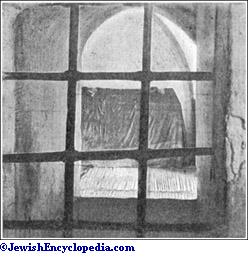
As a Conqueror.
Concerning David's military and political achievements, there is but meager information: a few isolated facts, however, are known; and the interrelation of these can only be conjectured. David subdued and made tributary to the new Israelitish kingdom the cognate tribes of Moab, Ammon, and Edom, as well as their neighbors on the northern frontier of Israel, the Arameans, who had joined the Ammonites in a war against David and his kingdom. Scanty as is the record of these wars, it indicates that they were not instituted for plunder or conquest; nor can it be proved that David was in a single instance the instigator. The Syrian-Ammonite war, the only conflict of which there is a detailed account, was occasioned by a frivolous provocation, the messengers of David having been wantonly insulted when on an errand of good-will and friendship (II Sam. x.).
David waged his wars vigorously, and did not hesitate to employ stern measures. His punishment of Moab and Edom was especially severe; but his alleged cruelties against the Ammonites rest on a misinterpretation of II Sam. xii. 31.
Death of Absalom.
Thus, through David, the people of Israel, who only a generation before had submitted to the insults of the Ammonites (I Sam. xi. 2), became the ruling nation between the Nile and the Euphrates; and it seemed as if their king was to end his days in peace and in the enjoyment of the position he had attained. In the prime of life, however, and at the height of his fame, David sinned; and the inexorable consequences of his transgression plunged him into misery, and threatened even the stability of his kingdom. David's sinful connection with Bath-sheba, whose husband he indirectly assassinated, encouraged his eldest son, Amnon, to deal wickedly with his beautiful stepsister, Tamar; whereupon he was slain by Absalom, her full brother. Absalom had to flee, but was recalled at the intercession of Joab. Stung, however, by the ill-timed severity of his father, Absalom instigated a rebellion in David's former capital, Hebron. David, taken completely by surprise, had to flee across the Jordan; but gaining time through Absalom's fatal delay, he gathered his old, well-tried troops about him, and easily dispersed Absalom's undisciplined bands at Mahanaim. Joab, with his own hand, killed the fleeing Absalom, against the king's express command.
David irritated the Israelites by unwise and onesided negotiations with the Judeans, whose defection had evidently been a heavy blow to him; and this bitterness resulted in a conflict between the Israelites and the Judeans on the return march. This conflict, which took place at the Jordan, became so bitter that the Benjamite Sheba ben Bichri succeeded in urging Israel to a revolt, which Joab, however, immediately quelled. Sheba fled to the city Abel Beth-maachah, on the northern boundary of the kingdom; but the inhabitants seized him, cut off his head, and throw it over the wall to Joab.
Concluding Years.
The remaining years of David's life and reign were peaceful. The question of his successor, however, brought up new difficulties. Adonijah, the eldest of David's sons after Absalom's death, was generallyregarded as his heir, and David allowed him to appear officially as crown prince. The ambitious and intriguing Bath-sheba tried to secure the succession for her son Solomon, the youngest of David's children, and David, infirm and completely under Bath-sheba's influence, believed a report—whether true or false—that Adonijah, unable to a wait his father's death, had already proclaimed himself king and had received the oath of allegiance. David, therefore, solemnly presented Solomon to the people as his successor and had him anointed. Soon afterward he died, at the age of seventy, having reigned for seven years and six months at Hebron as tribal King of Judah, and thirty-three years at Jerusalem as the second King of all Israel.
—In Rabbinical Literature:
David, the "chosen one of God" (Ab. R. N. xliii.; ed. Schechter, p. 61), belonged to a family that was itself among the elect of Israel. His ancestors were the noblest of the noble, the great men of the most prominent tribe of Israel (Ruth iv. 18-22), and he was a descendant of Miriam, the sister of Moses, although this is not clearly stated in Scripture (Sifre, Num. 78; ed. Friedmann, p. 20b). The judges Ibzan and Othniel were David's relations (B. B. 91a; Sifre, l.c.), and as the "ruler David"(David ha-Melek) continued the honorable traditions of his family, so the "pious David" was the son of a man who died sinless (Shab. 55b). Notwithstanding his piety Jesse's marital life was not untroubled; he intended even to liberate his favorite female slave and marry her, but his wife frustrated this design by disguising herself as the slave, and Jesse unwittingly married her the second time. The result of this union was David, who was passed off as the son of the slave, in order to leave Jesse in his error (Yalḳ., Makiri, ed. Buber, ii. 214; compare also Samuel Laniado's "Kele Yaḳar" to I Sam. xvii.). The supposed son of a slave, David was not educated with Jesse's other sons, but passed his days in the wilderness pasturing sheep (Yalḳ., Makiri, l.c.).
This pastoral life prepared him for the position he was to occupy. He treated the sheep entrusted to his care lovingly and tenderly, wherefore God said: "He understands how to pasture sheep; therefore he shall become the shepherd of My flock Israel" (Midr. Teh. lxxviii. 70; Ex. R. ii. 2; for a similar Arabic legend see Grünbaum, "Neue Beiträge," p. 193). In the lonely desert David also found opportunity to display his extraordinary strength and courage. Thus, in one day he strangled with his hands four lions and three bears that attacked his flock (Baraita of the Thirty-two Rules, iii.; Midr. Sam. xx.). David was once in great danger when he came upon a gigantic reem asleep. Taking it for a high mountain, he tried to climb it; but the animal awakened suddenly, and David found himself lifted high up into the air on its horns. David now vowed to God to build a temple 100 ells high—as high as the horns of the reem—if He would save him from the beast, and God thereupon sent a lion, which, as "king of the animals" (compare Ḳag. 13b), exacted respect even from this gigantic beast, which fell down before the lion, enabling David safely to alight. Then a deer came, which the lion immediately pursued, so that David escaped both from the reem and the lion (Midr. Teh. xxii. 22). David's pastoral life ended in his twenty-eighth year, when Samuel anointed him king (Yalḳ., Makiri, l.c.; compare also Seder 'Olam R. xiii.).
David Anointed as King.
The prophet thought at first that Eliab, David's eldest brother, was destined by God to be king, but it was indicated to him by means of the holy oil that David was the chosen one. When Samuel attempted to pour oil from the vessel upon each of David's brothers in succession, the oil remained in the vessel; but when David's turn came it flowed freely of itself; the drops that fell on his garments changed immediately into diamonds and pearls; and when the anointing was finished the horn was as full as before. David's mother now came and revealed the secret that had been kept for so many years, and his father and brothers learned that he was not the son of a slave (Yalḳ., Makiri, l.c.; Yalḳ. ii. 124 contains only a part of this legend; also Ephraem Syrus in his commentary to I Sam. xvi. 13, ed. Benedictini, p. 365; compare Ginzberg, "Die Haggada bei den Kirchenvätern," i. 27, 28). Although the anointing was kept secret, its effects became evident in David's remarkable spiritual development, for he received even the gift of prophecy (Josephus, "Ant." vi. 8, § 2; Sanh. 93b). He thereby excited the envy of many, especially of Doeg, who tried to prevent King Saul from calling David to his court (Sanh. l.c.; compare Doeg in Rab. Lit.). Saul became acquainted with David while the latter was still a boy, and grew attached to him, especially because of the cleverness he displayed on the following occasion: A woman who had to leave her home, and was unable to take her money with her, hid the gold pieces in barrels of honey, which she left in the care of a friend. The latter discovered the money, took it, and restored to the woman on her return only the honey. The woman brought the case before Saul, but as she could not prove her assertion the case was dismissed. When David, who was then a little boy playing before the king's house, heard the story, he undertook to convict the thief. At his suggestion the king commanded the barrels of honey to be broken, and two coins which the thief had not noticed were then found on the bottom, the theft being in this way proved (Jellinek, "B. H." iv. 150, 151, and in various "ma'aseh" collections).
David and Goliath.
David could enjoy the peace of court life only for a short time, as Goliath's appearance forced Saul into war. The sick king gladly accepted David's offer to march in his place against the blasphemous heathen (compare Goliath in Rab. Lit.), and when little David put on the great Saul's armor and found it to fit him perfectly, Saul recognized that David was intended for a higher mission. This change in David was due to the "holy oil" with which he was anointed; hence Saul became jealous of him, and David refused for this reason to go to battle in the king's armor (Tan., ed. Buber, iii. 84). Five stones came of themselves to David (Midr. Sam. xxi.), and when he touched them they changed into one stone (Zohar, Deut. 272). With them he intended to slayGoliath, for they symbolized God, the "three fathers" of Israel, and Aaron, whose descendants Hophni and Phineas had been killed shortly before by Goliath (Midr. Sam. l.c.; the Midrash quoted by Ḳimḥi to I Sam. xvii. 40 is somewhat different). As soon as David glanced at the giant the latter was struck with leprosy and rooted to the ground so that he could not move ("Ẓara'at"; Pesiḳ., ed. Buber, p. 175; see also Zohar, Num. p. 206, and parallel passages quoted by Buber). When David called out to Goliath "I shall give your flesh to the birds of heaven," Goliath looked up at the word "birds," the movement displacing his head-dress; and at the same moment the stone flung by David struck the giant's exposed forehead (Midrash quoted by ḳimḥi ad loc.; differently in Midr. Teh. lxxviii.). As Goliath was armed cap-a-pie, David was at a loss how to cut off his head. Uriah offered to help David if the latter would give him a Jewess for wife, and when David consented Uriah showed him how the ends of the bands that held the armor together were joined across the soles of Goliath's feet. David gave Bath-sheba to the Philistine, and she became later a source of much trouble to him, because he had had so little regard for the dignity of a Jewess (Midr. quoted by Alshech to I Sam. xvii. 50, and by Samuel Laniado to II Sam. xii.). David's victory over Goliath increased Saul's jealousy, who closely inquired into David's origin through his general Abner, in order to find out whether he really was a descendant of Pharez, for in that case Saul feared to see in David the future king. David's old enemy Doeg tried to prove that David being a descendant of the Moabitess Ruth, could not be regarded as a legitimate member of the Jewish community; the prophet Samuel, however, decided that the Biblical interdiction (Deut. xxiii. 3, 4) referred only to the men and not to the women of that people (Midr. Sam. xxii.; Ruth R. iv, 4; somewhat differently Yeb. 76b, 77a, and Ephraem Syrus, l.c. 379; compare Ginzberg, l.c. pp. 32, 33).
David Fleeing Before Saul.
David did not remain long with Saul, being obliged to flee from him shortly after Goliath's death. God did not abandon him, however, and not only saved him from his enemies, but also instructed him how to rule the world justly and wisely. Thus, David once had an opportunity to find out that even lunacy, which he thought served no purpose, had its place in the plan of the universe, for he owed it to his fictitious madness that he was not slain by Goliath's brothers, who formed the body-guard of King Achish (see Achish in Rab. Lit.; Midr. Teh. xxxiv. 1; Yalḳ. ii. 131, with variants; Second Alphabet of Ben Sira, ed. Venice, p. 24). He was compelled to change his mean opinion of the spider in his flight before Saul, when he was hiding in a cave, and his pursuers, seeing a spider's web across the front of the cave, thought it useless to enter; for God had commanded the spider at that moment to give a proof of its usefulness (Ben Sira, l.c.; partly in Targ. to Ps. lvii. 3; compare Levy, "Chal. Wörterb." i. 48). David had a wonderful, and at the same time instructive, escape when he seized the water-flask of Abner (see I Sam. xxvi. 7), and found himself caught between the legs of this giant as between two pillars; for a wasp stung Abner, who mechanically moved his feet, releasing David, who now recognized that even an apparently noxious insect can sometimes render service to man (Ben Sira, l.c.). Other miracles that David experienced in his flight before Saul were: the appearance of the angel informing Saul, who was about to seize David, that the Philistines were coming into the country (I Sam. xxiii. 26), whereupon Saul was obliged to give up the pursuit (Midr. Teh. xviii.); and the heavenly aid sent to David on his expedition against the Amalekites (I Sam. xxx. 17 et seq.), when the night was illuminated by lightning, thus enabling David to end the battle speedily (Lev. R. xxx. 3; Midr. Sam. xviii.).
David's Wars as King.
David's first thought on coming to the throne was to capture the ancient holy city of Jerusalem from the Jebusites. He did not fear the power of these heathen, but he did fear the covenant Abraham had made with their ancestors, the words of which were engraved on bronze figures (Pirḳe R. El. xxxvi.; compare Jebusites in Rab. Lit.). The city was furthermore surrounded by a high wall, and David could enter only after the wall had miraculously lowered itself (Midr. Teh. xviii.; compare Joab in Rab. Lit.). Although the Jebusites could not appeal to the promise given to them by Abraham, because they had attacked the Jews in the time of Joshua, yet David would not seize the holy city without indemnifying them for it (Pirḳe R. El. l.c.). After the capture of Jerusalem David marched against the Philistines in the valley of Rephaim (II Sam. v. 22 et seq.), and God commanded him to attack his enemy only after seeing the tree-tops bend, for God would judge the guardian angel of the heathen before giving the latter into the hands of the pious, and David was notified by the movement of the tree-tops (pseudo-Jerome commentary on II Sam. v. 24; compare Ginzberg, l.c. p. 125). On this occasion the pious king showed his great confidence in God, for there were only four ells between the two armies, and David had to use his utmost authority to make his followers refrain from battle, declaring that he would rather succumb in obeying God than conquer and be disobedient. He had hardly uttered these words when the tree-tops began to move, and he attacked the Philistines victoriously; whereupon God said to the angels: "Behold the great difference between him and Saul!" (compare I Sam. xiv. 19; Midr. Teh. xxvii.). The Philistines thought that David would not war against them, because they possessed a pledge—namely, the bridle of a charger that Isaac had given to Abimelech, the king of the Philistines, as a covenant (Pirḳe R. El. xxxvi.)—and the Arameans thought the same, as they possessed the "maẓẓebot" which Jacob and Laban had erected as covenants. The Sanhedrin, to whom David applied, decided that he was not obliged to keep the covenants of the fathers with the heathen, because the Philistines of David's time were not the descendants of the ancient inhabitants of the country, but a new people that had come from Caphtor (see Amos ix. 7); and the Arameans had lost all right to the covenantbetween Laban and Jacob on account of their attacks on Israel at the time of Moses and Joshua (Midr. Teh. lx.; Pirḳe R. El. l.c.).
David as Ruler.
David was not only a warrior, but also a wise and energetic ruler. Shortly after his accession he appointed not less than 90,000 officials, but he made the mistake of omitting the wise Ahithophel, for which both paid dearly later, as it was principally David's curse that brought about Ahithophel's tragic end (Yer. Sanh. x. 29a, end; abbreviated in Suk. 52b, 53a; compare Ahithophel in Rabbinical Literature; Psalms). Although he was king, he yet modestly asked counsel of his teachers Ira of Jair (M. Ḳ. 16b) and Mephiboshet regarding his decisions in ritual questions (Ber. 4a). He devoted so much time to the study of the Torah and to prayer that he was satisfied with "sixty breaths of sleep" (Suk. 26b). As soon as midnight had come the strings of his harp, made from the entrails of the ram that Abraham had sacrificed on Mount Moriah in place of Isaac, vibrated, and at the sound the king awakened and began to study the Torah (Ber. 3b; Yer. ib. i. 2d; Pirḳe R. El. xxi.). David also devoted much time to prayer, the one hundred daily benedictions being his work (Yer. Ber., end; on the ancient reading of this passage, see Ratner, "Ahabat Ẓiyyon we-Yerushalayim," ad loc.). He also collected psalms from the time of Abraham down to his own day (B. B. 14b), and composed new ones. When he had finished he exclaimed: "O Lord of the world, is there any creature in the world that has praised Thee so much?" Whereupon God sent a frog to inform him that this mean little animal sounded the praise of God uninterruptedly from early dawn till late at night (Yalḳ. ii. 889, end of Ps.). David, however, forgot himself so far as to boast only for a moment; generally he was very modest (Soṭah 10b). His coins showed on one side his shepherd's crook and scrip, and on the other David's tower (Gen. R. xxxix.; contra, B. Ḳ. 97b).
David's Piety. David Praying.(From a Passover Haggadah, Vienna, 1823, in the possession of J. D. Eisenstein.
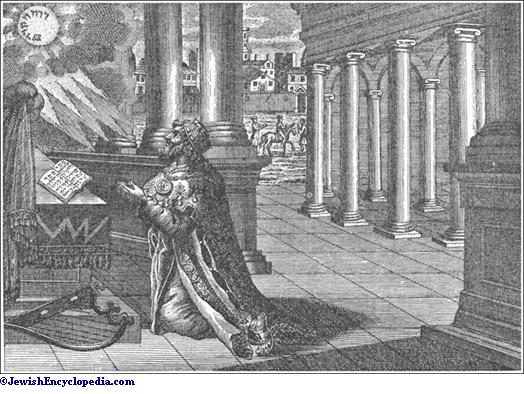
David's piety was so great that his prayers were able to bring things from heaven down to earth (Ḥag. 12b). It was one of his dearest wishes to build the Temple. God said, however, that the Temple would be indestructible if built by David, but that it was His design that it should be destroyed as punishment for Israel's sins; hence David could not build it (Pesḳ. R. 2; ed. Friedmann, p. 7). David's thoughts were so entirely directed to good that he was among the few pious ones over whom evil inclinations ("yeẓer ha-ra'") had no power (B. B. 17a), and his sin with Bath-sheba happened only as an example to show the power of repentance ('Ab. Zarah 4b, 5a). Some Talmudic authorities even assert that David did not commit adultery, for at that time all women obtained letters of divorce from their husbands who went to war, to use in case the latter should die on the field. Similarly David must notbe blamed for Uriah's death, since the latter had committed a capital offense in refusing to obey the king's command (II Sam. xl. 8, 9; Shab. 56a; Ḳid. 43a). The episode with Bath-sheba was also a punishment for David's overweening self-confidence, who thought himself equal to the "three fathers," and besought God to subject him to a trial that he might be able to prove the purity of his heart. God thereupon sent to him Satan in the shape of a bird; David threw an arrow at the latter, hitting instead a beehive under which was Bath-sheba, and on beholding her the king was at once violently enamored of her (Sanh. 107a). He spent twenty-two years in repenting this sin (Tanna debe Eliyahu R. ii.); and he also was stricken with leprosy for half a year, during which time he was abandoned not only by his own court, but by the Holy Spirit, in punishment for his sin (Yoma 22b; compare Ginzberg, l.c. pp. 43-46).
The most severe punishment, however, was Absalom's revolt; and it is a proof of David's great confidence in God's goodness that he thanked Him for sending his own son against him rather than a stranger, as the former might have been more inclined to be merciful to him if things had come to the worst (Ber. 7a). In his despair, however, David was about to deny God publicly, in order that the people might not call God unjust for so poorly rewarding David for his piety and justice. His friend Hushai the Archite came in time to show him that his punishment was not unmerited, and would not appear as such to the people, for it may be gathered from Scripture (Deut. xxi. 10 et seq.) that he who follows his passion and marries a captive of war must expect from this marriage a "stubborn and rebellious son." If David had not married Absalom's mother, who was a captive, he would not have had such a son (Sanh. 107a). David's kindness of heart is clearly shown in his behavior toward this wayward son, for he not only tried to save the latter's life, but the sevenfold repetition of Absalom's name in his dirge had the effect of saving him from the seven fires, or divisions, of hell (Soṭah 10b). Still David's sins were not atoned for by all these sufferings, and God one day gave him the choice between having his race destroyed and being taken prisoner by enemies. David chose the latter.
The Philistines.
Thereupon it happened that David pursuing a deer (Satan in disguise) was led into the country of the Philistines, where he was seized by Ishbibenob, Goliath's brother, who flung him into a wine-press. David was confronted by a horrible death, when the bottom of the press began to sink miraculously, so that he was saved from being crushed. Then he was rescued from his perilous position by Abishai, who was apprised, also miraculously, that David's life was in danger (see Abishai in Rab. Lit.); these two pious men conquered the giant Ishbi by pronouncing the name of God (Sanh. 95a; Jellinek, "B. H." iv. 140, 141). Among the trials of David was also the famine of three years (II Sam. xxi. 1 et seq.), which he regarded at first as a punishment for the godlessness of the people, and therefore examined the religious and moral conditions of the country for three successive years (Midr. Sam. xxviii. and the parallel passages in Buber ad loc.). When he found everything in good order he applied to God to find out the cause of the famine, and was informed that it was a punishment for not allowing the remains of Saul, "the anointed of God," to rest in holy ground. David thereupon brought the remains of Saul and Jonathan to the spot worthy of them, all the people taking part in the ceremony; and this love that Israel showed to its dead king induced God to take pity on them and end the famine (Pirḳe R. El. xvii.). Another debt of the people had still to be paid; namely, Saul's unmerciful behavior toward the Gibeonites, who now insisted on taking vengeance on his descendants. David tried his best to pacify them, conferring with each, and promising them as much money as they might demand. But when he saw that the Gibeonites possessed so little of the characteristic trait of the Israelites—mercy—he ordered them to be excluded from the Jewish community (Midr. Sam. l.c.). Although David was responsible neither for the famine nor for the execution of the descendants of Saul who were delivered to the Gibeonites, yet he was wrong in not employing for the relief of the sufferers during the famine the treasure that he had accumulated during many years, especially the gifts of gold presented to him by the women of Israel after his victory over Goliath. It would have been better to use them for that purpose than to save them for the building of the Temple, and God said therefore that he should not build it (Midr. Ruth Zuṭa, ed. Buber, p. 51). David is also censured for undertaking the census of the people, and is punished by a plague (II Sam. xxiv. 15) that, though lasting only a few hours (Ber. 62b; compare Ginzberg, l.c. p. 67), demanded many victims, among whom four of his sons, and the elders accompanying him, were slain by the angel; the latter even wiped his bloody sword on David's garments, causing thereby the trembling from which David suffered before his death (Tanna debe Eliyahu R. vii.). This trembling was a punishment for having cut the garment of Saul (I Sam. xxiv. 5); David now found no warmth in the garments that he wore (I Kings i. 1; Ber. 62b; compare Midr. Teh. lvii.).
David's Death.
When David saw his end approaching he tried to escape death by the following means: God had once revealed to him that he would die on a Sabbath, and David therefore spent every Sabbath in studying the Torah, so that the angel of death could not seize him. But the angel outwitted him by causing a noise in the royal palace; whereupon David interrupted his work for a moment, and went to a stairway. The stairs broke down, and David fell dead (Shab. xxx; Ruth R. i. 17). He died on a Sabbath and feast-day—Pentecost—and as no corpse might be moved on Sabbath, and David's body lay in the sun, Solomon called eagles, who guarded the body with their wings (Ruth R. l.c.). David reached the age of seventy years, which were presented to him by Adam. David had been destined to die immediately after his birth, but when God was showing the future generations to Adam, the latter offered to give seventy years of his life to David (Pirḳe R. El. xix.; Yalḳ. i. 41). Death did not put an end toDavid's greatness and splendor, for he was also among the elect in paradise (Jellinek, "B. H." v. 168; vi. 25, 26), and on the Day of Judgment he will pronounce the blessing over the wine during the great feast (Pes. 119b; compare Cup of Benediction). On the Day of Judgment David will also recite a psalm; the pious in paradise and the impious in hell will loudly say "Amen"; and then God will send an angel to bring even the impious to paradise (Jellinek, "B. H." v. 45, 46).
L. G.—In Mohammedan Literature:
Nearly all the legends relating to David (or Da'ud, as he is known to the Arabs) are elaborations of the Biblical narratives which were in circulation among the Jews at the time of Mohammed, and most of which may be traced back to the Koran or its commentaries. Other works which speak of him are the "Khaṣim" of Ḥusain ibn Mohammed, the "Ḳiṣṣat al-Anbiya," the "Dhakhirat al-'Ulum wa-Natijat al-Fuhum," and the "Ta'rikh Muntakhab."
David and Goliath.
To the Arabs these legends are important, as they form for them a real part of the world's history; and it is interesting to see how they are woven together and connected in a natural sequence. The very stones with which David kills Goliath are historical: one is the stone which Abraham threw at the devil when the latter tried to dissuade him from sacrificing Isaac; another is that which Gabriel pushed out of the ground when he created the spring for Ishmael; another again is the stone with which Jacob fought the angel sent against him by his brother Esau. After killing Goliath, David shares the kingdom with Saul, finally conquers his jealousy through his own generosity, and lives happily with him until Saul's death, when David is unanimously elected king. Baiḍawi remarks that the children of Israel were united for the first time under David.
David's Knowledge.
In addition to the kingdom, God grants David wisdom—interpreted to mean prophecy and the Psalms —and teaches him all he wishes to know; viz., the language of birds and stones, and how to make coats of mail. According to the Arabs, David was the inventor of chain armor, which he was enabled to make because the iron became soft in his hands. "It became like wax," says Baiḍawi, "so that he could mold it into any form he chose". It is related that David obtained this gift in the following manner: One day he overheard two angels, in the guise of men, comparing opinions about him. "He would be a perfect king," said one, "did he not take money from the public treasury"; whereupon David begged God to provide him with some means of self-support, and he was granted knowledge of the art of making armor.
At another time David overheard two men disputing as to the comparative merits of himself and Abraham; one of them contending that David had never endured such trials as had Abraham. David thereupon begged God to try his faith, and God sent a marvelous bird, which led David to a lake, on the shore of which he saw a beautiful woman bathing. This was none other than Bath-sheba, called "Saya" by the Arabs. After causing the death of her husband and marrying her, as related in the Bible, David is rebuked by two angels disguised as men, who tell him the story of the one ewe lamb, and demand judgment. In the Koran these angels come upon David on a day when the doors are closed; and on this Baiḍawi remarks that David so divided his time as to spend one day for devotion, one for giving judgment, one for preaching, and one for his own affairs. He also fasted every other day, and spent half the night in prayer. David was so filled with remorse that he wandered for three years in the desert, and shed more tears in that time than all humankind before him. During David's absence Absalom had made himself king, and had to be deposed.
David as Judge.
After this experience, David never had confidence in his own judgment; and God therefore gave him a miraculous bell, which rang to show the guilty party. As on one occasion he lost confidence in this also, it was taken away from him; and David called the boy Solomon to his aid in matters of justice. Wonderful tales are told showing the sagacity of this lad, then scarcely in his teens.
As David grew old he had only one more desire; namely, to see his future companion in paradise. This request is also granted; and after long wanderings David finds him on the summit of a mountain, on a verdant spot moist with his tears. This companion dies, and is buried by David, who on returning home finds the angel of death waiting for him also.
Bibliography:
Koran, suras ii. 250-252;
iv. 161;
v. 82;
vi. 84;
xvii. 57;
xxi. 79;
xxvii. 15, 16;
xxxiv. 10, 12;
xxxviii. 16, 21;
commentaries to the Koran by Baiḍawi and Tabari;
D'Herbelot, Bibliothèque Orientale;
Weil, Biblische Legenden der Muselmänner;
Max Grünbaum, Sprachund Sagenkund, pp. 511et seq.
—Critical View:
The salient features of the life and reign of David as outlined from I Sam. xvi. to I Kings ii. have been given above; and the most incisive criticism has been unable to modify any essential point of the narrative, which rests upon a strictly historic foundation. A far different impression of David is given in I Chronicles. Everything doubtful and offensive in regard to David and his house is here passed by, and he himself appears primarily as being preoccupied with the organization of the Temple service. He is said to have gathered together all the material for the building of the Temple, and to have planned every detail, so that Solomon merely had to carry out the work. He also arranged every part of the ritual, and distributed the various offices. The priests he divided into twenty-four families, who performed the service in the sanctuary according to lot. From among the Levites were chosen: (1) the Temple musicians, also divided into twenty-four classes; (2) the functionaries designated for subordinate service in the Temple, as door-keepers and overseers of supplies, chosen by lot according to their families; (3) judges and officials over Israel. The chronicler also mentions ordinances of David pertaining to military matters and to the royal domains.
David and the Psalter.
Subsequently David came to be regarded as thefounder of Israel's religious poetry. For since seventy-three of the Psalms have special superscriptions assigning their authorship to him, it became more and more the custom to ascribe the whole Psalter to him. Modern criticism has raised well-founded objections to this assumption. Indeed, the only generally recognized authentic specimen of the king's poetic activity is the splendid dirge on the deaths of Saul and Jonathan (II Sam. i. 19-27).
His Historic Importance.
David's historic importance can not be rated too high, as even those critics must admit who belittle his personal merits by ascribing his successes to a series of extraordinarily fortunate circumstances. Few men in the world's history have achieved as much as David. The molding of Israel into a nation is exclusively his work, for he was the first to unify what until then had been merely a conglomerate of clans and tribes; and Israel remained one nation even after the division of David's single kingdom. Saul had earnestly endeavored to give political unity to Israel; but he had been unequal to the task, and achieved nothing permanent. With Saul's death everything was lost, and the condition of the people was as hopeless as ever. David, in whom prudence and courage were most happily combined, and who was as careful and circumspect in the preparation of his plans as he was daring and energetic in their execution, followed up his successes with a definite end in view; and while aiming only at the attainable, did not rest until he had reached his goal. In view of the immense difficulties he had to overcome and of the crude and complex conditions which he was called upon to meet, the secret of David's success must be sought in his personality. He made himself the living center of his people and of his kingdom. A born ruler of men, and possessed of a royal nature that attracted and led all that came within his influence, he awakened the national enthusiasm, and thereby overcame every obstacle. For David not only made Israel a nation, but also elevated it at once to the pinnacle of glory. Israel itself has felt this; and therefore the return of a David has become the dream of its future and the object of its most ardent hopes.
David's character has often been criticized unfavorably because his critics have not taken the trouble to consider him in relation to his time. It is undeniable that he was the idol of his contemporaries, and that the power of his magnetic personality was irresistible. He was not a saintly character; and the Biblical accounts, with a nice regard for truth, have neither suppressed nor palliated his faults and weaknesses. Still, only blind prejudice will deny that his nature, in its essence, was noble and that he was animated and guided by true piety and a childlike faith in God. Even in modern times it is easy to understand how his contemporaries saw in him "the king after the heart of God."
DAVID (‘beloved’).—The second and greatest of the kings of Israel; the youngest of the eight sons of Jesse the Bethlehemite; he belonged to the tribe of Judah. The details of his life are gathered from 1Sa 16:3 – 1Ki 2:11, 1Ch 11:1 to 1Ch 29:30 (besides some scattered notices in the earlier chapters of 1 Ch.), the Psalms which bear on this period, and Bk. VII of the Antiquities of Josephus, though this latter adds but little to our knowledge. It is necessary to bear in mind two points of importance in dealing with the records of the life of David: firstly, the Hebrew text is, in a number of cases, very corrupt (notably in the books of Samuel), and in not a few passages the Alexandrian (Greek) version is to be preferred; secondly, our records have been gathered together from a variety of sources, and therefore they do not present a connected whole; that they are for this reason sometimes at variance with each other stands in the natural order of things.
1. Early years.—David was a shepherd by calling, and he continued this occupation until he had reached full manhood; the courage and strength sometimes required for the protection of flocks make it clear that he was more than a mere youth when he first appeared upon the scene of public life (1Sa 17:34-35). There are altogether three different accounts of David’s entry upon the stage of life.
(i) 1Sa 16:1-13. David is here represented as having been designated by Jahweh as Saul’s successor; Samuel is sent to Bethlehem to anoint him; all the seven sons of Jesse pass before the prophet, but the Spirit does not move him to anoint any of them; in perplexity he asks the father if he has any more children, whereupon the youngest is produced, and Samuel anoints him. Graphic as the story is, it strikes one as incomplete. Samuel does not even know of the existence of Jesse’s youngest son; the future king of Israel is introduced as a mere stripling whom nobody seems to know or care about, and he is left as abruptly as he is introduced. From all we know of Israel’s early heroes, a man was not raised to be a leader of the people unless or until he had first proved himself in some way to be the superior of his fellows. It was, of course, different when the monarchy had been securely established and the hereditary succession had come into vogue; though even then there were exceptions, e.g. in the case of Jehu. This was clearly so in the case of Saul, who had the reputation of being a ‘mighty man of valour’ (1Sa 9:2); and in the parallel case of the anointing of one to be king while the throne was still occupied, viz. Jehu, it is not an unknown man who is anointed (see 1Ki 19:16, 2Ki 9:3 ff.). The story, therefore, of David’s anointing by Samuel strikes one as being an incomplete fragment.
(ii) 1Sa 16:14-23. In this second account, the servants of Saul recommend that the king should send for someone who is a ‘cunning player on the harp,’ in order that by means of music the mental disorder from which he is suffering may be allayed. The son of Jesse is proposed, and forthwith sent for; when Saul is again attacked by the malady—said to be occasioned by ‘an evil spirit from the Lord’—David plays upon the harp, and Saul ‘is refreshed’ in spirit. In this account David is represented as a grown man, for it is said that Saul made him his armour-bearer.
(iii) 1Sa 17:1-58. The Greek version omits a large part of this account (1Sa 17:12-31; 1Sa 17:55-58), which seems itself to have been put together from different sources. According to it, David’s first appearance was on the eve of a battle between the Israelites and the Philistines. His father is in the habit of sending him to the Israelite camp with provisions for his three eldest brothers, who are among the warriors of the Israelite army; on one such occasion he finds the camp in consternation on account of the defiance of a Philistine hero, the giant Goliath. This man offers to fight in single combat with any Israelite who will come out and face him, but in spite of the high reward offered by the king to any one who will slay him—namely, great riches and the king’s daughter in marriage—nobody appears to answer the challenge. David gathers these details from different people in the camp, and, feeling sure of the help of Jahweh, determines to fight the giant. He communicates his purpose to Saul, who at first discourages him, but on seeing his firmness and confidence arms him and bids him go forth in the name of Jahweh. David, however, finds the armour too cumbersome, and discards it, taking instead nothing but five smooth stones and a sling. After mutual defiance, David slings one of his stones; the giant is hit, and falls down dead; David rushes up, draws the sword of the dead warrior, and cuts off his head. Thereupon panic takes hold of the Philistine host, and they flee, pursued by the Israelites, who thus gain a complete victory (see Elhanan).
It is worthy of note that each of these three accounts which introduce David to history connects with him just those three characteristics which subsequent ages loved to dwell upon. The first presents him as the beloved of Jahweh (cf. his name, ‘beloved’), who was specially chosen, the man after God’s own heart, the son of Jesse; the second presents him as the harpist, who was known in later ages as the ‘sweet psalmist of Israel’; while the third, which is probably the nearest to actual history, presents him as the warrior-hero, just as, in days to come, men would have pictured him whose whole reign from beginning to end was characterized by war.
David’s victory over Goliath had a twofold result; firstly, the heroic deed called forth the admiration, which soon became love, of the king’s son Jonathan; a covenant of friendship was made between the two, in token of which, and in ratification of which, Jonathan took off his apparel and armour and presented David with them. This friendship lasted till the death of Jonathan, and David’s pathetic lamentation over him (2Sa 1:25-27) points to the reality of their love. But secondly, it had the effect of arousing Saul’s envy; a not wholly unnatural feeling, considering the estimation in which David was held by the people in consequence of his victory; the adage—assuredly one of the most ancient authentic fragments of the history of the time—
‘Saul hath slain his thousands,
And David his ten thousands’
was not flattering to one who had, in days gone by, been Israel’s foremost warrior. For the present, however, Saul conceals his real feelings (1Sa 18:10-11 are evidently out of place), intending to rid himself of David in such a way that no blame would seem to attach itself to him. In fulfilment of his promise to the slayer of Goliath, he expresses his intention of giving his daughter Michal to David for his wife; but as David brings no dowry,—according to Hebrew custom,—Saul lays upon him conditions of a scandalous character (1Sa 18:25-26), hoping that, in attempting to fulfil them, David may lose his life. The scheme fails, and David receives Michal to wife. A further attempt to be rid of David is frustrated by Jonathan (1Sa 19:1-7), and at last Saul himself tries to kill him by throwing a javelin at him whilst playing on his harp; again he fails, for David nimbly avoids the javelin, and escapes to his own house. Thither Saul sends men to kill him, but with the help of his wife he again escapes, and flees to Ramah to seek counsel from Samuel. On Samuel’s advice, apparently, he goes to Jonathan by stealth to see if there is any possibility of a reconciliation with the king; Jonathan does his best, but in vain (1Sa 20:1-42), and David realizes that his life will be in danger so long as he is anywhere within reach of Saul or his emissaries.
2. David as an outlaw.—As in the case of the earlier period of David’s life, the records of this second period consist of a number of fragments from different sources, not very skilfully put together. We can do no more here than enumerate briefly the various localities in which David sought refuge from Saul’s vindictiveness, pointing out at the same time the more important episodes of his outlaw life.
David flies first of all to Nob, the priestly city; his stay here is, however, of short duration, for he is seen by Doeg, one of Saul’s followers. Taking the sword of his late antagonist, Goliath, which was wrapped in a cloth behind the ephod, he makes for Gath, hoping to find refuge on foreign soil; but he is recognized by the Philistines, and fearing that they would take vengeance on him for killing their hero Goliath, he simulates madness (cf. Psa 34:1-22 title),—a disease which by the Oriental (even to-day by the Bedouin) is looked upon as something sacrosanct. By this means he finds it easy enough to make his escape, and comes to the ‘cave of Adullam.’ Here his relations come to him, and he gathers together a band of desperadoes, who make him their captain. Finding that this kind of life is unfitted for his parents, he takes them to Mizpeh and confides them to the care of the king of Moab. On his return he is advised by the prophet Gad (doubtless because he had found out that Saul had received information of David’s whereabouts) to leave the stronghold; he therefore takes refuge in the forest of Hereth. While hiding here, news is brought to him that the Philistines are fighting against Keilah; he hastens to succour the inhabitants by attacking the Philistines; these he overcomes with great slaughter, and thereupon he takes up his abode in Keilah. In the meantime Saul’s spies discover the whereabouts of the fugitive, and David, fearing that the men of Keilah will deliver him up to his enemy, escapes with his followers to the hill-country in the wilderness of Ziph. A very vigorous pursuit is now undertaken by Saul, who seems determined to catch the elusive fugitive, and the chase is carried on among the wilds of Ziph, Maon, and Engedi. [Some portions of the narrative here seem to be told twice over with varying detail (cf. 1Sa 23:19 ff. with 1Sa 26:1 ff., and 1Sa 24:1 ff. with 1Sa 26:4 ff.).] It is during these wanderings that Saul falls into the power of David, but is magnanimously spared. The episode connected with David’s dealings with Nabal, and his taking Abigail and Ahinoam for his wives, also falls within this period (1Sa 24:1-22; 1Sa 25:1-44; 1Sa 26:1-25). At one time there seemed to be some hope of reconciliation between Saul and David (1Sa 26:24-25), but evidently this was short-lived, for soon afterwards David escapes once more, and comes with six hundred followers to the court of Achish, king of Gath. This time Achish welcomes him as an ally and gives him the city of Ziklag. David settles in Ziklag, and stays there for a year and four months (1Sa 27:7), occupying the time by fighting against the enemies of his country, the Geshurites, Amalekites, etc. At the end of this time, war again breaks out between the Israelites and the Philistines. The question arises whether David shall join with the forces of Achish against the Israelites; David himself seems willing to fight on the side of the Philistines (1Sa 29:8), but the princes of the Philistines, rightly or wrongly, suspect treachery on his part, and at the request of Achish he returns to Ziklag. On his arrival here he finds that the place has been sacked by the Amalekites, and forthwith he sets out to take revenge. This is ample and complete; part of the spoil which he acquires he sends as a present to the elders of Judah and to his friends (1Sa 30:26-31), a fact which shows that there was a party favourable to him in Judah; and this was possibly the reason and justification of the mistrust of the Philistine princes just mentioned. In the meantime the war between Israel and the Philistines ends disastrously for the former, and Saul and Jonathan are slain. David receives news of this during his sojourn in Ziklag. With this ends the outlaw life of David, for, leaving Ziklag, he comes to Hebron, where the men of Judah anoint him king (2Sa 2:4).
3. David as king
(a) Internal affairs.—For the first seven years of his reign David made Hebron his capital. In spite of his evident desire to make peace with the followers of Saul (2Sa 9:1-13), it was but natural that a vigorous attempt should be made to uphold the dynasty of the late king, at all events in Israel, as distinct from Judah (see Ishbosheth). It is therefore just what we should expect when we read that ‘there was long war between the house of Saul and the house of David’ (2Sa 3:1). The final victory lay with David, and in due time the elders of Israel came to him in Hebron and anointed him their king. As ruler over the whole land David realized the need of a more central capital; he fixed on Jerusalem, which he conquered from the Jebusites, and founded the royal city on Mt. Zion, ‘the city of David’ (2Sa 5:7). Thither he brought up the ark with great ceremony (2Sa 6:1 ff.), intending to build a permanent temple for it (2Sa 7:2), but the prophet Nathan declares to him that this is not Jahweh’s will. David’s disappointment is, however, soothed, for the prophet goes on to tell him that though he may not build this house, Jahweh will establish the house of David (i.e. in the sense of lineage) for ever (2Sa 7:11). David then enters in before Jahweh and offers up his thanksgiving (2Sa 7:18-29).
One of the darker traits of David’s character is illustrated by the detailed account of the Bathsheba episode (2Sa 11:2; 2Sa 12:25); so far from seeking to curb his passion for her on hearing that she is married, he finds ways and means of ridding himself of the husband, after whose death Bathsheba becomes his queen. The marriage was destined to influence materially the history of Israel (see Adonijah). But the most serious event in the history of the reign of David, so far as the internal affairs of the kingdom were concerned, was the rebellion of his son Absalom. Of an ambitious nature, Absalom sought the succession, even at the expense of dethroning his father. How he set about preparing the ground for the final coup is graphically described in 2Sa 15:1-6. After four [forty in the EV
The rebellion (if such it can be called) of Adonijah occurred at the very end of David’s reign. This episode is dealt with elsewhere (see Adonijah), and need not, therefore, be described here.
(b) External affairs.—Unlike most of his dealings with foreigners, David’s first contact, as king, with those outside of his kingdom, viz. with the Syrians, was of a peaceful character. Hiram, king of Tyre, sent (according to 2Sa 5:11, 1Ch 14:1) artificers of different kinds to assist David in building. But this was the exception. One of the characteristics of David’s reign was its large number of foreign wars. It is, however, necessary to bear in mind that in the case of a newly-established dynasty this is only to be expected. The following is, very briefly, a list of David’s foreign wars; they are put in the order found in 2Sam., but this order is not strictly chronological; moreover, it seems probable that in one or two cases duplicate, but varying, accounts appear: Philistines (2Sa 5:17-25), Moabites (2Sa 8:2), Zobah (2Sa 8:3-4), Syrians (2Sa 8:5-13), Edomites (2Sa 8:14), Ammonites, Syrians (2Sa 10:1, 2Sa 11:1, 2Sa 12:26-31), and Philistines (2Sa 21:15-22). David was victorious over all these peoples, the result being a great extension of his kingdom, which reached right up to the Euphrates (cf. Exo 23:31-33, Deu 11:23-25). Wars of this kind presuppose the existence of a, comparatively speaking, large army; that David had a constant supply of troops may be gathered from the details given in 1Ch 27:1-34.
While it is impossible to deny that the rôle of musician in which we are accustomed to picture David is largely the product of later ages, there can be no doubt that this rôle assigned to him is based on fact (cf. e.g. 1Sa 1:17-27, 2Sa 22:2-51= Psa 18:1-50, Amo 6:5), and he must evidently be regarded as one of the main sources of inspiration which guided the nation’s musicians of succeeding generations (see art. Psalms).
The character of David offers an intensely interesting complex of good and bad, in which the former largely predominates. As a ruler, warrior, and organizer, he stands pre-eminent among the heroes of Israel. His importance in the domain of the national religion lies mainly in his founding of the sanctuary of Zion, with all that that denotes. While his virtues of open-heartedness, generosity, and valour, besides those already referred to, stand out as clear as the day, his faults are to a large extent due to the age in which be lived, and must be discounted accordingly.
W. O. E. Oesterley.
I. Name and Genealogy
II. Early Years
1. Shepherd
2. Slinger
3. Harpist
4. Poet
5. Psalmist
6. Tribesman
III. In the Service of Saul
1. David First Meets Saul
2. His First Exploit
3. Envy of Saul and Flight of David
4. Jonathan and David
IV. David in Exile
1. David as Outlaw
2. David Joins the Philistines
V. David as King
1. Civil War
2. Conquests Abroad
3. Political Situation
4. The Ark
VI. Domestic Life
1. His Wives and Children
2. Domestic Troubles
VII. His officials
1. Prophets
2. Priests
3. Military Officers
4. Other Officials
5. Mutual Rivalry
VIII. Personal Character of David
1. Chronicles
2. Psalms
3. Complex Character
4. Physical Courage
5. Moral Courage
6. Prudence
7. Strategy
8. Nobility
9. David in Relation to His Family
10. David in Relation to His Friends
11. His Success
12. His Foreign Friends
13. Nemesis
14. References in the New Testament
Literature
I. Name and Genealogy
This name, which is written “defectively” in the older books, such as those of Samuel, but fully with the
II. Early Years
The home of David when he comes upon the stage of history was the picturesque town of Bethlehem.
1. Shepherd
There his family had been settled for generations, indeed ever since the Israelite nation had overrun the land of Canaan. His father was apparently not only the chief man of the place, but he seems to have been chieftain of the whole clan to which he belonged - the clan of Judah. Although the country round Bethlehem is more fertile than that in the neighborhood of Jerusalem, the inhabitants joined to the cultivation of the soil the breeding of cattle (Luk 2:8). David’s father, not only cultivated his ancestral fields, but kept flocks of sheep and goats as well. The flocks were sent out every day to pasture in the neighboring valleys attended by the herdsmen armed so as to defend themselves and their charge, not only against marauders from the surrounding deserts, but also from the lions and bears with which the country was then infested. David seems to have been in the habit of accompanying his father’s servants in their task (1Sa 17:20, 1Sa 17:22), and on occasion would be left in full charge by himself. Nor was his post at such times a sinecure. He had not only to keep a sharp lookout for thieves, but on more than one occasion had with no other weapon than his shepherd’s club or staff to rescue a lamb from the clutches of a lion or a bear (1Sa 17:34). Such adventures, however, must have been rare, and David must often have watched eagerly the lengthening of the shadow which told of the approach of sunset, when he could drive his charge into the zariba for the night and return home. There is, indeed, no life more monotonous and enervating than that of an eastern shepherd, but David must have made good use of his idle time. He seems, in fact, to have made such good use of it as to have neglected his handful of sheep. The incidents of which he boasted to Saul would not have occurred, had his proper occupation taken up all his thoughts; but, like King Alfred, his head seems to have been filled with ideas far removed from his humble task.
2. Slinger
David, like Nelson, does not seem to have known what it was to be afraid, and it was not to be expected that he could be satisfied with the lot of the youngest of eight sons of the now aged chief (1Sa 17:12; 1Ch 2:13). In the East every man is a soldier, and David’s bent was in that direction. The tribesmen of Benjamin near whose border his home was situated were famed through all Israel as slingers, some of whom could sling at a hair and not miss (Jdg 20:16). Taught, perhaps, by one of these, but certainly by dint of constant practice, David acquired an accuracy of aim which reminds one of the tales of William Tell or Robin Hood (1Sa 17:49).
3. Harpist
Another of the pastimes in the pursuit of which David spent many an hour of his youthful days was music. The instrument which he used was the “harp” (Hebrew
4. Poet
To the accompaniment of his lyre David no doubt sang words, either of popular songs or of lyrics of his own composition, in that wailing eastern key which seems to be an imitation of the bleating of flocks. The verses he sang would recount his own adventures or the heroic prowess of the warrior of his clan, or celebrate the loveliness of some maiden of the tribe, or consist of elegies upon those slain in battle. That the name of David was long connected with music the reverse of sacred appears from the fact that Amos denounces the people of luxury of his time for improvising to the sound of the viol, inventing instruments of music, like David (Amo 6:5). (It is not clear to which clause “like David” belongs, probably to both.) The only remains of the secular poetry of David which have come down to us are his elegies on Saul and Jonathan and on Abner (2Sa 1:19-27; 2Sa 3:33, 2Sa 3:14), which show him to have been a true poet.
5. Psalmist
Did David also compose religious verses? Was he “the sweet psalmist of Israel” (2Sa 23:1)? In the oldest account which we have, contained in the books of Samuel, David appears as a musician and as a secular poet only, for it is obvious the poetical passages, 2 Sam 22:1-23:7, do not belong to the original form of that book but are thrust in in the middle of a long list of names of David’s soldiers. The position is the same in Amo 6:5. It is in the later books and passages that sacred music and psalms begin to be ascribed to him. Perhaps the earliest instance is the passage just cited containing the “last words” of David (2Sa 23:1-7). The Chronicler (about 300 bc) seems to put parts of Psalms 105; Psa 96:1-13, and 106 into the mouth of David (1Ch 16:7), and Neh 12:36 regards him apparently as the inventor of the instruments used in the Temple service (1Ch 23:5), or as a player of sacred music. So too in the Septuagint psalter (Ps 151:2) we read, “My hands made an organ, my fingers fashioned a psaltery”; and gradually the whole of the Psalms came to be ascribed to David as author. In regard to this question it must be remembered that in the East at any rate there is no such distinction as that of sacred and secular. By sacred poetry we mean poetry which mentions the name of God or quotes Scripture, but the Hebrew or Arab poet will use the name of God as an accompaniment to a dance, and will freely sprinkle even comic poetry with citations from his sacred book. David must have composed sacred poems if he composed at all, and he would use his musical gift for the purposes of religion as readily as for those of amusement and pleasure (2Sa 6:14, 2Sa 6:15). Whether any of our psalms was composed by David is another question. The titles cannot be considered as conclusive evidence, and internal proofs of his authorship are wanting. Indeed the only psalm which claims to have been written by David is the 18th (= 2 Sam 22). One cannot help wishing that Psa 23:1-6 had been sung by the little herd lad as he watched his father’s flocks and guarded them from danger.
6. Tribesman
There are sayings of Mohammed that the happiest life is that of the shepherd, and that no one became a prophet who had not at one time tended a flock of sheep. What Mohammed meant was that the shepherd enjoys leisure and solitude for reflection and for plunging into those day dreams out of which prophets are made. If David, like the Arab poet Tarafa, indulged in sport, in music and in poetry, even to the neglect of his charge, he must have sought out themes on which to exercise his muse; and it must have been with no little chagrin that he learnt that whereas the tribes of Ephraim, Benjamin, Naphtali, Manasseh, Issachar, Zebulun, Levi, Dan, and even the non-Israelite tribes of Kenaz and the debatable land of Gilead could boast of having held the hegemony of Israel and led the nation in battle, his own tribe of Judah had played a quite subordinate part, and was not even mentioned in the national war song of Deborah. As contrasted with the poets of these tribes he could boast in his verses only of Ibzan who belonged to his own town of Bethlehem (Jdg 12:8). The Jerahmeelites were no doubt a powerful clan, but neither they nor any other of the subdivisions of Judah had ever done anything for the common good. Indeed, when the twelve pathfinders had been sent in advance into Canaan, Judah had been represented by Caleb, a member of the Uitlander tribe of Kenaz (Num 13:6). He became apparently the adopted son of Hezron and so David might claim kinship with him, and through him with Othniel the first of the judges (Jdg 1:13). David Thus belonged to the least efficient of all the Israelite tribes except one, and one which, considering its size and wealth, had till now failed to play a worthy part in the confederacy. It is difficult to believe that the young David never dreamed of a day when his own tribe should take its true place among its fellows, and when the deliverer of Israel from its oppressors should belong for once to the tribe of Judah.
III. In the Service of Saul
The earliest events in the career of David are involved in some obscurity.
1. David First Meets Saul
This is due mainly to what appears to be an insoluble difficulty in 1 Samuel 16 and 17. In chapter 16, David is engaged to play before Saul in order to dispel is melancholy, and becomes his squire or armor-bearer (1Sa 16:21), whereas in the following chapter he is unknown to Saul, who, after the death of Goliath, asks Abner who he is, and Abner replies that he does not know (1Sa 17:55). This apparent contradiction may be accounted for by the following considerations: (a) 1Sa 16:14-23 may be inserted out of its chronological order for the sake of the contrast with the section immediately preceding - “the spirit of Yahweh came mightily upon David from that day forward ... the spirit of Yahweh departed from Saul” (1Sa 16:13, 1Sa 16:14); (b) The fact of David becoming Saul’s squire does not imply constant personal attendance upon him; the text says David became an (not his) armor-bearer to Saul. The king would have many such squires: Joab, though only commander-in-chief, had, it seems, eighteen (2Sa 23:37 reads “armor-bearers”); (c) David would not play before Saul every day: his presence might not be required for a space of weeks or months; (d) Saul’s failure to recognize David may have been a result of the ’evil spirit from Yahweh’ and Abner’s denial of knowledge may have been feigned out of jealousy. If we accept all the statements of the dramatis personae in these narratives we shall not get very far.
2. His First Exploit
The facts seem to have been somewhat as follows: It had become evident that Saul was not equal to the task to which he had been set - the task of breaking the Philistine power, and it became the duty of Samuel, as the vicar of Yahweh and as still holding very large powers, to look about for a successor. He turned to the tribe of Judah (the full brother of his own ancestor Levi), a tribe which was fast becoming the most powerful member of the federation. The headman of this clan was Jesse of Bethlehem. His name was well known in the country - Saul does not require to be told who he is (1Sa 16:18; 1Sa 17:58) - but he was by this time advanced in years (1Sa 17:12). He had, however, many sons. Old men in the East often foretell a great future for a young boy (compare Luk 2:34). Samuel saw that David was formed of other clay than his brothers, and he anointed him as he had done Saul (1Sa 10:1). But whereas the anointing of Saul was done surreptitiously and for a definite purpose which was explained at the time (1Sa 10:1), that of David was performed before his whole family, but with what object he was not told (1Sa 16:13). His brothers do not seem to have thought the matter of much consequence (compare 1Sa 17:28), and all David could conclude from it was that he was destined to some high office - perhaps that of Samuel’s successor (compare 1Ki 19:15, 1Ki 19:16). It would have the effect of nerving him for any adventure and raising his hopes high and steeling his courage. Whether by accident or by contrivance he became attached to Saul as minstrel (compare 2Ki 3:15) and subsequently as one of his armor-bearers. He would probably be at this time about twenty years of age. It must have been after an interval of some months that an event happened which made it impossible for Saul ever again to forget the existence of David. This was the famous duel between David and the Philistine Goliath, which saved the situation for Saul for the time (1 Sam 17). In regard to this narrative it must be noted that 1 Sam 17:12-31, 1Sa 17:41, 1Sa 17:50, 1Sa 17:55-58 and 1Sa 18:1-5 are lacking in the best manuscript of the Septuagint, that is, the sending of David from Bethlehem and his fresh introduction to Saul and Saul’s failure to recognize him are left out. With the omission of these verses all the difficulties of the narrative vanish. For the reason why David could not wear the armor offered him was not because he was still a child, which is absurd in view of the fact that Saul was exceptionally tall (1Sa 9:2), but because he had had no practice with it (1Sa 17:39). It is ridiculous to suppose that David was not at this time full-grown, and that two armies stood by while a child advanced to engage a giant. The event gained for David the reputation won in modern times at the cannon’s mouth, but also the devoted friendship of Jonathan and the enmity of Saul (1Sa 18:1-9).
The next years of David’s life were spent in the service of Saul in his wars with the Philistines. David’s success where Saul had failed, however, instead of gratifying only inflamed the jealousy of the latter, and he determined to put David out of the way. More than once he attempted to do so with his own hand (1Sa 18:11; 1Sa 19:10), but he also employed stratagem. It came to his ears that his daughter Michal, as well as his son Jonathan, loved David, and Saul undertook to give her to David on the condition of his killing one hundred Philistines.
3. Envy of Saul and Flight of David
The gruesome dowry was paid, and David became Saul’s son-in-law. The Hebrew text states that Saul first offered his elder daughter to David, and then failed to implement his promise (1Sa 18:17-19, 1Sa 18:21), but this passage is not found in the Greek. David’s relation to Saul did not mitigate the hatred of the latter; indeed his enmity became so bitter that David determined upon flight. With the help of stratagem on the part of Michal, this was effected and David went to Samuel at Ramah for counsel and advice (1Sa 19:18). There Saul pursued him, but when he came into the presence of the prophet, his courage failed and he was overcome by the contagion of the prophetic ecstasy (1Sa 19:24) as he had been on a previous occasion (1Sa 10:11). David returned to Gibeah, while the coast was clear, to meet Jonathan, but Saul also returned immediately, his hatred more intense than before. David then continued his flight and came to Ahimelech, the priest at Nob (1Sa 21:1). It is sometimes supposed that we have here two inconsistent accounts of David’s flight, according to one of which he fled to Samuel at Ramah, and according to the other to Ahimelech at Nob; but there is no necessity for such a supposition, and even if it were correct, it would not clear up all the difficulties of the narrative. There is evidently much in these narratives that is left untold and our business should be to fill up the gaps in a way consistent with what we are given. That Saul made sure that David would not return is shown by the fact that he gave his daughter Michal to a man of the tribe of Benjamin as wife (1Sa 25:44).
4. Jonathan and David
The relation existing between Jonathan and David was one of pure friendship. There was no reason why it should not be so. A hereditary monarchy did not yet exist in Israel. The only previous attempt to establish such an institution - that of Gideon’s family (Jdg 9) - though not of Gideon himself (1 Sam 8:23) - had ended in failure. The principle followed hitherto had been that of election by the
IV. David in Exile
1. David as Outlaw
From the moment of his flight David became an outlaw and remained so until the death of Saul. This period of his career is full of stirring adventures which remind us of Robert Bruce or William Wallace of Scotland. Like King Arthur and other heroes he carried a famous sword - the sword of Goliath (1Sa 21:9). Having obtained it of Ahimelech, he for the first time left Israelite territory and went to the Philistine city of Gath (1Sa 21:10). Not feeling safe here he left and took up his abode in the cave of Adullam (1Sa 22:1) in the country of Judah, almost within sight of his native Bethlehem. This cave was admirably suited to the outlaw’s purpose and no doubt David had many a time explored its recesses when a boy. Here he was joined by his parents and brothers, with their servants, as well as by all sorts of persons who were at war with the government, debtors, fugitives from justice, and discontented persons generally. David Thus became the chief of a band of outlaws who numbered about 400. Of such stuff some of his bravest soldiers were made (2Sa 23:13). He had an augur, too, to direct his actions, and, after the massacre of the priests at Nob, a priest, Abiathar, carrying an ephod with which to cast lots (1Sa 22:5; 1Sa 23:6). During this period he supported himself and his men by making raids on the Philistine outposts and levying blackmail on his own countrymen (1Sa 25:2) in return for giving them his protection from the Philistines (1Sa 23:1). Hard pressed both by Saul and the Philistines (who had established themselves even in Bethlehem) he committed his parents to the keeping of the king of Moab, and began to rove as a freebooter through the country (1Sa 23:5, 1Sa 23:15, 1Sa 23:25, 1Sa 23:29). On two occasions David had Saul in his power, but refused to seize the opportunity of taking his life (1 Sam 24-26). Here again there are no adequate grounds for supposing we have two accounts of one and the same incident. During his wandering David’s followers increased in numbers (compare 1Sa 22:2; 1Sa 23:13; 1Sa 25:13). His chief lieutenant was his nephew Abishai, the son of his sister Zeruiah, but his brothers, Joab and Asahel, do not seem to have joined David yet. Another of his nephews, Jonathan the son of Shimei (Shammah), is mentioned (2Sa 21:21; compare 1Sa 16:9) and the Chronicler thinks many other knights joined him during this period (1Ch 11:10). The position of David at this time was very similar to that of the brigand Raisuli of late in Morocco. That there was some stability in it is shown by his taking two wives at this time - Ahinoam and Abigail (1Sa 25:42, 1Sa 25:43).
2. David Joins the Philistines
David now, abandoning all hope of ever conciliating the king (1Sa 27:1), made a move which shows at once his reckless daring and consummate genius. He offered the services of himself and his little army of 600 men to the enemies of his country. The town of Gath appears to have been an asylum for fugitive Israelites (1Ki 2:39). David’s first impulse on his flight from Saul had been to seek safety there (1Sa 21:10-15). Then, however, he was the hero of Israel, whose assassination would be the highest gain to the Philistines; now he was the embittered antagonist of Saul, and was welcomed accordingly. Achish placed at his disposal the fortified town of Ziklag in the territory of the now extinct tribe of Simeon, and there he and his followers, each of whom had his family with him, took up their quarters for sixteen months (1Sa 27:6, 1Sa 27:7). The advantages to David were many. He was safe at last from the persecution of Saul (1Sa 27:4); he could secure ample supplies by making raids upon the Amalekites and other tribes hostile to Israel toward the South (1Sa 27:8); and if the opportunity presented itself he could deal a serious blow at the Philistine arms. The position was no doubt a precarious one. It could last just as long as David could hoodwink Achish by persuading him that his raids were directed against his own tribe (1Sa 27:10). This he succeeded in doing so completely that Achish would have taken him with him on the campaign which ended in the decisive battle of Gilboa, but the other chiefs, fearing treachery, refused to allow him to do so. David was forced to return with his followers to Ziklag, only to find that town razed to the ground and all the women and children carried off by his old enemies the Amalekites (1Sa 30:1, 1Sa 30:2). By the time he had recovered the spoil and returned in triumph to Ziklag the battle of Gilboa had been fought and Saul was slain. The conduct of David in his relations with the Philistines was not more reprehensible than that of the Cid who allied himself with
V. David as King
1. Civil War
David immediately removed from Ziklag and took up his quarters at Hebron, where he was at once anointed king over his own tribe of Judah. Thus began the cleavage between Judah and Israel. Here he was joined, apparently for the first time, by his nephew Joab. Abner, however, loyal to his former master, had Esh-baal (1Ch 8:33), son of Saul, anointed king over the remaining tribes at Mahanaim, a fortified town east of the Jordan. War continued between David and Abner for several years, fortune always favoring David. Seeing things were going against him Abner forced Esh-baal into a personal quarrel with himself and then transferred his allegiance and persuaded his side to transfer theirs to David (2Sa 3:21). He did not reap the fruit of his defection, as he was immediately after assassinated by Joab in revenge for the death of Asahel whom Abner had killed in self-defence (2Sa 3:27). Deprived of his chief support
2. Conquests Abroad
King of all the Israelite tribes, David found his hands free to expel the foreigners who had invaded the sacred territory. His first step was to move his headquarters from the Southern Hebron, which he had been compelled at first to make his capital, to the more central Jerusalem. The fort here, which was still held by the aboriginal Jebusites, was stormed by Joab, David’s nephew, who also superintended the rebuilding for David. He was in consequence appointed commander-in-chief (1Ch 11:6, 1Ch 11:8), a post which he held as long as David lived. The materials and the skilled workmen for the erection of the palace were supplied by Hiram of Tyre (2Sa 5:11). David now turned his attention to the surrounding tribes and peoples. The most formidable enemy, the Philistines, were worsted in several campaigns, and their power crippled (2Sa 5:17; 2Sa 8:1). In one of these David so nearly came by his death, that his people would not afterward permit him to take part in the fighting (2Sa 21:16, 2Sa 21:17). One of the first countries against which David turned his arms was the land of Moab, which he treated with a severity which would suggest that the Moabite king had ill-treated David’s father and mother, who had taken refuge with him (2Sa 8:2). Yet his conduct toward the sons of Ammon was even more cruel (2Sa 12:31), and for less cause (1Sa 10:1). The king of Zobah (Chalkis) was defeated (2Sa 8:3), and Israelite garrisons were placed in Syria of Damascus (2Sa 8:6) and Edom (2Sa 8:14). The sons of Ammon formed a league with the Syrian kingdoms to the North and East of Palestine (2Sa 10:6, 2Sa 10:16), but these also had no success. All these people became tributary to the kingdom of Israel under David (2Sa 10:18, 2Sa 10:19) except the sons of Ammon who were practically exterminated for the time being (2Sa 12:31). Thus, Israel became one of the “great powers” of the world during the reign of David and his immediate successor.
3. Political Situation
There is no doubt that the expansion of the boundaries of Israel at this period almost to their ideal limits (Deu 11:24, etc.) was largely due to the fact that the two great empires of Egypt and Assyria were at the moment passing through a period of weakness and decay. The Assyrian monarchy was in a decadent state from about the year 1050 bc, and the 22nd Dynasty - to which Shishak belonged (1Ki 14:25) - had not yet arisen. David, therefore, had a free hand when his time came and found no more formidable opposition than that of the petty states bordering upon Palestine. Against the combined forces of all the Israelite tribes these had never been able to effect much.
4. The Ark
It had been the custom of the Israelites on setting out upon expeditions in which the nation as a whole took part to carry with them the sacred box or “ark” which contained the two stone tables (Jos 4:7, etc.). When David had secured the fortress of Jebus for his metropolis one of his first thoughts was to bring into it this emblem of victory. It was then lying at
VI. Domestic Life
1. His Wives and Children
In accordance with the practice of the kings of his time, David had several wives. His first wife was Michal, the younger daughter of Saul. When David fled from Saul she was given to Phaltiel, but was restored to David after Saul’s death. She does not appear to have borne any children. In 2Sa 21:8 “Michal” should be Merab (1Sa 18:19). During the period of separation from Michal, David took to wife Ahinoam of Jezreel and Abigail the wife of Nabal (1Sa 25:43, 1Sa 25:12), who accompanied him to Ziklag (1Sa 27:3), when they were among those captured by the Amalekites (1Sa 30:5). A fourth wife was the daughter of Talmai of Geshur, Maacah, whom he had captured in war (1Sa 27:8; 2Sa 3:3). When he removed to Hebron Ahinoam bore him his oldest son Amnon, and Abigail his second son Chileab or Daniel (2Sa 3:2, 2Sa 3:3; 1Ch 3:1); his third son was Absalom, whose mother was Maacah, and his fourth Adonijah. His mother’s name was Haggith; nothing is known about her. Two other sons, Shephatiah and Ithream were also born in Hebron (2Sa 3:2-5; 1Ch 3:1-4). When David added the kingdom of Israel to that of Judah, he, in accordance with custom, took more wives with a view to increase his state and dignity. One of these was Bathsheba, who became the mother of Solomon (2Sa 5:13; 1Ch 3:5; 1Ch 14:3). David’s sons discharged priestly functions (2Sa 8:18; compare Nathan in Zec 12:12).
2. Domestic Troubles
It was perhaps inevitable that in so large a household the usual dissensions and crimes of the harem should have sprung up in plenty. A most unvarnished account of these is given in 2 Sam 11 through 20 - it has been suggested by Abiathar the priest in order to avenge himself on Solomon for his disgrace (1Ki 2:26, 1Ki 2:27), Solomon’s mother being Bathsheba (2 Sam 11; 12). 1Ch 13:1-14 recounts the wrong done to Tamar, the daughter of David and Maacah, and sister of Absalom, and how the last named, having avenged his sister’s honor by killing Amnon, his oldest brother, fled for asylum to his mother’s father, the king of Geshur. Thence after two years he returned (chapter 14), only to foment rebellion against his father (chapter 15), leading to civil war between David and Judah on the one side and Absalom and Israel on the other (chapters 16; 17), and ending in the death of himself (chapter 18) and of Amasa, David’s nephew, at the hands of his cousins Joab and Abishai (2Sa 20:7), as well as nearly precipitating the disruption of the newly founded kingdom (2Sa 19:43). The rebellion of Absalom was probably due to the fact of Solomon having been designated David’s successor (compare 2Sa 12:24; 1Ch 22:9), for Absalom had the best claim, Amnon being dead and Chileab apparently of no account.
VII. His Officials
As David’s circumstances improved he required assistance in the management of his affairs.
1. Prophets
The beginning of his good fortune had been the friendship of the prophet Samuel (1Sa 16:13; 1Sa 19:18). The prophet or seer was keeper of the king’s conscience and was not appointed by him, but claimed divine authority (2Sa 7:3, 2Sa 7:1; 2Sa 12:1; 2Sa 24:11). Among the persons who discharged this duty for David were Gad the seer (1Sa 22:5) and Nathan the prophet (1Ki 1:11). All these are said to have written memoirs of their times (1Ch 29:29; 2Ch 9:29).
2. Priests
Next to the prophet came the priest. The
3. Military Officers
When still an outlaw David required the services of a henchman to take command of his men in his absence. This post was held at first by different persons according to circumstances, but generally, it seems, by his nephew Abishai (1Sa 26:6). It was only after the death of Saul that his brother Joab threw in his lot with David. His great military talents at once gave him a leading place, and as a reward for the capture of Jebus he was given the chief command, which he held against all rivals (2Sa 3:27; 2Sa 20:10) during the whole reign. David’s special body-guard of Philistine troops - the Cherethites and Pelethites - were commanded by Benaiah, who in the following reign, succeeded Joab (1Ki 2:35).
4. Other Officials
The office of recorder or magister memoriae was held during this reign and in the following by Jehoshaphat (2Sa 8:16); and that of secretary by Seraiah (2Sa 8:17), also called Shavsha (1Ch 18:16) or Shisha (1Ki 4:3). There were also the counselors, men noted for their great acumen and knowledge of human nature, such as Ahithophel and Hushai.
5. Mutual Rivalry
It was natural that there should be much mutual jealousy and rivalry among these officials, and that some of them should attach themselves to one of David’s many sons, others to another. Thus, Amnon is the special patron of David’s nephew Jonadab (2Sa 13:3; compare 2Sa 21:21), and Absalom is backed by Amasa (2Sa 17:25). The claim of Adonijah to the throne is supported by Joab and Abiathar (1Ki 1:7), as against that of Solomon who is backed by Nathan, Benaiah, Zadok (1Ki 1:8) and Hushai (compare Ant, VII, xiv, 4). Ahithophel sides with Absalom; Hushai with David (2Sa 15:12, 2Sa 15:32).
VIII. Personal Character of David
1. Chronicles
We would obtain a very different idea of the personal character of David if we drew our conclusions from the books of Samuel and Kings or from the books of Chronicles. There is no doubt whatever that the former books are much truer to fact, and any estimate or appreciation of David or of any of the other characters described must be based upon them. The Chronicler, on the other hand, is biased by the religious ideas of his own time and is prejudiced in favor of some of those whose biographies he writes and against others. He accordingly suppresses the dark passages of David’s life, e.g. the murder of Uriah (1Ch 20:1-8), or sets them in a favorable light, e.g. by laying the blame of the census upon Satan (1Ch 21:1). David’s success, especially as against Saul’s misfortune, is greatly exaggerated in 1Ch 12:2, 1Ch 12:22. Ceremonial functions are greatly elaborated (chapter 16; compare 2 Sam 6). The various orders of priests and singers in the second temple have their origin traced back to David (1Ch 16:4, 1Ch 16:37; 1 Ch 23 through 27), and the temple of Solomon itself is to all intents and purposes built by him (chapters 22; 28). At the same time there may be much material in the shape of names and isolated statements not found in the older books, which so long as they are not tinged with the Chronicler’s pragmatism or “tendency,” may possibly be authentic records preserved within the circle of the priestly caste, e.g. we are told that Saul’s skull was fastened in the temple of Dagon (1Ch 10:10). There is no doubt that the true names of Ish-bosheth, Mephibosheth and Eliada (2Sa 2:8; 2Sa 4:4; 2Sa 5:16) were
2. Psalms
If we could believe that the Book of Psalms was in whole or in part the work of David, it would throw a flood of light upon the religious side of his nature. Indeed, we should know as much about his religious life as can well be known about anyone. Unfortunately the date and authorship of the Psalms are questions regarding which the most divergent opinions are held. In the early Christian centuries all the Psalms were ascribed to David and, where necessary, explained as prophecies. The author of the Epistle to the Hebrews speaks of the Book of Psalms simply as “David” (Heb 4:7). The Greek text, however, of that book ascribes only some 87 of the poems to David, and the Hebrew only 73. Some of these are not David’s, and in the whole book there is only one which professes from its contents to be his, namely, Ps 18 (= 2 Sam 22). The occasion on which a psalm was composed is stated only in the case of thirteen psalms, all of which are ascribed to David. Each of these is referred to some incident recorded in the books of Samuel, although sometimes the citation is erroneous (see PSALMS). The Septuagint supplies occasions to two or three more psalms; but all such statements are merely the conjectures of readers and scribes and are of no historical value.
3. Complex Character
To form a correct opinion of anyone is much more difficult than to state the facts of his life; to form an opinion which will be generally accepted is impossible. Of David’s character the most opposite estimates have been formed. On one hand he is extolled as a saint, and yet few men have committed worse crimes. The character of David must remain, like that of everyone, an insoluble enigma. A person is to be judged by his motives rather than by his actions, and one’s true motives are unknown even to oneself (Jer 17:9). There are several sides of David’s nature in regard to which there cannot be two opinions.
4. Physical Courage
Perhaps the feature of his character which stands out most prominently in his earlier years, at any rate, is his boundless physical courage. He never shirked danger (1Sa 17:28, 1Sa 17:34) and delighted in hairbreadth escapes in 1Sa 26:6. Like most Semites he was fond of gambling and liked to take risks (1Sa 18:26; compare 1Sa 23:9; 1Sa 30:7), even when modesty would have led him to decline them (1Sa 17:32; compare Jdg 8:20). A native indifference to the shedding of blood grew into a liking for it, giving rise to acts of gross cruelty (1Sa 27:9; 2Sa 8:2; 2Sa 16:7, etc.). He had need, indeed, to be a brave man, considering the character of the men whom he ruled (1Sa 22:2). Yet he could rule them by gentleness as well as by force (1Sa 30:23). All classes had unbounded confidence in his personal courage and soldierly qualities (2Sa 18:3), and were themselves driven to restrain his military ardor (2Sa 21:17).
5. Moral Courage
Whether David possessed moral courage to an equal degree is another matter. Had he done so he would hardly have permitted the execution of seven sons of Saul (2Sa 21:1), and that, too, at the cost of breaking his plighted word (1Sa 24:21); he would not have stood in awe of the sons of his sister Zeruiah (2Sa 3:39), and would have punished Joab instead of weakly invoking an imprecation on his head (2Sa 3:29), however much he might have felt the loss of his services. But in many matters his natural sense of justice was blunted by the superstitions of the age in which he lived.
6. Prudence
But David was even more prudent than courageous. He is so described by the person who recommended him (somewhat eulogistically) to Saul (1Sa 16:18). Prudence or wisdom was indeed what his biographer most remarks in him (1Sa 18:5, 1Sa 18:30), and situated as he was he could not have too much of it. It shows itself in the fact that he consistently made as many friends and as few enemies as was possible. His wonderful foresight is shown in such acts as his conciliating the Judean chiefs with gifts taken from his spoil (1Sa 30:26), in his commendation of the men of
7. Strategy
Yet it must be confessed that David’s prudence often degenerates into cunning. With true oriental subtlety he believed firmly in keeping one’s secret to oneself at all costs (1Sa 21:2). The manner in which he got himself out of Gath after this first visit there (1Sa 21:13) and the fact that he hoodwinked Achish during sixteen months (1Sa 27:1-12; 1Sa 28:1; 1Sa 29:1-11) may excite our admiration but not our respect. The Oriental, however, delights in a display of cunning and makes use of it without shame (2Sa 15:34), just as the European does in secret. There is something curiously modern in the diplomacy which David employed to ensure his own return in due state (2Sa 19:11). We must remember, however, that David lived among persons hardly one of whom he could trust. Joab accuses Abner of deceit, while he himself was faithful to none except David (2Sa 3:25). Ziba accuses
8. Nobility
David was, indeed, a man very much ahead of the times in which he lived. His fine elegies upon the death of Saul and Jonathan, Abner and Absalom show that his nature was untainted with malice. It was no superstitious fear but a high sense of honor which kept him back from putting out of his way his arch-enemy when he had him in his power (1 Sam 24-26). He even attempts to find an excuse for him (1Sa 26:19), while depreciating himself (1Sa 24:14; 1Sa 26:20) in phrases which are more than a mere oriental metonymy (2Sa 9:8). It was the ambition of his life to be the founder of a permanent dynasty (2Sa 7:29), yet he was willing that his house should be sacrificed to save his nation from destruction (2Sa 24:17). Like most Orientals he was endowed with a refinement of feeling unknown in the West. His refusal to drink of water obtained at the cost of bloodshed has become classic (2Sa 23:17). And he seems to have been gifted with the saving sense of humor (1Sa 26:15). That he was a religious person goes without saying (2 Sam 7; 2Sa 8:11). He probably did not believe that outside the land of Israel Yahweh ceased to rule: the expression used in 1Sa 26:19 is not a term of dogmatic theology. Like other Hebrews David had no theology. He believed in Yahweh alone as the ruler, if not of the universe, at any rate of all the world known to him. He certainly did not believe in Chemosh or Milcom, whether in the lands of Moab and Ammon or out of them (2Sa 12:30; for “their king” read Malcam (Milcom)).
9. David in Relation to His Family
David discharged, as most Orientals do, his duty toward his parents (1Sa 22:3). To Michal, his first wife, his love was constant (2Sa 3:13), although she did not bear him any children. In accordance with the custom of the times, as his estate improved, he took other wives and slave-girls. The favorite wife of his latter days was Bathsheba. His court made some show of splendor as contrasted with the dwellings of the peasantry and the farmer class (2Sa 19:28, 2Sa 19:35), but his palace was always small and plain, so that it could be left to the keeping of ten women when he removed from it (2Sa 15:16). David and Michal seem to have lived on terms of perfect equality (2Sa 6:20). In this he contrasts somewhat with Ahab (1Ki 21:5). David’s chief weakness in regard to his family was his indulgence of some of his sons and favoring some above others, and want of firmness in regard to them. He could refuse them nothing (2Sa 13:27). His first favorite was his oldest son Amnon (2Sa 13:21, Septuagint). After the death of Amnon, Absalom became the favorite (2Sa 18:33), and after the death of Absalom, Adonijah (1Ki 1:6). Yet David lived for two whole years in Jerusalem along with Absalom without seeing him (2Sa 14:28), and he was succeeded not by Adonijah, but by Solomon, whose mother was the favorite wife of his later years.
10. David in Relation to His Friends
Not only did David know the value of having many friends, but he was capable of sincere attachment. There is no reason to doubt the sincerity of his love for Jonathan, although it is not so completely cut off from all suspicion of self-interest as is that of Jonathan for him. David, indeed, had the faculty of winning the confidence and love of all sorts and conditions of people, not only of Jonathan (1Sa 18:1; 20; 1Sa 23:16), but of Jonathan’s sister Michal (1Sa 18:20), of the whole people (1Sa 18:28 Septuagint; 2Sa 19:14), and even of his people’s enemies (2Sa 17:27). His friendship lasted as long as the object of it lived (2Sa 1:17; 2Sa 10:1 f). In the case of his officers this was partly due to his faculty for choosing good men (2Sa 8:16), so that the same persons often held the same offices during David’s life (2Sa 20:23). Yet the services of one of them at least were retained more by compulsion than by choice (2Sa 3:39). He seems, indeed, to have continued Joab in his post because he felt he could not do without him. Joab was devoted to David with the devotion of Caleb Balderstone to his master, and he was as utterly unscrupulous. He did not hesitate to commit any crime that would benefit David. The latter dared not perpetrate these atrocities himself, but he did not mind taking advantage of such a useful instrument, and never punished Joab for them, save with an impotent curse (2Sa 3:29). He dealt otherwise with malefactors who could be better spared (2Sa 1:14; 2Sa 4:9). Indeed, a suspicious juryman might find that David put both Abner and Amasa, in the way of Joab (2Sa 3:23; 2Sa 19:13; 4ff). It does not say much for David that he fell so low as to fear losing the good opinion even of Joab, this ready instrument of his worst crime (2Sa 11:25).
11. His Success
One reason for the high position David held in the popular estimation was no doubt his almost uninterrupted success. He was regarded as the chosen of Heaven, by friend and foe alike (1Sa 23:17). Fortune seemed to favor him. Nothing could have been more timely than the death of Saul and Jonathan, of Ishbaal and Abner, of Absalom and Amasa, and he did not raise his hand against one of them. As a guerrilla chief with his 600 bandits he could keep at bay. Saul with his 3,000 picked men (1Sa 24:2; 1Sa 26:2), but he was not a great general. Most of the old judges of Israel did in one pitched battle what David effected in a campaign (1Sa 18:30; 1Sa 19:8; 1Sa 23:1; 2Sa 5:17; 2Sa 21:15). Most of his conquests were won for him by Joab (1Ch 11:6; 2Sa 11:1), who willingly accorded David the credit of what he himself had done (2Sa 12:27, 2Sa 12:28; compare 2Sa 8:13; 1Ch 18:11 with the title of Psa 60:1-12). And to crown all, when he came to turn his arms east and west, he found his two most formidable opponents in these directions crippled and harmless. That he ever survived Saul he owed to a timely incursion of the Philistines (1Sa 23:24), and his whole career is largely to be explained by the fact that, at the moment, the tribe of Judah as a whole was passing from insignificance to supremacy.
12. His Foreign Friends
In the prosecution of his military achievements David employed everyone who came to his hand as an instrument without any question of nationality. This is not to impugn his patriotism. Eastern peoples are united not by the ties of country but of religion. Still it does seem strange that two of David’s best friends were two enemies of his nation - Nahash, king of the sons of Ammon (1Sa 11:1; 2Sa 10:1) and Achish, lord of Gath (1Sa 21:10; 1Sa 27:1-12; 1Sa 28:1; 1Sa 29:1-11). He appears to have found the Philistines more reliable and trustworthy than the Hebrews. When he became king, his personal body-guard was composed of mercenaries of that nation - the Cherethites and Pelethites - with whom he had become acquainted when at Ziklag (1Sa 30:14; 2Sa 8:18; 2Sa 20:23). It was to a native of Gath that he committed the care of the sacred ark on its passage from
13. Nemesis
David was a strong believer in the power of Nemesis, and that daughter of Night played a considerable part in his life. He felt a peculiar satisfaction in being undeservedly cursed by Shimei, from a conviction that poetic justice would in the end prevail (2Sa 16:12). He must have felt that the same unseen power was at work when his own oldest son was guilty of a crime such as his father had committed before him (2 Sam 13 and 11), and when the grandfather of the wife of Uriah the Hittite became the enemy whom he had most to fear (2Sa 11:3; 2Sa 23:34; compare Psa 41:9; Psa 55:12 f). And David’s own last hours, instead of being spent in repose and peace following upon a strenuous and successful life, were passed in meting out vengeance to those who had incurred his displeasure as well as commending those who had done him service (1Ki 2:5).
14. References in the New Testament
Even as early as Ezekiel, David became the ruler who was to govern the restored people of Israel (Eze 34:23, Eze 34:14; Eze 37:24). If there were to be a ruling house, it must be the Davidic dynasty; it did not occur to the Jews to think of any other solution (Amo 9:11; Hos 3:5; Jer 30:9; Zec 12:8). That Jesus was descended from David (Mat 9:27, etc.) is proved by the fact that his enemies did not deny that he was so (Mat 22:41). In the New Testament, David is regarded as the author of the Psalms (Act 4:25; Rom 4:6; Heb 4:7). He is also one of the Old Testament saints (Heb 11:32) whose actions (unless otherwise stated) are to be imitated (Mat 12:3); but yet not to be compared with the Messiah (Act 2:29; Act 13:36) who has power over the life to come (Rev 3:7) and who is “the Root of David” (Rev 5:5; Rev 22:16).
Literature
See the commentaries on the books of Samuel, Kings, Chronicles, and Psalms, and histories of the kingdoms of Israel and Judah, especially Wellhausen and Kittel. A sketch of the life and historical position of David from the modern Continental point of view will be found in G. Beer, Saul, David, Salomo, published by Mohr, Tübingen, 1906.
(Äáíåßä, but TR [Note: Textus Receptus, Received Text.] Äáâßä)
David, the most popular of the heroes and the most illustrious of the kings of Israel, is often alluded to in the NT. He is ‘David the son of Jesse’ (Act_13:22), a name reminiscent of his lowly origin; and he is ‘the patriarch David’ (Act_2:29), ‘our father David’ (Act_4:25), one of that company of venerable progenitors who may be supposed to have bequeathed something of their spirit to all their descendants. He is habitually thought of as the ideal of manhood, the man (ἀíÞñ) after God’s heart, doing all His will (Act_13:22); and as the devout worshipper who desired to find a habitation for the God of Jacob (Act_7:46). All Israelites loved to think of his ‘days’ (Act_7:45) as the golden age of Hebrew history, and of ‘the holy and sure blessings’ shown to him (Act_13:34), or Divine promises made to his family, as pledges of everlasting favour to his nation. He is of course included in the roll of the OT heroes of faith (Heb_11:32).
These were matters of ancient history, but the relation of David to the Messiah seemed a point of vital importance to every Jew and Jewish Christian, as well as of deep interest to all educated Gentile Christians. The Davidic descent of the coming Deliverer-based on Isa_11:6, Jer_23:5, Psa_132:11 -was an article of faith among the scribes, who connected with it the hope of regal power and a restored Kingdom. It would be too much to say that our Lord’s own discussion of the point (Mat_22:41, Mar_12:35, Luk_20:41) amounts to a denial on His part of Davidic descent, but it clearly implies that He did not attach to the traditional genealogy the same importance as the Rabbis. The Messiah’s spiritual Lordship, acknowledged by the writer of Psalms 110 -who is presumed to be David-is for Him the essential fact (cf. W. Baldensperger, Das Selbstbewusstsein Jesu2, 1892, p. 82f.). The Apostolic Church, however, appears to have taken for granted His Davidic extraction on the male side. This fact is genealogically set forth in Mat_1:1-16 and Luk_3:23-38. Much earlier, St. Paul is said to have referred to it at Pisidian Antioch (Act_13:23), and in Rom_1:3 he expresses the belief that Christ was ‘born of the seed of David according to the flesh’ (cf. 2Ti_2:8). For the writer of the Revelation, too, it is an article of faith that Christ is ‘the Root (meaning shoot or scion from the main stem) of David’ (Rev_5:5), ‘the Root and Offspring of David’ (Rev_22:16).
Before the rise of historical and literary criticism, the Psalms were assumed to be Davidic in authorship and many of them directly Messianic in import. In Act_1:16 the 69th Psalm, in Act_2:25; Psalms 16, in Act_2:34; Psalms 110, in Act_4:25; Psalms 2, in Rom_4:6; Psalms 32, in Rom_11:9; Psalms 69, and in Heb_4:7; Psalms 95 are ascribed to David. Psalms 16 is supposed to be the poetical embodiment of an astonishing vision granted to David, of the resurrection of his greater Son. In its original significance it was a cry for the deliverance or the writer from death and the expression of a serene hope that the prayer would be answered. St. Peter is struck by the parallel between the words of ‘the patriarch David’ and the experience of Christ, and instead of abstracting the eternal principle contained in the Psalm-that God cannot leave to destruction any holy one with whom He had made a covenant-and applying it to Christ, he assumes, as the exegetical methods of his time permitted him to do, that the Psalmist had the actual historical events directly in view a thousand years before their occurrence. In the same way Psalms 110, which ascribes to an ideal King the highest participation in the sovereignty of God, is interpreted, on the ground that David himself ‘ascended not into the heavens,’ as a prevision on his part of the Ascension of Christ (Act_2:34). Historical criticism insists on the rigid separation of all the Psalms from their NT applications. Each of them had its own meaning in its own time and place. The words ‘his office let another take’ (Act_1:20 ║ Psa_109:8) were no doubt originally spoken regarding some traitor, but probably not by David, and certainly not concerning the betrayer of our Lord. Yet ‘the idea lying behind the parallel perceived … is usually profound, admitting of suggestive restatement in terms of our own more rigorous literary methods’ (J. V. Bartlet, Acts [Century Bible, 1901], p. 145).
In Rev_3:7 the Messiah is described as ‘he that hath the key of David.’ This is part of a message of comfort to the persecuted Church of Philadelphia. The whole verse is an adaptation of Isa_22:22. The idea is that the steward who has the key of the house possesses the symbol of unlimited authority over the household. As the Scion of the house of David, Christ has supreme power in the Divine realm, admitting and excluding whom He will. ‘And the key of the house of David will I lay upon his shoulder’ (Isa_22:22) is synonymous with ‘And the government shall be upon his shoulder’ (9:6). Vested with that authority, possessing that key, the Messiah sets before the Jewish Christians of Philadelphia, who are shut out from the synagogue, the ever-open door of His eternal Kingdom.
Literature.-F. Weber, Jüdische Theologie, Leipzig, 1897, p. 382f.; C. A. Briggs, The Messiah of the Apostles, 1895, pp. 42, 74ff.; E. F. Scott, The Kingdom and the Messiah, 1911, p. 175ff.
James Strahan.
Rth 4:22 (c) He is a type of the Christian and of CHRIST who lives for GOD in his youth, is persecuted and rejected by his brethren, is tempted in the wilderness, but finally is exalted on the throne.
From humble beginnings as the youngest son of a Bethlehem shepherd named Jesse, David rose to become Israel’s greatest king. He established a dynasty out of which, according to God’s plan, came the great Messiah, the son of David, who was Jesus Christ, Saviour of the world (1Sa 16:1; 1Sa 16:11; 2Sa 5:3-4; 2Sa 5:12; Isa 9:7; Luk 1:32-33; Luk 2:11).
Early progress
After the failure of Saul as king, God directed Samuel to the young man David, whom Samuel marked out to be Israel’s next king (1Sa 13:14; 1Sa 15:28; 1Sa 16:11-14). Many years passed before David became king, and during those years he steadily matured in mind and body. He became skilled in speech, writing and music, and grew into a brave fighter through having to defend his flocks against wild animals and raiding Philistines (1Sa 16:18; 1Sa 17:34-36; cf. Psalms 23).
David’s introduction to Saul’s court was as one whose music relaxed the king’s troubled nerves (1Sa 16:16). After his victory over the Philistines’ champion fighter, he became Saul’s armour-bearer and full-time court musician (1Sa 16:21; 1Sa 17:50; 1Sa 18:2). At this time a close friendship began to develop between David and Saul’s son Jonathan. It lasted many years, and was ended only by Jonathan’s tragic death in battle (1Sa 18:1; see JONATHAN). David’s successes in battle won him promotion, but further successes and growing popularity so stirred up Saul’s jealousy against him that Saul tried to kill him (1Sa 18:5-11).
By this time David had no doubt begun the psalm-writing activity for which he is well known. The biblical book of Psalms contains many of the songs and poems he wrote during his long and eventful career. In these writings David gives his personal views of many of the incidents that another writer records in the books of 1 and 2 Samuel (see PSALMS, BOOK OF).\
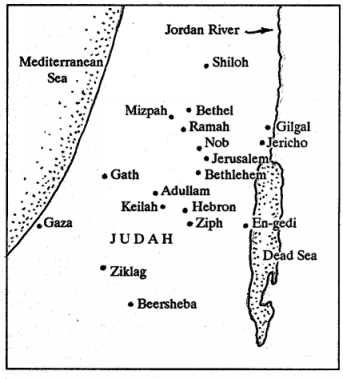
Flight from Saul
Unsuccessful in his direct attacks on David, Saul tried to have him killed in battle. He promised that if David could kill one hundred Philistines, he would give his daughter Michal to David for a wife. David again succeeded and, through marrying Michal, became part of the royal family (1Sa 18:20-29). But Saul’s jealousy resulted in further attempts to kill him (1Sa 19:1; 1Sa 19:10-11; Psalms 59).
After seeking temporary shelter with Samuel at Ramah (1Sa 19:18), David returned in secret to find out from Jonathan whether it was safe for him to enter Saul’s court. Upon discovering it was not, he obtained provisions from a priest at Nob and fled (1Sa 20:1; 1Sa 20:12-14; 1Sa 21:1-9).
When the Philistine city of Gath proved an insecure refuge (1Sa 21:10-15; Psalms 34; Psalms 56), David found a good hiding place in a cave at Adullam. Here he was joined by his family along with several hundred others, who for various reasons were dissatisfied with Saul’s administration (1Sa 22:1-2; Psalms 57; Psalms 63; Psalms 142). From these people David built himself a strong fighting unit, which in later times became the central force of his royal army (1Sa 22:2; 1Sa 23:13; 1Ch 11:10; 1Ch 11:15; 1Ch 12:8-18). But as long as Saul was king, David never allowed his men to attack him (1Sa 24:7; 1Sa 26:9).
Saul’s pursuit drove David increasingly into the semi-barren regions of Judah. David was pleased to use his fighting force to rescue the town of Keilah from the raiding Philistines (1Sa 23:4), but he was angry when the people of another Judean town, Ziph, betrayed him to Saul (1Sa 23:19; Psalms 54). On two occasions when he had an opportunity to kill Saul, he refused to (1Sa 24:3-7; 1Sa 26:5; 1Sa 26:9).
David supported his small army by protecting farmers against the raiding Philistines and then demanding food supplies as payment (1Sa 25:7-8; 1Sa 25:16; 1Sa 25:21). When one farmer refused to pay, David was saved from rash retaliation only by the quick thinking and wise words of the farmer’s wife, Abigail. When the farmer died, David married Abigail (1Sa 25:39).
Tired at the cruel pursuit by Saul and his Benjaminite supporters, David fell to the temptation to give up defending his righteousness. He decided to avoid further hardship by going and joining the enemy Philistines (1Sa 26:19; 1Sa 27:1-2; cf. Psalms 7; Psalms 11). From Philistia David enriched himself by carrying out brutal raids on neighbouring tribal people, though he repeatedly deceived the Philistine king concerning his activities. It was a disgraceful sixteen months David spent in Philistia, and, so far as we know, no psalm of his comes from this period (1Sa 27:7-11). Only after his own camp was cruelly raided did David stop his ungodly behaviour and return to the Lord (1Sa 30:1-7).
At this time the Philistines had gone to battle against Israel. David and his men had set out with the Philistines, but the Philistine leaders sent them back. They feared that David’s men might betray them and fight for Israel (1Sa 29:1-4). In the battle that followed, both Saul and Jonathan died (1Sa 31:1-5), and David composed a song in memory of them (2Sa 1:17-27).
Established as king
After Saul’s death there was confusion in Israel. David was declared king in Hebron, which was in the area of his own tribe Judah in the south, but one of Saul’s sons was declared king in the territory east of Jordan (2Sa 2:3-4; 2Sa 2:8-9). After two years of conflict, the supporters of David overpowered their opponents. However, David executed the murderers of Saul’s son, to make it clear that he had no desire to gain Saul’s throne by murder (2Sa 3:1; 2Sa 4:9-12; cf. 2Sa 1:14-16).
For the next five years David ruled from Hebron (2Sa 5:3-5). Being deep in the territory of Judah to the south, Hebron was not a suitable place from which to rule all Israel. Therefore, in an attempt to ensure the allegiance of the northern tribes, David decided to make Jerusalem his capital. Jerusalem was on a well fortified hill and belonged to no tribe, for it had remained under the control of the enemy since the time of Joshua. David conquered Jerusalem and soon united all the tribes under his rule (2Sa 5:5-7; 2Sa 5:12).
David then set out to make Jerusalem the religious as well as the political centre of the nation. He brought the ark from the country house where it had sat neglected during Saul’s reign, and placed it in a special tent he had erected for it (2Sa 6:2; 2Sa 6:17; cf. 1Sa 7:1-2; 1Ch 13:6). The conquest of Jerusalem and the arrival of the ark there are celebrated in some of David’s best known psalms (Psalms 24; Psalms 68; Psalms 110). Further psalms show the ideals he aimed at in his government (2Sa 23:1-7; Psalms 101), and express his deep gratitude to God for all his gracious blessings (Psalms 8; Psalms 103).
When David expressed his desire to build God a permanent house (meaning a temple), Nathan the prophet told him that God had a better purpose, and that was to build David a permanent house (meaning a dynasty). God had chosen David as the one through whose royal family he would bring the Messiah, the Saviour of the world (2Sa 7:8-17; Psa 2:7-9; Psa 89:19-37; Mat 22:42; Luk 1:68-70; Act 13:22-23).
As David’s military victories continued, Israel’s power grew, showing that God was strengthening David’s throne according to his promise. David’s power spread beyond the borders of Israel, so that he dominated all the neighbouring peoples, from the Nile River and the Red Sea in the south to the Euphrates River in the north (2 Samuel 8; cf. Psalms 18). Unfortunately, pride in his expanding power prompted David to carry out a census. He knew he deserved God’s punishment, but asked that it be mixed with mercy (2Sa 24:10; 2Sa 24:14; cf. Psalms 32).
David’s military conquests had involved him in much bloodshed. Therefore, although God granted David’s request for a temple, he considered that he was not a fit person to build it (1Ch 28:3; 1Ch 28:6). That privilege was given to David’s son, Solomon, though David helped him by preparing plans and setting aside money and materials for its completion (1Ch 22:2-6; 1Ch 28:11).
Family troubles
When he was at the height of his power, David committed a series of deliberate sins that affected the rest of his life. His sexual desire for Bathsheba led him to adultery and murder, as a result of which God assured him that his own family would be torn apart through adultery and murder (2Sa 12:7-12). David confessed his sin and God in his mercy forgave him (2Sa 12:13-14; Psalms 51), but that did not remove the suffering and distress that David had brought upon himself and his family.
David’s example of adultery and murder was followed in the family. One of the sons raped his sister, only to be murdered by another of the sons (2Sa 13:11-14; 2Sa 13:28-29). The murderer, Absalom, fled into exile. Three years later he returned to Jerusalem, but a further two years passed before David allowed him back into the palace (2Sa 13:38; 2Sa 14:24; 2Sa 14:28; 2Sa 14:33).
Over the next four years Absalom strengthened his position, till he was able to launch a surprise rebellion. David was forced to flee Jerusalem, and Absalom seized the throne (2Sa 15:1-7; 2Sa 15:14; Psalms 3). In the battle that followed, Absalom was killed, in spite of David’s instructions that no harm be done to him (2Sa 18:5; 2Sa 18:14). Only after the people had shown they wanted David back as their king did he return to Jerusalem (2Sa 19:9-15).
The peace of former times never returned to David’s throne. Soon he had to deal with another rebellion, this one led by a man called Sheba, who tried unsuccessfully to lead the northern tribes to break away from David (2Sa 20:1; 2Sa 20:22).
David’s closing years were saddened by conflict in the palace concerning which son would succeed him as king. His choice was Solomon, but the ambitious Adonijah tried to seize the throne for himself before David died. Again the rebellion failed. These stirring events gave the weak and aged David renewed strength, and with great haste he had Solomon anointed as the new king (1Ki 1:5-8; 1Ki 1:16-18; 1Ki 1:38-40). In due course he arranged a second anointing, this one public and with full regal ceremony, where he presented Solomon to the people as the divinely chosen successor (1Ch 28:1-10; see ADONIJAH; SOLOMON).
Hope for the future
In spite of his failures, David was one of the greatest men that Israel produced. In the centuries that followed, when Israelites looked for the coming of the Messiah, the best example by which they could imagine an ideal king was that of David (Hos 3:5). The Messiah was, as it were, a greater David (Eze 34:23-24; Eze 37:24-25). Being of David’s family, he was known as David’s son and he sat on David’s throne (Isa 9:7; Jer 23:5; Jer 33:15; Mat 12:23; Mat 20:31; Mat 21:15; Luk 1:32; Joh 7:42). Yet he was also David’s Lord (Mat 22:42-45; cf. Psa 110:1). As to his humanity, the Messiah Jesus was descended from David, but as to his divinity he was the eternal Son of God (Rom 1:3-4; Rev 22:16; see MESSIAH).
Because many of David’s psalms celebrate his victories and express the ideals that he looked for in his kingdom, the New Testament sometimes quotes them in relation to the Messiah Jesus (cf. Psalms 2 with Act 4:25; Act 13:33-34; 1Co 15:24-25; Heb 1:5; Heb 5:5; Rev 12:5; Rev 19:15; cf. Psalms 110 with Mat 22:42-45; Heb 7:15-17; Heb 7:21-22). Other psalms speak of David’s sufferings, and the New Testament quotes these also in relation to Jesus (cf. Psalms 22 with Mat 27:39-43; Mat 27:46; Joh 19:24; Heb 2:12; cf. Psalms 69 with Mat 27:34; Mat 27:38; Joh 2:17; Joh 15:25; Rom 15:3).
Not all David’s psalms, however, may be quoted as applying to Jesus, for many reflect David’s wrongdoings. The reader’s first consideration must be to consider the psalms in relation to the immediate circumstances about which David wrote (Psa 38:3; Psa 41:4; Psa 51:1-2). (For further details concerning the use of David’s psalms in the New Testament see PSALMS, BOOK OF.)
According to the titles in the book of Psalms, David wrote 73 of the 150 in the collection. His poetry appears in 2 Samuel also (2Sa 1:17-27; 2Sa 3:33-34; 2 Samuel 22; 2Sa 23:1-7). His exceptional abilities as a musician and a poet were well known (1Sa 16:17-18; 1Sa 16:23; 2Sa 23:1). He used those abilities in organizing the services for the proposed temple and in setting up official groups of singers and musicians (1Ch 6:31-32; 1Ch 15:16-28; 1Ch 16:7; Ezr 3:10; Neh 12:24; Neh 12:36; Neh 12:45-46). David served God faithfully in his own generation, and through his music and psalms has been of service to God’s people throughout succeeding generations (Act 13:36).
Israel’s greatest king, who ruled
about 1000 years before Christ. Besides
being a great military and political
leader, he was a deeply spiritual man
and a gifted musician, who wrote many
of the Psalms. He made plans and
arrangements for the building of the first
Temple in Jerusalem (the city of David),
which was actually completed by his son
Solomon. The Scriptures said that a
descendant of David would be Gods
chosen messiah (king), who would
establish an eternal kingdom. For that
reason, Jesus is sometimes called the
Son of David.