
Eagle was the ensign of the Roman empire. It is constantly the symbol of a king or kingdom; as in Eze 17:3; Eze 17:7; Eze 17:12. And it is so interpreted by the Oneirocritics in ch. 286.
We must observe very carefully the design of the Holy Ghost in exhibiting many symbols to denote the very same thing; as head, mountain, horn, eagle, wing of an eagle, beast, sun, and the like; all which signify a monarchy or kingdom. But then it is always, in different respects, to denote the different parts, qualities, and relations of its constitution. Thus, the head signifies a monarchy in respect of the dominion or members thereof, as it is a body politic; the mountain, in respect of its capital city situated thereon, for strength and defence of the parts under it; the horn, its power to defend its subjects and remove enemies; the eagle, its protecting of the subjects; the beast, its tyranny; the sun, its glory, and dominion, and power to give laws for the conduct of the subjects; light signifying government. By this variety the Holy Ghost finds ways to describe the nature and qualities of the matters foreseen, and the several degrees of their rise and fall; and, by consequence, to give, by different views, a full account of all that is necessary to be known. Besides, some symbols will suit some allegories, which others would not; the Holy Ghost in everything observing what we call their decorum, beyond any man that ever wrote; so that all the visions, and parts of a vision, hang together very properly, without any absurd cohesion of inconsistent matters. Nay, some symbols are affectedly chosen to express the fate of the things foreseen; thus, great and noble men come under the symbol of trees, when they are to be destroyed; but they are called birds, that is, of prey, when they are considered as devourers of plunder, seizing the spoils of vanquished enemies, and gorging or enriching themselves therewith.- Daubuz’s Discourse on the Symbolical Language.
In Æschylus f1 Xerxes is represented under the symbol of an eagle, and in like manlier Agamemnon.f2 The same poet calls the eagle the king of birdsf3 And so did the Egyptians,f4 who also represented a king that seldom appeared in public, and severely punished faults, by an eagle.f5 And in the Auspicia the eagle was always the symbol of the supreme powerf6
A ravenous bird, or eagle, (Isa 46:11), denotes Cyrus, whose ensign, we are informed, (Zenoph. Cyrop. L. 7.), was a golden eagle.
For the wings of an eagle, see under WINGS.
I cannot pass over this article in our Concordance, in as much as we find frequent mention made of the eagle in Scripture. And I do this the rather from the singularity of it, and especially in the way in which it is used. I mean, because it is declared in the Levitical law to be unclean; yea, all the different species of the eagle, including the vulture and the hawk, which are both of the eagle kind. (See Lev. xi. 13 - 16.) Now it is certain, that the Lord, (by which I apprehend is meant the Lord Jesus Christ in our nature, ) condescends to make use of the similitude of an eagle, in describing his care over his people, when he saith, I bare you on eagle’s wings, and brought you unto myself." (Exod. xix. 4. Deut. xxx2: 11.) Is there not something of a most interesting nature implied in those affections of the Lord, beside the protection here set forth as shewn his people? As the eagle is among the creatures of uncleanness; is there not an allusion to the Lord’s taking our uncleanness upon him, when he thus speaks of bearing his redeemed on eagle’s wings? The reader will observe, I do but ask the question, and not determine the matter. But as we well know, and all redeemed souls rejoice in the glorious consolation, it was Jesus both "bare our sins, and carried our sorrows, when the Lord JEHOVAH laid on him the iniquity of us all, " the Lord’s making use of one of the unclean creatures, in a similitude to himself, may not be supposed unaptly to represent this unequalled mercy? Connect with this view, what the gospel saith, (2 Cor. v. 21. and Gal. 3: 13.) and let the reader judge the fitness of the observation. He, who in such infinite and unequalled love and grace, became both sin and a curse for his people, might go on in the humiliation, to compare himself to the eagle, when made sin for us; that we might be made the righteousness of God in him.
The beautiful comparison, made in allusion to this bird, in providing safety for her young, to that of the Lord Jesus carrying his people as on eagle’s wings, is too striking hastily to pass it by. (Deut. xxx2: 11, 12.) The eagle’s stirring up her nest, fluttering over her young, spreading abroad her wings; taking them and bearing them on her wings; are beautiful descriptions, and which it seems, in the case of the eagle’s care over her brood, is literally the case. The young eagles are much disposed to sleep. The old bird therefore, rouseth them up, by disturbing them in their nest; when they are awakened, she fluttereth over them, spreading abroad her wings, to teach them how to use theirs, and how to fly. And until they are able to soar above all danger in the air, she carrieth them on her wings, that they may in due season use their own. Such, but in an infinitely higher degree of wisdom, love, and tenderness, doth Jesus, by his offspring. The Lord stirred them up from sleeping in the dangers of Egypt, and taught them how "to flee from thewrath to come." And the Lord is doing so now, in bringing up all his redeemed out of the Egypt of sin and death in this world.
But the most beautiful part of the representation remains yet to be noticed. The eagle is the only bird that carries her young upon her wings. All other birds use their talons for bearing up their little brood. Now, when the Lord Jesus useth this similitude, it teacheth us that it is impossible they can fall whom he bears; for they are on the wings and above, and not beneath, and like those birds, who catch up their young in their talons, and in their flight may drop them. Moreover, no weapon from beneath can reach the young, inthe care of the eagle, without first piercing the old bird. So nothing can touch Christ’s little ones without first destroying Christ. Was there ever a similitude more beautiful, lovely, and comfortable? Let me only add, to this figure of the Old Testament church, that precious one also, of the Lord Jesus in the New. I mean, when to the strength of the eagle, Jesus subjoins the affection of the hen; "saying, How often would I have gathered you, even as an hen gathers her chickens under her wings!" (Matt. 23. 37.) There is another similitude made use of respecting the church, in allusion to the eagle. The prophet Micah, (chap. i. 16.) speaks of the boldness of the eagle. And some have asserted, that in old age, the eagle is renewed with youth. Whether this be so, or not; or whether the moulting time, common to other birds every year, is only once experienced by the eagle, and that in old age, I will not, for I cannot, determine; but certain it is, that the Lord himself makes use of the similitude, to describe his people by. In one of the sweetest promises, the Lord thus comforts them, He giveth power to the faint, and to them that have no might, he increaseth strength. Even the youths shall faint and be weary, and the young men shall utterly fall; but they that wait upon the Lord shall renew their strength; they shall mount up with wings as eagles; they shall run and not be weary, and they shall walk and not faint." (Isa. xl. 27. to the end.) And while the Lord thus comforts his church with the assurance of the renewings of spiritual strength, like the eagle in nature, the church is described as praising God under the view of renewing grace, in the same figure: Bless the Lord, O my soul, and all that is within me, bless his holy name: who forgiveth all thine iniquities, and healeth all thy diseases: who redeemeth thy life from destruction, and crowneth thee with loving kindness and tender mercies: who satisfieth thy mouth with good things, so that thy youth is renewed as the eagle’s? (Ps. c3: 1 - 5.)
Is it at thy voice that the eagle soars? And therefore maketh his nest on high The rock is the place of his habitation.
He abides on the crag, the place of strength.
Thence he pounces upon his prey.
His eyes discern afar off.
Even his young ones drink down blood; And wherever is slaughter, there is he.
Alluding to the popular opinion that the eagle assists its feeble young in their flight, by bearing them up on its own pinions, Moses represents Jehovah as saying, “Ye have seen what I did to the Egyptians, and how I bore you on eagles’ wings, and brought you unto myself,” Exo 19:4. Scheuchzer has quoted from an ancient poet, the following beautiful paraphrase on this passage:—
Ac velut alituum princeps, fulvusque tonantis Armiger, implumes, et adhuc sine robore natos Sollicita refovet cura, pinguisque ferinae Indulget pastus: mox ut cum viribus aloe Vesticipes crevere, vocat se blandior aura, Expansa invitat pluma, dorsoque morantes Excipit, attollitque humeris, plausuque secundo
Fertur in arva, timens oneri, et tamen impete presso
Remigium tentans alarum, incurvaque pinnis
Vela legens, humiles tranat sub nubibus oras.
Hinc sensim supra alta petit, jam jamque sub astra Erigitur, cursusque leves citus urget in auras, Omnia pervolitans late loca, et agmine foetus Fertque refertque suos vario, moremque volandi Addocet: illi autem, longa assuetudine docti, Paulatim incipiunt pennis se credere coelo Impavidi: tantum a teneris valet addere curam.
[And as the king of birds, and tawny, armour-bearer of the Thunderer, cherishes with anxious care his unfledged, and as yet feeble young, and gratifies their appetite with rich prey: presently, when their downy wings have increased in strength, a milder air calls them forth, with expanded plumage he invites them, and receives them hesitating on his back, and sustains them on his shoulders, and with easy flight is borne over the fields, fearing for his burden, and yet with a moderated effort trying the rowing of their wings, and furling with his pinions his curved sails, he glides through the low regions beneath the clouds. Hence by degrees he soars aloft, and now he mourns to the starry heaven, and swiftly urges his rapid flight through the air, sweeping widely over space, and in his gyrations bearing his offspring to and fro, teaches them
the art of flying:—but they, taught by long practice, gradually begin to trust themselves fearlessly on their wings: So much does it avail to train the young with care.]
2. When Balaam delivered his predictions respecting the fate that awaited the nations which he then particularized, he said of the Kenites, “Strong is thy dwelling, and thou puttest thy nest in a rock,” Num 24:21; alluding to that princely bird, the eagle, which not only delights in soaring to the loftiest heights, but chooses the highest rocks, and most elevated mountains, as desirable situations for erecting its nest, Hab 2:9; Oba 1:4. What Job says concerning the eagle, which is to be understood in a literal sense, “Where the slain are, there is he,” our Saviour turns into a fine parable: “Wheresoever the carcass is, there will the eagles be gathered together,” Mat 24:28; that is, Wherever the Jews are, who have corruptly fallen from God, there will be the Romans, who bore the eagle as their standard, to execute vengeance upon them, Luk 17:37.
3. The swiftness of the flight of the eagle is alluded to in several passages of Scripture; as, “The Lord shall bring a nation against thee from afar, from the end of the earth, as swift as the eagle flieth,” Deu 28:49.
In the affecting lamentation of David over Saul and Jonathan, their impetuous and rapid career is described in forcible terms: “They were swifter than eagles; they were stronger than lions,” 2Sa 1:23. Jeremiah when he beheld in vision the march of Nebuchadnezzar cried, “Behold, he shall come up as clouds, and his chariots shall be as a whirlwind. His horses are swifter than eagles. Wo unto us, for we are spoiled,” Jer 4:13. To the wide-expanded wings of the eagle, and the rapidity of his flight, the same prophet beautifully alludes in a subsequent chapter, where he describes the subversion of Moab by the same ruthless conqueror: “Behold, he shall fly as an eagle, and spread his wings over Moab,” Jer 48:40. In the same manner he describes the sudden desolations of Ammon in the next chapter; but, when he turns his eye to the ruins of his own country, he exclaims, in still more energetic language, “Our persecutors are swifter than the eagles of the heavens,”
Lam 4:19. Under the same comparison the patriarch Job describes the rapid flight of time: “My days are passed away, as the eagle that hasteth to the prey,” Job 9:26. The surprising rapidity with which the blessings of common providence sometimes vanish from the grasp of the possessor is thus described by Solomon: “Riches certainly make themselves wings: they fly away as an eagle toward heaven,” Pro 23:5. The flight of this bird is as sublime as it is rapid and impetuous. None of the feathered race soar so high. In his daring excursions he is said to leave the clouds of heaven, and regions of thunder, and lightning, and tempest, far beneath him, and to approach the very limits of ether. There is an allusion to this lofty soaring in the prophecy of Obadiah, concerning the pride of Moab: “Though thou exalt thyself as the eagle, and though thou set thy nest among the stars, thence will I bring thee down, saith the Lord,”
Oba 1:4. The prophet Jeremiah pronounces the doom of Edom in similar terms: “O thou that dwellest in the clefts of the rock, that holdest the height of the hill; though thou shouldest make thy nest high as the eagle, I will bring thee down from thence, saith the Lord,” Jer 49:16. The eagle lives and retains its vigour to a great age; and, after moulting, renews its vigour so surprisingly, as to be said, hyperbolically, to become young again, Psa 103:5, and Isa 40:31. It is remarkable that Cyrus, compared, in Isa 46:11, to an eagle, (so the word translated “ravenous bird” should be rendered,) had an eagle for his ensign according to Xenophon, who uses, without knowing it, the identical word of the prophet, with only a Greek termination to it: so exact is the correspondence between the prophet and the historian, the prediction and the event. Xenophon and other ancient historians inform us that the golden eagle with extended wings was the ensign of the Persian monarchs long before it was adopted by the Romans: and it is very probable that the Persians borrowed the symbol from the ancient Assyrians, in whose banners it waved, till imperial Babylon bowed her head to the yoke of Cyrus. If this conjecture be well founded, it discovers the reason why the sacred writers, in describing the victorious march of the Assyrian armies, allude so frequently to the expanded eagle. Referring to the Babylonian monarch, the prophet Hosea proclaimed in the ears of all Israel, the measure of whose iniquities was nearly full, “He shall come as an eagle against the house of the Lord,”
Hos 8:1. Jeremiah predicted a similar calamity: “Thus saith the Lord, Behold, he shall fly as an eagle, and spread his wings over Moab,” Jer 48:40; and the same figure was employed to denote the destruction that overtook the house of Esau: “Behold, he shall come up and fly as the eagle, and spread his wings over Bozrah,” Jer 49:22. The words of these prophets received a full accomplishment in the irresistible impetuosity, and complete success with which the Babylonian monarchs, and particularly Nebuchadnezzar, pursued their plans of conquest. Ezekiel denominates him, with great propriety, “a great eagle with great wings,” because he was the most powerful monarch of his time, and led into the field more numerous and better appointed armies, (which the prophet calls, by a beautiful figure, “his wings,” the wings of his army,) than perhaps the world had ever seen. The Prophet Isaiah, referring to the same monarch, predicted the subjugation of Judea in these terms; “He shall pass through Judah. He shall overflow, and go over. He shall reach even to the neck; and the stretching out of his wings” (the array of his army) “shall fill the breadth of thy land, O Immanuel,”
Isa 8:8. The king of Egypt is also styled by Ezekiel, “a great eagle, with great wings, and many feathers;” but he manifestly gives the preference to the king of Babylon, by adding, that he had “long wings, full of feathers, which had divers colours;” that is, greater wealth, and a more numerous army.
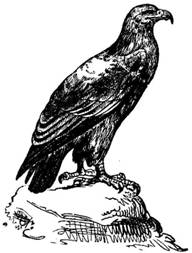
Fig. 168—Aquila heliaca
Eagle (Exo 19:4; Lev 11:13, etc.). The Eagle, in zoology, forms a family of several genera of birds of prey, mostly distinguished for their size, courage, powers of flight, and arms for attack. The bill is strong and bent into a plain pointed hook, without the notch in the inner curve which characterizes falcons; the nostrils are covered with a naked cere or skin, of a yellow or a blue color; the eyes are lateral, sunken, or placed beneath an overhanging brow; the head and neck covered with abundance of longish, narrow-pointed feathers; the chest broad, the legs and thighs exceedingly stout and sinewy, and feathered down to the toes; the feathers in general are brownish and rust-colored, and the tail is black, grey, or deep brown. Sea-eagles have the legs half bare and covered with horny scales; not unusually the head, back, and tail more or less white. The larger species of both measure, from head to tip of tail, 3 feet 6 inches or more, and spread their wings above 7 feet 6 inches. The claws of the fore and hind toe are particularly strong and sharp; in the sea-eagles they form more than half a circle, and in length measure from 1½ to 1¾ of an inch. These majestic birds have their abode in Europe, on the shores of the Mediterranean, in Syria and Arabia, wherever there are vast woody mountains and lofty cliffs: they occupy each a single district, always by pairs, excepting on the coasts, where the sea eagle and the osprey may be found not remote from the region possessed by the rough-legged eagles. It is in this last genus, most generally represented by the golden eagle, that the most powerful and largest birds are found. That species in its more juvenile plumage, known as the ring-tailed eagle, the Imperial eagle, and the booted eagle, is found in Syria; and at least one species of the sea-eagles frequents the coasts, and is even of stronger wing than the others. These build usually in the cliffs of Phoenicia, while the others are more commonly domiciliated within the mountains. According to their strength and habits the former subsist on antelopes, hares, hyrax, bustard, stork, tortoises, and serpents; and the latter usually on fish; both pursue the catta, partridge, and lizard. The osprey alone being migratory retires to Southern Arabia in winter. None, excepting the last-mentioned, are so exclusively averse to carrion as is commonly asserted: from choice or necessity they all, but in particular the sea-eagles, occasionally feed upon carcasses of horses, etc.; and it is well known in the East that they follow armies for that purpose. Hence the allusions in Job and Mat 24:28, though vultures may be included, are perfectly correct. So again are those which refer to the eagle’s eyrie, fixed in the most elevated cliffs. The swiftness of this bird, stooping among a flock of wild geese, with the rushing sound of a whirlwind, we have witnessed; and all know its towering flight, suspended on its broad wings among the clouds with little motion or effort. Thus the predictions, in which terrible nations coming from afar are assimilated to eagles, have a poetical and absolute truth, since there are species like the golden, which really inhabit the whole circumference of the earth, and the nations alluded to bore eagles’ wings for standards, and for ornaments on their shields, helmets, and shoulders. The species here figured is the one most common in Syria, and is distinguished from the others by a spot of white feathers on each shoulder.
Job 39:27-30, a large and very powerful bird of prey, hence called the King of birds. There are several species of eagle described by naturalists, and it is probable that this word in the Bible comprehends more than one of these. The noble eastern species, called by Mr. Bruce "the golden eagle," measures eight feet four inches from wing to wing; and from the tip of his tail to the point of his beak, when dead, four feet seven inches. Of all known birds, the eagle flies not only the highest, Pro 23:5 Jer 49:16 Job 1:4, but also with the greatest rapidity. To this circumstance there are several striking allusions in the sacred volume, 2Sa 1:23 Job 9:26 Lam 4:19 . Among the evils threatened to the Israelites in case of their disobedience, the prophet names one in the following terms: "The Lord shall bring a nation against thee from far, from the end of the earth, as swift as the eagle flieth," Deu 28:49 . The march of Nebuchadnezzar against Jerusalem, is predicted in similar terms: "Behold, he shall come up as clouds, and his chariots as a whirlwind: his horses are swifter than eagles," Jer 4:13 48:40 49:22 Hos 8:1 . This bird was a national emblem on Persian and Roman standards, as it now is on United States’ coins.\par The eagle, it is said, lives to a great age; and like other birds of prey, sheds his feathers in the beginning of spring, after which his old age assumes the appearance of youth. To this David alludes, when gratefully reviewing the mercies of Jehovah: "Who satisfieth thy mouth with good things, so that thy youth is renewed like eagle’s," Psa 103:5 Isa 40:31 . The careful pains of the eagle in teaching its young to fly, beautifully illustrate God’s providential care over Israel, Exo 19:4 Deu 32:11,12 .\par The eagle is remarkable for its keen sight and scent. Its flesh, like that of all birds of prey, was unclean to the Jews; and is never eaten by any body, unless in cases of necessity, Mat 24:28 Luk 17:37 .\par
Eagle. (Hebrew, nesher, that is, a tearer with the beak). At least four distinct kinds of eagles have been observed in Palestine, namely, the golden eagle, Aquila chrysaetos, the spotted eagle, Aquila naevia, the imperial eagle, Aquila heliaca, and the very common Circaetos gallicus. The Hebrew, nesher may stand for any of these different species, though perhaps more particular reference to the golden and imperial eagles and the griffon vulture may be intended.
The passage in Micah, Mic 1:16, "enlarge thy baldness as the eagle," may refer to the griffon vulture, Vultur fulvus, in which case the simile is peculiarly appropriate, for the whole head and neck of this bird are destitute of true feathers.
The "eagles" of Mat 24:28; Luk 17:37 may include the Vultur fulvus and Neophron percnopterus; though, as eagles frequently prey upon dead bodies, there is no necessity to restrict the Greek word to the Vulturidae. The figure of an eagle is now and has long been a favorite military ensign. The Persians so employed it; a fact which illustrates the passage in Isa 46:11 The same bird was similarly employed by the Assyrians and the Romans.
Its swift flight is alluded to, and rapacious cruelty, representing prophetically (Hab 1:8; Jer 4:13) the Chaldean, and ultimately, the Roman, invaders of Israel (Deu 28:49; Eze 17:3-7). Compare Josephus, B. J., 6. Its soaring high and making its nest in the inaccessible rock, also its wonderful far-sightedness and strength (Job 39:27-30). Psa 103:5 says: "thy youth is renewed like the eagle’s"; not as if the eagle renewed its youth in old age, but by the Lord’s goodness "thy youth is renewed" so as to be as vigorous as the eagle. The eagle’s vigor and longevity are illustrated by the Greek proverb, "the eagle’s old age is as good as the lark’s youth." Its preying on decomposing carcass symbolizes the divine retributive principle that, where corruption is, there vengeance shall follow. "Wheresoever the carcass is, there will the eagles be gathered together," quoted by our Lord from Job 39:30; Mat 24:28 - the vulture chiefly feeds on carcass.
The eagle’s forcibly training its young to fly pictures the Lord’s power, combined with parental tenderness, in training and tending His people (Deu 32:11; Exo 19:4). In the law the fostering mother is the eagle, God manifesting His power and sternness mingled with tenderness in bringing His people out of Egypt with a mighty hand and outstretched arm; in the gospel the fostering mother is the hen (Mat 23:37), Christ coming in grace, humility, and obedience unto death (Bochart). Subsequently, Christ rescues His people "from the face of the serpent" by giving His church the "two wings of a great eagle" (Rev 12:14).
The eagle "hovers over her young" in teaching them their first flight, ready in a moment to save them when in danger of falling on the rocks below. Compare Isa 31:5. God stirred up Israel from the foul nest of Egypt, which of their own accord they would have never left, so satisfied were they with its fleshpots in spite of its corruptions. The "stirring up the nest" spiritually corresponds to the first awakening of the soul; the "fluttering over her young" to the brooding of the Holy Spirit over the awakened soul; the "taking and bearing on her wings" to His continuous teaching and guardian care. The eagle assists the young one’s first effort by flying under to sustain it for a moment and encourage its efforts.
So the Spirit cooperates with us, after He has first given us the good will (Php 2:12-13). The eagle rouses from the nest, the hen gathers to herself; so the law and the gospel respectively. The Persians under Cyrus had a golden eagle on a spear as their standard (Isa 46:11). The eagle is represented in Assyrian sculptures as accompanying their armies; Nisroch, their god, had an eagle’s head. The Romans had the eagle standard, hence, the appropriateness of their being compared to an eagle (Deu 28:49).
occurs in Scripture as the translation of the Hebrews
The following is a close translation of a graphic description of raptorial birds of this class which occurs in the book of Job (39:26-30):
By thy understanding will [the] hawk tower,
Perchance on thy bidding [the] eagle will soar,
Or [it is then] that he will make lofty his nest?
A rock will he inhabit, and [there] roost,
Upon the peak of a rock, even [the] citadel:
From afar his eyes will look:
Ay, wherever [are the] slain, there [is] he!
As an eagle will rouse his nest;
Over his fledglings will hover;
Will spread his wings,
Will take it [i.e. his brood, or each of the young];
Will bear it upon his pinions:
[So] Jehovah, he alone would guide him [i.e. Israel];
And there was not with him a strange god" —
We may quote a passage from Sir Humphrey Davy, who says, "I once saw a very interesting sight above one of the crags of Ben Nevis, as I was going in the pursuit of black game. Two parent eagles were teaching their offspring, two young birds, the maneuvers of flight. They began by rising from the top of the mountain, in the eye of the sun. It was about midday, and bright for this climate. They at first made small circles, and the young birds imitated them. They paused on their wings, waiting till they had made their first flight, and then took a second and larger gyration, always rising towards the sun, and enlarging their circle of flight so as to make a gradually ascending spiral. The young ones still and slowly followed, apparently flying better as they mounted; and they continued this sublime exercise, always rising, till they became mere points in the air, and the young ones were lost, and afterwards their parents, to our aching sight." The expression in Exodus and Deut., "beareth them on her wings," has been understood by Rabbinical writers and others to mean that the eagle does actually carry her young ones on her wings and shoulders. This is putting on the words a construction which they by no means are intended to convey; at the same time, it is not improbable that the parent bird assists the first efforts of her young by flying under them, thus sustaining them for a moment, and encouraging them in their early lessons. (Comp. AElian, Anim. 2:40; Oppian, Cyneg. 3:1:15; Jerome in Jesa. 46; Naumaun, Naturgesch. d. Vogel, 1:215; on the contrary, Aristotle, Anim. 9:22.),
Finally, the eagle was an Assyrian emblem, and hence probably the reference in Hab 1:8. The eagle-headed deity of the Assyrian sculptures is that of the god Nisroch (q.v.); and in the representations of battles certain birds of this order are frequently shown accompanying the Assyrian warriors in their attacks, and in one case bearing off the entrails of the slain. From the Assyrians the use of the eagle as a standard (q.v.) descended to the Persians, and from them probably to the Romans. In all ages, and in most countries, as the proverbial "king of birds," it has been the symbol of majesty among the feathered tribes, like the lion among beasts.
2. The eagle, in zoology, forms a family of several genera of birds of prey, mostly distinguished for their size, courage, powers of flight, and arms for attack. The bill is strong, and bent into a plain pointed hook, without the notch in the inner curve which characterizes falcons; the nostrils are covered with a naked cere or skin of a yellow or a blue color; the eyes are lateral, sunken, or placed beneath an overhanging brow; the head and neck covered with abundance of longish, narrow-pointed feathers; the chest broad, and the legs and thighs exceedingly stout and sinewy. Eagles, properly so called, constitute the genus Aquila, and have the tarsi feathered down to the toes; they are clothed in general with brownish and rust- colored feathers, and the tail is black, grey, or deep brown. Sea-eagles (genus Haliaetus) have the tarsi or legs half bare and covered with horny scales; not unusually the head, back, and tail more or less white. The larger species of both measure, from head to tip of tail, 3 feet 6 inches or more, and spread their wings above 7 feet 6 inches; but these are proportionably broad to their length, for it is the third quill feather which is the longest, as if the Creator intended to restrain within bounds their rapidity of flight, while by their breadth the power of continuing on the wing is little or not at all impeded. The claws of the fore and hind toe are particularly strong and sharp; in the sea-eagles they form more than half a circle, and in length measure from 1.5 to 1.75 of an inch. These majestic birds have their abode in Europe, on the shores of the Mediterranean, in Syria and Arabia, wherever there are vast woody mountains and lofty cliffs; they occupy each a single district, always by pairs, excepting on the coasts, where the sea- eagle and the osprey (Pandion halicetus) may be found not remote from the region possessed by the rough-legged eagles — the first because it seeks to subsist on the industry of the second, and does not interfere with the prey of the third. It is in this last genus, most generally represented by the golden eagle (Aquila chryaeta) that the most powerful and largest birds are found. That species in its more juvenile plumage, known as the ring- tailed eagle, the imperial eagle, or mogilnick (A. heliaca), and the booted eagle (A. pinnata), is found in Syria; and at least one species of the sea- eagles (the Hal. ossifragus, albicilla, or albicaudus) frequents the coasts, and is even of stronger wing than the others.
These build usually in the cliffs of Phoenicia, while the others are more commonly domiciliated within the mountains. According to their strength and habits, the former subsist on antelopes, hares, hyrax, bustard, stork, tortoises, and serpents; and the latter usually live on fish; both pursue the catta (pterocles), partridge, and lizard. The osprey alone being migratory, retires to Southern Arabia in winter. None, excepting the last mentioned, are so exclusively averse to carrion as is commonly asserted: from choice or necessity they all, but in particular the sea-eagles, occasionally feed upon carcasses of horses, etc.; and it is well known in the East that they follow armies for that purpose. Hence the allusions in Job and Mat 24:28, though vultures may be included, are perfectly correct. So again are those which refer to the eagle’s eyrie, fixed in the most elevated cliffs. The swiftness of this bird, stooping among a flock of wild geese with the rushing sound of a whirlwind, is very remarkable; and all know its towering flight, suspended on its broad wings among the clouds with little motion or effort. Thus the predictions, in which terrible nations coming from afar are assimilated to eagles, have a poetical and absolute truth, since there are species, like the golden, which really inhabit the whole circumference of the earth, and the nations alluded to bore eagles’ wings for standards, and for ornaments on their shields, helmets, and shoulders. In the northern half of Asia, and among all the Turkish races, this practice is not entirely abandoned at this day, and eagle ensigns were constantly the companions of the dragons. China, India, Bactria, Persia, Egypt, the successors of Alexandria, the Etruscans, the Romans, the Celtae, and the Arabs had eagle signa of carved work, of metal, or the skins of birds stuffed, and set up as if they were living. These, named
Eagle (Heb. nesker; a tearer with the beak). There can be little doubt that the eagle of Scripture is the griffon (Gyps fulvus), or great vulture, see margin of the R. V., Lev 11:13, a bird very abundant in Palestine and adjacent countries. In spite of its name, it is a much nobler bird than a common vulture, and is scarcely more of a carrion-feeder than are all eagles. Indeed, the griffon is used by the orientals as the type of the lordly and the great. This well-known bird of prey was unclean by the Levitical law. Lev 11:13; Deu 14:12. It is called the "great vulture" in the margin of the R. V. The habits of the eagle are described in Num 24:21; Job 9:26; Job 39:27-30; Pro 23:5; Pro 30:17; Pro 30:19; Jer 49:16; Eze 17:3; Oba 1:4; Hab 1:8; Hab 2:9; Mat 24:28; Luk 17:37.
nesher,
EAGLE.—See Animals, p. 65b.
By: Emil G. Hirsch, Henry Hyvernat
The rendering in the English Bible versions of the Hebrew "nesher." The nesher, however, was bald; nested on high rocks; and was gregarious in its habits (Micah i. 16; Job xxxix. 27, 28; Prov. xxx. 17), all of which characteristics belong to the griffin-vulture, but not to the eagle.
Several species of eagles inhabit Palestine; and these are probably all included in the term "'ozniyyah" (Lev. xi. 13; Deut, xiv. 12; compare Tristram, "Natural History of the Bible," p. 181).
The Talmud says that the eagle is the king of birds, but that it is afraid of the flycatcher (Shab. 77b). It flies rapidly without tiring ( = "light like the eagle," Ab. v. 20).
The eagle is ranked among the unclean birds—a fact variously explained by the Talmudic writers (Ḥul. 61a). The nesher is found deified in the Assyrian Nisroch, the vulture-headed god (II Kings xix. 37; Isa. xxxvii. 38), and in the Arabic idol Nasr. In Ezekiel (i. 10, x. 14) the eagle is mentioned in connection with the throne of God. In rabbinic parlance "nesher" is used as a title of distinction; e.g., to denote the Roman government (Sanh. 12a).
Reverse of Copper Coin Bearing an Eagle, Attributed to Herod the Great.(After Madden, "History of Jewish Coinage.")

On the ancient fallacy that the eagle could renew its youth see Bochart, "Hierozoicon," part ii., bk. ii., ch. 1 (compare Ḳimḥi on Ps. ciii. 5).
Bibliography:
J. G. Woods, Animals of the Bible, Philadelphia, 1872;
L. Lewysohn, Die Zoologie des Talmuds, 1858.
EAGLE.—(1) nesher, Deu 32:11 etc., Lev 11:13 RVm
E. W. G. Masterman.
Emblem of Our Lord, who could gaze undazzled upon the glory of God, the Father, as an eagle at the sun. Associated in art with
Saint Augustine of Hippo as a symbol of inspiration
Saint Cuthbert, who was fed by an eagle
Saint Florian, whose corpse was protected from abuse by an eagle
Saint John of the Cross as a symbol of inspiration
Saint John the Evangelist as a symbol of inspiration and the Holy Ghost
Saint Juan Diego, whose birth name means "the eagle who speaks"
Saint Medard, who was sheltered from the weather by a hovering eagle
Saint Ruggero of Canne, who was sheltered in his travels by an eagle
Saint Servatus, who was sheltered from the sun by an eagle while he travelled as a pilgrim
Saint Wencelaus
It was used by early Christians as the sign of Baptism.
The first Biblical reference to the eagle referred to the right bird. Exo 19:4: “Ye have seen what I did unto the Egyptians, and how I bare you on eagles’ wings, and brought you unto myself.” This “bare you on eagles’ wings” must not be interpreted to mean that an eagle ever carried anything on its back. It merely means that by strength of powerful wing it could carry quite a load with its feet and frequently was seen doing this. Vultures never carried anything; they feasted and regurgitated what they had eaten to their young. The second reference is found in Lev 11:13 and repeated in Deu 14:12, the lists of abominations. It would seem peculiar that Moses would find it necessary to include eagles in this list until it is known that Arab mountaineers were eating these birds at that time. The next falls in Deu 28:49: “Yahweh will bring a nation against thee from far, from the end of the earth, as the eagle flieth; a nation whose tongue thou shalt not understand.” This also refers to the true eagle and points out that its power of sustained flight, and the speed it could attain when hastening to its hunger-clamoring young, had been observed. The next reference is in Deu 32:11:
“As an eagle that stirreth up her nest,
That fluttereth over her young,
He spread abroad his wings, he took them,
He bare them on his pinions.”
This is good natural history at last. Former versions made these lines read as if the eagle carried its young on its wings, a thing wholly incompatible with flight in any bird. Samuel’s record of the lamentation of David over Saul and Jonathan is a wonderful poetic outburst and contains reference to this homing flight of the eagle (2Sa 1:23). In Job 9:26 the arrow-like downward plunge of the hunger-driven eagle is used in comparison with the flight of time. In Job 39, which contains more good natural history than any other chapter of the Bible, will be found everything concerning the eagle anyone need know:
“Is it at thy command that the eagle mounteth up,
And maketh her nest on high?
On the cliff she dwelleth, and maketh her home,
Upon the point of the cliff, and the stronghold.
From thence she spieth out the prey;
Her eyes behold it afar off.
Her young ones also suck up blood:
And where the slain are, there is she” (Job 39:27-30).
Psa 103:5 is a reference to the long life of the eagle. The bird has been known to live to an astonishing age in captivity; under natural conditions, the age it attains can only be guessed.
“Who satisfieth thy desire with good things,
So that thy youth is renewed like the eagle.”
Pro 23:5 compares the flight of wealth with that of an eagle; Pro 30:17 touches on the fact that the eye of prey is the first place attacked in eating, probably because it is the most vulnerable point and so is frequently fed to the young. Pro 30:19:
“The way of an eagle in the air;
The way of a serpent upon a rock:
The way of a ship in the midst of the sea;
And the way of a man with a maiden.”
This reference to the eagle is to that wonderful power of flight that enables a bird to hang as if frozen in the sky, for long periods appearing to our sight immovable, or to sail and soar directly into the eye of the sun, seeming to rejoice in its strength of flight and to exult in the security and freedom of the upper air.
The word “way” is here improperly translated. To the average mind it always means a road, a path. In this instance it should be translated:
The characteristics of an eagle in the air;
The habit of a serpent upon the rock;
The path of a ship in the midst of the sea;
And the manner of a man with a maid.
Each of these lines stood a separate marvel to Agur, and had no connection with the others (but compare The Wisdom of Solomon 5:10, 11, and see WAY).
Isa 40:31 is another flight reference. Jer 49:16 refers to the inaccessible heights at which the eagle loves to build and rear its young. Jer 49:22 refers to the eagle’s power of flight. Eze 1:10 recounts a vision of the prophet in which strange living creatures had faces resembling eagles. The same book (Eze 17:3) contains the parable of the eagle: “Thus saith the Lord Yahweh: A great eagle with great wings and long pinions, full of feathers, which had divers colors, came unto Lebanon, and took the top of the cedar.” Hos 8:1 is another flight reference. Oba 1:4 is almost identical with Jer 49:16. The next reference is that of Micah, and really refers to the griffon vulture (Mic 1:16). In Hab 1:8 the reference is to swift flight. Mat 24:28 undoubtedly refers to vultures. In Rev 4:7 the eagle is used as a symbol of strength. In Rev 8:13 the bird is represented as speaking: “And I saw, and I heard an eagle (the King James Version “angel”), flying in mid heaven, saying with a great voice, Woe, woe, woe, for them that dwell on the earth, by reason of the other voices of the trumpet of the three angels, who are yet to sound.” The eagle makes its last appearance in the vision of the woman and the dragon (Rev 12:14).
(ἀåôüò, Rev_4:7; Rev_8:13; Rev_12:14)
There can be but little doubt that the ‘eagle’ of the English Version ought in most cases rather to be rendered ‘vulture.’ Both the Hebrew word ðָùָׁø (in the OT) and the Greek word ἀåôüò (in the NT) are used to designate ‘vulture’ as well as ‘eagle,’ and it is a bird of this species rather than an eagle that is generally referred to both in the OT and the NT, though in the above-mentioned passages it is just possible that ἀåôüò may denote an eagle.
Four kinds of vultures are known in Palestine (cf. Tristram, SWP [Note: WP Memoirs of Survey of Western Palestine.] : ‘The Fauna and Flora of Palestine,’ 1884, p. 94), viz. (1) Gypaetus barbatus; (2) Gyps fulvus, or ‘griffon’; (3) Neophron percnopterus, the ‘Egyptian vulture’; (4) Vultur monachus [cf. Post in Hasting's Dictionary of the Bible (5 vols) i. 632). The Gyps fulvus or ‘griffon’ is supposed to be referred to in most of the passages in the OT and the NT.
There are said to be eight different kinds of eagle in Palestine: (1) Aquila chrysaetus, or ‘Golden Eagle.’ This is seen in winter all over Palestine, but in summer it is only to be found in the mountain ranges of Lebanon and Hermon. (2) Aquila heliaca, or ‘Imperial Eagle,’ which is more common than the Golden Eagle, and does not leave its winter haunts in summer time. The Imperial Eagle prefers to make its nest in trees rather than cliffs, and in this respect differs from the Golden Eagle. (3) Aquila clanga, or ‘Greater Spotted Eagle.’ (4) Aquila rapax, or ‘Tawny Eagle,’ which is found fairly frequently in the wooded districts of Palestine. This bird breeds in the cliffs, and plunders other birds of their prey. (5) Aquila pennata, or ‘Booted Eagle,’ which is found chiefly in the wooded parts of Galilee, the Lebanon and Phaenicia. (6) Aquila nipalensis, or ‘Steppe Eagle.’ (7) Aquila bonelli, or ‘Bonelli’s Eagle,’ which is not uncommon in the wâdîs and rocky districts of Central Palestine. This bird is more like a falcon than an eagle. (8) Circaetus gallicus, or ‘Short-toed Eagle.’ This is by far the commonest of all Palestinian eagles. They remain from early spring to the beginning of winter, when most of them migrate, probably to Arabia. This fearless and dignified bird is easily recognized by its large flat head, huge yellow eyes, and brightly spotted breast. Its short toes and tarsi are covered with scales which afford it protection against the serpents on which it preys. The abundance of this species is doubtless accounted for by the large number of lizards and serpents found in Palestine. It is found throughout Central Europe, but only rarely; on the other hand, it is seen fairly often in the countries bordering on the Mediterranean. It breeds in trees and not on rocks.
In Rev_4:7 the eagle plays a part in the vision of the throne in heaven: ‘And the first creature was like a lion, and the second creature like a calf, and the third creature had a face as of a man, and the fourth creature was like a dying eagle.’ These four forms, which suggest all that is strongest, noblest, wisest, and swiftest in animate nature, are the same as those in Ezekiel’s vision (Eze_1:10), but here the order is different, and each ‘living creature’ has six wings, while in Ezekiel each has only four wings. Nature, including man, is thus represented before the Throne as consciously or unconsciously taking its part in the fulfilment of the will of the Divine.
In Rev_8:13; ‘And I saw, and I heard an eagle, flying in mid heaven, saying with a great voice, Woe, woe, woe, for them that dwell on the earth, by reason of the other voices of the trumpet of the three angels who are yet to sound,’ the eagle appears as the herald of calamity. The first series of four trumpet-blasts have gone forth, and the forces of Nature have done their work ruthlessly, but the worst is yet to come. The eagle-which, it will be noted, was heard as well as seen-is chosen on account of its swiftness as a fitting emblem of the judgment about to fall upon the pagan population of the world.
In Rev_12:14 the eagle is the means whereby the woman-i.e. the Christian Church-is conveyed away from the dragon and his fury to a place of safety in the wilderness. The actual event alluded to was no doubt the escape of the Church of Jerusalem to Pella (cf. Mar_13:14 ‘then let them that are in Judaea flee unto the mountains’), though the life of the Church and her members must always to some extent be a solitary life-i.e. in the world but not of it-and her vocation will, from one point of view, always be that of a ‘voice crying in the wilderness.’ Again, in the early days of Christianity persecution made secrecy necessary for the very existence of the Church. The figure in Rev_12:14 is paralleled in the OT. Thus in Exo_19:4 Jahweh is represented as saying, ‘Ye have seen what I did unto the Egyptians, and how I bare you on eagles’ wings, and brought you unto myself,’ while in Deu_32:11 He is likened unto an eagle: ‘As an eagle that stirreth up her nest, that fluttereth over her young, he spread abroad his wings, he took them, he bare them on his pinions.’ Lastly, in Isa_40:31 the promise to those who shall ‘wait upon the Lord’ is that ‘they shall renew their strength,’ and ‘mount up with wings as eagles.’ In all the passages in Revelation, it is probable that ἀåôüò denotes ‘vulture’ as elsewhere.
Literature.-For the eagle in Palestine see H. B. Tristram, SWP [Note: WP Memoirs of Survey of Western Palestine.] , ‘The Fauna and Flora or Palestine,’ 1884, pp. 94-101, Natural History of the Bible10, 1911, p. 172ff.; W. M. Thomson, The Land and the Book, new ed., 1910, p. 150f.; E. W. G. Masterman, in Hastings’ Single-vol. Dictionary of the Bible , 200 G. E. Post, in Hasting's Dictionary of the Bible (5 vols) i. 632; A. E. Shipley and S. A. Cook, in Encyclopaedia Biblica ii. 1145. On the texts see especially H. B. Swete, The Apocalypse of St. John2, 1907, ad loc.
P. S. P. Handcock.
Exo 19:4 (a) GOD compares Himself to an eagle in His work of taking Israel safely through the sorrows, dangers, and distresses of the wilderness journey.
Psa 103:5 (a) The strength and vigorous care given to the believer who walks with the Lord is compared to that which the eagle possesses. The Christian thus blessed is able to mount up above his surroundings and circumstances.
Pro 30:17 (a) By this figure we are informed that this particular type of sinner may not die a natural death, but will be subject to an unusual punishment which is unnatural.
Isa 40:31 (a) Under this figure, the Lord describes the ease and joy with which Christians rise out of their distresses and are set free from their surroundings when they look to the Lord earnestly for His blessing.
Eze 1:10 (b) One of the four aspects of the Lord JESUS, His deity, is represented here. This character of CHRIST is described particularly in the Gospel of John. (See also Eze 10:14, and Rev 4:7).
Eze 17:3 (a) The King of Babylon is represented by the eagle in this verse. The description concerns his invasion of Palestine and his victory over the King of the Jews. In verse 7 the eagle represents the King of Egypt. This is plainly seen by reading the rest of the chapter. These Kings are represented as eagles because they ruled over other kingdoms, they were swift in their invasions, and they were cruel in their afflictions of their conquered peoples.
Eze 17:7 (a) The King of Egypt also is compared to an eagle because he too was just about equal in power to the King of Babylon and ruled over kings and nations.
Dan 7:4 (a) The King of Babylon is described as an eagle in this passage, because of his supreme power, his swiftness, and his superiority. He is also described as a lion in the same passage. This refers to his mighty strength, for he did have more actual military power than the nations who followed him.
Hos 8:1 (a) Here is a reference to the swiftness with which the enemy of Israel would invade the land and conquer the people of GOD because of their disobedience.
Mic 1:16 (a) This peculiar figure probably describes an Oriental custom of magnifying the grief of those who sorrow. They wear unusual garments, eat unusual food, wail in an unusual loud fashion, and otherwise seek to let the world know of their grief.
Mat 24:28 (b) This is a description of the cruel, devouring nations who will pounce upon Israel in the time of her downfall and will carry away all her treasures. (See also Luk 17:37).
Rev 12:14 (a) This seems to be a prophecy concerning the special provision GOD will make to preserve a remnant of Israel from the terrible scourge and persecution that will arise against that people in the great day of GOD’s wrath.
Eagle. Eagles are included among the unclean birds mentioned in the Bible (Lev 11:13), (NKJV), but they were admired as majestic birds. The golden eagle, which is really dark brown with sprinkles of gold, has a 26-meter (8-feet) wingspread. It nests in high places that are inaccessible (Jer 49:16). There, in a nest which the eagle makes larger each year, the eagle hatches two eggs. Usually only one eaglet survives to adulthood.
An eagle has keen eyesight. He can spot his prey while soaring hundreds of feet in the air. Like a lightning bolt, he drops to seize it, killing it quickly with his powerful claws. Then he swoops back to his nest to rip the meat apart and share it with his young.
A mother eagle carries her eaglet on her back until it masters the art of flying. Moses used this familiar picture from nature to describe God’s care for His people. God stirred up Jacob (the nation of Israel), and carried His people on His wings (Deu 32:11-12) as He delivered them from slavery in Egypt.
Solomon marveled at "the way of an eagle in the air" (Pro 30:19). An eagle can stay aloft for hours, rarely moving his wings and riding wind currents. But many passages in the Bible also speak of the swiftness of the eagle’s flight (Deu 28:49).
The belief that an eagle renews its strength and youthful appearance after shedding its feathers gave rise to (Psa 103:5) and (Isa 40:31). Eagles do have a long life-span, living 20 to 30 years in the wild, and longer in captivity.
In the Old Testament, prophets spoke of the eagle as a symbol of God’s judgment (Jer 48:40; Eze 17:3; Eze 17:7). In (Rev 12:14), "two wings of a great eagle" portray God’s intervention to deliver His people from persecution.