
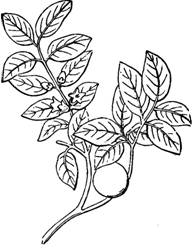
Fig. 169—Diospyros Ebenum
Ebony occurs only in one passage of Scripture, where the prophet Ezekiel (Eze 27:15), referring to the commerce of Tyre, says, ’The men of Dedan were thy merchants; many isles were the merchandise of thine hand: they brought thee for a present horns of ivory and ebony.’
Ebony wood was highly esteemed by the ancients, and employed by them for a variety of purposes. It is very appropriately placed in juxtaposition with ivory, because both were obtained from the same countries—Ethiopia and India: and, among the comparatively few articles of ancient commerce, must, from this cause, always have been associated together, while their contrast of color and joint employment in inlaid work, would contribute as additional reasons for their being adduced as articles characteristic of a distinct commerce.
But it is not in Ezekiel only that ebony and ivory are mentioned together. For Diodorus, as quoted by Bochart, tells us that an ancient king of Egypt imposed on the Ethiopians the payment of a tribute of ebony, gold, and elephants’ teeth. So Herodotus (Herodotus iii. 97), as translated by Bochart, says, ’Æthiopes Persis pro triennali tributo vehunt duos chœnices auri apyri (id est, ignem nondum experti), et ducentas ebeni phalangas, et magnos elephanti dentes viginti.’ Pliny, referring to this passage, remarks, ’But Herodotus assigneth it rather to Ethiopia, and saith, that every three years the Ethiopians had used to pay, by way of tribute, unto the kings of Persia, 100 billets of the timber of that tree (that is Ebene), together with gold and yvorie;’ and, again, ’From Syene (which confineth and boundeth the lands of our empire and dominion) as farre as to the island Meroë, for the space of 990 miles, there is little ebene found: and that in all those parts betweene there be few other trees to be found but date-trees, which peradventure may be a cause that Ebene was counted a rich tribute, and deserved the third place, after gold and ivorie’ (Holland’s Pliny, xii. 4). This however is a mistake, for several of the ancients mention both Indian and Ethiopian ebony.
If we look to the modern history of ebony, we shall find that it is still derived from more than one source. Thus, Mr. Holtzappfel, in his recent work on Turning, describes three kinds of ebony. 1. One from the Mauritius, in round sticks like scaffold poles, seldom exceeding fourteen inches in diameter, the blackest and finest in the grain, the hardest and most beautiful. 2. The East Indian, which is grown in Ceylon and the Peninsula of India, and exported from Madras and Bombay in logs from six to twenty, and sometimes even twenty-eight inches in diameter, and also in planks. This is less wasteful, but of an inferior grain and color to the above. 3. The African, shipped from the Cape of Good Hope in billets, the general size of which is from three to six feet long, three to six inches broad, and two to four inches thick. This is the least wasteful, as all the refuse is left behind; but it is the most porous, and the worst in point of color. No Abyssinian ebony is at present imported: this, however, is more likely to be owing to the different routes which commerce has taken, but which is again returning to its ancient channels, than to the want of ebony in the ancient Ethiopia. From the nature of the climate, and the existence of forests in which the elephant abounds, there can be no doubt of its being well suited to the group of plants which have been found to yield the ebony of Mauritius, Ceylon, and India, namely, the genus Diospyros of botanists.
The wood of a tree of no great size, growing in India and Africa; it is black, hard, heavy, and fine-grained, and receives a beautiful polish. It was anciently highly prized, Eze 27:15, and is still much used for musical instruments and fancy articles.\par
Ebony. Eze 27:15. One of the valuable commodities imported into Tyre by the men of Dedan; a hard, heavy and durable wood, which admits of a fine polish or gloss. The most usual color is black, but it also occurs red or green. The black is the heart of a tree called Diospyros ebenum. It was imported from India or Ceylon by Phoenician traders.
A dark hard wood,
The only objection to the above conclusion of any weight is, that hobnim is in the plural form. To this Bochart and others have replied, that there were two kinds of ebony, as mentioned by Theophrastus, Dioscorides, etc., one Ethiopian, the other Indian. Fuller and others maintain that the plural form is employed because the ebony was in pieces: "Refert ad ebeni palangas, quoe ex India et Ethiopia magno numero afferebantur.
If we look to the modern history of ebony, we shall find that it is still derived from more than one source. Thus Mr. Holtzappfel, in his recent work on Turning, describes three kinds of ebony.
The well-known hard black wood: it was imported with ivory into Tyre. Eze 27:15.
By: Emil G. Hirsch, Immanuel Benzinger
This word is mentioned only once in the Old Testament, namely, Ezek. xxvii. 15, where it is stated that the Arabian merchant people, the Dedanites (see Dodanim), brought horns of ebony to Tyre. The genuine ebony is the wood of the Diospyros Ebenum and of several kindred species. It is now indigenous to eastern Asia and Ceylon, but is found in Zanzibar and Mozambique also. In ancient times ebony was brought from Ethiopia; and this variety, which was considered superior to that of India, was held to be very precious. The Phenicians, Egyptians (Thebes; see "Zeit. für Aegyptologie," 1886, xiii.), and Babylonians ("ushu"; see Schrader, "K. B." iii. 37) used it for fashioning images of their gods and all kinds of precious vessels for sacred and profane use. Cheyne thinks, with some degree of probability ("Encyc. Bibl."), that ebony is mentioned also in I Kings x. 22, where, corresponding to Ezek. xxvii. 15, he reads  , "ivory and ebony," instead of
 .
EBONY (hobnîm, Eze 27:15) is the black heart-wood of the date-plum, Diospyros ebenum, imported from S. India and Ceylon. It was extensively imported by Phœnicians, Babylonians, and Egyptians for the manufacture of valuable vessels and of idols.
E. W. G. Masterman.
Ebony. A large tree which produces edible fruit similar to the persimmon. The hard, black wood from the inner portion of the tree is quite valuable and is used for fine furniture. It is also known to have been inlaid with ivory. Idols were sometimes carved from ebony wood.
A black wood that people valued highly in ancient times for making furniture. Ebony trees grow mostly in tropical climates in southern Asia. These trees have hard, dark-colored wood at their center.
Ebony comes from the date plum or date tree (Diospyros ebenaster and Diospyros melanoxylon) of India. This tree is very different from the date palm. Phoenician ships carried ebony across the Arabian Sea and up the Red Sea to the market in Tyre. From there, traders moved it overland using camel caravans.
The outer wood of these trees is white and soft. But when the tree gets old, the inner wood becomes hard, black, heavy, and long-lasting. This inner part makes up most of the valuable ebony sold today. Ebony can be polished to a smooth finish. People value it highly for making cabinets, for turning into shapes, for making fancy decorative items and instruments, and for covering other woods.
Ezekiel mentions ivory and ebony together (Ezekiel 27:15). Both in the past and today, craftspeople often set ivory into ebony because the colors create such a strong contrast with each other.
Aquifer Open Bible Dictionary © 2026 Mission Mutual, an adaptation of the Tyndale Open Bible Dictionary © 2023 Tyndale House Publishers. Licensed under CC BY-SA 4.0.
Reference:”
Discussion:
Ezekiel reports traders who brought hovnim to Tyre. Coupled with ivory, the Hebrew word hovnim could have referred to either Asian or African products. In 1982 Zohary stated that the identity of the hovnim in Ezekiel is unclear. He said that at best we can say that both Asian and African merchandise were shipped to Dedan, a Phoenician commercial center on the Arabian coast. Since then, however, Hepper, who believes that trading with the Far East was less than many other scholars have alleged, has said that this tree is not the Asian Ebony Diospyros ebenum we know today but a leguminous tree Dalbergia melanoxylon, which grows all across Africa along the southern edge of the Sahara Desert. Evidence for this, he says, is that the Old Egyptian cognate hbny found in hieroglyphs refers to Dalbergia melanoxylon.
Description:
If hovnim are from Africa, they could be Dalbergia melanoxylon, as Hepper asserts, or one of the many species of the genus Diospyros found throughout the continent, such as Diospyros mespiliformis. The latter is a huge, widespread forest tree up to 35 meters (115 feet) tall. Dalbergia melanoxylon is a smaller, spiny tree reaching a height of 6–7 meters (20–23 feet). It inhabits the dry savanna areas from Ethiopia across to Senegal and as far south as southern Africa, where it is called “zebrawood.” The leaves are compound, with the leaflets nearly opposite one another on the spine. It has white flowers that hang in loose clusters, and around October they give way to flat, papery seedpods about 6 centimeters (2.5 inches) long and 1 centimeter (1/2 inch) wide. The Asian ebony, if that is what hovnim refers to, is found in India and Sri Lanka, grows to 10 meters (33 feet) tall, and has evergreen leaves. The inner part of the trunk is black, which makes it an attractive wood for carvers, who inlay the wood with ivory.
Translation:
There are hundreds of species of ebony in tropical areas of the world (eighty in the Americas, ninety-four in Africa, and two hundred in Asia). In Africa the tree that produces most of the true ebony is Diospyros mespiliformis, which is found all the way from Senegal to the Red Sea and Arabia and southward to Southwest Africa and the Transvaal (Keay, Dalziel, and Hutchinson). In Nigeria it is called kanran or kanyan (Fulani nel'bi, Kanuri bergem). Surprisingly, both the Yoruba and Igbo Bibles in Nigeria have used eboni, perhaps reflecting the urbanization and Anglicization of those societies (or at least of the translators!). The Hausa word kanya correctly refers to the ebony tree. Diospyrus ebenum, found in India and Sri Lanka, might possibly have been on the world market in Bible times. A local word for this tree could be used in translations. If Hepper is correct, then the Dalbergia melanoxylon, locally known in Africa as “ebony” and also used for carving, should be used. Other transliteration possibilities are ebene (French) and ebenuz (Spanish).
Dalbergia species are also found in Central and South America under the names of palisander, kingwood, or tulipwood. A species in India is called blackwood or rosewood. In all these places the wood is used for radio cabinets, musical instruments, buttons, knife handles, chess pieces, and decorative carvings for tourists.
Plants and Trees in the Bible © United Bible Societies. Licensed under CC BY-SA 4.0.