
A well known kingdom in Scripture history, from whence the church, under the Lord, made their first Exodus. The believer in Christ knows also what it is to have been brought up in Egypt, and brought out of the Egypt of the soul.
a country of Africa, called also in the Hebrew Scriptures the land of Mizraim, and the land of Ham; by the Turks and Arabs, Masr and Misr; and by the native Egyptians, Chemi, or the land of Ham. Mr. Faber derives the name from Ai-Capht, or the land of the Caphtorim; from which, also, the modern Egyptians derive their name of Cophts. Egypt was first peopled after the deluge by Mizraim, or Mizr, the son of Ham, who is supposed to be the same with Menes, recorded in Egyptian history as the first king. Every thing relating to the subsequent history and condition of this country, for many ages, is involved in fable. Nor have we any clear information from Heathen writers, until the time of Cyrus, and his son Cambyses, when the line of Egyptian princes ceased in agreement with prophecies to that effect. Manetho, the Egyptian historian, has given a list of thirty dynasties, which, if successive, make a period of five thousand three hundred years to the time of Alexander, or three thousand two hundred and eighty-two years more than the real time, according to the Mosaic chronology. But this is a manifest forgery, which has, nevertheless, been appealed to by infidel writers, as authority against the veracity of the Mosaic history. The truth is, that this pretended succession of princes, if all of them can be supposed to have existed at all, constituted several distinct dynasties, ruling in different cities at the same time; thus these were the kingdoms of Thebes, Thin, Memphis, and Tanis. See WRITING.
2. In the time of Moses we find Egypt renowned for learning; for he was instructed “in all its wisdom;” and it is one of the commendations of Solomon, at a later period, that he excelled in knowledge “all the wisdom of the children of the east country, and all the wisdom of Egypt.”
Astronomy, which probably, like that of the Chaldeans, comprehended also judicial astrology, physics, agriculture, jurisprudence, medicine, architecture, painting, and sculpture, were the principal sciences and arts; to which were added, and that by their wisest men, the study of divination, magic, and enchantments. They had also their consulters with familiar spirits, and necromancers, those who had, or pretended to have, intercourse with the infernal deities, and the spirits of the dead, and delivered responses to inquirers. Of all this knowledge, good and evil, and of a monstrous system of idolatry, Egypt was the polluted fountain to the surrounding nations; but in that country itself it appears to have degenerated into the most absurd and debased forms. Among nations who are not blessed by divine revelation, the luminaries of heaven are the first objects of worship. Diodorus Siculus, mentioning the Egyptians, informs us, that “the first men, looking up to the world above them, and, struck with admiration at the nature of the universe, supposed the sun and moon to be the principal and eternal gods.” This, which may be called the natural superstition of mankind, we can trace in the annals of the west, as well as of the east; among the inhabitants of the new world, as well as of the old. The sun and moon, under the names of Isis and Osiris, were the chief objects of adoration among the Egyptians. But the earliest times had a purer faith. The following inscription, engraven in hieroglyphics in the temple of Neith, the Egyptian Minerva, conveys the most sublime idea of the Deity which unenlightened reason could form: “I am that which is, was, and shall be: no mortal hath lifted up my veil: the offspring of my power is the sun.” A similar inscription still remains at Capua, on the temple of Isis: “Thou art one, and from thee all things proceed.” Plutarch also informs us, that the inhabitants of Thebais worshipped only the immortal and supreme God, whom they called Eneph. According to the Egyptian cosmogony, all things sprung from athor, or night, by which they denoted the darkness of chaos before the creation. Sanchoniathon relates, that, “from the breath of gods and the void were mortals created.” This theology differs little from that of Moses, who says, “The earth was without form, and void; darkness was upon the face of the deep; and the Spirit of God moved upon the face of the waters.”
3. A superstitious reverence for certain animals, as propitious or hurtful to the human race, was not peculiar to the Egyptians. The cow has been venerated in India from the most remote antiquity. The serpent has been the object of religious respect to one half of the nations of the known world. The Romans had sacred animals, which they kept in their temples, and distinguished with peculiar honours. We need not therefore be surprised that a nation so superstitious as the Egyptians should honour, with peculiar marks of respect, the ichneumon, the ibis, the dog, the falcon, the wolf, and the crocodile. These they entertained at great expense, and with much magnificence. Lands were set apart for their maintenance; persons of the highest rank were employed in feeding and attending them; rich carpets were spread in their apartments; and the pomp at their funerals corresponded to the profusion and luxury which attended them while alive. What chiefly tended to favour the progress of animal worship in Egypt, was the language of hieroglyphics. In the hieroglyphic inscriptions on their temples, and public edifices, animals, and even vegetables, were the symbols of the gods whom they worshipped. In the midst of innumerable superstitions, the theology of Egypt contained the two great principles of religion, the existence of a supreme Being, and the immortality of the soul.
The first is proved by the inscription on the temple of Minerva; the second, by the care with which dead bodies were embalmed, and the prayer recited at the hour of death, by an Egyptian, expressing his desire to be received to the presence of the deities.
4. The opulence of Egypt was for ages increased by the large share it had in the commerce with the east; by its own favourable position, making it the connecting link of intercourse between the eastern and western nations; and especially by its own remarkable fertility, particularly in corn, so that it was, in times of scarcity, the granary of the world. Its extraordinary fertility was owing to the periodical inundation of the Nile; and sufficient proofs of the ancient accounts which we have of its productiveness are afforded to this day. The Rev. Mr. Jowett has given a striking example of the extraordinary fertility of the soil of Egypt, which is alluded to in Gen 41:47: “The earth brought forth by handfuls.” “I picked up at random,” says Mr. Jowett, “a few stalks out of the thick corn fields. We counted the number of stalks which sprouted from single grains of seed; carefully pulling to pieces each root, in order to see that it was but one plant. The first had seven stalks, the next three, the next nine, then eighteen, then fourteen. Each stalk would have been an ear.
5. The architecture of the early Egyptians, at least that of their cities and dwellings, was rude and simple: they could indeed boast of little in either external elegance or internal comfort, since Herodotus informs us that men and beasts lived together. The materials of their structure were bricks of clay, bound together with chopped straw, and baked in the sun. Such were the bricks which the Israelites were employed in making, and of which the cities of Pithom and Rameses were built. Their composition was necessarily perishable, and explains why it is that no remains of the ancient cities of Egypt are to be found. They would indeed last longer in the dry climate of this country than in any other; but even here they must gradually decay and crumble to dust, and the cities so constructed become heaps. Of precisely the same materials are the villages of Egypt built at this day. “Village after village,” says Mr. Jowett, speaking of Tentyra, “built of unburnt brick, crumbling into ruins, and giving place to new habitations, have raised the earth, in some parts, nearly to the level of the summit of the temple. In every part of Egypt, we find the towns built in this manner, upon the ruins, or rather the rubbish, of the former habitations. The expression in Jer 30:18, literally applies to Egypt, in the meanest sense: ‘The city shall be builded upon her own heap.’ And the expression in Job 15:28, might be illustrated by many of these deserted hovels: ‘He dwelleth in desolate cities, and in houses which no man inhabiteth, which are ready to become heaps.’ Still more touching is the allusion, in Job 4:19, where the perishing generations of men are fitly compared to habitations of the frailest materials, built upon the heap of similar dwelling-places, now reduced to rubbish: ‘How much less in them that dwell in houses of clay, whose foundation is in the dust!’”
6. The splendid temples of Egypt were not built, in all probability, till after the time of Solomon; for the recent progress made in the decyphering of hieroglyphics has disappointed the antiquaries as to the antiquity of these stupendous fabrics. It is well observed by Dr. Shuckford, that temples made no great figure in Homer’s time. If they had, he would not have lost such an opportunity of exerting his genres on so grand a subject, as Virgil has done in his description of the temple built by Dido at Carthage. The first Heathen temples were probably nothing more than mean buildings, which served merely as a shelter from the weather; of which kind was, probably, the house of the Philistine god Dagon. But when the fame of Solomon’s temple had reached other countries, it excited them to imitate its splendour; and nation vied with nation in the structures erected to their several deities. All were, however, outdone, at least in massiveness and durability, by the Egyptians; the architectural design of whose temples, as well as that of the Grecian edifices, was borrowed from the stems and branches of the grove temples.
7. It appears to be an unfounded notion, that the pyramids were built by the Israelites: they were, probably, Mr. Faber thinks, the work of the “Shepherds,” or Cushite invaders, who, at an early period, held possession of Egypt for two hundred and sixty years, and reduced the Egyptians to bondage, so that “a shepherd was an abomination to the Egyptians” in Joseph’s time. The Israelites laboured in making bricks, not in forming stones such as the pyramids are constructed with; and a passage in Mr. Jowett’s “Researches,” before referred to, will throw light upon this part of their history. Mr. Jowett saw at one place the people making bricks, with straw cut into small pieces, and mingled with the clay, to bind it. Hence it is, that when villages built of these bricks fall into rubbish, which is often the case, the roads are full of small particles of straws, extremely offensive to the eyes in a high wind. They were, in fact, engaged exactly as the Israelites used to be, making bricks with straw; and for a similar purpose, to build extensive granaries for the bashaw; “treasure-cities for Pharaoh.”
The same intelligent missionary also observes: “The mollems transact business between the bashaw and the peasants. He punishes them if the peasants prove that they oppress; and yet he requires from them that the work of those who are under them shall be fulfilled. They strikingly illustrate the case of the officers placed by the Egyptian taskmasters over the children of Israel; and, like theirs, the mollems often find their case is evil, Exodus 5.”
8. It is not necessary to go over those parts of the Egyptian history which occur in the Old Testament. The prophecies respecting this haughty and idolatrous kingdom, uttered by Jeremiah and Ezekiel when it was in the height of its splendour and prosperity, were fulfilled in the terrible invasions of Nebuchadnezzar, Cambyses, and the Persian monarchs. It comes, however, again into an interesting connection with the Jewish history under Alexander the Great, who invaded it as a Persian dependence. So great, indeed, was the hatred of the Egyptians toward their oppressors, that they hailed the approach of the Macedonians, and threw open their cities to receive them. Alexander, merciless as he was to those who opposed his progress or authority, knew how to requite those who were devoted to his interests; and the Egyptians, for many centuries afterward, had reason to recollect with gratitude his protection and foresight. It was he who discerned the local advantages of the spot on which the city bearing his name afterward stood, who projected the plan of the town, superintended its erection, endowed it with many privileges, and peopled it with colonies drawn from other places for the purpose, chiefly Greeks. But, together with these, and the most favoured of all, were the Jews, who enjoyed the free exercise of their religion, and the same civil rights and liberties as the Macedonians themselves. Kindness shown to the people of Israel has never, in the providence of God, brought evil on any country; and there can be no doubt but that the encouragement given to this enterprising and commercial people, assisted very much to promote the interests of the new city, which soon became the capital of the kingdom, the centre of commerce, of science, and the arts, and one of the most flourishing and considerable cities in the world. Egypt, indeed, was about to see better days; and, during the reigns of the Ptolemies, enjoyed again, for nearly three hundred years, something of its former renown for learning and power. It formed, during this period, and before the rapid extension of the Roman empire toward the termination of these years, one of the only two ancient kingdoms which had survived the Assyrian, Babylonian, Persian, and Macedonian empires: the other was the Syrian, where the Seleucidae, another family of one of the successors of Alexander, reigned; who, having subdued Macedonia and Thrace, annexed them to the kingdom of Syria, and there remained out of the four kingdoms into which the empire of Alexander was divided these two only; distinguished, in the prophetic writings of Daniel, by the titles of the kings or kingdoms of the north and the south.
9. Under the reign of the three first Ptolemies, the state of the Jews was exceedingly prosperous. They were in high favour, and continued to enjoy all the advantages conferred upon them by Alexander. Judea was, in fact, at this time, a privileged province of Egypt; the Jews being governed by their own high priest, on paying a tribute to the kings of Egypt. But in the reign of Ptolemy Epiphanes, the fifth of the race, it was taken by Antiochus, king of Syria; which was the beginning of fresh sufferings and persecutions; for although this Antiochus, who was the one surnamed the Great, was a mild and generous prince, and behaved favourably toward them, their troubles began at his death; his successor, Seleueus, oppressing them with taxes; and the next was the monster, Antiochus Epiphanes, whose impieties and cruelties are recorded in the two books of Maccabees. But still, in Egypt, the Jews continued in the enjoyment of their privileges, so late as the reign of the sixth Ptolemy, called Philometor, who committed the charge of his affairs to two Jews, Onias and Dositheus; the former of whom obtained permission to build a temple at Heliopolis. The introduction of Christianity into Egypt is mentioned under the article See ALEXANDRIA.
10. The prophecies respecting Egypt in the Old Testament have had a wonderful fulfilment. The knowledge of all its greatness and glory deterred not the Jewish prophets from declaring, that Egypt would become “a base kingdom, and never exalt itself any more among the nations.” And the literal fulfilment of every prophecy affords as clear a demonstration as can possibly be given, that each and all of them are the dictates of inspiration. Egypt was the theme of many prophecies, which were fulfilled in ancient times; and it bears to the present day, as it has borne throughout many ages, every mark with which prophecy had stamped its destiny: “They shall be a base kingdom. It shall be the basest of kingdoms. Neither shall it exalt itself any more among the nations: for I will diminish them, that they shall no more rule over the nations. The pride of her power shall come down; and they shall be desolate in the midst of the countries that are desolate; and her cities shall be in the midst of the cities that are wasted. I will make the land of Egypt desolate, and the country shall be desolate of that whereof it was full. I will sell the land into the hand of the wicked. I will make the land waste and all that is therein, by the hand of strangers. I the Lord have spoken it. And there shall be no more a prince of the land of Egypt,” Eze 30:5; Eze 30:7; Eze 30:12-13. “The sceptre of Egypt shall depart away,” Zec 10:11.
11. Egypt became entirely subject to the Persians about three hundred and fifty years previous to the Christian aera. It was afterward subdued by the Macedonians, and was governed by the Ptolemies for the space of two hundred and ninety-four years; until, about B.C. 30, it became a province of the Roman empire. It continued long in subjection to the Romans,— tributary first to Rome, and afterward to Constantinople. It was transferred, A.D. 641, to the dominion of the Saracens. In 1250 the Mamelukes deposed their rulers, and usurped the command of Egypt. A mode of government, the most singular and surprising that ever existed on earth, was established and maintained. Each successive ruler was raised to supreme authority, from being a stranger and a slave. No son of the former ruler, no native of Egypt, succeeded to the sovereignty; but a chief was chosen from among a new race of imported slaves. When Egypt became tributary to the Turks in 1517, the Mamelukes retained much of their power; and every pasha was an oppressor and a stranger. During all these ages, every attempt to emancipate the country, or to create a prince of the land of Egypt, has proved abortive, and has often been fatal to the aspirant. Though the facts relative to Egypt form too prominent a feature in the history of the world to admit of contradiction or doubt, yet the description of the fate of that country, and of the form of its government, may be left, says Keith, to the testimony of those whose authority no infidel will question, and whom no man can accuse of adapting their descriptions to the predictions of the event. Volney and Gibbon are our witnesses of the facts: “Such is the state of Egypt. Deprived, twenty-three centuries ago, of her natural proprietors, she has seen her fertile fields successively a prey to the Persians, the Macedonians, the Romans, the Greeks, the Arabs, the Georgians, and, at length, the race of Tartars distinguished by the name of Ottoman Turks. The Mamelukes, purchased as slaves, and introduced as soldiers, soon usurped the power and elected a leader. If their first establishment was a singular event, their continuance is not less extraordinary. They are replaced by slaves brought from their original country. The system of oppression is methodical. Every thing the traveller sees or hears reminds him he is in the country of slavery and tyranny.” “A more unjust and absurd constitution cannot be devised than that which condemns the natives of a country to perpetual servitude, under the arbitrary dominion of strangers and slaves. Yet such has been the state of Egypt above five hundred years. The most illustrious sultans of the Baharite and Borgite dynasties were themselves promoted from the Tartar and Circassian bands; and the four-and-twenty beys, or military chiefs, have ever been succeeded, not by their sons, but by their servants.” These are the words of Volney and of Gibbon; and what did the ancient prophets foretel?— “I will lay the land waste, and all that is therein, by the hands of strangers. I the Lord have spoken it. And there shall be no more a prince of the land of Egypt. The sceptre of Egypt shall depart away.” The prophecy adds: “They shall be a base kingdom: it shall be the basest of kingdoms.” After the lapse of two thousand and four hundred years from the date of this prophecy, a scoffer at religion, but an eye witness of the facts, thus describes the self-same spot: “In Egypt,” says Volney, “there is no middle class, neither nobility, clergy, merchants, landholders. A
universal air of misery, manifest in all the traveller meets, points out to him the rapacity of oppression, and the distrust attendant upon slavery. The profound ignorance of the inhabitants equally prevents them from perceiving the causes of their evils, or applying the necessary remedies. Ignorance, diffused through every class, extends its effects to every species of moral and physical knowledge. Nothing is talked of but intestine troubles, the public misery, pecuniary extortions, bastinadoes, and murders. Justice herself puts to death without formality.” Other travellers describe the most execrable vices as common, and represent the moral character of the people as corrupted to the core. As a token of the desolation of the country, mud-walled cottages are now the only habitations where the ruins of temples and palaces abound. Egypt is surrounded by the dominions of the Turks and of the Arabs; and the prophecy is literally true which marked it in the midst of desolation: “They shall be desolate in the midst of the countries that are desolate, and her cities shall be in the midst of the cities that are wasted.” The systematic oppression, extortion, and plunder, which have so long prevailed, and the price paid for his authority and power by every Turkish pasha, have rendered the country “desolate of that whereof it was full,” and still show both how it has been “wasted by the hands of strangers,” and how it has been “sold into the hand of the wicked.”
12. Egypt has, indeed, lately somewhat risen, under its present spirited but despotic pasha, to a degree of importance and commerce. But this pasha is still a stranger, and the dominion is foreign. Nor is there any thing like a general advancement of the people to order, intelligence and happiness.
Yet this fact, instead of militating against the truth of prophecy, may, possibly at no distant period, serve to illustrate other predictions. “The Lord shall smite Egypt: he shall smite and heal it: and they shall return to the Lord, and he shall be entreated of them, and shall heal them. In that day shall Israel be the third with Egypt and with Assyria, even a blessing in the midst of the land,” &c, Isa 19:22-25.
E´gypt, the land of Ham, a son of Noah, from whom was derived the ancient native appellation of the country, Chemi. From Mizraim, the second son of Ham, comes the ordinary Biblical name, Mizraim, a word which properly denotes Lower Egypt, as being that part of the country with which the Israelites were nearest and best, if not (in the earlier periods of their history) solely, acquainted. This designation, however, is sometimes used for Egypt indiscriminately, and was by the later Arabs extended to the entire country.
Egypt is the land of the Nile, the country through which that river flows from the Island of Philæ, situated just above the Cataracts of Syene, in lat. 24° 1′ 36″, to Damietta, in 31° 35′ N., where its principal stream pours itself into the Mediterranean Sea. On the east it is bounded by Palestine, Idumaea, Arabia Petraea, and the Arabian Gulf. On the west, the moving sands of the wide Libyan Desert obliterate the traces of all political or physical limits. Inhabited Egypt, however, is restricted to the valley of the Nile, which, having a breadth of from two to three miles, is enclosed on both sides by a range of hills: the chain on the eastern side disappears at Mocattam; that on the west extends to the sea. In lat. 30° 15′, the Nile divides into two principal streams, which, in conjunction with a third that springs somewhat higher up, forms the Delta, so called from its resemblance to the Greek letter Δ. These mountains are interesting, if for no other reason than that they served as the bed whence the materials were obtained out of which were constructed the wonderful buildings for which Egypt is justly distinguished. The superficial extent of Egypt has been estimated at about 11,000 square miles. The soil, which is productive, consists almost exclusively of mud brought down and deposited by the river, whose waters are indispensable every year for the purposes of agriculture to such an extent that the limits of their flow are the limits of vegetation. The Delta owes its very existence to the deposits of the Nile, and but for the waters of this stream, carried over its surface by natural or artificial means, would soon be a desert; it was therefore with propriety, as indeed was the entire country, termed ’the gift of the Nile.’ The agency of the stream is the more necessary because rain very seldom falls in Lower Egypt. The land, placed as it is on the confines of Africa and Asia, yet so adjacent and accessible to Europe, in itself a garden and a store-house, may well have held an important position in the ancient world, and can hardly fail, unless political influences are very adverse, to rise to a commanding attitude in modern times. As to the number of its inhabitants, nothing very definite is known. Its fertility would doubtless give birth to, and support, a teeming population. In very remote times as many as 8,000,000 souls are said to have lived on its soil. In the days of Diodorus Siculus they were estimated at 3,000,000. Volney made the number 2,300,000. The present government estimate is 3,200,000, which seems to be somewhat beyond the fact.
Egypt naturally divides itself into two great sections at the apex of the Delta, the country lying south of that point being designated Upper Egypt, that north of it Lower Egypt. Under the Ptolemies, and probably at a very early period, the whole country was divided into thirty-six cantons or provinces, which division was maintained till the invasion of the Saracens. It is now composed of 24 departments, which, according to the French system of geographical arrangement, are subdivided into arrondissements and cantons.
Well may Egypt have been visited as a granary by the needy in ancient times (Gen 12:10; Exo 16:3). Besides corn, the country produced onions, garlic, beans, pumpkins, cucumbers, melons, flax, cotton, and wine. The acacia, sycamore, palm, and fig-tree adorned the land; but there was a want of timber. The Nile produced the useful papyrus, and abounded in fish. On its banks lurked the crocodile and hippopotamus. The Egyptian oxen were celebrated in the ancient world. Horses abounded (1Ki 10:28); hence the use of war-chariots in fight (Isa 31:1; Diod. Sic. i. 45), and the celebrity of Egyptian charioteers (Jer 46:4; Eze 17:15). The land was not destitute of mineral treasures. Gold mines were wrought in Upper Egypt.
The climate is very regular and exceedingly hot; the atmosphere clear and shining; a shade is not easily found. Though rain falls even in the winter months very rarely, it is not altogether wanting, as was once believed. Thunder and lightning are still more infrequent, and are so completely divested of their terrific qualities that the Egyptians never associate with them the idea of destructive force. Showers of hail descending from the hills of Syria are sometimes known to reach the confines of Egypt: the formation of ice is very uncommon. Dew is produced in great abundance. The wind blows from the north from May to September, when it veers round to the east, assumes a southerly direction, and fluctuates till the close of April. The southerly vernal winds, traversing the arid sands of Africa, are most changeable as well as most unhealthy: they form the simoom or samiel, and have proved fatal to caravans and even to armies. Mosquitoes, locusts, frogs, together with the plague, the small pox, and leprosy, are the great evils of the country.
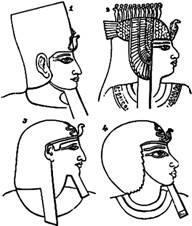
Fig. 170—Egyptian Facial Features
1. Egypto-Ethiopian (the Tirhakah of Scripture);
2, 4. Ethiopian;
3. Egyptian
The most recent inquiries have shown that the extreme limit at Philae was only of a political nature; for the natives of the country below it were of the same race as those who lived above that spot—a tribe which passed down into the fertile valley of the Nile from its original in the south. These Ethiopians and the Egyptians were not negroes, but a branch of the great Caucasian family. Their color—at least the color of the higher castes—was brown; their frame slender, but of great strength. The women were very fruitful.
The mode of life of the Egyptians was influenced by their locality: those who dwelt on high lands on the east, as well as those who dwelt on the marshy flat country in the Delta, were shepherds, as their land did not admit cultivation. The people who lived along the Nile became fishermen and sailors. The cultivated part of the natives who lived on the plains and over the surface of the country diligently and most successfully practiced all the arts of life, and have left ever-during memorials of their proficiency and skill.
On this natural diversity of pursuits, as well as on a diversity of blood, was founded the institution of castes, which Egypt had in common with India, and which pervaded the entire life of the nation. These, according to Herodotus, were seven in number: the priestly caste was the most honored and influential: it had in every large city a temple dedicated to the deity of the place, together with a high-priest, who stood next to the king and restricted his power. The priesthood possessed the finest portions of the country: they were the judges, physicians, astrologers, architects—in a word, they united in themselves all the highest culture and most distinguished offices of the land, while with them alone lay tradition, literature, and the sacred writings. This class exerted the most decided and extensive influence on the culture not only of their own country, but of the world; for during the brightest periods of Grecian history the love of knowledge carried into Egypt men who have done much to form the character of after-ages, such as Solon, Pythagoras, Archytas, Thales, Herodotus, Plato, and others (comp. Gen 41:8; Exo 7:11; Exo 7:22; Exo 8:7).
The peculiarities of the ancient Egyptians of the lower castes seem to have survived best, and to be represented, at least in some particulars, by the Fellahs of the present day. These Fellahs discharge all the duties of tilling the country and gathering its rich abundance: their attachment to it is very strong, and their love to the Nile almost a passion. They are a quiet, contented, submissive race, always living, through an unjust government, on the edge of starvation, yet always happy, with no thought for the morrow, no care for, no interest in, political change.
The only other tribe we have room to notice is that of the Copts, equally with the preceding, indigenous. They are Christians by hereditary transmission, and have suffered centuries of cruel persecutions and humiliations, though now they seem to be rising in importance, and promise to fill an important page in the future history of Egypt. In character they are amiable, pacific, and intelligent, having of course the faults and vices of dissimulation, falsehood, and meanness, which slavery never fails to engender. In office they are the scribes, the arithmeticians, the measurers, the clerks—in a word, the learned men of the country. The Copts have been under-estimated at 150,000 souls, divided into twelve Episcopal districts, the bishops of which unite to elect a patriarch.
’The wisdom of Egypt’ was a phrase which at an early period, passed into a proverb, so high was the opinion entertained by antiquity of the knowledge and skill of the ancient Egyptians (1Ki 4:30; Herod, ii. 160; Josephus, Antiq. viii. 2, 5; Act 7:22). It was long thought that the hieroglyphic inscriptions on the monumental remains of Egypt contained treasures of wisdom no less boundless than hidden; and, indeed, hieroglyphics were, in the opinion of some, invented by the priests of the land, if not expressly to conceal their knowledge from the profane vulgar, yet as a safe receptacle and convenient storehouse for their mysterious but invaluable doctrines. Great, consequently, was the expectation of the public when it was announced that a key had been discovered which opened the portal to these long-concealed treasures. Men of profound learning, great acuteness of mind, and distinguished reputation, have engaged and persevered in the inquiry; but, after all, the conclusions and positions which have been drawn and set forth are only in a few cases (comparatively) definite and unimpeachable.
The difficulties that oppose the formation of a satisfactory Egyptian chronology are great and numerous. The most distinguished writers differ egregiously in their statements.
Various efforts, however, have been made to remove difficulties, reconcile contradictions, and harmonize dissonances; but the success has been far from distinguished.
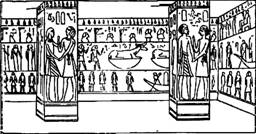
Fig. 171—Interior of Pictured Tomb
What, however, we know to be definite, and believe to be accurate in its disclosures, and what we judge to be far more important in an historical relation, is to be found in the paintings and sculptures with which the Egyptians left the walls of their tombs and temples decorated in forms and colors which have not yet faded from the sight. It is true that these instances of real picture-writing may do little for fixing the epoch of the accession of a king or the termination of a dynasty. Yet in this they are not entirely mute. Among the innumerable mural sculptures in the temple at Karnack, Champollion discovered one in which a king, Sheshonk (Shishak), is presenting captives of various nations to his God as trophies of victory. One of these, distinguished by a long beard and Jewish physiognomy, bears the hieroglyphic title Youdah Malek, king of Judah. But for any practical purpose, the determination of a date, or the identification of an event, is of small comparative moment; and far too much importance has been attached to mere chronological details. To learn when an Egyptian or Chinese king ascended the throne, or departed this life, may gratify the antiquary, or even reward much learned toil, but the world at large has an interest in history in the main, if not exclusively, so far as it discloses what men thought, felt, did; what they hoped, feared, and achieved in the days of old; thereby affording to posterity warnings, encouragement, light, and impulse. Now for these highly important purposes the most abundant materials are presented in Egypt, and may be found described in the works of Champollion, Wilkinson, and others. Let any one visit the Egyptian gallery in the British Museum, and he will be surprised and delighted to find Egypt almost resuscitated. The tombs have given up their dead. Buried treasures, over whose silence centuries had rolled before our era began, crowd on the sight and gratify the mind. And paintings, too, strike the eye, which may not indeed conform very exactly to the laws of perspective, but which lay open, and set before the spectator, the Egyptian, as he was in the days of his glory and pride. Indeed, from the paintings and sculptures which have been discovered and described, we are enabled to follow this most singular and deeply interesting people through all the classes of society, through all the operations of science and husbandry, into the transactions of public life, the details of house-keeping, the achievements of war, the amusements of hunting, fishing, feasting, and the solemn rites of a most august and imposing religious ceremonial.
Amid the various profane authors who have written more or less in detail on Egypt, the Bible remains our best and fullest authority for the early history of the country. This history, it is true, is not presented in a chronological series of events, nor supplied respecting any period with nice exactitude and minute details. The disclosures made by inscriptions on public buildings, of kings, wars, and conquests, may, when verified as to age, and placed in their probable order by the aid of learning and criticism, reveal more as to the dynasties and individual sovereigns; but on such information, even when free from doubt, and most accurate, little real value can be set; while the Bible supplies, either by express statement or obvious implication, facts and principles which constitute genuine history, and go far to give the past all the value which it can possess for the men of these times. And what makes these disclosures the more valuable is not only that they wear the character of genuine and uncorrupted history—free from the false, deep and unnatural colorings of mythology; but that they relate to the earliest forms of civilized life, and to ages over which profane historians have left the thickest darkness. Narrations and implications, such as the Bible affords in regard to the early history of Egypt, want no corroboration; they wear in their naturalness, simplicity, and correspondence with what would be expected in the ages to which they refer, evidence that they represent actual realities, which none can resist who have studied either human nature or human society. Still it may not be supererogatory to remark that the little which learning and industry have succeeded in extracting from the monumental inscriptions, and the very great deal which funereal and religious paintings have of late made known; and indeed all, from whatever source gathered, that we known of the country and its institutions and usages, are in entire harmony with what the Scriptures directly or indirectly teach respecting Egypt. And it is certainly a very great point to have ascertained beyond doubt that the Egypt of the Bible is Egypt indeed, not a fiction, nor an imposture, nor a blunder—as writers of the Voltaire school would persuade the world—but a reality, so far as it goes, a picture copied from actual life.
We learn from the Old Testament that while the Jews, the earliest nation that has handed down to us the history of its rise and civilization, were yet a tribe of wandering shepherds, under Abraham, depending solely upon the unbought gifts of nature, who, when they had exhausted one district, instead of cultivating it, drove off their flocks in search of a new pasture-ground, after the manner of the American Indians; the Egyptians were acquainted with agriculture and all those arts of civilization and government which indicate a social existence, extending backwards for at least several ages. This is confirmed in a striking manner by architectural remains that have survived the ravages of above thirty centuries; for while the Israelites, under the immediate successors of Joshua, were still warring with the Canaanites for the possession of the land of promise, or yet earlier, while they were yet slaves in Egypt, that most interesting land was distinguished for palaces, temples, porticos, obelisks, statues, and canals, which declare that they had been preceded by a long period of civilization, and which still remain the admiration of the world. The pyramids of Lower Egypt, requiring for their erection the least quantity of architectural knowledge, no elegance of design, no taste in detail, might possibly have been the work of men driven by task-masters to their daily labor; but that the palaces, tombs, and temples of Upper Egypt, which present to us the earliest known instances of architecture, sculpture, and painting; the colossal statues of Amenoph and Rameses, requiring considerable anatomical knowledge for the original design, and a mechanical skill in the execution, exceeding perhaps even that of the Greeks themselves; the vast works for irrigation; and the correct division of the calendar, implying great knowledge of mathematics—that these should have been the works of a people suffering under political disadvantages, and not far advanced in all the arts and refinements of social life, would contradict all that observation or history has made known. Some considerable degree therefore of political freedom, as well as a high cultivation, must at an early period have been enjoyed by the Egyptians.
In Genesis 10 we find the colonization of Egypt traced up to the immediate children of Noah, for it is there stated that Mizraim was the second son of Ham, who was himself the second son of Noah. Immediately after these genealogical statements the sacred narrative (Genesis 12) informs us that the patriarch Abraham, pressed by famine, went down (about B.C. 1920) into Egypt, where it appears he found a monarch, a court, princes and servants, and where he found also those supplies of food which the well-known fertility of the country had led him to seek there; for it is expressly stated that the favor which his wife had won in the reigning Pharaoh’s eyes procured him sheep and oxen, as well as he-asses, and men-servants, and maid-servants, and she asses and camels. In Gen 21:9, mention is made in the case of Ishmael, the son of Hagar the Egyptian, whose mother took him a wife out of the land of Egypt, of a mixed race between the Egyptians and the Chaldeans, a race which in after times became a great nation. In Genesis 39 begins the interesting story of Joseph’s being carried down to Egypt, with all its important consequences for the great-grandchildren of Abraham. The productiveness of the country is the allurement, famine the impulse. Attendant circumstances show that Egypt was then famous also for its commercial pursuits; and the entire narrative gives the idea of a complex system of society (about B.C. 1720), and a well-constituted yet arbitrary form of government. As in eastern courts at later periods of history, elevation to high offices was marked and sudden. The slave Joseph is taken from prison and from impending death, and raised to the dignity of prime vizier, and is entrusted with making provision for an approaching dearth of food, which he had himself foretold, during which he effects in favor of the ruling sovereign one of the greatest revolutions of property which history has recorded. The high consideration in which the priestly caste was held is apparent. Joseph himself marries a daughter of the priest of On. Out of respect towards, as well as by the direct influence of, Joseph, the Hebrews were well treated. The Scriptural record, however, distinctly states (Gen 46:34) that before the descent of Israel and his sons ’every shepherd’ was ’an abomination unto the Egyptians.’ The Hebrews, whose ’trade had been about cattle,’ must have been odious in the eyes of the Egyptians, yet are they expressly permitted to dwell ’in the best of the land’ (Gen 47:6), which is identified with the land of Goshen, the place which the Israelites had prayed might be assigned to them, and which they obviously desired on account of the adaptation of its soil to their way of life as herdsmen. Having settled his father and family satisfactorily in the land, Joseph proceeded to supply the urgent wants of a hungry nation, and at the same time converted the tenure of all property from freehold into tenancy-at-will, with a rent-charge of one-fifth of the produce, leaving their lands, however, in the hands of the priests; and thus he gave another evidence of the greatness of their power.
The richness of Goshen was favorable, and the Israelites ’grew and multiplied exceedingly,’ so that the land was filled with them. But Joseph was now dead; time had passed on, and there rose up a new king (probably one of a new dynasty) which knew (Exo 1:8) not Joseph, having no personal knowledge, and it may be no definite information of his services: who, becoming jealous of the increase of the Hebrews, set about persecuting them with the avowed intention of diminishing their numbers and crippling their power. Severe task-masters are therefore set over them; heavy tasks are imposed; the Hebrews are compelled to build ’treasure cities, Pithom and Raamses.’ It is found, however, that they only increase the more. In consequence, their burdens are doubled and their lives made bitter with hard bondage (Exo 1:14), ’in mortar and in brick, and in all manner of service in the field.’ Their first-born males, moreover, are doomed to destruction the moment they come into being. The deepest heart-burnings ensue; hatred arises between the oppressor and the oppressed; the Israelites seek revenge in private and by stealth (Exo 2:12). At last a higher power interferes, and the afflicted race is permitted to leave Egypt. At this time Egypt appears to have been a well-peopled and well-cultivated country, with numerous cities, under a despotic monarch, surrounded by officers of his court and a life-guard. There was a ceremonial at audience, a distinction of ranks, a state-prison, and a prime minister. Great buildings were carried on. There was set apart from the rest of the people an order of priests who probably filled offices in the civil government; the priest of Midian and the priest of On seem to have ruled over the cities so named. There was in the general class of priests an order—wise men, sorcerers, and magicians—who had charge of a certain secret knowledge: there were physicians or embalmers of the dead; the royal army contained chosen captains and horsemen and chariots. The attention which the people at large paid to agriculture, and the fixed notions of property which they in consequence had, made them hold the shepherd or nomad tribes in abhorrence, as freebooters only less dangerous than hunting tribes.
The ill feelings which the peculiar circumstances connected with the exode from Egypt had occasioned served to keep the Israelites and the Egyptians strangers, if not enemies, one to another during the lapse of centuries, till the days of David and Solomon, when (1 Kings 3, 7, 9, 11) friendly relations again spring up between the two countries. Solomon marries the daughter of a Pharaoh, who burns the city of Gezer, and who in consequence must have been master of Lower Egypt. ’And Solomon had horses brought out of Egypt, and linen yarn:’ six hundred shekels of silver was the price of a chariot, and one hundred and fifty the price of a horse. Jeroboam, however, who ’had lifted up his hand against the king,’ and become subsequently monarch of the revolted ten tribes, found refuge and protection in Egypt, which was then (about B.C. 975) governed by Shishak. From 2 Chronicles 12 it appears that in the fifth year of Solomon’s successor, Rehoboam, this same Shishak ’came against Jerusalem’ with a very large army, consisting of chariots, horse and foot soldiers, besides auxiliary foreigners; and having captured the fortified cities which lay on his march, he entered and plundered the metropolis. The language which is employed in Joel (Joe 3:19) shows that, in the ninth century before Christ, Egypt had, in conjunction with Edom, displayed both its power and its cruelty towards the kingdom of Judah. The rise and oppressiveness of the Assyrian power soon, however, inclined the Egyptians and the Israelites, from a sense of common danger, to cultivate friendly relations with one another. In 2 Kings 17 we find that in the twelfth year of Ahaz king of Judah (B.C. 730) Hoshea king of Israel desisted from paying his usual tribute to the king of Assyria, and courted the alliance of So, king of Egypt, who must have been a very powerful monarch to have been thought able to give assistance in opposition to Assyria. Against this mere human resource the prophet Isaiah (Isaiah 31) warmly protested, declaring its utter inefficiency, and striving to lead his countrymen to the practice of that righteousness and piety by neglecting which they had been forsaken of God. Upon this act of king Hoshea, however, the Assyrians overran Samaria and carried (2Ki 17:6) Israel away into Assyria. In the reign of Hezekiah (B.C. 726) it appears (2Ki 18:21) that the kingdom of Judah still ’trusted upon the staff of this bruised reed, even Egypt, on which if a man lean, it will go into his hand and pierce it: so is Pharaoh king of Egypt unto all that trust on him.’ In the last year of the reign of Josiah (B.C. 609) Egypt seems to have attempted to increase its influence in Palestine, when Pharaoh Nechoh (2Ki 23:29) ’went up against the king of Assyria to the river Euphrates,’ and Josiah going against him was slain in battle. His successor, Jehoahaz, was dethroned after a brief reign of three months, and imprisoned at Kiblah by the Egyptian monarch, who imposed on the country a heavy tribute. Pharaoh-Nechoh then made his elder brother Eliakim king, having changed his name to Jehoiakim. Jehoahaz afterwards died in Egypt. But the Egyptian influence over Judah soon ended; for in the fourth year of Jehoiakim (B.C. 604) Nebuchadnezzar king of Babylon marched against (Jeremiah 46; 2 Kings 21) Judah and its allies, defeated Pharaoh-Nechoh, and retook from the Egyptians Arabia Patara and all that belonged to them between the Euphrates and the Nile. Zedekiah, the next king of Judah, rebelling against Nebuchadnezzar, made an alliance with Pharaoh-Hophra (Jeremiah 44): and when Nebuchadnezzar besieged Jerusalem, on the march of the Egyptian army, the Chaldees raised the siege (Jer 37:5) and withdrew the army. But this was the last time that the Egyptian power was able to serve the Jews. The Assyrian party in the state, indeed, was in the minority, though assisted by the influence of Jeremiah and Ezekiel (Ezekiel 29; Jeremiah 25); yet it predominated: the Jews were carried captive to Babylon, and in less than a century afterwards Egypt was made a province of the same empire.
After the time of the exile the Egyptian Ptolemies were for a long while (from B.C. 301 to about 180) masters of Palestine, and during this period Egypt became as of old a place of refuge to the Jews, to whom many favors and privileges were conceded. This shelter seems not to have been for ages withdrawn (Mat 2:13). Yet it cannot be said that the Jews were held in esteem by the Egyptians. Indeed it was from an Egyptian, Manetho (B.C. 300), that the most defamatory misrepresentations of Jewish history were given to the world; and, in the days of Augustus, Chaeremon took special pains to make the Jewish people appear despicable.
In the reign of Ptolemy Philometor, Onias, whose father, the third high-priest of that name, had been murdered, fled into Egypt, and rose into high favor with the king and Cleopatra his queen. The high-priesthood of the temple of Jerusalem, which belonged of right to his family, having passed from it to the family of the Maccabees, by the nomination of Jonathan to this office (B.C. 153), Onias used his influence with the court to procure the establishment of a temple and ritual in Egypt which should detach the Jews who lived there from their connection with the temple at Jerusalem. The king complied with the request. To reconcile the Egyptian Jews to a second temple Onias alleged Isa 19:18-19. He chose for the purpose a ruined temple of Bubastis, at Leontopolis, in the Heliopolitan nome, one hundred and fifty stadia from Memphis, which place he converted into a sort of miniature Jerusalem, erecting an altar in imitation of that in the temple, and constituting himself high-priest. The king granted a tract of land around the temple for the maintenance of the worship, and it remained in existence till destroyed by Vespasian. The district in which this temple stood appears to have been, after Alexandria, the chief seat of the Jews in Egypt.
The most brilliant periods of Egyptian art were the reigns of the second and third Rameses. Most of the obelisks and colossal statues were wrought before or during the reign of Rameses II, the Sesostris of the Greek writers. Under this enterprising monarch, the ancient Theban empire attained its highest pinnacle of prosperity and power. Rameses III undertook distant military expeditions, roused the energies of the country, encouraged art, and erected the splendid temple of Medinet Abu. At a later age the scepter of Egypt was swayed by powerful monarchs, who built on a grand scale; but the seat of the government was then in the Delta, and there remain only a few obelisks.
The valley of the Nile is all along at intervals strewed with wrecks of ancient monumental grandeur; at Thebes, however, they are found on both sides of the river in greatest profusion. Next to the pyramids, the most wonderful relic of Egyptian art is the great hall of the temple of Karnack, on the east bank of the Nile. Its superficial area is 314 feet by 164. The massive stone roof is supported by 134 columns ranged in sixteen rows, most of which are 9 feet in diameter, and nearly 43 feet high: those of the central avenue are not less than 11 feet 6 inches in diameter, and 72 feet high; the diameter of their capitals at their widest spread is 22 feet. The walls, columns, architraves, ceilings, every surface exposed to the eye, is overspread with intaglio sculptures—gods, heroes, and hieroglyphics, painted in once vivid colors. But the hall of columns was but a part of this wonderful fabric. Immense pylons, half-buried quadrangles and halls, granite obelisks, and tremendous piles of fallen masonry, once formed a range of buildings upwards of 1200 feet in length. An avenue of colossal sphinxes led from the temple to Luxor, forming a vista which extended nearly a mile and a half, and was admirably adapted for the pageantry of religious processions. All these buildings formed parts of one magnificent whole; all were constructed of gigantic blocks, and most were covered with sculpture. ’Such was the imperial palace of the Pharaohs when Europe was yet in primeval barbarism, ages before Romulus took his omen on the Palatine hill,’ Now the ruins are strewn in chaotic confusion over a sandy plain, broken into shapeless mounds.
Among the most remarkable works of the Egyptians must be ranked the vast sepulchers excavated in the seclusion of the Theban mountains to receive their dead monarchs. ’It was,’ says Wathen, ’about an hour before sunset one evening that I set out to visit this Necropolis, intending to pass the night in one of the royal sepulchers. On approaching the gorge, the first thing that struck me was the quantity of bones, fragments of mummies, rolls of mummy cloth, and other relics of rifled (Egyptian) tombs that strewed the ground. Princes, priests, and warriors, after reposing thousands of years, are now dragged forth by poor peasants, and their bones lie scattered before the doors of their sepulchers. Candles were lighted: I passed the threshold, and looked round with silent wonder on the scene within. A large corridor or gallery ran back hundreds of feet into the heart of the mountain, divided by lateral projections into lengthening vistas of apartments. The walls were elegantly adorned with columns of blue hieroglyphics on a white ground, 3000 years old, yet retaining almost the freshness of yesterday. In a large chamber at the end of the gallery was a massive sarcophagus. Here once lay the royal mummy, but it had long been open, and was empty. There are eight or nine of these large painted tombs in a group, besides others of less interest. They vary in length from 100 to upwards of 400 feet. In most, you find on entering a long descending corridor or gallery, running off in a straight line into the heart of the mountain. At its farther end the corridor expands into one or more large apartments, whose roofs are supported by massive piers of the living rock. The walls and piers throughout are generally decorated with paintings still wonderfully retaining their freshness: the subjects are chiefly processions, religious rites, and allegoric and enigmatical devices.’ The object seems to have been to enshrine the corpse deep within the earth in a mass of masonry, far from the stir of the living world. For these royal sepulchers of Thebes they first selected the loneliest ravine; for each tomb they carried a gallery deep into the hill, and then placed the corpse in the remotest part. But the tombs of the kings form only a part of this great city of the dead. The sides of the hills overlooking the plain and the ravines intersecting them, contain innumerable sepulchral excavations. One valley was appropriated to the queens, and in a remote corner the apes had a cemetery. The priests seized the best spots.
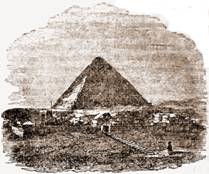
Fig. 172—Pyramid of Cheops
The purpose for which the pyramids were erected was once as little known as were most other things connected with Egypt. It now appears satisfactorily ascertained that they were designed to be mausoleums; and what an idea does it give us of the grandeur of conception, the splendor in every respect of the monarchs to whom they owe their origin, that they should have devised and executed tombs so stupendous! ’On leaving the village of Giza, on the river bank opposite old Cairo (Memphis), the pyramids rise before you glittering white against the blue sky; but the flatness of the plain and the purity of the atmosphere effectually deceive the eye as to their distance and consequently their size: you almost appear at their base while several miles really intervene. As you advance gradually they unfold their gigantic dimensions; but you must have been some time on the spot, your eye must have repeatedly traveled along the great pyramid’s 740 feet of base, and up its steep towering angles, before you can fully understand its immensity, and the actual amount of labor involved in its erection’ (Wathen). According to Pliny 366,000 men were employed for 20 years in erecting the great pyramid, and Herodotus reports from an inscription which it bore, that the expense of providing the workmen with onions and other roots amounted to 1600 talents. Whole mosques have probably been built out of spoils from it alone. Yet the integrity of its form remains substantially unimpaired, and from a distance scarcely a trace of violence or decay can be seen. The existing masonry has been estimated at above six millions of tons, which was raised over an area of thirteen English acres and a half; and, supposing the cost of the structure to have been one shilling a cubic foot, including carriage, materials, and workmanship, the erection required an outlay of nearly five millions sterling. The original perpendicular height was 480 feet, exceeding that of St. Peter’s by 43 feet, and that of St. Paul’s by 110.
The relation in which the religion of Egypt stands to that of Moses is one of very considerable interest and importance, and one which has not yet received the kind and degree of attention which it merits. Michaelis, and others of the same school, have given valuable aid, but they wrote with, compared with what is now known, insufficient knowledge, if not with somewhat too much of a foregone conclusion. Other learned men, influenced by their philosophical notions, or prejudiced against the Hebrew religion, have made Moses a mere copyist of institutions and retailer of ideas which he found in Egypt. As a basis for such a view it was necessarily assumed that a purer system of religion was found in Egypt in the days of Moses than existed in any other part of the world. In particular, the Egyptian mysteries were set forth as the depositories of high and valuable religious doctrines. Scripture and history (the Acts of the Apostles; Josephus, Philo) were adduced to show that Moses had been instructed in this priceless lore, and initiated into these mysteries; whence he was declared to have drawn his system of Monotheism. These views, however, rest on no solid foundation whatever, if, indeed, they may not be to some extent considered as the illusory and almost posthumous offspring of the old and exploded notion which ascribed boundless knowledge to the ancient Egyptians. Nor can they for a moment be held in these days after the light thrown on early Egypt by the monumental disclosures. The brief notion given above of the general characteristics of the earliest religion of the country, shows how utterly baseless such a theory is. In truth, the inhabitants of Palestine, so far back as we have been able to learn anything of them, seem to have possessed far better and purer religious opinions than those of the valley of the Nile, and in all probability did something to improve and elevate the religious system of the latter.
A celebrated country in the north of Africa, at the eastern part of the Mediterranean Sea. The Hebrews called it Mizraim, Gen 10:6, and hence it is now called by the Arabs, Mizr. The Greeks and Romans called it Aegyptus, whence Egypt; but the origin of this name is unknown.\par The habitable land of Egypt is for the most part a great valley, through which the river Nile pours its waters, extending in a straight line from north to south, and skirted on the east and west by ranges of mountains, which approach and recede from the river more or less in different parts. Where this valley terminates, towards the north, the Nile divides itself, about forty or fifty miles from the seacoast, into several arms, which inclose the so-called Delta. The ancients numbered seven arms and mouths; the eastern was that of Pelusium, now that of Tineh; and the western that of Canopus, now that of Aboukir. As these branches all separate from one point or channel, that is, from the main stream, and spread themselves more and more as they approach the coast, they form with the latter a triangle, the base of which is the seacoast; and having thus the form of the Greek letter, delta, this part of Egypt received the name of the Delta, which it has ever since retained. The prophet Ezekiel describes Egypt as extending from Migdol, that is, Magdolum, not far from the mouth of the Pelusian arm, to Syene, now Essuan, namely, to the border of Ethiopia, Eze 29:10 30:6. Essuan is also assigned by Greek and Arabian writers as the southern limit of Egypt. Here the Nile issues from the granite rocks of the cataracts, and enters Egypt proper. The length of the country, therefore, in a direct line, is about four hundred and fifty miles, and its area about eleven thousand square miles. The breadth of the valley, between Essuan and the Delta, is very unequal; in some places the inundations of the river extend to the foot of the mountains; in other parts there remains a strip of a mile or two in breadth which the water never covers, and which is therefore always dry and barren. Originally the name Egypt designated only the valley and the Delta; but at a later period it came to include also the region between this and the Red Sea.\par The country around Syene and the cataracts is highly picturesque; the other parts of Egypt, and especially the Delta, are uniform and monotonous. The prospect, however, is extremely different, according to the season of the year. From the middle of spring, when the harvest is over, one sees nothing but a gray and dusty soil, so full of cracks and chasms that he can hardly pass along. At the time of the autumnal equinox, the country presents nothing but an immeasurable surface of reddish or yellowish water, out of which rise date-trees, villages, and narrow dams, which serve as a means of communication. After the waters have retreated, and they usually remain only a short time at this height, you see, till the end of autumn, only a black and slimy mud. But in winter, nature puts on all her splendor. In this season, the freshness and power of the new vegetation, the variety and abundance of vegetable productions, exceed every thing that is known in the most celebrated parts of the European continent; and Egypt is then, from one end of the country to the other, like a beautiful garden, a verdant meadow, a field sown with flowers, or a waving ocean of grain in the ear. This fertility, as is well known, depends upon the annual and regular inundations of the Nile. Hence Egypt was called by Herodotus, "the gift of the Nile." See NILE.\par The sky is not less uniform and monotonous than the earth; it is constantly a pure unclouded arch, of a color and light more white than azure. The atmosphere has a splendor which the eye can scarcely bear, and a burning sun, whose glow is tempered by no shade, scorches through the whole day these vast and unprotected plains. It is almost a peculiar trait in the Egyptian landscape, that although not without trees, it is yet almost without shade. The only tree is the date-tree, which is frequent; but with its tall, slender stem, and bunch of foliage on the top, this tree does very little to keep off the light, and casts upon the earth only a pale an uncertain shade. Egypt, according, has a very hot climate; the thermometer in summer\par standing usually at eighty or ninety degrees of Fahrenheit; and in Upper Egypt still higher. The burning wind of the desert, Simoom, or Camsin, is also experienced, usually about the time of the early equinox. The country is not unfrequently visited by swarms of locusts. See LOCUSTS.\par In the very earliest times, Egypt appears to have been regarded under three principal divisions; and writers spoke of Upper Egypt or Thebais; Middle Egypt, Heptanomis or Heptapolis; and Lower Egypt or the Delta, including the districts lying east and west of the river. The provinces and cities of Egypt mentioned in the Bible may, in like manner, be arranged under these three great divisions:\par 1. LOWER EGYPT The northeastern point of this was "the river of Egypt," on the border of Palestine. The desert between this point, the Red Sea, and the ancient Pelusium, seems to have been the desert of Shur, Gen 20:1, now El-Djefer. Sin, "the strength [key] of Egypt," Eze 30:15, was probably Pelusium. The land of GOSHEN appears to have lain between Pelusium, its branch of the Nile, and the Red sea, having been skirted on the northeast by the desert of Shur; constituting perhaps a part of the province Rameses, Gen 47:11 . In this district, or adjacent to it, are mentioned also the cities Pithom, Raamses, Pi-Beseth, and On or Helipolis. In the proper Delta itself, lay Tahapanes, that is, Taphne or Daphne; Zoan, the Tanis of the Greeks; Leontopolis, alluded to perhaps in Isa 19:18 . West of the Delta was Alexandria.\par 2. MIDDLE EGYPT Here are mentioned Moph or Memphis, and Hanes, the Heracleopolis of the Greeks.\par 3. UPPER EGYPT The southern part of Egypt, the Hebrews appear to have called Pathros, Jer 44:1,15 . The Bible mentions here only two cities, namely, No, or more fully No-Ammon, for which the Seventy put Diospolis, the Greek name for Thebes, the most ancient capital of Egypt, (see AMMON, or No-Ammon, or No;) and Syene, the southern city and limit of Egypt.\par The chief agricultural productions of Egypt are wheat, durrah, or small maize, Turkish or Indian corn or maize, rice, barley, beans, cucumbers, watermelons, leeks, and onions; also flax and cotton. The date-tree and vine are frequent. The papyrus is still found in small quantity, chiefly near Damietta; it is a reed about nine feet high, as thick as a man’s thumb, with a tuft of down on the top. See BOOK, BULRUSH. The animals of Egypt, besides the usual kinds of tame cattle, are the wild ox or buffalo in great numbers, the ass and camel, dogs in multitudes without masters, the ichneumon, the crocodile, and the hippopotamus.\par The inhabitants of Egypt may be considered as including three divisions: 1. The Copts, or descendants of the ancient Egyptians. 2. The Fellahs, or husbandmen, who are supposed to represent the people in Scripture, called Phul. 3. The Arabs, or conquerors of the country, include the Turks, etc. The Copts are nominal Christians, and the clerks and accountants of the country. They have seen so many revolutions in the governing powers, that they concern themselves very little about the successes or misfortunes of those who aspire to dominion. The Fellahs suffer so much oppression, and are so despised by the Bedaween or wandering Arabs, and by their despotic rulers, that they seldom acquire property, and very rarely enjoy it in security; yet they are an interesting race, and devotedly attached to their native country and the Nile. The Arabs hate the Turks; yet the Turks enjoy most offices of government, though they hold their superiority by no very certain tenure.\par The most extraordinary monuments of Egyptian power and industry were the pyramids, which still subsist, to excite the wonder and admiration of the world. No work of man now extant is so ancient or so vast as these mysterious structures. The largest of them covers a square area of thirteen acres, and is still four hundred and seventy-four feet high. They have by some been supposed to have been erected by the Israelites during their bondage in Egypt. But the tenor of ancient history in general, as well as the results of modern researches, is against this supposition. It is generally believed that they were erected more than two thousand years before Christ, as the sepulchres of kings.\par But besides these imperishable monuments of kings long forgotten, Egypt abounds in other structures hardly less wonderful; on the beautiful islands above the cataracts, near Syene, and at other places in Upper Egypt; and especially in the whole valley of the Nile near Thebes, including Carnac, Luxor, etc. The temples, statues, obelisks, and sphinxes that cover the ground astonish and awe the beholder with their colossal height, their massive grandeur, and their vast extent; while the dwellings of the dead, tombs in the rock occupied by myriads of mummies, extend far into the adjacent mountains. The huge columns of these temples, their vast walls, and many of the tombs, are covered with sculptures and paintings which are exceedingly valuable as illustrating the public and the domestic life of the ancient Egyptians. See SHISHAK. With these are mingled many hieroglyphic records, which have begun to yield their long-concealed meaning to the inquisitions of modern science. Some of these are mere symbols, comparatively easy to understand. But a large portion of them are now found to be written with a sort of pictorial alphabet-each symbol representing the sound with which its own name commences. Thus OSIR, the name of the Egyptian god Soiris, would be represented by the picture of a reed, a child, and a mouth; because the initial sounds of the Coptic words for these three objects, namely, Ike, Si, and Ro, make up the name OSIR. There is, however, great ambiguity in the interpretation of these records; and in many cases the words, when apparently made out, are as yet unintelligible, and seem to be part of a priestly dialect understood only by the learned.\par The early history of ancient Egypt is involved in great obscurity. All accounts, however, and the results of all modern researches, seem to concur in representing culture and civilization as having been introduced and spread in Egypt from the south, and especially from Meroe; and that the country in the earliest times was possessed by several contemporary kings or states, which at length were all united into one great kingdom. The common name of the Egyptian kings was Pharaoh, which signified sovereign power. History has preserved the names of several of these kings, and a succession of their dynasties. But the inclination of the Egyptian historians to magnify the great antiquity of their nation has destroyed their credibility. See PHARAOH.\par This ancient and remarkable land is often mentioned in Scripture. A grandson of Noah seems to have given it his name, Gen 10:6 . In the day of Abraham it was the granary of the world, and the patruarch himself resorted thither in a famine, Gen 12:10 . His wife had an Egyptian handmaid, Hagar the mother of Ishmael, who also sought a wife in Egypt, Gen 21:9,21 . Another famine, in the days of Isaac, nearly drove him to Egypt, Gen 26:2 ; and Jacob and all his household ended their days there, Gen 39:1-50:26. After the escape of Israel from their weary bondage in Egypt, we read of little intercourse between the two nations for many years. In the time of David and Solomon, mention is again made of Egypt. Solomon married an Egyptian princess, 1Ki 3:7 9:1-28 11:43. But in the fifth year of his son Rehoboam, Judah was humbled at the feet of Shishak, king of Egypt, 2Ch 12:1-16 ; and for many generations afterwards the Jews were alternately in alliance and at war with that nation, until both were subjugated to the Assyrian empire, 2Ki 17:1-41 18:21 23:29 24:1-20 Jer 25:1-38 37:5 44:1-30 46:1-28.\par Egypt was conquered by Cambyses, and became a province of the Persian empire about 525 B. C. Thus it continued until conquered by Alesander, 350 B. C., after whose death it formed, along with Syria, Palestine, Lybia, etc., the kingdom of the Ptolemies. After the battle of Actium, 30 B. C., it became a Roman province. In the time of Christ, great numbers of Jews were residents of Alexandria, Leontopolis, and other parts of Egypt; and our Savior himself found an asylum there in his infancy, Mat 2:13 . Since that time it has ceased to be an independent state, and its history is incorporated with that of its different conquerors and possessors. In A. D. 640, it was conquered by the Arabs; and in later periods has passed from the hands of the caliphs under the power of Turks, Arabs, Kurds, Mamelukes; and since 1517, has been governed as a province of the Turkish empire. Thus have been fulfilled the ancient predictions recorded in God’s word, Eze 29:14,15 30:7,12,13 32:15. Its present population is about two millions.\par The religion of Egypt consisted in the worship of the heavenly bodies and the powers of nature; the priests cultivated at the same time astronomy and astrology, and to these belong probably the wise men, sorcerers, and magicians mentioned in Exo 7:11,22 . They were the most honored and powerful of the castes into which the people were divided. It was probably this wisdom, in which Moses also was learned, Mal 7:22 . But the Egyptian religion had this peculiarity, that it adopted living animals as symbols of the real objects of worship. The Egyptians not only esteemed many species of animals as sacred, which might not be killed without the punishment of death, but individual animals were kept in temples and worshipped with sacrifices, as gods.\par "The river of Egypt," Num 34:5 Jos 15:4,47 1Ki 8:65 2Ki 24:7 Isa 27:12 Eze 47:19 48:28, (and, according to some, Gen 15:18, although in this passage a different word is used signifying a permanent stream,) designates the brook El-Arish, emptying into the southeast corner of the Mediterranean at Rhinocolura.\par
E’gypt. (land of the Copts). A country occupying the northeast angle of Africa. Its limits appear always to have been very nearly the same. It is bounded on the north by the Mediterranean Sea, on the east by Palestine, Arabia and the Red Sea, on the south by Nubia, and on the west by the Great Desert. It is divided into upper Egypt -- the valley of the Nile -- and lower Egypt, the plain of the Delta, from the Greek letter; it is formed by the branching mouths of the Nile, and the Mediterranean Sea. The portions made fertile by the Nile comprise about 9582 square geographical miles, of which only about 5600 is under cultivation. -- Encyclopedia Britannica. The Delta extends about 200 miles along the Mediterranean, and Egypt is 520 miles long from north to south from the sea to the First Cataract.
Names. -- The common name of Egypt in the Bible is "Mizraim." It is in the dual number, which indicates the two natural divisions of the country into an upper and a lower region. The Arabic name of Egypt -- Mizr -- signifies "red mud". Egypt is also called in the Bible "the land of Ham," Psa 105:23; Psa 105:27, compare Psa 78:51, -- a name most probably referring to Ham the son of Noah -- and "Rahab," the proud or insolent: these appear to be poetical appellations. The common ancient Egyptian name of the country is written in hieroglyphics (Kem, which was perhaps pronounced Chem. This name signifies, in the ancient language and in Coptic, "black", on account of the blackness of its alluvial soil. We may reasonably conjecture that Kem is the Egyptian equivalent of Ham. See Names.
General Appearance, Climate, Etc. -- The general appearance of the country cannot have greatly changed since the days of Moses. The whole country is remarkable for its extreme fertility, which especially strikes the beholder when the rich green of the fields is contrasted with the utterly bare, yellow mountains or the sand-strewn rocky desert on either side. The climate is equable and healthy. Rain is not very unfrequent on the northern coast, but inland is very rare. Cultivation nowhere depends upon it. The inundation of the Nile fertilizes and sustains the country, and makes the river its chief blessing.
The Nile was, on this account, anciently worshipped. The rise begins in Egypt about the summer solstice, and the inundation commences about two months later. The greatest height is attained about or somewhat after the autumnal equinox. The inundation lasts about three months. The atmosphere, except on the seacoast, is remarkably dry and clear, which accounts for the so perfect preservation of the monuments, with their pictures and inscriptions. The heat is extreme during a large part of the year. The winters are mild.
The genealogies in Genesis 10 concern races, not mere descent of persons; hence, the plural forms, Madai, Kittim, etc. In the case of Egypt the peculiarity is, the form is dual, Mizraim, son of Ham (i.e. Egypt was colonized by descendants of Hain), meaning "the two Egypts," Upper and Lower, countries physically so different that they have been always recognized as separate. Hence, the Egyptian kings on the monuments appear with two crowns on their heads, and the hieroglyph for Egypt is a double clod of earth, representing the two countries, the long narrow valley and the broad delta. The Speaker’s Commentary suggests the derivation Mes-ra-n, "children of Ra," the sun, which the Egyptians claimed to be. It extended from Migdol (near Pelusium, N. of Suez) to Syene (in the far S.) (Eze 29:10; Eze 30:6 margin). The name is related to an Arabic word, "red mud."
The hieroglyphic name for Egypt is
Pharaoh was Suten, "king," of Upper Egypt; Shebt, "bee" (compare Isa 7:18), of Lower Egypt; together the SUTEN-SHEBT. The initial sign of Suten was a bent reed, which gives point to 2Ki 17:21; "thou trustest upon the staff of this bruised reed ... Egypt on which if a man lean it trill go into his hand and pierce it." Upper. Egypt always is placed before Lower, and its crown in the pschent above that of the latter. Egypt was early divided into nomes, each having its distinctive worship. The fertility of soil was extraordinary, due to the Nile’s overflow and irrigation; not, as in Palestine, due to rain, which in the interior is rare (Gen 13:10; Deu 11:10-11; Zec 14:18). The dryness of the climate accounts for the perfect preservation of the sculptures on stone monuments after thousands of years. Limestone is the formation as far as above Thebes, where sandstone begins.
The first cataract is the southern boundary of Egypt, and is caused by granite and primitive rocks rising through the sandstone in the river bed and obstructing the water. Rocky sandstrewn deserts mostly bound the Nilebordering fertile strip of land, somewhat lower, which generally in Upper Egypt is about 12 miles wide. Low mountains border the valley in Upper Egypt. In ancient times there was a fertile valley in Lower Egypt to the east of the delta, the border land watered by the canal of the Red Sea; namely, Goshen. The delta is a triangle at the Nile’s mouth, formed by the Mediterranean and the Pelusiac and Canopic branches of the river. The land at the head of the gulf of Suez in centuries has become geologically raised, and that on the N. side of the isthmus depressed, so that the head of the gulf has receded southwards. So plentiful were the fish, vegetables, and fruits, that the Israelites did "eat freely," though but bondservants.
But now political oppression has combined with the drying up of the branches and canals from the Nile and of the artificial lakes (e.g. Moeris) and fishponds, in reversing Egypt’s ancient prosperity. The reeds and waterplants, haunted by waterfowl and made an article of commerce, are destroyed and Goshen, once "the best of the land," is now among the worst by sand and drought. The hilly Canaan, in its continued dependence on heaven for rain, was the emblem of the world of grace upon which "the eyes of the Lord are always," as contrasted with Egypt, emblem of the world of nature, which has its supply from below and depends on human ingenuity. The Nile’s overflow lasts only about 100 days, but is made available for agriculture throughout the year by tanks, canals, and forcing machines. The "watering with the foot" was by treadwheels working sets of pumps, and by artificial channels connected with reservoirs, and opened, turned, or closed by the feet.
The
The warriors too were possessors (Diodorus, 1:73, 74; and Egyptian monuments), but probably not until after Joseph’s time, since they are not mentioned in Genesis, and at all events their tenure was distinct from the priests’, for each warrior received (Herodotus, 2:168) 12
Wheat was the chief produce; barley and spelt (asin Exo 9:32) ought to be translated instead of "rie," Triticum spelta, the common food of the ancient Egyptians, now called by the natives doora, the only grain, says Wilkinson, represented on the sculptures, but named on them often with other species) are also mentioned. The flax was "boiled," i.e. in blossom, at the time of the hail plague before the Exodus. This accurately marks the time just before Passover. In northern Egypt the barley ripens and flax blossoms in the middle of February or early in March, and both are gathered before April, when wheat harvest begins. Linen was especially used by the Egyptian priests, and for the evenness of the threads, without knot or break, was superior to any of modern manufacture. Papyrus is now no longer found in the Nile below Nubia. In ancient times, light boats were made of its stalks, and paper of its leaves.
It is a strong rush, three-cornered, the thickness of the finger, 10 or 15 ft. high, represented on the monuments. The "flags" are a species called
God made Amasis the hook which He put in the jaws of Pharaoh Hophra (Apries), who was dethroned and strangled, in spite of his proud boast that "even a god could not wrest from him his kingdom" (Herodotus, 2:169). Compare Isa 51:9-10. Rahab, "the insolent," is Egypt’s poetical name (Psa 87:4; Psa 89:10; Isa 51:9). Psa 74:13-14; Thou brokest the heads of the dragons in the waters, ... the heads of Leviathan, ... and gavest him to be meat to the people inhabiting the wilderness"; alluding to Pharaoh and his host overthrown in the Red Sea and their bodies cast on shore and affording rich spoil to Israel in the wilderness. Compare "the people ... are bread for us" (Num 14:9). The marshes and ponds of Egypt make it the fit scene for the plague of frogs. Locusts come eating all before them, and are carried away by the wind as suddenly as they come.
The dust-sprung "lice" are a sort of tick, as large as a gram of sand, which when filled with blood expands to the size of a hazel nut (Exo 8:17; Exo 8:21, etc.). The "flies" were probably the dog-fly (Septuagint) whose bite causes severe inflammation, especially in the eyelids; compare Isa 7:18, "the fly that is in the uttermost parts of the rivers of Egypt" Oedmann makes it the beetle, kakerlaque, Blatta orientalis, which inflicts painful bites; peculiarly appropriate, as the beetle was the Egyptian symbol of creative power.
ORIGIN. - The Egyptians were of Nigritian origin; like modern Nigritians, the only orientals respectful of women. There was no harem system of seclusion, the wife was "lady of the house." Their kindness to Israel, even during the latter’s bondservice, was probably the reason for their being admitted into the congregation in the third generation (Deu 23:3-8). An Arab or Semitic element of race and language is added to the Nigritian in forming the Egyptian people and their tongue. The language of the later dynasties appears in the demotic or enchorial writing, the connecting link between the ancient language and the present Coptic or Christian Egyptian. The great pyramid (the oldest architectural monument in existence according to Lepsius) is distinguished from all other Egyptian monuments in having no idolatrous symbols.
Piazzi Smith says, when complete, it was so adjusted and exactly fashioned in figure that it sets forth the value of the mathematical term pi, or demonstrates the true and practical squaring of a circle. The length of the front foot of the pyramid’s casing stone, found by Mr. W. Dixon, or that line or edge from which the angular pi slope of the whole stone begins to rise, which therefore may be regarded as a radical length for the theory of the great pyramid, measures exactly 25 pyramid inches, i.e. the ten-millionth part of the length of the earth’s semi-axis of rotation; 25 pyramid inches were the cubit of Noah, Moses, and Solomon "the cubit of the Lord their God." It is a monument of divinely-ordered number before the beginning of idolatry.
RELIGION. - Nature worship is the basis of the Egyptian apostasy from the primitive revelation; it degenerated into the lowest fetishism, the worship of cats, dogs, beetles, etc., trees, rivers, and hills. There were three orders of gods; the eight great gods, 12 lesser, and those connected with Osiris. However, the immortality of the soul and future rewards and punishments at the judgment were taught. The Israelites fell into their idolatries in Egypt (Jos 24:14; Eze 20:7-8.) This explains their readiness to worship the golden calf, resembling the Egyptian ox-idol, Apis (Exodus 32).
THE TEN PLAGUES. -The plagues were all directed against the Egyptian goes, from whom Israel was thus being weaned, at the same time that Jehovah’s majesty was vindicated before Egypt, and His people’s deliverance extorted from their oppressors. Thus, the turning of the Nile into blood was a stroke upon Hapi, the Nile god. The plague of frogs attacked the female deity with a frog’s head, Heka, worshipped in the district Sah, i.e. Benihassan, as wife of Chnum, god of cataracts or of the inundation; this was a very old form of nature worship in Egypt, the frog being made the symbol of regeneration; Seti, father of Rameses II, is represented on the monuments offering two vases of wine to an enshrined frog, with the legend "the sovereign lady of both worlds"; the species of frog called now dofda is the one meant by the Hebrew-Egyptian
The third plague of dust-sprung lice fell upon the earth, worshipped in the Egyptian pantheism as Seb, father of the gods (Exo 8:16); the black fertile soil of the Nile basin was especially sacred, called Chemi, from which Egypt took its ancient name. The fourth plague, of flies (Exo 8:21), was upon the air, deified as Shu, son of Ra the sun god, or as Isis, queen of heaven. The fifth was the murrain on cattle, aimed at their ox worship (Exo 9:1-7). The sixth, the boils from ashes sprinkled toward the heaven, was a challenge to Neit, "the great mother queen of highest heaven," if she could stand before Jehovah, also a reference to the scattering of victims’ ashes to the wind in honor of Sutech or Typhon; human sacrifices at Hellopolis, offered under the shepherd kings, had been abolished by Amosis I, but this remnant of the old rite remained; Jehovah now sternly reproves it ’by Moses’ symbolic act.
The seventh, the hail, thunder, and lightning; man, beast, herb, and tree were smitten, so that Pharaoh for the first time recognizes Jehovah as God; "Jehovah is righteous, and I and my people are wicked" (Exo 9:27). The eighth, the locusts eating every tree, attacked what the Egyptians so prized that Egypt was among other titles called "the land of the sycamore." The destruction at the Red Sea took place probably under Thothmes II., and it is remarkable that his widow imported many trees from Arabia Felix. The ninth, darkness, the S.W. wind from the desert darkening the arm: sphere with dense masses of fine sand, would fill with gloom the Egyptians, whose chief idol was Ra, the sun god.
The tenth, the smiting of the firstborn of man and beast, realized the threat, "against all the gods of Egypt I will execute judgment" (Exo 12:12); for every town and nome had its sacred animal, frog, beetle, ram, cow, cat, etc., representing each a god; Remphan and Chiun were adopted from abroad.
POWER AND CONQUESTS OF KINGS. -The kings seem to have been absolute; but the priests exercised a controlling influence so great that the Pharaoh of Joseph’s time durst not take their lands even for money. Tablets in the Sinaitic peninsula record the Egyptian conquest of Asiatic nomads there. The kings of the 18th dynasty reduced the countries from Syria to the Tigris under tribute, from 1500 to 1200 B.C. Hittites of the valley of the Orontes were their chief opponents.
RELATION TO ISRAEL. - Egyptian power abroad declined from 1200 to 990 B.C. the very interval in which David’s and Solomon’s wide empire fits in; then Shishak reigned and invaded Judah. The struggle with Assyria and Babylonia for the intermediate countries lasted until Pharaoh Necho’s defeat at Carchemish ended Egypt’s supremacy. Except Zerah and Shishak (of Assyrian or Babylonian extraction), the Egyptian kings were friendly to Israel in Palestine. Solomon married a Pharaoh’s daughter; Tirhakah helped Hezekiah; So made a treaty with Hoshea; Pharaoh Necho was unwilling to war with Josiah; and Pharaoh Hophra (Apries) raised the Chaldaean siege of Jerusalem as Zedekiah’s ally. In Africa they reduced the Rebu or Lubim. W. of Egypt; Ethiopia was ruled by a viceroy "prince of Kesh." The many papyri and inscriptions, religious, historical, and one a papyrus tale about two brothers, the earliest extant fiction (in the British Museum), show what a literary people the Egyptians were.
Geometry, mechanics, chemistry (judging from Moses’ ability, acquired probably from them, to burn and grind to powder the golden calf), astronomy (whereby Moses was able to form a calendar, Act 7:22), and architecture massive and durable, were among Egypt’s sciences. Magic was practiced (Exo 7:11-12; Exo 7:22; Exo 8:18-19; Exo 9:11; 2Ti 3:8-9). Pottery was part of Israel’s bondservice (Psa 81:6; Psa 68:13). The Israelites’ eating, dancing, singing, and stripping themselves at the calf feast, were according to Egyptian usage (Exo 32:5-25). Antiquity and dynasties. - The antiquity of the colonization of Egypt by Noah’s descendants is shown by the record of the migration of the Philistines from Caphtor, which must have been before Abram’s arrival in Palestine, for the Philistines were then there.
The Caphtorim sprang from the Mizraim or Egyptians (Gen 10:13-14; Jer 47:4; Amo 9:7). The Egyptians considered themselves and the Negroes, the red and the black races, as of one stock, children of the god Horus; and the Shemites and Europeans, the yellow and the white, as of another stock, children of the goddess Pesht. No tradition of the flood, though found in almost every other country, is traceable among them, except their reply to Solon (Plato, Tim., 23) that there had been many floods. There are few records of any dynasty before the 18th, except those of the 4th and 12th; but the names of the Pharaohs of the first six dynasties have been found, with notices implying the complete organization of the kingdom (Rouge, Recherches). The Memphite line under the 4th dynasty raised the most famous pyramids. The shepherd kings came from the East as foreigners, and were obnoxious to native Egyptians.
Indeed so intense was Egyptian prejudice that foreigners, and especially Easterners, are described as devils; much in the same way as the Chinese regard all outside the Celestial empire. A Theban line of kings reigned in Upper Egypt while the shepherds were in Lower. Hence arose the opinion that a shepherd king, not a native Egyptian, was the foreigner Joseph’s patron; Apophis is generally named. Pharaoh’s invitation to Joseph’s family to settle in Goshen (Gen 46:34; Gen 47:6), not among the Egyptians, may indicate a desire to strengthen himself against the Egyptian party. The absence of mention of the Israelites on the monuments would be accounted for by the troubled character of the times of the shepherd kings. But see below. The authorities for Egyptian history are
(1) the monuments;
(2) the papyri (the reading of hieroglyphics having been discovered by Young and Champollion from the trilingual inscription, hieroglyphics, enchorial or common Egyptian letters, and Greek, in honor of Ptolemy Epiphanes, on the Rosetta stone);
(3) the Egyptian priest Manetho’s fragments in Josephus, containing the regal list beginning with gods and continued through 30 dynasties of mortals, from Menes to Nectanebo, 343 B.C., these fragments abound in discrepancies;
(4) accounts of Greek visitors to Egypt after the Old Testament period. The two most valuable papyri are the Turin papyrus published by Lepsius; and the list of kings in the temple of Abydos, discovered By Mariette, which represents Seti I with his son Rameses II worshipping his 76 ancestors, beginning with Menes. The interval between the 6th and 11th dynasties is uncertain, the monuments affording no contemporary notices. The kings of this period in Manetho’s list were probably rulers of parts only of Egypt, contemporary with other Pharaohs. The Pharaohs of the 12th dynasty, and the early kings of the 13th, were lords of all Egypt, which the shepherd kings were not; the latter must therefore belong to a subsequent period. Sculpture and architecture were at their height in the 12th dynasty, and the main events of the time are recorded in many inscriptions.
From the fourth king of the 13th dynasty to the last of the 17th, the period of the Hyksos or shepherd kings, the monuments afford no data for the order of events. The complete list of the ancestors of Seti I gives no Pharaoh between Amenemha, the last king of the 12th dynasty, and Aahmes or Amosis, the first of the 18th, who expelled the Hyksos. From the 18th dynasty Egypt’s monumental history and the succession of kings are somewhat complete, but the chronology uncertain. No general era is based on the ancient inscriptions.
Apephis or Apepi was the last of the Hyksos, Ta-aaken Rasekenen the last of the contemporary Egyptian line. Abram’s visit (Gen 12:10-20) was in a time of Egypt’s prosperity; nor is Abram’s fear lest Sarai should be taken, and he slain for her sake, indicative of a savage state such as would exist under the foreign Hyksos rather than the previous native Egyptian kings; for in the papyrus d’Orbiney in the British Museum, of the age of Rameses II of a native dynasty, the 19th, the story of the two brothers (the wife of the elder of whom acts toward the younger as Potiphar’s wife toward Joseph) represents a similar act of violence (the Pharaoh of the time sending two armies to take a beautiful wife and murder her husband on the advice of the royal councilors), at the time of Egypt’s highest civilization; and this attributed not to a tyrant, but to one beloved and deified at his decease.
So in an ancient papyrus at Berlin a foreigner’s wife and children are taken by the king, as an ordinary occurrence. Moreover, in the Benihassan monuments, on the provincial governor’s tomb is represented a nomadic chief’s arrival with his retinue to pay homage to the prince. The pastoral nomads N.W. of Egypt, and the Shemites in Palestine, are called Amu; the chief, called Abshah in this papyrus (father of a multitude numerous as the sand, meaning much the same as Abraham), is the hak, i.e. sheikh, with a coat of many colors. Shasous is another name for wandering nomads; and Hyksos = prince of the Shasous. The story of Saneha (i.e. son of the sycamore) in one of the oldest papyri relates that he, an Amu, under the 12th dynasty, rose to high rank under Pharaoh, and after a long exile abroad was restored and made "counselor among the chosen ones," to develop the resources of Egypt (just as Joseph), taking precedence among the courtiers.
This proves there is nothing improbable in the account of Abram’s kind reception and Joseph’s elevation by the Pharaoh of a native dynasty, earlier than the foreign Hyksos, who were harsh and fierce, and more likely to repel than to welcome foreigners. Asses, regarded as unclean under the middle and later empire, were among Pharaoh’s presents to Abram (Gen 12:16). Horses are omitted, which accords with the earlier date, for they were unknown (judging from the monuments) to the 12th or any earlier dynasty, and were probably introduced from Arabia by the Hyksos. So that Abram’s visit seems to have been under an early Pharaoh, perhaps Amenemha, the first king of the 12th dynasty; Joseph’s visit two centuries later, toward the end of the 12th or the beginning of the 13th. Thenceforward, horses abounded in the Egyptian plains and were largely bought thence by Solomon (1Ki 4:26; 1Ki 10:25; 1Ki 10:29) in defiance of the prohibition, Deu 17:16; compare 2Ki 7:6.
SHEPHERD KINGS. - Salatis ("mighty", in Semitic) was first of the shepherd dynasty, which lasted about 250 years and comprised six kings, Apophis last. The long term, 500 years, assigned by Manetho to the shepherd kings, (and by Africanus 800,) is unsupported by the monuments, and is inconsistent with the fact that the Egyptians, at the return to native rulers under the 18th dynasty, after so complete an overthrow of their institutions for five or eight centuries (?), wrote their own language without a trace of foreign infusion, and worshipped the old gods with the old rites. The only era on Egyptian monuments distinct from the regnal year of the sovereign is on the tablet of a governor of Tanis under Rameses II, referring back to the Hyksos, namely, the 400th year from the era of Set the Golden under the Hyksos king, Set-a-Pehti, "Set the Mighty." Set was the chief god worshipped by the Hyksos from the first.
From Rameses II (1340 B.C.) 400 years would take us to 1740 or 1750 B.C. 250 years of the Hyksos dynasty would bring us to 1500 B.C. for their expulsion, and 250 before 1750 B.C. would be Abram’s date. Thus the period assigned to the dynasties before Rameses by Lepsius is much reduced. Joseph was quite young at his introduction to Pharaoh, and lived 110 years; but if Apophis, the contemporary of Rasekenen, the predecessor of Aahmes I who took Avaris and drove out the Hyksos, were Joseph’s Pharaoh, Joseph would have long outlived Apophis; how then after his patron’s expulsion could he have continued prosperous? Moreover, Apophis was not master of all Egypt, as Joseph’s Pharaoh was; Rasekenen retained the Thebaid, and after Apophis’ defeat erected large buildings in Memphis and Thebes.
The papyrus Sallier I represents Apophis’ reign as cruel and ending in an internecine He and his predecessors rejected the national worship for of Sutech = Set = the evil principle Typhon exclusively; his name Apepi means the great serpent, enemy of Ra and Osiris. Sutech answers to the Phoenician Baal, and is represented in inscriptions as the Hittites’ chief god, and had human sacrifices at Heliopolis under the Hyksos, which Aahmes I suppressed.
JOSEPH’S PHARAOH. - There is nothing of Joseph’s history which does not agree with the most prosperous period of the native dynasties; their inscriptions illustrate every fact recorded in Genesis concerning Joseph’s Pharaoh. Shepherds were, according to Genesis, "an abomination to the Egyptians" in Joseph’s time; this is decisive against his living under a shepherd king. The names of the first three of the 48 kings of the 13th dynasty in the papyrus at Turin resemble Joseph’s Egyptian title given by Pharaoh as his grand vizier Zafnath Paanaeh the food of life," or "the living" (compare the apposite title of the type, Joh 6:35). Joseph may therefore have lived trader an early Pharaoh of the 13th dynasty, prior to the Hyksos, or else of the 12th; compare the story of Saneha under Osirtasin above. This 12th dynasty was especially connected with On or Heliopolis, where Osirtasin I, the second king of that dynasty, built the temple, and where his name and title stand on the famous obelisk, the oldest and finest in Egypt.
On was the sacerdotal city and university of northern Egypt; its chief priest, judging from the priests’ titles, was probably a relative of Pharaoh. As absolute, Pharaoh could command the marriage of Joseph to the daughter of the priest of On, however reluctant the priesthood might be to admit a foreigner. Moreover, Joseph being naturalized would hardly be looked on as such, especially as being the king’s prime minister. The "Ritual," 17th chapter, belongs to the 11th dynasty, and is the oldest statement of Egyptian views of the universe. It implies a previous pure monotheism, of which it retains the unity, eternity, self-existence of the unseen God; a powerful confirmation of the primitive Bible revelation to Adam handed down to Noah, and thence age by age becoming more and more corrupted by apostasies from the original truth; the more the old text of the "Ritual" is freed from subsequent glosses, the more it approaches to revealed truth.
A sound pure morality in essentials and the fundamentals of primeval religion underlies the forms of worship, in spite of the blending with superstitious. This partly accounts for Joseph’s making such a marriage. Chnumhotep, a near relative and favorite of Osirtasin I, is described on the tombs of Benihassan as having precisely such qualities as Pharaoh honored in Joseph: "he injured no little child, oppressed no widow, detained for his own purpose no fisherman, took from work no shepherd or overseer’s men; there was no beggar in his days, no one starved in his time; when years of famine occurred, he plowed all the lands producing abundant food; he treated the widow as a woman with a husband to protect her." The division of land permanently into 36 nomes (Diodorus, 1:54), the redistribution of property, and the tenure under the crown subject to a rent of the fifth of the increase, are measures which could only emanate from a native Pharaoh.
Long afterward, Rameses II himself, or else popular tradition, appropriated these works to him or to his father Seti I; also the name Sesostris was appropriated to him. Had it been the work of the Hyksos, it would have been undone on the restoration of the legitimate Pharaohs. Amenemha III, sixth king of the 12th dynasty, first established a complete system of dikes, cocks, and reservoirs, to regulate the Nile’s inundation; he caused the lake Moeris to be made to receive the overflow and have it for irrigation in the dry season. Moeris (from the Egyptian mer a "lake") was near a place, Pianeh, "the house of life," corresponding to Joseph’s title, Zafnath Paanah the food of life." Probably was the Pharaoh to whom Joseph owed his elevation, for Joseph was just such a minister as would carry out this Pharaoh’s grand measures. The restoration of this lake would be the greatest boon to modern Egypt.
Amenemha III also formed the Labyrinth as a place of assembly for the representatives of the nomes on national matters of moment. The table of Abydos represents him as the last king of all Egypt in the old empire, and as such receiving worship from his descendant, Rameses. The Israelites remained undisturbed under the Hyksos, partly as offering no temptation to their cupidity, partly from the Hyksos’ respect to the Israelites’ ancestor Joseph’s high character in his dealings with the Hyksos’ ancestors when visiting Egypt in the famine. The Hyksos would have less motive for molesting the Israelites than for molesting native Egyptians. Restoration of the native dynasties; Pharaoh at the Exodus. Aahmes I (Amosis), founder of the 18th dynasty, married Neterfurt, an Ethiopian princess, named and portrayed on many monuments. With Ethiopian allies thus obtained, probably, he marched on Avaris in northern Egypt, Apophis’ stronghold, and overthrew and expelled the Hyksos. Of him it could best be said "there arose up a new king" (Exo 1:8), new to most Egyptians and especially those of northern Egypt.
He "knew not Joseph," and found Joseph’s people Israel in Goshen, settled in the richest land, rather favored than molested by the preceding Hyksos kings, in numbers (Exo 1:9) exceeding the native population, and so perhaps likely to join (Exo 1:10) any future invaders such as the Arab Hyksos had been, and commanding the western approach to the center of the land. His policy then was to prevent their multiplication, and set them to build depositories of provisions and arms on the eastern frontier: Pithom (either = Pachtum en Zaru, "the fortress of foreigners," in the monuments of Thothmes III., or more probably "the sanctuary of Tum," connected with a fortress), and Rameses, from Ra "the sun god" and mesu "children," the Egyptians’ peculiar name to distinguish themselves from foreigners (Mizraim is related), a name naturally given in a district associated with the sun god’s worship.
Aahmes I named his son Rames, and being the restorer of the sun worship would be most likely to name one treasure city Raamses the city of Rameses II, Meiamon, named from himself, in the 19th dynasty, in the midst of a flourishing population, was vastly changed from the earlier Raamses built by Israel in the midst of their oppressed and groaning population. In an inscription of the 22nd year of Aahmes I Fenchu are described as transporting limestone blocks from the quarries of Rufu to Memphis and other cities; the name means "bearers of the shepherd’s staff," an appropriate designation of the nomadic tribes of Semitic origin near Egypt, including the Israelites, who are designated by no proper name, though undoubtedly they were in Egypt in the 18th dynasty. Lepsuis fixes the accession of Aahmes I at 1706 B.C. Thethroes II was probably the Pharaoh who perished in the Red Sea, the year of the Exodus 1647 B.C. (1652 B.C., Smith’s Bible Dictionary)
The interval between the temple building, 1010 B.C.,
On his death the dowager queen, an Ethiopian, Nefertari, was regent, Moses’ second marriage to an Ethiopian subsequently may have been influenced by his former connection with Pharaoh’s daughter, and by the court’s connection with Ethiopia. Her son Amenophis (Amenhotep I) succeeded. He, with his admiral Ahmes, led an expedition into Ethiopia against an insurgent. Moses as the adopted child of the king’s sister naturally accompanied his master, and proved himself as Stephen says (Act 7:22), and Josephus in detail records, "mighty in words and in deeds." His connection with Ethiopia would thus be intimate. During the reign of Thothmes I, Moses was in Midian. Thothmes I, according to a rock inscription opposite the island of Tombos, subjugated the region between Upper Egypt and Nubia proper; and Ethiopia was henceforth governed by princes of the blood royal of Egypt, the first being named Memes, a name related to that given by Pharaoh’s daughter to her adopted son, Moses.
A sepulchral inscription records a great victory of Thothmes I in Mesopotamia. The acquisition of Nubia ("the land of gold") furnished the means of acquiring chariots, for which after this date Egypt was famous. Aahmes (Amessis in Josephus), wife and sister of Thothmes I (an incestuous marriage unknown to the early Pharaohs), succeeded him as regent for 20 years. Then Thothroes II, son of Thothmes I, in the beginning of his short reign warred successfully against the Shasous or N.E. nomadic tribes. He was married to his sister Hatasou, who succeeded as queen regnant. At his death the confederate nations N. of Palestine revolted, and no attempt to recover them was made until the 22nd year of Thothemes III.
The sudden collapse after a brilliant beginning, his death succeeded by the reigning of a woman for so long after him instead of his son, the absence of the glorious records which marked his predecessors’ reigns, and no effort being made to regain Egypt’s former possessions, all accord with the view that the plagues which visited Egypt, the Exodus after the slaying of the firstborn, and the final catastrophe at the Red Sea, occurred in his reign. Of course no monument would commemorate the king’s and the nation’s disasters. Moses returning from Midian at the close of the reign of Thothmes II found him at Zoan (i.e. Tunis or Avaris), the city taken by Aahmes I in Lower Egypt (Psa 78:12); the restlessness of the neighboring Shasous or Bedouins would require his presence there.
This Pharaoh was weak, capricious, and obstinate, and such a one as Hatasou (a superstitions devotee as the inscriptions prove, and there fore furious at the dishonors done through Moses’ God to her favorite idols and priests, and above all at the crowning calamity, the death of her firstborn) would urge on to avenge all her wrongs on the escaped bondservants. On her beautiful monument at Thebes she is represented with masculine attire and beard, and boasting of the idol Ammon’s favor and of her own gracious manners.
Each fit of terror which each fresh plague excited in the monarch soon gave way to renewed hardening of, his heart under her influence, until the door of repentance was forever shut against him; compare 2Co 7:10; Pro 29:1. Artapanus, a Jewish historian quoted by Alexander Polyhistor (Fragm. Hist. Greek, 3:223), Sylla’s contemporary, wrote: "the Memphites say that Moses led the people across the bed of the sea at the ebb of the tide; but they of Heliopolis that the king was with a vast force pursuing the Jews, because they were carrying away the riches borrowed of the Egyptians. Then God’s voice commanded Moses to smite the sea with his rod, so the sea parted asunder, and the host marched through on dry ground."
ISRAEL IN EGYPT. - The Egyptian monuments illustrate Israel’s oppression in many points. Bricks were the common material of building, and for the king’s edifices were stamped with his name. Chopped straw was used, as hair by plasterers, to make them more durable. Captives did the work in the royal brickfields; taskmasters with rods and the bastinado punished the idle. The entire stalk was left standing in cutting the wheat, so that stubble was easy to find in the fields. Though field labor is light, yet from the continued succession of crops and intense heat the cultivators’ lot is a hard one. The storing of water in vessels of wood and stone (Exo 7:19) is uniquely Egyptian. Reservoirs and cisterns were needless where the Nile and its canals made water so plentiful. But its turbid water at certain seasons needs purification for drinking; so it is kept in stone or wooden vessels until the sediment falls to the bottom.
The arts which Israel as a nomadic race knew not when they entered Egypt, such as writing, gem setting, working metals, carving, tanning, dyeing, linen weaving, building, they acquired before they left, and probably some Egyptians accompanied them (Exo 12:38). Thothmes III remained against his will a subject, while his sister ruled for 17 years. On ascending the throne he effaced her titles on the monuments, and reckoned his own reign from his predecessor’s death. In the 22nd year of his reign, according to the inscriptions in his temple dedicated to Ammon on his return, he marched to encounter the allied kings of all the districts between the Euphrates and the Mediterranean. He defeated them with great slaughter at Megiddo. The chiefs presented him as tribute gold, silver, bronze, lapis lazuli, precious coffers, gold- and silver-plated chariots, highly wrought Phoenician vases, a gold inlaid bronze harp, ivory, perfumes, wine; proofs of the high civilization of the then lords of Palestine.
The confederacy which gave unity and strength to its Canaanite and other inhabitants was thus, in God’s special providence, broken by Thothmes III just 17 years before Israel’s invasion, to prepare an easy conquest for them. He defeated their "892 chariots" (curiously answering to Jabin’s 900, Judges 4); also the "Cheta" or Hittites, and the "Rutens" or Syrians of Mesopotamia, Assur, Babel, Nineveh, Shinar, and the Remenen or Armenians. He brought home numerous captives, who are represented in Ammon’s temple at Abd el Kurna making bricks, as the Israelites had done. His wars ended in the 40th year of his reign, i.e. just at the close of Israel’s 40 years in the desert, when about to enter Canaan. Thus, the terror of Midian and Moab at Israel’s approach (Num 22:3-4) is partly accounted for, as they were still smarting under Thothmes’ defeat.
Egypt retained only such strongholds as commanded the N. road by the coast rate Syria, and left the petty kings (broken-spirited and disunited, and, as Scripture represents, liable to panics before any new foe) to keep their almost impregnable forts. The Israelites in the desert of Tih, out of the way of the coast road, offered no inducement to the conqueror. Had they remained in the peninsula of Sinai, they would have been within his reach; for its western district was subject to Egypt from the time of Snefru, the last Pharaoh of the 3rd dynasty. The most ancient existing monument records that he defeated the Ann, the old inhabitants, and founded a colony at Wady Mughara. The copper mines there were worked under Churn (Cheops) of the 4th dynasty and other monarchs long after, though it seems they were not worked and the Sinai peninsula not occupied by Egyptians at the date of the Exodus.
To the mines of this district attention has of late afresh been drawn. It may seem strange that the Pharaohs, supreme in western Asia up to Saul’s time, yet allowed Israel to invade and permanently occupy Palestine. But Egypt’s policy was to be content with plunder, tribute of submissive chieftains, and prisoners; and not, like Assyria, to occupy conquered countries permanently. The warrior caste, the Calasirians and Hermotybians, preferred returning to their settled homes to cultivate the fields after the inundation each year. Besides, Israel attacked Egypt’s enemies, the Hittites and Amorites; and the Israelite kingdom, while not so large as to excite the jealousy of Egypt, was large enough to prevent the reunion of the powers overthrown by Thothmes III. His successor, Amenhotep II, in making war transported his troops to Phoenicia by sea, as the representations on Aahmes’ tomb at El-kab, of this period, show.
He conquered the Rutens (according to an inscription in Amada in Nubia), advanced as far as Nineveh, and hanged seven princes of the confederates at Tachis, a city in Syria, with head downward, on the prow of his ship. Amenhotep III also conducted expeditions to the Soudan, but mainly was occupied in erecting magnificent works. He was married to a remarkable woman, not of royal birth or Egyptian creed, Tel, daughter of Juan (akin to Judah) and Tuaa. In 1Ch 4:17 Mered, son of Ezra two generations after Caleb founded a family by an Egyptian wife
Thus, Egypt remained supreme in Mesopotamia in the earlier part of the judges’ period. Then, during internal struggles, the Egyptian yoke was thrown off, and then scope was left for the invasion of Israel by Chushan Rishathaim of Mesopotamia, about a century after Joshua. He being expelled on one side, by Othniel, (and the Rutens or Assyrians consequently losing the ascendancy, toward the end of the 18th dynasty,) and Egypt being prostrated on the other side, Moab, Ammon, Amalek, under king Eglon, and Midian or Edom, naturally grew into power. The Cheta or Hittites also gradually extended their power from Cilicia to the Euphrates, holding Syria’s strongholds, and encroaching on the powers of Palestine during all the time of the 19th dynasty. Manetho’s testimony. - Manetho’s account recognizes the scriptural fact that:
(1) the Israelites whom he confounds with the Hyksos had been employed in forced labors, and that they
(2) went forth from the region about Avaris (related to the Hebrew, i.e. Goshen) "by permission"
(3) of the Theban king whose father (i.e. the first king of the 18th dynasty) had driven out the Hyksos from the rest of Egypt, and that
(4) they took with them their "furniture and cattle" and traversed the region between Egypt and Syria, and settled in Judaea, and that the king in resisting them felt
(5) "he was fighting against the gods," and
(6) was afraid for the safety of his young son.
Elsewhere he calls them "lepers," and confounds Moses with Joseph of Heliopolis (On) whom he makes leader of the Exodus (perhaps drawn from the fact that Israel and Moses carried with them Joseph’s body, Exo 13:19) under the name Ostirsiph (i.e. rich in food zaf), and notices the historical fact that it was with an Ethiopian army the Theban king ejected (the lepers and their allies) the shepherds. (See above.) The "leprosy" attributed to them is drawn from the leprous hand whereby Moses proved his divine mission (Exo 4:6), also from its prevalence among the Hebrew (Leviticus 13; 14). In the two centuries’ interval between the early judges and Deborah, the chief strongholds of Palestine were occupied by the Canaanites, Hittites, Jebusites, etc., during Egypt’s 19th dynasty, and are so represented in the monuments describing the attacks on them by Seti I. and Rameses II.
The open country was held by the Amorites. against whose iron chariots Israel could not stand (Jdg 1:19); so the district from the S. border northward is called in the monuments" the land of the Amorites." Compare Jdg 5:6, "the highways were unoccupied ... the villages ceased ... war was in the gates (of the strongholds). Was there a shield or spear seen among 40,000 in Israel?" Thus the Egyptian armies in traversing Syria would encounter no Israelite in the field and would only encounter Israel’s foes. Seti I, 150 years after the Exodus, overwhelmed the anti-Egyptian confederacy of tribes from Cilicia to Mesopotamia, headed by the Assyrians. Under Rameses II, the Assyrians are not even mentioned in his great campaign in his fifth year. The Hittites or Cheta, N. of Palestine (Jdg 1:26), became the great power opposed to Egypt under Seti I. Sisera is a Chetan name; and his master Jabin ruled the whole country in Merneptah’s reign.
Seti I overcame the Shasous, i.e. the warlike nomads who overran Palestine, Moah, Ammon, Amalek the Hittites, etc., his aim being to conquer Syria and to occupy Kadesh which was its chief city (Edessa, on the Orontes). Rameses Merammon (Sesostris) was associated in the kingdom with his father from infancy, and succeeded him as sole king, with a family of 27 princes, at his death. Rameses reigned 67 years (according to the monument at Tunis), but it is uncertain how long before his father’s death his reign is counted. He venerated his father in his early inscriptions, afterward effaced "Seti" for his own name. He is made by some the "new king" (Exodus 1). But facts and dates contradict it; and the assumption is false that he reigned 67 years after his father. The fortresses of Zaru and Pa-Ramesses which he enlarged existed previously, and therefore afford no argument for his being the Pharaoh who set Israel to work at Pithem and Rameses (which moreover are not certainly identical with Zaru and Pa-Ramesses).
Rameses set certain Aperu (identified by some with "Hebrew," by others explained" workmen") to work on the frontier in the region where Israel’s forefathers had been bondservants in hard service. Four Egyptian documents quoted by Cook (Speaker’s Commentary) contain the following particulars bearing on e question. The report of one. Kawisar (a Chetan), a commissariat officer at Pa-Ramesson, states to Rameses II that he has distributed rations to the Aperu who drew stores for the great fortress (Bekken) and to the soldiers. Another report, that of a scribe, Keniamen, to the
Moreover, 2,083 Aperu resided under Rameses III, 800 worked in the Hamamat quarry under Rameses IV similarly. These could not have been stayers behind after Israel’s Exodus, for the Egyptians would not then have tolerated them. Rameses, in his 21st year, made a treaty with Chetasar, king of the Cheta, on equal terms, and married his daughter. Palestine thus remained in quiet between the times of Eglon and Shamgar. Merneptah succeeded, and defeated confederate Libyans, Asiatics, and Tyrrhenians, Sicilians and Achaeans. Had Moses returned to Egypt at that time he would surely have mentioned some of these races in Genesis 10. In Merneptah’s reign southern Palestine was for the first time occupied by the Philistines, and northern Palestine subdued by Jabin the Canaanite king and his captain Sisera, who was chief of the Syrian confederates, with 900 chariots answering to the 892 taken by Thethroes III on the same battlefield, Megiddo.
This was about 1320 B.C., which year all Egyptologers agree occurred in Merneptah’s reign. Rameses III was the last Egyptian who gained great victories in Syria, transporting his forces there by sea, and conquering the Cheta. This overthrow of the Chetan confederacy, after Jabin’s defeat by Deborah, secured peace to Palestine. When Egypt’s monarchy became weaker some years later, Midian oppressed Israel (Judges 6). But Egypt retained a general ascendancy in Syria and Mesopotamia until the end of the Second dynasty, answering to the end of the period of the Judges.
Thus, God’s providence secured Israel from being crushed by tire overwhelming rival empires; and meanwhile the nation’s character’ was being molded and its resources prepared for the high place width it assumed among the great, kingdoms under Saul, David, and Solomon. The general scheme and facts above (as also the table below) are drawn in part from Cook’s interesting essay in the Speaker’s Commentary, also from Professor Rawlinson’s, Dr. Birch’s, and Hengstenberg’s works:
YEAR DYNASTIES CONTEMPORARY EVENTS RECORDED ON THE MONUMENTS SCRIPTURAL PARALLEL EVENTS
B.C. 2700 ... FIRST DYNASTY: THINITES (named from This, W. of the river, or Abydos). Begins with Menes.
B.C. 2470 ... SECOND; also THINITES (contemporaneous - In the Ashmolean Museum, Oxford, a tablet records poraneous with the Fourth). a king of the 2nd dynasty whose existence is known to us by the Tablet of Abydos
B.C. 2650 ... THIRD; MEMPHITES The last of the 3rd dynasty, with whom real history begins, Snefru, conquers the Anu, plants a colony at Wady Mughara, and occupies the W. of the Sinai peninsula and explores its turquoise and copper mines.
B.C. 2500 ... FOURTH; MEMPHITES Erection of the pyramids of Jizeh by Suphis and Sensuphis, the Great one the oldest of the three. The names Suphis, or Shofo (or Cheops), and Nou-shofo (Chephren, Herodotus), were found in "the chambers of construction," but hieroglyphics are not in the Great Pyramid itself. Explained by Piazzi Smith that they were shepherd kings (compare Gen 49:24) of an earlier dynasty than those of the 14th and 17th dynasties; from Jerusalem, holding the (pure faith of Melchizedek, and therefore hated Manetho and Herodotus) by the Egyptians. as foreigners and opponents of idolatry; forbidding any sculptures or painted emblems of the idols, in the pyramid, which was designed as the sacred standard of metrology of time, capacity, weight, line, square and cubic measure, heat, latitude, temperature, and indicated the mean density and true figure of the earth, standing in the political center of the earth. Shofo warred with the Arabs, according to the monuments.
FIFTH: ELEPHANTINES (contem-poraneous with the Fourth).
B.C. 2200 ... SIXTH; MEMPHITES (contemporaneous - In the Boulak Museum, Cairo, a monumental inscription raneous with the Ninth and exists, set up by Una, scribe and crown-bearer Eleventh). to King Teta, and "priest of the place of his pyramid," to Pepi, successor of Teta, of the 6th dynasty.
SEVENTH; MEMPHITES
EIGHTH; Memphites
NINTH; HERACLEOPOLITES (contemporaneous with the 6th and 11th dynasties)
TENTH; Heracleopolites
ELEVENTH; DIOSPOLITES (contemporaneous with the 6th and 9th dynasties)
About B.C. 2000 TWELFTH; DIOSPOLITES: Seven Dawn of poetry and philosophy; astronomy added Abram was graciously received. Pharaohs: Amenemha I, the five Epact days to the old 360. The capital Osirtasin I, Amenemha II, shifted from Memphis to Thebes. Foreigners Osirtasin II, Osirtasin III, from western Asia received and promoted by the Amenemha III, Amenemha IV; early Pharaohs. The latter execute great works and a queen, Ra-Sebek- of irrigation, to guard against famine. This Nefrou. 12th dynasty worshipped Amen (the occult god, hidden in nature), at Thebes. The Labyrinth, and the artificial Lake Moeris, their work.
THIRTEENTH: DIOSPOLITES (contemporary with the Shepherds). Pharaohs named Sebek-hotep.
About B.C. 1750 Fourteenth; XOITES, in Upper The early Pharaohs lords of all Egypt. Then the Joseph under an early Egypt (contemporaneous Hyksos, chief of the Shasous or" Nomads," seize Pharaoh, of the 13th dynasty, with the 15th and 16th N. Egypt; introduce worship of Sut, Sutech, or or under Amenemha III, dynasties in Lower Egypt). Baal-Salatis, the first Hyksos king; Apepi, the the sixth king of the 12th
FIFTEENTH; HYKSOS, or SHEP- last, overcome by Aahmes I; and Avaris, Tanis, dynasty. HERDS (contemporaneus with or Zoan, the Hyksos stronghold, taken, and the the 14th and 16th dynasties), Shepherds expelled. Rasetnub (the Saites of Sixteenth: SHEPHERDS (contemporaneous - Manetho) was leader of the Hyksos; his name temporaneous with the occurs on a tablet of Rameses II, 1300 B.C., who 14th and 15th dynasties). says Rasetnub’s era was 400 years before, i.e. 1700 B.C.; also on a lion at Bagdad (Dr. Birch).
About B.C 1525; SEVENTEENTH; APEPI, or but Lepsius, APOPHIS, last of the Hyksos. B.C. 1706 Ta-aaken Rasckenen, last of the contemporary Egyptian Pharaohs.
B.C. 1525... or EIGHTEENTH: DIOSPOLITES: Expels the Shepherds. Great buildings by forced Aahmes I., the" new king" B.C. 1706 Aahmes I (Nefertari, a Nubian labor. Theban worship restored. Expedition who imposed bond-service queen, regent), Amenhotep I, into Ethiopia under Amenhotep I. Successful upon Israel, building Thothmes I (Aahmes regent), expeditions into Nubia and Mesopotamia under forts in their own land. Thothmes II, Thothmes III, Thothmes I. First part of reign of Thothmes II Moses was saved and adopted Amenhotep IV (Khun-Aten); prosperous. Ends in a blank, followed by a by an Egyptian princess. B.C. 1463; or three kings, Horemheb, ille- general revolt of the Syrian confederates. Hata- Flees into Midian. Re- B.C. 1485. gitimate. son queen regnant for 17 or 22 years. Thothmes turn of Moses. The Exodus.
Lepsius, B.C. III recovers the ascendancy in Syria in the Pharaoh and his army 1647 22nd year, and invades Mesopotamia, and reduces perish in the Red Sea. Nineveh. His wars end in the 40th year of his Israel was in the wilderness reign. Monuments of him exist in El Karnak, for forty years. Joshua in the sanctuary of Thebes. Amenhotep II invades the 40th year enters Syria by sea; overthrows the confederates N. of Canaan. Israel acquires Palestine. Amenhotep III, and his queen Tel, most of Canaan. a foreigner favor a purer worship. Raise the temple at Thebes, where the vocal Memnon and its fellow now stand. Amenhotep IV, Khun-Aten, completes the religious revolution. A period Chushan Rishathaim invades follows of internal struggles, during which Israel. Mesopotamia threw off Egypt’s yoke.
NINETEENTH. Rameses I, Seti I, Wars with the Cheta, now the dominant race in The interval between Chushan Rameses II, Merneptah I, Syria. Seti I subdues the Shasous or nomads Rishathaim and Seti II, Am-Emmeses, Siptah, from Egypt to Syria, the Cheta, and Mesopota- Jabin. Palestine still in Tauser. mians. The great hypostyle hall of El Karnak the hands of the Amorites built. Bas-reliefs of his successes on the N. wall. and Canaanites. Toward The empire’s highest civilization. Rameses II the end of this period, co-regent with his father many years. Defeats subject to the Philistines the Cheta; contracts a treaty with their king, on the south, and whose daughter he marries. Captives employed to the Cheta or Hittites in enlarging fortresses, etc. The Aperu employed on the north. Revolt at Pa-Ramesses and Zaru. Reigns, dating, from against Jabin. Over- B.C. 1320 ... his co-regency, 67 years in all. The temples he throw of the Chetan built in Egypt and Nubia outshone all others. Sisera, in Merneptab’s reign.
TWENTIETH; Rameses III. Successes in Africa and Asia. The Cheta subdued. Events in Judges, after 12 more of the same name, Aperu employed in the king’s domains; also in Deborah and Barak. with distinguishing surnames. the quarries. Rameses III records his successes on his great temple of Medeenet Haboo in western Thebes; among them a naval victory in the Mediterranean over the Tokkaree (Carians) and Shairetana (Cretans). Other Shairetana (Cherethim) serve in his forces. After Rameses III anarchy succeeded, the high priests usurping the throne at Thebes, and a Lower Egypt dynasty, the 21st, arising at Tanis. Solomon’s wife was probably of the latter dynasty. Sheshonk I (Shishak), head of the 22nd dynasty, reunited the kingdom 990 B.C. He received Jeroboam Solomon’s enemy, who went forth from him to take the kingdom of the ten tribes.
Outside the southern wall of the temple of El Karnak is a list of Sheshonk’s conquests, among them "the kingdom of Judah." The overthrow of his successor (Zerah), Osorkon I, by Asa caused the decline of the dynasty (2Ch 14:9). The 25th dynasty was an Ethiopian line which boldly withstood the progress of Assyria. So, either Shebek II or Shebek I, Sabacho, was ally to Hoshea, Israel’s last king (2Ki 17:4). Tirhakah, the third of this dynasty (2Ki 19:9), made a diversion in favor of Hezekiah when threatened by Sennacherib.
The 26th dynasty was a native line, Saites. Psammetik I (664 B.C.) Neku (Necho) his son marched against Assyria, and unwillingly encountered and slew Josiah at Megiddo, 608 B.C. 2Ch 35:21; "I come not against thee, thou king of Judah, but against the house wherewith I have war; for God commanded me to make haste; forbear thee from meddling with God, who is with me, that He destroy thee not": characteristic of the kindly relations which all along subsisted between Israel and Egypt after the Exodus; the recognition of God is remarkable. Necho was routed at Carchemish by Nebuchadnezzar, 605 B.C. (Jer 46:2.) He "came not again any more out of his laud, for the king of Babylon had taken from the river of Egypt unto the river Euphrates all that pertained to the king of Egypt" (2Ki 24:7.)
Pharaoh Hophra, his second successor, after temporarily raising the siege of Jerusalem as Zedekiah’s ally (Jer 37:5; Jer 37:7; Jer 37:11), was afterward attacked by Nebuchadnezzar in his own country. Next, Amasis reigned prosperously; but his son, after a six months’ reign, was conquered by Cambyses, who reduced Egypt to a province of the Persian empire 525 B.C. He took Pelusium, the key of Egypt, by placing before his army dogs, cats, etc., held sacred in Egypt, so that no Egyptian would use weapon against them. The Ptolemies, successors of the Greek Alexander the Great, ruled for three hundred years, and raised Egypt to eminence by their patronage of literature; but they were a foreign line.
Thus, Ezekiel’s prophecies (Ezekiel 29-32) were fulfilled. Jeremiah’s prediction is fulfilled in the disappearance of Memphis and its temples; Jer 46:19, "Noph shall be waste and desolate without an inhabitant"; "I will destroy the idols, and I will cause images to cease out of Noph." Eze 30:13; "and there shall be no more a prince of the land of Egypt." Cambyses slew Apis, the sacred ox, and burnt the other idols. From the second Persian conquest, upward of 2,000 years ago, no native prince of an Egyptian race has reigned.
(or, more strictly, AEgypt, since the word is but anglicized from the Gr. and Lat.
Egypt, in the extensive sense, contains 115,200 square geographical miles, yet it has only a superficies of about 9582 square geographical miles of soil, which the Nile either does or can water and fertilize. This computation includes the river and lakes as well as sandy tracts which can be inundated, and the whole space either cultivated or fit for cultivation is no more than about 5626 square miles. Anciently 2735 square miles more may have been cultivated, and now it would be possible at once to reclaim about 1295 square miles. These computations are those of Colonel Jacotin and M. Esteve, given in the Memoir of the former in the great French work (Description de l’Egypte, 2d edition 18, part 2, page 101 sq.). They must be very nearly true of the actual state of the country at the present time. Mr. Lane calculated the extent of the cultivated land in A.D. 1375-6 to be 5500 square geographical miles, from a list of the cultivated lands of towns and villages appended to De Sacy’s Abd-Ahatif. He thinks this list may be underrated. M. Mengin made the cultivated land much less in 1821, but since then much waste territory has been reclaimed (Mrs. Poole, Englishwoman in Egypt, 1:85). The chief differences in the character of the surface in the times before the Christian era were that the long valley through which flowed the canal between the Nile and the Red Sea was then cultivated, and that the Gulf of Suez perhaps extended further north than at present.
As to the number of its inhabitants, nothing very definite is known. Its fertility would doubtless give birth to and support a teeming population. In very remote times as many as 8,000,000 souls are said to have lived on its soil. In the days of Diodorus Siculus they were estimated at 3,000,000. Volney made the number 2,300,000. A late government estimate is 3,200,000, which seems to have been somewhat below the fact (Bowring’s Report on Egypt and Candia, page 4). According to the census taken in 1882, the inhabitants number 6,817,265 in Egypt proper. The Copts are estimated at 300,000, the Bedouins being the most in number. Seven eighths of the entire population are native Mohammedans. In Alexandria, at the close of the last century, scarcely 40,000 inhabitants were counted, whereas at present that city contains 300,000, about half of whom are Arabs and half Europeans. The nationality of the latter has been ascertained to be as follows (the figures represent thousands): Greeks, 25; Italians, 18; French, 16; Anglo-Maltese, 13; Syrians and natives of the Levant, 12; Germans and Swiss, 10; various, 6. Cairo, the capital, contains upwards of 400,000 inhabitants; within its walls are 140 schools, more than 400 mosques, 1166 cafes, 65 public baths, and 11 bazaars. The other towns of importance, from their population, are, in Lower Egypt, Damietta, 45,000; Rosetta, 20,000; and in Upper Egypt, Syout, on the left bank of the Nile, numbering 20,000 souls.
III. Geographical Divisions. — Under the Pharaohs Egypt was divided into Upper and Lower, "the two regions" TA-TI? called respectively "the Southern Region" TA-RES, and "the Northern Region" TAMEHIT. There were different crowns for the two regions, that of Upper Egypt being white, and that of Lower Egypt red, the two together composing the pshent. The sovereign had a special title as ruler of each region: of Upper Egypt he was SUTEN, "king," and of Lower Egypt SHEBT, "bee," the two combined forming the common title SUTEN-SHEBT. The initial sign of the former name is a bent reed, which illustrates what seems to have been a proverbial expression in Palestine as to the danger of trusting to the Pharaohs and Egypt (1Ki 18:21; Isa 36:6; Eze 29:6): the latter name may throw light upon the comparison of the king of Egypt to a fly, and the king of Assyria to a bee (Isa 7:18). It must be remarked that Upper Egypt is always mentioned before Lower Egypt, and that the crown of the former in the pshent rises above that of the latter. In subsequent times the same division continued. Manetho speaks of it (ap. Josephus, c. Apion. 1:14), and under the Ptolemies it still prevailed. In the time of the Greeks and Romans, Upper Egypt was divided into the Heptanomis and the Thebais, making altogether three provinces, but the division of the whole country into two was even then the most usual. The Thebais extended from the first cataract at Philae to Hermopolis, the Heptanomis from Hermopolis to the point where the Delta begins to form itself. About A.D. 400 Egypt was divided into four provinces, Augustamnica Prima and Secunda, and AEgyptus Prima and Secunda. The Heptanomis was called Arcadia, from the emperor Arcadius, and Upper Egypt was divided into Upper and Lower Thebais.
From a remote period Egypt was subdivided into nomes (HESPU, sing. HESP), each one of which had its special objects of worship. The monuments show that this division was as old as the earlier part of the twelfth dynasty, which began cir. B.C. 1900. They are said to have been first 36 in number (Diod. Sic. 1:54; Strabo, 17:1). Ptolemy enumerates 44, and Pliny 46; afterwards they were further increased. There is no distinct reference to them in the Bible. In the Sept. version, indeed,
The climate is very equable, and, to those who can bear great heat, also healthy; indeed, in the opinion of some, the climate of Egypt is one of the finest in the world. There are, however, unwholesome tracts of salt marsh which are to be avoided. Rain seldom falls except on the coast of the Mediterranean. At Thebes a storm will occur, perhaps, not oftener than once in four years. Cultivation nowhere depends upon rain or showers. This absence of rain is mentioned in Deu 11:10-11) as rendering artificial irrigation necessary, unlike the case of Palestine, and in Zec 14:18 as peculiar to the country. The atmosphere is clear and shining; a shade is not easily found. Though rain falls even in the winter months very rarely, it is not altogether wanting, as was once believed. Thunder and lightning are still more infrequent, and are so completely divested of their terrific qualities that the Egyptians never associate with them the idea of destructive force. Showers of hail descending from the hills of Syria are sometimes known to reach the confines of Egypt. The formation of ice is very uncommon. Dew is produced in great abundance. The wind blows from the north from May to September, when it veers round to the east, assumes a southerly direction, and fluctuates till the close of April. The southerly vernal winds, traversing the arid sands of Africa, are most changeable as well as most unhealthy. They form the simoom or samiel, and have proved fatal to caravans and even to armies (View of Ancient and Modern Egypt, Edin. Cab. Library).
Egypt has been visited at all ages by severe pestilences, but it cannot be determined that any of those of ancient times were of the character of the modern plague. The plague with which the Egyptians are threatened in Zechariah (l.c.) is described by a word,
VII. Agriculture, etc. — The ancient prosperity of Egypt is attested by the Bible, as well as by the numerous monuments of the country. As early as the age of the Great Pyramid it must have been densely populated and well able to support its inhabitants, for it cannot be supposed that there was then much external traffic. In such a climate the wants of man are few, and nature is liberal in necessary food. Even the Israelites in their hard bondage did "eat freely" the fish, and the vegetables, and fruits of the country, and ever afterwards they longed to return to the idle plenty of a land where even now starvation is unknown. The contrast of the present state of Egypt with its former prosperity is more to be ascribed to political than to physical causes. It is true that the branches of the Nile have failed, the canals and the artificial lakes and ponds for fish are dried up; that the reeds and other water-plants which were of value in commerce, and a shelter for wild-fowl, have in most parts perished; that the Land of Goshen, once, at least for pasture, "the best of the land" (Gen 47:6; Gen 47:11), is now sand- strewn and unwatered, so as scarcely to be distinguished from the desert around, and that the predictions of the prophets have thus received a literal fulfillment (see especially Isa 19:5-10), yet this has not been by any irresistible aggression of nature, but because Egypt, smitten and accursed, has lost all strength and energy. The population is not large enough for the cultivation of the land now fit for culture, and long oppression has taken from it the power and the will to advance. Egypt is naturally an agricultural country. As far back as the days of Abraham, we find that when the produce failed in Palestine, Egypt was the natural resource. In the time of Joseph it was evidently the granary — at least during famines — of the nations around (Gen 12:10; compare Exo 16:3; Josephus, Ant. 15:9, 2). The inundation, as taking the place of rain, has always rendered the system of agriculture peculiar; and the artificial irrigation during the time of low Nile is necessarily on the same principle. We read of the Land of Promise that it is "not as the land of Egypt, from whence ye came out, where thou sowedst thy seed, and wateredst [it] with thy foot, as a garden of herbs: but the land whither thou goest in to possess it, [is] a land of hills and valleys, [and] drinketh water of the rain of heaven" (Deu 11:10-11). Watering with the foot may refer to, some mode of irrigation by a machine, but we are inclined to thinly that it is an idiomatic expression implying a laborious work. The monuments do not afford a representation of the supposed machine. That now called the shaduf, which is a pole having a weight at one end and a bucket at the other, so hung that the laborer is aided by the weight in raising the full bucket, is depicted, and seems to have been the common means of artificial irrigation (q.v.). There are detailed pictures of breaking up the earth, or ploughing, sowing, harvest, threshing, and storing the wheat in granaries. SEE AGRICULTURE.
The threshing was simply treading out by oxen or cows, unmuzzled (compare Deu 25:4). The processes of agriculture began as soon as the water of the inundation had sunk into the soil, about a month after the autumnal equinox (Exo 9:31-32) Vines were extensively cultivated, and there were several different kinds of wine, one of which, the Mareotic, was famous among the Romans. Of other fruit-trees, the date-palm was the most common and valuable. The gardens resembled the fields, being watered in the same manner by irrigation. SEE GARDEN; SEE VINEYARD. On the tenure of land much light is thrown by the history of Joseph. Before the famine each city and large village — for
The great lakes in the north of Egypt were anciently of high importance, especially for their fisheries and the growth of the papyrus. Lake Menzeleh, the most eastern of the existing lakes, has still large fisheries, which support the people who live on its islands and shore, the rude successors of the independent Egyptians of the Bucolia. Lake Moeris, anciently so celebrated, was an artificial lake between Beni-Suweif and Medinet el- Feyum. It was of use to irrigate the neighboring country, and its fisheries yielded a great revenue. SEE ANGLING. It is now entirely dried up. The canals are now far less numerous than of old, and many of them are choked and comparatively useless. The Bahr Yusuf, or "river of Joseph" — not the patriarch, but the famous sultan Yusuf Salah-ed-deen, who repaired it is a long series of canals, near the desert on the west side of the river, extending northward from Farshut for about 350 miles to a little below Memphis. This was probably a work of very ancient times. There can be no doubt of the high antiquity of the canal of the Red Sea, upon which the Land of Goshen mainly depended for its fertility. It does not follow, however, that it originally connected the Nile and the Red Sea.
VIII. Botany. — The cultivable land of Egypt consists almost wholly of fields, in which are very few trees. There are no forests and few groves, except of date-palms, and in Lower Egypt a few of orange and lemon trees. There are also sycamores, mulberry trees, and acacias, either planted on the sides of roads or standing singly in the fields. The Theban palm grows in the Thebais, generally in clumps. All these, except, perhaps, the mulberry-tree, were anciently common in the country. The two kinds of palm are represented on the monuments, and sycamore and acacia-wood are the materials of various objects made by the ancient inhabitants. The chief fruits are the date, grape, fig, sycamore-fig, pomegranate, banana, many kinds of melons, and the olive; and there are many others less common or important. These were also of old produced in the country. Anciently gardens seem to have received great attention, to have been elaborately planned, and well filled with trees and shrubs. Now horticulture is neglected, although the modern inhabitants are as fond of flowers as were their predecessors. The vegetables are of many kinds and excellent, and form the chief food of the common people. Anciently cattle seem to have been more numerous, and their meat, therefore, more usually eaten, but never as much so as in colder climates. The Israelites in the desert, though they looked back to the time when they "sat by the flesh-pots" (Exo 16:3), seem as much to have regretted the vegetables and fruits, as the flesh and fish of Egypt. "Who shall give us flesh to eat? We remember the fish which we did eat in Egypt freely, the cucumbers, and the melons, and the leeks, and the onions, and the garlic" (Num 11:4-5). The chief vegetables now are beans, peas, lentils, of which an excellent thick pottage is made (Gen 25:34), leeks, onions, garlic, radishes, carrots, cabbages, gourds, cucumbers, the tomato, and the eggfruit. There are many besides these. The most important field-produce in ancient times was wheat; after it must be placed barley, millet, flax, and, among the vegetables, lentils, peas, and beans. At the present day the same is the case; but maize, rice, oats, clover, the sugar-cane, roses, the tobacco-plant, hemp, and cotton, must be added, some of which are not indigenous. In the account of the plague of hail four kinds of field-produce are mentioned — flax, barley, wheat, and
It is clear from the evidence of the monuments and of ancient writers that, of old, reeds were far more common in Egypt than now. The byblus or papyrus is almost or quite unknown. Anciently it was a common and most important plant: boats were made of its stalks, and of their thin leaves the famous paper was manufactured. It appears to be mentioned under two names in the Bible, neither of which, however, can be proved to be a peculiar designation for it.
The birds of Egypt are not remarkable for beauty of plumage: in so open a country this is natural. The Rapaces are numerous, but the most common are scavengers, as vultures and the kite. Eagles and falcons also are plentiful. Quails migrate to Egypt in great numbers. The Grallitores and Anseres abound on the islands and sandbanks of the river, and in the sides of the mountains which approach or touch the stream.
Among the reptiles, the crocodile (q.v.) must be especially mentioned. In the Bible it is usually called
The Nile and lakes have an abundance of fishes; and although the fisheries of Egypt have very greatly fallen away, their produce is still a common article of food.
Among the insects the locusts must be mentioned, which sometimes come upon the cultivated land in a cloud, and, as in the plague, eat every herb, and fruit, and leaf where they alight; but they never, as then, overspread the whole land (Exo 10:3-6; Exo 10:12-19). They disappear as suddenly as they come, and are carried away by the wind (Exo 10:19). As to the lice and flies, they are now plagues of Egypt, but it is not certain that the words
XI. Language. — The ancient Egyptian language, from the earliest period at which it is known to us, is an agglutinate monosyllabic form of speech. It is expressed by the signs which we call hieroglyphics. The character of the language is compound: it consists of elements resembling those of the Nigritian languages and the Chinese language on the one hand, and those of the Shemitic languages on the other. All those who have studied the African languages make a distinct family of several of those languages, spoken in the north-east quarter of the continent, in which family they include the ancient Egyptian; while every Shemitic scholar easily recognizes in Egyptian, Shemitic pronouns and other elements, and a predominantly Shemitic grammar. As in person, character, and religion, so in language we find two distinct elements, mixed but not fused, and here the Nigritian element seems unquestionably the earlier, Bunsen asserts that this language is "ante-historical Shemitism:" we think it enough to say that no Shemitic scholar has accepted his theory. For a full discussion of the question, see Poole, The Genesis of the Earth and of Man, chapter 6. As early as the age of the 26th dynasty, a vulgar dialect was expressed in the demotic or enchorial writing. This dialect forms the link connecting the old language with the Coptic or Christian Egyptian, the latest phase. The Coptic does not very greatly differ from the monumental language, distinguished in the time of the demotic as the sacred dialect, except in the presence of many Greek words. SEE COPTIC LANGUAGE.
The language of the ancient Egyptians was entirely unknown until the discoveries made by Dr. Young from the celebrated Rosetta stone, now preserved in the British Museum. This stone is a slab of black marble, which was found by the French in August 1799, among the ruins of Fort St. Julien, on the western bank, and near the mouth of the Rosetta branch of the Nile. It contains a decree in three different kinds of writing, referring to the coronation of Ptolemy V (Epiphanes), and is supposed to have been sculptured B.C. cir. 195. As part of the inscription is in Greek, it was easily deciphered, and was found to state that the decree was ordered to be written in sacred, enchorial, and Greek characters. Thence, by carefully comparing the three inscriptions, a key was obtained to the interpretation of the mysterious hieroglyphics. The language which they express closely resembles that which was afterwards called Coptic when the people had become Christians. It is monosyllabic in its roots, and abounds in vowels. There were at least two dialects of it, spoken respectively in Upper and Lower Egypt. SEE ROSETTA STONE.
"The wisdom of Egypt" was a phrase which, at an early period, passed into a proverb, so high was the opinion entertained by antiquity of the knowledge and skill of the ancient Egyptians (1Ki 4:30; Herod. 2:160; Josephus, Ant. 8:25; Act 7:22). Nor, as the sequel of this article will show, were there wanting substantial reasons for the current estimate. If, however, antiquity did not on this point exceed the bounds of moderation, very certain is it that men of later ages are chargeable with the utmost extravagance in the terms which they employed when speaking on the subject. It was long thought that the hieroglyphical inscriptions on the monumental remains of Egypt contained treasures of wisdom no less boundless than hidden; and, indeed, hieroglyphics were, in the opinion of some, invented by the priests of the land, if not expressly to conceal their knowledge from the profane vulgar, yet as a safe receptacle and convenient storehouse for their mysterious but invaluable doctrines. Great, consequently, was the expectation of the public when it was announced that a key had been discovered which opened the portal to these long- concealed treasures. The result has not been altogether correspondent, especially with regard to the presumed secrets of ancient lore. Men of profound learning, great acuteness of mind, and distinguished reputation have engaged and persevered in the inquiry: it is impossible to study without advantage the writings of such persons as Zoega, Akerblad, Young, Champollion, Spohn, Seyffarth, Kosegarten, Ruhle; and equally ungrateful would it be to affirm that no progress has been made in the undertaking; but, after all, the novel conclusions and positions which have been drawn and set forth are only in a few cases (comparatively) definite and unimpeachable (Heeren, Ideen. 2:2,4; Quatremere, Recherches sur la langue et la litterature de l’Egypte). SEE HIEROGLYPHICS. The results in point of history and archaeology, as detailed by Lepsius, Brugsch, and other late Egyptologists, are far more important than in a purely scientific view. See below.
XII. Religion. — The basis of the religion was Nigritian fetichism, the lowest kind of nature-worship, differing in different parts of the country, and hence obviously indigenous. Upon this were engrafted, first, cosmic worship, mixed up with traces of primeval revelation, as in Babylonia; and then a system of personifications of moral and intellectual abstractions. The incongruous character of the religion necessitates this supposition, and the ease with which it admitted extraneous additions in the historical period confirms it. There were, according to Herodotus, three orders of gods — the eight great gods, who were the most ancient, the twelve lesser, and the Osirian group. They were represented in human forms, sometimes having the heads of animals sacred to them, or bearing on their heads cosmic or other objects of worship. The fetichism included, besides the worship of animals, that of trees, rivers, and hills. Each of these creatures or objects was appropriated to a divinity. There was no prominent hero-worship, although deceased kings and other individuals often received divine honors — in one case, that of Osirtasen II, of the 12th dynasty, the old Sesostris, of a very special character. The great doctrines of the immortality of the soul, man’s responsibility, and future rewards and punishments, were taught. Among the rites, circumcision is the most remarkable: it is as old as the time of the 4th dynasty.
Wilkinson gives us the following classification of the Egyptian deities (Materia Hieroglyphica, page 58, modified by himself in Rawlinson’s Herod. 2:241 sq.):
I. FIRST ORDER.
1. Amen, or Amun-ra, "the king of all the gods."
2. Maut, or Mut (Sanchon. mot), the material principle, sometimes as Buto (=Latona).
3. Noum, Nu, Nef, or Kneph=Mercury.
4. Site=Juno.
5. Pthah, or Ptah, the creative power [a function assigned by others to Kneph]=Vulcan.
6. Neith, self-born and of masculine character=Minerva.
7. Khem, the generative principle (phallus).
8. Pasht=Diana.
II. SECOND ORDER.
1. Re, Ra, or Phrah, the Sun, father of many deities, often combined with those of the others.
2. Seb, the Earth=Saturn, father of the inferior gods.
3. Netpe, wife of Seb, the Sky, mother of gods=Rhea.
4 Khous, son of Amun and Maut, the Moon=Hercules.
5. Anouke [Fire]=Vesta.
6. Atmu [? or Mat], Darkness, or Twilight.
7 Mui, or Shu, son of Re, Light [=Phoebus].
8. Taphne (Daphne), or Tafnet, a lion-headed goddess.
9. Thoth, the Intellect=Hermes and the Moon.
10. Sanak-re, or Sebak.
11. Eilithyia=Lucina.
12. Mandu, or Munt=Mars.
III. THIRD ORDER.
1. Osiris’
2. Isis, son and daughter of Seb and Netpe.
3. Aroeris, the elder Horus, son of Netpe.
4. Seth, or Typhon, the destructive principle [Death].
5. Nepthys (Nebtei), "lady of the house"=Vesta.
6. Horus the younger, god of Victory=Apollo.
7. Harpocrates, son of Osiris and Isis, emblem of Youth.
8. Anubis, son of Osiris.
IV. MISCELANEOUS.
1. Thmei, or Ma (
Together with about 50 more, some of them local divinities, and personifications of cities, besides deified animals, etc
XIV. Government. — The rule was monarchical, but not of an absolute character. The sovereign was not superior to the laws, and the priests had the power to check the undue exercise of his authority. The kings under whom the Israelites lived seem to have been absolute, but even Joseph’s Pharaoh did not venture to touch the independence of the priests. Nomes and districts were governed by officers whom the Greeks called nomarchs and toparchs. There seems to have been no hereditary aristocracy, except perhaps at the earliest period, for indications of something of the kind occur in the inscriptions of the 4th and 12th dynasties.
XV. Foreign Policy. — This must be regarded in its relation to the admission of foreigners into Egypt and to the treatment of tributary and allied nations. In the former aspect it was characterized by an exclusiveness which sprang from a national hatred of the yellow and white races, and was maintained by the wisdom of preserving the institutions of the country from the influence of the pirates of the Mediterranean and the Indian Ocean, and the robbers of the deserts. Hence the jealous exclusion of the Greeks from the northern ports until Naucratis was opened to them, and hence, too, the restriction of Shemitic settlers in earlier times to the land of Goshen, scarcely regarded as part of Egypt. It may be remarked as a proof of the strictness of this policy that during the whole of the sojourn of the Israelites they appear to have been kept in Goshen. The key to the policy towards foreign nations, after making allowance for the hatred of the yellow and white races balanced by the regard for the red and black, is found in the position of the great Oriental rivals of Egypt. The supremacy or influence of the Pharaohs over the nations lying between the Nile and the Euphrates depended as much on wisdom in policy as prowess in arms. The kings of the 4th, 6th, and 15th dynasties appear to have uninterruptedly held the peninsula of Sinai, where tablets record their conquest of Asiatic nomads. But with the 18th dynasty commences the period of Egyptian supremacy. Very soon after the accession of this powerful line most of the countries between the Egyptian border and the Tigris were reduced to the condition of tributaries. The empire seems to have lasted for nearly three centuries, from about B.C. 1500 to about 1200. The chief opponents of the Egyptians were the Hittites of the valley of the Orontes, with whom the Pharaohs waged long and fierce wars. After this time the influence of Egypt declined; and until the reign of Shishak (B.C. cir. 990-967), it appears to have been confined to the western borders of Palestine. No doubt the rising greatness of Assyria caused the decline. Thenceforward to the days of Pharaoh Necho there was a constant struggle for the tracts lying between Egypt, and Assyria, and Babylonia, until the disastrous battle at Carchemish finally destroyed the supremacy of the Pharaohs. It is probable that during the period of the empire an Assyrian or Babylonian king generally supported the opponents of the rulers of Egypt. Great aid from a powerful ally can indeed alone explain the strong resistance offered by the Hittites. The general policy of the Egyptians towards their eastern tributaries seems to have been marked by great moderation.
The Pharaohs intermarried with them, and neither forced upon them Egyptian garrisons, except in some important positions, nor attempted those deportations that are so marked a feature of Asiatic policy. In the case of those nations which never attacked them they do not appear to have even exacted tribute. So long as their general supremacy was uncontested they would not be unwise enough to make favorable or neutral powers their enemies. Of their relation to the Israelites we have for the earlier part of this period no direct information. The explicit account of the later part is fully consistent with what we have said of the general policy of the Pharaohs. Shishak and Zerah, if the latter were, as we believe, a king of Egypt or a commander of Egyptian forces, are the only exceptions in a series of friendly kings, and they were almost certainly of Assyrian or Babylonian extraction. One Pharaoh gave his daughter in marriage to Solomon, another appears to have been the ally of Jehoram, king of Israel (2Ki 7:6), So made a treaty with Hoshea, Tirhakah aided Hezekiah, Pharaoh Necho fought Josiah against his will, and did not treat Judah with the severity of the Oriental kings, and his second successor, Pharaoh Hophra, maintained the alliance, notwithstanding this break, as firmly as before, and, although foiled in his endeavor to save Jerusalem from the Chaldaeans, received the fugitives of Judah, who, like the fugitives of Israel at the capture of Samaria, took refuge in Egypt. It is probable that during the earlier period the same friendly relations existed. The Hebrew records of that time afford no distinct indication of hostility with Egypt, nor have the Egyptian lists of conquered regions and towns of the same age been found to contain any Israelitish name, whereas in Shishak’s list the kingdom of Judah and some of its towns occur. The route of the earlier Pharaohs to the east seems always to have been along the Palestinian coast, then mainly held by the Philistines and Phoenicians, both of whom they subdued, and across Syria northward of the territories occupied by the Hebrews. With respect to the African nations a different policy appears to have been pursued. The Rebu (Lebu) or Lubim, to the west of Egypt, on the north coast, were reduced to subjection, and probably employed, like the Shayretana or Cherethim, as mercenaries. Ethiopia was made a purely Egyptian province, ruled by a viceroy, "the prince of Kesh (Cush)," and the assimilation was so complete that Ethiopian sovereigns seem to have been received by the Egyptians as native rulers. Further south the negroes were subject to predatory attacks like the slave-hunts of modern times, conducted not so much from motives of hostility as to obtain a supply of slaves. In the Bible we find African peoples, Lubim, Phut, Sukkiim, Cush, as mercenaries or supporters of Egypt, but not a single name that can be positively placed to the eastward of that country.
XVI. Army. — There are some notices of the Egyptian army in the O.T. They show, like the monuments, that its most important branch was the chariot force. The Pharaoh of the Exodus led 600 chosen chariots, besides his whole chariot-force, in pursuit of the Israelites. The warriors fighting in chariots are probably the "horsemen" mentioned in the relation of this event and elsewhere, for in Egyptian they are called the "horse" or "cavalry." We have no subsequent indication in the Bible of the constitution of an Egyptian army until the time of the 22d dynasty, when we find that Shishak’s invading force was partly composed of foreigners; whether mercenaries or allies cannot as yet be positively determined, although the monuments make it most probable that they were of the former character. The army of Necho, defeated at Carchemish, seems to have been similarly composed, although it probably contained Greek mercenaries, who soon afterwards became the most important foreign element in the Egyptian forces.
XVII. Customs, Science, and Art. — The sculptures and paintings of the tombs give us a very full insight into the domestic life of the ancient Egyptians, as may be seen in Sir G. Wilkinson’s work. What most strikes us in their manners is the high position occupied by women, and the entire absence of the harem system of seclusion. The wife is called "the lady of the house." Marriage appears to have been universal, at least with the richer class; and if polygamy were tolerated it was rarely practiced. Of marriage ceremonies no distinct account has been discovered, but there is evidence that something of the kind was usual in. the case of a queen (De Rouge, Essai sur une Stele Egyptienne, pages 53, 54). Concubinage was allowed, the concubines taking the place of inferior wives. There were no castes, although great classes were very distinct, especially the priests, soldiers, artisans, and herdsmen, with laborers. A man of the upper classes might, however, both hold a command in the army and be a priest; and therefore the caste system cannot have strictly applied in the case of the subordinates. The general manner of life does not much illustrate that of the Israelites from its great essential difference. The Egyptians from the days of Abraham were a settled people, occupying a land which they had held for centuries without question except through the aggression of foreign invaders. The occupations of the higher class were the superintendence of their fields and gardens, their diversions, the pursuit of game in the deserts or on the river, and fishing. The tending of cattle was left to the most despised of the lower class. The Israelites, on the contrary, were from the very first a pastoral people: in time of war they lived within walls; when there was peace they "dwelt in their tents" (2Ki 13:5). The Egyptian feasts, and the dances, music, and feats which accompanied them for the diversion of the guests, as well as the common games, were probably introduced among the Hebrews in the most luxurious days of the kingdoms of Israel and Judah. The account of the noontide dinner of Joseph (Gen 43:16; Gen 43:31-34) agrees with the representations of the monuments, although it evidently describes a far simpler repast than would be usual with an Egyptian minister. The attention to precedence, which seems to have surprised Joseph’s brethren (Gen 43:33), is perfectly characteristic of Egyptian customs.
The Egyptians were in the habit of eating much bread at table, and fancy rolls or seed-cakes were in abundance at every feast. Those who could afford it ate wheaten bread, the poor alone being content with a coarser kind, made of dura flour or millet. They ate with their fingers, though they occasionally used spoons. The table was sometimes covered with a cloth; and in great entertainments among the rich, each guest was furnished with a napkin. They sat on a carpet or mat upon the ground, or else on stools or chairs round the table, and did not recline at meat like the Greeks and Romans. They were particularly fond of music and dancing. The most austere and scrupulous priest could not give a feast without a good band of musicians and dancers, as well as plenty of wine, costly perfumes and ointments, and a profusion of lotus and other flowers. Tumblers, jugglers, and various persons skilled in feats of agility, were hired for the occasion, and the guests played at games of chance, at mora, and the game of latrunculi, resembling draughts. The latter was the favorite game of all ranks, and Rameses III is more than once represented playing it in the palace at Thebes. The number of pieces for playing the game is not exactly known. They were of different colors on the opposite sides of the board, and were not flat as with us, but about an inch and a half or two inches high, and were moved like chessmen, with the thumb and finger.
The religious festivals were numerous, and some of them were, in the days of Herodotus, kept with great merry-making and license. His description of that of the goddess Bubastis, kept at the city of Bubastis, in the eastern part of the Delta, would well apply to some of the great Mohammedan festivals now held in the country (2:59, 60). The feast which the Israelites celebrated when Aaron had made the golden calf seems to have been very much of the same character: first offerings were presented, and then the people ate; and danced, and sang (Exo 32:5-6; Exo 32:17-19), and even, it seems, stripped themselves (Exo 32:25), as appears to have been not unusual at the popular ancient Egyptian festivals.
The funeral ceremonies were far more important than any events of the Egyptian life, as the tomb was regarded as the only true home. The body of the deceased was embalmed in the form of Osiris, the judge of the dead, and conducted to the burial-place with great pomp and much display of lamentation. The mourning lasted seventy-two days or less. Both Jacob and Joseph were embalmed, and the mourning for the former lasted seventy days.
The Egyptians, for the most part, were accustomed to shave their heads; indeed, except among the soldiers, the practice was probably almost universal. They generally wore skull-caps. Otherwise they wore their own hair, or wigs falling to the shoulders in numerous curls, or done up in the form of a bag. They also shaved their faces; kings, however, and other great personages had beards about three inches long and one inch broad, which were plaited. The crown of Upper Egypt was a short cap, with a tall point behind, which was worn over the other. The king often had the figure of an asp, the emblem of royalty, tied just above his forehead. The common royal dress was a kilt which reached to the ankles; over it was worn a shirt, coming down to the knees, with wide sleeves as far as the elbows: both these were generally of fine white linen. Sandals were worn on the feet, and on the person, armlets, bracelets, and necklaces. The upper and middle classes usually went barefoot; in other respects their dress was much the same as that of the king’s, but of course inferior, in costliness. The priests sometimes wore a leopard’s skin tied over the shoulders, or like a shirt, with the fore legs for the sleeves. The queen had a particular headdress, which was in the form of a vulture with expanded wings. The beak projected over the forehead, the wings fell on either side, and the tail hung down behind. She sometimes wore the uraeus or asp. The royal princes were distinguished by a side-lock of hair elaborately plaited. The women wore their hair curled or plaited, reaching about half way from the shoulders to the waist.
The Egyptians were a very literary people, and time has preserved to us, besides the inscriptions on their tombs and temples, many papyri of a religious or historical character, and one tale. They bear no resemblance to the books of the O.T., except such as arises from their sometimes enforcing moral truths in a manner not wholly different from that of the book of Proverbs. The moral and religious system is, however, essentially different in its principles and their application. Some have imagined a great similarity between the O.T. and Egyptian literature, and have given a show of reason to their idea by dressing up Egyptian documents in a garb of Hebrew phraseology, in which, however, they have gone so awkwardly that no one who had not prejudged the question could for a moment be deceived. We find frequent reference in the Bible to the magicians of Egypt. The Pharaoh of Joseph laid his dream before the magicians, who could not interpret it (Gen 41:8); the Pharaoh of the Exodus used them as opponents of Moses and Aaron, when, after what appears to have been a seeming success, they failed as before (Exo 7:11-12; Exo 7:22; Exo 8:18-19; Exo 9:11; 2Ti 3:8-9). The monuments do not recognize any such art, and we must conclude that magic was secretly practiced, not because it was thought to be unlawful, but in order to give it importance. SEE MAGIC; SEE JAMBRES; SEE JANNES.
In science, Egyptian influence may be distinctly traced in the Pentateuch. Moses was "learned in all the wisdom of the Egyptians" (Act 7:22), and probably derived from them the astronomical knowledge which was necessary for the calendar. His acquaintance with chemistry is shown in the manner of the destruction of the golden calf. The Egyptians excelled in geometry and mechanics: the earlier books of the Bible, however, throw no light upon the degree in which Moses may have made use of this part of his knowledge. In medicine and surgery, the high proficiency of the Egyptians was probably of but little use to the Hebrews after the Exodus: anatomy, practiced by the former from the earliest ages; was repugnant to the feelings of Shemites, and the simples of Egypt and of Palestine would be as different as the ordinary diseases of the country. In the arts of architecture, sculpture, and painting, the former of which was the chief, there seems to have been but a very slight and material influence. This was natural, for with the Egyptians architecture was a religious art, embodying in its principles their highest religious convictions, and mainly devoted to the service of religion. Durable construction, massive and grand form, and rich, though sober color, characterize their temples and tombs, the abodes of gods, and "homes" of men. To adopt such an architecture would have been to adopt the religion of Egypt, and the pastoral Israelites had no need of buildings. When they came into the Promised Land they found cities ready for their occupation, and it was not until the days of Solomon that a temple took the place of the tent, which was the sanctuary of the pastoral people. Details of ornament were of course borrowed from Egypt; but, separated from the vast system in which they were found, they lost their significance, and became harmless until modern sciolists made them prominent in support of a theory which no mind capable of broad views can for a moment tolerate.
It is hardly needful to observe that the ancient Egyptians had attained to high degrees of civilization and mental culture. This is evidenced by many facts. For instance, the variation of the compass may even now be ascertained by observing the lateral direction of the pyramids, on account of their being placed so accurately north and south. This argues considerable acquaintance with astronomy. Again, we know that they were familiar with the duodecimal as well as the decimal scale of notation, and must therefore have made some progress in the study of mathematics. There is proof that the art of painting upon plaster and panel was practiced by them more than 2000 years before Christ; and the sculptures furnish representations of inkstands that contained two colors, black and red; the latter being introduced at the beginning of a subject, and for the division of certain sentences, showing, this custom to be as old as that of holding the pen behind the ear, which is often portrayed in the paintings of the tombs. Alabaster was a material much used for vases, and as ointment was generally kept in an alabaster box, the Greeks and Romans applied the name alabastron to all vases made for that purpose; and one of them found at Thebes, and now in the museum at Alnwick Castle, contains some ointment perfectly preserved, though from the queen’s name in the hieroglyphics it must be more than 3000 years old. In architecture they were very successful, as the magnificent temples yet remaining bear evident witness, though in ruins. The Doric order is supposed to have been derived from columns found at Beni-Hassan, and the arch is at least as old as the 16th century B.C. In medical science, we know from the evidence furnished by mummies found at Thebes that the art of stopping teeth with gold, and probably cement, was known to the ancient Egyptians, and Cuvier found incontestible proof that the fractured bone of an ibis had been set by them while the bird was alive.
Sacred music was much used in Egypt, and the harp, lyre, flute, tambourine, cymbals, etc., were admitted in divers religious services, of which music constituted an important element. Sacred dancing was also common in religious ceremonies, as it seems to have been among the Jews (Psa 149:3). Moses found the children of Israel dancing before the golden calf (Exo 32:19), in imitation probably of rites they had often witnessed in Egypt.
The industrial arts held an important place in the occupations of the Egyptians. The workers in fine flax and the weavers of white linen are mentioned in a manner that shows they were among the chief contributors to the riches of the country (Isa 19:9). The fine linen of Egypt found its way to Palestine (Pro 7:16). That its celebrity was not without cause is proved by a piece found near Memphis, and by the paintings (compare Gen 41:42; 2Ch 1:16, etc.). The looms of Egypt were also famed for their fine cotton and woolen fabrics, and many of these were worked with patterns in brilliant colors, sometimes being wrought with the needle, sometimes woven in the piece. Some of the stripes were of gold thread, alternating with red ones as a border. Specimens of their embroidery are to be seen in the Louvre, and the many dresses painted on the monuments of the 18th dynasty show that the most varied patterns were used by the Egyptians more than 3000 years ago, as they were subsequently by the Babylonians, who became noted for their needle-work. Sir G. Wilkinson states that the secret of dyeing cloths of various colors by means of mordants was known to the Egyptians, as proved by the manner in which Pliny has described the process, though he does not seem to have understood it. They were equally fond of variety of patterns on the walls and ceilings of their houses and tombs, and some of the oldest ceilings show that the chevron, the checker, the scroll, and the guilloche, though ascribed to the Greeks, were adopted in Egypt more than 2000 years before our aera.
A gradual progress may be observed in their choice of fancy ornament. Beginning with simple imitations of real objects, as the lotus and other flowers, they adopted, by degrees, conventional representations of them, or purely imaginary devices; and it is remarkable that the oldest Greek and Etruscan vases have a similarly close imitation of the lotus and other real objects. The same patterns common on Greek vases had long before been introduced on those in Egypt; whole ceilings are covered with them; and the vases themselves had often the same elegant forms we admire in the cilix and others afterwards made in Greece. They were of gold and silver, engraved and embossed; those made of porcelain were rich in color, and some of the former were inlaid or studded with precious stones, or enameled in brilliant colors. Their knowledge of glass-blowing is shown by a glass bead inscribed with the name of a queen of the 18th dynasty which proves it to be as old as 3200 years ago. Among their most beautiful achievements in this art were their richly-colored bottles with waving lines and their small inlaid mosaics. In these last, the fineness of the work is so great that it must have required a strong magnifying power to put the parts together, especially the more minute details, such as feathers, the hair, etc. "They were composed," says Sir G. Wilkinson, "of the finest threads or rods of glass (attenuated by drawing them when heated to a great length), which, having been selected according to their color, were placed upright side by side, as in an ordinary mosaic, in sufficient number to form a portion of the intended picture. Others were then added until the whole had been composed; and when they had all been cemented together by a proper heat, the work was completed. Slices were then sawn off transversely, as in our Tunbridge ware, and each section presented the same picture on its upper and under side."
The more wealthy Egyptians had their large townhouses and spacious villas, in which the flower-garden and pleasure-grounds were not the least prominent features. Avenues of trees shaded the walks, and a great abundance of violets, roses, and other flowers was always to be had, even in winter, owing to the nature of their climate and the skill of their gardeners. A part also was assigned to vines and fruit-trees; the former were trained on trellis-work, the latter were standards. It is a curious fact that they were in the habit of employing monkeys, trained for the purpose, to climb the upper branches of the sycamore-trees, and to gather the figs from them. The houses generally consisted of a ground floor and one upper story; few were higher. They were often placed round an open court, in the center of which was a fountain or small garden. Large houses had sometimes a porch with a flight of steps before the street door, over which latter was painted the name of the owner. The wealthy landed proprietors were grandees of the priestly and military classes (Mr. Birch and M. Ampere may be said to have proved the non-existence of castes, in the Indian sense, in Egypt); but those who tended cattle were looked down upon by the rest of the community. This contempt is often shown in the paintings, by their being drawn unshaven, and squalid, and dressed in the same covering of mats that were thrown over the beasts they tended. None would intermarry with swineherds. It was the custom for the men to milk, as it is still among some Arab tribes, who think it disgraceful for a woman to milk any animal. Potters were very numerous, and the wheel, the baking of cups, and the other processes of their art were prominent on the monuments. It is singular, as affording illustration of Scripture language, that the same idea of fashioning the clay was also applied to man’s formation; and the gods Ptah and Num, the creative agencies, are represented sitting at the potter’s wheel turning the clay for the human creation. Pottery appears to have furnished employment to the Hebrews during the bondage (Psa 81:6; Psa 68:13; compare Exo 1:14).
The Egyptians were familiar with the use of iron from a very remote period, and their skill in the manufacture of bronze was celebrated. They were acquainted also with the use of the forceps, the blowpipe, the bellows, the syringe, and the siphon. Gold mines were wrought in Upper Egypt (Diod. Sic. 3:12).
Leather was sometimes used for writing purposes, but more frequently paper made from the papyrus, which grew in the marsh-lands of the Delta. The mode of making it was by cutting the pith into thin slices lengthwise, which being laid on a table were covered with similar layers at right angles, and the two sets, being glued together and kept under pressure a proper time, formed a sheet. The dried flower-heads of the papyrus have been found in the tombs.
As illustrating Scripture, it may be mentioned that the gods are sometimes represented in the tombs holding the Tau or sign of life, which was adopted by some of the early Christians in lieu of the cross, and is mentioned by Eze 9:4; Eze 9:6, as the "mark (Tau) set upon the foreheads of the men" who were to be preserved alive. Christian inscriptions at the great oasis are headed by this symbol; it has been found on Christian monuments at Rome.
Egyptian edicts seem to have been issued in the form of a firman or written order; and from the word used by Pharaoh in granting power to Joseph ("According to thy word shall all my people be ruled;" Hebrew kiss, Gen 41:40, alluding evidently to the custom of kissing a firman), we may infer that the people who received that order adopted the usual Eastern mode of acknowledging their obedience to the sovereign. Besides the custom of kissing the signature attached to these documents, the people were doubtless expected to "bow the knee" (Gen 41:43) in the presence of the monarch and chiefs of the nation, or even to prostrate themselves before them. The sculptures represent them thus bowing with the hand stretched out towards the knee. The account of brick-making in Exo 5:7-19 is illustrated in a remarkable degree by a painting in a tomb at Thebes, in which the hardness of the work, the tale of bricks, the straw, and the native taskmasters set over foreign workmen, are vividly portrayed. The making of bricks was a monopoly of the crown, which accounts for the Jews and other captives being employed in such numbers to make bricks for the Pharaohs. SEE BRICK.
Certain injunctions of the Mosaic law appear to be framed with particular reference to Egyptian practices, e.g. the fact of false witness being forbidden by a distinct and separate commandment, becomes the more significant when we bear in mind the number of witnesses required by the Egyptian law for the execution of the most trifling contract. As many as sixteen names are appended to one for the sale of a part of certain properties, amounting only to 400 pieces of brass. It appears that bulls only, and not heifers, were killed by the Egyptians in sacrifice. Compare with this the law of the Israelites (Num 19:2), commanding them to "bring a red heifer, without spot, wherein was no blemish." It was on this account that Moses proposed to go "three days’ journey into the desert," lest the Egyptians should be enraged at seeing the Israelites sacrifice a heifer (Exo 8:26); and by this very opposite choice of a victim they were made unequivocally to denounce and separate themselves from the rites of Egypt. The Egyptian common name for Heliopolis was AN, from which was derived the Hebrew On or Aon, pointed in Eze 30:17, Aven, and translated by Bethshemesh (Jer 43:13). So also the Pi- beseth of the same place in Ezekiel is from the Egyptian article Pi, prefixed to Bast, the name of the goddess there worshipped, and is equivalent to Bubastis, a city named after her, supposed to correspond to the Grecian Artemis. The Tahpanhes of Scripture (Jer 43:8; Eze 30:18) was perhaps a place called Daphnae, sixteen miles from Pelusium.
XVIII. Comparison with the Manners of the modern Inhabitants. — The mode of life of the Egyptians has in all ages necessarily been more or less influenced by their locality: those who dwelt on high lands on the east, as well as those who dwelt on the marshy flat country in the Delta, have become shepherds, as their land does not admit of cultivation. The people who live along the Nile become fishermen and sailors. The cultivated part of the natives who live on the plains and over the surface of the country diligently and most successfully practice all the arts of life, and in former ages have left ever-during memorials of their proficiency and skill. On this natural diversity of pursuits, as well as on a diversity of blood — for besides the master and ruling race of Ethiopians there were anciently others who were of nomad origin — was early founded the institution of so-called castes, which Egypt had, although less marked than India, and which pervaded the entire life of the nation. These, according to Herodotus (11:164), were seven in number (compare Diod. Sic. 1:73). The priestly caste was the most honored and influential. It had in every large city a temple dedicated to the deity of the place, together with a high-priest, who stood next to the king and restricted his power. The priesthood possessed the finest portions of the country. They were the judges, physicians, astrologers, architects — in a word, they united in themselves all the highest culture and most distinguished offices of the land, while with them alone lay tradition, literature, and the sacred writings. This class exerted the most decided and extensive influence on the culture not only of their own country, but of the world; for during the brightest periods of Grecian history the love of knowledge carried into Egypt men who have done much to form the character of after ages, such as Solon, Pythagoras, Archytas, Thales, Herodotus, Plato, and others (compare Gen 41:8; Exo 7:11; Exo 8:11; Exo 13:7; Josephus, Ant. 2:9, 2).
The peculiarities of the ancient Egyptians of the lower castes seem to have survived best, and to be represented, at least in some particulars, by the Fellahs of the present day. These Fellahs discharge all the duties of tilling the country and gathering its rich abundance. They are a quiet, contented, and submissive race, always living, through an unjust government, on the edge of starvation, yet always happy, with no thought for the morrow, no care for, no interest in, political changes. "Of the Fellahs it may be said, as was said by Amrou of the ancient Egyptians, ’they are bees always toiling, always toiling for others, not themselves.’ The love of the Fellah for his country and his Nile is an all-absorbing love. Remove him, and he perishes. He cannot live a year away from his village; his grave must be where his cradle was. But he is of all men most submissive: he will rather die than revolt; resignation is his primary virtue; impatience under any yoke is unknown to him; his life, his faith, his law is submission. ’Allah Kerim!’ is his hourly consolation, his perpetual benediction. He was made for peace, not for war; and, though his patriotism is intense, there is no mingling in it of the love of glory or the passion for conquest. His nationality is in his local affections, and they are most intense. Upon this race, the race of bright eyes and beautiful forms, it is impossible to look without deep interest: of all the gay, the gayest; of all the beings made for happiness, the most excitable. If days of peace and prosperity could be theirs, what songs, what music, what joys!" (Bowring’s Report, page 7).
The ruling class consists of Arabs intermingled with Turks, who have been in succession the conquerors of the land, and may be regarded as representing the priestly and military castes.
The only other tribe we have room to notice is that of the Copts; equally with the preceding indigenous. They are Christians by hereditary transmission, and have suffered centuries of cruel persecutions and humiliations, though now they seem to be rising in importance, and promise to fill an important page in the future history of Egypt. In character they are amiable, pacific, and intelligent, having, of course, the faults and vices of dissimulation, falsehood, and meanness, which slavery never fails to engender. In office they are the scribes, the arithmeticians, the measurers, the clerks — in a word, the learned men of the country. The language which they use in their religious services is the ancient Egyptian, or Coptic, which, however, is translated into Arabic for the benefit of tem laity (Bowring’s Report). SEE EGYPT, CHRISTIAN; and SEE COPTS.
XIX. Technical Chronology. — That the Egyptians used various periods of time, and made astronomical observations from a remote age, is equally attested by ancient writers and by their monuments. It is, however, very difficult to connect periods mentioned by the former with the indications of the same kind offered by the latter; and what we may term the recorded observations of the monuments cannot be used for the determination of chronology without a previous knowledge of Egyptian astronomy that we have not wholly attained. The testimony of ancient writers must, however, be carefully sifted, and we must not take their statements as a positive basis without the strongest evidence of correctness. Without that testimony, however, we could not at present prosecute the inquiry. The Egyptians do not appear to have had any common aera. Every document that bears the date of a year gives the year of the reigning sovereign, counted from that current year in which he came to the throne, which was called his first year. There is, therefore, no general means of testing deductions from the chronological indications of the monuments.
There appear to have been at least three years in use with the Egyptians before the Roman domination, the Vague Year, the Tropical Year, and the Sothic Year; but it is not probable that more than two of these were employed at the same time. The Vague Year contained 365 days without any additional fraction, and therefore passed through all the seasons in about 1500 years. It was used both for civil and for religious purposes. Probably the Israelites adopted this year during the sojourn in Egypt, and that instituted at the Exodus appears to have been the current Vague Year fixed by the adoption of a method of intercalation. SEE YEAR.
The Vague Year was divided into twelve months, each of thirty days, with five epagomenae, or additional days, after the twelfth. The months were assigned to three seasons, each comprising four months, called respectively the 1Jas 2:1-26 d, 3d, and 4th of those seasons. The names by which the Egyptian months are commonly known, Thoth, Paophi, etc., are taken from the divinities to which they were sacred. The seasons are called, according to our rendering, those of Vegetation, Manifestation, and the Waters, or the Inundation: the exact meaning of their names has, however, been much disputed. They evidently refer to the phenomena of a tropical year, and such a year we must therefore conclude the Egyptians had, at least in a remote period of their history. If, as we believe, the third season represents the period of the inundation, its beginning must be dated about one month before the autumnal equinox, which would place the beginning of the year at the winter solstice, an especially fit time in Egypt for the commencement of a tropical year. The Sothic Year was a supposed sidereal year of 365+ days, commencing with the so-called heliacal rising of Sothis. The Vague Year, having no intercalation, constantly retreated through the Sothic Year, until a period of 1461 years of the former kind, and 1460 of the latter had elapsed, from one coincidence of commencements to another.
The Egyptians are known to have used two great cycles, the Sothic Cycle and the Tropical Cycle. The former was a cycle of the coincidence of the Sothic and Vague years, and therefore consisted of 1460 years of the former kind. This cycle is mentioned by ancient writers, and two of its commencements recorded, the one, called the AEra of Menophres, July 20, B.C. 1322, and the other on the same day, A.D. 139. Menophres is supposed to be the name of an Egyptian king, and this is most probable. The nearest name is Mern-ptah, or Menephthah, which is part of that of Sethi Menptah, a title that seems to have been in one form or another common to several of the first kings of the 19th dynasty. Chronological indications seem to be conclusive in favor of Sethos I. The Tropical Cycle was a cycle of the coincidence of the Tropical and Vague years. We do not know the exact length of the former year with the Egyptians, nor, indeed, that it was used in the monumental age; but from the mention of a period of 500 years, the third of the cycle, and the time during which the Vague Year would retrograde through one season, we cannot doubt that there was such a cycle, not to speak of its analogy with the Sothic Cycle. It has been supposed by M. Biot to have had a duration of 1505 years; but the length of 1500 Vague Years is preferable, since it contains a number of complete lunations, besides that the Egyptians could scarcely have been more exact, and that the period of 500 years is a subdivision of 1500. Ancient writers do not fix any commencements of this cycle. If the characteristics of the Tropical Year are what we suppose, the cycle would have begun B.C. 2005 and 507: two hieroglyphic inscriptions are thought to record the former of these epochs (Poole, Horae AEgyptiacae, page 12 sq., pl. 1, Num 5:1-31; Num 6:1-27). The return of the Phoenix has undoubtedly a chronological meaning. It has been supposed to refer to the period last mentioned, but Poole is of opinion that the Phoenix Cycle was of exactly the same character, and therefore length, as the Sothic, its commencement being marked by the so-called heliacal rising of a star of the constellation BENNU HESAR, "the Phoenix of Osiris," which is placed in the astronomical ceiling of the Rameseium of El-Kurneh six months distant from Sothis. The monuments make mention of Panegyrical Months, which can only, it is supposed, be periods of thirty years each, and divisions of a year of the same kind. Poole has computed the following as dates of commencements of these Panegyrical Years, in accordance with which he has adjusted his chronology: 1st, B.C. 2717, 1st dynasty, aera of Menes (not on monuments); 2d, B.C. 2352, 4th dynasty, Suphis I and II; 3d, B.C. 1986 (12th dynasty, Osirtasen III? not on monuments); the last-mentioned date being also, according to him, the beginning of a Phoenix Cycle, which he thinks comprised four of these Panegyrical Years. The other important dates of the system of panegyrics which occur on the monuments are, in his scheme: B.C. 1442, 18th dynasty, queen Amen-nemt; and B.C. 1412, 18th dynasty, Thothmes III.
Certain phenomena recorded on the monuments have been calculated by M. Biot, who has obtained the following dates: Rising of Sothis in reign of Thothmes III, 18th dynasty, B.C. 1445; supposed vernal equinox, Thothmes III, B.C. cir. 1441; rising of Sothis, Rameses II, 19th dynasty, B.C. 1301; star-risings, Rameses VI and IX (? Meneptah I and II), 20th dynasty, B.C. cir. 1241. Some causes of uncertainty affect the exactness of these dates, and that of Rameses II is irreconcilable with the two of Thothmes III, unless we hold the calendar in which the inscription supposed to record it occurs to be a Sothic one, in which case no date could be obtained.
Egyptian technical chronology gives us no direct evidence in favor of the high antiquity which some assign to the foundation of the first kingdom. The earliest record which all Egyptologers are agreed to regard as affording a date is of the fifteenth century B.C., and no one has alleged any such record to be of an earlier time than the twenty-fourth century B.C. The Egyptians themselves seem to have placed the beginning of the 1st dynasty in the twenty-eighth century B.C., but for determining this epoch there is no direct monumental evidence, and a comparison with Scripture does not favor quite so early a date. SEE CHRONOLOGY.
XX. Historical Chronology. — The materials for this are the monuments and the remains of the historical work of Manetho. Since the interpretation of hieroglyphics has been discovered the evidence of the monuments has been brought to bear on this subject, but as yet it has not been sufficiently full and explicit to enable us to set aside other aid. We have still to look elsewhere for a general framework, the details of which the monuments may fill up. The remains of Manetho are now generally held to supply this want. A comparison with the monuments has shown that he drew his information from original sources, the general authenticity of which is vindicated by minute points of agreement. The information Manetho gives us, in the present form of his work, is, however, by no means explicit, and it is only by a theoretical arrangement of the materials that they take a definite form. The remains of Manetho’s historical work consist of a list of the Egyptian dynasties and two considerable fragments, one relating to the Shepherds, the other to a tale of the Exodus. The list is only known to us in the epitome given by Africanus, preserved by Syncellus, and that given by Eusebius. These present such great differences that it is not reasonable to hope that we can restore a correct text. The series of dynasties is given as if they were successive, in which case the commencement of the first would be placed full 5000 years B.C., and the reign of the king who built the Great Pyramid, 4000. The monuments do not warrant so extreme an antiquity, and the great majority of Egyptologers have therefore held that the dynasties were partly contemporary. A passage in the fragment of Manetho respecting the Shepherds, where he speaks of the kings of the Thebais and of the rest of Egypt rising against these foreign rulers, makes it almost certain that he admitted at least three contemporary lines at that period (Josephus, Apion, 1:14).
The naming of dynasties anterior to the time of a single kingdom, and then of later ones, which we know generally held sway over all Egypt — in other words, the first seventeen, distinct from the 18th and following dynasties — lends support to this opinion. The former are named in groups: first a group of Thinites, then one of Memphites, broken by a dynasty of Elephantinites, next a Heracleopolite line, etc., the dynasties of a particular city being grouped together; whereas the latter generally present but one or two together of the same name, and the dynasties of different cities recur. The earlier portion seems therefore to represent parallel lines, the later a succession. The evidence of the monuments leads to the same conclusion. Kings who unquestionably belong to different dynasties are shown by them to be contemporary (see, for example, in Rawlinson’s Herod. 2:289). In the present state of Egyptology this evidence has led to various results as to the number of contemporary dynasties, and the consequent duration of the whole history. One great difficulty is that the character of the inscriptions makes it impossible to ascertain, without the explicit mention of two sovereigns, that any one king was not a sole ruler. For example, it has lately been discovered that the 12th dynasty was for the greatest part of its rule a double line; yet its numerous monuments in general give no hint of more than one king, although there was almost always a recognised colleague. Therefore, a fortiori, no notice would be taken, if possible, on any monument of a ruler of another house than that of the king in whose territory it was made. We can therefore scarcely expect very full evidence on this subject. Mr. Lane, as long ago as 1830, proposed an arrangement of the first seventeen dynasties based upon their numbers and names. The subjoined table, after Poole, contains the dynasties thus arranged, with the approximative dates B.C. which he assigns to their commencements.
The monuments will not justify any great extension of the period assigned in the table to the first seventeen dynasties. The last date, that of the commencement of the 18th dynasty, cannot be changed more than a few years. Some Egyptologists, indeed, place it much earlier (Bunsen, B.C. 1625; Bockh, 1655; Lepsius, 1684; Brugsch, 1706), but they do so in opposition to positive monumental evidence. The date of the beginning of the 1st dynasty, which Poole is disposed to place a little before B.C. 2700, is more doubtful, but a concurrence of ethnological evidence points to the twenty-fifth century. The interval between the two dates cannot therefore be greatly more or less than nine hundred years, a period quite in accordance with the lengths of the dynasties according to the better text, if the arrangement here given be correct. Some have supposed a much greater antiquity for the commencement of Egyptian history (Bunsen, B.C. 3623; Lepsius, 3892; Brugsch, 4455; Bockh, 5702). Their system is founded upon a passage in the chronological work of Syncellus, which assigns a duration of 3555 years to the thirty dynasties (Chron. page 51 B). It is by no means certain that this number is given on the authority of Manetho, but apart from this, the whole statement is unmistakably not from the true Manetho, but from some one of the fabricators of chronology, among whom pseudo-Manetho held a prominent place (Encyc. Brit. 8th edit., "Egypt," page 452; Quarterly Review, Number 210, page 395-7). If this number be discarded as doubtful or spurious, there is nothing definite to support the extended system so confidently put forth by those who adopt it.
The importance of this ancient list of Egyptian kings — it being, in fact, the only completely connected line extant — requires a fuller exhibit than we usually give, and especially a somewhat minute examination of the monumental records compared with ancient historical documents. The dates given by us are essentially those assigned by Wilkinson in Rawlinson’s Herodotus, volume 2, chapter 8. The identifications are in part made by Kenrick (Egypt under the Pharaohs, volume 2). The names of Manetho exhibit many striking coincidences with the elements afforded by the latest researches and discoveries, especially Mariette’s "Apis list" on the tablet of Sakkarah, Diimichen’s "Sethos list" on that of Abydos, and the "Turin papyrus," as these are given in detail by Unger (Chronologie des Manetho, Berlin, 1867), although we have not been able to adopt all the conclusions of this author, whose work is the most elaborate on the subject. The fact that the names in all these lists are in continuous order does not prove an unbroken succession of reigns, for such is the case in Manetho’s list, although he expressly states that the several dynasties were of different localities. That the dynasties of the monumental lists likewise are not all consecutive is further proved by at least two conclusive circumstances: 1. The sum of the years of those 74 reigns, to which an explicit length is assigned in the Turin roll, is 1060; now if to this we add a corresponding number for the other 160 reigns whose duration is not specified in the same document, and also for the 10 subsequent names in the parallel lists down to Sethi I (B.C. 1322), we obtain a total of 3484 years for the first eighteen dynasties, or a date for Menes of B.C. 4806; but this would be 2144 years before the Flood, even according to the longest computation of the Biblical text. SEE AGES OF THE WORLD.
2. Several dynasties are wholly and designedly omitted in one of these monumental lists, which are given at length in the others (e.g. the 7th, 8th, 9th, 13th, 14th, and 15th), and at least one of them (the 11th) is absent in all of them, not to speak of numerous gaps and discrepancies: they must therefore, if at all trustworthy, be intended as contemporaneous lines in different sections of the empire, precisely as were those of Manetho, who frequently dispatches an entire dynasty without any details whatever, as being of local importance only. SEE MANETHO.
XXI. History. —
1. Traditionary Period. — We have first to notice the indications in the Bible which relate to the earliest period. In Gen 10:1-32 we find the colonization of Egypt traced up to the immediate children of Noah, for it is there stated that Mizraim was the second son of Ham, who was himself the second son of Noah. That Egypt was colonized by the descendants of Noah in a very remote age is further shown by the mention of the migration of the Philistines from Caphtor, which had taken place before the arrival of Abraham in Palestine (Gen 10:14; compare Deu 2:23; Amos 9:27). Before this migration could occur the Caphtorim and other Mizraites must have occupied Egypt for some time. Immediately after these genealogical statements, the sacred narrative (Gen 12:1-20) informs us that the patriarch Abraham, pressed by famine, went down (B.C. 2087) into Egypt, where it appears he found a monarch, a court, princes, and servants, and where he found also those supplies of food which the well- known fertility of the country had led him to seek there; for it is expressly stated that the favor which his wife had won in the reigning Pharaoh’s eyes procured him sheep and oxen, as well as he-asses, and men-servants, and maid-servants, and she-asses, and camels. A remarkable passage points to a knowledge of the date at which an ancient city of Egypt was founded: "Hebron was built seven years before Zoan in Egypt" (Num 13:22). We find that Hebron was originally called Kirjath-arba, and was a city of the Anakim (Jos 14:15), and it is mentioned under that appellation in the history of Abraham (Gen 23:2): it had therefore been founded by the giant race before the days of that patriarch. In Gen 21:9, mention is made in the case of Ishmael, the son of Hagar the Egyptian, whose mother took him a wife out of the land of Egypt (B.C. cir. 2055), of a mixed race between the Egyptians and the Chaldaeans, a race which in after times became a great nation. From this mixture of races it has been supposed the Arabs (
Of these first seventeen dynasties, Menes, the first mortal king of Egypt, according to Manetho, Herodotus, Eratosthenes, and Diodorus, and preceded, according to the first, by gods, heroes, and Manes (?),
At the beginning of the 4th dynasty, moreover, the peninsula of Sinai was in the possession of the Egyptians, and its copper mines were worked by them. The duration of this dynasty probably exceeded two centuries, and it was followed by the 6th. The 5th dynasty of Elephantinites, as just remarked, began the same time as the 4th. The names of several of its kings occur in the Necropolis of Memphis. The most important of them is Sephres, the Shuphra of the monuments, the Chephren of Herodotus, and Chephren of Diodorus. This dynasty lasted nearly 600 years. Of the 6th dynasty, which lasted about 150 years, the two most famous sovereigns are Phiops or Pepi and queen Nitoeris. The former is said to have ruled for a hundred years. With the latter the dynasty closed; for at this period Lower Egypt was invaded by the Shepherds, who entered the country from the north-east, about 700 years after Menes, and eventually drove the Memphites from the throne. Of the 7th and 8th dynasties nothing is known with certainty; they probably followed the 15th. To the former of them, one version of Manetho assigns a duration of 70 days, and 150 years to the latter. The 9th dynasty of Heracleopelites, or, more properly, of Hermonthites, as Sir G. Wilkinson has suggested (Rawlinson’s Herod. 2:293), arose while the 6th was in power. Little is known of either the 9th or 10th dynasties, which together may have lasted nearly 600 years, ending at the time of the great Shepherd war of expulsion, which resulted in the overthrow of all the royal lines except the Diospolite or Theban. With the 11th dynasty commenced the Diospolite kingdom, which subsequently attained to greater power than any other. Amenemhet I was the last and most famous king of this dynasty, and during part of his reign he was co-regent of Osirtasen or Sesertesen I, head of the 12th. An epoch is marked in Egyptian history by the commencement of this dynasty, since the Shepherd rule, which lasted for 500 years, is coeval with it. The three Osirtasens flourished in this dynasty, the second of whom is probably the Sesostris of Manetho. It began about Abraham’s time, or somewhat later. In ancient sculptures in Nubia we find kings of the 18th dynasty worshipping Osirtasen III as a god, and this is the only case of the kind. The third Osirtasen was succeeded by Amenemhet III, supposed to be the Moeris of Herodotus, who built the labyrinth. After the reigns of two other sovereigns, this dynasty came to a close, having lasted about 160 years. The 13th dynasty, which lasted some 400 years, probably began before the close of the 12th. The kings of this dynasty were of little power, and probably tributary to the Shepherds. The Diospolites, indeed, did not recover their prosperity till the beginning of the 18th dynasty. The 14th, or Xoite dynasty, seems to have risen with the 12th. It was named from Xois, a town of Lower Egypt, in the northern part of the Delta. It may have lasted for nearly 500 years, and probably terminated during the great Shepherd war. The 15th, 16th, and 17th dynasties are those of the Shepherds. Who these foreigners were who are said to have subdued Egypt without a battle is a question of great uncertainty. Their name is called Hyksos by Manetho, which is variously interpreted to mean shepherd kings, or foreign shepherds. They have been pronounced to have been Assyrians, Scythians, AEthiopians, Phoenicians, and Arabs. The kings of the 15th dynasty were the greatest of the foreign rulers. The kings of the 16th and 17th dynasties are very obscure. Mr. Poole says there are strong reasons for supposing that the kings of the 16th were of a different race from those of the 15th, and that they may have been Assyrians. Having held possession of Egypt 511, or, according to the longest date, 625 years, the Shepherds were driven out by Ames, or Amosis, the first king of the 18th dynasty; and the whole country was then united under one king, who rightly claimed the title of lord of the two regions, or of Upper and Lower Egypt.
3. Period of the Hebrew Sojourn. — In Gen 39:1-23 begins the interesting story of Joseph’s being carried down to Egypt, with all its important consequences for the great-grandchildren of Abraham. The productiveness of the country is the allurement, famine the impulse. Attendant circumstances show that Egypt was then famous also for its commercial pursuits; and the entire narrative gives the idea of a complex system of society (about B.C. 1890), and a well-constituted yet arbitrary form of government. As in Eastern courts at later periods of history, elevation to high offices was marked and sudden. The slave Joseph is taken from prison and from impending death, and raised to the dignity of prime vizier, and is intrusted with making provision for an approaching dearth of food, which he had himself foretold, during which he effects in favor of the ruling sovereign one of the greatest revolutions of property which history has recorded. The high consideration in which the priestly order was held is apparent. Joseph himself marries a daughter of the priest of On. Out of respect towards, as well as -by the direct influence of Joseph, the Hebrews were well treated. The scriptural record, however, distinctly states (Gen 46:34) that before the descent of Israel and his sons "every shepherd" was "an abomination unto the Egyptians." The Hebrews, whose "trade had been about cattle," must have been odious in the eyes of the Egyptians, yet they are expressly permitted to dwell "in the best of the land" (Gen 43:6), which is identified with the land of Goshen, the place which the Israelites had prayed might be assigned to them, and which they obviously desired on account of the adaptation of its soil to their way of life as herdsmen. Having settled his father and family satisfactorily in the land, Joseph proceeded to supply the urgent wants of a hungry nation, and at the same time converted the tenure of all property from freehold into tenancy-at-will, with a rent-charge of one fifth of the produce, leaving the priests’ lands, however, in their own hands; and thus he gave another evidence of the greatness of their power.
The richness of Goshen was favorable, and the Israelites "grew and multiplied exceedingly," so that the land was filled with them. But Joseph was now dead; time had passed on, and there rose up a new king (probably one of a new dynasty) "which knew (Exo 1:8) not Joseph," having no personal knowledge, and, it may be, no definite information of his services; who, becoming jealous of the increase of the Hebrews, set about persecuting them with the avowed intention of diminishing their numbers and crippling their power. Severe task-masters are therefore set over them; heavy tasks are imposed; the Hebrews are compelled to build "treasure cities, Pithom and Raamses." It is found, however, that they only increase the more. In consequence, their burdens are doubled and their lives made bitter with hard bondage (Exo 1:14), "in mortar and in brick, and in all manner of service in the field." SEE BRICK.
Their firstborn males, moreover, are doomed to destruction the moment they come into being. The deepest heartburnings ensue; hatred arises between the oppressor and the oppressed; the Israelites seek revenge in private and by stealth (Exo 2:12). At last a higher power interferes, and the afflicted race is permitted to quit Egypt (B.C. 1658). At this time Egypt appears to have been a well-peopled and well-cultivated country, with numerous cities, under a despotic monarch, surrounded by officers of his court and a life- guard. There was a ceremonial at audience, a distinction of ranks, a state- prison, and a prime minister. Great buildings were carried on. There was set apart from the rest of the people an order of priests who probably filled offices in the civil government; the priest of Midian and the priest of On seem to have ruled over the cities so named. There was in the general class of priests an order — wise men, sorcerers, and magicians — who had charge of a certain secret knowledge; there were physicians or embalmers of the dead; the royal army contained chosen captains, and horsemen, and chariots. The attention which the people at large paid to agriculture, and the fixed notions of property which they in consequence had, made them hold the shepherd or nomad tribes in abhorrence, as freebooters only less dangerous than hunting-tribes. SEE PHARAOH.
According to the scheme of Biblical chronology, which we have adopted as the most probable, the whole sojourn in Egypt would belong to the period before the 18th dynasty. The Israelites would have come in and gone forth during that obscure age, for the history of which we have little or no monumental evidence. This would explain the absence of any positive mention of them on the Egyptian monuments. Some assert that they were an unimportant Arab tribe, and therefore would not be mentioned, and that the calamities attending their departure could not be commemorated. These two propositions are contradictory, and the difficulties are unsolved. If, as Lepsius supposes, the Israelites came in under the 18th dynasty, and went out under the 19th, or if, as Bunsen holds, they came in under the 12th, and (after a sojourn of 1434 years!) went out under the 19th, the oppression in both cases falling in a period of which we have abundant contemporary monuments, sometimes the records of every year, it is impossible that the monuments should be wholly silent if the Biblical narrative is true. Let us examine the details of that narrative. At the time to which we should assign Joseph’s rule, Egypt was under Shepherds, and Egyptian kings of no great strength. Since the Pharaoh of Joseph must have been a powerful ruler and held Lower Egypt, there can be no question that he was, if the dates be correct, a Shepherd of the 15th dynasty. How does the Biblical evidence affect this inference? Nothing is more striking throughout the ancient Egyptian inscriptions and writings than the bitter dislike of most foreigners, especially Easterns. They are constantly spoken of in the same terms as the inhabitants of the infernal regions, not alone when at war with the Pharaohs, but in time of peace and in the case of friendly nations. It is a feeling paralleled in our days by that of the Chinese alone. The accounts of the Greek writers, and the whole history of the later period, abundantly confirm this estimate of the prejudice of the Egyptians against foreigners. It seems to us perfectly incredible that Joseph should be the minister of an Egyptian king. In lesser particulars the evidence is not less strong. The Pharaoh of Joseph is a despot, whose will is law, who kills and pardons at his pleasure; who not only raises a foreign slave to the head of his administration, but through his means makes all the Egyptians, except the priests, serfs of the crown. The Egyptian kings, on the contrary, were restrained by the laws, shared the public dislike of foreigners, and would have avoided the very policy Joseph followed, which would have weakened the attachment of their fellow-countrymen by the loosening of local ties and complete reducing to bondage of the population, although it would have greatly strengthened the power of an alien sovereign. Pharaoh’s conduct towards Joseph’s family points to the same conclusion. He gladly invites the strangers, and gives them leave to dwell, not among the Egyptians, hut in Goshen, where his own cattle seem to have been (Gen 46:34; Gen 47:6). His acts indicate a fellow-feeling, and a desire to strengthen himself against the national party. SEE JOSEPH.
The "new king," "which knew not Joseph," is generally thought by those who hold with us as to the previous history, to have been an Egyptian, and head of the 18th dynasty. It seems at first sight extremely probable that the king who crushed, if he did not expel the Shepherds, would be the first oppressor of the nation which they protected. Plausible as this theory appears, a close examination of the Biblical narrative seems to us to overthrow it. We read of the new king that he said unto his people, Behold, the people of the children of Israel [are] more and mightier than we: come on, let us deal wisely with them, lest they multiply, and it come to pass that, when there falleth out any war, they join also unto our enemies, and fight against us, and [so] get them up out of the land" (Exo 1:9-10). The Israelites are therefore more and stronger than the people of the oppressor; the oppressor fears war in Egypt, and that the Israelites would join his enemies; he is not able at once to adopt open violence, and he therefore uses a subtle system to reduce them by making them perform forced labor, and soon after takes the stronger measure of killing their male children. These conditions point to a divided country and a weak kingdom, and cannot, we think, apply to the time of the 18th and 19th dynasties. The whole narrative of subsequent events to the Exodus is consistent with this conclusion, to which the use of universal terms does not offer any real objection. When all Egypt is spoken of, it is not necessary either in Hebrew or in Egyptian that we should suppose the entire country to be strictly intended. If we conclude, therefore, that the Exodus most probably occurred before the 18th dynasty, we have to ascertain, if possible, whether the Pharaohs of the oppression appear to have been Egyptians or Shepherds. The change of policy is in favor of their having been Egyptians, but is by no means conclusive, for there is no reason that all the foreigners should have had the same feeling towards the Israelites, and we have already seen that the Egyptian Pharaohs and their subjects seem in general to have been friendly to them throughout their history, and that the Egyptians were privileged by the law, apparently on this account. It may be questioned whether the friendship of the two nations, even if merely a matter of policy, would have been as enduring as we know it to have been, had the Egyptians looked back on their conduct towards the Israelites as productive of great national calamities, or had the Israelites looked back upon the persecution as the work of the Egyptians. If the chronology be correct, we can only decide in favor of the Shepherds. During the time to which the events are assigned there were no important lines but the Theban, and one or more of Shepherds. Lower Egypt, and especially its eastern part, must have been in the hands of the latter.
The land of Goshen was in the eastern part of Lower Egypt: it was wholly under the control of the oppressors, whose capital or royal residence, at least in the case of the Pharaoh of the Exodus, lay very near to it. Manetho, according to the transcript of Africanus, speaks of three Shepherd dynasties, the 15th, 16th, and 17th, the last of which, according to the present text, was of Shepherds and Thebans, but this is probably incorrect, and the dynasty should rather be considered as of Shepherds alone. It is difficult to choose between these three: a passage in Isaiah, however, which has been strangely overlooked, seems to afford an indication which narrows the choice. "My people went down aforetime into Egypt to sojourn there, and the Assyrian oppressed them without cause" (Isa 52:4). This indicates that the oppressor was an Assyrian, and therefore not of the 15th dynasty, which, according to Manetho, in the epitomes, was of Phoenicians, and opposed to the Assyrians (Josephus, Apion, 1:14). Among the names of kings of this period in the royal Turin papyrus (ed. Wilkinson) are two which appear to be Assyrian, so that we may reasonably suppose that some of the foreign rulers were of that race. Their exact date, however, is undecided. It cannot be objected to the explanation we have offered that the title Pharaoh is applied to the kings connected with the Israelites, and that they must therefore have been natives, for it is almost certain that at least some of the Shepherd kings were Egyptianized, like Joseph, who received an Egyptian name, and Moses, who was supposed by the daughters of Jethro to be an Egyptian (Exo 2:19). It has been urged by the opponents of the chronological schemes that place the Exodus before the later part of the fourteenth century B.C., that the conquests of the Pharaohs of the 18th, 19th, and 2Cth dynasties would have involved collisions with the Israelites had they been in those times already established in Palestine, whereas neither the Bible nor the monuments of Egypt indicate any such event. It has been overlooked by the advocates of the Rabbinical date of the Exodus that the absence of any positive Palestinian names, except that of the Philistines, in the lists of peoples and places subject to these Pharaohs, and in the records of their wars, entirely destroys their argument; for while it shows that they did not conquer Palestine, it makes it impossible for us to decide on Egyptian evidence whether the Hebrews were then in that country or not. Shishak’s list, on the contrary, presents several well-known names of towns in Palestine, besides that of the kingdom of Judah. The policy of the Pharaohs, as previously explained, is the key to their conduct towards the Israelites. At the same time, the character of the portions of the Bible relating to this period prevents our being sure that the Egyptians may not have passed through the country, and even put the Israelites to tribute. It is illustrative of the whole question under consideration that, in the most flourishing days of the sole kingdom of Israel, a Pharaoh should have marched unopposed into Palestine and captured the Canaanitish city Gezer, at no great distance from Jerusalem, and that this should be merely incidentally mentioned at a later time instead of being noticed in the regular course of the narrative (1Ki 9:15-16). SEE EXODE.
4. Definite Period. — With the 18th dynasty, about B.C. 1520, a new and clearer epoch of Egyptian history begins, both as regards the numerous materials for reconstructing it, and also its great importance. In fact, the history of the 18th, 19th, and 20th dynasties is that of the Egyptian empire. Amosis, orAhmes, the head of the first of these, overthrew the power of the Shepherds, and probably expelled them. No great monuments remain of the first king, but from various inscriptions we are warranted in supposing that he was a powerful king. During his reign we first find mention of the horse, and, as it is often called by the Shemitic name sus, it seems probable that it was introduced from Asia, and possibly by the Shepherd kings. If so, they may have been indebted to the strength of their cavalry for their easy conquest of Egypt. It is certain that, while other animals are frequently depicted on the monuments, neither in the tombs near the pyramids, nor at Beni-Hassan, is there any appearance of the horse, and yet, subsequently, Egypt became the great depot for these animals, insomuch that in the time of Solomon they were regularly imported for him, and for "all the kings of the Hittites, and for the kings of Syria;" and when Israel was invaded by Sennacherib, it was on Egypt that they were said to put their trust for chariots and for horsemen. Amenoph I, the next king (B.C. cir. 1498), was sufficiently powerful to make conquests in Ethiopia and in Asia. In his time we find that the Egyptians had adopted the five intercalary days, as well as the twelve hours of day and night. True arches, not "arches of approaching stones," also are found at Thebes, bearing his name on the bricks, and were in common use in his time. See ARCH. Some of the more ancient chambers in the temple of Amen-ra, or El-Karnak, at Thebes, were built by him. In the reign of his successor, Thothmes I (B.C. cir. 1478), the arms of Egypt were carried into Mesopotamia, or the land of "Naharayn:" by some Naharayn is identified with the Nairi, a people south-west of Armenia. Libya also was subject to his sway.
A monument of his reign is still remaining in one of the two obelisks of red granite which he set up at El- Karnak, or Thebes. The name of Thothmes II (B.C. cir. 1470) is found as far south as Napata, or Gebel Berkel, in Ethiopia. With him and his successor was associated a queen, Amense or Amen-numt, who seems to have received more honor than either. She is thought to have been a Semiramis, that name, like Sesostris, probably designating more than one individual. Queen Amen-nemt and Thothmes II and III are the earliest sovereigns of whom great monuments remain in the temple of El-Karnak, the chief sanctuary of Thebes. Thothmes III (B.C. cir. 1463) was one of the most remarkable of the Pharaohs. He carried his arms as far as Nineveh, and reduced perhaps Babylon also to his sway, receiving a large tribute from Asiatic nations over whom he had triumphed. This was a common mode of acknowledging the supremacy of a conqueror, and by no means implied that the territory was surrendered to him; on the contrary, he may only have defeated the army of the nation, and that beyond its own frontier. The Punt, a people of Arabia, the Shupha, supposed to be of Cyprus, and the Ruten, a people of the Euphrates or Tigris, thus confessed the power of Thothmes; and the monuments at Thebes are rich in delineations of the elephants and bears, camelopards and asses, the ebony, ivory, gold, and silver which they brought for tribute. Very beautiful specimens of ancient Egyptian painting belong to the time of this king; indeed his reign, with that of Thothmes II preceding it, and those of Amenoph II (B.C. cir. 1416), Thothmes IV (whose name is borne by the sphinx at the pyramids), and Amenoph III following it, may be considered as comprising the best period of Egyptian art; all the earlier time showing a gradual improvement, and all the later a gradual declension. In the reign of Thothmes IV (B.C. cir. 1410), according to Manetho, the Shepherds took their final departure. The conquests of Amenoph III (B.C. cir. 1403) were also very extensive; traces of his power are found in various parts of Ethiopia; he states on scarabaei, struck apparently to commemorate his marriage, that his northern boundary was in Mesopotamia, his southern in Kara (Choloe?). From his features, he seems to have been partly of Ethiopian origin. His long reign of nearly forty years was marked by the construction of magnificent temples. Of these, the greatest were two at Thebes; one on the west bank, of which little remains but the two great colossi that stood on each side of the approach to it, and one of which is known as the vocal Memnon. He likewise built, on the opposite bank, the great temple, now called that of El-Uksor, which Rameses II afterwards much enlarged. The tomb of this king yet remains at Thebes. For a period of about thirty years after the reign of Amenoph III, Egypt was disturbed by the rule of stranger kings, who abandoned the national religion, and introduced a pure sun-worship. It is not known from whence they came, but they were regarded by the Egyptians as usurpers, and the monuments of them are defaced or ruined by those who overthrew them. Sir G. Wilkinson supposes that Amenoph III may have belonged to their race; but, if so, we must date the commencement of their rule from the end of his reign, as then began that change of the state religion which was the great peculiarity of the foreign domination. How or when the sun-worshippers were destroyed or expelled from Egypt does not appear. Horus, or Harem- heb, who succeeded them (B.C. cir. 1367), was probably the prince by whom they were overthrown.
He was a son of Amenoph III, and continued the line of Diospolite sovereigns. The records of his reign are not important; but the sculptures at Silsilis commemorate a successful expedition against the negroes. Horus was indirectly succeeded by Rameses I, with whom substantially commences the 19th dynasty, about B.C. 1324. His tomb at Thebes marks the new dynasty, by being in a different locality from that of Amenoph III, and being the first in the valley thenceforward set apart as the cemetery of the Theban kings. After a short and unimportant reign, he was succeeded by his son Sethi I, or Sethos (B.C. 1322). He is known by the magnificent hypostyle hall in the great temple of El-Karnak, which he built, and on the outside of the north wall of which are sculptured the achievements of his arms. His tomb, cruelly defaced by travelers, is the most beautiful in the Valley of the Kings, and shows that his reign must have been a long one, as the sepulcher of an Egyptian king was commenced about the time of his accession, and thus indicated the length of his reign. He conquered the Kheta, or Hittites, and took their stronghold Ketesh, variously held to be at or near Emesa, on or near the Orontes, or Kadesh, or even Ashtaroth. His son Rameses II, who was probably for some time associated with him in the throne, became the most illustrious of the ancient kings of Egypt (B.C. cir. 1307). If he did not exceed all others in foreign conquests, he far outshone them in the grandeur and beauty of the temples with which he adorned Egypt and Nubia. His chief campaign, as recorded on his numerous monuments, was against the Kheta or Hittites, and a great confederacy they had formed. He defeated their army, captured Ketesh, and forced them to conclude a treaty with him, though this last object does not seem to have been immediately attained. It is he who is generally intended by the Sesostris of classic writers. He built the temple which is erroneously called the Memnonium, but properly the Rameseum of El-Kurneh, on the western bank of the Nile, one of the most beautiful of Egyptian monuments, and a great part of that of El-Uksor, on the opposite bank, as well as additions to that of El- Karnak.
Throughout Egypt and Nubia are similar memorials of the power of Rameses II, one of the most remarkable of which is the great rock- temple of Abu-Simbel, not far north of the second cataract. The temple of Ptah, at Memphis, was also adorned by this Pharaoh, and its site is chiefly marked by a very beautiful colossal statue of him, fallen on its face and partly mutilated through modern vandalism. He was succeeded by his son Meneptah, who is supposed by the advocates of the Rabbinical date of the Exodus to have been the Pharaoh in whose time the Israelites went out. The monuments tell us little of him or of his successor, which latter was followed by his son Rameses III, perhaps the head of the 20th dynasty (B.C. cir. 1200). With this sovereign the glories of the Theban line revived, and a series of great victories by land and sea raised Egypt to the place which it had held under Rameses II. He built the temple of Medinet-Habu, on the western bank at Thebes, the walls of which are covered with scenes representing his exploits. The most remarkable of the sculptures commemorating them represents a naval victory in the Mediterranean, gained by the Egyptian fleet over that of the Tokkari, probably the Carians, and Shairetana (Khairetana), or Cretans. Other Shairetana, whom Mr. Poole takes to correspond to the Cherethim of Scripture, served in the Egyptian forces. This king also subdued the Pelesatu, or Philistines, and the Rebu (Lebu), or Lubim, to the west of Egypt. Several kings hearing the name of Rameses succeeded Rameses II, but their tombs alone remain. Under them the power of Egypt evidently declined, and towards the close of the dynasty the country seems to have fallen into anarchy, the high- priests of Amen having usurped regal power at Thebes, and a Lower Egyptian dynasty, the 21st, arisen at Tanis. Of these, however, but few records remain.
With the succeeding dynasty occurs the first definite point of connection between the monumental and Che scriptural history of Egypt. The ill feelings which the peculiar circumstances connected with the exode from Egypt had occasioned served to keep the Israelites and the Egyptians strangers, if not enemies, one to another during the lapse of centuries, till the days of David and Solomon, when (1Ki 3:1-28; 1Ki 7:1-51; 1Ki 9:1-28; 1Ki 11:1-43) friendly relations again spring up between the two countries. Solomon marries the daughter of Pharaoh, who burns the city of Gezer, and who, in consequence, must have been master of Lower Egypt (B.C. cir. 1010). "And Solomon had horses brought out of Egypt, and linen yarn:" six hundred shekels was the price of a chariot, and one hundred and fifty the price of a horse. Probably the Egyptian princess who became Solomon’s wife was a daughter of a king of the Tanite dynasty. It was during the reign of a king of this age that "Hadad, being yet a little child," fled from the slaughter of the Edomites by David, and took refuge, together with "certain Edomites of his father’s servants," at the court of Pharaoh, who "gave him to wife the sister of his own wife, the sister of Tahpenes the queen" (1Ki 11:17-19), B.C. cir. 1040-1000. The 22d dynasty was of Bubastite kings; the name of one of them has been found among the sculptured remains of the temples of Bubastis; they were probably not of unmixed Egyptian origin, and may have been partly of Assyrian or Babylonian race. The first king was Sheshonk I (B.C. cir. 990), the contemporary of Solomon, and in his reign it was that "Jeroboam arose and fled into Egypt unto Shishak, king of Egypt, and was in Egypt until the death of Solomon" (1Ki 11:40), B.C. 973. In the 5th year of Rehoboam, B.C. 969, Sheshonk invaded Judaea with an army of which it is said "the people were without number that came with him out of Egypt, the Lubims, the Sukkiims, and the Ethiopians;" and that, having taken the "fenced cities" of Judah, he "came up against Jerusalem, and took away the treasures of the house of the Lord, and the treasures of the king’s house," and "the shields of gold which Solomon had made" (2Ch 12:1-16). "The record of this campaign," says Sir G. Wilkinson, "which still remains on the outside of the south wall of the great temple of Karnak, bears an additional interest from the name of Yuda-Melchi (kingdom of Judah), first discovered by Champollion in the long list of captured districts and towns put up by Sheshonk to commemorate his success." Perhaps it was by Jeroboam’s advice that he thus attacked Judah. It is doubtful, however, whether Jeroboam did not suffer by the invasion as well as Rehoboam. SEE SHISHAK.
The next king, Osorkon I, is supposed by some to have been the Zerah whom Asa defeated (2Ch 14:9); and in that view, as the army that Zerah led can only have been that of Egypt, his overthrow will explain the decline of the house of Sheshonk. According to others, Zerah was a king of Asiatic Ethiopia. SEE ZERAH. Of the other kings of this dynasty we know scarcely more than the names. It was followed by the 23d dynasty of Tanite kings, so called from Tanis, the Zoan of Scripture. They appear to have been of the same race as their predecessors. Bocchoris the Wise, a Saite, celebrated as a lawgiver, was the only king of the 24th dynasty (B.C. cir. 734). He is said to have been burned alive by Sabaco the Ethiopian, the first king of the 25th or Ethiopian dynasty. Egypt therefore makes no figure in Asiatic history during the 23d and 24th dynasties; under the 25th it regained, in part at least, its ancient importance. This was a foreign line, the warlike sovereigns of which strove to the utmost to repel the onward stride of Assyria. It is not certain which of the Sabacos — Shebake, or his successor Shebateke — corresponded to the So or Seva of the Bible, who made a treaty with Hoshea, which, as it involved a refusal of his tribute to Shalmaneser, caused the taking of Samaria, and the captivity of the ten tribes. SEE SO. The last king of this dynasty was Tirhakah, or Tehrak (B.C. 690), who, probably while yet ruling over Ethiopia or Upper Egypt only, advanced against Sennacherib to support Hezekiah, king of Judah, B.C. 713. It does not appear whether he met the Assyrian army, but it seems certain that its miraculous destruction occurred before any engagement had been fought between the rival forces. Perhaps Tirhakak availed himself of this opportunity to restore the supremacy of Egypt west of the Euphrates. SEE TIRHAKAH.
With him the 25th dynasty closed. It was succeeded by the 26th, of Saite or native kings. The first sovereign of importance was Psammetichus, or Psametik I (B.C. 664), who, according to Herodotus, had previously been one of a dodecarchy which had ruled Egypt. Rawlinson finds in Assyrian history traces of a dodecarchy before Psammetichus. This portion of the history is obscure. Psammetichus carried on a war in Palestine, and is said to have taken Ashdod, or Azotus, i.e., according to Wilkinson, Shedid, "the strong," after a siege of twenty- nine years (Herod. 2:157; see Rawlinson in loc. 2:204). It was probably held by an Assyrian garrison, for a Tartan, or general of the Assyrian king, had captured it apparently when garrisoned by Egyptians and Ethiopians in the preceding century (Isa 20:1-6). Psammetichus was succeeded by his son Neku, the Pharaoh-Necho of Scripture, B.C. 610. In his first year he advanced to Palestine, marching along the sea-coast on his way to Carchemish on the Euphrates, and was met by Josiah, king of Judah, whom he slew at Megiddo, B.C. 609. The remonstrance of the Egyptian king on this occasion is very illustrative of the policy of the Pharaohs in the East (2Ch 35:21), no loss than in his lenient conduct after the defeat and death of the king of Judah. Neku was probably successful in his enterprise, and on his return deposed Jehoahaz, the son of Josiah, and set up Jehoiakim in his stead. He apparently wished by this expedition to strike a blow at the falling power of the Assyrians, whose capital was shortly after taken by the combined forces of the Babylonians and Medes. The army, however, which was stationed on the Euphrates by Neku met with a signal disaster three years afterwards, being routed by Nebuchadnezzar at Carchemish (Jer 46:2). The king of Babylon seems to have followed up his success, as we are told (2Ki 24:7) that "the king of Egypt came not again any more out of his land, for the king of Babylon had taken from the river of Egypt unto the river Euphrates all that pertained to the king of Egypt." Neku either commenced a canal to connect the Nile and the Red Sea, or else attempted to clear one previously cut by Rameses II; in either case the work was not completed. SEE NECHO.
The second successor of Neku was the next sovereign of note, Ruahprah, or Vaphrah, called Pharaoh-Hophra in the Bible, and by Herodotus Aprics. He took Gaza and Sidon, and defeated the king of Tyre in a sea-fight. He also worsted the Cyprians. Havinga thus restored the power of Egypt, he succored Zedekiah, king of Judah, and when Jerusalem was besieged, obliged the Chaldaeans to retire (Jer 37:5; Jer 37:7; Jer 37:11). He was so elated by these successes that he thought "not even a god could overthrow him." In Eze 29:3, he is thought to be called "the great dragon (i.e. crocodile?) that lieth in the midst of his rivers, which hath said, My river is mine own, and I have made it for myself." At last, however, Amosis, or Ahmes II, who had been crowned in a military revolt, took him prisoner and strangled him (B.C. 569), so that the words of Jeremiah were fulfilled: "I will give Pharaoh-Hophra, king of Egypt, into the hand of his enemies, and into the hand of them that seek his life" (Jer 44:30). There seems little doubt that at the time of this rebellion, and probably in conjunction with the advance of Amosis, Egypt was invaded and desolated by Nebuchadnezzar. SEE HOPHRA.
The remarkable prophecies, however, in Eze 29:1-21; Eze 30:1-26; Eze 31:1-18 may refer for the most part to the invasion of Cambyses, and also to the revolt of Inarus under Artaxerxes. Amosis, the successor of Apries, reigned nearly fifty years, and, taking advantage of the weakness and fall of Babylon, he somewhat restored the weight of Egypt in the East. But the new power of Persia was to prove even more terrible to his house than Babylon had been to the house of Psammetichus. He was succeeded by his son Psammenitus, held to be the Psametik III of the monuments, B.C. 525. Shortly after his accession this king was attacked by Cambyses, who took Pelusium, or "Sin, the strength of Egypt," and Memphis, and subsequently put Psammenitus to death. With Cambyses (B.C. 525) began the 27th dynasty of Persians, and Egypt became a Persian province, governed by a satrap. The conduct of Darius Hystaspis (B.C. 521) to the Egyptians was favorable, and he caused the temples to be adorned with additional sculptures. The large temple in the Great Oasis was principally built by him, and in it is found his name, with the same honorary titles as the ancient kings. Before the death of Darius, however, the Egyptians rebelled, but were again subdued by Xerxes (B.C. 485), who made his brother Achaemenes governor of the country. Under Artaxerxes Longimanus they again revolted, as above referred to, and in the 10th year of Darius Nothus contrived to throw off the Persian yoke, when Amyrtaeus the Saite became the sole king of the 28th dynasty (B.C. 414). After having ruled six years, he was succeeded by the first king of the 29th or Mendesian dynasty. Of the four kings comprising it little is known, and the dates are uncertain. It was followed by the last, or 30th dynasty of Sebennyte kings. The first of these was Nectanebo, or Nekt-har-heb (B.C. 387), who successfully defended his country against the Persians, had leisure to adorn the temples, and was probably the last Pharaoh who erected an obelisk. His son Teos, or Tachos, was the victim of a revolt, from which he took refuge in the Persian court, where he died, while his nephew Nectanebo II, or Nekt-neb, ascended the throne as the last native king of Egypt (B.C. 361). For some time he successfully opposed the Persians, but eventually succumbed to Artaxerxes Ochus, about B.C. 343, when Egypt once more became a Persian province. "From that time till our own day," says Mr. Poole, "a period of twenty-two centuries, no native ruler has sat on the throne of Egypt, in striking fulfillment of the prophecy, ’There shall be no more a prince of the land of Egypt’ (Eze 30:13)."
Egypt was governed by a Persian satrap till Persia itself was conquered by Alexander the Great, B.C. 332. When Alexander’s army occupied Memphis, the numerous Greeks who had settled in Lower Egypt found themselves the ruling class. Egypt became at once a Greek kingdom, and Alexander showed his wisdom in the regulations by which he guarded the prejudices and religion of the Egyptians, who were henceforth to be treated as inferiors, and forbidden to carry arms. He founded Alexandria as the Greek capital. On his death, his lieutenant Ptolemy made himself king of Egypt, being the first of a race of monarchs who governed for 300 years, and made it the second chief kingdom in the world, till it sunk under its own luxuries and vices and the rising power of Rome. The Ptolemies founded a large public library and a museum of learned men. SEE ALEXANDRIA.
After the time of the exile the Egyptian Ptolemies were for a long while (from B.C. 301 to about 180) masters of Palestine, and during this period Egypt became as of old a place of refuge to the Jews, to whom many favors and privileges were conceded; This shelter seems not to have been for ages withdrawn (Mat 2:13). Yet it cannot be said that the Jews were held in esteem by the Egyptians (Philo, c. Apion, 2, page 521). Indeed, it was from an Egyptian, Manetho (B.C. 300), that the most defamatory misrepresentations of Jewish history were given to the world; and, in the days of Augustus, Chaeremon took special pains to make the Jewish people appear despicable (Josephus, Apion, 1:32; comp. Creuzer, Com. Herod. 1:270). SEE PTOLEMY.
In the reign of Ptolemy Philometor, Onias, whose father, the third high- priest of that name, had been murdered, fled into Egypt, and rose into high favor with the king and Cleopatra his queen. The high priesthood of the Temple of Jerusalem, which belonged of right to his family, having passed from. it to the family of the Maccabees, by the nomination of Jonathan to this office (B.C. 153), Onias used his influence with the court to procure the establishment of a temple and ritual in Egypt which should detach the Jews who lived there from their connection with the Temple at Jerusalem. The king complied with the request. To reconcile the Egyptian Jews to a second temple, Onias alleged Isa 19:18-19. He close for the purpose a ruined temple of Bubastis, at Leontopolis, in the Heliopolitan nome, one hundred and fifty stadia from Memphis, which place he converted into a sort of miniature Jerusalem (Josephus, War, 1:1), erecting an altar in imitation of that in the Temple, and constituting himself high-priest. The king granted a tract of land around the temple for the maintenance of the worship, and it remained in existence till destroyed by Vespasian (Josephus, Ant. 13:3; 20:9; War, 7:11). The district in which this temple stood appears to have been, after Alexandria, the chief seat of the Jews in Egypt, and which, from the name of its founder, was called
There is not space here for a detailed account of the pyramids; suffice it to say that the present perpendicular height of the great pyramid is 450 feet, 9 inches and its present base 746 feet. It is about 30 feet lower than it was originally, much of the exterior having been worn off by age and man’s violence. Like all the other pyramids, it faces the cardinal points. The surface presents a series of great steps, though when first built it was cased, and smooth, and polished. The platform on the summit is about 32 feet square. The pyramid is almost entirely solid, containing only a few chambers, so small as not to be worthy of consideration in calculating its contents. It was built by Rhufa (Cheops), or Shufu (Suphis). The second pyramid stands at a short distance south-west of the great pyramid, and is not of much smaller dimensions. It is chiefly remarkable for a great part of its casing having been preserved. It was built by Khafra or Shafra (Chephren), a king of the same period. The third pyramid is much smaller than either of the other two, though it is constructed in a more costly manner. It was built by Mycerinus or Mencheres, the fourth ruler of the 4th dynasty. Near the three pyramids are six smaller ones; three of them are near the east side of the great pyramid, and three on the south side of the third pyramid. They are supposed to be the tombs of near relatives of the kings who founded the great pyramid. To the east of the second pyramid is the great sphinx. 188 feet in length, hewn out of a natural eminence in the solid rock, some defects of which are supplied by a partial stone casing, the legs being likewise added. SEE PYRAMIDS.
In the tract between the pyramids of Sakkarah and Abu-Sir are the remains of the Serapeum, and the burial place of the bulls Apis, both discovered by M. Mariette. They are enclosed by a great wall, having been connected, for the Serapeum was the temple of Apis. The tomb is a great subterranean gallery, whence smaller passages branch off, and contains many sarcophagi in which the bulls were entombed. Serapis was a form of Osiris, his name being Osir-hapi, or Osiris Apis. In ascending the river we arrive at the ancient Ahnas, supposed by some to be the Hanes of Isaiah, and about sixty miles above Cairo, at Beni-Suweif, the port of the province of the Feyum. In this province are supposed to be the remains of the famous Labyrinth of Moeris, probably Amen-em-ha III, and not far off, also, may be traced the site of the Lake Moeris, near the ancient Arsinoe, or Crocodilopolis, now represented by Medinet el-Feylum. The next objects of peculiar interest are the grottoes of Beni-Hassan, which are monuments of the 12th dynasty, dating about B.C. 2000. Here are found two columns of an order which is believed to be the prototype of the Doric. On the walls of the tombs are depicted scenes of hunting, fishing, agriculture, etc. There is also an interesting representation of the arrival of certain foreigners, supposed to be Joseph’s brethren — at least illustrative of their arrival. In the town of Asyrt, higher up the river, is seen the representative of the ancient Lycopolis. It was an important place 3500 years ago, and has thus outlived Thebes and Memphis, Tanis and Pelusium. Further on, a few miles south-west of Girga, on the border of the Libyan desert, is the site of the sacred city of Abydus, a reputed burial-place of Osiris, near which, also, must have been situated the very ancient city of This, which gave its name to the 1Jas 2:1-26 nd dynasties. About forty miles from Abydus, though nearly in the same latitude, is the village of Denderah, famous for the remains of the temple of Athor, the Egyptian Venus, who presided over the town of Tentyra. the capital of the Tentyrite nome. This temple dates from the time of the earlier Caesars, and the names of the last Cleopatra, and Caesarion her son, are found in it. SEE DENDERAH.
About twenty miles still higher up the Nile than Denderah, and on the western bank, are the ruins of Thebes, the No-Amon of the Bible. In the hieroglyphic inscriptions the name of this place is written AP-T, or with the article prefixed T-AP, and AMENHA, the abode of Amen. The Copts write the former name Tape, which becomes in the Memphitic dialect Thaba, and thus explains the origin of the Greek
About twenty miles further south of the site of Thebes is the village of Edfu, representing the town called by the Greeks Apollinopolis Magna, where is still found in a comparatively perfect state a temple of the Ptolemaic period. SEE TEMPLE. Above Edfu, at Jebel es-Silsileh, the mountains on either side, which have for some time confined the valley to a narrow space, reach the river, and contract its course and higher still, about thirty miles, is the town of Aswan, which represents the ancient Syene, and stands among the palm-trees on the eastern bank, opposite to the island of Elephantine. The bed of the river above this place is obstructed by numerous rocks and islands of granite, which form the rapids called the first cataract. During the inundation boats are enabled by a strong northerly wind to pass this cataract without aid, and, in fact, at other times the principal rapid has only a fall of five or six feet, and that not perpendicular. The roaring of the troubled stream, and the red granite islands and rocks which stud its surface, give the approach a wild picturesqueness till we reach the open stream, less than two miles further, and the beautiful island of Philae suddenly rises before our eyes, completely realizing one’s highest idea of a sacred place of ancient Egypt. It is very small, only a quarter of a mile long and 500 feet broad, and contains monuments of the time of the Ptolemies. In the desert west of the Nile are situate the great and little wahs (oases), and the valley of the Natron lakes, containing four Coptic monasteries, the remains of the famous anchorite settlement of Nitria, recently noted for the discovery of various Syrian MSS. In the eastern desert the chief town of importance is Es-Suweis, or Suez, the ancient Arsinoe, which gives its name to the western gulf of the Red Sea. XXIII. Prophecies. — It would not be within the province of this article to enter upon a general consideration of the prophecies relating to Egypt; we must, however, draw the reader’s attention to their remarkable fulfillment. The visitor to the country needs not to be reminded of them; everywhere he is struck by the precision with which they have come to pass. We have already spoken of the physical changes which have verified to the letter the words of Isaiah. In like manner we recognize, for instance, in the singular disappearance of the city of Memphis and its temples in a country where several primeval towns yet stand, and scarce any ancient site is unmarked by temples, the fulfillment of the words of Jeremiah: ’Noph shall be waste and desolate without an inhabitant" (Jer 46:19), and those of Ezekiel, "Thus saith the Lord God, I will also destroy the idols, and I will cause [their] images to cease out of Noph”? (Eze 30:13).
The principal passages relating to Egypt are as follows: Isa 19:1-25; Jer 43:8-13; Jer 44:30; Jer 46:1-28; Eze 29:1-21; Eze 30:1-26; Eze 31:1-18; Eze 32:1-32, inclusive. In the course of what has been said, several allusions have been made to portions of these prophecies; and it may here be observed that the main reference in them seems to be to the period extending from the times of Nebuchadnezzar to those of the Persians, though it is not easy to elucidate them to any great extent from the history furnished by the monuments. Nebuchadnezzar appears to have invaded Egypt during the reign of Apries, and Sir G. Wilkinson thinks that the story of Amasis’ rebellion was invented or used to conceal the fact that Pharaoh-Hophla was deposed by the Babylonians. It is not improbable that Amasis came to the throne by their intervention. The forty years’ desolation of Egypt (Eze 29:10) is a point of great difficulty, owing chiefly to the statements of Herodotus (2:161, 177) as to the unexampled prosperity of the reigns of Apries and Amasis (B.C. 588- 25), during which the period in question must have fallen. That the Greek historian was misled by the accounts of the Egyptian priests, who wished to conceal the extent of the national humiliation by Nebuchadnezzar and Cambyses, is made evident by Browne (Ordo Saeclorum? page 191 sq.), who thus arranges the events: "Soon after B.C. 572, Nebuchadnezzar invades Egypt, conquers Apries, and puts him to death, and carries off the spoil of Egypt, together with its chief men, to some other part of his dominions: Amasis is appointed his viceroy. Cyrus, about B.C. 532, ’turns the captivity of Egypt,’ as he had before done that of the Jews. On his death Amasis revolts, and Cambyses invades and fully subjugates all Egypt, B.C. 525." SEE EZEKIEL.
XXIV. Literature. — For a very full classified list of works on Egypt, see Jolowicz’s Bibliotheca -Egyptiaca (Lpz. 1858, 8vo), with the Supplement thereto (ib. 1861). The following are the most useful, excepting such as relate to the modern history. On Egypt generally: Description de l’E’gypte (2d ed. Par. 1821-9); Encyclopaedia Britannica (8th edit. art. Egypt). Description, Productions, and Topography: Abd-Allatif, Relation de E’gypte (ed. Silvestre de Sacy, Par. 1810); D’Anville, Memoires sur l’Egypte (Par. 1766); Belzoni, Narrative of Operations (London, 1820); Brugsch, Geographische Inschriften d. alt-Egyptischen Denkmaler (Lpz. 1857); Id. Reiseberichte aus AEgypten (ib. 1855); Champollion le Jeune, L’E’gypte sous les Pharaons (Par. 1814); Id. Lettres ecrites pendant son Voyage en Egypte (2d edit. Par. 1833); Ehrenberg and Hemprich, Naturgeschichtliche Reiser — Reisen in AEgypten, etc. (Lpz. 1828); Symbolae Physicae (ib. 1829-1845); Forskal, Descriptiones animalium, etc. (Hafn. 1775-6); Id. Flora AEgyptiaco-arabica (ib. 1775); Harris, Hieroglyphical Standards (London, 1852); Linant de Bellefonds, Memoire sur le lac de Moeris (Paris, 1843); Quatremere, Memoires Geographiques et Historiques (Paris, 1811); Russegger, Reisen (Lpz. 1841-8); Vyse and Perring, Pyramids of Gizeh (Lond. 1839-42); Perring, 58 Large Views, etc., of the Pyramids of Gizeh (Lond. 1841); Wilkinson, Modern Egypt and Thebes (Lond. 1843); Id. Hand-book for Egypt (2d edit. Lond. 1858); Id. Survey of Thebes (plan); Id. on the Eastern Desert (in the Jour. Geogr. Soc. 2:1832, p. 28 sq.); Hartmann, Naturgesch. der Nillander (Lpz. 1865); Kremer, Egypten (modern, Lpz. 1863); Parthey, Erdk. des alten AEgyptens (ib. 1859); Pethorick, Egypt, etc. (Lond. 1861). Monuments and Inscriptions: Champollion le Jeune, Monuments (Paris, 1829-47); Id. Notices descriptives (ib. 1844); Gliddon, Lectures (N.Y. 1843); Lepsius, Denkmaler (Lpz. 1849 sq.); Letronne, Recueil des inscriptions grecques et latines d’E’gypte (Par. 1842); Rosellini, Monumenti (Pisa, 1832-44); Dumichen, Altagypt. Inschriften (in three series, Lpz. 1865 -8); Brugsch, Recueil de Monuments Egyptiens (Par. 186263); Leemans, Monuments Egyptiens (ib. 1866); Rhind, Thebes, etc. (Lond. 1862). Language: Brugsch, Grammaire Demotique (Berl. 1855); Id. Hierog.-Demot. Worterb. (Berl. 1867); Id. Zwei bilingue Papyri (ib. 1865); Birch, Dictionary of Hieroglyphics (in Bunsen, volume 5); Champollion le Jeune, Grammaire Egyptienne (Paris, 1836-41); Dictionnaire E’gyptien (ib. 1841); Encyclop. Brit. (8th edit. art. Hieroglyphics); Parthey, Vocabularium Coptico-Latinum, etc. (Berl. 1844); Peyron, Grammatica linguae Copticae (Turin, 1841); Id. Lexicon (ib. 1835); Schwartze, Das Alte Aegypten (Lpz. 1843). Ancient Chronology, History, and Manners: Bunsen, Egypt’s Place (London, 1850-59); Cory, Ancient Fragments (2d edit. Lond. 1832); Herodotus (ed. Rawlinson, volumes 1-4, Lond. and N.Y. 1861); Hengstenberg, Egypt and the Books of Moses (Lond. 1843); Ideler, Handbuch der Chronologie (Lpz. 1825); Lepsius, Chronologie der Aegypter (volume 1, Lpz. 1849); Id. Konigsbuch der alten Aegypter (ib. 1858); Poole, Horae Egyptiacae. (Lond. 1851); Wilkinson, Manners and Customs of the Ancient Egyptians (ib. 1837, 1841); Id. Popular Account of the Ancient Egyptians (Lond. and N.Y. 1855); Kenrick, Egypt under the Pharaohs (Lond. and N.Y. 1852); Osburn, Monumental History (Lond. 1854); Sharpe, Hist. of Egypt (Lond. 1846); Brugsch, Histoire de l’E’gypte (Paris, 1859 sq.); Hincks, Years of the Egyptians (London, 1865); Lauth, Der Dynast. Manetho’s (Leipzig, 1865); Unger, Chronologie des Manetho (Berlin,1867). Ancient Religion: Herodotus; Diodorus of Sicily; Plutarch; Porphyry; Iamblichus, etc.; Jablonski, Pantheon Aegypt. (Frankf. 1750-52, 3 volumes); Schmidt, De sacerdot. et sacrificiis AEgyptiorum (Tub. 1786); Hirt, U. d. Bildung d. agyptischen Gottheiten (1821); Champollion, Pantheon egyptied (Paris, 1832); Haymann, Darstellung d. A.-nr. M. (Bonn, 1837); Roth, Die ag. u. Zoroastrische Glaubenslehre (Manh. 1846); Beauregard, Les divinites E’gyptiennes (Paris, 1866); Sharpe, Egyptian Mythology (Lond. 1863); Lepsius, D. Todtenbuch (Lpz. 1867); Rouge, Ritual des E’gyptiens (Paris, 1866); Birch, The Funeral Ritual (in Bunsen, volume 5); Pleyte, La Religion des Pre-Israelites (Par. 1862). Modern Inhabitants: Lane, Modern Egyptians (3d ed. 1860); Id. Thousand and One Nights (2d edit., by Poole, Lond. 1859); Mrs. Poole, Englishwoman in Egypt (Lond. and N.Y. 1844). The periodicals of Great Britain, France, and Germany contain many valuable papers on Egyptian history and antiquities, by Dr. Hincks, Mr. Birch, M. de Rouge, and others. There is a monthly Egyptological Zeitschrift, edited by M. Brugsch, published at Berlin; and a society called the "Eg. Explor. Fund" of London, has published several Memoirs of new researches.
Egypt (ç’jĭpt). This is one of the oldest and most remarkable countries in ancient history, famous for its pyramids, sphinxes, obelisks, and ruins of temples and tombs. In early times it reached a high state of culture in art and literature, and is of great interest to Jew and Christian as the early home of the Israelites and of their great lawgiver Moses. Our notice of it must be confined to its relations to Bible events, and to those facts in its history that throw light on the Scripture. In Hebrew, Egypt is called Misraim, a dual form of the word, indicating the two divisions—Upper and Lower Egypt, or (as Tayler Lewis suggests), the two strips on the two sides of the Nile. It is also known as the Land of Ham, Psa 105:23; Psa 105:27, and Rahab, "the proud one." Psa 87:4; Psa 89:10; Isa 51:9. The Coptic and older title is Kemi, or Chemi, meaning black, from the dark color of the soil. The name Egypt first occurs in its Greek form in Homer, and is applied to the Nile and to the country, but afterward it is used for the country only. Egypt is in the northeastern part of Africa and lies on both sides of the Nile. In ancient times it included the land watered by the Nile as far as the First Cataract, the deserts on either side being included in Arabia and Libya. Ezekiel indicates that Egypt reached from Migdol, east of the Suez Canal, to Syene, now Assouan, on the border of Nubia, near the First Cataract of the Nile. Eze 29:10, margin. The length of the country in a straight line from the Mediterranean to the First Cataract is about 520 miles; its breadth is from 300 to 450 miles, and its entire area is about 212,000 square miles. Nubia, Ethiopia, and other smaller districts bordering on the Nile to the south of Egypt, were, at times, under its sway. The country has three great natural divisions: 1. The Delta. 2. The Nile Valley. 3. The sandy and rocky wastes. The Delta is one vast triangular plain, chiefly formed by the washing down of mud and loose earth by the great river Nile and watered by its several mouths, and by numerous canals. The Delta extends along the Mediterranean for about 200 miles and up the Nile for 100 miles. The Tanitic branch of the Nile is on the east of the Delta, and the Canopic branch on the west, though the Delta is now limited chiefly to the space between the Rosetta and the Damietta branches, which is about 90 miles in extent.
Climate.— The summers are hot and sultry, the winters mild; rain, except along the Mediterranean, is very rare, the fertility of the land depending almost entirely upon the annual overflow of the Nile, or upon artificial irrigation by canals, water-wheels, and the shadoof, winds are strong, those from a northerly source being the most prevalent, while the simoon, a violent whirlwind and hurricane of sand, is not infrequent. The soil, when watered, is fertile, and fruits, vegetables, plants, and nuts are abundant. The papyrus reed was that from which paper was made. The reeds have disappeared, as Isaiah predicted. Isa 19:6-7. Domestic and wild animals were numerous, including the crocodile and hippopotamus, and vulture, hawk, hoopoe (a sacred bird), and ostrich were common. Flies and locusts were sometimes a scourge. Joe 2:1-11.
Inscriptions.— The hieroglyphic signs on the monuments are partly ideographic or pictorial, partly phonetic. The hieroglyphic, the shorter hieratic, and the demotic alphabets were deciphered by Champollion and Young by means of the famous trilingual Rosetta Stone, discovered in 1799, and the Coptic language, which is essentially the same with the old Egyptian. For a summary of the respective merits of Young and Champollion with regard to the interpretation of Egyptian hieroglyphics, see Allibone’s Dictionary of Authors, vol. 3, p. 2902. The process of decipherment was, briefly, as follows: the Rosetta Stone had an inscription in three characters, hieroglyphic, demotic, and Greek. The Greek, which was easily read, declared that there were two translations—one in the sacred, the other in the popular language of the Egyptians, adjacent to it. The demotic part was next scrutinized, and the groups determined which contained the word Ptolemy. These were compared with other framed symbols on an obelisk found at Philæ, and after a time the true interpretation of these signs discovered, so that scholars can now read most of these hieroglyphic signs with great accuracy.
History.— The ancient history of Egypt has been divided into three periods by leading writers: the old monarchy, extending from the foundation of the kingdom to the invasion of the Hyksos; the middle, from the entrance to the expulsion of the Hyksos; and the new, from the re-establishment of the native monarchy by Amasis to the Persian conquest. Manetho enumerates 30 dynasties as having ruled in Egypt before Alexander the Great, probably several of them at the same time, but over separate parts of the country. Manetho was an Egyptian priest who lived in the em of the Ptolemies in the third century b.c. His work (a history of Egypt, written in Greek) is lost, but his list of dynasties has been preserved in later writers. The beginning of the first dynasty in his list is fixed by Lepsius in 3892 b.c., but by Böckh in 5702 b.c. 1. The old monarchy: Memphis was the most ancient capital, the foundation of which is ascribed to Menes, the first historic king of Egypt. The most memorable epoch in the history of the old monarchy is that of the Pyramid kings, placed in Manetho’s fourth dynasty. Their names are found upon these monuments: the builder of the great pyramid is called Suphis by Manetho, Cheops by Herodotus, and Khufu or Shufu in an inscription upon the pyramid. The erection of the second pyramid is attributed by Herodotus and Diodorus to Chephren; and upon the neighboring tombs has been read the name of Khafra or Shafre. The builder of the third pyramid is named Mycerinus by Herodotus and Diodorus; and in this very pyramid a coffin has been found bearing the name Menkura. The most powerful kings of the old monarchy were those of Manetho’s twelfth dynasty; to this period is assigned the construction of the Lake of Moeris and the Labyrinth. 2. The middle monarchy. In this period the nomadic horde called Hyksos for several centuries occupied and made Egypt tributary; their capital was Memphis; they constructed an immense earth-camp, which they called Abaris; two independent kingdoms were formed in Egypt, one in the Thebaid, which held intimate relations with Ethiopia; another at Xois, among the marshes of the Nile; but finally the Egyptians regained their independence, and expelled the Hyksos; Manetho supposes they were called hyksos, from hyk, a king, and sos, a shepherd. The Hyksos form the fifteenth, sixteenth and seventeenth dynasties. Manetho says they were Arabs, but he calls the six kings of the fifteenth dynasty Phœnicians. 3. The new monarchy covers the eighteenth to the end of the thirtieth dynasty. The kingdom was consolidated by Amosis, who succeeded in expelling the Hyksos. The glorious era of Egyptian history was under the nineteenth dynasty, when Sethi I., b.c. 1322, and his grandson, Rameses the Great, b.c. 1311, both of whom represent the Sesostris of the Greek historians, carried their arms over the whole of western Asia and southward into Soudan, and amassed vast treasures, which were expended on public works. Under the later kings of the nineteenth dynasty the power of Egypt faded: but with the twenty-second we again enter upon a period that is interesting from its associations with biblical history. The first of this dynasty, Sheshonk I., b.c. 990, was the Shishak who invaded Judea in Rehoboam’s reign and pillaged the temple. 1Ki 14:25. Probably his successor, Osorkon I., is the Zerah of Scripture, defeated by Asa. The chronology and dates in Egyptian history are very unsettled and indefinite. The two noted authorities on this subject—M. Mariette and Prof. Lepsius—differ over 1100 years in their tables as to the length of dynasties I.,—XVII. and others vary in their computations about 3000 years as to the length of the empire. Some have conjectured that Menes, the founder of Egypt, was identical with Mizraim, a grandson of Noah. Gen 10:6. So probably the same with Shebek II., who made an alliance with Hoshea, the last king of Israel. Tehrak or Tirhakah fought Sennacherib in support of Hezekiah. After this a native dynasty—the twenty-sixth—of Saite kings again occupied the throne. Psametek I. or Psammetichus I., b.c. 664, warred in Palestine, and took Ashdod (Azotus) after a siege of 29 years. Neku or Necho, the son of Psammetichus, continued the war in the east, and marched along the coast of Palestine to attack the king of Assyria. At Megiddo Josiah encountered him, b.c. 608-7. 2Ch 35:21. The army of Necho was after a short space routed at Carchemish by Nebuchadnezzar, b.c. 605-4. Jer 46:2. The second successor of Necho, Apries, or Pharaoh-hophra, sent his army into Palestine to the aid of Zedekiah, Jer 37:5; Jer 37:7; Jer 37:11, so that the siege of Jerusalem was raised for a time. There is, however, no certain account of a complete subjugation of Egypt by the king of Babylon. Amosis, the successor of Apries, had a long and prosperous reign, and somewhat restored the weight of Egypt in the East. But Persia proved more terrible than Babylon to the house of Psammetichus, and the son of Amosis had reigned but six months when Cambyses reduced the country to the condition of a province of his empire, b.c. 525.
Egypt and the Bible.— To the Bible-reader the chief points of interest in Egyptian history are those periods when that country came in contact with the patriarchs and the Israelites. The visit of Abraham to Egypt. Gen 12:10-20. This visit took place, according to the Hebrew (or short) chronology, about b.c. 1920, which would bring it, according to some, at the date of the Hyksos, or Shepherd-kings; others regard this as too late a date, and put it in the beginning of the twelfth dynasty; and his favorable reception is supposed to be illustrated by a picture in the tombs at Beni Hassan (where are many remarkable sculptures), representing the arrival of a distinguished nomad chief with his family, seeking protection under Osirtasen II. Next is the notice of Joseph in Egypt Gen 37:36. This beautiful and natural story has been shown to be thoroughly in accord with what is known of Egyptian customs of that age. Inscriptions on the monuments speak of the dreams of Pharaoh; the butler’s and baker’s duties are indicated in pictures; one of the oldest papyri relates the story that a foreigner was raised to the highest rank in the court of Pharaoh; and Dr. Brugsch believes an inscription on a tomb at el-Kab to contain an unmistakable allusion to the seven years of famine in Joseph’s time, as follows: "I gathered grain, a friend of the god of harvest. I was watchful at the seed-time. And when a famine arose through many years, I distributed the grain through the town in every famine." The greatest point of interest is, perhaps, the period of oppression of the Israelites in Egypt, and the Exodus. Exo 1:8-22; Exo 12:41. Who was the Pharaoh of the oppression, and who the Pharaoh of the Exodus? To this two answers are given by different scholars: 1. Amosis or Aahmes I., the first ruler of the eighteenth dynasty, is identified with the Pharaoh of the oppression, and Thothmes II., about 100 years later, as the Pharaoh of the Exodus, by Canon Cook. 2. That Rameses II., the third sovereign of the nineteenth dynasty, is the Pharaoh of the oppression, and Menephthah the Pharaoh of the Exodus. The question is unsettled, leaning now to earlier date. Rameses II is the Sesostris of the Greeks, who blended him with his father, Sethi I., or Sethos. He ruled 67 years and was the great conqueror and builder, covering his empire with monuments in glory of himself. "His name," says Dr. Ebers, "may be read today on a hundred monuments in Goshen." Among his many structures noted on monuments and in papyri are fortifications along the canal from Goshen to the Bed Sea, and particularly at Pi-tum and Pi-rameses or Pi-ramessu; these must be the same as the treasure-cities Pithom and Rameses, built or enlarged by the Israelites for Pharaoh. Exo 1:11. Herodotus tells us that a son and successor of Sesostris undertook no warlike expeditions and was smitten with blindness for ten years because he "impiously hurled his spear into the overflowing waves of the river, which a sudden wind caused to rise to an extraordinary height." Schaff says: "This reads like a confused reminiscence of the disaster at the Bed Sea." The chief objection to this view is that it allows less than 315 years between the Exodus and the building of Solomon’s temple; but the present uncertainties of the Hebrew and Egyptian chronologies deprive the objection of great weight. After the Exodus the Israelites frequently came into contact with Egypt at various periods in their history. Through an Egyptian, David recovered the spoil from the Amalekites, 1Sa 30:11, etc.; Solomon made a treaty with king Pharaoh and married his daughter, 1Ki 3:1; Gezer was spoiled by Pharaoh and given to Solomon’s wife, 1Ki 9:16; Solomon brought horses from Egypt; Hadad fled thither for refuge, as did also Jeroboam, 1Ki 10:28; 1Ki 11:17; 1Ki 12:2; Shishak plundered Jerusalem and made Judæa tributary, 1Ki 14:25, and a record of this invasion and conquest has been deciphered on the walls of the great temple at Karnak, or el-Karnak. In this inscription is a figure with a strong resemblance to Jewish features, which bears Egyptian characters that have been translated "the king of Judah." Pharaoh-necho was met on his expedition against the Assyrians by Josiah, who was slain. 2Ki 23:29-30. Pharaoh-hophra aided Zedekiah, Jer 37:5-11, so that the siege of Jerusalem was raised, but he appears to have been afterward attacked by Nebuchadnezzar. The sway of Egypt was checked and finally overcome by the superior power of Babylonia, and its entire territory in Asia was taken away. 2Ki 24:7; Jer 46:2. The books of the prophets contain many declarations concerning the wane and destruction of the Egyptian power, which have been remarkably fulfilled in its subsequent history. See Isa 19:1-25; Isa 20:1-6; Isa 30:3; Isa 31:3; Isa 36:6; Jer 2:36; Jer 9:25-26; Jer 43:11-13; Jer 44:30; Jer 46:1-28; Eze 29:1-21; Eze 30:1-26; Eze 31:1-18; Eze 32:1-32; Dan 11:42; Joe 3:19; and "the sceptre of Egypt shall depart away." Zec 10:11. In the New Testament there are several references to the relations of the Israelites to Egypt as they existed in Old Testament times; see Act 2:10; Act 7:9-40; Heb 3:16; Heb 11:26-27; but the interesting fact in the New Testament period was the flight of the holy family into Egypt, where the infant Jesus and his parents found a refuge from the cruel order of Herod the Great. Mat 2:13-19. Among the various other allusions to Egypt in the Bible are those to its fertility and productions, Gen 13:10; Exo 16:3; Num 11:5; to its mode of irrigation as compared with the greater advantages of Canaan, which had rain and was watered by natural streams, Deu 11:10; its commerce with Israel and the people of western Asia, Gen 37:25; Gen 37:36; 1Ki 10:28-29; Eze 27:7; its armies equipped with chariots and horses, Exo 14:7; Isa 31:1; its learned men and its priests, Gen 41:8; Gen 47:22; Exo 7:11; 1Ki 4:30; its practice of embalming the dead, Gen 50:3; its aversion to shepherds, and its sacrifices of cattle, Gen 46:34; Exo 8:26; how its people should be admitted into the Jewish Church, Deu 23:7-8; the warnings to Israel against any alliance with the Egyptians, Isa 30:2; Isa 36:6; Eze 17:15; Eze 29:6; and to the towns of the country. Eze 30:13-18. The records on existing monuments have been found to confirm the accuracy of all these allusions to the customs of the people.
Ruins.—" Egypt is the monumental land of the earth," says Bunsen, "as the Egyptians are the monumental people of history." Among the most interesting ancient cities are:(a) On or Heliopolis, "the city of the sun," ten miles northeast of Cairo, where there was an obelisk of red granite 68 feet high, and erected previous to the visit of Abraham and Sarah to the land of the Pharaohs. Formerly the obelisks of Cleopatra stood here also, but were removed to Alexandria during the reign of Tiberius; and one of them now stands on the banks of the Thames, London, and another in Central Park, New York. Joseph was married at Heliopolis, Gen 41:45, and there, according to Josephus, Jacob made his home; it was probably the place where Moses received his education, where Herodotus acquired most of his skill in writing history, and where Plato, the Greek philosopher, studied. (b) Thebes "of the hundred gates," one of the most famous cities of antiquity, is identified with No or No-Ammon of Scripture. Jer 46:25; Eze 30:14-16; Nan. 3:8. The ruins are very extensive, and the city in its glory stretched over thirty miles along the banks of the Nile, covering the places now known as Luxor, Karnak, and Thebes. (c) Memphis, the Noph of Scripture. Jer 46:19. "Nothing is left of its temples and monuments but a colossal statue of Rameses II., lying mutilated on the face in the mud." The temples at Karnak and Luxor are the most interesting, the grandest among them all being the magnificent temple of Rameses II. There are ruins of temples at Denderah, Abydos, Philæ, Heliopolis, and at Ipsamboul, 170 miles south of Philæ, in Nubia. Among the noted tombs are those at Thebes, Beni-Hassan, and Osiout, and among the obelisks are those at Luxor, Karnak, Heliopolis, and Alexandria. In a cave near Thebes 39 royal mummies and various other objects were discovered in 1881. Among the mummies was that of Rameses II., the Pharaoh of the oppression, which has been fully described by Maspero. These wonderful ruins attest the magnificence and grandeur, but also the absolute despotism and slavery, of this land in the earliest ages and as far back as before the days of Abraham, and they also attest in the most impressive manner the fulfillment of prophecy. Over 2000 years it has been without "a prince of the land of Egypt," Eze 30:13; and "the basest of the kingdoms." Eze 29:15.
In Hebrew Mizraim (though really it is Mitsraim ). It is a dual form, signifying ’the two Matsors,’ as some think, which represent Lower and Upper Egypt. Egypt is also called THE LAND OF HAM in Psa 105:23; Psa 105:27; Psa 106:22; and RAHAB, signifying ’the proud one’ in Psa 87:4; Psa 89:10; Isa 51:9. (This name in Hebrew is not the same as Rahab, the harlot, which is really Rachab.) Upper Egypt is called PATHROS, that is, ’land of the south,’ Isa 11:11. Lower Egypt is MATSOR in Isa 19:6; Isa 37:25, but translated ’defence’ and ’besieged places’ in the A.V. Egypt is one of the most ancient and renowned countries, but it is not possible to fix any date to its foundation.
The history of ancient Egypt is usually divided into three parts.
1. The Old Kingdom, from its commencement to the invasion of Egypt by those called Hyksos or Shepherd-kings. This would embrace the first eleven dynasties. In some of these the kings reigned at Memphis, and in others at Thebes, so that it cannot now be ascertained whether some of the dynasties were contemporaneous or not. To the first four dynasties are attributed the building of the great Pyramid and the second and third Pyramids, and also the great Sphinx.
2. The Middle Kingdom commenced with the twelfth dynasty. Some Hyksos had settled in Lower Egypt as early as the sixth dynasty; they extended their power in the fourteenth dynasty, and reigned supreme in the fifteenth, sixteenth, and seventeenth dynasties. These were Semites from Asia. They established themselves in the north of Egypt at Zoan, or Tanis, and Avaris, while Egyptian kings reigned in the south. They are supposed to have held the north for about 500 years, but some judge their sway to have been much shorter.
3. The New Kingdom was inaugurated by the expulsion of the Hyksos in the eighteenth dynasty, when Egypt regained its former power, as we find it spoken of in the O.T.
The first mention of Egypt in scripture is when Abraham went to sojourn there because of the famine. It was turning to the world for help, and it entangled the patriarch in conduct for which he was rebuked by Pharaoh, the prince of the world. Gen 12:10-20. This would have been about the time of the twelfth dynasty. About B.C. 1728 Joseph was carried into Egypt and sold to Potiphar: his exaltation followed; the famine commenced, and eventually Jacob and all his family went into Egypt. See JOSEPH. At length a king arose who knew not Joseph, doubtless at the commencement of a new dynasty, and the children of Israel were reduced to slavery. Moses was sent of God to deliver Israel, and the plagues followed. See PLAGUES OF EGYPT. On the death of the firstborn of the Egyptians, Israel left Egypt. See ISRAEL IN EGYPT and the EXODUS.
Very interesting questions arise - which of the kings of Egypt was it who promoted Joseph? which king was it that did not know Joseph? and which king reigned at the time of the Plagues and the Exodus? The result more generally arrived at is that the Pharaoh who promoted Joseph was one of the Hyksos (who being of Semitic origin, were more favourable to strangers than were the native Egyptians), and was probably APEPA or APEPI II, the last of those kings. It was to the Egyptians that shepherds were an abomination, as scripture says, which may not have applied to the Hyksos (which signifies ’shepherds’ and agrees with their being called shepherd-kings), and this may account, under the control of God, for ’the best of the land’ being given to the Israelites.
The Pharaoh of the oppression has been thought to be RAMESES II of the nineteenth dynasty, and the Pharaoh of the Exodus to be MENEPHTHAH his son. The latter had one son, SETI II, who must have been slain in the last plague on Egypt, if his father was the Pharaoh of the Exodus. The monuments record the death of the son, and the mummy of the father has not been found, but he is spoken of as living and reigning after the death of his son. This would not agree with his perishing in the Red Sea. Scripture does not state positively that he fell under that judgement, but it does say that God "overthrew Pharaoh and his host in the Red Sea." Psa 136:15. God also instructed Moses to say to Pharaoh, "Thou shalt be cut off from the earth. And in very deed for this cause have I raised thee up, for to show in thee my power." Exo 9:15. Menephthah has been described as "weak, irresolute, and wanting in physical courage," and it is thought he would never have ventured into the Red Sea. The monuments depict him as "one whose mind was turned almost exclusively towards sorcery and magic." It is no wonder therefore that he was so slow to learn the power of Jehovah. As scripture does not give the names of the Pharaohs in the Pentateuch, there is really no definite link between those mentioned therein and any particular kings as found on the monuments. Some Egyptologers consider other kings more probable than the above, placing the time of Joseph before the period of the Hyksos, while others place it after their exit.
After the Exodus scripture is silent as to Egypt for about 500 years, until the days of Solomon. The Tell Amarna Tablets (to be spoken of presently) reveal that Canaan was subject to Egypt before the Israelites entered the land. Pinetem 2, of the twenty-first dynasty, is supposed to be the Pharaoh who was allied to Solomon.
The first Pharaoh mentioned by name is SHISHAK: he has been identified with Shashank I. first king of the twenty-second dynasty, who held his court at Bubastis. He gave shelter to Jeroboam when he fled from Solomon, and after Solomon’s death he invaded Judaea with 1200 chariots, 60,000 horsemen, and people without number. He took the walled cities, and pillaged Jerusalem and the temple: "he took all: he carried away also the shields of gold which Solomon had made." 1Ki 11:40; 1Ki 14:25-26; 2Ch 12:2-9. It is painfully interesting to find, among the recorded victories of Shishak on the temple at Karnak, a figure with his arms tied behind, representing Judah as a captive The inscription reads JUDAH MELCHI, kingdom of Judah.
The next person mentioned is ZERAH the Ethiopian, who brought an army of 1,000,000 and 300 chariots against Asa the king of Judah. Asa piously called to the Lord for help, and declared his rest was on Him. God answered his faith, and the Egyptian hosts were overcome, and Judah took ’very much spoil.’ 2Ch 14:9-13. It will be noticed that scripture does not say that Zerah was a Pharaoh. He is supposed to have been the general of Osorkon 2. the fourth king of the twenty-second dynasty.
The twenty-fifth dynasty was a foreign one, of Ethiopians who reigned in Nubia. Its first king, named Shabaka, or Sabaco, was the So of scripture. Hoshea, king of Israel, attempted an alliance with this king that he might be delivered from his allegiance to Assyria. He made presents to Egypt; but the scheme was not carried out. It led to the capture of Samaria and the captivity of the ten tribes. 2Ki 17:4.
Another king of this dynasty was Tirhakah or Taharka (the Tehrak of the monuments) who came into collision with Assyria in the 14th year of Hezekiah. Sennacherib was attacking Libnah when he heard that the king of Ethiopia had come out to fight against him. Sennacherib sent a second threatening letter to Hezekiah; but God miraculously destroyed his army in the night. Tirhakah was afterwards defeated by Sennacherib and again at the conquest of Egypt by Esar-haddon. 2Ki 19:9; Isa 37:9.
Egypt recovered this shock under Psammetichus I of Sais (twenty-sixth dynasty), and in the days of Josiah, PHARAOH-NECHO, anxious to rival the glories of the eighteenth and nineteenth dynasties, set out to attack the king of Assyria and to recover the long-lost sway of Egypt over Syria. Josiah opposed Necho, but was slain at Megiddo. Necho carrying all before him proceeded as far as Carchemish on the Euphrates, and on returning to Jerusalem he deposed Jehoahaz and carried him to Egypt (where he died), and set up his brother Eliakim in his stead, calling him Jehoiakim. The tribute was to be one hundred talents of silver and a talent of gold. 2Ki 23:29-34; 2Ch 35:20-24; Jer 26:20-23. By Necho being able to attack the king of Assyria, in so distant a place as Carchemish shows the strength of Egypt at that time, but the power of Babylon was increasing, and after three years Nebuchadnezzar defeated the army of Necho at Carchemish, and recovered every place from the river of Egypt to the Euphrates; and "the king of Egypt came not again any more out of his land." 2Ki 24:7; Jer 46:2-12. The Necho of scripture is Nekau on the monuments, a king of the twenty-sixth dynasty.
The Greek writers and the Egyptian monuments mention Psamatik 2 as the next king to Necho, and then Apries (Uahabra on the monuments, the letter U being equivalent to the aspirate), the HOPHRA of scripture. Zedekiah had been made governor of Jerusalem by Nebuchadnezzar, but he revolted and formed an alliance with Hophra. Eze 17:15-17. When the Chaldeans besieged Jerusalem Hophra, true to his word, entered Palestine. Nebuchadnezzar raised the siege, attacked and defeated him, and then returned and re-established the siege of Jerusalem. He took the city and burned it with fire. Jer 37:5-11.
Hophra was filled with pride, and it is recorded that he said not even a god could overthrow him. Such arrogance could not go unpunished. Ezekiel was at Babylon: and in his prophecy (Eze 29:1-16) he foretells the humbling of Egypt and their king, "the great dragon that lieth in the midst of his rivers." Egypt should be made desolate from Migdol to Syene (margin ), even to the border of Ethiopia (from the north to the south) ’forty years.’ Abdallatif, an Arab writer, says that Nebuchadnezzar ravaged Egypt and ruined all the country for giving an asylum to the Jews who fled from him, and that it remained in desolation forty years. Other prophecies followed against Egypt. Ezek. 30, Ezek. 31, Ezek. 32 and in Jer 44:30 Hophra is mentioned. God delivered him into the hands of those ’that sought his life,’ which were some of his own people.
When Nebuchadnezzar had destroyed Jerusalem, he left some Jews in the land under Gedaliah the Governor; but Gedaliah being slain, they fled into Egypt, taking Jeremiah with them, to Tahpanhes. Jer 43:5-7. He there uttered prophesies against Egypt, Isa. 43 and Isa. 44. The series of prophecies give an approximate date for the devastation of Egypt by Nebuchadnezzar. In taking Tyre he had no wages (they carried away their treasures in ships) and he should have Egypt as his reward. Tyre was taken in B.C. 572, and Nebuchadnezzar died B.C. 562, leaving a margin of ten years. Eze 29:17-20.
After Nebuchadnezzar, Egypt became tributary to Cyrus: Cambyses was its first Persian king of the twenty-seventh dynasty. On the passing away of the Persian Empire, Alexander the Great had possession of Egypt and founded Alexandria. On the death of Alexander the Ptolemies reigned over Egypt for about 300 years. Some of the doings of the Ptolemies were prophesied of in Dan. 11. See ANTIOCHUS. In B.C. 30 Octavius Caesar entered Egypt, and it became a Roman province. In A.D. 639 Egypt was wrested from the Eastern empire by the Saracens, and was held under the suzerainty of the Turks until the nineteenth century. It is a great kingdom in desolation. Joe 3:19.
We have seen that at one time Egypt was able to bring a million soldiers into Palestine; and at another to attack Assyria. History also records their having sway over Phoenicia, and carrying on severe wars with the Hittites, with whom they at length made a treaty, which is given in full on the monuments.
Some prophecies have been referred to, and though they apply to events now long since past, they may have a yet future application. For instance, "The Lord shall be known to Egypt, and the Egyptians shall know the Lord in that day, and shall do sacrifice and oblation, yea, they shall vow a vow unto the Lord and perform it . . . . . in that day shall Israel be the third with Egypt and with Assyria, even a blessing in the midst of the land; whom the Lord of hosts shall bless, saying, Blessed be Egypt my people, and Assyria the work of my hands, and Israel mine inheritance." Isa 19:21-25: cf. Zep 3:9-10. Surely these statements apply to a time when God will bring Egypt into blessing. This might not have been expected, seeing that Egypt is a type of the world - the place where nature gratifies its lusts, and out of which the Christian is brought - but in the millennium the earth will be brought into blessing, and then no nation will be blessed except as they own Jehovah and His King who will reign over all the earth. Then "Princes shall come out of Egypt; Ethiopia shall soon stretch out her hands unto God." Psa 68:31.
Egypt too, it must be remembered, was the place of sojourn of God’s favoured people Israel. It was a king of Egypt who caused to be translated the Old Testament into Greek, the LXX, quoted by the Lord Himself when on earth; and it was to Egypt that Joseph fled with the young child and His mother from the wrath of Herod. Egypt was a broken reed on which the Israelites rested: it oppressed them and even attacked and pillaged Jerusalem. But it has been punished and remains desolate to this day; and further, as the kingdom of the South it will yet be dealt with: cf. Dan 11:42-43. Afterwards God will also heal and bring it into blessing: in grace He says "Blessed be Egypt my People."
THE TELL AMARNA TABLETS. Comparatively lately a number of clay tablets have been discovered in Upper Egypt. Many of them are despatches from persons in authority in Palestine to the kings of Egypt, showing that Egypt had held more or less sway over portions of the land. The inscriptions are in cuneiform characters, but in the Aramaic language, which resembles Assyrian. The writers were Phoenicians, Philistines, and Amorites, but not Hittites, though these are mentioned on the tablets. The date for some of these despatches has been fixed as from about B.C. 1480, and they were addressed to the two Pharaohs known as Amenophis 3 and 4. They show that Egypt had withdrawn its troops from Palestine, and was evidently losing all power in the country, the northern part of which was being invaded by the Hittites. The governors mention this in their despatches, and urge Egypt to send troops to stop the invasion. Some of the tablets are from Southern Palestine, and witness of troubles in that region also. The name Abiri occurs, describing a people invading from the desert: these are supposed to be the Hebrews. It is recorded that they had taken the fortress of Jericho, and were plundering ’all the king’s lands.’ The translator (Major Conder) believes he has identified the names of three of the kings smitten by Joshua: Adoni-zedec, king of Jerusalem; Japhia, king of Lachish; and Jabin, king of Hazor. Jos 10:3; Jos 11:1. He also believes that the dates coinciding, with the above-named kings agree with the common chronology of scripture for the book of Joshua. If he is correct in this the Exodus can no longer be placed under the nineteenth dynasty. It may be remarked, however, that not one of the tablets from the South bears any king’s name, being merely addressed ’To the King, my Lord,’ etc.
A few of the principal Events with their approximate dates are added:
DYNASTIES.
i. - iii. Twenty-six names of kings are given, commencing with Menes, but some are probably mythical.
iv. At Memphis. Khufu or Suphis was the builder of the first great pyramid at Gizeh. Khafra or Shafra built the second, and Menkaura the third.
v. At Elephantine.
vi. At Memphis. Some ’shepherd-kings’ invaded Lower Egypt.
vii. - x. Dynasties were contemporaneous: a period of confusion.
xi. At Thebes. Title claimed over all Egypt by Antef or Nentef.
xii. At Thebes. Amenemhat I, or Ameres, conquered Nubia (Cush). Amenemhat 3 constructed the lake Moeris, and the Labyrinth, supposed to be a national meeting place. Abraham’s sojourn in Egypt was possibly in this dynasty.
xiii. At Thebes. Troublous times.
xiv. At Xois. The power of the Hyksos extends.
xv. Hyksos kings. Apepa II supposed to be the king who exalted Joseph.
xvi. The Israelites enter Egypt about B.C. 1706.
xvii. Vassal kings under Hyksos rule, reigned at Thebes.
xviii. At Thebes. The Hyksos driven out of Egypt. Thothmes I carried his arms into Asia. Thothmes III, the greatest warrior king; built the grand temple of Ammon at Thebes. Amenhotep, or Amenophis III erected the twin Colossi of himself at Thebes.
xix. At Thebes. Seti I or Sethos, erected the great Hall at Karnak. Rameses II attacked the Hittites on the north, but concluded an alliance. Judged to be the king who oppressed Israel, and Menephthah to be the Pharaoh of the Exodus. (B.C 1491.) His son (Seti-Menephthah) died when young (perhaps at the Passover). A period of anarchy ensued
xx. At Thebes. Eleven kings named Rameses: they became idle and effeminate, until the priests seized the throne.
xxi. At Tanis. Priest-kings. Pinetem II is supposed to be the Pharaoh allied to Solomon. (About B.C. 1014.)
xxii. At Bubastis. Shashank or Shishak, the ally of Jeroboam of Israel, was conqueror of Rehoboam of Judah. (B.C. 971.) Osorkon I and Thekeleth I succeeded. Osorkon II sent Zerah his general against Asa king of Judah. (B.C. 941.)
xxiii. At Tanis. Two kings reigned, contemporaneous with dynasty twenty-two.
xxiv. At Sais. Contemporaneous with dynasty twenty-five.
xxv. In Nubia. Ethiopian kings. Shabaka, or Sabaco, the So who was allied with Hoshea of Samaria, was defeated by Sargon of Assyria. (B.C. 720.) Shabataka, defeated by Sennacherib. Taharka, or Tehrak, conquered by Esarhaddon. Thebes destroyed by the Assyrians. (B.C. 666.) Egypt became a province of Assyria.
xxvi. At Sais. Period of Greek influence in Egypt. Psamatik I. Or Psammetichus I: threw off the yoke of Assyria and ruled all Egypt. Nekau, or Necho, killed Josiah at Megiddo (B.C. 610) on his way to attack the Assyrians at Carchemish. Afterwards he was defeated by Nebuchadnezzar at the same place. (B.C. 606.) Hophra, or Apries, ally of Zedekiah, was conquered by Nebuchadnezzar (B.C. 581), who afterwards ravaged Egypt as far as Elephantine. Apries was put to death, and Amasis reigned as tributary to Babylon. (B.C. 571.) In after years Amasis became ally of Croesus of Lydia against Cyrus the Persian. Psamatik III was conquered by Cambyses, and Egypt became a province of the Persian empire. (B.C. 526.)
xxvii. The kings of Persia were the kings of Egypt. (B.C. 526 - 487.)
xxviii. Native kings reigned without being subdued by Persia, to Artaxerxes III. (Ochus)
xxx. when Egypt was again defeated. (B.C. 350.) On the Persian Empire being conquered by Alexander the Great, Egypt also became a part of the Grecian empire. (B.C. 332.) On the death of Alexander, Egypt was ruled by the Ptolemies. (B.C. 323.) See ANTIOCHUS.
Egypt became a Roman province. (B.C. 30.)
Egypt was wrested from the Eastern Empire by the Saracens. (A.D. 639.)
EGYPT.—The Gospel narrative comes into contact with the land of Egypt at one point alone, and then only incidentally, in a manner which seems to have exercised no influence and left no trace upon the course of sacred history. The record, moreover, is confined to the first of the Evangelists, and is by him associated with the fulfilment of prophecy, as one of the links which drew together the ancient Hebrew Scriptures and the life of our Lord. The narrative is simple and brief. St. Matthew relates that Joseph, in obedience to the command of God, conveyed by an angel in a dream, took refuge in Egypt with the child and His mother from the murderous intentions of Herod the king (Mat 2:13 f.). The return to Palestine, again at the bidding of an angel of the Lord in a dream, is described (Mat 2:19 ff.). Joseph, however, feared to enter Judaea because of Archelaus, Herod’s son and successor; and in obedience to a second vision directed his course to Galilee, and settled at Nazareth (Mat 2:22 f.).
To St. Matthew it would appear that the chief interest of the history lies in its relation to OT prophecy. Both movements, the Flight and the Return to Nazareth, are described as fulfilments of the word spoken ‘through the prophet’ (Mat 2:15), or ‘through the prophets’ (Mat 2:23). In the first instance the passage quoted is Hos 11:1 ‘When Israel was a child, then I loved him, and called my son out of Egypt’ (
The narrative of the Evangelist is absolutely simple and unadorned, and amounts to little more than a mention of the journey into Egypt made under Divine direction. No indication is given either of the locality or duration of the stay in the country. The impression conveyed, however, is that the visit was not prolonged.* [Note: Herod’s death (Mat 2:19) would appear to have occurred not long after the ‘Massacre of the innocents’ in Bethlehem.] Had the case been otherwise, it would hardly have failed to find mention in the other Synoptic Gospels, if not in St. John. The absence, therefore, of further record is hardly sufficient ground for throwing doubt upon the reality of the incident itself.
This brief statement is supplemented and expanded in the Apocryphal Gospels with a wealth of descriptive detail. The fullest accounts are found, as might be expected, in the Gospel of the Infancy, and the Gospel of pseudo-Matthew (see Hasting’s Dictionary of the Bible , Extra Vol. p. 430 ff.).
In the Gospel of the Infancy (ch. ix. f.), Joseph and Mary with the Child set out for Egypt at cock-crow, and reach a great city and temple with an idol to whose shrine the other idols of Egypt send gifts. There they find accommodation in a hospital dedicated to the idol, and a great commotion is caused by their entrance. The people of the land send to the idol to inquire the reason of the commotion, and are told that an ‘occult god’ has come, who alone is worthy of worship, because he is truly Son of God. Thereupon the idol falls prostrate, and all the people run together at the sound. The following chapter narrates the healing of the three-year-old son of the priest of the idol, who is possessed by many demons, and whose sickness is described in terms similar to those used of the Gadarene demoniac (Luk 8:27, Mar 5:2-5). Thereafter Joseph and Mary depart, being afraid lest the Egyptians should burn them to death because of the destruction of the idol. Passing on their way they twice meet with robbers in the desert. In the first instance the robbers flee on their approach, and a number of captives are liberated. At a considerably later stage of their journey (ch. xxiii.) two handits are encountered, whose names are given as Titus and Dumachus, the former of whom bribes his companion not to molest Joseph and Mary; and the child Jesus foretells His crucifixion at Jerusalem thirty years later with these two robbers, and that Titus shall precede Him into Paradise. On the road the travellers have passed through many cities, at which a demoniac woman, a dumb bride, a leprous girl who accompanies them on their journey, and many others have been healed. Finally, they come to Memphis (ch. xxv.), where they see the Pharaoh, and remain three years, during which period Jesus works many miracles; returning at the end of the three years to Palestine, and by direction of an angel making their home at Nazareth.
In a similar strain the Gospel of pseudo-Matthew (ch. xvii. ff.) records the number of attendants, with riding animals, a waggon, pack-oxen and asses, sheep and rams, that set out with Joseph and Mary from Judaea. In a cave where they had stopped to rest they are terrified by dragons, which, however, worship the child Jesus; and lions and other wild beasts escort them on their way through the desert. A palm-tree bends down its boughs that Mary may pluck the fruit; and as a reward a branch of it is carried by an angel to Paradise. A spring also breaks forth from its roots for the refreshment of man and beast. And the long thirty days’ journey into Egypt is miraculously shortened into one. The name of the Egyptian city to which they come is said to be Sotines within the borders of Hermopolis, and there, in default of any acquaintance from whom to seek hospitality, they take refuge in the temple, called the ‘capitol.’ The 355 idols of the temple, to which divine honours were daily paid, fall prostrate, and are broken in pieces; and Affrodosius, the governor of the town, coming with an army, at sight of the ruined idols worships the child Jesus, and all the people of the city believe in God through Jesus Christ. Afterwards Joseph is commanded to return into the land of Judah. Nothing, however, is said of the actual journey, but a narrative of events ‘in Galilee’ follows, beginning with the fourth year of Christ’s age.
According to the Gospel of Thomas, ch. i. ff. (Latin, Tisch. Evv. Apocr. [Note: Apocrypha, Apocryphal.] p. 156 ff.), Jesus was two years old on entering Egypt. He and His parents found hospitality in the house of a widow, where they remained for a year, at the close of which they were expelled because of a miracle wrought by Jesus in bringing a dry and salted fish to life. A similar fate overtakes them subsequently in being driven from the city. The angel directs Mary to return, and she goes with the child to Nazareth. The History of Joseph, ch. viii. f., states the duration of the stay in Egypt as a whole year, and names Nazareth as the city in which Jesus and His parents lived after their return into the land of Israel.
The Flight of the Holy Family into Egypt has been at all times a favourite subject for the exercise of Christian art. William Blake, Charles Holroyd, Eugène Girardet, Anthony van Dyke, William Dobson, and many others have painted the scenes by the way with a circumstance and detail which are indebted, where not wholly imaginary, to the accounts of the Apocryphal Gospels. The reality would doubtless differ widely from the tranquil and easy conditions under which it has usually been depicted, and from which most readers have formed their mental conceptions of the event. The simple reticence of the Gospel narrative is in striking contrast to the luxuriance and prodigality of miracle of the Apocryphal story. All that can be affirmed with certainty is that the flight would be conducted in haste and with the utmost secrecy, and probably for the most part under cover of night. See also Flight.
Literature.—For notes on the Gospel narrative see the Commentaries on St. Matthew; and for the Apocryphal additions to the history, Tischendorf’s Evangelia Apocrypha, Leipzig, 1853. Certain features in the latter appear to betray Buddbist relations or parentage. For some account of the treatment of the subject in art, see Farrar, Christ in Art, pp. 263–273.
A. S. Geden.
By: Emil G. Hirsch, W. Max Muller, Richard Gottheil
—Ancient and Biblical:
The valley of the Nile north of the first cataract, having an area of 9,000-12,000 square miles of arable ground. Almost rainless, the country depends upon the inundations of the Nile and artificial irrigation (comp. Deut. xi. 10; Zech, xiv. 18), although the narrow valley and its triangular prolongation of alluvium, the Delta or Lower Egypt, possess an extremely fertile soil. Egypt had in early times a very limited flora, which, like its fauna, was of an entirely African character. The same may be said of its population, which, quite in agreement with Gen. x., formed a branch of the great white African or Hamitic family.
Tradition has preserved the recollection of the early division of Egypt into two kingdoms, (a) that of the red crown in the north, whose capital was Buto, and (b) that of the white crown in the south, with its capital at Eileithyiaspolis, the modern El-Kab; and in literary style Egypt is always designated as "the two countries" (comp. "Miẓrayim," dual, but see below). Yet these formed one kingdom even before King Menes (about 3500 B.C.?), whom the later books of history considered as the first historical king. The division of the country into about thirty (thirty-six?; later, forty-two) nomes or counties points to a still more primitive period, indicating that many independent tribes may have inhabited the land.
Some very primitive traits always adhere even to the later, highly developed culture. The clothing was remarkably scanty long after 3000 B.C.; and the scarcity of metals, although these were known very early, forced not only priests (in analogy with the old Israelitish custom referred to in Ex. iv. 25 and Josh. v. 2), but also sculptors, masons, and other craftsmen, generally to use stone implements nearly up to 1000 B.C. The religion above all remained most primitive: it never concealed that its hundreds of local divinities, its sacred animals, trees, and stones, had their most perfect analogy and origin in the fetishism or animism of the negroes, although even in prehistoric time higher ideas, partly of undoubtedly Asiatic origin (especially traits of that astral mythology of which the clearest expression is found in Babylonia), mingled with it. The language and the race remained very consistent.
The history of Egypt can be best divided after the system of Manetho, using his scheme of thirty royal dynasties from Menes to Alexander. Although these groups of kings do not represent genealogically correct divisions, and are often quite conventional, the uncertainty of chronology, especially before 2000 B.C., forces the student to use that arrangement. Dynasties 1-6 are called the ancient empire, dynasties 11-13 the middle empire, and dynasties 18-26 the new empire.
The Ancient Empire.
The tombs of Manetho's "Thinitic" dynasties 1 and 2 have recently been excavated near This Abydos (see especially Petrie, "Royal Tombs," 1900 et seq.). Whether that of the half-legendary Menes is among them remains disputed, but some of the tombs may be even earlier. The arts and architecture were even then highly developed at the royal court; and that the system of hieroglyphic writing was perfectly established as early as 3500 B.C. is shown by the inscriptions. The residence of those ancient kings seems to have been partly at This, partly in the ancient capitals of Upper Egypt, the twin cities Hieraconpolis and Eileithyiaspolis. Less well known at present is dynasty 3, which moved the capital not far south of Memphis. The earliest known pyramid (in steps, because unfinished), near Saḳḳarah, was built by King Zoser of this dynasty, who seems to have first exploited the mines near Sinai, which furnished the copper for tools and weapons. Dynasty 4 (from about 2900?) is famous for the construction of the three largest pyramids, those of Cheops (Khufu), Chephren(Kha'f-re'), and Mycerinus(Men-ka[u]-re') near Gizeh—monuments which the successors did not try to imitate. Snefru(i), the first king, seems to have waged extensive wars in Nubia and Palestine. From dynasty 5 remainders exist of several gigantic monuments in the form of huge obelisks (not monolithic!) on platforms, dedicated to the sun-god Re' (see Pillars). In dynasty King Pepy (pronounced "Apopy"?) I. (c. 2450 B.C.) was a great builder; he founded Memphis proper. With dynasty 6 closes the period called conventionally the ancient empire. Of its literature only religious and magic texts (chiefly from the funerary chambers of the pyramids in dynasties 5 and 6; comp. Maspero, "Les Inscriptions des Pyramides de Saqqarah," 1894) have been preserved. Egyptian sculpture reached its acme of perfection at that time.
The Middle Empire.
After the sixth dynasty the centralization of the government broke down, and the nomarchs or counts became independent princes. The long wars which they waged over their possessions or the crown of the whole country, led to the establishment of two rival kingdoms, one (dynasties 9 and 10) at Heracleopolis, the other (dynasty 11) at Thebes. The younger Theban family finally united Egypt again under one scepter (c. 2150 B.C.?). Much more important is the 12th (Theban) dynasty (c. 2000 to 1800 B.C.) of seven kings—four of whom were called Amen-em-ḥe't, and three Usertesen (or Sa-n-usor-et)—and a queen. The fertile oasis of Fa(i)yum was created by diking off (not excavating) the lake called "Moeris" (after Amen-em-ḥe't III.). Nubia to above the second cataract was conquered; but a powerful Canaanitish kingdom prevented conquests, in Asia—only Usertesen III. records an expedition to Palestine.
The following period (13th and 14th dynasties) soon developed the former decentralization, together with civil wars and anarchy. One hundred and fifty kings—i.e., aspirers to the crown—are recorded. This explains the ability of a Syrian power, the so-called Hyksos (better "Hyku-ssos" = "foreign rulers," mistranslated "shepherd kings" in Manetho), to conquer Egypt (c. 1700?). On this family of (7?) rulers, in whose time, after Ex. xii. 40, the immigration of Israel into Egypt is usually assumed, see Apôphis. Most scholars consider them as Canaanites, somewhat after Josephus' confusion of "Hykussos" and "Israelites"; but it seems that those kings were of non-Semitic (northern?) origin (comp. "Mittheilungen der Vorderasiatischen Gesellschaft," 1898, p. 107). The nomarchs of Thebes revolted against the foreigners (c. 1620 B.C.?), and after a long struggle, especially around the stronghold of the foreigners, Hat-wa'ret (Auaris) (near Tanis?), expelled the Hykussos soon after 1600.
The New Empire.
Syenite Stele of Amenophis III. with Added Inscription of Meneptah II. Mentioning the Israelites.(From Flinders Petrie, "Six Temples at Thebes.")
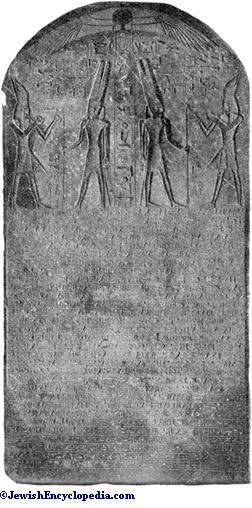
These circumstances gave to the new dynasty (the 18th) a warlike character. Following the claims of their predecessors, its kings conquered and held about two-thirds of Syria; the north seems to have been under the control of the Mesopotamian kingdom Mitanni, and it withstood, therefore, the Egyptian attacks. Amosis (A'ḥmose) I. began those conquests. Amenophis (Amen-ḥotep) I. died after a short, peaceful reign. Thutmosis (Dhut[i]-mose) I. penetrated to the Euphrates (after 1570). Thutmosis II.'s reign was filled apparently with internal disturbances connected with the question of succession. Thutmosis III. (c. 1503) stood for twenty-two years under the control of his aunt (?) Ma'-ḳa-re or Ḥa't-shepsut (who has commemorated in her beautiful terrace-temple at Der al-Baḥri a commercial expedition to Punt, i.e., the incense region east of Abyssinia). His independent rule is marked by fourteen campaigns, reaching as far as northern Mesopotamia, and by great constructions (the temple of Karnak, etc.). Amenophis II., Thutmosis IV., and, less successfully, Amenophis III. (c. 1436) maintained the Asiatic conquests; Ethiopia as far as Khartum had been subjected and, unlikeSyria, which was merely tributary, had been made a province by the first kings of dynasty 18.
Amenophis IV. (c. 1400) is a most interesting person. He attempted a great religious reform; making the sun-disk his chief god, and persecuting the cult of several gods, especially that of the Theban Amon, the official god of the empire, with such hatred that he even changed his royal name and his residence. At his new capital, the modern Tell el-Amarna, the famous archive of cuneiform despatches has been found, which shows him corresponding with all the important kings of western Asia, but unable to control his Syrian possessions owing to the great struggles which his innovations had caused in Egypt. After his death (c. 1383) his reforms were overthrown, especially by his fourth successor, Ḥar-em-ḥeb(e). The religion, mummified again, kept its deplorable state of confusion forever.
The 19th dynasty begins with Rameses I. (after 1350?). Sethos (Setoy) I. and Rameses II. maintained only the smaller half of Syria against the encroaching empire of the Hittites. Both were very active as builders; Rameses II. (the "Sesostris" of the Greeks, reigning 67 years from about 1330?) was undoubtedly the greatest builder of the Pharaohs, even after taking into account the many cases where he appropriated monuments already in existence. Under his son Me(r)neptaḥ (c. 1263?) occurs the first monumental mention of Israel apparently dwelling as a rebellious nation in Palestine. Ex. i. 11, on the other hand, seems to fix upon Rameses II. as the Pharaoh of the oppression (see Rameses), While Me(r)neptaḥ is generally considered as the Pharaoh of the Exodus. How to fit the new monumental data in with the Biblical chronology is yet an open question, there being no certain monumental evidence for Israel's stay in Egypt. Me(r)neptaḥ warded off a great invasion of Libyans allied with pirates from Asia Minor and Europe. The nineteenth dynasty ended with several short-lived, powerless rulers, among them a Syrian (officer?) as usurper.
The Ramesides.
Setnakht(e) reunited the country and established a new dynasty (the 20th) somewhat before 1200. His son Rameses III. tried to imitate Rameses II., especially as builder. He fought with the Libyans, who pressed more than before on Lower Egypt; with the northern pirates; with the Philistines, who had just settled in Syria; with the Amorites; and with small Hittite princes. His successors, the Ramesides (Rameses IV.-XII.), had short, inglorious reigns; Palestine and Phenicia were freed from the condition of an Egyptian dependency, which had been their lot for more than 400 years. The priesthood had become so wealthy by numerous donations that the royal power vanished, and finally the high priests of Thebes became kings. They had soon to yield to the twenty-first (Tanitic) dynasty (c. 1100). Its seven kings were hemmed in by their Libyan mercenaries, whose generals gained great influence. Therefore the Pharaohs were unable to interfere in Syria, where the Philistines were waging war. Solomon's Egyptian wife (I Kings ix. 16, 24; xi. 1) would seem to have been a daughter of the following ruler (comp. ib. ix. 16, which states that Gezer was her dowry).
Israelites Building Storehouses for Pharaoh.(From an illuminated haggadah in the possession of the Earl of Crawford.)
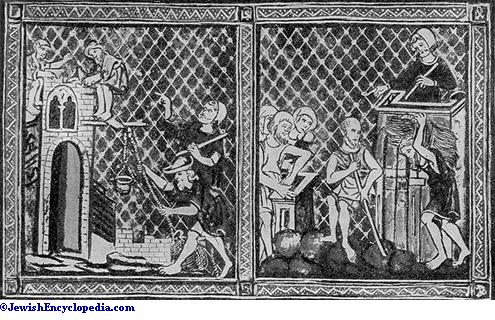
Shoshenḳ I. (the Biblical "Shishak"), a descendant of Libyan generals, who founded the twenty-second or Bubastite dynasty (c. 950 B.C.), checked the Philistines, arranged the division of the Israelitish kingdom, evidently in favor of Jeroboam (comp. I Kings xi. 18), and ransacked Palestine (ib. xiv. 25; II Chron.xii.). On the Edomite Hadad (I Kings xi. 17-22) see below. Shoshenḳ's successors, however—3 Shoshenḳs, 2 Takelots, 3 Osorkons (Wasarken), 1 Pemay—could not maintain this influence in Asia.
Muṣri and Mizraim.
After 800 B.C. Egypt was again practically divided into about twenty kingdoms ruled by the generals of the larger Libyan garrisons. The new kingdom of Ethiopia was thus able to occupy Thebes; about 750 the Ethiopian king P-'ankhy even tried to conquer all Egypt. Only his grandson Shabako was, however, able to accomplish this and to subject the most powerful of the many princes, the ruler of Saïs and Memphis (Bocchoris or Bok-en-ranf, the son of Tef-nakhte), somewhat before 700. Neither he nor his successor Shabatako seems to have been able to interfere in Syria, finding it difficult to maintain Egypt. It has been shown conclusively by Winckler (especially in "Mittheilungen der Vorderasiatischen Gesellschaft," 1898, p. 1; comp. also Schrader, "K. A. T." 3d ed., p. 145) that the king So with whom Hoshea had conspired against Assyria (II Kings xvii. 4) was Sib'e, viceroy of Muṣri, i.e., northwestern Arabia (not Mizraim-Egypt, cuneiform "Miṣri"), and that various other conflicts between Assyria and Egypt (?) refer rather to this Muṣri (which curiously had a king, Pir'u, formerly understood as "Pharaoh"). Few scholars, however, have accepted in all its conclusions the inference drawn from this, namely, that a great many Biblical passages originally refer to this Muṣri, not Mizraim-Egypt (thus Gen. xiii. 10; xvi. 1, 3; l. 11; I Sam. xxx. 13; II Sam. xxiii. 21; I Kings iii. 1, xi. 14 et seq.; Hadad's and Jeroboam's exile [see above]; and even Israel's servitude in Egypt).
The third king of the twenty-fifth (Ethiopian) dynasty, Taharḳo (see Tirhakah), had a share in rebellions of the vassals of Assyria, especially in the rebellion of Tyre, which led to two expeditions of Esarhaddon against Egypt. It was conquered in the second campaign and divided among twenty princes, descendants of Libyan generals. Taharḳo and his successor Tandamani repeatedly disputed without success the possession of Egypt by the Assyrians (comp. Nahum iii.); about 660 B.C. Psam(m)ethik I. (son of Necho I.), a descendant of the 24th dynasty, nominal reign 664-610, made himself independent of Assurbanipal's sovereignty.
Saïtic Dynasty.
The new Saïtic dynasty (the 26th) brought the first centralized government after several centuries, and new prosperity, which was demonstrated by a remarkable archaizing revival of art. The enterprising Necho (Nekau) II. (610-594) undertook the conquest of Syria, which, however, was frustrated by his defeat at Carchemish by Nebuchadrezzar. He built a fleet, dug the first connection between the Nile and the Red Sea, and sent Phenician sailors around Africa. After Psam(m)ethik II. (594-588), Apries or Uaphris (Pharaoh hophrah, 588-569), seeking to check the Babylonians who menaced Egypt, instigated and aided the Jews (Jer. xxxvii. 5; comp. Ezek. xxix. 6) and Tyrians and received their fugitives (Jer. xli. 17). This policy seems to have been continued by his successor, the clever usurper Amasis (A'ḥmose II., 564-526), who still warded off the destruction threatened in Jer. xlvi. 26.
But when the Babylonian empire had been superseded by the Persian, Psam(m)ethik, III. could not maintain himself any longer. In 525 Egypt was conquered by Cambyses, and remained a Persian province notwithstanding various rebellions, led by the half-Libyan soldiers, in 487, 460, and most successfully in 414. The period of independence (414-350?) was filled by internal struggles and by wars of defense against the Persians. The Macedonian conquest brought Egypt independence under the dynasty of the Ptolemies. But Egyptian culture was sinking fast; the native population (which rebelled repeatedly against the foreign rulers, led again by the old soldier class of Libyan descent) was reduced to the position of heavily taxed pariahs; and the kings in Alexandria considered their empire as a part of the Greek world. The annexation by Rome (31 B.C.) aggravated this decline of an old civilization, though temples were repaired or built by the Roman government and decorated with very poor hieroglyphics till about 300 C.E. The condition prophesied, that Egypt should be without native rulers, can, however, be traced back, as an actuality, as far as the tenth century B.C. (see above).
For the political history of the Ptolemies down to Ptolemy XVI. and the famous queen Cleopatra VII., see Ptolemy. The great development of African commerce by Ptolemy II. and the building of the Jewish temple at Leontopolis under Ptolemy VI. may be mentioned. Palestine was an Egyptian province until 198 B.C., when Antiochus III. the Great conquered it. The attempt of Ptolemy VI. Philometor to regain it (I Macc. xi. 1) was ended by his death in 145 B.C.
The Biblical name (land of) "Mizraim," or (in more poetic style) "Maẓor," is Semitic ("Miṣri" is the earliest Babylonian form) and may have some connection with that of the neighboring Muṣri (see above). The Biblical (dual?) form was usually understood as an allusion to the prehistoric division of Egypt, but, although the Hebrew (and Assyrian) has a special name for Upper Egypt, "Pathros" (Isa. xi. 1; Jer. xliv. 1; Ezek. xxix. 14, xxx. 14), the ending "ayim" is now considered as a locative by scholars. The common Egyptian designation was "Keme[t]" = "black," i.e., "fertile land." The classical name "Ægyptos" seems to be connected with the old name of Memphis, "(Ḥ)a(t)ka-ptaḥ." The Bible calls Egypt also "land of Ham" (Ps. cv. 23, 27; comp. Ps. lxxviii. 51, cvi. 22), or contemptuously "Rahab," i.e., "boasting monster." The fertility of the country is mentioned in Gen. xiii. 10; Ex. xvi. 3; and Num. xi. 5 (see Deut. xi. 10 on the necessity of laborious irrigation). That the country depends on the Nile (the abundance and overflowing of which are proverbial; see Nile) is indicated by the Prophets, who threaten Egypt often with its drying up (e.g., Isa. xix. 5; comp. also the kine of Pharaoh's dream rising from the river [Gen. xl.]). On other disadvantages of the country see Plagues.
Biblical References.
The monuments furnish several examples of permission given to large numbers of fugitive or starvingSemites to settle in the land, as Gen. xlviii. describes. Traders had always free access, as Gen. xxxvii. 25 and xlii. 2 imply. Hence after 1700 B.C. Egypt had constantly a large Semitic element of population, especially along the eastern frontier of the Delta (comp. Isa. xix. 18 on five cities speaking the language of Canaan). The Egyptian cities mentioned in the Bible all belong to this part of the country. No (Thebes) and Syene show, however, that the land south of Memphis also was well known in Palestine. More Jews and Samaritans immigrated in the Ptolemaic time, settling especially around Alexandria. The heavy taxation of the Egyptian peasants and their serfdom, from which only the priests were exempted, are mentioned in Gen. xlvii. 20-26; the hard socage of the Israelites in Egypt was the usual one of royal serfs, into the condition of whom the colonists of Goshen had to enter. The most important industry, the weaving of various kinds of linen (of which "buẓ" [byssus] and "shesh" kept their Egyptian names with the Hebrews), is alluded to in Isa. xix. 9; Ezek. xxvii. 7; and Prov. vii. 16. Of Egyptian customs, the shaving of the beard and (sometimes) of the head (which, however, the better classes, except the priests, covered again by a wig), circumcision, the laws of clean and unclean (almost as complicated as those of Israel and often quite analogous), the custom of embalming the dead by a long process (mummification), and the long mourning are alluded to in Gen. xli. 14; Joshua v. 9 (?); Gen. xliii. 32, xlvi. 36, 1, 2-3, respectively. Otherwise the customs did not differ very much from those of the Syrian peasants (beer largely replaced wine, as castor-oil, etc., did the olive-oil, and linen the woolen clothing of Syria). Flax and spelt (the modern "durrah") were especially characteristic products of the fields (Ex. ix. 31-32, R. V.).
In morals, the marriage of brothers and sisters as a regular institution was the principal difference. Women had greater liberty even than in Babylonia (comp. Gen. xxxix.). The Egyptians were very industrious (as their gigantic constructions attest), but neither enterprising (hence they never made good sailors or traders) nor warlike. From the earliest period they preferred to employ foreign mercenaries (comp. Jer. xlvi. 9; Ezek. xxvii. 10). Hence Egypt was a conquering power only on a rather limited scale (comp. on its military weakness II Kings xviii. 21; Isa. xxxvi. 6). The country exercised a strong influence in the development of Eastern culture chiefly by its remarkable art and industries, less by science because of the national writing, the hieroglyphs, which could not be adapted to other languages (what the Greeks called hieratic writing was merely the cursive form; the demotic was a kind of stenography, developed from that cursive after 700 B.C.).
Tell al-Yahudiyyah (The Mound of the Jews), Egypt.(From "Memoirs of Egypt Exploration Fund.")
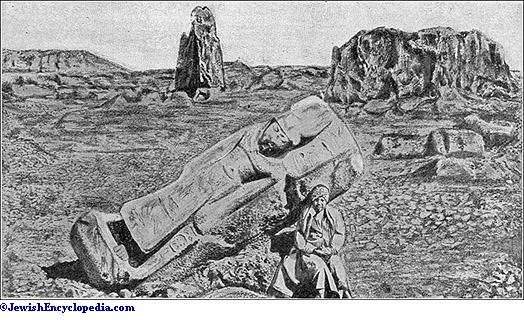
Of the enormous number of local divinities (usually arranged in triads—father, mother, and child—as in Babylonia) the Bible mentions only the god of Thebes, since the 18th dynasty the official deity of Egypt (see Amon); for the sun-god (with whom later religion tried to identify almost all ancient local gods) see Beth-shemesh. For the reputation of Egyptian learning see an allusion in I Kings iv. 30; for magic, Isa. xix. 3; Ex. vii. 11. The magic literature is, indeed, endless. Modern scholars consider Babylonia as generally more advanced in science (except, perhaps, medicine, which was an Egyptian specialty). Contrary to a popular erroneous view on the character of the Egyptians as gloomy, they wereextremely superstitious, but less serious than any branch of the Semites, as a very remarkable entertaining literature and their non-official art demonstrate. Their massive architecture forms no contradiction, being relieved by polychromy.
Bibliography: History:
Flinders Petrie, History of Egypt, 1895 et seq.;
Wiedemann, Aegyptische Gesch. 1884;
E. Meyer, Geschichte des Alten Aegyptens, Berlin, 1887;
Maspero, History of the Ancient Orient, 3 vols., French and English, 1895-99.
Contact between Egypt and Asia: W. Max Müller, Asien und Europa, 1893;
idem, in Der Alte Orient, 1901, No. 4.
Egypto-Biblical questions: Ebers, Aegypten und die Bücher Mosis, 1867 (antiquated);
Brugsch, Steininschrift und Bibelwort, 1891 (requires caution).
Language: Erman, Egyptian Grammar, German and English, 1894;
Brugsch, Hieroglyphisch-Demotisches Wörterb. 1867-80.
For the Coptic, Stern, Koptische Grammatik, 1880;
Steindorff, in the Porta Linguarum Orientalium, 1894;
Peyron, Lexicon Copticum, 1835.
On the Egyptian loanwords from Semitic, Bondi, Dem Hebräisch-Phönizischen Sprachzweige Angehörige Lehnwörter, etc., 1886.
Manners and customs: Erman, Aegypten und Aegyptisches Leben, 1885 (Eng. ed., 1894);
Brugsch, Die Aegyptologie, 2d ed., 1897.
Religion: Wiedemann, Die Religion der Alten Egypter, 1890 (Eng. transl., 1896);
Brugsch, Religion und Mythologie, 1884-88;
Maspero, La Mythologie Egyptienne, 1889;
Lanzone, Dizionario di Mitologia Egiziana, 1881.
Names: Proper names, Lieblein, Hieroglyphisches Namenwörterb. 1871-92;
ancient geographical names, Brugsch, Dictionnaire, Géorgraphique, 1877-80 (with much caution).
Literature: Translations in Records of the Past;
Griffith, in The World's Best Literature, 1897;
Petrie, Egyptian Tales, 1895;
Maspero, Contes Populaires, 1882;
W. M. Müller, Die Liebespoesie der Alten Aegypter, 1899;
Wiedemann, in Der Alte Orient, iii., part 4;
the so-called Book of the Dead, ed. Naville, 1886; transl. by Le Page Renouf, 1896 et seq.
Decipherment of hieroglyphics: Brugsch, Die Aegyptologie, Leipsic, 1881.
Art: Perrot and Chipiez, Eng. ed., 1883;
Maspero, Egyptian Archeology, Eng. transl., 1893;
Flinders Petrie, Egyptian Decorative Art, 1895;
Rosellini, Monumentidel Egitto, 1842 et seq.;
Champollion, Monuments, 1835-45;
Lepsius, Denkmäler aus Aegypten, 1849-58;
annual publications of the Egypt Exploration Fund and Survey of Egypt.
Repertories on Egypt in general: Jolowicz, Bibliotheca Ægyptiaca, 1858-61;
Ibrahim-Hilmy, The Literature of Egypt and the Sudan, 1886-88.
—In Medieval and Modern Times:For the titles of works cited under abbreviations, see Bibliography at the end of the article.
The history of the Jews in Egypt during the Greek and Ptolemaic periods centers almost completely in the city of Alexandria (see Jew. Encyc. i. 361 et seq.). As early as the third century B.C. there was a widespread Jewish diaspora in Egypt. In addition to those in Alexandria a colony of Jews existed during the Ptolemaic period at Athribis in Lower Egypt, on the Damietta arm of the Nile (ib. ii. 273). An inscription in which the Jews dedicate a synagogue to Ptolemy and Berenice has recently been found near the canal which connected Alexandria with the Canopic mouth of the Delta (T. Reinach, in R. E. J. xlv. 161; Mahaffy, "Hist. of Egypt," p. 192). Farther to the south, on the west bank of the Nile, was Fayum, identified by Saadia (to Ex. i. 11) with Pithom. A papyrus of the year 238-237 B.C. mentions a certain Ionathas of this city (Mahaffy, "The Flinders Petrie Papyri," part ii., pp. 15, 23). Another papyrus of the same date records that the Jews and Greeks in a place called "Psenyris" had to pay a special tax for the slaves in their possession (compare idem, "Hist. of Egypt," p. 93; T. L. Z. 1896, 2, p. 35); and in a third papyrus a place called "Samareia" in the Fayum is mentioned, together with a number of names, among which is that of a certain Sabbathion, a Jewess according to Schürer (ib. 20, p. 522) and Reinach (R. E. J. xxxvii. 520). Another papyrus of the third century B.C. (Grenfell, "The Oxyrhynchus Papyri," i. 74) mentions a Jew named "Danooul." For the Roman period there is evidence that at Oxyrynchus (Behneseh), on the east side of the Nile, there was a Jewish community of some importance. It even had a Jews' street (R. E. J. xxxvii. 221). Many of the Jews there must have become Christians, though they retained their Biblical names (e.g., "David" and "Elisabeth," occurring in a litigation concerning an inheritance). There is even found a certain Jacob, son of Achilles (c. 300 C.E.), as beadle of an Egyptian temple. A papyrus of the sixth or seventh century C.E. contains a receipt given to Gerontius, quartermaster of the general Theodosius, by Aurelius Abraham, son of Levi, and Aurelius Amun, son of David, hay-merchants. To the same century belongs a papyrus detailing an exchange of vinegar for must between Apollos of the Arab village in the Arsinoe nome (i.e., Fayum) and the Hebrew Abraham, son of Theodotus (see also Wessely in "Sitzungsberichte der Kaiserlichen Akademie der Wissenschaften in Wien," 1902, pp. 12 et seq. For a Hebrew inscription at Antinoë, in Middle Egypt, see Jew. Encyc. i. 630, s.v. Antinoë).
From the Arab Conquest.
Knowledge of the history of the Jews in Egypt from the time of the Arab invasion is still very fragmentary. There are a few scattered notices in the Hebrew chronicles and travels of later periods; but the best information comes from the fragments found in the Cairo genizah and in part published by Neubauer, Schechter, Hirschfeld, Margoliouth, Kaufmann, and others. To these may be added occasional references in Arabic works on Egyptian history and topography. No attempt has yet been made to put this material together.
Cairo.
During this period, Egypt was known to the Jews by its old name  ; for which, at times, was substituted
  (Ezek. xxx. 13) or
  (Ezek. xxix. 10; see Ahimaaz Chronicle, 128, 7). It was also known as "the Diaspora" (
 , Al-Ḥarizi, § 46; M. xli. 214, 424; J. Q. R. xv. 86, 88;
  ib. 88). In the Ahimaaz Chronicle
  is perhaps used once (126, 2; see Z. D. M. G. li, 437). This last is derived from
  , a name given to Fostat (M. V. p. 181; J. Q. R. ix. 669; synonymously,
  , ib. xv. 87), which was known to Strabo and other Greek writers as well as to the Arabs, who, for the sake of distinction, often called it "Babylon of Egypt" (Pauly-Wissowa, "Real-Encyc." i. 2699; Z. D. M. G. li. 438; L.-P. p. 3). The name "Babli-on" (Heliopolis) was popularly connected with Babylon (Lane-Poole, "Cairo," p. 214). Cairo itself (Miṣr al-Ḳahirah, "the victorious") is called
  , or, as in Arabic,
  (S. 118, 7); it was a new city, founded by the vizier Jauhar in 969 for the Fatimites. The older city was farther to the southwest. It was called "Al-Fosṭaṭ" (the camp), and was founded by 'Amr ibn al-'Aṣi in 641 (B. p. 341). It remained the official capital for three centuries, and the commercial capital up to the time of the crusading King Amalric (1168), when it was burned. Its Hebrew name was
  (Z. D. M. G. li. 451; Kaufmann Gedenkbuch, p. 236),
  (S. 118, 5); or "the older M.,"
 (G. p. 34),
  (or
(or  , S. 136, 29). Synonymously, Fostat was called
  or
or  , in accordance with the translation of
  (Jer. xliii. 10); by the Karaites
  (L. notes, p. 61; compare Jer. xlvi. 20). Another name for Fostat was
  (Zoan), or
  (Al-Ḥarizi, "Taḥkemoni," § 46; S. 118, 5), and for the inhabitants
  (J. Q. R. xiv. 477; compare
  . Curiously enough, Benjamin of Tudela uses the name "Zoan" for a stronghold between Cairo and the Muḳaṭṭam Hills.
Alexandria was identified with the Biblical 
 (Nahum iii. 8) and so called by Ibn Safir ("Eben Sappir," i. 2a), though the Greek name was also used,
  (Conforte, "Ḳore ha-Dorot," p. 5a); and, following the Arabic, the gentile adjective
  or
or  (see Neubauer, "Cat. Bodl. Hebr. MSS." No. 146). The region of the east arm of the Nile was called by its Arabic name
  , i.e., Damietta; or, symbolically,
 ("Abiathar Megillah" and Benjamin of Tudela; see J. Q. R. xv. 89). In the letter of Al-Afḍal's ex-minister of finance (see below) occurs the form
  =
= , Tamiathis, i.e., Damietta Z. D. M. G. li. 447). The Fayum was generally identified with the Biblical "Pithom" (
 ) and so called (Dunash b. Tamim; compare Grätz, "Gesch." Hebr. transl., iii. 465). The gentile form was
  (M. J. C. i. 40); or, according to the Arabic,
  (e.g., Saadia and Nathanael).
Saadia was naturally well acquainted with Egyptian topography. In his translation of Gen. x. 13, 14 he has the following identifications:
|
|
= |
inhabitants |
of |
Tanis. |
|
|
= |
" |
" |
Alexandria. |
|
|
= |
" |
" |
Behnesch. |
|
|
= |
" |
" |
Farama (Yaḳut, iii. 882). |
|
|
= |
" |
" |
Biyama (idem, i. 899). |
|
|
= |
" |
" |
Sa'id. |
|
|
= |
" |
" |
Damietta. |


The Jews and the Arabs.
Jerome was in Egypt in the year 400; he mentions five cities there "which still speak the Canaanitish [i.e., the Syriac] language." This perhaps refers to Aramaic—not to Coptic, as Krauss believes—and may very well have been due to the large colonies of Jews in the land (J. Q. R. vi. 247). The part taken by the Jews in the Arab invasion of Egypt is not clear. In addition to the Jews settled there from early times, some must have come from the Arabian peninsula. The letter sent by Mohammed to the Jewish Banu Janba in Maḳna near Aila (Wellhausen, "Skizzen," iv. 119) in the year 630 is said by Al-Baladhuri to have been seen in Egypt; and a copy, written in Hebrew characters, has been found in the Cairo genizah (J. Q. R. xv. 173). Hebrew papyri are found in the Theodore Graf collection covering the period 487-909. The Jews had no reason to feel kindly toward the former masters of Egypt. In 629 the emperor Heraclius I. had driven the Jews from Jerusalem (Bury, "Later Roman Empire," ii. 215). According to Al-Maḳrizi, substantiated by Eutychius, this was followed by a massacre of Jews throughout the empire—in Egypt, aided by the Copts, who had old scores against the Jews to wipe out, dating from the Persian conquest of Alexandria at the time of Emperor Anastasius I. (502) and of the Persian general Shahin (617), when the Jews assisted the conquerors against the Christians (B. pp. 82, 134, 176). The treaty of Alexandria (Nov. 8, 641), which sealed the Arab conquest of Egypt, expressly stipulates that the Jews are to be allowed to remain in that city (B. p. 320); and at the time of the capture of that city, Amr, in his letter to the calif, relates that he found there 40,000 Jews.
Of the fortunes of the Jews in Egypt under the Ommiad and Abbassid califs (641-868), the Tulunids (863-905), and the Ikhshidids, next to nothing is known. One important name has come down from that time, viz., Mashallah (770-820), the astrologer, called "Al-Miṣri" or "Al-Alaksandri" (B. A. § 18). The Fatimite 'Ubaid Allah al-Mahdi, who founded the new Shiitic dynasty in 909, is said to have been the son of a Jewess, or to have been a Jew adroitly exchanged for the real heir. This is probably nothing more than an invention of the Sunnites tending to discredit the Alid descent of the new house (Weil, "Geschichte der Califen," ii. 600; Becker, "Beiträge zur Geschichte Aegyptens," p. 4). During the earlier period of this dynasty lived the gaon Saadia (892-942), whose teacher in Egypt was a certain Abu Kathir mentioned by Al-Mas'udi (Grätz, "Gesch." v. 282).
Rule of the Fatimite Califs.
The Fatimite rule was in general a favorable one for the Jews, except the latter portion of Al-Ḥakim's reign. This is directly confirmed by the laudatory terms in which the dynasty is spoken of by the author of the "Abiathar Megillah" (discovered by Schechter, J. Q. R. xv. 73). From this time on Jews are found prominent in the service of the califs. Isaac b. Solomon Israeli, the physician (d. 953), was recalled to Egypt from Kairwan and entered the service of 'Ubaid Allah; he was still in the royal service at the death of Al-Manṣur (952). Al-Mu'izz (952-975) had several Jews in his service. The Bagdad apostate Ya'ḳub ibn Killis, who had been the right-hand man of the Ikhshidid Kafur (966), was driven by the intrigues of the vizier Ibn al-Furat to enter the service of Al-Mu'izz. He was probably with Jauhar when the latter led the calif's forces into Egypt, and he became vizier under the calif 'Aziz. This Jauhar, who for some time was practically ruler over Egypt and Syria, has been identified by De Goeje with Paltiel, of whom the Ahimaaz Chronicle speaks with much enthusiasm (Z. D. M. G. lii. 75). Jauhar is known to have been brought from South Italy; but the identification is still very uncertain. The first fifteen years of Al-'Aziz's reign were dominated by Ibn Killis, whom Kaufmann has endeavored to identify with Paltiel; these were years of plenty and quiet. A Jew, Manasseh, was chief secretary in Syria (J. Q. R. xiii. 100; B. A. § 60; L.-P. p. 120). Moses b. Eleazar, his sons Isaac and Ishmael, and his grandson Jacob, were in the service of this calif (B. A. § 55).
The foundation of Talmudic schools in Egypt is usually placed at this period, and is connected with the story of the four captive rabbis who were sold into various parts of the Diaspora. Shemariah b.Elhanan is said to have been taken by the Arab admiral Ibn Rumaḥis (or Damahin) to Alexandria and then sent to Cairo, where he was redeemed in the tenth century (Ibn Da'ud, ed. Neubauer, M. J. C. i. 68). A letter from him is published by Schechter (J. Q. R. vi. 222, 596), and one from Ḥushiel to him (ib. xi. 644). That he was settled in Fostat is proved by a legal document, dated 1002, in his own hand-writing. His cosignatories are Paltiel b. Ephraim, Solomon b. David, Aaron b. Moses, and Jalib b. Wahb. He is here termed "rosh" (ha-yeshibah; J. Q. R. xi. 648; "Teshubot he-Geonim," ed. Harkavy, p. 147). Early responsa sent to Egypt are made mention of (ib. pp. 20, 142, 146), and one by Samuel b. Ḥofni (?) to Shemariah is likewise mentioned (J. Q. R. xiv. 491).
The Pranks of the Mad Calif.
That the mad calif Al-Ḥakim (996-1020) during the first ten years of his reign allowed both Jews and Christians to remain in the somewhat exceptional position which they had obtained under the toleration of Al-'Aziz is proved by the fragment of a versified megillah, in which the calif  (Al-Ḥakim bi-Amr Allah) is lauded as "the best of rulers, the founder of hospitals, just and equitable" (J. Q. R. ix. 25; Z. D. M. G. li. 442). But the Jews finally suffered from the calif's freaks. He vigorously applied the laws of Omar, and compelled the Jews to wear bells and to carry in public the wooden image of a calf. A street in the city, Al-Jaudariyyah, was inhabited by Jews. Al-Ḥakim, hearing that they were accustomed to mock him in verses, had the whole quarter burned down; and, says Al-Maḳrizi, "up to this day no Jews are allowed to dwell there" ("Al-Khiṭaṭ," ii. 5). According to Al-Ḳalḳashandi ("Ṣubḥ al-A'sha," transl. Wüstenfeld, p. 73) the Jews then moved into the street Al-Zuwailah. Both of these streets were in the northwestern part of the city, not far from the Darb al-Yahud of to-day.
During the reign of Al-Mustanṣir Ma'add (1035-1094) the real power was wielded by his mother, a black Sudanese slave, who had been sold to Al-Ẓahir by Sahl, a Jew of Tustar. This Sahl had two sons, Abu Sa'id, a dealer in antiquities, and Abu Naṣr Harun, a banker. Through the intrigues of Abu Sa'id the vizier Ibn al-Anbari was deposed and his place taken by an apostate Jew, Abu Manṣur Ṣadaḳah ibn Yusuf. After nine months Ṣadaḳah, fearing the power of Abu Sa'id, had him put to death (Wüstenfeld, "Fatimiden," p. 230). To the eleventh century belongs the papyrus letter sent (1046) from Egypt to the Palestinian gaon Solomon b. Judah ("Mittheilungen aus der Sammlung der Papyrus Erzherzog Rainer," 1892, p. 127). It seems that an Egyptian community had been rent asunder by the presence in the synagogue of Solomon Sabik, a ḥazzan who had been excommunicated by the bet din of Ramleh for witchcraft. Sabik's letter of recommendation from the Palestinian gaon was considered a forgery; and a new letter from the gaon was demanded (R. E. J. xxv. 272; J. Q. R. xv. 82). A papyrus deed of gift, dated 1089, names Abraham b. Shemaiah as head of the rabbinate at Fostat, his colleagues being Samuel the Spaniard and Ḥalfon b. Shabib, the ḥazzan ("Führer durch die Sammlung der Papyrus Erzherzog Rainer," p. 266). At this time there lived also Ephraim ibn al-Zafan (Za'faran; died 1068), a noted court physician, from whom Al-Afḍal once bought a library of 10,000 volumes, and who, when he died, left more than 20,000 books (B. A. § 142).
Jewish Ministers.
At the beginning of the twelfth century a Jew, Abu al-Munajja ibn Sha'yah, was at the head of the Department of Agriculture. He is especially known as the constructor of a Nile sluice (1112), which was called after him "Baḥr Abi al-Munajja" (Ibn Duḳmaḳ, "Description de l'Egypte," ii. 46, Cairo, 1893; Al-Maḳrizi, l.c. i. 72, 477; Ibn Iyyas, "Bada'i al-Zuhur," ii. 109, 182; Al-Kutubi, "Fawat," i. 89; Al-Ḳalḳashandi, l.c. p. 27). He fell into disfavor because of the heavy expenses connected with the work, and was incarcerated in Alexandria, but was soon able to free himself (J. Q. R. xv. 73). A document concerning a transaction of his with a banker has been preserved (J. Q. R. xv. 168). Under the vizier Al-Malik al-Afḍal (1137) there was a Jewish master of finances, whose name, however, is unknown. His enemies succeeded in procuring his downfall, and he lost all his property. He was succeeded by a brother of the Christian patriarch, who tried to drive the Jews out of the kingdom. Four leading Jews worked and conspired against the Christian, with what result is not known. There has been preserved a letter from this ex-minister to the Jews of Constantinople, begging for aid in a remarkably intricate poetical style (J. Q. R. ix. 29, x. 430; Z. D. M. G. li. 444). One of the physicians of the calif Al-Ḥafiẓ (1131-49) was a Jew, Abu Manṣur (Wüstenfeld, p. 306). Abu al-Faḍa'il ibn al-Nakid (died 1189) was a celebrated oculist (B. A. § 151).
In this century a little more light is thrown upon the communities in Egypt through the reports of certain Jewish scholars and travelers who visited the country. Judah ha-Levi was in Alexandria in 1141, and dedicated some beautiful verses to his friend Aaron Ben-Zion ibn Alamani and his five sons of that city. At Damietta Ha-Levi met his friend, the Spaniard Abu Sa'id ibn Ḥalfon ha-Levi. About 1160 Benjamin of Tudela was in Egypt; he gives a general account of the Jewish communities which he found there. At Cairo there were 2,000 Jews; at Alexandria 3,000, with a R. Phineas b. Meshullam, who had come from France, at their head; in the Fayum there were 20 families; at Damietta 200; at Bilbais, east of the Nile, 300 persons; and at Damira 700. At Maḥallah (Yaḳut, iv. 428), now Maḥallat al-Kabir, half-way on the railroad line between Alexandria and Damietta, Benjamin found 500. Sambari (119, 10) mentions a synagogue here ( ), with a scroll of the Law (seen as late as 1896 by S. Schechter) in a metal case, which was used only on Rosh Ḥodesh, and which was supposed to entail the death of any one who swore falsely after having touched it. Benjamin also found 200 Jews at Sefitah and 200 at Al-Butij, on the east bank of the Nile. Sambari (156, 16) speaks of Jews also at Reshid (Rosetta), where Samuel b. David saw two synagogues (G. p. 4).
Maimonides.
The rigid orthodoxy of Saladin (1169-93) doesnot seem to have affected the Jews in his kingdom. A Karaite doctor, Abu al-Bayyan al-Mudawwar (d. 1184), who had been physician to the last Fatimite, treated Saladin also (B.A. § 153); while Abu al-Ma'ali, brother-in-law of Maimonides, was likewise in his service (ib. § 155). In 1166 Maimonides went to Egypt and settled in Fostat, where he gained much renown as a physician, practising in the family of Saladin and in that of his vizier Ḳaḍi al-Faḍil al-Baisami. The title "Ra'is al-Umma" or "al-Millah" (Head of the Nation, or of the Faith), was bestowed upon him. In Fostat, he wrote his "Mishneh Torah" (1180) and the "Moreh Nebukim," both of which evoked opposition even from the Mohammedans, who commented upon them (J. Q. R. vi. 218). From this place he sent many letters and responsa; e.g., to Jacob, son of Nathaniel al-Fayyumi, on the pseudo-Messiah in South Arabia, and to R. Ḥasdai ha-Levi, the Spaniard, in Alexandria ("Teshubot ha-Rambam," p. 23a). In 1173 he forwarded a request to the North-African communities to aid in releasing a number of captives. The original of the last document has been preserved (M. xliv. 8). He caused the Karaites to be removed from the court (J. Q. R. xiii. 104). He also served Saladin's successors as physician.
Maimonides' presence in Egypt at this time was quite fortunate. A certain Zuṭa, also called "Yaḥya," had supplanted the nagid Samuel for sixty-four days. Samuel, however, was reinstated. Zuṭa hoarded up much wealth, and when the nagid died (before 1169), denounced his manner of collecting the revenues. Though the accusation was proved to be false, Zuṭa induced Saladin to sell him the dignity, and under the name of "Sar Shalom ha-Levi" he greatly overtaxed the people for four years—probably from 1185 to 1189, two documents written during his tenure of office bearing these dates respectively (J. Q. R. viii. 555). Maimonides, with the aid of R. Isaac, whom Harkavy and Neubauer connect with Isaac b. Shoshan ha-Dayyan, succeeded in driving Zuṭa out of office; and he and his son were put under the ban for the denunciations which they had hurled right and left. The matter was even brought to the attention of the vizier ( ). A megillah ("Megillat Zuṭa") recounting these events was written in rimed prose by Abraham bar Hillel in 1196 (J. Q. R. viii. 541, ix. 721, xi. 532; Wertheimer, "Ginze Yerushalayim," i. 37; see also Harkavy in "Ha -Miẓpah," 1885, ii. 543; Kaufmann, in M. xli. 460, and J. Q. R. ix. 170).
The severe pest that visited Egypt in 1201-1202 in consequence of an exceptionally low Nile, and which is graphically described by the physician 'Abd al-Laṭif, is also described in a Hebrew fragment which is at present in the possession of A. Wolf of Dresden (Z. D. M. G. li. 448).
Plan of the City of Cairo, Twelfth Century.(After Lane-Poole, "Medieval Egypt.")Al-Ḥarizi's Visit.
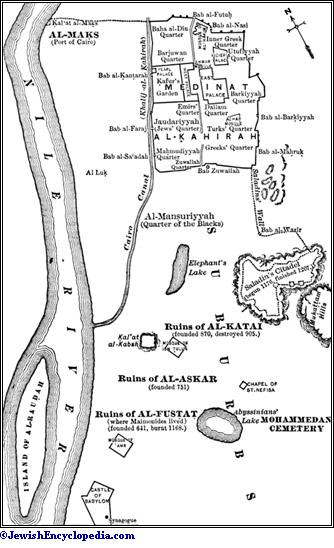
It was during the nagidship of Abraham Maimonides, who was physician to Al-Malik al-Kamil (1218-38), that Al-Ḥarizi went to Egypt, of which he speaks in the thirty-sixth and forty-sixth maḳamahs of his "Taḥkemoni." The former is supposed by Kaminka to be possibly a satire on Zuṭa (M. xliv. 220; Kaminka's ed., p. xxix.; but  must referto South Arabia). In Alexandria Al-Ḥarizi mentions R. Simḥah ha-Kohen, the Karaite Obadiah (the royal scribe) and his son Joseph, R. Hillel, and R. Zadok, the ḥazzan. In Fostat he mentions especially the dayyan Menahem b. R. Isaac. He also met Abraham Maimonides; and in Egypt he began to write his "Taḥkemoni." At the beginning of the thirteenth century there lived Jacob b. Isaac (As'ad al-Din al-Maḥalli), a renowned physician and medical writer (B. A. § 163). A letter to Hananeel b. Samuel (c. 1200), author of commentaries to the Talmud, has been published by Horwitz (Z. H. B. iv. 155; compare B. A. § 166). In 1211 a number of French rabbis, at the head of whom were the brothers Joseph and Meïr ben Baruch, emigrated to Palestine, and on their way visited Abraham Maimonides, who mentions them in his "Milḥamot Adonai" (ed. Leipsic, p. 16a; see R. E. J. vi. 178; Berliner's "Magazin," iii. 158).
Under the Mamelukes.
Under the Baḥri Mamelukes (1250-1390) the Jews led a comparatively quiet existence; though they had at times to contribute heavily toward the maintenance of the vast military equipment, and were harassed by the cadis and ulemas of these strict Moslems. Al-Maḳrizi relates that the first great Mameluke, Sultan Baibars (Al-Malik al-Thahir, 1260-77), doubled the tribute paid by the "ahl al-dhimmah." At one time he had resolved to burn all the Jews, a ditch having been dug for that purpose; but at the last moment he repented, and instead exacted a heavy tribute, during the collection of which many perished (Quatremère, "Histoire des Sultans Mamelukes," ii. 154). Under Al-Naṣir Mohammed (three times sultan, 1293-1340) the tribute from Jews and Christians amounted to 10 to 25 dirhems per head (L.-P. p. 304).
An account is given in Sambari (135, 22) of the strictness with which the provisions of the Pact of Omar were carried out. The sultan had just returned from a victorious campaign against the Mongols in Syria (1305). A fanatical convert from Judaism, Sa'id ibn Ḥasan of Alexandria, was incensed at the arrogance of the non-Moslem population, particularly at the open manner in which services were conducted in churches and synagogues. He tried to form a synod of ten rabbis, ten priests, and the ulemas. Failing in this, he endeavored to have the churches and synagogues closed. Some of the churches were demolished by the Alexandrian mob; but most of the synagogues were allowed to stand, as it was shown that they had existed at the time of Omar, and were by the pact exempted from interference. Sambari (137, 20) says that a new pact was made at the instance of letters from a Moorish king of Barcelona (1309), and the synagogues were reopened; but this probably refers only to the reissuing of the Pact of Omar. There are extant several notable fet was (responsa) of Moslem doctors touching this subject; e.g., those of Aḥmad ibn 'Abd al-Ḥaḳḳ, who speaks especially of the synagogues at Cairo, which on the outside appeared like ordinary dwelling-houses—a fact which had occasioned other legal writers to permit their presence. According to Taki al-Din ibn Taimiyyah (b. 1263), the synagogues and churches in Cairo had once before been closed. This fanatical Moslem fills his fet was with invectives against the Jews, holding that all their religious edifices ought to be destroyed, since they had been constructed during a period when Cairo was in the hands of heterodox Moslems, Ismailians, Karmatians, and Nusairis (R. E. J. xxx. 1, xxxi. 212; Z. D. M. G. liii. 51). The synagogues were, however, allowed to stand (Weil, l.c. iv. 270). Under the same sultan (1324) the Jews were accused of incendiarism at Fostat and Cairo; they had to exculpate themselves by a payment of 50,000 gold pieces (Quatremère, l.c. ii. 16). The dignity which Moses Maimonides had given to Egyptian-Jewish learning was not maintained by his descendants. In 1314 the French philosopher and exegete Joseph Caspi went on a special mission to Egypt, where he hoped to draw inspiration for philosophical study; but he was much disappointed, and did not remain there for any length of time (Grätz, "Gesch." vii. 362). During the period just referred to lived Abu al-Muna al-Kuhin al-Aṭṭar, who compiled a much-used pharmacopœia (ed. Cairo, 1870, 1883; B. A. § 176), and the apostate Sa'd ibn Manṣur ibn Kammuna (1280), who wrote a number of tracts on philosophy and an interesting controversial tract on Judaism, Christianity, and Islam (B. A. § 178).
In the Fifteenth Century.
Under the Burji Mamelukes the Franks again attacked Alexandria (1416), and the laws against the Jews were once more strictly enforced by Sheik al-Mu'ayyid (1412-21); by Ashraf Bars Bey (1422-38), because of a plague which decimated the population in 1438; by Al-Ẓahir Jaḳmaḳ (1438-53); and by Ḳa'iṭ-Bey (1468-95). The lastnamed is referred to by Obadiah of Bertinoro (O. p. 53). The Jews of Cairo were compelled to pay 75,000 gold pieces (Muir, "Mamluks," pp. 136, 154, 180). During this century two travelers visited Egypt—namely, Meshullam of Volterra (1481) and Obadiah of Bertinoro (1488), just mentioned—and they have left accounts of what they saw there (see Bibliography, below). Meshullam found 60 Jewish householders in Alexandria, but no Karaites or Samaritans; there were two synagogues, a large and a small one. Fostat was in ruins; but he mentions the Elijah and the Damwah synagogues. In Cairo he found 500 Jewish householders, 22 Karaites, and 50 Samaritans; six synagogues, and a royal interpreter of Jewish descent, one Tagribardi. Of other prominent Jews he mentions R. Samuel  a rich and charitable man, physician to the sultan, and his son Jacob; R. Joshua
  and Ẓadaḳah b.
  (M. V. pp. 176-187).
Letter (Papyrus) of an Egyptian Rabbi to Soloman ben Judah, Twelfth Century.(In the collection of Grand Duke Rainer.)
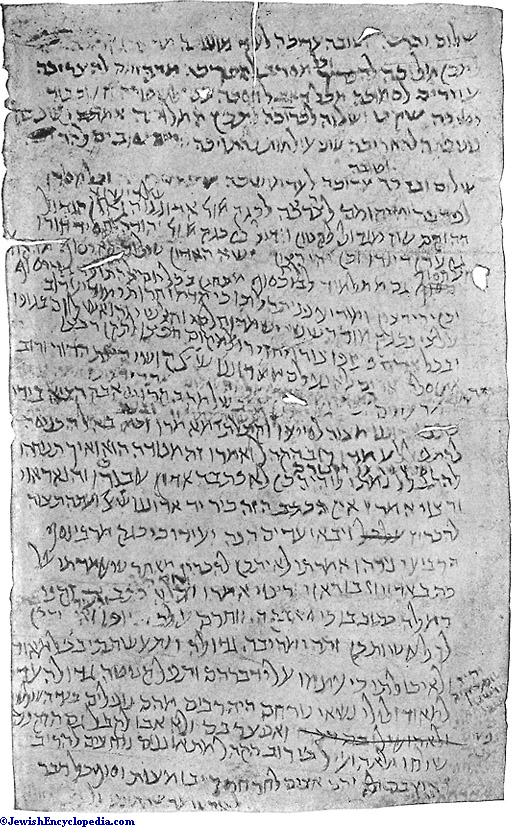
Obadiah was protected in Alexandria by R. Moses Grasso, interpreter for the Venetians, whom he mentions as a very prominent man. He speaks of only 25 Jewish families there; but there were 700 Jews in Cairo, 50 Samaritans, and 150 Karaites. The Samaritans, he says, are the richest of all the Jews, and are largely engaged in the business of banking. He also met there Anusim from Spain (O. p. 51). The Jewish community must have been greatly augmented by these exiles. They were well received, though occasionally their presence caused strife, as in the case of Joseph ibn Ṭabul, who insisted upon joining the Sephardim, though he really belonged to the Arabic community. Sulaimah ibn Uḥna and Ḥayyim Vital interfered, and copies of their letters to Ibn Ṭabul have been preserved (Frumkin, "Eben Shemuel," p. 7). Among their number may be mentioned Moses b. Isaac Alashkar, Samuel Sidillo (1455-1530), David ibn Abi Zimra (1470-1572), Jacob Berab (who came from Jerusalem in 1522; Frumkin, l.c. p. 30), and Abraham ibn Shoshan, the last three holding official positions as rabbis. Moses de Castro, a pupil of Berab, was at the head of the rabbinical school at Cairo.
Under the Turks.
On Jan. 22, 1517, the Turkish sultan, Salim I., defeated Tuman Bey, the last of the Mamelukes. He made radical changes in the affairs of the Jews, abolishing the office of nagid, making each community independent, and placing David ibn Abi Zimra, at the head of that of Cairo. He also appointed Abraham de Castro to be master of the mint. About this time David Re'ubeni was in Cairo (1523?); he speaks of the Jews' street there ( = "Darb al-Yahudi"), of their occupation as goldsmiths, and of Abraham de Castro, who, he says, lived as a pseudo-Mohammedan (M. J. C. ii. 141). It was during the reign of Salim's successor, Sulaiman II., that Aḥmad Pasha, Viceroy of Egypt, revenged himself upon the Jews because De Castro had revealed (1524) to the sultan his designs for independence (see Aḥmad Pasha; Abraham de Castro). The "Cairo Purim," in commemoration of their escape, is still celebrated on Adar 28.
("Sar shel Miẓrayim"; Conforte, "Ḳore ha-Dorot," 40b).
The text of the megillah read on that day has been published by Löwe in "Ha-Maggid," Feb. 14, 28, 1866, and, from agenizah fragment, in J. Q. R. viii. 277, 511. The short report of an eyewitness, Samuel b. Naḥman, is given in Neubauer, "Aus der Petersburger Bibliothek," p. 118. Secondary sources: Ibn Verga, Additamenta, p. 111; S. 145, 9 (see J. Q. R. xi. 656); Joseph ha-Kohen, "'Emeḳ ha-Bakah," pp. 76, 95; idem, "Dibre ha-Yamim," p. 72.
Toward the end of the sixteenth century Talmudic studies in Egypt were greatly fostered by Bezaleel Ashkenazi, author of the "Shiṭṭah Meḳubbeẓet." Among his pupils were Isaac Luria, who as a young man had gone to Egypt to visit a rich uncle, the tax-farmer Mordecai Francis (Azulai, "Shem ha-Gedolim," No. 332); and Abraham Monson (1594). Ishmael Kohen Tanuji finished his "Sefer ha-Zikkaron" in Egypt in 1543. Joseph ben Moses di Trani was in Egypt for a time (Frumkin, l.c. p. 69), as well as Ḥayyim Vital Aaron ibn Ḥayyim, the Biblical and Talmudical commentator (1609; Frumkin, l.c. pp. 71, 72). Of Isaac Luria's pupils, a Joseph Ṭabul is mentioned, whose son Jacob, a prominent man, was put to death by the authorities
According to Manasseh b. Israel (1656), "The viceroy of Egypt has always at his side a Jew with the title 'zaraf bashi,' or 'treasurer,' who gathers the taxes of the land. At present Abraham Alkula [ ] holds the position." He was succeeded by Raphael Joseph Tshelebi, the rich friend and protector of Shabbethai Ẓebi (Grätz, "Gesch." x. 34). Shabbethai was twice in Cairo, the second time in 1660. It was there that he married the ill-famed Sarah, who had been brought from Leghorn (ib. p. 210). The Shabbethaian movement naturally created a great stir in Egypt. It was in Cairo that Miguel (Abraham) Cardoso, the Shabbethaian prophet and physician, settled (1703), becoming physician to the pasha Kara Mohammed. In 1641 Samuel b. David, the Karaite, visited Egypt. The account of his journey (G. i. 1) supplies special information in regard to his fellow sectaries. He describes three synagogues of the Rabbinites at Alexandria, and two at Rashid (G. i. 4). A second Karaite, Moses b. Elijah ha-Levi, has left a similar account of the year 1654; but it contains only a few points of special interest to the Karaites (ib).
Sambari mentions a severe trial which came upon the Jews, due to a certain "ḳadi al-'asakir" (="generalissimo," not a proper name) sent from Constantinople to Egypt, who robbed and oppressed them, and whose death was in a certain measure occasioned by the graveyard invocation of one Moses of Damwah. This may have occurred in the seventeenth century (S. 120, 21). David Conforte was dayyan in Egypt in 1671. In Sambari's own time (1672) there were Jews at Alexandria, Cairo, and Damanhur (R. Ḥalfon b. 'Ula, the dayyan); at  or
or  (S. 133, 11; 136, 18; R. Judah ha-Kohen, the dayyan; this city is perhaps identical with Bilbaïs, though a genizah fragment in Cambridge mentions the city
  in 1119); at Maḥallah (R. Peraḥiah b. Jose, the dayyan), at Bulak (S. 162, 7), and at Rashid (S. 156, 16), where he mentions Moses ibn Abu Darham, Judah
  , and Abraham ibn Ẓur. Sambari gives also the names of the leading Jews in Alexandria and Cairo. His chronicle (edited in part by Neubauer, and reprinted by Berliner, Berlin, 1896) is chiefly valuable for the history of the Jews in Egypt, his native country. From 1769 to 1773 Hayyim Joseph Azulai was rabbi in Cairo (J. Q. R. xv. 333).
("Israelit," 1892, p. 639).
Solomon Ḥazzan gives the following list of rabbis at Alexandria during recent times: Jedidiah Israel (1777-82), his nephew Israel (1802-23), Solomon Ḥazzan (1832-56), Israel Moses Ḥazzan (1862), Nathan Amram (1862-73), Moses Pardo (1873-74), and Elijah Ḥazzan (1888). Israel Yom-Ṭob, who was nominally chief rabbi of Cairo, died April 8, 1892, and was succeeded by Aaron ben Simon
In the Nineteenth Century.
Two Jewish travelers have left an account of the condition of the Jews in Egypt about the middle of the nineteenth century. Benjamin II. found in Alexandria about 500 families of indigenous Jews and 150 of so-called Italians. Each of these communities had its own synagogue, but both were presided over by R. Solomon Ḥazzan, a native of Safed. In Cairo also he found two Jewish communities; the indigenous numbering about 6,000 families and the Italian 200. Both were presided over by Ḥakam Elijah Israel of Jerusalem. Benjamin speaks of their eight synagogues, one of which is called "the Synagogue of Maimonides." In Fostat, or old Cairo, he found 10 Jewish families, very poor, and supported by their richer brethren in Cairo. In Damietta there were 50 Jewish families, and between that place and Cairo several scattered Jewish communities which had lapsed into a dead state of ignorance (Benjamin II., "Eight Years in Asia and Africa," pp. 230 et seq.).
Ibn Safir ("Eben Sappir," pp. 26 et seq., Lyck, 1866) gives a more detailed account. He says that most of the Jews at present in Alexandria went there in recent times, after the cutting of the Maḥmudiyyah Canal. A number had gone from Rashid and from Damietta, so that only a handful of Jews was left in those places. The number in Alexandria he estimates at 2,000. Among the synagogues were the Kanis al-'Aziz, a small one, and the Kanis Sardahil, a large one. The Elijah synagogue had beenrebuilt three years before his arrival. He speaks also of a synagogue with Sephardic ritual for the Italian Jews, numbering 100, and of a special synagogue for 50 Jews who had come there from eastern Europe. Of Jews in other parts of Egypt he mentions: 20 at Ṭanṭa, between the Rosetta and Damietta arms of the Nile, with a synagogue; 40 families in Manṣurah; 20 families in Maḥallah, with a synagogue (p. 21b); 20 families in Bet Jamari (?); 5 families at Zifteh, on the left bank of the Damietta arm, 10 Jews at Benha, and only 1 in Fayum (p. 25a). In Cairo he found 600 families of native Jews and 60 of Italians, Turks, etc., following the Sephardic ritual, and 150 Karaite families living in a separate quarter. The Jews live in the northwestern part of the city in a special quarter called "Darb al-Yahudi." The lanes are narrow, but the houses are large. The Jews are well-to-do and are engaged largely in the banking business. The cemetery is two hours distant from the city, and the graves are not marked by any stones. There is, however, a monument to a celebrated pious man, R. Ḥayyim  , to which the Jews make pilgrimages, taking off their shoes as they approach it. Kapusi (?) must have lived toward the end of the sixteenth and at the beginning of the seventeenth century. He is mentioned in a document of the year 1607, together with Abraham Castro, Benjamin
  , Conforte, l.c. p. 41b), and Moses Arragel (Ḥazzan, "Ha-Ma'alot li-Shelomoh," p. 12a), and by Conforte (ib.).
New Synagogue at Cairo, Egypt.(After a photograph.)
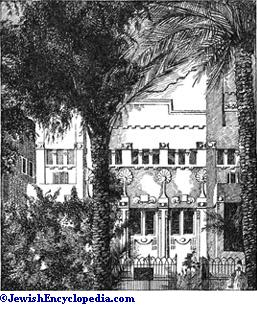
The head of the Egyptian Jews outside of Alexandria was R. Elijah Israel b. Isaac of Jerusalem, whose power over the community was considerable. Ibn Safir mentions as leaders of the community Yom-Ṭob b. Elijah Israel, a judge; Jacob Shalom; the Ya'beẓ family; Jacob Catawi; Saadia; and Abraham Rosana. In the ruined city of Fostat he found twelve Jewish families, whose number was increased during the summer by the rich Cairo Jews who go there for a time ("Eben Sappir," p. 20a).
Blood accusations occurred at Alexandria in 1844 (Jost, "Neuere Geschichte," ii. 380), in 1881 (Jew. Encyc. i. 366), and in Jan., 1902 (see, "Bulletin All. Isr." 1902, p. 24). In consequence of the Damascus Affair, Montefiore, Crémieux, and Solomon Munk visited Egypt in 1840; and the last two did much to raise the intellectual status of their Egyptian brethren by the founding, in connection with Rabbi Moses Joseph Algazi, of schools in Cairo (Jost, l.c. p. 368; idem, "Annalen," 1840, p. 429).
In 1892 a German-Italian congregation was formed at Port Said under Austrian protection ("Israelit," 1892, p. 1620). When Khartum fell into the hands of the Mahdi (1885), seven or eight Jews were found there, among them Neufeld. They were, however, all foreigners.
According to the official census published in 1898 (i., xviii.), there were in Egypt 25,200 Jews in a total population of 9,734,405. Of these, 12,693 were Egyptians and 12,507 strangers. Their distribution in the various cities was as follows:
|
|
No. of Jews. |
|
Lower Egypt. |
Governorats. |
|
|
Cairo |
11,489 |
|
|
Alexandria |
9,946 |
|
|
Damietta |
9 |
|
|
G. Gl. du Canal |
439 |
|
|
Suez |
123 |
|
|
Provinces. |
|
|
|
Rehera |
246 |
|
|
Sharkieh |
278 |
|
|
Dakalieh |
828 |
|
|
Gharbieh |
1,404 |
|
|
Kalyubieh |
185 |
|
|
Manufieh |
26 |
|
|
Upper Egypt. |
Provinces. |
|
|
Beni-Souef |
31 |
|
|
Fayum |
9 |
|
|
Gizeh |
17 |
|
|
Minia |
65 |
|
|
Assiuṭ |
13 |
|
|
Guerga |
19 |
|
|
Ḳonah |
42 |
|
|
Nubia |
31 |
|
|
|
|
______ |
|
|
|
Total |
25,200 |
The Alliance Israélite Universelle, together with the Anglo-Jewish Association, maintains at Cairo a boys' and a girls' school, founded in 1896. There are Zionist societies in Cairo, Alexandria, Manṣurah, Suez, Damanhur, Maḥallah, Kobra, and Ṭanṭa. The Zionist society Bar Cochba in Alexandria founded there a Hebrew school in 1901; it issues a journal, "Le Messager Sionist," which in 1902 superseded the "Mebassereth Zion."
Constitution; the Nagid.
The Egyptian communities were presided over for many centuries by a nagid, similar to the "resh galuta" in the East. One of the earliest references to the Egyptian nagid is to be found in the Midrash Agadat Bereshit (p. 110, Warsaw, 1876). His full title was  (compare the title of Simon,
  I. Macc. xiv. 28), or
  (MS. Cambridge Add. No. 3124, David Maimonides, 1396), or perhaps
  (Benjaminof Tudela; compare Z. D. M. G. lii. 446; J. Q. R. ix. 116); and Sambari (116, 20; 133, 7) speaks of him as
  . His authority at times, when Syria was a part of the Egyptian-Mohammedan empire, extended over Palestine; according to the Ahimaaz Chronicle (130, 5), even to the Mediterranean littoral on the west. In one document ("Kaufmann Gedenkbuch," p. 236) the word is used as synonymous with "padishah." The date is 1209; but the term may refer to the non-Jewish overlord. In Arabic works he is called "ra'is al-Yahud" (R. E. J. xxx. 9); though his connection with the "shaikh al-Yahud," mentioned in many documents, is not clear. Meshullam of Volterra says expressly that his jurisdiction extended over Karaites and Samaritans also; and this is confirmed by the official title of the nagid in the instrument of conveyance of the Fostat synagogue. At times he had an official vicenagid, called by Meshullam
  (M. V. p. 187, 5); in Hebrew,
  (J. Q. R. x. 162). To assist him he had a bet din of three persons (S. 133, 21)—though Meshullam mentions four judges and two scribes, and the number was at times increased even to seven—and there was a special prison over which he presided (M. V. p. 186). He had full power in civil and criminal affairs, and could impose fines and imprisonment at will (David ibn Abi Zimra, Responsa, ii., No. 622; M. V. ib.; O. p. 17). He appointed rabbis; and the congregation paid his salary, in addition to which he received certain fees. His special duties were to collect the taxes and to watch over the restrictions placed upon the further construction of synagogues (Shihab al-Din's "Ta'rif," cited in R. E. J. xxx. 10). Even theological questions—regarding a pseudo-Messiah, for example—were referred to him (J. Q. R. v. 506, x. 140). On Sabbath he was escorted in great state from his home to the synagogue, and brought back with similar ceremony in the afternoon (S. 116, 8). On Simḥat Torah he had to read the Pentateuchal lesson and to translate it into Aramaic and Arabic. Upon his appointment by the calif his installation was effected with much pomp: runners went before him; and the royal proclamation was solemnly read (see E. N. Adler in J. Q. R. ix. 717).
Origin of the Office.
The origin of the nagidship in Egypt is obscure. Sambari and David ibn Abi Zimra (Frumkin, "Eben Shemuel," p. 18) connect it directly with a daughter of the Abbassid calif Al-Ṭa'i (974-991), who married the Egyptian calif 'Aḍud al-Daulah (977-982). But 'Aḍud was a Buwahid emir of Bagdad under Al-Muktafi; and, according to Ibn al-Athir ("Chronicles," viii. 521), it was 'Aḍud's daughter who married Al-Ṭa'i. Nor does Sambari give the name of the nagid sent from Bagdad. On the other hand, the Ahimaaz Chronicle gives to the Paltiel who was brought by Al-Mu'izz to Egypt in 952 the title of "nagid" (125, 26; 129, 9; 130, 4); and it is possible that the title originated with him, though the accounts about the general Jauhar may popularly have been transferred to him. If this be so, he was followed by his son, R. Samuel (Ahimaaz Chronicle, 130, 8), whose benefactions, especially to the Jews in the Holy Land, are noticed. This must be the Samuel mentioned as head of the Jews many hundred years previous by Samuel b. David, and claimed as a Karaite. The claim is also made by Firkovitch, and his date is set at 1063. He is said to have obtained permission for the Jews to go about at night in the public streets, provided they had lanterns, and to purchase a burial-ground instead of burying their dead in their own courtyards (G. pp. 7, 61). The deed of conveyance of the Rabbinite synagogue at Fostat (1038), already referred to, mentions Abu (Ibn?) Imran Musa ibn Ya'ḳub ibn Isḥaḳ al-Isra'ili as the nagid of that time. The next nagid mentioned is the physician Judah b. Josiah, a Davidite of Damascus, also in the eleventh century (S. 116, 20; 133, 10); a poem in honor of his acceptance of the office has been preserved (J. Q. R. viii. 566, ix. 360).
Succession of Nagidim.
In the same century lived the nagid Meborak b. Saadia, a physician (J. Q. R. viii. 557): he is referred to in a contract dated 1098 (ib. ix. 38, 115), in the epistle of the exminister of finance of the vizier Al-Afḍal (Z. D. M. G. lii. 446), and in a Lewis-Gibson fragment (J. Q. R. ix. 116). He was maligned by the exilarch David, and was forced to take refuge for a time in Fayum and Alexandria (ib. xv. 89).
It is uncertain whether there was a nagid named Mordecai; the expression "Mordekai ha-Zeman" is probably appellative (ib. ix. 170); but the fragment of a poem (see "He-Ḥaluẓ," iii. 153) addresses him as "Negid 'Am El," which is quite distinctive (J. Q. R. viii. 553). His full name would then be Mordecai b. al-Ḥarabiyyah. He was succeeded by Abu Manṣur Samuel b. Hananiah, who was nagid at the time of Judah ha-Levi (1141). He is not to be confused with Samuel ha-Nagid of Spain, as he is even in Sambari (S. 156, 24; see J. Q. R. ix. 170, xiii. 103; M. xl. 417). He was living in 1157, but not so late as 1171, as he is not mentioned by Benjamin of Tudela. When Benjamin was in Egypt the nagid was Nathanael (Hibat Allah ibn Jami, a renowned physician; B. A. § 145). This can be seen from Benjamin's description, though the title is not used (despite Neubauer, J. Q. R. viii. 553). He is mentioned in 1164 in a marriage contract published by Merx ("Doc. Paleogr." 1894; M. xxxix. 150, xli. 214; J. Q. R. xiii. 103; B. A. § 145). During the time that he farmed the revenues the usurper Zuṭa must have held office (M. xli. 463). Zuṭa was ousted by Maimonides, though whether the latter took his place as nagid, and what was his relationship to Nathanael, are not clear. A ketubbah, dated 1172, in the library of the late D. Kaufmann, seems by its wording to indicate that Maimonides did hold the office (Z. D. M. G. li. 451; M. xli. 425, 463). Maimonides induced many Karaites to return to Rabbinism (Grätz, "Gesch." vi. 359).
The dignity of nagid was vested for some time in the family of Maimonides: Abraham (1186-1237; a document from his bet din is published by D. W. Amram in "The Green Bag," xiii. 339, Boston, 1901); his son David (1212-1300; S. 120, 15; 134, 29; M. xliv. 17; "Kerem Ḥemed," ii. 169; "Or Meïr," p. 34); the latter's son Abraham Maimonides II. (1246-1310); and Abraham's son Joshua b. Abraham (b. 1248).
In regard to the fourteenth century there is noinformation. In the fifteenth occurs a Nagid Amram (1419), to whom a letter was sent (preserved by the Italian stylist Joseph b. Judah Sarko) introducing a certain R. Elias, who was on a mission to seek the Lost Ten Tribes (J. Q. R. iv. 303). Lipmann of Mühlhausen mentions the office in his "Niẓẓaḥon" (ed. Amsterdam, p. 96). In 1481 Meshullam of Volterra mentions Solomon b. Joseph, whose father before him had also been nagid. Solomon was physician to the sultan Al-Malik al-Ashraf Ḳa'it Bey (M. V. p. 186); his dayyanim were Jacob b. Samuel  (
( ?), Jacob
  , Samuel b. Akil, and Aaron Me'appe. He was followed by Nathan Kohen Sholal (seen by Obadiah of Bertinoro, 1488), who was born in the Maghreb and had formerly lived in Jerusalem (O. p. 52). Nathan was followed by his nephew, Isaac Kohen Sholal (1509; S. 157, 1). A letter from his bet din is mentioned, among others, by Conforte ("Ḳore ha-Dorot," p. 31a; compare Frumkin, l.c. p. 20, and Azulai, "Shem ha-Gedolim," No. 322, i. 45a). For a time he was deprived of his rank; but he returned to Egypt in 1500 (Samuel de Avila in Frumkin, "Eben Shemuel," p. 18; Brüll's "Jahrb." vii. 123). Abraham de Castro (1524), the mint-master, is given the title "nagid" by Sambari (145, 10; 159, 20); his nephew, Jacob de Castro (d. 1610), was a rabbinic authority. The same source mentions (S. 157, 6) as the last dignitaries
  ?) and Jacob ibn Ḥayyim. From the time of the Osmanli rule, says Sambari (116, 22), the nagid dynasty was no longer in the family of David, but was given to the one preeminent for wisdom and riches. He was sent to Egypt by the Jewish notables of Constantinople. The pretensions of Jacob ibn Ḥayyim made him disliked (116, 25). He was put under the ban by Bezaleel Ashkenazi, and driven from the country.
The office of nagid was suspended about the middle of the sixteenth century (according to Azulai, "Shem ha-Gedolim," i. 16, by Bezaleel himself), the chief rabbi being given the title "tshelebi." David ibn Abi Zimra was chief rabbi of Egypt for many years (c. 1570), and his decisions were widely followed throughout the Orient ("Ma'alot li-Shelomoh," p. 18b). The title "nagid" given to Berab (Responsa,  , i. 87) is purely honorific.
The following is a tentative list of the negidim, as far as they can at present be determined:
|
Tenth Century. |
|
Paltiel (?) |
Samuel (?) |
|
Eleventh Century. |
|
Musa ibn Ya'ḳub al-Isra'ili |
Meborak b. Saadia |
|
Judah b. Josiah |
(Mordecai b. al-Ḥarabiyyah ?) |
|
Twelfth Century. |
|
Samuel b. Hananiah |
Nathanael Hibat Allah |
|
Zuṭa |
Maimonides |
|
Thirteenth Century. |
|
Abraham Maimonides I. |
Abraham Maimonides II. |
|
David Maimonides |
Joshua b. Abraham Maimonides |
|
Fifteenth Century. |
|
Amram |
Solomon b. Joseph (1481) |
|
Joseph |
Nathan Kohen Sholai |
|
Isaac Kohen Sholal |
|
Sixteenth Century. |
|
Abraham de Castro (1524) |
|

|
Jacob ibn Ḥayyim |
Gaon and Nagid.
The question of the relation of the religious leadership (gaonate) to the more worldly nagidship is extremely difficult of solution on account of the paucity of documents. The Egyptians seem to have recognized the authority of the Babylonian geonim; for they addressed questions to them (Harkavy, "Teshubot ha-Geonim," p. 342), and even helped the declining fortunes of the Eastern schools (Schechter, "Saadyana," pp. 117 et seq.). The head of the schools in Egypt was called, as in Babylon, "rosh ha-yeshibah," or "nasi"—a title which was much misused, to judge from a responsum of Abraham Maimonides, ("Teshubot ha-Rambam," p. 50a). The quarrel between the Babylonians and the Palestinians regarding the right to fix the religious calendar each year could not have been passed unnoticed in Egypt. All the fragments dealing with the controversy between Saadia and Ben Meïr that have been found of recent years have come from the Cairo genizah (see R. E. J. xliv. 230). There is evidence that the question became acute for the Jews in Egypt also, during the califate of Al-Mustanṣir Billah (1036-94). This evidence is the so-called "Abiathar scroll." It seems as if a new Palestinian gaonate had begun about 1045 with Solomon b. Judah. Abiathar was a scion of a Palestinian priestly family. His father Elijah and a certain Joseph (before 1054) claimed jurisdiction over the Jews both in Palestine and in Egypt under the title of "gaon." They were bitterly opposed by a member of the exilarch's family, Daniel b. Azariah, "the Nasi," who had come from Babylon. Joseph was supported by the government; he died in 1054, and Daniel ruled for eight years without opposition (d. 1062). On his death, Elijah (d. 1084) held the office for nearly twenty-three years. In 1082 this Elijah called a synod at Tyre, and ordained his son Abiathar as gaon. But about 1081 David b. Daniel, a descendant of the Babylonian exilarch, aged 20, had gone to Egypt (Damira?), and in 1083 was in Fostat, where his claims were supported by the government, especially by the nagid Meborak and by a relative of his, Josiah b. Azariah, the head of the school there, to whom the title "gaon" is also given (J. Q. R. xv. 86). At times the title does not seem to have been distinctive of any office.
The Babylonian gaonate had died out with Hezekiah; and the idea was to renew it in Egypt. David was declared exilarch; and he exercised power over the Jewish communities in Alexandria, Damietta, and Fostat, which he oppressed with taxes. He also had power over the Jews in Ashkelon, Cæsarea, Haifa, Beirut, and Byblus, and over Tyre also when it came again under the power of Egypt (1089), causing the gaon there to flee. Daniel then sent his own representative to the city. In 1093, in opposition to Abiathar, David endeavored to be made "rosh gelayot" over all Israel. His harshness caused Meborak to support Abiathar; and in 1094 Meborak assisted in having Abiathar's power as gaon acknowledged (J. Q. R. xiv. 449, xv. 91). A defense of the pretensions of David by the school in Fostat has been published by Schechter (ib. xiv. 476). Abiathar was probably succeeded as gaon by his brother, Solomon b. Elijah, who had been "ab bet din" (ib.xiv. 481). Solomon was followed by his son Maẓliaḥ (c. 1131). Following a notice of Benjamin of Tudela, Bacher believes that the gaonate was then transferred to Damascus (ib. xv. 95). This gives the following list of Egyptian geonim:
|
Solomon (1047) |
Abiathar |
|
Joseph (d. 1054) |
Solomon |
|
Elijah (d. 1084) |
Maẓliaḥ (c. 1131) |
Karaites in Egypt.
It is not known how early the Karaites commenced to settle in Egypt. The polemics against them of Saadia Gaon (before 928) show that at that time their numbers must have been large; and his activity in this respect may have won for him his position at Sura (J. Q. R. x. 240). It was in Egypt that he wrote his polemical work against Anan, "Kitab al-Rudd" (915), and his "Kitab al-Tamyiz" (926). His "Emunot" was written in 933. Four years afterward Al-Ḳirḳisani wrote his "Kitab al-Anwar," in which he gives an account of the Jewish sects of his day. Among these he mentions the "Ḳar'ites" ( ), so called because they used vessels made of gourds. They resided near the Nile, 20 parasangs from Fostat, and traced their descent from Johanan the son of Kareah (Jer. xliii. 4), who had emigrated to Egypt. They celebrated Sunday in addition to Saturday (ib. vii. 704). Saadia even had personal disputations with Karaites, notably with Abu al-Sari ben Zuṭa (M. xli. 204). Of his adversaries in Egypt, mention may be made of Solomon b. Jeroham, author of Karaitic commentaries to the Bible and of controversial tracts (B. A. § 40), and of Menahem Gizni of Alexandria, who wrote polemics against Saadia, and of whom a poem and a letter to the Karaites of Fostat have been preserved (L., Notes, p. 50). The oldest Egyptian Karaitic document published is a bill of divorce dated Fostat, 1030 (E. N. Adler in J. Q. R. xii. 684). Present knowledge of Karaitic scholars and communities commences really with the twelfth century. Cairo and Alexandria became, after Jerusalem and Constantinople, their chief centers; and Karaites were to be found in Egypt wherever Jews dwelt. Most of the Karaitic manuscripts in the Paris and St. Petersburg libraries have come from Egypt (Neubauer, "Aus der Petersburger Bibliothek," p. 21). At the end of the twelfth century there lived in Egypt the Karaite poet Moses Dar'i; Israel b. Daniel al-Ḳumisi (about 1162), who wrote a "Sefer ha-Miẓwot" (J. Q. R. viii. 701; B. A. § 70); and David b. Solomon (Sulaiman b. Mubarak, 1161-1241), who is described by his contemporary, Ibn Abi Usaidia, as an excellent physician and teacher in the service of the Ayyubid Abu Bakr al-'Adil, and as being connected with the hospital Al-Naṣiri in Cairo (J. Q. R. xiii. 103; B. A. § 154). Ibn al-Ḥiti, in his literary chronicle, mentions in Ramleh the sheik 'Ali b. Abraham al-Ṭawil, and especially the nasi Solomon, who wrote on forbidden marriages (J. Q. R. ix. 440). Of Karaites in the following centuries mention may be made of Yafith b. Saghir, author of a "Sefer ha-Miẓwot"; Solomon Kohen (Abu Manṣur Sulaiman ibn Ḥafas), writer on medical subjects (B. A. § 194); and Yafith ibn Abi al-Ḥasan al-Barkamani, polemic—all of the thirteenth century; Israel b. Samuel ha-Ma'arabi (1310), who also wrote a "Sefer ha-Miẓwot" (B. A. § 184); Samuel b. Moses ha-Ma'arabi (1434), author of "Al-Mushid," on the laws and commandments, as well as of commentaries to the Bible (B. A. § 199).
Karaite Organization in Egypt.
Little is known about the organization of the communal life of the Karaites. They claim to have had at the head a "ra'is," whose seat for a time was in Fostat; though Saadia (Commentary to Ps. 119, end) expressly states that the Karaites agreed to have no nasi in the Diaspora (L., Notes, p. 52). This head was called "nasi" or "rosh hagolah." A list of the nasis is given in Karaitic manuscripts, carrying their genealogy back to David, which fact at once raises suspicions. For Egypt the following are given: Saadia, 980; Solomon; Hezekiah; Hasdai; David; and Solomon Abu al-Faḍl—(see Fürst, "Gesch. des Karäerthums," ii. 192; Notes, p. 77; J. Q. R. ix. 441).
The fact of there being such a head can hardly be doubted, since several of those cited above are mentioned regularly with the title attached to their names. Samuel b. David gives a description of his Karaite brethren in Egypt in the seventeenth century, and paints their condition in glowing colors (G. p. 5; transl. in Neubauer, l.c. p. 40). He stayed in Cairo with the nasi Baruch; and he mentions especially one Abraham Ḳudsi (i.e., "of Jerusalem"). This latter, together with the physician Zachariah, is mentioned by Moses b. Elijah also (G. p. 34). Samuel relates further that many of the Karaites were goldsmiths, but that in his day the wealth of the community was reduced (p. 5). Ibn Safir likewise speaks of the Karaitic goldsmiths. In his day Moses ha-Levi of Jerusalem was their ḥakam and Elisha their "rosh." Reference has already been made to the number of Karaites in Egypt at various times. Occasionally many were converted to Rabbinism, notably by Abraham Maimonides in 1313 (S. 134, 15; "Kaftor u-Feraḥ," p. 13b; J. Q. R. xiii. 101), a fact due, perhaps, to the mild and considerate manner in which they were treated, especially by Moses Maimonides (see his "Teshubah," No. 153, ed. Leipsic, p. 35b). A similar policy was pursued by Joseph del Medigo, who, being in Cairo in 1616, entered into friendly relations with their ḥakam, Jacob Alexandri (Geiger, "Melo Chofnajim," p. xxxii.). According to a report in Jost's "Annalen" (iii. 84), they numbered 100 in Cairo in 1841; while E. N. Adler speaks of 1,000 in 1900 (J. Q. R. xii. 674). A Karaitic Haggadah, with Arabic translation for the use of the Karaites in Cairo, was published at Presburg in 1879 by Joshua b. Moses ("Hebr. Bibl." xix. 2).
Samaritans in Egypt.
The Samaritans also settled in Egypt at an early date, though very little is known of their actual history. For Alexandria, see Jew. Encyc. i. 366; and for the Dosithean sect, ib. iv. 643. The Samaritan chronicle published by Neubauer (J. A. 1869, No. 14) gives the names of the high priests and of the chief Samaritan families in Egypt. He mentions Ḥelbah b. Sa'adah, who went to live in Egypt and was the progenitor of the Ha-Mora and Ḥelbah families (idem, offprint, p. 74); Garnakah b. Ḥelef, progenitor of the Garnakah family (p. 75); Raḥiz b. Shafar, the first to go to Egypt by sea; Joseph b.Ḥelef; Elias Ṣadaḳah ha-Ḥifi, progenitor of the Ḥofni family at Cairo (p. 77); and in 1504 one Jacob of the family Puḳah, who is called "King of Israel" and "Abrek" (compare "He-Ḥaluẓ," iii. 153, 2), and whom the writer praises for his numerous good deeds (p. 80). In the fifteenth (?) century lived Abu Sa'id al-'Afif, one of the best-known physicians in Cairo, and a writer on medical subjects (B. A. § 325). Mention must also be made of Muhadhdhib al-Din Yusuf al-'Askari, author of a "Sefer ha-Miẓwot" (ib. § 328).
In 1481 Meshullam of Volterra found 50 Samaritan families in Cairo, with a synagogue (p. 185). A hanging for the Ark with a Samaritan inscription and coming from this synagogue was presented to the congregation of Widdin or to that of Ofen in the sixteenth century. Samaritans are also mentioned by David ibn Abi Zimra and by Joseph del Medigo, who saw them at disputations with Ali ibn Raḥmadan (Brüll's "Jahrb." vii. 44). Of Samaritan literature in Egypt nothing is as yet known. Müller and Kaufmann suspect that a papyrus fragment containing part of an acrostic litany is of Samaritan origin ("Mittheilungen aus der Sammlung der Papyrus Erzherzog Rainer," i. 39). The use of Hebrew script by Samaritans is not, as Harkavy thinks (see "Allg. Zeit. des Jud." 1891, p. 57), peculiar. One of the Arabic Pentateuch manuscripts described by De Sacy ("Mémoire sur la Version Arabe à l'Usage des Samaritains," p. 13) was bought at Cairo, and seems to have been written there at the time of the Circassian sultan Al-Ashraf Kansuḥ ai-Ghuri (beginning of the sixteenth century) by one Ṣadaḳah b. Joseph 
 ; ib. p. 17; compare a similar expression,
  , in the colophon of a Cambridge Samaritan Pentateuch, J. Q. R. xiv. 28, l. 8; 352; xv. 75). The Scaliger manuscript, from which Juynboll edited the Book of Joshua (Leyden, 1848), came from the Egyptian Samaritans in 1584. It was written upon the skin of the Passover lamb (Juynboll, "Commentarii in Historiam Gentis Samaritanæ," p. 33).
Synagogues in Cairo.
The importance of the Jewish communities in Egypt may be seen from the number of synagogues which formerly existed in and around Cairo. Arabic topographers of Egypt have even given accounts of them; e.g., Ibrahim ibn Mohammed ibn Duḳmaḳ (1350-1406; "Description de l'Egypte," ed. Vollers, 1893, p. 108) and Al-Maḳrizi ("Al-Ḥiṭaṭ," ii. 464). These accounts are followed by Sambari (S. 118, 136; see Schreiner in Z. D. M. G. xlv. 296). There were at least ten synagogues; Meshullam of Volterra (M. V. p. 185) describes six of them. The Karaite Samuel b. David speaks of thirty-one, besides fifty  ("charitable foundations"), of which there were originally as many as seventy (G. p. 6). Following is a list of the synagogues:
1. The Damwa synagogue in Gizeh, on the west bank of the Nile, opposite Fostat:  (S. 120, 4),
  (O. p. 18 and a MS. in "Or Meïr," p. 34),
  (M. V. p. 182; see J. Q. R. xv. 75); on the spot to which Moses is said to have retired. Tradition says that it was built forty years after the destruction of the First Temple. A tree there is said to have grown out of Moses' rod. Al-Maḳrizi relates that the Jews made pilgrimages to this synagogue on the Feast of Revelation. Sambari states that the Cairo Jews were accustomed to invite their brethren from all parts of Egypt to come there on Adar 7 (Death of Moses), the day following being celebrated with feasting. It was also called "Moses'Synagogue" ("Kanisat Musa"; S. 120, 137; Benjamin of Tudela, ii, 235); but in Sambari's time it was in ruins (S. 119, 30; 137, 14). According to Benjamin of Tudela, the overseer of the synagogue was called "Al-Shaikh abu Naṣr" (p. 98). Bertinoro speaks also of a Karaite synagogue in the place.
2. The Jauhar synagogue, built upon the spot where both Elijah and Phineas b. Eliezer were born ("Al-Ḥiṭaṭ," ii. 47). This also was in ruins (S. 121, 15).
3. The Al-Maṣaṣah synagogue in Cairo, built in the year 315, Seleucidan era [= 3-4 C.E.], and restored under Omar ibn al-Khaṭṭab (816); situated in the Darb al-Karmah.
4. The synagogue of the Palestinians ("Al-Shamiyyin"), in a section of Cairo called Ḳaṣr al-Sham; according to Ibn Duḳmaḳ, in the Ḳaṣr al-Rum. A wooden tablet over the gate says that it was built in 336 of the Seleucidan era, forty-five years before the destruction of the Temple; but Moses ben Elijah (G. p. 34) gives the date as 1531 (= 1291, if, as he thinks, this is according to the Seleucidan era). It is called after Elijah (S. 118, 9), who is said to have appeared in the southeast corner (O. p. 18). About 1487 the sultan Ḳa'it Bey, or his vizier ( ), wished to remove the columns of the building for use in his own palace. He was bought off with 1,000 gold pieces (O. ib.). In the northeast corner was a platform, on which was a celebrated Torah scroll, said to have been written by Ezra, and to which magical powers were attributed (S. 118, 137; O. ib.). Moses b. Elijah speaks of the many inscriptions and psalms which covered the walls and the "hekal," as well as the names, written or cut in, of the many visitors to the synagogue. Benjamin II. calls it also "Kenisat Eliyahu" (Engl. ed., p. 233). It is standing to-day (1903); and E. N. Adler holds that it was originally a church of the third or fourth century, the titular saint of which was Michael (J. Q. R. ix. 670). Samuel b. David tries to make out that it was in former times a Karaite synagogue (G. p. 60).The best description of the synagogue is given by Ibn Safir (l.c. pp. 20 et seq.). He calls it the "synagogue of Ezra," on the theory that it was founded by him. Rosh Ḥodesh Iyyar is celebrated with much pomp here, and Jews flock from Cairo and other places with offerings. Ibn Safir also mentions the many inscriptions and names to be found upon the walls; the room in the southeast corner where Elijah is said to have appeared; the cupboard in the northeast corner containing the Ezra manuscript; and especially the Genizah, to which he ascended by means of a ladder, but found little of value there.
5. In the same part of the city (Ibn Duḳmaḳ, again, has Ḳaṣr al-Rum), in the "Jews' Lane' ("Zuḳaḳ al-Yahud") was the synagogue of the Babylonian Jews ("Al-'Iraḳiyyin"). In Sambari's time it was in ruins. Benjamin II. must refer to this in speaking of the synagogue "Al-Karkujan" (S. p. 233).
6, 7. Al-Maḳrizi mentions two Karaite synagogues; one that of Ibn Shamikh ( ; S. 137, 11). This is the only one referred to by Sambari, in the district
  (i.e., the street Al-Khurunfush in the northern part of Cairo; Maḳrizi, l.c. ii. 27; Al-Ḳalḳashandi, p. 72); it is now in ruins. Ibn Duḳmaḳ mentions one in Maṣmuma, in a small alley of the Darb al-Karmah (see above). The Karaites, however, speak of two; one, large and spacious, for the Jerusalem Karaites, with fourteen marble pillars and containing five hekalot, fourteen scrolls, and many Arabic Karaitic manuscripts; the second, smaller and private, situated in the courtyard of a certain Aaron (G. pp. 6, 34).
8. A Rabbinite synagogue in which Sambari worshiped, "Kanisat al-Musta'rab" (S. 156, 5; compare Conforte, "Ḳore ha-Dorot," 32b, 33a), for the Arabic Jews. The deed of conveyance of the synagogue (1038) speaks of it as situated in the Darb al-Banadir in the Zuwailah quarter. It was closed at one time, opened again by Eliezer Skandari in 1580, but had been closed for forty years before Sambari wrote (S. 160, 10). A specially venerated Bible codex, called "Al-Sunbaṭi," was brought to the synagogue in 1623 from the Egyptian village of Sunbaṭ; a light was kept burning before it, and on Simḥat Torah it was carried once around the synagogue (S. 119, 1; perhaps the "Codex Sambuki"; see Jew. Encyc. iii. 179).
9. Synagogue al-Ḥadrah (Al-Maḳrizi). This also was in the Zuwailah quarter, in the Darb al-Ra'id.
10. A Samaritan synagogue (Al-Maḳrizi; M. V. p. 185).In addition, Sambari mentions a synagogue of the West-African Jews ( ; 134, 9), in which Maimonides was buried before his body was taken to Palestine, and a private one of R. Sedillo, still standing in his day (S. 145, 16; but 159, 7 has
  = Sevilla?). In the middle of the nineteenth century Ibn Safir (l. c. p. 9a) found ten old synagogues in Cairo proper, and of them mentions the following: (1) Synagogue ofR. Ishmael, rebuilt, in which most of the Franks (European Jews) worshiped. Attached to it was a school for orphans and poor children. (2) Synagogue Miẓrayim, the oldest of all, about to be rebuilt. (3) Synagogue of the Portuguese, rebuilt. (4) Synagogue of R. Moses (Maimonides), still standing; on the north side was a small room before which a perpetual light burned. This must be Sambari's Maghrabi synagogue. (5) Synagogue of R. Zimrah (David ibn Abi Zimrah). (6) Synagogue of R. Ḥayyim
  (see below). (7) Synagogue of the "Ba'al ha-Nes"; who he was is unknown. (8) Turkish synagogue; very old, and in which various minyanim prayed.
Literary Productions.
Of the literary ability of the Egyptian Jews the old Cairo genizah is continually giving further evidence. The old Bible fragments still to be found there are minutely described by Ibn Safir, l.c. pp. 11b et seq.; the standard Bible codex of Aaron b. Asher was brought to Egypt and used by Maimonides ("Yad," Sefer Torah, p. 3, end). A codex of the year 1008, written in Egypt, was corrected by means of this standard manuscript (M. xx. 8). Maimonides found there portions of the Gemara which he thought were 500 years old ("Yad," Malweh, xv. 2). Many of the writers and scholars whose names have become famous have already been mentioned. All departments of Jewish literature are represented; but it was especially in poetry of various kinds that they excelled. This was probably due to their intimate personal and literary acquaintance with Arabic authors. Mention may be made here of the dedicatory poem to the nagid Judah (J. Q. R. viii. 556, ix. 360); the "Maḳamah" of the historian Abraham b. Hillel (ib. ix. 168), which shows also the influence of the Spanish-Hebrew poets; the involved and extremely well-executed "Tarshish" (Arabic, "Tajnis") of the professional scribe who wrote the letter of the ex-minister of Al-Afḍal (ib. ix. 29, x. 430); the verses of Abraham Maimonides, mentioned even by Sambari (S. 134, 16); and the prose with occasional lapses into piyyuṭ, many specimens of which have been found by Schechter. The megillah form was generally used for historical records, either in prose or in poetry; e.g., the Cairo Purim, the Zuṭa, and the Abiathar Megillot (ib. xiv. 449). From Egypt have come nearly all the fragments of the Hebrew original of Ben Sirach (Ecclesiasticus). The number of the manuscripts of this text testifies that it was widely read. Many private libraries of large extent must have existed in Egypt—e.g., those of Bezaleel Ashkenazi and David ibn Abi Zimrah; and the fragments of catalogues which have been preserved show the wide scope of the literary interests of the times (Schechter, "Saadyana," p. 78).
The material used for writing was at first papyrus (for an example of the eighth century see Chwolson, "Corpus," p. 121; for a marriage contract of the ninth century see "Führer Durch die Papyr. Erzherzog Rainer," p. 262; see also ib. p. 234; "Aegyptische Zeitschrift," xxxiii. 64; "Magazin," vi. 250); later, parchment and paper were employed. The Egyptian Jews wrote in Arabic as frequently as in Hebrew, and wrote well. Sambari's remark to that effect (S. 120, 1) is borne out by recent discoveries. At times they even went so far as to write their Hebrew in Arabic characters; e.g., the Karaite Bible manuscripts described by Hörnle ("British Museum Karaite MSS." London, 1889), and the fragments published by Hirschfeld (J. Q. R. xv. 168). They busied themselves also with Arabic literature, fragments of which have been found written in Hebrew characters (ib.).
As regards typography, one Jewish work only is known to bear the imprint "Miẓrayim" (Cairo)—Ḥayyim Vital's ritual book in two volumes, "Ḥok le-Yisrael" (1740). It was edited by Isaac Baruch and published by Abraham Ẓaddikḳ. The establishment in which it was printed was owned by Abraham ben Moses Yatom, whose workmen were Solomon Sachata ben Samuel, Aaron ben Isaac Naḥmias, Israel ben Jacob Ḳimḥi, and Gershon ben Solomon. The book was approved by Nissim Solomon al-Gazi, rabbi at Cairo, and Moses Israel, rabbi at Alexandria.
With the exception of this one work, it is only quite recently that Hebrew books have been printed in Egypt, notably by Faraj Ḥayyim Mizraḥi in Alexandria. He has published the following works:
By Solomon Ḥazzan:  , a companion to the "Shem ha-Gedolim," dealing with Eastern authors (1894);
  (1895);
  (1895);
  , an alphabetic collection of ritual ordinances (1900). By Elijah Ḥazzan:
  , on the peculiar religious observances and customs of the Alexandrian Jews (1894). By Meborak Berhent of Tripolis:
  (1896).
In addition, the following works have been printed in Alexandria:
 , with commentary of David Maimonides (1901).
 (1888);
  (1887). By Abraham Kestin:
 , "Hebrew Grammar for Arabic-speaking Jews" (1896).
 (1880).
 , prayer-book, Egyptian rite.
 .
.
Liturgy.
The peculiarities in the liturgy and religious observances of the Egyptian Jews have been indicated by Zunz ("Ritus," p. 55), and for Alexandria they have been explained at length by Elijah Ḥazzan in his "Neweh Shalom" (Alexandria, 1894); see also Ibn Safir, pp. 10 et seq. In the Siddur of Saadia there is given probably the earliest form of the Egyptian order of service (see the account by Steinschneider in "Cat. Bodl." col. 2203, and B. A. § 62); but it seems doubtful if this order was observed for any length of time. Maimonides found little occasion to make changes; though his decisions in such matters became authoritative for the greater part of the East. As the Palestinians and Babylonians had their own synagogues, so they preserved some of their peculiar customs; e.g., the Babylonians preserved the yearly cycle in the Reading of the Law; the Palestinians, the triennial—an arrangement not touched by Maimonides ("Yad," Tefillah, xiii. 1), and of which Abraham Maimonides complains (J. Q. R. v. 420; M. xli. 464; Benjamin of Tudela, p. 98; S. 118, 25). The buying of certain miẓwot was a hereditary privilege. The "Kol Nidre" prayer was not recited in Cairo (Geiger's "Zeitschr." ii. 254; M. xli. 464). On special occasions, when more than seven were called to the Law on a Sabbath, certain portions were repeated. On week-days the Sabbath portion was read, but without the Hafṭarah (Samuel b. David, ed. Gurland, p. 6). According to Conforte (l.c. p. 14a), David Maimonides' Midrashot to the Torah were read in some of the Egyptian congregations every Sabbath.
Some Egyptian liturgical texts have been found in the Cairo genizah, and their peculiarities noted by Schechter (J. Q. R. x. 654). From these, fragments of the Passover Haggadah have been published by I. Abrahams (ib. p. 41), in which the repeated reference to the "Memra" or "Logos" discloses peculiar Egyptian traits. The first attempts to illustrate the Haggadah are also found in the genizah fragments (Kaufmann, ib. p. 381). Peculiarities in connection with the rite of circumcision are described in the letter of Moses b. Elijah (ed. Gurland, p. 35); but it is not said whether these are Karaitic. It was customary in Egypt to put a reference to the ritual bath ("miḳweh") in the ketubbah, a point upon which Maimonides, having the Karaite system in view, insisted with rigor ("Teshubot," No. 116); also to insert a promise from the man that he would not marry an additional wife (ketubbah of 1396; MS. Cambridge Add. No. 3124; compare  , i. 94). It was also customary to carry the dead to Palestine for burial (Abi Zimrah, Responsa, §§ 611, 741). According to Ibn Safir (p. 11b), in every synagogue in Cairo there is a small cupboard (called also
  ) in which an old copy of the Bible in book-form, or portions of it, is kept, and before which a light is kept burning (see above).
Bibliography:
Many of the genizah fragments mentioned have been republished by Schechter, Saadyana:
Geniza Fragments, Cambridge, 1903. Compare, especially, Bacher, Ein Neuerschlossenes Capitel. der Jüd. Gesch. in J. Q. R. xv. 79 et seq.;
Berliner, Die Nagid-Würde, in Magazin, xvii. 50 et seq. See further Steinschneider and Cassel, in Ersch and Gruber, Encyc. section ii., part 28, p. 64.
The following is a key to the abbreviations used in this article: B. = Butler, Arab Conquest of Egypt. B. A. = Steinschneider, Bibliotheca Arabica Judaica, Frankfort, 1902. G. = Gurland, Ginze Yisrael: Neue Denkmäler der Jüd. Literatur, part 1, Lyck, 1865. J. Q. R. = Jewish Quarterly Review. L. = Pinsker, Liḳḳuṭe Ḳadmoniyyot, Vienna, 1860. L.-P. = Lane-Poole, A History of Egypt in the Middle Ages, London, 1901. M. = Monatsschrift. M. J. C. = Medieval Jewish Chronicles. M. V. = Meshullam of Volterra, in Luncz, Jerusalem, i. O. = Obadiah of Bertinoro, in Neubauer, Zwei Briefe Abadjah's, Leipsic, 1863. R. E. J. = Revue des Etudes Juives. S. = Sambari, ed. Neubauer, in M. J. C. i. T. L. Z. = Theologische Literaturzeitung. Z. D. M. G. = Zeitschrift der Deutschen Morgenlündischen Gesellschaft. Z. H. B. = Zeitschrift für Hebräische Bibliographie.
EGYPT.—Habitable and cultivable Egypt consists practically of the broad fan-shaped’ Delta opening on to the Mediterranean, and the narrow valley of the Nile bordered by deserts as far as the First Cataract (beyond which is Nubia, i.e. Ethiopia), with a few oases westward of the valley. Amongst the latter may be counted the Fayyum, which, however, is separated from the river only by a narrow ridge, and is connected therewith by a canal or natural channel conveying the waters of the river to the oasis. The Greek name Aigyptos may perhaps be connected with Hakeptah, a name in vogue during the New Kingdom for Memphis, the northern capital. Egypt was divided anciently into Upper and Lower, the latter comprising the Delta and a portion of the valley reaching above Memphis, while Upper Egypt (the northern portion of which is often spoken of as Middle Egypt) terminated at the First Cataract (Aswan). Each of these main divisions was subdivided into nomes, or counties, varying to some extent at different times, 22 being a standard number for the Upper Country and 20 for the Lower. Each nome had its capital city—the god of which was important throughout the nome—and was generally governed by a nomarch. The alluvial land of Egypt is very fertile and easy to cultivate. Its fertility is independent of rainfall, that being quite insignificant except along the Mediterranean coast; it depends on the annual rise of the Nile, which commences in June and continues till October. If the rise is adequate, it secures the main crops throughout the country. In ancient times there may have been extensive groves of acacia trees on the borders of the alluvium kept moist by soakage from the Nile; but at most seasons of the year there was practically no natural pasture or other spontaneous growth except in marshy districts.
In this brief sketch it is impossible to bestow more than a glance upon the various aspects of Egyptian civilization. The ancient Egyptians were essentially not negroes, though some affirm that their skulls reveal a negro admixture. Their language shows a remote affinity with the Semitic group in structure, but very little in vocabulary; the writing for monumental and decorative purposes was in pictorial ‘hieroglyphic’ signs, modified for ordinary purposes into cursive ‘hieratic’ and in late times further to ‘demotic’: the last form preserves no traces of the pictorial origins recognizable by any one but a student. The Egyptian, like the old Hebrew writing, cannot record vowels, but only the consonantal skeletons of words.* [Note: Egyptian names in this and other articles by the same writer, if not in their Grecized or Hebraized forms, are given, where possible, as they appear to have been pronounced in the time of the Deltaic Dynasties and onwards, i.e. during the last 1000 years b.c. This appears preferable to a purely conventional form, as it represents approximately the pronunciation heard by the Hebrew writers. The vowels are to be pronounced as in Italian.]
The Egyptian artist at his best could rise to great beauty and sublimity, but the bulk of his work is dead with conventionality, and he never attained to the idea of perspective in drawing. The Egyptian engineers could accurately place the largest monoliths, without, however, learning any such mechanical contrivances as the pulley or the screw. The ‘wisdom of the Egyptians’ was neither far advanced nor profound, though many ideas were familiar to them that had never entered the heads of the nomads and inferior races about them. Their mathematics and astronomy were of the simplest kind; yet the Egyptian calendar was infinitely superior to all its contemporaries, and is scarcely surpassed by our own. The special importance attached by the Egyptians to the disposal and furnishing of the body after death may have been inspired by the preservative climate. From an early time the elaboration of doctrines regarding the afterlife went on, involving endless contradictions. We may well admire the early connexion of religion with morality, shown especially in the ‘Negative Confession’ and the judgment scene of the weighing of the soul before Osiris, dating not later than the 18th Dynasty; yet in practice the Egyptian religion, so far as we can judge, was mainly a compelling of the gods by magic formulæ. The priesthood was wealthy and powerful, and the people devout. The worship of animals was probably restricted to a few sacred individuals in early Egypt, but a degree of sanctity was afterwards extended to the whole of a species, and to almost every species.
1. The History of Egypt was divided by Manetho (who wrote for Ptolemy I. or II.) into 31 dynasties from Menes to Alexander. The chronology is very uncertain for the early times: most authorities in Germany place the 1st Dyn. about b.c. 3300, and the 12th Dyn. at b.c. 2000–1800. These dates, which depend largely on the interpretation of records of astronomical phenomena, may perhaps be taken as the minimum. The allowance of time (200 years) for the dark period between the 12th and the 18th Dyns. seems insufficient: some would place the 12th Dyn. at b.c. 2500–2300, or even a whole ‘Sothic’ period of 1460 years earlier than the minimum; and the 1st Dynasty would then be pushed back at least in equal measure. From the 18th Dyn. onwards there is close agreement.
The historic period must have been preceded by a long pre-historic age, evidenced in Upper Egypt by extensive cemeteries of graves containing fine pottery, instruments in flint exquisitely worked, and in bone and copper, and shapely vessels in hard stone. Tradition points to separate kingdoms of Upper and Lower Egypt towards the close of this period. Menes, the founder of the 1st Dyn., united the two lands. He came probably from This, near Abydos, where royal tombs of the first three Dyns. have been found; but he built Memphis as his capital near the dividing line between the two halves of his kingdom. The earliest pyramid dates from the end of the 3rd dynasty. The stupendous Pyramids at Gizeh are of Cheops, Chephren, and Mycerinus of the 4th Dyn., from which time we have also very beautiful statues in wood, limestone, and diorite. In the 5th Dyn. the relief sculpture on tombs reached its highest excellence. The 6th Dyn. is notable for long inscriptions, both religious texts in the pyramids and biographical inscriptions in the lesser tombs. The first eight Dyns., of which the 7th and 8th are utterly obscure, constitute the Old Kingdom. After the first two Dyns., best represented at Abydos, its monuments are concentrated at Memphis, but important records of the 6th Dyn. are widely spread as far south as the First Cataract, parallel with the growing power and culture of the nomarchs. Expeditions were made even under the 1st Dyn. to the copper and turquoise mines in the peninsula of Sinai, and cedar wood was probably then already obtained from Lebanon by sea. Under the 6th Dyn. Nubia furnished troops to the Egyptian armies from the distant south as far perhaps as Khartum. But at the end of it there was a collapse, probably through insufficient control of the local princes of that time by the nomarch.
In the next period, the Middle Kingdom (Dyns. 9–17), we see the rise of Thebes; but the 9th and 10th Dyns. were from Heracleopolis, partly contemporary with the 11th Dyn., which eventually suppressed the rival house. The monuments of the 11th Dyn. are almost confined to the neighbourhood of Thebes. Under the Amenemhçs and Senwosris of the 12th Dyn., Egypt was as great as it was in the 4th Dyn., but its power was not concentrated as then. The break-up of the old Kingdom had given an opportunity to a number of powerful families to grow up and establish themselves in local princedoms: the family that triumphed over the rest by arms or diplomacy could control but could not ignore them, and feudalism was the result, each great prince having a court and an army resembling those of the king, but on a smaller scale. The most notable achievement of these Dyns. was the regulation of the lake of Mœris by Amenemhç III., with much other important work for irrigation and improvement of agriculture. Literature also flourished at this period. The traditional exploits of the world-conqueror Sesostris seem to have been developed in late times out of the petty expeditions of Senwosri III. into Nubia, Libya, and Palestine. The 13th and 14th Dyns. are represented by a crowd of 150 royal names: they are very obscure, and some scholars would make them contemporary with each other and with the following. The 15th and 16th Dyns. were of the little-known Hyksos or ‘Shepherd kings,’ apparently invaders from the East, who for a time ruled all Egypt (c
The 18th Dyn. ushers in the most glorious period in Egyptian history, the New Kingdom, or, as it has been called on account of its far-reaching sway, the Empire, lasting to the end of the 20th Dynasty. The prolonged effort to cast out the Hyksos had welded together a nation in arms under the leadership of the Theban kings, leaving no trace of the old feudalism; the hatred of the oppressor pursued the ‘pest’ far into Syria in successive campaigns, until Thetmosi I., the second successor of Ahmosi, reached the Euphrates. Thetmosi II. and a queen, Hatshepsut (c
Although the 18th Dyn. was so powerful and active, and had built temples in Nubia as well as in Syria, the Delta was neglected. Only on the road to Asia, at Heliopolis and Bubastis, have relics been found of these kings. Until Akhenaton’s heresy, their religious zeal was devoted to honouring Ammon. The 19th Dyn., on the other hand, was as active in the Delta as in other parts of Egypt, and although Ammon remained the principal god of the State, Ptah of Memphis and Rç the sun-god of Heliopolis were given places of honour at his side. There is a famous series of reliefs at Karnak of the Syrian war of Seti I. (c
Egypt now (c
Meanwhile the family of Neko at Sais was securing its position in the Delta, taking advantage of the protection afforded by the Assyrians and the weakening of the Ethiopian power. Neko himself was killed, perhaps by Tandamane, but his son Psammetichus took his place, founding the 26th Dynasty. Counting his reign from the death of Tahrak (c
The Persian Dynasty is counted as the 27th. The memory of its founder was hateful to the Egyptians and the Greeks alike; probably the stories of his mad cruelty, though exaggerated, have a solid basis. Darius, on the other hand (521–486), was a good and considerate ruler, under whom Egypt prospered again; yet after the battle of Marathon it revolted. Xerxes, who quelled the revolt, and Artaxerxes were both detested. Inaros the Libyan headed another rebellion, which was backed by an Athenian army and fleet; but after some brilliant successes his attempt was crushed. It was not till about b.c. 405 that Egypt revolted successfully; thereafter, in spite of several attempts to bring it again under the Persian yoke, it continued independent for some 60 years, through Dyns. 28–30. At length, in 345, Ochus reconquered the province, and it remained subject to Persia until Alexander the Great entered it almost without bloodshed in 332 after the battle of Issus.
Throughout the Hellenistic (Ptolemaic and Roman) period the capital of Egypt was Alexandria, the intellectual head of the world. Under the Ptolemys, Egypt on the whole prospered for two centuries, though often torn by war and dissension. [In the reign of Philo-metor (c
2. Egypt in the Bible is Egypt under the Deltaic Dynasties, or, at earliest, of the New Kingdom. This applies not only to the professedly late references in 1 and 2Kings, but also throughout. Abraham and Joseph may belong chronologically to the Middle Kingdom, but the Egyptian names in the story of Joseph are such as were prevalent only in the time of the Deltaic Dynasties. There were wide differences in manners and customs and in the condition of the country and people at different periods of the history of Egypt. In the Biblical accounts, unfortunately, there are not many criteria for a close fixing of the dates of composition. It may be remarked that there were settlements of Jews in Pathros (Upper Egypt) as early as the days of Jeremiah, and papyri indicate the existence of an important Jewish colony at Syene and Elephantine, on the S. border of Egypt, at an equally early date. The OT writers naturally show themselves much better acquainted with the eastern Delta, and especially the towns on the road to Memphis, than with any other part of Egypt. For instance, Sais, the royal city of the 26th Dyn. on the W. side of the Delta, is not once mentioned, and the situation of Thebes (No-Amon) is quite misunderstood by Nahum. Of localities in Upper Egypt only Syene and Thebes (No) are mentioned; in Middle Egypt, Hanes; while on the eastern border and the route to Memphis (Noph) are Shihor, Shur, Sin, Migdol, Tahpanhes, Pi-beseth, On; and by the southern route, Goshen, Pithom, Succoth, Rameses, besides lesser places in the Exodus. Zoan was not on the border routes, but was itself an important centre in the East of the Delta, as being a royal city. There are but few instances in which the borrowing of Egyptian customs or even words by the Hebrews can be traced; but the latter were none the less well acquainted with Egyptian ways. The Egyptian mourning of 70 days for Jacob is characteristic (Gen 50:3), so also may be the baker’s habit of carrying on the head (Gen 40:16-17). The assertion that to eat bread with the Hebrews was an abomination to the Egyptians (Gen 43:32) has not yet been satisfactorily explained. The Hebrews, no doubt, like the Greeks in Herodotus, slew and ate animals, e.g. the sheep and the cow, which Egyptians in the later days were forbidden to slay by their religious scruples. Circumcision was frequent in Egypt, but how far it was a general custom (cf. Jos 5:9) is not clear. Prophecies of a Messianic type were current in Egypt, and one can be traced back to about the time of the Hyksos domination. It has been suggested that in this and in the custom of circumcision are to be seen the most notable influences of Egypt on the people of Israel.
3. Religion.—The piety of the Egyptians was the characteristic that struck the Greeks most forcibly, and their stupendous monuments and the bulk of the literature that has come down to us are either religious or funerary. An historical examination of all the phenomena would show that piety was inherent in the nature of the people, and that their religious observances grew and multiplied with the ages, until the Moslem conquest. The attempt will now be made to sketch some outlines of the Egyptian religion and its practices, as they appear especially in the last millennium b.c. The piety of the Egyptians then manifested itself especially in the extraordinary care bestowed on the dead, and also in the number of objects, whether living or inanimate, that were looked upon as divine.
The priests (Egyp. ‘the pure ones’ or ‘the divine fathers’) were a special class with semi-hereditary privileges and duties. Many of them were pluralists. They received stipends in kind from the temples to which they were attached, and in each temple were divided into four phylæ or tribes, which served in succession for a lunar month at a time. The chief offices were filled by select priests entitled prophets by the Greeks (Egyp. ‘servants of the god’; Potiphera (Gen 41:45) was prophet [of Rç] in On), of which there was theoretically one for each god in a temple. Below the priests in the temple were the pastophori (Egyp. ‘openers,’ i.e. of shrines), and of the same rank as these were the choachytes (Egyp. ‘water-pourers’) in the necropolis. These two ranks probably made offerings of incense and libations before the figure of the god or of the deceased. The priestly class were very attentive to cleanliness, wearing white linen raiment, shaving their heads, and washing frequently. They abstained especially from fish and beans, and were probably all circumcised. The revenues of the temples came from endowments of land, from offerings and from fees. The daily ritual of offering to the deity was strictly regulated, formula) with magic power being addressed to the shrine, its door, its lock, etc., as it was being opened, as well as to the deity within; hymns were sung and sistrums rattled, animals slaughtered, and the altar piled with offerings. On festal occasions the god would be carried about in procession, sometimes to visit a neighbouring deity. Burnt-offerings, beyond the burning of incense, were unknown in early times, but probably became usual after the New Kingdom. Offerings of all kinds were the perquisite of the priests when the god (image or animal) had bad his enjoyment of them. Oracles were given in the temples, not by an inspired priest, but by nods or other signs made by the god; sometimes, for instance, the decision of a god was sought in a legal matter by laying before him a papyrus in which the case was stated. In other cases the enquirer slept in the temple, and the revelation came in a dream. The oracles of the Theban Ammon and (later) of Buto were political forces: that of Ammon in the Oasis of Siwa played a part in Greek history. The most striking hymns date from the New Kingdom, and are addressed especially to the solar form of Ammon (or to the Aton during Akhenaton’s heresy); the fervour of the worshipper renders them henothelstic, pantheistic, or even theistic in tone. Prayers also occur; but the tendency was overwhelmingly greater to magic, compelling the action of the gods, or in other ways producing the desired effect. Preservative amulets, over which the formulæ had been spoken or on which such were engraved, abound on the mummies of the later dynasties, and no doubt were worn by living persons. The endless texts inscribed in the pyramids of the end of the Old Kingdom, on coffins of the Middle Kingdom, and in the Book of the Dead, are almost wholly magical formulæ for the preservation of the material mummy, for the divinization of the deceased, for taking him safely through the perils of the under world, and giving him all that he would wish to enjoy in the future life. A papyrus is known of spells for the use of a mother nursing her child; spells accompanied the employment of drugs in medicine; and to injure an enemy images were made in wax and transformed by spells into persecuting demons.
Egyptian theology was very complex and self-contradictory; so also were its views about the life after death. These were the result of the amalgamation of doctrines originally belonging to different localities; the priests and people were always willing to accept or absorb new ideas without displacing the old, and to develop the old ones by imagination in different directions. No one attempted to reach a uniform system, or, if any had done so, none would abide long by any system. Death evidently separated the elements of which the living man was composed; the corpse might be rejoined from time to time by the hawk-winged soul, while at other times the latter would be in the heavens associating with gods. To the ka (life or activity or genius) offerings were made at the tomb; we hear also of the ‘shade’ and ‘power.’ The dead man was judged before Osiris, the king of the dead, and if condemned, was devoured by a demon, but if justified, fields of more than earthly fruitfulness were awarded to him in the under world; or he was received into the bark of the sun to traverse the heavens gloriously; or, according to another view, he passed a gloomy and feeble existence in the shadows of the under world, cheered only for an hour as the sun travelled nightly between two of the hour-gates of the infernal regions. No hint of the Pythagorean doctrine of metempsychosis, attributed by Herodotus to the Egyptians, has yet been found in their writings; but spells were given to the dead man by which he could voluntarily assume the form of a lotus, of an ibis or a heron or a serpent, or of the god Ptah, or ‘anything that he wished.’ Supplies for the dead were deposited with him in the grave, or secured to him by magic formulæ; offerings might be brought by his family on appropriate occasions, or might be made more permanent by endowment; but such would not be kept up for many generations.
As to the deities, the king was entitled the ‘good god,’ was a mediator between god and man as the religious head of the State and chief of the priesthood, and his image might he treated as divine even during his lifetime. A dead man duly buried was divine and identified with Osiris, but in few cases did men preserving their personality become acknowledged gods; such was the case, however, conspicuously with two great scribes and learned men—Imhotep, architect of king Zoser of the 3rd dynasty, and Amenhotp, son of Hap, of the time of Amenhotp III. (18th dynasty), who eventually became divine patrons of science and writing: the former was considered to be a son of Ptah, the god of Memphis, and was the equivalent of Asklepios as god of healing. Persons drowned or devoured by crocodiles were accounted specially divine, and Osiris from certain incidents in his myth was sometimes named ‘the Drowned.’ The divinities proper were (1) gods of portions of the universe: the sun-god Rç was the most important of these; others were the earth-god Geb, the sky-god Shoon, and the goddess Nut, with stellar deities, etc. (2) Gods of particular qualities or functions: as Thoth the god of wisdom, Mei goddess of justice and truth, Mont the god of war, Ptah the artificer god. (3) Gods of particular localities: these included many of classes (1) and (2). Some of them had a wide vogue from political, mythological, or other reasons: thus, through the rise of Thebes, Ammon, its local god, became the King of the Gods, and the god of the whole State in the New Empire; and Osiris, god of Busiris in the Delta, became the universal King of the Dead, probably because his myth, shown in Passion Plays at festivals, made a strong appeal to humanity. Around the principal god of a temple were grouped a number of other deities, subordinate to him there and forming his court, although they might severally be his superiors in other localities; nine was the typical number in the divine court, and thus the co-templar deities were called the Ennead of the principal god, though the number varied considerably. Each principal god or goddess, too, had a consort and their child, forming a triad; these triads had been gradually developed by analogy from one group to another, as from that of Osiris, Isis, and Horus described below.
Some of the deities were of human form, as Ptah, Osiris, Etom, Muth, Neith, besides those which were of human origin. Bes, the god of joy and of children, was a grotesque dwarf dancer. Others were in the form of animals or animal-headed—canine, as Anubis and Ophois; feline, as Mihos (Minsis) and the goddesses Sakhmis and Bubastis. Thoth was ibis-headed; Horus, Rç, and Mont had the heads of falcons. Besides the sacred animal whose head is seen in the representations of the god, there were others which did not affect his normal form, although they were considered as incarnations of him. Thus the bull Apis was sacred to Ptah, Mnevis to Etom, Bacis to Mont; and in addition to the ibis, the ape was, in a more complete sense than these, an embodiment of Thoth. In the late ages most mammals, birds, reptiles, fishes, and several insects were looked upon as sacred,—some only in particular localities, others universally, such as the cow sacred to Hathor, Isis, etc., and the cat sacred to Bubastis; after death, the sacred animals were mummified, fully or in part, separately or in batches, according to their size and sanctity.
Rç, the sun-god, was the ruler of heaven and the archetype of the living king; other ruling gods, such as Ammon, Suchos the crocodile-god, Mont the war-god, were identified with Rç, whose name was then generally added to theirs. The popular Osiris legend was the supreme factor in the Egyptian religion, however, from the 26th Dynasty and onwards. Osiris was the beneficent king of Egypt, slain and cut in pieces by his wicked brother Seth, sought for by his sister-wife Isis, and restored by her magic to life; Isis bore him Horus, who avenged his father by overcoming Seth. The dead Osiris was an emblem of the dead king and of the sun in the night, Horus of the succeeding or reigning king and of the next day’s sun; thus the tragedy and the triumph were ever renewed. Not only dead kings, but also all the blessed dead, were assimilated to Osiris, and triumphed through Horus and his helpers. With the Osiris legend are connected the best features in the Book of the Dead, the remarkable judgment scene, and the negative confession, implying that felicity after death depended on a meritorious life. Seth, once god of several localities and a type of power, as an element of the myth, was the type of darkness and wickedness; and in late times he, together with his animals the ass and the hippopotamus, and Suchos the crocodile-god, were execrated, and his worship hardly tolerated even in his own cities. Ptah the god of Memphis had an uninteresting personality; the inhabitants of that populous capital reserved their emotions for the occasions when Apis died and a new Apis was found, assimilating the former to Osiris and probably the latter to Horus. The dead Apis, which was buried with such pomp and expenditure, was called the Osiris Apis—Osirapis or Serapis. With some modification, this Serapis, well known and popular amongst natives and foreign settlers alike, was chosen by Ptolemy Soter to be the presiding deity of his kingdom, for the Egyptians, and more especially for the Greeks at Alexandria. He was worshipped as a form of Osiris, an infernal Zeus, associated with Isis. His acceptance by the Greek world, and still more enthusiastically by the Romans and the western half of the Roman world, spread the Osiris Passion—otherwise the Isiac mysteries—far and wide. This Isiac worship possessed many features in common with Christianity: on the one hand, it prepared the world for the latter, and influenced its symbols; while, on the other, it proved perhaps the most powerful and stubborn adversary of the Christian dogma in its contest with paganism.
F. Ll. Griffith.
Independent state of northeastern Africa. According to tradition Saint Mark the Evangelist introduced the Catholic Faith into Alexandria which became the center of Christianity in Egypt. Until the Second Æcumenical Council (381) the Patriarch of Alexandria was recognized as next in rank to the Bishop of Rome, and the patriarchate reached its most flourishing period under Saint Athanasius (died 373), champion of the Faith against Arianism, and Saint Cyril (412-444), defender of the Divinity of Christ. In the 5th century the patriarchate fell prey to the Monophysite heresy, and the Catholic succession was twice interrupted for long periods. The Saracen invasions wrought disaster for both uniats and schismatics, and both Churches further declined in the persecutions of the 14th century. Organization of the Uniat Coptic Church dates from 1721 when Benedict XIV gave to Amba Athanasius, Coptic Bishop of Jerusalem, jurisdiction over all Catholics of the Coptic Rite in Egypt and elsewhere, and in 1895 Leo XIII restored the Patriarchate of Alexandria.
Vicariates Apostolic include:
Alessandria di Egitto (-Eliopoli di Egitto-Port-Said)
Alexandria (Armenian)
Eliopoli di Egitto
Port-Said
Coptic ecclesiastical divisions include:
Alessandria (Archdiocese)
Alessandria (Eparchy)
Assiut {Lycopolis} (Eparchy)
Guizeh (Eparchy)
Ismayliah (Eparchy)
Luqsor (Eparchy)
Minya (Eparchy)
Sohag (Eparchy)
Other ecclesiastical divisions include:
Alessandria (Melkite Archdiocese)
Iskanderiya (Armenian Eparchy)
Le Caire (Chaldean Eparchy)
Le Caire (Maronite Eparchy)
Le Caire (Syrian Eparchy)
See also:
New Catholic Dictionary
This subject will be treated under the following main divisions: I. General Description; II. Ancient Egyptian History; III. Ancient Egyptian Religion; IV. Literary Monuments of Ancient Egypt; V. The Coptic Church; VI. Coptic Literature; VII. Copto-Arabic Literature. I. GENERAL DESCRIPTIONThe name Egypt proper applies only to the rather narrow valley of the Nile from the Mediterranean, 31° 35’ N. latitude, to the First Cataract, at Assuân (Syene), 24° 5’ 30" N. latitude, a stretch of about 680 miles by rail. However, from remote antiquity, as now, Egypt held sway over Nubia, reaching by degrees as far as Napata (Gebel Barkal), 18° 30’ N. latitude, which, under the eighteenth dynasty, was the southernmost city of the empire -- another stretch of about 590 miles by rail. Distances by water are somewhat greater owing to the winding course of the river. From Napata the Nile continues for a while in the south-west direction which it follows from Abu-Hamed, but soon assumes is ordinary sinuous course to the north, describing two great principle curves -- one to the west down to Wâdi Halfa, just below the second cataract, Soleb being the westernmost point, then another to the east as far as Assiût (Lycopolis), Assuân forming its apex, or easternmost point. As far as Edfu (Appollinopolis Magna) the valley is rather narrow, rarely as much as two or three miles wide. Indeed, "in Lower Nubia the cultivable land area is seldom more than a few hundred yards in width and at not a few points, especially on the west bank, the desert advances clear up to the river bank" (Baedeker, Egypt, 1908, p. 376). The general aspect of the Nubian desert is that of a comparatively low table-land, stony in the north, studded with sandy hills in the south. At Assuân the course of the river is broken by the first cataract, where its waters rush between numberless more or less diminutive islands, the most famous of which is the island of Philæ above and Elephantine in front of Assuân. The cataract, however, has lost much of its grandeur since the building of the great dam which now regulates the supply for the irrigation of the country in time of low water. From Assuân to Edfu (about 48 miles) the banks are so high that even in the annual inundation they are above the level of high water, and consequently remain barren. Near Edfu the valley widens out and becomes wider still in the neighbourhood of Esneh (Latopolis). At Luxor (part of Thebæ) it again narrows for a few miles, but after that it maintains a respectable breadth, averaging between twelve and fifteen miles. At Assuân begin the two high ranges of the Libyan and Arabian deserts, between which the valley extends. The range to the left is somewhat farther from the river, so that most of the towns are built on the western bank.Near Girgeh (Abydos) begins the Bahr-Yûsef, Joseph’s Canal. It was formerly a branch of the Nile; it runs parallel to the main stream at a distance of from 5 to 6 miles along the left bank, and empties into the Fayûm (nome of Arsinoe). One hundred ten miles above Memphis the Libyan mountains bend to the north-west, and then, facing north-east, they draw nearer against to the Nile, thus surrounding a large extent of territory, which of old was know as Te-She, or Lakeland, from the great inland lake frequently mentioned and described by the Greek Moeris. It is still called Fayûm, from the Coptic "piiom, "the sea". This lake once occupied almost the entire basin of the Fayûm, but within the historical period its circumference does not seem to have exceeded 140 miles. It lay 73 feet above the sea level, and was very deep, as shown by its last vestige, the Birket-el-Karûn, which lies 144 feet below the same level (Baedeker, op. cit., p. 186 sq.).A little before reaching Cairo the Nile flows along the rocky and sandy plateau on which the three best-known pyramids stand. There, too, the two ranges of Arabian and Libyan mountains, which above this point run for many miles close to the river, turn sharply aside in the direction of the north-east and north-west, thus forming a triangle with the Mediterranean shore. The immense alluvial plain thus encompassed was called by the Greeks the Delta, owing to its likeness to the fourth letter of their alphabet (Delta). As soon as the river enters this plain its waters divide into several streams which separately wind their way to the sea and make it a garden of incredible fertility. In ancient times there were seven of these branches, five natural and two artificial. Only two are now of importance for navigation, the Damietta (Tamiathis) and the Rosetta branches, both named for the towns near which they discharge into the sea. It is to be remarked that, as a natural result of the incessant struggle between sea and land the outline of the Delta is even now somewhat indefinite, and was probably much more so in the remote past. The shore is always partly covered with lagoons which move from one place to another. The most extensive of these are now, from east to west, Lake Menzaleh between the ancient Ostium Phatniticum and Ostium Pelusiacum, Lake Borolos (Lacus Buto or Paralus) east and Lake Edkû west of the Rosetta mouth (Ostium Bolbitinum), and Lake Mariût (Mareotis Lacus) south of the narrow strip of land on which Alexandria stands. Between Lake Menzaleh and the Red Sea, on a line running first south, and then south-south-east, are Lake Balah, Lake Timsâh, and the Bitter Lakes (Lacus Amari), now traversed by the Suez Canal. Wâdi Tumilât connects Lake Timsâh with the Delta across the Arabian desert, and forms the natural entrance to Egypt from the Asiatic side. West of the Delta, in a depression of the Libyan Desert, lies the Wâdi Natrûn (Vallis Nitria), famous in early Christian times, under the name of the Desert of Scete, for its Coptic monasteries, four of which exist to this day.Geology. The low Nubian table-land through which the Nile meanders consists of a red sandstone, belonging to the upper cretaceous formation. It has furnished the Egyptians with an excellent building stone which they have exploited from remote antiquity, especially at Gebel Silsileh (Silsilis), 26 miles south of Edfu, where the sandstone beds, in sharp contrast to their former low level, rise in steep banks overhanging the river, thus offering unusual facilities for quarrying and transporting the stone. Near Edfu the sandstone is replaced by nummulitic limestones (Eocene) of the Tertiary period, which form the bulk of the Libyan desert and a considerable portion of the Arabian desert as well. The Libyan Desert is a level, or almost level, table-land averaging 1000 feet above the sea. On the east it is fringed with craggy cliffs overhanging the valley, while its outward border, running aslant to the north-west, offers here and there deep bays in which lie the oases of Khârgeh and Dâkhleh (Great Oasis), Farâfreh (Tringtheos Oasis), and Siweh (Jupiter Ammon). The oasis of Bahriyeh (Small Oasis), north-east of Farâfreh, lies, on the contrary, in a depression entirely surrounded by the higher plateau. The Fayûm, in fact, is nothing but such an oasis on a larger scale. The plateau itself is waterless and practically without vegetation. Its strata are gently inclined to the north-west, so that the highest level is in the south, near Luxor, where the oldest (lower Eocene) strata appear, and valleys (Bibân-el-Molûk) take the place of the cliffs, undoubtedly for the same reason as in the Arabian desert (see below).East of the Nile the limestone formation originally presented much the same appearance as in the Libyan counterpart. This appearance, however, was changed by a high (6000 to 7000 feet) range of crystalline rocks (granite, gneiss, diotite, porphyry, etc.) which sprang up along the Red Sea, lifting and tilting both the limestone formation and the sandstone beds (which extend farther north on the eastern than on the western side of the river), thus creating numerous deeply eroded valleys. Some of these run north and south, but most of them slope down to the Nile. The Wâdi Hammâmât (the Rehrnu Valley of the Egyptians) runs almost straight across the desert from Keft (Coptos) on the Nile in the direction of Koseir (Leucos Limên of the Greeks) on the Red Sea. In spite of this the Arabian Desert still preserves its general appearance of a table-land. The open plains, of course, are almost devoid of vegetation, but numerous plants can be seen in the valley after rain, and they thrive in the sheltered ravines among the hills where springs occur. Near Assuân a spur of the eruptive range just mentioned runs in a western direction to the Nile, extending clear across the bed of the river and thus occasioning the so-called first cataract.The formation of the present Valley of the Nile, in Egypt proper, dates from the Pliocene times, when it first appeared as a fiord into which the water of the Mediterranean Sea flowed at least as far as Keneh (Caenepolis) and perhaps even as far as Esneh (in the older Miocene times, the valley did not exist at all, the Arabian and Libyan deserts forming one continuous table-land). Intimately connected with the formation of the valley are the sands and loams occurring to the south of the pyramids of Gizeh, as is shown by numerous Pliocene fossils they contain (Baedeker, Egypt, p. 1). The silicified wood which abounds in the district of Moghara, west of the Wâdi Natrûn (see above), belongs to the Miocene times, as do also the marine limestones of the Plateau of Cyrenaica, north of the Oasis of Siweh, on the eastern edge of the Arabian Desert, and on the shore of the Gulf of Suez. The so-called petrified forests near Cairo consist of the stems of trees silicified by the action of the siliceous thermal springs which bubbled forth amid the networks of lagoons existing in these parts in Oligocene times. Those forest trees are still more common in the Fayûm, where innumerable bones of extinct terrestrial and marine mammals and reptiles have been found in sands of the same geological age (Baedeker, loc. cit).Deposits of alabaster are to be found in the neighbourhood of El ’Amerna, where the alabaster quarries of Hetnub were worked by the Egyptians from the time of the Fourth Dynasty. The cultivated plains of the Delta and the Nile valley consist of recent alluvial deposits, ranging from fine sand to the finest silt laid down by the water of the annual inundation. Under these lie coarser yellowish sands and gravels of the Pleistocene age, which here and there reach the surface in the Delta as islands of sandy waste among the rich cultivation of the surrounding country (Baedeker, Egypt, p. xlix). Gold-bearing quartz and iron ore are plentiful in the eruptive range of the eastern desert both in Nubia and in Egypt, and gold mines were exploited there by the pharaohs. No workings of iron ore have been found (Breasted, "History of the Ancient Egyptians", 122, 142, 154, 155).Flora and Agriculture. Since the remotest antiquity Egypt has been famous for its fertility. The black soil, really a gift of the Nile, annually enriched by a fresh layer of silt, requires but little care in tilling and plowing. Hence the primitive character of the agricultural implements -- the plough, in particular, which is precisely the same now as it was 5000 years ago, a pole to which is fastened a piece of wood bent inward at an acute angle and shod, at least in later periods, with a three-pronged piece of iron. There is no trace of large forests similar to our own ever having covered the valley proper of the Nile in quaternary times, much less the Libyan or Arabian ranges, but the Delta still has, and may have had in the past, large groves of palm trees. So far as we can judge from the paintings of the early tombs, the whole cultivatable land was laid out in fields, orchards, or gardens. The fields gave rich crops of wheat, barley, millet (Sorghum vulgare), flax, lentils, peas, and beans. The orchards were stocked with trees, which, as a rule, were planted as much for the shade the afforded as for their refreshing fruit. There were palms of two species, the ordinary date-palm and the dûm-palm, the latter growing in Upper Egypt only. Oranges and lemons were peculiar to Lower Egypt, while sycamores, tamarisks, acacias of various kinds, the vine, the pomegranate, and the olive were common; oleanders, roses, carnations and geraniums were, as they still are, the principal decorative plants. In the kitchen gardens grew cabbages, cucumbers, melons, and garlic, which the Israelites seem to have regretted no less than the excellent fish (Numbers 6:5) and the fat fleshpots (Exodus 16:3) of the land of bondage. Reeds of various kinds grew abundantly in the marshes of Lower Egypt especially; the most important reed was the papyrus; its stalks served to make boats (Isaiah 17:2), ropes, sandals, clothes, and baskets. It was in such a basket that Moses was put by his mother and exposed in the flags by the river brink (Exodus 2:3). But it was especially as a writing material that the papyrus became famous. Its large, fibrous stalks, being first stripped of their rind, were sliced length-wise. Two layers of such slices were disposed at right angles to one another and fastened with a sort of glue under some pressure, and the sheet of paper was ready for use as soon as it dried. When written upon the sheet was rolled up with the writing inside, and the title of contents was then added on the back end of it. In ancient Egypt the tuft of papyrus was the coat of arms or symbol of the Northern Kingdom. This reed, so common in Egypt up to the first centuries of our era, has now completely disappeared from that country, very likely on account of the high tax which the Roman emperors imposed on its cultivation. It exists still, however, on the upper course of the Nile, and, according to Bruce, the Abyssinians still make boats of its stalks. Among the many other aquatic plants must be mentioned the lotus, a water-lily, of which two species, the Castalia scutifolia (Nymphæa coerulea), with blue flowers, and the Castalia mystica (Nymphæ lotus), with white blossoms, are often found figured on Egyptian monuments, particularly on columns. The flower of the lotus was the emblem of Upper Egypt, as the tuft of papyrus was of Lower Egypt.The inundation of the Nile is of utmost importance to Egypt; it is no exaggeration to say that but for its annual recurrence the rich valley would soon become a desert similar to those of Libya and Arabia. The overflow is due principally to the torrents of rain that fall almost uninterruptedly in Abyssinia during the four months of summer and swell the Blue Nile (Astapus), which discharges into the Nile proper, or White Nile, at Khartûm. The rise of the Nile begins in Egypt a few days before the summer solstice, that is between the 10th and 20th of June; but the inundation does not begin until fully two months later. It reaches its maximum height about the autumnal equinox when it begins gradually to subside until the vernal equinox, so that the whole process of inundation lasts about nine months. The maximum height of the water varies in different places, decreasing as the area covered by the inundation increases. The mean difference between the highest and lowest stages of the river is 21 feet at Khartûm, 20 feet at Wâdi Halfa, 23 feet at Asûan, 22 feet at Asiût, and 22 feet at Minieh. Below the last-names point controlling works now prevent the rise of the river. (Baedeker, Egypt, p. xlvi.) At Cairo to-day the average rise is 16 feet. Some twenty-five years ago it used to be 25 feet at Cairo, 24 feet at Rosetta. When stated generally the height of the inundation must be understood as the height of the nilometre on the island of Rôdah, near Cairo (close by the ancient Babylon. Formerly, a rise of 18 to 20 feet was poor, 20 to 24 insufficient, 24 to 27 good, and 27 and above too much. For seven years, A. H. 475-464 (A.D. 1065-1072) the inundation failed altogether. The long duration of the overflow is due to the fact that is it controlled by artificial means without which it would undoubtedly prove as detrimental as it is beneficial. The only part left to nature is the process of infiltration which is due to the pressure of the water on the banks and is favoured by the porous nature of the soil, also by the fact that the subsoil, like the surface of the valley, gently slopes down to the mountains. It is only when this natural process is completed that the river is ready to overflow its banks, and then begins man’s work. The sluices of the canals are opened, and the waters are led first to the higher level lands nearer the banks, then to the lower lands, for in its general configuration the soil to be submerged, as the subsoil, is convex -- not concave as in the case of ordinary rivers. This is brought about by building earthen dykes across the canals and the fields; the dyke is removed when the preceding tract has been sufficiently irrigated. The reverse is done when the river begins to fall, and the waters are kept in the remotest parts of the valley as high as possible above the level of the river, and they are let out slowly so as to secure irrigation for the low-water months, March to June. This process, however, is not always possible, either because the irrigation is insufficient or because the canals and sluices are not kept in good condition. The fellaheen (tillers of the soil) then have to raise the water from the river, the canals, or the numerous wells fed by natural infiltration, so as to water their fields.Two machines chiefly are used for this purpose; the sâkyeh and the shâdûf. The sâkyeh consist of two cog-wheels working at right angles to each other. The perpendicular wheel carries an endless chain, to which are attached leathern, wooden, or clay buckets. As the wheel turns the buckets are dipped in the water and filled, when they are lifted and emptied into a channel which carries the water into the fields. These machines are worked by asses or buffaloes in Egypt and by camels in Nubia. The shâdûf is a roughly made pair of gigantic scales in which the trays are replaced by a bucket on one end and a stone on the other, the stone being a little more than the weight of the bucket when filled. A man stands on the bank and, pulling on the rope to which the bucket is attached, submerges the latter, then letting go, the weight of the stone pulls the bucket out, when it can be emptied into the proper channel. In the Lower Delta, where the level of the water in the canals remains nearly the same, they use a wooden wheel called tâbût, which raises the water by means of numerous compartments in the hollow felloes. Such methods, however, while absorbing all the energies of the population fro most of the year, are far from exhausting the irrigation power supplied by the Nile during inundation, nine-tweflths of the annual outpour being contributed during the three months of maximum rise. It allows one crop only for the irrigated lands, and leaves many districts desert-like for lack of water. The pharaohs of the twelfth dynasty, it seems, tried partly to obviate these defects by using the natural lake of the Fayûm as a reservoir where the surplus of the inundation waters were stored during their highest rise, which allowed them to double the volume of the river below the Fayûm during the three months of low Nile. The immense waterworks necessitated by the undertaking, at the point where the lake was most commonly visited by foreigners, gave the impression that the lake itself was an artificial excavation, as reported by classic geographers and travellers.This great enterprise was not resumed until the close of the last century, when a series of gigantic dams at different points on the Nile was planned by the Egyptian Government; these, in part at least, have been completed. The Barrage du Nil (about twelve miles below Cairo) was completed in 1890. It extends across the Rosetta and Damietta branches and two of the principal canals of the Delta, thus ensuring constant navigation on the Rosetta branch and perennial irrigation through most of the Delta. The dam of Assiût, constructed 1898-1902, regulates the amount of water in the Ibrâhimieh Canal, and thus insures the irrigation of the provinces of Assiût, Minieh, Beni-Suef (10 miles east of the Heracleopolis Magna), and through Bahr-Yûsef, of the Fayûm. Finally the dam of Assuân, also completed in 1902, below the island of Philæ, maintains such a supply of water in the canals of Lower and Middle Egypt that upwards of 500,000 acres have been added to the area of cultivatable land in the summer. This dam, the largest structure of the kind in the world, rises 130 feet above the foundation, and dams up the water of the Nile to a height of 83 feet, thus forming a lake of 234,000,000,000 gallons. Its length is 2150 yards; its width 98 feet at the bottom, and 23 feet at the top. The Egyptian government has lately decided to raise it 23 feet, which will more than double the huge reservoir’s capacity and will afford irrigation for about 930,000 acres of land now lying waste in Upper Egypt (Baedeker, Egypt, p. 365). In addition to these gigantic waterworks, the number and capacity of the canals have been considerably increased, thus allowing the inundation waters to reach further on the outskirts of the desert; to this, probably, is due the fact that the average level of high waters is lower than it used to be -- 25 feet at Asuân instead of 40, although for the region below Minieh this change is also to be explained by the manipulation of the controlling waterworks (Baedeker, Egypt, p. lxvi). II. ANCIENT EGYPTIAN HISTORYChronology. The ancient Egyptians practically had only one kind of year: a vague year consisting of twelve months, each of thirty days, and five supplementary days which were intercalated between the thirtieth day of the last month of the year just elapsed and the first day of the first month of the following year. Technically, those five days did not belong to the year; the Egyptians always said the "year and the five days to be found thereon". The five extra days were sacred to Osiris, Horus, Set, Isis, and Nephthys. They were days of bad omen. The year was divided into three periods, or seasons, of four months each: the inundation (Egyptian Echut, or Echet), the sowing-time (Proyet), and the harvest (Somu). In ancient times months had no special names, they were simply designated by ordinal numbers in each season, as "the first month of the inundation" and so on. Each month (as also the decades and hours), however, had as a patron one of the divinities who feast occurred during that month, and the patrons, it seems, varied according to time and locality. At a rather later period the names of those patrons passed over to the months themselves, hence the names transmitted to us by the classic writers (see table below). Each month was divided into three decades (the Egyptians do not seem to have ever used, or even known, the week of seven days); each day into 24 hours, 12 hours of actual day time and 12 hours of actual night time. The hours of day and night, consequently, were not always of the same length. The sixth hour of night corresponded to midnight, and the sixth hour of day to noon. There were further subdivisions of time, but their relation to the hour is unknown. The day most likely began with the first day-time hour; some, however, think it began with the first hour of night.The year began with the first day of Thoth (Inundation I) which, of course, was supposed to coincide with the first rise of the river. The first of Thoth was also supposed to coincide with the day of the heliacal rising of Sirius, which was called New Year’s Day and celebrated as such each year with a great festival. Isis, typified by Sirius, her star, was believed to bring with the inundation a promise of plenty for the new year; this takes us back to the first centuries of the fifth millennium, when the summer solstice, which precedes by a few days only the inundation, actually coincided with the heliacal rising of Sirius. We know, besides, from the classical writers that the latter phenomenon occurred on the 19th or 20th of July (according to the Julian calendar), which points to Memphis as the home of the Egyptian Calendar. The Egyptians, however, must have perceived in the course of time (if they had not foreseen it) that their calendar of 365 days would not, as they evidently believed at first, bring back the seasons every years at their respective natural times. Their year being about one-fourth of a day shorter than the Sirius year, on the fourth anniversary of its adoption, it had retroceded a whole day on the heliacal rising of Sirius; 486 years later, the retrocession was of about 120 days, so that the calendar indicated the opening of the inundation time when in fact the harvest was only beginning; and so on until, after 1461 revolutions of the civil year and 1460 only of Sirius, the first of Thoth fell again on the heliacal rising of that star. This period of 1460 Sirius years (1461 Egyptian years) received later the name Sothic period from Sothis, a Greek form of Sopdet, the Egyptian name of Sirius. Long before the end of the first Sothic period it was found necessary to consider the first of Thoth as a New Year’s Day also, the civil New Year’s Day. As early as the Fourth Dynasty we find the two Near Year’s Days recorded side by side in the tombs.To the common people who, as usual, were guided by the appearances, the calendar was steady while Sirius and the natural seasons were moving around it. Consequently Sirius’s New Year’s Day -- which seems to be all they knew or ever cared to know of the Sirius year -- was a movable feats, the date of which was to be announced every year. The fact that they estimated its precession on the calendar at six hours exactly, which was not correct except in 3231 B.C. (see E. Meyer, "Aegyptische Chronologie", p. 14) tends to show that the date was not obtained from astronomical observation, but in a mechanical way on the supposition that every four years it would fall one day later, this rule having been ascertained astronomically once for all, and considered as correct (E. Meyer, op. cit., p. 19).The cycle of the Sothic periods has been established in different ways by various scholars, with slight variations in the years of beginning of the several periods (see Ginzel, "Handbuch der mathematischen und technischen Chronologie", 187 sqq.). According to F. Meyer (op. cit., 28), a new period began:-- 19 July, A.D. 140-141 19 July, 1321-20 B.C. 19 July, 2781-80 B.C. 19 July, 4241-40 B.C. These dates have been adopted by Breasted in his chronology (Ancient Records of Egypt, I, sec. 44), which we shall follow in the chronological arrangement of the Egyptian dynasties (see below).We have no evidence of the Egyptians ever having become aware of the difference between the Sirius year and the solar year, which accounts for the shifting of the summer solstice and, consequently, of the beginning of the inundation from 25 July, in 4236 B.C., to 21 June, in 139 A.D. (see Ginzel, op. cit., 190). This divergence, however, was too slow, and amounted to so little,even in the course of several centuries, that the Egyptian astronomers might well have overlooked, or at least ignored, it with regard to the calendar. It is still more remarkable that, after noting the retrocession of their vague year, they should not have tried to even it up with the Sirius year. But the astronomers were also priests and, as such, custodians of the religious side of the calendar, which in their eyes could not have been less important. The simple insertion of an intercalary day would have been sufficient when two years agreed, but that happened rarely; and the need of a reform was not felt by the contemporary generation. When that need was most acute, as in the middle of a Sothic period, the intercalation was not enough; the reform, to be satisfactory, would have demanded the bringing back of the seasons to their right times (at least in the measure allowed by the shifting of the summer solstice), which could not have been done without passing over several months and days (cf. the Gregorian Reform) and consequently almost as many feasts and popular festivals. Indeed, in Ptolemaic times, when, prompted by pressing politico-religious reasons, the priests finally undertook a reform, they were satisfied with the insertion of a sixth epagomene day every four years. This fixed year, known as the Canopic or Tanitic year, began on 22 October, 238 B.C. (Julian), the first day of Thoth happening then to coincide with that date. It met with but scant favour and was abandoned under Ptolemy IV (Philopator), in honour of whose predecessor, Ptolemy III, the decree had been issued. A second attempt on the same limited scale, and probably in the same spirit of flattery, was made in the early years of August, in connexion with the establishment of the era of Alexandria. The Egyptian years was then brought into harmony with the fixed Julian year, inasmuch as it received every four years an intercalary day. That day was inserted after the fifth epagomene, preceding the Julian intercalary year. The first of Thoth, however, remained where it was when the reform overtook it, viz., on 29 August, except after an intercalary year, when it fell on 30 August. The first year with an intercalary day, it seems, was 23 B.C. (see Ginzel, op. cit., I, 224-228). This fixed year, which is still in use in the Coptic church, was first adopted by the Greek and Roman portions of the population, while the Egyptians proper for several centuries clung still to the old vague year.As we have seen in the beginning of this section, the whole arrangement of the Egyptian year and its relation to the astronomical and climatic phenomena of chief importance to the ancient Egyptians indicate that it must have been established at a time when one of the heliacal risings of Sirius coincided with the beginning of the inundation, which takes place shortly (according to the Coptic Calendar three days) after the summer solstice. This points clearly to the beginning of the Sothic period the first year of which fell on 19 July, 4241 B.C., when the summer solstice was on 25 July, and the inundation on 28 July. At the beginning of the preceding period, 19 July, 2781 B.C., the summer solstice had already retroceded to 13 July, so that the inundation (16 July) preceded the heliacal rising of Sirius, while at the beginning of the following period, 19 July 5701 B.C., the summer solstice was due only on 6 August, and the inundation on 9 August, or 21 days after the heliacal rising of Sirius (cf. Ginzel, op. cit., 190; E. Meyer, op. cit., 144 sqq.). The date 2781, as a possible date for the inauguration of the Egyptian calendar, is also excluded by the fact that the intercalary days (proving the use of the shifting year of 360 plus 5 days) are mentioned in the so-called Pyramid Texts, which are far older than the Fifth and Sixth Dynasties, although the occur for the first time on the monuments of these dynasties (E. Meyer, op. cit., 40; Breasted, "Ancient Records of Egypt", I, 30). The date of the heliacal rising of Sirius varies according to the latitude from which it is observed. The fact that most of the classical writers and Egyptian documents fix that date at 19 July shows that the Egyptians observed it from the 30th degree of N. latitude, which points to one of the ancient cities of the Southern Delta as the home of the Egyptian year, probably Memphis or Heliopolis (E. Meyer, op. cit., 41; Ginzel, op. cit., I, 186; Breasted, op. cit., I, sec. 45).The following table exhibits the seasons and the 12 months of the Egyptian year and their Greek names (still in use with slight changes of orthography in the Coptic Calendar) and their respective dates of beginning according to the Julian Calendar, when I Thoth fell on the heliacal rising of Sirius, i.e., at the opening of the Sothic periods: Inundation I: Thoth . . . . . . . . . . . . 19 July Inundation II: Phaôphi. . . . . . . . . . 18 August Inundation III: Athyr. . . . . . . . . . . . 17 September Inundation IV: Choiac. . . . . . . . . . . . 17 October Sowing I: Tybi. . . . . . . . . . . . . . 16 November Sowing II: Mechir. . . . . . . . . . . . 16 December Sowing III: Phamenoth. . . . . . . . 15 January Sowing IV: Pharmouthi. . . . . . . . 14 February Harvest I: Pachon. . . . . . . . . . . . 16 March Harvest II: Payni. . . . . . . . . . . . . .15 April Harvest III: Epiphi. . . . . . . . . . . . . 15 May Harvest IV: Mesôri. . . . . . . . . . . . . 14 June The Five Epagomene days: 14 July The following table shows the correspondence of the present Egyptian (and Coptic) calendar, as reformed under Augustus, with our own calendar, both before and after intercalation:-- Thoth I: 29 Aug. (After Intercalation: 30 Aug.) Phaôphi: 28 Sept. (After Intercalation: 29 Sept.) Athyr: 28 Oct. (After Intercalation: 29 Oct.) Choiac: 27 Nov. (After Intercalation: 28 Nov.) Tybi: 28 Dec. (After Intercalation: 29 Dec.) Mechir: 26 Jan. (After Intercalation: 29 Jan.) Phamenoth: 25 Feb. (After Intercalation: 26 Feb.) Pharmouthi: 27 Mar. (After Intercalation: 28 Mar.) Pachon: 26 Apr. (After Intercalation: 27 Apr.) Payni: 26 May (After Intercalation: 27 May) Epiphi: 25 June (After Intercalation: 26 June) Mesôri: 25 July (After Intercalation: 26 July) Epagomene day: 24 Aug. (After Intercalation: 25 Aug.) Although the Egyptians kept track of the Sirius year, in so far as its beginning was the official New Year’s day, they do not seem to have made use of it for chronological purposes. The same may be said of the other methods of reckoning the year which may have been in use among some classes of the population, as, for instance, the natural year based on the recurrence of the natural seasons. It is not uncommonly taken for granted or advanced that the Egyptian vague year of 365 days was preceded by a round year of 360 days, and that the former was obtained by adding 5 days to the latter. Arguments in favour of that view are few and not convincing. A year of 360 days neither lunar or solar is hardly imaginable (cf. Ginzel, op. cit. 69; E. Meyer op. cit., 10). It is even more likely that, even before the arrangement of 360 plus 5 days, the Egyptian year (originally a lunar year) had become luni-solar, and increased to 365 days, either as a fixed number for every year by intercalary days distributed over the whole year (as in the Julian year), or as an average number in a series of years by a process of embolism (as for instance in the Hebrew year). Finally it was decided to adopt the far simpler and rational arrangement of 12 even months followed by 5 intercalary days; the distribution of the days was changed, not their number. This recast of the calendar found expression at a very early period, if not at the time when it took place, in the following fable by preserved by Plutarch (De Iside et Osiride, xii), but undoubtedly very ancient, as judged from the fact that the divinities mentioned in it belonged to the earliest stages of the Egyptian pantheon. Rhea (Egyptian Nût) having had secret intercourse with Kronos (Geb), Hêlos (Re) cast a spell on her to prevent her from bringing forth during any month of any year. But Hermes (Thoth) who loved her played dice with the Moon and won from her the 73rd part (not 60th as Maspéro, "Histoire ancienne", p. 87; nor 70th as E. Meyer, op. cit., p. 9; nor 72nd, as Ginzel, op. cit. p. 171) of her courses (literally lights, photon), which he added to the (remaining) 360 days. During these five days Nût brought forth her children (Osiris, Horus, Set, Isis, and Nephthys).The ancient Egyptians never had eras in the usual sense of the word, i.e., epochs from which all successive years are counted regardless of political or other changes in the life of the nation. Instead of eras, in the first five dynasties, they used to name each civil year for some great political or religious event (a usage which had its parallel in Babylonia), as "the Year of the Smiting of the Troglodytes", "the Year of the Conquest of Nubia", "the Year of the defeat of Lower Egypt", "the Year of the Worship of Horus"; or from some fiscal process recurring periodically, as "the Year of [or after] the Second Occurrence of the Census of all Cattle, Gold", etc. which was often abbreviated to "the Year of the Second Occurrence of the Census", or, still more briefly, "the Year of the Second Occurrence". The census having become annual, each year of any given reign came to be identified as the year of the first (or whatever might be the proper ordinal) census of that reign, a new series beginning with each reign. From the Eleventh Dynasty on, the years were always numbered from the first of the current reign, and the second year of the reign was supposed to begin with the first day of Thoth next following the date of the kings’ accession, no matter how recent that date might be. The absence of eras in ancient Egypt is all the more remarkable as there were several periods which could easily have been utilized for that purpose, the Sothic period especially. (On other periods -- Phoenix, Apis, etc. -- mentioned by the classical writers but not yet found on Egyptian monuments, as also on the so-called Great and Small years, and the supposed Nubti Era, see Ginzel, op. cit., I, sec. 38 and 45.)In later times several eras were created or adopted in Egypt, the principal of which was the Era of Alexandria. Its epoch, or starting-point, has conventionally been fixed at 30 (or 31) August of the first year of Augustus (Julian, 30 B.C.), although, as we have seen, it did not acquire its intercalary character until 26, or even 23, B.C., so that its first years were ordinary Egyptian vague years (for further details see Ginzel, op. cit., I, pp. 224-28). The Philippic, or Macedonian Era (more generally known as the Era of Alexander) was introduced into Egypt in the third century B.C., after the death of Alexander the Great (323 B.C.). Up to Ptolemy Philadelphus (285-47 B.C.), Egyptian monuments were dated according to the old Egyptian system, but after that time the Macedonian dates are generally found together with the Egyptian. Macedonian dating was gradually superseded by the use of the fixed eras, yet it is found, sporadically at least, as late as the second century after Christ (Ginzel, op. cit., I, p. 232). The Philippic Era begins on I Thoth, 425 (12 November., 324 B.C., Julian style) of the era of Nabonassar; like the latter it is based on a vague year on the same pattern, months’ names included, as the old Egyptian year. The Era of Nabonassar begins as noon, 26 February, 747 B.C. (Julian style). It is the basis of the famous Canon of Ptolemy. It was used in Egypt especially for astronomical purposes, and it met with great favour with chronographers, on account of the certainty of its starting-point and its well-established accuracy. The reduction of Nabonassar’s years into the corresponding usual Christian reckoning is rather complicated and requires the use of special tables (see Ginzel, op. cit., I, p. 143 sqq.).Only a very small portion of the colossal mass of inscriptions, papyri, etc. so far discovered in Egypt has any bearing on, or can be any assistance in, chronological questions. The astronomical knowledge of the ancient Egyptians does not seem to have gone very far, and, as everyone knows, accurate astronomical observations rightly recorded in connexion with historical events are the basis of any true chronology of ancient times. It is remarkable that the Egyptian Claudius Ptolemy (second century after Christ) took from the Babylonians and the Greeks all the observations of eclipses he ever used and started his canon (see above) with Babylonian, not with Egyptian kings. Evidently he held no records of sun observations made in Egypt. Yet, for religious reasons, the Egyptians noted the Heliacal risings of Sirius on the various dates of their movable calendar. A few have reached us, and have been of no small assistance in astronomically determining, within four years at least, some of the most important epochs of Egyptian history. The Egyptians also recorded the coincidence of new moons with the days of their calendar. Such data in themselves have no chronological value, as the phases of the moon return to the same positions on the calendar every nineteen years; taken, however, in conjunction with other data, they can help us to determine more precisely the chronology of some events (Breasted, op. cit., I, sec. 46). Moreover, ancient Egypt has bequeathed to us a number of monuments of a more or less chronological character: (1) The calendars of religious feasts [Calendars of Dendera (Tentyris), Edfu, Esneh, all three of which belong to the late period, Calendar of Papyrus Sallier IV] are especially interesting because they illustrate the nature of the Egyptian year (see Ginzel, op. cit., p. 200 sqq). (2) The lists of selected royal names comprise: the so-called Tablets of Sakkâra, Nineteenth Dynasty, forty-seven names beginning with the sixth of the First Dynasty; Karnak (part of Thebæ), Eighteenth Dynasty, sixty-one names, unfortunately not chronologically arranged; Abados, Nineteenth Dynasty, seventy-six names beginning with Menes. (3) Two chronological compilations known as the Turin Papyrus, Nineteenth Dynasty, and the Palermo Stone, Fifth Dynasty, from the places where they are now preserved. Unfortunately, the first of these last two monuments is broken into many fragments and otherwise mutilated, while the second is but a fragment of a much larger stone. These two documents (cf. E. Meyer, op. cit., pp. 105-205, and Breasted, op. cit., I., pp. 51 sqq.) are, though fragmentary, of the greatest importance, in particular for the early dynasties and the predynastic times. The Turin papyrus contains, besides the name of the kings chronologically arranged in groups or dynasties, the durations both of the individual reigns and of the various dynasties or groups of dynasties, in years, months, and days. On the Palermo Stone each year of a reign is entered separately and is often accompanied with short historical notices. -- All these documents combined furnish the chronological frame for the vast amount of historical matter contained in thousands of mural inscriptions and stelæ collected and worked out with almost incredible patience by several generations of Egyptologists during the last hundred years.Of secondary importance are the data furnished by the Greek and Latin writers. Still we must mention here the Aigyptiaka Hypomnemata of the Egyptian priest Manetho of Sebennytus, third century B.C. Of this work we have: (a) Some fragments which, preserved by Josephus (Contra Apion, I, xiv, xv, xx), were used by Eusebius in his "Præparatio Evangelica" and the first book of his "Chronicon"; (b) by an epitome which has reached us in two recensions; one of these recensions (the better of the two) was used by Julius Africanus, and the other by Eusebius in their respective chronicles; both have been preserved by Georgius Syncellus (eighth-ninth century) in his Egloge Chronographias. We also have a Latin translation by St. Jerome and an Armenian version of the Eusebian recension, while fragments of the recension of Julius Africanus are to be found in the so-called "Excerpta Barbara". Judging from that epitome, the work of Manetho was divided into three parts, the first of which contained the reigns of the gods and demi-gods (omitted in the African recension) and eleven dynasties of human kings; the second, eight dynasties of such kings; the third, twelve (the last one added after Manetho’s death). Besides a few short notices, the epitome contains nothing but names and figures showing the duration of each reign and dynasty. Those figures are summed up at the end of each book. In the shape it has reached us Manetho’s work is of comparatively little assistance, on account of its chronology, which seems to be hopelessly mixed up, besides being grossly exaggerated; and it must be used with the greatest caution. (For further details on Manetho and his work see the preface of C. Müller in the Didot edition of the second volume of "Fragmenta Historicorum Græcorum", and E. Meyer, op. cit., pp. 69-99.) In the next place should be mentioned a list of so-called Theban kings handed down by Erotosthenes of Cyrene (third century B.C.) and preserved by Syncellus. It seems to be a translation of some Egyptian royal list similar to the Table of Karnak [see C. Müller in the Didot edition of Heroditus (Fragmenta chronographica, p. 182) and E. Meyer, op. cit., pp. 99-103]. Lastly, Heroditus’s Historiai (fifth century B.C.) and Diodorus Siculus’s Bibliotheke (first century B.C.) deserve at least a passing mention. Although their interest lies chiefly in another direction, yet we may glean from them occasional chronological data for the times during which these two writers lived.We cannot enter here upon even a cursory analysis, much less a discussion, of the various systems of Egyptian chronology. The older systems of Champollion, Lepsius, Lesueur, Brugsch, Mariette were, to a considerable extent, based on theories which have since been proved false, or on an imperfect study and an erroneous interpretation of the chronological material. These scholars, however, paved the way for the present generation of Egyptologists, of the German school especially, who have at last succeeded in placing the chronology of ancient Egypt on a firm basis. The following chronological table up to the Twenty-sixth Dynasty is condensed from the excellent work of Professor J. H. Breasted, "Ancient Records of Egypt", I, pp. 40-47. The other dynasties up to the Thirtieth are taken from Professor G. Steindorff’s "Outline of the History of Egypt" in Baedeker’s "Egypt" (6th ed., 1908), with the exception of the year 408, the last of the Twenty-seventh Dynasty and first of the Twenty-eighth, which we copy from Maspéro, "Guide to the Cairo Museum" (Cairo, 1903, p. 3:-- 4241* B.C. -- Introduction of the Calendar 3400 B.C. -- Accession of Menes and beginning of the dynasties 3400-2980 B.C. -- First and Second Dynasties 2980-2900 B.C. -- Third Dynasty 2900-2750 B. C. -- Fourth Dynasty ¹2750-2625 B.C. -- Fifth Dynasty ¹2625-2475 B.C. -- Sixth Dynasty 2475-2445 B.C. -- Seventh and Eighth Dynasties 2445-2160 B.C. -- Ninth and Tenth Dynasty 2160-2000 B.C. -- Eleventh Dynasty 2000*-1788* B.C. -- Twelfth Dynasty ²1788*-1580 B.C. -- Thirteenth to Seventeenth Dynasties (including Hyksos times) ¹1580-1350 B.C. -- Eighteenth Dynasty ¹1350-1205 B.C. -- Nineteenth Dynasty ¹1205-1200 B. C. -- Interim ¹1200-1090 B.C. -- Twentieth Dynasty ¹1090-945 B.C. -- Twenty-first Dynasty ¹945-745 B.C. -- Twenty-second Dynasty ¹745-718 B.C. -- Twenty-third Dynasty ¹718-712 B.C. -- Twenty-fourth Dynasty ¹712-663 B.C. -- Twenty-fifth Dynasty 663-525 B.C. -- Twenty-sixth Dynasty 525-408 B.C. -- Twenty-seventh Dynasty 408-398 B.C. -- Twenty-eighth Dynasty 398-378 B.C. -- Twenty-ninth Dynasty 378-341 B.C. -- Thirtieth Dynasty Dates marked with an asterisk in the above table are astronomically computed and correct within three years, while the date 525 is attested by the Canon of Ptolemy. Several dates besides, within the period of the Eighteenth Dynasty and the initial date of Shebataka, second king of the twenty-fifth Dynasty, are also astronomically determined. The superscript "1" (¹) indicates that the numerical difference between the two following dates is the minimum duration allowed by the monuments for the corresponding dynasties. The superscript "2" (²) on the contrary, indicates the maximum of duration. this is the case only for the period from the Thirteenth to the Seventeenth dynasties. What this period may loose some day will be the gain of the nine following dynasties, but the extreme dates, 1788 and 662, will not be affected. The duration of 285 years for the Ninth and Tenth Dynasties, indicated by the two extreme dates 2445-2160, is an estimate, in round numbers, based on an average of 16 years for each of their 18 kings. The uncertainty which attaches to that period affects the dates of all the preceding dynasties, which, consequently, may some day have to be shifted as much as a century either way.Ethnology. Scholars are at variance as to the origin of the Egyptians. Some, chiefly philologists, suppose that the Egyptians of historical times had come from Western Asia either directly, through the Isthmus of Suez, or, as most will have it, through the straits of Bab-el-Mandeb and Ethiopia. Others, principally naturalists, think they came from, or at least through, Libya, while others still place the original home of the Egyptians in Central Africa. The first hypothesis is now the most commonly received. Several considerations tend to make it plausible: the fact, for instance, that wheat and barely, which have been found in the most ancient tombs dating from before the first dynasty, are originally indigenous to Asia, as well as linen, wine, and the produce of other cultivated plants which are represented among the funeral offerings in the tombs of the earliest dynasties. And the same can be said of the two sacred trees of the Egyptian pantheon, the sycamore and the persea. Finally, the fact that the ancestor of the domesticated Egyptian ass had its home in the wilderness in the south of Egypt would show that the Asiatic invaders or settlers came through Ethiopia. This theory tallies with the Biblical narrative, Gen., x, 6, which makes the ancestor of the Egyptians, under the ethnic name of Misraim, the brother of Cûsh the Ethiopian, of Phût (e.g. Puanit, the Poeni of the Latins), and Canaan, all three of whom certainly had their original homes in Asia. What seems more certain is that the Egyptians of historical times belong to the same stock as the Libyans and other races, some of which were absorbed, while other were totally or partly driven away by them. Five at least of these are given in the Bible (Genesis 10:13, 14) under ethnic names as sons of Misraim, i.e. Ludim (according to Maspéro, "Histoire Ancienne des peuples de l’Orient", Paris, 1908, p. 16, the Rotu or Romitu of the hieroglyphics, i.e. the Egyptians proper), Laabim (the Libyans), Naphtûchim (the inhabitants of No-Phtah, or Memphis), Patrûsim (the inhabitants of the To-rêsi, i.e. Upper Egypt), Anamim (the Anûs, who, in prehistoric times founded On of the North, or Heliopolis, and On of the South, or Hermonthis).Predynastic History. At all events, in the predynastic times, when the light of history begins to dawn on Egypt, various races which at different periods had settled in Egypt, had been blended under the molding influence of the climate of their new home, and turned into a new race, well-characterized and easily distinguished from any other race, Asiatic, European, or African -- the Egyptian race. Naturally, a difference of occupation created a certain variety of types within that race. While the tiller of the soil was short and thick-set, the men of the higher classes and the women generally were rather tall and slender, but all were broad-shouldered, erect, spare, flat-footed. The head is rather large, the forehead square and rather low, the nose fleshy, the lips thick but not turned up, the mouth rather large with an undefinable expression of instinctive sadness. The type perpetuated itself through thirty or forty centuries of revolutions, invasions, or pacific immigrations and survives to this day in the peasant class, the fellaheen, who form the bulk of the population and the sinews of the national strength. All agree that, even before the Egyptian race had attained that remarkable degree of ethnological permanence, Egypt, from a merely pastoral region, had become an agricultural country, as a result of the immigration (or invasion) of Asiatic tribes, for, before the dawn of historical times, they had learned to grow wheat and barley, using the plow in their cultivation. Next came the political organization of the country. It was subdivided into a number of small independent States, which became the nomes of pharaonic times, each with its own laws and religion. In the course of time some of these States were merged into one another, until they formed two large principalities, the Northern Kingdom (To-Mehi) and the Southern Kingdom (To-Rêsi), an arrangement which must have lasted some time, for when the final degree of centralization was reached, and the two countries united under one rule, the king took the title of "Lord of Both Lands", or "King of Upper and Lower Egypt" (never "King of Kimit", i.e. of Egypt) and often wore a double crown consisting of the white crown of the South and the red crown of the North; the arms of the United Kingdom were formed by a union of the lotus and the papyrus, the emblems of the two countries.The capital of the Northern Kingdom was Bûto, under the protection of the serpent goddess of the same name (now Tell-el-Ferâ’in, 20 miles south-west from Rosetta). Nekheb (the modern el-Kâb, a few miles north of Edfu) was the capital of the Southern Kingdom; the vulture-goddess, Nekhabet, was its protecting deity. But at both capitals the hawk-god, Horus, was worshipped as the distinctive patron-deity of both kings. That ancient population of Egypt, referred to in later texts as the "Horus-worshippers", have recently emerged from the mythical obscurity to which their kings have been relegated before the days of Manetho, who knows them as the xxx, "the shades", i.e. the deified ancestors. The Palermo Stone has revealed to us the names of six or seven rulers of the Northern Kingdom; and in Upper Egypt, thousands of sepulchres (none of the kings, unfortunately) have recently been excavated. The bodies, unembalmed, lie sideways, in what is called the "embryonic" posture, surrounded by pottery or stone jars, where remains of food, drink, and ointment can still be discerned, with toilet utensils, flint weapons, and clay models of various objects which the deceased might need in the life hereafter -- boats especially, to cross the waters to the Elysian Fields. From those early times date, as to the essentials of concept and expression, the Pyramid Text alluded to in a former section of this article. We have seen, under Chronology, that the institution of the calendar dates from predynastic times (4241 B.C.), and that its original home was in the Northern Kingdom, probably at Memphis or at On (Heliopolis). The computations necessary for that calendar show clearly that we must trace to predynastic times the hieroglyphic system of writing which we find fully developed in the royal tombs of the first two dynasties (Breasted, "Ancient History of the Egyptians", pp. 35-39).Dynastic History. Since Manetho of Sebennytus (see above) it has been customary to arrange the long series of kings who ruled over ancient Egypt, from the beginning of history until the conquest of Alexander the Great, in thirty dynasties, each of which corresponds, or as a rule, seems to correspond, to a break in the succession of legitimate rulers, resulting from internal dissensions or military reverses, the latter almost invariably leading to an invasion and, eventually, the establishment of a foreign dynasty. Manetho’s claim, that his history was compiled from lists of royal ancestry, is fairly borne out by the monuments -- the so-called Tablets (royal lists) of Sakkarah, Abydos, Karnak, and especially the Palermo Stone, as well as annals of individual kings recorded on the walls of temples, tombs, etc.These thirty dynasties are very unevenly known to us; of a good many we know next to nothing. This is in particular the case for the Seventh and Eighth dynasties (Memphites), the Ninth and Tenth (Heracleopolites), the Eleventh (Theban -- contemporary with the Tenth), the Thirteenth (Theban) and the Fourteenth (Xoite -- in part simultaneous), the Fifteenth, and the Sixteenth (Hyksos), and the Seventeenth Dynasty (Theban -- partly contemporary with the Sixteenth. Other dynasties are known to us by their monuments, especially their tombs, which are often extremely rich in information as to the institutions, arts, manners, and customs of Egypt during the lifetime of their occupants, but almost totally devoid of historical evidence proper. Such is the case, for instance, for the first five dynasties, of which all we can say is that they must have ruled successively over the whole land of Egypt and that their kings must have been conquerors as well as builders. We know little or nothing of the peoples they battled with, nor can we detect the political reasons which brought about the rise and fall of the several dynasties. Evidently, in some cases the lack of information on some periods, which must have been very momentous ones in the political life of Egypt, should be attributed to the disappearance of monuments of an historical character, or to the fact that such monuments have not yet been discovered; it is very likely, however, that in many cases no historical evidence was ever handed down to posterity. In Egypt, as in Assyria and Babylonia, it was not customary for kings to place their defeats on record, nor did the chieftain or the soldier or fortune who after a period of internal dissensions succeeded in establishing himself as the founder of a new dynasty, care to take posterity into his confidence as to his origin and previous political career. Manetho, who, as a rule, does not seem to have been much better informed than we are, resorts in such cases to traditions, strongly tinged with legend, which were in the keeping of the priests and belonged, very likely, to the same stock as most of those related by Heroditus on matters that could not fall under his personal observation. Such traditions, until confirmed by the monuments, or at any rate purified of their legendary elements by comparison with them, must of course be kept in abeyance. For the present the royal names are almost all that we can regard as certain for several of the dynasties. Such is the case for the first two dynasties, which until about 1888 A.D. were considered by most scholars as entirely mythical. Their tombs, however, have since been discovered at Ûmm-el-Ga’âb, near Abydos, in the territory of the ancient This (Thinis), and the names of Menes, Zer, Usaphais, and Miebis have already been found. A good many other kings of Manetho’s list cannot be identified with the owners of the tombs discovered, owing to the fact that, while Manetho gives only the proper names of the kings, the monuments contained, as a rule, nothing but their Horus names (Maspéro, "Histoire Ancienne", 56 sq.). Monuments of these kings have been discovered in Upper Egypt and at Sakkarah, which shows that they must have ruled over the whole land of Egypt. The various articles found in these royal tombs point to a high degree of civilization by no means inferior to that of the immediately following dynasties. Religion in general, and the funerary rites in particular, were already fixed, and the hieroglyphic system of writing had reached its last stage of alphabetic development (Maspéro, loc. cit.; Breasted, "History of Ancient Egyptians", 40 sqq.).The history of Egypt can be divided into two large periods, the first of which comprises the first seventeen and the second the other thirteen dynasties. In current literature Dynasties Three to Eleven are often variously referred to as the Old Kingdom (ancien empire), Dynasties Twelve to Seventeen as the Middle Kingdom (moyen empire), Dynasties Eighteen to Twenty as the Empire (nouvel empire). The simpler division which we propose here seems to us more rational.First Period: First to Seventeenth Dynasty. -- During this period Egypt and the Asiatic empires never, so far as we know, came into contact, except possibly in a pacific and commercial way; their armies never met in battle. Some of the ancient Babylonian and Chaldean kings, like Sargon I (third millennium B.C.), may have occasionally extended their raids as far as the Mediterranean Sea, but it does not seem that they ever established their rule in a permanent way. They were fully occupied with the war waged among themselves, or with the Elamites who for centuries contended with Babylonia and Chaldea for supremacy in Western Asia. On their side the kings of Egypt had to secure their own borders (principally the southern) against the neighbouring tribes, a necessity which led them, after many centuries of warfare, to the conquest of Nubia. As early as the reign of Pepi (Sixth Dynasty) Nubia had been brought under control so far as to receive Egyptian colonies. Under the kings of the Twelfth Dynasty, chiefly under Usertasen III (the Sesostris of the Greeks), the conquest was achieved, and the valley of the Upper Nile as far as the Second Cataract was organized into an Egyptian province. The Libyans, also, and the tribes settled between the Nile and the Red Sea had to be repeatedly repelled or conquered. The brief records of such punitive expeditions, which appear on the Palermo Stone, attribute them to dates as early as the first two dynasties. Extensive commercial relations were maintained with the Syrian coast (whither King Snefrû, of the third dynasty, sent a fleet to procure cedar logs from Mount Lebanon), with the Upper Nile districts, with Arabia to the south, and with the Somali coast (Punt, Pûanit) to the east. Roads were built for this commerce between Coptos and the different points of the Red Sea. The chief of these roads led through Wâdi Hammamat (Rohanû or Rehenu Valley), the rich quarries of which were operated by the Egyptians from the time of the Fifth Dynasty; it furnished the niger, or Thebaicus, lapis, a hard dark stone which was used for statues and coffins. In Asia proper the pharaohs of that time sought no extension of territory, with the exception of a few points in the Peninsula of Sinai, where, as early as the First Dynasty, but especially since the time of Snefrû, they operated mines of copper and turquoise. As a rule on the north-west border they kept on the defensive against the raids of the nomadic tribes established on the Syrian desert and, like the modern Bedouins, always ready for plunder. On that side the frontier was protected by a wall across the Wadi Tumilat and a line of forts extending from the Nile to the Red Sea. Occasionally the Egyptians resorted to counter-raids on the Syrian territory, as in the case of the Amus and Hirûshaitus under Pepi I, but, the punishment inflicted, they invariably returned to their line of defense.The seat of government during the first period was several times shifted from one city to another. Menes, before the union of the two kingdoms, very likely resided at This, in his native nome of Abydos, in Upper Egypt. Having succeeded in bringing Lower Egypt under his rule, he appropriately selected Memphis for the capital of the new kingdom, as being more central. During the Ninth and Tenth Dynasties, Heracleopolis, only a short distance south of Memphis,
became the official seat of government, for no special known reason -- perhaps simply because the pharaohs of the reigning dynasties had originally been natives and princes of these nomes. They were opposed by the princes of Thebes (Eleventh Dynasty) who finally (Twelfth Dynasty) succeeded in overthrowing them and selected their own city as capital. This radical change had the advantage of brining Nubia within closer range, and it may have contributed substantially to the conquest of that province; but it weakened the northern border, which was now too far from the center of political life.The pharaohs of the Thirteenth Dynasty (most of whom were called Sebek-hotep or Nofir-hotep), without abandoning Thebes, seemed to have paid more attention than their predecessors to the cities of the Delta, where -- at Tanis in particular -- they occasionally resided, and it was from Xois (Sakha), a city of Lower Egypt that the next following (Fourteenth) dynasty arose. It seems that the kings of that dynasty never succeeded in establishing a firm and lasting government. Their rapid succession on the throne and the famous invasion of the Hyksos which Manetho registers at that time, point to internal dissensions and a condition of affairs verging on anarchy. "At this time there came to us king Timæos by name. Under this king, God, why I do not know, sent an adverse wind to us, and against all likelihood from parts of the East of ignoble race, coming unexpectedly, invaded the country and conquered it easily and without battle." This testimony contains contradictory elements. It is difficult to imagine how an invasion could result in a conquest unless it took place gradually and consequently not "unexpectedly". The most probable interpretation of Manetho’s words seems to be: that the invaders came in a peaceful quest for new homes, and not all in one body, though in comparatively large numbers at one time; that they first settled, with their flocks, in the rich pasture lands of the Delta, then, little by little, adapted themselves to the political life of the country, some succeeding in occupying important situations in the army or in the administration; that finally one of them, favoured by the rivalry of competitors for the vacant throne, seized the reigns of government and was recognized as king not only by the men of his own race, but also by quite a considerable party of the natives.The identity of the Hyksos has been the subject of long discussions. Some, with De Cara, think they were the same as the Hittites, others (Baedeker, "Egypt", p. lxxix) see in them simple Syrian bedouins. The opinion which seems most probably and best agrees with the tradition preserved by Manetho, identifies them with the large Canaanitic family once settled in Lower Chaldea, along the Persian Gulf and the Arabian coast. According to Professor Maspéro (op. cit., 194 sqq.), it was the invasion of the lower Euphrates by the Elamites under Kudurnakhunte (2285 B.C.) that forced his family to migrate to the west in search of a new home. The seafaring tribes settled along the eastern shore of the Mediterranean Sea to which they gave their name (Phoenicians, Phoinikes, Poeni; Egyptian Puanit, Punt; Bible, Phut). Others settled in the mountainous district of Palestine (Canaan proper), where they resumed their nomadic life, and gradually developed into an agricultural race. Others, finally, shepherds also, probably prevented from taking the northern direction by the powerful and well-organized nation of the Hittites, turned to Egypt, where they settled as explained above. Manetho assigns them to three dynasties, the Fifteenth, Sixteenth, and Seventeenth, of which only the Sixteenth held sway overall Egypt. During the Fifteenth Dynasty, the princes of the southern nomes, for a least a time, managed to retain a certain independence. They regained it under the Third Hyksos Dynasty, with which they share the honour of being recognized as the Seventeenth Dynasty. The last of them, Amosis, after a war of six years, finally succeeded in driving the intruders out of Egypt, pursuing the remnant of their army as far as Sharhuna (perhaps Sharukhen, Joshua 19:6) in Southern Syria, where the last battle was fought and won by the Egyptians. From the monuments we know the names of at least four of the Hyksos kings, three of the name of Apophi and one Khian. An alabaster vase bearing the names of the last has been found under a wall of the palace of Cnossis in Crete, and a lion in Bagdad Their capital seems to have been Avaris on the north-eastern border of the Delta. Some think that their rule extended over Palestine and Southern Syria, which would explain the location of their capital. The usage of carrying on official correspondence with the local princes of Syria and Palestine in the Babylonian language and script probably dates from the period of the Hyksos. Few of the monuments of the Hyksos have been preserved, enough of them, however, to show us that as a rule the Shepherd kings conformed to the ancient culture of Egypt, adopting its language, art, religion (cf. however, Maspéro, op. cit., 203) and political institutions. But they oppressed their Egyptians subjects, and posterity held their memory in abomination.It is in the Hyksos period that we must place the arrival of the Israelites in Egypt. The migration of the Terachites from Ur in Chaldea may have coincided with, or at all events was posterior to, that of the great Canaanitic family. Although of different stock, the two families had long been thrown together in their former common home and spoke the same language; and this may partly explain the favour which the children of Israel found at the hands of an Egyptian ruler, himself of Canaanitic, or possibly of Semitic, origin. "The scarabs of a Pharaoh who evidently belonged to the Hyksos time give his name as Jacob-her or possibly Jacob-El, and its is not impossible," remarks Professor Breasted, "that some chief of the Jacob-tribes of Israel for a time gained the leadership in this obscure age" (Hist. of Anc. Egypt, 181).Second Period: Eighteenth to Thirtieth Dynasty. -- The second period is chiefly characterized by the Asiatic victories of the pharaohs when it opens, and by the repeated invasions of Egyptian territory by Asiatic powers, which was the reaction of those victories. During the first period Egypt could be great at home, within her natural borders along the Nile valley Every page of her history is her own. During the second period her greatness is in proportion to her conquests abroad on another continent; almost every page of her history belongs to the history of the world.The first ambition of the kings of the Eighteenth Dynasty, inaugurated by Ahmosis (1580-1557 B.C.), was to secure their own borders against the Libyans, who had encroached upon the Delta during the period of confusion preceding the expulsion of the Hyksos, and, against the Nubians, who had availed themselves of the same opportunity to shake off the yoke of Egyptian domination. The first point was achieved by Amenhotep I, the second by Thotmes I, whose two successive reigns lasted from 1557 to 1501 B.C. Not satisfied with recovering and reorganizing the ancient province of Nubia, Thotmes I pushed more than 400 miles further south to Napata, below the Fourth Cataract, where the southern border of Egypt remained fixed for the next eight hundred years or so. Both Amenhotep I and Thotmes I, and perhaps Ahmosis, too, had already undertaken the conquest of Syria. But it was reserved for Thotmes III (1501-1447 B.C.) to complete it and organize the conquered territory as a permanent dependency of Egypt. Circumstances were favourable. Both Assyria and Babylonia were in decline, and the powerful Hittites were restricted within their own borders beyond the Cilician Gates in Asia Minor. Nevertheless the great confederation of the Canaanitic cities (perhaps to be identified with the Hyksos), backed the Phoenician cities, the States, or State, of Naharin (from the Mediterranean to the bend of the Euphrates), and the Aryan kingdom of Mitanni (between the Euphrates and the Belik), was not an enemy to be despised, and it cost the army and fleet of the pharaoh no less than seventeen campaigns to achieve a permanent victory. The Kings of Assyria and Babylonia, and even the Hittites, sent presents which Thotmes took for tribute; but he does not seem to have invaded their territories; he probably never crossed the Belik or the Cilician Gates, which mark the limits of the greatest extension of Egyptian control in Asia. The whole region conquered was organized as a simple tributary territory under the supervision of a governor general backed by Egyptian garrisons in the chief cities. The local rulers were otherwise left unmolested except in the case of rebellion, when the punishment was prompt and severe in the extreme. Their sons were educated in Egypt, and were generally appointed to succeed them at their death. The administration of this territory, which included also the island of Cyprus, and was, like Nubia, the source of immense wealth to Egypt, gave rise to considerable correspondence between suzerain and vassals. On the part of the latter it was written on clay tablets in the Babylonian language and characters -- at that time the official language and characters of Western Asia. From that correspondence (so-called Tell-Amarna tablets) we learn that under Amenhotep IV (1375-1358 B.C.) the vigilance of the Egyptian court had considerably relaxed; the local dynasties were constantly and vainly asking for Egyptian troops against the encroachments of the Hittites and the Khabiri. This led, toward the end of the dynasty, to a complete loss of the Asiatic territory conquered by Thotmes III.The Eighteenth Dynasty was an era of great international prosperity. With the single exception of Amenhotep IV, who allowed himself to be drawn into a scheme to reform the Egyptian religion, all its kings were wise and just rulers. They were also great builders and devoted their vast resources in men -- chiefly captives taken in war -- in gold, and silver, derived from tribute, to the erection of magnificent temples and temple-like mortuary chapels, all of which they richly endowed. The reform attempted by Amenhotep IV consisted in proclaiming Aton (an old form of Re, or Ra, the sun-god of Heliopolis) the sole god, and in enforcing his worship at the expense of others, particularly Amon for whom the priesthood of Thebes claimed precedence over the others. He ordered the word god, as applied to the other deities, to be chiselled out wherever it could be found on the temples and other monuments. He changed his own name to Ikhnaton, "Spirit of Aton", in honour of the new god, to whom he erected a temple at Thebes called Gem-Aton. Lastly, he changed his residence from Thebes to Akhetaton, "Horizon of Aton" (now El ’Amarna), a city which he founded in a like spirit, and he also founded two other cities of the same name, each with a Gem-Aton temple, one in Nubia, at the foot of the Third Cataract (where it was discovered in 1907 by Professor Breasted), and the other in Syria, the site of which is still unknown. This reform was violently opposed by the established priesthood, and the land was soon thrown into a state of general confusion verging on anarchy. The temples and cities dedicated to Aton were destroyed and abandoned soon after the royal reformer’s death.Harmhab (1350-1315 B.C.), the founder of the Nineteenth Dynasty, was principally engaged in bringing the land out of the confusion into which it had fallen during the last years of the preceding dynasty, and restoring the temples of the ancient gods to their former splendor. Seti I (1313-12î) attempted to recover the Asiatic provinces lost by Amenhotep IV, but he does not seem to have pushed his advance farther than Hauran and the southern slopes of Mount Lebanon. He probably did no more than skirmish with the Hittites, who were now in possession of the valley of the Orantes, and had occupied the strong post of Kadesh on that river; even his conquest of Palestine does not appear to have been permanent. At all events Seti’s son, Ramses II (12î-1225), had to begin all over again. After three years spent in recovering Palestine, Ramses finally succeeded in dislodging the Hittites from the valley of the Orantes. The war nevertheless continued some ten or eleven years longer without great results, the Hittities returning to their former positions as soon as Ramses had retired to Egypt for the winter season; when the Hittites proposed to him a treaty of permanent peace and alliance he gladly accepted it (1272 B.C.). This treaty, of which we have two Egyptian transcripts and a Hittite copy in the Babylonian language and character, does not stipulate anything with regard to the boundary between the two countries, which was, very likely, about the same as under Seti, save possibly on the coast, where it may have been extended to the Nahr-el-Kelb as suggested by the presence of three stelæ carved there on the rocks by Ramses. Thirteen years later the Hittite king visited Egypt on the occasion of the marriage of his eldest daughter with the pharaoh. Diplomatic unions of that kind had already taken place during the preceding dynasty. The treaty was faithfully observed by both parties, at least until the second year of Merneptah (1225-1215), the son and successor of Ramses II, when the Hittites seem to have taken part in an invasion of the Delta by the Libyans and various peoples of the northern Mediterranean, their allies.Neither this, however, nor the disaffection which at the same time was rampant among his Asiatic vassals spurred Merneptah to new conquests. The Hittite war of Ramses II, it seems, had completely exhausted the military enterprise of Egypt. Her armies from that time kept to the defensive. Merneptah was satisfied to bring back Palestine to submission and defeat and drive out the Libyans -- among whom the Tehenu tribe was prominent apparently because they were settled on the Egyptian border -- and their allies, the Sherden (Sardinians), the Shekelesh (Sicilians?), the Ekwesh (Achæans?), and the Lycians. But even these were considered great achievements, and the people sang:--The Kings are overthrown, saying "Sâlâm!" Not one holds up his head among the nine nations of the bow. Wasted is Tehenu, The Hittite land is pacified, Plundered is the Canaan, with every evil, Carried off is Askalon, Seized upon is Gezer, Yenoam is made as a thing not existing, Israel is desolated, her seed is not, Palestine has become a [defenceless] widow for Egypt. All lands are united, they are pacified, Everyone that is turbulent is bound by King Merneptah.(Breasted, op. cit., 330; "Ancient Records of Egypt", III, 603 sqq.) The situation at home was no brighter, and it became worse under Merneptah’s successors, Amenmeses, Memeptah-Siptah, and Seti II, until complete anarchy prevailed. Thrusting aside a host of less daring pretenders, a Syrian named Irisu (or Yerseu), who held an important position as head of one of the nomes, seized the power and for five years ruled the land in tyranny and violence. (Breasted, "Ancient Records of Egypt", IV, §. 398.) Thus ended the Nineteenth Dynasty.Of Setnakht (1200-1198 B.C.), the founder of the following dynasty, we know little except that he was a strong man who succeeded in restoring order. His son, Ramses III (1198-1167) was confronted by very much the same situation as Merneptah some twenty-five years before, only a great deal more serious. The allies of the Libyans defeated by Merneptah were only the vanguard of a far more dreadful army of invasion. This was now approaching. It was followed at close range by motley hordes of immigrants from the islands and the northern shores of the Mediterranean, "peoples of the sea", as the Egyptians called them. Besides those already mentioned we find now the Peleset (Philistines) and the Denyen (Danaoio). Some of the invaders were coming by sea, along the coast, others by land. Ramses III showed himself equal to the occasion. Having defeated a first contingent who had already landed in the Delta and joined the Libyans, he sent a strong fleet to check the advance of the main body of the invaders’ ships and hastened by land, with his army, to Syria, where he expected to find the enemy. Both the land and the naval battles were fought in about the same region, for Ramses, having routed the land forces of the enemy, was in time to co-operate with the Egyptian fleet in defeating that of the invaders. This brilliant campaign stayed the advance of the immigrants who now came straggling along, settling here and there as vassals of Egypt, in Syria and in Palestine, where, later, one of their tribes, the Peleset, or Philistines, offered a stubborn resistance to the invasion of the Hebrews. On the other hand the great Hittite confederation had been very much weakened, if not entirely disintegrated, as a result of the invasion. Ramses III had to repel another invasion of the Libyans, impelled this time by Meshwesh (the Maxyes of Heroditus), and shortly after he found it necessary to appear again with his army in Northern Palestine, where rebellion ha broken out against some of his vassals. The boundary remained, probably, where it was under the Nineteenth Dynasty, including the whole course of the River Leontes (or Litany) and possibly a small portion of the upper Orantes, excluding Kadesh. Ramses III had not further trouble with his Asiatic vassals.With the successors of Ramses III, nine weak pharaohs of the same name (Ramses IV-XII), national decay sets in. Egypt entirely loses her prestige abroad, particularly in Asia, where Syria is expanding under Tiglath-Pileser I; at home everything is confusion. Priests, officials, and mercenaries whose wealth and prerogatives have been steadily growing at the expense of both pharaoh and his people, now fight among themselves for the controlling political influence, the pharaoh being reduced to a mere puppet. Such a state of disorganization prevails everywhere that, in the necropolis of Thebes, in sight of the temple of Amon, where the high-priest is so powerful, the tombs of the pharaohs are desecrated and plundered by a band of robbers, and the royal mummies despoiled of all their most costly ornaments.At some period during the Nineteenth Dynasty the pharaohs had their capital at Tanis (Sân-el-Hagar) in the Delta, Thebes remaining the religious capital of the empire. There Ramses XII resided when a local noble, Nesubenebded, seized the power (1113 B.C.) and established himself as king over the Delta. The weak pharaoh retired to Thebes, where he was soon overshadowed by Hrihor, the high-priest of Amon, who, when Ramses XII died as ingloriously as he had lived, was finally proclaimed supreme ruler of Egypt by an oracle of Khonsu followed by the approval of Amon (1090). Hrihor’s rule, in fact, never extended over Lower Egypt, and his independence was not even suspected by Manetho who, after Ramses XII, introduces the Twenty-first Dynasty with Nesubenebded as its founder. The division between the two countries was to continue, save for short intervals, for about four hundred and fifty years. Thebes, however, rarely during that time enjoyed complete independence, and still more rarely ruled over the whole country. Her relations to the Delta were usually those of a vassal to a suzerain. Her influence was particularly felt in Nubia, whither descendants of Hrihor seem to have retired at an early period, eventually founding an independent nation at Napata. Confusion and disorder still prevailed all over the land. To save them from desecration, the royal mummies had to be concealed in an old, and probably unused, tomb of Amenhotep I, near the temple of Deir el-Bahri, where they remained hidden until they were rifled some thirty-five years ago by the Arabs. Most of them are now at the Museum of Cairo. The capital of this dynasty was at Tanis. Its last king, Psibkhenno II, may be the pharaoh mentioned in III Kings, xi, 18; iii, 1; ix, 16 (see below). Assyria was then on the decline and we can best represent to ourselves David and Solomon as at least nominal vassals of Egypt.Sheshonk (945-î4), founder of the Twenty-second Dynasty, was a powerful mercenary prince, or chief of hired troops, of Heracleopolis, where his ancestors, of Libyan origin, had settled early in the Twenty-first dynasty. In 945 B.C. he proclaimed himself king, establishing his residence at Bubastis, in the Delta. Sheshonk seems to have been an ambitious and energetic ruler. He certainly led a successful campaign in Palestine, perhaps the same mentioned in III Kings, xiv, 25 (cf. 2 Chronicles 12:2 sqq.), where it is said that he came to Jerusalem in the fifth year of Roboam, and took away the treasures of the house of the Lord, although Jerusalem is not among the one hundred and fifty-six Palestinian cities recorded in his inscription. In Solomon’s time, Sheshonk had given hospitality to Jeroboam (1 Kings 11:40). According to Professor Breasted (Ancient Egyptians, 362), Sheshonk is also to be identified with the pharaoh who gave his daughter as a wife to Solomon (1 Kings 3:1) and later on conquered Gezer and turned it over to his daughter, Solomon’s wife, as a dowry (1 Kings 9:16) while Professor Maspéro (Hist. Anc., 416) refers to these episodes and that of Hadad (1 Kings 11:14 sqq.) to Psibkhenno II, the last king of the Twenty-first Dynasty. During the following reigns of this dynasty history records nothing but endless civil wars between the two principalities of Thebes and Heracleopolis and feuds between the mercenary lords of the Delta. On the other hand, Assyria was more powerful than ever. Shalmaneser defeated, at Karnak on the Orontes, a Syrian coalition to which one of Sheshonk’s successors -- probably Takelot II -- had contributed one thousand men (854 B.C.). Under such circumstances Egypt’s influence in Palestine must have dwindled to nothing.One of the Delta lords, Pedibast, at the death of Sheshonk IV, last king of the Twenty-second Dynasty, succeeded in establishing a new dynasty, which Manetho places at Tanis, although Pedibast was of Bubastite origin. But neither he himself nor his successors could control the situation.Under his successor, Osorkon III, a dynast of Sais, Tefnakhte undertook to supplant him and the many other dynasts, several of whom were claiming the titles and prerogatives of royalty. He had partly succeeded when Piankhi, ruler of the independent kingdom of Napata (see above), overran Egypt as far as the Mediterranean, obliging all the pretenders, Orsokon and Tefnakhte included, to recognize his suzerainty. But as soon as the invaders had withdrawn, Tefnakhte resumed his designs and was eventually successful in subduing Orsokon, who acknowledged himself as vassal. (We must refer to this period the King of Egypt mentioned in 2 Kings 17:4, as inciting Hosea of Samaria to rebel against Shalmaneser IV.) Tefnakhte’s son Bochoris, however, was regarded as the founder of a new dynasty, his father, probably , having died before Orsokon. Scarcely had he reigned six years when Shabaka, Pianki’s brother, invaded Egypt in his turn, and so firmly did he entrench himself there that he became the founder of the Twenty-fifth, or Ethiopian Dynasty. Unfortunately for him and his successors, Assyria, having absorbed all the principal states of Syria and Palestine, and holding the others well under control, was now threatening to invade the territory of Egypt. Shabaka, alive to the danger, formed an alliance with Philistia, Juda, Moab, Edom, and Tyre, against Sennacherib, and sent to Syria an army under the command of his nephew Taharka (cf. 2 Kings 19:9, where Taharka is called King of Ethiopia). The allies were completely defeated, and Sennacherib was beleaguering Jerusalem, which alone, so far, with Tyre, when, to use the words of the Bible, "an angel of the Lord came, and slew in the camp of the Assyrians a hundred and weighty-five thousand. And when he arose early in the morning he saw all the bodies of the dead. And Sennacherib King of the Assyrians departing went away, and he returned and abode in Ninive" (2 Kings 19:35, 36). But the power of Assyria was not broken for all that, although Taharka, who was now reigning, might have believed it when, twenty-seven years later, he succeeded in repelling Easar-haddon, of which repulse he made great display on the pedestal of a statue of his, drawing on the lists left by Ramses II of Asiatic captured cities to swell his own victory. In 670 the Assyrians appeared again, more formidable than ever, defeated Taharka, captured Memphis, and withdrew after having organized at least Lower Egypt into an Assyrian dependency. Among the princes who hastened to do homage to the King of Assyria the first place is given to Necho of Sais, a descendant of Tefnakhte through Bochoris. Taharka had fled to the south, where he raised fresh troops, and marched on Lower Egypt hoping to recover the lost provinces, but with no other result than to bring back the Assyrians, who routed him again and pursued him almost as far as Thebes (668 B.C.). The reigning family of the Delta, who had sided with him, were sent to Ninevah in chains. Necho was one of them, but he knew how to ingratiate himself with Assurbanipal, who restored him to his Kingdom of Sais. Tanutamon, having succeeded his father Taharka (663 B.C.), undertook in his turn the recovery of Lower Egypt, but with no better success. This time Assurbanipal’s army pursued the enemy to Thebes, which was sacked and plundered.Psamtik, son of Necho, took advantage of the struggle in which his protector, Assurbanipal, had now become involved with Babylonia to free himself from the Syrian allegiance. He succeeded in suppressing practically all the mercenary lords and local dynasties, repaired the long-neglected irrigation system, and gave a strong impulse to commerce. The Twenty-sixth Dynasty, which he introduces, was, as a whole, a period of restoration and great internal prosperity. It was also a period of renascence in art, religion, and literature, marked by a return to archaic traditions. Industrial art flourished as never before. The army was reorganized and strengthened with large contingents of Greek mercenaries, the Libyans having lost their efficiency in becoming Egyptianized. Psamtik does not seem to have made much use of the army, but Necho and his successors could not refrain from interfering with the affairs of Asia. The temptation was great. During the long reign of Psamtik I Assyria had been constantly declining. In 609 he was succeeded by his son Necho, and three years later Ninevah was finally captured, and Assyria had come to an end forever. Necho though this a favourable chance to recover the old Asiatic possessions of Egypt, and marched on Carchemish (cf. 2 Chronicles 35:20; Jeremiah 46:7-9). At Magiddo the King of Juda, Josias, who foolishly persisted in disputing his passage, was routed and mortally wounded (II Paralip. xxxv, 22). This incident brought Necho to Jerusalem, where he deposed Joahaz, the successor of Josias, and put in his place his brother Eliakim, changing his name to Jehoiakim. As for Joahaz, he took him to Egypt (2 Chronicles 36:1-4; cf. 2 Kings 23:29-34). Hearing of Necho’s conquest, Nabopolassar, to whom that country had fallen in the division of Assyria’s possessions, sent his son Nebuchadnezzar (Nabuchodonosor) to check his advance. Necho was so completely defeated at Charchemish (605 B.C.) that he did not dare to make another stand, and retreated to Egypt; "And the king of Egypt came not again any more out of his own country; for the king of Babylon had taken all that belonged to the king of Egypt, from the river of Egypt, unto the river Euphrates" (2 Kings 24:7). Apries (588-569 B.C.), Necho’s second successor, was not more fortunate in a similar attempt. Zedekiah had sent to him for assistance against Nebuchadnezzar (Ezech. xvii, 15), but Apries either retired without fighting (Jeremiah 36:6) or was defeated (Josephus, Antiq. Jud., X, vii, §3), and Jerusalem was captured, and her temple destroyed (587 B.C.). When, however, the remnant of the Jews fled to Egypt, taking Jeremiah with them, Apries received them and allowed them to settle in different cities of the Delta, at Memphis, and in Upper Egypt (Jeremiah 41:17-18; 44:1) -- Such, very likely was the origin of the Jewish colony established in the island of Elephantine, "before Cambyses", as related in the Judeo-Aramaic papyri recently discovered there (see below, under Twenty-seventh Dynasty). Later, probably after Tyre had finally surrendered to the Chaldeans (574), Apries successfully carried out a naval expedition against Phoenicia (Masp., Hist. anc., 639; Breasted, Hist. of the Anc. Egypt., 409, places that expedition in 587 B.C.).The reverses of Necho and Apries in Asia did not affect the prosperity of Egypt during the reign of these two pharaohs, any more than did the rivalry of one of his officials, Amasis, whom Apries had sent to suppress a mutiny of the native troops, and who was proclaimed king by them. Apries and Amasis reigned together for some time, and when, a conflict having arisen between the two, Apries was defeated and slain, Amasis gave him an honourable burial. Strange to say, Amasis, who had been the champion of the native element as against the Greeks, now favoured the latter far more than any of his predecessors. He founded for them the city of Naucratis, in the Delta, as a home and market, and they soon made it the most important commercial centre of Egypt. The foreign policy of Amasis, as a rule, was one of prudence; his only conquest was Cyprus, over which, since the days of Thotmos III, Egypt had often exercised suzerainty. He made, however, one fatal mistake: he joined the abortive league formed by Croesus, King of Lydia, against Cyrus, and, although he afterwards carefully avoided crossing the path of the Persian conqueror, the latter’s son, Cambyses, taking the word for the deed, did not fail to resent his past inclination.Cambyses invaded Egypt in 525 B.C., shortly after Psamtik III had succeeded his father. The pharaoh was put to death under cruel circumstances, the tomb of Amasis was violated, his mummy burnt to ashes, and a Persian governor was appointed. Otherwise Cambyses did all he could to conciliate his Egyptian subjects. He assumed the traditional pharaonic titles and ceremonial, and caused himself to be initiated into the mysteries of the goddess Neit. He made good the damages sustained by the temples during the conquest, led an unsuccessful expedition against the oases of the Libyan desert, and was not much happier in a campaign against the independent Kingdom of Napata. Embittered by these reverses he departed, in later years, from his earlier conciliatory policy, and committed sacrilegious acts which exasperated the people against him. Darius I (521-486) completed the canal begun by Necho between the Nile and the Red Sea. He reopened the road from Keft (Coptos) to the Red Sea, garrisoned the oases, and otherwise furthered the prosperity and security of Egypt. In his reorganization of the Persian Empire, which he divided into a number of governments under a central administration, Egypt, with Cyrene, Barca, and Lower Nubia, formed the sixth government, or satrapy. This, however, affected only the garrisoned cities and their respective territories. Elsewhere the old feudal organization was left untouched, and from time to time the local princes availed themselves of their semi-independence to rebel.After the battle of Marathon (487) the Egyptians revolted and expelled the Persians. But in the following year Achemenes, who had just been appointed satrap by his brother Xerxes I (486-465), brought them back to submission. Of a far more serious character was the insurrection which broke out in 463 under Artaxerxes I (465-425), and which was not quelled until its leader, Inaros (of the house of Psamtik), aided by the Athenians, had routed two successive Persian armies (454). Under Darius II the power of the Persians began to decline. The weakness of their administration at that time is attested by the Judeo-Aramaic papyri recently discovered at Elephantine. From these documents we learn that, while the provincial governor was absent, the commander of the garrison at Syene had been bribed by the Egyptian priests of Chnûb (Chnûm), to plunder and destroy the temple of the Jewish colony at Elephantine. The culprits, it seems, were put to death by the Persian authorities, yet when the victims applied for permission to rebuild their temple, their request was granted only on the condition that they should not in future offer up bloody sacrifices -- a concession, evidently, to the priests of Chnûb, who probably objected to the slaughtering of the ram, an animal sacred to their god. The little colony, we may suppose, did not long enjoy its curtailed privileges; it very probably succumbed to Egyptian fanaticism during the two following dynasties (Stähelin, "Israel in Aegytpen nach neugefundenen Urkunden", 14 sqq.).Finally, in 404 B.C., the last year of Darius II (424-404) and first year of Artaxerxes II (404-362), a certain Amyrtæos of Saitic birth succeeded in proclaiming Egypt’s independence. His six years of reign constitute the Twenty-eighth Dynasty. The Twenty-ninth Dynasty (Mendesian), comprising the reigns of Nepherites, Achoris, and Psammuthis, who took an active part in the wars against Artaxerxes II, lasted twenty years. The Thirtieth Dynasty (Sebennytic) begins with Nectanebo I (378-361), who successfully repelled the Persians. Tachos (360-359), his successor, attempted to invade the Syrian territory, but, as a result of rivalries and dissensions between himself and his namesake Tachos, whom he had appointed as regent, he was supplanted by Nectanebo II (358-342), a cousin of Tachos the regent, and took refuge with Artaxerxes II, at whose court he died. Nectanebo II was at first successful in repelling the attack of Artaxerxes III (Ochus -- 362-338); later, however, he was defeated, and the Persians once more became masters of Egypt (341). The king fled to Ethiopia, and the temples were plundered. It was then that Egypt lost forever the right of being governed by rulers of her own. III. ANCIENT EGYPTIAN RELIGIONGod and man, those two essential terms of every religion, are but imperfectly reflected in the Egyptian religious monuments. A book similar in scope to our Bible certainly never existed in Egypt, and if their different theological schools, or priests of some particular theological school, ever agreed on certain truths about God and man, which they assigned to official didactic writings, such writings have not reached us. Nor is the vast body of religious monuments bequeathed to us by ancient Egypt of such a nature as to compensate for this lack of positive and systematic information. The figured and inscribed monuments discovered in the temples, and especially in the tombs, acquaint us with the names and external aspects of numerous deities, with the material side of the funerary rites, from which they may safely conclude that they admitted the dependency of man on superior beings, and a certain survival of man after death. But as to the essence of these gods, their relation to the world and man as expressed by the worship of which they were the objects, the significance and symbolism of the rites of the dead, the nature of the surviving principle in man, the nature and mode of the survival itself as depending on earthly life, and the like, the monuments are either silent about, or offer us such contradictory and incongruous notions that we are forced to conclude that the Egyptians never evolved a clear and complete system of religious views. What light can be brought out of this chaos we shall concentrate on two chief points: (a) The Pantheon, corresponding to the term God; and (b) The Future Life, as best representing the term Man.(a) The Egyptian Pantheon. By this term we understand such gods as were officially worshipped in one or more of the various nomes, or in the country at large. We exclude, therefore, the multitude of dæmons or spirits which animated almost everything man came into contact with -- stones, plants, animals -- and the lesser deities which presided over every stage of human life -- birth, naming, etc. The worship they received was of an entirely local and private nature, and we know almost nothing of it.Each nome had its own chief deity or divine lord, male or female, apparently inherited from the ancient tribes. With each deity an animal, as a rule, but sometimes also a tree or a mineral, was associated. Thus Osiris of Busiris was associated with a pillar, or a trunk of a tree; Hathor of Denderah, with a sycamore; Osiris of Mendes, with a goat; Set of Tanis, with an ass; Buto of the city of the same name, with a serpent; Bast of Bubastis, with a cat; Atûm, or Tûm, of Heliopolis, with a serpent, a lion, or possibly later the bull Mnevis; Ptah of Memphis, with the Bull Apis; Sovek, in the Fayûm and at Ombos (Kôm Ombo), with a crocodile; Anubis of Assiût, with a jackal; Thoth of Hermopolis, with an ibis or a baboon; Amon of Thebes, and Chnûm, at the Cataract, with a ram; Horus of el-Kâb and Edfu, with a hawk. According to some scholars, this association at first was merely symbolical; it was not until the Nineteenth Dynasty that sacred animals, having gradually come to be considered as incarnations, or at least dwelling-places, of the various gods, began to be worshipped as gods (Breasted, "Hist. Anc. Egypt.", 59, 324). But this view, once quite common, is now generally abandoned, and fetishistic animal-worship is now considered as the true basis of the Egyptian religion [cf. Chantepie de la Saussaye, "Lehrbuch der Religionsgeschichte" (1905), I, 194, sqq.]. In any case the origin of the association of certain animals with certain gods, whether symbolical or not, is unknown; as a rule the same may be said of the various attributes of the various gods and goddesses. We understand that Thoth, being a lunar god, could have been considered the god of time, computation, letters, and science (although we do not know how, being associated with the ibis or baboon, he became a lunar god); but we do not see why the ram-god Chnûm should have been represented as a potter, nor why the cow-goddess, Hathor, and the cat-goddess, Bast, were identified with beauty, joy, and love, while the lioness-deity, Sekhmet, was the goddess of war, and Neith was identified both with war and with weaving. The names of the gods, as a rule, give no clue. At an early date the crude primitive fetishism was somewhat mitigated, when the deities were supposed to reside in statues combining human figures with animal heads.Triads.-- In other respects gods and goddesses were imagined to be very much like men and women; they ate, drank, married, begat children, and died. Each nome, besides its chief god or goddess, had at least two secondary deities, the one playing the part of a wife or husband to the chief deity, the other that of a son. Thus, in Thebes the group of Amon, Mût (or Ament), and Chons; in Memphis the group of Ptah, Sekhmet, and Nefertem; etc. Sometimes the triads consisted on one god and two goddesses, as at Elephantine, or even three male deities. Those groups were probably first obtained by the fusion of several religious centres into one, the number three being suggested by the human family, or possibly by the family triad Osiris, Isis, and Horus, of the Osiris cycle. In some cases the second element was a mere grammatical duplicate of the first, as Ament, wife of Amen (Amon), and was considered as one with it; it was then natural to identify the son with his parents, and so arose the concept of one god in three forms. There was in this a germ of monotheism. It is doubtful, however, whether it would have developed beyond the bounds of henotheism but for the solar religion which seems to have sprung into existence toward the dawn of the dynastic times, very likely under the influence of the school of Heliopolis. But before we turn to this new phase of the Egyptian religion, we must consider another aspect of the ancient gods which may have furnished the basis of unification of the various local worships.The Gods of the Dead.-- Gods, being fancied like men, where, like them, subject to death, the great leveller. Each community had the mummy of its god. But in the case of gods, as in that of men, death was not the cessation of all life. With the assistance of magical devices the dead god was simply transferred to another world, where he was still the god of the departed who had been his devotees on earth. Hence two forms of the same god, frequently under to two different names, which eventually led to the conception of distinct gods of the dead. Such were Chent-Ament, the first of the Westerners (the dead) at Abydos, Sokar (or Seker), probably a form of Ptah, at Memphis. Sometimes, however, the god of the dead retained the name he had before, as Anubis at Assiût, Knonyu at Thebes, and Osiris, wherever he began to be known as such.Legend of Osiris.-- Each of the gods had his own legend. Osiris was the last god who reigned upon the earth, and he was a wise and good king. But his brother Set was a wicked god and killed Osiris, cutting his body into fragments, which he scattered all over the land. Isis, sister and wife of Osiris, collected the fragments, put them together, and embalmed them, with the assistance of her son, Horus, Anubis (here, perhaps, a substitute for Set, who does not seem to have been originally conceived as his brother’s slayer), and Nephthys, Set’s wife. Isis, then, through her magical art, revives her husband who becomes king of the dead, while Horus defeats Set and reigns on the earth in his father’s place. According to another version, Qeb, father of Osiris, and Set put an end to the strife by dividing the land between the two competitors, giving the South to Horus and the North to Set.Sidereal and Elemental Gods.-- It is generally conceded that some of the gods had a sidereal or elemental character. Horus, of Edfu and el-Kâb (Ilithyaspolis), and Anher, son of This, represented one or other aspect of the sun. Thoth of Hermopolis and Knonthu of Thebes were lunar gods. Min, of Akhmin (Chemmis) and Coptos, represented the cultivable land and Set, of Ombos (near Nakadeh), the desert. Hapi was the Nile, Hathor the vault of heaven. In some cases this sidereal or elemental aspect of the local gods may be primitive, especially among the tribes of Asiatic origin; but in other cases it may be of later date and due to the influence of the solar religion of Re, which, as we have already said, came into prominence, if not into existence, during the early dynastic times.Solar Gods, Re or Ra.-- That Re was such a local god in representing the sun, is generally taken for granted although by no means proven. We cannot assign him to any locality not furnished with another god of its own. We never find him, like the vast majority of the local gods, associated with a sacred animal, nor is he ever represented with a human figure, except as a substitute for Atûm, or as identified with Horus or some other god. His only representative among men is the pharaoh, who in the earliest dynastic monuments appears as his son. Finally it is difficult to understand how the kings of the southern kingdom, after having extended their rule to the north, should have given up their own patron god, Horus, for a local deity of the conquered land. It looks as if the worship of Re had been inaugurated some time after the reunion of the two lands, and possibly for political reasons. At all events, the solar religion soon became very popular, and it may be said that to the end it remained the state religion of Egypt. Re, like the other gods, had his legend -- or rather myth -- excogitated by the theological school of Heliopolis in connection with the comogenic system of the same school. He had created the world and was king over the earth. In course of time the mortals rebelled against him because he was too old, whereupon he ordered their destruction by the goddess of war, but on the presentation of 7000 jars of human blood he was satisfied and decided to spare men. Tired of living among them, he took his flight to heaven, where, standing in the sacred bark, he sails in the celestial ocean. The fixed stars and the planets are so many gods who play the parts of pilot, steersman, and oarsman. Re rises in the east, conquers the old foe (darkness), spreads light, life, wealth, and joy on all sides, and receives everywhere the applause of gods and men; but now he comes to the western horizon, where, behind Abydos, through an enormous crevice, the celestial waters rush down to the lower hemisphere. The sacred bark follows the eternal river, and, unretarded, the god passes slowly through the kingdom of the night, conquering his foes, solacing his faithful worshipers, only, however, to renew his course over the upper hemisphere, as bright, as vivifying, as beautiful as ever. Soon each phase of the sun’s course received a special name and gradually developed into a distinct god; thus we find Harpochrates (Horus’s Child) representing morning sun; Atûm, the evening sun; Re, the noon sun; while Harmakhuti (Horus on the two horizons -- Harmachis, supposed to be represented by the great Sphinx) is both the rising and the setting sun.Cosmogony and Enneads.-- Different cosmogonic systems were excogitated at a very early date (some of them, possibly, before dynastic times) by the various theological schools, principally by the school of Heliopolis. Unfortunately, none of these systems seems to have been handed down in the primitive form. According to one version of the Heliopolitan cosmogony, the principle of all things is the god Nûn, the primordial ocean, in which Atûm, the god of light, lay hidden and alone until he decided to create the world. He begat all by himself Shu, the atmosphere, and Tefnût, the dew. In their turn Shu and Tefnût begat Qeb, the earth, and Nût, the vault of heaven. These two were lying asleep in mutual embrace in the Nûn when Shu, stealing between them, raised Nût on high. The world was formed, and the sun could begin its daily course across the heavens. Qeb and Nût begat Osiris, the cultivatable land and the Nile united in one concept, Set the desert, and the two sisters Isis and Nephthys. To this first ennead, of which Tûm (later supplanted by Re) appears as the head, two others were added, the first of which began with Horus, as son of Osiris and Isis. The three enneads constituted as many dynasties of gods, or demi-gods, who reigned on the earth in predynastic times. We have seen above that the third of these dynasties, called "the shades" (nekues) by Manetho, represents the predynastic kings mentioned on the Palermo Stone. The Heliopolitan Ennead became very popular, and every religious center was now ambitious to have a similar one, the same gods and order being generally retained, except that the local deity invariably appeared at the head of the combination.It has long been customary to assert that in Egypt human life was compared to the course of the sun, and that Osiris was nothing but the sun considered as dead. It is far more correct, however, to say, with Professor Maspéro [Revue de l’histoire des religions (1887), XV, 307 sqq.], that the course of the sun was compared to that of human life. Osiris is not a sun that has set, but the sun that has set is an Osiris; this is so true that when the sun reappears on the eastern horizon, he is represented as the youth, Horus, son of Osiris.The great prominence given to Re and Osiris by the Heliopolitan School of theology not only raised the Egyptian belief to a higher plane, but brought about a certain unification of it -- a consolidation, so to speak, of the local worships. Naturally, the local gods retained their original external appearance, but they were now clothed with the attributes of the new Heliopolitan deity, Re, and were slowly identified with him. Every god now became a sun-god under some aspect; and in some cases the name of the Heliopolitan god was added to the name of the local god, as Sobek-Re, Chnûm-Re, Ammon-Re. It was a step toward monotheism, or at any rate towards a national henotheism. This tendency must have been encouraged by the pharaohs in their capacity rather of political than religious rulers of the nation. There could be no perfect and lasting political unity as long as the various nomes retained their individual gods.It is significant that in the only two periods when the pharaohs seem to have had absolute political control of Egypt -- viz. from the Fourth to the Fifth and from the Eighteenth to the Twentieth Dynasty -- the systems of Re, in the former period, and his Theban form, Ammon-Re, in the latter period, come clearly to the front, while the local religious systems fall into the background. These, however, though they were no more than tolerated, seemed to constitute a menace to political unity. The effort of Amenhotep IV to introduce the cult of his only god, Aton (see above, in Dynastic History; Second Period), was perhaps not prompted exclusively by a religious ideal, as is generally believed. A similar attempt in favour of Re and his ennead was perhaps made by the Memphite kings. From Khafre, the second king of the fourth dynasty, to the end of the sixth dynasty, the name Re is a part of the name of almost every one of those kings, and the monuments show that during that period numerous temples were erected to the chief of the Heliopolitan Ennead in the neighbouring nomes. Such encroachments of the official religion on the local forms of worship may have caused the disturbance which marked the passage from the fifth to the sixth dynasty and the end of the latter. That such disturbances were not merely of a political nature is clear in the light of the well-known facts that the royal tombs and the temples of that period were violated and pillaged, if not destroyed, and that the mortuary statues of several kings, those of Khafre in particular, were found, shattered into fragments, at the bottom of a pit near these pyramids. Evidently, those devout "sons of Re" were not in the odour of sanctity with some of the Egyptian priests, and the imputation of impiety brought against them, as recorded by Heroditus (II, 127, 128; cf. Diodrus Siculus, I, 14), may not have been quite as baseless as is assumed by some modern scholars (Maspéro, Histoire Ancienne, pp. 76 sq.).If the foregoing sketch of the Egyptian religion is somewhat obscure, or even produces a self-contradictory effect, this may perhaps be attributed to the fact that the extremely remote periods considered (mostly, in fact, prehistoric) are known to us from monuments of a later date, where they are reflected in superimposed outlines, comparable to a series of pictures of one person at different stages of life, and in different attitudes and garbs, taken successively on the same photographic plate. The Egyptians were a most conservative people; like other people, they were open to new religious concepts, and accepted them, but they never got rid of the older ones, no matter how much the older might conflict with the newer. However, if the writer is not mistaken, two prominent features of their religion are sufficiently clear: first, animal fetishism from beginning to end in a more or less mitigated form; secondly, superposition, in the early Memphite dynasties, of the sun-worship, the sun being considered not as creator, but as organizer of the world, from an eternally pre-existent matter, perhaps the forerunner of the demiurge of the Alexandrine school.(b) The Future Life. As early as the predynastic times the Egyptians believed that man was survived in death by a certain principle of life corresponding to our soul. The nature of this principle, and the conditions on which its survival depended, are illustrated by the monuments of the early dynasties. It was called the ka of the departed, and was imagined as the counterpart of the body it had animated, being of the same sex, remaining throughout its existence of the same age as at the time of death, and having the same needs and wants as the departed had in his lifetime. It endured as long as the body, hence the paramount importance the Egyptians attached to the preservation of the bodies of their dead. They generally buried them in ordinary graves, but always in the dry sand of the desert, where moisture could not affect them; among the higher classes, to whom the privilege of being embalmed was first restricted, the mummy was sealed in a stone coffin and deposited in a carefully concealed rock-excavation over which a tomb was built. Hence, also, the presence in the tombs of life-like statues of the deceased to which the ka might cling, should the mummy happen to meet destruction. But the ka could also die of hunger or thirst, and for this reason food and drink were left with the body at the time of burial, fresh supplies being deposited from time to time on top of the grave, or at the entrance to the tomb. The ka, or "double" as this word is generally interpreted, is confined to the grave or tomb, often called "the house of the ka". There near the body, it now lives alone in darkness as once, in union with the body, it lived in the sunny world. Toilet articles, weapons against possible enemies, amulets against serpents, are also left in the tomb, together with magic texts and a magic wand which enable it to make use of these necessaries.Along with the ka, the texts mention other surviving principles of a less material nature, the ba and the khu. Like the ka, the ba resides in the body during man’s life, but after death is free to wander where it pleases. It was conceived as a bird, and is often represented as such, with a human head. The khu is luminous; it is a spark of the divine intelligence. According to some Egyptologists, it is a mere transformation which the ka undergoes when, in the hereafter, it is found to have been pure and just during lifetime; it is then admitted to the society of the gods; according to others, it is a distinct element residing in the ba. Simultaneously with the concepts of the ba and the khu, the Egyptians developed the concept of a common abode for the departed souls, not unlike the Hades of the Greeks. But their views varied very much, both as to the location of that Hades and as to its nature. It is very likely that, originally, every god of the dead had a Hades of his own; but, as those gods were gradually either identified with Osiris or brought into his cycle as secondary infernal deities, the various local concepts of the region of the dead were ultimately merged into the Osirian concept. According to Professor Maspéro, the kingdom of Osiris was first thought to be located in one of the islands of the Northern Delta whither cultivation had not yet extended. But when the sun in its course through the night had become identified with Osiris, the realm of the dead was shifted to the region traversed by the sun during the night, wherever that region might be, whether under the earth, as more commonly accepted, or in the far west, in the desert, on the same plane with the world of the living, or in the north-eastern heavens beyond the great sea that surrounds the earth.As the location, so does the nature of the Osirian Hades seem to have varied with different schools; and here, unfortunately, as in the case of the Egyptian pantheon, the monuments exhibit different views, superimposed one upon the other. We seem, however, the discern two traditions which we might call the pure Osiris and the Re-Osiris traditions. According to the former tradition, the aspiration of all the departed is to be identified with Osiris, and to live with him in his kingdom of Earu, or Yalu, fields -- such a paradise as the Egyptian peasant could fancy. There ploughing and reaping are carried on as upon the earth, but with hardly any labour, and the land is so well irrigated by the many branches of another Nile that wheat grows seven ells. All men are equal; all have to answer the call for work without distinction of former rank. Kings and grandees, however, can be spared that light burden by having ushebtis (respondents) placed in their tombs. These ushebtis were small statuettes with a magical text which enabled them to impersonate the deceased and answer the call for him.To procure the admission of the deceased to this realm of happiness his family and friends had to perform over him the same rites as were performed over Osiris by Isis, Nephthys, Horus, and Anubis. Those rites consisted mostly of magical formulæ and incantations. The mummification of the body was considered an important condition, as Osiris was supposed to have been mummified. It seems, also, that in the beginning at least, the Osirian doctrine demanded a certain dismemberment of the body previous to all other rights, as the body of Osiris had been dismembered by Set. Possibly, also, this took place in the pre-dynastic times, when the bodies of the dead appear to have been intentionally dismembered and then put together again for burial (Chantepie de la Saussaye, op. cit., I, 214). At all events, Diodorus narrates that the surgeon who made the first incision on the body previous to the removal of the viscera had to take to flight immediately after having accomplished his duty, while the mob pretended to drive him away with stones (Diodorus Siculus, I, 91), as though he impersonated Set. This custom, however, of dismembering bodies may be older that the Osirian doctrine, and may explain it, rather than being explained from it (Chantepie de la Saussaye, op. cit., I, 220). When all the rites had been duly performed the deceased was pronounced Osiris so-and-so -- he had been identified with the god Osiris. He could now proceed to the edge of the great river beyond which are the Earu fields. Turn-face, the ferryman, would carry him across, unless the four sons of Horus would bring him a craft to float over, or the hawk of Horus, or the ibis of Thoth, would condescend to transport him on its pinions to his destination. Such were, during the Memphite dynasties, the conditions on which the departed soul obtained eternal felicity; they were based on ritual rather than on moral purity. It seems, however, that already at that time some texts show the deceased declaring himself, or being pronounced, free of certain sins. He is represented appearing before Osiris, surrounded by forty-two judges. His heart is weighed on scales by Horus and Anubis, over against a feather, a symbol of justice, while Thoth registers the result of the operation. In the meantime the deceased recites a catalogue of forty-two sins (so-called "negative confession") of which he is innocent. Between the scales and Osiris there is what seems to be a female hippopotamus, appearing ready to devour the guilt souls; but there was no danger of falling into her jaws, as the embalmers had been careful to remove the heart and replace it by a stone scarab inscribed with a magical spell which prevented the heart from testifying against the deceased. The concept of retribution implied by the judgment very likely originated with the School of Abydos [see Maspéro, "Revue de l’histoire des religions" (1887), XV, 308 sqq.].According to another tradition, which is represented along with the foregoing in the Pyramid Texts, the deceased is ultimately identified not with Osiris himself, but with Re identified with Osiris and his son Horus. His destination is the bark of Re on the eastern horizon, wither he is transported by the same ferryman Turn-face. Once on the sacred bark, the deceased may bid defiance to all dangers and enemies, he enjoys absolute and perfect felicity, leaves the kingdom of Re-Osiris, and follows Re-Horus across the heavens to the region of the living gods. The same concept was resumed by the Theban School. An important variant of this Re-Osiris tradition is to be found in two books due to the Theban Ammon-Re School of theology, the "Book of what there is in the Duat" (Hades) and the "Book of the Gates". In both compositions the course of Re in the region of darkness is divided into twelve sections corresponding to the twelve hours of night, but in the latter book each section is separated by a gate guarded by giant serpents. Some of these sections are presided over by the old gods of the dead, Sokar and Osiris, with their faithful subjects. The principle feature of these two books is the concept of a retribution which we now meet clearly expressed for the first time. While the innocent soul, after a series of transformations, reaches at last, on the extreme limit of the lower world, the bark of Re, where it joins the happy crowd of the gods, the criminal one is submitted to various tortures and finally annihilated (see, however, below under IV). IV. LITERARY MONUMENTS OF ANCIENT EGYPTThe earliest specimens of Egyptian literature are the so-called Pyramid Texts engraved on the walls of the halls and rooms of the pyramids of Unis (Fifth Dynasty) and Teti II, Pepi I, Mernere, and Pepi II (Sixth Dynasty). They represent two ancient rituals of the dead, the older of which, as is generally conceded, antedates the dynastic times. The texts corresponding to this one are mostly incantations and magic prayers supposed to protect the deceased against serpents and scorpions, hunger and thirst, and old age. The gods are made to transmit to the deceased the offerings placed in the tomb; nay, these offerings are so placed in his power that he positively eats and digests them, thus assimilating their strength and other desirable qualities. In these last two features Professor Maspéro sees an indication that although the concept of the ba had already been superimposed on that of the ka, when that ritual first came into existence, yet anthropophagical sacrifices, if no longer in use, were still fresh in the memory of the Egyptians. This high, probably predynastic, antiquity, is confirmed by peculiarities of language and orthography, which in more than one case seem to have puzzled the copyists of the Fifth and Sixth Dynasties (Maspéro, in Revue de l’hist. des religions", XII (1885), pp. 125 sqq.]. The other ritual represented in the Pyramid Texts is the Book of Funerals, already known in several recensions and published by Professor E. Schiaparelli (Il libro de’ funerali degli Antichi Egiziani, Rome, 1881-2). It is supposed to be the repetition of the rites by which Isis and Horus had animated the mummy of Osiris with the life he had as god of the dead. The principal ceremony consisted in the opening of the mouth and eyes of the mummy, so that the deceased, in his second life, could enjoy the mortuary offerings and guide and express himself in the next world. For the details of this exceedingly interesting ritual, we refer the reader to the excellent analysis of Professor Maspéro in the "Revue de l’Histoire des Religions" [XV (1887), 158 sqq.]. These two books were very popular with the Egyptians down to the end of the Ptolemaic times, especially the second one, which is profusely illustrated in the tomb of Seti I.The Book of the Dead. Next in antiquity comes the Book of the Dead, the most widely known monument of
Egyptian literature. Numerous copies of it are to be found in all the principle museums of Europe. It may be best described as a general illustrated guidebook of the departed soul in Amenti (the Region of the West). There, whatever his belief as to the survival of man in the hereafter, the deceased found what he had to do to be admitted, what ordeals he would have to undergo before reaching his destination, what spirits and genii he would have to propitiate, and how to come out of all this victorious. Broadly speaking, the book can be divided into three sections: (1) "Book of the Going Out by Daytime" (cc. i-xvi), a title generally, though wrongly, extended to the whole book; (2) Chapters xvii-cxxiv: fitting the deceased for admission (xvii-xci) to the kingdom of Osiris, his itinerary thereto, whether by water or overland (xcii-cii, cxii-cxix), and his settlement therein (ciii-cx), without further formality than conciliating the ferryman or the guardian genii with certain incantations and magical prayers recited with the right intonations; in case the deceased believed in retribution, before gaining admission he had to repair to the Hall of Justice, there to be tried by Osiris (cxxiii-cxxv); (3) Chapter cxxv to the end; practically another guidebook for the special profit of the followers of the School of Abydos. It begins with the trial, after which it goes over pretty much the same ground as the common guide, with variations peculiar to the doctrine of the school. For further details see the masterly review by Maspéro of Naville’s edition of the Book of the Dead during the Eighteenth to Twentieth Dynasties, in "Revue de l’histoire des religions", XV (1887), pp. 263-315. The most important chapters, from a theological viewpoint, are perhaps the seventeenth, a compendius summary of what the deceased was supposed to know on the nature of the gods with whom he was to identify himself, and the one hundred and twenty-fifth, where, along with the disclaimer of forty-two offenses, we find also an enumeration of several good works, as feeding the hungry, clothing the naked, making offerings to the dead, and sacrificing to the gods. The Book of the Dead naturally received many additions in the course of centuries, as new concepts evolved from the older ones. It would not be correct, however, to conclude that all the chapters not found in the older copies are of recent date. Comparison between various copies of known date show that, as a rule, they were mere abstracts from the standard copies preserved by the corporations of embalmers, or undertakers, the deceased individual having, as a rule, ordered during his lifetime a copy to be prepared according to his own belief and means. The fact that certain chapters, like lxiv, were assigned by the manuscripts to what seem to us remotre dates, such as the reigns of King Khufu (Cheops), of the fourth, or King Usaphais, of the first, dynasty, does not prove that these chapters were thought to be older than the others; the reverse is more likely to be the correct view. The bulk of the chapters were believed by the Egyptians to antedate the human dynastic times, and, as Professor Maspéro remarks, the discovery of the Pyramid Texts, to which the Book of the Dead is closely related, shows that this idea was not altogether futile (op. cit., XV, 299). The Book of the Dead contains several passages in common with the ritual of the dead represented by the Pyramid Texts, and its first fifteen chapters were likewise read at burials, but otherwise it constitutes a distinct type. The Book of the Dead occurs in two recensions: the Theban (Eighteenth to Twentieth Dynasty) and the Saitic (Twenty-sixth Dynasty). The latter which, naturally, is the longer (165 chapter), was published by Lepsius (Das Todtenbuch der Aegypter, Leipzig, 1842), from a Turin papyrus. Thr first two translations of the Book of the Dead by Birch (in Bunsen, "Egypt’s Place in Universal History", V, 66-333) and Pierret (Le Livre des Morts des Anciens Egyptiens, Paris, 1882) are based on that edition. In 1886 E. Naville published a critical edition of the Theban recension, "Das ägyptische Todtenbuch der XVIII. bis XX. Dynastie", Berlin, 1886. In 1901 Dr. E. A. W. Budge published a translation of that same recension, but augmented with a considerable number of chapters (in all, 160) from the new Theban manuscripts and 16 chapters from the Saitic recension (The Book of the Dead, London, 1901). For further bibliographic details see Budge, "The Papyrus of Ani" (London, 1895, 371 sqq.).Substitutes for the Book of the Dead. Other books similar in scope to the Book of the Dead, and often substituted for it in tombs, are: (1) "The Book of the Respirations communicated by Isis to her brother Osiris to restore a new life to his soul and body and renew all his limbs so that he may reach the horizon with his father Re, and his soul may rise to the heavens in the disk of the moon, and his body shine in the stars of Orion on the bosom of Nût; in order that this may also happen to Osiris N." This book has so far been found only with the mummies of the priests and priestesses of Amon-Re. It not only makes allusion to the formulæ and acts by means of which the resurrection is effected, but also treats of the life after death (tr. by P. J. Horrack in "Records of the Past", IV, 119 sqq.). A variation of this book under the title "Another Chapter of Coming Forth by Day, in order not to let him [the deceased] absorb impurities in the necropolis, but to let him drink truth, eat truth, accomplish all transformations he may please, to restore a new life" etc. (as above) was published by Weidemann, "Hieratische Texte aus den Musee zu Berlin u. Paris" (Leipzig, 1879). (2) "The Lamentations of Isis and Nephthys" (tr. by Horrack, op. cit., II, 117 sqq.). (3) "The Book of the Glorification of Osiris", a variation of the preceding, published by Pierret from a Louvre papyrus. (4) The "Book of the Wandering of Eternity" published by Bergmann, "Das Buch vom Durchwandel der Ewigkeit" in "Sitzungsber. d. K. K. Ak. d. Wiss. in Wien", 1877.Mythological Compositions. A different group of funeral books is represented by certain mythological compositions. They consist principally of figures relating to the various diurnal and nocturnal phases of the sun, accompanied with explanatory legends. The oldest of such compositions can be assigned to the Eighteenth Dynasty, and refers to both daily and nightly courses of the sun, the two being often combined in one picture in two sections. In later times the nocturnal aspect of the sun prevails, and the composition becomes more and more funereal in scope, until the diurnal solar symbols disappear almost entirely (see Devéria, "Catalogue" etc. pp. 1-15). Several of the figures are borrowed from the Book of the Dead.Book of the Duat. Closely related to these mythological compositions is the "Book of what there is in the Duat" (or Lower Hemisphere, as commonly, though perhaps wrongly, understood. See below, under Astronomy). It consist of a hieroglyphic text with numerous mythological or symbolical illustrations describing the nocturnal navigation of the sun (represented as the ram-headed god Chnûm) on the river Uernes (cf. the xxx of the Greeks) during the twelve hours of the night, through as many halls. To each hall corresponds one of the successive modifications through which every being was supposed to be brought back from death to a new life. Such modifications are effected by the deities in charge of the various halls, who, in addition, contribute, either by towing or some other mysterious way, to the progress of the solar bark on the Uernes, typifying that of the regeneration. However, this process of regeneration is not accomplished in Chnûm himself but in the god Sokari, who plays the part of the dead sun. The deceased, who is never mentioned by name, appears as a mere figurant, or rather an onlooker. All those who take part in the action seem to be permanently settled in the Duat, with no other apparent purpose than to play their own parts on the passage of the solar bark. This is the case even with the damned, who, when the time of retribution comes at the end of the tenth, and during the eleventh, hour, impersonate the enemies of Osiris, and for the time being are submitted to atrocious torments and even annihilated. Whether one is justified, as is generally granted, in seeing in this last point a proof that the Egyptians as a people believed in eternal retribution, does not appear quite certain if we consider the highly mystical character of the book, the understanding of which was the privilege of a few initiated. For further details see the introduction to and analysis of that book by Devéria ("Catalogue" etc., pp. 15-39. See also Jéquier, "Livre de ce qu’il a dans l’Hades", Paris, 1894).Ritual of the Embalming. To close the above remarks on the funereal literature we must mention the Ritual of Embalming, published by Professor Maspéro (Notices et Extraits des Manuscripts etc., t. XXIV, Paris, 1882).Liturgies. The religion of the living, if we may so express ourselves, is far from being as largely represented in Egyptian literature as that of the dead. Yet we have a few important works, such as the ritual, or rather the liturgy, of Osiris in his temple at Abydos, of which an illustrated edition has been preserved on the walls of that temple (published by Loret, "Le Rituel dy culte divin journalier en Egypte", 1902), and the liturgy of the Amon-worship contained in a Berlin papyrus (O. v. Lemm, Ritualbuch des Amondienstes, 1882). The litany of the sun has been translated by Neville, in "Records of the Past", VIII, 103 sqq.; also a fragment of the legend of Re to which we have already alluded (op. cit. VI, 103 sq.) and several hymns to Osiris (op. cit., New Series, VI, 17 sq.), the Nile (op. cit., New Series, III, 46 sqq.), and Amon-Re (in Maspéro, "Histoire ancienne", pp. 328 sqq.; Grébaut, "Hymne à Ammon-Ra", Paris, 1875; cf. Stern in Zeitschrift für äegyptische Sprache", 1877, and Brugsch, "Religion u. Mythologie der alten Aegypter", Leipzig, 1885, pp. 690 sqq.). From the point of view of composition and style these hymns are the most remarkable literary products of Egypt, as they are the most striking specimens of the monotheistic tendencies which developed under the Eighteenth-Twentieth Dynasties as a result of the political supremacy of Thebes. Not less worthy are the hymns composed by Amenophis IV in honour of his sole god Aton (see the specimen published by Breasted, "History of the Ancient Egyptians", pp. 273 sqq.).Moral. Several Egyptians literary compositions of a moral nature have reached us. The two oldest are attributed to Kagemme, vizier of King Snefrû, and Ptahhotep, vizier and chief judge under King Isesi, last but one of the fifth dynasty. Both compositions, preserved in a manuscript of the Twelfth Dynasty, consist of apophthegms and proverbs of a rather positive and practical nature, as "A slight failure is enough to make vile a great man" (Kagemme), or "A docile son shall be happy on account of his obedience; he shall grow old and get favour", or "If you are a wise man, fix your house pleasantly, love your wife, do not quarrel with her, give her food and jewels, because this makes her comely, give her perfumes and pleasures during your life. She is a treasure which must be worthy of its owner" (Ptahhotep). Under the Twelfth Dynasty we have the teaching of Amenemhet I, where the old king warns his son and successor, Usertesen, against placing too much confidence in, and being too intimate with, those around him, exemplifying his teaching from his own experience (translated in "Records of the Past", II, p. 9 sqq.). Of a much higher order and wider scope are the counsel that Ani, a scribe of the Nineteenth Dynasty, gives to his son, Khons-Hotep: "Let thine eyes observe the deeds of God; it is he that strikes whatsoever is stricken. Piety to the gods is the highest virtue"; "It is I that gave thee to thy mother, but it is she that bore thee, and while she was carrying thee she suffered many pains. When the time of her delivery arrived thou wert born and she carried thee like the veriest yoke, her pap in thy mouth, for three years. Thou didst grow, and thy filthiness never so far disgusted her as to make her cry out: ’Oh! what am I doing?’ Thou wert sent to school. She was anxious about thee every day, bringing thee meat and drink from home. Thou didst take a house and wife of thine own, but never forget the pains of childbed that though didst cost to thy mother; give her not cause to complain of thee, lest perchance she lift up her hands to the divinity, and he give ear to her will"; "Keep this in mind whenever thou hast to make a decision: Even as the most aged die thou also shalt lie down among them. There is no exception; even for him whose life is without blame, the same lot awaits him as well. Thy death messenger will come to thee, too, to carry thee away. Discourses will avail thee nothing, for he is coming, yea, he is ready even now. Do not begin to say: ’I am still but a child, I whom thou takest off.’ Thou knowest not how thou shalt die. Death comes to the suckling babe; yea, to him who is yet in the womb, as well as to the old, old man. See, I tell thee things for thy good, which thy shall ponder in thy heart before acting. In them thou shalt find happiness and all evil shall be put far from thee" (tr, of Chabas, "L’Egyptologie", Paris, 1876-8).History. Egyptian historical literature is somewhat illustrated from what we have said of the sources of chronology (see above, II, subsection Chronology). In sharp contrast with the aridity which generally characterizes such documents, the so-called prose-poem of Pentaur stands alone so far. Pentaur was the name of the copyist, not of the author, as was long believed. Its subject is an episode of the famous campaign of Ramses II against the Hittites. When taken by surprise he, with only the household troops and a few officers who happened to be there, bravely charged the van of the enemy who were in pursuit of his defeated army, and so brilliantly successful was he that the rout was turned into a victory. The work displays a good deal of literary skill and is the closest approach to an epic to be found in Egyptian literature (Breasted, "Hist. of the Anc. Egyptians", 320; cf. Maspéro, "Hist. Anc.", 272 sq.). Note less remarkable, perhaps, although less pretentious in point of style are: (1) the long autobiography of Uni, under three successive kings (Teti II, Pepi I, and Mernere) of the sixth dynasty, the longest funerary inscription and the most important historical document of that time (Breasted, "Anc. Rec. of Egypt", I, 134 sq.); (2) the famous stele of Piankhi (see above, II. under Dynastic History; Second Period) which Professor Breasted calls the clearest and most rational account of a military expedition which has survived from ancient Egypt (Hist. of the Anc. Egyptians, 370); (3) the great Papyrus Harris, a huge roll one hundred and thirty feet long, the longest document from the Early Orient. It contains an enormous inventory of the gifts of Ramses III to the three chief divinities of Egypt, a statement of his achievements abroad, and his benefactions to his people at home (op. cit., 347).Fiction. If history proper is not more largely represented in Egyptian literature, it is because its naturally positive and dry character, which the structure of the Egyptian language made it difficult to disguise, was not in harmony with the highly imaginative Egyptian mind. No doubt the Egyptians were proud of their kings; but from one end of the country to the other the waters of the Nile reflected temples and mortuary chapels without number, on the walls of which the achievements of the pharaohs were spread in gorgeous inscriptions and reliefs. That was all the history they needed. It furnished them with historical outlines which their fertile imaginations filled out with stories or tales in their own taste, tales in the style of the "Arabian Nights", where animals and mummies spoke like ordinary folks, as for instance in the tale of "The Two Brothers", from the Nineteenth Dynasty ("Records of the Past", II, 137 sqq.) and the story of Satni-Khâmois from Ptolemaic times (op. cit., IV, 131 sq.). In "The Doomed Prince", Twentieth Dynasty (op. cit. II, 153 sq.), men fly like birds; in "The Shipwrecked", Twelfth Dynasty (translated, with all the others, in Maspéro, "Les contes populaires de l’Egypte ancienne", 3rd ed., Paris, 1905) the hero is shipwrecked on the island of Ka (one of the popular conceptions of the Land of the Dead), where a gigantic serpent addresses him with a human voice and treats him with the utmost kindness. In "The Daughter of the Prince of Bakhtan", Twentieth Dynasty, the prince’s younger daughter is delivered from a demon or spirit by a statue of the god Khansu for which he had sent to Thebes. Sometimes, however, the action remains within the limits of the natural order, and the interest consists in some extraordinary change of fortune, as in the case of Sinuhit, Twelfth Dynasty, or in some clever stratagem, as in "How Thutiy captured Joppa", Twentieth Dynasty, and in the story of Ramsinitos (Herod, II, 121), Saitic times. The dramatis personæ of such tales and stories are often persons of royal blood, the pharaoh himself not infrequently playing the principal part; and the names which they bear, as a rule, are real historic names, so that in some cases it is not clear, at first sight, whether one has to deal with history or with fiction. More frequently, however, the names have been selected at random, sometimes from proper names, sometimes from the prænomina, or even from popular nicknames. Moreover, chronology, as is usual in popular fiction, is grossly disregarded. In the story of "Satni-Khâmois", for instance, Memephtah, instead of appearing as the brother of the hero, is alluded to as a remote predecessor of Ramses II (Usirmari of the tale, a prænomen of Ramses II in his youth). This literature of historical fiction was evidently very popular in Egypt at all times and in all classes of society. That it was chiefly from this source that Heroditus collected most of his notices of the ancient kings of Egypt is evident from the chronological confusion and the great mixture of names, prænomina, and nicknames which prevail in his writings. See on this all-important point the very interesting introduction of Prof. Maspéro to his "Contes populaires de l’ancienne Egypte" (3rd ed., Paris, 1905).Astronomy. We have no special treatise on astronomy written by ancient Egyptians in book form. The monuments, however, the temples and tombs especially, give us a fair idea of their astronomical knowledge. On the whole their notions were rather elementary. They knew the zodiac and the principal constellations, and had special names for Orion (Sahu) and Sirius (Sopdit), the former being sacred to Osiris and the latter to Isis, and for the thirty-six decani which presided over the thirty-six decades of the year. They had compiled tables of the rising and setting of a great many, if not all, of the stars visible to the naked eye. The knew the difference between fixed stars and planets, and the apparently retrograde motion of Mars at certain points of the year had not escaped their attention. beyond this they knew probably little or nothing (see Ginzel, "Handbuch der mathematischen u. technischen Chronologie", I, 153). We have seen above (II., subsection Chronology) how the Egyptians used what they knew of astronomy for the division of time and its computation. They fancied the earth round and flat, surrounded with mountains beyond which flowed a large river which they called Uernes (cf. the Ouranos of the Greeks). At the four cardinal points the mountains rose higher and supported the celestial vaults, which they imagined as solid, although transparent. Over this vault flowed the celestial waters on which the sun, and the moon, and the stars floated in barks. The sun at the end of every day went out through the western mountains, and sailed on the Uernes first northward, then southward to the mountain of the east, where he entered our world again through a large gate. Egyptian mythology saw in the celestial vault an immense cow (Hathor), or a woman, the goddess Nût, whom Shu (the atmosphere) had separated from her husband Qeb, or Sib (the earth) and who brought forth the sun every morning, and swallowed it every evening (Maspéro in Revue de l’historie des religions", XV, 269 sqq.). The many representations of the celestial vault in tombs and on the inner sides of the lids of sarcophagi are purely mythological (op, cit., I, 151).Mathematics. Our earliest Egyptian treatise on mathematics is the Rhind Papyrus of the British Museum [ed. Eisenlohr, Ein mathematiches Handbuch der alten Aegypter, 1877; L. Rodet in Jour. de la Soc. Math. de France, VI (1878), 139 sqq.]; it dates back to the Nineteenth Dynasty. It contains: (a) several theorems of plane geometry with rules for measuring solids; (b) a manual of the calculator on a purely arithmetical basis, not algebraic. [Rodet in Jour. Asiatique (1881), XVIII, 184 sq., 390 sq.]. The numerical system was decimal, and it contained figures for one and for each power of ten; these figures were repeated as many times as contained in the number to be expressed. With the exception of two-thirds, the only fraction which they could write with one sign were those having one as a numerator.Astrology. Among the documents belonging to this science the most important is a fragmentary astrological calendar (British Museum) written during the Nineteenth Dynasty. It contains a list of the things which it is proper to do or to avoid on each day of the year. The reason why such a day was fas or nefas was ordinarily taken from some mythological tradition. The Greeks and Romans were not ignorant of this science, but the name "Egyptian days" (dies Ægyptiaci), by which they designated it, shows clearly that they borrowed it from Egypt.Medicine. The Museum of Berlin preserves a copy of an Egyptian treatise on medicine, said to have been completed by, or at least under, kings of the First and Second Dynasties. There is besides, in the University Library of Leipzig, a papyrus commonly known as the Ebers papyrus, containing a copy (Eighteenth Dynasty) of another treatise attributed to King Cheops of the Fourth Dynasty. From these two documents and others of less importance we may infer that the Egyptians new little about theoretical medicine, as, for religious reasons, they were not allowed to study anatomy. Practical medicine, on the other hand, was so far developed among them that the Egyptian physicians were those most highly esteemed by the Greeks and the Romans. The names given to diseases are not always clear, but the description of symptoms is often sufficiently detailed to enable a physician to identify them. Pharmaceutical science was till more advanced. Four kinds of remedies are to be found in the recipes: ointments, potions, plasters, clysters; they were usually taken from vegetables, sometimes from minerals (as sulphate of copper, salt, nitre, memphitic stone); the raw flesh, blood (fresh or dried up), hair, and horn of animals were also used, especially to reduce inflammations. The elements of such remedies were first mashed, boiled, and strained, then diluted in water, beer, infusions of oats, milk, oil, and even human urine. But the Egyptians believed that not all diseases were of natural origin; some were caused by evil spirits who obsessed the patients.For Egyptian Art see TEMPLE. V. THE COPTIC CHURCHThe Church of the Copts or Egyptians, the usual modern name for the Church of Alexandria, though very often arbitrarily restricted to the period beginning with its secession (451) from the Catholic Church under its patriarch Dioscurus (q. v.) when it became a distinctly national church. The word Copt is an adaptation of the Arabic Qibt or Qubt (a corruption of Greek Aigyptios). The Arab conquerors thus designated the old inhabitants of Egypt (in vast majority followers of Dioscurus) in contradistinction both to themselves and to the Melchites of Greek origin and language who were still in communion with the Catholic Church, but have since drifted within the orbit of the so-called Orthodox, i.e., schismatic Greek, Church. A general article on the Coptic Church will be found under ALEXANDRIA, CHURCH OF. Special features of importance are treated under the titles ALEXANDRIA, COUNCILS OF; GNOSTICISM; MONASTICISM; PERSECUTION; SACRAMENTS; VERSIONS OF THE BIBLE. See also ATHANASIUS; CYRIL OF ALEXANDRIA; DIONYSIUS OF ALEXANDRIA; MARK; THEOPHILUS, PATRIARCH OF ALEXANDRIA; CLEMENT OF ALEXANDRIA; ORIGEN; DIOSCURUS; MELCHITES; MISSIONS. In the present article we shall treat in particular the origins and constitution of the Coptic Church, especially the question of its episcopate, to the Council of Nicea (325). We shall close with a short sketch of the present condition of both the Jacobite and the Uniate branches of the Coptic Church, chiefly from the point of view of their organization.1. Early Christianity in Egypt. We have no direct evidence of Christianity having existed in Egypt until Clement of Alexandria (A.D. 150-220) when it had already spread over the land. What we know of the Church of Egypt before that time is exclusively through inferences or unconfirmed traditions preserved principally by Eusebius (see below). Thus we may infer the existence of Christianity in Egypt during the second century from the fact that under Trajan a Greek version of the "Gospel According to the Hebrews" was being circulated there (Duchesne, Histoire Ancienne de l’Eglise, I, 126). We know that this gospel was the book of the Judeo-Christians. Its very name points to the existence at the same date of another Christian community, recruited from among the Gentiles. This, presumably, followed another Gospel which Clement of Alexandria calls "the Gospel According to the Egyptians". (On the Gospel of the Egyptians, see Harnack, Chronologie der altchristlichen Litteratur, I, 1, pp. 612-622; on the Gospel of the Hebrews, ibid., pp. 631-49). This writer quotes it along with the "Gospel According to the Hebrews". However, he clearly distinguishes both from the canonical Gospels, which shows that those two apocrypha were then mere relics of the past, or were at least old enough to be entitled to some consideration in spite of their uncanonical character. Some writers, as Bardenhewer, (Geschichte der altchristliche Literatur, I, 387), think that the "Gospel According to the Egyptians" owed its name to its diffusion among the Egyptians throughout the land, in contradistinction to some other Gospel, canonical or uncanonical, in use in Alexandria. In this case we might conclude furthermore to the existence of a third Christian community, consisting of native Egyptians, as it is difficult to suppose that two Hellenistic communities would have used two different Gospels. But we have no evidence of a native church having existed at as early a period as suggested by the elimination of the Gospel of the Egyptians from the canon at the time of Clement of Alexandria.Again, organized Christianity at an early date in Egypt is, indirectly at least, attested by the activity of the Gnostic schools in that country in the third and fourth decades of the second century. Eusebius is authority that "Basilides the heresiarch", founder of one of these schools, came to prominence in the year 134. Other Egyptian founders of such schools, Valentinus and Carpocrates, belong to the same period. Valentinus had already moved to Rome in 140, under the pontificate of Pope Hyginus (Irenæus, Adv. Hær., III, iv, 3), after having preached his doctrines in Egypt, his native country.As Duchesne (op. cit., I, 331) well remarks, one cannot believe that these heretical manifestations represented all the Alexandrine Christianity. These schools, precisely because they are nothing but schools, suppose a Church, "the Great Church", as Celsus calls it; such aberration, precisely because labelled with their authors’ names, testify to the existence of the orthodox tradition in the country where they originated. This tradition, from which heresies of such a power of diffusion could separate themselves without putting its very existence in jeopardy, must have been endowed with a vitality which cannot be accounted for without at least half a century of normal growth and organization under the guidance strong and vigilant bishops. We may, therefore, safely conclude as that as early as the middle decades of the first century there was in Alexandria, and probably in the neighboring nomes, or provinces, Christian communities consisting principally of Hellenistic Jews and of those pious men (phoboumenoi ton Theon) who had embraced the tenets and practices of Judaism without becoming regular proselytes. These communities must have had some numerical importance, for on the one hand the Jews were exceedingly numerous (over one million) in Egypt, and particularly in Alexandria, where they constituted two-fifths of the whole population; and on the other hand the philosophical eclecticism that generally prevailed in Alexandria at that time co-operated in favour of Christian ideas with the great doctrinal tolerance then obtaining throughout Judaism, to the extent, indeed, as Duchesne tersely puts it, that one might think like Philo or like Akiba, believe in the resurrection of the flesh or in its final annihilation, expect the Messias or ridicule that hope, philosophize like Ecclesiastes or like the Wisdom of Solomon (op. cit., I, 122). Along with this Judaizing church, whose hopes and expectations were centered in Jerusalem and the Temple, who accepted Christianity and yet continued to observe the Law, there was another Church, decidedly Gentile -- we might say, Christian -- in its character and aspirations, as well as in its practices. It is difficult to surmise what the relations of those two churches to one another were in their details. It is very probable that the destruction of Jerusalem and the Temple by Titus, by putting an end to the hopes of many among the judaizing Church, brought them over to the Great Church, which henceforth gained rapidly in numbers and prestige and soon became the only orthodox Christian Church.2. Chronology of Early Episcopate. Eusebius, both in his "Chronicles" and in his "Ecclesiastical History" (cf. Harnack, "Chronologie der altchristlichen Litteratur", I, 1, pp. 70-208), registers the names and years of pontificate of ten bishops supposed to have occupied in succession the see of Alexandria prior to the accession of Demetrius (188-9). Those names he took from the now-lost "Chronology" of Julius Africanus, who visited Egypt in the early portion of the third century. They are as follows: Anianus, 22 years; Abilius, 13; Cerdo, 11; Primus, 12; Justus, 11; Eumenes, 13; Marcus, 10; Celadion, 14; Agripinus, 12; Julianus, 10. Dates are also given, each bishop being entered under the year of reign of the Roman Emperor in which his accession took place. Thus Anianus is listed under the eighth year of Nero (A.D. 62-3). It seems certain, however, that these synchronistic indications do not belong to the list as found by Julius Africanus, but were computed by himself, from Demetrius down, on the years of pontificate of the several bishops. The same writer (Harnack, "Chronologie", I, 1, p. 706) is authority for another tradition preserved also by Eusebius, to the effect that Christianity was first introduced in Egypt by St. Mark the Evangelist in the third year of Claudius (A.D. 43), only one year after St. Peter established his see in Rome, and one year before Evodius had been raised to the see of Antioch. He preached there his gospel and founded Churches in Antioch. Little is added by Eusebius, viz., that according to Clement of Alexandria Mark had come to Rome with St. Peter (probably after Agrippa’s death in 44), and that, according to Papias, after Peter’s death (probably 64) Mark had written there the Gospel that bears his name (see Harnack, Chronologie, I, 1, pp. 652-3). This latter point is confirmed by Irenæus, op. cit., III, i, 2: "Post vero horum [Petro et Pauli] excessum, Marcus, discipulus et interpres Petri, et ipse quæ Petro nuntiata erant per scripta nobis tradidit."Other chronological traditions, often mere variations of those just related, concerning the apostolate and death of St. Mark, have been handed down mostly by the Oriental compilers of chronicles. They are strongly legendary and often conflict with one another and with the Eusebian traditions. In more than one instance they seem to have originated from a misunderstanding of Eusebius’s text, of which we know there was a Coptic translation, or from an effort to harmonize or supplement the traditions reported (but not confirmed) by that writer. Until these Oriental sources have been critically edited and their chronology brought out of its chaotic state, it is impossible to make use of them to any considerable extent. It seems, however, certain (1) that St. Mark died a martyr, though the constant tradition that his martyrdom was on Easter day, and on the 24th or 25th of April seems to be worthless, seeing that from the year 45 to the end of the first century Easter never fell on either of those dates; (2) that, having temporarily left Egypt to go (or to return) to the Pentapolis, St. Mark had appointed Anianus his successor several years prior to his own death. Severus of Nesteraweh, a bishop of the ninth century, says that it was seven years before his martyrdom. It is remarkable that Eusebius, while stating that Anianus succeeded St. Mark in the eighth year of Nero (AD 62-3), does not mention Mark’s death (as in the case of St. Peter). Probably he had found no tradition on that point. The fact, however, that he gives Anianus as the first bishop of Alexandria shows that, in his mind, the two events were not contemporaneous. For if Anianus had taken possession of the see on St. Mark’s death, he would have been the second, not the first bishop. There is some reason to suspect the correctness of traditions transmitted by Julius Africanus through Eusebius. The round number of ten bishops for a period of which we otherwise know nothing, the fact that in every case the pontificate existed of complete years only without extra months and days, the further fact that we find in that short list, two pontificates of ten years, two of eleven, two of twelve, two of thirteen, which would seem to indicate that the other two were originally fourteen years each -- all this might suggest that the list of Julius Africanus is to at least some extent artificial, and based on a uniform number of twelve years for each pontificate, giving a sum total of one hundred and twenty years for the list. One might surmise that the list was originally supposed to start from St. Mark’s death, and later on the enthronement of Anianus was taken as its beginning, his pontificate being, as a consequence, increased by from four to eight years. Nor is it, perhaps, entirely fortuitous that the different recensions of the "Chronicon" of Eusebius (the Armenian recension, for instance) count so very near 144 years (12 x 12) from St. Mark’s arrival in Egypt to Demetrius. It would not be difficult to find other instances of chronologies of predocumentary times thus artificially rounded out on the basis of the numbers ten and twelve.We have, perhaps, a relic of an entirely different tradition in a remark to found in the "Chronicon Orientale" of Peter Ibn Râhib, namely, that after the pontificate of Abilius there was a vacancy of three years, owing to the destruction of the Temple of Jerusalem under Titus. If we had not the list of Julius Africanus, such a statement might not seem devoid of plausibility. As we have seen before, the first Christian community of Alexandria consisted chiefly of Jews and we should naturally suppose that its first pastors were chosen from among the Jews. At any rate they were regarded as Jews by the Government. Now it is known that, after the destruction of the Temple of Jerusalem, Vespasian adopted measures of extreme rigor against the Jewish population of Egypt, lest they should try to make their temple of Leontopolis the national centre of their race, and thus defeat his very purpose in wiping out the existence of the Temple of Jerusalem. It was not until A.D. 73, when this obnoxious temple was, in its turn, destroyed, that the persecution ceased and the Jews were restored to their former privilege of free worship. Supposing that the predecessor of Abilius died in A.D. 70, it would appear likely enough that the see should have remained vacant during the time of the persecution.3. Nature of Early Episcopate. There is much discussion as to the nature of the early episcopate in Egypt. Tradition seems to point to a collective episcopate consisting of twelve presbyters with a bishop at their head. St. Jerome, in a letter to Evangelus (P.L., XXII, 1194), insisting on the dignity of the priesthood, says, "At Alexandria, from the time of St. Mark the Evangelist to that of the Bishops Heraclas and Dionysius [middle of the third century] the presbyters of Alexandria used to call bishop one they elected from among themselves and raised to a higher standing, just as the army makes an emperor, or the deacons call archdeacon, one from their own body whom they know to be of active habits". This is confirmed by: (1) a passage of a letter of Severus of Antioch, written from Egypt between 518 and 538. Speaking of a certain Isaias who adduced an ancient canon to prove the validity of his episcopal ordination although performed by a single bishop, Severus says: "It was also customary for the bishop of the city famous for the orthodoxy of its faith, the city of Alexandria, to be appointed by priests. Later, however, in agreement with a canon which obtained everywhere, the sacramental institution of their bishop took place by the hands of the bishops." (2) A passage of the annals of Eutychius, Melchite Patriarch of Alexandria who flourished in the early decades of the tenth century: "St. Mark along with Ananias [Anianus] made twelve priests to be with the patriarch; so that when this should be wanting they might elect one out of the twelve priests and the remaining eleven should lay their hands upon his head and bless him and appoint him patriarch; and should after this choose a man of note and make him priest with them in the place of the one who had been made patriarch from among the twelve priests, in such sort that they should always be twelve. This custom, that the priests of Alexandria should appoint the patriarch from the twelve priests, did not come to an end till the time of Alexander patriarch of Alexandria, one of the three hundred and eighteen [the fathers of Nicæa] who forbade the presbyters [in the future] to appoint the patriarch, but decreed that on the death of the patriarch the bishops should convene and appoint the patriarch, and he furthermore decreed that on the death of the patriarch they should elect a man of note from whichsoever place, from among those twelve priests or not . . . and appoint him" (tr. from the Arabic text ed. Cheikho in "Corpus. Script. Christ. Orientalium; Scriptores Arabici", Ser. IIIa. tom. VI, 95, 96). Finally, we read in the apophthegms on the Egyptian monk Poemen (Butler, "Lausiac History of Palladius") that certain heretics came to Poemen and began to scoff at the Archbishop of Alexandria as having ordination (cheirotonian) from priests. The old man did not answer, but he said to the brothers: "Prepare the table, make them eat, and dismiss them in peace." It is generally supposed that the heretics in question were Arians and really intended to make Poemen believe that the then Archbishop of Alexandria had been ordained by priests, and St. Athanasius is supposed to have been that archbishop. Now, as it is a well-known fact that St. Athanasius was consecrated by bishops, that accusation is considered one of the many calumnies the Arians used to spread against him. If this interpretation be true, the Lausiac text proves nothing for the nature of the early Alexandrian episcopate. But it seems highly improbable that the Arians should have dared to assert what everyone in Egypt in the least familiar with contemporary events, must have known to be false. In fact, the Lausiac text is susceptible of a more plausible interpretation, to wit, that the episcopal character of the Archbishop of Alexandria was to be traced to simple presbyters, while in other churches the Apostolic succession had been transmitted from the very beginning through an uninterrupted line of bishops. In this case the Lausiac would have been the oldest case of the tradition transmitted by Jerome, Severus, and Eutychius, for Poemen flourished in the first half of the fifth century (Dict. Christ. Biogr. s. v.), or even as early as the latter half of the fourth century, if Charles Gore is right in his argument that Rufinus visited that holy hermit in 375 (Journal of Theological Studies, III, 280). Moreover, that the bishops of Alexandria originally were not only elected but also appointed by presbyters is, indirectly at least, confirmed by another tradition for which Eutychius is the authority, to wit, that, till Demetrius, there was no other bishop in Egypt than the Bishop of Alexandria. This was denied by Solerius (Hist. Chron. Patr. Alex., 8* = 10*) and others, but we shall see in the following section that their reasons are not conclusive (cf. Harnack, "Miss u. Ausbreitung", 2d. ed. II, 133, n. 3). The tradition that the early bishops of Alexandria were elected and appointed by a college of presbyters is therefore, if not certain, at least highly probable. On the other hand, it seems almost certain that that custom came to an end much earlier than Eutychius, or even Jerome, would have it. Significant is the fact that they disagree on the terminus ad quem; still more significant that Severus of Antioch is silent on that point. Besides, several passages of the works of Origen and Clement of Alexandria can hardly be understood without supposing that the mode of episcopal election and ordination was then the same throughout the rest of the Christian world (see Cabrol in his "Dict. d’archéologie chrét", s. v. Alexandrie: Election du Patriarche).We may not dismiss the question without recalling the use which Presbyterians, since Selden, have made of that tradition to uphold their views on the early organization of the Church. It suffices to say that their theory rests, after all, on the gratuitous assumption (to put it as mildly as possible) that the presbyters who used to elect the Bishop of Alexandria, were priests as understood in the now current meaning of this word. Such is not the tradition; according to Eutychius himself, Selden’s chief authority, the privilege of patriarchal election was vested not in the priests in general, but in a college of twelve priests on whom that power had been conferred by St. Mark. They were in that sense an episcopal college. Later on, when it became necessary to establish resident bishops in the provinces, the appointees may have been selected from the college of presbyters, while still retaining their former quality of members of the episcopal college. So that, little by little, the power of patriarchal election passed into the hands of regular bishops. The transfer would have been gradual and natural; which would explain the incertitude of the witnesses of the tradition as to the time when the old order of things disappeared. Eutychius may have been influenced in his statement by the fourth Nicene canon. As for St. Jerome, he may have meant Demetrius and Heraclas, instead of Heraclas and Dionysius, for he may have been aware of the other tradition handed down by Eutychius, to the effect that those two patriarchs were the first to ordain bishops since St. Mark (see below).4. The Episcopate in the Provinces.-- Delegated Bishops or Itinerant Bishops. We have said that according to the ancient tradition handed down by Eutychius, the bishop of Alexandria was for a long time the only bishop in Egypt. Eutychius’s words are as follows: "From Anianus, who was appointed the Patriarch of Alexander by Mark the Evangelist, until Demetrius, Patriarch of Alexandria (and he was the eleventh Patriarch of Alexandria), there was no bishop in the province [sic -- read provinces -- see below] of Egypt [Arabic Misr], and the patriarchs his predecessors had appointed no bishop. And when Demetrius became patriarch he appointed three bishops, and he is the first Patriarch of Alexandria who set the bishops over the provinces. And when he died, Heraclas was made Patriarch of Alexandria, and he appointed twenty bishops (translated from the edition of L. Cheikho, in Corp. Scrip. Christ. Orient.: Script Arabici", ser. III, tom. VI, I, p. 96). It has been objected against this tradition that the Emperor Hadrian, writing to Servanius on the religious conditions of Egypt (Vopiscus, "Vita Saturnini", 8), speaks of Christian bishops; but this letter is now generally considered a forgery of the third century (cf. Harnack, "Mission u. Ausbreitung des Christentums", 2d ed., II, 133, n. 3), and even if it were genuine it would be necessary to know exactly what Hadrian meant by the word bishop; we shall see that it could be used in a sense rather different from the current meaning. A stronger objection is taken from the "Livers of the Patriarch of Alexandria" by Severus of Ashmunein, where we read that three of the early patriarchs -- Cerdo, Celadion, and Julian -- were elected by bishops as well as by the people. It is far from certain, however, that the word bishop in these three cases has its ordinary meaning. In the case of Cerdo, the text reads: "When the priests and the bishops, who were representing the patriarch in the towns, heard of his death they were grieved, and they all went to Alexandria and, having taken counsel with orthodox people", etc. It seems evident that these "bishops" were nothing but delegated bishops, acting in virtue of a special and temporary, not an ordinary and permanent delegation of powers as ordinary bishops (see below); for in this case, delegation, being a matter of course, would not be mentioned. They were not bishops in the ordinary canonical sense of the word. In Celadion’s case the text says: "The bishops who were in Alexandria in those days" -- i.e., probably who were stationed there, resided there, which certainly cannot be understood of ordinary bishops, whose residence would have been in their respective dioceses. There was room for but one such bishop in Alexandria. Still clearer is the passage concerning Julian: "A party of bishops from the synod assembled with the people of Alexandria", etc. What was that synod? Evidently not a council which happened to be in session, for in that case all certainly would have taken part in the election. Besides, if Celadion’s predecessor had called a synod or council, Severus, or the author from whom he borrowed that meagre biography, would not have failed to swell it with this important event. There seems to be no other solution but to see in that synod a body of presbyters or delegated bishops who were habitually in residence in Alexandria, a body of men who could be called bishops, and yet had no ordinary jurisdiction, as is evidenced, first, by the express statement in Cerdo’s case and, secondly, by the fact that they usually resided in Alexandria, as stated or implied in the other two cases. Such a body of men the twelve presbyters of Eutychius must have been; so that those three passages, far from contradicting Eutychius’s testimony, rather confirm it. We find, however, a more direct confirmation of Eutychius’s statement in another, so far equally misinterpreted, passage of Severus. In the biography of Julian, the immediate predecessor of Demetrius, we read: "After this patriarch, the bishop of Alexandria did nor remain always there, but he used to go out secretly and organize the hierarchy [yausim kahanat, literally, "ordain clergy"], as St. Mark the Evangelist had done." The same remark is found in the "Chronicon Orientale" of Peter Ibn Râhib, with the variation, "No bishop always remained in Alexandria"; and the omission of the last words "as St. Mark" etc. We know that the words yausim kahanat have so far been rendered "ordinationes sacerdotum faciebant" (Renaudor, Hist. Patr. Alexandr.. p. 18), "ordained priests" (Evetts, "Hist. of the Patriarchs of the Coptic Church of Alexandria" in Graffin-Nau’s "Patrologia Orientalis", I, 154). There is no doubt, however, that the word kahanat (plural of kâhin) as a rule stands for bishops and deacons as well as for priests. That it really is so in this case is made clear from a comparison of three version of the same episode of the life of St. Mark. The author of the second biography in Severus’s work says that the Evangelist, seeing that the people of Alexandria were plotting against his life, went out from their city (secretly, adds Severus of Nesteraweh, Bargés, op. cit., p. 56), and returned to the Pentapolis, where he remained for two years, appointing bishops, priests, and deacons in all its provinces. The Melchite Martyrology of Alexandria, under 25 April, says that St. Mark went from Alexandria to Barca (Pentapolis) and beatified the Churches of Christ, "instituting bishops and the rest of the clergy [kahanat] of that country". It is evident that in the mind of the author of that latter passage kahanat, on the one hand, and "bishops, priests, and deacons", on the other, are interchangeable.) Finally, in the "Chronicon Orientale", where the same episode of St. Mark’s life is related, we find simply: "appointing clergy [kahanat] for them", without special mention of the bishops. And the argument will appear all the more convincing if we notice that the remark of Julian’s biography must have had in view the labours of St. Mark in the Pentapolis, when he added "as St. Mark the Evangelist had done", for neither the oriental nor any other sources record a further instance of ordinations performed by St. Mark outside of Alexandria.Before we dismiss this interesting passage of Julian’s biography, let us call attention to another detail of it. The patriarch is styled simply the bishop of Alexandria, which shows that the source from which the remark was borrowed must belong to a time when the expressions archbishop and patriarch had not yet come into use. It may, therefore, be considered absolutely certain that, according to all the oriental sources, there was from the time of St. Mark to Julian’s death only one diocese in the whole territory of Egypt proper, namely the Diocese of Alexandria, and only one bishop, the Bishop of Alexandria. That bishop was assisted by a college of presbyters. These were bishops to all intents and purposes, excepting jurisdiction, which they had by delegation only. If Eutychius calls them presbyters, it is because he found that word in the source he was using, possibly the very same in which the author of Julian’s biography found the word bishop used to designate the patriarch. In the "Lives of the Patriarchs" by Severus of Ashmunein, they are called bishops, in agreement with the current use of the time when those biographies were first written down. On so much the oriental sources agree, and substantially they confirm the traditions preserved by St. Jerome and Severus of Antioch. They disagree as to the number of presbyters created by St. Mark; Makrizi, who probably copied Eutychius, gives the same number (twelve) and does not speak of deacons. Severus’s second biography of St. Mark, Al-Makin, and the "Chronicon Orientale" say three presbyters and seven deacons. According to Severus of Nesteraweh, St. Mark "ordained priests the sons of Anianus, who were but few, and eleven deacons". It is impossible to reconcile these data. If Eutychius’s figure, as is very likely, has no historical foundation, it might be based on Mark, iii, 14. The number three in the other sources, if fictitious, might reflect the fourth canon of Nicæa. Although we have no means of determining, even approximately, to what extent Christianity had spread over Egyptian territory over the first two centuries of our era, there is hardly any doubt that the number of communities, as well as the area over which they were scattered, very much exceeded the proportions of any ordinary diocese in the primitive Church. Christianity, says Clement of Alexandria, (Strom, VI, xviii, 167), had spread kata ethnos kai komen kai polin pasan, i.e. whole houses and families have embraced the faith, which has found adherents in all classes of society. And this statement is borne out by Eusebius (Hist. Eccl. VI, i), who says that in the year 202, during the Severian persecution, Christians were dragged to Alexandria, for trial ap Aigyptou kai Thebaidos apases. It would seem that under ordinary circumstances there must have been a call for an ordinary resident bishop at least in each of the three great provinces of Heptanomis (Middle Egypt), Thebais (Upper Egypt), and Arsinoe (the Fayûm).But in Egypt, as elsewhere, the Church in its infancy naturally copied the political organization of the country, and Egypt, in that respect, was entirely different from the rest of the Roman Empire. Rome, or rather Augustus, in taking possession of Egypt as his person spoil, took in almost bodily the old political organization created by the Pharaohs and developed and strengthen by the Ptolemies, simply replacing the king by a prefect in whom, as his representative, all authority, judicial and military, was vested. That organization was characterized by the total absence of municipal institutions; no organized cities, as in the rest of the Roman Empire, no magistrate elected by a senate, and governing in its name. The country was divided, as of old, into nomes, each of which was administered by a strategos (formerly, nomarch) under the prefect, though occasionally two nomes were temporarily united under one strategos, or one nome was divided between two strategoi. The strategos appointed all subaltern officials throughout the nome, subject to approval from the prefect, and transmitted to them his orders. In judicial matters they could initiate proceedings, but could deliver judgment only when specially empowered as delegates by the prefect. In each village there was a council of elders who acted as intermediaries for the payment of taxes, and were held responsible to the authorities of the nome for the good order of their fellow villagers; they had, however, no authority except by delegation. Alexandria was no exception to that rule; it was not until the reign of Septimius Severus that the city was granted a senate, and even then the citizens were not permitted to elect their own magistrates. The situation was probably the same in other cities which at a still later period secured the privilege of a senate. For convenience’ sake the Ptolemies had grouped the nomes of Upper Egypt into one province governed by an epistrategos; the Romans at first did the same for the nomes of Middle Egypt (including the Arsinoite nome, the modern Fayûm) and the Delta. or Lower Egypt. But this and other later arrangements of the nomes into provinces never affected the political organization of the country. The epistrategoi were the usual delegates for many of the powers nominally exercised by the prefect. They appointed the strategoi and other local officials, subject to confirmation by the prefect. In a general way they acted as intermediaries for the transmission to the authorities of the nome of the orders issued by the prefect (Milne, p. 4-6). In each nome there was a metropolis which was the residence of the strategos, and, as such, the political center of the nome. It was a religious centre as well, as it contained the chief sanctuary of the special god of the whole nome. The chief priest in charge of that sanctuary naturally ruled in religious matters over all the secondary temples scattered throughout the territory of the nome. There was in Alexandria a "High Priest of Alexandria and all Egypt", appointed by the emperor, and probably a Roman, like the prefect upon whom he depended and whose substitute he was in religious matters. He had supreme authority over the priests and control of the temple treasures all over Egypt. In course of time, particularly under Diocletian, several changes took place in that organization; but these changes affected in no way the workings of the administration of the country which, through a chain extending from the prefect to the last and least subaltern of the smallest village, brought every inhabitant under the control of the imperial prefect.A more striking example of centralized power can hardly be imagined: one master, supreme in all branches of administration; between him and the people, ministers who transmit his orders, but never act except on his behalf, and refer to him all cases of any importance. Such, also, was the organization of the Coptic Church in the first one hundred and twenty years of its existence: one master only, one seat and source of jurisdiction, one judge -- the bishop of Alexandria. It is, therefore, this fullness of jurisdiction, rather than the fullness of the priesthood -- plenitudo sacerdotii -- that is understood by the title of bishop. The presbyters who elect the bishop of Alexandria, also have the fullness of the priesthood, but they have no jurisdiction of their own. We found them temporarily in charge in the provinces, but they were acting on behalf of the bishop; and for that reason, in the older sources, they are not called bishops. With Demetrius (188-232) a new era opens. The bishops of Alexandria, as we have seen, began to leave the city secretly, and ordained bishops, priests, and deacons everywhere, as St. Mark himself had done when he went to the Pentapolis. The word secretly is suggestive of times of persecution (cf. Abraham Ecchellensis, "Eutychius vindicatus", 126; Renaudot, "Hist. Patriarcharum Alexandrinorum", I). it would seem that this new departure of Demetrius took place in the very first years of the third century, when the Severian persecution broke out. The dangers then threatening the Christian communities -- which by this time had greatly increased in all parts of Egypt -- may have been the chief consideration which prompted the bishop to come to the assistance of his flock by giving it permanent pastors (see, however, Harnack, "Mission", II, 137, note 2, quoting Schwartz). According to the tradition of Eutychius, Demetrius created three bishops: Heraclas (232-48) as many as twenty. The number of bishops so increased, under Dionysius (248-65); Maximus (265-82), Theonas (282-300), Peter Martyr (300-311), Achillas (312), and Alexander (313-326), that the last of these could, in 320, muster nearly one hundred bishops against Arius (Socrates, Hist. Eccl., I, vi) from Egypt, Libya, and the Pentapolis. The Egyptian hierarchy was then fully organized (cf. Harnack, op. cit., II, 142), a fact which explains, and is explained by, the wholesale Christianization of Egypt during the third century. In spite, however, of that astonishing development of the hierarchy, the old institution of itinerant bishops had not yet entirely disappeared. It happened often during the persecutions that bishops were incarcerated pending trial, and therefore were unable to hold ordinations. Their places were then filled by periodeutai, or itinerant bishops ordained for that purpose, and resident in Alexandria when not engaged in their sacred functions. It was for having presumed to usurp the function of such periodeutai, that Meltius, Bishop of Lycopolis (in Upper Egypt) was censured by the Patriarch Alexander, and finally condemned and deprived of his jurisdiction by the Council of Nicæa (see Hefele-Leclercq, Hist. des Conciles, Paris, 1907, I, 488-503, where all the sources are indicated).The existence of metropolitans (in the canonical sense of the word) in the church of Egypt is a matter of considerable doubt (see Harnack, op. cit., II, 150, note 3, where reference is made to Schwartz, "Athanasiana", I, in "Nachtricht. d. K. Gesellschaft d. Wiss. zu Göttingen", 1904, p. 180, and Lübeck, "Reichseintheilung u. kirchliche Hierarchie", pp. 109 sq., 116 sqq.). If some bishops (which is very likely; she Hefele, "Conciliengeschichte", I, pp. 391, 3î) bore that title they could not have differed from the ordinary Egyptian bishops in their relation to the Bishop of Alexandria. It is a well known fact that the Bishop of Alexandria was wont to ordain not only his metropolitans, as did other patriarchs, but also their suffragans, with the sole proviso that their election should have been sanctioned by their respective metropolitans (Hefele, op. cit. I, p. 393). St. Epiphanius, writing of Meletius, whom he calls archiepiskopos (Hæres, lxix, c, iii), by which he means really metropolitan (Hefele, ibid), says: "Ille quidem cæteris Ægypti episcopis antecellens, secundum a Petro [Alexandrino] dignitatis locum obtinebat, utpote illius adjutor sed eidem tamen subjectus et ad ipsum rebus ecclesiasticus referens" [He indeed, being preeminent over all the other bishops of Egypt, held the position next in dignity with that of Peter (of Alexandria), as being his helper, yet subject to him and dependent on him in ecclesiastical affairs. In what concern Meletianism St. Epiphanius is not to be implicitly trusted. In this case, however, his testimony is probably correct; his words depict just such a condition of affairs as we would naturally expect from the general analogy of the church organization with the civil government. The existence of the epistrategoi and the nature of their relations to the prefect of Egypt might well have suggested the appointment of metropolitans with just as limited an independence of the Bishop of Alexandria as St. Epiphanius attributes to Meletius.PRESENT STATE OF THE COPTIC CHURCHThe Jacobite Church has thirteen dioceses in Egypt: Cairo under the Patriarch of Alexandria, with 23 churches and 35 priests; Alexandria, with a metropolitan, having charge also of the provinces of Bohaireh and Menufiyeh, 48 churches, 60 priests; the three provinces of Dakalieh, Sharkieh, and Garbieh, 70 churches, 95 priests; Gizeh and Fayûm, 25 churches, 40 priests; Beni-Suef, 24 churches, 70 priests; Minieh, 40 churches, 90 priests; Sanabû, 32 churches, 65 priests; Manfalût, 28 churches, 55 priests; Assiût (metropolitan see), 25 churches, 66 priests; Abûtig (metropolitan see) 45 churches, 105 priests; Akhmim and Girgeh (metropolitan see), 50 churches, 101 priests; Keneh, 24 churches, 48 priests; Luxor and Esneh (metropolitan see) 24 churches, 48 priests. By way of summary it may be said that the Jacobite Coptic Church has 1 patriarch, 6 metropolitans, 6 bishops, 856 priests, 449 churches, and about 600,000 souls. There are in addition, outside of Egypt, a metropolitan in Jerusalem, a bishop for Nubia and Khartûm, a metropolitan and two bishops in Abyssinia. Some ten years ago the abbots of the monasteries of Moharrak (province of Assiût), St. Anthony, St. Paul (both in the Arabian Desert), and Baramûs (in the des
ert of Notria) were raised to the dignity of bishops.There are three categories of schools. (a) Church schools, under the patriarch (conservative); 1 ecclesiastical college, 50 pupils; 6 boys’ schools, 1100 pupils; 2 girls’ schools, 350 pupils. (b) Tewfik schools, under the society of the same name (rather liberal and in opposition to the patriarch): 1 boys’ school, 290 pupils; 1 girls’ school, 140 pupils. (c) Private schools: 5 boys’s schools, 300 pupils; 1 girls’ school, 5 pupils. -- In all 2235 pupils attend these Jacobite schools.The Uniat Church.-- The Catholic, or Uniat branch of the Coptic Church dates from 1741, when Benedict XIV, seeing that the patriarch and the majority of the bishops could not be depended on to effectuate union with Rome, granted to Amba Athanasius, Coptic Bishop of Jerusalem, jurisdiction over all Christians of the Coptic Rite in Egypt and elsewhere. Athanasius continued to reside in Jerusalem, where he ministered to his charge in Egypt through his vicar-general. Justus Maraghi. During his administration flourished Raphael Tuki, a native of Girgeh, and an alumnus of the Urban (Propaganda) College at Rome. After a few years of fruitful labours in his native land he was recalled to Rome (where he received the title of Bishop of Arsinoe) to superintend the printing of the Coptic liturgical books (Missal, 1746; Psalter, 1749; Breviary, 1750; Pontifical, 1761; Ritual, 1763; Theotokiæ, 1764). Athanasius was succeeded (1781) by John Farargi as Vicar Apostolic of the Coptic Nation, with the title of Bishop of Hysopolis; but he never received episcopal consecration, there being no Catholic bishop of the Coptic Rite to perform it. The same can be said of his successor Matthew Righet, appointed in 1788, and made Bishop of Uthina in 1815; he died in 1822, and was succeeded by Maximus Joed, also made Bishop of Uthina in 1824, and a few months later Patriarch of Alexandria, by decree of Leo XII, who, at the request of the Khedive Mehemet-Ali, had decided to restore the Catholic Patriarchate of Alexandria. That decree, however, never went into effect, owing, apparently, to the opposition of Abraham Cashoor, then at Rome, where he had been consecrated Archbishop of Memphis by the pope himself. Maximus died in 1831. His successor was Theodore Abû-Karim, made bishop of Alia in 1832, and appointed delegate and Visitator Apostolic of Abyssinia in 1840. He died in 1854 and was succeeded in 1856 by Athanasius Khûzam, Bishop of Maronia, who in turn was succeeded in 1866 by Agapius Bshai, Bishop of Cariopolis, representative of his nation at the Vatican Council in 1869-70. Owing to regrettable differences with his flock, this bishop, more learned and pious than tactful, was recalled to Rome in, or soon after, 1878, and did not return to Egypt until 1887, forty days before his death. During his absence, and after his death, the church was administered by an Apostolic Visitator, Monsignor Anthony Morcos (not a Copt or a bishop) with the title of pro-vicar Apostolic. His successor was also a simple Apostolic Visitator, and governed the Uniat Copts until 1895, when the patriarchate of Alexandria was restored by Leo XIII (Litter. Apost. "Christi Domini") with a bishop, Cyril Macaire, as Apostolic administrator, and two suffragan sees, Hermopolis (residence at Minieh) and Thebes (residence at Tartah), which were entrusted respectively to Bishops Maximus Sedfaoui and Ignatius Berzi, both consecrated in 1896. In 1899 Bishop Cyril Macaire was promoted to the title and rank of Patriarch of Alexandria, with residence at Cairo, taking the name of Cyril II; he resigned in 1908, and Bishop Sedfaoui was named administrator. The Uniat Coptic Diocese of Alexandria counts (Lower Egypt and Cairo) 2500 souls, 4 churches or chapels, 14 priests (2 married), a petit séminaire with 8 pupils (under the direction of the Jesuits), and 1 school for boys (under the Christian Brothers). In the Diocese of Hermopolis (Middle Egypt) there are 2500 Catholics, 10 priests (4 married), 7 churches or chapels, 12 stations, 9 schools for boys, with 240 pupils, and 1 for girls, with 50 pupils. The Diocese of Thebes (part of Upper Egypt) has 15,250 souls, 31 priests (15 married), 35 churches or chapels, 18 stations, 1 theological seminary (for all three diocese), with 17 pupils, 21 schools for boys, with 240 pupils, and 5 schools for girls, with 253 pupils. In addition to the above-mentioned clergy and institutions, there are several houses of Latin religious (both men and women) whose members minister to the Catholic Copts. VI. COPTIC LITERATUREThe literature of Christian Egypt, at first written in the Coptic language and later translated into, or written outright in, Arabic. That literature is almost exclusively religious, or rather (with the exception of the Gnostic writings and a few magical texts) ecclesiastical, either as to its contents (Bible, lectionaries, martyrologies, etc.) or as to its purpose (grammars and vocabularies composed with reference to the ecclesiastical books). Thus defined, however, Coptic literature is by no means the equivalent of literature of the Egyptian Church, as this would include as well the Greek writings of the Fathers of the Church, and other Greek monuments of Egyptian origin. They will be found under the headings of their respective authors; see for instance ALEXANDER; ATHANASIUS; CLEMENT OF ALEXANDRIA; CYRIL OF ALEXANDRIA; ORIGEN; THEOPHILUS, PATRIARCH OF ALEXANDRIA, etc.The Coptic Language is an offspring of the Egyptian, or rather it is that very same language in the various popular forms it had evolved when Egypt as a whole became Christian (third and fourth centuries). Consequently it appears in several dialects; the Sahidic (formerly called Theban), or dialect of Upper Egypt (Arab, Essa’id, "the high"); the Akhmimic, originally in use in the province of Akhmim, afterwards superseded by Sahidic; the Fayûmic, or dialect of the Fayûm; the Middle Egyptian; and the Bohairic (formerly Memphitic), i.e. the dialect of Bohaireh or the Region of the Lake (Mariût?) a name now applied to the north-western province of the Delta, of which Damanhûr is the seat of government. From the literary point of view the Sahidic and the Buhairic are by far the most important, although, as we shall see, the most ancient, and in some respects most valuable, Coptic manuscripts are in the Akhmimic dialect. The question of priority between these dialects -- if understood of the greater or lesser similarity which they bear to the respective dialects of the ancient Egyptian from which they derived, or of the time when they first came into use as Christian dialects -- cannot, in the opinion of the present writer, be safely decided. All we can say is that we have no Bohairic manuscript or literary monument as old as some Sahidic manuscripts or literary monuments. The Coptic alphabet, some letters of which are peculiar to one or the other of the dialects, is the Greek alphabet increased by six or seven signs borrowed from the Demotic to express sounds or combinations of sounds unknown to the Greeks. On the one hand, some of the Greek letters like Xi and Psi never occur except in Greek words. In all Coptic dialects Greek words are of frequent occurrence. Some of these undoubtedly had crept into the popular language even before the introduction of Christianity, but a good many must have been introduced by the translators to express ideas not familiar to the ancient Egyptians, or, as in the case of the particles, to give more suppleness or roundness to the sentence. Almost any Greek verb in common occurrence could be used in Coptic by prefixing to its infinitive auxiliaries, which alone were inflected. Thus, also, abstract substantives could be obtained by joining a Greek adjective to certain abstract Coptic prefixes, as met-agathos, goodness, kindness. Frequently a Greek word is used along with its Coptic equivalent. Greek words which had, so to speak, acquired a right of citizenship were often used to translate other Greek words such as molis for mogis, pyle for thyra. The relation of Coptic to Greek, from that point of view, is about the same as that of French or English to Latin, although in lesser proportion.Scripture and Apocrypha. Greek being the original language of the Church of Egypt, the first Coptic literary productions were naturally translations from the Greek. Undoubtedly the most important of such translations was that of the Bible into several dialects spoken by the various native Egyptian communities. For these see VERSIONS OF THE BIBLE. The apocrypha were also translated and widely diffused, judging from the many fragments of manuscripts, especially in Sahidic, which have reached us. Such translations, however, unlike the versions of the Bible, are far from being faithful. The native imagination of the translators invariably leads them to amplify and embellish on the Greek original. Among the Apocrypha of the Old Testament we must mention, first, the "Testament of Abraham, Isaac, and Joseph", in Bohairic, published by professor I. Guidi in the "Rendiconti delli Reale Accademia dei Lincei", 18 March, 1900; "Il testo copto del Testamento di Abramo", and 22 Apr., 1900: "Il Testamento di Abramo"; and 22 Apr., 1900: "Il Testamento d’Isaaco e il Testamento di Giacobbe (testo Copto)"; then three Apocalypses of late Jewish origin: one anonymous (in Akhmimic) and the other two attributed to Elias (Akhmimic and Sahidic) and Sophonias (Sahidic). They have been published by G. Steindorf in Gebhart and Harnack’s "Texte u. Untersuchungen zur Geschichte der altchistlichen Literatur", N. S., II; "Die Apokalypse des Elias: Eine unbekannte Apokalypse und Bruchstücke der Sophonias-Apokalypse" (text and translation, Leipzig, 1899). Parts of the same texts had already been published and translated by Bouriant, "Les papyrus d’Akhmim" in "Mémoire publiés par les membres de la Mission Archéologique Française au Caire", I (1881-4), pp. 261 sqq., and by Stern, "Die koptische Apokalypse des Sophonias" in "Zeitschrift für ägyptische Sprache", etc., XXIV (1886), pp. 115 sqq. There is also a Sahidic fragment of an Apocalypse of Moses-Adam published by G. Schmidt and Harnack ("Sitzungsberichte d. Kgl. Preuss. Akad. d. Wiss.", 1891, p. 1045) and one in Sahidic, too, of the Fourth Book of Esdras, published by Leipolt and Violet ("Ein sahidisches Bruchstück d. vierten Esrabuches" in "Texte u. Untersuchungen", N. S. XI, I b.).The New Testament class is of course much more largely represented. Several apocryphal writings of the Gospel class have been published by F. Robinson, "Coptic Apocryphal Gospels, Translations together with the texts of some of them", etc., Cambridge, 1896 (Texts and Studies, IV, 2). The chief documents produced in this work are the "Life of the Virgin" (Sahidic), the "Falling Asleep of Mary" (Bohairic and Sahidic), and the "Death of St. Joseph" (Bohairic and Sahidic). The "Life of the Virgin" is somewhat similar to the "Protoevangelium Jacobi". The "Falling Asleep of Mary" exists also in Greek, Latin, Syriac, and Arabic, and the Coptic texts may serve to throw light on the relations of those various recensions and on the origin of the tradition. The only other known text of the "Death of St. Joseph" is an Arabic one, more closely related to the Bohairic than to the Sahidic text. There is also among the papyri preserved at Turin a Sahidic version of the "Acta Pilati" published by Fr. Rossi, "I Papyri Copti Museo Egizio di Torino" (2 vols., Turin, 1887-î), I, fasc. 1, "Il Vangelo di Nicodemo". Some Sahidic fragments published by Jacoby ("Ein neues Evangelium fragment", Strasburg, 1900), and assigned by him to the Gospel of the Egyptians, are thought by Zahn to belong to the Gospel of the Twelve [Neue kirchliche Zeitschrift, IX (1900), pp. 361-70]. To the Gospel of the Twelve Revillout assigns not only the Strausburg fragments and several of those published both by himself ("Apocryphes coptes du Nouveau Testament, Textes", Paris, 1876) and Guidi (see below), but also a good many more Paris fragments which he publishes and translates. Other Paris fragments Revillout thinks belong to the Gospel of St. Bartholomew (Les Apocryphes coptes; I, Les Evangiles des douze Apôtres et de S. Barthélemy" in Graffin-Nau, "Patrologia Orientalis", II, 1, Paris, 1907). However, before the publication of Revillout appeared, the Paris texts had been published by Lacau, who found them to belong to five different codices corresponding to as many different writings all referring to the Ministry or Passion and Resurrection of Christ. One would be the Gospel of Bartholomew and another the Apocalypse of the same Apostle ("Fragments d’Apocryphes de la Bibliothéque Nationale" in "Mémoires de la Mission française d’archéologie orientale", Cairo, 1904). According to Leipoldt we have the first evidence of a Coptic recension of the "Protoevangelium Jacobi" in a Sahidic folio published by him [Zeitschrift für Neutestimentliche Wissenschaft, VI (1905), pp. 106, 107].The apocryphal legends of the apostles are still more numerous in the Coptic literature, where they constitute a group quite distinct and proper to Egypt, which seems to be their original home, although in vast majority translated from Greek originals into the Sahidic dialect. They were always popular, and long before Coptic ceased to be universally understood, some time between the eleventh and fourteenth century, they were translated into Arabic and then from Arabic into Ethiopic. Among the principal are the Preachings of St. James, son of Zebedee, St. Andrew, St. Philip, Sts. Andrew and Paul, and Sts. Andrew and Bartholomew; the martyrdoms of St. James, son of Zebedee, St. James the Less, St. Peter, St. Paul; also the life of Pseudo-Prochoros and the metastasis of St. John and a Martyrdom of St. Simon (different from the documents generally known under the names of "Preaching" and "Martyrdom" of that apostle and of which short fragments only have been preserved in Coptic). The texts of all these have been published by Professor I. Guidi in his "Frammenti Copti" (Rendiconti della Reale Accademia dei Lincei, III and IV, 1887-88), and "Di alcune pergamene Saidiche" (Rendiconte della R. Acc. dei Lincei, Classe di Scienze morale, storiche e filologische, II, fasc. 7, 1893), and the translation in the same author’s "Gli ati aprocrifi degli Apostoli" (Giornale della Società Asiatica Italiana, vol. II, pp. 1-66, 1888), and in his "Di alcune Pergamene", just mentioned. The same documents have been to no small extent supplemented from St. Petersburg manuscripts by Oscar v. Lemm, in his "Koptische apocryphe Apostelacten" in "Melanges Asiatiques tirés du Bulletin de l’Académie impériale de St. Pétersbourg", X, 1 and 2 [Bulletin, N. S., I and III (XXXIII and XXXV), 1890-î].We close this section with the mention of two documents of more than usual interest: first, seven leaves of papyrus (Berlin P. 8502) of the praxis Petrou and a considerable portion of the Acta Pauli (Heidelberg Copt. Papyrus I), in their original form (i.e., including the so-called "Acta Pauli et Theclæ"). Both of these documents have been published, translated into German, and thoroughly discussed by C. Schmidt ["Die alten Petrusakten", etc. in "Texte u. Unters.", N. S., photographic reproduction of the Coptic text); 2d edit. (without photographic plates), Leipzig, 1905, 1 vol.].Patrology. Ante-Nicene Fathers.-- But few Coptic translations from the Ante-Nicene Fathers have been preserved. As Dr. Leipoldt justly remarks, when the native Church of Egypt began to form its literature, the literary productions of the early church had lost much of their interest. We have, however, two fragments of the letters of Ignatius of Antioch, published by Pitra (Anal. sacra, 255 sqq.) and Lightfoot (Apost. Fathers, II, III, London, 1889, 277 sqq.) and several of the "Shepherd" of Hermas, published by Leipoldt (Sitzungsberichte der K. Gesellsch. d. Wissensch. in Berlin, 1903, pp. 261-68), and Delaporte [Revue de l’Orient Chrétien, X (1905), pp. 424-433; XI (1906), pp. 31-41], and, what is more, two papyrus codices in Akhmimic dialect, one (Berlin) of the fourth, and the other (Strausburg) of the seventh or eighth century, both containing the first epistle of Clement to the Corinthians under its primitive title (Epistle to the Romans). The Berlin codex, which is almost complete, has just been published, with a German translation and an exhaustive commentary, by C. Schmidt (Der 1. Clemensbrief in altkoptischer Ueberlieferung untersucht u. herausgegeben, Leipzig, 1908). Extracts from the commentaries of Hippolytus of Rome, Iranus, and Clement of Alexandria are to be found in the famous Bohairic catena (dated A.D. 888) of Lord Zouche’s collection (Parham, 102; published by de Lagarde, "Catenæ in Evagelia Ægyptiaca quæ supersunt". Gottingen, 1886). But it is very likely that this manuscript was translated from a Greek catena, and consequently it does not show that the writings of those Fathers existed independently in the Coptic literature. Clement of Alexandria, in any case, and also Origen, were considered as heretics, which would explain their absence from the repertory of the Coptic Church.Post-Nicene Fathers.-- The homilies, sermons, etc. from the Greek Fathers of the Council of Nicæa to that of Chalcedon were well represented in the Coptic literature, as we may judge from what has come down to us in the various dialects. In Bohairic we have over forty complete homilies or sermons of St. John Chysostom, several of St. Cyril of Alexandria, St. Gregory Nazianzen, Theophilus of Alexandria, and St. Ephraim the Syrian, while in Sahidic we find a few complete writings and a very large number of fragments, some quite considerable, of the homiletic works of the same Fathers and of many others, like St. Athanasius, St. Basil, Proclus of Cyzicus, Theodotus of Ancyra, Epiphanius of Cyprus, Amphilocius of Iconium, Severianus of Gabala, Cyril of Jerusalem, Eusebius of Cæsarea, and the pseudo-Dionysius the Areopagite. Liberius of Rome and St. Ephraem are also represented by several fragments of sermons. We need not say that these writings are not infrequently spurious, and and that they can in no case be held up as models of translation.The Bohairic part of this great mass of literature is still almost entirely unedited, we might say unexplored. Two sermons of St. Ephraem have been published, one, on the adulterous woman of the Gospel, by Guidi (Bessarione, Ann. VII, vol. VI, Rome, 1903), the other (fragment) on the Transfiguration by Budge (Proceedings of the Soc. of Bibl. Archæology, IX, 1887, pp. 317 sqq.). Budge published also a large fragment of an encomium on Elijah the Tishbite attributed to St. John Chrysostom (Transactions of the Soc. Bibl. Arch., IX, 1893, pp. 355 ff.), and Amélineau, a sermon of St. Cyril of Alexandria on death ("Monuments pour servir à l’Histoire du Christianisme en Egypte aux IVe et Ve siècles -- Mémoires publiés par les Membres de la Mission Archéologique Française au Caire, IV, 1888). As for the Sahidic portion, two homilies of St. John Chrysostom, of doubtful genuineness if not altogether spurious, and all the homilectical fragments of the Turin museum, were published and translated into Italian by Rossi in his "Papiri del Museo Egizio di Torino" (2 vols., Turin, 1887-î), and quite a number of fragments, often unidentified, were published in the catalogues of the various collections of Coptic manuscripts, principally in the catalogue of the Borgian collection by Zoega ("Catalogus codicium copticorum manuscriptorum", etc., Rome, 1810; Latin translations generally accompany the texts). Among the Sahidic versions of Greek writings of this class and period we must mention, in view of their importance, first a fragment of the Agchyrotos of St. Epiphanius (J. Leipoldt, "Epiphanios" von Salamis ’Ancoratus’, in Saïdischer Uebersetzung" in "Berichte d. philo-hist. Klasse d. Gesellsch. d. Wiss. zu Leipzig", 1902); secondly, several fragments of the lost Festal Letters of St. Athanasius (C. Schmidt, "Der Osterbrief des Athanasius vom Jahre 367" in "Nachrichte d. K. Gesellsch. d. Wiss. zu Göttingen, Philol.-Hist. Kl. 1898; "Ein Neues Fragment des Osterbriefs des Athanasius vom Jahre 367", Gottingen, 1901; O. v. Lemm, "Zwei coptische Fragmente aus den Festbriefen des heiligen Athanasius" in "Recueil des travaux rédigés en mémoire du jubilé scientifique de M. Daniel Chwolson", Berlin, 1899).Post-Chalcedon Fathers.-- Only a few of these had the honor of a place in Coptic literature. The separation of the Church of Egypt from the Catholic world was complete after the deposition of her patriarch Dioscursus (451), and, in spite of the efforts of the Byzantine Court to bring back Egypt to unity by forcing orthodox pontiffs on her and by other means of coercion, the native Egyptians stubbornly refused their allegiance to the "intruders", and from that time on would have nothing to do with the Greek world, the very name of which became an abomination to them. The chief exception was in favour of the works of Severus, the expelled Monophysite Patriarch of Antioch, who had taken refuge and died in Egypt. We have a complete encomium of his on St. Michael, in Bohairic, published by E. A. Wallis Budge ("St. Michael the Archangel: Three Encomiums", etc., London, 1894), several fragments of homilies in Sahidic, and a letter in Bohairic to the Deaconess Anastasia (cf. Wright, "Catalogue of Syriac manuscripts in the British Museum", No. DCCCCL, 10). We may also mention here a panegyric of St. George, Martyr, by Theodosius, Monophysite Bishop of Jerusalem (d. after 453), published and translated into English by E. A. Wallis Budge, "The Martyrdom and Miracles of St. George of Cappadocia" (Oriental Text Series, I, London, 1888). The constant political agitation in which the successors of Dioscursus were involved accounts probably for the almost complete absence of their works from Coptic literature in general and in particular from this section. The only homilies or sermons we can record are, first, a sermon on the Assumption of the Virgin (already mentioned in the Apocrypha) and an encomium on St. Michael by Theodosius (the latter published by Budge, "Three Encomiums", mentioned above), both in Bohairic and probably spurious; also a Sahidic fragment of a discourse pronounced by the same on the 11th of Thoth; secondly a sermon on the Marriage at Cana, by Benjamin, in Bohairic; thirdly, the first sermon of Mark II on Christ’s burial, also in Bohairic. Rarer still are the sermons or homilies of other bishops of Egypt. The only two names worthy of mention are those of John, Bishop of Parallou (Burlos), and Rufus of Shôtep, both of unknown date; of the former we have one short Sahidic fragment of a discourse on "St. Michael and the blasphematory books of the heretics that are read in the orthodox churches"; of the latter, several important fragments of homilies on the Gospels of St. Matthew and St. Luke, also in Sahidic. (See MARTYRS; MONASTICISM.)Church Discipline. Among the various early collections of Apostolic precepts and church regulations which the Copts incorporated from the Greek into their native literature, we shall mention:--(1) The Didache. -- It is true that up to the present this document is not known to be extant in Coptic except in so far as chapters iv-xiv of the Apostolic Church ordinance (see below) are but a paraphrase of the first four chapters of the Didache as revealed to us by Bryennios. Towards the end of the last century, however, the first part of the Didache (chapters i-x, the so-called "Duæ Viæ") was discovered embedded in Shenûte’s Arabic life published by Amélineau (Monuments pour servir à l’histoire de l’Egypte chrétienne aux IVe et Ve siècle. Vie die Schnoudi", pp. 289 sqq., in "Mémoires publiés par les membres de la Mission archéologique française au Caire", IV, Paris, 1888); and although that insertion is in Arabic, like the rest of the Life, its grammar is so thoroughly Coptic that there can be no doubt that it, also, was translated from a Coptic original. For further details see Iselin and Heusler, who were first to make the discovery ("Eine bisher unbekannte Version des ersten Teiles der Apostellehre" in "Texte u. Untersuchungen", XIII, I, 1895), and U. Benigni, who, three years later, quite independently from Iselin and Heusler, had reached the same conclusions [Didache Coptica: ’Duarum viarum’ recensio Coptica monastica per arabicam versionem superstes, 2d ed., Rome, 1899 (Reprint from "Bessarione", 1898)].(2) The so-called Apostolic Church Ordinance, consisting of thirty canons, and extant both in Bohairic and Sahidic. The former test was published and translated into English by H. Tattam (The Apostolic Constitutions or Canons of the Apostles, London, 1848, pp. 1-30), and re-translated into Greek by P. Bötticher (later P. de Lagarde) in Chr. C. Bunsen’s "Analecta Ante-Nicæna" (London, 1864, II, 451-460); the latter text was edited, without translation, both by P. de Lagarde, in his "Ægyptiaca" (Göttingen, 1883, pp. 239-248, Canons 0-30), and U. Bouriant, in "Les Canons Apostoliques de Clément de Rome; traduction en dialecte théban d’après un manuscrit de la Bibliothèque du Patriarche Jacobite du Caire" [in "Recueil de travaux relatifs à la philologie et à l’archéologie égyptienne et assyrienne", V (1884), pp. 202-206].(3) The Egyptian Church Ordinance, consisting of thirty-two canons and extant, likewise, both in Bohairic and in Sahidic. The Bohairic was published and translated into English by H. Tattam (op. cit., pp. 31-î), and re-translated into Greek by P. Bötticher (in Bunsen’s "Analecta", pp. 461-477). The Sahidic was published by de Lagarde, "Ægyptiaca" (pp. 248-266, can. 31-62) and Bouriant (op. et loc. cit., pp. 206-216). A translation into German by G. Steindorff, from the edition of de Lagarde, is found in Achelis, "Die Kanones Hippolyti" (Leipzig, 1891, in "Texte u. Untersuchungen", VI, 4 pp. 39 sqq.).(4) An epitomized recension of sections 1-46 of the Eighth Book of the Apostolic Constitutions; also both in Bohairic (published and translated into English by H. Tattam, op. cit., pp. 93-172) and in Sahidic (published by de Lagarde, "Ægyptiaca", pp. 226-291, canons 68-73, and Bouriant, op. cit., VI, pp. 97-109; examined and translated into German from the Lagarde edition, by Leipoldt, "Saïdische Auszüge", etc., in "Texte u. Untersuchungen", new series, I, b, Leipzig, 1894). According to Leipoldt (op. cit., pp. 6-9), this abstract, in which the liturgical sections are either curtailed or entirely omitted has much in common with the "Constitutiones per Hippolytum" not only in the choice of the selection, as already shown by Achelis, but also in point of style; the Coptic document is beyond doubt of Egyptian origin. Besides the above Bohairic and Sahidic texts, there is a fragment (de Lagarde, can 72-78, 24) of another Sahidic text which, according to Leipoldt (who first published it and translated it into German, op. cit.), belongs to an older recension. The text published by de Lagarde and Bouriant is derived from an older recension, with corrections from the Greek Apostolic Constitutions as they were when the "Constitutiones per Hippolytum" were taken from them. On this theory of Leipoldt’s, however, see Funk, "Das achte Buch der apostolischen Konstiutionen in der Koptischen Ueberlieferung" in "Theologische Quartalschrift", 1904, pp. 429-447).The above three documents, (2), (3), (4) form one collection of 78 canons, under the following title: "These are the canons of Our Holy Fathers the Apostles of Our Lord Jesus Christ, which they established in the Churches". As a whole they are known, since de Lagarde’s edition, as "Canones Ecclesiastici". The Bohairic manuscript (Berlin, or 4° 519) used by Tattum was translated, and the Sahidic one (library of the Jacobite Coptic patriarch) used by Bouriant was copied on the manuscript (British Museum or. 1320 dated A.D. 1006) reproduced by de Lagarde. Bouriant’s edition is faulty. A complete edition of the Canones Ecclesiastici and Canons of the Apostles (see below), with the Ethiopic and Arabic texts and an English translation, is due to G. Homer (The Statutes of the Apostles or Canones Ecclesiastici, London, 1904). The author gives variant readings from several manuscripts for each version, and in a long introduction he examines the mutual relations of the various texts.(5) Canones Apostulorum. -- A recension of Book VIII, 47, of the Apostolic Constitutions entitled: "The Canons of the Church which the Apostles gave through Clêmês [Clement]". These canons are usually called Canones Apostolorum, with de Lagarde, by whom a Sahidic recension was first published (op. cit., pp. 201-238; published also by Bouriant, op. cit., VI, pp. 109-115). This recension contains 71 canons. A Bohairic recension of 85 canons, as in the Greek, was published and translated in English by H. Tattam (op. cit., pp. 173-214); published also by de Lagarde along with the Sahidic text (op. et loc. cit.).(6) Canones Hippolyti. -- A Sahidic fragment of the Paris collection (B. N. Copte 129 11 ff. 71-78) contains a series of canons under the title of "Canons of the Church which Hippolytus, Bishop of Rome, wrote". So far as the present writer knows, these canons have not yet been the object of a critical study; nor does it seem that they were ever published.(7) The Canons of Athanasius, or rather the Coptic writing which underlies the Copto-Arabic collection of 107 canons bearing that name, are undoubtedly one of the oldest collections of Church regulations and very likely rightly attributed by the tradition to St. Athanasius of Alexandria, and, in that case, perhaps to be identified with the "Commandments of Christ" which the Chronicle of John of Niki attributes to this Father of the Church and the "Canons of Apa Athanasius" mentioned in the catalogue of a library of a Theban monastery which catalogue dates from about A.D. 600. The Sahidic text, unfortunately not complete, was published and translated (along with the Arabic text by Riedel) by Crum from a British Manuscript papyrus (sixth or seventh century) and two fragments of a manuscript on parchment (tenth century) preserved in the Borgian collection (Naples) and the Rainer collection (Vienna), in Riedel and Crum’s "Canons of Athanasius of Alexandria", London, 1904. To this work we are indebted for the information contained in this brief notice. Although this interesting document is a pure Egyptian production, there is but little doubt that it was originally written in Greek.(8) The Canons of St. Basil, preserved in a Turin papyrus broken into many hopelessly disconnected fragments, which Fr. Rossi published and translated although he could not determine to what writing they belonged (I Paprio Copti del Museo Egizio di Torino, II, fasc. IV). Of late those fragments were identified by Crum, who, despairing of establishing their original order, arranged them for convenience according to the Arabic recension published by Riedel (Die Kirchenrechtsquellen des Patriarchats Alexandrien, Leipzig, 1900, p. 231) and translated them into English ["Coptic version of the Canons of St. Basil" in "Proceedings of the Society of Biblical Archæology", XXVI (1904), pp. 81-î].History. Among the historical productions of Coptic literature, none of which can be highly recommended, we shall mention:--(1) An Ecclesiastical History in twelve books, extending from a period we cannot determine, to the re-establishment of Timothy Ælurus as patriarch of Egypt. If we suppose that in this, as often in similar works, the author continued his narrative until his own times it would seem almost certain that he wrote it in Greek. At all events the prominence given to the affairs of the Church of Alexandria shows him Egyptians, as from his tone it is clear that he professed Monophysitism. Like so many other Coptic literary productions, the Ecclesiastical History reached us in the shape of fragments only. They are all in Sahidic, and one belonged to two different copies of the same work, or perhaps to two copies of two works very similar in scope and method. Both copies (or works) contain a number of passages translated (more frequently paraphrased, sometimes abridged) from the "Ecclesiastical History" of Eusebius. On the other side the Coptic work was heavily laid under contribution by Severus of Ashmunein in his "History of the Patriarchs of Alexandria". Some of the fragments were published by Zoega in "Catalogus Codicum Copticorum", with a Latin translation, some by O. v. Lemm, "Koptische Fragmente zur Patriarchengeschicte Alexandriens" ("Mémoires de l’Acad. Imp. de S. Pétersb.", VIIe sér., XXXVI, 11, St. Petersburg, 1888; and "Bulletin de l’Acad. Imp. de S. Pétersb.", 1896, IV, p. 237, in both cases with German translation; the others by Crum, "Eusebius and Coptic Church Histories" in "Proceedings of the Soc. of Bibl. Archæology", XXIV, 1902, with English translation).(2) The Acts and Canons of the Council of Nicæa, preserved in Sahidic fragments in the Turin and Borgian collections. They have been published, translated into French, and discussed at length by Revillout, "Le Concile de Nicée d’apres les textes coptes et les diverses collections canoniques, I, textes, Traductiuons et dissertation critique", Paris 1881 (Journal Asiatique, 1873-1875); vol. II, "Dissertation critique (Suite et fin)", Paris 1899. The author believes in the genuineness of this collection; see, however, the two excellent reviews of Vol. II by Batiffol (Revue de l’histoire des religions, XII, 1900, pp. 248-252) and Duchesne (Bulletin critique, 1900, I, pp. 330-335).(3) The Acts of the Council of Ephesus, of which we have considerable fragments of a Sahidic text in the Borgian and Paris collections. The fragments of the former collection were published by Zoega, "Catalogus", pp. 272-280, with a Latin translation; those of the latter collection by Bouriant, "Actes du concile d’Ephèse: texte Copte publié et traduit" ("Mémoires publiés par la Mission archéol. française au Caire", VIII, Paris, 18î). The Paris fragments have also been translated into German and thoroughly discussed by Kraatz, with the help of C. Schmidt, "Koptische Acten zum Ephesinischer Konzil vom Jahre 431" (Texte u. Untersuchungen, new series, XI, 2, Leipzig, 1904). Kraatz thinks that this recension is the work of an Egyptian and, in substance, a good representative of the Greek documents already known. These fragments contain, however, additional information not entirely devoid of historical value.(4) The so-called "Memoirs of Dioscursus", a Monophysitical counterpart of the Acts of the Council of Chalcedon. It is in the shape of a Bohairic panegyric of Macarius, Bishop of Tkhôu, delivered by Dioscursus during his exile at Gangræ in presence of the Egyptian delegates who had come to announce to him the death of Macarius. The publication of that curious document with French translation and commentary was begun by Revillout under the title of "Récits de Dioscore exilé à Gangres sur le concile de Chalcédoine" (Revue Egyptologique, I, pp. 187-189, and II, pp. 21-25, Paris, 1880, 1882) published and translated into French by E. Amélineau, "Monuments pour servir" (Mémoires publiés, etc., IV, Paris, 1888), pp. î-164. As against Revillout, Amélineau asserts the spuriousness of these Acts. Almost immediately after the latter’s publication, Krall published and translated some Sahidic fragments which exhibited a better recension of the same document, and show that in this, as in other cases, the Bohairic text was translated from the Sahidic. In disagreement with Amélineau, Krall thinks it more probable that the Memoirs of Dioscursus were originally written in Greek, and sees no reason to doubt their genuineness ("Koptische Beiträge zur ägyptischen Kirchengeschicte" in "Mittheilungen aus der Sammlung der Papyrus Erzherzog Rainer", IV, p. 67, Vienna, 1888). In 1903 Crum published copies by A. des Rivières of ten leaves of a papyrus codex, once part of the Harris collection, now lost. Three of those leaves belonged to the panegyric of Macarius, while the others were part of a life of Dioscursus, of which a Syriac recension was published by Nau ("Histoire de Dioscore, patriarche d’Alexandrie écrite par son disciple Théophiste" in "Journal Asiatique", Série X, t. I, pp. 5-108, 214-310). Nau thinks that the Syriac and Coptic recensions of the life are independent of each other, which points to a Greek original for that document, and probably also for the panegyric (Notes sur quelques fragments coptes relatifs à Dioscore, ibid., t. II, PP. 181-4).(5) A correspondence in Bohairic between Peter Mongus, Patriarch of Alexandria, and Acacius, Patriarch of Constantinople. It includes the Henoticon, which Zeno issued at the suggestion of Acacius. It was published in a French translation by E. Revillout, "Le premier schisme de Constantinople" [Revue des questions historiques, XXIII (1877), Paris, pp. 83-134], and by Amélineau, "Lettres de Pierre Monge et d’Acace" (Monuments pour servir, etc.; Mémoires publiés par les Membres de la Mission Archéologique française au Caire, IV, pp. 196-228). This correspondence is obviously spurious.(6) On another document possibly of greater historical interest, but too short or too badly preserved to be of any practical use, see Crum, "A Coptic Palimpsest" in "Proceed. of the Soc. of Bibl. Arch.", XIX (1897), pp. 310-22 (Justinian times; name of Zoilus occurs). Two Sahidic fragments of the lives of a certain Samuel, superior of a monastery, and Patriarch Benjamin, both of whom lived at the time of the Arabic conquest, furnished E. Amélineau with the basis of a new solution of the problem as to the identity of the Makaukas ["Fragments coptes pour servir à l’hist. de la conquête de l’Egypte par les Arabes" in "Journal Asiatique" VIIIe Série., t. XII, pp. 361-410. Cf. A. J. Butler, "On the Identity of Al Mukaukis" in "Proceedings Soc. of Bibl. Arch.", XXIII (1901), pp. 275 sqq.].There is also quite a number of Sahidic fragments of lives or encomiums of patriarchs and bishops, et. which either have not yet been examined or have proved to contain none of the historical information often to be found in documents of their nature.Liturgy. The Coptic liturgy was derived from the ancient Alexandrine liturgy by the simple way of translation. The fact that in all the principal Coptic liturgical books most of the parts recited by the deacon (Diakonika), the responses by the people, and several prayers by the priest appear in Greek, even to this day, bears sufficient witness to the correctness of this statement. The change of language did not take place everywhere at the same time. At any rate it was gradual. The vernacular Coptic appeared first in the side column, or on the opposite page, as an explanation of the Greek text, which was no longer sufficiently intelligible to the people. In the course of time the Greek disappeared entirely, with exception of the Diakonika and corresponding responses which, on account of their shortness and frequent recurrence, continued to be familiar to the people. The most ancient relics of Coptic liturgy are all in Sahidic dialect, a fact which by itself, perhaps, would not be a sufficient reason for asserting that in the north of Egypt Bohairic was not used as a liturgical language as early as the Sahidic in Upper Egypt; although, for reasons which time and space do not allow us to discuss, this seems quite probable. For several centuries Bohairic, which was the liturgical language adopted by the Jacobite patriarchs when they gave up Greek, has been the sole sacred idiom all over Egypt. The substitution of the Northern dialect for the Southern one probably took place by degrees and was not completed until about the fourteenth century, when Sahidic ceased to be generally understood by the faithful. It was not a mere substitution of language, but one of recension as well, as evidenced by the remains of the Sahidic liturgy.The literature of the Coptic Liturgy, as now in force, comprises the following books:--Euchologium (Arabic, Khulâgi). -- Like the Euchologion to mega of the Greeks, it is a combination of the Euchologion with the leitourgikon. It includes, therefore, not only the Liturgy proper, or Mass, with the Diaconicum (which contains the part of the deacon and the responses of the people), but also the various liturgical matter pertaining to the Pontifical and Ritual. It contains in addition the services of the morning and of the evening incense, performed at Vespers, Matins, and Prime. The Mass consists of (1) the Ordo Communis (Prothesis and Mass of the catechumens), which never varies; (2) the Mass of the Faithful or Anaphora, of which there are three varieties: St. Basil’s for ordinary days; St. Cyril’s (a recension of the Alexandrine Anaphora of St. Mark) for the month of the Choiac (Advent) and Lent, and St. Gregory Nazianzen’s for feast days.The Euchologium was edited by Raphael Tuki in three books under both Coptic and Arabic titles, which we translate as follows: (1) "Book of the three Anaphoras, namely, those of St. Basil, St. Gregory the Theologian, and St. Cyril, with other holy prayers", Rome, Propaganda, 1736, pp. 282, 389 -- Contents: Evening Incense and Morning Incense with proprium temporis thereto; Mass, including the three Anaphoras; Prayers before and After Meals, Blessing of the Water, and the Ordo Renovationis Calicis. (2) "Book containing all the holy prayers", ibid, 1761-2, 2 vols. -- Contents: I, Ordinations, Blessing of Religious Habit, Enthronization of Bishops, Consecration of myron (Holy Chrism) and Churches (676 pages): II, Consecration of Altars and Sacred Vessels, Blessing of Church Vestments, Sacred Pictures, Relics, Consecration of Churches (if rebuilt) and Baptismal Fonts; Blessing of the Boards used for the Heikel (Holy of holies); Reconciliation of the same if replaced because decayed or if desecrated; Special Services for the Epiphany, Maundy Thursday, Pentecost, the Feast of St. Peter and St. Paul; Reconciliation of persons guilty of apostasy and other special crimes; Blessing of the Oil, water, and Loaf for one bitten by a mad dog, etc., etc. (515 pages). (3) "Book of the service of the Holy Mysteries, Funerals of the Dead, Canticles, and one month of the Katameros" (this last item, a reduction of the work of the same name described hereunder, is printed here for convenience). The three books just described are generally referred to as "Missale Copto-Arabice", Pontificale Copto-Arabice", and "Rituale Copto-Arabice", although these designations do not appear on the title pages nor elsewhere in the books. Neither does the name of the editor (Tuki) appear.The Missale has been edited anew with a slightly different arrangement, both in Coptic and Arabic, under the title: "Euchologium of the Alexandrine Church", Cairo, Catholic Press of St. Mark, Era of the Martyrs 1614 (A.D. 1898). Another Egyptian edition (Jacobite?) of the Missale (Cairo, 1887) is mentioned by Brightman (Liturgies Eastern and Western, I, p. lxvii), and a Jacobite "genuine" edition of the "Euchologium [complete?] from manuscript sources" (Cairo, 1902), by Crum (Realencyklopädie für protestantische Theologie, 3d edition, XII, p. 810). The Missale edited by Tuki does not differ from the oldest manuscript of the Vatican Library (thirteenth cent.), except that the names of Dioscursus, Severus of Antioch, and Jacobus Baradæus have been expunged from the diptychs, and that of the pope added to them, the mention of Chalcedon introduced after that of Ephesus, and the Filioque inserted in the Creed. As for his Pontificale and Ritual, they certainly contain everything that is essential and common to the majority of good codices. Naturally the latter vary both in the arrangement and the selection of prayers according to their origin and date of compilation. Tuki’s Ordo Communis, and St. Basil’s Anaphora, with rubrics in Latin only, were reprinted by J. A. Assemani, "Missale Alexandrinum", pars II, pp. 1-90, in "Codex Litugicus", VII (Rome, 1754). John, Marquess of Bute, published also an edition of the Morning Incense, Ordo Communis (from Tuki’s text with some additions), and St. Basil’s Anaphora (from Tuki’s?): "The Coptic Morning Service for the Lord’s Day" (London, 1882), pp. 35 sqq. (See Brightman, op. et loc. cit.)There has been no complete translation. The Ordo Communis and the three Anaphoras have been translated into (1) Latin, (a) from an Arabic (Vienna?) manuscript by Victor Scialach, "Litugicæ Basilii Magni, Gregorii Theologi, Cyrilli Alexandrini ex Arabico conversæ" (Vienna, 1604 -- reprinted in "Magna Bibliotheca Patrum". Paris, 1654, t. VI); (b) from a Paris Coptic manuscript by Renaudot, "Liturgiarum Orientalium Collectio" (2 vols., Paris; Frankfort, 1847), I; (2) English, (a) from "an old manuscript", by Malan, "Original Documents of the Coptic Church; V, the Divine xxx" (London, 1875); (b) from a manuscript now in the library of Lord Crawford, by Rodwell, "The Liturgies of St. Basil, St. Gregory, and St. Cyril from a Coptic manuscript of the thirteenth century" (London, 1870). The Ordo Communis and St. Basil’s Anaphora in Latin, by Assemani, from Tuki’s Arabic (op. et loc. cit.); in English from Renaudot’s Latin by Neal, "History of the Eastern Church" (London, 1850), introduction, pp. 381 sqq., 532 sqq. The Ordo Communis and St. Cyril’s Anaphora (from Bodelian manuscripts of the thirteenth and fourteenth centuries), by Brightman (op. cit., pp. 144-188). Morning Incense, Ordo Communis, and St. Basil’s Anaphora, by John, Marquess of Bute (op. cit.).Horarium (Arab. Agbiah, Egbieh), corresponding to our Breviary, edited by R. Tiko under the following title (Coptic and Arabic): "A Book of the seven prayers of the day and of the night" (Rome, 1750), generally referred to as "Diurnum Alexandrinum Copto-Arabicum" [Morning (Prime), Terce, Sext, None, Evening (Vespers), Sleep (Complin), Prayer of the veil (extra-canonical?), Midnight (Matins)]. This book is intended for private recitation and gives but an imperfect idea of the office as performed in the monasteries or even in the churches where a numerous clergy is in attendance.Katameros (Gr. Kata meros, Arab. Kutmârus) contains the portions of the Psalms, Acts, Catholic Epistles, St. Paul’s Epistles, and the Gospels which are read at the canonical hours and Mass. It is divided into three volumes: (I) from Thoth to Mechir; (II) from the beginning of Lent to Pentecost inclusive; (III) from Pachon to the Epagomene days which the Copts called the "little month" or in Arabic, the "forgotten days". The Katameros for the two weeks from Palm Sunday to Easter Sunday has been published under the Coptic and Arabic title "Book of the Holy Pasch according to the rite of the Alexandrine Church" (Catholic Press of St. Mark, Cairo, 1899). This portion of the Katameros contains numerous lessons from the Old Testament (see VERSIONS OF THE BIBLE). Its arrangement is attributed to Gabriel Ibn Tureik, seventieth patriarch (d. 1145). Mai (Scriptorum veterum nova collectio, IV, Rome, 1831, pp. 15-34) gives a table of the Gospels for feasts and fasts and for Saturdays, Sundays, Wednesdays, and Fridays of the year. Malan (Original Documents of the Coptic Church, IV, London, 1874) gives the Sunday Gospels and versicles for Vespers, Matins, and Mass for the year. De Lagarde tabulated all the lessons and Psalms from Athyr to Mechir, and from Epiphi to the "little month", also those for Lent and the Ninevites’ fast, for the Sundays of Eastertide, and for the principal feasts (Abhandlungen d. histor-philol. Klasse d. Kgl. Gesellsch. d. Wiss. zu Göttingen, XXIV, 1879).The Psalmodia. -- This is a collection of poetical compositions in honour of Our Lord and the Blessed Virgin, the saints and the angels, sung during the various services, especially at Vespers, Matins, and Prime. They form two distinct systems, one of which, called Theotokia, is most elaborate, and, as its name indicates, deals exclusively with the Mother of God. The other, the Doxologia, extends to all the saints. A compendium of this book has been published by Tuki, under the Coptic and Arabic title "Book of the Theotokia and Katataxis of the month of Choiac" (Rome, 1746), 344 pp. The book is the subject of an interesting study by Mallon, "Les Théotokies ou office de la Sainte Vierge dans le rite copte" in "Revue de l’Orient Chrétien" (1904), IX, pp. 17-31.The Antiphonarium (Arab. Andifnâr=î, Difnar=î), a collection of anthems in honour of the saints. The composition or the arrangement of this book is attributed to Gabriel Ibn Tureik. (See MONASTICISM.)Of the Sahidic recension (or recensions) of the Egyptian Liturgy we have fragments from the various books, which books seem to have been the same as in the Bohairic recension. The most interesting of those relics belong to the Liturgy proper or Mass, to the Anaphoras principally. Of these the Churches of Upper Egypt apparently had a large number, for we have portions of those of St. Cyril, St. Gregory, St. Matthew, St. James, St. John of Bosra, and of several others not yet identified. Some have been published and translated by Giorgi (Lat. tr.), Krall (Ger. tr.), and Hyvernat (Lat. tr. only). For the titles of the publications and further information on nature of fragments published, see Brightman, "Liturgies Eastern and Western" (Oxford, 1896), I, pp. lxviii-lxix. There are also important relics of the Diaconicum, probably enough to reconstruct that book entirely (one fragment published by Giorgi, "Fragmentum Evangelii Sti. Joannis" etc., Rome, 1789, a very large number of fragments of the Katameros, lectionaries, and not a few hymns (some of them popular rather than liturgical) which of late have aroused the interests of students of Coptic poetry [see Junker, "Koptische Poesie des 10. Jahrhunderts" in "Orient Christianus" (1906), VI, pp. 319-410; with literature on the subject complete and up-to-date]. The fragments in British Museum and Leiden Collections have been published in full in the catalogues of Crum (pp. 144-161, 969-978) and Pleyte-Boeser. A complete edition and translation of the Sahidic liturgy is being prepared (1909) by the writer of this article for the "Corpus Scriptorum Christianorum Orientalium". VII. COPTO-ARABIC LITERATURELong before Coptic became extinct as a spoken idiom it had ceased to be a literary language. The change seems to have taken place about the tenth century. The old Coptic literature continued for some centuries to be copied for the benefit of a few but at the time the work of translating it into Arabic was being carried on on a large scale and must have been completed early in the thirteenth century, at the latest. John of Semenûd, who about 1240 composed a Coptic lexicon of the liturgical language, is highly praised by one of his successors, Abû Ishâq Ibn al-’Assâl, for having realized the uselessness of composing, as used to be done before, dictionaries of the whole literature. This remark would hardly be intelligible if the translating of the non-liturgical part of Coptic literature had not then been completed, much less if it had not yet begun. Those early translations include not only the works already reviewed in the preceding section of this article, but a good many more now lost in the Coptic version or translated anew from the Greek of the Syriac originals. Among the latter are quite a number of Nestorian writers, expurgated when necessary. But the glory of the Copto-Arabic literature lies in its original writings. We have already mentioned (see above, V.) the three historians of the Coptic Church, Severus of Ashmûnein, Eutychius, and al-Makin. The authors of the new Canons are: Christodulos, sixty-sixth patriarch, 1047-77; Cyrillus II, sixty-seventh patriarch, 1078-î; Macarius, sixty-ninth patriarch, 1103-29; Gabriel Ibn Tureik, seventieth patriarch, 1131-45; Cyrillus III Ibn Laqlaq, seventy-fifth patriarch, 1235-43, and Michael, Metropolitan of Damietta, twelfth century. -- Collectors of Canons: Abû Solh Ibn Bânâ, eleventh cent., Macarius, fourteenth cent. (if not to be identified with the Simeon Ibn Maqârâ, mentioned by Abû ’l-Barakât). -- Compilers of Nomo-Canons: Michael of Damietta, twelfth cent., Abû ’l-Fadâil Ibn al’Assâl, thirteenth cent., etc. (see Riedel, "Die Kirchenrechtsquellen des Patriarchats Alexandrien, Leipzig, 1900). -- Hagiographers are represented by Peter, Bishop of Melig, twelfth and thirteenth cent., credited by Abû ’l-Barakât with the composition of the Sinaksâri or martyrology, and Michael, also Bishop of Melig, fifteenth cent., to whom the same book is also attributed (probably because he revised and completed the work of his predecessor). -- Severus of Ashmûnein, Peter of Melig, Abû Ishâq Ibn al’Assâl and his brother Abû ’l-Fadâil Ibn al’Assâl, are the chief representatives of theology, as Severus of Ashmûnein and Abû ’l-Faraq Ibn al’Assâl, thirteenth cent., are of Scriptural studies, and John Abu Zakariah Ibn Saba and Gabriel V, eighty-eighth patriarch (fifteenth century), of liturgy; John’s treatise "Gauharat an-nafisah" (Precious Gem) has been published (Cairo, 1902). -- For the grammarians and lexicographers, several of whom have already been mentioned in one connexion or another, see the excellent study of A. Mallen, S.J., "Une école de savants Egyptiens au moyen âge" in "Mélanges de la faculté Orientale de l’université Saint Joseph", I, pp. 109-131, II, pp. 213-264. There remains to mention the great ecclesiastical encyclopedia of the Coptic Church, the "Lamp of Darkness and Illumination of the Church Service" of Shams al-Ri’âsah Abû ’l-Barakât Ibn Kibr (1273-1363). This stupendous work sums up, so to speak, the four centuries of literary activity we have just reviewed. (See Reidel, op. cit., pp. 15-80).-----------------------------------I. RECLUS, Nouvelle géographie universelle (Paris, 1885), X; tr. of same, The Earth and Its Inhabitants; BAEDEKER, Egypt and Sudan (Leipzig, 1908); CLOT-BEY, Aperçu général sur l’Egypte (2 vols., Paris, 1840); BRUCE, Travels to Discover the Source of the Nile in the Years 1768-1773 (7 vols., London and Edinburgh, 1813); BURCKHARDT, Travels in Nubia (London, 1819); CAILLIAUD, Voyage à Méroé . . . .1819-1822 (Paris, 1826-28); DROVETTI, Voyage à l’Oasis de Dakel (Paris, 1821); CAMPOLLION, Lettres écrites d’Egypte et de Nubie (Paris, 1833); RUSSEGGER, Reisen in Europa, Asien und Afrika, 1835 bis 1831 (Stuttgart, 1841), II; LEPSIUS, Discoveries in Egypt, Ethiopia, and the Peninsula of Sinai in the Years 1842-1845 (London, 1852; 2d ed., 1853); Id., tr. HORNER, Letters from Egypt, Ethiopia and Sinai (London, 1853): BRUGSCH, Die Geographie des alten Aegypten (Leipzig, 1857); BROWN, The Fayum and Lake Moeris (London, 18î); LYONS, The Physiography of the River Nile and its Basin (London, 1906); EBERS, Egypt, Descriptive, Historical, Picturesque (London, 1881).IIa. GINZEL, Handbuch des matematischen und technischen Chronologie: I, Zeitrechnung der Babylonier, Aegypter, Mohammedaner, Perser, etc (Leipzig, 1906) -- pp. 234 sqq. contains a complete bibliography of Egyptian chronology -- LEHMAN, Zwei Hauptprobleme der altorientalischen Chronologie (Berlin, 1898); MEYER, Aegyptische Chronologie (publication of the Berl. Akad., 1904); NIEBUHR, Die Chronologie der Geschichte Israels, Aegyptens, Babyloniens und Assyriens (Leipzig, 1896); also chapters in works cited in bibliography at the end of the next section, especially in BREASTED, Ancient Records, and PETRIE, Illustrated History of Egypt, I.IIb. MASPâRO, Histoire ancienne des peuples de l’Orient classique (3 vols., Paris, 1897-9); also McCLURE, tr. of same, ed. SAYCE, The Dawn of Civilization (Egypt, Chalæe), and The Struggle of the Nations (Egypt, Syria, and Assyria) (3rd ed., 2 vols., London, 1897); MASPâRO, Histoire ancienne des peuples de l’Orient (7th ed., Paris, 1908); BREASTED, The Ancient Records of Egypt (the Egypt historical documents in English, complete from the earliest times to the Persian Conquest -- 5 vols., Chicago, 1906-7); BREASTED, A History of Egypt (New York, 1905); Id., A History of the Ancient Egyptians (New York, 1908); MEYER, Geschichte des alten Aegyptens (Berlin, 1887); Wiedeman, Aegyptische Geschicte (Gotha, 1884-1885); BISSING, Geschicte Aegyptens (Berlin, 1904); BUDGE, History of Egypt (7 vols., London); PETRIE (ed.), Illustrated History of Egypt I-III, From the Earliest Times to the End of the XXXth Dynasty (3 vols., London, 1887--); MAHAFFY, History of Egypt under the Ptolemaic Dynasty (London, 1899); MILNE, History of Egypt under Roman Rule (London, 1898); LANE-POOLE, History of Egypt in the Middle Ages (London, 1901) -- these three forming vols. IV-VI in Petrie’s series. EGYPT AND THE BIBLE -- VIGOUROUX, La Bible et les découvertes modernes (4 vols., Paris, 1884 --); MEYER, ed. Die Israeliten und ihre Nachbarstämme; STEINDORFF in Recent Research in Bible Lands, ed. HILPRICHT (Philadelphia, 1906); GRIFFITH in Authority and Archæology, ed. HOGARTH (New York, 1899); MÜLLER, Asien und Europa nach altägyptischen Denkmälern (Leipzig, 1893); SPIEGELBERG, Aegyptische Randglossen zum Alten Testament (Strasburg, 1904); Idem, Aufenthalt Israels in Aegypten (Strasburg, 1904).IV. DEVâRIA, Catalogue des manuscrits égyptiens etc. qui sont conservés au musée égyptien de Louvre (Paris, 1872); MASPâRO, Les inscriptions des pyramides de saqqarah (Paris, 1894 -- reprint from Recueil de travaux, etc., vols. III-V, VII-XII, XIV; NAVILLE, Das ägyptische Todtenbuch der 18-20 Dynastie (Berlin, 1886); BUDGE, The Book of the Dead (3 vols., London, 1898; London and Chicago, 1901); LEPSIUS, Das Todtenbuch der Aegypter nach dem hieroglyphischen Papyrus in Turin (Leipzig, 1842); LEFâBURE, Hypogées royaux in Mém de la Mission archéolog. française, II-III, 1-2; JâQUIER, Livre de ce qu’il a dans l’Hades (Paris, 1894); ERMAN, A Handbook of Egyptian Religion, tr. by GRIFFTH (London, 1907); STEINDORF, The Religion of the Ancient Egyptians (New York and London, 1905); WIEDEMAN, Die Religion des alten Aegypter (Munster, 1890) -- also to be had in English; MASPâRO, Etudes de Mythologie et d’archéologie égyptiennes (3 vols., Paris, 1893-98); LANGER, Die Aegypter in de la SAUSSAYE, Lehrbuch der Religionsgeschichte (Tubingen, 1905), I, 172-274; ERMAN, tr. TIRARD. Life in Ancient Egypt (London, 1895 -- chapter xv is a general sketch of Egyptian literature proper); MASPâRO, Les contes populaires de l’Egypte ancienne (3rd ed., Paris, 1905); GRIFFITH, Stories of the High Priests of Memphis (London, 1900); PETRIE, Egyptian Tales (London -- after GRIFFITH and MASPâRO).V. KRUGER in Grande Encycl., s. v. Eglise copte; CRUM in Realencykl. für prot. Theol. u. Kirche, s. v. Koptische Kirke (concise and complete, generally accurate); FULLER in Dict. of Christ. Biogr., s. v. Coptic Church; STERN in ERSCH and GRUBER, Encyclopädie der Wissenschaften u. Künste, s. v. Kopten, Koptische Sprache und Litteratur; SOLLERIUS, Hist. chronol. patriarcharum Alex. in Acta SS., V or (new ed.) VII; De S. Marco Evangelista in Acta S.S., April III (25 April); MACAIRE (CYRIL II), Histoire de l’église d’Alexandrie depuis St. Marc jusqu’ à nos jours (Cairo, 1874); Missiones Catholicæ (Rome, 1907); RENAUDOT, De Patriarcha Alexandrino in his Liturgiarum Orientalium Collectio, I; REHKOPF, Vitæ Patriarcharum Alexandinorum quinque, Specimen I (Leipzig, 1758); Specimen II, Leipzig, 1759); Animadversiones historico-criticæ ad vitæ Patriarcharum Alex. sæc. primi et Secundi, Spec. III (Leipzig, 1759); RENAUDOT, Historia patriarcharum Alexandinorum Jacobitarum, etc. (Paris, 1713); LEQIEN, Oriens Christianus, II; De patriarchatu Alexandrino, 329-86 (preceded by a map), 387-512, and 513-640: NEALE, History of the Holy Eastern Church; Patriarchate of Alexandria (London, 1847); BUTLER, The Ancient Coptic Churches of Egypt (Oxford, 1884); BUTCHER, The Story of the Church of Egypt (London, 1897); FOWLER, Christian Egypt, Past, Present, and Future (2d. ed., London, 1902). Original Sources -- ZOTENBERG, tr. Chronique de Jean évéque de Nikiou, texte éthiopien in Notices et extraits des manuscrits de Bibliothèque Nationale, XXIV, 125-605, 1883 (for the period beginning with Diocletian -- cf. ZOTENBERG, Chronique de Jean évéque de Nikiou, extract from Journal Asiatique (Paris, 1879); SEVERUS, BISHOP OF ASHMUNEIN, History of the Patriarchs of the Coptic Church of Alexandria; St. Mark to Benjamin (661) text and tr. by EVETTS in GRAFFIN-NAU, Patrilogia Orientalis, I, II, IV; also text only, for the same period, by SEYBOLD in Corpus Script. Christ. Orientalium; Scriptores Arabici, ser. 3 tom. IX; SEVERUS, BISHOP OF ASHMUNEIN, Réfutation de Sa’id Ibn Batrik [Eutychius]; Le livre des conciles, text and tr. by CHâBLI, in GRAFFIN-NAU, Patr. Orient., III, 2; SELDEN, Eutychii Ægyptii Patriarchæ Orthodoxorum Alexandrini, etc. ecclessiæ suæ origines (London, 1642); ABRAHAM ECCHELLENSIS, Eutychius Patriarcha vindicatus (Rome, 1661); EUTYCHIUS (SA’ID IBN BATRIK, Melchite Patriarch of Alexandria), Annals, Arabic text ed. CHEIKHO in C. S. C. O.: Script Arabici, ser. 3, VI: earlier edition of the same by Pococke (2 vols. 4to, Oxford, 1658, 1659); PETER IBN RÂHIB (also known as ABÛ AHÂKIR), Chronicon orientale, Arab text and Latin tr. by CHEIKHO in C. S. C. O., Scriptores Arabici, ser. 3, II (1903); there is also a Latin tr. by ABRAHAM ECCHELLENSIS (Paris, 1651, 1685) corrected by JOS. SIM. ASSEMANI (Venice, 1749); MAKRIZI (fourteenth-century Mahommedan writer), Geschichte der Copten, ed. WOESTENFELD (Gottingen, 1845); VANSLEB, Historie de l’Eglise d’ Alexandrie fondée par St. Marc, chiefly from ABÛ’L-BARAKÂT (Paris, 1677); ABÛ SÂLIH, The Churches and the Monasteries of Egypt, text and tr. by BUTLER (Oxford, 1895); BARGÈS, Homélie sur St. Marc, Apôtre et Evangéliste (Paris, 1877) [by SEVERUS OF NESTERAWEH]. General Works on Later History of Egypt. -- MILNE, History of Egypt under Roman Rule (New York, 1898); BUTLER, The Arab Conquest of Egypt etc. (London, 1902); POOLE, Hist. of Egypt in the M. A. (New York, 1901); LANE, Modern Egyptians (London, 1860); KLUNZINGER, Bilder aus Oberägypten
(177) tr. Upper Egypt, Its People and Its Products (New York, 1878).VII. COPTIC LITERATURE. -- QUATREMÈRE, Recherches sur la langue et la littérature de l’Egypte (Paris, 1818); RENAUDIN, Essai de bibliographie Copte (Poiters, 1896); Littérature chrétienne de l’Egypte in Université Catholique, New Ser. XXX (1899); STERN, Koptische Sprache in ERSCH and GRUBER, XXXIX; BENIGNI, Bibliografia Copta in Bessarione (Rome, 1900), year V, vol. VIII; CRUM in Archæological Report of Egypt Exploration Fund, every year from 1893; LEIPOLDT, Gesch. der koptischen Lit. in Litteraturen des Ostens in Einzeldarstellungen, VII, 131-183; ZOEGA, Catalogus Codicum Copticorum, manuscriptorum qui in Musæo Borgiano Velitris asservantur (Rome, 1810); MINGARELLI, Ægyptiorum Codicum reliquiæ Venetiis in Bibliotheca Naniana asservatæ (Bologna, 1785); CRUM, Catalogue of the Coptic Manuscripts of the British Museum (London, 1905); PLEYTE-BOESER, Manuscrits Coptes de Musée d’Antiquités des Pays-Bas (Leyden, 1897). COPTO-ARABIC LITERATURE. -- VANSLER, Histoire de l’Eglise d’Alexandrie (Paris, 1677), 331-343, abstract from ABU’L-BARAKÂT’s encyclopedia; RIEDEL, the same abstract in Ger. tr. in Nachrichten von d. Kgl. Geselllsch d. Wiss. zu Göttingen, Philolog.-hist Klasse (1902), 5; MALLON, Ibin al-’Assâl, Les trois écrivains de ce nom in Journal Asiatique, X, Sér. VI (1905), pp. 509 sq.; MAI, Script. Vet. Nova Collectio, IV Codices Arabici, etc. (Rome, 1831). See also other catalogues of Christian Arabic MSS. (Paris, London, Oxford, etc.). EGYPT IN GENERAL. -- Among the older works on Egypt the following still possess value: BUNSEN, Egypt’s Place in Universal History (London, 1848-67); WILKINSON, Manners and Customs of the Ancient Egyptians (Boston, 1883). For further bibliographic information see the bibliographies in BREASTED, History of the Ancient Egyptians, 445 sqq., and BAEDECKER, Egypt, clxxxi sqq. The most complete bibliography of Egypt is: HILMY, The Literature of Egypt and the Soudan (London, 1886).H. HYVERNAT Transcribed by M. Donahue The Catholic Encyclopedia, Volume VCopyright © 1909 by Robert Appleton CompanyOnline Edition Copyright © 2000 by K. KnightNihil Obstat, May 1, 1909. Remy Lafort, CensorImprimatur. +John M. Farley, Archbishop of New York
I. The Country
1. The Basis of the Land
2. The Nile Valley
3. Earliest Human Remains
4. Climate
5. Conditions of Life
6. The Nile
7. The Fauna
8. The Flora
9. The Prehistoric Races
II. The History
1. 1st and 2nd Ages: Prehistoric
2. 3d Age: 1st and 2nd Dynasties
3. 4th Age: 3rd through 6th Dynasties
4. 5th Age: 7th through 14th Dynasties
5. 6th Age: 15th through 24th Dynasties
6. 7th Age: 25th Dynasty to Roman Times
7. 8th Age: Arabic
8. Early Foreign Connections
III. The Old Testament Connections
1. Semitic Connections
2. Abramic Times
3. Circumcision
4. Joseph
5. Descent into Egypt
6. The Oppression
7. The Historic Position
8. The Plagues
9. Date of the Exodus
10. Route of the Exodus
11. Numbers of the Exodus
12. Israel in Canaan
13. Hadad
14. Pharaoh’s Daughter
15. Shishak
16. Zerakh
17. The Ethiopians
18. Tahpanhes
19. Hophra
20. The Jews at Syene
21. The New Jerusalem of Oniah
22. The Egyptian Jew
23. Cities and Places Alphabetically
IV. The Civilization
1. Language
2. Writing
3. Literature
4. Four Views of Future Life
5. Four Groups of Gods
6. Foreign Gods
7. Laws
8. Character
Literature
Egypt (
I. The Country
1. The Basis of the Land
Though Egypt is one of the earliest countries in recorded history, and as regards its continuous civilization, yet it is a late country in its geological history and in its occupation by a settled population. The whole land up to Silsileh is a thick mass of Eocene limestone, with later marls over that in the lower districts. It has been elevated on the East, up to the mountains of igneous rocks many thousand feet high toward the Red Sea. It has been depressed on the West, down to the Fayum and the oases below sea-level. This strain resulted in a deep fault from North to South for some hundreds of miles up from the Mediterranean. This fault left its eastern side about 200 ft. above its western, and into it the drainage of the plateau poured, widening it out so as to form the Nile valley, as the permanent drain of Northeast Africa. The access of water to the rift seems to have caused the basalt outflows, which are seen as black columnar basalt South of the Fayum, and brown massive basalt at Khankah, North of Cairo.
2. The Nile Valley
The gouging out of the Nile valley by rainfall must have continued when the land was 300 ft. higher than at present, as is shown by the immense fails of strata into collapsed caverns which were far below the present Nile level. Then, after the excavations of the valley, it has been submerged to 500 ft. lower than at present, as is shown by the rolled gravel beds and deposits on the tops of the water-worn cliffs, and the filling up of the tributary valleys - as at Thebes - by deep deposits, through which the subsequent stream beds have been scoured out. The land still had the Nile source 30 ft. higher than it is now within the human period, as seen by the worked flints in high gravel beds above the Nile plain. The distribution of land and water was very different from that at present when the land was only 100 ft. lower than now. Such a change would make the valley an estuary up to South of the Fayum, would submerge much of the western desert, and would unite the Gulf of Suez and the Mediterranean. Such differences would entirely alter the conditions of animal life by sea and land. And as the human period began when the water was considerably higher, the conditions of climate and of life must have greatly changed in the earlier ages of man’s occupation.
3. Earliest Human Remains
The earliest human remains belonging to the present condition of the country are large paleolithic flints found in the side valleys at the present level of the Nile. As these are perfectly fresh, and not rolled or altered, they show that paleolithic man lived in Egypt under the present conditions. The close of this paleolithic age of hunters, and the beginning of a settled population of cultivators, cannot have been before the drying up of the climate, which by depriving the Nile of tributary streams enfeebled it so that its mud was deposited and formed a basis for agriculture. From the known rate of deposit, and depth of mud soil, this change took place about 10,000 years ago. As the recorded history of the country extends 7,500 years, and we know of two prehistoric ages before that, it is pretty well fixed that the disappearance of paleolithic man, and the beginning of the continuous civilization must have been about 9,000 to 10,000 years ago. For the continuation of this subject see the section on “History” below.
4. Climate
The climate of Egypt is unique in the world. So far as solar heat determines it, the condition is tropical; for, though just North of the tropic which lies at the boundary of Egypt and Nubia, the cloudless condition fully compensates for higher latitude. So far as temperature of the air is concerned, the climate is temperate, the mean heat of the winter months being 52 degrees and of the summer about 80 degrees, much the same as Italy. This is due to the steady prevalence of north winds, which maintain fit conditions for active, strenuous work. The rainlessness and dry air give the same facility of living that is found in deserts, where shelter is only needed for temperature and not for wet; while the inundation provides abundant moisture for the richest crops.
5. Conditions of Life
The primitive condition - only recently changed - of the crops being all raised during five cool months from November to April, and the inundation covering the land during all the hot weather, left the population free from labor during the enervating season, and only required their energies when work was possible under favorable conditions. At the same time it gave a great opportunity for monumental work, as any amount of labor could be drawn upon without the smallest reduction in the produce of the country. The great structures which covered the land gave training and organization to the people, without being any drain upon the welfare of the country. The inundation covering the plain also provided the easiest transport for great masses from the quarries at the time when labor was abundant. Thus the climatic conditions were all in favor of a great civilization, and aided its production of monuments. The whole mass of the country being of limestone, and much of it of the finest quality, provided material for construction at every point. In the south, sandstone and granite were also at hand upon the great waterway.
6. The Nile
The Nile is the great factor which makes life possible in Northeast Africa, and without it Egypt would only be a desolate corner of the Sahara. The union of two essentially different streams takes place at Kharrum. The White or light Nile comes from the great plains of the Sudan, while the Blue or dark Nile descends from the mountains of Abyssinia. The Sudan Nile from Gondokoro is filtered by the lakes and the
7. The Fauna
The fauna has undergone great changes during the human period. At the close of the prehistoric age there are represented the giraffe, elephant, wild ox, lion, leopard, stag, long-necked gazelle and great dogs, none of which are found in the historic period. During historic times various kinds of antelopes have been exterminated, the hippopotamus was driven out of the Delta during Roman times, and the crocodile was cleared out of Upper Egypt and Nubia in the last century. Cranes and other birds shown on early sculptures are now unknown in the country. The animals still surviving are the wolf, jackal, hyena, dogs, ichneumon, jerboa, rats, mice, lizards (up to 4 ft. long) and snakes, besides a great variety of birds, admirably figured by Whymper, Birds of Egypt. Of tamed animals, the ox, sheep, goat and donkey are ancient; the cat and horse were brought in about 2000 bc, the camel was not commonly known till 200 ad, and the buffalo was brought to Egypt and Italy in the Middle Ages.
8. The Flora
The cultivated plants of Egypt were numerous. In ancient times we find the maize (
9. The Prehistoric Races
The original race in Egypt seems to have been of the steatopygous type now only found in South Africa. Figures of this race are known in the caves of France, in Malta, and later in Somaliland. As this race was still known in Egypt at the beginning of the neolithic civilization, and is there represented only by female figures in the graves, it seems that it was being exterminated by the newcomers and only the women were kept as slaves.
The neolithic race of Egypt was apparently of the Libyan stock. There seems to have been a single type of the Amorites in Syria, the prehistoric Egyptians and the Libyans; this race had a high, well-filled head, long nose slightly aquiline, and short beard; the profile was upright and not prognathous, the hair was wavy brown. It was a better type than the present south Europeans, of a very capable and intelligent appearance. From the objects found, and the religious legends, it seems that this race was subdued by an eastern, and probably Arabian race, in the prehistoric age.
II. The History
The founders of the dynastic history were very different, having a profile with nose and forehead in one straight line, and rather thick, but well-formed lips. Historically the indications point to their coming from about Somali land by water, and crossing into Egypt by the Koptos road from the Red Sea. The 2nd Dynasty gave place to some new blood, probably of Sudany origin. In the 6th and 7th Dynasties foreigners poured in apparently from the North, perhaps from Crete, judging by their foreign products. The 15th and 16th Dynasties were Hyksos, or Semitic “princes of the desert” from the East. The 17th and 18th Dynasties were Berber in origin. The 19th Dynasty was largely Semitic from Syria. The 22nd Dynasty was headed by an eastern adventurer Sheshenq, or Shusinak, “the man of Susa.” The 25th Dynasty was Ethiopian. The 26th Dynasty was Libyan. The Greeks then poured into the Delta and the Fayum, and Hellenized Egypt. The Roman made but little change in the population; but during his rule the Arab began to enter the eastern side, and by 641 ad the Arab conquest swept the land, and brought in a large part - perhaps the majority - of the ancestors of the present inhabitants. After 3 centuries the Tunisians - the old Libyans - conquered Egypt again. The later administrations by Syrians, Circassians, Turks and others probably made no change in the general population. The economic changes of the past century have brought in Greeks, Italians and other foreigners to the large towns; but all these only amount to an eightieth of the population. The Coptics are the descendants of the very mixed Egyptians of Roman age, kept separate from the Arab invaders by their Christianity. They are mainly in Upper Egypt, where some villages are entirely Coptic, and are distinguished by their superior cleanliness, regularity, and the freedom of the women from unwholesome seclusion. The Coptics, though only a fifteenth of the population, have always had a large share of official posts, owing to their intelligence and ability being above that of the Muslim.
1. 1st and 2nd Ages: Prehistoric
In dealing with the history, we here follow the dating which was believed and followed by the Egyptians themselves. All the monumental remains agree with this, so far as they can check it; and the various arbitrary reductions that have been made on some periods are solely due to some critics preferring their internal sense to all the external facts. For the details involved in the chronology, see Historical Studies, II (British School of Archaeology in Egypt). The general outline of the periods is given here, and the detailed view of the connection with Old Testament history is treated in later sections.
1st Age
The prehistoric age begins probably about 8000 bc, as soon as there was a sufficient amount of Nile deposit to attract a settled population. The desert river valley of Egypt was probably one of the latest haunts of steatopygous Paleolithic man of the Bushman type. So soon as there was an opening for a pastoral or agricultural people, he was forced away by settlers from Libya. These settlers were clad in goatskins, and made a small amount of pottery by hand; they knew also of small quantities of copper, but mainly used flint, of which they gradually developed the finest working known in any age. They rapidly advanced in civilization. Their pottery of red polished ware was decorated with white clay patterns, exactly like the pottery still made in the mountains of Algeria. The forms of it were very varied and exquisitely regular, although made without the wheel. Their hardstone vases are finer than any of those of the historic ages. They adopted spinning, weaving and woodwork.
2nd Age
Upon these people came in others probably from the East, who brought in the use of the Arab face-veil, the belief in amulets, and the Persian lapis lazuli. Most of the previous forms of pottery disappear, and nearly all the productions are greatly altered. Copper became common, while gold, silver and lead were also known. Heliopolis was probably a center of rule.
2. 3rd Age: 1st and 2nd Dynasties
About 5900 bc a new people came in with the elements of the art of writing, and a strong political ability of organization. Before 5800 bc they had established kings at Abydos in Upper Egypt, and for 3 centuries they gradually increased their power. On the carved slates which they have left, the standards of the allied tribes are represented; the earliest in style shows the standard of Koptos, the next has a standard as far North as Hermopolis, and the latest bears the standard of Letopolis, and shows the conquest of the Fayum, or perhaps one of the coast lakes. This last is of the first king of the 1st Dynasty, Mena.
The conquest of all Egypt is marked by the beginning of the series of numbered dynasties beginning with Mena, at about 5550 bc. The civilization rapidly advanced. The art was at its best under the third king, Zer, and thence steadily declined. Writing was still ideographic under Mena, but became more syllabic and phonetic toward the end of the dynasty. The work in hardstone was at its height in the vases of the early part of the 1st Dynasty, when an immense variety of beautiful stones appear. It greatly fell off on reaching the 2nd Dynasty. The tombs were all of timber, built in large pits in the ground.
3. 4th Age: 3rd Through 6th Dynasties
The 2nd Dynasty fell about 5000 bc, and a new power rapidly raised the art from an almost barbarous state to its highest triumphs by about 4750 bc, when the pyramid building was started. Khufu, the builder of the Great Pyramid in the 4th Dynasty, was one of the greatest rulers of Egypt. He organized the administration on lines which lasted for ages. He reformed the religious system, abolishing the endowments, and substituting models for the sacrifice of animals. He trained the largest body of skilled labor that ever appeared, for the building of his pyramid, the greatest and most accurate structure that the world has ever seen. The statuary of this age is more lifelike than that of any later age. The later reigns show steady decay in the character of work, with less dignity and more superficiality in the article
4. 5th Age: 7th Through 14th Dynasties
By about 4050 bc, the decline of Egypt allowed of fresh people pressing in from the North, probably connected with Crete. There are few traces of these invaders; a curious class of barbaric buttons used as seals are their commonest remains. Probably the so-called “Hyksos sphinxes” and statues are of these people, and belong to the time of their attaining power in Egypt. By 3600 bc, the art developed into the great ages of the 11th to the 12th Dynasties which lasted about 2 centuries. The work is more scholastic and less natural than before; but it is very beautiful and of splendid accuracy. The exquisite jewelry of Dahshur is of this age. After some centuries of decay this civilization passed away.
5. 6th Age: 15th Through 24th Dynasties
The Semitic tribes had long been filtering into Egypt, and Babylonian Semites even ruled the land until the great migration of the Hyksos took place about 2700 bc. These tribes were ruled by kings entitled “princes of the desert,” like the Semitic Absha, or Abishai, shown in the tomb of Beni-hasan, as coming to settle in Egypt. By 1700 bc the Berbers who had adopted the Egyptian civilization pressed down from the South, and ejected the Hyksos rule. This opened the most flourishing period of Egyptian history, the 18th Dynasty, 1587-1328 bc. The profusion of painted tombs at Thebes, which were copied and popularized by Gardner Wilkinson, has made the life of this period very familiar to us. The immense temples of Karnak and of Luqsor, and the finest of the Tombs of the Kings have impressed us with the royal magnificence of this age. The names of Thothmes I and III, of the great queen Hatshepsut, of the magnificent Amenhotep III, and of the monotheist reformer Akchenaton are among those best known in the history. Their foreign connections we shall notice later.
The 19th and 20th Dynasties were a period of continual degradation from the 18th. Even in the best work of the 6th Age there is hardly ever the real solidity and perfection which is seen in that of the 4th or 5th Ages. But under the Ramessides cheap effects and showy imitations were the regular system. The great Rameses II was a great advertiser, but inferior in power to half a dozen kings of the previous dynasty. In the 20th Dynasty one of the royal daughters married the high priest of Amen at Thebes; and on the unexpected death of the young Rameses V, the throne reverted to his uncle Rameses VI, whose daughter then became the heiress, and her descendants, the high priests of Amen, became the rightful rulers. This priestly rule at Thebes; beginning in 1102 bc, was balanced by a purely secular rule of the north at Tanis (Zoan). These lasted until the rise of Sheshenq I (Shishak) in 952 bc, the founder of the 22nd Dynasty. His successors gradually decayed till the fall of the 23rd Dynasty in 721 bc. The Ethiopian 26th Dynasty then held Egypt as a province of Ethiopia, down to 664 bc.
6. 7th Age: 25th Dynasty to Roman Times
It is hard to say when the next age began - perhaps with the Ethiopians; but it rose to importance with the 26th Dynasty under Psamtek (Psammitichos I), 664-610 bc, and continued under the well-known names of Necoh, Hophra and Amasis until overthrown by the Persians in 525 bc. From 405 to 342 the Egyptians were independent; then the Persians again crushed them, and in 332 they fell into the hands of the Macedonians by the conquest of Alexander.
The Macedonian Age of the Ptolemies was one of the richest and most brilliant at its start, but soon faded under bad rulers till it fell hopelessly to pieces and succumbed to the Roman subjection in 30 bc. From that time Egypt was ground by taxation, and steadily impoverished. By 300 ad it was too poor to keep even a copper currency in circulation, and barter became general. Public monuments entirely ceased to be erected, and Decius in 250 ad is the last ruler whose name was written in the old hieroglyphs, which were thenceforward totally forgotten. After three more centuries of increasing degradation and misery, the Arab invasion burst upon the land, and a few thousand men rode through it and cleared out the remaining effete garrisons of the empire in 641 ad.
7. 8th Age: Arabic
The Arab invasion found the country exhausted and helpless; repeated waves of tribes poured in, and for a generation or two there was no chance of a settlement. Gradually the majority of the inhabitants were pressed into Islam, and by about 800 ad a strong government was established from Bagdad, and Egypt rapidly advanced. In place of being the most impoverished country it became the richest land of the Mediterranean. The great period of medieval Egypt was under the guidance of the Mesopotamian civilization, 800-969 ad. The Tunisian dominion of the Fatimites, 969-1171, was less successful. Occasionally strong rulers arose, such as
8. Early Foreign Connections
The foreign connections of Egypt have been brought to light only during the last 20 years. In place of supposing that Egypt was isolated until the Greek conquest, we now see that it was in the closest commercial relation with the rest of the world throughout its history. We have already noted the influences which entered by conquest. During the periods of high civilization in Egypt, foreign connections came into notice by exploration and by trade. The lazuli of Persia was imported in the prehistoric age, as well as the emery of Smyrna. In the 1st Dynasty, Egypt conquered and held Sinai for the sake of the turquoise mines. In the 3rd Dynasty, large fleets of ships were built, some as much as 160 ft. long; and the presence of much pottery imported from Crete and the north, even before this, points to a Mediterranean trade. In the 5th Dynasty, King Unas had relations with Syria. From the 12th Dynasty comes the detailed account of the life of an Egyptian in Palestine (Sanehat); and Cretan pottery of this age is found traded into Egypt.
III. The Old Testament Connections
1. Semitic Connections
The Hyksos invasion unified the rule of Syria and Egypt, and Syrian pottery is often found in Egypt of this age. The return of the wave, when Egypt drove out the Hyksos, and conquered Syria out to the Euphrates, was the greatest expansion of Egypt. Tahutmes I set up his statue on the Euphrates, and all Syria was in his hands. Tahutmes III repeatedly raided Syria, bringing back plunder and captives year by year throughout most of his reign. The number of Syrian artists and of Syrian women brought into Egypt largely changed the style of art and the standard of beauty. Amenhotep III held all Syria in peace, and recorded his triumphs at the Euphrates on the walls of the temple of Soleb far up in Nubia. His monotheist son, Amenhotep IV, took the name of Akhenaton, “the glory of the sun’s disc,” and established the worship of the radiant sun as the Aton, or Adon of Syria. The cuneiform letters from Tell el-Amarna place all this age before us in detail. There are some from the kings of the Amorites and Hittites, from Naharain and even Babylonia, to the great suzerain Amenhotep III. There is also the long series describing the gradual loss of Syria under Akhenaton, as written by the governors and chiefs, of the various towns. The main letters are summarized in the Students’ History of Egypt, II, and full abstracts of all the letters are in Syria and Egypt, arranged in historical order.
Pal was reconquered by Seti I and his son Rameses II, but they only held about a third of the extent which formerly belonged to Amenhotep III. Merenptah, son of Rameses, also raided Southern Palestine. After that; it was left alone till the raid of Sheshenq in 933 bc. The only considerable assertion of Egyptian power was in Necoh’s two raids up to the Euphrates, in 609 and 605 bc. But Egypt generally held the desert and a few minor points along the south border of Palestine. The Ptolemies seldom possessed more than that, their aspirations in Syria not lasting as permanent conquests. They were more successful in holding Cyprus.
2. Abramic Times
We now come to the specific connections of Egypt with the Old Testament. The movement of the family of Abram from Ur in the south of Mesopotamia up to Haran in the north (Gen 11:31) and thence down Syria into Egypt (Gen 12:5, Gen 12:10) was like that of the earlier Semitic “princes of the desert,” when they entered Egypt as the Hyksos kings about 2600 bc. Their earlier dominion was the 15th Dynasty of Egypt, and that was followed by another movement, the 16th Dynasty, about 2250 bc, which was the date of the migration of Terah from Ur. Thus the Abramic family took part in the second Hyksos movement. The cause of these tribal movements has been partly explained by Mr. Huntington’s researches on the recurrence of dry periods in Asia (Royal Geogr. Soc., May 26, 1910: The Pulse of Asia). Such lack of rain forces the desert peoples on to the cultivated lands, and then later famines are recorded. The dry age which pushed the Arab tribes on to the Mediterranean in 640 ad was succeeded by famines in Egypt during 6 centuries So as soon as Abram moved into Syria a famine pushed him on to Egypt (Gen 12:10). To this succeeded other famines in Canaan (Gen 26:1), and later in both Canaan and Egypt (Gen 41:56; Gen 43:1; Gen 47:13). The migration of Abram was Thus conditioned by the general dry period, which forced the second Hyksos movement of which it was a part. The culture of the Hyksos was entirely nomadic, and agrees in all that we can trace with the patriarchal culture pictured in Gen.
3. Circumcision
Circumcision was a very ancient mutilation in Egypt, and is still kept up there by both Muslim and Christian. It was first adopted by Abram for Ishmael, the son of the Egyptian Hagar (Gen 16:3; Gen 17:23), before Isaac was promised. Hagar married Ishmael to an Egyptian (Gen 21:21), so that the Ishmaelites, or Hagarenes, of Gilead and Moab were three-quarters Egyptian.
At Gerar, in the south of Palestine, Egyptian was the prevailing race and language, as the general of Abimelech was Phichol, the Egyptian name Pa-khal, “the Syrian,” showing that the Gerarites were not Syrians.
4. Joseph
The history of Joseph rising to importance as a capable slave is perfectly natural in Egypt at that time, and equally so in later periods down to our own days. That this occurred during the Hyksos period is shown by the title given to Joseph -
5. Descent into Egypt
The descent into Egypt and sojourn there are what might be expected of any Semitic tribe at this time. The allocation in Goshen (Gen 47:27) was the most suitable, as that was on the eastern border of the Delta, at the mouth of the Wady Tumilat, and was a district isolated from the general Egyptian population. The whole of Goshen is not more than 100 square miles, being bounded by the deserts, and by the large Egyptian city of Budastis on the West. The accounts of the embalming for 40 days and mourning for 70 days (Gen 50:3), and putting in a coffin (Gen 50:26) are exact. The 70 days’ mourning existed both in the 1st Dynasty and in the 20th.
6. The Oppression
The oppression in Egypt began with a new king that knew not Joseph. This can hardly be other than the rise of the Berber conquerors who took the Delta from the Hyksos at the beginning of the 18th Dynasty, 1582 bc, and expelled the Hyksos into Syria. It could not be later than this, as the period of oppression in Egypt is stated at 4 centuries (Gen 15:13; Act 7:6), and the Exodus cannot be later than about 1220 bc, which leaves 360 years for the oppression. Also this length of oppression bars any much earlier date for the Exodus. The 360 years of oppression from 430 of the total sojourn in Egypt, leaves 70 years of freedom there. As Joseph died at 110 (Gen 50:26), this implies that he was over 40 when his family came into Egypt, which would be quite consistent with the history.
7. The Historic Position
The store cities Pithom and Raamses are the sites
8. The Plagues
The plagues are in the order of usual seasonal troubles in Egypt, from the red unwholesome Nile in June, through the frogs, insects, hail and rain, locusts, and sandstorms in March. The death of the firstborn was in April at the Passover.
9. Date of the Exodus
The date of the Exodus is indicated as being about 1200 bc, by the 4 centuries of oppression, and by the names of the land and the city of Rameses (Gen 47:4; compare Exo 1:11). The historical limit is that the Egyptians were incessantly raiding Palestine down to 1194 bc, and then abandoned it till the invasion of Shishak. As there is no trace of these Egyptian invasions during all the ups and downs of the age of the Judges, it seems impossible to suppose the Israelites entered Canaan till after 1194 bc. The setting back of the Exodus much earlier has arisen from taking three simultaneous histories of the Judges as consecutive, as we shall notice farther on. The facts stated above, and the length of all three lines of the priestly genealogies, agree completely with the Egyptian history in putting the Exodus at about 1220 bc, and the entry into Canaan about 1180 bc.
10. Route of the Exodus
The route of the Exodus was first a concentration at Raamses or
11. Numbers of the Exodus
The numbers of the Israelites have long been a difficulty. On the one hand are the census lists (Nu 1; 2 and 26), with their summaries of 600,000 men besides children and a mixed multitude (Exo 12:37, Exo 12:38; Exo 38:26; Num 1:46; Num 11:21). On the other hand there are the exact statements of there being 22,273 firstborn, that is, fathers of families (Num 3:43), and that 40,000 armed men entered Canaan with Joshua (Jos 4:13), also the 35,000 who fought at Ai (Jos 8:3, Jos 8:12), and the 32,000 who fought against Midian (Jdg 7:3). Besides these, there are the general considerations that only 5,000 to 10,000 people could live in Goshen, that the Amalekites with whom the Israelites were equally matched (Exo 17:11) could not have exceeded about 5,000 in Sinai, that Moses judged all disputes, and that two midwives attended all the Israelite births, which would be 140 a day on a population of 600,000. Evidently, the statements of numbers are contradictory, and the external evidence is all in accord with lesser numbers. Proposals to reduce arbitrarily the larger numbers have been frequent; but there is one likely line of misunderstanding that may have originated the increase. In the census lists of the tribes, most of the hundreds in the numbers are 400 or 500, others are near those, and there are none whatever on 000, 100, 800 or 900. Evidently, the hundreds are independent of the thousands. Now in writing the statements, such as “Reuben, 46,500,” the original list would be 46
12. Israel in Canaan
Two points need notice here as incidentally bearing on the Egyptian connections: (1) The Israelites in Palestine before the Exodus, indicated by Merenptah triumphing over them there before 1230 bc, and the raids during the Egyptian residence (1Ch 7:21); (2) The triple history of the Judges, west, north, and east, each totaling to 120 years, in accord with the length of the four priestly genealogies (1Ch 6:4-8, 1Ch 6:22-28, 1Ch 6:33-35, 1Ch 6:39-43, 1Ch 6:44-47), and showing that the dates are about 1220 bc the Exodus, 1180 bc the entry to Canaan, 1150 bc the beginning of Judges, 1030 bc Saul (Egypt and Israel, 52-58).
13. Hadad
The connections with the monarchy soon begin. David and Joab attacked Edom (2Sa 8:14), and Hadad, the young king, was carried off by his servants to Egypt for safety. The Pharaoh who received and supported him must have been Siamen, the king of Zoan, which city was then an independent capital apart from the priest kings of Thebes (1Ki 11:15-22). Hadad was married to the Egyptian queen’s sister when he grew up, probably in the reign of Pasebkhanu II.
14. Pharaoh’s Daughter
The Pharaoh whose daughter was married to Solomon must have been the same Pasebkhanu; he reigned from 987-952 bc, and the marriage was about 970 in the middle of the reign. Another daughter of Pasebkhanu was Karamat, who was the wife of Shishak. Thus Solomon and Shishak married two sisters, and their aunt was queen of Edom. This throws light on the politics of the kingdoms. Probably Solomon had some child by Pharaoh’s daughter, and the Egyptians would expect that to be the heir. Shishak’s invasion, on the death of Solomon, was perhaps based upon the right of a nephew to the throne of Judah.
15. Shishak
The invasion of Shishak (Egyptian, Sheshenq) took place probably at the end of his reign. His troops were Lubim (Libyans), Sukkim (men of Succoth, the east border) and Kushim (Ethiopians). The account of the war is on the side of the great fore-court at Karnak, which shows long lists of places in Judah, agreeing with the subjugation recorded in 1Ki 14:25, 1Ki 14:26, and 2Ch 12:2-4.
16. Zerakh
Zerakh, or Usarkon, was the next king of Egypt, the son of Karamat, Solomon’s sister-in-law. He invaded Judah unsuccessfully in 903 bc (2Ch 14:9) with an army of Libyans and Sudanis (2Ch 16:8). A statue of the Nile, dedicated by him, and naming his descent from Karamat and Pasebkhanu, is in the British Museum.
17. The Ethiopians
After a couple of centuries the Ethiopian kings intervened. Shabaka was appointed viceroy of Egypt by his father Piankhy, and is described by the Assyrians as Sibe, commander-in-chief of Muzri, and by the Hebrews as Sua or So, king of Egypt (2Ki 17:4). Tirhakah next appears as a viceroy, and Hezekiah was warned against trusting to him (2Ki 19:9). These two kings touch on Jewish history during their vice-royalties, before their full reigns began. Necoh next touches on Judah in his raid to Carchemish in 609 bc, when he slew Josiah for opposing him (2Ki 23:29, 2Ki 23:30; 2Ch 35:20-24).
18. Tahpanhes
After the taking of Jerusalem, for fear of vengeance for the insurrection of Ishmael (2Ki 25:25, 2Ki 25:26; Jer 40; 41; 42), the remnant of the Jews fled to the frontier fortress of Egypt, Tahpanhes, Tehaphnehes, Greek Daphnae, modern Defenneh, about 10 miles West of the present Suez Canal (Jer 43:7-13). The brick pavement in front of the entrance to the fortress there, in which Jeremiah hid the stones, has been uncovered and the fortress completely planned. It was occupied by Greeks, who there brought Greek words and things into contact with the traveling Jews for a couple of generations before the fall of Jerusalem.
19. Hophra
The prophecy that Hophra would be delivered to them that sought his life (Jer 44:30) was fulfilled, as he was kept captive by his successor, Amasis, for 3 years, and after a brief attempt at liberty, he was strangled.
20. The Jews at Syene
The account of the Jews settled in Egypt (Jer 44) is singularly illustrated by the Aramaic Jewish papyri found at Syene (Aswan). These show the use of Aramaic and of oaths by Yahu, as stated of 5 cities in Egypt (Isa 19:18). The colony at Syene was well-to-do, though not rich; they were householders who possessed all their property by regular title-deeds, who executed marriage settlements, and were fully used to litigation, having in deeds of sale a clause that no other deed could be valid. The temple of Yahu filled the space between two roads, and faced upon 3 houses, implying a building about 60 or 70 ft. wide. It was built of hewn stone, with stone columns, 7 gates, and a cedar roof. It was destroyed in 410, after lasting from before Cambyses in 525 bc, and a petition for rebuilding it was granted in 407.
21. The New Jerusalem of Oniah
The most flourishing period of the Jews in Egypt was when Oniah IV, the son of the rightful high priest Oniah, was driven from Jerusalem by the abolition of Jewish worship and ordinances under Antiochus. In 170 bc he fled to Egypt, and there established a new Jerusalem with a temple and sacrifices as being the only way to maintain the Jewish worship. Oniah IV was a valiant man, general to queen Cleopatra I; and he offered to form the Jewish community into a frontier guard on the East of Egypt, hating the Syrians to the uttermost, if the Jews might form their own community. They so dominated the eastern Delta that troops of Caesar could not pass from Syria to Alexandria without their assent. The new Jerusalem was 20 miles North of Cairo, a site now known as
22. The Egyptian Jew
The Jew in Egypt followed a very different development from the Babylonian Jew, and this Egyptian type largely influenced Christianity. In the colony at Syene a woman named “Trust Yahweh” had no objection to swearing by the Egyptian goddess Seti when making an Egyptian contract; and in Jer 44:15-19, the Jews boasted of their heathen worship in Egypt. Oniah had no scruple in establishing a temple and sacrifices apart from Jerusalem, without any of the particularism of the Maccabean zealots. Philo at Alexandria labored all his life for the union of Jewish thought with Greek philosophy. The Hermetic books show how, from 500 to 200 bc, religious thought was developing under eclectic influence of Egyptian Jewish, Persian, Indian and Greek beliefs, and producing the tenets about the second God, the Eternal Son, who was the Logos, and the types of Conversion, as the Divine Ray, the New Birth, and the Baptism. Later the Wisdom literature of Alexandria, 200-100 bc, provided the basis of thought and simile on which the Pauline Epistles were built. The great wrench in the history of the church came when it escaped from the Babylonian-Jewish formalism of the Captivity, which ruled at Jerusalem, and grew into the wider range of ideas of the Alexandrian Jews. These ideas had been preserved in Egypt from the days of the monarchy, and had developed a great body of religious thought and phraseology from their eclectic connections. The relations of Christianity with Egypt are outside our scope, but some of them will be found in Egypt and Israel, 124-41.
23. Cities and Places Alphabetically
The Egyptian cities, places and peoples named in the Old Testament may briefly be noted. AVEN (Eze 30:17) or ON (Gen 41:45) is the
BAAL-ZEPHON was a shrine on the eastern site of the head of the Red Sea, a few miles South of Ismailiyeh; no trace is now known of it (Exo 14:2).
CUSHIM or Ethiopians were a part of the Egyptian army of Shishak and of Usarkon (2Ch 12:3; 2Ch 16:8). The army was in 4 brigades, that of Ptah of Memphis, central Egypt; that of Amen of Thebes, Southern Egypt and Ethiopia; that of Set of the eastern frontier (Sukkim); and that of Ra, Heliopolis and the Delta.
GOSHEN was a fertile district at the west end of the Wady Tumilat, 40 to 50 miles Northeast of Cairo. It was bounded by the deserts on the North and Southeast, and by the Egyptian city of Bubastis on the West. Its area was not over 100 square miles; it formerly supported 4,000 Bedouin and now about 12,000 cultivators.
LUBIM, the Libyans who formed part of the Egyptian army as light-armed archers, from very early times.
MIGDOL is the name of any tower, familiar also as Magdala. It was applied to some watchtower on the West of the Red Sea, probably on the high land above the Serapeum.
No is Thebes, in Assyrian
NOPH, the Egyptian Men-nofer, Greek Memphis, now
PATHROS is the usual name for Upper Egypt in the prophets. It is the Egyptian Pa-ta-res, “the south land.”
PI-BESETH is the Egyptian Pa-Bast, Greek Bubastis, at the eastern side of the Delta, the city of the cat-headed goddess Bast. The ruins are still large, and the temple site has been excavated, producing sculptures from the 4th Dynasty onward.
PITHOM is the Egyptian Pa-Tum, the city of the Sun-god Tum or Atmu, who was worshipped on the East of the Delta. The site has remains of the fortress of Rameses II, built by the Israelites, and is now known as
RAAMSES is the other city built by the Israelites, now
SIN is the Greek Pelusium, Assyrian
SUCCOTH was the district of “booths,” the eastern part of the Wady Tumilat. It was written in Egyptian Thuku and abbreviated to Thu in which form it appears as a Roman name. The people of Succoth were Sukkim, named in the army of Shishak (2Ch 12:3).
SYENE, Hebrew
TAHPANHES, TEHAPHNEHES, Greek
ZOAN, Greek
IV. The Civilization
1. Language
We now turn to some outline of the civilization of the Egyptians. The language had primitive relations with the Semitic and the Libyan. Perhaps one common stock has separated into three languages - Semitic, Egyptian, and Libyan. But though some basal words and grammar are in common, all the bulk of the words of daily life were entirely different in the three, and no one could be said to be derived from the other. Egyptian so far as we can see, is a separate language without any connection as close as that between the Indo-European group. From its proximity to Syria, Semitic loan words were often introduced, and became common in the 18th Dynasty and fashionable in the 19th. The language continually altered, and decayed in the later periods until Coptic is as different from it as Italian is from Latin.
2. Writing
The writing was at first ideographic, using a symbol for each word. Gradually, signs were used phonetically; but the symbol, or some emblem of the idea of the word, continued to be added to it, now called a determinative. From syllabic signs purely alphabetic signs were produced by clipping and decay, so that by 1000 to 500 bc the writing was almost alphabetic. After that it became modified by the influence of the short Greek alphabet, until by 200 ad it was expressed in Greek letters with a few extra signs. The actual signs used were elaborate pictures of the objects in the early times, and even down to the later periods very detailed signs were carved for monumental purposes. But as early as the 1st Dynasty a very much simplified current hand had been started, and during the pyramid period this became hardly recognizable from the original forms. Later on this current hand, or
3. Literature
The literature begins during the pyramid period, before 4000 bc, with biographies and collections of maxims for conduct; these show well-regulated society, and would benefit any modern community in which they were followed. In the 12th Dynasty tales appear, occupied with magic and foreign travel and wonders. A long poem in praise of the king shows very regular versification and system, of the type of Ps 136, the refrain differing in each stanza and being probably repeated in chorus, while the independent lines were sung by the leader. In the 18th Dynasty, tales of character begin to develop and show much skill, long annals were recorded, and in the 19th Dynasty there is an elaborate battle poem describing the valor of Rameses II. At about 700 bc there is a considerable tale which describes the quarrels of the rival chiefs, and the great fight regulated like a tournament by which the differences were settled. Such are the principal literary works apart from business documents.
4. Four Views of Future Life
The religion of Egypt is an enormous subject, and that by which Egypt is perhaps most known. Here we can only give an outline of the growth and subdivisions of it. There never was any one religion in Egypt during historic times. There were at least four religions, all incompatible, and all believed in at once in varying degrees. The different religions can best be seen apart by their incongruity regarding the future life.
(1) The dead wandered about the cemetery seeking food, and were partly fed by the goddess in the sycamore tree. They therefore needed to have plates of food and jars of water in the tomb, and provided perpetually by their descendants in front of the doorway to the grave. The deceased is represented as looking out over this doorway in one case. Here came in the great principle of substitution. For the food, substitute its image which cannot decay, and the carved table of offerings results. For the farmstead of animals, substitute its carved image on the walls and the animal sculptures result. For the life of the family, substitute their carved figures doing all that was wanted, sacrificing and serving, and the family sculptures result. For the house, substitute a model upon the grave, and the pottery soul-houses appear with their furniture and provisions. For the servants, put their figures doing household work, and their service is eternal. For the master himself, put the most lifelike image that can be made, and his soul will occupy that as a restful home fitted for it. This principle is still believed in. Funeral offerings of food are still put even in Muslim graves, and a woman will visit a grave, and, removing a tile, will talk through a hole to her dead husband.
(2) The dead went to the kingdom of Osiris, to which only the good were admitted, while the evil were rejected, and consumed either by monsters or by fire. This heavenly kingdom was a complete duplicate of the earthly life. They planted and reaped, sported and played. And as the Egyptian felicity consisted in making others work for them, so each man was provided with a retinue of serfs to cultivate the land for him. These
(3) The dead joined the company of the immortal gods, who float on the heavenly ocean in the boat of the sun. With them they have to face the terrors of the hours of the night when the sun goes through the underworld. Long charms and directions are needed for safety in this passage, and these form a large part of the funerary tests, especially on the Tombs of the Kings in the 18th-21st Dynasties. To reach the boat of the sun a boat must be provided in the tomb, with its sailors and sails and oars. Such are frequent from the 6th-13th Dynasties.
(4) The dead were carried off by the Hathor cow, or a bull, to wait for a bodily resurrection. In order to preserve the body for some life after the present age, each part must be protected by an appropriate amulet; hence, dozens of different amulets were placed on the body, especially from about 600-400 bc.
Now it will be seen that each of these beliefs contradicts the other three, and they represent, therefore, different religious origins.
5. Four Groups of Gods
The mythology is similarly diverse, and was unified by uniting analogous gods. Hence, when we see the compounds such as Ptah-Sokar-Osiris, or Amen-Ra or Osiris-Khentamenti, it is clear that each god of the compound belongs to a different religion, like Pallas-Athene or Zeus-Labrandeus, in Greek compounds. So far as we can at present see, the gods linked with each of the beliefs about the soul are as follows:
(1) The Soul in the Tombs and Cemetery
With this belief belong the animal gods, which form the earliest stratum of the religion; also Sokar the god of “Silence,” and Mert Sokar, the “Lover of Silence,” as the gods of the dead. With this was allied a belief in the soul sometimes going to the west, and hence, Khent-amenti, a jackal-headed god, “he who is in the west,” became the god of the dead.
(2) The Soul in the Heavenly Kingdom
Osiris is the lord of this kingdom, Isis his sister-wife, Horus their son, Nebhat (Nephthys) the sister of Isis, and Set her husband. Set also was regarded as coequal with Horus. This whole mythology results probably from the fusion of tribes who were originally monotheistic, and who each worshipped one of these deities. It is certain that the later parts of this mythology are tribal history, regarded as the victories and defeats of the gods whom the tribes worshipped.
(3) The Soul in the Sun-Boat
Ra was the Sun-god, and in other forms worshipped as Khepera and Atmu. The other cosmic gods of the same group are Nut, the heaven, and her husband Geb, the earth; Shu, space, and his sister Tefnut. Anher the Sky-god belongs to Upper Egypt.
(4) The Mummy with Amulets, Preserved for a Future Life
Probably to this group belong the gods of principles, Hathor the female principle; Min the male principle; Ptah the architect and creator of the universe; his spouse Maat, abstract truth and justice.
6. Foreign Gods
Foreign gods frequently appear also in Egypt, mostly from Syria. Two importations were of great effect. Aton the radiant energy of the sun, the Adon or “lord,” Adonai, Adonis, was introduced as a sole deity by Akhenaton 1380 bc, and all other gods were proscribed. This was a strictly rational and scientific religion, attributing all life and power to the action of the sun’s rays; but it only lasted 20 years in Egypt, and then vanished. The other important worship was that of Zeus Sarapis. The Zeus statue is said to have been imported from Sinope by Ptolemy I, but the Sarapis was the god of Memphis, Osarhapi, the Osiris form of the Hapi bull. The Egyptian worshipped his old gods; the Greek was satisfied with Zeus; and both nations united in adoring Zeus Sarapis. The temples and ritual are too wide a subject to touch in our present space; but the essential principle was that of providing a banquet for the god, and feasting in his temple, not that of an expiatory sacrifice or burnt offering, which is Semitic.
7. Laws
The laws are but little known until the late Greek accounts. Marriage was usual with a sister, but this may have been with a half-sister, as among the Greeks and early Hebrews. Polygamy was unusual, but was legal, as many as six wives being represented in one instance. Kings of course had unlimited
8. Character
The national character was easygoing, kindly, never delighting in torture like the Assyrians and Romans, but liable to be too slack and careless. Firmness, decision and fortitude were held up as the leading virtues. The structure of society, the arts and the industries are outside of the scope of this article.
(For differing views on chronology and sites, see articles EXODUS; WANDERINGS; PITHOM; RAAMSES, etc., and on individual kings, etc., articles under their names, and EGYPTIAN KINGS.)
Literature
Works in English, that are the most accessible, are stated in preference to foreign works, the references to which will be seen in the books stated below.
The Country
Baedeker’s Egypt; on the flora, Petrie, Hawara, Biahmu, and Arsioe.
The History
Prehistoric: Petrie, Diospolis Parva, etc.; de Morgan, Reeherches; Maspero, The Dawn of Civilization, The Struggle of the Nations, The Passing of the Empires; Petrie, Student’s History of Egypt; Breasted, A History of Egypt, etc. On the 1st-2nd Dynasties, Petrie, Royal Tombs. On the 3rd-6th Dynasties, Petrie, The Pyramids and Temples of Gizeh; Murray, Saqqara Mastabas I. On the 7th-14th Dynasties, Petrie, Gizeh and Rifeh; de Morgan, Dahchour, I, II. On the 15th-24th Dynasties, Weigall, Guide to Antiquities; Baedeker on Thebes; Petrie, Six Temples at Thebes. On the 25th Dynasty to Roman times, Petrie, Temple of Apries; Mahaffy, The Empires of the Ptolemies; Milne, History of Egypt under Roman Rule. On the early foreign connections, Petrie, Methods and Aims in Archaeology.
On the Semitic Connections
Petrie, Syria and Egypt from the Tell el-Amarna Tablets.
On the Old Testament Connections
Petrie, Egypt and Israel.
On the Language
Murray, Elementary Grammar.
On the Writing and Literature
Erman, Life in Ancient Egypt; Petrie, Egyptian Tales, I, II.
On the Religion
Wiedemann, Religion of the Ancient Egyptians.
On the Customs
Wilkinson, Manners and Customs of the Ancient Egyptians.
On the Arts
Petrie, The Arts and Crafts of Ancient Egypt.
(Áἴãõðôïò)
NT references to Egypt occur mostly in historical retrospects. As the land which was friendly and hospitable to the Hebrews in the time of Joseph, but cruel and oppressive in that of Moses, it is mentioned twelve times in Stephen’s address before the Sanhedrin (Acts 7), once in St. Paul’s speech at Lystra (13:17), and four times in Hebrews (3:16; 8:9; 11:26, 27). There is a single allusion to contemporary Egypt in the account of the first Christian Pentecost: among the Jews and proselytes who were ‘sojourning in Jerusalem,’ and who formed St. Peter’s audience, were ‘the dwellers (ïἱ êáôïéêïῦíôåò) … in Egypt’ (Act_2:9-10).
Philo estimated that there were not fewer than a million Jews in Egypt in his time (in Flaccum, 6; see Schürer, History of the Jewish People (Eng. tr. of GJV).] II. ii. [1885] 229). The movement from Palestine into Egypt, partly by voluntary emigration and partly by forcible deportation, had been going on for six centuries. Aristeas (Epist. 13) states that Psammeticus (probably the Second, 594-586 b.c.) had Jewish mercenaries in his army. A company of Jews fled to Egypt after the Fall of Jerusalem in 586 b.c. (Jeremiah 42-43). Some Aramaic papyri found at Assuan and Elephantine show that a colony of Jews was settled at this garrison and trailing post (590 miles S. of Cairo) in the 6th and 5th centuries b.c., and that they had built a temple to Jahweh. Many Jews were attracted to Alexandria at the time of its foundation by the offer of citizenship (Jos. c. Ap. ii. 4, Ant. XIX. v. 2). Ptolemy Lagi carried a vast number of Jews captive to Egypt (Aristeas, Epist. 12-14), Philo mentions that two of the five quarters into which Alexandria was divided were called ‘the Jewish’ (in Flaccum, 8). In no country were the Jews so prosperous, so influential, so cultured as they were in Egypt, where some of them held important offices of State under the Ptolemys (Jos. c. Ap. ii. 5, Ant. XIII. x. 4, xiii. 1, 2), and where an attempt was made to fuse Hellenic with Hebrew ideals.
History gives no trustworthy account of the evangelization of Egypt. The statement found in Eusebius (HE [Note: E Historia Ecclesiastica (Eusebius, etc.).] ii. 16) that St. Mark was the first missionary who went thither, and that he preached there the Gospel which he had written, is confessedly legendary, and the idea that Apollos had some share in the enlightenment of his native city is no more than a natural conjecture. There are few materials to fill the gap between apostolic times and the beginning of the 3rd cent., when Alexandria (q.v. [Note: quod vide, which see.] ), the home of Clement and Origen, became the intellectual capital of Christendom. Even till the days of Constantine the progress of Christianity in Egypt was almost confined to this one Hellenistic city.
‘The great city which spiritually is called Sodom and Egypt’ (Rev_11:8) is probably Jerusalem, regarded as the latter-day enemy of righteousness and of God’s people, such as Sodom and Egypt had been in ancient times. The alternative view is that Rome is the great city which is allegorically or mystically named. If the addition ‘where also their Lord was crucified’ were original, it would of course decide the point; but this may be a gloss.
Literature.-A. Harnack, The Mission and Expansion of Christianity in the First Three Centuries2, Eng. translation , 1908; A. H. Sayce and A. E. Cowley, Aramaic Papyri discovered at Assouan, Oxford, 1906; articles in Hastings’ Single-vol. Dictionary of the Bible , Dict. of Christ and the Gospels , Encyclopaedia Biblica , and Hasting's Dictionary of the Bible (5 vols) , with the Literature there cited.
James Strahan.
In spite of the ancient culture and civilization for which Egypt is famous, the feature highlighted in the Bible is that Egypt was a place of bondage out of which God redeemed his people (Exo 6:6-7; Exo 15:1-12; Exo 20:2; Deu 6:12; Jos 24:17). Throughout their history, the people of Israel celebrated their deliverance from Egypt, reminding themselves that God’s grace and power alone had saved them (Lev 23:43; Deu 16:1-3; 1Sa 10:17-18; Neh 9:16-17; Psa 106:7-12; Dan 9:15; Amo 2:10; Mic 7:15; Act 7:17-19; Act 7:36; see PASSOVER).
Egypt continued to be involved in the history of God’s people, and is mentioned often throughout the period of the Old Testament period. Even the New Testament opens with a reference to Egypt, for Mary and Joseph spent a time there with the baby Jesus (Mat 2:13-15).
The land and the people
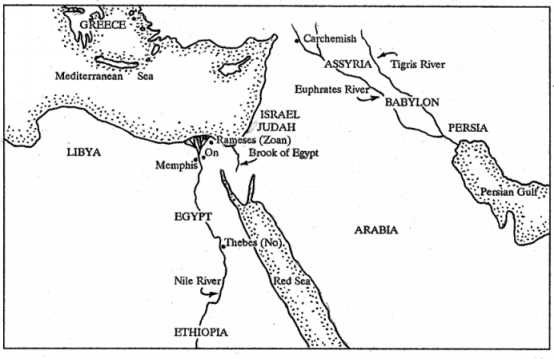
Less than one twentieth of ancient Egypt was usable land, and almost the whole of Egypt’s population lived in that area. Most of the remaining land was desert. Rain fell only rarely, and the country was dependent almost entirely on the Nile River for its water supply.
Egypt was divided into two main parts, Upper and Lower. Upper Egypt, to the south, was desert except for the Nile Valley, where soil left behind after the annual flooding of the Nile made the land usable for a few kilometres either side of the river. Lower Egypt, to the north, consisted mainly of the flat and often swampy Delta that stretched from Cairo (Memphis) to the Mediterranean Sea, 180 kilometres away (see NILE).
A stream called the Brook (or River) of Egypt, which formed part of the south-western boundary of the land promised to Israel, was not the Nile River but the Wadi El-Arish. It flowed out of the Sinai Peninsular into the Mediterranean Sea. This was a very practical boundary from Israel’s point of view. It excluded the useless desert land of the Wilderness of Shur to the west, but included the usable farming and grazing land to the east (Num 34:1-5; Jos 15:4; Jos 15:47; 1Ki 8:65; Isa 27:12).
The people of Egypt appear to have been a mixture of Hamites and Semites. The descendants of Ham developed their own culture throughout lands of northern Africa, and were called Mizraim by the Hebrews (Gen 10:6; Psa 78:51; Psa 105:23; Psa 105:27). From very early times, other peoples mingled with the Hamites, among them the Semites (descendants of Shem). The Semitic influence was the chief cause of the advanced civilization that was already established in Egypt at the time Israel became prominent in the Bible story.
For most of this period the capital of Egypt was Memphis, on virtually the same site as present-day Cairo (Jer 44:1; Hos 9:6; see MEMPHIS). Nearby was the city of sun worship, which the Egyptians called On and the Greeks called Heliopolis (Gen 41:45; Jer 43:13; cf. Isa 19:18).
Pharaoh was the title given to all Egyptian kings, and was used either by itself or attached to the king’s personal name (Exo 5:1; 2Ki 23:29; see PHARAOH). The people considered the king to be a god and did not question his laws.
Egyptians worshipped many gods, most of them gods of nature and therefore concerned with the Nile, on which the life of Egypt depended (Exo 12:12). Pharaoh was considered to be a god-king who embodied one of these gods. At his death he passed from the world of the humans to the world of the gods, which explains why the Pharaohs built for themselves elaborate tombs such as the pyramids.
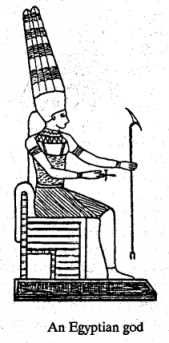
Bible history up till the exodus
After about a thousand years of development and progress under successive Egyptian dynasties, the native Egyptian rulers gradually lost their power to aggressive chiefs among recent Semitic immigrants. These foreign chiefs (in Egyptian called Hyksos) eventually took over the country (about 1720 BC).
The Hyksos continued the traditional Egyptian style of government, with the leader becoming the Pharaoh. Egyptian officials handled the day-to-day administration as previously. However, during the century and a half of the Hyksos dynasties, a number of Semites (such as Joseph) were appointed to high positions in the Egyptian government. At the same time official procedures and traditions remained thoroughly Egyptian (Gen 41:14; Gen 41:40-45; Gen 43:32; Gen 46:34; Gen 47:22; Gen 47:26; Gen 50:2-3; Gen 50:26).
Egyptian princes overthrew the Hyksos and established a new dynasty about 1570 BC. This was a turning point in Egyptian history, and the next five hundred years was the period of Egypt’s greatest power and magnificence. For most of this time the capital was at Thebes in Upper Egypt. This was a magnificent city, a fact reflected in the Hebrew word no, by which the Israelites called the city (Jer 46:25; Eze 30:16; Nah 3:8; see THEBES).
Meanwhile the descendants of Jacob, who had migrated to Egypt during the time of the Hyksos, had multiplied greatly. The Egyptian rulers, fearing and despising these Semite migrants, introduced laws against them and eventually made them slaves. This provided the Pharaohs with a cheap work force for their extensive building programs. One of the cities that the Hebrew slaves built was Rameses (or Ra’amses) in the Nile Delta. (It was probably the former Hyksos capital, Avaris, rebuilt.) The building program included a palace, storehouses and defence installations (Exo 1:8-11; see RAMESES).
The Pharaohs lived in luxury and their large harems usually included many foreign women. It was therefore not unusual for non-Egyptian children to grow up in the palace (Exo 2:10). Pharaoh also had magicians and wise men, who were among his chief advisers (Exo 7:11; Exo 8:19). (For Moses’ conflict with Pharaoh see PHARAOH; PLAGUE.)
Bible history during the Israelite monarchy
Apart from the events that led up to and included the exodus (1280 BC), Egypt had little to do with Israel during the five hundred years of Egypt’s greatest power. This time of Egyptian greatness came to an end about 1085 BC, and the story of the nation from then on is one of decline. The capital from 1085 to 660 BC was Rameses, renamed Zoan (Isa 19:11; Isa 19:13; Isa 30:4).
About 970 BC Solomon, king of Israel, married the daughter of the Pharaoh of Egypt as part of a treaty designed to strengthen the security and commercial life of both kingdoms (1Ki 3:1; 1Ki 4:21; 1Ki 10:28-29). But when that Pharaoh died, the new Pharaoh, fearful of Israel’s increasing power, encouraged rebellions within Israel. He also supported guerilla attacks around its borders, and on one occasion he himself attacked and plundered Jerusalem (1Ki 11:14-22; 1Ki 11:40; 1Ki 14:25-27).
During the time of Israel’s divided kingdom, both sections were at times tempted to rely on Egypt for help against Assyria. They were always disappointed (2Ki 17:4-6; 2Ki 18:21; 2Ki 18:24; Isa 30:1-3; Isa 31:1). Also during this time Assyria destroyed the former Egyptian capital, Thebes (Nah 3:8-10).
When Babylon conquered the Assyrian capital Nineveh in 612 BC, Pharaoh Necho of Egypt went to help what was left of Assyria to withstand Babylon. Josiah, king of Judah, opposed Necho, fearing that this Egyptian-Assyrian alliance was a threat to his independence. Judah was defeated and Josiah killed. Necho now considered himself controller of Judah and placed a heavy tax on it (2Ki 23:28-35). But in 605 BC Babylon conquered Egypt in the Battle of Carchemish, and so became the new master of Judah (2Ki 24:7; Jer 46:2).
After serving Babylon for a time, the Judean king rebelled, bringing a punishing invasion from Babylon. Babylon then appointed a new Judean king, Zedekiah, but after a while he too sought Egyptian aid in rebelling against Babylon, a policy that Jeremiah and Ezekiel strongly opposed (2Ki 24:18-20; Jer 2:16-18; Jer 2:36-37; Jer 21:1-10; Jer 37:6-10; Eze 17:12-16; Eze 29:6-9). This brought a further attack by Babylon, resulting in the destruction of Jerusalem in 587 BC and the deportation of most of the Judeans to Babylon (2Ki 25:1-21).
Gedaliah, a Judean official, was appointed by the Babylonians as governor of those who remained in Judah. He encouraged the people to submit to Babylon and not to look for support against Babylon from Egypt. But the pro-Egyptian group murdered Gedaliah. The remaining Judeans, fearing a revenge attack by Babylon, fled for their lives to Egypt (2Ki 25:22-26; Jer 40:13-16; Jeremiah 41; Jeremiah 42; Jer 43:1-7).
Summary of later history
In another battle, in 568 BC, Babylon defeated Egypt again, this time not on foreign soil but in Egypt itself (Jer 46:13-24; Eze 29:17-20; Eze 30:20-26). Babylon then forced Egypt to join it in resisting the rising power of Persia, but the attempt was unsuccessful. Persia conquered Babylon in 539 BC, and conquered Egypt in 525 BC. Egypt rebelled against Persia whenever the opportunity arose, till in 341 BC the last native ruler of Egypt was removed (cf. Eze 32:1-16).
With Alexander the Great’s conquest in 332 BC, Egypt came under the rule of the Greeks. In New Testament times it was ruled by the Romans (Act 21:38). In the third century AD it became a nominally Christian country, but in 641 AD it was conquered by the Moslems and has remained under Moslem control ever since.