
Though the history of this highly favoured servant of the Lord would afford much improvement to enlarge upon, according to the Scripture testimony concerning him, yet it would swell this work to a size much beyond the limits intended, for the writer to indulge himself in it. I have therefore noticed this prophet, only with a view to remark the greatness of his name. Elijah is a compound word, including two of the names of JEHOVAH. Eli, my God; and Jah, the Lord. It would be thought presumptuous to call our children in thepresent hour by such names, in the plain English of the words, but with the Hebrews it was done in honour of the Lord God of their fathers. And so particular do the pious fathers of the Old Testament seem to have been, in naming their children, that they studied to give them such as might have some allusion to the Lord, or to retain one of the letters of JEHOVAH in them. If I venture to add another observation concerning this great man, it would be but just to remark, that in that memorable prophecy of Malachi, concerningthe coming of Elijah before the day of Christ, (chap 4: 5.) though our Lord explained this to his disciples, in making reference to the spirit of Elias in the person of John the baptist, Matt. 17. 11, 12.) yet our Lord did not limit the coming of Elijah to that season only. The Evangelists, in describing the transfiguration of the Lord Jesus, relate that Elijah and Moses were present at the solemn scene. (Matt. 17. 3, 4, ) And there doth not seem an objection, wherefore Elijah may not again appear before the LordJesus comes in glory, as is supposed, he will in his reign upon earth. The expression of Malachi seems to warrant this conclusion, for it is said, that this mission of Elijah will be "before the great and dreadful day of the Lord." The first coming of Christ, was indeed a great and glorious, but not a dreadful day. Whereas, the second coming is uniformly spoken of as the terrible day of the Lord. For while it will be to be glorified in his saints, and to be admired in all them that believe, " it is no less said to be in flaming fire, taking vengeance on them that know not God, and that obey not the gospel of the Lord Jesus Christ." (2 Thess. i 8. 10.)
Elijah or Elias, a prophet, was a native of Tishbe beyond Jordan in Gilead. Some think that he was a priest descended from Aaron, and say that one Sabaca was his father; but this has no authority. He was raised up by God, to be set like a wall of brass, in opposition to idolatry, and particularly to the worship of Baal, which Jezebel and Ahab supported in Israel. The Scripture introduces Elijah saying to Ahab, 1Ki 17:1-2, A.M. 3092, “As the Lord God of Israel liveth, before whom I stand, there shall not be dew nor rain these years, but according to my word.” It is remarkable, that the number of years is not here specified; but in the New Testament we are informed that it was three years and six months. By the prohibition of dew as well as ruin, the whole vegetable kingdom was deprived of that moisture, without which neither the more hardy, nor more delicate kinds of plants could shoot into herbage, or bring that herbage to maturity. The Lord commanded Elijah to conceal himself beyond Jordan, near the brook Cherith. He obeyed, and God sent ravens to him morning and evening, which brought him flesh and bread. Scheutzer observes, that he cannot think that the orebim of the Hebrew, rendered “ravens,” means, as some have thought, the inhabitants of a town called Oreb, nor a troop of Arabs called orbhim; and contends that the bird called the raven, or one of the same genus, is intended. Suppose that Elijah was concealed from Ahab in some rocky or mountainous spot, where travellers never came; and that here a number of voracious birds had built their nests upon the trees which grew around it, or upon a projecting rock, &c. These flying every day to procure food for their young, the prophet availed himself of a part of what they brought; and while they, obeying the dictates of nature, designed only to provide for their offspring, Divine providence directed them to provide at the same time for the wants of Elijah. What, therefore, he collected, whether from their nests, from what they dropped, or under a supernatural influence, brought to him, or occasionally from all these means, was enough for his daily support. “And the orebim furnished him bread or flesh in the morning, and bread or flesh in the evening.” But as there were probably several of them, some might furnish bread and others flesh, as it happened; so that a little from each formed his solitary but satisfactory meal. To such straits was the exiled prophet driven! Perhaps these orebim were not strictly ravens, but rooks. The word rendered raven, includes the whole genus, among which are some less impure than the raven, as the rook. Rooks living in numerous societies, are supposed by some to be the kind of birds employed on this occasion, rather than ravens, which fly only in pairs. But upon all these explanations we may observe, that when an event is evidently miraculous, it is quite superfluous, and often absurd, to invent hypotheses to make it appear mere easy. After a time the brook dried up, and God sent Elijah to Zarephath, a city of the Sidonians. At the city gate he met with a widow woman gathering sticks, from whom he desired a little water, adding, “Bring me, I pray thee, also a morsel of bread.” She answered, “As the Lord liveth, I have no bread, but only a handful of meal, and a little oil in a cruse; and I am gathering some sticks, that I may dress it for me and my son, that we may eat it, and die.” Elijah said, “Make first a little cake, and bring it me, and afterward make for thee and thy son: for thus saith the Lord, the barrel of meal shall not waste, neither shall the cruse of oil fail, until the day the Lord sendeth rain upon the earth.” His prediction was fully accomplished, and he dwelt at the house of this widow. Some time after, the son of this woman fell sick, and died. The mother, overwhelmed with grief, intreated the assistance and interposition of Elijah, who taking the child in his arms, laid him on his own bed, and cried to the Lord for the restoration of the child’s life. The Lord heard the prophet’s petition, and restored the child.
2. After three years of drought, the Lord commanded Elijah to show himself to Ahab. The famine being great in Samaria, Ahab sent the people throughout the country, to inquire after places where they might find forage for the cattle. Obadiah, an officer of the king’s household, being thus employed, Elijah presented himself, and directed him to tell Ahab, “Behold, Elijah is here!” Ahab came to meet the prophet, and reproached him as the cause of the famine. Elijah retorted the charge upon the king, and his iniquities, and challenged Ahab to gather the people together, and the prophets of Baal, that it might be determined by a sign from heaven, the falling of fire upon the sacrifice, who was the true God. In this the prophet obeyed the impulse of the Spirit of God; and Ahab, either under an influence of which he was not conscious, or blindly confident in the cause of idolatry, followed Elijah’s direction, and convened the people of Israel, and four hundred prophets of Baal. The prophets of Baal prepared their altar, sacrificed their bullock, placed it on the altar, and called upon their gods. They leaped upon the altar, and cut themselves after their manner, crying with all their might. Elijah ridiculed them, and said, “Cry aloud, for he is god; either he is talking, or he is pursuing, or he is on a journey, or peradventure he sleepeth, and must be awaked.” When midday was past, Elijah repaired the altar of the Lord; and with twelve stones, in allusion to the twelve tribes of Israel, he built a new altar. He then laid his bullock upon the wood, poured a great quantity of water three times upon the sacrifice and the wood, so that the water filled the trench which was dug round the altar. After this he prayed, and, in answer to his prayer, the Lord sent fire from heaven, and consumed the wood, the burnt sacrifice, the stones, and dust of the place, and even dried up the water in the trench. Upon this, all the people fell on their faces, and exclaimed, “The Lord, he is the God.” Elijah then, having excited the people to slay the false prophets of Baal, said to Ahab, “Go home, eat and drink, for I hear the sound of abundance of rain;” which long-expected blessing descended from heaven according to his prediction, and gave additional proof to the truth of his mission from the only living and true God.
3. Jezebel, the wife of Ahab, threatened Elijah for having slain her prophets. He therefore fled to Beersheba, in the south of Judah, and thence into Arabia Petrea. In the evening, being exhausted with fatigue, he laid himself down under a juniper tree, and prayed God to take him out of the world. An angel touched him, and he arose, and saw a cake baked on the coals, and a cruse of water; and he ate and drank, and slept again. The angel again awakened him, and said, “Rise and eat, for the journey is too great for thee;” and he ate and drank, and went in the strength of that meat forty days and forty nights, unto Horeb, the mount of God. Here he had visions of the glory and majesty of God, and conversed with him; and was commanded to return to the wilderness of Damascus, to anoint Hazael king over Syria, and Jehu king over Israel, and to appoint Elisha his successor in the prophetic office. Some years after, Ahab having seized Naboth’s vineyard, the Lord commanded Elijah to reprove Ahab for the crime he had committed. Elijah met him going to Naboth’s vineyard to take possession of it, and said, “In the place where dogs licked the blood of Naboth, shall they lick thy blood, even thine. And the dogs shall eat Jezebel by the wall of Jezreel.” Both of which predictions were fulfilled in the presence of the people. Ahaziah, king of Israel, being hurt by a fall from the platform of his house, sent to consult Baalzebub, the god of Ekron, whether he should recover. Elijah met the messengers, and said to them, “Is it because there is no God in Israel, that ye go to inquire of Baalzebub, the god of Ekron? Now, therefore, saith the Lord, Thou shalt surely die.” The messengers of Ahaziah returned, and informed the king, that a stranger had told them he should certainly die; and Ahaziah knew that this was the Prophet Elijah.
The king, therefore, sent a captain with his company of fifty men, to apprehend him; and when the officer was come to Elijah, who was sitting upon a hill, he said, “Thou man of God, the king commands thee to come down.” Elijah answered, “If I be a man of God, let fire come down from heaven, and consume thee and thy fifty.” The prophet’s words were followed with the effect predicted. The king sent another captain, who was also consumed; but a third captain going to Elijah, intreated him to save him and his people’s lives, and Elijah accompanied him to the king. By these fearful miracles he was accredited to this successor of Ahab as a prophet of the true God, and the destruction of these companies of armed men, was a demonstration of God’s anger against the people at large.
Elijah could not in this case act from any other impulse than that of the Spirit of God.
4. Elijah, understanding by revelation that God would soon translate him out of this world, was desirous of concealing this fact from Elisha, his inseparable companion. He therefore said to Elisha, “Tarry thou here, for the Lord hath sent me to Bethel.” But Elisha answered, “I will not leave thee.” At Bethel, Elijah said, “Tarry thou here, the Lord hath sent me to Jericho;” but Elisha replied, he would not forsake him. At Jericho Elijah desired him to stay; but Elisha would not leave him. They went therefore together to Jordan, and fifty of the sons of the prophets followed them at a distance. When they were come to the Jordan, Elijah took his mantle, and with it struck the waters, which divided, and they went over on dry ground. Elijah then said to Elisha, “Ask what I shall do for thee before I be taken away from thee.” “I pray thee,” said Elisha, “let a double portion of thy spirit be upon me;” that is, obtain the gift of prophecy from God for me, in the same measure that thou possessest it. Double may signify like; or the gift of prophecy, and of miracles, in a degree double to what thou dost possess, or to what I now possess. Elijah answered, “Thou hast asked me a very hard thing; yet, if thou see me when I am taken from thee, it shall be so unto thee; but if not, it shall not be so.” As they journeyed, a fiery chariot, with horses of fire, suddenly separated them, and Elijah was carried in a whirlwind to heaven; while Elisha exclaimed, “My father, my father, the chariots of Israel and the horsemen thereof!”
5. Elijah was one of the most eminent of that illustrious and singular race of men, the Jewish prophets. Every part of his character is marked by a moral grandeur, which is heightened by the obscurity thrown around his connections, and his private history. He often wears the air of a supernatural messenger suddenly issuing from another world, to declare the commands of heaven, and to awe the proudest mortals by the menace of fearful judgments. His boldness in reproof; his lofty zeal for the honour of God; his superiority to softness, ease, and suffering, are the characters of a man filled with the Holy Spirit; and he was admitted to great intimacy with God, and enabled to work miracles of a very extraordinary and unequivocal character. These were called for by the stupid idolatry of the age, and were in some instances equally calculated to demonstrate the being and power of Jehovah, and to punish those who had forsaken him for idols. The author of Ecclesiasticus has an encomium to his memory, and justly describes him as a prophet “who stood up as fire, and whose word burned as a lamp.” In the sternness and power of his reproofs, he was a striking type of John the Baptist, and the latter is therefore prophesied of, under his name. Mal 4:5-6, has this passage: “Behold, I will send you Elijah the prophet, before the coming of the great and dreadful day of the Lord.” Our Saviour also declares that Elijah had already come in spirit, in the person of John the Baptist. At the transfiguration of our Saviour, Elijah and Moses both appeared and conversed with him respecting his future passion, Mat 17:3-4; Mar 9:4; Luk 9:30. Many of the Jews in our Lord’s time believed him to be Elijah, or that the soul of Elijah had passed into his body, Mat 16:14; Mar 6:15; Luk 9:8. In conclusion, we may observe, that to assure the world of the future existence of good men in a state of glory and felicity, and that in bodies changed from mortality to immortality, each of the three grand dispensations of religion had its instance of translation into heaven; the patriarchal in the person of ENOCH, the Jewish in the person of ELIJAH, and the Christian in the person of CHRIST.
Eli´jah (Jehovah is God). This wonderworking prophet is introduced to our notice like another Melchizedek (Gen 14:18; Heb 7:3), without any mention of his father or mother, or of the beginning of his days. From this silence of Scripture as to his parentage and birth, much vain speculation has arisen. Some suppose that Elijah is called a Tishbite from Tishbeh, a city beyond the Jordan. The very first sentence that the prophet utters is a direful denunciation against Ahab; and this he supports by a solemn oath: ’As the Lord God of Israel liveth, before whom I stand, there shall not be dew or rain these years (i.e. three and a half years, Luk 4:25; Jas 5:17), but according to my word’ (1Ki 17:1). Before, however, he spoke thus, it would seem that he had been warning this most wicked king as to the fatal consequences which must result both to himself and his people, from the iniquitous course he was then pursuing: and this may account for the apparent abruptness with which he opens his commission.
We can imagine Ahab and Jezebel being greatly incensed against Elijah for having foretold and prayed that such calamities might befall them. For some time they might attribute the drought under which the nation suffered to natural causes, and not to the interposition of the prophet. When, however, they saw the denunciation of Elijah taking effect far more extensively than had been anticipated, they would naturally seek to wreak their vengeance upon him as the cause of their sufferings. But we do not find him taking one step for his own preservation, till the God whom he served said, ’Get thee hence, and turn thee eastward, and hide thyself by the brook Cherith, that is before Jordan: and it shall be that thou shalt drink of the brook; and I have commanded the ravens to feed thee there’ (1Ki 17:3-4). Other and better means of protection from the impending danger might seem open to him; but, regardless of these, he hastened to obey the divine mandate, and ’went and dwelt by the brook Cherith that is before Jordan’ (1Ki 17:5).
A fresh trial now awaits this servant of God (B.C. 909), and in the manner in which he bears it, we see the strength of his faith. For one year, as some suppose, God had miraculously provided for his bodily wants at Cherith; but the brook which, heretofore, had afforded him the needful refreshment there, became dried up. Encouraged by past experience of his heavenly Father’s care of him, the prophet still waited patiently till He said, ’Arise (1Ki 17:9), get thee to Zarephath, which belongeth to Zidon, and dwell there: behold, I have commanded a widow woman there to sustain thee.’ He then, at once, set out on the journey, and now arrived at Zarephath, he, in the arrangement of God’s providence, met, as he entered its gate, the very woman who was deputed to give him immediate support. But his faith is again put to a sore test, for he found her engaged in a way which was well calculated to discourage all his hopes; she was gathering sticks for the purpose, as she assured him, of cooking her last meal, and now that the famine prevailed there, as it did in Israel, she saw nothing before her and her only son but starvation and death. How then could the prophet ask for, and how could she think of giving, a part of her last morsel? The same Divine Spirit inspired him to assure her that she and her child should be even miraculously provided for during the continuance of the famine: and also influenced her heart to receive, without doubting, the assurance! The kindness of this widow in baking the first cake for Elijah was well requited with a prophet’s reward (Mat 10:41-42); she afforded one meal to him, and God afforded many to her (see 1Ki 17:16). While residing here God accordingly saw fit to visit the family with a temporary calamity. ’And it came to pass that the son of the woman, the mistress of the house, fell sick: and his sickness was so sore that there was no life left in him’ (1Ki 17:17). 1Ki 17:18 contains the expostulation with the prophet of this bereaved widow; she rashly imputes the death to his presence. Elijah retaliates not, but calmly takes the dead child out of the mother’s bosom, and lays it on his own bed (1Ki 17:19), that there he may, in private, pray the more fervently for its restoration. His prayer was heard, and answered by the restoration of life to the child, and of gladness to the widow’s heart.
Since now, however, the long-protracted famine, with all its attendant horrors, failed to detach Ahab and his guilty people from their abominable idolatries, God mercifully gave them another opportunity of repenting and turning to Himself. For three years and six months (Jas 5:17) the destructive famine had spread its deadly influence over the whole nation of Israel. The prophet was then called by the word of the Lord to return to Israel. Wishing not to tempt God by going unnecessarily into danger, he first presented himself to good Obadiah (1Ki 18:7). This principal servant of Ahab was also a true servant of God; and on recognizing the prophet he treated him with honor and respect. Elijah requested him to announce to Ahab that he had returned. Obadiah, apparently stung by the unkindness of this request, replied, ’What have I sinned, that thou shouldest thus expose me to Ahab’s rage, who will certainly slay me for not apprehending thee, for whom he has so long and so anxiously sought in all lands and in confederate countries, that they should not harbor a traitor whom he looks upon as the author of the famine,’ etc. Moreover, he would delicately intimate to Elijah how he had actually jeoparded his own life in securing that of one hundred of the Lord’s prophets, and whom he had fed at his own expense. Satisfied with Elijah’s reply to this touching appeal, wherein he removed all his fears about the Spirit’s carrying himself away (as 2Ki 2:11-16; Eze 8:3; Act 8:39), he resolves to be the prophet’s messenger to Ahab. Intending to be revenged on him, or to inquire when rain might be expected, Ahab now came forth to meet Elijah. He at once charged him with being the main cause of all the calamities which he and the nation had suffered. But Elijah flung back the charge upon himself, assigning the real cause to be his own sin of idolatry. Regarding, however, his magisterial position, while he reproved his sin, he requests him to exercise his authority in summoning an assembly to Mount Carmel, that the controversy between them might be decided, whether the king or the prophet was the troubler of Israel. Whatever were the secret motives which induced Ahab to comply with this proposal, God directed the result. Elijah offered to decide this controversy between God and Baal by a miracle from Heaven. As fire was the element over which Baal was supposed to preside, the prophet proposes (wishing to give them every advantage) that, two bullocks being slain, and laid each upon a distinct altar, the one for Baal, the other for Jehovah, whichever should be consumed by fire must proclaim whose the people of Israel were, and whom it was their duty to serve. The people consent to this proposal. Elijah will have summoned not only all the elders of Israel, but also the four hundred priests of Baal belonging to Jezebel’s court, and the four hundred and fifty who were dispersed over the kingdom. Confident of success, because doubtless God had revealed the whole matter to him, he enters the lists of contest with the four hundred and fifty priests of Baal. Having reconstructed an altar which had once belonged to God, with twelve stones—as if to declare that the twelve tribes of Israel should again be united in the service of Jehovah—and having laid thereon his bullock, and filled the trench by which it was surrounded with large quantities of water, lest any suspicion of deceit might occur to any mind I the prophet gives place to the Baalites—allows them to make trial first. In vain did these deceived and deceiving men call, from morning till evening, upon Baal—in vain did they now mingle their own blood with that of the sacrifice: no answer was given—no fire descended.
Elijah having rebuked their folly and wickedness with the sharpest irony, and it being at last evident to all that their efforts to obtain the wished-for fire were vain, now, at the time of the evening sacrifice, offered up his prayer. The prayer of the Baalites was long, that of the prophet was short—charging God with the care of His covenant, of His truth, and of His glory—when, behold, ’the fire came down, licked up the water, and consumed not only the bullock, but the very stones of the altar also.’ The effect of this on the mind of the people was what the prophet desired: acknowledging the awful presence of the Godhead, they exclaim, as with one voice, ’Jehovah He is the God! Jehovah He is the God!’ Seizing the opportunity while the people’s hearts were warm with the fresh conviction of this miracle, he bade them take those juggling priests and destroy them; and this he might lawfully do at God’s direction, and under the sanction of His law (Deu 13:5; Deu 18:20). Ahab having now publicly vindicated God’s violated law by giving his royal sanction to the execution of Baal’s priests. Elijah informed him that he may go up to his tent on Carmel to take refreshment, for God will send the desired rain. In the meantime he prayed earnestly (Jas 5:17-18) for this blessing: God heard and answered: a little cloud arose out of the Mediterranean sea, in sight of which the prophet now was, diffused itself gradually over the entire face of the heavens, and then emptied its refreshing waters upon the whole land of Israel. Here was another proof of the Divine mission of the prophet, from which, we should imagine, the whole nation must have profited; but subsequent events would seem to prove that the impression produced by these dealings of God was of a very partial and temporary character. Impressed with the hope that the report of God’s miraculous action at Carmel might not only reach the ear, but also penetrate and soften the hard heart of Jezebel; and anxious that the reformation of his country should spread in and about Jezreel also, Elijah, strengthened, as we are told, from on high, now accompanies Ahab thither on foot. How ill-founded the prophet’s expectation was, subsequent events too painfully proved. Jezebel, instead of receiving Elijah obviously as the messenger of God for good to her nation, now secretly conceived and openly declared her fixed purpose to put him to death. Dreading the vile woman’s design, and probably thinking that there was no hope of producing any reformation among the people, he fled into the wilderness, and there longed for death. But God is still gracious to him, and at once touches his heart and corrects his petulancy by the ministration of His angel, and by an awful exhibition of His Divine power. And having done this, revealing Himself in the gentle accents of a still voice, He announces to him thathe must go and anoint Hazael king over Syria, Jehu king over Israel, and Elisha prophet in his own place, ere death can put a period to his labors. When God had comforted His prophet by telling him of these three instruments he had in store to vindicate his own insulted honor, then he convinced him of his mistake in saying ’I only am left alone,’ etc. by the assurance that there were seven thousand in Israel who had not bowed the knee to Baal.
Leaving the cave of Horeb (B.C. 906), Elijah now proceeded to the field where he found Elisha in the act of plowing, and he cast his prophet’s mantle over him, as a symbol of his being clothed with God’s spirit. The Divine impression produced upon the mind of Elisha by this act of Elijah made him willing to leave all things and follow him.
For about six years from this calling of Elisha we find no notice in the sacred history of Elijah, till God sent him once again to pronounce sore judgments upon Ahab and Jezebel for the murder of unoffending Naboth (1Ki 21:17, etc.). How he and his associate in the prophetic office employed themselves during this time we are no told. We need not dwell upon the complicated character of Ahab’s wickedness (1 Kings 21), in winking at the murderous means whereby Jezebel procured for him the inalienable property of Naboth [AHAB; NABOTH]. When he seemed to be triumphing in the possession of his ill-obtained gain, Elijah stood before him, and threatened him, in the name of the Lord (2Ki 9:21-26. inclusive), that God would retaliate blood for blood, and that not on himself only—’his seventy sons shall die, and (2Ki 10:6) Jezebel shall become meat for dogs.’ Fearing that these predictions would prove true, as those about the rain and fire had done, Ahab now assumed the manner of a penitent; and, though subsequent acts proved that his repentance was not permanent, yet God rewards his temporary abasement by a temporary arrest of judgment. We see, however, in after parts of this sacred history, how the judgments denounced against him, his abandoned consort, and children, took effect to the very letter.
Elijah again retired from the history till an act of blasphemy on the part of Ahaziah, the son and successor of Ahab, causes God to call him forth. Ahaziah met with an injury, and, fearing that it might be unto death, he, as if to prove himself worthy of being the son of idolatrous Ahab and Jezebel, sent to consult Baalzebub, the idol-god of Ekron; but the angel of the Lord told Elijah to go forth and meet the messengers of the king (2Ki 1:3-4), and assure them that he should not recover. Suddenly reappearing before their master, he said unto them, ’Why are ye now turned back?’ when they answered, ’There came a man up to meet us, and said unto us, Go, turn again unto the king that sent you, and say unto him, Thus saith the Lord: Is it not because there is no God in Israel that thou sendest to inquire of Baalzebub, the god of Ekron? Wherefore thou shalt not come down from that bed on which thou art gone up, but shalt surely die.’ Conscience seems to have at once whispered to him that the man who dared to arrest his messengers with such a communication must be Elijah, the bold but unsuccessful reprover of his parents. Determined to chastise him for such an insult, he sent a captain and fifty armed men to bring him into his presence; but at Elijah’s word fire descended from Heaven and consumed the whole band. Attributing this destruction of his men to some natural cause, he sent forth another company, on whom though the same judgment fell, this impious king is not satisfied till another and a similar effort is made to capture the prophet. The captain of the third band implored and found mercy at the hands of the prophet, who at once descended from Carmel and accompanied him to Ahaziah. Fearless of his wrath, Elijah now repeats to the king himself what he had before said to his messengers, and agreeably thereto, the sacred narrative informs us that Ahaziah died.
The above was the last more public effort which the prophet made to reform Israel. His warfare being now accomplished on earth, God, whom he had so long and so faithfully served, will translate him in a chariot of fire to Heaven. Conscious of this, he determines to spend his last moments in imparting divine instruction to, and pronouncing his last benediction upon, the students in the colleges of Bethel and Jericho; accordingly, he made a circuit from Gilgal, near the Jordan, to Bethel, and from thence to Jericho. Wishing either to be alone at the moment of being caught up to Heaven; or, what is more probable, anxious to test the affection of Elisha (as Christ did that of Peter), he delicately intimates to him not to accompany him in this tour. But the faithful Elisha, to whom, as also to the schools of the prophets, God had revealed His purpose to remove Elijah, declares his fixed determination not to forsake his master now at the close of his earthly pilgrimage. Ere yet, however, the chariot of God descended for him, he asks what he should do for Elisha. The latter, conscious of the complicated and difficult duties which now awaited him, asks for a double portion of Elijah’s spirit. Elijah, acknowledging the magnitude of the request, yet promises to grant it on the contingency of Elisha seeing him at the moment of his rapture. Possibly this contingency was placed before him in order to make him more on the watch, that the glorious departure of Elijah should not take place without his actually seeing it. While standing on the other side of the Jordan, whose waters were miraculously parted for them to pass over on dry ground, angels descended, as in a fiery chariot, and, in the sight of fifty of the sons of the prophets and Elisha, carried Elijah into Heaven. Elisha, at this wonderful sight, cried out, like a bereaved child, ’My Father, my Father, the chariot of Israel and the horsemen thereof;’ as if he had said, Alas! the strength and savior of Israel is now departed! But it was not so; for God designed that the mantle which fell from Elijah as he ascended should now remain with Elisha as a pledge that the office and spirit of the former had now fallen upon himself.
The prophet, a native of Tishbeh in Gilead, 1Ki 17:1 . His parentage and early history are unknown. His bold faithfulness provoked the wrath of Ahab and Jezebel, especially when he threatened several years of drought and famine as a punishment for the sins of Israel, B. C. 908. By the divine direction the prophet took refuge on the bank of the brook Cherith, where he was miraculously fed by ravens. Thence he resorted to Zarephath, in Phoenicia; where one miracle provided him with sustenance and another restored to life the child of his hostess. Returning to King Ahab, he procured the great assembling at mount Carmel, where God "answered by fire," and the prophets of Baal were destroyed. Now too the long and terrible drought was broken, and a plentiful rain descended at the prophet’s prayer. Finding that not even these mighty works of God would bring the nation and its rulers to repentance, Elijah was almost in despair. He fled into the wilderness, and was brought to Horeb, the mount of God, where he was comforted by a vision of God’s power and grace. Again he is sent on a long journey to Damascus to anoint Hazael as king of Syria. Jehu also he anoints to be king of Israel, and Elisha he summons to become a prophet. Six years later he denounces Ahab and Jezebel for their crimes in the matter of Naboth; and afterwards again is seen foretelling the death of king Ahaziah, and calling fire from heaven upon two bands of guards sent to arrest him. Being now forewarned of the approach of his removal from earth, he gives his last instructions to the school of the prophets, crosses the Jordan miraculously, and is borne to heaven in a fiery chariot without tasting death, leaving his mantle and office to Elisha, 1Ki 17:1-19:21 21:29 2Ki 1:1-2:18.\par His translation occurred about B. C. 896. Previously, it is supposed, he had written the letter which, eight years afterwards, announced to king Jehoram his approaching sickness and death, 2Ch 21:12-19 .\par Elijah was one of the most eminent and honored of the Hebrew prophets. He was bold, faithful, stern, self-denying, and zealous for the honor of God. His whole character and life are marked by peculiar moral grandeur. He bursts upon our view without previous notice; he disappears by a miracle. He bears the appearance of a supernatural messenger of heaven, who has but one work to do, and whose mind is engrossed in its performance. His history is one of the most extraordinary on record, and is fraught with instruction. It was a high honor granted to Moses and Elijah, that they alone should appear on the mount of Transfiguration, many centuries after they had gone into heaven-to bear witness of its existence, and commune with the Savior concerning his death, Luk 9:28-35 .\par John the Baptist was foretold under the name of Elias, or Elijah, from his resemblance in character and life to the ancient prophet of Israel, Mal 4:5,6 Mat 17:10-13 .\par
Eli’jah. (my God is Jehovah). Elijah has been well entitled "the grandest and the most romantic character that Israel ever produced." "Elijah, the Tishbite, ... of the inhabitants of Gilead" is literally all that is given us to know of his parentage and locality. Of his appearance as he "stood before" Ahab, (B.C. 910), with the suddenness of motion, to this day, characteristic of the Bedouins, from his native hills, we can perhaps realize something from the touches, few but strong, of the narrative.
His chief characteristic was his hair, long and thick, and hanging down his back. His ordinary clothing consisted of a girdle of skin around his loins, which he tightened when about to move quickly. 1Ki 18:46. But in addition to this, he occasionally wore the "mantle," or cape of sheepskin which has supplied us with one of our most familiar figures of speech.
His introduction, in what we may call the first act of his life, is the most startling description. He suddenly appears before Ahab, prophesies a three-years drought in Israel, and proclaims the vengeance of Jehovah for the apostasy of the king. Obliged to flee from the vengeance of the king, or more probably of the queen, (compare 1Ki 19:2, he was directed to the brook, Cherith. There, in the hollow of the torrent bed, he remained, supported in the miraculous manner with which we are all familiar, till the failing of the brook obliged him to forsake it.
His next refuge was at Zarephath. Here, in the house of the widow woman, Elijah performed the miracles of prolonging the oil and the meal, and restored the son of the widow to life after his apparent death. 1 Kings 17. In this or some other retreat, an interval of more than two years must have elapsed. The drought continued, and at last, the full horrors of famine, caused by the failure of the crops, descended on Samaria.
Again Elijah suddenly appears before Ahab. There are few more sublime stories in history than the account of the succeeding events -- with the servant of Jehovah and his single attendant on the one hand, and the 850 prophets of Baal on the other; the altars, the descending fire of Jehovah consuming both sacrifice and altar; the rising storm, and the ride across the plain to Jezreel. 1 Kings 18.
Jezebel vows vengeance, and again Elijah takes refuge in flight into the wilderness, where he is again miraculously fed, and goes forward, in the strength of that food, a journey of forty days to the mount of God, even to Horeb, where he takes refuge in a cave, and witnesses a remarkable vision of Jehovah. 1Ki 19:9-18. He receives the divine communication, and sets forth in search of Elisha, whom he finds ploughing in the field, and anoints him prophet in his place. 1 Kings 19.
For a time, little is heard of Elijah, and Ahab and Jezebel probably believed they had seen the last of him. But after the murder of Naboth, Elijah, who had received an intimation from Jehovah of what was taking place, again suddenly appears before the king, and then follow Elijah’s fearful denunciation of Ahab and Jezebel, which may possibly be recovered by putting together the words recalled by Jehu, 2Ki 9:26; 2Ki 9:36-37, and those given in 1Ki 21:19-25.
A space of three or four years now elapses, (compare 1Ki 22:1; 1Ki 22:51; 2Ki 1:17, before we again catch a glimpse of Elijah. Ahaziah is on his death-bed, 1Ki 22:51; 2Ki 1:1-2, and sends to an oracle or shrine of Baal to ascertain the issue of his illness; but Elijah suddenly appears on the path of the messengers, without preface or inquiry utters his message of death, and as rapidly disappears.
The wrathful king sends two bands of soldiers to seize Elijah, and they are consumed with fire; but finally the prophet goes down and delivers to Ahaziah’s face, the message of death. No long after, Elijah sent a message to Jehoram denouncing his evil doings, and predicting his death. 2Ch 21:12-15.
It was at Gilgal -- probably on the western edge of the hills of Ephraim -- that the prophet received the divine intimation that his departure was at hand. He was at the time with Elisha, who seems now to have become his constant companion, and who would not consent to leave him. "And it came to pass as they still went on and talked, that, behold, a chariot of fire and horses of fire, and parted them both asunder; and Elijah went up by a whirlwind into heaven." (B.C. 896).
Fifty men of the sons of the prophets ascended the abrupt heights behind the town, and witnessed the scene. How deep was the impression which he made on the mind of the nation may be judged of from the fixed belief which many centuries after prevailed that Elijah would again appear for the relief and restoration of his country, as Malachi prophesied. Mal 4:5. He spoke, but left no written words, save the letter to Jehoram king of Judah. 2Ch 21:12-15.
("God-Jehovah".) (1Ki 17:1, etc.). "The Tishbite, of the inhabitants of Gilead." No town of the name has been discovered; some explain it as "Converter." His name and designation mark his one grand mission, to bring his apostate people back to Jehovah as THE true God; compare 1Ki 18:39 with Mal 4:5-6. In contrast to the detailed genealogy of Samuel, Elisha, and other prophets, Elijah abruptly appears, like Melchizedek in the patriarchal dispensation, without father or mother named, his exact locality unknown; in order that attention should be wholly fixed on his errand from heaven to overthrow Baal and Asherah (the licentious Venus) worship in Israel. This idolatry had been introduced by Ahab and his idolatrous wife, Ethbaal’s daughter Jezebel (in violation of the first, commandment), as if the past sin of Israel were not enough, and as if it were "a light thing to walk in the sins of Jeroboam," namely, the worship of Jehovah under the symbol of a calf, in violation of the second commandment.
Ahab and his party represented Baal and Jehovah as essentially the same God, in order to reconcile the people to this further and extreme step in idolatry; compare 1Ki 18:21; Hos 2:16. Elijah’s work was to confound these sophisms and vindicate Jehovah’s claim to be God ALONE, to the exclusion of all idols. Therefore, he suddenly comes forth before Ahab, the apostate king, announcing in Jehovah’s name "As the Lord God of Israel liveth (as contrasted with the dead idols which Israel worshipped) before whom I stand, there shall not be dew nor rain these years, but according to my word." The shutting up of heaven at the prophet’s word was, Jehovah’s vindication of His sole Godhead; for Baal (though professedly the god of the sky)and his prophets could not open heaven and give showers (Jer 14:22). The socalled god of nature shall be shown to have no power over nature: Jehovah is its SOLE Lord.
Elijah’s "effectual" prayer, not recorded in 1 Kings but in Jas 5:17, was what moved God to withhold rain for three years and a half; doubtless, Elijah’s reason for the prayer was jealousy for the Lord God (1Ki 19:10; 1Ki 19:14), in order that Jehovah’s chastening might lead the people to repentance. In "standing before the Lord" he assumed the position of a Levitical priest (Deu 10:8), for in Israel the Levitical priesthood retained in Judah had been set aside, and the prophets were raised up to minister in their stead, and witness by word and deed before Jehovah against the prevailing apostasy. His departure was as sudden as his appearance. Partaking of the ruggedness of his half civilized native Gilead bordering on the desert, and in uncouth rough attire, "hairy (2Ki 1:8, Hebrew: "lord of hair") and with a girdle of leather about his loins," he comes and goes with the suddenness of the modern Bedouin of the same region.
His "mantle,"
Carnivorous birds themselves, they lose their ravenous nature to minister to God’s servant, for God can make the most unlikely instruments minister to His saints. It was probably at this time that Jezebel, foiled in her deadly purpose against Elijah, "cut off Jehovah’s prophets" (1Ki 18:4; 1Ki 19:2). The brook having dried up after a year’s stay he retreated next to Zarephath or Sarepta, between Tyre and Sidon, where least of all, in Jezebel’s native region, his enemies would have suspected him to lie hid. But apostates, as Israel, are more bigoted than original idolaters as the Phoenicians. From Jos 19:28 we learn Zarephath belonged to Asher; and in Deu 33:24 Moses saith, "let Asher dip his foot in oil." At the end of a three and a half years of famine, if oil was to be found anywhere, it would be here, an undesigned coincidence and mark of genuineness.
At God’s command, in the confidence of faith, he moves for relief to this unpromising quarter. Here he was the first "apostle" to the Gentiles (Luk 4:26); a poor widow, the most unlikely to give relief, at his bidding making a cake for him with her last handful of meal and a little oil, her all, and a few gathered sticks for fuel; like the widow in the New Testament giving her two mites, not reserving even one,: nor thinking, what shall I have for my next meal? (Luk 21:2.) So making God’s will her first concern, her own necessary food was "added" to her (Mat 6:33; Isa 33:16; Psa 37:19; Jer 37:21); "the barrel of meal wasted not, neither did the oil fail until the day that the Lord sent rain upon the earth." Blessed in that she believed, she by her example strengthened Elijah’s faith in God as able to fulfill His word, where all seemed hopeless to man’s eye.
Her strong faith, as is God’s way; He further tried more severely. Her son fell sick, and "his sickness was so sore that no breath was left in him." Her trial brought her sins up before her, and she regarded herself punished as unworthy of so holy a man’s presence with her. But he restored her son by stretching himself upon the child thrice (as though his body were the medium for God’s power to enter the dead child), and crying to the Lord; hereby new spiritual life also was imparted to herself, as she said, "by this I know that thou art a man of God, and that the word of the Lord in thy mouth is truth." Toward the close of the three and a half years of famine, when it attacked Samaria the capital, Ahab directed his governor of the palace, the Godfearing Obadiah who had saved and fed a hundred prophets in a cave, to go in one direction and seek some grass to save if possible the horses and mules, while he himself went in the opposite direction for the same purpose.
Matters must have come to a crisis, when the king set out in person on such an errand. It was at this juncture, after upward of two years’ sojourn at Zarephath, Elijah by God’s command goes to show himself to Ahab. Overcoming the awestruck Obadiah’s fear, lest, when he should tell the king, Behold Elijah is here, meanwhile the Spirit should carry him away, Elijah, whom Ahab’s servants had been seeking everywhere in vain for three years, now suddenly stands before Ahab with stern dignity. He hurls back on the king himself the charge of being, like another Achan, the troubler of Israel; "I have not, troubled Israel, but thou and thy father’s house, in that ye have spoken the commandments of Jehovah, and thou hast followed Baalim." On Carmel the issue was tried between Jehovah and Baal, there being on one side Baal’s 450 prophets with the 400 of Asherah, "the groves"), who ate at Jezebel’s table under the queen’s special patronage; on the other side Jehovah’s sole representative, in his startling costume, but with dignified mien.
Amidst Elijah’s ironical jeers they cried, and gashed themselves, in vain repetitions praying from morning until noon for fire from their god Baal, the sun god and god of fire (!), and leaped upon (or up and down at) the altar. Repairing Jehovah’s ruined altar (the former sanctity of which was seemingly the reason for his choice of Carmel) with 12 stones to represent the tribes of all Israel, and calling upon the God of Abraham, Isaac, and Jacob, to let it be known that He is the Lord God, he brought down by prayer fire from heaven consuming the sacrifice, wood, stones, and dust, and licking up the water in the trench. The idolatrous prophets were slain at the Brook Kishon, idolatry being visited according to the law with the penalty of high treason against God the king of the national theocracy (Deu 13:9-11; Deu 13:15; Deu 18:20). Then upon the nation’s penitent confession of God follows God’s removal of the national judgment.
The rain, beginning with the small hand-like cloud, and increasing until the whole sky became black (Luk 12:54; Luk 13:19), returned as it had gone, in answer to Elijah’s effectual prayer, which teaches us to not only pray but also wait (Jas 5:17-18; 1Ki 18:41-45). Ahab rides in his chariot across the plain 16 miles to Jezreel, in haste lest the rainflood of the Kishon should make the Esdraelon or Jezreel plain impassable with mud; Elijah, with Spirit-imparted strength from "the hand of the Lord upon" him, running before, but no further than the entrance of the city, for he shrank from the contamination of the court and its luxuries. Jezebel’s fury upon hearing of the slaughter of her favorite prophets knew no bounds: "so let the gods do to me and more also, if I make not. thy life as the life of one of them by tomorrow" (1Ki 19:2). Elijah fled for his life to Beersheba of Judah, with one attendant, and leaving him there went a day’s journey into the wilderness.
His not having heretofore moved to the neighboring land of godly Jehoshaphat, and his now fleeing to its most southerly town, farthest from Ahab’s dominion, and thence into the desert, at first sight seems strange. But upon closer search into Scripture it is an undesigned propriety that he avoids the land of the king whose one grand error was his marrying his son Jehoram to Athaliah, Ahab’s and Jezebel’s daughter, at least as early as the sixth or seventh year of Jehoshaphat and the tenth or eleventh of Ahab (Blunt’s Undesigned Coincidences); thereby he became so closely allied to the ungodly Ahab that at the Ramoth Gilead expedition he said to the latter, "I am as thou art, my people as thy people" (1Ki 22:4). In this flight Elijah’s spirit of faith temporarily gave way.
After the excitement of the victory over the Baal priests, and the nervous tension which under God’s mighty hand sustained him in running to Jezreel, there ensued a reaction physically and an overwhelming depression of mind; for the hope which had seemed so bright at Carmel, of a national repentance and return to God, the one ruling desire of his soul, was apparently blighted; his labors seemed lost; the throne of iniquity unshaken; and hope deferred made his heart sick. Sitting under a juniper (
By God’s command, "in the strength of that meat" (the supernatural being based on the natural groundwork) he went, Moses like, 40 days and 40 nights unto a cave at Horeb where he "lodged" for the night (Hebrew
Jehovah there said, "What doest thou here, Elijah?" thou whose name implies thy calling to witness for God Jehovah, away from the court and people whom thou wast called to reprove! Elijah pleads his "jealousy for Jehovah God of hosts," and that with all his zeal he is left. the sole worshipper of Jehovah, and that even his life they seek to take away. God directs him to "go forth and stand upon the mountain before the Lord," as Moses did when "the Lord passed by." There by the grand voice of nature, the strong wind rending the rocks, the earthquake, and the fire, (in none of which, though emanating from God, did He reveal Himself to Elijah,) and lastly by "a still small voice," God taught the impatient and desponding prophet that it is not by astounding miracles such as the fire that consumed the sacrifice, nor by the wind and earthquake wherewith God might have swept away the guilty nation, but by the still small voice of God’s Spirit in the conscience, that Jehovah savingly reveals Himself, and a revival of true religion is to be expected.
Those astounding phenomena prepared the way for this, God’s immediate revelation to the heart. Miracles sound the great bell of nature to call attention; but the Spirit is God’s voice to the soul. Sternness hardens; love alone melts. A John the Baptist, Elijah’s antitype, the last representative of the Sinaitic law, must be followed by the Messiah and His Spirit speaking in the winning tones of Mat 11:29. The still small voice constrained Elijah to wrap his face in his mantle; compare Moses, Exo 3:6; Isa 6:2. A second time to the same question he gives the same reply, but in a meeker spirit. Jehovah therefore cheers him amidst despondency, by giving him work still to do for His name, a sure token that He is pleased with his past work: "Go, return ... to the wilderness of Damascus, and anoint Hazael king over Syria, Jehu ... over Israel, and Elisha ... prophet in thy room.
Yet (adds the Lord to cure his depression by showing him his witness for God was not lost, but had strengthened in faith many a secret worshipper) I have left Me 7,000 in Israel who have not bowed unto Baal," etc. Elisha he first sought out and found in Abel Meholah in the valley of the Jordan on his way northward, for spiritual companionship was his first object of yearning. Casting his mantle on him as the sign of a call, he was followed by Elisha, who thenceforth became his minister, and who executed subsequently the former two commands.
With Jehu and Bidkar his retinue riding behind, he proceeded to take possession of the coveted vineyard on the following day (compare "yesterday,"
Three years later, part of the judgment foretold came to pass upon Ahab, whose blood, after his fall in the battle of Ramoth Gilead, the dogs licked up while his chariot was being washed in the pool of Samaria. His successor Ahaziah after a two years reign, during which Moab rebelled, fell from a lattice and lay sick. Sending to consult concerning his recovery the Philistine oracle of Baalzebub at Ekron, he learned from his messengers that a man met them saying, "Is it not because there is not a God in Israel that thou sendest to inquire of Baalzebub the god of Ekron? therefore thou shalt not come down, .... but shalt surely die" (2Ki 1:6). As usual, Elijah’s appearance was sudden and startling, and he stands forth as vindicating Jehovah’s honor’ before the elect nation. Ahaziah, with his mother’s idol-mad vindictiveness, sent a captain with fifty to arrest this "lord of hair" (Hebrew text: 2Ki 1:8) whom he at once guessed to be Elijah.
Emerging from some recess of Carmel and taking his seat on "the hill" or "mount" (Hebrew), he thence met the captain’s demand, "Man of God, the king saith, come down," with "If I be a man of God, let fire come down from heaven, and consume thee and thy fifty." So it came to pass. Again the same occurred. The third, however, escaped by begging him to hold his life precious and to spare him. Elijah went down, under God’s promised protection, and spoke the same message of death to the king in person as he had previously spoken to the king’s messenger. This was his last interview with the house of Ahab, and his last witness against Baal worship. The severity of the judgment by fire is due to the greatness of the guilt of the Israelite king and his minions who strove against God Himself in the person of His prophet, and hardened themselves in idolatry, which was high treason against God and incurred the penalty of death under the theocracy.
It is true the Lord Jesus reproved the fiery zeal of James and John, "the sons of thunder," as ignorant of the true spirit of His disciples, when they wished like Elias to call down fire to consume the Samaritans who would not receive Him. But the cases are distinct. He was not yet revealed to the half-pagan Samaritans as clearly as Jehovah had been through Elijah to Israel, the elect nation. His life was not sought by the Samaritans as Elijah’s was by Israel’s king and his minions. Moreover, the temporal penalties of the theocracy, ordained by God for the time, were in our Lord’s days giving place to the antitypes which are abiding.
Shortly afterward Elijah wrote a letter (
Already in Elijah’s lifetime Joram had begun to reign jointly with his father Jehoshaphat (2Ki 8:16; 2Ki 8:18) and had betrayed his evil spirit which was fostered by Athaliah his wife, Ahab’s daughter. Jehoshaphat in his lifetime, with worldly prudence, while giving the throne to Joram, gave Joram’s brethren "great gifts and fenced cities." But Elijah discerned in Joram the covetous and murderous spirit which would frustrate all Jehoshaphat’s forethought, the fatal result of the latter’s carnal policy in forming marriage alliance with wicked Ahab. Therefore, as Elijah had committed to Elisha the duty laid on himself by God of foretelling to Hazael his elevation to the Syrian throne (Elisha being Elijah revived in spirit), so Elijah committed to him the writing which would come after Elijah’s translation to Joram with all the solemnity of a message from Elijah in the unseen world to condemn the murder when perpetrated which Elijah foresaw he would perpetrate.
The style is peculiarly Elijah’s, and distinct from the narrative context. So Isaiah foretold concerning Cyrus’ future kingdom (Isaiah 44-45); and Ahijah concerning Josiah (1Ki 13:2). Fairbairn makes it be called "a letter from Elijah" because he was ideal head of the school of prophecy from which it emanated, and his spirit still rested upon Elisha. But the language, 2Ch 21:12, implies in some stricter sense it was Elijah’s writing delivered by Elisha, his successor, to Joram. But see Lord A. C. Hervey’s view JEHORAM. Elijah’s ministry was now drawing to its close. Symptoms appear of his work beginning to act on the nation, in the increased boldness of other prophets to the king’s face, besides Elijah himself: e.g. 1Ki 20:35-36; again, Micaiah, 1 Kings 22. Hence, we find not less than fifty called "sons of strength" at Elijah’s translation (2Ki 2:3; 2Ki 2:7); and these settled at Bethel, one of the two head quarters of idolatry.
To these sons of the prophets, as well as to Elisha, it was revealed that their master Elijah was about to be caught up front them. Elijah sought that privacy which he felt most suitable to the coming solemn scene; but Elisha would not leave him. To Gilgal (the one on the W. border of the Ephraimite hills), Bethel, and Jericho successively, by the Lord’s mission, Elijah went, giving probably parting counsels to the prophets’ schools in those places. Finally, after parting asunder the Jordan with his mantle, he gave Elisha leave to ask what he would, and having promised that he should have a double portion of Elijah’s spirit, a chariot and horses of fire parted the two, and Elijah went up by a whirlwind into heaven. The "hardness" of Elisha’s request, and its granting being dependent on his seeing Elijah ascend, imply that it is to be got from God not (Mat 19:26) man; that therefore he must look up to Him who was about to translate Elijah, not to Elijah himself.
The "double portion" is not "double" what Elijah had, for Elisha had not tidal; but, as the firstborn son and heir received two portions, and the other children but one, of the father’s goods (Deu 21:17), so Elisha, as Elijah’s adopted son, begs a preeminent portion of Elijah’s spirit, of which all the other "sons of the prophets" should have their share (Grotius); compare Deu 21:15. But the comparison in the context is not with other prophets but with Elijah. Double, literally, "a mouth of two," is probably used generally for the spirit in large or increased measure, the spirit of prophecy and of miracles. Elisha performed double as many miracles, namely, 16 as compared with Elijah’s eight; and the miracles of a like kind to Elijah’s; compare 1Ki 17:17-24 with 2Ki 4:29-37; 1Ki 17:16 with 2Ki 4:1-7. Elisha, when getting his choice, asked not for gains, honors, or pleasures, but for spiritual gifts, with a view, not to his own glory, but to the glory of God and the edification of the church.
Seeing that the national evils were so crying, he sought the only remedy, an increased measure of the Spirit, whose power had already began somewhat to improve the state of the nation. As Elijah’s ascension was the forerunner of Elisha’s possessing an influence such as Elijah had not, Elisha becoming the honored adviser of kings whereas Elijah had been their terror, Elisha on his deathbed being recognized as "the chariot of Israel and the horsemen thereof" by king Joash just as Elijah had been by Elisha, so Christ’s ascension was the means of obtaining for the church the Holy Spirit in full measure, whereby more souls were gathered in than by Jesus’ bodily presence (Joh 16:6-15; Eph 4:8-14). When the Old Testament canon was being closed, Malachi, its last prophet, threw a ray over the dark period of 400 years that intervened until the New Testament return of revelation, by announcing, "Behold I will send you Elijah the prophet before the coming of the great and dreadful day of the Lord.
And he shall turn the heart of the fathers to the children, and the heart of the children to their fathers, lest I come and smite the earth with a curse." Our Lord declares that John the Baptist was the Elias to come (Mat 11:14; Mat 17:12). This is explained in Luk 1:11; Luk 1:17, which refers to Mal 4:5-6; "he shall go before the Lord in the spirit and power of Elias, to turn the hearts of the fathers (Jacob, Levi, Moses, Elijah, Mal 1:2; Mal 2:4; Mal 2:6; Mal 3:3-4; Mal 4:4, who had been alienated as it were by their children’s apostasy) to the children (made penitent through John’s ministry), and the disobedient to the wisdom of the just." John was an Elijah, but not the Elijah, from whence to the query (Joh 1:21), "Art thou Elias?" he answered, "I am not." "Art thou that prophet?" "No."
Elijah is called by Malachi "the prophet," not the Tishbite, as he here represents the whole series of prophets culminating in the greatest, John (though he performed no miracles as Elijah). The Jews always understood a literal Elijah, and said, "Messiah must be anointed by Elijah." As there is a second consummating advent of Messiah, so also of His forerunner (possibly in person as at the transfiguration, Mat 17:3, even after which He said (Mat 17:11), "Elias shall first come and restore all things," namely, at "the times of restitution of all things"), possibly a prophet clothed with Elijah’s miraculous power of inflicting judgments, which John had not. The miracles foretold of the two witnesses (Rev 11:4-5, "fire out of their mouth," i.e. at, their word; 1Ki 17:1; 2Ki 1:10; "power to shut heaven that it rain not," Jas 5:17; Luk 4:25; and "to turn the waters to blood and smite the earth with all plagues ") are the very ones characteristic of Moses and Elijah.
The forerunning "the great and dreadful day of Jehovah" can only exhaustively refer to Messiah’s second coming, preceded by a fuller manifestation of Elijah than that of John before Messiah’s first coming. Moses and Elijah’s appearance at the transfiguration in glorified bodies is a sample of the coming transfiguration (Moses, buried by the Lord, of the sleeping saints; and Elijah, translated without death, of living saints) and of their reign with Christ over the earth in glorified bodies, as Peter, James, and John are a sample of the nations in the flesh about to be reigned over.
The subject of Moses’ and Elijah’s discourse with Jesus on the mount was His decease, for this is the grand center to which the law as represented by Moses, and the prophets represented by Elijah, converge. Elijah’s translation was God’s witness for His faithful servant to the apostate postdiluvial world, as Enoch’s to the antediluvial, against their unbelief. God’s voice, "This is My beloved Son, hear Him," attests that the servants must bow to the Son for whose coming they prepared the way (compare Rev 19:10 end). Rome’s barefooted Carmelites have many absurd traditions as to the derivation of their order from Elijah himself, and as to the "cloud out of the sea" typifying the Virgin Mary, to whom a chapel is dedicated on the imaginary site of Elijah’s seeing the cloud!
(Hebrews Eliyah’,
1. Origin. — This wonder-working prophet is introduced to our notice like another Melchizedek (Gen 10:4; Gen 10:18; Heb 7:3), without any mention of his father or mother, or of the beginning of his days — as if he had dropped out of that cloudy chariot which, after his work was done on earth, conveyed him back to heaven. "Elijah the Tishbite, of the inhabitants of Gilead," is literally all that is given us to know of his parentage and locality (1Ki 17:1). The Hebrew text is
2. Personal Appearance. — The mention of Gilead, however, is the key- note to much that is most characteristic in the story of the prophet. Gilead was the country on the further side of the Jordan — a country of chase and pasture, of tent-villages and mountain castles, inhabited by a people not settled and civilized like those who formed the communities of Ephraim and Judah, but of wandering, irregular habits, exposed to the attacks of the nomad tribes of the desert, and gradually conforming more and more to the habits of those tribes; making war with the Hagarites, and taking the countless thousands of their cattle, and then dwelling in their stead (1Ch 5:10; 1Ch 5:19-22). SEE GILEAD.
With Elijah this is seen at every turn. Of his appearance as he "stood before" Ahab — with the suddenness of motion to this day characteristic of the Bedouins from his native hills — we can perhaps realize something from the touches, few, but strong, of the narrative. Of his height little is to be inferred — that little is in favor of its being beyond the ordinary size. His chief characteristic was his hair, long and thick, and hanging down his back, and which, if not betokening the immense strength of Samson, yet accompanied powers of endurance no less remarkable. SEE HAIR. His ordinary clothing consisted of a girdle of skin round his loins, which he tightened when about to move quickly (1Ki 18:46). But in addition to this he occasionally wore the "mantle" (q.v.), or cape, of sheep-skin, which has supplied us with one of our most familiar figures of speech. In this mantle, in moments of emotion, he would hide his face (1Ki 19:13), or when excited would roll it up as into a kind of staff. On one occasion we find him bending himself down upon the ground with his face between his knees. Such, so far as the scanty notices of the record will allow us to conceive it, was the general appearance of the great prophet — an appearance which there is no reason to think was other than uncommon even at that time. The solitary life in which these external peculiarities had been assumed had also nurtured that fierceness of zeal and that directness of address which so distinguished him. It was in the wild loneliness of the hills and ravines of Gilead that the knowledge of Jehovah, the living God of Israel, had been impressed on his mind, which was to form the subject of his mission to the idolatrous court and country of Israel.
3. History. — The northern kingdom had at this time forsaken almost entirely the faith in Jehovah. The worship of the calves had been a departure from him, it was a violation of his command against material resemblances; but still it would appear that even in the presence of the calves Jehovah was acknowledged, and they were at any rate a national institution, not directly imported from the idolatries of any of the surrounding countries. SEE CALF.
They were announced by Jeroboam as the preservers of the nation during the great crisis of its existence: "Behold thy gods, O Israel, that brought thee up out of the land of Egypt" (1Ki 12:28). But the case was quite different when Ahab, not content with the calf-worship — "as if it had been a light thing to walk in the sins of Jeroboam, the son of Nebat" — married the daughter of the king of Sidon, and introduced on the most extensive scale (Josephus, Ant. 9:6, 6) the foreign religion of his wife’s family, the worship of the Phoenician Baal. What this worship consisted of we are ignorant — doubtless it was of a gay, splendid, and festal character, and therefore very opposite to the grave, severe service of the Mosaic ritual. Attached to it and to the worship of Asherah (A.V. "Ashtaroth," and "the groves") were licentious and impure sites, which in earlier times had brought the heaviest judgments on the nation (Num 15:1-41; Jdg 2:13-14; Jdg 3:7-8). But the most obnoxious and evil characteristic of the Baal religion was that it was the worship of power, of mere strength, as opposed to that of a God of righteousness and goodness — a foreign religion, imported from nations the hatred of whom was inculcated in every page of the law, as opposed to the religion of that God who had delivered the nation from the bondage of Egypt, had "driven out the heathen with his hand, and planted them in," and through whom their forefathers had "trodden down their enemies, and destroyed those that rose up against them." It is as a witness against these two evils that Elijah comes forward. (B.C. cir. 907.)
(1.) What we may call the first act in his life embraces between three and four years — three years and six months for the duration of the drought, according to the statements of the New Testament (Luk 4:25; Jas 5:17), and three or four months more for the journey to Horeb and the return to Gilead (1 Kings 17:50–19:21). His introduction is of the most startling description: he suddenly appears before Ahab, as with the unrestrained freedom of Eastern manners he would have no difficulty in doing, and proclaims the vengeance of Jehovah for the apostasy of the king. This he does in the remarkable formula evidently characteristic of himself, and adopted after his departure by his follower Elisha — a formula which includes everything at issue between himself and the king — the name of Jehovah — his being the God of Israel — the Living God — Elijah being his messenger, and then — the special lesson of the event — that the god of power and of nature should be beaten at his own weapons. "As Jehovah, God of Israel, liveth, before whom I stand," whose constant servant I am, "there shall not be dew nor rain these years, but according to my word." Before, however, he spoke thus, it would seem that he had been warning this most wicked king as to the fatal consequences which must result both to himself and his people from the iniquitous course he was then pursuing, and this may account for the apparent abruptness with which he opens his commission. What immediate action followed on this we are not told; but it is plain that Elijah had to fly before some threatened vengeance, either of the king, or more probably of the queen (compare 19:2). Perhaps it was at this juncture that Jezebel "cut off the prophets of Jehovah" (1Ki 18:4). We can imagine Ahab and Jezebel being greatly incensed against Elijah for having foretold and prayed that such calamities might befall them. For some time they might attribute the drought under which the nation suffered to natural causes, and not to the interposition of the prophet; and, therefore, however they might despise him as a vain enthusiast, they would not proceed immediately to punish him. When, however, they saw the denunciation of Elijah taking effect far more extensively than had been anticipated, they would naturally seek to wreak their vengeance upon him as the cause of their sufferings. But we do not find him taking one step for his own preservation till the God whom he served interposed. He was directed to the brook Cherith, either one of the torrents which cleave the high table-lands of his native hills, or on the west of Jordan, more in the neighborhood of Samaria, perhaps the present wady Kelt. SEE CHERITH. There, in the hollow of the torrent-bed, he remained, supported in the miraculous manner with which we are all familiar, till the failing of the brook obliged him to forsake it. How long he remained in the Chelith is uncertain. The Hebrew expression is simply "at the end of days;" nor does Josephus afford us any more information. A vast deal of ingenuity has been devoted to explaining away Elijah’s "ravens." The Hebrew word,
Moreover, he would delicately intimate to Elijah how he had actually jeoparded his own life in securing that of one hundred of the Lord’s prophets, and whom he had fed at his own expense. Satisfied with Elijah’s reply to this touching appeal, wherein he removed all his fears about the Spirit’s carrying him away (as 2Ki 2:11-16; Eze 3:4; Act 8:39), he resolves to be the prophet’s messenger to Ahab. Intending to’ be revenged on him, or to inquire when rain might be expected, Ahab now came forth to meet Elijah. He at once charged him with troubling Israel, i.e., with being the main cause of all the calamities which he and the nation had suffered. But Elijah flung back the charge upon himself, assigning the real cause to be his own sin of idolatry. Regarding, however, his magisterial position, while he reproved his sin, he requests him to exercise his authority in summoning an assembly to Mount Carmel, that the controversy between them might be decided by a direct miracle from heaven (compare Mat 16:1). Whatever were his secret motives, Ahab accepted this proposal. As fire was the element over which Baal was supposed to preside, the prophet proposes (wishing to give them every advantage), that, two bullocks being slain, and laid each upon a distinct altar, the one for Baal, the other for Jehovah, whichever should be consumed by fire must proclaim whose the people of Israel were, and whom it was their duty to serve. The people consent to this proposal, because, it may be, they were not altogether ignorant how God had formerly answered by fire (Gen 4:4; Lev 9:24; Jdg 6:21; Jdg 13:20; 1Ch 21:26; 2Ch 7:1).
Elijah will have summoned not only all the elders of Israel, but also the four hundred priests of Baal belonging to Jezebel’s court, and the four hundred and fifty who were dispersed over the kingdom. The former, however, did not attend, being, perhaps, glad to shelter themselves under the plea that Jezebel would not allow them to do so. Why Mount Carmel, which we do not hear of until now, was chosen in preference to the nearer Ebal or Gerizim, is not evident. Possibly Elijah thought it wise to remove the place of the meeting to a distance from Samaria. Possibly in the existence of the altar of Jehovah (18:30) — in ruins, and therefore of earlier erection — we have an indication of an ancient sanctity attaching to the spot. On the question of the particular part of the ridge of Carmel which formed the site of the meeting, there cannot be much doubt. SEE CARMEL.
There are few more sublime stories in history than this. On the one hand the solitary servant of Jehovah, accompanied by his one attendant, with his wild shaggy hair, his scanty garb, and sheepskin cloak, but with calm dignity of demeanor, and the minutest regularity of procedure; on the other hand, the prophets of Baal and Ashtaroth, doubtless in all the splendor of their vestments (2Ki 10:22), with the wild din of their "vain repetitions" and the maddened fury of their disappointed hopes, and the silent people surrounding all — these things form a picture which brightens into fresh distinctness every time we consider it. Having reconstructed an altar which had once belonged to God, with twelve stones — as if to declare that the twelve tribes of Israel should again be united in the service of Jehovah — and having laid thereon his bullock, and filled the trench by which it was surrounded with large quantities of water, lest any suspicion of deceit might occur to any mind, the prophet gives place to the Baalites- allows them to make trial first. In vain did these deceived and deceiving men call, from morning till evening, upon Baals — in vain did they now mingle their own blood with that of the sacrifice: no answer was given — no fire descended. Elijah having rebuked their folly and wickedness with the sharpest irony, and it being at last evident to all that their efforts to obtain the wished-for fire were vain, now, at the time of the evening sacrifice, offered up his prayer. The Baalites’ prayer was long, that of the prophet is short — charging God with the care of his covenant, of his truth, and of his glory — when, "behold, the fire came down, licked up the water, and consumed not only the bullock, but the very stones of the altar also." The effect of this on the mind of the people was what the prophet desired: acknowledging the awful presence of the Godhead, they exclaim, as with one voice, " The Lord, he is God; the Lord, he is God!" Seizing the opportunity while the people’s hearts were warm with the fresh conviction of this miracle, he bade them take those juggling priests and kill them at Kishon, that their blood might help to fill that river which their idolatry had provoked God to empty by drought.
All this Elijah might lawfully do at God’s direction, and under the sanction of his law (Deu 13:5; Deu 18:20). Ahab having now publicly vindicated God’s violated law by giving his royal sanction to the execution of Baal’s priests, Elijah informed him that he may go up to his tent on Carmel to take refreshment, for God will send the desired rain. In the mean time he prayed earnestly (Jas 5:17-18) for this blessing: God hears and answers: a little cloud arises out of the Mediterranean Sea, in sight of which the prophet now was, diffuses itself gradually over the entire face of the heavens, and now empties its refreshing waters upon the whole land of Israel! Here was another proof of the divine mission of the prophet, from which, we should imagine, the whole nation must have profited; but subsequent events would seem to prove that the impression produced by these dealings of God was of a very partial and temporary character. Impressed with the hope that the report of God’s miraculous actings at Carmel might not only reach the ear, but also penetrate and soften the hard heart of Jezebel, and anxious that the reformation of his country should spread in and about Jezreel also, Elijah, strengthened, as we are told, from on high, now accompanies Ahab thither on foot. The ride across the plain to Jezreel was a distance of at least 16 miles; the prophet, with true Arab endurance, running before the chariot, but also, with true Arab instinct, stopping short of the city, and going no further than the "entrance of Jezreel."
So far the triumph had been complete; but the spirit of Jezebel was not to be so easily overcome, and her first act is a vow of vengeance against the author of this destruction. "God do so to me, and more also," so ran her exclamation, "if I make not thy life as the life of one of them by tomorrow about this time." It was no duty of Elijah to expose himself to unnecessary dangers, and, as at his first introduction, so now, he takes refuge in flight. The danger was great, and the refuge must be distant. The first stage on the journey was Beersheba — "Beersheba which belongeth to Judah," says the narrative, with a touch betraying its Israelitish origin. Here, at the ancient haunt of those fathers of his nation whose memory was so dear to him, and on the very confines of cultivated country, Elijah halted. His servant — according to Jewish tradition, the boy of Zarephath — he left in the town, while he himself set out alone into the wilderness — the waste uninhabited region which surrounds the south of Palestine. The labors, anxieties, and excitement of the last few days had proved too much even for that iron frame and that stern resolution. His spirit is quite broken, and he wanders forth over the dreary sweeps of those rocky hills wishing for death — "It is enough! Lord, let me die, for I am not better than my fathers." The man whose prayer had raised the dead, had shut and opened heaven, he who had been so wonderfully preserved by God at Cherith and Zarephath, and who dared to tax Ahab to his face with being Israel’s troubler, is now terrified and disconsolate, thus affording a practical evidence of what the apostle James says of him, that he was a man of like passions with us. His now altered state of mind would seem to have arisen out of an exaggerated expectation of what God designed to effect through the miracles exhibited to, and the judgments poured upon this guilty nation. He seems to have thought that, as complete success did not crown the last great effort he had made to reform Israel, there could not be the slightest use in laboring for this end any longer. It is almost impossible not to conclude from the terms of the story that he was entirely without provisions for this or any journey. But God, who had brought his servant into this difficulty, provided him with the means of escaping from it. He now, alone in the wilderness and at Mount Horeb, will at once touch his heart and correct his petulancy by the ministration of his angel, and by a fearful exhibition of his divine power. The prophet, in a fit of despair, laid himself down beneath a lone "juniper-tree" (Hebrew
Then, as before with Moses (Exo 34:6), "the Lord passed by;" passed in all the terror of his most appalling manifestations. The fierce wind tore the solid mountains and shivered the granite cliffs of Sinai; the earthquake crash reverberated through the defiles of those naked valleys; the fire burnt in the incessant blaze of Eastern lightning. Like these, in their degree, had been Elijah’s own modes of procedure, but the conviction is now forced upon him that in none of these is Jehovah to be known. Then, penetrating the dead silence which followed these manifestations, came the fourth mysterious symbol — "the still small voice." What sound this was — whether articulate voice or not, we cannot determine; but low and still as it was, it spoke in louder accents to the wounded heart of Elijah than the roar and blaze which had preceded it. To him, no less unmistakably than to Moses centuries before, it was proclaimed that Jehovah was “merciful and gracious, long-suffering and abundant in goodness and truth." Elijah knew the call, and at once stepping forward and hiding his face in his mantle, stood waiting for the divine communication. It is in the same words as before, and so is his answer; but with what different force must the question have fallen on his ears, and the answer left his lips! "Before his entrance to the cave he was comparatively a novice; when he left it he was an initiated man. He had thought that the earthquake, the fire, the wind, must be the great witnesses of the Lord. But He was not in them; not they, but the still small voice had that awe in it which forced the prophet to cover his face with his mantle. What a conclusion of all the past history! What an interpretation of its meaning!" (Maurice, Prophets and Kings, page 136). Not in the persecutions of Ahab and Jezebel, nor in the slaughter of the prophets of Baal, but in the 7000 unknown worshippers who had not bowed the knee to Baal, was the assurance that Elijah was not alone as he had seemed to be.
Three commands were laid on him — three changes were to be made. Instead of Ben-hadad, Hazael was to be king of Syria; instead of Ahab, Jehu the son of Nimshi was to be king of Israel; and Elisha the son of Shaphat was to be his own successor. These per. sons shall revenge God’s quarrels: one shall begin, another shall prosecute, and the third shall perfect the vengeance on Israel. Of these three commands, the first two were reserved for Elisha to accomplish; the last only was executed by Elijah himself. It would’ almost seem as if his late trials had awakened in him a yearning for that affection and companionship which had hitherto been denied him. His first search was for Elisha. Apparently he soon found him; we must conclude at his native place, Abel-meholah, probably somewhere about the center of the Jordan valley. SEE ABEL-MEHOLAH.
Elisha was ploughing at the time, and Elijah "passed over to him" — possibly crossed the river — and, without uttering a sword, cast his mantle, the well-known sheepskin cloak, upon him, as if, by that familiar action (which was also a symbol of official investiture), claiming him for his son. A moment of hesitation — but the call was quickly accepted; and then commenced that long period of service and intercourse which continued till Elijah’s removal, and which after that time procured for Elisha one of his best titles to esteem and reverence — "Elisha the son of Shaphat, who poured water on the hands of Elijah." SEE ELISHA.
(2.) For about six years from this calling of Elisha we find no notice in the sacred history of Elijah, till God sent him once again to pronounce sore judgments upon Ahab and Jezebel for the murder of unoffending Naboth (1Ki 21:17, etc.). How he and his associate in the prophetic office employed themselves during this time we are not told. We may conceive, however, that they were much engaged in prayer for their country, and in imparting knowledge in the schools of the prophets, which were at Jericho and Beth-el. Ahab and Jezebel now probably believed that their threats had been effectual, and that they had seen the last of their tormentor. At any rate, this may be inferred from the events of chapter 21. SEE AHAB. Foiled in his wish to acquire the ancestral plot of ground of Naboth by the refusal of that sturdy peasant to alienate the inheritance of his fathers, Ahab and Jezebel proceed to possess themselves of it by main force, and by a degree of monstrous injustice which shows clearly enough how far the elders of Jezreel had forgotten the laws of Jehovah, how perfect was their submission to the will of their mistress. At her orders Naboth is falsely accused of blaspheming God and the king, is with his sons (2Ki 9:26; romp. Jos 7:24) stoned and killed, and his vineyard then — as having belonged to a criminal-becomes at once the property of the king. SEE NABOTH.
Ahab loses no time in entering on his new acquisition. Apparently the very next day after the execution he proceeds in his chariot to take possession of the coveted vineyard. Behind him — probably in the back part of the chariot — ride his two pages Jehu and Bidkar (2Ki 9:26). But the triumph was a short one. Elijah had received an intimation from Jehovah of what was taking place, and rapidly as the accusation and death of Naboth had been hurried over, he was there to meet his ancient enemy, and as an enemy he does meet him — as David went out to meet Goliath — on the very scene of his crime; suddenly, when least expected and least wished for, he confronts the miserable king. Then follows the curse, in terms fearful to any Oriental — peculiarly terrible to a Jew, and most of all significant to a successor of the apostate princes of the northern kingdom — "I will take away thy posterity; I will cut off from thee even thy very dogs; I will make thy house like that of Jeroboam and Baasha; thy blood shall be shed in the same spot where the blood of thy victims was shed last night; thy wife and thy children shall be torn in this very garden by the wild dogs of the city, or as common carrion devoured by the birds of the sky" — the large vultures which in Eastern climes are always wheeling aloft under the clear blue sky, and doubtless suggested the expression to the prophet. How tremendous was this Scene we may gather from the fact that after the lapse of at least twenty years Jehu was able to recall the very words of the prophet’s burden, to which he ,and his companion had listened as they stood behind their master in the chariot. The whole of Elijah’s denunciation may possibly be recovered by putting together the words recalled by Jehu, 2Ki 9:26; 2Ki 9:36; 2Ki 9:7, and those given in 1Ki 21:19-25. Fearing that these predictions would prove true, as those about the rain and fire had done, Ahab now assumed the manner of a penitent; and, though subsequent acts proved the insincerity of his repentance, yet God rewarded his temporary abasement by a temporary arrest of judgment. We see, however, in after parts of this sacred history, how the judgments denounced against him, his abandoned consort, and children took effect to the very letter. SEE JEZEBEL.
(3.) A space of three or four years now elapses (compare 1Ki 22:1; 1Ki 22:51; 2Ki 1:17) before we again catch a glimpse of Elijah. The denunciations uttered in the vineyard of Naboth have been ,partly fulfilled. Ahab is dead, and his son and successor, Ahaziah, has met with a serious accident, after a troubled reign of less than two years (2Ki 1:1-2; 1Ki 22:51). Fearing a fatal result, as if to prove himself a worthy son of an idolatrous parentage, he sends to an oracle or shrine of Baal at the Philistine town of Ekron to ascertain the issue of his illness. But the oracle is nearer at hand than the distant Ekron. An intimation is conveyed to the prophet, probably at that time inhabiting one of the recesses of Carmel, and, as on the former occasions, he suddenly appears on the path of the messengers, without preface or inquiry utters his message of death, and as rapidly disappears. The tone of his words is as national on this as on any former occasion, and, as before, they are authenticated by the name of Jehovah — "Thus saith Jehovah, Is it because there is no God in Israel that ye go to inquire of Baalzebub, god of Ekron?" The messengers returned to the king too soon to have accomplished their mission. They were possibly strangers; at any rate they were ignorant of the name of the man who had thus interrupted their journey. But his appearance had fixed itself in their minds, and their description at once told Ahaziah, who must have seen the prophet about his father’s court or have heard him described in the harem, who it was that had thus reversed the favorable oracle which he was hoping for from Ekron. The "hairy man" (
(4.) It must have been shortly after the death of Ahaziah that Elijah made a communication with the southern kingdom. It is the only one of which any record remains, and its mention is the first and last time that the name of the prophet appears in the Books of Chronicles. Mainly devoted, as these books are, to the affairs of Judah, this is not surprising. The alliance between his enemy Ahab and Jehoshaphat cannot have been unknown to the prophet, and it must have made him regard the proceedings of the kings of Judah with more than ordinary interest. When, therefore, Jehoram, the son of Jehoshaphat, who had married the daughter of Ahab, began "to walk in the ways of the kings of Israel, as did the house of Ahab, and to do that which was evil in the sight of Jehovah," Elijah sent him a letter (
4. Traditionary Views and Character. — Elijah and Moses are the only men whose history does not terminate with their departure out of this world. Elijah appeared with Moses on Mount Hermon at the time of our Lord’s transfiguration, and conversed with him respecting the great work of redemption which he was about to accomplish (Mat 17:1-3). The author of the book of Ecclesiasticus (chapter 48) justly describes him as a prophet "who stood up as a fire, and whose word burned as a lamp." But, with the exception of the eulogiums contained in that catalogue of worthies, and 1Ma 2:58, and the passing allusion in Luk 9:54, none of the later references allude to his works of destruction or of portent. They all set forth a different side of his character from that brought out in the historical narrative. They speak of his being a man of like passions with ourselves (Jas 5:17); of his kindness to the widow of Sarepta (Luk 4:25); of his "restoring all things" (Mat 17:11); “turning the hearts of the fathers to the children, and the disobedient to the wisdom of the just" (Mal 4:5-6; Luk 1:17). In the sternness and power of his reproofs, however, he was a striking type of John the Baptist, and the latter is therefore prophesied of under his name: "Behold, I will send you Elijah the prophet before the coming of the great and dreadful day of the Lord" (Mal 4:5-6). Our Savior also declares that Elijah had already come in spirit, in the person of John the Baptist. Many of the Jews in our Lord’s time believed him to be Elijah, or that the soul of Elijah had passed into his body (Luk 9:8). SEE JOHN THE BAPTIST.
How deep was the impression which he made on the mind of the nation may be judged from the fixed belief which many centuries after prevailed that Elijah would again appear for the relief and restoration of his country. The prophecy of Malachi was possibly at once a cause and an illustration of the strength of this belief. Each remarkable person, as he arrives on the scene, be his habits and characteristics what they may — the stern John, equally with his gentle Successor — is proclaimed to be Elijah (Mat 16:14; Mar 6:15; Joh 1:21). His appearance in glory on the Mount of Transfiguration does not seem to have startled the disciples. They were "sore afraid," but not apparently surprised. On the contrary, Peter immediately proposes to erect a tent for the prophet whose arrival they had so long been expecting. ’Even the cry of our Lord from the cross, containing as it did but a slight resemblance to the name of Elijah, immediately suggested him to the bystanders. "He calleth for Elijah." "Let be, let us see if Elijah will come to save him."
In the Talmud (see the passages cited by Hamburger, Real-Encykl. s.v. Eliahu) he is recorded as having often appeared to the wise and good rabbis — at prayer in the wilderness, or on their journeys — generally in the form of an Arabian merchant (Eisenmenger, 1:11; 2:402-7). At the circumcision of a child a seat was always placed for him, that, as the zealous champion and messenger of the "covenant" of circumcision (1Ki 19:14; Mal 3:1), he might watch over the due performance of the rite. During certain prayers ,the door of the house was set open that Elijah might enter and announce the Messiah (Eisenmenger, 1:685). His coming will be three days before that of the Messiah, and on each of the three he will proclaim, in a voice which shall be heard all over the earth, peace, happiness, salvation, respectively (Eisenmenger, 2:696). So firm was the conviction of his speedy arrival, that when goods were found and no owner appeared to claim them, the common saying was, "Put them by till Elijah comes" (Lightfoot, Exercit. Mat 17:10; Joh 1:21). The same customs and expressions are even still in use among the stricter Jews of this and other countries (see Revue des deux Mondes, 24:131, etc.).
Elijah has been canonized in both the Greek and Latin churches. Among the Greeks Mar Elygis is the patron of elevated spots, and many a conspicuous summit in Greece is called by his name (Clark, Peloponnessus, p. 190). The service for his day —
It is as connected with the great Order of the barefooted Carmelites that Elijah is celebrated in the Latin Church. According to the statements of the Breviary (Off. B. Marim Virginis de Monte Carmelo, Julii 16), the connection arose from the dedication to the Virgin of a chapel on the spot from which Elijah saw the cloud (an accepted type of the Virgin Mary) rise out of the sea. But other legends trace the origin of, the order to the great prophet himself, as the head of a society of anchorites inhabiting Carmel; and even as himself dedicating the chapel in which he worshipped to the Virgin! (St. John of Jerusalem, as quoted by Mislin, Lieux Saints, 2:49; and the bulls of various popes enumerated by Quaresmius, volume 2) These things are matters of controversy in the Roman Church, Baronius and others having proved that the order was founded in 1181, a date which is repudiated by the Carmelites (see extracts in Fabricius, Codex Pseudepig. page 1077).
In the Mohammedan traditions Ilyas is said to have drank of the Fountain of Life, "by virtue of which he still lives, and will live to the day of judgment." He is by some confounded with St. George, and with the mysterious el-Khidr, one of the most remarkable of the Moslem saints (see Lane’s Arabian Nights, Introd. note 2; also Selections from the Kuran; page 221, 222). The Persian Sojis are said to trace themselves back to Eli. jah (Fabricius, page 1077); and he is even held to have been the teacher of Zoroaster (D’Herbelot, Bib. Or. s.v.).
Among other traditions, it must not be omitted that the words "Eye hath not seen," etc., 1Co 2:9, which are without doubt quoted by the apostle from Isa 64:4, were, according to an ancient belief, from " the Apocalypse, or mysteries of Elijah,"
II. (Sept.
Elijah (e-lî’jah), my God is Jehovah. 1. That most renowned prophet of Israel who, with no introduction as to his birth or parentage, or even account of the divine commission given to him, bursts forth in sacred story as the stern denouncer of judgment on apostate Israel, and who, after his marvelous course of miracle and bold vindication of God’s authority, is translated without tasting death. He first appears as a messenger from God to Ahab, the wicked king of Israel, probably in the tenth year of his reign. He was sent to prophesy three years’ drought in the land of Israel. After delivering this startling and distressing prophecy, he was directed to flee to the brook Cherith, where he was miraculously fed by ravens. When the brook had dried up he was sent to a widow woman of Zarephath, and again the hand of the Lord supplied his wants and those of his friends. He raised the widow’s son to life. 1Ki 17:1-24. After the famine had lasted the predicted period, Elijah encountered Ahab, and then ensued the magnificent display of divine power and of human trust upon the ridge of Carmel. 1Ki 18:1-46. See Ahab. The reaction from such a mental strain left the prophet in a weak, nervous condition, and in a fit of despondency he fled from Jezebel into the "wilderness" and desired death. In Mount Sinai the downcast man of God was witness of Jehovah’s strength and experienced Jehovah’s tenderness in a very remarkable vision. 1Ki 19:9-18. He anointed Elisha to be prophet in his room. 1Ki 19:1-21. He then retired into privacy, but after the dastardly murder of Naboth he suddenly appeared before the guilty king and announced the judgment of Jehovah against the royal pair. 1Ki 21:1-29. Several years after occurred the prophecy of Ahaziah’s death. 2Ki 1:1-1 See Ahaziah. The slaughter by fire of the two companies of troops sent to take Elijah must have greatly increased the popular awe of the prophet. Elijah was translated to heaven in a miraculous manner. 2Ki 2:1-25. The character of Elijah made a deep impression upon the Jews. He was expected to return to earth as the forerunner of Messiah; an expectation encouraged by the remarkable prophecy, Mal 4:5-6, already referred to. The prophecy was indeed fulfilled, but not in the way they imagined. John Baptist, though not personally Elijah, Joh 1:21, was to go before the Messiah in the spirit and power of the ancient prophet, Luk 1:17; and thus our Lord himself explained the matter to his disciples. Mat 17:10-13. There was, it is true, a personal appearance of Elijah with Moses, when the two in glory stood beside the transfigured Saviour on the holy mount, and talked with him of his coming death—a proof how both the law and the prophets pointed to a Redeemer suffering ere he was triumphant. Mat 17:1-8; Mar 9:2-8; Luk 9:28-36. There are those who believe that the prediction of Elijah’s coming has not yet had its full accomplishment; and they expect, before the second appearing of the Lord, that the old stern prophet of Gilead, who never died, will tread the earth again. Such a question, however, cannot be discussed here.
[Eli’jah]
This remarkable prophet is introduced abruptly in scripture in the midst of the apostasy of the kingdom of Israel, which was brought to a head in the reign of Ahab. The object of his ministry was to recover the people to the God they had forsaken. This will explain the miraculous displays accompanying his testimony, by which the people were left without excuse. It may be noted however that the miracles had a judicial character. He shut heaven that it did not rain, and he called fire down on the captains and their fifties. They were intended to recall the people to their allegiance and responsibility to God.
He is called "Elijah the Tishbite who was of the inhabitants of Gilead" (1Ki 17:1), and with no further introduction he delivered a message to Ahab of fearful import to Israel, that there should be no rain or dew these years but according to his word. In the Epistle of James we learn that what was pronounced so boldly in public was the outcome of inward exercise and earnest prayer. He forthwith retired from the public eye, and was miraculously cared for at the brook Cherith, being fed with bread and flesh morning and evening by ravens. The brook at length becoming dry, he went to Zarephath belonging to Zidon at the commandment of the Lord, where he lodged with a poor widow, whose faith was tested at the outset by the prophet’s request that she should provide for his need first from her slender store of meal and oil, on the assurance of the Lord God of Israel that her barrel of meal and cruse of oil should not waste till He sent rain on the earth. She was further tested by the death of her son, upon which the power of God in resurrection was taught her through the instrumentality of the prophet. The soul of the child came again into him and he revived. This widow is referred to in Luke’s Gospel along with the case of Naaman the Syrian, as illustrating the abounding of the grace of God beyond the limits of Israel. 1Ki 17.
In the third year the time had at length arrived for the rights of Jehovah to be vindicated before all Israel, to the confusion of the followers of Baal. Elijah under the full direction of the Lord came forth from his mysterious retreat, and showed himself to Obadiah, the governor of Ahab’s house, who was engaged in searching the land for provender. This man, though in such apostate surroundings, was truly pious, and had befriended Jehovah’s prophets when Jezebel had sought to slay them. Assured by Elijah that he was ready to show himself to Ahab (though this latter had in vain sought him in many kingdoms to wreak vengeance on him for the prolonged drought), he reported Elijah’s appearance, and the prophet and king were soon face to face. Charged with troubling Israel, the prophet in the power of God rejoined that the guilt of this lay on Ahab and on his house, in forsaking Jehovah for Baal. He directed him to call all the prophets of Baal together to mount Carmel, and there before the assembled throng of Israel he stood alone for God. Nothing can exceed the interest of this moment when the question raised was whether Jehovah or Baal was the God. Sustained by the mighty power of Jehovah, His faithful servant directed everything. The issue is presented: the prophets of Baal offered their sacrifice, and from morning till noon in vain implored the intervention of their god. There was no voice nor any that regarded. Their failure being patent to all, Elijah then invited the people to draw near. He repaired Jehovah’s altar that was broken down, building it of twelve stones, according to the number of the tribes of Israel, he offered his sacrifice, deluged three times with water the altar, wood, and victim, till the trench around the altar was full; then offered up in the hearing of Israel an affecting prayer to the "Jehovah God of Abraham, Isaac, and of Israel," upon which the fire of the Lord fell, and all was consumed, the sacrifice, wood, stones, dust, and water. "Jehovah, He is the God" was the twice repeated cry of Israel in view of these things; and, controlled by the power of God in the prophet, they, at his bidding, seized the prophets of Baal, who were to a man slain by him. Upon this he told Ahab that there was a sound of abundance of rain, while he himself retired to the top of Carmel to note the first indications of the approaching blessing; and then, still in the power of God, he ran before Ahab’s chariot to the entrance of Jezreel. 1Ki 18.
Jezebel let him know that her vengeance was at hand; and at the threat of this terrible woman, the prophet, lately so bold, fled the country. We now see Elijah in the wilderness, a weak and timid man, weary of the conflict, occupied with himself rather than the Lord, and asking to be allowed to die. Sustained by miraculous food, he went in the strength of it for forty days and nights to Horeb, the mount of God. Here the Lord dealt most graciously with his poor and feeble servant, who is found pleading his own jealousy for God while interceding against Israel. Wind, earthquake, and fire would have well suited the prophet in his frame of mind, but the still small voice was that of the Lord, and Elijah had to learn that He had not given up His people. He had yet 7000 whose knees had not bowed to Baal. But Elijah was to anoint Hazael to be king over Syria, Jehu to be king over Israel, and Elisha to be prophet in his room. Judgement should be executed where necessary and by instruments prepared of God. Elijah thereupon departed, and finding Elisha threw upon him his mantle. 1Ki 29.
For a time Elijah was in retirement, but he again reappeared on the occasion of Naboth’s murder, and with the old energy of faith prophetically announced the doom of Ahab and Jezebel to Ahab’s face. Once more the prophet is seen, confronting Ahab’s successor and son Ahaziah, who, following closely in his parents’ steps, had sent messengers to Baalzebub the god of Ekron to inquire whether he should recover from his sickness. Two captains and their fifties, who had been sent to arrest him, were smitten with fire from heaven at Elijah’s word. Accompanying the third, who humbly begged for their lives, the prophet announced to the apostate king the judgement of the God he had despised. 1Ki 21; 2Ki 1.
We have now reached the closing scene of this truly remarkable man’s long and faithful service for Jehovah. The ordinary lot of man should not be his. Traversing in the close company of Elisha the spots which, however now perverted, told of certain great truths - Gilgal, of the necessity of the judgement of self, the place of circumcision - Bethel, of the faithfulness of God and the resources which are His for His own, the place where God had appeared to Jacob - Jericho, of the power of God as against all that of the enemy - they reached the Jordan through which they passed dry shod, the waters being separated hither and thither by Elijah smiting them with his mantle. The land of Israel is left by the well-known figure of death, "and it came to pass, that as they still went on and talked, that, behold, there appeared a chariot of fire and horses of fire, and parted them both asunder; and Elijah went up by a whirlwind into heaven." Figuratively he had passed through death, and ascended to heaven: this forms the basis of Elisha’s ministry. 2Ki 2.
In the N.T. John the Baptist was in the character of Elijah as the prophet who was to come before "the great and terrible day of the Lord," to affect the hearts of the people, if he had been received; but not being received, except by a few, John declared to the Jews that he was not Elijah. So it remains for Elijah’s ministry to be fulfilled ere Christ appears in glory. Mal 4:5-6; Mat 11:14; Luk 1:17; Joh 1:21.
Moses and Elijah were seen on the mount of transfiguration, as representatives of the law and the prophets; but theirs was then a subordinate place, for the proclamation was "This is my beloved Son; hear him." Mat 17:3; Mar 9:4; Luk 9:30. Elijah’s testimony was given in righteousness: his ministry demanded that the righteous claims of God as the Jehovah of His people should be satisfied. Elisha’s ministry differed from this, and was more of grace.
[Eli’jah]
Priest who had married a strange wife. Ezr 10:21.
ELIJAH (Authorized Version Elias) is mentioned in the Gospels on 9 occasions, reported in 15 passages (rejecting Luk 9:54). Of these passages only one, Luk 4:25 f., alludes to the story of Elijah as it is contained in the OT. Here Jesus justifies His performance of miracles in Capernaum, while refraining from working them in Nazareth, by citing the well-known story of Elijah’s going away from Israel in time of famine to relieve the distress of a Sidonian widow (1Ki 17:8-9). All the other passages refer to the present or future work of an Elijah who, according to common Jewish belief, still lived and would appear again upon earth.
The dominant note in the belief is that the prophet was to appear as the forerunner of the Messiah. This notion appears in its simplest form in the accounts of the avowal of the Messiahship of Jesus at Caesarea Philippi (Mat 16:13 ff., Mar 8:27 ff., Luk 9:18 ff.). The answers then given by the disciples to Jesus’ question as to the popular estimate of Himself were varied, and doubtless representative: He was John the Baptist, Elijah, Jeremiah, or one of the prophets (cf. Mar 6:15, Luk 9:8). Only one, Simon, saw in the work of Jesus the consummation, rather than the postponement, of their Messianic hope. The period of Elijah the forerunner is past, and the Messiah is here.
The relation between the prophet Elijah, the lawgiver Moses, and the Messiah Jesus, is dramatically presented in the narrative of the Transfiguration (Matthew 17, Mar 9:2 ff., Luk 9:28 ff.). Here, too, the logical proof is presented that Elijah has come already, and is John the Baptist. When once Jesus has been accepted as the Messiah, the work of John cannot fail to be known as the great preparatory work of Elijah. This work finds expression in St. Matthew’s report of Jesus’ characterization of John (Joh 11:14; omitted from the parallel in Lk.).
The Baptist’s denial that he was Elijah (Joh 1:21 ff.) is the natural expression of his lofty idea of the work of preparation for the Messiah contrasted with the insufficiency of the work he had actually been able to perform. The passage incidentally describes one of the functions of Elijah who was to come, viz., that he should baptize. Baptism was then one of the preliminaries of the salvation which the Messiah was to bring.
Elijah is mentioned again in connexion with the Crucifixion (Mat 27:46-49, Mar 15:34-36). The bystanders professedly misunderstood Jesus’ cry, ‘Eli, Eli,’ as a call to Elijah. They proposed to wait and see if he would come down to help Him. Bearing in mind that Elijah is the forerunner of the Messiah, their curiosity seems not simply whether Jesus would have supernatural relief, as a man might, but whether Elijah would, by coming to His aid, prove that Jesus was after all the Messiah.
There remains the striking picture of the Baptist in the character of Elijah, drawn in Luk 1:19 ff. The passage clearly assumes the developed doctrine of the Messiahship of Jesus, and the career of John the Baptist is analyzed from this point of view. The high spiritual plane of the identification is obvious. John comes in the spirit and power of the great prophet, reconciling families, reducing the disobedient to obedience, preparing Israel for the coming of the Messiah. Only on this high plane could the identification be successful. The work of the forerunner here finds fullest expression. He not simply proclaims, he prepares. This is, however, the implication of the other passages; otherwise the suggested identification of Jesus with Elijah would not have been possible, for it was the very works of Jesus that called out the suggestion. The same is true in the case of John.
The belief in the reappearance of Elijah, held by the Jews of NT times, is a later stage of the belief which is expressed in Mal 4:5 [English ]: he would come before the great day of Jehovah to reconcile the hearts of parents and children. Sir 48:10 ff. describes the same work more elaborately, and forms an early interpretation of the passage in Malachi.
The Rabbinical writings abound in expressions of the same belief, with characteristic extravagances and specifications. These Jewish traditions know Elijah as zealous in the service of God, and as a helper in distress, as well as the forerunner of the Messiah. Naturally his work is in behalf of their own people, and is performed in connexion with their own institutions.
As the Jews elaborated the earlier doctrine of the Messiah, and as in their thought He became more and more exalted in holiness and majesty, the impossibility of His appearance in the midst of all the sin and shame of Israel was increasingly felt; and the character of Elijah, the holy prophet, zealous in his earthly life for the political and religious integrity of the nation, and already enshrined in tradition as having been spared death, was a fitting one to be chosen to carry on the great work of preparing Israel for the blessings of the Messianic era. Indeed, in some passages the doctrine of Elijah has developed to such an extent as well nigh to usurp the functions of the Messiah.
Literature.—Volz, Jüdische Eschatologie, 192 and passim; Jewish Encyc. s.v.; Gfrörer, Jahrhundert des Heils, ii. 227 f.; Bacher, Agade d. Tannaiten, passim; Weber, Altsyn. pal. Theol. 337–339; Schurer, GJV [Note: JV Geschichte des Jüdischen Volkes.] 3 [Note: designates the particular edition of the work referred] ii. 524 f.
O. H. Gates.
( ).
).
By: Emil G. Hirsch, Eduard König, Solomon Schechter, Louis Ginzberg, M. Seligsohn, Kaufmann Kohler
—Biblical Data:
The name  means "Yhwh is (my) God," and is a confession that its bearer defended Yhwh against the worshipers of Baal and of other gods. It has therefore been assumed that the prophet took this name himself (Thenius, in "Kurzgefasstes Exegetisches Handbuch zu I Könige," xvii. 1). Elijah was a prophet in Israel in the first half of the ninth pre-Christian century, under King Ahab. In I Kings xvii. 1 and xxi. 17, etc., Elijah is called "the Tishbite" (
 ), probably because he came from a place (or a family) by the name of "Tishbe." A place of that name lay within the boundaries of Naphtali (comp. Tobit i. 2). But the Hebrew words
  must refer to a place in Gilead (see, however, Targum, Masoretes and David Ḳimḥi ad loc.).
Elijah, therefore, came from the land east of the Jordan, to wage war, in the name of the God of his fathers, against the worship of Baal. He was marked as an adherent of the old customs by his simple dress, consisting of a mantle of skins girt about the loins with a leather belt (II Kings i. 8). He began his activities with the announcement that the drought then afflicting the land should not cease until he gave the word (comp. Josephus, "Ant." viii. 13, § 2).
Ahab and Elijah.
This announcement, addressed to Ahab and his wife, marked the beginning of a life of wandering and privation for the prophet. He fled from hiding-place to hiding-place, the first being by the brook Cherith ( ). Since Robinson's explorations in Palestine (ii. 533 et seq.) this brook has been identified with the Wadi el-Ḳelt, which discharges into the Jordan near Jericho. But the resemblance between the two names is really less close than appears, for it must be remembered that "Ḳelt" is pronounced with the emphatic "k." Moreover, since the expressions
  and
and  refer to the land east of the Jordan, the brook Cherith must have been there, even if there is no modern river-name with which to identify it. After the brook Cherith had dried up, the prophet was forced to seek refuge beyond the boundaries of Israel, and found it in the Phenician Zarephath, about four hours' journey south of Sidon, where a widow sustained him. She was rewarded by the prophet's miraculous benefits (I Kings xvii. 9-24).
The greatest achievement of Elijah's life was his victory over the priests of Baal at Mt. Carmel. Having heard that the other prophets of Yhwh were also persecuted, he requested King Ahab to gather the people of Israel, the 450 priests of Baal, and the 400 prophets of Ashtaroth on Mt. Carmel. Then he asked Israel the famous question: "How long do ye halt on both knees?" (A. V.: "How long halt ye between two opinions?"), meaning, "How long will ye be undecided as to whether ye shall follow Yhwh or Baal?" The people remaining silent, he invited the priests of Baal to a contest, proposing that he and they should each build an altar and lay a burnt offering thereon, and that the God who should send down fire from heaven to consume the offering should be accepted as the true God. After various unsuccessful attempts to get a favorable answer had been made by the prophets of Baal, while they were ridiculed with subtle irony by Elijah, Yhwh sent fire from heaven to consume his offering. Yhwh was recognized by Israel, and the priests of Baal were slain near the brook Kishon (I Kings xviii. 40).
The Ascension of Elijah. From an illuminated ḳetubah of the early nineteenth century.(In the U. S. National Museum, Washington, D. C.)
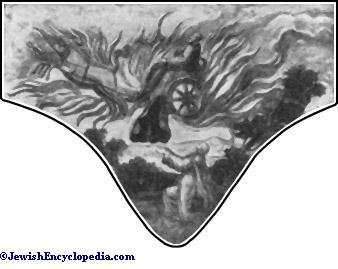
Elijah at Mount Horeb.
But this victory brought no rest to Elijah. He had to leave Israel in order to escape the vengeance of Jezebel (ib. xix. 3 et seq.), and fled to the place where Israel's Law had been promulgated by Moses. As he lay under a juniper-tree, exhausted by his journey, he was miraculously provided with food; and on reaching Horeb, the mountain of God, he heard the voice of the Lord exhorting him to patience. This is the sense of the famous passage (ib. xix. 11-13). God manifested Himself neither in the great wind that rent the mountains,nor in the earthquake, nor in the fire, but in the "still small voice." The three following measures were suggested: the appointing of a foreign enemy of Israel; the anointing of an Israelitic rival king to Ahab's dynasty; and the anointing of Elisha to continue the spiritual work of the prophet. This, the chief work of the prophet, Elijah himself carried on to the end of his life. After the election of Elisha (xix. 19-21), he prophesied both punishments and promises (xxi. 17-28; II Kings i. 3 et seq.), and left the field of his activities as suddenly as he had appeared (II Kings ii. 11).
Elijah is also mentioned in later Biblical and apocryphal passages as follows: II Chron. xxi. 12. et seq.; Mal. iii. 24; Ecclus. (Sirach) xlviii. 1; 1 Macc. ii. 58; Isaiah's Martyrdom, ii. 14 (in Kautzsch, "Die Apokryphen und Pseudepigraphen des Alten Testaments," 1898, ii. 125).
—In Rabbinical Literature:
Elijah, "let him be remembered for good," or "he who is remembered for good" (Yer. Sheb. iii., end); or, as he is commonly called among the Jews, "the prophet Elijah" (Eliyahu ha-nabi'), has been glorified in Jewish legend more than any other Biblical personage. The Haggadah which makes this prophet the hero of its description has not been content, as in the case of others, to describe merely his earthly life and to elaborate it in its own way, but has created a new history of him, which, beginning with his death or "translation," ends only with the close of the history of the human race. From the day of the prophet Malachi, who says of Elijah that God will send him before "the great and dreadful day" (Mal. iii. 23 [A. V. iv. 5]), down to the later marvelous stories of the Ḥasidic rabbis, reverence and love, expectation and hope, were always connected in the Jewish consciousness with the person of Elijah. As in the case of most figures of Jewish legend, so in the case of Elijah the Biblical account became the basis of later legend. Elijah the precursor of the Messiah, Elijah zealous in the cause of God. Elijah the helper in distress—these are the three leading notes struck by the Haggadah, endeavoring to complete the Biblical picture with the Elijah legends. Since, according to the Bible, Elijah lived a mysterious life, the Haggadah naturally did not fail to supply the Biblical gaps in its own way. In the first place, it was its aim to describe more precisely Elijah's origin, since the Biblical (I Kings xvii. 1) "Elijah, who was of the inhabitants of Gilead," was too vague.
Three different theories regarding Elijah's origin are presented in the Haggadah: (1) he belonged to the tribe of Gad (Gen. R. lxxi.); (2) he was a Benjamite from Jerusalem, identical with the Elijah mentioned in I Chron. viii. 27; (3) he was a priest. That Elijah was a priest is a statement which is made by many Church fathers also (Aphraates, "Homilies," ed. Wright, p. 314; Epiphanius, "Hæres." lv. 3, passim), and which was afterward generally accepted, the prophet being further identified with Phinehas (Pirḳe R. El. xlvii.; Targ. Yer. on Num. xxv. 12; Origen, ed. Migne, xiv. 225). Mention must also be made of a statement which, though found only in the later cabalistic literature (Yalḳuṭ Reubeni, Bereshit, 9a, ed. Amsterdam), seems nevertheless to be very old (see Epiphanius, l.c.), and according to which Elijah was an angel in human form, so that he had neither parents nor offspring. See Melchizedek.
In the Times of Ahab.
If the deeds which the Scripture records of Phinehas be disregarded, Elijah is first met with in the time of Ahab, and on the following occasion: God bade the prophet pay a visit of condolence to Hiel, who had suffered the loss of his sons because of his impiety. Elijah was unwilling to go, because profane words always angered and excited him. Only after God had promised to fulfil whatever words the prophet might utter in his righteous indignation did Elijah go to Hiel. Here the prophet met Ahab and warned him that God fulfils the maledictions of the godly, and that Hiel had been deprived of his sons because Joshua had anathematized the rebuilding of Jericho. The king derisively asked: Is Joshua greater than his teacher Moses? For Moses threatened all idolaters with hunger and distress, and yet he—Ahab-was faring very well. At this Elijah said (I Kings xvii. 1): "As the Lord God of Israel liveth," etc.; thereupon God had to fulfil His promise, and a famine came in consequence of the want of rain (Sanh. 113a; Yer. Sanh. x.). God sent ravens to supply the wants of the prophet during the famine. Some think "'ore-bim" (ravens) refers to the inhabitants of Oreb (Gen. R. xxxviii. 5; Ḥul. 5a; so also the Jewish teacher of Jerome in his commentary on Isa. xv. 7). The ravens brought meat to Elijah from the kitchen of the pious Jehoshaphat (Tan., ed. Buber, iv. 165; Aphraates, l.c. p. 314; different in Sanh. 113). God, however, who is merciful even toward the impious, sought to induce Elijah to absolve Him from His promise, so that He might send rain. He accordingly caused the brook from which the prophet drew water to dry up, but this was of no avail. God finally caused the death of the son of the widow in whose house the prophet lived, hoping thereby to overcome the latter's relentless severity. When Elijah implored God to revive the boy (compare Jonah in Rabbinical Literature), God answered that this could only be accomplished by means of "the heavenly dew," and that before He could send the dew it would be necessary for the prophet to absolve Him from His promise (Yer. Ber. iv. 9b; different in Sanh. 113a). Elijah now saw that it would be necessary to yield, and took the opportunity to prove before Ahab, by a second miracle, the almighty power of God. He arranged with the king to offer sacrifices to God and Baal at one and the same time, and to see which would turn out to be the true God.
The bulls, which were selected for sacrifice by lot, were twins which had grown up together. But while Elijah brought his bull quickly to the place of sacrifice, the 450 priests of Baal labored in vain to induce the other to move a step. The animal even began to speak, complaining that while it was his twin brother's glorious privilege to be offered upon the altar of God, he was to be offered to Baal. Only after the prophet had convinced him that his sacrifice would also be for the glorification of Godcould the priests of Baal lead him to the altar (Tan., ed. Buber, iv. 165). They then commenced to cry "Baal! Baal!" but there was no response. In order to confound them utterly, "God made the whole world keep silent as if it were void and waste"; so that the priests of Baal might not claim that the voice of Baal had been heard (Ex. R. xxix., end). These proceedings consumed much time, and Elijah found it necessary to make the sun stand still: "Under Joshua thou stoodst still for Israel's sake; do it now that God's name be glorified!" (Aggadat Bereshit, lxxvi.). Toward evening Elijah called his disciple Elisha and made him pour water over his hands. Then a miracle took place: water commenced to flow from the fingers of Elijah as from a fountain, so that the ditch around the altar became full (Tanna debe Eliyahu R. xvii.). The prophet prayed to God that He would send fire down upon the altar, and that the people might see the miracle in its proper light and not regard it as sorcery (Ber. 9b). In his prayer he spoke of his mission as the precursor of the Messiah, and petitioned God to grant his request that he might be believed in future (Midr. Shir ha-Shirim, ed. Grünhuth, 25a; Aggadat Bereshit, lxxvi.).
Elijah's Zeal for God.
In spite of Elijah's many miracles the great mass of the Jewish people remained as godless as before; they even abolished the sign of the covenant, and the prophet had to appear as Israel's accuser before God (Pirḳe R. El. xxix.). In the same cave where God once appeared to Moses and revealed Himself as gracious and merciful, Elijah was summoned to appear before God. By this summons he perceived that he should have appealed to God's mercy instead of becoming Israel's accuser. The prophet, however, remained relentless in his zeal and severity, so that God commanded him to appoint his successor (Tanna debe Eliyahu Zuṭa viii.). The vision in which God revealed Himself to Elijah gave him at the same time a picture of the destinies of man, who has to pass through "four worlds." This world was shown to the prophet in the form of the wind, since it disappears as the wind; storm ( ) is the day of death, before which man trembles (
 ); fire is the judgment in Gehenna, and the stillness is the last day (Tan., Peḳude, p. 128, Vienna ed.). Three years after this vision (Seder 'Olam R. xvii.) Elijah was "translated." Concerning the place to which Elijah was transferred, opinions differ among Jews and Christians, but the old view was that Elijah was received among the heavenly inhabitants, where he records the deeds of men (Ḳid. 70; Ber. R. xxxiv. 8), a task which according to the apocalyptic literature is entrusted to Enoch. But as early as the middle of the second century, when the notion of translation to heaven was abused by Christian theologians, the assertion was made that Elijah never entered into heaven proper (Suk. 5a; compare also Ratner on Seder 'Olam R. xvii.); in later literature paradise is generally designated as the abode of Elijah (compare Pirḳe R. El. xvi.), but since the location of paradise is itself uncertain, the last two statements may be identical.
It is one of the duties of Elijah to stand at the cross roads of paradise and to lead the pious to their proper places, to bring the souls of the impious out of hell at the beginning of the Sabbath, to lead them back again at the end of the Sabbath, and after they have suffered for their sins, to bring them to paradise forever (Pirḳe R. El. l.c.). In mystic literature Elijah is an angel, whose life on earth is conceived of as a merely apparitional one, and who is identified with Sandalfon. The cabalists speak also of the struggle between Elijah and the Angel of Death, who asserts his right to all children of men, and who endeavored to prevent, Elijah from entering heaven (Zohar Ruth, beginning, ed. Warsaw, 1885, 76a). The taking of Elijah into heaven or supramundane regions did not mean his severance from this world; on the contrary, his real activity then began. From Biblical times there is his letter to Jehoram, written seven years after his translation (Seder 'Olam R. xvii.; compare, however, Josephus, "Ant." ix. 5, § 2), and his interference in favor of the Jews after Haman had planned their extinction (see Ḥarbona; Mordecai). But it is mainly in post-Biblical times that Elijah's interest in earthly events was most frequently manifested, and to such an extent that the Haggadah calls him "the bird of heaven" (Ps. viii. 9, Hebr.), because like a bird he flies through the world and appears where a sudden divine interference is necessary (Midr. Teh. ad loc.; see also Ber. 4b; Targ. on Eccles. x. 20). His appearing among men is so frequent that even the irrational animals feel it: the joyous barking of the dogs is nothing else than an indication that Elijah is in the neighborhood (B. Ḳ. 60b). To men he appears in different forms, sometimes while they are dreaming, sometimes while they are awake, and this in such a way that the pious frequently know who is before them. Thus he once appeared to a Roman officer in a dream and admonished him not to be lavish of his inherited riches (Gen. R. lxxxiii.). Once a man came into a strange city shortly before the beginning of the Sabbath, and not knowing to whom to entrust his money (which he was not allowed to carry on the Sabbath), he went to the synagogue, where he saw some one with phylacteries on his forehead, praying. To this man he gave all that he had for keeping, but when he asked for its return at the end of the Sabbath, he found that he had to deal with a hypocrite and impostor. When the poor man fell asleep Elijah appeared to him, and showed him how to obtain his money from the wife of the swindler. When he awoke he followed the advice of Elijah, and not only received his money back, but also unmasked the hypocrite (Pesiḳ. R. xxii.; Yer. Ber. ii.).
Elijah in the Guise of an Arab.
Elijah appeared to many while they were awake, and this in various ways. He often elected to appear in the guise of an Arab ( ) or, more exactly, in that of an Arab of the desert
  (see Arabia in Rabbinical Literature). In this manner he once appeared to a poor but pious man, and asked him whether he wished to enjoy the six good years which were appointed him now, or at the end of his life. The pious man took him for a sorcerer, and made no reply. But when Elijah came the third time, the man consulted his wife as to what he should do. They concluded to tell the Arab that they wished to enjoy the good years at once; they had hardlyexpressed their wish when their children found a great treasure. The pious couple made good use of their riches, and spent much money for benevolent purposes. After six years the Arab returned and told them that the end of their prosperity had come. The woman, however, said to him: "If you can find people who will use with more conscientiousness what you give unto them, then take it from us and give it to them." God, who well knew what use this pious couple had made of their wealth, left it in their hands as long as they lived (Midr. Ruth Zuṭa, ed. Buber, near end).
To the pious, Elijah is in many cases a guardian angel, for whom no place is too remote, and who leaves nothing undone to help them in their distress or to save them from misery. Thus, Nahum of Gimzo was once sent on a political mission to Rome and given certain gifts to carry to the emperor; on the way he was robbed of these, but Elijah replaced them, and procured for Nahum riches and honor (Sanh. 109a). He saved the tanna Meïr from the persecuting bailiffs. During the religious persecutions under Hadrian he saved another tanna, Eleazar ben Prata, from the Roman government, which wished to sentence him to death, by removing those who were to testify against him and by bringing him to a place 400 miles distant ('Ab. Zarah 17b). He acted as witness for the amora Shila, when he was accused of exercising jurisdiction according to Jewish law (Ber. 58a), and appeared as comforter to Akiba when the latter was in distress (Ned. 50a). As physician he helped Simi b. Ashi (Shab. 109b), and R. Judah I., whose awful and incessant pains he stopped by laying his hand upon him. This healing had at the same time the effect of reconciling Rabbi with Ḥiyyah, for Elijah appeared to Rabbi in the form of Ḥiyyah, and caused him thereby to hold Ḥiyyah in great respect (Yer. Kil. ix. 32b). Elijah was a daily guest in the academy of Rabbi, and on one occasion he even disclosed a great celestial mystery, for which he was severely punished in heaven (B. M. 85b). Elijah, however, is not only the helper in distress and the peacemaker, but he acted also as teacher of Eleazar ben Simon, whom he taught for thirteen years (Pesiḳ., ed. Buber, x. 92b; see Akiba ben Joseph in Legend).
The following is an Elijah story which was very widely circulated, and which was even given a place in the liturgy: To a pious but very poor man Elijah once appeared and offered himself as servant. The man, at first refusing, finally took him. He did not keep him long, however, for the king needed a skilful builder for a palace which he was about to build; Elijah offered his services, and the pious man received a high price for his servant. Elijah did not disappoint his new master, but prayed to God, whereupon suddenly the palace of the king stood there in readiness. Elijah disappeared (Rabb. Nissim, "Ḥibbur Yafeh meha-Yeshu'ah," near end). This story has been beautifully worked over in the piyyuṭ. "Ish Ḥasid," which is sung, according to the German-Polish ritual, on Sabbath evening.
Elijah the Friend of the Pious.
In olden times there were a number of select ones with whom Elijah had intercourse as with his equals, they being at the time aware of his identity. In Talmudic-Midrashic literature are the following stories: Eliezer ben Hyrcanus was brought by Elijah to Jerusalem to receive instruction there from Johanan ben Zakkai (Pirḳe R. El. i.). In the great controversy between this teacher and his colleagues, Elijah communicated to Rabbi Nathan what the opinion concerning this controversy was in heaven (B. M. 59b). The same Nathan was also instructed by him with reference to the right measure in eating and drinking (Giṭ. 70a). A special pet of Elijah seems to have been Nehorai, whom he instructed with reference to Biblical passages, and explained to him also some of the phenomena of nature (Yer. Ber. ix. 13c; Ruth R. iv.). Another teacher, called "Jose" (probably not Jose b. Ḥalafta), was so familiar with Elijah that he was not afraid to declare openly that Elijah had a rough temper (Sanh. 113a). The words of Elijah to Judah, the brother of Salla the Pious, read: "Be not angry, and you will not sin; drink not, and you will not sin" (Ber. 29b). Besides this friendly advice the pious Judah received important instructions from Elijah (Yoma 19b; Sanh. 97b). Rabbah ben Shila (Ḥag. 15b), Rabbah ben Abbahu (Ḥag. 15b; B. M. 114b), Abiathar (Giṭ. 6b), Kahana (Ḳid. 41a), Bar He He (Ḥag. 9b), are also mentioned as among the pious who personally communicated with Elijah. Besides these, some others whose names are not given are mentioned as having been in friendly relations with Elijah (B. B. 7b; Yer. Ter. i. 40d; see also Ket. 61a). What kind of people Elijah selected may be seen from the following: Of two pious brothers, one allowed his servants to partake only of the first course at meals, whereas the other allowed them to partake of every course. Elijah did not visit the first, whereas he frequently visited the latter. In like manner he treated two brothers, one of whom served himself first, and then his guests, whereas the other cared for his guests first (Ket. l.c.). The demands of Elijah upon his friends were very strict, and the least mistake alienated him. One of his friends built a vestibule, whereby the poor were at a disadvantage in that their petitioning voices could be heard in the house only with great difficulty; as a result Elijah never came to him again (B. B. 7b).
Very characteristic of Elijah is his relation to the Babylonian amora Anan. A man brought Anan some small fish as a present, which he would not accept, because the man wished to submit to him a law case for decision. The petitioner, however, sooner than have the rabbi refuse his gift, decided to take his case elsewhere, and requested Anan to direct him to another rabbi; this Anan did. The rabbi before whom the case was tried showed himself very friendly toward the man because he had been recommended to him by Anan, and decided in his favor. Elijah, till then Anan's teacher and friend, deserted him from that moment, because, through his carelessness, judgment had been biased (Ket. 105b). The Midrash Tanna debe Eliyahu, in which Elijah often speaks of himself in the first person, recounting his experiences and teaching many lessons, is likewise associated with Anan, who is said to have compiled the work from Elijah's own discourses.
Joshua b. Levi and Elijah.
None of the pious could boast of such a close relation to Elijah as could Joshua b. Levi, to fulfill whose wishes Elijah was always ready, although he sometimes showed himself very severe toward him (Yer. Ter. viii. 4b; Yer. Sheb. ix. 31a; Mak. 11a). Elijah once brought about an interview between Joshua and the Messiah (Sanh. 98a), and he also showed Joshua the precious stones which, according to the words of the prophet (Isa. liv. 11, 12), shall replace the sun in giving light to Jerusalem (Pesiḳ. xviii. 136a). But more precious than these sacred revelations were the lessons which Joshua received from Elijah, especially the doctrine of the theodicy, which Elijah tried to explain to his friend by means of illustrations. Joshua once asked Elijah to take him along on his journeys through the world. To this the prophet yielded on condition that Joshua should never question him concerning the causes of his actions, strange as they might appear; should this condition be violated, the prophet would be obliged to part from him. Both set out upon their journey. The first halt was at the house of a poor man who owned only a cow, but who, with his wife, received the strangers most kindly, and entertained them to the best of his ability. Before they continued their journey next morning, the rabbi heard Elijah pray that God might destroy the poor man's cow, and before they had left the hospitable house the cow was dead. Joshua could not contain himself, but in great excitement said to Elijah: "Is this the reward which the poor man receives for his hospitality toward us?" The prophet reminded him of the condition upon which they had undertaken the journey, and silently they continued on their way. Toward evening they came to the house of a rich man who did not even look at them, so that they had to pass the night without food and drink. In the morning when they left the inhospitable house, Joshua heard Elijah pray that God would build up a wall which had fallen in one of the rich man's houses. At once the wall stood erect. This increased the agitation of the rabbi still more; but remembering the condition which had been imposed upon him, he kept silent. On the next evening they came to a synagogue adorned with silver and gold, none of whose rich members showed any concern for the poor travelers, but dismissed them with bread and water. Upon leaving the place Joshua heard Elijah pray that God would make them all leaders ("heads"). Joshua was about to break his promise, but forced himself to go on in silence again. In the next city they met very generous people who vied with one another in performing acts of kindness toward the strangers. Great, then, was the surprise of Joshua when, upon leaving the place, he heard the prophet pray that God might give them only "one head."
Elijah Explains His Actions.
Joshua could not refrain any longer, and asked, Elijah to explain to him his strange actions, although he knew that by asking he would forfeit the prophet's companionship. Elijah answered: "The poor but generous man lost his cow because of my prayer, for I knew that his wife was about to die, and I asked God to take the life of the cow instead of that of the wife. My prayer for the heartless rich man was because under the fallen wall was a great treasure which would have come into the hands of this unworthy man had he undertaken to rebuild it. It was also no blessing which I pronounced upon the unfriendly synagogue, for a 'place which has many heads will not be of long duration'; on the other hand, I wished for the others, the good people, 'one head,' that union and peace may always be among them." This is a widely circulated legend, first found in Nissim ben Jacob's "Ḥibbur Yafeh," 1886, pp. 9-12, and reprinted in Jellinek's "Bet ha-Midrash," v. 133-135 (vi. 131-133 gives another version). For Judæo-German and other renderings of this legend see Zunz, "G. V." 2d ed., p. 138. The antiquity of the legend may be seen from the fact that Mohammed mentions it in the Koran, sura xviii. 59-82; compare also "R. E. J." viii. 69-73.
Besides Joshua ben Levi, Elijah showed another rabbi, Baroka by name, that things must not be judged from outward appearances. Once they were in a lively street of a great city, when the rabbi asked Elijah whether there were any in the multitude who would have a place in the world to come. The prophet could give an affirmative answer in regard to three men only: a jailer and two jesters—the first, because he saw to it that chastity and morality prevailed among the inmates of the prison; the latter, because they tried by their jests to banish all anxious thoughts from the people (Ta'an. 22a).
The Prophet Elijah.(From a printed Passover Haggadah, Prague, 1526.)

The Tannaim and Amoraim are not the only ones who could boast of the special favor of Elijah. The mystics and cabalists of all times frequently appealed to Elijah as their patron. Among them was the gaon Joseph, of whom it was said that Elijah was a daily visitor at his academy (First Epistle of Sherira, ed. Neubauer, p. 32). The introduction of the Cabala to Provence is traced directly to Elijah, who revealed the secret doctrine to Jacob ha-Nozer. Similarly Abraham b. Isaac and Abraham ben David of Posquières are mentioned as privileged ones, to whom Elijah appeared (see Jellinek, "Auswahl Kabbalistischer Mystik," pp. 4, 5). The pseudonymous author of the "Ḳanah" asserted that he had received his teachings directly from Elijah. In the Zohar, Simon ben Yoḥai and his son Eleazar are mentioned as among those who enjoyed the special friendship of Elijah. This work, as well as the Tiḳḳun Zohar and the Zohar Ḥadash, contains muchthat is ascribed to Elijah (compare Friedmann, "Seder Eliyahu Rabba we-Seder Eliyahu Zuṭa," pp. 38-41). When, toward the middle of the fourteenth century, the Cabala received new prominence in Palestine, Elijah again took a leading part. Joseph de la Regna asks Elijah's advice in his combat with Satan. The father of the new cabalistic school, Isaac Luria, was visited by Elijah before his son was born. In like manner, the father of Israel Ba'al Shem-Ṭob received the good news from Elijah that a son would be born unto him, "who would be a light in Israel" ("Ma'asiyyot Peliot," pp. 24, 25, Cracow, 1896, which contains an interesting narrative of Elijah's meeting with the father of Ba'al Shem-Ṭob).
Elijah as the Forerunner of the Messiah.
Elijah Announcing the Coming of the Messiah.(From an illuminated Maḥzor in the town hall of Frankfort-on-the-Main.)
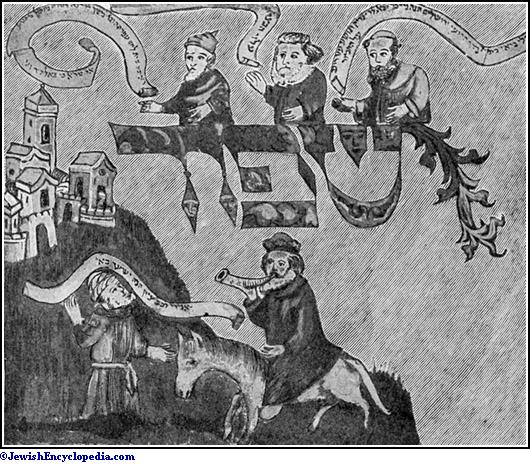
The climax of Elijah's activity is his appearance shortly before the Messianic time. "He is appointed to lead aright the coming ages, to restore the tribes of Jacob," says Ben Sira of him (Ecclus. [Sirach] xlviii. 10, 11). In the second half of the first Christian century it was expected that Elijah would appear shortly before the coming of the Messiah, to restore to families the purity which in the course of time had become doubtful ('Eduy. viii. 7; this is the opinion of Johanan b. Zakkai). A century later the notion prevailed that Elijah's office was "to bring peace and adjust all differences" (ib.). It was expected that all controversies and legal disputes which had accumulated in the course of time would be adjusted by him, and that difficult ritual questions and passages of Scripture seemingly conflicting with each other would be explained, so that no difference of opinion would exist concerning anything (Men. 45b; Ab. R. N. xxxiv.; Num. R. iii., near the end; compare also Jew. Encyc. i. 637a). The office of interpreter of the Law he will retain forever, and in the world to come his relation to Moses will be the same as Aaron's once was (Zohar, Ẓaw, iii. 27, bottom). But the notion which prevailed at the time of the origin of Christianity, that Elijah's mission as forerunner of the Messiah consisted mainly in changing the mind of the people and leading them to repentance, is not unknown to rabbinical literature (Pirḳe R. El. xliii., xlvii.). His real Messianic activity—in some passages he is even called "go'el" (="redeemer"; compare Friedmann, l.c. pp. 25, 26)—will commence three days before the coming ofthe Messiah. On the first day he will lament over the devastation of Palestine, but will close with the words: "Peace will now come over the earth"; on the second and third days he will speak words of comfort (Pesiḳ. R. xxxv. 161; Elijah as the "good messenger of salvation" is a frequent figure in the apocalyptic midrashim). When the archangel Michael blows the trumpet, Elijah will appear with the Messiah, whom he will present to the Jews ("Otot ha-Mashiaḥ," in Jellinek, "B. H." ii. 62, 125; see Eschatology). They will ask of Elijah, as an attestation of his mission, that he raise the dead before their eyes and revive such of the dead as they personally knew (Shir ha-Shirim Zuṭa, ed. Buber, 38, end; compare also Syriac Apocalypse of Baruch; Bousset, "The Antichrist Legend," p. 203).
The Seven Miracles.
But he will do more than this, in that he will perform seven miracles before the eyes of the people: (1) He will bring before them Moses and the generation of the wilderness; (2) he will cause Korah and his company to rise out of the earth; (3) he will revive the Messiah, the son of Joseph; (4) he will show them again the three mysteriously lost sacred utensils of the Temple, namely, the Ark, the vessel of manna, and the vessel of sacred oil (see Antichrist); (5) he will show the scepter which he received from God; (6) he will crush mountains like straw; (7) he will reveal the great mystery (Jellinek, l.c. iii. 72). At the bidding of the Messiah, Elijah will sound the trumpet, and at the first blast the primitive light will appear; at the second, the dead will rise; and at the third, the Divine Majesty will appear (Jellinek, l.c. v. 128). During the Messianic reign Elijah will be one of the eight princes (Micah v. 4), and even on the Last Day he will not give up his activity. He will implore God's mercy for the wicked who are in hell, while their innocent children who died in infancy on account of the sins of their fathers, are in paradise. Thus he will complete his mission, in that God, moved by his prayer, will bring the sinful fathers to their children in paradise (Eccl. R. iv. 1). He will bring to an end his glorious career by killing Samael at the behest of God, and thus destroy all evil (Yalḳuṭ Ḥadash, ed. Radawil, 58a). Compare Elijah's Chair.
Bibliography:
Bousset, The Antichrist Legend, s.v.;
Friedmann, Seder Eliyahu Rabba we-Seder Eliyahu Zuṭa, pp. 1-44, Warsaw, 1902;
S[amuel] K[ohn], Der Prophet Elia in der Legende, in Monatsschrift, xii. 241 et seq., 361 et seq.;
Ginzberg, Die Haggada bei den Kirchenvätern, i. 76-80.
S. S. L. G.—In Mohammedan Literature:
Elijah is mentioned in the Koran as a prophet together with Zechariah, John, and Jesus (sura vi. 85); while in sura xxxvii. 123-130 it is said: "Verily, Elijah [Ilyas] was of the prophets, when he said to his people, 'Will ye call upon Baal and leave the best of creators, God, your Lord?'" In verse 130 he is called "Ilyasin": "Peace upon Ilyasin, thus do we reward those who do well."
According to Baiḍawi, the people to whom Elijah was sent were the inhabitants of Baalbek in Cle-Syria. When Elijah made his appearance as a prophet the king (Ibn al-Athir says that the king's name was Ahab, but places him after Ezekiel) believed in him, though the people did not. The king made Elijah his vizier, and both worshiped God. But the king soon apostatized, and Elijah separated from him. The prophet then afflicted the country with famine, and no one save himself had bread to eat; so that if one noticed the odor of bread he said: "Elijah must have passed this way."
One day Elijah came into the house of an old woman who had a paralytic child named Elisha ibn Ukhṭub. Elijah cured the child, who remained with the prophet, and, after Elijah's translation, became his successor.
The Jewish tradition that Elijah is identical with Phinehas is current among the Moslems also. They have, moreover, another tradition borrowed from the Jews. Elijah, they say, will appear on the last day, and either he or one of his descendants will await, in the interior of a mountain, the second coming of the Messiah.
Certain Islamic authorities confound Elijah with Al-Khiḍr (= "the green" or "fresh one"), famous in Mohammedan literature on account of his having discovered the fountain of perpetual youth. Even their names have been combined in "Khiḍr-Ilyas" or "Khiḍralas." Other authorities, among them the author of the "Ta'rikh Muntaḥab," distinguish Elijah from Al-Khiḍr, whom they identify with Elisha. They believe that, while the latter is the guardian of the sea, Elijah is the guardian of the desert (the idea originating, doubtless, in the fact that Elijah hid himself in the desert; I Kings xix. 4).
Elijah's translation is thus described by the Moslems: God had told Elijah in a vision to go out of the town and to mount anything which he might see before him. He departed with his disciple Elisha, and, seeing a horse, mounted it. God covered him with feathers, enveloped him with fire, took away from him the desire of eating and drinking, and joined him to His angels. According to Ibn al-Athir, God made Elijah of a twofold nature: man and angel, earthly and heavenly.
Bibliography:
Ibn al-Athir, Al-Ta'rikh al-Kamil, i. 90, 91, Cairo, 1891-92;
Tabari, Chroniques (French transl. of Zotenberg), i. 374, 381, 409-411;
Rampoldi, Annali Musulmani, iv. 491, vi. 549, Milan, 1822-25;
E. Rödiger, in Ersch and Gruber, Encyc. section i., part 33, p. 324;
D'Herbelot, Bibliothèque Orientale, iii. 345, s.v. Ilia;
—In Medieval Folk-Lore:
Owing to his ubiquitousness and to the universal belief that he remained after his departure from the earth the ever-ready helper of the Jew, Elijah the prophet became the prototype of the Wandering Jew. Many characteristics of wandering deities and heroes like those of Buddha, of Zeus, and of Thor and Wodan who were believed to wander about the earth to test the piety and hospitality of the people, hence also those of Khiḍr, the Arabic legendary hero, were incorporated in the history of Elijah. He was accordingly expected to appear from time to time, especially on solemn occasions, as "the angel of the covenant," the genius of Jewish home sanctity who keeps a record of every mésalliance (Ḳid. 70a). He was believed to be present as the angel of the covenant at the circumcision (see Elijah's Chair), or to appear as a guest at the Seder and as protector of the Jewish household whenever the door was opened on that night. Every Saturday evening his blessedintervention was invoked for the work of the new week; hence the many mystic formulas in the cabalistic liturgy for the close of the Sabbath.
He was often identified with other heroes of Jewish legend to whom immortality was attributed, such as Melchizedek, who had no father or mother, and Enoch-Meṭaṭron, who is said to have been a shoemaker by profession (Yalḳ. Reubeni, Bereshit, 27a and 9d), and this seems to explain the original story of the Wandering Jew.
Bibliography:
A. Tendlau, Sprichwörter und Redensarten Deutsch-Jüdischer Vorzeit, pp. 14-16, Frankfort-on-the-Main, 1860;
idem, Das Buch der Sagen und Legenden Jüdischer Vorzeit, notes to Nos. 3, 28, Frankfort, 1873;
L. Geiger, Zeitschrift für die Geschichte der Juden in Deutschland, iii. 297;
Mannhardt, Germanische Mythen, pp. 118, 725, Berlin, 1858;
Nork, Etymologisches Mythologisches Wörterbuch, s.v. Elias.
Sources.
—Critical View:
The stories of Elijah are not all derived from the same author. This is evident, first, from the fact that the longer form of the name ( ) is used (about sixty times) everywhere except in II Kings i. 3-12 and (in reference to other persons of the name) in I Chron. viii. 27; Ezra x. 21, 26. Then, too, there is a significant disagreement between I Kings xix. 15 et seq., where Elijah is commissioned to anoint Kings Hazael and Jehu, and II Kings viii. 7 et seq., ix. 1 et seq., where it is said that these two kings were appointed by Elisha. Neither of these stories, however, bears marks of exilic or post-exilic origin, for the compound prepositions
  (I Kings xviii. 19) or
  (xxi. 29) are not a proof of such origin, although the latter preposition is often used by preference in the post-exilic period. It is also obvious that the mention of the sacrifice (I Kings xviii. 36) does not stamp the story as post-exilic (contrary to G. Rösch, "Der Prophet Elia," in "Theologische Studien und Kritiken," 1892, pp. 557 et seq.; comp. Ed. König, "Einleitung ins Alte Testament," p. 264).
Many scholars, nevertheless, consider the stories legendary; and, although something extraordinary must have happened at Mt. Carmel, it can not be denied that the miraculous incidents of the prophet's career may have been magnified as they passed on from generation to generation. The account of the destruction of the two captains and their soldiers may be taken as an example of this; and, indeed, the fact that the shorter form of the prophet's name is used proves the account to be undoubtedly of later origin.
Some modern scholars regard the stories as mythological—Hugo Winckler, for instance, in his "Geschichte Israels" (1900, ii. 273).
Three other persons by the name of Elijah are mentioned in the Old Testament: a Benjamite who lived before the time of Saul (I Chron. viii. 27), and two persons of the post-exilic period (Ezra x. 21, 26).
Bibliography:
The various histories of Israel, including those of Guthe (1899) and Winckler (1900);
H. Gunkel, Der Prophet Elia, in Preussische Jahrbücher, 1897, pp. 18 et seq.
ELIJAH.—1. Elijah, the weirdest figure among the prophets of Israel, steps across the threshold of history when Ahab is on the throne (c
Such was the situation, when Elijah suddenly appears before Ahab as the champion of Jehovah. The hearts of the apostate king and people are to be chastened by a drought (1Ki 17:3). It lasts three years; according to a statement of Menander quoted by Josephus (Ant. VIII. xiii. 2), in the reign of Ithobal, the Biblical Ethbaal, Phœnicia suffered from a terrible drought, which lasted one year. Providence first guides the stern prophet to the brook Cherith (Wady Kelt in the vicinity of Jericho), where the ravens supply him with food. Soon the stream becomes a bed of stones, and Elijah flees to Zarephath in the territory of Zidon. As the guest of a poor widow, he brings blessings to the household (cf. Luk 4:25, Jas 5:17). The barrel of meal did not waste, and the cruse of oil did not fail. Like the Great Prophet of the NT, he brings gladness to the heart of a bereaved mother by restoring her son to life (1Ki 17:8 ff., cf. Luk 7:11 ff.).
The heavens have been like brass for months upon months, and vegetation has disappeared. The hearts of Ahab’s subjects have been mellowed, and many are ready to return to their old allegiance. The time is ripe for action, and Elijah throws down the gauntlet to Baal and his followers. Ahab and his chief steward, Obadiah, a devoted follower of the true God, are traversing the land in different directions in search of grass for the royal stables, when the latter encounters the strange figure of Jehovah’s relentless champion. Obadiah, after considerable hesitation and reluctance, is persuaded by the prophet to announce him to the king (1Ki 18:7-15). As the two meet, we have the first skirmish of the battle. ‘Art thou he that troubleth Israel?’ is the monarch’s greeting; but the prophet’s reply puts the matter in a true light: ‘I have not troubled Israel, but thou and thy father’s house.’ At Elijah’s suggestion the prophets of Baal are summoned to Carmel to a trial by fire. The priests of the Tyrian deity, termed ‘prophets’ because they practised the mantic art, select a bullock and lay it upon an altar without kindling the wood. From morn till noon, and from noon till dewy eve, they cry to Baal for fire, but all in vain. Elijah cuts them to the quick with his biting sarcasm: ‘Cry aloud; for he is a god: either he is musing, or he is gone aside, or he is on a journey, or peradventure he sleepeth and must be awaked.’ Towards evening a dismantled altar of Jehovah is repaired, and a trench is dug round it. After the sacrificial animal has been prepared, and laid upon the wood, water is poured over it, until every thing about the altar is thoroughly soaked and the trench is full. At the prayer of Elijah, fire falls from heaven, devouring the wood, stone, and water as well as the victim. The people are convinced, and shout, ‘Jehovah, he is God; Jehovah, he is God.’ That evening, Kishon’s flood, as of old (Jdg 5:21), is red with the blood of Jehovah’s enemies. The guilt of the land has been atoned for, and the long hoped for rain arrives. Elijah, in spite of his dignified position, runs before the chariot of Ahab, indicating that he is willing to serve the king as well as lead Jehovah’s people (1Ki 18:41-46). The fanatical and implacable Jezebel now threatens the life of the prophet who has dared to put her minions to death. Jehovah’s successful champion loses heart, and flees to Beer-sheba on the extreme south of Judah. Leaving his servant, he plunges alone into the desert a day’s journey. Now comes the reaction, so natural after an achievement like that on Carmel, and Elijah prays that he may be permitted to die. Instead of granting his request, God sends an angel who ministers to the prophet’s physical needs. On the strength of that food he journeys forty days until he reaches Horeb, where he receives a new revelation of Jehovah (1Ki 19:1-8). Elijah takes refuge in a cave, perhaps the same in which Moses hid (Exo 33:22), and hears the voice of Jehovah, ‘What doest thou here, Elijah?’ The prophet replies, ‘I have been very jealous for Jehovah, God of Hosts; for the children of Israel have forsaken thy covenant thrown down thine altars, and slain thy prophets with the sword; and I, even I only, am left; and they seek my life, to take it away.’ Then Jehovah reveals His omnipotence in a great wind, earthquake, and fire; but we read that Jehovah was not in these. Then followed a still small voice (Heb. lit. ‘a sound of gentle stillness’), in which God made known His true nature and His real purpose (1Ki 19:9-14). After hearing his complaint, Jehovah gives His faithful servant a threefold commission: Hazael is to be anointed king of Syria, Jehu of Israel; and Elisha is to be his successor in the prophetic order. Elijah is further encouraged with information that there are still 7000 in Israel who have not bowed the knee to Baal (1Ki 19:15; 1Ki 19:18). As far as we know, only the last of these three commissions was executed by the prophet himself, who, after this sublime incident, made his headquarters in the wilderness of Damascus (>Ki 19:15); the other two were carried out either by Elisha or by members of the prophetic guilds (2Ki 8:7 ff; 2Ki 9:2).
Elijah is also the champion of that civic righteousness which Jehovah loved and enjoined on His people. Naboth owns a vineyard in the vicinity of Jezreel. In the spirit of the Israelitish law (Lev 25:23, Num 36:8) he refuses to sell his property to the king. But Jezehel is equal to the occasion; at her suggestion false witnesses are bribed to swear that Naboth has cursed God and the king. The citizens, thus deceived, stone their fellow-townsman to death. Abah, on his way to take possession of his ill-gotten estate, meets his old antagonist, who pronounces the judgment of God upon him: ‘In the place where dogs licked the blood of Naboth shall dogs lick thy blood, even thine,’ is the prophet’s greeting. For Ahab’s sins, every male child of his house will be swept off by an awful fate (1Ki 21:19; 1Ki 21:21; 1Ki 21:24). By the ramparts of Jezreel itself, the dogs will devour the body of Jezebel (1Ki 21:23). These predictions, although delayed for a time on account of the repentance of Ahab, were all fulfilled (1Ki 22:38, 2Ki 9:25 f., 2Ki 9:30 f., 2Ki 10:7 ff.).
Ahaziah is a true son of Ahab and Jezebel. Meeting with a serious accident, after his fall he sends a messenger to Ekron to inquire of Baal-zebub, the fly-god, concerning his recovery. Elijah intercepts the emissaries of the king, hidding them return to their master with this word from Jehovah: ‘Is it because there is no God in Israel, that ye go to inquire of Baal-zebub the god of Ekron? Thou shalt not come down from the bed whither thou art gone up, but shalt surely die.’ Ahaziah recognizes the author of this message, and sends three captains of fifties to capture the prophet, who calls down fire from heaven on the first two. The third approaches him in a humble spirit, and at God’s bidding Elijah accompanies the soldier to the palace and reiterates the message of doom (2Ki 1:1-18).
Like all the great events of his life, the death of this great man of God was dramatic. Accompanied by his faithful follower Elisha, he passes from Bethel to Jericho, and from thence they cross the Jordan, after Elijah has parted the waters by striking them with his mantle. As they go on their way, buried in conversation, there suddenly appears a chariot of fire with horses of fire, which parts them asunder; and Elijah goes up by a whirlwind to heaven (cf. Elisha).
In the history of prophecy Elijah holds a prominent position. Prophetism had two important duties to perform: (1) to extirpate the worship of heathen deities in Israel, (2) to raise the religion of Jehovah to ethical purity. To the former of these two tasks Elijah addressed himself with zeal; the latter was left to his successors in the eighth century. In his battle against Baal, he struggled for the moral rights and freedom of man, and introduced ‘the categorical imperative into prophecy.’ He started a movement which finally drove the Phœnician Baal from Israel’s confines.
Elijah figures largely in later Scriptures; he is the harbinger of the Day of the Lord (Mal 4:5); in the NT he is looked upon as a type of the herald of God, and the prediction of his coming in the Messianic Age is fulfilled in the advent of John the Baptist (Mat 11:10 ff.). On the Mount of Transfiguration he appears as the representative of OT prophecy (Mat 17:3, Mar 9:4, Luk 9:36). The prophet whose ‘word burned like a torch’ (Sir 48:1) was a favourite with the later Jews; a host of Rabbinical legends grew up around his name. According to the Rabbis, Elijah was to precede the Messiah, to restore families to purity, to settle controversies and legal disputes, and perform seven miracles (cf. JE
2. A Benjamite chief (1Ch 8:27). 3. 4. A priest and a layman who had married foreign wives (Ezr 10:21; Ezr 10:26).
James A. Kelso.
(Hebrew: Yahweh is God)
Prophet of the Old Testament. He announced to Achad, King of Israel, who under the influence of his Tyrian wife Jezabel had erected a temple to Baal, that Jehovah had determined to avenge the apostasy of Israel by bringing a long drought on the land. During the drought which lasted three years, Elias withdrew to the vicinity of the brook Carith, where he was fed by the ravens. After the brook had dried up he crossed over to Sarepta, where he was hospitably received by a poor widow, whose charity he rewarded by increasing her store of meal and oil and by raising her child to life. At length he once more confronted the king and challenged the prophets of Baal to a contest on Mount Carmel, when Elias’s oblation was consumed by fire from heaven, and the false prophets were slain by the people at his command. He was obliged to flee from the wrath of Jezabel and while on Mount Horeb was commissioned by Jehovah to anoint Hazael to be King of Syria, Jehu to be King of Israel, and Eliseus to be his own successor. Subsequently he denounced Achab for the murder of Naboth and reprimanded Ochozias and Joram, King of Juda. While conversing with Eliseus on the hills of Moab he was translated to heaven in a fiery chariot. The Carmelite Order traces its origin to him. An apocryphal Apocalypse of Elias was partly recovered by Maspero in a Coptic translation.
Elias (Heb. ’Eliahu, "Yahveh is God"; also called Elijah).The loftiest and most wonderful prophet of the Old Testament. What we know of his public life is sketched in a few popular narratives enshrined, for the most part, in the First (Third) Book of Kings. These narratives, which bear the stamp of an almost contemporary age, very likely took shape in Northern Israel, and are full of the most graphic and interesting details. Every part of the prophet’s life therein narrated bears out the description of the writer of Ecclesiasticus: He was "as a fire, and his word burnt like a torch" (xlviii, 1). The times called for such a prophet. Under the baneful influence of his Tyrian wife Jezabel, Achab, though perhaps not intending to forsake altogether Yahveh’s worship, had nevertheless erected in Samaria a temple to the Tyrian Baal (1 Kings 16:32) and introduced a multitude of foreign priests (xviii 19); doubtless he had occasionally offered sacrifices to the pagan deity, and, most of all, hallowed a bloody persecution of the prophets of Yahveh.Of Elias’s origin nothing is known, except that he was a Thesbite; whether from Thisbe of Nephtali (Tob., i, 2, Gr.) or from Thesbon of Galaad, as our texts have it, is not absolutely certain, although most scholars, on the authority of the Septuagint and of Josephus, prefer the latter opinion. Some Jewish legends, echoed in a few Christian writings, assert moreover that Elias was of priestly descent; but there is no other warrant for the statement than the fact that he offered sacrifices. His whole manner of life resembles somewhat that of the Nazarites and is a loud protest against his corrupt age. His skin garment and leather girdle (2 Kings, 1, 8), his swift foot (1 Kings 18:46), his habit of dwelling in the clefts of the torrents (xvii,3) or in the caves of the mountains (xix, 9), of sleeping under a scanty shelter (xix, 5), betray the true son of the desert. He appears abruptly on the scene of history to announce to Achab that Yahveh had determined to avenge the apostasy of Israel and her king by bringing a long drought on the land. His message delivered, the prophet vanished as suddenly as he had appeared, and, guided by the spirit of Yahveh, betook himself by the brook Carith, to the east of the Jordan, and the ravens (some critics would translate, however improbable the rendering, "Arabs" or "merchants") "brought him bread and flesh in the morning, and bread and flesh in the evening, and he drank of the torrent" (xvii, 6).After the brook had dried up, Elias, under Divine direction, crossed over to Sarepta, within the Tyrian dominion. There he was hospitably received by a poor widow whom the famine had reduced to her last meal (12); her charity he rewarded by increasing her store of meal and oil all the while the drought and famine prevailed, and later on by restoring her child to life (14-24). For three years there fell no rain or dew in Israel, and the land was utterly barren. Meanwhile Achab had made fruitless efforts and scoured the country in search of Elias. At length the latter resolved to confront the king once more, and, suddenly appearing before Abdias, bade him summon his master (xviii, 7, sq.). When they met, Achab bitterly upbraided the prophet as the cause of the misfortune of Israel. But the prophet flung back the charge: "I have not troubled Israel, but thou and thy father’s house, who have forsaken the commandments of the Lord, and have followed Baalim" (xviii, 18). Taking advantage of the discountenanced spirits of the silenced king, Elias bids him to summon the prophets of Baal to Mount Carmel, for a decisive contest between their god and Yahveh. The ordeal took place before a great concourse of people (see CARMEL, MOUNT) whom Elias, in the most forcible terms, presses to choose: "How long do you halt between two sides? If Yahveh be God, follow him; but if Baal, then follow him" (xviii, 21). He then commanded the heathen prophets to invoke their deity; he himself would "call on the name of his Lord"; and the God who would answer by fire, "let him be God" (24). An altar had been erected by the Baal-worshippers and the victim laid upon it; but their cries, their wild dances and mad self-mutilations all the day long availed nothing: "There was no voice heard, nor did any one answer, nor regard them as they prayed" (29). Elias, having repaired the ruined altar of Yahveh which stood there, prepared thereon his sacrifice; then, when it was time to offer the evening oblation, as he was praying earnestly, "the fire of the Lord fell, and consumed the holocaust, and the wood, and the stones, and the dust, and licked up the water that was in the trench" (38). The issue was fought and won. The people, maddened by the success, fell at Elias’s command on the pagan prophets and slew them at the brook Cison. That same evening the drought ceased with a heavy downpour of rain, in the midst of which the strange prophet ran before Achab to the entrance of Jezrael.Elias’s triumph was short. The anger of Jezabel, who had sworn to take his life (xix, 2), compelled him to flee without delay, and take his refuge beyond the desert of Juda, in the sanctuary of Mount Horeb. There, in the wilds of the sacred mountain, broken spirited, he poured out his complaint before the Lord, who strengthened him by a revelation and restored his faith. Three commands are laid upon him: to anoint Hazael to be King of Syria, Jehu to be King of Israel, and Eliseus to be his own successor. At once Elias sets out to accomplish this new burden. On his way to Damascus he meets Eliseus at the plough, and throwing his mantle over him, makes him his faithful disciple and inseparable companion, to whom the completion of his task will be entrusted. The treacherous murder of Naboth was the occasion for a new reappearance of Elias at Jezrael, as a champion of the people’s rights and of social order, and to announce to Achab his impending doom. Achab’s house shall fall. In the place where the dogs licked the blood of Naboth will the dogs lick the king’s blood; they shall eat Jezabel in Jezrael; their whole posterity shall perish and their bodies be given to the fowls of the air (xxi, 20-26). Conscience-stricken, Achab quailed before the man of God, and in view of his penance the threatened ruin of his house was delayed. The next time we hear of Elias, it is in connexion with Ochozias, Achab’s son and successor. Having received severe injuries in a fall, this prince sent messengers to the shrine of Beelzebub, god of Accaron, to inquire whether he should recover. They were intercepted by the prophet, who sent them back to their master with the intimation that his injuries would prove fatal. Several bands of men sent by the king to capture Elias were stricken by fire from heaven; finally the man of God appeared in person before Ochozias to confirm his threatening message. Another episode recorded by the chronicler (2 Chronicles 21:12) relates how Joram, King of Juda, who had indulged in Baal-worship, received from Elias a letter warning him that all his house would be smitten by a plague, and that he himself was doomed to an early death.According to 2 Kings 3, Elias’s career ended before the death of Josaphat. This statement is difficult -- but not impossible -- to harmonize with the preceeding narrative. However this may be, Elias vanished still more mysteriously than he had appeared. Like Enoch, he was "translated", so that he should not taste death. As he was conversing with his spiritual son Eliseus on the hills of Moab, "a fiery chariot, and fiery horses parted them both asunder, and Elias went up by a whirlwind into heaven" (2 Kings 2:11), and all the efforts to find him made by the sceptic sons of the prophets disbelieving Eliseus’s recital, availed nothing. The memory of Elias has ever remained living in the minds both of Jews and Christians. According to Malachias, God preserved the prophet alive to entrust him, at the end of time, with a glorious mission (iv, 5-6): at the New Testament period, this mission was believed to preceede immediately the Messianic Advent (Matthew 17:10, 12; Mark 9:11); according to some Christian commentators, it would consist in converting the Jews (St. Jer., in Mal., iv, 5-6); the rabbis, finally, affirm that its object will be to give the explanations and answers hitherto kept back by them. I Mach., ii, 58, extols Elias’s zeal for the Law, and Ben Sira entwines in a beautiful page the narration of his actions and the description of his future mission (Ecclus., xlviiii, 1-12). Elias is still in the N.T. the personification of the servant of God (Matthew 16:14; Luke 1:17; 9:8; John 1:21). No wonder, therefore, that with Moses he appeared at Jesus’ side on the day of the Transfiguration.Nor do we find only in the sacred literature and the commentaries thereof evidences of the conspicuous place Elias won for himself in the minds of after-ages. To this day the name of Jebel Mar Elyas, usually given by modern Arabs to Mount Carmel, perpetuates the memory of the man of God. Various places on the mountain: Elias’s grotto; El-Khadr, the supposed school of the prophets; El-Muhraka, the traditional spot of Elias’s sacrifice; Tell el-Kassis, or Mound of the priests -- where he is said to have slain the priests of Baal -- are still in great veneration both among the Christians of all denominations and among the Moslems. Every year the Druses assemble at El-Muhraka to hold a festival and offer a sacrifice in honour of Elias. All Moslems have the prophet in great reverence; no Druse, in particular, would dare break an oath made in the name of Elias. Not only among them, but to some extent also among the Jews and Christians, many legendary tales are associated with the prophet’s memory. The Carmelite monks long cherished the belief that their order could be traced back in unbroken succession to Elias whom they hailed as their founder. Vigorously opposed by the Bollandists, especially by Papenbroeck, their claim was no less vigorously upheld by the Carmelites of Flanders, until Pope Innocent XII, in 1698, deemed it advisable to silence both contending parties. Elias is honoured by both the Greek and Latin Churches on 20 July.The old stichometrical lists and ancient ecclesiastical writings (Const. Apost., VI, 16; Origen, Comm. in Matthew 27:9; Euthalius; Epiphan., Haer., 43) mention an apocryphal "Apocalypse of Elias", citations from which are said to be found in I Cor. ii, 9, and Eph., v, 14. Lost to view since the early Christian centuries, this work was partly recovered in a Coptic translation found (1893) by Maspéro in a monastery of Upper Egypt. Other scraps, likewise in Coptic, have since been also discovered. What we possess now of this Apocalypse -- and it seems that we have by far the greater part of it -- was published in 1899 by G. Steindorff; the passages cited in I Cor., ii, 9, and Eph., v, 14, do not appear there; the Apocalypse on the other hand, has a striking analogy with the Jewish "Sepher Elia".-----------------------------------CHARLES L. SOUVAY Transcribed by Paul T. Crowley Dedicated to Our Lady of Mt. Carmel and the Carmel Monastery of Santa Fe, NM The Catholic Encyclopedia, Volume VCopyright © 1909 by Robert Appleton CompanyOnline Edition Copyright © 2003 by K. KnightNihil Obstat, May 1, 1909. Remy Lafort, CensorImprimatur. +John M. Farley, Archbishop of New York
I. The Works of Elijah
1. The Judgment of Drought
2. The Ordeal by Prayer
3. At Horeb
4. The Case of Naboth
5. Elijah and Ahaziah
6. Elijah Translated
7. The Letter to Jehoram
II. The Work of Elijah
III. Character of the Prophet
IV. Miracles in the Elijah Narratives
V. Elijah in the New Testament
Literature
(1) The great prophet of the times of Ahab, king of Israel. Elijah is identified at his first appearance (1Ki 17:1) as “Elijah the Tishbite, who was of the sojourners of Gilead.” Thus his native place must have been called Tishbeh. A Tishbeh (Thisbe) in the territory of Naphtali is known from Tobit 1:2; but if (with most modern commentators) the reading of the Septuagint in 1 Ki is followed, the word translated “sojourners” is itself “Tishbeh,” locating the place in Gilead and making the prophet a native of that mountain region and not merely a “sojourner” there.
I. The Works of Elijah
In 1Ki 16:29-34 we read of the impieties of Ahab, culminating in his patronage of the worship of the Tyrian Baal, god of his Tyrian queen Jezebel (1Ki 16:31). 1Ki 16:34 mentions as another instance of the little weight attached in Ahab’s time to ancient prophetic threatenings, the rebuilding by Hiel the Bethelite of the banned city of Jericho, “with the loss” of Hiel’s eldest and youngest sons. This is the situation which calls for a judgment of Yahweh, announced beforehand, as is often the case, by a faithful prophet of Yahweh.
1. The Judgment of Drought
Whether Elijah was already a familiar figure at the court of Ahab, the narrative beginning with 1Ki 17:1 does not state. His garb and manner identified him as a prophet, in any case (2Ki 1:8; compare Zec 13:4). Elijah declared in few words that Yahweh, true and only rightful God of Israel, whose messenger he was, was even at the very time sending a drought which should continue until the prophet himself declared it at an end. The term is to be fixed, indeed, not by Elijah but by Yahweh; it is not to be short (“these years”), and it is to end only when the chastisement is seen to be sufficient. Guided, as true prophets were continually, by the “word of Yahweh,” Elijah then hid himself in one of the ravines east of (“before”) the Jordan, where the brook Cherith afforded him water, and ravens brought him abundant food (“bread and flesh” twice daily), 1Ki 17:2-6. As the drought advanced the brook dried up. Elijah was then directed, by the “word of Yahweh,” as constantly, to betake himself beyond the western limit of Ahab’s kingdom to the Phoenician village of Zarephath, near Sidon. There the widow to whom Yahweh sent him was found gathering a few sticks from the ground at the city gate, to prepare a last meal for herself and her son. She yielded to the prophet’s command that he himself should be first fed from her scanty store; and in return enjoyed the fulfillment of his promise, uttered in the name of Yahweh, that neither barrel of meal nor cruse of oil should be exhausted before the breaking of the drought. (Josephus, Ant, VIII, xiii, 2, states on the authority of Menander that the drought extended to Phoenicia and continued there for a full year.) But when the widow’s son fell sick and died, the mother regarded it as a Divine judgment upon her sins, a judgment which had been drawn upon her by the presence of the man of God. At the prayer of Elijah, life returned to the child (1Ki 17:17-24).
“In the third year,” 1Ki 18:1 (Luk 4:25; Jas 5:17 give three years and six months as the length of the drought), Elijah was directed to show himself to Ahab as the herald of rain from Yahweh. How sorely both man and beast in Israel were pressed by drought and the resulting famine, is shown by the fact that King Ahab and his chief steward Obadiah were in person searching through the land for any patches of green grass that might serve to keep alive some of the king’s own horses and mules (1Ki 18:5, 1Ki 18:6). The words of Obadiah upon meeting with Elijah show the impression which had been produced by the prophet’s long absence. It was believed that the Spirit of God had carried Elijah away to some unknown, inaccessible, mysterious region (1Ki 18:10, 1Ki 18:12). Obadiah feared that such would again be the case, and, while he entreated the prophet not to make him the bearer of a message to Ahab, appealed to his own well-known piety and zeal, as shown in his sheltering and feeding, during Jezebel’s persecution, a hundred prophets of Yahweh. Elijah reassured the steward by a solemn oath that he would show himself to Ahab (1Ki 18:15). The king greeted the prophet with the haughty words, “Is it thou, thou troubler of Israel?” Elijah’s reply, answering scorn with scorn, is what we should expect from a prophet; the woes of Israel are not to be charged to the prophet who declared the doom, but to the kings who made the nation deserve it (1Ki 18:17, 1Ki 18:18).
2. The Ordeal by Prayer
Elijah went on to challenge a test of the false god’s power. Among the pensioners of Jezebel were 450 prophets of Baal and 400 prophets of the Asherah - still fed by the royal bounty in spite of the famine. Accepting Elijah’s proposal, Ahab called all these and all the people to Mt. Carmel (1Ki 18:19, 1Ki 18:20). Elijah’s first word to the assembly implied the folly of their thinking that the allegiance of a people could successfully be divided between two deities: “How long go ye limping between the two sides?” (possibly “leaping over two thresholds,” in ironical allusion to the custom of leaping over the threshold of an idol temple, to avoid a stumble, which would be unpropitious; compare 1Sa 5:1-5). Taking the people’s silence as an indication that they admitted the force of his first words, Elijah went on to propose his conditions for the test: a bullock was to be offered to Baal, a bullock to Yahweh, but no fire put under; “The God that answereth by fire, let him be God.” The voice of the people approved the proposal as fair (1Ki 18:22-24). Throughout a day of blazing sunshine the prophets of Baal called in frenzy upon their god, while Elijah mocked them with merciless sarcasm (1Ki 18:25-29). About the time for the regular offering of the evening sacrifice in the temple of Yahweh at Jerusalem, Elijah assumed control. Rebuilding an ancient altar thrown down perhaps in Jezebel’s persecution; using in the rebuilding twelve stones, symbolizing an undivided Israel such as was promised to the patriarch Jacob of old; drenching sacrifice and wood with water from some perennial spring under the slopes of Carmel, until even a trench about the altar, deep and wide enough to have a two-
3. At Horeb
The same night a messenger from Jezebel found Elijah. The message ran, “As surely as thou art Elijah and I am Jezebel” (so the Septuagint), “so let the gods do to me, and more also” (i.e. may I be cut in pieces like a sacrificed animal if I break my vow; compare Gen 15:8-11, Gen 15:17, Gen 15:18; Jer 34:18, Jer 34:19), “if I make not thy life as the life of one of” the slain prophets of Baal “by to-morrow about this time.” Explain Elijah’s action how we may - and all the possible explanations of it have found defenders - he sought safety in instant flight. At Beersheba, the southernmost town of Judah, he left his “servant,” whom the narrative does not elsewhere mention. Going onward into the southern wilderness, he sat down under the scanty shade of a desert broom-bush and prayed that he might share the common fate of mankind in death (1Ki 19:1-4). After sleep he was refreshed with food brought by an angel. Again he slept and was fed. In the strength of that food he then wandered on for forty days and nights, until he found himself at Horeb, the mountain sacred because there Yahweh had revealed Himself to Moses (1Ki 19:5-8). The repetition of identical words by Elijah in 1Ki 19:10 and 1Ki 19:14 represents a difficulty. Unless we are to suppose an accidental repetition by a very early copyist (early, since it appears already in the Septuagint), we may see in it an indication that Elijah’s despondency was not easily removed, or that he sought at Horeb an especial manifestation of Yahweh for his encouragement, or both. The prophet was bidden to take his stand upon the sacred mount; and Yahweh passed by, heralded by tempest, earthquake and thunderstorm (1Ki 19:9-12). These were Yahweh’s fore-runners only; Yahweh was not in them, but in the “still small voice,” such as the prophets were accustomed to hear within their souls. When Elijah heard the not unfamiliar inner voice, he recognized Yahweh present to hear and answer him. Elijah seems to be seeking to justify his own retreat to the wilderness by the plea that he had been “very jealous,” had done in Yahweh’s cause all that mortal prophet could do, before he fled, yet all in vain! The same people who had forsaken the law and “covenant” of Yahweh, thrown down His altars and slain His prophets, would have allowed the slaughter of Elijah himself at the command of Jezebel; and in him would have perished the last true servant of Yahweh in all the land of Israel (1Ki 19:13, 1Ki 19:14).
Divine compassion passed by Elijah’s complaint in order to give him directions for further work in Yahweh’s cause. Elijah must anoint Hazael to seize the throne of Syria, Israel’s worst enemy among the neighboring powers; Jehu, in like manner, he must anoint to put an end to the dynasty of Ahab and assume the throne of Israel; and Elisha, to be his own successor in the prophetic office. These three, Hazael and his Syrians, Jehu and his followers, even Elisha himself, are to execute further judgments upon the idolaters and the scorners in Israel. Yahweh will leave Himself 7,000 (a round number, a limited but not an excessively small one, conveying a doctrine, like the doctrine of later prophets, of the salvation of a righteous remnant) in Israel, men proof against the judgment because they did not share the sin. If Elijah was rebuked at all, it was only in the contrast between the 7,000 faithful and the one, himself, which he believed to number all the righteous left alive in Israel (1Ki 19:15-18).
4. The Case of Naboth
The anointing of Hazael and of Jehu seems to have been left to Elijah’s successor; indeed, we read of no anointing of Hazael, but only of a significant interview between that worthy and Elisha (2Ki 8:7-15). Elijah next appears in the narrative as rebuker of Ahab for the judicial murder of Naboth. In the very piece of ground which the king had coveted and seized, the prophet appeared, unexpected and unwelcome, to declare upon Ahab, Jezebel and all their house the doom of a shameful death (1 Ki 21). There was present at this scene, in attendance upon the king, a captain named Jehu, the very man already chosen as the supplanter of Ahab, and he never forgot what he then saw and heard (2Ki 9:25, 2Ki 9:26).
5. Elijah and Ahaziah
Ahab’s penitence (1Ki 21:28, 1Ki 21:29) averted from himself some measure of the doom. His son Ahaziah pulled it down upon his own head. Sick unto death from injuries received in a fall, Ahaziah sent to ask an oracle concerning his recovery at the shrine of Baal-zebub in Ekron. Elijah met the messengers and turned them back with a prediction, not from Baal-zebub but from Yahweh, of impending death. Ahaziah recognized by the messengers’ description the ancient “enemy” of his house. A captain and fifty soldiers sent to arrest the prophet were consumed by fire from heaven at Elijah’s word. A second captain with another fifty met the same fate. A third besought the prophet to spare his life, and Elijah went with him to the king, but only to repeat the words of doom (2 Ki 1).
6. Elijah Translated
A foreboding, shared by the “sons of the prophets” at Beth-el and Jericho, warned Elijah that the closing scene of his earthly life was at hand. He desired to meet the end, come in what form it might, alone. Elisha, however, bound himself by an oath not to leave his master. Elijah divided Jordan with the stroke of his mantle, that the two might pass over toward the wilderness on the east. Elisha asked that he might receive a firstborn’s portion of the spirit which rested upon his master. “A chariot of fire, and horses of fire” appeared, and parted the two asunder; “and Elijah went up by a whirlwind into heaven” (2Ki 2:1-11).
7. The Letter to Jehoram
In 2Ch 21:12-15 we read of a “writing” from Elijah to Jehoram, son of Jehoshaphat, king of Judah. The statements of 2Ki 3:11, 2Ki 3:12 admit of no other interpretation than that the succession of Elisha to independent prophetic work had already occurred in the lifetime of Jehoshaphat. It has been pointed out that the difficult verse, 2Ki 8:16, appears to mean that Jehoram began to reign at some time before the death of his father; it is also conceivable that Elijah left a message, reduced to writing either before or after his departure, for the future king of Judah who should depart from the true faith.
II. The Work of Elijah
One’s estimate of the importance of the work of Elijah depends upon one’s conception of the condition of things which the prophet confronted in Northern Israel. While it is true that the reign of Ahab was outwardly prosperous, and the king himself not without a measure of political sagacity together with personal courage, his religious policy at best involved such tolerance of false faiths as could lead only to disaster. Ever since the time of Joshua, the religion of Yahweh had been waging its combat with the old Canaanite worship of the powers of Nature, a worship rendered to local deities, the “Baalim” or “lords” of this and that neighborhood, whose ancient altars stood “upon the high mountains, and upon the hills, and under every green tree” (Deu 12:2). The god imported from Phoenicia by Jezebel bore also the title Baal; but his character and his worship were worse and more debasing than anything that had before been known. Resistance offered by the servants of Yahweh to the claims of the queen’s favored god led to persecution, rightly ascribed by the historian to Jezebel (1Ki 18:4). In the face of this danger, the differences between the worship of Yahweh as carried on in the Northern Kingdom and the same worship as practiced at Jerusalem sank out of sight. The one effort of Elijah was to recall the people from the Tyrian Baal to Yahweh, the God of their fathers. The vitality of the true religion in the crisis is shown by the fidelity of such a man as Obadiah (1Ki 18:3 f), or by the perseverance of a righteous remnant of 7,000, in spite of all that had happened of persecution (1Ki 19:18). The work begun by Elijah was finished, not without blood, by Jehu; we hear no more of the worship of the Tyrian Baal in Israel after that anointed usurper’s time (2 Ki 9; 10). To say that Elijah at Horeb “learns the gentleness of God” (Strachan in HDB) is to contradict the immediate text of the narrative and the history of the times. The direction given Elijah was that he should anoint one man to seize the throne of Syria, another to seize that of Israel, and a prophet to continue his own work; with the promme and prediction that these three forces should unite in executing upon guilty Israel the judgment still due for its apostasy from Yahweh and its worship of a false god. Elijah was not a reformer of peace; the very vision of peace was hidden from his eyes, reserved for later prophets for whom he could but prepare the way. It was his mission to destroy at whatever cost the heathen worship which else would have destroyed Israel itself, with consequences whose evil we cannot estimate. Amos and Hosea would have had no standing-ground had it not been for the work of Elijah and the influences which at Divine direction he put in operation.
III. Character of the Prophet
It is obvious that the Scripture historian does not intend to furnish us with a character-study of the prophet Elijah. Does he furnish even the material upon which such a study may profitably be attempted? The characterization found in Jas 5:17, “Elijah was a man of like passions (margin, “nature”) with us,” is brief indeed; but examination of the books which have been written upon the life of Elijah leads to the conclusion that it is possible to err by attaching to events meanings which those events were never intended to bear, as well as by introducing into one’s study too much of sheer imagination. It is easy, for example, to observe that Elijah is introduced to the reader with suddenness, and that his appearances and disappearances in the narrative seem abrupt; but is one warranted in arguing from this a like abruptness in the prophet’s character? Is not the sufficient explanation to be reached by observing that the historian’s purpose was not to give a complete biography of any individual, whether prophet or king, but to display the working of Yahweh upon and with the kingdoms of Israel and Judah through the prophets? Few personal details are therefore to be found recorded concerning even such a prophet as Elijah; and none at all, unless they have a direct bearing upon his message. The imagination of some has discerned a “training of Elijah” in the experiences of the prophet; but to admit that there must have been such a training does not oblige us to discover traces of it in the scenes and incidents which are recorded.
Distrusting, for the reasons above suggested, any attempt at a detailed representation of the prophet’s inner life, one may seek, and prize, what seems to lie upon the surface of the narrative: faith in Yahweh as God of Nature and as covenant God of the patriarchs and their descendants; consuming “zeal” against the false religion which would displace Yahweh from the place which must be His alone; keen vision to perceive hypocrisy and falsehood, and sharp wit to lash them, with the same boldness and disregard of self that must needs mark the true prophet in any age.
IV. Miracles in the Elijah Narratives
The miraculous element must be admitted to be prominent in the experiences and works of Elijah. It cannot be estimated apart from the general position which the student finds it possible to hold concerning miracles recorded in the Old Testament. The effort to explain away one or another item in a rationalistic way is wholly unprofitable. Elijah’s “ravens” may indeed be converted by a change of vowel-points into “Arabians”; but, in spite of the fact that Orientals would bring offerings of food to a holy hermit, the whole tenor of the narrative favors no other supposition than that its writer meant “ravens,” and saw in the event another such exercise of the power of Yahweh over all things as was to be seen in the supply of meal and oil for the prophet and the widow of Zarephath, the fire from heaven, the parting of the Jordan, or the ascension of the prophet by whirlwind into heaven. Some modern critics recognize a different and later source in the narrative of 2 Ki 1; but here again no real difficulty, if any difficulty there be, is removed. The stern prophet who would order the slaughter of the 450 Baal prophets might well call down fire to consume the soldiers of an apostate and a hostile king. The purpose and meaning of the Elijah chapters is to be grasped by those who accept their author’s conception of Yahweh, of His power, and of His work in Nature and with men, rather than by those who seek to replace that conception by another.
V. Elijah in the New Testament
Malachi (Mal 4:5) names Elijah as the forerunner of “the great and terrible day of Yahweh,” and the expectation founded upon this passage is alluded to in Mar 6:15 parallel Luk 9:8; Mat 16:14 parallel Mar 8:28 parallel Luk 9:19; Mat 27:47-49 parallel Mar 15:35, Mar 15:36. The interpretation of Malachi’s prophecy foreshadowed in the angelic annunciation to Zacharias Luk 1:17), that John the Baptist should do the work of another Elijah, is given on the authority of Jesus Himself (Mat 11:14). The appearance of Elijah, with Moses, on the Mount of Transfiguration, is recorded in Mat 17:1-13 parallel Mar 9:2-13 parallel Luk 9:28-36, and in Mat 11:14 parallel Mar 9:13 Jesus again identifies the Elijah of Malachi with John the Baptist. The fate of the soldiers of Ahaziah (2 Ki 1) is in the mind of James and John on one occasion (Luk 9:54). Jesus Himself alludes to Elijah and his sojourn in the land of Sidon (Luk 4:25, Luk 4:26). Paul makes use of the prophet’s experience at Horeb (Rom 11:2-4). In Jas 5:17, Jas 5:18 the work of Elijah affords an instance of the powerful supplication of a righteous man.
(2) A “head of a father’s house” of the tribe of Benjamin (1Ch 8:27, the King James Version “Eliah”).
(3) A man of priestly rank who had married a foreign wife (Ezr 10:21).
(4) A layman who had married a foreign wife (Ezr 10:26).
Literature
The histories of Israel and commentaries on Kings are many. Those which tend to rationalizing tend also to decrease the importance of Elijah to the history. F. W. Robertson, Sermons, 2nd series, V; Maurice, Prophets and Kings of the Old Testament, Sermon VIII; Milligan, Elijah (“Men of the Bible” series); W. M. Taylor, Elijah the Prophet.
(Ἠëßáò)
One incident in the life of Elijah is recalled by St. Paul (Rom_11:2-4) and another by St. James (james 5:17f.).
(1) Much is to be learned from a great man’s mistakes; the memory of his lapses may save others from falling. In a mood of despair Elijah imagined that the worst had happened to Israel, and that the worst was likely to overtake himself. The prophets were slain, the altars were digged down, he was left alone, and his enemies were seeking his life. Ahab and Jezebel and the false prophets had triumphed; it was all over with the cause of righteousness and truth for which he had laboured. Seeing that all Israel had proved unfaithful to God, there was nothing for the lonely, outlawed prophet to live for, and he requested that he might die. But the answer-ὁ ÷ñçìáôéóìüò, the Divine oracle-proved him to be the victim of a morbid fancy, and brought him back to facts. Among the faithless many others were as faithful as he. God had reserved for Himself seven thousand men who had not bowed the knee to Baal. All Israel had not forsaken Him, and-what was still more important-He had in no wise forsaken Israel. There is but one thing that could ever conceivably justify pessimism-the failure of Divine power or love; and the fear of that calamity is but a human weakness. Now St. Paul could not help seeing the close analogy between the conditions of Elijah’s critical time and those of his own. Israel as a whole seemed once more to have forsaken God, in rejecting the Messiah. In certain moods St. Paul might be tempted to compare himself-lonely, hated, hunted-to the sad prophet. But did the ‘great refusal’ of the majority prove either that all Israel was unfaithful or that God had cast off His people? No, for (a) now as in Elijah’s time there were splendid exceptions, forming a remnant (ëåῖììá = ùְׁàָø) which was the true Israel; and (b) God’s immutable faithfulness made the idea of a rejection incredible and almost unthinkable.
(2) St. James (5:17f.) takes an illustration from the story of Elijah, and in doing so reminds his readers that, though so great in life and so remote from ordinary humanity in the manner of his exodus from the world, the prophet was yet a man of like passions (or ‘nature,’ Revised Version margin) with us-ἄíèñùðïò ὁìïéïðáèὴò ἡìῖí-so that his experiences may serve as a help to weak, ordinary mortals. The success of his prayer for a time of drought, and again for rain in a time of famine, is cited as an evidence of the fact that ‘the prayer of a righteous man availeth much in its working.’ It has to be noted, however, that the OT narrative (1 Kings 17) contains no reference whatever to the former petition, while the latter is scarcely deducible from 1Ki_18:42, where it is only stated that the prophet bowed himself down upon the earth and put his face between his knees. Sirach (48:2, 3), however, affirms that he ‘brought a famine,’ and ‘by the word of the Lord he shut up the heaven’. In 4 Ezra (7:109) Elijah is cited as an example of intercession pro his qui pluviam acceperunt.
James Strahan.
1Ki 17:1 (c) He is a type of CHRIST as Lord, as King, as the Lion, and as the Eagle. The word means "GOD is the Lord."
The chief purpose for which God raised up Elijah was to preserve in Israel the worship of Yahweh, Israel’s covenant God. Israel had always been tempted to mix the worship of their God with the religious practices of local Baalism (see BAAL), but matters suddenly worsened after Jezebel became queen. Jezebel was daughter of the king-priest of Philistia and had married King Ahab of Israel. She brought with her a new and more dangerous form of Baalism, which she then tried to make the national religion of Israel. This was the Baalism of the god Melqart, whose influence had already spread south along the Mediterranean coast as far as Mt Carmel (1Ki 16:30-33).
Early resistance to Baalism
Baal was supposed to control nature and fertility. Therefore, to show the powerlessness of Baal, Elijah announced a three-year drought throughout Israel and Phoenicia. God’s miraculous provisions of food, both in Israel and in Phoenicia, showed that he, not Baal, was the God of nature (1Ki 17:1-4; 1Ki 17:9; 1Ki 17:16; cf. Luk 4:25-26). Elijah’s healing of the widow’s son confirmed the woman’s faith in the one true God (1Ki 17:24).
After three years of drought, Elijah challenged Ahab to gather Baal’s prophets to Mt Carmel for a public contest to show who was the true God, Yahweh or Baal (1Ki 18:19-21). The Baal priests considered Mt Carmel to be one of their sacred sites, yet even there they were shamefully defeated (1Ki 18:40). As a final proof that Israel’s God, not Baal, controlled nature, Elijah announced that God would end the drought by sending a storm. That same day the drought ended (1Ki 18:41-46; cf. Jas 5:17-18).
Elijah felt that he was fighting alone in his battle with Jezebel’s Baalism (1Ki 18:22; Rom 11:1-5). This feeling was strengthened when, in spite of his spectacular victory over Baal at Mt Carmel, nothing in Israel seemed to have changed. The people did not cease from their Baal worship, and Jezebel did not cease from her efforts to kill him. He therefore fled for his life (1Ki 19:1-3).
God directed Elijah south to Mt Sinai, the place where, centuries earlier, he had established his covenant with Israel. There he showed Elijah the difference between spectacular public events and the quiet work of God within people’s hearts. The former may have some use, but Israel would have truly lasting benefits only as people listened to the voice of God in their hearts and responded to it. God assured Elijah that a minority of people in Israel would make the quiet response of faithfulness to him (1Ki 19:10-12; 1Ki 19:18).
For Israel’s idolatrous majority, however, there would be further violent and spectacular events, but these would be in judgment against them rather than against Baal. God’s instruments of judgment against Israel would be an enemy king Hazael, an Israelite king Jehu, and Elijah’s successor Elisha (1Ki 19:15-21).
Ministry fulfilled
In addition to opposing Ahab and Jezebel because of their Baalism, Elijah opposed them because of their greed and injustice. After their seizure of Naboth’s vineyard, Elijah announced the judgment of God upon them (1Ki 21:20-24). Ahab’s son Ahaziah, who came to the throne after Ahab’s death, continued the worship of Baal and likewise met opposition from Elijah. God preserved Elijah from Ahaziah’s attempts to capture him, and then used Elijah to pronounce certain death upon the Baalist king (2Ki 1:2-4; 2Ki 1:13-17).
The time had now come for Elijah to pass on to Elisha the responsibility for preserving the faithful and preparing judgment for the Baalists. Elijah tested his young successor to see whether he was prepared for the difficult and wide-ranging work ahead, or whether he would rather settle at one of the schools of the prophets (2Ki 2:1-6). Elisha stayed with Elijah to the end, and in due course received Elijah’s spiritual inheritance (2Ki 2:9). Elijah’s earthly life ended when he was taken up to heaven in a whirlwind (2Ki 2:11).
Jews of a later era expected the return of Elijah immediately before the coming of the Messiah (Mal 4:5-6; Mar 6:15; Mar 8:27-28). Jesus pointed out that this ‘Elijah’, this forerunner of the Messiah, was John the Baptist (Mat 11:10-14; Mat 17:10-13; Luk 1:17).
On the occasion of Jesus’ transfiguration, Elijah and Moses appeared together talking with Jesus about his coming death, and witnessing something of his coming glory. These two men, the great lawgiver and the great prophet, were representative figures from the former era. Their presence symbolized that the one to whom the law and the prophets pointed had now arrived. All the expectations of the former era were now fulfilled in Jesus Christ (Luk 9:28-31; cf. Luk 24:27; see TRANSFIGURATION).
A very important Israelite leader
and prophet who spoke for God during a
25-year period ending about 850 b.c. In
the time of Jesus, the Jews were expecting
Elijah to come again before the
Messiah. See Mal. 4:5–6.