
A city. There were two of this name, one a city of Benjamin, several miles from Jerusalem; and the other belonging to Ephraim, near Jordan. Here it was the Lord Jesus went a few days before his crucifixion. (See John xi. 54.)
was the name of Joseph’s second son, by Asenath, Potiphar’s daughter. He was born in Egypt, A.M. 2294. Ephraim, with his brother Manasseh, was presented by his father Joseph to Jacob on his death bed, Gen 48:8, &c. Jacob laid his right hand on Ephraim the younger, and his left on Manasseh the older. Joseph was desirous to change his hands, but Jacob answered, “I know it, my son; Manasseh shall be multiplied, but Ephraim shall be greater.” The sons of Ephraim having made an inroad into Palestine, the inhabitants of Gath killed them. Ephraim their father mourned many days for them, and his brethren came to comfort him, 1Ch 7:20-21. Afterward, he had a son named Beriah, and a daughter Sherah. He had also other sons, Rephah, Resheph, Tela, &c.
His posterity multiplied in Egypt to the number of forty thousand five hundred men capable of bearing arms. In the land of promise, Joshua, who was of this tribe, gave them their portion between the Mediterranean west, and the river Jordan east. The ark and tabernacle remained long in this tribe at Shiloh; and after the separation of the ten tribes, the seat of the kingdom was in Ephraim, and hence Ephraim is frequently used to denote the whole kingdom. The district belonging to this tribe is called Ephratah, Psa 132:6. Ephraim was led captive beyond the Euphrates, with all Israel, by Salmaneser, king of Assyria, A.M. 3283.
2. EPHRAIM was also the name of a city, into which Christ retired with his disciples a little before his passion, Joh 11:54. It was situated in the tribe of Ephraim, near the river Jordan. There was also the wood or forest of Ephraim, situated on the other side Jordan, in which Absalom’s army was routed and himself killed, 2Sa 18:6.
Ephraim, 1
E´phraim (fruitfulness), the younger son of Joseph, but who received precedence over the elder in and from the blessing of Jacob (Gen 41:52; Gen 48:1). That blessing was an adoptive act, whereby Ephraim and his brother Manasseh were counted as sons of Jacob in the place of their father; the object being to give to Joseph, through his sons, a double portion in the brilliant prospects of his house. Thus the descendants of Joseph formed two of the tribes of Israel, whereas every other of Jacob’s sons counted but as one. There were thus, in fact, thirteen tribes of Israel; but the number twelve is usually preserved, either by excluding that of Levi (which had no territory), when Ephraim and Manasseh are separately named, or by counting these two together as the tribe of Joseph, when Levi is included in the account. The intentions of Jacob were fulfilled, and Ephraim and Manasseh were counted as tribes of Israel at the departure from Egypt, and as such shared in the territorial distribution of the Promised Land (Num 1:33; Jos 17:14; 1Ch 7:20).
At the departure from Egypt the population of the two tribes of Ephraim and Manasseh together amounted to 72,700 men capable of bearing arms, greatly exceeding that of any single tribe, except Judah, which had somewhat more. During the wandering their number increased to 95,200, which placed the two tribes much higher than even Judah. At the Exode, Ephraim singly had 40,500, and Manasseh only 32,200; but a great change took place in their relative numbers during the wandering. Ephraim lost 8000, and Manasseh gained 20,500; so that just before entering Canaan, Ephraim stood at 32,500, and Manasseh at 52,700.
One of the finest and most fruitful parts of Palestine, occupying the very center of the land, was assigned to this tribe. It extended from the borders of the Mediterranean on the west to the Jordan on the east: on the north it had the half-tribe of Manasseh, and on the south Benjamin and Dan (Jos 16:5, sq.; 17:7, sq.). This fine country included most of what was afterwards called Samaria, as distinguished from Judea on the one hand, and from Galilee on the other. The tabernacle and the ark were deposited within its limits, at Shiloh; and the possession of the sacerdotal establishment, which was a central object of attraction to all the other tribes, must in no small degree have enhanced its importance, and increased its wealth and population. The domineering and haughty spirit of the Ephraimites is more than once indicated (Jos 17:14; Jdg 8:1-3; Jdg 12:1) before the establishment of the regal government; but the particular enmity of Ephraim against the other great tribe of Judah, and the rivalry between them, do not come out distinctly until the establishment of the monarchy. In the election of Saul from the least considerable tribe in Israel, there was nothing to excite the jealousy of Ephraim; and, after his heroic qualities had conciliated respect, it rendered the new king true allegiance and support. But when the great tribe of Judah produced a king in the person of David, the pride and jealousy of Ephraim were thoroughly awakened, and it was doubtless chiefly through their means that Abner was enabled to uphold for a time the house of Saul; for there are manifest indications that by this time Ephraim influenced the views and feelings of all the other tribes. They were at length driven by the force of circumstances to acknowledge David upon conditions; and were probably not without hope that, as the king of the nation at large, he would establish his capital in their central portion of the land. But when he not only established his court at Jerusalem, but proceeded to remove the ark thither, making his native Judah the seat both of the theocratic and civil government, the Ephraimites became thoroughly alienated, and longed to establish their own ascendancy. The building of the temple at Jerusalem, and other measures of Solomon, strengthened this desire; and although the minute organization and vigor of his government prevented any overt acts of rebellion, the train was then laid, which, upon his death, rent the ten tribes from the house of David, and gave to them a king, a capital, and a religion suitable to the separate views and interests of the tribe. Thenceforth the rivalry of Ephraim and Judah was merged in that between the two kingdoms; although still the predominance of Ephraim in the kingdom of Israel was so conspicuous as to occasion the whole realm to be called by its name, especially when that rivalry is mentioned.
Ephraim, 2
Ephraim, a city in the wilderness of Judea, to which Jesus withdrew from the persecution which followed the miracle of raising Lazarus from the dead (Joh 11:54). It is placed by Eusebius eight Roman miles north of Jerusalem. This indication would seem to make it the same with the Ephrain which is mentioned in 2Ch 13:19, along with Bethel and Jeshanah, as towns taken from Jeroboam by Abijah.
Ephraim, 3
Ephraim, a mountain or group of mountains in central Palestine, in the tribe of the same name, on or towards the borders of Benjamin (Jos 17:15; Jos 19:50; Jos 20:7; Jdg 7:24; Jdg 17:1; 1Sa 9:4; 1Ki 4:8). From a comparison of these passages it may be collected that the name of ’Mount Ephraim’ was applied to the whole of the ranges and groups of hills which occupy the central part of the southernmost border of this tribe, and which are prolonged southward into the tribe of Benjamin. In the time of Joshua these hills were densely covered with trees (Jos 17:18), which is by no means the case at present.
Ephraim, 4
Ephraim, the forest of, in which Absalom lost his life (2Sa 18:6-8), was in the country east of the Jordan, not far from Mahanaim. How it came to bear the name of a tribe on the other side the river is not known.
The second son of Joseph, born in Egypt, Gen 41:52 . Although the youngest, he yet had the chief blessing of his grandfather Jacob, and the tribe was always more distinguished than that of Manasseh, Gen 48:8-20 Num 2:18-21 . The portion of Ephraim was large and central, and embraced some of the most fertile land in all Canaan. It extended from the Mediterranean across to the Jordan, north of the portions of Dan and Benjamin and included Shiloh, Shechem, etc. A range of mountainous country, which runs through it, is called "the mountains of Ephraim," or "mount Ephraim." This extends also farther south into the portion of Judah, and is there called "the mountains of Judah." Samaria, the capital of the ten tribes, being in Ephraim, this latter name is often used for the kingdom of Israel, Isa 11:13 Jer 31:6 50:19.\par The FOREST of Ephraim, where Absalom lost his life, was on the east side of the Jordan, near Mahanaim, 2Sa 18:6-8 .\par The TOWN called Ephraim, to which the Savior withdrew from his enemies, Joh 11:54, was probably the same place mentioned in 2Ch 13:19, and called Ophrah in Jos 18:23 1Sa 13:17 . See also 2Sa 13:23 . It is supposed to be the present Taiyibeh, on a hill overlooking the Jordan valley, five miles northeast of Bethel.\par
E’phra-im. (double fruitfulness).
1. The second son of Joseph, by his wife Asenath. (B.C. 1715-1708). The first indication we have of that ascendancy over his elder brother Manasseh, which at a later period, the tribe of Ephraim so unmistakably possessed, is in the blessing of the children by Jacob. Gen 48:1.
2. That portion of Canaan named after Joseph’s second son. Gen 41:50-52. The boundaries of the portion of Ephraim are given in Joshua, Jos 16:1-10. The south boundary was coincident for part of its length with the north boundary of Benjamin. It extended from the Jordan on the east, at the reach opposite Jericho, to the Mediterranean on the west, probably about Joppa.
On the north of Ephraim and Manasseh were the tribes of Asher, Zebulun and Issachar. The territory thus allotted to the "house of Joseph" may be roughly estimated at 55 miles from east to west by 70 from north to south. It was one at once of great richness and great security. Its fertile plains and well-watered valleys could only be reached by a laborious ascent through steep and narrow ravines, all but impassable for an army.
Under Joshua. The tribe must have taken a high position in the nation, to judge from the tone which the Ephraimites assumed on occasions shortly subsequent to the conquest. After the revolt of Jeroboam, the history of Ephraim is the history of the kingdom of Israel, since not only did the tribe become a kingdom, but the kingdom embraced little besides the tribe.
3. In "Baal-hazor, which is by Ephraim" was Absalom’s sheepfarm, at which took place the murder of Amnon, one of the earliest precursors of the great revolt. 2Sa 13:23. There is no clue to its situation.
4. A city "in the district near the wilderness," to which our Lord retired, with his disciples, when threatened with violence, by the priests. Joh 11:54.
("doubly fruitful".) Joseph’s second son by Asenath, named so, "for," said Joseph, "God hath caused me to be fruitful in the land of my affliction." Born during the seven plenteous years; the "doubly fruitful" may refer to both the fruitfulness vouchsafed to Joseph and the plenty of the season. As regards Ephraim himself, he was doubly blessed:
(1) in being made, as well as Manasseh, a patriarchal head of a tribe, like Jacob’s immediate sons (Gen 48:5); as Judah received the primary birthright (Reuben losing it by incest, Simeon and Levi by cruelty), and became the royal tribe from whence king David and the Divine Son of David sprang, so Ephraim received a secondary birthright and became ancestor of the royal tribe among the ten tribes of Israel (Gen 49:3-10; Gen 49:22-26).
(2) Ephraim the younger was preferred to Manasseh the elder, just as Jacob himself was preferred before the elder Esau. Jacob wittingly guided his hands so as to lay his right on Ephraim and his left on Manasseh, notwithstanding Joseph’s remonstrance; saying, "Manasseh shall be great, but his younger brother shall be greater than he, and his seed shall become a multitude of nations." Jacob called to mind God’s promise at Luz, "I will make thee fruitful," a Hebrew word related to Ephraim and to Ephrath, the scene of the death of his darling wife, Ephraim’s grandmother (Gen 35:11; Gen 35:16; Gen 48:4; Gen 48:7; Gen 48:13-19). Ephraim was about 21 when Jacob blessed him, for he was born before the seven years’ famine, and Jacob came to Egypt toward its closing years, and lived 17 years afterward (Gen 47:28).
Before Joseph’s death Ephraim’s family had reached the third generation (Gen 50:23). The last notice we have of him is his mourning for his sons killed in the foray by the men of Gath, and naming his new-born son
Still in Moses’ blessing Ephraim stands pre-eminent over Manasseh; and he and Manasseh are compared to the two horns of the reem (not unicorn but the gigantic wild ox, now extinct, or urus); "with them he (Joseph) shall push the people together to the ends of the earth, and they are the ten thousands of Ephraim and they are the thousands of Manasseh." Moreover Joseph’s land is "blessed of the Lord for the precious things of heaven ... the dew ... the deep beneath ... the precious fruits brought forth by the sun and ... put forth by the moon ... the chief things of the ancient mountains and ... of the lasting hills ... of the earth and its fullness, and the good will of Him that dwelt in the bush": a glorious issue to the afflictions "of him that was separated from his brethren" (Deu 33:17). "His glory (is like) the firstling of his bullock," rather "the firstling of his (Joseph’s) bullock (i.e. Ephraim made by Jacob in privileges the firstborn of Joseph’s offspring; the singular ’bullock’ being used collectively for all Joseph’s offspring, and expressing their strength) is his glory."
Whereas Jacob dwelt on Joseph’s trials, and prophetically the severe wars of his descendants, in which God would strengthen them as He had strengthened Joseph, Moses looks onward to their final triumph and peaceful enjoyment of all precious things in their land. The tribe Ephraim’s territory. - The two great tribes of Judah and Joseph (Ephraim and Manasseh) took their inheritance first. The boundaries of Ephraim are traced from W. to E. in Jos 16:1-10. Ataroth Adar and upper Bethheron lay on the center of the southern border of Ephraim. The border on the N. side went out westward, i.e. seaward, to Michmethah, which was in front (W. or N.W.) of Shechem (Nablus), the latter being in Ephraim. From Michmethah the border went round to the E. at the back of mount Ebal, then S.E. toward Janohah (Yanun). It passed Taanath Shiloh (probably Salim).
From Janohah it touched Ataroth on the wady Fasail; then passing Naarath or Naaran (1Ch 7:28) on the E. of Bethel, called Neara by Josephus, abounding in water, and so likely to be near Ras el Ain (five miles N. of Jericho), which pours a full stream into the wady Nawayimeh. From Naarath Ephraim’s boundary reached Jericho, and struck into the line that forms the S. baseline of the tribe, running to the Jordan. From En Tappuah (Ain Abuz, five miles and a half S. of Shechem) Ephraim’s boundary ran S.W. into the brook Kanah, which still retains its ancient name; thence the boundary ran out to the sea. The boundary between Ephraim and his brother Manasseh is not exactly defined; compare Jos 17:14-18. Generally, Ephraim lay to the S., Manasseh to the N. But Manasseh, instead of crossing the country from E. to W. as it is often represented, occupied only half that space, and lay along the sea to the W., bounded on the E. by mount Carmel.
The territory of the twofold "house of Joseph" was 55 miles from E. to W. by 70 from N to S. The northern half of central Palestine was "mount Ephraim," hills of limestone material, intersected by wide plains with streams of running water, and therefore, clothed with vegetation. Travelers attest the increasing beauty of the country in going N. from Jerusalem. The "precious things of the earth," "flowers," "olive valleys," and "vines" are assigned to Ephraim (Isa 28:1-4; Hos 10:1). He is compared to a "heifer," whereas Dan, Judah, and Benjamin among their comparatively barren rocks are compared to lions and wolves. Ephraim lay near the highways from Egypt and Philistia to Galilee and from Jordan to the sea. Ephraim did not extend to the sea, but had separate cities assigned to it in Manasseh on the coast. In it were Shechem, Jacob’s original settlement, "his parcel of ground" and well; Ebal and Gerizim, the mounts of cursing and blessing; and Shiloh, the seat of the sanctuary until the time of Eli.
Here too was the great Joshua’s tomb, as also his patrimony. Jealous sensitiveness as to any exploit achieved without Ephraim’s sharing in it betrayed at once their tribal self importance and their recognized high standing among the tribes. So toward Gideon, Jephthah and David (Jdg 8:1; Jdg 12:1; 2Sa 19:41-43). In one instance they nobly interposed to clothe, feed, and restore in freedom their captive brethren of Judah (2Ch 28:9-15). Psalm 78 was designed to soothe their tribal soreness at the transference of the religious capital from Shiloh to Jerusalem (Psa 78:60-70). They attached themselves to David after Ishbosheth’s fall; 20,800 warriors of them "coming with a perfect heart to Hebron, to make David king over all Israel." Among his state officers there was more than one Ephraimite (1Ch 27:10-14); and after Absalom’s rebellion they were probably foremost among the men of Israel in expressing jealousy of Judah in respect to the latter’s greater share in promoting David’s return.
From the time of the severance of the ten tribes from Judah, brought about by Rehoboam’s infatuation and Jeroboam’s ("ruler over all the charge of the house of Joseph") rousing Ephraim’s innate self-elation, Ephraim became the representative and main portion of the northern kingdom; for the surrounding pagan, the luxurious Phoenicians, the marauding Midianites, the Syrians and Assyrians from the N., and the Egyptians from the S., left to Israel little which was permanently, exclusively, and distinctively its own, beyond the secure territory of Ephraim with its hilly fastnesses. The plain of Esdraelon, to the N. beyond Ephraim, was the natural battlefield for Egyptian forces advancing along the seacoast plain from the S. and Syrians and Assyrians from the N. to operate in; but Ephraim could only be reached through precipitous ascents and narrow passes, where invaders could be easily repelled.
But her continually increasing moral degeneracy and religious apostasy rendered all her natural advantages unavailing. No temporary revival, as in Judah’s case, relieves the gloomy picture, until the cup of her iniquity was full; and God, though His amazing love long forbore to judge her, at last swept her away permanently from her home and her abused privileges and opportunities. (Hosea 5; Hosea 6; Hosea 7; Hosea 9; Hosea 10; Hos 11:1-8; Hosea 12; Hosea 13; Ezekiel 23; 2 Kings 17).
(Hebrews Ephra’yim,
1. TRIBE OF EPHRAIM. This tribe, although, in accordance with the ancient laws of primogeniture, inferior, as being the junior, yet received precedence over that descended from the elder Manasseh by virtue of the blessing of Jacob (Gen 41:52; Gen 48:1). That blessing was an adoptive act, whereby Ephraim and his brother Manasseh were counted as sons of Jacob, in the place of their father; the object being to give to Joseph, through his sons, a double portion in the brilliant prospects of his house. Thus the descendants of Joseph formed two of the tribes of Israel, whereas every other of Jacob’s sons counted but as one. There were thus, in fact, thirteen tribes of Israel; but the number twelve is usually preserved, either by excluding that of Levi (which had no territory) when Ephraim and Manasseh are separately named, or by counting these two together as the tribe of Joseph when Levi is included in the account. The intentions of Jacob were fulfilled, and Ephraim and Manasseh were counted as tribes of Israel at the departure from Egypt, and, as such, shared in the territorial distribution of the Promised Land (Num 1:33; Jos 17:14; 1Ch 7:20). The precise position of the immediate descendants of Joseph in Egypt might form an interesting subject for speculation. Being the sons of one in eminent place, and through their mother connected with high families in Egypt, their condition could not at once have been identified with that of the sojourners in Goshen; and perhaps they were not fully amalgamated with the rest of their countrymen until that king arose who knew not Joseph.
The numbers of the tribe did not at all times correspond with the promise of the blessing of Jacob. At the census in the wilderness of Sinai (Num 1:32-33; Num 2:19) its numbers were 40,500, placing it at the head of the children of Rachel — Manasseh’s number being 32,200, and Benjamin’s 35,400. But forty years later, on the eve of the conquest (Num 26:37), without any apparent cause, while Manasseh had advanced to 52,700, and Benjamin to 45,600, Ephraim had decreased to 32,500, the only smaller number being that of Simeon, 22,200. At this period the families of both the brother tribes are enumerated, and Manasseh has precedence over Ephraim in order of mention. It is very possible that these great fluctuations in number may, in part at least, have been owing to the various standards under which the "mixed multitude" (
The following is a list of all the Biblical localities within this tribe, with the probable modern sites; those not identified by any modern traveler are enclosed in brackets:
Gob | do. | SEE GEZER. |
Jacob’s Well. | Well. | Bir-Yakub. |
Janohah. | Town. | Yanun. |
Japhleti. | Village. | [Beit Unia]? |
Jeshanah. | Town. | [Ain-Sinia]? |
Kanah. | Brook. | Nahr Fulaik? |
Lasharon. | Plain. | SEE SHARON. |
Lebonah. | Town. | Lubbban. |
Luz. | do. | [N. of Beitin]? |
Michmethah. | do. | [On Wady Bidan]? |
Moreh. | Hill. | [S. spur of Jebel Duhy]? |
Pirathon. | Town. | Ferata. |
Salim. | do. | Sheikh Salim. |
Samaria. | do. | Sebustiyeh. |
Saron. | Region. | SEE SHARON. |
Shalem. | Town. | Salim. |
Shalisha. | Region. | [Khurbet Hatta]. |
Sharon. | do. | N. part maritime plain. |
Shechem. | Town. | Nablus. |
Shiloh. | do. | Seilun. |
Sychem or Sychar. | do. | SEE SHECHEM. |
Tappuah. | do. | ‘Atuf? |
Thebez. | do. | Tubas. |
Timnath (-heres or} | do. | Tibneh. -serah.) |
Tiphsah. | do. | [Asira]? |
Tirzah. | do. | Talusa. |
Uzzen-sherah. | do. | [Suffa]? |
Zalmon. | Mount. | [Jebel Sleiman]. |
Central Palestine consists of an elevated district which rises from the flat ranges of the wilderness on the south of Judah, and terminates on the north with the slopes which descend into the great plain of Esdraelon. On the west a flat strip separates it from the sea, and on the east another flat strip forms the valley of the Jordan. Of this district the northern half was occupied by the great tribe we are now considering. This was the Haar- Ephraim, or "Mount Ephraim," a district which seems to extend as far south as Ramah and Bethel (1Sa 1:1; 1Sa 7:17; 2Ch 13:4; 2Ch 13:19, compared with 15:8), places but a few miles north of Jerusalem, and within the limits of Benjamin. (See below.) In structure it is limestone — rounded hills separated by valleys of denudation, but much less regular and monotonous than the part more to the south, about and below Jerusalem; with "wide plains in the heart of the mountains, streams of running water, and continuous tracts of vegetation" (Stanley, Palest. p. 225). All travelers bear testimony to the "general growing richness" and beauty of the country in going northwards from Jerusalem, the "innumerable fountains" and streamlets, the villages more thickly scattered than anywhere in the south, the continuous corn-fields and orchards, the moist, vapory atmosphere (Martineau, pages 516, 521; Van de Velde, 1:386-8). These are the "precious things of the earth, and the fullness thereof," which are invoked on the "ten’ thousands of Ephraim" and the "thousands of Manasseh" in the blessing of Moses. These it is which, while Dan, Judah, and Benjamin are personified as lions and wolves, making their lair and tearing their prey among the barren rocks of the south, suggested to the lawgiver, as they had done to the patriarch before him, the patient "bullock" and the "bough by the spring, whose branches ran over the wall" as fitter images for Ephraim (Gen 49:22; Deu 33:17). And centuries after, when its great disaster had fallen on the kingdom of Israel, the same images recur to the prophets. The "flowers" are still there in the "olive valleys," "faded" though they be (Isa 28:1). The vine is an empty, unprofitable vine, whose very abundance is evil (Hos 10:1); Ephraim is still the "bullock," now "unaccustomed to the yoke," but waiting a restoration to the "pleasant places" of his former "pasture" (Jer 31:18; Hos 9:13; Hos 4:16) — "the heifer that is taught and loveth to tread out the corn," the heifer with the "beautiful neck" (Hos 10:11), or the "kine of Bashan on the mountain of Samaria" (Amo 4:1).
The wealth of their possession had not the same immediately enervating effect on this tribe that it had on some of its northern brethren, e.g., Asher (q.v.). Various causes may have helped to avert this evil.
1. The central situation of Ephraim in the highway of all communications from one part of the country to another. From north to south, from Jordan to the Sea — from Galilee, or still more distant Damascus, to Philistia and Egypt — these roads all lay more or less through Ephraim, and the constant traffic along them must have always tended to keep the district from sinking into stagnation.
2. The position of Shechem, the original settlement of Jacob, with his well and his "parcel of ground," with the two sacred mountains of Ebal and Gerizim, the scene of the impressive and significant ceremonial of blessing and cursing; and the tomb and patrimony of Joshua, the great hero not only of Ephraim, but of the nation — the fact that all these localities were deep in the heart of the tribe, must have made it always the resort of large numbers from all parts of the country — of larger numbers than any other place, until the establishment of Jerusalem by David. Moreover, the tabernacle and the ark were deposited within its limits, at Shiloh; and the possession of the sacerdotal establishment, which was a central object of attraction to all the other tribes, must, in no small degree, have enhanced its importance, and increased its wealth and population. It is, perhaps, to this fact that David alludes in Psa 132:6, if by "Ephratah" this tribe is there meant. 3. But there was a spirit about the tribe itself which may have been both a cause and a consequence of these advantages of position. That spirit, early domineering and haughty (Jos 17:14), though sometimes taking the form of noble remonstrance and reparation (2Ch 28:9-15), usually manifested itself in jealous complaint at some enterprise undertaken or advantage gained in which they had not a chief share. To Gideon (Jdg 8:1), to Jephthah (Jdg 12:1), and to David (2Sa 19:41-43), the cry is still the same in effect — almost the same in words — "Why did ye despise us that our advice should not have been first had?" "Why hast thou served us thus that thou calledst us not?" The unsettled state of the country in general, and of the interior of Ephraim in particular (Jdg 9:1-57), and the continual incursions of foreigners, prevented the power of the tribe from manifesting itself in a more formidable manner than by these murmurs during the time of the Judges and the first stage of the monarchy.
Samuel, though a Levite, was a native of Ramah in Mount Ephraim, and Saul belonged to a tribe closely allied to the family of Joseph, so that during the priesthood of the former and the reign of the latter the supremacy of Ephraim may be said to have been practically maintained. Certainly in neither case had any advantage been gained by their great rival in the south. But when the great tribe of Judah produced a king in the person of David, the pride and jealousy of Ephraim were thoroughly awakened, and it was doubtless chiefly through their means that Abner was enabled for a time to uphold the house of Saul; for there are manifest indications that by, this time Ephraim influenced the views and feelings of all the other tribes. They were at length driven by the force of circumstances to acknowledge David upon conditions; and were probably not without hope that, as the king of the nation at large, he would establish his capital in their central portion of the land. Again, the brilliant successes of David, and his wide influence and religious zeal, kept matters smooth for another period, even in the face of the blow given to both Shechem and Shiloh by the concentration of the civil and ecclesiastical capitals at Jerusalem. Twenty thousand and eight hundred of the choice warriors of the tribe, "men of name throughout the house of their father," went as far as Hebron to make David king over Israel (1Ch 12:30). Among the officers of his court we find more than one Ephraimite (1Ch 27:10; 1Ch 27:14), and the attachment of the tribe to his person seems to have been great (2Sa 19:41-43). But as he not only established his court at Jerusalem, but proceeded to remove the ark thither, making his native Judah the seat both of the theocratic and civil government, the Ephraimites, as a tribe, became thoroughly alienated, and longed to establish their own ascendency. The building of the temple at Jerusalem, and other measures of Solomon, strengthened this desire; and although the minute organization and vigor of his government prevented any overt acts of rebellion, yet the train was then laid, and the reign of Solomon, splendid in appearance but oppressive to the people, developed both the circumstances of revolt and the leader who was to turn them to account. Solomon saw through the crisis, and if he could have succeeded in killing Jeroboam, as he tried to do (1Ki 11:40), the disruption might have been postponed for another century. As it was, the outbreak was deferred for a time, but the irritation was not allayed, and the insane folly of his son brought the mischief to a head. Rehoboam probably selected Shechem — the old capital of the country — for his coronation, in the hope that his presence and the ceremonial might make a favorable impression, but in this he failed utterly, and the tumult which followed shows how complete was the breach — "To your tents, O Israel! now see to thine own house, David!" Rehoboam was certainly not the last king of Judah whose chariot went as far north as Shechem, but he was the last who visited it as a part of his own dominion, and he was the last who, having come so far, returned unmolested to his own capital. Jehoshaphat escaped, in a manner little short of miraculous, from the risks of the battle of Ramoth-Gilead, and it was the fate of two of his successors, Ahaziah and Josiah — differing in everything else, and agreeing only in this — that they were both carried dead in their chariots from the plain of Esdraelon to Jerusalem.
Thenceforth the rivalry of Ephraim and Judah was merged in that between the two kingdoms; although still the predominance of Ephraim in the kingdom of Israel was so conspicuous as to occasion the whole realm to be called by its name, especially when that rivalry is mentioned. This title is particularly employed in the prophetical books (Isa 9:8; Isa 17:3; Isa 28:3; Hos 4:17; Hos 5:3; Hos 9:3). When the land of Ephraim is meant, the word is fem. in the original (Hos 5:9); when the people, masc. (Isa 7:8). Thus in two senses the history of Ephraim is the history of the kingdom of Israel, since not only did the tribe become a kingdom, but the kingdom embraced little besides the tribe. This is not surprising, and quite susceptible of explanation. North of Ephraim the country appears never to have been really taken possession of by the Israelites. Whether from want of energy on their part, or great stubbornness of resistance on that of the Canaanites, certain it is that of the list of towns from which the original inhabitants were not expelled, the great majority belong to the northern tribes, Manasseh, Asher, Issachar, and Naphtali. In addition to this original defect there is much in the physical formation and circumstances of the upper portion of Palestine to explain why those tribes never took any active part in the kingdom. They were exposed to the inroads and seductions of their surrounding heathen neighbors — on one side the luxurious Phoenicians, on the other the plundering Bedouins of Midian; they were open to the attacks of Syria and Assyria from the north, and Egypt from the south; the great plain of Esdraelon, which communicated more or less with all the northern tribes, was the natural outlet of the no less natural high roads of the maritime plain from Egypt, and the Jordan valley for the tribes of the East, and formed an admirable base of operations for an invading army. But, on the other hand, the position of Ephraim was altogether different. It was one at once of great richness and security. Her fertile plains and well-watered valleys could only be reached by a laborious ascent through steep and narrow ravines, all but impassable for an army. There is no record of any attack on the central kingdom, either from the Jordan valley or the maritime plain. On the north side, from the plain of Esdraelon, it was more accessible, and it was from this side that the final invasion appears to have been made. But even on that side the entrance was so difficult and so easily defensible — as we learn from the description in the book of Judith (Jdt 4:6-7) — that, had the kingdom of Samaria been less weakened by internal dissensions, the attacks even of the great Shalmaneser might have been resisted, as at a later date were those of Holofernes. There are few things more mournful in the sacred story than the descent of this haughty and jealous tribe, from the culminating point at which it stood when it entered on the fairest portion of the Land of Promise the chief sanctuary and the chief settlement of the nation within its limits, its leader the leader of the whole people — through the distrust which marked its intercourse with its fellows, while it was a member of the confederacy, and the tumult, dissension, and ungodliness which characterized its independent existence, down to the sudden captivity and total oblivion which closed its career. Judah had her times of revival and of recurring prosperity, but here the course is uniformly downward — a sad picture of opportunities wasted and personal gifts abused. ’When Israel was a child, then I loved him, and called my son out of Egypt... . I taught Ephraim also to go, taking them by their arms, but they knew not that I healed them. I drew them with cords of a man, with bands of love ... but the Assyrian shall be their king, because they refused to return... . How shall I give thee up, Ephraim? how shall I deliver thee, Israel? how shall I make thee as Admah? how shall I set thee as Zeboim?" (Hos 11:1-8). SEE ISRAEL, KINGDOM OF.
2. MOUNT EPHRAIM, a mountain or group of mountains in Central Palestine, in the tribe of the same name, on or towards the borders of Benjamin (Jos 17:15; Jos 19:50; Jos 20:7; Jdg 7:24; Jdg 17:1; 1Sa 9:4; 1Ki 4:8). From a comparison of these passages it may be collected that the name of "Mount Ephraim" was applied to the whole of the ranges and groups of hills which occupy the central part of the southernmost border of this tribe, and which are prolonged southward into the tribe of Benjamin. (See above.) In the time of Joshua these hills were densely covered with trees (Jos 17:18), which is by no means the case at present. In Jer 1:19, Mount Ephraim is mentioned in apposition with Bashan, on the other side of the Jordan, as a region of rich pastures, suggesting that the valleys among these mountains were well watered and covered with rich herbage, which is true at the present day. Joshua was buried in the border of his own inheritance in Timnath-heres, "in the mount of Ephraim, on the north side of the hill Gaash" (Jdg 2:9).
Ephraim (ç’fra-ĭm), double land, two-fold increase, very fruitful. The second son of Joseph, born in Egypt before the famine, Gen 41:50-52, and therefore upwards of 20 at Jacob’s death. Joseph, when he was apprised of his father’s sickness, was anxious to obtain the recognition of his sons Manasseh and Ephraim. Jacob adopted them as patriarchs, or heads of tribes, equally with his own sons. But he placed the younger, Ephraim, before the elder, Manasseh, "guiding his hands wittingly," in spite of Joseph’s remonstrance, and prophetically declaring that the posterity of Ephraim should be far greater and more powerful than the posterity of Manasseh. Gen 48:1-22. The territory of Ephraim lay in the centre of Canaan, south of Manasseh and north of Benjamin and Dan, extending from the Jordan to the Mediterranean Sea. It was about 55 miles long, and about 30 miles in its greatest breadth. It was well watered and fertile, fulfilling the blessing of Moses in Deu 33:13-16.
Ephraim, Gate of. One of the gates of ancient Jerusalem, 2Ki 14:13; 2Ch 25:23; Neh 8:16; Neh 12:39; probably on the north side, as the present Damascus gate is.
Ephraim, Mount. A name applied to the hill-country of Ephraim, extending from Bethel to the plain of Jezreel; called also the "mountains of Israel," R. V. "hill country of Israel," Jos 11:21, and "mountains of Samaria." Jer 31:5-6; Amo 3:9.
Ephraim, Wood of. A forest in which the great battle was fought when Absalom was killed. 2Sa 18:6. It lay east of the Jordan, in Gilead, near Mahanaim. Thick woods of oaks and terebinths still exist in that region.
[E’phraim]
Second son of Joseph and Asenath. The name is also given to the tribe of which he was the head, and also to the district of Palestine that fell to his lot. When Israel blessed the two sons of Joseph he set Ephraim before his elder brother, saying he should be greater, and his seed should become a multitude (or, ’fatness’) of nations. Gen 48:17-19. Little is recorded of Ephraim personally; and of his descendants, Joshua the son of Nun is the most renowned. The tribe on the second year from the Exodus numbered in fighting men 40,500; but had decreased during the forty years to 32,500. Num 1:33; Num 26:37.
The territory of the tribe was in the heart of Palestine, having Manasseh on the north, Benjamin on the south, and Dan on the west. It has beautiful valleys and noble mountains with many springs and streams. Its two principal towns were Shiloh and Shechem.
Ephraim had the place of the first-born (Jer 31:9), the birthright being taken from Reuben and given to Joseph. 1Ch 5:1-2. Also the place of the tabernacle was in the tribe of Ephraim, hence we find in the time of the judges this tribe asserting its own importance. They were angry with Gideon for not calling them to the war sooner than he did; but a soft answer appeased their wrath. Jdg 7:24; Jdg 8:1-3. Again they complained to Jephthah that he had gone without them to fight the Ammonites, though Jephthah declared that he had called them, and they had not responded. They also haughtily said of the Gileadites that they were fugitives of Ephraim, implying that they were not a tribe, but belonged to Ephraim, from whence they had escaped. The conflict was sharp; the Gileadites seized the ford of the Jordan, and then by putting all who wanted to pass to the test of pronouncing Shibboleth (which the Ephraimites could only call Sibboleth) they slew 42,000 of the men of Ephraim. Jdg 12:1-6. Thus was this proud and envious tribe punished for molesting their brethren, whereas they had not driven out the heathen inhabitants of the land, as they should have done. Jdg 1:29. Type of many in the church who in pride contend with their brethren, but do not fight God’s battles against spiritual wickedness. Later on the Lord forsook Shiloh, and chose, not the tribe of Ephraim, but that of Judah both for the place of royalty and for the sanctuary.
In the kingdom under David and Solomon we read very little of Ephraim, but it is twice called in the Psalms ’the strength (or defence) of mine head.’ Psa 60:7; Psa 108:8. At the division of the tribes Ephraim took the most prominent place; Shechem and Samaria being in their territory naturally contributed to this, and accounts for the ten tribes being constantly called ’Ephraim’ by the prophets. In the same way the two tribes are called ’Judah.’ Hos 5:3; Hos 5:5; Hos 5:13-14, etc. Isaiah prophesied that in sixty-five years Ephraim should be broken and should not be a people. Isa 7:8. This was in B.C. 742, and Samaria was taken and Israel carried into captivity in B.C. 721, so that the prophecy doubtless referred to Esarhaddon planting a colony of foreigners in Samaria in B.C. 678, which fulfils the sixty-five years. This also agrees with the prophecy saying ’the head of Ephraim ’ is Samaria.
In the prophecies also that refer to the future blessing of the twelve tribes Ephraim is regarded as representing the ten tribes. Eze 37:16-22, where the twelve tribes are to become one nation in their own land, with one king over them: a prophecy which clearly has never yet been fulfilled, but which will surely be accomplished in God’s own time.
[E’phraim]
1. Town near to Absalom’s sheep-farm, where Amnon was killed. 2Sa 13:23.
2. City near to the wilderness, to which the Lord and His disciples withdrew from the threatened violence of the leaders of the Jews at Jerusalem. Joh 11:54. Identified with et Taiyibeh, 31° 57’ N, 35° 18’ E.
EPHRAIM.—Joh 11:54 only. After the raising of Lazarus, Jesus departed, in consequence of the plots of the chief priests against Him, ‘unto a country ( Revised Version NT 1881, OT 1885 ‘into the country’) near to the wilderness, into a city called Ephraim, and there continued with his disciples.’
There are scarcely any textual variations. TR spells
Eusebius in his Onomasticon says (ad Ephron, Jos 15:9)
Eb. Nestle.
By: Emil G. Hirsch, Eduard König, Solomon Schechter, Isaac Broydé
—Biblical Data:
1. Son of Joseph. The name is connected with the root  ("to be fruitful": Gen. xli. 52). He was the younger of the two sons born to Joseph before the famine, Manasseh being the elder (Gen. xli. 51). Nevertheless, Jacob, while blessing both, confers on Ephraim the rights of the firstborn, to be unto him "as Reuben and Simeon" (Gen. xlvii. 1-20), Joseph unsuccessfully attempting to prevent the preference of the younger. This episode puts the historical fact that Ephraim and Manasseh (and Benjamin) originally constituted one tribe (see Gen. xlix. 22-26; Deut. xxxiii. 13-17) in the form of a personal experience in the family of the patriarch. From Joseph, Manasseh was first to separate: hence he is the elder; but Ephraim, increasing in importance and number, outstrips the brother clan. That the birthright of Reuben is given to Joseph's sons, as is stated in I Chron. v. 1, indicates the gradual disintegration of the tribe of Reuben, and the rise to prominence of the Joseph division. The successive development of these conditions is also reflected in the circumstance that in the enumerations of the tribes Manasseh sometimes precedes Ephraim (Num. xxvi. 34); sometimes the order is reversed (Num. i. 32).
Holzinger ("Genesis," p. 199) and Guthe ("Geschichte des Volkes Israel," 1899, pp. 2 et seq.) declare Ephraim to have been a later personification (compare Gunkel, "Genesis," p. 427). For arguments against this theory see Koenig, "Einleitung in das Alte Testament," pp. 183-185. While blessing, Jacob crosses ( ) his hands in order to place his right hand upon the head of Ephraim. Thisverb, which occurs only in this passage, has given rise to curious rabbinical interpretations. Connecting it with "sekel" (mind, wisdom), Targum Onḳelos construes it as indicating that Jacob acted with full knowledge (see also Rashi and Ibn Ezra to the verse). According to R. Judah,
  really reads "shikkel," and signifies that Jacob despoiled Manasseh in favor of Ephraim (Pesiḳ. R. 3 [ed. Friedmann, p. 12a, note 85]). R. Nehemiah claims that the expression denotes the power of Jacob to "instruct" and guide the holy spirit (ib.). It is of interest to note that the words of Jacob's blessing (Gen. xlviii. 16) constitute one of the "pesuḳe de raḥame," verses petitioning protection which, according to the saying of Abaye (Ber. 5a), were added to the Shema' recited on retiring.
Chief of Ephraim. —2.
The tribe; named after its eponym, Ephraim, the second son of Joseph (Gen. xli. 50 et seq.). Of its earlier history, an obscure gloss (I Chron. vii. 21, 22) preserves only a vague reminiscence of a cattle-raid in which the tribe was ingloriously beaten by the aboriginal people of Gath. At the time of the Exodus Ephraim appears to have been numerically one of the smaller tribes (40,500 warriors, while Judah is credited with 74,600, Zebulun with 57,400, Manasseh with 32,200, and Benjamin with 35,400: Num. i. 32-37). But Ephraim, Manasseh, and Benjamin, descendants of Rachel, marched together, Ephraim in the lead, and camped west of the Tabernacle (Num. ii. 18). The chief of Ephraim, who made the offerings for his brothers, was Elishama, son of Ammihud (Num. i. 10, vii. 48-53). Among the spies sent into Canaan was Hoshea of Ephraim, whose name was changed to "Joshua" (Num. xiii. 9, [R. V. 17]), and his succession to the leadership after Moses proves that by the invasion Ephraim had risen to dominant influence, though the figures of the census, which credit it with only 32,500 warriors against Manasseh's 52,700 and Benjamin's 45,600, show a loss (Num. xxvi. 34 et seq.).
At the apportioning of the land, Ephraim was represented among the commissioners by Kemuel, the son of Shiphtan, as well as by Joshua (Num. xxxiv. 24). From Joshua xvii. 14-18, xviii. 5, it is plain that at the conquest and settlement of the land Ephraim and Manasseh (and Benjamin: compare Ps. lxxx. 2; II Sam. xix. 20; Num. ii. 18 et seq.) were considered one tribe—that of Joseph. Indeed, in the old tribal poem, the so-called Blessing of Jacob (Gen. xlix. 22 et seq.; compare Deut. xxxiii. 13 et seq.; Judges i. 22), by modern critics ascribed to the early part of the period of the Judges, Joseph is named in place of Manasseh and Ephraim. In consequence of the necessity of acquiring more territory to provide for its growing numbers, this Joseph group forced its way northward through hostile territory (Josh. xvii. 14 et seq.). This movement resulted in the isolation of Manasseh and Ephraim (Josh. xxi. 5) though the lines of demarcation between their separate possessions were by no means consistently or continuously drawn, each having settlements in the district of the other (Josh. xvi. 9; xvii. 8, 9). The southern boundaries of the portion of Joseph, which constituted also the southern frontier of Ephraim, are these: Starting from the Jordan, near Jericho and its springs on the east, and following the desert of Beth-aven, which rises from Jericho to the hill of Beth-el, the line passed from Beth-el to Luz; thence toward the boundary of the Archites ('Ain 'Arik) to Ataroth, descending westward toward the frontier of the Japhletites to the border of the nether Beth-horon and to Gezer (Tell Jezer), terminating at the sea (Josh. xvi. 1-3).
Ephraim's Portion.
In Josh. xvi. 5 et seq., however, the statement is made that Ephraim's border eastward ran from Ataroth-addar to Beth-horon the upper, bending westward at Michmethath on the north, and then, turning eastward to Taanathshiloh (the modern Ta'na), passed along it to the east of Janoah (modern Yanun), descending again to Ataroth and to Naarah (modern Khirbat Tamiyyah), finally reaching Jericho and ending at the Jordan. From Tappuah the line proceeded westward to the brook Kanah (probably the Nahr al-Faleḳ) and to the sea (the Mediterranean: Vulgate, incorrectly, "the Dead Sea"). These data are confusing and not always consistent; they prove that for many centuries the delimitations were uncertain and the traditions concerning them conflicting (see Holzinger, "Joshua," pp. 66, 67).
The district occupied by Ephraim was mountainous but very fertile (Hosea ix. 13; Gen. xlix. 22; Deut. xxxiii. 13-16; Isa. xxviii. 1). Its geographical position, midway between Dan, Benjamin, and Manasseh beyond the Jordan, contributed materially to making its possessor, Ephraim, the dominant factor in the political development of the northern tribes. The mountains afforded protection; the Jordan and the sea were within easy reach; and the natural roads of communication between the north and the south passed through it. Within its borders were the old centers of the religio-political life, Shechem, Aruma, and Shiloh, the seat of the Sanctuary.
The character imputed to Ephraim reflects the rugged configuration of its home district (Gen. xlix. 23, 24). Ephraim is equipped with "the horns of the wild ox" (Deut. xxxiii. 17).
Ephraim's Martial Character.
The deeds of the tribe reported in the Book of Judges bear out this characterization. It had a share in the expedition against Hazor and King Jabin (Judges iv. 2; Josh. xix. 36). Deborah is represented as residing in its borders (Judges iv. 5; see for modern critical views Budde, "Das Buch der Richter"). In the Song of Deborah the tribe is commended as among the first to respond to the summons to arms (Judges v. 14). Ephraim, jealous of its rivals for the leadership, has a dispute with Gideon about being neglected at the outset of his campaign against the Midianites (Judges vii. 24, viii. 1); but its displeasure is abated by a happily turned compliment about "the gleaning of the grapes of Ephraim being better than the vintage of Abiezer" (Judges viii. 2). Under Jephthah the men of Ephraim again resented a slight of this kind (xii. 1), but with dire consequences to themselves. The Gileadites, having an old grudge against them (Judges xii. 4), smote them, and the venture cost the tribe 42,000 men (ib. 6).
The episode is of linguistic interest, as in connection therewith the peculiar dialectic difference of theEphraimitic speech is recorded in the "s" pronunciation of the word "Shibboleth" (ib.). Abdon of Pirathon, an Ephraimite, is mentioned as one of the later judges (xii. 15), while, thanks to Abimelech, Ephraim and its capital Shechem enjoy, if only for a short time, the distinction of being the first in Israel to be under a king (ix. 6). Samuel sustained close connections with Ephraim (I Sam. i. 1, vii. 15-17). In his selection of Saul as king, the jealousies of the tribe were well considered, the new monarch being a Benjamite and therefore an ally of Ephraim. Hence, at the death of Saul, Ephraim remained loyal to his son Ishbosheth, and accepted David's (Judah's) rule only after Abner's and Ishbosheth's assassination (II Sam. ii. 9, v.); but under Solomon's successor it found the coveted opportunity, with the support of the Ephraimite prophet Ahijah, to secede and set up its own independent kingdom under Jeroboam (I Kings xi. 26, 29), with Shechem as the capital (I Kings xii. 1).
Secession of Ephraim.
Thenceforth the history of Ephraim is merged in that of the Northern Kingdom, in which it remained the dominant factor, so that, especially in figurative speech, its name came to be used for the state of the Ten Tribes (Isa. vii. 2-5, 8; Hosea v. 3, 5, 9; vi. 4, and elsewhere). In II Chron. xv. 8-11 the secession of Ephraim is denounced as a forsaking of the God of its fathers and of His laws. II Chron. xxx. 1, 10, 18 describes the irreligion of Ephraim in mocking the emissaries of Hezekiah, come to invite them to keep the Passover in Jerusalem, and concludes the account by reporting the destruction of all the idolatrous appointments by the pious celebrants, "even in Ephraim [and Manasseh]." Josiah is credited with despatching an embassy on a similar errand (II Chron. xxxiv. 6, 9).
Ephraim's rejection is spoken of in the Psalms (lxxviii. [A. V. lxxvii.] 67), though in lx. 7 Ephraim is hailed "as the defense of [God's] head" (compare cviii. 8). Ephraimites constituted an element in the formation of the new people, the Samaritans (Ezra iv. 4: "'Am ha-areẓ" [ ]; Ecclus. [Sirach] ii. 26: "That foolish people that dwell in Shechem").
E. G. H. E. K.—In Rabbinical Literature:
Though for seventeen years Jacob instructed Ephraim, yet when the latter came with his father Joseph and his brother Manasseh to be blessed Jacob did not recognize him, because on seeing Jeroboam and Ahab, Ephraim's descendants, the prophetic spirit left him. Joseph then addressed a fervent prayer to God, and the spirit of prophecy returned. Jacob then saw another of the descendants of Ephraim, Joshua benNun, and thereupon gave the precedence to Ephraim over his elder brother Manasseh by placing his right hand upon his head and by mentioning his name first (Tan. to Wayeḥi). Ephraim was thus favored with the birthright because he was modest and not selfish (Gen. R. vi.; Pesiḳ. R. 3). God, who executes the wishes of the just, confirmed Jacob's blessings, and Ephraim took precedence over Manasseh in the order of the Judges (Joshua of Ephraim coming before Gideon of Manasseh), in the order of the standards (Ephraim's preceding that of Manasseh), in the offering of the princely sacrifices (Num. vii.), and in the order of Kings (Jeroboam and Ahab coming before Jehu: Num. R. xiv.). In imparting the blessing Jacob said to Ephraim: "Ephraim, the heads of the tribes, the chiefs of the yeshibot, and the best and most prominent of my children shall be called after thy name" (Lev. R. ii.); Joshua, Deborah, Barak, Samuel, Messiah ben Joseph, and Messiah ben David were Ephraimites (Pesiḳ. R. 37 [ed. Friedmann, p. 164a]). The tribe of Ephraim miscalculated the time of the deliverance of the children of Israel from Egypt, and left the country thirty years before the appointed time. They were met by a hostile host of Philistines, who offered them battle, in which the Ephraimites lost 300,000 men (according to Pesiḳ., 180,000; according to Pirḳe R. El., 200,000). Their bones were strewn in heaps along the roads. According to the "Sefer ha-Yashar" (see Shemot), this event took place in the 180th year after the Israelites went to Egypt, when 30,000 infantry from the tribe of Ephraim left Egypt. The battle was waged near Gath. Because they rebelled against the word of God in leaving Egypt before the end of the captivity destined by God had arrived, all except ten were slain. The Philistines lost in the battle 20,000 men. The ten men who escaped from the battle returned to Egypt and related to their brethren what had happened to them. Ephraim, who was still alive, mourned over them many days. That the children of Israel might not see the bleached bones of the slain of Ephraim and return to Egypt, God led them to Canaan by circuitous ways (Ex. R. xx.). The slain Ephraimites were subsequently resuscitated by Ezekiel (Sanh. 92b). Ephraim's banner was painted black, and bore the picture of a bullock (Num. R. ii.); Moses alluded to it when he said of Joseph: "The firstling of his bullock, majesty is his" (Deut. xxxiii. 17, R. V.). In the camp Ephraim occupied the west side; from the west come the severest winds, and also heat and cold; to these Ephraim's strength is compared (Num. R. ii.). As God created the four cardinal points and placed against them the standards of four of the tribes, so He surrounded His throne with four angels, the angel to the west being Raphael ("the Healer"), who was to heal the breach wrought by Ephraim's descendant, King Jeroboam (Ex. R. vii.). See Messiah.
EPHRAIM.—A grandson of Jacob, and the brother of Manasseh, the first-born of Joseph by Asenath, the daughter of Potiphera, priest of On (Gen 41:50 f. [E
Gen 48:14 ff. (J
P
The appearance of Joseph in the Blessing of Jacob, with no mention of his sons, who according to J
The traditions in the Book of Joshua are notably uninforming. Canaanites remained in the territory until a late date, as is seen from Jdg 1:29 and the history of Shechem (ch. 8 f.). Ephraim was the strongest of the tribes and foremost in leadership, but was compelled to yield the hegemony to David. From that time onwards the history is no longer tribal but national history. Eli, priest of Shiloh and judge of Israel, Samuel, and Jeroboam I. were among its great men. Shechem, Tirzah, and Samaria, the capitals of the North, were within its boundaries; and it was at Shiloh that Joshua is said to have divided the land by lot. See also Tribes of Israel.
James A. Craio.
EPHRAIM.—1. A place near Baal-hazor (2Sa 13:23) It may be identical with the Ephraim which the Onomasticon places 20 Roman miles N. of Jerusalem, somewhere in the neighbourhood of Sinjil and el-Lubbân. If Baal-hazor be represented, as seems probable, by Tell ‘Asûr, the city by relation to which such a prominent feature of the landscape was indicated must have been of some importance. It probably gave its name in later times to the district of Samaria called Aphærema (1Ma 11:34, Jos.
The Forest of Ephraim (Heb. ya’ar Ephraîm.) was probably not a forest in our sense of the term, but a stretch of rough country such as the Arabs still call wa‘r, abounding in rocks and thickets of brushwood. The district is not identified, but it must have been E. of the Jordan, in the neighbourhood of Mahanaim. It was the scene of Absalom’s defeat and death (2Sa 18:6 ff). The origin of the name cannot now be discovered. Mount Ephraim, Heb, har Ephraîm, is the name given to that part of the central range of Western Palestine occupied by Ephraim, corresponding in part to the modern Jebel Nâblus—the district under the governor of Nâblus. Having regard to Oriental usage, it seems a mistake to tr.
W. Ewing.
Younger son of the patriarch Joseph (Genesis 41), born in Egypt, during the seven years of plenty. The first indication of the superiority of Ephraim over his elder brother, Manasses, is seen in the blessing given by their grandfather Jacob (Genesis 48). Using the power given to him by Divine promises, Jacob adopts as his sons, Manasses and Ephraim, in order that these might form not two branches of the same tribe, but two distinct tribes. Jacob gives the preference to the younger, by placing his right hand over the head of Ephraim.
1. The Patriarch
The younger of the two sons of Joseph and Asenath, born in Egypt. He and his brother Manasseh were adopted by Jacob, and ranked as his own sons, each becoming the ancestor of a tribe in Israel. In blessing his grandchildren, despite their father’s protest, Jacob preferred the younger, foreshadowing the future eminence of his descendants (Gen 41:50; Gen 48:20). In the Blessing of Jacob however, the two are included under the name of Joseph (Gen 49:22 f).
2. The Tribe
At the first census on leaving Egypt, Ephraim’s men of war numbered 40,500; and at the second census they are given as 32,500 (Num 1:33; Num 26:37). See, however, article NUMBERS. The head of the tribe at the Exodus was Elishama, son of Ammihud (Num 1:10). With the standard of the tribe of Ephraim on the West of the tabernacle in the desert march were Manasseh and Benjamin (Num 2:18). The Ephraimite among the spies was Hoshea (i.e. Joshua), the son of Nun (Num 13:8). At the division of the land Ephraim was represented by prince Kemuel, son of Shiphtan (Num 34:24). The future power of this tribe is again foreshadowed in the Blessing of Moses (Deu 33:17). When Moses died, a member of the tribe, Joshua, whose faith and courage had distinguished him among the spies, succeeded to the chief place in Israel. It was natural that the scene of national assemblies, and the center of the nation’s worship, should be chosen within the land occupied by the children of Joseph, at Shechem and Shiloh respectively. The leadership of Ephraim was further emphasized by the rule of Samuel. From the beginning of life in Palestine they enjoyed a certain prestige, and were very sensitive on the point of honor (Jdg 7:24; Jdg 8:1; Jdg 12:1). Their acceptance of and loyalty to Saul, the first king chosen over Israel, may be explained by his belonging to a Rachel tribe, and by the close and tender relations existing between Joseph and Benjamin. But they were never reconciled to the passing of the scepter to Judah in the person of David (2Sa 2:8 f). That Israel would have submitted to the sovereignty of Absalom, any more than to that of David, is not to be believed; but his revolt furnished an opportunity to deal a shrewd blow at the power of the southern tribe (2Sa 15:13). Solomon’s lack of wisdom and the crass folly of Rehoboam in the management of the northern tribes fanned the smoldering discontent into a fierce flame. This made easy the work of the rebel Jeroboam; and from the day of the disruption till the fall of the Northern Kingdom there was none to dispute the supremacy of Ephraim, the names Ephraim and Israel being synonymous. The most distinguished of Ephraim’s sons were Joshua, Samuel and Jeroboam I.
3. The Territory
The central part of Western Palestine fell to the children of Joseph; and, while the boundaries of the territory allotted to Ephraim and Manasseh respectively are given in Jos 16:1-10; Jos 17:1, it seems to have been held by them in common for some time (Jos 17:14). The Canaanites in certain cities of both divisions were not driven out. It was probably thought more profitable to enslave them (Jos 16:10; Jos 17:13). The boundaries of Ephraim cannot be followed with accuracy, but roughly, they were as follows: The southern boundary, agreeing with the northern border of Benjamin, started from Bethel, and passed down westward by nether Beth-horon and Gezer toward the sea (Jos 16:3; in Jos 16:5 it stops at upper Beth-horon); it turned northward to the southern bank of the brook Kanah (
1) Son of Joseph. Ancestor of one of the tribes of Israel; 2) The tribe that bears his name.
Hos 7:8 (a) This is another name for the nation of Israel, and was used about Israel when she turned her back on GOD to serve idols and live in rebellion. Israel as "Ephraim" is pictured as "a cake not turned." This refers to the fact that Israel or any individual for that matter might be splendidly related to the things of earth and to fellowmen, which would represent the lower side of the cake where it is well cooked. The upper part, however, which is raw, represents the state of Israel or an individual toward GOD, if that individual is an unsaved, self-righteous person. This is a type of the religious man of the world whose human attitudes are above reproach, but who has not a proper relationship to GOD. (See the thirty-five other times this name is mentioned in Hosea. See also Psa 78:9).
Joseph and his Egyptian wife had two sons, Manasseh and Ephraim (Gen 41:50-52). When the aged Jacob gave his parting blessings to his family, he gave the firstborn’s blessing to Joseph instead of to Reuben (because of Reuben’s immorality with Jacob’s concubine; Gen 35:22; Gen 49:3-4; 1Ch 5:1-2). This meant that Joseph would father two tribes in Israel instead of one. Jacob therefore raised Joseph’s two sons to the same level as Jacob’s other sons, so that Joseph’s two sons would each have his own tribe (Gen 48:5-6). The tribe of the younger son Ephraim was destined to become stronger than that of the older son Manasseh (Gen 48:12-20).
Good territory
The tribe of Ephraim received as its inheritance possibly the best part of Canaan (cf. Gen 49:22-26). This was the central highland region between the Jordan River and the Mediterranean Sea (Joshua 16). (For information about its more important towns see BETHEL; JERICHO; JOPPA; SHECHEM; SHILOH.)
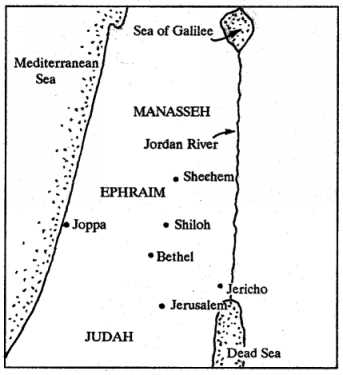
Yet the Ephraimites were not satisfied. Since the fertile hills of the territory given to them were largely covered with forest, they complained that there was not enough land suitable for them to build villages to house all their people. Joshua told them to clear the forests and drive out the remaining Canaanite people and they would find that they had plenty of land (Jos 17:14-18; see also Jdg 17:1; 2Sa 18:6).
Political ambition
Ephraim considered itself to be the leading tribe in Israel, and showed a spirit of jealousy when denied the status it believed it deserved. It complained to Gideon when he did not invite it to the battle against the Midianites (Jdg 8:1), and to Jephthah when he did not ask it to join the battle against the Ammonites (Jdg 12:1).
In particular, Ephraim was jealous of Judah, whom it saw as its competitor for leadership in Israel. When David (who was from the tribe of Judah) succeeded Saul as king of Israel, Ephraim supported Saul’s son as a rival king, but after two years was forced to admit defeat (2Sa 2:4; 2Sa 2:8-10; 2Sa 5:1-3). Some years later Absalom rebelled against David, and once again Ephraim appears to have supported the anti-David forces (2Sa 18:6-8).
When, after the death of Solomon, the northern tribes broke away from Judah, an Ephraimite led the revolt and became the first king of the breakaway kingdom (1Ki 11:26-28; 1Ki 12:20). This breakaway northern kingdom continued to call itself Israel, whereas the southern kingdom (which the dynasty of David continued to rule over in Jerusalem) became known as the kingdom of Judah. The northern kingdom Israel was so dominated by Ephraim that it was often called Ephraim (Isa 7:2; Isa 7:9; Isa 7:17; Isa 28:1; Hos 4:17; Hos 5:3; Hos 9:3; see ISRAEL).
The second son of Joseph and the
name of one of the tribes of Israel. Sometimes
it is used as the name for the northern
kingdom of Israel, since Ephraim was
most often the leading tribe.