
A province in Palestine. Nazareth was a city of Galilee. And as the Lord Jesus was brought up in this city, he was called, by way of reproach, the Galilean. Isaiah, speaking of the gospel, ages before Christ came, pointed to this memorable spot, as comprehensive of all blessings in the advent of Jesus; and Matthew made application of the prophet’s words to Christ. "The land of Zebulon, and the land of Naphtali, by the way of the sea beyond Jordan, in Galilee of the nations. The people that walked in darkness have seen a greatlight: they that dwell in the land of the shadow of death, upon them hath the light shined." (Isa. ix. 1, 2. Matt. 4: 15, 16.)
was one of the most extensive provinces into which the Holy Land was divided. It exceeded Judea in extent, but probably varied in its limits at different times. This province is divided by the rabbins into, 1. The Upper; 2. The Nether; and 3. The Valley. Josephus divides it into only Upper and Lower; and he says that the limits of Galilee were, on the south, Samaria and Scythopolis, unto the flood of Jordan. Galilee contained four tribes, Issachar, Zebulun, Naphtali, and Asher; a part, also, of Dan, and part of Persia, that is, beyond the river. Upper Galilee abounded in mountains. Lower Galilee, which contained the tribes of Zebulun and Asher, was sometimes called the Great Field, “the champaign,”
Deu 11:30. The Valley was adjacent to the sea of Tiberias. Josephus describes Galilee as very populous, and containing two hundred and four cities and towns. It was also very rich, and paid two hundred talents in tribute. The natives were brave and good soldiers; but they were seditious, and prone to insolence and rebellion. In the books of Ezra and Nehemiah, the inhabitants of Galilee and Peraea are scarcely mentioned, whether they were Jews returned from Babylon, or a mixture of different nations. The language of these regions differed considerably from that of Judea; as did various customs, in which each followed its own mode. Our Lord so frequently visited Galilee, that he was called a Galilean, Mat 26:69. The population of Galilee being very great, he had many opportunities of doing good in this country; and, being there out of the power of the priests at Jerusalem, he seems to have preferred it as his abode. Nazareth and Capernaum were in this division. From such a mixture of people, many provincialisms might be expected. Hence, we find Peter detected by his language, probably by his phraseology, as well as his pronunciation, Mar 14:70. Upper Galilee had Mount Lebanon and the countries of Tyre and Sidon on the north; the Mediterranean Sea on the west; Abilene, Ituraea, and the country of the Decapolis, on the east; and Lower Galilee on the south. Its principal city was Caesarea Philippi. This part of Galilee, being less inhabited by Jews, was thence called Galilee of the Nations, or of the Gentiles. Lower Galilee had the upper division of the same country to the north; the Mediterranean on the west; the sea of Galilee, or lake of Gennesareth, on the east; and Samaria on the south. Its principal cities were Tiberias, Chorazin, Bethsaida, Nazareth, Cana, Capernaum, Nain, Caesarea of Palestine, and Ptolemais. This district was of all others most honoured with the presence of our Saviour. Here he was conceived; here he was brought back by his mother and reputed father, after their return from Egypt; here he lived with them till he was thirty years of age; and, although after his entrance on his public ministry he frequently visited the other provinces, it was here that he chiefly resided. Here, also, he made his first appearance after his resurrection to his Apostles, who were themselves natives of the same country, and were thence called men of Galilee.
GALILEE, Sea of. This inland sea, or more properly lake, which derives its several names, the lake of Tiberias, the sea of Galilee, and the lake of Gennesareth, from the territory which forms its western and south-western border, is computed to be between seventeen and eighteen miles in length, and from five to six in breadth. The mountains on the east come close to its shore, and the country on that side has not a very agreeable aspect: on the west, it has the plain of Tiberias, the high ground of the plain of Hutin, or Hottein, the plain of Gennesareth, and the foot of those hills by which you ascend to the high mountain of Saphet. To the north and south it has a plain country, or valley. There is a current throughout the whole breadth of the lake, even to the shore; and the passage of the Jordan through it is discernible by the smoothness of the surface in that part. Various travellers have given different accounts of its general aspect. According to Captain Mangles, the land about it has no striking features, and the scenery is altogether devoid of character. “It appeared,” he says, “to particular disadvantage to us, after those beautiful lakes we had seen in Switzerland; but it becomes a very interesting object when you consider the frequent allusions to it in the Gospel narrative.” Dr. Clarke, on the contrary, speaks of the uncommon grandeur of this memorable scenery. “The lake of Gennesareth,” he says, “is surrounded by objects well calculated to heighten the solemn impressions made by such recollections, and affords one of the most striking prospects in the Holy Land. Speaking of it comparatively, it may be described as longer and finer than any of our Cumberland and Westmoreland lakes, although perhaps inferior to Loch Lomond. It does not possess the vastness of the lake of Geneva, although it much resembles it in certain points of view. In picturesque beauty, it comes nearest to the lake of Locarno, in Italy, although it is destitute of any thing similar to the islands by which that majestic piece of water is adorned. It is inferior in magnitude, and in the height of its surrounding mountains, to the Lake Asphaltites.” Mr. Buckingham may perhaps be considered as having given the most accurate account, and one which reconciles, in some degree, the differing statements above cited, when, speaking of the lake as seen from Tel Hoom, he says, that its appearance is grand, but that the barren aspect of the mountains on each side, and the total absence of wood, give a cast of dulness to the picture: this is increased to melancholy by the dead calm of its waters, and the silence which reigns throughout its whole extent, where not a boat or vessel of any kind is to be found. The situation of the lake, lying, as it were, in a deep basin between the hills which enclose it on all sides, excepting only the narrow entrance and outlets of the Jordan at either end, protects its waters from long-continued tempests: its surface is in general as smooth as that of the Dead Sea. But the same local features render it occasionally subject to whirlwinds, squalls, and sudden gusts from the mountains, of short duration; especially when the strong current formed by the Jordan is opposed by a wind of this description from the south-east, sweeping from the mountains with the force of a hurricane, it may easily be conceived that a boisterous sea must be instantly raised, which the small vessels of the country would be unable to resist. A storm of this description is plainly denoted by the language of the evangelist, in recounting one of our Lord’s miracles: “There came down a storm of wind on the lake, and they were filled with water, and were in jeopardy. Then he arose, and rebuked the wind and the raging of the water; and they ceased, and there was a calm,”
Luk 8:23-24. There were fleets of some force on this lake during the wars of the Jews with the Romans, and very bloody battles were fought between them. Josephus gives a particular account of a naval engagement between the Romans under Vespasian, and the Jews who had revolted during the administration of Agrippa. Titus and Trajan were both present, and Vespasian himself was on board the Roman fleet. The rebel force consisted of an immense multitude, who, as fugitives after the capture of Tarichaea by Titus, had sought refuge on the water. The vessels in which the Romans defeated them were built for the occasion, and yet were larger than the Jewish ships. The victory was followed by so terrible a slaughter of the Jews, that nothing was to be seen, either on the lake or its shores, but the blood and mangled corpses of the slain; and the air was infected by the number of dead bodies. Six thousand five hundred persons are stated to have perished in this naval engagement, and in the battle of Tarichaea, beside twelve hundred who were afterward massacred in cold blood, by order of Vespasian, in the amphitheatre at Tiberias, and a vast number who were given to Agrippa as slaves.
Gal´ilee, the name given to one of the three principal divisions of Palestine, the other two being Judea and Samaria. This name of the region was very ancient. It occurs in the Hebrew forms of Galil and Galilah, Jos 20:7; Jos 21:3; 1Ki 9:11; 2Ki 15:29; and in Isa 9:1 we have ’Galilee of the nations;’ 1Ma 5:15; Mat 4:15.
Galilee was the northernmost of the three divisions, and was divided into Upper and Lower. The former district had Mount Lebanon and the countries of Tyre and Sidon on the north; the Mediterranean Sea on the west; Abilene, Ituræa, and the country of Decapolis on the east; and Lower Galilee on the south. This was the portion of Galilee which was distinctively called ’Galilee of the nations,’ or of the ’Gentiles,’ from its having a more mixed population, i.e. less purely Jewish than the others. Caesarea Philippi was its principal city. Lower Galilee had Upper Galilee on the north, the Mediterranean on the west, the Sea of Galilee or Lake of Gennesareth on the east, and Samaria on the south. Its principal towns were Tiberias, Chorazin, Bethsaida, Nazareth, Cana, Capernaum, Nain, Caesarea of Palestine, and Ptolemais. This is the district which was of all others the most honored with the presence of our Savior. Here he lived entirely until he was thirty years of age; and although, after the commencement of his ministry, he frequently visited the other provinces, it was here that he chiefly resided. Here also he made his first appearance to the Apostles after his resurrection; for they were all of them natives of this region, and had returned hither after the sad events at Jerusalem (Mat 28:7).
Hence the disciples of Christ were called ’Galileans.’ They were easily recognized as such; for the Galileans spoke a dialect of the vernacular Syriac different from that of Judea, and which was of course accounted rude and impure, as all provincial dialects are considered to be, in comparison with that of the metropolis. It was this which occasioned the detection of St. Peter as one of Christ’s disciples (Mar 14:70). The Galilean dialect was of a broad and rustic tone, which affected the pronunciation not only of letters but of words.
The Galileans are mentioned by Josephus as a turbulent and rebellious people, ready on all occasions to rise against the Roman authority. This character of them explains what is said in Luk 13:1, with regard to ’the Galileans whose blood Pilate had mingled with their sacrifices.’ Josephus, indeed, does not mention any Galileans slain in the Temple by Pilate; but the character which he gives that people sufficiently corroborates the statement. The tumults to which he alludes were, as we know, chiefly raised at the great festivals, when sacrifices were slain in great abundance; and on all such occasions the Galileans were much more active than the men of Judea and Jerusalem, as is proved by the history of Archelaus, which case, indeed, furnishes an answer to those who deny that the Galileans attended the feasts with the rest of the Jews.
This seditious character of the Galileans also explains why Pilate, when sitting in judgment upon Jesus, caught at the word Galilee when used by the chief priests, and asked if he were a Galilean (Luk 23:6). To be known to belong to that country was of itself sufficient to prejudice Pilate against him, and to give some countenance to the charges, unsupported by impartial evidence, which were preferred against him, and which; Pilate himself had, just before, virtually declared to be false.
In the time of Christ, included all the northern part of Palestine lying west of the Jordan and north of Samaria. Before the exile the name seems to have been applied only to a small tract bordering on the northern limits, 1Ki 9:11 . Galilee, in the time of Christ, was divided into Upper and Lower, the former lying north of the territory of the tribe of Zebulun, and abounding in mountains; the latter being more level and fertile, and very populous; the whole comprehending the four tribes of Issachar, Zebulun, Naphtali, and Asher. Lower Galilee is aid to have contained four hundred and four towns and villages, of which Josephus mentions Tiberias, Sepphoris, and Gabara, as the principal; though Capernaum and Nazareth are the most frequently mentioned in the New Testament, Mar 1:9 Luk 2:39 Joh 7:52, etc. "Galilee of the Gentiles" is supposed to be Upper Galilee, either because it bordered on Tyre and Zidon, or because Phenicians, Syrians, Arabs, and other heathen were numerous among it inhabitants. The Galileans were accounted brave and industrious; though other Jews affected to consider them as not only stupid and unpolished, but also seditious, and therefore proper objects of contempt, Luk 13:1 23:6 Joh 1:47 7:52. They appear to have used a peculiar dialect, by which they were easily distinguished from the Jews of Jerusalem, Mar 14:70 . Many of the apostles and first converts to Christianity were men of Galilee, Mal 1:11 2:7, as well as Christ himself; and the name Galilean was often given as an insult, both to him and his followers. The apostate emperor Julian constantly used it, and in his dying agony and rage cried out, "O Galilean, thou hast conquered!" Our Savior resided here from infancy till he was thirty years of age, and during much of his public ministry; and the cities of his public ministry; and the cities of Nazareth, Nain, Cana, Capernaum, with the whole region of the sea of Galilee, are sacredly endeared to all his people by the words he there spoke, and the wonders he wrought. For the Sea of Galilee, see SEA 3.\par
Gal’ilee. (circuit). This name, which, in the Roman age, was applied to a large province, seems to have been originally confined to a little "circuit" of country round Kedesh-Naphtali, in which were situated the twenty towns given by Solomon to Hiram king of Tyre as payment for his work in conveying timber from Lebanon to Jerusalem. Jos 20:7; 1Ki 9:11.
In the time of our Lord, all Palestine was divided into three provinces; Judea, Samaria and Galilee. Luk 17:11; Act 9:31. Joseph. B.J. Iii. 3. The latter included the whole northern section of the country, including the ancient territories of Issachar, Zebulun, Asher and Naphtali. On the west, it was bounded by the territory of Ptolemais, which probably included the whole plain of Akka to the foot of Carmel. The southern border ran along the base of Carmel and of the hills of Samaria to Mount Gilboa, and then descended the valley of Jezreel by Scythopolis to the Jordan. The river Jordan, the Sea of Galilee, and the upper Jordan to the fountain at Dan, formed the eastern border; and the northern ran from Dan westward across the mountain ridge till it touched the territory of the Phoenicians.
Galilee was divided into two sections, "Lower" and "Upper." Lower Galilee included the great plain of Esdraelon with its offshoots, which ran down to the Jordan and the Lake of Tiberias, and the whole of the hill country adjoining it on the north to the foot of the mountain range. It was thus one of the richest and most beautiful sections of Pales-tine. Upper Galilee embraced the whole mountain range lying between the upper Jordan and Phoenicia. To this region, the name "Galilee of the Gentiles" is given in the Old and New Testaments. Isa 9:1; Mat 4:16.
Galilee was the scene of the greater part of our Lord’s private life and public acts. It is a remarkable fact that the first three Gospels are chiefly taken up with our Lord’s ministrations in this province, while the Gospel of John dwells more upon those in Judea.
Galilee from
The most northerly of the three provinces of Palestine, namely, Galilee, Samaria, Judaea (Joh 4:3-4; Luk 17:11; Act 9:31). Galilee’s Gentile character caused the southern Jews of purer blood to despise it (Joh 1:46; Joh 7:52); but its very darkness was the Lord’s reason for vouchsafing to it more of the light of His presence and ministry than to self-satisfied and privileged Judaea. There He first publicly preached, in Nazareth synagogue. From it came His apostles (Act 1:11; Act 2:7); foretold in Deu 33:18-19; Deu 33:23. Compare on Pentecost Act 2:7; Psa 68:27-28. Jerusalem, the theocratic capital, might readily have known Messiah; to compensate less favored Galilee He ministered mostly there. Galilee’s debasement made its people feel their need of the Savior, a feeling unknown to the self right. cons Jews (Mat 9:13).
"The Light to lighten the Gentiles, and the Glory of His people Israel," appropriately ministered on the border land between Israel and the Gentiles, still on Israel’s territory, to which He was primarily sent (Mat 15:24). Places and persons despised of men are honored of God. The region the first to be darkened by the Assyrian invasion was cheered by the prophet’s assurance that it should be the first enlightened by Immanuel (1Co 1:27-29). Its population being the densest of any part of Palestine, and its freedom from priestly and pharisaic prejudice, were additional grounds for its receiving the larger share of His ministry. It was bounded on the W. by the region of Ptolemais (Acre), namely, the plain of Akka to the foot of Carmel. The Jordan, the sea of Galilee, lake Huleh, and the spring at Dan, was the eastern border. The northern boundary reached from Dan westward to Phoenicia (Luk 8:26).
The southern border ran along the base of Carmel and the Samaritan hills to mount Gilboa, then along the valley of Jezreel by Scythopolis (Bethshean) to Jordan. Probably the cleansing of the ten lepers took place near Jenin, the border town of Galilee toward Samaria, near the S. of the sea of Galilee. Jebel Jermuk is the highest mountain, 4,000 ft. above the sea. There were two divisions:
I. Lower Galilee was the whole region from the plain of Akka on the W. to the lake of Galilee on the E., including the rich plain of Esdraelon, the heritage of Issachar, who submitted to servitude, to "tribute," for the sake of the rich plenty that accompanied it (Gen 49:14-15; Deu 33:18). "Rejoice Zebulun in thy going out (thy mercantile enterprises by sea and fishing in the lake of Galilee), and Issachar in thy tents (in thy inland prosperity, agriculture and home comforts) they shall suck of the abundance of the seas (the riches of the sea in general, and the purple dye extracted from the murex here) and of treasures hid in the sand" (the sand of these coasts being especially valuable for manufacturing glass, a precious thing anciently: Job 28:17).
"They shall call the people unto the mountain," etc.: Zebulun and Issachar shall offer their wealth at the Lord’s appointed mount, and invite Gentile nations to join them (Psa 22:27-28, etc.). The conversion of the Gentiles, brought in to Israel and Israel’s Savior, is herein prophetically typified (compare Isa 60:5-6; Isa 60:16; Isa 66:11-12). Asher "dips his feet in oil," i.e. abounds in olive groves. "Fat bread" and "royal dainties" are his, grain, wine, milk, butter, from his uplands and valleys (Gen 49:20; Deu 33:24-25). "Thy shoes iron and brass," i.e. thy hills shall yield these metals (Deu 8:9). "As thy days (so shall) thy strength (be)," i.e., as thy several days come (throughout life) strength will be given thee," Compare 1Ki 8:59 margin.
II. Upper Galilee extended from Bersabe on the S. to the village of Baca, bordering on Tyre, and from Meloth on the W. to Thella, near Jordan (Josephus, B. J., 3:3, sec. 1); in fact, the whole mountain range between the upper Jordan and Phoenicia. Its southern border extended from the N.W. of the sea of Galilee to the plain of Akka. This upper Galilee is chiefly meant by "Galilee of the Gentiles." The ravine of the Leonres separates the mountain range of upper Galilee from Lebanon, of which it is a southern prolongation. Safed is the chief town. The scenery is bolder and richer than that of southern Palestine. On the table land of upper Galilee lie the ruins of Kedesh Naphtali (Jos 20:7).
Bochart, altering the vowel points, translated Gen 49:21, "Naphtali is a spreading terebinth, which puts forth goodly branches"; for the country of Kedesh Naphtali is a natural park of oaks and terebinths. As Nazareth was the scene of our Lord’s childhood, so Capernaum in Galilee was for long the home of His manhood (Mat 4:13; Mat 9:1).
The Galilean accent and dialect were unique, owing to Gentile admixture (Mat 26:73). After Herod the Great’s death Herod Antipas governed Galilee until six years after Christ’s crucifixion. Herod Agrippa, with the title of "king," succeeded. On his death (Act 12:23) Galilee was joined to the Roman province of Syria. After the fall of Jerusalem Galilee became famed for its rabbis and schools of Jewish learning; and the Sanhedrim or great council was removed to Sepphoris, and then to Tiberias. Rabbi Judah Haqodesh here compiled the Mishna, to which the Gemara was subsequently added. The remains of splendid synagogues in Galilee still attest the prosperity of the Jews from the second to the seventh century.
(
Upper Galilee, according to Josephus, extended from Bersabe on the south to thee village of Baca, on the borders of the territory of Tyre, and from Meloth as the west to Thella, a city near the Jordan (War, 3:3, 1). None of these places are now known, but there is no difficultv in ascertaining the position and approximate extent of the province. It embraced the whole mountaim range lying beteween the upper Jordan and Phoenicia. Its southern border ran along the foot of the Safed range from the northwest angle of the Sea of Galilee to the plain of Akka. To this region the name "Galilee of the Gentiles" is given in the O. and N.T. (Isa 9:1; Mat 4:15). So Eusebius states (Onom. s.v.
Galilee (găl’i-lee), circle, circuit. A name in the Old Testament for a small district in the northern mountains of Naphtali, around Kedesh-naphtali, and including 20 towns given by Solomon to Hiram, king of Tyre, Jos 20:7; Jos 21:32; 1Ki 9:11; 2Ki 15:29, and called "Galilee of the nations" in Isa 9:1. Devastated during the wars of the Captivity, it was repeopled by strangers. In the time of the Maccabees they probably outnumbered the Jewish population, and gave their new name to a much wider district. In the time of our Lord, Palestine was divided into three provinces, of which Galilee was the most northern. It included the whole region from the plain of Jezreel to the Litany (Leontes) river, being about 50 miles long by 20 to 25 miles wide. The northern part was known as Upper and the southern part as Lower Galilee. These included the territories given to Asher, Naphtali, Zebulun, and Issachar. The country was famed for its fertility, rich pastures, and fine forests. The portion west of the lake was the most beautiful. In the Roman period the population was dense, Josephus estimating it at 2,000,000 or 3,000,000, though that is probably an exaggeration. It had a mixed population of heathens, foreigners, and Jews. The latter, having a strong, if not dominant, influence, were less strict and less acquainted with the Law than their southern Judæan neighbors, by whom they were little esteemed. The noted mountains of Galilee were Carmel, Gilboa, and Tabor; the towns were Nazareth, Cana, Tiberias, Chorazin, Bethsaida, and Capernaum. Jesus spent the greater portion of his life and ministry in Galilee. Many of his most remarkable miracles, teachings, and labors were within this province of Galilee. His disciples were chiefly from this region. Act 1:11. After the fall of Jerusalem, Galilee became the residence of celebrated rabbis and the centre of Jewish schools of learning.
[Gal’ilee]
This was a much smaller district in the O.T. than in the N.T., although its area is not very defined. It seems formerly to have included a portion of Naphtali, and perhaps a portion of Asher. ’Kedesh in Galilee,’ one of the cities of refuge was in Naphtali. Jos 20:7; Jos 21:32; 1Ch 6:76. Solomon gave Hiram twenty cities in Galilee. These are not named, but they would naturally be near to Tyre. When Hiram went to view them he called them the ’land of Cabul,’ as if he included them all under the one name of ’Cabul,’ worthless. Now there was and is a village of this name on the frontier of Asher, which would seem to indicate that Asher was in the district of Galilee. 1Ki 9:11-13. About B.C. 740 Tiglath-pileser carried away captive all the inhabitants of Naphtali, etc. 2Ki 15:29. This was doubtless followed by the district being inhabited by foreigners, who, when the captivity of Israel was completed, would be able to spread themselves southward. Hence the term ’Galilee of the Gentiles ,’ or nations, which does not occur until Isa 9:1; the prophecy is quoted in Mat 4:15.
In N.T. times Galilee had become a much larger district, including the portions of Asher, Naphtali, Zebulon, and Issachar. It had over 200 towns and villages, and about three million inhabitants in Josephus’ time. It was bounded on the south by Samaria, and embraced the whole of the north part of Palestine. It included the towns of Nain, Nazareth, Cana, Tiberias, Magdala, Dalmanutha, Bethsaida, Chorazin, and Capernaum.
It is probable that the Galilaeans had a different manner of pronunciation, or the language spoken in Galilee was not so refined as that spoken at Jerusalem, which led to Peter being detected by his speech. Mat 26:69; Mat 26:73; Mar 14:70. But the voice of the same Peter, under the power of God, was mighty on the day of Pentecost, though the hearers said "are not all these which speak Galilaeans?" Act 2:7. They were surprised to hear such men speak in foreign tongues, the more so because no prophet was ever looked for from thence, nor any good thing from Nazareth. Joh 1:46; Joh 7:52. Still in that despised district the Lord spent His youth: thus early was He as One separated from the course of the nation of Israel, a Nazarene; and the principal part of His ministry was among the poor of the flock in that locality; fulfilling thus the will of God and the prophetic word, on which God had caused His people to hope.
GALILEE
1. Name.—The English form of the name ‘Galilee’ is derived from the Hebrew
2. History.—When the Hebrew invasion of Palestine took place, the main part of Galilee was allotted to Zebulun, Asher, and Naphtali. According to Jdg 1:30-33, Zebulun was not altogether successful in driving out the inhabitant of their portion, while Asher and Naphtali had to be content to settle as best they could among the inhabitants, ‘for they did not drive them out.’ These inhabitants seem to have been Amorites and Hivites from the Lebanon. An account of one (or two) of the battles fought in this country is found in Judges 4-5. In the days of the Monarchy, Galilee always suffered in the Syrian wars. It was ravaged by Ben-hadad (1Ki 15:20), probably won back by Ahab, taken again by the Aramaeans under Hazael (2Ki 12:18; 2Ki 13:22), and recovered by Jeroboam ii. It was also on the high-road of the Assyrian invasion, and was won for Assyria by Tiglath-pileser iii. in 734 (2Ki 15:29), many of its inhabitants being carried into captivity. From this time up to the end of the 2nd cent. b.c. the population was heathen, with a small number of Jewish settlers, who attached themselves to Jerusalem after the return from the Exile. About the year 164, Simon the brother of Judas Maccabaeus pursued the Syrians to Ptolemais, and on his way back brought the Galilaean Jews and their property to Judaea (1Ma 5:21-23). Some 60 years later the whole state of affairs in Galilee was changed. According to Strabo, on the authority of Timagenes (Josephus Ant. xiii. xi. 3), Aristobulus (b.c. 104–103) conquered much of Galilee, and compelled the inhabitants to be circumcised and live according to Jewish laws. This work had probably been already begun by John Hyrcanus (b.c. 135–105). Herod at his death bequeathed Galilee to Herod Antipas, who succeeded after much opposition in having his legacy confirmed at Rome.
3. Extent.—The amount of territory covered by the name ‘Galilee’ varied in different times. Originally it comprised the hilly and mountainous country to the north of the Plain of Esdraelon or the smaller plain of cl-Buttauf. The boundaries were probably not well defined, but on the north it included Kedesh (Jos 20:7; Jos 21:32). It was later spoken of in two divisions—Upper and Lower Galilee (cf. Jdt 1:8, 1Ma 12:49), and in the Mishna is divided into three parts, these corresponding to the natural divisions of plain, hill-country, and mountain.
The boundaries of Galilee at the time of Christ are thus given by Josephus:
‘Now Phœnice and Syria surround the two Galilees, which are called Upper and Lower Galilee. They are bounded on the W. by the borders of the territory belonging to Ptolemais, and by Carmel, which mountain of old belonged to the Galilaeans, but now to the Tyrians; and next it is Gaba (Jebâta* [Note: The identifications in brackets are those of Sir C. W. Wilson in Shilleto’s translation of Josephus.] ), which is called “the city of horsemen,” because those horsemen that were dismissed by Herod the king dwelt therein; they are bounded on the S. by Samaria and Scythopolis, as far as the streams of the Jordan; on the E. by Hippene (the district of Hippos, Sâsiyeh) and Gadaris (the district of Gadara, Umm Keis), and also by Gaulanitis (Jaulân) and the borders of the kingdom of Agrippa; and their N. parts are bounded by Tyre, and the country of the Tyrians. As for what is called Lower Galilee, it extends in length from Tiberias to Chabulon (Kâbûl), and Ptolemais is its neighbour on the coast; and its breadth is from the village called Xaloth (Iksâl), which lies in the great plain, to Bersabe, from which beginning the breadth of Upper Galilee is also taken to the village Baca, which divides the land of the Tyrians from Galilee; its length is also from Meloth (Meiron) to Thella (probably Tell Thala), a village near the Jordan’ (BJ iii. iii. 1).
4. Geography.—The southernmost division of Galilee was Esdraelon (G. A. Smith, HGHL [Note: GHL Historical Geog. of Holy Land.] p. 379). It consists of (1) the triangular plain about 200 feet above sea-level, 29 miles long from the foot of Carmel to Jenîn, 15 from Jenîn to Tabor, and 15 from Tabor to the foot of Carmel; (2) the valley of Jezreel (Nahr Jalûd), running down for 12 miles from Jezreel to Bethshean, some 400 feet below sea-level. The Plain of Esdraelon is watered by the Kishon flowing to the Mediterranean; but, as the edges are somewhat higher than the centre, it is often marshy. It played a great part in the history of Palestine (cf. HGHL [Note: GHL Historical Geog. of Holy Land.] p. 391 ff.), but has no mention in the story of the Gospels.
On the other hand, the middle division of Galilee, known as Lower Galilee, contains nearly all the important sites of the Gospel record. Nazareth, Capernaum, Shunem, Nain, Cana, etc., are within its borders. It is bounded on the W. by the Plain of Ptolemais, on the S. by the Plains of Esdraelon and Jezreel, on the E. by the Sea of Galilee (though sometimes a part of the country east of the sea was considered Galiliean), and on the N. by a line passing from the N. end of the Sea of Galilee through Ramah to the coast. It consists of four chains of hills running east and west, intercepted by valleys and plains. The hills reach a height of about 1200 feet. The southern chain consists of the Nazareth hills, with Mt. Tabor; the next range contains the Karn Hattin of Crusading fame; the third, the city of Jotapâta; while the fourth consists of the southern slopes of the mountains of Upper Galilee. The central plain of cl-Buttauf is about 500 feet above sea-level, while the coast of the Sea of Galilee is nearly 700 feet below sea-level. The whole country is well watered by streams flowing east or west, and was extremely fertile. The grass of the plains was green, and evergreen oaks grew on the hills. The cornfields gave a plenteous harvest, and pomegranates abounded.
Upper Galilee ranged from the N. boundary of Lower Galilee to the Tyrian boundary, which seems to have been at the time of Christ just south of Kedesh, which according to Josephus was a Tyrian fortress on the borders of Galilee (Ant. xiii. v. 6; BJ ii. xviii. l, iv. ii. 3). It is a land of mountains, where the hills run from 2000 to 4000 feet in height. It too was a fertile land, with thick woods, sycamores, olives, vines, and green pastures by its waters.
5. Roads.—‘Judaea was on the road to nowhere; Galilee is covered with roads to everywhere’ (G. A. Smith, HGHL [Note: GHL Historical Geog. of Holy Land.] p. 425). Roads in the East even now are often mere tracks, scarcely recognizable by the Western. They are repaired for great occasions, and soon allowed to fall again into their natural condition. Remains of pavements, however, show that at the time of Christ the Roman genius for road-making had been at work in the district of Galilee. Especially was this the case on the great high-road, the ‘Way of the Sea,’ as it was called in the Middle Ages (from an interpretation of Isa 9:1), which crossed the middle of Lower Galilee. The eastern termini of the main roads were the two bridges which crossed the Jordan. These were (1) the bridge about half-way between Merom and the Sea of Galilee, now called the ‘Bridge of Jacob’s Daughters.’ To this came the road from Damascus and the intervening country. Westward from the river the road ran by Safed and Ramah to Ptolemais. From this a branch struck off a few miles west of the river, passed by Arbela (Irbid), and rejoined the highroad near Ramah. Another branch went southwards to the west coast of the Sea of Galilee at Khân Minych, and proceeded to Bethshean, where it joined the road from (2) the bridge a few miles south of the Sea of Galilee, now called the Jisr cl-Mujâmia. Over this bridge came the traffic from Arabia and Gilead. From it one road passed through Bethshean, the Valley of Jezreel, and the Plain of Esdraelon, to the coast of the Mediterranean, and so on to Egypt; another by Cana and Sepphoris to Ptolemais. The main road from the shore of the Sea of Galilee to the highlands went by the Wady cl-Hammâm past Arbela, then between Tabor and the Nazareth hills to Esdraelon. Along these and many other roads flowed a ceaseless stream of traffic, and the fulness of their life is reflected in the parables of Christ (cf. Encyc. Bibl. iv. 5191; HGHL [Note: GHL Historical Geog. of Holy Land.] p. 430 f.).
6. Government.—Galilee was a part of the Roman Empire; that is, in the days of Christ it was under the emperors Augustus and Tiberius. Roman garrisons were in towns all round the country. Roman influence was felt everywhere. But the mass of the people had little or nothing to do with the Roman Empire directly. The direct government of the land was in the hands of Herod Antipas, to whom, with the title of ‘tetrarch,’ it was assigned by Augustus after the death of Herod. Antipas was 17 years old at his accession to power, and established his capital at Sepphoris. About the year 22, however, he built a new city on the shore 6f the Sea of Galilee, named it Tiberias in honour of the emperor, and made it his capital. This city was governed after the Greek model by a council of 600, with an Archon and other officers. In these two cities was centred the chief legal administration of affairs in Galilee during the life of Christ. But in Galilee, as elsewhere, the chief details of life were regulated by the Jews’ own religious laws rather than by ordinary civil enactments. The chief authority was the Sanhedrin (see Sanhedrin) at Jerusalem, to which appeals could be made when local doctors differed. The chief local difficulties were usually satisfied by the decisions of local councils (cf. Mat 10:17), probably associated more or less closely with the local synagogues (see Synagogue).
7. People.—Galilee was a populous country. ‘The cities lie very thick, and the very many villages are everywhere so populous from the richness of the soil, that the very least of them contains more than fifteen thousand inhabitants’ (Josephus BJ iii. iii. 2). In another place Josephus says there were 240 cities and villages in Galilee (Life, 45), and that many of these had strong walls. From each of these to the others must have been a network of tracks and roads in addition to the main roads (see above). and the land was a scene of constant activity. The bracing air of the hills and the activity of everyday life formed a people of energy and vigour. ‘The Galilaeans are inured to war from their infancy, and have been always very numerous; nor has their country ever been destitute of men of courage’ (Josephus BJ iii. iii. 2). Regarded with a certain amount of patronizing contempt by the pure-blooded and more strictly theologically-minded Jews of Jerusalem and its neighbourhood, they still had the religions zeal of country-folk. This zeal was quickened by their pilgrimages to Jerusalem, which made a greater impression on their active minds than on those who were more familiar with the life of the Holy City. At any apparent insult to their religion they were ready to break out in revolt. Before, during, and after the life of Jesus, Galilaean leaders arose and flew to arms in the vain attempt to secure religious autonomy. Yet they differed in many respects from their Judaean brothers. The very technical terms of the market and the details of their religious customs varied from those of the South (cf. Schürer, HJP [Note: JP History of the Jewish People.] ii. i. 4). Their pronunciation of the Aramaic language had peculiarities of its own (Mat 26:73), one of these being the confusion of the guttural sounds. Besides, however, the natural bodily vigour and mental freshness of these highlanders, the most important difference between them and the people of Judaea lay in the different attitude in daily life towards the larger world of the Roman Empire and Hellenistic influence. Knowledge of, at any rate spoken, Greek was to them a necessity of business, and no attempt could be made, as in Jerusalem, to avoid the study of it (cf. Moulton, Prolegomena to Gram, of NT Greek, 1906, p. 8). Many must have been, like Matthew, in Government employ. All were brought into daily contact with Greek and Roman modes of life and thought. It was to this people of larger experience of life and broader ways of thinking that Jesus appealed in the greater part of His earthly ministry, and from it that He chose the men who were first to make His message known to the world. See also art. Sea of Galilee.
Literature.—Artt. ‘Galilee’ in Hasting’s Dictionary of the Bible . and ‘Galilaa’ in PRE [Note: RE Real-Encyklopädie fur protest. Theologic und Kirche.] 3 [Note: designates the particular edition of the work referred] ; Neubauer, Géog. du Talmud; Guérin, Galilée; Merrill, Galilee in the Time of Christ; G. A. Smith, HGHL [Note: GHL Historical Geog. of Holy Land.] , chs. xx, xxi.
G. W. Thatcher.
By: Emil G. Hirsch, Frants Buhl, Solomon Schechter
—Biblical and Post-Biblical Data:
In the Greek period the customary name for the northern division of western Palestine. The name is formed from "ha-Galil," in the Old Testament (Josh. xx. 7, xxi. 32, LXX.; I Kings ix. 11; II Kings xv. 29; I Chron. vi. 61), or from "Gelil ha-Goyim" (circle of the heathens; Isa. viii. 23; comp. I Macc. v. 15), and designates the mountainous country which rises east of the plain of Jezreel, and extends as far as Lebanon and Antilebanon. Galilee was divided into two sections, Lower or South Galilee, and Upper or North Galilee, which were separated by the plain of Ramah (comp. Josh. xix. 36).
Politically a Jewish country, Galilee, according to Josephus ("B. J." iii. 3, § 1), was bounded north and west by the Tyrian territory, south by Samaria and Scythopolis, and east by the trans-Jordanic country and the Lake of Gennesaret. Josephus also divides the Galilean mountain-range into two sections, Upper and Lower Galilee, which division corresponds to the natural division of the country as just stated. According to the same author, Upper Galilee was bounded on the south by Bersaba (perhaps the ruined Abu Sheba south from the plain of Ramah; on the west by Meroth (the position of which can not be positively determined); on the north by Baca (also unknown); and on the east by Thella on the Jordan. Lower Galilee extended in the west to Chabulon near Ptolemais; in the south to Exaloth, that is, Chisloth (Josh. xix. 12, 18); and in the east to Tiberias. From other passages in Josephus it appears that the Jewish section of Galilee did not extend far north; for Kadesh was already in Tyrian possession ("B. J." ii. 18, §, 1, and often elsewhere). On the other hand, in the specification of the boundary-lines according to the Talmud (see Hildesheimer, "Beiträge zur Geographie Palästinas," 1886), the northeastern boundary of Galilee extends farther west and north, namely, from Ptolemais through Ga'ton (now Ja'ṭun), Bet Zenita (Zuwenita), Ḳastra de-Gelil (Gelil), Kur (Al-Kura),Yatir (Ya'tir), and Tafnit (Tibnin) to Marj 'Ayun.
Galilee, a beautiful and very fertile country, isjustly praised by Josephus ("B. J." iii. 3, § 2). According to his statement, it included a number of cities and many villages, the smallest of which had not fewer than 15,000 inhabitants. This is doubtless an exaggeration, though the density of the population is beyond question. As early as Old Testament times the population of this region was greatly mixed; and it became more so after the downfall of the Ephraimitic kingdom. During the Maccabean struggle the Jews of Galilee constituted such a small number that they could all be brought to Jerusalem (I Macc. v. 23).
It is not expressly stated when Galilee was taken by the Maccabees, but Schürer's suggestion ("Gesehichte," 3d ed., i. 275 et seq.), that the section of the Iturean territory which Aristobulus I. conquered (Josephus, "Ant." xiii. 11, § 3) was Galilee, is probably correct. Undoubtedly many Jews subsequently emigrated to that blessed land, so that the population became predominantly Jewish, as is described in the New Testament and by Josephus. Upon the death of Herod the Great, Galilee was apportioned to Herod Antipas; and after his deposition it was incorporated into the province of Syria, a part of which it continued to form, except under the short rule of Agrippa (40-44).
After the fall of the Jewish state a new period of prosperity set in for Galilee; and it gradually became the center of Jewish life in Palestine.
E. G. H. F. Bu.—In Rabbinical Literature:
Galilee is enumerated mainly for religio-legal purposes in the Talmud (B. B. iii. 2; Ket. xiii. 9; Tosef., Ket., end; Sanh. 11b; et al.). It comprised the northern territory east of the Jordan, which river constituted the frontier. Kefar 'Awtanai (Giṭ. vii. 8) was at its southern boundary (see Josephus, "B. J." iii. 3, § 1). According to Sheb. ix. 2, Galilee was divided into three parts: Upper Galilee (above Kefar Ḥananyah, where no sycamores are found), Lower Galilee (land of sycamores), and the plain (the, Teḥum, or territory of Tiberias). In the letter addressed to his "brethren" of Galilee by R. Gamaliel (Tosef., 'Eduy. ii.; Sanh. ii.; ib. 77a) the plain is not specified.
This province is praised for the fertility of its fields and vineyards (Meg. 6a); its fruits are very sweet (Ber.44a). Olive-oil was one of its chief products (Sifre, Deut. 33, in blessing of Asher). "It is easier to raise a legion of olive-trees in Galilee than one child in Palestine" (Ber. R. xx.), Special Galilean jars were manufactured for the storing of oil (Kelim ii. 2). Wine, on the other hand, was scarce (Nazir 31b). Linen was abundant, and the women were famous for the fineness of their homespun (B. Ḳ. 119).
Characteristics of Galileans.
The inhabitants, partly pagan, partly Jewish, are said to have been quarrelsome and of a disobliging disposition (Ned. 48a; Tosef., Giṭ. vi.). Still one exception showing delicate appreciation of the true implications of charity is mentioned (Tosef., Peah, viii.): an impoverished old man was served the delicacies he had indulged in in his prosperous days. The Galileans were more solicitous of their honor than of their property (Yer. Ket. iv. 14). Widows were treated with consideration (Ket. iv. 14). Young married people were not permitted to be alone immediately after the nuptial ceremony (Ket. 12a). At funerals the preacher of the funeral oration preceded the bier; in Judea he followed (Shab. 158a). It is said in the Talmud that Jose b. Joezer of Zeredah and Jose b. Johanan of Jerusalem declared the country of the nations ("Ereẓ ha-'Ammim") unclean (Shab. 14b, 15a). Rashi understands by "Ereẓ ha-'Ammim" the country of the Gentiles-that is, the country outside of Palestine; but Kaminka concludes that Galilee is meant, the name being similar to the Biblical "Gelil ha-Goyim." Thus there is an essential difference with regard to ritual observance of cleanliness between Judea and Galilee.
On the whole, the Galileans are said to have been strict in their religious observances (M. Ḳ. 23a; Pes. 55a; Yer. R. H. iv. 6; Yer. Soṭah ix. 10). Measures and weights were peculiar in Galilee: 1 Judean se'ah = 5 Galilean se'ah; 5 Judean sela = 10 Galilean sela (B. B. 122b; Ḥul. 137b). The Galilean Sicarii were dreaded (Tosef., Giṭ. ii.). Study of the traditions was not one of the Galilean virtues, neither was their dialectic method very flexible ('Er. 53a). But it is for their faulty pronunciation that the Galileans are especially remembered: 'ayin and alef, and the gutturals generally, were confounded, no distinction being made between words like '"amar" (= "ḥamor," uss), "ḥamar" (wine), "'amar" (a garment), "emar" (a lamb: 'Er. 53b); therefore Galileans were not permitted to act as readers of public prayers (Meg. 24b). Still, according to Geiger ("Orient," iv. 432), to the Galileans must be ascribed the origin of the Haggadah. Galilee was very rich in towns and hamlets (Yer. Meg. i. 1), among which were Sepphoris ( or
or  ) Asha, Shephar'am, BetShe'arim, Tiberias, Magdala, Kefar Ḥananyah, 'Akbara, Acco, Paneas, Cæsarea. On Galil, a place of the same name as the province, see Hildesheimer, "Beiträge zur Geographic Palästinas," P. 80.
Bibliography:
Neubauer, La Géographic du Talmud, Paris, 1868;
Dalman, Grammatik des Jüdisch-Palästinischen Aramäisch, Leipsic, 1899;
Hirsch Hildesheimer, Beiträge zur Geographic Palästinas, p. 80;
Guérin, Galilée, 1880;
Merrill, Galilee in the Time of Christ, London, 1885;
George Adam Smith, The Historical Geography of the Holy Land, London, 1894;
A. Kaminka, Studien zur Geschichte Galiläas, Berlin, 1890.
GALILEE
1. Position.—Galilee was the province of Palestine north of Samaria. It was bounded southward by the Carmel range and the southern border of the plain of Esdraelon, whence it stretched eastward by Bethshean (Scythopolis, Beisan) to the Jordan. Eastward it was limited by the Jordan and the western bank of its expansions (the Sea of Galilee and Waters of Merom). Northward and to the north-west it was bounded by Syria and Phœnicia; it reached the sea only in the region round the bay of Acca, and immediately north of it. Its maximum extent therefore was somewhere about 60 miles north to south, and 30 east to west.
2. Name.—The name Galilee is of Hebrew origin, and signifies a ‘ring’ or ‘circuit.’ The name is a contraction of a fuller expression, preserved by Isa 9:1, namely, ‘Galilee of the [foreign] nations.’ This was originally the name of the district at the northern boundary of Israel, which was a frontier surrounded by foreigners on three sides. Thence it spread southward, till already by Isaiah’s time it included the region of the sea, i.e. the Sea of Galilee. Its further extension southward, to include the plain of Esdraelon, took place before the Maccabæan period. The attributive ‘of the nations’ was probably dropped about this time—partly for brevity, partly because it was brought into the Jewish State by its conquest by John Hyrcanus, about the end of the 2nd cent. b.c.
3. History.—In the tribal partition of the country the territory of Galilee was divided among the septs of Asher, Naphtali, Zebulun, and part of Issachar. In the OT history the tribal designations are generally used when subdivisions of the country are denoted; this is no doubt the reason why the name ‘Galilee,’ which is not a tribal name, occurs so rarely in the Hebrew Scriptures—though the passage in Isaiah already quoted, as well as the references to Kedesh and other cities ‘in Galilee’ (Jos 20:7; Jos 21:32, 1Ki 9:11, 2Ki 15:29, 1Ch 6:76), show that the name was familiar and employed upon occasion. But though some of the most important of the historical events of the early Hebrew history took place within the borders of Galilee, it cannot be said to have had a history of its own till later times.
After the return of the Jews from the Exile, the population was concentrated for the greater part in Judæa, and the northern parts of Palestine were left to the descendants of the settlers established by Assyria. It was not till its conquest, probably by Joho Hyrcanus, that it was once more included in Jewish territory and occupied by Jewish settlers. Under the pressure of Egyptian and Roman invaders the national patriotism developed rapidly, and it became as intensely a Jewish State as Jerusalem itself, notwithstanding the contempt with which the haughty inhabitants of Judæa regarded the northern provincials. Under the Roman domination Galilee was governed as a tetrarchate, held by members of the Herod family. Herod the Great was ruler of Galilee in b.c. 47, and was succeeded by his son Antipas, as tetrarch, in b.c. 4. After the fall of Jerusalem, Galilee became the centre of Rabhinic life. The only ancient remains of Jewish synagogues are to be seen among the ruins of Galilæan cities. Maimonides was buried at Tiberias. But it is as the principal theatre of Christ’s life and work that Galilee commands its greatest interest. Almost the whole of His life, from His settlement as an infant in Nazareth, was spent within its borders. The great majority of the twelve Apostles were also natives of this province.
4. Physical Characteristics.—Owing to moisture derived from the Lehanon mountains, Galilee is the best-watered district of Palestine, and abounds in streams and springs, though the actual rainfall is little greater than that of Judæa. The result of this enhanced water supply is seen in the fertility of the soil, which is far greater than anywhere in Southern Palestine. It was famous for oil, wheat, barley, and fruit, as well as cattle. The Sea of Galilee fisheries were also important. The formation of the country is limestone, broken by frequent dykes and outflows of trap and other volcanic rocks. Hot springs at Tiberias and elsewhere, and not infrequent earthquakes, indicate a continuance of volcanic and analogous energies.
5. Population.—Galilee in the time of Christ was inhabited by a mixed population. There was the native Jewish element, grafted no doubt on a substratum of the Assyrian settlers and other immigrants, whose intrusion dated from the Israelite Exile—with probably yet a lower stratum, stretching back to the days of the Canaanites. Besides these there was the cultivated European class—the inhabitants of the Greek cities that surrounded the Sea of Tiberias, and the military representatives of the dominant power of Rome. We have seen that in Judæa the Galilæans were looked down upon. ‘Can any good thing come out of Nazareth?’ (Joh 1:46) was one proverb. ‘Out of Galilee ariseth no prophet’ (Joh 7:52) was another, in the face of the fact that Galilee was the home of Deborah, Barak, Ibzan, Tola, Elon, with the prophets Jonah, Elisha, and possibly Hosea. The Galilæans no doubt had provincialisms, such as the confusion of the gutturals in speech, which grated on the sensitive ears of the Judæans, and was one of the indications that betrayed Peter when he endeavoured to deny his discipleship (Mat 26:73).
R. A. S. Macalister.
(Hebrew: district)
Most northern of the three provinces of Palestine west of the Jordan at the time of Our Lord, comprising in general the territory assigned by Josue to the tribes of Asher, Nephtali, Zabulon, and Issachar. It was the native land of Jesus Christ, the cradle of the Christian Faith, where He began His ministry and performed many of His miracles, and from whence came His Apostles. Joseph and Mary belonged to Nazareth, the chief city in the south, and there Jesus lived the greater part of His life. Galilee’s fertility, invigorating climate, forests, vineyards, lakes, rivers, and prosperous cities gave it a varied and attractive aspect.
(Sept. and N.T. Galilaia).The native land of Jesus Christ, where He began His ministry and performed many of His works, and whence He drew His Apostles. Orginally, the Hebrew word Gâlîl, derived from gâlal, "to roll", meant a circle or district, and in its feminine and plural forms was applied indifferently to several regions in Palestine. The simple term Gâlîl (Galilee) occurs first in Jos., xx, 7 (cf. Joshua 21:32; and 1 Chronicles 6:76) where it denotes that portion of Nephtali lying to the northeast of Lake Merom, in which lay Cedes, one of the six cities of refuge. In III Kings, ix, 11, the expression "land of Galilee" is used to designate the northern part of Palestine, that embraced the twenty cities given by Solomon to Hiram, King of Tyre. Isaias (ix, 1) gives to "the land of Zabulon, and the land of Nephtali" the name "Galilee of the Nations" (D.V. "Galilee of the Gentiles"), undoubtedly on account of the large Gentile population in that region. As early as the Machabean period, the limits of Galilee had extended to Samaria (1 Maccabees 10:30), without however including the plain of Jezrael and the territory of Ptolemais (1 Maccabees 12:47, 49). The New Testament frequently recognizes it as dividing, with the provinces of Samaria and Judea, all of Western Palestine. Josephus and, more accurately, the Talmudists (cf. Neubauer, "La Géographie du Talmud", Paris, 1868) give its boundaries at this period, as Phoenicia and Coele-Syria on the north; the Jordan valley on the east; Samaria, having En Gannim (modern Jennin) at its frontier, on the south; the Mediterranean and Phoenicia on the west. The territory thus described is naturally divided by a high ridge, at the eastern extremity of which was Caphar Hanan (Kefr ’Anân), into Upper Galilee, embracing ancient Nephtali and the northern part of Asher, and Lower Galilee, embracing ancient Zabulon and parts of Asher and Issachar. Although mountain ranges extend throughout the territory, rising to a height of 4000 feet in Upper, and to 1800 feet in Lower Galilee, the land is very productive, especially in the southern division where the valleys and plains are greater, and is capable of sustaining a very large population.Josue (xix, 10-39) names 69 important Canaanite towns and cities, existing in the conquered territory allotted to the Hebrew tribes of Nephtali, Zabulon, Asher, and Issachar. Josephus (Vita, 45) counted 204 prosperous villages and 15 fortified cities in the Galilee of his time. Now its population is small, and for the most part scattered among miserable villages and mud hamlets. Safed, one of the four sacred cities of Palestine revered by Jews, which has a population of about 15,000, of whom 9000 are Jews, is the principal city in the north. Nazareth, a Christian city (about 10,000), is the chief city in the south. The deportation of Jews by Theglathphalasar (Tiglath-Pileser), 734 B. C., gave an overwhelming predominance to the Gentile elements noted in the population by Isaias. Although the Jews multiplied rapidly in Galilee after the Babylonian exile, they were oppressed by the heathen as late as the Machabean period (1 Maccabees 5:45-54), and did not prevail until the first century before Christ. As results of their long intercourse with the conquered Canaanites, and Phoenician, Syrian, and Greek immigrants, and their separation from their brethren in Judea by interlying Samaria, they spoke a dialect and had peculiarities in business, family and religious customs, that brought upon them the contempt of the inhabitants of Jerusalem. Under the Roman Empire both Christianity and Judaism flourished there, as is evidenced by the ruins of numerous synagogues, churches, and monasteries belonging to that period that were destroyed by the Moslems. There are also notable ruins of churches and monasteries erected by the Crusaders, who restored Christianity in Palestine in the twelfth century, and were not finally overcome until 1291, when Acre in Galilee, their last stronghold, was taken by the Moslems. The territory is now a Turkish possession belonging to the vilayet of Beirut. The people are divided in their religious beliefs. Catholics of the Latin, Greek, and Maronite Rites, Orthodox Greeks, and Druses live side by side with Moslems. Near Safed there are several modern Jewish colonies.----------------------------------- Smith, Hist. Geog. of the Holy Land (London, 1885); Palestine Explorations Fund, Memoirs I (1881); Merrill, Galilee in the time of Christ (London, 1891); von Schürer, Jewish People in the Time of Christ (New York, 1885); Guérin, Galilée (2 vols., Paris, 1880). A.L. MCMAHON Transcribed by Fr. Paul-Dominique Masiclat, O.P. The Catholic Encyclopedia, Volume VICopyright © 1909 by Robert Appleton CompanyOnline Edition Copyright © 2003 by K. KnightNihil Obstat, September 1, 1909. Remy Lafort, CensorImprimatur. +John M. Farley, Archbishop of New York
1. Galilee of the Nations
Kedesh, the city of refuge, is described as lying in Galilee, in Mt. Naphtali (Jos 20:7; compare Jos 21:32). The name seems originally to have referred to the territory of Naphtali. Joshua’s victorious campaign in the north (Josh 11), and, subsequently, the triumph of the northern tribes under Deborah and Barak (Jdg 4 f) gave Israel supremacy; yet the tribe of Naphtali was not able to drive out all the former inhabitants of the land (Jdg 1:33). In the time of Solomon the name applied to a much wider region, including the territory of Asher. In this land lay the cities given by Solomon to Hiram (1Ki 9:11). Cabul here named must be identical with that of Jos 19:27. The Asherites also failed to possess certain cities in their allotted portion, so that the heathen continued to dwell among them. To this state of things, probably, is due the name given in Isa 9:1 to this region, “Galilee of the nations,” i.e. a district occupied by a mixed population of Jews and heathen. It may also be referred to in Jos 12:23, where possibly we should read “king of the nations of Galilee” (
2. Ancient Boundaries
There is nothing to guide us as to the northern boundary of Galilee in the earliest times. On the East it was bounded by the upper Jordan and the Sea of Galilee, and on the South by the plain of
3. Before the Exile
At the instigation of Asa, king of Judah, Benhadad, son of Tabrimmon of Damascus, moved against Israel, and the cities which he smote all lay within the circle of Galilee (1Ki 15:20). Galilee must have been the arena of conflict between Jehoahaz and Hazael, king of Syria. The cities which the latter captured were recovered from his son Benhadad by Joash, who defeated him three times (2Ki 10:32; 2Ki 13:22). The affliction of Israel nevertheless continued “very bitter,” and God saved them by the hand of Jeroboam son of Joash, the great warrior monarch of the Northern Kingdom, under whom Galilee passed completely into the hands of Israel (2Ki 14:25). But the days of Israel’s supremacy in Northern Palestine were nearly over. The beginning of the end came with the invasion of Tiglath-pileser III, who took the chief cities in Galilee, and sent their inhabitants captive to Assyria (2Ki 14:29). Probably, as in the case of the Southern Kingdom, the poorest of the land were left as husbandmen. At any rate there still remained Israelites in the district (2Ch 30:10 f); but the measures taken by the conqueror must have made for the rapid increase of the heathen element.
4. After the Exile
In post-exilie times Galilee is the name given to the most northerly of the three divisions of Western Palestine. The boundaries are indicated by Josephus (BJ, III, iii, 1). It was divided into Lower and Upper Galilee, and was encompassed by Phoenicia and Syria. It marched with Ptolemais and Mt. Carmel on the West. The mountain, formerly Galliean, now belonged to the Syrians. On the South it adjoined Samaria and Scythopolis (
5. Character of the Galileans
In the mixed population after the exile the purely Jewish element must have been relatively small. In 165 bc Simon Maccabeus was able to rescue them from their threatening neighbors by carrying the whole community away to Judea (1 Macc 5:14ff). Josephus tells of the conquest by Aristobulus I of Ituraea (Ant., XIII, xi, 3). He compelled many of them to adopt Jewish religious customs, and to obey the Jewish law. There can be little doubt that Galilee and its people were treated in the same way. While Jewish in their religion, and in their patriotism too, as subsequent history showed, the population of Galilee was composed of strangely mingled elements - Aramaean, Iturean, Phoenician and Greek In the circumstances they could not be expected to prove such sticklers for high orthodoxy as the Judeans. Their mixed origin explains the differences in speech which distinguished them from their brethren in the South, who regarded Galilee and the Galileans with a certain proud contempt (Joh 1:46; Joh 7:52). But a fine type of manhood was developed among the peasant farmers of the two Galilees which, according to Josephus (BJ, III, iii, 2), were “always able to make a strong resistance on all occasions of war; for the Galileans are inured to war from their infancy ... nor hath the country ever been destitute of men of courage.” Josephus, himself a Galilean, knew his countrymen well, and on them he mainly relied in the war with Rome. In Galilee also the Messianic hope was cherished with the deepest intensity. When the Messiah appeared, with His own Galilean upbringing, it was from the north-countrymen that He received the warmest welcome, and among them His appeal elicited the most gratifying response.
6. Later History
In 47 bc, Herod the Great, then a youth of 25, was made military commander of Galilee, and won great applause by the fashion in which he suppressed a band of robbers who had long vexed the country (Ant., XIV, ix, 2). When Herod came to the throne, 37 bc, a period of peace and prosperity for Galilee began, which lasted till the banishment of his son Antipas in 40 ad. The tetrarchy of Galilee was given to the latter at his father’s death, 4 bc. His reign, therefore, covered the whole life of Jesus, with the exception of His infancy. After the banishment of Antipas, Galilee was added to the dominions of Agrippa I, who ruled it till his death in 44 ad. Then followed a period of Roman administration, after which it was given to Agrippa II, who sided with the Romans in the subsequent wars, and held his position till 100 ad. The patriotic people, however, by no means submitted to his guidance. In their heroic struggle for independence, the command of the two Galilees, with Gamala, was entrusted to Josephus, who has left a vivid narrative, well illustrating the splendid courage of his freedom-loving countrymen. But against such an adversary as Rome even their wild bravery could not prevail; and the country soon lay at the feet of the victorious Vespasian, 67 ad. There is no certain knowledge of the part played by Galilee in the rebellion under Hadrian, 132-35 ad.
At the beginning of the Roman period Sepphoris (
7. Cities of Galilee
Among the more notable cities in Galilee were Kedesh Naphtali, the city of refuge, the ruins of which lie on the heights West of
8. General Description
In physical features Galilee is the most richly diversified and picturesque district in Western Palestine; while in beauty and fertility it is strongly contrasted with the barren uplands of Judah. Cut off from Mt. Lebanon in the North by the tremendous gorge of the
The district may be described as comparatively well watered. The Jordan with its mighty springs is, of course, too low for purposes of irrigation. But there are many perennial streams fed by fountains among the hills. The springs at Jenin are the main sources of the river Kishon, but for the greater part of its course through the plain the bed of that river is far below the surface of the adjoining land. The dews that descend from Lebanon and Hermon are also a perpetual source of moisture and refreshment.
9. Products
Galilee was famous in ancient times for its rich and fruitful soil, “full of the plantations of trees of all sorts, insomuch that it invites the most slothful to pains in its cultivation by its fruitfulness; accordingly it is all cultivated by its inhabitants, and no part of it lies idle” (BJ, III, iii, 2). See also GENNESARET, LAND OF. The grapes grown in Naphtali were in high repute, as were the pomegranates of Shikmona - the Sykaminos of Josephus - which stood on the shore near Mt. Carmel. The silver sheen of the olive meets the eye in almost every valley; and the olive oil produced in Galilee has always been esteemed of the highest excellence. Its wheat fields also yielded an abundant supply, the wheat of Chorazin being proverbial. The great plain of Esdraelon must also have furnished rich provision. It cannot be doubted that Galilee was largely drawn upon for the gifts in kind which Solomon bestowed upon the king of Tyre (2Ch 2:10). At a much later day the inhabitants of Tyre and Sidon depended upon the produce of Galilee (Act 12:20).
Galilee was in easy touch with the outside world by means of the roads that traversed her valleys, crossed her ridges and ran out eastward, westward and southward. Thus she was connected with the harbors on the Phoenician seaboard, with Egypt on the South, with Damascus on the Northeast, and with the markets of the East by the great caravan routes (see “Roads” under PALESTINE).
10. Contact with the Outside World
In the days of Christ the coming and going of the merchantmen, the passing of armies and the movements of the representatives of the Empire, must have made these highways a scene of perpetual activity, touching the dwellers in Galilee with the widening influences of the great world’s life.
11. Population
The peasant farmers of Galilee, we have seen, were a bold and enterprising race. Encouraged by the fruitfulness of their country, they were industrious cultivators of the soil. Josephus estimates the population at 3,000,000. This may be an exaggeration; but here we have all the conditions necessary for the support of a numerous and prosperous people. This helps us to understand the crowds that gathered round and followed Jesus in this district, where the greater part of His public life was spent. The cities, towns and villages in Galilee are frequently referred to in the Gospels. That the Jewish population in the centuries immediately after Christ was numerous and wealthy is sufficiently proved by the remains from those times, especially the ruins of synagogues, e.g. those at
Galilee was not without her own heroic memories. The great battlefields of Megiddo, Gilboa, and the waters of Merom lay within her borders; and among the famous men of the past she could claim Barak, Ibzan, Elon and Tola of the judges; of the prophets, Jonah and Elisha at least; possibly also Hosea who, according to a Jewish tradition, died in Babylon, but was brought to Galilee and buried in
For detailed description of the country, see ISSACHAR; ASHER; ZEBULUN and NAPHTALI; see also GALILEE, SEA OF.
Galilee is seldom mentioned in the NT outside the Gospels. The only references are in the early chapters of Acts (Act_1:11; Act_5:37; Act_9:31; Act_10:37; Act_13:31). Most of the apostles belonged to this northern province (Act_1:11; Act_13:31). Judas, the Leader of an agitation in the days of the enrolment of Quirinius, is described as ‘of Galilee’ (Act_5:37). After Saul’s conversion, peace descended upon the Christians in Galilee, as well as in Judaea and Samaria (Act_9:31). Walking in the fear of the Lord and the comfort of the Holy Spirit, their numbers greatly increased.
1. The name.-The name ‘Galilee’ is derived from the Heb. ðָּìִéì (Gâlîl), through the Gr. Ãáëéëáßá and the Lat. Galilœa. The Hebrew word, denoting ‘ring’ or ‘circle,’ was used geographically to describe a ‘circuit’ of towns and villages. As applied to this particular district in north-western Palestine, the form used is either äַðָּìִéì, ‘the district’ (Jos_20:7; Jos_21:32, 1Ki_9:11, 2Ki_15:29, 1Ch_6:76), or ðְּìִéì äַðּåֹéִí, ‘district of the nations’ (Isa_9:1). Given originally to the highlands on the extreme northern border, this name gradually extended itself southwards over the hill-country till it reached and eventually included the Plain of Esdraelon (G. A. Smith, Historical Geography of the Holy Land (G. A. Smith) 4, pp. 379 and 415). For the most part, however, Esdraelon seems to have been a frontier or arena of battle, rather than an actual part of Galilee.
2. The boundaries.-The natural boundaries of Galilee never agreed with its political frontiers. The naturallimits are Esdraelon, the Mediterranean Sea, the Jordan valley, and the gorge of the river Litany. But the actual borders have shifted from time to time. At the period of widest extension, they may be set down as the Kasimiyeh or Litany gorge on the N., the southern edge of Esdraelon on the S., Phœnicia (which always belonged to Gentiles) on the W., and the Upper Jordan (with its two lakes) on the E. These boundaries, excluding Carmel and the area of the lakes, enclosed a province about 50 miles long by 25 to 35 miles broad-an area of about 1600 square miles. Within these limits lay ‘a region of mountain, hill, and plain, the most diversified and attractive in Palestine’ (Masterman, Studies in Galilee, p. 4).
3. The divisions.-Josephus (Bellum Judaicum (Josephus) iii. iii. 1) gives the divisions, in his time, as two, called the Upper Galilee and the Lower. The Mishna (Shebuth ix. 2) states that the province contained ‘the upper, the lower, and the valley.’ The latter are certainly the natural divisions. The mountains separate very clearly into a higher northern and a lower southern group, and the ‘valley’ is the valley of the Upper Jordan.
(a) Upper Galilee is less easily characterized physically than Lower. ‘It appears to the casual observer a confused mass of tumbled mountains, to which not even the map can give an orderly view’ (Masterman, p. 11). It is in reality ‘a series of plateaus, with a double water-parting, and surrounded by hills from 2000 to 4000 feet’ (G. A. Smith, Historical Geography of the Holy Land (G. A. Smith) 4, p. 416). The central point is Jebel Jermak (3934 ft.), the highest mountain in western Palestine. The scantier water supply of Upper Galilee is compensated for by the copiousness of the dew-fall throughout the later summer months.
(b) Lower Galilee is easier to describe. It consists of parallel ranges of hills, all below 2000 ft., running from W. to E., with broad fertile valleys between. The whole region is of great natural fertility, owing to abundance of water, rich volcanic soil, the gentleness of the slopes, and the openness of the plains. The great roads of the province cross this lower hill-country. The dividing-line between Upper and Lower Galilee is the range of mountains running right across the country along the northern edge of the Plain of Rameh.
(c) The Valley consists of the Upper Jordan and its two lakes, Huleh and Gennesaret. The river, taking its rise from springs and streams in the neighbourhood of Banias and Tel-el-Kadi, flows south in a steadily deepening channel, through Huleh, till it empties itself into the Sea of Gennesaret, at a depth of 689 ft. below sea-level. It has fallen to this depth in about 19 miles. Six miles north of the lake, the river is crossed by the ‘Bridge of the daughters of Jacob,’ on the famous Via Maris of the Middle Ages, the principal thoroughfare between Damascus and the Mediterranean ports. The Lake of Galilee could never be sufficiently praised by the Jewish Rabbis. They said that Jahweh had created seven seas, and of these had chosen the Sea of Gennesaret as His special delight. It had rich alluvial plains on the north and south, a belt of populous and flourishing cities round its border, abundance of fish in its depths, and a climate that attracted both workers and pleasure-seekers to its shores. At the beginning of the Christian era, it presented a reproduction in miniature of the rich life and varied activities of the province as a whole.
4. The physical characteristics.-These are principally two: (a) abundance of water, and (b) fertility of soil. As to (a), the words of the ancient promise, ‘for the Lord thy God bringeth thee into a good land, a land of brooks of water, of fountains and depths springing forth in valleys and hills’ (Deu_8:7), are literally true of Galilee, particularly in its southern half. Large quantities of water are collected during the rainy season among the higher slopes and plateaus, and are thence dispersed by the rivers and streams over the lower-lying tracts, where they become stored in springs and wells. There are the two lakes already mentioned-Huleh, 3½ miles long by 3 miles wide (the Samechonitis of Josephus, but probably not the Waters of Merom of Jos_11:5; Jos_11:7 [cf. Masterman, Studies in Galilee, p. 26f., and Encyclopaedia Biblica iii. 3038]); the Lake of Galilee (Gennesaret), 13 miles long by 8 miles broad at its widest point. Round its shores are the ruins of at least nine ancient cities or towns. These are Chorazin, Capernaum, Magdala, Tiberias, Taricheae, Hippos, Gamala, Gergesa, and Bethsaida. The principal rivers of the province are the Jordan, the Litany, the Kishon, and the Belus. In addition to these lakes and rivers, there are many greater streams and innumerable springs and wells. These waters, together with the copious dews of the summer, give Galilee the advantage over Samaria and set it in marked contrast to Judaea .
As to (b), all authorities unite in celebrating the natural wealth of Galilee, The other half of the promise made to the Hebrews was also true of this highly favoured province. It was ‘a land of wheat and barley, and vines and fig trees and pomegranates; a land of oil olives and honey; a land wherein thou shalt eat bread without scarceness, thou shalt not lack any thing in it’ (Deu_8:8-9). Josephus bears witness that the soil was universally rich and fruitful, and that it invited even the most slothful to take pains in its cultivation (Jos. Bellum Judaicum (Josephus) iii. iii. 2). Even to-day, when such large tracts lie uncultivated, no part of Palestine is more productive. The chief products were oil, wine, wheat, and fish. ‘In Asher, oil flows like a river,’ said the Rabbis, who also held that it was ‘easier to raise a legion of olive trees in Galilee than to raise one child in Judaea .’ Gischala was the chief place of manufacture. There were also large stores at Jotapata during the Roman War. Considerable quantities were sent to Tyre and to Egypt. Made from the olive trees, the oil was used principally for external application, for illumination, and in connexion with religious ritual. Wine was made in many quarters of the province, the best qualities coming from Sigona; while wheat and other grains were plentifully raised all over Lower Galilee, especially round about Sepphoris and in the fields of the Plain of Gennesaret. The fish, for which the province was always noted in ancient times, was caught in the inland lakes, particularly in the Lake of Galilee. It formed a large part of the food of the lake-side dwellers, and a considerable trade was carried on by the fish-catchers and fish-curers of the large towns on the shore. The best fishing-grounds were, and still are, at el-Bataiha in the north, and in the bay of Tabigha, at the N.W. corner. Taricheae, in the south, was another centre of the industry. In addition to the above-mentioned commodities, Galilee produced flax from which fine linen fabrics were woven, pottery, and a rich dye made from the indigo plant. The prosperity of the province was enhanced by its proximity to the Phœnician ports, and by the network of highways which crossed it in all directions.
5. The inhabitants.-To-day Galilee possesses a remarkably mixed population, and its inhabitants are physically finer than those of the southern provinces (cf. Masterman, pp. 17-20). In apostolic times, the same was true. Along the western and northern borders were the Syrophœnicians (Mar_7:26), or Tyrians (as Josephus calls them), while from the east nomadic Bedouins were continually pressing in upon the lower-lying tracts. But besides these Semitic elements, Greeks and Graecized Syrians were distributed over parts of the land (Masterman, p. 120), and Romans made their influence felt throughout a large area of the province. Only in the more secluded towns among the hills would Jewish life be preserved in its characteristic purity. In spite, however, of the mingling of nationalities, the Galilaeans were thoroughly and patriotically Jewish during the 1st cent. of the Christian era. Wherever a true Jew settled abroad, he kept himself distinct from his neighbours, clinging tenaciously to his religion and to his racial customs. And the same thing happened with the Jew at home, when Gentile immigrants settled within his borders. His contempt for foreigners and foreign ways helped him to keep his own character and traditions intact. The Galilaeans were industrious workers-the bulk of them being cultivators of the soil or tenders of the fruit-trees. They were brave soldiers too, as may be learned from the chronicles of Josephus.
‘The Galilaeans are inured to war from their infancy, and have been always very numerous; nor has their country ever been destitute of men of courage’ (Jos. Bellum Judaicum (Josephus) iii. iii. 2).
There does not seem to be any sufficient ground for the dislike and contempt in which the Galilaeans were held by their religiously stricter brethren of Judaea . Possibly they were less exact in their observance of tradition. But they were devoted to the Law, and their country was well supplied with synagogues, schools, and teachers. If they were less orthodox, from the Pharisaic standpoint, the Messianic hope burned brightly in their souls, and they crowded to the ministry of Jesus. They were certainly more tolerant and open-minded than the Judaea ns, and it was from them that Jesus chose most of the men who were to give His teaching to the world.
The population of Galilee in apostolic times was considerably greater than it is to-day. At the present time, it is estimated to be somewhere about 250,000 (including children), spread over an area of 1341 square miles and inhabiting some 312 towns and villages. This gives 186 to the square mile. Josephus’ figures mean that the population in his day amounted to something like three millions. He speaks of 204 cities and villages (Vita, 45), the smallest of which contained above 15,000 inhabitants (Bellum Judaicum (Josephus) iii. iii. 2). This estimate, in spite of the arguments of Merrill (Galilee in the Time of Christ, pp. 62-67), can hardly be correct. Good reasons have been given for believing that 400,000 is a much more likely figure, which means a population of 440 to the square mile. A village of 1,500 inhabitants is reckoned to be a very large one today, and the largest towns (with the exception of Safed) contain fewer than 15,000 people. See Masterman, pp. 131-134.
6. History and government.-At the partition of west Palestine among the twelve tribes, Galilee fell to the lot of Issachar, Zebulun, Asher, and Naphtali, who did not drive out the original inhabitants. The population, therefore, continued to be a mixed one, and the borders of the province were constantly being pressed upon by foreigners. In 734 b.c., Tiglath-Pileser III. carried away most of the inhabitants, and after this depopulation very few Jews re-settled in the district till the extension of the Jewish State under John Hyrcanus (135-104 b.c.). At this time, or a little later, Galilee became thoroughly judaized. The settlers were placed under the Law, and quickly developed a warm patriotism, which made them ever afterwards zealous and persistent champions of their national rights and traditions. Later on, the province was the principal scene of our Lord’s life and ministry. Later still, it succeeded Judaea as ‘the sanctuary of the race and the home of their theological schools’ (G. A. Smith, Historical Geography of the Holy Land (G. A. Smith) 4, p. 425).
From 4 b.c. to a.d. 39, Herod Antipas was tetrarch of Galilee and Peraea, by appointment of the Roman Emperor. Antipas appears to have been a capable ruler on the whole. Like his father, he was fond of building and embellishing cities. He re-built and fortified Sepphoris, his first capital, and a little later erected a new capital city on the west shore of the lake, calling it Tiberias, after the Emperor whose favour he enjoyed. Having secured the banishment of Antipas in a.d. 39, Herod Agrippa I. received the tetrarchy of Galilee, in addition to the territories of Philip and of Lysanias which he had previously obtained. From Claudius (in a.d. 41) he also obtained Judaea and Samaria, thus establishing dominion over all the land formerly ruled by Herod the Great. After Agrippa’s death, in a.d. 44, Claudius reverted to the method of government by procurator-a change which greatly displeased the Jews as a whole and especially stirred the animosity of the zealots. Under the administration of the new procurators, the people’s patience became exhausted, and in the time of Gessius Florus (a.d. 64-66) the revolt began which ended in the destruction of the Jewish State. In the spring of a.d. 67 Vespasian assembled his army at Ptolemais and began the reduction of Galilee. This was accomplished in the course of the first campaign, despite the courage and persistence of the inhabitants. But it was not till after the lapse of another three years that Jerusalem fell (a.d. 70) and the Jewish State was dissolved.
Though the general administration of Galilaean civil affairs lay (till a.d. 44) with the tetrarchs, the details of daily life were regulated by the Jews’ own religious laws (Dict. of Christ and the Gospels . i. 633). The Sanhedrin at Jerusalem exercised the chief authority, but there were also local ‘councils’ (Mat_5:22; Mat_10:17) which had limited jurisdiction. But, throughout the whole period, over all and influencing all, was the firm rule of Rome.
Literature.-articles in Hasting's Dictionary of the Bible (5 vols) ii. 98-102 (S. Merrill), Dict. of Christ and the Gospels i. 632-634 (G. W. Thatcher), and Realencyklopädie für protestantische Theologie und Kirche 3 (Guthe); G. A. Smith, Historical Geography of the Holy Land (G. A. Smith) 4, 1897, chs. xx.-xxi.; S. Merrill, Galilee in the Time of Christ, Boston, 1881, London, 1885; V. Guérin, Description … de la Palestine, pt. iii.: ‘Galilée,’ Paris, 1880; F. Buhl, GAP [Note: AP Geographie des alten Palästina (Buhl).] , Freiburg and Leipzig, 1896, §§ 18-19, 68, 113-123; E. Schürer, History of the Jewish People (Eng. tr. of GJV).] , 1885-91 (index); E. W. G. Masterman, Studies in Galilee, Chicago, 1909; A. Neubauer, La Géog. du Talmud, Paris, 1868, §§ 188-240; SWP [Note: WP Memoirs of Survey of Western Palestine.] i. [1861].
A. W. Cooke.
Galilee was the northern section of Palestine. It was a mountainous region that extended from the Lake of Galilee north to the Lebanon Ranges and west to the coastal plain. The Old Testament barely mentions it by name, since it was not in those days a distinct political territory. When the Old Testament refers to places in Galilee, it usually mentions them according to their location in the tribal areas of the region – Dan, Naphtali, Issachar, Zebulun and Asher (Jos 20:7; Isa 9:1; cf. Mat 4:12-15).
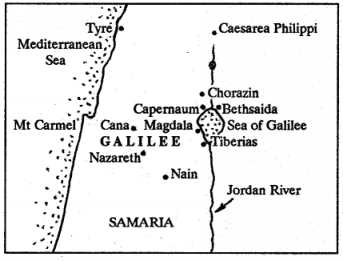
In New Testament times Galilee was a clearly defined region and a province of the Roman Empire. It fell within the sub-kingdom of Herod Antipas (Mar 6:14-29; Luk 3:1; Luk 23:6-12) and his successor Herod Agrippa I (Act 12:20), but was under the overall rule of Rome. (For details see HEROD.)
The population of Galilee was a mixture of Jews and Gentiles, and this was one reason why the strict Jews of Judea despised the Galilean Jews (Joh 7:41; Joh 7:52). Added to this, Galilee was cut off from Judea by the territory of the Samaritans, a people of mixed blood and mixed religion who hated, and were hated by, the Jews (Luk 9:51-56; Joh 4:3-4; Joh 4:9).
Jesus grew up in Galilee (see NAZARETH) and spent most of the three and a half years of his public ministry there (Mat 2:22-23; Mat 3:13; Mat 4:12-16; Mat 4:23; Mat 15:29; Mat 17:22; Mat 19:1; Mat 21:11; Mat 26:32; Mat 26:69; Mat 27:55; Mat 28:7; Mat 28:16). Towns of Galilee that feature in the story of Jesus are Caesarea Philippi in the far north (Mat 16:13), Capernaum, Bethsaida, Chorazin, Magdala and Tiberias around the Lake of Galilee (Mat 4:13; Mat 11:21-23; Mat 27:56; Mar 6:45; Joh 6:17; Joh 6:23), and Nazareth, Cana and Nain in the hill country south of the lake (Luk 2:39; Luk 4:16; Luk 7:11; Joh 2:1-11; Joh 4:46; Joh 21:2). (For further details see separate entries under the names of these towns. For details of the physical features of Galilee see PALESTINE.)