
This animal was one of the clean beasts, and used in the Jewish church both for food and sacrifice. (Lev. 16. 5.) and the veil of the tabernacle was made of the hair of the goat. (Exod. xxv. 4.) But in the after ages of the church, the goat became figurative of the ungodly. And, perhaps, this arose from the calves and devils (literally goats), which Jeroboam set up for idol worship. (See 2 Cor. xi 14, 15.) Hence the Lord is represented by the prophet, as punishing the goats; that is, the worshippers of those dunghill idols. (Zech. x.3.)Hence also another prophet exclaims, "Hell from beneath is moved for thee, to meet thee at thy coming; it stirreth up the dead for thee, even all the chief ones of the earth;" The margin of the Bible hath it, even all the great goats of the earth; meaning the princes and great men. (Isa. 14. 9.) Hence our blessed Lord, in describing the solemn events of the last day, describes the wicked and ungodly as goats on his left hand, destined for destruction. (Matt. xxv. 33.) I have been more particular on this subject, in order to explainwherefore it is, that as the goat was by the Lord’s own appointment of the clean beasts both for good and sacrifice, that the Lord Jesus and his servant should make the goat a figure, or emblem, of the reprobate, and as distinguished from the sheep of his fold. And this the account of the goat set up as an idol by Jeroboam, and sacrificed to by the people in direct opposition to the God of Israel, very fully explains.
While I am upon this subject of the goat, it may not be unacceptable to the pious reader, to say a few words on the very striking ceremony appointed by the Lord of the scape goat on the great day of atonement. I need not describe the ceremony itself, for the reader will find a full account thereof, Lev. 16. There is somewhat most wonderfully interesting when this service of the scape goat is considered with an eye to Christ. The high priest laying both his hands on the head of the beast, and making a confession over him of allthe iniquities of the children of Israel, with all their transgressions in all their sins, as if transferring both the sin and guilt from themselves to another; certainly this had no meaning but in reference to the Lord Jesus Christ; and certainly, beheld in allusion to him, the whole service becomes plain and obvious. The Suretyship of Christ is hereby most blessedly shadowed forth; and both the law of God and the justice of God in that Suretyship evidently satisfied. Indeed, the type falls short of the thing itself in one point; for thescape goat was altogether passive in the act, but Christ, in his voluntary surrender of himself, manifested a willing offering. On the part of God the Father, the type, and the thing signified by the type, became one and the same. For though it is out of any creature’s power, to make a transfer of sin to another, yet it is not beyond the sovereignty and prerogative of God. And when the Lord Jesus, at the call of God, stood up from everlasting as the covenant Head of his people, his voluntary offering gave efficacy to the whole. In this he undertook to answer for all their sins, and to do away the whole of their guilt and pollution by the sacrifice of himself. Hence JEHOVAH is represented by the prophet, as "laying upon him the iniquity of us all." (Isa. l3: 6.) And Jesus is no less represented as saying, "Lo, I come to do thy will, O God." (Ps. xl. 7, 8.) I would just ask the reader, whether such a view doth not bring comfort to the soul, in thus beholding the transfer of sin, with all its defilement, taken from our poor nature, and put upon the person of Christ. How blessed must it have been in God the Holy Ghost, to have had the representation made of it in an age so distant from the thing itself, as if to testify the Lord’s approbation of it in the people’s safety. Though the Scriptures are silent upon it, yet the history of the scape goat among the Jews, has handed down by tradition the account, which is not uninteresting. It is said, that when the two goats were led into the inner court of the temple and presented to the high priest, according to the Lord’s appointment of casting lots, (Lev. 16. 8.) the scape goat, or as the margin of the Bible expresseth it, the Azazel, had then a fillet, or a narrow piece of scarlet, fastened to its head, which soon became white. And hence the prophet is supposed to allude when saying, "though your sins be as scarlet, they shall be white as snow; though they be red like crimson, they shall be as wool." (Isa. i. 18.) The scape goat was then sent away, by the hand of some fit man, or as the margin of the Bible hath it, by a man of opportunity, into the wilderness. Some of theJews say, that the edge of the wilderness had a precipice where the Azazel fell over, and was dashed to pieces. But the wilderness which no man went through, and none inhabited, " carried with it the same idea, that "the iniquity of Israel when, sought for, there should be none; and the sins of Judah, and they should not be found." (Jer. 1. 20.) When the Lord puts away sin, in Scripture language it is said, "that he remembers it no more." (Heb. 8. 15. with Jer. xxxi. 34.)
3.
5.
The goat was one of the clean beasts which the Israelites might both eat and offer in sacrifice. The kid,
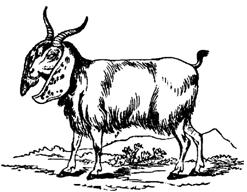
Syrian Goat
The races of this animal either known to or kept by the Hebrew people were probably—1. The domestic Syrian long-eared breed, with horns rather small and variously bent; the ears longer than the head, and pendulous; hair long, often black;—2. The Angora, or rather Anadoli breed of Asia Minor, with long hair, more or less fine;—3. The Egyptian breed, with small spiral horns, long brown hair, very long ears;—4. A breed from Upper Egypt without horns, having the nasal bones singularly elevated, the nose contracted, with the lower jaw protruding the incisors, and the female with udder very low and purse-shaped. This race, the most degraded by climate and treatment of all the domestic varieties, is clad in long coarse hair, commonly of a rufous brown color, and so early distinct, that the earlier monuments of Egypt represent it with obvious precision.
The natural history of the domestic goat requires no illustration in this place, and its economic uses demand only a few words. Notwithstanding the offensive lasciviousness which causes it to be significantly separated from sheep, the goat was employed by the people of Israel in many respects as their representative. It was a pure animal for sacrifice (Exo 12:5), and a kid might be substituted as equivalent to a lamb: it formed a principal part of the Hebrew flocks; and both the milk and the young kids were daily articles of food. Among the poorer and more sober shepherd families, the slaughter of a kid was a token of hospitality to strangers, or of unusual festivity; and the prohibition, thrice repeated in the Mosaic law, ’not to seethe a kid in its mother’s milk’ (Exo 23:19; Exo 34:26; and Deu 14:21), may have originated partly in a desire to recommend abstemiousness, which the legislators and moralists of the East have since invariably enforced with success, and partly with a view to discountenance a practice which was connected with idolatrous festivals, and the rites they involved. It is from goatskins that the leathern bottles to contain wine and other liquids are made in the Levant. For this purpose, after the head and feet are cut away, the case or hide is drawn off the carcass over the neck, without opening the belly; and the extremities being secured, it is dried with the hair in or outside, according to the use it is intended for. The old worn-out skins are liable to burst: hence the obvious propriety of putting new wine into new bottles (Mat 9:17). Harmer appears to have rightly referred the allusion in Amo 3:12, to the long-eared race of goats: ’As the shepherd taketh out of the mouth of the lion two legs or a piece of ear, so shall the children of Israel be taken out that dwell in Samaria and Damascus.’
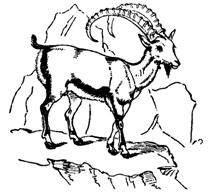
Wild Goat of Sinai
Beside the domestic goats. Western Asia is possessed of one or more wild species—all large and vigorous mountain animals, resembling the ibex or bouquetin of the Alps. Of these, Southern Syria, Arabia, Sinai, and the borders of the Red Sea, contain at least one species, known to the Arabs by the name of Beden or Beddan, and Taytal. We take this animal to be that noticed in 1Sa 24:2; Job 39:1; Psa 104:18; Pro 5:19. The male is considerably taller and more robust than the larger he-goats, the horns forming regular curves backwards, and with from 15 to 24 transverse elevated cross ridges, being sometimes near three feet long, and exceedingly ponderous: there is a beard under the chin, and the fur is dark brown; but the limbs are white, with regular black marks down the front of the legs, with rings of the same color above the knees and on the pasterns. The females are smaller than the males, more slenderly made, brighter rufous, and with the white and black markings on the legs not so distinctly visible. This species live in troops of 15 or 20, and plunge down precipices with the same fearless impetuosity which distinguishes the ibex. Their horns are sold by the Arabs for knife-handles, etc.; but the animals themselves are fast diminishing in number.
A well-known animal, resembling the sheep, but covered with hair instead of wool. Large flocks of them were kept by the Jews, Gen 27:9 1Sa 25:2 2Ch 17:11 . They were regarded as clean for sacrifice, Exo 12:5 Lev 3:12 Num 15:27 ; and their milk and the young kids were much used for food, Deu 14:4 Jdg 6:19 Pro 27:27 Luk 15:29 . The common leather bottles were made of their skins. Several kinds of goats were kept in Palestine: one kind having long hair, like the Angora, and another, long and broad ears. This kind is probably referred to in 1Sa 3:12, and is still the common goat of Palestine.\par Herodotus says, that at Mendes, in Lower Egypt, both the male and female goat were worshipped. The heathen god Pan was represented with the face and thighs of a goat. The heathen paid divine honors also to real goats, as appears in the table of Isis. The abominations committed during the feast of these infamous deities cannot be told.\par WILD GOATS are mentioned in 1Sa 24:2 Job 39:1 Psa 104:18 . This is doubtless the Ibex, or mountain goat, a large and vigorous animal still found in the mountains in the peninsula of Sinai, and east and south of the Dead Sea.\par These goats are very similar to the bouquetin or chamois of the Alps. They feed in flocks of a score or two, wit one of their number acting as a sentinel. At the slightest alarm, they are gone in an instant, darting fearlessly over the rocks, and falling on their horns from a great height without injury. Their horns are two or three feet long, and are sold by the Arabs for knife-handles, etc. For SCAPEGOAT, see EXPIATION.\par
Goat. There appear to be two or three varieties of the common goat, Hircus agagrus, at present bred in Palestine and Syria, but whether they are identical with those which were reared by the ancient Hebrews, it is not possible to say.
The most marked varieties are the Syrian goat, Capra mammorica, and the Angora goat, Capra angorensis, with fine long hair. As to the "wild goats," 1Sa 24:2; Job 39:1; Psa 104:18, it is not at all improbable that some species of ibex is denoted.
1. Wild goat,
2. The goat deer, or else gazelle,
3. The
4.
5.
an animal of the genus Capra, found in every part of the world, and easily domesticated. There are various names or appelations given to the goat in the original text of the Scriptures. SEE CATTLE.
1. Most frequently
The races either known to or kept by the Hebrew people were probably, 1. The domestic Syrian long-eared breed, with horns rather small and variously bent; the ears longer than the head, and pendulous; hair long, often black. 2. The Angora, or rather Anadoli breed of Asia Minor, with long hair, more or less fine. 3. The Egyptian breed, with small spiral horns, long brown hair, very long ears. 4. A breed from Upper Egypt, without horns, having the nasal bones singularly elevated, the nose contracted, with the lower jaw protruding the incisors, and the female with udder very low, and purse-shaped.
Besides the domestic goats, Western Asia is possessed of one or more wild species — all large and vigorous mountain animals, resembling the ibex or bouquetin of the Alps. Of these, Southern Syria, Arabia, Sinai, and the borders of the Red Sea contain at least one species, known to the Arabs by the name of Beden or Beddan, and Taytal — the Capra Jaela of Ham. Smith, and Capra Sinaitica of Ehrenberg. We take this animal to be that noticed under the name of
From Lev 17:7, it appears that the rebellious Hebrews, while in the desert, fell into the idolatrous worship of the he-goat (rendered "devils," comp. 2Ch 11:15), after the example of the Egyptians, under whose influences they had grown up. Herodotus says (1:46) that at Mendes, in Lower Egypt, both the male and female goat were worshipped; that the god Pan had the face and thighs of a goat; not that they believed him to be of this figure, but because it had been customary to represent him thus. They paid divine honors, also, to real goats, as appears in the table of His. The Sairim (" wild beasts") of Isa 13:21 were, according to the popular notion, supposed to be wild men SEE APE in the form of he-goats, living in unfrequented, solitary places, and represented as dancing and calling to each other. — Calmet. SEE SPECTRE.
A he-goat was the symbol of the Macedonian empire in the prophetic vision of Daniel (Dan 8:5) — a goat that had a notable born between his eyes. It is interesting to know that this was the recognized symbol of their nation by the Macedonians themselves.
There are coins of Archelaus, king of Macedon (B.C. 413), having as their reverse a one-horned goat; and there is a gem in the Florentine collection, a on which are engraved two heads united at their occiputs, the one that of a ram, the other that of a one-horned goat. By this is expressed the union of the Persian and Macedonian kingdoms, and Mr. T. Combe, who gives us the information, thinks that "it is extremely probable that the gem was engraved after the conquest of Persia by Alexander the Great." SEE MACEDDONIA.
Goat. There are many varieties of the goat; four were most likely known to the Hebrews: 1. The domestic Syrian long-eared breed, with horns rather small and variously bent; the ears longer than the head, and pendulous; hair long, often black. 2. The Angora, or rather Anadolia breed of Asia Minor, with long hair, more or less fine. 3. The Egyptian goat, with small spiral horns, long brown hair, and very long ears. 4. A goat of Upper Egypt without horns, having the nasal bones singularly elevated, the nose contracted, with the lower jaw protruding the incisors. Gen 15:9. Several words are used in Hebrew for this animal. Goats constituted a large part of Hebrew flocks; for the milk and the flesh were articles of food. Gen 27:9; 1Sa 25:2; Pro 27:27. As clean animals they were used in sacrifice, Exo 12:5; Heb 9:13; and their hair was manufactured into a thick cloth. Of this, one of the coverings of the tabernacle was made, Exo 25:4; Exo 26:7; and it was on this material that in all probability Paul was employed. Act 18:3. There is a Hebrew word also which occurs four times, rendered thrice "wild goats." 1Sa 24:2; Job 39:1; Psa 104:18, and once "roe," R. V. "doe," Pro 5:19. This, there can be little doubt, is the ibex, which is specially formed for climbing, its forelegs being shorter than the hinder. The word translated "devils," R. V. "he-goats," in Lev 17:7; 2Ch 11:15, is one of the ordinary terms for a goat, signifying hairy. This animal is sometimes introduced in Scripture symbolically, as in Dan 8:5; Dan 8:21; comp. Mat 25:32-33.
The well-known animal, regarded as clean under the Levitical economy, and having a large place in the sacrifices. Goats formed an important item in the property of the patriarchs. In Daniel’s prophecy of the kingdoms, that of Greece was compared to a ’rough he goat,’ but with a notable horn between his eyes. Dan 8:5; Dan 8:8; Dan 8:21. The goats, in the sessional judgement of the living nations, represent the lost, in contrast to the saved, who are compared to sheep. Mat 25:32-33. THE WILD GOATS were larger animals and lived on the mountains. 1Sa 24:2; Job 39:1; Psa 104:18.
GOAT.—See Animals, p. 63b.
By: Emil G. Hirsch I. M. Casanowicz
—Biblical, Data:
"'Ez" is the generic name for both sexes. Special terms for the he-goat: "'attud," Gen. xxxi. 10; Ps. l. 9, etc.; "ẓafir," Ezra viii. 35; II Chron. xxix. 21; "sa'ir," Gen. xxxvii. 31; Lev. iv. 23, etc.; and "tayish," Gen. xxx. 35, etc. "Seh," usually meaning "sheep," is also used for "goat" in Ex. xii. 5 and Deut. xiv. 4, and both sheep and goats are comprised under "ẓon" (small cattle), in contrast to "baḳar" (large cattle). For the young goat, or kid, "gedi" is used in Gen. xxvii. 9, Judges vi. 19, etc., and the feminine form, "gediyyah," in Cant. i. 8.
Of the domesticated goat, Capra hircus, to which the names generally refer, the chief breed occurring in Palestine is the mamber (from "Mamre"), or Syrian goat, with long ears and stout horns. The mohair, or Angora goat, with silky hair, is seldom met with in Palestine proper. The wild or mountain goat, Capra agagrus, occurring south of the Lebanon, is probably intended by "aḳḳo" (wild goat; Deut. xiv. 5 among the clean animals) and "ya'el" (A. V. "roe," R. V. "doe"), whose fondness for rocky heights is referred to in I Sam. xxiv. 3; Ps. civ. 18; Job xxxix. 1.
Usefulness.
The goat formed an important part of Palestinian husbandry (Gen. xxx. 32, xxxii. 15; I Sam. xxv. 2; Prov. xxvii. 26; Cant. iv. 1, vi. 5). Its milk and flesh were staple articles of food (Prov. xxvii. 27); the kid was considered a delicacy (Gen. xxvii. 9, 14; Judges vi. 19, xiii. 15; etc.; comp. also Ex. xxiii. 19, xxxiv. 26; Deut. xiv. 21, the prohibition against seething the kid in the milk of its mother; see Dietary Laws); the hair of the goat was woven into curtains and tent-covers (Ex. xxvi. 7, xxxv. 26, etc.), or used for stuffing cushions (I Sam. xix. 13); its skin was employed for garments (Heb. xi. 37; comp. Gen. xxvii. 16) and for bottles (Gen. xxi., 14; Josh. ix. 5; comp. Matt. xi. 17). The goat entered largely into the sacrificial ritual (Lev. iii. 12; iv. 23, 28; v. 6; comp. Gen. xv. 9); on the Day of Atonement a "scapegoat" carried away the sins of the people to Azazel (Lev. xvi. 10 et seq.). The local name "En Gedi" (I Sam. xxiv. 2; at present 'Ain Jidi) attests the frequency of the goat in Palestine.
Like the ram, the he-goat as the leader of the flock (comp. Prov. xxx. 31) symbolizes the rulers and rich in contrast to the poor and common people (Isa. xiv. 9; Jer. l. 8, li. 40; Ezek. xxxiv. 17; Zech. x. 3; comp. Dan. viii. 5); and, like the gazelle, the female wild goat, "ya'alah," recalls the grace of woman (Prov. v. 19).
—In Rabbinical Literature:
The Talmud ascribes to the goat great strength, endurance (Beẓah 25b), and pluck (Shab. 77b). Job's goats killed the wolves which assailed them (B. B. 15b), and Ḥanina's would bring bears upon their horns (Ta'an. 25a, and parallels). Goat's milk fresh from the udder relieves pains of the heart (Tem. 15b), and that of a white goat possesses especial curative properties (Shab. 109b). Against diseases of the spleen the same organ of a goat which has not yet borne young is recommended (Giṭ. 69b). Among the manifold uses of the goat may be mentioned, in addition to those given above, the making of its horns and hoofs into vessels (Ḥul. 25b). The blood of the he-goat is more similar to human blood than is that of any other animal (Gen. R. lxxxiv. 19). "Goat of  " in Ḥul. 80a may refer to a forest goat, or to a mountain goat ("bale" in Persian = height).
Bibliography:
-
Tristram, Natural History of the Bible, pp. 88-97;
-
L. Lewysohn, Zoologie des Talmuds, pp. 123-126.
GOAT.—(1) ‘çz, used generically, both sexes, Gen 30:35, Exo 12:5, Ezr 6:17 etc. (2) tsâphîr (root ‘to leap’), ‘he-goat,’ 2Ch 29:21, Ezr 8:35, Dan 8:5; Dan 8:8. (3) sâ‘îr (root ‘hairy’), usually a he-goat, e.g. Dan 8:21 ‘rough goat’; se‘îrah, Lev 5:6 ‘she-goat’; se‘îrîm, tr.
Wild goat.—(1) yâ‘çl (cf. proper name Jael), used in pl. ye’çlîm, 1Sa 24:2, Psa 104:18, and Job 39:1. (2) ’akkô, Deu 14:5. Probably both these terms refer to the wild goat or ibex, Capra beden, the beden or ‘goats of Moses’ of the Arabs. It is common on the inaccessible cliffs round the Dead Sea, some of which are known as jebel el-beden, the ‘mountains of the wild goats’ (cf. 1Sa 24:2). The ibex is very shy, and difficult to shoot. Though about the size of an ordinary goat, its great curved horns, often 3 feet long, give it a much more imposing appearance.
E. W. G. Masterman.
1. Names
The common generic word for “goat” is
2. Wild Goats
The original of our domestic goats is believed to be the Persian wild goat or pasang, Capra aegagrus, which inhabits some of the Greek islands, Asia Minor, Syria, Mesopotamia, Persia, Afghanistan, and Northwestern India. It is called
3. Domestic Goats
Domestic goats differ greatly among themselves in the color and length of their hair, in the size and shape of their ears, and in the size and shape of their horns, which are usually larger in the males, but in some breeds may be absent in both sexes. A very constant feature in both wild and domestic goats is the bearded chin of the male. The goats of Palestine and Syria are usually black (Son 4:1), though sometimes partly or entirely white or brown. Their hair is usually long, hanging down from their bodies. The horns are commonly curved outward and backward, but in one very handsome breed they extend nearly outward with slight but graceful curves, sometimes attaining a span of 2 ft. or more in the old males. The profile of the face is distinctly convex. They are herded in the largest numbers in the mountainous or hilly districts, and vie with their wild congeners in climbing into apparently impossible places. They feed not only on herbs, but also on shrubs and small trees, to which they are most destructive. They are largely responsible for the deforested condition of Judea and Lebanon. They reach up the trees to the height of a man, holding themselves nearly or quite erect, and even walk out on low branches.
4. Economy
Apart from the ancient use in sacrifice, which still survives among Moslems, goats are most valuable animals. Their flesh is eaten, and may be had when neither mutton nor beef can be found. Their milk is drunk and made into cheese and
5. Religious and Figurative
Just as the kid was often slaughtered for an honored guest (Jdg 6:19; Jdg 13:19), so the kid or goat was frequently taken for sacrifice (Lev 4:23; Lev 9:15; Lev 16:7; Num 15:24; Ezr 8:35; Eze 45:23; Heb 9:12). A goat was one of the clean animals (
(ôñÜãïò)
The Greek word signifies a ‘he-goat’ (Lat. hircus), and is used in the Septuagint as the equivalent of the Heb. words òַúּåּã, öָôִéø, úַּéִùׁ (all = ‘he-goat’). The only NT references to the ‘goat’ outside the Gospels are in the Epistle to the Hebrews (Heb_9:12-13; Heb_9:19; Heb_10:4). In Heb_9:12; Heb_9:19 it is associated with calves (i.e. bullocks), and there is doubtless an allusion in these two passages to the sacrificial rites of the Day of Atonement. On this occasion, the high priest offered up a bullock as a sin-offering for himself (Lev_16:11), and a goat as a sin-offering for the people (Lev_16:15). The usual phrase to designate sacrifices in general is used in Heb_9:13; Heb_10:4, ‘bulls and goats’ or ‘goats and bulls.’
The general meaning of Heb_9:12 ff. is quite clear. The writer says: ‘if-and you admit this-the blood of goats and bullocks, as on the Day of Atonement, could sanctify unto the cleanness of the flesh, how much more could the Blood of Christ, the Divine-Human sacrifice, cleanse the conscience from dead works to serve the living God!’
In Heb_10:4 the writer abandons his rhetorical style and categorically asserts that ‘it is impossible for the blood of bulls and goats to take away sins.’ He here uses the general term for sacrifices, and thereby denies that any of the sacrifices of the old Law ever did or ever could ‘take away sins.’
Many different breeds of domesticated goats are known in Syria, the most common of which is the mamber or ordinary black goat. These animals attain a large size, and pendent ears about a foot long are their most characteristic feature. Their peculiar ears are apparently alluded to in Amo_3:12. They generally have horns and short beards. Another breed found in N. Palestine is the angora, which has very long hair. Goats supplied most of the milk of Palestine (cf. Pro_27:27), and the young were often killed for food, being regarded as special delicacies, as they are to-day (cf. Gen_27:9, Luk_15:29). Their long silky hair was woven into curtains, coverings of tents, etc. (cf. Exo_35:26, Num_31:20), and as goat’s-hair cloth, called cilicium, was made in the province of which Tarsus, the birth-place of St. Paul, was the capital, and was exported thence to be used in tent-making, it is reasonable to suppose that the Apostle was engaged in this very trade (Act_18:3). Their skins were sometimes used as clothing, and doubtless the hairy mantle of the prophets (cf. Zec_13:4) was made of this material (cf. also Heb_11:37), but they were more often converted into bottles. The early inhabitants of Palestine (cf. Gen_21:19, Jos_9:4, 1Sa_25:18, Mat_9:17, Mar_2:22, Luk_5:37), just like the modern Bedouins, utilized the skins of their cattle and their flocks for the purpose of storing oil, wine, milk, or water, as the case might be. The animals whose skins were generally chosen for the purpose were the sheep and the goat as at the present day, while the skin of the ox was used for very large bottles. The legs, or at all events the lower part of the legs, together with the head, are first removed, the animal is next skinned from the neck downwards, great care being taken to avoid tearing the skin; all apertures are then carefully closed, and the neck is fitted with a leather thong which serves as a cork.
In view of the numerous uses which the goat has been made to subserve, it is not surprising to find that it was highly valued in ancient times even as it is now. A large part of the wealth of Laban and of the wages he paid to Jacob consisted of goats, while ‘a thousand goats’ is mentioned as one of the principal items in Nabal’s property (1Sa_25:2). They thrive in hilly and scantily watered districts, where they are much more abundant than sheep, and pasture where there is much brush-wood, the luxuriant grasses of the plains being ‘too succulent for their taste’ (Tristram in Smith’s Dict. of the Bible 2 1200b). They are largely responsible for the barrenness of the hills, and the general absence of trees in Palestine.
Literature.-H. B. Tristram, Natural History of the Bible10, 1911, p. 88ff.; Smith’s Dict. of the Bible , s.v.; SWP [Note: WP Memoirs of Survey of Western Palestine.] vii. 6; E. C. Wickham, The Epistle to the Hebrews, 1910, p. 68; B. F. Westcott, The Epistle to the Hebrews2, 1892, p. 258ff.; R. Lyddeker, in Murray’s Dict. of the Bible , s.v.; Hasting's Dictionary of the Bible (5 vols) ii. 195f.; Hastings’ Single-vol. Dictionary of the Bible , p. 298f.; Encyclopaedia Biblica ii. 1742ff.; J. C. Geikie, The Holy Land and the Bible, 1903, pp. 40, 80-85, 113.
P. S. P. Handcock.
Goat. In Bible times, Hebrew shepherds treasured the goat because it was such a useful animal. They wove its hair into a type of rough cloth. They drank the goat’s milk which is sweet and more nutritious than cow’s milk-- ideal for making cheese. They even used goatskin bottles to transport water and wine. When the hide of these containers wore thin, they leaked and had to be patched (Jos 9:4; Mat 9:17).
Goats often grazed with sheep in mixed flocks. Unlike their gentle and helpless cousins, goats were independent, willful, and curious. Bible writers sometimes used goats to symbolize irresponsible leadership (Jer 50:8; Zec 10:3). In Jesus’ parable of the Great Judgment (Mat 25:32-33), the goats represented the unrighteous who could not enter His kingdom.
Goats were often sacrificed in the worship system of ancient Israel. In an early ritual, the Hebrews used two goats. They sacrificed one, sprinkling its blood upon the back of the other. This scapegoat was then sent into the wilderness, symbolically bearing the sins of the people (Lev 16:10).
Young goats are referred to as kids in the Bible (Gen 27:9; Gen 27:16; Num 7:87). The wild goat of Palestine is known as the ibex (Deu 14:5), (RSV, NIV; mountain goat, NKJV; pygarg, KJV; satyr, KJV, RSV).