
See Mount Hebron.
one of the most ancient cities in the world; for it was built seven years before Zoan, the capital of Lower Egypt, Num 13:22. Now, as the Egyptians gloried much in the antiquity of their cities, and their country was indeed one of the first that was peopled after the dispersion of Babel, it may be from hence concluded that it was one of the most ancient. Some think it was founded by Arba, one of the oldest giants in Palestine; for which reason it was called Kirjath-arba, or Arba’s city, Jos 14:15; which name was afterward changed to that of Hebron, Jos 15:13. Arba was the father of Anak; and from Anak the giants, called Anakim, took their name, who were still dwelling at Hebron when Joshua conquered the land of Canaan. When it was first called Hebron, is uncertain; some think, not till it was conquered by Caleb, and that he called it so from his son of that name. But Calmet is of opinion that the name of Hebron is more ancient; and that Caleb, to do honour to his son, named him after this ancient and celebrated place. Hebron was situated upon an eminence, twenty miles southward from Jerusalem, and twenty miles north from Beersheba. Abraham, Sarah, and Isaac were buried near Hebron, in the cave of Machpelah, or the double cave, which Abraham bought of Ephron, Gen 23:7-9. Hebron was the allotment of Judah. The Lord assigned it for the inheritance of Caleb, Jos 14:13; Jos 10:3; Jos 10:23; Jos 10:37. Joshua first took Hebron, and killed the king, whose name was Hoham. But afterward Caleb again made a conquest of it, assisted by the troops of his tribe, and the valour of Othniel, Jdg 1:12-13. It was appointed to be a dwelling for priests, and declared to be a city of refuge, Jos 21:13. David, after the death of Saul, fixed the seat of his government there, 2Sa 2:2-5. At Hebron, Absalom began his rebellion, 2Sa 15:7-8, &c. During the captivity of Babylon, the Edomites having invaded the southern parts of Judea, made themselves masters of Hebron; hence Josephus sometimes makes it a part of Edom. Here Zacharias and Elizabeth are believed to have dwelt; and it is supposed to have been the birth place of John the Baptist. Hebron is now called El Hhalil; though not a town of large dimensions, it has a considerable population. According to Ali Bey, it contains about four hundred families of Arabs; but he does not notice either the Jews, who are numerous, or the Turks. He describes it as situated on the slope of a mountain, and having a strong castle. Provisions, he says, are abundant, and there is a considerable number of shops. The streets are winding, and the houses unusually high. The country is well cultivated, to a considerable extent. Hebron is computed to be twenty- seven miles south-west of Jerusalem.
He´bron, a town in the south of Palestine and in the tribe of Judah, 18 miles south from Jerusalem, in 31° 32′ 30″ N. lat., 35° 8′ 20″ E. long., at the height of 2664 Paris feet above the level of the sea. It is one of the most ancient cities existing, having, as the sacred writer informs us, been built ’seven years before Zoan in Egypt,’ and being mentioned even prior to Damascus (Num 13:22; Gen 13:18; comp. 15:2). Its most ancient name was Kirjath-arba, that is, ’the city of Arba,’ from Arba, the father of Anak and of the Anakim who dwelt in and around Hebron (Gen 23:2; Jos 14:15; Jos 15:3; Jos 21:11; Jdg 1:10). It appears to have been also called Mamre, probably from the name of Abraham’s Amoritish ally (Gen 23:19; Gen 35:27; comp. 14:13, 24). The ancient city lay in a valley; and the two remaining pools, one of which at least existed in the time of David, serve, with other circumstances, to identify the modern with the ancient site (Gen 37:14; 2Sa 4:12). Much of the life-time of Abraham, Isaac, and Jacob was spent in this neighborhood, where they were all entombed; and it was from hence that the patriarchal family departed for Egypt by the way of Beersheba (Gen 37:14; Gen 46:1). After the return of the Israelites, the city was taken by Joshua and given over to Caleb, who expelled the Anakim from its territories (Jos 10:36-37; Jos 14:6-15; Jos 15:13-14; Jdg 1:20). It was afterwards made one of the cities of refuge, and assigned to the priests and Levites (Jos 20:7; Jos 21:11; Jos 21:13). David, on becoming king of Judah, made Hebron his royal residence. Here he reigned seven years and a half; here most of his sons were born; and here he was anointed king over all Israel (2Sa 2:1-4; 2Sa 2:11; 1Ki 2:11; 2Sa 5:1; 2Sa 5:3). On this extension of his kingdom Hebron ceased to be sufficiently central, and Jerusalem then became the metropolis. It is possible that this step excited a degree of discontent in Hebron which afterwards encouraged Absalom to raise in that city the standard of rebellion against his father (2Sa 15:9-10). Hebron was one of the places fortified by Rehoboam (2Ch 11:10); and after the exile the Jews who returned to Palestine occupied Hebron and the surrounding villages (Neh 11:25).
Hebron is not named by the prophets, nor in the New Testament; but we learn from the first book of Maccabees, and from Josephus, that it came into the power of the Edomites who had taken possession of the south of Judah, and was recovered from them by Judas Maccabaeus. During the great war, Hebron was seized by the rebel Simon Giorides, but was recaptured and burnt by Cerealis, an officer of Vespasian. Josephus describes the tombs of the patriarchs as existing in his day; and both Eusebius and Jerome, and all subsequent writers who mention Hebron down to the time of the Crusades, speak of the place chiefly as containing these sepulchers. Among the Muslims it is still called el-Khulil, from the name which they give to Abraham, meaning ’the friend’ (of God).
Since the capture of Jerusalem by Saladin in 1187, Hebron has always remained in the possession of the Muslims. In the modern history of Hebron the most remarkable circumstance is the part which the inhabitants of the town and district took in the rebellion of 1834, and the heavy retribution which it brought down upon them. They held out to the last, and gave battle to Ibrahim Pasha near Solomon’s Pools. They were defeated; but retired and entrenched themselves in Hebron, which Ibrahim carried by storm, and gave over to sack and pillage. The town has not yet recovered from the blow it then sustained.
In the fourteenth century pilgrims passed from Sinai to Jerusalem direct through the desert by Beersheba and Hebron, and it continued to be occasionally visited by European travelers down to the latter part of the seventeenth century; but from that time till the present century it appears to have been little frequented by them.
The town of Hebron lies low down on the sloping sides of a narrow valley (of Mamre), chiefly on the eastern side, but in the southern part stretches across also to the western side. The houses are all of stone, high and well built, with windows and flat roofs, and on these roofs are small domes, sometimes two or three to each house. The shops are well furnished, better indeed than those of towns of the same class in Egypt, and the commodities are of a very similar description. The only display of local manufactures is the produce of the glass-works, for which the place has long been celebrated in these parts. Gates are placed not only at the entrance of the city, but in different parts of the interior, and are closed at night for the better preservation of order, as well as to prevent communication between the different quarters.
There are nine mosques in Hebron, none of which possess any architectural or other interest, with the exception of the massive structure which is built over the tombs of the patriarchs. This is esteemed by the Muslims one of their holiest places, and Christians are rigorously excluded from it. At the period, however, when the Holy Land was in the power of the Christians, access was not denied; and Benjamin of Tudela says that the sarcophagi above ground were shown to the generality of pilgrims as what they desired to see; but if a rich Jew offered an additional fee, ’an iron door is opened, which dates from the time of our forefathers who rest in peace, and with a burning taper in his hands the visitor descends into a first cave, which is empty, traverses a second in the same state, and at last reaches a third, which contains six sepulchers, those of Abraham, Isaac, and Jacob, and of Sarah, Rebekah, and Leah, one opposite the other. All these sepulchers bear inscriptions, the letters being engraved; thus upon that of Abraham: “This is the sepulcher of our father Abraham, upon whom be peace;” even so upon that of Isaac and all the other sepulchers.’ The identity of this place with the cave of Machpelah has not been called in question.
The court in which the mosque stands is surrounded by an extensive and lofty wall, formed of large stones, and strengthened by square buttresses. This wall is the greatest antiquity in Hebron, and even Dr. Robinson supposes that it may be substantially the same which is mentioned by Josephus, and by Eusebius and Jerome as the sepulcher of Abraham. Besides this venerable wall, there is nothing at Hebron bearing the stamp of antiquity, save two reservoirs for rain water outside the town. As these pools are doubtless of high antiquity, one of them is in all likelihood the ’pool of Hebron’ over which David hanged up the assassins of Ishbosheth (2Sa 4:12).
The present population of Hebron has not been clearly ascertained, but it probably amounts to about 5000. Most of the inhabitants are Muslims, of fierce and intolerant character. There are no resident Christians. The Jews amount to about one hundred families, mostly natives of different countries of Europe, who have emigrated to this place for the purpose of having their bones laid near the sepulchers of their illustrious ancestors. They have two synagogues and several schools.
The environs of Hebron are very fertile. Vineyards and plantations of fruit-trees, chiefly olive-trees, cover the valleys and arable grounds; while the tops and sides of the hills, although stony, are covered with rich pastures, which support a great number of cattle, sheep, and goats, constituting an important branch of the industry and wealth of Hebron. The hill country of Judah, of which it is the capital, is indeed highly productive, and under a paternal government would be capable of sustaining a large population. That it did so once, is manifest from the great number and extent of ruined terraces and dilapidated towns. It is at present abandoned, and cultivation ceases at the distance of two miles north of the town. The hills then become covered with prickly and other stunted trees, which furnish Bethlehem and other villages with wood.
One of the most ancient cities of Canaan, being built seven years before Tanis, the capital of Lower Egypt, Num 13:22 . It was anciently called Kirjath-arba, (see ARBA,) and Mamre, and was a favorite residence of the patriarchs Abraham, Isaac, and Jacob. Here too they were buried, Gen 14:13-24 23:2-19 35:27. Under Joshua and Caleb the Israelites conquered it from the Canaanites and Anakim, and it was afterwards made a Levitical city of refuge, Jos 14:13-15 15:13 21:11,13 Jdg 1:10,20 . It was David’s seat of government during the seven years when he reigned over Judah only, 2Sa 2:3 5:5. Here Absalom raised the standard of revolt, 2Sa 15:9,10 . It was fortified by Rehoboam, and is mentioned after the captivity, but not in the New Testament, Neh 11:25 . At present Hebron is an unwalled city of about 8,000 inhabitants, of whom some 600 are Jews, and the remainder Turks and Arabs. It lies in a deep valley and on the adjacent hillside, in the ancient hill-country of Judea, about 2,600 feet above the sea. Its modern name, El-khulil, the friend, is the same which the Moslems give to Abraham, "the friend of God;" and they profess to hold in their keeping the burial-place of the patriarchs, the "cave of Machpelah." It is covered by a small mosque, surrounded by a stone structure 60 feet high, 150 feet wide, and 200 feet long. Within this no Christian is permitted to enter; but it is evidently of very high antiquity, and may well be regarded as inclosing the true site of the ancient tomb. Other relics of antiquity exist in two stone reservoirs, the larger 133 feet square, and 21 feet deep. They are still in daily use; and one of them was probably the "pool in Hebron," above which David hung up the assassins of Ish-bosheth, 2Sa 4:12 . The city contains nine mosques and two synagogues. Its streets are narrow; the houses of stone, with flat roofs surmounted by small domes. Large quantities of glass lamps and colored rings are here manufactured; also leathern bottles, raisins, and dibs, or grape-syrup. The environs of the city are very fertile, furnishing the finest vineyards in Palestine, numerous plantations of olive and other fruit trees, and excellent pasturage. See ESHCOL, MAMRE.\par
He’bron. (alliance).
1. The third son of Kohath, who was the second son of Levi. Exo 6:18; Num 3:19; 1Ch 6:2; 1Ch 6:18; 1Ch 23:12. He was the founder of a family of Hebronites, Num 3:27; Num 26:58; 1Ch 26:23; 1Ch 30-31, or Bene-Hebron, (that is, sons of Hebron). 1Ch 15:9; 1Ch 23:19.
2. A city of Judah, Jos 15:54, situated among the mountains, Jos 20:7, 20 Roman miles south of Jerusalem, and the same distance north of Beersheba. Hebron is one of the most ancient cities in the world still existing; and in this respect, it is the rival of Damascus. It was a well-known town when Abraham entered Canaan, 3800 years ago. Gen 13:18.
Its original name was Kirjath-arba, Jdg 1:10, "the city of Arba"; so called from Arba, the father of Anak. Jos 15:13-14; Jos 21:13. Sarah died at Hebron; and Abraham then bought, from Ephron, the Hittite, the field and cave of Machpelah, to serve as a family tomb. Gen 23:2-20. The cave is still there, and the massive walls of the Haram or mosque, within which it lies, form the most remarkable object in the whole city.
Abraham is called, by Mohammedans, el-Khulil, "the Friend", that is, of God, and this is the modern name of Hebron. Hebron now contains about 5000 inhabitants, of whom some fifty families are Jews. It is picturesquely situated in a narrow valley, surrounded by rocky hills. The valley runs from north to south; and the main quarter of the town, surmounted by the lofty walls of the venerable Haram, lies partly on the eastern slope. Gen 37:14. Compare Gen 23:19.
About a mile from the town, up the valley, is one of the largest oak trees in Palestine. This, say some, is the very tree beneath which Abraham pitched his tent, and it still bears the name of the patriarch.
3. One of the towns in the territory of Asher, Jos 19:28, probably Ebdon or Abdom.
1. Third son of Kohath; younger brother of Amram, father of Moses and Aaron (Exo 6:18). The family of Hebronites sprang from him. In the 40th year of David’s reign 2,700 of them, at Jazer in Gilead, "mighty men of valor," superintended for the king the two and a half tribes "in matters pertaining to God and the king" (1Ch 26:30-32); Jerijah was their chief. Also Hashabiah and 1,700 Hebronites were officers "in all the Lord’s business and the king’s service" on the W. of Jordan.
2. 1Ch 2:42-43.
3. A city in the hill country of Judah, originally Kirjath (the city of) Arba (Jos 15:13; Jos 14:15). "Arba was a great man among the Anakims, father of Anak." (See Jos 21:11; Jdg 1:10.) Twenty Roman miles S. of Jerusalem, and twenty N. of Beersheba. Rivaling Damascus in antiquity. Built seven years before Zoan in Egypt (Num 13:22). Well known at Abram’s entrance into Canaan, 3,780 years ago (Gen 42:18). Hebron was the original name, changed to Kirjath Arba during Israel’s sojourn in Egypt, and restored by Caleb, to whom it was given at the conquest of Palestine (Gen 23:2; Jos 14:13-15). The third resting place of Abram; Shechem was the first, Bethel the second.
Near Hebron was the cave of Machpelah, where he and Sarah were buried. Now El Khalil, the house of "the friend" of God. Over the cave is now the mosque El Haran, from which all but Muslims are excluded jealously (though the Prince of Wales was admitted), and in which probably lie the remains of Abraham and Isaac, and possibly Jacob’s embalmed body, brought up in state from Egypt (Gen 50:13). Near it was the oak or terebinth, a place of pagan worship. Hebron was called for a time also Mamre, from Abram’s ally (Gen 23:19; Gen 35:27). It was made a Levite city of refuge (Jos 21:11-13). Still there is an oak bearing Abraham’s name, 23 ft. in girth, and covering 90 ft. space in diameter. In Hebron, David reigned over Judah first for seven and a half years (2Sa 5:5). Here Absalom set up the standard of revolt.
On the return from Babylon some of the children of Judah dwelt in Kirjath Arba (Neh 11:25). After various vicissitudes it fell into the Moslems’ hands in A.D. 1187, and has continued so ever since. It is picturesquely situated in a narrow valley running from N. to S. (probably that of Eshcol, whence the spies got the great cluster of grapes, Num 13:23), surrounded by rocky hills, still famed for fine grapes. S. of the town in the bottom of the valley is a tank, 130 ft. square by 50 deep. At the western end is another, 85 ft. long by 55 broad. Over the former probably David hung Ishbosheth’s murderers (2Sa 4:12).
4. A town in Asher; spelled in Hebrew differently from the former Hebron. Abdon is read in many manuscripts
Hebron (hç’bron), friendship. An ancient town of Palestine, about 20 miles south of Jerusalem, first called Kirjath-arba, or city of Arba. Jos 21:11; Jos 15:13-14; Jdg 1:10. It lies about 3000 feet above the level of the sea, and is one of the oldest towns in the world and mentioned before Damascus, Gen 13:18; Gen 14:13; and was built 7 years before Zoan, or Tanis, in Egypt, Num 13:22. Hebron is named about forty times in the Old Testament, but nowhere in the New. Abraham pitched his tent under the oaks of Mamre, near Hebron, Gen 13:18, and he bought the cave of Machpelah, as a burial-place. Gen 23:17-20. Hebron was taken by Joshua, Jos 10:36-37; Jos 12:10, and the region given to Caleb, Jos 14:13; was rebuilt and made a Levitical city and a city of refuge, Jos 20:7; Jos 21:11; was the royal residence of David, 2Sa 2:1-14; 1Ki 2:11; became the headquarters of the rebellious Absalom, 2Sa 15:10; was fortified by Rehoboam and repeopled after the captivity. 2Ch 11:10; Neh 11:25. A pool is still shown over which tradition says that David hung the murderers of Ishbosheth, and the tomb of Abner and Ishbosheth is also pointed out within an Arab house, and the mosque is known to conceal the noted cave of Machpelah, the burial-place of Abraham, Isaac, and Jacob and their wives except Rachel. The mosque is closed against visitors and guarded with the strictest care by the Moslems.
[Heb’ron]
1. City and district in which Abraham, Isaac, and Jacob dwelt, about twenty-two miles south of Jerusalem. There also Sarah died, and was buried in the cave of Machpelah, as were also Abraham, Isaac, Jacob, Rebekah, and Leah. Gen 49:31. The city was built seven years before ’Zoan in Egypt’ and had been formerly called KIRJATH-ARBA It was thus one of the most ancient cities known in the world. It was possessed by the Canaanites, until conquered by Joshua, and the city given to Caleb, in the portion of Judah. It afterwards became a city of refuge. David reigned in Hebron seven and a half years. Gen 13:18; Gen 23:2; Gen 23:19; Num 13:22; Jos 10:36; Jos 20:7; Jdg 1:10; Jdg 1:20; 2Sa 2:11, etc. There is still a large town on the spot, with some 18,000 inhabitants, called el Khulil, 31° 32’ N, 35° 6’ E. Also a mosque, said to be built over the cave of Machpelah. This is strictly guarded, very few being allowed to see the tomb.
2. City in Asher. Jos 19:28. Not identified.
3. Son of Kohath, a son of Levi. His descendants are called HEBRONITES. Exo 6:18; Num 3:19; Num 3:27; 1Ch 6:2; 1Ch 6:18; 1Ch 15:9; 1Ch 23:12; 1Ch 23:19.
4. One of the descendants of Caleb. 1Ch 2:42-43.
( ):
):
By: Gotthard Deutsch, M. Franco, Emil G. Hirsch, M. Seligsohn
1. A city of Asher, properly "Ebron"; called also Abdon.
2. Town in Palestine, about 17 miles southwest of Jerusalem; it has a population of 14,000, including 1,100 Jews—690 Sephardim and 410 Ashkenazim. In 1890 there was a Jewish population of 1,490, but it has been diminishing. Most of the Jews still live in a ghetto surrounded by walls, and known in Spanish as "El Cortijo" (the court). It consists of a maze of narrow and dark passages, into which the doorways open at distances of not more than three feet. In ancient times Hebron was knownas "Kirjath-arba," after its reputed founder, Arba, father of the Anakim (Josh. xiv. 15, xxi. 11). But according to modern exegetes the name is equivalent to the "city of the four." The patriarch Abraham resided at Hebron (Gen. xiii. 18, xiv. 13, xviii. 1, xxiii. 2), and purchased a cave known as the "Double Cave," where Sarah was buried. Abraham, Isaac, Jacob, and Leah were afterward buried there (see Burial; Caves in Palestine; Machpelah). Jacob went from Hebron to Egypt (Gen. xxxvii. 14, xlvi. 1); the spies visited the city (Num. xiii. 22). In the time of Joshua, Hoham, King of Hebron, was captured there and put to death by the Israelites. Hebron and its territory were at first given to Caleb (Josh. xiv. 6 et seq., xv. 13; Judges i. 20), and then to the Levites of the family of Kohath; it ultimately became one of the six cities of refuge (Josh. xx. 7). David lived there until the conquest of Jerusalem, and was there anointed as king (II Sam. ii. 1, 11; iii. 2 et seq.; v. 1 et seq.). Absalom's revolt began there (II Sam. xv. 9 et seq.); Rehoboam fortified the city (II Chron. xi. 10).Hebron was one of the towns which possessed a Jewish community after the return from Babylon (Neh. xi. 25), but the Idumeans appear to have afterward acquired it, since they were expelled by Judas Maccabeus (I Macc. v. 65). Occupied by the Romans, it was taken by Simon, son of Gioras, one of the leaders of the insurrection; but the Roman general Cerealis retook it by storm, killed the garrison, and burned the city (Munk, "La Palestine," p. 57). Jews did not inhabit Hebron after the destruction of the Temple, nor under the Romans, Byzantines, Arabs, or Crusaders. Benjamin of Tudela found only a single Jew (1171) at St. Abraham, as Hebron was called by the Crusaders. He asserts, however, that the Church of St. Abraham had been a synagogue under the Turkish rule. Forty years later R. Samuel bar Shimshon, who explored Palestine in 1209, makes no mention of Jews in Hebron.
The Modern Community.
Local tradition attributes the foundation of the modern community to Malkiel Ashkenazi (1450?), in whose honor a service is held every year on the anniversary of his death. (Azulai, "Shem ha-Gedolim," p. 88). Fifty years afterward, however, it was difficult to form a "minyan" (quorum). The following were chief rabbis of Hebron: Israel Ẓebi (1701-31); Abraham Castel (1757); Aaron Alfandari (1772); Mordecai Ruvio (c. 1785); David Melamed (c. 1789); Eliakim (end of 18th cent.); Ḥayyim ha-Levi Polacco (c. 1840); Hai Cohen (1847-52); Moses Pereira (1852-64); Elia Sli-. man Mani(1864-78); Raḥamim Joseph Franco (1878-1901); Hezekiah Medini (former chief rabbi of Karasu-Bazar in the Crimea; known as the "Ḥakam Bashi Wakili"; acting chief rabbi since 1901).
General View of Hebron.(From a photograph by the American Colony, Jerusalem.)
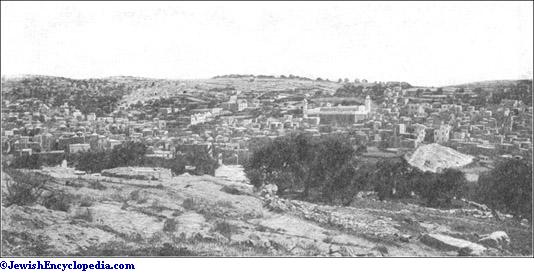
Hebron possesses four synagogues within the ghetto and four batte ha-midrash without. The oldest synagogue, that of Abraham Abinu, is supposed to date back three centuries. It was restored in 1738 and enlarged in 1864. The others are Keneset Eliyyah Mani (like the former, Sephardic), and two Ashkenazic. There are three yeshibot, the oldest having been founded by Israel Ẓebi (d. 1731); the second was formed by the union of four older yeshibot. It possesses the library of Vivas, a native of Leghorn, and is very rich in Spanish works. Hebron possesses four Talmud Torahs for Sephardim and one for Ashkenazim. There are three mutual-aid societies and a free dispensary. The Sephardic community is administered by the chief rabbi and a council of seven members; the Ashkenazic by the chief rabbi and a council of three. Most of the Jews are supported by the "ḥaluḳḳah," but there are a few carpenters and shoemakers. Among the antiquities are the Double Cave, revered by the Mohammedans; the ruins of Abraham's house; the tombs of Gad, Nathan the prophet, Abner (David's commander-in-chief), and others. The modern name of the town isAl-Khalil (lit. "the friend" [i.e., of God], a name by which Abraham was known; comp. Isa. xli. 8).
Numerous rabbinical authors have lived at Hebron, including Elijah de Vidas (1525), author of "Reshit Ḥokmah"; Solomon Edni (1622), author of "Meleket Shelomoh"; Moses ha-Levi (1668), author of "Yede Mosheh"; Israel Ẓebi (1731), author of "Urim Gedolim"; Abraham Conque (1740), author of "Abaḳ Derakim"; Ḥayyim Abraham Israel Ẓebi (1776), author of "Be'er Mayim Ḥayyim"; Aaron Alfandari (1772), author of "Yad Aharon" and "Merkebet ha-Mishneh"; Mordecai Ruvio (1785), author of "Shemen ha-Mor"; Judah Divan (1792), author of "Zibḥe Shelamim"; Elijah Sliman Mani (d. 1878), author of "Kisse Eliyahu"; Raḥamim Joseph Franco (d. 1901), author of "Sha'are Raḥamim"; Hezekiah Medini, author of "Sedeh Ḥemed."
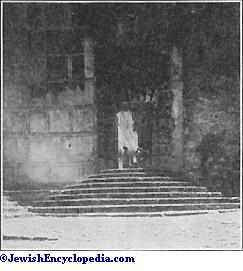
Entrance to the Mosque at Hebron, Containing the Traditional Cave of Machpelah.(From a photograph by the American Colony, Jerusalem.)
Bibliography:
Azulai, Shem ha-Gedolim;
Hazan, Ha-Ma'alot li-Shelomoh, Alexandria, 1889;
S. Munk, La Palestine, Paris;
Benjamin II., Acht Jahre in Asien und Afrika;
Abraham Ḥayyim Penso, Minḥat Ḳena'ot, Jerusalem, 1879;
Luncz, Jerusalem, 1895-1901.
D. M. Fr.
3. Third son of Kohath, son of Levi and founder of the Levitic family, the Hebronites (Ex. vi. 18; Num. iii. 19, 27; xxvi. 58). The Hebronites are often mentioned in the enumerations of the Levites, under the name either of "Ha-Ḥebroni" (Num. iii. 27, xxvi. 58; I Chron. xxvi. 23, 30, 31) or of "Bene-Ḥebron" (I Chron. xv. 9, xxiii. 19). In the time of David the chief of the Hebronites was called Jeriah (I Chron. xxiii. 19, and elsewhere). In the fortieth year of David's reign the Hebronites were settled at Jazer in Gilead, of whom 2,700 mighty men were appointed by the king superintendents over the two and one-half tribes, and 1,700, under Hashahiah, held similar positions on the west of the Jordan (ib. xxvi. 30, 31).
4. One of the tribe of Judah, a descendant of Caleb (ib. ii. 42, 43).
HEBRON.—A very ancient city in Palestine, 20 miles S.S.W. from Jerusalem. It is in a basin on one of the highest points of the Judæan ridge, being about 3040 ft. above sea-level. A note of its antiquity is given in Num 13:22, which states that it was ‘seven years older than Zoan in Egypt.’ Its original name seems to have been Kiriath-arba (i.e. probably Tetrapolis, or ‘Four Cities’), and it was a stronghold of the Anakim. In the time of Abraham, however (whose history is much bound up with this place), we read of Hittites here. From Ephron the Hittite he purchased the cave of Machpelah for the burial of Sarah his wife (Gen 23:1-20). This allusion has given rise to much controversy. At the time of the entry of the Israelites it was held by three chieftains of great stature, Sheshai, Ahiman, and Talmai (Num 13:22). On the partition of the country it was allotted to the tribe of Judah, or rather to the Calebites (Jos 14:12; Jos 15:14), who captured it for the Israelite immigrants. The city itself was allotted to the Kohathite Levites, and it was set apart as a city of refuge (Jos 20:7). Here David reigned seven and a half years over Judah (2Sa 5:5), till his capture of Jerusalem from the Jebusites fixed there the capital of the country. It was here also that the rebellious Absalom established himself as king (2Sa 15:7 ff.). It was fortified by Rehoboam (2Ch 11:10). After the Captivity it was for a time in the hands of the Edomites (though from Neh 11:25 it would appear to have been temporarily colonized by the returned Jews), but was re-captured by Judas Maccabæus (1Ma 5:65). In the war under Vespasian it was burned. In 1167 it became the see of a Latin bishop; in 1187 it was captured for the Muslims by Saladin.
The modern town contains about 10,000 inhabitants. Its chief manufactures are glassware and leather water-skins. In the centre is the Haram or mosque, formerly a Crusaders’ church, built over the reputed cave of Machpelah. The modern name is Khalîl er-Rahmân, ‘the friend of the Merciful’—the Muslim title of Abraham. ‘Abraham’s oak’ is shown near the city, but this is as apocryphal as the ascription of a cistern called ‘Sarah’s bath.’ There is a remarkable stone-built enclosure near by called Râmat el-Khalîl; it has been attempted to show this to be Samuel’s Ramah; probably, however, it is nothing more Important than a Muslim khan, built out of earlier materials.
R. A. S. Macalister.
(Hebrew: league)
Ancient royal city of Chanaan, famous in biblical history; mentioned in Old Testament (Genesis 13), when Abraham went to the vale of Mambre, a name given to Hebron. On the death of Sara, his wife, he bought there the cave of Machpelah as a burial-place for her, Isaac, Jacob and himself. David was anointed King of Juda at Hebron and made it his capital (2 Kings 2), and all the tribes of Israel came and made submission to him there (5). The modern El-Khulil, south of Jerusalem, occupies the site.
(hbrwn, chebrón)An ancient royal city of Chanaan, famous in biblical history, especially at the time of the patriarchs and under David. During the Middle Ages it was an episcopal see — at present it is only a titular one — and was situated in Palestine Prima, with Cæsarea as metropolitan. Hence the division of this article into two parts: (I) Biblical Epoch, (II) Christian Epoch. BIBLICAL EPOCHHebron is one of the earliest towns mentioned in history. According to the Bible (Numbers 13:23) it was founded seven years before Zoan or Tanis, the most ancient town in Lower Egypt, which means that it existed from the first half of the third millennium B. C. Josephus (Bel. Jud., IV, ix, 7) says that in his time the town was already 2300 years old. It was originally called Kiriat Arba, or Kiriat- ha-Arba (D. V. Cariath-Arbe, Genesis 23:2, 35:27; Joshua 14:15, 15:13, 15:54, 20:7, 21:11; Judges 1:10; Nehemiah 11:25) from the name of Arba, "the greatest among the Enacims" (Joshua 14:15). The Vulgate, taking the common name ha-adam in this last expression, i. e. the man, for the proper name Adam, translates as follows: "Adam the greatest among the Enacim was laid there"; whence it should not be inferred, as was the case with some ancient authors, that Hebron contains the tomb of the first man. The explanation of the name Kiriat-Arba by the Bible shows all others to be merely fanciful. Such, for instance, is that of St. Jerome (De locis et nominibus locorum Hebraicorum, s. v. Arbac, P. L., XXIII, 862; Ep. xlvi, P. L., XXII, 491; Ep. cviii, P. L. XXII, 886; Quest. in Gen., P. L., XXIII, 978) and of some Jewish commentators who take the word Arba to mean "four", and Kiriat-Arba to be the "town of the four", i. e. the four patriarchs buried in the cave of Machpelah: Abraham, Isaac, and Jacob, to whom must be added, according to various opinions, either Adam, Caleb, Esau, or Joseph. According to de Saulcy (Voyage en Terre Sainte, I, 152) the name means "the town of the four quarters"; while it suits the modern town, this is not at all true of the ancient one. The Bible, however, insists over and over again on the true origin of the name: "Cariath-Arbe the father of Enac, which is Hebron" (Joshua 15:13; 21:11). The name Hebron is also very ancient. It appears under the form Cheburo on Egyptian monuments of the second milennium B. C. (Brügsch, "Geog. Inschriften altägypt. Denkmäler", II, 76).The earliest mention of Hebron in the Scriptures occurs (Genesis 13:18) on the occasion of Abraham’s coming to the vale of Mambre; and this last name is often given to Hebron (Genesis 23:19, 35:27). On the death of Sara, his wife, the patriarch bought from Ephron the Hethite the cave of Machpelah to serve as a burying place for his family (Genesis 23); Abraham himself was buried there (Genesis 25:9), as were also Isaac (Genesis 35:27-29) and Jacob (Genesis 50:13). Hebron thus became the second homeland of Abraham, and the centre of attraction during the wanderings of the patriarchs. Isaac and Jacob dwelt at Mambre, and it was from the "vale of Hebron" that Joseph was sent towards Sichem and Dothain to inquire after his brethren (Genesis 37:14, 17). The Hebrew spies sent by Moses into Chanaan went as far as Hebron, and it was from the adjacent valley of Escol that they brought back a vine-branch with its cluster of grapes, and some pomegranates and figs (Numbers 13:23-25). When the Israelites invaded Chanaan, Oham, King of Hebron, allied himself against them with four other Chanaanite princes to besiege Gabaon. After Josue had defeated them, and put them to death, he went on to attack Hebron, which he took, putting all its inhabitants to death (Joshua 10:3, 23-26, 36-37; 11:21; 12:10). On the division of the Promised Land, Hebron fell to the tribe of Juda and was given to Caleb (Joshua 14:13, 14; 15:13, 54; Judges 1:20). It soon afterwards became a city of refuge, falling to the lot of the children of Aaron (Joshua 20:7, 21:11, 13; 1 Chronicles 6:55, 57). After the death of Saul on Mount Gelboe, David went to Hebron with his men, and occupied all the surrounding villages (2 Samuel 2:1, 3). He was there anointed King of Juda; made Hebron his capital, and reigned there seven years and a half (2 Samuel 2:11, 3:2, 5; 5:5; 1 Kings 2:11; 1 Chronicles 3:1, 4; and 29:27). Abner, the leader of Saul’s army, came to Hebron to see David, was well received by him, but was afterwards killed by Joab. The king wept over Abner, gave him burial, and composed a lament over him (2 Samuel 3:19-4:1). It was also to Hebron that Baana and Rechab, chiefs of the bands of Isboseth, brought the head of that son of Saul whom they had traitorously slain. David ordered the murderers to be put to death; their hands and feet were cut off, and hanged up over the pool in Hebron (2 Samuel 4:2-12). Then all the tribes of Israel came and made submission to David (2 Samuel 5:1-3; 1 Chronicles 11:1-3). When Absalom revolted against his father, who had then become King of Jerusalem, it was Hebron he made his headquarters (2 Samuel 15:7-11). The town was fortified by Roboam (2 Chronicles 11:10). Cariath-Arbe is also mentioned among the towns occupied by the children of Juda after the captivity (Nehemiah 11:25). Under Syrian domination, it passed into the hands of the Idumeans; Judas Machabeus, who drove them out, razed the fortifications of Chebron (1 Maccabees 5:65). CHRISTIAN EPOCHSome writers, following Baronius, Papebroch, Cornelius a Lapide, and Matth. Polus, have identified Hebron as the city of Juda where the Visitation took place, and where St. John the Baptist was born. They hold that Hebron was the most important of the towns of Juda, since Jerusalem belonged to Benjamin; and that, moreover, Hebron was the most important of the Levitical towns belonging to the sons of Caath, from whom came Zachary, father of the Precursor. However there is fairly strong local tradition in favour of identifying the "city of Juda" with Carem, the modern Ain-Karim (see CAREM; Heidet in Vig., "Dict. de la Bible", s. v. Carem; and Meistermann, "La partrie de S. Jean Baptiste"). At the time of the great Jewish rebellion, Simon ben Giora captured Hebron from the Romans; but the town was soon retaken, shortly before the siege of Jerusalem, by Cerealis, one of Vespasian’s generals, who ravaged it with fire and sword (Josephus, "Bel. Jud.", IV, ix, 7-9). It was with great difficulty that Hebron ever recovered. Eusebius (Onomast., s. v. ’Arbó) tells us that in his day (fourth century) it was merely a large hamlet; but the neighbourhood has always been dear to pagans, Jews, and Christians alike (Eusebius, "Vita Constantini", III, li, lii, in P. G. XX, 1112-1117; Socrates, "Hist Eccl.", in P. G. LXVII, 124; Sozomen, "Hist. Eccl.", in P. G. LXVII, 941-946). Even the Mussulmans held it dear by reason of its many Scriptural associations, especially the apparition of the angels to Abraham, and because it contains the tomb of the patriarchs. This tomb is mentioned by Josephus (loc. cit.; "Ant.", I, 14), by Eusebius (Onomasticon, loc. cit.), by the Pilgrim of Bordeaux in 333, and by visitors of after-ages, as a sanctuary held in the highest reverence. At the time of the Arab conquest in 637, Hebron, for all these reasons, was chosen as one of the four holy cities of Islam. Previously Khusrau (614), the Persian king, had spared it in deference to the Jews of whom there were many in his army. Eusebius, Socrates, and Sozomen (loc. cit.) relate that Constantine ordered a church to be built at Mambre, with the object of putting an end to the superstitious practices that took place there every year during a semi-religious fair. But we do not know at what epoch a basilica was first built over the cave of Machpelah. It is certain that the Crusaders took the town in 1100, and that the sanctuary became the church of Saint Abraham, also called the church of the Holy Cave (Sancta Caverna or Spelunca, ’ágion spelaîon). The town itself is often styled by the chroniclers of that period Castel Saint-Abraham, Præsidium or Castellum ad Sanctum Abraham. A priory of Canons Regular of St. Augustine was installed to take charge of the basilica (de Rozière, "Cartulaire du Saint-Sépulchre", 120, 142, etc., 171).A curious document relating to the medieval period and taken from a fifteenth-century manuscript, is found in the "Recueil des historiens des croisades" (Hist. Occid., V, 302-316) under the heading: "Canonici Hebronensis tractatus de inventione sanctorum patriarcharum Abraham, Ysaac et Jacob" [see Riant, "Invention de la sépulture des patriarches … à Hébron, le 25 juin 1119", in "Archives de l’Orient latin", II (1883), 411-421; also "Acta SS.", Oct., IV, 683-691; and "Analecta Bollandiana", XX (1901), 464]. This story seems to be founded on fact; two Arab historians, who may have lived contemporaneously, mention such a discovery (Recueil des Hist. des Croisades, op. cit., p. 64).Its most interesting historical materials are: a description of the sanctuary existing on the site of the tombs before the coming of the Franks; the sending of an embassy from Constantinople to Palestine by Theodosius the Younger, about 415, to bring back the bodies of the three patriarchs, and the failure of this attempt; the existence of a synagogue at Hebron at the time of the First Crusade; the spoliation of the sanctuary at Hebron between 1099 and 1102 by a Latin archbishop, probably Pierre de Narbonne, transferred from the See of Alban to that of Apamea between 1112 and 1119. A reference is made, at the year 1119, to Rainier, prior of Hebron, and to two monks, Odo and Arnulph, who gave the anonymous writer the facts he relates; mention is also made of Baudouin, seigneur of Saint-Abraham; Guermond, Patriarch of Jerusalem (d. 1128); and a description occurs of the sepulchral crypt where the bodies of the patriarchs lay. In 1167 Hebron became a Latin see; its first titular was Rainaldus (1167-1170), nephew of the patriarch Foucher (Du Cange, "Families d’outremer", 794).A letter of Clement IV, dated 1 June, 1267, orders the Patriarch of Jerusalem to supply the church of Hebron with a priest (Eubel, "Hierarchia Catholica", I, 283). After Geoffrey (Gaufridus), O.P., 1273-1283, the bishops of Hebron were merely titulars, and a great confusion existed in their list (Lequien, "Oriens Christ.", III, 639-642, 1269-1270; Gams, "Series episc.", 435; Eubel, op. cit., I, 283, II, 180). Cardinal Mermillod was at one time Titular of Hebron. The titular at present is Monsignor Petkoff, Vicar Apostolic of the Uniat Bulgarians in Thrace, who resides at Adrianople. As a residential see, Hebron enjoyed a very brief existence. However it survived the triumph of Saladin in 1187, and the march of the Kharesmian hordes in 1244. Saladin, after the victory at Hattin (15 July, 1187), and that at Ascalon (5 September), hastened, before marching on Jerusalem, to occupy Hebron, and to associate the sanctuary of Abraham with the worship of Islam. The Kharesmians destroyed the town, but did not touch the sanctuary (Riant, "Archives", II, 420-421).In spite of Mohammedan fanaticism, which since the fourteenth century had forbidden a non-Mussulman to enter the hallowed place (Isaac Chelo, 1334, "Les chemins de Jérusalem, in Carmoly, "Itinéraires", 243), the schismatic Greeks, after the departure of the Latins, retained for a time a residing bishop in Hebron. Lequien (III, 641-642) mentions one of these bishops, Joannikios, whose name appears with that of Christodoulos of Gaza in the Acts of the Council of Jerusalem in 1672 (Mansi, XXXIV B, 1771) under the title of Ioannikíou toû theophilestátou ’archiepiskópou toû ‘agíon spelaíon (Joannikios, most holy Archbishop of the holy Cave). Among the other signatories (ibid., 1174) were two priests of the same church, George and Isas, both of whom describe themselves as ‘iereùs toû ‘agíou spelaíou (priest and servant of the holy Cave). This Greek see did not last long; and it is not mentioned in the notice of Chrysanthus, Patriarch of Jerusalem, 1707-1731. In 1834, after defeating, near the Pools of Solomon, the inhabitants of Hebron who had risen against his authority, Ibrahim Pasha took their town by assault.Hebron is to-day one of the principal towns of Palestine. It is about twenty-four miles to the south of Jerusalem, is the residence of a kaimakam, and has a population of 20,000, of whom 2000 are Jews of German, Spanish, or Portuguese origin; the remainder are Mussulman fanatics. Its Arab name, El-Khalil, signifies "the friend of God", and calls to mind Abraham who is given that appellation in James, ii, 23. The town is picturesquely situated at about 3000 feet above the sea, on a narrow plateau among the hills of Judea. Its only monument of interest is the "Holy Enclosure" (Haram-el-Khalil), within which stands the mosque over the burial cave of Machpelah. The Haram is in the form of a rectangular parallelogram about 200 feet long, by 120 broad, and 50 to 60 feet high. The walls are adorned with many pilasters, and are built of enormous rough stones. The style of the construction belongs to the time when the crypts of the Haram at Jerusalem were built, and seems Roman in character. The modern mosque is built on the site of an ancient basilica restored by the Crusaders (La Palestine, Guide historique et pratique, par des professeurs de N. D. de France à Jérusalem, p. 268). The sacred enclosure is one of the finest relics of ancient architecture in Palestine, and has been admired since the time of the Pilgrim of Bordeaux (fourth century). In the opinion of many it is of Jewish origin and dates from the time of the kings of Juda (cf. Legendre in Vig., "Dict. de la Bible", s. v. Hébron). Consult Riant, "Archives", II, 412, for a list of the few travellers who, during the nineteenth century, were able to visit this sanctuary so fanatically guarded by the Mussulmans. In 1862 the present King of England, then Prince of Wales, and in 1869 the Crown Prince of Prussia, later Frederick III, were among the visitors. The trade of the town is much the same as in all Arab countries. The comparative fertility of the soil and an abundance of water contribute to increase this trade, which consists mainly in the making of goat-skin water bags, jars, and especially glass ware for which, for centuries, Hebron has used a soda extracted from the trans-Jordan regions. The vineyards around the town are very fine; they belong mainly to the Jews who trade in dried raisins, and manufacture a syrup and an excellent wine known as Hebron wine. Of late years the Russians have contrived to get a foothold at El-Khalil, and they have now a hostelry at the entrance to the town.-----------------------------------A complete bibliography of Hebron would mean a lengthy enumeration; the principal works alone will be mentioned here. GUÉRIN, Description de la Judée, III, 214-256; ROBINSON, Biblical Researches in Palestine, II, 73-94; CONDER AND KITCHENER, Memoirs of a Survey of Western Palestine, III, 305-8; 333-46; THOMSON, The Land and the Book, I: Southern Palestine (London, 1881), 268-82; ROSEN, Ueber das Thal und die nächste Umgebung Hebrons in Zeitschrift des deutschen morgenl. Gesellschaft, XII, 477; LEGENDRE in VIG., Dict. de la Bible, s. v. On its Christian history, see the works referred to in the body of this article: LEQUIEN, DU CANGE, EUBEL, and the historians of the Crusades at places indicated; also, for both epochs, SAUVAIRE, Histoire de Jérusalem et d’Hébron depuis Abraham jusqu’à la fin du XVe siecle de J. C. (Paris, 1876), containing fragments of the chronicle of Mondjired-din, translated from the Arabic text.S. SALAVILLE Transcribed by WGKofron With thanks to Fr. John Hilkert and St. Mary’s Church, Akron, Ohio The Catholic Encyclopedia, Volume VIICopyright © 1910 by Robert Appleton CompanyOnline Edition Copyright © 2003 by K. KnightNihil Obstat, June 1, 1910. Remy Lafort, S.T.D., CensorImprimatur. +John Cardinal Farley, Archbishop of New York
I. History of the City
Hebron is said to have been rounded before Zoan (i.e.
1. Patriarchal Period
Abram came and dwelt by the oaks of MAMRE (which see), “which are in Hebron” Gen (Gen 13:18); from here he went to the rescue of Lot and brought him back after the defeat of Chedorlaomer (Gen 14:13 f); here his name was changed to Abraham (Gen 17:5); to this place came the three angels with the promise of a son (Gen 18:1 f); Sarah died here (Gen 23:2), and for her sepulcher Abraham bought the cave of Machpelah (Gen 23:17); here Isaac and Jacob spent much of their lives (Gen 35:27; Gen 37:14); from here Jacob sent Joseph to seek his brethren (Gen 37:14), and hence, Jacob and his sons went down to Egypt (Gen 46:1). In the cave of Machpelah all the patriarchs and their wives, except Rachel, were buried (Gen 49:30 f; Gen 50:13).
2. Times of Joshua and Judges
The spies visited Hebron and near there cut the cluster of grapes (Num 13:22 f). HOHAM (which see), king of Hebron, was one of the five kings defeated by Joshua at Beth-horon and slain at Makkedah (Jos 10:3 f). Caleb drove out from Hebron the “Three sons of Anak” (Jos 14:12; Jos 15:14); it became one of the cities of Judah (Jos 15:54), but was set apart for the Kohathite Levites (Jos 21:10 f), and became a city of refuge (Jos 20:7). One of Samson’s exploits was the carrying of the gate of Gaza “to the top of the mountain that is before Hebron” (Jdg 16:3).
3. The Days of the Monarchy
David, when a fugitive, received kindness from the people of this city (1Sa 30:31); here Abner was treacherously slain by Joab at the gate (2Sa 3:27), and the sons of Rimmon, after their hands and feet had been cut off, were hanged “beside the pool” (2Sa 4:12). After the death of Saul, David was here anointed king (2Sa 5:3) and reigned here 7 1/2 years, until he captured Jerusalem and made that his capital (2Sa 5:5); while here, six sons were born to him (2Sa 3:2). In this city Absalom found a center for his disaffection, and repairing there under pretense of performing a vow to Yahweh, he raised the standard of revolt (2Sa 15:7 f). Josephus mistakenly places here the dream of Solomon (Ant., VIII, ii, 1) which occurred at Gibeon (1Ki 3:4). Hebron was fortified by Rehoboam (2Ch 11:10).
4. Later History
Probably during the captivity Hebron came into the hands of Edom, though it appears to have been colonized by returning Jews (Neh 11:25); it was recovered from Edom by Simon Maccabeus (1 Macc 5:65; Josephus, Ant, XII, viii, 6). In the first great revolt against Rome, Simon bar-Gioras captured the city (BJ, IV, ix, 7), but it was retaken, for Vespasian, by his general Cerealis who carried it by storm, slaughtered the inhabitants and burnt it (ibid., 9).
During the Muslim period Hebron has retained its importance on account of veneration to the patriarchs, especially Abraham; for the same reason it was respected by the Crusaders who called it Castellum ad Sanctum Abraham. In 1165 it became the see of a Latin bishop, but 20 years later it fell to the victorious arms of Saladin, and it has ever since remained a fanatic Moslem center, although regarded as a holy city, alike by Moslem, Jew and Christian.
II. The Ancient Site
Modern Hebron is a straggling town clustered round the
A mile or more to the Northwest of Hebron is the famous oak of MAMRE (which see), or “Abraham’s oak,” near which the Russians have erected a hospice. It is a fine specimen of the Holm oak (Quercus coccifera), but is gradually dying. The present site appears to have been pointed out as that of Abraham’s tent since the 12th century; the earlier traditional site was at
III. Modern Hebron
Modern Hebron is a city of some 20,000 inhabitants, 85 percent of whom are Moslems and the remainder mostly Jews. The city is divided into seven quarters, one of which is known as that of the “glass blowers” and another as that of the “water-skin makers.” These industries, with the manufacture of pottery, are the main sources of trade. The most conspicuous building is the
For Hebron (Jos 19:28) see EBRON.
Hebron was a very old settlement in the south of Canaan. It was situated at the point where two main highways crossed, the north-south route from central Canaan to Egypt, and the east-west route from the Dead Sea to the Mediterranean coast (for map see PALESTINE). Hebron was also known as Kiriath-arba and Mamre. Abraham, Isaac and Jacob all lived in the region at various times, and Abraham bought a piece of ground there for a family burial place (Gen 13:18; Gen 18:1; Gen 23:2; Gen 23:17-20; Gen 25:9; Gen 35:27; Gen 37:14; Gen 50:13).
At the time of Israel’s conquest under Joshua, Hebron’s local inhabitants were a tall powerfully built people whom many thought could never be conquered (Num 13:21-28; Num 13:31-33). Caleb, however, believed otherwise (Num 13:30). Not only did he defeat them, but he received their territory as his family possession (Jos 14:12-15). Hebron, in the centre of this territory, became one of the three cities of refuge established west of Jordan (Jos 20:7-9; Jos 21:9-13).
The town fell within the tribal allotment of Judah and soon became the chief town of the tribe. For seven years it was the capital of David’s kingdom, till he conquered Jerusalem and made it his new capital (2Sa 5:1-5). When Absalom tried to overthrow David, Hebron was the base from which he launched his rebellion (2Sa 15:7-10). A later king, Rehoboam, recognized Hebron’s strategic situation on the main highways, and fortified it as a key defence outpost (2Ch 11:5-12).