
Helmet [ARMS; ARMOR]
Helmet. See Arms.
For the protection of the head, as worn by warriors. See ARMOUR. In the Christian’s armour the helmet is ’salvation,’ or ’the hope of salvation.’ Eph 6:17; 1Th 5:8. It is those who know their salvation that can take part against the wicked spirits in the heavenlies. It is to be remarked that Jehovah (Christ) in a future day will Himself put on righteousness as a breastplate, and a helmet of salvation, to avenge His people by punishing their enemies. Isa 59:17.
( or
 ):
By: Emil G. Hirsch, Immanuel Benzinger
In olden times the helmet seems to have been worn only by kings, military officers, and other important officials. At least, it is mentioned only of Goliath and Saul that they had brazen helmets (I Sam. xvii. 5, 38). Not until later did a helmet form part of the complete armor of an ordinary soldier. Chronicles relates that Uzziah equipped the whole Jewish army with helmets and armor (II Chron. xxvi. 14). The authenticity of this account may be uncertain, but it tends to show that the wearing of a helmet was a general custom at that time. In Jer. xlvi. 4, also, the helmet is reckoned a necessary part of the armor. It must not be supposed, however, that these helmets were of brass; they were leather caps. The head-coverings of the Syrian and Hittite warriors were of this kind, as they are pictured on the Egyptian monuments (see illustrations in W. Max Müller's "Asien und Europa," pp. 302-384). These were round, flat caps, fitting the head closely, with a projection at the back to protect the neck. The Egyptian soldiers wore similar caps, only theirs were broader at the back and covered the ears also. In Egypt, too, metal helmets were rare; they were more common among the Assyrians. Helmets were usually hemispherical. The round cap, fitting tightly to the head, is still worn in the East, but not frequently. The hemispherical helmet, if made of leather, usually had metal rings, or else two metal bands on the outside, to give it firmness. As a rule side-pieces protected the ears. The shape of the metal helmets was the same. Both leather and metal helmets were ornamented with bands and flaps of the most varied form.
Coin of Herod the Great, Showing Helmet with Cheek-Pieces.(After Madden.)
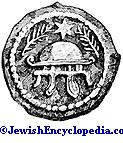
HELMET.—See Armour, § 2 (b).
See Armour.
Isa 59:17 (a) A symbol of the blessing that comes to the one who is saved. His thoughts are guarded and his decisions are in the fear of GOD.
Eph 6:17 (a) This represents the provision GOD has made in His salvation for protecting the mind, the thoughts, and the mental processes. The mind is renewed by the Holy Spirit. It is enlightened by the Word of GOD and all of this is compared to a helmet. (See also 1Th 5:8).
A helmet is a hard covering worn on the head for protection in battle.
A soldier’s head was one of the most easily injured parts of the body. For this reason, soldiers have used helmets for protection since at least the end of the fourth millennium BC.
Goliath and Saul both wore bronze helmets (1 Samuel 17:5, 38). For many centuries, helmets were standard equipment for heavily armed soldiers in foreign armies. However, helmets do not seem to have been common in Israel’s army during the time of the united kingdom.
King Uzziah later provided helmets for the army of Judah as part of his military reforms (2 Chronicles 26:14).
See also Armor and Weapons.
Aquifer Open Bible Dictionary © 2026 Mission Mutual, an adaptation of the Tyndale Open Bible Dictionary © 2023 Tyndale House Publishers. Licensed under CC BY-SA 4.0.
References:
Description:
The helmet was protective armor covering the head. In some helmet designs there were flaps extending down over the ears or even to the neck. Among the Israelites and their immediate neighbors, helmets were usually made of leather. Helmets made of metal were rare and were generally imported from countries to the east and north. See the illustration at 2.3.1 Sheath, scabbard<REALIA:2.3.1>.
Translation:
For languages having no term for “helmet,” translators may use a descriptive equivalent, such as “protection for the head” or “covering for the head in fighting.” The figurative expression “helmet of salvation” in ISA 59:17 and EPH 6:17 may be rendered “salvation, which is like a protection for the head.”
Human-made Things in the Bible © United Bible Societies. Licensed under CC BY-SA 4.0.