
See Horns
By horns the Hebrews sometimes understood an eminence, or angle, a corner, or a rising. By horns of the altar of burnt offerings, many understand the angles of that altar; but there were also horns, or eminences, at the corners of that altar, Exo 27:2; Exo 30:2. Horn also signifies glory, brightness, rays. God’s “brightness was as the light, he had horns coming out of his hand,” Hab 3:4; that is refulgent beams issuing from the hollow of it. As the ancients frequently used horns to hold liquors, vessels containing oil and perfumes are often called horns, whether made of horn or not. “Fill thine horn with oil,” says the Lord to Samuel, “and anoint David,” 1Sa 16:1. Zadok took a horn of oil out of the tabernacle, and anointed Solomon, 1Ki 1:39. Job called one of his daughters Kerenhappuch, horn of antimony, or horn to put antimony (stibium) in, which the women of the east still use at this day, Job 43:14. The principal defence and strength of horned beasts consist in their horns; and hence the Scripture mentions the horn as a symbol of strength. The Lord exalted the horn of David, the horn of his people; he breaketh the horn of the ungodly; he cutteth off the horn of Moab; he cutteth off the horn of Israel; he promiseth to make the horn of Israel to bud forth; to reestablish the honour of it, and restore its former vigour. Moses compares Joseph to a young bull, and says that he has horns like those of a unicorn. Kingdoms and great powers are often in Scripture described by the symbol of horns. In Daniel 7, 8, horns represent the power of the Persians, of the Greeks, of Syria, of Egypt, or of Pagan and Papal Rome. The prophet represents three animals as having many horns, one of which grew from the other. This emblem is a natural one, since in the east are rams which have many horns.
Horn, from its primary use for defense in the case of horned animals, came to acquire several derivative meanings, some of which are connected with the illustration and right understanding of holy writ. As horns are hollow and easily polished, they have in ancient and modern times been used for drinking-vessels and for military purposes; and as they are the chief source of strength for attack and defense with the animals to which God has given them, they serve in Scripture as emblems of power, dominion, glory, and fierceness (Dan 8:5; Dan 8:9; 1Sa 16:1; 1Sa 16:13; 1Ki 1:39; Jos 6:4-5; 1Sa 2:1; Psa 75:5; Psa 75:10; Jer 48:25; Eze 29:21; Amo 6:13). Hence to defile the horn in the dust (Job 16:15), is to lower and degrade oneself, and, on the contrary, to lift up, to exalt the horn (Psa 75:4; Psa 89:17; Psa 148:14), is poetically to raise oneself to eminent honor or prosperity, to bear oneself proudly. In the East, at present, horns are used as an ornament for the head, and as a token of eminent rank. The women among the Druses on Mount Lebanon wear on their heads silver horns of native make, ’which are the distinguishing badge of wifehood.’
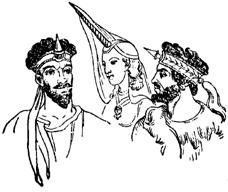
Horn Head Dresses
By an easy transition, horn came to denote an elevation or hill (Isa 5:1); in Switzerland mountains still bear this name, thus, Schreckhorn, Buchhorn. The altar of burnt-offerings (Exo 27:2) and the altar of incense (Exo 30:2), had each at the four corners four horns of shittim-wood, the first being overlaid with brass, the second with gold (Exo 37:25; Exo 38:2; Jer 17:1; Amo 3:14). Upon the horns of the altar of burnt-offerings was to be smeared with the finger the blood of the slain bullock (Exo 29:12; Lev 4:7-18; Lev 8:15; Lev 9:9; Lev 16:18; Eze 43:20). By laying hold of these horns of the altar of burnt-offering the criminal found an asylum and safety (1Ki 1:50; 1Ki 2:28). These horns are said to have served as a means for binding the animal destined for sacrifice (Psa 118:27); but this use Winer denies, asserting that they did not and could not answer for such a purpose.
Of animals were used as drinking vessels, and to hold ointments, perfumes, etc., 1Sa 16:1 1Ki 1:39 . The "horns of the altar" were its four corners and elevation on them, Exo 27:2 30:2. See ALTAR.\par The principal defense and ornament of many beasts are in their horns; and hence the horn is often a symbol of strength, honor, and dominion. The Lord exalted the horn of David, and of his people; he breaketh the horn of salvation, and of defiling the horn in the dust, Deu 33:17 1Sa 2:1,10 Job 16:15 Psa 75:10 Dan 7:20-24 Luk 1:69 . There may be an allusion in these passages to a very common part of the female dress in some parts of the East. The married women among the Druses of mount Lebanon still wear on their heads silver horns, as in the accompanying cut; the other head is that of an Abyssinian chief.\par
Horn. The word "horn" is often used metaphorically to signify strength and honor, because horns are the chief weapons and ornaments of the animals which possess them; hence, they are also used as a type of victory. Of strength, the horn of the unicorn was the most frequent representative, Deu 33:17; etc., but not always; compare 1Ki 22:11 where probably horns of iron, worn defiantly and symbolically on the head, are intended.
Among the Druses, upon Mount Lebanon, the married women wear silver horns on their heads. In the sense of honor, the word horn stands for the abstract "my horn," Job 16:16, "all the horn of Israel," 1Sa 2:3, and so for the supreme authority. It also stands for the concrete, whence, it comes to mean king, kingdom. Dan 8:2 etc.; Zec 1:18. Out of either or both of these last two metaphors, sprang the idea of representing gods with horns.
The "horn" being the instrument of the oxen’s strength is the symbol of power (1Ki 22:11). The "horns of the
The ram with two horns (Dan 8:3) represents the Medo-Persian double power. The "notable horn" of the "he goat" (Dan 8:5) is Alexander the Great who on coins is represented with horns. The four horns in Zec 1:18 represent the four ruling powers of the world, to be superseded finally by Messiah’s kingdom: Babylon, Medo-Persia, Greece, and Rome. (On "the little horn" of the third and of the fourth world powers (Dan 7:8; Dan 8:9).
Horn. The word "horn" is often used to signify power and honor. Of strength, the horn of the unicorn, R. V. "wild ox," was the most frequent representative. Deu 33:17, etc., but not always; comp. 1Ki 22:11, where probably horns of iron, worn defiantly and symbolically on the head, are intended. Among the Druses upon Mount Lebanon the married women wear silver horns on their heads. In the sense of honor, as "my horn," Job 16:15; "all the horn of Israel," Lam 2:3—and hence for the supreme authority. It also stands for honor or power, whence it comes to mean king, kingdom. Dan 8:3, etc.; Zec 1:18. It was also a symbol of victory. 1Ki 22:11; Rev 5:6.
HORN.—The expression ‘a horn of salvation’ in the song of Zacharias (Luk 1:69) is undoubtedly a reference to the promised Messiah. A similar combination of words is found in Psa 18:2, but the conception is more probably due to Psa 132:17, 1Sa 2:10.
1. In the OT the word ‘horn’ is figuratively used in poetical and allegorical language: (a) for abstract notions of strength (Num 23:22, Psa 89:17-24), and hence of dignity (Psa 112:9) or pride (Psa 75:4 ff.); also, (b) in a concrete sense, to represent kings and empires (Dan 7:24; Dan 8:20 f., Zec 1:18 ff.). The rendering ‘a mighty salvation,’ Luk 1:69 (Pr. Bk. [Note: Bk. Prayer Book.] ), paraphrases the sense but obliterates the associations. Hor. Od. iii. 21, 18 is quoted as an instance of the metaphor in ordinary literature, in which it is rare.
2. Inasmuch as the horn in animals is a weapon of attack rather than of defence, some have regarded it as a symbol of aggressive strength (see Delitzsch, Perowne, etc., on Psa 18:2): possibly combative strength, in which both ideas are included, would be a better definition. There are two classes of symbols expressive of such strength: (a) natural weapons (e.g. horn, right hand, arm, etc.), and (b) artificial weapons (arrows, axe, shield, etc.). When any distinction is to be made, the former class tends to represent that strength which is personal, inherent, immediate; the latter, to represent that strength in which second causes, instruments, agents appear (Isa 10:5; Isa 10:15).
F. S. Ranken.
HORN (Heb. qeren, Gr. keras).—Sometimes horns were wrought into vessels in which oil was stored (1Ki 1:39) or carried (1Sa 16:1). Probably with some dainty ornamentation, they were used to hold eye-paint (Job 42:14, Keren-happuch). Of rams’ horns a kind of trumpet was made Jos 6:4); see Music, 4 (2) (e). ‘Horns’ in poetry symbolized strength (Deu 33:17 etc.). ‘Horn’ in Psa 18:2 = 2Sa 22:3 stands for offensive weapons, as ‘shield’ for defensive (Perowne). To ‘exalt one’s born,’ or ‘cause it to bad’ (grow), is to strengthen and prosper him (1Sa 2:1, Eze 29:21 etc.). For one to ‘lift his horn’ is to be arrogant (Psa 75:4-5). To crush or weaken one is to ‘break or cut off his born’ (Jer 48:25, Lam 2:3). In prophetic symbolism borns stand for kings and military powers (Dan 7:8; Dan 8:21 etc.). The altar borns (Exo 27:2), to which fugitives seeking asylum clung (1Ki 1:50 etc.), were projections at the four corners, and apparently peculiarly sacred (Exo 30:10 etc.); but their significance and use are now unknown.
W. Ewing.
Saint Eustachius, a symbol of being a huntsman and soldier
Saint Hubert, a symbol of being a huntsman
New Catholic Dictionary
(1)
(2) Both the altar of burnt offering (Exo 27:2; Exo 38:2; compare Eze 43:15) and the incense altar (Exo 30:2; Exo 37:25, Exo 37:26; compare Rev 9:13) had “horns,” which are explained to be projections “of one piece with” the wooden framework and covered with the brass (or gold) that covered the altar. They formed the most sacred part of the altar and were anointed with the blood of the most solemn sacrifices (only) (Exo 30:10; Lev 4:7, Lev 4:18, Lev 4:25, Lev 4:30, Lev 4:34; Lev 16:18; compare Eze 43:20), and according to Lev 8:15; Lev 9:9, the first official sacrifices began by anointing them. Consequently cutting off the horns effectually desecrated the altar (Amo 3:14), while “sin graven on them” (Jer 17:1) took all efficacy from the sacrifice. On the other hand they offered the highest sanctuary (1Ki 1:50, 1Ki 1:51; 1Ki 2:28). Of their symbolism nothing whatever is said, and the eventual origin is quite obscure. “Remnants of a bull-cult” and “miniature sacred towers” have been suggested, but are wholly uncertain. A more likely origin is from an old custom of draping the altar with skins of sacrificed animals (RS, 436). That, however, the “horns” were mere conveniences for binding the sacrificial animals (Psa 118:27, a custom referred to nowhere else in the Old Testament), is most unlikely. See ALTAR.
(3) The common figurative use of “horn” is taken from the image of battling animals (literal use in Dan 8:7, etc.) to denote aggressive strength. So Zedekiah ben Chenaanah illustrates the predicted defeat of the enemies by pushing with iron horns (1Ki 22:11; 2Ch 18:10), while “horns of the wildox” (Deu 33:17; Psa 22:21; Psa 92:10, the King James Version “unicorn”) represent the magnitude of power, and in Zec 1:18-21 “horns” stand for power in general. In Hab 3:4 the “horns coming out of his hand” denote the potency of Yahweh’s gesture (the Revised Version (British and American) “rays” may be smoother, but is weak). So to “exalt the horn” (1Sa 2:1, 1Sa 2:10; Psa 75:4, etc.) is to clothe with strength, and to “cut off the horn” (not to be explained by Amo 3:14) is to rob of power (Psa 75:10; Jer 48:25). Hence, the “horn of salvation” in 2Sa 22:3; Psa 18:2; Luk 1:69 is a means of active defense and not a place of sanctuary as in 1Ki 1:50. When, in Dan 7:7-24; Dan 8:3, Dan 8:8, Dan 8:9, Dan 8:20, Dan 8:21; Rev 13:1; Rev 17:3, Rev 17:7, Rev 17:12, Rev 17:16, many horns are given to the same animal, they figure successive nations or rulers. But the seven horns in Rev 5:6; Rev 12:3 denote the completeness of the malevolent or righteous power. In Rev 13:11, however, the two horns point only to the external imitation of the harmless lamb, the “horns” being mere stubs.
(êÝñáò)
Except in Luk_1:69 (‘horns of salvation’), the only allusions to ‘horns’ in the NT are in the Apocalyptic Visions (Rev_5:6; Rev_9:13; Rev_12:3; Rev_13:1; Rev_13:11; Rev_17:3; Rev_17:7; Rev_17:12; Rev_17:16). The horn as an emblem of strength and power is obviously derived from the animal world. The bull has always been recognized among primitive peoples as a fitting symbol for strength; hence the horn of a bull, which is the characteristic feature of that animal and its natural weapon of offence, acquired a special significance. We thus find it used symbolically by the Babylonians and Assyrians, the horned cap being the distinguishing mark of the gods. The first occurrence of its emblematic use in the OT is in Deu_33:17, where Ephraim is said to have the horns of a wild ox (øְàַí). Other examples will be found in 1Sa_2:1; 1Sa_2:10 and also in 1Ki_22:11, where Zedekiah is said to have made ‘horns of iron,’ whereby Israel would ‘push the Syrians, until they be consumed.’ In the later books of the OT the horn is used as ‘the symbol of a dynastic force’ (cf. Zec_1:18 ff., Dan_7:7 ff; Dan_8:3 ff.), and it is used in the same sense in Rev_12:3; Rev_13:1; Rev_13:11; Rev_17:3 ff.
In Rev_5:6 the ‘seven horns’ symbolize the power of the Lamb as the victorious Christ, and the ‘seven,’ which throughout the OT and the NT represents fullness, here denotes the all-sufficiency of that power. In the ‘horns of the golden altar’ in Rev_9:13 we seem to have an echo of Exo_27:1-2; as H. B. Swete says (The Apocalypse of St. John2, 121), there may here be some allusion to the ‘four corners of the earth’ mentioned in Rev_7:1, and the ‘single’ voice is a suitable mouthpiece for the single-hearted and unanimous desire of the Church throughout the world. In Rev_12:3 the great red dragon is furnished with ten horns. The horns, however, are not crowned, and it is interesting in this connexion to compare and contrast the account of the wild beast of the sea (Rev_13:1), where the beast is represented as having ten diadems on its ten horns. The ten crowned horns in the latter passage (Rev_13:1) denote ten kings and represent the forces which, arising out of the Roman Empire itself, like horns out of a beast’s head, would ultimately bring about its dissolution. The second beast (Rev_13:11) is of a different character; he has ‘two horns like unto a lamb,’ but, notwithstanding his gentle and docile appearance, ‘he spake as a dragon.’ He represents a religious power, and at once recalls the ‘false prophets (Mat_7:15) which come to you in sheep’s clothing, but inwardly are ravening wolves.’ Lastly, ‘a scarlet-coloured beast … having seven heads and ten horns’ (Rev_17:3), is the undoer of ‘the great harlot’ (Rev_17:16). The reference is again to the doom of the Roman Empire. The ten horns are ‘ten kings which have received no kingdom as yet’ (Rev_17:12), but are destined to ‘receive authority as kings, with the beast, for one hour.’ Both the kings and the beast to whom ‘they give their power and authority’ will be impotent in their attack against the Lamb, but nevertheless they are destined to be the willing or unwilling agents of the Divine purpose-‘they shall hate the harlot, and shall make her desolate and naked, and shall eat her flesh and shall burn her utterly with fire. For God did put in their hearts to do his mind.’ The harlot is the great city (i.e. Rome; Rev_17:18), and she was to receive her death-blow at the hands of those who ‘have received no kingdom as yet.’ The Seer’s prediction was amply verified by the numerous invasions of barbarian hordes, which blackened the page of Rome’s history in the 5th and 6th centuries a.d., and finally laid its long-established Empire in ruins.
Literature.-H. B. Swete, The Apocalypse of St. John2, 1907, pp. 78, 120, 149, 221f., 224f.; Murray’s Dict. of the Bible , 355; Hasting's Dictionary of the Bible (5 vols) ii. 415f.; Encyclopaedia Biblica i. 209f.
P. S. P. Handcock.
The horn is used as a symbol of power, strength, honor and grandeur. Sometimes it is a good power, and sometimes an evil power. Sometimes it refers to the strength of a nation, other times to the ruler of a nation. Sometimes it refers to a position of elegance and popularity with pride. Only a few cases will be listed to illustrate these truths.
Deu 33:17 (a) Type of the strength and the power of the two tribes of Joseph.
1Sa 2:1 (a) Type of the feelings of victory of Hannah because she was a new mother.
2Sa 22:3 (a) Type of GOD as the power who placed David as King over Israel.
1Ki 22:11 (b) Type of the power of the King of Israel in conquering Syria.
Job 16:15 (b) Type of the humbling experience of Job when he lost his all. Psa 18:2 (a) Type of the power of GOD which gave David his position. Psa 22:21 (a) GOD’s power is compared to or contrasted with the power of the unicorn which perhaps was the rhinoceros.
Psa 75:4 (a) Type of the proud rich who wished to exalt their own strength and whom GOD would humble. (See Psa 75:10).
Psa 89:17 (b) Type of the blessing of GOD because of which the power and excellency of Israel will one day be exalted. (See Psa 89:24; Psa 92:10; Psa 112:9; Psa 132:17).
Psa 118:27 (c) Probably this means that GOD will bind us to our decisions when we consecrate our lives to Him.
Lam 2:3, Lam 2:17 (b) This is a type of the power of GOD to reduce the strength of Israel and to increase the power of the enemy.
Jer 48:25 (b) This is a picture of the power of Moab both for offense and defense, which GOD took from them and made them weak.
Eze 29:21 (b) This is a type in prophecy of the restoration of Israel as a world power.
Eze 34:21 (b) A figure of the power of the leaders of Israel who were persecuting the poor.
Dan 7:7 (b) Here and throughout this book horns are a sign of both men and nations in their power to rule or misrule. The little horns represent kings or generals, or men who rise up out of obscurity and are not well known. The big horns represent mighty kings who become world rulers, such as Alexander the Great.
Dan 8:3 (a) These two horns represent the two kings as are mentioned.
Dan 8:8 (b) This figure describes a prominent and well-known ruler.
Amo 6:13 (b) A type of the great power which the people claimed they had created by their own wits and wisdom.
Mic 4:13 (b) By this type GOD indicates that He will make Israel again a great and strong nation.
Hab 3:4 The word here is a mistranslation, and it should read "bright beams." It probably indicates that there is power in the light of GOD and in His wonderful hands of strength.
Zec 1:18 (a) Here we see four Gentile powers which persecuted and scattered Israel.
Luk 1:69 (a) This is a type of the Lord JESUS by whom and through whom sinners are saved from the wrath to come.
Rev 5:6 (a) These represent the seven-fold aspect of the Holy Spirit in His power as the seven eyes represent the seven aspects of the Spirit’s knowledge.
Rev 12:3 (a) The figure represents Satan and his mighty power in controlling men.
Rev 13:1 (a) This type represents Satan’s antichrist who will have power over the nations.
Rev 13:11 (a) The type in this case represents the false prophet. Because there are two horns we understand that he has power to exalt the Devil, and also to curse men.
Rev 17:3, Rev 17:12 (a) These are the evil powers of the world as represented in the ten kings.
Since wild animals used their horns to defend themselves or attack their enemies, Israelites often spoke of the horn as a symbol of power (Deu 33:17; 1Ki 22:11; Psa 18:2; Psa 22:21; Psa 75:5; Psa 75:10; Psa 92:10; Zec 1:21; Luk 1:69; Rev 5:6). Sometimes horns were symbolic of powerful rulers (Dan 7:7; Dan 7:24; Dan 8:20; Rev 17:3; Rev 17:12).
People used certain kinds of horns as musical instruments, particularly on ceremonial occasions (2Sa 6:15). In times of battle, the blowing of horns, like the blowing of trumpets or bugles, was a means of making declarations or sending signals (Jos 6:4; Jos 6:13; Jdg 7:18; 1Co 14:8). Other horns were made into containers for the oil used in the ceremonial anointing of kings and priests (1Sa 16:13; 1Ki 1:39).
Ornamental horns projected from the four corners of the altars of the tabernacle. The priests applied the blood of certain sacrifices to these horns as part of the ritual for the cleansing of sin (Exo 27:2; Exo 29:12; Exo 30:1-2; Exo 30:10). Israelite law did not permit the widespread ancient practice of clinging to the horns of the altar to escape punishment for murder (Exo 21:14; 1Ki 1:51; 1Ki 2:29).