
To build an house, is, in the Hebrew style, to settle a family: to make one prosper. So in Exo 1:21, "he built them houses," signifies that they flourished and prospered. The same phrase occurs in 1Sa 2:35; 2Sa 7:2; 1Ki 11:38. And so in Euripides,f1 "Wisdom is immoveable, and keeps together a house,"- an expression found in Solomon, Pro 9:1, to the very same purpose. And therefore, in the symbolical language, houses, palaces, and sons mutually explain each other.
Thus, according to the Persian and Egyptian Interpreters, ch. cxlviii.: "If a king dreams that he orders a new palace to be built for his habitation and it be finished, it denotes that he shall beget a son and heir:" children, or rather sons, being the settlement of a house or family.
The word house, in Scripture, means somewhat more than the mere residence of a family; indeed, it hath various significations. Heaven is called the house of God, "an house not made with hands, eternal in the heavens." The grave is called the house appointed for all living." (Job xxx. 23.) The church is called "the house of the living God." Ye also, saith Peter, speaking to the faithful, "are built up a spiritual house." (1 Pet. 2: 5. Heb. 3: 6.) But in a more general way, a family is called an house, such as the house of theRechabites, (Jer. xxxv. 2.) the house of David, (Zech. 13. 1.) But amidst all these, and more to the like import, that undoubtedly is the highest and the best sense of the word which considers the Lord Jesus Christ himself as the High Priest and Head of his body the church, and the bodies of his people the temple of his indwelling residence by his Spirit. And the conscious sense of his presence, in upholding, acting upon, comforting, refreshing, stengthening, and witnessing to the soul, and for the Lord in the soul, these areamong the most blessed evidences in the enjoyment of the household of faith. Here, in the fullest sense of the expression, the church, and every individual believer forming a part in that church, may and is called the house of the living God. "Lo! I come, said JEHOVAH, and I will dwell in the midst of thee; (Zech. 2: 11.) and this scriptural sense of the word may serve to shew why it was the patriarchs, and holy men of old, were so anxious concerning their households and brailles. Thus the faithful Abraham, after that theLord had revealed himself unto him in vision, and said, Fear not, Abraham, I am thy shield, and thine exceeding great reward;" the patriarch felt a boldness to ask of God concerning his household. Abram said, "Lord God! what wilt thou give me, seeing I go childless, and the steward of ray house is this Eliezer of Damascus?" (Gen. xv. l, 2.) meaning, that he was not born of his bowels, but Damascus born, probably a black. Now as it is well known, that every black slave when freed by his master, was always after known bythe name of the child" of the house, (for so the phrase steward of my house means, ) it is likely, that Abram felt some jealousy concerning this freed slave being his heir. And the very name Eliezer was not a little in countenancing this idea, which signified the help of my God. But I leave the reader to his own views of this subject, only remarking farther, that the Lord’s gracious answer concerning Isaac seems a confirmation, that it was in this, or some such like sense, the house or family was regarded. See Gen 15:4 - 6.
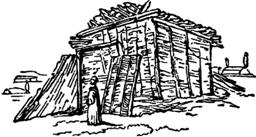
House
Houses are often mentioned in Scripture, several important passages of which cannot be well understood without a clearer notion of the houses in which the Hebrews dwelt, than can be realized by such comparisons as we naturally make with those in which we ourselves live. But things so different afford no grounds for instructive comparison. We must therefore bring together such facts as can be collected from the Scripture and from ancient writers, with such details from modern travelers and our own observations, as may tend to illustrate these statements; for there is every reason to conclude that little substantial difference exists between the ancient houses and those which are at this day found in south-western Asia.
Our information respecting the abodes of men in the ages before the Deluge is, however, too scanty to afford much ground for notice.
We may, therefore, pass over this early period, and proceed at once to the later times in which the Hebrews flourished.
The observations offered under Architecture will preclude the expectation of finding among this Eastern people an accomplished style of building. The reason of this is plain. Their ancestors had roved through the country as nomad shepherds, dwelling in tents; and if ever they built huts they were of so light a fabric as easily to be taken down when a change of station became necessary. In this mode of life solidity in the structure of any dwelling was by no means required; much less were regular arrangement and the other requisites of a well-ordered dwelling matters of consideration. Under such circumstances as these, no improvement in the habitation takes place. The tents in which the Arabs now dwell are in all probability the same as those in which the Hebrew patriarchs spent their lives.
On entering Palestine, the Israelites occupied the dwellings of the dispossessed inhabitants; and for a long time no new buildings would be needed. The generation which began to build new houses must have been born and bred in the country, and would naturally erect buildings like those which already existed in the land. Their mode of building was therefore that of the Canaanites whom they had dispossessed. Of their style of building we are not required to form any exalted notions. In all the history of the conquest of the country by the Israelites, there is no account of any large or conspicuous building being taken or destroyed by them. It would seem also as if there had been no temples; for we read not that any were destroyed by the conquerors; and the command that the monuments of idolatry should be overthrown, specifies only altars, groves, and high places—which seems to lead to the same conclusion; since, if there had been temples existing in the land of Canaan, they would doubtless have been included. It is also manifest from the history that the towns which the Hebrews found in Palestine were mostly small, and that the largest were distinguished rather by their number than by the size or magnificence of their buildings.
It is impossible to say to what extent Solomon’s improvements in state architecture operated to the advancement of domestic architecture. He built different palaces, and it is reasonable to conclude that his nobles and great officers followed more or less the models which these palaces presented. In the East, however, the domestic architecture of the bulk of the people is little affected by the improvements in state buildings. Men go on building from age to age as their forefathers built; and in all probability the houses which we now see in Palestine are such as those in which the Jews, and the Canaanites before them, dwelt—the mosques, the Christian churches, and the monasteries being the only new features in the scene.
There is no reason to suppose that many houses in Palestine were constructed with wood. A great part of that country was always very poor in timber, and the middle part of it had scarcely any wood at all. But of stone there was no want; and it was consequently much used in the building of houses. Having premised this, the principal building materials mentioned in Scripture may be enumerated with reference to their place in the three kingdoms of nature.
I. Vegetable Substances:—
1. Shittim, or the timber of the acacia tree, which grows abundantly in the valleys of Arabia Petræa, and was therefore employed in the construction of the tabernacle. Not being, however, a tree of Palestine, the wood was not subsequently used in building.
2. The wood of the sycamore fig-tree, mentioned in Isa 9:10, as a building timber in more common use than cedar, or perhaps than any other wood known in Palestine.
3. Cedar. As this was a wood imported from Lebanon, it would only be used in the higher class of buildings.
4. Algum, which, being imported from the Eastern seas, must have been valued at a high price. It was used by Solomon for pillars for his own palace, and for the temple (1Ki 10:11-12).
5. Cypress-wood. Boards of this were used for the floor of the Temple, which may suggest the use to which it was ordinarily applied (1Ki 6:15; 2Ch 3:5).
Particular accounts of all these woods, and of the trees which afforded them, may be seen under the respective words.
II. Mineral Substances:—
1. Marble. We find the court of the king of Persia’s palace covered with marble of various colors (Est 1:6). David is recorded to have possessed abundance of marble (1Ch 29:2; comp. Son 5:15), and it was used by Solomon for his palace, as well as for the Temple.
2. Porphyry and Granite are supposed to be ’the glistering stones, and stones of divers colors’ named in 1Ch 29:2. If so, the mountains of Arabia Petræa furnished the nearest source of supply, as these stones do not exist in Palestine or Lebanon.
3. Bricks. Bricks hardened by fire were employed in the construction of the tower of Babel (Gen 11:3), and the hard bondage of the Israelites in Egypt consisted in the manufacture of sun dried bricks (Exo 5:7; Exo 5:10-13). This important building-material has been noticed under another head [BRICKS]; and it only remains to remark that no subsequent notice of bricks as being used by the Hebrews occurs after they had entered Palestine. Yet, judging from existing analogies, it is more than probable that bricks were to a considerable extent employed in their buildings.
3. Chalk and Gypsum. That the Hebrews were acquainted with these materials appears from Deu 27:2; and from Dan 5:5; Act 23:3, it further appears that walls were covered with them.
4. Mortar, a cement made of lime, ashes, and chopped straw, or of gypsum and chopped straw. This is probably meant in Jer 43:9; Eze 13:10-11; Eze 22:28.
5. Asphaltum, or Bitumen, which is mentioned as being used for a cement by the builders of Babel. This must have been in the want of lime-mortar, the country being a stoneless plain. But the Israelites, who had no lack of the usual cements, did not employ bitumen [ASPHALTUM].
6. The metals also must be, to a certain extent, regarded as building materials: lead, iron, and copper are mentioned; and even silver and gold were used in combination with wood, for various kinds of solid, plated, and inlaid work (Exo 36:34; Exo 36:38).
III. Animal Substances:—
Such substances can be but in a small degree applicable to building. Ivory houses are mentioned in 1Ki 22:39; Amo 3:14; most likely from certain parts of the wood-work, probably about the doors and windows, being inlaid with this valuable substance. Solomon obtained ivory in great quantities from Tyre (1Ki 10:22; 2Ch 9:21). [IVORY].
In describing the houses of ancient Palestine, there is no way of arriving at distinct notions but by taking the texts of Scripture and illustrating them by the existing houses of those parts of Western Asia which have been the least exposed to the changes of time, and in which the manners of ancient days have been the best preserved. Writers on the subject have seen this, and have brought together the descriptions of travelers bearing on the subject; but these descriptions have generally been applied with very little judgment, from the want of that distinct knowledge of the matter which only actual observation can give. Travelers have seldom been students of Scripture, and students of Scripture have seldom been travelers. The present writer, having resided for a considerable time in Turkish Arabia, where the type of Scriptural usages has been better preserved than in Egypt, or even in Palestine itself, is enabled to speak on this matter with somewhat more precision. Of four houses in which he there resided, two were first-rate, and two were second-rate. One of the latter has always seemed to him to suggest a more satisfactory idea of a Scriptural house than any of the others, or than any that he ever saw in other Eastern countries. That one has therefore formed the basis of all his ideas on this subject; and where it seemed to fail, the others have usually supplied the illustration he required. This course he has found so beneficial that he will endeavor to impart a clear view of the subject to the reader by giving a general notion of the house referred to, explaining any points in which the others differed from it, and producing the passages of Scripture which seem to be illustrated in the process.
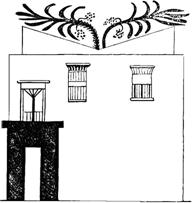
Egyptian House
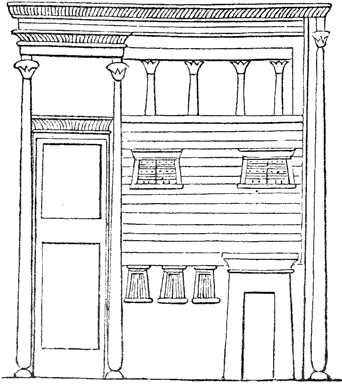
We may premise that the houses present little more than a dead wall to the street. The privacy of Oriental domestic habits would render our plan of throwing the front of the houses towards the street most repulsive. On coming to a house, one finds a lofty wall, which would be blank but for the low door of entrance [GATES]; over which is usually the kiosk, or latticed window (sometimes projecting like the huge bay windows of Elizabethan houses), or screened balcony of the ’summer parlor.’ Besides this, there may be a small latticed window or two high up the wall, giving light and air to upper chambers. This seems, from the engraving (fig. 223), to have been the character of the fronts of ancient Egyptian houses.
The buildings which form the house front towards an inner square or court. Small houses have one of these courts, but superior houses have two, and first-rate houses three, communicating with each other; for the Orientals dislike ascending stairs or steps, and prefer to gain room rather by the extent than height of their habitations. It is only when the building-ground is confined by nature or by fortifications, that they build high houses. Not one out of four houses we ourselves inhabited had more than one story: but, from the loftiness of the rooms, they were as high as houses of three stories among ourselves. If there are three or more courts, all except the outer one are much alike in size and appearance; but the outer one, being devoted to the more public life of the occupant, and to his intercourse with society, is materially different from all the others. If there are more than two, the second is devoted chiefly to the use of the master, who is there attended only by his eunuchs, children, and females, and sees only such persons as he calls from the third or interior court in which they reside. In the history of Esther, she incurs danger by going from her interior court to that of the king, to invite him to visit her part of the palace; but she would not on any account have gone to the outermost court, in which the king held his public audiences. When there are only two courts, the innermost is the harem, in which the women and children live, and which is the true domicile of the master, to which he withdraws when the claims of business, of society, and of friends have been satisfied, and where no man but himself ever enters, or could be induced to enter, even by strong persuasions.
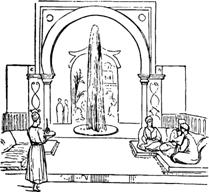
Public Room
Entering at the street-door, a passage, usually sloping downward, conducts to the outer court; the opening from the passage to this is not opposite the gate of entrance, but by a side turn, to preclude any view from the street into the court when the gate is opened. On entering the outer court through this passage, we find opposite to us the public room, in which the master receives and gives audience to his friends and clients. This is entirely open in front, and, being richly fitted up, has a splendid appearance when the first view of it is obtained. A refreshing coolness is sometimes given to this apartment by a fountain throwing up a jet of water in front of it. Some idea of the apartment may be formed from the annexed cut (fig. 224). This is the ’guest-chamber’ of Luk 22:11. A large portion of the other side of the court is occupied with a frontage of lattice-work filled with colored glass, belonging to a room as large as the guest-chamber, and which in winter is used for the same purpose, or serves as the apartment of any visitor of distinction, who cannot of course be admitted into the interior parts of the house. The other apartments in this outer court are comparatively small, and are used for the accommodation of visitors, retainers, and servants. These various apartments are usually upon what we should call the first floor, or at least upon an elevated terrace. The ground-floor is in that case occupied by various store-rooms and servants’ offices. In all cases the upper floor, containing the principal rooms, is fronted by a gallery or terrace, protected from the sun by a sort of penthouse roof supported by pillars of wood.
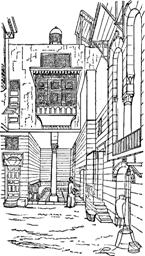
House pillars
In houses having but one court, the reception-room is on the ground-floor, and the domestic establishment in the upper part of the house. This arrangement is shown in the annexed figure (fig. 225), which is also interesting from its showing the use of the ’pillars’ so often mentioned in Scripture, particularly ’the pillars on which the house stood, and by which it was borne up’ (Jdg 16:29).
The kiosk, which has been mentioned above as fronting the street, over the gateway, is connected with one of the larger rooms already described, or forms a separate apartment, which is the summer parlor of Scripture. Here, in the heat of the afternoon, the master lounges or dozes listlessly, refreshed by the air which circulates between the openings of the lattice-work; and here he can, if he pleases, notice unobserved what passes in the street. In this we are to seek the summer parlor in which Ehud smote the king of Moab (Jdg 3:20), and the ’chamber on the wall,’ which the Shunamite prepared for the prophet (2Ki 4:10). The projecting construction over the reception chamber in fig. 225 is, like the kiosk, towards the street as a summer parlor; but there it belongs to the women’s apartments, and looks into the court, and not the street.
Inner Court
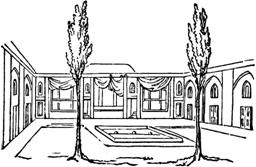
It is now time to proceed to the inner court, which we enter by a passage and door similar to those by which we entered from the street. This passage and door are usually at one of the innermost corners of the outer court. Here a much more extended prospect opens to us, the inner court being generally much larger than the former. The annexed cut (fig. 226) will convey some notion of it; but being a Persian house, it somewhat differs from that which we have more particularly in view. It is lower, the principal apartments standing upon a terrace or bank of earth, and not upon a basement story of offices; and it also wants the veranda or covered gallery in front, which we find in Syro-Arabian houses. The court is for the most part paved, excepting a portion in the middle, which is planted with trees (usually two) and shrubs, with a basin of water in the midst. In our Arabian house the two trees were palm-trees, in which a number of wild doves built their nests. In the second cut (fig. 223), showing an ancient Egyptian house, we see the same arrangement: two palm-trees growing in the court extend their tops above, and, as it were, out of the house—a curious effect frequently noticed in the towns of South-western Asia. That the Jews had the like arrangement of trees in the courts of their houses, and that the birds nested in them, appears from Psa 84:2-3. They had also the basin of water in the inner court, or harem; and among them it was used for bathing, as is shown by David’s discovering Bathsheba bathing as he walked on the roof of his palace. This use of the reservoir has now been superseded by the establishment of public warm baths in every town, and in private mansions. Cold bathing has all but ceased in Western Asia.
The arrangement of the inner court is very similar to that of the outer; but the whole is more open and airy. The buildings usually occupy two sides of the square, of which the one opposite the entrance contains the principal apartments. They are upon what we should call the first floor, and open into a wide gallery or veranda, which in good houses is nine or ten feet deep, and covered by a wooden penthouse supported by a row of wooden columns. This terrace, or gallery, is furnished with a strong wooden balustrade, and is usually paved with squared stones, or else floored with boards. In the center of the principal front is the usual open drawing-room, on which the best art of the Eastern decorator is expended. Much of one of the sides of the court front is usually occupied by the large sitting-room, with the latticed front covered with colored glass, similar to that in the outer court. The other rooms, of smaller size, are the more private apartments of the mansion. There are usually no doors to the sitting or drawing-rooms of Eastern houses: they are closed by curtains, at least in summer, the opening and shutting of doors being odious to most Orientals. The same seems to have been the case among the Hebrews, as far as we may judge from the curtains which served instead of doors to the tabernacle, and which separated the inner and outer chambers of the temple. The curtained entrances to our Westminster courts of law supply a familiar example of the same practice.
These observations apply to the principal story. The basement is occupied by various offices, stores of corn and fuel, places for the water-jars to stand in, places for grinding corn, baths, kitchens, etc. The kitchens are always in this inner court, as the cooking is performed by women, and the ladies of the family superintend or actually assist in the process. The kitchen, open in front, is on the same side as the entrance from the outer court; and the top of it forms a terrace, which affords a communication between the first floor of both courts by a private door, seldom used but by the master of the house and attendant eunuchs.
The kitchen is surrounded by a bank of brickwork, on the top of which are the fireplaces formed in compartments, and separated by little walls of fire-brick or tile. In these different compartments the various dishes of an Eastern feast may be at once prepared at charcoal fires. This place being wholly open in front, the half-tame doves, which have their nests in the trees of the court, often visit it, in the absence of the servants, in search of crumbs, etc. As they sometimes blacken themselves, this perhaps explains the obscure passage in Psa 68:13, ’Though ye have lien among the pots, ye shall be as the wings of a dove covered with silver,’ etc. In Turkish Arabia most of the houses have underground cellars or vaults, to which the inhabitants retreat during the mid-day heat of summer, and there enjoy a refreshing coolness. In the rest of the year these cellars, or serdaubs, as they are called, are abandoned to the bats, which swarm in them in scarcely credible numbers (Isa 2:20).
From the court a flight of stone steps, usually at the corner, conducts to the gallery, from which a plainer stair leads to the house-top. If the house be large, there are two or three sets of steps to the different sides of the quadrangle, but seldom more than one flight from the terrace to the housetop of any one court. There is, however, a separate stair from the outer court to the roof, and it is usually near the entrance. This will bring to mind the case of the paralytic, whose friends, finding they could not get access to Jesus through the people who crowded the court of the house in which he was preaching, took him up to the roof, and let him down in his bed through the tiling, to the place where Jesus stood (Luk 5:17-26). If the house in which our Lord then was had more than one court, he and the auditors were certainly in the outer one; and it is reasonable to conclude that he stood in the veranda addressing the crowd below. The men bearing the paralytic therefore perhaps went up the steps near the door; and finding they could not even then get near the person of Jesus, the gallery being also crowded, continued their course to the roof of the house, and removing the boards over the covering of the gallery, at the place where Jesus stood, lowered the sick man to his feet. But if they could not get access to the steps near the door, as is likely, from the door being much crowded, their alternative was to take him to the roof of the next house, and there hoist him over the parapet to the roof of the house which they desired to enter.
Latticed Windows
The roof of the house is, of course, flat. It is formed by layers of branches, twigs, matting, and earth, laid over the rafters and trodden down; after which it is covered with a compost which acquire considerable hardness when dry. Such roofs would not, however, endure the heavy and continuous rains of our climate; and in those parts of Asia where the climate is more than usually moist, a stone roller is usually kept on every roof, and after a shower a great part of the population is engaged in drawing these rollers over the roofs. It is now very common, in countries where timber is scarce, to have domed roofs; but in that case the flat roof, which is indispensable to Eastern habits, is obtained by filling up the hollow intervals between the several domes, so as to form a flat surface at the top. These flat roofs are often alluded to in Scripture; and the allusions show that they were made to serve the same uses as at present. In fine weather the inhabitants resorted much to them to breathe the fresh air, to enjoy a fine prospect, or to witness any event that occurred in the neighborhood (2Sa 11:2; Isa 22:1; Mat 24:17; Mar 13:15). The dryness of the summer atmosphere enabled them, without injury to health, to enjoy the bracing coolness of the night-air by sleeping on the house-tops; and in order to have the benefit of the air and prospect in the daytime, without inconvenience from the sun, sheds, booths, and tents, were sometimes erected on the house-tops (2Sa 16:22).
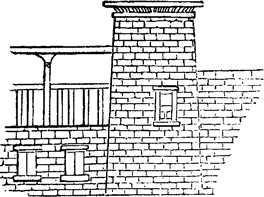
The roofs of the houses are well protected by walls and parapets. Towards the street and neighboring houses is a high wall; and towards the interior court-yard usually a parapet or wooden rail. ’Battlements’ of this kind, for the prevention of accidents, are strictly enjoined in the Law (Deu 22:8); and the form of the battlements of the Egyptian houses, as shown in the annexed engravings, suggest some interesting analogies, when we consider how recently the Israelites had quitted Egypt when that law was delivered.
Battlement
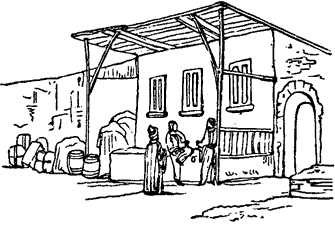
Of the inferior kinds of Oriental dwellings, such as are met with in villages and very small towns, the subjoined is not an unfavorable specimen. In these there is no central court, but there is generally a yard attached, either on one side or at the rear. The shaded platform in front is such as is usually seen attached to coffeehouses, which is, in fact, the character of the house represented in fig. 229. Here the customers sit and smoke their pipes, and sip their coffee. The village cabins and abodes of the peasantry are, of course, of a still inferior description; and, being the abodes of people who live much in the open air, will not bear comparison with the houses of the same class in Northern Europe, where the cottage is the home of the owner.
No ancient houses had chimneys. The word so translated in Hos 13:3, means a hole through which the smoke escaped; and this existed only in the lower class of dwellings, where raw wood was employed for fuel or cooking, and where there was an opening immediately over the hearth to let out the smoke. In the better sort of houses the rooms were warmed in winter by charcoal in braziers, as is still the practice (Jer 36:22; Mar 14:54; Joh 18:18).
The windows had no glass. They were only latticed, and thus gave free passage to the air and admitted light, while birds and bats were excluded. In winter the cold air was kept out by veils over the windows, or by shutters with holes in them sufficient to admit light (1Ki 7:17; Son 2:9).
Coffee House
In the East, where the climate allows the people to spend so much of their time out of doors, the articles of furniture and the domestic utensils have always been few and simple. They are in this work noticed under separate heads [BEDS; LAMP; POTTER]. The rooms, however, although comparatively vacant of moveables, are far from having a naked or unfurnished appearance. This is owing to the high ornament given to the walls and ceilings. The walls are broken up into various recesses, and the ceiling into compartments. The ceiling, if of wood and flat, is of curious and complicated joinery; or, if vaulted, is wrought into numerous coves, and enriched with fret-work in stucco; and the walls are adorned with arabesques, mosaics, mirrors, painting, and gold; which, as set off by the marble-like whiteness of the stucco, has a truly brilliant and rich effect. There is much in this to remind one of such descriptions of splendid interiors as that in Isa 54:11-12.
Is often put for dwelling, residence; and hence the temple, and even the tabernacle, are called the house of God.\par The universal mode of building houses in the East, is in the form of a hollow square, with an open court or yard in the center; which is thus entirely shut in by the walls of the house around it. Into this court all the windows open, there being usually no windows towards the street. Some houses of large size require several courts, and these usually communicate with each other. These courts are commonly paved; and in many large houses parts of them are planted with shrubs and trees, Psa 84:3 128:3; they have also, when possible, a fountain in them, often with a jet d’ eau, 2Sa 17:18 . It is customary in many houses to extend an awning over the whole court in hot weather; and the people of the house then spend much of the day in the open air, and indeed often receive visits there. In Aleppo, at least, there is often on the south side of the court an alcove in the wall of the house, furnished with divans or sofas, for reclining and enjoying the fresh air in the hot seasons.\par In the middle of the front of each house is usually an arched passage, leading into the court-not directly, lest the court should be exposed to view from the street, but by turning to one side. The outer door of this passage was, in large houses, guarded by a porter, Mal 12:13 . The entrance into the house is either from this passage or from the court itself.\par The following extracts from Dr. Shaw will interest the reader, and at the same time serve to illustrate many passages of Scripture. He remarks, "the general method of building, both in Barbary and the Levant, seems to have continued the same from the earliest ages, without the least alteration or improvement. Large doors, spacious chambers, marble pavements, cloistered courts, with fountains sometimes playing in the midst, are certainly conveniences very well adapted to the circumstances of these climates, where the summer heats are generally so intense. The jealously likewise of these people is less apt to be alarmed, while all the windows open into their respective courts, if we except a latticed window or balcony which sometimes looks into the streets", 2Ki 9:30 .\par "The streets of eastern cities, the better to shade them from the sun, are usually narrow, with sometimes a range of shops on each side. If from these we enter into one of the principal houses, we shall first pass through a porch or gateway with benches on each side, there the master of the family receives visits and dispatches business; few persons, not even the nearest relations, having a further admission, except upon extraordinary occasions. From hence we are received into the court, or quadrangle, which, lying open to the weather, is, according to the ability of the owner, paved with marble, or such materials as will immediately carry off the water into the common sewers. When many people are to be admitted, as upon the celebration of marriage, the circumcising of a child, or occasions of the like nature, the company is rarely or never received into one of the chambers. The court is the usual place of their reception, which is strewed accordingly with mats and carpets for their more commodious entertainment. Hence it is probable that the place where our Savior and the apostles were frequently accustomed to give their instructions, was in the area, or quadrangle, of one of this kind of houses. In the summer season, and upon all occasions when a large company is to be received, this court is commonly sheltered from the heat or inclemency of the weather by a veil or awning, which, being expanded upon ropes from one side of the parapet wall to the other, may be folded or unfolded at pleasure. The psalmist seems to allude either to the tents of the Bedaween, or to some covering of this kind, in that beautiful expression, of spreading out the heavens like a curtain, Psa 140:2 . The court is for the most part surrounded with a cloister or colonnade; over which, when the house has two or three stories, there is a gallery erected, of the same dimensions with the cloister, having a balustrade, or else a piece of carved or latticed work going round about it to prevent people from falling from it into the court. From the cloister and galleries we are conducted into large spacious chambers, of the same length with the court, but seldom or never communicating with one another. One of them frequently serves a whole family; particularly when a father indulges his married children to live with him; or when several person join in the rent of the same house. From whence it is, that the cities of these countries, which in general are much inferior in bigness to those of Europe, yet are so exceedingly populous, that great numbers op people are always swept away by the plague, or any other contagious distemper."\par The chambers of the rich were often hung with velvet or damask tapestry, Gen 1:6 ; the upper part adorned with fretwork and stucco; and the ceilings with wainscot or mosaic work or fragrant wood, sometimes richly painted, Jer 22:14 . The floors were of wood or of painted tiles, or marbles; and were usually spread with carpets. Around the walls were mattresses or low sofas, instead of chairs. The beds were often at one end of the chamber, on a gallery several feet above the floor, with steps and a low balustrade,\par 2Ki 1:4,16 . The stairs were usually in a corner of the court, beside the gateway, Mat 24:17 .\par "The top of the house," says Dr. Shaw, "which is always flat, is covered with a strong plaster of terrace; from whence, in the Frank language, it has attained the name of the terrace. It is usually surrounded by two walls; the outermost whereof is partly built over the street, partly makes the partition with the contiguous houses, being frequently so low that one may easily climb over it. The other, which I call the parapet wall, hangs immediately over the court, being always breast high; we render it the ’battlements,’ Deu 22:8 . Instead of this parapet wall, some terraces are guarded in the same manner the galleries are, with balustrades only, or latticed work; in which fashion probably, as the name seems to import, was the net, or ’lattice,’ as we render it, that Ahaziah, 2Ki 1:2, might be carelessly leaning over, when he fell down from thence into the court. For upon these terraces several office of the family, are performed; such as the drying of linen and flax, Jos 2:6, the preparing of figs and raisins; here likewise they enjoy the cool, refreshing breezes of the evening; converse with one another, 1Sa 9:25 2Sa 11:2 ; and offer up their devotions, 2Ki 23:12 Jer 19:13 Mal 10:9 . In the feast of Tabernacles booths were erected upon them, Neh 8:16 . When one of these cities is built upon level ground, we can pass from one end of it to the other, along the tops of the houses, without coming down into the street."\par "Such, in general, is the manner and contrivance of the eastern houses. And if it may be presumed that our Savior, at the healing of the paralytic, was preaching in a house of this fashion, we preaching in a house of this fashion, we may, by attending only to the structure of it, give no small light to one circumstance of that history, which has given great offence to some unbelievers. Among other pretended difficulties and absurdities relating to this fact, it has been urged that the uncovering or breaking up on the roof, Mar 2:4, or the letting a person down through it, Luk 5:19, suppose that the crowd being so great around Jesus in the court below, that those who brought the sick man could not come near him, they went upon the flat roof, and removing a part of the awning, let the sick man down in his mattress over the parapet, quite at the feet of Jesus."\par Dr. Shaw proceeds to describe a sort of addition to many oriental houses, which corresponds probably to the upper chambers often mentioned time the Bible. He says, "To most of these houses there is a smaller one annexed, which sometimes rises one story higher than the house; at other times it consists of one or two rooms only and a terrace; while others that are built, as they frequently are, over the porch or gateway, have (if have not) all the conveniences that belong to the house, properly so called. There is a door of communication from them into the gallery of the house, kept open or shut at the discretion of the master of the family; besides another door, which opens immediately from a privy stairs down into the porch, without giving the least disturbance to the house. These smaller houses are known by the name alee, or oleah, and in them strangers are usually lodged and entertained; and thither likewise the men are wont to retire, from the hurry and noise of their families, to be more at leisure for meditation or devotion, Mat 6:6 ; besides the use they are at other times put to, in serving for wardrobes and magazines."\par This then, or something like this, we may suppose to have been the ali’yah or upper chamber of the Hebrews. Such was the "little chamber upon the wall," which the Shunammite had built for Elisha, 2Ki 4:10 ; the "summer parlor" of Eglon, Jdg 3:20 ; and the "chamber over the gate," where David retired to weep, 2Sa 18:33 ; and perhaps in the New Testament the "upper chamber" where Tabitha was laid out, Mal 9:37, and whence Eutychus fell from the window of the third loft into the court, Mal 20:9 .\par The flat roof of oriental houses often afford a place of retirement and meditation; here Samuel communed with Saul, 1Sa 9:25 ; and from /1Sa 9:26, they would seem also to have slept there, as is still common in the East, 2Sa 11:2 Dan 4:30 . Mr. Wood says, "It has ever been a custom with them," the Arabs in the East, "equally connected with health and pleasure, to pass the nights in summer upon the house-tops, which for this very purpose are made flat, and divided from each other by walls. We found this way of sleeping extremely agreeable; as we thereby enjoyed the cool air, above the reach of gnats and vapors, without any other covering than the canopy of heaven, which unavoidably presents itself in different pleasing forms, upon every interruption of rest, when silence and solitude strongly dispose the mid to contemplation, Mal 10:9 . The roof of an ancient house was the best and often the only place, from which to get a view of the region around; hence the resort to it in times of peril, Isa 15:3 22:1. In many cases roofs were coated with hardened earth, through which, when cracked or soaked through by rain, the water dripped, Pro 27:15 ; and in which, when neglected, the grass grows in spring, but soon withers after the rains have ceased, Psa 129:6,7 Isa 37:27 ."\par The common material for building the best oriental houses is stone. Brick is also used. But the houses of the people in the East in general are very bad constructions, consisting of mud walls, reeds, and rushes; whence they become apt illustrations of the fragility of human life, Job 4:19 ; and as mud, pebbles, and slime, or at best unburnt bricks are used informing the walls, the expression, "digging through houses," Job 24:16 Mat 6:19 24:14, is easily accounted for; as is the behavior of Ezekiel, Eze 12:5, who dug through such a wall in the sight of the people; whereby, as may be imagined, he did little injury to his house; notwithstanding which, the symbol was very expressive to the beholders. So also the striking illustration in Eze 13:10-16 . On the sites of many ancient cities of Syria and Babylonia only the ruins of public edifices disappeared ages ago. Travellers near the Ganges and the Nile speak of multitudes of huts on the sandy banks of those rivers being swept away in a night by sudden freshets, leaving not a trace behind. This may illustrate our Savior’s parable, in Mat 7:24-27 . See TENT.\par
House. The houses of the rural poor in Egypt, as well as in most parts of Syria, Arabia and Persia, are generally mere huts of mud or sunburnt bricks. In some parts of Palestine and Arabia, stone is used, and, in certain districts, caves in the rocks are used as dwellings. Amo 5:11. The houses are usually of one story only, namely, the ground floor, and often contain only one apartment.
Sometimes, a small court for the cattle is attached; and, in some cases, the cattle are housed in the same building, or they live in a raised platform, and, the cattle round them on the ground. 1Sa 28:24. The windows are small apertures high up in the walls, sometimes grated with wood. The roofs are commonly, but not always flat, and are usually formed of a plaster of mud and straw laid upon boughs or rafters; and upon the flat roofs, tents or "booths" of boughs or rushes are often raised, to be used as sleeping-places in summer.
The difference between the poorest houses, and those of the class next above them, is greater than between these and the houses of the first rank. The prevailing plan of eastern houses of this class presents, as was the case in ancient Egypt, a front of wall, whose blank and mean appearance, is usually relieved only by the door and a few latticed and projecting windows. Within this, is a court or courts with apartments opening into them. Over the door is a projecting window with a lattice more or less elaborately wrought, which, except in times of public celebrations, is usually closed. 2Ki 9:30.
An awning is sometimes drawn over the court, and the floor is strewed with carpets on festive occasions. The stairs to the upper apartments are, in Syria, usually in a corner of the court. Around part, if not the whole, of the court is a veranda, often nine or ten feet deep, over which, when there is more than one floor, runs a second gallery of like depth, with a balustrade. When there is no second floor, but more than one court, the women’s apartments -- hareems, harem or haram -- are usually in the second court; otherwise, they form a separate building within the general enclosure, or are above on the first floor.
When there is an upper story, the ka’ah forms the most important apartment, and thus, probably, answers to the "upper room," which was often the guest-chamber. Luk 22:12; Act 1:13; Act 9:37; Act 20:8. The windows of the upper rooms often project one or two feet, and form a kiosk or latticed chamber. Such may have been "the chamber in the wall." 2Ki 4:10-11. The "lattice," through which Ahasiah fell, perhaps belonged to an upper chamber of this kind, 2Ki 1:2, as also the "third loft," from which Eutychus fell. Act 20:9. Compare Jer 22:13.
Paul preached in such a room on account of its superior rise and retired position. The outer circle in an audience in such a room sat upon a dais, or upon cushions elevated so as to be as high as the window-sill. From such a position, Eutychus could easily fall. There are usually no special bed-rooms in eastern houses. The outer doors are closed with a wooden lock, but, in some cases, the apartments are divided from each other by curtains only. There are no chimneys, but fire is made, when required, with charcoal in a chafing-dish; or a fire of wood might be made in the open court of the house. Luk 22:65.
Some houses in Cairo have an apartment open in front to the court with two or more arches and a railing, and a pillar to support the wall above. It was in a chamber of this size to be found in a palace, that our Lord was being arraigned, before the high priest, at the time when the denial of him, by St. Peter, took place. He "turned and looked" on Peter as he stood by the fire in the court, Luk 22:56; Luk 22:61; Joh 18:24, whilst he himself was in the "hall of judgment."
In no point do Oriental domestic habits differ more from European than in the use of the roof. Its flat surface is made useful for various household purposes, such as drying corn, hanging up linen, and preparing figs and raisins. The roofs are used as places of recreation in the evening, and, often, as sleeping-places at night. 1Sa 9:25-26; 2Sa 11:2; 2Sa 16:22; Job 27:18; Pro 21:9; Dan 4:29. They were also used as places for devotion and even idolatrous worship. 2Ki 23:12; Jer 19:13; Jer 32:29; Zep 1:6; Act 10:9.
At the time of the Feast of Tabernacles, booths were erected by the Jews, on the top of their houses. Protection of the roof by parapets was enjoined by the law. Deu 22:8. Special apartments were devoted in larger houses to winter and summer uses. Jer 36:22; Amo 3:15. The ivory house of Ahab was probably a palace largely ornamented with inlaid ivory. The circumstance of Samson’s pulling down the house by means of the pillars may be explained by the fact of the company being assembled on tiers of balconies above each other, supported by central pillars on the basement; when these were pulled down, the whole of the upper floors would fall also. Jdg 16:26.
Known to man as early at least as Cain; the tent not until Jabal, the fifth in descent from Cain (Gen 4:7; Gen 4:17; Gen 4:20). The rude wigwam and the natural cave were the abodes of those who, being scattered abroad, subsequently degenerated from the primitive civilization implied in the elaborate structure of Babel (Gen 11:3; Gen 11:31). It was from a land of houses that Abram, at God’s call, became a dweller in tents (Gen 12:1; Heb 11:9). At times he still lived in a house (Gen 17:27); so also Isaac (Gen 27:15), and Jacob (Gen 33:15). In Egypt the Israelites resumed a fixed life in permanent houses, and must have learned architectural skill in that land of stately edifices. After their wilderness sojourn in tents they entered into possession of the Canaanite goodly cities. The parts of the eastern house are:
(1) The porch; not referred to in the Old Testament save in the temple and Solomon’s palace (1Ki 7:6-7; 2Ch 15:8; Eze 40:7; Eze 40:16); in Egypt (from whence he derived it) often it consisted of a double row of pillars; in Jdg 3:23 the Hebrew word (the front hall) is different. The porch of the high priest’s palace (Mat 26:71;
(2) The court is the chief feature of every eastern house. The passage into it is so contrived that the court cannot be seen from the street outside. An awning from one wall to the opposite shelters from the heat; this is the image, Psa 104:2, "who stretchest out the heavens like a curtain." At the side of the court opposite the entrance was the:
(3) guest chamber (Luk 22:11-12), Hebrew
(4) The stairs. Outside the house, so that Ehud could readily escape after slaying Eglon (Jdg 3:23), and the bearers of the paralytic, unable to get to the door, could easily mount by the outside stairs to the roof, and, breaking an opening in it, let him down in the midst of the room where Jesus was (Mar 2:4). The Israelite captains placed Jehu upon their garments on the top of the stairs, as the most public place, and from them proclaimed "Jehu is king" (2Ki 9:13).
(5) The roof is often of a material which could easily be broken up, as it was by the paralytic’s friends: sticks, thorn bushes (
Here, in national calamities, the people retired to bewail their state (Isa 15:3; Jer 48:38); here in times of danger they watched the foe advancing (Isa 22:1, "thou art wholly gone up to the housetops"), or the bearer of tidings approaching (2Sa 18:24; 2Sa 18:33). On the top of the upper chamber, as the highest point of the house, the kings of Judah made idolatrous altars to the sun and heavenly hosts (2Ki 23:12; Jer 19:13; Jer 32:29). Retributively in kind, as they burnt incense to Baal the god of fire, the Chaldeans should burn the houses, the scene of his worship, with fire (Zep 1:5). On the top of the house the tent was spread for Absalom’s incestuous act with his father’s concubines, to show the breach with David was irreparable (2Sa 16:21-22).
On the housetop publicly the disciples should proclaim what Jesus privately taught them (Mat 10:27; Luk 12:3). Here Peter in prayer saw the vision (Act 10:9). From the balustraded vast roof of Dagon’s temple the 3,000 Philistines witnessed Samson’s feats (Jdg 16:27). By pulling down the two central pillars on which in front the roof rested, he pulled down the whole edifice. Here the people erected their booths for the feast of tabernacles (Neh 8:16). The partly earth materials gave soil for grass to spring in rain, speedily about to wither, because of the shallowness of soil, under the sun’s heat like the sinner’s evanescent prosperity (2Ki 19:26; Psa 129:6).
Though pleasant in the cool evening and night, at other times the housetop would be anything but pleasant; so "it is better to dwell in a corner of the housetop (though there exposed to wind, rain, heat, and cold) than with a brawling woman in a wide house" (a house of community, i.e. shared with her) (Pro 21:9).
(6) The "inner chamber." 1Ki 20:30; 1Ki 22:25 should be translated (fleeing) "from chamber to chamber." The "guest chamber" was often the uppermost room (Greek
Such "a little chamber" the Shunammite woman made (built) "on the wall" of the house for Elisha (2Ki 4:10, compare 1Ki 17:19). Ahaziah fell down from such an "upper chamber" with a projecting latticed window (2Ki 1:2). The "summer house" was generally the upper room, the "winter house" was the lower room of the same house (Jer 36:22; Amo 3:15); or if both were on the same floor the "summer house" was the outer, the "winter house" the inner apartment. An upper room was generally over gateways (2Sa 18:33). Poetically, "God layeth the beams of His upper chambers (Hebrew) in the waters, whence "He watereth the hills" (Psa 104:3; Psa 104:13).
(7) Fireplaces are seldom in the houses; but fire pans in winter heated the apartment. Jer 36:22 translated he stove (a brazen vessel, with charcoal) was burning before him." Chimneys were few (Hos 13:3), simple orifices in the wall, both admitting the light and emitting the smoke. Kitchens are first mentioned in Eze 46:23-24. A fire was sometimes burned in the open court (Luk 22:55-56; Luk 22:61); Peter warmed himself at such a fire, when Jesus on His trial in the large hall, open in front to the court, with arches and a pillar to support the wall above, "turned and looked" on him. Cellars often were made under the ground floor for storage, "secret chambers" (Mat 24:20). Sometimes the granary was "in the midst of the house" (2Sa 4:6).
(8) The cisterns cut in the limestone rock are a leading feature in the houses at Jerusalem, varying from 4 ft. to 30 ft. in width, 8 inches to 30 inches length, 12 inches to 20 inches depth. Almost every house has one, and some as many as four. The rain water is conducted from the roofs into them. Hence the inhabitants within Jerusalem never suffered from want of water in the longest sieges, whereas the besiegers have often suffered. So Neh 9:25, "cisterns hewn" margin, compare 2Ki 18:31; 2Ch 26:10 margin," Uzziah cut out many cisterns." Israel’s forsaking God for earthly trusts is called a "forsaking of the fountain of living waters" for "broken cisterns that can hold no water" (Jer 2:13). Pro 5:15, "drink waters out of thine own cistern," means, enjoy thine own wife’s love, seek none else. So the heavenly spouse is called "a fountain sealed" (Son 4:12).
(9) The foundation was an object of great care. "Great stones" were brought for that of the temple. Often they dug down to the rock and by arches (though not mentioned in Scripture, Eze 40:16 should be translated "porches") built up to the surface. Metaphorically, man’s foundation is in the dust (Job 4:10). The wise man digs down to the rock (Luk 6:48), hearing and doing Christ’s savings. Christ is the only foundation (1Co 3:11, etc.). The apostles become "foundations" only by identification with Him, confessing and building themselves, and others on Him (Eph 2:20). Simon became the "rock" by identifying himself with Him; but when he identified himself with "Satan" in his dislike of the cross, Jesus called him so (Mat 16:16-19; Mat 16:22-23).
(10) The windows were small and latticed, in the sense of glass. Metaphorically the eyes, looking out from the eyelids which open and shut like the casement of a window (Ecc 12:3). Christ "looketh forth at the windows ... showing Himself through the lattice," the types and prophecies were lattice glimpses of Him to the Old Testament congregation (Son 2:9; Joh 8:56). The legal "wall of partition" was only removed by Christ’s death (Heb 10:20). Even still He shows Himself only to faith, through the windows of His word and the lattice of ordinances and sacraments (Joh 14:21), not full vision (1Co 13:12); an incentive to our looking for His coming in person (Isa 33:17).
(11) The walls being often of mud can be easily dug through by a robber (Job 4:19; Job 24:16; Job 15:28). When deserted they soon become "heaps." So hopes of peace with God which rest on no scriptural promises are like walls built with "untempered mortar" (
House. See Dwelling.
There are but few things mentioned in scripture that throw light upon the construction of the houses in the East. Of modern eastern houses it may be said the backs of the houses are in the street. There is a door, with perhaps a lattice over it, and one or two lattices high up, with all the rest a blank wall. A house may be watched all day, and not a soul be seen, unless some one comes to the door, though all going on in the street may be seen from the lattices. The door opens into a porch or passage, which leads into an open court, but so arranged that no one can see into the court when the door is opened. The court is large, sometimes open to the sky, in which visitors are received and business transacted: some have two courts, or even three. Often there is a fountain and trees in the court. Around the court are entrances to more private rooms, where meals are served and to chambers where the inmates repose. The ’parlour’ where Samuel entertained Saul would be one of such rooms.
Stairs in the corner of the court lead to upper private rooms; and often there are stairs outside the house that lead to the roof. These enabled the sick man to be carried to the roof in Mar 2:4, when entrance could not be obtained by the door. The roof is often made of sticks, thorn bushes, mortar and earth; which often have to be rolled to consolidate the structure after rain. A hole could easily be broken through such a roof to let down the paralytic. Other roofs were more substantial, with a parapet round them for safety. On such roofs persons retired for private conversation and for prayer, 1Sa 9:25; Act 10:9; and in the evening for coolness. 2Sa 11:2.
The Lord speaks of the disciples publishing on the housetop what He had told them privately. Mat 10:27; Luk 12:3. This mode of proclamation may often be seen in the East when the public crier calls out from the housetop the information he has to make known.
Houses were mostly built of stone, that being plentiful and wood comparatively scarce. In Bashan there are still numbers of ancient houses, solidly built of stone, some with the ancient stone doors still on their hinges, or rather pivots, many of the houses having no inhabitant. Temporary houses and those for the poor were often built of mud, which could easily be dug through by a thief, and which left to themselves soon became a heap of rubbish. Job 4:19; Job 15:28; Job 24:16; Mat 24:43. Cattle were often kept in some part of the house, as they are to this day, for safety. 1Sa 28:24.
HOUSE
The ‘house,’ as a building, plays no such part in Oriental as in Western life and civilization. Climatic conditions in the East permit people to live much in the open. Accordingly we find artisans and merchants plying their trades in the street, or in open shops looking out on the street. Then the domestic life of the Oriental requires little beyond a sheltered place for sleeping and a quiet place for eating. The ordinary house of the ancient Hebrew, we may be sure, was much like that found in Palestine to-day—it could hardly be cruder, or more primitive. As to Hebrew architecture, of either OT or NT times, the Bible has little to say. Architecture proper can hardly be said to have arisen among the Hebrews before the time of the kings, say, about b.c. 1000. Then, it would seem, it differed little from that of the Phœnicians, Assyrians, and Egyptians. The style of the house would naturally be determined largely by the location, the materials at hand, and the purpose to be served. Palestine, as known to history, has had few great forests, and little timber of any kind suited for building. (Solomon had to import materials for palace and temple, 1Ki 5:18). Houses built in the plains were usually constructed of mud, clay, or sun-dried bricks (cf. Job 4:19). ‘Houses of clay,’ or those built of sun-dried bricks, could be easily broken into—a fact that gives point to our Lord’s allusion in the Sermon on the Mount, when He would dissuade from laying up treasures ‘where thieves break through and steal’ (Mat 6:19), where it is literally ‘dig through’ ((Revised Version margin) ). Great care needed to be taken with the foundations. In a limestone country like Palestine, if one dig deep enough, he finds almost anywhere a stratum of solid rock. It is still true that the wise man builds his house upon the rock (Mat 7:24). It is common there now to dig down to the rock and lay the foundation of even the ‘house of clay’ upon it. Mat 7:25 ‘It was founded,’ might well be rendered, ‘It was foundationed upon the rock,’ if we had such a word in English. St. Luke (Luk 6:48) says, ‘dug, and went deep, and laid a foundation upon the rock.’
In the mountainous regions limestone rock was the building material chiefly used, as it was abundant, easily quarried, and readily worked. The house of stone was, probably, modelled after, or developed from, the cave. The nature of the country invited to this. First the natural cave would be used, and, as there was demand, artificially enlarged. Then, occasionally, in some inviting place, a cave would be hewn out of the rock, de novo. Finally, a wall would be built in front for protection, or privacy, and so the cave would be converted into a sheltered dwelling. Henceforth it would serve as a model for detached stone houses. As a matter of fact, in the ancient village of Siloam are found all these kinds of houses, and they illustrate this process of development. (See Jewish Encyc. art. ‘House’). Bricks were sometimes used even in the mountain regions, though counted inferior to hewn stone (2Sa 12:31). Many stone houses were unpretentious and rude, being built of rough, unhewn stones; but some, then as now, were built of hewn stones, with vaulted stone roofs, e.g. the palaces of the rich, or of the ruling class (cf. ‘the house of the ruler,’ Mar 5:38, ‘the high priest’s house,’ Luk 22:54). Sometimes space for walking was left around the dome, but often all the space between the dome and the battlement (Deu 22:8) would be filled in, so as to give the much-desired flat roof—the favourite resort of the Oriental in the cool of the evening (2Sa 11:2), and an inviting sleeping-place in summer (1Sa 9:25). Such a house will often have a hut of branches, or of vine-covered trellis-work, on the roof (cf. 2Sa 16:22, Neh 8:16), and sometimes a more substantial room, where guests of honour are lodged (1Ki 17:19, 2Ki 4:10). For ‘summer parlour,’ cf. Jdg 3:20, (Revised Version margin) has rightly ‘upper chamber of cooling.’ (See Mar 14:15, and cf. ‘upper room’ elsewhere). From the roof one could easily see what was going on in the street, or on a neighbouring housetop (cf. 1Sa 9:25); indeed, could even step from roof to roof, and thus walk the whole length of a street, as the present writer once did in Damascus (cf. Mar 13:15; Josephus Ant. xiii. 140 [ed. Niese]).
The humbler house of the plain was very simple, having usually only one apartment, which some times sheltered both man and beast. The walls were sometimes smeared with clay (Lev 14:41), sometimes plastered (Eze 13:10, Deu 27:4). The roof was made, no doubt, as that of the common Arab house is made to-day, by laying rough beams about three feet apart, then laying reeds or brushwood close and thick across, covering it with something like the thickly matted thorn-bush called bellan, and then spreading over the whole, first a coat of thick mortar, and then one of marl or earth, and rolling it. Such roofs would require frequent repairing and rolling to keep out the rain, and, if neglected, would get so soaked with the tropical rains that they would cave in. In this way whole villages have had to be abandoned, and their houses left desolate. It was probably one of the simplest of such roofs that was ‘broken up’ (Mar 2:4) when the paralytie was let down from the housetop at Capernaum into the presence of Jesus to be healed. The whole affair would seem to have been the extemporaneous device of plain peasants, accustomed to open their roofs and let down grain, straw, and other articles, as they still do in that country (Thomson, Land and Book, ii. 6ff.). The furniture of such a house would be very simple,—a few mats, or pallets, spread on the ground floor for sleeping on at night, then rolled up and put aside in the day; latterly a ‘divan’ set against the wall on one side, a small table, a few rude chairs, a niche in the wall for the primitive little lamp, unless it was of a sort to hang from a rafter, and a few large jugs for grain, water, wine, or oil.
The palace of the rich would differ from such a house, of course, in having more rooms, and richer and more varied furniture. The numerous rooms, often preferably arranged in a suite on the ground floor around one or more open courts, were often built in storeys. Fine woods, olive, cedar, etc., were used for the doors and windows, and the floors were sometimes made of wood, but often of cement or stone, or even of rich mosaics; while the walls in rare instances were inlaid with ivory and beaten gold (cf. Amo 5:11, 1Ki 22:39; 1Ki 6:18; 1Ki 6:20).
The Graeco-Roman architecture of the Hellenistic period did not exert any very marked or lasting influence upon the architecture of Palestine, partly because of the Jewish antipathy to the Hellenizing tendency, and partly because it was confined to the larger buildings, such as palaces, baths, theatres, temples, etc. See, further, Hasting’s Dictionary of the Bible , art. ‘House.’
Literature.—The Heb. Archaeologies of Keil, Benzinger, Nowack; Edersheim, Jewish Social Life; Tristram, Eastern Customs in Bible Lands; Mackie, Bible Manners, etc.
Geo. B. Eager.
By: Emil G. Hirsch, Immanuel Benzinger
In the warm countries of the East the house is not so important a factor as it is in Western civilization, the climate permitting the Palestinian to live almost entirely in the open air. Artisans do not ply their trades in the house, but directly in the street, or in an open shop looking onto the street. The Palestinian, therefore, requires few domestic conveniences beyond a sheltered place for sleeping and a quiet place for eating. The style of the house is influenced by the material. Since historic times Palestine has had no large forests, and hence no timber for building. Solomon had to import the beams for his edifices (I Kings v. 20 [A. V. 6]), and builders usually had to be very economical with wood. In the plains they generally used bricks of clay, baked in the sun (comp. "bet ḥomer," Job iv. 19, xiii. 12, et al.). In the mountains limestone furnished a good material, being easily quarried and worked.
Caves as Houses.
As these conditions have always obtained, it may be assumed that the house of the ancient Israelite did not differ materially from that of the present inhabitant of the country; indeed, it could hardly have been much more primitive. The present village of Siloam illustrates the way in which the Palestinian houses were modeled on, and developed from, the cave. First, the natural cave was enlarged; then a cave was hewn in the rock; and finally a wall was built in front, converting the cave into a sheltered dwelling. Houses of all these kinds are found in Siloam; some are merely enlarged caves; others have at least a firmly built front wall; and others again are merely built against the rock.
Clay Houses.
The ancient houses, with the exception of the palaces of the great, consisted of only one apartment. In the plains four simple brick walls constituted a house. The walls were often smeared with clay (Lev. xiv. 41 et seq.). The Hebrews began to use lime also at an early date (Amos ii. 1; Isa. xxxiii. 12), and the walls of the better class of houses were plastered (Ezek. xiii. 10 et seq.; Deut. xxvii. 4). The roof was constructed of a few untrimmed logs, branches, and brushwood; a layer of earth was pounded into this framework, and the whole covered with a coating of clay and straw. A roof of this kind keeps off the rain, provided it is repaired and rolled before the rainy season begins. But a house of clay frequently gets so soaked with rain that it falls in, and it is not surprising that villages so built should disappear entirely soon after being abandoned.
Stone Houses.
The stone houses in the mountains are more solid structures. The smaller houses are built of unhewn stones, the more pretentious ones of correspondingly larger stones, with vaulted roofs. It is an open question how the Hebrews of ancient times succeeded in building vaulted domes over square edifices. Ancient ruins indicate that they knew how to meet the difficulty without resort to the dome proper: if the space was too large to be covered by slabs of stone extending from wall to wall, stone beams were laid across the corners, and the process then repeated over the corners formed by each successive series of beams, until the space was narrowed to the desired extent. These vaulted roofs were covered with clay on the outside; only enough space for walking was left round the dome. Frequently, however, the entire space around the dome was filled in so as to convert the whole roof into a flat surface.
The level roof was a favorite resort in the cool of the evening (II Sam. xi. 2), and was much used as a sleeping-place in the summer (I Sam. ix. 25), as it is to-day; small huts of branches were built on the roof as a protection against the sun (II Sam. xvi. 22; Neh. viii. 16). A person on the roof could see what was going on in the street or in the neighborhood without being seen himself (I Sam. ix. 25); and a flight of steps led directly to the roof from the street or the court. Ancient law required the roof to be surrounded with a battlement (Deut. xxii. 8): yet a person could easily step from one roof to the next, and walk the length of whole streets in that way (comp. Mark xiii. 15; Josephus, "Ant." xiii 140, ed. Niese). Among the peasants the single apartment of the house served for both man and beast, the clay flooring of the part reserved for the former being slightly raised. There being no chimney, the smoke escaped through the windows (Hosea xiii. 3, A. V. "chimney"), which were covered with wooden lattices (Judges v. 28; I Kings vi. 4; Prov. vii. 6). The opening for the door was very low (Prov. xvii. 19). The Furniture of the ordinary house was as simple as it is to-day. It included a few mats, spread upon the floor at night for sleeping, and rolled up during the day, or a kind of divan set against the wall; there were a table and chairs; a large jug for grain stood in the corner, and othersfor water, wine, oil, etc.; a niche in the wall held the lamp.
Upper Apartment.
This ordinary house, however, frequently had an upper apartment ("'aliyyah") on the roof, either the hut of branches referred to above (Judges iii. 20), or a more substantial room, where guests of honor were lodged for the night (I Kings xvii. 19; II Kings iv. 10). The "palace" of the rich differed from this only in having a larger number of rooms, arranged in a suite on the ground floor rather than in stories. Special rooms for the summer and the winter are mentioned (Amos iii. 15; Jer. xxxvi. 22). The increasing luxury in the time of the later kings is exemplified in the building of palatial houses with many rooms (Jer. xxii. 14), and especially in the richness of the materials. Hewn stone was used instead of brick (Amos v. 11); in post-exilic times marble also (I Chron. xxix. 2; Cant. v. 15; Josephus, "Ant." xv. 392, ed. Niese; "B. J." v. 4, § 4). The walls were painted or paneled (Jer. xxii. 14); olive or cedar-wood was used for doors and windows (ib.); the floor was paved, or covered with wood (I Kings vi. 15; II Kings xvi. 17); the woodwork of the walls and the jambs of doors and windows were inlaid with ivory (Amos iii. 15; I Kings xxii. 39), covered with beaten gold (I Kings vi. 20), or ornamented with carving (I Kings vi. 18). But the style of building remained, and still remains, unchanged. The Greco-Roman style, with which the Jews became acquainted in the Hellenic period, did not exert any great or lasting influence on the domestic architecture of Palestine, being confined to the larger edifices—palaces, baths, and theaters.
Bibliography:
Benzinger, Arch.;
Nowack, Lehrbuch der Hebräischen Archäologie.
HOUSE.—The history of human habitation in Palestine goes back to the undated spaces of the palæolithic or early stone age (see especially the important chapter on ‘Prehistoric Archæology’ in Vincent, Canaan d’après l’exploration récente, 1907, pp. 373 ff.). The excavations and discoveries, of the last few years in particular, have introduced us to the pre-historic inhabitants whom the Semitic invaders, loosely termed Canaanites or Amorites, found in occupation of the country somewhere in the third millennium before our era (circa b.c. 2500). The men of this early race were still in the neolithic stage of civilization, their only implements being of polished flint, bone, and wood. They lived for the most part in the natural limestone caves in which Palestine abounds. In the historical period such underground caves (for descriptions and diagrams of some of the more celebrated, see Schumacher, Across the Jordan, 135–146; Bliss and Macalister, Excavations in Palestine, 204–270) were used by the Hebrews as places of refuge in times of national danger (Jdg 6:2, 1Sa 13:6) and religious persecution (2Ma 6:11, Heb 11:38). But it is not with these, or with the tents in which the patriarchs and their descendants lived before the conquest of Canaan, that this article has to deal, but with the houses of clay and stone which were built and occupied after that epoch.
1. Materials.—The most primitive of all the houses for which man has been indebted to his own inventiveness is that formed of a few leafy boughs from the primeval forest, represented in Hebrew history to this day by the booths of OT (see Booth). Of more permanent habitations, the earliest of which traces have been discovered are probably the mud huts, whose foundations were found by Mr. Macalister in the lowest stratum at Gezer, and which are regarded by him as the work of the cave-dwellers of the later stone age (PEFSt
The excavations have shown that there is no uniformity, even at a given epoch, in the size of bricks, which are both rectangular and square in shape. The largest, apparently, have been found at Taanach, roughly 21 inches by 153/4, and 43/4 inches in thickness. At Gezer a common size is a square brick 15 inches in the side and 7 inches’ thick (PEFSt
The stone used for house building varied from common field stones and larger, roughly shaped, quarry stones to the carefully dressed wrought stone (gâzith, 1Ki 5:17 RV
2. General plan of Hebrew houses.—The recent excavations at Gezer and elsewhere have shown that the simplest type of house in Palestine has scarcely altered in any respect for four thousand years. Indeed, its construction is so simple that the possibility of change is reduced to a minimum. In a Syrian village of to-day the typical abode of the fellah consists of a walled enclosure, within which is a small court closed at the farther end by a house of a single room. This is frequently divided into two parts, one level with the entrance, assigned at night to the domestic animals, cows, ass, etc.; the other, about 18 in. higher, occupied by the peasant and his family. A somewhat better class of house consists of two or three rooms, of which the largest is the family living and sleeping room, a second is assigned to the cattle, while a third serves as general store-room (AV
The Canaanite houses, which the Hebrews inherited (Deu 6:10) and copied, are now known to have been arranged on similar lines (see the diagram of a typical Canaanite house in Gezer, restored by Mr. Macalister in his Bible Sidelights from Gezer [1906], fig. 25). As in all Eastern domestic architecture, the rooms were built on one or more sides of an open court (2Sa 17:18, Jer 32:2 etc.). These rooms were of small dimensions, 12 to 15 feet square as a rule, with which may be compared the legal definition of ‘large’ and ‘small’ rooms in the late period of the Mishna. The former was held to measure 15 ft. by 12, with a height, following the model of the Temple (1Ki 6:2 ff.), equal to half the sum of the length and breadth, namely, 131/2 ft.; a ‘small’ room measured 12ft. by 9, with a height of 101/2 ft. (Baba bathra, vi. 4).
Should occasion arise, through the marriage of a son or otherwise, to enlarge the house, this was done by building one or more additional rooms on another side of the court. In the case of a ‘man of wealth’ (1Sa 9:1 RVm
3. Foundation and dedication rites.—In building a house, the first step was to dig out the space required for the foundation (cf. Mat 7:24 ff.), after which came the ceremony of the laying of the foundation stone, the ‘corner stone of sure foundation’ of Isa 28:16 (see, further, Corner-Stone). The ‘day of the foundation’ (2Ch 8:16), as we learn from the poetic figure of Job 38:6 ff., was, as it is at the present day, one of great rejoicing (cf. Ezr 3:11).
With the exception of a passage to be cited presently, the OT is silent regarding a foundation rite on which a lurid light has been cast by the latest excavations in Palestine. It is now certain that the Canaanites, and the Hebrews after them, were wont to consecrate the foundation of a new building by a human sacrifice. The precise details of the rite are still uncertain, but there is already ample evidence to show that, down even to ‘the latter half of the Hebrew monarchy’ (PEFSt
An interesting development of this rite of foundation sacrifice can be traced from the fifteenth century b.c. onwards. With the jar containing the body of the victim there were at first deposited other jars containing jugs, howls, and a lamp, perhaps also food, as in ordinary burials. Gradually, it would seem, lamps and bowls came to be buried alone, as substitutes and symbols of the human victim, most frequently a lamp within a bowl, with another bowl as covering. Full details of this curious rite cannot be given here, but no other theory so plausible has yet been suggested to explain these ‘lamp and bowl deposits’ (see Macalister’s reports in PEFSt
Here by anticipation may be taken the rite of the formal dedication of a private house, which is attested by Deu 20:5, although the references in Hebrew literature to the actual ceremony are confined to sacred and public buildings (Lev 8:10 ff., 1Ki 8:1 ff., 1Ki 8:10 ff., Ezr 6:16 f., Neh 3:1; Neh 12:27, 1Ma 4:52 ff.). It is not improbable that some of the human victims above alluded to may have been offered in connexion with the dedication or restoration of important buildings (cf. 1Ki 16:34 above).
On the whole subject it may be said, in conclusion, that, judging from the ideas and practice of the Bedouin when a new tent or ‘house of hair’ is set up, we ought to seek the explanation of the rite of foundation sacrifice—a practice which obtains among many races widely separated in space and time—in the desire to propitiate the spirit whose abode is supposed to be disturbed by the new foundation (cf. Trumbull, Threshold Covenant, 46 ff.), rather than in the wish to secure the spirit of the victim as the tutelary genius of the new building. This ancient custom still survives in the sacrifice of a sheep or other animal, which is indispensable to the safe occupation of a new house in Moslem lands, and even to the successful inauguration of a public work, such as a railway, or—as the other day in Damascus—of an electric lighting installation. In the words of an Arab sheik: ‘Every house must have its death—man, woman, child, or animal’ (Curitiss, Primitive Semitic Religion To-day).
4. Details of construction, walls and floor.—The walls of Canaanite and Hebrew houses were for the most part, as we have seen, of crude brick or stone. At Tell el-Hesy (Lachish), for example, we find at one period house walls of ‘dark-brown clay with little straw’; at another, walls of ‘reddish-yellow clay, full of straw’ (Bliss, A Mound of Many Cities, 44). At Gezer Mr. Macalister found a wall that was ‘remarkable for being built in alternate courses of red and white bricks, the red course being four inches in height, the white five inches’ (PEFSt
In ordinary cases the thickness of the outside walls varied from 18 to 24 inches; that of partition walls, on the other hand, did not exceed 9 to 12 inches (ib. 118). In NT times the thickness varied somewhat with the materials employed (see Baba bathra, i. 1). It is doubtful if the common view is correct, which finds in certain passages, especially Psa 118:22 and its NT citations, a reference to a corner stone on the topmost course of masonry (see Corner). In most cases the reference is to the foundation stone at the corner of two walls, as explained above.
The inside walls of stone houses received a ‘plaister’ (EV
The floors of the houses were in all periods made of hard beaten clay, the permanence of which to this day has proved to the excavators a precious indication of the successive occupations of the buried cities of Palestine. Public buildings have been found paved with slabs of stone. The better sort of private houses were no doubt, like the Temple (1Ki 6:15), floored with cypress and other woods.
The presence of vaults or cellars, in the larger houses at least, is shown by Luk 11:33 RV
5. The roof.—The ancient houses of Canaan, like their modern representatives, had flat roofs, supported by stout wooden beams laid from wall to wall. Across these were laid smaller rafters (Son 1:17), then brushwood, reeds, and the like, above which was a layer of earth several inches thick, while on the top of all came a thick plaster of clay or of clay and lime. It was such a roofing (AV
It was, and is, difficult to keep such a roof watertight in the rainy season, as Pro 27:15 shows. In several houses at Gezer a primitive drain of jars was found for carrying the water from the leaking roof (Ecc 10:18 RV
The roof was required by law to be surrounded by a battlement, or rather a parapet, as a protection against accident (Deu 22:8). Access to the roof was apparently obtained, as at the present day, by an outside stair leading from the court. Our EV
Otherwise the houses of Palestine were, as a rule, of one storey. Exceptions were confined to the houses of the great, and to crowded cities like Jerusalem and Samaria. Ahaziah’s upper chamber in the latter city (2Ki 1:2) may well have been a room in the second storey of the royal palace, where was evidently the window from which Jezebel was thrown (2Ki 9:33). The same may be said of the ‘upper room’ in which the Last Supper was held (Mar 14:15||; cf. Act 1:13). It was a Greek city, however, in which Eutychus fell from a window in the ‘third story’ (Act 20:9 RV
6. The door and its parts.—The door consisted of four distinct parts: the door proper, the threshold, the lintel (Exo 12:7 RV
The threshold (Jdg 19:27, 1Ki 14:17 etc.) or sill must have been invariably of stone. Among the Hebrews, as among so many other peoples of antiquity, a special sanctity attached to the threshold (see Trumbull, The Threshold Covenant, passim). The doorposts or jambs were square posts of wood (1Ki 7:5, Eze 41:21) or of stone. The command of Deu 6:9; Deu 11:20 gave rise to the practice, still observed in all Jewish houses, of enclosing a piece of parchment containing the words of Deu 6:4-9; Deu 11:13-21 in a small case of metal or wood, which is nailed to the doorpost, hence its modern name mezuzah (‘doorpost’).
Doors were locked (Jdg 3:23 f.) by an arrangement similar to that still in use in Syria (see the illust. in Hastings’ DB
In the larger houses it was customary to have a man (Mar 13:34) or a woman (2Sa 4:6 RVm
7. Lighting and heating.—The ancient Hebrew houses must have been very imperfectly lighted. Indeed, it is almost certain that, in the poorer houses at least, the only light available was admitted through the doorway (cf. Sir 42:11 [Heb. text], ‘Let there be no casement where thy daughter dwells’), in any case, such windows as did exist were placed high up in the walls, at least six feet from the ground, according to the Mishna. We have no certain monumental evidence as to the size and construction of the windows of Hebrew houses (but see for a probable stone window-frame, 20 inches high, Bliss and Macalister, Excavs. in Palest. 143 and pl. 73). They may, however, safely be assumed to have been much smaller than those to which we are accustomed, although the commonest variety, the challôn, was large enough to allow a man to pass out (Jos 2:15, 1Sa 19:12) or in (Joe 2:9). Another variety (’arubbah) was evidently smaller, since it is used also to designate the holes of a dovecot (Isa 60:8 EV
Most of the houses excavated show a depression of varying dimensions in the floor, either in the centre or in a corner, which, from the obvious traces of fire, was clearly the family hearth (Isa 30:14). Wood was the chief fuel (see Coal), supplemented by withered vegetation of all sorts (Mat 6:30), and probably, as at the present day, by dried cow and camel dung (Eze 4:15). The pungent smoke, which was trying to the eyes (Pro 10:26), escaped by the door or by the window, for the chimney of Hos 13:3 is properly ‘window’ or ‘casement’ (’arubbah, see above). In the cold season the upper classes warmed their rooms by means of a brasier (Jer 36:22 f. RV
8. Furniture of the house.—This in early times was of the simplest description. Even at the present day the fellahin sit and sleep mostly on mats and mattresses spread upon the floor. So the Hebrew will once have slept, wrapped in his simlah or cloak as ‘his only covering’ (Exo 22:27), while his household gear will have consisted’ mainly of the necessary utensils for the preparation of food, to which the following section is devoted. Under the monarchy, however, when a certain ‘great woman’ of Shunem proposed to furnish ‘a little chamber over the wall’ for Elisha, she named ‘a bed and a table and a stool and a candlestick’ (2Ki 4:10), and we know otherwise that while the poor man slept on a simple mat of straw or rushes in the single room that served as living and sleeping room, the well-to-do had not only beds but bedchambers (2Sa 4:7, 2Ki 11:2, Jdt 16:19 etc.). The former consisted of a framework of wood, on which were laid cushions (Amo 3:12 RV
The bed often served as a couch by day (Eze 23:41, Amo 3:12 RV
As regards the stool above referred to, and the seats of the Hebrews generally, it must suffice to state that the seats of the contemporary Egyptians (for illustt. see Wilkinson, op. cit. i. 408 ff.) and Assyrians were of two main varieties, namely, stools and chairs. The former were constructed either with a square frame or after the shape of our camp-stools; the latter with a straight or rounded back only, or with a back and arms. The Hebrew word for Elisha’s stool is always applied elsewhere to the seats of persons of distinction and the thrones of kings; it must therefore have been a chair rather than a stool, although the latter is its usual meaning in the Mishna (Krengel, Das Hausgerät in der Mishnah, 10 f.—a mine of information regarding the furniture, native and foreign, to be found in Jewish houses in later times). Footstools were also in use (2Ch 9:18 and oft., especially in metaphors).
The tables were chiefly of wood, and, like those of the Egyptians (Wilkinson, op. cit. i. 417 f. with illustt.), were ‘round, square, or oblong,’ as the Mishna attests. They were relatively much smaller and lower than ours (see, further, Meals, § 4).
The fourth article in Elisha’s room was a candlestick, really a lampstand, for which see Lamp. It would extend this article beyond due limits to discuss even a selection from the many other articles of furniture, apart from those reserved for the closing section, which are named in Biblical and post-Biblical literature, or which have been brought to light in surprising abundance by the recent excavations. Mention can he made only of articles of toilet, such as the ‘molten mirror’ of Job 37:18 (AV
9. Utensils connected with food.—Conspicuous among the ‘earthen vessels’ (2Sa 17:28) of every household was the water-jar or pitcher (kad)—the barrel of 1Ki 18:33, Amer. RV
The bucket of Num 24:7, Isa 40:15 was a water-skin, probably adapted, as at the present day, for drawing water by having two pieces of wood inserted crosswise at the mouth. The main use of skins among the Hebrews, however, was to hold the wine and other fermented liquors. The misleading rendering bottles is retained in RV
No house was complete without a supply of baskets of various sizes and shapes for the bread (Exo 29:23) and the fruit (Deu 26:2), and even in early times for the serving of meat (Jdg 6:19). Among the ‘vessels of wood’ of Lev 15:12 was the indispensable wooden howl, which served as a kneading-trough (Exo 12:34), and various other bowls, such as the ‘lordly dish’ of the nomad Jael (Jdg 5:25) and the bowl of Gideon (Jdg 6:38), although the howls were mostly of earthenware (see Bowl).
As regards the actual preparation of food, apart from the oven (for which see Bread), our attention is drawn chiefly to the various members of the pot family, so to say. Four of these are named together in 1Sa 2:14, the kiyyôr, the dûd, the qallachath, and the pârûr, rendered respectively the pan, the kettle, the caldron, and the pot. Elsewhere these terms are rendered with small attempt at consistency; while a fifth, the most frequently named of all, the sîr, is the flesh-pot of Exo 3:16, the ‘great pot’ of 2Ki 4:38, and the ‘caldron’ of Jer 1:13. In what respect these differed it is impossible to say. The sîr was evidently of large size and made of bronze (1Ki 7:45), while the pârûr was small and of earthenware, hence ben-Sira’s question: ‘What fellowship hath the [earthen] pot with the [bronze] caldron?’ (Sir 13:2, Heb. text). The kiyyôr, again, was wide and shallow, rather than narrow and deep. Numerous illustrations of cooking-pots from OT times may be seen in the recent works above referred to. The only cooking utensils known to be of iron are the baking-pan (Lev 2:5 RV
In the collection of pottery figured in Bliss and Macalister’s work one must seek the counterparts of the various dishes, mostly wide, deep howls, in which we read of food being served, such as the ‘dish’ from which the sluggard is too lazy to withdraw his hand (Pro 19:24 RV
A. R. S. Kennedy.
I. Cave Dwellings
II. Stone-Built and Mud/Brick-Built Houses
1. Details of Plan and Construction
(1) Corner-Stone
(2) Floor
(3) Gutter
(4) Door
(5) Hinge
(6) Lock and Key
(7) Threshold
(8) Hearth
(9) Window
(10) Roof
2. Houses of More than One Story
(1) Upper Chambers and Stairs
(2) Palaces and Castles
3. Internal Appearance
III. Other Meanings
Literature
I. Cave Dwellings
The earliest permanent habitations of the prehistoric inhabitants of Palestine were the natural caves which abound throughout the country. As the people increased and grouped themselves into communities, these abodes were supplemented by systems of artificial caves which, in some cases, developed into extensive burrowings of many adjoining compartments, having in each system several entrances. These entrances were usually cut through the roof down a few steps, or simply dropped to the floor from the rock surface. The sinking was shallow and the headroom low but sufficient for the undersized troglodites who were the occupiers.
II. Stone-Built and Mud/Brick-Built Houses
There are many references to the use of caves as dwellings in the Old Testament. Lot dwelt with his two daughters in cave (Gen 19:30). Elijah, fleeing from Jezebel, lodged in a cave (1Ki 19:9). The natural successor to the cave was the stone-built hut, and just as the loose field-bowlders and the stones, quarried from the caves, served their first and most vital uses in the building of defense walls, so did they later become material for the first hut. Caves, during the rainy season, were faulty dwellings, as at the time when protection was most needed, they were being flooded through the surface openings which formed their entrances. The rudest cell built of rough stones in mud and covered a with roof of brushwood and mud was at first sufficient. More elaborate plans of several apartments, entering from what may be called a living-room, followed as a matter of course, and these, huddled together, constituted the homes of the people. Mud-brick buildings (Job 4:19) of similar plan occur, and to protect this friable material from the weather, the walls were sometimes covered with a casing of stone slabs, as at Lachish. (See Bliss, A Mound of Many Cities.) Generally speaking, this rude type of building prevailed, although, in some of the larger buildings, square dressed and jointed stones were used. There is little or no sign of improvement until the period of the Hellenistic influence, and even then the improvement was slight, so far as the homes of the common people were concerned.
1. Details of Plan and Construction
One should observe an isometric sketch and plan showing construction of a typical small house from Gezer. The house is protected and approached from the street by an open court, on one side of which is a covered way. The doors enter into a living-room from which the two very small inner private rooms, bedchambers, are reached. Builders varied the plan to suit requirements, but in the main, this plan may be taken as typical. When members of a family married, extra accommodation was required. Additions were made as well as could be arranged on the cramped site, and in consequence, plans often became such a meaningless jumble that it is impossible to identify the respective limits of adjoining houses. The forecourt was absorbed and crushed out of existence, so that in many of the plans recovered the arrangement is lost.
(1) Corner-Stone
Corner-stone (
(2) Floor
Floor (
(3) Gutter
Gutter (
(4) Door
Door (
(5) Hinge
Hinge (
(6) Lock and Key
Lock and key (“lock,”
(7) Threshold
Threshold (
(8) Hearth
Hearth (
(9) Window
Window (
(10) Roof
Roof (
2. Houses of More than One Story
(1) Upper Chambers and Stairs
It is certain that there were upper chambers (
(2) Palaces and Castles
Palaces and castles (
3. Internal Appearance
Walls were plastered (Lev 14:43, Lev 14:18), and small fragments of painted (Jer 22:14) plaster discovered from time to time show that some attempt at mural decoration was made, usually in the form of crudely painted line ornament. Walls were recessed here and there into various forms of cupboards (which see) at various levels. The smaller cuttings in the wall were probably for lamps, and in the larger and deeper recesses bedmats may have been kept and garments stored.
III. Other Meanings
The word has often the sense of “household,” and this term is frequently substituted in the Revised Version (British and American) for “house” of the King James Version (e.g. Exo 12:3; 2Ki 7:11; 2Ki 10:5; 2Ki 15:5; Isa 36:3; 1Co 1:11; 1Ti 5:14); in certain cases for phrases with “house” the Revised Version (British and American) has “at home”. (Acts 12:46; Act 5:42). See HOUSE OF GOD; HOUSEHOLD.
Literature
Macalister, Excavations at Gezer; PEFS; Sellin, Excavations at Taanach; Schumacher, Excavations at Tell Mutesellim; Bliss, Mound of Many Cities; articles in Dictionaries and Encyclopedias.
In this article the references in the NT to the structure and appointments of a house will be collected together, and a description of a house in apostolic times will be given, with illustrations from the present writer’s observations in his Eastern travels. For ‘house’ in the sense of those who inhabit the building, and of descendants, see Family.
1. Foundations and materials.-Great attention was paid to the foundations; they were if possible of stone, even if the walls were of mud. The foundations (the apostles and prophets) and the cornerstone (Christ) are the principal elements in the spiritual house (Eph_2:20). The importance of the foundations of the wall of the holy city is illustrated in Rev_21:14 ff. by their being adorned with precious stones. It thus happens in the present day that in the ordinary Eastern house the foundations often cost as much as all the rest of the building put together. In places where stone is plentiful all houses are built of that material; otherwise only the very rich men’s houses are of stone and all others are built of sun-dried bricks (sometimes of kiln-dried bricks, which are more expensive), or even of mud set in layers, each layer being left to dry hard before the next layer is placed on the top of it. The sun-dried bricks are made simply of clay with which chopped straw is mixed (Exo_5:7), and are set to dry in the sun for a few days before they are wanted for the building. Thus brick-making and house-building go on together on the same ground. The perishable nature of the material explains why, with the exception of the royal palaces, which were built of stone, nearly all Nineveh has completely vanished. If Layard’s rather doubtful theory is correct (Nineveh and its Remains, London, 1849, vol. ii. p. 236ff.), that vast city of ‘three days’ journey’ [round the walls] (Jon_3:3) occupied the large area between the fortresses, which alone remain to this day, and was some 75 miles in circumference; but of the buildings in the centre of the area there is not a trace. The same thing also explains the references to ‘digging through’ houses in Mat_6:19; Mat_24:43, Luk_12:39; this is quite an easy thing to do.
2. The roof (äῶìá; sometimes óôÝãç, Mat_8:8, Luk_7:6).-This is flat, made of mud laid on beams of wood, crossed by laths, and covered with matting. It is used in summer as a sleeping-place, and by day (especially in the evening) as a sitting-room, or often as a promenade, for roofs of adjacent houses in the villages are frequently joined together. It is possible sometimes to walk from one end of the village to the other without descending the ladders or staircases to the courtyards and streets. Hence in time of persecution the fugitive would do well to flee along the roofs rather than fall a prey to the enemy in the streets (Mat_24:17, Mar_13:15, Luk_17:31). So St. Peter goes to the roof to pray (Act_10:9). The roof is a favourite place for village gossip; this is the ‘proclamation on the housetops’ of Mat_10:27, Luk_12:3. The nature of the material of the roof explains how easy it was to dig through it (Mar_2:4, ἐîïñýîáíôåò; cf. Gal_4:15) in order to let the paralytic down; the mention of tiles in || Luk_5:19 is merely a paraphrase adopted by St. Luke for the comprehension of his more Western readers-or at least of readers less acquainted with the customs of Palestine than those of St. Mark (W. M. Ramsay, Was Christ born at Bethlehem?, 1898, p. 57f.).
3. The windows (èõñßäåò).-In the East these now usually look into the courtyard, not into the street, as privacy is of the greatest importance. Such was probably the case in Act_20:9, where Eutychus, sitting in a window, falls from the third story (ἀðὸ ôïῦ ôñéóôÝãïõ); as Eastern houses are usually of two stories (for the kitchen see below), we must here have an exception to the general rule. It is not common for windows to be in the outside wall of a town; yet this must have been the case in Act_9:25, 2Co_11:33, where St. Paul is let down through the town wall and escapes, in both cases from Damascus, for both passages seem to refer to the same incident (cf. also Rahab, Jos_2:15). Except in the better houses, no glass is used in the windows; oiled cotton or paper serves instead of glass in the winter, being removed in the summer. Glass (other than that used for mirrors) is mentioned in the NT only in Rev_4:6; Rev_15:2; Rev_21:18; Rev_21:21; its costliness in ancient times, as in the modern East, is seen by its being coupled with gold in Job_28:17 Revised Version .
4. The house-gate.-The door or gate itself is èýñá (Mar_2:2, Joh_18:16, figuratively in Rev_3:20), but ðõëþí is the gateway or entry of a house, especially if large, as well as of a city (Mat_26:71, Luk_16:20, Act_10:17; Act_12:13 f.; in the last passage the full expression ‘door of the gate’ (èýñá ôïῦ ðõëῶíïò) is used, but in Act_12:14 ðõëþí includes èýñá, for it is ‘opened’ by Rhoda; cf. articles Door and Gate). For a house-gate ðýëç is not ordinarily used; it is the gate of a city, and so of a public building like the Temple or a prison (Act_3:10; Act_12:10, but Act_3:2 has èýñá). The house-gate was naturally kept locked in troublous times, as in Act_10:17; Act_12:13-16, and was guarded by a porter (Mar_13:34, ὁ èõñùñüò) or a portress (Joh_18:16, ἡ èõñùñüò; cf. Mar_14:69, Act_12:13 f.), just as the figurative sheepfold in Joh_10:3 is guarded by ‘the porter,’ probably the Holy Spirit (H. B. Swete, The Holy Spirit in the NT, 1909, p. 146). The entry (ðõëþí) is either the same as, or else leads into, the fore-court (ðñïáýëéïí) of Mar_14:68, where || Mat_26:71 has ðõëþí. Outside the gate of the great houses the beggars sit (Luk_16:20, Lazarus), as they did at the gate of the Temple (Act_3:2; Act_3:10). Inside the gate, perhaps in the fore-court, were the water-pots for washing (Joh_2:6); evidently not in the guest-room.
5. The courtyard (áὐëÞ).-This occupied the centre of the house (Mat_26:69, Mar_14:54; Mar_14:66). We read of a charcoal fire in it-a brazier in the open air (Mar_14:54; Mar_14:67, Luk_22:55 f., Joh_18:18; Joh_18:25), in the middle (Luk_22:55). On this courtyard the rooms opened; our Lord inside was visible to Peter in the court (Luk_22:61). The rooms, in places where there is little cold weather, might be entirely open to the court, as may be seen at the present day, e.g. at Mosul; or, in colder places, might open on the court with doors and windows, with or without a covered gallery.
6. The kitchen.-The kitchen itself is not mentioned in the NT, though the oven (Mat_6:30) and kitchen utensils (Mar_7:4) are referred to. Yet in all but the richer houses it is the most commonly used part of the house, and the family ordinarily live in it; in some Eastern countries it is emphatically called ‘the house’ as opposed to ‘the rooms.’ The oven is a hole in the floor; the fire, of dried manure, is kindled at the bottom; and the sides are made of hardened clay, to which the flaps of dough adhere until they are baked and ready to be hooked out as bread. Other food is cooked over the fire in pots. As there is no chimney (in our sense of the word), the kitchen must necessarily be of one story only, to allow of a hole in the roof for the escape of the smoke.
7. The rooms.-(a) There is not in the East, in the ordinary houses, the distinction usually found in the West between bedrooms and sitting-rooms. The latter are turned into bedrooms by spreading the bedclothes on the floor. Thus the ‘bed-chamber’ (êïéôþí, Act_12:20) of which Blastus was guardian would be unusual except in a great house such as that of Herod.
(b) Most houses, even of the comparatively poor, have a fairly large room or rooms, often, but not always, on the first floor, to entertain guests who come unexpectedly, for Eastern hospitality is great (see Home). Hence we read that the upper room (ἀíþãåïí or ἀíþãáéïí or ἀíùãåþí or ἀíÜãáéïí) of Mar_14:14 f., Luk_22:11 f. was large, and it is expressly called a ‘guest-chamber,’ êáôÜëõìá, i.e. a place where the guests unpack their baggage; it may be doubted if êáôÜëõìá in Luk_2:7 is rightly rendered ‘inn,’ for this in Luk_10:34 is called ðáíäï÷åῖïí. Probably the êáôÜëõìá was a guest-chamber in a house where Joseph expected to lodge, but it is a word elastic in meaning (see A. Plummer, St. Luke 2 [International Critical Commentary , 1898], 54). The upper room of the Last Supper was very probably the place where the Ten and the rest were assembled on Easter Day, and if so must have been somewhat large, though the word used (ἠèñïéóìÝíïõò, Luk_24:33 Revised Version ; cf. Luk_24:9) suggests crowding, just as the compounds óõíçèñïéóìÝíïé, óõíáèñïßóáò in Act_12:12; Act_19:25 suggest a large assembly. In Acts the word used for such an upper room is ὑðåñῷïí, Act_1:13; Act_9:37; Act_9:39 (Dorcas) Act_20:8 (at Troas). The room mentioned in Act_1:13 must have been large, for it held 120 people; and it was perhaps the same as the coenaculum of Mar_14:14 f., for it is called ‘the upper room’ (Revised Version ). It has been suggested that as different words are used, the rooms must have been different; yet this would not account for St. Luke’s using ἀíþãåïí in his Gospel, and always ὑðåñῷïí in Acts. It was no doubt in such a guest-chamber on the first floor that Jesus healed the paralytic, for it was under the roof. (With this arrangement for an upper room we may compare the ordinary provision in a caravanserai of a room or rooms over the gateway for the guests, while the stables are below, and round the courtyard.) Such an upper room is probably the îåíßá in Phm_1:22, Act_28:23 -a lodging in a private house. In response to St. Paul’s request, Philemon would doubtless offer his own guestroom. When the Apostle arrived in Rome he probably at first lodged, guarded by soldiers, in the guest-room of a friend, though afterwards he hired a private house (ìßóèùìá, Act_28:30). For the use of these guest-rooms as the first Christian churches, see Family.
(c) Besides the above rooms we read in the NT of a ôáìåῖïí (better ôáìéåῖïí) and an ἀðïèÞêç. The latter is a barn or granary (Mat_3:12; Mat_6:26; Mat_13:30, Luk_3:17; Luk_12:18; Luk_12:24). The former is properly a store-chamber (Luk_12:24), and is usually used in that sense in the Septuagint (Deu_28:8, etc.). All Eastern houses have such chambers, and for security they are usually placed so as not to have an outside wall, but to open off the kitchen. Hence any inner chamber used for living in came to be so called (Mat_6:6; Mat_24:26, Luk_12:3). The Latin translations of ôáìåῖïí vary greatly (Plummer, St. Luke2, 318).
8. Paving of the rooms.-This is very seldom of wood (except in Solomon’s Temple, 1Ki_6:15; 1Ki_6:30, where the wood was overlaid with gold), but, even on the upper floors, of beaten mud, sometimes of a sort of cement. In rich houses pavements of stone or marble were used; thus the Gabbatha (Ëéèüóôñùôïí) of Joh_19:13 was probably a hall paved with stone.
9. Furniture of the rooms.-Very little is said of this in the NT; and, in truth, Eastern houses need little furniture. Carpets (with straw mats under them to protect them from the mud floor), mattresses, and bedclothes are practically the only necessaries. When we read in the NT the various words for a ‘bed’ as used for sleeping in-êëßíç (Mat_9:2, Luk_5:18), êëéíßäéïí (Luk_5:19; Luk_5:24; the same as êëßíç, Luk_5:18), êñÜââáôïí (Mar_2:4; Mar_6:55, Joh_5:8)-only mattresses and bedclothes are meant. The man who rises in the morning ‘takes up his bed,’ and, rolling it up in an outer cover, places it against the wall, where it serves as a cushion in the day-time. The same is probably true of êëßíç in Mar_7:30, Luk_17:34, Rev_2:22, where either sense is possible; and of the êëéíἀñéá êáὶ êñÜââáôá in Act_5:15 (inferior Manuscripts substitute êëßíáé for the former word), where the sick are laid in the streets. On the other hand, the low couches (êëßíáé, triclinia, ôñéêëßíéá [the last not in the NT] used for meals are clearly articles of furniture in Mar_4:21; Mar_7:4 (here a ‘Western’ addition, but it may be genuine), Luk_8:16; for a lamp may be put under them (cf. ἀñ÷éôñßêëéíïò, Joh_2:6). On these couches the people reclined; hence ἀíÜêåéìáé is ‘to sit at meat’ (Mat_9:10, etc.), and the guests are ἀíáêåßìåíïé (Mat_22:10). It seems doubtful if bedsteads are ever mentioned in the NT; see, further, article Bed, Couch. The ‘candlestick’ or lamp-stand (ëõ÷íßá) mentioned in the above passages is also a piece of furniture, set in the middle of the room to hold the light. Chairs and tables are not much used by non-westernized Orientals to this day; but sometimes a low stand is placed on the floor to hold food at meals, though more often the meats are placed on a tablecloth on the ground. Thus ‘table’ in the Bible does not usually denote an article of furniture, except in the case of the money-changers in Mat_21:12, Mar_11:15, Joh_2:15, where a house is not being spoken of. The throne (âῆìá), of a king is mentioned in Act_12:21, and figuratively the èñüíïò of God and the èñüíïé of angels or men (Mat_19:28, Rev_20:4, etc.) are spoken of; but ordinary people sat, as they still sit in the true East, on the ground, of on cushions, though chairs or seats (êáèÝäñáé) were not unknown (Mat_21:12, Mar_11:15).
Literature.-C. Warren in Hasting's Dictionary of the Bible (5 vols) ii. 431, article ‘House (especially for the OT); A. J. Maclean and W. H. Browne, The Catholicos of the East and his People, London, 1892; A. H. Layard, Nineveh and its Remains, do. 1849, especially pt. i. ch. vi. and vii., pt. ii. ch. ii.
A. J. Maclean.
Deu 7:8 (a) This is a reference to the nation of Egypt. (See also Deu 8:14).
Deu 25:10 (a) The type here is used to describe a family or the line of generation. (See also Rth 4:12; Jdg 8:35; Jdg 9:6; Jdg 10:9; 1Sa 3:14; 2Sa 3:1). In quite a number of places throughout the Scriptures the word "house" is used as a reference to a family in various generations, or to a nation.
Isa 66:1 (b) This is a type of the building which the Lord expects each believer to construct in his life for the glory of GOD and the blessing of men. This house must have a right foundation, JESUS CHRIST:
- a heating plant to keep the heart and soul on fire for GOD;
- a kitchen so that the food may be prepared for the soul;
- a library for the education and instruction of the mind;
- a music room to keep the heart singing;
- a parlor for hospitality;
- a bedroom for rest;
- a bath room for cleansing;
- an attic for storage;
and also the light of the Word and the water of the Spirit.
Mat 7:26 (a) Refers to the kind of life one builds for eternity. If he builds on CHRIST, his life will stand the tests of time and eternity. If he builds on character, morals, tradition or false religions, it will be destroyed under the storm of GOD’s wrath.
2Co 5:1 (a) This refers to the physical body in which we live.
1Ti 3:15 (a) This is a name applied to the entire church of GOD composed of all believers.
2Ti 2:20 (b) This type refers to the church of GOD in which there are some who are very valuable, and other people who do not seem to be so important. In every home there are beautiful vases, and other valuable vessels in the parlor. They are expensive, attractive, and receive much attention from the visitors. In the kitchen of the same home there are the skillet, the tea kettle, the baking pans, and other such inferior vessels. They are just as essential, or more so, than those in the parlor. We could keep house without those in the parlor, but we would not get along very well without those in the kitchen. Our Lord is telling us that if we purge ourselves from the sins that are mentioned in the early part of this chapter, the entangling with the world, the attractiveness of sins, the mishandling of the Word of GOD, profane babbling, and false teachings, then we shall be vessels unto honor. Some of us will serve in the kitchen, and others in the parlor.
Heb 3:5-6 (b) In verse 5 the type represents the nation of Israel. In verse 6 it represents the church of GOD, of which the Lord JESUS is the head.
Israel’s conquest of Canaan under Joshua led to a new way of life for the Israelite people. One feature of this new way of life was a change in their domestic accommodation. Instead of being a wandering people who lived in tents and other temporary shelters, they were now a settled people who lived in houses (cf. Num 24:5; see TENT).
The Israelites built some of these houses themselves, but others they took over from the Canaanites. Often the houses were grouped together in villages or towns, where a surrounding wall protected them against attack. Farmers went out of the town and farmed their fields during the day, and returned to the safety of their homes at night (Jdg 9:42-45; 1Sa 6:18; 1Ch 27:25).
The Israelite house
An ancient Israelite house was usually rectangular in plan, two storeyed, made of either stones or bricks, and covered on the inside walls with plaster (Lev 14:40-42; cf. Exo 5:7). The house had to be built on a solid foundation, and the whole structure was held together by being built into huge stones at the corners of the building (Isa 28:16; Mat 7:24-27; Mat 21:42; see CORNERSTONE).
Outside the house, steps led up to the roof, which was a flat area used as a place to relax, sleep, pray and worship (Jer 32:29; Mar 2:4; Mar 13:15; Act 10:9). A railing or low wall around the edge of the roof prevented people from accidentally falling off (Deu 22:8).
Inside the larger houses was a central courtyard where women did much of the cooking, washing and other household work. Water pots, jars and household utensils were usually kept in this courtyard (Isa 44:16; Jer 25:10; Eze 24:3-5; Mar 7:4; Luk 22:55). People stored their family food and valuable possessions in the house, along with their farm tools and, at times, food for their animals (Jdg 19:21). Windows were usually covered with lattice for security (Song of Son 2:9).
The upper floor of a house may have consisted of one large room or may have been divided into several smaller rooms. This upper floor was used for sleeping, for accommodating guests, or for holding large gatherings (Luk 22:12; Act 1:12; Act 20:8). In most houses furniture was simple, consisting only of those articles that were necessary (2Ki 4:10). The houses of the rich, by contrast, were furnished lavishly (Amo 3:15; Amo 6:4-6).
Making good use of the house
God’s people are expected to use their houses, as they should use all things, for the glory of God (Col 3:17). The house should, above all, be a home, where children and adults can live together in a healthy and enjoyable family life (1Ti 3:4; 1Ti 3:12; 1Ti 5:14; see FAMILY).
But Christians must not use their houses solely for their own benefit. Their houses should be places where other Christians can enjoy fellowship (Act 2:46; Act 16:15; Act 16:34; Act 21:8) and perhaps have regular meetings (Rom 16:5; 1Co 16:19; Col 4:15). They should use their houses to practise hospitality at all times – not just in entertaining friends, but in providing generous help and friendship to the lonely, the poor and the needy (Isa 58:7; Mat 25:35; Heb 13:2; see HOSPITALITY).