
One of the Scripture names of God, and peculiar to him, signifying the Being who is self-existent, and gives existence to others. The name is also given to Christ, Is. 40: 3. and is a proof of his godhead, Mat 3:3. Is. 6: Joh 12:41. the Jews had so great a veneration for this name, that they left off the custom of pronouncing it, whereby its true pronunciation was forgotten. They believe that whosoever knows the true pronunciation of it cannot fail to be heard of God.
And so far was this act of humiliation from lessening the infinite dignity of the Lord Jesus Christ, or in a single circumstance departing from his own essential power and GODHEAD, that had he not been God as well as man, he could not have been a suited person of JEHOVAH’S Servant. And although he did veil the glories of the GODHEAD, during the time of his tabernacling in substance of our flesh here below, yet was it utterly impossible to be a moment void of it; and oftentimes he caused it to burst forth in wonderful displayof sovereign glory and power. He, and he only, as God and man in the person, could be the competent Servant, of JEHOVAH to obey and fulfil all righteousness; to cancel and take away all sins by his blood; and as JEHOVAH’S righteous servant, to justify many, and to be "his salvation to the ends of the earth.;
I hope the reader will be able from this short relation of the person of the Lord Jesus Christ, as the Christ of God, God and man united, to form full and just ideas of the sense in which it is, that our dear Redeemer is JEHOVAH’S Servant. Indeed this character is so peculiarly and personally his own, and his alone, that it is impossible any other should be. And he is so fully and so completely JEHOVAH’S Servant, out of zeal to his Father’s glory, and out of pure free unpurchased love to his church, his Spouse, that the properknowledge of the Lord Jesus Christ in his character, among all his other offices and characters, is life eternal. (See John 17. 3.)
And now reader, if the Lord, the Holy Ghost, whose office it is to take of the things of Jesus, and to shew to the people, hath graciously shewn Christ to you in this lovely and endearing character; what a sweetness must your soul find, as often as you hear God the Father calling upon you in that sweet Scripture, to behold his Servant, your Surety, whom JEHOVAH upholds, and in whom his soul delighteth! And how blessed must you be to behold your Lord Jesus as JEHOVAH’S Servant and your Surety, entering, as the Scriptureshave set him forth, the service of his Father, magnifying his holy law, and fulfilling all righteousness; yea, more than repairing all the breaches our sins had made, and purchasing for his redeemed a greater abundance of glory and happiness by his righteousness and blood shedding, than a whole eternity will be able to recompence! Oh, what endless glories, even now by faith, break in upon the soul, while contemplating the Father’s grace, and Jesus’ love, in this great salvation! "Haste, haste my beloved, and until theday break, and the shadows flee away, be thou like a roe or a young hart upon the mountains of Bether." (Son 2:17.)
1. That although it signifies the state of being, yet it forms no verb.
2. It never assumes a plural form.
3. It does not admit an article, or take an affix.
4. Neither is it placed in a state of construction with other words;
though other words may be in construction with it.
It seems to be a compound of
Rev 1:4; Rev 11:17; that is, eternal, as the schoolmen speak, both a parte ante, and a parte post. Compare Joh 8:58. It is usually marked by an abbreviation,
Jeho´vah, or rather perhaps Jahveh, the name by which God was pleased to make Himself known, under the covenant, to the ancient Hebrews (Exo 6:2-3). The import of this name has been considered under the head God.
The ineffable name of God among the Hebrews. It never has the article before it, nor is it found in the plural form. The Jews never pronounced this name; and wherever it occurs in the Hebrew Scriptures, the substituted for it, in reading, the word ADONAI, Lord, or ELOHIM, God. See GOD. In the Hebrew Bible, it is always written with the vowels of one or the other of these words. Its ancient pronunciation is by many thought to have been Yahweh, but this is not certain. Its meaning is HE IS the same as I AM, the person only being changed. Thus it denotes the self-existence, independence, immutability, and infinite fullness of the divine Being, which is a pledge that he will fulfil all his promises. Compare Exo 3:14, I AM THAT I AM, the meaning of which see under the article GOD. In Exo 6:3, God says, "I appeared unto Abraham, unto Isaac, and unto Jacob, by the name of God Almighty; but by my name Jehovah was I not known to them;" yet the appellation Jehovah appears to have been known from the beginning, Gen 4:2 . We have reason to believe that God himself, who named man Adam, named himself JEHOVAH; but in his revelation to the patriarchs he had not appropriated to himself this name in a peculiar way, as he now did, nor unfolded the deep meaning contained in it. He had said to them, "I am God Almighty," Gen 17:1 26:11; or, "I am Jehovah, the God of Abraham," etc.; but never simply, "I am Jehovah." It should be remembered that our English version translates this name by the word LORD, printed in small capitals.\par
Jeho’vah. (I am; the eternal living one). The Scripture appellation of the supreme Being, usually interpreted as signifying self-derived and permanent existence. The Jews scrupulously avoided every mention of this name of God, substituting in its stead, one or other of the words with whose proper vowel-points it may happen to be written. This custom, which had its origin in reverence, was founded upon an erroneous rendering of Lev 24:16 from which it was inferred that the mere utterance of the name constituted a capital offence. According to Jewish tradition, it was pronounced, but once a year, by the high priest on the Day of Atonement when he entered the Holy of Holies; but on this point, there is some doubt.
When Moses received his commission to be the deliverer of Israel, the Almighty, who appeared in the burning bush, communicated to him, the name which he should give as the credentials of his mission: "And God said unto Moses, "I AM THAT I AM (ehyea asher ehyeh); and he said, ’Thus shalt thou say unto the children of Israel, I AM hath sent me unto you.’ " That this passage is intended to indicate the etymology of Jehovah, as understood by the Hebrews, no one has ventured to doubt.
While Elohim exhibits God displayed in his power as the creator and governor of the physical universe, the name Jehovah designates his nature as he stands in relation to man, as the only almighty, true, personal, holy Being, a spirit and "the father of spirits," Num 16:22, compare Joh 4:24, who revealed himself to his people, made a covenant with them, and became their lawgiver, and to whom all honor and worship are due.
Exo 6:2-3; "I am JEHOVAH, and I appeared unto Abraham,... by the name of God Almighty (
If JEHOVAH had been a name of more recent introduction, the whole nation would never have accepted it with such universal reverence. Elohim appears in the trial of Abraham’s faith (Genesis 22); Jehovah, in its triumph. The last 19 chapters of Genesis, from Jacob’s meeting the angels and Esau, have Elohim alone (except in the history of Judah and Pharez, Genesis 38; and Joseph’s first entrance into Egypt, Genesis 39; and Jacob’s dying exclamation, Gen 49:18; the beginning and close of the long period of sorrow and patient waiting) to prepare by contrast for the fuller revelation to Moses, when Jehovah is made known in its full and experimental preciousness. "To be made known" (Exo 6:3) means to be manifested in act (Psa 9:17; Psa 48:3-6), making good in fact all that was implied in the name (Eze 20:9) (
The name was not new to Israel, for it occurs before Exo 6:3 in Exo 3:16; Exo 4:1. ELOHIM, from
The Jews by a misunderstanding of Lev 24:16 ("utters distinctly" instead of "blasphemeth") fear to use the name, saying instead "the name," "the four lettered name," "the great and terrible name." So Septuagint, Vulgate, and even KJV (except in four places "Jehovah": Isa 12:2; Isa 26:4; Exo 6:3; Psa 83:18) has "THE LORD," which in CAPITALS represents JEHOVAH, in small letters Adonai. Maimonides restricts its use to the priests’ blessings and to the sanctuary; others to the high priest on the day of atonement, when entering the holy of holies. The Samaritans pronounced the name
So that
Elohim is the God of providence; Jehovah is the God of promise and prophecy; hence, the prophets’ formula is, "thus saith Jehovah," not Elohim. Elohim is wider in meaning, embracing the representatives of Deity, angels and human judges and rulers (Psa 82:6; Joh 10:34-35). Jehovah is deeper, the incommunicable name. The more frequent use of the name Jehovah from Samuel’s time is due to the religious revival then inaugurated, and to the commencement of the regular school of prophets. In the first four verses of the Bhagavat God says to Brahma, "I was at first ... afterward I AM THAT WHICH IS, and He who must remain am I." (Sir W. Jones).
Jehovah (je-ho’vah), he will be. A title of the supreme Being, indicative of eternal and immutable self-existence. Exo 6:3. It is similar to the title "I am." Exo 3:14. In the English Bible it is usually translated "Lord" and printed in small capitals. It occurs first in the second chapter of Genesis. As distinct from Elohim, it signifies the God of revelation and redemption, the God of the Jews, while Elohim is the God of nature, the Creator and Preserver of all men. See Jah, God.
All the titles by which the living and true God was made known to Israel have now been brought under consideration with the exception of one, namely, Jehovah (
The shorter form, Jah, occurs in Exo 15:6; Exo 17:16, in each of which passages our translators have rendered it Lord; it is also found a few times in Isaiah, and in thirty-five passages in the Psalms, the earliest instances being Psa 77:11; Psa 89:8. We are familiar with it in the expression Hallelujah, i.e. Praise Jah, also in compound names suc has Elijah and Jehoshua.
It is a strange fact, with respect to the word Jehovah , that critics should differ as to its pronunciation, its origin, and its meaning. The first difficulty has arisen from the mystery with which the Jews have always surrounded this sacred and (as they hold) incommunicable name; but we may rest content with the traditional pronunciation of the word until there is stronger re as on than appears at present for the substitution of Jahveh, or of some other form. The Assyrians represent it in Israelitish names by the forms Yahu and Yahava (Sayce). The doubt about the signification of the name is owing probably rather to the finiteness of the human understanding than to any uncertainty as to the revelation of Jehovah contained in Scripture.
Whatever may be the opinion about Elohim , it is generally agreed that Jehovah is not a generic or class name, but a personal or proper name. Maimonides says that all the names of God which occur in Scripture are derived from his works except one, and that is Jehovah ; and this is called ’the plain name,’ because it teaches plainly and unequivocally of the substance of God. A Scotch divine has said, ’ in the name Jehovah the Personality of the Supreme is distinctly expressed. It is everywhere a proper name, denoting the person of God, and Him only; whence Elohim partakes more of the character of a common noun, denoting usually, indeed, but not necessarily or uniformly, the Supreme. The Hebrew may say the Elohim , the true God, in opposition to all false Gods; but he never says the Jehovah , for Jehovah is the name of the true God only. He says again and again my god, but never my Jehovah , for when he says "my God" he means Jehovah . He speaks of the God of Israel, but never of the Jehovah of Israel, for there is no other Jehovah . He speaks of the living God, but never of the living Jehovah , for he cannot conceive of Jehova has other than living.’
The meaning, and, in all probability, the etymology
It is supposed by some critics that the contributors to the early Books of the Bible were of different schools of thought, some believing in Elohim , some in Jehovah , and some in both. this is no place for discussing such a theory. Undoubtedly some writers preferred to use one name and some another. this is demonstrated by a comparison of parallel texts in Kings and Chronicles.
Although man had fallen, Jehovah had not forsaken him; his Spirit still strove with man (Gen 6:3), but the judicial aspect of his nature had to be exercised in punishment, as we see from the history of the Deluge, the confusion of tongues, and the destruction of Sodom and Gomorrha in Gen 9:26, Jehovah is called the God of Shem; and in 14:22, He is identified by Abram with El-Elion, ’the Most High God,’ who is ’the Possess or of heaven and earth.’
In Gen 15:1, we are introduced to the expression which afterwards became so familiar, ’the Word of Jehovah ;’ and throughout that remarkable chapter the name Elohim does not occur, because it is the name Jehovah which God adopts when making his communications and covenants with man in chap. 16 ’the angel of Jehovah ’ is spoken of for the first time, and appears to be identical with Jehovah Himself; He is also described by Abraham as ’the Judge of all the earth’ (chap. 18:25).
The Patriarchs are frequently represented as worshipping and holding spiritual communication with Jehovah , who seems to have revealed Himself in a human form to these privileged children of Adam, whether through visions or otherwise (see Gen 18:1-2; Gen 28:13-17; Gen 32:24-30).
In Exo 24:10, we are told of the Elders that ’they saw the God of Israel . and did eat and drink.’ What a marvellous sight, and what a mysterious feast is here recorded! But this God of Israel must have been Jehovah , whom Jacob or Israel worshipped, and who was now revealing Himself to fulfil the promises made to the fathers.
Jehovah is represented as in constant communication with Moses; and when He threatened that He would not go up to the l and of Canaan with the people because of their idolatry, the law-giver took the sacred tent which already existed (for there must have been worship from the beginning), and pitched it without the camp, and ’the cloudy pillar descended, and stood at the do or of the tabernacle, and talked with Moses. and Jehovah spake unto Moses face to face, as a man speaketh unto his friend’ (Exo 33:9-11). Then it was that Moses besought this august Being to show him his glory, and his merciful answer was given and the revelation made: ’Jehovah , the merciful and gracious El, long-suffering, and abounding in loving-kindness and truth. Keeping loving-kindness for thousands, pardoning iniquity and transgression and sin, and that will by no means hold men guiltless; visiting the iniquity of the fathers up on the children, and up on the children’s children, unto the third and fourth generation’ (Exo 34:6-7).
Here, then, we have the full meaning of the name Jehovah , and we find that it sums up both the merciful and the judicial aspects of the Divine character, so that while the title Elohim sets forth God’s creative and sustaining Power, Shaddal his Bounty, and Elion his Sublimity, the name Jehovah sets forth his essential and unswerving principles of mercy and judgment, and presents Him as a Father, a Friend, and a Moral Governor.
[Jeho’vah] See GOD.
By: Emil G. Hirsch
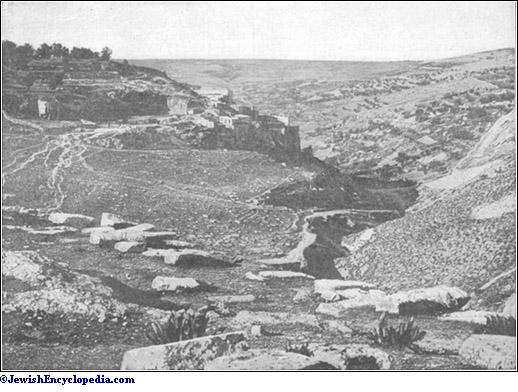
Valley of Jehoshaphat.(From a photograph by Bonfils.)
A mispronunciation (introduced by Christian theologians, but almost entirely disregarded by the Jews) of the Hebrew "Yhwh," the (ineffable) name of God (the Tetragrammaton or "Shem ha-Meforash"). This pronunciation is grammatically impossible; it arose through pronouncing the vowels of the "ḳere" (marginal reading of the Masorites:  = "Adonay") with the consonants of the "ketib" (text-reading:
  = "Yhwh")—"Adonay" (the Lord) being substituted with one exception wherever Yhwh occurs in the Biblical and liturgical books. "Adonay" presents the vowels "shewa" (the composite
  under the guttural
  under the
  (= "Jehovah"). Sometimes, when the two names
  and
and  occur together, the former is pointed with "ḥatef segol" (
 ) under the
  (="Jehovah")—to indicate that in this combination it is to be pronounced "Elohim" (
 ). These substitutions of "Adonay"and "Elohim" for Yhwh were devised to avoid the profanation of the Ineffable Name (hence
  is also written
  , or even
  , and read "ha-Shem" = "the Name ").
The reading "Jehovah" is a comparatively recent invention. The earlier Christian commentators report that the Tetragrammaton was written but not pronounced by the Jews (see Theodoret, "Question. xv. in Ex." [Field, "Hexapla," i. 90, to Ex. vi. 3]; Jerome, "Præfatio Regnorum," and his letter to Marcellus, "Epistola," 136, where he notices that "PIPI" [=  ] is presented in Greek manuscripts; Origen, see "Hexapla" to Ps. lxxi. 18 and Isa. i. 2; comp. concordance to LXX. by Hatch and Redpath, under
"Jehovah" is generally held to have been the invention of Pope Leo X.'s confessor, Peter Galatin ("De Arcanis Catholicæ Veritatis," 1518, folio xliii.), who was followed in the use of this hybrid form by Fagius (= Büchlein, 1504-49). Drusius (= Van der Driesche, 1550-1616) was the first to ascribe to Peter Galatin the use of "Jehovah," and this view has been taken since his days (comp. Hastings, "Dict. Bible," ii. 199, s.v. "God"; Gesenius-Buhl, "Handwörterb." 1899, p. 311; see Drusius on the tetragrammaton in his "Critici Sacri, i. 2, col. 344). But it seems that even before Galatin the name "Jehovah" had been in common use (see Drusius, l.c. notes to col. 351). It is found in Raymond Martin's "Pugio Fidei." written in 1270 (Paris, 1651, iii., pt. ii., ch. 3, p. 448; comp. T. Prat in "Dictionnaire de la Bible," s.v.). See also Names of God.
The pronunciation "Jehovah" has been defended by Stier ("Hebr. Lehrgebäude") and Hölemann ("Bibelstudien.," i.).
The use of the composite "shewa" "ḥatef segol" ( ) in cases where "Elohim" is to be read has led to the opinion that the composite "shewa" "ḥatef pataḥ" (
 ) ought to have been used to indicate the reading "Adonay." It has been argued in reply that the disuse of the "pataḥ" is in keeping with the Babylonian system, in which the composite "shewa" is not usual. But the reason why the "pataḥ" is dropped is plainly the non-guttural character of the "yod"; to indicate the reading "Elohim," however, the "segol" (and "ḥirek" under the last syllable, i.e.,
  ) had to appear in order that a mistake might not be made and "Adonay" be repeated. Other peculiarities of the pointing are these: with prefixes ("waw," "bet," "min") the voweling is that required by "Adonay": "wa-Adonay," "ba-Adonay," "me-Adonay." Again, after "Yhwh" (= "Adonay") the "dagesh lene" is inserted in
  , which could not be the case if "Jehovah" (ending in
  ), which should, before a word like "Jehovah," be on the first syllable, rests on the second when they stand before
  , which fact is proof that the Masorites read "Adonay" (a word beginning with "a").
Bibliography:
Schrader-Schenkel, Bibellexikon, iii. 147 et seq.;
Köhler, De Pronunciatione Tetragrammatis, 1867;
Driver, Recent Theories on the . . . Pronunciation, etc., in Studia Biblica, i., Oxford, 1885;
Dalman, Der Gottesname Adonaj und Seine Gesch. 1889;
Dillmann, Kommentar zu Exodus und Leviticus, p. 39, Leipsic, 1897;
Herzog-Hauck, Real-Encyc. viii., s.v. Jahve.
JEHOVAH—See God, § 2 (f).
Pronounced, by modern scholars, Yahveh or Yahweh (Hebrew: He Who is). Name of God in the Old Testament, occurring about 6000 times. It is the very name considered by the Jews as great, glorious, terrible, hidden, mysterious, to blaspheme which merited death (Leviticus 24). Designating The Being, or, as God Himself expresses it, "I am who am" (Exodus 3), it was revealed to Moses on Mount Horeb as the incommunicable name of God.
The proper name of God in the Old Testament; hence the Jews called it the name by excellence, the great name, the only name, the glorious and terrible name, the hidden and mysterious name, the name of the substance, the proper name, and most frequently shem hammephorash, i.e. the explicit or the separated name, though the precise meaning of this last expression is a matter of discussion (cf. Buxtorf, "Lexicon", Basle, 1639, col. 2432 sqq.).Jehovah occurs more frequently than any other Divine name. The Concordances of Furst ("Vet. Test. Concordantiae", Leipzig, 1840) and Mandelkern ("Vet. Test. Concordantiae", Leipzig, 1896) do not exactly agree as to the number of its occurrences; but in round numbers it is found in the Old Testament 6000 times, either alone or in conjunction with another Divine name. The Septuagint and the Vulgate render the name generally by "Lord" (Kyrios, Dominus), a translation of Adonai—usually substituted for Jehovah in reading. I. PRONUNCIATION OF JEHOVAHThe Fathers and the Rabbinic writers agree in representing Jehovah as an ineffable name. As to the Fathers, we only need draw attention to the following expressions: onoma arreton, aphraston, alekton, aphthegkton, anekphoneton, aporreton kai hrethenai me dynamenon, mystikon. Leusden could not induce a certain Jew, in spite of his poverty, to pronounce the real name of God, though he held out the most alluring promises. The Jew’s compliance with Leusden’s wishes would not indeed have been of any real advantage to the latter; for the modern Jews are as uncertain of the real pronunciation of the Sacred name as their Christian contemporaries. According to a Rabbinic tradition the real pronunciation of Jehovah ceased to be used at the time of Simeon the Just, who was, according to Maimonides, a contemporary of Alexander the Great. At any rate, it appears that the name was no longer pronounced after the destruction of the Temple. The Mishna refers to our question more than once: Berachoth, ix, 5, allows the use of the Divine name by way of salutation; in Sanhedrin, x, 1, Abba Shaul refuses any share in the future world to those who pronounce it as it is written; according to Thamid, vii, 2, the priests in the Temple (or perhaps in Jerusalem) might employ the true Divine name, while the priests in the country (outside Jerusalem) had to be contented with the name Adonai; according to Maimonides ("More Neb.", i, 61, and "Yad chasaka", xiv, 10) the true Divine name was used only by the priests in the sanctuary who imparted the blessing, and by the high-priest on the Day of Atonement. Phil ["De mut. nom.", n. 2 (ed. Marg., i, 580); "Vita Mos.", iii, 25 (ii, 166)] seems to maintain that even on these occasions the priests had to speak in a low voice. Thus far we have followed the post-Christian Jewish tradition concerning the attitude of the Jews before Simeon the Just.As to the earlier tradition, Josephus (Antiq., II, xii, 4) declares that he is not allowed to treat of the Divine name; in another place (Antiq., XII, v, 5) he says that the Samaritans erected on Mt. Garizim an anonymon ieron. This extreme veneration for the Divine name must have generally prevailed at the time when the Septuagint version was made, for the translators always substitute Kyrios (Lord) for Jehovah. Ecclus., xxiii, 10, appears to prohibit only a wanton use of the Divine name, though it cannot be denied that Jehovah is not employed as frequently in the more recent canonical books of the Old Testament as in the older books. It would be hard to determine at what time this reverence for the Divine name originated among the Hebrews. Rabbinic writers derive the prohibition of pronouncing the Tetragrammaton, as the name of Jehovah is called, from Lev., xxiv, 16: "And he that blasphemeth the name of the Lord, dying let him die". The Hebrew participle noqedh, here rendered "blasphemeth", is translated honomazon in the Septuagint, and appears to have the meaning "to determine", "to denote" (by means of its proper vowels) in Gen., xxx, 28; Num., i, 17; Is., lxii, 2. Still, the context of Lev., xxiv, 16 (cf. verses 11 and 15), favours the meaning "to blaspheme". Rabbinic exegetes derive the prohibition also from Ex., iii, 15; but this argument cannot stand the test of the laws of sober hermeneutics (cf. Drusius, "Tetragrammaton", 8-10, in "Critici Sacri", Amsterdam, 1698, I, p. ii, col. 339-42; "De nomine divino", ibid., 512-16; Drach, "Harmonic entre l’Eglise et la Synagogue", I, Paris, 1844, pp. 350-53, and Note 30, pp. 512-16). What has been said explains the so-called qeri perpetuum, according to which the consonants of Jehovah are always accompanied in the Hebrew text by the vowels of Adonai except in the cases in which Adonai stands in apposition to Jehovah: in these cases the vowels of Elohim are substituted. The use of a simple shewa in the first syllable of Jehovah, instead of the compound shewa in the corresponding syllable of Adonai and Elohim, is required by the rules of Hebrew grammar governing the use of shewa. Hence the question: What are the true vowels of the word Jehovah?It has been maintained by some recent scholars that the word Jehovah dates only from the year 1520 (cf. Hastings, "Dictionary of the Bible", II, 1899, p. 199: Gesenius-Buhl, "Handwörterbuch", 13th ed., 1899, p. 311). Drusius (loc. cit., 344) represents Peter Galatinus as the inventor of the word Jehovah, and Fagius as it propagator in the world of scholars and commentators. But the writers of the sixteenth century, Catholic and Protestant (e.g. Cajetan and Théodore de Bèze), are perfectly familiar with the word. Galatinus himself ("Areana cathol. veritatis", I, Bari, 1516, a, p. 77) represents the form as known and received in his time. Besides, Drusius (loc. cit., 351) discovered it in Porchetus, a theologian of the fourteenth century. Finally, the word is found even in the "Pugio fidei" of Raymund Martin, a work written about 1270 (ed. Paris, 1651, pt. III, dist. ii, cap. iii, p. 448, and Note, p. 745). Probably the introduction of the name Jehovah antedates even R. Martin.No wonder then that this form has been regarded as the true pronunciation of the Divine name by such scholars as Michaelis ("Supplementa ad lexica hebraica", I, 1792, p. 524), Drach (loc. cit., I, 469-98), Stier (Lehrgebäude der hebr. Sprache, 327), and others. Jehovah is composed of the abbreviated forms of the imperfect, the participle, and the perfect of the Hebrew verb "to be" (ye=yehi; ho=howeh; wa=hawah). According to this explanation, the meaning of Jehovah would be "he who will be, is, and has been". But such a word-formation has no analogy in the Hebrew language. The abbreviated form Jeho supposes the full form Jehovah. But the form Jehovah cannot account for the abbreviations Jahu and Jah, while the abbreviation Jeho may be derived from another word. The Divine name is said to be paraphrased in Apoc., i, 4, and iv, 8, by the expression ho on kai ho en kai ho erchomenos, in which ho erchomenos is regard as equivalent to ho eromenos, "the one that will be"; but it really means "the coming one", so that after the coming of the Lord, Apoc., xi, 17, retains only ho on kai ho en. the comparison of Jehovah with the Latin Jupiter, Jovis. But it wholly neglects the fuller forms of the Latin names Diespiter, Diovis. Any connection of Jehovah with the Egyptian Divine name consisting of the seven Greek vowels has been rejected by Hengstenberg (Beitrage zur Einleiung ins Alte Testament, II, 204 sqq.) and Tholuck (Vermischte Schriften, I, 349 sqq.).To take up the ancient writers: Diodorus Siculus writes Jao (I, 94); Irenaeus ("Adv. Haer.", II, xxxv, 3, in P. G., VII, col. 840), Jaoth; the Valentinian heretics (Ir., "Adv. Haer.", I, iv, 1, in P.G., VII, col. 481), Jao; Clement of Alexandria ("Strom.", V, 6, in P.G., IX, col. 60), Jaou; Origin ("in Joh.", II, 1, in P.G., XIV, col. 105), Jao; Porphyry (Eus., "Praep. evang", I, ix, in P.G., XXI, col. 72), Jeuo; Epiphanius ("Adv. Haer.", I, iii, 40, in P.G., XLI, col. 685), Ja or Jabe; Pseudo-Jerome ("Breviarium in Pss.", in P.L., XXVI, 828), Jaho; the Samaritans (Theodoret, in "Ex. quaest.", xv, in P. G., LXXX, col. 244), Jabe; James of Edessa (cf.. Lamy, "La science catholique", 1891, p. 196), Jehjeh; Jerome ("Ep. xxv ad Marcell.", in P. L., XXII, col. 429) speaks of certain ignorant Greek writers who transcribed the Hebrew Divine name II I II I. The judicious reader will peceive that the Samaritan pronunciation Jabe probably approaches the real sound of the Divine name closest; the other early writers transmit only abbreviations or corruptions of the sacred name. Inserting the vowels of Jabe into the original Hebrew consonant text, we obtain the form Jahveh (Yahweh), which has been generally accepted by modern scholars as the true pronunciation of the Divine name. It is not merely closely connected with the pronunciation of the ancient synagogue by means of the Samaritan tradition, but it also allows the legitimate derivation of all the abbreviations of the sacred name in the Old Testament. II. MEANING OF THE DIVINE NAMEJahveh (Yahweh) is one of the archaic Hebrew nouns, such as Jacob, Joseph, Israel, etc. (cf. Ewald, "Lehrbuch der hebr. Sprache", 7th ed., 1863, p. 664), derived from the third person imperfect in such a way as to attribute to a person or a thing the action of the quality expressed by the verb after the manner of a verbal adjective or a participle. Furst has collected most of these nouns, and calls the form forma participialis imperfectiva. As the Divine name is an imperfect form of the archaic Hebrew verb "to be", Jahveh means "He Who is", Whose characteristic note consists in being, or The Being simply.Here we are confronted with the question, whether Jahveh is the imperfect hiphil or the imperfect qal. Calmet and Le Clere believe that the Divine name is a hiphil form; hence it signifies, according to Schrader (Die Keilinschriften und das Alte Testament, 2nd ed., p. 25), He Who brings into existence, the Creator; and according to Lagarde (Psalterium Hieronymi, 153), He Who causes to arrive, Who realizes His promises, the God of Providence. But this opinion is not in keeping with Ex., iii, 14, nor is there any trace in Hebrew of a hiphil form of the verb meaning "to be"; moreover, this hiphil form is supplied in the cognate languages by the pi’el form, except in Syriac where the hiphil is rare and of late occurrence.On the other hand, Jehveh may be an imperfect qal from a grammatical point of view, and the traditional exegesis of Ex., iii, 6-16, seems to necessitate the form Jahveh. Moses asks God: "If they should say to me: What is his [God’s] name? What shall I say to them?" In reply, God returns three several times to the determination of His name. First, He uses the first person imperfect of the Hebrew verb "to be"; here the Vulgate, the Septuagint, Aquila, Theodotion, and the Arabic version suppose that God uses the imperfect qal; only the Targums of Jonathan and of Jerusalem imply the imperfect hiphil. Hence we have the renderings: "I am who am" (Vulg.), "I am who is" (Sept.), "I shall be who] shall be" (Aquila, Theodotion), "the Eternal who does not cease" (Ar.); only the above-mentioned Targums see any reference to the creation of the world. The second time, God uses again the first person imperfect of the Hebrew verb "to be"; here the Syriac, the Sumaritan, the Persian versions, and the Targums of Onkelos and Jerusalem retain the Hebrew word, so that one cannot tell whether they regard the imperfect as a qal or a hiphil form; the Arabic version omits the whole clause; but the Septuagint, the Vulgate, and the Targum of Jonathan suppose here the imperfect qal: "He Who Is, hath sent me to you" instead of "I Am, hath sent me to you: (Vulg.); "ho on sent me to you" (Sept.); "I am who am, and who shall be, hath sent me to you" (Targ. Jon.). Finally, the third time, God uses the third person of the imperfect, or the form of the sacred name itself; here the Samaritan version and the Targum of Onkelos retain the Hebrew form; the Septuagint, the Vulgate, and the Syriac version render "Lord", though, according to the analogy of the former two passages, they should have translated, "He Is, the God of your fathers, . . . hath sent me to you"; the Arabic version substitutes "God". Classical exegesis, therefore, regards Jahveh as the imperfect qal of the Hebrew verb "to be".Here another question presents itself: Is the being predicated of God in His name, the metaphysical being denoting nothing but existence itself, or is it an historical being, a passing manifestation of God in time? Most Protestant writers regard the being implied in the name Jahveh as an historical one, though some do not wholly exclude such metaphysical ideas as God’s independence, absolute constancy, and fidelity to His promises, and immutability in His plans (cf. Driver, "Hebrew Tenses", 1892, p. 17). The following are the reasons alleged for the historical meaning of the "being" implied in the Divine name: The metaphysical sense of being was too abstruse a concept for the primitive times. Still, some of the Egyptian speculations of the early times are almost as abstruse; besides, it was not necessary that the Jews of the time of Moses should fully understand the meaning implied in God’s name. The scientific development of its sense might be left to the future Christian theologians. The Hebrew verb hayah means rather "to become" than "to be" permanently. But good authorities deny that the Hebrew verb denotes being in motion rather than being in a permanent condition. It is true that the participle would have expressed a permanent state more clearly; but then, the participle of the verb hayah is found only in Ex., ix, 3, and few proper names in Hebrew are derived from the participle. The imperfect mainly expresses the action of one who enters anew on the scene. But this is not always the case; the Hebrew imperfect is a true aorist, prescinding from time and, therefore, best adapted for general principles (Driver, p. 38). "I am who am" appears to refer to "I will be with thee" of v. 12; both texts seems to be alluded to in Os., i, 9, "I will not be yours". But if this be true, "I am who am" must be considered as an ellipse: "I am who am with you", or "I am who am faithful to my promises". This is harsh enough; but it becomes quite inadmissible in the clause, "I am who am, hath sent me". Since then the Hebrew imperfect is admittedly not to be considered as a future, and since the nature of the language does not force us to see in it the expression of transition or of becoming, and since, moreover, early tradition is quite fixed and the absolute character of the verb hayah has induced even the most ardent patrons of its historical sense to admit in the texts a description of God’s nature, the rules of hermeneutics urge us to take the expressions in Ex., iii, 13-15, for what they are worth. Jahveh is He Who Is, i.e., His nature is best characterized by Being, if indeed it must be designated by a personal proper name distinct from the term God (Revue biblique, 1893, p. 338). The scholastic theories as to the depth of meaning latent in Yahveh (Yahweh) rest, therefore, on a solid foundation. Finite beings are defined by their essence: God can be defined only be being, pure and simple, nothing less and nothing more; not be abstract being common to everything, and characteristic of nothing in particular, but by concrete being, absolute being, the ocean of all substantial being, independent of any cause, incapable of change, exceeding all duration, because He is infinite: "Alpha and Omega, the beginning and the end, . . . who is, and who was, and who is to come, the Almighty" (Revelation 1:8). Cf. St. Thomas, I, qu. xiii, a. 14; Franzelin, "De Deo Uno" (3rd ed., 1883, thesis XXIII, pp. 279-86. III. ORIGIN OF THE NAME JAHVEH (YAHWEH)The opinion that the name Jahveh was adopted by the Jews from the Chanaanites, has been defended by von Bohlen (Genesis, 1835, p. civ), Von der Alm (Theol. Briefe, I, 1862, pp. 524-27), Colenso (The Pentateuch, V, 1865, pp. 269-84), Goldziher (Der Mythus bei den Hebräern, 1867, p. 327), but has been rejected by Kuenen ("De Godsdienst van Israel", I, Haarlem, 1869, pp. 379-401) and Baudissin (Studien, I, pp. 213-18). It is antecedently improbable that Jahveh, the irreconcilable enemy of the Chanaanites, should be originally a Chanaanite god.It has been said by Vatke (Die Religion des Alten Test., 1835, p. 672) and J.G. Müller (Die Semiten in ihrem Verhältniss zu Chamiten und Japhetiten, 1872, p. 163) that the name Jahveh is of Indo-European origin. But the transition of the Sanscrit root, div—the Latin Jupiter-Jovis (Diovis), the Greek Zeus-Dios, the Indo-European Dyaus into the Hebrew form Jahveh has never been satisfactorily explained. Hitzig’s contention (Vorlesungen über bibl. Theol., p. 38) that the Indo-Europeans furnished at least the idea contained in the name Jahveh, even if they did not originate the name itself, is without any value.The theory that Jahveh is of Egyptian origin may have a certain amount of a priori probability, as Moses was educated in Egypt. Still, the proofs are not convincing: Röth (Die Aegypt. und die Zoroastr. Glaubenslehre, 1846, p. 175) derives the Hebrew name from the ancient moon-god Ih or Ioh. But there is no connection between the Hebrew Jahveh and the moon (cf. Pierret, "Vocabul. Hiérogl.", 1875, p. 44). Plutarch (De Iside, 9) tells us that a statue of Athene (Neith) in Sais bore the inscription: "I am all that has been, is, and will be". But Tholuck (op. cit., 1867, pp. 189-205) shows that the meaning of this inscription is wholly different from that of the name Jahveh. The patrons of the Egyptian origin of the sacred name appeal to the common. Egyptian formula, Nuk pu nuk but though its literal signification is "I am I", its real meaning is "It is I who" (cf. Le Page Renouf, "Hibbert Lectures for 1879", p. 244). As to the theory that Jahveh has a Chaldean or an Accadian origin, its foundation is not very solid: Jahveh is said to be a merely artificial form introduced to put meaning into the name of the national god (Delitzsch, "Wo lag das Paradies", 1881, pp. 158-64); the common and popular name of God is said to have been Yahu or Yah, the letter I being the essential Divine element in the name. The contention, if true, does not prove the Chaldean or Accadian origin of the Hebrew Divine name; besides the form Yah is rare and exclusively poetic; Yahu never appears in the Bible, while the ordinary full form of the Divine name is found even in the inscription of Mesa (line 18) dating from the ninth century B.C. Yahu and Yah were known outside Israel; the forms enter into the composition of foreign proper names; besides, the variation of the name of a certain King of Hammath shows that Ilu is equivalent to Yau, and that Yau is the name of a god (Schrader, "Bibl. Bl.", II, p. 42, 56; Sargon, "Cylinder", xxv; Keil, "Fastes", I. 33). But foreign proper names containing Yah or Yahu are extremely rare and doubtful, and may be explained without admitting gods in foreign nations, bearing the sacred name. Again, the Babylonian pantheon is fairly well known at present, but the god Yau does not appear in it. Among the pre-Semitic Babylonians, I is a synonym of Ilu, the supreme god; now I with the Assyrian nominative ending added becomes Yau (cf. Delitzsch, "Lesestücke", 3rd ed., 1885, p. 42, Syllab. A, col. I, 13-16). Hommel (Altisrael. Ueberlieferung, 1897, pp. 144, 225) feels sure that he has discovered this Chaldean god Yau. It is the god who is represented ideographically (ilu) A-a, but ordinarily pronounced Malik, though the expression should be read Ai or Ia (Ya). The patriarchal family employed this name, and Moses borrowed and transformed it. But Lagrange points out that the Jews did not believe that they offered their children to Jahveh, when they sacrificed them to Malik (Religion semitique, 1905, pp. 100 sqq.). Jer., xxxii, 35, and Soph., i, 5, distinguish between Malik and the Hebrew God. Cheyne (Traditions and Beliefs of Ancient Israel, 1907, pp. 63 sqq.) connects the origin of Jahveh with his Yerahme’el theory; but even the most advanced critics regard Cheyne’s theory as a discredit to modern criticism. Other singular opinions as to the origin of the sacred name may be safely omitted. The view that Jahveh is of Hebrew origin is the most satisfactory. Arguing from Ex., vi, 2-8, such commentators as Nicholas of Lyra, Tostatus, Cajetan, Bonfrère, etc., maintain that the name was revealed for the first time to Moses on Mount Horeb. God declares in this vision that he "appeared to Abraham . . . by the name of God Almighty; and my name Adonai [Jahveh] I did not shew them". But the phrase "to appear by a name" does not necessarily imply the first revelation of that name; it rather signifies the explanation of the name, or a manner of acting conformable to the meaning of the name (cf. Robion in "la Science cathol.", 1888, pp. 618-24; Delattre, ibid., 1892, pp. 673-87; van Kasteren, ibid., 1894, pp. 296-315; Robert in "Revue biblique", 1894, pp. 161-81). On Mt. Horeb God told Moses that He had not acted with the Patriarchs as the God of the Covenant, Jahveh, but as God Almighty.Perhaps it is preferable to say that the sacred name, though perhaps in a somewhat modified form, had been in use in the patriarchal family before the time of Moses. On Mt. Horeb God revealed and explained the accurate form of His name, Jahveh. The sacred name occurs in Genesis about 156 times; this frequent occurrence can hardly be a mere prolepsis. Gen., iv, 26, states that Enos "began to call upon the name of the Lord [Jahveh]", or as the Hebrew text suggests, "began to call himself after the name of Jahveh". Jochabed, the mother of Moses, has in her name an abbreviated form Jo (Yo) of Jahveh. The pre-Mosaic existence of the Divine name among the Hebrews accounts for this fact more easily than the supposition that the Divine element was introduced after the revelation of the name. Among the 163 proper names which bear an element of the sacred name in their composition, 48 have yeho or yo at the beginning, and 115 have yahu or yah and the end, while the form Jahveh never occurs in any such composition. Perhaps it might be assumed that these shortened forms yeho, yo, yahu, yah, represent the Divine name as it existed among the Isralites before the full name Jahveh was revealed on Mt. Horeb. On the other hand, Driver (Studia biblica, I, 5) has shown that these short forms are the regular abbreviations of the full name. At any rate, while it is not certain that God revealed His sacred name to Moses for the first time, He surely revealed on Mt. Horeb that Jahveh is His incommunicable name, and explained its meaning.----------------------------------- Besides the works referred to in the text, the reader may consult: RELAND, Deeds Excreitationum (Utrecht, 1707); SCHRADER in SCHENKEL’S Bibel Lexicon, s. v. Jahve; PHAT, Dict. de la Bible, s.v. Jehovah; ROBERTSON SMITH in Brit. and Foreign Evan. Review (January, 1876), gives a summary of recent discussion of the subject; OEHLER, Real-Encyclopadie, S.V. Jehova. A.J. MAAS Transcribed by Thomas M. Barrett Dedicated to Mary Kathryn French Barrett The Catholic Encyclopedia, Volume VIIICopyright © 1910 by Robert Appleton CompanyOnline Edition Copyright © 2003 by K. KnightNihil Obstat, October 1, 1910. Remy Lafort, S.T.D., CensorImprimatur. +John Cardinal Farley, Archbishop of New York
See YAHWEH.
An anglicized pronunciation of the Hebrew tetragrammaton, YHWH, which are the four consonant letters used to spell God’s name in the Old Testament (Exo 3:14). The Hebrews considered the name of God too holy to pronounce and substituted the word “Lord” (adonai) when the text was read. The vowels of the word “adonai” was combined with YHWH to get the word “Jehovah” which was first used in the 12th century. A more accurate pronunciation of YHWH would be “Yahweh.” However, the exact and proper pronunciation has been lost.