
The name means, his moon - - from Jareac. This is the famous city before whose walls the Lord manifested such a miracle of grace to Israel, in causing them to fall to the ground at the blasting of the rams’ horns. (See Josh. vi.) It was situated about seven leagues from Jerusalem, and about two from the river Jordan, (Josh. 18: 20, 21.) and was called by Moses the city of palm trees; and, no doubt, in point of pleasantness, must have been a lovely place. (See Deut. 34. 3.) But we find, in the after days of Israel’s history, the barrenness of Jericho spoken of, (2 Kings 2: 18 - 22.) See Elisha. There is somewhat particularly striking concerning Jericho being cursed by Joshua before the Lord, and yet that Rahab the harlot should be of this city, concerning whom such blessed things are spoken of in Scripture. (See on the one hand, Josh. vi. 26. compared with 1 Kings 16. 34; and on the other, see Josh. 2: with Heb. xi. 31.) If the reader will be at the trouble to count the period between Joshua’s curse on Jericho, and the rebuilding of Jericho by Hiel the Bethelite, he will find that near five hundred and thirty - seven years had passed between the one and the other. The Hebrews paid great respect to the Cherem, that is, the curse of Joshua. This anathema was carefully remembered by them; and, no doubt, when Hiel in defiance of it began to build Jericho, the pious believers among the Hebrews felt indignant at the daring attempt, and marked the issue in the event that followed on Hiel’s two sons.
was a city of Benjamin, about seven leagues from Jerusalem, and two from the Jordan, Jos 18:21. Moses calls it the city of palm trees, Deu 34:3, because of palm trees growing in the plain of Jericho. Josephus says, that in the territory of this city were not only many palm trees, but also the balsam tree. The valley of Jericho was watered by a rivulet which had been formerly salt and bitter, but was sweetened by the Prophet Elisha, 2Ki 2:19. Jericho was the first city in Canaan taken by Joshua, Jos 2:1-2, &c. He sent thither spies, who were received by Rahab, lodged in her house, and preserved from the king of Jericho. Joshua received orders to besiege Jericho, soon after his passage over Jordan, Jos 6:1-3, &c. God commanded the Hebrews to march round the city once a day for seven days together. The soldiers marched first, probably out of the reach of the enemies’ arrows, and after them the priests, the ark, &c. On the seventh day, they marched seven times round the city; and at the seventh, while the trumpets were sounding, and all the people shouting, the walls fell down. The rabbins say, that the first day was our Sunday, and the seventh the Sabbath day. During the first six days, the people continued in profound silence; but on the seventh Joshua commanded them to shout. Accordingly they all exerted their voices, and the wall being overthrown, they entered the city, every man in the place opposite to him. Jericho being devoted by God, they set fire to the city, and consecrated all the gold, silver, and brass. Then Joshua said, “Cursed be the man before the Lord who shall rebuild Jericho.” About five hundred and thirty years after this, Hiel, of Bethel, undertook to rebuild it; but he lost his eldest son, Abiram, at laying the foundations, and his youngest son, Segub, when he hung up the gates. However, we are not to imagine that there was no city of Jericho till the time of Hiel. There was a city of palm trees, probably the same as Jericho, under the Judges, Jdg 3:13. David’s ambassadors, who had been insulted by the Ammonites, resided at Jericho till their beards were grown, 2Sa 10:4. There was, therefore, a city of Jericho which stood in the neighbourhood of the original Jericho. These two places are distinguished by Josephus. After Hiel of Bethel had rebuilt old Jericho, no one scrupled to dwell there. Our Saviour wrought miracles at Jericho.
According, to Pococke, the mountains to which the absurd name of Quarantania has been arbitrarily given, are the highest in all Judea; and he is probably correct; they form part of a chain extending from Scythopolis into Idumea. The fountain of Elisha he states to be a soft water, rather warm; he found in it some small shell fish of the turbinated kind. Close by the ruined aqueduct are the remains of a fine paved way, with a fallen column, supposed to be a Roman milestone. The hills nearest to Jerusalem consist, according to Hasselquist, of a very hard limestone; and different sorts of plants are found on them, in particular the myrtle, the carob tree, and the turpentine tree; but farther toward Jericho they are bare and barren, the hard limestone giving way to a looser kind, sometimes white and sometimes grayish, with interjacent layers of a reddish micaceous stone, saxum purum micaceum. The vales, though now bare and uncultivated, and full of pebbles, contain good red mould, which would amply reward the husbandman’s toil. Nothing can be more savage than the present aspect of these wild and gloomy solitudes, through which runs the very road where is laid the scene of that exquisite parable, the good Samaritan, and from that time to the present, it has been the haunt of the most desperate bandits, being one of the most dangerous in Palestine. Sometimes the track leads along the edges of cliffs and precipices, which threaten destruction on the slightest false step; at other times it winds through craggy passes, overshadowed by projecting or perpendicular rocks. At one place the road has been cut through the very apex of a hill, the rocks overhanging it on either side. Here, in 1820, an English traveller, Sir Frederick Henniker, was attacked by the Arabs with fire-arms, who stripped him naked, and left him severely wounded: “It was past mid-day, and burning hot,” says Sir Frederick; “I bled profusely; and two vultures, whose business it is to consume corpses, were hovering over me. I should scarcely have had strength to resist, had they chosen to attack me.”
The modern village of Jericho is described by Mr. Buckingham as a settlement of about fifty dwellings, all very mean in their appearance, and fenced in front with thorny bushes, while a barrier of the same kind, the most effectual that could be raised against mounted Arabs, encircles the town. A fine brook flows by it, which empties itself into the Jordan; the nearest point of that river is about three miles distant. The grounds in the immediate vicinity of the village, being fertilized by this stream, bear crops of dourra, Indian corn, rice, and onions. The population is entirely Mohammedan, and is governed by a sheikh: their habits are those of Bedouins, and robbery and plunder form their chief and most gainful occupation. The whole of the road from Jerusalem to the Jordan, is held to be the most dangerous in Palestine; and indeed, in this portion of it, the very aspect of the scenery is sufficient, on the one hand, to tempt to robbery and murder, and, on the other, to occasion a dread of it in those who pass that way. One must be amid these wild and gloomy solitudes, surrounded by an armed band, and feel the impatience of the traveller who rushes on to catch a new view at every pass and turn; one must be alarmed at the very tramp of the horses’ hoofs rebounding through the caverned rocks, and at the savage shouts of the footmen, scarcely less loud than the echoing thunder produced by the discharge of their pieces in the valleys; one must witness all this upon the spot, before the full force and beauty of the admirable story of the good Samaritan can be perceived. Here, pillage, wounds, and death would be accompanied with double terror, from the frightful aspect of every thing around. Here, the unfeeling act of passing by a fellow creature in distress, as the priest and Levite are said to have done, strikes one with horror, as an act almost more than inhuman. And here, too, the compassion of the good Samaritan is doubly virtuous, from the purity of the motive which must have led to it, in a spot where no eyes were fixed on him to draw forth the performance of any duty, and from the bravery which was necessary to admit of a man’s exposing himself, by such delay, to the risk of a similar fate to that from which he was endeavouring to rescue his fellow creature.
Jer´icho, a town in the plain of the same name, not far from the river Jordan, at the point where it enters the Dead Sea. It lay before the Israelites when they crossed the river, on first entering the Promised Land; and the account which the spies who were sent by them into the city received from their hostess Rahab, tended much to encourage their subsequent operations, as it showed that the inhabitants of the country were greatly alarmed at their advance, and the signal miracles which had marked their course from the Nile to the Jordan. The strange manner in which Jericho itself was taken must have strengthened this impression in the country, and appears, indeed, to have been designed for that effect. The town was utterly destroyed by the Israelites, who pronounced an awful curse upon whoever should rebuild it; and all the inhabitants were put to the sword, except Rahab and her family (Jos 2:6). In these accounts Jericho is repeatedly called ’the city of palm-trees;’ which shows that the hot and dry plain, so similar to the land of Egypt, was noted beyond other parts of Palestine for the tree which abounds in that country, but which was and is less common in the land of Canaan than general readers and painters suppose. It has now almost disappeared even from the plain of Jericho, although specimens remain in the plain of the Mediterranean coast.
Notwithstanding the curse, Jericho was soon rebuilt [HIEL], and became a school of the prophets (Jdg 3:13; 1Ki 16:34; 2Ki 2:4-5). Its inhabitants returned after the exile, and it was eventually fortified by the Syrian general Bacchides (Ezr 2:34; Neh 3:2; 1Ma 9:50). Pompey marched from Scythopolis, along the valley of the Jordan, to Jericho, and thence to Jerusalem; and Strabo speaks of the castles Thrax and Taurus, in or near Jericho, as having been destroyed by him. Herod the Great, in the beginning of his career, captured and sacked Jericho, but afterwards strengthened and adorned it, when he had redeemed its revenues from Cleopatra, on whom the plain had been bestowed by Antony. He appears to have often resided here, probably in winter: he built over the city a fortress called Cypros, between which and the former palace he erected other palaces, and called them by the names of his friends. Here also was a hippodrome or circus, in which the same tyrant, when lying at Jericho on his death-bed, caused the nobles of the land to be shut up, for massacre after his death. He died here; but his bloody intention was not executed. The palace at this place was afterwards rebuilt more magnificently by Archelaus. By this it will be seen that the Jericho which existed in the time of our Savior was a great and important city—probably more so than it had ever been since its foundation. It was once visited by him, when he lodged with Zaccheus, and healed the blind man (Luk 18:35-43; Luk 19:1-7; Mat 20:29-34; Mar 10:46-52). Jericho was afterwards made the head of one of the toparchies, and was visited by Vespasian before he left the country, who stationed there the tenth legion in garrison. Eusebius and Jerome describe Jericho as having been destroyed during the siege of Jerusalem, on account of the perfidy of the inhabitants, but add that it was afterwards rebuilt. The town, however, appears to have been overthrown during the Muhammadan conquest; for Adamnanus, at the close of the seventh century, describes the site as without human habitations, and covered with corn and vines. The celebrated palm-groves still existed. In the next century a church is mentioned; and in the ninth century several monasteries appear. About the same time the plain of Jericho is again noticed for its fertility and peculiar products; and it appears to have been brought under cultivation by the Saracens, for the sake of the sugar and other products for which the soil and climate were more suitable than any other in Palestine. Ruins of extensive aqueducts, with pointed Saracenic arches, remain in evidence of the elaborate irrigation and culture of this fine plain—which is nothing without water, and everything with it—at a period long subsequent to the occupation of the country by the Jews. It is to this age that we may probably refer the origin of the castle and village, which have since been regarded as representing Jericho. The place has been mentioned by travelers and pilgrims down to the present time as a poor hamlet consisting of a few houses. In the fifteenth century the square castle or tower began to pass among pilgrims as the house of Zaccheus, a title which it bears to the present day.
The village now regarded as representing Jericho is supposed to date its origin from the ninth century. It bears the name of Rihah, and is situated about the middle of the plain, six miles west from the Jordan, in N. lat. 31° 57´, and E. long. 35° 33´. Dr. Olin describes the present village as ’the meanest and foulest of Palestine.’ It may perhaps contain forty dwellings, formed of small loose stones. The most important object is a square castle or tower, which Dr. Robinson supposes to have been constructed to protect the cultivation of the plain under the Saracens. It is thirty or forty feet square, and about the same height, and is now in a dilapidated condition.
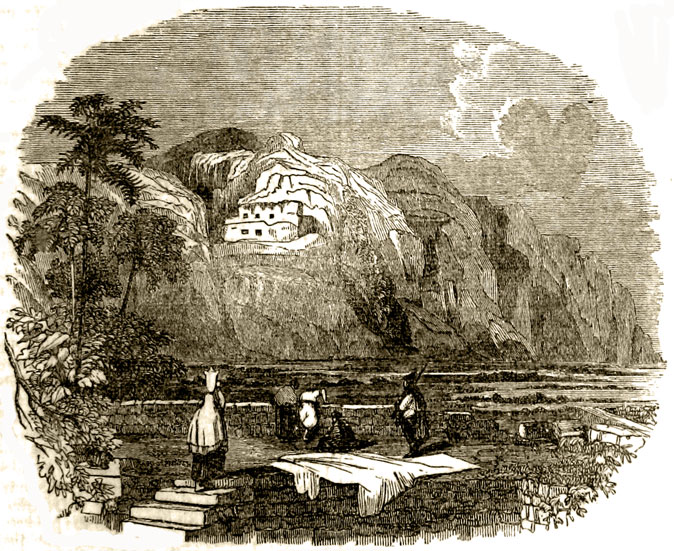
Fig. 233—Jericho
Rihah may contain about two hundred inhabitants, who have a sickly aspect, and are reckoned vicious and indolent. They keep a few cattle and sheep, and till a little land for grain as well as for gardens. A small degree of industry and skill bestowed on this prolific soil, favored as it is with abundant water for irrigation, would amply reward the labor. But this is wanting; and everything bears the mark of abject, and, which is unusual in the East, of squalid poverty. There are some fine fig-trees near the village, and some vines in the gardens. But the most distinguishing feature of the whole plain is a noble grove of trees which borders the village on the west, and stretches away northward to the distance of two miles or more.
This grove owes its existence to the waters of one of the fountains, the careful distribution of which over the plain by canals and aqueducts did once, and might still, cover it with abundance. One of these fountains is called by the natives Ain es-Sultan, but by pilgrims the Fountain of Elias, being supposed to be the same whose bitter waters were cured by that prophet. Dr. Robinson thinks there is reason for this conclusion. It lies almost two miles N.W. from the village, and is a large and beautiful fountain of sweet and pleasant waters. Beyond the fountain rises up the bold perpendicular face of the mountain Quarantana (Kuruntul), from the foot of which a line of low hills runs out N.N.E. in front of the mountains, and forms the ascent to a narrow tract of table-land along their base. On this tract, at the foot of the mountains, about two and a half miles N.N.W. from the Ain es-Sultan, is the still larger fountain of Duk, the waters of which are brought along the base of Quarantana in a canal to the top of the declivity at the back of Ain es-Sultan, whence they were formerly distributed to several mills, and scattered over the upper part of the plain.
Under the mountains on the western confine of the plain, about two miles west of Rihah, and just where the road from Jerusalem comes down into the plain, are considerable ruins, extending both on the north and south side of the road. Mr. Buckingham was the first to suspect that these were the ruins of the ancient Jericho. He shows that the situation agrees better with the ancient intimations than does that of the modern village, near which no trace of ancient ruins can be found. Since this idea was started the matter has been examined by other travelers; and the conclusion seems to be that Rihah is certainly not the ancient Jericho, and that there is no site of ancient ruins on the plain which so well answers to the intimations as that now described; although even here some drawback to a satisfactory conclusion is felt, in the absence of any traces of those great buildings which belonged to the Jericho of King Herod.
A city of Benjamin, Jos 16:7 18:21, about eighteen miles east north east of Jerusalem, and seven miles from the Jordan. It was the first city in Canaan taken by Joshua, who being miraculously aided by the downfall of its walls, totally destroyed it, sparing only Rahab and her household, and pronounced a curse upon the person who should ever rebuild it, which was more than five hundred years afterwards fulfilled on Hiel, Jos 6:26 1Ki 16:34 . Meanwhile a new Jericho had been built on some neighboring site, Jdg 3:3 2Sa 10:5 . Jericho was also called the "city of palm-trees," Deu 34:3 Jdg 1:16, and became afterwards flourishing and second in importance only to Jerusalem. It contained a school of the prophets, and as the residence of Elisha, 2Ki 2:4,18 . Here also Christ healed two blind men, Mat 20:29-34, and forgave Zaccheus, Luk 19:2-8 .\par The site of Jericho has usually been fixed at Rihah, a mean and foul Arab hamlet of some two hundred inhabitants. Recent travellers, however, show that the probably location of Jericho was two mile west of Rihah, at the mouth of Wady Kelt, and where the road from Jerusalem comes into the plain. The city destroyed by Joshua may have been nearer to the fountain of Elisha, supposed to be the present Ain es-Sultan, two miles northwest of Rihah. On the west and north of Jericho rise high limestone hills, one of which, the dreary Quarantana, 1,200 or 1,500 feet high, derives its name from the modern tradition that it was the scene of our Lord’s forty days’ fast and temptation. Between the hills and the Jordan lies "the plain of Jericho," Jos 4:13, over against "the plains of Moab" east of the river. It was anciently well watered and amazingly fruitful. It might easily be made so again, but now lies neglected, and the palmtrees, balsam, and honey, for which it was once famous, have disappeared.\par The road from Jericho to Jerusalem ascends through narrow and rocky passes amid ravines and precipices. It is an exceedingly difficult and dangerous route, and is still infested by robbers, as in the time of the good Samaritan, Luk 10:30-34 .\par
Jer’icho. (place of fragrance). A city of high antiquity, situated in a plain traversed by the Jordan, and exactly over against where that river was crossed by the Israelites under Joshua. Jos 3:16. It was five miles west of the Jordan and seven miles northwest of the Dead Sea. It had a king. Its walls were so considerable that houses were built upon them. Jos 2:15. The spoil that was found in it, betokened its affluence. Jericho is first mentioned as the city, to which the two spies were sent by Joshua from Shittim. Jos 2:1-21. It was bestowed by him, upon the tribe of Benjamin, Jos 18:21, and from this time, a long interval elapses before Jericho appears again upon the scene.
Its second foundation under Hiel, the Bethelite is recorded in 1Ki 16:34. Once rebuilt, Jericho rose again slowly into consequence. In its immediate vicinity, the sons of the prophets sought retirement from the world; Elisha "healed the spring of the waters;" and over against it, beyond Jordan, Elijah "went up by a whirlwind into heaven." 2Ki 2:1-22. In its plains, Zedekiah fell into the hands of the Chaldeans. 2Ki 25:5; Jer 39:5. In the return under Zerubbabel, the "children of Jericho," 345 in number, are comprised. Ezr 2:34; Neh 7:36. Under Herod the Great, it again became an important place. He fortified it and built a number of new palaces, which he named after his friends. If he did not make Jericho his habitual residence, he at last retired thither to die, and it was in the amphitheater of Jericho , that the news of his death was announced, to the assembled soldiers and people by Salome.
Soon afterward, the palace was burnt and the town plundered by one Simon, slave to Herod; but Archelaus rebuilt the former sumptuously, and founded a new town on the plain, that bore his own name; and, most important of all, diverted water from a village called Neaera, to irrigate the plain, which he had planted with palms. Thus, Jericho was once more "a city of palms" when our Lord visited it. Here, he restored sight to the blind. Mat 20:30; Mar 10:46; Luk 18:35. Here the descendant of Rahab did not disdain the hospitality of Zaccaeus, the publican.
Finally, between Jerusalem and Jericho was laid the scene of his story of the good Samaritan. The city was destroyed by Vespasian. The site of ancient (the first) Jericho is placed by Dr. Robinson in the immediate neighborhood of the fountain of Elisha; and that of the second (the city of the New Testament and of Josephus) at the opening of the Wady Kelt (Cherith), half an hour from the fountain. (The village identified with Jericho lies a mile and a half from the ancient site, and is called Riha. It contains probably 200 inhabitants, indolent and licentious and about 40 houses. Dr. Olin says it is the "meanest and foulest village of Palestine;" yet the soil of the plain is of unsurpassed fertility. -- Editor).
Num 22:1; Jos 2:1-3; Jos 2:5; Jos 2:15; Jos 3:16. From a root "fragrance," or "the moon" (
Other towns had their inhabitants only slain, as under the divine ban (Deu 7:2; Deu 20:16-17; Deu 2:34-35), while the cattle and booty fell to the conquerors. Jericho’s men, cattle, and booty were all put under the ban, as being the first town of Canaan which the Lord had given them. They were to offer it as the firstfruits, a sign that they received the whole land as a fief from His hand. The plain was famed for palms and balsams, whence Jericho is called "the city of palms" (Deu 34:3; Jdg 1:16; Jdg 3:13; 2Ch 28:15). The town stood, according to some, N. of the poor village Riha, by the wady Kelt. However, modern research places it a quarter of a mile from the mountain Quarantana (the traditional scene of Christ’s temptation), at the fountain of Elisha. This accords with Jos 16:1, "the water of Jericho," and Josephus mentions the fount and the mountain near (B. J., 4:8, section 2-3). Traces of buildings occur S. of the fountain. Its site was given to Benjamin (Jos 18:21).
It is mentioned in David’s time as a town (2Sa 10:5). Joshua’s curse therefore was not aimed against rebuilding the town, which the Benjamites did, but against its miraculously overthrown walls being restored, against its being made again a fortress.
From mount Pisgah, the peak near the town Nebo, on its western slope (Deu 34:1), Moses looked "over against Jericho." Jericho strategically was the key of the land, being situated at the entrance of two passes through the hills, one leading to Jerusalem the other to Ai and Bethel. "By faith the walls of Jericho fell down, after they were compassed about seven days" (whereas sieges often last for years) (Heb 11:30). Trumpets, though one were to sound for ten thousand years, cannot throw down walls; but faith can do all things (Chrysostom). Six successive days the armed host marched round the city, the priests bearing the ark, as symbol of His presence, in the middle between the armed men in front and the rereward or rearguard, and seven priests sounding seven ramshorn (rather Jubilee) trumpets, the sign of judgment by "the breath of His mouth"; compare the seven trumpets that usher in judgments in Revelation, especially Rev 11:13; Rev 11:15.
On the seventh day they compassed Jericho seven times, and at the seventh time the priests blew one long blast, the people shouted, and the wall fell flat. Even though volcanic agency, of which traces are visible in the Jordan valley, may have been employed, the fall was no less miraculous; it would prove that the God of revelation employs His own natural means in the spiritual world, by supernatural will ordering the exact time and direction of those natural agencies to subserve His purposes of grace to His people, and foreannouncing to them the fact, and connecting it with their obedience to His directions: so in the Egyptian plagues. The miracle wrought independently of all conflict on their part at the outset marked that the occupation of the whole Holy Land was to be by His gift, and that it was a, fief held under God at His pleasure. Under Elisha a school of prophets resided at Jericho.
(2Ki 2:5; 2Ki 4:1; 2Ki 6:1-2; 2Ki 5:24, for "tower" translated "the hill" before the city: Keil). Of "children of Jericho" 345 returned from Babylon (Ezr 2:34). They helped to rebuild the wall (Neh 3:2; Neh 7:36). Archelaus in our Lord’s days had irrigated the plain and planted it with palms. Herod the Great had previously founded a new town (Phasaelis) higher up the plain. The distinction between the new and the old towns may solve the seeming discrepancy between Matthew (Mat 20:30), who makes the miracle on the blind to be when Jesus was leaving Jericho, and Luke, who says it was when Jesus was come nigh unto Jericho (Luk 18:35).
The Lord Himself, in whose genealogy Rahab the harlot is found, here was guest of Zacchaeus the publican, a lucrative office in so rich a city as the Roman Jericho was. The tree that Zacchaeus climbed was the fig mulberry or tree fig. The Lord’s visit to Bethany appropriately follows His parable of the good Samaritan who relieved the man robbed between Jerusalem and Jericho, for Jesus was then traveling from Jericho to Jerusalem, and Bethany was only a little way short of Jerusalem (Luk 10:25; Luk 10:38; Joh 11:1). James and John’s proposal to call fire down upon the Samaritans who would not receive Him in an earlier stage of the journey suggested probably His choosing a Samaritan to represent the benefactor in the parable, a tacit rebuke to their un-Christlike spirit (Luk 9:51-56).
Jericho (jĕr’i-kô), city of the moon, or place of fragrance. A city of Benjamin, situated in the valley of the Jordan, on the west side of that river, and north of its entrance into the Dead sea. Jos 2:1-3; 1Ki 16:34. It was also called the City of Palm-trees. Deu 34:3; Jdg 1:16. As Jericho was the first city that was taken, on the west of the Jordan, the ban was laid on all the property in it. Joshua burned the city with fire, and pronounced a solemn curse upon the person who, at any succeeding period, should build its walls or set up its gates. Jos 4:13; which was executed upon Hiel, 533 years afterward. 1Ki 16:33-34. Previous to this, however, the city had been rebuilt, but not upon its ancient foundations. Jdg 3:13; 2Sa 10:5; 2Ki 2:4-5. The more ancient city was probably in the neighborhood of the beautiful fountain, which is apparently the same whose waters Elisha healed. 2Ki 2:18-22. The later Jericho appears to have occupied the site of the miserable and filthy village, Er-Riha, nearly two miles from the fountain. Ezr 2:34; Neh 3:2; Mat 19:1; Mat 20:29-34; Mar 10:1; Mar 10:46; Mar 10:52; Luk 18:35-43; Luk 19:1-10. Riha lies almost desert; and even that "one solitary palm tree" which Dr. Robinson saw is gone. The inhabitants are a feeble and licentious race. The road between Jerusalem and Jericho still retains its ancient character for scenes of assault and robbery. Luk 10:30.
The strongly fortified city that was the first to be taken by Israel when entering the land. The spies had been sheltered there by Rahab the harlot, from whom they heard that the terror of Israel had fallen upon the inhabitants. The city and all therein was accursed, and was to be utterly destroyed, except the silver, and gold, and vessels of brass and iron, which were consecrated to the Lord: typical of the power of Satan in the world that stops the progress of the Christian: he must count it all as accursed, though God may use such things by consecrating them to Himself.
The capture of the city was altogether of God, after it had been compassed six days by the people, accompanied by the ark and the priests blowing the trumpets: in that way they proclaimed the rights of the Lord of all the earth to the land, while Jericho was the fortress of the enemy. On the seventh day, after being compassed seven times (double type of perfection) the priests blowing their trumpets, the people shouted, and the walls of the city fell down. The city was destroyed and all that had life was put to the sword, except Rahab and those she had with her sheltered under the scarlet line. Jos 2:1-22; Joshua. 6; Heb 11:30. A curse was pronounced upon the man who should re-build the city. This was verified when Hiel built it. 1Ki 16:34.
Jericho was allotted to Benjamin, Jos 18:21; but later was taken possession of by Eglon the king of Moab. It is designated ’the city of palm trees.’ Deu 34:3; Jdg 1:16; Jdg 3:13; 2Ch 28:15. Afterwards ’sons of the prophets’ dwelt there: they said that the situation of the city was ’pleasant,’ but the water was bad. It was Elisha’s first miracle, he cast in salt and the water was healed. It was the ministration of the heavenly blessing in the place of the curse. 2Ki 2:18-22. Some who returned from exile are described as ’children of Jericho.’ Ezr 2:34; Neh 7:36.
But little more is known of Jericho until Antony gave its palm groves and balsam gardens to Cleopatra; from her the place was rented by Herod the Great, who had a palace there, and it was there he died. It was burned down soon after, but was rebuilt by Archelaus. This was the city visited by the Lord, when He lodged with Zacchaeus and cured the blind men. Mat 20:29; Mar 10:46; Luk 18:35; Luk 19:1.
The Ain es Sultan, 31° 52’ N, 35° 27’ E, is held to be the fountain healed by Elisha, and the ruins around mark the site of the ancient city, five miles from the Jordan; but this is not the site of the Jericho of N.T. times, which may or may not agree with the situation of the miserable village of Eriha, which is sometimes called Jericho: it is a mile and a half S.E. of the ancient site.
JERICHO was situated in the valley of the Jordan, about 5 miles west of the river and about 6 north of the Dead Sea. The distance between Jerusalem and Jericho was about 17 miles. The immediate vicinity enjoyed the advantage of abundant springs (2Ki 2:19-22), and showed great fertility. It was the ‘city of palms’ (Deu 34:3, 2Ch 28:15), and Josephus gives an enthusiastic account of the abundance and variety of its products (BJ iv. viii. 2, 3).
The Jericho which was destroyed by Joshua was a considerable town, characterized by the wealth of its inhabitants and the strength of its fortifications (Joshua 6, 7). The rebuilding of the city is described in 1Ki 16:34, but the place is referred to at earlier dates (Jos 18:21, 2Sa 10:5, 1Ch 19:5). A school of prophets was established at Jericho (2Ki 2:5), and it was from Jericho that Elijah and Elisha went down to Jordan. Other references are found in 2Ch 28:15, 2Ki 25:5, Jer 39:5, Ezr 2:34, Neh 3:2; Neh 7:36.
In the time of our Lord, Jericho was a large and important town. Antony granted the revenues of Jericho and the surrounding district to Cleopatra, and these were farmed from her by Herod the Great. Afterwards Herod received Jericho by gift from Augustus, and erected a citadel, which he called Cypros, above the town. He also built within the city a palace, in which he died. This palace was rebuilt by Herod Archelaus after it had been burned down by Simon during the troubles which followed upon the death of Herod the Great (Josephus Ant. xvii. x. 6 and xiii. 1). After the deposition of Herod Archelaus as tetrarch of Judaea, Jericho was held directly by the Roman procurator, who farmed out its revenues.
Modern Jericho (er-Riha) is a miserable village of 300 inhabitants; the forest of palms has entirely disappeared, and only here and there can traces of the former fertility of the district be seen. The exact site of the Canaanite Jericho does not correspond with that of the modern village, and probably there were two towns, a little apart from one another, which, during the prosperity of the Roman occupation, may have been united by continuous building.
By tradition, Jericho has been closely associated with the Baptism of Jesus and the Temptation. The site of Bethany or Bethabara (wh. see), however, cannot be fixed with certainty, and some (e.g. Conder) maintain that the ford east from Jericho cannot be the place, but rather a ford farther north, lying east from Cana of Galilee. The traditional scene of the Temptation is a mountain called from this association Quarantania, lying to the west of Jericho. But the uncertainty of the scene of the Baptism and the vagueness of the phrase ‘the wilderness’ (Mat 4:1 ||) make this a matter of tradition only.
From Jericho to Jerusalem there are three roads. The central one of these is the most direct, and was that used by pilgrims going from Galilee to Jerusalem, who took the circuitous route in order to avoid entering Samaria. It is an extremely arduous path, and wayfarers were much exposed to the attacks of robbers, who easily found secure concealment among the bare and rugged hills which it traversed: a fact which gives vividness to the parable of the Good Samaritan (Luk 10:30). This road was that which Jesus took on His last journey to Jerusalem. After the raising of Lazarus, Jesus and His disciples withdrew ‘into a city called Ephraim’ (Joh 11:54). (On its site see art. Ephraim). From this place Jesus could see the pilgrim bands from Galilee going down to Jericho on their way to Jerusalem. And in all probability, when ‘the Passover was nigh at hand,’ He joined one of these bands, and so paid that visit to Jericho with which the names of Bartimaeus and Zacchaeus are associated. See artt. Bartimaeus and Zacchaeus.* [Note: The statement is frequently met with, in connexion with our Lord’s treatment of Zacchaeus and also in connexion with the parable of the Good Samaritan, that Jericho was a sacerdotal city. In regard to this, it is certain that the priests and throughout the towns and villages, but were scattered throughout the towns and villages of Judaea. Jericho, as within easy reach of Jerusalem and an important place, may have been a favourite residence for the priests (see Schurer, HJP ii. i. 229).]
Literature.—Stanley, SP [Note: P Sinai and Palestine.] ch. vii. pp. 305, 316; G. A. Smith, HGHL [Note: GHL Historical Geog. of Holy Land.] 264, 268, 493, 496; Hasting’s Dictionary of the Bible , artt. ‘Jericho, ‘Ephraim,’ ‘Bethabara’; Farrar, Life of Christ, ii. 178–186.
Andrew N. Bogle.
( , and once, I Kings xvi. 34,
  ).
).
By: Emil G. Hirsch, M. Seligsohn, Solomon Schechter
—Biblical Data:
A city in the Jordan valley, opposite Nebo (Deut. xxxii. 49), to the west of Gilgal (Josh. iv. 19). Owing to its importance, the part of the Jordan near Jericho was called "the Jordan of Jericho" (Num. xxii. 1, Hebr.). It was a well-fortified city, surrounded by a wall, the gate of which was closed at dusk (Josh. ii. 5, 15), and was ruled by a king (ib. ii. 2, xii. 9). It was also rich in cattle and particularly in gold and silver (see the account of the spoil taken there, ib. vii. 21).
Taking of Jericho.
Jericho commanded the entrance to Palestine; hence while Joshua was still encamped at Shittim, east of the Jordan, he sent two spies to investigate the state of the country in general and of Jericho in particular (ib. ii. 1). They lodged at Rahab's house in the wall of the city, and, upon their presence being suspected, Rahab let them out through the window by means of a rope (ib. ii. 2-15). Crossing the Jordan, and having first encamped at Gilgal (ib. v. 10), Joshua besieged Jericho and took it in a miraculous manner (ib. vi. 1). The whole army marched around it once a day for six days and seven times on the seventh day. When the last circuit had been made and while the [seven] priests blew trumpets, the Israelites were ordered to shout, and when they did so, the walls fell down before them (ib. vi. 2-20). According to this narrative, the Israelites had no conflict with the people of Jericho; but Josh. xxiv. 11 speaks of their fight with the "men of Jericho." The conquerors, by special command of the Lord, spared the life of none except Rahab and her family, who were saved according to the promise given to her by the spies; even the cattle were destroyed. The city and everything in it were burned; only the vessels of gold, silver, copper, and iron were declared sacred and were reserved for the treasury of the Lord (ib. vi. 21-25). Joshua pronounced a solemn curse on the man who should rebuild Jericho (ib. vi. 26), and this curse was fulfilled on Hiel (I Kings xvi. 34). Still it can not be affirmed that Jericho remained uninhabited till Hiel's time.
Traditional Site of Ancient Jericho.(From a photograph by Bonfils.)
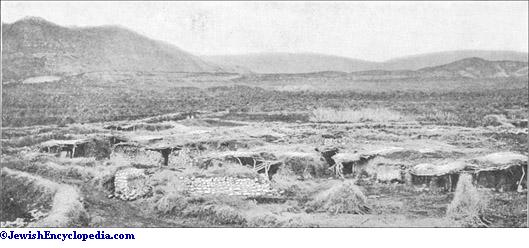
Jericho was given by Joshua to the tribe of Benjamin (Josh. xviii. 21), and later, when David's ambassadors had been ill-treated by Hanun, the King of Ammon—he had shaved off one-half of their beards—they were told by David to stay at Jericho till their beards should be grown (II Sam. x. 4-5).
The "city of palm-trees," conquered by Eglon, King of Moab (Judges iii. 13), was probably Jericho (comp. Deut. xxxiv. 3; II Chron. xxviii. 15). After it had been rebuilt by Hiel, the city gained more importance. The sons of the prophets settled there; Elisha "healed" its waters by casting salt into them (II Kings ii. 5, 19-22). Elijah's ascension took place not far from Jericho (ib. ii. 4 et seq.).
Post-Biblical History.
The captives who had been carried away by Pekah to Samaria, and were released by order of the prophet Oded, were brought to Jericho, "the city of palm-trees" (II Chron. xxviii. 8-15). Zedekiah was captured by the Chaldeans in the plains of Jericho (II Kings xxv. 5; Jer. xxxix. 5). At the return from captivity, under Zerubbabel, the children of Jericho are stated to have been 345 in number (Ezra ii. 34; Neh. vii. 36). It seems that they settled again in their native town; for men of Jericho assisted Nehemiah in reconstructing the wall of Jerusalem (Ezra iii. 2). Later, Jericho was fortified by the Syrian general Bacchides (I Macc. ix. 50). The fertility of the plain of Jericho, alluded to in the Bible by the appellation "city of palm-trees" (see above), is described at length by Josephus ("B. J." iv. 8, § 3). Strabo (xvi. 2) likens the plain surrounded by mountains to a theater.
Jericho was an important place under the Romans. When Pompey endeavored to clear Palestine of robbers, he destroyed their two strongholds, Threx and Taurus, which commanded the approach to Jericho (ib.). After Jerusalem had been taken by Pompey, Gabinius divided the whole country into five judicial districts (
After Herod's death his ex-slave Simon burned the royal palace at Jericho and plundered what had been left in it ("Ant." xvii. 10, § 6). It was magnificently rebuilt by Archelaus, who also carried on some important irrigation works (ib. xvii. 13, § 1). In the time of Josephus, Judea was divided into eleven toparchies, of which the eleventh was Jericho ("B. J." iii. 3, § 5). When Vespasian approached Jericho the inhabitants fled to the mountains (ib. iv. 8, § 2). Vespasian erected a citadel at Jericho and garrisoned it (ib. iv. 9, § 1). Among the remarkable events that took place at Jericho according to Christian tradition was Jesus, healing the blind (Matt. xx. 29; Mark x. 46; Luke xviii. 35).
Jericho, on account of the fertility of its soil, continued to prosper till about 230, when it was destroyed in the war between Alexander Severus and Ardashir, surnamed "Artaxerxes," the founder of the Sassanid dynasty (Solin, "Collectanea," in Th. Reinach's "Textes Relatifs au Judaïsme," p. 339). It is most probable that Jericho was destroyed by the Romans themselves in order to chastise the Jews for their Persian leanings. Many historians, including Graetz, ascribe the second destruction of Jericho to Artaxerxes III., Ochus; but Solin's text shows the improbability of this interpretation. It is to this destruction that Jerome ("Onomasticon") refers in his statement that after Jericho was destroyed by the Romans it was rebuilt a third time. Munk ("Palestine," p. 41b) maintains that Jericho had been destroyed by Vespasian, and was rebuilt by Hadrian. It was entirely burned during the Crusades. Near the site of ancient Jericho there is now a small village called "Al-Riḥah," inhabited by forty or fifty Mohammedan families (Munk, ib.).
Jabal Ḳaranṭal and Probable Site of Ancient Jericho.(From a photograph by Dr. W. Popper.)
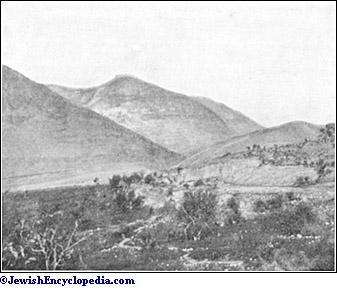
It may be of interest to note that, according to Eusebius ("Hist. Eccl." vi. 16), in the last years of Caracalla's reign (217) there were found at Jericho manuscripts, both Hebrew and Greek, of the OldTestament, and Origen is said to have used these for his Hexapla.
During Mohammedan occupation Jericho was the center of an extensive sugar-cane industry ("Kitab al-Masalik," pp. 57, 78, Leyden, 1889; Al-Ya'ḳubi, "Kitab al-Buldan," p. 113, ib. 1861). Jericho or Al-Riḥah was destroyed for the last time in 1840 by Ibrahim Pasha in a punitive expedition against the Bedouins.
Bibliography:
Bliss, in Hastings, Dict. Bible;
Guerin, Samarie, Paris, 1874;
Robinson, Researches, ii. 273 et seq.;
Th. Reinach, in the Kohut Memorial Volume, pp. 457 et seq.;
Schürer, Gesch. 3d ed., i. 224 et passim, iii. 6;
Conder, Tent Work in Palestine, ii. 1-34, London, 1879.
E. G. H. M. Sel.—In Rabbinical Literature:
Jericho is greatly praised by the Talmudists for its fertility and the abundance of its palm-trees; it is alluded to in the Bible as the "city of palm-trees" (see Biblical Data, above). The Targum of Jonathan without hesitation renders the "'Ir ha-Temarim" of Judges (i. 16, iii. 13) as well as the "Tamar" of Ezekiel (xlvii. 19) by "Jericho." It was also rich in balsam (Ber. 43a; comp. Strabo, xvi. 2), and its plain was covered with wheat (Mek., Beshallaḥ, 'Amaleḳ, 1 [ed. Weiss, p. 64a]). When the Israelites divided the land of Canaan among themselves they left a fertile area of the plain of Jericho, 500 ells square, to the tribe on whose territory the Temple was to be built, giving it in temporary charge to Jonadab b. Rechab (Sifre, Num. 81 [ed. Friedmann, p. 21b]). In Jericho fruit ripened earlier than in any other place, while at Beth-el it ripened later (Gen. R. xcix. 3).
Owing to its geographical position, Jericho was considered the key to Palestine; therefore the Israelites said, "If we take Jericho we shall possess the whole of Palestine" (Midr., Tan., Beha'aloteka, ed. Vienna, p. 206b). Jericho was conquered by Joshua on Saturday (Yer. Shab. i. 3), its wall being swallowed up by the earth; and it is counted among the places where miracles were performed and where a benediction must be recited (Ber. 54a, b). When Joshua pronounced the curse against whomever should rebuild it, he meant both the rebuilder of Jericho and the builder of any other city under the same name (Sanh. 113a). The King of Babylon had a viceroy in Jericho who sent dates to his master, receiving in return articles manufactured in Babylonia; hence the Babylonian garment stolen by Achan (see Josh. vii. 21; Gen. R. lxxxv. 15; Yalḳ., Josh. 18).
In the time of the Tannaites Jericho had a large priestly population (Ta'an. 27a). An indication of the size of its population is the fact that for each of the twenty-four groups ("ma'amadot") of men furnished by Jerusalem for the service in the Temple, Jericho furnished another group, but half as numerous. It could have supplied as many men as Jerusalem, which, however, was given the preeminence (Yer. Ta'an. iv. 2; Pes. iv. 1). The bellicose priests ("ba'ale zero'ot") so often spoken of in the Talmud were at Jericho, where the owners of sycamore-trees were obliged to consecrate them to the Lord in order to save them from the rapacity of the priests (Pes. 57a). It is said that the people of Jericho were accustomed to do six questionable things: graft palm-trees during the whole day of the 14th of Nisan; read "Shema'" without stopping between "eḥad" and "we-ahabta"; reap before the 'Omer; use the fruit of the consecrated sycamore-trees; eat on Sabbath the fruit which fell from the trees; leave "pe'ah" of vegetables. The Talmudists blamed them for doing the latter three things (Pes. 55b, 56a; Yer. Pes. iv. 9). These six things are somewhat differently enumerated in Men. 71a. Büchler concluded that by "the people of Jericho" the priests are meant. There was a school in Jericho which was named "Bet Gadya" (Yer. Soṭah ix. 13) or "Bet Guriyya" (Sanh. 11a).
Though ten parasangs distant from Jerusalem the people of Jericho could hear on Yom Kippur the Sacred Name pronounced by the high priest in the Temple of Jerusalem, and the daily closing of the large gate of the Temple (Yoma 39b; Yer. Suk. v. 3). It is said (Ab. R. N., Text B, ed. Schechter, 53b) that in Jericho could be heard the singing of the Levites and the sound of the horn and trumpet. The fragrance of the incense burned at Jerusalem pervaded Jericho and rendered perfume unnecessary for its women's toilet (Yoma l.c.; Yer. Suk. l.c.; Ab. R. N. l.c.).
Bibliography:
Büchler, Die Priester und der Cultus, pp. 161 et seq., Vienna, 1895;
Neubauer, G. T. pp. 161 et seq.
JERICHO.—A city situated in the Jordan valley about 5 miles from the north end of the Dead Sea, now represented by the miserable village of er-Rîha. It was the first city conquered by the Israelites after their passage of the Jordan. The course of events, from the sending of the spies to the destruction of Achan for infraction of the tabu on the spoil, is too well known to need repetition here (see Jos 1:1-18; Jos 2:1-24; Jos 3:1-17; Jos 4:1-24; Jos 5:1-15; Jos 6:1-27; Jos 7:1-26). A small hamlet remained on the site, belonging to Benjamin (Jos 18:21), which was insignificant enough for David’s ambassadors to retire to, to recover from their insulting treatment by Hanun (2Sa 10:5, 1Ch 19:5). The city was re-founded by Hiel, a Bethelite, who apparently endeavoured to avert the curse pronounced by Joshua over the site by sacrificing his sons (1Ki 16:34). A college of prophets was shortly afterwards founded here (2Ki 2:4), for whose benefit Elisha healed its bitter waters (2Ki 2:18). Hither the Israelites who had raided Judah, in the time of Ahaz, restored their captives on the advice of the prophet Oded (2Ch 28:15). Here the Babylonians finally defeated Zedekiah, the last king of Judah, and so destroyed the Judahite kingdom (2Ki 25:5, Jer 39:5; Jer 52:8). Bacchides, the general of the Syrians in the Maccabæan period, captured and fortified Jericho (1Ma 9:50); Aristobulus also took it (Jos.
The modern er-Rîha is not exactly on the site of ancient Jericho, which is a collection of mounds beside the spring traditionally associated with Elisha. The Roman and Byzantine towns are represented by other sites in the neighbourhood. Ancient aqusducts, mills, and other antiquities are numerous, as are also remains of early monasticism.
The site, though unhealthy for man, is noted for its fertility. Josephus (BJ IV. viii. 3) speaks of it with enthusiasm. Even yet it is an important source of fruit supply. The district round Jericho is the personal property of the Sultan.
R. A. S. Macalister.
(1) Ancient Chanaanite city, near Jerusalem, north of the Dead Sea, taken and destroyed by Josue in a famous battle after the passage of the Jordan (Josue 6). When restored by Achab (3 Kings 16) the Israelites settled there. In Deuteronomy 34:3, and Judges 1:16; 3:13 it is called the City of Palm Trees.
(2) The ancient city had entirely disappeared when Herod founded a new Jericho, where he died. Through this city Jesus passed on His last journey to Jerusalem; at its gates He cured two blind men (Matthew 20) and met the publican Zacheus (Luke 19).
Three cities of this name have successively occupied sites in the same neighbourhood.I. A city of Canaan taken and destroyed by Josue after the passage of the Jordan (Joshua 6). The establishment of the Israelites in the industries of the "City of Palm Trees" gave birth to the Jericho of Benjamin (Joshua 18:21), which was for some time dominated by Eglon, King of Moab (Judges 3:12), and in which David’s emissaries hid themselves when they had been outraged by Hanon, King of the Ammonites (II Kings, X, 5). But when, under Achab, the Canaanite Jericho had been restored by Hiel the Bethelite (1 Kings 16:34), the Israelites installed themselves there. They were visited by Eliseus, who purified the waters of the spring (2 Kings 2:18-22). Three hundred and forty-five men of Jericho, returning from captivity, repopulated their native city (Ezra 2:34; Nehemiah 7:36). Having fallen into the hands of the Syrians, it was fortified by Bacchides, to protect Judea on the eastern side (1 Maccabees 9:50). This Jericho was situated at Tell-es-Sulthàn, near the Fountain of Eliseus (’Ain-es-Sultàn), which flows at a distance of about two miles north-west of ez-Ribà, the modern Jericho. Excavations made in this tell in 1907-08 brought to light a rampart measuring some 840 yards in circuit, a citadel with double wall of the Canaanite period, Israelitish dwellings of the time of the Kings, and some post-exilic Jewish pottery (Mitteil. der deutschen Orient. Gesellschaft zu Berlin, December, 1908, no. 39; "Revue Biblique", 1909, 270-79).II. The ancient Jericho, near the spring, had entirely disappeared when Herod founded a new Jericho towards the point where the brook of the Kelt and the Jerusalem road emerge from the mountains. Protected by the fort of Cypros, it possessed royal palaces, vast reservoirs, a hippodrome, and an amphitheatre (Josephus, "Bell. Jud.", I, xxi, 14; xxxiii, 6, 8; "Antiq. Jud.", XVI, v, 2). Herod died there: his son Archelaus further embellished the palaces and caused new aqueducts to be built to bring water to the palm gardens (Antiq. Jud., XVII, xiii, 1). It was at the gates of this Jericho that Christ cured two blind men (Matthew 20:29-34), only one--Bartimeus--according to Mark (x, 46) and Luke (xviii, 35), and saw the publican Zacheus (Luke 19:1-5). The Khìrbet Qaqûn, the Birket Mûsâ, a few artificial mounds, are the visible remains of the second Jericho, which, before being entirely destroyed, served for some days as a Roman camp (Bell. Jud., viii, 2; ix, 13).III. A third Jericho then came into existence in the gardens which the Fountain of Eliseus watered, and where, besides the palm, grew the henna, balm, myrrh (Bell. Jud., IV, viii, 3), the sycamore, banana, etc. According to the map of the Mâdabâ, it was an important city and a see suffragan to Cæsarea Maritima. Its known bishops are Januarius (325), Macer (381), Eleutherius (415), Joannes (518), Gregorius (536), Basilius (800) (Lequien, "Oriens Christianus", III, 646-50). Justinian set up here a great caravanserai (Procopius, "De Ædif.", v, 9). During the Crusades Jericho was a benefice attached to the Holy Sepulchre. The Byzantine city was succeeded by the present Ribà, which consists of a few hostelries for pilgrims and tourists, and some fifteen wattle huts inhabited by Ghawarneh Arabs. There is also a Greek church (called "the Sanctuary of Zacheus") served by two Orthodox monks, a Latin chapel, and a mosque.-----------------------------------GEYER, Itinera Hierosolymitana (Vienna, 1898); CONDER AND KITCHENER, Survey of West Palestine, Mem., III (London, 1883); GuéRIN, Samarie, I (Paris, 1874): ROBINSON, Biblical Researches in Palestine, I (Boston, 1856); RELAND, Palæstina (Utrecht, 1714).F.M. ABEL Transcribed by Tom Burgoyne In memory of Father Baker, founder of Our Lady of Victory Homes The Catholic Encyclopedia, Volume VIIICopyright © 1910 by Robert Appleton CompanyOnline Edition Copyright © 2003 by K. KnightNihil Obstat, October 1, 1910. Remy Lafort, S.T.D., CensorImprimatur. +John Cardinal Farley, Archbishop of New York
The geological situation (see JORDAN VALLEY) sheds great light upon the capture of the city by Joshua (Josh 6). If the city was built as we suppose it to have been, upon the unconsolidated sedimentary deposits which accumulated to a great depth in the Jordan valley during the enlargement of the Dead Sea, which took place in Pleistocene (or glacial) times, the sudden falling of the walls becomes easily credible to anyone who believes in the personality of God and in His power either to foreknow the future or to direct at His will the secondary causes with which man has to deal in Nature. The narrative does not state that the blowing of the rams’ horns of themselves effected the falling of the walls. It was simply said that at a specified juncture on the 7th day the walls would fall, and that they actually fell at that juncture. The miracle may, therefore, be regarded as either that of prophecy, in which the Creator by foretelling the course of things to Joshua, secured the junction of Divine and human activities which constitutes a true miracle, or we may regard the movements which brought down the walls to be the result of direct Divine action, such as is exerted by man when be produces an explosion of dynamite at a particular time and place. The phenomena are just such as occurred in the earthquake of San Francisco in 1906, where, according to the report of the scientific commission appointed by the state, “the most violent destruction of buildings was on the made ground. This ground seems to have behaved during the earthquake very much in the same way as jelly in a bowl, or as a semi-liquid in a tank.” Santa Rosa, situated on the valley floor, “underlain to a considerable depth by loose or slightly coherent geological formations,... 20 miles from the rift, was the most severely shaken town in the state and suffered the greatest disaster relatively to its population and extent” (Report, 13 and 15). Thus an earthquake, such as is easily provided for along the margin of this great Jordan crevasse, would produce exactly the phenomena here described, and its occurrence at the time and place foretold to Joshua constitutes it a miracle of the first magnitude.
Notwithstanding the curse pronounced in Jos 6:26 the King James Version, prophesying that whosoever should rebuild the city “he shall lay the foundations thereof in his firstborn,” it was rebuilt (1Ki 16:34) by Hiel the Bethelite in the days of Ahab. The curse was literally fulfilled. Still David’s messengers are said to have “tarried at Jericho” in his day (2Sa 10:5; 1Ch 19:5). In Elisha’s time (2Ki 2:5) there was a school of prophets there, while several other references to the city occur in the Old Testament and the Apocrypha (2Ch 28:15, where it is called “the city of palmtrees”; 2Ki 25:5; Jer 39:5; Ezr 2:34; Neh 3:2; Neh 7:36; 1 Macc 9:50). Josephus describes it and the fertile plain surrounding it, in glowing terms. In the time of Christ, it was an important place yielding a large revenue to the royal family. But the city which Herod rebuilt was on a higher elevation, at the base of the western mountain, probably at
(Ἱåñé÷þ, Westcott-Hort’s Greek Testament Ἰåñåé÷þ)
The fall of the walls of Jericho is mentioned as an illustration of the miracle-working power of Israel’s faith (Heb_11:30). Enervated by the heat and fertility of the deep valley in which the city stood, the inhabitants of Jericho were always un-warlike, and the story in Joshua 6 gives an idea of the astonishing ease with which their stronghold was captured. The site of Jericho shifted several times. The Canaanite city has been identified with a tell or mound, 1200 ft. long and about 50 ft. high, beside Elisha’s Fountain. This has now been carefully explored under the direction of E. Sellin of Vienna, and the mud walls of the old town laid bare. See ‘The German Excavations at Jericho,’ in PEFSt [Note: EFSt Palestine Exploration Fund Quarterly Statement.] , 1910, pp. 54-68.
James Strahan.
Luk 10:30 (c) In this passage, Jerusalem represents the place of Christian privileges and Jericho represents the way of the world. The verse presents this trip as a path downward.
The ancient town of Jericho was destroyed and rebuilt many times, though sometimes the rebuilt town was beside, rather than on top of, the ruins of the former town. The present town of Jericho, the Old Testament town destroyed by Joshua, and the New Testament town visited by Jesus all occupied different sites, though these sites are within a kilometre or so of each other.
One reason for this constant settlement of Jericho was the presence there of a good spring of water. This ensured a constant supply of fresh water and made the place such an oasis that people called Jericho the city of palm trees (Deu 34:3). The town was located in a flat area of the Jordan Valley. To the east a small plain dropped away into the Jordan River, and to the west barren hills rose up to the central highlands.
Archaeological evidence indicates that Jericho was in existence in 8000 BC. Its first mention in the Bible concerns events about 1240 BC, when the Israelites under Joshua approached Canaan from the plains of Moab, crossed the Jordan River and conquered Jericho in their first battle in Canaan (Num 22:1; Joshua 2; Joshua 3; Joshua 4; Joshua 5; Joshua 6).
Joshua announced a curse over Jericho, and for the next few hundred years no one dared rebuild the town properly, though some sort of settlement still existed there (Jos 6:26; Jdg 3:13; 2Sa 10:5). When a man named Hiel later rebuilt the city, he suffered the punishment announced by Joshua (1Ki 16:34; cf. Jos 6:26). A school for young prophets was located at Jericho in the time of Elijah and Elisha (2Ki 2:4-5; 2Ki 2:15-22).
There were further destructions and rebuildings of Jericho over the following centuries. The town was still in existence in New Testament times, having been rebuilt by Herod the Great. The narrow road that descended from Jerusalem through wild and rocky country to Jericho was dangerous because of bandits (Luk 10:30).
Jesus visited Jericho on his final journey to Jerusalem, and may have passed through the town on other occasions. Among those who benefited from Jesus’ visit were some blind beggars and a well known tax collector (Mat 20:29-34; Luk 18:35-43; Luk 19:1-11).