
The holy city: and so generally known was Jerusalem by this name, that the eastern part of the world never called it by any other name than the Elkuds, the holy. Not that this would have made it so, but it proves the general consent of nations to the title: no doubt, the thing was from the Lord. That the Lord Jesus distinguished it in a very peculiar manner with his love, his lamentation over it proves. (Matt. 23. 37.) And Matthew twice calls it by this name. (Matt. 4: 5. and 27. 53.) Jerusalem was anciently Jehus. Some calledit Solyma, or Jerosolyma; but the general name by the Hebrews was Jeruschalem, meaning, the vision of peace; from Rahe, to see; and Shalom, peace. Joshua first conquered it, (see Josh. 18: 28.) but the Jebusites were not totally drawn out of it until the days of David, (See 2 Sam. v. 5.) The history of Jerusalem is truly interesting; but it would form more the subject of a volume than a short notice in a work of this kind, to enter into particulars. If we were to go back to the first account of it in Scripture, we must being withGen.14. where we find Melchisedeck king of it, and then called Salem. The church, perhaps on this account, speaks of it as the Lord’s tabernacle, (Ps. l26. 2.) and when we consider, that all the great events of the church were carried on here, no doubt, it riseth in importance to every believer’s view. Here it was the Lord Jesus made his public appearance, when he came into our world for the salvation of his people; here he finished redemption - work; here he made that one offering of himself once offered, by which heperfected for ever them that are sanctified; and here all the great events of salvation were wrought. No wonder, therefore, that Jerusalem hath been called the holy city, and is rendered so dear to all his redeemed. Hence Jerusalem, now in the present moment, means the church on earth, and is prayed for under that name. (Isa. lx2: 1. Ps. c37. 5, 6.) And hence the church in heaven is called the New Jerusalem. (Rev. 3: 12. and xxi. 2.) Jerusalem is said to be the centre of the earth; and the prophet Ezekiel, (chap. 38.11, 12.) describing the insolent threats of Gog concerning his proposed destruction of Jerusalem, calls the people of it, those who dwell in the midst of the land, or as the margin of the Bible renders it, in the navel of the earth.
The tears of Jesus over Jerusalem having been misconstrued, and as such made use of to support an opinion foreign to the general scope of the gospel, I cannot dismiss the article without offering a short observation upon it. We are told by the Evangelists, that "when Jesus was come near to Jerusalem, he beheld the city, and wept over it, saying, If thou hadst known, even thou, at least in this thy day, the things which belong unto thy peace: but now they are hid from thine eyes. For the days shall come upon thee, that thineenemies shall cast a trench about thee, and compass thee round, and keep thee in on every side, and shall lay thee even with the ground, and thy children within thee; and they shall not leave in thee one stone upon another, because thou knowest not the time of thy visitation." Whoever attends with any degree of diligence to those several expressions of our Lord, will plainly discover that all that is here spoken refers to the destruction of Jerusalem as a city and nation, and wholly in temporal things. It hath nothing to do with grace, as some have improperly concluded, as if Jerusalem had outlived her day of grace, and, therefore, could find no mercy from the Lord; and all sinners, in like manner, might outlive their day also. There is not a word of the kind in it. Jesus, in that tenderness of heart which distinguished his character, wept over the beautiful and beloved city, in contemplating the overthrow of it by the Roman power, that he knew would sack and destroy it. And knowing that their rejection of him as the Lord of life and glory was thecause; he expresseth himself in tears with this compassionate apostrophe. But what have those expressions to do with the doctrine that some men raise out of it, as if Jesus had limited a day of grace to individuals, and that men might outlive that day, and then the saving means of grace would be hidden from their eyes! Surely, there is not a syllable in the whole passage to justify or give countenance to such a doctrine. The Lord is speaking wholly of Jerusalem in temporal things. Hadst thou known (said Jesus), in this thyday the things which belong to thy peace. It is Jerusalem’s day, not the Lord’s day of grace. It is thy peace, not God’s peace. The promise to all the Lord’s people is absolute - - "Thy people shall be willing in the day of thy power." (Ps. cx. 3.) And this secures the day of grace to all whom the Father hath given to the Son; for Jesus saith, of all thou hast given me I have lost none." (John 17. 12.) So that this holds good respecting the gift of grace to all generations of the church; but in temporals, like Jerusalem, the Lord’sjudgments may, and the Lord’s judgments will follow and overthrow nations, where the gospel is preached and rejected. And while the Lord knoweth them that are his, and will save them by his grace, the nations who reject Christ, nationally considered, must perish.
formerly called Jebus, or Salem, Jos 18:28; Heb 7:2, the capital of Judea, situated partly in the tribe of Benjamin, and partly in that of Judah. It was not completely reduced by the Israelites till the reign of David, 2Sa 5:6-9. As Jerusalem was the centre of the true worship, Psa 122:4, and the place where God did in a peculiar manner dwell, first in the tabernacle, 2Sa 6:7; 2Sa 6:12; 1Ch 15:1; 1Ch 16:1; Psa 132:13; Psa 135:2, and afterward in the temple, 1Ki 6:13; so it is used figuratively to denote the church, or the celestial society, to which all that believe, both Jews and Gentiles, are come, and in which they are initiated, Gal 4:26; Heb 12:22; Rev 3:12; Rev 21:2; Rev 21:10. Jerusalem was situated in a stony and barren soil, and was about sixty furlongs in length, according to Strabo. The territory and places adjacent were well watered, having the fountains of Gihon and Siloam, and the brook Kidron, at the foot of its walls; and, beside these, there were the waters of Ethan, which Pilate had conveyed through aqueducts into the city. The ancient city of Jerusalem, or Jebus, which David took from the Jebusites, was not very large. It was seated upon a mountain southward of the temple. The opposite mountain, situated to the north, is Sion, where David built a new city, which he called the city of David, whereto was the royal palace, and the temple of the Lord. The temple was built upon Mount Moriah, which was one of the little hills belonging to Mount Sion.
Through the reigns of David and Solomon, Jerusalem was the metropolis of the whole Jewish kingdom, and continued to increase in wealth and splendour. It was resorted to at the festivals by the whole population of the country; and the power and commercial spirit of Solomon, improving the advantages acquired by his father David, centred in it most of the eastern trade, both by sea, through the ports of Elath and Ezion-Geber, and over land, by the way of Tadmor or Palmyra. Or, at least, though Jerusalem might not have been made a depot of merchandise, the quantity of precious metals flowing into it by direct importation, and by duties imposed on goods passing to the ports of the Mediterranean, and in other directions, was unbounded. Some idea of the prodigious wealth of Jerusalem at this time may be formed by stating, that the quantity of gold left by David for the use of the temple amounted to £21,600,000 sterling, beside £3,150,000 in silver; and Solomon obtained £3,240,000 in gold by one voyage to Ophir, while silver was so abundant, “that it was not any thing accounted of.” These were the days of Jerusalem’s glory. Universal peace, unmeasured wealth, the wisdom and clemency of the prince, and the worship of the true God, marked Jerusalem, above every city, as enjoying the presence and the especial favour of the Almighty. But these days were not to last long: intestine divisions and foreign wars, wicked and tyrannical princes, and, last of all, the crime most offensive to Heaven, and the one least to be expected among so favoured a people, led to a series of calamities, through the long period of nine hundred years, with which no other city or nation can furnish a parallel. After the death of Solomon, ten of the twelve tribes revolted from his successor Rehoboam, and, under Jeroboam, the son of Nebat, established a separate kingdom: so that Jerusalem, no longer the capital of the whole empire, and its temple frequented only by the tribes of Judah and Benjamin, must have experienced a mournful declension. Four years after this, the city and temple were taken and plundered by Shishak, king of Egypt, 1Ki 14:26-27; 2Ch 12:2-9. One hundred and forty-five years after, under Amaziah, they sustained the same fate from Joash, king of Israel, 2 Kings 14; 2 Chronicles 25. One hundred and sixty years from this period, the city was again taken, by Esar-haddon, king of Assyria; and Manasseh, the king, carried a prisoner to Babylon, 2 Chronicles 33. Within the space of sixty-six years more it was taken by Pharaoh-Necho, king of Egypt, whom Josiah, king of Judah, had opposed in his expedition to Carchemish; and who, in consequence, was killed at the battle of Megiddo, and his son Eliakim placed on the throne in his stead by Necho, who changed his name to Jehoiakim, and imposed a heavy tribute upon him, having sent his elder brother, Jehoahaz, who had been proclaimed king at Jerusalem, a prisoner to Egypt, where he died, 2 Kings 23; 2 Chronicles 35. Jerusalem was three times besieged and taken by Nebuchadnezzar, king of Babylon within a very few years. The first, in the reign of the last mentioned king, Jehoiakim, who was sent a prisoner to Babylon, and the vessels of the temple transported to the same city, 2 Chronicles 36. The second, in that of his son Jehoiachin; when all the treasures of the palace and the temple, and the remainder of the vessels of the latter which had been hidden or spared in the first capture, were carried away or destroyed, and the best of the inhabitants, with the king, led into captivity, 2 Kings 24; 2 Chronicles 36. And the third, in the reign of Zedekiah, the successor of Jehoiachin; in whose ninth year the most formidable siege which this ill fated city ever sustained, except that of Titus, was commenced. It continued two years; during a great part of which the inhabitants suffered all the horrors of famine: when, on the ninth day of the fourth month, in the eleventh year of Zedekiah, which answers to July in the year B.C. 588, the garrison, with the king, endeavoured to make their escape from the city, but were pursued and defeated by the Chaldeans in the plains of Jericho; Zedekiah taken prisoner; his sons killed before his face at Riblah, whither he was taken to the king of Babylon; and he himself, after his eyes were put out, was bound with fetters of brass, and carried prisoner to Babylon, where he died: thus fulfilling the prophecy of Ezekiel, which declared that he should be carried to Babylon, but should not see the place, though he should die there, Eze 12:13. In the following month, the Chaldean army, under their general, Nebuzaradan, entered the city, took away every thing that was valuable, and then burned and utterly destroyed it, with its temple and walls, and left the whole razed to the ground. The entire population of the city and country, with the exception of a few husbandmen, were then carried captive to Babylon.
During seventy years, the city and temple lay in ruins: when those Jews who chose to take immediate advantage of the proclamation of Cyrus, under the conduct of Zerubbabel, returned to Jerusalem, and began to build the temple; all the vessels of gold and silver belonging to which, that had been taken away by Nebuchadnezzar, being restored by Cyrus. Their work, however, did not proceed far without opposition; for in the reign of Cambyses, the son of Cyrus, who in Scripture is called Ahasuerus, the Samaritans presented a petition to that monarch to put a stop to the building, Ezr 4:6. Cambyses appears to have been too busily engaged in his Egyptian expedition to pay any attention to this malicious request.
His successor, Smerdis, the Magian, however, who in Scripture is called Artaxerxes, to whom a similar petition was sent, representing the Jews as a factious and dangerous people, listened to it, and, in the true spirit of a usurper, issued a decree putting a stop to the farther building of the temple, Ezr 4:7, &c; which, in consequence, remained in an unfinished state till the second year, according to the Jewish, and third, according to the Babylonian and Persian account, of Darius Hystaspes, who is called simply Darius in Scripture. To him also a representation hostile to the Jews was made by their inveterate enemies, the Samaritans; but this noble prince refused to listen to it, and having searched the rolls of the kingdom, and found in the palace at Acmetha the decree of Cyrus, issued a similar one, which reached Jerusalem in the subsequent year, and even ordered these very Samaritans to assist the Jews in their work; so that it was completed in the sixth year of the same reign, Ezr 4:24; Ezra 5; Ezr 6:1-15. But the city and walls remained in a ruinous condition until the twentieth year of Artaxerxes, the Artaxerxes Longimanus of profane history; by whom Nehemiah was sent to Jerusalem, with a power granted to him to rebuild them. Accordingly, under the direction of this zealous servant of God, the walls were speedily raised, but not without the accustomed opposition on the part of the Samaritans; who, despairing of the success of an application to the court of Persia, openly attacked the Jews with arms. But the building, notwithstanding, went steadily on; the men working with an implement of work in one hand, and a weapon of war in the other; and the wall, with incredible labour, was finished in fifty-two days, in the year B.C. 445; after which, the city itself was gradually rebuilt, Nehemiah 2, 4, 6. From this time Jerusalem remained attached to the Persian empire, but under the local jurisdiction of the high priests, until the subversion of that empire by Alexander, fourteen years after. See ALEXANDER.
At the death of Alexander, and the partition of his empire by his generals, Jerusalem, with Judea, fell to the kings of Syria. But in the frequent wars which followed between the kings of Syria and those of Egypt, called by Daniel, the kings of the north and south, it belonged sometimes to one and sometimes to the other,—an unsettled and unhappy state, highly favourable to disorder and corruption,—the high priesthood was openly sold to the highest bidder; and numbers of the Jews deserted their religion for the idolatries of the Greeks. At length, in the year B.C. 170, Antiochus Epiphanes, king of Syria, enraged at hearing that the Jews had rejoiced at a false report of his death, plundered Jerusalem, and killed eighty thousand men. Not more than two years afterward, this cruel tyrant, who had seized every opportunity to exercise his barbarity on the Jews, sent Apollonius with an army to Jerusalem; who pulled down the walls, grievously oppressed the people, and built a citadel on a rock adjoining the temple, which commanded that building, and had the effect of completely overawing the seditious. Having thus reduced this unfortunate city into entire submission, and rendered resistance useless, the next step of Antiochus was to abolish the Jewish religion altogether, by publishing an edict which commanded all the people of his dominions to conform to the religion of the Greeks: in consequence of which, the service of the temple ceased, and a statue of Jupiter Olympus was set up on the altar. But this extremity of ignominy and oppression led, as might have been expected, to rebellion; and those Jews who still held their insulted religion in reverence, fled to the mountains, with Mattathias and Judas Maccabeus; the latter of whom, after the death of Mattathias, who with his followers and successors, are known by the name of Maccabees, waged successful war with the Syrians; defeated Apollonius, Nicanor, and Lysias, generals of Antiochus; obtained possession of Jerusalem, purified the temple, and restored the service, after three years’ defilement by the Gentile idolatries.
From this time, during several succeeding Maccabean rulers, who were at once high priests and sovereigns of the Jews, but without the title of king, Jerusalem was able to preserve itself from Syrian violence. It was, however, twice besieged, first by Antiochus Eupator, in the year 163, and afterward by Antiochus Sidetes, in the year B.C. 134. But the Jews had caused themselves to be sufficiently respected to obtain conditions of peace on both occasions, and to save their city; till, at length, Hyrcanus, in the year 130 B.C., shook off the Syrian yoke, and reigned, after this event, twenty-one years in independence and prosperity. His successor, Judas, made an important change in the Jewish government, by taking the title of king which dignity was enjoyed by his successors forty-seven years, when a dispute having arisen between Hyrcanus II, and his brother Aristobulus, and the latter having overcome the former, and made himself king, was, in his turn, conquered by the Romans under Pompey, by whom the city and temple were taken, Aristobulus made prisoner, and Hyrcanus created high priest and prince of the Jews, but without the title of king. By this event Judea was reduced to the condition of a Roman province, in the year 63
B.C. Nor did Jerusalem long after enjoy the dignity of a metropolis, that honour being transferred to Caesarea. Julius Caesar, having defeated Pompey, continued Hyrcanus in the high priesthood, but bestowed the government of Judea upon Antipater, an Idumaean by birth, but a Jewish proselyte, and father of Herod the Great. For the siege and destruction of Jerusalem by the Romans, See JEWS.
Jerusalem lay in ruins about forty-seven years, when the Emperor AElius Adrian began to build it anew, and erected a Heathen temple, which he dedicated to Jupiter Capitolinus. The city was finished in the twentieth year of his reign, and called, after its founder, AElia, or AElia Capitolina, from the Heathen deity who presided over it. In this state Jerusalem continued, under the name of AElia, and inhabited more by Christians and Pagans than by Jews, till the time of the Emperor Constantine, styled the Great; who, about the year 323, having made Christianity the religion of the empire, began to improve it, adorned it with many new edifices and churches, and restored its ancient name. About thirty-five years afterward, Julian, named the Apostate, not from any love he bore the Jews, but out of hatred to the Christians, whose faith he had abjured, and with the avowed design of defeating the prophecies, which had declared that the temple should not be rebuilt, wrote to the Jews, inviting them to their city, and promising to restore their temple and nation. He accordingly employed great numbers of workmen to clear the foundations; but balls of fire bursting from the earth, soon put a stop to their proceeding. This miraculous interposition of Providence is attested by many credible witnesses and historians; and, in particular, by Ammianus Marcellinus, a Heathen, and friend of Julian; Zemuch David, a Jew; Nazianzen, Chrysostom, Ambrose Ruffinus, Theodoret, Sozomen, and Socrates, who wrote his account within fifty years after the transaction, and while many eye-witnesses of it were still living. So stubborn, indeed, is the proof of this miracle, that even Gibbon, who strives to invalidate it, is obliged to acknowledge the general fact.
Jerusalem continued in nearly the same condition till the beginning of the seventh century, when it was taken and plundered by the celebrated Chosroes, king of Persia, by whom many thousands of the Christian inhabitants were killed, or sold for slaves. The Persians, however, did not hold it long, as they were soon after entirely defeated by the Emperor Heraclius, who rescued Jerusalem, and restored it, not to the unhappy Jews, who were forbidden to come within three miles of it, but to the Christians. A worse calamity was, however, speedily to befall this ill fated city. The Mohammedan imposture arose about this time; and the fanatics who had adopted its creed carried their arms and their religion with unprecedented rapidity over the greater part of the east. The Caliph Omar, the third from Mohammed, invested the city, which, after once more suffering the horrors of a protracted siege, surrendered on terms of capitulation in the year 637; and has ever since, with the exception of the short period that it was occupied by the crusaders, been trodden under foot by the followers of the false prophet.
2. The accounts of modern Jerusalem by travellers are very numerous. Mr. Gender, in his “Palestine,” has abridged them with judgment; and we give the following extract: The approach to Jerusalem from Jaffa is not the direction in which to see the city to the best effect. Dr. E. D. Clarke entered it by the Damascus gate: and he describes the view of Jerusalem, when first descried from the summit of a hill, at about an hour’s distance, as most impressive. He confesses, at the same time, that there is no other point of view in which it is seen to so much advantage. In the celebrated prospect from the Mount of Olives, the city lies too low, is too near the eye, and has too much the character of a bird’s eye view, with the formality of a topographical plan. “We had not been prepared,” says this lively traveller, “for the grandeur of the spectacle which the city alone exhibited. Instead of a wretched and ruined town, by some described as the desolated remnant of Jerusalem, we beheld, as it were, a flourishing and stately metropolis, presenting a magnificent assemblage of domes, towers, palaces, churches, and monasteries; all of which, glittering in the sun’s rays, shone with inconceivable splendour. As we drew nearer, our whole attention was engrossed by its noble and interesting appearance. The lofty hills surrounding it give the city itself an appearance of elevation less than it really has.” Dr. Clarke was fortunate in catching this first view of Jerusalem under the illusion of a brilliant evening sunshine; but his description is decidedly overcharged. M. Chateaubriand, Mr. Buckingham, Mr. Brown, Mr. Jolliffe, Sir F. Henniker, and almost every other modern traveller, confirm the representation of Dr. Richardson. Mr. Buckingham says, “The appearance of this celebrated city, independent of the feelings and recollections which the approach to it cannot fail to awaken, was greatly inferior to my expectations, and had certainly nothing of grandeur or beauty, of stateliness or magnificence, about it. It appeared like a walled town of the third or fourth class, having neither towers, nor domes, nor minarets within it, in sufficient numbers to give even a character to its impressions on the beholder; but showing chiefly large flat-roofed buildings of the most unornamented kind, seated amid rugged hills, on a stony and forbidding soil, with scarcely a picturesque object in the whole compass of the surrounding view.” Chateaubriand’s description is very striking and graphical. After citing the language of the Prophet Jeremiah, in his lamentations on the desolation of the ancient city, as accurately portraying its present state, Lam 1:1-6; Lam 2:1-9; Lam 2:15, he thus proceeds: “When seen from the Mount of Olives, on the other side of the Valley of Jehoshaphat, Jerusalem presents an inclined plane, descending from west to east. An embattled wall, fortified with towers, and a Gothic castle, encompasses the city all round; excluding, however, part of Mount Zion, which it formerly enclosed. In the western quarter, and in the centre of the city, the houses stand very close; but, in the eastern part, along the brook Kedron, you perceive vacant spaces; among the rest, that which surrounds the mosque erected on the ruins of the temple, and the nearly deserted spot where once stood the castle of Antonia and the second palace of Herod. The houses of Jerusalem are heavy square masses, very low, without chimneys or windows: they have flat terraces or domes on the top, and look like prisons or sepulchres. The whole would appear to the eye one uninterrupted level, did not the steeples of the churches, the minarets of the mosques, the summits of a few cypresses, and the clumps of nopals, break the uniformity of the plan. On beholding these stone buildings, encompassed by a stony country, you are ready to inquire if they are not the confused monuments of a cemetery in the midst of a desert. Enter the city, but nothing will you there find to make amends for the dulness of its exterior. You lose yourself among narrow, unpaved streets, here going up hill, there down, from the inequality of the ground; and you walk among clouds of dust or loose stones. Canvas stretched from house to house increases the gloom of this labyrinth. Bazaars, roofed over, and fraught with infection, completely exclude the light from the desolate city. A few paltry shops expose nothing but wretchedness to view; and even these are frequently shut, from apprehension of the passage of a cadi. Not a creature is to be seen in the streets, not a creature at the gates extent now and then a peasant gliding through the gloom, concealing under his garments the fruits of his labour, lest he should be robbed of his hard earnings by the rapacious soldier. Aside, in a corner, the Arab butcher is slaughtering some animal, suspended by the legs from a wall in ruins: from his haggard and ferocious look, and his bloody hands, you would suppose that he had been cutting the throat of a fellow creature, rather than killing a lamb. The only noise heard from time to time in the city is the galloping of the steed of the desert: it is the janissary who brings the head of the Bedouin, or who returns from plundering the unhappy Fellah. Amid this extraordinary desolation, you must pause a moment to contemplate two circumstances still more extraordinary. Among the ruins of Jerusalem, two classes of independent people find in their religion sufficient fortitude to enable them to surmount such complicated horrors and wretchedness. Here reside communities of Christian monks, whom nothing can compel to forsake the tomb of Christ; neither plunder, nor personal ill treatment, nor menaces of death itself. Night and day they chant their hymns around the holy sepulchre. Driven by the cudgel and the sabre, women, children, flocks, and herds, seek refuge in the cloisters of these recluses. What prevents the armed oppressor from pursuing his prey, and overthrowing such feeble ramparts? The charity of the monks: they deprive themselves of the last resources of life to ransom their suppliants. Cast your eyes between the temple and Mount Zion; behold another petty tribe cut off from the rest of the inhabitants of this city. The particular objects of every species of degradation, these people bow their heads without murmuring; they endure every kind of insult without demanding justice; they sink beneath repeated blows without sighing; if their head be required, they present it to the scimitar. On the death of any member of this proscribed community, his companion goes at night, and inters him by stealth in the Valley of Jehoshaphat, in the shadow of Solomon’s temple. Enter the abodes of these people, you will find them, amid the most abject wretchedness, instructing their children to read a mysterious book, which they in their turn will teach their offspring to read. What they did five thousand years ago, these people still continue to do. Seventeen times have they witnessed the destruction of Jerusalem, yet nothing can discourage them, nothing can prevent them from turning their faces toward Sion. To see the Jews scattered over the whole world, according to the word of God, must doubtless excite surprise. But to be struck with supernatural astonishment, you must view them at Jerusalem; you must behold these rightful masters of Judea living as slaves and strangers in their own country; you must behold them expecting, under all oppressions, a king who is to deliver them. Crushed by the cross that condemns them, skulking near the temple, of which not one stone is left upon another, they continue in their deplorable infatuation. The Persians the Greeks, the Romans, are swept from the earth; and a petty tribe, whose origin preceded that of those great nations, still exists unmixed among the ruins of its native land.” To the same effect are the remarks of Dr. Richardson: “In passing up to the synagogue, I was particularly struck with the mean and wretched appearance of the houses on both sides of the streets, as well as with the poverty of their inhabitants. The sight of a poor Jew in Jerusalem has in it something peculiarly affecting. The heart of this wonderful people, in whatever clime they roam, still turns to it as the city of their promised rest. They take pleasure in her ruins, and would kiss the very dust for her sake. Jerusalem is the centre around which the exiled sons of Judah build, in imagination, the mansions of their future greatness. In whatever part of the world he may live, the heart’s desire of a Jew is to be buried in Jerusalem. Thither they return from Spain and Portugal, from Egypt and Barbary, and other countries among which they have been scattered: and when, after all their longings, and all their struggles up the steeps of life, we see them poor, and blind, and naked, in the streets of their once happy Zion, he must have a cold heart that can remain untouched by their sufferings. without uttering a prayer that God would have mercy on the darkness of Judah; and that the Day Star of Bethlehem might arise in their hearts.”
“Jerusalem,” remarks Sir Frederick Henhiker, “is called, even by Mohammedans, the Blessed City (El Gootz, El Koudes.) The streets of it are narrow and deserted, the houses dirty and ragged, the shops few and forsaken; and throughout the whole there is not one symptom of either commerce, comfort, or happiness. The best view of it is from the Mount of Olives: it commands the exact shape and nearly every particular; namely, the church of the holy sepulchre, the Armenian convent, the mosque of Omar, St. Stephen’s gate, the round-topped houses, and the barren vacancies of the city. Without the walls are a Turkish burial ground, the tomb of David, a small grove near the tombs of the kings, and all the rest is a surface of rock, on which are a few numbered trees. The mosque of Omar is the St. Peter’s of Turkey, and the respective saints are held respectively by their own faithful in equal veneration. The building itself has a light pagoda appearance; the garden in which it stands occupies a considerable part of the city, and, contrasted with the surrounding desert, is beautiful. The burial place of the Jews is over the valley of Kedron, and the fees for breaking the soil afford a considerable revenue to the governor. The burial place of the Turks is under the walls, near St. Stephen’s gate. From the opposite side of the valley, I was witness to the ceremony of parading a corpse round the mosque of Omar, and then bringing it forth for burial. I hastened to the grave, but was soon driven away: as far as my on dit tells me, it would have been worth seeing. The grave is strown with red earth, supposed to be of the Ager Damascenes of which Adam was made; by the side of the corpse is placed a stick, and the priest tells him that the devil will tempt him to become a Christian, but that he must make good use of his stick; that his trial will last three days, and that he will then find himself in a mansion of glory,” &c.
The Jerusalem of sacred history is, in fact, no more. Not a vestige remains of the capital of David and Solomon; not a monument of Jewish times is standing. The very course of the walls is changed, and the boundaries of the ancient city are become doubtful. The monks pretend to show the sites of the sacred places; but neither Calvary, nor the holy sepulchre, much less the Dolorous Way, the house of Caiaphas, &c, have the slightest pretensions to even a probable identity with the real places to which the tradition refers. Dr. E. D. Clarke has the merit of being the first modern traveller who ventured to speak of the preposterous legends and clumsy forgeries of the priests with the contempt which they merit. “To men interested in tracing, within its walls, antiquities referred to by the documents of sacred history, no spectacle,” remarks the learned traveller, “can be more mortifying than the city in its present state. The mistaken piety of the early Christians, in attempting to preserve, has either confused or annihilated the memorials it was anxious to render conspicuous. Viewing the havoc thus made, it may now be regretted that the Holy Land was ever rescued from the dominion of Saracens, who were far less barbarous than their conquerors. The absurdity, for example, of hewing the rocks of Judea into shrines and chapels, and of disguising the face of nature with painted domes and gilded marble coverings, by way of commemorating the scenes of our Saviour’s life and death, is so evident and so lamentable, that even Sandys, with all his credulity, could not avoid a happy application of the reproof conveyed by the Roman satirist against a similar violation of the Egerian fountain.” Dr. Richardson remarks, “It is a tantalizing circumstance for the traveller who wishes to recognize in his walks the site of particular buildings, or the scenes of memorable events, that the greater part of the objects mentioned in the description both of the inspired and the Jewish historian, are entirely removed, and razed from their foundation, without leaving a single trace or name behind to point out where they stood. Not an ancient tower, or gate, or wall, or hardly even a stone, remains. The foundations are not only broken up, but every fragment of which they were composed is swept away, and the spectator looks upon the bare rock with hardly a sprinkling of earth to point out her gardens of pleasure, or groves of idolatrous devotion. And when we consider the places, and towers, and walls about Jerusalem, and that the stones of which some of them were constructed were thirty feet long, fifteen feet broad, and seven and a half feet thick, we are not more astonished at the strength, and skill, and perseverance, by which they were constructed, than shocked by the relentless and brutal hostility by which they were shattered and overthrown, and utterly removed from our sight. A few gardens still remain on the sloping base of Mount Zion, watered from the pool of Siloam; the gardens of Gethsemane are still in a sort of ruined cultivation; the fences are broken down, and the olive trees decaying, as if the hand that pressed and fed them were withdrawn; the Mount of Olives still retains a languishing verdure, and nourishes a few of those trees from which it derives its name; but all round about Jerusalem the general aspect is blighted and barren; the grass is withered; the bare rock looks through the scanty sward; and the grain itself, like the staring progeny of famine, seems in doubt whether to come to maturity, or die in the ear. The vine that was brought from Egypt is cut off from the midst of the land; the vineyards are wasted; the hedges are taken away; and the graves of the ancient dead are open and tenantless.”
3. On the accomplishment of prophecy in the condition in which this celebrated city has lain for ages, Keith well remarks:—It formed the theme of prophecy from the death bed of Jacob; and, as the seat of the government of the children of Judah, the sceptre departed not from it till the Messiah appeared, on the expiration of seventeen hundred years after the death of the patriarch, and till the period of its desolation, prophesied of by Daniel, had arrived. It was to be trodden down of the Gentiles, till the time of the Gentiles should be fulfilled. The time of the Gentiles is not yet fulfilled, and Jerusalem is still trodden down of the Gentiles. The Jews have often attempted to recover it: no distance of space or of time can separate it from their affections: they perform their devotions with their faces toward it, as if it were the object of their worship as well as of their love; and, although their desire to return be so strong, indelible, and innate, that every Jew, in every generation, counts himself an exile, yet they have never been able to rebuild their temple, nor to recover Jerusalem from the hands of the Gentiles. But greater power than that of a proscribed and exiled race has been added to their own, in attempting to frustrate the counsel that professed to be of God. Julian, the emperor of the Romans, not only permitted but invited the Jews to rebuild Jerusalem and their temple; and promised to reestablish them in their paternal city. By that single act, more than by all his writings, he might have destroyed the credibility of the Gospel, and restored his beloved but deserted Paganism. The zeal of the Jews was equal to his own; and the work was begun by laying again the foundations of the temple. It was never accomplished, and the prophecy stands fulfilled. But even if the attempt of Julian had never been made, the truth of the prophecy itself is unassailable. The Jews have never been reinstated in Judea. Jerusalem has ever been trodden down of the Gentiles. The edict of Adrian was renewed by the successors of Julian; and no Jews could approach unto Jerusalem but by bribery or by stealth. It was a spot unlawful for them to touch. In the crusades, all the power of Europe was employed to rescue Jerusalem from the Heathens, but equally in vain. It has been trodden down for nearly eighteen centuries by its successive masters; by Romans, Grecians, Persians, Saracens, Mamelukes, Turks, Christians, and again by the worst of rulers, the Arabs and the Turks. And could any thing be more improbable to have happened, or more impossible to have been foreseen by man, than that any people should be banished from their own capital and country, and remain expelled and expatriated for nearly eighteen hundred years? Did the same fate ever befall any nation, though no prophecy existed respecting it? Is there any doctrine in Scripture so hard to be believed as was this single fact at the period of its prediction? And even with the example of the Jews before us, is it likely, or is it credible, or who can foretel, that the present inhabitants of any country upon earth shall be banished into all nations, retain their distinctive character, meet with an unparalleled fate, continue a people, without a government and without a country, and remain for an indefinite period, exceeding seventeen hundred years, till the fulfilment of a prescribed event which has yet to be accomplished? Must not the knowledge of such truths be derived from that prescience alone which scans alike the will and the ways of mortals, the actions of future nations, and the history of the latest generations?
Jeru´salem (habitation of peace), the Jewish capital of Palestine. It is mentioned very early in Scripture, being usually supposed to be the Salem of which Melchizedek was king. The Psalmist says (Psa 76:2): ’In Salem is his tabernacle, and his dwelling-place in Sion.’
The mountain of the land of Moriah, which Abraham (Gen 22:2) reached on the third day from Beersheba, there to offer Isaac, is, according to Josephus, the mountain on which Solomon afterwards built the temple (2Ch 3:1).
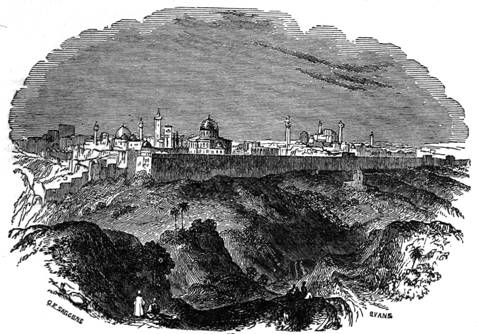
Fig. 234—Jerusalem
The name Jerusalem first occurs in Jos 10:1, where Adonizedek, king of Jerusalem, is mentioned as having entered into an alliance with other kings against Joshua, by whom they were all overcome (comp. Jos 12:10).
In drawing the northern border of Judah, we find Jerusalem again mentioned (Jos 15:8; comp. Jos 18:16). This border ran through the valley of Ben Hinnom; the country on the south of it, as Bethlehem, belonged to Judah; but the mountain of Zion, forming the northern wall of the valley, and occupied by the Jebusites, appertained to Benjamin. Among the cities of Benjamin, therefore, is also mentioned (Jos 18:28) ’Jebus, which is Jerusalem’ (comp. Jdg 19:10; 1Ch 11:4).
After the death of Joshua, when there remained for the children of Israel much to conquer in Canaan, the Lord directed Judah to fight against the Canaanites; and they took Jerusalem, smote it with the edge of the sword, and set it on fire (Jdg 1:1-8). After that, the Judahites and the Benjamites dwelt with the Jebusites at Jerusalem; for it is recorded (Jos 15:63) that the children of Judah could not drive out the Jebusites inhabiting Jerusalem; and we are further informed (Jdg 1:21) that the children of Benjamin did not expel them from Jerusalem. Probably the Jebusites were removed by Judah only from the lower city, but kept possession of the mountain of Zion, which David conquered at a later period. Jerusalem is not again mentioned till the time of Saul, when it is stated (1Sa 17:54) that David took the head of Goliath and brought it to Jerusalem. After David, who had previously reigned over Judah alone in Hebron, was called to rule over all Israel, he led his forces against the Jebusites, and conuered the castle of Zion, which Joab first scaled (2Sa 5:5-9; 1Ch 11:4-8). He then fixed his abode on this mountain, and called it ’the city of David.’ Thither he carried the Ark of the Covenant and there he built unto the Lord an altar in the threshing-floor of Araunah the Jebusite, on the place where the angel stood who threatened Jerusalem with pestilence (2Sa 24:15-25).
The reasons which led David to fix upon Jerusalem as the metropolis of his kingdom have been alluded to elsewhere [ISRAEL; JUDAH]; being chiefly, that it was in his own tribe of Judah, in which his influence was the strongest, while it was the nearest to the other tribes of any site he could have chosen in Judah. The peculiar strength also of the situation, enclosed on three sides by a natural trench of valleys, could not be without weight.
The promise made to David received its accomplishment when Solomon built his temple upon Mount Moriah. By him and his father Jerusalem had been made the imperial residence of the king of all Israel: and the temple, often called ’the house of Jehovah,’ constituted it at the same time the residence of the King of kings, the supreme head of the theocratical state, whose vicegerents the human kings were taught to regard themselves. It now belonged, even less than a town of the Levites, to a particular tribe: it was the center of all civil and religious affairs, the very place of which Moses spoke, Deu 12:5: ’The place which the Lord your God shall choose out of all your tribes to put his name there, even unto his habitation shall ye seek, and thither thou shalt come’ (comp. 9:6; 13:12; 14:23; 16:11-16; Psalms 122).
The importance and splendor of Jerusalem were considerably lessened after the death of Solomon; under whose son, Rehoboam, ten of the tribes rebelled, Judah and Benjamin only remaining in their allegiance. Jerusalem was then only the capital of the very small state of Judah. And when Jeroboam instituted the worship of golden calves in Bethel and Dan the ten tribes went no longer up to Jerusalem to worship and sacrifice in the house of the Lord (1Ki 12:26-30).
After this time the history of Jerusalem is continued in the history of Judah, for which the second book of the Kings and of the Chronicles are the principal sources of information.
After the time of Solomon, the kingdom of Judah was almost alternately ruled by good kings, ’who did that which was right in the sight of the Lord,’ and by such as were idolatrous and evil disposed; and the reign of the same king often varied and was by turns good or evil. The condition of the kingdom, and of Jerusalem in particular as its metropolis, was very much affected by these mutations. Under good kings the city flourished, and under bad kings it suffered greatly. Under Rehoboam (B.C. 973) it was conquered by Shishak, king of Egypt, who pillaged the treasures of the temple (2Ch 12:9). Under Amaziah it was taken by Jehoash, king of Israel, who broke down 400 cubits of the wall of the city, and took all the gold and silver, and all the vessels that were found in the temple (2Ki 14:13-14). Uzziah, son of Amaziah, who at first reigned well, built towers in Jerusalem at the corner-gate, at the valley-gate, and at the turning of the wall, and fortified them (2Ch 26:9). His son, Jotham, built the high gate of the temple, and reared up many other structures (2Ch 27:3-4). Hezekiah (B.C. 728) added to the other honors of his reign that of an improver of Jerusalem. His most eminent work in that character was the stopping of the upper course of Gihon, and bringing its waters by a subterraneous aqueduct to the west side of the city (2Ch 32:30). This work is inferred, from 2 Kings 20, to have been of great importance to Jerusalem, as it cut off a supply of water from any besieging enemy, and bestowed it upon the inhabitants of the city. Hezekiah’s son, Manasseh, in his later and best years, built a strong and very high wall on the west side of Jerusalem (2Ch 33:14). The works in the city connected with the names of the succeeding kings of Judah were, so far as recorded, confined to the defilement of the house of the Lord by bad kings, and its purgation by good kings, till about 100 years after Manasseh, when, for the abounding iniquities of the nation, the city and temple were abandoned to destruction. After a siege of three years, Jerusalem was taken by Nebuchadnezzar, who razed its walls, and destroyed its temple and palaces with fire (2 Kings 25; 2 Chronicles 36; Jeremiah 39). Thus was Jerusalem smitten with the calamity which Moses had prophesied would befall it, if the people would not keep the commandments of the Lord, but broke his covenant (Lev 26:14; Deuteronomy 28).
But God, before whom a thousand years are as one day, gave to the afflicted people a glimpse beyond the present calamity and retributive judgment, into a distant futurity. The same prophets who foretold the destruction of Jerusalem, also announced the consolations of a coming time.
Moses had long before predicted that if in the land of their captivity they repented of their evil, they should be brought back again to the land out of which they had been cast (Deu 30:1-5; comp. 1Ki 8:46-53; Neh 1:8-9). The Lord also, through Isaiah, condescended to point out the agency through which the restoration of the holy city was to be accomplished, and even named long before his birth the very person, Cyrus, under whose orders this was to be effected (Isa 44:28; comp. Jer 3:2; Jer 3:7-8; Jer 23:3; Jer 31:19; Jer 32:36-37).
Among the remarkably precise indications should be mentioned that in which Jeremiah (Jer 25:9; Jer 25:12) limits the duration of Judah’s captivity to 70 years.
These encouragements were continued through the prophets, who themselves shared the captivity. Of this number was Daniel (Dan 9:16; Dan 9:19), who lived to see the reign of Cyrus, king of Persia (Dan 10:1), and the fulfillment of his prayer. It was in the year B.C. 536, ’in the first year of Cyrus,’ that in accomplishment of the prophecy of Jeremiah, the Lord stirred up the spirit of this prince, who made a proclamation throughout all his kingdom, expressed in these remarkable words: ’The Lord God of heaven hath given me all the kingdoms of the earth, and he has charged me to build him a house at Jerusalem, which is in Judah. Who is there among you of all his people? his God be with him, and let him go up to Jerusalem, and build the house of the Lord God of Israel’ (Ezr 1:2-3). This important call was answered by a considerable number of persons, particularly priests and Levites; and the many who declined to quit their houses and possessions in Babylonia, committed valuable gifts to the hands of their more zealous brethren. Cyrus also caused the sacred vessels of gold and silver which Nebuchadnezzar had taken from the temple to be restored to Sheshbazzar, the prince of Judah, who took them to Jerusalem, followed by 42,360 people, beside their servants, of whom there were 7337 (Ezr 1:5-11).
On their arrival at Jerusalem they contributed according to their ability to rebuild the temple; Jeshua, the priest, and Zerubbabel, reared up an altar to offer burnt-offerings thereon; and when in the following year the foundation was laid of the new house of God, ’the people shouted for joy, but many of the Levites who had seen the first temple wept with a loud voice’ (Ezr 3:2; Ezr 3:12). When the Samaritans expressed a wish to share in the pious labor, Zerubbabel declined the offer; and in revenge the Samaritans sent a deputation to King Artaxerxes of Persia, carrying a presentment in which Jerusalem was described as a rebellious city of old time, which, if rebuilt, and its walls set up again, would not pay toll, tribute, and custom, and would thus endamage the public revenue. The deputation succeeded, and Artaxerxes ordered that the building of the temple should cease. The interruption thus caused lasted to the second year of the reign of Darius (Ezr 4:24), when Zerubbabel and Jeshua, supported by the prophets Haggai and Zechariah, again resumed the work, and would not cease, though cautioned by the Persian governor of Judea. On the matter coming before Darius Hystaspis, and the Jews reminding him of the permission given by Cyrus, he decided in their favor, and also ordered that the expenses of the work should be defrayed out of the public revenue (Ezr 6:8). In the sixth year of the reign of Darius the temple was finished, when they kept the Feast of Dedication with great joy, and next celebrated the Passover (Ezr 6:15-16; Ezr 6:19). Afterwards, in the seventh year of the second Artaxerxes, Ezra, a descendant of Aaron, came up to Jerusalem, accompanied by a large number of Jews who had remained in Babylon. He was highly patronized by the king, who not only made him a large present in gold and silver, but published a decree enjoining all treasurers of Judaea speedily to do whatever Ezra should require of them; allowing him to collect money throughout the whole province of Babylon for the wants of the temple at Jerusalem; and also giving him full power to appoint magistrates in his country to judge the people (Ezra 7-8). At a later period, in the twentieth year of king Artaxerxes, Nehemiah, who was his cupbearer, obtained permission to proceed to Jerusalem, and to complete the rebuilding of the city and its wall, which he happily accomplished, despite of all the opposition which he received from the enemies of Israel (Nehemiah 1; Nehemiah 2; Nehemiah 4; Nehemiah 6). The city was then capacious and large, but the people in it were few, and many houses lay still in ruins (Neh 7:4). At Jerusalem dwelt the rulers of the people and ’certain of the children of Judah and of the children of Benjamin;’ but it was now determined that the rest of the people should cast lots to bring one of ten to the capital (Neh 11:1-4). All strangers, Samaritans, Ammonites, Moabites, etc., were removed, to keep the chosen people from pollution; ministers were appointed to the temple, and the service was performed according to the law of Moses (Ezra 10; Nehemiah 8; Nehemiah 10; Nehemiah 12; Nehemiah 13). Of the Jerusalem thus by such great and long-continued exertions restored, very splendid prophecies were uttered by those prophets who flourished after the exile: the general purport of which was to describe the temple and city as destined to be glorified far beyond the former, by the advent of the long and eagerly expected Messiah, ’the desire of all nations’ (Zec 9:9; Zec 12:10; Zec 13:3; Hag 2:6-7; Mal 3:11).
Thus far the Old Testament has been our guide in the notices of Jerusalem. For what follows, down to its destruction by the Romans, we must draw chiefly upon Josephus, and the books of the Maccabees. The difficulty here, as before, is to separate what properly belongs to Jerusalem from that which belongs to the country at large. For as Jerusalem was invariably affected by whatever movement took place in the country of which it was the capital, its history might be made, and often has been made, the history of Palestine.
It is said by Josephus, that, when the dominion of this part of the world passed from the Persians to the Greeks, Alexander the Great advanced against Jerusalem to punish it for the fidelity to the Persians which it had manifested while he was engaged in the siege of Tyre. His hostile purposes, however, were averted by the appearance of the high-priest Jaddua at the head of a train of priests in their sacred vestments Alexander recognized in him the figure which in a dream had encouraged him to undertake the conquest of Asia. He therefore treated him with respect and reverence, spared the city against which his wrath had been kindled, and granted to the Jews high and important privileges. The historian adds that the high-priest failed not to apprise the conqueror of those prophecies in Daniel by which his successes had been predicted. The whole of this story is, however, liable to suspicion, from the absence of any notice of the circumstance in the histories of this campaign which we possess.
After the death of Alexander at Babylon (B.C. 324), Ptolemy surprised Jerusalem on the Sabbath-day, when the Jews would not fight, plundered the city, and carried away a great number of the inhabitants to Egypt, where, however, from the estimation in which the Jews of this period were held as citizens, important privileges were bestowed upon them. In the contests which afterwards followed for the possession of Syria (including Palestine), Jerusalem does not appear to have been directly injured, and was even spared when Ptolemy gave up Samaria, Acco, Joppa, and Gaza to pillage. The contest was ended by the treaty in B.C. 302, which annexed the whole of Palestine, together with Arabia Petræa and Cœle-Syria, to Egypt. Under easy subjection to the Ptolemies the Jews remained in much tranquility for more than a hundred years, in which the principal incident, as regards Jerusalem itself, was the visit which was paid to it, in B.C. 245, by Ptolemy Energetes, on his return from his victories in the East. He offered many sacrifices, and made magnificent presents to the temple. In the wars between Antiochus the Great and the kings of Egypt, from B.C. 221 to 197, Judæa could not fail to suffer severely; but we are not acquainted with any incident in which Jerusalem was principally concerned till the alleged visit of Ptolemy Philopator in B.C. 211. He offered sacrifices, and gave rich gifts to the temple, but, venturing to enter the sanctuary, in spite of the remonstrances of the high-priest, he was seized with a supernatural dread, and fled in terror from the place. It is said that on his return to Egypt he vented his rage on the Jews of Alexandria in a very barbarous manner [ALEXANDRIA]. But the whole story of his visit and its results rests upon the sole authority of the third book of Maccabees (3 Maccabees 1-2), and is therefore not entitled to implicit credit. Towards the end of this war the Jews seemed to favor the cause of Antiochus; and after he had subdued the neighboring country, they voluntarily tendered their submission, and rendered their assistance in expelling the Egyptian garrison from Mount Zion. For this conduct they were rewarded by many important privileges by Antiochus.
Under their new masters the Jews enjoyed for a time nearly as much tranquility as under the generally benign and liberal government of the Ptolemies. But in B.C. 176, Seleucus Philopator, hearing that great treasures were hoarded up in the temple, and being distressed for money to carry on his wars, sent his treasurer, Heliodorus, to bring away these treasures. But this personage is reported to have been so frightened and stricken by an apparition that he relinquished the attempt; and Seleucus left the Jews in the undisturbed enjoyment of their rights. His brother and successor, Antiochus Epiphanes, however, was of another mind. He took up the design of reducing them to a conformity of manners and religion with other nations; or, in other words, of abolishing those distinctive features which made the Jews a peculiar people, socially separated from all others. This design was odious to the great body of the people, although there were many among the higher classes who regarded it with favor. Of this way of thinking was Menelaus, whom Antiochus had made a high-priest, and who was expelled by the orthodox Jews with ignominy, in B.C. 169, when they heard the joyful news that Antiochus had been slain in Egypt. The rumor proved untrue, and Antiochus on his return punished them by plundering and profaning the temple. Worse evils befell them two years after: for Antiochus, out of humor at being compelled by the Romans to abandon his designs upon Egypt, sent his chief collector of tribute, Apollonius, with a detachment of 22,000 men, to vent his rage on Jerusalem. This person plundered the city, and razed its walls, with the stones of which he built a citadel that commanded the temple mount. A statue of Jupiter was set up in the temple; the peculiar observances of the Jewish law were abolished; and a persecution was commenced against all who adhered to these observances, and refused to sacrifice to idols. Jerusalem was deserted by priests and people, and the daily sacrifice at the altar was entirely discontinued.
This led to the celebrated revolt of the Maccabees, who, after an arduous and sanguinary struggle, obtained possession of Jerusalem (B.C. 163), and repaired and purified the temple, which was then dilapidated and deserted. The sacrifices were then recommenced, exactly three years after the temple had been dedicated to Jupiter Olympius. The castle, however, remained in the hands of the Syrians, and long proved a sore annoyance to the Jews; but at length, in B.C. 142, it was taken by Simon Maccabeus, who demolished it altogether, that it might not again be used against the Jews by their enemies. Simon then strengthened the fortifications of the mountain on which the temple stood, and built there a palace for himself, which was strengthened and enlarged by Herod the Great, who called it the castle of Antonia, under which name it makes a conspicuous figure in the Jewish wars with the Romans.
Of Jerusalem itself we find nothing of consequence till it was taken by Pompey in the summer of B.C. 63, and on the very day observed by the Jews as one of lamentation and fasting, in commemoration of the conquest of Jerusalem by Nebuchadnezzar. Twelve thousand Jews were massacred in the temple courts, including many priests, who died at the very altar rather than suspend the sacred rites. On this occasion Pompey, attended by his generals, went into the temple and viewed the sanctuary; but he left untouched all its treasures and sacred things, while the walls of the city itself were demolished. From this time the Jews are to be considered as under the dominion of the Romans. The treasures which Pompey had spared were seized a few years after (B.C. 51) by Crassus. In the year B.C. 43, the walls of the city, which Pompey had demolished, were rebuilt by Antipater, the father of that Herod the Great under whom Jerusalem was destined to assume the new and more magnificent, aspect which it bore in the time of Christ, and which constituted the Jerusalem which Josephus describes. The temple itself was taken down and rebuilt by Herod the Great, with a magnificence exceeding that of Solomon’s (Mar 13:1; Joh 2:20; see Temple). It was in the courts of the temple as thus rebuilt, and in the streets of the city as thus improved, that the Savior of men walked up and down. Here he taught, here he wrought miracles, here he suffered; and this was the temple whose ’goodly stones’ the apostle admired (Mar 13:1), and of which he foretold that before the existing generation had passed away not one stone should be left upon another.
Jerusalem seems to have been raised to this greatness, as if to enhance the misery of its overthrow. So soon as the Jews had set the seal to their formal rejection of Christ, by putting him to death, and invoking the responsibility of his blood upon the heads of themselves and of their children (Mat 27:25), its doom went forth. After having been the scene of horrors without example, it was, in A.D. 70, abandoned to the Romans, who razed the city and temple to the ground, leaving only three of the towers and a part of the western wall to show how strong a place the Roman arms had overthrown. Since then the holy city has lain at the mercy of the Gentiles, and will so remain ’until the times of the Gentiles are fulfilled.’
Modern History
The destruction of Jerusalem by the Romans did not cause the site to be utterly forsaken: but for a considerable period there is no mention of it in history. Up to A.D. 131 the Jews remained tolerably quiet. The then emperor, Adrian, among other measures of precaution, ordered Jerusalem to be rebuilt as a fortified place wherewith to keep in check the whole Jewish population. The works had made some progress, when the Jews, unable to endure the idea that their holy city should be occupied by foreigners, and that strange gods should be set up within it, broke out into open rebellion under the notorious Barchochebas, who claimed to be the Messiah. His success was at first very great; but he was crushed before the tremendous power of the Romans, so soon as it could be brought to bear upon him: and a war scarcely inferior in horror to that under Vespasian and Titus was, like it, brought to a close by the capture of Jerusalem, of which the Jews had obtained possession. This was in A.D. 135, from which period the final dispersion of the Jews has been often dated. The Romans then finished the city according to their first intention. It was made a Roman colony, inhabited wholly by foreigners, the Jews being forbidden to approach it on pain of death: a temple to Jupiter Capitolinus was erected on Mount Moriah, and the old name of Jerusalem was sought to be supplanted by that of Ælia Capitolina, conferred upon it in honor of the emperor, Ælius Adrianus, and Jupiter Capitolinus. This name was retained for some time by the Muhammadans; and it was not till after they recovered the city from the Crusaders that it became generally known among them by the name of El-Khuds—the holy—which it still bears.
From the rebuilding by Adrian the history of Jerusalem is almost a blank till the time of Constantine, when its history, as a place of extreme solicitude and interest to the Christian church, properly begins. Pilgrimages to the Holy City now became common and popular. Such a pilgrimage was undertaken in A.D. 326by the emperor’s mother Helena, then in the 80th year of her age, who built churches on the alleged site of the nativity at Bethlehem, and of the resurrection on the Mount of Olives. This example may probably have excited her son to the discovery of the site of the holy sepulcher, and to the erection of a church thereon. He removed the temple of Venus, with which, in studied insult, the site had been encumbered. The holy sepulcher was then purified, and a magnificent church was, by his order, built over and around the sacred spot. This temple was completed and dedicated with great solemnity in A.D. 335. There is no doubt that the spot thus singled out is the same which has ever since been regarded as the place in which Christ was entombed; but the correctness of the identification then made has been of late years much disputed.
By Constantine the edict, excluding the Jews from the city of their fathers’ sepulchers, was so far repealed that they were allowed to enter it once a-year to wail over the desolation of ’the holy and beautiful house’ in which their fathers worshipped God. When the nephew of Constantine, the Emperor Julian, abandoned Christianity for the old Paganism, he endeavored, as a matter of policy, to conciliate the Jews. He allowed them free access to the city, and permitted them to rebuild their temple. They accordingly began to lay the foundations in A.D. 362; but the speedy death of the emperor probably occasioned that abandonment of the attempt which contemporary writers ascribe to supernatural hindrances. The edicts seem then to have been renewed which excluded the Jews from the city, except on the day of annual wailing.
In the following centuries the roads to Zion were thronged with pilgrims from all parts of Christendom. After much struggle of conflicting dignities, the ’holy city’ was, in A.D. 451, declared a patriarchate by the council of Chalcedon. In the next century it found a second Constantine in Justinian, who ascended the throne A.D. 527. He repaired and enriched the former structures, and built upon Mount Moriah a magnificent church to the Virgin, as a memorial of the persecution of Jesus in the temple.
In A.D. 614 the Persians took it by storm, and slew thousands of the inhabitants, and inflicted much injury on the buildings.
Their inroad was speedily repaired. But in A.D. 636 it fell into the hands of a more formidable enemy, the Khalif Omar. By his orders the magnificent mosque which still bears his name was built upon Mount Moriah, upon the site of the Jewish temple.
Jerusalem remained in possession of the Arabians, and was occasionally visited by Christian pilgrims from Europe, till towards the year 1000, when a general belief that the second coming of the Savior was near at hand drew pilgrims in unwonted crowds to the Holy Land. The sight, by such large numbers, of the holy place in the hands of infidels, the exaction of tribute by the Muslem government, and the insults to which the pilgrims, often of the highest rank, were exposed from the Muslem rabble, excited an extraordinary ferment in Europe, and led to those remarkable expeditions for recovering the Holy Sepulcher from the Muhammadans, which, under the name of the Crusades, will always fill a most important and curious chapter in the history of the world.
On the 17th of June, 1099, the Crusaders, under Godfrey of Bouillon, appeared before Jerusalem, which was at that time in possession of the Fatemite khalifs of Egypt.
After a siege of forty days the holy city was taken by storm on the 15th day of July; and a dreadful massacre of the Muslim inhabitants followed, without distinction of age or sex. As soon as order was restored, and the city cleared of the dead, a regular government was established by the election of Godfrey as king of Jerusalem. The Christians kept possession of Jerusalem eighty-eight years. During this long period they appear to have erected several churches and many convents. Of the latter few, if any, traces remain; and of the former, save one or two ruins, the Church of the Holy Sepulcher, which they rebuilt, is the only memorial which attests the existence of the Christian kingdom of Jerusalem. In A.D. 1187the Holy City was wrested from the hands of the Christians by the Sultan Saladin. From that time to the present day Jerusalem has remained, with slight interruption, in the hands of the Muslims. On the threatened siege by Richard of England in 1192, Saladin took great pains in strengthening its defenses. New walls and bulwarks were erected, and deep trenches cut, and in six months the town was stronger than it ever had been, and the works had the firmness and solidity of a rock. But in A.D. 1219 the Sultan Melek el-Moaddin of Damascus, who then had possession of Jerusalem, ordered all the walls and towers to be demolished, except the citadel and the enclosure of the mosque, lest the Franks should again become masters of the city and find it a place of strength. In this defenseless state Jerusalem continued till it was delivered over to the Christians in consequence of a treaty with the emperor Frederick II, in A.D. 1229, with the understanding that the walls should not be rebuilt. Yet ten years later (A.D. 1239) the barons and knights of Jerusalem began to build the walls anew, and to erect a strong fortress on the west of the city. But the works were interrupted by the emir David of Kerek, and who seized the city, strangled the Christian inhabitants, and cast down the newly erected walls and fortress. Four years after, however (A.D. 1243), Jerusalem was again made over to the Christians without any restriction, and the works appear to have been restored and completed; for they are mentioned as existing when the city was stormed by the wild Kharismian hordes in the following year; shortly after which the city reverted for the last time into the hands of its Muhammadan masters, who have kept it to the present day.
From this time Jerusalem appears to have sunk very much in political and military importance; and it is scarcely named in the history of the Memluk sultans who reigned over Egypt and the greater part of Syria in the fourteenth and fifteenth centuries. At length, with the rest of Syria and Egypt, it passed under the sway of the Turkish sultan Selim I, who paid a hasty visit to the holy land from Damascus after his return from Egypt. From that time Jerusalem has formed a part of the Ottoman Empire, and during this period has been subject to few vicissitudes; its history is accordingly barren of incident. The present walls of the city were erected by Suleiman the Magnificent, the successor of Selim, in A.D. 1542, as is attested by an inscription over the Jaffa gate. So lately as A.D. 1808, the church of the holy sepulcher was partially consumed by fire; but the damage was repaired with great labor and expense by September, 1810, and the traveler now finds in this imposing fabric no traces of the recent calamity.
In A.D. 1832 Jerusalem became subject to Mohammed Ali, the pasha of Egypt, the Holy City opening its gates to him without a siege. During the great insurrection in the districts of Jerusalem and Nabulus, in 1834, the insurgents seized upon Jerusalem, and held possession of it for a time; but by the vigorous operations of the government, order was soon restored, and the city reverted quietly to its allegiance on the approach of Ibrahim Pasha with his troops. In 1841 Mohammed Ali was deprived of all his Syrian possessions by European interference, and Jerusalem was again subjected to the Turkish government, under which it now remains. It is not, perhaps, the happier for the change. The only subsequent event of interest has been the establishment of a Protestant bishopric at Jerusalem by the English and Prussian governments, and the erection upon Mount Zion of a church, calculated to hold 500 persons, for the celebration of divine worship according to the ritual of the English church.
General Topography
Jerusalem lies near the summit of a broad mountain-ridge, extending, without interruption, from the plain of Esdraelon to a line drawn between the south end of the Dead Sea and the south-east corner of the Mediterranean; or, more properly, perhaps, it may be regarded as extending as far south as to Jebel Araif in the Desert, where it sinks down at once to the level of the great western plateau. This tract, which is everywhere not less than from 20 to 25 geographical miles in breadth, forms the precipitous western wall of the great valley of the Jordan and the Dead Sea, and is everywhere rocky, uneven, and mountainous; and is, moreover, cut up by deep valleys which run east or west on either side towards the Jordan or the Mediterranean. The line of division, or watershed, between the waters of these valleys, follows for the most part the height of land along the ridge; yet not so but that the heads of the valleys, which run off in different directions, often inter-lap for a considerable distance. Thus, for example, a valley which descends to the Jordan often has its head a mile or two westward of the commencement of other valleys which run to the western sea.
From the great plain of Esdraelon onwards toward the south, the mountainous country rises gradually, forming the tract anciently known as the mountains of Ephraim and Judah; until, in the vicinity of Hebron, it attains an elevation of nearly 3000 Paris feet above the level of the Mediterranean Sea. Further north, on a line drawn from the north end of the Dead Sea towards the true west, the ridge has an elevation of only about 2500 Paris feet; and here, close upon the watershed, lies the city of Jerusalem. Its mean geographical position is in lat. 31° 46′ 43″ N., and long. 35° 13′ E. from Greenwich.
The surface of the elevated promontory, on which the city stands, slopes somewhat steeply towards the east, terminating on the brink of the valley of Jehoshaphat. From the northern part, near the present Damascus gate, a depression or shallow wady runs in a southern direction, having on the west the ancient hills of Akra and Zion, and on the east the lower ones of Bezetha and Moriah. Between the hills of Akra and Zion another depression or shallow wady (still easy to be traced) comes down from near the Jaffa gate, and joins the former. It then continues obliquely down the slope, but with a deeper bed, in a southern direction, quite to the pool of Siloam and the valley of Jehoshaphat. This is the ancient Tyropæon. West of its lower part Zion rises loftily, lying mostly without the modern city; while on the east of the Tyropaeon and the valley first mentioned lie Bezetha, Moriah, and Ophel, the last a long and comparatively narrow ridge, also outside of the modern city, and terminating in a rocky point over the pool of Siloam. These three last hills may strictly be taken as only parts of one and the same ridge. The breadth of the whole site of Jerusalem, from the brow of the valley of Hinnom, near the Jaffa gate, to the brink of the valley of Jehoshaphat, is about 1020 yards, or nearly half a geographical mile.
The country around Jerusalem is all of limestone formation, and not particularly fertile. The rocks everywhere come out above the surface, which in many parts is also thickly strewed with loose stones; and the aspect of the whole region is barren and dreary; yet the olive thrives here abundantly, and fields of grain are seen in the valleys and level places, but they are less productive than in the region of Hebron and Nabulus. Neither vineyards nor fig-trees flourish on the high ground around the city, though the latter are found in the gardens below Siloam, and very frequently in the vicinity of Bethlehem.
Ancient Jerusalem
Every reader of Scripture feels a natural anxiety to form some notion of the appearance and condition of Jerusalem, as it existed in the time of Jesus, or rather as it stood before its destruction by the Romans. There are unusual difficulties in the way of satisfying this desire, although it need not be left altogether ungratified. The principal sources of these difficulties have been indicated by different travelers, and by none more forcibly than by Richardson (Travels, ii. 251). ’It is a tantalizing circumstance, however, for the traveler who wishes to recognize in his walks the site of particular buildings, or the scenes of memorable events, that the greater part of the objects mentioned in the description, both of the inspired and of the Jewish historian, are entirely razed from their foundation, without leaving a single trace or name behind to point out where they stood. Not an ancient tower, or gate, or wall, or hardly even a stone, remains. The foundations are not only broken up, but every fragment of which they were composed is swept away, and the spectator looks upon the bare rock with hardly a sprinkling of earth to point out her gardens of pleasure, or groves of idolatrous devotion.’
To the difficulties originating in these causes may be added those which arise from the many ambiguities in the description left by Josephus, the only one which we possess, and which must form the ground-work of most of our notices respecting the ancient city. There are indeed some manifest errors in his account, which the critical reader is able to detect without having the means to rectify.
In describing Jerusalem as it stood just before its destruction by the Romans, Josephus states that the city was built upon two hills, between which lay the valley Tyropaeon (Cheesemonger’s Valley), to which the buildings on both hills came down. This valley extended to the fountain of Siloam. The hill on which the upper town stood was much higher than the other, and straighter in its extent. On account of its fortifications, David called it the Fortress or Castle; but in the time of Josephus it was known by the name of the Upper Market. The other hill, on which was situated the lower town, was called Akra. It was in the form of a horseshoe or crescent. Opposite to Akra was a third, and naturally lower hill (Moriah), on which the temple was built; and between this and Akra was originally a broad valley, which the inhabitants of Jerusalem filled up in the time of Simon Maccabaeus for the purpose of connecting the town with the temple. At the same time they lowered the hill Akra, so as to make the temple rise above it. Both the hills on which the upper and lower towns stood were externally surrounded by deep valleys, and here there was no approach because of the precipices on every side.
The single wall which enclosed that part of the city skirted by precipitous valleys began at the tower of Hippicus. On the west it extended (southward) to a place called Bethso, and the gate of the Essenes; thence it kept along on the south to a point over against Siloam; and thence on the east was carried along by Solomon’s Pool and Ophla (Ophel), till it terminated at the eastern portico of the temple. Of the triple walls, we are told that the first and oldest of these began at the tower of Hippicus, on the northern part, and, extending (along the northern brow of Zion) to the Xystus, afterwards terminated at the western portico of the temple. The second wall began at the gate of Gennath (apparently near Hippicus), and, encircling only the northern part of the city, extended to the castle of Antonia at the north-west corner of the area of the temple. The third wall was built by Agrippa at a later period: it also had its beginning at the tower of Hippicus, ran northward as far as the tower Psephinos; and thence sweeping round towards the north-east by east, it turned afterwards towards the south, and was joined to the ancient wall at or in the valley of the Kidron. This wall enclosed the hill Bezetha. From other passages we learn that the Xystus, named in the above descriptions, was an open place in the extreme part of the upper city, where the people sometimes assembled, and that a bridge connected it with the temple.
Dr. Robinson, in comparing the information derived from Josephus with his own more detailed account, declares that the main features depicted by the Jewish historian may still be recognized. ’True,’ he says, ’the valley of the Tyropaeon, and that between Akra and Moriah, have been greatly filled up with the rubbish accumulated from the repeated desolations of nearly eighteen centuries. Yet they are still distinctly to be traced: the hills of Zion, Akra, Moriah, and Bezetha, are not to be mistaken; while the deep valleys of the Kidron, and of Hinnom, and the Mount of Olives, are permanent natural features, too prominent and gigantic indeed to be forgotten, or to undergo any perceptible change.’
The details embraced in this general notice must be more particularly examined in connection with modern observations; for it is to be remembered that the chief or only value of these observations consists in the light which they throw on the ancient condition and history of the site.
The first or most ancient wall appears to have enclosed the whole of Mount Zion. The greater part of it, therefore, must have formed the exterior and sole wall on the south, overlooking the deep valleys below Mount Zion; and the northern part evidently passed from the tower of Hippicus on the west side, along the northern brow of Zion, and across the valley, to the western side of the temple area. It probably nearly coincided with the ancient wall which existed before the time of David, and which enabled the Jebusites to maintain themselves in possession of the upper city, long after the lower city had been in the hands of the Israelites. Mount Zion is now unwalled, and is excluded from the modern city. No trace of this wall can now be perceived, but by digging through the rubbish the foundations might perhaps be discovered.
The account given by Josephus, of the second wall, is very short and unsatisfactory. It seems to have enclosed the whole of the lower city, or Akra, excepting that part of the eastern side of it which fronted the Temple area on Mount Moriah, and the southern side, towards the valley which separated the lower from the upper city. In short, it was a continuation of the external wall, so far as necessary, on the west and north, and on so much of the east as was not already protected by the strong wall of the Temple area.
Although these were the only walls that existed in the time of our Savior, we are not to infer that the habitable city was confined within their limits. On the contrary, it was because the city had extended northward far beyond the second wall that a third was built to cover the defenseless suburb: and there is no reason to doubt that this unprotected suburb, called Bezetha, existed in the time of Christ. This wall is described as having also begun at the tower of Hippicus: it ran northward as far as to the tower Psephinos, then passed down opposite the sepulcher of Helena (queen of Adiabene), and, being carried along through the royal sepulchers, turned at the corner tower by the Fullers’ monument, and ended by making a junction with the ancient wall at the valley of the Kidron. It was begun ten or twelve years after our Lord’s crucifixion by the elder Herod Agrippa, who desisted from completing it for fear of offending the Emperor Claudius. But the design was afterwards taken up and completed by the Jews themselves, although on a scale of less strength and magnificence. Dr. Robinson thinks that he discovered some traces of this wall, which are described in his great work.
The same writer thinks that the wall of the new city, the Ælia of Adrian, nearly coincided with that of the present Jerusalem.
We know from Josephus that the circumference of the ancient city was 33 stadia, equivalent to nearly three and a half geographical miles. The circumference of the present walls does not exceed two and a half geographical miles; but the extent of Mount Zion, now without the walls, and the tract on the north formerly enclosed, or partly so, by the third wall, sufficiently account for the difference.
The history of the modern walls has already been given in the sketch of the modern history of the city. The present walls have a solid and formidable appearance, especially when cursorily observed from without; and they are strengthened, or rather ornamented, with towers and battlements after the Saracenic style. They are built of limestone, the stones being not commonly more than a foot or 15 inches square. The height varies with the various elevations of the ground. The lower parts are probably about 25 feet high, while in more exposed localities, where the ravines contribute less to the security of the city, they have an elevation of 60 or 70 feet.
Much uncertainty exists respecting the ancient gates of Jerusalem. Many gates are named in Scripture; and it has been objected that they are more in number than a town of the size of Jerusalem could require—especially as they all occur within the extent embraced by the first and second walls, the third not then existing. It has, therefore, been suggested as more than probable that some of these gates were within the city, in the walls which separated the town from the temple, and the upper town from the lower, in which gates certainly existed. On the other hand, considering the circumstances under which the wall was rebuilt in the time of Nehemiah, it is difficult to suppose that more than the outer wall was then constructed, and certainly it was in the wall then built that the ten or twelve gates mentioned by Nehemiah occur. But these may be considerably reduced by supposing that two or more of the names mentioned were applied to the same gate. If this view of the matter be taken, no better distribution of these gates can be given than that suggested by Raumer.
A. On the north side.
1. The Old Gate, probably at the north-east corner (Neh 3:6; Neh 12:39).
2. The Gate of Ephraim or Benjamin (Jer 38:7; Jer 37:13; Neh 12:39; 2Ch 25:23). This gate doubtless derived its names from its leading to the territory of Ephraim and Benjamin; and Dr. Robinson supposes it may possibly be represented by some traces of ruins which he found on the site of the present gate of Damascus.
3. The Corner-gate, 400 cubits from the former, and apparently at the north-west corner (2Ch 25:23; 2Ki 14:13; Zec 14:10). Probably the Gate of the Furnaces is the same (Neh 3:11; Neh 12:38).
B. On the west side.
4. The Valley-gate, over against the Dragon-fountain of Gihon (Neh 2:13; Neh 3:13; 2Ch 26:9). It was probably about the north-west corner of Zion, where there appears to have been always a gate, and Dr. Robinson supposes it to be the same with the Gennath of Josephus.
C. On the south side.
5. The Dung-gate, perhaps the same as Josephus’s Gate of the Essenes (Neh 2:13; Neh 12:31). It was 1000 cubits from the valley-gate (Neh 3:13), and the dragon-well was between them (Neh 2:13). This gate is probably also identical with ’the gate between two walls’ (2Ki 25:4; Jer 39:4; Lam 2:7).
6. The Gate of the Fountain, to the south-east (Neh 2:14; Neh 3:15); the gate of the fountain near the king’s pool (Neh 2:14); the gate of the fountain near ’the pool of Siloah by the king’s garden’ (Neh 3:15). The same gate is probably denoted in all these instances, and the pools seem to have been also the same. It is also possible that this fountain-gate was the same otherwise distinguished as the brick-gate (or potter’s gate), leading to the valley of Hinnom (Jer 19:2, where the Auth. Ver. has ’east-gate’).
D. On the east side.
7. The Water-gate (Neh 3:26).
8. The Prison-gate, otherwise the Horse-gate, near the temple (Neh 3:28; Neh 12:39-40).
9. The Sheep-gate, probably near the sheep-pool (Neh 3:1-32; Neh 12:39).
10. The Fish-gate was quite at the north-east (Neh 3:3; Neh 12:39; Zep 1:10; 2Ch 33:14).
In the middle ages there appear to have been two gates on each side of the city, making eight in all; and this number, being only two short of those assigned in the above estimate to the ancient Jerusalem, seems to vindicate that estimate from the objections which have been urged against it.
On the west side were two gates, of which the principal was the Gate of David, often mentioned by the writers on the Crusades. It corresponds to the present Jaffa gate. The other was the gate of the Fullers’ Field, so called from Isa 7:3. There is no trace of it in the present wall.
On the north there were also two gates; and all the middle-age writers speak of the principal of them as the gate of St. Stephen, from the notion that the death of the protomartyr took place near it. This was also called the gate of Ephraim, in reference to its probable ancient name. The present gate of St. Stephen is on the east of the city, and the scene of the martyrdom is now placed near it; but there is no account of the change. Farther east was the gate of Benjamin, corresponding apparently to what is now called the gate of Herod.
On the east there seem to have been at least two gates. The northernmost is described by Adamnanus as a small portal leading down to the valley of Jehoshaphat. It was called the gate of Jehoshaphat, from the valley to which it led. It seems to be represented by the present gate of St. Stephen. The present gate of St. Stephen has four lions sculptured over it on the outside, which, as well as the architecture, show that it existed before the present walls. The other gate is the famous Golden Gate in the eastern wall of the temple area. This gate is, from its architecture, obviously of Roman origin, and is conjectured to have belonged to the enclosure of the temple of Jupiter which was built by Adrian upon Mount Moriah. The exterior is now walled up; but being double, the interior forms within the area a recess, which is used for prayer by the Muslim worshipper.
On the south side were also two gates. The easternmost is now called by the Franks the Dung-gate. The earliest mention of this gate is by Brocard, about A.D. 1283, who regards it as the ancient Water-gate. Farther west, between the eastern brow of Zion and the gate of David, the Crusaders found a gate which they call the Gate of Zion, corresponding to one which now bears the same name.
Of the seven gates mentioned as still existing, three, the Dung Gate, the Golden Gate, and Herod’s Gate, are closed. Thus there are only four gates now in use, one on each side of the town, all of which have been enumerated. St. Stephen’s, on the east, leads to the Mount of Olives, Bethany, and Jericho. Zion Gate, on the south side of the city, connects the populous quarter around the Armenian convent with that part of Mount Zion which is outside the walls, and which is much resorted to as being the great field of Christian burial, as well as for its traditional sanctity as the site of David’s tomb, the house of Caiaphas, house of Mary, etc. The Jaffa Gate, on the west, is the termination of the important routes from Jaffa, Bethlehem, and Hebron. The Damascus Gate, on the north, is also planted in a vale, which in every age of Jerusalem must have been a great public way, and the easiest approach from Samaria and Galilee.
The towers of Jerusalem are often mentioned in Scripture and in Josephus. Most of the towers mentioned by Josephus were erected by Herod the Great, and were, consequently, standing in the time of Christ. It was on these, therefore, that his eyes often rested when he approached Jerusalem, or viewed its walls and towers from the Mount of Olives. Of all these towers, the most important is that of Hippicus, which Josephus, as we have already seen, assumed as the starting point in his description of all the walls of the city. Herod gave to it the name of a friend who was slain in battle. It was a quadrangular structure, 25 cubits on each side, and built up entirely solid to the height of 30 cubits. The altitude of the whole tower was 80 cubits. Dr. Robinson has shown that this tower should be sought at the north-west corner of the upper city, or Mount Zion. This part, a little to the south of the Jaffa Gate, is now occupied by the citadel. It is an irregular assemblage of square towers, surrounded on the inner side towards the city by a low wall, and having on the outer or west side a deep fosse. The towers which rise from the brink of the fosse are protected on that side by a low sloping bulwark or buttress, which rises from the bottom of the trench at an angle of forty-five degrees. This part bears evident marks of antiquity, and Dr. Robinson is inclined to ascribe these massive outworks to the time of the rebuilding and fortifying of the city by Adrian. The north-eastern tower bears among the Franks the name of the Tower of David, while they sometimes give to the whole fortress the name of the Castle of David. Taking all the circumstances into account, Dr. Robinson thinks that the antique lower portion of this tower is in all probability a remnant of the tower of Hippicus, which, as Josephus states, was left standing by Titus when he destroyed the city.
Josephus describes two other towers—those of Phasaëlus and Mariamne, both built by Herod, one of them being named after a friend, and the other after his favorite wife. They stood not far from Hippicus, upon the first or most ancient wall, which ran from the latter tower eastward, along the northern brow of Zion. Connected with these towers and Hippicus was the royal castle or palace of the first Herod, which was enclosed by this wall on the north, and on the other sides by a wall 30 cubits high. These were the three mighty towers which Titus left standing as monuments of the strength of the place which had yielded to his arms. But nothing now remains save the above-mentioned supposed remnant of the tower of Hippicus.
A fourth tower, called Psephinos, is mentioned by Josephus. It stood at the north-west corner of the third or exterior wall of the city. It did not, consequently, exist in the time of Christ, seeing that the wall itself was built by Herod Agrippa, to whom also the tower may be ascribed.
The above are the only towers which the historian particularly mentions. But in describing the outer or third wall of Agrippa, he states that it had battlements of two cubits, and turrets of three cubits more: and as the wall was 20 cubits high, this would make the turrets of the height of 25 cubits, or nearly 38 feet. Many loftier and more substantial towers than these were erected on each of the walls at regulated distances, and furnished with every requisite for convenience or defense. Of those on the third or outer wall are enumerated ninety; on the middle or second wall, forty; and on the inner or ancient wall, sixty.
The temple was in all ages the great glory and principal public building of Jerusalem, as the heathen temple, church, or mosque, successively occupying the same site, has been ever since the Jewish temple was destroyed. That temple is reserved for a separate article [TEMPLE], and there are few other public edifices which require a particular description. Those most connected with Scripture history are the palace of Herod and the tower of Antonia. The former has already been noticed. In the time of Christ it was the residence of the Roman procurators while in Jerusalem; and as such provincial residences were called by the Romans Prætoria, this was the prætorium or judgment-hall of Pilate (Mat 27:27; Mar 15:16; Joh 18:28). In front of the palace was the tribunal or ’judgment-seat,’ where the procurator sat to hear and determine the causes; and where Pilate was seated when our Lord was brought before him. It was a raised pavement of mosaic work, called in the Hebrew Gabbatha, or ’an elevated place’ [JUDGMENT-HALL].
The tower or castle of Antonia stood on a steep rock adjoining the north-west corner of the temple. It has already been mentioned that it originated under the Maccabees, who resided in it. As improved by Herod, who gave it the name of Antonia, after his patron Mark Antony, this fortress had all the extent and appearance of a palace, being divided into apartments of every kind, with galleries and baths, and also broad halls or barracks for soldiers; so that, as having everything necessary within itself, it seemed a city, while in its magnificence it was a palace. At each of the four corners was a tower, one of which was 70 cubits high, and overlooked the whole temple with its courts. The fortress communicated with the cloisters of the temple by secret passages, through which the soldiers could enter and quell any tumults, which were always apprehended at the time of the great festivals. It was to a guard of these soldiers that Pilate referred the Jews as a ’watch’ for the sepulcher of Christ. This tower was also ’the castle’ into which St. Paul was carried when the Jews rose against him in the temple, and were about to kill him; and where he gave his able and manly account of his conversion and conduct (Act 21:27-40; Acts 22). This tower was, in fact, the citadel of Jerusalem.
In the narratives of all the sieges which Jerusalem has suffered, we never read of the besieged suffering from thirst, although driven to the most dreadful extremities and resources by hunger while the besiegers are frequently described as suffering greatly from want of water, and as being obliged to fetch it from a great distance. This is a very singular circumstance, and is perhaps only in part explained by reference to the system of preserving water in cisterns, as at this day in Jerusalem. There is, however, good ground to conclude that from very ancient times there has been under the temple an unfailing source of water, derived by secret and subterraneous channels from springs to the west of the town, and communicating by other subterraneous passages with the pool of Siloam and the fountain of the Virgin in the east of the town, whether they were within or without the walls of the town. The ordinary means taken by the inhabitants to secure a supply of water have been described under the article Cistern.
Modern Jerusalem
In proceeding to furnish a description of the present Jerusalem, we shall, for the most part, place ourselves under the guidance of Dr. Olin, whose account is not only the most recent, but is by far the most complete and satisfactory which has of late years been produced.
The general view of the city from the Mount of Olives is mentioned more or less by all travelers as that from which they derive their most distinct and abiding impression of Jerusalem.
The summit of the Mount of Olives is about half a mile east from the city, which it completely overlooks, every considerable edifice and almost every house being visible. The city seen from this point appears to be a regular inclined plain, sloping gently and uniformly from west to east, or towards the observer, and indented by a slight depression or shallow vale, running nearly through the center in the same direction. The south-east corner of the quadrangle—for that may be assumed as the figure formed by the rocks—that which is nearest to the observer, is occupied by the mosque of Omar and its extensive and beautiful grounds. This is Mount Moriah, the site of Solomon’s temple; and the ground embraced in the sacred enclosure, which conforms to that of the ancient temple, occupies about an eighth of the whole modern city. It is covered with green sward and planted sparingly with olive, cypress, and other trees, and it is certainly the most lovely feature of the town, whether we have reference to the splendid structures or the beautiful lawn spread out around them.
The south-west quarter, embracing that part of Mount Zion which is within the modern town, is to a great extent occupied by the Armenian convent, an enormous edifice, which is the only conspicuous object in this neighborhood. The north-west is largely occupied by the Latin convent, another very extensive establishment. About midway between these two convents is the castle or citadel, close to the Bethlehem gate, already mentioned. The north-east quarter of Jerusalem is but partially built up, and it has more the aspect of a rambling agricultural village than that of a crowded city. The vacant spots here are green with gardens and olive-trees. There is another large vacant tract along the southern wall, and west of the Haram, also covered with verdure. Near the center of the city also appear two or three green spots, which are small gardens. The Church of the Holy Sepulcher is the only conspicuous edifice in this vicinity, and its domes are striking objects. There are no buildings which, either from their size or beauty, are likely to engage the attention. Eight or ten minarets mark the position of so many mosques in different parts of the town, but they are only noticed because of their elevation above the surrounding edifices. Upon the same principle the eye rests for a moment upon a great number of low domes, which form the roofs of the principal dwellings, and relieve the heavy uniformity of the flat plastered roofs which cover the greater mass of more humble habitations.
From the same commanding point of view a few olive and fig trees are seen in the lower part of the valley of Jehoshaphat, and scattered over the side of Olivet from its base to the summit. They are sprinkled yet more sparingly on the southern side of the city on Mounts Zion and Ophel. North of Jerusalem the olive plantations appear more numerous as well as thriving, and thus offer a grateful contrast to the sun-burnt fields and bare rocks which predominate in this landscape. The region west of the city appears to be destitute of trees. Fields of stunted wheat, yellow with the drought rather than white for the harvest, are seen on all sides of the town.
Jerusalem, as seen from Mount Olivet, is a plain inclining gently and equably to the East. Once enter its gates, however, and it is found to be full of inequalities. The passenger is always ascending or descending. There are no level streets, and little skill or labor has been employed to remove or diminish the inequalities which nature or time has produced. Houses are built upon mountains of rubbish, which are probably twenty, thirty, or fifty feet above the natural level, and the streets are constructed with the same disregard to convenience, with this difference, that some slight attention is paid to the possibility of carrying off surplus water. The latter are, without exception, narrow, seldom exceeding eight or ten feet in breadth. The houses often meet, and in some instances a building occupies both sides of the street, which runs under a succession of arches barely high enough to permit an equestrian to pass under them. A canopy of old mats or of plank is suspended over the principal streets when not arched. This custom had its origin, no doubt, in the heat of the climate, which is very intense in summer, and it gives a gloomy aspect to all the most thronged and lively parts of the city. These covered ways are often pervaded by currents of air when a perfect calm prevails in other places. The principal streets of Jerusalem run nearly at right angles to each other. Very few, if any, of them bear names among the native population. They are badly paved, being merely laid irregularly with raised stones, with a deep square channel, for beasts of burden, in the middle; but the steepness of the ground contributes to keep them cleaner than in most Oriental cities.
The houses of Jerusalem are substantially built of the limestone of which the whole of this part of Palestine is composed: not usually hewn, but broken into regular forms, and making a solid wall of very respectable appearance. For the most part there are no windows next to the street, and the few which exist for the purposes of light or ventilation are completely masked by casements and lattice-work. The apartments receive their light from the open courts within. The ground plot is usually surrounded by a high enclosure, commonly forming the walls of the house only, but sometimes embracing a small garden and some vacant ground. The rain-water which falls upon the pavement is carefully conducted, by means of gutters, into cisterns, where it is preserved for domestic uses. The people of Jerusalem rely chiefly upon these reservoirs for their supply of this indispensable article. Stone is employed in building for all the purposes to which it can possibly be applied, and Jerusalem is hardly more exposed to accidents by fire than a quarry or subterranean cavern. The floors, stairs, etc. are of stone, and the ceiling is usually formed by a coat of plaster laid upon the stones, which at the same time form the roof and the vaulted top of the room. Doors, sashes, and a few other appurtenances, are all that can usually be afforded of a material so expensive as wood. A large number of houses in Jerusalem are in a dilapidated and ruinous state.
Nothing of this would be suspected from the general appearance of the city as seen from the various commanding points without the walls, nor from anything that meets the eye in the streets. Few towns in the East offer a more imposing spectacle to the view of the approaching stranger. He is struck with the height and massiveness of the walls, which are kept in perfect repair, and naturally produce a favorable opinion of the wealth and comfort which they are designed to protect. Upon entering the gates, he is apt, after all that has been published about the solitude that reigns in the streets, to be surprised at meeting large numbers of people in the chief thoroughfares, almost without exception decently clad. A longer and more intimate acquaintance with Jerusalem, however, does not fail to correct this too favorable impression, and demonstrate the existence and general prevalence of the poverty and even wretchedness which must result in every country from oppression, from the absence of trade, and the utter stagnation of all branches of industry. Considerable activity is displayed in the bazaars, which are supplied scantily, like those of other Eastern towns, with provisions, tobacco, coarse cottons, and other articles of prime necessity. A considerable business is still done in beads, crosses, and other sacred trinkets, which are purchased to a vast amount by the pilgrims who annually throng the holy city. The support and even the existence of the considerable population of Jerusalem depend upon this transient patronage—a circumstance to which a great part of the prevailing poverty and degradation is justly ascribed. With the exception of some establishments for soap-making, a tannery, and a very few weavers of coarse cottons, there do not appear to be any manufacturers properly belonging to the place. Agriculture is almost equally wretched, and can only give employment to a few hundred people. The masses really seem to be without any regular employment. A considerable number, especially of the Jews, professedly live on charity. Many Christian pilgrims annually find their way hither on similar resources, and the approaches to the holy places are thronged with beggars, who in piteous tones demand alms in the name of Christ and the Blessed Virgin. The general condition of the population is that of abject poverty. A few Turkish officials, ecclesiastical, civil, and military; some remains of the old Muhammadan aristocracy—once powerful and rich, but now much impoverished and nearly extinct; together with a few tradesmen in easy circumstances, form almost the only exceptions to the prevailing indigence. There is not a single broker among the whole population, and not the smallest sum can be obtained on the best bills of exchange short of Jaffa or Beirut.
The number of the inhabitants of Jerusalem has been variously estimated by different travelers. The estimate lately given by Dr. Schulz, the Prussian consul at Jerusalem, is as follows:—
Muhammadans | 5,000 | ||
Christians | |||
Greeks | 2,000 | ||
Roman Catholics | 900 | ||
Armenians | 350 | ||
Copts | 100 | ||
Syrians | 20 | ||
Abyssinians | 20 | ||
3,390 | |||
Jews | |||
Turkish subjects (Sephardim) | 6,000 | ||
Foreign (Ashkenazim), namely, Polish, Russians, and German | 1,100 | ||
Karaites | 20 | ||
7,120 | |||
Total | 15,510 |
The language most generally spoken among them is the Arabic. Schools are rare, and consequently facility in reading is not often met with. The general condition of the inhabitants has already been indicated.
The Turkish governor of the town holds the rank of Pasha, but is responsible to the Pasha of Beirut. The government is somewhat milder than before the period of the Egyptian dominion; but it is said that the Jewish and Christian inhabitants at least have ample cause to regret the change of masters, and the American missionaries lament that change without reserve. Formerly there were in Palestine monks of the Benedictine and Augustine orders, and of those of St. Basil and St. Anthony; but since 1304 there have been none but Franciscans, who have charge of the Latin convent and the holy places. They resided on Mount Zion till A.D. 1561, when the Turks allowed them the monastery of St. Salvador, which they now occupy. They had formerly a handsome revenue out of all Roman Catholic countries, but these sources have fallen off since the French revolution, and the establishment is said to be poor and deeply in debt. The expenses arise from the duty imposed upon the convent of entertaining pilgrims; and the cost of maintaining the twenty convents belonging to the establishment of the Terra Santa is estimated at 40,000 Spanish dollars a year. The convent contains fifty monks, half Italians and half Spaniards. In it resides the Intendant or the Principal of all the convents, with the rank of abbot, and the title of Guardian of Mount Zion and Custos of the Holy Land. There is also a president or vicar, who takes the place of the guardian in case of absence or death. The procurator, who manages their temporal affairs, is always a Spaniard. A council, called Discretorium, composed of these officials and three other monks, has the general management of both spiritual and temporal matters.
There is a Greek patriarch of Jerusalem, but he usually resides at Constantinople, and is represented in the holy city by one or more vicars, who are bishops residing in the great convent near the Church of the Holy Sepulcher. In addition to thirteen monasteries in Jerusalem, they possess the convent of the Holy Cross, near Jerusalem, that of St. Helena, between Jerusalem and Bethlehem, and that of St. John, between Jerusalem and the Dead Sea. All the monks of the convents are foreigners. The Christians of the Greek rite who are not monks are all native Arabs, with their native priests, who are allowed to perform the church services in their mother tongue—the Arabic.
The Armenians in Jerusalem have a patriarch, with three convents and 100 monks. They have also convents at Bethlehem, Ramleh, and Jaffa. Few of the Armenians are natives: they are mostly merchants, and among the wealthiest inhabitants of the place; and their convent in Jerusalem is deemed the richest in the Levant. Their church of St. James upon Mount Zion is very showy in its decorations, but void of taste. The Coptic Christians at Jerusalem are only some monks residing in the convent of Es-Sultan, on the north side of the pool of Hezekiah. There is also a convent of the Abyssinians, and one belonging to the Jacobite Syrians.
The Jews inhabit a distinct quarter of the town between Mount Zion and Mount Moriah. This is the worst and dirtiest part of the holy-city, and that in which the plague never fails to make its first appearance. Few of the Jerusalem Jews are natives; and most of them come from foreign parts to die in the city of their fathers’ sepulchers. They are for the most part wretchedly poor, and depend in a great degree for their subsistence upon the contributions of their brethren in different countries. The expectation of support from the annual European contributions leads many of them to live in idleness. Hence there are in Jerusalem 500 acknowledged paupers, and 500 more who receive charity in a quiet way. Many are so poor that, if not relieved, they would not stand out the winter season. A few are shopkeepers, and a few more hawkers, and a very few are operatives. None of them are agriculturists—not a single Jew cultivates the soil of his fathers.
The chief city of the Holy Land, and to the Christian the most illustrious in the world. It is situated in 31 degrees 46’43" N. lat., and 35 degrees 13’ E. long. on elevated ground south of the center of the country, about thirty-seven miles from the Mediterranean, and about twenty-four from the Jordan. Its site was early hallowed by God’s trial of Abraham’s faith, Gen 22:1-24 2Ch 3:1 . It was on the border of the tribes of Benjamin and Judah, mostly within the limits of the former, but reckoned as belonging to the latter, because conquered by it, Jos 15:8 18:16,28 Jud 1:18. The most ancient name of the city was Salem, Gen 14:18 Psa 76:2 ; and it afterwards was called Jebus, as belonging to the Jebusites, Jdg 19:10,11 . Being a very strong position, it resisted the attempts of the Israelites to become the sole masters of it, until at length its fortress was stormed by David, 2Sa 5:6,9 ; after which it received its present name, and was also called "the city of David." It now became the religious and political center of the kingdom, and was greatly enlarged, adorned, and fortified. But its chief glory was, that in its magnificent temple the ONE LIVING AND TRUE GOD dwelt, and revealed himself.\par After the division of the tribes, it continued the capital of the kingdom of Judah, was several times taken and plundered, and at length was destroyed at the Babylonian captivity, 2Ki 14:13 2Ch 12:9 21:16 24:23 25:23 36:3,10 17:1-20:37. After seventy years, it was rebuilt by the Jews on their return from captivity about 536 B. C., who did much to restore it to its former splendor. About 332 B. C., the city yielded to Alexander of Macedon; and not long after his death, Ptolemy of Egypt took it by an assault on the Sabbath, when it is said the Jews scrupled to fight. In 170 B. C., Jerusalem fell under the tyranny of Antiochus Epiphanes, who razed its walls, set up an image of Jupiter in the temple, and used every means to force the people into idolatry. Under the Maccabees, however, the Jews, in 163 B. C., recovered their independence. Just a century later, it was conquered by the Romans. Herod the Great expended vast sums in its embellishment. To the city and temple thus renovated the ever-blessed Messiah came, in the fullness of time, and made the place of his feet glorious. By his rejection and crucifixion Jerusalem filled up the cup of her guilt; the Jewish nation perished from off the land of their fathers, and the city and temple were taken by Titus and totally destroyed, A. D. 70-71. Of all the structures of Jerusalem, only three towers and a part of the western wall were left standing. Still, as the Jews began to return thither, and manifested a rebellious spirit, the emperor Adrian planted a Roman colony there in A. D. 135, and banished the Jews, prohibiting their return on pain of death. He changed the name of the city to Aelia Capitolina, consecrated it to heathen deities, in order to defile it as much as possible, and did what he could to obliterate all traces both of Judaism and Christianity. From this period the name Aelia became so common, that the name Jerusalem was preserved only among the Jews and better-informed Christians. In the time of Constantine, however, it resumed its ancient name, which it has retained to the present day. Helena, the mother of Constantine, built two churches in Bethlehem and on mount Olivet, about A. D. 326; and Julian, who, after his father, succeeded to the empire of his uncle Constantine, endeavored to rebuild the temple; but his design, and that of the Jews, whom he patronized, was frustrated, as contemporary historians relate, by an earthquake, and by balls of fire bursting forth among the workmen, A. D. 363.\par The subsequent history of Jerusalem may be told in a few words. In 613, it was taken by Chosroes king of Persia, who slew, it is said, 90,000 men, and demolished, to the utmost of his power, whatever the Christians had venerated: in 627, Heraclius defeated Chosroes, and Jerusalem was recovered by the Greeks. Soon after command the long and wretched era of Mohammedanism. About 637, the city was taken from the Christians by the caliph Omar, after a siege of four months, and continued under the caliphs of Bagdad till 868, when it was taken by Ahmed, a Turkish sovereign of Egypt. During the space of 220 years, it was subject to several masters, Turkish and Saracenic, and in 1099 it was taken by the crusaders under Godfrey Bouillon, who was elected king. He was succeeded by his brother Baldwin, who died in 1118. In 1187, Saladin, sultan of the East, captured the city, assisted by the treachery of Raymond, count of Tripoli, who was found dead in his bed on the morning of the day in which he was to have delivered up the city. It was restored, in 1242, to the Latin princes, by Saleh Ismael, emir of Damascus; they lost it in 1291 to the sultans of Egypt, who held it till 1382. Selim, the Turkish sultan, reduced Egypt and Syria, including Jerusalem, in 1517, and his son Solyman built or reconstructed the present walls in 1534. Since then it has remained under the dominion of Turkey, except when held for a short time, 1832-4, by Ibrahim Pasha of Egypt. At present, this city is included in the pashalic of Damascus, though it has a resident Turkish governor.\par Jerusalem is situated on the central tableland of Judea, about 2,400 feet above the Mediterranean. It lies on ground which slopes gently down towards the east, the slope being terminated by an abrupt declivity, in some parts precipitous, and overhanging the valley of Jehoshaphat or of the Kidron. This sloping ground is also terminated on the south by the deep and narrow valley of Hinnom, which constituted the ancient southern boundary of the city, and which also ascends on its west side, and comes out upon the high ground on the northwest. See GIHON. But in the city itself, there were also two ravines or smaller valleys, dividing the land covered by buildings into three principal parts or hills. ZION, the highest of these, was in the southwest quarter of the city, skirted on the south and west by the deep valley of Hinnom. On its north and east sides lay the smaller valley "of the cheesemongers," or Tyropoeon also united, near the northeast foot of Zion, with a valley coming down from the north. Zion was also called, The city of David; and by Josephus, "the upper city." Surrounded anciently by walls as well as deep valleys, it was the strongest part of the city, and contained the citadel and the king’s palace. The Tyropoeon separated it from Acra on the north and Moriah on the northeast. ACRA was less elevated than Zion, or than the ground to the northwest beyond the walls. It is called by Josephus "the lower city." MORIAH, the sacred hill, lay northeast of Zion, with which it was anciently connected at its nearest corner, by a bridge over the Tyropoeon, some remnants of which have been identified by Dr. Robinson. Moriah was at first a small eminence, but its area was greatly enlarged to make room for the temple. It was but a part of the continuous ridge on the east side of the city, overlooking the deep valley of the Kidron; rising on the north, after a slight depression, into the hill Bezetha, the "new city" of Joephus, and sinking away on the south into the hill Ophel. On the east of Jerusalem, and stretching from north to south, lies the Mount of Olives, divided from the city by the valley of the Kidron, and commanding a noble prospect of the city and surrounding county. Over against Moriah, or a little further north, lies the garden of Gethsemane, with its olive trees, at the foot of the Mount of Olives. Just below the city, on the east side of the valley of the Kidron, lies the miserable village of Siloa; farther down, this valley unites with that of Hinnon, at a beautiful spot anciently "the king’s gardens;" still below, is the well of Nehemiah, anciently En-rogel; and from this spot the united valley winds among mountains southward and eastward to the Dead sea. In the mouth of the Tyropoeon, between Ophel and Zion, is the pool of Siloam. In the valley west and northwest of Zion are the two pools of Gihon, the lower being now broken and dry. In the rocks around Jerusalem, and chiefly in the sides of the valleys of the Kidron and Hinnom opposite the city, are many excavated tombs and caves.\par Of the WALLS of ancient Jerusalem, the most ancient that of David and Solomon, encircled the whole of Mount Zion, and was also continued around Moriah and Ophel. The depth of the valleys south and east of Jerusalem, rendered it comparatively easy to fortify and defend it on these sides. This southern wall, in the period of kings and of Christ, traversed the outmost verge of those hills, inclosing the pool of Siloam, Ophel, and portions apparently of the valleys of Hinnom and the Kidron, 2Ch 33:14 Neh 2:14 3:15.\par A second wall, built by Jotham, Hezekiah, and Manasseh, made some changes on the southern line, and inclosed a large additional space on the north. It commenced somewhat east of the tower of Hippicus, on the northwest border of Zion, included Acra and part of Bezetha, and united with the old wall on the east. This wall was destroyed, as well as the first, at the captivity, but both were afterwards reerected, it is believed, on nearly the same lines, and were substantially the same at the time of Christ. The precise course of the second wall may perhaps be ascertained by future excavations, but is now more disputed than any other point of the topography of Jerusalem. To ascertain the exact location of "the tower Gennath," where this wall began, and trace its course "in a circuit" to Antonia, would show whether the traditional site of Calvary, now far within the city limits, lay within or without the ancient wall. The arguments from topography are strongly against the tradition; and it would seem that this whole region, if not actually within the wall, must have been at least occupied by the city suburbs at that time.\par The third wall, commenced by Herod Agrippa only ten years after the crucifixion of Christ, ran from the tower Hippicus nearly half a mile northwest to the tower of Psephinos, and sweeping round by the "tombs of the kings," passed down east of Bezetha, and joined the old eastern wall. The whole circumference of the city at that time was a little over four miles. Now it is only two and three quarters at the most; and the large space on the north, which the wall of Agrippa inclosed, is proved to have been built upon by the numerous cisterns which yet remain, and the marble fragments which the plough often turns up.\par The preceding plan of Ancient Jerusalem exhibits the walls, gates, towers, and other prominent objects in and around the city, with as much accuracy as can be secured, now that it has borne the ravages of so many centuries, been nearly a score of times captured, and often razed to the ground. Fuller descriptions of many of the localities referred to may be found under their respective heads.\par MODERN JERUSALEM, called by the Arabs El-Kuds, the holy, occupies unquestionably the site of the Jerusalem of the Bible. It is still "beautiful for situation," and stands forth on its well-defined hills "as a city that is compact together," Psa 48:2,12 122:3,4 125:1,2. The distant view of its stately walls and numerous domes and minarets is highly imposing. But its old glory has departed; its thronging myriads are no more; desolation covers the barren mountains around it, and the tribes go up to the house of the Lord no longer. She that once sat as a queen among them, now sitteth solitary, "trodden down of the Gentiles," "reft of her sons, and mid her foes forlorn." "Zion is ploughed as a field," and the soil is mixed with the rubbish of ages, to the depth in some places of forty feet.\par The modern wall, built in 1542, varies from twenty to sixty feet in height, and is about two and a half miles in circuit. On the eastern and shortest side, its course is nearly straight; and it coincides, in the southern half on this side, with the wall of the sacred area now called El-Haram, the holy. This area, 510 yards long from north to south, and 310 to 350 yards in breadth, is inclosed by high walls, the lower stones of which are in many parts very large, and much more ancient than the superstructure. It is occupied by the great octagonal mosque called Kubbet es-Sukhrah, or Dome of the Rock, and the mosque El-Aksa, with their grounds. It covers the site of the ancient temple and of the great tower Antonia. See TEMPLE. At its southeast corner, where the wall is seventy-seven feet high, the ground at its base is one hundred and fifty feet above the dry bed of the Kidron. From this corner, the wall runs irregularly west by south, crosses mount Zion, leaving the greater part of it uninclosed on the south, and at its western verge turns north to the Jaffa gate, where the lower part of a very old and strong tower still remains. The upper part of this tower is less ancient and massive. It is known as "the tower of David," and is generally thought to have been the Hippicus of Josephus. Thence the wall sweeps irregularly round to the northeast corner. It is flanked at unequal distances by square towers, and has battlements running all around on its summit, with loopholes in them for arrows or muskets. There are now in use only four gates: the Jaffa or Bethlehem gate on the west, the Damascus gate on the north, St. Stephen’s gate on the east, and Zion gate on the south. In the eastern wall of El-Haram is the Golden gate, long since blocked up, and in the city wall two smaller gates, more recently closed, namely, Herod’s gate on the north-east, and Dung gate in the Tyropoeon on the south.\par Within the city walls are seen narrow and often covered streets, ungraded, ill-paved, and in some parts filthy, though less so than in most oriental cities. The houses are of hewn stone, with few windows towards the streets. Their flat roofs are strengthened and ornamented by many small domes. The most beautiful part of the city is the area of the great mosque-from which until recently all Christians have been rigorously excluded for six centuries-with its lawns and cypress trees, and the noble dome rising high above the wall. On mount Zion, much of the space within the wall is occupied by the huge Armenian convent, with the Syrian convent, and the church of St. James. Beyond the wall and far to the south is a Mohammedan mosque, professedly over the tomb of David. This is more jealously guarded against Christians than even the mosque of Omar. Near it is the small cemetery of the American missionaries. At the northwest corner of Zion rises the high square citadel above referred to, ancient and grand. Still farther north is the Latin convent, in the most westerly part of Jerusalem; and between it and the center of the city stands the church of the Holy Sepulchre, over the traditional scenes of the death and the resurrection of our Lord. See CALVARY. In various parts of the city the minarets of eight or ten mosques arise, amid an assemblage of about two thousand dwellings, not a few of which are much dilapidated.\par The present population of Jerusalem may be about 12,000 souls, of whom about two-fifths are Mohammedans, and the remainder Jews and Christians in nearly equal numbers. There is also a considerable garrison, 800 to 1,000, stationed there; and in April of each year many thousands of pilgrims from foreign lands make a flying visit to the sacred places. The Moslemim reside in the center of the city, and towards the north and east. The Jews’ quarter is on the northeast side of Zion. The Greek, Latin, Armenian, Syrian, and Coptic Christians are located chiefly around their respective convents, and their burial-places are on mount Zion, as well as that of the American Protestant mission. The Jews bury on Mount Olivet and the Mohammedans in several places, though preferring the eastern brow of Moriah. Jerusalem is but the melancholy shadow of its former self. The nominal Christians residing there are in a state of degraded and ignorant subjection to the Mohammedans, and their petty discords and superstitions are a reproach to the Christian name. The Jews, 3,000 to 5,000 in number, are still more oppressed and abject. Most of them were born in other lands, and have come here to die, in a city no longer their own. Discouraged by endless exactions, they subsist on the charities of their brethren abroad. It is only as a purchased privilege that they are allowed to approach the foundations of the sacred hill where their fathers worshipped the only true God. Here, in a small area near some huge and ancient stones in the base of the western wall of Moriah, they gather, especially on sacred days, to sit weeping and wailing on the ground, taking up the heart-breaking lamentations of Jeremiah-living witnesses of the truth of God’s word fulfilled in them. See WALL.\par THE NEW JERUSALEM, is a name given to the church of Christ, and signifying is firm foundations in the love, choice, an covenant of God; its strong bulwarks, living fountains, and beautiful palaces; its thronging thousands, its indwelling God, and its consummated glory in heaven, Gal 4:26 Heb 12:22 Jer 3:12 21:1-27.\par
Jeru’salem. (the habitation of peace). Jerusalem stands in latitude 31 degrees 46’ 35" north and longitude 35 degrees 18’ 30" east of Greenwich. It is 32 miles distant from the sea and 18 from the Jordan, 20 from Hebron and 36 from Samaria.
"In several respects," says Dean Stanley, "its situation is singular among the cities of Palestine. Its elevation is remarkable; occasioned not from its being on the summit of one of the numerous hills of Judea, like most of the towns and villages, but because it is on the edge of one of the highest table-lands of the country. Hebron indeed is higher still by some hundred feet, and from the south, accordingly (even from Bethlehem).
The approach to Jerusalem is by a slight descent. But from any other side the ascent is perpetual; and to the traveller approaching the city from the east or west, it must always have presented the appearance beyond any other capital of the then known world -- we may say beyond any important city that has ever existed on the earth -- of a mountain city; breathing, as compared with the sultry plains of Jordan, a mountain air; enthroned, as compared with Jericho or Damascus, Gaza or Tyre, on a mountain fastness." -- S. & P. 170,
Jerusalem, if not actually in the centre of Palestine, was yet virtually so. "It was on the ridge, the broadest and most strongly-marked ridge, of the backbone of the complicated hills which extend through the whole country from the plain of Esdraelon to the desert."
Roads. -- There appear to have been but two main approaches to the city: --
i. From the Jordan valley by Jericho and the Mount of Olives. This was the route commonly taken from the north and east of the country.
ii. From the great maritime plain of Philistia and Sharon. This road led by the two Beth-horons up to the high ground at Gibeon, whence it turned south, and came to Jerusalem by Ramah and Gibeah, and over the ridge north of the city.
Topography. -- To convey an idea of the position of Jerusalem, we may say, roughly, that the city occupies the southern termination of the table-land, which is cut off from the country round it on its west, south and east sides by ravines more than usually deep and precipitous. These ravines leave the level of the table-land, the one on the west and the other on the northeast of the city, and fall rapidly until they form a junction below its southeast corner.
The eastern one -- the Valley of the Kedron, commonly called the Valley of Jehoshaphat -- runs nearly straight from north by south.
But the western one -- the Valley of Hinnom -- runs south for a time, and then takes a sudden bend to the east until it meets the Valley of Jehoshaphat, after which the two rush off as one to the Dead Sea.
How sudden is their descent may be gathered from the fact that the level at the point of junction -- about a mile and a quarter from the starting-point of each -- is more than 600 feet below that of the upper plateau from which they began their descent.
So steep is the fall of the ravines, so trench-like their character, and so close do they keep to the promontory at whose feet they run, as to leave on the beholder almost the impression of the ditch at the foot of a fortress rather than of valleys formed by nature.
The promontory thus encircled is itself divided by a longitudinal ravine running up it from south to north, called the Valley of the Tyropoeon, rising gradually from the south, like the external ones, till at last it arrives at the level of the upper plateau, dividing the central mass into two unequal portions.
Of these two, that on the west is the higher and more massive, on which the city of Jerusalem now stands, and in fact always stood. The hill on the east is considerably lower and smaller, so that to a spectator from the south the city appears to slope sharply toward the east.
Here was the Temple, and here stands now the great Mohammedan sanctuary with its mosques and domes. The name of Mount Zion has been applied to the western hill from the time of Constantine to the present day. The eastern hill, called Mount Moriah in 2Ch 3:1 was, as already remarked, the site of the Temple. It was situated in the southwest angle of the area, now known as the Haram area, and was, as we learn from Josephus, an exact square of a stadium, or 600 Greek feet, on each side.
(Conder, "Bible Handbook," 1879) states that, by the latest surveys, the Haram area is a quadrangle with unequal sides. The west wall measures 1601 feet, the south 922, the east 1530, the north 1042. It is thus nearly a mile in circumference, and contains 35 acres. -- Editor).
Attached to the northwest angle of the Temple was the Antonia, a tower or fortress. North of the side of the Temple is the building now known to Christians as the Mosque of Omar, but by Moslems called the Dome of the Rock. The southern continuation of the eastern hill was named Ophel, which gradually came to a point at the junction of the Valleys of Tyropoeon and Jehoshaphat; and the northern Bezetha, "the new city," first noticed by Josephus, which was separated from Moriah by an artificial ditch, and overlooked the valley of Kedron on the east; this hill was enclosed within the walls of Herod Agrippa. Lastly, Acra lay westward of Moriah and northward of Zion, and formed the "lower city" in the time of Josephus.
Walls. -- These are described by Josephus. The first or old wall was built by David and Solomon, and enclosed Zion and part of Mount Moriah. (The second wall enclosed a portion of the city called Acra or Millo, on the north of the city, from the Tower of Mariamne to the Tower of Antonia. It was built as the city enlarged in size; begun by Uzziah 140 years after the first wall was finished, continued by Jotham 50 years later, and by Manasseh 100 years later still. It was restored by Nehemiah. Even the latest explorations have failed to decide exactly what was its course. (See Conder’s Handbook of the Bible, art. Jerusalem).
The third wall was built by King Herod Agrippa, and was intended to enclose the suburbs which had grown out on the northern sides of the city, which before this had been left exposed. After describing these walls, Josephus adds that the whole circumference of the city was 33 stadia, or nearly four English miles, which is as near as may be the extent indicated by the localities. He then adds that the number of towers in the old wall was 60, the middle wall 40, and the new wall 99.
Water Supply. -- (Jerusalem had no natural water supply, unless we so consider the "Fountain of the Virgin," which wells up with an intermittent action from under Ophel. The private citizens had cisterns, which were supplied by the rain from the roofs; and the city had a water supply "perhaps the most complete and extensive ever undertaken by a city," and which would enable it to endure a long siege.
There were three aqueducts, a number of pools and fountains, and the Temple area was honeycombed with great reservoirs, whose total capacity is estimated at 10,000,000 gallons. Thirty of these reservoirs are described, varying from 25 to 50 feet in depth; and one, called the great Sea, would hold 2,000,000 gallons. These reservoirs and the pools were supplied with water by the rainfall and by the aqueducts. One of these, constructed by Pilate, has been traced for 40 miles, though in a straight line the distance is but 13 miles. It brought water from the spring Elam, on the south, beyond Bethlehem, into the reservoirs under the Temple enclosure. -- Editor).
Pools and fountains. -- A part of the system of water supply. Outside the walls, on the west side, were the Upper and Lower Pools of Gihon, the latter close under Zion, the former more to the northwest on the Jaffa road. At the junction of the Valleys of Hinnom and Jehoshaphat was Enrogel, the "Well of Job", in the midst of the king’s gardens. Within the walls, immediately north of Zion, was the "Pool of Hezekiah." A large pool existing beneath the Temple (referred to in Sir 1:3 was probably supplied by some subterranean aqueduct.
The "King’s Pool" was probably identical with the "Fountain of the Virgin," at the southern angle of Moriah. It possesses the peculiarity that it rises and falls at irregular periods; it is supposed to be fed form the cistern below the Temple. From this a subterranean channel cut through solid rock leads the water to The Pool of Siloah, or Siloam, which has also acquired the character of being an intermittent fountain. The pool of which tradition has assigned the name of Bethesda is situated on the north side of Moriah; it is now named Birket Israil.
Burial-grounds. -- The main cemetery of the city seems from an early date to have been where it is still -- on the steep slopes of the valley of the Kedron. The tombs of the kings were in the city of David, that is, Mount Zion. The royal sepulchres were probably chambers containing separate recesses for the successive kings.
Gardens. -- The king’s gardens of David and Solomon seem to have been in the bottom formed by the confluence of the Kedron and Himmon. Neh 3:15. The Mount of Olives, as its name, and the names of various places upon it seem to imply, was a fruitful spot. At its foot was situated the Garden of Gethsemane. At the time of the final siege, the space north of the wall of Agrippa was covered with gardens, groves and plantations of fruit trees, enclosed by hedges and walls; and to level these was one of Titus’ first operations. We know that the Gennath (that is, "of gardens") opened on this side of the city.
Gates. -- The following is a complete list of the gates named in the Bible and by Josephus, with the reference to their occurrence: --
Gate of Ephraim. 2Ch 25:23; Neh 8:16; Neh 12:39. This is probably the same as the... --
Gate of Benjamin. Jer 20:2; Jer 37:13; Zec 14:10. If so, it was 400 cubits distant from the... --
Corner Gate. 2Ch 25:23; 2Ch 26:9; Jer 31:38; Zec 14:10.
Gate of Joshua, governor of the city. 2Ki 23:8.
Gate between the two walls. 2Ki 25:4; Jer 39:4.
Horse Gate. Neh 3:28; 2Ch 23:15; Jer 31:40.
Ravine Gate, (that is, opening on ravine of Hinnom). 2Ch 26:9; Neh 2:13; Neh 2:15; Neh 3:13.
Fish Gate. 2Ch 33:14; Neh 3:13; Zep 1:10.
Dung Gate. Neh 2:13; Neh 3:13.
Sheep Gate. Neh 3:1; Neh 3:32; Neh 12:39.
East Gate. Neh 3:29.
Miphkad Gate or Inspection Gate or Muster Gate Neh 3:31.
Fountain Gate, (Siloam?) Neh 12:37.
Water Gate. Neh 12:37.
Old Gate. Neh 12:39.
Prison Gate. Neh 12:39.
Gate Harsith, (perhaps the Sun Gate; Authorized Version, East Gate). Jer 19:2.
First Gate. Zec 14:10.
Gate Gennath (gardens). Jos B.J. V. 4, - 4.
Essenes’ Gate. Jos. B.J. 4, - 2.
To these should be added the following gates to the Temple: --
Gate Sur, 2Ki 11:6 called also Gate of Foundation. 2Ch 23:5.
Gate of the Guard, or Gate Behind the Guard, 2Ki 11:6; 2Ki 11:19;
called the High Gate. 2Ki 15:35; 2Ch 23:20; 2Ch 27:3.
Gate Shallecheth. 1Ch 26:16.
At present, the chief gates are --
The Zion’s Gate and
the Dung Gate, in the south wall;
St. Stephen’s Gate and
the Golden Gate (now walled up), in the east wall;
The Damascus Gate and
Herod’s Gate, in the north wall; and
The Jaffa Gate, in the west wall.
Population. -- Taking the area of the city enclosed by the two old walls at 750,000 yards, and that enclosed by the wall of Agrippa at 1,500,000 yards, we have 2,250,000 yards for the whole. Taking the population of the Old City at the probable number of the one person to 50 yards, we have 15,000 and at the extreme limit of 30 yards, we should have 25,000 inhabitants for the Old City, and at 100 yards to each individual in the New City, about 15,000 more; so that the population of Jerusalem, in its days of greatest prosperity, may have amounted to from 30,000 to 45,000 souls, but could hardly ever have reached 50,000; and assuming that in times of festival one-half was added to this amount, which is an extreme estimate, there may have been 60,000 or 70,000 in the city when Titus came up against it.
(Josephus says that at the siege of Jerusalem the population was 3,000,000; but Tacitus’ statement that it was 600,000 is nearer the truth. This last is certainly within the limits of possibility.)
Streets, houses, etc. -- Of the nature of these in the ancient city, we have only the most scattered notices. The "east street," 2Ch 29:4, the "street of the city," that is, the city of David, 2Ch 32:6, the "street facing the water gate," Neh 8:1, Neh 8:3, or, according to the parallel account in 1Es 9:38, the "broad place of the Temple towards the east;" the "street of the house of God," Ezr 10:9, the "street of the gate of Ephraim," Neh 8:16, and the "open place of the first gate toward the east," must have been not "streets," in our sense of the word, so much as the open spaces found in easter towns round the inside of the gates.
Streets, properly so called, there were, Jer 5:1; Jer 11:13; etc.; but the name of only one, "the bakers’ street," Jer 37:21, is preserved to us. The Via Dolorosa, or street of sorrows, is a part of the street thorough which Christ is supposed to have been led on his way to his crucifixion.
To the houses, we have even less clue; but there is no reason to suppose that, in either houses or streets, the ancient Jerusalem differed very materially from the modern. No doubt the ancient city did not exhibit that air of mouldering dilapidation which is now so prominent there. The whole of the slopes south of the Haram area (the ancient Ophel), and the modern Zion, and the west side of the Valley of Jehoshaphat, presents the appearance of gigantic mounds of rubbish. In this point at least, the ancient city stood in favorable contrast with the modern, but in many others, the resemblance must have been strong.
Annals of the City. -- If, as is possible, Salem is the same with Jerusalem, the first mention of Jerusalem is in Gen 14:18 about B.C. 2080. It is next mentioned in Jos 10:1 B.C. 1451. The first siege appears to have taken place almost immediately after the death of Joshua -- circa 1400 B.C. Judah and Simeon "fought against it and took it, and smote it with the edge of the sword, and set the city on fire." Jdg 1:8. In the fifteen centuries which elapsed between this siege and the siege and destruction of the city by Titus, A.D. 70, the city was besieged no fewer than seventeen times; twice, it was razed to the ground, on two other occasions, its walls were levelled. In this respect, it stands without a parallel in any city, ancient or modern.
David captured the city B.C. 1046, and made it his capital, fortified and enlarged it. Solomon adorned the city with beautiful buildings, including the Temple, but made no additions to its walls. The city was taken by the Philistines and Arabians, in the reign of Jehoram, B.C. 886, and by the Israelites, in the reign of Amaziah, B.C. 826. It was thrice taken by Nebuchadnezzar, in the years B.C. 607, 597 and 586, in the last of which, it was utterly destroyed. Its restoration commenced under Cyrus, B.C. 538, and was completed under Artaxerxes I, who issued commissions for this purpose to Ezra, B.C. 457, and Nehemiah, B.C. 445.
In B.C. 332, it was captured by Alexander the Great. Under the Ptolemies and the Seleucidae, the town was prosperous, until Antiochus Epiphanes sacked it, B.C. 170. In consequence of his tyranny, the Jews rose under the Maccabees, and Jerusalem became again independent, and retained its position until its capture by the Romans under Pompey, B.C. 63. The Temple was subsequently plundered by Crassus, B.C. 545, and the city by the Parthians, B.C. 40.
Herod took up his residence there as soon as he was appointed sovereign, and restored the Temple with great magnificence. On the death of Herod, it became the residence of the Roman procurators, who occupied the fortress of Antonia. The greatest siege that it sustained, however, was at the hands of the Romans under Titus, when it held out nearly five months, and when the town was completely destroyed, A.D. 70. Hadrian restored it as a Roman colony, A.D. 135, and among other buildings, erected a temple of Jupiter Capitolinus on the site of the Temple. He gave to it the name of Aelia Capitolina, thus combining his own family name with that of the Capitoline Jupiter.
The emperor Constantine established the Christian character by the erection of a church on the supposed site of the Holy Sepulchre, A.D. 336. Justinian added several churches and hospitals about A.D. 532. It was taken by the Persians, under Chosroes II, in A.D. 614. The dominion of the Christians in the Holy City was now rapidly drawing to a close. In A.D. 637, the patriarch Sophronius surrendered to the khalif Omar in person.
With the fall of the Abassides, the Holy City passed into the hands of the Fatimite dynasty, under whom, the sufferings of the Christians in Jerusalem reached their height. About the year 1084, it was bestowed upon Ortok, chief of a Turkman horde. It was taken by the Crusaders in 1099, and for eighty-eight years, Jerusalem remained in the hand of the Christians. In 1187, it was retaken by Saladin after a siege of several weeks. In 1277, Jerusalem was nominally annexed to the kingdom of Sicily. In 1517, it passed under the sway of the Ottoman sultan Selim I, whose successor, Suliman, built the present walls of the city in 1542. Mohammed Aly, the pasha of Egypt, took possession of it in 1832; and in 1840, after the bombardment of Acre, it was again restored to the sultan.
(Modern Jerusalem, called by the Arabs, el-Khuds, is built upon the ruins of ancient Jerusalem. The accumulated rubbish of centuries is very great, being 100 feet deep on the hill of Zion. The modern wall, built in 1542, forms an irregular quadrangle about 2 1/2 miles in circuit, with seven gates and 34 towers. It varies in height from 20 to 60 feet. The streets within are narrow, ungraded, crooked, and often filthy. The houses are of hewn stone, with flat roofs and frequent domes. There are few windows toward the street.
The most beautiful part of modern Jerusalem is the former Temple area (Mount Moriah), "with its lawns and cypress tress, and its noble dome rising high above the wall." This enclosure, now called Haram esh-Sherif, is 35 acres in extent, and is nearly a mile in circuit. On the site of the ancient Temple stands the Mosque of Omar, "perhaps the very noblest specimen of building-art in Asia." "It is the most prominent as well as the most beautiful building in the whole city."
The mosque is an octagonal building, each side measuring 66 feet. It is surmounted by a dome, whose top is 170 feet from the ground. The Church of the Holy Sepulchre, which is claimed, but without sufficient reason, to be upon the site of Calvary, is "a collection of chapels and altars of different ages and a unique museum of religious curiosities from Adam to Christ." The present number of inhabitants in Jerusalem is variously estimated. Probably Pierotti’s estimate is very near the truth, -- 20,330; of whom 5068 are Christians, 7556 Mohammedans (Arabs and Turks), and 7706 Jews. -- Editor).
"The valley of Shaveh, the king’s dale" (Gen 14:17; 2Sa 18:18), was the valley of Kedron, and the king of Sodom had no improbable distance to go from Sodom in meeting him here (two furlongs from Jersalem: Josephus, Ant. 7:10, section 3). Ariel, "lion of God," is another designation (Isa 29:1-2; Isa 29:7).
The temple situated at the connecting point of Judah and northern Israel admirably united both in holiest bonds. Jerusalem lies on the ridge of the backbone of hills stretching from the plain of Jezreel to the desert. Jewish tradition placed the altars and sanctuary in Benjamin, the courts of the temple in Judah. The two royal tribes met in Jerusalem David showed his sense of the importance of the alliance with Saul of Benjamin by making Michal’s restoration the condition of his league with Abner (2Sa 3:13). Its table land also lies almost central on the middle route from N. to S., and is the watershed of the torrents passing eastward to Jordan and westward to the Mediterranean (Eze 5:5; Eze 38:12; Psa 48:2).
It lay midway between the oldest civilized states; Egypt and Ethiopia on one hand, Babylon, Nineveh, India, Persia, Greece, and Rome on the other; thus holding the best vantage ground whence to act on heathendom. At the same time it lay out of the great highway between Egypt and Syria and Assyria, so often traversed by armies of these mutually hostile world powers, the low sea coast plain from Pelusium to Tyre; hence it generally enjoyed immunity from wars. It is 32 miles from the sea, 18 from Jordan, 20 from Hebron, 36 from Samaria; on the edge of one of the highest table lands, 3700 ft. above the Dead Sea; the N.W. part of the city is 2,581 ft. above the Mediterranean sea level; Mount Olivet is more than 100 ft. higher, namely, 2,700 ft. The descent is extraordinary; Jericho, 13 miles off, is 3,624 ft. lower than Olivet, i.e. 900 ft. below the Mediterranean. Bethel to the N., 11 miles off, is 419 ft. below Jerusalem. Ramleh to the W., 25 miles off, is 2,274 ft. lower. To the S. however the hills at Bethlehem are a little higher, 2,704; Hebron, 3,029. To the S.W. the view is more open, the plain of Rephaim beginning at the S. edge of the valley of Hinnom and stretching towards the western sea. To the N.W. also the view reaches along the upper part of the valley of Jehoshaphat.
The city is called "the valley of vision" (Isa 22:1-5), for the lower parts of the city, the Tyro-peon (the cheesemakers), form a valley between the heights. The hills outside too are "round about" it (Psa 125:2). On the E. Olivet; on the S. the hill of evil counsel, rising from the vale of Hinnom; on the W. the ground rises to the borders of the great wady, an hour and a half from the city; on the N. a prolongation of mount Olivet bounds the prospect a mile from the City. Jer 21:13,"inhabiters of the valley, rock of the plain" (i.e. Zion). "Jerusalem the defensed" (Eze 21:20), yet doomed to be "the city of confusion," a second Babel (confusion), by apostasy losing the order of truth and holiness, so doomed to the disorder of destruction like Babylon, its prototype in evil (Isa 24:10; Jer 4:23). Seventeen times desolated by conquerors, as having become a "Sodom" (Isa 1:10). "The gates of the people," i.e. the central mart for the inland commerce (Eze 26:2; Eze 27:17; 1Ki 5:9). "The perfection of beauty" (Lam 2:15, the enemy in scorn quoting the Jews’ own words), "beautiful for situation" (Psa 48:2; Psa 50:1-2).
The ranges of Lebanon and Antilebanon pass on southwards in two lower parallel ranges separated by the Ghor or Jordan valley, and ending in the gulf of Akabah. The eastern range distributes itself through Gilead, Mesh, and Petra, reaching the Arabian border of the Red Sea. The western range is the backbone of western Palestine, including the hills of Galilee, Samaria, Ephraim, Benjamin, and Judah, and passing on into the Sinaitic range ending at Ras Mohammed in the tongue of land between the two arms of the Red Sea. The Jerusalem range is part of the steep western wall of the valley of the Jordan and the Dead Sea. W. of this wall the hills sink into a lower range between it and the Mediterranean coast plain. The eastern ravine, the valley of Kedron or Jehoshaphat running from N. to S., meets at the S.E. grainer of the city table land promontory the valley of Hinnom, which on the W. of the precipitous promontory first runs S., then bends eastward (S. of the promontory) until it meets the valley of Jehoshaphat at Bir Ayub; thence as one they descend steeply toward the Dead Sea. The promontory itself is divided into two unequal parts by a ravine running from S. to N. The western part or "upper city" is the larger and higher.
The eastern part, mount Moriah and the Acra or "lower city" (Josephus), constitute the lower and smaller; on its southern portion is now the mosque of Omar. The central ravine half way up sends a lateral valley running up to the general level at the Jaffa or Bethlehem gate. The central ravine or depression, running toward the Damascus gate, is the Tyropeon. N. of Moriah the valley of the Asmonaeans running transversely (marked still by the reservoir with two arches, "the pool of Bethesda" so-called, near St. Stephen’s gate) separates it from the suburb Bezetha or new town. Thus the city was impregnably entrenched by ravines W., S., and E., while on the N. and N.W. it had ample room for expansion. The western half is: fairly level from N. to S., remembering however the lateral valley spoken of above. The eastern hill is more than 100 ft. lower; the descent thence to the valley, the Bir Ayub, is 450 ft. The N. and S. outlying hills of Olivet, namely, Viri Galilaei, Scopus, and mount of Offence, bend somewhat toward the city, as if "standing round about Jerusalem." The neighbouring hills though not very high are a shelter to the city, and the distant hills of Moab look like a rampart on the E.
The route from the N. and E. was from the Jordan plain by Jericho and mount Olivet (Luk 17:11; Luk 18:35; Luk 19:1-29; Luk 19:45; Luk 19:2 Samuel 15-16; 2Ch 28:15). The route from Philistia and Sharon was by Joppa and Lydda, up the two Bethherons to the high ground at Gibeon, whence it turned S. and by Ramah and Gibeah passed over the N. ridge to Jerusalem. This was the road which armies took in approaching the city, and it is still the one for heavy baggage, though a shorter and steeper road through Amwas and the great wady is generally taken by travelers from Jaffa to Jerusalem. The gates were:
(1) that of Ephraim (2Ch 25:23), the same probably as that
(2) of Benjamin (Jer 20:2), 400 cubits from
(3) "the corner gate" (2Ch 25:23).
(4) Of Joshua, governor of the city (2Ki 23:8).
(5) That between the two walls (2Ki 25:4).
(6) Horse gate (Neh 3:28).
(7) The valley gate (2Ch 26:9).
(8) Fish gate (2Ch 33:14).
(9) Dung gate (Neh 2:13).
(10) Sheep gate (Neh 3:1).
(11) E. gate (Neh 3:29).
(12) Miphkad (Neh 3:31).
(13) Fountain gate (Neh 12:37).
(14) Water gate.
(15) Old gate (Neh 12:39).
(16) Prison gate.
(17) The E. gate (margin Jer 19:2, "sun gate"), Harsith; Jerome takes it from heres, "a potter’s vessel," the way out to Hinnom valley where the potters formed vessels for the use of the temple (Jer 19:10-11).
(18) First gate (Zec 14:10), perhaps "the old gate" of Neh 3:6.
The gates of the temple were Sur (2Ki 11:6), named "the gate of foundation" (2Ch 23:5); "the gate of the guard" (2Ki 11:6; 2Ki 11:19); "high gate" (2Ch 23:20); Shallecheth (1Ch 26:16). The sides of the valleys of Kedron and Hinnom were and are the chief burial places (2Ki 23:6); tombs still abound on the slopes. Impurities of every kind were cast there (1Ki 15:13; 2Ch 29:5; 2Ch 29:16). The kings were buried in mount Zion. "David was buried in the city of David (here used in a vague sense (see Birch’s remark quoted at the close of this article) of the Ophel S. of the temple mount), between Siloah and the house of the mighty men," i.e. the guard house (Neh 3:16). It became the general burial place of the kings of Judah. Its site was known down to Titus’ destruction of the city, which confused the knowledge of the sacred sites. "The king’s garden," of David and Solomon, was at the point of union of Kedron and Hinnom (Neh 3:15). The garden of Gethsemane was at the foot of Olivet. Beyond the Damascus or northern gate the wall crosses the royal caverns.
Jerusalem is honeycombed with natural and excavated caverns and cisterns for water, for burial, and for quarries. The royal quarries extend under the city according to the first measurement 200 yds. southeastwards, and are 100 yds. wide. The cuttings are four or five inches wide, with a little hollow at the left corner of each, into which a wick and oil might be placed. Mr. Schick adds considerably to these measurements by his recent discoveries. The entrance is so low that one must stoop, but the height speedily increases in advancing. N. of the city an abundant waterspring existed, the outflow of which was stopped probably by Hezekiah, and the water conducted underground to reservoirs within the city. From these the overflow passed to "the fount of the Virgin," thence to Siloam, and perhaps to Bir Ayub, the "well of Nehemiah." Besides this spring, private and public cisterns abounded. Outside on the W. are the upper and lower reservoirs of Gihon (Birket Momilla and Birket es Sultan). On the S.E. outside is the pool of Siloam. The Birket Hammam Sitti Maryam is close to St. Stephen’s gate, which is on the eastern side of the city, just above the Haram area.
The pool of Hezekiah is within, near the Jaffa gate, which receives the overflow of Birket Mamilla. The pool of Bethesda is inside, near St. Stephen’s gate. Barclay discovered a reservoir in the Tyropoeon, W. of the Haram (the temple erect, the slopes S. of which are Ophel), supplied from Bethlehem and Solomon’s pools. Four great towers stood at the N.W. part of the wall. The castle of Antonia, in our Lord’s time, rose above all other buildings in the city, and was protected by the keep in its S.E. corner.
History: The first mention of Jerusalem is as the Salem of Melchizedek (Gen 14:18). Herodotus gives it the name Cadytis, which reappears in the modern El Kuds, or this may come from Kodesh, "the holy city." Next in Jos 10:1, etc., as the capital of Adonizedek. Then Joshua allotted it to Benjamin (Jos 15:8; Jos 18:16; Jos 18:28). Neither Judah, whose land environed the stronghold, nor Benjamin could drive the Jebusites out of it (Jos 15:62; Jdg 1:21).
The first destruction of tide lower city is recorded Jdg 1:3-8; Judah, with Simeon, "smote it with the sword, and set it on fire" as being unable to retain possession of it (for the Jebusites or Canaanites held the fortress), so that, as Josephus says (Ant. 5:2, section 23), they moved to Hebron. This was the first of the 17 sieges ending with the Roman (Luk 21:20; Mat 24:15). Twice in these sieges it was destroyed; on two other occasions its walls were overthrown. We find it in the hands of the stranger, the Jebusite, in Jdg 19:10-12. David at last took the hitherto impregnable stronghold, which was therefore called "the city of David" (Joab being the first in the assault, 1Ch 11:6), and built his palace there.
For this its situation admirably adapted it, bordering between Judah, his own tribe, and the valiant small tribe of Benjamin, which formed the connecting link with the northern tribes, especially with Ephraim the house of Joseph. This event he, and his enemies the Philistines too, regarded as a pledge that his kingdom was established. Here in Zion was the sepulchre of David, where also most of his successors were buried. In 1Sa 17:54 it is said David brought Goliath’s head to Jerusalem; either to the lower city, which was already in the Israelites’ hands, or finally, as a trophy, to the city of David when it fell into his hands. The altar too was transferred in Solomon’s reign from the tabernacle of Gibeon to the permanent temple. The preparation for this transference was made by David’s sacrificing in the threshing floor of Araunah the Jebusite, where he saw the Angel of Jehovah after the plague, and where he was directed by God to rear an altar (2Sa 24:16-25; 1 Chronicles 21; 1 Ch 22:1; 2Ch 3:1; Psa 76:1-2; Psa 132:13-18). Asaph wrote Psa 78:67-71 to soothe Ephraim’s jealous feeling by showing that the transference of the sanctuary from Shiloh to Zion was God’s appointment; henceforth Zion is "the mountain of the Lord’s house" (Isa 2:2).
At the meeting of the valleys Kedron and Hinnom David had his royal gardens, S.E. of the city, watered by Ain Ayub (the well of Joab). Solomon, besides the Temple and Palace, enlarged and strengthened the wall with towers (Jos. Ant. 8:6, section 1), taking in the outlying suburbs (1Ki 3:1; 1Ki 9:15; 1Ki 9:24).
But fortifications avail nothing without God’s favor. He and his people forfeited this by idolatries (1Ki 14:22-28; 1Ki 14:2 Chronicles 12). So Shishak, Jeroboam’s ally, came up against Jerusalem. Rehoboam at once surrendered all the treasures of Jehovah’s house, and of the palace, including Solomon’s 300 golden shields (three pounds in each) in the house of the forest of Lebanon (1Ki 10:17), for which Rehoboam substituted brazen shields. Asa, after overthrowing the Ethiopian Zerah who thought to spoil Jerusalem as Shishak did, brought in the sacred offerings which his father Abijah had dedicated from the war with Jeroboam (2Ch 13:16-20), and which he himself had dedicated from the Ethiopian spoil, into the house of the Lord, silver, gold, and vessels (1Ki 15:15; 2Ch 14:12-13). So he replaced the vessels taken by Shishak. Asa also rebuilt Jehovah’s altar before the porch (2Ch 15:8). Jehoshaphat, Asa’s son, probably added "the new court" to the temple (2Ch 20:5).
The fourth siege of Jerusalem was in the reign of Jehoram, Jehoshaphat’s son. In punishment for his walking in the Israelite Ahab’s idolatries instead of the ways of his father, and for his slaying his brothers, Jehovah smote him with a great stroke, stirring up the spirit of the Philistines and the Arabians near the Ethiopians to break into Judah, slay all his sons except the youngest (in retributive justice both to himself and his sons: 2Ch 21:4; 2Ch 21:10-20; 2Ch 22:1; 2Ch 24:7), and carry away all the substance in the king’s house, and his wives; he himself also died of sore disease by Jehovah’s visitation, and was excluded from "the sepulchres of the kings," though buried in the city of David. Keil denies the certainty of Jerusalem having been taken this time, as "Judah" does not necessarily include Jerusalem which is generally distinctly mentioned; "the king’s house" is not necessarily the palace, what may be meant is all whatever substance of the king’s house (family) was found.
But it is hard to see how they could carry away his sons and wives without taking the capital. Next Joash (and Jehoiada in his 23rd year of reign (2Ki 12:6-16; 2Ch 24:4-14) repaired the temple after its being injured by the Baal worshippers of Athaliah’s rein.
Josephus (9:9, section 9) says that he compelled the inhabitants to open the gates by threatening to kill Amaziah otherwise. Uzziah repaired the walls, building towers at the corner gate (the N.W. corner of the city: 2Ch 26:9; Neh 3:19-24), at the turning of the wall (E. of Zion, so that the tower at this turning defended both Zion and the temple from attacks from the S.E. valley), and at the valley gate (on the W. of the city, where now is the Jaffa gate) opening to Hinnom. Also he made engines to be on the towers and bulwarks, to shoot arrows and great stones with. The great earthquake in his reign (Amo 1:1) was a physical premonition of the social revolutions about to visit the guilty nation as a judgment from God (Mat 24:7-8). Jotham "built the high gate of the house of the Lord" connecting the palace and the temple (2Ch 23:20; 2Ch 27:3); and built much at the wall of Ophel, the S. slope of Moriah, the wall that connected Zion with the temple mount. Under Ahaz Jerusalem was besieged by Rezin of Syria and Pekah of Israel (2Ki 16:5-6). Josephus (Ant. 9:12, section 1) says it withstood them" for a long time," doubtless owing to the fortifications of the two previous kings.
Rezin during it made an expedition to Elath, which he transferred from the Jews to Edom. On his return, finding Jerusalem still not taken, he ravaged Judea, and leaving Pekah at Jerusalem he carried a number of captives to Damascus. Ahaz then ventured to meet Pekah in open battle and was utterly defeated, losing 120,000 slain, besides numerous captives, all of whom however by the prophet Oded’s counsel were sent back. Jerusalem was uninjured.
Hezekiah stopped the outflow of the source of the Kedron N.E. of the city, to which
Manasseh on his restoration from Babylon built a fresh wall outside the city of David on the W. side of Gihon in the valley, even to the entering in at the fish gate (2Ch 33:14), and continued Jotham’s works enclosing Ophel, and raising the fortress up to a very great height.
Nebuchadnezzar in person came up against Jehoiachin, who surrendered in the third month of his reign, wishing to spare the city the horrors of a lengthened siege when he saw resistance would be unavailing (2Ki 24:10-13; Josephus, B. J., 6:2).
On Pharaoh Hophra’s approach the siege was for a brief space intermitted (Jer 37:5-11); but the Chaldeans returned and took Jerusalem after the inhabitants had suffered much by famine and pestilence (Jer 32:24; 2Ki 25:3; Lam 5:10) in Zedekiah’s 11th year, on the ninth day of the fourth month, a year and a half from the beginning of the siege. Nebuchadnezzar was meanwhile at Riblah, watching the siege of Tyre. The breach in the walls of Jerusalem was made at midnight, and the Jews knew nothing until the Chaldean generals took their seats (Jer 39:3) "in the middle gate" (between Zion the citadel and the lower city on the N.), or as the Jewish historian says, "in the middle court of the temple" (Josephus, Ant. 10:8, section 2). Zedekiah stole out by a gate on the S. side, and by the royal gardens fled across Kedron and Olivet, but was overtaken in the Jericho plains, and brought for judgment to Riblah. On the seventh day of the next (the fifth) month Nebuzaradan, the commander of the king’s body guard, arrived, and after collecting the captives and booty, on the tenth day he burnt the temple, palace, and chief buildings, and threw down the walls (Jer 52:12-14), so that they soon became "heaps of rubbish" (Neh 4:2).
The Assyrian regular custom was for the generals to sit in council at the gate, the usual place of public assembly, at the close of a siege The Imperial Bible Dictionary supposes Zion’s superior strength caused the month’s delay between the princes sitting in the gate on the ninth day of the fourth month and the final desolation on the seventh day of the fifth month; but the account above is more probable. The king’s orders had to be first obtained from Riblah before the final destruction took place under Nebuzaradan, who carried out Nebuchadnezzar’s instructions. Meantime the horrors described in Lam 2:4; Lam 5:11-12, slaughter of old and young, and violation of women, took place in the upper city, Zion, as well as the lower. "In the tabernacle of the daughter of Zion He poured out His fury like fire. They ravished the women in Zion, and the maids in the city of Judah. Princes are hanged up by their hand," etc. (On the numbers carried away, and who returned, Gedaliah’s murder, and the rebuilding of the temple, etc. see CAPTIVITY; GEDALIAH; CYRUS; EZRA; HAGGAI; NEHEMIAH.)
42,360 returned with Zerubbabel’s caravan (Ezr 2:64), carrying back the old temple vessels besides other treasures (Ezr 5:14; Ezr 6:5). On the first day of the seventh month Joshua the high priest and Zerubbabel set up the altar and kept the feast of tabernacles (Ezr 3:1-6). In the second year the temple foundation was laid, amid tears of the old men and the trumpets’ notes sounded by the priests and cymbal music of the Levites. The work, after many interruptions by Samaritan enemies influencing Artaxerxes or Pseudo-Smerdis, (they failed apparently with Ahasuerus, Cyrus’ successor), then by Tatnai governor W. of the river, was finally completed on the third day of the last month, Adar, in the sixth year of Darius, by the Jews encouraged through the prophesying of Haggai (Hag 1:4-9) and Zechariah. (Ezra 4; Ezra 5; Ezr 6:14-15 ff)
3rd Tisri (September 19); Ezekiel and the captives at Babylon hearing the news of the temple’s destruction, 9th Tebeth; the Chaldees entering the city, also Titus’ making, a breach in Antonia, 17th Tammuz (July 8). The new temple was 60 cubits lower than Solomon’s (Josephus Ant. 15:11, section 1). After 58 years’ interval Ezra (457 B.C.: Ezra 7-8) led a second caravan of priests, Levites, Nethinims, and laymen, 1777 in all, with valuable offerings of the Persian king, and of the Jews still remaining in Babylon; he corrected several irregularities, especially the alliance with and retention of foreign wives, which had caused such sin and sorrow to the nation formerly. Eleven years afterward Nehemiah arrived (445 B.C.), and gave the finishing stroke to the national organization by rebuilding and dedicating the wall (enclosing Jerusalem as well as Zion), notwithstanding the mockings and threats of the Horonite Sanballat, the ruler of the Samaritans, and Tobiah the Ammonite. Ezra cooperated with him (Nehemiah 8) by reading publicly the law at a national assembly on the first of the seventh month, the anniversary of the first return of Zerubbabel’s caravan; then followed the grand and formal observance of the feast of tabernacles with a fullness of detail such as had not been since Joshua’s days, for the earlier observance in Ezr 3:1; Ezr 3:4 was only with burnt offerings, etc.
Simon the Just, a leading hero with the Jews, succeeded his father Onias in the high priesthood (300 B.C.). He repaired the sanctuary, added deep foundations to gain a larger surface (Sir 50:1-4), coated the great sea or cistern in the court with brass, and fortified the city walls. Ptolemy Philadelphus caused the Septuagint Greek translation of the Old Testament to be made at Alexandria (255 B.C.), and for the purpose sent Aristeas to Jerusalem in Eleazar’s high priesthood, and bestowed rich gifts on the temple (Josephus, Ant. 12:2, section 5-10, 15). Jerusalem became a prey subsequently to rival parties, at one time taken by Antiochus the Great (203 B.C.), then retaken by Scopas the Alexandrian general, who garrisoned the citadel, then again delivered by the Jews to Antiochus, who rewarded them by presents for the temple, which He decreed should be inviolable, and by remitting taxes. Antiochus Epiphanes, the subject of Daniel’s prophecy (Daniel 8; Daniel 11), sold the high priesthood while Onias III. was alive to the high priest’s brother Joshua.
Greek dress, sports, and gymnasia where young men were trained naked (1 Maccabees. 1; 2 Maccabees 4-5), and endeavoured to "become uncircumcised." obliterating the Jews’ distinctive mark. Onias )assuming the Greek name
Antiochus decreed pagan worship throughout his kingdom, and sent Athenaeus to Jerusalem to enforce it. The temple was reconsecrated to Jupiter Olympias (2 Maccabees 6). Pagan riot, reveling, and dalliance with harlots took place within the sacred precincts. The altar was filled with profane things, sabbath keeping was forbidden, the Jewish religion proscribed. The Jews on the king’s birthday were forced monthly to eat of idol sacrifices, and to go in procession carrying ivy on Bacchus’ feast. Pigs’ flesh was offered to Zeus on an altar set on Jehovah’s brazen altar, and the broth sprinkled about the temple (Josephus Ant. 12-13). Many heroically resisted; so, amidst torments and bitter persecutions, the ancient spirit of the theocracy revived (Heb 11:34-38). See for their terrible and heroic sufferings for their faith 2Ma 6:10-31; 2 Maccabees 7. Judas Maccabeus then gathered 6,000 faithful Jews (chapter 8), and praying God to look upon the downtrodden people, the profaned temple, the slaughter of harmless infants, and blasphemies against His name, be could not be withstood by the enemy.
With 10,000 he defeated Lysias with 60,000 choice footmen and 5000 horsemen at Bethsura, in Idumea. Judas’ prayer (1 Maccabees 4) before the battle breathes the true spirit of faith: "Blessed art Thou, O Saviour of Israel, who didst quell the violence of the mighty man by the band of Thy servant David, and gavest the host of strangers into the hand of Jonathan the son of Saul and his armour bearer: shut up this army in the hand of Thy people Israel ... and let all those that know Thy name praise Thee with thanksgiving." On the third anniversary of the desecration, the 25th of Chisleu, 165 B.C., he dedicated the temple with an eight days’ feast (alluded to in Joh 10:22, and apparently observed by our Lord though of human ordinance). Then he strengthened the temple’s outer wall. On Eleazar his brother’s death in battle, Judas retired to Jerusalem and endured a severe siege, which ended in Lysias advising Antiochus (son of Epiphanes) to grant the Jews their own laws, their liberty, and their fortress. Judas subsequently defeated Nicanor, general of the usurper Demetrius, whence the gate E. of the great court was named Nicanor. Judas died (161 B.C.) in battle with Bacchides, Nicanor’s successor, and all Israel mourned for him; "how is the valiant man fallen that delivered Israel!" (1 Maccabees 9) Jonathan and Simon, Judas’ brothers, succeeded to the command of Israel, and rebuilt the walls as a solid fortification round Zion.
Simon succeeded as high priest and leader at Jonathan’s death, and took the lower city, Acra, which had been so long in the foe’s hands. He cast down the citadel and lowered the eminence on which it stood, so that the temple overtopped all the other buildings; and he filled up the valleys with earth, in order to make them on a level with the narrow streets of the city, thus the entire depth of the temple foundations did not appear. (Josephus, Ant. 13:6, section 7; B.J., 5:5, section 1). Then he built a fort on the N.W. side of the temple hill, so as to command Acra, namely, Baris, where he resided, afterward the well known Antonia John Hyrcanus his son succeeded. Antiochus Sidetes, king of Syria, besieged Jerusalem, and then and then only a want of water was experienced, which was relieved by a fall of rain. Ultimately the siege ended in terms of peace. The name Maccabee was first given to Judas, from the initials of the Hebrew "Who among the gods is like unto Thee, O Jehovah?" (Exo 15:11) or of the sentence, "Mattathias (whose third son was Judas), a priest (of the course of Joarib, the first of the 24 courses, but not high priest), son of Johnnan"; or from
"Asmonaeans" is the proper family designation, from Hashmon, the great grandfather of Mattathias. Aristobulus, Hyrcanus’ son, succeeded as high priest, and assumed the title "king." Alexander next succeeded. Then his sons Aristobulus and Hyrcanus by their rivalries (in which for the first time the animosities of the sects, the Pharisees and Sadducees come into prominence) caused the interference of Pompey the Roman general (63 B.C.), who after a siege took the temple by storm, the priests all the time calmly performing regularly their rites, and many being slain while thus engaged. What most astonished the Romans was to find no image or shrine in the holy of holies. Pompey allowed Hyrcanus to remain high priest without the title "king." He reverently left the treasures and sprees in the temple untouched; he merely laid a tribute upon the city, and destroyed the walls. The greedy Crassus two years later (54 B.C.) not only plundered what Pompey had spared, but also what the Jews throughout the world had contributed, namely, 10,000 talents or 2,000,000 British pounds, and this though the priest in charge had given him a bar of gold on condition of his sparing everything else. Julius Caesar confirmed Hyrcanus in the high priesthood, and gave him civil power as ethnarch, and made his chief minister Antipater the Idumean, Herod’s father, procurator of Judaea.
Upon Antipater’s assassination Herod and Phasaelus his sons, with Hyrcanus, resisted Antigonus (Aristobulus’ son and Hyrcanus’ nephew), who with a Parthian army attacked Jerusalem. Five hundred Parthian horsemen with Antigonus were admitted on pretence of mediating. Phasaelus was killed, Herod escaped. Hyrcanus knelt before the new king his nephew, who then bit off his ears to incapacitate him from being high priest. Herod ultimately, with the Roman governor of Syria, Sosius, took Jerusalem by siege and storm. Antigonus gave himself up from the Baris, which remained untaken, and at last was killed by Antony’s command. Herod slew the chiefs of the Asmonaeans, and the whole sanhedrim, except the two great founders of the Jewish rival schools, Hillel and Shammai, and finally Hyrcanus, more than 80 years old, the last of the Asmonaeans. Still the old spirit of the Maccabees survived. Every attempt Herod made at Greek and Roman innovations upon Jewish religious feeling was followed by outbreaks. This was the case on his building a theater, with quinquennial games in honour of Caesar, at Jerusalem, and placing around trophies which the Jews believed to contain figures of men.
He enlarged the Baris at the W. end of the N. wall of the temple, built by John Hyrcanus on the foundations of Simon Maccabeus, and named it Antonia after his friend Mark Antony. He occupied the Asmonaean palace at the eastern side of the upper city adjoining the end of the bridge joining it to the S. part of the temple. He built a new palace at the N.W. corner of the upper city (where now stands the Latin convent), next the old wall, on his marriage to a priest Simon’s daughter. His most magnificent work was to rebuild the temple from its foundations; two (years were spent in preparations beginning 20 or 19 B.C.), one and a half in building the porch, sanctuary, and holy of holies (16 B.C.). But the court and cloisters were not finished until eight years subsequent to the beginning of the work (9 B.C.). The bridge of Herod between the upper city and what had been the royal cloister of Solomon’s palace, S.W. of the temple, was now rebuilt, of which part (Robinson’s arch, so-called from its discoverer) still remains. Nor was the temple considered completed until A.D. 64, under Herod Agrippa II and the procurator Albinus.
So in Joh 2:20 the Jews said to our Lord, "forty and six years has this temple been in building" (Greek), namely, 20 years from beginning the work to the era A.D. when Christ was in His fourth year, 27 years added brings us to His 30th year when He begun His ministry, so the year when the Jews said it would be the 46th or 47th year from the temple work being begun. Herod also built three great towers on the old wall in the N.W. corner near the palace, and a fourth as an outwork; called Hippicus, Phasaelus, Mariamne, and Psephinus. The Jews were indignant at his fixing a golden eagle, the symbol of Roman authority, over the sanctuary, in violation of the second commandment, and two rabbis instigated disciples to pull it down; the rabbis were burnt alive. Herod died some months after Christ’s birth.
Coponius took possession of the high priest’s state robes, which were to be put after use in a stone chamber under the seal of the priests, in charge of the captain of the guard. Christ’s visit to the temple (Luk 2:42) took place while Coponius ruled. Ambivius, Annius Rufus, and Val. Gratus successively held the office, then Pontius Pilate, Joseph Caiaphas being high priest. Pilate transferred the winter quarters of the Roman army from Caesarea to Jerusalem. The Jews resented his introduction of the eagles and images of the emperor, and they were withdrawn; also his applying the sacred revenue from redeeming vows (Corban) to an aqueduct bringing water 200 or 400 stadia (Jos. Ant. 18:3, section 2; B. J. 2:9, section 4) into the city. In A.D. 27 our Lord attended the first Passover recorded since His childhood (Joh 2:13). At the Passover A.D. 30 our Lord’s crucifixion and resurrection took place. Pilate was recalled in A.D. 37, and Vitellius, prefect of Syria, let the Jews again keep the high priest’s vestments, and removed Caiaphas, and gave the high priesthood to Jonathan, Annas’ son. Petronius superseded Vitellius, who brought an imperial order for erecting in the temple Caligula’s statue.
The Jews protested against this order, and by Agrippa’s intercession it was countermanded. Claudius’ accession brought an edict of toleration to the Jews.
The
The insurgents from the temple and lower city, reinforced by the Sicarii, drove them out, and set on fire the Asmonaean palace, the high priest’s house, and the archives repository, "the nerves of the city" (B.J., 2:17, section 6); next they slew the Roman garrison, and burnt Antonia; then they murdered treacherously the soldiers in the three great towers who had been forced out of Herod’s palace after a resistance of three weeks. Next the high priest and his brother were found in the aqueduct and slain. Cestius Gallus marched from Scopus on the city through the Bezetha, but was obliged to retire from the N. wall of the temple, E. of and behind Antonia, back to Scopus, where he was utterly defeated in November, A.D. 66. C. Gallus’ first advance and retreat gave the Christians the opportunity of fleeing as Christ counselled them, "when ye see Jerusalem compassed with armies, then let them which are in Judea flee to the mountains" (Mat 24:16). Vespasian, until the fall of Gistala, in October or November, A.D. 67, was subduing the northern country. John son of Levi escaped to Jerusalem, and in two years and a half (A.D. 70) Titus began the siege, the Zealots then having overcome the moderate party.
The Zealots were in two parties: one under John of Giscala and Eleazar, holding the temple and Antonia, 8,400 men; the other under Simon Burgioras in the tower Phasaelus, holding the upper city, from the Coenaculum to the Latin convent, the lower city in the valley, and the Acre N. of the temple, 10,000 men and 5,000 Idumeans. Strangers and pilgrims swelled the number to 600,000 (Tacitus). Josephus says a million perished in the siege, and 40,000 were allowed to depart into the country, besides an immense number sold to the army, part of the "97,000 carried captive during the whole war" (B.J., 6:9, section 3). This number is thought an exaggeration. Our Lord’s prophecy (Luk 19:41-44) was literally fulfilled: "thine enemies shall cast a trench about thee, and compass thee round, and keep thee in on every side." Out of 27 sieges this was the only one in which Jerusalem was surrounded by a wall. Titus, with 30,000 men, including four legions and auxiliaries (the 12th and 15th on Scopus far to the N., the 5th a little behind, and the 10th on Olivet), forced an entrance through the first wall by the battering ram called "the conqueror," then through the second.
Then, withdrawing the 10th from Olivet, he gave the Jews time for offering terms of peace, but in vain. Next he attacked the temple at Antonia and the city near the monument of John Hyrcanus simultaneously; but John undermined and fired at one point the Roman banks made for their batteries (catapults, balistae, and rams), and Simon assailed and fired the rams at the other point. Titus then resolved to surround the whole city with a wall, to prevent intercourse with the country on the S. and W. sides. The wall was completed in three days. Then Antonia was taken on June 11. The period of bombarding the temple is named by the Jews "the days of wretchedness." On the 28th of June the daily "sacrifice (Dan 9:27) ceased" from want of an officiating priest, and Titus again in vain invited to a surrender. On July 15th a soldier, contrary to Titus’ intention, fired the temple, and all Titus’ efforts to stop the fire were unavailing, the very same month and (day that Nebuchadnezzar burnt the first temple, God marking the judgment plainly as from Him.
Titus himself recognized this: "we fought with God on our side, it is God who pulled the Jews out of these strongholds, for what could the hands of men or machines have availed against these towers?" The infatuation and divisions of the Jews "shortened those days" in order that "the elect," the seed of future Israel "might be saved" (Mat 24:22). On September 11th at last the Romans gained the upper city; even still John and Simon might have made terms, had they held the three great towers which were deemed impregnable; but they fled, and were taken to grace the Roman conqueror’s triumph at Rome. The city and temple were wholly burnt and destroyed, excepting the W. wall of the upper city and Herod’s three great towers, which were left as memorials of the strength of the defenses. The old and weak were killed, the children under 17 sold as slaves, the rest were sent to the Egyptian mines, the amphithe tres, and Rome, where they formed part of Titus’ triumphal train. The 10th legion under Terentius Rufus "so thoroughly leveled and dug up, that no one visiting Jerusalem would believe it had ever been inhabited" (Josephus B.J. 7:1, section 1), fulfilling Christ’s words, cf6 "they shall lay thee even with the ground and thy children within thee; and they shall not leave in thee one stone upon another, because thou knewest not the time of thy visitation" (in mercy).
The Jews revolted again under Barchochab ("son of a star") who pretended to be the Messiah prophesied of by Balaam (Num 24:17), "there shall come a star out of Jacob," when the emperor Hadrian tried to colonize Jerusalem with his veterans, and so forever to prevent its becoming a rallying point to the nation. R. Akiba was his armor-bearer. Having been crowned at Bether he gained possession of Jerusalem, of which his coins with the legend "to the freedom of Jerusalem" and "Jerusalem the holy" bear evidence. After two years’ war he was slain, and Hadrian completed the fulfillment of Christ’s words by razing the ruins still left and drawing a plow over the temple foundations. The new Roman Jerusalem was called Aelia (from his own name) Capitolina (from the temple to Jupiter Capitolinus reared on the temple site). A donkey driver in our days picked up the head of Hadrian’s statue not far from the Damascus gate. The head bears a crown of laurels, the two branches of which are attached to a medallion, on which is engraven in cameo an eagle, the symbol of imperial power. Jews were forbidden to enter the city on pain of death.
In the fourth century they got leave to enter it in order to wail on the anniversary of its capture; their place of wailing being then as now by the W. wall of the temple, where the Jews every Friday at three o’clock, the time of the evening sacrifice, wail over their desecrated temple. Christian pilgrimage to the holy places in the same century became common. The empress Helena, Constantine’s mother, in A.D. 326 built a grand church on Olivet. Constantine founded an oratory on the site of Astarte’s shrine, which occupied the alleged scene of the resurrection. The martyrion on the alleged site of finding the cross was erected E. of the oratory or church of the resurrection. In the apostate Julian’s reign the Jews at his instigation attempted with great enthusiasm to rebuild the temple; but a whirlwind and earthquake shattered the stones of the former foundation, and a fire from the temple mount consumed their tools. Ammianus Marcellinus (23:1), the emperor’s friend, attests the fact. Providence baffled Julian’s attempt to falsify Christ’s words. The Persian Chosroes II took Jerusalem by storm A.D. 614, slew thousands of monks and clergy, destroyed the churches, including that of the Holy Sepulchre, and carried away the so called wood of the true cross, which in 628 was restored.
Caliph Omar (637 A.D.) took the city from the patriarch Sophronius, who said, "Verily, this is the abomination of desolation spoken of by Daniel the prophet, standing in the holy place." Christians were allowed liberty of worship, but forbidden to erect more churches. The proper mosque of Omar still exists in the S.E. corner of the mosque el Aksa, and has been always a place of Muslim pilgrimage. The crusaders took Jerusalem in A.D. 1099, July 15th, and it remained in Christian possession 88 years, Saladin retook it in 1187. In a dismantled state it was ceded to the Christians by the treaty with the emperor Frederick II, in 1219, and has ever since remained in the Mahometans’ hands. From the first siege by the children of Judah (Jdg 1:8), 1400 B.C., to A D. 1244 Jerusalem underwent 27 sieges, the last being by the Kharesmian hordes who slaughtered the priests and monks. There was the city before David, the second that of Solomon 1000 to 597 B.C., the third city that of Nehemiah which lasted for 300 years. A Grsecised city under Herod (the fourth city) succeeded, This city, destroyed by Titus A.D. 70, was followed by a Roman city, the fifth, which lasted until the Mahometan time, the sixth city.
Then followed the Christian city of Godfrey and the Baldwins, the seventh; lastly the eighth, the modern city of 600 years of Moslem rule. The Ottoman Suleiman in 1542 built the present walls. After a brief possession by the Pasha of Egypt from 1832 to 1840, Jerusalem was restored to the Sultan of Turkey, in whose hands it continues. Sites: J. Fergusson thinks the Muslim "Dome of the Rock" to be Constantine’s church over the rock which contained Christ’s tomb. The socalled Church of the Sepulchre shows by its architecture that its date of erection was after the crusades. But the Dome of the Rock in architecture is evidently long before them, and has in its center a rock, sakhrah, with one cave in it as Eusebius describes, and is near buildings undoubtedly of Constantine’s time. The present Church of the Sepulchre has never had a rock in it, but merely a small tabernacle of marble. The Dome of the Rock is an eight-sided building, each side being 67 ft. long, ornamented by seven windows on each side.
The interior has two cloisters separated by an octagonal course of piers and columns; within this again another circle of four great piers and twelve Corinthian columns supporting the great dome. This stands immediately over the sacred rock, which rises 4 ft. 9 1/2 in. above the marble pavement. Beneath is a cave entered by a flight of steps at the S.E. The cave is 24 ft. by 24 ft., but the side at the entrance not square; 6 ft. high on the average. The floor is marble, with a slab in the center covering "the well of the spirits" as the Mahometans call it. The slab is never lifted, and is believed to be the gate of paradise. The roof is pierced by a round hole. The Dome is not strictly a mosque; the proper mosque of the whole enclosure, called the Musjid, is the El Aksa at the S.W. angle. The Stoa Basilica or royal porch of Herod’s temple occupied the whole S. side, overhanging the valley (see Josephus Ant. 15:16, section 5). Herod added the S.W. of the Haram area to the S. cloister of the temple.
The arch of a bridge (joining originally the royal cloister to the upper city) commencing 40 ft. from the S.W. angle, coinciding with the center of the stoa, remains in part, and is known as Robinson’s arch, its pier or spring still being in situ. One of the gateways mentioned by Josephus (B.J. 6:6, section 2) as leading from the temple has been found. Warren’s excavations prove that Robinson’s arch supported the propylaea and led from the valley into the royal cloisters of Solomon’s palace, which was S.W. of the temple. Josephus does not exaggerate when he speaks of the giddy height of this southern cloister above the valley below. At the depth of 60 feet Warren found in situ large stones forming the foundation of the wall of enclosure, bearing Phoenician marks. At the same angle of the Haram area were pieces of pottery with the Phoenician character, denoting they were made for royal use, probably accumulations from the royal services of Solomon’s palace, which abutted there. The tuffy remaining arch of importance, Wilson’s arch, further up on the W. wall of the Haram area, must have been the bridge crossing the valley to the temple.
The rock levels, which are highest in the northern half of the Haram area, and the excavated walls, confirm the old tradition that the Kubbet es Sakhrah, or rock under the dome, was the altar of Araunah’s threshing floor and marks the site of Solomen’s temple, and that the latter was not, as Fergusson thinks, at the S.W. angle of the Haram. The second wall began near Phasaelus tower at the gate of Gennath, crossed Tyropoeon (about where the Damascus gate now is), enclosing the lower city in that valley, then turning S. to Antonia. Beveled old stone work found near the Damascus gate shows that there the second wall coincided with the modern Wall. The N. part too of the W. wall of the Haram rests probably on the foundations of the second wall. Herod Agrippa, A.D. 42, built the third wall, enclosing the northern suburbs and Bezetha (N. of Acra), and Acra (N. of Antonia and the temple). It began at Hippicus, thence it passed to the tower Psephinus N. of the city; thence it extended opposite Queen Helena’s tomb, of Adiabene, then opposite the tombs of the kings; then it turned from the point close to the fuller’s monument, at the tower of the corner, and "it joined the old wall at the valley of Kedron" (Josephus, B.J. 5:4, section 2).
Josephus makes the city’s circumference 33 stadia, almost four miles, which accords with the sites given above. Antonia was a tower at the N.W. angle of the temple, and with its enclosing wall was at least two stadia in circumference (B.J. 5:2, section 8), the temple with Antonia being six, the temple by itself four, a stadium each side, leaving two for Antonia; it may have been more, as the fourth side coinciding with the W. part of the N. wall of the temple is perhaps not counted by Josephus in the six of the temple and Antonia together. The
The Acra, or citadel, though said by Josephus to be in "the lower city," yet originally commanded by its superior height the temple lying close to it on the same hill; for Josephus says, "the other hill, called Acra, sustains the lower city, and is of the shape of the moon when horned," i.e., curving round from the E. or temple hill to the N. of the Western hill. This whole eastern division was the lower city, in comparison to the western division which was higher and was the upper city. The Haram esh Sherif ("the noble sanctuary") is enclosed by a massive wall rising 50 feet above the surface. The faces of the stones in various places are dressed with a marginal draft, i.e., the central portion of stone projects from a marginal cutting of 2 in. to 4 in., the projecting face being left rough in the oldest portions. It is called the Jewish bevel, but is seen also in Cyrus’ tomb at Pasargadae.
The S. wall, overlooking the southern tongue of Moriah called Ophel, has three gates: the Single gateway, now closed up, most modern; the Triple gate, three circular arches built up, the opening to a subterranean avenue up to the platform; the Double gateway or Huldah, where the modern city wall abuts upon the Haram wall; the central pier and E. and W. jambs are marginal drafted stones; within is a subterranean passage up to the Haram area, with a monolith 21 ft. high and 6 1/2 diameter. At 40 ft. N. of the S.W. angle is the projecting part of the famous "Robinson’s arch" (above an older arch), the span of which Major Wilson estimated at 45 ft.; and the pier is 51 ft. 6 in. long and 12 ft. 2 in. thick. Higher up is the wailing place. Robinson’s arch has the same draft and chisel marks as the wall at the S.W. angle. There were four gates to the temple in the W. wall of the Haram area: namely, Wilson’s arch, above a second; Barclay’s gateway, or the gate of the Prophet, 270 ft. N. of the S.W. angle; and Robinson’s arch; the fourth Captain Warren believes he has ascertained to have been N. of Wilson’s arch, at a piercing of the Haram wall, 20 ft. S. of Bab el Mathara. This again will indicate that Fergusson’s location of the temple S. of Wilson’s arch must be erroneous.
Under Wilson’s arch is a cistern low down, and a shaft sunk along the wall, the stones 4 ft. high being in their original position, and probably the oldest existing portions of the sanctuary’s enclosing wall. Running water was found, and observations prove that a fountain to this day is running beneath the city. An aqueduct in the rock is older than the wall, and the wall crosses the Tyropeon valley. The Jews’ tradition is that when flowing water has been found three times under the city Messiah is at hand; Warren’s discovery was the third. He thinks Herod, in reconstructing the temple, took in the palace of Solomon, and built the present S.W. angle of the sanctuary; for the course of great stones running continuously from the E. angle to the Double gate comes there suddenly to an end, therefore the wall to this point was built before the continuation to the W. All the stones in the S. wall are in situ, and have the marginal draft. The rock 60 ft. below the surface at the S.W. angle slopes down until it reaches 90 ft. below the surface.
It rises rapidly eastward along the S. wall, is 30 ft. below the surface at the Double gate, level with it at the Triple gate. Therefore the temple could not have been here (as Fergusson thinks), for it would not have looked down on a deep valley, but on a rock sloping one in three. Solomon’s palace probably stretched eastward along the S. wall from the Double gate, and Herod built the S.W. angle, which accounts for the absence of the course of great stones W. of the Double gate, The heaviest stone in the wall (100 tons weight) is in the S.E. angle, the longest (38 ft. 9 in.) at the S.W. angle. The S.W. angle is built over a circular aqueduct below, and is therefore later than it. Moreover, S. of Barclay’s gate on the W. wall there are stones at a higher level with faces rough. From it northwards the drafted stones have their faces finely worked. Also the stones of the S. wall near the W. angle are rough up to a certain pavement, the date of which is probably about that of Herod. Lastly, the W. wall here is not built on the E. but on the W. slope of the Tyropoeon valley, probably at a time when rubbish had choked up the valley so that it was here partially covered in (Captain Warren); for all these reasons the S.W. angle must be later than the rest of the S. wall, and is probably Herod’s work; therefore the temple was not where Fergusson puts it at the S.W. angle.
At the Triple gateway a passage runs up to the platform by an inclined plane. Fergusson places the E. wall of Herod’s temple here, and makes this wall to be the W. wall of the passage. Capt. Warren’s examination disproves this, it has no appearance of being the outer wall of the temple. A secret causeway was found by Warren connecting the temple area and the citadel, large enough to march an army through. The rock to the N. of the platform is made level with it, but slopes thence with a dip of 60 ft. in 400 down to the Triple gate. At the N.E. angle Phoenician marks are on the turret courses of stones. A valley ran right across by the N. corner. The Birket Israel there was built for a pool. The platform in the middle is not built, but is of rock scarped in the N. From the platform of the Sakhrah to the S.W. angle there is a dip of 140 ft. in the rock, to the S.E. angle 160 ft., to the N.E. angle 110 ft. Fergusson’s site of the altar would need 50 ft. deep to be filled up to get the altar level, while Araunah’s threshing floor was on a slope of one in six. Solomon’s temple would never be built upon a slope as steep as Gibraltar rock to the W., or anywhere but on the ridge flattened near the top.
Threshing floors are on the highest ridges, to catch every breeze. If on the ridge the temple could not be at the S.W. of the Haram, or N.E., or N.W. (for there too is a small valley 30 ft. depressed under the N. side of the platform), or S.E. The altar must be at the dome of the rock, the same rock having been part of the Chel through which the gate Nitsots led underground to the gate Tadi. Solomon’s temple was a rectangle, 900 ft. from E. to W., 600 from N. to S. Wilson’s arch is thus Solomonic, also all the portion of the sanctuary on the E. side. The wall at the S. E. and N.E. is as old as any part; this is explained if Solomon’s palace stood at the S.E. corner, 300 ft. from N. to S., and 600 from E. to W. In the S.E. corner Solomon’s porch was on the wall between Solomon’s palace and that continued part which, turning to the W. at the N.E. angle, formed the N. part of the second wall. The Talmud shows that "the stone of foundation," i.e. the solid rock, was the highest point within the mountain of the house, projecting slightly above the floor of the holy of holies. There was a 22 cubits and three finger-breadths’ difference of level between the floor opposite the E. gate, and the highest point of the rock projecting from the floor of the holy of holies.
A line produced from the Sakhrah through the center of the house beyond the mount of Olives
Area and population: The space within the old walls is estimated at 180 acres, that of the whole city enclosed within Agrippa’s walls 2,250,000 yds. The population at the time Titus advanced against it would, judging from the space, not much exceed 70,000; but Tacitus’ statement, 600,000, and Josephus’ 1,200,000, must be taken into account, also the crowding of pilgrims in and about the city at the great feasts, and the denser crowding of Eastern centers of population than ours, owing to their living more in the open air. Psa 48:1-2 favors the view that Zion is not the southwestern hill: "the city of our God ... the mountain of His holiness; beautiful in its elevation (Hebrew) ... is mount Zion, on the sides of the N.," i.e. where the hill sides meet on the N., for Zion citadel was N.W. of the temple site, and commanded it in David’s time. The mystic Lucifer’s boast (compare with 2Th 2:4), "I will sit upon the mount of the congregation (God’s place of meeting His people) in the sides of the N." connects the temple with the same site (" the sides of the N.") as that of Zion in Psalm 48.
Modern Zion on the contrary is the most southern point of the city. If the psalm, as is probable, be an enumeration of the several parts, "Zion" the acropolis stands first; then "the sides of the N.," the temple; then "the city of the great King," the upper city, "Jerusalem," which is often distinguished from "Zion" (2Ki 19:31; Psa 51:18; Zec 1:17; Joe 3:16). Zion, owing to its greater nearness to the temple hill than to the upper city, is regarded in Scripture as especially holy; perhaps also with allusion to its having been the home of the ark during David’s time (Psa 2:6; Psa 132:13). Jer 31:6; "let us go up to Zion, unto the Lord our God." Joe 3:17; "I am the Lord your God, dwelling in Zion." Hence we read Ahaz was buried "in the city, even Jerusalem," but not "in the sepulchres of the kings," which were in "Zion the city of David" (2Ch 28:27). The modern sepulchre of David is in Jerusalem, not in (or by) the city of David where the Bible says it was. The close connection of Zion and the temple appears in 1Ma 4:37; 1Ma 4:60; 1Ma 7:33; the rabbis held the same view. Nehemiah 3 and Nehemiah 12 confirm this.
The order of places in the dedication of the wall is this: the princes went on the wall at a point over against the temple; half to the right "toward the dung gate" on the S. of the city (Neh 12:31; Neh 12:37); "and at the fountain, which was over against them (N.E. of the dung gate), they went up by the stairs of the city of David, at the going up of the wall, above the house of David, even unto the water gate eastward" (N.E. of the fountain gate); the other half (Neh 12:38) "from beyond the tower of the furnaces (W. of the city) even unto the broad wall (northwards from the furnaces tower), and from above the gate of Ephraim (northeastward of broad wall), and above the old gate (northeastward), and above the fish gate (due N. of the city), and the tower of Hananeel (N.E. of the city), and the tower of Meah (S.E. of the tower of Hananeel), unto the sheep gate (S.E. of Meah tower): and they stood still in the prison gate" (S.E. of sheep gate and N.E. of the temple area, E. of the city). There the two companies met, and "gave thanks in the house of God." In Nehemiah 3 the first 16 verses apply to Jerusalem, the last 16 verses to Zion the city of David.
The places repaired are enumerated in the reverse order, starting from the sheep gate to the fountain of furnaces (the site of the present tower in the citadel); then the order of the right half company at the dedication, the valley gate, dung gate, fountain gate, "the wall of the Siloah pool (S.E. of the city) by the king’s garden, and unto the stairs that go down from the city of David." All these notices will harmonize with mount Zion being connected with, though distinct from, and lying on the N.W. of the temple hill.
Water Supply: "Hezekiah stopped the upper watercourse of Gihon and brought it straight down to the W. side of the city of David" (2Ch 32:3-4; 2Ch 32:30).
The aqueduct discovered would be the "conduit" in the highway of the fullers’ field, by which Rabshakeh stood when speaking to the Jews on the wall. Siloam, where Solomon was anointed, is identified with lower Gihon. The position of the discovered aqueduct accords with the view that the eastern hill was connected with the city of David; Hezekiah, by leading the water W. of it, would bring the water within the city; whereas if Zion were the southwestern hill, the course of the water W. of it would be outside the city. The Tyropeon valley is the valley of Gihon, stretching from the upper Gihon on the N. outside the city to the lower Gihon on the S. outside the city; but see Birch’s view below. Warren makes the lower Gihon to be Amygdalon, N.E. of Herod’s. palace, and near the so-called Holy Sepulchre, but within the second wall. Tacitus says the city had "a perennial fountain of water, and subterranean channels hollowed in the rock." A great reservoir or "excavated sea" is yet in existence, under the temple; the "water gate" implies that its overflow passed out by underground channels in that quarter.
The steps of the gate ran down with water when caliph Omar was searching for the Sakhrah or holy rock, the supposed stone of Jacob’s vision (not that under the Dome of the Rock, but under the Aksa), then covered with filth by the Christians. The so called pool of Bethesda is more rightly "the sheep pool," designed as a water reservoir to receive some of the overflow from the excavated sea, not as a fosse; the stone faced with fine plaster proves this. The reservoirs at Etham, now called "Solomon’s pools," also supplied water taken into the city above Siloam. Cisterns too abounded all over the city. The cistern called "Hezekiah’s pool," near the so-called "church of the Holy Sepulchre," is really a mere receptacle within the walls for the surplus rain water drained into the Birket Mamilla.
The Holy Sepulchre: Defending his views, Fergusson reminds us that Eusebius says: "impious persons, to insult Christians, heaped earth on the rock, and erected an idol temple over it." When the earth was removed, "the rock stood alone on the level, having only one cave in it." "On the spot that witnessed our Saviour’s sufferings a new Jerusalem was constructed over against the one so celebrated of old, ... now in desolation; opposite this city the emperor (Constantine) began to rear a monument of our Saviour’s victory over death" (Vita Const., 3:26, 33). Constantine’s two buildings, the Anastasis (now called the mosque of Omar and Dome of the Rock, according to Fergusson a circular church over the tomb of Christ), and the Golden gateway, the propylaea to the basilica, still remain. Fergusson (Smith’s Bible Dictionary) contends that the architecture of both is that of Constantine’s century, the end of the third and beginning of the fourth; the bent entablature on the external and internal openings proves it to be later than Hadrian’s time, while its classical features show it earlier than Justinian, when the incised style came in. The Golden gateway is a festal not a fortified entrance; suited to a sacred or palatial edifice, such as was the basilica described by Eusebius as Constantine’s. The Anastasis has the Roman round arch wherever the modern coating of tiles has peeled off. It is a tomb building in style, in form and arrangement resembling that of Constantine at Rome, and that of his daughter Constantia outside the walls.
Fergusson thinks no other object can be assigned for such a tomb-like building of Constantine over a mass of native rock (the
From the council and the praetorium Jesus, in being led "without the gate" (Heb 13:12), would meet "Simon ... passing by as he came out of the country" Mar 15:21). Golgotha was close to a thoroughfare where "they that passed by reviled Him" (Mat 27:39).
He describes the church of the sepulchre, then the mosque El Aksa as on the site of Solomon’s temple; either he omits mentioning the most conspicuous building in Jerusalem, namely, the Dome of the Rock, or he means his description of the church of the sepulchre to answer for it, the two being the same. Dositheus (2:1, section 7) describes it as on the edge of a steep valley on the W., which is true of the Dome of the Rock on the verge of the Tyropoeon valley, but not of the modern Church of the Sepulchre. Epiphanius in the fourth century speaks of Golgotha as "over against the mount of Olives." In the modern Holy Sepulchre the only fragment of architecture earlier than the crusades is a classical cornice worked in with the gothic, probably a relic picked up by the crusaders from the ruin of the old basilica destroyed by El Hakeem before their arrival. The Christians in the tenth century were excluded from the holy places under pain of death. When the persecution abated some returned and built a simulated sepulchre church in their old quarter of the city, namely, the W., not in fraud, but to celebrate as in Spain and elsewhere the sacred Easter mysteries.
When the crusaders gained back the city the name remained of "the Sepulchre Church" which was now treated as the real one. The crusaders regarded however the mosque El Aksa as "the temple of Solomon," making it a stable in contempt of Judaism, and the buildings as the knights’ dwellings, who therefore were called "templars." But the Dome of the Rock they, called "the temple of the Lord," evidently knowing so much, if no more, that it was a Christian church, by whomsoever and for whatsoever special purpose built. The S. wall of the Haram bears traces of Julian’s attempt, through the Jews, to rebuild the temple. The great tunnel like vault under the mosque El Aksa, with four-domed vestibule, appears to be part of Herod’s temple (Fergusson); outside are added to these old walls architectural decorations, so slightly attached that daylight can partly be seen between. Their style is classical, therefore not so late as Justinian; yet not so old as the style of the Golden gateway or of the Dome of the Rock; evidently they are of Julian’s age. Hadrian’s name is turned upside down in an inscription above, the stone being evidently an insertion in the wall.
The workmen (Gregory Nazianzen, Ad Jud. et Gent. 7, section 1), when driven from their works by balls of fire issuing from the foundations, took refuge in a neighbouring church, evidently the church of Constantine, the only church near. The temple site was well known at that time (A.D. 362), and was held accursed by the Christians as doomed by Christ. But the Dome of the Rock was not within its precincts, and so would be unobjectionable as a Christian site. Procopius (De Aedific. Const.) describes Justinian’s church in such terms as exactly apply to the S.E. rectangle of the Haram, E. of the site where are now the mosques of Omar and El Aksa. The substructures which he details as needful to be built up correspond to the vaults in the S.E. angle of the Haram; at the N. end of these Justinian’s church was probably built. The church cannot be El Aksa, which is on the temple site (Fergusson), held accursed by Christians, and where they never built a church (Eutychius, Annales 2:289). The Sakhrah was found by Omar covered with filth, and held in Christians’ abhorrence as within the temple precincts. Justinian’s favorite architecture was a dome on pendentives, the type of an Eastern church.
The Aksa on the other hand has no
Eusebius describes the sepulchre as looking eastward, whereas the Sakhrah cave is underground, entered by a descent of 20 steps at the S.E. angle; and the basilica as built on an excavation, whereas the mosque stands on an eminence. Moreover, the rock cave is uncarved and unfaced by tool inside and outside, and it seems unlikely that Joseph of Arimathea, a rich man, should choose a cave for his sepulchre and leave the stone so rough and undressed. H. B. thinks the rock to be the old top of Moriah (the scene of Abraham’s sacrifice), spared by Solomon in leveling the hill, which no tool has touched save at one end where is a rough cleavage. It has no appearance of a tomb; the cave below is a natural hollow; there is a deep shaft in the center of the floor of the cave, communicating with Kedron. H. B. guesses it was the conduit for carrying the blood of sacrifices away, for it is called "the well of souls" (the blood being the life or soul: Lev 17:11). Luk 23:53 states "the sepulchre" was "hewn in stone" (
Capt. Warren’s explanations favor a position N. or N.E. of the city for the site of Christ’s sepulchre. The Jews regarded the rock as Jacob’s pillow (but Jacob’s resting place was some solitary place, not near a city as Salem of Melchizedek was), as the threshing floor of Araunah the Jehusite, and as the site of the brazen altar; a Moslem of the twelfth century describes the cave as ten cubits long, five wide, and a fathom high. The S.W. city "Jerusalem," being higher, would seem more naturally to be the Jebusite fortress; but "Jerusalem" the city is in many passages distinguished from the castle Zion which David took and the city of David (1Ch 11:4-8; 2Sa 5:6-9). Probably the Jebusites held both the S.W. and the N.W. or Acra heights, with their stronghold Zion (on the N.W. bend of the eastern hill), which was originally far higher until Simon Maccabee lowered it. The Jews occupied the lower city until David dislodged the Jebusites from the heights. It is noteworthy, in estimating the arguments above, that the terms "mount Zion" and" city of David" are in a vague sense applied to Ophel, Moriah, Millo or Acra, and the upper city. The same name, "sunny mountain," still is applied to the hills about Jerusalem.
Zion is a district name like mount Ephraim. Thus, Hezekiah’s bringing the water "from Gihon to the W. side of the city of David" means that he brought it by an aqueduct from the Virgin’s fount or Enrogel (Gihon according to the Jews) to Siloam (the lower Gihon), a water channel still to be seen. In 2Ch 33:14; 2Ch 32:30, Ophel is termed part of "the city of David"; so Millo is in "the city of David" (2Ch 32:5). So also "in" means often "by," as when Uzziah or Azariah is said to have been buried "in the city of David" (2Ki 15:5-7), but in 2Ch 26:23 "in the field of the burial which belonged to the kings, for they said, he is a leper." He was buried in the same field, but in a rock-cut separate chamber of his own, not in the sepulchre of the kings. Thus, David’s tomb may have been cut in the face of the high rock with which Ophel ends just over Siloam. (W. F. Birch, Palestine Exploration Quarterly Statement, October, 1877.) Outside the Damascus northern gate is the 20-inch entrance descending into the quarries out of which came the enormous stones of the walls, temple, and other structures.
Some of the stones in the quarries still bear the Phoenician paint marks of the masons, who had intended to quarry them, answering to similar marks in the temple stones. How far one may bear marks of spiritual designation for the temple of the Holy Spirit, and yet never become a living stone in it, but always remain in the quarry of nature (Isa 51:1)! Spiritually, Jerusalem is the antithesis to Babylon. By apostasy "the faithful city" becomes "the harlot" or Babylon (Isa 1:21; Rev 17:5). In the gospel dispensation the literal Jerusalem by servile adherence to the letter, and by rejecting Christ who is the end and fulfillment of the law, became the bondservant; whereas "Jerusalem which is above is free, and is the mother of us all" (Gal 4:26). It is the center of the spiritual kingdom, as the old Jerusalem was the center of Judaism. It is the church or Messianic theocracy now. It will finally be the heavenly Jerusalem, "the new Jerusalem which cometh down out of heaven from my God" (Rev 3:12). The Greek for "new" (
The first foundation of the spiritual church was lain in the literal Jerusalem (Joh 12:15; 1Pe 2:6.) This spiritual church is the earnest of that everlasting Jerusalem which shall come down from heaven to abide permanently in "the new heavens and new earth." The glorious literal Jerusalem (Jer 3:17-18; Zechariah 14) of the millennium (Revelation 20), the metropolis of the Christianized world kingdoms, will be the earthly representative and forerunner of the heavenly and everlasting Jerusalem which shall follow the destruction of the old earth and its atmosphere (Heb 11:10; Rev 21:2-27). John in the Gospel applies to the old city the Greek name
Paul uses the same distinction only where, he is refuting Judaism (Gal 4:26; Heb 12:22). The citizens of that holy Jerusalem to come constitute the wife of the Lamb. It is a perfect cube, denoting the complete elect church. During the millennium the elect, saints reign with Christ as king-priests over the earth and over Israel and the nations in the flesh. Not until the earth has been regenerated by fire will it be a fit home for the saints or heavenly Jerusalem, about to descend upon and to make their everlasting abode there. God dwells in His spiritual temple (
Jerusalem (je-ru’sa-lĕm). The religious and political capital of Israel; called also "the Holy City," Neh 11:1; "City of the Great King," Psa 48:2: "City of David" and "Zion." 1Ki 8:1; 2Ki 14:20. Jewish writers held that it was the same as Salem. Gen 14:18; Psa 76:2. The first notice of it as Jerusalem is in Jos 10:1. It was a boundary mark between Benjamin and Judah. Jos 15:8; Jos 18:16; Jos 18:28, where it is called Ha-jebusi, that is, the Jebusite—In A. V. Jebusi—and in Jdg 19:10-11, "Jebus, which is Jerusalem," because it was then a city inhabited by Jebusites. Jerusalem is in latitude 31° 47’ north, and in longitude 35° 18’ east from Greenwich, or about the latitude of Savannah, Ga. It is 35 miles east from the Mediterranean sea, and 18 miles west of the north end of the Dead sea. It stands on four peaks of the mountain ridge of Western Palestine, at a general elevation of about 2600 feet above the sea, the English survey placing the height of Moriah at 2440 feet, Mount Zion 2550 feet, Mount of Olives 2665 feet. The hill on which the temple stood is 2440 feet high, "dropping abruptly," Bays Selah Merrill, "at the northeast corner 100 feet, at the southeast corner 250 feet, at the southwest corner 140 feet, and on the west side about 100 feet, while toward the north, beyond what afterward became the temple area, the ridge rose gradually about 100 feet, its highest point being at the spot now known as Jeremiah’s Grotto. Excluding the extension of the ridge to Jeremiah’s Grotto, the horizontal area thus bounded is the same as the present Haram Area. Zion was 100 feet higher than the temple mount, and the distance across from summit to summit was less than one-third of a mile; but the descent to the bottom of the ravine separating the two was 100 feet on the side of the temple mount, and 200 feet on the side of Zion. Olivet is 90 feet higher than the highest point of Jerusalem, 143 feet higher than Mount Zion, and 243 feet higher than the temple mount. But the distance from the highest point of Jerusalem to the top of Olivet is scarcely more than a mile. Thus Olivet overlooks Jerusalem, and from its summit the best view of the city is obtained." "In several respects," says Dean Stanley, "its situation is singular among the cities of Palestine. Its elevation is remarkable; occasioned, not from its being on the summit of one of the numerous hills of Judæa, like most of the towns and villages, but because it is on the edge of one of the highest table-lands of the country. Hebron, indeed, is higher still by some hundred feet, and from the south, accordingly (even from Bethlehem), the approach to Jerusalem is by a slight descent. But from any other side the ascent is perpetual; and to the traveller approaching the city from the east or west it must always have presented the appearance, beyond any other capital of the then known world—we may say beyond any important city that has ever existed on the earth—of a mountain city; breathing, as compared with the sultry plains of Jordan, a mountain air; enthroned, as compared with Jericho or Damascus, Gaza, or Tyre, on a mountain fastness." Sinai and Palestine, 170, 1. The elevation of Jerusalem is a subject of constant reference and exultation by the Jewish writers. Their fervid poetry abounds with allusions to its height, to the ascent thither of the tribes from all parts of the country. It was the habitation of Jehovah, from which "He looked upon all the inhabitants of the world," Psa 33:14; its kings were "higher than the kings of the earth." Psa 89:27. Jerusalem, if not actually in the centre of Palestine, was yet virtually so. This central position as expressed in the words of Eze 5:5, "I nave set Jerusalem in the midst of the nations and countries round about her," led in later ages to a definite belief that the city was actually in the centre of the earth.
Roads.—There were 3 main approaches to the city: 1. From the Jordan valley by Jericho and the Mount of Olives. This was the route commonly taken from the north and east of the country—as from Galilee by our Lord, Luk 17:11; Luk 18:35; Luk 19:1; Luk 19:29; Luk 19:37, etc., from Damascus by Pompey, to Mahanaim by David. 2Sa 15:1-37; 2Sa 16:1-23. It was also the route from places in the central districts of the country, as Samaria. 2Ch 28:15. The latter part of the approach, over the Mount of Olives, as generally followed at the present day, is identical with what it was, at least in one memorable instance, in the time of Christ. 2. From the great maritime plain of Philistia and Sharon. This road led by the two Bethhorons up to the high ground at Gibeon, whence it turned south, and came to Jerusalem by Ramah and Gibeah, and over the ridge north of the city. 3. There was also the route from Hebron, Bethlehem, and Solomon’s pools on the south.
To the four hills, Zion, Ophel, Acra, and Moriah, in the ancient city may be added the hill of Goath, and Bezetha, the new town. The precise topography of the city has long been in dispute, and while recent explorations have added much to our knowledge of the city, many points are yet unsettled. The western hill was called Mount Zion, and it is also clear that Zion and the city of David were identical. "David took the castle of Zion, which is the city of David." "And David dwelt in the castle, therefore they called it the city of David. And he built the city round about, even from Millo round about, and Joab repaired the rest of the city." 2Sa 5:7-9; 1Ch 11:5-8. Mount Moriah was the eastern hill, 2Ch 3:1, and the site of the temple. It was situated in the southwest angle of the area, now known as the Haram area, and was, Josephus tells us, an exact square of a stadium, or 600 Greek feet, on each side. At the northwest angle of the temple was the Antonia, a tower or fortress. North of the side of the temple is the building now known to Christians as the Mosque of Omar, but by Moslems it is called the Dome of the Rock. Ophel was the southern continuation of the eastern bill, which gradually came to a point at the junction of the valleys Tyropœon and Jehoshaphat. Bezetha, "the New City," noticed by Josephus, was separated from Moriah by an artificial ditch, and overlooked the valley of Kidron on the east; this hill was enclosed within the walls of Herod Agrippa. Lastly, Acra lay westward of Moriah and northward of Zion, and formed the "Lower City" in the time of Josephus.
Gates.— The following list of gates, named In the Bible and Josephus, are given by Smith: 1. Gate of Ephraim. 2Ch 25:23; Neh 8:16; Neh 12:39. This is probably the same as the 2. Gate of Benjamin. Jer 20:2; Jer 37:13; Zec 14:10. If so, it was 400 cubits distant from the 3. Corner gate. 2Ch 25:23; 2Ch 26:9; Jer 31:38; Zec 14:10. 4 Gate of Joshua, governor of the city. 2Ki 23:8. 5. Gate between the two walls. 2Ki 25:4; Jer 39:4. 6. Horse gate. Neh 3:28; 2Ch 23:15; Jer 31:40. 7. Ravine gate, R. V., valley gate, i.e., opening on ravine of Hinnom. 2Ch 26:9; Neh 2:13; Neh 2:15; Neh 3:13. 8. Fish gate. 2Ch 33:14; Neh 12:39. 9. Dung gate. Neh 2:13; Neh 3:1-32; Neh 13:10. Sheep gate. Neh 3:1; Neh 3:32; Neh 12:39. 11. East gate. Neh 3:29. 12. Miphkad. R. V., "Hammiplikod." Neh 3:31. 13. Fountain gate (Siloam?). Neh 12:37. 14. Water gate. Neh 12:37. 15. Old gate. Neh 12:39. 16. Prison gate. Neh 12:39. 17. Gate Harsith (perhaps the Sun), A. V., East gate. Jer 19:2. 18. First gate. Zec 14:10. 19. Gate Gennath (gardens). Joseph. B. J. v. 4, 34. 20. Essenes’ gate. Joseph. B. J. 4, § 2. To these should be added the following gates of the temple: Gate Sur. 2Ki 11:6. Called also Gate of foundation. 2Ch 23:5. Gate of the guard, or behind the guard. 2Ki 11:6; 2Ki 11:19; called the High gate, R. V., "upper gate." 2Ch 23:20; 2Ch 27:3; 2Ki 15:35. Gate Shallecheth. 1Ch 26:16. It is impossible to say which or how many of these names designate different gates. The chief gates of Jerusalem, now are four: the Damascus gate on the north, the Jaffa gate on the west, David or Zion gate on the south, and St. Stephen’s gate on the east. The Mohammedans have other names for these gates. Only during the past six centuries have traditions connected the martyr Stephen with the present St. Stephen’s gate; before that they were located to the north about the Damascus gate. The small door in the gate, to admit persons to enter after the gate was locked at night, is in the Jaffa sate, but it was built only 30 years ago. There is no evidence that there was such a door in our Lord’s time, and to use it, as illustrating "the needle’s eye," Luk 8:25, is without warrant from ancient history.
Walls.— According to Josephus, the first or old wall began on the north at the tower called Hippicus, the ruins now called Kasi-Jalud at the northwest angle of the present city, and, extending to the Xystus, joined the council house, and ended at the west cloister of the temple. The second wall began at the gate Gennath, in the old wall, probably near the Hippicus, and passed round the northern quarter of the city, enclosing the great valley of the Tyropœon, which leads up to the Damascus gate; and then, proceeding southward, joined the fortress Antonia. The points described by Josephus in the course of this wall have not been identified, and have given rise to sharp disputes, as the course of this wall goes far towards deciding the true site of Calvary. Joh 19:20; Luk 23:33. The third wall was built by King Herod Agrippa; and was intended to enclose the suburbs on the northern sides of the city, which before this had been left exposed.
Extent.—After describing the walls, Josephus adds that the whole circumference of the city was 33 stadia, or nearly four English miles, which is as near as may be the extent indicated by the localities. He then adds that the number of towers in the old wall was 60, the middle wall 40, and the new wall 99. Jerusalem of today as walled in would require about an hour to walk around it. The walls, measuring straight from point to point, are about 12,000 feet in length; the north wall being 3930 feet, the east wall 2754 feet, the south wall 3245 feet, and the west wall 2086 feet. The area in the present city is about 210 acres. The ancient city included the southern slopes of Zion and Ophel, which in modern times have been under cultivation, thus fulfilling the prediction, "Zion shall be ploughed like a field." Jer 26:18.
The Pools of Gihon, Siloam, Hezekiah, Bethesda, En-rogel, etc., will be noticed under their proper titles.
The king’s garden, Neh 3:15, was probably outside the city at the south, as Gethsemane, Mat 26:36, was eastward at the foot of the Mount of Olives. Of the various so-called streets, as the "east street," R.V., "the broad place on the east," 2Ch 29:4; the "street of the city," i.e., the city of David, R. V., "broad place at the gate of the city," 2Ch 32:6; the "street," R. V., "broad place facing the water gate," Neh 8:1; Neh 8:3, or, according to the parallel account in 1Es 9:38, the "broad place of the temple towards the east;" the "street of the house of God," Ezr 10:9, R. V., "broad place;" the "street," R. V., "broad place of the gate of Ephraim," Neh 8:16; and the "open place of the first gate toward the east" could not have been "streets," in our sense of the word, but rather open spaces found in eastern towns near the inside of the gates. Streets, properly so called, there were, however, Jer 5:1; Jer 11:13, etc.; but the name of only one, "the bakers’ street," Jer 37:21, is preserved to us.
History.—Only a brief notice of its history can be given. We catch our earliest glimpse of Jerusalem in Jos 10:1, and in Jdg 1:1-36. which describes how the "children of Judah smote it with the edge of the sword, and set the city on fire;" and almost the latest mention of it in the New Testament is contained in the solemn warnings in which Christ foretold how Jerusalem should be "compassed with armies," Luk 21:20, and the "abomination of desolation" be seen standing in the Holy Place, Mat 24:15. In the 15 centuries which elapsed between those two periods, the city was besieged no fewer than 17 times; twice it was razed to the ground; and on two other occasions its walls were levelled. In this respect it stands without a parallel in any city, ancient or modern. David captured the city, b.c. 1046, and made it his capital, fortified and enlarged it. 2Sa 5:7; 2Sa 6:2-16; 1Ki 11:36. Solomon adorned the city with beautiful buildings, including the temple, but made no additions to its walls. 1Ki 7:2-7; 1Ki 8:1-66; 1Ki 10:7; 2Ch 9:1-12. The city was taken by the Philistines and Arabians in the reign of Jehoram, b.c. 886, and by the Israelites in the reign of Amaziah, b.c. 826. The books of Kings and of Chronicles give the history of Jerusalem under the monarchy. It was thrice taken by Nebuchadnezzar, in the years b.c. 607, 597, and 586, in the last of which it was utterly destroyed. Its restoration commenced under Cyrus, b.c. 536, and was completed under Artaxerxes I., who issued commissions for this purpose to Ezra, b.c. 457, and Nehemiah, b.c. 445. Neh 4:7-22; Neh 6:1-16. In b.c. 332 it was captured by Alexander the Great, and again under Antiochus Epiphanes, b.c. 170. Under the Maccabees Jerusalem became independent and retained its position until its capture by the Romans under Pompey, b.c. 63. The temple was subsequently plundered by Crassus, b.c. 54, and the city by the Parthians, b.c. 40. Herod took up his residence there, and restored the temple with great magnificence. It was taken and destroyed by the Romans under Titus, when it had held out nearly five months, a.d. 70, fulfilling Christ’s prophecy, Mat 24:1-51. Hadrian restored it as a Roman colony, a.d. 135. The emperor Constantine erected a church on the supposed site of the holy sepulchre, a.d. 336, and Justinian added several churches and hospitals, about a.d. 532. It was taken by the Persians under Chosroes II. in a.d. 614. In a.d. 637 the patriarch Sophronius surrendered to the khalif Omar, and the Holy City passed into the hands of the Fatimite dynasty. About 1084 it was bestowed upon Ortok, whose severity to the Christians became the proximate cause of the Crusades. It was taken by the Crusaders in 1099, and for 88 years Jerusalem remained in the hands of the Christians. In 1187 it was retaken by Saladin after a siege of several weeks. In 1277 Jerusalem was nominally annexed to the kingdom of Sicily. In 1517 it passed under the sway of the Ottoman sultan Selim I., whose successor, Suliman, built the present walls of the city in 1542. Mohammed Ali, the pasha of Egypt, took possession of it in 1832; and in 1840, after the bombardment of Acre, it was again restored to the sultan and has since remained in the hands of the Turks. A steam railway was opened from Jaffa (Joppa) to Jerusalem in October, 1892.
Population.— It is estimated that modern Jerusalem has from 50,000 to 75,000 inhabitants, of whom 12,000 are Mohammedans, 8000 Christians, and 25,000 to 30,000 (Conder says 40,000) Jews, nearly 30,000 depending largely for their living upon benevolent gifts from religious brethren elsewhere. The population of Jerusalem in ancient times probably did not exceed 75,000 at any period of Bible history.
Recent Explorations.— Besieged 17 times, twice destroyed, ancient Jerusalem is now buried under 80 feet of earth and rubbish. Of the explorations and present condition of the city, Selah Merrill, United States consul at Jerusalem (in Jackson’s concise Dictionary), says: "One would suppose that in a place like Jerusalem, which has always teen a centre of special interest, there would be many remains of antiquity and a large number of historical sites whose genuineness no person would question. The truth is just the contrary of this. Very many things are doubtless buried which will, from time to time, be brought to light, as has been the case during the past 25 years. Thanks to recent excavations, certain points and objects have been recovered which "may be accepted as authentic beyond dispute. Thus we have the actual site of the Herodian temple, together with portions of the wall which supported its area, also the remains of a bridge of the same period which led from the temple to Mount Zion. We have the point of the native rock over which the altar was built, and from this are able to determine the site of the Holy of Holies. We can point to the spot where the castle of Antonia stood, and thus fix the eastern terminus of the ’second wall.’" Near the Jaffa gate Dr. Merrill "discovered, in 1885, a section of this wall, whose position has been so long in dispute. One hundred and twenty feet of it were exposed, consisting of one, two, and in a single place of three layers of massive stones, and from this the position of the Gennath Gate can be determined within a few yards. The lower portion of the so-called ’Castle of David’ belongs to the time of Herod, if not to an earlier period. In the northwest corner of the city the foundations of one of the great towers of ancient Jerusalem have been uncovered, and massive work of the same age is found at the Damascus Gate. Under the mosque El Aksa are the columns of the Double Gate and the Porch belonging to it, through which our Lord must have often entered the temple. There is no question about the valleys Hinnom, Jehoshaphat, and the Tyropœan, or the pool of Siloam. The rock-cut conduit, leading for 1700 feet under Ophel, connecting the Pool of Siloam with the Virgin’s Fountain, in which the Siloam inscription was discovered in 1880, dates from the time of the Hebrew kings. North of the city we have the tomb of Helena, the mother of Izates, built in the last century before Christ; and there are a few other objects, as the Tomb of Absalom and that of Jehoshaphat, which certainly belong to ancient times, but whose exact date cannot be determined." The old Pool of Bethesda was lately discovered by Conrad Schick, under the Church of St. Anne. Beyond these, our knowledge of the various places in ancient Jerusalem, noticed in the Bible and Josephus, is indefinite if not chaotic. Jerusalem is not a centre of trade, and it has few manufactures or business by which wealth can be acquired. Moneychangers are numerous because people from many other countries are found there, most of whom bring with them coin that is not current in the city. Shopkeepers are seldom able to make change themselves, and it is understood that the purchaser must come prepared to pay the exact amount of his purchase. Upward of 40 different languages and dialects are spoken in Jerusalem. Society is of a low order. The people are slow to adapt themselves to new conditions. There is, however, reason to hope for improvement under better religious and educational influences, and under a wise and helpful government.
In Scripture and Prophecy. Jerusalem is named 799 times in the Bible, and many times alluded to in sacred history and prophecy. Its strength and beauty are noticed, Psa 48:2; Psa 48:11-13; Psa 122:2-5; its peace is prayed for, Psa 51:18; Psa 122:6-8; its glory noticed, Psa 87:1-6. The siege and desolation of the city for sins were predicted, Isa 29:1-3; Isa 27:10; Jer 4:11; Jer 19:8; Jer 21:10; especially its destruction by the Chaldeans, Jer 13:9; Jer 13:18; Jer 34:22; Eze 24:2; Amo 2:5. These predictions were literally fulfilled. See 1Ki 14:25-26; Jer 51:50-51; Lam 2:13; Lam 5:11-22. Its preservation and restoration at times promised and performed, 2Ki 19:10; 2Ch 32:9-20; Isa 37:17; Isa 37:20; Isa 37:33-35; Psa 69:35, where it is called Zion: compare Isa 11:9-10; Jer 31:1; Jer 31:4; Jer 31:38-40; Zec 8:3-5. Again its destruction by the Romans was predicted, Zec 14:2; Luk 19:41-44; and Luk 21:9-10; Luk 21:20; Luk 21:24; and Josephus’ description of the siege and destruction of the city under Titus (Wars, Bk. vi.) shows how terrible was the fulfillment of this prophecy of Christ. It is still the "Sacred City," however, to the Jew, the Christian, and the Moslem, hallowed by the footsteps and sufferings of the Son of God.
[Jeru’salem]
Great interest naturally attaches to this city because of its O.T. and N.T. histories, and its future glory. The signification of the name is somewhat uncertain: some give it as ’the foundation of peace;’ others ’the possession of peace.’ Its history has, alas, been anything but that of peace; but Hag 2:9 remains to be fulfilled: "in this place will I give peace," doubtless referring to the meaning of ’Jerusalem.’ The name is first recorded in Jos 10:1 when Adoni-zedec was its king, before Israel had anything to do with it, and four hundred years before David obtained full possession of the city. 2Sa 5:6-9. This name may therefore have been given it by the Canaanites, though it was also called JEBUS. Jdg 19:10. It is apparently symbolically called SALEM, ’peace,’ in Psa 76:2;
Jerusalem was taken from the Jebusites and the city burnt, Jdg 1:8; but the Jebusites were not all driven out, for some were found dwelling in a part of Jerusalem called the fort, when David began to reign over the whole of the tribes. This stronghold was taken, and Jerusalem became the royal city; but the great interest that attaches to it arises from its being the city of Jehovah’s election on the one hand, and the place of Jehovah’s temple, where mercy rejoiced over judgement. See ZION and MORIAH. In Solomon’s reign it was greatly enriched, and the temple built. At the division of the kingdom it was the chief city of Judah. It was plundered several times, and in B.C. 588 the temple and city were destroyed by the king of Babylon. In B.C. 536, after 70 years (from B.C. 606, when the first captivity took place, Jer 25:11-12; Jer 29:10), Cyrus made a declaration that God had charged him to build Him a house at Jerusalem, and the captives were allowed to return for the purpose. In B.C. 455 the commission to build the city was given to Nehemiah. It existed, under many vicissitudes, until the time of the Lord, when it was part of the Roman empire. Owing to the rebellion of the Jews it was destroyed by the Romans, A.D. 70.
Its ruins had a long rest, but in A.D. 136 the city was rebuilt by Hadrian and called Ælia Capitolina. A temple to the Capitoline Jupiter was erected on the site of the temple. Jews were forbidden, on pain of death, to enter the city, but in the fourth century they were admitted once a year. Constantine after his conversion destroyed the heathen temples in the city. In A.D. 614 Jerusalem was taken and pillaged by the Persians. In 628 it was re-taken by Heraclius. Afterwards it fell into the hands of the Turks. In 1099 it was captured by the Crusaders, but was re-taken by Saladin. In 1219 it was ceded to the Christians, but was subsequently captured by Kharezmian hordes. In 1277 it was nominally annexed to the kingdom of Sicily. In 1517 it passed under the sway of the Ottoman Sultan, and became a part of the Turkish empire. It has already sustained about thirty sieges, and although in the hands of the Jews now its desolations are not yet over!
The beautiful situation of Jerusalem is noticed in scripture; it stands about 2593 feet above the sea, and the mountains round about it are spoken of as its security. Psa 125:2; Lam 2:15. Between the mountains and the city there are valleys on three sides: on the east the valley of the Kidron, or Jehoshaphat; on the west the valley of Gihon; and on the south the valley of Hinnom. The Mount of Olives is on the east, from whence the best view of Jerusalem is to be had. On the S.W. lies the Mount of Offence, so called because it is supposed that Solomon practised idolatry there. On the south is the Hill of Evil Counsel; the origin of which name is said to be that Caiaphas had a villa there, in which a council was held to put the Lord to death. But these and many other names commonly placed on maps, have no other authority than that of tradition. To the north the land is comparatively level, so that the attacks on the city were made on that side.
The city, as it now stands surrounded by walls, contains only about one-third of a square mile. Its north wall running S.W. extends from angle to angle, without noticing irregularities, about 3930 feet; the east 2754 feet; the south 3425 feet; and the west 2086 feet; the circumference being about two and a third English miles. Any one accustomed to the area of modern cities is struck with the small size of Jerusalem. Josephus says that its circumference in his day was 33 stadia, which is more than three and three-quarters English miles. It is clear that on the south a portion was included which is now outside the city. Also on the north an additional wall enclosed a large portion, now called BEZETHA; but this latter enclosure was made by Herod Agrippa some ten or twelve years after the time of the Lord. Traces of these additional walls have been discovered and extensive excavations on the south have determined the true position of the wall.
Several gates are mentioned in the O.T. which cannot be traced; it is indeed most probable they do not now exist. On the north is the Damascus gate, and one called Herod’s gate walled up; on the east an open gate called St. Stephen’s, and a closed one called the Golden gate; on the south Zion gate, and a small one called Dung gate; on the west Jaffa gate. A street runs nearly north from Zion gate to Damascus gate; and a street from the Jaffa gate runs eastward to the Mosque enclosure These two streets divide the city into four quarters of unequal size. Since the formation of the State of Israel a large modern city has built up to the North West of the Old City.
There is a fifth portion on the extreme S.E. called MORIAH, agreeing, as is supposed, with the Mount Moriah of the O.T., on some portion of which the temple was most probably built. It is now called ’the Mosque enclosure,’ because on it are built two mosques. It is a plateau of about 35 acres, all level except where a portion of the rock projects near the centre, over which the Mosque of Omar is built. To obtain this large plain, walls had to be built up at the sides of the sloping rock, forming with arches many chambers, tier above tier. Some chambers are devoted to cisterns, and others are called Solomon’s stables. That horses have been kept there at some time appears evident from rings being found attached to the walls, to which the horses were tethered.
Josephus speaks of Jerusalem being built upon two hills with a valley between, called the TYROPOEON VALLEY. This lies on the west of the Mosque enclosure and runs nearly north and south. Over this valley the remains of two bridges have been discovered: the one on the south is called the ’Robinson arch,’ because that traveller discovered it. He judged that some stones which jutted out from the west wall of the enclosure must have been part of a large arch. This was proved to have been the case by corresponding parts of the arch being discovered on the opposite side of the valley. Another arch was found complete, farther north, by Captain Wilson, and is called the ’Wilson arch.’ Below these arches were others, and aqueducts.
Nearly the whole of this valley is filled with rubbish. There may have been another valley running across the above, as some suppose; but if so, that also is choked with debris, indeed the modern city appears to have been built upon the ruins of former ones, as is implied in the prophecy of Jer 9:11; Jer 30:18. The above-named bridges would unite the Mosque enclosure, or Temple area, with the S.W. portion of the city, which is supposed to have included ZION.
The Jews are not allowed in the Temple area, therefore they assemble on a spot near Robinson’s arch, called the JEWS’ WAILING PLACE, where they can approach the walls of the area which are built of very large and ancient stones. On Fridays and feast days they assemble in numbers; they kiss the stones and weep, and pray for the restoration of their city and temple, being, alas, still blind to the only true way of blessing through the Lord Jesus whom they crucified.
The Christian population gave names to the streets, and point out traditional sites of many events recorded in scripture, but of course without the slightest authority. Of these arbitrary identifications the one that appears the most improbable is that of the CHURCH OF THE HOLY SEPULCHRE, said to cover the spots where the Lord was crucified and where He was buried, which is within the city. See CALVARY.
About a hundred yards east of the Damascus gate is the entrance to a quarry, which extends a long way under the city, and from which a quantity of stone must have been extracted. There are heaps of small chips showing that the stones were dressed there; perhaps the ’great and costly’ stones for the temple, built by Solomon were made ready there. 1Ki 5:17; 1Ki 6:7. There are blackened nooks where apparently lamps were placed to give the workmen light; marks of the tools are easily discernible, and some blocks are there which have been only partially separated; everything has the appearance of workmen having but recently left their work, except that there are no tools lying about.
As to the future of Jerusalem, scripture teaches that a portion of the Jews will return in unbelief (and indeed many have now returned), occupy Jerusalem, rebuild the temple, and have a political existence. Isa 6:13; Isa 17:10-11; Isa. 18; Isa 66:1-3. After being under the protection of the future Roman Empire, and having received Antichrist, they will be brought through great tribulation. The city will be taken and the temple destroyed. Isa 10:5-6; Zec 14:1-2. But this will not be the final destiny of Jerusalem. We read "it shall not be plucked up nor thrown down any more for ever." Jer 31:38-40. "Thus saith the Lord of hosts: There shall yet old men and old women dwell in the streets of Jerusalem, and every man with his staff in his hand for very age. And the streets of the city shall be full of boys and girls playing in the streets thereof.’’ Zec 8:4-5. The temple will also be rebuilt, the particulars of which are given in the prophet Ezekiel. See TEMPLE.
The sides of the square space allotted to the future city measure 5000 enlarged cubits (of probably 24-1/2 inches), a little less than 2 miles: the city itself to occupy a square of 4500 cubits each way, with a margin all round of 250 cubits, with large suburbs east and west. The 4500 cubits equal about 1.8 mile, and give about three and a quarter square miles, which, by the dimensions given above, will be seen to be very much larger than the present Old City. Eze 48:15-20. The formation of the hills and valleys were thought to be a difficulty, but the New City is already built outside the walls, and there will be physical changes in the country: living waters will flow from the city, half of them running into the western sea and half of them into the eastern sea: cf. Zec 14:8-10. The new city will have twelve gates, three on each of its sides. "The name of the city from that day shall be THE LORD IS THERE." Eze 48:30-35.
* On the TELL AMARNA TABLETS (see THE TELL AMARNA TABLETS under ’Egypt’) Jerusalem occurs several times as u-ru-sa-lim, the probable signification of which is ’city of peace.’
The Gentiles Treading Jerusalem Under Their Feet
Psa_79:1; Luk_21:24; Rev_11:1-2.
The LORD Choosing Jerusalem
Deu_12:11; 1Ki_8:38-48; 1Ki_11:31-36; 2Ki_21:7; 2Ch_6:19-40; 2Ch_33:7; Neh_1:2-9; Psa_132:13-15; Zec_2:10-13.
The LORD Making Jerusalem A Cup Of Trembling
Zec_12:1-3.
The New Jerusalem
Isa_65:14-25; Eze_48:30-35; Gal_4:21-26; Heb_12:22-28; Rev_3:12; Rev_21:1-5; Rev_21:9-27.
Those That Love Jerusalem
Psa_122:1-7.
What Jerusalem Is
1Ki_11:31-36; Psa_132:13-15; Jer_3:14-17; Zec_8:3; Mat_5:34-35.
What Shall Be Put In Jerusalem
Deu_12:11; 1Ki_8:28-43; 1Ki_9:1-3; 1Ki_11:31-36; 2Ki_21:4; 2Ki_21:7; 2Ch_6:19-38; 2Ch_33:4; 2Ch_33:7; Neh_1:2-9.
What Shall Go Forth From Jerusalem
Isa_2:1-3; Mic_4:1-2; Zec_14:8.
When Jerusalem Will Be Desolated
Luk_21:20-24.
JERUSALEM
1. Name.
2. Natural site.
3. Climate and Diseases.
4. Water supply.
5. Topography.
6. History of the city during period of the Gospels.
7. Jerusalem in the Gospels.
Literature.
1. Name.—This appears in the Gospels as
2. Natural site.—Modern Jerusalem occupies a situation which is defined geographically as 31° 46′ 45″ N. lat. by 35° 13′ 25″ long. E. of Greenwich, and lies at levels between 2300 and 2500 feet above the Mediterranean. It is overlooked by somewhat higher ground to the N., to the E., and the South. On the West the outlook is somewhat more open, but even here the view is not very extensive; only along a narrow line to the S.E. a gap in the mountains exposes to view a long strip of the beautiful mountains of Moab across the Dead Sea, itself invisible in its deep basin. Although the exact situation of the city has varied considerably during historical times, yet the main natural features which gave Jerusalem its strength—and its weakness—both as a fortress and as a sanctuary, may be easily recognized to-day. Built, as it has been, in a peculiarly bare and ill-watered region, off the natural lines of communication, it could never have enjoyed its long and famous history but for certain compensating advantages.
The city’s site lies slightly to the east of the great mountainous backbone of Palestine, upon a tongue-shaped ridge running from N.W. to S.E. This ‘tongue’ is the central of three branches given off at this point. The N.E. one terminates opposite the city as the Mount of Olives, while a southern branch, given off near the highest point before the modern Jaffa road commences to descend to the city, runs almost due south, and terminates near the commencement of the Wady el-Wurd, at a point on which is situated to-day the summer residence of the Greek Patriarch, known as Katamûn. The whole mountain group is isolated from its neighbours on the N.W. and W. by the deep Wady beit Hanîna, to the S.W. by the roots of the Wady es-Surâr, and to the E. and S.E. by the Wady en-Nâr and other steep valleys running down towards the Jordan and the Dead Sea. To the north and south, where the ancient caravan road from Hebron and the Negeb runs towards Samaria and Galilee, it is separated from the main backbone by only shallow and open valleys. The special ridge of land on which Jerusalem stands is roughly quadrilateral in shape, but merges itself into higher ground towards the N. and N.W. The surface direction is generally downwards from N. to S., with a slight tilt towards the E.; this is due to the dip of the strata, which run E.S.E. Like all this part of the country, the rocky formation is grey chalky limestone, deposited in beds of varying hardness. The least durable, which still lies on the surface of the Mount of Olives, having been denuded here, the top layer over the city’s site, is a hard limestone with flinty bands, known locally as the Mezzeh. This is the formation most suitable for building-stone, though the hardest to work upon. Under this are thick strata of a soft white stone of uniform consistence, known locally as Meleki. These softer layers have been of the greatest importance in the history of the city, as in them have been excavated the countless caves, cisterns, and tombs which cover the whole district, and from them in ancient times most of the building-stones were taken. In many places this Meleki rock when first excavated is quite soft and easily worked with the most primitive tools, but on exposure to the air it rapidly hardens. The stones from this soft layer, however, never have the durability of those from the Mezzeh; and doubtless it is because of the poor material used that so few relies of real antiquity have survived till to-day. Under the Meleki is a layer of dolomite limestone which comes to the surface in the valley to the south of the city, and is of importance, because along its non-porous surface the water, which percolates through the other layers, is conducted upwards to the one spring—the Virgin’s Fountain.
The enormous accumulation of débris over the ancient site renders it difficult to picture to-day its primitive condition. The extensive investigations made here during the past fifty years, as well as the examination of many kindred sites in other parts of Palestine, lead to the conclusion that the whole area before human habitation consisted of an irregular, rocky surface, broken up by a number of small shallow valleys in which alone there was sufficient soil for vegetation. To-day the rock is everywhere covered with debris of a depth varying from 40 to 70 or more feet. Only those who understand how much this vast accumulation has blotted out the ancient natural landmarks can realize how very difficult are even the essential and elementary questions of Jerusalem topography.
Of the broad natural features that survive, most manifest are the two great valleys which demark the before mentioned tongue of land. The Eastern Valley commences a mile north of the city wall in a shallow depression near the watershed, a little to the N. of the highest point on the Jaffa road. It at first runs S.E., and is shallow and open: it is here known as the Wady el-Jôz. It then turns due south, and soon becomes a ravine with steep sides, called by the Moslems the Wady Sitti Miriam, and by Christians since the 4th cent. the Valley of Jehoshaphat* [Note: Eusebius, onomasticon2, 193, 20] (a name very probably connected originally with the neighbouring village of Shʻafat, and corrupted to Jehoshaphat because of Joe 3:2; Joe 3:12). This ravine, on reaching the northern extremity of the village of Silwan, turns S.W. and joins the Western Valley near the well now called Bir Eyyûb. In ancient times this part of the valley with its steep and, in places, precipitous sides, must have formed a most efficient protection to the whole E. and S.E. sides of the city. It is mentioned in the NT as the ‘brook’ (
The quadrilateral plateau enclosed by these valleys, about half a mile in breadth and some 1000 acres in extent, was subdivided by several shallow natural valleys. Of these the most important, and the only one which to-day is clearly seen, is a valley known as el-Wad. This, commencing near the present Damascus Gate, runs S. in a somewhat curved direction, dividing the modern city into two unequal halves, and after passing out near the Dung Gate joins the Kidron Valley at the Pool of Siloam. Although extensively filled up in places, the outline of the valley may still be clearly seen from any high point in the city near the Damascus Gate, and its bed is to-day traversed by one of the two carriage roads in the city. Though crossed near the Bab es-Silsileh by an artificial causeway in which was discovered ‘Wilson’s Arch,’ it again appears near the Jews’ Wailing-place, much of its bed being even to-day waste ground. At this point the W. hill still preserves something of its precipitous face,* [Note: Robinson, BRP i. 390.] but on its E. side it is largely encroached upon by the S.W. corner of the Haram. This valley is evidently that described as the Tyropœon or Cheesemongers’ Valley, and by it the whole natural site of Jerusalem is divided into Western and Eastern hills.
The broader and loftier Western hill is without doubt that called by Josephus the Upper Market-place and the Upper City, and it is the one which since the 4th cent. has been known as Zion. Josephus (BJ v. iv. 1) mentions that in his day it was called the Citadel of David, and this tradition survives in the name the ‘Tower of David,’ given to the fortress at the Jaffa Gate. This is not the place to discuss the position of Zion, but it is now fairly generally admitted that the tradition which placed the Citadel of David and Zion on this Western spur was wrong, and that these sites lay on the Eastern hill south of the Temple. Josephus (BJ v. iv. 1) describes the Western hill as ‘much higher’ and ‘in length more direct’ than the other hill opposite to it. The buildings on it extended southward to the Valley of Hinnom, but to the north it is bounded by a valley which runs eastward from near the modern Jaffa Gate to join the Tyropœon Valley opposite the Western wall of the Temple area. It is to-day largely filled up, but its direction is preserved by David Street. The first wall ran along the S. edge of this valley, and the suburbs which grew up to its north were enclosed by the second wall.
Regarding the Eastern hill, or, rather, regarding the name for part of this Eastern hill, there is much more dispute. Josephus (BJ v. iv. 1) wrote of the ‘other hill, which was called Akra, and sustains the lower city’: it ‘is the shape of a moon when she is horned; over against this there was a third hill’—evidently, from the description, that covered by the Temple—‘but naturally lower than Akra, and parted formerly from the other by a deep valley.’ He narrates how Simon Maccabaeus, after capturing the fortress which stood there, set his followers to work night and day for three years levelling the mountain, so that it should no longer be able to support a fortress which could overlook the Temple. As a result of this work, the valley between this hill and the Temple was filled up. The conclusion is therefore that this hill, which we learn was the ‘City of David’ at the time of the Maccabees, formed in the days of Josephus one hill with the Temple hill, and further that it was separated from the Western hill, whereon was the Upper City, by the valley which ‘extended as far as Siloam.’ All this points to the Eastern hill south of the Temple as the site of Akra* [Note: This view was apparently first put forward by Olshausen, and has been recently revived by Benzinger, G. A. Smith, and Sanday.] and of the Lower City. Akra cannot have lain north of the Temple, for here lay the Antonia (Ant. xv. xi. 4; BJ v. v. 8), the ancient Baris or tower, a fortress distinct from the Akra, indeed largely its successor; and north of this again was Bezetha, the New City.
There is much to confirm this view of the position of the Akra. The Akra was built on the ‘City of David,’ and this is identical with the Jebusite Zion. On quite other grounds Zion has been placed on this hill by many modern authorities. Then Akra is associated, in the description of the taking of Jerusalem, with ‘the fountain,’ i.e. the Virgin’s Fountain, and Siloam (BJ v. vi. 1).† [Note: BJ v. iv. 1, vi. vi.3, and v. vii. 2.] The appropriateness of the name ‘Lower City’ for the part of Jerusalem which sloped down south from the Temple is as evident as ‘Upper City’ is for that which actually overlooked the Temple on the west. If this, the most ancient part of Jerusalem, is not that described by Josephus as Akra and Lower City, what name did it have? It must have contained a very large share of the ordinary dwellings of the people. Ophlas (the Ophel of the OT) seems in Josephus’ (BJ v. iv. 2) time, at any rate, to have been only a particular knoll near the S.E. corner of the Temple.
The topographical difficulties are not insurmountable if the history is borne in mind. It is highly probable that a valley does exist either south of the present Temple area or even on a line between the present Temple platform and the el-Aksa mosque. The name may have remained associated with the highest parts of the hill, even though the wall of the Temple at the time of Josephus may have encroached on the hill, and even have covered part of the site of the ancient fortress. The Lower City seems to have extended up the Tyropœon Valley at least to the first wall, and hence the descent by steps from one of the W. gates of the Temple described by Josephus presents no real difficulty to the view of the position of Akra here maintained.
The older view of Robinson, Warren, Conder, and others, that Akra was the hill now sustaining the Muristan and the Church of the Sepulchre, north of the W. branch of the Tyropœon Valley, presents many difficulties. This was the area enclosed by the second wall, and Josephus calls it not the Lower City, but ‘the northern quarter of the city.’ Then the condition of neither the hill nor the valley tallies with the description of Josephus, and in his day the valley between this and the Temple must have been very much deeper than it is to-day. Josephus is more likely to be wrong in stating that the hill had once been higher than the Temple and was separated from it by a deep valley—a statement which depended on tradition—than in describing the hill as lower in his time and the valley as filled up—facts which he must have seen with his own eyes.
3. Climate and Diseases.—The climate of Jerusalem, while bearing the broad characteristics common to the land, presents in some respects marked features of contrast to that of the Jordan Valley and other low-lying places which were the scenes of the ministry of Jesus. There is every reason for believing that the general climatic features are the same to-day as then. On the whole, Jerusalem must be considered healthy, and what disease there is, is largely due to preventable causes. The marked changes of season, the clear pure atmosphere, with frequent winds, and the cool nights even in midsummer, combine to give Jerusalem a climate superior to the lower parts of Palestine. In winter the cold is considerable but never extreme, the lowest temperature recorded in 20 years being only 25° F. As a rule, a frost occurs on some half a dozen nights in each year. January, February, and December are, in this order, the three coldest and wettest months, though the minimum temperature has occurred several times in March, and a night temperature as low as 40° at the end of May (cf. Joh 18:18). Snow falls heavily at times, but only in exceptionally severe winters. The average rainfall is about 26 inches, a lower mean than at Hebron, but higher than in the plains and the Jordan Valley. The maximum fall recorded (1847) was 41.62 inches, the minimum (1870) was 13.39. So low a fall as this, especially if preceded by a scanty fall, means considerable distress in the succeeding dry season. During the summer no rain falls, and the mean temperature steadily rises till August, when it reaches 73.6, though the days of maximum heat (near or even over 100°) are often in September. It is not, however, the seasons of extreme heat or cold that are most trying to the health, but the intermediate spring and autumn, especially the months of May and October. This is largely due to the winds. Of all the winds the most characteristic is the S.E.—the sirocco—which in midwinter blows piercingly cold, and in the spring and autumn (but not at all in the summer) hot, stifling, and often laden with fine dust from the deserts whence it comes. On such days all Nature suffers, the vegetation droops, and man not only feels debilitated and depressed, but is actually more liable to illness, especially ‘fever’ and ophthalmia. The N.W. is the cold refreshing wind which, almost every summer afternoon and evening, mitigates the heat. The S.W. wind blows moist off the sea, and in the later summer brings the welcome copious clouds and, in consequence, the refreshing ‘dews.’ In the early mornings of September and October thick mists often fill the valleys till dispersed by the rising sun. The onset of the rains, in late October, is not uncommonly signalized by heavy thunderstorms and sudden downpours of rain, which fill with raging and destructive floods the valleys still parched by seven months’ drought. As much as 4 inches of rain has fallen in one day.
The diseases of Jerusalem are preventable to a large extent under proper sanitary conditions. Malarial fevers, ophthalmia, and smallpox (in epidemics) are the greatest scourges. Enteric fever, typhus, measles, scarlet fever, and cholera (rarely) occur in epidemics. Tubercular diseases, rheumatism, erysipelas, intestinal worms, and various skin diseases are all common.
4. Water supply.—The water supply of Jerusalem has in all its history been of such importance and, on account of the altitude of the city, has involved so many elaborate works, which remain to-day as archaeological problems, that it will be well to consider it separately. The city never appears to have seriously suffered from want of water in sieges, but probably at no period was Jerusalem more lavishly supplied with water than it was during the Roman predominance, and most of the arrangements were complete before the time of Christ.
Of springs we know of only one to-day, and there is no reason to believe there were ever any more. This spring is that known to the Christians as ‘Ain Sitti Miriam—the spring of the Lady Mary—or the Virgin’s Fountain (from a tradition that the Virgin washed the clothes of the infant Jesus there), to the Moslem fellahin as ‘Ain umm ed-deraj—‘the spring of the mother of the steps,’ and to the eastern Jews as ‘Aaron’s (or “the priests”) bath.’ The water arises in a small cave reached by 30 steps, some 25 feet underground, in the Kidron Valley, due south of the Temple area. Though to-day lying so deep, there are ample evidences that originally the mouth of the cave opened out on the side of the valley, and that the water flowed out thence. It has become buried through the accumulated debris in the valley bed. At the back of the cave—some 30 feet from the entrance—is a tunnel mouth, the beginning of the famous Siloam aqueduct (see Siloam). The flow is intermittent, about two or three times a day on an average. This fact is recorded by Jerome, and is by many authorities considered a reason for locating here the Pool of Bethesda (see Bethesda). The water is brackish to the taste, and chemical examination shows that, to-day at any rate, it is contaminated with sewage. It is undoubtedly unfit for drinking purposes: it is used chiefly by the people of the village of Silwan, especially at the Siloam-pool end of the aqueduct, for watering their gardens.
Further down the valley, at its junction with the Valley of Hinnom, there is a well, 125 feet deep, known as Bir Eyyûb, or Job’s Well. This, though rediscovered by the Crusaders, is almost certainly ancient and may have been the En-rogel of the OT. From here great quantities of water are drawn all the year round, much of which is carried in skins and sold in Jerusalem, but it is in no way of better quality than that from the Virgin’s Fountain. After a spell of heavy rain the water rises up like a genuine spring, and overflowing underground a little below the actual well mouth, it bursts forth in a little stream and runs down the Wady en-Nâr. Such an outflow may last several days, and is a great source of attraction to the people of Jerusalem, who, on the cessation of the rain, hasten out to sit by the ‘flowing Kidron’ and refresh themselves beside its running waters. During the unusually heavy rains of the winter 1904–5 the ‘Kidron’ ran thus four times. A little farther down the valley there occurs, at the same time and under the same circumstances, another apparent ‘spring’—the ‘Ain el-Lôz—due to the water of Bir Eyyûb finding its way along an ancient rock-cut aqueduct and bursting up through the ground where the conduit is blocked.
The Hammâm esh-Shefa (bath of healing) under the W. wall of the Haram area has by many been considered an ancient spring. To-day the water collects in an extensive underground rocky chamber at the bottom of a well 86 feet deep. Quite possibly before the area to the north was so thickly inhabited, when, for example, this well was outside the walls, a certain amount of good water may have been obtainable here, but now what collects is a foul and smelling liquid which percolates to the valley bottom from the neighbouring inhabited area, and it is unfit for even its present use—in a Turkish bath.
More important than springs or wells are the innumerable cisterns with which, from the earliest times, the hill of Jerusalem has been honeycombed. It has already been pointed out that the rainfall of this region is considerable, and rain-water collected on a clean roof and stored in a well-kept cistern is good for all domestic purposes. There are private cisterns under practically every house, but there are in addition a number of larger reservoirs for public use. In the Haram—the ancient Temple area—there are 37 known excavations, of which one, the ‘great sea,’ it is calculated, can hold about 2,000,000 gallons.
In other parts the more important cisterns are—the Birket Mamilla, Hammâm el-Batrak, Birket Israël, Birket es-Sultân, ‘The Twin Pools,’ the so-called ‘Pool of Bethesda,’ and the two Siloam pools—Birket Silwan and Birket el-Hamra. The last three are dealt with in the special articles Bethesda and Siloam respectively. The Birket es-Sultân, the misnamed ‘Lower Pool of Gihon’ in the Valley of Hinnom, was probably first constructed by German knights in the 12th cent., and was repaired by the Sultan Suleiman ibn Selîm in the 16th cent., while the Twin Pools near the ‘Sisters of Zion’ were made in the moat of the Antonia fortress after the destruction of the city in a.d. 70; so neither of these needs description here. The other three require longer notice. The Birket Mamilla, incorrectly called the ‘Upper Pool of Gihon,’ lies at the head of the Valley of Hinnom, about 700 yards W. N. W. of the Jaffa Gate, and used to collect all the surface water from the higher ground around; in recent years the Moslem cemetery in which it lies has been surrounded by a wall, which has largely cut off the supplies. After a spell of heavy rain it often used to fill to overflowing. It is 97 yards long, 64 yards wide, and 19 feet deep. It appears to be ‘the Serpents’ Pool’ of Josephus (BJ v. iii. 2). The outlet on the E. side leads to a conduit which enters the city near the Jaffa Gate and empties itself into the great rock-cut pool—Birket Hammâm el-Batrak (the pool or bath of the Patriarch), commonly known as the Pool of Hezekiah. The pool, 80 yards long by 48 yards wide, is largely rock-cut, and lies across the W. arm of the Tyropœon Valley; there are indications that it extended at one time further north than it does at present. Josephus apparently refers to this as the Pool Amygdalon (
Constructed for Jerusalem, though seven miles from the city, are the three great reservoirs known as ‘Solomon’s Pools,’ or el-Buruk. They lie one below the other down a valley; their floors are made of the valley bed, deepened in places, and they are naturally deepest at their lower or eastern ends; they increase in size from above downward. The largest and lowest is nearly 200 yards long, 60 yards wide, and 50 feet deep. To-day they are useless, but when kept in repair and clean were no doubt valuable as storeplaces of surplus supplies of surface water from the surrounding hills and of water from the springs. Regarding the question when these pools were made there are most contrary opinions. It is highly improbable that they go back anything like as far as Solomon’s time, and the association of his name with any great and wise work is so common in the East that the name ‘Solomon’s Pools’ means nothing. On the whole, it is likely the work was not later than Roman times.
The system of aqueducts which centre round these pools has a special interest. Two were constructed to carry water from the four springs in the Valley of the pools to Jerusalem, and two others to supplement this supply. The first two are the well-known high- and low-level aqueducts. The former appears to have reached the city somewhere about the level of the Jaffa Gate, and may also have supplied the Birket Mamilla. It is specially remarkable for the way it crossed a valley on the Bethlehem road by means of an inverted syphon. Large fragments of this great stone tube have been found, and from inscriptions carved on the limestone blocks the date of its construction or repair must have been in Roman times and, according to some authorities, as late as about a.d. 195. Unless, however, the account given of the royal palace gardens of Herod is greatly exaggerated, the aqueduct must have been in use in Herod’s days, as it is the only conduit by which running water could have readied the city at a level high enough to have supplied these gardens. The low-level aqueduct, still in use along a good part of its course, may easily be followed to-day along its whole length of 11½ miles. It brought water from the springs into the Temple area. It is very probably the source of the ‘spring’ which is said by Tacitus (Hist. v. 2) to have run perpetually in the Temple. Of the two supplementary aqueducts, one, of exactly the same construction as the last mentioned, brought water from the copious springs at Wady Arrûb—two-thirds of the way from Jerusalem to Hebron—along an extraordinarily winding conduit 28 miles long. The other, built on an altogether different principle, is a four-mile channel which gathers water from a long chain of wells in the Wady Biâr on the plan of a Persian kharîz, such as is extensively used in Northern Syria. This, pronounced by Sir C. Wilson ‘one of the most remarkable works in Palestine,’ is probably comparatively late. It seems to have been used to supplement the water of the springs in the Valley of the Pools.
The special interest of the great ‘low-level aqueduct’ described above, with its total length of 40 miles, lies in the historical fact that it, or some part of it, was one of the causes of the recall of Pontius Pilate. ‘Pilate (Ant. xviii. iii. 2) undertook to bring a current of water to Jerusalem, and did it with the sacred money, and derived the origin of the stream from the distance of two hundred furlongs.’ A riot took place, and a ‘great number’ of people were slain. This may be the incident referred to in Luk 13:1 f. Josephus is correct in saying that Pilate was bringing water a distance of 200 stadia (= 26 miles), then this must apply to the extension of the aqueduct to Wady Arrûb. In any case, it is highly improbable that his was the initiation of the whole work. The very absence of inscriptions and of contemporary references makes it probable that the condnit was at least older than Roman times. If we allow that the high-level aqueduct goes back to the days of Herod the Great, then the low-level aqueduct may well go back some centuries earlier.
5. Topography of the City in the time of Christ
The city walls.—At the time of Christ, Jerusalem had two walls which had been restored by order of Julius Caesar (Ant. xiv. x. 5). In a.d. 43, Agrippa i. commenced a third one of great magnificence, which, however, seems never to have been properly finished.
(a) The first wall had 60 towers; it encompassed the ancient and most important secular buildings of the city. Though some minor details are yet unknown, its general course is perfectly clear. The tower Hippicus, at which it arose—one of those magnificent towers built by Herod—was situated close to the present so-called ‘Tower of David,’ in which indeed its remains may even be incorporated. From here it ran along the S. edge of the W. arm of the Tyropœon Valley. It then passed the Xystus, joined on to the Council House near the present Mehkemeh or Town Hall, and ended at the Western Cloister. It probably crossed the Tyropœon Valley, where to-day there is the causeway leading to the Bab es-Silsileh of the Haram. The western wall commenced at the tower Hippicus, and probably followed the line of the present western wall to the great corner tower, the rocky foundations of which are now included in the C.M.S. Boys’ School. Somewhere near this part of its course it passed ‘a place called Bethso’—unidentified; it then bent S.E. ‘to the gate of the Essenes, and went thence southward along the steep edge of the Valley of Hinnom down to the Pool of Siloam.’ It had ‘its bending above the fountain Siloam,’ which probably implies that it surrounded the pool on the W., N., and E., but did not enclose it, as a wall at another period undoubtedly did. It then ran on the edge of the steep rocks above the Virgin’s Fountain—called, apparently, by Josephus ‘Solomon’s Pool’—and thence to ‘a certain place which they called Ophlas, where it joined to the eastern cloister of the Temple’ (BJ v. iv. 2).
Extensive remains of this wall have been traced. Those of the great tower at the S.W. corner were examined by Maudslay in 1874. He found the base of a tower 20 feet high hewn out of the native rock. It was nearly square, and projected 45 feet from the scarp to which it was attached—altogether a great work, and at a point which must have always been specially well fortified.* [Note: PEFSt, 1875, p. 83.] A little to the east is another great scarp, and here Bliss† [Note: Sec ‘Excavations at Jerusalem, 1894–97,’ Bliss and Dickie, PEFSt.] began to trace out the buried remains of the south wall. He found near the commencement of his excavations a gate which may very probably be the Gate of the Essenes. In tracing the wall towards Siloam, foundations belonging to two distinct periods were excavated. Bliss considered that the higher of these belonged to the wall of the period between Herod and Titus. A little to the W. of Siloam he found the remains of a fine gateway showing three periods of use—the sill lying at different heights in each period—and a fine rock-cut underground drain, almost certainly Roman work, which he traced for a great distance up the W. side of the Tyropœon Valley, where it came to lie under a paved street ascending the valley in the direction of the Temple. After leaving the before-mentioned gate, there were indications—not, it must be admitted, decisive—that the wall at one period surrounded the pool on three sides, as Josephus apparently describes, while at another period it crossed the mouth of the Tyropœon Valley on an elaborate dam. To the east of the pool the rock scarp is exposed, and almost every trace of the wall has been removed. As regards the E. section of this southern wall, Sir Charles Warren in 1875 traced the buried remains of a wall 14½ feet thick and, in places, 70 feet high from the S.E. corner of the Temple southwards for 90 feet, and then S.W. for 700 feet. Two hundred feet from the end he unearthed the remains of a massive tower standing to the height of 66 feet and founded upon rock. The wall itself had been built, not on rock, but on virgin soil. The course of the wall, as described by Josephus, thus appears to be very fully verified by modern discoveries.
(b) With regard to the second wall a great deal of uncertainty prevails. There are few more hotly disputed problems in Jerusalem topography. This second wall appears to have been on the line of that made by the later kings of Judah, to have been repaired by Nehemiah, and used by the Hasmonaeans. It is dismissed by Josephus (BJ v. iv. 2) in a very few words; it ‘took its beginning from that gate which they call Gennath, which belonged to the first wall; it only encompassed the northern quarter of the city and reached as far as the tower of Antonia.’ It had 40 towers on it. No remains of the gate Gennath have been found, but the configuration of the ground makes it improbable that the wall could have taken its rise very far to the E. of the present Jaffa Gate, as here there exists a narrow neck of high ground, but a little to the E. the level abruptly descends into the W. arm of the Tyropœon. In 1886 some 30 yards of the remains of what seemed a city wall were discovered 15 feet below the street, where the foundations of the Grand New Hotel were dug. They were supposed by Messrs. Merrill and Schick to be part of the second wall at its W. end, but too short a piece was examined to allow of positive conclusions. The other supposed traces of the second wall are even more ambiguous. In the N. part of the Muristan, where to-day stands the German church, Schick found remains of which he said, ‘I am convinced that these are traces of the second wall’: these would fall in line with a wall 10 or 12 feet thick, which, according to Robinson (BRP [Note: RP Biblical Researches in Palestine.] i. 408), was found N. of the Pool of Hezekiah, when the foundations of the Coptic Convent were laid. Again, just to the N. of the German church and E. of the Church of the Holy Sepulchre were found extensive ruined walls, which are to-day treasured by the Russian ecclesiastical authorities as sure evidences that the site of the traditional Holy Sepulchre was outside the ancient walls. It is, however, much more probable that these remains, which are quite unlike city walls, are really fragments of Constantine’s Great Basilica.
The question is thus quite an open one, but the argument that the second wall cannot, on military grounds, have followed a course S. of the site of the Sepulchre is an unsafe one. As Sir C. Wilson* [Note: PEFSt 16903, p. 247 footnote.] points out: ‘There are several Greek towns in Asia Minor where the city walls or parts of them are quite as badly traced according to modern ideas. In ancient towns the Acropolis was the principal defence, the city wall was often weak.’ It may indeed be suggested that this very weakness made Agrippa undertake his new wall along a better line for defence.
(c) The whole question of the second wall depends largely on what view is taken of the course of the third wall constructed by Agrippa i. The most widely accepted opinion to-day is that this followed much the same course as the present N. wall. It was begun upon the most elaborate plan, but was never apparently finished on the scale designed, because Agrippa feared Claudius Caesar, ‘lest he should suspect that so strong a wall was built in order to make some innovation in public affairs’ (BJ v. iv. 2). It was, however, at the time of the siege, over 18 feet wide and 40 feet high, with 90 massive towers. It began at the tower Hippicus, and had its N.W. corner at a great octagonal tower, called Psephinus, 135 feet high and overlooking the whole city.† [Note: It does not appear whether this tower was one of Herod’s constructions or of later date, but the latter now seems the more probable.] From here was an extensive view of Arabia, i.e. the Land of Moab, at sunrise, ‘as well as of the utmost limits of the Hebrew possessions at the sea westwards’ (BJ v. iv. 3). The foundations of this tower are supposed to survive to-day just inside the N.W. angle of the modern city, under the name Kalât el-Jalud, or Goliath’s Castle. From this corner the wall ‘extended till it came over against the monuments of Helena, queen of Adiabene, the daughter of Izates’ (BJ v. iv. 2). This, however, must be read in the light of the statement of Josephus in another place (Ant. xx. iv. 3) that this tomb is ‘distant no more than three furlongs from the city of Jerusalem.’ The so-called ‘Tombs of the Kings’ are now very generally identified as the very notable tomb of Queen Helena, and, that being so, the distance given, 3 stadia or furlongs (700 yards), is a fair description of the distance of this monument from the present north wall near the Damascus Gate. He next states that ‘it extended further to a great length, and passed by the sepulchral caverns of the kings’—these last may very well be the extensive caves known as ‘Solomon’s Quarries.’ The wall ‘bent again at the tower of the corner,’ which then may have been where the present Stork Tower at the N.E. corner of the city is, ‘at the monument which is called the monument of the fuller’—probably destroyed—‘and joined the old wall at the valley called the Valley of the Kidron.’ This was probably near the present St. Stephen’s Gate. The exact course at the N.E. corner is very doubtful; it is quite possible that it turned S.E. near ‘Herod’s Gate.’ It will be observed that the description fits in very well with the course followed by the existing N. wall. At the Damascus Gate there are unmistakable evidences that a gate at least as ancient as Roman times stood there. The supporters of the view that the second wall ran here lay stress on certain supposed remains of the third wall further north. A candid examination of such of these as survive, and of the accounts, both verbally and in publications, of those that have been removed, does not seem very convincing. One of the best marked pieces, forming the side of a cistern near Helena’s Tomb, proved on recent examination to be but a piece of smooth scarp facing towards the city, and not remains of a building at all.
As is clear from the history of the taking of the city, there was another wall, no doubt greatly inferior in strength to those before mentioned, which ran along the western side of the Tyropœon, bounding in that direction the ‘Upper City’ (Tacitus, Hist. v. 11), and it is probable that some kind of wall, though doubtless only a temporary one, ran along the opposite or eastern side of the valley.
Towers.—Of the great towers the three erected by Herod the Great yet remain to be described. Josephus, in his usual exaggerated manner, says they ‘were for largeness, beauty, and strength beyond all that were in the habitable earth’ (BJ v. iv. 3). They were dedicated to Herod’s friend Hippicus, his brother Phasael, and his wife Mariamne, whom he had murdered. Each of these towers was of solid masonry at the base. The base of Hippicus was about 44 feet square and 50 high, over which was a reservoir and several rooms, and, surmounting all, battlements with turrets: the total height was 140 feet. The second tower, Phasael, was 70 feet square at the base and nearly 160 feet high, and, it is said, ‘wanted nothing that might make it appear to be a royal palace.’ The Mariamne tower was smaller and less lofty, but ‘its upper buildings were more magnificent.’ As to the position of these towers, the present ‘Tower of David’ is generally considered to contain the remains of Phasael, with various Crusading and Saracenic additions. Hippicus must have been near this spot, perhaps where the Jaffa Gate now stands, and Mariamne probably a little more to the east on higher ground. The three are all described as being ‘on the north side of the wall,’ and from a distance they all appeared to be of the same height. The N.W. corner of the city, where they stood, was one without much natural defence, and they bore the same important relation to the King’s Palace as the other fortress, the Antonia, did to the Temple.
Of the other great architectural works of the period we have but scanty description and still scantier remains, with the exception, of course, of the Temple, for which see art. Temple.
Herod’s great palace, built on the site of the palace of the Hasmonaeans (Ant. xx. viii. 11), evidently adjoined the before-mentioned towers on the south, and occupied an area of land now covered by the English church and schools and the Armenian quarter, probably extending also to the Patriarch’s house and gardens—the greater part, indeed, of the area between the present David Street (along the line of which the first wall ran) to the N. and the modern city walls as far east as the Zion Gate to the south, it is quite possible that the present course of the southern wall was determined by the remains of the S. wall of this palace. From the walls an extensive view could be seen, and at a later time Agrippa II. gave great offence when he added a lofty dining-room from which he could watch all the doings in the Temple. To frustrate this, the Jews raised a wall upon the ‘uppermost building which belonged to the inner court of the Temple towards the west.’ This gave annoyance not only to Agrippa but also to Festus, who ordered it to be removed. On appeal, however, Nero gave his verdict in favour of the Jews. The palace had walls, in parts over 50 feet high, with many towers, and was internally fitted with great luxury. Around it were numerous porticos, with ‘curious pillars’ buried among groves of trees, and gardens well irrigated and ‘filled with brazen statues through which the water ran out.’
Between the palace grounds and the Temple lay the Xystus, a gymnasium surrounded with columns, for Greek games. Connecting the W. wall of the Temple with the W. hill and the ‘Upper City,’ was a bridge which had been broken down when Pompey (Ant. xiv. iv. 4; BJ i. vii. 2) besieged the Temple in b.c. 65, but had been repaired. The projecting arch of this bridge was first recognized by Robinson, and the PEF [Note: EF Palestine Exploration Fund.] excavations not only uncovered the central pier, but beneath the early Roman pavement found an old voussoir of the earlier bridge of Pompey’s time, which had fallen through into an ancient drain below the street. No remains of this bridge have, however, so far been recovered further to the west.
The hippodrome apparently lay somewhat to the south, on the borders, perhaps, of the Tyropœon Valley near the present Dung Gate; this was very probably the ‘place of exercise’ of 2Ma 4:12 (cf. 1Ma 1:15), and the description ‘under the very castle’ would well suit this place if Akra was where it is here proposed to locate it. Of the position of Herod’s theatre nothing at all is known.
Next to the Temple, perhaps the most famous building in Jerusalem was Antonia, the great fortress of the Temple, and the acropolis of the city, which from its lofty height is described by Tacitus (Hist. v. 11) as pre-eminently conspicuous. It had received the name Antonia from Herod after Mark Antony, but it had in Hasmonaean times been known as Baris. Nehemiah (Neh 2:8 Revised Version NT 1881, OT 1885 ) mentions a castle (birah) as being here—to the north of the Temple: this the high priest Hyrcanus (BJ i. vi. 1) made his headquarters. It is interesting that at least a portion of the site with so great a reputation as a military stronghold should even to-day be occupied by troops—the Turkish garrison. A great rock scarp on which part of the ancient fortress stood is still clearly visible from the Haram, and in the moat cut to protect its northern aspect lie the ‘Twin Pools.’ The fortress lay at the N.W. corner of the Temple enclosure, and is described by Josephus as being built on a rock over 87 feet high, ‘on a great precipice’; the rock was covered with smooth stones, and upon the rocky platform was a building 70 feet high fitted up with great magnificence. At the four corners were towers 87 feet high, except that at the S.E. corner, which was over 120 feet high; from it the whole Temple was overlooked, but a considerable space separated it from the Temple itself (BJ vi. ii. 5–7). At the W. corner there were passages into the W. and the N. cloisters by which the Temple guards could obtain access to the Temple. The Western boundary was probably on the line of the present W. wall of the Haram, and the moat (BJ v. iv. 2) to the N. appears to have been demonstrated, but the S. and E. boundaries are unknown. The total area must have been large, as it held a whole Roman legion, and it is clear from history that it was a powerful fortress. Even before its extension by Herod, Antigonus could not capture it until after the city and the Temple had been taken by storm, and in a.d. 70 the capture of Antonia is recorded as one of the fiercest of the fights of the siege (BJ vi. i. and ii.). It is commonly believed that the Prœtorium (Mar 15:16 ff.) was in part of Antonia, for there undoubtedly was the Roman garrison (Act 21:34). See Praetorium.
Near the W. wall of the Temple where is now the Turkish Town Hall (el-Mehkemeh) was the Town Council House. Possibly it was here the high priest held his court.
The palaces of Monobazus, king of Adiabene, and of his mother Queen Helena appear to have been on the southern slopes of the Eastern hill, the former probably due east of the Pool of Siloam.
Of the great number of tombs around Jerusalem the majority of the most conspicuous and notable belong to a later period than Christ’s life. The monuments of Queen Helena, known as the ‘Tombs of the Kings,’ and probably almost all the tombs in the valley in which the ‘Tombs of the Judges’ are situated, are of a date very soon after Christ’s death. The same is probably true of the famous group of tombs near the S.E. corner of the Temple, the so-called ‘Pillar of Absalom,’ the ‘Tomb of Jehoshaphat,’ the ‘Grotto of St. James,’ and the ‘Pyramid of Zacharias.’ It is very tempting to connect these highly ornamented tomb structures with the words of Jesus (Mat 23:27; Mat 23:35), spoken as they probably were almost within sight of this spot. If so, the indications of work of a later period may be additions to earlier constructions of the Herodian era. The so-called Tombs of Joseph of Arimathaea and of Nicodemus, to the W. of the shrine of the Holy Sepulchre, though only by a late tradition associated with these NT characters, are undoubtedly old tombs, probably much before Christ’s time. The traditional tomb of Christ has been treated in a separate article. See Golgotha.
A general view of the city in the time of Christ from such a height as Olivet must have been an impressive sight. In the foreground lay the great Temple in a grandeur and beauty greater than it had ever had in all its long history, its courts all day crowded with throngs of worshippers from every corner of the known world. To the north of this, Antonia, with its four massive towers, stood sentinel over the city and the Temple. Behind these lay the Upper City crowned by the magnificent palace-fortress of Herod, with its great groves of trees and well-watered gardens. To the right of this lay the great towers Hippicus, Phasael, and Mariamne. Then between these buildings and the Temple lay the central valley with the Xystus and its many columns, the lofty bridge, and, a little to the south, the great Hippodrome. Then somewhere among the houses, which rose tier above tier from the valley, very probably in that part of the city which is described by Josephus (Ant. xv. viii. 1) as like an amphitheatre itself, lay the theatre of Herod, doubtless facing the distant mountains of Moab. Then southward, covering both the hills as they descended into the deep valleys towards Siloam, were the thick built houses of the common folk, with other palaces such as those of Monobazus and Helena rising like islands from among them. Enclosing all were the mighty walls of the Temple and of the city—these latter alone with a hundred towers—rising up, in many places precipitously, from deep valleys, suggestive at once of strength and security. To the north lay the New City, yet unwalled, where, doubtless, countless villas rose amid the fresh greenness of gardens and trees.
‘The devil taketh him up into an exceeding high mountain, and sheweth him all the kingdoms of the world, and the glory of them’ (Mat 4:8). Did they not all lie beneath the gaze of the Man of Galilee if He were brought from the neighbouring wilderness into the blaze of material glory—Greek, Roman, and Hebrew—spread out beneath Him in the Holy City?
The city over which the Son of Man wept (Luk 19:41) must have been a city representing, in small area, more extravagant display, more intense contrasts of materialism and religious zeal, of Rome’s iron discipline and seething rebellion, of the East and the West, and more seeds of that fanatic hatred that spells murder than the world has ever seen. Elements were here gathered that made the city a miniature of the whole world, of a world, too, hastening to destruction.
The total population of the city cannot have been large, and the numbers given by Josephus (BJ ii. xiv. 2, v. vi. 1, vi. ix. 3) and Tacitus (Hist. v. 13) are manifestly exaggerated. The present permanent population of modern Jerusalem, which covers a considerably larger area than the city in the time of Christ, is about 65,000. However closely the people were packed in the ancient city, it is hardly possible that there could have been so many as this, and many put the estimate at one-half this number. At the time of the Passover, when numbers were camped on the Mount of Olives and at other spots around, it is possible to believe that the population may have been considerably higher than that of to-day.
6. History of Jerusalem during the period of the Gospels.—For a few short years before the birth of Jesus, Jerusalem enjoyed a time of extraordinary material prosperity, during which the great architectural works of Herod the Great were completed. It is evident, as has often been the case in the East, that this work was carried out only by means of great oppression, so that the king, while he left behind him vast monuments in stone, left also a memory execrated in the hearts of the common people. Some twenty years before the birth of Jesus the magnificent palace of Herod was finished;* [Note: Palace built b.c. 24; Temple restored b.c. 19–11.] the three great towers, the theatre, the Xystus, and the Hippodrome (these last two adorned, if not initiated, by Herod) were completed early in his reign. Several years (b.c. 19–11) were also spent in adorning and extending the Temple, a work which was being continued during the life of Christ (Joh 2:20). At this time the Temple must have attained a grandeur and beauty exceeding all previous eras. Yet the declining days of Herod the Great found the city seething with rebellion, which, just before his death, found vent in the public destruction of the golden eagle (BJ i. xxxiii.) which he had erected over the gate of the Temple. In revenge for this forty persons were burnt alive, and others were executed in less terrible ways. When the king considered that his last hour was imminent, he shut into the Hippodrome the most illustrious of the Jews, with orders that they should be executed when he died, so that the city might on his death be filled with mourning, even if not for him.
Herod’s death in b.c. 4, the year of the Nativity, let loose on all sides the disorderly elements. Archelaus, the heir by Herod’s will, advertised his accession by ascending a golden throne in the Temple on a ‘high elevation made for him,’ and hastened to ingratiate himself by promising all kinds of good things to the expectant and worshipping crowds. He was, however, unable to satisfy the excessive and exacting demands of the unruly crowds, who had been deeply stirred by the heavy punishment meted out by Herod in the affair of the golden eagle, and at the approach of the Passover a riot followed which ended in the massacre of three thousand Jews—mainly visitors to the feast, who were encamped in tents outside the Temple. Archelaus forthwith hastened to Rome to have his appointment confirmed, leaving the city in utter confusion. As soon as he had taken ship, Sabinus, the Roman procurator, hastened to the city, seized and garrisoned the king’s palace and all the fortified posts of which he could get possession, and laid hands on all the treasures he could find. He endeavoured to assert his authority with a view to opposing the absent Archelaus, for he at the same time sent to Rome a letter accusing him to Caesar. At the succeeding feast of Pentecost the crowds of Galilaeans, Idumaeans, and trans-Jordan Jews, with recruits from the more unrestrained elements from Jerusalem, rose in open rebellion, and commenced to besiege Sabinus in the palace. One party assembled along the whole Wt wall of the Temple to attack from the east, another towards the south at the Hippodrome, and a third to the west—apparently outside the W. walls of the city. Sabinus, who seems to have been an arrant coward, sent an appeal for help to Varus, the governor of Syria, who was then in Antioch, and shut himself up in the tower Phasael. From there he signalled to the troops to fall upon the people. A terrible fight ensued, at first in the city itself and then in the Tyropœon Valley, from which the Roman soldiers shot up at the rioters assembled in the Temple cloisters. Finding themselves at great disadvantage from their position in the valley, the soldiers in desperation set lire to the cloisters, and their Jewish opponents, crowded within and upon the roof, were either burnt to death or were slaughtered in attempting to escape. Some of the soldiers pursuing their victims through the flames burst into the Temple precincts and seized the sacred treasures; of these Sabinus is stated to have received 400 talents for himself. Upon this, other parties of Jews, exasperated by these affairs, made a counter attack upon the palace and threatened to set it on fire. They first offered a free pass to all who would come out peaceably, whereupon many of Herod’s soldiers came out and joined the Jews; but Rufus and Gratus with a band of horsemen went over to the Romans with three thousand soldiers. Sabinus continued to be besieged in the palace, the walls of which the Jews commenced to undermine, until Varus arrived, after which he slunk away to the seacoast. The Jerusalem Jews excused themselves to the governor by laying all the blame on their fellow-countrymen from other parts. Varus suppressed the rebellion with ruthless firmness, crucifying two thousand Jews; and then, leaving a legion in the city to maintain order, he returned to Antioch. Archelaus returned some months later as ethnarch, and ruled for ten years, until, being accused to Caesar of oppression, he was banished to Vienne.
During the rule of Coponius (6–10), the procurator who succeeded, another Passover disturbance occurred. This was due to the extraordinary and defiant conduct of a party of Samaritans, who threw some dead bodies into the cloisters of the Temple just after midnight,—a step which must, without doubt, have deepened the smouldering hatred between Jews and Samaritans (Joh 4:9). Marcus Ambivius (11–12) and Annius Rufus (13) after short and uneventful terms of office were succeeded by Valerius Gratus (14–25), whose eleven years were marked only by the many changes he made in the high priesthood. His successor, Pontius Pilate (26–37), left the stamp of his character on secular history by making a great show of authority, in constituting Jerusalem the military headquarters, and introducing Caesar’s effigies into the city, but entirely reversing this policy when it was vigorously opposed by the more fanatic elements of the Jews. On this occasion a great gathering of Jews assembled in, apparently, the Xystus (
The whole secular history as given by Josephus shows in what an excitable and unstable condition the Jews were, specially at the time of the feasts, when the city was filled by outsiders. In such a city it is not wonderful that twice (Joh 8:59; Joh 10:31) Jesus was threatened with stoning: The histories of past Passovers in the Holy City may have made Pilate acutely anxious as to whither the commotion connected with the arrest of Jesus was tending; the leaders of the Jews, on the other hand, had doubtless learnt by their victory in the matter of Caesar’s effigies to anticipate that, if they blustered and threatened enough, Pilate was unlikely finally to withstand their demands.
7. Jerusalem in the Gospels.—The earliest Gospel incident connected with the city is the foretelling to Zacharias in the Temple of the birth of John the Baptist (Luk 1:5-23); the second, the arrival of the Magi to inquire in the city where the ‘king of the Jews’ was born (Mat 2:1-10). Shortly after this occur the purification of the Virgin Mary and the presentation of Jesus in the Temple (Luk 2:22-39); and some twelve years later the first (?) Passover of Jesus in the Holy City and the incident of His staying behind to discuss with the doctors in the Temple (Luk 2:41-49). After this, with the exception of one brief scene in the Temptation (Mat 4:5), the Synoptics are silent regarding any events in the city until the last week of His life. It is clear that Jesus rather avoided the city, and that the city was hostile to Him. It was Jerusalem as the centre of Jewish religious life which alone drew Jesus there; almost exclusively His being there was connected with attendance at a feast; and, with the single exception of the incident at the Pool of Bethesda, all His doings were, till the last week, in the courts of the Temple. In the Fourth Gospel there is mention of a Passover at which Jesus cleansed the Temple, and later had His discourse with Nicodemus (Joh 2:13; Joh 3:1-21). Then a year and a half after, while He was attending the Feast of Tabernacles, occurred the incidents of the adulteress and the blind man (Joh 7:2; Joh 8:3 ff; Joh 9:1 ff.), ending in an attempt to arrest Him and a threatened stoning. A little later in the year, at the Feast of Dedication, He appeared in the Temple and was again threatened with stoning (Joh 10:22-39). After the raising of Lazarus at Bethany, Jesus deliberately avoided entering the city, but shortly afterwards He determinately turned His face towards it, with the consciousness that suffering and death inevitably awaited Him there (Mar 10:32-34).
When at last the step of return to the metropolis had been taken and the triumphal entry into the city (Mat 21:1-11, Mar 11:1-10, Luk 19:29-44, Joh 12:12-19) and the second cleansing of the Temple (Mat 21:12-16, Mar 11:11, Luk 19:45-46) had occurred, Jesus seems to have gladly withdrawn Himself night after night from the turmoil of the city to the quiet of the village life of Bethany, out of sight of the sad and tragic city over which He could but weep (Luk 19:41-44). The night of His arrest seems to have been the first in that fateful week He spent in the immediate environs of the city. Then during the closing days came teaching by the miracle of the fig-tree (Mat 21:20-22, Mar 11:20-25) and by parable (the Wicked Husbandmen, the Ten Virgins, the Sheep and the Goats), as well as by direct prediction, to enforce the lesson that judgment on the city and the nation was nigh at hand. The wickedness and hypocrisy of the city led to the sterner denunciations of the scribes and Pharisees by One who considered that their doom was practically sealed (Matthew 23). Only in the incidents of the widow’s mite (Mar 12:41-44, Luk 21:1-4) and in the coming of the Greek strangers to Jesus (Joh 12:20-33) is there any sign of this lifting of the heavy clouds of approaching tragedy. The efforts of Pharisees, Sadducees, and lawyers to catch Him in some political indiscretion or unorthodoxy in His teaching were alike foiled, and at length the leaders of the Jews made their unholy compact with the traitor Judas.
As the first day of Unleavened Bread drew nigh, the disciples were sent into the city to prepare the Passover. The scene of this incident is to-day pointed out as an upper room (50 feet by 30 feet) near the modern Zion gate of the city; tradition, according to Epiphanius, records that this was one of the few buildings which escaped destruction by Titus. It is certainly on the site, even if it is not the actual room, referred to by Bishop Cyril of Jerusalem in the middle of the 4th cent, as the place where the disciples were assembled on the day of Pentecost. Arculf is the first (about a.d. 685) to point it out as the Cœnaculum. Since 1561 the buildings, with the traditional tomb of David adjoining, have been in the hands of the Moslems.
After the Supper, Jesus withdrew with His disciples to the Garden of Gethsemane. The fact that He crossed the Kidron points to some spot on the lower slopes of’ the Mount of Olives, and tradition since the 4th cent, has fixed on one which is now preserved as a garden by the Franciscans. If the site of the Cœnaculum is correct, it is probable that Jesus reached Gethsemane along the line of the paths now running outside the S. wall of the city, leaving the city south of the Temple.
After arrest, Jesus was taken by the soldiers to the palace of the high priest in the Temple precincts. Probably the procession followed the general direction of the road which to-day runs from Gethsemane to St. Stephen’s gate, though there are indications that in ancient times this road was more direct than it now is. In the early morning He was brought before Pilate in the Praetorium, and he in turn sent Him (Luk 23:7-11) to Herod Antipas, tetrarch of Galilee, who happened to be in Jerusalem at the time. The natural place where Herod would have his quarters would be in some part of his father’s palace on the W. hill, and it may well be argued by those who think it more likely that the Praetorium was in the same enclosure, that it is hardly probable that Pilate would have lightly risked sending Jesus twice through the streets when so many Galilaeans were about the city.
After the condemnation came the procession to Golgotha. The traditional route of this, known as the Via Dolorosa, has been selected on very slender grounds; indeed, all the ‘stations of the cross’ on the way have varied greatly from time to time. Even the first station, the site of the Praetorium, has been placed in many parts of the city. In the 4th cent, it was near the present Bab el-Kattanîn, two centuries later it was marked by the basilica of St. Sophia. During the Crusading period it was placed first on the W. hill, under the idea that Pilate’s house must have been near the Royal Palace, as several good modem authorities think it was; but at a later period it was transferred to the present Turkish barracks, indisputably on some part of the site of Antonia, as the more probable. The starting-point of the Via Dolorosa being so arbitrarily fixed, it necessarily follows that the various ‘stations of the cross’ are the flimsiest traditions. The second station—where the cross was laid on Jesus—is below the steps descending from the barracks. Near this is the well-known Ecce Homo arch—a construction of the 2nd cent.; and inside the adjoining institution of the Sisters of Zion is shown a large sheet of pavement belonging to the Roman period (and identified by the Latin authorities as the Gabbatha of Joh 19:13), which may quite possibly have been in position at the time of the Crucifixion: part of its surface belongs to a street. The third station is shown where the street from the barracks—Tarîk bâb Sitti Miriam—joins the carriage road from the Damascus Gate, running along the ancient Tyropœon Valley; the spot is marked by a broken, prostrate column. Here Jesus sank under the weight of the cross. A few yards farther down the carriage road, the fourth station—where Jesus met His mother—lies on the right. At the next turning to the right is the fifth station, where Simon of Cyrene took the cross from Jesus; and if we ascend this street by a series of steps, the sixth station—the scene of the incident of St. Veronica’s handkerchief—is found, near where the road becomes arched over. When the Via Dolorosa crosses the central street of the city, Suk es-Semany, the procession is supposed to have left the city walls. This is the seventh station. The eighth station, where Jesus admonished the women not to weep for Him bat for themselves (Luk 23:27-28), lies up the ascent towards the Church of the Sepulchre; and the ninth station, where Jesus is said to have fallen a second time under the weight of the cross, is in front of the Coptic monastery. The remaining five stations are included in the Church of the Sepulchre, for which see art. Golgotha.
The last mention of Jerusalem in the Gospels is in the injunction to the disciples to begin preaching the gospel there (Luk 24:47). The full force of this, and the necessity for their being specially commanded, is fully realized only when it is seen what a unique position Jerusalem held in the mind of Jesus, as was recognized by His regular attendance at the Temple services and the periodical feasts; how deep was His pity for its close approaching doom; how bitter had been the hostility to His teaching and His claims; and, lastly, how extraordinarily important was Jerusalem at that time as a meeting-place of many intensely held religious ideals.
Literature.—This is enormous, and to attempt an exhaustive analysis would here be out of place. The authorities mentioned below are only some of those of which the writer has himself made use, and in the great majority of instances the references are only to modern writers.—
The Bible, the Apocrypha, the works of Josephus, and the History of Tacitus; the volume ‘Jerusalem’ in the Memoirs of the PEF [Note: EF Palestine Exploration Fund.] (1884); Rev. W. F. Birch in PEFSt [Note: EFSt Quarterly Statement of the same.] ; Bliss and Dickie, Excavations in Jerusalem (1894–1897); Dr. T. Chaplin on the Climate of Jerusalem in PEFSt [Note: EFSt Quarterly Statement of the same.] , 1883; Conder, art. ‘Jerusalem’ in Hasting’s Dictionary of the Bible , and many other works and papers; Glaisher, ‘Meteorological observations in Jerusalem ‘in PEF [Note: EF Palestine Exploration Fund.] special pamphlet; Richard Gottheil, art. ‘Jerusalem’ in Jewish Encyclopedia (1904); Rev. E. Hanauer and Dr. Merrill of Jerusalem, various papers in the PEFSt [Note: EFSt Quarterly Statement of the same.] ; Lewin, Siege of Jerusalem by Titus (1863); Prof. Mitchell, art. on the Walls of Jerusalem in JBL [Note: BL Journal of Biblical Literature.] (1903); Porter in Murray’s Guide Book1 [Note: designates the particular edition of the work referred] ; Robinson’s BRP [Note: RP Biblical Researches in Palestine.] (1858); Sanday, Sacred Sites of the Gospels (1903); Schick, ‘Die Wasserversorgung der Stadt Jerusalem’ in the ZDPV [Note: DPV Zeitschrift des Deutschen Palästina-Vereins.] (1878), and many papers in the PEFSt [Note: EFSt Quarterly Statement of the same.] and elsewhere; Geo. Adam Smith, artt. ‘Jerusalem’ in Encyc. Bibl. and Expositor, 1903 and 1905; W. R. Smith, part of art. ‘Jerusalem’ in Encyc. Bibl.; Socin and Benzinger in Baedeker’s Handbook to Palestine; Sir Charles Warren, Underground Jerusalem (1876); Andrew Watt on Climate in Jour. of Scot. Meteor. Society, 1900–1901; Williams, Holy City, 1849; Sir Charles Wilson, art. ‘Jerusalem’ in Smith’s DB [Note: Dictionary of the Bible.] 2 [Note: designates the particular edition of the work referred] (1893), also on ‘Golgotha and the Holy Sepulchre’ in PEFSt [Note: EFSt Quarterly Statement of the same.] , 1902–3–4–5, and many other articles.
E. W. G. Masterman.
See Periodicals; Year-Books.
JERUSALEM
I. Situation.—Jerusalem is the chief town of Palestine, situated in 31° 46′ 45″ N. lat. and 35° 13′ 25″ E. long. It stands on the summit of the ridge of the Judæan mountains, at an elevation of 2500 feet above the sea-level. The elevated plateau on which the city is built is intersected by deep valleys, defining and subdividing it.
1. The defining valleys are: (1) the Wady en-Nâr, the Biblical Valley of the Kidron or of Jehoshaphat, which, starting some distance north of the city, runs at first (under the name of Wady el-Jôz) in a S. E.direction; it then turns southward and deepens rapidly, separating the Jerusalem plateau from the ridge of the Mount of Olives on the east; finally, it meanders through the wild mountains of the Judæan desert, and finds its exit on the W. side of the Dead Sea. (2) A deep cleft now known as the Wady er-Rabâbi, and popularly identified with the Valley of the son of Hinnom, which commences on the west side of the city and runs down to and joins the Wady en-Nâr about half a mile south of the wall of the present city. In the fork of the great irregular Y which these two valleys form, the city is built.
2. The chief intersecting valley is one identified with the Tyropœon of Josephus, which commences in some olive gardens north of the city (between the forks of the Y), runs, ever deepening, right through the modern city, and finally enters the Wady en-Nâr, about 1/8 mils above the mouth of the Wady er-Rabâbi. There is also a smaller depression running axially across the city from West to East, intersecting the Tyropœon at right angles. These intersecting valleys are now almost completely filled up with the accumulated rubbish of about four thousand years, and betray themselves only by slight depressions in the surface of the ground.
3. By these valleys the site of Jerusalem is divided into four quarters, each on its own hill. These hills are traditionally named Acra, Bezetha, Zion, and Ophel, in the N. W., N. E., S. W., and S. E.respectively; and Ophel is further subdivided (but without any natural line of division) into Ophel proper and Moriah, the latter being the northern and higher end. But it must be noticed carefully at the outset that around these names the fiercest discussions have raged, many of which are as yet not within sight of settlement.
4. The site of Jerusalem is not well provided with water. The only natural source is an intermittent spring in the Kidron Valley, which is insufficient to supply the city’s needs. Cisterns have been excavated for rain-storage from the earliest times, and water has been led to the city by conduits from external sources, some of them far distant. Probably the oldest known conduit is a channel hewn in the rock, entering Jerusalem from the north. Another (the ‘low-level aqueduct’) is traditionally ascribed to Solomon: it brings water from reservoirs beyond Bethlehem; and a third (the ‘high-level aqueduct’) is of Roman date. Several conduits are mentioned in the OT: the ‘conduit of the upper pool, in the highway of the fuller’s field’ (Isa 7:3), which has not been identified; the conduit whereby Hezekiah ‘brought the waters of Gihon straight down on the west side of the city of David,’ also referred to as the ‘conduit’ whereby he ‘brought water into the city’ (2Ki 20:20, 2Ch 32:30), is probably to be identified with the Siloam tunnel, famous for its (unfortunately undated) Old Hebrew inscription.
II. History
1. Primitive period.—The origin of the city of Jerusalem is lost in obscurity, and probably, owing to the difficulties in the way of excavation, must continue to be matter of speculation. The first reference that may possibly be connected with the city is the incident of the mysterious ‘Melchizedek, king of Salem’ (Gen 14:18), who has been the centre of much futile speculation, due to a large extent to misunderstanding of the symbolic use of his name by the authors of Psa 110:1-7 (Psa 110:4) and Hebrews (chs. 5–7). It is not even certain that the ‘Salem’ over which this contemporary of Hammurabi ruled is to be identified with Jerusalem (see Salem); there is no other ancient authority for this name being applied to the city. We do not touch solid ground till some eight or nine hundred years later, when, about 1450, we find ‘Abd-khiba, king of Urusalim, sending letters to his Egyptian over-lord, which were discovered with the Tell el-Amarna correspondence. The contents of these letters are the usual meagre record of mutual squabbles between the different village communities of Palestine, and to some extent they raise questions rather than answer them. Some theories that have been based on expressions used by ‘Abd-khiba, and supposed to illuminate the Melchizedek problem, are now regarded as of no value for that desirable end. The chief importance of the Tell el-Amarna correspondence, so far as Jerusalem is concerned, is the demonstration of the true antiquity of the name ‘Jerusalem.’
Where was the Jerusalem of ‘Abd-khiba situated? This question, which is bound up with the authenticity or otherwise of the traditional Zion, and affects such important topographical and archæological questions as the site of David’s tomb, is one of the most hotly contested of all the many problems of the kind which have to be considered by students of Jerusalem. In an article like the present it is impossible to enter into the details of the controversy and to discuss at length the arguments on both sides. But the majority of modern scholars are now coming to an agreement that the pre-Davidic Jerusalem was situated on the hill known as Ophel, the south-eastern of the four hills above enumerated, in the space intercepted between the Tyropœon and Kidron valleys. This is the hill under which is the only natural source of water in the whole area of Jerusalem—the ‘Virgin’s Fountain,’ an intermittent spring of brackish water in the Kidron Valley—and upon which is the principal accumulation of ancient débris, with ancient pottery fragments strewn over the surface. This hill was open for excavation till three or four years ago, though cumbered with vegetable gardens which would make digging expensive; but lately houses have commenced to be built on its surface. At the upper part of the hill, on this theory, we cannot doubt that the high place of the subjects of ‘Abd-khiba would be situated; and the tradition of the sanctity of this section of the city has lasted unchanged through all the varying occupations of the city—Hebrew, Jewish, Byzantine, Arab, Crusader, and modern Mohammedan. Whether his be the ‘land of Moriah’ of Gen 22:2 is doubtful: it has been suggested that the name is here a copyist’s error for ‘land of Midian,’ which would be a more natural place for Jahweh worship in the days of Abraham than would the high place of the guardian numen of Jerusalem.
In certain Biblical passages (Jos 18:28 [but see RV
Cf. art. Jebus.
At the Israelite immigration the king of Jerusalem was Adoni-zedek, who headed a coalition against Gibeon for having made terms with Joshua. This king is generally equated with the otherwise unknown Adoni-bezek, whose capture and mutilation are narrated in Jdg 1:5-7 (see Moore’s Judges, ad loc.). The statement that Judah burnt Jerusalem (Jdg 1:8) is generally rejected as an interpolation; it remained a Jebusite city (Jdg 1:21; Jdg 19:11) until its conquest by David. According to the cadastre of Joshua, it was theoretically just within the south border of the tribe of Benjamin (Jos 15:8; Jos 18:16; Jos 18:28).
2. David and Solomon.—The city remained foreign to the Israelites (Jdg 19:11) until the end of the period of 71/2 years which David reigned in Hebron, when he felt himself powerful enough to attack the Jebusite stronghold. The passage describing his capture of the city is 2Sa 5:4-10, and few passages in the historical books of the Old Testament are more obscure, owing partly to textual corruption and partly to topographical allusions clear to the writer, but veiled in darkness for us. It appears that the Jebusites, trusting in the strength of their gates, threw taunts to the Israelite king that ‘the blind and the lame would be enough to keep him out’; and that David retorted by applying the term to the defenders of the city: ‘Go up the drain,’ he said to his followers, ‘and smite those blind and lame ones.’ He evidently recognized the impregnability of the defences themselves; but discovered and utilized a convenient drain, which led underground into the middle of the city. A similar drain was found in the excavation at Gezer, with a device in the middle to prevent its being used for this purpose. During the revolt of the fellahîn against Ibrahim Pasha in 1834, Jerusalem, once more besieged, was entered through a drain in the same way. It need hardly be said that David’s, ‘gutter’ has not yet been identified with certainty.
If the identification of the Jebusite city with Ophel be admitted, we cannot fail to identify it also with the ‘city of David,’ in which he dwelt (2Sa 5:9). But when we read further that David ‘built round about from Millo and inward’ we are perplexed by our total ignorance as to what Millo may have been, and where it may have been situated. The word is by the LXX
As soon as Solomon had come to the throne and quelled the abortive attempts of rivals, he commenced the work of building the Temple in the second month of the fourth year of his reign, and finished it in the eighth month of his eleventh year (1Ki 6:1-38). His royal palace occupied thirteen years (1Ki 7:1). These erections were not in the ‘city of David’ (1Ki 9:24), which occupied the lower slopes of Ophel to the south, but on the summit of the same hill, where their place is now taken by the Mohammedan ‘Noble Sanctuary.’ Besides these works, whereby Jerusalem received a glory it had never possessed before, Solomon built Millo, whatever that may have been (1Ki 9:24), and the wall of Jerusalem (1Ki 9:15), and ‘closed up the breach of the city of David’ (1Ki 11:27),—the latter probably referring to an extension of the area of the city which involved the pulling down and rebuilding elsewhere of a section of the city walls.
3. The Kings of Judah.—In the fifth year of Rehoboam, Jerusalem sustained the first siege it had suffered after David’s conquest, being beleaguered by Shishak, king of Egypt (1Ki 14:25), who took away the treasures of the Temple and of the royal house. Rehoboam provided copper substitutes for the gold thus lost. The royal house was again pillaged by a coalition of Philistines and Arabs (2Ch 21:16) in the time of Jehoram. Shortly afterwards took place the stirring events of the usurpation of Athaliah and her subsequent execution (2Ki 11:1-21). Her successor Joash or Jehoash distinguished himself by his repair of the Temple (2Ki 12:1-21); but he was obliged to buy off Hazael, king of Syria, and persuaded him to abandon his projected attack on the capital by a gift of the gold of the Temple (2Ki 12:18). Soon afterwards, however, Jehoash of Israel came down upon Jerusalem, breached the wall, and looted the royal and sacred treasuries (2Ki 14:14). This event taught the lesson of the weakness of the city, by which the powerful king Uzziah profited. In 2Ch 26:9; 2Ch 26:15 is the record of his fortifying the city with additional towers and ballistas; the work of strengthening the fortifications was continued by Jotham (2Ki 15:35, 2Ch 27:3). Thanks probably to these precautions, an attack on Jerusalem by the kings of Syria and of Israel, in the next reign (Ahaz’s), proved abortive (2Ki 16:5). Hezekiah still further prepared Jerusalem for the struggle which he foresaw from the advancing power of Assyria, and to him, as is generally believed, is due the engineering work now famous as the Siloam Tunnel, whereby water was conducted from the spring in the Kidron Valley outside the walls to the reservoir at the bottom of the Tyropœon inside them. By another gift from the apparently inexhaustible royal and sacred treasures, Hezekiah endeavoured to keep Sennacherib from an attack on the capital (2Ki 18:13); but the attack, threatened by insulting words from the emissaries of Sennacherib, was finally averted by a mysterious calamity that befell the Assyrian army (2Ki 19:35). By alliances with Egypt (Isa 36:6) and Babylon (ch. 39) Hezekiah attempted to strengthen his position. Manasseh built an outer wall to the ‘city of David,’ and made other fortifications (2Ch 33:14). In the reign of Josiah the Book of the Law was discovered, and the king devoted himself to the repairs of the Temple and the moral reformation which that discovery involved (2Ki 22:1-20). The death of Josiah at Megiddo was disastrous for the kingdom of Judah, and he was succeeded by a series of petty kinglings, all of them puppets in the hands of the Egyptian or Babylonian monarchs. The fall of Jerusalem could not be long delayed. Nebuchadnezzar of Babylon captured and looted it, and carried away captive first Jehoiachin (2Ki 24:12), and finally Zedekiah, the last king of Judah (ch. 25).
The aspect and area of the Jerusalem captured by Nebuchadnezzar must have been very different from that conquered about 420 years before by David. There is no direct evidence that David found houses at all on the hill now known as Zion; but the city must rapidly have grown under him and his wealthy successor; and in the time of the later Hebrew kings included no doubt the so-called Zion hill as well. That it also included the modern Acra is problematical, as we have no information as to the position of the north wall in preexilic times; and it is certain that the quite modern quarter commonly called Bezetha was not occupied. To the south a much larger area was built on than is included in modern Jerusalem: the ancient wall has been traced to the verge of the Wady er-Rabâbi. The destruction by Nebuchadnezzar and the deportation of the people were complete: the city was left in ruins, and only the poorest of the people were left to carry on the work of agriculture.
4. The Return.—When the last Semitic king of Babylon, Nabonidus, yielded to Cyrus, the representatives of the ancient kingdom of Judah were, through the favour of Cyrus, permitted to re-establish themselves in their old home and to rebuild the Temple. The Books of Ezra and Nehemiah are the record of the works then undertaken, the former being specially concerned with the restoration of the Temple and the religious observances, the latter with the reconstruction of the fortifications of the city.
The Book of Nehemiah contains the fullest account that we have of the fortifications of Jerusalem, and it has been the most carefully studied of any source of information on the subject. A paper by Prof. H. G. Mitchell on the ‘Wall of Jerusalem according to Nehemiah’ (in the JBL
5. From Alexander the Great to the Maccabees.—By the battle of Issus (b.c. 333) Alexander the Great became master of Palestine; and the Persian suzerainty, under which the Jews had enjoyed protection and freedom to follow their own rites, came to an end. Alexander’s death was the signal for the long and complicated struggle between the Seleucids and the Ptolemys, between whom Jerusalem passed more than once. One result of the foreign influences thus brought to bear on the city was the establishment of institutions hitherto unknown, such as a gymnasium. This leaven of Greek customs, and, we cannot doubt, of Greek religion also, was disquieting to those concerned for the maintenance of Deuteronomic purity, and the unrest was fanned into revolt in 168, when Antiochus Epiphanes set himself to destroy the Jewish religion. The desecration of the Temple, and the attempt to force the Jews to sacrifice to pagan deities (1Ma 1:2), led to the rebellion headed by the Maccabæan family, wherein, after many vicissitudes, the short-lived Hasmonæan dynasty was established at Jerusalem. Internal dissensions wrecked the family. To settle a squabble as to the successor of Alexander Jannæus, the Roman power was called in. Pompey besieged Jerusalem, and profaned the Temple, which was later pillaged by Crassus; and in b.c. 47 the Hasmonæans were superseded by the Idumæan dynasty of the Herods, their founder Antipater being established as ruler of Palestine in recognition of his services to Julius Cæsar.
6. Herod the Great.—Herod the Great and his brother Phasael succeeded their father in b.c. 43, and in 40 Herod became governor of Judæa. After a brief exile, owing to the usurpation of the Hasmonæan Antigonus, he returned, and commenced to rebuild Jerusalem on a scale of grandeur such as had never been known since Solomon. Among his works, which we can only catalogue here, were the royal palace; the three towers—Hippicus, Phasaelus (named after his brother), and Antonia; a theatre; and, above all, the Temple. Of these structures nothing remains, so far as is known, of the palace or the theatre, or the Hippicus tower: the base of Phasaelus, commonly called David’s tower, is incorporated with the citadel; large fragments of the tower Antonia remain incorporated in the barracks and other buildings of the so-called Via Dolorosa, the street which leads through the city from the St. Stephen’s gate, north of the Temple enclosure: while of the Temple itself much remains in the substructures, and probably much more would be found were excavation possible. See Temple.
7. From the time of Christ to the destruction of Jerusalem.—The events in the life of Christ, in so far as they affect Jerusalem, are the only details of interest known to us for the years succeeding the death of Herod in b.c. 4. These we need not dwell upon here, but a word may fitly be spoken regarding the central problem of Jerusalem topography, the site of the Holy Sepulchre. The authenticity of the traditional site falls at once, if it lie inside the north wall of Jerusalem as it was in Christ’s time, for Christ suffered and was buried without the walls. But this is precisely what cannot be determined, as the line of the wall, wherever it may have been, is densely covered with houses; and it is very doubtful whether such fragments of wall as have from time to time been found in digging foundations have anything to do with each other, or with the city rampart. A priori it does not seem probable that the traditional site of the Holy Sepulchre should have been without the walls, for it assumes that these made a deep re-entrant angle for which the nature of the ground offers no justification, and which would be singularly foolish strategically. The identification of the site cannot with certainty be traced back earlier than Helena; and, though she visited Jerusalem as early as 326, yet it must not be forgotten that in endeavouring then to find the tomb of Christ, without documents to guide her, she was in as hopeless a position as a man who under similiar circumstances should at the present year endeavour to find the tomb of Shakespeare, if that happened to be unknown. Indeed, Helena was even worse off than the hypothetical investigator, for the population, and presumably the tradition, have been continuous in Stratford-on-Avon, which certainly was not the case with Jerusalem from a.d. 30 to 326. A fortiori these remarks apply to the rival sites that in more recent years have been suggested. The so-called ‘Gordon’s Calvary’ and similar fantastic identifications we can dismiss at once with the remark that the arguments in their favour are fatuous; that powerful arguments can be adduced against them; that they cannot even claim the minor distinction of having been hallowed by the devotion of sixteen centuries; and that, in short, they are entirely unworthy of the smallest consideration. The only documents nearly contemporary with the crucifixion and entombment are the Gospels, which supply no data sufficient for the identification of the scenes of these events. Except in the highly improbable event of an inscription being at some time found which shall identify them, we may rest in the certainty that the exact sites never have been, and never will be, identified.
In a.d. 35, Pontius Pilate was recalled; Agrippa (41–44 a.d.) built an outer wall, the line of which is not known with certainty, on the north side of the city, and under his rule Jerusalem grew and prospered. His son Agrippa built a palace, and in a.d. 64 finished the Temple courts. In 66 the Jews endeavoured to revolt against the Roman yoke, and brought on themselves the final destruction which was involved in the great siege and fall of Jerusalem in a.d. 70.
8. From the destruction of Jerusalem to the Arab conquest.—The events following must be more briefly enumerated. In 134 the rebellion of the Jews under Bar Cochba was crushed by Hadrian, and the last traces of Judaism extinguished from the city, which was rebuilt as a pagan Roman town under the name of Ælia Capitolina. By 333 the Jews had acquired the right of visiting annually and lamenting over the pierced stone on which their altar had been erected. Under Constantine, Christianity was established, and the great flood of pilgrimage began. Julian in 362 attempted to rebuild the Temple; some natural phenomenon—ingeniously explained as the explosion of a forgotten store of naphtha, such as was found some years ago in another part of the city—prevented him. In 450 the Empress Eudocia retired to Jerusalem and repaired the walls; she built a church over the Pool of Siloam, which was discovered by excavation some years ago. In 532 Justinian erected important buildings, fragments of which remain incorporated with the mosque; but these and other Christian buildings were ruined in 614 by the destroying king Chosroës ii. A short breathing space was allowed the Christians after this storm, and then the young strength of Islam swept over them. In 637 Omar conquered Jerusalem after a four months’ siege.
9. From the Arab conquest to the present day.—Under the comparatively easy rule of the Omeyyad Califs, Christians did not suffer severely; though excluded from the Temple area (where ‘Abd el-Melek built his beautiful dome in 688), they were free to use the Basilica of the Holy Sepulchre. This, however, could not last under the fanatical Fatimites, or the Seljuks who succeeded them; and the sufferings of the Christians led to that extraordinary series of piratical invasions, commonly called the Crusades, by which Palestine was harried for about a hundred years, and the undying tradition of which will retard indefinitely the final triumph of Christianity over the Arab race. The country was happily rid of the degraded and degrading Latin kingdom in 1187, when Jerusalem fell to Saladin. For a brief interval, from 1229 to 1244, the German Christians held the city by treaty; but in 1244 the Kharezmian massacre swallowed up the last relics of Christian occupation. In 1517 it was conquered by Sultan Selim i., and since then it has been a Turkish city. The present walls were erected by Suleiman the Magnificent (1542). In recent years the population has enormously increased, owing to the establishment of Jewish refugee colonies and various communities of European settlers; there has also been an extraordinary development of monastic life within and around the city.
R. A. S. Macalister.
(Hebrew: salim, peace)
Ancient city in Palestine, the religious and political center of the Israelites, situated 15 miles west of the Jordan on the crest of a chain of mountains which traverses Palestine from north to south. It was originally called Salem, and was the capital of King Melchisedech (Genesis 14) in 2100 B.C. First mentioned in the Bible in Josue, chapters 10, 15, the inhabitants are called Jebusites. In the division of the Promised Land, Jerusalem was assigned to the tribe of Benjamin. Its most famous rulers were David, who brought the Ark of the Covenant into the city, and his son Solomon, who built the Temple, and during whose reign Jerusalem attained the height of its glory and grandeur. Its downfall came (10 AD) after a siege of 143 days, in which it is said 600,000 Jews perished, when it was conquered and destroyed by the Romans under Titus. The house which was the scene of Pentecost and the Last Supper was spared, and became the first Christian church, the Cenacle. Jerusalem, because it was the scene of the Passion and Death of Our Lord, is the destination of pilrims from allover the world.
I. The Name
1. In Cuneiform
2. In Hebrew
3. In Greek and Latin
4. The Meaning of Jerusalem
5. Other Names
II. Geology, Climate and Springs
1. Geology
2. Climate and Rainfall
3. The Natural Springs
III. The Natural Site
1. The Mountains Around
2. The Valleys
3. The Hills
IV. General Topography of Jerusalem
1. Description of Josephus
2. Summary of the Names of the Five Hills
3. The Akra
4. The Lower City
5. City of David and Zion
V. Excavations and Antiquities
1. Robinson
2. Wilson and the Palestine Exploration Fund (1865)
3. Warren and Conder
4. Maudslay
5. Schick
6. Clermont-Ganneau
7. Bliss and Dickie
8. Jerusalem Archaeological Societies
VI. The City’s Walls and Gates
1. The Existing Walls
2. Wilson’s Theory
3. The Existing Gates
4. Buried Remains of Earlier Walls
5. The Great Dam of the Tyropoeon
6. Ruins of Ancient Gates
7. Josephus’ Description of the Walls
8. First Wall
9. Second Wall
10. Third Wall
11. Date of Second Wall
12. Nehemiah’s Account of the Walls
13. Valley Gate
14. Dung Gate
15. Fountain Gate
16. Water Gate
17. Horse Gate
18. Sheep Gate
19. Fish Gate
20. The “Old Gate”
21. Gate of Ephraim
22. Tower of the Furnaces
23. The Gate of Benjamin
24. Upper Gate of the Temple
25. The Earlier Walls
VII. Antiquarian Remains Connected with the Water Supply
1. Gihon: The Natural Spring
2. The Aqueduct of the Canaanites
3. Warren’s Shaft
4. Hezekiah’s “Siloam” Aqueduct
5. Other Aqueducts at Gihon
6. Bir Eyyub
7. Varieties of Cisterns
8. Birket Israel
9. Pool of Bethesda
10. The Twin Pools
11. Birket Hammam El Batrak
12. Birket Mamilla
13. Birket es Sultan
14. “Solomon’s Pools”
15. Low-Level Aqueduct
16. High-Level Aqueduct
17. Dates of Construction of these Aqueducts
VIII. Tombs, Antiquarian Remains and Ecclesiastical Sites
1. “The Tombs of the Kings”
2. “Herod’s Tomb”
3. “Absalom’s Tomb”
4. The “Egyptian Tomb”
5. The “Garden Tomb”
6. Tomb of “Simon the Just”
7. Other Antiquities
8. Ecclesiastical Sites
IX. History
1. Tell el-Amarna Correspondence
2. Joshua’s Conquest
3. Site of the Jebusite City
4. David
5. Expansion of the City
6. Solomon
7. Solomon’s City Wall
8. The Disruption (933 bc)
9. Invasion of Shishak (928 bc)
10. City Plundered by Arabs
11. Hazael King of Syria Bought Off (797 bc)
12. Capture of the City by Jehoash of Israel
13. Uzziah’s Refortification (779-740 bc)
14. Ahaz Allies with Assyria (736-728 bc)
15. Hezekiah’s Great Works
16. Hezekiah’s Religious Reforms
17. Manasseh’s Alliance with Assyria
18. His Repair of the Walls
19. Josiah and Religious Reforms (640-609 bc)
20. Jeremiah Prophesies the Approaching Doom
21. Nebuchadnezzar Twice Takes Jerusalem (586 bc)
22. Cyrus and the First Return (538 bc)
23. Nehemiah Rebuilds the Walls
24. Bagohi Governor
25. Alexander the Great
26. The Ptolemaic Rule
27. Antiochus the Great
28. Hellenization of the City under Antiochus Epiphanes
29. Capture of the City (170 bc)
30. Capture of 168 bc
31. Attempted Suppression of Judaism
32. The Maccabean Rebellion
33. The Dedication of the Temple (165 bc)
34. Defeat of Judas and Capture of the City
35. Judas’ Death (161 bc)
36. Jonathan’s Restorations
37. Surrender of City to Antiochus Sidetes (134 bc)
38. Hasmonean Buildings
39. Rome’s Intervention
40. Pompey Takes the City by Storm
41. Julius Caesar Appoints Antipater Procurator (47 bc)
42. Parthian Invasion
43. Reign of Herod the Great (37-4 bc)
44. Herod’s Great Buildings
45. Herod Archelaus (4 bc-6 ad)
46. Pontius Pilate
47. King Agrippa
48. Rising against Florus and Defeat of Gallus
49. The City Besieged by Titus (70 ad)
50. Party Divisions within the Besieged Walls
51. Capture and Utter Destruction of the City
52. Rebellion of Bar-Cochba
53. Hadrian Builds Aelia Capitolina
54. Constantine Builds the Church of the Anastasis
55. The Empress Eudoxia Rebuilds the Walls
56. Justinian
57. Chosroes II Captures the City
58. Heracleus Enters It in Triumph
59. Clemency of Omar
60. The Seljuk Turks and Their Cruelties
61. Crusaders Capture the City in 1099
62. The Kharizimians
63. Ottoman Turks Obtain the City (1517 ad)
X. Modern Jerusalem
1. Jews and “Zionism”
2. Christian Buildings and Institutions
Literature
I.the Name
1. In Cuneiform
The earliest mention of Jerusalem is in the Tell el-Amarna Letters (1450 bc), where it appears in the form Uru-sa-lim; allied with this we have Ur-sa-li-immu on the Assyrian monuments of the 8th century bc.
The most ancient Biblical form is
2. In Hebrew
The form Hebrew with the ending -
3. In Greek and Latin
In the Septuagint we get (
In the New Testament we have (
4. The Meaning of Jerusalem
With regard to the meaning of the original name there is no concurrence of opinion. The oldest known form, Uru-sa-lim, has been considered by many to mean either the “City of Peace” or the “City of (the god) Salem,” but other interpreters, considering the name as of Hebrew origin, interpret it as the “possession of peace” or “foundation of peace.” It is one of the ironies of history that a city which in all its long history has seen so little peace and for whose possession such rivers of blood have been shed should have such a possible meaning for its name.
5. Other Names
Other names for the city occur. For the name Jebus see JESUS. In Isa 29:1, occurs the name
In Arabic the common name is
Non-Moslems usually use the Arabic form
II. Geology, Climate, and Springs
1. Geology
The geology of the site and environs of Jerusalem is comparatively simple, when studied in connection with that of the land of Palestine as a whole (see GEOLOGY OF PALESTINE). The outstanding feature is that the rocks consist entirely of various forms of limestone, with strata containing flints; there are no primary rocks, no sandstone (such as comes to the surface on the east of the Jordan) and no volcanic rocks. The lime stone formations are in regular strata dipping toward the Southeast, with an angle of about 10 degrees.
On the high hills overlooking Jerusalem on the East, Southeast and Southwest there still remain strata of considerable thickness of those chalky limestones of the post-Tertiary period which crown so many hilltops of Palestine, and once covered the whole land. On the “Mount of Olives,” for example, occurs a layer of conglomerate limestone known as
Over the actual city’s site all this has been denuded long ages ago. Here we have three layers of limestone of varying density very clearly distinguished by all the native builders and masons:
(1)
(2) Below this is the
(3) Under the
This deep layer, which underlies the whole city, comes to the surface in the Kidron valley, and its impermeability is probably the explanation of the appearance there of the one true spring, the “Virgin’s Fount.” The water over the site and environs of Jerusalem percolates with ease the upper layer, but is conducted to the surface by this hard layer; the comparatively superficial source of the water of this spring accounts for the poorness of its quality.
2. Climate and Rainfall
The broad features of the climate of Jerusalem have probably remained the same throughout history, although there is plenty of evidence that there have been cycles of greater and lesser abundance of rain. The almost countless cisterns belonging to all ages upon the site and the long and complicated conduits for bringing water from a distance, testify that over the greater part of history the rainfall must have been, as at present, only seasonal.
As a whole, the climate of Jerusalem may be considered healthy. The common diseases should be largely preventable - under an enlightened government; even the malaria which is so prevalent is to a large extent an importation from the low-lying country, and could be stopped at once, were efficient means taken for destroying the carriers of infection, the abundant Anopheles mosquitoes. On account of its altitude and its exposed position, almost upon the watershed, wind, rain and cold are all more excessive than in the maritime plains or the Jordan valley. Although the winter’s cold is severely felt, on account of its coinciding with the days of heaviest rainfall (compare Ezr 10:9), and also because of the dwellings and clothes of the inhabitants being suited for enduring heat more than cold, the actual lowest cold recorded is only 25 degrees F., and frost occurs only on perhaps a dozen nights in an average year. During the rainless summer months the mean temperature rises steadily until August, when it reaches 73, 1 degrees F., but the days of greatest heat, with temperature over 100 degrees F. in the shade at times, occur commonly in September. In midsummer the cool northwest breezes, which generally blow during the afternoons and early night, do much to make life healthy. The most unpleasant days occur in May and from the middle of September until the end of October, when the dry southeast winds - the sirocco - blow hot and stifling from over the deserts, carrying with them at times fine dust sufficient in quantity to produce a marked haze in the atmosphere. At such times all vegetation droops, and most human beings, especially residents not brought up under such conditions, suffer more or less from depression and physical discomfort; malarial, “sandfly,” and other fevers are apt to be peculiarly prevalent. “At that time shall it be said ... to Jerusalem, A hot wind from the bare heights in the wilderness toward the daughter of my people, not to winnow, nor to cleanse” (Jer 4:11).
During the late summer - except at spells of sirocco - heavy “dews” occur at night, and at the end of September or beginning of October the “former” rains fall - not uncommonly in tropical downpours accompanied by thunder. After this there is frequently a dry spell of several weeks, and then the winter’s rain falls in December, January and February. In some seasons an abundant rainfall in March gives peculiar satisfaction to the inhabitants by filling up the cisterns late in the season and by producing an abundant harvest. The average rainfall is about 26 inches, the maximum recorded in the city being 42, 95 inches in the season 1877-78, and the minimum being 12, 5 inches in 1869-70. An abundant rainfall is not only important for storage, for replenishment of the springs and for the crops, but as the city’s sewage largely accumulates in the very primitive drains all through the dry season, it requires a considerable force of water to remove it. Snow falls heavily in some seasons, causing considerable destruction to the badly built roofs and to the trees; in the winter of 1910-11 a fall of 9 inches occurred.
3. The Natural Springs
There is only one actual spring in the Jerusalem area, and even to this some authorities would deny the name of true spring on account of the comparatively shallow source of its origin; this is the intermittent spring known today as
In ancient times all the water flowed down the open, rocky valley, but at an early period a wall was constructed to bank up the water and convert the source into a pool. Without such an arrangement no water could find its way into the cave and the tunnels. The tunnels, described below (VI), were constructed for the purpose (1) of reaching the water supply from within the city walls, and (2) of preventing the enemies of the Jews from getting at the water (2Ch 32:4). The water of this source, though used for all purposes by the people of Siloam, is brackish to the taste, and contains a considerable percentage of sewage; it is quite unfit for drinking. This condition is doubtless due to the wide distribution of sewage, both intentionally (for irrigation of the gardens) and unintentionally (through leaking sewers, etc.), over the soil overlying the rocks from which the water flows. In earlier times the water was certainly purer, and it is probable, too, that the fountain was more copious, as now hundreds of cisterns imprison the waters which once found their way through the soil to the deep sources of the spring.
The waters of the Virgin’s Fount find their way through the Siloam tunnel and out at
The second source of water in Jerusalem is the deep well known as
Nearly 600 yards South of
The only other possible site of a spring in the Jerusalem area is the
G.A. Smith thinks that the JACKAL’S WELL (which see) mentioned by Nehemiah (Neh 2:13), which must have been situated in the Valley of Hinnom, may possibly have been a temporary spring arising there for a few years in consequence of an earthquake, but it is extremely likely that any well sunk then would tap water flowing a long the bed of the valley. There is no such “spring” or “well” there today.
III. The Natural Site
Modern Jerusalem occupies a situation defined geographically as 31 degrees 46 feet 45 inches North latitude., by 35 degrees 13 feet 25 inches East longitude. It lies in the midst of a bare and rocky plateau, the environs being one of the most stony and least fruitful districts in the habitable parts of Palestine, with shallow, gray or reddish soil and many outcrops of bare limestone. Like all the hill slopes with a southeasterly aspect, it is so thoroughly exposed to the full blaze of the summer sun that in its natural condition the site would be more or less barren. Today, however, as a result of diligent cultivation and frequent watering, a considerable growth of trees and shrubs has been produced in the rapidly extending suburbs. The only fruit tree which reaches perfection around Jerusalem is the olive.
1. The Mountains Around
The site of Jerusalem is shut in by a rough triangle of higher mountain ridges: to the West runs the main ridge, or water parting, of Judea, which here makes a sweep to the westward. From this ridge a spur runs Southeast and East, culminating due East of the city in the MOUNT OF OLIVES (which see), nearly 2,700 ft. above sea-level and about 300 ft. above the mean level of the ancient city. Another spur, known as
2. The Valleys
Within the enfolding hills the city’s proper site is demarked by two main valleys. That on the West and Southwest commences in a hollow occupied by the Moslem cemetery around the pool
The eastern valley takes a wider sweep. Commencing high up in the plateau to the North of the city, near the great water-parting, it descends as a wide and open valley in a southeasterly direction until, where it is crossed by the Great North Road, being here known as
Another interior valley, which is known rather by the rock contours, than by surface observations, being largely filled up today, cuts diagonally across the Northeast corner of the modern city. It has no modern name, though it is sometimes called “St. Anne’s Valley.” It arises in the plateau near “Herod’s Gate,” known as
3. The Hills
The East and West valleys isolate a roughly quadrilateral tongue of land running from Northwest-West to South-Southeast, and tilted so as to face Southeast. This tongue is further subdivided by
The eastern ridge may be reckoned as beginning at the rocky hill
The central, or central-eastern, summit is that appearing as es
The sloping, southeastern, hill, South of the temple area appears today, at any rate, to have a steady fall of from 2,350 ft. just South of the
IV. General Topography of Jerusalem
From the foregoing description of the “natural site,” it will be seen that we have to deal with 5 natural subdivisions or hills, two on the western and three on the eastern ridges.
1. Description of Josephus
In discussing the topography it is useful to commence with the description of Josephus, wherein he gives to these 5 areas the names common in his day (BJ, V, iv, 1, 2). He says: “The city was built upon two hills which are opposite to one another and have a valley to divide them asunder ... Now the Valley of the Cheesemongers, as it was called, and was that which distinguished the hill of the upper city from that of the lower, extended as far as Siloam” (ibid., V, iv, 1). Here we get the first prominent physical feature, the bisection of the city-site into two main hills. Farther on, however, in the same passage - one, it must be admitted, of some obscurity - Josephus distinguishes 5 distinct regions:
(1) The Upper City or Upper Market Place
(The hill) “which sustains the upper city is much higher and in length more direct. Accordingly, it was called the citadel (
(2) Akra and Lower City
“The other hill, which was called Akra, and sustains the lower city, was double-curved” (
(3) The Temple Hill
Josephus’ description here is curious, on account of its indefiniteness, but there can be no question as to which hill he intends. He writes: “Over against this is a third hill, but naturally lower than the Akra and parted formerly from the other by a fiat valley. However, in those times when the Hasmoneans reigned, they did away with this valley, wishing to connect the city with the temple; and cutting down the summit of the Akra, they made it lower, so that the temple might be visible over it.” Comparison with other passages shows that this “third hill” is the central-eastern - the “Temple Hill.”
(4) Bezetha
“It was Agrippa who encompassed the parts added to the old city with this wall (i.e. the third wall) which had been all naked before; for as the city grew more populous, it gradually crept beyond its old limits, and those parts of it that stood northward of the Temple, and joined that hill to the city, made it considerably larger, and occasioned that hill which is in number the fourth, and is called ’Bezetha,’ to be inhabited also. It lies over against the tower Antonia, but is divided from it by a deep valley, which was dug on purpose.... This new-built part of the city was called ’Bezetha’ in our language, which, if interpreted in the Greek language, may be called the ’New City.’” This is clearly the northeastern hill.
(5) The Northern Quarter of the City
From the account of the walls given by Josephus, it is evident that the northern part of his “first wall” ran along the northern edge of the southwestern hill; the second wall enclosed the inhabited part of the northwestern hill. Thus Josephus writes: “The second wall took its beginning from the gate which they called Gennath in the first wall, and enclosing, the northern quarter only reached to the Antonia.” This area is not described as a separate hill, as the inhabited area, except on the South, was defined by no natural valleys, and besides covering the northwestern hill, must have extended into the Tyropoeon valley.
2. Summary of the Names of the Five Hills
Here then we have Josephus’ names for these five districts:
(1) Southwestern Hill
Southwestern Hill, “Upper City” and “Upper Market Place”; also the Summary,
(2) Northwestern Hill
“The northern quarter of the city.” This district does not appear to have had any other name in Old Testament or New Testament, though some of the older authorities would place the “Akra” here (see infra). Today it is the “Christian quarter” of Jerusalem, which centers round the Church of the Holy Sepulchre.
(3) Northeastern Hill
“Bezetha” or “New City,” even now a somewhat sparsely inhabited area, has no name in Biblical literature.
(4) Central-Eastern Hill
The “third hill” of Josephus, clearly the site of the Temple which, as Josephus says (BJ, V, v), “was built upon a strong hill.” In earlier times it was the “threshing-floor of Araunah the Jebusite.” On the question whether it has any claims to be the Moriah of Gen 22:2, as it is called in 2Ch 3:1, see MORIAH. The temple hill is also in many of the Hebrew writings called Zion, on which point see ZION.
(5) Southeastern Hill
This Josephus calls “Akra” and “Lower City,” but while on the one hand these names require some elucidation, there are other names which have at one period or another come to be applied to this hill, namely, “City of David,” “Zion” and “Ophel.” These names for this hill we shall now deal with in order.
3. The Akra
In spite of the very definite description of Josephus, there has been considerable difference of opinion regarding the situation of the “Akra.” Various parts of the northwestern, the northeastern, the southeastern hills, and even the central-eastern itself, have been suggested by earlier authorities, but instead of considering the various arguments, now largely out of date, for other proposed sites, it will be better to deal with the positive arguments for the southeastern hill. Josephus states that in his day the term “Akra” was applied to the southeastern hill, but in references to the earlier history it is clear that the Akra was not a whole hill, but a definite fortress (
(1) It was situated on the site, or on part of the site, which was considered in the days of the Maccabees to have been the “City of David.” Antiochus Epiphanes (168 bc), after destroying Jerusalem, “fortitled the city of David with a great and strong wall, with strong towers and it became unto them an Akra” (1 Macc 1:33-36). The formidable fortress - known henceforth as “the Akra” - became a constant menace to the Jews, until at length, in 142 bc, it was captured by Simon, who not only razed the whole fortress, but, according to Josephus (Ant., XIII, vi, 7; BJ, V, iv, 1), actually cut down the hill on which it stood. He says that “they all, labouring zealously, demolished the hill, and ceasing not from the work night and day for three whole years, brought it to a level and even slope, so that the Temple became the highest of all after the Akra and the hill upon which it was built had been removed” (Ant., XIII, vi, 7). The fact that at the time of Josephus this hill was evidently lower than the temple hill is in itself sufficient argument against any theory which would place the Akra on the northwestern or southwestern hills. (2) The Akra was close to the temple (1 Macc 13:52), and from its walls the garrison could actually overlook it (1 Macc 14:36). Before the hill was cut down it obscured the temple site (same place) . (3) It is identified by Josephus as forming part, at least, of the lower city, which (see below) bordered upon the temple (compare BJ, I, i, 4; V, iv, 1; vi, 1). (4) The Septuagint identifies the Akra with Millo (2Sa 5:9; 1Ki 9:15-24; 2Ch 32:5).
Allowing that the original Akra of the Syrians was on the southeastern hill, it is still a matter of some difficulty to determine whereabouts it stood, especially as, if the statements of Josephus are correct, the natural configuration of the ground has been greatly altered. The most prominent point upon the southeastern hill, in the neighborhood of Gihon, appears to have been occupied by the Jebusite fortress of ZION (which see), but the site of the Akra can hardly be identical with this, for this became the “City of David,” and here were the venerated tombs of David and the Judean kings, which must have been destroyed if this hill was, as Josephus states, cut down. On this and other grounds we must look for a site farther north. Sir Charles Watson (PEFS, 1906, 1907) has produced strong topographical and literary arguments for placing it where the al
4. The Lower City
Josephus, as we have seen, identified the Akra of his day with the Lower City. This latter is not a name occurring in the Bible because, as will be shown, the Old Testament name for this part was “City of David.” That by Lower City Josephus means the southeastern hill is shown by many facts. It is actually the lowest part of the city, as compared with the “Upper City,” Temple Hill and the Bezetha; it is, as Josephus describes, separated from the Upper City by a deep valley - the Tyropoeon; this southeastern hill is “double-curved,” as Josephus describes, and lastly several passages in his writings show that the Lower City was associated with the Temple on the one end and the Pool of Siloam at the other (compare Ant, XIV, xvi, 2; BJ, II, xvii, 5; IV, ix, 12; VI, vi, 3; vii, 2).
In the wider sense the “Lower City” must have included, not only the section of the city covering the southeastern hill up to the temple precincts, where were the palaces (BJ, V, vi, 1; VI, vi, 3), and the homes of the well-to-do, but also that in the valley of the Tyropoeon from Siloam up to the “Council House,” which was near the northern “first wall” (compare BJ, V, iv, 2), a part doubtless inhabited by the poorest.
5. City of David and Zion
It is clear (2Sa 5:7; 1Ch 11:5) that the citadel “Zion” of the Jebusites became the “City of David,” or as G. A. Smith calls it, “David’s Burg,” after its capture by the Hebrews. The arguments for placing “Zion” on the southeastern hill are given elsewhere (see ZION), but a few acts relevant especially to the “City of David” may be mentioned here: the capture of the Jebusite city by means of the gutter (2Sa 5:8), which is most reasonably explained as “Warren’s Shaft” (see VII); the references to David’s halt on his flight (2Sa 15:23), and his sending Solomon to Gihon to be crowned (1Ki 1:33), and the common expression “up,” used in describing the transference of the Ark from the City of David to the Temple Hill (1Ki 8:1; 2Ch 5:2; compare 1Ki 9:24), are all consistent with this view. More convincing are the references to Hezekiah’s aqueduct which brought the waters of Gihon “down on the west side of the city of David” (2Ch 32:30); the mention of the City of David as adjacent to the Pool of Shelah (or Shiloah; compare Isa 8:6), and the “king’s garden” in Neh 3:15, and the position of the Fountain Gate in this passage and Neh 12:37; and the statement that Manasseh built “an outer wall to the City of David, on the west side of Gihon” in the
The name appears to have had a wider significance as the city grew. Originally “City of David” was only the name of the Jebusite fort, but later it became equivalent to the whole southeastern hill. In the same way, Akra was originally the name of the Syrian fort, but the name became extended to the whole southeastern hill. Josephus looks upon “City of David” and “Akra” as synonymous, and applies to both the name “Lower City.” For the names Ophel and Ophlas see OPHEL.
V. Excavations and Antiquities
During the last hundred years explorations and excavations of a succession of engineers and archaeologists have furnished an enormous mass of observations for the understanding of the condition of ancient Jerusalem. Some of the more important are as follows:
In 1833 Messrs. Bonorni, Catherwood and Arundale made a first thorough survey of the
1. Robinson
In 1838, and again in 1852, the famous American traveler and divine, E. Robinson, D.D., visited the land as the representative of an American society, and made a series of brilliant topographical investigations of profound importance to all students of the Holy Land, even today.
In 1849 Jerusalem was surveyed by Lieuts. Aldrich and Symonds of the Royal Engineers, and the data acquired were used for a map constructed by Van de Vilde and published by T. Tobler.
In 1857 an American, J.T. Barclay, published another map of Jerusalem and its environs “from actual and minute survey made on the spot.”
In 1860-1863 De Vogüé in the course of some elaborate researches in Syria explored the site of the sanctuary.
2. Wilson and the Palestine Exploration Fund (1865)
In 1864-65 a committee was formed in London to consider the sanitary condition of Jerusalem, especially with a view to furnishing the city with a satisfactory water-supply, and Lady Burdett-Coutts gave 500 pounds toward a proper survey of Jerusalem and its environs as a preliminary step. Captain (later Lieutenant-General Sir Charles) Wilson, R.E., was lent by the Ordnance Survey Department of Great Britain for the purpose. The results of this survey, and of certain tentative excavations and observations made at the same time, were so encouraging that in 1865 “The Palestine Exploration Fund” was constituted, “for the purpose of investigating the archaeology, geography, geology, and natural history of the Holy Land.”
3. Warren and Conder
During 1867-70 Captain (later Lieutenant-General Sir Charles) Warren, R.E., carried out a series of most exciting and original excavations all over the site of Jerusalem, especially around the
4. Maudslay
In 1875 Mr. Henry Maudslay, taking advantage of the occasion of the rebuilding of “Bishop Gobat’s Boys’ School,” made a careful examination of the remarkable rock cuttings which are now more or less incorporated into the school buildings, and made considerable excavations, the results being described in PEFS (April, 1875).
In 1881 Professor Guthe made a series of important excavations on the southeastern hill, commonly called “Ophel,” and also near the Pool of Siloam; his reports were published in ZDPV, 1882.
5. Schick
The same year (1881), the famous Siloam inscription was discovered and was first reported by Herr Baurath Schick, a resident in Jerusalem who from 1866 until his death in 1901 made a long series of observations of the highest importance on the topography of Jerusalem. He had unique opportunities for scientifically examining the buildings in the
6. Clermont-Ganneau
M. Clermont-Ganneau, who was resident in Jerusalem in the French consular service, made for many years, from 1880 onward, a large number of acute observations on the archaeology of Jerusalem and its environs, many of which were published by the PEF. Another name honored in connection with the careful study of the topography of Jerusalem over somewhat the same period is that of Selah Merrill, D.D., for many years U.S. consul in Jerusalem.
7. Bliss and Dickie
In 1894-97 the Palestine Exploration Fund conducted an elaborate series of excavations with a view to determining in particular the course of the ancient southern walls under the direction of Mr. T.J. Bliss (son of Daniel Bliss, D.D., then president of the Syrian Protestant College, Beirût), assisted by Mr. A.C. Dickie as architect. After picking up the buried foundations of walls at the southeastern corner where “Maudslay’s scarp” was exposed in the Protestant cemetery, Bliss and Dickie followed them all the way to the Pool of Siloam, across the Tyropoeon and on to “Ophel” - and also in other directions. Discoveries of great interest were also made in the neighborhood of the Pool of Siloam (see SILOAM).
Following upon these excavations a number of private investigations have been made by the Augustinians in a large estate they have acquired on the East side of the traditional hill of Zion.
In 1909-1911 a party of Englishmen, under Captain the Honorable M. Parker, made a number of explorations with very elaborate tunnels upon the hill of Ophel, immediately above the Virgin’s Fount. In the course of their work, they cleaned out the whole Siloam aqueduct, finding some new passages; they reconstructed the Siloam Pool, and they completed Warren’s previous investigation in the neighborhood of what has been known as “Warren’s Shaft.”
8. Jerusalem Archaeological Societies
There are several societies constantly engaged in observing new facts connected with the topography of ancient Jerusalem, notably the School of Archaeology connected with the University of Stephens, under the Dominicans; the American School of Archaeology; the German School of Biblical Archaeology under Professor Dalman, and the Palestine Exploration Fund.
VI. The City’s Walls and Gates
1. The Existing Walls
Although the existing walls of Jerusalem go back in their present form to but the days of Suleiman the Magnificent, circa 1542 ad, their study is an essential preliminary to the understanding of the ancient walls. The total circuit of the modern walls is 4,326 yards, or nearly 2 1/8 miles, their average height is 35 ft., and they have altogether 35 towers and 8 gates - one of which is walled up. They make a rough square, with the four sides facing the cardinal points of the compass. The masonry is of various kinds, and on every side there are evidences that the present walls are a patchwork of many periods. The northern wall, from near the northwestern angle to some distance East of the “Damascus Gate,” lies parallel with, though somewhat inside of, an ancient fosse, and it and the gate itself evidently follow ancient lines. The eastern and western walls, following as they do a general direction along the edges of deep valleys, must be more or less along the course of earlier walls. The eastern wall, from a little south of Stephen’s Gate to the southeastern angle, contains many ancient courses, and the general line is at least as old as the time of Herod the Great; the stretch of western wall from the so-called “Tower of David” to the southwestern corner is certainly along an ancient line and has persisted through very many centuries. This line of wall was allowed to remain undestroyed when Titus leveled the remainder. At the northwestern angle are some remains known as
2. Wilson’s Theory
The course of the southern wall has long been a difficulty; it is certainly not the line of wall before Titus; it has none of the natural advantages of the western and eastern walls, and there are no traces of any great rock fosse, such as is to be found on the north. The eastern end is largely built upon the lower courses of Herod’s southern wall for his enlarged temple-platform, and in it are still to be found walled up the triple, single and double gates which lead up to the Temple. The irregular line followed by the remainder of this wall has not until recent times received any explanation. Sir Charles Wilson (Golgotha and the Holy Sepulchre) suggests the probable explanation that the line of wall from the southwestern to the “Zion Gate” was determined by the legionary camp which stood on the part of the city now covered by the barracks and the Armenian quarter. Allowing that the remains of the first wall on the North and West were utilized for this fortified camp (from 70-132 ad), and supposing the camp to have occupied the area of 50 acres, as was the case with various European Roman camps, whose remains are known, the southern camp wall would have run along the line of the existing southern walls. This line of fortification having been thus selected appears to have been followed through the greater part of the succeeding centuries down to modern times. The line connecting the two extremities of the southern wall, thus determined by the temple-platform and legionary camp, respectively, was probably that first followed by the southern wall of Hadrian’s city AElia.
3. The Existing Gate
Of the 8 existing city gates, on the west side there is but one,
All these gates assumed their present form at the time of the reconstruction of the walls by Suleiman the Magnificent, but the more important ones occupy the sites of earlier gates. Their names have varied very much even since the times of the Crusaders. The multiplicity of names for these various gates - they all have two or three today - and their frequent changes are worth noticing in connection with the fact that in the Old Testament history some of the gates appear to have had two or more names.
As has been mentioned, the course of the present southern wall is the result of Roman reconstruction of the city since the time of Titus. To Warren, Guthe, Maudslay and Bliss we owe a great deal of certain knowledge of its more ancient course. These explorers have shown that in all the pre-Roman period (and at least one period since) the continuation southward of the western and eastern ridges, as well as the wide valley between - an area now but sparsely inhabited - was the site of at once the most crowded life, and the most stirring scenes in the Hebrew history of the city. The sanctity of the Holy Sepulchre has caused the city life to center itself more and more around that sanctuary, thereby greatly confusing the ancient topography for many centuries.
4. Buried Remains of Earlier Walls
(1) Warren’s excavations revealed: (a) a massive masonry wall 46 ft. East of the Golden Gate, which curved toward the West at its northern end, following the ancient rock contours at this spot. It is probable that this was the eastern wall of the city in pre-Herodian times. Unfortunately the existence of a large Moslem cemetery outside the eastern wall of the
(2) In 1881 Professor Guthe picked up fragmentary traces of this city-wall farther south, and in the excavations of Captain Parker (1910-1911) further fragments of massive walls and a very ancient gate have been found.
(3) Maudslay’s excavations were on the southwestern hill, on the site occupied by “Bishop Gobat’s School” for boys, and in the adjoining Anglo-German cemetery. The school is built over a great mass of scarped rock 45 ft. square, which rises to a height of 20 ft. from a platform which surrounds it and with which it is connected by a rock-cut stairway; upon this massive foundation must have stood a great tower at what was in ancient times the southwestern corner of the city. From this point a scarp facing westward was traced for 100 ft. northward toward the modern southwestern angle of the walls, while a rock scarp, in places 40 ft. high on the outer or southern side and at least 14 ft. on the inner face, was followed for 250 ft. eastward until it reached another great rock projection with a face of 43 ft. Although no stones were found in situ, it is evident that such great rock cuttings must have supported a wall and tower of extraordinary strength, and hundreds of massive squared stones belonging to this wall are now incorporated in neighboring buildings.
(4) Bliss and Dickie’s work commenced at the southeastern extremity of Maudslay’s scarp, where was the above-mentioned massive projection for a tower, and here were found several courses of masonry still in situ. This tower appears to have been the point of divergence of two distinct lines of wall, one of which ran in a direction Northeast, skirting the edge of the southeastern hill, and probably joined the line of the modern walls at the ruined masonry tower known as
5. The Great Dam of the Tyropoeon
During most periods, if not indeed in all, the wall was carried across the mouth of the Tyropoeon valley upon a great dam of which the massive foundations still exist under the ground, some 50 ft. to the East of the slighter dam which today supports the
6. Ruins of Ancient Gates
In the stretch of wall from “Maudslay’s Scarp” to the Tyropoeon valley remains of 2 city gates were found, and doubtful indications of 2 others. The ruins of the first of these gates are now included in the new extension of the Anglo-German cemetery. The gate had door sills, with sockets, of 4 periods superimposed upon each other; the width of the entrance was 8 ft. 10 inches during the earliest, and 8 ft. at the latest period. The character of the masonry tended to show that the gate belonged to the upper wall, which is apparently entirely of the Christian era. If this is so, this cannot be the “Gate of the Gai” of Neh 3:13, although the earlier gate may have occupied this site. Bliss suggests as a probable position for this gate an interval between the two contiguous towers IV and V, a little farther to the East.
Another gate was a small one, 4 ft. 10 inches wide, marked only by the cuttings in the rock for the door sockets. It lay a little to the West of the city gate next to be described, and both from its position and its insignificance, it does not appear to have been an entrance to the city; it may, as Bliss suggests, have given access to a tower, now destroyed.
The second great city gateway was found some 200 ft. South of the
7. Josephus’ Description of the Walls
The most definite account of the old walls is that of Josephus (BJ, V, iv, 1, 2), and though it referred primarily to the existing walls of his day, it is a convenient one for commencing the historical survey. He describes three walls. The first wall “began on the North, at the tower called Hippicus, and extended as far as the Xistus, and then Joining at the Council House, ended at the western cloister of the temple.” On the course of this section of the wall there is no dispute. The tower Hippicus was close to the present Jaffa Gate, and the wall ran from here almost due West to the temple-area along the southern edge of the western arm of the Tyropoeon (see III, 2, above). It is probable that the
8. First Wall
It must have crossed the main Tyropoeon near the
Josephus traces the southern course of the first wall thus: “It began at the same place (i.e. Hippicus), and extended through a place called Bethso to the gate of the Essenes; and after that it went southward, having its bending above the fountain Siloam, when it also bends again toward the East at Solomon’s Pool, and reaches as far as a certain place which they called ’Ophlas,’ where it was joined to the eastern cloister of the temple.” Although the main course of this wall has now been followed with pick and shovel, several points are still uncertain. Bethso is not known, but must have been close to the southwestern angle, which, as we have seen, was situated where “Bishop Gobat’s School” is today. It is very probably identical with the “Tower of the Furnaces” of Neh 3:11, while the “Gate of the Essenes” must have been near, if not identical with, the “Gate of the Gai” of Neh 3:13. The description of Josephus certainly seems to imply that the mouth of the Siloam aqueduct (“fountain of Siloam”) and the pools were both outside the fortification. We have seen from these indications in the underground remains that this was the case at one period. Solomon’s Pool is very probably represented by the modern
9. Second Wall
The Second Wall of Josephus “took its beginning from that gate which they called ’Gennath,’ which belonged to the first wall: it only encompassed the northern quarter of the city and reached as far as the tower Antonia” (same place). In no part of Jerusalem topography has there been more disagreement than upon this wall, both as regards its curve and as regards its date of origin. Unfortunately, we have no idea at all where the “Gate Gennath” was. The Tower Antonia we know. The line must have passed in a curved or zigzag direction from some unknown point on the first wall, i.e. between the Jaffa Gate and the
10. Third Wall
This third wall, which was commenced after the time of Christ by Herod Agrippa I, is described in more detail by Josephus. It was begun upon an elaborate plan, but was not finished in its original design because Agrippa feared Claudius Caesar, “lest he should suspect that so strong a wall was built in order to make some innovation in public affairs” (BJ, V, iv, 2). It, however, at the time of the siege, was of a breadth of over 18 ft., and a height of 40 ft., and had 90 massive towers. Josephus describes it as beginning at the tower Hippicus (near the Jaffa Gate), “where it reached as far as the north quarter of the city, and the tower Psephinus.” This mighty tower, 135 ft. high, was at the northwestern corner and overlooked the whole city. From it, according to Josephus (BJ, V, vi, 3), there was a view of Arabia (Moab) at sunrising, and also of “the utmost limits of the Hebrew possessions at the Sea westward.” From this corner the wall turned eastward until it came over against the monuments of Helene of Adiabene, a statement, however, which must be read in connection with another passage (Ant., XX, iv, 3), where it says that this tomb “was distant no more than 3 furlongs from the city of Jerusalem.” The wall then “extended to a very great length” and passed by the sepulchral caverns of the kings - which may well be the so-called “Solomon’s Quarries,” and it then bent at the “Tower of the Corner,” at a monument which is called the Monument of the Fuller (not identified), and joined to the old wall at the Kidron valley.
The commonly accepted theory is that a great part of this line of wall is that pursued by the modern north wall, and
Others, following the learned Dr. Robinson, find it impossible to believe that the total circuit of the walls was so small, and would carry the third wall considerably farther north, making the general line of the modern north wall coincide with the second wall of Josephus. The supporters of this view point to the description of the extensive view from Psephinus, and contend that this presupposed a site on still higher ground, e.g. where the present Russian buildings now are. They also claim that the statement that the wall came “over against” the monument of Queen Helena certainly should mean very much nearer that monument than the present walls. Dr. Robinson and others who have followed him have pointed to various fragments which they claim to have been pieces of the missing wall. The present writer, after very many years’ residence in Jerusalem, watching the buildings which in the last 25 years have sprung up over the area across which this line of wall is claimed to have run, has never seen a trace of wall foundations or of fosse which was in the very least convincing; while on the other hand this area now being rapidly covered by the modern suburb of Jerusalem presents almost everywhere below the surface virgin rock. There is no evidence of any more buildings than occasional scattered Roman villas, with mosaic floors. The present writer has rather unwillingly come to the opinion that the city walls were never farther north than the line they follow today. With respect to the objection raised that there could not possibly have been room enough between the two walls for the “Camp of the Assyrians,” where Titus pitched his camp (BJ, V, vii, 3), any probable line for the second wall would leave a mean of 1,000 ft. between the two walls, and in several directions considerably more. The probable position of the “Camp of the Assyrians” would, according to this view, be in the high ground (the northwestern hill) now occupied by the Christian quarter of the modern city. The question of what the population of Jerusalem was at this period is discussed in IX, 49, below. For the other great buildings of the city at this period, see also IX, 43-44, below.
11. Date of Second Wall
Taking then the walls of Jerusalem as described by Josephus, we may work backward and see how the walls ran in earlier periods. The third wall does not concern us any more, as it was built after the Crucifixion. With respect to the second wall, there is a great deal of difference of opinion regarding its origin. Some consider, like Sir Charles Watson, that it does not go back earlier than the Hasmoneans; whereas others (e.g. G.A. Smith), because of the expression in 2Ch 32:5 that Hezekiah, after repairing the wall, raised “another wall without,” think that this wall goes back as far as this monarch. The evidence is inconclusive, but the most probable view seems to be that the “first wall,” as described by Josephus, was the only circuit of wall from the kings of Judah down to the 2nd century bc, and perhaps later.
12. Nehemiah’s Account of the Walls
The most complete Scriptural description we have of the walls and gates of Jerusalem is that given by Nehemiah. His account is valuable, not only as a record of what he did, but of what had been the state of the walls before the exile. It is perfectly clear that considerable traces of the old walls and gates remained, and that his one endeavor was to restore what had been before - even though it produced a city enclosure much larger than necessary at his time. The relevant passages are Neh 2:13-15, the account of his night ride; 3:1-32, the description of the rebuilding; and Neh 12:31-39, the routes of the two processions at the dedication.
13. Valley Gate
In the first account we learn that Nehemiah went out by night by the VALLEY GATE (which see), or Gate of the Gai, a gate (that is, opening) into the Gai Hinnom, and probably at or near the gate discovered by Bliss in what is now part of the Anglo-German cemetery; he passed from it to the Dung Gate, and from here viewed the walls of the city.
14. Dung Gate
This, with considerable assurance, may be located at the ruined foundations of a gate discovered by Bliss at the southeastern corner of the city. The line of wall clearly followed the south edge of the southwestern hill from the Anglo-German cemetery to this point. He then proceeded to the Fountain Gate, the site of which has not been recovered, but, as there must have been water running out here (as today) from the mouth of the Siloam tunnel, is very appropriately named here.
15. Fountain Gate
Near by was the KING’S POOL (which see), probably the pool - now deeply buried - which is today represented by the
All the archaeological evidence is in favor of the wall having crossed the mouth of the Tyropoeon by the great dam at this time, and the propinquity of this structure to the Fountain Gate is seen in Neh 3:15, where we read that Shallum built the Fountain Gate “and covered it, and set up the doors thereof ... and the bars thereof, and the wall of the pool of Shelah (see SILOAM) by the KING’S GARDEN (which see), even unto the stairs that go down from the city of David.” All these localities were close together at the mouth of
Passing from here we can follow the circuit of the city from the accounts of the rebuilding of the walls in Neh 3:15 f. The wall from here was carried “over against the sepulchres of David,” which we know to have stood in the original “City of David” above Gihon, past “the pool that was made,” and “the house of the
16. Water Gate
There is also mention of a Water Gate in this position, which is just where one would expect a road to lead from the temple-area down to Gihon. From the great number of companies engaged in building, it may be inferred that all along this stretch of wall from the Tyropoeon to the temple, the destruction of the walls had been specially great.
17. Horse Gate
Proceeding North, we come to the Horse Gate. This was close to the entry to the king’s house (2Ki 11:16; 2Ch 23:15; Jer 31:40). The expression used, “above” the Horse Gate, may imply that the gate itself may have been uninjured; it may have been a kind of rock-cut passage or tunnel. It cannot have been far from the present southeastern angle of the city. Thence “repaired the priests, every one over against his own house” - the houses of these people being to the East of the temple. Then comes the GATE OF HAMMIPHKAD (which see), the ascent (or “upper chamber,” margin) of the corner, and finally the SHEEP GATE (which see), which was repaired by the goldsmiths and merchants.
18. Sheep Gate
This last gate was the point from which the circuit of the repairs was traced. The references, Neh 3:1, Neh 3:31; Neh 12:39, clearly show that it was at the eastern extremity of the north wall.
The details of the gates and buildings in the north wall as described by Nehemiah, are difficult, and certainty is impossible; this side must always necessarily have been the weak side for defense because it was protected by no, or at best by very little, natural valley. As has been said, we cannot be certain whether Nehemiah is describing a wall which on its western two-thirds corresponded with the first or the second wall of Josephus. Taking the first theory as probable, we may plan it as follows: West of the Sheep Gate two towers are mentioned (Neh 3:1; Neh 12:39). Of these HANANEL (which see) was more easterly than HAMMEAH (which see), and, too, it would appear from Zec 14:10 to have been the most northerly point of the city. Probably then two towers occupied the important hill where afterward stood the fortress Baris and, later, the Antonia. At the Hammeah tower the wall would descend into the Tyropoeon to join the eastern extremity of the first wall where in the time of Josephus stood the Council House (BJ, V, iv, 2).
19. Fish Gate
It is generally considered that the FISH GATE (which see) (Neh 3:3; Neh 12:39; Zep 1:10; 2Ch 33:14) stood across the Tyropoeon in much the same way as the modern Damascus Gate does now, only considerably farther South. It was probably so called because here the men of Tyre sold their fish (Neh 13:16). It is very probably identical with the “Middle Gate” of Jer 39:3. With this region are associated the MISHNEH (which see) or “second quarter” (Zep 1:10 margin) and the MAKTESH (which see) or “mortar” (Zep 1:11).
20. “Old Gate”
The next gate westward, after apparently a considerable interval, is translated in English Versions of the Bible the “OLD GATE” (which see), but is more correctly the “Gate of the old ....”; what the word thus qualified is, is doubtful. Neh 3:6 margin suggests “old city” or “old wall,” whereas Mitchell (Wall of Jerusalem according to the Book of Neh) proposes “old pool,” taking the pool in question to be the so-called “Pool of Hezekiah.” According to the view here accepted, that the account of Nehemiah refers only to the first wall, the expression “old wall” would be peculiarly suitable, as here must have been some part of that first wall which went back unaltered to the time of Solomon. The western wall to the extent of 400 cubits had been rebuilt after its destruction by Jehoash, king of Israel (see IX, 12, below), and Manasseh had repaired all the wall from Gihon round North and then West to the Fish Gate. This gate has also been identified with the
21. Gate of Ephraim
The next gate mentioned is the Gate of Ephraim (Neh 12:39), which, according to 2Ki 14:13; 2Ch 25:23, was 400 cubits or 600 ft. from the Corner Gate. This must have been somewhere on the western wall; it is scarcely possible to believe, as some writers would suggest, that there could have been no single gate between the Corner Gate near the northwestern corner and the Valley Gate on the southern wall.
22. Tower of the Furnaces
The “Broad Wall” appears to correspond to the southern stretch of the western wall as far as the “Tower of the Furnaces” or ovens, which was probably the extremely important corner tower now incorporated in “Bishop Gobat’s School.” This circuit of the walls satisfies fairly well all the conditions; the difficulties are chiefly on the North and West. It is a problem how the Gate of Ephraim comes to be omitted in the account of the repairs, but G.A. Smith suggests that it may be indicated by the expression, “throne of the governor beyond the river” (Neh 3:7). See, however, Mitchell (loc. cit.). If theory be accepted that the second wall already existed, the Corner Gate and the Fish Gate will have to be placed farther north.
23. The Gate of Benjamin
In Old Testament as in later times, some of the gates appear to have received different names at various times. Thus the Sheep Gate, at the northeastern angle, appears to be identical with the Gate of Benjamin or Upper Gate of Benjamin (Jer 20:2; Jer 37:13; Jer 38:7); the prophet was going, apparently, the nearest way to his home in Anathoth. In Zec 14:10 the breadth of the city is indicated, where the prophet writes, “She shall be lifted up, and shall dwell in her place, from Benjamin’s gate unto the place of the first gate, unto the corner gate.”
24. Upper Gate of the Temple
The Upper Gate of the Temple (2Ki 15:35; 2Ch 27:3; compare 2Ch 23:20; Eze 9:2) is probably another name for the same gate. It must be remembered the gates were, as excavations have shown us, reduced to a minimum in fortified sites: they were sources of weakness.
The general outline of the walls and gates thus followed is in the main that existing from Nehemiah back until the early Judean monarchy, and possibly to Solomon.
25. The Earlier Walls
Of the various destructions and repairs which occurred during the time of the monarchy, a sufficient account is given in IX below, on the history. Solomon was probably the first to enclose the northwestern hill within the walls, and to him usually is ascribed all the northern and western stretch of the “First Wall”; whether his wall ran down to the mouth of the Tyropoeon, or only skirted the summit of the northwestern hill is uncertain, but the latter view is probable. David was protected by the powerful fortifications of the Jebusites, which probably enclosed only the southeastern hill; he added to the defenses the fortress MILLO (which see). It is quite possible that the original Jebusite city had but one gate, on the North (2Sa 15:2), but the city must have overflowed its narrow limits during David’s reign and have needed an extended and powerful defense, such as Solomon made, to secure the capital. For the varied history and situation of the walls in the post-Biblical period, see IX (“History”), below.
VII. Antiquarian Remains Connected with the Water-Supply
In a city like Jerusalem, where the problem of a water-supply must always have been one of the greatest, it is only natural that some of the most ancient and important works should have centered round it. The three sources of supply have been (1) springs, (2) cisterns, (3) aqueducts.
1. Gihon: The Natural Spring
(1) The natural springs have been described in II, 3; but connected with them, and especially with the city’s greatest and most venerated source, the Gihon, there are certain antiquarian remains of great interest.
(a) The “Virgin’s Fount,” ancient Gihon, arises, as has been described (II, 3), in a rocky cleft in the Kidron valley bottom; under natural conditions the water would run along the valley bed, now deeply buried under débris of the ancient city, and doubtless when the earliest settlers made their dwellings in the caves (which have been excavated) on the sides of the valley near the spring, they and their flocks lived on the banks of a stream of running water in a sequestered valley among waterless hills. From, however, a comparatively early period - at the least 2000 bc - efforts were made to retain some of the water, and a solid stone dam was built which converted the sources into a pool of considerable depth. Either then, or somewhat later, excavations were made in the cliffs overhanging the pool, whereby some at least of these waters were conducted, by means of a tunnel, into the heart of the southeastern hill, “Ophel,” so that the source could be reached from within the city walls. There are today two systems of tunnels which are usually classed as one under the name of the “Siloam aqueduct,” but the two systems are probably many centuries apart in age.
2. The Aqueduct of the Canaanites
The older tunnel begins in a cave near the source and then runs westward for a distance of 67 ft.; at the inner end of the tunnel there is a perpendicular shaft which ascends for over 40 ft. and opens into a lofty rock-cut passage which runs, with a slight lateral curvature, to the North, in the direction of the surface. The upper end has been partially destroyed, and the roof, which had fallen in, was long ago partially restored by a masonry arch. At this part of the passage the floor is abruptly interrupted across its whole width by a deep chasm which Warren partially excavated, but which Parker has since conclusively shown to end blindly. It is clear that this great gallery, which is 8 to 9 ft. wide, and in places as high or higher, was constructed (a natural cavern possibly utilized in the process) to enable the inhabitants of the walled-in city above it to reach the spring. It is in fact a similar work to the great water-passage at GEZER (which see), which commenced in a rock-cut pit 26 ft. deep and descended with steps, to a depth of 94 ft. 6 inches below the level of the rock surface; the sloping passage was 23 ft. high and 13 ft. broad. This passage which could be dated with certainty as before 1500 bc, and almost certainly as early as 2000 bc, was cut out with flint knives and apparently was made entirely to reach a great underground source of water.
3. Warren’s Shaft
The discovery of this Gezer well-passage has thrown a flood of light upon the “Warren’s Shaft” in Jerusalem, which would appear to have been made for an exactly similar purpose. The chasm mentioned before may have been an effort to reach the source from a higher point, or it may have been made, or later adapted, to prevent ingress by means of the system of tunnels into the city. This passage is in all probability the “watercourse” (
4. Hezekiah’s “Siloam” Aqueduct
The true Siloam tunnel is a considerably later work. It branches off from the older aqueduct at a point 67 ft. from the entrance, and after running an exceedingly winding course of 1,682 ft., it empties itself into the Pool of Siloam (total length 1,749 ft.). The whole canal is rock cut; it is 2 to 3 ft. wide, and varies in height from 16 ft. at the south end to 4 ft. 6 inches at the lowest point, near the middle. The condition of this tunnel has recently been greatly changed through Captain Parker’s party having cleared out the accumulated silt of centuries; before this, parts of the channel could be traversed only with the greatest difficulty and discomfort. The primitive nature of this construction is shown by the many false passages made, and also by the extensive curves which greatly add to its length. This latter may also be partly due to the workmen following lines of soft strata. M. Clermont-Ganneau and others have thought that one or more of the great curves may have been made deliberately to avoid the tombs of the kings of Judah. The method of construction of the tunnel is narrated in the Siloam Inscription (see SILOAM). It was begun simultaneously from each end, and the two parties met in the middle. It is a remarkable thing that there is a difference of level of only one foot at each end; but the lofty height of the southern end is probably due to a lowering of the floor here after the junction was effected. It is practically certain that this great work is that referred to in 2Ki 20:20: “Now the rest of the acts of Hezekiah, and all his might, and how he made the pool, and the conduit, and brought water into the city, are they not written in the book of the chronicles of the kings of Judah?” And in 2Ch 32:30: “This same Hezekiah also stopped the upper spring of the waters of Gihon, and brought them straight down on the west side of the city of David.”
5. Other Aqueducts at Gihon
In addition to these two conduits, which have a direct Scriptural interest, there are remains of at least two other aqueducts which take their origin at the Virgin’s Fount - one a channel deeply cut in rock along the western sides of the Kidron valley, found by Captain Parker, and the other a built channel, lined with very good cement, which takes its rise at a lower level than any of the other conduits close to the before-mentioned rocky cleft from which the water rises, and runs in a very winding direction along the western side of the Kidron. This the present writer has described in PEFS, 1902. One of these, perhaps more probably the former, may be the conduit which is referred to as Shiloah (
There are other caves and rock-cut channels around the ancient Gihon which cannot fully be described here, but which abundantly confirm the sanctity of the site.
6.
(b)
7. Varieties of Cisterns
(2) The cisterns and tanks. - Every ancient site in the hill country of Palestine is riddled with cisterns for the storage of rain water. In Jerusalem for very many centuries the private resident has depended largely upon the water collected from the roof of his house for all domestic purposes. Such cisterns lie either under or alongside the dwelling. Many of the earliest of these excavations are bottle-shaped, with a comparatively narrow mouth cut through the hard
For more public purposes large cisterns were made in the
8. Birket Israel
Within the city walls the largest reservoir is the
9. Pool of Bethesda
The discovery, a few years ago, of the long-lost
10. The Twin Pools
To the West of the
11.
On the northwestern hill, between the Jaffa Gate and the Church of the Sepulchre there is a large open reservoir, known to the modern inhabitants of the city as
12. Birket Mamilla
The
13.
The
The Pool of Siloam and the now dry
There are other tanks of considerable size in and around the city, e.g. the
14. “Solomon’s Pools”
(3) The conduits bringing water to the city from a distance are called the “high-level” and “low-level” aqueducts respectively, because they reached the city at different levels - the former probably somewhere near the present Jaffa Gate, the latter at the temple-platform.
15. Low-Level Aqueduct
The low-level aqueduct which, though out of repair, can still be followed along its whole course, conveyed water from three great pools in the
16. High-Level Aqueduct
The high-level aqueduct commences in a remarkable chain of wells connected with a tunnel, about 4 miles long, in the
17. Dates of Construction of These Aqueducts
On a number of these blocks, Latin inscriptions with the names of centurions of the time of Severus (195 ad) have been found, and this has led many to fix a date to this great work. So good an authority as Wilson, however, considers that these inscriptions may refer to repairs, and that the work is more probably Herodian. Unless the accounts of Josephus (BJ, V, iv, 4; II, xvii, 9) are exaggerated, Herod must have had some means of bringing abundant running water into the city at the level obtained by this conduit. The late Dr. Schick even suggested a date as early as Hyrcanus (135-125 bc). With regard to the low-level aqueduct, we have two definite data. First Josephus (Ant., XVIII, iii, 2) states that Pontius Pilate “undertook to bring a current of water to Jerusalem, and did it with the sacred money, and derived the origin of the stream from the distance of 200 furlongs,” over 22 miles; in BJ, II, ix, 4 he is said to have brought the water “from 400 furlongs” - probably a copyist’s error. But these references must either be to restorations or to the extension from
Jerus still benefits somewhat from the low-level aqueduct which is in repair as far as Bethlehem, though all that reaches the city comes only through a solitary 4-inch pipe. The high-level aqueduct is hopelessly destroyed and can be traced only in places; the wells of
VIII. Tombs, Antiquarian Remains and Ecclesiastical Sites
1. The “Tombs of the Kings”
Needless to say all the known ancient tombs in the Jerusalem area have been rifled of their contents long ago. The so-called Tombs of the Kings in the
2. “Herod’s Tomb”
On the western side of the
3. “Absalom’s Tomb”
On the eastern side of the Kidron, near the southeastern angle of the
The adjoining traditional tomb of Zachariah is a monolithic monument cut out of the living rock, 16 ft. square and 30 ft. high. It has square pilasters at the corners, Ionic pillars between, and a pyramidal top. Its origin is unknown; its traditional name is due to our Lord’s word in Mat 23:35; Luk 11:51 (see ZACHARIAH).
4. The “Egyptian Tomb”
A little farther down the valley of the Kidron, at the commencement of the village of Siloam, is another rock-cut tomb, the so-called Egyptian Tomb, or according to some, “the tomb of Solomon’s Egyptian wife.” It is a monolith 18 ft. square and 11 ft. high, and the interior has at one time been used as a chapel. It is now Russian property. It probably belongs to much the same period as the three before-mentioned tombs, and, like them, shows strong Egyptian influence.
The so-called “Tombs of the Judges” belong to the Roman period, as do the scores of similar excavations in the same valley. The “Tombs of the Prophets” on the western slopes of the Mount of Olives are now considered to belong to the 4th or 5th Christian century.
Near the knoll over Jeremiah’s Grotto, to the West and Northwest, are a great number of tombs, mostly Christian. The more northerly members of the group are now included in the property of the Dominicans attached to the Church of Stephen, but one, the southernmost, has attracted a great deal of attention because it was supposed by the late General Gordon to be the tomb of Christ.
5. The “Garden Tomb”
In its condition when found it was without doubt, like its neighbors, a Christian tomb of about the 5th century, and it was full of skeletons. Whether it may originally have been a Jewish tomb is unproved; it certainly could not have been recognized as a site of any sanctity until General Gordon promulgated his theory (see PEFS, 1892, 120-24; see also GOLGOTHA).
6. Tomb of “Simon the Just”
The Jews greatly venerate a tomb on the eastern side of the
7. Other Antiquities
Only passing mention can here be made of certain remains of interest connected with the exterior walls of the
Nearly 600 ft. farther North, along this western temple-wall is Wilson’s Arch, which lies under the surface within the causeway which crosses the Tyropoeon to the
8. Ecclesiastical Sites
With regard to the common ecclesiastical sites visited by pious pilgrims little need be said here. The congeries of churches that is included under that name of Church of the Holy Sepulchre includes a great many minor sites of the scenes of the Passion which have no serious claims. Besides the Holy Sepulchre itself - which, apart from its situation, cannot be proved or disproved, as it has actually been destroyed - the only important site is that of “Mount Calvary.” All that can be said is that if the Sepulchre is genuine, then the site may be also; it is today the hollowed-out shell of a rocky knoll encased in marble and other stones and riddled with chapels. See GOLGOTHA.
The coenaculum, close to the Moslem “Tomb of David” (a site which has no serious claims), has been upheld by Professor Sanday (Sacred Sites of the Gospels) as one which has a very strong tradition in its favor. The most important evidence is that of Epiphanias, who states that when Hadrian visited Jerusalem in 130, one of the few buildings left standing was “the little Church of God, on the site where the disciples, returning after the Ascension of the Saviour from Olivet, had gone up to the Upper room, for there it had been built, that is to say in the quarter of Zion.” In connection with this spot there has been pointed out from early Christian times the site of the House of Caiaphas and the site of the death of the Virgin Mary - the Dormitio Sanctae Virginis. It is in consequence of this latter tradition that the German Roman Catholics have now erected here their magnificent new church of the Dormition. A rival line of traditions locates the tomb of the Virgin in the Kidron valley near Gethsemane, where there is a remarkable underground chapel belonging to the Greeks.
IX. History
Pre-Israelite period. - The beginnings of Jerusalem are long before recorded history: at various points in the neighborhood, e.g. at
1. Tell El-Amarna Correspondence
The first certain reference to this city is about 1450 bc, when the name Ur-u-salem occurs in several letters belonging to the Tell el-Amarna Letters correspondence. In 7 of these letters occurs the name
2. Joshua’s Conquest
At the time of Joshua’s invasion of Canaan, ADONI-ZEDEK (which see) is mentioned (Josh 10:1-27) as king of Jerusalem; he united with the kings of Hebron, Jarmuth, Lachish and Eglon to fight against the Gibeonites who had made peace with Joshua; the 5 kings were defeated and, being captured in hiding at the cave Makkedah, were all slain. Another king, ADONIBEZEK (which see) (whom some identify with Adoni-zedek), was defeated by Judah after the death of Joshua, and after being mutilated was brought to Jerusalem and died there (Jdg 1:1-7), after which it is recorded (Jdg 1:8) that Judah “fought against Jerusalem, and took it ... and set the city on fire.” But it is clear that the city remained in the hands of the “Jebusites” for some years more (Jdg 1:21; Jdg 19:11), although it was theoretically reckoned on the southern border of Benjamin (Jos 15:8; Jos 18:16, Jos 18:28). David, after he had reigned 7 1/2 years at Hebron, determined to make the place his capital and, about 1000 bc, captured the city.
3. Site of the Jebusite City
Up to this event it is probable that Jerusalem was like other contemporary fortified sites, a comparatively small place encircled with powerful walls, with but one or perhaps two gates; it is very generally admitted that this city occupied the ridge to the South of the temple long incorrectly called “Ophel,” and that its walls stood upon steep rocky scarps above the Kidron valley on the one side, and the Tyropoeon on the other. We have every reason to believe that the great system of tunnels, known as “Warren’s Shaft” (see VII, 3, above) existed all through this period.
4. David
The account of the capture of Jerusalem by David is obscure, but it seems a probable explanation of a difficult passage (2Sa 5:6-9) if we conclude that the Jebusites, relying upon the extraordinary strength of their position, challenged David: “Thou shalt not come in hither, but the blind and the lame shall turn thee away” (2Sa 5:6 margin), and that David directed his followers to go up the “watercourse” and smite the “lame and the blind” - a term he in his turn applies mockingly to the Jebusites. “And Joab the son of Zeruiah went up first, and was made chief” (1Ch 11:6). It seems at least probable that David’s men captured the city through a surprise attack up the great tunnels (see VII, 3, above). David having captured the stronghold “Zion,” renamed it the “City of David” and took up his residence there; he added to the strength of the fortifications “round about from the MILLO (which see) and onward”; with the assistance of Phoenician workmen supplied by Hiram, king of Tyre, he built himself “a house of cedar” (2Sa 5:11; compare 2Sa 7:2). The ark of Yahweh was brought from the house of Obed-edom and lodged in a tent (2Sa 6:17) in the “city of David” (compare 1Ki 8:1). The threshing-floor of Araunah (2Sa 24:18), or Ornan (1Ch 21:15), the Jebusite, was later purchased as the future site of the temple.
5. Expansion of the City
The Jerusalem which David captured was small and compact, but there are indications that during his reign it must have increased considerably by the growth of suburbs outside the Jebusite walls. The population must have been increased from several sources. The influx of David’s followers doubtless caused many of the older inhabitants to be crowded out of the walled area. There appear to have been a large garrison (2Sa 15:18; 2Sa 20:7), many officials and priests and their families (2Sa 8:16-18; 2Sa 20:23-26; 2Sa 23:8), and the various members of David’s own family and their relatives (2Sa 5:13-16; 2Sa 14:24, 2Sa 14:28; 1Ki 1:5, 1Ki 1:53, etc.). It is impossible to suppose that all these were crowded into so narrow an area, while the incidental mention that Absalom lived two whole years in Jerusalem without seeing the king’s face implies suburbs (2Sa 14:24, 2Sa 14:28). The new dwellings could probably extend northward toward the site of the future temple and northwestward into and up the Tyropoeon valley along the great north road. It is improbable that they could have occupied much of the western hill.
6. Solomon
With the accession of Solomon, the increased magnificence of the court, the foreign wives and their establishments, the new officials and the great number of work people brought to the city for Solomon’s great buildings must necessarily have enormously swelled the resident population, while the recorded buildings of the city, the temple, the king’s house, the House of the Daughter of Pharaoh, the House of the Forest of Lebanon, the Throne Hall and the Pillared Hall (1Ki 7:1-8) must have altered the whole aspect of the site. In consequence of these new buildings, the sanctuary together with the houses of the common folk, a new wall for the city was necessary, and we have a statement twice made that Solomon built “the wall of Jerusalem round about” (1Ki 3:1; 1Ki 9:15); it is also recorded that he built Millo (1Ki 9:15, 1Ki 9:24; 1Ki 11:27), and that “he repaired the breach of the city of David his father” (1Ki 11:27). The question of the Millo is discussed elsewhere (see MILLO); the “breach” referred to may have been the connecting wall needed to include the Millo within the complete circle of fortifications, or else some part of David’s fortification which his death had left incomplete.
7. Solomon’s City Wall
As regards the “Wall of Jerus” which Solomon built, it is practically certain that it was, on the North and West, that described by Josephus as the First Wall (see VI, 7 above). The vast rock-cut scarps at the southwestern corner testify to the massiveness of the building. Whether the whole of the southwestern hill was included is matter of doubt. Inasmuch as there are indications at Bliss’s tower (see VI, 4d above) of an ancient wall running northeasterly, and enclosing the summit of the southwestern hill, it would appear highly probable that Solomon’s wall followed that line; in this case this wall must have crossed the Tyropoeon at somewhat the line of the existing southern wall, and then have run southeasterly to join the western wall of the old city of the Jebusites. The temple and palace buildings were all enclosed in a wall of finished masonry which made it a fortified place by itself - as it appears to have been through Hebrew history - and these walls, where external to the rest of the city, formed part of the whole circle of fortification.
Although Solomon built so magnificent a house for Yahweh, he erected in the neighborhood shrines to other local gods (1Ki 11:7, 1Ki 11:8), a lapse ascribed largely to the influence of his foreign wives and consequent foreign alliances.
8. The Disruption (933 bc)
The disruption of the kingdom must have been a severe blow to Jerusalem, which was left the capital, no longer of a united state, but of a petty tribe. The resources which were at the command of Solomon for the building up of the city were suddenly cut off by Jeroboam’s avowed policy, while the long state of war which existed between the two peoples - a state lasting 60 years (1Ki 14:30; 1Ki 15:6, 1Ki 15:16; 1Ki 22:44) - must have been very injurious to the growth of commerce and the arts of peace.
9. Invasion of Shishak (928 bc)
In the 5th year of Rehoboam (928), Shishak (
10. City Plundered by Arabs
It is clear that by the reign of Jehoshaphat the city had again largely recovered its importance (compare 1 Ki 22), but in his son Jehoram’s reign (849-842 bc) Judah was invaded and the royal house was pillaged by Philistines and Arabs (2Ch 21:16-17). Ahaziah (842 bc), Jehoram’s son, came to grief while visiting his maternal relative at Jezreel, and after being wounded in his chariot near Ibleam, and expiring at Megiddo, his body was carried to Jerusalem and there buried (2Ki 9:27-28). Jerusalem was now the scene of the dramatic events which center round the usurpation and death of Queen Athaliah (2Ki 11:16; 2Ch 23:15) and the coronation and reforms of her grandson Joash (2 Ki 12:1-16; 2Ch 24:1-14).
11. Hazael King of Syria Bought off (797 bc)
After the death of the good priest Jehoiada, it is recorded (2Ch 24:15) that the king was led astray by the princes of Judah and forsook the house of Yahweh, as a consequence of which the Syrians under Hazael came against Judah and Jerusalem, slew the princes and spoiled the land, Joash giving him much treasure from both palace and temple (2Ki 12:17, 2Ki 12:18; 2Ch 24:23). Finally Joash was assassinated (2Ki 12:20, 2Ki 12:21; 2Ch 24:25) “at the house of Millo, on the way that goeth down to Silla.”
12. Capture of the City of Jehoash of Israel
During the reign of Amaziah (797-729 bc), the murdered king’s son, a victory over Edom appears to have so elated the king that he wantonly challenged Jehoash of Israel to battle (2Ki 14:8 f). The two armies met at Beth-shemesh, and Judah was defeated and “fled every man to his tent.” Jerusalem was unable to offer any resistance to the victors, and Jehoash “brake down the wall of Jerusalem from the gate of Ephraim unto the corner gate, 400 cubits” and then returned to Samaria, loaded with plunder and hostages (2Ki 14:14). Fifteen years later, Amaziah was assassinated at Lachish whither he had fled from a conspiracy; nevertheless they brought his body upon horses, and he was buried in Jerusalem.
13. Uzziah’s Refortification (779-740 bc)
Doubtless it was a remembrance of the humiliation which his father had undergone which made Uzziah (Azariah) strengthen his position. He subdued the Philistines and the Arabs in
14. Ahaz Allies with Assyria (736-728 bc)
His son Ahaz was soon to have cause to be thankful for his father’s and grandfather’s work in fortifying the city, for now its walls were successful in defense against the kings of Syria and Israel (2Ki 16:5, 2Ki 16:6); but Ahaz, feeling the weakness of his little kingdom, bought with silver and gold from the house of Yahweh the alliance of Tiglath-pileser, king of Assyria. He met the king at Damascus and paid him a compliment by having an altar similar to his made for his own ritual in the temple (2Ki 16:10-12). His reign is darkened by a record of heathen practices, and specially by his making “his son to pass through the fire” - as a human sacrifice in, apparently, the Valley of Hinnom (1Ki 16:3-4; compare 2Ch 28:3).
15. Hezekiah’s Great Works
Hezekiah (727-699 bc), his son, succeeded to the kingdom at a time of surpassing danger. Samaria, and with it the last of Israel’s kingdom, had fallen. Assyria had with difficulty been bought off, the people were largely apostate, yet Jerusalem was never so great and so inviolate to prophetic eyes (Isa 7:4 f; Isa 8:8, Isa 8:10; Isa 10:28 f; Isa 14:25-32, etc.). Early in his reign, the uprising of the Chaldean Merodach-baladan against Assyria relieved Judah of her greatest danger, and Hezekiah entered into friendly relations with this new king of Babylon, showing his messengers all his treasures (Isa 39:1, Isa 39:2). At this time or soon after, Hezekiah appears to have undertaken great works in fitting his capital for the troubled times which lay before him. He sealed the waters of Gihon and brought them within the city to prevent the kings of Assyria from getting access to them (2Ki 20:20; 2Ch 32:4, 2Ch 32:30). See SILOAM.
It is certain, if their tunnel was to be of any use, the southwestern hill must have been entirely enclosed, and it is at least highly probable that in the account (2Ch 32:5), he “built up all the wall that was broken down, and built towers thereon (margin), and the other wall without,” the last phrase may refer to the stretch of wall along the edge of the southwestern hill to Siloam. On the other hand, if that was the work of Solomon, “the other wall” may have been the great buttressed dam, with a wall across it which closed the mouth of the Tyropoeon, which was an essential part of his scheme of preventing a besieging army from getting access to water. He also strengthened MILLO (which see), on the southeastern hill. Secure in these fortifications, which made Jerusalem one of the strongest walled cities in Western Asia, Hezekiah, assisted, as we learn from Sennacherib’s descriptions, by Arab mercenaries, was able to buy off the great Assyrian king and to keep his city inviolate (2Ki 18:13-16). A second threatened attack on the city appears to be referred to in 2 Ki 19:9-37.
16. His Religious Reforms
Hezekiah undertook reforms. “He removed the high places, and brake the pillars, and cut down the Asherah: and he brake in pieces the brazen serpent that Moses had made and ... he called it Nehushtan,” i.e. a piece of brass (2Ki 18:4).
Manasseh succeeded his father when but 12, and reigned 55 years (698-643) in Jerusalem (2Ki 21:1). He was tributary to Esarhaddon and Ashurbanipal, as we know from their inscriptions; in one of the latter’s he is referred to as king “of the city of Judah.” The king of Assyria who, it is said (2Ch 33:11; compare Ant, X, iii, 2), carried Manasseh in chains to Babylon, was probably Ashurbanipal. How thoroughly the country was permeated by Assyrian influence is witnessed by the two cuneiform tablets recently found at Gezer belonging to this Assyrian monarch’s reign (PEFS, 1905, 206, etc.).
17. Manasseh’s Alliance with Assyria
The same influence, extending to the religious sphere, is seen in the record (2Ki 21:5) that Manasseh “built altars for all the host of heaven in the two courts of the house of Yahweh.” There are other references to the idolatrous practices introduced by this king (compare Jer 7:18; 2Ki 23:5, 2Ki 23:11, 2Ki 23:12, etc.). He also filled Jerusalem from one end to the other with the innocent blood of martyrs faithful to Yahweh (2Ki 21:16; compare Jer 19:4). Probably during this long reign of external peace the population of the city much increased, particularly by the influx of foreigners from less isolated regions.
18. His Repair of the Walls
Of this king’s improvements to the fortifications of Jerusalem we have the statement (2Ch 33:14), “He built an outer wall to the city of David, on the west side of Gihon in the valley, even to the entrance at the fish gate.” This must have been a new or rebuilt wall for the whole eastern side of the city. He also compassed about the OPHEL (which see) and raised it to a very great height.
Manasseh was the first of the Judahic kings to be buried away from the royal tombs. He was buried (as was his son Amon) “in the garden of his own house, in the garden of Uzza” (2Ki 21:18). These may be the tombs referred to (Eze 43:7-9) as too near the temple precincts.
19. Josiah and Religious Reforms (640-609 bc)
In the reign of Josiah was found the “Book of the Law,” and the king in consequence instituted radical reforms (2 Ki 22; 23). Kidron smoked with the burnings of the Asherah and of the vessels of Baal, and Topheth in the Valley of Hinnom was defiled. At length after a reign of 31 years (2Ki 23:29, 2Ki 23:30), Josiah, in endeavoring to intercept Pharaoh-necoh from combining with the king of Babylon, was defeated and slain at Megiddo and was buried “in his own sepulchre” in Jerusalem - probably in the same locality where his father and grandfather lay buried. Jehoahaz, after a reign of but 3 months, was carried captive (1 Ki 23:34) by Necoh to Egypt, where he died - and apparently was buried among strangers (Jer 22:10-12). His brother Eliakim, renamed Jehoiakim, succeeded. In the 4th year of his reign, Egypt was defeated at Carchemish by the Babylonians, and as a consequence Jehoiakim had to change from subjection to Egypt to that of Babylon (1 Ki 23:35ff).
20. Jeremiah Prophesies the Approaching Doom
During this time Jeremiah was actively foretelling in streets and courts of Jerusalem (Jer 5:1, etc.) the approaching ruin of the city, messages which were received with contempt and anger by the king and court (Jer 36:23). In consequence of his revolt against Babylon, bands of Chaldeans, Syrians, Moabites and Ammonites came against him (2Ki 24:2), and his death was inglorious (2Ki 24:6; Jer 22:18, Jer 22:19).
21. Nebuchadnezzar Twice Takes Jerusalem (586 bc)
His son Jehoiachin, who succeeded him, went out with all his household and surrendered to the approaching Nebuchadnezzar (597), and was carried to Babylon where he passed more than 37 years (2Ki 25:27-30). Jerusalem was despoiled of all its treasures and all its important inhabitants. The king of Babylon’s nominee, Zedekiah, after 11 years rebelled against him, and consequently Jerusalem was besieged for a year and a half until “famine was sore in the city.” On the 9th of Ab all the men of war “fled by night by the way of the gate between the two walls, which was by the king’s garden,” i.e. near the mouth of the Tyropoeon, and the king “went by the way of the Arabah,” but was overtaken and captured “in the plains of Jericho.” A terrible punishment followed his faithlessness to Babylon (2Ki 25:1-7). The city and the temple were despoiled and burnt; the walls of Jerusalem were broken down, and none but the poorest of the land “to be vinedressers and husbandmen” were left behind (2Ki 25:8 f; 2Ch 36:17 f). It is probable that the ark was removed also at this time.
22. Cyrus and the First Return (538 bc)
With the destruction of their city, the hopes of the best elements in Judah turned with longing to the thought of her restoration. It is possible that some of the remnant left in the land may have kept up some semblance of the worship of Yahweh at the temple-site. At length, however, when in 538 Cyrus the Persian became master of the Babylonian empire, among many acts of a similar nature for the shrines of Assyrian and Babylonian gods, he gave permission to Jews to return to rebuild the house of Yahweh (Ezr 1:1 f). Over 40,000 (Ezr 1:1-11; 2) under Sheshbazzar, prince of Judah (Ezr 1:8, Ezr 1:11), governor of a province, returned, bringing with them the sacred vessels of the temple. The daily sacrifices were renewed and the feasts and fasts restored (Ezr 3:3-7), and later the foundations of the restored temple were laid (Ezr 3:10; Ezr 5:16), but on account of the opposition of the people of the land and the Samaritans, the building was not completed until 20 years later (Ezr 6:15).
23. Nehemiah Rebuilds the Walls
The graphic description of the rebuilding of the walls of Jerusalem in 445 by Nehemiah gives us the fullest account we have of these fortifications at any ancient period. It is clear that Nehemiah set himself to restore the walls, as far as possible, in their condition before the exile. The work was done hurriedly and under conditions of danger, half the workers being armed with swords, spears and bows to protect the others, and every workman was a soldier (Neh 4:13, Neh 4:16-21). The rebuilding took 52 days, but could not have been done at all had not much of the material lain to hand in the piles of ruined masonry. Doubtless the haste and limited resources resulted in a wall far weaker than that Nebuchadnezzar destroyed 142 years previously, but it followed the same outline and had the same general structure.
24. Bagohi Governor
For the next 100 years we have scarcely any historical knowledge of Jerusalem. A glimpse is afforded by the papyri of Elephantine where we read of a Jewish community in Upper Egypt petitioning Bagohi, the governor of Judea, for permission to rebuild their own temple to Yahweh in Egypt; incidentally they mention that they had already sent an unsuccessful petition to Johanan the high priest and his colleagues in Jerusalem. In another document we gather that this petition to the Persian governor was granted. These documents must date about 411-407 bc. Later, probably about 350, we have somewhat ambiguous references to the destruction of Jerusalem and the captivity of numbers of Jews in the time of Artaxerxes (III) Ochus (358-337 bc).
With the battle of Issus and Alexander’s Palestinian campaign (circa 332 bc), we are upon surer historical ground, though the details of the account (Ant., XI, viii, 4) of Alexander’s visit to Jerusalem itself are considered of doubtful authenticity.
25. Alexander the Great
After his death (323 bc), Palestine suffered much from its position, between the Ptolemies of Egypt and the Seleucids of Antioch. Each became in turn its suzerain, and indeed at one time the tribute appears to have been divided between them (Ant., XII, iv, 1).
26. The Ptolemaic Rule
In 321 Ptolemy Soter invaded Palestine, and, it is said (Ant., XII, i, 1), captured Jerusalem by a ruse, entering the city on the Sabbath as if anxious to offer sacrifice. He carried away many of his Jewish prisoners to Egypt and settled them there. In the struggles between the contending monarchies, although Palestine suffered, the capital itself, on account of its isolated position, remained undisturbed, under the suzerainty of Egypt. In 217 bc, Ptolemy (IV) Philopator, after his victory over Antiochus III at Raphia, visited the temple at Jerusalem and offered sacrifices; he is reported (3 Macc 1) to have entered the “Holy of Holies.” The comparative prosperity of the city during the Egyptian domination is witnessed to by Hecataeus of Abdera, who is quoted by Jos; he even puts the population of the city at 120,000, which is probably an exaggeration.
27. Antiochus the Great
At length in 198, Antiochus the Great having conquered Coele-Syria in the epoch-making battle at Banias, the Jews of their own accord went over to him and supplied his army with plentiful provisions; they assisted him in besieging the Egyptian garrison in the AKRA (which see) (Ant., XII, iii, 3). Josephus produces letters in which Antiochus records his gratification at the reception given him by the Jews and grants them various privileges (same place) . We have an account of the prosperity of the city about this time (190-180 bc) by Jesus ben Sira in the Book of Ecclus; it is a city of crowded life and manifold activities. He refers in glowing terms to the great high priest, Simon ben Onias (226-199 bc), who (Ecclesiasticus 50:1-4) had repaired and fortified the temple and strengthened the walls against a siege. The letter of Aristeas, dated probably at the close of this great man’s life (circa 200 bc), gives a similar picture. It is here stated that the compass of the city was 40 stadia. The very considerable prosperity and religious liberty which the Jews had enjoyed under the Egyptians were soon menaced under the new ruler; the taxes were increased, and very soon fidelity to the tenets of Judaism came to be regarded as treachery to the Seleucid rule.
28. Hellenization of the City Under Antiochus Epiphanes
Under Antiochus Epiphanes the Hellenization of the nation grew apace (2 Macc 4:9-12; Ant, XII, v, 1); at the request of the Hellenizing party a “place of exercise” was erected in Jerusalem (1 Macc 1:14; 2 Macc 4:7 f). The Gymnasium was built and was soon thronged by young priests; the Greek hat - the
29. Capture of the City (170 bc)
Antiochus lost no time; he hastened (170 bc) against Jerusalem with a great army, captured the city, massacred the people and despoiled the temple (1 Macc 1:20-24; Ant, XII, v, 3). Two years later Antiochus, balked by Rome in Egypt (Polyb. xxix. 27; Livy xlv. 12), appears to have determined that in Jerusalem, at any rate, he would have no sympathizers with Egypt.
30. Capture of 168 bc
He sent his chief collector of tribute (1 Macc 1:29), who attacked the city with strong force and, by means of stratagem, entered it (1 Macc 1:30). After he had despoiled it, he set it on fire and pulled down both dwellings and walls. He massacred the men, and many of the women and children he sold as slaves (1 Macc 1:31-35; 2 Macc 5:24).
31. Attempted Suppression of Judaism
He sacrificed swine (or at least a sow) upon the holy altar, and caused the high priest himself - a Greek in all his sympathies - to partake of the impure sacrificial feasts; he tried by barbarous cruelties to suppress the ritual of circumcision (Ant., XII, v, 4). In everything he endeavored, in conjunction with the strong Hellenizing party, to organize Jerusalem as a Greek city, and to secure his position he built a strong wall, and a great tower for the Akra, and, having furnished it well with armor and victuals, he left a strong garrison (1 Macc 1:33-35). But the Syrians had overreached themselves this time, and the reaction against persecution and attempted religious suppression produced the great uprising of the Maccabeans.
32. The Maccabean Rebellion
The defeat and retirement of the Syrian commander Lysias, followed by the death of Antiochus Epiphanes, led to an entire reversal of policy on the part of the Council of the boy-king, Antiochus V. A general amnesty was granted, with leave to restore the temple-worship in its ancestral forms. The following year (165 bc) Judas Maccabeus found “the sanctuary desolate, and the altar profaned, the gates burned up, and shrubs growing in the courts as in a forest ... and the priests’ chambers pulled down” (1 Macc 4:38).
33. The Dedication of the Temple (165 bc)
He at once saw to the reconstruction of the altar and restored the temple-services, an event celebrated ever after as the “Feast of the Dedication,” or
34. Defeat of Judas and Capture of the City
The Hellenizing party suffered in the reaction, and the Syrian garrison in the Akra, Syria’s one hold on Judea, was closely invested, but though Judas had defeated three Syrian armies in the open, he could not expel this garrison. In 163 bc a great Syrian army, with a camel corps and many elephants, came to the relief of the hard-pressed garrison. Lysias, accompanied by the boy-king himself (Antiochus V), approached the city from the South via BETH-ZUR (which see). At Beth-zachariah the Jews were defeated, and Judas’ brother Eleazar was slain, and Jerusalem was soon captured. The fort on Mt. Zion which surrounded the sanctuary was surrendered by treaty, but when the king saw its strength he broke his oath and destroyed the fortifications (1 Macc 6:62). But even in this desperate state Judas and his followers were saved. A certain pretender, Philip, raised a rebellion in a distant part of the empire, and Lysias was obliged to patch up a truce with the nationalist Jews more favorable to Judas than before his defeat; the garrison in the Akra remained, however, to remind the Jews that they were not independent. In 161 bc another Syrian general, Nicanor, was sent against Judas, but he was at first won over to friendship and when, later, at the instigation of the Hellenistic party, he was compelled to attack Judas, he did so with hastily raised levies and was defeated at Adasa, a little North of Jerusalem. Judas was, however, not long suffered to celebrate his triumph. A month later Bacchides appeared before Jerusalem, and in April, 161, Judas was slain in battle with him at Berea.
35. His Death (161 bc)
Both the city and the land were re-garrisoned by Syrians; nevertheless, by 152, Jonathan, Judas’ brother, who was residing at Michmash, was virtual ruler of the land, and by astute negotiation between Demetrius and Alexander, the rival claimants to the throne of Antioch, Jonathan gained more than any of his family had ever done. He was appointed high priest and
36. Jonathan’s Restorations
He made the walls higher and built up a great part of the eastern wall which had been destroyed and “repaired which was called Caphenatha” (1 Macc 12:36-37; Ant, XIII, v, ii); he also made a great mound between the Akra and the city to isolate the Syrian garrison (same place) .
37. Surrender of City to Antiochus Sidetes (134 bc)
Simon, who succeeded Jonathan, finally captured the Akra in 139, and, according to Josephus (Ant., XIII, vi, 7), not only destroyed it, but partially leveled the very hill on which it stood (see, however, 1 Macc 14:36, 37). John Hyrcanus, 5 years later (134 bc), was besieged in Jerusalem by Antiochus Sidetes in the 4th year of his reign; during the siege the Syrian king raised 100 towers each 3 stories high against the northern wall - possibly these may subsequently have been used for the foundations of the second wall. Antiochus was finally bought off by the giving of hostages and by heavy tribute, which Hyrcanus is said to have obtained by opening the sepulcher of David. Nevertheless the king “broke down the fortifications that encompassed the city” (Ant., XIII, viii, 2-4).
38. Hasmonean Buildings
During the more prosperous days of the Hasmonean rulers, several important buildings were erected. There was a great palace on the western (southwestern) hill overlooking the temple (Ant., XX, viii, 11), and connected with it at one time by means of a bridge across the Tyropoeon, and on the northern side of the temple a citadel - which may (see VIII, 7 above) have been the successor of one here in pre-exilic times - known as the Baris; this, later on, Herod enlarged into the Antonia (Ant., XV, xi, 4; BJ, V, v, 8).
39. Rome’s Intervention
In consequence of the quarrel of the later Hasmonean princes, further troubles fell upon the city. In 65 bc, Hyrcanus II, under the instigation of Antipas the Idumean, rebelled against his brother Aristobulus, to whom he had recently surrendered his claim to sovereignty. With the assistance of Aretas, king of the Nabateans, he besieged Aristobulus in the temple. The Roman general Scaurus, however, by order of Pompey, compelled Aretas to retire, and then lent his assistance to Aristobulus, who overcame his brother (Ant., XIV, ii, 1-3). Two years later (63 bc) Pompey, having been met by the ambassadors of both parties, bearing presents, as well as of the Pharisees, came himself to compose the quarrel of the rival factions, and, being shut out of the city, took it by storm.
40. Pompey Takes the City by Storm
He entered the “Holy of Holies,” but left the temple treasures unharmed. The walls of the city were demolished; Hyrcanus II was reinstated high priest, but Aristobulus was carried a prisoner to Rome, and the city became tributary to the Roman Empire (Ant., XIV, iv, 1-4; BJ, I, vii, 1-7). The Syrian proconsul, M. Lucinius Crassus, going upon his expedition against the Parthians in 55 bc, carried off from the temple the money which Pompey had left (Ant., XIV, vii, 1).
41. Julius Caesar Appoints Antipater Procurator (47 bc)
In 47 bc Antipater, who for 10 years had been gaining power as a self-appointed adviser to the weak Hyrcanus, was made a Roman citizen and appointed procurator in return for very material services which he had been able to render to Julius Caesar in Egypt (Ant., XIV, viii, 1, 3, 5); at the same time Caesar granted to Hyrcanus permission to rebuild the walls of Jerusalem besides other privileges (Ant., XIV, x, 5). Antipater made his eldest son, Phaselus, governor of Jerusalem, and committed Galilee to the care of his able younger son, Herod.
42. Parthian Invasion
In 40 bc Herod succeeded his father as procurator of Judea by order of the Roman Senate, but the same year the Parthians under Pacorus and Barzapharnes captured and plundered Jerusalem (Ant., XIV, xiii, 3, 5) and re-established Antigonus (BJ, I, xiii, 13). Herod removed his family and treasures to Massada and, having been appointed king of Judea by Antony, returned, after various adventures, in 37 bc. Assisted by Sosius, the Roman proconsul, he took Jerusalem by storm after a 5 months siege; by the promise of liberal reward he restrained the soldiers from sacking the city (Ant., XIV, xvi, 2-3).
43. Reign of Herod the Great (37-4 bc)
During the reign of this great monarch Jerusalem assumed a magnificence surpassing that of all other ages. In 24 bc the king built his vast palace in the upper city on the southwestern hill, near where today are the Turkish barracks and the Armenian Quarter. He rebuilt the fortress to the North of the temple - the ancient Baris - on a great scale with 4 lofty corner towers, and renamed it the Antonia in honor of his patron. He celebrated games in a new theater, and constructed a hippodrome (BJ, II, iii, 1) or amphitheater (Ant, XV, viii, 1).
44. Herod’s Great Buildings
He must necessarily have strengthened and repaired the walls, but such work was outshone by the 4 great towers which he erected, Hippicus, Pharsel and Mariamne, near the present Jaffa Gate - the foundations of the first two Great are supposed to be incorporated in the present so-called “Tower of David” - and the lofty octagonal tower, Psephinus, farther to the Northwest. The development of Herod’s plans for the reconstruction of the temple was commenced in 19 bc, but they were not completed till 64 ad (Joh 2:20; Mat 24:1, Mat 24:2; Luk 21:5, Luk 21:6). The sanctuary itself was built by 1,000 specially trained priests within a space of 18 months (11-10 bc). The conception was magnificent, and resulted in a mass of buildings of size and beauty far surpassing anything that had stood there before. Practically all the remains of the foundations of the temple-enclosure now surviving in connection with the
45. Herod Archelaus (4 bc-6 ad)
Thinking that order had been restored, Archelaus set out for Rome to have his title confirmed. During his absence Sabinus, the Roman procurator, by mismanagement and greed, raised the city about his ears, and the next Passover was celebrated by a massacre, street fighting and open robbery. Varus, the governor of Syria, who had hastened to the help of his subordinate, suppressed the rebellion with ruthless severity and crucified 2,000 Jews. Archelaus returned shortly afterward as ethnarch, an office which he retained until his exile in 6 ad. During the procuratorship of Coponius (6-10 ad) another Passover riot occurred in consequence of the aggravating conduct of some Samaritans.
46. Pontius Pilate
During the procuratorship of Pontius Pilate (26-37 ad) there were several disturbances, culminating in a riot consequent upon his taking some of the “corban” or sacred offerings of the temple for the construction of an aqueduct (Ant., XVIII, iii, 2) - probably part at least of the “lowlevel aqueduct” (see VII, 15, above). Herod Agrippa I enclosed the suburbs, which had grown up North of the second wall and of the temple, by what Josephus calls the “Third Wall” (see V, above).
47. King Agrippa
His son, King Agrippa, built - about 56 ad - a large addition to the old Hasmonean palace, from which he could overlook the temple area. This act was a cause of offense to the Jews who built a wall on the western boundary of the Inner Court to shut off his view. In the quarrel which ensued the Jews were successful in gaining the support of Nero (Ant., XX, viii, 11). In 64 ad the long rebuilding of the temple-courts, which had been begun in 19 bc, was concluded. The 18,000 workmen thrown out of employment appear to have been given “unemployed work” in “paving the city with white stone” (Ant., XX, ix, 6-7).
48. Rising Against Florus and Defeat of Gallus
Finally the long-smoldering discontent of the Jews against the Romans burst forth into open rebellion under the criminal incompetence of Gessius Florus, 66 ad (Ant., XX, xi, 1). Palaces and public buildings were fired by the angered multitude, and after but two days’ siege, the Antonia itself was captured, set on fire and its garrison slain (BJ, II, xvii, 6-7). Cestius Gallus, hastening from Syria, was soon engaged in a siege of the city. The third wall was captured and the suburb BEZETHA (which see) burnt, but, when about to renew the attack upon the second wall, Gallus appears to have been seized with panic, and his partial withdrawal developed into an inglorious retreat in which he was pursued by the Jews down the pass to the Beth-horons as far as Antipatris (BJ, II, xix).
49. The City Besieged by Titus (70 ad)
This victory cost the Jews dearly in the long run, as it led to the campaign of Vespasian and the eventual crushing of all their national hopes. Vespasian commenced the conquest in the north, and advanced by slow and certain steps. Being recalled to Rome as emperor in the midst of the war, the work of besieging and capturing the city itself fell to his son Titus. None of the many calamities which had happened to the city are to be compared with this terrible siege. In none had the city been so magnificent, its fortifications so powerful, its population so crowded. It was Passover time, but, in addition to the crowds assembled for this event, vast numbers had hurried there, flying from the advancing Roman army. The loss of life was enormous; refugees to Titus gave 600,000 as the number dead (BJ, V, xiii, 7), but this seems incredible. The total population today within the walls cannot be more than 20,000, and the total population of modern Jerusalem, which covers a far greater area than that of those days, cannot at the most liberal estimate exceed 80,000. Three times this, or, say, a quarter of a million, seems to be the utmost that is credible, and many would place the numbers at far less.
50. Party Divisions Within the Besieged Walls
The siege commenced on the 14th of Nisan, 70 ad, and ended on the 8th of Elul, a total of 134 days. The city was distracted by internal feuds. Simon held the upper and lower cities; John of Gischala, the temple and “Ophel”; the Idumeans, introduced by the Zealots, fought only Walls for themselves, until they relieved the city of their terrors. Yet another party, too weak to make its counsels felt, was for peace with Rome, a policy which, if taken in time, would have found in Titus a spirit of reason and mercy. The miseries of the siege and the destruction of life and property were at least as much the work of the Jews themselves as of their conquerors. On the 15th day of the siege the third wall (Agrippa’s), which had been but hastily finished upon the approach of the Romans, was captured; the second wall was finally taken on the 24th day; on the 72nd day the Antonia fell, and 12 days later the daily sacrifice ceased. On the 105th day - the ominous 9th of Ab - the temple and the lower city were burnt, and the last day found the whole city in flames.
51. Capture and Utter Destruction of the City
Only the three great towers of Herod, Hippicus, Pharsel and Mariamne, with the western walls, were spared to protect the camp of the Xth Legion which was left to guard the site, and “in order to demonstrate to posterity what kind of city it was and how well fortified”; the rest of the city was dug up to its foundations (BJ, VII, i, 1).
52. Rebellion of Bar-Cochba
For 60 years after its capture silence reigns over Jerusalem. We know that the site continued to be garrisoned, but it was not to any extent rebuilt. In 130 ad it was visited by Hadrian, who found but few buildings standing. Two years later (132-35 ad) occurred the last great rebellion of the Jews in the uprising of Bar-Cocha (“son of a star”), who was encouraged by the rabbi Akiba. With the suppression of this last effort for freedom by Julius Severus, the remaining traces of Judaism were stamped out, and it is even said (the Jerusalem Talmud,
53. Hadrian Builds Aelia Capitolina
In 138 Hadrian rebuilt the city, giving it the name Aelia Capitolina. The line of the Southern wall of Aelia was probably determined by the southern fortification of the great Roman legionary camp on the western (southwestern) hill, and it is probable that it was the general line of the existing southern wall. At any rate, we know that the area occupied by the coenaculum and the traditional “Tomb of David” was outside the walls in the 4th century. An equestrian statue of Hadrian was placed on the site of the “Holy of Holies” (Jerome, Commentary on Isa 2:8; Mat 24:15). An inscription now existing in the southern wall of the temple-area, in which occurs the name of Hadrian, may have belonged to this monument, while a stone head, discovered in the neighborhood of Jerusalem some 40 years ago, may have belonged to the statue. Either Hadrian himself, or one of the Antonine emperors, erected a temple of Venus on the northwestern hill, where subsequently was built the Church of the Holy Sepulchre (Euseb., Life of Constantine, III, 36). The habit of pilgrimage to the holy sites, which appears to have had its roots far back in the 2nd century (see Turner, Journal of Theological Studies, I, 551, quoted by Sanday, Sacred Sites of the Gospels, 75-76), seems to have increasingly flourished in the next two centuries; beyond this we know little of the city.
54. Constantine Builds the Church of the Anastasis
In 333 ad, by order of Constantine, the new church of the Anastasis, marking the supposed site of the Holy Sepulchre, was begun. The traditions regarding this site and the Holy Cross alleged to have been found there, are recorded some time after the events and are of doubtful veracity. The building must have been magnificent, and covered a considerably larger area than that of the existing church. In 362 Julian is said to have attempted to rebuild the temple, but the work was interrupted by an explosion. The story is doubtful.
At some uncertain date before 450 the coenaculum and “Church of the Holy Zion” were incorporated within the walls. This is the condition depicted in the Madeba Mosaic and also that described by Eucherius who, writing between 345-50 ad, states that the circuit of the walls “now receives within itself Mt. Zion, which was once outside, and which, lying on the southern side, overhangs the city like a citadel.” It is possible this was the work of the emperor Valentinian who is known to have done some reconstruction of the walls.
55. The Empress Eudoxia Rebuilds the Walls
In 450 the empress Eudoxia, the widow of Theodosius II, took up her residence in Jerusalem and rebuilt the walls upon their ancient lines, bringing the whole of the southwestern hill, as well as the Pool of Siloam, within the circuit (Evagarius, Hist. Eccles., I, 22). At any rate, this inclusion of the pool existed in the walls described by Antoninus Martyr in 560 ad, and it is confirmed by Bliss’s work (see above VI, 4). She also built the church of Stephen, that at the Pool of Siloam and others.
56. Justinian
The emperor Justinian, who was perhaps the greatest of the Christian builders, erected the great Church of Mary, the remains of which are now considered by some authorities to be incorporated in the
57. Chosroes II Captures the City
In 614 Palestine was conquered by the Persian Chosroes II, and the Jerusalem churches, including that of the Holy Sepulchre, were destroyed, an event which did much to prepare the way for the Moslem architects of half a century later, who freely used the columns of these ruined churches in the building of the “Dome of the Rock.”
58. Heracleus Enters It in Triumph
In 629 Heracleus, having meanwhile made peace with the successor of Chosroes II, reached Jerusalem in triumph, bearing back the captured fragment of the cross. He entered the city through the “Golden Gate,” which indeed is believed by many to have reached its present form through his restorations. The triumph of Christendom was but short. Seven years earlier had occurred the historic flight of Mohammed from Mecca (the Hegira), and in 637 the victorious followers of the Prophet appeared in the Holy City. After a short siege, it capitulated, but the khalif Omar treated the Christians with generous mercy.
59. Clemency of Omar
The Christian sites were spared, but upon the temple-site, which up to this had apparently been occupied by no important Christian building but was of peculiar sanctity to the Moslems through Mohammed’s alleged visions there, a wooden mosque was erected, capable of accommodating 3,000 worshippers. This was replaced in 691 ad by the magnificent
60. The Seljuk Turks and Their Cruelties
In 1077 Isar el Atsis, a leader of the Seljuk Turks conquered Palestine from the North, drove out the Egyptians and massacred 3,000 of the inhabitants of Jerusalem. The cruelty of the Turks - in contrast, be it noted, with the conduct of the Arab Moslems - was the immediate cause of the Crusades. In 1098 the city was retaken by the Egyptian Arabs, and the following year was again captured after a 40 days’ seige by the soldiers of the First Crusade, and Godfrey de Bouillon became the first king. Great building activity marked the next 80 peaceful years of Latin rule: numbers of churches were built, but, until toward the end of this period, the walls were neglected.
61. Crusaders Capture the City in 1099
In 1177 they were repaired, but 10 years later failed to resist the arms of the victorious Saladin. The city surrendered, but City the inhabitants were spared. In 1192 Saladin repaired the walls, but in 1219 they were dismantled by orders of the sultan of Damascus. In 1229 the emperor Frederick II of Germany obtained the Holy City by treaty, on condition that he did not restore the fortifications, a stipulation which, being broken by the inhabitants 10 years later, brought down upon them the vengeance of the emir of Kerak. Nevertheless, in 1243 the city was again restored to the Christians unconditionally.
62. The Kharizimians
The following year, however, the Kharizimian Tartars - a wild, savage horde from Central Asia - burst into Palestine, carrying destruction before them; they seized Jerusalem, massacred the people, and rifled the tombs of the Latin kings. Three years later they were ejected from Palestine by the Egyptians who in their turn retained it until, in 1517, they were conquered by the Ottoman Turks, who still hold it. The greatest of their sultans, Suleiman the Magnificent, built the present walls in 1542.
63. Ottoman Turks Obtain the City (1517 ad)
In 1832 Mohammed Ali with his Egyptian forces came and captured the city, but 2 years later the
X. Modern Jerusalem
1. Jews and “Zionism”
The modern city of Jerusalem has about 75,000 inhabitants, of whom over two-thirds are Jews. Until about 50 years ago the city was confined within its 16th-century walls, the doors of its gates locked every night, and even here there were considerable areas unoccupied. Since then, and particularly during the last 25 years, there has been a rapid growth of suburbs to the North, Northwest, and West of the old city. This has been largely due to the steady stream of immigrant Jews from every part of the world, particularly from Russia, Romania, Yemin, Persia, Bokhara, the Caucasus, and from all parts of the Turkish empire. This influx of Jews, a large proportion of whom are extremely poor, has led to settlements or “colonies” of various classes of Jews being erected all over the plateau to the North - an area never built upon before - but also on other sides of the city. With the exception of the Bokhara Colony, which has some fine buildings and occupies a lofty and salubrious situation, most of the settlements are mean cottages or ugly almshouses. With the exception of a couple of hospitals, there is no Jewish public building of any architectural pretensions. The “Zionist” movement, which has drawn so many Jews to Jerusalem, cannot be called a success, as far as this city is concerned, as the settlers and their children as a rule either steadily deteriorate physically and morally - from constant attacks of malaria, combined with pauperism and want of work - or, in the case of the energetic and enlightened, they emigrate - to America especially; this emigration has been much stimulated of late by the new law whereby Jews and Christians must now, like Moslems, do military service.
The foreign Christian population represents all nations and all sects; the Roman church is rapidly surpassing all other sects or religions in the importance of their buildings. The Russians are well represented by their extensive enclosure, which includes a large cathedral, a hospital, extensive hospice in several blocks, and a handsome residence for the consul-general, and by the churches and other buildings on the Mount of Olives. The Germans have a successful colony belonging to the “Temple” sect to the West of Jerusalem near the railway station, and are worthily represented by several handsome buildings, e.g. the Protestant “Church of the Redeemer,” built on the site and on the ground plan of a fine church belonging to the Knights of John, the new (Roman Catholic) Church of the Dormition on “Mount Zion,” with an adjoining Benedictine convent, a very handsome Roman Catholic hospice outside the Damascus Gate, the Kaiserin Augusta Victoria Sanatorium on the Mount of Olives, and a Protestant
2. Christian Buildings and Institutions
The British Ophthalmic Hospital, belonging to the “Order of the Knights of John,” the English Mission Hospital, belonging to the London Jews Society, the Bishop Gobat’s School and English College connected with the Church Missionary Society, 3 Anglican churches, of which the handsome George’s Collegiate Church adjoins the residence of the Anglican bishop, and a few small schools comprise the extent of public buildings connected with British societies. France and the Roman Catholic church are worthily represented by the Dominican monastery and seminary connected with the handsome church of Stephen - rebuilt on the plan of an old Christian church - by the Ratisbon (Jesuit) Schools, the Hospital of Louis, the hospice and Church of Augustine, and the monastery and seminary of the “white fathers” or Frères de la mission algérienne, whose headquarters center round the beautifully restored Church of Anne. Not far from here are the convent and school of the Soeurs de Sion, at the Ecce Homo Church. Also inside the walls near the New Gate is the residence of the Latin Patriarch - a cardinal of the Church of Rome - with a church, the school of the Frères de la doctrine chrétienne, and the schools, hospital and convent of the Franciscans, who are recognized among their co-religionists as the “parish priests” in the city, having been established there longer than the numerous other orders.
All the various nationalities are under their respective consuls and enjoy extra-territorial rights. Besides the Turkish post-office, which is very inefficiently managed, the Austrians, Germans, French, Russians and Italians all have post-offices open to all, with special “Levant” stamps. The American mail is delivered at the French post-office. There are four chief banks, French, German, Ottoman and Anglo-Palestinian (Jewish). As may be supposed, on account of the demand for land for Jewish settlements or for Christian schools or convents, the price of such property has risen enormously. Unfortunately in recent years all owners of land - and Moslems have not been slow to copy the foreigners - have taken to enclosing their property with high and unsightly walls, greatly spoiling both the walks around the city and the prospects from many points of view. The increased development of carriage traffic has led to considerable dust in the dry season, and mud in winter, as the roads are metaled with very soft limestone. The Jerus-Jaffa Railway (a French company), 54 miles long, which was opened in 1892, has steadily increased its traffic year by year, and is now a very paying concern. There is no real municipal water-supply, and no public sewers for the new suburbs - though the old city is drained by a leaking, ill-constructed medieval sewer, which opens just below the Jewish settlement in the Kidron and runs down the
Literature
This is enormous, but of very unequal value and much of it out of date. For all purposes the best book of reference is Jerusalem from the Earliest Times to ad 70, 2 volumes, by Principal G.A. Smith. It contains references to all the literature. To this book and to its author it is impossible for the present writer adequately to express his indebtedness, and no attempt at acknowledgment in detail has been made in this article. In supplement of the above, Jerusalem, by Dr. Selah Merrill, and Jerusalem in Bible Times, by Professor Lewis B. Paton, will be found useful. The latter is a condensed account, especially valuable for its illustrations and its copious references. Of the articles in the recent Bible Dictionaries on Jerusalem, that by Conder in HDB is perhaps the most valuable. Of guide-books, Baedeker’s Guide to Palestine and Syria (1911), by Socin and Benzinger, and Barnabe Meistermann’s (R.C.) New Guide to the Holy Land (1909), will be found useful; also Hanauer’s Walks about Jerusalem.
On Geology, Climate and Water-Supply
Hull’s “Memoir on Physical Geography and Geology of Arabian Petrea, Palestine, and Adjoining Districts,” PEF; and Blankenhorn,” Geology of the Nearer Environs of Jerusalem,” ZDPV, 1905; Chaplin, “Climate of Jerusalem,” PEFS, 1883; Glaisher, “Meteorol. Observations in Palestine,” special pamphlet of the Palestine Exploration Fund; Hilderscheid, “Die Niederschlägsverhaltnisse Palestine in alter u. neuer Zeit,” ZDPV (1902); Huntington, Palestine and Its Transformation (1911); Andrew Watt, “Climate in Hebron,” etc., Journal of the Scottish Meteorological Society (1900-11); Schick, “Die Wasserversorgung der Stadt Jerusalem,” ZDPV, 1878; Wilson “Water Supply of Jerusalem,” Proceedings of the Victoria Institute, 1906; Masterman, in Biblical World, 1905.
On Archaeology and Topography
PEF, volume on Jerusalem, with accompanying maps and plans; Clermont-Ganneau, Archaeological Researches, I, 1899 (PEF); William, Holy City (1849); Robinson, Biblical Researches (1856); Wilson, Recovery of Jerusalem (1871); Warren, Underground Jerusalem (1876); Vincent, Underground Jerusalem (1911); Guthe, “Ausgrabungen in Jerusalem,” ZDPV, V; Bliss and Dickie, Excavations in Jerusalem (1894-97); Sanday, Sacred Sites of the Gospels (1903); Mitchell, “The Wall of Jerusalem according to the Book of Neh,” JBL (1903); Wilson, Golgotha and the Holy Sepulchre (1906); Kuemmel, Materialien z. Topographie des alten Jerusalem; also numerous reports in the PEFS; Zeitschrift des deutschen Palestine Vereins; and the Revue biblique.
On History
Besides Bible, Apocrypha, works of Josephus, and History of Tacitus: Besant and Palmer, History of Jerusalem; Conder, Judas Maccabeus and Latin Kingdom of Jerusalem; Le Strange, Palestine under the Moslems (1890); C.F. Kent, Biblical Geography and History (1911). Bevan, Jerusalem under the High-Priests; Watson, The Story of Jerusalem.
1. The name.-Two forms occur in the NT: (a) ÉåñïõóáëÞì, the ‘genuinely national form,’ ‘hieratic and Hebraising,’ used ‘where a certain sacred significance is intended, or in solemn appeals’; it occurs forty times in Acts, and is also found in the letters of St. Paul, in Hebrews, and in the Apocalypse; it is indeclinable, and without the article except when accompanied by an adjective; (b) Éåñïóüëõìá, the hellenized form, favoured by Josephus, and occurring over twenty times in Acts, and in the narrative section of Galatians. As a rule it is a neuter plural, with or without the article. In each case the aspirate is doubtful. For a discussion of the forms see G. A. Smith, Jerusalem, i. 259ff.; W. M. Ramsay, Luke the Physician, London, 1908, p. 51ff.; and T. Zahn, Introduction to the NT, Eng. translation , Edinburgh, 1909, ii, 592ff.
2. Topography.-The chief authority for Jerusalem in the 1st cent. a.d.-its topography no less than its history-is the Jewish writer Josephus. His historical works cover the period with which we have here to deal, and it is to the details there furnished that we owe most of our knowledge of the fortunes and aspect of the city in the Apostolic Age. Any account of the topography of Jerusalem at this time must necessarily follow the descriptions of Josephus, as interpreted by the majority of modern scholars. It has always to be kept in mind, however, that there is considerable difference of opinion on many points, and that the views of the minority, or even of an individual, although we may not be able to accept them, are to be regarded with respect.
i. The City Walls, as they existed at the time of the siege in a.d. 70, first claim attention.
(a) First Wall.-In historical order, but not according to the standpoint of the besiegers, for whom the first wall was the third, the walls of Jerusalem on the north side proceed from the interior to the exterior of the city. At all times the south side of the city had only one encompassing wall, but during most of our period there were three walls-the third only in part-upon the north side. The first of these northern walls commenced on the W. of Jerusalem near the modern Jaffa Gate, and ran in an easterly direction along the northern face of the so-called S. W. Hill, crossing the Tyropœon Valley, which then markedly divided the city from N. to S., and joining the W. wall of the Temple enclosure. At its W. extremity it was marked by the three towers of Herod the Great-Hippicus, Phasaël, and Mariamne (or Mariamme); and at the Temple end it ran near to the bridge which gave access from the S. W. Hill to the outer court of the Temple. This point is now marked by the modern Bab es-Silsileh, and Wilson’s Arch found here stands over the remains of an older bridge which is doubtless the viaduct of Josephus’s time. From the Tower of Hippicus the wall ran southwards and followed approximately the line of the modern W. wall, but it extended further south, turning S. E. along Maudslay’s Scarp and proceeding in a straight course to the Pool of Siloam, at the mouth of the Tyropaeon Valley. At this time the pool possibly lay outside the wali (F. J. Bliss and A. C. Dickie, Excavations at Jerusalem, 1894-1897, pp. 304, 325), although G. A. Smith places it inside (Jerusalem, i. 224). After crossing the Tyropaeon, at some point or other, the wall was continued in a N.E. direction, running along the slope of Ophel to join the Temple enclosure at its S.E. angle. A considerable part of this wall upon the S. side of the city has been excavated by Warren, Guthe, Bliss, and Dickie. The last two explorers found remains of two walls with a layer of debris between. Bliss is of opinion that the under wall is the one destroyed by Titus, and he says further: ‘There is no evidence, nor is it probable, that the south line was altered between the time of Nehemiah and that of Titus’ (Excav. at Jerus., p. 319).
We are here concerned with the subsequent history of the wall upon the S. side only in so far as after the destruction by Titus it appears to have been rebuilt on a new line to form the S. side of the Roman camp upon the S.W. Hill, this being the line of the modern city wall on the S. The part upon the W., together with Herod’s three towers, was spared by Titus and utilized by him for the ‘Camp.’ So also, we may infer, was the wall skirting the W. side of the Tyropaeon, running N. and S. from the neighbourhood of the bridge to the region of the Pool of Siloam to form the E. boundary of the S.W. Hill. This wall is not mentioned by Josephus, but its presence may be concluded from the fact that Titus had to commence siege operations anew against that division of the city which stood on the S.W. Hill (‘the Upper City’). According to C. W. Wilson, the ground enclosed by the walls of the Upper City extended to 74½ acres. The new wall drawn on the S. side over the summit of the hill reduced the area to about 48½ acres, only a little short of the normal dimensions of a ‘Camp’ (Golgotha and the Holy Sepulchre, p. 143f.
(b) Second Wall.-According to Josephus, this commenced at the Gate Genath (or Gennath) in the First Wall, and circled round the N. quarter of the city, running up to Antonia, the castle situated at the N.W. corner of the Temple area. It had fourteen* [Note: ôÝóóáñáò êáὶ äÝêá (Niese); Whiston reads ‘forty’ (BJ v. iv. 3).] towers, compared with sixty on the First Wall and ninety on the Third. Its extent was therefore limited in comparison with the others. There is much discussion as to its actual line in view of the importance of this for the determination of the site of Golgotha and the Holy Sepulchre. This is a question that falls to be treated under the Gospel Age, although we have an interest in the projection of the wall towards the N., since upon this depends the view taken of the line of the Third Wall. With the majority of modern investigators we decide for a limited compass, no part being further N. than the extremity which went up from the Tyropaeon to Antonia. The Gate Genath has not been located, but it must have been in the neighbourhood of the three great towers, and perhaps lay inside of all three. C. M. Watson concludes from a study of the records and from personal investigation of the site that the Second Wall was most probably built by Antipater, father of Herod the Great. He interprets Josephus as speaking of ‘a new construction necessitated by the growth of the new suburb on the northwestern hill’ (The Story of Jerusalem, p. 85). The Second Wall is usually identified with the North Wall of Nehemiah (Smith, Jerusalem, i. 204). In the opinion of Smith ‘we do not know how the Second Wall ran from the First to the Tyropaeon; we do not know whether it ran inside or outside the site of the Church of the Holy Sepulchre’ (ib. p. 249). Wilson also leaves the question open (Golgotha, p. 137).
(c) Third Wall.-As already noted, the line of the Third Wall is bound up with the question of the line of the Second Wall. Following Robinson, both Merrill (Ancient Jerusalem, ch. xxiv.) and Paton (Jerusalem in Bible Times, pp. 111-115) place it a considerable distance N. of the modern city wall. Most other students of the subject are content to accept the present North Wall as marking the site of the Third or Agrippa’s Wall. Conder (The City of Jerusalem, pp. 162-166) occupies an intermediate position, giving a northerly extension beyond the present limits only on the side W. of the Damascus Gate. The wall was commenced about a.d. 41 on a colossal plan; but, suspicion having been aroused, operations had to be suspended by order of Claudius. The wall was hurriedly completed before the days of the siege. The main purpose of the Third Wall was to enclose within the fortified area of the city the new suburb of Bezetha, which had grown up since Herod the Great’s time on the ridge N. of the Temple and Antonia. The most conspicuous feature on the wall was the Tower of Psephinus at the N.W. corner, which is named in conjunction with the three great towers of Herod, and may have existed at an earlier time (Smith, Jerusalem, ii. 487), being also the work of Herod (Encyclopaedia Biblica ii. 2428). The W. extremity of the wall was at Hippicus; the N.W. point at Psephinus; the N.E. point, according to Josephus, at the Tower of the Corner, opposite the ‘Monument of the Fuller’; and the E. extremity at the old wall in the Kidron Valley, i.e. the N.E. point of the Temple enclosure. Merrill’s view (Anc. Jerus., pp. 44, 51) is that the line of this wall in its southerly trend would cut the line of the present wall a little E. of Herod’s Gate; in other words, the present N.E. corner of the city was not within the walls of Jerusalem before its destruction by Titus. This view has much to commend it, although it is not admitted by those who advocate that the Third Wall followed the line of the present wall in its entire course (Smith, Jerusalem, i. 245ff.).
ii. Temple Walls.-The remainder of the perimeter of the outer wall of Jerusalem was made up by the E. wall of the Temple, which in Herod’s time coincided with the city wall (Smith, Jerusalem, i. 234f.). The enclosure of the sanctuary did not, however, extend so far N. as it does to-day. Warren’s Scarp, as it is called, marks the N. limit of the outer court of Herod’s temple (Expository Times xx. [1903-09] 66). This would cut the E. wall only slightly N. of the present Golden Gate. An extension to the N. was perhaps made by Agrippa I. (Smith, Jerusalem, i. 237f.), but even then the N. boundary must have fallen considerably short of the present wall. The fore-court of Antonia must therefore have projected some distance into the present Ḥaram area, and the rock on which the castle stood, while scarped on the other three sides, must on the S. have formed part of the same ridge as that on which the Temple lay. The N. Temple area wall presumably joined this rock, while the W. Temple area wall started from the S.W. point of the fore-court of Antonia and ran S. to meet the S. wall lower down the Tyropaeon Valley. Examination of the rock levels has proved that the S.W. corner of the Temple area is upon the far side of the valley, i.e. upon the S.W. Hill.
A proper understanding of this complex of walls is essential to an appreciation of Josephus’s narrative of the siege of a.d. 70, which in turn gives the key to the whole situation within Jerusalem in the time of the apostles. The city was fortified in virtue of its complete circuit of walls. When the most northerly wall was breached it still was fortified by the second N. wall and all that remained. When the second wall was taken, access was given to the commercial suburb (ðñïÜóôåéïí) in the Upper Tyropaeon Valley. Antonia formed a fortress by itself, likewise the Temple both in its outer court and in the inner sanctuary. After the Temple was taken the way was open to the ‘Lower City’ and the Akra, which is almost synonymous with the ‘Lower City,’ i.e. the Lower Tyropaeon Valley from the First Wall to the Pool of Siloam together with the S.E. Hill, of which Ophlas formed a part. Lastly, the S.W. Hill, on which stood the ‘Upper City’ with the ‘Upper Agora,’ was completely fortified, and doubtless the Palace of Herod at the N.W. corner of the ‘Upper City’ also was a strong place within four walls, with the three great towers upon the N. side.
iii. Changes in the City during the Apostolic Age.-While there was nothing to equal the great building achievements of Herod the Great, activity was by no means stayed during the interval between the Death of Christ and the Destruction of Jerusalem (circa, about a.d. 30-70). This we judge from the fact that it was not until c. [Note: . circa, about.] a.d. 64 that operations in the courts of the Temple were at an end. Even then the cessation of work involved about 18,000 men. To prevent disaffection and privation, they were transferred with the sanction of Agrippa II. to the work of paving the streets of the city (Jos. Ant. XX. ix. 7). Reference has already been made to the building of the Third Wall during the reign of Agrippa I., and this was necessitated by the growth of the suburb Bezetha, or New Town, lying north of Antonia and the Temple on the N.E. ridge. The Lower Aqueduct, which brought water to the Temple enclosure from a distance of 200 stadia, is ascribed to Pontius Pilate during the years preceding his recall and was in a way responsible for his demission of office (a.d. 36). Several palaces were built at this time-all overlooking the Tyropaeon: that of Bernice, near the Palace of the Hasmonaeans (see below); of Helena, Queen of Adiabene, who was resident in Jerusalem during the great famine (Act_11:28); of Monobazus, her son; and of Grapte, a near relative. Agrippa II. enlarged the Hasmonaean Palace, which was situated on the S.W. Hill near the bridge over the Tyropaeon, and when finished overlooked the sanctuary. This was a cause of friction, and led to the building of a screen within the sacred area (Ant. XX. viii. 11). Most of these notable buildings were destroyed or plundered during the faction fights on the eve of the siege (Bellum Judaicum (Josephus) ii. xvii. 6, IV. ix. 11) and during its course (vi. vii. 1).
While stone was freely used in construction, it ought to be realized that timber also played a large part-much more so than at the present day (Merrill, Anc. Jerus., pp. 136, 150, 152). The Timber Market was in Bezetha, the new suburb. For ordinary building purposes wood was brought from a distance, but during the siege the Romans availed themselves of the trees growing in the environs, totally altering the external aspect of the city. Still more fatal to its beauty was the havoc wrought by fire within the Temple area, and in the various quarters of the city after the victory of the Romans, and most of all in the execution of Titus’s order to raze the city to the ground. In spite of Josephus’s testimony, all writers are not of one mind regarding the extent of the ruin. Thus Wilson says of the ‘Upper City’ at least: ‘Many houses must have remained intact. The military requirements of the Roman garrison necessitated some demolition; but there is no evidence that a plough was passed over the ruins, or that Titus ever intended that the city should never be rebuilt’ (Golgotha, p. 52; cf. Merrill, Anc. Jerus., p. 179).
iv. Sacred sites pertaining to the Apostolic Age.-For this department of our subject we must call in the aid of tradition, in so far as this appears to be in any measure worthy of credence. The sites to be dealt with are mostly suggested by the narrative of the Book of Acts.
(a) The Caenaculum.-Outside the present S. city wall on the S.W. Hill lies a complex of buildings, which since the 16th cent. have been in Moslem possession and are termed en-Nebi Dâ’ûd. Underground is supposed to be the Tomb of David, but this part is not open to the inspection of Christians. Immediately above this is a vaulted room (showing 14th cent. architecture), which is now identified with the ‘large upper room’ in which the Last Supper was held, where Christ appeared to His disciples, in which the early Christians assembled, and where the Holy Ghost was given. It is supposed to be the house of Mary, the mother of John Mark. According to a later tradition-which probably arose from a confusion of this Mary with the Mother of Jesus-this is also the scene of the death of the Virgin. Here also Stephen was thought to be martyred (still later). The earliest tradition with which we are here concerned dates from the 4th cent, a.d., being preserved by Epiphanius (de Mens. et Pond. xiv. [Migne, Patr. Graeca, xliii. col. 259ff.]; cf. Wilson, Golgotha, p. 173):
‘He [Hadrian] found the whole city razed to the ground, and the Temple of the Lord trodden under foot, there being only a few houses standing, and the Church of God, a small building, on the place where the disciples on their return from the Mount of Olives, after the Saviour’s Ascension, assembled in the upper chamber. This was built in the part of Sion which had escaped destruction, together with some buildings round about Sion, and seven synagogues that stood alone in Sion like cottages.’
Since then there have been many changes in the buildings themselves and in their owners, but the tradition has been constant. What it is worth still awaits the test, but, as Stanley says: ‘there is one circumstance which, if proved, would greatly endanger the claims of the “Caenaculum.” It stands above the vault of the traditional Tomb of David, and we can hardly suppose that any residence, at the time of the Christian era, could have stood within the precincts of the Royal Sepulchre’ (Sinai and Palestine, new ed., London, 1877, p. 456). It may be noted that the Tomb of David is now sought, although it has not been found, on the S.E. Hill, where, in the opinion of most, the ‘City of David,’ or Zion, lay (Paton, Jerusalem, p. 74f.). From the language of Act_2:29 the tomb was evidently in the neighbourhood of Jerusalem (cf. Ant. XIII. viii. 4, XVI. vii. 1, Bellum Judaicum (Josephus) I. ii. 5). Sanday is prepared to give the tradition about the Caenaculum ‘an unqualified adhesion’ (Sacred Sites of the Gospels, p. 78), and proceeds to argue the matter at length (pp. 78-88). His argument is contested by G. A. Smith (Jerusalem, ii. 567ff.), whose opinion is that ‘while the facts alleged (by Dr. Sanday) are within the bounds of possibility, they are not very probable’ (p. 568). Wilson is more favourable, and thinks that here ‘amidst soldiers and civilians drawn from all parts of the known world, the Christians may have settled down on their return from Pella, making many converts and worshipping in a small building [see Epiphanius, as above] which in happier times was to become the “Mother Church of Sion,” the “mother of all the churches” ’ (Golgotha, p. 54; cf. T. Zahn, Introduction to the NT, ii. 447f.).
(b) The Temple and its precincts.-Although tradition has fixed on one spot as being the special meeting-place of the first Christians, there can be no doubt they still continued to frequent the Temple. While they had indeed become Christians they did not cease to be Jews, at least not that section which remained in Jerusalem during the years preceding the Fall of the city. Accordingly we find in the Book of Acts a considerable body of evidence regarding the presence of Christians in and about the Temple. A detailed notice of all these references properly belongs to another article (Temple), but a brief mention of those concerning the environs may here be made.
(á) ‘Peter and John were going up into the temple at the hour of prayer’ (Act_3:1). This is topographically exact, whether we take the outer court or the sanctuary proper, which only Jews could enter (Act_21:28 ff.). There were ramps and stairs and steps at many points. An exception would have to be made if we accepted Conder’s identification of the Beautiful Door or Gate (Act_3:2; Act_3:10) as being the main entrance on the W., ‘probably at the end of the bridge leading to the Royal Cloister’ (The City of Jerusalem, p. 129). But for several reasons this cannot be entertained. A. R. S. Kennedy has shown (Expository Times xx. 270ff.; cf. Schürer, History of the Jewish People (Eng. tr. of GJV).] ii i. [1885] 280) that the Beautiful Door is to be sought in the inner courts, and preferably on the E. side of the Court of the Women. Little value can be attached to the tradition that the Golden Gate above the Kidron Valley is the gate referred to in Act_3:2.
(â) The porch or portico along the E. side of the Temple area is the Solomon’s Porch of Act_3:11; Act_5:12. Its appearance may be realized from the frontispiece (by P. Waterhouse) of Sacred Sites of the Gospels, where a full view is given of the so-called Royal Porch on the S. side. This is generally supposed to have had an exit on the W. by a bridge crossing the Tyropaeon (see Conder, above) at Robinson’s Arch, but Kennedy has shown that nearly all moderns are in error about this (Expository Times xx. 67; cf. Jos. Ant. XV. xi. 5). On the W. and N. sides there were also porches or cloisters which met at the entrance to Antonia.
(c) Antonia.-This fortress is about the most certainly defined spot within the walls of Jerusalem. To-day it is occupied in part by the Turkish barracks, on the N.W. of the Ḥaram area. In Herod the Great’s time the castle was re-built on a grand scale and strongly fortified. Later it was occupied as a barracks (ðáñåìâïëÞ, Act_21:34; Act_21:37, etc.) by the Romans, who here maintained a legion (ôÜãìá [Bellum Judaicum (Josephus) v. v. 8], understood by Schürer [History of the Jewish People (Eng. tr. of GJV).] I. ii. (1890) 55] as = ‘cohort’; this is not accepted by Merrill [Anc. Jerus. 216f.]). As shown above, it is probable that some slight re-adjustment of the forecourt of Antonia and of the N. side of the Temple area had taken place in the interval following Herod the Great’s reign. From the vivid narrative of Act_21:27 ff. it is evident that the Temple area was at a lower level than the Castle, for stairs led down to the court. According to Josephus (Bellum Judaicum (Josephus) v. v. 8), on the corner where Antonia joined the N. and W. cloisters of the Temple it had gangways down to them both for the passage of the guard at the Jewish festivals. While the exact plan of the ground can hardly be determined, there seems to be no justification for ‘a valley’ and ‘a double bridge,’ as supposed by Sunday and Water-house (Sacred Sites, p. 108 and plan [p. 116]; cf. Smith, Jerusalem, ii. 499 n. [Note: . note.] ). By cutting down the cloisters a barricade could be erected to prevent entrance to the Temple courts from the Castle, as was done by the Jews in the time of Florus (a.d. 66 [Bellum Judaicum (Josephus) II. xv. 6; cf. VI. ii. 9, iii. 1]). Opinion is divided as to whether the Roman procurator made his headquarters in Antonia or in Herod’s Palace on the S.W. Hill, but the evidence seems to be in favour of the latter. This appears most clearly from the proceedings in the time of Florus (Bellum Judaicum (Josephus) II. xiv. 8, 9; see Wilson, Golgotha, p. 41f.; Smith, Jerusalem, ii. 573ff.). Antonia was certainly used as a place of detention, as is plain from Act_22:30. This leads us to remark on the position of-
(d) The Council House.-The meeting-place of the Sanhedrin in apostolic times is of some importance in view of the experience of St. Peter, St. John, and St. Paul. From data provided by Josephus we judge that it lay between the Xystus and the W. porch of the Temple, i.e. near the point where the bridge crossed the Tyropaeon. From Josephus (Bellum Judaicum (Josephus) VI. vi. 3) we also infer that it was in the ‘Lower City,’ for it perished together with Akra and the place called Ophlas. It is reasonable to seek in proximity to the Council House the prison of Act_4:3; Act_5:18; that of Act_12:4 was probably in connexion with the Palace of Herod, where presumably Agrippa I. lived and maintained his own guard (see Ant. XIX. vii. 3). The traditional spot was shown in the 12th cent. E. of where this palace stood, in the heart of the ‘Upper City,’ while the present Zion Gate upon the S. was taken to be the iron gate of Act_12:10 (Conder, The City of Jerusalem, p. 16).
(e) Sites associated with the proto-martyrs.-(1) St. Stephen.-The association of St. Stephen with the Caenaculum dates from the 8th cent., and with the modern Bâb Sitti Maryam (St. Stephen’s Gate) from the 15th century. These traditions may be ignored, and attention fixed on the site N. of the city, where Eudocia’s Church was built as early as the 5th century. Its site was recovered in 1881. It must be recalled that when St. Stephen perished (between a.d. 33 and 37) the Third wall was not in existence, and the total irregularity of the proceedings at his stoning leads us to think that he was killed at the readiest point outside the city. If on the N. side, as the tradition bound up with Eudocia’s Church seems to imply, it would probably be outside the gate of the Second Wall.
(2) James the Great, the brother of John, is supposed to have been beheaded in a prison now marked by the W. aisle of the Church of St. James in the Armenian Quarter-a tradition of no value. It is worthy of note, however, that, as in the case of St. Peter, the spot is not remote from the Palace of Herod.
(3) James the Just, ‘the brother of Jesus, who was called the Christ’ (Ant. XX. ix. 1), according to Hegesippus (preserved in Eusebius, HE [Note: E Historia Ecclesiastica (Eusebius, etc.).] ii. xxiii. 4ff.) also suffered a violent death (circa, about a.d. 62) after a mode which is very improbable (see Hasting's Dictionary of the Bible (5 vols) , article ‘James,’ § 3), the stoning excepted, to which Josephus testifies. The Grotto of St. James near the S.E. corner of the Temple area, on the E. side of Kidron, is supposed to be his tomb (15th cent. tradition), or preferably his hiding-place (6th cent. tradition). While the tomb is as old as the days of the Apostle, or even older, the inscription above its entrance bears reference to the Benê Ḥezir (S. R. Driver, Notes on Heb. Text of Books of Samuel2, 1913, p. xxi).
(f) The tree (with the bridge) where Judas hanged himself, and Akeldama, the field of blood (Act_1:19), are shown, but there are rival sites for the latter, and the former has often changed (Conder, The City of Jerusalem, p. 18f.).
(g) Sites associated with the Virgin.-Besides the tradition of the Dormitio Sanctae Mariae, the scene of the Virgin’s death, in proximity to the Caenaculum, the Tomb of the Virgin is marked by a church, originating in the 5th cent., in the valley of the Kidron, outside St. Stephen’s Gate (Sanday, Sacred Sites, p. 85).
(h) The scene of the Ascension.-Discarding Luk_24:50, Christian tradition early laid hold upon the summit of the Mount of Olives (cf. Act_1:12) as the scene of the Ascension. The motive for this will he understood from what has been written by Eusebius (Demons. Evang. vi. 18 [Migne, Patr. Graeca, xxii. col. 457f.]; cf. Wilson, Golgotha, p. 172):
‘All believers in Christ flock together from all quarters of the earth, not as of old to behold the beauty of Jerusalem, or that they may worship in the former Temple which stood in Jerusalem, but that they may abide there, and both hear the story of Jerusalem, and also worship in the Mount of Olives over against Jerusalem, whither the glory or the Lord removed itself, leaving the earlier city. There, also, according to the published record, the feet of our Lord and Saviour, who was Himself the Word, and, through it, took upon Himself human form, stood upon thy Mourn of Olives near the cave which is now pointed out there.’
Constantine erected a basilica on the summit, where the Chapel of the Ascension now stands. His mother, the Empress Helena, built a church at the same point, and another, called the Eleona, to mark the cave where Christ taught His disciples (Watson, Jerusalem, p. 124). The latter has recently been discovered and excavated (Revue Biblique , 1911, pp. 219-265).
3. History
i. Jerusalem under Roman Procurators; Agrippa i and Agrippa ii. (a.d. 30-70).-The writings of Josephus afford evidence that it is possible to narrate the history of events in Jerusalem during the Apostolic Age without reference to the Christians. From our point of view we must sit loose to the fortunes of the Jews as such, in whom Josephus was interested; but for a due appreciation of the history of the Christian Church in Jerusalem a sketch of contemporary events must first be given, special note being made of points of contact with the narrative of Acts.
Pontius Pilate continued in office for some years after the Death of Christ. At the beginning of his term (a.d. 26) he had shown marked disregard for the feelings of the Jews by introducing ensigns bearing images of Caesar into Jerusalem. Later, he gave further offence by appropriating the Corban in order to carry out his scheme for the improvement of the water-supply of the city and of the Temple. Even though the work proceeded, Pilate’s cruelty in this instance was not forgotten and helped to swell the account against him, which resulted in his recall for trial (a.d. 36). Vitellius, governor of Syria, paid a visit to Jerusalem at the Passover of the same year, and adopted a more conciliatory policy, remitting the market-toll and restoring the high-priestly vestments to the custody of the Jews. The procurators of Caligula’s reign (a.d. 37-41) may be left out of account.
The government now passed into the hands of King Agrippa i., who ruled in Jerusalem during the last years that the apostles as a body continued there (a.d. 41-44). Agrippa had already rendered service to the nation of the Jews by preventing Caligula from setting up his statue in the Temple. He was promoted by Claudius to be King of Judaea , as his grandfather Herod had been. He journeyed to Jerusalem, and as a thank-offering dedicated and deposited in the Temple a chain of gold, the gift of Caligula, in remembrance of the term he had passed in prison before good fortune attended him.
While keeping the favour of the Emperor, he also took measures further to ingratiate himself with the Jews. According to Josephus, so good a Jew was he that he omitted nothing that the Law required, and he loved to live continually at Jerusalem (Ant. XIX. vii. 3). His Jewish, or rather his Pharisaical, policy seems to have been at the root of his scheme for building the Third Wall, and also explains his persecution of the Christians (Act_12:3). His coins circulating in Jerusalem bore no image, as an accommodation to Jewish scruples. Outside the Holy City, however, he was as much under the influence of the Graeco-Roman culture of the age as his grandfather had been. After his death, in the manner described in Act_12:23 (cf. Ant. XIX. viii. 2; see article Josephus), Palestine reverted to the rule of procurators, so far as civil administration was concerned. In religious matters control was entrusted to Agrippa’s brother, Herod the King of Chalcis, whom the younger Agrippa succeeded. Hence the intervention of the latter at the trial of St. Paul (Ac 25:13ff-26). With one or two exceptions the procurators who followed were distasteful to the Jews, whose discontent worked to a head in a.d. 66, when the open breach with Rome occurred.
Under Cuspius Fadus (a.d. 44-46) the custody of the high-priestly vestments was resumed by the Roman authorities, and once more they were guarded in Antonia, but this was countermanded upon a direct application of the Jews to Claudius. During the rule of Fadus and his successor Tiberius Alexander (a.d. 46-48) the people of Jerusalem, like their brethren throughout Judaea , were oppressed by the great famine (Act_11:28 ff.), which Queen Helena of Adiabene, now resident in Jerusalem (see above), did much to relieve (Ant. XX. ii. 5, v. 2; cf. article Famine). In the time of Ventidius Cumanus (a.d. 48-52) the impious act of a Roman soldier at the Passover season led to serious collision with the Roman power and to great loss of life (Ant. XX. v. 3, Bellum Judaicum (Josephus) II. xii. 1). This was the first of a series of troubles that led to Cumanus being recalled. Antonius Felix (a.d. 52-60) was sent in his stead, and under him matters proceeded from bad to worse. Owing to the violent methods of the Sicarii, life in Jerusalem became unsafe, and even the high priest Jonathan fell a victim to their daggers. Not only against Rome was there revolt, but also on the part of the priests against the high priests (Ant. XX. viii. 8). The events recorded in Acts 23, 24 fall within the last two years of Felix’s rule. Porcius Festus (60-62) succeeded Felix, and died in office. In the confusion following his death, which was fomented by Ananus the high priest, Agrippa II. intervened, and Ananus was displaced, but not before James, the brother of Christ, had suffered martyrdom at his hands (Ant. XX, ix. 1). The date (a.d. 62) is regarded as doubtful by Schürer (History of the Jewish People (Eng. tr. of GJV).] i. ii. 187). Albinus (a.d. 62-64) devoted his energies to making himself rich, and under him anarchy prevailed, which became even worse under Gessius Florus (a.d. 64-66). His appropriation of the Temple treasures precipitated the great revolt from Rome, which ended with the Destruction of Jerusalem (Sept., a.d. 70).
Agrippa ii. enters into the history of Jerusalem during the procuratorship of Festus, whose services he enlisted against the priests in their building of a wall within the Temple area counter to his heightened Palace (see above). Along with his sister Bernice he sought in other ways, outwardly at least, to conciliate the Jews. While Bernice performed a vow according to prescribed ritual (Bellum Judaicum (Josephus) II. xv. 1), Agrippa showed some zeal, but little discretion, in matters affecting the Temple. His efforts at mediation upon the outbreak of hostilities were in vain; he was forced to take sides with Rome, and appears in attendance upon Titus after he assumed the command.
The harrowing details of the last four years preceding the Fall of Jerusalem, the factions, privations, bloodshed, and ruin, lie apart from the history of the Apostolic Church, and are here omitted. At an early stage of the war the Christians escaped to Pella beyond Jordan ( Historia Ecclesiastica (Eusebius, etc.)iii. v. 3), where they remained till peace was concluded and a return made possible. This is usually dated fully half a century later, after the founding of the Roman city aelia Capitolina in the reign of Hadrian (a.d. 136), but nothing is known for certain beyond the fact of the return (Epiphanius, de Mens. et Pond. xv. [Migne, Patr. Graeca, xliii. col. 261f.]). Some would date the return as early as a.d. 73 (see Wilson, Golgotha, p. 54f.).
ii. The Christians in Jerusalem.-Apart from the Book of Acts there is little information regarding the Christians during the years that they tarried in Jerusalem. A not unlikely tradition gives twelve years as the period that the Twelve remained at the first centre of the Church. After that arose persecution and consequent dispersion. This may be dated in the short reign of Agrippa I. (a.d. 41-44). Subsequent to this the Church in Jerusalem, which from the first had been Jewish-Christian, became pronouncedly Judaistic, perhaps an essential to its own preservation. Up to the time of the revolt (a.d. 66], while there were indeed conflicts with the Jewish authorities, more or less coincident with interregna in the procuratorship, there was no open breach. The sect was tolerated, as others were, by the Jewish leaders, so long as there was outward conformity to the ritual of the Temple. The progressive movement in Christianity was external to Jerusalem and even to Palestine; the Church in the metropolis of the faith became increasingly conservative, and in the end ceased to have any standing within the Church Catholic. But this did not take place until the post-Apostolic Age. Attention must be fixed chiefly on the first few decades following the Death of Christ, years in which originated much that became permanent within the Church as well as features that were destined to pass away.
(a) The disciples and the Lord.-Throughout the Book of Acts emphasis is laid upon the fact that Christ had risen from the dead. So far as can be discovered, the first Christians had no concern for the scene of the Crucifixion nor yet for the empty tomb. It was not until the 4th cent. a.d. that these spots, so venerated in after ages, came to be marked by a Christian edifice. The thoughts of the early Christians were upon the living and not the dead. They cherished the hope of the speedy return of Christ to earth in all the glory of His Second Coming, and reckoned that they lived in the time of the end, when the fullness of Messiah’s Kingdom was about to be ushered in. This being the case, they made no provision for posterity in the way of erecting memorials to the Christ who had sojourned among them in the flesh, and, as the extracts from Patristic writers (see small type above) reveal, after ‘sacred sites’ began to be marked, they were those associated with the post-resurrection life of the Lord.
(b) Relation of the Christians to other dwellers in the city.-The desire to make converts to the faith must have brought the Christians into contact with their fellow-citizens and with those of the Dispersion who chanced to be present in the city. Their assembling in the Temple, for instance, was not simply to fulfil the Law (Act_3:1), nor yet for the sake of meeting with each other (5:12), but to work upon the mass of the people through the words and wonders of the apostles. Only by public activity could the numbers have grown with the rapidity and to the extent they did. Of necessity this propaganda was attended by a measure of opposition from those who were the traditional enemies of the Lord. But, so long as Roman rule was exercised, persecution could not make headway. While thus mixing to some extent with other elements in the city, the Christians also lived a life apart for purposes of instruction and fellowship, and for the performance of the simple ritual of the faith (Act_2:42; Act_12:12, etc.). There is no evidence that they possessed any special building like a synagogue. A private house, such as that of Mary, the mother of John Mark, would have served their purpose, and according to tradition (see above) this was the recognized centre. Even at the time of the so-called Council (Act_15:6) no indication is given that the assembly was convened in an official building.
(c) Organization.-Those who had companied with Jesus in the days of His public ministry were from the outset regarded as leaders in the Church, and were in possession of special gifts and powers. To the Twelve, who were Hebrews, there were shortly added the Seven, perhaps as an accommodation to the Hellenists (Act_6:1). This step probably marks the first cleavage in the ranks of the Christians, as they began to be called, and paved the way for the wider breach which in a few years severed those at the ancient centre of Jewish faith and practice from the numerically stronger division of Gentile believers in other places. Harnack regards it as possible that the Seven were ‘Hellenistic rivals of the Twelve’ (The Constitution and Law of the Church, 30), the chief being St. Stephen, whose adherents were persecuted after his death, the apostles themselves being let alone (The Mission and Expansion of Christianity2, i. 50f.; cf. Act_8:1).
The appointment of the Seven reveals the fact that in one respect the initial practice of the Christians had been tentative and could not be sustained. The community of goods, which theoretically was an ideal system, ultimately proved unworkable, and was not imitated in other Christian communities. The poverty of the mother Church, which continued after Gentile churches had been planted at many points, has been regarded as the outcome of this experiment, but it is likely that the causes of this poverty in Jerusalem lay deeper than that. G. A. Smith (Jerusalem, ii. 563) has shown that Jerusalem is naturally a poor city, and he attributes her chronic poverty to the inadequacy of her own resources and the many non-productive members her population contained. These conditions were not altered in apostolic times. In view of the circumstance that at a comparatively late stage the further commission was given to St. Paul and Barnabas to remember the poor (Gal_2:10), i.e. at Jerusalem, this may conceivably be grounded not upon special need but upon the analogy of the tribute paid by those of the Diaspora to headquarters. ‘The church at Jerusalem, together with the primitive apostles, considered themselves the central body of Christendom, and also the representatives of the true Israel’ (Harnack, Mission and Expansion2, i. 330f.).
(d) The position of James, the Lord’s brother.-More than any of the Twelve, who at first were so prominent, is James, the Lord’s brother, associated with the Church in Jerusalem. He appears suddenly in Acts as possessed of authority equal to that of the greatest of the apostles, and at the Council he occupies the position of president. When St. Paul visited the city for the last time he reported himself to James and the elders. From extracts of Hegesippus preserved by Eusebius, and from Eusebius himself, we learn that James owed his outstanding position to his personal worth, as also to his relationship to Jesus, and it seems evident that he was the leading representative of Judaistic Christianity, of that section which by its adherence to the Law and the Temple was able to maintain itself in Jerusalem after others, even the chief apostles, had been compelled to leave the city. But James also suffered martyrdom (see above, 2, iv. (e)). He was followed by his cousin Symeon, whom Hegesippus (Euseb.) styles ‘second bishop.’
There is great diversity of opinion as to when this appointment was made (Wilson, Golgotha, p. 55n.). The date of his death is placed c. [Note: . circa, about.] a.d. 107. As Eusebius learned that until the siege of Hadrian (a.d. 135) there were fifteen bishops, all said to be of Hebrew descent (HE [Note: E Historia Ecclesiastica (Eusebius, etc.).] iv. v. 2), the tradition is hard to believe. Harnack thinks that relatives of Jesus or presbyters may be included in the number (Mission and Expansion2, ii. 97).
(e) Effect of the Fall of Jerusalem upon the Church there.-The final destruction of the city in a.d. 70 is generally regarded as crucial not only for the Jews but also for the Christians, not because the latter were present at the time, but because there had perforce to be a severance from the former ways now that the Temple had ceased to be. But the importance of this event has been over-rated (A. C. McGiffert, The Apostolic Age, p. 546). As regards the Church Catholic, the centre, or centres, had already been moved, while the local church, which escaped the terrors of the siege, was small, tending indeed to extinction. The Church in aelia Capitolina was Gentile-Christian, with Mark as first bishop. It fashioned for itself a new Zion, on the S.W. Hill; and when in the 3rd cent. Jerusalem became a resort of pilgrims, the ‘sacred sites’ did not include the Temple area, the Jewish Zion, which indeed was regarded by the Christians ‘with an aversion which is really remarkable, and which increased as years passed by’ (Watson, Jerusalem, p. 119).
Literature.-(a) Contemporary authorities and Patristic works are frequently cited in the article, and need not be repeated.-(b) Dictionary articles are numerous: Hasting's Dictionary of the Bible (5 vols) , Hastings’ Single-vol. Dictionary of the Bible , Dict. of Christ and the Gospels , Encyclopaedia Biblica , Jewish Encyclopedia , etc.-(c) Of topographical works those found of most service are: C. W. Wilson, Golgotha and the Holy Sepulchre, London, 1906; G. A. Smith, Jerusalem, do. 1907-08; L. B. Paton, Jerusalem in Bible Times, Chicago and London, 1908; C. R. Conder, The City of Jerusalem, London, 1909; S. Merrill, Ancient Jerusalem, London and New York, 1908; C. M. Watson, The Story of Jerusalem, do. 1912; F. J. Bliss and A. C. Dickie, Excavations at Jerusalem, 1894-97, London, 1898; W. Sanday and P. Waterhouse, Sacred Sites of the Gospels, Oxford, 1903. Other works not already cited: K. Baedeker, Palestine and Syria, Leipzig, 1912, pp. 19-90; F. Bnhl, Geog. des alten Palästina, Freiburg and Leipzig, 1896, pp. 144-154; H. Vincent, Jérusalem antique, Paris, 1913ff.-(d) Historical works: E. Schürer, History of the Jewish People (Eng. tr. of GJV).] , Edinburgh, 1885-91; A. C. McGiffert, A History of Christianity in the Apostolic Age, do. 1897, pp. 36-93, 549-568; C. von Weizsäcker, The Apostolic Age of the Christian Church2, Eng. translation , London, 1897-98, bk. i. chs. i.-iv., bk. ii. ch. iii., bk. iv. ch. i., bk. v. ch. ii.; A. Harnack, The Mission and Expansion of Christianity in the First Three Centuries2, Eng. translation , do. 1908, i. 44-64, 182-184, ii. 97-99, The Constitution and Law of the Church in the First Two Centuries, Eng. translation , do. 1910, pp. 1-39.
W. Cruickshank.
Gal 4:26 (a) This is a type of the true faith of GOD. Also a type of the free life by the Son through His Truth.
Heb 12:22 (a) The name given to our eternal home in glory and also to the present church.
Rev 21:2 (a) A description of the place in which we shall live and dwell in happy fellowship with GOD and His Son through eternity.
Jerusalem has existed for thousands of years and during that time the shape of the city has changed repeatedly – valleys filled in, hills taken away, other hills added by the accumulation of rubbish, and city boundaries altered from era to era. But the overall picture of an elevated city built on an uneven plateau remains as in Bible times.
Valleys and streams
The only convenient access to the city in ancient times was from the north, access on the other sides being hindered by cliffs that fell away into deep valleys. On the south-west side was the Valley of Hinnom, where at times idolaters set up altars on which they offered their children as burnt sacrifices to the god Molech (Jos 15:8; 2Ch 28:3; 2Ch 33:6). Jeremiah foretold God’s judgment on these people by announcing that in the place where they killed their children, they themselves would be killed and their corpses left to rot in the sun (Jer 7:31-34; Jer 32:35).
People also used the Valley of Hinnom as a place to dump broken pottery (Jer 19:1-13). Other rubbish accumulated, with the result that in later years the place became a public garbage dump where fires burnt continually. The Hebrew name ‘Valley of Hinnom’ transliterated via the Greek is gehenna, which was the word Jesus used to indicate the place of final judgment on the wicked (Mat 5:29-30; Mat 10:28; Mat 18:9; Mat 23:33; Mar 9:43-48; cf. Rev 20:10; Rev 20:15; see HELL).
Immediately to the east of the city another valley ran south, separating the city from the Mount of Olives. This was known as the Valley of Kidron or the Valley of Jehoshaphat. In the rainy season a swiftly flowing stream ran from the hills north of Jerusalem through this valley, ending in the Dead Sea (2Sa 15:23; 1Ki 2:37; 1Ki 15:13; 2Ch 30:14; Joe 3:2; Joe 3:12; Joh 18:1).
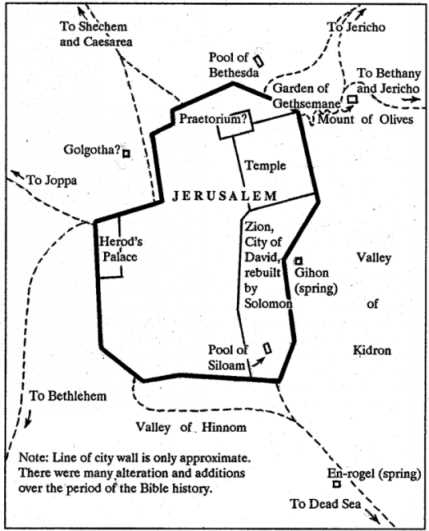
Between the city and the Kidron stream was the Spring of Gihon, whose waters King Hezekiah redirected into Jerusalem to improve the city’s water supply (2Ki 20:20; 2Ch 32:30; 2Ch 33:14). The water flowed into pools, or reservoirs, some of which were damaged when the Babylonians destroyed Jerusalem. They were later repaired in the time of Nehemiah (Neh 2:14; Neh 3:15; cf. Isa 22:9-11). One of these reservoirs, the Pool of Siloam, was still in use hundreds of years later (Joh 9:7). Nearby was the Tower of Siloam which, somewhere about the time of Jesus, collapsed, killing eighteen people (Luk 13:4).
In addition to the Spring of Gihon, there was a spring at En-rogel, just outside Jerusalem to the south (Jos 15:7; 2Sa 17:17). The Jerusalem leaders had a means of sealing up these springs so that any besieging army would be without water (2Ch 32:4). Apart from these two springs, Jerusalem had to depend for its water supply on rain water that was directed into stone reservoirs (2Ki 18:31; Jer 38:6; Joh 5:2).
Mountains and hills
The commanding hill in Jerusalem was Zion, where for centuries a strong fortress enabled the city’s previous inhabitants, the Jebusites, to withstand Israel’s attacks. Finally, David defeated them (2Sa 5:7; see JEBUSITES). The hill was also known as Moriah and was the place where David decided to build Israel’s temple (2Ch 3:1; cf. Gen 22:2). Both the city and the temple were figuratively called Zion (1Ki 8:1; 2Ki 19:31; Psa 2:6; Psa 9:11; Psa 48:12; Psa 74:2; Isa 8:18; see ZION).
To the east of the Kidron stream was the Mount of Olives, so named because of its many olive orchards (2Sa 15:30; 2Ki 23:12-13; Eze 11:23; Zec 14:4). The main road from Jerusalem to Jericho passed through the villages of Bethany and Bethphage on the slopes of the mountain (Mar 10:46; Mark 11; Mark 1; Mark 11; Luk 10:30).
Also on the slopes of this mountain was a garden called Gethsemane, where Jesus often went with his disciples. On the night before his crucifixion he went to this garden to pray, and in the early hours of the morning was arrested there (Mat 26:30; Mat 26:36; Mat 26:47; Luk 21:37; Luk 22:39; Luk 22:48). The Mount of Olives was also the place from which Jesus returned to heaven (Luk 24:50-51; Act 1:9-12).
Another hill outside Jerusalem was Golgotha (meaning ‘a skull’), the hill on which Jesus was crucified (Mat 27:33; Luk 23:33; Joh 19:17). No one is certain which of several possible sites is Golgotha or how the hill got its name, but it was on a main road not far outside one of the city gates. A garden containing a tomb was nearby (Mat 27:39; Joh 19:20; Joh 19:41).
Walls and buildings
From the days before Israel’s conquest under David, Jerusalem was a walled city and well fortified (Jos 15:63; 2Sa 5:6-7). Walls and fortifications were repaired, enlarged, or added to by various Israelite kings. Among these kings were David (2Sa 5:9; the Millo was some tower or other defence fortification), Solomon (1Ki 9:15), Rehoboam (2Ch 11:5), Asa (2Ch 14:7), Uzziah (2Ch 26:9), Jotham (2Ch 27:3), Hezekiah (2Ch 32:5) and Manasseh (2Ch 33:14).
Among the buildings that Solomon built as part of his program for the adornment of Jerusalem were an expensive temple, a magnificent palace, a military headquarters called the House of the Forest of Lebanon, an auditorium called the Hall of Pillars, a judgment court called the Hall of the Throne and a separate palace for the queen. All these buildings were contained within a large enclosure called the Great Court (1Ki 7:1-12).
Several hundred years later, the armies of Babylon destroyed Jerusalem (587 BC). They broke down large sections of the city wall, burnt most of the houses and destroyed all the important buildings, including the temple and the palace (2Ki 25:1-4; 2Ki 25:9).
When Persia conquered Babylon in 539 BC and allowed the exiled Jews to return to Jerusalem, the people first of all rebuilt the temple, completing it in 516 BC (Ezr 6:14-15). But during the next seventy years they did no major reconstruction work. The city was still in a state of disrepair and the wall surrounding the city had not been rebuilt. The Persians’ appointment of Nehemiah as governor was specifically for this project of reconstruction (Neh 2:1-8). The book of Nehemiah shows how Nehemiah carried out the work, and gives details concerning different sections of the wall and the various city gates (Neh 2:13-20; Nehemiah 3).
Herod the Great, with help from the Roman authorities, carried out major reconstruction work in Jerusalem during the period just before the New Testament era. The program included civil and military buildings (Mat 27:27; Mar 15:16; Joh 19:13; Act 23:10; Act 23:35).
To the Jews the greatest of Herod’s works was the construction of a new temple (the previous temple having been destroyed by the Romans). It was built on the same site as the previous temples but was much larger and far more magnificent. It took many decades to build and was not completed till long after Herod’s death (Mar 13:1; Joh 2:20; Act 3:2; see HEROD; TEMPLE).
Old Testament history of Jerusalem
It seems that Jerusalem was originally known by its shorter name Salem, and was the city of which Melchizedek was priest-king (Gen 14:18). When the Israelites entered Canaan, the city was occupied by the Jebusites and was known as Jebus. Although the city at first fell to the conquering Israelites, the local people soon retook it. When the Israelites, after their conquest of Canaan, divided the land between their tribes, Jerusalem fell within the tribal area of Benjamin. By that time the Jebusites were firmly in control of Jerusalem again, and they remained in control till the time of David (Jos 15:8; Jos 15:63; Jos 18:28; Jdg 1:8; Jdg 1:21; Jdg 19:10-11).
No doubt David had several reasons for wanting to conquer Jerusalem and make it the capital of his kingdom. Firstly, a city that was so hard to conquer would make an excellent site for a capital. Secondly, the conquest of such a long-held enemy fortress was certain to win nationwide support for David. Thirdly, since Jerusalem was not in the possession of any Israelite tribe, there could be no cause for inter-tribal jealousy if he made it his capital.
Although the Jebusites thought their city was unconquerable (2Sa 5:6), David’s men took it in a surprise attack. They entered the city secretly through a water tunnel, which the Jebusites used for bringing water into the city from a spring outside the city walls (2Sa 5:7-10).
David’s plans were to make Jerusalem the religious as well as the administrative centre of his kingdom. He placed the ark of the covenant in a special tent erected for it in the city, and made arrangements for his son and successor, Solomon, to build a permanent temple on Mt Zion (2Sa 6:17; 2Sa 7:12-13; 1Ch 15:29; 1Ch 22:1-5; 1Ch 28:11).
Solomon’s plans, however, were for more than a temple. He wanted to make Jerusalem a national showpiece, and his building program included a luxurious palace and many other magnificent buildings. But his oppressive policies of forced labour and heavy taxes created a feeling of rebellion among the people. The outcome was that most of Israel broke away from Jerusalem after Solomon’s death (1Ki 12:1-19).
Only two tribes remained loyal to the throne of David, and together they became known as the kingdom of Judah, with their capital at Jerusalem as previously. The remaining ten tribes still called themselves Israel and formed a separate kingdom in the north, with their own capital and their own religious system (1Ki 12:20-33).
From this point on the history of Jerusalem is to a large extent the history of Judah (2 Chron Chaps. 12-36; see JUDAH, TRIBE AND KINGDOM). Jerusalem fell under the domination of Babylon in 605 BC, and after repeated attempts at rebellion was finally destroyed by Babylon in 587 BC (2Ki 24:1; 2Ki 25:1-12).
After Persia conquered Babylon in 539 BC and released the captive people, the Jews returned to their land and reoccupied Jerusalem (Ezr 1:1-4; Ezr 6:15; Neh 2:17-20). Over the next century they rebuilt the temple, the city and the city walls, as outlined above. With the completion of Nehemiah’s program, the Old Testament history of Jerusalem comes to an end.
Into the New Testament era
During the four hundred years between the close of the book of Nehemiah and the opening of the New Testament, Jerusalem continued to have a colourful history. In 333 BC the Greek conqueror Alexander the Great won a decisive victory over Persia and the next year became the new controller of Jerusalem. Soon, however, the Greek Empire split. In the east there were two main sectors, Egyptian and Syrian, with Palestine being controlled by Egypt till 198 BC, and then by Syria.
When, about 168 BC, fighting broke out among rival groups of Jews in Jerusalem, the Greek ruler in Syria, Antiochus IV Epiphanes, took the opportunity to invade Jerusalem, slaughter the Jews, and if possible destroy the Jewish religion. After setting up a Greek altar in the Jewish temple, he took animals that the Jews considered unclean and offered them as sacrifices to the Greek gods.
The Jews, led by a zealous group called the Maccabees, assembled a fighting force to resist Antiochus. After three years of fighting they won back their religious freedom and rededicated their temple (165 BC). The Maccabees decided to keep fighting till they had gained political freedom as well, and after twenty years were successful.
For the next eighty years Jerusalem remained independent, but the Jews’ internal conflicts finally brought in the Romans who, in 63 BC, seized control of Jerusalem. After some initial confusion, Rome appointed as ruler of Palestine the man who became known as Herod the Great and whose extensive improvements to Jerusalem have been referred to above.
Jerusalem was the centre of opposition to Jesus and the place where he was eventually condemned and crucified (Mat 16:21; Mat 23:37; Mar 11:15-18; Joh 11:55-57; Joh 12:12; Joh 12:19). After Jesus’ resurrection, his disciples remained in Jerusalem till they received the promised Holy Spirit. The early church became established in Jerusalem, from where it spread to nations near and far (Act 1:4; Act 8:1-4; Act 8:14; Acts 11; Acts 22; Rom 15:26-27).
The Jerusalem church itself, however, had an unsettled early history. This was mainly because of its constant battle with narrow-minded Jewish legalists (Act 11:2-3; Act 15:1-5). Paul tried to foster a sense of fellowship between the Jewish church in Jerusalem and the Gentile churches elsewhere (Act 11:29-30; Act 21:20-26; Rom 15:25-27; Gal 2:9-10), but the city as a whole turned against him violently, as it had against Jesus (Act 21:11-13; Act 21:30-36; Act 22:22; Act 23:10-15; Act 23:31-35).
Brief history to the present day
In AD 66 a group of Jewish extremists revolted against Rome, with the result that Rome attacked Jerusalem with its full force. In AD 70 most of the city, including the temple, was destroyed, as Jesus had foretold (Mat 24:1-2; Luk 19:41-44; Luk 21:20-24).
The Romans rebuilt Jerusalem in AD 132, declaring it a pagan city from which all Jews were excluded. When Constantine became Emperor in AD 313, he declared Jerusalem a Christian city. In AD 637 the Muslims conquered Jerusalem, and in 691 erected a mosque on the site where the Jewish temple previously stood. In 1542 the Muslim ruler rebuilt the city walls, and they still stand today. Except for brief and isolated periods, Jerusalem remained under Muslim control till 1967, when it was retaken by the Jews. The mosque on the temple hill, however, still stands.