
The well known son of Jacob, whose history we have in Genesis from the thirtieth chapter to the end of the book. This made, in the margin of the Bible, is Adding - - from Jasaph, to increase. It were needless to enter particulars of Joseph’s history, when the Bible hath given it so beautifully. But perhaps it may not be an unacceptable service to observe on the history of this patriarch, what a remarkable character he is, and in what numberless instances he appears as a type of Christ: taken altogether, perhaps the greatest in the whole Scriptures. I shall particularize in a few leading features.
As Joseph was the beloved son of Jacob, and distinguished by his father with special tokens, of his affection, and which excited the envy of his brethren; so Christ, the beloved and only begotten son of God, by means of that distinguishing token of JEHOVAH, in setting him up, the Head of his body the church, and giving him a kingdom, in his glorious character of Mediator, called forth, as is most generally believed, that war we read of in heaven in the original rebellion of angels. (See Rev. x2:) The coat of many colours Josephwore might not unaptly be said to represent the several offices of the Lord Jesus when on earth - - his prophetical, priestly, and kingly character. The dreams of Joseph, implying his superiority over his brethren and his father’s house, interpreted with an eye to Christ, are very striking circumstances of the preeminency of his character. Of him, indeed, might the prophecy of Jacob respecting Judah be fully applied: Thou art he whom thy brethren shall praise: thy hand shall be in the neck of thine enemies, and thy father’schildren shall bow down be fore thee. (Gen. xlix. 8.) The mission of Joseph to his brethren, by the father, to see if they were well, and how they fared, (Gen. 37. 14.) is a striking representation of the mission of God’s dear Son to this our world. He came indeed, not only to seek, but to save that which was lost; but like another Joseph, the treatment he received corresponded in all points, only in an infinitely higher degree of baseness and cruelty. They sold Joseph for a slave, for twenty pieces of silver, and he wascarried down into Egypt, and from the pit and the prison he arose, by divine favour, to be Governor over the whole land. But our Joseph was not only sold for thirty pieces of silver, but at length crucified and slain, and from the grave which he made with the wicked and with the rich in his death, by his resurrection and ascension, at the right hand of power, he is become the universal and eternal Governor both of heaven and earth. The temptations of Joseph, by the wife of Potiphar, bear no very distant resemblance to thetemptations of the Lord Jesus by Satan. The trial to the one, was the lusts of the flesh; the trial to the other, was the pride of life. But the grace imparted to Joseph, to repel the temptation, and the punishment he suffered by a false imputation, very beautifully set forth the innocency of Christ triumphing over the Devils temptation in the wilderness, and the imputation of our sin to Jesus, who himself bore our sins in his own body on the tree, though himself without sin, neither was guile found in his mouth. In the exaltationof Joseph at the right hand of Pharaoh, and all the famished country coming to him for bread, we behold a lovely type, indeed, of our Almighty Joseph exalted at the right hand of God, and dispensing blessings of grace and mercy in the living bread, which is himself, to a famished world. And as then the Zapnathpaaneah of Egypt revealed secrets, and the cry was, Go unto Joseph, what he saith unto you do: so now, in the person of the Lord Jesus Christ, we do, indeed, behold our Wonderful Counsellor, who hath made known to us his and his Fathers will, and the one desire of every soul is, to go unto Jesus, whatsoever he saith unto us is blessed, and our duty to obey. In the going down of Israel into Egypt with all his house, constrained by famine to seek breadwhat a striking portrait is here also drawn of the true Israel of God, constrained by the famine of soul to seek to Jesus for supply. And though like the brethren of Joseph, little do we at first know, that the Lord of the country is our brother, though in the first awakenings of spiritualwant the Governor may seem with us, as Joseph did to them, to speak roughly; yet when the whole comes to be opened tour view, and Jesus is indeed discovered to be Lord of all the land, how, like Josephs brethren, are we immediately made glad, and eat and drink at his table with him, forgetting all past sorrow in present joy, and partaking of that bread of life, of which whosoever eateth shall live forever!
Such, among many other striking particularities, are the incidents in the history of the patriarch Joseph, which are highly typical of Christ.
Under the article of Joseph we must not forget to observe, that there are several more of the name mentioned in Scripture, and of some importance.
Joseph the husband of Mary, the mother of the Lord Jesus Christ, Matt. i. 15.18.
Joseph, or Joses, son of Mary and Cleophas, supposed to be one of those who did not at first believe on Christ, but was afterwards converted, John 7: 5.
Joseph, called Barsabas, a candidate for the apostleship with Matthias. See Acts i. 23.
Joseph of Arimathea, John xix. 38.
Joseph, husband to Salome.
son of Jacob and Rachel, and brother to Benjamin, Gen 30:22; Gen 30:24. The history of Joseph is so fully and consecutively given by Moses, that it is not necessary to abridge so familiar an account. In place of this, the following beautiful argument by Mr. Blunt for the veracity of the account drawn from the identity of Joseph’s character, will be read with pleasure:—I have already found an argument for the veracity of Moses in the identity of Jacob’s character, I now find another in the identity of that of Joseph. There is one quality, as it has been often observed, though with a different view from mine, which runs like a thread through his whole history, his affection for his father. Israel loved him, we read, more than all his children; he was the child of his age; his mother died while he was yet young, and a double care of him consequently devolved upon his surviving parent. He made him a coat of many colours; he kept him at home when his other sons were sent to feed the flocks. When the bloody garment was brought in, Jacob in his affection for him,—that same affection which, on a subsequent occasion, when it was told him that after all Joseph was alive, made him as slow to believe the good tidings as he was now quick to apprehend the sad; in this his affection for him, I say, Jacob at once concluded the worst, and “he rent his clothes and put sackcloth upon his loins, and mourned for his son many days, and all his daughters rose up to comfort him; but he refused to be comforted, and he said, For I will go down into the grave unto my son mourning.”
Now, what were the feelings in Joseph which responded to these? When the sons of Jacob went down to Egypt, and Joseph knew them, though they knew not him; for they, it may be remarked, were of an age not to be greatly changed by the lapse of years, and were still sustaining the character in which Joseph had always seen them; while he himself had meanwhile grown out of the stripling into the man, and from a shepherd boy was become the ruler of a kingdom; when his brethren thus came before him, his question was, “Is your father yet alive?” Gen 43:7.
They went down a second time, and again the question was, “Is your father well, the old man of whom ye spake, is he yet alive?” More he could not venture to ask, while he was yet in his disguise. By a stratagem he now detains Benjamin, leaving the others, if they would, to go their way. But Judah came near unto him, and entreated him for his brother, telling him how that he had been surety to his father to bring him back; how that his father was an old man, and that this was the child of his old age, and that he loved him; how it would come to pass that if he should not see the lad with him he would die, and his gray hairs be brought with sorrow to the grave; for “how shall I go to my father, and the lad be not with me, lest, peradventure, I see the evil that shall come on my father?” Here, without knowing it, he had struck the string that was the tenderest of all. Joseph’s firmness forsook him at this repeated mention of his father, and in terms so touching: he could not refrain himself any longer; and, causing every man to go out, he made himself known to his brethren. Then, even in the paroxysm which came on him, (for he wept aloud, so that the Egyptians heard,) still his first words uttered from the fulness of his heart were, “Doth my father yet live?” He now bids them hasten and bring the old man down, bearing to him tokens of his love and tidings of his glory. He goes to meet him; he presents himself unto him, and falls on his neck, and weeps on his neck a good while; he provides for him and his household out of the fat of the land; he sets him before Pharaoh. By and by he hears that he is sick, and hastens to visit him; he receives his blessing; watches his death bed; embalms his body; mourns for him threescore and ten days; and then carries him, as he had desired, into Canaan to bury him, taking with him, as an escort to do him honour, “all the elders of Israel, and all the servants of Pharaoh, and all his house, and the house of his brethren, chariots, and horsemen, a very great company.” How natural was it now for his brethren to think that the tie by which alone they could imagine Joseph to be held to them was dissolved, that any respect he might have felt or feigned for them must have been buried in the cave of Machpelah, and that he would now requite to them the evil they had done! “And they sent a messenger unto Joseph, saying, Thy father did command before he died, saying, So shall ye say unto Joseph, Forgive, I pray thee now, the trespass of thy brethren, and their sin; for they did unto thee evil.” And then they add of themselves, as if well aware of the surest road to their brother’s heart, “Forgive, we pray thee, the trespass of the servants of the God of thy father.” In every thing the father’s name is still put foremost: it is his memory which they count upon as their shield and buckler.
It is not the singular beauty of these scenes, or the moral lesson they teach, excellent as it is, with which I am now concerned, but simply the perfect artless consistency which prevails through them all. It is not the constancy with which the son’s strong affection for his father had lived through an interval of twenty years’ absence, and, what is more, through the temptation of sudden promotion to the highest estate;—it is not the noble- minded frankness with which he still acknowledges his kindred, and makes a way for them, “shepherds” as they were, to the throne of Pharaoh himself;—it is not the simplicity and singleness of heart which allow him to give all the first-born of Egypt, men over whom he bore absolute rule, an opportunity of observing his own comparatively humble origin, by leading them in attendance upon his father’s corpse to the valleys of Canaan and the modest cradle of his race;—it is not, in a word, the grace, but the identity of Joseph’s character, the light in which it is exhibited by himself, and the light in which it is regarded by his brethren, to which I now point as stamping it with marks of reality not to be gainsayed.
Some writers have considered Joseph as a type of Christ; and it requires not much ingenuity to find out some resemblances, as his being hated by his brethren, sold for money, plunged into deep affliction, and then raised to power and honour, &c; but as we have no intimation in any part of Scripture that Joseph was constituted a figure of our Lord, and that this was one design of recording his history at length, all such applications want authority, and cannot safely be indulged. The account seems rather to have been left for its moral uses, and that it should afford, by its inimitable simplicity and truth to nature, a point of irresistible internal evidence of the truth of the Mosaic narrative.
2. JOSEPH, the husband of Mary, and reputed father of Jesus, was the son of Jacob, and grandson of Matthan, Mat 1:15-16. The place of his stated residence was Nazareth, particularly after the time of his marriage. We learn from the evangelists that he followed the occupation of a carpenter, Mat 13:55; and that he was a just man, or one of those pious Israelites who looked for the coming of the Messiah, Mat 1:19. It is probable that Joseph died before Christ entered upon his public ministry; for upon any other supposition we are at a loss to account for the reason why Mary, the mother of Jesus, is frequently mentioned in the evangelic narrative, while no allusion is made to Joseph; and, above all, why the dying Saviour should recommend his mother to the care of the beloved disciple John, if her husband had been then living, Joh 19:25-27.
3. JOSEPH OF ARIMATHEA, a Jewish senator, and a believer in the divine mission of Jesus Christ, Joh 19:38. St. Luke calls him a counsellor, and also informs us that he was a good and just man, who did not give his consent to the crucifixion of Christ, Luk 23:50-51. And though he was unable to restrain the sanhedrim from their wicked purposes, he went to Pilate by night, and solicited from him the body of Jesus. Having caused it to be taken down from the cross, he wrapped it in linen, and laid it in his own sepulchre, which, being a rich man, he appears to have recently purchased, and then closed the entrance with a stone cut purposely to fit it, Mat 27:57-60; Joh 19:38-42.
Joseph, 1
Jo´seph (God-increased), son of Jacob and Rachel, born under peculiar circumstances, as may be seen in Gen 30:22; on which account, and because he was the son of his old age (Gen 37:3), he was beloved by his father more than were the rest of his children, though Benjamin, as being also a son of Jacob’s favorite wife, Rachel, was in a peculiar manner dear to the patriarch. The partiality evinced towards Joseph by his father excited jealousy on the part of his brethren, the rather that they were born of different mothers (Gen 37:2). Joseph had reached his seventeenth year, when some conduct on the part of his brothers seems to have been such as in the opinion of Joseph to require the special attention of Jacob, to whom, accordingly, he communicated the facts. This greatly increased their dislike to him, and they henceforth ’hated him, and could not speak peaceably unto him’ (Gen 37:4). Their aversion, however, was carried to the highest pitch when Joseph acquainted them with two dreams, which appeared to indicate that Joseph would acquire preeminence in the family, if not sovereignty; and while even his father rebuked him, his brothers were filled with envy. Jacob, however, was not aware of the depth of their ill will; so that, on one occasion, having a desire to hear intelligence of his sons, who were pasturing their flocks at a distance, he did not hesitate to make Joseph his messenger for that purpose. His appearing in view of his brothers was the signal for their malice to gain head. They began to devise means for his immediate destruction, which they would unhesitatingly have effected, but for his half-brother, Reuben, who, as the eldest son, might well be the party to interfere on behalf of Joseph. A compromise was entered into, in virtue of which the youth was stripped of the distinguishing vestments which he owed to his father’s affection, and cast into a pit. Having performed this evil deed, and while they were taking refreshment, the brothers beheld a caravan of Arabian merchants, who were bearing the spices and aromatic gums of India down to the well-known and much-frequented mart, Egypt. On the proposal of Judah they resolved that, instead of allowing Joseph to perish, they should sell him to the merchants. This was accordingly done. Joseph was sold for a slave, to be conveyed by his masters into Egypt. While on his way thither, Reuben returned to the pit, intending to rescue his brother, and convey him safely back to their father. Joseph was gone. On which Reuben went to the wicked young men, who, not content with selling a brother into slavery, determined to punish their father for his partiality towards the unoffending sufferer. With this view they dipped Joseph’s party-colored garment in the blood of a kid and sent it to Jacob, in order to make him believe that his favorite child had been torn to pieces by some wild beast. The trick succeeded, and Jacob was grieved beyond measure.
Meanwhile the merchants sold Joseph to Potiphar, an officer of Pharaoh’s, and captain of the royal guard, who was a native of the country. In Potiphar’s house Joseph enjoyed the highest confidence and the largest prosperity. A higher power watched over him; and whatever he undertook succeeded, till at length his master gave everything into his hands. But a second time he innocently brought on himself the vengeance of the ill-disposed. Charged by his master’s wife with the very crime to which he had in vain been tempted, he was at once cast by his master into the state prison.
The narrative, which is obviously constructed in order to show the workings of divine Providence, states, however, that Joseph was not left without special aid, in consequence of which he gained favor with the keeper of the prison to such an extent that everything was put under his direction. Two of the regal officers, ’the chief of the butlers’ and ’the chief of the bakers,’ having offended their royal master, were consigned to the same prison with Joseph. While there, each one had a dream, which Joseph interpreted correctly. The butler, whose fate was auspicious, promised the young Hebrew to employ his influence to procure his deliverance; but when again in the enjoyment of his ’butlership,’ he ’forgat’ Joseph (Genesis 40). Pharaoh himself, however, had two dreams, which found in Joseph a successful expounder; for the butler then remembered the skill of his prison-companion, and advised his royal master to put it to the test in his own case. Pharaoh’s dream, as interpreted by Joseph, foreboded the approach of a seven years’ famine; to abate the evils of which Joseph recommended that some ’discreet and wise’ man should be chosen and set in full power over the land of Egypt. The monarch was alarmed, and called a council of his advisers. The wisdom of Joseph was recognized as of divine origin and supereminent value; and the king and his ministers (whence it appears that the Egyptian monarchy—at Memphis—was not despotic, but constitutional) resolved that Joseph should be made (to borrow a term from Rome) Dictator in the approaching time of need. The highest honors were conferred upon him. He was made ruler over all the land of Egypt, and the daughter of Potipherah, priest of On, given him to wife.
Seven years of abundance afforded Joseph opportunity to carry into effect such plans as secured an ample provision against the seven years of need. The famine came, but it found a prepared people. The visitation did not depend on any mere local causes, for ’the famine was over all the face of the earth;’ ’and all countries came into Egypt to Joseph to buy corn’ (Gen 41:56-57). Among these customers appeared ten brethren, sons of the Hebrew Jacob. They had of necessity to appear before Joseph, whose license for the purchase of corn was indispensable. Joseph had probably expected to see them, and he seems to have formed a deliberate plan of action. His conduct has brought on him the always ready charges of those who would rather impeach than study the Bible, and even friends of that sacred book have hardly in this case done Joseph full justice. Joseph’s main object appears to have been to make his brothers feel and recognize their guilt in their conduct towards him. For this purpose suffering, then as well as now, was indispensable. Accordingly Joseph feigned not to know his brothers, charged them with being spies, threatened them with imprisonment, and allowed them to return home to fetch their younger brother, as a proof of their veracity, only on condition that one of them should remain behind in chains, with a prospect of death before him should not their words be verified. Then it was, and not before, that ’they said one to another, We are verily guilty concerning our brother, in that we saw the anguish of his soul and would not hear; therefore is this distress come upon us’ (Gen 42:21). On which, after weeping bitterly, he by common agreement bound his brother Simeon, and left him in custody. At length Jacob consented to Benjamin’s going in company with his brothers, and provided with a present consisting of balm, honey, spices and myrrh, nuts and almonds, and with double money in their hands (double, in order that they might repay the sum which Joseph had caused to be put into each man’s sack at their departure, if, as Jacob supposed, ’it was an oversight’), they went again down to Egypt and stood before Joseph (Gen 43:15); and there, too, stood Benjamin, Joseph’s beloved brother. The required pledge of truthfulness was given. If it is asked why such a pledge was demanded, since the giving of it caused pain to Jacob, the answer may be thus: Joseph knew not how to demean himself towards his family until he ascertained its actual condition. That knowledge he could hardly be certain he had gained from the mere words of men who had spared his life only to sell him into slavery. How had these wicked men behaved towards his venerable father? His beloved brother Benjamin, was he safe? or had he suffered from their jealousy and malice the worse fate with which he himself had been threatened? Nothing but the sight of Benjamin could answer these questions, and resolve these doubts.
Benjamin had come, and immediately a natural change took place in Joseph’s conduct: the brother began to claim his rights in Joseph’s bosom. Jacob was safe, and Benjamin was safe. Joseph’s heart melted at the sight of Benjamin: ’And he said to the ruler of his house, Bring these men home, and slay and make ready, for these men shall dine with me at noon’ (Gen 43:16). But guilt is always the ready parent of fear. Accordingly the brothers expected nothing but being reduced to slavery. When taken to their own brother’s house, they imagined they were being entrapped. A colloquy ensued between them and Joseph’s steward, whence it appeared that the money put into their sacks, to which they now attributed their peril, was in truth a present from Joseph, designed, after his own brotherly manner, to aid his family in their actual necessities. Noon came, and with it Joseph, whose first question regarded home: ’He asked them of their welfare, and said, Is your father well, the old man of whom ye spake? is he yet alive? And he lifted up his eyes and saw his brother Benjamin, his mother’s son, and said, Is this your younger brother? And he said, God be gracious unto thee, my son!’ ’And Joseph made haste, for his bowels did yearn upon his brother, and he sought where to weep, and he entered into his chamber and wept there.’ Does this look like harshness?
The connection brings into view an Egyptian custom, which is of more than ordinary importance, in consequence of its being adopted in the Jewish polity: ’And they set on (food) for him by himself (Joseph), and for them by themselves (the brethren), and for the Egyptians which did eat with them, by themselves: because the Egyptians might not eat bread with the Hebrews; for that is an abomination with the Egyptians’ (Gen 43:32). This passage is also interesting, as proving that Joseph had not, in his princely grandeur, become ashamed of his origin, nor consented to receive adoption into a strange nation: he was still a Hebrew, waiting, like Moses after him, for the proper season to use his power for the good of his own people.
Joseph, apparently with a view to ascertain how far his brethren were faithful to their father, hit upon a plan which would in its issue serve to show whether they would make any, and what, sacrifice, in order to fulfill their solemn promise of restoring Benjamin in safety to Jacob. Accordingly he ordered not only that every man’s money (as before) should be put in his sack’s mouth, but also that his ’silver cup in which my lord drinketh, and whereby he divineth,’ should be put in the sack’s mouth of the youngest. The brethren departed, but were soon overtaken by Joseph’s steward, who charged them with having surreptitiously carried off this costly and highly-valued vessel. They on their part vehemently repelled the accusation, adding, ’with whomsoever of thy servants it be found, both let him die, and we also will be my lord’s bondmen.’ A search was made, and the cup was found in Benjamin’s sack. Accordingly they returned to the city. And now came the hour of trial: Would they purchase their own liberation by surrendering Benjamin? After a most touching interview, in which they proved themselves worthy and faithful, Joseph declared himself unable any longer to withstand the appeal of natural affection. On this occasion Judah, who was the spokesman, showed the deepest regard to his aged father’s feelings, and entreated for the liberation of Benjamin even at the price of his own liberty. In the whole of literature we know of nothing more simple, natural, true, and impressive.
Most natural and impressive is the scene also which ensues, in which Joseph, after informing his brethren who he was, and inquiring, first of all, ’Is my father alive?’ expresses feelings free from the slightest taint of revenge, and even shows how, under Divine Providence, the conduct of his brothers had issued in good—’God sent me before you to preserve a posterity in the earth, and to save your lives by a great deliverance.’ Five years had yet to ensue in which ’there would be neither earing nor harvest,’ and therefore the brethren were directed to return home and bring Jacob down to Egypt with all speed. ’And he fell upon his brother Benjamin’s neck and wept; and Benjamin wept upon his neck. Moreover, he kissed all his brethren, and wept upon them; and after that his brethren talked with him’ (Gen 45:14-15).
The news of these striking events was carried to Pharaoh, who being pleased at Joseph’s conduct, gave directions that Jacob and his family should come forthwith into Egypt. The brethren departed, being well provided for—’And to his father Joseph sent ten asses laden with the good things of Egypt, and ten she asses laden with corn and bread and meat for his father by the way.’
The intelligence which they bore to their father was of such a nature that ’Jacob’s heart fainted, for he believed them not.’ When, however, he had recovered from the thus naturally told effects of his surprise, the venerable patriarch said, ’Enough; Joseph my son is yet alive: I will go and see him before I die’ (Gen 45:26; Gen 45:28).
Accordingly Jacob and his family, to the number of threescore and ten souls, went down to Egypt, and by the express efforts of Joseph, were allowed to settle in the district of Goshen, where Joseph met his father: ’And he fell on his neck, and wept on his neck a good while.’ There Joseph ’nourished his father and his brethren, and all his father’s household, with bread, according to their families’ (Gen 47:12).
Meanwhile the predicted famine was pauperizing Egypt. The inhabitants found their money exhausted, and their cattle and substance all gone, being parted with in order to purchase food from the public granaries, until at length they had nothing to give in return for sustenance but themselves. ’Buy us’—they then imploringly said to Joseph—’and our land for bread, and we and our land will be slaves unto Pharaoh.’ ’And Joseph bought all the land of Egypt for Pharaoh, so the land became Pharaoh’s.’ The people too, ’Joseph removed to cities from one end of the borders of the land to the other end.’ Religion, however, was too strong to submit to these political and social changes, and so the priests still retained their land, being supplied with provisions out of the common store gratuitously. The land, which was previously the people’s own, was now leased to them on a tenancy, at the rent of one-fifth of the produce: the land of the priests being exempted.
Joseph had now to pass through the mournful scenes which attend on the death and burial of a father. Having had Jacob embalmed, and seen the rites of mourning fully observed, the faithful and affectionate son proceeded into the land of Canaan, in order, agreeably to a promise which the patriarch had exacted, to lay the old man’s bones with those of his fathers, in ’the field of Ephron the Hittite.’ Having performed with long and bitter mourning Jacob’s funeral rites, Joseph returned into Egypt. The last recorded act of his life forms a most becoming close. After the death of their father, his brethren, unable, like all guilty people, to forget their criminality, and characteristically finding it difficult to think that Joseph had really forgiven them, grew afraid, now they were in his power, that he would take an opportunity of inflicting some punishment on them. They accordingly go into his presence, and, in imploring terms and an abject manner, entreat his forgiveness. ’Fear not’—this is his noble reply—’I will nourish you and your little ones.’
Joseph lived an hundred and ten years, kind and gentle in his affections to the last; for we are told, ’The children of Machir, the son of Manasseh, were brought up upon Joseph’s knees’ (Gen 50:23). And so having obtained a promise from his brethren, that when the time came, as he assured them it would come, that God should visit them, and ’bring them unto the land which he sware to Abraham, to Isaac, and to Jacob,’ they would carry up his bones out of Egypt, Joseph at length ’died and they embalmed him, and he was put in a coffin’ (Gen 50:26). This promise was religiously fulfilled. His descendants, after carrying the corpse about with them in their wanderings, at length put it in its final resting-place in Shechem, in a parcel of ground that Jacob bought of the sons of Hamor, which became the inheritance of the children of Joseph (Jos 24:32).
By his Egyptian wife, Asenath, daughter of the high priest of Heliopolis, Joseph had two sons, Manasseh and Ephraim (Gen 41:50 sq.), whom Jacob adopted (Gen 48:5), and who accordingly took their place among the heads of the twelve tribes of Israel.
Joseph, 2
Joseph, ’the husband of Mary, of whom was born Jesus, who is called Christ’ (Mat 1:16). By Matthew He is said to have been the son of Jacob, whose lineage is traced by the same writer through David up to Abraham. Luke represents Him as being the son of Heli, and traces His origin up to Adam. How these accounts are to be reconciled, is shown under Genealogy.
The statements of Holy Writ in regard to Joseph are few and simple. According to a custom among the Jews, traces of which are still found, Joseph had pledged his faith to Mary; but before the marriage was consummated she proved to be with child. Grieved at this, Joseph was disposed to break off the connection; but, not wishing to make a public example of one whom he loved, he contemplated a private disruption of their bond. From this step, however, he is deterred by a heavenly messenger, who assures him that Mary has conceived under a divine influence. ’And she shall bring forth a son, and thou shalt call His name Jesus; for He shall save His people from their sins’ (Mat 1:21 sq.; Luk 1:31). To this account various objections have been taken; but most of them are drawn from the ground of a narrow, shortsighted and half-informed rationalism, which judges everything by its own small standard, and either denies miracles altogether, or admits only such miracles as find favor in its sight.
Joseph was by trade a carpenter, in which business he probably educated Jesus (Mat 13:55; Mar 6:3). The word rendered ’carpenter’ is of a general character, and may be fitly rendered by the English word ’artificer’ or ’artisan.’ Schleusner asserts that the universal testimony of the ancient church represents our Lord as being a carpenter’s son. Hilarius, on Matthew, asserts, in terms which cannot be mistaken, that Jesus was a smith. Of the same opinion was the venerable Bede; while others have held that our Lord was a mason, and Cardinal Cajetan, that he was a goldsmith. The last notion probably had its origin in those false associations of more modern times which disparage hand-labor. Among the ancient Jews all handicrafts were held in so much honor, that they were learned and pursued by the first men of the nation.
Christian tradition makes Joseph an old man when first espoused to Mary, being no less than eighty years of age, and father of four sons and two daughters. The painters of Christian antiquity conspire with the writers in representing Joseph as an old man at the period of the birth of our Lord—an evidence which is not to be lightly rejected, though the precise age mentioned may be but an approximation to fact.
It is not easy to determine when Joseph died, but it has been alleged, with great probability, that he must have been dead before the crucifixion of Jesus. There being no notice of Joseph in the public life of Christ, nor any reference to him in the discourses and history, while ’Mary’ and ’His brethren’ not infrequently appear, these circumstances afford evidence not only of Joseph’s death, but of the inferior part which as legal father only of our Lord, Joseph might have been expected to sustain. So far as our scanty materials enable us to form an opinion, Joseph appears to have been a good, kind, simple-minded man, who, while he afforded aid in protecting and sustaining the family, would leave Mary unrestrained to use all the impressive and formative influence of her gentle, affectionate, pious, and thoughtful soul.
1. The son of Jacob and his beloved Rachel, born in Mesopotamia, Gen 30:22-24, B. C. 1747. He is memorable for the wonderful providence of God, which raised him from a prison to be the grandvizier of Egypt, and made him the honored means of saving countless human lives. His history is one of the most pleasing and instructive in the Bible; and is related in language inimitably natural, simple, and touching. It is too beautiful for abridgment, and too familiar to need rehearsal. It throws much light on the superintending providence of God, as embracing all things, great and small in the perpetual unfolding of his universal plan. No narrative in the Bible more strikingly illustrates the protective and elevating power of the fear of God, and its especial value for the young. To behold this lovely image of filial piety and unwavering faith, of self-control in youth and patience in adversity, of discretion and fidelity in all stations of life, serenely walking with God through all, and at death intrusting soul and body alike into his hands, Heb 11:22 ; may well lead the young reader to cry, Oh that the God of Joseph were my God, Gen 37:1-36 39:1-50:26. Joseph died, aged on hundred and ten, B. C. 1637; and when the Israelites, a century and a half later, went up from Egypt, they took his bones, and at length buried them in Shechem, Exo 13:19 Jos 24:32 . A Mohammedan wely or tomb covers the spot regarded generally, and it may be correctly, as the place of his burial. It is a low stone enclosure, and stands in quiet seclusion among high trees, at the western entrance of the valley of Shechem, at the right of the traveller’s path and nearer mount Ebal than mount Gerizim.\par 2. The husband of Mary, Christ’s mother. His genealogy is traced in Mat 1:1-15, to David, Judah, and Abraham. See GENEALOGY. His residence was at Nazareth in Galilee, where he followed the occupation of a carpenter, to which Christ also was trained, Mar 6:3 . He was a pious and honorable man, as appears from his whole course towards Mary and her son. They both attended the Passover at Jerusalem when Christ was twelve years of age, Luk 2:41-51 ; and as no more is said of him in the sacred narrative, and Christ committed Mary to the care of one of his disciples, he is generally supposed to have died before Christ began his public ministry. He seems to have been well known among the Jews, Mar 6:3 Joh 6:42 .\par 3. A native of Arimathea, but at the time of Christ’s crucifixion a resident at Jerusalem. He was doubtless a believer in the Messiah, and "waited for the kingdom of God." He was a member of the Jewish Sanhedrim, and opposed in vain their action in condemning the Savior, Luk 23:51 . When all was over, he "went in boldly unto Pilate, and craved the body of Jesus." It was now night and the Jewish Sabbath was at hand. He therefore, with the aid of Nicodemus, wrapped the body in spices, for the time, and laid it in his own tomb, Mar 15:43-46 Joh 19:38-42 .\par 4. A disciple of Christ, also named Justus, and Barsabas. See BARSABAS.\par
Jo’seph. (increase).
1. The elder of the two sons of Jacob, by Rachel. He was born in Padan-aram (Mesopotamia), probably about B.C. 1746. He is first mentioned when a youth, seventeen years old. Joseph brought the evil report of his brethren to his father, and they hated him because his father loved him more than he did them, and had shown his preference by making a dress which appears to have been a long tunic with sleeves, worn by youths and maidens of the richer class. Gen 37:2.
He dreamed a dream foreshadowing his future power, which increased the hatred of his brethren. Gen 37:5-7. He was sent by his father to visit his brothers, who were tending flocks in the fields of Dothan. They resolved to kill him, but he was saved by Reuben, who persuaded the brothers to cast Joseph into a dry pit, to the intent that he might restore him to Jacob. The appearance of the Ishmaelites suggested his sale for "twenty pieces (shekels) of silver." Gen 37:28. Sold into Egypt to Potiphar, Joseph prospered and was soon set over Potiphar’s house, and "all he had he gave into his hand;" but incurring the anger of Potiphar’s wife, Gen 39:7-13, he was falsely accused and thrown into prison, where he remained at least two years, interpreting during this time the dreams of the cupbearer and the baker.
Finally Pharaoh himself dreamed two prophetic dreams. Joseph, being sent for, interpreted them in the name of God, foretelling the seven years of plenty and the seven years of famine. Pharaoh, at once, appointed Joseph, not merely governor of Egypt, but second only to the sovereign, and also gave him to wife Asenath, daughter of Potipherah priest of On (Hieropolis), and gave him a name or title, Zaphnath-paaneah. (preserver of life). Joseph’s first act was to go throughout all the land of Egypt.
During the seven plenteous years, there was a very abundant produce, and he gathered the fifth part and laid it up. When the seven good years had passed, the famine began. Gen 41:54-57. See Famine. After the famine had lasted for a time, apparently two years, Joseph gathered up all the money that was found in the land of Egypt and in the land of Canaan, for the corn which they brought, and brought it into Pharaoh’s house, Gen 47:13-14, and when the money was exhausted, all the cattle, and finally all the land, except that of the priests, and apparently, as a consequence, the Egyptians themselves. He demanded, however, only a fifth part of the produce as Pharaoh’s right.
Now Jacob, who had suffered also from the effects of the famine, sent Joseph’s brother to Egypt for corn. The whole story of Joseph’s treatment of his brethren is so graphically told in Genesis, Genesis 42-45, and is so familiar, that it is unnecessary here to repeat it. On the death of Jacob in Egypt, Joseph carried him to Canaan, and laid him in the cave of Machpelah, the burying-place of his fathers.
Joseph lived "a hundred and ten years," having been more than ninety in Egypt. Dying, he took an oath of his brethren that they should carry up his bones to the land of promise: thus showing in his latest action, the faith, Heb 11:22, which had guided his whole life. Like his father, he was embalmed, "and he was put in a coffin in Egypt." Gen 50:26. His trust, Moses kept, and laid the bones of Joseph in his inheritance in Shechem, in the territory of Ephraim, his offspring. His tomb is, according to tradition, about a stone’s throw from Jacob’s well.
2. Father of Igal, who represented the tribe of Issachar among the spies. Num 13:7.
3. A lay Israelite who had married a foreign wife. Ezr 10:42. (B.C. 459).
4. A representative of the priestly family of Shebaniah. Neh 12:14. (B.C. after 536).
5. One of the ancestors of Christ, son of Jonan. Luk 3:30.
6. Another ancestor of Christ, son of Judah. Luk 3:26. (B.C. between 536-410).
7. Another ancestor of Christ, son of Mattathias. Luk 3:24. (B.C. after 400).
8. Son of Heli, and reputed father of Jesus Christ. All that is told us of Joseph in the New Testament may be summed up in a few words. He was a just man, and of the house and lineage of David. He lived at Nazareth in Galilee. He espoused Mary, the daughter and heir of his uncle Jacob, and before he took her home as his wife, received the angelic communication recorded in Mat 1:20.
When Jesus was twelve years old, Joseph and Mary took him with them to keep the Passover at Jerusalem, and when they returned to Nazareth, he continued to act as a father to the child Jesus, and was reputed to be so indeed. But here, our knowledge of Joseph ends. That he died before our Lord’s crucifixion is indeed tolerably certain, by what is related, Joh 19:27, and perhaps ,Mar 6:3, may imply that he was then dead. But where, when or how he died we know not.
9. Joseph of Arimathaea, a rich and pious Israelite, probably a member of the Great Council or Sanhedrin. He is further characterized as "a good man and a just." Luk 23:50. We are expressly told that he did not "consent to the counsel and deed" of his colleagues in conspiring to bring about the death of Jesus; but he seems to have lacked the courage to protest against their judgment.
On the very evening of the crucifixion, when the triumph of the chief priests and rulers seemed complete, Joseph "went in boldly unto Pilate and craved the body of Jesus." Pilate consented. Joseph and Nicodemus then, having enfolded the sacred body in the linen shroud which Joseph had bought, consigned it to a tomb hewn in a rock, in a garden belonging to Joseph, and close to the place of crucifixion. There is a tradition that he was one of the seventy disciples.
10. Joseph, called Barsabas, and surnamed Justus; one of the two person chosen by the assembled church, Act 1:23, as worthy to fill the place in the apostolic company from which Judas had fallen.
The older of Jacob’s two sons by Rachel. Having been long barren, she said at his birth "God hath taken away (
These robes generally had a stripe round the skirts and sleeves. On the tomb of Chnumhotep at Benihassan, under the 12th dynasty, the Semitic visitors are represented in colored robes, of pieces sewn together. Jacob probably designed hereby to give Joseph, the firstborn of Rachel who, but for Laban’s trick, was his rightful first wife as she was his dearest,the primogeniture forfeited by Reuben (1Ch 5:1; Gen 35:22; Gen 49:4). The Arab chief to this day wears an aba or garment of different colored stripes as emblem of office. The more his father loved the more his brethren hated him, and could not speak peaceably to him (Ecc 4:4; compare the Antitype Joh 1:11; Joh 5:17-20; Joh 7:5; Joh 15:23-25). The preeminence given him by his earthly was confirmed by his heavenly Father in two successive dreams.
In his simplicity, possibly with some degree of elation, but certainly with the divine approval (for the revelation was given to be made known, Mat 10:27), he told the dreams to his brethren, which only aggravated their hatred: the first, their sheaves bowing to his sheaf (pointing to his coming office of lord of the Egyptian granaries); the second, the sun, moon, and 11 stars bowing to him (these heavenly bodies symbolizing authorities subject to his chief rule; compare the coming eclipse of the natural luminaries and earthly potentates before the Antitype, Mat 24:29-30; Rev 6:12). In the Antitype the Old Testament prophecies answer to Joseph’s dreams; the Jewish rulers rejected Him, though knowing, yet practically knowing not, the prophecies concerning Him (Act 13:27). Leah or else Bilhah, Rachel’s handmaid, answers to the "moon," "thy mother," as Jacob to the "sun," and the 11 stars to the 11 brothers (Gen 37:6-10).
He told his second dream to his father as well as to his brethren, because it affected not merely them but Jacob and his mother also. His father at first was displeased with what seemed at variance with a son’s submission to his parent. But, like Mary in the case of the Antitype, he "observed the saying" (Luk 2:19; Luk 2:51). Unbelief, along with a secret misgiving that it might prove true after all, and bitter envy, wrought upon the brothers. So upon their father sending Joseph from the vale of Hebron in the S. to Shechem in the N. to inquire after their welfare and the flocks, when they saw him afar off at Dothan, they conspired to slay him, saying "we shall see what will become of his dreams." So as to the Antitype, Mat 21:38; Mat 27:1. Stephen and the apostles evidently contemplated Joseph as type of Jesus (Act 7:9-14; Act 3:13-18). Jacob’s special love shadows God’s love to His Only Begotten (Mat 3:17).
Joseph’s readiness at his father’s calls answers to the good Shepherd, the Son of God’s volunteering to come securing our eternal welfare at the cost of His life (Psa 40:6-7; Joh 10:11). Providence turned aside their first plan. Reuben persuades them to avoid the guilt of blood by casting him into a dry pit or cistern, intending to return and deliver him. In his absence (the narrative with the artlessness of truth never explains why Reuben was absent at the crisis; a forger would have carefully made all plain) they strip off his coat of many colors (type of the human body with its manifold perfections which the Father "prepared" the Son, and which His unnatural brethren stripped Him of: Heb 10:5; Php 2:6-8); and while he was in the pit "eat bread" (Pro 30:20; compare Joh 18:28; Zec 9:11). Ishmaelite or Midianite merchants from Gilead, with spicery, balm, and myrrh (gum ladanum), for Egypt, the land of embalming the dead (Gen 50:2-3), passed by; and Judah, type of Judas, proposes the new plan of selling their brother for 20 pieces of silver (Lev 27:5) to the strangers (compare Mat 20:19; Luk 18:32; Luk 20:20, the Jews delivering Jesus to the Gentile Romans).
Thus, they thought they had foiled forever the prediction of his elevation, but this was the very means of realizing it, by God’s overruling and matchless counsels. Compare the Antitype (Act 4:25-28; Isa 28:29; Pro 19:21). Joseph’s anguish of soul is noticed incidentally in the brothers’ self reproach (Gen 42:21). Affection for his father is a trait characterizing him throughout, even as the father loved him, so that at his supposed loss through a wild beast (his sons having sent him Joseph’s tunic dipped in blood) Jacob refused to be comforted. Severance from his father was the bitterest ingredient in his cup of slavery. So the Antitype, Mat 27:46. His chief inquiries long afterward were about his father (Gen 43:7; Gen 45:13; Gen 45:28; Gen 41:51), and the remembrance of "his father" was with him the strongest plea after Jacob’s death, that the brothers thought they could urge for their being forgiven (Gen 50:16-17).
Reuben with characteristic instability forbore to tell his father the truth, while he had not consented to their deed. Jacob’s cry, "I will go down into
Joseph’s knowledge of flocks qualified him in some degree for the post, and his integrity made him trustworthy in it, so that his master felt he could safely entrust to his charge his household and all that he had, and "the Lord blessed the Egyptian’s house for Joseph’s sake" (as in Jacob’s case, Gen 30:27); Psa 1:3. But now his virtue encountered a severer test than that of his brothers’ bad example; Potiphar’s wife, with the lustfulness of Egyptian women, conceived a passion for his beauty and tempted him. Seemingly, his safety was in compliance, his danger if he should provoke her by non-compliance. Had he given way to animal appetite he would have yielded; but his master’s absolute confidence in him, which gave him the opportunity with probable impunity ("my master wotteth not what is with me in the house"), was just the reason he gives for not abusing that confidence. Above all, regard for God restrained him instinctively: "how CAN (not merely shall) I do this great wickedness, and sin against God?"
So Mat 7:18; 1Jn 3:9, "cannot." Willful sin is impossible so long as one is under the principle of grace. On "against God," the feature of sin which constitutes its chief heinousness, see Psa 51:4; 2Sa 12:13. When she importuned him day by day, he avoided being with her; they who would escape sin should flee temptation and occasions of sin. When she caught his garment he fled, leaving it in her hand. Then she accused him of the very sin to which she tried in vain to tempt him. An Egyptian story, in the papyrus d’Orbiney in the British Museum, The Two Brothers, in later times, seems founded on that of Joseph, the elder brother’s wife tempting the younger with almost the same words as Potiphar’s wife used to Joseph. The story of Saneha in one of the oldest papyri records his elevation to high rank under a Pharaoh of the 12th dynasty, and his developing the resources of Egypt just as Joseph did. Potiphar’s not putting Joseph to death implies that he did not feel sure of his wife’s story, and half suspected Joseph might be innocent.
It cannot have been he but another who entrusted the prisoners to Joseph; for if Potiphar believed him innocent, as the committing of prisoners to him would imply, he would not have left him in prison. His doing so was providentially ordered for Joseph’s elevation. Joseph’s lettering, "the iron entering into his soul," is alluded to in Psa 105:17-18. The keeper of the prison, however, discovered his trustworthiness, and committed to him all the prisoners, "the Lord giving him favor in the keeper’s sight" (Pro 16:7). After a time the chief of Pharaoh’s cupbearers (Hebrew), and the chief of his bakers or confectioners, were cast into prison by the king; the captain of the guard committed them as men of rank to Joseph’s custody. His interpretation of their dreams, the vine with three branches and the pressing the grape juice into Pharaoh’s cup, and the three baskets of white bread (the Egyptians being noted for their fancy bread and pastry) out the uppermost of which the birds ate, came to pass; Pharaoh restored the chief cupbearer, and decapitated the chief baker.
The mention of wine is confirmed by the monuments, which make it the beverage of the rich, beer that of the poor, and represent the process of fermenting wines in early times. The chief cupbearer forgot his promise and his benefactor Joseph (Amo 6:6); compare the Antitype, Psa 31:12, He "remembered" the companion of His suffering (Luk 23:42). After two years Pharaoh’s two dreams of the seven fat and seven lean kine out of the river (Nile,
Having in vain consulted his magicians or "sacred scribes" (
Joseph recommended the king to appoint a chief officer and subordinates to take up by taxation a fifth of the produce in the plenteous years against the famine years. The king raised Joseph as one" in whom the Spirit of God was," to be grand vizier over his house and his people, reserving the throne alone for himself. He put his signet ring (the names of the Pharaohs were always written in an elongated, signet like, ring) on Joseph’s hand in token of delegated sovereignty, a gold chain about his neck, and arrayed him in the fine linen peculiar to the Egyptian priests; and made him ride in his second chariot, while the attendants cried "Abrech," ("Rejoice thou") (Egyptian), calling upon him to rejoice with all the people at his exaltation (Canon Cook, Speaker’s Commentary) Pharaoh named Joseph "Zaphnath Paaneah." the food of life or of the living. Compare the Antitype (Joh 6:35) occupying the mediatorial throne with the Father’s delegated tower, giving the bread of life first to His own brethren the Jews. then to the world.
Then Joseph, who shrank from adulterous lusts, in righteous retribution received pure wedded joys in union with Asenath ("devoted to Neith and Isis") daughter of Potipherah ("devoted to Ra, the sun god") priest of ON , Heliopolis or Bethshemesh (the city of the sun god), the religious capital. Pharaoh doubtless ordered the marriage, to link his prime minister with the noblest in the land. Pharaoh himself was invested with the highest sacerdotal dignity, and could remove all disqualifications, so as to enable Joseph to be allied to the proud and exclusive priest caste. The Egyptian religion, though blended with superstitions, retained then much of the primitive revelation, the unity, eternity, and self existence of the unseen God. The sun was made His visible symbol, the earliest idolatry (Job 31:26, Sabeanism). Joseph probably drew Asenath to his own purer faith. Joseph certainly professed openly his religion without molestation (Gen 42:18), and Pharaoh recognizes the God of Joseph and His Spirit as the true God (Gen 41:32-38-39).
Like the Antitype (Luk 3:23), Joseph was 30 in entering on his public ministry, so that he was 13 years in Egypt, in Potiphar’s house and in prison, before his elevation. With characteristic energy as a steward he made an immediate tour throughout Egypt, and laid up grain in immense quantities, all registered accurately by scribes when the granaries were being filled (as Egyptian monuments represent). God gave him two children, to whom he gave Hebrew names, showing he remembered as ever the God of his fathers: Manasseh, "forgetting," "for God," said he, "hath made me forget all my toil and all my father’s house" (i.e. not literally forgetting his relatives, for "his father" was uppermost in his affections; but has swallowed past sorrow in present joy; compare Psa 90:15; Isa 65:16-17; Isa 61:7; Isa 62:4; Rev 7:14-17; spiritually, Psa 45:10); and Ephraim, "doubly fruitful," Joseph again attributing all to God, "God hath caused me to be fruitful in the land of my affliction" (compare Gen 49:22; Joh 15:2 ff).
Apophis the last of the shepherd kings was supposed to be the Pharaoh over Joseph. But Apophis was not master of all Egypt, as Joseph’s Pharaoh was. "Shepherds were an abomination" in Joseph’s time, which could not have been the case under a shepherd king. Osirtasin I, the second king of the 12th dynasty, was perhaps Joseph’s Pharaoh. This dynasty was especially connected with On. There still stand Osirtasin’s name and title on the famous obelisk, the oldest and finest in Egypt. Chnumhotep, Osirtasin’s relative and favorite, is described upon the tombs of Benihassan as possessing the qualities so esteemed in Joseph "When years of famine occurred he plowed all the lands producing abundant food." The tenure under the crown, subject to a rent of a fifth of the increase, could only emanate from a native Pharaoh. Had it been a shepherd king’s work, it would have been set aside on the return of the native dynasties. Amenemha III, sixth of the 12th dynasty, established a complete system of dikes, locks, and reservoirs, to regulate the Nile’s overflow.
He fitted the lake Moeris for receiving the overflow; near it was Pianeh, "the house of life," answering to Zaphnath Paaueah, "the food of life." If he be Joseph’s Pharaoh Joseph was just the minister to carry out his grand measures. In the seven famine years the Egyptians as well as the people of adjoining lands, W. Africa, Ethiopia, Arabia, Syria, which shared in the drought (for the tropical rains on the Abyssinian mountains, on which the Nile’s rise depends, have the same origin as the Palestine rains), and which partially depended on Egypt the granary of many countries (Act 27:6; Act 27:38), came to buy grain. Pharaoh’s one reply to all was: "go to Joseph, what he saith to you, do" (compare the Antitype: Joh 6:45 ff; Joh 2:5). His brethren too came and bowed before him, unconsciously fulfilling the dream which they had so striven to frustrate (Act 4:27-28; Pro 19:21; Pro 21:30). His speech and manners were Egyptian, so that they knew him not though he knew them.
So the Antitype’s brethren shall at last, like all others, bow before Him who is supereminently exalted just because He humbled Himself (Php 2:6-11; Psa 22:22; Psa 22:26-29). He knows His people before they know Him (Joh 15:16; Joh 10:14; Gal 4:9). Joseph spoke roughly to his brethren, at once to avoid recognition and to bring them to repentance: "ye are spies, to see the nakedness (the assailable, because defenseless, points) of the land ye are come." Egypt was exposed to incursions of Canaanite Hittites and Arabs, and the invasion of the shepherds or Hyksos was already impending.
Not Joseph but Pharaoh it was who made the exception in behalf of the idolatrous priests, giving them grain without requiring their land (Gen 47:22). Herodotus mentions the allotment of the soil by the crown among the people. The monuments record several famines and precautions taken against it. Joseph’s statesmanship appears in the policy adopted. The Egyptians became the king’s servants, and their property his, by their own voluntary act. His generous principle of dealing with them then, asking only a fifth after establishing the right to all, won their universal approval of an evenly distributed instead of an unequal taxation. A fifth was probably the sole tax on them. Joseph’s policy was to centralize power in the monarch’s hands, a well ordered monarchy being the best in the existing state of Egypt to guard against the recurrence of famines by stores laid by systematically, and by irrigation in the absence of the Nile’s overthrow, and by such like governmental works, instead of leaving all to the unthrifty and unenterprising cultivators.
The removal to cities (Gen 47:19-26) facilitated his providing the people with food. The Egyptians did not regard one fifth as an exorbitant rent, but acknowledged "thou hast saved our lives" (compare the Antitype, Act 5:31). Joseph’s brethren in replying as to their father and family kept up the old lie, "one is not." Joseph required that one of them should fetch the youngest who was they said with his father, and kept them three days in ward, then let them take back grain for their households, but bound Simeon before their eyes as a hostage for their bringing Benjamin and so proving their truthfulness. As they had separated him from his father so he separated one from them, possibly the ringleader in their cruelty to Joseph (compare Genesis 34; Gen 49:5-7.) As they had seen his anguish of soul so now their souls were in terrified anguish, with the stings of conscience added (Gen 42:21-22): retribution in kind (Num 32:23 ff; Mat 7:2).
Joseph heard their self reproaching, remorseful cry, "we are verily guilty concerning our brother in that we saw ... and we would not hear" (Pro 21:13). Joseph, though cherishing no revenge nay feeding his enemy when hungry (Rom 12:20), saw that temporary affliction was needed to bring them to penitence (Hos 5:15; Job 36:8-9). He filled their sacks (Hebrew, "vessels") and restored their money (Luk 6:34-35). divine guidance led Joseph to require Benjamin, the surest way of bringing Jacob and the whole family into their Egyptian house of bondage and training. His real kindness to them here shows that the severity was used in the interests of justice and their ultimate good by humiliation, while he retained all a brother’s tenderness. The discovery of their money alarmed both the brothers and Jacob; "all these things are against me," but see Rom 8:31. Reuben offered to let his two sons be slain if he did not bring Benjamin back.
At last, when want of grain forced him, Jacob gave a reluctant consent on Judah’s undertaking to be surety for Benjamin. So with double money and a present of balm (balsam gum), honey (else grape juice boiled down to syrup,
Each was served separately; all were ranged according to age, but the youngest had five messes for their one sent from before Joseph. The monuments accord with this representation. They drank freely ("were merry".) On the morrow, by putting his silver cup (bowl from which wine was poured into smaller cups) in Benjamin’s sack, and sending his steward after them upon their leaving the city where Joseph lived, he elicited Judah’s generous offer to be bondsman and so not bring his father’s grey hairs with sorrow to the grave, bound up as Jacob’s life was with Benjamin’s.
The thought of his father’s loving anxiety moved him to make himself known to them. He wept aloud while "they were troubled at his presence"; it was as if the ghost of one whom they had murdered stood before them. They shrank from him, but he said "come near to me" (compare Mat 14:26; the Antitype and His future comforting of Zion, Isa 40:2; Isa 61:2-3). Joseph soothes their remorse, "be not angry with yourselves, for God did send me before you to preserve life." So Act 3:12-18; Act 4:27-28. He gave them the kiss of reconciliation and wept over them. Above all he tells them: "haste ye ... to my father and say, God hath made me lord of all Egypt, come down and thou shalt dwell in Goshen near me."
His filial reverence and love appear in his meeting his father in his own state chariot and escorting him to Goshen, Judah having preceded Jacob to announce to Joseph his approach. Goshen was assigned as a separate settlement to the Hebrew as shepherds, to avoid offense to the Egyptians, who being themselves tillers of the ground looked down on their nomadic neighbours. Already the latter had made inroads on lower Egypt, and after Joseph’s time established the dynasty of shepherd kings or Hyksos (Gen 46:28-34). Jacob gave Joseph "one portion above his brethren, taken from the Amorites with sword and bow," therefore not Shechem (portion) which he bought (see 1Ch 5:1-2). Joseph, though the birthright was transferred to him from Reuben by Jacob, was not entered into the family registers as firstborn, because Judah prevailed above the rest and king David was chosen front his tribe.
Still Jacob the progenitor marked Joseph as firstborn by assigning to his two sons Ephraim and Manasseh two tribal domains according to the law of the firstborn (Deu 21:15-17); his dying blessing on Joseph beautifully expresses Joseph’s "fruitfulness amidst affliction," as his "arms were made strong by the hands of the mighty God of Jacob." Jacob’s blessing on Joseph once "separate from his brethren" exceeded that of Abraham on Isaac, and of Isaac on Jacob, and lasts as long as "the everlasting hills." The mention of Joseph’s "servants the physicians" (Gen 50:2) accords with the Egyptian usage of great men having many physicians attached to each household, one for each kind of sickness and to embalm the dead. After embalming and burying his father he was accosted by his brethren, who judged him by their own ungenerous and deceitful characters; he reassured them by renouncing vengeance as God’s prerogative not his (Rom 12:19), and by speaking kindly.
Joseph lived to 110 years, of which 93 were spent in Egypt; seeing Ephraim’s and Manasseh’s grandchildren, and showing his faith to the end by still clinging amidst all his grandeur in Egypt to God’s promise of his seed’s settlement in Canaan and therefore commanding Israel on oath to carry his remains there (Heb 11:22). His body was embalmed, and in due time carried by Israel to Shechem his burying place (Exo 13:19; Jos 24:32; Act 7:16). Ephraim and Manasseh followed the idolatries out of which their mother had come rather than the pure faith of Joseph. He is one of the most faultless human heroes of Scripture. Decision in good, yet versatility in adapting itself to all circumstances, strong sense of duty, strict justice combined with generosity, self-control in adversity and prosperity alike, strength of character with sensitive tenderness and delicacy, modesty and magnanimity, strong filial love, above all abiding faith in God, appear throughout his remarkable history. As a statesman he got men unconditionally into his power that he might benefit them, and displayed extraordinary administrative ability.
2. Num 13:7.
3. Ezr 10:42.
4. Neh 12:14.
5. Luk 3:30.
6. Joseph or Josek (Luk 3:26).
7. Another (Luk 3:24).
8. Son of Heli, husband of the Virgin Mary, daughter and heiress of his uncle Jacob. The frequent recurrence of the name in Luke’s genealogy and its absence from Matthew’s confirm the view that Luke’s gives Joseph’s line of parentage down from Nathan, David’s son, but Matthew’s the line of succession to the throne.
After the wise men’s departure another dream from the Lord caused him to flee from Herod’s murderous agents by night with mother and Child to Egypt, where he remained until the angel of the Lord in another dream intimated Herod’s death, He arose and returned; but fearing Archelaus who reigned in Judaea, and warned of God in a fourth dream (the divine mode of revelation in the early stage of the kingdom of God, less perfect than those vouchsafed in the advance, stages), Joseph turned aside to his old home Nazareth. Joseph is mentioned as with Mary in presenting the Babe in the temple and as "marvelling at those things spoken of" Jesus by Simeon, and as "blessed" by him. Lastly, when Jesus was taken at 12 years of age to the temple and tarried behind, Joseph and His mother knew not of it; and Mary on finding Him said, "Thy father and I have sought Thee sorrowing."
He replied, "Wist ye not that I must be about My Father’s business?" Henceforward there is no more mention of the earthly father, and the heavenly and true Father is all in all. He was a "carpenter," and doubtless instructed the holy Jesus in this work (Mat 13:55; Mar 6:3). Mary and Jesus’ brethren are occasionally mentioned during His ministry, but Joseph never; evidently he had died previously, which Jesus’ committal of the Virgin mother to John (Joh 19:27) confirms. Tradition has supplied by fiction what the Gospels under the Spirit’s guidance do not contain.
9. Of Aramahea.
God had foretold ages ago (Isa 53:9), "they (His enemies) appointed (designed) His grave with the wicked (by crucifying Him between two thieves), but He was with a rich man at His death," i.e. when He was dead. Up to the end this prophecy seemed most unlikely to be fulfilled; but when God’s time had come, at the exact crisis came forward two men, the last one would expect, both rich and members of the hostile body of rulers. The same event which crushed the hopes and raised the fears of the avowed disciples inspired Joseph with a boldness which he never felt before. All four evangelists record his deed. He had the privilege of taking down from the cross the sacred body, wrapping in fine linen which he had bought, and adding spices with Nicodemus’ help, and consigning to his own newly hewn rock tomb wherein no corpse had ever lain, and in his own garden near Calvary, and then rolling the stone to the door of the sepulchre. Tradition represents Joseph as sent to Great Britain by the apostle Philip (A.D. 63), and as having settled with a band of disciples at Glastonbury, Somersetshire.
Joseph (jô’zef), increase, 1. The elder of Jacob’s two sons by Rachel, Gen 37:3, and beloved by his father. The gift of the new robe, or coat of many colors, was perhaps intended to give him the rights of primogeniture, as the son of his first wife, in place of Reuben who had forfeited them. Gen 35:22; 1Ch 5:1. He was born in Mesopotamia. Gen 30:22-24. By a wonderful providence of God he was raised from a prison to be the chief ruler of Egypt under Pharaoh. "The story of his father’s fondness, of his protest against sin among his brothers, of their jealous hostility and his prophetic dreams, of his sale by his brethren to Midianites and by them to Potiphar in Egypt, of the divine favor on his pure and prudent life, his imprisonment for three to twelve years for virtue’s sake, his wonderful exaltation to power and his wise use of it for the good of the nation, of his tender and reverent care of his father, his magnanimity to his brethren, and his faith in the future of God’s chosen people, is one of the most pleasing and instructive in the Bible, and is related in language inimitably natural, simple, and touching. It is too beautiful for abridgment, and too familiar to need full rehearsal."—Hand. The history of Joseph is strikingly confirmed by the Egyptian monuments. Joseph married the princess Asenath, daughter of Potipherah, priest of On; and his two sons, Manasseh and Ephraim, Gen 41:50, whom Jacob adopted. Gen 48:5, became the heads of two of the twelve tribes of Israel. 2. The son of Heli and reputed father of Jesus Christ. He was a just man, and of the house and lineage of David. He lived at Nazareth in Galilee. He espoused Mary, the daughter and heir of his uncle Jacob, and before he took her home his wife received the angelic communication recorded in Mat 1:20. When Jesus was twelve years old, Joseph took his mother and Jesus to keep the passover at Jerusalem, and when they returned to Nazareth he continued to act as a father to the child Jesus, and was reputed to be so indeed. But here our knowledge of Joseph ends. That he died before our Lord’s crucifixion is indeed tolerably certain, by what is related, Joh 19:27; and, perhaps, Mar 6:3, may imply that he was then dead. But where, when, or how he died, we know not. 3. Joseph of Arimathæa, a rich and pious Israelite, probably a member of the Great Council or Sanhedrin. He is further characterized as "a good man and a just." Luk 23:50. We are told that he did not "consent to the counsel and deed" of his colleagues in the death of Jesus. On the evening of the crucifixion Joseph "went in boldly unto Pilate and craved the body of Jesus." Pilate consented. Joseph and Nicodemus then, having enfolded the sacred body in the linen shroud which Joseph had bought, placed it in a tomb hewn in a rock, in a garden belonging to Joseph, and close to the place of crucifixion. There is a tradition that he was one of the seventy disciples. 4. Joseph, called Barsabas, and surnamed Justus: one of the two persons chosen by the assembled church, Act 1:23, as worthy to fill the place in the apostolic company from which Judas had fallen.
Jacobs Age at His Birth’. Joseph was thirty years old when he Stood before Pharaoh (Gen 41:46). The seven plenteous years and two years of the famine had passed when Jacob went into Egypt (30+7+2=39) (Gen 41:46,53,54; Gen 45:4-6; Gen 47:1-9). Jacob was one hundred thirty years old when he entered Egypt (Gen 47:1-9). Jacob was, therefore, (130 - 39 = 91) ninety-one years old at the birth of Joseph. Early Life. Joseph was the son of Rachel, born to Jacob in his Old age (Gen 30:1-24), and was therefore the favorite (Gen 37:3; Joseph had two remarkable dreams, resulting in the estrangement of his Brothers and the suspicion of his father (Gen 37:5-11). His brothers sold him into slavery, and deceived their father by dipping the coat of Many colors into the blood of a goat, assuring him that they had found It (Gen 37:15-35). Lessons from Jacobs Mourning’. Jacob mourned for Joseph, Believing that he was dead (Gen 37:31-35). We may learn from this, to be careful about acting on the testimony of prejudiced witnesses, and that a lie conscientiously believed and acted upon will produce substantially the same effects as the truth. Early Life in Egypt. Joseph was sold to Potiphar, an officer of Pharaoh. (Gen 39:1; Act 7:9). On a false charge he was thrown into prison. In prison he enjoyed the confidence of the keeper, and Interpreted the dreams of the butler and baker (Gen 39:21-23; Gen 40:1-23). Pharaohs Dreams’. The king had two dreams: He stood by the river and saw seven well-favored and fat-fleshed Kine come up out of the river and feed in a meadow, and seven Other kine that were ill-favored and lean-fleshed followed and Devoured them. He beheld seven ears of corn upon one stalk, rank and good, and They were followed by seven thin and blasted ears by which They were devoured (Gen 41:1-7). Josephs Interpretation’. The wise men failed to give the king’s Mind any relief, and Pharaoh, on the suggestion of the chief butler, Called for Joseph, who declared that the dreams were one, and predicted That there would immediately follow seven years of plenty, succeeded by Seven years of famine (Gen 41:8-32). His Elevation. Pharaoh immediately clothed Joseph in royal Vestures, made him ride in the second chariot, and required the people To prostrate themselves before him (Gen 41:33-45). His Marriage. Pharaoh gave him the name Zaphnathpaaneah (Preserver of the age, or revealer of secrets), and also gave him Asenath, the daughter of Potipherah, priest of On, to wife. By this Union were two sons (Gen 41:44-52). Preparation for the Famine. Joseph immediately began to make Preparations for the famine. He gathered corn "as the sands of the Sea" and stored it in the cities (Gen 41:47-52). Famine in Egypt. The famine began as Joseph had predicted and Covered the entire land of Egypt (Gen 41:53-57). Famine in Canaan. The famine extended to Canaan (Gen 42:1,2 Acts 7:11). Jacob sent his sons to Egypt to buy corn. Joseph recognized them, but they did not know him. He supplied their wants, and they Returned to their home (Gen 42:3-38). On their return to Egypt, Joseph made himself known to them and sent for his father to come to Egypt (Gen 43:1-34; Gen 44:1-34; Gen 45:1-24; Act 7:12,14). Jacob received the news of Joseph’s glory with incredulity (Gen 45:25-28). Lessons from Josephs Brothers’. We may learn from this, to investigate thoroughly before coming to a conclusion, and that after a man is once settled in error, it takes a tremendous influence to deliver him from it. Jacobs Descent into Egypt’. Jacob at once departed for Egypt Accompanied by his entire family; they also took their possessions (Gen 46:1-26). Harmony of Gen 46:26; Deu 10:22; Act 7:14. The first passage counts the direct descendants (sixty-six) of Jacob who went with him Into Egypt (Gen 46:26). The second counts the sixty-six, Jacob, Joseph, and his two sons (Deu 10:22). The third counts the seventy, and five of Joseph’s "kindred" whose names are not given. Jacobs Introduction to Pharaoh’. Joseph introduced his father To Pharaoh, who received him with respect. Jacob in return blessed Pharaoh twice, and departed from his presence (Gen 47:7-10). Settled in Goshen. Jacob and his family were given permission To dwell in Goshen where they enjoyed peace, plenty, and general Prosperity (Gen 47:1-27). Date. It was twenty-five years from the death of Terah to the birth of Isaac (Gen 11:32; Gen 12:1-5; Gen 21:5; Act 7:1-4). It was sixty years from the birth of Isaac to the birth of Jacob (Gen 25:26). It was one hundred thirty years from the birth of Jacob to his introduction to Pharaoh. (25 + 60 + 130 = 215) (Gen 47:7-10). The settling of the Hebrews in Egypt was therefore two hundred fifteen years after the death of Terah or Abram’s entrance into Canaan.
Last Days of Jacob. The closing of Jacob’s life was distinguished by (A) obtaining a promise from Joseph to bury him with his Fathers (Gen 47:26-31); (b) reminding Joseph of the promises of God (Gen 48:1-4); (c) adopting Joseph’s two sons (Gen 48:5,6); (d) placing Ephraim before Manasseh (Gen 48:8-20); (e) predicting the restoration of his family to Canaan (Gen 48:21); (f) giving Joseph an extra portion of his estate (Gen 48:21,22); (g) prophesying of the coming Shiloh (Gen 48:8-12; Heb 7:14; Rev 5:1-5); (h) blessing all his sons (Gen 49:1-28).
Death and Burial of Jacob. Jacob died in Egypt, was embalmed by Joseph’s orders, carried to Canaan, and buried with great honors and great lamentation (Gen 50:1-13; Act 7:15,16). Last Days of Joseph. Joseph’s last days were distinguished by forgiving his brothers; enjoying the pleasures of family relation; predicting the restoration of his brethren to the land of Abraham, Isaac, and Jacob; and taking a pledge of his brethren to carry his bones with them on their departure (Gen 50:15-26).
[Jo’seph]
Eleventh son of Jacob and first of Rachel. The interesting history of Joseph is too well known to need being given in its detail, but attention should be given to the many respects in which Joseph was a striking type of the Lord Jesus. He was the beloved one of his father: this with the intimations given to him of his future position, destined for him by God in the midst of his family, stirred up the envy of his brethren and resulted in his being sold to the Gentiles: as the Lord was hated by His brethren the Jews, and sold by one of them. Joseph was accounted as dead. He was brought very low, being cast into prison, under a false accusation against him because he would not sin: his feet were ’made fast in the stocks,’ and the iron entered his soul: in all these circumstances he was foreshadowing the Lord in His humiliation.
On the elevation of Joseph to power he was unknown to his brethren, as the Lord in exaltation is now to His brethren after the flesh. During this time he had a Gentile wife and children and became ’fruitful’: so while the Lord is rejected by the Jews, God is gathering from the nations a people for His name. Joseph ruled over the Gentiles, as the Lord will do. Then all Joseph’s brethren bowed down to him, as eventually all the twelve tribes will bow down to the Lord. This is followed by all the descendants of Jacob being placed in a fruitful part of the country, as the nation will be gathered to the pleasant land in the millennium.
The beautiful and touching way in which Joseph dealt with his brethren, will be repeated in a magnified way by the Lord’s tender and loving dealing with the remnant of Judah when they come to speak to Him about the wounds in His hands, and to mourn over the way He was treated by them. They will then see that, notwithstanding their hatred, He laid the foundation in His death for their future blessing.
When Jacob prophetically blessed His sons, Joseph had a prominent place. Gen 49:22-26. He was to be very fruitful, with branches running over the wall: so the blessing of Israel through Christ extends to the Gentiles. He was sorely grieved, hated, and shot at, as was the Lord; but his bow abode in strength, and from him was the shepherd, the stone of Israel (two titles of the Lord). Then the blessings of heaven and of the deep, of the breasts and of the womb, are multiplied on the head and on the crown of Joseph, as the one separated from his brethren: all foreshadowing, though to be far exceeded by, the many crowns and the glory in heaven and on earth of the true Nazarite, now sanctified in heavenly glory, the Lord Jesus. For the blessing by Moses cf. Deu 33:13-17. Joseph, when about to die, had faith that God would surely deliver Israel from Egypt and gave directions concerning his bones. Gen 37 - Gen 50; Exo 13:19. For the Egyptian king under whom it is supposed that Joseph lived, see EGYPT.
2. Father of Igal, of Issachar. Num 13:7.
3. Son of Asaph: appointed to the service of song. 1Ch 25:2; 1Ch 25:9.
4. One who had married a strange wife. Ezr 10:42.
5. Priest ’of Shebaniah’ who returned from exile. Neh 12:14.
6. Husband of Mary the mother of Jesus. He was ’a just man,’ and was obedient to the instructions he received from God as to his wife, and in protecting the infant Jesus. He was of the house and lineage of David, his genealogy being given in Mat 1 and perhaps in Luke 3. The visit to Jerusalem, when the Lord was twelve years old, is the last incident recorded of him. He is once called ’the carpenter,’ Mat 13:55, as is the Lord also in Mar 6:3. It was a custom for all Jews to learn a trade. Mat 1:16-25; Mat 2:13; Mat 2:19; Luk 1:27; Luk 2:4-43; Luk 3:23; Luk 4:22; Joh 1:45; Joh 6:42.
7. Joseph of Arimathaea, an honourable counsellor, and a rich man. He was a secret disciple of Jesus, and had not consented to the action of the Sanhedrim in condemning the Lord. He boldly asked for the body of Jesus, and interred it in his own new tomb, thus fulfilling Isa 53:9; Mat 27:57; Mat 27:59; Mar 15:43; Luk 23:50; Joh 19:38.
8-10. Son of Mattathias; son of Juda; and son of Jonan - three in the genealogy of the Lord Jesus. Luk 3:24; Luk 3:26; Luk 3:30.
11. Disciple, also called BARSABAS, surnamed JUSTUS, who, with Matthias, was selected as fit to take the place of Judas, but the lot fell on Matthias. Act 1:23.
JOSEPH (
5. Joseph, the husband of Mary and the reputed father of Jesus (Luk 3:23), is not mentioned in Mk., and only indirectly in Jn. (Joh 1:45; Joh 6:42). He was of Davidic descent; and, though Mt. and Lk. differ in the genealogical details, they connect Jesus with Joseph and through him with David (Mat 1:1 ff., Luk 3:23 ff.). Joseph, who was a carpenter (Mat 13:55) and a poor man, as his offering in the temple showed Luk 2:24), lived in Nazareth (Luk 2:4) and was espoused to Mary, also of Nazareth (Luk 1:26). By their betrothal they entered into a relationship which, though not the completion of marriage, could be dissolved only by death or divorce. Before the marriage ceremony Mary was ‘found with child of the Holy Ghost,’ but the angelic annunciation to her was not made known to Joseph. He is described as a just man (Mat 1:19), a strict observer of the Law. The law was stern (Deu 22:23-24), but its severity had been mitigated and divorce had taken the place of death. Divorce could be effected publicly, so that the shame of the woman might be seen by all; or it could be done privately, by the method of handing the bill of separation to the woman in presence of two witnesses.† [Note: Edersheim, The Life and Times of Jesus the Messiah, i. 154. Dalman asserts that Edersheim is incorrect in stating that public divorce was possible (see Hastings’ DB, art. ‘Joseph’).] Joseph, not willing to make Mary a public example, ‘was minded to put her away privily’ (Mat 1:18). An angel, however, appeared to him in a dream, telling him not to fear to marry Mary, as the conception was of the Holy Ghost, and also that she would bring forth a son, whom he was to name Jesus (Mat 1:20 f.). The dream was accepted as a revelation,‡ [Note: cit. i. 155.] as a token of Divine favour, and Joseph took Mary as his wife, but did not live with her as her husband till she had brought forth her firstborn son (Mat 1:24 f.).
Before the birth of Christ there was an Imperial decree that all the world should be taxed, and Joseph, being of the house and lineage of David, had to leave Nazareth and go to Bethlehem, to be taxed with Mary.§ [Note: On the question of the visit to Bethlehem see Ramsay’s Was Christ born at Bethlehem?] In Bethlehem Jesus was born; and there the shepherds, to whom the angel had announced the birth of the Saviour, found Mary and Joseph and ‘the babe lying in a manger’ (Luk 2:16). At the circumcision, on the eighth day after the birth, the child received the name ‘Jesus’ which Joseph had been commanded to give Him; and on a later day, when Mary’s purification was accomplished (cf. Lev 12:2-4), she and Joseph took Jesus to the temple in Jerusalem (Luk 2:22), to ‘present him to the Lord’* [Note: ‘The earliest period of presentation was thirty-one days after birth, so as to make the legal month quite complete’ (Edersheim, The Life and Times of Jesus the Messiah, i. 193).] and to offer a sacrifice, according to the requirements of the law (Exo 13:2, Lev 12:8). Joseph fulfilled the law as if he were the father of Jesus; and after the ceremonies in the temple he must have returned with Mary and her son to Bethlehem, which was 6 miles distant from Jerusalem. In Bethlehem the Wise Men who had come from the East saw Mary and ‘the young child’ and worshipped Him; and after their departure the angel of the Lord appeared again to Joseph, bidding him take Mary and the child and flee into Egypt on account of Herod, who would seek to destroy Him (Mat 2:13). Joseph was quick to obey, and rising in the night he took the young child and His mother and departed for Egypt, where Herod had no authority (Mat 2:14). In Egypt they were to remain till the angel brought word to Joseph (Mat 2:13); and there they dwelt, possibly two or even three years, till the death of Herod, when the angel again appeared in a dream to Joseph. The angel commanded him to take the young child and His mother and go into the land of Israel. Obedience was at once given by Joseph, but he became afraid when he learned that Archelaus was reigning in Judaea. Again the angel appeared in a dream, and after a warning Joseph proceeded to Nazareth, which was not under the rule of Archelaus, who had an evil reputation, but under that of the milder Antipas (Mat 2:14-23).
It is recorded of Joseph that he and Mary went every year, at the Passover, to Jerusalem, and that when Jesus was twelve years of age He accompanied them. On that occasion Jesus tarried in Jerusalem, after Joseph and Mary, thinking He was with them in the company, had left the city. When they had gone a day’s journey they found He was not with them, and they turned back to Jerusalem. After three days they found Him in the temple among the doctors, and they were amazed. Mary’s words, ‘Son, why hast thou thus dealt with us? behold, thy father and I have sought thee sorrowing.’ called forth an answer which Joseph and Mary did not understand. But after the incident in Jerusalem, Jesus went with them to Nazareth and ‘was subject unto them’ (Luk 2:41-51). Mary’s words and the record of the subjection of Jesus to her and Joseph indicate that Joseph stood to Jesus in the place of an earthly father. How long that relationship continued is unknown, since the time of the death of Joseph is not stated in the Gospels. It may be accepted as a certainty that he was not alive throughout the period of the public ministry of Jesus, seeing that he is not directly or indirectly mentioned along with His mother and brothers and sisters (Mar 3:31; Mar 6:3).
6. Joseph of Arimathaea (
J. Herkless.
( in Ps. lxxxi. 6).
By: Joseph Jacobs, M. Seligsohn, Solomon Schechter, Emil G. Hirsch, George A. Barton, Richard Gottheil, Mary W. Montgomery
Sold as Slave.
—Biblical Data:
Eleventh son of Jacob and the elder of the two sons of Rachel; born at Haran (Gen. xxx. 24). The meaning given to the name (l.c.) is "shall add": "The Lord shall add to me another son." It seems probable, however, from Ps. lxxxi. 6, that, like all other Hebrew names beginning with the syllable "Jo," it has Yhwh as its first element, and is a contraction, the original form being "Jehoseph," while in Gen. xxx. 23 there is an allusion to the connection of "Joseph" with  ("to take away"). Upon Joseph centered the love of his father, Jacob, who showered upon "the son of his old age" many tokens of special favor and arrayed him in a "coat of many colors." This favoritism, however, excited the envy of his older brothers, and Joseph increased their envy by telling them of two dreams which prognosticated his ruling over them (Gen. xxxvii. 2-11). When a lad of seventeen, Joseph was sent by his father to inquire after his brothers, who were pasturing the flocks in Shechem. He found them at Dothan, and when his brothers saw him approaching they planned to kill him. Reuben, however, took his part, and, in order to remove him from the fury of the others, advised them to throw Joseph into a pit (Gen. xxxvii. 13-24). Different accounts are given of the sale of Joseph, which immediately followed; according to one, the brothers, while eating at some distance from the pit, sighted a caravan of Ishmaelites, to whom they decided, at Judah's advice, to sell Joseph. In the meantime some Midianite merchants passing the pit drew Joseph out and sold him for twenty pieces of silver to the Ishmaelites, who took Joseph to Egypt (Gen. xxxvii. 25-28). The last statement is repeated in Gen. xxxix. 1, while in Gen. xxxvii. 36 it is said that the Midianites (Hebr. "Medanites") sold him to Potiphar in Egypt.
Traditional Tomb of Joseph near Nablus (Shechem).(From a photograph by Bonfils.)
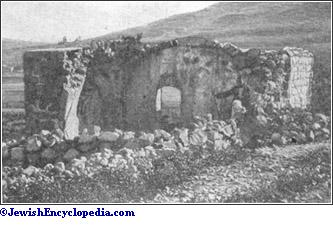
Cast into Prison.
In Potiphar's house Joseph fared well, for, seeing that he prospered in all that he did, his master appointed him superintendent of his household. But Joseph was "a goodly person and well favored," and his master's wife conceived a passion for him. Her repeated advances being repulsed, she finally attempted compulsion; still failing, she brought a false accusation against him before her husband, and Joseph was thrown into prison. There, too, Yhwh was with Joseph; the keeper of the prison, seeing that he could place confidence in him, committed the other prisoners to his charge (Gen. xxxix.). Soon afterward two of Pharaoh's officers, the chief cupbearer and the chief baker, having offended the king, were thrown into the prison whereJoseph was, and Joseph was appointed to serve them. One morning both officers told Joseph their dreams of the previous night, which they themselves were unable to interpret. Joseph concluded from their dreams that the chief cupbearer would be reinstated within three days and that the chief baker would be hanged. Joseph requested the chief cupbearer to mention him to Pharaoh and secure his release from prison, but that officer, reinstalled in office, forgot Joseph (Gen. xl.).
Joseph remained two years longer in prison, at the end of which period Pharaoh had a dream of seven lean kine devouring seven fat kine and of seven withered ears devouring seven full ears. Great importance was attached to dreams in Egypt, and Pharaoh was much troubled when his magicians proved unable to interpret them satisfactorily. Then the chief cupbearer remembered Joseph and spoke of his skill to Pharaoh. Accordingly he was sent for, and he interpreted Pharaoh's dream as foretelling that seven years of abundance would be followed by seven years of famine and advised the king to appoint some able man to store the surplus grain during the period of abundance. Pleased with his interpretation, Pharaoh made him viceroy over Egypt, giving him the Egyptian name of Zaphnath-paaneah and conferring on him other marks of royal favor. Joseph was then thirty years of age. Pharaoh married him to Asenath, the daughter of Potiphera, priest of On, through whom he had two sons, Manasseh and Ephraim (Gen. xli. 1-52).
As Viceroy of Egypt.
During the seven years of abundance Joseph amassed for the king a great supply of corn, which he sold to both Egyptians and foreigners (Gen. xli. 48-49, 54-57). The famine having extended to all the neighboring countries, Joseph's brothers, with the exception of Benjamin, went to Egypt to buy corn. Joseph recognized his brothers, who prostrated themselves before him and therein fulfilled, in part, his dreams. He received them roughly and accused them of being spies, thereby compelling them to give him information about their family. Desiring to see Benjamin, Joseph demanded that they substantiate their statements by sending one of their number for Benjamin while the others remained behind. He accordingly imprisoned them for three days, and then sent them away with corn, retaining Simeon as a hostage (Gen.xlii. 1-25). The famine in Canaan continuing, Jacob was again obliged to send his sons to Egypt for corn. As Joseph had commanded them not to appear before him again without Benjamin, Jacob was compelled to let Benjamin go with them. He sent also a present to Joseph in order to win his favor, together with the money which had been, by Joseph's orders, put into their sacks.
Makes Himself Known to His Brothers.
The second time Joseph received them very kindly and prepared a feast for them, but paid special attention to Benjamin (Gen. xliii.). Desiring to know what his brothers would do if under some pretext he retained Benjamin, Joseph gave orders to fill their sacks with corn, put their money into their sacks, and put his silver goblet in Benjamin's. On the following morning the brothers departed, but before they had gone far a messenger overtook them, accusing them of stealing the goblet. The messenger searched their sacks and found the goblet in Benjamin's sack; this compelled them to return. Joseph reproached them for what they had done, and Judah, speaking on behalf of his brothers, expressed their willingness to remain as slaves to Joseph. The latter, however, declined their offer, declaring that he would retain Benjamin only (Gen. xliv. 1-17). Overcome by Judah's eloquent appeal (Gen. xliv. 18-34) and convinced of his brothers' repentance, Joseph disclosed himself to them. He inquired after his father, but as they were too much amazed and startled to answer him, he assured them that in treating him as they did they had been carrying out the will of God. He then urged them to return home quickly, loaded them with presents for his father, and supplied them with vehicles for the transportation of the whole family (Gen. xlv.). Joseph met his father in the land of Goshen. He recommended his brothers to represent themselves as shepherds so that they might remain in Goshen unmolested. Then he presented five of his brothers to Pharaoh, who granted them a domain in Goshen; and, after having introduced Jacob to Pharaoh, Joseph domiciled the whole family, at Pharaoh's command, "in the land of Rameses," where he supplied them with all they needed (Gen. xlvi. 29-xlvii. 12).
Joseph and His Brothers.(From the Sarajevo Haggadah, 14th century.)
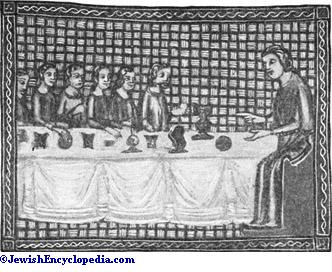
As a ruler, Joseph changed the system of land-tenure in Egypt. The famine being severe, the people first expended all their money in the purchase of corn, then they sold their cattle, and finally gave up their land. Thus all the cultivated land in Egypt, except that of the priests, became the property of the crown, and the people farmed it for the king, giving him one-fifth of the produce (Gen. xlvii. 14-26). Hearing of his father's sickness, Joseph went to him with his two sons, whom Jacob blessed, conferring upon Joseph at the same time one portion more than the portions of his brothers (Gen. xlviii.). Joseph carried Jacob's remains to the land of Canaan, where he gave them stately burial. His brothers, fearing that he would avenge himself upon them, then sent to implore his forgiveness. Joseph allayed their fears and promised that he would continue to provide for their wants. He lived to the age of one hundred and ten, and saw his great-grandchildren grow up. Before his death he made the children of Israel take an oath that when they left the land of Egypt they would take his bones with them. His body was embalmed and placed temporarily in a coffin. At the Exodus his bones accompanied Moses, and were finally buried in Shechem (Gen. 1.; Ex. xiii. 19; Josh. xxiv. 32).
Like His Father.
—In Rabbinical Literature:
Joseph occupies a very important place in the Haggadah, and no patriarch was the subject of so many Midrashic legends. As Rachel was visited by the Lord on Rosh ha-Shanah (R. H. 10b), Joseph was born in due course on the 1st of Tammuz, 2199 (Book of Jubilees, xxviii. 32). He is represented as a perfectly righteous man ("ẓaddiḳ gamur") and as the counterpart of his father; not only did Joseph resemble his father in appearance and in having been born circumcised, but the main incidents of their lives were parallel. Both were born after their mothers had been barren for a long time; both were hated by their brothers; both were met by angels at various times (Gen. R. lxxxiv. 6; Num. R. xiv. 16). Joseph is extolled by the Rabbis for being well versed in the Torah, for being a prophet, and for supporting his brothers (Tan., Wayesheb, 20). According to R. Phinehas, the Holy Spirit dwelt in Joseph from his childhood until his death (Pirḳe R. El. xxxviii.). Jacob's other children came into the world only for Joseph's sake; the Red Sea and the Jordan were passed dry-shod by the children of Israel through the virtue of Joseph (Gen. R. lxxxiv. 4; Leḳaḥ Ṭob to Gen. xxxvii. 2). When Joseph and his mother bowed to Esau (Gen. xxxiii. 7), Joseph shielded his mother with his figure (Targ. pseudo-Jonathan, ad loc.), protecting her from the lascivious eyes of Esau, for which he was rewarded through the exemption of his descendants from the spell of the evil eye (Gen. R. lxxviii. 13; comp. Ber. 20a; Soṭah 36b).
When Joseph reported to his father the evil doings of his brothers (Gen. xxxvii. 2), his design was merely that his father might correct them (Leḳaḥ Ṭob, ad loc.). The nature of the "evil report" is variously given by the Rabbis. According to Pirḳe R. El. xxxviii., Joseph spoke only against the sons of Bilhah and Zilpah, that they ate meat which they had not slaughtered in accordance with the Law (comp. Targ. pseudo-Jonathan, ad loc.). According to R. Judah, Joseph reported that the sons of Leah slighted the sons of the concubines by calling them slaves. R. Simeon's opinion was that Joseph spoke against them all, accusing them of "looking at the daughters of the land" (Gen. R. lxxxiv. 7). The reason for Jacob's special love toward Joseph was, according to R. Judah, that Joseph resembled Jacob in appearance; but according to R. Nehemiah it was that he transmitted to Joseph all the halakot he had studied in the school of Shem and Eber (ib. lxxxiv. 8).
Joseph Sold by His Brothers.(From the Sarajevo Haggadah, 14th century.)
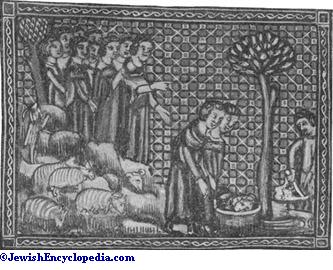
Sent to Brothers.
Joseph is represented as an exemplar of filial respect, for when his father requested him to go and see how his brothers fared, he went promptly and with gladness of heart, although he knew that they hated him (Mek., Beshallaḥ, Wayehi, 1; Gen. R. lxxxiv. 12, 15). When he went to his brothers, he was accompanied to Dothan by three angels (ib. lxxxiv. 13; comp. Targ. pseudo-Jonathan to Gen. xxxvii. 15, and "Sefer ha-Yashar," section "Wayesheb"). When the brothers saw Joseph approaching from a distance, they decided to set the dogs upon him (l.c.). After being beaten by his brethren, Joseph was thrown by Simeon into a pit, among serpents and scorpions; but Joseph prayed to God and the reptiles retired to their holes (ib. lxxxiv. 15; Targ. pseudo-Jonathan, ad loc.). Afterward, Simeonordered stones thrown into the pit (Tan., Wayesheb, 13; Yalḳ., Gen. 142). The brothers encamped at a distance from the pit that they might not hear Joseph's cries, and while they were eating a company of Midianites passed by the pit, heard Joseph calling for help, and drew him up. A struggle then ensued between the brothers and the Midianites. The former declared that Joseph was their rebellious slave; the latter regarded their statements with suspicion; but the difference was settled by the sale of Joseph to the Midianites ("Sefer ha-Yashar," l.c.). The brothers then divided among themselves the purchase-money—twenty pieces of silver (Gen. xxxvii. 28), each taking two pieces, with which they bought shoes (Pirḳe R. El. xxxviii.). As Joseph had been thrown naked into the pit, the Midianites would have compelled him to accompany them so, but God, not willing that so righteous a man should travel in an unseemly manner, sent Gabriel to transform into a long garment the amulet Joseph wore on his neck. The brothers, however, on seeing the garment, demanded it of the Midianites, saying that they had sold them a naked slave, but, after some altercation, consented to take four pairs of shoes in exchange. Joseph wore the same garment when he was Potiphar's slave, when he was in prison, and when he became the viceroy of Egypt (Jellinek, "B. H." v. 157, vi. 120).
Joseph in Captivity.
When the Midianites noticed the nobility of Joseph's countenance, they understood that he was not a slave and regretted having bought him. They would have taken him back to his father had not the distance been too great; but when they met, soon after, a company of Ishmaelites they sold Joseph to them. Passing his mother's grave, Joseph prostrated himself upon it, weeping bitterly and imploring her assistance; from her grave she answered that she was afflicted by his troubles, but that he must hope and await the intervention of God. The Ishmaelites violently dragged Joseph away, beat him cruelly, and continued their journey. They finally met four merchants, descendants of Medan, to whom they sold Joseph; and the Medanites in turn sold Joseph to Potiphar for four hundred pieces of silver ("Sefer ha-Yashar," l.c.; comp. Gen. R. lxxxiv. 20.)
Joseph was sold by his brothers on Yom Kippur (Book of Jubilees, xxxiv. 15). In reward for his righteousness, the Ishmaelites, who generally dealt in ill-smelling articles, were on that occasion influenced by Providence to carry fragrant spices in order that Joseph's journey to Egypt might be more agreeable (Gen. R. lxxxiv. 16). When Jacob's sons reached home, affirming that Joseph had been devoured by a wild beast (comp. Gen. xxxvii. 33), Jacob ordered them to arm themselves and capture the beast. They accordingly went forth and returned with a wolf; but when Jacob began to reproach the beast for its cruelty, the wolf answered, in human language, that it had not committed the crime of devouring Joseph, and that it was itself searching for its lost cub; Jacob therefore let the wolf go ("Sefer ha-Yashar," l.c.).
Jacob did not wholly believe that Joseph was dead, because he could not forget him, while the dead are soon forgotten. He therefore hewed out twelve stones and placed them in a row, after writing on them the names of his twelve sons with their corresponding months and zodiacal signs. Then he commanded them to bow to the stone of Reuben, but no stone moved; then he commanded them to bow to Simeon's stone, with the same result; but when he came to the stone of Joseph, all the other stones bowed to it. Even then Jacob was not sure that Joseph was alive, and repeated the same experiment with sheaves, getting the same result, without, however, reaching a conviction. He was finally convinced by a vision which he had of the future priestly organization, interpreting the names of Eliashib, chief of a division of the sons of Aaron (I Chron. xxiv. 12), and Elkanah, a noted Levite (I Sam. i. 1), as signifying respectively "God will bring him back" and "he was bought by Potiphar" (Soferim xxi. 9).
Joseph's Temptation.
The prosperity of Joseph in Potiphar's house is described by the Rabbis as follows: "The wishes of Potiphar were executed in an instant; when he desired that the cup which Joseph handed him should be warm, it was warm; and if he desired that it should be cold, it was cold" (Tan., Wayesheb, 16; Gen. R. lxxxvi. 6). At first Potiphar was of the opinion that Joseph was a magician, and he wondered, saying, "Is there a lack of magicians in Egypt?" but afterward he saw that the Shekinah dwelt in Joseph (Gen. R. l.c.; Leḳaḥ Ṭob to Gen. xxxix. 3). Joseph's character was antithetical to the characters of all the other slaves; the latter were rapacious, while Joseph never enjoyed anything that was not his (Zeb. 118b); the other slaves were given over to lust, while Joseph was chaste; the others ate the priestly portions because they were slaves of the priests (see Lev. xxii. 11), while Joseph, through his righteousness, caused the descendants of his master, who were his own descendants as well, to eat those portions; this identifies Joseph with Putiel, Eleazar's father-in-law (Gen. R. lxxxvi. 3; comp. Mek., l.c.; Soṭah 43a). Like all other righteous men, Joseph was tried by God (Gen. R. lxxxvii. 3; comp. Test. Patr., Joseph, 2). He was one of the three men who successfully resisted temptation; for this he was rewarded by having the letter
The story of Joseph and Zelikah (Zulaikha), thewife of Potiphar, is narrated in the "Sefer ha-Yashar" (l.c., following Arabic sources, as the very name "Zelikah" shows) as follows: Zelikah at first attempted to seduce Joseph by arraying him in fine garments, putting before him the most delicious viands, and speaking to him in amorous terms. These means failing, she used threats, but without effect, for Joseph remained inflexible (comp. Test. Patr., Joseph, 3). The vehemence of her unrequited passion soon impaired her health. On one occasion, when some noble ladies of Egypt had come to see her, she told her maid to give them oranges and sent Joseph in to wait upon them; the women, unable to turn their eyes from Joseph, cut their fingers while peeling the oranges, and when Zelikah asked them the cause, they answered that they could not help looking at Joseph. She then said: "What would you do if, like myself, you had him every day before your eyes?" According to Gen. R. lxxxvii. 5 and Test. Patr., Joseph, 4-5, Zelikah told Joseph that she was ready to kill her husband so that he might marry her legally. But Joseph exclaimed: "After inducing me to commit adultery, thou desirest me to become a murderer!" Zelikah promised that, if he would yield to her, she would embrace his religion and induce all the Egyptians to do the same. Joseph answered that the God of the Hebrews does not desire unchaste worshipers. She next brought Joseph into her chamber in the inner part of the house and placed him on her bed, over which was the image of her Egyptian god. Then she covered her face with a veil, and Joseph said: "Thou art afraid of an idol; shall I not fear Yhwh, who sees all things?" (Gen. R. l.c.).
Joseph in Prison.
It happened that, at the Nile festival, all the people of the house except Joseph and Zelikah had gone to see the ceremonies; Zelikah feigned illness as her reason for not attending the festival (comp. Soṭah 36b). With one hand she grasped a sword and with the other caught Joseph's garment, and when he attempted to release himself a rent was made in the garment. Afterward, when Joseph was brought before the priests for judgment, and while they were deliberating, Zelikah's child of eleven months suddenly began to speak, accusing its mother and declaring Joseph's innocence. The priests then ordered the garment to be brought in order that they might see on which side it had been rent; seeing that it was rent in the back, they declared Joseph innocent. Joseph was nevertheless thrown into prison by Potiphar, who was anxious thus to save his wife a public exposure ("Sefer ha-Yashar," l.c.; comp. Gen. R. lxxxvii. 10). According to Midrash Abkir (Yalḳ., Gen. 146), Zelikah requested her female friends to testify that Joseph had assailed them also. Potiphar was going to kill him, but his wife prevailed on him to imprison him and then sell him, so as to recover the money he had paid for Joseph. According to the same Midrash, it was Asenath who told Potiphar of her mother's false accusation.
Joseph as Ruler.
Joseph's duties took him every day to his master's house, and this gave Zelikah opportunities to renew her entreaties and threats. As Joseph continued to look downward, she put an iron spear under his chin to force him to look at her, but still Joseph averted his gaze (Gen. R. lxxxvii. 11; comp. "Sefer ha-Yashar," l.c.). There is a disagreement among rabbinical writers as to the length of time Joseph spent in Potiphar's house and in prison. According to Seder 'Olam (Neubauer, "M. J. C." ii. 28) and Gen. R. (lxxxvi. 7, after the correction of "Mattenot Kehunnah"), Joseph was one year in Potiphar's house and twelve years in prison; according to Pirḳe R. El. (l.c.), he was in prison ten years; according to the Book of Jubilees (xlvi. 7), he was ten years in the house and three years in prison. The last opinion seems to be supported by Gen. R. lxxxix. 2 and Tan., Miḳḳeẓ, 2, where it is said that Joseph remained two years longer in prison as a punishment for having trusted in the promises of man (comp. Gen. xl. 14-15). When the chief butler told Pharaoh of Joseph's skill in interpreting dreams (Gen. xli. 12-13), he endeavored at the same time to discredit Joseph, but an angel baffled the chief butlet's design (Gen. R. lxxxviii. 6, lxxxix. 9). According to Soṭah 36b, Gabriel taught Joseph the seventy languages which a ruler of Egypt was obliged to know, and it was then that he added the letter
When Joseph interpreted Pharaoh's dreams, the king asked him for a sign by which he might know that his interpretation was true. Joseph then told him that the queen, who was about to be delivered of a child, would give birth to a son, but that at the same time another son, two years of age, would die; and it so happened. As a viceroy, Joseph built himself a magnificent palace, placing in it a great number of slaves. He equipped also a considerable army, with which he marched to help the Ishmaelites against the Tarshishites, winning a great victory ("Sefer ha-Yashar," section "Miḳḳeẓ").
Joseph showed great discernment in preserving the grain which he gathered, by storing in each district only the amount which had grown there (Gen. R. xc. 5). Later, when the famine waxed sore and the Egyptians went to Joseph for grain, he compelled them to undergo circumcision, refusing food to uncircumcised people (ib. xc. 6, xci. 5). He stored up in Egypt all the gold and silver of the world, and it was carried away by the Israelites when they left Egypt. According to another opinion, Joseph placed the gold and silver in three hidden treasuries, of which one was discovered by Korah, one by Antoninus, son of Severus, and one is being kept for the righteous in the future world (Pes. 119a; comp. "Sefer ha-Yashar," section "Wayiggash").
Joseph and His Brethren.
Joseph always kept in mind his father and brothers, and during the twenty-two years he was away from home he drank no wine (Shab. 139a; Gen. R. xciv. 25; Test. Patr., Joseph, 3). It is said also that Joseph wore sackcloth and fasted much (Gen. R. lxxxv. 2; Test. Patr. l.c.). He is represented as very modest, so that though viceroy of Egypt he was not vain of his power (Ex. R. i. 7). Knowing that his brothers would come to buy grain, Joseph gave orders that nobody should be permitted to enter until he had given in writing his own and his father's names. His brothers, fearing the evil eye,entered the city at ten different gates, and in the evening the gatekeepers brought their names to Joseph. Three days passed, and the brothers had not appeared before Joseph; so Joseph sent seventy-strong men to search for them. The brothers were found in the street of the harlots, whither they had gone with the object of looking for Joseph. When they were brought into Joseph's house, Joseph, feigning divination through his goblet, enumerated all their deeds, how they had destroyed Shechem, how they had sold their brother; and the fact of being found in the street of the harlots proved, he said, that they were spies. A struggle ensued between Joseph's men and his brothers, who were on the point of destroying Egypt, but they were subdued by Manasseh, who imprisoned Simeon (Gen. R. xci. 6; comp. "Sefer ha-Yashar," l.c.). Later, when, under the pretext of his having stolen the goblet, Benjamin was detained by Joseph (Gen. xliv.), another violent struggle ensued between Joseph and his brothers, who would have carried Benjamin off by force. Seeing that his brothers, especially Judah, were again becoming furious, Joseph, with his foot, struck a marble pillar on which he was sitting, shattering it into fragments (Gen. R. xciii. 7).
Why He Died Before His Brothers.
According to the "Sefer ha-Yashar" (section "Wayiggash"), where the whole struggle is narrated at great length, Manasseh was the hero of that exploit (see Targ. Yer. to Gen. xliv. 19). Joseph allowed himself to be recognized by his brothers for fear they might destroy Egypt (Gen. R. l.c.). Certain rabbis underrated Joseph's merit by declaring that he died before his brothers because he had made them feel his authority (Ber. 55a; comp. Tan., Wayiggash, 3). According to other opinions, Joseph died before them because he embalmed his father's body instead of relying on God to keep the body from decay; or because he heard Judah say "thy servant my father" several times without correcting him (Pirḳe R. El. xxxix.; Gen. R. c. 4). Joseph's solicitude on behalf of his brothers is pointed out by Pesiḳ. R. 3 (ed. Friedmann, p. 10b) as follows: Although he honored his father greatly, he always avoided meeting him, so that he would not have known that his father was sick had not a messenger been sent to him (Gen. xlviii. 1); Joseph apprehended, perhaps, that his father would ask him how he came to be sold by his brothers, and would curse them. When Jacob prepared himself to bless Joseph's two sons, the Holy Spirit had left him, but it returned to him through Joseph's prayer (Pesiḳ. l.c. p. 12a). Joseph is said to have himself superintended his father's burial, although he had so many slaves; he was rewarded in that Moses himself carried his bones (Soṭah 9b; comp. Ex. xiii. 19), and in that his coffin was carried in the wilderness side by side with the Ark of the Covenant (Mek., l.c.).
According to most rabbinical authorities, Joseph's coffin was sunk in the Nile (Targ. pseudo-Jonathan to Gen. 1. 26; Mek., Beshallaḥ, Wayyehi, 1; Ex. R. xx. 17); but according to R. Nathan, Joseph was buried in the royal palace. In the time of the Exodus, Serah, daughter of Asher, showed Moses where the coffin was sunk. Moses threw a pebble into the water there and cried out: "Joseph! Joseph! the time has come for the Israelites to be rescued from their oppressors; come up and do not cause us any further delay!" The coffin thereupon floated up (Mek., l.c.; Ex. R. l.c.). It may be added that the piyyuṭ beginning "Arze ha-Lebanon" and recited on Yom Kippur is based on the legend that Joseph was bartered for shoes (comp. Amos ii. 6).
Bibliography:
Adolf Kurrein, Traum und Wahrheit, Lebensbild Josephs nach der Agada, Regensburg, 1887.
—Critical View:
The narratives concerning Joseph (Gen. xxxvii. and xxxix.-1.) are composed of two principal strata: a Jahvistic stratum and an Elohistic one, with a few details here and there from the compiler of the Priestly Code (for details see J. E. Carpenter and G. Harford-Battersby, "Hexateuch," pp. 58-79). According to the Jahvistic narrative, Joseph is rescued by Judah when his brethren plot against him, and is afterward sold to Ishmaelites, who in turn sell him to an Egyptian of high position whose name is not given. The wife of this Egyptian brings an accusation against Joseph, and he is cast into prison; but the jailer makes him overseer of the other prisoners. The Jahvistic account of his escape from prison has been omitted; and in the sequel nothing is said about Simeon's becoming a hostage. The brethren open their sacks at a halting-place and find their money; Judah offers to become surety to his father for Benjamin's return; the Israelites settle in the land of Goshen; and Jacob's life closes with his poetic blessing.
In the Elohistic portions Joseph is rescued from his other brethren by Reuben and thrown into a pit, from which he is taken and sold to the Midianites; they in turn sell him to Potiphar, captain of the guard, who makes him ruler over the prisoners confined in his house. Afterward, when his brethren are accused of being spies, they volunteer the information about the younger brother. Simeon is left in Egypt as a hostage; the others open their sacks at the end of their homeward journey; Reuben offers to become security for Benjamin's return; and there is no mention of Goshen. In other respects the narratives seem to have been closely parallel. The Priestly Code adds a few statistics and gives a list of the people who went down to Egypt.
Modern critics have made various estimates of the historical worth of these narratives of Joseph. As the reputed ancestor of the tribes of Ephraim and Manasseh, he is regarded by some as altogether legendary or even mythical. Thus Winckler held the story of Joseph to be a sun-myth ("Gesch. Israels," part ii., pp. 73-77; see, however, his "Abraham der Babylonier, Joseph der Egypter," 1903); while the fact that "Jacob-el" and "Joseph-el" appear in a list of Thothmes III. as the names of places in Palestine (W. Max Müller, "Asien und Europa," pp. 163 et seq.), lends to the legendary view some probability. Still, even if these narratives should prove to be legendary, not every legend is a sun-myth.
On the other hand, archeological evidence has been urged in favor of the historical character of Joseph. Two of the El-Amarna tablets (Schrader,"K. B." v., Nos. 44, 45) show that a Semite held a position in Egypt quite analogous to that attributed to Joseph. The Egyptian "Tale of Two Brothers" shows that such situations as that in which Joseph found himself with the wife of his master were not unknown in Egypt (comp. Sayce, "Verdict of the Monuments," pp. 209-211).
The Egyptians attached great significance to dreams, as they are said to have done in the Biblical narrative (comp. Brugsch, "History of Egypt," pp. 200, 314, 406); famines of long duration were also not infrequent, being produced by the failure of the Nile overflow. One such, from 1064 to 1071, is attested by the Arabic historian Al-Makrizi (comp. Stanley, "Jewish Church," i. 79). Such instances of the correctness of the portraiture from an Egyptian standpoint might be greatly multiplied. At the most, however, they do not prove the historical character of the narrative, but that, if it is fiction, it is very realistic fiction. In either case the narratives were not written till after the ninth century B.C.; for such names as "Potiphar" (Gen. xxxix. 1) and "Zaphenath-paneah" (Gen. xli. 45) do not occur in Egyptian before that century (comp. Brugsch in "Old Testament Student," xi. 481).
Those who regard the Joseph stories as historical generally hold that the Pharaoh by whom Joseph was made the practical ruler of Egypt was one of the Hyksos kings. This result is reached partly by reckoning back from Rameses II., who is regarded as the Pharaoh of the oppression, and partly by assuming that the Hyksos were Semitic or Asiatic, and that such a situation was more possible under them. The El-Amarna tablets cited above make it clear, however, that it would have been equally possible under the kings of the eighteenth dynasty, such as Amenophis III. or Amenophis IV. (about 1400 B.C.).
Bibliography:
In addition to the literature cited above, see the commentaries of Dillmann and Gunkel on Genesis, and Driver in Hogarth, Authority and Archœology, pp. 46-54.
—In Arabic Literature:
The story of Joseph or Yusuf as it is told in Arabic literature has the same general outlines as the Biblical narrative; but in the Arabic account there is a wealth of accessory detail and incident. Some of these amplifications have been borrowed by Jewish writers (as in the "Sefer ha-Yashar"; see Grünbaum, "Zu 'Yussuf und Suleicha,'" in "Z. D. M. G." xliii. 1 et seq.). Joseph is regarded by the Arabs as a prophet (Koran, suras vi. 84, xl. 36). He is also a type of manly beauty; so that one often finds the expression "a second Joseph," meaning one extraordinarily beautiful. He is likewise called the "Moon of Canaan." A great many public works in Egypt have been attributed to him. Some believe that he built the city of Memphis, and that he was instrumental in building the obelisks and pyramids. He also instructed the Egyptians in science. In the Koran a whole chapter (sura xii.) is devoted to Joseph; and the commentators add many details to this "best of stories," as Mohammed calls it (sura xii. 3).
Joseph and Zulaikha.
The story of Yusuf and Zulaikha is a favorite love-song in the East, and the Persian poet Firdusi has written on the subject an epic which begins with Jacob's suit for Rachel (published by Schlechta-Wssehrd, Vienna, 1889). The narrative, however, among the Mohammedans is more than a simple love-tale. Their theologians use it to symbolize the spiritual love between God and the soul (D'Herbelot, "Bibliothèque Orientale," iii. 371). Zulaikha or Ra'il is the wife of Kitfir or Itfir (the Biblical Potiphar), through whose accusations, although they are proved to be false, Joseph is thrown into prison. After his phenomenal rise to power, as he is passing through the street one day his attention is attracted by a beggar woman whose bearing shows traces of former greatness. Upon stopping to speak to her he discovers Zulaikha, who has been left in misery at the death of her husband. Joseph causes her to be taken to the house of a relative of the king, and soon obtains permission to marry her, she having lost none of her former beauty nor any of her first love for him.
Other features in the Arabic history of Joseph which are lacking in the Old Testament narrative, are the stories of Jacob and the wolf and of Joseph at his mother's tomb (contained in a manuscript at Madrid). After Joseph's brothers had returned to their father with the coat dipped in blood, Jacob was so prostrated that for several days he was as one dead. Then he began to wonder that the garment had no rents or marks of claws and teeth, and suspicions of the truth arose in his mind. To allay his doubts the brothers scoured the country and caught in a net a wolf, which they brought alive to their father. Jacob, after reproaching the wolf for its cruelty, asked it to relate how it came to commit so wicked a deed; whereupon Allah opened the mouth of the dumb beast and it talked, disclaiming any connection with the death of Joseph. It even expressed sympathy for the grieving father, saying that it had itself lost its own dear child. The patriarch was much affected by this tale, and entertained the wolf hospitably before sending it on its way with his blessing.
The story of Joseph at his mother's tomb shows the boy's piety and forgiving nature. As the caravan bearing him to Egypt passed near his mother's grave Joseph slipped away unnoticed and fell upon the tomb in an agony of tears and prayer. For this he was severely abused, whereupon a storm suddenly arose, making further progress impossible. Only when Joseph had forgiven the offender did the storm disappear (Ticknor, "Hist. of Spanish Literature," 3d American ed., i. 85 et seq., Boston, 1864). This "Poema de José" was written in Spanish with Arabic characters by a Morisco, who had forgotten the language of his forefathers, but still remembered their traditions. These stories are found in the "Sefer ha-Yashar" also; but their origin is certainly Arabic (see Grünbaum, l.c.).
Differences of Tradition.
There are certain minor points in which the Arabic story differs from the Biblical. In the Koran the brothers ask Jacob to let Joseph go with them. In the Arabic story the pit into which Joseph is thrown is a well with water in it, and Joseph escapes by climbing upon a rock. Joseph's face possessed such a peculiar brilliancy that his brothers noticed the different light in the sky assoon as he appeared above the edge of the well, and they came back to claim him as their slave. This same peculiarity was noticeable when they went to Egypt: although it was evening when they entered the city, his face diffused such a light that the astonished inhabitants came out to see the cause of it. In the Bible Joseph discloses himself to his brethren before they return to their father the second time after buying corn. In the Arabic story they are compelled to return to Jacob without Benjamin, and the former weeps himself blind. He remains so until the sons have returned from Egypt a third time, bringing with them Joseph's garment which Gabriel had given him in the well, and which, having come from paradise, healed the patriarch's eyes as soon as he put it to his face.
Joseph was buried in the Nile, as there was some dispute as to which province should be honored by having his tomb within its boundaries. Moses was able by a miracle to raise the sarcophagus and to take it with him at the time of the Exodus.
Bibliography:
Koran, sura xii., and its commentators, Baidawi, Zamakhshari, Ṭabari, and others;
D'Herbelot, Bibliothèque Orientale, iii. 368 et seq., Paris, 1789;
A. Geiger, Was Hat Mohammed aus dem Judenthume Aufgenommen? Bonn, 1833;
Schlechta-Wssehrd, Aus Firdusi's "Yussuf und Suleicha," in Z. D. M. G. xli.;
G. Weil, Biblical Legends of the Mussulmans, Eng. transl., New York, 1846.
JOSEPH (in OT and Apocr.
JOSEPH.—Jacob’s eleventh son, the elder of the two sons of Rachel; born in Haran. The name is probably contracted from Jehoseph (Psa 81:5), ‘May God add’ (cf. Gen 30:23 f., where etymologies from two sources are given). Joseph is the principal hero of the later chapters of Genesis, which are composed mainly of extracts from three documents. J
At present the date of Joseph can be only provisionally fixed, as the account of his life neither mentions the name of the ruling Pharaoh nor refers to distinctive Egyptian manners or customs in such a way as to yield a clue to the exact period. The Pharaoh of the oppression is now generally taken to be Rameses ii. of the 19th dynasty (c
With the return of Jacob to Hebron (Gen 35:27) he ceases to be the central figure of the story, and Joseph takes his place. Of his life to the age of 17 (Gen 37:2) nothing is told, except that he was his father’s favourite, and rather too free in carrying complaints of his brothers and telling them of his boyish dreams. Sent to Shechem, he found that his brothers had taken their flocks northwards fifteen miles, to the richer pasturage of Dothan. As soon as he came within sight, their resentment perceived its opportunity, and they arranged to get rid of him and his dreams; but the two traditions are not completely harmonized. J
In Egypt, Joseph was bought by Potiphar, a court official, whose title makes him chief of the royal butchers and hence of the body-guard; and the alertness and trustworthiness of the slave led quickly to his appointment as major domo (Egyp. mer-per), a functionary often mentioned on the monuments (Erman, Life in Anc. Egypt, 187 f.). Everything prospered under Joseph’s management; but his comeliness and courtesy attracted the notice of his master’s wife, whose advances, being repelled, were transformed into a resentment that knew no scruples. By means of an entirely false charge she secured the removal of Joseph to the State prison, which was under the control of Potiphar (Gen 40:3), and where again he was soon raised to the position of overseer or under-keeper. Under his charge were placed in due course the chief of the Pharaoh’s butlers and the chief of his bakers, who had for some unstated reason incurred the royal displeasure. Both were perplexed with dreams, which Joseph interpreted to them correctly. Two years later the Pharaoh himself had his duplicated dream of the fat and lean kine and of the full and thin ears; and as much significance was attached in Egypt to dreams, the king was distressed by his inability to find an interpreter, and ‘his spirit was troubled.’ Thereupon the chief butler recalled Joseph’s skill and his own indebtedness to him, and mentioned him to the Pharaoh, who sent for him, and was so impressed by his sagacity and foresight that exaltation to the rank of keeper of the royal seal followed, with a degree of authority that was second only to that of the throne. The Egyptian name of Zaphenath-paneah (of which the meaning is perhaps ‘The God spake and he came into life,’ suggesting that the bearer of the name owed his promotion to the Divine use of him as revealer of the Divine will) was conferred upon him, and he married Asenath, daughter of one of the most important dignitaries in the realm, the priest of the great national temple of the sun at On or Heliopolis, seven miles north-east of the modern Cairo.
So far as Egypt was concerned, Joseph’s policy was to store the surplus corn of the years of plenty in granaries, and afterwards so to dispose of it as to change the system of land-tenure. Famines in that country are due generally to failure or deficiency in the annual inundation of the Nile, and several of long endurance have been recorded. Brugsch (Hist.2 i. 304) reports an inscription, coinciding in age approximately with that of Joseph, and referring to a famine lasting ‘many years,’ during which a distribution of corn was made. This has been doubtfully identified with Joseph’s famine. Other inscriptions of the kind occur, and are sufficient to authenticate the fact of prolonged famines, though not to yield further particulars of the one with which Joseph had to deal. His method was to sell corn first for money (rings of gold, whose weight was certified by special officials), and when all this was exhausted (Gen 47:15), corn was given in exchange for cattle of every kind, and finally for the land. The morality of appropriating the surplus produce and then compelling the people to buy it back, must not be judged by modern standards of justice, but is defensible, if at all, only in an economic condition where the central government was responsible for the control of a system of irrigation upon which the fertility of the soil and the produce of its cultivation directly depended, and where the private benefit of the individual had to be ignored in view of a peril threatening the community. Instead of regarding the arrangement as a precedent to be followed in different states of civilization, ground has been found in it for charging Joseph with turning the needs of the people into an occasion for oppressing them; and certainly the effect upon the character and subsequent condition of the people was not favourable. The system of tenure in existence before, by which large landed estates were held by private proprietors, was changed into one by which all the land became the property of the crown, the actual cultivators paying a rental of one-fifth of the produce (Gen 47:24). That some such change took place is clear from the monuments (cf. Erman, Life in Anc. Egypt, 102), though they have not yielded the name of the author or the exact date of the change. An exception was made in favour of the priests (Gen 47:22), who were supported by a fixed income in kind from the Pharaoh, and therefore had no need to part with their land. In later times (cf. Diodorus Siculus, i. 73 f.) the land was owned by the kings, the priests, and the members of a military caste; and it is not likely that the system introduced by Joseph lasted long after his death. The need of rewarding the services of successful generals or partisans would be a strong temptation to the expropriation of some of the royal lands.
The peculiarity of the famine was that it extended over the neighbouring countries (Gen 41:56 f.); and that is the fact of significance in regard to the history of Israel, with which the narrative in consequence resumes contact. The severity of the famine in Canaan led Jacob to send all his sons except Benjamin ( Gen 42:4) to buy corn in Egypt. On their arrival they secured an interview with Joseph, and prostrated themselves before him (Gen 37:7, Gen 42:6); but in the grown man, with his shaven face [on the monuments only foreigners and natives of inferior rank are represented as wearing beards] and Egyptian dress, they entirely failed to recognize their brother. The rough accusation that they were spies in search of undefended ways by which the country might be invaded from the east, on which side lines of posts and garrisons were maintained under two at least of the dynasties, aroused their fears, and an attempt was made to allay Joseph’s suspicions by detailed information. Joseph catches at the opportunity of discovering the truth concerning Benjamin, and, after further confirming in several ways the apprehensions of his brothers, retains one as a hostage in ward and sends the others home. On their return (Gen 42:35 E
Goshen, a pastoral district in the Delta about forty miles north-east of Cairo, was selected for the new home of Jacob. The district was long afterwards known as ‘the land of Rameses’ (Gen 47:11) from the care spent upon it by the second king of that name, who often resided there, and founded several cities in the neighbourhood. In Egypt swine-herds and cow-herds were ‘an abomination’ to the people (Gen 46:34; cf. Hdt. ii. 47, and Erman, op. cit. 439f.), but there is no independent evidence that shepherds were, and the contempt must be regarded as confined to those whose duties brought them into close contact with cattle, for the rearing of cattle received much attention, the superintendent of the royal herds being frequently mentioned in the inscriptions. Joseph’s household and brothers flourished during the seventeen years (Gen 47:27 f.) Jacob lived in Egypt. Before his death he blessed Joseph’s two sons, giving preference to the younger in view of the greatness of the tribe to be derived from him, and leaving to Joseph himself one portion above his brethren, viz. Shechem (Gen 48:22 RVm
Of the general historicity of the story of Joseph there need be no doubt. Allowance may be made for the play of imagination in the long period that elapsed before the traditions were reduced to writing in their present form, and for the tendency to project the characteristics of a tribe backwards upon some legendary hero. But the incidents are too natural and too closely related to be entirely a product of fiction; and the Egyptian colouring, which is common to both of the principal documents, is fatal to any theory that resolves the account into a mere elaboration in a distant land of racial pride. Joseph’s own character, as depicted, shows no traces of constructive art, but is consistent and singularly attractive. Dutifulness (1Ma 2:53) is perhaps its keynote, manifested alike in the resistance of temptation, in uncomplaining patience in misfortune, and in the modesty with which he bore his elevation to rank and power. Instead of using opportunities for the indulgence of resentment, he recognizes the action of Providence, and nourishes the brothers (Sir 49:15) who had lost all brotherly affection for him. On the other hand, there are blemishes which should be neither exaggerated nor overlooked. In his youth there was a degree of vanity that made him rather unpleasant company. That his father was left so long in ignorance of his safety in Egypt may have been unavoidable, but leaves a suspicion of inconsiderateness. When invested with authority he treated the people in a way that would now be pronounced tyrannical and unjust, enriching and strengthening the throne at the expense of their woe; though, judged by the standards of his own day, the charge may not equally lie. On the whole, a very high place must be given him among the early founders of his race. In strength of right purpose he was second to none, whilst in the graces of reverence and kindness, of insight and assurance, he became the type of a faith that is at once personal and national (Heb 11:22), and allows neither misery nor a career of triumph to eclipse the sense of Divine destiny.
R. W. Moss.
JOSEPH (in NT).—1. 2. Two ancestors of our Lord, Luk 3:24; Luk 3:30.
3. The husband of Mary and ‘father’ of Jesus.—Every Jew kept a record of his lineage, and was very proud if he could claim royal or priestly descent; and Joseph could boast himself ‘a son of David’ (Mat 1:20). His family belonged to Bethlehem, David’s city, but he had migrated to Nazareth (Luk 2:4), where he followed the trade of carpenter (Mat 13:55). He was betrothed to Mary, a maiden of Nazareth, being probably much her senior, though the tradition of the apocryphal History of Joseph that he was in his ninety-third year and she in her fifteenth is a mere fable. The tradition that he was a widower and had children by his former wife probably arose in the interest of the dogma of Mary’s perpetual virginity. The Evangelists tell us little about him, but what they do tell redounds to his credit. (1) He was a pious Israelite, faithful in his observance of the Jewish ordinances (Luk 2:21-24) and feasts (Luk 2:41-42). (2) He was a kindly man. When he discovered the condition of his betrothed, he drew the natural inference and decided to disown her, but he would do it as quietly as possible, and, so far as he might, spare her disgrace. And, when he was apprised of the truth, he was very kind to Mary. On being summoned to Bethlehem by the requirements of the census, he would not leave her at home to suffer the slanders of misjudging neighbours, but took her with him and treated her very gently in her time of need (Luk 2:1-7). (3) He exhibited this disposition also in his nurture of the Child so wondrously entrusted to his care, taking Him to his heart and well deserving to be called His ‘father’ (Luk 2:33; Luk 2:41; Luk 2:48, Mat 13:55, Joh 1:45; Joh 6:42). Joseph never appears in the Gospel story after the visit to Jerusalem when Jesus had attained the age of twelve years and become ‘a son of the Law’ (Luk 2:41-51); and since Mary always appears alone in the narratives of the public ministry, it is a reasonable inference that he had died during the interval. Tradition says that he died at the age of one hundred and eleven years, when Jesus was eighteen.
4. One of the Lord’s brethren, Mat 13:55, where AV
5. Joseph of Arimathæa.—A wealthy and devout Israelite and a member of the Sanhedrim. He was a disciple of Jesus, but, dreading the hostility of his colleagues, he kept his faith secret. He took no part in the condemnation of Jesus, but neither did he protest against it; and the likelihood is that he prudently absented himself from the meeting. When all was over, he realized how cowardly a part he had played, and, stricken with shame and remorse, plucked up courage and ‘went in unto Pilate and asked for the body of Jesus’ (Mar 15:43). It was common for friends of the crucified to purchase their bodies, which would else have been cast out as refuse, a prey to carrion birds and beasts, and give them decent burial; and Joseph would offer Pilate his price; in any case he obtained the body (Mar 15:45). Joseph had a garden close to Calvary, where he had hewn a sepulchre in the rock for his own last resting-place; and there, aided by Nicodemus, he laid the body swathed in clean linen (Mat 27:57-61 = Mar 15:42-47 = Luk 23:50-56 = Joh 19:38-42).
6. Joseph Barsabbas, the disciple who was nominated against Matthias as successor to Judas in the Apostolate. He was surnamed, like James the Lord’s brother, Justus (Act 1:23). Tradition says that he was one of the Seventy (Luk 10:1). 7. See Barnabas.
David Smith.
(Hebrew: may God add)
Patriarch, eleventh son of Jacob, first-born of Rachel, immediate ancestor of the tribes of Manasses and Ephraim. His father’s favorite, he was hated by his brothers, who sold him into bondage to the Ismaelites (Genesis 37). Taken into Egypt, he was kindly treated and became the personal attendant of his Egyptian master, Putiphar, eunuch of Pharao (Genesis 39). His skill in interpreting dreams brought him to the notice of Pharao who made him keeper of the royal seal and second in power in Egypt. During the famine predicted by him his brothers came from Chanaan to buy grain in Egypt and failed to recognize him. At Joseph’s insistence they returned with Benjamin whereupon Joseph disclosed himself and invited his father and brothers to settle in Gessen (Genesis 47). He died at the age of 110, and his bones were later removed to Sichem in Chanaan (Jos. 24).
The eleventh son of Jacob, the firstborn of Rachel, and the immediate ancestor of the tribes of Manasses and Ephraim. His life is narrated in Gen., xxx, 22-24; xxxvii; xxxix-1, wherein contemporary scholars distinguish three chief documents (J, E, P). (See ABRAHAM) The date of his eventful career can be fixed only approximately at the present day, for the Biblical account of Joseph’s life does not name the particular Pharaoh of his time, and the Egyptian customs and manners therein alluded to are not decisive as to any special period in Egyptian history. His term of office in Egypt falls probably under one of the later Hyksos kings (see EGYPT). His name, either contracted from Jehoseph (Psalm 81:6, in the Hebrew) or abbreviated from Joseph-El (cf. Karnak inscription of Thothmes III, no. 78), is distinctly connected in Gen., xxx, 23, 24, with the circumstances of his birth and is interpreted: "may God add". He was born in Haran, of Rachel, Jacob’s beloved and long-barren wife, and became the favourite son of the aged patriarch. After Jacob’s return to Chanaan, various circumstances made Joseph the object of the mortal hatred of his brothers. He had witnessed some very wicked deed of several among them, and they knew that it had been reported to their father. Moreover, in his partiality to Joseph, Jacob gave him an ample garment of many colours, and this manifest proof of the patriarch’s greater love for him aroused the jealousy of Joseph’s brothers to such an extent that "they could not speak peaceably to him". Finally, with the imprudence of youth, Joseph told his brothers two dreams which clearly portended his future elevation over them all, but which, for the present, simply caused them to hate him all the more (Genesis 37:1-11). In this frame of mind, they seized upon the first opportunity to get rid of the one of whom they spoke as "the dreamer". As they fed their father’s flocks in Dothain (now Tell Dothain, about fifteen miles north of Sichem), they saw from afar Joseph, who had been sent by Jacob to inquire about their welfare, coming to them, and they at once resolved to reduce to naught all his dreams of future greatness. At this point the narrative in Genesis combines two distinct accounts of the manner in which the brothers of Joseph actually carried out their intention of avenging themselves upon him. These accounts present slight variations, which are examined in detail by recent commentators on Genesis, and which, far from destroying, rather confirm the historical character of the fact that, through the enmity of his brothers, Joseph was brought down to Egypt. To protect themselves they dipped Joseph’s fine garment into the blood of a kid, and sent it to their father. At the sight of this blood-stained garment, Jacob naturally believed that a wild beast had devoured his beloved son, and he gave himself up to the most intense grief (xxxvii, 12-35).While thus bewailed as dead by his father, Joseph was sold into Egypt, and treated with the utmost consideration and the greatest confidence by his Egyptian master, to whom Gen., xxxvii, 36, gives the name of Putiphar ["He whom Ra (the sun-god) gave"] and whom it describes as Pharaoh’s eunuch and as the captain of the royal body-guard (cf. xxxix, 1). Quick and trustworthy, Joseph soon became his master’s personal attendant. He was next entrusted with the superintendence of his master’s house, a most extensive and responsible charge, such as was unusual in large Egyptian households. With Yahweh’s blessing, all things, "both at home and in the field", became so prosperous under Joseph’s management that his master trusted him implicitly, and "knew not any other things, save the bread which he ate". While thus discharging with perfect success his manifold duties of major-domo (Egyp. mer-per), Joseph was often brought in contact with the lady of the house, for at that time there was as much free intercourse between men and women in Egypt as there is among us in the present day. Oftentimes she noticed the youthful and handsome Hebrew overseer, and carried away by passion, she repeatedly tempted him to commit adultery with her, till at length, resenting his virtuous conduct, she accused him of those very criminal solicitations wherewith she had herself pursued him. The credulous master believed the report of his wife, and in his wrath cast Joseph into prison. There also Yahweh was with His faithful servant: He gave him favour with the keeper of the prison, who soon placed in Joseph implicit confidence, and even committed to his charge the other prisoners (xxxix, 2-23). Shortly afterwards two of Pharaoh’s officers, the chief butler and chief baker, having incurred the royal displeasure for some reason unknown to us, were put in ward in the house of the captain of the guard. They also were placed under Joseph’s charge, and as he came in to them one morning, he noticed their unusual sadness. They could not catch the meaning of a dream which each had had during the night, and there was no professional interpreter of dreams near at hand. Then it was that Joseph interpreted their dreams correctly, bidding the chief butler to remember him when restored to his office, as indeed he was three days after, on Pharaoh’s birthday (xl). Two years rolled by, after which the monarch himself had two dreams, the one of the fat and lean kine, and the other of the full and withered ears. Great was Pharaoh’s perplexity at these dreams, which no one in the realm could interpret. This occurrence naturally reminded the chief butler of Joseph’s skill in interpreting dreams, and he mentioned to the king what had happened in his own case and in that of the chief baker. Summoned before Pharaoh, Joseph declared that both dreams signified that seven years of plenty would immediately be followed by seven years of famine, and further suggested that one-fifth of he produce of the years of plenty be laid by as provision for the years of famine. Deeply impressed by the clear and plausible interpretation of his dreams, and recognizing in Joseph a wisdom more than human, the monarch entrusted to him the carrying out of the practical measure which he had suggested. for this purpose he raised him to the rank of keeper of the royal seal, invested him with an authority second only to that of the throne, bestowed on him the Egyptian name of Zaphenath-paneah ("God spoke, and he came into life"), and gave him to wife Aseneth, the daughter of Putiphares, the priest of the great national sanctuary at On (or Heliopolis, seven miles north east of the modern Cairo).Soon the seven years of plenty predicted by Joseph set in, during which he stored up corn in each of the cities from which it was gathered, and his wife, Aseneth, bore him two sons whom he called Manasses and Ephraim, from the favorable circumstances of the time of their birth. Next came the seven years of dearth, during which by his skilful management Joseph saved Egypt from the worst features of want and hunger, and not only Egypt, but also the various countries around, which had to suffer from the same grievous and protracted famine (xli). Among these neighbouring countries was counted the land of Chanaan where Jacob had continued to dwell with Joseph’s eleven brothers. Having heard that corn was sold in Egypt, the aged patriarch sent his sons thither to purchase some, keeping back, however, Rachel’s second child, Benjamin, "lest perhaps he take harm in the journey". Admitted into Joseph’s presence, his brothers failed to recognize in the Egyptian grandee before them the lad whom they had so cruelly treated twenty years before. He roughly accused them of being spies sent to discover the undefended passes of the eastern frontier of Egypt, and when they volunteered information about their family, he, desirous of ascertaining the truth concerning Benjamin, retained one of them as hostage in prison and sent the others home to bring back their youngest brother with them. On their return to their father, or at their first lodging-place on the way, they discovered the money which Joseph had ordered to be placed in their sacks. Great was their anxiety and that of Jacob, who for a time refused to allow his sons to return to Egypt in company with Benjamin. At length he yielded under the pressure of famine, sending, at the same time, a present to conciliate the favour of the Egyptian prime minister. at the sight of Benjamin Joseph understood that his brothers had told him the truth at their first appearance before him, and he invited them to a feast in his own house. At the feast he caused them to be seated exactly according to their age, and he honoured Benjamin with "a greater mess", as a mark of distinction (xlii-xliii). Then they left for home, unsuspecting that at Joseph’s order his divining cup had been hidden in Benjamin’s sack. They were soon overtaken, charged with theft of that precious cup, which, upon search, was found in the sack where it had been hidden. In their dismay they returned in a body to Joseph’s house, and offered to remain as his bondmen in Egypt, an offer which Joseph declined, declaring that he would only retain Benjamin. Whereupon Juda pleads most pathetically that, for the sake of his aged father, Benjamin be dismissed free, and that he be allowed to remain in his brother’s place as Joseph’s bondman. Then it was that Joseph disclosed himself to his brothers, calmed their fears, and sent them back with a pressing invitation to Jacob to come and settle in Egypt (xliv-xlv, 24).It was in the land of Gessen, a pastoral district about forty miles north-east of Cairo, that Joseph called his father and brothers to settle. There they lived as prosperous shepherds of the king, while in their misery the Egyptians were gradually reduced to sell their lands to the Crown, in order to secure their subsistence from the all-powerful prime minister of Pharaoh. And so Joseph brought it to pass that the former owners of landed property — with the exception, however, of the priests — became simple tenants of the king and paid to the royal treasury, as it were, an annual rent of one-fifth of the produce of the soil (xlvi, 28-xlvii, 26). During Jacob’s last moments, Joseph promised his father that he would bury him in Chanaan, and caused him to adopt his two sons, Manasses and Ephraim (xlvii, 25-xlviii). After his father’s demise, he had his body embalmed and buried with great pomp in the Cave of Machpelah (l, 1-14). He also allayed the fears of his brothers who dreaded that he should now avenge their former ill-treatment of him. He died at the age of 110, and his body was embalmed and put in a coffin in Egypt (l, 15-25). Ultimately, his remains were carried into Chanaan and buried in Sichem (Exodus 13:19; Joshua 24:32).Such, in substance, is the Biblical account of Joseph’s career. In its wonderful simplicity, it sketches one of the most beautiful characters presented by Old-Testament history. As a boy, Joseph has the most vivid horror for the evil done by some of his brothers; and as a youth, he resists with unflinching courage the repeated and pressing solicitations of his master’s wife. Cast into prison, he displays great power of endurance, trusting to God for his justification. When raised to the rank of viceroy of Egypt, he shows himself worthy of that exalted dignity by his skilful and energetic efforts to promote the welfare of his adopted countrymen and the extension of his master’s power. A character so beautiful made Joseph a most worthy type of Christ, the model of all perfection, and it is comparatively easy to point out some of the traits of resemblance between Jacob’s beloved son and the dearly beloved Son of God. Like Jesus, Joseph was hated and cast out by his brethren, and yet wrought out their salvation through the sufferings they had brought upon him. Like Jesus, Joseph obtained his exaltation only after passing through the deepest and most undeserved humiliations; and, in the kingdom over which he ruled, he invited his brethren to join those whom heretofore they had looked upon as strangers, in order that they also might enjoy the blessings which he had stored up for them. Like the Saviour of the world, Joseph had but words of forgiveness and blessing for all who, recognizing their misery, had recourse to his supreme power. It was to Joseph of old, as to Jesus, that all had to appeal for relief, offer homages of the deepest respect, and yield ready obedience in all things. Finally, to the Patriarch Joseph, as to Jesus, it was given to inaugurate a new order of things for the greater power and glory of the monarch to whom he owed his exaltation.While thus recognizing the typical meaning of Joseph’s career, one should not for a moment lose sight of the fact that one is in presence of a distinctly historical character. Efforts have indeed been made in certain quarters to transform the history of Joseph into a story of a tribe of the same name which, at some remote period, would have attained to great power in Egypt, and which, at a much later date, popular imagination would have simply pictured as an individual. But such a view of the Biblical account is decidedly inadmissible. To careful scholars it will always appear more difficult to think of Joseph as a tribe that rose to power in Egypt than as an individual who actually passed through the experiences which are described in Genesis. Again, they will always look upon the incidents narrated in the sacred record as too natural, and too closely related, to be entirely the product of fiction. The same historical character of the Biblical narrative is powerfully confirmed by the substantial agreement which contemporary critics feel bound to admit between the two principal documents (J, E), which, according to them, have been used in its composition: such an agreement points manifestly to an earlier oral tradition, which, when committed to writing in two distinct forms, was not materially affected by the altered circumstances of a later age. It is finally put beyond the possibility of a doubt by the Egyptian colouring which is common to both these documents, and which will be presently described. This Egyptian element is no mere literary dress with which the poplar fancy of a later date and in a distant land could have vested more or less happily the incidents narrated. It belongs to the very core of the history of Joseph, and is plainly a direct reflection of the manners and customs of ancient Egypt. Its constant truthfulness to things Egyptian proves the existence of an ancient tradition, dating as far back as the Egyptian period, and faithfully preserved in the composite account of Genesis.The extent of the Egyptian colouring just referred to in the history of Joseph has been closely investigated by recent scholars. The brown-skinned children of Israel, who brought camels richly laden from the East to the Nile, are drawn to life on the Egyptian monuments, and the three kinds of spices they were carrying into Egypt are precisely those which would be in demand in that country for medicinal, religious, or embalming purposes. The existence of various overseers in the houses of Egyptian grandees is in perfect harmony with ancient Egyptian society, and the mer-per or superintendent of the house, such as Joseph was, is in particular often mentioned on the monuments. To the story of Joseph and his master’s wife, there is a remarkable and well-known parallel in the Egyptian "Tale of the Two Brothers". The functions and dreams of the chief butler and chief baker are Egyptian in their minute details. In the seven cows which Pharaoh saw feeding in the meadow, we have a counterpart of the seven cows of Athor, pictured in the vignette of chapter cxlviii of the "Book of the Dead". Joseph’s care to shave and change his raiment before appearing in the presence of Pharaoh, is in agreement with Egyptian customs. His advice to gather corn during the seven years of plenty falls in with Egyptian institutions, since all important cities were supplied with granaries. Joseph’s investiture, his change of name at his elevation, can be easily illustrated by reference to the Egyptian monuments. The occurrence of famines of long duration, the successful efforts made to supply the corn to the people year after year while they lasted, find their parallels in recently discovered inscriptions. The charge of being spies, made by Joseph against his brothers, was most natural in view of the precautions known to have been taken by the Egyptian authorities for the safety of their Eastern frontier. The subsequent history of Joseph, his divining cup, his giving to his brothers changes of garments, the land of Gessen being set apart for his father and brethren, because the shepherd was an abomination to the Egyptians, Joseph’s embalming of his father, the funeral procession for Jacob’s burial, etc., exhibit in a striking manner the great accuracy of the Biblical account in its numerous and oftentimes passing references to Egyptian habits and customs. Even the age of 110 years, at which Joseph died, appears to have been regarded in Egypt — as is shown by several papyri — as the most perfect age to be desired.-----------------------------------FRANCIS E. GIGOT Transcribed by Paul T. Crowley Dedicated to Mr. Michael Crowley and Mr. Neal Crowley and Families The Catholic Encyclopedia, Volume VIIICopyright © 1910 by Robert Appleton CompanyOnline Edition Copyright © 2003 by K. KnightNihil Obstat, October 1, 1910. Remy Lafort, S.T.D., CensorImprimatur. +John Cardinal Farley, Archbishop of New York
1. In the Old Testament:
(1) The 11th son of Jacob and 1st of Rachel (see separate article).
(2) The father of Igal of Issachar, one of the 12 spies (Num 13:7).
(3) A son of Asaph (1Ch 25:2, 1Ch 25:9).
(4) A man of the sons of Bani, who had married a foreign wife (Ezr 10:42).
(5) A priest of the family of Shebaniah in the days of Joiakim (Neh 12:14).
2. In the Apocrypha:
(1) Son of Zacharias, defeated by Gorgias circa 164 BC (1 Macc 5:18, 56, 60).
(2) Called a brother of Judas Maccabeus in 2 Macc 8:22, probably by mistake for John.
(3) Great-grandfather of Judith (Judith 8:1).
3. In the New Testament:
(1) The husband of Mary, the mother of Jesus (see special article).
(2, 3) The name of 3 ancestors of Jesus according to the King James Version (Luk 3:24, Luk 3:26, Luk 3:30); the name of two according to the Revised Version (British and American), which reads “Josech” in Luk 3:26.
(4) A Jew of Arimathea in whose sepulcher Jesus was buried (Mat 27:57, etc.; see article).
(5) One of the brethren of Jesus, according to the Revised Version (British and American) (Mat 13:55, the King James Version “Joses”). the King James Version and the Revised Version (British and American) both have “Joses” in Mat 27:56; Mar 6:3; Mar 15:40, Mar 15:47.
(6) Joseph Barsabbas (Act 1:23; see article).
(7) Joseph, surnamed Barnabas (Act 4:36, the King James Version “Joses”; see BARNABAS).
(ἸùóÞö)
1. The elder of Jacob’s two sons by Rachel, the eleventh Patriarch, the ancestor of the tribes of Ephraim and Manasseh. In St. Stephen’s address before the Sanhedrin reference is made to Joseph’s being sold by his brothers, God’s presence with him in Egypt, his promotion to be governor of the land, his manifestation of himself to his brethren, his invitation to his father and all his kindred to migrate to Egypt (Act_7:9-14), and finally, at a much later date, the rise of a Pharaoh who ‘knew not Joseph’ (7:18).
The question of the historicity of the narrative in Genesis was never raised by the Apostolic Church, nor by the modern Church till the dawn of the age of criticism. The critical verdict is that the story is based upon facts which have been idealized in the spirit of the earlier Hebrew prophets. That the tradition of a Hebrew minister in Egypt, who saved the country in time of famine, ‘should be true in essentials is by no means improbable’ (J. Skinner, Genesis [International Critical Commentary , 1910] 441). Driver thinks it credible that an actual person, named Joseph, ‘underwent substantially the experiences recounted of him in Gn.’ (Hasting's Dictionary of the Bible (5 vols) ii. 771b). See H. Gunkel, Genesis, 1910, p. 356f.
In Heb_11:21 allusion is made to the blessing received by Joseph’s two sons from his dying father. In Heb_11:22 Joseph is placed on the roll of the ‘elders’-saints of the OT-who by their words and deeds gave evidence of their faith. The particular facts selected as proving his grasp of things unseen-which is the essence of faith (Heb_11:1)-are his death-bed prediction of the exodus of the children of Israel and his commandment regarding the disposal of his bones (Gen_50:24-25; cf. Jos_24:32). Though he was an Egyptian governor, speaking the Egyptian language, and married to an Egyptian wife, he was at heart an unchanged Hebrew, and his dying eyes beheld the land from which he had been exiled as a boy, the homeland of every true Israelite.
2. Joseph Barsabbas, surnamed Justus, was one of those who accompanied Jesus during His whole public ministry and witnessed His Resurrection. He was therefore nominated, along with Matthias, for the office made vacant by the treachery and death of Judas Iscariot (Act_1:21-23). After prayer ‘the lot fell upon Matthias’ (Act_1:26). It is admitted even by radical critics that Jesus deliberately chose twelve disciples (corresponding to the twelve tribes of Israel), and it was natural that these should seek to keep their sacred number unimpaired. The name ‘Barsabbas’ (or ‘Barsabas,’ C, Vulgate , Syrr.) has been variously explained as ‘child of the Sabbath,’ ‘son of Sheba,’ ‘warrior,’ or ‘old man’s son.’ The Roman surname Justus was adopted in accordance with a Jewish custom which prevailed at the time-cf. ‘John whose surname was Marcus’ (Act_12:12; Act_12:25), and ‘Saul, who is also Paulus’ (Act_13:9). It is a natural conjecture-no more-that this Joseph was the brother of Judas Barsabbas (Act_15:22). Eusebius (HE [Note: E Historia Ecclesiastica (Eusebius, etc.).] i. 12) regards him as one of ‘the Seventy’ (Luk_10:1), and records (iii. 39) that a ‘wonderful event happened respecting Justus, surnamed Barsabbas, who, though he drank a deadly poison, experienced nothing injurious (ìçäὲí ἀçäÝò), by the grace of God.’
3. Joseph, surnamed Barnabas (Act_4:36). See Barnabas.
James Strahan.
(or Joses; Matt 13)
- Six Josephs appear:
(1) Joseph, husband of Mary and father of Jesus;
(2) Joseph (Matt 13; or Joses), brother of Jesus;
(3) Joseph (or Joses), brother of the apostle James, son of Alphaeus;
(4) Joseph of Arimathea, a member of the Sanhedrin who placed the body of Jesus in his own tomb; and
In the Acts of the Apostles:
(5) Joseph Barsabas, one of the two disciples short-listed to replace the dead Judas Iscariot as the twelfth apostle;
(6) Joseph the Levite from Cyprus, the original name of Barnabas who travelled with Paul on his First Missionary Journey.
Son of Jacob (Israel). Ancestor of two of the tribes of Israel. He was sold into slavery by his jealous brothers, but became powerful in Egypt and paved the way for his family’s settlement there.
Gen 37:9-10 (c) This character is a type of the Lord JESUS in many respects. Forty-two different aspects of CHRIST may be seen in his life. In this Scripture, Joseph is a type of CHRIST in that he is honored by his father and mother. They and all of his brothers must bow down in obeisance to him, as every knee shall bow to CHRIST.
Gen 43:3 (c) Here Joseph is a true type of GOD, the Judge, and Benjamin is a type of the Lord JESUS. It is almost a repetition of that beautiful truth in Joh 14:6. No man can see the Father’s face unless he comes with the Lord JESUS, the elder brother.
Gen 49:22 (c) This is a type of the fruitful Christian who, though persecuted and hindered by others, nevertheless continues to bear fruit in the regions round about as well as in the home parish. Israel was to be a blessing to Gentiles.