
Also see beast
Lion is the strongest f1 and boldestf2 of beasts, and is therefore, upon the account of his courage and power to resist his enemies, the symbol of a king. And it is so explained by the Persian and Egyptian Interpreters, chap. 269., and by Artemidorus, Lib. 2. c. 12.
Agreeably to the signification of this symbol, the Mussulmans call Ali,f3 one of their great prophets, and son-in-law to Mahomet, by the name of Assad Allah Algaleb, the Lion of God always Victorious; and the Persians, Schir Khoda, the Lion of God.
The lion is seldom taken in ill part, but when his mouth or rapacity is in view; as in Psa 22:21; 1Pe 5:8.
Lion is the symbol of a king, as in Jer 4:7, "The lion is come up from his thicket, and the destroyer of the Gentiles is on his way." Christ is the Lion of the Tribe of Judah; Rev 5:5. If it be asked why Christ is represented as a lion, and also as a lamb? the answer is, It is suitable to the symbolical language, to represent the same thing under as different symbols as it bath qualities necessary to be described.
HEAD OF A LION.-To have the head of a lion, or of a wolf, or of a leopard, or of an elephant, portends, says Artemidorus, Lib. i. c. 39, obtaining of victory; and then adds, "He that has such a dream will be
By the head of a lion the Egyptians represented a vigilant person, or guardian; the lion sleeping with his eyes open.f4
According to Ælian,f5 the lion has a very piercing eye, and is of brutes the only one that is not born blind.
We meet with many passages in Scripture concerning the lion. This beast was very common in Palestine, and hence, in the sacred writings, frequent allusion is made to the lion by way of similitude and figure. It would have been unnecessary, in a work of this kind, to have noticed the lion, had it not been that the Lord Jesus Christ is spoken of under this title, as "the Lion of the tribe of Judah." The comparative view of Gen. xlix. 9. with Rev. v. 5. will serve to explain. The dying patriarch blessing the tribe of Judah, and holding forth his prophetic sayings with an eye to Christ, describes our glorious Judah, or Jehudah, under this strong figure - - his hand was to be "in the neck of his enemies;" meaning that he would totally destroy them from the head to the feet. And all his father’s children were to bow down before him." It is the distinguishing feature of Jesus, that while bringing hell and all his foes under his feet, his redeemed bend in holy adoration, and love, and praise before him. "He is the praise of all his saints." (Ps. cxl7: 14.) There is agreat beauty in the figures Jacob makes use of concerning Christ. Not content with simply speaking of him as a lion, which includes every thing in the similitude, that is royal, courageous, terrible, and full of dignity and majesty, Jacob particularizes the figure under the several characters of the lion, and the lion’s whelp, and the old lion. "Judah (said he) is a lion’s whelp; from the prey, my son, thou art gone up; he stooped down, he couched as a lion, and as an old lion, who shall rouse, him up?" It is said of the lion, that both inhis rampant state, when couching, he is equally formidable; when seizing his prey, or when consuming it, none dare to follow or oppose. We should not have understood the beauty of those similitudes in reference to Christ, had not the sacred writers been so very particular: But it is remarkable, how many and various the names the Hebrews adopted to describe the different characters of the lion by. We find, as here by Jacob, they had names for the lion’s whelp, and the young lion, and the old, and the lion from theswellingsof Jordan, " (Jer 1:44.) and the lion like men of Moab. (2Sa 23:20.) Frequent expressions we find of the kind by say of allusion in the Scriptures. What a sweet consoling thought to the believer travelling through this waste and howling wilderness, that our Jesus is the sovereign of all, and the ruler over all. "The Lion of the tribe of Judah" is gone up from the prey, and he alone hath power to kill and to save. The Scriptures speak of the old serpent the devil under this character, as a roaring lion going about seeking whom he may devour." (1 Pet. v. 8.) But while we behold the almighty Lord Jesus in his victories having subdued our foe, we have nothing to fear, but to resist him stedfast in the faith, and sure we are "to overcome by the blood of the Lamb, " as all have done before. (See Rev. x2: 10, 11.) If I might be permitted under this article to offer one observation more, it should be to say, what a mercy it is for us that this apostate Spirit which scours through the earth, and the Prince of the power of the air, and now worketh, aswe are told he doth, in the children of disobedience, is invisible. The sight of such an enemy would freeze our very nature. The common lions and beasts of the forest, would shrink with terror from the view. How happy ought the people of God to consider themselves, that though so near them in his devilish devices, yet he dare not become visible; and though he is so busy in the cruelties of his temptations, yet his power is limited. When I hear or see some awful effects of his devices, on the minds of my fellow creatures andfellow sinners; oh! how powerfully doth it teach me the blessed consequences of distinguishing grace! Doth he work his devilish purposes on others, and am I preserved from his snare? Doth he accomplish their destruction, and do I escape? Reader! think of this precious subject! How doth it exalt my Lord in the consciousness of preserving grace! And how doth it tend to humble my soul!’
The lion has several names in Scripture, according to his different ages or character:
3.
“Then went Samson down, and, behold, a young lion roared against him, and the Spirit of the Lord came mightily upon him, and he rent him as he would have rent a kid, and he had nothing in his hand,” Jdg 14:5-6. An instance in quite modern times of an unarmed man attempting to combat a lion is related by Poiret: “In a douar, or a camp of Bedouin Arabs, near La Calle, a French factory, a young lion had seized a cow. A young Moor threw himself upon the savage beast, to tear his booty from him, and as at were to stifle him in his arms, but he would not let go his prey. The father of the young man hastened to him, armed with a kind of hoe; and aiming at the lion, struck his son’s hand, and cut off three of his fingers. It cost a great deal of trouble to rescue the prey from the lion. I
saw this young man, who was attended by Mr. Gay, at that time surgeon to the hospital of La Calle.” David, according to 1Sa 17:34, had, when a shepherd, once fought with a lion, and another time with a bear, and rescued their prey from them. Tellez relates, that an Abyssinian shepherd had once killed a lion of extraordinary size with only two poles. “Behold, he shall come up like a lion from the swelling of Jordan against the habitation of the strong,” Jer 49:19. The comparison used by the prophet in these words will be perfectly understood by the account which Mr. Maundrell gives of the river Jordan: “After having descended,” says he, “the outermost bank of Jordan, you go about a furlong upon a level strand, before you come to the immediate bank of the river. This second bank is so beset with bushes and trees, such as tamarisks, willows, oleanders, &c, that you can see no water till you have made your way through them. In this thicket anciently, and the same is reported of it at this day, several sorts of wild beasts were wont to harbour themselves, whose being washed out of the covert by the over-flowings of the river gave occasion to that allusion: ‘He shall come up like a lion from the swelling of Jordan.’”
“He shall be cast into the den of lions,” Dan 6:7. “In Morocco,” says Host, “the king has a lions’ den, into which men, particularly Jews, are sometimes thrown; but the latter generally come off unhurt; because the keepers of these animals are Jews, who may safely be with them, with a rod in the hand, if they only take care to go out backward, as the lion does not suffer any one to turn his back upon him. The other Jews do not let their brethren remain longer than a night among the lions, as they might otherwise become too hungry; but ransom them with money, which is, in fact, the king’s object.” In another place in the same work we find the following description of the construction of this lions’ den: “At one end of the royal palace there is a place for ostriches and their young; and beyond the other end, toward the mountains, there is a large lions’ den, which consists of a large square hole in the ground, with a partition, in the middle of which there is a door, which the Jews, who are obliged to maintain and keep them for nothing, are able to open and shut from above, and can thus entice the lions, by means of the food, from one division to the other, to clean the other in the mean time. It is all in the open air, and a person may look down over a wall, which is a yard and a quarter high.”
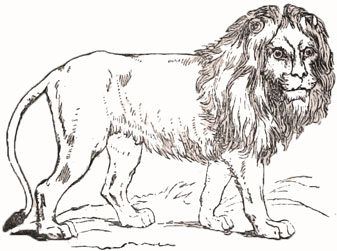
Fig. 244—Lion
The most powerful, daring, and impressive of all carnivorous animals, the most magnificent in aspect and awful in voice. Being very common in Syria in early times, the lion naturally supplied many forcible images to the poetical language of Scripture, and not a few historical incidents in its narratives. This is shown by the great number of passages where this animal, in all the stages of existence—as the whelp, the young adult, the fully mature, the lioness—occurs under different names, exhibiting that multiplicity of denominations which always results when some great image is constantly present to the popular mind. Thus we have,
Gor, a lion’s whelp, a very young lion (Gen 49:9; Deu 33:20; Jer 51:38; Eze 19:2; Nah 2:11-12, etc.).
Chephir, a young lion, when first leaving the protection of the old lair to hunt independently (Eze 19:2-3; Psa 91:13; Pro 19:12, etc.).
Art, an adult and vigorous lion, a lion having paired, vigilant and enterprising in search of prey (Nah 2:12; 2Sa 17:10; Num 23:24). This is the common name of the animal.
Sachal, a mature lion in full strength; a black lion? (Job 4:10; Job 10:16; Psa 91:13; Pro 26:13; Hos 5:14; Hos 13:7) This denomination may very possibly refer to a distinct variety of lion, and not to a black species or race, because neither black nor white lions are recorded, excepting in Oppian; but the term may be safely referred to the color of the skin, not of the fur; for some lions have the former fair, and even rosy, while in other races it is perfectly black. An Asiatic lioness, formerly at Exeter Change, had the naked part of the nose, the roof of the mouth, and the bare soles of all the feet pure black, though the fur itself was very pale buff.
Laish, a fierce lion, one in a state of fury (Job 4:11; Pro 30:30; Isa 30:6).
Labia, a lioness (Job 4:11, where the lion’s whelps are denominated ’the sons of Labiah,’ or of the lioness).
The lion is the largest and most formidably armed of all carnassial animals, the Indian tiger alone claiming to be his equal. One full grown, of Asiatic race, weighs above 450 pounds, and those of Africa often above 500 pounds. The fall of a fore paw in striking has been estimated to be equal to twenty-five pounds’ weight, and the grasp of the claws, cutting four inches in depth, is sufficiently powerful to break the vertebrae of an ox. The huge laniary teeth and jagged molars worked by powerful jaws, and the tongue entirely covered with horny papillae, hard as a rasp, are all subservient to an immensely strong, muscular structure, capable of prodigious exertion, and minister to the self-confidence which these means of attack inspire. In Asia the lion rarely measures more than nine feet and a half from the nose to the end of the tail, though a tiger-skin of which we took the dimensions was but a trifle less than 13 feet. In Africa they are considerably larger, and supplied with a much greater quantity of mane. Both tiger and lion are furnished with a small horny apex to the tail—a fact noticed by the ancients, but only verified of late years, because this object lies concealed in the hair of the tip, and is very liable to drop off. All the varieties of the lion are spotted when whelps; but they become gradually buff or pale. One African variety, very large in size, perhaps a distinct species, has a peculiar and most ferocious physiognomy, a dense black mane extending half way down the back, and a black fringe along the abdomen and tip of the tail; while those of southern Persia and the Dekkan are nearly destitute of that defensive ornament. The roaring voice of the species is notorious to a proverb, but the warning cry of attack is short, snappish, and sharp. Like all the feline, they are more or less nocturnal, and seldom go abroad to pursue their prey till after sunset. When not pressed by hunger, they are naturally indolent, and, from their habits of uncontrolled superiority, perhaps capricious, but often less sanguinary and vindictive than is expected.
Lions are monogamous, the male living constantly with the lioness, both hunting together, or for each other when there is a litter of whelps; and the mutual affection and care for their offspring which they display are remarkable in animals by nature doomed to live by blood and slaughter. It is while seeking prey for their young that they are most dangerous; at other times they bear abstinence, and when pressed by hunger will sometimes feed on carcasses found dead. They live to more than fifty years; consequently, having annual litters of from three to five cubs, they multiply rapidly when not seriously opposed. In ancient times, when the devastations of Egyptian, Persian, Greek, and Roman armies passed over Palestine, there can be little doubt that these destroyers made their appearance in great numbers. The fact, indeed, is attested by the impression which their increase made upon the mixed heathen population of Samaria, when Israel was carried away into captivity (2Ki 17:25-26).
The Scriptures present many striking pictures of lions, touched with wonderful force and fidelity: even where the animal is a direct instrument of the Almighty, while true to his mission, he still remains so to his nature. Thus nothing can be more graphic than the record of the man of God (1Ki 13:28), disobedient to his charge, struck down from his ass, and lying dead, while the lion stands by him, without touching the lifeless body, or attacking the living animal, usually a favorite prey. See also Gen 49:9; Job 4:10-11; Nah 2:11-12. Samson’s adventure also with the young lion (Jdg 14:5-6), and the picture of the young lion coming up from the underwood cover on the banks of the Jordan, all attest a perfect knowledge of the animal and its habits. Finally, the lions in the den with Daniel, miraculously leaving him unmolested, still retain, in all other respects, the real characteristics of their nature.
The lion, as an emblem of power, was symbolical of the tribe of Judah (Gen 49:9). The type recurs in the prophetical visions, and the figure of this animal was among the few which the Hebrews admitted in sculpture, or in cast metal, as exemplified in the throne of Solomon. Lions, in remote antiquity, appear to have been trained for the chase, and are, even now, occasionally domesticated with safety. Placability and attachment are displayed by them even to the degree of active defense of their friends, as was exemplified at Birr, in Ireland, in 1839, when ’a keeper of wild beasts, being within the den, had fallen accidentally upon a tiger, who immediately caught the man by the thigh, in the presence of numerous spectators; but a lion, being in the same compartment, rose up, and seizing the tiger by the neck, compelled it to let go, and the man was saved.’ Numerous anecdotes of a similar character are recorded both by ancient and modern writers.
Zoologists consider Africa the primitive abode of lions, their progress towards the north and west having at one time extended to the forests of Macedonia and Greece; but in Asia, never to the south of the Nerbudda, nor east of the lower Ganges. Since the invention of gunpowder, and even since the havoc which the ostentatious barbarism of Roman grandees made among them, they have diminished in number exceedingly, although at the present day individuals are not infrequently seen in Barbary, within a short distance of Ceuta.
The well-known and noble king of beasts, frequently spoken of in Scripture. He often exceeds eight feet in length and four feet in height; and his majestic and dauntless aspect, his prodigious strength and agility, and his peculiar roar, make him the terror of the forests. Lions were common in Palestine, (See JORDAN,) and the Hebrews had seven different names for them, to distinguish the different ages, etc. Five of these occur together in Job 4:10,11 . See also Jon 2:11,12 . The psalmist alludes to the stealthy creeping of the lion till he can spring upon his prey, when he says of the crafty wicked man, "He lieth in wait secretly as a lion in his den; .... he croucheth, and humbleth himself, that the poor may fall by his strong ones." The Bible reader will remember the exploits of Samson and of David, Jdg 14:5,6 1Sa 17:34-36, the story of the disobedient prophet slain by a lion, 1Ki 13:28, and of the obedient Daniel, safe in the lion’s den, Dan 6:1-28 ; also the sublime image of Jehovah’s care for his people, in Isa 31:4 .\par "The Lion of the tribe of Judah," Jer 5:5, is Jesus Christ, who sprung from the tribe of Judah and the race of David, and overcame death, the world, and the devil. It is supposed that a lion was the device of the tribe of Judah; whence this allusion, Gen 49:9 .\par
Lion. "The most powerful, daring and impressive of all carnivorous animals, the most magnificent in aspect and awful in voice." At present, lions do not exist in Palestine; but they must, in ancient times, have been numerous.
The lion of Palestine was in all probability the Asiatic variety, described by Aristotle and Pliny as distinguished by its short and curly mane, and by being shorter and rounder in shape, like the sculptured lion found at Arban. It was less daring than the longer maned species, but when driven by hunger, it not only ventured to attack the flocks in the desert in presence of the shepherd, 1Sa 17:34; Isa 31:4, but laid waste to towns and villages, 2Ki 17:25-26; Pro 22:13; Pro 26:13, and devoured men. 1Ki 13:24; 1Ki 20:36.
Among the Hebrews, and throughout the Old Testament, the lion was the achievement of the princely tribe of Judah, while, in the closing book of the canon, it received a deeper significance as the emblem of him who "prevailed to open the book and loose the seven seals thereof." Rev 5:5. On the other hand, its fierceness and cruelty rendered it an appropriate metaphor for a fierce and malignant enemy, Psa 7:2; Psa 22:21; Psa 57:4; 2Ti 4:17, and hence, for the arch-fiend himself. 1Pe 5:8.
The forests and tangled thickets have been almost swept away which were their former lair. Jordan’s wooded banks, its "pride" (as some translated, but others "swelling"), gave cover to lions (Jer 49:19), "a lion from the swelling (so Calvin, the overflow forcing the lion from the woody banks) of Jordan." The Asiatic lion has a short curly mane, and is shorter and rounder than the African. It laid waste villages (2Ki 17:25-26; Pro 22:13) and slew men (1Ki 13:24; 1Ki 20:35-36). Shepherds, as David, sometimes singly encountered it, and prevailed (1Sa 17:34-35; Amo 3:12); oftener in bands, frightening him with shouts into a pit covered over with reed or branches lightly, to entrap it (Eze 19:4; Eze 19:8-9). Benaiah slew one in a pit or cistern, in which it had taken refuge in a snowstorm (2Sa 23:20).
Samson slew one at Timnath (Jdg 14:5-6). Lion hunting is depicted as the amusement of the Ninevite kings, who followed the great hunter Nimrod’s example. Captured lions were caged, which illustrates the image in Eze 19:9. The lion symbolizes bravery, so the faces of the warriors of Gad who joined David are designated "the faces of lions" (1Ch 12:8); also might and royalty, as in the winged lion figures with human heads in the Assyrian palace remains, and in Solomon’s steps to his throne (1Ki 10:19-20); so the royal tribe Judah had the lion as its standard. Messiah is "the Lion of the tribe of Judah, the root of David," yet also the Lamb, combining opposites. The first of the four living creatures was like a lion (Rev 4:7, compare Eze 1:10), the kingly aspect of Messiah in Matthew.
Nineveh is compared to a lion’s den, full of remains of its prey, appropriately, as lion figures abounded in the Assyrian palaces, Nah 2:11-12, "where is," etc.? i.e. God will so destroy it that its site will be hard to find; fulfilled to the letter (Nah 1:8). Lions haunted dens in Lebanon and Hermon (Son 4:8). Balaam compares Israel to "a great lion (
Satan is the "roaring lion" as well as the subtle serpent (1Pe 5:8).
Lion. Lions do not now exist in Palestine; but they must in ancient times have been numerous there. The names Lebaoth, Jos 15:32; Jos 19:6; Laish, Jdg 18:7; 1Sa 25:44, indicate the presence of the lion in those regions. The lion of Palestine was in all probability the Asiatic variety, described by Aristotle and Pliny as distinguished by its short curly mane, and by being shorter and rounder in shape, like the sculptured lion found at Arban. When driven by hunger it not only ventured to attack the flocks in the desert in presence of the shepherd, 1Sa 17:34; Isa 31:4, but laid waste towns and villages, 2Ki 17:25-26; Pro 22:13; Pro 26:13, and devoured men. 1Ki 13:24; 1Ki 20:36. Among the Hebrews, and throughout the Old Testament, the lion was the symbol of the princely tribe of Judah, while in the closing book of the Bible it received a deeper significance as the emblem of him who "prevailed to open the book, and to loose the seven seals thereof." Rev 5:5. On the other hand its fierceness and cruelty rendered it an appropriate metaphor for a fierce and malignant enemy, Psa 7:2; Psa 22:21; Psa 57:4; 2Ti 4:17, and hence for the archfiend himself, 1Pe 5:8.
There are several Hebrew words translated ’lion,’ the principal of which is ari, from ’to tear.’ The lion is declared to be the "strongest among beasts and turneth not away for any." Pro 30:30. This shows that the lion may be taken as a symbol of ’strength,’ and as such the Lord is called the lion of the tribe of Judah, to which is attached the symbol of royalty, for Judah held the sceptre. Gen 49:9-10; Rev 5:5. Satan also has a kingdom and is called a strong one, Mat 12:26; and he is the ’lion’ seeking whom he may devour. He is compared to a ’roaring lion,’ because he is like that animal, which roars when it is sure of its prey: cf. Amo 3:4. The Lord knows how to deliver His servants even out of the mouth of the lion.
By: Emil G. Hirsch, I. M. Casanowicz, Solomon Schechter
There are several names for the lion in the Old Testament (comp. Job iv. 10 et seq.): "aryeh," or "ari," which is the most general name; "labi'" and "lebiyah," for the old lion and lioness; "kefir" and "gur," for the young, strong lion and whelp respectively; while "layish" and "shaḥal" occur in more poetic diction.
The lion is one of the most frequently mentioned animals in the Bible, which would indicate its former abundance in Palestine. Its favorite haunts were the bushy environments of the Jordan (Jer. xlix. 19, l. 44; Zech. xi. 3), caves and thickets (Jer. iv. 7, xxv. 38; Ps. x. 9, xvii. 12), in general the woods (Jer. xii. 8; Amos iii. 8) and the desert (Isa. xxx. 6). Place-names which may be connected with the lion are: Arieh (II Kings xv. 25), Lebaoth and Beth-lebaoth (Josh. xv. 32, xix. 6), Chephirah (Josh. ix. 17, xviii. 28; Ezra ii. 25; Neh. vii. 29), and Laish, the original name of northern Dan (Judges xviii. 29).
Many habits of the lion are incidentally mentioned in the Old Testament. The male assists in the rearing and training of the young (Ezek. xix. 2; Nah. ii. 13); it lies in wait in secret places (Deut. xxxiii. 22; Lam, iii. 10); growls over its prey (Isa. xxxi. 4); breaks the bones of its victims (Isa. xxxviii. 13), and carries them to its lair (Gen. xlix. 9). It not only was the terror of flocks (Mic. v. 8), but also attacked men (I Kings xiii. 24, xx. 36; II Kings xvii. 25). It was, however, fought by shepherds with sling and staff (I Sam. xvii. 34; Amos iii. 12), and was sometimes killed by daring men (Judges xiv. 5; II Sam. xxiii. 20). From Ezek. xix. 4, 8 it may be inferred that the usual manner of catching the animal alive was by pit and net. The custom of Oriental kings of throwing those fallen into disgrace to lions which were kept in dens, is illustrated in Dan. vi. 8 et seq.
The lion is the emblem of strength, courage, and majesty (Prov. xxii. 13, xxvi. 13, xxx. 30). Judah is compared to a lion (Gen. xlix. 9); so also are Gad and Dan (Deut. xxxiii. 20, 23), Saul and Jonathan (II Sam. i. 23), Israel (Num. xxiii. 24, xxiv. 9), and even God Himself (Isa. xxxi. 4; Hos. v. 14, xi. 10). Similes are derived from its terrific visage (I Chron. xii. 9), and especially from its terror-inspiring roar. The latter is ascribed to enemies (Isa. v. 29; Zeph. iii. 3; Ps. xxii. 13; Prov. xxviii. 15); to false prophets (Ezek. xxii. 25); to the wrath of a king (Prov. xix. 12, xx. 2); to God (Jer. xxv. 30; Joel iv. 16; Amos i. 2, iii. 8). In the Psalter the lion is often the symbol of the cruel and oppressive, the mighty and rich (e.g., Ps. x. 9, xxxiv. 11, xxxv. 17).
As an element of decorative art the figure of the lion entered into the design of the brazen Laver in the Temple of Solomon and of Solomon's throne (I Kings vii. 29, x. 20, and parallels).
—In Rabbinical Literature:
The Talmud states six names of the lion, namely: "aryeh," "kefir," "labi'," "layish," "shaḥal," and "shaḥaf" (Sanh. 95a; Ab. R. N. xxxix., end). The most general terms, however, are "are," "arya'" (B. Ḳ. 4a), and "aryeh"; for the lioness, "lebiyah" (B. Ḳ. 16b), "guryata" (Shab. 67a), and "kalba" (Yalḳ. ii. 721); and for the young lion, "gurya"(Sanh. 64a). In Ḥul. 59b an animal called "ṭigris" is defined as "the lion of Be-'Ilai" ( ). By "Be-'Ilai" is probably meant a mountain height or mountain forest, perhaps specially the Lebanon (comp. "bala," ib. 80a, and see Goat); and if by "ṭigris" the tiger is meant, it would appear that the Talmudical writers did not know this animal from personal observation, and it was therefore endowed by them with fabulous proportions and qualities. Thus it is said in the same passages that the distance between the lobes of its lungs was nine cubits, and that its roar at a distance of 400 parasangs brought down the walls of Rome. Kohut ("Ueber die Jüdische Angelologie und Dämonologie," etc., p. 103; comp. also idem, "Aruch Completum," iv. 15) surmises that "ṭigris" is the Persian "thrigaṭ," i.e., the mythical three-legged animal (comp. also Schorr in "He-Ḥaluẓ," vii. 32).
The lion is often enumerated among the dangerous animals (B. Ḳ. 15b and parallels). It is especially dangerous in rutting-time (Sanh. 106a). It begins to devour its prey alive (Pes. 49b), carrying part of it to the lair for the lioness and the whelps (B. Ḳ. 16b; Sanh. 90b). Sometimes, however, the lion will stay among flocks without injuring them (Ḥul. 53a); it attacks man only when driven by hunger (Yeb. 121b), and never two men when they are together (Shab. 151b). Though the lion can be tamed (Sanh. 15b; comp. the expression "ari tarbut," B. Ḳ. 16b), it is, on account of its dangerousness, kept in a cage (Shab. 106b), and when so confined is fed with the flesh of wild asses (Men. 103b). It is forbidden to sell lions to the pagans because the latter use them in their circuses ('Ab. Zarah 16a). In passing a lion's den ("gob") one should recite a benediction of thanksgiving in memory of the miracle which happened to Daniel when he was thrown into such a den (Ber. 57b). The term of gestation of the lion is three years (Bek. 8a). Its tormentor is the "mafgia'," or little Ethiopian gnat (Shab. 77b). For the medicinal use of the milk of the lioness see Yalḳ. 721.
The Talmud makes about the same figurative use of the lion as does the Old Testament. The lion is the king of animals (Ḥag. 13b) and the symbol of true mental greatness; and in this regard it is contrasted with the fox (Shab. 111b; Ab. iv. 15; Giṭ. 83b); it is the type of strength and awe (Pes. 112a; Shebu. 22b; B. Ḳ. 85a). The sound of God's voice is likened to the roaring of the lion (Ber. 3a, b). The name of the lion is applied to God, Israel, and the Temple (comp. Isa. xxix. 1: "ariel"; Pesiḳ. R. 28 [ed. Friedmann, p. 133] and parallels). The lion also symbolizes the mighty spirit of temptation and seduction to idolatry (Sanh. 64a; comp. I Peter v. 8). The Temple of Ezekiel is compared to the lion in its structure, both being broad in front and narrow behind (Mid. iv. 7). The lion is also the fifth sign ("Leo") of the zodiac, corresponding to the fifth month, Ab (Pesiḳ. R. l.c.; Yalḳ., Ex. 418).
Bibliography:
Tristram, Nat. Hist. p. 115;
Lewysohn, Z. T. pp. 68 and 70.
LION, HENRI JULIUS:
By: Isidore Singer, E. Slijper
Dutch journalist; born March 23, 1806, at Elberfeld; died Oct. 19, 1869. In 1824 he entered the Prussian army, and in 1830 that of Holland. In 1834 he went to India, and was honorably discharged as an officer at his own request in 1841. After this he devoted himself to industrial enterprises, having acquired a great practical knowledge of Indian affairs. He was the Nestor of Indian journalism, being the founder of the "Bataviaasch Handelsblad." To his great perseverance must be ascribed the appointment of a committee to consider the establishment of a railway in Java.
Bibliography:
Van der Aa, Biographisch Woordenboek, xxi.
LION
(1) ’ări, ’aryeh, full-grown lion (Gen 49:9, Jdg 14:8; Jdg 14:2 etc.).
(2) kĕphîr, a young strong lion (Jdg 14:6, Job 4:10, Eze 19:2 etc.).
(3) lâbî (cf. Arab
(4) layîsh, particularly in poetry (Job 4:11, Pro 30:30, Isa 30:6 etc.).
(5) shachal, poetically, lit. ‘the roarer’ (Job 4:10; Job 10:18; Job 28:8, Hos 5:14, Psa 91:13).
(6) benç-shachats is tr.
Lions have been extinct in Palestine since the time of the Crusades, but evidently were once plentiful, especially in the thickets along the Jordan (Jer 49:19; Jer 50:44, Zec 11:3). They were a source of danger to men (1Ki 13:24 f., 1Ki 20:35, 2Ki 17:25), and especially to shepherds’ flocks (1Sa 17:34, Isa 31:4, Amo 3:12, Mic 5:8). The terrifying roar of the lion is referred to in Pro 19:12; Pro 20:2 etc., and it is compared to the voice of God (Jer 25:30, Joe 3:16, Amo 3:8). Metaphorically, Judah is described as a lion in Gen 49:9, Dan in Deu 33:22, and Israel in Num 23:24; Num 24:9; but in the NT the lion is usually typical of Satan (1Pe 5:8; ct.
E. W. G. Masterman.
A symbol of Our Saviour, "the Lion of the fold of Juda" (Apocalypse 5); also of Saint Mark, Saint Jerome, and Saint Blaise. Being emblematic of solitude, it is sometimes shown in pictures of hermit saints.
1. Names:
(1) Occurring most often in the Old Testament is
2. Natural History:
The lion is not found in Palestine at the present day, though in ancient times it is known to have inhabited not only Syria and Palestine but also Asia Minor and the Balkan peninsula, and its fossil remains show that it was contemporary with prehistoric man in Northwestern Europe and Great Britain. Its present range extends throughout Africa, and it is also found in Mesopotamia, Southern Persia, and the border of India. There is some reason to think that it may be found in Arabia, but its occurrence there remains to be proved. The Asiatic male lion does not usually have as large a mane as the African, but both belong to one species, Fells leo.
3. Figurative:
Lions are mentioned in the Bible for their strength (Jdg 14:18), boldness (2Sa 17:10), ferocity (Psa 7:2), and stealth (Psa 10:9; Lam 3:10). Therefore in prophetical references to the millennium, the lion, with the bear, wolf, and leopard, is mentioned as living in peace with the ox, calf, kid, lamb and the child (Psa 91:13; Isa 11:6-8; Isa 65:25). The roaring of the lion is often mentioned (Job 4:10; Psa 104:21; Isa 31:4 (the Revised Version (British and American) “growling”); Jer 51:38; Eze 22:25; Hos 11:10). Judah is a “lion’s whelp” (Gen 49:9), likewise Dan (Deu 33:22). It is said of certain of David’s warriors (1Ch 12:8) that their “faces were like the faces of lions.” David’s enemy (Psa 17:12) “is like a lion that is greedy of his prey.” “The king’s wrath is as the roaring of a lion” (Pro 19:12). God in His wrath is “unto Ephraim as a lion, and as a young lion to the house of Judah” (Hos 5:14). “The devil, as a roaring lion, walketh about, seeking whom he may devour” (1Pe 5:8). “Lion” occurs in the figurative language of Ezekiel, Daniel, and Revelation. The figures of lions were used in the decorations of Solomon’s temple and throne (1Ki 7:29, 1Ki 7:36; 1Ki 10:19 f).
4. Narrative:
Nearly all references to the lion are figurative. The only notices of the lion in narrative are of the lion slain by Samson (Jdg 14:5); by David (1Sa 17:34 f); by Benaiah (2Sa 23:20; 1Ch 11:22); the prophet slain by a lion (1Ki 13:24; also 1Ki 20:36); the lions sent by the Lord among the settlers in Samaria (2Ki 17:25); Daniel in the lions’ den (Dan 6:16). In all these cases the word used is
5. Vocabulary:
The Arabic language boasts hundreds of names for the lion. Many of these are, however, merely adjectives used substantively. The commonest Arabic names are
“The roaring of the lion (
And the teeth of the young lions (
The old lion (
And the whelps of the lioness (
In Jdg 14:5-18, no less than three different terms,
With the possible exception of 1Pe_5:8, the use of ‘lion’ in the NT from 2 Tim. onwards is dependent on the OT. An animal of great size and strength, of noble bearing as well as of extreme cruelty, he is a fitting symbol for moral and spiritual reference.
1. In 1Pe_5:8, man’s adversary, the devil, is represented as always roaming about in search of prey, his very raging, which betrays his ravenous hunger, striking terror into the hearts of all.
2. In Heb_11:33, the reference is to the actual wild beast. Among the heroic deeds of the worthies of the OT recounted by the author of the Epistle is that they ‘stopped the mouths of lions’ (cf. Samson, Jdg_14:5-6; David, 1Sa_17:34-36; Benaiah, 2Sa_23:20). More remotely the story of Daniel suggests this mighty achievement, yet here God and not Daniel is said to have shut the lions’ mouths (Dan_6:22).
3. St. Paul declares that he had ‘escaped the mouth of the lion’ (2Ti_4:17; cf. Psa_22:21, 1Ma_2:60). The allusion of the Apostle is to the punishment of being thrown to the lions. Some have indeed permitted a literal interpretation of ‘lion’ (A. Neander, History of the Planting and Training of the Christian Church, Eng. translation , i. [1880] 345). Since, however, he was a Roman citizen and could claim the right of being beheaded (see Beast), the more probable explanation is that the reference is not to an actual lion. Concerning this, various conjectures have been advanced. ‘Lion’ has been interpreted as Nero (Chrysostom); calamity, which would result from cowardice and humiliation (N. J. D. White, in Expositor’s Greek Testament , ‘1 and 2 Timothy and Titus,’ 1910, p. 182; cf. Ps 21:22, 23 [Septuagint ]); ‘the immediate peril’ (Conybeare-Howson, The Life and Epistles of St. Paul, new ed., 1877, ii. 593), although the reference may be to St. Paul’s having established his right as a Roman citizen not to be exposed to the wild beasts. If, however, the reference is to the lion’s mouth, then Satan may be intended as a devouring adversary (cf. 1Pe_5:8, above), from which St. Paul had escaped. The time, place, and occasion of this reference have been variously conceived, (a) 2Ti_4:9; 2Ti_4:11-18; 2Ti_4:20-21 is a fragment, written from Caesarea, inserted in the Epistle, alluding to his address before the Sanhedrin (cf. Act_22:30; Act_23:11; B. W. Bacon, The Story of St. Paul, 1905, p. 198ff.). (b) Writing from Rome in his first imprisonment, he says that, although the result of the preliminary hearing was a suspension of judgment, yet he had expectation that he would escape a final condemnation, and that too in the immediate future (A. C. McGiffert, A History of Christianity in the Apostolic Age, 1897, p. 421). Writing from Rome in his second imprisonment, St. Paul says that at the close of his first imprisonment his pleading was so cogent and convincing that he was set at liberty (Eusebius, HE [Note: E Historia Ecclesiastica (Eusebius, etc.).] ii. 22, 1 Clem. 5; cf. T. Zahn, Introd. to the NT, Eng. translation , 1909, i. 441, ii. 1ff.). (c) After his arrival in Rome the second time, the preliminary investigation had resulted in his remand; but the completion of the trial would not eventuate so favourably (Conybeare-Howson, op. cit. ch. xxvi.; N. J. D. White, op. cit. 181ff.).
4. In the Apocalypse (5:5) the Exalted Christ is presented under the guise of a lion, where the undoubted reference is to Gen_49:9. He, who had overcome through death and the Resurrection, who had thus opened a way to God’s sovereignty over men, and is therefore alone able to loose the seals of the Divine judgment, i.e. to carry history forward to its consummation, is symbolized by a being of the highest prowess and strength. Yet no sooner has this suggestion of overmastering might become effective than it is withdrawn to give place to another-its exact opposite-that of a lamb as though slain, a symbol of sacrifice and humiliation (see Lamb).
5. The same intimation of majesty and strength occurs in Rev_4:7, where the Seer is taken up into heaven, and beholds the four and twenty elders about the throne, with the four living creatures, having the likeness respectively of a lion, a calf, the face of a man, and a flying eagle (cf. Eze_1:5 ff. [esp. Eze_1:10] Eze_10:14; also Isa_6:1 ff.).
6. The remaining references in the Apocalypse revert to the terrorizing aspect of this king of beasts (Rev_9:8 [cf. Joe_1:6] Rev_9:17, Rev_10:3 [cf. Isa_5:29] Rev_13:2 [cf. Dan_7:4 ff.]).
C. A. Beckwith.
This animal is used as a figure or a type of power, sagacity, strength, wrath and ability. Sometimes the lion represents CHRIST JESUS. Sometimes it represents Satan. It always represents tremendous power and strength.
Gen 49:9 (b) Emblematic of the power, strength and cunning of Judah for GOD because he came from GOD. The "lion" refers to GOD. Judah as the whelp is the offspring.
Jdg 14:8 (c) This is sometimes taken as a type of CHRIST. Out of His death comes the sweetness of GOD’s grace, and the blessings of salvation.
2Sa 17:10 (b) This is the estimate of David’s power and boldness as given by Hushai. He uses this figure to describe the mighty fighting power of David.
1Ki 7:29 (c) These figures represent various aspects of the Lord JESUS CHRIST. They are to be seen in connection with the character of CHRIST, both in Ezekiel and in the Revelation. Over the grave of Bobby Burns in the castle at Dumfernlin in Scotland there is a wooden canopy upheld by four posts. On the top of these posts there appear the four figures which Solomon mentions and which are also mentioned in Ezekiel - the lion, the ox, the man, the eagle. These indicate the four great attributes and characteristics of the Lord JESUS CHRIST.
1Ch 11:22 (c) This may be used as a type of Satan. Though every condition was favorable to the lion, this bold servant of David took his life in his hand and killed the beast. So our Saviour with everything against Him overcame Satan at Calvary when it seemed as though He could not possibly come out of the conflict a victor.
1Ch 12:8 (a) The face of the lion is under perfect control of the spirit of the lion. No one can tell the feelings of the lion by observing the face. Even when ready to attack, the face remains placid and calm. This figure used in connection with the Gadites indicates that these were men of might as the lion, men of fight as a lion, men of flight as a lion, and always with perfect control of their actions and their feelings.
Psa 22:13 (a) The maddening throng around the Cross resembled lions in their hatred, their vociferous shouts and their anger against the Son of GOD.
Psa 35:17 (b) This is a cry of the Lord JESUS for GOD to preserve Him from the fierce attacks of the enemies around Him.
Ecc 9:4 (b) This is a very graphic way of telling us that a great and mighty powerful man is of no value when dead. Nero, Napoleon, Stalin and Hitler have lost their power. The least of all living persons is better than the greatest of dead conquerors.
Jer 12:8 (a) This represents GOD’s own people who should have been of the sheep of His pasture, but instead turned against Him in hatred and rebellion.
Eze 1:10 (b) This is one of the types of the Lord JESUS in which His great strength, power, majesty and sovereignty are represented. (See also Rev 4:7 and Rev 5:5).
Eze 19:2 (a) The nation of Israel was compared to this animal. The leaders represent the parent animals. Their offspring are the cubs, but all of them are fierce and cruel in their attitude toward GOD and His prophet.
1Pe 5:8 (a) Satan is thus described. This animal cannot be tamed to become a servant of man. Its nature cannot be changed. It is never constructive, but always destructive in all its actions. It is never a friend of man, but always his enemy. He is said to be roaring because he is always hunting up victims. The lion roars only when it is hungry. Satan is never satisfied. He is always in the business of devouring and destroying and is never a blessing to men.
Rev 5:5 (a) CHRIST JESUS is the King of kings as the lion is the king of beasts. He is unconquerable and unavoidable. He cannot be defeated. He is afraid of no enemy. He cannot be hindered by any circumstances. He is always able to do whatever needs to be done for the glory of GOD and the blessing of men.
Rev 13:2 (b) This animal reveals the terrible power the antichrist will have to tear, destroy and hurt GOD’s people and all who will not bow to his sovereign sway.
Lion. The lion was the most awesome and dangerous wild beast in Palestine. His tawny hide blended into the golden fields and sandy wastes. Lions hid in forests and sometimes pounced from the thickets near the Jordan River (Jer 49:19).
The Bible contains many references to lions. Daniel miraculously survived a night in a lions’ den (Daniel 6). Samson and David killed lions singlehandedly (Jdg 14:5-6; 1Sa 17:34-37). Kings hunted lions for sport. According to (Eze 19:1-9), lions were also captured with pits and nets.
The lion’s majestic appearance and fearsome roar prompted many comparisons. The prophet Joel declared, "The Lord also will roar from Zion" (Joe 3:16). The apostle Peter wrote: "Be sober, be vigilant; because your adversary the devil walks about like a roaring lion." The prophet Hosea foretold that God would be like a protective lion for the nation of Israel (Hos 5:14); (panther, NEB).
Largest and grandest of cats, the lion is filled with power. A swat of his paw can kill. His massive body forces him to rely on strength instead of speed in his hunting.
A lion looks and sounds so imposing that he symbolizes royalty and courage. The highest compliment which biblical writers could give was to indicate that a person had the face or heart of a lion. Ari, the most common term for lion, means "the strong one." In (Isa 29:1) Jerusalem is called "Ariel," implying that the capital of the Jewish nation is "the strong [lion-like] city of God." In some translations of the Bible, a young lion is called a cub (Gen 49:9), (NIV), while other translations use the word whelp (Gen 49:9).
The Israelite tribes of Judah, Dan, and Gad-- and also the nation of Babylon-- adopted the lion as their symbol. Jesus is called "the lion of Judah" (Rev 5:5). Isaiah the prophet foretold that at the end of time, the Prince of Peace would tame even the fierce heart of the lion (Isa 9:6-7; Isa 11:1-9).