
Is a mutual agreement to determine an uncertain event, no other ways determinable, by an appeal to the providence of God, on casting or throwing something. This is a decisory lot, Pro 16:33; Pro 18:18. The matter, therefore, to be determined, in order to avoid guilt, should be important, and no other possible way left to determine it; and the manner of making the appeal solemn and grave, if we would escape the guilt of taking the name of God in vain. Wantonly, without necessity, and in a ludicrous manner, to make this appeal, must be therefore highly blameable. And if thus the decisory lot, when wantonly and unneccessarity employed, be criminal, equally, if not more so, must the divinatory lot be, which is employed for discovering the will of God: this being no mean of God’s appointment, must be superstitious, and the height of presumption.
Son of Haran, and nephew to Abraham. His name signifies wrapped up, or hidden. His history we have interspersed with that of Abraham, from Gen. xi. 27. to xix. 36.
the son of Haran, and nephew to Abraham. He accompanied his uncle from Ur to Haran, and from thence to Canaan; a proof of their mutual attachment, and similarity of principles respecting the true religion. With Abraham he descended into Egypt, and afterward returned with him into Canaan: but the multiplicity of their flocks, and still more the quarrels of their servants, rendered a friendly separation necessary. When God destroyed the cities of the plain with fire and brimstone, he delivered “just Lot” from the conflagration, according to the account of the divine historian. The whole time that Lot resided there was twenty-three years. During all this period he had been a preacher of righteousness among this degenerate people. In him they had before their eyes an illustrious example of the exercise of genuine piety, supported by unsullied justice and benevolent actions. And doubtless it was for these purposes that Divine Providence placed him for a time in that city. The losses which Lot sustained on this melancholy occasion were very great; his wife, property, and all the prospects of the future settlement of his family blasted. Pity must therefore draw a friendly veil over the closing scene of this man of affliction; and let him that thinketh he standeth, take heed lest he fall into deeds more reprehensible than those of Lot, without having equal trials and sufferings to plead in his favour. Respecting his wife, whether grieving for the loss of her property, or inwardly censuring the severity of the divine dispensation, or whether moved by unbelief or curiosity, cannot now be known; but, looking back, she became a pillar of salt, Gen 19:26. It would be endless to present the reader with all the opinions on this subject. Some contend that nothing more is meant than that she was suffocated: others, that a column or monument of metallic salt was erected upon her grave: others affirm that she became encrusted with the sulphur, insomuch that she appeared like an Egyptian mummy, which is embalmed with salt. Our Lord warns his disciples to remember Lot’s wife in their flight from Jerusalem, and not to imitate her tardiness, Luk 17:32.
2. LOT, any thing cast or drawn in order to determine any matter in question, Pro 18:18. We see the use of lots among the Hebrews in many places of Scripture: God commands, for example, that lots should be cast upon the two goats which were offered for the sins of the people, upon the solemn day of expiation, to know which of the two should be sacrificed, and which liberated, Lev 16:8-10. He required also that the land of promise should be divided by lot as soon as it was conquered; which command Joshua accordingly executed, Num 26:55-56; Num 33:54; Num 34:13, &c; Joshua xiv-xvi; hence the term “lot” is used for an inheritance, “Thou maintainest my lot;” and figuratively for a happy state or condition. The priests and Levites had their cities appointed by lot. Lastly, in the time of David, the four and twenty classes of the priests and Levites were distributed by lot, to determine in what order they should wait in the temple, 1Ch 6:54; 1Ch 6:61; 1Ch 24:5; 1Ch 25:8. In the division of the spoil, after victory, lots were likewise cast, to give every man his portion, Oba 1:11; Nah 3:10, &c. In the New Testament, after the death of Judas, lots were cast to decide who should occupy the place of the traitor, Act 1:26. From the above instances, it is clear that when men have recourse to this method, the matter ought to be of the greatest importance, and no other apparent way left to determine it; and the manner of making the appeal should be solemn and grave, if we would escape the guilt of taking the name of God in vain. It unquestionably implies a solemn appeal to the Most High to interpose by his decision; and so every thinking man will be very careful that he has a true and religious ground for so serious a proceeding; and few if any cases can now occur in which it can have any justification. The ancient manner of casting lots, was either in some person’s “lap,” or fold of the robe; into a helmet, or urn, or other vessel, in which they might be shaken before they were drawn or cast.
Lot (A covering); son of Haran and nephew of Abraham, who by the early death of his father had already come into possession of his property when Abraham went into the land of Canaan (Gen 11:31). Their united substance, consisting chiefly in cattle, was not then too large to prevent them from living together in one encampment. Eventually, however, their possessions were so greatly increased, that they were obliged to separate; and Abraham with rare generosity conceded the choice of pasture-grounds to his nephew. Lot availed himself of this liberality of his uncle, as he deemed most for his own advantage, by fixing his abode at Sodom, that his flocks might pasture in and around that fertile and well-watered neighborhood (Gen 13:5-13). He had soon very great reason to regret this choice; for although his flocks fed well, his soul was starved in that vile place, the inhabitants of which were sinners before the Lord exceedingly. There ’he vexed his righteous soul from day to day with the filthy conversation of the wicked’ (2Pe 2:7).
About eight years after his separation from Abraham (B.C. 1913), Lot was carried away prisoner by Chedorlaomer, along with the other inhabitants of Sodom, and was rescued and brought back by Abraham (Genesis 14), as related under other heads [ABRAHAM; CHEDORLAOMER]. This exploit procured for Abraham much celebrity in Canaan; and it ought to have procured for Lot respect and gratitude from the people of Sodom, who had been delivered from hard slavery and restored to their homes on his account. But this does not appear to have been the result.
At length the guilt of ’the cities of the plain’ brought down the signal judgments of Heaven. The avenging angels, after having been entertained by Abraham, repaired to Sodom, where they were received and entertained by Lot, who was sitting in the gate of the town when they arrived. While they were at supper the house was beset by a number of men, who demanded that the strangers should be given up to them, for the unnatural purposes which have given a name of infamy to Sodom in all generations. Lot resisted this demand, and was loaded with abuse by the vile fellows outside on that account. They had nearly forced the door, when the angels smote them with instant blindness, by which their attempts were rendered abortive, and they were constrained to disperse. Towards morning the angels apprised Lot of the doom which hung over the place, and urged him to hasten thence with his family. He was allowed to extend the benefit of this deliverance to the families of his daughters who had married in Sodom; but the warning was received by those families with incredulity and insult, and he therefore left Sodom accompanied only by his wife and two daughters. As they went, being hastened by the angels, the wife, anxious for those who had been left behind, or reluctant to remove from the place which had long been her home, and where much valuable property was necessarily left behind, lingered behind the rest, and was suddenly involved in the destruction, by which—smothered and stiffened as she stood by saline incrustations—she became ’a pillar of salt.’
Lot and his daughters then hastened on to Zoar, the smallest of the five cities of the plain, which had been spared on purpose to afford him a refuge: but, being fearful, after what had passed, to remain among a people so corrupted, he soon retired to a cavern in the neighboring mountains, and there abode. After some stay in this place, the daughters of Lot became apprehensive lest the family of their father should be lost for want of descendants, than which no greater calamity was known or apprehended in those times; and in the belief that, after what had passed in Sodom, there was no hope of their obtaining suitable husbands, they, by a contrivance which has in it the taint of Sodom, where they had been brought up, made their father drunk with wine, and in that state seduced him into an act which, as they well knew, would in soberness have been most abhorrent to him. They thus became the mothers, and he the father, of two sons, named Moab and Ammon, from whom sprung the Moabites and Ammonites, so often mentioned in the Hebrew history (Genesis 19). This circumstance is the last which the Scripture records of the history of Lot; and the time and place of his death are unknown.
The son of Haran, and nephew of Abraham, followed his uncle from Ur, and afterwards from Haran, to settle in Canaan, Gen 11:31 12:4-6 13:1. Abraham always had a great affection for him, and when they could not continue longer together in Canaan, because they both had large flocks and their shepherds sometimes quarreled, Gen 13:5-7, he gave Lot the choice of his abode. Lot chose the plain of Sodom, which appears then to have been the most fertile parts of the land. Here he continued to dwell till the destruction of Sodom and the adjacent cities. He was a righteous man even in Sodom, 2Pe 2:7 ; but the calamities consequent upon his choice of this residence-his capture by eastern marauders, the molestation caused by his ungodly and vicious neighbors, the loss of his property in the burning city, the destruction of his sons-in-law and of his wife-if they do not prove that he regarded ease and profit more than duty, show that the most beautiful and fruitful land is not always the best; the profligacy of its citizens may sink it into the abyss of perdition, and endanger all who have any concern with it. Lot’s wife, looking back with disobedient regrets, and arrested by the threatened judgment midway in her flight to the mountain, is an awful warning to all who turn their faces Zionward, but are unwilling to leave all for Christ, Gen 19:1-38 Luk 17:32 .\par
Lot. (veil or covering).
1. The son of Haran, and therefore the nephew of Abraham. Gen 11:27; Gen 11:31. (B.C. before 1926-1898). His sisters were Milcah, the wife of Nahor, and Iscah, by some identified with Sarah. Haran died before the emigration of Terah and his family from Ur of the Chaldees, Gen 11:28, and Lot was, therefore, born there.
He removed with the rest of his kindred to Charran, and again subsequently with Abraham and Sarai to Canaan. Gen 12:4-5. With them, he took refuge in Egypt from a famine, and with them, returned, first to the "south," Gen 13:1, and then to their original settlement between Bethel and Ai. Gen 13:3-4.
But the pastures of the hills of Bethel, which had, with ease, contained the two strangers on their first arrival, were not able any longer to bear them, so much had their possessions of sheep, goats and cattle increased. Accordingly, they separated, Lot choosing the fertile plain of the Jordan, and advancing as far as Sodom. Gen 13:10-14.
The next occurrence in the life of Lot is his capture by the four kings of the east and his rescue by Abram. Gen 13:14. The last scene preserved to us in the history of Lot is too well known to need repetition.
He was still living in Sodom, Gen 19:1, from which he was rescued by some angels on the day of its final overthrow. He fled first to Zoar, in which he found a temporary refuge during the destruction of the other cities of the plain. Where this place was situated is not known with certainty. See Zoar.
The end of Lot’s wife is commonly treated as one of the difficulties of the Bible; but it surely need not be so. It cannot be necessary to create the details of the story where none are given. On these points, the record is silent. The value and the significance of the story to us are contained in the allusion of Christ. Luk 17:32.
Later ages have not been satisfied so to leave the matter, but have insisted on identifying the "pillar" with some one of the fleeting forms which the perishable rock of the south end of the Dead Sea is constantly assuming in its process of decomposition and liquefaction. From the incestuous intercourse between Lot and his two daughters, sprang the nations of Moab and Ammon.
(literally, a pebble).
2. The custom of deciding doubtful questions by lot is one of great extent and high antiquity. Among the Jews, lots were used with the expectation that God would so control them as to give a right direction to them. They were very often used by God’s appointment. "As to the mode of casting lots, we have no certain information. Probably several modes were practiced."
"Very commonly among the Latins, little counters of wood were put into a jar with so narrow a neck, that only one could come out at a time. After the jar had been filled with water and the contents shaken, the lots were determined by the order in which the bits of wood, representing the several parties, came out with the water. In other cases, they were put into a wide open jar, and the counters were drawn out by the hand. Sometimes again, they were cast in the manner of dice. The soldiers who cast lots for Christ’s garments undoubtedly used these dice." -- Lyman Abbott.
Haran’s son, Abraham’s nephew (Gen 11:27-31). Born in Ur of the Chaldees, before Terah’s emigration. Accompanied Abram to Charan, then to Canaan (Gen 12:4-5), then, in the famine, to Egypt. On their return a quarrel arose between Abram’s and Lot’s herdsmen. In the spirit of a child of God Abram goes to Lot himself, instead of listening to subordinates’ reports, and begs as they are brethren there should be no strife between them (contrast Act 15:39), and offers Lot precedency, though as his senior Abram might have claimed it; "if thou wilt take the left hand, then I will go to the right," etc. Lot chose by sight, not faith, the richly watered circle of the Jordan, fertile, but the region of wicked Sodom (Jos 7:24; Jos 8:15). At first Lot only "pitched his tent toward Sodom," but he was venturing too near temptation not to be caught (Psa 1:1; 1Co 15:33).
He soon was dwelling in a "house" in Sodom, and paid the penalty in being carried off with his much-loved "goods" by Chedorlaomer; he was rescued only by the disinterested bravery and magnanimity of Abram, who, forgetting Lot’s unamiable conduct, thought only of how to rescue him at all hazards in his distress. This warning ought to have been enough to drive Lot from Sodom, but no, he still lives there. Next, Lot appears exercising that goodly hospitality by which he" entertained angels unawares," and for which the Epistle to Hebrew (Heb 13:2) commends him. Evidently, the luxury of worldly Sodom had not wholly corrupted the simplicity of his character. The Spirit of God, who knows hearts, designates him (2Pe 2:7-9) "just Lot, vexed with the filthy conversation (the licentious behaviour) of the wicked" (the lawless, who set at defiance the laws of nature and God).
The Sodomites’ words, "this one fellow came in to sojourn, and he will needs be a judge" refer evidently to Lot’s remonstrances with them which Peter presupposes. The gracious Lord reminds us of his faithfulness, not of his subsequent incest. If there had been "ten" such "fellows" in Sodom Jehovah would have spared it (Gen 18:32). Again God records, "that righteous man dwelling among them, in seeing and hearing, vexed (tormented) his righteous soul from day to day with their unlawful deeds." Lot had gone into temptation, and must have perished but, for God’s grace; to all appearances his position was hopeless, but "the Lord knoweth how to deliver the godly out of temptations," He is at no loss for means. The angels’ visit was meant to test Lot as well as the Sodomites. The angels’ declining his invitation at first, "we will abide in the street (the broad open space) all night," answers to Jesus’ mode of eliciting the faith of the two Emmaus disciples (Luk 24:28).
His sin is faithfully recorded, his offering to sacrifice his daughters’ honour to save his guests. He was retributively punished by those daughters sacrificing their father’s honour and their own. They seem to have been only betrothed, not yet married, to Lot’s so-called "sons in law." When he warned them to flee from the coming destruction "he seemed as one that mocked unto his sons in law" (compare Luk 24:11). His imperfection of faith appears in that "he lingered" even on the morning of Sodom’s doom. But the angels "laid hold upon his hand ... the Lord being merciful to him (Rom 9:15-16) ... and set him without the city." They further warned him, "escape for thy life, look not behind thee (compare the Christian’s motto, Php 3:13; Luk 9:62), neither stay thou in all the plain," the (
God grants even this, and adds "I cannot do anything until thou be come there"; God’s love controls His omnipotence (Mat 27:42). Lot’s wife "looked back" with regrets on Sodom’s sinful pleasures, then stayed behind, and "became a pillar of salt"; possibly overtaken by the fire and brimstone and incrusted with salt. The Americans found E. of Usdum a pillar of salt 40 ft. high, which may be the traditional one identified with Sodom’s wife (Josephus, Ant. 1:11). Vacillation in faith led him to doubt even Zoar’s safety, notwithstanding God’s promise. From "lingering" about Sodom, Lot passes to the opposite extreme, desponding of safety even in its extreme skirt. His unbelief issued in the sin in the cave, and the offspring were "the children of Lot," Moab and Ammon (Deu 2:9; Deu 2:19; Psa 73:8). See our Lord’s spiritual lesson from Sodom and Lot’s wife (Luk 17:28-32).
Lot (lŏt), veil or covering. The son of Haran and nephew of Abraham. Gen 11:27; Gen 11:31. His sisters were Milcah the wife of Nahor, and Iscah, by some identified with Sarah. Haran died before the emigration of Terah and his family from Ur of the Chaldees, ver. 28, and Lot was therefore born there. He removed with the rest of his kindred to Haran, and again subsequently with Abraham and Sarai to Canaan. Gen 12:4-5. With them he took refuge in Egypt from a famine, and with them returned first to the "South," Gen 13:1, and then to their original settlement between Bethel and Ai. vs. 3, 4. Later, they separated, Lot choosing the fertile plain of the Jordan, near Sodom. Gen 13:10-14. Lot was captured by the four kings of the East, and rescued by Abram. Gen 14:1-24. He was still living in Sodom, Gen 19:1-38, from which he was rescued by angels on the day of its final overthrow. He fled first to Zoar, in which he found a temporary refuge during the destruction of the other cities of the plain. The end of Lot’s wife is commonly treated as one of the difficulties of the Bible; but it surely need not be so. The value and the significance of the story to us are contained in the allusion of Christ. Luk 17:32. It is folly to think of identifying the "pillar" with some one of the fleeting forms which the perishable rock of the south end of the Dead Sea is constantly assuming. From the incestuous intercourse between Lot and his two daughters sprang the nations of Moab and Ammon.
Lot. Casting lots or a pebble is an ancient custom of deciding doubtful questions. Pro 16:33. Among the Jews lots were used with the expectation that God would so control them as to give a right direction to them, as in the choice of the apostle Matthias, Act 1:26, and in the cases of Saul and Jonathan, and Jonah and his companions to determine who had offended God. 1Sa 14:41-42; Jon 1:7. In the division of the Promised Land among the tribes of Israel the use of the lot was expressly commanded by God himself, it being understood that the extent of territory should be proportioned to the population of each tribe. Num 26:55. So the selection of the scapegoat on the day of atonement was to be determined by lot. Lev 16:8. Property was divided in a similar way. Psa 22:18; Mat 27:35. The orders of the priests and their daily services were also assigned by lot. 1 Chron. chaps. 24, 25. The manner of casting lots is supposed to have been by stones or marks which were thrown together into the lap or fold of a garment, or into an urn or vase, and the person holding them shook them violently, and they were then drawn. The passage, Pro 16:33, is paraphrased thus: "In a lot-vase the lots are shaken in all directions; nevertheless, from the Lord is the whole decision or judgment."
Son of Haran the brother of Abraham. He seems to have accompanied Abraham. without having a like faith in Abraham’s God. When their flocks and herds had so increased that they could no longer dwell together, Abraham bade his nephew choose whither he would turn. Lot looked on the well-watered plain of the Jordan, and went toward Sodom, notwithstanding that the men of that city were exceedingly wicked. The next record of Lot is that he dwelt in Sodom, and from thence was carried away by the four kings who made war against that city.
Though rescued by Abraham he did not profit by the discipline, but returned to dwell in the guilty city; whereas Abraham would not accept so much as a shoe latchet from its king. Lot is next seen sitting in the gate of Sodom, the place of power and judgement, when the two angels arrived to destroy the city. He acted hospitably towards them, but had to be rescued by them from the enmity of the inhabitants.
Lot and his family were loathe to leave the city, but the angels hastened them out, and bade them flee to the mountains. Lot begged to be allowed to go to Zoar, and was permitted; but, fearing to stay there, he left with his two daughters and abode in a cave, where, alas, he became the father of Moab and Ben-ammi, the ancestors of the Moabites and the Ammonites, who are afterwards alluded to as the children of Lot.
From his history in the O.T. it could not have been discovered that he was a righteous man; but this testimony is given of him in 2Pe 2:7-8, where he is called ’just Lot,’ who, as a righteous man, was daily vexed in his soul by the unlawful deeds of those among whom he dwelt. Though God delivered him, he is a solemn instance of a righteous man dwelling needlessly amid gross wickedness; his course being the strongest contrast to that of Abraham. Gen 11 - Gen 14, Gen 19; Psa 83:8; Luk 17:28-29.
LOT’S WIFE, on leaving Sodom, looked back and became a pillar of salt! and is held up as a warning not to linger but to flee from coming judgements. Luk 17:32.
LOT.—The suddenness of the Divine Parousia and the unpreparedness and want of expectation on the part of the world, find illustration from ‘the days of Lot’ (Luk 17:28), when the people of Sodom continued their social and commercial activity until ‘the day that Lot went out’ (Luk 17:29).
Lot’s Wife—to whom in Jewish tradition the name
Our Lord’s word ‘Remember’ neither confirms nor rejects the tradition. It is with the spiritual fact and its lesson, not with the memorial, that He is concerned. The folly of unreadiness, of the longing for things left behind, of the desire to retain a transient little in the face of impending judgment and at the cost of a greater and eternal loss, is the lesson He would teach in connexion with His Parousia, from the remembrance of Lot’s wife.
Literature.—Hasting’s Dictionary of the Bible , Smith’s DB
J. T. L. Maggs.
( ).
).
By: Emil G. Hirsch, M. Seligsohn, Solomon Schechter, Joseph Jacobs
—Biblical Data:
Son of Haran, Abraham's brother, and, consequently, nephew of Abraham; emigrated with his grandfather, Terah, from Ur of the Chaldees to Haran (Gen. xi. 31). Lot joined Abraham in the land of Canaan, and in the time of famine went with him to Egypt (ib. xii. 4, xiii. 1). Owing to Lot's riches in flocks and tents a quarrel arose between his herdsmen and those of Abraham, the result of which was the separation of uncle and nephew. Lot chose the fertile plain of the Jordan, and extended his tents to Sodom (ib. xiii. 5-12). After the defeat of the King of Sodom and his allies in the valley of Siddim, Lot, who had been dwelling among them, was taken prisoner, with all his family and property, by Chedorlaomer; but he was rescued by Abraham (ib. xiv. 12-16).
In Gen. xix. Lot is represented as the counterpart of Abraham in regard to hospitality: like Abraham, he rose to meet the angels, whom he took for men, bowing to them; and, like Abraham, too, he "pressed" them to enter his house and "made them a feast" (ib. xix. 1-3). When his dwelling was surrounded by the profligate people of Sodom, Lot placed his duty as a host above that as a father and offered them his two unmarried daughters. The angels then announced to him that their mission was to destroy the guilty cities, and urged him to leave the place. Lot tried, but unsuccessfully, to persuade his sons-in-law to leave also. He himself hesitated to flee, and the angels took him, his wife, and his two daughters by the hand, "the Lord being merciful unto him," and led him out of the city. They then enjoined him to flee to the mountain without looking behind him; but the mountain being so far off Lot requested them to spare the small city of Zoar in order that he might find refuge there; and his request was granted. During the flight to Zoar, Lot's wife, who looked behind her, was turned into a pillar of salt (ib. xix. 4-22, 26).
Lot, fearing that Zoar, also, might be destroyed eventually, went up to the mountain and dwelt in a cave, where, by an incestuous intercourse with his two daughters, he became the ancestor of the two nations Moab and Ammon (ib. xix. 30-38). Lot is twice mentioned in the expression "children of Lot," applied to Ammon and Moab (Deut. ii. 19; Ps. lxxxiii. 8).
E. G. H. M. Sel.—In Rabbinical Literature:
Lot is generally represented by the Rabbis in an unfavorable light. When the quarrel arose between his shepherds and those of Abraham (Gen. xiii. 7), there was a quarrel between Abraham and Lot also. The latter sent his flocks to graze in fields that did not belong to him; and when Abraham, induced by the complaints of the wronged owners, remonstrated,Lot showed himself rebellious (Targ. of pseudo-Jonathan and Yer. to Gen. xiii. 7; Pesiḳ. R. 3 [ed. Friedmann, pp. 9b-10a]; Gen. R. xli. 6-7). Lot, while separating himself from Abraham, separated himself from God also, saying, "I have no desire either in Abraham or in his God" (Gen. R. xli. 9-10). It was only after the wicked ("rasha'") Lot had left Abraham that God spoke again to the latter (Pesiḳ. R. l.c.; comp. Gen. xiii. 14). Lot was given over to lust; therefore he chose Sodom as his residence (Pesiḳ. R. l.c.; Gen. R. xli. 9), and his daughters' act of incest was due to his neglect. The account of it was therefore read every Saturday in the synagogues as a warning to the public (Nazir 23b; Gen. R. li. 12).
The above-mentioned incident of the flocks shows that Lot was not too conscientious; he was besides very greedy of wealth; and at Sodom he practised usury (Gen. R. li. 8). His hesitation to leave the city (comp. Gen. xix. 16) was due to his regret for his great wealth which he was obliged to abandon (Gen. R. l. 17). The Rabbis cited the drunkenness of Lot as an example of the degree of intoxication which renders a man irresponsible ('Er. 65a). All the special favors which Lot received from God were granted through the merit of Abraham; otherwise he would have perished with the people of Sodom (Gen. R. xli. 4; Midr. ha-Gadol to Gen. xiii. 11). His being spared at the time of the destruction of Sodom is recorded also as a reward for not having betrayed Abraham when the latter told Pharaoh that Sarah was his sister (ib. li. 8).
The Pirḳe Rabbi Eli'ezer, however, shows a much milder attitude toward Lot, interpreting the word "ẓaddiḳ" of Gen. xviii. 23 as referring to him (Pirḳe R. El. xxv.). Besides passing over in silence Lot's shameful deeds, it records the hospitality which, in imitation of Abraham, he practised at Sodom: even after the people of Sodom had proclaimed that any hospitable person would be burned, he continued to practise it under cover of night. This trait is mentioned also in Gen. R. (l. 8); but it is there narrated in a manner which renders Lot's merits insignificant. It is further said (ib. l. 9; Lev. R. xxiii.) that Lot pleaded the whole night in favor of the people of Sodom. The Alphabet of Ben Sira (ed. Bagdad, pp. 2b, 17b, 19b), apparently borrowing from the Koran (suras vii. 78-82, xxii. 43), calls Lot "a perfectly righteous man" ("ẓaddiḳ gamur") and prophet (comp. II Peter ii. 7, 8; Epstein, "Mi-Ḳadmoniyyot ha-Yehudim," 121).
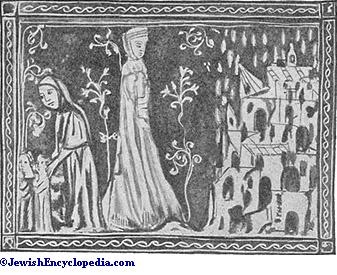
Genesis Rabbah (l. 14) concludes that Lot had at the time of the destruction of Sodom four daughters, two married and two betrothed, and that the latter escaped with their father. But he had previously had a daughter named Peloṭet, who was married to one of the inhabitants of Sodom. She secretly practised hospitality, but being one day discovered by the people of Sodom, was sentenced to be burned (Pirḳe R. El. l.c.; "Sefer ha-Yashar," "Lek Leka," ed. Leghorn, p. 23a). Lot's wife, called "'Irit" or "'Idit," desirous to see whether her other two daughters followed her, looked behind her; but she then saw the back of the Shekinah and was accordingly punished for her imprudence (Pirḳe R. El. l.c.). She was turned into a pillar of salt because she had previously sinned by not giving salt to strangers (Targ. pseudo-Jonathan and Yer. to Gen. xix. 26; comp. Gen. R. li. 7). According to a legend, oxen used to consume every day the pillar of salt by licking it down to the toes, but it was restored by the morning (Pirḳe R. El. l.c.; Sefer ha-Yashar, "Wayera," p. 28a, b). Lot's wife, being turned into a pillar of salt, was not considered as a dead body, contact with which rendered one unclean (Niddah 70b). The transformation was one of those miraculous occurrences at sight of which one must recite a benediction (Ber. 54a).
Lot's Wife Turned into a Pillar of Salt.(From the Sarajevo Haggadah of the fourteenth century.)
—Critical View:
Lot is regarded by the critics as an eponym representing the supposed common ancestor of the two tribes or nations of Moab and Ammon. His relation to Abraham is in this view intended to mark the ethnographic connection of these two tribes with the Israelites; and his choice of an eastern location may be taken as indicating a voluntary relinquishment of all claims of the Moabites and Ammonites to Canaan. His relations with his daughters probably represent some rough pleasantry common among the Israelitish folk and indicating their scorn for their nearest neighbors. Fenton, however ("Early Hebrew Life"), suggests that in a matriarchal state such unions would not be indecorous, since in social stages where descent was tracedonly through the mother the father would be no relation to the children.
The story about Lot's wife, also, bears marks of popular origin, and is regarded by critics and travelers as a folk-legend intended to explain some pillar of crystallized rock-salt resembling the female human form. Owing to its composition, such a pillar would soon dissolve. One in the neighborhood of the Dead Sea was identified by Josephus ("Ant." i. 11, § 4) as that of Lot's wife; and another (or the same) had that name at the time of Clement of Rome (I Cor. xi. 2).
As Lot is declared to have dwelt in a cave (Gen. xix. 30), Ewald ("History of Israel," i. 313) and Dillmann (ad loc.) identify him with Lotan, the leader of one of the tribes of Horites or cave-dwellers (Gen. xxxvi. 22, 29). The Dead Sea is still called "Baḥr Luṭ."
LOT.—The son of Haran, brother of Abraham. His name seems clearly derived from a root meaning to wrap closely. The account of his life is contained in Gen 11:27 to Gen 14:16; Gen 14:19. He was born in Ur, and went with Abraham to Haran, and thence to Canaan. He accompanied Abraham in much of his wandering. The separation between them (ch. 13) was due to a quarrel between their herdsmen, each having great possessions of cattle. As a result, Lot dwelt in the cities of the plain, making his home in Sodom. During the expedition of Chedorlaomer (ch. 14) he was carried away captive, and rescued by Abraham. In ch. 19 is narrated the escape of Lot and his daughters from Sodom, with the subsequent incidents. The city of Zoar, where they dwelt for a time, is possibly the Zoara or Zoôr of Josephus, at the S.E. extremity of the Dead Sea, in the modern Ghôr es-Sâfieh, a well-watered region. The mountain to which he finally went is doubtless the mountainous region later known as Moab. The story of the daughters of Lot (Gen 19:30-38) is now usually considered to be not history, but a traditional account of the origin of the two nations, Moab and Ammon. The basis of the story is partly popular etymology of the two names; while it is prompted chiefly by national rivalry and hostility. That Lot was a righteous man (2Pe 2:7-8) may be granted in a relative sense, in comparison with the Sodomites; but he shows no great strength of character.
Lot’s wife.—The historical character of the story of Lot’s wife and her transformation into a pillar of salt is doubtful: it may have arisen from the peculiarities of the cliffs in the vicinity of the Dead Sea. At its S.W. extremity is a range of cliffs 6 miles long and 600 feet high, called Jebel Usdum, ‘the mountain of Sodom.’ These consist of crystallized rock salt, covered with chalky limestone and gypsum, and curiously furrowed and worn, so as sometimes to resemble a human figure.
George R. Berry.
Son of Aran and nephew of Abraham. He settled in Kikkar the fertile region about the Jordan, residing in Sodom. At the time of the pillage of the latter he was captured and carried away but was soon rescued by Abraham. He was saved by angels when Sodom and Gomorrha were destroyed for their immorality; his wife, however, was turned into a pillar of salt for her disobedience. It has been suggested that she may have been overtaken by the salty waters of the Dead Sea or that she became coated with salt released from the soil by the heat of the flame. Later Lot had two sons, Moab and Ammon, the fruits of incest, whose descendants were Israel’s most bitter enemies.
A wrapping
Son of Abraham’s brother Aran (Genesis 11:27), therefore Abraham’s nephew (his "brother": xiii, 8, 11; xiv, 14, 16) and grandson of Thare, father of Abraham (xi, 31). Lot was among those whom Thare took with him out of Ur of the Chaldees, to go to the land of Chanaan. When Thare died in Haran, Lot continued the journey with Abraham. It may be inferred that Lot accompanied his uncle to Sichem, to the mountain between Bethel and Hai, and then to the south (xii, 6, 8, 9). Whether Lot went to Egypt with Abraham at the time of the famine (xii, 10-20) is not explicitly stated, but is implied in xiii, 1: "And Abraham went up out of Egypt, he and his wife, and all that he had, and Lot with him into the south." After their return, they once more settled between Bethel and Hai (xiii, 3). Lot and Abraham had numerous flocks and herds, so numerous that the pasture and watering places proved insufficient for them. Strife ensued between the herdsmen of Abraham and of Lot. Abraham, in the interest of peace, proposed to his nephew that they should live apart, and even allowed Lot to take his choice of the surrounding country. Lot chose the watered and fertile region "about the Jordan" (Kikkar), and fixed his abode in the city of Sodom, whereas Abraham dwelt in the land of Chanaan (xiii, 6-12). The next incident in the life of Lot is related in connection with the expedition of Chodorlahomor against the five cities "about the Jordan", including Sodom (xiv, 1 sqq.). The kings of the Pentapolis were defeated, their cities pillaged, and among those carried away by the victorious kings was Lot, who lost all his possessions (xiv, 12). Lot’s predicament was made known to Abraham, who at once chose three hundred and eighteen of his best men and set out in pursuit of the retreating victorious kings. He overtook them in Dan, where he surprised them at night, and routed them completely. Lot and his possessions were rescued by Abraham, who brought all back safely to Sodom (xiv, 13-16; see ABRAHAM).Again we read of Lot in connection with the mission of the angels who had been sent by God to destroy the five cities in the valley of the Jordan. These angels, three in number, were first entertained by Abraham in the vale of Mambre (Genesis 18:2 sqq.), and then two of them made their way towards Sodom, where they arrived in the evening (xix, 1). Here they met Lot, who, sitting in the gateway of the city---a common place of meeting in the East---arose and greeted the strangers, at the same time offering them the hospitality of his house. The strangers at first refused, but finally accepted the pressing invitation of Lot, who then prepared a feast for them (xix, 2, 3). That night the men of Sodom revealed their degradation by attacking Lot’s house and demanding his two guests for their vile purpose (4, 5). Lot interceded in behalf of his guests in accordance with his duties as host, which are most sacred in the East, but made the mistake of placing them above his duties as a father by offering his two daughters to the wicked designs of the Sodomites (6-8). The latter, however, refused the substitution, and just as they were about to inflict violence upon Lot the two angels intervened, drawing Lot into the house and striking the men outside with blindness, thus preventing them from finding the door of the house (9-11). The angels then made known to Lot the object of their visit to Sodom, which they were sent to destroy, and advised him to leave the city at once with his family and belongings. Lot imparted the news to his prospective sons-in-law, who, however, refused to consider it seriously. The next morning, the angels once more admonished Lot to leave Sodom, and when he still hesitated they took him, his wife, and two daughters, and brought them out of the city, warning them not to look back nor to remain in the vicinity of the doomed city, but to flee into the mountains (12-17). The mountains, however, seemed too far distant to Lot, and he requested to seek shelter in a small city nearer by. The request was granted, and Lot fled to Segor (Heb. Zo’ar), which is also promised protection (18-23). Sodom, Gomorrha, and the other cities of the Pentapolis were then destroyed. Lot’s wife, disregarding the injunction of the angels, looked back, and was converted into a pillar of salt (24-26). Lot, seeing the terrible destruction of the five cities, feared for his own safety in Segor, and therefore fled with his two daughters into the mountains, where they dwelt in a cave (30). It was here, according to the Sacred Text, that Lot’s two daughters were guilty of incestuous intercourse with their father, the outcome of which was the birth of Moab and Ammon, the fathers of Israel’s future most bitter enemies (31-38). This last incident also closes the history of Lot. His name, however, occurs again in the expression "the children of Lot", meaning the Moabites (Deuteronomy 2:9), and the Ammonites (Deuteronomy 2:19), and both (Ps. lxxxii, 9). In the New Testament, Christ refers to the destruction of Sodom "in the days of Lot" (Luke 17:28, 29), and St. Peter (2 Peter 2:6-8) speaks of the deliverance of the "just Lot". The fate of Lot’s wife is referred to in Wis., x, 7; Luke, xvii, 32. According to Jewish and Christian tradition, the pillar of salt into which she was converted was preserved for some time (Josephus, "Antiq.", I, xi, 4; Clement of Rome, "I Cor.", xi, 2; Irenæus, "Adv. Haer.", IV, xxxi). Various explanations are given of this phenomenon. According to von Hummelauer ("Comment. in Gen.", Paris, 1895, 417), Lot’s wife could easily have been overtaken by the salty waters of the Dead Sea and literally covered with salt. Kaulen had already advanced a similar explanation, accounting for the coating of salt by the heat of the flames releasing the salt fumes from the soil.-----------------------------------F. X. E. ALBERT Transcribed by Thomas J. Bress The Catholic Encyclopedia, Volume IXCopyright © 1910 by Robert Appleton CompanyOnline Edition Copyright © 2003 by K. KnightNihil Obstat, October 1, 1910. Remy Lafort, CensorImprimatur. +John M. Farley, Archbishop of New York
I. Personality.
The man who bore the name Lot (
The reason for thus singling out but one of the grandsons of Terah appears in the next verse, where we are told that “Haran died before his father Terah in the land of his nativity, in Ur of the Chaldees.” For that period in the life of this family, therefore, which begins with the migration from Ur, Lot represents his father’s branch of the family (Gen 11:31). It is hardly probable that the relation between Abraham and Lot would have been what it was, had not Haran died; but be this as it may, we read this introduction of Lot into the genealogy of Terah as an anticipation of the story to which it furnishes an introduction, and in which Lot is destined to play an important part.
The sections of that story in which Lot appears are: in Gen 11, the migration from Ur to Haran; in Gen 12, Abraham’s wanderings; in Gen 13, the separation of Abraham and Lot; in Gen 14, the campaign of the eastern kings against Sodom and Abraham’s recovery of the captives; and in Gen 19, the destruction of Sodom.
In Gen 14:14, Gen 14:16 Lot is termed the “brother” of Abraham; but that this does not represent a variant tradition is proved by reference to Gen 14:12 of the same chapter (ascribed to “an independent source”) and to Gen 13:8 (ascribed to J; compare Gen 11:28 J).
II. Career.
1. First Period:
Lot’s life, as the scanty references to him permit us to reconstruct it, falls into four periods. Of the first period - that previous to the migration from Haran - we know nothing save Lot’s birth in Ur, the death of his father there, the marriage of his sister Milcah to his uncle Nahor (of another sister, Iscah, we learn only the name), and the journey to Haran in company with Terah, Abraham and Sarah. The fact that Sarah’s childlessness and Haran’s death are the only two circumstances related of the family history, may serve to explain why Lot went with Abraham instead of staying with Nahor. A childless uncle and a fatherless nephew may well have remained together with the idea that, even if there was no formal adoption, the nephew might become his uncle’s heir. Certainly, the promise of a numberless seed, so often repeated to the patriarchs, comes first to Abraham immediately after Lot has separated from him (see Gen 13:6-18).
2. Second Period:
In the second period of Lot’s life, we find him the companion of Abraham on his journeys from Mesopotamia to Canaan, through Canaan to Egypt, and back again to the neighborhood of Beth-el. His position is subordinate, for his uncle is head of the family, and oriental custom is uniform and rigorous in the matter of family rule. Hence, the use of the singular number throughout the narrative. What Abraham did, his whole “clan” did. Yet Lot’s position was as nearly independent as these patriarchal conditions admit. When the story reaches the point where it is necessary to mention this fact, the narrator explains, first, the generosity with which Abraham treated his nephew, in permitting him to have “flocks, and herds, and tents” of his own, a quasi-independent economy, and second, that disproportion between their collective possessions and the land’s resources which made separation inevitable. Up to this point the only mention of Lot during this period of wandering is contained in Gen 13:1, in the words “and Lot with him.” And even here the words are useless (because stating a fact perfectly presumable here as elsewhere), except as they prepare the reader for the story of the separation that is immediately to follow.
3. Third Period:
That story introduces the third period of Lot’s career, that of his residence in the
With a magnanimity that must have seemed even greater to minds accustomed to patriarchal authority than it seems to us, and that was in fact much more remarkable than it would be here and now, Abraham offers to his nephew the choice of the land - from the nomad’s point of view. In the “we are brethren” (Gen 13:8), the whole force of the scene is crystallized. Lot, who believes himself to have chosen the better part, is thereupon traced in his nomadic progress as far as Sodom, and the reader leaves him for a time face to face with a city whose men “were wicked and sinners against Yahweh exceedingly,” while the narrative moves on with Abraham through that fresh scene of revelation which presented to this man of magnanimity a Divine deed to all the land, and to this man, now left without an heir from among his own kindred (compare Gen 15:2, Gen 15:3), a Divine pledge of innumerable offspring.
Lot returns for a moment to our view as the mainspring of Abraham’s motions in the campaign of Gen 14. We are expressly told that it was “when Abram heard that his brother was taken captive,” that he “led forth his trained men ... and pursued.” On the one hand we hear that Lot now “dwelt in Sodom,” having abandoned the life in tents that he had led since Mesopotamian days, and on the other hand we find in him a foil to the energetic, decisive and successful figure of his uncle - for Lot plays a sorry role, bracketed always with “the women and the goods.”
This period of his life ends with the annihilation of his chosen home, his wealth, his companions, and all that was his save two daughters, who, it would seem, might better have perished with the rest. Genesis 19, coming immediately after the intercession of Abraham for Sodom that poignantly impresses on the reader’s mind the wickedness of Lot’s environment, exhibits to us the man himself in his surroundings, as they have affected him through well-nigh a score of years (compare Gen 12:4; Gen 17:1). What we see is a man who means well (courtesy, Gen 19:1; hospitality, Gen 19:2, Gen 19:3, Gen 19:6-8; natural shame, Gen 19:7; loyalty, Gen 19:14; and gratitude, Gen 19:19), but who is hopelessly bound up with the moral life of the city through his family connections - alliances that have pulled him down rather than elevated others (Gen 19:9, Gen 19:14, Gen 19:26, Gen 19:31-35). The language of 2Pe 2:7, 2Pe 2:8 reminds us that Lot was, even at this time of his life, a “righteous” man. Viewed as a part of his environment (the writer has been speaking of Sodom, Gen 19:6), Lot was certainly entitled to be called a “righteous” man, and the term fits the implications of Gen 18:23-32. Moreover, Gen 19 itself shows Lot “vexed ... with their lawless deeds” and “sore distressed by the lascivious life of the wicked” (compare Gen 19:3, Gen 19:7, Gen 19:8, Gen 19:14). Yet the contrast with Abraham is always present in the reader’s mind, so that the most lasting impressions are made by Lot’s selfishness worldliness vacillation and cowardice, not to mention the moral effect made by the closing scene of his life (Gen 19:30-38).
4. Fourth Period:
The fourth period of Lot’s career is of uncertain duration. Upon the destruction of Sodom he dwelt at first in Zoar, the “little” city, spared as a convenient refuge for him and his; but at some time unspecified, he “went up out of Zoar,” for “he feared to dwell in Zoar” - why, we cannot say. This fear was greater than even the evidently great fear he entertained of dwelling in “the mountain” (Gen 19:19). In this mountain-country of rocks and caves (Driver in HDB, article “Lot,” cites Buckingham, Travels in Syria, 61-63, 87, as authority for the statement that people still live in caves in this region), Lot and his two remaining daughters dwell; and the biography of this companion of “the friend of God” ends in a scene of incest, which supplies the logical epilogue to a drama of progressive moral deterioration. This bestial cave-man of Gen 19 is the “brother” of Abraham, but he has reached this goal because his path had led down from Beth-el to Sodom. The origin of the two neighboring and kindred nations, Moab and Ammon, is by the Hebrew tradition traced thus to Lot and his daughters.
III. Place in Later Literature.
In the Bible, Lot finds mention only as the father of Moab and Ammon (Deu 2:9, Deu 2:19; Psa 83:8), and in the passage in 2 Pet already noticed; and, besides these places, in Luk 17:28-32. Here Lot represents the central figure in the destruction of Sodom, as Noah in the flood in the preceding context (compare the association of these two characters in 2 Pet and the Koran). His deliverance is mentioned, the haste and narrowness of that escape is implied, and his wife’s fate is recalled. In Jewish and Mohammedan lore (including many passages in the Koran itself), Lot is a personage of importance, about whom details are told which fancy has added to the sober traditions of old Israel. But particularly for Mohammed there was point of attachment in Lot’s career, offered in Gen 19:7, Gen 19:14. Like Mohammed to the men of wicked Mecca, Lot becomes a preacher of righteousness and a messenger of judgment to the men of wicked Sodom. He is one of the line of apostles, sent to reveal God’s will and purpose to his contemporaries.
IV. Critical Theories About the Figure of Lot.
The common view of those who deny the historical reality of Lot is that this name simply stands for the ethnic group, Moab and Ammon. Wellhausen, e.g., expressly calls “Lot” a national name (Volksname). As to what is told of him in Gen he remarks: “Were it not for the remarkable depression in which the Dead Sea lies, Sodom and Gomorrah would not have perished; were it not for the little flat tongue of land that reaches out into the swamp from the Southeast, Lot would have fled at once to the mountains of his sons, Moab and Ammon, and not have made the detour by Zoar, which merely serves the purpose of explaining why this corner is excepted from ’the overthrow,’ to the territory of which it really belongs” (Prolegomena6, 323). Meyer confesses that nothing can be made of Lot, because “any characteristic feature that might furnish a point of attachment is entirely lacking.” The first of the families of the Horites of Seir was named Lotan (Gen 36:20, Gen 36:22), and this writer believes it “probable that this name is derived from Lot; but that Lot was ever a tribal name (Stammname) follows neither from this fact (rather the contrary) nor from the designation of Moab and the
Lot’s Wife: This woman, unknown by name, figures in the narrative of Lot that relates his escape from Sodom. She is mentioned in Gen 19 only in Gen 19:15-17, where she is commanded to flee from the doomed city with her husband and daughters, and is laid hold upon by the angelic visitors in their effort to hasten the slow departure; and in Gen 19:26, where she alone of the four fugitives disobeys the warning, looks back, and becomes a “pillar of salt” This disobedience, with the moral state it implied and the judgment it entailed, is held up as an example by Christ in Luk 17:32. In the Scriptures this is all that is said of a person and event that furnished the basis for a great deal of speculation. Josephus (Ant., I, xi, 4) adds to the statement derived from Gen, “She was changed into a pillar of salt,” the words, “for I visited it, and it still remains even now” (see also The Wisdom of Solomon 10:7).
Among Christian writers contemporary with and subsequent to Josephus, as well as among the Jews themselves and other Orientals, the same assertion is found, and down to recent times travelers have reported the persistence of such a “pillar of salt,” either on the testimony of natives or as eyewitnesses. The question of the origin and nature of these “pillars” is a part of the larger question of Sodom and its neighborhood (see SALT; SIDDIM; SLIME); for that no one particular “pillar” has persisted through the centuries may be regarded as certain; nor if it had, would the identification of Lot’s wife with it and with it alone be ascertainable. This is just an early, persistent and notable case of that “identification” of Biblical sites which prevails all over the Holy Land. It is to be classed with the myth-and legend-building turn of mind in simple peoples, which has e.g. embroidered upon this Old Testament account of the destruction of Sodom such marvelous details and embellishments.
The principal thing to observe is the vagueness and the simplicity of the story in Gen. For it does not necessarily imply the “metamorphosis” popularly attributed to it, in the strict sense of that word. And it lacks, even in a narrative like this, where the temptation would be greatest, all indications of that “popular archaeology” or curiosity, which according to some critics, is alleged to have furnished the original motive for the invention of the patriarchal narratives. “She became a pillar of salt,” and “Remember Lot’s wife”: this is the extent of the Biblical allusions. All the rest is comment, or legend, or guess, or “science.”
(Ëþô)
Lot, the nephew, and for a time the companion, of Abraham, is thrice over called ‘righteous’ in 2Pe_2:7-8. With all his faults, of which the spirit of compromise was the most conspicuous, he was relatively äßêáéïò, i.e. in comparison with the citizens of Sodom among whom he made his abode. The Vulgate and Erasmus assume that in v. 8 he is designated ‘just in seeing and hearing’-‘aspectu et auditu justus’-but it is better to read, ‘in seeing and hearing he vexed his righteous soul.’ The active voice (ἐâáóÜíéæåí) implies that while he was no doubt continually vexed beyond measure by the conduct of the people around him, his troubles were ultimately of his own making, ‘It was precisely his dwelling there, which was his own deliberate choice, that became an active torment to his soul’ (H. von Soden in Handkom. zum NT, iii., Freiburg i. B., 1899, p. 203).
James Strahan.
When Abraham and his household moved from Mesopotamia into Canaan, his nephew Lot went with him. He also went with Abraham into Egypt, and then back into Canaan (Gen 11:26-31; Gen 12:1-5; Gen 12:10; Gen 13:1).
Like Abraham, Lot was a wealthy owner of sheep and cattle. When trouble arose between Abraham’s and Lot’s workers, the two households separated. Lot chose for himself the fertile pasture lands around Sodom and Gomorrah, east of the Dead Sea (Gen 13:5-11). Lot’s choice was selfish and it soon brought him trouble. Mesopotamian invaders raided his territory, plundered his goods and took Lot himself captive. Only swift action by Abraham rescued him (Gen 14:1-3; Gen 14:12-16).
Lot established himself in the city of Sodom and continued to increase in prosperity. But Sodom and the neighbouring city of Gomorrah were so morally corrupt that God decided to destroy them (Gen 13:12-13; Gen 18:20-21). Lot did not agree with the immoral practices of Sodom (2Pe 2:7-8), though he apparently did nothing to oppose them. He was even prepared to allow the sexual perverts of the city to rape his daughters, in order to save two guests from homosexual assault (Gen 19:1-11). Lot was so much at home in Sodom that even when God’s judgment was about to fall on the city, he did not want to leave (Gen 19:15-20).
The two daughters of Lot, still affected by the evil influences of Sodom, forced their father into immoral sexual relations with them. The two children born as a result marked the beginnings of two nations, Ammon and Moab (Gen 19:30-38).