
Manna (Hidden). Of the manna that fell, some was designed for common use, or the sustenance of the Israelites, and some was laid by for a sacred use in the ark, to be as a memorial, Exo 16:32-33. That which was common was corruptible, and they who eat thereof died, even though it were bread that came down from heaven, as our Saviour saith, Joh 6:32; but that which was laid up and hidden in the ark, did miraculously remain to be preserved to all generations. It is God alone that keeps, and consequently gives the true bread, food, or manna from heaven; and that is such manna as was hidden in the ark, and incorruptible, even the incorruptible riches or livelihood, which is laid up; whereof they who partake or eat shall never hunger, but shall be immortal.
The hidden manna, therefore, is the symbol of immortality; but an immortality, consisting of such a life, and means to preserve it, as are wonderful and transcendent beyond our present imaginations. It is secret or hidden, and therefore wonderful.
In the margin of the Bible it is called Man - hu, (Exod. 16. 15.) meaning the bread with which the Lord fed. Israel in the wilderness. It was altogether miraculous: for this food began to fall from heaven from the time the Israelites arrived in the wilderness of Zin, which was the sixteenth day of the second month after their departure from Egypt, until that they came to Canaan, during the pilgrimage of forty years. And what rendered this daily mercy the more miraculous was, that on the Sabbath - days it never fell, during the wholeof this eventful period. I beg the reader to read the interesting account of it, Exod. 16. throughout: it will well reward his attention, The children of Israel called it Man - hu; that is, they asked the question, What is this, far it is peculiar? And hence Moses, (Deut. 8. 3.) reminds Israel of their surprize at first beholding it. "Who fed thee (said Moses) with that peculiar things which thou knewest not, neither did thy fathers know.
The miracle itself was designed to be a standing miracle, for Israel to remember and record in their generations for ever; hence an omer of it was to be reserved in a pot, and laid up before the Lord for a memorial. Here was a double proof of the miracle; for the manna itself was s perishable and delicate, that if only kept for day, it bred worms and stank; yet, to teach Israel to reverence the Sabbaths, that which we kept for the use of the Sabbath bred no worm nor stank; and the omer of it also which was laid up before the m Lord, was preserved pure generation to generation.
It was also no less miraculous, the immense quantity which regularly fell every day in the supply. It gave supply to the whole camp Israel - - six hundred thousand on foot that we men, besides children, and mixed multitude that went with Israel, came out of Egypt; therefore allowing for increase, we may safely put down near a million of souls, who were daily fed from the supply of manna. (See Exod. x2: 37, 38.) The manna had a remarkable quality, which, though not miraculous, is recorded as worthy our observation. Though itmelted at the heat of the sun, yet when brought into the tent it became hard, so that the people ground it in mills, or beat it in a mortar. (See Num. xi. 7, 8. and Exod. 16. 20, 21.) It may be proper to observe, that what is now called manna in the shop of the apothecary, hath no One resemblance or connection whatever with the manna of Scripture, but is the gum, or balsam, of certain trees. We are told indeed by historians, that in Arabia and in Calabria, and in other places, there is a dew on the ground still to be seen likemanna. But that this cannot be similar to the manna of Israel is evident, for it is of medicinal quality, and affects the bowels. The Jews are so tenacious respecting the manna of their fathers, that they pronounce an anathema and execration on every one that would call in question the miraculous nature of it. And Christians ought not to be less earnest in defence of the same precious truth, since the manna of the Old Testament was but typical and figurative of the bread of life under the New. Jesus was all along thusrepresented to Israel; and was then, and is now, the living bread, by faith, with which the Lord feeds all the true Israel. (See John vi. 31 - 58. Rev. 2: 17.)
Our translators and others make a plain contradiction in the relation of this account of the manna, by rendering it thus: “And when the children of Israel saw it, they said one to another, It is manna; for they knew not what it was;” whereas the Septuagint, and several authors, both ancient and modern, have translated the text according to the original: “The Israelites seeing this, said one to another, What is it?
Manna, or Man. The name given to the miraculous food upon which the Israelites were fed for forty years, during their wanderings in the desert. The same name has in later ages been applied to some natural productions, chiefly found in warm dry countries, but which have little or no resemblance to the original manna. This is first mentioned in Exodus 16. It is there described as being first produced after the eighth encampment in the desert of Sin, as white like hoar frost (or of the color of bdellium, Num 11:7), round, and of the bigness of coriander seed (gad). It fell with the dew every morning, and when the dew was exhaled by the heat of the sun, the manna appeared alone, lying upon the ground or the rocks round the encampment of the Israelites. ’When the children of Israel saw it, they said one to another, What is it? for they knew not what it was’ (Exo 16:15). In the Authorized, and some other versions, this passage is inaccurately translated—which indeed is apparent from the two parts of the sentence contradicting each other. Josephus (Antiq. iii. 1. § 6), as quoted by Dr. Harris, says: ’The Hebrews call this food manna, for the particle man in our language is the asking of a question, What is this? (mah-hu). Moses answered this question by telling them, ’This is the bread which the Lord hath given you to eat.’ We are further informed that the manna fell every day, except on the Sabbath. Every sixth day, that is on Friday, there fell a double quantity of it. Every man was directed to gather an omer (about three English quarts) for each member of his family: and the whole seems afterwards to have been measured out at the rate of an omer to each person: ’He who gathered much had nothing over, and he who gathered little had no lack.’ That which remained ungathered dissolved in the heat of the sun, and was lost. The quantity collected was intended for the food of the current day only; for if any were kept till next morning, it corrupted and bred worms. Yet it was directed that a double quantity should be gathered on the sixth day for consumption on the Sabbath. And it was found that the manna kept for the Sabbath remained sweet and wholesome, notwithstanding that it corrupted at other times, if kept for more than one day. In the same manner as they would have treated grain, they reduced it to meal, kneaded it into dough, and baked it into cakes, and the taste of it was like that of wafers made with honey, or of fresh oil. In Num 11:6-9, where the description of the manna is repeated, an omer of it is directed to be preserved as a memorial to future generations, ’that they may see the bread wherewith I have fed you in the wilderness;’ and in Jos 5:12 we learn that after the Israelites had encamped at Gilgal, and did eat of the old corn of the land, the manna ceased on the morrow after, neither had the children of Israel manna anymore.’
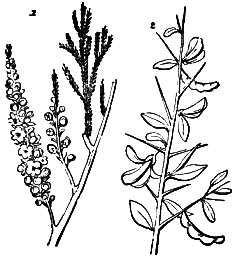
Fig. 251—Manna Plants—1. Alhagi maurorum. 2. Tamarix gallica.
This miracle is referred to in Deu 8:3; Neh 9:20; Psa 78:24; Joh 6:31; Joh 6:49; Joh 6:58; Heb 9:4. Though the manna of Scripture was so evidently miraculous, both in the mode and in the quantities in which it was produced, and though its properties were so different from anything with which we are acquainted, yet, because its taste is in Exodus said to be like that of wafers made with honey, many writers have thought that they recognized the manna of Scripture in a sweetish exudation which is found on several plants in Arabia and Persia. The name man, or manna, is applied to this substance by the Arab writers, and was probably so applied even before their time. But the term is now almost entirely appropriated to the sweetish exudation of the ash trees of Sicily and Italy. These, however, have no relation to the supposed manna of Scripture. Of this one kind is known to the Arabs by the name of guzunjbeen, being the produce of a plant called guz, and which is ascertained to be a species of tamarisk. The same species seems also to be called toorfa, and is common along different parts of the coast of Arabia. It is also found in the neighborhood of Mount Sinai. In the month of June it drops from the thorns of the tamarisk upon the fallen twigs, leaves and thorns, which always cover the ground beneath the tree in the natural state. The Arabs use it as they do honey, to pour over their unleavened bread, or to dip their bread into; its taste is agreeable, somewhat aromatic, and as sweet as honey. ’If eaten in any quantity it is said to be highly purgative.’ When Lieut. Wellsted visited this place in the month of September, he found the extremities of the twigs and branches retaining the peculiar sweetness and flavor which characterize the manna. The Bedouins collect it early in the morning, and, after straining it through a cloth, place it either in skins or gourds; a considerable quantity is consumed by themselves; a portion is sent to Cairo; and some is also disposed of to the monks at Mount Sinai. The latter retail it to the Russian pilgrims.’ ’The Bedouins assured me that the whole quantity collected throughout the Peninsula, in the most fruitful season, did not exceed 150 wogas (about 700 pounds); and that it was usually disposed of at the rate of 60 dollars the woga.’
Another kind of manna, which has been supposed to be that of Scripture, is yielded by a thorny plant very common from the north of India to Syria, and which by the Arabs is called Al-haj: whence botanists have constructed the name Alhagi. The Alhagi maurorum is remarkable for the exudation of a sweetish juice, which concretes into small granular masses, and which is usually distinguished by the name of Persian manna. The climates of Persia and Bokhara seem also well suited to the secretion of this manna, which in the latter country is employed as a substitute for sugar, and is imported into India for medicinal use through Caubul and Khorassan. These two, from the localities in which they are produced, have alone been thought to be the manna of Scripture. But, besides these, there are several other kinds of manna. Indeed, a sweetish secretion is found on the leaves of many other plants, produced sometimes by the plant itself, at others by the punctures of insects. It has been supposed, also, that these sweetish exudations being evaporated during the heat of the day in still weather, may afterwards become deposited, with the dew, on the ground, and on the leaves of plants; and thus explain some of the phenomena which have been observed by travelers and others. But none of these mannas explain, nor can it be expected that they should explain, the miracle of Scripture, by which abundance is stated to have been produced for millions, where hundreds cannot now be subsisted.
The miraculous food given by God to the Israelites during their wanderings in the desert. It was a small grain, white like hoarfrost, round, and of the size of coriander-seed, Exo 16:1-36 Num 11:1-35 . It fell every morning, with the dew, about the camp of the Israelites, and in so great quantities during the whole forty years of their journey in the wilderness, that it was sufficient to serve the entire multitude instead of bread, Exo 16:35 Deu 29:5,6 Jos 5:12 . It is nowhere said that the Israelites had no other food, that numerous flocks and herds accompanied the camp of Israel is clear from many passages. Certainly the daily sacrifices were offered, and no doubt to her offerings affording animal food on which the priests and Levites subsisted, according to their offices.\par When manna was first sent the Israelites "knew not what it was," and "said one to another", MAN-HU, which means, What is it? Most interpreters think that form the frequent repetition of this inquiry the name MAN or manna arose. Burckhardt says, that in the valleys around Sinai a species of manna is still found, dropping from the sprigs of several trees, but principally from the tamarisk, in the month of June. It is collected by the Arabs, who make cakes of it, and call it honey of betrouk. See Exo 16:31 . Since his time it has been ascertained by Dr. Ehrenburg that the exudation of this manna is occasioned by an insect, which he has particularly described. Besides this substance and the manna of commerce, which is used as a laxative medicine, and is produced by the ash-trees of southern Europe, several other vegetable products in Arabia, Persia, etc., of similar origin and qualities, are known by the same name. It is in vain, however, to seek to identify with any of these the manna of the Israelites, which was evidently a special provision for them, beginning and terminating with their need of it. It was found, not on trees and shrubs, but on "the face of the wilderness" wherever they went; and was different in its qualities from any now known by that name, being dry enough to grind and bake like grain, but breeding worms on the second day. It was miraculous in the amount that fell, for the supply of millions; in not falling on the Sabbath; in falling in double quantities the previous day; and in remaining fresh during the Sabbath. By these last three peculiarities God miraculously attested the sanctity of the Sabbath, as dating from the creation and not from Mount Sinai. Moreover, a specimen of manna as laid up in a golden vase in the ark of the covenant in memory of a substance which would otherwise have perished, Heb 9:4 .\par In Psa 78:24-25, manna is called "angels’ food" and "corn of heaven," in token of its excellence, and that it came directly from the hand of God. The people gathered on an average about three quarts for each man. They who gathered more than they needed, shared it freely with others; it could not be hoarded up: and thus, as Paul teaches us, 2Co 8:13-15, it furnishes for all men a lesson against hoarding the earthly and perishable gifts of God, and in favor of freely imparting to our brethren in need.\par This great boon of God to the Israelites also offers many striking analogies, illustrative of "the true Bead" which came down form heaven to rebellious and perishing man, Joh 6:31-58 Jer 2:17 . Like the manna, Christ descends from above around the camp of his church in daily abundant supplies, to meet the wants of every man.\par
Manna. (what is this?). (Hebrew, man). The most important passages of the Old Testament on this topic are the following: Exo 16:14-36; Num 11:7-9; Deu 11:5; Deu 11:16; Jos 5:12; Psa 78:24-25.
From these passages, we learn that the manna came every morning, except the Sabbath, in the form of a small round seed, resembling the hoar frost, so that it must be gathered early, before the sun became so hot as to melt it; that it must be gathered every day except the Sabbath; that the attempt to lay aside for a succeeding day, except on the day immediately preceding the Sabbath, failed because the substance becoming wormy and offensive; that it was prepared for food by grinding and baking; that its taste was like fresh oil, and like wafers made with honey, equally agreeable to all palates; that the whole nation, of at least 2,000,000, subsisted upon it for forty years; that it suddenly ceased when they first got the new corn of the land of Canaan; and that it was always regarded as a miraculous gift directly from God, and not as a product of nature.
The natural products of the Arabian deserts and other Oriental regions which bear the name of manna have not the qualities or uses ascribed to the manna of Scripture. The latter substance was undoubtedly wholly miraculous, and not, in any respect, a product of nature, though its name may have come from its resemblance to the natural manna. The substance now called manna in the Arabian desert, through which the Israelites passed, is collected in the month of June from the tarfa or tamarisk shrub (Tamarix gallica).
According to Burckhardt, it drops from the thorns on the sticks and leaves with which the ground is covered, and must be gathered early in the day or it will be melted by the sun. The Arabs cleanse and boil it, strain it through a cloth and put it in leathern bottles; and in this way, it can be kept uninjured for several years. They use it like honey or butter with their unleavened bread, but never make it into cakes or eat it by itself. The whole harvest, which amounts to only five or six hundred pounds, is consumed by the Bedouins, "who," says Schaff, "consider it the greatest dainty their country affords."
The manna of European commerce conies mostly from Calabria and Sicily. It’s gathered during the months of June and July from some species of ash, (Ornus europaea and Ornus rotundifolia), from which it drops in consequence of a puncture by an insect resembling the locust, but distinguished from it by having a sting under its body. The substance is fluid at night and resembles the dew, but in the morning it begins to harden.
There is a connection between the natural
(1) It was found not under the tamarisk, but on the surface of the wilderness, after the morning dew had disappeared.
(2) The quantity gathered in a single day exceeded the present produce of a year.
(3) It ceased on the sabbath.
(4) Its properties were distinct; it could be ground and baked as meal, it was not a mere condiment but nutritious as bread.
(5) It was found not merely where it still is, but Israel’s whole way to Canaan (and not merely for a month or two each year, but all the year round). The miracle has all the conditions and characteristics of divine interpositions.
(1) A necessity, for Israel could not otherwise have been sustained in the wilderness.
(2) A divine purpose, namely to preserve God’s peculiar people on which His whole providential government and man’s salvation depended.
(3) Harmony between the natural and the supernatural; God fed them, not with the food of other regions, but with that of the district.
The local coloring is marked. Moses the writer could neither have been deceived as to the fact, nor could have deceived contemporaries and eye-witnesses. (Speaker’s Commentary) The Scripture allusions to it are in Exo 16:14-36; Num 11:7-9; Deu 8:3-16; Jos 5:12; Psa 78:24-25 ("angels’ food"; not as if angels ate food, but food from the habitation of angels, heaven, a directly miraculous gift), Mat 4:4; Joh 6:31-50; 1Co 10:3. The manna was a "small round thing as the hoar-frost on the ground," falling with the dew on the camp at night. They gathered it early every morning before the sun melted it.
If laid by for any following day except the sabbath it bred worms and stank. It was like coriander seed and bdellium, white, and its taste as the taste of fresh oil, like wafers made with honey (Num 11:7-9). Israel subsisted on it for 40 years; it suddenly ceased when they got the first new grain of Canaan. Vulgate, Septuagint, and Josephus (Ant. 3:1, sec. 6) derive manna from Israel’s question to one another,
To commemorate Israel’s living on omers or tenth deals of manna one omer was put into a golden pot and preserved for many generations beside the ark. Each was to gather according to his eating, an omer apiece for each in his tent, a command testing their obedience, in which some failed, gathering more but gaining nought by it, for however much he gathered, on measuring it in his tent he found he had only as much as he needed for his family; type of Christian charity, which is to make the superfluity of some supply the needs of others. "that there may be equality" (2Co 8:14-15); "our luxuries should yield to our neighbor’s comforts, and our comforts to his necessities" (John Howard). The manna typifies Christ.
(1) It falls from above (Joh 6:32, etc.) as the dew (Psa 110:3; Mic 5:7) round the camp, i.e. the visible church, and nowhere else; the gift of God for which we toil not (Joh 6:28-29); when we were without merit or strength (Rom 5:6; Rom 5:8).
(2) It was gathered early; so we, before the world’s heat of excitement melt away the good of God’s gift to us (Psa 63:1; Hos 5:15; Hos 6:4; Mat 13:6).
(3) A double portion must be gathered for the sabbath.
(4) It was ground in the mill, as Christ was "bruised" for us to become our "bread of life."
(5) Sweet as honey to the taste (Psa 34:8; Psa 119:103; 1Pe 2:3).
(6) It must be gathered "day by day," fresh each day; so today’s grace will not suffice for tomorrow (1Ki 8:59 margin; Mat 6:11; Luk 11:3). Hoarded up it putrefied; so gospel doctrine laid up for speculation, not received in love and digested as spiritual food, becomes a savor of death not life (1Co 8:1).
(7) To the carnal it was "dry" food though really like "fresh oil" (Num 11:6; Num 11:8; Num 21:5): so the gospel to the worldly who long for fleshly pleasures of Egypt, but to the spiritual it is full of the rich savor of the Holy Spirit (2Co 2:14-16).
(8) Its preservation in the golden pot in the holiest typifies Jesus, now in the heavenly holiest place, where He gives of the hidden manna to him that overcometh (Rev 2:17); He is the manna hidden from the world but revealed to the believer, who has now a foretaste of His preciousness; like the incorruptible manna in the sanctuary, the spiritual food offered to all who reject the world’s dainties for Christ is everlasting, an incorruptible body, and life in Christ at the resurrection.
(9) The manna continued with Israel throughout their wilderness journey; so Christ with His people here (Mat 28:19).
(10) It ceases when they gain the promised rest, for faith then gives place to sight and the wilderness manna to the fruit of the tree of life in the midst of the paradise of God (Rev 2:7; Rev 22:2; Rev 22:14).
Manna, (what is this? Heb. mân). The chief food of the Israelites in the wilderness. Exo 16:14-36; Num 11:7-9; Deu 8:3; Deu 8:16; Jos 5:12; Psa 78:24-25. The most remarkable things about the manna of the Israelites were: 1. That double the quantity was supplied on the day preceding the Sabbath or seventh day; 2. That on the Sabbath or seventh day none was furnished; 3. That what they kept from the sixth day to the seventh was sweet and good, while what they kept from any other day to the next day bred worms and became offensive. These miracles were wrought in attestation of the sanctity of the Sabbath. The manna of the Jews is described as "a small round thing," as small as "the hoarfrost on the ground," "like coriander seed" (in shape doubtless, perhaps in size and density), "of the color of bdellium." "and the taste of it like wafers made with honey." For forty years this miraculous supply of food was furnished daily to between 3,000,000 and 4,000,000 of people. Deu 29:5-6. It ceased while they were encamped at Gilgal, immediately after they had celebrated the passover for the first time in the Land of Promise. To commemorate this wonderful miracle a golden pot was provided, Exo 16:33; Heb 9:4, and an omer (or one man’s portion) of the manna put up for preservation and placed in or near the ark, that succeeding generations might see with their own eyes the very substance on which their fathers were miraculously fed in their long and perilous journeyings from Egypt to Canaan. The manna which is now used in medicine as a mild laxative is the juice of the flowering ash, a native of Sicily, Calabria, and other parts of the south of Europe. It is either naturally concreted, or exsiccated, and purified by art. The best manna is in oblong pieces or flakes of a pale yellow color; light, friable, and somewhat transparent. It has no characteristics in common with the manna miraculously supplied to the Israelites while journeying through the wilderness. Wherever the manna is referred to in Scripture, it is invariably regarded as a miraculous food sent directly from God. The Lord Jesus accepted the manna as a type of himself—the living bread which came down from heaven. "For the bread of God is he which cometh down from heaven and giveth life unto the world." Joh 6:33; Joh 6:48; Joh 6:50. The phrase "hidden manna," Rev 2:17, figuratively describes the spiritual food which Christ supplies to those who believe in him and live by faith in him.
The food miraculously supplied from heaven to the Israelites during the forty years of their wanderings. Its name signifies ’what is it?’ for they knew not what it was. It fell every morning except on the Sabbath, and had to be gathered early, or it melted. If kept till the second day it bred worms, except the double quantity gathered on the day before the Sabbath, which was good on the second day. The quantity to be gathered was on an average an omer (about 4 pints) for every man. Some gathered more and some less, and when they measured it with an omer "he that gathered much had nothing over, and he that gathered little had no lack; they gathered every man according to his eating."
The explanation given by the Rabbis is that though several in a family went out to gather the manna, when it was brought home and measured it was found to be just an omer for each of them. The more probable explanation is that though on an average an omer was the portion for each, some needed more and others less, and therefore every one gathered ’according to his eating,’ according to what he knew he would require, and thus every one had enough and there was nothing wasted. The former part of the passage is quoted in 2Co 8:15, to show that in making a collection for the poor saints there should be the carrying out of this divine principle of ’equality,’ the abundance of some contributing to the need of others.
The manna ceased as soon as the Israelites had crossed the Jordan, and eaten of the old corn of the promised land. The manna is described as being like coriander seed, of the colour of bdellium. It was ground in mills, or pounded in a mortar, and baked in pans, or made into cakes. It tasted like wafers made with honey, Exo 16:31; but afterwards, when the people had lost their relish for it, like fresh oil. Num 11:6-9. The people, alas, murmured because they had nothing to eat but the manna.
The manna is typical of Christ Himself, the vessel of God’s good pleasure, and of heavenly grace here on earth - the heavenly One in the midst of earthly circumstances. He is this heavenly grace now for His own, so that grace is ministered to them for the wilderness journey. When they are viewed as in the land, that is, as made to sit in heavenly places in Christ, and entering in spirit upon their heavenly and eternal portion, then Christ in glory, the centre of all the Father’s counsels, is their food, as the ’old corn’ of the promised land. The Christian, whose heart is not set for God’s purpose, gets tired of the manna, and longs, alas, for other food, as the Israelites did. Exo 16:15-35; Deu 8:3; Deu 8:16; Jos 5:12; Neh 9:20; Psa 78:24; Heb 9:4. In Rev 2:17 the Lord promises to give to the overcomer in the church in Pergamos to eat of the HIDDEN MANNA, that is, some sweet secret communion with Himself, known in the glory as the One who suffered here.
MANNA.—The miracle of the loaves and fishes, by which Jesus fed five thousand men, stirred the multitudes to fanaticism (Joh 6:1-15). Their first impulse was to make Jesus king by force. On the morrow they followed Him across the sea to Capernaum, hoping that He would feed them again in some supernatural way, and suggesting the giving of bread from heaven as a suitable sign in confirmation of His high claims. Would not the prophet of Nazareth imitate the great lawgiver, who gave their fathers bread from heaven? Jesus turns their thoughts away from Moses to God: ‘It was not Moses that gave you the bread out of heaven, but my Father giveth you the true bread out of heaven.’ As God gave the fathers literal bread from heaven, so now He is giving to their children spiritual food that nourishes the soul eternally. ‘I am the bread of life; he that cometh to me shall not hunger, and he that believeth on me shall never thirst.’ ‘Your fathers did eat the manna in the wilderness, and they died.’ God has a far better gift than the manna that was gathered day by day in the wilderness. ‘I am the living bread that cometh down out of heaven: if any man eat of this bread, he shall live for ever; yea, and the bread which I will give is my flesh, for the life of the world’ (Joh 6:51).
In Rev 2:17 the spiritual blessing promised by the glorified Christ to the victor in life’s battle is called ‘hidden manna.’
John R. Sampey.
( ).
).
By: Executive Committee of the Editorial Board., M. Seligsohn
—Biblical Data:
The miraculously supplied food on which the Israelites subsisted in the wilderness. Its name is said to have originated in the question  ("What is it?" Ex. xvi. 15, R. V.; comp. Rashi ad loc.), asked by the Israelites when they first saw it. According to George Ebers ("Durch Gosen zum Sinai," p. 236), the name comes from the Egyptian "mennu" (= "food"). The manna is also designated "bread" (Ex. xvi. 4); it is called "the corn of heaven" and "the bread of the mighty" in Ps. lxxviii. 24-25, R. V., and, in a depreciative sense, "the light bread" in Num. xxi. 5. The manna descended in the night in the form of coriander-seed of the color of bdellium (Num. xi. 7), so that in the morning the ground looked as if it were covered with hoar frost. The grains were ground or pounded into flour, and then the flour was prepared and baked in the form of cakes, the taste of which was like that of "wafers made with honey" or "as the taste of fresh oil" (Ex. xvi. 31; Num. xi. 8).
The gathering of the manna was connected with several miracles: it was collected before sunrise, for, in spite of its hard substance, it melted in the sun. The quantity collected made exactly one omer for every person, whether one collected much or little. On Friday morning the portions were double, for the manna could not be found on Sabbath. The manna was eaten the day it was gathered; if it were left until the following morning it corrupted and bred worms, though the manna gathered on Friday and kept for the Sabbath remained fresh. It continuedto descend during the forty years the Israelites were in the wilderness, but when they arrived at Gilgal, on the 14th of Nisan, and began to eat the grain grown there, the manna ceased to fall. In order to perpetuate the memory of this providence, Aaron was told to put an omer of manna in a vessel and lay it "before the testimony" (Ex. xvi. 17-35; Josh. v. 10-12). Num. xxi. 5 makes it appear that manna was the only food of the Israelites while they were in the wilderness, although references to provisions of fine flour, oil, and meat are met with elsewhere. It may be either that the manna constituted their main but not only food-supply during the whole forty years, or that it became their exclusive food after the provisions they took with them from Egypt were exhausted.
Certain modern scholars attempt to identify the manna of Exodus with the exudation of the tamarisk-trees (named by Ehrenberg the "Tammarix mannifera") of the Sinaitic peninsula. The Arabs call it "mann al-sa-ma" (= "heavenly manna"), and collect it and sell it to pilgrims. It has been identified also with the exudations of other trees found in those regions. A more recent view identifies the Biblical manna with lichen and allied species of plants found in Arabia and other parts of western Asia. The reports of modern travelers, however, are contradictory in regard to "manna."
—In Rabbinical Literature:
Manna was one of the ten things created on the first Friday of Creation, in the twilight (Abot v. 9; comp. Targ. pseudo-Jonathan to Ex. xvi. 4, 15). According to Zabdi b. Levi, the manna which fell near the camp of the Israelites in the wilderness covered an area two thousand cubits square; it remained on the ground until four hours after sunrise, when it melted. It fell to a depth of sixty cubits, or, according to Isi b. Akiba (Midr. Teh. to Ps. xxiii.), of fifty cubits, and the quantity which fell every day would have sufficed to nourish the people for two thousand years. The question why was it necessary that the manna should fall every day is answered by the Rabbis in different ways: the Israelites could not be encumbered with its burden; they needed warm food every day, and the manna was warm when it fell; they needed that their hearts should be turned to God for their daily bread. It was so conspicuous that all the kings of the East and West could see it from their palaces (Yoma 76a; Tan., Beshallaḥ, 21).
In order that the manna might remain clean, a north wind first swept the ground, and then rains washed it. Then, after the ground had been covered with a layer of dew, the manna fell upon it, and was itself then covered with dew (Mek., Beshallaḥ, Wayassa', 3; comp. Sifre, Num. 89). It so fell that the righteous had no trouble in gathering it, finding it at the doors of their tents; those of less firm belief had to go farther for it; the wicked had to go far from the camp to gather it (Yoma 75a). A very different statement, but of the same nature, is given in Tan., Beshallaḥ, 22: The diligent went out into the field to gather the manna; the less diligent went just outside their tents; but the indolent lay in their sleeping-places while the manna fell into their outstretched hands. Created only for the children of Israel, the heathen could not secure the smallest quantity of it, for when one stretched out his hand to pick it up, it slipped from his grasp (Sifre, Deut. 313; Midr. Abkir, in Yalḳ., Ex. 258); according to another opinion, it tasted bitter to the heathen (Tan., l.c.).
Israelites Gathering Manna in the Desert.(From the Sarajevo Haggadah of the fourteenth century.)
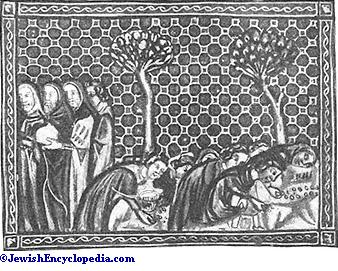
The melting of the manna formed streams which furnished drink to many deer and other animals, and when those animals were afterward killed by heathen, the latter recognized in the meat the taste of the manna (Tan., l.c.; comp. Targ. pseudo-Jonathan to Ex. xvi. 21). It was only in this way that the heathen could know the true taste of the manna, for the water itself was bitter to them (Tan., l.c.). With the manna precious stones fell every morning (Yoma l.c.). The manna was adapted to the taste of each individual; to the adult it tasted like the food of the adult, while to the sucking child it tasted like the milk of its mother's breasts. By wishing, one could taste in the manna anything desired, whether fowl or fruit; thus the statement that the people ground it, or pounded it, and then baked it (Num. xi. 8), is only figurative, for if one so wished it tasted like food made of flour ground or pounded, baked or cooked. According to a different interpretation, the wicked were compelled to grind it and prepare it until it was fit for food, while for the righteous it was ground by angels before it fell from heaven.
Characteristics.
The manna exhaled a fragrant odor, and during the forty years the Israelites wandered in the wilderness it served the women as perfume. Being a heavenly food, the manna contained nutritious matter only, without any waste products, so that during the whole time the Israelites lived upon it the grossest office of the body remained unexercised. The Israelites, nevertheless, complained of it (comp. Num. xi. 6): "Shall a human being not discharge of what he eats? our bowels will surely be swollen" (Yoma l.c.; Sifre, Num. 87-89; Tan., l.c.). A miracle attended the collecting of the manna, in that the number of omers gathered by each family was found to correspond to the number of its members. This rendered the manna useful in solving most difficult problems. For instance, when two people came before Moses, one accusing the other of having stolen his slave and the other claiming to have bought the slave, Moses deferred his decision to the following morning, when the number of omers of manna in their respective houses showed to whom the slave belonged. In this way many otherwise inextricable complications could be unraveled (Yoma 75a).
The Rabbis disagreed as to the period of time for which the pot of manna was placed by Aaron "before the testimony." It was placed there only for the following generation; it was placed there for all future generations; it was to be kept there until the coming of the Messiah. It is one of the three things which will be restored by Elijah. Jeremiah, when remonstrating with the children of Israel for their neglect of the Torah, showed them the pot of manna: "See how God nourishes those that occupy themselves with the study of the Law." There is also a disagreement between the Rabbis with regard to the length of time after Moses' death in which the Israelites ate the manna—whether for forty days, seventy days, or for the fourteen years during which the land of Canaan was conquered and divided among the tribes. According to R. Joshua, the manna ceased to descend immediately after Moses' death, and the Israelites were compelled to eat what they had gathered previously (Mek., l.c.). The manna is reserved as the future food of the righteous, for which purpose it is ground in a mill situated in Sheḥaḳim, the third heaven (Ḥag. 12b; Tan., l.c.).
MANNA.—The food of the Israelites during the wanderings (Exo 16:1, Jos 5:12), but not the only food available. Documents of various dates speak of (a) cattle (Exo 17:3; Exo 19:13; Exo 34:3, Num 7:3; Num 7:6 f.), especially in connexion with sacrifice (Exo 24:5; Exo 32:8, Lev 8:2; Lev 8:25; Lev 8:31; Lev 9:4; Lev 10:14, Num 7:15 ff.); (b) flour (Num 7:13; Num 7:19; Num 7:25 etc., Lev 10:12; Lev 24:5); (c) food in general (Deu 2:3, Jos 1:11).
1. The origin of the word is uncertain. In Exo 16:13 the exclamation might be rendered, ‘It is mân!’ (note RVm
2. The manna was flaky, small, and white (Exo 16:14; Exo 16:31). It resembled the ‘seed’ (better ‘fruit’) of the coriander plant (Exo 16:31, Num 11:7), and suggested bdellium (Num 11:7 [see § 3]). It could be ground, and was stewed or baked (Exo 16:23, Num 11:8). The taste is compared to that of honey-wafers (Exo 16:31), or oil (Num 11:8), it was gathered fresh every morning early (but see § 4), for, if exposed to the sun, it melted (Exo 16:21; cf. Wis 19:2); if kept overnight (see § 4), it went had (Exo 16:19 f.). Each person was entitled to a measured ’omer of manna (Exo 16:19).
3. Many would identify manna with the juice of certain trees. The flowering ash (S. Europe) exudes a ‘manna’ (used in medicine); and a species of tamarisk found in the Sinai peninsula yields a substance containing sugar. The description of manna would not in every point support such an identification, but it is worth noting that manna is likened (see § 2) to bdellium, which is a resinous exudation. A more recent theory is that manna was an edible lichen like that found in Arabia, etc.
4. Manna would thus come under the category of ‘special providences,’ not ‘miracles.’ There can, however, be no doubt that the Biblical writers regarded it as miraculous. (a) There is enough for a host of ‘600,000 footmen.’ (b) The quantity gathered proves exactly suited to the consumer’s appetite (Exo 16:18). (c) The Sabbath supply (gathered the previous day) retains its freshness (Exo 16:23 f.). (d) An ‘omer of it is kept as a sacred object near (Exo 16:33 f.) but not within (1Ki 8:9; ct.
5. All this must lend significance to NT mention. Christ as the living bread is typified by manna (Joh 6:31 ff., 1Co 10:3; 1Co 4:1-21); and secret spiritual sustenance is the reward for ‘him that overcometh’ (Rev 2:17).
H. F. B. Compston.
A sweet exudate, called in Arabic mann or mann es-sama (manna of heaven), which exudes in drops from the Tamarix Mannifera, the tarfa tree.
A similar substance yielded by other shrubs, or, according to Niebuhr, by a species of oak tree.
A laxative exudate of the flowering ash, Traximus Ornus.
A miraculous food sent by God to the Hebrews in the Exodus, described in Exodus 16, and Numbers 11. The etymology of the name is clearly given in Exodus 16: man hu, "wvhat is it?" It is a desperate rebellion against evidence to try to identify the miraculous manna of the Exodus with the natural exudates. The daily consumption of manna, as computed by Macalister was more than 300 tons; as he rightly declares "all the Tamarisks in the desert could not have yielded this daily provision." This natural exudate is only found during two months of autumn; it has been falsely described, having none of the properties asserted of the miraculous substance of the Exodus.
New Catholic Dictionary
(Gr. man, manna; Lat. man, manna).The food miraculously sent to the Israelites during their forty years sojourn in the desert (Exodus 16; Numbers 11:6-9). It fell during the night in small white flakes or grains which covered the ground and presented the appearance of hoar frost. These grains are described as resembling coriander seed and bdellium, with a taste like "flour with honey", or "bread tempered with oil" (Exodus 16:31; Numbers 11:7-8).The manna fell for the first time while the Israelites were in the desert of Sin, six weeks after their departure from Egypt, in answer to their murmurs over the privations of desert life (Exodus 16:1 sq.) and thenceforth fell daily, except on the Sabbath, till they arrived at Galgal in the plain of Jericho (Joshua 5:12). During these years the manna was their chief but not their only article of diet. Their herds furnished them some milk and meat; they had oil and flour, at least in small quantities, and at times purchased provisions from neighbouring peoples (Leviticus 2 sq.; 17:1 sq.; Deuteronomy 2:6, 28). The manna had to be gathered in the morning, as the heat of the sun melted it. The quantity to be collected was limited to a gomor (omer, between six and seven pints) per person; but on the eve of the Sabbath a double portion was gathered. When kept over night it putrefied and bred worms, except the portion which was reserved for the Sabbath. Though it was probably eatable in the natural state, it was usually ground in a mill or beaten in a mortar and then boiled and made into cakes. As a reminder to future generations, a vessel filled with manna was placed near the Ark of the Covenant. The name is connected with the exclamation "Man hu", which the Israelites uttered on first seeing it. This expression since the time of the Septuagint is generally translated "What is this?", though it should more probably be translated "Is this manna?", or "It is manna". A substance named mannu was known in Egypt at that time, and the resemblance of the newly fallen food to this substance would naturally call forth the exclamation and suggest the name.Many scholars have identified the Biblical manna with the juice exuded by a variety of Tamarix gallica (Tamarix mannifera) when it is pricked by an insect (Coccus manniparus), and known to the Arabs as mann es-sama, "gift of heaven" or "heavenly manna". But although manna in several respects answers the description of the manna of the Bible, it lacks some of its distinctive qualities. It cannot be ground or beaten in a mortar, nor can it be boiled and made into cakes. It does not decay and breed worms, but keeps indefinitely after it is collected. Besides, being almost pure sugar, it could hardly form the chief nourishment of a people for forty years. But even if the identify were certain, the phenomenon of its fall, as recorded in Exodus, could not be explained except by a miracle. For, although the tamarisk was probably more plentiful in the days of the Exodus than it is now, it could not have furnished the large quantity of manna daily required by the Israelites. Moreover, the tamarisk manna exudes only at a certain season, whereas the Biblical manna fell throughout the year; it exudes every day during its season, while the Biblical manna did not fall on the Sabbath. Most of these objections apply also to the juice exuded by the Camel’s Thorn (Alhagi Camelorum), which is sometimes considered identical with Biblical manna.Others think they have found the true manna in a lichen, Lenora esculenta (also known as Spharothallia esculenta), met with in Western Asia and North Africa. It easily scales off, and being carried away by the wind sometimes falls in the form of a rain. In times of famine it is ground and mixed with other substances to make a kind of bread. But this lichen is dry and insipid, and possesses little nutritive value. The regular fall in this case, too, would be miraculous. The manna may, indeed, have been a natural substance, but we must admit a miracle at least in the manner in which it was supplied. For not only does the phenomenon resist all natural explanation, but the account of Exodus, as well as the designation "bread from heaven", "bread of angels", i.e., sent by the ministry of angels (Psalm 77:24-25; Wisdom 16:20), plainly represents it as miraculous.Christ uses the manna as the type and symbol of the Eucharistic food, which is true "bread from heaven":, and "bread of life", i.e., life-giving bread, in a far higher sense than the manna of old (John 6). St. Paul in calling the manna "spiritual food" (1 Corinthians 10:3), alludes to its symbolical significance with regard to the Eucharist as much as to its miraculous character. Hence the manna has always been a common Eucharistic symbol in Christian art and liturgy. In Apoc., ii, 17, the manna stands as the symbol of the happiness of heaven.----------------------------------- HUMMELAUER, Com. In Exod. (Paris, 1897), 168 sq.; EBERS, Durch Gosen zum Sinai (Leipzig, 1872), 236; RITTER, Die Erdkunde (Berlin, 1848), xiv, 665 sq.; BURCKHARDT, Travels in Syria (London, 1822), 600 sq.; LESETRE in VIG., Dict de la Bible, s. v.; ZENNER, Man hu in Zeirschr. der Kath. Theol., xxiii (1899), 164; PETERS, Zu Man hu, ibid., 371. F. BECHTEL Transcribed by Thomas M. Barrett Dedicated to Jesus Christ, our "Bread of Life from Heaven" The Catholic Encyclopedia, Volume IXCopyright © 1910 by Robert Appleton CompanyOnline Edition Copyright © 2003 by K. KnightNihil Obstat, October 1, 1910. Remy Lafort, CensorImprimatur. +John M. Farley, Archbishop of New York
1. Old Testament References:
This substance is described as occurring in flakes or small round grains, literally, “hoax frost”; it fell with the dew (Num 11:9) and appeared when the dew left the ground (Exo 16:14); “It was like coriander seed, white; and the taste of it was like wafers made with honey” (Exo 16:31). In Num 11:8, its taste is described “as the taste of fresh oil,” margin “cakes baked with oil.” “And the children of Israel did eat the manna forty years, until they came ... unto the borders of the land of Canaan” (Exo 16:35). It ceased the day after they ate the produce of the land, unleavened cakes and parched grain, in the plains of Jericho (Jos 5:10-12). Although an important article of diet, it was by no means the sole one as seems implied in Num 21:15; there are plenty of references (e.g. Exo 17:3; Exo 24:5; Exo 34:3; Lev 8:2, Lev 8:26, Lev 8:31; Lev 9:4; Lev 10:12; Lev 24:5; Num 7:13, Num 7:19 f, etc.) which show that they had other food besides. The food was gathered every morning, “every man according to his eating: and when the sun waxed hot, it melted” (Exo 16:21); a portion of the previous day’s gathering bred worms and stank if kept (Exo 16:20); on the 6th day a double amount was gathered, the Sabbath portion being miraculously preserved (Exo 16:22-27). A pot - a golden one (Heb 9:4) - with an omer of manna was “laid up before Yahweh” in the tabernacle (Exo 16:33). Manna is referred to in Neh 9:20. It is described poetically as “food from heaven” and “bread of the mighty” (Psa 78:24 f); as “bread of heaven” (Psa 105:40); and as “angels’ bread” (2 Esdras 1:19; The Wisdom of Solomon 16:20).
2. New Testament References:
In Jn 6:31-63, our Lord frequently refers to “the manna” or “bread from heaven” as typical of Himself. Paul (1Co 10:3) refers to it as “spiritual food,” and in Rev 2:17 we read, “To him that overcometh, to him will I give of the hidden manna.”
Manna, as might be expected, figures largely in rabbinical literature. It was, it is said, adapted to the taste of each individual who could by wishing taste in the manna anything he desired (compare The Wisdom of Solomon 16:21). Manna is reserved as the future food of the righteous (compare Rev 2:17), for which purpose it is ground in a mill situated in the third heaven (Chag 12b; Tan. Beshallach 22).
3. Natural Explanations:
No substance is known which in any degree satisfies all the requirements of the Scriptural references, but several travelers in the wilderness have reported phenomena which suggest some of the features of the miraculous manna.
(1) In the Peninsula of Sinai, on the route of the children of Israel, a species of tamarisk, named in consequence by Ebers Tammaris mannifera, is found to exude a sweet, honey-like substance where its bark is pierced by an insect, Gossyparia mannifera. It collects upon the twigs and falls to the ground. The Arabs who gather it to sell to pilgrims call it
(2) A second proposal is to identify manna with a lichen - Lecanora esculenta and allied species - which grows in the Arabian and other deserts upon the limestone. The older masses become detached and are rolled about by the wind. When swept together by sudden rain storms in the rainy season they may collect in large heaps. This lichen has been used by the Arabs in time of need for making bread. It is a quite reasonable form of nourishment in the desert, especially when eaten with the sugary manna from the trees.
(ìÜííá)
1. Among the sacra contained in the Tabernacle the writer of Heb. mentions (Heb_9:4) the pot of manna, which Aaron was directed to lay up before the Lord as a perpetual memorial of the miraculous food whereby the Israelites were sustained in the wilderness (Exo_16:33). The Heb. text does not describe the pot as golden, but the NT writer follows the Septuagint , which reads ëÜâå óôÜìíïí ÷ñõóïῦí ἕíá. In Solomon’s Temple the two tables of stone were the sole contents of the ark of the covenant (1Ki_8:9), but the Rabbis assumed that the jar of manna was also deposited there, evidently basing their belief on the words ‘before the Lord.’
2. The Message to the Church of Pergamos (Rev_2:12-17) contains the promise that he who overcomes-refusing at all costs to eat things sacrificed to idols-shall be fittingly rewarded by receiving the hidden manna to eat. There is here probably an allusion to the Jewish tradition that, before the Fall of Jerusalem, the ark and its sacred contents were removed by Jeremiah and hidden in a cave of Mount Sinai (2Ma_2:1), from which they were to be restored to their place at the coming of the Messiah, when all the old miracles would be repeated. ‘And at that time,’ says Apoc. Bar. (xxix. 8), ‘the stores of manna shall descend again from above; and they shall eat of it in those years.’ After manna had come to be named ‘corn of heaven’ (Psa_78:24), ‘bread of the mighty’ (Psa_78:25), ‘heavenly bread’ (Psa_105:40), panis angelorum (4 Ezr. 1:29), ÜããÝëùí ôñïöÞ (Wis_16:20), ἀìâñïóßá ôñïöÞ (Wis_19:21), it was naturally regarded not merely as material nourishment but as ‘spiritual food’ (âñῶìá ðíåõìáôéêüí [1Co_10:3]). Like the bread of Christ’s own miracles, it had sacramental value, feeding the soul as well as the body (cf. Joh_6:31-33).
James Strahan.
Deu 8:3 (a) This bread is a type of CHRIST, the living Bread. GOD gave it to Israel in a miraculous way. He is the living bread which sustains the lives of GOD’s people. It was always pure white. It was sweet. There was enough for all. (See also Joh 6:49; Heb 9:4).
Rev 2:17 (a) This bread is a type of some sort of unseen and unknown blessings which are given by GOD for the blessing of His people when they live victorious lives for Him. It is a gift that is lovely, precious, attractive and satisfying, but the character of it is unknown.
Manna was a kind of food that God first gave to the Israelites soon after they left Egypt. It remained their daily food for the next forty years (Exo 16:4; Num 11:6; Psa 78:23-24). It was not, however, their only food (Exo 18:12; Lev 7:14-15; Lev 11:2-3; Lev 11:9; Num 11:31-34). God’s provision of the manna ceased once the people arrived in Canaan (Jos 5:12).
The people of Israel gave the food the name ‘manna’ (meaning ‘What is it?’) because they did not know what else to call it (Exo 16:15; Exo 16:31). We today do not know exactly what the manna was or how it was made. Possibly it was a substance prepared by insects that sucked the gum from trees. It formed during the night and was ready to be collected in the morning. It was fine, flaky, tasted like wafers mixed with honey, and could be cooked in various ways (Exo 16:14; Exo 16:23; Exo 16:31; Num 11:7-9).
God supplied the manna every morning, and the people had to eat it the same day. The only exceptions concerned the Sabbath rest day. There was no manna on Saturday mornings, but God gave two days’ supply each Friday, half of which the people kept for use on Saturday. Because the manna spoiled quickly, the people preserved the supply for Saturday by baking or boiling it beforehand. Moses controlled the collection and distribution of the manna so that no one had too much or too little (Exo 16:4-5; Exo 16:15-18; Exo 16:23).
The command that prohibited keeping the manna overnight tested the people’s obedience. The promise that ensured complete Sabbath rest through the double supply each Friday tested their faith. But in both matters they failed (Exo 16:19-30).
In accordance with God’s instructions, Moses put part of the manna in a jar, to keep as a memorial of how God fed his people in the wilderness. This jar was later placed in the ark of the covenant together with Aaron’s rod and the stone tablets inscribed with the law (Exo 16:31-35; Heb 9:4).
God also used the manna to teach the Israelites that their lives depended not merely on the food they ate, but on their spiritual relationship with God (Deu 8:3; cf. Mat 4:4). Jesus compared the gift of manna to satisfy physical hunger with the gift of himself to satisfy spiritual hunger. He did not need to make food fall from heaven, for he himself was the true bread from heaven (Joh 6:31-35). He gave himself as a sacrifice for sin, so that those who trust in him may have eternal life (Joh 6:48-51; cf. Rev 2:17).
The special food provided by God
that the Israelites gathered daily from
the ground during the 40 years they
wandered through the desert. See
Ex. 16:4–36.