
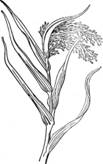
Fig. 253—Millet—Panicum miliaceum
Millet occurs in Eze 4:9, where the Prophet is directed to take unto him wheat, and barley, and beans, and lentiles, and millet and fitches, and to put them into one vessel, and to make bread thereof for himself. All the grains enumerated in this verse continue to form the chief articles of diet in the East in the present day, as they appear to have done in ancient times. The common millet is cultivated from the middle of Europe to the most southern part of India and is sometimes cultivated in England on account of the seeds being used for feeding birds and poultry. But the grain is usually imported into this country from the Mediterranean. In India it is cultivated in the cold weather, that is, in the same season with wheat and barley, and is an article of diet with the inhabitants. Having mentioned the extreme points where this grain is cultivated, it is hardly necessary to state that it is produced in the intermediate countries. Tournefort says that in the Isle of Samos the inhabitants, in preparing their bread, knead together one half wheat and the other half barley and millet mixed together. It is also an article of diet both in Persia and India, and is so universally cultivated in the East as one of their smaller corn-grasses, that it is most likely to be the kind alluded to in the passage of Ezekiel.
A kind of grain of which there are several species cultivated in Italy, Syria, Egypt, and India. It is used partly green as fodder, and partly in the ripe grain for bread, etc. Eze 4:9, received an order from the Lord to make himself bread with a mixture of wheat, barley, beans, lentiles, and millet. "Durra," says Niebuhr, "is a kind of millet, made into bread with camel’s milk, oil, butter, etc, and is almost the only food eaten by the common people of Arabia Felix. I found it so disagreeable, that I would willingly have preferred plain barley bread." This illustrates the appointment of it to the prophet Ezekiel as a part of his hard fare.\par
Millet. A kind of grain. A number osf species are cultivated in the East. When green, it is used as fodder, and for bread when ripe. Eze 4:9. It is probable that both the Sorghum vulgare and the Panicum miliaceum were used, and the Hebrew, dochan, may denote either of these plants.
Eze 4:9,
Millet, the grain of the cultivated panic-grass (Panicum miliaceum), or of du-rah (variously spelled, but thus pronounced). Eze 4:9. Durah or Egyptian corn (Sorghum vulgate) resembles maize in size and general appearance, and is largely cultivated upon the Nile.
dochan. Small seeds used as an ingredient in coarse bread or in pottage. Eze 4:9. The Hebrew word is held to embrace at least two species of millet, the Sorghum vulgare and the Panicum miliaceum.
By: Joseph Jacobs, Immanuel Löw
An important species of grain which grows chiefly in sandy regions. In Arabia, Italy, and elsewhere a bread, excellent when fresh, is made of it, and also of the species Panicum italicum Linn. The grain is mentioned but once in the Bible, in Ezek. iv. 9: "Take thou also unto thee wheat, and barley, and beans, and lentils, and millet, andfitches, and put them in one vessel, and make thee bread thereof." Since this passage was evidently intended to enumerate all the kinds of grain used for making bread, millet ("doḥan") was included; but it is practically impossible to decide which variety the prophet meant. Rosenmüller and others preferred to translate "doḥan" by "Indian millet," because the Arabic "dukhn" was shown by Forskål to have this meaning, although Furrer had already pointed out that panicum likewise bears the same name; it is best to translate "doḥan" by "millet," especially if the Biblical "sorah" be rendered "sorghum" (Isa. xxviii. 25, A. V., "wheat"; with which Sachau compares the  [i.e., "durrah" = "broom-corn"] of an inscription at Zenjirli; comp. Post, "Flora of Syria, Palestine, and Sinai," p. 854, Beirut, 1896), and to use "panicum" as a translation of "pereg," which is first found in the Mishnah. The Syrians, misled by their word "peragga," have traced this Mishnaic word to the "pannag" of Ezek. xxvii. 17. The Septuagint and the Vulgate, followed by the English versions, incorrectly translate "nisman" (Isa. xxviii. 25) by "millet."
Mishnah.
In Mishnaic times millet of two kinds, rice, and sesame constituted a separate category of cultivated plants, which were grouped between grain and pulse, although rice and millet more closely approached the former (Löw, "Pflanzennamen," p. 102; Sheb. ii. 7; Yer. Sheb. 34a, 10; Sifra, Behar, 105c; R. H. 13b; Ḥal. i. 4; Mek., Bo, 8b, 12; 9a, 27; Sifre, i. 110, 146; ii. 105; Yer. Peah i. 16c, 23; Mek., Deut. i. 14; Hoffmann). Dioscorides discusses the four kinds of plants in the same sequence. In spite of the fact that rice and millet are kinds of grain, they were not included among the recognized species ('Er. 81a; Pes. 35a; Ber. 37a; "Halakot Gedolot," ed. Hildesheimer, p. 54; Maimonides, "Yad," Berakot, v. 10; "Kesef Mishne," ad loc.).
Foreign names for millet occur in rabbinical works, e.g.: "hirse," "hirsen" ("'Aruk ha-Ḳaẓer"; "Lebush," Oraḥ Ḥayyim, 208, 8; Isaac Tyrnau; et passim), "arzan hindi" (Bacher, "Sefer ha-Shorashim," No. 879), "dokhn" (Maimonides), "ḍurra" ("Birke Yosef," Oraḥ Ḥayyim, 205), "mil," "miglio" (D. Ḳimḥi, "Zunz Jubelschrift," Hebrew part, p. 97; Rashi), "panis," "panitz" (Rashi, and A. Berliner, "Festschrift," p. 248), "panizo" ("Paḥad Yiẓḥaḳ," s.v.).
Bibliography:
Beckmann, Beiträge, ii. 543;
Rosenmüller, Biblische Naturgesch. i. 84;
Ibn Safir, Eben Sappir, i. 40a;
Wönig, Die Pflanzen im Alten Aegypten, pp. 173 et seq., Leipsic, 1886.
MILLET (probably Panicum miliaceum or perhaps Andropogon sorghum) is mentioned in Eze 4:9 (only) as an ingredient in bread. See Food, § 2.
Both the common millet and the dourra were cultivated in Egypt in very ancient times; the Hebrew
Millet. An annual grain-producing grass which was under one meter (three feet) high and produced many seeds. The seeds of millet were smaller than other cereal grains. Millet has been known since ancient times in Palestine and Egypt. It was used for bread ( Eze 4:9) and eaten raw, especially by the poor.
Millet is referred to in several different ways in ( Eze 27:17). It is translated pannag in the KJV, confections in the NIV, meal in the NEB, and cakes in the NASB.
Millet is a small-seeded grass that people grow for food and for its leaves (Ezekiel 4:9). People originally grew millet (Panicum miliaceum) in Europe and Asia for its edible seeds.
Millet seeds are the smallest of all grass seeds that people grow for food, but the plants produce many seeds. Millet is a grass that lives for one year and usually grows no taller than 0.6 meter (2 feet).
The small seeds of millet are used on cakes. In some cases, people eat the seeds uncooked.
Aquifer Open Bible Dictionary © 2026 Mission Mutual, an adaptation of the Tyndale Open Bible Dictionary © 2023 Tyndale House Publishers. Licensed under CC BY-SA 4.0.
Discussion:
To illustrate the siege of Jerusalem, Ezekiel is instructed to make a loaf of bread out of wheat, barley, beans, lentils, millet (dochan in Hebrew), and spelt in EZK 4:9. In Arabic millet is called dukhn or dochna, suggesting that the Hebrew word dochan could indeed be millet. Some scholars believe that Millet Panicum miliaceum or Panicum callosum was first domesticated in Ethiopia, but others say in India or the East Indies. From one of those places it was carried into Mesopotamia around 3000 B.C. If that is so, it may have been known to the people of Israel during their stay in Egypt as well as after the conquest of Canaan. Zohary implies that dochan was either millet or sorghum (see 3.1.3 Sorghum (durra)). In EZK 27:17 a reference is made to pannag, which Moldenke takes as possibly referring to millet, on the basis of the fact that in Syriac pannag refers to millet. However, Hepper says that neither millet nor sorghum reached the Mediterranean area before the Christian era, making it unlikely that dochan or pannag refer to either millet or sorghum.
Today millet is used throughout the world for porridge, alcoholic beverages, and as animal food. It is not good for bread, which may be significant in the incident mentioned in EZK 4:9.
Description:
If indeed millet was grown at all in Old Testament times, it would have been a short variety less than 1 meter (3 feet) in height. It has a single head on a stalk, with many tiny seeds, so the Latin name is miliaceum (“million seeds”).
Translation:
There are six hundred kinds of Panicum species growing in the warm and tropical zones of the world, many of them domesticated, and two in Europe. Translators who do not have a local word for millet will need to use a transliteration from a major language, for example, French millet, Portuguese miliyo, and Spanish mijo. Since the references to millet are part of lists in non-rhetorical contexts, there is no need to look for a cultural equivalent.
Plants and Trees in the Bible © United Bible Societies. Licensed under CC BY-SA 4.0.