
A particular dress or habit worn to signify grief on some melancholy occasion, particularly the death of friends, or of great public characters. The modes of mourning are various in various countries: as also are the colours that obtain for that end. In Europe the ordinary colour for mourning is black; in China, it is white; in Turkey, blue or violet; in Egypt, yellow; in Ethiopia, brown. Each people pretend to have their reasons for the particular colour of their mourning. White is supposed to denote purity; yellow, that death is the end of human hopes, as leaves when they fall, and flowers when they fade, become yellow; brown denotes the earth, whither the dead return; black, the privation of life, as being the privation of light; blue expresses the happiness which it is hoped the deceased enjoys; and purple or violet, sorrow on the one side, and hope on the other, as being a mixture of black and blue. For an account of the mourning of the Hebrews, see Lev 19:21: Jer 16:6. Num 20:1-29: Deu 34:8.
We find in the early ages of the church, great lamentation observed at the death of their friends The funeral of Sarah is set forth in this view. And still more, in that of the patriarch Jacob, Seven days the funeral halted at the threshing - floor of Atad. And the astonishment of the inhabitants of the land was so great, that they gave a name to it, and called it Abel - mizraim; that is, the mourning of the Egyptians, (Gen 1:7 - 11. We find that the Israelites themselves called all places of their mourning by one name, Bochim, that isweepers. (See Judges 2: 1 - 5.)
See BURIAL and See DEAD.
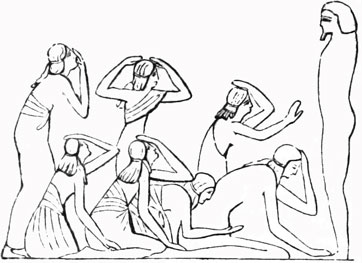
Fig. 257—Egyptian Mourners putting ashes on their Heads
This head embraces both the outward expressions of sorrow for the dead, referred to in the Scriptures, and those expressions which were intended to exhibit repentance, etc. These subjects may be noticed according to Townsend’s chronological arrangement, and since they nearly approximate, will be pursued together. Under this arrangement, the earliest reference to any kind of mourning is that of Job (B.C. 2130), who, being informed of the destruction of his children as the climax of his calamities, ’arose, rent his mantle, shaved his head, and fell down upon the ground and worshipped’ (Job 1:20), uttered sentiments of submission (Job 1:21), and sat down among the ashes (Job 2:8). His friends came to him by an appointment among themselves to mourn with him and comfort him (Job 2:11); they lift up their voices and wept upon a view of his altered appearance; they rent every man his mantle and sprinkled dust upon their heads towards heaven (Job 2:12), and sat down with him on the ground seven days and seven nights, waiting till his grief should subside before they commenced their office as mourners. Job then bewails aloud his unhappy condition (Job 3). In Job 16:15-16, reference is made to the customs of sewing sackcloth upon the skin, defiling the head with dust, and suffering the face to be begrimed with weeping. Clamor in grief is referred to (Job 19:7; Job 30:28): it is considered a wicked man’s portion that his widows shall not weep at his death (Job 27:15). However it is to be accounted for, in the course of the book of Job nearly all the chief characteristics of eastern mourning are introduced. This will appear as we proceed. The next instance is that of Abraham, who came to mourn and weep for Sarah (B.C. 1871), words which denote a formal mourning (Gen 23:2). Days of mourning are referred to in regard to the expected death of Isaac (Gen 27:41). These appear generally to have consisted of seven, as for Saul (1Sa 31:13). Weeping appears (B.C. 1729), either as one chief expression of mourning, or as the general name for it. Hence when Deborah, Rebecca’s nurse, was buried at Bethel under an oak, at this period, the tree was called Allon-bachuth, the oak of weeping (Gen 35:8). The children of Israel were heard to weep by Moses throughout their families, every man in the door of his tent (Num 11:10; comp. 14:1; 25:6). So numerous are the references to tears in the Scriptures as to give the impression that the Orientals had them nearly at command (comp. Psa 6:6). Reuben rent his clothes upon finding Joseph gone (Gen 37:29), and uttered lamentations (Gen 37:30). Jacob rends his clothes and puts sackcloth upon his loins, and mourns for his son many days; his sons and his daughters rise up to comfort him and he gives utterance to his grief; thus his father wept for him (Gen 37:34-35). Joseph’s brothers rend their clothes (Gen 44:13); and this act, as expressive of grief or horror, occurs in multitudes of passages down to the last age of the Jewish empire (Act 14:14). Scarcely less numerous are the references to sackcloth on the loins as an expression of mourning; we have even lying in sackcloth (1Ki 21:27), and sackcloth upon both man and beast at Nineveh (Jon 3:8). Joseph’s brethren fell to the ground before him in token of grief (Gen 44:14); and this, or lying or sitting on the ground, was a common token of mourning (comp. Psa 35:14; 1Sa 5:4; Isa 3:26; Isa 47:1; Eze 26:16, etc.). The next incident in the history of the subject is the mourning for Jacob by the Egyptians, which was conducted, no doubt, by professional mourners during threescore and ten days (Gen 50:3), called the days of mourning (Gen 50:4), though most likely that computation includes the process of embalming. It seems to have amounted to a royal mourning, doubtless out of regard to Joseph. The mourning for Joseph’s father was renewed by Joseph’s command, with a very great and sore lamentation, upon the funeral cavalcade having arrived in Canaan, and continued seven days (Gen 50:10). When the children of Israel (B.C. 1491) mourned under the threat of the divine displeasure, they did not put on their ornaments (Exo 33:4; comp. Joe 2:13; Eze 24:17). At the giving of the law the modes of mourning were regulated by several enactments. It was forbidden the Jews to make cuttings in their flesh for the dead (Lev 19:28). The ancient Egyptians, according to Herodotus, did not cut themselves (Herodotus ii. 61); it was a Syrian custom, as appears from the votaries of Baal (1Ki 18:28); nor were the Jews allowed to make any baldness between their eyes for the dead (Deu 14:1). The priests were forbidden to uncover the head in mourning (Lev 10:6), or to rend their clothes, or to contract the ceremonial defilement involved in mourning except for their nearest kindred (Lev 21:1; Lev 21:4); but the high-priest was entirely forbidden to do so even or his father or his mother (Lev 21:11), and so was the Nazarite (Num 6:7). These prohibitions respecting the head and the beard (Lev 19:27) seem to have been restricted to funeral occasions, as the customs referred to were lawfully practiced on other sorrowful events (comp. Ezr 9:3; Job 1:20; Isa 22:12; Jer 7:29; Mic 1:16). Even the food eaten by mourners was considered unclean (comp. Deu 26:14, with Hos 9:4; Eze 24:17). The Jews were commanded to afflict their souls on the Day of Atonement (Lev 23:27; Num 29:7). All the house of Israel mourned for Aaron thirty days (Num 20:29). The Israelites wept for Moses thirty days, called the days of weeping and mourning for Moses (Deu 34:8; B.C. 1451). Joshua and the elders of Israel put dust upon their heads at the defeat of Ai, and fasted (Jos 7:6), as did the eleven tribes after the defeat at Gibeah, and wept (Jdg 20:26), as did all the Israelites at the command of Joshua, on which occasion it is said ’they drew water and poured it out before the Lord’ (1Sa 7:6; comp. Psa 22:14). The prophet Joel commanded a fast as part of a national mourning. A fast is proclaimed to all the inhabitants or visitors at Jerusalem (Jer 36:9; comp. Zec 7:5). Fasting is practiced at Nineveh as part of a public humiliation (Jon 3:5). In our Lord’s language, ’to fast’ and ’to mourn’ are the same thing (Mat 9:15). Public humiliations attended with religious assemblies and prayers (Joe 2:16-17); with fasts (Isa 58:3); see all these united (1Ma 3:44; 1Ma 3:47-48). The first complete description of mourning for the dead occurs in 2Sa 3:31; 2Sa 3:35. Elegies were composed by the prophets on several disastrous occasions (Eze 26:1-18; Eze 27:1-36; Amo 5:1, etc.). In Psa 35:12-14, which is ascribed to David, there is a description of the humiliations practiced by the friends of the sick, in order to procure their recovery. Samuel is honored with a public mourning by the Israelites (1Sa 25:1), B.C. 1058. Upon the death of Saul, David wrote an elegy (2Sa 1:17-27). This, like that upon the death of Abner, seems to be a poetical description of the character of the departed, like the dirge for an Egyptian king. Lifting up the hands seems to have been an expression of grief (Psa 141:2; Lam 1:17; Ezr 9:5). Messengers were sent to condole with survivors; thus David sent such to Hanun, king of Ammon, upon the death of his father (2Sa 10:1-2); ’Many of the Jews came to comfort Martha and Mary’ (Joh 11:19); ’A great company of women attended our Lord to the cross, bewailing and lamenting him’ (Luk 23:27); ’Much people’ were with the widow of Nain (Luk 7:12). Indeed, if persons met a funeral procession they were expected to join it—a custom which is thought to illustrate St. Paul’s words, ’Weep with them that weep’ (Rom 12:15). Ashes were often laid on the head in token of mourning; thus ’Tamar put ashes on her head, rent her garment, and laid her hand upon her head, and went on crying’ (2Sa 13:19-20; comp. Isa 61:3; 2Es 9:38). They even wallowed in ashes (Eze 27:30). Mourning apparel is first mentioned in 2Sa 14:2, where it appears that the wearer did not anoint himself with oil (comp. Mat 6:17). The first reference to hired mourners occurs in Ecc 12:5, ’The mourners go about the streets.’ They are certainly alluded to in Jer 9:17-20, ’the mourning women’ (probably widows, comp. Psa 78:64; Act 9:39). Another reference to them occurs in 2Ch 35:25. The greater number of the mourners in ancient Egypt were women, as in the modern East. In the included figure (fig. 257) mourners, all females, are shown casting dust upon their heads before the mummy of a man. Mourning for the dead was conducted in a tumultuous manner; they also wept and wailed greatly (Mar 5:38). Even devout men made great lamentations (Act 8:2).
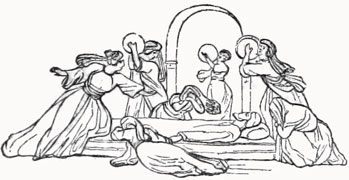
Fig. 258—Wailing with Tabrets, etc.
Among other signs of mourning they shaved the head, and even tore off the hair (Amo 8:10; Mic 1:16; Isa 15:2; Isa 22:12; Jer 7:29). Ezra plucked off the hair of his head and of his beard (Ezr 9:3; Josephus, Antiq. xvi. 7. 5). The Jews went up to the house-tops to mourn (Isa 15:2-3; Isa 22:1); and so did the Moabites (Jer 48:37-38: Jdt 8:5). They also made cutting in their hands(Jer 48:37-38); they smote upon the thigh (Jer 31:19; Eze 21:12); on the breast (Nah 2:7; Luk 18:13; Luk 23:48); they smote both hands together (Num 24:10, stamped with the foot (Eze 6:11), bowed down the head (Lam 2:10), covered the lips (Mic 3:7), the face (2Sa 19:4), and the head (2Sa 15:31), and went barefoot (2Sa 15:30). Neighbors and friends provided food for the mourners (2Sa 3:35; Jer 16:7; comp. Eze 24:17); this was called ’the bread of bitterness,’ ’the cup of consolation.’ In later times the Jews had a custom of giving bread to the poor, at funerals, and leaving it for their use at tombs and graves. Women went to tombs to indulge their grief (Joh 11:31); anniversary mourning (1Es 1:32).
The Hebrews, at the death of their friends and relations, made striking demonstrations of grief and mourning. They wept, tore their clothes, smote their breasts, threw dust upon their heads, Jos 7:6, and lay upon the ground, went barefooted, pulled their hair and beards, or cut them, Ezr 9:3 Isa 15:2, and made incisions on their breasts, or tore them with their nails, Lev 19:28 21:5 Jer 16:6 48:37. The time of mourning was commonly seven days, 1Sa 31:11-13 ; but it was lengthened or shortened according to circumstances, Zec 12:10 . That for Moses and Aaron was prolonged to thirty days, Num 20:29 Deu 34:8 ; and that for Jacob to seventy days, Gen 50:3 .\par During the time of their mourning, the near relations of the deceased continued sitting in their houses, and fasted, 2Sa 12:16, or ate on the ground. The food they took was thought unclean, and even themselves were judged impure. "Their sacrifices shall be unto them as the bread of mourners: all that eat thereof shall be polluted," Hos 9:4 . Their faces were covered, and in all that time they could not apply themselves to any occupation, nor read the book of the law, nor offer their usual prayers. They did not dress themselves, nor make their beds, nor uncover their heads, nor shave themselves, nor cut their nails, nor go into the bath, nor salute any body. Nobody spoke to them unless they spoke first, Job 2:11-13 . Their friends commonly went to visit and comfort them, Joh 11:19,39, bringing them food, 2Sa 3:35 Jer 16:7 . They also went up to the roof, or upon the platform of their houses, to bewail their misfortune: "They shall gird themselves with sackcloth; on the tops of their houses, and in their streets, every one shall howl, weeping abundantly," Isa 15:3 Jer 48:38 . The mourning dress among the Hebrews was not fixed either by law or custom. We only find in Scripture that they used to tear their garments, a custom still observed; but now they tear a small part merely, and for form’s sake, 2Sa 13:19 2Ch 34:27 Ezr 9:3 Job 2:12 Joe 2:13 . Anciently in times of mourning, they clothed themselves in sackcloth, or haircloth, that is, in clothes of coarse brown or black stuff, 2Sa 3:31 1Ki 21:27 Gen 4:1 Psa 35:13 69:11.\par They hired women to weep and wail, and also persons to play on instruments, at the funerals of the rich or distinguished, Jer 9:17 . In Mat 9:23, we observe a company of minstrels or players on the flute, at the funeral of a girl of twelve year of age. All that met a funeral procession were accustomed to join them for a time, to accompany them on their way, sometimes relieving the bearers of the bier, and mingling their tears with those of the mourners, 1Ch 12:15 .\par The custom of hiring women to weep and wail has come down to modern times. The following account of such a scene at Nablous, the ancient Shechem, is form Dr. Jowett. The governor of the city had died the very morning of Dr. Jowett’s arrival. "On coming within sight of the gate, we perceived a numerous company of females, who were singing in a kind of recitative, far from melancholy, and beating time with their hands. If this be mourning, I thought, it is of a strange kind. It had indeed sometimes more the air of angry defiance. But on our reaching the gate, it was suddenly exchanged for most hideous plaints and shrieks, which, with the feeling that we were entering a city at no time celebrated for its hospitality, struck a very dismal impression upon my mind. They accompanied us a few paces; but it soon appeared that the gate was their station, to which having received nothing from us, they returned. We learned, in the course of the evening, that these were only a small detachment of a very numerous body of ’cunning women’ with the design, as of old, to make the eyes of all the inhabitants ’run down with tears, and their eyelids gush out with water,’ Jer 9:17-18 . For this good service, they would, the next morning wait upon the government and principal persons, to receive some trifling fee."\par Some of the Jewish forms of mourning are the appropriate and universal language of grief; others, to our modern and occidental taste, savor of extravagance. None of these were enjoined by their religion, which rather restricted than encouraged them, Lev 10:6 19:27 21:1-11 Num 6:7 Deu 14:1 . They were the established customs of the times. Sorrow finds some relief in reversing all the usages of ordinary life. Christianity, however, moderates and assuages our grief; shows us a Father’s hand holding the rod, and the dark valley itself penetrated by the heavenly light into which it emerges, 1Co 15:53-55 1Th 4:14-18 Jer 7:13-17 14:13.\par
Mourning. One marked feature of Oriental mourning is what may be called its studies publicity, and the careful observance of the prescribed ceremonies. Gen 23:2; Job 1:20; Job 2:12.
1. Among the particular forms observed the following may be mentioned:
(a) Rending the clothes. Gen 37:29; Gen 37:34; Gen 44:13; etc.
(b) Dressing in sackcloth. Gen 37:34; 2Sa 3:31; 2Sa 21:10; etc.
(c) Ashes, dust or earth sprinkled on the person. 2Sa 13:19; 2Sa 15:32; etc.
(d) Black or sad-colored garments. 2Sa 14:2; Jer 8:21; etc.
(e) Removal of ornaments or neglect of person. Deu 21:12-13; etc.
(f) Shaving the head, plucking out the hair of the head or beard. Lev 10:6; 2Sa 19:24; etc.
(g) Laying bare some part of the body. Isa 20:2; Isa 47:2; etc.
(h) Fasting or abstinence in meat and drink. 2Sa 1:12; 2Sa 3:35; 2Sa 12:16; 2Sa 12:22; etc.
(i) In the same direction may be mentioned diminution in offerings to God, and prohibition to partake of sacrificial food. Lev 7:20; Deu 26:14.
(k) Covering the "upper lip," that is, the lower part of the face, and sometimes the head, in token of silence. Lev 13:45; 2Sa 15:30; 2Sa 19:4.
(l) Cutting the flesh; Jer 16:6-7; Jer 41:5; beating the body. Eze 21:12; Jer 31:19.
(m) Employment of persons hired for the purpose of mourning. Ecc 12:5; Jer 9:17; Amo 5:16; Mat 9:23.
(n) Akin to the foregoing usage; the custom for friends or passers-by to join in the lamentations, of bereaved or afflicted persons. Gen 50:3; Jdg 11:40; Job 2:11; Job 30:25; etc.
(o) The sitting or lying posture in silence indicative of grief. Gen 23:3; Jdg 20:26; etc.
(p) Mourning feast and cup of consolation. Jer 16:7-8.
The period of mourning varied. In the case of Jacob, it was seventy days, Gen 50:3, of Aaron, Num 20:29, and Moses, Deu 34:8, thirty days. A further period of seven days in Jacob’s case. Gen 50:10. Seven days for Saul, which may have been an abridged period in the time of national danger. 1Sa 31:13.
With the practices above mentioned, Oriental and other customs, ancient and modern, in great measure agree. Arab men are silent in grief, but the women scream, tear their hair, hands and face, and throw earth or sand on their heads. Both Mohammedans and Christians in Egypt hire wailing-women, and wail at stated times.
Burckhardt says the women of Atbara, in Nubia, shave their heads on the death of their nearest relatives - -a custom prevalent also among several of the peasant tribes of upper Egypt. He also mentions wailing-women, and a man in distress besmearing his face with dirt and dust in token of grief.
In the "Arabian Nights" are frequent allusions to similar practices. It also mentions ten days and forty days as periods of mourning. Lane, speaking of the modern Egyptians, says, "After death, the women of the family raise cries of lamentation, called welweleh or wilwal, uttering the most piercing shrieks, and calling upon the name of the deceased, ’Oh, my master! Oh, my resource! Oh, my misfortune! Oh, my glory!’ " See Jer 22:18.
The females of the neighborhood come to join with them in this conclamation: generally, also, the family send for two or more neddabehs or public wailing-women. Each brings a tambourine, and, beating them, they exclaim, ’Alas for him!’ The female relatives, domestics and friends, with their hair dishevelled and, sometimes with rent clothes, beating their faces, cry in like manner, ’Alas for him!’ These make no alteration in dress, but women, in some cases, dye their shirts, head-veils and handkerchiefs of a dark-blue color. They visit the tombs at stated periods." -- Mod. Eg. Iii. 152, 171, 195.
Noisy, violent, and demonstrative in the East as it is among the Irish, Highlanders, and Welsh; beating the breast or the thigh (Eze 21:12), cutting the flesh (Jer 16:6), weeping with a loud cry, wearing dark colored garments, hiring women as professional mourners (Ecc 12:5; Mat 9:23; Amo 5:16),"skillful in lamentation" (Jer 9:17), singing elegies, having funeral feasts and the cup of consolation (Jer 16:7-8). It was an occasion of studied publicity and ceremonial; so Abraham for Sarah (Gen 23:2), Jacob for Joseph (Gen 37:34-35), Joseph and the Egyptians for Jacob 70 days and a further period of seven (Gen 50:3-10), Israel for Aaron 80 days (Num 20:29), and for Moses (Deu 34:8). Jabesh Gileadites for Saul fasted seven days (1Sa 31:13); David for Abner with fasting, rent clothes, and sackcloth, and with an elegy (2Sa 3:81-89).
Job for his calamities, with rent mantle, shaven head, sitting in ashes; so the three friends with dust upon their heads, etc., seven days and nights (Job 1:20-21; Job 2:8). In the open streets and upon the housetops (Isa 15:2-3); stripping off ornaments (Exo 33:4); stripping the foot and some other part of the body (Isa 20:2). Penitent mourning was often expressed by fasting, so that the words are interchanged as synonymous (Mat 9:15), and the day of atonement, when they "afflicted their souls," is called "the fast" (Act 27:9; Lev 23:27; Israel, 1Sa 7:6; Nineveh, Jon 3:5; the Jews when hereafter turning to Messiah, Zec 12:10-11). Exclusion from share in the sacrificial peace offerings (Lev 7:20), Covering the upper lip and the head, in token of silence: Lev 13:45, the leper; 2Sa 15:30, David. The high priest and Nazarites were not to go into mourning for even father or mother or children (Lev 21:10-11; Num 6:7).
So Aaron in the case of Nadab and Abihu (Lev 10:2-6); Ezekiel for his wife (Eze 24:16-18); "the bread of men" is that usually brought to mourners by friends in sympathy. The lower priests only for nearest relatives (Lev 21:1-4). Antitypically, the gospel work is to take precedence of all ties (Luk 9:59-60): "let me first go and bury my father" means, let me wait at home until he die and, I bury him. The food eaten in mourning was considered impure (Deu 26:14; Hos 9:4). The Jews still wail weekly, each Friday, at Jerusalem, in a spot below the temple wall, where its two courses of masonry (with blocks 30 ft. long) meet.
Mourning. Oriental mourning is public and careful of prescribed ceremonies. Gen 23:2; Job 1:20; Job 2:12. Among the forms observed the following may be mentioned: Rending the clothes, Gen 37:29; Gen 37:34; Gen 44:13, etc.; dressing in sackcloth, Gen 37:34; 2Sa 3:31; 2Sa 21:10, etc.; ashes, dust or earth sprinkled on the person, 2Sa 13:19; 2Sa 15:32, etc.; black or sad-colored garments, 2Sa 14:2; Jer 8:21, etc.; removal of ornaments or neglect of person, Deu 21:12-13, etc.; shaving the head, plucking out the hair of the head or beard, Lev 10:6; 2Sa 19:24, etc.; laying bare some part of the body, Isa 20:2; Isa 47:2, etc.; fasting or abstinence in meat and drink, 2Sa 1:12; 2Sa 3:35; 2Sa 12:16; 2Sa 12:22, etc. In later times for the employment of persons hired for the purpose of mourning, Ecc 12:5; Jer 9:17; Amo 5:16; Mat 9:23, friends or passers-by to join in the lamentations of bereaved or afflicted persons, Gen 50:3; Jdg 11:40; Job 2:11; Job 30:25, etc.; and in ancient times the sitting or lying posture in silence indicative of grief, Gen 23:3; Jdg 20:26, etc. The period of mourning varied. In the case of Jacob it was seventy days, Gen 50:3; of Aaron, Num 20:29, and Moses, Deu 34:8, thirty. A further period of seven days in Jacob’s case. Gen 50:10. Seven days for Saul, which may have been an abridged period in the time of national danger. 1Sa 31:13.
It was the habit of the Hebrews, as it still is in the East, to make a great demonstration of their mourning. They would beat their breasts, cover their heads, fast, put dust and ashes on their heads, neglect their hair, wear dull-coloured garments, rend their clothes, wear sackcloth, etc. For Asa and Zedekiah there was ’great burning’ of odours at their death, which was most probably copied from the heathen. 2Ch 16:14; Jer 34:5. At a death professional mourners were hired, mostly women. "Call for the mourning women . . . . let them make haste, and take up a wailing for us, that our eyes may run down with tears, and our eyelids gush out with waters." Jer 9:17-18; cf. 2Sa 14:2; Amo 5:16. Musicians also attended at deaths, who played mournful strains. Mat 9:23. God does not desire those who are bereaved to be without feeling: the Lord wept at the grave of Lazarus, but He would have reality in all things. He had to say to His people, "Rend your heart, and not your garments." Joe 2:13.
Those That Mourn
Job_5:8-11; Mat_5:4; Luk_6:21.
When People Mourn
Pro_29:2.
Who Shall Mourn
Luk_6:24-25.
Who To Mourn With
Rom_12:15.
MOURNING.—An expression of grief for death or disaster. See also artt. Lamentation and Rending of Garments. Mourning is associated in the Gospels (1) with ‘the appearance of the sign of the Son of Man,’ Mat 24:30; (2) with the removal of the visible presence of the Saviour, Mat 9:15; (3) with the death of friends. It is also one of the conditions mentioned in the Beatitudes as bearing a special blessing (Mat 5:4, but cf. Luk 6:21). The laws of mourning were very minute. The general time of mourning was seven days, during which the mourner was forbidden to work, wash, anoint himself, or wear his shoes. This last provision might, however, be evaded by putting earth or ashes into his boots. For seven days the mourner might not read in the Law, the Prophets, or the Talmud, because it was a ‘joy’ to do so; but a teacher could teach others through an interpreter. The mourner was allowed during this period to read only the books of Job, Jeremiah, Lamentations, and the
‘Blessed art thou, O God our Lord, King of the universe, God of our Fathers, our Creator, our Redeemer, our Sanctifier, the Holy One of Jacob, the King of Life, who art good and doest good; the God of truth, the righteous Judge who judgest in righteousness, who takest the soul in judgment, and rulest alone in the universe, who doest in it according to His will, and all His ways are in Judgment, and we are His people and His servants, and in everything we are bound to praise Him and to bless Him, who shields all the calamities of Israel and will shield us in this calamity, and from this mourning will bring us to life and peace. Comfort, O God our Lord, all the mourners of Jerusalem, and all the mourners that mourn in our sorrow. Comfort them in their mourning, and make them rejoice in their agony as a man is comforted by his mother. Blessed art Thou, O God, the Comforter of Zion, and that buildest again Jerusalem’ (Jewish prayer-books from
Literature.—See under Rending of Garments.
W. H. Rankine.
( ):
):
By: Cyrus Adler, Judah David Eisenstein
Mourning Period.
Manifestation of sorrow and grief over the loss, by death or otherwise, of a relative, a friend, an honored leader or prophet, or over a national calamity.
—Biblical Data:
It is recorded that Abraham mourned for Sarah (his wife) and wept for her (Gen. xxiii. 2). Jacob mourned "many days" for the supposed death of Joseph. David lamented for Absalom, in spite of the latter's ill conduct. The mourning for an only son was profound (Amos viii. 10). The days of mourning for parents were generally observed (Gen. xxvii. 41). Joseph mourned seven days for his father (ib. 1. 10), while the mourning of the captive Gentile woman lasted thirty days (Deut. xxi. 13), showing that the Gentile period of mourning for a parent exceeded that of the Hebrews.
The death of a person who had been esteemed and honored in life was publicly lamented by the people as a tribute of respect. Jacob was thus honored in Egypt when he died; the Egyptians organized an elaborate public funeral, and their mourning for him lasted seventy days (Gen. 1. 3). Among the Hebrews a public mourning never exceeded thirty days, even in the case of their greatest prophet, Moses (Deut. xxxiv. 8).
The mourning for a national defeat or other public calamity was confined to the day the news of the misfortune was received. For an exceptionally great and epoch-marking calamity, as the destruction of the Temple on the 9th of Ab, every anniversary of the event was observed as a day of mourning.
The manner of mourning differed according to the degree of the loss and distress connected with it. The Gentile captive mourned for her parents by remaining within the house, weeping, cutting off her hair, and paring her nails, abundant hair and long nails being considered marks of feminine beauty; whereas among men, during mourning, the hair and nails were allowed to grow. Mourning was also marked by throwing dust on the head (Josh. vii. 6), by wearing sackcloth, sitting in ashes, lacerating the flesh, and tearing out the hair of the head and face (Jer. xvi. 6). Such self-mutilation, however, was forbidden by Moses (Lev. xxi. 5; Deut. xiv. 1). Other forms of mourning are indicated in Ezek. xxiv. 17, as (1) crying, (2) removing the head-dress, (3) removing the shoes, (4) covering the lips as a guard of silence, (5) eating "the bread of mourners" (Hos. ix. 4).
To express his sorrow for the death of Saul and Jonathan and the defeat of Israel, David rent his clothes, wept, and fasted all day (II Sam. i. 11, 12). David's lament on that occasion is one of the gems of Hebrew poetry. Seven days' mourning for the dead appears to have been usual among the Jews (comp. Ecclus. [Sirach] xxii. 12).
—In Rabbinical Literature:
According to the Talmud, the seven days of mourning were observed even before the Flood. The seven days of grace granted to the wicked generation of the Flood (Gen. vii. 4) were to allow the period of mourning for Methuselah to expire (Sanh. 108b; Gen. R. xxxii. 10). An inference is drawn from the verse in Amos (viii. 10), "I will turn your feasts into mourning"—the principal feasts, like those of Passover and Sukkot, continue seven days; so also do the mourning days (M. Ḳ. 20a). Another reason for the number seven is that it is a tenth of man's allotted span of three-score and ten ("Sefat Emet," xix.; quoted in Levensohn, "Meḳore Minhagim," § 97).
The mourning proper, according to the Talmud, is divided into four periods. The first three days are given to weeping and lamentation; the deceased is eulogized up to the seventh day, the mourner keeping within the house; the somber garb of mourning is worn up to the thirtieth day, and personal adornment is neglected; in the case of mourning for a parent, the pursuit of amusement and entertainment is abandoned up to the end of the year.
Mourning is represented as a sword raised over the mourner's shoulders during the first three days; it approaches him from the corner of the room up to the end of seven days; it passes him on the street up to the end of thirty days; it is likely to strike any one of the family during the whole year (M. Ḳ. 27b; Yer. M. Ḳ. iii. 7; comp. Shulḥan 'Aruk, Yoreh De'ah, 394, 4).
Limitations to Grief.
Excessive mourning is discouraged, as it would imply that "the mourner is possessed of more pity than the Almighty." "One who persists in mourning overmuch for his dead will mourn for another death" (M. Ḳ. 27b). The prolongation of mourning to twelve months probably originated with the instruction given by Judah ha-Nasi I., that his disciples should close the yeshibah and observe full mourning for thirty days; that to the end of twelve months the yeshibah should be closed during one-half of the day and that the other half should be devoted to eulogies of the dead nasi (Ket. 103b). There is also an allusion in the Zohar to the belief that while the soul of a righteous person clings to his body for the first thirty days before entering heaven, the soul of an ordinary person clings to the body for twelve months (Zohar, Wayaḳhel, pp. 398, 419, ed. Wilna, 1882). The full year of mourning is now observed only for parents.
Mourning Habit and "Keri'ah."
The mourning garments worn by a widow (Gen. xxxviii. 14) were probably black (comp. II Sam. xiv. 2). R. Yannai contrasted the black garment ofa mourner with the white garment of a bridegroom (Shab. 114a). Naḥmanides quotes R. Isaac ibn Ghayyat on the custom of wearing black ("Torat ha-Adam," p. 27d, ed. Venice, 1595). Asheri says "one may mourn for his father-in-law by wearing black for twelve months; one may mourn so for a mere friend, as did David for Abner" ("Rabbenu Asher," Rule 27, No. 9). In Russia, Poland, and Galicia the Jews discarded black for mourning in order to avoid seeming to ape the Christian custom. The only outward sign of mourning observed there is the "keri'ah" (rent) in the garment (there are numerous references in the Bible to rending the garments as a sign of grief). The rent must be at least a handbreadth (4 inches) long, and it is usually made in the lapel of the coat. In case of a parent's death the mourner must rend all the clothes worn by him during the mourning period. In ancient times it was customary to mourn for a parent, a principal teacher, or a nasi by exposing both shoulders through the upper garments; for a ḥakam (chief rabbi) the right shoulder was exposed, for the ab bet din the left shoulder. This custom had already become obsolete in the Middle Ages.
Ceremonies.
Full mourning is limited to the following occasions: the death of a (1) father, (2) mother, (3) son, (4) daughter, (5) brother, (6) sister, (7) wife or husband (comp. Lev. xxi. 2, 3). The Rabbis included a half-brother and half-sister. Mourning need not be observed for a child that has lived less than thirty days. The ceremonies observed in mourning for a kinsman are as follows: The time between death and the burial is called "aninut" (= "deep grief"), during which the mourner must not eat in the same house with the dead, and, except on Sabbath or on a holy day, must not eat in company, nor eat meat, nor drink wine. On returning from the burial "Shib'ah" commences—the seven days during which the mourner is confined to the house, in which he sits on the floor or on a low bench, devoting his time to reading the Book of Job. He is excused from rising when an elder, or even a nasi, passes. The lamentation while sitting may have been derived from Neh. i. 4.
The first meal after the funeral is prepared by a neighbor; it is called "se'udat habra'ah" (= "meal of consolation"). It usually consists of bread with eggs or lentils (B. B. 16a), the latter being a symbol of death. The mourner occupies the front seat in the room when the consolers come to visit him, as indicated in Job xxix. 25, the Talmudic interpretation of which is "as one comforted by mourners" (Ket. 69b). "Silence is the price of consolation in a house of mourning" (Ber. 6b). Aaron "held his peace" when apprised of the death of his sons Nadab and Abihu (Lev. x. 3). Hence the conversation is limited to praises of the deceased. The mourner, however, speaks first, and it is provided that he pronounce the benediction, "Praised be the Almighty, the righteous Judge." The visitors must not make observations reflecting on Providence, as, for instance, "What can you do?" On leaving, the visitors say, "May the Almighty comfort you among all mourners for Zion and Jerusalem."
Mourners' Ordinance.
The things prohibited to mourners during Shib'ah are: (1) manual labor or business transactions; (2) bathing or anointing the body; (3) wearing shoes or sandals; (4) reading the Torah or studying (the reading of the Book of Job or the Lamentations excepted); (5) cohabitation; (6) lying on the bed when it is in its usual horizontal position (hence it was necessary to take down the canopy and fold up the lower supports so that one end of the bed might touch the ground); (7) washing and preparing garments; (8) cutting the hair. The last two prohibitions are in force up to the end of thirty days, while music and all forms of recreation are usually excluded for the whole year, especially when the mourning is for a parent. Marrying is prohibited during the first thirty days; in the case of mourning for husband or wife this prohibition extends to a year. The prohibition against working during Shib'ah is modified where the mourner is dependent on his daily earnings; in such a case he may resume his work in private after three days.
Friends Giving Mourners Bread of Affliction.(From Kirchner, "Jüdisches Ceremoniel," 1726.)
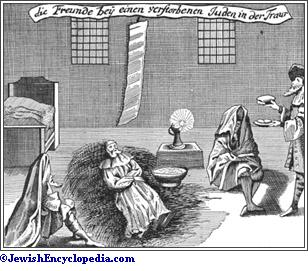
Many exceptions to these regulations are enumerated in Yoreh De'ah, 380-383. The Sabbath excludes public mourning, but is counted in the Shib'ah. A holy day suspends the Shib'ah when the latter has begun at least one hour before the holy day; otherwise the Shib'ah is postponed until after the holy day. The holy days also deduct seven days from the thirty days of mourning ("Sheloshim"),and where the Shib'ah expires immediately before the holy days begin, the thirty days of mourning are entirely suspended. The Feast of Tabernacles causes fourteen days to be deducted from the thirty days, if the Shib'ah begins at least one hour before the holy days. See Burial; Funeral Rites; Jahrzeit; Ḳaddish.
Bibliography:
Maimonides, Yad, Ebel; Shulḥan, 'Aruk, Yoreh De'ah, 340-403;
Shibbole ha-Leḳeṭ, Semaḥot, §§ 1-53 (ed. Buber, pp. 337-368, Wilna, 1886);
Levensohn, Zerubbabel, iv. 50;
Geiger, Wiss. Zeit. Jüd. Theol. iii. 214-233;
Nowack, Lehrbuch der Hebräischen Archäologie, i. 193;
Benzinger, Arch. p. 163;
Eisenstein, Mourners' Almanac, New York, 1900;
Morris Jastrow, Jr., in Journal of the American Oriental Society, No. 20, pp. 133-150.
Mourning is primarily the expression of sorrow for the dead; but the term is also applied to the grief over sin and to the distress over calamity.
1. A list of mourning customs among the Hebrews will be found in the article ‘Mourning’ in Hasting's Dictionary of the Bible (5 vols) . Among them are weeping and wailing of an intentionally demonstrative and unrestrained kind, the rending of garments, the wearing of sackcloth, the sprinkling of dust and ashes on the head, the striking of breast and head, fasting, ejaculations of woe, the recital of elegies for the departed. Reference is made to several of these customs in the description given in Revelation 18 of the mourning over the destruction of Babylon. The worldly kings, the merchants and mariners, act as mourners: they weep and wail, cast dust upon their heads, utter exclamations of woe, and in turn dirgefully declare the past glories of the fallen (Rev_18:10 f.). The term êïðåôüí (used in Act_8:2 to indicate the lamentation of the devout men over Stephen; cf. êüøïíôáé [Rev_1:7; Rev_18:9]; derivation, êüðôåéí, ‘to strike’) indicates the association of the beating of head and breast with mourning. In Act_9:36 f. the widows gather round the body of Dorcas, weep and recount her good deeds. In Jam_5:1 the rich are bidden to weep and howl, i.e. as wailing mourners.
2. The Pauline version of the eucharist introduces the words, ‘Do this in remembrance of me’ (åἰò ôὴí ἐìὴí ἀíÜìíçóéí), and the rite is regarded as a proclamation of the Lord’s death till He come (1Co_11:24-26). This language suggests a comparison with the customs of commemorative mourning for the dead (cf. the annual lamentation for Jephthah’s daughter [Jdg_11:40]; see article ‘Jahrzeit’ in Jewish Encyclopedia ). If the Pauline version of the eucharist has been influenced by the mysteries, the mourning customs for Attis and Adonis (‘weeping for Tammuz,’ see J. G. Frazer’s Adonis, Attis, Osiris3, 1914) may not be without significance for the study of this feature of the Lord’s Supper.
3. The gravity with which sin was regarded is suggested by the application of terms of mourning to the grief over transgression. Sinners are bidden, as a sign of humble penitence, to be afflicted, mourn, and weep. Laughter is to be turned to mourning (Jam_4:9; cf. 1Ki_1:27). Among the welcome indications of a repentant Corinthian church is its mourning (ὀäõñìüò [2Co_7:7]). The idea in the writer’s mind in Rev_1:7 (‘Behold, he cometh with the clouds, and every eye shall see him, and they that pierced him, and all the tribes of the earth shall mourn over him’) was probably the mourning of guilt, regret, and shame-there was no need to mourn a living Christ returning in glory. Possibly, however, the words indicate that now all nations recognized that the ignominiously crucified One was worthy of a world’s mourning.
4. National calamity is presented under the figure of a bereavement (cf. the mourning for Israel [Joe_1:8; Joe_1:13]). Babylon in her strength boasts, ‘No widow am I, and shall in no wise see mourning’ (Rev_18:7). In a day she knows the widowhood of retributive disaster (Rev_18:8). The representation changes-widowed Babylon is herself mourned for by others (Rev_18:8-19); see 1.
5. The emphasis placed by the early Church on the overthrow of death as an elemental power by the resurrection of Jesus, on the certainty of a future life, the conception of a fuller, richer existence beyond the grave-a ‘clothing upon’ rather than a stripping of personality-all tended to rob death of its sting and the grave of its victory. The believer had no need to sorrow as did the rest that had no hope. On the other hand, it is significant that the parting of St. Paul from his children in the faith at Miletus, who expected to see him no more, was with loud lamentation (Act_20:36), and the Apostle felt that the severance from the brethren at Caesarea was breaking his heart (Act_21:13). Faith lights up the tomb, but does not make the human heart unnatural. Human grief ‘will have way’ until, as in the Apocalyptist’s vision, God shall wipe away all tears from men’s eyes, and death and mourning shall be no more (Rev_21:4).
H. Bulcock.
Judaism has extensive mourning practices broken into several periods of decreasing intensity.