
This aromatic gum is from a tree common in Arabia. The Hebrews called it Mur. It formed a principal ingredient in the holy ointment for anointing the tabernacle and the vessels of the sanctuary, and also Aaron and his sons; and the Lord forbade the use of it in common, or any composition by way of imitating it, on pain of being cut off from his people. Was not this a striking type of the Holy Ghost in his divine offices, and the awful consequence of attempting any thing which bore a resemblance to the holy unction of the Spirit? (See Exod. xxx. 22 - 33.)
The Holy Ghost hath been pleased to mark out so many things concerning the Lord Jesus under the figure and type of myrrh, that we ought not to pass over a short consideration of some of them at least. Jesus himself is the sweet scented myrrh of his gospel; hence the church saith of him, that he is "a bundle of myrrh, " (Song i. 13.) meaning, no doubt, that he is a cluster, a fulness, of all divine and human excellences. Every thing in Christ, and from Christ, is most grateful and full of odour to his church and people; hence hisgarments are said "to smell of myrrh, aloes and cassia" - - all temporal, all spiritual, and eternal blessings are in him for his spouse, his fair one, his redeemed. "I will get me (saith the church) to the mountains of myrrh, and to the hill of frankincense, until the day break, and the shadows flee away." (Song 4: 6.)
Myrrh is not only figuratively made use of to denote the sweetness and rich odour of Jesus, in his person, grace, and fulness, but the blessed Spirit uses the figure of myrrh to speak of his sufferings also; yea, the offered myrrh mingled with wine to Jesus on the cross, and which was among the predictions concerning the Lord in that solemn season, plainly testified the bitterness of Christs sufferings. And the double quality of this Arabian gum, its fragrancy, and its bitterness, formed a striking union to shew forth how precious asacrifice of a sweet smelling savour was that very death, which to Jesus was gall and bitterness, indeed, in the extreme. (Mark xv. 23.) And may we not suppose that the Lord Jesus had an eye both to his own sufferings, and to the sufferings of his faithful ones, who had followed him to glory through persecution and not unfrequently death, when he said: I have gathered my myrrh with my spice?" for in his own person he trod the wine - press of the wrath of God alone, and may be said to gather the fruits of the labour andtravail of his soul when beholding the blessed effects of it in the everlasting salvation of his people. And in their lesser conflicts and exercises, the bitterness of their sorrows Jesus takes notice of and gathers, when owning them for his own, and bringing them home to his Father’s house, he brings them to himself, that where he is there they may be also. Blessed Lord Jesus! come as thou hast said to my house, to my heart, while thine hands are dropping with myrrh, and thy fingers with sweet - smelling myrrh, and be thou"like a young roe or an hart upon the mountains of spices!" (Son 5:1.5; 8. 14.)
Myrrh is the exudation of a little-known tree found in Arabia, but much more extensively in Abyssinia. It formed an article of the earliest commerce, was highly esteemed by the Egyptians and Jews, as well as by the Greeks and Romans, as it still is both in the East and in Europe. The earliest notice of it occurs in Exo 30:23, ’Take thou also unto thee principal spices, of pure myrrh (morderor) 500 shekels.’ It is afterwards mentioned in Est 2:12, as employed in the purification of women; in Psa 45:8, as a perfume, ’All thy garments smell of myrrh, and aloes, and cassia;’ also in several passages of the Song of Solomon (Son 4:6; Son 5:5). We find it mentioned in Mat 2:11, among the gifts presented by the wise men of the East to the infant Jesus—’gold, and frankincense, and myrrh.’ It may be remarked as worthy of notice, that myrrh and frankincense are frequently mentioned together. In Mar 15:23, we learn that the Roman soldiers ’gave him (Jesus) to drink wine mingled with myrrh; but he received it not.’ The Apostle John (Joh 19:39) says, ’Then came also Nicodemus, and brought a mixture of myrrh and aloes, about an hundred pound weight,’ for the purpose of embalming the body of our Savior.
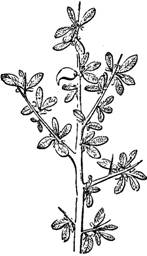
Fig. 274—Balsamodendron Myrrha
Though myrrh seems to have been known from the earliest times, and must consequently have been one of the most ancient articles of commerce, the country producing it long remained unknown. Some is undoubtedly procured in Arabia, but the largest quantity has always been obtained from Africa. Mr. Johnson, in his recently published Travels in Abyssinia (i. 249), mentions that ’Myrrh and mimosa trees abounded in this place’ (Koranhedudah in Adal). The former he describes as being ’a low, thorny, ragged-looking tree, with bright-green trifoliate leaves; the gum exudes from cracks in the bark of the trunk near the root, and flows freely upon the stones immediately underneath. Artificially it is obtained by bruises made with stones. The natives collect it principally in the hot months of July and August, but it is to be found, though in very small quantities, at other times of the year.
Several kinds of myrrh were known to the ancients; and in modern commerce we have Turkish and East Indian myrrh, and different names used to be, and are still applied to it, as red and fatty myrrh, myrrh in tears, in sorts, and myrrh in grains. In the Bible also several kinds of myrrh are enumerated, respecting which various opinions have been entertained.
Myrrh, it is well known, was celebrated in the most ancient times as a perfume, and a fumigator, as well as for its uses in medicine. Myrrh was burned in the temples, and employed in embalming the bodies of the dead. It was offered in presents, as natural products commonly were in those days, because such as were procured from distant countries were very rare. The ancients prepared a wine of myrrh, and also an oil of myrrh, and it formed an ingredient in many of the most celebrated compound medicines, as the Theriaca, the Mithridata, Manus Dei. etc. Even in Europe it continued to recent times to enjoy the highest medicinal reputation, as it does in the East in the present day. From the sensible properties of this drug, and from the virtues which were ascribed to it, we may satisfactorily account for the mention of it in the several passages of Scripture which have been quoted.
A precious gum yielded by a tree common in Africa and Arabia, which is about eight or nine feet high; its wood hard, and its trunk thorny. It was of several kinds, and various degrees of excellence. The best was an ingredient in the holy ointment, Exo 30:23 . It was also employed in perfumes, Gen 2:12 Psa 45:8 Son 4:6 5:5,13; and in embalming, to preserve the body from corruption, Joh 19:39 . The magi, who came from the East to worship Christ, offered him myrrh, Mat 2:11 .\par In Mar 15:23, is mentioned "wine mingles with myrrh," which was offered to Jesus previous to his crucifixion, and intended to deaden the anguish of his sufferings. It was a custom among the Hebrews to give such stupefying liquors to persons who were about to be capitally punished, Pro 31:6 . Some have thought that the myrrhed wine of Mark is not the same as the "vinegar mingled with gall" of Mat 27:34 . They suppose the myrrhed wine was given to our Lord from a sentiment of sympathy, to prevent him from feeling too sensibly the pain of his sufferings; while the potation mingled with gall, of which he would not drink, was given from cruelty. But the other explanation is the more probable. See GALL.\par
Myrrh. This substance is mentioned in Exo 30:23, as one of the ingredients of the "oil of holy ointment:" in Est 2:12, as one of the substances used in the purification of women; in Psa 45:8; Pro 7:17, and in several passages in Canticles, as a perfume. The Greek occurs in Mat 2:11, among the gifts brought by the wise men to the infant Jesus, and in Mar 15:23, it is said that "wine mingled with myrrh" was offered to, but refused by, our Lord on the cross.
Myrrh was also used for embalming. See Joh 19:39, and Herod. Ii. 86. The Balsamodendron myrrha, which produces the myrrh of commerce, has a wood and bark which emit a strong odor; the gum which exudes from the bark is at first oily, but becomes hard by exposure to the air.
(This myrrh is in small yellowish or white globules or tears. The tree is small, with a stunted trunk, covered with light-gray bark, It is found in Arabia Felix. The myrrh of Gen 37:25, was probably ladalzum, a highly-fragrant resin and volatile oil used as a cosmetic, and stimulative as a medicine. It is yielded by the cistus, known in Europe as the rock rose, a shrub with rose-colored flowers, growing in Palestine, and along the shores of the Mediterranean. -- Editor).
For wine mingled with myrrh, see Gall.
Hebrew
As it stupefies the senses He would not have that which mitigates death’s horrors, but would meet it in full consciousness. It was one of the three offerings of the wise men (Mat 2:11). Nicodemus brought it to embalm His sacred body (Joh 19:39).
Myrrh. A gum resin, celebrated for its aromatic properties. It derives its name from the Hebrew word môr, which implies "flowing"or "distilling," Greek murrha. The Balsamodendron myrrha, of the natural order Terebinthaceæ, is the tree found in Arabia and Africa, from which myrrh is chiefly procured. It exudes from the bark, and is at first soft, oily, and yellowish-white; it afterwards acquires the consistency of butter, and becomes still harder by exposure to the air, changing to a reddish hue. In commerce it is of two kinds, "myrrh in tears" and "myrrh in sorts." Myrrh is frequently mentioned in Scripture. It was an ingredient in the holy anointing oil, Exo 30:23; it was used in perfumes, Psa 45:8; Pro 7:17; Son 1:13; Son 8:6; in unguents, Est 2:12; Son 5:5; for strengthening wine, Mar 15:23; also in embalming, Joh 19:30. Myrrh was among the offerings made by the eastern sages. Mat 2:11. The best was that which flowed spontaneously from the tree.
1. lot. This is judged to be a fragrant resinous gum gathered from the leaves of the cistus , or rock rose. Gen 37:25; Gen 43:11.
2. mor, Arabic murr. The true myrrh, so called because it distils its gum as tears, which harden into a bitter aromatic gum. It was an ingredient in the holy anointing oil, and was much prized as a perfume. Exo 30:23; Est 2:12; Psa 45:8; Pro 7:17; Son 1:13; Son 3:6; Son 4:6; Son 4:14; Son 5:1; Son 5:5; Son 5:13. It is identified with the balsamodendron myrrha and other allied species. In the N.T. the same is alluded to under the name of
MYRRH (
‘Gold, a monarch to declare;
Frankincense, that God is there;
Myrrh, to tell the heavier tale
Of His tomb and funeral.’
Though we may admit that in the gifts presented there was an unconscious fulfilment of prophecy (Isa 60:6), no symbolism of the nature referred to can have been designed by the Magi. So far as their intention was concerned, they simply offered to the new-born King, whom they came to worship, the choicest and most precious products of their country, and thus expressed their homage.
In Mar 15:23 we are told that there was offered to Christ, probably just before He was nailed to the cross,
Literature.—Birdwood in Bible Educator, ii. 151; an exhaustive article by Hanbury, ‘The Botanical Origin and Country of Myrrh’ in the Pharmaceutical Journal, 19th Apr. 1873.
J. Cromarty Smith.
MYRRH.—1. môr (Arab
2. lôt, tr.
E. W. G. Masterman
(Hebrew: mor)
Gum resin used as an ingredient in incense and the oil of Extreme Unction. In ancient times it was extensively used as perfume and was presented by one of the Magi to the Infant Jesus as emblematic of suffering. It was also used for embalming and for an anodyne.
(1) (
Whichever view is correct, it is probable that the
(2) (
(Matt 2)
- see Gold, Incense, Myrrh
Psa 45:8 (c) This type represents the fragrance of CHRIST to GOD in His sacrificial death. His death went up to GOD as a sweet smelling savour, which is most blessed both to GOD and to man. (See also Joh 19:39).
Pro 7:17 (c) This may be taken as a picture or a type of the enticing, alluring schemes and plans of the harlots to attract men to their homes, and to a life of sinful pleasure.
Son 1:13 (c) By this figure we understand the feelings of GOD’s people concerning the loveliness of CHRIST to their hearts. The beauty, the fragrance and the attractiveness of the Lord JESUS are compared to the sweet odors arising from precious spices.
Mat 2:11 (c) This perfume is the third of the gifts mentioned, which were brought to the Lord JESUS CHRIST by the wise men. It typifies the beauty and the value of CHRIST as He gave His life for us.
- the gold is a type of His perfection and loveliness in His prenatal days.
- the frankincense may be taken as a type of the beauty and loveliness of CHRIST during His life on earth.
- the myrrh may remind us of the preciousness and sweetness of CHRIST in His death.
Myrrh. An extract from a stiff-branched tree with white flowers and plum-like fruit. After myrrh was extracted from the wood, it soon hardened and was valued as an article of trade. It was an ingredient used in anointing oil ( Exo 30:23), and was used as perfume ( Psa 45:8; Pro 7:17; Son 3:6), in purification rites for women ( Est 2:12), as a gift for the infant Jesus ( Mat 2:11), and in embalming ( Joh 19:39). According to the Gospel of Mark (15:23), the drink offered to Jesus before His crucifixion was "wine mingled with myrrh." Matthew, however, has "sour wine mingled with gall" ( Mat 27:34).
The reference to myrrh in ( Gen 37:25) and (43:11) is thought to be ladanum, sometimes called onycha, from a species of rockrose and not the true myrrh. Also see Onycha.
Sweet-smelling sap from the bark of
trees or other plants that was used for
perfume and also to prepare bodies for
burial. Mixed with wine, it was probably
used to relieve pain (Mk. 15:23).