
a little city in the tribe of Zebulun, in Lower Galilee, to the west of Tabor, and to the east of Ptolemais. This city is much celebrated in the Scriptures for having been the usual place of the residence of Jesus Christ, during the first thirty years of his life, Luk 2:51. It was here he lived in obedience to Joseph and Mary, and hence he took the name of Nazarene. After he had begun to execute his mission he preached here sometimes in the synagogue, Luk 4:16. But because his countrymen had no faith in him, and were offended at the meanness of his original, he did not many miracles here, Mat 13:54; Mat 13:58, nor would he dwell in the city. So he fixed his habitation at Capernaum for the latter part of his life, Mat 4:13. The city of Nazareth was situated upon an eminence, and on one side was a precipice, from whence the Nazarenes designed, at one time, to cast Christ down headlong, because he upbraided them for their incredulity, Luk 4:29.
The present state of this celebrated place is thus described by modern travellers:—Nassara, or Naszera, is one of the principal towns in the pashalic of Acre. Its inhabitants are industrious, because they are treated with less severity than those of the country towns in general. The population is estimated at three thousand, of whom five hundred are Turks; the remainder are Christians. There are about ninety Latin families, according to Burckhardt; but Mr. Connor reports the Greeks to be the most numerous: there is, besides, a congregation of Greek Catholics, and another of Maronites. The Latin convent is a very spacious and commodious building, which was thoroughly repaired and considerably enlarged in 1730. The remains of the more ancient edifice, ascribed to the mother of Constantine, may be observed in the form of subverted columns, with fragments of capitals and bases of pillars, lying near the modern building. Pococke noticed, over a door, an old alto-relief of Judith cutting off the head of Holofernes. Within the convent is the church of the annunciation, containing the house of Joseph and Mary, the length of which is not quite the breadth of the church; but it forms the principal part of it. The columns and all the interior or the church are hung round with damask silk, which gives it a warm and rich appearance. Behind the great altar is a subterranean cavern, divided into small grottoes, where the virgin is said to have lived. Her kitchen, parlour, and bed room, are shown, and also a narrow hole in the rock, in which the child Jesus once hid himself from his persecutors. The pilgrims who visit these holy spots are in the habit of knocking off small pieces of stone from the walls, which are thus considerably enlarging. In the church a miracle is still exhibited to the faithful. In front of the altar are two granite columns, each two feet one inch in diameter, and about three feet apart. They are supposed to occupy the very places where the angel and the virgin stood at the precise moment of the annunciation. The innermost of these, that of the virgin, has been broken away, some say by the Turks, in expectation of finding treasure under it; “so that,” as Maundrell states, “eighteen inches’ length of it is clean gone between the pillar and the pedestal.” Nevertheless, it remains erect, suspended from the roof, as if attracted by a loadstone. It has evidently no support below; and, though it touches the roof, the hierophant protests that it has none above. “All the Christians of Nazareth,” says Burckhardt, “with the friars, of course, at their head, affect to believe in this miracle; though it is perfectly evident that the upper part of the column is connected with the roof.” “The fact is,” says Dr. E. D. Clarke, “that the capital and a piece of the shaft of a pillar of gray granite have been fastened on to the roof of the cave; and so clumsily is the rest of the hocus pocus contrived, that what is shown for the lower fragment of the same pillar resting upon the earth, is not of the same substance, but of Cipolino marble. About this pillar, a different story has been related by almost every traveller since the trick was devised. Maundrell, and Egmont and Heyman, were told that it was broken, in search of hidden treasure, by a pasha, who was struck with blindness for his impiety. We were assured that it was separated in this manner when the angel announced to the virgin the tidings of her conception. The monks had placed a rail, to prevent persons infected with the plague from coming to rub against these pillars: this had been, for many years, their constant practice, whenever afflicted with any sickness. The reputation of the broken pillar, for healing every kind of disease, prevails all over Galilee.”
Burckhardt says that this church, next to that of the holy sepulchre, is the finest in Syria, and contains two tolerably good organs. Within the walls of the convent are two gardens, and a small burying ground: the walls are very thick, and serve occasionally as a fortress to all the Christians in the town. There are, at present, eleven friars in the convent: they are chiefly Spaniards. The yearly expenses of the establishment are stated to amount to upward of nine hundred pounds; a small part of which is defrayed by the rent of a few houses in the town, and by the produce of some acres of corn land: the rest is remitted from Jerusalem. The whole annual expenses of the Terra Santa convents are about fifteen thousand pounds; of which the pasha of Damascus receives about twelve thousand pounds. The Greek convent of Jerusalem, according to Burckhardt’s authority, pays much more, as well to maintain its own privileges, as with a view to encroach upon those of the Latins. To the north-west of the convent is a small church, built over Joseph’s work shop. Both Maundrell and Pococke describe it as in ruins; but Dr. E. D. Clarke says, “This is now a small chapel, perfectly modern, and neatly whitewashed.” To the west of this is a small arched building, which, they say, is the synagogue where Christ exasperated the Jews, by applying the language of Isaiah to himself. It once belonged to the Greeks; but, Hasselquist says, was taken from them by the Arabs, who intended to convert it into a mosque, but afterward sold it to the Latins. This was then so late a transaction that they had not had time to embellish it. The “Mountain of the Precipitation” is at least two miles off; so that, according to this authentic tradition, the Jews must have led our Lord a marvellous way. But the said precipice is shown as that which the Messiah leaped down to escape from the Jews; and as the monks could not pitch upon any other place frightful enough for the miracle, they contend that Nazareth formerly stood eastward of its present situation, upon a more elevated spot. Dr. E. D. Clarke, however, remarks that the situation of the modern town answers exactly to the description of St. Luke. “Induced, by the words of the Gospel, to examine the place more attentively than we should otherwise have done, we went, as it is written, out of the city, ‘to the brow of the hill whereon the city is built,’ and came to a precipice corresponding to the words of the evangelist. It is above the Maronite church, and, probably, the precise spot alluded to by the text.”
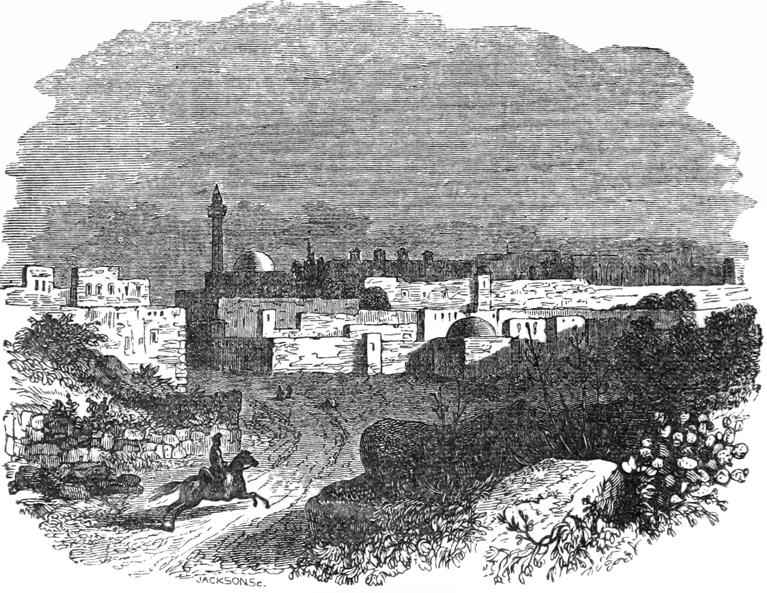
Fig. 275—Nazareth
Naz´areth, a town in Galilee, in which the parents of Jesus were resident, and where in consequence He lived till the commencement of His ministry. It derives all its historical importance from this circumstance, for it is not even named in the Old Testament or by Josephus: which suffices to show that it could not have been a place of any consideration, and was probably no more than a village.
Nazareth is situated about six miles W.N.W. from Mount Tabor, on the western side of a narrow oblong basin, or depressed valley, about a mile long by a quarter of a mile broad. The buildings stand on the lower part of the slope of the western hill, which rises steep and high above them. It is now a small, but more than usually well-built place, containing about three thousand inhabitants, of whom two-thirds are Christians. The flat-roofed houses are built of stone, and are mostly two stories high. The environs are planted with luxuriantly-growing fig-trees, olive-trees, and vines, and the crops of corn are scarcely equaled throughout the length and breadth of Canaan. All the spots which could be supposed to be in any way connected with the history of Christ are, of course, pointed out by the monks and local guides, but on authority too precarious to deserve any credit, and with circumstances too puerile for reverence. It is enough to know that the Lord dwelt here; that for thirty years He trod this spot of earth, and that His eyes were familiar with the objects spread around. In the southwest part of the town is a small Maronite church, under a precipice of the hill, which here breaks off in a perpendicular wall forty or fifty feet in height. Dr. Robinson noticed several such precipices in the western hill around the village, and with very good reason concludes that one of these, probably the one just indicated, may well have been the spot whither the Jews led Jesus, ’unto the brow of the hill whereon the city was built, that they might cast him down headlong’(Luk 4:28-30); and not the precipice, two miles from the village, overlooking the plain of Esdraelon, which monkish tradition indicates to the traveler as the ’Mount of Precipitation.’
A city of lower Galilee, about seventy miles north of Jerusalem, in the territory of the tribe of Zebulun. It was situated on the side of a hill overlooking a rich and beautiful valley, surrounded by hills, with a narrow outlet towards the south. At the mouth of this ravine the monks profess to show the place where the men of the city were about to cast Jesus from the precipice, Luk 4:29 . Nazareth is about six miles west north west of Mount Tabor, and nearly half way form the Jordan to the Mediterranean. It is said in the New Testament to be "the city of Jesus," because it was the place of his usual residence during the first thirty years of his life, Mat 2:23 Luk 1:26 2:51 4:16. He visited it during his public ministry, but did not perform many miracles there because of the unbelief of the people, Mat 13:54-58 . It is not even named in the Old Testament, nor by Josephus; and appears to have been a small place, of no very good repute, Joh 1:46 . The modern town, en-Nasirah, is a secluded village of about three thousand inhabitants, most of whom are Latin and Greek Christians. It lies about eight hundred feet above the level of the sea; and is one of the pleasantest towns in Syria. Its houses are of stone, two stories high, with flat roofs. It contains a mosque, a large Latin convent, and two or three chapels. The traditionary "Mount of the Precipitation" is nearly two miles from the town, too remote to have answered the purpose of the enraged Nazarenes; while there were several precipitous spots close at hand, where the fall is still from thirty to fifty feet.\par From the summit of the hill on the eastern slope of which Nazareth lies, is a truly magnificent prospect. Towards the north, the eye glances over the countless hills of Galilee, and reposes on the majestic and snow-crowned Hermon. On the east, the Jordan valley may be traced, and beyond it the dim heights of ancient Bashan. Towards the south, spreads the broad and beautiful plain of Esdraelon, with the bold outline of Mount Tabor, and parts of Little Hermon and Gilboa visible on its eastern border, and the hills of Samaria on the south, while Carmel rises on the west of the plain, and dips his feet in the blue waters of the Mediterranean.\par Says Dr. Robinson in his "Biblical Researches in Palestine," "I remained for some hours upon this spot, lost in the contemplation of the wide prospect and of the events connected with the scenes around. In the village below, the Savior of the world had passed his childhood; and although we have few particulars of his life during those early years, yet there are certain features of nature which meet our eyes now, just as they once met his."\par "He must often have visited the fountain near which we had pitched our tent; his feet must frequently have wandered over the adjacent hills, and his eyes have doubtless gazed upon the splendid prospect form this very spot. Here the Prince of peace looked down upon the great plain, where the din of battles so oft had rolled, and the garments of the warrior been dyed in blood; and he liked out, too, upon the sea over which the swift ships were to bear the tidings of his salvation to nations and to continents them unknown. How has the moral aspect to things been changed!"\par "Battles and bloodshed have indeed not ceased to desolate this unhappy country, and gross darkness now covers the people; but from this region a light went forth, which has enlightened the world and unveiled new climes; and now the rays of that light begin to be reflected back form distant isles and continents, to illuminate anew the darkened land where it first sprung up."\par
Naz’areth. (the guarded one). The ordinary residence of our Saviour, is not mentioned in the Old Testament, but occurs first in Mat 2:23. It derives its celebrity from its connection with the history of Christ, and in that respect has a hold on the imagination, and feelings of men, which it shares only with Jerusalem and Bethlehem. It is situated among the hills which constitute the south ridges of Lebanon,just before they sink down into the plain of Esdraelon.
(Mr. Merrill, in "Galilee in the Time of Christ," (1881), represents Nazareth in Christ’s time as a city, (so always called in the New Testament), of 15,000 to 20,000 inhabitants, of some importance and considerable antiquity, and not so insignificant and mean as has been represented. -- Editor). Of the identification of the ancient site there can be no doubt. The name of the present village is en-Nazirah the same, therefore, as of old.
It is formed on a hill or mountain, Luk 4:29, it is within the limits of the province of Galilee, Mar 1:9, it is near Cana, according to the implication in Joh 2:1-2; Joh 2:11, a precipice exists in the neighborhood. Luk 4:29. The modern Nazareth belongs to the better class of eastern villages. It has a population of 3000 or 4000; a few are Mohammadans, the rest Latin and Greek Christians. (Near this town, Napoleon once encamped, (1799), after the battle of Mount Tabor).
The origin of the disrepute in which Nazareth stood, Joh 1:47, is not certainly known. All the inhabitants of Galilee were looked upon, with contempt by the people of Judea, because they spoke a ruder dialect, were less cultivated and were more exposed, by their position, to contact with the heathen. But Nazareth labored under a special opprobrium [Reproach, mingled with contempt or disdain.], for it was a Galilean, and not a southern Jew, who asked the reproachful question, whether "any good thing" could come from that source.
Above the town are several rocky ledges, over which a person could not be thrown without almost certain destruction. There is one very remarkable precipice, almost perpendicular and forty or fifty near the Maronite church, which may well be supposed to be the identical one, over which his infuriated fellow townsmen attempted to hurl Jesus.
In a basin among hills descending into Esdraelon from Lebanon, and forming a valley which runs in a wavy line E. and W. On the northern side of the valley the rounded limestone hills rise to 400 or 500 ft. The valley and hill sides abound in gay flowers as the hollyhock growing wild, fig trees, olives, and oranges, gardens with cactus hedges, and grainfields. Now en Nazirah on a hill of Galilee (Mar 1:9), with a precipice nigh (Luk 4:29); near Cane (Joh 2:1-2; Joh 2:11). Its population of 4,000 is partly Muslim, but mainly of Latin and Greek Christians. It has a mosque, a Maronite, a Greek, and a Protestant church, and a large Franciscan convent. The rain pouring down the hills would sweep away a house founded on the surface, and often leaves the streets impassable with mud. So the houses generally are of stone, founded, after digging deep, upon the rock (Luk 6:47).
On a hill behind is the tomb of neby Ismail, commanding one of the most lovely prospects in the world, Lebanon and snowy Hermon on the N., Carmel and the Mediterranean and Acca on the W., Gilead and Tabor on the S.E., the Esdraelon plain and the Samaria mountains on the S., and villages on every side; Cana, Nain, Endor, Jezreel (Zerin), etc. Doubtless in early life Jesus often stood on this spot and held communion with His Father who, by His Son, had created this glorious scene. Nazareth is never named in Old Testament. It was there Gabriel was sent from God to announce to the Virgin her coming conception of Him who shall reign over the house of Jacob for ever, and of whose kingdom there shall be no end (Luk 1:26-33). After His birth and the sojourn in Egypt Joseph and Mary took the child to their original home in Nazareth, six miles W. of Mount Tabor (Mat 2:23; Luk 2:39; Luk 4:16).
As "John the Baptist; was in the desert until the day of his showing unto Israel," so Messiah was growing up unknown to the world in the sequestered town among the mountains, until His baptism by the forerunner ushered in His public ministry. As Jews alone lived in Nazareth from before Josephus’ time to the reign of Constantine (Epiphanius, Haer.), it is impossible to identify the sacred sites as tradition pretends to do, namely, the place of the annunciation to Mary, with the inscription on the pavement of the grotto, "
Jesus taught in the synagogue of Nazareth, "His own country" (Mat 13:54), and was there "thrust out of the city and led unto the brow of the hill whereon if was built, to be cast down headlong," but "passing through the midst of them He went His way" (Luk 4:16-30). The hill of precipitation" is not the one presumed, two miles S.E. of Nazareth. The present village is on the hill side, nearer the bottom than the top. Among the rocky ledges above the lower parts of the village is one 40 ft. high, and perpendicular, near the Maronite church: this is probably the true site. It is striking how accurately Luke steers clear of a mistake; he does not say they ascended or descended to reach the precipice, but "led" Jesus to it. He does not say the "city" was built on the brow of the hill, but that the precipice was "on the brow," without stating whether it was above (as is the case) or below the town.
A forger could hardly go so near a topographical mistake, without falling into it. "Jesus of Nazareth" was part of the inscription on the cross (Joh 19:19). It is the designation by which He revealed Himself to Saul (Act 22:8). Nazareth bore a bad name even in Galilee (for Nathanael who said "can any good thing come out of Nazareth?" was of Galilee), which itself, because of its half pagan population and rude dialect, was despised by the people of Judea. The absence of "good" in Nazareth appears from the people’s willful unbelief in spite of Jesus’ miracles, and their attempt on His life (Mat 13:54-58), so that He left them, to settle in Capernaum (Mat 4:13). "The fountain of the Virgin" is at the N.E. of the town.
Nazareth (năz’a-rĕth), separated? Mat 2:23. A city of Galilee, famous as the home of Jesus during his childhood and youth until he began his public ministry. It was about 14 miles from the Sea of Galilee, and 66 miles north of Jerusalem in a straight line. It is one of the most beautiful sites in the Holy Land. Nazareth is not mentioned in the Old Testament, nor by any classical author, nor by any writer before the time of Christ. It was for some unknown reason held in disrepute among the Jews of Judæa. Joh 1:46. It was situated in a mountain, Luk 4:29, within the province of Galilee, Mar 1:9, and near Cana, as Joh 2:1-2; Joh 2:11 seems to imply. There was a precipice near the town, down which the people proposed to cast Jesus. Luk 4:29. It is mentioned 29 times in the New Testament. At Nazareth the angel appeared to Mary: the home of Joseph, Luk 1:26; Luk 2:39, and to that place Joseph and Mary returned after their flight into Egypt. Mat 2:23. The hills and places about the town possess a deep and hallowed interest to the Christian as the home of Jesus during his childhood and youth, until he entered upon his ministry, and had preached in the synagogue, and was rejected by his own townspeople. Even after Capernaum became "his own city" he was known as "Jesus of Nazareth," Mat 13:54-58; Mar 6:1-6; Act 2:22; Act 3:6; Act 4:10; Act 6:14, and his disciples were called "Nazarenes." The town is now called En-Nâsirah, or Nasrah, and has from 6000 to 7000 population, though the Turkish officials estimate it at 10,000. The brow of the hill over which the enraged Nazarenes threatened to cast Jesus is probably near the Maronite church, though tradition places it at the "Mount of Precipitation," two or three miles south of the town.
[Naz’areth]
Town where the Lord was ’brought up.’ Early in the Lord’s ministry He visited Nazareth, and taught in the synagogue. The people wondered at His gracious words, but they said, "Is not this Joseph’s son?" When He told them that no prophet is accepted in his own country, and proceeded to speak of the grace of God having gone out to the Gentiles in O.T. times, they were filled with wrath, thrust Him out of the city, and sought to hurl Him over the brow of the hill on which the city was built. But He, passing through the midst of them, went His way. Luk 4:16-30. About twelve months later He visited ’his own country’ again and taught in the synagogue. But the inhabitants only regarded Him as ’the carpenter,’ and were offended in Him. He did not many mighty works there because of their unbelief. Mat 13:54-58; Mar 6:1-6. As far as is known the Lord did not visit Nazareth again.
It is identified with en Nasirah , in Lower Galilee, 32° 42’ N, 35° 18’ E. The town presents a striking appearance, the houses being built of the white limestone of the neighbourhood, which reflects the rays of the sun. There is a steep precipice which is probably the place where the enraged people intended to cast down the Lord. A spring, called the ’fountain of the virgin,’ supplies the town with water, where the women may daily be seen with their pitchers, and whence doubtless the mother of the Lord also fetched water for her family. The name of the city often occurs in the gospels in the expression, ’Jesus of Nazareth,’ and this designation was also placed on the cross. God has highly exalted the One who humbled Himself, and was in the eyes of the Jews merely ’Jesus of Nazareth.’
NAZARETH (
That in our Lord’s time Nazareth was a place of considerable importance is indicated by the fact that it is always referred to in the NT as a city (
With the exception of the events of the early ministry recorded in Luk 4:16 ff., the direct references to Nazareth in the Gospels are all associated with the birth and boyhood of Jesus. It was to Nazareth that the angel Gabriel was sent, to Mary His mother (Luk 1:26); and thither His parents came to find a home after the flight into Egypt (Mat 2:23). From Nazareth they journeyed into Judaea for the purpose of the Roman enrolment (Luk 2:4), returning to the same city when the requirements of the Jewish law for the purification of Mary had been satisfied (Luk 2:39). Twelve years later a similar visit to Jerusalem, in accordance with His parents’ annual practice (Luk 2:41 f.), and return to Nazareth (Luk 2:51), make it evident that the home during this period had been at the latter town. On the occasion of His baptism, it is from Nazareth that, according to St. Mark (Mar 1:9), Christ came to the Jordan; the other Synoptists merely state that the journey was made from Galilee (Mat 3:13), or name no place (Luk 3:21). His early life, therefore, was spent at Nazareth, and only in consequence of the opposition aroused by His preaching in the synagogue and the murderous attempt upon His life (Luk 4:28 f.) did He abandon Nazareth and take up His abode at Capernaum (Mat 4:13). Thenceforward He does not appear to have visited, or to have had any direct relations with, His former home. Its name, however, continued to cling to Him, and by that designation He is known to the ‘multitudes’ at Jerusalem at the Passover, the stranger-pilgrims from Galilee His native province (Mat 21:11). Philip uses the name when he calls Nathanael to Jesus (Joh 1:45); and later in the history it is employed by Peter at Caesarea (Act 10:38) as a well-known title with which Gentiles also would be familiar.
The precise form of the word and its signification are alike uncertain. In two passages (Mat 4:13, Luk 4:16) the oldest Manuscripts read
The adjective also appears in two different forms. The Second Gospel uses only
Literature.—In addition to the references given above, the articles in the Bible Dictionaries may be consulted; add Edward Robinson, BRP
A. S. Geden.
(the modern Al-Naṣira):
By: Isidore Singer, George A. Barton
Town in Galilee, situated in a valley to the north of the plain of Esdraelon. It is about 1,200 feet above the level of the Mediterranean. Nazareth first appears in the New Testament as the place where Jesus passed his boyhood (Matt. ii. 23; Luke i. 26; ii. 4, 39, 51; John i. 46 et seq.; Acts x. 38). It is not mentioned in the Old Testament, or in Josephus or the Talmud (though Eleazar Ḳalir [8th and 9th cent.] in the elegy "Ekah Yashebah" mentions the priestly class of Nazareth [ = "Mishmeret"], doubtless on the basis of some ancient authority). This has led Wellhausen ("Israelitische und Jüdische Gesch." p. 220) and Cheyne (Cheyne and Black, "Encyc. Bibl.") to conjecture that "Nazareth" is a name for Galilee. Such an inference is in the highest degree precarious. It is evident from John i. 46 that Nazareth was an obscure place. During the Biblical period Japhia was the important town of the locality and attracted to itself all the notice of historians.
Nazareth is mentioned by Eusebius and Jerome in the "Onomasticon" as 15 Roman miles eastward from Legio (Lajjun). Epiphanius ("Hæres." i. 136) says that until the time of Constantine, Nazareth was inhabited only by Jews, which statement implies that in his day some Christians lived there. Toward the close of the sixth century it became a place of pilgrimage, for Antoninus the Martyr visited it and saw there an ancient synagogue and a church. It is said to have been almost totally destroyed by the Saracens, but after the establishment of the Latin kingdom of Jerusalem it was rebuilt, and the bishopric of Scythopolis was transferred to it. The population is estimated at about 10,000—3,500 being Mohammedans, and the rest Christians.
Bibliography:
Edersheim, Life and Times of Jesus the Messiah, i. 146 et seq., 233 et seq.;
Robinson, Researches, ii. 133-143;
G. A. Smith, Historical Geography of the Holy Land, pp. 432 et seq.;
Buhl, Geographie des Alten Palästina, pp. 215 et seq.;
Neubauer, G. T. p. 190.
NAZARETH (mod. en-Nâsira).—A town in the north border of the Plain of Esdraelon. It was a place of no history (being entirely unmentioned in the OT, Josephus, or the Talmud), no importance, and, possibly, of bad reputation (Joh 1:48). Here, however, lived Mary and Joseph. Hither, before their marriage, was the angel Gabriel sent to announce the coming birth of Christ (Luk 1:26-38), and hither the Holy Family retired after the flight to Egypt (Mat 2:23). The obscure years of Christ’s boyhood were spent here, and in its synagogue He preached the sermon for which He was rejected by His fellow-townsmen (Mat 13:54, Luk 4:28). After this, save as a centre of pilgrimage, Nazareth sank into obscurity. The Crusaders made it a bishopric; it is now the seat of a Turkish lientenant-governor. Many traditional sites are pointed out to pilgrims and tourists, for not one of which, with the possible exception of the ‘Virgin’s Well’ (which, being the only spring known in the neighbourhood, was not improbably that used by the Holy Family), is there any justification.
R. A. S. Macalister.
The town of Galilee where the Blessed Virgin dwelt and where Christ lived the first 30 years of his life, situated in a hollow plateau between the hills of Lebanon, the ancient town occupying the triangular hillock in the north. In earliest times it was the home of priests on their way to the Temple of Jerusalem, and up to the time of Constantine, exclusively Jewish. By 570 the dwelling of Mary had been converted into a basilica and in the 7th century the church of the Nutrition of Jesus was erected. The toleration of the Moslems who conquered Galilee in 637 did not last, for thc Crusaders were compelled to leave the town, 1187, and all the Christian buildings were destroyed in 1263. The Franciscan friars, arriving in the 14th century, were driven out twice, but in 1629 were allowed to build a church, which was, however, ruined by the Bedouins. The friars built the present church in 1730. In 1909 explorations below and about it revealed the plans of the ancient basilica of Constantine, which the Crusaders copied. The Franciscans built their church so that fifteen steps led down to the ancient Chapel of the Angel, and two to the grotto with its altar of the Annunciation. The choir of the church is directly above the grotto; the chapel is the traditional site of the house of the Virgin; and the church of the Nutrition marks the home of the Holy Family.
The town of Galilee where the Blessed Virgin dwelt when the Archangel announced to her the Incarnation of the Word, and where Christ lived until the age of thirty years, unknown, and obedient to Mary and Joseph. In the manuscripts of the New Testament, the name occurs in a great orthographical variety, such as Nazaret, Nazareth, Nazara, Nazarat, and the like. In the time of Eusebius and St. Jerome (Onomasticon), its name was Nazara (in modern Arabic, en Nasirah), which therefore, seems to be the correct name; in the New Testament we find its derivatives written Nazarenos, or Nazoraios, but never Nazaretaios. The etymology of Nazara is neser, which means "a shoot". The Vulgate renders this word by flos, "flower", in the Prophecy of Isaias (xi, 1), which is applied to the Saviour. St. Jerome (Epist., xlvi, "Ad Marcellam") gives the same interpretation to the name of the town.Nazareth is situated in the most southerly hills of the Lebanon range, just before it drops abruptly down to the plain of Esdraelon. The town lies in a hollow plateau about 1200 feet above the level of the Mediterranean, between hills which rise to an altitude of 1610 feet. The ancient Nazareth occupied the triangular hillock that extends from the mountain on the north, having its point turned to the south. Its northwestern boundary is marked by numerous Jewish tombs which have been discovered on the slope of Jebel es Likh. The southeastern limit is the small valley that descends from the beautiful spring called St. Mary’s Well, which was, no doubt, the chief attraction for the first settlers. In the last fifty years the population has increased rapidly, and amounts at the present day to more than 7000 souls. The modern houses, white and clean, run up all along the hillsides, especially on the north. Spread out in the shape of an amphitheatre, set in a green framework of vegetation, Nazareth offers to the eye a very attractive picture. HISTORYThe town is not mentioned in the Old Testament, nor even in the works of Josephus. Yet, it was not such an insignificant hamlet as is generally believed. We know, first, that it possessed a synagogue. Neubaurer (La géographie du Talmud, p. 190) quotes, moreover, an elegy on the destruction of Jerusalem, taken from ancient Midrashim now lost, and according to this document, Nazareth was a home for the priests who went by turns to Jerusalem, for service in the Temple. Up to the time of Constantine, it remained exclusively a Jewish town. St. Epiphaenius (Adv. Haereses, I, ii, haer., 19) relates that in 339 Joseph, Count of Tiberias, told him that, by a special order of the emperor, "he built churches to Christ in the towns of the Jews, in which there were none, for the reason that neither Greeks, Samaritans, nor Christians were allowed to settle there, viz., at Tiberias, at Diocaesarea, or Sepphoris, at Nazareth, and at Capharnaum". St. Paula and St. Sylvia of Aquitaine visited the shrines of Nazareth towards the end of the fourth century, as well as Theodosius about 530; but their short accounts contain no description of its monuments. The Pilgrim of Piacenza saw there about 570, besides "the dwelling of Mary converted into a basilica", the "ancient synagogue". A little treatise of the same century, entitled "Liber nominum locorum ex Actis", speaks of the church of the Annunciation and of another erected on the site of the house "where our Lord was brought up". In 670 Arculf gave Adamnan an interesting description of the basilica of the Annunciation and of the church of the "Nutrition of Jesus".The toleration which the Moslems showed towards the Christians, after conquering the country in 637, did not last long. Willibald, who visited Nazareth about 725, found only the basilica of the Annunciation, "which the Christians", he says "often redeemed from the Saracens, when they threatened to destroy it". However, in 808 the author of the "Commemoratorium de easis Dei" found twelve monks at the basilica, and eight at the Precipice, "a mile away from the town". The Greek emperor, John Zimisces, reconquered Galilee from the Arabs in 920, but, five years afterwards, he was poisoned by his eunuchs, and his soldiers abandoned the country. The basilica, finally ruined under the reign of the Calif Hakem (1010), was rebuilt by the crusaders in 1101, as well as the church of the Nutrition, or St. Joseph’s House. At the same time the Greeks erected the church of St. Gabriel near the Virgin’s Well. The archiepiscopal See of Scythopolis was also transferred to Nazareth. After the disastrous battle of Hattin (1187), the crusaders, with the European clergy, were compelled to leave the town. On 25 March, 1254, St. Louis and Queen Marguerite celebrated the feast of the Annunciation at Nazareth; but nine years later, the Sultan Bibars completely destroyed all the Christian buildings, and Nazareth soon dwindled down to a poor village. In the fourteenth century, a few Franciscan Friars established themselves there, among the ruins of the basilica. They had much to suffer during their stay, and many of them were even put to death, especially in 1385, in 1448, and in 1548, when all the friars were driven out of the country. In 1620 Fakher ed Dîn, Emir of the Druses, allowed them to build a church over the Grotto of the Annunciation; but it was ruined some years later by the Bedouins. The Franciscans nevertheless remained near the sanctuary, and in 1730 the powerful Sheikh Dhaher el Amer authorized them to erect the church which is still to be seen. SITESIn the fourth century, local tradition indicated the house of the Virgin at the top of the southern point of the hill, which rises some 30 feet over the plain. The dwelling consisted of a little building with a grotto in the rear. Even now, other dwellings like this are to be found in Nazareth. Explorations made in 1909, beneath and around the present church, brought to light the whole plan of the ancient basilica of Constantine. It was built from west to east, divided into three naves by two rows of syenite columns, and the grotto was in the north nave. The crusaders followed the same plan, and even kept the two rows of columns; they only added new pillars and gave to the façade, as well as to the apse, the appearance and solidity of a fortress. The Franciscans erected their church across the ancient building, so as to bring the grotto beneath the choir at the end of the central nave. The crypt was always three or four feet below the pavement of the church. Since 1730 there have been fifteen steps leading down to the Chapel of the Angel, and two more to the Grotto itself. The chapel is the traditional site of the house, properly so-called, of the Virgin; at the north end of it, the mosaic pavement is well preserved, and is adorned with an inscription in Greek letters which undoubtedly dates from the sixth century. A beautiful altar dedicated to the mystery of the Annunciation occupies the Grotto. On the left are two columns of porphyry, certainly placed there in the fourth century.About 300 paces northeast of the basilica of the Annunciation, "the church of the Nutrition" marked the traditional site of St. Joseph’s dwelling, where, after the warning of the Angel (Matthew 1:20), he received Mary his spouse with the ceremonial prescribed by the law for matrimony. After his return from Egypt, Joseph came back to Nazareth and, with the Virgin and the Divine Child, again occupied his own house. There Jesus was brought up and dwelt till he left the town at the beginning of His public life. Two documents of the fourth century allude to this place, and two others of the sixth and seventh mention the church of the Nutrition, built over it. Excavations made in 1909 brought to light the lower layers of a fine church of the twelfth century, from which a staircase hewn in the rock descends to an irregular grotto excavated beneath the sanctuary. Several interesting details answer to the description given by Arculf in 670. The Franciscans are about to rebuild this sanctuary.The mountain "whereon the city is built" ends in a row of hills that overlook the town. On the south, one mile and a half away, the chain of hills terminates abruptly in two precipitous peaks separated by a deep, wild gorge. The western peak is called Jebel el Qafsah, "Mount of the Leap", or "of the Precipice". A monastery building on this mountain, where the Jews would have cast Christ down headlong, was still occupied by eight monks at the beginning of the ninth century. The ruins now to be seen there belong to the convent of the time of the Crusades.-----------------------------------Survey of Western Palestine, Memoirs, I (London, 1881), 275-79 and 3 28; GUERIN, La Galilee, I (Paris, 1880), 83-102; VIAUD, Nazareth et ses eglises d’apres les fouilles recentes (Paris, 1910); MEISTERMANN, New Guide to the Holy Land (London, 1907), 382-401.BARNABAS MEISTERMANN Transcribed by Thomas M. Barrett Dedicated to the people of Nazareth The Catholic Encyclopedia, Volume XCopyright © 1911 by Robert Appleton CompanyOnline Edition Copyright © 2003 by K. KnightNihil Obstat, October 1, 1911. Remy Lafort, S.T.D., CensorImprimatur. +John Cardinal Farley, Archbishop of New York
1. Notice Confined to the New Testament:
A town in Galilee, the home of Joseph. and the Virgin Mary, and for about 30 years the scene of the Saviour’s life (Mat 2:23; Mar 1:9; Luk 2:39, Luk 2:51; Luk 4:16, etc.). He was therefore called Jesus of Nazareth, although His birthplace was Bethlehem; and those who became His disciples were known as Nazarenes. This is the name, with slight modification, used to this day by Moslems for Christians,
The town is not named in the Old Testament, although the presence of a spring and the convenience of the site make it probable that the place was occupied in old times. Quaresimus learned that the ancient name was
2. Position and Physical Features:
The ancient town is represented by the modern
3. Present Inhabitants:
There are now some 7,000 inhabitants, mainly Christian, of whom the Greek Orthodox church claims about 3,000. Moslems number about 1,600. There are no Jews. It is the chief market town for the pastoral and agricultural district that lies around it.
4. Labors of Jesus:
In Nazareth, Jesus preached His first recorded sermon (Luk 4:16 ff), when His plainness of speech aroused the homicidal fury of His hearers. “He did not many mighty works there because of their unbelief” (Mat 13:58). Finding no rest or security in Nazareth, He made His home in Capernaum. The reproach implied in Nathanael’s question, “Can any good thing come out of Nazareth?” (Joh 1:46), has led to much speculation. By ingenious emendation of the text Cheyne would read, “Can the Holy One proceed from Nazareth?” (EB, under the word). Perhaps, however, we should see no more in this than the acquiescence of Nathanael’s humble spirit in the lowly estimate of his native province entertained by the leaders of his people in Judea.
5. Later History:
Christians are said to have first settled here in the time of Constantine (Epiphanius), whose mother Helena built the Church of the Annunciation. In crusading times it was the seat of the bishop of Bethscan. It passed into Moslem hands after the disaster to the Crusaders at
Protestant Missions are now represented in Nazareth by agents of the Church Missionary Society, and of the Edinburgh Medical Missionary Society.
The ‘city called Nazareth’ (Mat_2:23), in which Jesus lived from childhood to manhood, lay in a beautiful valley of Southern Galilee, due west of the southern end of the Lake of Galilee, and about midway between that Lake and the Mediterranean. After the Gospels, it is expressly mentioned only in the phrase Ἰçóïῦí ôὸí ἀðὸ ÍáæáñÝè, ‘Jesus of Nazareth’ (Act_10:38), but an equivalent of this expression, Ἰçóïῦò ὁ Íáæùñáῖïò, also translated ‘Jesus of Nazareth,’ but lit. [Note: literally, literature.] ‘the Nazaraean,’ or ‘Nazarene,’ is found six times in Acts; while the followers of Jesus are once called ‘the Nazarenes’ (ïἱ Íáæùñáῖïé, Act_24:5). The name ‘Jesus of Nazareth’ has various shades of meaning, according to the spirit in which it is uttered. On the Day of Pentecost St. Peter uses it with an amazed sense of the identity of the lowly Nazarene, who met a felon’s death, with the glorious Being who, Risen and Exalted, has been made Lord and Christ (Act_2:22; cf. Act_3:6, Act_4:10). The accusers of Stephen refer with contemptuous anger to ‘this Jesus the Nazarene’ (Act_6:14), whom the heretic would fain set above Moses. St. Paul recalls the time when his unenlightened conscience drove him to take active measures against ‘Jesus the Nazarene,’ a name which he used at that time with fierce scorn (Act_26:9). But on the road to Damascus he learned its true meaning, when his question ‘Who art thou, Lord?’ was answered, ‘I am Jesus the Nazarene’ (Act_22:8). The Galilaean town, valley, and hills were for ever graven on the Saviour’s heart, and His own use of the familiar title made it doubly sacred. His followers could never object to be named ‘the Nazarenes,’ as they were, e.g., by Tertullus (Act_24:5), just as they could not but glory in being called ‘the Christians’ (Act_11:26). While the former name was of Jewish origin, and came to be their standing designation among the unbelieving Jews, the latter was a Gentile coinage. ‘The Nazarene’ and ‘the Nazarenes’ correspond to the terms which are used in the Talmud-äַðּåֹöְøִé (Sanh. 43a, 107b; Sot. 47a) and äַðּåֹöְøִéí (Ta‛ǎn. 27b); and to the present day the word Nôṣrî is habitually applied in Jewish literature to Jesus’ followers, whom a strict orthodoxy can no more name ‘Christians’ than it can call their leader ‘Christ.’ The name ‘Nazarenes’ still designates the Christians in all Muslim lands.
It is a significant fact that Nazareth, which is so dear to Christendom, is never named in the OT, Josephus, or the Talmud. Though it was a city (ðüëéò, Mat_2:23), not a village (êþìç), it was a place without a history, and Nathanael of Cana-who may not have been quite free from the jealousy of neighbourhood-had great difficulty in imagining that it might produce the Messiah (Joh_1:46). But many things have been said, and uncritically repeated, about Nazareth, which are not well grounded on fact; e.g., that Jesus lived for thirty years ‘in the deep obscurity of a provincial village … not only in a despised province, but in its most disregarded valley’ (F. W. Farrar, The Life of Christ, new ed., 1894, p. 41), and that ‘probably public opinion looked upon the little town as morally degenerate’ (Meyer on Joh_1:47). There is no reason to believe that the Nazarenes were less brave, less devoted to their country’s cause, less zealous for the law, less inspired by Messianic hopes than the other Galilaeans. And one of the hills that ‘girdle quiet Nazareth’ was a perfect watch-tower, set in the midst of the Holy Land and the mighty Roman Empire, for the young Prophet who was to give the city so great a place in history. His feet climbed its summit easily and-as His love of hills would indicate-probably often; and while His eyes ranged over one of the fairest prospects on earth, He had ‘ears to hear’ the murmur of the world. If His youth was inwardly, it could scarcely be outwardly, peaceful. He loved solitude, and the words ‘in secret’ (ἐí ôῷ êñõðôῷ, Mat_6:4; Mat_6:6) were dear to Him; yet He was destined for society, and His early years were passed in no backwater, but in the full current of the events of His time. He was never far from the crowds, often (such were Roman oppression and Jewish sedition) the madding crowds of Galilee, and ‘all the rumour of the Empire entered Palestine close to Nazareth’ (G. A. Smith, Historical Geography of the Holy Land (G. A. Smith) , 1897, p. 434; cf. Selah Merrill, Galilee in the Time of Christ, 1885, p. 123f.). All the time that His talent (if the word may here be used) was growing in stillness, His character was being formed in the stream of the world. Nazareth was in truth the best of all places for the education of the Messiah (cf. W. M. Ramsay, The Education of Christ2, 1902).
Various etymologies of ‘Nazareth’ have been proposed. The idea that it means ‘consecrated,’ ‘devoted to God’ (from ðָãַø, whence Nazirite), or that it denotes ‘my Saviour’ (ðåֹöְøִé), may be dismissed at once. Equally improbable is the notion that it embodies a Messianic name, ‘the Shoot,’ or ‘the Sprout’ (ðֵöֶø), which is found in Isa_11:1. The most likely suggestion is that it signifies ‘Watch-tower’ (from ðֹöָøֶú, Aram. ðָöְøֶä, ðָöְøַú, a name which would be given first to the hill, and then to the town built on its flank.
Acting on a hint of Wellhausen’s (Israelitische und jüdische Geschichte, 1894, p. 222, footnote 3), T. K. Cheyne has tried to conjure ‘the city of Nazareth’ out of existence, leaving the sacred name as a mere synonym of ‘Galilee’ (Encyclopaedia Biblica iii. 3358 f.), but his reasoning, as G. A. Barton remarks in Jewish Encyclopedia , is ‘in the highest degree precarious.’
Literature.-A. P. Stanley, Sinai and Palestine23, 1912; V. Guérin, Description géog. de la Palestine, pt. iii.: ‘Galilée,’ 1880; F. Buhl, GAP [Note: AP Geographie des alten Palästina (Buhl).] , 1896; W. Sanday, Sacred Sites of the Gospels, 1903; K. Baedeker, Palestine and Syria, 1912, p. 246.
James Strahan.
The chief importance of Nazareth is that it was the place where Jesus lived most of his life. It is not mentioned in the Old Testament, and is mentioned in the New Testament only in connection with the story of Jesus.
Nazareth was situated in the hilly country of the northern part of Palestine known as Galilee. It had no great political importance, though it was close to several trade routes that passed through Palestine. Citizens of rival towns did not have a high opinion of it (Joh 1:43-46). The town today is within the borders of modern Israel, and is larger and more important than it was in Jesus’ day.
Jesus’ parents were originally from Nazareth, but before his birth they moved south to Bethlehem in Judea (Luk 2:4). After Jesus’ birth the family went to Egypt to escape the murderous Herod, and it was probably about two years later that they returned to Palestine and settled again in Nazareth (Mat 2:19-23; Luk 2:39). Jesus spent his childhood in Nazareth (Luk 2:40; Luk 2:51; Luk 4:16), and seems to have continued living there till he was about thirty years of age, at which time he began his public ministry (Mar 1:9; Luk 3:23).
A common Jewish practice was to identify people by the name of the town they came from. Jesus was often referred to – by friends, enemies, angels, demons, common people, government officials, and even by himself – as Jesus of Nazareth (Mat 26:71; Mar 1:23-24; Mar 16:5-6; Luk 24:19; Joh 18:5; Joh 19:19; Act 2:22; Act 22:8).
The people of Nazareth, who had seen Jesus grow up in their town, were surprised that he could preach so well, especially since he had not studied at any of the schools of the rabbis. They were also angry that he would not perform miracles to please them. On one occasion they tried to throw him over one of the cliffs in the hills around Nazareth (Mat 13:53-58; Luk 4:16-30; Mar 6:1-6).
In New Testament times the unbelieving Jews refused to call Jesus by his messianic name ‘Christ’, and refused to call his followers ‘Christians’. They called him simply Jesus of Nazareth or Jesus the Nazarene, and called his followers Nazarenes (Act 24:5). Even today, in Hebrew and Arabic speech, Christians may be called Nazarenes.