
Among the Hebrews, a kind of building, in the form of a tent, set up by the express command of God for the performance of religious worship, sacrifices, &c. Exo 26:27: Feast of Tabernacles, a solemn festival of the Hebrews, observed after harvest, on the 15th day of the month Tisri, instituted to commemorate the goodness of God, who protected the Israelites in the wilderness, and made them dwell in booths when they came out of Egypt.
Various are the significations of this word in Scripture. Sometimes it is intended to mean the place of worship the Israelites had in the wilderness. At others, is meant no more than a common dwelling place. Thus, Eliphas adviseth Job to put away iniquity from his tabernacles. (Job xx2: 23.) But in a much higher sense than every other, Christ’s human nature is said to be the true tabernacle which "the Lord pitched, and not man." (Heb. 8. 2.) And as this view of the word tabernacle throws aside the consideration of every other;so doth the contemplation of this furnish a subject of everlasting pleasure and delight. The Holy Ghost by the apostle informs the church, that this tabernacle of the human nature of Christ was the dwelling place of JEHOVAH. In him dwelleth all the fulness of the GODHEAD bodily." (Coloss. 2: 9.) Not as the Holy Ghost dwelleth in the bodies of his people which are said to be his Temple, (1 Cor. vi. 19.) but substantially, personally, permanently, and for ever. So the GODHEAD fills the human nature of Christ. For that naturebeing filled with the divine, receives the same effect as iron heated in the fire is made fiery, like the fire which is filled by it. So the GODHEAD dwells bodily in the manhood of Christ. What a blessed soul - refreshing view of the Lord Jesus as JEHOVAH’S Tabernacle, is this! And what endears it yet more is, that the Holy Ghost immediately adds in the following Scripture, concerning the church’s interest and completeness in him, "And ye are complete in him." (Coloss. 2: 10.) Founded in his marvellous person, the church hath her Tabernacle in Christ Jesus, her resting place, her sure portion for grace here, and glory for ever. Pause, I beseech you, reader, over the soul - transporting subject. Behold Jesus, (yea thy Jesus, if so be united to him by the Holy Ghost) in his mediatorial fulness as the Tabernacle of JEHOVAH. Here to this one glorious individual person, the Christ of God, JEHOVAH communicates his personality, his subsistence, or to use the words of Scripture: in him dwelleth all the fulness of the GODHEAD bodily." And by virtue of Christ’shuman nature, to which his whole body, the church, is united; all, and every individual member, the weakest and humblest, as well as the strongest and the highest, have their completeness in the justifying righteousness of his person to bear them up, and bring them on before JEHOVAH, in grace here, and to bear them home, and bring them in before JEHOVAH in his three - fold character of person, Father, Son, and Holy Ghost, in glory for evermore. Oh, the blessedness of that tabernacle, "which the Lord pitched, andnotman!"
in Hebrew,
The tabernacle was finished on the first day of the first month of the second year after the departure out of Egypt, A.M. 2514. When it was set up, a dark cloud covered it by day, and a fiery cloud by night. Moses went into the tabernacle to consult the Lord. It was placed in the midst of the camp, and the Hebrews were ranged in order about it, according to their several tribes. When the cloud arose from off the tabernacle, they decamped; the priests carried those things which were most sacred, and the Levites all the several parts of the tabernacle. Part of the tribes went before, and the rest followed after, and the baggage of the tabernacle marched in the centre.
The tabernacle was brought into the land of Canaan by Joshua, and set up at Gilgal. Here it rested till the land was conquered. Then it was removed to Shiloh, and afterward to Nob. Its next station was Gibeah, and here it continued till the ark was removed to the temple.
Tabernacle (tent of assembly). We may distinguish in the Old Testament three sacred tabernacles:
I. The Ante-Sinaitic, which was probably the dwelling of Moses, and was placed by the camp of the Israelites in the desert, for the transaction of public business (Exo 33:7).
II. The Ante-Sinaitic tabernacle, which had served for the transaction of public business probably from the beginning of the exodus, was superseded by the Sinaitic; this was constructed by Bezaleel and Aholiab as a portable mansion-house, guildhall, and cathedral, and set up on the first day of the first month in the second year after leaving Egypt. Of this alone we have accurate descriptions.
III. The Davidic tabernacle was erected by David in Jerusalem for the reception of the ark (2Sa 6:12), while the old tabernacle remained to the days of Solomon at Gibeon, together with the brazen altar, as the place where sacrifices were offered (1Ch 16:39, and 2Ch 1:3).
The second of these sacred tents is, as the most important, called the tabernacle par excellence. Moses was commanded by Jehovah to have it erected in the Arabian Desert, by the voluntary contributions of the Israelites, who carried it about with them in their migrations until after the conquest of Canaan, when it remained stationary for longer periods in various towns of Palestine.
The materials of which this tent was composed were so costly, that skeptics have questioned whether they could be furnished by a nomadic race. The tabernacle exceeded in costliness and splendor, in proportion to the slender means of a nomadic people, the magnificence of any cathedral of the present day, compared with the wealth of the surrounding population. The mode of collecting the voluntary offerings for this great work, and the design of the structure, are fully described in Exodus 25-27, and in 35-37.
A tent, booth, pavilion, or temporary dwelling. For its general meaning and uses, see TENT. In the Scriptures it is employed more particularly of the tent made by Moses at the command of God, for the place of religious worship of the Hebrews, before the building of the temple. The directions of God, and the account of the execution of them, are contained in Exo 25:1-40, and the following chapters. This is usually called the tabernacle of the congregation, or tent of assembly, and sometimes the tabernacle of the testimony.\par The tabernacle was of an oblong rectangular form, thirty cubits long, ten broad, and ten in height, Ex 26.15-30; 36.20-30; that is, about fifty-five feet long, eighteen broad, and eighteen high. The two sides and the western end were formed of boards of shittim wood, overlaid with thin plates of gold, and fixed in solid sockets or vases of silver. Above, they were secured by bars of the same wood overlaid with gold, passing through rings of gold which were fixed to the boards. On the east end, which was the entrance, there were no boards, but only five pillars of shittim wood, whose chapters and fillets were overlaid with gold and their hooks of gold, standing in five sockets of brass. The tabernacle thus erected was covered with four different kinds of curtains. The first and inner curtain was composed of fine linen, magnificently embroidered with figures of cherubim, in shades of blue, purple, and scarlet; this formed the beautiful ceiling. The next covering was made of fine goats’ hair; the third of rams’ skins or morocco dyed red; and the fourth and outward covering of a thicker leather. See BADGERS’ SKINS. We have already said that the east end of the tabernacle had no boards, but only five pillars of shittim wood; it was therefore closed with a richly embroidered curtain suspended from these pillars, Exo 27:16 .\par Such was the external appearance of the sacred tent, which was divided into two apartments by means of four pillars of shittim wood overlaid with gold, like the pillars before described, two cubits and a half distant from each other; only they stood in sockets of silver instead of brass, Exo 26:32 36:36; and on these pillars was hung a veil, formed of the same materials as the one placed at the east end, Exo 26:31-33 36:35 Heb 9:3 . The interior of the tabernacle was thus divided, it is generally supposed, in the same proportions as the temple afterwards built according to its model; two-thirds of the whole length being allotted to the first room, or the Holy Place, and one-third to the second, or Most Holy Place. Thus the former would be twenty cubits long, ten wide, and ten high, and the latter ten cubits every way. It is observable, that neither the Holy nor the Most Holy place had any window. Hence the need of the candlestick in the one, for the service that was performed therin.\par The tabernacle thus described stood in an open space or court of an oblong form, one hundred cubits in length, and fifty in breadth, situated due east and west, Exo 27:18 . This court was surrounded with pillars of brass, filleted with silver, and placed at the distance of five cubits from each other, twenty on each side and ten on each end. Their sockets were of brass, and were fastened to the earth with pins of the same metal, Exo 38:10,17,20 . Their height was probably five cubits, that being the length of the curtains that were suspended on them, Exo 28:18 . These curtains, which formed an enclosure round the court, were of fine twined white linen yarn, Exo 27:9 38:9,16, except that at the entrance on the east end, which was of blue and purple and scarlet and fine white twined linen, with cords to draw it either up or aside when the priests entered the court, Exo 27:16 38:18. Within this area stood the altar of burntofferings, and the laver with its foot or base. This altar was placed in a line between the door of the court and the door of the tabernacle, but nearer the former, Exo 40:6,29 ; the laver stood the altar of burnt-offering and the door of the tabernacle, Exo 38:8 . In this court all the Israelites presented their offerings, vows, and prayers.\par But although the tabernacle was surrounded by the court, there is no reason to think that it stood in the center of it. It is more probable that the area at the east end was fifty cubits square; and indeed a less space than that could hardly suffice for the work that was to be done there, and for the persons who were immediately to attend the service. We now proceed to notice the furniture which the tabernacle contained.\par In the Holy Place to which none but priests were admitted, Heb 9:6, were three objects worthy of notice: namely, the altar of incense, the table for the show-bread, and the candlestick for the showbread, and the candlestick for the lights, all of which have been described in their respective places. The altar of incense was placed in the middle of the sanctuary, before the veil, Exo 30:6-10 40:26-27; and on it the incense was burnt morning and evening, Exo 30:7,8 . On the north side of the altar of incense, that is, on the right hand of the priest as he entered, stood the table for the show-bread, Exo 26:35 40:22,23; and on the south side of the Holy Place, the golden candlestick, Exo 25:31-39 . In the Most Holy Place, into which only the high priest entered once a year, Heb 9:7, was the ark, covered by the mercy-seat and the cherubim.\par The gold and silver employed in decorating the tabernacle are estimated at not less than a million of dollars. The remarkable and costly structure thus described was erected in the wilderness of Sinai, on the first day of the first month of the second year, after the Israelites left Egypt, Ex 40.17; and when erected was anointed, together with its furniture, with holy oil, Exo 40:9-11, and sanctified by blood, Exo 24:6-8 Heb 9:21 . The altar of burnt offerings, especially, was sanctified by sacrifices during seven days, Exo 29:37 ; while rich donations were given by the princes of the tribes for the service of the sanctuary, Num 7:1 .\par We should not omit to observe, that the tabernacle was so constructed as to be taken to pieces and put together again, as occasion required. This was indispensable; it being designed to accompany the Israelites during their travels in the wilderness. With it moved and rested the pillar of fire and of cloud. As often as Israel removed, the tabernacle was taken to pieces by the priests, closely covered, and borne in regular order by the Levites, Num 4:1-49 . Wherever they encamped, it was pitched in the midst of their tents, which were set up in a quadrangular form, under their respective standards, at a distance from the tabernacle of two thousand cubits; while Moses and Aaron, with the priests and Levites, occupied a place between them.\par How long this tabernacle existed we do not know. During the conquest it remained at Gilgal, Jos 4:19 10:43. After the conquest it was stationed for many years at Shiloh, Jos 18:1 1Sa 1:3 . In 2Sa 6:17, and 1Ch 15:1, it is said that David had prepared and pitched a tabernacle in Jerusalem for the ark, which before had long been at Kirjath-jearim, and then in the house of Obed-edom, 1Ch 13:6,14 2Sa 6:11,12 . In 1Ch 21:29, it is said that the tabernacle of Moses was still at Gibeon at that time; and it would therefore seem that the ark had long been separated from it. The tabernacle still remained at Gibeon in the time of Solomon, who sacrificed before it, 2Ch 1:3,13 . This is the last mention made of it; for apparently the tabernacle brought with the ark into the temple, 2Ch 5:5, was the tent in which the ark had been kept on Zion, 2Ch 1:4 5:2.\par Feast of Tabernacles. This festival derives its name from the booths in which the people dwelt during its continuance, which were constructed of the branches and leaves of trees, on the roofs of their houses, in the courts, and also in the streets. Nehemiah describes the gathering of palm-branches, olive branches, myrtlebranches, etc., for this occasion, from the Mount of Olives. It was one of the three great festivals of the year, at which all the men of Israel were required to be present, Deu 16:16 . It was celebrated during eight days, commencing on the fifteenth day of the month Tishri, that is, fifteen days after the new moon in October; and the first and last days were particularly distinguished, Lev 23:34-43 Neh 8:14-18 . This festival was instituted in memory of the forty years’ wanderings of the Israelites in the desert, Lev 23:42,43, and also as a season of gratitude and thanksgiving for the gathering in of the harvest; whence it is also called the Feast of the Harvest, Exo 23:16 34:22. The season was an occasion of rejoicing and feasting. The public sacrifices consisted of two rams and fourteen lambs on each of the first seven days, together with thirteen bullocks on the first day, twelve on the second, eleven on the third, ten on the fourth, nine on the fifth, eight on the sixth, and seven on the seventh; while on the eighth day one bullock, one ram, and seven lambs were offered, Num 29:12-39 . On every seventh year, the law of Moses was also read in public, in the presence of all the people, Deu 31:10-13 Neh 8:18 .\par To these ceremonies the later Jews added a libation of water mingled with wine, which was poured upon the morning sacrifice of each day. The priests, having filled a vessel of water from the fountain of Siloam, bore it through the water gate to the temple, and there, while the trumpets and horns were sounding, poured it upon the sacrifice arranged upon the altar. This was probably done as a memorial of the abundant supply of water which God afforded to the Israelites during their wanderings in the desert; and perhaps with reference to purification from sin, 1Sa 7:6 . This was accompanied with the singing of Isa 12:1-6: "With joy shall ye draw water from the wells of salvation;" and may naturally have suggested our Savior’s announcement while attending this festival, "If any man thirst, let him come unto me and drink," Joh 7:37,38 . The first and eighth days of the festival were Sabbaths to the Lord, in which there was a holy convocation, and in which all labor was prohibited, Lev 23:39 Num 29:12,35 ; and as the eighth was the last festival day celebrated in the course of each year, it appears to have been esteemed as peculiarly important and sacred.\par
Hebrew
(1) the whole tabernacle (Exo 25:8),
(2) the court of the priests (Num 4:12), and
(3) in the narrowest sense to the holy of holies (Lev 4:6).
The same tabernacle was in the wilderness and in Shiloh; the external surroundings alone were changed (Psa 78:60; Jos 18:1; 1Sa 3:15). The inner
The materials for the
(1) the fabric unsightly in form and the beauty of its materials mainly concealed; also
(2) drapery could not be strained over a space of 15 feet without heavily sagging, and a flat roof could not keep out rain; also
(3) the pins and cords essential to a tent would hardly have place if the curtains were merely thrown over the woodwork and hung down on each side; also
(4) the name "tent" implies a structure in that shape, not flat roofed; also
(5) the five pillars in front of the
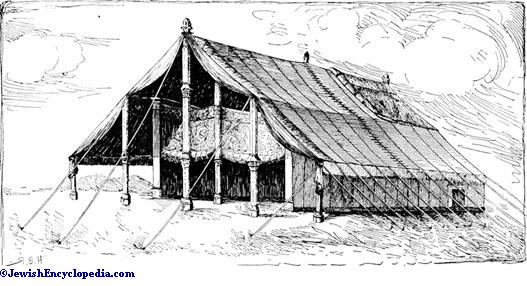
The five are quite appropriate to the entrance to a tent; the middle one, the tallest, supporting one end of a ridge pole, 60 ft. long. The heads of the pillars were joined by connecting rods (KJV "fillets ") overlaid with gold (Exo 36:38). There were five bars for each side of the structure, and five for the back, the middle bar alone of the five on each wall reached from end to end (Exo 26:28), as here shown. The red rams’ skins covering was over the goats’ hair, and the tachash skins above this (Exo 26:14). The tent cloth was laid over the tabernacle cloth so as to allow a cubit of tent cloth extending on each side in excess of the tabernacle cloth; it extended two cubits at the back and front (Exo 26:13; Exo 36:9; Exo 36:13). The roof angle was probably a right angle; then every measurement is a multiple of five cubits, except the width of the tabernacle cloth, 21 cubits, and the length of the tent cloth, 44 cubits. Each side of the slope would be about 14 cubits, half the width of the tabernacle cloth. The slope extends five feet beyond the wooden walls, and five from the ground.
The tent cloth would hang down one cubit on each side. The tent area (judging from the tabernacle cloth) thus is 10 ft. by 21 ft.; the tent cloth overhanging at the back and front by two cubits, i.e. half a breadth. The wooden structure within the tent would have a space all around it of five cubits in width; here probably were eaten the sacrificial portions of meat not to be taken outside, here too were spaces for the priests, like the small apartments round three sides of the temple. The five pillars must have stood five cubits apart. Each chief measurement of the temple was just twice that of the tabernacle. The holiest place, a square of ten cubits in the tabernacle (according to inference), was 20 cubits in the temple; the holy place in each case was a corresponding double square. The porch, five cubits deep in the tabernacle, was ten cubits in the temple; the side spaces, taking account of the thickness of the temple walls, were five cubits and ten cubits wide respectively; the tabernacle ridge pole was 15 cubits high, that of the temple roof (the holy place) was 30 cubits (1Ki 6:2).
In Eze 41:1
The ark contained it; and the lid of the ark, the mercyseat, was the place where Jehovah met or communed with Israel. As the Israelite theocracy was God’s kingdom, so the tabernacle was His palace, where the people had audience of God and whence He issued His commands, embodied in the testimony within the ark. The altar of burnt offering outside marks that only through shedding of blood can sinful man be admitted within His courts; and the mercy-seat within the veil, sprinkled with blood of the victim slain outside, typifies Christ, our propitiation or propitiatory within the heavenly holy of holies (Rom 3:25), who is the sinner’s only meeting place with God. Once admitted within the courts by the propitiation of Christ, we as king priests can offer incense of prayer and praise, as the priests burnt incense with holy fire on the altar of incense within (Psa 141:2; Mal 1:11). The separation of the church from the world is marked by the exclusion of any but priests from the holy place, and of the people from the congregation while unclean; the need of holiness by the various purifications (compare Psalm 24).
The king-priestly functions belonging to Israel in relation to the world, but declined through slowness of faith (Exo 19:6; Exo 20:19; Deu 5:27-28), Jehovah keeps for them against Israel’s restoration (Isa 61:6; Isa 66:21). The tabernacle represents God dwelling in the midst of Israel, and Israel drawing nigh to God through atonement and with offerings, prayers, and praises. Christ’s body is "the antitypical tabernacle which the Lord pitched, not man" (Heb 8:2). Through His glorified body as the tabernacle Christ passes into the heavenly holy of holies, God’s immediate presence, where He intercedes for us. His manhood is the "tabernacle of meeting" between us and God, for we are members of His body (Eph 5:30). Joh 1:14, "the Word was made flesh and tabernacled among us." The "veil’s" antitype is His rent flesh, or suffering humanity, through which He passed in entering the heavenly holiest for us (Heb 5:7; Heb 10:19-20).
His body is the temple (Joh 2:19). The tabernacle or temple is also a type of the church founded on Christ, the meeting place between God and man (Eph 2:18-22). As 10 (= 1 + 2 + 3 + 4) the number for completeness predominates in the tabernacle itself, so five the half of ten, and the number for imperfection, predominates in the courts; four appearing in the perfect cube of the holiest expressed worldwide extension and divine order. The shittim or acacia, wood implied incorruption and imperishableness of divine truth. As the court represents the Jewish dispensation, so the holy place the Christian and the holiest place the glorified church. The church having passed through the outer court, where atonement has been once for all made, ministers in the holy place, as consisting of king priests (1Pe 2:5; 1Pe 2:9; Rev 1:6; Rev 5:10) without earthly mediator, with prayer, praise, and the light of good works; and has access in spirit already (Heb 10:19), and in body finally, into the heavenly holiest.
In another point of view the court is the body, the holy place the soul, the holiest the spirit. The tabernacle was fixed at Shiloh (Jos 18:1). Then the ark was taken by the Philistines, and returned to Baale or Kirjath Jearim; then the tabernacle was at Nob and Gibeon until the temple was built (1 Samuel 4; 1 Samuel 6; 1Sa 21:1; 1Ch 13:5; 1Ch 16:39; 2Sa 6:2; 2Sa 6:17). The tabernacle was made in strict accordance with the pattern God revealed to Moses’ mind; nothing was left to the taste and judgment of artificers (Exo 25:9; Exo 25:40). It answered to the archetype in heaven, of which the type was showed by God to Moses (mentally it is probable) in the mountain (Heb 8:5). Bezaleel of Judah and Aholiab of Dan were divinely qualified for the work (Exo 31:3) by being "filled with the Spirit of God in wisdom, understanding, knowledge, and all workmanship."
Moses’ own "tent" (not
The cloud, dark by day, fiery red by night, rested on the tabernacle so long as Israel was to stay in the same encampment; it moved when Israel must move (Exo 40:36-38; Num 9:15-23). Jehovah’s name, the I AM, distinguishing the personal Creator from the creature, excludes pantheism and idolatry, as conversely the seemingly sublime inscription on Isis’ shrine at Sais, identifying the world and God, involves both: "I am all that has been, and is, and shall be, and my veil no mortal has withdrawn" (Clemens Alex. de Isaiah et Osir., 394). Moses’ authorship of the Pentateuch is marked by the fact that all his directions concerning impurity through a dead body relate to a tent such as was in the wilderness, nothing is said of a house; but in the case of leprosy a house is referred to (Num 19:11; Num 19:14; Num 19:21; Lev 13:47-59).
As to the Levites’ service (Numbers 3-4) of the tabernacle, exact details as to the parts each family should carry on march are given, such as none but an eye-witness would detail. The tabernacle with the camp of the Levites was to set forward between the second and third camps (Num 2:17); but Numbers 10 says after the first camp had set forward the tabernacle was taken down, and the sons of Gershon and Merari set forward bearing the tabernacle, and afterward the second camp or standard of Reuben. This seeming discrepancy is reconciled a few verses after: the tabernacle’s less sacred parts, the outside tent, etc., set out between the first and second camp; but the holy of holies, the ark and altar, did not set out until after the second camp. The reason was that those who bore the outside tabernacle might set it up ready for receiving the sanctuary against its coming (Num 10:14-21). No forger in an age long before modern criticism was thought of would invent such a coincidence under seeming discrepancy.
Tabernacle, Exo 25:9, literally means "a tent." The sanctuary where in the earlier times the most sacred rites of the Hebrew religion were performed. The command to erect a tabernacle is recorded in Exo 25:8; and in that place, and in Exo 29:42-43; Exo 29:45, the special purpose is declared for which it was to be made. And so we find the various names of it, the "tent," Exo 26:11-12; the "tabernacle," dwelling or habitation, Exo 26:13; the "tent of meeting," Exo 29:43, for so the words should be rendered; the "tent of the testimony" or "tabernacle of witness," Num 9:15; Num 17:7; Num 18:2; the "house of the Lord," Deu 23:18; Jos 9:23; Jdg 18:31; all these appelations pointing to the covenant-purpose of God. The command to make it began by inviting the people to contribute suitable materials. They were to be offered with a willing heart. These materials are described in Exo 25:3-7. And the tabernacle was to be built according to the pattern given of God. It was as to its general plan like an ordinary tent, which is usually divided into two compartments, the inner lighted by a lamp and closed against strangers. Such tents are longer than they are broad. And so the tabernacle was an oblong square or rectangle, 30 cubits (45 feet or perhaps 50 feet) long, ten cubits in breadth and in height. The frame-work on these sides was perpendicular boards of shittim-wood, that is, acacia, overlaid with gold, kept together by means of transverse bars passing through golden rings, and each with two tenons, fitting into silver sockets, on which they stood. There were four coverings. The first was ten curtains of byssus, or fine linen, blue, purple, and scarlet, with cherubim embroidered on them, coupled together by loops and gold hooks. The second covering was of goals’ hair in eleven curtains. The third covering was of rams’ skins dyed red, like our morocco leather; and the fourth of "badgers’ skins," more probably a kind of seal skin. These were to protect the tabernacle from the weather. The inner apartment or most holy place was a cube of ten cubits, the outer apartment 20 cubits in length and ten in breadth. They were separated by a veil of the same kind as the innermost covering, suspended on four gilded acacia pillars reared upon silver sockets. The east end or entrance of the tabernacle had also a large curtain suspended from five gilded acacia pillars set in sockets of brass or copper.
The Furniture.— In the most holy place, which the high priest alone entered, was the ark of the covenant; in the holy place, where the priests ministered—to the north the table of shew-bread, to the south the golden candlestick, in the centre the altar of incense. Round about the tabernacle was an open court into which the people were admitted, 100 cubits in length and 50 broad. It was formed by columns, 20 on each side, 10 at each end, raised on brazen or copper sockets. Hangings fastened to the pillars formed three sides and part of the fourth: on the east the breadth of four pillars was reserved for a central entrance, where was an embroidered curtain suspended from the four pillars. Immediately opposite the entrance was the great altar of burnt offering; and between that and the door of the tabernacle was the laver. Ex., chaps. 26, 27, 38, 40. There are some parts of the description of the pillars and hangings of the court which it is not easy to understand. The tabernacle was completed in about nine months: and as the people offered most liberally, Exo 36:5, it was a costly structure: the value of the materials being estimated at $1,000,000. It was erected on the first day of the first month of the second year after leaving Egypt. It was carried by the Israelites into Canaan, and there set up, possibly first at Gilgal, then, when the land was subdued, at Shiloh, Jos 18:1, and also at Bethel, perhaps afterwards at Nob, and then at Gibeon. 1Ch 16:39; 1Ch 21:29. It was removed, when the temple was built, to Jerusalem, and possibly deposited in the temple. 1Ki 8:4; 2Ch 5:5. For the regulations about its removal see Num 4:1-49. David seems to have constructed a second tabernacle to receive the ark when it was brought to Jerusalem. 2Sa 6:17; 1Ch 15:1. Doubtless the first one had perished or worn out. See Bissell, Bib. Antiq.
The usual word for a tabernacle is Ohel (
Where the Feast of Tabernacles is referred to, Sucah is used. It probably means a place of shade or shelter, hence a booth, tent, or pavilion. The rendering cottage in Isa 1:8 is hardly accurate in Job 36:29 we read, ’Can any one understand the spreadings of the clouds, or the noise of his tabernacle?’ Here reference is made to the heavens, either as God’s place of shelter--H is hiding-place place -- or to the clouds as a shade for the earth.
In Amo 5:26, ’Ye have borne the tabernacle of Moloch,’ there may be reference to a movable tent in which the images of false gods were placed. The marginal rendering, ’Siccuth your king,’ is endorsed by the Masoretic punctuation, is accepted by Luther and by the R.V., and may be illustrated by the name of the Assyrian god Sakkut. But the quotation in St. Stephen’s speech (Act 7:43) follows the LXX, and is confirmed by the implied contrast with another tabernacle of which we read in Amo 9:11, where the same word is used, ’I will raise up the tabernacle of David that is fallen down, and will close up the breaches thereof’ With this passage may be compared the complaint of Jeremiah concerning the temple et Jerusalem: God ’hath violently taken away his tabernacle (
By: Executive Committee of the Editorial Board., Eduard König
The portable tent-like structure that served the Israelites as a sanctuary during their wanderings in the wilderness and in the early period of their life in Palestine. It is chiefly in Ex. xxvi. and its parallel, ib. xxxvi. 8-38, that the oldest sanctuary of Yhwh is mentioned. Its fundamental part consisted of a framework of acacia-wood. Each board was 10 cubits long and 1½ cubits broad (an old Hebraic cubit measured probably, like the Babylonian, 55.5 cm.). The north and south sides each contained twenty such boards (ib. xxvi. 18, 20). The western side consisted of six similar boards (ib. verse 22), with the addition of two more which were to join the western with the northern and southern sides, respectively, in a manner rather obscurely described (ib. verses 23-25). These forty-eight boards were fixed in silver sockets, two to each board, bymeans of "hands" ("yadot"), i.e., tenons, and they were kept from falling apart by five cross-bars on a side (ib. verses 26-28). The eastern side remained open.
Parts.
Since this framework was of course the first part to be set up (ib. xl. 18), it has been mentioned first here; but what really constituted the dwelling of the Lord, according to the express words of the Old Testament (ib. xxvi. 1, 6; xxxvi. 8, 13), were the inner curtains, which gave the structure its characteristic form. The quality and colors of these curtains were chosen accordingly; they were woven from the finest threads, some white, some bluish and reddish purple, and some scarlet. Pictures of cherubim were also woven in them (ib. xxvi. 1-6). A second set of curtains was made of goat-hair, which was the usual material for tents (ib. verses 7-13); these, by synecdoche (comp. König, "Stilistik," etc., p. 64), were called the "tent" (ib. xxvi. 7; xxxviii. 14, 18; xl. 19), inasmuch as they formed the chief part thereof; and upon them were placed two coverings, one of ramskin dyed red, and one of skins of the "taḥash." This latter was probably a seal; in any case it was a less common animal than the sheep, which Friedrich Delitzsch in his "Prolegomena zu einem Neuen Hebräisch-Aramäischen Wörterbuch" (p. 79) understands by "taḥash." With regard to the first-mentioned curtains, some scholars, as Winer("B. R." s.v.) and Holzinger (on Ex. xxvi. 15, in "K. H. C." 1900), have declared that they formed not the walls of the Tabernacle, but merely an inner covering of those walls; but the contrary view is much more probable, and is the one adopted by De Wette, for instance ("Hebräische Archäologie," § 194), by Riehm ("Handwörterbuch des Biblischen Altertums," p. 1559), and by Baentsch ("Handkommentar zum Exodus," 1900, p. 228); indeed, the circumstance that these curtains are called "the dwelling" and that the tent-covering is placed upon them (Ex. xl. 19) is convincing evidence for the opinion that they enveloped the boards almost completely lest they might become soiled; they were not to touch the floor, and so were made only 28 cubits long. This fact would not be so comprehensible had the curtains been merely interior hangings. The objection has been raised, it is true, that cherubim were woven into them, and that in Solomon's Temple cherubim were carved on the inner walls; but the latter case presents a necessary modification which resulted naturally when the dwelling of the Lord no longer consisted chiefly of curtains. Moreover, the text contains no suggestion of hooks or any other appliances by means of which the curtains might have been suspended had they been intended merely to cover the inner surface of the walls.
Size.
The Tabernacle.(Restored by Ferguson.)
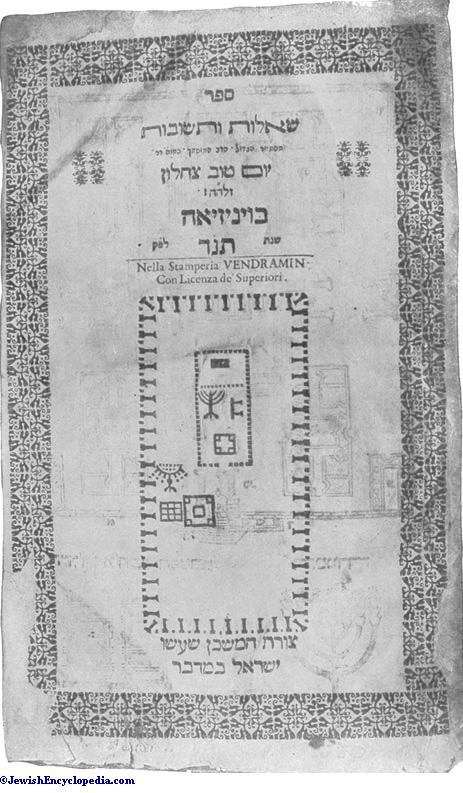
Title-Page from Yom-Ṭob Ẓahalon's "She'elot u-Teshubot," Venice, 1694, Showing Ground-Plan of the Tabernacle.(From the Sulzberger collection in the Jewish Theological Seminary of America, New York.)
The examination of the component parts of Yhwh's dwelling mentioned above leads to a consideration of its size. The height was undoubtedly 10 cubits; but the length was not simply 20 × 1½ cubits, since there must also be taken into consideration the eight boards on the western side. These measured 12 cubits by themselves; and, in addition, the thickness of the two boards by which the western wall was joined on one side to the southern and on the other to the northern wall (ib. xxvi. 23-25) must be reckoned in determining the exterior length of the Tabernacle. The thickness of these boards may be estimated from the following calculation: The Holy of Holies was 10 cubits high and 10 cubits long, since half of the inner covering, which was 40 cubits long, reached from the lower end of the western wall to the edge of the Holy of Holies (ib. xxvi. 33). This most holy place in all probability formed a cube of 10 cubits (comp. "ka'bah" = "cube"). If so the breadth of the Tabernacle must have been 10 cubits, i.e., the breadth of its inner space, whereas the eight western boards measured 12 cubits; and the southern and northern walls must each have covered one of the 12 cubits of the western wall; i.e., the boards must each have been 1 cubit thick. The outer length of the Tabernacle was, then, 20 × 1½ + 1 cubit = 31 cubits; and its outer width was 8 × 1½ cubits. But the inner length was 30 cubits, and the inner breadth 10 cubits; and since the inner space constituted the dwelling of the Lord, Josephus says ("Ant." iii. 6, § 3), not without reason, "its length, when it was set up, was 30 cubits, and its breadth was 10 cubits."
Holy Place.
This tent was divided, by means of a curtain hung 10 cubits from the western wall, into a most holy place ("Ḳodesh ha-Ḳodashim") and a holy place ("Ḳodesh"). This curtain was called "paroket," and was woven from the same four stuffs as the costly curtains which formed the inner covering (Ex. xxvi. 31-35). The eastern entrance to the holy place, which was 20 cubits long, was covered by a curtain ("masak") of the same materials (ib. verses 36 et seq.). Finally a court (ḥaẓer) formed in a certain measure a part of the Tabernacle. This court was 100 cubits long and 50 cubits broad (ib. xxvii. 9-13), and, since the Tabernacle was placed in its western part, it was rightly called a forecourt. The Tabernacle could be taken down (Num. x. 17); and it is therefore called a "tent." Its form does not need to have been that of a house (namely, that of Solomon's Temple), since (despite Holzinger's [l.c. p. 129] and Baentsch's [l.c. p. 231] statements) tents are sometimes made in an elongated form.
Name.
As has been mentioned above, this sanctuary of Yhwh (Ex. xxv. 8) was in the nature of things called the "dwelling" par excellence ("ha-mishkan") and the "tent" par excellence ("ha-ohel"); but its most frequent designation is "ohel mo'ed" (ib. xxvii. 21 et seq.). This term means "tent of mutual appointment," that is, "place of meeting [of God with Moses and with his successors]" (ib. xxv. 22; comp. the heathen "har mo'ed," Isa. xiv. 13). It was a mistake to interpret "mo'ed" here in a temporal sense, as if it had meant "tent of fixed time" (Targ., Pesh., Arabic). The expression means still less "tent of witness" (LXX.:
Age and Origin.
It was natural that the Ark of the Covenant should have been erected in some protected place; and such a place is expressly mentioned in Ex. xxxiii. 7-11 (which section is correctly ascribed to a comparatively ancient chronicler), and is called "ohel mo'ed." It is, to be sure, stated in the same place that Moses used to set up the Tabernacle outside of the camp (comp. König, "Syntax," §§ 157, 367e), and its position is so designated in Num. x. 32; xi. 24, 26 et seq., 30; xii. 4, whereas according to Num. ii. 2, 17; v. 1 et seq., the ohel mo'ed formed the central point of the camp. This obscurity in the memory of Israel is not to be denied; but, nevertheless, the question remains as to whether or not the Tabernacle, the description of which has been given above, is to be treated as a pure invention of the later priests, as is claimed by many exegetes and with special emphasis by Baentsch (l.c. p. 220). The argument that the splendor with which the Tabernacle was furnished according to Ex. xxvi. 1 et seq., precludes its assignment to the time of Moses is of no weight, since the passage Ex. iii. 22 et seq. does not admit the conclusion that the Israelites who came out of Egypt were wholly destitute. Moreover, it is not remarkable, as has been claimed, that the tent of meeting should sometimes have been called "house" ("bayit"; comp. Josh. xviii. with Judges xviii. 31), since the tent which David erected for the Ark of the Covenant (II Sam. vi. 17) is similarly called "house of Jehovah" (ib. xii. 20); and if the Tabernacle was a product of the imagination, with Solomon's Temple as its prototype, other differences between the descriptions of the two would be hard to explain (e.g., one candlestick instead of ten).
Symbolic Meaning.
It is probable that the characteristic features of the place of worship in the Old Testament bore, in addition to their outward purpose, an inner relationship to religious ideas. The following may be considered the chief of these: the opening of the gate toward the east had reference to the rising of the sun (comp. Isa. xli. 1 et seq.); the distinction between the holy place and the most holy place corresponded to the distinction between heaven and the innermost heaven ("sheme ha-shamayim"; I Kings viii. 27, etc.); and the forecourt, according to Isa. lxvi. 1, symbolized the earth. This interpretation was suggested by Josephus (l.c. iii. 6. § 4), and has been developed chiefly by Bähr ("Symbolik des Mosaischen Kultus," 1837).
TABERNACLE.—1. By ‘the tabernacle’ without further qualification, as by the more expressive designation ‘tabernacle of the congregation’ (RV
2. The sections of the Priests’ Code (P
In these and other OT passages the wilderness sanctuary is denoted by at least a dozen different designations (see the list in Hastings’ DB
3. In order to do justice to the Priestly writers in their attempts to give literary shape to their ideas of Divine worship, it must be remembered that they were following in the footsteps of Ezekiel (chs. 40–48), whose conception of a sanctuary is that of a dwelling-place of the Deity (see Eze 37:27). Now the attribute of Israel’s God, which for these theologians of the Exile overshadowed all others, was His ineffable and almost unapproachable holiness, and the problem for Ezekiel and his priestly successors was how man in his creaturely weakness and sinfulness could with safety approach a perfectly holy God. The solution is found in the restored Temple in the one case (Eze 40:1-49 ff.), and in the Tabernacle in the other, together with the elaborate sacrificial and propitiatory system of which each is the centre. In the Tabernacle, in particular, we have an ideal of a Divine sanctuary, every detail of which is intended to symbolize the unity, majesty, and above all the holiness of J″
4. Taking this general idea of the Tabernacle with us, and leaving a fuller discussion of its religious significance and symbolism to a later section (§ 8), let us proceed to study the arrangement and component parts of P
(a) We begin, therefore, with ‘the court of the dwelling’ (Exo 27:9). This is described as a rectangular enclosure in the centre of the camp, measuring 100 cubits from east to west and half that amount from south to north. If the shorter cubit of, say, 18 inches (for convenience of reckoning) be taken as the unit of measurement, this represents an area of approximately 50 yards by 25, a ratio of 2:1. The entrance, which is on the eastern side, is closed by a screen (Exo 27:16 RV
(b) In the centre of the court is placed the altar of burnt-offering (Exo 27:1-8), called also ‘the brazen altar’ and ‘the altar’ par excellence. When one considers the purpose it was intended to serve, one is surprised to find this altar of burnt-offering consisting of a hollow chest of acacia wood (so RV
(c) In proximity to the altar must be placed the bronze laver (Exo 30:17-21), containing water for the ablutions of the priests. According to Exo 38:8, it was made from the ‘mirrors of the women which served at the door of the tent of meeting’ (RV
5. (a) It has already been emphasized that the dominant conception of the Tabernacle in these chapters is that of a portable sanctuary, which is to serve as the earthly dwelling-place of the heavenly King. In harmony therewith we find the essential part of the fabric of the Tabernacle, to which every other structural detail is subsidiary, described at the outset by the characteristic designation ‘dwelling.’ ‘Thou shalt make the dwelling (EV
The ten curtains of the dwelling (mishkân), each 28 cubits by 4, are to be of the finest linen, adorned with inwoven tapestry figures of cherubim in violet, purple, and scarlet (see Colours). ‘the work of the cunning workman’ (Exo 26:1 ff. RV
(b) The next section of the Divine directions (Exo 26:7-14) provides for the thorough protection of these delicate artistic curtains by means of three separate coverings. The first consists of eleven curtains of goats’ hair ‘for a tent over the dwelling,’ and therefore of somewhat larger dimensions than the curtains of the latter, namely 30 cubits by 4, covering, when joined together, a surface of 44 cubits by 30. The two remaining coverings are to be made respectively of rams’ skins dyed red and of the skins of a Red Sea mammal, which is probably the dugong (Exo 26:14, RV
(c) At this point one would have expected to hear of the provision of a number of poles and stays by means of which the dwelling might be pitched like an ordinary tent. But the author of Exo 26:1-14 does not apply the term ‘tent’ to the curtains of the dwelling, but, as we have seen, to those of the goats’ hair covering, and instead of poles and stays we find a different and altogether unexpected arrangement in Exo 26:15-30. Unfortunately the crucial passage, Exo 26:15-17, contains several obscure technical terms, with regard to which, in the present writer’s opinion, the true exegetical tradition has been lost. The explanation usually given, which finds in the word rendered ‘boards’ huge wooden beams of impossible dimensions, has been shown in a former study to be exegetically and intrinsically inadmissible; see art. ‘Tabernacle’ in Hastings’ DB
The open frames—after being overlaid with gold according to our present but scarcely original text (1Ki 7:29)—are to be ‘reared up,’ side by side, along the south, west, and north sides of a rectangular enclosure measuring 30 cubits by 10 (1Ki 3:1), the east side or front being left open. Twenty frames go to form each long side of the enclosure (11/2x20 = 30 cubits); the western end requires only six frames (11/2x6 = 9 cubs.); the remaining cubit of the total width is made up by the thickness of the frames and bars of the two long sides. The two remaining frames are placed at the two western corners, where, so far as can be gathered from the obscure text of 1Ki 3:24, the framework is doubled for greater security. The lower ends of the two uprights of each frame are inserted into solid silver bases, which thus form a continuous foundation and give steadiness to the structure. This end is further attained by an arrangement of bars which together form three parallel sets running along all three sides, binding the whole framework together and giving it the necessary rigidity.
Over this rigid framework, and across the intervening space, are laid the tapestry curtains to form the dwelling, the symbolic figures of the cherubim now fully displayed on the sides as well as on the roof. Above these come the first of the protective coverings above described, the goats’ hair curtains of the ‘tent,’ as distinguished from the ‘dwelling.’ In virtue of their greater size, they overlap the curtains of the latter, their breadth of 30 cubits exactly sufficing for the height and width of the dwelling (10 + 10 + 10 cubits). As they thus reached to the base of the two long sides of the Tabernacle, they were probably fastened by pegs to the ground. At the eastern end the outermost curtain was probably folded in two so as to hang down for the space of two cubits over the entrance (26:9). In what manner the two remaining coverings are to be laid is not specified.
[This solution of the difficulties connected with the construction of the Tabernacle, first offered in DB
(d) The fabric of the Tabernacle, as described up to this point in Exo 26:1-30, has been found to consist of three parts, carefully distinguished from each other. These are (1) the artistic linen curtains of the dwelling, the really essential part; (2) their supporting framework, the two together enclosing, except at the still open eastern front, a space 30 cubits long and 10 cubits wide from curtain to curtain, and 10 cubits in height; and (3) the protecting tent (so called) of goats’ hair, with the two subsidiary coverings.
The next step is to provide for the division of the dwelling into two parts, in the proportion of 2 to 1, by means of a beautiful portiere, termed the veil (Exo 26:31 ff.), of the same material and artistic workmanship as the curtains of the dwelling. The veil is to be suspended from four gilded pillars, 20 cubits from the entrance and 10 from the western end of the structure. The larger of the two divisions of the dwelling is named the holy place, the smaller the holy of holies or most holy place. From the measurements given above, it will be seen that the most holy place—the true presence-chamber of the Most High, to which the holy place forms the antechamber—has the form of a perfect cube, 10 cubits (about 15 ft.) in length, breadth, and height, enclosed on all four sides and on the roof by the curtains and their cherubim.
(e) No provision has yet been made for closing the entrance to the Tabernacle. This is now done (Exo 26:36 f.) by means of a hanging, embroidered in colours—a less artistic fabric than the tapestry of the ‘cunning workman’—measuring 10 cubits by 10, and suspended from five pillars with bases of bronze. Its special designation, ‘a screen for the door of the Tent’ (Exo 26:36 RV
6. Coming now to the furniture of the dwelling, and proceeding as before from without inwards, we find the holy place provided with three articles of furniture: (a) the table of shewbread, or, more precisely, presence-bread (Exo 25:23-30, Exo 37:10-16); (b) the so-called golden candlestick, in reality a seven-branched lampstand (Exo 25:31-40, Exo 37:17-24) (c) the altar of incense (Exo 30:1-7, Exo 37:25-28). Many of the details of the construction and ornamentation of these are obscure, and reference is here made, once for all, to the fuller discussion of these difficulties in the article already cited (DB
(a) The table of shewbread, or presence-table (Num 4:7), is a low table or wooden stand overlaid with pure gold, 11/2 cubits in height. Its top measures 2 cubits by 1. The legs are connected by a narrow binding-rail, one hand-breadth wide, the ‘border’ of Exo 25:25, to which are attached four golden rings to receive the staves by which the table is to be carried on the march. For the service of the table are provided ‘the dishes, the spoons, the flagons, and the bowls thereof to pour withal’ (Exo 25:29 RV
(b) The golden candlestick or lampstand is to be constructed of ‘beaten work’ (repoussé) of pure gold. Three pairs of arms branched off at different heights from the central shaft, and curved outwards and upwards until their extremities were on a level with the top of the shaft, the whole providing stands for seven golden lamps. Shaft and arms were alike adorned with ornamentation suggested by the flower of the almond tree (cf. diagram in DB
(c) The passage containing the directions for the altar of incense (Exo 30:1-7) forms part of a section (chs. 30, 31) which, there is reason to believe is a later addition to the original contents of the Priests’ Code. The altar is described as square in section, one cubit each way, and two cubits in height, with projecting horns. Like the rest of the furniture, it was made of acacia wood overlaid with gold, with the usual provision of rings and staves. Its place is in front of the veil separating the holy from the most holy place. Incense of sweet spices is to be offered upon it night and morning (Exo 30:7 ff.).
7. In the most holy place are placed two distinct yet connected sacred objects, the ark and the propitiatory or mercy-seat (Exo 25:10-22, Exo 37:1-9). (a) P
(b) Distinct from the ark, but resting upon and of the same superficial dimensions as its top, viz. 21/2 by 11/2 cubits, we find a slab of solid gold to which is given the name kappôreth. The best English rendering is the propitiatory (Exo 25:17 ff.), of which the current mercy-seat, adopted by Tindale from Luther’s rendering, is a not inappropriate paraphrase. From opposite ends of the propitiatory, and ‘of one piece’ with it (Exo 25:19 RV
We have now penetrated to the Innermost shrine of the priestly sanctuary. Its very position is significant. The surrounding court is made up of two squares, 50 cubits each way, placed side by side (see above). The eastern square, with its central altar, is the worshippers’ place of meeting. The entrance to the Tabernacle proper lies along the edge of the western square, the exact centre of which is occupied by the most holy place. In the centre of the latter, again, at the point of intersection of the diagonals of the square, we may be sure, is the place intended for the ark and the propitiatory. Here in the very centre of the camp is the earthly throne of J″
8. These observations lead naturally to a brief exposition of the religious symbolism which so evidently pervades every part of the wilderness sanctuary. Its position in the centre of the camp of the Hebrew tribes has already been more than once referred to. By this the Priestly writer would emphasize the central place which the rightly ordered worship of Israel’s covenant God must occupy in the theocratic community of the future.
The most assured fruit of the discipline of the Babylonian Exile was the final triumph of monotheism. This triumph we find reflected in the presuppositions of the Priests’ Code. One God, one sanctuary, is the idea implicit throughout. But not only is there no God but Jahweh; Jahweh, Israel’s God, ‘is one’ (Deu 6:4 RVm
Nor is the perpetual striving after proportion and symmetry which characterizes all the measurements of the Tabernacle and its furniture without a deeper significance. By this means the author undoubtedly seeks to symbolize the perfection and harmony of the Divine character. Thus, to take but a single illustration, the perfect cube of the most holy place, of which ‘the length and breadth and height,’ like those of the New Jerusalem of the Apocalypse (Rev 21:16), ‘are equal,’ is clearly intended to symbolize the perfection of the Divine character, the harmony and equipoise of the Divine attributes.
Above all, however, the Tabernacle in its relation to the camp embodies and symbolizes the almost unapproachable holiness of God. This fundamental conception has been repeatedly emphasized in the foregoing sections, and need be re-stated in this connexion only for the sake of completeness. The symbolism of the Tabernacle is a subject in which pious imaginations in the past have run riot, but with regard to which one must endeavour to be faithful to the ideas in the mind of the Priestly author. The threefold division of the sanctuary, for example, into court, holy place, and holy of holies, may have originally symbolized the earth, heaven, and the heaven of heavens, but for the author of Exo 25:1-40 ff. it was an essential part of the Temple tradition (cf. Temple, § 7). In this case, therefore, the division should rather be taken, as in § 7 above, as a reflexion of the three grades of the theocratic community, people, priests, and high priest.
9. Reluctantly, but unavoidably, we must return, in conclusion, to the question mooted in § 2 as to the relation of the gorgeous sanctuary above described to the simple ‘tent of meeting’ of the older Pentateuch sources. In other words, is P
Apart, therefore, from the numerous difficulties presented by the description of the Tabernacle and its furniture, such as the strangely inappropriate brazen altar (§ 4 (b)), or suggested by the unexpected wealth of material and artistic skill necessary for its construction, modern students of the Pentateuch find the picture of the desert sanctuary and its worship irreconcilable with the historical development of religion and the cultus in Israel. In Exo 25:1-40 and following chapters we are dealing not with historical fact, but with ‘the product of religious idealism’; and surely these devout idealists of the Exile should command our admiration as they deserve our gratitude. If the Tabernacle is an ideal, it is truly an ideal worthy of Him for whose worship it seeks to provide (see the exposition of the general idea of the Tabernacle in § 3, and now in full detail by M‘Neile as cited, § 5 above). Nor must it be forgotten, that in reproducing in portable form, as they unquestionably do, the several parts and appointments of the Temple of Solomon, including even its brazen altar, the author or authors of the Tabernacle believed, in all good faith, that they were reproducing the essential features of the Mosaic sanctuary, of which the Temple was supposed to be the replica and the legitimate successor.
A. R. S. Kennedy.
(Latin tabernaculum, tent).Tabernacle in Biblical parlance usually designates the movable tent-like sanctuary of the Hebrews before the erection of Solomon’s Temple. The various expressions in the Hebrew text in reference to the Tabernacle (’ohel, tent; ’ohel mo’ed, tent of meeting; ’ohel ha-’eduth, tent of the testimony; mishkan, dwelling; mishkan ha- ’eduth, dwelling of the testimony; mishkan ’ohel, dwelling of the tent; beth Yahweh, house of Yahweh; godesh, holy; miqdash, sanctuary; hekal, temple),while enabling us to form a fair idea of this construction, raise, by the seeming consistency of the passages in which they severally occur, many problems with which all modern commentators of the Scriptures have to grapple. Thus, Exodus describes the ark as sheltered in a tent (xxxiii, 7; Hebr. ’ohel mo’ed), whose position was "without the camp afar off" (Cf. Numbers 11:16 sqq.; 11:24-30; 12; Deuteronomy 31:14 sqq.), guarded by "Josue the son of Nun" (11), and at the door of which Yahweh was wont to manifest himself to Moses (9-11; cf. Numbers 12:5; Deuteronomy 31:15). That this "tent of tryst" (or better, perhaps, "tent of the oracle") was not identical with the tabernacle modern independent critics urge from the fact that this ’ohel mo’ed was in existence before Beseleel and Ooliab commenced the construction of the Tabernacle (Exodus 35-36) and that the customary place of the latter was in the very midst of the encampment (Numbers 2:1 sqq.; 10:15 sqq.). Much stress is laid upon this and other seeming discrepancies to conclude that the description of the tabernacle found in Ex., xxv-xxxi, xxxix-xl, is the work of post-exilian authors of the Priestly Code.Assuming, however, the historical accuracy of the Biblical narratives, we shall limit ourselves here to a brief description of that "portable sanctuary" of the Hebrews. In this sanctuary we should distinguish the tent or tabernacle proper from the sacred enclosure in which the tent stood. The "court of the tabernacle" (Exodus 27:9) was a rectangular space, measuring 100 by 50 cubits (probably the Egyptian cubit, 203/4 ins.), screened off by curtains of "fine twisted linen" (xxvii, 9), 5 cubits high, 100 cubits long on the north and south sides, 50 on the east and 15 on the west, and 20 cubits on either side of the entrance. The entrance was closed by a hanging of fine twisted linen , embroidered in violet, purple, and scarlet and "twice dyed" on a white ground (probable meaning of Exodus 27:16). All these curtains were suspended from sixty pillars, but not in a "loose and flowing manner", as Josephus wrongly states, since the total length of the curtains is exactly the same as the perimeter of the court, one pillar being assigned to every five cubits of curtain. These pillars of setimwood, five cubits high, stood on bases ("sockets", Exodus 39:39) of brass and were held in position by means of cords (ibid., xxxix, 40) fastened to brass pegs ("pins", ibid., xxxv, 18) which were stuck in the ground; the pillars ended in a capital ("head", Exodus 39:17, etc.; we must believe that the height given above includes both the base and capital of the pillar) with a band or necking (to hang the curtain) overlaid with silver. East of the entrance were found successively: the altar of holocausts (Exodus 27:1-8, etc.), the brazen layer (xxx, 18-21; xxxviii, 8, etc.),and the tabernacle proper. The latter was conceived to be the dwelling-tent of God; hence it consisted essentially of curtains, the wooden framework, though indispensable, being only of secondary importance. The whole structure measured 30 by 10 cubits, and was divided into two sections; the one to the west, the "Holy Place", containing the altar of incense, the golden candlestick, and the table of shewbreads; and the other, the "Holy of Holies", containing the Ark of the Covenant with the propitiatory and the cherubim. These sections were respectively 20 and 10 cubits long.Jewish exegetical tradition, followed by almost every Christian exponent of the Bible, understood the wooden framework to be made up of 48 massive boards (rather beams) of setim wood, measuring 10 by 11/2 by 1 cubit, placed side by side. This means a weight (about fifty tons) out of proportion with what these beams would have to bear and very difficult of transportation. Some modern scholars having studied more closely the technical terms used in the original adopt another view. According to them the "boards" of the tabernacle must be understood as light frames consisting of two uprights joined (probably at the top, middle, and bottom) by ties or cross-rails (the "mortises" in Exodus 26:17). Of these frames, overlaid with gold (xxvi, 29), there were 20 on the north side of the tabernacle, 20 on the south, and 6 on the east. To provide solidity and rigidity, a slanting frame was put at the north-east and south-east corners to buttress the structure (xxvi, 23); the lower part of the uprights was sunk deep into silver sockets or bases, probably to be understood as square blocks (about 1 cubit high and 3/4 cubit square); finally, five wooden bars, passing through rings attached to the frames, ran along the sides (xxvi, 26-28). On the west the frames were to be replaced by five pillars of setimwood overlaid with gold, sunk in brass bases, and crowned with golden capitals (xxvi, 37). Four pillars of the same workmanship, with silver bases, separated the Holy Place from the Holy of Holies.A curtain, two pieces of fine tapestry joined by golden rings, was spread over the whole framework; each piece of tapestry consisted of five strips, 28 by 4 cubits, fitted together by loops. The total dimension of this being 20 by 40 cubits, it must have reached on the north and south the top of the bases, against which it was possibly fixed (there were loops at the top of the curtains likely for this purpose), whereas on the east it reached to the ground. Covering this curtain was another woven of goats’ hair (the ordinary tent material), fitted in somewhat similarly; its dimensions, 11 (6+5)x4=44 by 30 cubits, were so calculated as to cover entirely the inside curtain on the north, east, and south sides and to hang down doubled on the west side, thus covering the tops and capitals of the pillars (Exodus 26:7-13). Two outer coverings (no dimensions are given), one of dyed rams’ skin and one of dugongs’ skin, protected the whole structure. A hanging of apparently the same workmanship as that closing the entrance of the court, screened the entrance of the tabernacle (ibid., 36); finally, a veil of the same tapestry as the inner curtain, hooked from the four pillars mentioned above, completed the separation of the Holy of Holies from the Holy Place.HistoryDelayed by the people’s outburst of idolatrous worship pending the long intercourse of Moses with God on Mount Sinai, the construction was achieved by the skilful workmen selected by God, and was dedicated on the first day of the second year after the flight from Egypt. Henceforth the tabernacle, under the special care of the Levites of the family of Gerson, accompanied the Israelites through their wanderings in the wilderness; during marches, it came after the first six tribes and before the other six (Numbers 2:3-34); in encampments, it occupied the middle of the camp, three tribes being on each side. After the crossing of the Jordan, it remained very likely at Galgala until its removal to Silo (Joshua 18:1), where it remained many years. In Saul’s time we hear of the tabernacle at Nobe (1 Samuel 21:1-6), and later at Gabaon (1 Chronicles 16:39), until Solomon had it removed to his new Temple (1 Kings 8:4; 2 Chronicles 5:5). It disappeared in the first years of the sixth century B.C., being either taken away by the Babylonian army in 588, or, if credence be given the letter prefacing II Mach., hidden by Jeremias in an unknown and secure place.----------------------------------- JOSEPHUS, Jewish Antiquities, III, vi; PHILO, De Vita Moysis. Talmud Babyl.: Tract. Middoth, a baraitha gives the opinions of the ancient doctors on the subject. BROWN, The Tabernacle (6th ed., 1899); ORR, The Problem of the O.T. (New York, 1906); OTTLEY, Aspects of the O.T. (Oxford, 1897); WELLHAUSEN, Prolegomena (Edinburgh, 1885); WESTCOTT, Essay on the General Significance of the Tabernacle in The Epistle to the Hebrews (New York, 1889), 233 sqq.; B HR, Symbolik des mosaisch. Kultus (1837-39); FRIEDRICH, Symbolik der mos. Stiftshütte (Leipzig, 1841); GRAF, Die geschichtl. Bücher des A. T. (Leipzig, 1866), 51 sqq.; NEUMANN, Die Stiftshütte (Gotha, 1861); POPPER, Der bibl. Bericht ber die Stiftshütte (Leipzig, 1862); RIGGENBACH, Die mosaisch. Stiftshütte (1861); SCHICK, Stiftshütte u. Tempel (1898). CHARLES L. SOUVAY Reynir Gudmundsson The Catholic Encyclopedia, Volume XIVCopyright © 1912 by Robert Appleton CompanyOnline Edition Copyright © 2003 by K. KnightNihil Obstat, July 1, 1912. Remy Lafort, S.T.D., CensorImprimatur. +John Cardinal Farley, Archbishop of New York
A. Structure and History
I. INTRODUCTORY
1. Earlier “Tent of Meeting”
2. A Stage in Revelation
3. The Tabernacle Proper
II. STRUCTURE
1. The Enclosure or Court
2. Structure, Divisions and Furniture of the Tabernacle
(1) Coverings of the Tabernacle (Exodus 26:1-14; 36:8-19)
(a) Tabernacle Covering Proper
(b) Tent Covering
(c) Protective Covering
(2) Framework and Divisions of the Tabernacle (Exodus 26:15-37; 36:20-38)
Arrangement of Coverings
(3) Furniture of the Sanctuary
(a) The Table of Shewbread
(b) The Candlestick (Lampstand)
(c) The Altar of Incense
III. HISTORY
1. Removal from Sinai
2. Sojourn at Kadesh
3. Settlement in Canaan
4. Destruction of Shiloh
5. Delocalization of Worship
6. Nob and Gibeon
7. Restoration of the Ark
8. The Two Tabernacles
IV. SYMBOLISM
1. New Testament References
2. God’s Dwelling with Man
3. Symbolism of Furniture
LITERATURE
I. Introductory.
Altars sacred to Yahweh were earlier than sacred buildings. Abraham built such detached altars at the Terebinth of Moreh (Gen 12:6, Gen 12:7), and again between Beth-
1. Earlier “Tent of Meeting”:
The first step toward a habitation for the Deity worshipped at the altar was taken at Sinai, when Moses builded not only “an altar under the mount,” but “12 pillars, according to the 12 tribes of Israel” (Exo 24:4). There is no recorded command to this effect, and there was as yet no separated priesthood, and sacrifices were offered by “young men of the children of Israel” (Exo 24:5); but already the need of a separated structure was becoming evident. Later, but still at Sinai, after the sin of the golden calf, Moses is stated to have pitched “the tent” (as if well known: the tense is frequentative, “used to take the tent and to pitch it”) “without the camp, afar off,” and to have called it, “the tent of meeting,” a term often met with afterward (Exo 33:7 ff). This “tent” was not yet the tabernacle proper, but served an interim purpose. The ark was not yet made; a priesthood was not yet appointed; it was “without the camp”; Joshua was the sole minister (Exo 33:11). It was a simple place of revelation and of the meeting of the people with Yahweh (Exo 33:7, Exo 33:9-11). Critics, on the other hand, identifying this “tent” with that in Num 11:16 ff; Num 12:4 ff; Deu 31:14, Deu 31:15 (ascribed to the Elohist source), regard it as the primitive tent of the wanderings, and on the ground of these differences from the tabernacle, described later (in the Priestly Code), deny the historicity of the latter. On this see below under B, 4, (5).
2. A Stage in Revelation:
No doubt this localization of the shrine of Yahweh afforded occasion for a possible misconception of Yahweh as a tribal Deity. We must remember that here and throughout we have to do with the education of a people whose instincts and surroundings were by no means monotheistic. It was necessary that their education should begin with some sort of concession to existing ideas. They were not yet, nor for long afterward, capable of the conception of a God who dwelleth not in temples made with hands. So an altar and a tent were given them; but in the fact that this habitation of God was not fixed to one spot, but was removed from place to place in the nomad life of the Israelites, they had a persistent education leading them away from the idea of local and tribal deities.
3. The Tabernacle Proper:
The tabernacle proper is that of which the account is given in Ex 25 through 27; 30 through 31; 35 through 40, with additional details in Num 3:25 ff; Num 4:4 ff; Num 7:1 ff. The central idea of the structure is given in the words, “Make me a sanctuary, that I may dwell among them” (Exo 25:8). It was the dwelling-place of the holy Yahweh in the midst of His people; also the place of His “meeting” with them (Exo 25:22). The first of these ideas is expressed in the name
II. Structure.
The ground plan of the Mosaic tabernacle (with its divisions, courts, furniture, etc.) can be made out with reasonable certainty. As respects the actual construction, knotty problems remain, in regard to which the most diverse opinions prevail. Doubt rests also on the precise measurement by cubits (see CUBIT; for a special theory, see W. S. Caldecott, The Tabernacle; Its History and Structure). For simplification the cubit is taken in this article as roughly equivalent to 18 inches.
A first weighty question relates to the shape of the tabernacle. The conventional and still customary conception (Keil, Bahr, A. R. S. Kennedy in HDB, etc.) represents it as an oblong, flat-roofed structure, the rich coverings, over the top, hanging down on either side and at the back - not unlike, to use a figure sometimes employed, a huge coffin with a pall thrown over it. Nothing could be less like a “tent,” and the difficulty at once presents itself of how, in such a structure, “sagging” of the roof was to be prevented. Mr. J. Fergusson, in his article “Temple” in Smith’s DB, accordingly, advanced the other conception that the structure was essentially that of a tent, with ridge-pole, sloping roof, and other appurtenances of such an erection. He plausibly, though not with entire success, sought to show how this construction answered accurately to the measurements and other requirements of the text (e.g. the mention of “pins of the tabernacle,” Exo 35:18). With slight modification this view here commends itself as having most in its favor.
To avoid the difficulty of the ordinary view, that the coverings, hanging down outside the framework, are unseen from within, except on the roof, it has sometimes been argued that the tapestry covering hung down, not outside, but inside the tabernacle (Keil, Bahr, etc.). It is generally felt that this arrangement is inadmissible. A newer and more ingenious theory is that propounded by A. R. S. Kennedy in his article “Tabernacle” in HDB. It is that the “boards” constituting the framework of the tabernacle were, not solid planks, but really open “frames,” through which the finely wrought covering could be seen from within. There is much that is fascinating in this theory, if the initial assumption of the flat roof is granted, but it cannot be regarded as being yet satisfactorily made out. Professor Kennedy argues from the excessive weight of the solid “boards.” It might be replied: In a purely “ideal” structure such as he supposes this to be, what does the weight matter? The “boards,” however, need not have been so thick or heavy as he represents.
In the more minute details of construction yet greater diversity of opinion obtains, and imagination is often allowed a freedom of exercise incompatible with the sober descriptions of the text.
1. The Enclosure or Court:
The attempt at reconstruction of the tabernacle begins naturally with the “court” (
2. Structure, Divisions and Furniture of the Tabernacle:
In the inner of the two squares of the court was reared the tabernacle - a rectangular oblong structure, 30 cubits (45 ft.) long and 10 cubits (15 ft.) broad, divided into two parts, a holy and a most holy (Exo 26:33). Attention has to be given here (1) to the coverings of the tabernacle, (2) to its framework and divisions, and (3) to its furniture.
(1) Coverings of the Tabernacle (Exo 26:1-14; Exo 36:8-19).
The wooden framework of the tabernacle to be afterward described had 3 coverings - one, the immediate covering of the tabernacle or “dwelling,” called by the same name,
(a) Tabernacle Covering Proper:
The covering of the tabernacle proper (Exo 26:1-6) consisted of 10 curtains (
(b) Tent Covering:
The “tent” covering (Exo 26:7-13) was formed by 11 curtains of goats hair, the length in this case being 30 cubits, and the breadth 4 cubits. These were joined in sets of 5 and 6 curtains, and as before the two divisions were coupled by 50 loops and clasps (this time of bronze), into one great curtain of 44 cubits (66 ft.) in length and 30 cubits (45 ft.) in breadth - an excess of 4 cubits in length and 2 in breadth over the fine tabernacle curtain.
(c) Protective Covering:
Finally, for purposes of protection, coverings were ordered to be made (Exo 26:14) for the “tent” of rams’ skins dyed red, and of seal-skins or porpoise-skins (English Versions of the Bible, “badgers’ skins”). The arrangement of the coverings is considered below.
(2) Framework and Division of the Tabernacle (Exodus 26:15-37; 36:20-38)
The framework of the tabernacle was, as ordinarily understood, composed of upright “boards” of acacia wood, forming 3 sides of the oblong structure, the front being closed by an embroidered screen,” depending from 5 pillars (Exo 26:36, Exo 26:37; see below). These boards, 48 in number (20 each for the north and south sides, and 8 for the west side), were 10 cubits (15 ft.) in height, and 1 1/2 cubits (2 ft. 3 in.) in breadth (the thickness is not given), and were overlaid with gold. They were set by means of “tenons” (literally, “hands”), or projections at the foot, 2 for each board, in 96 silver “sockets,” or bases (“a talent for a socket,” Exo 38:27). In the boards were “rings” of gold, through which were passed 3 horizontal “bars,” to hold the parts together - the middle bar, apparently, on the long sides, extending from end to end (Exo 26:28), the upper and lower bars being divided in the center (5 bars in all on each side). The bars, like the boards, were overlaid with gold. Some obscurity rests on the arrangement at the back: 6 of the boards were of the usual breadth (= 9 cubits), but the 2 corner boards appear to have made up only a cubit between them (Exo 26:22-24). Notice has already been taken of theory (Kennedy, article “Tabernacle,” HDB) that the so-called “boards” were not really such, but were open “frames,” the 2 uprights of which, joined by crosspieces, are the “tenons” of the text. It seems unlikely, if this was meant, that it should not be more distinctly explained. The enclosure thus constructed was next divided into 2 apartments, separated by a “veil,” which hung from 4 pillars overlaid with gold and resting in silver sockets. Like the tabernacle-covering, the veil was beautifully woven with blue, purple, and scarlet, and with figures of cherubim (Exo 26:31, Exo 26:32; see VEIL). The outer of these chambers, or holy place” was as usually computed, 20 cubits long by 10 broad; the inner, or most holy place, was 10 cubits square. The “door of the tent” (Exo 26:36) was formed, as already stated, by a “screen,” embroidered with the above colors, and depending from 5 pillars in bronze sockets. Here also the hooks were of gold, and the pillars and their capitals overlaid with gold (Exo 36:38).
Arrangement of Coverings:
Preference has already been expressed for Mr. Fergusson’s idea that the tabernacle was not flat-roofed, the curtains being cast over it like drapery, but was tentlike in shape, with ridge-pole, and a sloping roof, raising the total height to 15 cubits. Passing over the ridge pole, and descending at an angle, 14 cubits on either side, the inner curtain would extend 5 cubits beyond the walls of the tabernacle, making an awning of that width North and South, while the goats’-hair covering above it, 2 cubits wider, would hang below it a cubit on either side. The whole would be held in position by ropes secured by bronze tent-pins to the ground (Exo 27:19; Exo 38:31). The scheme has obvious advantages in that it preserves the idea of a “tent,” conforms to the principal measurements, removes the difficulty of “sagging” on the (flat) roof, and permits of the golden boards, bars and rings, on the outside, and of the finely wrought tapestry, on the inside, being seen (Professor Kennedy provides for the latter by his “frames,” through which the curtain would be visible). On the other hand, it is not to be concealed that the construction proposed presents several serious difficulties. The silence of the text about a ridge-pole, supporting pillars, and other requisites of Mr. Fergusson’s scheme (his suggestion that “the middle bar” of Exo 26:28 may be the ridge-pole is quite untenable), may be got over by assuming that these parts are taken for granted as understood in tent-construction. But this does not apply to other adjustments, especially those connected with the back and front of the tabernacle. It was seen above that the inner covering was 40 cubits in length, while the tabernacle-structure was 30 cubits. How is this excess of 10 cubits in the tapestry-covering dealt with? Mr. Fergusson, dividing equally, supposes a porch of 5 cubits at the front, and a space of 5 cubits also behind, with hypothetical pillars. The text, however, is explicit that the veil dividing the holy from the most holy place was hung “under the clasps” (Exo 26:33), i.e. on this hypothesis, midway in the structure, or 15 cubits from either end. Either, then, (1) the idea must be abandoned that the holy place was twice the length of the Holy of Holies (20 X 10; it is to be observed that the text does not state the proportions, which are inferred from those of Solomon’s Temple), or (2) Mr. Fergusson’s arrangement must be given up, and the division of the curtain be moved back 5 cubits, depriving him of his curtain for the porch, and leaving 10 cubits to be disposed of in the rear. Another difficulty is connected with the porch itself. No clear indication of such a porch is given in the text, while the 5 pillars “for the screen” (Exo 26:37) are most naturally taken to be, like the latter, at the immediate entrance of the tabernacle. Mr. Fergusson, on the other hand, finds it necessary to separate pillars and screen, and to place the pillars 5 cubits farther in front. He is right, however, in saying that the 5th pillar naturally suggests a ridge-pole; in his favor also is the fact that the extra breadth of the overlying tentcovering was to hang down, 2 cubits at the front, and 2 cubits at the back of the tabernacle (Exo 26:9, Exo 26:12). It is possible that there was a special disposition of the inner curtain - that belonging peculiarly to the “dwelling” - “according to which its “clasps” lay above the “veil” of the Holy of Holies (20 cubits from the entrance), and its hinder folds closed the aperture at the rear which otherwise would have admitted light into the secrecy of the shrine. But constructions of this kind must ever remain more or less conjectural.
The measurements in the above reckoning are internal. Dr. Kennedy disputes this, but the analogy of the temple is against his view.
(3) Furniture of the Sanctuary
The furniture of the sanctuary is described in Ex 25:10-40 (ark, table of shewbread, candlestick); Exo 30:1-10 (altar of incense); compare Exodus 37 for making. In the innermost shrine, the Holy of Holies, the sole object was the ark of the covenant, overlaid within and without with pure gold, with its molding and rings of gold, its staves overlaid with gold passed through the rings, and its lid or covering of solid gold - the propitiatory or mercy-seat - at either end of which, of one piece with it. (Exo 25:19; Exo 37:8), stood cherubim, with wings outstretched over the mercy-seat and with faces turned toward it (for details see ARK OF THE COVENANT; MERCY-SEAT; CHERUBIM). This was the meeting-place of Yahweh and His people through Moses (Exo 25:22). The ark contained only the two tables of stone, hence its name “the ark of the testimony” (Exo 25:16, Exo 25:22). It is not always realized how small an object the ark was - only 2 1/2 cubits (3 ft. 9 in.) long, 1 1/2 cubits (2 ft. 3 in.) broad, and the same (1 1/2 cubits) high.
The furniture of the outer chamber of the tabernacle consisted of (a) the table of shewbread; (b) the golden candlestick: (c) the altar of incense, or golden altar. These were placed, the table of shewbread on the north side (Exo 40:22), the candlestick on the south side (Exo 40:24), and the altar of incense in front of the veil, in the holy place.
(a) The Table of Shewbread:
The table of shewbread was a small table of acacia wood, overlaid with gold, with a golden rim round the top, gold rings at the corners of its 4 feet, staves for the rings, and a “border” (at middle?) joining the legs, holding them together. Its dimensions were 2 cubits (3 ft.) long, 1 cubit (18 inches) broad, and 1 1/2 cubits (2 ft. 3 inches) high. On it were placed 12 cakes, renewed each week, in 2 piles (compare Lev 24:5-9), together with dishes (for the bread), spoons (incense cups), flagons and bowls (for drink offerings), all of pure gold. See SHEWBREAD, TABLE OF.
(b) The Candlestick:
The candlestick or lampstand was the article on which most adornment was lavished. It was of pure gold, and consisted of a central stem (in Exo 25:32-35 this specially receives the name “candlestick”), with 3 curved branches on either side, all elegantly wrought with cups of almond blossom, knops, and flowers (lilies?) - 3 of this series to each branch and 4 to the central stem. Upon the 6 branches and the central stem were 7 lamps from which the light issued. Connected with the candlestick were snuffers and snuff-dishes for the wicks - all of gold. The candlestick was formed from a talent of pure gold (Exo 25:38). See CANDLESTICK.
(c) The Altar of Incense:
The description of the altar of incense occurs (Exo 30:1-10) for some unexplained reason or displacement out of the place where it might be expected, but this is no reason for throwing doubt (with some) upon its existence. It was a small altar, overlaid with gold, a cubit (18 in.) square, and 2 cubits (3 ft.) high, with 4 horns. On it was burned sweet-smelling incense. It had the usual golden rim, golden rings, and gold-covered staves. See ALTAR OF INCENSE.
III. History.
1. Removal from Sinai:
We may fix 1220 BC as the approximate date of the introduction of the tabernacle. It was set up at Sinai on the 1st day of the 1st month of the 2nd year (Exo 40:2, Exo 40:17), i.e. 14 days before the celebration of the Passover on the first anniversary of the exodus (see CHRONOLOGY OF THE OLD TESTAMENT, VII., VIII.). When the people resumed their journey, the ark was wrapped in the veil which had served to isolate the most holy place (Num 4:5). This and the two altars were carried upon the shoulders of the children of Kohath, a descendant of Levi, and were removed under the personal supervision of the high priest (Num 3:31, Num 3:32; Num 4:15). The rest of the dismembered structure was carried in six covered wagons, offered by the prince, each drawn by two oxen (Nu 7). Doubtless others were provided for the heavier materials (compare Keil). Before leaving Sinai the brazen altar had been dedicated, and utensils of gold and silver had been presented for use at the services. The tabernacle had been standing at Sinai during 50 days (Num 10:11).
2. Sojourn at Kadesh:
The journey lay along the “great and terrible wilderness” between Horeb in the heart of Arabia and Kadesh-barnea in the Negeb of Judah; of the 40 years occupied in the journey to Canaan, nearly 38 were spent at Kadesh, a fact not always clearly recognized. The tabernacle stood here during 37 years (one year being occupied in a punitive journey southward to the shore of the Red Sea). During this whole time the ordinary sacrifices were not offered (Amo 5:25), though it is possible that the appropriate seasons were nevertheless marked in more than merely chronological fashion. Few incidents are recorded as to these years, and little mention is made of the tabernacle throughout the whole journey except that the ark of the covenant preceded the host when on the march (Num 10:33-36). It is the unusual that is recorded; the daily aspect of the tabernacle and the part it played in the life of the people were among the things recurrent and familiar.
3. Settlement in Canaan:
When, at last, the Jordan was crossed, the first consideration, presumably, was to find a place on which to pitch the sacred tent, a place hitherto uninhabited and free from possible defilement by human graves. Such a place was found in the neighborhood of Jericho, and came to be known as Gilgal (Jos 4:19; Jos 5:10; Jos 9:6; Jos 10:6, Jos 10:43). Gilgal, however, was always regarded as a temporary site. The tabernacle is not directly mentioned in connection with it. The question of a permanent location was the occasion of mutual jealousy among the tribes, and was at last settled by the removal of the tabernacle to Shiloh, in the territory of Ephraim, a place conveniently central for attendance of all adult males at the three yearly festivals, without the zone of war, and also of some strategic importance. During the lifetime of Joshua, therefore, the tabernacle was removed over the 20 miles, or less, which separated Shiloh among the hills from Gilgal in the lowlands (Jos 18:1; Jos 19:51). While at Shiloh it seems to have acquired some accessories of a more permanent kind (1Sa 1:9, etc.), which obtained for it the name “temple” (1Sa 1:9; 1Sa 3:3).
4. Destruction of Shiloh:
During the period of the Judges the nation lost the fervor of its earlier years and was in imminent danger of apostasy. The daily services of the tabernacle were doubtless observed after a perfunctory manner, but they seem to have had little effect upon the people, either to soften their manners or raise their morals. In the early days of Samuel war broke out afresh with the Philistines. At a council of war the unprecedented proposal was made to fetch the ark of the covenant from Shiloh (1Sa 4:1 ff). Accompanied by the two sons of Eli - Hophni and Phinehas - it arrived in the camp and was welcomed by a shout which was heard in the hostile camp. It was no longer Yahweh but the material ark that was the hope of Israel, so low had the people fallen. Eli himself, at that time high priest, must at least have acquiesced in this superstition. It ended in disaster. The ark was taken by the Philistines, its two guardians were slain, and Israel was helpless before its enemies. Though the Hebrew historians are silent about what followed, it is certain that Shiloh itself fell into the hands of the Philistines. The very destruction of it accounts for the silence of the historians, for it would have been at the central sanctuary there, the center and home of what literary culture there was in Israel during this stormy period, that chronicles of events would be kept. Psa 78:60 ff no doubt has reference to this overthrow, and it is referred to in Jer 7:12. The tabernacle itself does not seem to have been taken by the Philistines, as it is met with later at Nob.
5. Delocalization of Worship:
For lack of a high priest of character, Samuel himself seems now to have become the head of religious worship. It is possible that the tabernacle may have been again removed to Gilgal, as it was there that Samuel appointed Saul to meet him in order to offer burnt offerings and peace offerings. The ark, however, restored by the Philistines, remained at Kiriath-jearim (1Sa 7:1, 1Sa 7:2), while courts for ceremonial, civil, and criminal administration were held, not only at Gilgal, but at other places, as Beth-
6. Nob and Gibeon:
We next hear of the tabernacle at Nob, with Ahimelech, a tool of Saul (probably the Ahijah of 1Sa 14:3), as high priest (1Sa 21:1 ff). This Nob was 4 miles to the North of Jerusalem and was more-over a high place, 30 ft. higher than Zion. It does not follow that the tabernacle was placed at the top of the hill. Here it remained a few years, till after the massacre by Saul of all the priests at Nob save one, Abiathar (1Sa 22:11 ff). Subsequently, possibly by Saul himself, it was removed to Gibeon (1Ch 16:39; 1Ch 21:29). Gibeon was 6 miles from Jerusalem, and 7 from Beth-el, and may have been chosen for its strategic advantage as well as for the fact that it was already inhabited by priests, and was Saul’s ancestral city.
7. Restoration of the Ark:
This removal by Saul, if he was the author of it, was recognized afterward by David as a thing done, with which he did not think it wise to interfere (of 1Ch 16:40). On his capturing the fortress of Jebus (later Jerusalem), and building himself a “house” there, David prepared a place for the ark of God, and pitched a tent on Zion in imitation of the tabernacle at Gibeon (2Sa 6:17 ff; 1Ch 16:1). He must also have provided an altar, for we read of burnt offerings and peace offerings being made there. Meanwhile the ark had been brought from Kiriath-jearim, where it had lain so long; it was restored in the presence of a concourse of people representing the whole nation, the soldiery and civilians delivering it to the priests (2Sa 6:1 ff). On this journey Uzzah was smitten for touching the ark. Arrived near Jerusalem, the ark was carried into the house of Obed-edom, a Levite, and remained there for 3 months. At the end of this time it was carried into David’s tabernacle with all fitting solemnity and honor.
8. The Two Tabernacles:
Hence, it was that there were now two tabernacles, the original one with its altar at Gibeon, and the new one with the original ark in Jerusalem, both under the protection of the king. Both, however, were soon to be superseded by the building of a temple. The altar at Gibeon continued in use till the time of Solomon. Of all the actual material of the tabernacle, the ark alone remained unchanged in the temple. The tabernacle itself, with its sacred vessels, was brought up to Jerusalem, and was preserved, apparently, as a sacred relic in the temple (1Ki 8:4). Thus, after a history of more than 200 years, the tabernacle ceases to appear in history.
IV. Symbolism.
Though the tabernacle was historically the predecessor of the later temples, as a matter of fact, the veil was the only item actually retained throughout the series of temples. Nevertheless it is the tabernacle rather than the temple which has provided a substructure for much New Testament teaching. All the well-known allusions of the writer to the Hebrews, e.g. in chapters 9 and 10, are to the tabernacle, rather than to any later temple.
1. New Testament References:
In general the tabernacle is the symbol of God’s dwelling with His people (Exo 25:8; compare 1Ki 8:27), an idea in process of realization in more and more perfect forms till it reaches its completion in the carnation of the Word (“The Word became flesh, and dwelt (Greek “tabernacled”) among us,” Joh 1:14; compare 2Co 5:1), in the church collectively (2Co 6:16) and in the individual believer (1Co 6:19) and finally in the eternal glory (Rev 2:13 ff). In the Epistle to the Hebrews, the locus classicus of the tabernacle in Christian thought, the idea is more cosmical - the tabernacle in its holy and most holy divisions representing the earthly and the heavenly spheres of Christ’s activity. The Old Testament was but a shadow of the eternal substance, an indication of the true ideal (Heb 8:5; Heb 10:1). The tabernacle in which Christ ministered was a tabernacle which the Lord pitched, and not man (Heb 8:2). He is the high priest of “the greater and more perfect tabernacle” (Heb 9:11). “Christ entered not into a holy place made with hands, like in pattern to the true; but into heaven itself, now to appear before the face of God for us” (Heb 9:24). The symbolical significance of the tabernacle and its worship is not, however, confined to the Epistle to the Hebrews. It must be admitted that Paul. does not give prominence to the tabernacle symbolism, and further, that his references are to things common to the tabernacle and the temple. But Paul speaks of “the layer of regeneration” (Tit 3:5 the Revised Version margin), and of Christ, who “gave himself up for us, an offering and a sacrifice to God, for an odor of a sweet smell” (Eph 5:2). The significance which the synoptic writers give to the rending of the veil of the temple (Mat 27:51; Mar 15:38; Luk 23:45) shows how this symbolism entered deeply into their thought and was felt by them to have divine attestation in this supernatural fact. The way into the holiest of all, as the writer to the Hebrews says, was now made manifest (Heb 9:8; Heb 10:19, Heb 10:20).
2. God’s Dwelling with Man:
The suggestion which underlies all such New Testament references is not only that Christ, in His human manifestation, was both tabernacle and priest, altar and sacrifice, but also, and still more, that God ever has His dwelling among men, veiled no doubt from the unbelieving and insincere, but always manifest and accessible to the faithful and devout. As we have a great high priest who is now passed into the heavens, there to appear in our behalf in the true tabernacle, so we ourselves have permission and encouragement to enter into the holiest place of all on earth by the blood of the everlasting covenant. Of the hopes embodied in these two planes of thought, the earthly tabernacle was the symbol, and contained the prospect and foretaste of the higher communion. It is this which has given the tabernacle such an abiding hold on the imagination and veneration of the Christian church in all lands and languages.
3. Symbolism of Furniture:
The symbolism of the various parts of the tabernacle furniture is tolerably obvious, and is considered under the different headings. The ark of the covenant with its propitiatory was the symbol of God’s gracious meeting with His people on the ground of atonement (compare Rom 3:25; see ARK OF THE COVENANT). The twelve cakes of shewbread denote the twelve tribes of Israel, and their presentation is at once an act of gratitude for that which is the support of life, and, symbolically, a dedication of the life thus supported; the candlestick speaks to the calling of Israel to be a people of light (compare Jesus in Mat 5:14-16); the rising incense symbolizes the act of prayer (compare Rev 5:8; Rev 8:3).
Literature.
See the articles on “Tabernacle” and “Temple” in Smith’s DB, HDB, EB, The Temple BD, etc.; also the commentaries. on Exodus (the Speaker’s Pulpit Commentary, Keil’s, Lange’s, etc.); Bahr, Symbolik d. Mosaischen Cult; Keil, Archaeology, I, 98 ff (English translation); Westcott, essay on “The General Significance of the Tabernacle,” in his Hebrews; Brown, The Tabernacle (1899); W. S. Caldecott, The Tabernacle: Its History and Structure. See the articles in this Encyclopedia on the special parts of the tabernacle. See also TEMPLE.
B. In Criticism
I. CONSERVATIVE AND CRITICAL VIEWS
II. ARGUMENTS IN SUPPORT OF THE CRITICAL THEORY EXAMINED
1. Not Stated, That the Temple Was Constructed after the Pattern of the Tabernacle
2. No Trace of the Tabernacle in Pre-Solomonic Times
3. The Tabernacle Could Not Have Been Built as Exodus Describes
4. Biblical Account Contains Marks of Its Unhistorical Character
5. Pre-exilic Prophets Knew Nothing of Levitical System of Which the Tabernacle Was Said to Be the Center.
LITERATURE
I. Conservative and Critical Views.
The conservative view of Scripture finds: (1) that the tabernacle was constructed by Moses in the wilderness of Sinai; (2) that it was fashioned according to a pattern shown to him in the Mount; (3) that it was designed to be and was the center of sacrificial worship for the tribes in the wilderness; and (4) that centuries later the Solomonic Temple was constructed after it as a model.
However, the critical (higher) view of Scripture says: (1) that the tabernacle never existed except on paper; (2) that it was a pure creation of priestly imagination sketched after or during the exile; (3) that it was meant to be a miniature sanctuary on the model of Solomon’s Temple; (4) that it was represented as having been built in the wilderness for the purpose of legitimizing the newly-published Priestly Code (P) or Levitical ritual still preserved in the middle books of the Pentateuch; and (5) that the description of the tabernacle furnished in the Priestly Code (P) (Ex 25 through 31; 36 through 40; Num 2:2, Num 2:17; Num 5:1-4; Num 14:44) conflicts with that given in the Elohist (E) (Exo 33:7-11), both as to its character and its location.
The principal grounds on which it is proposed to set aside the conservative viewpoint and put in its place the critical theory are these:
II. Arguments in Support of the Critical Theory Examined.
(1) It is nowhere stated that Solomon’s Temple was constructed after the pattern of the Mosaic tabernacle; hence, it is reasonable to infer that the Mosaic tabernacle had no existence when or before the Solomonic Temple was built.
(2) No trace of the Mosaic tabernacle can be found in the pre-Solomonic period, from which it is clear that no such tabernacle existed.
(3) The Mosaic tabernacle could not have been produced as Exodus describes, and, accordingly, the story must be relegated to the limbo of romance.
(4) The Biblical account of the Mosaic tabernacle bears internal marks of its completely unhistorical character.
(5) The pre-exilic prophets knew nothing of the Levitical system of which the Mosaic tabernacle was the center, and hence, the whole story must be set down as a sacred legend.
These assertions demand examination.
1. Not Stated, That the Temple Was Constructed After the Pattern of the Tabernacle:
It is urged that nowhere is it stated that Solomon’s Temple was fashioned after the pattern of the Mosaic tabernacle. Wellhausen thinks (GI, chapter i, 3, p. 44) that, had it been so, the narrators in Kings and Chronicles would have said so. “At least,” he writes, “one would have expected that in the report concerning the building of the new sanctuary, casual mention would have been made of the old.” And so there was - in 1Ki 8:4 and 2Ch 5:5. Of course, it is contended that “the tent of meeting” referred to in these passages was not the Mosaic tabernacle of Ex 25, but simply a provisional shelter for the ark - though in P the Mosaic tabernacle bears the same designation (Exo 27:21). Conceding, however, for the sake of argument, that the tent of the historical books was not the Mosaic tabernacle of Exodus, and that this is nowhere spoken of as the model on which Solomon’s Temple was constructed, does it necessarily follow that because the narrators in Kings and Chronicles did not expressly state that Solomon’s Temple was built after the pattern of the Mosaic tabernacle, therefore the Mosaic tabernacle had no existence when the narrators wrote? If it does, then the same logic will demonstrate the non-existence of Solomon’s Temple before the exile, because when the writer of P was describing the Mosaic tabernacle he made no mention whatever about its being a miniature copy of Solomon’s Temple. A reductio ad absurdum like this disposes of the first of the five pillars upon which the new theory rests.
2. No Trace of the Tabernacle in Pre-Solomonic Times
It is alleged that no trace of the Mosaic tabernacle can be found in pre-Solomonic times. On the principle that silence about a person, thing or event does not prove the non-existence of the person or thing or the non-occurrence of the event, this 2nd argument might fairly be laid aside as irrelevant. Yet it will be more satisfactory to ask, if the assertion be true, why no trace of the tabernacle can be detected in the historical books in pre-Solomonic times. The answer is, that of course it is true, if the historical books be first “doctored,” i.e. gone over and dressed to suit theory, by removing from them every passage, sentence, clause and word that seems to indicate, presuppose or imply the existence of the tabernacle, and such passage, sentence, clause and word assigned to a late R who inserted it into the original text to give color to his theory, and support to his fiction that the Mosaic tabernacle and its services originated in the wilderness. Could this theory be established on independent grounds, i.e. by evidence derived from other historical documents, without tampering with the sacred narrative, something might be said for its plausibility. But every scholar knows that not a particle of evidence has ever been, or is likely ever to be, adduced in its support beyond what critics themselves manufacture in the way described. That they do find traces of the Mosaic tabernacle in the historical books, they unconsciously and unintentionally allow by their efforts to explain such traces away, which moreover they can only do by denouncing these traces as spurious and subjecting them to a sort of surgical operation in order to excise them from the body of the text. But these so-called spurious traces are either true or they are not true. If they are true, whoever inserted them, then they attest the existence of the tabernacle, first at Shiloh, and afterward at Nob, later at Gibeon, and finally at Jerusalem; if they are not true, then some other things in the narrative must be written down as imagination, as, e.g. the conquest of the land, and its division among the tribes, the story of the altar on the East of Jordan, the ministry of the youthful Samuel at Shiloh, and of Ahimelech at Nob.
(1) The Mosaic Tabernacle at Shiloh.
That the structure at Shiloh (1Sa 1:3, 1Sa 1:9, 1Sa 1:19, 1Sa 1:24; 1Sa 2:11, 1Sa 2:12; 1Sa 3:3) was the Mosaic tabernacle everything recorded about it shows. It contained the ark of God, called also the ark of the covenant of God and the ark of the covenant of Yahweh, or more fully the ark of the covenant of Yahweh of Hosts, names, especially the last, which for the ark associated with the tabernacle were not unknown in the period of the wandering. It had likewise a priesthood and a sacrificial worship of three parts - offering sacrifice (in the forecourt), burning incense (in the holy place), and wearing an ephod (in the Holy of Holies) - which at least bore a close resemblance to the cult of the tabernacle, and in point of fact claimed to have been handed down from Aaron. Then Elkanah’s pious custom of going up yearly from Ramathaim-zophim to Shiloh to worship and to sacrifice unto Yahweh of Hosts suggests that in his day Shiloh was regarded as the central high place and that the law of the three yearly feasts (Exo 23:14; Lev 23:1-18; Deu 16:16) was not unknown, though perhaps only partially observed; while the statement about “the women who did service at the door of the tent of meeting” as clearly points back to the similar female institution in connection with the tabernacle (Exo 38:8). To these considerations it is objected (a) that the Shiloh sanctuary was not the Mosaic tabernacle, which was a portable tent, but a solid structure with posts and doors, and (b) that even if it was not a solid structure but a tent, it could be left at any moment without the ark, in which case it could not have been the Mosaic tabernacle of which the ark was an “inseparable companion”; while (c) if it was the ancient “dwelling” of Yahweh, it could not have been made the dormitory of Samuel. But (a) while it need not be denied that the Shiloh sanctuary possessed posts and doors - Jer 7:12 seems to admit that it was a structure which might be laid in ruins - yet this does not warrant the conclusion that the Mosaic tabernacle had no existence in Shiloh. It is surely not impossible or even improbable that, when the tabernacle had obtained a permanent location at Shiloh, and that for nearly 400 years (compare above under A., III., 1., 8. and see CHRONOLOGY OF THE OLD TESTAMENT, VII., VIII.), during the course of these centuries a porch with posts and doors may have been erected before the curtain that formed the entrance to the holy place, or that strong buildings may have been put up around it as houses for the priests and Levites, as treasure-chambers, and such like - thus causing it to present the appearance of a palace or house with the tabernacle proper in its interior. Then (b) as to the impossibility of the ark being taken from the tabernacle, as was done when it was captured by the Philistines, there is no doubt that there were occasions when it was not only legitimate, but expressly commanded to separate the ark from the tabernacle, though the war with the Philistines was not one. In Num 10:33, it is distinctly stated that the ark, by itself, went before the people when they marched through the wilderness; and there is ground for thinking that during the Benjamite war the ark was with divine sanction temporarily removed from Shiloh to Beth-
(2) The Mosaic Tabernacle at Nob.
That the sanctuary at Nob (1Sa 21:1-6) was the Mosaic tabernacle may be inferred from the following circumstances: (a) that it had a high priest with 85 ordinary priests, a priest’s ephod, and a table of shewbread; (b) that the eating of the shewbread was conditioned by the same law of ceremonial purity as prevailed in connection with the Mosaic tabernacle (Lev 15:18); and (c) that the Urim was employed there by the priest to ascertain the divine will - all of which circumstances pertained to the Mosaic tabernacle and to no other institution known among the Hebrews. If the statement (1Ch 13:3) that the ark was not inquired at in the days of Saul calls for explanation, that explanation is obviously this, that during Saul’s reign the ark was dissociated from the tabernacle, being lodged in the house of Abinadab at Kiriath-jearim, and was accordingly in large measure forgotten. The statement (1Sa 14:18) that Saul in his war with the Philistines commanded Ahijah, Eli’s great-grandson, who was “the priest of the Lord in Shiloh, wearing an ephod” (1Sa 14:3) to fetch up the ark - if 1Sa 14:18 should not rather be read according to the Septuagint, “Bring hither the ephod” - can only signify that on this particular occasion it was fetched from Kiriath-jearim at the end of 20 years and afterward returned thither. This, however, is not a likely supposition; and for the Septuagint reading it can be said that the phrase “Bring hither” was never used in connection with the ark; that the ark was never employed for ascertaining the Divine Will, but the ephod was; and that the Hebrew text in 1Sa 14:18 seems corrupt, the last clause reading “for the ark of God was at that day and the sons of Israel,” which is not extremely intelligible.
(3) The Mosaic Tabernacle at Gibeon.
The last mention of the Mosaic tabernacle occurs in connection with the building of Solomon’s Temple (1Ki 8:4; 2Ch 1:3; 2Ch 5:3), when it is stated that the ark of the covenant and the tent of meeting, and all the holy vessels that were in the tent were solemnly fetched up into the house which Solomon had built. That what is here called the tabernacle of the congregation, or the tent of meeting, was not the Mosaic tabernacle has been maintained on the following grounds: (a) that had it been so, David, when he fetched up the ark from Obed-edom’s house, would not have pitched for it a tent in the city of David, but would have lodged it in Gibeon; (b) that had the Gibeon shrine been the Mosaic tabernacle it would not have been called as it is in Kings, “a great high place”; (c) that had the Gibeon shrine been the Mosaic tabernacle, Solomon would not have required to cast new vessels for his Temple, as he is reported to have done; and (d) that had the Gibeon shrine been the Mosaic tabernacle the brazen altar would not have been left behind at Gibeon but would also have been conveyed to Mt. Moriah.
But (a) if it was foolish and wrong for David not to lodge the ark in Gibeon, that would not make it certain that the Mosaic tabernacle was not at Gibeon. That it was either foolish or wrong, however, is not clear. David may have reckoned that if the house of Obed-edom had derived special blessing from the presence of the ark in it for three months, possibly it would be for the benefit of his (David’s) house and kingdom to have the ark permanently in his capital. And in addition, David may have remembered that God had determined to choose out a place for His ark, and in answer to prayer David may have been directed to fetch the ark to Jerusalem. As good a supposition this, at any rate, as that of the critics.
(b) That the Gibeon shrine should have been styled “the great high place” (1Ki 3:4) is hardly astonishing, when one calls to mind that it was the central sanctuary, as being the seat of the Mosaic tabernacle with its brazen altar. And may not the designation “high place,” or
(c) The casting of new vessels for Solomon’s Temple needs no other explanation than this, that the new house was at least twice as spacious as the old, and that in any case it was fitting that the new house should have new furniture.
(d) That the brazen altar would not have been left behind at Gibeon when the Mosaic tabernacle was removed, may be met by the demand for proof that it was actually left behind. That it was left behind is a pure conjecture. That it was transplanted to Jerusalem and along with the other tabernacle utensils laid up in a side chamber of the temple is as likely an assumption as any other (see 1Ki 8:4).
3. The Tabernacle Could Not Have Been Built as Exodus Describes
It is maintained that the Mosaic tabernacle could not have been produced as Exodus describes: (1) that the time was too short, (2) that the Israelites were too little qualified, and (3) that the materials at their disposal were too scanty for the construction of so splendid a building as the Mosaic tabernacle. But (1) does any intelligent person believe that 9 months was too short a time for 600,000 able-bodied men, to say nothing of their women and children, to build a wooden house 30 cubits long, 10 high and 10 broad, with not as many articles in it as a well-to-do artisan’s kitchen oftentimes contains? (2) Is it at all likely that they were so ill-qualified for the work as the objection asserts? The notion that the Israelites were a horde of savages or simply a tribe of wandering nomads does not accord with fact. They had been bond-men, it is true, in the land of Ham; but they and their fathers had lived there for 400 years; and it is simply incredible, as even Knobel puts it, that they should not have learnt something of the mechanical articles One would rather be disposed to hold that they must have had among them at the date of the Exodus a considerable number of skilled artisans. At least, archaeology has shown that if the escaped bondsmen knew nothing of the arts and sciences, it was not because their quondam masters had not been able to instruct them. The monuments offer silent witness that every art required by the manufacturers existed at the moment in Egypt, as e.g. the arts of metal-working, wood-carving, leather-making, weaving and spinning. And surely no one will contend that the magnificent works of art, the temples and tombs, palaces and pyramids, that are the world’s wonder today, were the production always and exclusively of native Egyptian and never of Hebrew thought and labor! Nor (3) is the reasoning good, that whatever the Israelites might have been able to do in Egypt where abundant materials lay to hand, they were little likely to excel in handicrafts of any sort in a wilderness where such materials were wanting. Even Knobel could reply to this, that as the Israelites when they escaped from Egypt were not a horde of savages, so neither were they a tribe of beggars; that they had not entered on their expedition in the wilderness without preparation, or without taking with them their most valuable articles; that the quantities of gold, silver and precious stones employed in the building of the tabernacle were but trifles in comparison with other quantities of the same that have been found in possession of ancient oriental peoples; that a large portion of what was contributed had probably been obtained by despoiling the Egyptians before escaping from their toils and plundering the Amalekites whom they soon after defeated at Rephidim, and who, in all likelihood, at least if one may judge from the subsequent example of the Midianites, had come to the field of war bedecked with jewels and gold; and that the acacia wood, the linen, the blue, the purple and the scarlet, with the goats’ skins, rams’ skins, and seal skins might all have been found and prepared in the wilderness (compare Kurtz, Geschichte des alten Bundes, II, section 53). In short, so decisively has this argument, derived from the supposed deficiency of culture and resources on the part of the Israelites, been disposed of by writers of by no means too conservative pro-clivities, that one feels surprised to find it called up again by Benzinger in Encyclopedia Biblica to do duty in support of the unhistorical character of the tabernacle narrative in Exodus.
4. Biblical Account Contains Marks of Its Unhistorical Character
The Biblical account of the Mosaic tabernacle, it is further contended, bears internal marks of its completely unhistorical character, as e.g. (1) that it represents the tabernacle as having been constructed on a model which had been supernaturally shown to Moses; (2) that it habitually speaks of the south, north, and west sides of the tabernacle although no preceding order had been issued that the tent should be so placed; (3) that the brazen altar is described as made of timber overlaid with brass, upon which a huge fire constantly burned; (4) that, the tabernacle is depicted, not as a mere provisional shelter for the ark upon the march, but “as the only legitimate sanctuary for the church of the twelve tribes before Solomon”; and (5) that the description of the tabernacle furnished in P (Ex 25 through 31; 36 through 40; Num 2:2, Num 2:17; Num 5:1-4; Num 14:44) conflicts with that given in E (Exo 33:7-11), both as to its character and its location.
But (1) why should the story of the tabernacle be a fiction, because Moses is reported to have made it according to a pattern showed to him in the Mount (Exo 25:40 (Hebrew 8:5))? No person says that the Temple of Solomon was a fiction, because David claimed that the pattern of it given to Solomon had been communicated to him (David) by divine inspiration (1Ch 28:19). Every critic also knows that Ezekiel wrote the book that goes by his name. Yet Ezekiel asserts that the temple described by him was beheld by him in a vision. Unless therefore the supernatural is ruled out of history altogether, it is open to reply that God could just as easily have revealed to Moses the pattern of the tabernacle as He afterward exhibited to Ezekiel the model of his temple. And even if God showed nothing to either one prophet or the other, the fact that Moses says he saw the pattern of the tabernacle no more proves that he did not write the account of it, than Ezekiel’s stating that he beheld the model of his temple attests that Ezekiel never penned the description of it. The same argument that proves Moses did not write about the tabernacle also proves that Ezekiel could not have written about the vision-temple. Should it be urged that as Ezekiel’s temple was purely visionary so also was Moses’ tabernacle, the argument comes with small consistency and less force from those who say that Ezekiel’s vision-temple was the model of a real temple that should afterward be built; since if Ezekiel’s vision-temple was (or should have been, according to the critics) converted into a material sanctuary, no valid reason can be adduced why Moses’ vision-tabernacle should not also have been translated into an actual building.
(2) How the fact that the tabernacle had three sides, south, north and west, shows it could not have been fashioned by Moses, is one of those mysteries which takes a critical mind to understand. One naturally presumes that the tabernacle must have been located somewhere and oriented somehow; and, if it had four sides, would assuredly suit as well to set them toward the four quarters of heaven as in any other way. But in so depicting the tabernacle, say the critics, the fiction writers who invented the story were actuated by a deep-laid design to make the Mosaic tabernacle look like the Temple of Solomon. Quite a harmless design, if it was really entertained! But the Books of Kings and Chronicles will be searched in vain for any indication that the Temple foundations were set to the four quarters of heaven. It is true that the 12 oxen who supported the molten sea in Solomon’s Temple were so placed - 4 looking to the North, 4 to the South, 4 to the East, and 4 to the West (1Ki 7:25); but this does not necessarily warrant the inference that the sides of the Temple were so placed. Hence, on the well-known principle of modern criticism, that when a thing is not mentioned by a writer the thing does not exist, seeing that nothing is recorded about how the temple was placed, ought it not to be concluded that the whole story about the Temple is a myth?
(3) As to the absurdity of representing a large fire as constantly burning upon a wooden altar overlaid with a thin plate of brass, this would certainly have been all that the critics say - a fatal objection to receiving the story of the tabernacle as true. But if the story was invented, surely the inventor might have given Moses and his two skilled artisans, Bezalel and Oholiab, some credit for common sense, and not have made them do, or propose to do, anything so stupid as to try to keep a large fire burning upon an altar of wood. This certainly they did not do. An examination of Exo 27:1-8; Exo 38:1-7 makes it clear that the altar proper upon which “the strong fire” burned was the earth or stone-filled (Exo 20:24 f) hollow which the wooden and brass frame enclosed.
(4) The fourth note of fancy - what Wellhausen calls “the chief matter” - that the tabernacle was designed for a central sanctuary to the church of the Twelve Tribes before the days of Solomon, but never really served in this capacity - is partly true and partly untrue. That it was meant to be a central sanctuary, until Yahweh should select for Himself a place of permanent habitation, which He did in the days of Solomon, is exactly the impression a candid reader derives from Exodus, and it is gratifying to learn from so competent a critic as Wellhausen that this impression is correct. But that it really never served as a central sanctuary, it is impossible to admit, after having traced its existence from the days of Joshua onward to those of Solomon. That occasionally altars were erected and sacrifices offered at other places than the tabernacle - as by Gideon at Ophrah (Jdg 6:24-27) and by Samuel at Ramah (1Sa 7:17) - is no proof that the tabernacle was not the central sanctuary. If it is, then by parity of reasoning the altar in Mt. Ebal (Deu 27:5) should prove that Jerusalem was not intended as a central sanctuary. But, if alongside of the Temple in Jerusalem, an altar in Ebal could be commanded, then also alongside of the tabernacle it might be legitimate to erect an altar and offer sacrifice for special needs. And exactly this is what was done. While the tabernacle was appointed for a central sanctuary the earlier legislation was not revoked: “An altar of earth thou shalt make unto me, and shalt sacrifice thereon thy burnt-offerings, and thy peace-offerings, thy sheep, and thine oxen: in every place where I record my name I will come unto thee and I will bless thee” (Exo 20:24). It was still legitimate to offer sacrifice in any spot where Yahweh was pleased to manifest Himself to His people. And even though it had not been, the existence of local shrines alongside of the tabernacle would no more warrant the conclusion that the tabernacle was never built than the failure of the Christian church to keep the Golden Rule would certify that the Sermon on the Mount was never preached.
(5) With regard to the supposed want of harmony between the two descriptions of the tabernacle in P and E, much depends on whether the structures referred to in these documents were the same or different. (a) If different, i.e. if the tent in E (Exo 33:7-11) was Moses’ tent (Kurtz, Keil, Kalisch, Ewald and others), or a preliminary tent erected by Moses (Havernick, Lange; Kennedy, and section A (I, 1), above), or possessed by the people from their forefathers (von Gerlach, Benzinger in EB), no reason can be found why the two descriptions should not have varied as to both the character of the tent and its location. The tent in E, which according to the supposition was purely provisional, a temporary sanctuary, may well have been a simple structure and pitched outside the camp; while the tent in P could just as easily have been an elaborate fabric with an ark, a priesthood and a complex sacrificial ritual and located in the midst of the camp. In this case no ground can arise for suggesting that they were contradictory of one another, or that P’s tent was a fiction, a paper-tabernacle, while E’s tent was a reality and the only tabernacle that ever existed in Israel. But (b) if on the other hand the tent in E was the same as the tent in P (Calvin, Mead in Lange, Konig, Eerdmans, Valeton and others), then the question may arise whether or not any contradiction existed between them, and, if such contradiction did exist, whether this justifies the inference that P’s tent was unhistorical, i.e. never took shape except in the writer’s imagination.
That the tent in E was not P’s Mosaic tabernacle has been argued on the following grounds: (a) that the Mosaic tabernacle (assuming it to have been a reality and not a fiction) was not yet made; so that E’s tent must have been either the tent of Moses or a provisional tent; (b) that nothing is said about a body of priests and Levites with an ark and a sacrificial ritual in connection with E’s tent, but only of a non-Levitical attendant Joshua, and (c) that it was situated outside the camp, whereas P’s tabernacle is always represented as in the midst of the camp.
The first of these grounds largely disappears when Exo 33:7 is read as in the Revised Version: “Now Moses used to take the tent and to pitch it without the camp.” The verbs, being in the imperfect, point to Moses’ practice (Driver, Introduction and Hebrew Tenses; compare Ewald, Syntax, 348), which again may refer either to the past or to the future, either to what Moses was in the habit of doing with his own or the preliminary tent, or what he was to do with the tent about to be constructed. Which interpretation is the right one must be determined by the prior question which tent is intended. Against the idea of E’s tent being Moses’ private domicile stands the difficulty of seeing why it was not called his tent instead of the tent, and why Moses should be represented as never going into it except to hold communion with Yahweh. If it was a provisional tent, struck up by Moses, why was no mention of its construction made? And if it was a sort of national heirloom come down from the forefathers of Israel, why does the narrative contain not the slightest intimation of any such thing?
On the other hand if E’s tent was the same as P’s, the narrative does not require to be broken up; and Exo 33:7-11 quite naturally falls into its place as an explanation of how the promises of Exo 33:3 and Exo 33:5 were carried out (see infra).
The second supposed proof that E’s tent was not P’s but an earlier one, namely, that P’s had a body of priests and Levites, an ark and a complex ritual, while E’s had only Joshua as attendant and made no mention of ark, priests or sacrifices, loses force, unless it can be shown that there was absolute necessity that in this paragraph a full description of the tabernacle should be given. But obviously no such necessity existed, the object of the writer having been as above explained. Driver, after Wellhausen (GJ, 387), conjectures that in E’s original document Exo 33:7-11 may have been preceded “by an account of the construction of the Tent of Meeting and of the ark,” and that “when the narrative was combined with that of P this part of it (being superfluous by the side of Exodus 25 through 35) was probably omitted.” As this however is only a conjecture, it is of no more (probably of less) value than the opinion that Exodus 25 through 35 including Exo 33:7-11 proceeded from the same pen. The important contribution to the interpretation of the passage is that the absence from the paragraph relating to E’s tent of the ark, priests and sacrifices is no valid proof that E’s tent was not the Mosaic tabernacle.
The third argument against their identity is their different location - E’s outside and P’s inside the camp. But it may be argued (a) that the translation in the Revised Version (British and American) distinctly relieves this difficulty. For if Moses used to take and pitch the tabernacle outside the camp, the natural implication is that the tabernacle was often, perhaps usually, inside the camp, as in the Priestly Code (P), and only from time to time pitched outside the camp, when Yahweh was displeased with the people (Eerdmans, Valeton). Or (2) that “outside the camp” may signify away, at an equal distance from all the four camps (“over against the tent of meeting” - in the King James Version “far off,” after Jos 3:4 - were the various tribes with their standards, i.e. the four camps, to be pitched; Num 2:2); so that the tabernacle might easily be in the midst of all the camps and yet “outside” and “far off” from each camp separately, thus requiring every individual who sought the Lord to go out from his camp unto the tabernacle. Num 11:26-30 may perhaps shed light upon the question. There it is stated that “there remained two men in the camp (who) had not gone out with Moses unto the Tent,” and that Moses and the elders after leaving the tent, “gat (them) into the camp.” Either the tent at this time was in the center of the square, around which the four camps were stationed, or it was outside. If it was outside, then the first of the foregoing explanations will hold good; if it was inside the camp, then the second suggestion must be adopted, namely, that while the camps were round about the tabernacle, the tabernacle was outside each camp. “Although the tabernacle stood in the midst of the camp, yet it was practically separated from the tents of the tribes by an open space and by the encampment of the Levites” (Pulpit Commentary, in the place cited.; compare Keil, in the place cited.). When one calls to mind that the tabernacle was separated from each side of the square probably, as in Jos 3:4, by 2,000 cubits (at 19-25 inches each = about 3/4 of a mile), one has small difficulty in understanding how the tabernacle could be both outside the several camps and inside them all; how the two promises in Ex 33 (the King James Version) - “I will not go up in the midst of thee” (Exo 33:3) and “I will come up into the midst of thee” (Exo 33:5) - might be fulfilled; how Moses and the elders could go out from the camp (i.e. their several camps) to the tabernacle and after leaving the tabernacle return to the camp (i.e. their several camps); and how no insuperable difficulty in the shape of an insoluble contradiction exists between E’s account and P’s account.
5. Pre-Exilic Prophets Knew Nothing of Levitical System of Which the Tabernacle Was Said to Be the Center.
That the pre-exilic prophets knew nothing about the Levitical system of which the tabernacle was the center is regarded as perhaps the strongest proof that the tabernacle had no existence in the wilderness and indeed never existed at all except on paper. The assertion about the ignorance of the pre-exilic prophets as to the sacrificial system of the Priestly Code has been so often made that it has come to be a “commonplace” and “stock-phrase” of modern criticism. In particular, Amos in the 8th century BC (Amo 5:25, Amo 5:26) and Jeremiah in the 7th century BC (Jer 7:21-23) are quoted as having publicly taught that no such sacrificial ritual as the tabernacle implied had been promulgated in the wilderness. But, if these prophets were aware that the Levitical Law had not been given by Moses, one would like to know, (1) how this interpretation of their language had been so long in being discovered; (2) how the critics themselves are not unanimous in accepting this interpretation - which they are not; (3) how Amos could represent Yahweh as saying “I hate, I despise your feasts, and I will take no delight in your solemn assemblies. Yea, though ye offer me your burnt-offerings and meal-offerings, I will not accept them; neither will I regard the peace-offerings of your fat beasts” (Amo 5:21, Amo 5:22), if Yahweh had never accepted and never enjoined them; (4) how Jeremiah could have been a party to putting forward Deuteronomy as a work of Moses if he knew that Yahweh had never commanded sacrifices to be offered, which Deuteronomy does; and (5) how Jeremiah could have blamed Judah for committing spiritual adultery if Yahweh had never ordered the people to offer sacrifice.
In reply to (1) it will scarcely do to answer that all previous interpreters of Amos and Jeremiah had failed to read the prophets’ words as they stand (Amo 5:25, Amo 5:26; Jer 7:22), because the question would then arise why the middle books of the Pentateuch should not also be read as they stand, as e.g. when they say, “The Lord spake unto Moses,” and again “These (the legislative contents of the middle books) are the commandments, which Yahweh commanded Moses for the children of Israel in mount Sinai” (Lev 27:34). As for (2) it is conveniently forgotten that Bohlen (Introduction to Genesis, I, 277) admitted that some of the Pentateuch “might possibly have originated in the time of Moses,” and when quoting Jer 7:22 never dreamed of putting forward an explanation different from the orthodox rendering of the same, and certainly did not cite it as a proof that the Law had no existence prior to the exile; that De Wette in his Einleitung (261, 262, 8th edition) stated that “the holy laws and institutions of theocratic people had for their author Moses, who in giving them stood under divine guidance”; that Knobel (Die Bucher Ex und Lev, xxii) explicitly declared that Moses must be regarded not only as the liberator and founder of his people, but also the originator of the peculiar Israelite constitution and lawgiving, at least in its fundamental elements; that Ewald (Die Propheten, II, 123) regarded Jer 7:22 as making no announcement about the origin of the sacrificial cult; and that Bleek (Introduction to the Old Testament) forgot to read the modern critical interpretation into the words of Amos and Jeremiah for the simple reason that to have done so would have stultified his well-known view that many of the laws of the middle books of the Pentateuch are of Mosaic origin. Nor is the difficulty (3) removed by holding that, if prior to the days of Amos Yahweh did accept the burnt offerings and meal offerings of Israel, these were not sacrifices that had been appointed in the wilderness, because Yahweh Himself appears to intimate (Amo 5:25, Amo 5:26) that no such sacrifices or offerings had been made during the whole 40 years’ wandering. Had this been the case, it is not easy to see why the post-exilic authors of the Priestly Code should have asserted the contrary, should have represented sacrifices as having been offered in the wilderness, as they have done (see Nu 16; 18). The obvious import of Yahweh’s language is either that the sacrificial worship which He had commanded had been largely neglected by the people, or that it had been so heartless and formal that it was no true worship at all - their real worship being given to their idols - and that as certainly as the idolaters in the wilderness were excluded from Canaan, so the idolaters in Amos’ day, unless they repented, would be carried away into exile. As to (4) Jeremiah’s action in putting forward or helping to put forward Deuteronomy as a work of Moses when he knew that it represented Yahweh as having commanded sacrifices to be offered both in the wilderness and in Canaan (Deu 12:6, Deu 12:11, Deu 12:13), and must have been aware as well that J-E had represented Yahweh as commanding sacrifice at Sinai (Exo 20:24, Exo 20:25), no explanation can be offered that will clear the prophet from the charge of duplicity and insincerity, or prevent his classification with the very men who were a grief of mind to him and against whom a large part of his life was spent in contending, namely, the prophets that prophesied lies in the name of God. Nor does it mend matters to suggest (Cheyne) that when Jeremiah perceived that Deuteronomy, though floated into publicity under high patronage, did not take hold, he changed his mind, because in the first place if Jeremiah did so, he should, like an honest man, have washed his hands clear of Deuteronomy, which he did not; and in the second place, because had he done so he could not have been “the iron pillar and brazen wall” which Yahweh had intended him to be and indeed had promised to make him against the princes, priests and people of the land (Deu 1:18). And, still further, (5) it passes comprehension how, if Yahweh never commanded His people to offer sacrifice to Him, Jeremiah could have represented Yahweh as enjoining him to pronounce a curse upon the inhabitants of Jerusalem because they transgressed the words of Yahweh’s covenant, which He had made with their fathers in the day when He brought them out of the land of Egypt, by running after other gods to serve them, setting up altars and burning incense unto Baal and even working lewdness in Yahweh’s house (Jer 11:1-15). It is urged in answer to this, that the offense complained of was not that the men of Judah did not offer sacrifices to Yahweh, but that they offered them to Baal and polluted His temple with heathen rites - that what Yahweh demanded from His worshippers was not the offering of sacrifice, but obedience to the moral law conjoined with abstinence from idolatry. But in that case, what was the use of a temple at all? And why should Yahweh speak of it as “mine house,” if sacrifices were not required to be offered in it (compare on this Kittel, The Scientific Study of the Old Testament, 218)? Why idolatrous sacrifices were denounced was not merely because they were wrong in themselves, but also because they had supplanted the true sacrificial worship of Yahweh. As already stated, it is not easy to perceive how Jeremiah could have said that Yahweh had never commanded sacrifices to be offered to Him, when he (Jeremiah) must have known that the Book of the Covenant in J-E (Exo 20:24, Exo 20:25) represented Yahweh as expressly enjoining them. Had Jeremiah not read the Book of the Covenant with sufficient care? This is hardly likely in so earnest a prophet. Or will it be lawful to suggest that Jeremiah knew the Book of the Covenant to be a fiction and the assumption of divine authority for its enactments to be merely a rhetorical device? In this case his words might be true; only one cannot help regretting that he did not distinctly state that in his judgment the Book of the Covenant was a fraud.
It may now be added in confirmation of the preceding, that the various references to a tabernacle in the New Testament appear at least to imply that in the 1st Christian century the historicity of the Mosaic tabernacle was generally accepted. These references are Peter’s exclamation on the Mount of Transfiguration (Mat 17:4; Mar 9:5; Luk 9:33); Stephen’s statement in the council (Act 7:44); the affirmations in Hebrews (Heb 8:1-13; 9); and the voice which John heard out of heaven (Rev 21:3). It may be admitted that taken separately or unitedly these utterances do not amount to a conclusive demonstration that the tabernacle actually existed in the wilderness; but read in the light of Old Testament aeclarations that such a tabernacle did exist, they have the force of a confirmation. If the language of Peter and that of John may fairly enough be regarded as figurative, even then their symbolism suggests, as its basis, what Stephen and the writer to the He affirm to have been a fact, namely, that their “fathers had the tabernacle ... in the wilderness,” and that, under the first covenant, “there was a tabernacle prepared.”
Literature.
I, critical: De Wette, Beitrage; von Bohlen, Genesis; Georg, Judische Feste; Reuss, Geschichte der heiligen Schriften des AT; Graf, de Templo Silonensi; Kuenen, The Religion of Israel; Wellhausen, Prolegomena zur Geschichte Israels; HDB and EB, articles “Tabernacle,” II, conservative: Bredenkamp, Gesetz und Propheten; Kurtz, Geschichte des alten Bundes; Havernick, Einleitung; Hengstenberg, Egypt and the Books of Moses; Riehm, Handworterbuch, and Herzog, RE (ed 1; edition 3 is “critical”), articles “Stiftshutte”; Baxter, Sanctuary and Sacrifice; Bissell, The Pentateuch: Its Origin and Structure; Orr, The Problem of the Old Testament; Whitelaw, Old Testament Critics.
(óêçíÞ, tabernaculum)
Tabernacle is the name given in the English Bible, since the time of Wyclif, to the moving sanctuary which, according to the OT priestly writers, was prepared by Moses as the place of worship of the Israelites during their wanderings in the wilderness. This tabernacle, which is described with elaborate detail in Exodus 25-31, and which supplies the writer of Hebrews with the premisses of his great argument, is now almost universally regarded as a post-Exilic product of the Hebrew religious imagination, working upon a foundation of historical fact. Suggested by the Divine promise to Israel, ‘My dwelling shall be with them’ (Eze_37:27)-where ‘dwelling’ (îִùְׁëֶּï) gives the literal sense of the word usually rendered by ‘tabernacle’-it was an attempt to give ideal expression, by outward and visible symbols, to a people’s faith in the real presence of God. Realizing the double truth of the Divine nearness and mysterious unapproachableness, the priests in a manner materialized the conditions under which the right relation between God and His people could be renewed and maintained. Their sanctuary was evidently a development of the sketch of Ezekiel (40-48); but, whereas his ideal was a hope to be realized in the Messianic age, theirs was represented as a reminiscence of the Mosaic time. In some respects following, but in others widely diverging from, the arrangements of the first Temple, its ritual was in all essentials actualized in the second and third Temples. Various allusions to the tabernacle are found in the apostolic writings.
1. The writer of Hebrews delights, like Philo, in the typical and allegorical interpretation of the OT Scriptures, which seem to him pregnant with hidden spiritual meanings. His aim is to prove that the Christian has passed ‘ex umbris et imaginibus in veritatem.’ Never referring to the Temple, always to the tabernacle, he lingers over the description of ‘the vessels of the ministry’ (Heb_9:21), entering into details which would have been superfluous had he been writing merely to Jewish readers. While he recognizes the splendour of the old order, and reverently unfolds the significance of its ritual, he regards all the Levitical institutions as prophetic types which, having at length been fulfilled by Christ, may now be set aside without compunction or regret. His philosophical presupposition, or view of the world, is the Platonic and Philonic one, that heaven is the place of realities, while earth is the place of shadows; and his central doctrine is that Christ, having, as a ‘minister of the true tabernacle (ἡ óêçíὴ ἡ ἀëçèéíÞ), which the Lord pitched, not man’ (Heb_8:2), entered within the veil, has won for every Christian the right of personal access to God. Holding, like the most enlightened Israelites before him, that the Mosaic ordinances were no more than Divinely appointed ceremonial forms, and asserting the spiritual ineffectiveness of the whole ritual, even of the supreme sacrifice of the Day of Atonement, he declares ‘the first tabernacle’ (Heb_9:6; Heb_9:8), though made in all things according to a heavenly pattern (ôýðïí, Heb_8:5), to be superseded by ‘a greater and more perfect tabernacle’ (Heb_9:11), and the Levitical priesthood by ‘a more excellent ministry’ (äéáöïñùôÝñá ëåéôïõñãßá, Heb_8:6).
2. The writer of the Fourth Gospel illustrates the Incarnation by saying that the Logos tabernacled (ἐóêÞíùóåí) among us (Joh_1:14). As God once dwelt, in visible cloud and flame, among His people, so Christ has sojourned among men, who have beheld His glory, which in this instance is the spiritual glory of a perfect manhood.
3. The author of the Revelation depicts the final state of Messianic happiness in the words: ‘Behold, the tabernacle (óêçíÞ) of God is with men, and he shall dwell (óêçíþóåé) with them’ (Joh_21:3). ‘So closely does Shekinah resemble óêçíÞ, that the former has even been thought of as a transliteration of the latter’ (C. Taylor, Sayings of the Jewish Fathers2, Cambridge, 1897, p. 44). That was no more than a linguistic fancy, Shekinah being really derived from the same verb as mishkan, ‘tabernacle.’ But the Messianic promise is partially fulfilled in an intenser realization of the Divine Immanence in the world, where ‘earth’s crammed with heaven, and every common bush afire with God’ (E. B. Browning, Aurora Leigh, bk. vii. line 844 f.), and a modern mystic declares that ‘there is but one Temple in the world, and that is the Body of Man. Nothing is holier than this high form. Bending before men is a reverence done to this Revelation in the Flesh. We touch Heaven, when we lay our hand on a human body’ (Novalis, Carlyle’s Critical and Miscellaneous Essays, London, 1872, ii. 216). Cf. St. Paul’s words, ‘ye are a temple (íáüò, from íáßåéí, ‘to dwell’) of God … the temple of God is holy, which temple ye are’ (1Co_3:16-17). But when a promise is to be fulfilled by Christ, the best is yet to be.
Literature.-W. Nowack, Lehrbuch der hebräischen Archäologie, Freiburg i. B., 1894; I. Benzinger, Hebräische Archäologie, do., 1894; R. L. Ottley, Aspects of the OT (BL [Note: L Bampton Lecture.] ), London, 1897, pp. 226ff., 261ff.; A. R. S. Kennedy, articles ‘Tabernacle’ in Hasting's Dictionary of the Bible (5 vols) and Encyclopaedia Britannica 11.
James Strahan.
(Hebrews 8)
- The original tabernacle was the place of worship built in the desert to God’s detailed instructions (Exodus 25-27) given to Moses on Mount Sinai. Within the tabernacle courtyard was the altar where the Levite priests made the prescribed blood and other sacrifices. Beyond it was the "holy of holies" where God met with his people.
Psa 19:4 (a) The great expanse of the heavens is described as a tent in which the sun rules and reigns. It is quite a few million miles wide and high, and is not subject to the whims of men, nor the storms of life.
Psa 27:5 (a) His presence is described as a tabernacle or tent. As we retire into His presence from the storms of life, we find His preserving care and quietness of spirit. (See also Psa 61:4; Isa 4:6; Jer 10:20).
Psa 84:1 (b) In this way the Lord describes the holiness and the blessedness of the gatherings of the people of GOD for worship, praise and service.
Pro 14:11 (c) Probably this refers to the manner of life of the Christian. Because he walks with GOD, and seeks to serve his Lord, he is assured of the presence of the Holy Spirit, and this probably is called a "Tabernacle."
Isa 33:20 (a) Probably the entire city of Jerusalem is called by this name. (See also Lam 2:4).
2Co 5:1 (a) The human body is called by this name because the spirit dwells in this body in order to serve the Lord, and be a blessing to others. At death the spirit leaves the tabernacle, so that GOD may repair the building and fix it up new for the return of the spirit in the day of the resurrection. (See also 2Pe 1:13).
Heb 8:2 (b) Probably this is a type of the church of GOD in which the Spirit of GOD now dwells, and where the glory of GOD is revealed.
When Israel left Egypt to begin a new life as an independent nation, God gave detailed arrangements for its organized religious life. According to these arrangements, Israel’s place of worship was to be a tabernacle, or tent, set up in the centre of the camp. This tabernacle was the symbol of God’s presence, a sign that God dwelt among his people. He was part of them, the centre of their national life. It was known as the tent of meeting (Exo 39:32), for it was the place where God met with his people. It was also called the tent of the testimony (Exo 38:21), to remind the people that within it, in the ark, was the testimony of God, the law, which was to guide and control their lives.
The tabernacle was designed so that it could be easily put together, taken apart and transported. It was a prefabricated shrine that the people of Israel took with them on their journey to Canaan and set up at camps along the way. It consisted of a two-roomed timber structure inside a tent, which in turn was set in a large court surrounded by a fence. Within the rooms, and in the open court, were articles of sacred furniture.
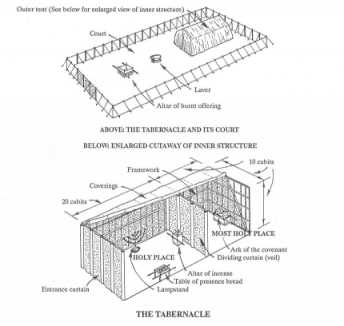
Inside the tent
Probably the easiest way to picture the two-roomed structure under the tent is as a box-like frame with a cloth draped over it (as a tablecloth drapes over a table). The structure was 30 cubits long, 10 cubits wide and 10 cubits high (a cubit being about 44 centimetres or 18 inches). It was formed on the sides and rear by wooden frames that fitted vertically into metal bases and were joined horizontally with wooden bars. A row of timber columns formed the front, and another divided the structure into two rooms. All timber was overlaid with gold (Exo 26:15-37).
A multi-coloured embroidered linen covering was then draped over the entire structure, forming a ceiling overhead and walls on three sides. Curtains hung on columns formed the entrance and the internal partition (Exo 26:1-6; Exo 26:31-37). A covering of goats’ hair was placed over the linen covering to give added protection (Exo 26:7-13).
This covered structure was shielded from the weather by a two-layer tent of animal skins pitched over the whole (Exo 26:14). Though brilliantly coloured inside, outwardly the shrine appeared as simply a tent; hence the name, tabernacle.
The front room of the structure was called the Holy Place and contained three articles of furniture. Against one wall was a table made of wood overlaid with gold. On it were twelve cakes of ‘presence bread’, in symbolic acknowledgment that Israel lived constantly in the presence of God, its provider. The cakes were renewed each Sabbath (Exo 25:23-30; Lev 24:5-9). Against the opposite wall was a seven-headed ornamented lampstand made entirely of gold (Exo 25:31-40; Exo 26:35; see LAMP). Against the dividing curtain (or veil) was an altar used solely for burning incense. It was made of wood overlaid with gold. The daily offering of incense symbolized the continual offering of the people’s homage to God (Exo 30:1-10; see INCENSE).
The room behind the veil was called the Most Holy Place, or Holy of Holies, and was only half the size of the Holy Place. The only piece of furniture in this room was a wooden box, overlaid with gold, known as the ark of the covenant, or covenant box (Exo 25:10-16; Exo 26:34). Its richly ornamented lid, called the mercy seat, was the symbolic throne of the invisible God. The symbolic guardians of this throne were two golden cherubim (Exo 25:17-21; 1Sa 4:4; see CHERUBIM).
In giving this throne the name ‘mercy’, or ‘grace’, God reminded his people that in spite of all their religious exercises, they could be accepted into his presence and receive his forgiveness only by his mercy (Exo 25:22; cf. Heb 4:16). Inside the ark were placed the stone tablets of the law (Deu 10:1-5), and later, Aaron’s rod and the golden pot of manna (Heb 9:4).
Only priests could go into the Holy Place (Num 18:1-7;Heb 9:6). Only the high priest could go into the Most Holy Place, and then only once a year, on the Day of Atonement (Lev 16:11-15; Heb 9:7; see DAY OF ATONEMENT; PRIEST).
Courtyard and camp
This tabernacle-tent was set in a large court, 100 cubits long and 50 cubits wide, in which all the animal sacrifices were offered. Around the court was a fence of cloth attached to posts, with an entrance on the eastern side, opposite the entrance to the tent. The fence gave protection against desert winds and was high enough to prevent people outside from watching proceedings out of idle curiosity. It separated the tabernacle sufficiently from the camp to help create a feeling of reverence towards the tabernacle and its services (Exo 27:9-19).
All animal sacrifices were offered on a large altar that was made of wood overlaid with a metal variously described as bronze, copper or brass. The altar was a hollow box that was either filled with earth to form a mound on which the sacrifices were burnt, or had an internal grid for the same purpose. Halfway up the outside of the altar was a horizontal ledge supported by a grating. The priests may have stood on this ledge while offering the sacrifices (Exo 27:1-8).
Between the bronze altar and the entrance to the tent was a laver, or large basin, in which the priests washed before administering the sacrifices or entering the Holy Place. It also was made of bronze. The priests’ washings had both a practical purpose and a symbolic significance, to demonstrate that cleansing from all uncleanness was necessary in the worship and service of God (Exo 30:17-21; Exo 38:8; cf. 2Ch 4:6).
The people of Israel camped in an orderly arrangement on the four sides of the tabernacle. Nearest the tabernacle, on the eastern side, were the priests. The three family divisions of the Levites were on the other three sides (Num 3:23; Num 3:29; Num 3:35; Num 3:38). Further out were the common people according to their tribes, with three tribes on each of the four sides (Num 2:3; Num 2:10; Num 2:18; Num 2:25).
Construction and maintenance
Building materials for the tabernacle came from the voluntary offerings of the people. They gave so generously that Moses had to restrain them (Exo 25:2; Exo 36:5-7). In making the different parts of the tabernacle, the craftsmen had to conform to the overall pattern and dimensions that God gave (Exo 25:9; Exo 25:40), but they still had plenty of opportunity to use their skills in the structural and ornamental details (Exo 31:1-9). Moses inspected the separate parts of the tabernacle after they were finished (Exo 39:32-43), then supervised the erection of the whole (Exo 40:1-33).
Israelites no doubt saw symbolic significance in the differing values of materials outside and inside the tabernacle. As one moved from the outer court through the Holy Place into the Most Holy Place, the brilliance of the metals and the richness of the cloth hangings increased. It all helped to emphasize the majesty and holiness of Yahweh, the King of Israel who lived among his people, yet at the same time dwelt separately from them in unapproachable glory (Exo 40:34-35).
Apart from its symbolic significance to God’s people, the tabernacle was very practically suited to Israel’s circumstances. A tent over a prefabricated frame was most convenient for a travelling people. Cloth hangings were suitable for entrances and partitions. Timber was of a kind that was plentiful in the region, light to carry, and did not warp or rot easily. Metals were of a kind that would not rust. Some of the pieces of furniture were fitted at the corners with rings, through which carrying poles were placed to make transport easier (Exo 25:12-15; Exo 25:26-28; Exo 27:6-7; Exo 30:4-5).
Money for the maintenance of the tabernacle came from a special tax taken from the people whenever there was a national census. The tax was equal for all, but small enough for even the poorest to pay. The rich could gain no advantage. All God’s people had an equal share in maintaining the tabernacle and its services (Exo 30:11-16).
Only Levites, however, could carry out the work of cleaning, repairing, erecting, dismantling and transporting the tabernacle. They were to do so according to the specific allocation of duties that God set out (Num 3:21-39; Num 4:1-33; see LEVITE). (Concerning the sacrifices offered at the tabernacle see SACRIFICE.)
Purpose fulfilled
Throughout their journey from Sinai to Canaan, the people of Israel set up the tabernacle at their camping places (Num 10:33-36; Num 33:1-49). When they entered Canaan, they set it up in their main camp at Gilgal (Jos 4:19; Jos 10:6; Jos 10:15; Jos 10:43). After the conquest, they shifted the camp to a more central location at Shiloh, where again they set up the tabernacle (Jos 18:1; Jos 19:51). It remained there for most of the next two hundred years (Jdg 18:31; 1Sa 1:3), though there was a period when it was in the neighbouring town of Bethel (Jdg 20:26-27).
It seems that during Israel’s time of conflict with the Philistines, the tabernacle was destroyed in an enemy attack upon Shiloh (Psa 78:60-61; Jer 7:12-14; Jer 26:6; Jer 26:9). But the Israelites apparently rebuilt it, for later it was set up at Nob (1Sa 21:1; 1Sa 21:6; Mar 2:26), and then at Gibeon (1Ch 16:39; 1Ch 21:29; 2Ch 1:3; 2Ch 1:6).
For much of this time the ark of the covenant had become separated from the tabernacle (1Sa 4:4; 1Sa 4:11; 1Sa 7:2; 2Sa 6:1-2; 2Sa 6:10-17; 2Ch 1:3-4; see ARK). When Solomon built the temple in Jerusalem, he dismantled the tabernacle and stored it in the temple (1Ki 8:1-11).
With the replacement of the movable tent by a permanent building, misunderstandings soon arose. Instead of realizing that God was among his people wherever they were, people thought that the temple in Jerusalem was the only place where he dwelt. When the early Christian preacher Stephen attacked this mistaken attitude, the Jews responded by killing him (Act 7:44-50).
The New Testament book of Hebrews points out that the tabernacle had a purpose in demonstrating important truths concerning sinners’ approach to a holy God. The tabernacle system was a help to people in the era before Christ, but it also pointed to something far better. The truths that the tabernacle demonstrated reached their full expression in the new era that came with Jesus Christ (Heb 6:19-20; Heb 8:1-5).
Although the tabernacle system was imperfect, it was not wrong in principle. It was imperfect only because it suffered those limitations of the pre-Christian era that Christ, and Christ alone, could overcome (Heb 9:1-14; Heb 9:24; Heb 10:19-20).
The tabernacle was the structure ordered built by God so that He might dwell among His people (Exo 25:8). It was to be mobile and constructed to exacting specifications. It is referred to in Exo 25:1-40; Exo 26:1-37; Exo 27:1-21; Exo 30:1-38; Exo 31:1-18; Exo 35:1-35; Exo 36:1-38; Exo 37:1-29; Exo 38:1-31; Exo 39:1-43; Exo 40:1-38f11; Num 3:25ff; Num 4:4ff; Num 7:1ff. In all of scripture more space is devoted to the tabernacle than any other topic. Many books have been written on the spiritual significance of the tabernacle, how it represented Christ, and how it foretold the gospel. The tabernacle consisted of the outer court and the tabernacle. The outer court was entered from the East. The outer court contained the altar of burnt offering (Exo 27:1-8) and the bronze laver (Exo 30:17-21). The tabernacle stood within the court (Exo 26:1ff.). It was divided into two main divisions: the holy place and the holy of holies which were separated by a veil (Exo 26:31 ff.), the same veil that was torn from top to bottom at the crucifixion of Jesus (Mat 27:51). Where the veil had represented the barrier separating sinful man from a holy God (Heb 9:8), its destruction represented the free access sinners have to God through the blood of Christ (Heb 10:19ff.).
The tabernacle was a place of sacrifice. The holy place contained three things: first, a table on which was placed the shewbread, the bread of the presence (Exo 25:23-30), second, a golden lampstand (Exo 25:31-40) and third, an altar of incense (Exo 30:1-7). In the Holy of Holies was the ark of the covenant which contained the Ten Commandments (Exo 25:16). The holy of holies was entered only once a year by the high priest who offered sacrifice for the nation of Israel.