
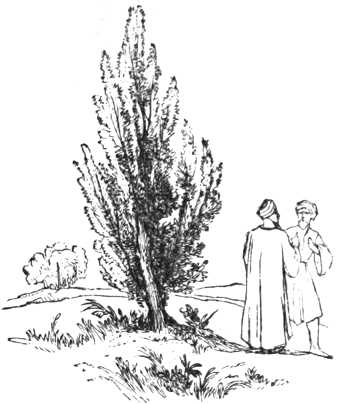
Fig. 327—Tamarisk: Tamarix orientalis
This is supposed to be the meaning of the word eshel, which occurs in three places of Scripture, in one of which, in our Authorized Version, it is rendered grove, and in the other two tree. The first notice of this tree is in Gen 21:33, ’And Abraham planted a grove (eshel) in Beersheba, and called there on the name of the Lord.’ The second notice is in 1Sa 22:6: ’Now Saul abode in Gibeah under a tree (eshel) in Ramah, having his spear in his hand, and all his servants were standing about him.’ Under such a tree also he and his sons were buried, for it is said (1Sa 31:13), ’And they took their bones, and buried them under a tree (eshel) at Jabesh, and fasted seven days.’
From the characteristics of the tamarisk-tree of the East, it certainly appears as likely as any to have been planted in Beersheba by Abraham, because it is one of the few trees which will flourish and grow to a great size even in the arid desert. It has also a name in Arabic, asul, very similar to the Hebrew eshel. Besides the advantage of affording shade in a hot country, it is also esteemed on account of the excellence of its wood, which is converted into charcoal. It is no less valuable on account of the galls with which its branches are often loaded, and which are nearly as astringent as oak-galls. It is also one of those trees which were esteemed by the ancients.
It is very remarkable that the only tree which is found growing among the ruins of Babylon is a tamarisk. Thus, on the north side of the Kasr, where Ker Porter thought he saw traces of the hanging gardens, there stands upon an artificial eminence a tree to which the Arabs give the name of athela. It is a species of tree altogether foreign to the country. Two of the attendants of Ker Porter, who were natives of Bender Bushire, assured him that there are trees of that kind in their country, which attain a very great age, and are called gaz. ’The one in question is in appearance like the weeping-willow, but the trunk is hollow through age, and partly shattered. The Arabs venerate it as sacred, in consequence of the Caliph Ali having reposed under its shade after the battle of Hillah.’
By: Isidore Singer, M. Seligsohn
Tree, several species of which are found in and around Palestine. The Hebrew term for the tamarisk is doubtful. The word  , which occurs three times in the Old Testament, is interpreted by modern scholars as meaning "a tamarisk," and is so rendered in the Revised Version. Abraham planted a "tamarisk-tree" (R. V.) in Beer-sheba (Gen. xxi. 33; A. V. gives "a grove"). "Saul was sitting . . . under the tamarisk-tree in Ramah" (I Sam. xxii. 6, R. V.). Finally, the bones of Saul and his sons were buried "under the tamarisk-tree in Jabesh" (I Sam. xxxi. 13, R. V.). The parallel passage of I Chron. x. 12 has
 , which is rendered "oak-tree" by both the English versions (R. V., margin, "terebinth"). Therefore
 in the last-mentioned passage is rendered "tree" in the Authorized Version.
TAMARISK (’çshel).—This name occurs in RV
E. W. G. Masterman.
Tamarisk. A small tree with thick foliage and spikes of pink blooms. It provided ample shade for desert travelers ( 1Sa 22:6). The word for tamarisk is translated tree, grove, or oak by the KJV.
A tamarisk is a small, fast-growing tree or shrub with strong, durable wood. These plants grow well in harsh places like deserts, sand dunes, and salty marshes. The Bible mentions tamarisk trees in Genesis 21:33 and 1 Samuel 22:6 and 31:13.
Tamarisk plants often provide welcome green foliage and cooling shade for travelers in hot, dry regions. One type of tamarisk, Tamarix aphylla, has small, scale-like leaves and produces small white flowers. These tiny leaves help the tree conserve water in dry climates. Tamarix aphylla can survive in harsh environments and grows well in areas where water is scarce.
The manna tamarisk (Tamarix mannifera) is a shrub or small tree that grows from 2.7 to 4.6 meters (9 to 15 feet) tall and has tiny pink flowers. It is found in deserts from Israel and surrounding areas to Arabia and the Sinai. On hot days, tiny insects that live on the plant make a sweet, sticky substance on its branches. This substance dries into small white lumps that can be collected and eaten. Some people have suggested that this is the kind of “manna” the Israelites ate in the wilderness (Exodus 16), but it does not match all the Bible’s descriptions of manna.
In regions where trees are scarce, people value the larger tamarisk trees for their wood. This wood was used for building structures and for making high-quality charcoal for fires.
Aquifer Open Bible Dictionary © 2026 Mission Mutual, an adaptation of the Tyndale Open Bible Dictionary © 2023 Tyndale House Publishers. Licensed under CC BY-SA 4.0.
Discussion:
There are two main species of tamarisk referred to in the Bible, the Leafless Tamarisk Tamarix aphylla and the much more common Nile Tamarisk Tamarix nilotica. Both species are found throughout the plains and in the wadis (dry stream beds) of the Aravah and the Negev, where they tap water that has soaked into the ground after flash floods. Tamarisks can grow in salty soil, earning them the name “salt cedar” in some places. A third species grows only in the Jordan Valley. None of them has proper leaves but rather fleshy twigs, which are eaten by goats and sheep. Despite a similarity in name, tamarinds (Tamarindus indica) are not related to tamarisks.
In the account of the burial of Saul we have a mismatch between 1SA 31:13, which says he was buried uner an ’eshel (“tamarisk” in RSV), and 1CH 10:12, which says he was buried under an ’elah (“oak” in RSV). So what was it? Maybe neither!
At some point in the development of Hebrew, the word ’eshel became a general term for trees. However, the words ’allon (“oak”) and ’elah (“terebinth”) also generalized in post-biblical Hebrew to ’ilan, meaning “tree,” so it is possible that at some point in the editing of 1 Chronicles, ’elah as a generic word replaced the earlier ’eshel, which itself could have already been generic at that point. That is, both words could have been regional, stylistic, or in-vogue variations of the general word for “tree.”
Description:
The leafless tamarisk grows to a height of 10 meters (33 feet) and can be 1 meter (3 feet) across at the base. The more common Nile tamarisk is smaller and is really a shrub, branching right from the ground. Tamarisks grow in very dry places due to the fact that their roots extend far into the ground. A specimen in Iraq was found to have roots extending 11 meters (36 feet) below the surface (Hepper, page 53). Both species have a broad crown. The trunk is often twisted. The cedar-like branches hang down like those of the weeping willow. Bedouin shepherds have planted many of them throughout the Negev for their flocks.
Special significance:
The fact that Abraham planted a tamarisk and worshiped Yahweh there (GEN 21:33) indicates that these trees, like oaks, were associated with the spirit world. According to Zohary, the “cedar” branches mentioned in the cleansing rituals of LEV 14:4 and NUM 19:6 may possibly have been from tamarisks, although Phoenician juniper trees (very similar to cedar) were also available in some places on the journey of the wandering Israelites. Imported into the western United States, tamarisks have multiplied so fast in stream beds that they are now considered a costly nuisance. In some places they are used in making dyes and in processing leather.
Translation:
Tamarisks are found plentifully in Asia (forty species) and Europe (fourteen species), with a few also in Africa in the Mediterranean basin. The English versions are virtually unanimous in translating ’eshel as “tamarisk.” CEV uses “tamarisk” with a footnote: “A tall shade tree that has deep roots and needs little water.” The options for translating “tamarisk” are:
1. Transliterate from a major language, for example, tamarisiki, tamaris, esheli (Hebrew), or eteli /atali (Arabic).
2. Consider the function of the tree, which in Genesis was almost certainly connected to Abraham’s worship of God, and translate as “holy tree” perhaps with a footnote giving the Hebrew and/or English, especially if you have used “holy tree” in GEN 12:6 for “oak.”
3. Simply use “tree” with a footnote stating that the Hebrew specifies ’eshel, that is, tamarisk.
Plants and Trees in the Bible © United Bible Societies. Licensed under CC BY-SA 4.0.