
TEMPLE and TABERNACLE or TENT, are opposite.
A tabernacle or tent denotes an unsettled state, from the use of tents in places where men travel and have no settled habitations. And thus whilst Israel was unsettled in the desert, and even in Canaan, till the utmost of what was promised to Abraham for their sakes was fulfilled, God had a moveable tabernacle, and therefore said of himself, "That he also walked in a tent, and in a tabernacle," 2Sa 7:6. But, on the contrary, when the Israelites were fully settled in the promised land, God had then to spew his fixed abode with them, a standing house, palace, or temple built for him. And to make up the notion of dwelling or habitation complete, there were to be all things suitable to a house belonging to it.
Hence in the holy place there was to be a table and a candlestick; because this was the ordinary furniture of a room. The table was to have its dishes, spoons, bowls, and covers, and to be always furnished with bread upon it; and the candlestick to have its lamp continually burning.
Hence also there was to be a continual fire kept in the house of God, upon the altar, as the focus of it. And besides all this, to carry the notion still farther, there was to be some constant meat and provision brought into this house; which was done in the sacrifices, that were partly consumed by fire upon the altar, as God’s own portion and mess, and partly eaten by the priests, who were God’s family, and therefore to be maintained by him. Besides the flesh of the beast offered up in sacrifice, there was a mincha made of flour and oil, and a libamen that was always joined with the daily sacrifice, as the bread and drink which was to go along with God’s meat. It was also strictly commanded that there should be salt in every sacrifice, because all meat is unsavoury without salt.
Lastly, all these things were to be consumed on the altar only by the holy fire that came down from heaven, because they were God’s portion, and therefore to be eaten or consumed by himself in an extraordinary manner. From all this it appears, that the building of the temple was wholly designed to make a durable and permanent mansion for God; and consequently for his worship, "a rest for the ark, a settlement for the feet of God," as David designed it, 1Ch 28:2, and as God himself did declare it to David by the prophet Nathan, 1Ch 17:4-5; 1Ch 17:9. And therefore the word temple, when used symbolically, is the symbol of the Christian church since its settlement with authority.
In the Oneirocritics, chap. 225., a temple is interpreted of the house of a king, which agrees with the Jewish temple, being a house or palace for God, as the king or monarch of the Jews.
As a tabernacle denotes an unsettled state of the Church, so even the symbol of a temple may come under the notion of a tabernacle, whenever the Church is in a weak declining condition. Thus in Jer 10:20, when the Jewish nation was reduced to such a state, that the temple was to be destroyed, and the people led into captivity, the temple is spoken of under the symbols of tabernacle and curtains, to spew that the temple was as it were tottering, and as unsettled as a tabernacle.
The like opposition is to be seen in Amo 9:11, "In that day will I raise up the tabernacle of David that is fallen, and close up the breaches thereof; and I will raise up his ruins, and I will build it as in the days of old;" where the kingdom or house of David in oppression comes under the notion of a tabernacle. The opposition between a house and tabernacle appears in Pro 14:11 : "The house of the wicked shall be overthrown, but the tabernacle of the upright shall flourish." The meaning is, the most flourishing state of the wicked shall have an end, but the upright from a low oppressed state and condition shall be exalted to honour and happiness. And thus St. Paul, comparing this present life, and the unsettled, afflicted, and miserable state thereof, with the certainty, happiness and perpetuity of the next, calls the first by the name of "our earthly house of this tabernacle," and that too subject to be dissolved; adding thereto, " that in this tabernacle we groan being burdened:" but the other is "a building of God, an house not made with hands, eternal in the heavens," 2Co 5:1. So in Heb 13:13-14, we have the symbols of a camp and city opposed, which bear the same proportion to each other as tent and temple.
If the temple be shut, by an enemy’s possessing the entrance, it signifies the suppression of the public profession of the truth, and of the public worship of God. But if it be open, it denotes religious liberty. And seeing that the high-priest only had admission into the most holy place, where the ark of the covenant, and the other special symbols of the more immediate presence of God were to be seen (Heb 9:7), therefore, for the temple to be open, and its inmost recesses to be so disclosed, as for the ark of the covenant to be seen, is the symbol of the highest state of liberty and privilege, Rev 11:19.
A public building erected for the purpose of religious worship.
This word in Scripture, though generally made use of to express one and the same thing, namely, the house of God, hath various references in relation to the divine glory. There was no building in the church of God called the temple, until the one built by Solomon. Before those days the house appropriated for the worship of the Lord was called the tabernacle, or sanctuary. But when the Lord bad instructed his people by his servant Nathan the prophet, (see 2 Sam. 7:) concerning the temple, we find Solomon, by the Lord’sappointment, building this first temple on Mount Moriah. And independent of every other consideration, how blessedly did the very spot typify Christ, the true temple for the glory of JEHOVAH to be manifested in. This temple was begun somewhat about a thousand years before Christ, and took nine years in building. The desolation of Jerusalem by the king of Babylon at the captivity, brought on the desolation also of the temple, until it was totally destroyed in the eleventh year of Zedikiah, after it had stood amidst manyravages and injuries, from the plunder of the enemies of Israel, somewhat more than four hundred years.
During the captivity of Babylon the temple remained in ruins; but in the first year of Cyrus at Babylon, the Jews were permitted to return to Jerusalem, and to rebuild the temple of the Lord. And amidst much persecution and many interruptions, the people accomplished the purpose, and the second temple was completed at a period of somewhat more than five hundred years before the coming of Christ. I refer the reader to the prophecies of Haggai and Zechariah, and to the books of Ezra and Nehemiah, for the Scripturalaccount of this great event. This second temple continued until the manifestation of the Lord Jesus Christ in substance of our flesh, thereby confirming and fulfilling the prophecy of Haggai 2: 9, The glory of this latter house shall be greater than of the former, saith the Lord of hosts." And this was literally the case from the presence of Jesus, notwithstanding it had none of the five signs which Solomon’s temple had, namely - - 1. The Urim and Thummim; 2. the ark of the covenant; 3. the fire upon the altar, which neverwent out; 4. the Shechinah, or manifestation of the Lord’s presence: 5. the spirit of prophecy. When Jesus entered the temple, his presence became the sum and substance which all these signs did but faintly resemble and minister unto; and therefore confirmed JEHOVAH’S promise of the greater glory of the second, than of the first temple. But the great object, the temple itself in both, and indeed in all other instances represented, was the person of Christ in his human nature; "for in him dwelleth all the fulness of theGODHEAD bodily." (Col. 2: 9.) Hence, therefore, as in the tabernacle in the wilderness, and in the temple at Jerusalem, the glory of the Lord was graciously manifested to the people to intimate the divine presence, so in the person of Christ Jesus, all that is visible it JEHOVAH did appear. See those sweet Scriptures in confirmation. (John 2: 19 - 21. Ephes. 2: 20 - 22.) See Tabernacle.
the house of God; properly the temple of Solomon. David first conceived the design of building a house somewhat worthy of the divine majesty, and opened his mind to the Prophet Nathan, 2 Samuel 7; 1 Chronicles 17; 1Ch 22:8, &c. God accepted of his good intentions, but refused him the honour. Solomon laid the foundation of the temple, A.M. 2992, completed it in 3000, and dedicated it in 3001, 1Ki 8:2; 2 Chronicles 5; 2Ch 6:7. According to the opinion of some writers, there were three temples, namely, the first, erected by Solomon; the second, by Zerubbabel, and Joshua the high priest; and the third, by Herod, a few years before the birth of Christ. But this opinion is, very properly, rejected by the Jews; who do not allow the third to be a new temple, but only the second temple repaired and beautified: and this opinion corresponds with the prophecy of Hag 2:9, “that the glory of this latter house,” the temple built by Zerubbabel, “should be greater than that of the former;” which prediction was tittered with reference to the Messiah’s honouring it with his presence and ministry. The first temple is that which usually bears the name of Solomon; the materials for which were provided by David before his death, though the edifice was raised by his son. It stood on Mount Moriah, an eminence of the mountainous ridge in the Scriptures termed Mount Zion, Psa 132:13-14, which had been purchased by Araunah, or Ornan, the Jebusite, 2Sa 24:23-24; 1Ch 21:25. The plan, and the whole model of this superb structure, were formed after that of the tabernacle, but of much larger dimensions. It was surrounded, except at the front or east end, by three stories of chambers, each five cubits square, which reached to half the height of the temple; and the front was ornamented with a magnificent portico, which rose to the height of one hundred and twenty cubits: so that the form of the whole edifice was not unlike that of some ancient churches, which have a lofty tower in the front, and a low aisle running along each side of the building. The utensils for the sacred service were the same; excepting that several of them, as the altar, candlestick, &c, were larger, in proportion to the more spacious edifice to which they belonged. Seven years and six months were occupied in the erection of the superb and magnificent temple of Solomon, by whom it was dedicated, A.M. 3001, B.C. 999, with peculiar solemnity, to the worship of the Most High; who on this occasion vouchsafed to honour it with the Shechinah, or visible manifestation of his presence. Various attempts have been made to describe the proportions and several parts of this structure; but as scarcely any two writers agree on this subject, a minute description of it is designedly omitted. It retained its pristine splendour only thirty-three or thirty-four years, when Shishak, king of Egypt, took Jerusalem, and carried away the treasures of the temple; and after undergoing subsequent profanations and pillages, this stupendous building was finally plundered and burnt by the Chaldeans under Nebuchadnezzar, A.M. 3416, or B.C. 584, 2Ki 25:13-15; 2Ch 36:17-20.
After the captivity, the temple emerged from its ruins, being rebuilt by Zerubbabel, but with vastly inferior and diminished glory; as appears from the tears of the aged men who had beheld the former structure in all its grandeur, Ezr 3:12. The second temple was profaned by order of Antiochus Epiphanes, A.M. 3837, B.C. 163, who caused the daily sacrifices to be discontinued, and erected the image of Jupiter Olympus on the altar of burnt-offering. In this condition it continued three years, l Mac. 4. 42, when Judas Maccabaeus purified and repaired it, and restored the sacrifices and true worship of Jehovah. Some years before the birth of our Saviour, the repairing and beautifying of this second temple, which had become decayed in the lapse of five centuries, was undertaken by Herod the Great, who for nine years employed eighty thousand workmen upon it, and spared no expense to render it equal, if not superior, in magnitude, splendour, and beauty, to any thing among mankind. Josephus calls it a work the most admirable of any that had ever been seen or heard of, both for its curious structure and its magnitude, and also for the vast wealth expended upon it, as well as for the universal reputation of its sanctity. But though Herod accomplished his original design in the time above specified, yet the Jews continued to ornament and enlarge it, expending the sacred treasure in annexing additional buildings to it; so that they might with great propriety assert, that their temple had been forty and six years in building, Joh 2:20.
Before we proceed to describe this venerable edifice, it may be proper to remark, that by the temple is to be understood not only the fabric or house itself, which by way of eminence is called the temple, namely, the holy of holies, the sanctuary, and the several courts both of the priests and Israelites, but also all the numerous chambers and rooms which this prodigious edifice comprehended; and each of which had its respective degree of holiness, increasing in proportion to its contiguity to the holy of holies. This remark it will be necessary to bear in mind, lest the reader of Scripture should be led to suppose, that whatever is there said to be transacted in the temple was actually done in the interior of that sacred edifice. To this infinite number of apartments, into which the temple was disposed, our Lord refers, Joh 14:2; and by a very striking and magnificent simile, borrowed from them, he represents those numerous seats and mansions of heavenly bliss which his Father’s house contained, and which were prepared for the everlasting abode of the righteous. The imagery is singularly beautiful and happy, when considered as an allusion to the temple, which our Lord not unfrequently called his Father’s house.
The second temple, originally built by Zerubbabel after the captivity, and repaired by Herod, differed in several respects from that erected by Solomon, although they agreed in others.
The temple erected by Solomon was more splendid and magnificent than the second temple, which was deficient in five remarkable things that constituted the chief glory of the first: these were, the ark and the mercy seat: the shechinah, or manifestation of the divine presence, in the holy of holies; the sacred fire on the altar, which had been first kindled from heaven; the urim and thummim; and the spirit of prophecy. But the second temple surpassed the first in glory; being honoured by the frequent presence of our divine Saviour, agreeably to the prediction of Hag 2:9. Both, however, were erected upon the same site, a very hard rock, encompassed by a very frightful precipice; and the foundation was laid with incredible expense and labour. The superstructure was not inferior to this great work: the height of the temple wall, especially on the south side, was stupendous. In the lowest places it was three hundred cubits, or four hundred and fifty feet, and in some places even greater. This most magnificent pile was constructed with hard white stones of prodigious magnitude. The temple itself, strictly so called, which comprised the portico, the sanctuary, and the holy of holies formed only a small part of the sacred edifice on Mount Moriah, being surrounded by spacious courts, making a square of half a mile in circumference. It was entered through nine gates, which were on every side thickly coated with gold and silver; but there was one gate without the holy house, which was of Corinthian brass, the most precious metal in ancient times, and which far surpassed the others in beauty. For while these were of equal magnitude, the gate composed of Corinthian brass was much larger; its height being fifty cubits, and its doors forty cubits, and its ornaments both of gold and silver being far more costly and massive. This is supposed to have been the “gate called Beautiful” in Act 3:2, where Peter and John, in the name of Christ, healed a man who had been lame from his birth. The first or outer court, which encompassed the holy house and the other courts, was named the court of the Gentiles; because the latter were allowed to enter into it, but were prohibited from advancing farther. It was surrounded by a range of porticoes, or cloisters, above which were galleries, or apartments, supported by pillars of white marble, each consisting of a single piece, and twenty-five cubits in height. One of these was called Solomon’s porch, or piazza, because it stood on a vast terrace, which he had originally raised from a valley beneath, four hundred cubits high, in order to enlarge the area on the top of the mountain, and make it equal to the plan of his intended building; and as this terrace was the only work of Solomon that remained in the second temple, the piazza which stood upon it retained the name of that prince. Here it was that our Lord was walking at the feast of dedication, Joh 10:23; and that the lame man, when healed by Peter and John, glorified God before all the people, Act 3:11. This superb portico is termed the royal portico by Josephus, who represents it as the noblest work beneath the sun, being elevated to such a prodigious height, that no one could look down from its flat roof to the valley below, without being seized with dizziness; the sight not reaching to such an immeasurable depth. The south-east corner of the roof of this portico, where the height was the greatest, is supposed to have been the
Magnificent as the rest of the sacred edifice was, it was infinitely surpassed in splendour by the inner temple, or sanctuary. Its appearance, according to Josephus, had every thing that could strike the mind, or astonish the sight: for it was covered on every side with plates of gold; so that when the sun rose upon it, it reflected so strong and dazzling an effulgence, that the eye of the spectator was obliged to turn away, being no more able to sustain its radiance than the splendour of the sun. To strangers who were approaching: it appeared at a distance like a mountain covered with snow; for where it was not decorated with plates of gold, it was extremely white and glistening. On the top it had sharp-pointed spikes of gold, to prevent any bird from resting upon it and polluting it. There were, continues the Jewish historian, in that building, several stones which were forty-five cubits in length, five in height, and six in breadth. “When all these things are considered,” says Harwood, “how natural is the exclamation of the disciples, when viewing this immense building at a distance: ‘Master, see what manner of stones’ (
Both the first and second temples were contemplated by the Jews with the highest reverence. Of their affectionate regard for the first temple, and for Jerusalem, within whose walls it was built, we have several instances in those Psalms which were composed during the Babylonish captivity; and of their profound veneration for the second temple we have repeated examples in the New Testament. They could not bear any disrespectful or dishonourable thing to be said of it. The least injurious slight of it, real or apprehended, instantly awakened all the choler of a Jew, and was an affront never to be forgiven. Our Saviour, in the course of his public instructions, having said, “Destroy this temple, and in three days I will raise it up again,”
Joh 2:19, it was construed into a contemptuous disrespect, designedly thrown out against the temple; his words instantly descended into the heart of the Jews, and kept rankling there for some years; for, upon his trial, this declaration, which it was impossible for a Jew ever to forget or to forgive, was immediately alleged against him, as big with the most atrocious guilt and impiety; they told the court they had heard him publicly assert, “I am able to destroy this temple,” Mat 26:61. The rancour and virulence they had conceived against him for this speech, was not softened by all the affecting circumstances of that wretched death they saw him die; even as he hung upon the cross, with triumph, scorn, and exultation, they upbraided him with it, contemptuously shaking their heads, and saying, “Thou that destroyest the temple, and buildest it in three days, save thyself! If thou be the Son of God, come down from the cross!” Mat 27:40. It only remains to add, that it appears, from several passages of Scripture, that the Jews had a body of soldiers who guarded the temple, to prevent any disturbances during the ministration of such an immense number of priests and Levites. To this guard Pilate referred, when he said to the chief priests and Pharisees who waited upon him to desire he would make the sepulchre secure, “Ye have a watch, go your way, and make it as secure as ye can,” Mat 27:65. Over these guards one person had the supreme command, who in several places is called the captain of the temple, or officer of the temple guard. “And as they spake unto the people, the priests and the captain of the temple and the Sadducees came upon them,” Act 4:1; Act 5:25-26; Joh 18:12. Josephus mentions such an officer.
After the Israelites had exchanged their nomadic life for a life in permanent habitations, it was becoming that they should exchange also their movable sanctuary or tabernacle for a temple. There elapsed, however, after the conquest of Palestine, several centuries during which the sanctuary continued movable, although the nation became more and more stationary. It appears that the first who planned the erection of a stone-built sanctuary was David, who, when he was inhabiting his house of cedar, and God had given him rest from all his enemies, meditated the design of building a temple in which the ark of God might be placed, instead of being deposited ’within curtains,’ or in a tent, as hitherto. This design was at first encouraged by the prophet Nathan; but he was afterwards instructed to tell David that such a work was less appropriate for him, who had been a warrior from his youth, and had shed much blood, than for his son, who should enjoy in prosperity and peace the rewards of his father’s victories. Nevertheless, the design itself was highly approved as a token of proper feelings towards the Divine King (2Sa 7:1-12; 1Ch 17:1-14; 1Ch 28:1-21). We learn, moreover, from 1 Kings 5, and 1 Chronicles 22, that David had collected materials which were afterwards employed in the erection of the temple, which was commenced four years after his death, about B.C. 1012, four hundred and eighty years after the Exodus from Egypt, and was about seven years in building. We thus learn that the Israelitish sanctuary had remained movable more than four centuries subsequent to the conquest of Canaan.
The site of the temple was on Mount Moriah, which was at first insufficient for the temple and altar, and therefore walls and buttresses were built in order to gain more ground by filling up the interval with earth. The hill was also fortified by a threefold wall, the lowest tier of which was in some places more than 300 cubits high; and the depth of the foundation was not visible, because it had been necessary in some parts to dig deep into the ground in order to obtain sufficient support. The dimensions of the stones of which the walls were composed were enormous; Josephus mentions a length of 40 cubits.
The workmen and the materials employed in the erection of the temple were chiefly procured by Solomon from Hiram, king of Tyre, who was rewarded by a liberal importation of wheat. Josephus states that the foundation was sunk to an astonishing depth, and composed of stones of singular magnitude, and very durable. Being closely mortised into the rock with great ingenuity, they formed a basis adequate to the support of the intended structure.
The temple itself and its utensils are described in 1 Kings 6, 7, and 2 Chronicles 3-4.
Divines and architects have repeatedly endeavored to represent the architectural proportions of the temple, which was 60 cubits long, 20 wide, and 30 high. The internal dimension of the ’holy’ was 40 cubits long, 20 cubits wide, and 30 cubits high. The holy was separated from the ’holy of holies’ by a partition, a large opening in which was closed by a suspended curtain. The holy of holies was on the western extremity of the entire building, and its internal dimensions formed a cube of 20 cubits. On the eastern extremity of the building was the porch, at the entrance of which stood the two columns called Jachin and Boaz, which were 23 cubits high.
The temple was also surrounded by three stories of chambers, each of which stories was five cubits high, so that there remained above, ample space for introducing the windows, which served chiefly for ventilation, as the light within the temple was obtained from the sacred candlesticks. The windows which are mentioned in 1Ki 6:4, consisted probably of lattice-work.
It seems from the descriptions of the temple to be certain that the holy of holies was an adytum without windows. To this fact Solomon seems to refer when he spake, ’The Lord said that he would dwell in the thick darkness’ (1Ki 8:12).
From 1Ki 7:10, we learn that the private dwellings of Solomon were built of massive stone. We hence infer, that the framework of the temple also consisted of the same material. The temple was, however, wainscoted with cedar wood, which was covered with gold. The boards within the temple were ornamented by beautiful carvings representing cherubim, palms, and flowers. The ceiling of the temple was supported by beams of cedar wood. The wall which separated the holy from the holy of holies probably consisted not of stone, but of beams of cedar. The partitions were probably in part reticulated, so that the incense could spread from the holy to the most holy.
The floor of the temple was throughout of cedar, but boarded over with planks of fir (1Ki 6:15). The doors of the oracle were composed of olive-tree; but the doors of the outer temple had posts of olive-tree and leaves of fir (1Ki 6:31, sq.). Both doors, as well that which led into the temple as that which led from the holy to the holy of holies, had folding leaves, which, however, seem to have been usually kept open, the aperture being closed by a suspended curtain.
Within the holy of holies stood only the ark of the covenant; but within the holy were ten golden candlesticks, and the altar of incense (comp. the separate articles).
The temple was surrounded by an inner court, which in Chronicles is called the Court of the Priests, and in Jeremiah the Upper Court. This again was surrounded by a wall consisting of cedar beams placed on a stone foundation (1Ki 6:36). Besides this inner court there is mentioned a Great Court (2Ch 4:9). This court was also more especially called the court of the Lord’s house (Jer 19:12; Jer 26:2). These courts were surrounded by spacious buildings, which, however, according to Josephus, seem to have been partly added at a period later than that of Solomon. From these descriptions we learn that the temple of Solomon was not distinguished by magnitude, but by good architectural proportions, beauty of workmanship, and costliness of materials. Many English churches have an external form not unlike that of the temple of Solomon.
There was a treasury in the temple, in which much precious metal was collected for the maintenance of public worship. The gold and silver of the temple was, however, frequently applied to political purposes, and the treasury was repeatedly plundered by foreign invaders. The sacred edifice was burned down by Nebuchadnezzar, B.C. 588, having stood since its commencement 417 or 418 years. Thus terminated what the later Jews called the first house.
Second Temple
In the year B.C. 536the Jews obtained permission from Cyrus to colonize their native land. Cyrus commanded also that the sacred utensils which had been pillaged from the first temple should be restored, and that for the restoration of the temple assistance should be granted (Ezra 1, 6; 2Ch 36:22, sq.). The first colony, which returned under Zerubbabel and Joshua, having collected the necessary means, and having also obtained the assistance of Phoenician workmen, commenced in the second year after their return, B.C. 534, the rebuilding of the temple. The Sidonians brought rafts of cedar trees from Lebanon to Joppa. The Jews refused the cooperation of the Samaritans, who, being thereby offended, induced the King Artasashta (probably Smerdis) to prohibit the building. And it was only in the second year of Darius Hystaspis, B.C. 520, that the building was resumed. It was completed in the sixth year of this king, B.C. 516.
This second temple was erected on the site of the former, and probably after the same plan. The old men who had seen the first temple were moved to tears on beholding the second, which appeared insignificant in comparison with the first (Ezr 3:12; Hag 2:3, sq.). It seems, however, that it was not so much in dimensions that the second temple was inferior to the first, as in splendor, and in being deprived of the Ark of the Covenant, which had been burned with the temple of Solomon.
Temple of Herod
Herod, wishing to ingratiate himself with the people, and being fond of architectural display, undertook not merely to repair the second temple, but to raise a perfectly new structure. As, however, the temple of Zerubbabel was not actually destroyed, but only removed after the preparations for the new temple were completed, there has arisen some debate whether the temple of Herod could properly be called the third temple.
The work was commenced in the eighteenth year of the reign of Herod; that is, about the year 734-735 from the building of Rome, or about twenty or twenty-one years before the Christian era. Priests and Levites finished the temple itself in one year and a half. The outbuildings and courts required eight years. However, some building operations were constantly in progress under the successors of Herod, and it is in reference to this we are informed that the temple was finished only under Albinus, the last procurator but one, not long before the commencement of the Jewish war in which the temple was again destroyed. It is in reference also to these protracted building operations that the Jews said to Jesus, ’Forty and six years was this temple in building’ (Joh 2:20).
The whole of the structures belonging to the temple were a stadium square, and consequently four stadia (or half a Roman mile) in circumference. The temple was situated on the highest point, not quite in the center, but rather to the north-western corner of this square, and was surrounded by various courts, the innermost of which was higher than the next outward, which descended in terraces. The temple, consequently, was visible from the town, notwithstanding its various high enclosures. The outer court was called the mountain of the house, and had five principal gates. Annexed to the outer wall were halls which surrounded the temple. The Levites resided in these halls, and they seem likewise to have been used by religious teachers for the purpose of addressing their hearers. Thus we find that Jesus had there various opportunities for addressing the people and refuting cavillers.
Here also the first Christians could daily assemble with one accord (Act 2:46). Within this outer court money-changers and cattle-dealers transacted a profitable business, especially during the time of Passover. The profaneness to which this money-changing and cattle-dealing gave rise caused the indignation of our Lord, who suddenly expelled all these traffickers from their stronghold of business (Mat 21:12, sq.; Mar 11:15-17; Luk 19:45-46; Joh 2:13-17).
The holy of holies was entirely empty, but there was a stone in the place of the Ark of the Covenant, on which the high-priest placed the censer. Before the entrance of the holy of holies was suspended a curtain, which was rent by the earthquake that followed after the crucifixion.
The temple was situated upon the south-eastern corner of Mount Moriah, which is separated to the east by a precipitous ravine and the Kidron from the Mount of Olives, which is much higher than Moriah. On the south the temple was bounded by the ravine which separates Moriah from Zion, or the lower city from the upper city. Opposite to the temple, at the foot of Zion, were formerly the king’s gardens, and higher up, in a south-westerly direction, the stronghold of Zion, or the city of David, on a higher level than the temple. The temple was in ancient warfare almost impregnable, from the ravines at the precipitous edge of which it stood; but it required more artificial fortifications on its western and northern sides, which were surrounded by the city of Jerusalem; for this reason there was erected at its north-western corner the tower of Antonia, which, although standing on a lower level than the temple itself, was so high as to overlook the sacred buildings, with which it was connected partly by a large staircase, partly by a subterraneous communication. This tower protected the temple from sudden incursions from the city of Jerusalem, and from dangerous commotions among the thousands who were frequently assembled within the precincts of the courts, which also were sometimes used for popular meetings. Under the sons of Herod, the temple remained apparently in good order, and Herod Agrippa, who was appointed by the Emperor Claudius its guardian, even planned the repair of the eastern part, which had probably been destroyed during one of the conflicts between the Jews and Romans of which the temple was repeatedly the scene (Antiq. xvii. 10). Many writers on the subject have adopted a style as if they possessed much information about the archives of the temple; there are a few indications from which we learn that important documents were deposited in the tabernacle and temple. Even in Deu 31:20, we find that the book of the law was deposited in the Ark of the Covenant. 2Ki 22:8, Hilkiah rediscovered the book of the law in the house of Jehovah. In 2Ma 2:13, we find a bibliotheca or library mentioned, apparently consisting chiefly of the canonical books, and probably deposited in the temple. In Josephus it is mentioned that a book of the law was found in the temple. It appears that the sacred writings were kept in the temple. Copies of political documents seem to have been deposited in the treasury of the temple.
During the final struggle of the Jews against the Romans, A.D. 70, the temple was the last scene of the tug of war. The Romans rushed from the tower Antonia into the sacred precincts, the halls of which were set on fire by the Jews themselves. It was against the will of Titus that a Roman soldier threw a firebrand into the northern outbuildings of the temple, which caused the conflagration of the whole structure, although Titus himself endeavored to extinguish the fire.
The sacred utensils, the golden table of the show-bread, the book of the law, and the golden candlestick, were displayed in the triumph at Rome. Representations of them are still to be seen sculptured in relief on the triumphal arch of Titus. The place where the temple had stood seemed to be a dangerous center for the rebellious population, until, in A.D. 130, the Emperor Hadrian founded a Roman colony, under the name Ælia Capitolina, on the ruins of Jerusalem, and dedicated a temple to Jupiter Capitolinus on the ruins of the temple of Jehovah. Henceforth no Jew was permitted to approach the site of the ancient temple.
The Emperor Julian undertook, A.D. 363, to rebuild the temple; but after considerable preparations and much expense, he was compelled to desist by flames which burst forth from the foundations. A splendid mosque now stands on the site of the temple. This mosque was erected by the caliph Omar after the conquest of Jerusalem by the Saracens, A.D. 630.
A building hallowed by the special presence of God, and consecrated to his worship. The distinctive idea of a temple, contrasted with all other buildings, is that it is the dwelling-place of a deity; and every heathen temple had its idol, but the true and living God dwelt "between the cherubim" in the Holy of Holies at Jerusalem. Hence, figuratively applied, a temple denotes the church of Christ, 2Th 2:4 Jer 3:12 ; heaven, Psa 11:4 Jer 7:15 ; and the soul of the believer, in which the Holy Spirit dwells, 1Co 3:16,17 6:19 2Co 6:16 .\par After the Lord had instructed David that Jerusalem was the place he had chosen in which to fix his dwelling, that pious prince began to realize his design of preparing a temple for the Lord that might be something appropriate to His divine majesty. But the honor was reserved for Solomon his son and successor, who was to be a peaceful prince, and like David, who had shed much blood in war. David, however, applied himself to collect great quantities of gold, silver, brass, iron, and other materials for this undertaking, 2Sa 1:1-25 7:1-29 1Ch 22:1-19 .\par The place chosen for erecting this magnificent structure was Mount Moriah, Gen 2:2,14 2Ch 3:1, the summit of which originally was unequal, and its sides irregular; but it was a favorite object of the Jews to level and extend it. The plan and the whole model of this structure was laid by the same divine architect as that of the tabernacle, namely, God himself; and it was built much in the same form as the tabernacle, but was of much larger dimensions. The utensils for the sacred service were also the same as those used in the tabernacle, only several of them were larger, in proportion to the more spacious edifice to which they belonged. The foundations of this magnificent edifice were laid by Solomon, in the year B. C. 1011, about four hundred and eighty years after the exodus and the building of the tabernacle; and it was finished B. C. 1004, having occupied seven years and six months in the building. It was dedicated with peculiar solemnity to the worship of Jehovah, who condescended to make it the place for the special manifestation of his glory, 2Ch 5:1-7:22. The front or entrance to the temple was on the eastern side, and consequently facing the Mount of Olives, which commanded a noble prospect of the building. The temple itself, strictly so called, which comprised the Porch, the Sanctuary, and the Holy of Holies, formed only a small part of the sacred precincts, being surrounded by spacious courts, chambers, and other apartments, which were much more extensive than the temple itself. It should be observed that the word temple does not always denote the central edifice itself, but in many passages some of the outer courts are intended.\par From the descriptions which are handed down to us of the temple of Solomon, it is utterly impossible to obtain so accurate an idea of its relative parts and their respective proportions, as to furnish such an account as may be deemed satisfactory to the reader. Hence we find no two writers agreeing in their descriptions. The following account may give a general idea of the building.\par The Temple itself was seventy cubits long; the Porch being ten cubits, 1Ki 6:3, the Holy place forty cubits, 1Ki 6:17, and the Most Holy place, twenty cubits, 2Ch 3:8 . The width of the Porch, Holy, and Most Holy places was thirty cubits, 1Ki 6:2 ; but the height of the porch was much greater, being no less than one hundred and twenty cubits, 2Ch 3:4, or four times the height of the rest of the building. The Most Holy place was separated from the Sanctuary by an impervious veil, Luk 23:45, and was perhaps wholly dark, 1Ki 8:12, but for the glory of the Lord which filled it. To the north and south sides, and the west end of the Holy and Most Holy places, or all around the edifice, from the back of the porch on one side, to the back of the porch on the other side, certain buildings were attached. These were called side chambers, and consisted of three stories, each five cubits high, 1Ki 6:10, and joined to the wall of the temple without. Thus the three stories of side chambers, when taken together, were fifteen cubits high, and consequently reached exactly to half the height of the side walls and end of the temple; so that there was abundance of space above these for the windows which gave light to the temple, 1Ki 6:4 .\par Solomon’s temple appears to have been surrounded by two main courts: the inner court, that "of the Priests," 1Ki 6:36 2Ch 4:9 ; and the outer court, that "of Israel;" these were separated by a "middle wall of partition," with lodges for priests and Levites, for wood, oil, etc., 1Ch 28:12 . The ensuing description is applicable to the temple courts in the time of our Lord.\par The "court of the Gentiles" was so called because it might be entered by persons of all nations. The chief entrance to it was by the east or Shushan gate, which was the principal gate of the temple. It was the exterior court, and by far the largest of all the courts belonging to the temple, and is said to have covered a space of more than fourteen acres. It entirely surrounded the other courts and the temple itself; and in going up to the temple from its east or outer gate, one would cross first this court, then the court of the Women, then that of Israel, and lastly that of the Priests. This outmost court was separated from the court of the women by a wall three cubits high of lattice work, and having inscriptions on its pillars forbidding Gentiles and unclean persons to pass beyond it, on pain of death, Mal 21:28 Zep 2:13,14 . From this court of the Gentiles our Savior drove the persons who had established a cattle-market in it, for the purpose of supplying those with sacrifices who came from a distance, Mat 21:12-13 . We must not overlook the beautiful pavement of variegated marble, and the "porches" or covered walks, with columns supported magnificent galleries, with which this court was surrounded. Those on the east, west, and north sides were of the same dimensions; but that on the south was much larger. The porch called Solomon’s Joh 10:23 Mal 3:11, was on the east side or front of this court, and was so called because it was built by this prince, upon a high wall rising from the alley of Kidron.\par The "court of the Women," called in Scripture the "new court," 2Ch 20:5, and the "outer court," Eze 46:21, separated the court of the Gentiles from the court of Israel, extending along the east side only of the latter. It was called the court of the women because it was their appointed place of worship, beyond which they might not go, unless when they brought a sacrifice, in which case they went forward to the court of Israel. The gate which led into this court from that of the Gentiles, was "the Beautiful gate" of the temple, mentioned in Mal 3:2,10 ; so called, because the folding doors, lintel, and side-posts were all overlaid with Corinthian brass. The worshipper ascended to its level by a broad flight of steps. It was in this court of the women, called the "treasury," that our Savior delivered his striking discourse to the Jews, related in Joh 8:1-20 . It was into this court also that the Pharisee and the publican went to pray, Luk 18:10-13, and hither the lame man followed Peter and John, after he was cured- the court of the women being the ordinary place of worship for those who brought no sacrifice, Mal 3:8 . From thence, after prayers, he went back with them, through the "Beautiful gate" of the temple, where he had been lying, and through the sacred fence, into the court of the Gentiles, where, under the eastern piazza, or Solomon’s porch, Peter preached Christ crucified. It was in the same court of the women that the Jews laid hold of Paul, when they judged him a violator of the temple by taking Gentiles within the sacred fence, Mal 21:26-29 .\par The "court of Israel" was separated from the court of the women by a wall thirty-two and a half cubits high on the outside, but on the inside only twenty-five. The reason of which difference was, that as the rock on which the temple stood became higher on advancing westward, the several courts naturally became elevated in proportion. The ascent into this court from the east was by a flight of fifteen steps, of a semicircular form, and the magnificent gate Nicanor. On these steps the Levites stood in singing the "songs of degrees." The whole length of the court from east to west was one hundred and eighty-seven cubits, and the breadth from north to south, one hundred and thirty-five cubits. In this court, and the piazza which surrounded it, the Israelites stood in solemn and reverent silence while their sacrifices were burning in the inner court, and while the services of the sanctuary were performed, Luk 1:8-11,21,22 .\par Within this court, and surrounded by it, was the "court of the Priests;" one hundred and sixty-five cubits long and one hundred and nineteen cubits wide, and raised two and a half cubits above the surrounding court, from which it was separated by pillars and a railing. Within this court stood the brazen altar on which the sacrifices were consumed, the molten sea in which the priests washed, and the ten brazen lavers for washing the sacrifices; also the various utensils and instruments for sacrificing, which are enumerated in 2Ch 4:1-22 . It is necessary to observe here, that although the court of the Priests was not accessible to all Israelites, as that of Israel was to all the priests, yet they might enter it for three several purposes: to lay their hands on the animals which they offered, or to kill them, or to wave some part of them.\par From the court of the Priests, the ascent to the temple was by a flight of twelve steps, each half a cubit in height, which led into the sacred porch. Of the dimensions of this in Solomon’s temple, as also of the Sanctuary and Holy of Holies, we have already spoken. It was within the door of the porch, and in the sight of those who stood in the courts immediately before it, that the two pillars, Jachiin and Boaz, were placed, 2Ch 3:17 Eze 40:49 .\par The temple of Solomon retained its pristine splendor but thirtythree years, when it was plundered by Shishak king of Egypt, 1Ki 14:25,26 2Ch 12:9 . After this period it underwent sundry profanities and pillages from Hazael, Tiglath-pileser, Sennacherib, etc., 2Ki 12:1-21 16:1-20 18:1-37; and was at length utterly destroyed by Nebuchadnezzar king of Babylon, B. C. 588, after having stood according to Usher, four hundred and twenty-four years, three months, and eight days.\par After lying in ruins for fifty-two years, the foundations of the second temple were laid by Zerubbabel, and the Jews who had availed themselves of the privilege granted by Cyrus and returned to Jerusalem, Ezr 1:1-4 2:1 3:8-10. After various hindrances, it was finished and dedicated twenty-one years after it was begun, B. C. 515, Ezr 6:15-16 . The dimensions of this temple in breadth and height were double those of Solomon’s. The weeping of the people at the laying of the foundation, therefore, Ezr 3:12-13, and the disparaging manner in which they spoke of it, when compared with he first one, Hag 2:3, were occasioned by its inferiority not in size, but in glory. It wanted the five principal things which could invest it with this: namely, the ark and mercy seat, the divine presence or visible glory, the holy fire on the altar, the urim and thummin, and the Spirit of prophecy. In the year B. C. 163, this temple was plundered and profaned by Antiochus Epiphanes, who ordered the discontinuance of the daily sacrifice, offered swine’s flesh upon the altar, and completely suspended the worship of Jehovah. Thus it continued for three years, when it was repaired and purified by Judas Maccabaeus, who restored the divine worship, and dedicated it anew.\par Herod, having slain all the Sanhedrim, except two, in the first year of his reign, B. C. 37, resolved to atone for it by rebuilding and beautifying the temple. This he was the more inclined to do, both from the peace which he enjoyed, and the decayed state of the edifice. After employing two years in preparing the materials for the work, the temple of Zerubbabel was pulled down, B. C. 17, and fortysix years before the first Passover of Christ’s ministry. Although this temple was fit for divine service in nine years and a half, yet a great number of laborers and artificers were still employed in carrying on the outbuildings all the time of our Savior’s abode on earth. His presence fulfilled the predictions in Hag 2:9 Mal 3:1 . The temple of Herod was considerably larger than that of Zerubbabel, as that of Zerubbabel was larger than Solomon’s. For whereas the second temple was seventy cubits long, sixty broad, and sixty high, this was one hundred cubits long, seventy broad, and one hundred high. The porch was raised to the height of one hundred cubits, and was extended fifteen cubits beyond each side of the rest of the building. All the Jewish writers praise this temple exceedingly for its beauty and the costliness of its workmanship. It was built of white marble, exquisitely wrought, and with stones of large dimensions, some of them twenty-five cubits long, eight cubits high, and twelve cubits thick. To these there is no doubt a reference in Mar 13:1 Luk 21:5: "And as he went out of the temple, one of his disciples saith unto him, Master, see what manner of stones, and what buildings are here!" Luke says, "goodly stones." See a description of the ornaments of one of its gates under VINE.\par This splendid building, which rose like a mount of gold and of snow, and was once the admiration and envy of the world, has forever passed away. According to our blessed Lord’s prediction, that "there should not be left one stone upon another that should not be thrown down," Mar 13:2, the whole structure above ground was completely demolished by the Roman soldiers, under Titus, A. D. 70. The temple area is now occupied by two Turkish mosques, into which, until recently, neither Jew nor Christian was permitted to enter. Beneath the vast area of El-Haram still exist immense arched ways and vaults of unknown date; also a large and deep well, and other indications that the temple always possessed a copious and perennial supply of water, derived perhaps in part from Gihon by Hezekiah’s aqueduct, and in part from Solomon’s pools, and flowing off through the fountain of the Virgin and the pool of Siloam. In the outer walls of the present area are seen at several places stones of vast size, evidently belonging to the ancient walls. Near the southwest corner certain huge stones mark the beginning of an arch, a part of the stately bridge which anciently connected the temple are with Mount Zion; and a little north of this spot is the celebrated wailing-place of the Jews. See WALL.\par In the time of the kings, a regular guard of Levites was always on duty at the temple, 1Ch 26:1-32 2Ch 23:19 . During the supremacy of the Romans there was a Roman garrison in the strong tower of Antonia, which, with its various courts and fortifications, adjoined the temple area on the north, and was connected with it by passages both above and under ground, Joh 18:12 Mal 4:1 5:26 21:31-40.\par The utmost veneration and love were always cherished towards the temple by pious Jews, Psa 84:1-12 . All the people also, from various motives, gloried in it, many with a bigoted and idolatrous regard. Hence the charge of blaspheming the temple, which was found the most effectual means of enraging the populace against Christ and his followers, Mat 26:61 27:40 Joh 2:19,20 Mal 6:13 21:27-30.\par
"This is the house of the Lord God, and this is the altar ... for Israel" (2Ch 3:1). "Solomon began to build the house of Jehovah at Jerusalem in Mount Moriah (Hebrew in the mount of the vision of Jehovah) where He appeared unto David in the place that David had prepared in the threshing floor of Ornan the Jebusite." Warren identifies the "dome of the rock" with Ornan’s threshing floor and the temple altar. Solomon’s temple was there in the Haram area, but his palace in the S.E. of it, 300 ft. from N. to S., and 600 from E. to W., and Solomon’s porch ran along the E. side of the Haram area. The temple was on the boundary line between Judah and Benjamin, and so formed a connecting link between the northern and the southern tribes; almost in the center of the nation. The top of the hill having been leveled, walls of great stones (some 30 ft. long) were built on the sloping sides, and the interval between was occupied by vaults or filled up with earth.
The lower, bevelled stones of the wall still remain; the relics of the eastern wall alone being Solomon’s, the southern and western added later, but still belonging to the first temple; the area of the first temple was ultimately a square, 200 yards, a stadium on each side, but in Solomon’s time a little less. Warren makes it a rectangle, 900 ft. from E. to W., and 600 from N. to S. "The Lord gave the pattern in writing by His hand upon David," and "by His Spirit," i.e. David wrote the directions under divine inspiration and gave them to Solomon (1Ch 28:11-19). The temple retained the general proportions of the tabernacle doubled; the length 60 cubits (90 ft.), the breadth 20 cubits (30 ft.): 1Ki 6:2; 2Ch 3:3. The height 30 cubits, twice the whole height of the tabernacle (15 cubits) measuring from its roof, but the oracle 20 cubits (double the height of the tabernacle walls, 10 cubits), making perfect cube like that of the tabernacle, which was half, i.e. ten each way; the difference between the height of the oracle and that of the temple, namely, ten cubits, was occupied by the upper rooms mentioned in 2Ch 3:9, overlaid with pure gold.
The temple looked toward the E., having the most holy place in the extreme W. In front was a porch as broad as the temple, 20 cubits, and ten deep; whereas the tabernacle porch was only five cubits deep and ten cubits wide. Thus, the ground plan of the temple was 70 cubits, i.e. 105 ft., or, adding the porch, 80 cubits, by 40 cubits, whereas that of the tabernacle was 40 cubits by 20 cubits, i.e. just half. In 2Ch 3:4 the 120 cubits for the height of the porch is out of all proportion to the height of the temple; either 20 cubits (with Syriac, Arabic and Septuagint) or 30 cubits ought to be read; the omission of mention of the height in 1Ki 6:3 favors the idea that the porch was of the same height as the temple, i.e. 30 cubits . Two brazen pillars (Boaz "strength is in Him", and Jachin "He will establish"), 18 cubits high, with a chapiter of five cubits - 23 cubits in all - stood, not supporting the temple roof, but as monuments before the porch (1Ki 7:15-22). The 35 cubits instead of 18 cubits, in 2Ch 3:15, arose from a copyist’s error (confounding
The circumference of the pillars was 12 cubits or 18 ft.; the significance of the two pillars was eternal stability and the strength of Jehovah in Israel as representing the kingdom of God on earth, of which the temple was the visible pledge, Jehovah dwelling there in the midst of His people. Solomon (1Ki 6:5-6) built against the wall of the house stories, or an outwork consisting of three stories, round about, i.e. against the longer sides and the hinder wall, and not against the front also, where was the porch. Rebates (three for the three floors of the side stories and one for the roof) or projecting ledges were attached against the temple wall at the point where the lower beams of the different side stories were placed, so that the heads of the beams rested on the rebates and were not inserted in the actual temple wall. As the exterior of the temple wall contracted at each rebate, while the exterior wall of the side chamber was straight, the breadth of the chambers increased each story upward. The lowest was only five broad, the second six, and the third seven; in height they were each five cubits.
Winding stairs led from chamber to chamber upward (1Ki 6:8). The windows (1Ki 6:4) were made "with closed beams" Hebrew, i.e. the lattice work of which could not be opened and closed at will, as in d welling houses (2Ki 13:17). The Chaldee and rabbiical tradition that they were narrower without than within is probable; this would adapt them to admit light and air and let out smoke. They were on the temple side walls in the ten cubits’ space whereby the temple walls, being 30 cubits high, out-topped the side stories, 20 cubits high. The tabernacle walls were ten cubits high, and the whole height 15 cubits, i.e. the roof rising five cubits above the internal walls, just half the temple proportions: 20 cubits, 30 cubits, 10 cubits respectively. The stone was made ready in the quarry before it was brought, so that there was neither hammer nor axe nor any tool heard in the house while it was building (1Ki 6:7).
In the Bezetha vast cavern, accidentally discovered by tapping the ground with a stick outside the Damascus gate at Jerusalem, evidences still remain of the marvelous energy with which they executed the work; the galleries, the pillars supporting the roof, and the niches from which the huge blocks were taken, of the same form, size, and material as the stones S.E. of the Haram area. The stone, soft in its native state, becomes hard as marble when exposed to the air. The quarry is 600 ft. long and runs S.E. At the end are blocks half quarried, the marks of the chisel as fresh as on the day the mason ceased; but the temple was completed without them, still they remain attached to their native bed, a type of multitudes, impressed in part, bearing marks of the teacher’s chisel, but never incorporated into the spiritual temple.
The masons’ Phoenician marks still remain on the stones in this quarry, and the unique beveling of the stones in the temple wall overhanging the ravine corresponds to that in the cave quarry. Compare 1Pe 2:5; the election of the church, the spiritual temple, in God’s eternal predestination, before the actual rearing of that temple (Eph 1:4-5; Rom 8:29-30), and the peace that reigns within and above, in contrast to the toil and noise outside in the world below wherein the materials of the spiritual temple are being prepared (Joh 16:33), are the truths symbolized by the mode of rearing Solomon’s temple. On the eastern wall at the S.E. angle are the Phoenician red paint marks.
These marks cut into or painted on the bottom rows of the wall at the S.E. corner of the Haram, at a depth of 90 ft. where the foundations rest on the rock itself, are pronounced by Deutseh to have been cut or painted when the stones were first laid in their present places, and to be Phoenician letters, numerals, and masons’ quarry signs; some are well known Phoenician characters, others such as occur in the primitive substructions of the Sidon harbour. The interior was lined with cedar of Lebanon, and the floors and ceiling with cypress (
The costly wood, least liable to corruption, and the precious stones set in particular places, suited best a building designed to be "the palace of the Lord God" (1Ch 29:1). The furniture of the temple was the same mainly as that of the tabernacle. Two cherubim were placed over the ark, much larger than those in the tabernacle; they were ten cubits high, with wings five cubits long, the tips of which outstretched met over the ark, and in the other direction reached to the N. and S. sides of the house. Their faces turned toward the house (2Ch 3:13), not as in the tabernacle (Exo 25:20) toward the mercy-seat. Instead of the one seven-branched candlestick ten new ones were made of pure gold, five for the right or N. side and five for the left side of the temple. So there were ten tables of shewbread (2Ch 4:8; 2Ch 4:19). Still the candlestick and the shewbread table were each spoken of as one, and probably but one table at a time was served with shewbread.
The ten (the world number) times seven (the divine number) of the golden candlestick = 70; and the ten times twelve (the church number) of the shewbread = 120, implying the union of the world and the Deity and of the world and the church respectively.
The great court or that of the people, outside this, was surrounded by walls, and accessible by brass or bronze doors (2Ch 4:9). The gates noticed are the chief or E. one (Eze 11:1), one on the N. near the altar (Eze 8:5), the higher gate of the house of Jehovah, built by Jotham (2Ki 15:35), the gate of the foundation (2Ch 23:5), Solomon’s ascent up to the house of Jehovah (1Ki 10:5; 2Ch 9:11; 2Ki 16:18). Hiram, son of a Tyrian father and Hebrew mother, was the skilled artisan who manufactured the bronze articles in a district near Jordan between Succoth and Zarthan (1Ki 7:13-14; 1Ki 7:46; 2Ch 4:16-17). Solomon dedicated the temple with prayer and thank offerings of 20,000 oxen and 120,000 sheep (1 Kings 8; 2 Chronicles 5 to 7).
The Levites throughout the land were to teach Israel the law of their God; the particular mode was left to patriarchal usage and the rules of religious feeling and reason (Deu 33:10; Deu 6:7). The stranger was not only permitted but encouraged to pray toward the temple at Jerusalem; and doubtless the thousands (153,600) of strangers, remnants of the Amorites, Hittites, Perizzites, and Jebusites, whom Solomon employed in building the temple, were proselytes to Jehovah (2Ch 2:17; 1Ch 22:2). (On its history (see JERUSALEM.) Shishak of Egypt, Asa of Judah, Joash of Israel, and finally Nebuchadnezzar despoiled it in succession (1Ki 14:26; 1Ki 15:18; 2Ch 25:23-24). After 416 years’ duration the Babylonian king’s captain of the guard, Nebuzaradan, destroyed it by fire (2Ki 25:8-9). Temple of Zerubabel.
Erected by sanction of Cyrus, who in his decree alleged the command of the God of heaven (Ezr 1:12), on the stone site ("the place where they offered sacrifices") and to reproduce Solomon’s temple "with three rows (i.e. three stories) of great stones, and a row of new timber" (a wooden story, a fourth, called a talar: Josephus 11:4, 6; 15:11, section 1): Ezr 6:3-12, comp. 1Ki 6:36. The golden and silver vessels taken by Nebuchadnezzar were restored; the altar was first set up by Jeshua and Zerubbabel, then the foundations were laid (Ezra 3) amidst weeping in remembrance of the glorious former temple and joy at the restoration. Then after the interruption of the work under Artaxerxes I or Pseudo Smerdis, the temple was completed in the sixth year of Darius (chapter 6).
The height, 60 cubits (Ezr 6:3), was double that of Solomon’s temple. Josephus confirms this height of 60 cubits, though he is misled by the copyist’s error, 120, in 2Ch 3:4. Zerubbabel’s temple was 60 cubits broad (Ezr 6:3) as was Herod’s temple subsequently, 20 cubits in excess of the breadth of Solomon’s temple; i.e., the chambers all around were 20 in width instead of the ten of Solomon’s temple; probably, instead of as heretofore each room of the priests’ lodgings being a thoroughfare, a passage was introduced between the temple and the rooms. Thus the dimensions were 100 cubits long, 60 broad, and 60 high, not larger than a good sized parish church. Not merely (Hag 2:3) was this temple inferior to Solomon’s in splendour and costly metals, but especially it lacked five glories of the former temple:
(1) the ark, for which a stone served to receive the sprinkling of blood by the high priest, on the day of atonement;
(2) the sacred fire;
(3) the Shekinab;
(4) the spirit of prophecy;
(5) the Urim and Thummim.
Its altar was of stone, not brass (1Ma 4:45), it had only one table of shewbread and one candlestick. Antiochus Epiphanes profaned this temple; afterward it was cleansed or dedicated, a new altar of fresh stones made, and the feast of dedication thenceforward kept yearly (Joh 10:22). But "the glory of this latter house was greater than of the former" (Hag 2:9) because of the presence of Messiah, in whose face is given the light of the knowledge of the glory of God (2Co 4:6; Heb 1:2) as Himself said, "in this place is one (Greek ’a something greater,’ the indefiniteness marking the infinite vastness whereby He is) greater than the temple" (Mat 12:6), and who "sat daily teaching in it" (Mat 26:55). The Millennial Temple at Jerusalem. (See Ezekiel 40-48.)
The dimensions are those of Solomon’s temple; an inner shrine 20 cubits square (Eze 41:4); the nave 20 cubits by 40 cubits; the chambers round ten wide, including the thickness of the walls; the whole, with the porch, 40 cubits by 80 cubits; but the outer court 500 reeds on each of its sides (Eze 42:16), i.e. a square of one mile and one seventh, considerably more than the area of the old Jerusalem, temple included. The spiritual lesson is, the church of God, the temple of the Holy Spirit, hereafter to be manifested on earth, shall be on a scale far surpassing its present dimensions; then first shall Jehovah be worshipped by the whole congregation of the earth, led by Israel the leader of the grand choir. The temple of Herod had an outer court which with porticoes, measuring 400 cubits every way, was a counterpart on a smaller scale to the outer court of Ezekiel’s temple and had nothing corresponding in Solomon’s temple or Zerubbabel’s. No ark is in it, for Jehovah the ark’s Antitype shall supersede it (Jer 3:16-17; Mal 3:1).
The temple interior waits for His entrance to fill it with His glory (Eze 43:1-12). No space shall be within its precincts which is not consecrated; whereas in the old temple there was a greater latitude as to the exterior precincts or suburbs (2Ki 23:11). "A separation" shall exist "between the sanctuary and the profane place"; but no longer the partition wall between Jew and Gentile (Eph 2:14; Eze 42:20). The square symbolizes the kingdom that cannot be moved (Dan 2:44; Heb 12:28; Rev 21:16). The full significance of the language shall not be exhausted in the millennial temple wherein still secular things shall be distinguished from things consecrated, but shall be fully realized in the post-millennial city, wherein no part shall be separated from the rest as "temple," for all shall be holy (Rev 21:10-12). The fact that the Shekinah glory was not in the second temple whereas it is to return to the future temple proves that Zerubbabel’s temple cannot be the temple meant in Ezekiel (compare Eze 43:2-4).
Christ shall return in the same manner as He went up, and to the same place, Mount Olivet on the E. of Jerusalem (Eze 11:23; Zec 14:4; Act 1:9-12). The Jews then will welcome Him with blessings (Luk 13:35); His triumphal entry on the colt was the type (Luk 19:38). As the sacrificial serrate at the tabernacle at Gibeon and the ark service of sacred song for the 30 years of David’s reign, before separate (2Sa 6:17; 2Ch 1:3-4; called "the tabernacle of David" Amo 9:11-12; Act 15:16; 1Ch 13:3; 1Ch 16:37; 1Ch 16:39), were combined in Solomon’s temple, so the priestly intercessory functions of our High priest in heaven and our service of prayer and praise carried on separately on earth, during our Judaeo universal dispensation, shall in the millennial temple at Jerusalem be combined in perfection, namely, Christ’s priesthood manifested among men and our service of outward and inward liturgy.
In the final new and heavenly Jerusalem on the regenerated earth, after the millennium, Christ shall give up the mediatorial and sacerdotal kingdom to the Father, because its purpose shall have been fully completed (1Co 15:24; 1Co 15:28); so there shall be no temple, "the Lord God Almighty and the Lamb shall be the temple" (Rev 21:22). Herod’s temple (which was essentially the continuation of Zerubbabel’s temple: compare Hag 2:9).
Beyond this was an outer enclosure, 400 cubits or one stadium each way, with porticoes exceeding in splendour all the temples of the ancient world, supporting a carved cedar roof; the pavement was mosaic. Herod sought to rival Solomon, reconcile the Jews to his dynasty as fulfilling Hag 2:9 that the glory of the latter temple should be greater than that of the former, and so divert them from hopes of a temporal Messianic king (Josephus, Ant. 15:11 section 1,5; 20:9, section 7; B.J. 1:21, section 1): he employed 10,000 skilled workmen, and 1,000 priests acquainted with fine work in wood and stone; in one year and a half the temple was ready for the priests and Levites; in eight the courts were complete; but for the 46 years up to Jesus’ ministry (Joh 2:20) various additions were being made, and only in the time of Agrippa II the works ceased. The temple occupied the highest of terraces rising above one another; it occupied all the area of Solomon’s temple with the addition of that of Solomon’s palace, and a new part added on by Herod at the S.W. corner by artificial works; Solomon’s porch lay along the whole E. side. Gentiles had access to the outer court.
The gates were: on the W. side, one to Zion, two to the suburbs, and one by steps through the valley into the other city. Two subterranean passages on the S. led to the vaults and, water reservoirs of the temple. On the N. one concealed passage led to the castle Antonia, the fortress commanding the temple. The only remains of Herod’s temple in situ are the double gates on the S. side at 365 ft. distance from the S.W. angle. They consist of a massive double archway on the level of the ground, opening into a square vestibule 40 ft. each way. In the center of this is a pillar crowned with a Corinthian capital, the
The gate of the inner temple to which this passage led was called "the water gate": Neh 12:37 (Talmud, Mid. ii. 6). Westward there were four gateways to the outer enclosure of the temple (Josephus, Ant. 15:11, section 5). The most southern (the remains of which Robinson discovered) led over the bridge which joined the
The
The court of the women was eastward (Josephus, B. J. 5:5, section 3), with the magnificently gilt and carved eastern gate leading into it from the outer court, the same as "the Beautiful gate" (Act 3:2; Act 3:11). "Solomon’s porch" was within the outer eastern wall of the temple, and is attributed by Josephus (Ant. 15:11, section 3, 20:9, section 7; B.J. 5:5, section 1,3) to Solomon; the Beautiful gate being on the same side, the people flocking to see the cripple healed there naturally ran to "Solomon’s porch." Within this gateway was the altar of burnt offering, 50 cubits square and 15 high, with an ascent to it by an inclined plane. On its south side an inclined plane led down to the water gate where was the great, cistern in the rock (Barclay, City of the Great King, 526); supplying the temple at the S.W. angle of the altar was the opening through which the victims’ blood flowed W. and S. to the king’s garden at Siloam. A parapet one cubit high surrounding the temple and altar separated the people from the officiating priests (Josephus, B.J. 5:5, section 6).
The temple, 20 cubits by 60 cubits, occupied the western part of this whole enclosure. The holiest place was a square cube, 20 cubits each way; the holy place two such cubes; the temple 60 cubits across and 100 E. and W.; the facade by adding its wings was 100, the same as its length E. and W. (Josephus, B. J., 5:5, section 4.) Warren (Athenaeum, No. 2469, p. 265) prefers the Mishna’s measurements to Josephus’ (Ant. 15:11, section 3), and assumes that the 600 ft. a side assigned by Josephus to the courts refer to orbits not feet, Josephus applied the 600 ft. of the inner court’s length to the 600 cubits of the outer court. The E., W., and S. walls of the present Muslim sanctuary, and a line drawn parallel to the northern edge of the raised platform, eight cubits N. of the Golden gate, measuring respectively 1,090 ft., 1,138 ft., 922 ft., and 997 ft. (i.e. averaging 593 cubits), closely approach Josephus’ 600.
Allow eight cubits for the wall all round, 30 for width of cloisters N., E., and W. sides, and 105 ft. for the S. cloister, and we have 505 cubits for inner sides of the cloisters, closely approaching the Talmudic 500 cubits. The Golden gate (its foundations are still existing) continues the double wall of the northern cloisters to the E., .just as Robinson’s arch led from the southern cloisters to the W.; on this gate "was pourtrayed the city Shushan; through it one could see the high priest who burnt the heifer and his assistants going out to Mount Olivet." On the E. wall stood Solomon’s porch or cloister (Josephus. Ant. 20:9, section 7). The temple’s W. end coincides with the W. side of the raised platform, and its S. side was 11 ft. S. of the S. end of this same platform. Josephus states (Ant. 15:11, section 5; 20:8, section 11; B. J. 2:16, section 3) that king Agrippa built a dining room (overlooking the temple inner courts) in the palace of the Asmonaeaus, at the N. end of the upper city overlooking the
The altar stood over the western end of the souterrain, which was probably connected with the water system needed for the temple, and with the blood passage discovered at the S.E. angle of the Muslim sanctuary, and with the gates Mokhad, Nitzotz, and Nicanor (Ant. 15:11, section 6). Warren’s plan of the temple is drawn from the Talmud. The Huldah gates answer to the double and triple gates on the S. side; the western gates are still in situ, that from the souterrain is the gate leading down many steps to the Acra. S. of this is the causeway still in, situated (except at Wilson’s arch) over the valley N. of the
The Jews’ "house was left desolate," according to Christ’s prophecy, 37 years before the event; though Titus wished to spare it, the fury of his soldiers and the infatuation of the Jewish zealots thwarted his wish, and unconsciously fulfilled the decree of God; and fragments of old pottery and broken lamps now are found where the light of Jehovah’s glory once shone, Hadrian, the emperor, in 130, erected on the site a temple to Jupiter Capitolinus. The apostate emperor Julian tried to rebuild the temple, POTTERY TRADE MARKS. but was thwarted by balls of fire which interrupted the workmen. The mosque of Omar has long stood on the site of the temple in the S.W. of the Harem area. But when "the times of the Gentiles shall be fulfilled, "and when the Jews shall look to Jesus and say, "Blessed is He that cometh in the name of the Lord," the kingdom with its temple will come again to Israel (Luk 13:35; Luk 21:24; Act 1:6-7).
hieron (G2411) Temple
naos (G3485)
Both hieron and naos are translated "temple" in our English versions. Although it is difficult to say how they could have been distinguished, translating them by different words would have clarified the sacred narrative and made it more precise. Hieron refers to the whole sacred enclosure, the temenos including the outer courts, porches, porticoes, and other related buildings. Naos refers to the temple itself, the proper habitation of God (Act_7:48; Act_17:24; 1Co_6:19), the oikos [G3624] tou Theou (house of God), the heart and center of the whole. Hagiasma is used to refer to the Holy Place and to the Holy of Holies (1Ma_1:37; 1Ma_3:45; cf. 1Ma_3:37-42). This distinction between hieron and naos is found in secular Greek references to heathen temples and in sacred Greek references to the temple of the true God.
When referring to the temple in Jerusalem, Josephus, Philo, the Septuagint, and the New Testament always distinguish hieron from naos. Often the distinction is explicit. After describing the building of the naos by Solomon, for example, Josephus wrote: "Outside the temple [naou] he constructed a sacred enclosure [hieron] in the form of a square." In another passage where Josephus describes how the Samaritans sought permission from the Jews to help rebuild God's house, he used the phrase "to join in the building of the temple [naon]." Although the Samaritans' request was denied (see Ezr_4:2), they were permitted to "come into the sacred enclosure [hieron] to worship God," something forbidden under the penalty of death to mere Gentiles, who were not to pass beyond their own exterior court.
The distinction between hieron and naos helps us better understand several New Testament passages. When Zacharias entered into "the templeof the Lord" to burn incense, the people who awaited his return and who stood "outside" (Luk_1:10) also were in the templethe hieronthough Zacharias alone entered the naos, the "temple" in its narrower sense. We often read of Christ teaching "in the temple" (Mat_26:55; Luk_21:37; Joh_8:20), and we might wonder how long conversations could have been maintained there without interrupting the service of God. But this "temple" is always the hieron, the porches and porticoes of the temple that were intended for such purposes. Christ never entered the naos during his earthly ministry, since that right was reserved for the priests. Jesus drove the money-changers and the buyers and sellers with their sheep and oxen from the hieron, not from the naos. Even those profane men had not dared to establish themselves in the temple in its strictest sense (Mat_21:12; Joh_2:14).
Keeping in mind the distinction between hieron and naos helps us understand how the prophet Zacharias could be slain "between the temple and the altar" (Mat_23:35). Here the word translated "temple" is naos, which helps to answer the questions: "Was not the altar inthe temple? And if so, how could any locality be described as betweenthe two?" The brazen altar alluded to in Mat_23:35 was located in the hieron, not in the naos. It was situated "in the courtof the house of the Lord," where the sacred historian (2Ch_24:21) lays the scene of this murder, not in the naos.
Finally, Judas vividly portrayed his defiance and despair by entering into the naos itself (Mat_27:5) which was reserved for the priests aloneand casting down before the priests the accursed blood money! Expositors who affirm that naos here stands for hieron should adduce some other passage where the one is used for the other.
Temple. A place or building dedicated to religious worship. "God... dwelleth not in temples made with hands." Act 17:24. The word temple occurs in the A. V. about 200 times, generally referring to the one at Jerusalem. But the temple at Babylon is alluded to, 2Ch 36:7; Ezr 5:14; the temple of Diana at Ephesus, Act 19:27; the temple of God, 2Co 6:16, meaning the saints, and the temple in the Holy City—the New Jerusalem. Rev 21:22. The word specially designated the sanctuary of Jehovah at Jerusalem. There were three successive temples there; 1. Solomon’s; 2. Zerubbabel’s, known as the Second temple; 3. Herod’s temple.
1. Solomon’s Temple, was built on Mount Moriah, in the eastern part of Jerusalem, by Solomon, the king, as conceived and planned by his father David. 1Ch 17:1. David gathered the materials and funds to build it—"an hundred thousand talents of gold, and a thousand thousand talents of silver; and of brass and iron without weight." 1Ch 22:14. The silver and gold would be equal to from $2,000,000 to $4,000,000. Besides gold and silver, David collected immense quantities of "brass" (bronze or copper), iron, stone, timber, etc., and he secured skilful mechanics and artificers for every branch of the work. 1Ch 22:1-19; 1Ch 29:4; 1Ch 29:7. He also furnished the design, plan, and location of the building; in all which he was divinely instructed. 1Ch 21:1-30; 1Ch 22:1-19; 1Ch 28:11-19. There were 183,600 Jews and strangers employed on it—of Jews 30,000, by rotation 10,000 a month; of Canaanites, 153,600, of whom 70,000 were "bearers of burdens," 80,000 hewers of wood and stone, and 3600 overseers. The parts were all prepared at a distance from the site of the building, and when they were brought together the whole structure was erected without the sound of hammer, axe, or any tool of iron. 1Ki 6:7. It required seven and one-half years to complete it in all its splendor, the glory of Jerusalem, and the most magnificent edifice in the world, b.c. 1005. Like the tabernacle, it had its front toward the east. All the arrangements of the temple were identical with those of the tabernacle, and the dimensions of every part exactly double those of the previous structure. It was 70 cubits long and 20 wide, and had in front a porch more than 200 feet high. All around the main structure there were attached to the north and south sides and at the west end certain buildings called side chambers, 1Ki 6:10, three stories in height, which were much more extensive than the temple itself. The material was white stone: the woodwork of cedar, overlaid with fine gold; the floor of cedar, with planks of fir. 1Ki 6:15. The holy of holies was a small square chamber, absolutely dark except by the light received through the entrance. In it were two huge golden figures, standing upright on their feet, on each side of the ark, which rested upon a protuberance of rough rock. Above the ark the wings of these cherubim met. The walls of the chambers which ran round the rest of the building were not allowed to lean against the outer walls of this sanctuary. The quarries of Solomon have been discovered under the present city of Jerusalem, near the Damascus gate. They are very extensive. The temple of Solomon stood 424 years; at times was allowed to fall into decay; was plundered by Shishak, king of Egypt, during the reign of Rehoboam. 1Ki 14:25-26. After this it was frequently profaned and pillaged; was repaired by Joash, 2Ki 12:5-14, and by Josiah, 2Ch 29:3-9. Its destruction was prophesied by Jeremiah, Jer 7:2; Jer 7:14, and it was at last broken down and destroyed by the king of Babylon, and the nation itself carried Into captivity. 2Ki 25:8-9; 2Ki 25:13-17; 2Ch 36:18-19, b.c. 586.
2. The Temple of Zerubbabel.— In b.c. 536 Cyrus the Persian king of Babylon gave permission to the Jews to return. Zerubbabel, as Jewish governor, and Joshua, the high priest, superintended the people in rebuilding the temple. Cyrus permitted and encouraged them to do this work. Ezr 3:8. Owing to the opposition of their enemies, it was not, however, completed for 20 years, b.c. 515. The story of this long struggle and trouble is told in the book of Ezra. This second temple, though inferior in many respects to the first—having no ark, no mercy-seat, no visible revelation of the divine glory, no sacred fire, no Urim and Thummim, and no spirit of prophecy, Ezr 3:12-13—still was in breadth and height, in almost every dimension, one-third larger than Solomon’s.
3. Temple of Herod.— The temple of Zerubbabel after nearly 500 years had suffered much from wars, age, and decay, when Herod the Great, to secure the favor of the Jews, undertook to rebuild it. He began the work 20 years before the birth of Christ and completed the main building in one year and a half, and the adjoining buildings in eight years. But the work was not entirely ended till a.d. 64, under Herod Agrippa II. So the statement in Joh 2:20 is correct. The building stood upon Mount Moriah, in an area which was 500 cubits square. Along the ramparts of the temple hill ran double cloisters or arcades, and there the money changers sat Mat 21:12. There were several courts about the temple which were upon different levels. The outer court, or court of the Gentiles, came first; then the court of the women, the court of Israel, the court of the priests, and then the temple itself. Between the first two came the "soreg" ("interwoven"), or "middle wall of partition." Eph 2:14. It had 13 openings; upon it, at intervals, were stones with Greek inscriptions, threatening death to the Gentile who entered. A stone thus inscribed was discovered lately by an explorer in Palestine. The charge that Paul had brought such a Greek into the enclosure aroused the Jerusalem mob. Act 21:28. The court of Israel, 10 cubits by 135, was 15 steps higher up, and upon them the 15 Songs of Degrees—Psa 120:1-7; Psa 121:1-8; Psa 122:1-9; Psa 123:1-4; Psa 124:1-8; Psa 125:1-5; Psa 126:1-6; Psa 127:1-5; Psa 128:1-6; Psa 129:1-8; Psa 130:1-8; Psa 131:1-3; Psa 132:1-18; Psa 133:1-3; Psa 134:1-3, inclusive—were sung. The musical instruments were kept there. It was merely a platform, and had no cloisters or columns. Only men especially purified could enter it. The court of the priests, or sanctuary, 135 by 176 cubits, was 2½ cubits higher than the court of Israel, the wall being 1 cubit high, with 3 steps above it On the wall there was a platform from which the priests blessed the people. The entrance of the temple was 20 cubits wide and 40 high. Over it hung the golden vine, supported, probably, by nails. The temple was of two stories; in the lower there were 38 chambers in three tiers; in the upper, none. The holy house was entered from the porch by a gate 20 cubits high and 10 broad, with double doors, opening out and in; before it hung a veil of equal width with the doors. Before the entrance to the holy of holies hung two veils or two curtains, 1 cubit apart, and, inasmuch as the opening of the outer curtain was upon the north, while the inner was on the south, no glimpse of the holy of holies could be obtained by any one but the high priest. The purification of Mary, Luk 2:22, must have been near the gate Nicanor. The Child Jesus was found amid the doctors of the law in the temple courts. Luk 2:46. The Beautiful Gate, Act 3:2, was one of the finest entrances to the temple. The castle of Antonia, from which, by a secret passageway, the Roman soldiery could be led down into the temple area to preserve order—as notably to rescue Paul, Act 21:31-32—was situated upon the northwestern corner of the outer cloister, and had four towers with a large interior space. Jesus foretold the destruction of the third temple: "There shall not be left here one stone upon another, that shall not be thrown down." Mat 24:2; Mar 13:2; Luk 21:6. This prophecy was made about 30 a.d., and was fulfilled about 40 years afterward, by the Roman soldiers, who set the temple on fire and destroyed it in 70 a.d., although the Roman commander had given strict orders to have it preserved. About three centuries later, the emperor Julian attempted to rebuild it, but was prevented, for the terrific explosions that took place, as the workmen dug down for the foundations, caused them to throw away their implements, and the work was abandoned. See Milman’s Hist. Christianity, iii. 27.
Up to quite recent times the Haram—as the enclosure containing the site of the temple is called, and where the mosques of Omar and el-Aksar now stand—was closed to all non-Mohammedans; but the pressure brought to bear after the Crimean war, 1856, was too great, and now travellers find little difficulty in gaining admittance.
The temple was a type of the Christian, for every Christian is a temple of the Holy Ghost. 1Co 3:16-17; 1Co 6:19; 2Co 6:16; 1Pe 2:5. The temple seen by Ezekiel in vision is very fully described, and is supposed by some to be a figure of the actual temple. See Eze 40:1-49; Eze 41:1-26; Eze 42:1-20; Eze 43:1-27; Eze 44:1-31; Eze 45:1-25; Eze 46:1-24; Eze 47:1-23.
The identification in name between a building set apart for sacred purposes and the worshippers who meet there in may be traced back to the days of Moses, perhaps to an earlier period. The people of Israel were to be a spiritual house, and God was to dwell among them, as in a tabernacle in the N.T., Christians are described in almost the same terms.
The ordinary Hebrew name for the temple was Haical (
Another word rendered temple is Beth (
TEMPLE
i. Use of terms.—1. The word which is most frequently used in the Gospels for the temple is
3. A few other expressions used for the temple may be briefly referred to:
ii. Herod’s temple.—There are several admirable descriptions of Herod’s temple published and easily available;§
1. The Outer Court.—This large space (two stadia††
2. The Court of the Israelites.—This inner court was raised fifteen cubits§
(a) The Women’s Court.—This was the smaller division; it occupied the eastern part. The court received its name from the fact that it formed the limit to which women might advance towards the sanctuary, not because it was reserved for the use of women.¶
(b) But the Court of the Israelites proper was the western and larger court, called also the Men’s Court, and to this only men had access. It ran round the whole of the Sanctuary itself, in which was included the Priests’ Court (see below). In the Men’s Court were (according to Josephus) the treasury-chambers, where all the more valuable temple belongings were kept. The ‘treasury’ spoken of in Mar 12:41; Mar 12:43, Luk 21:1 was clearly entered by women; the discrepancy may, however, be explained by supposing that one of the trumpet-shaped receptacles into which offerings were cast, and which usually stood in the Men’s Court, was at certain times placed in the eastern portion of the court, so that every one, including the women, might have the opportunity of making the offerings; on such occasions the Women’s Court was, for the time being, a treasury. On the other hand, the treasury mentioned in Joh 8:20 would appear, from the context,†
3. The Court of the Priests.—Before entering the most sacred parts of the Sanctuary, the Priests’ Court had to be traversed. In this court there stood, in the centre, the great altar for burnt-sacrifices, and close to it the brazen laver for the priestly ablutions. On the right of these, on entering, was the place for slaughtering the animals brought for sacrifice. On either side of the court were the priests’ chambers; it is probable that one of these was the Lishkath parhedrin, ‘the Hall of the
4. The Holy Place (hêkhâl).—This was separated from the Priests’ Court by a high porch (ʾûlâm, see above, i. 1), running north and south; it was a hundred cubits in height (the highest part of the whole temple) and breadth, but only eleven in depth. The Holy Place stood on a higher level than the surrounding court, from which twelve steps led up to it. Its furniture consisted of the altar of incense (see Luk 1:9), the table of the shewbread, and the seven-branched candlestick.
5. The Holy of Holles (dĕbîr).—No human foot might enter here, with the one exception of the high priest, who entered once a year, on the Day of Atonement, for the purpose of presenting sacrifice and incense before God. It was properly the place wherein the ark should have rested; but nothing is heard of the ark after the Captivity, and the Holy of Holies was, therefore, quite empty. The ‘foundation stone’ (
iii. Christ and the temple.—1. The earliest mention of the temple in connexion with Christ is on the occasion of His being brought there for ‘presentation’ and ‘redemption’ thirty-one days after His birth, in accordance with Jewish law (Luk 2:22-39, cf. Exo 13:1-16). This ceremony took place in the Court of the Women, as the presence of Mary and Anna shows; it was a simple one,‡
From Luk 2:41 it may be assumed that Christ was brought annually to Jerusalem for the Passover celebration in the temple; there was no need for Him to be left behind,§
One other reference, prior to the time of Christ’s public ministry, but on the threshold of it, is contained in the parable of His Temptation, whose second scene (in Lk. the third) is represented as having taken place on the pinnacle of the temple.
2. By far the most important part of Christ’s connexion with the temple is His teaching given within its precincts. On a number of occasions we read of the representatives of different classes coming to Him in the temple, often, no doubt, with the genuine object of profiting by His teaching, but frequently also for a more sinister purpose (e.g. Mat 16:1; Mat 22:15). The most elaborate account of such teaching is probably that contained in the long passage Mat 21:23 to Mat 23:39; the whole of this discourse, addressed, as opportunity offered, to a variety of hearers, would appear to have been spoken in the large outer court (ii. 1). The many sided character of Christ’s teaching in the temple is well illustrated by this section; the first who are here mentioned as coming to Him were the chief priests and elders of the people, who asked Him by what authority He taught; the series of parables which constituted His reply to their question concluded with an appeal to Scripture: ‘Did ye never read in the Scriptures, The stone which the builders rejected, the same is become the head of the corner?’ (Psa 118:22); there was peculiar aptitude in the quotation being given in the temple, for ‘stone’ was a figurative expression for the leader of the people, which must have been familiar to His hearers (cf. Isa 19:13, Jdg 20:2, 1Sa 14:33, Zec 10:4); a family, and also a nation, were conceived of as a building (cf. 1Pe 2:5), the head of which was regarded as the most prominent feature—the part of the spiritual building which stood out most conspicuously. There is ample evidence to show that the Jews regarded the temple as, in a real sense, a. symbol of their nation. When Christ spoke of Himself as the ‘corner-stone,’ He was claiming for Himself the leadership of the people, i.e. He was, in effect, declaring Himself to be the Messiah.*
But perhaps the most impressive teaching of Christ in the temple was during the great festivals, when immense numbers of people from all parts of the country came up to Jerusalem. It is in the Fourth Gospel that the details of this teaching are, for the most part, preserved; thus in Joh 7:10 ff. we read that during the Feast of Tabernacles, Jesus went into the temple and taught, so that the people marvelled at His teaching; and that on the last day of this feast a climax was reached; for, while on the one hand He was declared to be the Messiah, on the other this claim was disputed; and that the chief priests and Pharisees, believing that their opportunity had come, attempted to take Him, but in vain, for the majority of the people sided with Christ. The method of Christ’s, public teaching in the temple together with the way in which the learned Jews sought to combat it, is graphically described in such passages as John 7, 8; the whole of the episode dealt with in these chapters took place in the outer Court of the Gentiles, where the largest number of people congregated: this is clear from the fact that some of the people took up stories†
It is certain, therefore, that Christ made every use of the opportunities afforded of pressing home His teaching in the temple;*
3. It is extraordinary that no instance of a miracle of healing by Christ is recorded in the Gospels as having been performed in the temple; but in view of such passages as Act 3:1-12; Act 5:12 we cannot doubt that such did take place, especially as the Outer Court of the temple would be a natural spot for the lame and crippled to congregate for the purpose of arousing the pity of those going up to worship.
Only once is the temple the scene in a parable, namely, in that of the Pharisee and the Publican (Luk 18:10-14); while in one other, the Good Samaritan (Luk 10:30-36), temple officers are referred to.
4. There are, in the next place, a certain number of passages in the Gospels in which there are direct references to the temple, or something connected with it, though it is not mentioned by name. The temple and its furniture would have been so well known to the people that Christ could use both symbolically without actually mentioning them, and yet His hearers would perfectly understand the reference. The most striking instance of this is where the sanctuary is used as a symbol of Christ’s risen body (Joh 2:19-21; cf. Mat 26:6 f., Mat 27:40, Mar 14:58; Mar 15:29). But, as a rule, these references are not so obvious to modern ears as to those who heard them. The significance of these examples is enhanced in the case of those which were spoken in the temple itself; among them are: Joh 8:12 ‘I am the light of the world’; one may reasonably infer that there was a reference here to the seven-branched lampstand in the Holy Place;†
One has but to bear in mind the part that the temple and its worship played among the Jews, not only of Palestine but also of the Diaspora, to realize that the references indicated above are not fanciful.
iv. Christ’s attitude towards the temple worship.—The Gospels present to us two elements in Christ’s attitude towards the temple and its system of worship which appear, at first sight, to be contradictory; but they can, nevertheless, be satisfactorily accounted for.
On the one hand, Christ evinces a great love and reverence for the temple; His frequent appearance there cannot have been only for the purpose of teaching the people, for, while it is true that the Gospels never directly record an instance of His offering sacrifice, there can be no reasonable doubt that He fulfilled the duties incumbent upon every true Israelite; this the following considerations will bear out:
The keynote of Christ’s subsequent observance of the Law (cf. Mat 5:18) was already sounded at His presentation in the temple (Luk 2:22-24); from boyhood He was taught to observe the Passover (Luk 2:41-42), and it is inconceivable that He should, later on, have omitted what was a sacred duty in the eyes of every Jew, viz. taking His share in the family sacrifice in the temple at the Passover feast.¶
But, on the other hand, there are references, equally decisive, though fewer in number, in which both the temple and its worship are regarded as of quite subordinate importance. Thus in Mat 12:6, where Christ speaks of Himself as ‘greater than the temple,’ He was uttering words which, at all events to Jews, must have implied a depreciation of the temple; in the same passage the quotation from Hos 6:6 ‘I will have mercy and not sacrifice’ (repeated in Mat 9:13) pointed distinctly to the relative unimportance of sacrifice. Again, the parable of the Good Samaritan illustrates what Christ thought of the priesthood (Luk 10:31); and most striking is His reply to those who lavished praise on the beauty of the temple: ‘Verily, I say unto you, There shall not be left one stone upon another, that shall not be thrown down’ (Mat 24:2, Mar 13:1; Mar 13:3, Luk 21:5-6), in connexion with which must be taken Joh 4:21 ‘Neither in this mountain nor in Jerusalem shall ye worship the Father.’†
This twofold, and apparently contradictory, attitude of Christ towards the temple and its worship has also a twofold explanation. There can be little doubt, in the first place, that Christ’s realization of the relatively minor importance of the temple and its worship stood in the closest relation to His second coming (
Cleansing of the temple.—This episode, together with the triumphal entry into Jerusalem, is one of the few events (apart from the story of the Passion) recorded by all four Evangelists; this is significant, for its importance can scarcely be exaggerated. There are slight variations in the four accounts, but the substantial fact is identical in each (Mat 21:12-17, Mar 11:15-18, Luk 19:45-46, Joh 2:14-21). It is necessary to realize clearly that this act of ‘cleansing’ (the expression is quite misleading) belonged to a definite course of action marked out by Christ for Himself, and that it formed the last great act [the narrative in Jn. being misplaced] of His public ministry prior to the Passion. It is therefore important to connect it with the leading events of the few months preceding it.
According to Mk., which may be regarded as offering the earliest and most strictly historical account, that which definitely and irrevocably marked the final breach between Christ and the ecclesiastical authorities was the question of Sabbath observance (cf. Burkitt, The Gospel History and its Transmission, p. 68 ff.); the controversy on this subject culminated in the healing of the man with the withered hand on the Sabbath (Mar 3:1 ff.). This occurred in the country under the jurisdiction of Herod Antipas, i.e. during the Galilaean ministry, which had as one of its most notable results the adhesion to Christ of the masses. It was on account of this popular support that the religious authorities deemed it advisable to get help from the secular arm, if this movement, so dangerous from their point of view, was to be checked. For this reason they appealed to the Herodians (Mar 3:6); their appeal was evidently successful, for Christ found it necessary to leave Galilee, and to remain in such parts of the country as were outside the jurisdiction of Herod Antipas; thus freeing Himself from the molestations of the Herodians. During this time the multitudes flocked to Him; but His main purpose consisted in preparing His disciples for what was to come. This preparation went on for some months. Then Christ determined to go up to Jerusalem for the Passover and appear publicly once more,*
(i.) Excepting on this supposition, there was no meaning in Christ’s action; the Outer Court, or ‘Court of the Gentiles,’ where the ‘cleansing’ took place (see above, ii. 1), was not ‘sacred’ soil; it cannot, therefore, have been on account of profanation of the temple that Christ acted as He did. The sheep and oxen, doves, and money-changers, were all absolutely essential for the carrying on of the sacrificial system of the time; Christ’s action was too significant to be misunderstood.—(ii.) The stress laid in each of the three Synoptics on the temple being a ‘house of prayer,’ seems to point in the same direction. There is some significance, too, in the dialogue which took place very shortly after between our Lord and one of the scribes (Mat 12:28), when the latter says: ‘… and to love his neighbour as himself, is much more than whole burnt-offerings and sacrifices,’—words which Christ describes as ‘discreet.’—(iii.) The event took place just before the Feast of the Passover, i.e. at a time when the sacrificial animals would be crowding in as they did at no other time of the year. This made Christ’s action all the more significant.—(iv.) The whole belief and attitude of both hierarchy and people regarding the sacrifices were such that the abrogation of these latter was an indispensable necessity if Christ’s teaching was to have practical and permanent results. Vast as the number of public, official sacrifices were, those of private individuals were of an infinitely greater number; it was these latter that formed one of the characteristic marks of the worship at Jerusalem.
‘Here, day after day, whole crowds of victims were slaughtered and whole masses of flesh burnt; and when any of the high festivals came round, there was such a host of sacrifices to dispose of that it was scarcely possible to attend to them all, notwithstanding the fact that there were thousands of priests officiating on the occasion. But the people of Israel saw, in the punctilious observance of this worship, the principal means of securing for themselves the favour of their God’ (Schürer, HJP
These considerations seem to show that the ‘cleansing’ of the temple really did connote an intention in the mind of Christ to abrogate entirely the Jewish sacrificial system; if this is not what it meant, it is difficult to see any point in it at all. In how far Christ intended to mark Himself out as Him in whom was hereafter to be centred a purified, spiritual ‘sacrificial system,’—or, in other words, what the relations were between the ‘cleansing’ of the temple and the words spoken in the upper chamber, ‘This is my body,’ ‘This is my blood,’—is a question which cannot be dealt with here.
If the meaning of the Cleansing of the Temple here advocated be correct, it will at once be seen that few actions of our Lord possessed greater significance.
Literature.—Besides the various works referred to above, the following selection of books is recommended: Fergusson, The Temples of the Jews, London, 1878; Warren and Conder, Survey of Western Palestine: ‘Jerusalem,’ pp. 117–341, London, 1884; Stade, GVI
W. O. E. Oesterley.
TEMPLE.—1. The first Temple mentioned in connexion with the worship of J″
2. Solomon’s Temple.—The site.—The successive Temples of Solomon, Zerubbabel, and Herod were buildings of moderate dimensions, and were built, by every token, on one and the same site. Now, there is only one place in Jerusalem where this site is to be looked for, namely, on that part of the eastern hill which is now occupied by the large platform, extending to some 35 acres, known as the Haram esh-Sharif or ‘Noble Sanctuary’ (see Jerusalem, and below, § 11). There has, however, been considerable difference of opinion in the past as to the precise spot within the Haram area on which the ‘holy house’ itself was reared. Thus a few British writers, among whom Fergusson the distinguished architect, and W. Robertson Smith, in his article ‘Temple’ in the EBr
The remarkable persistence of sacred sites in the East is a phenomenon familiar to all students of religion, and there can be little doubt that the Chronicler is right in identifying the site of ‘the altar of burnt-offering for Israel’ (1Ch 22:1) with the spot ‘by the threshing-floor of Oman [in 2Sa 24:16 Araunah] the Jehusite,’ where the angel of the plague stayed his hand, and on which David by Divine command erected his altar of commemoration (see, further, § 6 (b)). This being so, the location of the Temple immediately to the west of the rock follows as a matter of course. The only possible alternative is to regard the rock as marking the site, not of the altar of burnt-offering, but of ‘the holy of holies’ of the successive Temples—a view beset with insuperable difficulties.
3. The Temple building—Its arrangement and dimensions.—The Temple and its furniture are described in 1Ki 6:1-38; 1Ki 7:13-51—two passages which are, unfortunately, among the most difficult in the OT, by reason of the perplexing technical terms employed and the unsatisfactory nature of the received text.
All recent study of these passages in commentaries and elsewhere is based on Stade’s brilliant essay in his ZATW
The Temple proper was an oblong building, 60 cubits in length by 20 in breadth (1Ki 6:2), with a porch in front, facing eastwards, of the same width as the main building and 10 cubits in depth. These, however, are inside measurements, as is evident from 1Ki 6:20; 1Ki 6:24; 1Ki 6:27. The corresponding outside measurements depend, of course, upon the thickness of the walls, which is nowhere stated. But inasmuch as Ezekiel, the Temple of whose vision is in all essential points a replica of that of Solomon, gives 6 cubits as the thickness of its walls (Eze 41:5), except the walls of the porch, which were 5 cubits thick (Eze 40:48), those of the first Temple are usually assumed to have been of the same dimensions. Less they could scarcely have been, if, as will presently appear, rebatements of three cubits in all have to be allowed in the lower half, since a thickness of three cubits in the upper half seems necessary, in view of the thrust of a heavy roof of 20 cubits’ span.
The interior was divided into two chambers by a transverse partition, implied in 1Ki 6:31, but disregarded in the inside measurements given in 1Ki 6:2. The anterior chamher, termed the hçkâl, and corresponding to the holy place in the Tabernacle, measured 40 cubits by 20, being twice as large as the inner chamber, the dĕbîr (EV
On all sides, except the front which was occupied by the porch, the Temple proper was surrounded by a lateral building of three storeys, the whole 15 cubits high (so the emended text of 1Ki 6:11), each storey containing a number of small chambers for storage purposes. The beams forming the floors and ceilings of these side chambers were not let into the Temple wall, but were supported by making three successive rebatements of a cubit each in the wall (1Ki 6:6). The chambers accordingly increased a cubit in width in each storey, from 5 in the lowermost storey to 6 and 7 in those above. The entrance to the side chambers was on the south side of the building. The nature and position of the windows which were made ‘for the house’ are alike uncertain. Openings fitted with lattice work are probably intended (1Ki 6:4). Their position was most likely in the side walls above the roof of the lateral building.
The question of the area covered by the complete building now described has usually been answered hitherto by a reference to Ezekiel’s Temple, which was exactly 100 cubits by 50. But a careful comparison of the measurements of the two Temples makes it extremely probable that the numbers just given are due to Ezekiel’s fondness for operating with 50 and its multiples. The present writer is convinced that the prophet has not only increased the depth of the porch from 10 to 12 cubits (Eze 40:49 LXX
In the existing uncertainty as to the length of the cubit employed by Solomon’s architects, it is impossible to translate these dimensions into feet and inches with mathematical exactness. If the long cubit of c. 201/2 inches employed by Ezekiel (see Eze 40:5 and cf. 2Ch 3:3) is preferred, the total area covered will be 164 ft. by 82 ft., while the dimensions of ‘the holy place’ will be approximately 70 by 35 by 50 ft. in height, and those of ‘the most holy place’ 35 by 35 by 35 ft. A serious objection to this adoption of the longer cubit, which was not foreseen when the art. ‘Weights and Measures’ in Hastings’ DB
4. The interior of the Temple.—The entrance to the Temple was through the open porch or vestibule on the eastern front. ‘For the entering of the temple’ was provided a large folding-door of cypress wood (1Ki 6:34), each leaf divided vertically into two leaves, one of which folded back upon the other. According to 1Ki 6:35 in its present form, the leaves were ornamented with carved figures of cherubim, palms, and flowers, all overlaid with gold (but see below). The stone floor was covered with planks of cypress wood. That the latter should have been plated with gold (1Ki 6:30) is scarcely credible. The walls of both chambers were lined with boards (literally ‘ribs’) of cedar wood, ‘from the floor of the house to the rafters of the ceiling’ (so read 1Ki 6:15). There is no mention in this verse, it will he noted, of any ornamentation of the cedar panels, which is first found in 1Ki 6:18; 1Ki 6:29; but the former verse is absent from LXX
The inner chamber of the Temple was separated from ‘the holy place,’ as has already been shown, by a partition wall, presumably of stone, which we have assumed above to have been a cubit in thickness. In it was set a door of olive wood, described obscurely in 1Ki 6:31, which seems to say that its shape was not rectangular like the entrance door (see the Comm. on 1Ki 6:31; 1Ki 6:33), but pentagonal; in other words, the lintel of the door, instead of being a single cross-beam, consisted of two beams meeting at an angle. In the centre of the chamber, facing the entrance (2Ch 3:13), stood two cherubim figures of olive wood, each 10 cubits high, with outstretched wings. The latter measured 10 cubits from tip to tip, so that the two sets of wings reached from the north to the south wall of ‘the most holy place’ (1Ki 6:23-28). It is entirely in accordance with ancient practice that these symbolic figures should be overlaid with gold (1Ki 6:28).
But with regard to the excessive introduction of gold plating by the received text throughout, including even the Temple floor, as we have seen, there is much to be said in favour of the view, first advanced by Stade, that it is due to a desire on the part of later scribes to enhance the magnificence of the first Temple. In the original text the gold plating was perhaps confined to the cherubim, as has just been suggested, or to these and the doors, which appear to have had a gold sheathing in the time of Hezekiah (2Ki 18:16).
5. The furniture of the Temple.—If 1Ki 7:48-51 is set aside as a later addition (see the Comm.), the only article of Temple furniture is the altar of cedar introduced in the composite text of 1Ki 7:20-22. As there are good grounds for believing that a special altar of incense was first introduced into the second Temple (see § 9), the former is now identified by most writers with the table of shewbread (see Shewbread; and Tabernacle, § 6 (a)). Its position is evidently intended to be in the outer chamber in front of the entrance to the inner shrine. The same position ‘before the oracle’ (dĕbîr 1Ki 7:49) is assigned to the ten ‘candlesticks,’ properly lampstands (Tabernacle, § 6 (b)), five probably being meant to stand on either side of the entrance. Although, from the date of the passage cited, we may hesitate to ascribe these to Solomon, they doubtless at a later time formed a conspicuous part of the Temple furniture (cf. Jer 52:19).
On the completion of the Temple, the sacred memorial of earlier days, the already venerable ark of J″
6. The court of the Temple and its furniture—(a) The court and gates.—The Temple of Solomon formed part of a large complex of buildings, comprising an arsenal, a judgment-hall, the palace with its harem, and finally the royal chapel, the whole surrounded by ‘the great court’ of 1Ki 7:9; 1Ki 7:12. Within this enclosure, at its upper or northern end, was ‘the inner court’ of 1Ki 6:36, 1Ki 7:12 within which, again, stood the Temple (1Ki 8:34). It is of importance to note that this single court of the Temple was open to the laity as well as to the priests (1Ki 8:62), as is specially evident from Jer 35:1 ff; Jer 36:10 etc.
plan of royal buildings
(after Stade and Benzinger).
1. The great court. 2. The ‘other’ or middle court. 3. The inner (or Temple) court. 4. House of Lebanon. 5. Porch of pillars. 6. Throne porch. 7. Royal palace. 8. Harem. 9. Temple. 10. Altar.
Several gates of this court are mentioned by later writers, but their precise position is uncertain. The main entrance was doubtless in the east wall, and may be indicated by ‘the king’s entry without’ of 2Ki 16:13, and ‘the king’s gate eastward’ of 1Ch 9:18. The ‘gate of the guard’ (2Ki 11:19), on the other hand, may be looked for in the south wall separating the Temple court from ‘the other court’ (1Ki 7:8) in which the royal palace was situated (cf. Eze 43:7 f.). There were also one or more gates on the north side (Eze 8:3; Eze 9:2, Jer 20:2 ‘gate of Benjamin,’ etc.). Cf. art. Jerusalem, II. 4.
(b) The altar of burnt-offering.—It is surprising that no reference is made in the early narrative of 1Ki 7:1-51 to the making of so indispensable a part of the apparatus of the cult. In the opinion of most critics, this omission is due to the excision from the original narrative of the relative section by a much later editor, who assumed that, the brazen altar of the Tabernacle accompanied the ark to the new sanctuary (but see Burney, Notes on Heb. Text, etc., 102 f.). The Chronicler, whether informed by his text of 1Kings. or otherwise, tells us that Solomon’s altar of burnt-offering (1Ki 9:25) was of brass (cf. the ‘brazen altar’ 1Ki 8:64), 20 cubits in length and breadth and 10 in height (2Ch 4:1). Its position was on the site of the earlier altar of David (2Ch 3:1), which, it may be asserted with confidence, stood somewhere on the sacred rock still to be seen within the Mosque of Omar (see § 2 above). The precise position which the altars of the first and second Temples occupied on the surface of the rock, which measures at least some 50 ft. by 40 ft., must remain a matter of conjecture. Herod’s altar was large enough almost to cover the rock (§ 11 (c)). This question has recently been made the subject of an elaborate investigation by Kittel in his Studien zur heb. Archäologie (1908, 1–85). Solomon’s altar was superseded in the reign of Ahaz by a larger altar of more artistic construction, which this sovereign caused to be made after the model of one seen by him at Damascus (2Ki 16:10-16).
(c) The brazen sea.—In the court, to the south of the line between the altar and the Temple (1Ki 7:39), stood one of the most striking of the creations of Solomon’s Phœnician artist, Huram-abi of Tyre. This was the brazen sea (1Ki 7:23-26, 2Ch 4:2-5), a large circular basin or tank of bronze, 10 cubits ‘from brim to brim’ and 5 in depth, with the enormous capacity of 2000 baths, or more than 16,000 gallons. Even should this prove an exaggerated estimate, the basin must have bulged very considerably in the middle, and the medial diameter must have been at least twice that of the mouth. The brim curved outwards like the calyx of a flower, and underneath it the body of the ‘sea’ was decorated with two rows of gourd-shaped ornaments. The basin rested on the backs of twelve bronze oxen, which, in groups of three, faced the four cardinal points. Notwithstanding 2Ch 4:6, written centuries after it had disappeared (Jer 52:17; Jer 52:20), recent writers are inclined to give the brazen sea a purely symbolical signification. But whether it is to be interpreted as a symbol of the primeval abyss (Gen 1:2) and of J″
(d) The brazen lavcrs.—A similar symbolical significance is probably to be assigned to the ten lavers of bronze (1Ki 7:27-39). These were smaller editions of the brazen sea, being only four cubits in diameter, holding only 40 baths (c
(e) The pillars Jachin and Boaz.—Nowhere is the symbolical element in these creations of Huram-abi’s art more apparent than in the twin pillars with the mysterious names Jachin and Boaz, which were set up on either side of the entrance to the Temple porch. They have been discussed in the art. Jachin and Boaz (where ‘chapiter’ is explained) (see also Kittel’s art. ‘Temple’ in PRE
7. General idea and plan of Solomon’s Temple.—The building of the Temple occupied seven years and six months (1Ki 6:37 f.). After standing for three centuries and a half it was burned to the ground by the soldiers of Nebuchadnezzar in b.c. 587–6, having first been stripped of everything of value that could be carried away. Before passing to a study of its successor, it may be well to note more precisely the purpose for which it was erected, and the general idea underlying its plan. As expressly implied by the term ‘the house’ (bayith) applied to it by the early historian, the Temple was intended to be, before all else, the dwelling-place of Israel’s God, especially as represented by the ark of J″
As regards the plan of the new sanctuary as a whole, with its threefold division of court, holy place, and holy of holies (to adopt, as before, the later terminology), its origin is to be sought in the ideas of temple architecture then current not only in Phœnicia, the home of Solomon’s architects and craftsmen, but throughout Western Asia. Syria, as we now know, was influenced in matters of religious art not only by Babylonia and Egypt, but also by the so-called Mycenæan civilization of the Eastern Mediterranean basin. The walled court, the porch, fore-room, and innermost cella are all characteristic features of early Syrian temple architecture. Whether or not there lies behind these the embodiment of ideas from the still older Babylonian cosmology, by which the threefold division of the sanctuary reflects the threefold division of the heavenly universe (so Benzinger, Heb. Arch.,2 330, following Winckler and A. Jeremias), must be left an open question. In certain details of the furniture, such as the wheeled carriers of the lavers and their ornamentation, may also be traced the influence of the early art of Crete and Cyprus through the Phœnicians as intermediaries.
8. The Temple of Ezekiel’s vision (Eze 40:1-49; Eze 41:1-26; Eze 42:1-20; Eze 43:1-27).—Although the Temple of Ezekiel remained a dream, a word may be said in passing regarding one of its most characteristic features, on account of its influence on the plan of the actual Temples of the future. This is the emphasis laid throughout on the sacrosanct character of the sanctuary—a reflexion of the deepening of the conception of the Divine holiness which marked the period of the Exile. The whole sacred area covered by the Temple and its courts is to be protected from contact with secular buildings. One far-reaching result of this rigid separation of sacred and secular is the introduction of a second Temple court, to which the priests alone, strictly speaking, are entitled to access (Eze 40:28 ff.). For the details of Ezekiel’s sketch, with its passion for symmetry and number, see the Comm. and Witton Davies’ art. ‘Temple’ in Hastings’ DB
9. The Temple of Zerubbabel.—The second Temple, as it is frequently named, was built, at the instigation of the prophets Haggai and Zechariah, under the leadership of Zerubbabel. According to the explicit testimony of a contemporary (Hag 2:18), the foundation was laid in the second year of Darius Hystaspis (b.c. 520)—a date now generally preferred to that of the much later author of Ezr 3:8 ff. The building was finished and the Temple dedicated in b.c. 516. We have unfortunately no description of the plan and arrangements of the latter, and are dependent for information regarding it mainly on scattered references in the later canonical and extra-canonical books. It may be assumed, however, that the altar of burnt-offering, previously restored by the exiles on their return (Ezr 3:3), occupied the former site, now consecrated by centuries of worship, and that the ground plan of the Temple followed as nearly as possible that of its predecessor (cf. G. A. Smith, op. cit. ii. ch. xii.).
As regards the furnishing of Zerubbabel’s Temple, we have not only several notices from the period when it was still standing, but evidence from the better known Temple of Herod, in which the sacred furniture remained as before. Now, however scantily the former may have been furnished at the first, we should expect that after the introduction of the Priests’ Code under Ezra, the prescriptions therein contained for the furniture of the Tabernacle would be carried out to the letter. And this is indeed to a large extent what we find. Thus only one golden lampstand illuminated ‘the holy place’ (1Ma 1:21) instead of ten in the former Temple. The table of shewbread succeeded ‘the altar of cedar’ of 1Ki 6:20 (for which see § 5 above). The golden altar of incense, which belongs to a later stratum of P
In one point of cardinal importance the glory of the second house was less than that of the first. No attempt was made to construct another ark; ‘the most holy place’ was empty. A splendid curtain or veil replaced the partition wall between the two divisions of the sanctuary, and is mentioned among the spoils carried off by Antiochus (1Ma 1:22). In another way the second Temple was distinguished from the first; it had two courts in place of one, an inner and an outer (1Ma 4:38; 1Ma 4:49, 1Ma 9:54), as demanded by Ezekiel. This prophet’s further demand, that the laity should be entirely excluded from the inner court, was not carried out, as is evident from the experience of Alexander Jannæus. Having given offence to the people while officiating at the altar on the occasion of the Feast of Tabernacles, he was pelted with the citrons which they carried. Alexander in consequence had the altar and Temple railed off to keep the worshippers henceforth at a more respectful distance (Jos.
The altar was no longer of brass but of unbewn stone (1Ma 4:47), as required by Exo 20:25, and attested by the earlier writer above cited (ap. Jos.
10. If only for the sake of completeness, a brief reference must be made at this point to two other temples for the worship of J″
11. The Temple of Heron.—It was in the eighteenth year of his reign that Herod obtained the permission of his suspicious subjects to re-build the Temple of Zerubbabel. The Temple proper was re-built by a thousand specially trained priests within the space of eighteen months; the rest of the buildings took years to finish, indeed the last touches were given only six or seven years before the final catastrophe in a.d. 70, when the whole was destroyed by the soldiers of Titus. For a fuller study of several of the points discussed in this section, see the present writer’s articles on ‘Some Problems of Herod’s Temple’ in ExpT
(a) The outer court, its size, cloisters, and gates.—It is advisable in this case to reverse the order of study adopted for the first Temple, and to proceed from the courts to the Temple proper. In this way we start from the existing remains of Herod’s enterprise, for all are agreed that the Haram area (see above § 2) and its retaining walls are in the main the work of Herod, who doubled the area of Zerubbabel’s courts by means of enormous substructure (Jos.
The climax of Herod’s architectural triumphs was reached in the magnificent colonnades which surrounded the four sides of this court. The colonnade along the south wall, in particular, known as ‘the Royal Porch’ (or portico, stoa), was ‘exceeding magnifical’ (1Ch 22:5). It consisted of four rows of monolithic marble columns of the Corinthian order, forming three aisles; the two side aisles were 30 ft. in breadth and 50 ft. in height, while the central aisle was half as broad again as the other two and twice as high (Jos.
The main approaches to the court were naturally on the west and south. The principal entrance from the west was by the gate of Kiponos (Midd. i. 3), the approach to which was by a bridge over the Tyropœon, now represented by Wilson’s arch. On the south were the two gates represented by the present ‘double’ and ‘triple’ gates, and named the Huldah (or ‘mole’) gates, because the visitor passed into the court by sloping tunnels beneath the royal porch. These ramps opened upon the Court of the Gentiles about 190 ft. from the south wall (see plan and, for details, ExpT
(b) The inner courts and their gates.—The great court was open to Jew and Gentile alike, and, as we learn from the Gospels, was the centre of a busy life, and of transactions little in accord with its sacred purpose. The sanctuary in the strict sense began when one reached the series of walls, buildings, and courts which rose on successive terraces in the northern half of the great enclosure. Its limits were marked out by a low balustrade, the sôrçg, which ran round the whole, and was provided at intervals with notices warning all Gentiles against entering the sacred enclosure on pain of death (cf. St. Paul’s experience, Act 21:26 ff.). From the sôrçg, flights of steps at different points led up to a narrow terrace, termed the chçl (XYZ in plan), 10 cubits wide, beyond which rose a lofty retaining wall enclosing the whole sanctuary, to which Jews alone had access.
The great wall by which the sanctuary was converted into a fortress, was pierced by nine gateways—h 1–9 on the plan—over which were built massive two-storeyed gate-houses ‘like towers’ (Jos.
Entering by the ‘Beautiful Gate,’ H
The west side of this court was bounded by a wall, which divided the sanctuary into two parts, an eastern and a western. As the level of the latter was considerably higher than that of the eastern court, a magnificent semicircular flight of fifteen steps led up from the one to the other. At the top of the steps was an enormous gateway, 50 cubits by 40, allowing the worshippers an uninterrupted view of the altar and the Temple. The leaves of its gate were even more richly plated with silver and gold by Alexander than the others, and hence many have identified this gate with ‘the gate that was called Beautiful’ (but see Schürer, loc. cit. and ExpT
(c) The court of the priests and the great altar.—There is some uncertainty as to the arrangements of the western court, which we have now reached, owing to the divergent data of our two authorities, Josephus and the Mishna. The simplest solution is perhaps to regard the whole western court as in one sense the court of the priests, ‘the court’ par excellence of the Mishna (Midd. v. 1, etc.). Alexander Jannæus, we learned (§ 9), railed off the Temple and altar, and restricted the male Israelites to the outer edge of the then inner court. This arrangement was retained when the courts were laid out anew by Herod. In Middoth ii. 6 a narrow strip by the entrance—only 11 cubits in width, but extending the whole breadth of the court from N. to S.—is named the court of Israel. Josephus, however, is probably right in representing the latter as running round three sides of the western court (as on plan bbb). Its small size was a reminder that the laity—apart from those actually taking part in the sacrifices, who had, of course, to be allowed even within the still more sacred precincts of the priests’ court—were admitted on suffrance to the western court; the eastern court, or court of the women, was, as has been indicated, the proper place of worship for the laity. Along the N. and S. walls of the enclosure were built chambers for various purposes connected with the Temple ritual (Midd. v. 3, 4), chambers and gatehouses being connected by an ornamental colonnade. Those whose location can he determined with some degree of certainty are entered on the plan and named in the key thereto.
The inner court is represented in the Mishna as a rectangle, 187 cubits by 135, the outer or women’s court as an exact square, 135 cubits by 135 (and so on most plans, e.g. DB
In the latest, and in some respects the best, plan of Herod’s Temple by Waterhouse in Sanday’s Sacred Sites of the Gospels, the data of the Mishna are set aside, and a large ‘court of men of Israel’ is inserted in the western court in addition to those above described. Against this view it may be urged, (1) that it requires its author to remove the eastern court, which was an essential part of the sanctuary, from a place on the present inner platform of the Haram; (2) the consequence of this is to narrow unduly the space between the Beautiful Gate and Solomon’s Porch. If there is one statement of the Mishna that is worthy of credit, it is that ‘the largest free space was on the south, the second largest on the east, the third on the north, and the smallest on the west’ (Midd. ii. 1). But, as the plan referred to shows, this is not the case if the court of the women is removed so far to the east by the insertion of a large ‘court of Israel.’ The plan is also open to criticism on other grounds (cf. G. A. Smith, op. cit. ii. 508 ff.).
The altar of burnt-offering, D
12. The Temple building.—A few yards beyond the great altar rose the Temple itself, a glittering mass of white marble and gold. Twelve steps, corresponding to the height (12 half-cubits) of the massive and probably gold-covered stereobate on which the building stood, led up to the porch.
The porch was probably 96 cubits in height and of the same breadth at the base. The Mishna gives its height, including the 6 cubits of the podium or stereobate, as 100 cubits. The real depth was doubtless, as in Solomon’s Temple (§ 3), 10 cubits in the centre, but now increased to 20 cubits at the wings (so Josephus). As the plan shows, the porch outflanked the main body of the Temple, which was 60—the Mishna has 70—cubits in breadth, by 18 cubits at either wing. These dimensions show that Herod’s porch resembled the pylons of an Egyptian temple. It probably tapered towards the top, and was surmounted by an Egyptian cornice with the familiar cavetto moulding (cf. sketch below). The entrance to the porch measured 40 cubits by 20 (Middoth, iii. 7), corresponding to the dimensions of ‘the holy place., There was no door.
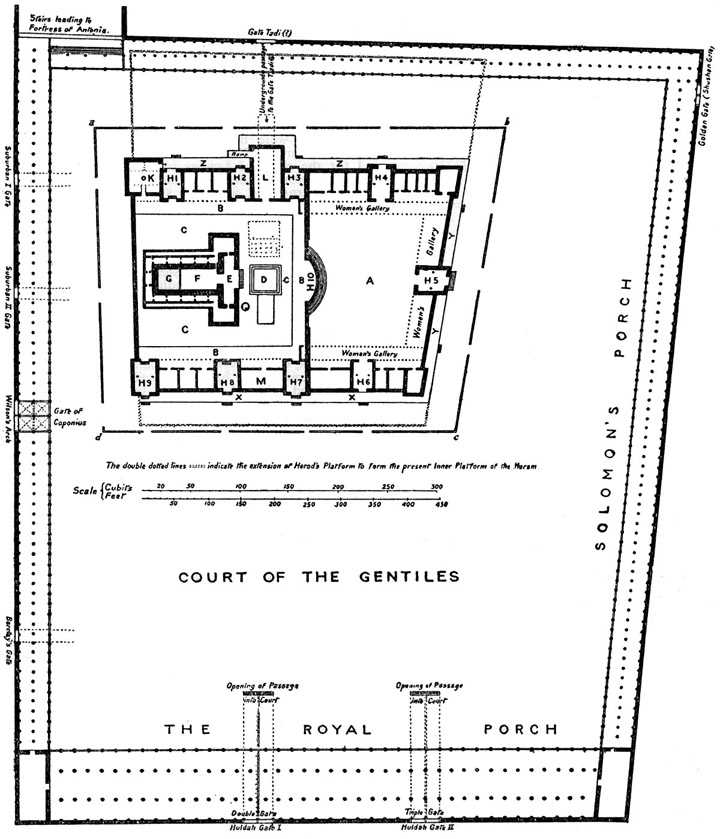
KEY TO PLAN OF HEROD’S TEMPLE AND COURTS.
a b c d, the surrounding balustrade (sôrçg). X Y Z, the terrace (chçl).
A, Court of the Women. B B B, Court of Israel. C C C, Court of the Priests.
D, altar of burnt-offering. E F G, porch, holy place, and holy of holies. O, the laver.
H, 1–9, Gates of the Sanctuary (Middoth, i. 4, 5), viz.: 1, gate of the House Moked; 2, Corban gate; 3, gate Nitsus; 5, the gate of Nicanor, or the Beautiful Gate; 7, the water gate; 8, gate of the firstborn; 9, the fuel gate; 10, the ‘upper gate,’ wrongly called the gate of Nicanor.
K, the guardhouse Moked (= hearth). L, the ‘northern edifice that was between the two gates’ (see BJ vi. ii 7 [Niese, § 150]). Here, it is suggested, the sacrificial victims were examined by the priests, having been brought in either by the underground passage shown on the plan, or by the ramp also shown. The upper storey may have contained the important ‘chamber of the councillors’ (parhedrin) (Yômâ, i. 1).
M, the chamber Gazith, in which the priests on duty assembled for prayer (Tamîd, iv. end). There are not sufficient data for fixing the location of the other chambers mentioned in the Mishna. Their distribution on the plan is purely conjectural.
The ‘great door of the house’ (20 cubits by 10) was ‘all over covered with gold,’ in front of which hung a richly embroidered Babylonian veil, while above the lintel was figured a huge golden vine (Jos.
DIAGRAMMATIC SECTION OF TEMPLE AND PORCH.
As in Solomon’s Temple, three storeys of side-chambers, prob. 30 cubits in height, ran round three sides of the main building. But by the provision of a passage-way giving access to the different storeys, and making a third outside wall necessary, the surface covered by the whole was now 96 cubits in length by 60 in breadth, not reckoning the two wings of the porch. Over the whole length of the two holy places a second storey was raised, entirely, as it seems, for architectural effect.
The total height of the naos is uncertain. The entries by which the Mishna makes up a total of 100 cubits are not such as inspire confidence; the laws of architectural proportion suggest that the 100, although also given by Josephus, should be reduced to 60 cubits or 88 feet, equal to the breadth of the naos and lateral chambers. On the plan the lowest side chambers are intended to be 5 cubits wide and their wall 3 (both as in § 3), the passage-way 3, and the outside wall 3, giving a total width of 14 + 6 + 20 + 6 +14 = 60 cubits (Jos.
The furniture of ‘the holy place’ remained as in former days. Before the veil stood the altar of incense; against the south wall the seven-branched golden lampstand, and opposite to it the table of shewbread (Jos.
‘The most holy place’ was empty as before (Jos.
All in all, Herod’s Temple was well worthy of a place among the architectural wonders of the world. One has but to think of the extraordinary height and strength of the outer retaining walls, parts of which still claim our admiration, and of the wealth of art and ornament lavished upon the porticoes and buildings. The artistic effect was further heightened by the succession of marble-paved terraces and courts, rising each above and within the other, from the outer court to the Temple floor. For once we may entirely credit the Jewish historian when he tells us that from a distance the whole resembled a snow-covered mountain, and that the light reflected from the gilded porch dazzled the spectator like ‘the sun’s own rays’ (Jos.
13. The daily Temple service in NT times.—This article may fitly close with a brief account of the principal act of Jewish worship in the days of our Lord, which centred round the daily or ‘continual’ (Heb. lamîd. Exo 29:42) burnt-offering, presented every morning and every evening, or rather mid-afternoon, throughout the year, in the name, and on behalf, of the whole community of Israel (see Exo 29:38-42, Num 28:3-8). A detailed account of this service, evidently based on reliable tradition, is given in the Mishna treatise Tamîd, of which English translations will be found in Barclay’s Talmud, and in PEFSt
The detachment of priests on duty in the rotation of their ‘courses’ (Luk 1:8) slept in the ‘house Moked’ (K on plan). About cock-crow the priests who wished to be drawn for the morning service bathed and robed, and thereafter repaired to the chamber Gazith (M) in order to determine by lot those of their number who should ‘officiate.’ By the first lot a priest was selected to remove the ashes from the altar of burnt-offering, and prepare the wood, etc., for the morning sacrifice. This done, ‘the presiding official said to them, Come and draw (to decide) (1) who shall slay, (2) who shall toss (the blood against the altar), (3) who shall remove the ashes from the incense altar, (4) who shall clean the lampstand, (5)–(10) who shall carry the parts of the victim to the foot of the altar [six parts are specified], (11) who shall prepare the (meal-offering) of fine flour, (12) the baked offering (of the high priest), and (13) the wine of the drink-offering’ (Mishna, Tamîd, iii. 1).
At the hour of dawn the preparations here set forth were begun, and the Temple gates thrown open. After the victim, a yearling lamb, had been slain, the incense altar prepared and the lamps trimmed, the officiating priests assembled in the chamber Gazith for a short religious service, after which there commenced the solemn acts of worship in which the tamîd culminated—the offering of incense and the burning of the sacrificial victim. The priest, chosen as before by lot (Luk 1:9), entered the Temple with a censer of incense, and, while the smoke was ascending from the altar within the Holy Place, the worshippers without prostrated themselves in adoration and silent prayer. After the priestly benediction had been pronounced from the steps of the porch (Tamîd, vii. 2), the several parts of the sacrifice were thrown upon the altar and consumed. The pouring of the drink-offering was now the signal for the choir of Levites to begin the chanting of the Psalm for the day. At intervals two priests blew on silver trumpets, at whose sound the people again prostrated themselves. With the close of the Psalm the public service was at an end, and the private sacrifices were then offered.
The order of the mid-afternoon service differed from the above only in that the incense was offered after the burning of the victim instead of before. The lamps, also, on the ‘golden candlestick,’ were lighted at the ‘evening’ service.
A. R. S. Kennedy.
The Latin form, templum, from which the English temple is derived, originally signified an uncovered area marked off by boundaries; especially the place marked off by the augurs to be excepted from all profane uses. Among the Remans the precincts of a temple were always quadrangular in ground plan; hence the so-called temple of Vesta, one of the most famous sanctuaries in Rome, being circular in plan, was not strictly a temple, but only an oedes sacra, or sacred building. When the augurs had determined the boundaries of a temple-enclosure, the boundaries could not lawfully be interrupted except at one point, which was to serve as an entrance. To mark these boundaries no walls were needed; a formula spoken by the augur was sufficient, and from this ceremony came the phrase effari locum, literally, "to proclaim a place", hence, to define and dedicate.It is certain that the Indo-Germanic peoples originally had no buildings for the worship of their gods, but worshipped the gods upon mountains, as Herodotus expressly says of the Persians, or believed the supernatural beings were present in groves or trees. Consequently among the ancient Germans the conception of a grove was identified with that of a temple. Among the Greeks, also, the worship of trees seems to be indicated by the word for temple, naos, which according to some authorities originally signified "tree" or "tree trunk". It is certain that the Greeks believed that at Dodona they hear the voice of the gods foretelling the future from the rustling of the sacred oaks. In the Homeric age, the temple as a space set apart and containing an altar, which was perhaps shaded by a group of trees, was more commonly found than the temple built by man. If actual temples are mentioned by Homer, as at Troy and the fabulous city of the Phæacians, the circumstance is probably attributable to oriental influence. The pagan Germans were never able to bring themselves to give up their worship of the gods in groves to any such extent as the Greeks and Remans did under the influence of the East. Still the German peoples were hardly entirely without temples, any more than the Scandinavians, although these temples could only have been of wood. The beginnings of stone temples among the Germans probably go back to the first Christian centuries and are attributable to the influence of their neighbors, the Gauls.When new temples were built precincts already consecrated to the divinity were preferably chosen. It was also customary to select the highest spot in a city, the acropolis, as the general,preference at that time was for high, open spaces. Further the kind of divinity had also influence on the choice of the spot: thus Zeus preferred the heights, Mars the marketplaces, Hercules the gymnasium, others, the fortified castle, the gates of the city, the plain. If the temple could not be erected on an open space dedicated to the divinity, it was customary to surround the temple by an enclosed precinct, whereby it was separated from all that was profane. Still other buildings were frequently inside this enclosure, as the houses for the priests, or the stalls for the sacrificial animals. Vessels containing water were placed at the entrance; from these, those entering sprinkled themselves to be purified from all guilt, as nothing impure was permitted to enter the precincts.As a rule a Greek temple faced east. The point towards which a Roman temple faced varied, according to the theory of H. Nissen, who investigated a large number of these temples in respect to this matter. He claimed that the position of the front depended on the altitude of the sun of the feast day of the respective god. Nissen started from the assumption that the Greeks and Romans regarded the gods and manifestations of the world-preserving spirit, and as such subordinated them to the original symbol of the world-spirit, the sun. Consequently, according to his theory, the temples were so placed that on the day settled on the calendar as the birthday and feast day of the god the rays of the rising sun fell along the axis of the temple and thus also on his statue. This theory suffers, however, from the fatal uncertainty as to the date the day of dedication fell on. Moreover, the instances in which it has lately been possible to determine the unknown god occupying a temple of known position, so as to test the correctness of this hypothesis, have proven unfavorable to it. [Nissen, "Templum" (Berlin, 1869)]. At the same time, however, it remains a fact that the orientation of the temple was universally customary, just as it was later in the case of the Christian church.Among the Romans when the building of the temple was completed it was dedicated to the divinity by the public authorities or by a person specially delegated for this office, while the priests only pronounced the formulæ without personally completing the sacred act. The dedication adhered permanently to the soil which was released by it from all other religious obligations and was withdrawn from profane use. The anniversary of the dedication was celebrated annually by a sacrifice.Among the equipments of the temple was a massive altar, sacrificial tables, movable heaths for fire, sacrificial utensils and other objects, which were dedicated at the same time as the temple. They formed a temple property that could not be sold. However, in times of necessity, especially in war, these treasures were often melted down, as were the costly church utensils of the medieval era and of later periods. The doorkeeper, who permitted visitors to enter the temple at stated times, also guarded the treasures.The massive altar, as mentioned above, did not stand in the temple but before it. Either it was built upon a high stone platform, and thus united architecturally with the temple, or it stood in front of the steps or in the portico. There was, as a rule, only one sacrificial table in the temple and only one altar in front of it. The cella of the temple contained the most important object, the statue of the divinity, which stood on a pedestal against the rear wall opposite the entrance. In the earliest period it was made of wood or clay, later it was cast from bronze or made of marble. Besides the statue of the god to whom the temple was dedicated, statues of other gods were at times placed in the temple, partly as ornaments, partly because of their connexion with the principal god.Taking their use as the basis of classification, three kinds of temples may be distinguished: temples for worship, for use in connexion with the agones, or festival games, and for the mysteries. The temple for worship was small and its cella contained only the statue of the god that was the object of veneration; it served religious uses exclusively. This temple frequently had connected with it the temple for festival games which served for the solemn crowning of the victor in the national competitive contests, and as the place for keeping the apparatus for the festivals. The temples of the mysteries were used by the initiated for the celebration of the secret cults, and differed from others, so far as the scanty remains permit a judgment, both in extent and form. Such temples were to be found, for instance, at Eleusius and at Samothracia. As has just been said, the temple contained only the statue of the god; it existed not so much for men as for the gods. It was exclusively the house of the god to whom it was dedicated. Still the god was pleased when at national festivals men appeared in his sanctuary with prayers and incense, and thus these days became religious as well as national festivals.Again, because the objects placed in the temple were more secure, it served as a treasury both for the State and for private persons. From 438 B. C. The public treasury of Athens was kept in the Parthenon. Naturally the temple also contained the votive offerings presented to the gods, as statues, lamps, wreaths, rings, and bracelets. A list of these objects was annually compiled, and once in four years it was engraved in marble; some fragments of such marbles are still in existence. Sometimes, too, the temple contained the mint.Besides material things men also found security and protection in the temple against threatening danger. Every temple was a asylon, that is, it was inviolable, and none dared to drive a malefactor away from the altar unless such a one wished to draw down the wrath of the gods upon himself. All temples did not grant the same protection: only certain temples had the privilege of unconditional security. Still there were ways of making the right of asylum ineffective, as was shown in the case of the Spartan Pausanius. During the reign of Tiberius the great number of asylums in Asia Minor was a subject of complaint.As to the form and manner of construction of the temple, we must in the first place not imagine that the Greeks and Romans at all times built for the gods those magnificent structures that even to-day all men of taste admire. The earliest sanctuaries of the gods were cave-temples, if grottoes and crypts deserve this name at all. Even in a later age the worship of Mithras was preferably celebrated in grottoes. Related to the natural cave-temples are the artificial rock-temples , of which magnificent examples are still to be found in India. A third form, found especially in Assyria, Mexico, and Peru, may be called tower, or pyramidal temples, because the actual sanctuary is placed on a truncated pyramid. The fourth, finally, is the classical form of Greeks and Romans. It is a development of the megaron, or ruler’s house, of primitive times, which consisted only of a large hall with portico. This portico was formed by the projecting side-walls of the hall and was ornamented in front with two columns.Having thus briefly considered the subject as a whole, we will now examine somewhat more closely the kinds of temple used by various civilized nations. This is all the more necessary to guard against identifying the temple of the Greeks with that of other peoples. The discussion, however, must be brief, because temples, both pagan and Christian, have always been the highest achievements of architecture, and have therefore been treated incidentally in other articles. The oldest architectural remains are those of Egypt. The main point of interest here is the structure of the great temples of the eighteenth to the twentieth dynasties (about 1530 - 1130 B. C.). Of special importance are the ruins of temples at Thebes or the present villages of Luxor and Karnak. The Egyptian temple is not an organic structure complete in itself; instead of unity there are the following distinct parts: dromos, enclosing wall, pylon, peristyle, hypostyle, and sekos. The temple of the Egyptians therefore consisted of a large complex of buildings and the temple precincts, the whole surrounded by a massive wall, and reached by a broad avenue (dromos) bordered by figures of sphinxes and rams. Between the temples of Luxor and Karnak this avenue for processions was nearly a mile and a quarter in length and nearly seventy-five feet wide. In the enclosing wall, which at Karnak was about thirty-two feet wide, there were several gigantic gateways called pylons, flanked by tower-like buildings. These led into the sacred precincts, within which was a lake. On certain days the statue of the god was rowed round this lake in a golden bark. A second pylon led to the peristyle, or protikos, a quadrangular open space containing covered halls with columns; a third pylon led into the hypostyle, or large covered colonnade. The hypostyle was called "the hall of manifestation", and only "the enlightened" were permitted to enter it, the lower classes of the population might only come as far as the peristyle. On the farther side of the hypostyle there were still other large halls which led ultimately to the actual sanctuary, or sekos, in which the divinity was represented by a statue or some symbol; only the king, or his representative, the high priest, could enter the sekos. Beyond the sanctuary were other large halls and chambers for keeping the apparatus for the festivals. A peculiarity of this extended series of sacred buildings is that the greater the distance from the entrance the narrower and lower the structure, so that the sekos is only a small dark chamber.The huge size and rich equipment of Egyptian temples is explained by the fact that they were monuments of the piety of the ruler, royal houses of prayer; consequently the king alone had the right to enter the sanctuary. For this reason the paintings and reliefs on a sunken background (coelanaglyphic), with which the temple walls were richly ornamented, presented in the most varied forms the homage and worship paid to the ruler. The ruler also showed the depth of his piety by the magnificent festivals which were connected with the temple.The architecture of the temple was in harmony with the obscure, mysterious, and sensual religious conceptions of the Egyptians. The temple was an inorganic conglomeration of structures fitted the one into the other, that only arouse our astonishment by their size and magnificence. It is hardly necessary to say that no rigid system prevailed in the plan of either the Egyptian temples or those to be mentioned further on, and that there were small temples as well as large.The Chaldean temples differed essentially from those of the Egyptians; if in the later the chief extent was horizontal, in the former it was vertical. The large temples of the Chaldeans were constructed so as to form a series of terraces or steps or something like a pile of rectangular prisms, decreasing in size from the base up. According to Herodotus, the temple of Bel at Babylon, built in a series of terraces, measured at the base two stadia (1214 feet) each way. On this broad base the tower-like structure rose in seven stories which were topped by the actual sanctuary. The upper stories were reached by means of an exterior stairway or an inclined roadway. Half-way up there was a chamber where those who were mounting could sit down and rest. This peculiar form of architecture was certainly influenced by astrology which had so authoritative a position in the Chaldeo-Assyrian religion. The temples raised on terraces were constructed in three, or five, or more stories, according to the importance of the divinity. Besides these there most certainly must have been smaller houses of one story for the gods, though of this no positive proof has yet been discovered. Temples raised on terraces have also been found in Mexico and Peru, as, for instance, at Tehuacan and Santiago Guatusca.The Indian temples are principally grottoes or caves. They are generally constructed in one or two forms: either hewn out of the rock and remaining connected with the main mass, or, cut away from the surrounding mass of rock so as to stand alone. To the first class belong largely the Buddhist temples (chaitya), while the latter form is preferred by the Brahmins. The more developed ground-plan of the Buddhist chaitya resembles in some points the plan of the early Christian basilica. It is a quadrangular space, its length much greater than its width, and has a kind of apse opposite the entrance. The inner space is divided into several naves by pillars which follow the line of the apse. In the apse is the dagoba, a circular mound like a grave, terminating at the top in a hemisphere with a ti or tee (stone in the form of an altar). The dagoba is used to hold relics of Buddha, and the entire tumulus is covered by a large umbrella. Noted cave-temples are to be found at Karli in the Chatt mountains (second century B. C.), at Agunta, and at Pandu-Lena. The detached temple consists sometimes of several buildings and halls connected by stairs and bridges. These buildings have been cut out of the parent rock so as to stand in a court surrounded by columned cloisters. Such a a temple is the wonderful structure of Kailas (Seat of the Blessed) at Allora, a work of the ninth century. Sometimes the temple is of small dimensions, as that at Mahavelliopore on the Coromandel Coast which is hewn out of a detached rock; the ground-plan is a quadrangle, and it rises in several stories like a pyramid built in several terraces.The typical Greek temple stood alone on a broad foundation platform, built on all sides in terraces, which is called the crepidoma. The temple consisted, generally, first, of the naos, or cella, which was a rectangular enclosed space for holding the statue of the god; second of the pronaos, a portico or vestibule in front of the cella with which it was connected by a door, while to the front it had open columns with rows of spaces between; third, the posticum, a portico behind the cella, and corresponding to the pronaos. Large buildings contained two further structures, the opisthodomos, a chamber between the cella and the osticum, and fifth, the peristyle, a covered walk with a system of columns surrounding the temple and open on the outer side. These two last-mentioned parts of the temple were probably added in the seventh century B. C.The nature of the Greek temple varied with its ground-plan. The simplest form was called the temple with antæ (templum in antis), antæ signifying pilasters which form the terminations of walls. If the two side-walls of the cella extend a little beyond the transverse wall, and these ends of the side-walls are finished with antæ, then these give the name to the entire structure. Two columns generally stand in the space between the two antæ. The sense of symmetry led to the same construction at the rear without there being any change in the name. If the portico were formed merely by a row of columns without the aid of walls it was called a prostyle temple; if the same construction were also placed at the rear of the building it was amphiprostyle. The actual creation of the Greek mind was the peristyle, in which the entire temple was surrounded by a row of columns that carried the projecting beams of the roof. A second, inner row of columns was generally arranged at the front and back of the building. If the columns were replaced by engaged columns on the walls of the cells, the temple was a pseudo-peripteral temple. A temple was called dipteros if it were surrounded by a double colonnade, and psuedo-dipteros when the inner row of columns was not used. A circle of columns with a roof over them, but without a cella, formed a monopteral temple. A third method of designating or distinguishing the temples is by the number of columns in front, thus temples are called tetrastyle, hexastyle, octastyle, that is having five, six, or eight columns.Up to the seventh century B. C. The method of building was very simple: the walls of the cella were made of unburnt brick resting on a stone base, the columns were of wood, for originally the Greek temple in its essential parts was not built of stone. In the buildings of better construction the walls were ornamented with terra-cotta tiles, and the columns were covered with precious metals. The earliest temples were built in the Doric style; this was followed in the sixth century by the Ionic style that came from Asia Minor, and later by the Corinthian style. One style, however, never entirely supplanted the other. If in the Doric temple the impression made was that of massiveness, the Ionic temple converted a sense of agreeable lightness and grace. The effect produced by the Greek temple was not that of gigantic size, as in the Egyptian, or of colossal mass, as in the Assyrian; it arose from the harmonious relation between all its members, by the spiritualizing of the style of architecture and the ornamentation, as well as the careful execution of all parts, even those least seen. Thus it became a model for all succeeding centuries, which always return to it after they have tried for a time new architectural designs of their own. The Romans were the first to adopt the plan of the Greek temple, but they impressed their character upon it in several ways: the foundation platform was frequently omitted, or was replaced by a podium without any steps except those leading to the entrance; the front was emphasized by prolonging the portico and increasing the number of columns. The finely balanced design of the Greeks was sacrificed to ostentatious display of material and the huge size of the structure. The round temple is peculiar to the Romans, who greatly developed it. Among the temples of this style is one of the most important masterpieces of Roman architecture, the Pantheon, as well as several small, graceful structures like that at Tivoli.However important a Greek or Roman temple may be architecturally, still it is essentially nothing more than a beautiful and stately private house, a dwelling-place of the divinity, not a house of prayer and a place for the people to offer sacrifice. In this is made evident the marked difference between the temple and the Christian church. From the beginning the Christian church was intended to hold all those who believed and its interior was divided into sanctuary and nave for the clergy and the laity. It contained in itself the fruitful seed which enabled it in the course of centuries to develop, even architecturally, far beyond the classical temple. In the latter, excepting in the prostyle temple, the front had hardly any distinctive characteristic, in the peripteral, amphiprostyle, and other temples the back and front were alike. On the other hand, the façades of many Christian churches are works of the finest finish and highest architectural value. Although the temple contained several chambers within, yet this fact exercised no actual influence on its external construction, while in the Christian church, either of the Romanesque or of the Gothic style, the interior arrangement is easily recognized from the external construction. It is a striking fact, and perhaps, one that is not to be explained entirely by the dislike of the early Christians for the places of heathen worship, that from the beginning the model chosen for the Christian church was not the classic temple, but the basilica, which, as the court and place of exchange, was intended to hold large numbers of people. LITURGY OF THE TEMPLEThe three great national festivals of the Jews — the Passover, Pentecost, and the Feast of Tabernacles — were the occasion of special liturgical service of the Temple (Exodus 23:14, 17; 34:23; Deuteronomy 16:16). Other feasts could be celebrated by local observance. Not so these three national feasts. All males were supposed to appear in Jerusalem on these occasions: "in the place which the Lord thy God shall choose, that his name may dwell there" (Deuteronomy 16:6). It was during the Passover, while the lambs for the Pasch were dressed, that the Levites in the Temple chanted the Hallel (Psalms 113-118; Vulgate 112-117). These same Psalms were repeated during the Paschal meal, — the first two after the second cup, the remainder after the fourth cup.The ordinary temple liturgy is not clear to us. Scant and obscure details are preserved in the Sacred Text. The people gathered in the courts of the temple to receive instruction from the prophets and to join them in prayer (Isaiah 1:12-15). The Deuteronomic custom was that the Torah should be read to the people in the Temple at the feast of the Tabernacles (Deuteronomy 31:10-13). After the exile, Esdras brought back this custom (Nehemiah 8:5-8). And yet, not even the reading of the Torah was the chief purpose of the Temple; it was essentially "a house of prayer for all nations" (Isaiah 56:7); prayer to Jahweh was its chief purpose. It was in the Temple of Silo that Anna prayed for a man child (1 Samuel 1:11). In the first Temple of Jerusalem, Solomon said his inspiring prayer for Israel (1 Kings 8:12-53). Apart from the Psalms, set forms of prayers were very rare. In such set forms, the priest offered the first-fruits and tithes before the altar of the Temple (Deuteronomy 26:5-10); and the high-priest laid the sins of Israel upon the heads of the scape-goat (Leviticus 16:21). During the morning and evening sacrifices the Levites sang praises to the Lord (1 Chronicles 23:30). These praises would seem to have been the Psalms, since the leader of the Levites in the time of Nehemias was a son of Asaph (Nehemiah 9:17). The titles of many of the Psalms give evidence of their liturgical use in the Temple or the "House of Jahweh" that preceded the temple. The Psalms of Asaph and of the sons of Korah (see PSALMS) at one time made up a liturgical collection for temple service. The sons of Asaph were among the temple Levites (1 Chronicles 25:1). The sons of Korah were also a levitical family of temple singers (2 Chronicles 20:19). In fact, there can be no doubt but the psalms are evidence of a gradual development of a liturgical hymnal for temple service.Certain elements of synangogal liturgy (see SYNAGOGUE) probably have their origin in temple service. The "Shema" (Deuteronomy 6:4-9), together with the Ten Commandments and several benedictions, were recited by the priest at the morning sacrifice (Tamid. V). Josephus (Ant. Jud., IV, viii, 13) dates this synangogal practice from the time of Moses.-----------------------------------ZENNER, Die Chorgesänge im Buche der Palmen (Freiburg, 1896); ZENNER-WEISMAN, Die Psalmen nach dem Urtext (Münster, 1906). The latter text edits the text over much, and has consequently been put on the index (1911).BEDA KLEINSCHMIDT & WALTER DRUM Transcribed by M. Donahue & Larisa Vidmar The Catholic Encyclopedia, Volume XIVCopyright © 1912 by Robert Appleton CompanyOnline Edition Copyright © 2003 by K. KnightNihil Obstat, July 1, 1912. Remy Lafort, S.T.D., CensorImprimatur. +John Cardinal Farley, Archbishop of New York
A. STRUCTURE AND HISTORY
I. SOLOMON’S TEMPLE
I. INTRODUCTORY
1. David’s Project
2. Plans and Preparations
3. Character of the Building
4. Site of the Temple
5. Phoenician Assistance
II. THE TEMPLE BUILDING
1. In General
2. Dimensions, Divisions and Adornments
3. The Side-Chambers
4. The Porch and Pillars
III. COURTS, GATES ANY ROYAL BUILDINGS
1. The Inner Court
(1) Walls
(2) Gates
2. The Great Court
3. The Royal Buildings
IV. FURNITURE OF THE TEMPLE
1. The Sanctuary
(1) The “Debhir”
(2) The “Hekhal”
2. The Court (Inner)
(1) The Altar
(2) The Molten (Bronze) Sea
(3) The Layers and Their Bases
V. HISTORY OF THE TEMPLE
1. Building and Dedication
2. Repeated Plunderings, etc.
3. Attempts at Reform
4. Final Overthrow
II. EZEKIEL’S PROPHETIC SKETCH
I. INTRODUCTORY
1. Relation to History of Temple
2. The Conception Unique and Ideal
3. Its Symmetrical Measurements
II. PLAN OF THE TEMPLE
1. The Outer Court
2. The Inner Court
3. The Temple Building and Adjuncts
III. THE TEMPLE OF ZERUBBABEL
I. INTRODUCTORY
1. The Decree of Cyrus
2. Founding of the Temple
3. Opposition and Completion of the Work
II. THE TEMPLE STRUCTURE
1. The House
2. Its Divisions and Furniture
3. Its Courts, Altar, etc.
4. Later Fortunes
IV. THE TEMPLE OF HEROD
I. INTRODUCTORY
1. Initiation of the Work
2. Its Grandeur
3. Authorities
4. Measurements
II. THE TEMPLE AND ITS COURTS
1. Temple Area - Court of Gentiles
2. Inner Sanctuary Inclosure
(1) Wall, “Hel,” “Soregh,” Gates
(2) Court of the Women
(3) Inner Courts: Court of Israel; Court of the Priests
(4) The Altar, etc.
3. The Temple Building
(1) House and Porch
(2) “Hekhal” and “Debhir”
(3) The Side-Chambers
III. NEW TESTAMENT ASSOCIATIONS OF HEROD’S TEMPLE
1. Earlier Incidents
2. Jesus in the Temple
3. The Passion-Week
4. Apostolic Church
5. The Temple in Christian Thought
LITERATURE
A. Structure and History
I. Solomon’s Temple
I. Introductory.
1. David’s Project:
The tabernacle having lasted from the exodus till the commencement of the monarchy, it appeared to David to be no longer fitting that the ark of God should dwell within curtains (it was then in a tent David had made for it on Zion: 2Sa 6:17), while he himself dwelt in a cedar-lined house. The unsettled and unorganized state of the nation, which had hitherto necessitated a portable structure, had now given place to an established kingdom. The dwelling of Yahweh should therefore be henceforth a permanent building, situated at the center of the nation’s life, and “exceeding magnificent” (1Ch 22:5), as befitted the glory of Yahweh, and the prospects of the state.
2. Plans and Preparations:
David, however, while honored for his purpose, was not permitted, because he had been a man of war (2 Sam 7; 1Ch 22:8; compare 1Ki 5:3), to execute the work, and the building of the house was reserved for his son, Solomon. According to the Chronicler, David busied himself in making extensive and costly preparations of wood, stone, gold, silver, etc., for the future sanctuary and its vessels, even leaving behind him full and minute plans of the whole scheme of the building and its contents, divinely communicated (1Ch 22:2 ff; 1Ch 28:11 ff; 29). The general fact of lengthened preparation, and even of designs, for a structure which so deeply occupied his thoughts, is extremely probable (compare 1Ki 7:51).
3. Character of the Building:
The general outline of the structure was based on that of the tabernacle (on the modern critical reversal of this relation, see under B, below). The dimensions are in the main twice those of the tabernacle, though it will be seen below that there are important exceptions to this rule, on which the critics found so much. The old question (see TABERNACLE) as to the shape of the building - flat or gable-roofed - here again arises. Not a few modern writers (Fergusson, Schick, Caldecott, etc.), with some older, favor the tentlike shape, with sloping roof. It does not follow, however, even if this form is, with these writers, admitted for the tabernacle - a “tent” - that it is applicable, or likely, for a stone “house,” and the measurements of the Temple, and mention of a “ceiling” (1Ki 6:15), point in the opposite direction. It must still be granted that, with the scanty data at command, all reconstructions of the Solomonte Temple leave much to be filled in from conjecture. Joseph Hammond has justly said: “It is certain that, were a true restoration of the Temple ever to be placed in our hands, we should find that it differed widely from all attempted ’restorations’ of the edifice, based on the scanty and imperfect notices of our historian and Ezekiel” (Commentary on 1 Ki 6, “Pulpit Commentary”).
4. Site of the Temple:
The site of the Temple was on the eastern of the two hills on which Jerusalem was built - that known in Scripture as Mt. Moriah (2Ch 3:1) or Mt. Zion (the traditional view which locates Zion on the western hill, on the other side of the Tyropoeon, though defended by some, seems untenable; see “Zion,” in HDB; “Jerusalem,” in DB, etc.). The place is more precisely defined as that where Araunah (Ornan) had his threshing-floor, and David built his altar after the plague (1Ch 21:22; 2Ch 3:1). This spot, in turn, is now all but universally held to be marked by the sacred rock,
5. Phoenician Assistance:
For aid in his undertaking, Solomon invited the cooperation of Hiram, king of Tyre, who willingly lent his assistance, as he had before helped David, granting Solomon permission to send his servants to cut down timber in Lebanon, aiding in transport, and in the quarrying and hewing of stones, and sending a skillful Tyrian artist, another Hiram, to superintend the designing and graving of objects made of the precious metals, etc. For this assistance Solomon made a suitable recompense (1 Ki 5; 2 Ch 2). Excavations seem to show that a large part of the limestone of which the temple was built came from quarries in the immediate neighborhood of Jerusalem (Warren, Underground Jerusalem, 60). The stones were cut, hewn and polished at the places whence they were taken, so that “there was neither hammer nor axe nor any tool of iron heard in the house, while it was in building” (1Ki 5:17, 1Ki 5:18; 1Ki 6:7). Opinions differ as to the style of architecture of the building. It was probably unique, but Phoenician art also must have left its impress upon it. See ARCHITECTURE.
II. The Temple Building.
1. In General:
In contrast with the tabernacle, which was a portable “tent,” consisting of a framework of acacia wood, with rich coverings hung over it, and standing in a “court” enclosed by curtains (see TABERNACLE), the Temple was a substantial “house” built of stone (probably the hard white limestone of the district), with chambers in three stories, half the height of the building (1Ki 6:5, 1Ki 6:6), round the sides and back, and, in front, a stately porch (1Ki 6:3), before which stood two lofty bronze pillars - Jachin and Boaz (1Ki 7:21; 2Ch 3:4, 2Ch 3:15-17). Within, the house was lined with cedar, overlaid with gold, graven with figures of cherubim, palms, and open flowers (1Ki 6:15, 1Ki 6:18, 1Ki 6:21, 1Ki 6:22, 1Ki 6:29), and a partition of cedar or stone divided the interior into two apartments - one the holy place (the
2. Dimensions, Divisions and Adornments:
The Temple, like the tabernacle, stood facing East, environed by “courts” (“inner” and “greater”), which are dealt with below, Internally, the dimensions of the structure were, in length and width, double those of the tabernacle, namely, length 60 cubits, width 20 cubits. The height, however, was 30 cubits, thrice that of the tabernacle (1Ki 6:2; compare 1Ki 6:18, 1Ki 6:20). The precise length of the cubit is uncertain (see CUBIT); here, as in the article TABERNACLE, it is taken as approximately 18 inches. In internal measurement, therefore, the Temple was approximately 90 ft. long, 30 ft. broad, and 45 ft. high. This allows nothing for the thickness of the partition between the two chambers. For the external measurement, the thickness of the walls and the width of the surrounding chambers and their walls require to be added. It cannot positively be affirmed that the dimensions of the Temple, including the porch, coincided precisely with those of Ezekiel’s temple (compare Keil on 1Ki 6:9, 1Ki 6:10); still, the proportions must have closely approximated, and may have been in agreement.
The walls of the building, as stated, were lined within with cedar; the holy place was ceiled with fir or cypress (2Ch 3:5; the “oracle” perhaps with cedar); the flooring likewise was of fir (1Ki 6:15). All was overlaid with gold, and walls and doors (see below) were adorned with gravings of cherubim, palm trees, and open flowers (1 Ki 6:19-35; 2Ch 3:6 adds “precious stones”). Of the two chambers into which the house was divided, the outermost (or
3. The Side-Chambers:
The thickness of the Temple walls is not given, but the analogy of Ezekiel’s temple (Ezek 41) and what is told of the side-chambers render it probable that the thickness was not less than 6 cubits (9 ft.). Around the Temple, on its two sides and at the back, were built chambers (
4. The Porch and Pillars:
A conspicuous feature of the Temple was the porch in front of the building, with its twin pillars, Jachin and Boaz. Of the porch itself a very brief description is given. It is stated to have been 20 cubits broad - the width of the house - and 10 cubits deep (1Ki 6:3). Its height is not given in 1 Kings, but it is said in 2Ch 3:4 to have been 120 cubits, or approximately 180 ft. Some accept this enormous height (Ewald, Stanley, etc.), but the majority more reasonably infer that there has been a corruption of the number. It may have been the same height as the Temple - 30 cubits. It was apparently open in front, and, from what is said of its being “overlaid within with pure gold” (2Ch 3:4), it may be concluded that it shared in the splendor of the main building, and had architectural features of its own which are not recorded. Some find here, in the wings, treasury chambers, and above, “upper chambers,” but such restorations are wholly conjectural. It is otherwise with the monumental brass (bronze) pillars - Jachin and Boaz - of which a tolerably full description is preserved (1Ki 7:15-22; 2Ch 3:15-17; 2Ch 4:11-13; compare Jer 52:20-23), still, however, leaving many points doubtful. The pillars which stood in front of the porch, detached from it, were hollow bronze castings, each 18 cubits (27 ft.) in height (35 cubits in 2Ch 3:15 is an error), and 12 cubits (18 ft.) in circumference, and were surmounted by capitals 5 cubits (7 1/2 ft.) high, richly ornamented on their lower, bowl-shaped (1Ki 7:20, 1Ki 7:41, 1Ki 7:42) parts, with two rows of pomegranates, enclosing festoons of chain-work, and, in their upper parts, rising to the height of 4 cubits (6 ft.) in graceful lily-work. See JACHIN AND BOAZ.
It was seen that the holy place (
III. Courts, Gates and Royal Buildings.
The Temple was enclosed in “courts” - an “inner” (1Ki 6:36; 1Ki 7:12; 2Ch 4:9, “court of the priests”; Jer 36:10, “the upper court”; Eze 8:3, Eze 8:16; Eze 10:3), and an outer or “greater court” (1Ki 7:9, 1Ki 7:12; 2Ch 4:9) - regarding the situation, dimensions and relations of which, alike to one another and to the royal buildings described in 1 Ki 7 the scanty notices in the history leave room for great diversity of opinion. See COURT OF THE SANCTUARY.
1. The Inner Court:
The “inner court” (
(1) Walls:
The walls of the court were built of three rows of hewn stone, with a coping of cedar beams (1Ki 6:36). Their height is not stated; it is doubtful if it would admit of the colonnades which some have supposed; but “chambers” are mentioned (Jer 35:4; Jer 36:10 - if, indeed, all belong to the “inner” court), which imply a substantial structure. It was distinctively “the priests’ court” (2Ch 4:9); probably, in part, was reserved for them; to a certain degree, however, the laity had evidently free access into it (Jer 36:10; Jer 38:14; Eze 8:16, etc.). The mention of “the new court” (2Ch 20:5, time of Jehoshaphat), and of “the two courts of the house of Yahweh” (2Ki 21:5; 2Ch 33:5, time of Manasseh), suggests subsequent enlargement and division.
(2) Gates:
Though gates are not mentioned in the narratives of the construction, later allusions show that there were several, though not all were of the time of Solomon. The principal entrance would, of course, be that toward the East (see EAST GATE). In Jer 26:10 there is allusion to “the entry of the new gate of Yahweh’s house.” This doubtless was “the upper gate” built by Jotham (2Ki 15:35) and may reasonably be identified with the “gate that looketh toward the North” and the “gate of the altar” (i.e. through which the sacrifices were brought) in Eze 8:3, Eze 8:1, and with “the upper gate of Benjamin” in Jer 20:3. Mention is also made of a “gate of the guard” which descended to the king’s house (2Ki 11:19; see below). Jeremiah speaks of a “third entry that is in the house of Yahweh” (Jer 38:14), and of “three keepers of the threshold” (Jer 52:24), but it is not clear which court is intended.
2. The Great Court:
The outer or “great court” of the Temple (
3. The Royal Buildings:
The group of buildings which, on theory now stated, were enclosed by the southern part of the great court, are those described in 1Ki 7:1-12. They were of hewn stone and cedar wood (1Ki 7:9-11), and embraced: (1) The king’s house, or royal palace (1Ki 7:8), in close contiguity with the Temple-court (2Ki 11:19). (2) Behind this to the West, the house of Pharaoh’s daughter (2Ki 11:9) - the apartments of the women. Both of these were enclosed in a “court” of their own, styled in 2Ki 11:8 “the other court,” and in 2Ki 20:4 margin “the middle court.” (3) South of this stood the throne-room, and porch or hall of judgment, paneled in cedar” from floor to floor,” i.e. from floor to ceiling (2Ki 11:7). The throne, we read later (1Ki 10:18-20), was of ivory, overlaid with gold, and on either side of the throne, as well as of the six steps that led up to it, were lions. The hall served as an audience chamber, and for the administration of justice. (4) Yet farther South stood the porch or hall of pillars, 50 cubits (75 ft.) long and 30 cubits (45 ft.) broad, with a sub-porch of its own (1Ki 10:6). It is best regarded as a place of promenade and vestibule to the hall of judgment. (5) Lastly, there was the imposing and elaborate building known as “the house of the forest of Lebanon” (1Ki 10:2-5), which appears to have received this name from its multitude of cedar pillars. The scanty hints as to its internal arrangements have baffled the ingenuity of the commentators. The house was 100 cubits (150 ft.) in length, 50 cubits (75 ft.) in breadth, and 30 cubits (45 ft.) in height. Going round the sides and back there were apparently four rows of pillars. The Septuagint has three rows), on which, supported by cedar beams, rested three tiers or stories of side-chambers (literally, “ribs,” as in 1Ki 6:5; compare the Revised Version margin). In 1Ki 6:3 it is disputed whether the number “forty and five; fifteen in a row” (as the Hebrew may be read) refers to the pillars or to the chambers; if to the former, the Septuagint reading of “three rows” is preferable. The windows of the tiers faced each other on the opposite sides (1Ki 6:4, 1Ki 6:5). But the whole construction is obscure and doubtful. The spacious house was used partly as an armory; here Solomon put his 300 shields of beaten gold (1Ki 10:17).
IV. Furniture of the Temple.
1. The Sanctuary:
We treat here, first, of the sanctuary in its two divisions, then of the (inner) court.
(1) The “Debhir”.
In the most holy place, or
(2) The “Hekhal”.
In the holy place, or
2. The Court (Inner):
(1) The Altar.
The most prominent object in the Temple-court was the altar of burnt offering, or brazen altar (see BRAZEN ALTAR). The site of the altar, as already seen, was the rock
(2) The Molten (Bronze) Sea.
A new feature in the sanctuary court - taking the place of the “laver” in the tabernacle - was the “molten sea,” the name being given to it for its great size. It was an immense basin of bronze, 5 cubits (7 1/2 ft.) high, 10 cubits (15 ft.) in diameter at the brim, and 30 cubits (45 ft.) in circumference, resting on 12 bronze oxen, and placed between the altar and the Temple-porch, toward the South (1Ki 7:23-26, 1Ki 7:39; 2Ch 4:2-5, 2Ch 4:10). The bronze was a handbreadth in thickness. The brim was shaped like the flower of a lily, and encompassing the basin were ornamental knops. Its capacity is given as 2,000 baths (1Ki 7:26; by error in 2Ch 4:5, 2Ch 4:3,000 baths). The oxen on which it rested faced the four cardinal points - three looking each way. The “sea,” like the laver, doubtless supplied the water for the washing of the priests’ hands and feet (compare Exo 30:18; Exo 38:8). The view of certain scholars (Kosters, Gunkel, etc.) that the “sea” is connected with Babylonian mythical ideas of the great deep is quite fanciful; no hint appears of such significance in any part of the narrative. The same applies to the lavers in the next paragraph.
(3) The Lavers and Their Bases.
The tabernacle laver had its place taken by the “sea” just described, but the Temple was also provided with 10 lavers or basins, set on “bases” of elaborate design and moving upon wheels - the whole made of bronze (1Ki 7:27-37). Their use seems to have been for the washing of sacrifices (2Ch 4:6), for which purpose they were placed, 5 on the north side, and 5 on the south side, of the Temple-court. The bases were 4 cubits (6 ft.) long, 4 cubits broad, and 3 cubits (4 1/2 ft.) high. These bases were of the nature of square paneled boxes, their sides being ornamented with figures of lions, oxen and cherubim, with wreathed work beneath. They had four feet, to which wheels were attached. The basin rested on a rounded pedestal, a cubit high, with an opening 1 1/2 cubits in diameter to receive the laver (1Ki 7:31). Mythological ideas, as just said, are here out of place.
V. History of the Temple.
1. Building and Dedication:
The Temple was founded in the 4th year of Solomon’s reign (1Ki 6:1), and occupied 7 1/2 years in building (1Ki 6:38); the royal buildings occupied 13 years (1Ki 7:1) - 20 years in all (the two periods, however, may in part synchronize). On the completion of the Temple, the ark was brought up, in the presence of a vast assemblage, from Zion, and, with innumerable sacrifices and thanksgiving, was solemnly deposited in the Holy of Holies (1 Ki 8:1-21; 2Ch 5:1-14; 2Ch 6:1-11). The Temple itself was then dedicated by Solomon in the noble prayer recorded in 1 Ki 8:22-61; 2 Ch 6:12-42, followed by lavish sacrifices, and a 14 days’ feast. At its inauguration the house was filled with the “glory” of Yahweh (1Ki 8:10, 1Ki 8:11; 2Ch 5:13, 2Ch 5:14).
2. Repeated Plunderings, Etc.:
The religious declension of the later days of Solomon (1Ki 11:1-8) brought in its train disasters for the nation and the Temple. On Solomon’s death the kingdom was disrupted, and the Temple ceased to be the one national sanctuary. It had its rivals in the calf-shrines set up by Jeroboam at Beth-el and Dan (1Ki 12:25-33). In the 5th year of Rehoboam an expedition was made against Judah by Shishak, king of Egypt, who, coming to Jerusalem, carried away the treasures of the Temple, together with those of the king’s house, including the 300 shields of gold which Solomon had made (1Ki 14:25-28; 2Ch 12:2-9). Rehoboam’s wife, Maacah, was an idolatress, and during the reign of Abijam, her son, introduced many abominations into the worship of the Temple (1Ki 15:2, 1Ki 15:12, 1Ki 15:13). Asa cleared these away, but himself further depleted the Temple and royal treasuries by sending all that was left of their silver and gold to Ben-hadad, king of Syria, to buy his help against Baasha, king of Israel (1Ki 15:18, 1Ki 15:19). Again the Temple was foully desecrated by Athaliah (2Ch 24:7), necessitating the repairs of Jehoash (2Ki 12:4 ff; 2Ki 24:4 ff); and a new plundering took place in the reign of Ahaziah, when Jehoash of Israel carried off all the gold and silver in the Temple and palace (2Ki 14:14). Uzziah was smitten with leprosy for presuming to enter the holy place to offer incense (2Ch 26:16-20). Jehoshaphat, earlier, is thought to have enlarged the court (2Ch 20:5), and Jotham built a new gate (2Ki 15:35; 2Ch 27:3). The ungodly Ahaz went farther than any of his predecessors in sacrilege, for, besides robbing the Temple and palace of their treasures to secure the aid of the king of Assyria (2Ki 16:8), he removed the brazen altar from its time-honored site, and set up a heathen altar in its place, removing likewise the bases and ornaments of the lavers, and the oxen from under the brazen (bronze) sea (2Ki 16:10-17).
3. Attempts at Reform:
An earnest attempt at reform of religion was made by Hezekiah (2Ki 18:1-6; 2Ch 29:31), but even he was driven to take all the gold and silver in the Temple and king’s house to meet the tribute imposed on him by Sennacherib, stripping from the doors and pillars the gold with which he himself had overlaid them (2Ki 18:14-16; 2Ch 32:31). Things became worse than ever under Manasseh, who reared idolatrous altars in the Temple-courts, made an Asherah, introduced the worship of the host of heaven, had horses dedicated to the sun in the Temple-court, and connived at the worst pollutions of heathenism in the sanctuary (2Ki 21:3-7; 2Ki 23:7, 2Ki 23:11). Then came the more energetic reforms of the reign of Josiah, when, during the repairs of the Temple, the discovery was made of the Book of the Law, which led to a new covenant with Yahweh, a suppression of the high places, and the thorough cleansing-out of abuses from the Temple (2 Ki 22; 23:1-25; 2 Ch 34; 35). Still, the heart of the people was not changed, and, as seen in the history, and in the pages of the Prophets, after Josiah’s death, the old evils were soon back in full force (compare e.g. Eze 8:7-18).
4. Final Overthrow:
The end, however, was now at hand. Nebuchadnezzar made Jehoiakim his tributary; then, on his rebelling, came, in the reign of Jehoiachin, took Jerusalem, carried off the treasures of the Temple and palace, with the gold of the Temple vessels (part had already been taken on his first approach, 2Ch 36:7), and led into captivity the king, his household and the chief part of the population (2 Ki 24:1-17). Eleven years later (586 BC), after a siege of 18 months, consequent on Zedekiah’s rebellion (2Ki 25:1), the Babylonian army completed the destruction of Jerusalem and the Temple. Only a few lesser utensils of value, and the brazen (bronze) pillars, bases and sea remained; these were now taken away, the larger objects being broken up (2Ki 25:13-16). The Temple itself, with its connected buildings, and the houses in Jerusalem generally, were set on fire (2Ki 25:9). The ark doubtless perished in the conflagration, and is no more heard of. The residue of the population - all but the poorest - were carried away captive (2Ki 25:11, 2Ki 25:12; see CAPTIVITY). Thus ended the first Temple, after about 400 years of chequered existence.
II. Ezekiel’s Prophetic Sketch
I. Introductory.
1. Relation to History of Temple:
Wellhausen has said that Ezekiel 40 through 48 “are the most important in his book, and have been, not incorrectly, called the key to the Old Testament” (Prolegomena, English translation, 167). He means that Ezekiel’s legislation represents the first draft, or sketch, of a priestly code, and that subsequently, on its basis, men of the priestly school formulated the Priestly Code as we have it. Without accepting this view, dealt with elsewhere, it is to be admitted that Ezekiel’s sketch of a restored temple in chapters 40-43 has important bearings on the history of the Temple, alike in the fact that it presupposes and sheds back light upon the structure and arrangements of the first Temple (Solomon’s), and that in important respects it forecasts the plans of the second (Zerubbabel’s) and of Herod’s temples.
2. The Conception Unique and Ideal:
While, however, there is this historical relation, it is to be observed that Ezekiel’s temple-sketch is unique, presenting features not found in any of the actually built temples. The temple is, in truth, an ideal construction never intended to be literally realized by returned exiles, or any other body of people. Visionary in origin, the ideas embodied, and not the actual construction, are the main things to the prophet’s mind. It gives Ezekiel’s conception of what a perfectly restored temple and the service of Yahweh would be under conditions which could scarcely be thought of as ever likely literally to arise. A literal construction, one may say, was impossible. The site of the temple is not the old Zion, but “a very high mountain” (Eze 40:2), occupying indeed the place of Zion, but entirely altered in elevation, configuration and general character. The temple is part of a scheme of transformed land, partitioned in parallel tracts among the restored 12 tribes (Ezek 47:13 through 48:7, Eze 48:23-29), with a large area in the center, likewise stretching across the whole country, hallowed to Yahweh and His service (Eze 48:8-22). Supernatural features, as that of the flowing stream from the temple in Ezekiel 47, abound. It is unreasonable to suppose that the prophet looked for such changes - some of them quite obviously symbolical - as actually impending.
3. Its Symmetrical Measurements:
The visionary character of the temple has the effect of securing that its measurements are perfectly symmetrical. The cubit used is defined as “a cubit and a handbreadth” (Eze 40:5), the contrast being with one or more smaller cubits (see CUBIT). In the diversity of opinion as to the precise length of the cubit, it may be assumed here that it was the same sacred cubit employed in the tabernacle and first Temple, and may be treated, as before, as approximately equivalent to 18 inches.
II. Plan of the Temple.
Despite obscurities and corruption in the text of Ezekiel, the main outlines of the ideal temple can be made out without much difficulty (for details the commentaries must be consulted; A. B. Davidson’s “Ezekiel” in the Cambridge Bible series may be recommended; compare also Keil; a very lucid description is given in Skinner’s “Book of Ezk,” in the Expositor’s Bible, 406-13; for a different view, see Caldecott, The Second Temple in Jerusalem).
1. The Outer Court:
The temple was enclosed in two courts - an outer and an inner - quite different, however, in character and arrangement from those of the first Temple. The outer court, as shown by the separate measurements (compare Keil on Eze 40:27), was a large square of 500 cubits (750 ft.), bounded by a wall 6 cubits (9 ft.) thick and 6 cubits high (Eze 40:5). The wall was pierced in the middle of its north, east and south sides by massive gateways, extending into the court to a distance of 50 cubits (75 ft.), with a width of 25 cubits (37 1/2 ft.). On either side of the passage in these gateways were three guardrooms, each 6 cubits square (Eze 40:7 margin), and each gateway terminated in “porch,” 8 cubits (12 ft.) long (Eze 40:9), and apparently (thus, the Septuagint, Eze 40:14; the Hebrew text seems corrupt), 20 cubits across. The ascent to the gateways was by seven steps (Eze 40:6; compare Eze 40:22, Eze 40:26), showing that the level of the court was to this extent higher than the ground outside. Round the court, on the three sides named - its edge in line with the ends of the gateways - was a “pavement,” on which were built, against the wall, chambers, 30 in number (Eze 40:17, Eze 40:18). At the four corners were enclosures (40 cubits by 30) where the sacrifices were cooked (compare Eze 46:21-24) - a fact which suggests that the cells were mainly for purposes of feasting. (The “arches” (
2. The Inner Court:
The inner court was a square of 100 cubits (150 ft.), situated exactly in the center of the larger court (Eze 40:47). It, too, was surrounded by a wall, and had gateways, with guardrooms, etc., similar to those of the outer court, saving that the gateways projected outward (50 cubits), not inward. The gates of outer and inner courts were opposite to each other on the North, East, and South, a hundred cubits apart (Eze 40:19, Eze 40:23, Eze 40:27; the whole space, therefore, from wall to wall was 50 and 100 and 50 = 200 cubits). The ascent to the gates in this case was by eight steps (Eze 40:37), indicating another rise in level for the inner court. There were two chambers at the sides of the north and south gates respectively, one for Levites, the other for priests (Eze 40:44-46; compare the margin); at the gates also (perhaps only at the north gate) were stone tables for slaughtering (Eze 40:39-43). In the center of this inner court was the great altar of burnt offering (Eze 43:14-17) - a structure 18 cubits (27 ft.) square at the base, and rising in four stages (1, 2, 4, and 4 cubits high respectively, Eze 43:14, Eze 43:15), till it formed a square of 12 cubits (18 ft.) at the top or hearth, with four horns at the corners (Eze 43:15, Eze 43:16). Steps led up to it on the East (Eze 43:17). See ALTAR OF BURNT OFFERING.
3. The Temple Building and Adjuncts:
The inner court was extended westward by a second square of 100 cubits, within which, on a platform elevated another 6 cubits (9 ft.), stood the temple proper and its connected buildings (Eze 41:8). This platform or basement is shown by the measurements to be 60 cubits broad (North and and South) and 105 cubits long (East and West) - 5 cubits projecting into the eastern square. The ascent to the temple-porch was by 10 steps (Eze 40:49; Septuagint, the Revised Version margin). The temple itself was a building consisting, like Solomon’s, of three parts - a porch at the entrance, 20 cubits (30 ft.) broad by 12 cubits (18 ft.) deep (so most, following the Septuagint, as required by the other measurements); the holy place or
Such, in general, was the sanctuary of the prophet’s vision, the outer and inner courts of which, and, crowning all, the temple itself, rising in successive terraces, presented to his inner eye an imposing spectacle which, in labored description, he seeks to enable his readers likewise to visualize.
III. The Temple of Zerubbabel
I. Introductory.
1. The Decree of Cyrus:
Forty-eight years after Nebuchadnezzar’s destruction of the first Temple, the Babylonian empire came to an end (538 BC), and Persia became dominant under Cyrus. In the year following, Cyrus made a decree sanctioning the return of the Jews, and ordering the rebuilding of the Temple at Jerusalem (2Ch 36:23; Ezr 1:1-4). He not only caused the sacred vessels of the old Temple to be restored, but levied a tax upon his western provinces to provide materials for the building, besides what was offered willingly (Ezr 1:6-11; Ezr 6:3 ff). The relatively small number of exiles who chose to return for this work (40,000) were led by Sheshbazzar, “the prince of Judah” (Ezr 1:11), whom some identify with Zerubbabel, likewise named “governor of Judah” (Hag 1:1). With these, if they were distinct was associated Joshua the high priest (in Ezra and Nehemiah called “Jeshua”).
2. Founding of the Temple:
The first work of Joshua and Zerubbabel was the building of the altar on its old site in the 7th month of the return (Ezr 3:3 ff). Masons and carpenters were engaged for the building of the house, and the Phoenicians were requisitioned for cedar wood from Lebanon (Ezr 3:7). In the 2nd year the foundations of the temple were laid with dignified ceremonial, amid rejoicing, and the weeping of the older men, who remembered the former house (Ezr 3:8-13).
3. Opposition and Completion of the Work:
The work soon met with opposition from the mixed population of Samaria, whose offer to join it had been refused; hostile representations, which proved successful, were made to the Persian king; from which causes the building was suspended about 15 years, till the 2nd year of Darius Hystaspis (520 BC; Ezr 4). On the other hand, the prophets Haggai and Zechariah stimulated the flagging zeal of the builders, and, new permission being obtained, the work was resumed, and proceeded so rapidly that in 516 BC the temple was completed, and was dedicated with joy (Ezr 5; 6).
II. The Temple Structure.
1. The House:
Few details are available regarding this temple of Zerubbabel. It stood on the ancient site, and may have been influenced in parts of its plan by the descriptions of the temple in Ezekiel. The inferiority to the first Temple, alluded to in Ezr 3:12 and Hag 2:3, plainly cannot refer to its size, for its dimensions as specified in the decree of Cyrus, namely, 60 cubits in height, and 60 cubits in breadth (Ezr 6:3; there is no warrant for confining the 60 cubits of height to the porch only; compare Josephus, Ant., XI, i), exceed considerably those of the Temple of Solomon (side-chambers are no doubt included in the breadth). The greater glory of the former Temple can only refer to adornment, and to the presence in it of objects wanting in the second. The Mishna declares that the second temple lacked five things present in the first - the ark, the sacred fire, the
2. Its Divisions and Furniture:
The temple was divided, like its predecessor, into a holy and a most holy place, doubtless in similar proportions. In 1 Macc 1:22 mention is made of the “veil” between the two places. The most holy place, as just said, was empty, save for a stone on which the high priest, on the great Day of Atonement, placed his censer (
3. Its Courts, Altar, Etc.:
The second temple had two courts - an outer and an inner (1 Macc 4:38, 48; 9:54; Josephus, Ant., XIV, xvi, 2) - planned apparently on the model of those in Ezekiel. A.R.S. Kennedy infers from the measurements in the
A brief contemporary description of this Temple and its worship is given in Aristeas, 83-104. This writer’s interest, however, was absorbed chiefly by the devices for carrying away the sacrificial blood and by the technique of the officiating priests.
4. Later Fortunes:
The vicissitudes of this temple in its later history are vividly recorded in 1 Maccabees and in Josephus. In Ecclesiasticus 50 is given a glimpse of a certain Simon, son of Onias, who repaired the temple, and a striking picture is furnished of the magnificence of the worship in his time. The desecration and pillaging of the sanctuary by Antiochus, and its cleansing and restoration under Judas are alluded to above (see HASMONEANS; MACCABEANS). At length Judea became an integral part of the Roman empire. In 66 BC Pompey, having taken the temple-hill, entered the most holy place, but kept his hands off the temple-treasures (Ant., XIV, iv, 4). Some years later Crassus carried away everything of value he could find (Ant., XIV, vii, 1). The people revolted, but Rome remained victorious. This brings us to the time of Herod, who was nominated king of Judea by Rome in 39 BC, but did not attain actual power until two years later.
IV. The Temple of Herod
I. Introductory.
1. Initiation of the Work:
Herod became king de facto by the capture of Jerusalem in 37 BC. Some years later he built the fortress Antonia to the North of the temple (before 31 BC). Midway in his reign, assigning a religious motive for his purpose, he formed the project of rebuilding the temple itself on a grander scale (Josephus gives conflicting dates; in Ant., XV, xi, 1, he says “in his 18th year”; in BJ, I, xxi, 1, he names his 15th year; the latter date, as Schurer suggests (GJV4, I 369), may refer to the extensive preparations). To allay the distrust of his subjects, he undertook that the materials for the new building should be collected before the old was taken down; he likewise trained 1,000 priests to be masons and carpenters for work upon the sanctuary; 10,000 skilled workmen altogether were employed upon the task. The building was commenced in 20-19 BC. The
2. Its Grandeur:
Built of white marble, covered with heavy plates of gold in front and rising high above its marble-cloistered courts - themselves a succession of terraces - the temple, compared by Josephus to a snow-covered mountain (BJ, V, v, 6), was a conspicuous and dazzling object from every side. The general structure is succinctly described by G. A. Smith: “Herod’s temple consisted of a house divided like its predecessor into the Holy of Holies, and the Holy Place; a porch; an immediate fore-court with an altar of burnt offering; a Court of Israel; in front of this a Court of Women; and round the whole of the preceding, a Court of the Gentiles” (Jerusalem, II, 502). On the “four courts,” compare Josephus, Apion, II, viii.
3. Authorities:
The original authorities on Herod’s temple are chiefly the descriptions in Josephus (Ant., XV, xi, 3, 5; BJ, V, v, etc.), and the tractate
4. Measurements:
Differences of opinion continue as to the sacred cubit. A. R. S. Kennedy thinks the cubit can be definitely fixed at 17, 6 inches. (Expostory Times, XX, 24 ff); G. A. Smith reckons it at 20, 67 inches. (Jerusalem, II, 504); T. Witton Davies estimates it at about 18 in. (HDB, IV, 713), etc. W. S. Caldecott takes the cubit of Josephus and the
II. The Temple and Its Courts.
1. Temple Area - Court of Gentiles:
Josephus states that the area of Herod’s temple was double that of its predecessor (BJ, I, xxi, 1). The Mishna (Mid., ii. 2) gives the area as 500 cubits (roughly 750 ft.); Josephus (Ant., XV, xi, 3) gives it as a stadium (about 600 Greek ft.); but neither measure is quite exact. It is generally agreed that on its east, west and south sides Herod’s area corresponded pretty nearly with the limits of the present
2. Inner Sanctuary Inclosure:
(1) Wall, “Hel,” “Soregh,” Gates.
In the upper or northerly part of this large area, on a much higher level, bounded likewise by a wall, was a second or inner enclosure - the “sanctuary” in the stricter sense (Josephus, BJ, V, v, 2) - comprising the court of the women, the court of Israeland the priests’ court, with the temple itself (Josephus, Ant., XV, xi, 5). The surrounding wall, according to Josephus (BJ, V, v, 2), was 40 cubits high on the outside, and 25 on the inside - a difference of 15 cubits; its thickness was 5 cubits. Since, however, the inner courts were considerably higher than the court of the women, the difference in height may have been some cubits less in the latter than in the former (compare the different measurements in Kennedy, ut supra, 182), a fact which may explain the difficulty felt as to the number of the steps in the ascent (see below). Round the wall without, at least on three sides (some except the West), at a height of 12 (Mid.) or 14 (Jos) steps, was an embankment or terrace, known as the
(2) Court of the Women.
The eastern gate, approached from the outside by 12 steps (Mid., ii. 3; Maimonides), admitted into the court of the women, so called because it was accessible to women as well as to men. Above its single colonnades were galleries reserved for the use of women. Its dimensions are given in the Mishna as 135 cubits square (Mid., ii. 5), but this need not be precise. At its four corners were large roofless rooms for storage and other purposes. Near the pillars of the colonnades were 13 trumpet-shaped boxes for receiving the money-offerings of the people (compare the incident of the widow’s mite, Mar 12:41 ff; Luk 21:1 ff); for which reason, and because this court seems to have been the place of deposit of the temple-treasures generally, it bore the name “treasury” (
(3) Inner Courts: Court of Israel; Court of the Priests:
From the women’s court, the ascent was made by 15 semicircular steps (Mid., ii. 5; on these steps the Levites chanted, and beneath them their instruments were kept) to the inner court, comprising, at different levels, the court of Israel and the court of the priests. Here, again, at the entrance, was a lofty, richly ornamented gate, which some, as said, prefer to regard as the Gate of Nicanor or Beautiful Gate. Probably, however, the view above taken, which places this gate at the outer entrance, is correct. The Mishna gives the total dimensions of the inner court as 187 cubits long (East to West) and 135 cubits wide (Mid., ii. 6; Act 3:1). Originally the court was one, but disturbances in the time of Alexander Janneus (104-78 BC) led, as formerly told, to the greater part being railed off for the exclusive use of the priests (Josephus, Ant., XIII, xiii, 5). In the Mishna the name “court of the priests” is used in a restricted sense to denote the space - 11 cubits - between the altar and “the court of Israel” (see the detailed measurements in Mid., Act 3:1). The latter - “the court of Israel” - 2 1/2 cubits lower than “the court of the priests,” and separated from it by a pointed fence, was likewise a narrow strip of only 11 cubits (Mid., ii. 6; Act 3:1). Josephus, with more probability, carries the 11 cubits of the “court of Israel” round the whole of the temple-court (BJ, V, vi). Waterhouse (Sacred Sites, 112) thinks 11 cubits too small for a court of male Israelites, and supposes a much larger enclosure, but without warrant in the authorities (compare Kennedy, ut supra, 183; G. A. Smith, Jerusalem, II, 508 ff).
(4) The Altar, Etc.
In the priests’ court the principal object was the great altar of burnt offering, situated on the old site - the
3. The Temple Building:
(1) House and Porch.
Yet another flight of 12 steps, occupying most of the space between the temple-porch and the altar, led up to the platform (6 cubits high) on which stood the temple itself. This magnificent structure, built, as said before, of blocks of white marble, richly ornamented with gold on front and sides, exceeded in dimensions and splendor all previous temples. The numbers in the Mishna and in Josephus are in parts discrepant, but the general proportions can readily be made out. The building with its platform rose to the height of 100 cubits (150 ft.; the 120 cubits in Josephus, Ant., XV, xi, 3, is a mistake), and was 60 cubits (90 ft.) wide. It was fronted by a porch of like height, but with wings extending 20 cubits (30 ft.) on each side of the temple, making the total breadth of the vestibule 100 cubits (150 ft.) also. The depth of the porch was 10 or 11 cubits; probably at the wings 20 cubits (Jos). The entrance, without doors, was 70 cubits high and 25 cubits wide (Mid. makes 40 cubits high and 20 wide). Above it Herod placed a golden eagle, which the Jews afterward pulled down (Ant., XVII, vi, 3). The porch was adorned with gold.
(2) “Hekhal” and “Debhir”.
Internally, the temple was divided, as before, into a holy place (
(3) The Side-Chambers.
The walls of the temple appear to have been 5 cubits thick, and against these, on the North, West, and South, were built, as in Solomon’s Temple, side-chambers in three stories, 60 cubits in height, and 10 cubits in width (the figures, however, are uncertain), which, with the outer walls, made the entire breadth of the house 60 or 70 cubits. Mid., iv. 3, gives the number of the chambers as 38 in all. The roof, which Keil speaks of as “sloping” (Bib. Archaeology, I, 199), had gilded spikes to keep off the birds. A balustrade surrounded it 3 cubits high. Windows are not mentioned, but there would doubtless be openings for light into the holy place from above the sidechambers.
III. New Testament Associations of Herod’s Temple.
1. Earlier Incidents:
Herod’s temple figures so prominently in New Testament history that it is not necessary to do more than refer to some of the events of which it was the scene. It was here, before the incense altar, that the aged Zacharias had the vision which assured him that he should not die childless (Luk 1:11 ff). Here, in the women’s court, or treasury, on the presentation by Mary, the infant Jesus was greeted by Simeon and Anna (Luk 2:27 ff). In His 12th year the boy Jesus amazed the temple rabbis by His understanding and answers (Luk 2:46 ff).
2. Jesus in the Temple:
The chronological sequence of the Fourth Gospel depends very much upon the visits of Jesus to the temple at the great festivals (see JESUS CHRIST). At the first of these occurred the cleansing of the temple-court - the court of the Gentiles - from the dealers that profaned it (Joh 2:13 ff), an incident repeated at the close of the ministry (Mat 21:12 ff and parallel’s). When the Jews, on the first occasion, demanded a sign, Jesus spoke of the temple of His body as being destroyed and raised up in three days (Joh 2:19), eliciting their retort, “Forty and six years was this temple in building,” etc. (Joh 2:20). This may date the occurrence about 27 AD. At the second cleansing He not only drove out the buyers and sellers, but would not allow anyone to carry anything through this part of the temple (Mar 11:15-17). In Jn His zeal flamed out because it was His Father’s house; in Mk, because it was a house of prayer for all nations (compare Isa 56:7). With this non-exclusiveness agrees the word of Jesus to the woman of Samaria: “The hour cometh, when neither in this mountain (in Samaria), nor in Jerusalem, shall ye worship the Father” (Joh 4:21). During the two years following His first visit, Jesus repeatedly, at festival times, walked in the temple-courts, and taught and disputed with the Jews. We find Him in Jn 5 at “a feast” (Passover or Purim?); in John 7; 8, at “the feast of tabernacles,” where the temple-police were sent to apprehend Him (Joh 7:32, Joh 7:45 ff), and where He taught “in the treasury” (Joh 8:20); in Joh 10:22 ff, at “the feast of the dedication” in winter, walking in “Solomon’s Porch.” His teaching on these occasions often started from some familiar temple scene - the libations of water carried by the priests to be poured upon the altar (Joh 7:37 ff), the proselytes (Greeks even) in the great portico (Joh 12:20 ff), etc. Of course Jesus, not being of the priestly order, never entered the sanctuary; His teaching took place in the several courts open to laymen, generally in the “treasury” (see Joh 8:20).
3. The Passion-Week:
The first days of the closing week of the life of Jesus - the week commencing with the Triumphal Entry - were spent largely in the temple. Here He spoke many parables (Mt 21; 22 and parallel’s); here He delivered His tremendous arraignment of the Pharisees (Mt 23 and parallel’s); here, as He “sat down over against the treasury,” He beheld the people casting in their gifts, and praised the poor widow who cast in her two mites above all who cast in of their abundance (Mar 12:41 ff and parallel’s). It was on the evening of His last day in the temple that His disciples drew His attention to “the goodly stones and offerings” (gifts for adornment) of the building (Luk 21:5 and parallel’s) and heard from His lips the astonishing announcement that the days were coming - even in that generation - in which there should not be left one stone upon another (Luk 21:6 and parallel’s). The prediction was fulfilled to the letter in the destruction of the temple by the Romans in 70 AD.
4. Apostolic Church:
Seven weeks after the crucifixion the Pentecost of Acts 2 was observed. The only place that fulfils the topographical conditions of the great gatherings is Solomon’s Porch. The healing of the lame man (Act 3:1 ff) took place at the “door ... called Beautiful” of the temple, and the multitude after the healing ran together into “Solomon’s Porch” or portico (Act 3:11). Where also were the words of Luk 24:53, they “were continually in the temple, blessing God,” and after Pentecost (Act 2:46), “day by day, continuing stedfastly ... in the temple,” etc., so likely to be fulfilled? For long the apostles continued the methods of their Master in daily teaching in the temple (Act 4:1 ff). Many years later, when Paul visited Jerusalem for the last time, he was put in danger of his life from the myriads of Jewish converts “all zealous for the law” (Act 21:20), who accused him of profaning the temple by bringing Greeks into its precincts, i.e. within the
5. The Temple in Christian Thought:
From the time that the temple ceased to exist, the Talmud took its place in Jewish estimation; but it is in Christianity rather than in Judaism that the temple has a perpetual existence. The New Testament writers make no distinction between one temple and another. It is the idea rather than the building which is perpetuated in Christian teaching. The interweaving of temple associations with Christian thought and life runs through the whole New Testament. Jesus Himself supplied the germ for this development in the word He spoke concerning the temple of His body (Joh 2:19, Joh 2:21). Paul, notwithstanding all he had suffered from Jews and Jewish Christians, remained saturated with Jewish ideas and modes of thought. In one of his earliest Epistles he recognizes the “Jerus that is above” as “the mother of us all” (Gal 4:26 the King James Version). In another, the “man of sin” is sitting “in the temple of God” (2Th 2:4). The collective church (1Co 3:16, 1Co 3:17), but also the individual believer (1Co 6:19), is a temple. One notable passage shows how deep was the impression made upon Paul’s mind by the incident connected with Trophimus the Ephesian (Act 21:29). That “middle wall of partition” which so nearly proved fatal to him then was no longer to be looked for in the Christian church (Eph 2:14), which was “a holy temple” in the Lord (Eph 2:21). It is naturally in the Epistle to the Hebrews that we have the fullest exposition of ideas connected with the temple, although here the form of allusion is to the tabernacle rather than the temple (see TABERNACLE; compare Westcott on Hebrews, 233 ff). The sanctuary and all it included were but representations of heavenly things. Finally, in Revelation, the vision is that of the heavenly temple itself (Rev 11:19). But the church - professing Christendom? - is a temple measured by God’s command (Rev 11:1, Rev 11:2 ff). The climax is reached in Rev 21:22-23: “I saw no temple therein (i.e. in the holy city): for the Lord God the Almighty, and the Lamb, are the temple thereof ... and the lamp thereof is the Lamb.” Special ordinances are altogether superseded.
Literature.
In general on the temples see Keil, Biblical Archaeology, I, in which the older literature is mentioned; Fergusson, Temples of the Jews; Comms. on K, Chronicles, Ezr, Neh, and Ezk; articles in the dicts. and encs (DB, HDB, EB); G. A. Smith, Jerusalem and similar works. On Solomon’s Temple, compare Benzinger, Heb. Archaologie. On Ezekiel’s temple, see Skinner’s “Book of Ezekiel” in Expositor’s Bible. On Zerubbabel’s temple, compare W. Shaw Caldecott, The Second Temple in Jerusalem. The original authorities on Herod’s temple are chiefly Josephus, Ant., XV, xi, and BJ, V, v; and the Mishna,
B. IN CRITICISM
I. ALLEGED LACK OF HARMONY BETWEEN EARLIER (KINGS) AND LATER (CODE OF HAMMURABI) VERSIONS OF TEMPLE BUILDING
1. Second Version Not a Facsimile of First
2. The Two Versions Differ as to the Builder
3. The Earlier Version Silent about Things Recorded in Later Version
II. DETAILED OBJECTIONS AGAINST CHRONICLER’S ACCOUNT
1. Reason for Interdicting David’s Purpose to Build a Temple
2. Impossibility of David in His Old Age Collecting Materials Enumerated by the Chronicler
3. Supernaturally Received Pattern of the Temple Said to Have Been Given by David to Solomon
4. Alleged Organization of the Temple-Service by David
5. Assertion by Solomon That the Temple Would Be Used as a Central Sanctuary
LITERATURE
B. In Criticism
Modern criticism does not challenge the existence of a Solomonic Temple on Mt. Moriah, as it does that of a Mosaic tabernacle in the wilderness. Only it maintains that historic value belongs exclusively to the narrative in Kings, while the statements in Chronicles are pure ornamentation or ecclesiastical trimming dating from post-exilic times. All that is true about the Temple, says criticism, is (1) that David originally, i.e. on coming to the throne of all Israel, contemplated erecting such a structure upon Araunah’s threshing-floor, but was prohibited from doing so by Nathan, who at first approved of his design but was afterward directed by Yahweh to stay the king’s hand, and to inform the king that the work of building a house for Yahweh to dwell in was not to be his (the king’s) task and privilege but his son’s, and that as a solatium for his disappointment Yahweh would build him a house, by establishing the throne of his kingdom forever (2Sa 7:4-17); (2) that after David’s death Solomon called to mind the pious purpose of his father of which he had been informed and the express promise of Yahweh that David’s successor on the throne should execute that purpose, and accordingly resolved to “build a house for the name of Yahweh his God” (1Ki 5:3-5); and (3) that 7 1/2 years were employed in the work of construction, after which the finished Temple was dedicated in the presence of the congregation of Israel, with their princes, priests and Levites, in a speech which rehearsed the fact that David had intended to build the house but was prevented, and with a prayer which once more connected the Temple with the pious intention of David (1Ki 8:18-20).
All the rest is simply embellishment (Wellhausen, GI, 181-92; article “Temple” in EB): (1) that David’s purpose to build the Temple was interdicted because he had been a man of war and had shed blood (1Ch 28:3), which in Wellhausen’s judgment should rather have been a qualification for the business; (2) that David in his old and feeble age made elaborate preparations for the construction of the house he was not to see - which, again writes Wellhausen, was like “making the bread so far ready that his son only required to shove it into the oven”; (3) that David gave to his son Solomon the pattern of the house in all its details as the Lord had caused him to understand in writing (“black upon white,” as Wellhansen expresses it) by His (the Lord’s) hand upon him - which was different from the way in which Moses received instruction about the tabernacle, namely, by a pattern shown to him in the Mount, and carried in his recollection; (4) that David before his death arranged all the musical service for the Temple, invented musical instruments, appointed all the officers to be associated with the Temple priests, Levites, porters and singers, distributing them in classes and assigning them their duties by lot (1 Ch 23:2-26; 2Ch 8:12-16) - exactly as these things were afterward arranged in the second or post-exilic temple and were now carried back to David as the legislation of the Priestly Code was assigned to Moses; and (5) that David’s son Solomon assures Hiram (the Revised Version (British and American) “Huram”) that the Temple will be used as a central sanctuary “to burn before him (Yahweh) incense of sweet spices, and for the continual showbread, and for the burnt-offerings morning and evening, on the sabbaths, and on the new moons, and on the set feasts of Yahweh our God” (2Ch 2:3 ff), i.e. for divine service, which, according to criticism, was of post-exilic origin.
The questions that now fall to be considered are: (1) whether the statements of the Chronicler are inconsistent with those in the Books of Samuel and Kings; and (2) if not, whether they are in themselves such as to be incredible.
I. Alleged Want of Harmony Between Earlier (K) and Later (Ch) Versions of Temple Building.
1. Second Version Not a Facsimile of First
It does not seem reasonable to hold that this has been established. The circumstance that the second account is not a facsimile of the first does not warrant the conclusion that the first alone is fact and the second fiction. It is quite conceivable that both might be true. David might have had it in his mind, as the first account states and the second acknowledges, to build a house for Yahweh, and yet not have been able to carry his purpose into effect, and have been obliged to hand over its execution to his son. David, moreover, might have been hindered by Yahweh (through His prophet Nathan) from building the Temple for more reasons than one - because the proposal was premature, God having it in His mind to build a house for David, i.e. to establish his dynasty, before requiring a permanent habitation for Himself; and also because the time was unpropitious, David having still much to do in the subjugation of his country’s enemies; and because it was more fitting that a temple for the God of Peace should not be erected by one who had been a man of war from his youth. The first of these reasons is stated in Samuel, the second and third are recorded in Chronicles.
2. The Two Versions Differ as to the Builder
The earlier version does not say that David built the house; but that his son was to do it, and this the later version does not contradict; the later version does not claim that the idea originated with Solomon, but ascribes it to David, precisely as the earlier version does. In this there is no disharmony, but rather underlying harmony. Both versions assert that David purposed and that Solomon performed, in which surely there is perfect agreement.
3. The Earlier Version Silent About Things Recorded in Later Version
The silence of the earlier version about the things recorded in the later version, such as the preparation of material and the organization of the Temple-service, does not prove that these things were not known to the author of the earlier version, or had not taken place when he wrote. No writer is obliged to cram into his pages all he knows, but only to insert as much of his information as will subserve his aim in writing. Nor does his omission to set down in his narrative this or that particular fact or incident amount to a demonstration that the unrecorded fact or incident had not then occurred or was not within his cognizance. Least of all is it expected that a writer of civil history shall fill his pages with details that are purely or chiefly ecclesiastical. In short, if the omission from Kings of David’s preparations and arrangement for the Temple testifies that no such preparations or arrangements were made, the omission from Chronicles of David’s sin with Bath-sheba and of Nathan’s parable of the Ewe Lamb should certify that either these things never happened or they were not known after the exile. It is usual to say they were purposely left out because it was the Chronicler’s intention to encircle David with a nimbus of glory (Wellhausen), but this is simply critical hypothesis, the truth of which is disputed. On critical principles either these incidents in David’s life were not true or the Chronicler was not aware of them. But the Chronicler had as one main source for his composition “the earlier historical books from Genesis to Kings” (Driver), and “the tradition of the older source only has historical value” (Wellhausen).
II. Detailed Objections Against Chronicler’s Account.
1. Reason for Interdicting David’s Purpose to Build a Temple
Examining now in detail the abovestated objections, we readily see that they are by no means so formidable as at first sight they look, and certainly do not prove the Chronicler’s account to be incredible. That David’s purpose to build a temple should have been interdicted because he had been a man of war and had shed blood appears to Wellhausen to be a watermark of non-historicity. Benzinger in Encyclopedia Biblica (art. “Temple”) goes beyond this and says “There is no historical probablity David had thoughts of building a temple.” But if David never thought of building a temple, then not only was the Chronicler mistaken in making Solomon say (2Ch 6:7) that it was in the heart of his father so to do, but he was chargeable with something worse in making the Lord say to David, “Whereas it was in thy heart to build a house for my name, thou didst well in that it was in thy heart” (2Ch 6:8), unless he was absolutely certain that the statement was true - which it was not if Benzinger may be relied on.
Nor is it merely the Chronicler whose character for intelligence and piety suffers, if David never thought of building a temple; the reputation of the author or authors of Samuel and Kings must also go, since they both declare that David did entertain the purpose which Benzinger denies (2Sa 7:2; 1Ki 5:3); and an impartial reasoner will hesitate before he sacrifices the good name even of two unknown ancient writers at the ipse dixit of any modern scholar.
We may therefore limit our remarks to Wellhausen’s objection and reply that the reason assigned by Chronicles for prohibiting David from carrying out his purpose, namely, that he had been a man of war, might have been an argument for permitting him to do so, or at least for his seeking to do so, had his object been to erect a monument to his own glory or a thank offering to God for the victories he had won; but not if the Temple was designed to be a habitation wherein God might dwell among His people to receive their worship and bless them with His grace. Strange as it may seem (Winer) that David should have been debarred from carrying out his purpose for the reason assigned, yet there was reason in the interdict, for not only was it fitting that peaceful works should be carried out by peaceful hands (Merz in PRE2), but David’s vocation was not temple-building but empire-building (to use a modern phrase); and many campaigns lay before him ere the leisure could be found or the land could be ready for the execution of his sacred design.
2. Impossibility of David in His Old Age Collecting Materials Enumerated by the Chronicler
That David in his old and feeble age could not possibly have collected all the materials enumerated by 1 Ch 29 might possibly have been true, had David been an impecunious chieftain and had he only in the last years of his life commenced to amass treasure. But David was a powerful and wealthy eastern potentate and a valiant warrior besides, who had conquered numerous tribes, Philistines, Moabites, Syrians, Edomites and Ammonites, and had acquired from his victories large spoil, which from an early stage in his career he had been accustomed to dedicate to the Lord (2Sa 8:11). Hence, it is little better than trifling to put forward as an inherent mark of incredibility the statement that David in his old age could not have made extensive and costly preparations for the building of the Temple - all the more that according to the narrative he was assisted by “the princes of the fathers’ houses, and the princes of the tribes of Israel, and the captains of thousands and of hundreds, with the rulers over the king’s work,” and “the people” generally, who all “offered willingly for the service of the house of God.”
No doubt the value in sterling money of these preparations is enormous - the gold and silver alone being variously reckoned at 8 (Keil), 16 (Bertheau), 81 (Michaelis), 450 (Kautzsch), 1,400 (Rawlinson) millions of pounds - and might reasonably suggest either that the text has become corrupt, or the numbers were originally used loosely to express the idea of an extraordinary amount, or were of set purpose exaggerated. The first of these explanations is adopted by Rawlinson; the second by Berthcan; the third by Wellhausen, who sees in the whole section (1 Ch 22 through 29) “’a frightful example of the statistical fantasy of the Jews, which delights itself in immense sums of gold upon paper.” But even conceding that in each of these explanations a measure of truth may lie, it does not seem justifiable to wipe out as unhistorical and imaginary the main statement of the Chronicler, that David’s preparations were both extensive and costly, all the less that 1Ki 10:14, 1Ki 10:15 bears witness to the extraordinary wealth of Solomon. whose income is stated to have been 666 talents of gold, or about 3 millions sterling, a year, besides that he had of the merchantmen, and of the traffic of the spice merchants, and of all the kings of Arabia and of the governors of the country. If David’s annual income was anything like this, and if he had command of all the treasures accumulated in previous years, it does not look so impossible as criticism would make out that David could have prepared for the future Temple as the Chronicler reports.
3. Supernaturally Received Pattern of the Temple Said to Have Been Given by David to Solomon
That David gave to Solomon the pattern of the Temple in a writing which had been prepared by him under direct supernatural guidance can be objected to only by those who deny the possibility of such divine communications being made by God to man. If criticism admits, as it sometimes does, the possibility of both revelation and inspiration, the objection under consideration must fall to the ground. That the method of making David acquainted with the pattern of the Temple was not in all respects the same as that adopted for showing Moses the model of the tabernacle, only proves that the resources of infinite wisdom are not usually exhausted by one effort, and that God is not necessarily tied down to one particular way of uttering His thoughts.
But criticism mostly rejects the idea of the supernatural and accordingly dismisses this statement about the God-given pattern as altogether fanciful - pointing (1) to the fact that similar temples already existed among the Canaanites, as e.g. at Shechem (Jdg 9:46) and at Gaza (Jdg 16:29), which showed there was no special need for a divinely-prepared plan; and (2) to the circumstance that Solomon fetched Hiram, a Tyrian worker in brass, to assist in the erection of the Temple, which again, it is urged, renders probable the conclusion that at least Phoenician ideas entered into its structure (Duncker, Benzinger). Suppose, however, it were true that the Temple was fashioned on a Phoenician, Canaanite or Egyptian model, that would not disprove the statement that David was guided by divine inspiration in drawing up the outline of the building.
4. Alleged Organization of the Temple-Service by David
That David’s organization of the Temple-service, both as to officers and instruments as to ritual and music, corresponded exactly (or nearly so) with what afterward existed in the second temple can hardly be adduced as a proof of non-historicity, except on the supposition that Chronicles deliberately “transformed the old history into church history” by ascribing to David the holy music and the arrangement of the Temple personals” which belonged to the post-exilic age, precisely as the author or authors of the Priestly Code, which dated from the same age (according to criticism), attributed this to Moses (Wellhausen, GI, 187) - in other words, by stating what was not true in either case, by representing that as having happened which had not happened. Whether this was originally intended to deceive and was a willful fraud, as some hold, and whether it was legitimate then “to do evil that good might come,” to persuade men that David organized the musical service which was performed in the second temple in order to secure for it popular acceptance, it may be left to each reader to determine; it must always be wrong to ascribe doubtful practices to good men like the authors of the Priestly Code (P) and of Chronicles unless one is absolutely sure that they were guilty of such practices. Undoubtedly the fair and reasonable thing is to hold that the Chronicler wrote the truth until it is proved that he did not; and for his statement it may be claimed that at least it has this in its favor, that in the earlier sources David is distinctly stated to have been a musician (1Sa 16:23), to have composed a song, Ps 18 (2Sa 22:1), and to have been designated “the sweet psalmist of Israel.” No doubt on the critical hypothesis this might explain why the thought occurred to the Chronicler to credit David with the organization of the Temple-service; but without the critical hypothesis it equally accounts for the interest David took in preparing “the music and the personals” for the Temple which his son was to, build. “The tradition that David intended to build a temple and that he reorganized public worship, not forgetting the musical side thereof (compare 2Sa 6:5 with Amo 6:5),” says Kittel (The Scientific Study of the Old Testament, 136, English translation), “is not altogether without foundation.”
5. Assertion by Solomon That the Temple Would Be Used as a Central Sanctuary
That the Temple-service was carried out in accordance with the regulations of the Priestly Code does not prove that the Chronicles account is unreliable, unless it is certain that the postexilic Priestly Code was an entirely new ritual which had never existed before, which some modern critics do not admit. But, if it was merely, as some maintain, a codification of a cult that existed before, then no sufficient reason exists for holding that Solomon’s Temple was designed to be a private chapel for the king (Benzinger), erected partly out of piety but partly also out of love of splendor and statecraft (Reuss), rather than a central sanctuary for the people. A study of Solomon’s letter to Hiram (2Ch 2:4) shows that the Temple was intended for the concentration of the nation’s sacrificial worship which had up till then been frequently offered at local shrines, though originally meant for celebration at the Mosaic tabernacle - for the burning of sweet incense (Exo 30:1), the offering day by day continually of the burnt offering (Exo 29:39). And though, it is admitted, the letter to Hiram as reported in 1 Kings makes no mention of this intention, yet it is clear from 1Ki 8:62-65, that Solomon, after dedicating the Temple by prayer, used it for this purpose. Wherefore, if Chronicles simply transferred to the consecration of the Temple a ritual that had no existence until after the exile, the author of Kings did the same, which again would destroy Wellhausen’s admission that historical validity attaches to the earlier source. A much more likely supposition is that the ritual reported by both historians was not that of a Priestly Code manufactured for the second temple, but that which had been published by Moses for the tabernacle, in place of which it had come. That local shrines for many years existed alongside of the Temple only proves that Solomon’s original idea was not perfectly carried out either by himself or his people.
Literature.
The Commentaries of Bertheau and Keil on Chronicles; Reuss, Geschichte der heiligen Schriften des Alten Testaments; articles on “Temple” in Sch-Herz; Riehm. Handworterbuch; HDB; EB; Wellhausen. Prolegomena schichte Israels.
The articles under this heading in Hasting's Dictionary of the Bible (5 vols) , Dict. of Christ and the Gospels , and Encyclopaedia Biblica make another description of the Temple and its services unnecessary. What is relevant here is an indication of the significance of the sanctuary and its ritualin apostolic Christianity.
1. Jewish Christians and the Temple.-St. Luke evidently attached much importance to the fact recorded at the end of his Gospel, that after the resurrection of Christ the apostles ‘were continually in the temple, blessing God’ (Luk_24:53). Their assurance of Jesus’ Messiahship, proved by His victory over death, made no breach in the continuity of their Jewish faith and practice. It rather revealed to their minds a new wealth of meaning in the old ritual, and so fired themselves as worshippers with a new enthusiasm. A. C. McGiffert (History of Christianity in the Apostolic Age, Edinburgh, 1897, p. 64f.) thinks that ‘it may fairly be supposed that the effect of their Christian faith was to make all of the early disciples more devout and earnest Jews than they had ever been.’ ‘We have distinct evidence that Christian Jews like other Jews frequented the temple, the sanctuary of the nation, and thereby maintained their claim to be Jews in the true sense’ (F. J. A. Hort, Judaistic Christianity, London, 1894, p. 45). After the baptism of fire on the Day of Pentecost they are found ‘continuing stedfastly with one accord in the temple’ (Act_2:46). Peter and John went up into the Temple at the hour of prayer (Act_3:1), and in the fulfilment of their commission as witnesses for Christ (Act_1:8) they found their best audiences in the Temple-courts. At the Beautiful Gate-either the Gate of Nicanor leading into the court of the Israelites or the Eastern Gate of the outer court-they moved the crowd by performing an act of healing in Christ’s name; and in Solomon’s Porch-the long colonnade in the east of the Temple area-Peter testified to the raising of the Prince of Life whom the rulers had in ignorance killed. It is significant that two apostles were arrested not by the religious, but by the secular authorities, i.e. the head of the Temple police (óôñáôçãὸò ôïῦ ἱåñïῦ) and the Sadducees (Act_4:1); and, if their freedom of speech was somewhat curtailed, this was not because of their attitude to the Temple and its services, which was evidently quite correct, but simply because they were said to be exciting the multitude and disturbing the peace. The reproof administered to them was as mild as their confinement was brief; and the Christian Jews, finding that they could not be excluded from the Temple precincts, continued to make Solomon’s Porch their ordinary rendezvous (Act_5:12). A second arrest of apostles followed, but the report has it that the angel who released them bade them go and speak in the Temple all the words of this life (Act_5:17-20), and accordingly they are again found standing there and teaching the people (Act_5:25). Until the appearance of Stephen created a new situation, the apostles were daily in the Temple, teaching and preaching Jesus as the Messiah. Against so strict and thoroughgoing Jews the guardians of the national religion, as embodied in the Temple and its cultus, had no ground of complaint, and the apostles on their side ‘could still cherish the hope that the nation at large might be brought to turn and bow the knee to its true Messiah’ (Hort, op. cit., p. 45 f.). For the present the bearing of their teaching upon the Temple itself was but dimly, if at all, perceived, and wholly unexpressed.
2. Stephen and the Temple.-It was the protomartyr that brought Christianity into open conflict with Judaism. His attitude to the Temple has been variously understood. He was accused of speaking ‘blasphemous words against Moses, and against the law’ (Act_6:11), of ceasing not ‘to speak words against this holy place and the law’ (v. 13). C. von Weizsäcker (Apostolic Age, Eng. translation , i.2 [London, 1897] 64) holds that his speech does not by any means refute the grounds of complaint. On the contrary, it is at least in part equivalent to a substantial justification of the doctrine complained of, since it declares at its close that the worship of God in this temple ‘made with hands’ had never been in accordance with the will of God. F. Spitta (Die Apostelgeschichte, Halle, 1891, p. 105 f.) also thinks that the building of the Temple is represented by Stephen as an unauthorized and presumptuous act. Teaching of such a kind, however, would have brought Stephen into collision not only with the Hellenistic Jews, but with the whole body of Christians in Jerusalem. It seems much more likely that he made no theoretical attack upon the Mosaic Law, while his declaration that ‘the Most High dwelleth not in houses made with hands’ (Act_7:48-50) was so far from being new that it merely echoed the words of Solomon at the dedication of the first Temple (1Ki_8:27). It was not the worship but the spirit of the worshippers that aroused his scornful indignation. Warning them, in the manner of the old prophets, that no amount of attention to outward ordinances could ever secure the favour of God, he demanded a spiritual as opposed to a mechanical religion. If he was in the habit of repeating Christ’s prediction of the destruction of the Temple at the Parousia-and this was probably what gave colour to the charges made against him-he interpreted that threat not as an abrogation of the Mosaic Law, but as a judgment upon the nation for its sin. The third Temple might fall as the first had fallen, and yet the Torah itself remain intact. ‘To call Stephen a forerunner of Paul, and to think of him as anticipating in any way Paul’s treatment of the Jewish law and his assertion of a free Gentile Christianity, is to misunderstand him’ (McGiffert, op. cit., p. 89). For him, as for every other Jewish Christian in Jerusalem, the Law, without distinction of moral and ceremonial precepts, was ‘ordained of angels’; in his view the nation’s treatment of its prophets and its Messiah was the supreme proof that the Law had not been kept; and the burden of his preaching was a call to Jerusalem not to close her Temple and abolish her ritual, but to take the lead in a national repentance for a broken Law.
3. St. Paul and the Temple.-The recognition of the validity of a Christianity to which Jerusalem and the Temple were negligible quantities was the result of a protracted controversy in which St. Paul was the champion of freedom. For him the observance of the ancient ritual laws and traditions, which had so long been a matter of principle, becomes at last one of indifference. He is consequently accused of ‘teaching all the Jews which are among the Gentiles to forsake Moses’ (Act_21:21). This he never did, and, to prove that the charge was groundless, he was advised, during his last visit to Jerusalem, to conciliate the great mass of Christian Jews by performing the vow of a Nazirite in the Temple. Weizsäcker thinks that in the whole narrative of this episode ‘practically nothing is historical’ (op. cit., ii. [London, 1895] 14; but McGiffert holds ‘that Paul may well have done just what he is reported to have done’ (op. cit., p. 343). Had he been advised by James to prove that he habitually observed the Law as a matter of conscience, he could never have consented. But he had long been in the habit of identifying himself in things non-essential now with Jews and now with Gentiles in order that he might ‘win some of them’ (1Co_9:20), and the last instance of conformity was merely the most striking. What impression the object-lesson actually made upon the law-abiding Christian Jews for whom it was specially intended is not recorded; but it clearly had other results which were not anticipated, for the Jews rose in arms against St. Paul as a profaner of the Temple, and the Romans arrested him as a disturber of the peace.
4. St. James and the Temple.-James the Just, the Lord’s brother, represented two ideas-the continuance of the Church in union with the Temple, and the hope of the conversion of Israel. He was the acknowledged leader of those Christians who were zealous for the Law (îçëùôáὶ ôïῦ íüìïõ, Act_21:20). If he conceded the principle of Gentile Christian freedom, he did it reluctantly. He was the staunch defender not only of the primacy but of the permanence of Judaic Christianity. After his martyrdom (Euseb. Historia Ecclesiastica (Eusebius, etc.) ii. 23) his spirit and ideal survived for a time, but the swift and dramatic evolution of events made the position of the Christian Church in the Jewish nation and under the Law more and more untenable. When the excitement of the conflict with Rome gradually became intense, and the inevitable crisis approached, the Christians found it necessary (about a.d. 67) to quit Jerusalem and migrate to the Hellenistic city of Pella, beyond the Jordan. Their hope of a Jewish national Church, centralized in the Temple and giving both law and gospel to mankind, had at least to be postponed. But in this instance postponement meant ultimate abandonment. In three years the Temple was destroyed, Jewish nationality shattered, and St. James’s theory of a hegemony of Judaic Christianity confuted by the remorseless logic of history. But a far higher ideal could then be realized. ‘The hour cometh, when neither in this mountain, nor in Jerusalem, shall ye worship the Father’ (Joh_4:21). ‘And he showed me the holy city Jerusalem, coming down out of heaven from God.… And I saw no temple therein’ (Rev_21:10; Rev_21:22).
Literature.-A. Hausrath, History of the NT Times, London, 1895, ii. 176 ff.; E. F. Scott, The Apologetic of the NT, do., 1907, p. 78 ff.
James Strahan.
(Matt 4)
- From the Latin for an open or consecrated place, a place of worship. The three successive buildings of Jewish worship in Jerusalem. In Christian terms, the place where God lives, whether in our body or heart.
1) The central place of worship in ancient Jerusalem, where sacrifices were offered, destroyed in 70 C.E. 2) The term commonly used for houses of worship within the Reform movement.
Psa 27:4 (a) The presence of GOD is thus described and David wanted to live in that divine presence constantly, as though it were indeed the house of GOD.
Psa 29:9 (b) Probably David was referring both to the actual house of GOD at Jerusalem and also to the mystical Temple of GOD which is His people. Every child of GOD like every piece of the temple in some way represents the majesty, the glory, the beauty, and the usefulness into which we have been called by His grace. It is interesting to note the typology of the temple, for there is a splendid comparison between parts of the temple, and the individuals in the church of GOD.
Joh 2:19 (a) The Lord is referring to His own body in which GOD dwelt. (See also Mat 26:61 and Mar 15:29).
1Co 3:16 (a) The church is called GOD’s temple. It is a collection and an assembly of GOD’s people. Therefore, it is the habitation of GOD through the Spirit. In this way it resembling the temple of the Old Testament. (See Eph 2:21).
1Co 6:19 (a) In the previous reference the whole church is compared to the temple, but in this passage the individual believer is compared to the temple. The Holy Spirit dwells in the church as a collection of GOD’s people, and also in the individual because he is a child of GOD.
A temple was a house for a god, a place where the god dwelt and was worshipped. This was so in the case of the false gods that Israel’s neighbours worshipped (1Sa 5:2; 1Sa 31:10; 1Ki 16:32; 2Ki 5:18), and in the case of the one and only true God whom Israel worshipped (Psa 5:7; Psa 134:1; Hag 1:8-9; Mat 12:4; Joh 2:16; cf. 1Co 6:19; Rev 11:19).
However, the true God, who is the eternal one and the creator of all things, cannot be contained in a building. The Israelite temple, like the tabernacle before it, was only a symbol of God’s presence. It symbolized that he dwelt among his people (Exo 25:8; 1Ki 8:10-13; Act 7:48-50). God’s original plan for such a dwelling place was the tabernacle, which, being a tent, was a movable shrine that could be set up anywhere. This demonstrated to the people that God was not limited to one locality. The people were to remember this when they built their permanent temple in Jerusalem (2Sa 7:5-7; Act 7:44-46).
The site of the temple in Jerusalem was a piece of land that David had bought from a local farmer on the hill of Zion (Moriah) (2Sa 24:18; 2Sa 24:22-25; 2Ch 3:1; Psa 74:2; Psa 78:68-69; cf. Gen 22:2). Each of the later temples was built on the same site, on top of the ruins of the previous temple. All three temples were based on the plan of the tabernacle, though they were larger and they included additional features.
Solomon’s temple
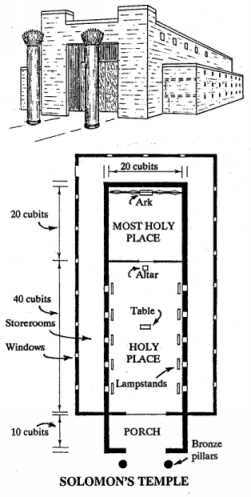
Simply described, the temple built by Solomon was a rectangular stone building with a porch added to the front, and three storeys of storerooms added to the sides and rear (1Ki 6:1-10). Two huge bronze pillars stood in front of the porch. They did not support the roof, but were purely ornamental (1Ki 7:15-22). Entrance from the porch into the temple was through decorated folding doors (1Ki 6:33-35). All stonework inside the building was covered with lavishly carved wood panelling, which in turn was overlaid with beaten gold (1Ki 6:1-10; 1Ki 6:15; 1Ki 6:21-22; 1Ki 6:29).
An internal partition divided the main temple into two rooms. The larger front room was called the nave or Holy Place, the smaller rear room the inner sanctuary or Most Holy Place. The front room had windows, but not the rear room. This rear room contained the gold-covered ark of the covenant (covenant box), which symbolized the presence of God, and two winged creatures of gold (cherubim), which were symbolic guardians of the ark (1Ki 6:31-32; 2Ch 3:14; see ARK; CHERUBIM). The front room contained two pieces of gold-covered furniture, the altar of incense and the table of ‘presence bread’. In addition there were ten golden lampstands, five on each of the two side walls (1Ki 7:48-49; see LAMP).
In the open courtyard outside the building (1Ki 6:36) stood a huge bronze altar of sacrifice (2Ch 4:1). Also in the courtyard was a bronze laver, or tank, which held water for cleansing rites (1Ki 7:23-26). There were also ten mobile lavers, each consisting of a bronze basin set in a trolley, the four sides of which were enclosed with decorative panels (1Ki 7:27-39).
The wealth of the temple’s decorations and furnishings made it a target for enemy plunderers. At times the Judean kings themselves plundered it, usually to obtain funds to pay foreign overlords or invaders (1Ki 14:25-26; 1Ki 15:18; 2Ki 16:8; 2Ki 18:15). Some of Judah’s more ungodly kings brought idols and other articles of foreign religion into the temple, and even introduced heathen practices (2Ki 16:10-18; 2Ki 21:4; 2Ch 25:14).
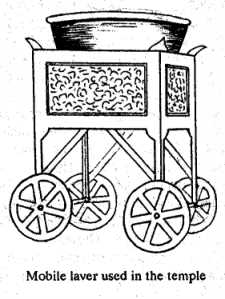
As a result of Judah’s unfaithfulness to God, the temple was frequently damaged or allowed to deteriorate. On a number of occasions godly kings repaired the temple and introduced reforms to restore it to its proper use (2Ki 12:4-16; 2Ch 29:3-11; 2Ch 34:8-13). When the Babylonians destroyed Jerusalem in 587 BC, they stripped everything of value from the temple, then smashed or burnt what remained and took the people into captivity (2Ki 25:8-17; cf. Psa 74:3-7).
Visions of Ezekiel
The captivity in Babylon would last no longer than seventy years, and the prophet Ezekiel wanted to prepare the people to return to their homeland. He therefore presented to them a plan for life in the rebuilt nation.
This plan, based on visions that Ezekiel saw, included a temple where God dwelt among his people in an ideal religious and political order. In this order the temple was not in the city, but in a large portion of land marked out for the priests (Eze 45:1-4). The main building (the Holy Place and the Most Holy Place) was only one part of a huge complex of buildings, courtyards and various facilities for priests and worshippers (Ezekiel 40; Ezekiel 41; Eze 42:1-14; Eze 43:13-17; Eze 46:19-24). Whatever symbolic value Ezekiel’s visions may have had, his ideal temple was never built.
Zerubbabel’s temple
When Persia conquered Babylon in 539 BC, the Persian king gave permission for the captive Jews to return to their land. Under the joint leadership of the governor Zerubbabel and the high priest Joshua, those who returned promptly began to rebuild the temple. They soon set up the altar, and in the second year they laid the foundation of the temple, but when local people opposed the builders, the work stopped (Ezr 3:1-3; Ezr 3:8-10; Ezr 4:1-5; Ezr 4:24). For sixteen years nobody worked on the temple. When the prophets Haggai and Zechariah roused the people to action, work restarted and within four years the temple was finished (Ezr 5:1-2; Ezr 6:15).
Little is known about this temple. It was not as large or as splendid as the former temple (Ezr 6:3-5; Hag 2:3; Zec 4:10), though like the former temple, it had storerooms for the people’s offerings (Neh 13:4-9; Mal 3:10).
The best known events connected with this temple occurred in the second century BC. The leader of the Syrian sector of the former Greek Empire, Antiochus IV Epiphanes, being violently opposed to the Jews, found an excuse to invade and defile the temple. He set up an idolatrous altar, then took animals that the Jews considered unclean and offered them as sacrifices to the Greek gods. This led to a Jewish uprising under the leadership of a group known as the Maccabees. After three years of fighting, the Jews regained religious freedom and rededicated the temple (165 BC).
A century later, when the Romans invaded Palestine, the Jews converted the temple into a fortress that was strong enough to withstand the enemy for three months. Finally, in 63 BC, the Romans destroyed it.
Herod’s temple
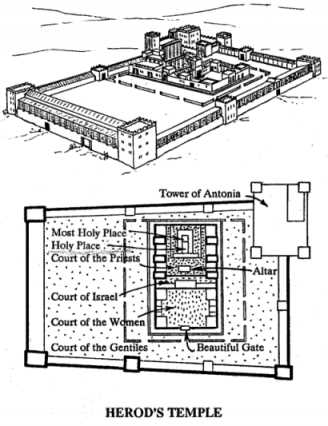
When Herod, who was not a genuine Jew, won Rome’s appointment as ‘king’ of Judea, he tried to win the Jews’ favour by building them a magnificent new temple. The main building took ten years to build and was finished about 9 BC, but builders were still working on the rest of the huge complex during the time of Jesus’ public ministry (Joh 2:20). They finished the project in AD 64.
The main building consisted of two rooms, the Holy Place and the Most Holy Place, divided by a curtain (Mat 27:51). This building and its associated altar of burnt offering were set in a walled courtyard, which normally only the priests could enter (Luk 1:8-10).
Outside the Court of the Priests was another walled courtyard, known as the Court of Israel. Men could enter this courtyard, but not women. Beyond this was yet another walled courtyard, this one known as the Court of the Women, for it marked the limit beyond which women could not go. Entrance to this court was through the Beautiful gate (Act 3:10), and inside the court were collection boxes for the temple offerings (Mar 12:41-44). No Gentiles were allowed into any of these courts, and any who attempted to do so risked death (Act 21:28-31).
This fully enclosed area was set within a large open court called the Court of the Gentiles, for it was the only area open to Gentiles. Around the perimeter of this court was a covered area where the teachers of the law taught (Luk 2:46; Luk 19:47; Joh 10:23-24), where temple merchants carried out their business (Joh 2:14-16) and where the poor and the sick begged for help (Mat 21:14; Act 3:11; Act 5:12; Act 5:16).
In the north-eastern corner of the Court of the Gentiles was the Tower of Antonia. This was probably the praetorium, the palace where the Roman governor stayed when he came to Jerusalem to control the crowds at festival times (Mat 27:27; Mar 15:16; Act 21:30-37). (Normally the governor lived at Caesarea; Act 23:33.) The entire temple complex was surrounded by a wall made of huge stones (Mar 13:1).
The new temple
Jesus, being zealous for the true worship of God, condemned the Jews for their misuse of the temple. As a result the Jews became increasingly hostile towards him (Joh 2:13-22; Mar 11:15-19; cf. Mal 3:1). He condemned their religion as they practised it, and forecast that one of God’s judgments on it would be the destruction of the temple (Mar 13:1-2).
Through Jesus, God was now building a new temple. This was not a building made of stones, but a community of people, the Christian church. This is a living temple, a community where God dwells, where his people worship him and where they maintain true holiness (Joh 4:21-24; 1Co 3:16-17; 2Co 6:16-18; Eph 2:21-22; 1Pe 2:4-5; cf. Rev 21:22; Rev 22:1-4).
It seems that many of the early Christians did not immediately understand that with the death and resurrection of Jesus, the temple had no further use in God’s purposes for his people. They continued to go to the temple daily, worshipping, praying and witnessing to the resurrection life of Jesus (Luk 24:52-53; Act 2:46-47; Act 3:1; Act 5:12; Act 5:42).
Stephen, however, pointed out that if people thought Christianity was still part of the old temple-based religion, they were mistaken. The temple was in fact a hindrance to a proper understanding of Christianity (Act 6:13; Act 7:44-50). The Jews reacted violently to Stephen’s preaching and killed him; but at least there was now a clear distinction between the old temple-based religion and Christianity. The Christians’ association with the temple was gone for ever (Act 7:54-60; Act 8:1-3).
Within forty years the Jews also had lost their association with the temple; for in AD 70 the armies of Rome destroyed it (Mar 13:2; Luk 19:41-44). Since then, the Jews have had no temple.
The permanent building in
Jerusalem that replaced the portable
Holy Tent that was used by the Israelites
from the time of their wandering in the
desert to the reign of king Solomon,
when the first Temple was built. Like the
Holy Tent, the Temple was the center of
Israelite worship, although provision was
made for it to be “a house of prayer for
all nations” (Isa. 56:7).