
“There are two animals,” says Bruce, “named frequently in Scripture, without naturalists being agreed what they are. The one is the behemoth, the other the reem; both mentioned as types of strength, courage, and independence on man; and, as such, exempted from the ordinary lot of beasts, to be subdued by him, or reduced under his dominion. The behemoth, then, I take to be the elephant; his history is well known, and my only business is with the reem, which I suppose to be the rhinoceros. The derivation of this word, both in the Hebrew and Ethiopic, seems to be from erectness, or standing straight. This is certainly no particular quality in the animal itself, which is not more, nor even so much erect as many other quadrupeds, for its knees are rather crooked; but it is from the circumstance and manner in which his horn is placed. The horns of all other animals are inclined to some degree of parallelism with the nose, or os frontis, [front bone.] The horn of the rhinoceros alone is erect and perpendicular to this bone, on which it stands at right angles; thereby possessing a greater purchase of power, as a lever, than any horn could possibly have in any other position. This situation of the horn is very happily alluded to in the sacred writings: ‘My horn shalt thou exalt like the horn of a reem,’ Psa 92:10. And the horn here alluded to is not wholly figurative, but was really an ornament worn by great men in the days of victory, preferment, or rejoicing, when they were anointed with new, sweet, or fresh oil; a circumstance which David joins with that of erecting the horn. Balaam, a priest of Midian, and so in the neighbourhood of the haunts of the rhinoceros, and intimately connected with Ethiopia, for they themselves were shepherds of that country, in a transport, from contemplating the strength of Israel, whom he was brought to curse, says, that they had as it were the strength of the reem, Num 23:22.
Job 39:9-10, makes frequent allusion to his great strength, ferocity, and indocility. Isa 34:7, who of all the prophets seems to have known Egypt and Ethiopia the best, when prophesying about the destruction of Idumea, says, that the reem shall come down with the fat cattle: a proof that he knew his habitation was in the neighbourhood. In the same manner as when foretelling the desolation of Egypt, he mentions, as one manner of effecting it, the bringing down the fly from Ethiopia, Isa 7:18-19, to meet the cattle in the desert and among the bushes, and destroy them there, where that insect did not ordinarily come but on command, Exo 8:22, and where the cattle fled every year, to save themselves from that insect.
“The rhinoceros in Geez is called arwe harish, and in the Amharic auraris, both which names signify the large wild beast with the horn. This would seem as if applied to the species that had but one horn. The Ethiopic text renders the word reem, arwe harish, and this the Septuagint translates
as they must have seen an animal of this kind exposed at Alexandria
an animal, which never has appeared after the search of so many ages. Scripture speaks of the horns of the unicorn,
In the book of Job 39:9-10, the reem is represented as an unmanageable animal, which, although possessed of sufficient strength to labour, sternly and pertinaciously refused to bend his neck to the yoke.
Will the reem submit to serve thee? Will he, indeed, abide at thy crib?
Canst thou make his harness bind the reem to the furrow?
Will he, forsooth, plough up the valleys for thee?
Wilt thou rely on him for his great strength, And commit thy labour unto him?
Wilt thou trust him that he may bring home thy grain, And gather in thy harvest?
The rhinoceros, in size, is only exceeded by the elephant; and in strength and power is inferior to no other creature. He is at least twelve feet in length, from the extremity of the snout to the insertion of the tail; six or seven feet in height, and the circumference of the body is nearly equal to its length. He is particularly distinguished from the elephant and all other animals by the remarkable and offensive weapon he carries upon his nose. This is a very hard horn, solid throughout, directed forward, and has been seen four feet in length. Mr, Browne, in his Travels, says, that the Arabians call the rhinoceros abukurn, “father of the one horn.” The rhinoceros is very hurtful, by the prodigious devastation which he makes in the fields. This circumstance peculiarly illustrates the passage from Job. Instead of trusting him to bring home the grain, the husbandman will endeavour to prevent his entry into the fields, and hinder his destructive ravages. In a note upon this passage, Mr. Good says, “the original reem, by all the older translators rendered rhinoceros, or unicorn, is by some modern writers supposed to be the bubalus, bison, or wild ox. There can be no doubt that rhinoceros is the proper term; for this animal is universally known in Arabia, by the name of reem, to the present day.” The rhinoceros, though next in size, yet in docility and ingenuity greatly inferior, to the elephant, has never yet been tamed, so as to assist the labours of mankind, or to appear in the ranks of war. The rhinoceros is perfectly indocile and untractable, though neither ferocious nor carnivorous. He is among large animals what the hog is among smaller ones, brutal and insensible; fond of wallowing in the mire, and delighting in moist and marshy situations near the banks of rivers. He is, however, of a pacific disposition; and, as he feeds on vegetables, has few occasions for conflict. He neither disturbs the less, nor fears the greater, beasts of the forest, but lives amicably with all. He subsists principally on large succulent plants, prickly shrubs, and the branches of trees; and lives to the age of seventy or eighty years.
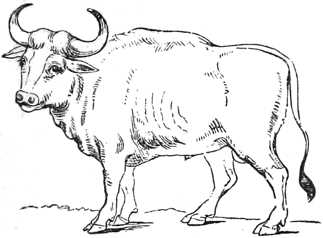
Fig. 334—Unicorn: Bibos cavifrons
The radical meaning of the Hebrew word (reem) thus rendered furnishes no evidence that an animal such as is now understood by ’unicorn’ was known to exist, or that a rhinoceros is thereby absolutely indicated; and here is no authority whatever for the inference that either was at anytime resident in Western Asia.
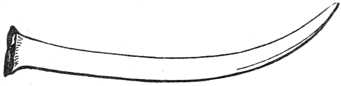
Fig. 335—Horn of the unknown species of Rhinoceros
The Indian rhinocerotes are essentially tropical animals, and there is no indication extant that in a wild state they ever extended to the west of the Indus. Early colonies and caravans from the East most probably brought rumors of the power and obstinacy of these animals to Western Asia, and it might have been remarked that under excitement the rhinoceros raises its head and horn on high, as it were in exultation, though it is most likely because the sense of smelling is more potent in it than that of sight, which is only lateral, and confined by the thickness of the folds of skin projecting beyond the eye-balls. The rhinoceros is not absolutely untamable—a fact implied even in Job. Thus we take this species as the original type of the unicorn; but the active invention of Arabic minds, accidentally, perhaps, in the first instance, discovered a species of Oryx (generically bold and pugnacious ruminants), with the loss of one of its long, slender, and destructive horns. In this animal the reem of the Hebrews and the far East became personified, being most probably an Oryx Leucoryx, since individuals of that species have been repeatedly exhibited in subsequent ages as unicorns, when accident or artifice had deprived them of one of their frontal weapons. In Africa, however, among three or four known species of rhinoceros, and vague rumors of a Bisulcate species of unicorn, probably only the repetition of Arabian reports, there appears to exist between Congo, Abyssinia, and the Cape, precisely the terra incognita of Africa, a real pachydermous animal; which seems to possess the characteristics of the poetical unicorn. In the narratives of the natives of the different regions in question there is certainly both exaggeration and error; but they all incline to a description which would make the animal indicated a pachyderm of the rhinoceros group, with a long and slender horn proceeding from the forehead, perhaps with another incipient behind it, and in general structure much lighter than other rhinocerotes.
One-horned, corresponding to the word Monoceros, by which the original Hebrew REEM is translated by the Seventy. The Hebrew word means erect, and has no reference to the number of horns. Most interpreters now understand it of the wild buffalo of the Eastern continents, the Bos Bubalus of Linaeus, resembling the American buffalo, but having larger horns and no dewlap. This animal has the appearance of uncommon strength. The bulk of his body, and his prodigious muscular limbs, denote his force at the first view, Num 23:22 . His aspect is ferocious and malignant, and at the same time stupid. His head is of ponderous size; his eyes diminutive; and what serves to render his visage still more savage, are the tufts of frizzled hair which hang down from his cheeks and the lower part of his mouth, Job 39:9-12 Psa 22:21 .\par Wild buffalo occur in many parts of Africa and India, where they live in great troops in the forests, and are regarded as excessively fierce and dangerous animals. The hunters never venture in any numbers to oppose these ferocious animals face to face; but conceal themselves in the thickets or in the branches of the trees, whence they attack the buffaloes as they pass along.\par In Egypt, as also in Southern Europe, the buffalo has been partially domesticated in comparatively modern times. Travelers also find it in parts of Syria, Persia, and India. It is less docile than the ox, retaining a remnant of ferocity and intractability, together with a wild and lowering aspect. It is commonly driven and guided by means of a ring in the nose. To the ancient Hebrews, however, it seems to have been known only in its wild state, savage, ferocious, and often immensely large.\par
Unicorn. The rendering of the Authorized Version of the Hebrew reem, a word which occurs seven times in the Old Testament as the name of some large wild animal. The reem of the Hebrew Bible, however, has nothing at all to do with the one-horned animal of the Greek and Roman writers, as is evident from Deu 33:17 where, in the blessing of Joseph, it is said; "his glory is like the firstling of his bullock, and his horns are like the horns of a unicorn;" not, as the text of the Authorized Version renders it, "the horns of unicorns."
The two horns of the ram are "the ten thousands of Ephraim and the thousands of Manasseh." This text puts a one-horned animal entirely out of the question. Considering that the reem is spoken of as a two-horned animal of great strength and ferocity, that it was evidently well known and often seen by the Jews, that it is mentioned as an animal fit for sacrificial purposes, and that it is frequently associated with bulls and oxen, we think there can be no doubt that, some species of wild ox is intended.
The allusion in Psa 92:10, "But thou shalt lift up, as a reeym, my horn," seems to point to the mode in which the Bovidae use their horns, lowering the head and then tossing it up. But it is impossible to determine what particular species of wild ox is signified probably some gigantic urus is intended.
(It is probable that it was the gigantic Bos primigeniua, or aurochs, now extinct, but of which Caesar says, "These uri are scarcely less than elephants in size, but in their nature, color and form are bulls. Great is their strength and great their speed; they spare neither man nor beast when once; they have caught sight of them" -- Bell. Gall. Vi. 20. -- Editor).
(1) great strength, Num 23:22; Job 39:11;
(2) two horns, Deu 33:17;
(3) fierceness, Psa 22:21;
(4) untameableness, Job 39:9-11, where the unicorn, probably the wild bison, buffalo, ox, or urus (now only found in Lithuania, but then spread over northern temperate climes, Bashan, etc., and in the Hercynian forest, described by Caesar as almost the size of an elephant, fierce, sparing neither man nor beast) stands in contrast to the tame ox used in plowing, Job 39:11-12;
(5) playfulness of its young, Psa 29:6;
(6) association with "bullocks and bulls" for sacrifice, Isa 34:6-7;
(7) lifting up the horn, Psa 92:10, as bovine animals lower the head and toss up the horn.
Unicorn, reêm, or high. Num 23:22, A. V., but R. V. reads "wild ox." The word occurs seven times in the Old Testament. That fabulous creature the unicorn certainly is not meant by the Hebrew reêm. Critics are agreed that the passages mentioning it, correctly understood, require an animal with two horns. This animal was distinguished for his ferocity, Isa 34:7, strength, Num 23:22; Num 24:8, agility, Psa 29:6, wildness, Job 39:9, as well as for being horned, and destroying with his horns. Deu 33:17; Psa 22:21. For various reasons this animal could not have been the rhinoceros. Probably it was the now extinct aurochs (Bos primigenius), a long-horned and powerful ox, which existed in the forests of Europe nearly, or quite, until the Middle Ages. An allied species of great size and strength is known to have existed in Palestine, as the bison (Bison bonasus), and some or these, now called aurochs, are still found in the forests of Lithuania.
The Hebrew word is reem, translated in the LXX by
By: Emil G. Hirsch, I. M. Casanowicz
Rendering in the Authorized Version of the Hebrew  or
or  , following the Septuagint and the Vulgate. Aquila and Saadia, on Job xxxix. 9, read "rhinoceros"; Bochart ("Hierozoicon") and others, "oryx," or "white antelope"; Revised Version, "wild ox" (margin, "ox-antelope"). The allusions to the "re'em" as a wild, untamable animal of great strength and agility, with mighty horns (Job xxxix. 9-12; Ps. xxii. 21, xxix. 6; Num. xxiii. 22, xxiv. 8; Deut. xxxiii. 17; comp. Ps. xcii. 11), best fit the aurochs (Bos primigenius). This view is supported by the Assyrian "rimu," which is often used as a metaphor of strength, and is depicted as a powerful, fierce, wild, or mountain bull with large horns. The term evidently denotes from its connection some animal of the bovine or antelope class, perhaps the oryx (so LXX.). The oryx, as well as the wild bull and ox, is common in Palestine and Syria; and aurochs' teeth were found by Tristram on the flooring of an ancient cave in the Lebanon.
The Talmud has for "re'em"  or
or  , which etymologically recalls the Arabic "ghazal" (= "gazel"), but is said to be the name of an animal of such size that it could not enter the ark of Noah, but had to be fastened thereto by its horn (Zeb. 113b; comp. B. B. 74b; Shab. 107b; Yalḳuṭ Shim'oni, ii. 97d, where it is said that the re'em touches the clouds). If the Talmud intended the urzila for the unicorn, it can not be identical with the one-horned ox which Adam is said to have offered as sacrifice (Ḥul. 60a and parallels), because the urzila is classed among the animals of the field that may not be offered for that purpose. The Tosefta on the passage in Zebaḥim explains the urzila as the buffalo.
Again, in Ḥul. 59b is mentioned an animal called  (perhaps shortened from "monoceros" or "rhinoceros"), which, "though it has only one horn, is allowed as food," and is then explained as the "hart of the forest 'Ilai" (
 ; comp. B. B. 16b). The Talmud apparently thinks here of the antelope oryx, the mode of depicting which on Persian monuments gave rise to the belief by the ancients (comp. Pliny, "Historia Naturalis," viii. 21, 30) in the existence of the unicorn (comp. "S. B. O. T.," Psalms [Eng. transl.], p. 173). In Arabic likewise "re'em" is applied to the leucoryx. The aurochs is mentioned in the Talmud under the name
  (= "ox of the plain"), in explanation of
  , the rendering of
  (Deut. xiv. 5) by the Targum, which Rashi (Ḥul. 80a) explains as the "ox of the Lebanon." It is classed among cattle (Kil. viii. 6), and is caught with slings (B. Ḳ. 117a; comp. Isa. li. 20).
Bibliography:
Tristram, Nat. Hist. p. 146;
Lewysohn, Z. T. pp. 114, 126, 149;
C. Cohen, Gesch. des Einhorns, Berlin, 1896.
UNICORN (re’çm, Num 23:22 etc.; rçm, Job 39:9; RV
E. W. G. Masterman.
Num 24:8 (a) The power and strength of Israel in her prosperity is represented by this animal. We do not know just what animal it was, but from the description it must have been same prehistoric monster built like the rhinoceros. From the fact that it had just one horn, we may understand that this represents just the one Person who could strengthen and use Israel, and that one was their GOD.
Deu 33:17 (a) This figure represents one who has unusual strength and power. It probably represents Joseph, with his great influence for the benefit of his children.
Psa 22:21 (b) Here we see the figure which is used by our Lord to represent the terrible power of His enemies, who had Him under their control and were putting Him to death at Calvary.
Psa 92:10 (b) This describes the great power and invincible might which the Psalmist knew would be his because he believed GOD, and walked with Him.
Unicorn. A unicorn is a mythical creature, similar to a horse, with a single spiral horn growing out of its forehead. In the Middle Ages, the unicorn appeared in paintings as a symbol of purity. Many people believed an animal like this really lived. In the Bible, most verses that refer to the unicorn emphasize its great strength (Num 23:22; Num 24:8; Deu 33:17). The biblical writer may have had the aurochs in mind. This horned wild ox was so large and powerful that no one could control or tame it (Job 39:9-10; Psa 22:21; Psa 92:10; Isa 34:7).