
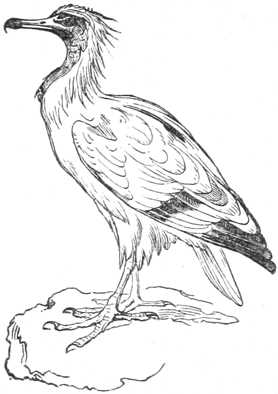
Fig. 339—Vultur percnopterus
An unclean bird (Lev 11:14). The species of vulture, properly so called, have the head naked or downy, the crop external, and very long wings; they have all an offensive smell, and we know of none that even the scavenger-ants will eat. When dead they lie on the ground untouched till the sun has dried them into mummies. Those found in and about the Egyptian territory are Vultur fulvus, V. gyps (Savigny), V. Ægyptius (Savigny), V. monachus (Arabian vulture), V. cinereus, V. Nubicus, and a black species, which is often figured on Egyptian monuments as the bird of victory, hovering over the head of a national hero in battle, and sometimes with a banner in each talon. It is perhaps the gypaetus barbatus (peres), or lammer geyer; for though neither a vulture nor an eagle, it is the largest bird of prey of the old continent, and is armed like the eagle with formidable claws. The head is wholly feathered; its courage is equal to its powers, and it has a strength of wing probably superior to all raptorians, excepting the condor. It is found with little or no difference from Norway to the Cape of Good Hope, and from the Pyrenees to Japan. Most of the above-named species are occasionally seen in the north of Europe. The voice varies in different species, but those of Egypt, frequenting the Pyramids, are known to bark in the night like dogs. Excepting the carrion vultures, all the other species are of large size; some superior in bulk to the swan, and others a little less.
There can be no doubt that the White Carrion Vulture (Vultur percnopterus) is the bird called in Hebrew (as it still is in Arabic) Racham, rendered Gier-eagle in Lev 11:18; Deu 14:17. It forms a small group of Vulturidae, subgenerically distinguished by the name of Percnopterus and Neophron, differing from the other vultures in the bill being longer, straight, more attenuated, and then uncinated, and in the back of the head and neck being furnished with longish, narrow, suberectile feathers. In size the species is little bulkier than a raven, but it stands high on the legs. Always soiled with blood and garbage, offensive to the eye and nose, it yet is protected in Egypt both by law and public opinion for the services it renders in clearing the soil of dead carcasses putrefying in the sun, and the cultivated fields of innumerable rats, mice, and other vermin. It extends to Palestine in the summer season, but becomes scarce towards the north, where it is not specially protected; and it accompanies caravans, feasting on their leavings and on dead camels, etc.
A large bird of prey, belonging to the genus hawks, and including a great many species. It is pronounced unclean by Moses, Lev 11:14 Deu 14:13 . See BIRDS. The vulture has a naked or downy head, a bare neck and long wings, and is disgusting to every sense, especially to the smell. It is a carrion bird, though not exclusively, and has extraordinary powers of vision. Scarcely can an exhausted camel fall on it route and die, before numbers of these filthy scavengers show themselves in the distance, hastening to the spot, Job 28:7 .\par
Vulture. The rendering in the Authorized Version of the Hebrew, daah, dayyah, and also in Job 28:7 of ayyah. There seems no doubt that the Authorized Versions translation is incorrect, and that the original words refer to some of the smaller species of raptorial birds, as kites or buzzards. See Kite. But the Hebrew word, nesher, invariably rendered "eagle" in the Authorized Version, is probably the vulture. See Eagle.
The griffon of the Vulturidae is noted for seeing its prey from the greatest height. Though previously scarcely known in the Crimea, during the Anglo-Russian war they remained near the camp throughout the campaign; "wheresoever the carcass is, there will the eagles be gathered together" (Mat 24:28; Job 39:30). Besides the griffon, the lammergever and the Egyptian vulture, "Pharaoh’s hens," are found in Palestine.
Vulture. In Lev 11:14, Deu 14:18, Isa 34:15, in place of this word, we should probably read "black kite," Milvus migrans. This is a bird which, except in the winter months, collects in Palestine in great numbers and is very sociable in its habits, according to the reference in Isaiah. Another Hebrew word rendered "vulture," R. V. "falcon," in Job 28:7, is elsewhere correctly rendered kite. It is a striking instance of the accuracy of the Scripture writers that, while the peculiar faculty for discovering their food which carrion-devourers possess is popularly attributed to the sense of smell, the Bible rightly attributes it to sight. In the book of Job the characteristic of the eagle is that "her eyes behold afar off." Job 28:7 refers to the same peculiarity, "There is a path which the vulture’s eye hath not seen," implying that its vision is most acute and penetrating. It is well proved that birds of prey discern their booty at vast distances, that the eager flight of one is observed and followed by another, and so on, till many are gathered together wheresoever the carcase is.
There are three words so translated.
1. ayyah, a bird of keen sight. Job 28:7. It is supposed to be a species of KITE, as the Hebrew is translated in Lev 11:14; Deu 14:13.
2. dayyah, a bird inhabiting ruins: supposed to be another species of KITE. Deu 14:13; Isa 34:15.
3. daah, a bird of rapid flight, Lev 11:14; supposed to be the FALCON; the word occurs here only. These are all classed among the unclean birds. For the true vulture see EAGLE.
By: Emil G. Hirsch, I. M. Casanowicz
The Hebrew terms rendered in one or the other of the English versions by "vulture" are: "da'ah" (Lev. xi. 14) and its variant "dayyah" (Deut. xiv. 13 and Isa. xxxiv. 15 [R. V. "kite"]), "ayyah" (Lev. xi. 14; Deut. xiv. 13; Job xxviii. 7 [R. V. "kite" and "falcon"]), and "raḥam," "raḥamah" (Lev. xi. 18; Deut. xiv. 17 [A. V. "giereagle"]); all refer to unclean birds. The raḥam is identified with the Egyptian or Pharaoh's vulture (Neophron percnopterus), called also by the Arabs "raḥam"; it is a migratory bird, known in Palestine and Arabia, returning from the south in the spring. The Hebrew "nesher" (always rendered by "eagle" in the A. and R. V.) also denotes large birds of prey in general, and in some passages refers particularly to the vulture, or griffin-vulture, which belongs to the Vulturidæ family. So in Jer. xlix. 16 and Job xxxix. 27-30, where the nesher is described as making its nest in the highest cliffs, which is characteristic of the vulture; or in Micah i. 16, where the bald-headedness of the nesher is alluded to (this can only refer to the vulture, which is devoid of true feathers on the head and neck); or when it is used as an image of an invading army (comp. Deut. xxviii. 49; Jer. xlviii. 40; Hos. viii. 1; Hab. i. 8). The Romans also did not distinguish sharply between the eagle and the vulture (Pliny, "Nat. Hist." x. 3, xiii. 26). The griffin-vulture is most abundant in Palestine, where it breeds in colonies, while the kite is represented by four species.
Besides all the Biblical terms for the vulture, the Talmud uses the name "ra'ah" on account of the keenness of the vulture's sight, "for it can, while in Babylon, sight carrion in Palestine" (Ḥul. 63b; B. M. 24b [Rashi]). In the passage of Ḥullin it is said that there are a hundred kinds of unclean birds in the Orient, all belonging to the vulture tribe ("min ayyah"). The proper name of the raḥam is  ; it is called raḥam because with its appearance mercy, that is, rain, is bestowed on the world, while the name
  is due to its cry "shirḳreḳ" (Ḥul. 63a). In Ḥul. 25b is mentioned a bird of whose claws vessels were made, and which Rashi explains to be a griffin-vulture.
Bibliography:
Tristram, Nat. Hist. p. 172;
Lewysohn, Z. T. p. 167.
VULTURE.—1. dâ’âh, Lev 11:14, dayyâh or dayyôth, Deu 14:13 AV
E. W. G. Masterman.
Isa 34:15 (b) This bird is a type of the voracious, hungry nations who are to come down on Idumea, and devour her assets.
Vulture. Vultures are large, loathsome members of the hawk family. The largest species have a wingspread of about 32 meters (9 to 10 feet). Most vultures have bare heads and necks. However, the lammergeier (bearded vulture) has dirty-white neck feathers and a tassel of dark feathers hanging from its beak. The Egyptian vulture likewise has neck feathers. A griffon’s long neck is covered with fine white down.
The lammergeier is also called the ossifrage (see (Lev 11:13; Deu 14:12) or the gier eagle (Lev 11:18; Deu 14:17).
Vultures feed on dead bodies. For this reason they were considered UNCLEAN animals by the Jewish people (Lev 11:13; Deu 14:12-13). Other versions of the Bible translate the word as buzzard, falcon, and bustard.
Or “eagle,” a bird of prey that eats
dead animals.