
Yoke
A symbol of subjection and servitude, 1Ki 12:4 ; an iron yoke, of severe oppression, Deu 28:48 . The ceremonial law was a yoke, a burden-some restriction, Mal 15:10 Gal 5:1 . The withdrawing or breaking of a yoke denoted a temporary or an unlimited emancipation form bondage, Isa 58:6 Jer 2:20, and sometimes the disowning of rightful authority, Jer 5:5 . The iron yoke imposed by our sins, none but God can remove, Lam 1:14 ; but the yoke of Christ’s service is easy and light, Mat 11:29,30 .\par
Yoke.
1. A well-known implement of husbandry, frequently used metaphorically for subjection, for example, 1Ki 12:4; 1Ki 12:9-11; Isa 9:4; Jer 5:5, hence, an "iron yoke" represents an unusually galling bondage. Deu 28:48; Jer 28:13.
2. A pair of oxen, so termed as being yoked together. 1Sa 11:7; 1Ki 19:19; 1Ki 19:21. The Hebrew term is also applied to asses, Jdg 19:10, and mules, 2Ki 5:17, and even to a couple of riders. Isa 21:7.
3. The term is also applied to a certain amount of land, 1Sa 14:14, equivalent to that which a couple of oxen could plough in a day, Isa 5:10, (Authorized Version, "acre"), corresponding to the Latin jugum.
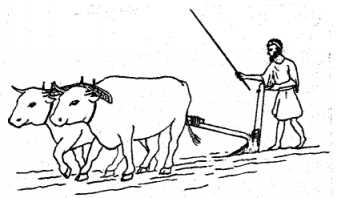
Yoke. It was much lighter and larger than ours, so that the cattle stood farther apart. It was simply a stick laid upon the necks of the cattle, to which it was held by thongs instead of wooden bows, and in a similar manner it was attached to the plough-beam. In modern Syria wooden pins are sometimes used instead of thongs, the lower ends of which are held by a parallel stick under the necks of the oxen. The yoke was an appropriate emblem of subjection and of slavery, while the removal of it indicated deliverance. Gen 27:40; Jer 2:20; Mat 11:29-30. Breaking the yoke also represents the rejection of authority. Nan. 1:13.
The harness that secures an animal to a cart or plough; and the beam to which two animals are fastened for any purpose of labour; it is also used to denote the number two, as ’a yoke of oxen.’ 1Sa 11:7. It is employed as a symbol of servitude and slavery. Jer 28:2-14; 1Ti 6:1. Also of the grievous bondage of being under the law. Act 15:10; Gal 5:1. The Lord Jesus invites the believer to take His yoke upon him, and to learn of Him; that is, giving up self-will, to be in submission to the will of God, content to be in the lowest place; and such will find rest to their souls. His yoke is easy, and His burden is light. Mat 11:29-30.
Not Being Entangled With The Yoke Of Bondage
Act_15:10; Gal_5:1.
The LORD Breaking Yokes
Lev_26:11-13; Eze_34:27-29.
The Yoke Of Jesus Christ
Mat_11:25-30.
Who Not To Be Equally Yoked With
2Co_6:14-18
YOKE.—The yoke (
When Jesus turned His gaze from the fields of industrial life, and from the book of remembrance of the past to the book of the life of His own generation, He discovered a nation under the yoke, a race under the harrow. He hit the mark when He spoke of yokes. His audience was made up of those who were wearing yokes of all sorts and sizes, but no man with his own yoke harnessed on exactly as his neighbour’s. On the other hand, that audience was suffering under an intolerable strain. Three yokes were galling and killing them—(1) the yoke of the Law, (2) of Rome, (3) of sin. Their leaders (Mat 23:4) bound grievous burdens on the people’s shoulders; nor would they remove them. Of some it was the constant temptation to throw off the yoke of the foreigner. The Zealots (Luk 6:15) were most restive under Rome. They were the political Nationalists of the day. Again, who of them all was not ‘sold under sin’ (Rom 7:14)? These were the yokes of the people. The yoke of Jesus was the will of the Father. He wore it always, never worked without it; never against it, always with it (Joh 8:29). Once He asked thrice if He might take it off (Mat 26:39 ff.) for the road was steep. The yoke of Jesus was the welfare of man. He came to serve (Mar 10:45). To be Saviour was at once the lowliest, loftiest, and loneliest way of working out the welfare of man. And this yoke was tied on with cords of love (Joh 13:1) unto the end. The humanity of Jesus was His yoke. He was, not the angel (Heb 2:9; Heb 2:16), but the man Christ Jesus (1Ti 2:5); and He did the perfect will of the Father under this yoke, frail but firm—the body of His humiliation.
Literature.—Bishop Thorold’s The Yoke of Christ; Expositor, i. vi. [1877] 142, vii. [1878] 348, xi. [1880] 101; Exp. Times, iii. [1892] 512, vi. [1895] 176; Henry Drummond, Pax Vobiscum, 41; W. A. Butler, Sermons, ii. 320; G. A. Chadwick, Pilate’s Gift, 62; G. Macdonald, Hope of the Gospel, 152.
John R. Legge.
See AGRICULTURE.
YOKE.—See Agriculture, 1; Weights and Measures, 1.
(1) The usual word is
What is meant by “the yoke on their jaws” in Hos 11:4 is quite obscure. Possibly a horse’s bit is meant; possibly the phrase is a condensed form for “the yoke that prevents their feeding”; possibly the text is corrupt. See JAW.
The figurative use of “yoke” in the sense of “servitude” is intensely obvious (compare especially Jer 27, 28). Attention needs to be called only to Lam 3:27, where “disciplining sorrow” is meant, and to Jer 5:5, where the phrase is a figure for “the law of God.” This last use became popular with the Jews at a later period and it is found, e.g. in Apocrypha Baruch 41:3; Psalter of Solomon 7:9; 17:32; Ab. iii. 7,. and in this sense the phrase is employed. by Christ in Mat 11:29 f. “My yoke” here means “the service of God as I teach it” (the common interpretation, “the sorrows that I bear,” is utterly irrelevant) and the emphasis is on “my.” The contrast is not between “yoke” and “no yoke,” but between “my teaching” (light yoke) and “the current scribal teaching’; (heavy yoke).
(2) “Yoke” in the sense of “a pair of oxen” is
See also UNEQUAL; YOKE-FELLOW.
Gen 27:40 (b) This type is used to indicate the oppression and repression placed upon one person by another person, or upon one nation by another nation.
Mat 11:29 (b) This term is used to indicate the blessed union for service which the Lord desires on the part of His people. The Christian, walking with the Lord and serving Him, finds the work to be easy, and the load is light.
2Co 6:14 (b) In this case the yoke represents an unhappy union of those who are saved with those who are unsaved in any service or work. The Lord commands His people to be linked up only with Christians, and not with those who belong to Satan’s family. This refers to marriage, to business, and to every other form of union. This situation is complicated frequently by those who are saved, born again, after the union is made. GOD made provision for this situation in various parts of His Word.
A yoke was a piece of curved wood placed over the neck of an animal to enable it to pull a plough or a cart (Num 19:2). According to a commonly used metaphor, the yoke was a symbol of hardship and bondage (Gen 27:40; 1Ki 12:4; Isa 9:4; Jer 27:8; Jer 28:1-16; 1Ti 6:1). In this sense Jewish law-keeping was a harsh yoke. It was a burden that the Jewish religious leaders forced upon the people (Act 15:10; Gal 5:1; cf. Mat 23:4).
When people submit to Jesus Christ as their master, they take upon themselves his yoke. Christ’s yoke, however, is not harsh or heavy, but easy and light. Obedience to him does not create weariness, but brings refreshment, joy and meaning to life (Mat 11:28-30; 1Jn 5:3).
Farmers sometimes yoked animals together to form a pair or a team (1Ki 19:19; Luk 14:19; Php 4:3); but Israelite law did not allow them to yoke together two animals of a different kind, such as an ox and an ass (Deu 22:10). Paul used this to illustrate that a Christian should not enter into a binding relationship (such as marriage) with a non-Christian (2Co 6:14).
A pole that was put across the
shoulders of men, usually slaves, or
animals and used in pulling or carrying
heavy loads.