Menu

Total Depravity & Entire Sanctification

S
sermonindex

Here are some visual charts I made regarding total depravity, entire sanctification, conversion, regeneration, etc:

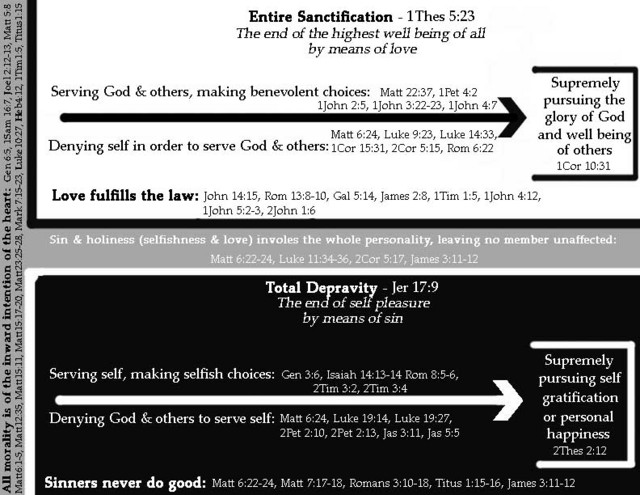
[b]ENTIRE SANCTIFICATION & TOTAL DEPRAVITY[/b]

http://openairoutreach.com/albums/adobe/SanctificationDepravity3.sized.jpg


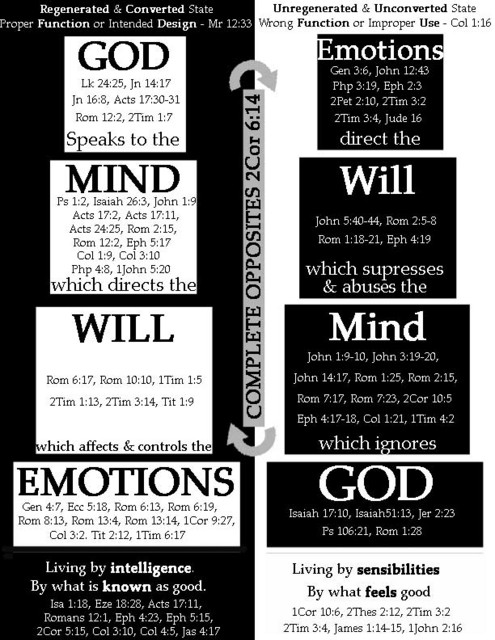
[b]THE SANCTIFIED & THE DEPRAVED PERSONALITY:[/b]

http://openairoutreach.com/albums/adobe/Personality2.sized.jpg


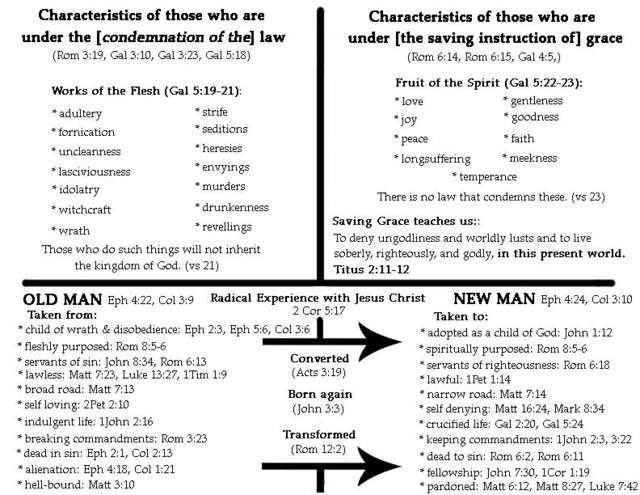
[b]MARKS OF CONVERSION & DEPRAVITY:[/b]

http://openairoutreach.com/albums/adobe/ConversionCharacteristics3.sized.jpg

[b]
HINDERANCES TO GRACE:[/b]

http://openairoutreach.com/albums/adobe/Grace_Repentance.sized.jpg

R
rookie

Just a thought...

Your graphs seem to point to one moment of experience in the life of a believer as the conversion which enables that person to know the things of the Spirit. There seems to be something missing in your pictorial.

Scripture points to an ongoing work of multiple experiences thoughtout ones life that changes the substance for what one hope for. We all come to Christ having been corrupted by the spirit of Satan and therefore dead sons of disobedience. All of our desires are founded on the fallen principles of this world. Thoughtout Scripture whether in the OT or the NT, the mind and heart (inward desire) are transformed in a way that points to one growing in wisdom and understanding of the ways of God. Paul is always praying for the brethren...

Eph. 1:17 that the God of our Lord Jesus Christ, the Father of glory, may give to you the spirit of wisdom and revelation in the knowledge of Him, 18 the eyes of your understanding being enlightened; that you may know what is the hope of His calling, what are the riches of the glory of His inheritance in the saints,

Col. 2:1 For I want you to know what a great conflict I have for you and those in Laodicea, and for as many as have not seen my face in the flesh, 2 that their hearts may be encouraged, being knit together in love, and attaining to all riches of the full assurance of understanding, to the knowledge of the mystery of God, both of the Father and of Christ, 3 in whom are hidden all the treasures of wisdom and knowledge.

Jer. 9:23 Thus says the LORD:
\t“Let not the wise man glory in his wisdom,
\tLet not the mighty man glory in his might,
\tNor let the rich man glory in his riches;
24 \tBut let him who glories glory in this,
\tThat he understands and knows Me,
\tThat I am the LORD, exercising lovingkindness, judgment, and righteousness in the earth.
\tFor in these I delight,” says the LORD.


Psalm 119 teaches us the many ways God reveals Himself to those who live by faith. In this Psalm we are given an example of a man who is taught by Him about His precepts, statutes, ordinances, judgements, commands, and discipline. All of these experiences are available to us as we feed on His word.


Col. 3:16 Let the word of Christ dwell in you richly in all wisdom, teaching and admonishing one another in psalms and hymns and spiritual songs, singing with grace in your hearts to the Lord.


How would you graph the parable of the sower and the seed?

God Bless
Jeff

S
sermonindex

Rookie,

You are right. There is not only crisis experiences, but also daily choices. Holiness for example, is not merely a crisis decision, but a daily or momentary decision. It starts with the crisis decision, but then is continued by habitual decisions.


Here is another chart I made regarding the relation of knowledge, obligation, and blameworthiness:

Knowledge/Obligation/Blameworthiness:

http://www.openairoutreach.com/gallery/adobe/Knowledge_Guilt9?full=1


R
RobertW

Hi Jesse,

I am wondering from the charts where you stand in contrast to Finney on the subject of regeneration? Where I have seen much good in his teachings on certain subjects I have two fundamental differences; one is that he never really believed in original sin and the other is on the subject of a believers security. Finney uses many terms that are his own or have no correlation to the scriptures so he is hard to follow. I think he needed to stick with the scriptures more. Just wondering since we have not talked in a while.

Robert

S
sermonindex

I am wondering from the charts where you stand in contrast to Finney on the subject of regeneration?

[b]Regarding Regeneration:[/b]

My understanding of Finneys view of regeneration is that it was identical with conversion. But the word regeneration emphasis the work of the Spirit while conversion emphasis the work of the individual, but that the two must work together while it is the Spirit that originates the process by enlightening or convicting the mind.

Finney did not believe that regeneration was the reception of any new faculty like a free-will. He disagreed with the Calvinists notion that a sinner doesn't have the ability to obey God, that a sinner doesn't have a free-will. So they teach that regeneration, the reception of free-will, must proceed conversion, and that only God is active in regeration while man is passive, while in conversion God is passive while man is active.

But Finney believed all men already had free-will, and that regeneration/conversion has both God and man active at the same time. God teaches, man obeys. I agree with this. Regeneration is the enlightening of the mind by the Spirit while conversion is the application of the will to the Spirit's teaching. But all men already have a free-will, so regeneration is not the reception of a free-will. All men can already yeild, submit, and obey God.

Regeneration/Conversion is the pressing of the truth upon the mind by the Spirit and the will of man yeilding to this truth.

one is that he never really believed in original sin

[b]Regarding Original Sin[/b]

Finney differed both from Augustine and Pelagius on the issue of the conditions of babies.

Augustine taught that babies are evil and deserve hell from birth, but can escape hell if they are baptized.

Pelagius said babies are born completely fine, without any faults or problems from their parents.

Finney took the middle ground. Augustine said babies are evil, Pelagius said babies are good, Finney said babies are biased. Finney said that babies inherit physical depravity, or a body that is depraved with excited passions - aggrevated temptation - and is now subjected to death and disease. While moral depravity or moral character was dependant upon an individuals own free moral choices.

I agree with this. I believe we inherit a depraved body at birth, that is subjected to death and disease and influences us to sin. But we still have a free will and can choose to walk after the lust of the flesh or not.

But I do not believe that "sin" is some sort of stuff or thing that we can literally inherit, neither do I believe that anyone is held accountable or guilty for another man's sins, nor do I believe that sin is in the blood. Neither do I believe that we inherit a nature (a body) that is a sin itself, nor a nature (a body)that causes or forces us to sin.

But all sin is a voluntary choice to violate God's law, while our bodies, especially fallen bodies, is a source of aggrevated tempation. Sin is not a body, sin is not a physical thing, sin is not in our blood. But sin is a wrong or selfish moral choice.

Here is a chart I made specificly on this:
http://www.openairoutreach.com/gallery/adobe/PelagiusAugustineFinney4?full=1

and the other is on the subject of a believers security.

[b]Regarding Eternal Security[/b]

Finney believed in more eternal security then I do. Finney believed that if a Christian fell away He would not go to Heaven, but believed that a Christian would not fall away. He believed in perseverence of the Saints, that all true Saints will persevere.

Finney said that theorically if a Christian fell away, they could lose their salvation. But that in reality no true Christian actually will fall away.

I believe that the atonement of Christ makes it possible for God to conditionally forgive sin (because the severity of the blood-requirement declared the righteousness of God) but does not obligate God to automaticly forgive anyones sins (because it was not the payment of anyones debt or the exact and literal penalty of the law). Our deserved wrath was not poured out upon another (that would be unjust) but the atonement was an alternative to our punishment which makes it possible for the wrath of God to pass over all those who repent and believe.

So an individual is eternally secure so long as they are in a repentant, believing, persevering state. But if they fall into unbelief or unrepentance, they are indeed hell-bound.

L
letsgetbusy

Wow. Sounds like I line up with Finney a good deal.

R
RobertW

I agree with this. I believe we inherit a depraved body at birth, that is subjected to death and disease and influences us to sin. But we still have a free will and can choose to walk after the lust of the flesh or not.

How then do you reckon with Eph. 2 that tells us that there is a 'spirit' that now works in the children of disobedience and they are by 'nature' children of wrath? If it is our body that influences us to sin then Christ would have likewise had a depraved body. But these are not biblical terms so it is impossible to understand them biblically. I think there has to be a place for the influence of the spirit that now works in the children of disobedience. This is more than a physical problem it is a spiritual problem that has to be healed (Isaiah 53).


I believe that the atonement of Christ makes it possible for God to conditionally forgive sin (because the severity of the blood-requirement declared the righteousness of God) but does not obligate God to automaticly forgive anyones sins (because it was not the payment of anyones debt or the exact and literal penalty of the law). Our deserved wrath was not poured out upon another (that would be unjust) but the atonement was an alternative to our punishment which makes it possible for the wrath of God to pass over all those who repent and believe.

Oh yes, I forgot about the atonement. That was number 3. Christ's life was the propitiation for our sins. His blood takes away our sins.

1 Peter 2:24

Who his own self bare our sins in his own body on the tree, that we, being dead to sins, should live unto righteousness: by whose stripes ye were healed.

Heb. 9:28
...so Christ was offered once to bear the sins of many.

Matt. 26:28
For this is my blood of the new testament, which is shed for many for the remission of sins.
KJV

Robertson's comments on Matt 26:28, [i]He had the definite conception of his death on the cross as the basis of forgiveness of sin. The purpose of the shedding of his blood of the New Covenant was precisely to remove (forgive) sins.[/i]

If God does not automatically forgive our sin as we walk in the light then if we die with any unconfessed sin we are lost. Have you really thought through the implications of this? A person could effectively serve God their entire life and fear messing it up on the last day of their life and going to hell because of an unconfessed sin.


R
rookie

I checked your pictorial and found that what you write is in Scripture...especially the idea that with greater understanding comes greater accountability.

The closer one gets to God the more one is subject to His law of holiness..

In generations where men were far from God, He was more merciful toward them...

1 Samuel 3:

1 Now the boy Samuel ministered to the LORD before Eli. And the word of the LORD was rare in those days; there was no widespread revelation. 2 And it came to pass at that time, while Eli was lying down in his place, and when his eyes had begun to grow so dim that he could not see, 3 and before the lamp of God went out in the tabernacle of the LORD where the ark of God was, and while Samuel was lying down, 4 that the LORD called Samuel. And he answered, “Here I am!” 5 So he ran to Eli and said, “Here I am, for you called me.”

The word of the Lord was rare in those days...and before the lamp of God went out in the tabernacle of the Lord...the Lord judged Eli and his sons for not being true witnesses of Him...

1Sam. 2:27 Then a man of God came to Eli and said to him, “Thus says the LORD: ‘Did I not clearly reveal Myself to the house of your father when they were in Egypt in Pharaoh’s house? 28 Did I not choose him out of all the tribes of Israel to be My priest, to offer upon My altar, to burn incense, and to wear an ephod before Me? And did I not give to the house of your father all the offerings of the children of Israel made by fire? 29 Why do you kick at My sacrifice and My offering which I have commanded in My dwelling place, and honor your sons more than Me, to make yourselves fat with the best of all the offerings of Israel My people?’ 30 Therefore the LORD God of Israel says: “I said indeed that your house and the house of your father would walk before Me forever.’ But now the LORD says: ‘Far be it from Me; for those who honor Me I will honor, and those who despise Me shall be lightly esteemed. 31 Behold, the days are coming that I will cut off your arm and the arm of your father’s house, so that there will not be an old man in your house. 32 And you will see an enemy in My dwelling place, despite all the good which God does for Israel. And there shall not be an old man in your house forever. 33 But any of your men whom I do not cut off from My altar shall consume your eyes and grieve your heart. And all the descendants of your house shall die in the flower of their age. 34 Now this shall be a sign to you that will come upon your two sons, on Hophni and Phinehas: in one day they shall die, both of them.

And for those who lived in a generation where God was speaking to them day by day...

Lev. 9:22 Then Aaron lifted his hand toward the people, blessed them, and came down from offering the sin offering, the burnt offering, and peace offerings. 23 And Moses and Aaron went into the tabernacle of meeting, and came out and blessed the people. Then the glory of the LORD appeared to all the people, 24 and fire came out from before the LORD and consumed the burnt offering and the fat on the altar. When all the people saw it, they shouted and fell on their faces. 1 Then Nadab and Abihu, the sons of Aaron, each took his censer and put fire in it, put incense on it, and offered profane fire before the LORD, which He had not commanded them. 2 So fire went out from the LORD and devoured them, and they died before the LORD. 3 And Moses said to Aaron, “This is what the LORD spoke, saying:
\t‘By those who come near Me
\tI must be regarded as holy;
\tAnd before all the people
\tI must be glorified.’ ” So Aaron held his peace.

This precept is woven throughout Scripture...

God Bless

Jeff

R
rookie

Eph. 2:1 And you He made alive, who were dead in trespasses and sins, 2 in which you once walked according to the course of this world, according to the prince of the power of the air, the spirit who now works in the sons of disobedience,

"The spirit" contained within these verses refers to the devil if I read this Scripture correctly. What does Finney say of our former father the devil of whose sons we once were?

In Christ
Jeff

S
sermonindex

What does Finney say of our former father the devil of whose sons we once were?

My understanding is that Jesus said a child is like his father. The devil was our Father because we did his will. But now God is our Father because we do His will.

The demonic spirit's used to work to decieve us, to sin and to sin, and these spirits still work with the children of disobedience, but now we are lead by the Holy Spirit, who is the Spirit of truth.

If God does not automatically forgive our sin as we walk in the light then if we die with any unconfessed sin we are lost. Have you really thought through the implications of this? A person could effectively serve God their entire life and fear messing it up on the last day of their life and going to hell because of an unconfessed sin.

Brother, I understand that you grew up around moral government theology. But it is possible that some of what you were taught as "moral government" was not the actual teachings of Finney.

Finney did not believe that if you have one unconfessed sin you went to hell and neither do I. Sin is not merely an outward executive action, but sin is a condition of the heart or a state of the will, when a persons intention is to serve self rather then to love God and neighbor.

So since sin is not merely an outward executive action, but an inward intention (hense the pharisees were outwardly righteous but inwardly full of iniquity because they did "righteous" things with selfish motives) the forsaking of all sin in general is required for forgiveness, but not the confession of all sins in particular, for that would require perfect memory. So true repentance is general repentance, when a person turns from all sin at once, but forgiveness does not require the confession of each and every individual sin that has ever been committed, that would be impossible.

God automaticly forgives those who repent and believe. But nobody is forgiven until they repent and believe. Only repented sins are forgiven, because only repented sins are forgivable.

(PS. If the death of Christ was the payment of everyones debt, then everyone is forgiven because everyones debt is paid. But the bible says not everyone makes it to heaven. So either Christ did not die for everyone, either he didn't pay for everyones debt, or his death was simply not the payment of debt or the reception of punishment, but was an alternative to it.)

Wow. Sounds like I line up with Finney a good deal.

Yea me too. I had heard a lot of bad things about "Finney and his theology" which to me meant it was either bad or really good. But when I started reading him for myself, I thought it was awesome, spiritual, and totally scriptural.


How then do you reckon with Eph. 2 they are by 'nature' children of wrath?

Here is a tract I wrote started with Ephesians 2:3

[b]SINNERS BY CHOICE OR BY CONSTITUTION?[/b]

May you know the truth and may the truth set you free! (John 8:32)

Merriam-Webster’s 11th collegiate dictionary defines:

Choice: “the act of choosing: selecting; power of choosing: option.”

Constitution: “the physical makeup of the individual especially with respect to the health, strength, and appearance of the body. The structure, composition, or physical make up, or nature of something.”

Do individuals become sinners by their own personal, moral choices? Or do individuals become sinners by their inherited physical constitution? The answer to such a theological question is of vital importance, as it directly affects the way we view sin and sinners; God and His government; the wisdom or reasonableness of God‘s requirements and the justice of His wrath.

Choices are voluntary, inherited constitutions are involuntary. Choices are optional, inherited constitutions are unavoidable. If it’s by inherited constitution that individuals become sinners, then it’s not by choice. If it is by choice that individuals become sinners, then it is not by constitution. If it’s by necessity, then it is not by liberty. And if it is by liberty, then it is not by necessity.

Those who have advocated a constitutional sin often attempt to use Ephesians 2:3 in support of their doctrine: Eph 2:3 “Among whom also we all had our conversation in times past in the lust of our flesh, fulfilling the desires of the flesh and of the mind; and were by nature the children of wrath, even as the others.”

Here is some awesome information. The Greek word for “by nature” is “phusis”. The English translations divide “phusis” into two words, “by” and “nature” but in the Greek it is one word. Strong’s says “phusis” can properly and accurately be translated as “use constitution” or “usage nature“ or simply “by nature“.

In context of the whole verse this passage means that those who choose to walk after “the lust of our flesh“, to gratify “the desires of the flesh“, are therefore children of wrath “by nature”, that is, they are children of wrath because of their usage of their constitution, because of the usage of their nature. “Children of wrath” (Eph 2:3) are very simply “children of disobedience” (Eph 2:1) who are wrongly using their constitutions.

Only what is physical, our fleshly bodies, is hereditary. (Gen 1:21, 1Cor 15:38-39, Heb 2:14) While we inherit our physical bodies from our parents, which are now subjected to death and disease because of Adams sin (1Corinthians 15:21-22), we do not inherit our parents guilt. (2Kings 14:6, Deu 24:16, 2Chr 25:4, Eze 18:2-4, Eze 18:19-20) Neither do our souls come from our parents but rather our souls come directly from God in it’s spiritual condition. (Ezekiel 18:4) That is why a child is neither guilty of evil nor praiseworthy of good until he himself is born and make’s his own choices. (Rom 9:11) And so each man is responsible for “the things done in his body”, and is judged “according to that he hath done, whether it be good or bad”. (2Cor 5:10) In punishment or reward, it is all according to their own works. (2Cor 11:15, Rev 22:12)

The flesh has lusts, cravings, or desire, which can be gratified through the forbidden means of sin. (Gen 3:6) These lusts are at first involuntary lusts, cravings, or desires, being strictly physical and not moral. There are involuntary physical desires and then there are intentional committals of the will. One is involuntary while the other is intentional. The former is physical, the latter is moral. But involuntary physical impulses do not bring forth moral (or immoral) sin until the will selfishly serves them supremely (James 1:15) instead of self sacrificially serving the highest well-being of others. (Luke 10:27). Physical temptation becomes immoral sin when the will yields itself to it.

It was the natural, physical lusts, cravings, or desires of the flesh which were the source of temptation for Eve in the Garden. (Gen 3:6) She “saw that it was good for food”, “pleasant to the eye”, and “desired to make one wise”. These were all natural, physical appetites for food and wisdom which she sought to gratify through sin or disobedience to God. This was the first case in history when a human being submitted their will to serve their flesh supremely rather then submitting their will to the truth of God revealed to their minds. This was the first case in the history of a human individual doing what feels good over against what she knew was good. And this is exactly what every sinner does.

Sin is a corruption of yourself or a personal choice to corrupt yourself. (Exo 32:7, Deu 9:12, Deu 32:5, Jdg 2:19, Hos 9:19) Sin is a corruption of what was meant to be good. (Gen 1:31) Walking in the flesh bears fruit unto death. (Rom 7:5) The fleshly lusts wage war against the soul. (1Peter 2:11) To be carnally “minded“ (phronema = purposed), is death. But to be spiritually “minded“ (phronema = purposed), is life and peace. (Rom 8:6) Those who are carnally purposed, “do mind [phroneo =interest oneself in] the things of the flesh; but they that are after the Spirit [interest themselves in] the things of the Spirit. (Rom 8:5)

The lust of the flesh, or desires of the sensibilities, are the source of temptation for sin. (Rom 7:21) Sin consists in selfishness which is being self-purposed, self-interested, self-serving or self-willed. (Isaiah 14:13-14, 2Peter 2:10) This is when one’s will is for their own happiness supremely. But the revelation of moral truth presented to the mind or intelligence, as revealed by the Spirit of God, is an influence towards obedience and submission. (Rom 7:12-13) Obedience consists in being self sacrificial, God-purposed, God-interested, God-serving, or God-willed. (Luke 9:23) This is when one’s will serves God and not self. (2Cor 5:15)

The demands of the flesh as imposed by the sensibilities and the demands of the Spirit as presented to the intelligence are contrary on to another, being hostile towards each other, being at an antithesis. (Rom 7:23) The former demands self indulgence and self-service supremely, the latter demands self denial and God-service supremely. (Rom 7:25)

“Neither yield ye your members as instruments of unrighteousness unto sin: but yield yourselves unto God, as those that are alive from the dead, and your members as instruments of righteousness unto God.” (Rom 6:13) The physical constitution of man is a mere tool or an “instrument” without any inherit moral character in and of itself. The body is properly and strictly neither moral nor immoral, good nor bad, sinful or holy, in and of itself apart from it’s usage as controlled by the human will. As a tool or “instrument“, the body or “members” can be an “instrument of sin” or an “instrument of righteousness“, depending on what the human will “yields” it to. (Rom 6:13)

“As ye have yielded your members servants to uncleanness and to iniquity unto iniquity; even so now yield your members servants to righteousness unto holiness.” (Rom 6:19) “For he that sows to his flesh shall of the flesh reap corruption; but he that sows to the Spirit shall of the Spirit reap life everlasting.” (Gal 6:8)

Christians still live “in the flesh” (2Cor 10:3), but they do not live “according” to it. (2Cor 10:2) The physical body that Christians have is the same exact physical body they had when they were children of wrath (Php 3:11-12), and it will remain the same exact body until they die (2Peter 1:14) until the resurrection when they receive a glorified body. (1Cor 15:53-54) While the constitution itself is the same, the usage of the constitution has changed. Christians have obeyed the command to “present your bodies a living sacrifice, holy, acceptable unto God, which is your reasonable service” (Rom 12:1). “And they that are Christ’s have crucified the flesh with the affections and lusts.“ (Gal 5:24) Christians are those who “let not sin reign in” their “mortal body” to “obey it in the lusts thereof”. (Rom 6:12) Christians have gone from being governed by the flesh (Col 3:7) to being governed by Christ. (Col 1:13) They have cleansed themselves from the filthiness of the flesh. (2Cor 7:1)

Sin is when the will is submitted to the sensibilities, to the lusts, desires, or affections of the flesh (IJohn 2:16), over against the moral demands of God clearly perceived by the mind. (John 1:9, John 16:8) Sinners do what “feels good,” seeking their own pleasure and happiness as the end in which they are in pursuit. But obedience is when the will is submitted to what is “logikos“ or “reasonable“ or “rational“, when the will performs it‘s “reasonable service“. (Rom 6:13) This is when a sinner comes unto God to “reason together” (Isaiah 1:18), when he comes to his senses (Luke 15:17), when the sinner “considers and turns” (Eze 18:28) when the will submits to the intellect, or to the moral truth of God which the Spirit reveals to the Mind. (Acts 17:11)

Christians do what they “know is good” for the glory of God and the well-being of others. (Matt 22:37) Those who walk in the Spirit do not fulfill the lusts of the flesh. (Gal 5:16) A single individual cannot serve both the flesh and the Spirit, serve both self and God, or serve any two Masters at the same time. (Matt 6:24, James 3:11) It is by willfully escaping “the corruption that is in the world” that comes by obeying “lust“, by yielding unto the moral demands presented by the Spirit, that we become “partakers of the divine nature“. (2Peter 1:14)

The bad nature (or old man, Rom 6:6, Col 3:8-9) is when you submit your will to the sensibilities (Eph 4:22), when you use your body as an instrument for sin. (Rom 6:13) But the divine nature (or new man, Eph 4:24, Col 3:1-2, Col 3:12-14) is when you submit your will to your intellect (Col 3:10), when you use your body as an instrument for righteousness. (Rom 6:13) This is when a person “does by nature the things contained in the law.” (Rom 2:14)

The mind was designed to receive revelation or moral truth from the Spirit of God. (Rom 2:15) The will was designed to be under submission or obedience to the mind, to obey it‘s moral demands. (Rom 6:17) And the sensibilities were meant to serve the will and mind, to wholesomely and wonderfully experience and enjoy life. (Ecc 5:18, 1Tim 6:17) The will was always suppose to rule over the sensibilities. (Gen 4:7) But sinners have established the gratification of the sensibilities as supreme, having subjected the will to be in submission or obedience to the impulses and pleasures of the sensibilities. (Php 3:19) And they have suppressed in unrighteousness the truth of God as revealed to the mind. (Rom 8:1, 2:8; 2Thes 2:10, 2:12). And so sinners have “perverted that which was right” (Job 33:27), using for evil what was intended for good.

Sinners are enemies of God through wicked works (Col 1:21), because they are obeying the “lust of the flesh” or wrongly using their natures, constitutions, or faculties (Eph 2:3). Because sinners have indulged the flesh, rather then mortify it’s members, they have come under the wrath of God. (Col 3:5-6)

All sin in essences consists in a wrong moral choice (1John 3:4) to serve self as opposed to serving God‘s glory and the well-being of others (Luke 10:27). This is why there is no scriptural reason for any sort of “physical” regeneration in this life in order to be saved, because there is no such thing as “physical” sin, but only a physical temptation which attempts to direct the will. (Gal 4:14, James 1:14) The flesh, with it’s lusts, is the source of temptation, but it is not sin itself. And so the body does not need to be removed before we can be saved, or before we can have victory over sin in this life (Gal 1:4), but rather God’s grace teaches us to ‘deny ungodliness and worldly lust” that we would be “godly in this present world”. (Titus 2:12) And so Christians are to glorify God while in their physical bodies. (1Cor 6:20) Whether absent or present in the body they are to be acceptable unto God. (2Cor 5:9)

Rather then a physical regeneration, the Spirit of God brings about a “moral” regeneration at conversion (2Cor 4:16), because all sin is a moral choice, all sin consists in sinning. (1John 3:4) Sin is willful rebellion against what the mind knows is right, against perceived moral knowledge. (Heb 10:26, James 4:17) Sin is always avoidable, always being optional. (1Cor 10:13) The Spirit changes our will (Eze 18:31, 36:26), not by force or by might, but through the influence of truth upon the mind by the Spirit (John 6:44, John 12:32, John 17:19, Titus 3:5), so that we can be saved in this life. (1John 3:14) And when God changes man's will, the whole man is changed and he is a new creature! (2Cor 5:17)

But the Spirit does not change our physical bodies, in this life, in order for us to be saved. Conversion is not the reception of any new faculties, but it is the proper use of the present faculties. (Rom 6:13, 6:19) Christians are spiritually, not physically, transformed in this life. (Rom 12:2) This is truly what it is to be “born again” (John 3:3) or to be “born of the Spirit”. (John 3:6) And we will receive a glorified body, which is not subjected to death and disease, in the next life. (1Cor 15:42, Php 3:21)

The choice to serve the lust of the flesh unto death or to obey the truth of the Spirit unto life is freely yours. (Deu 30:19, Gal 6:8) Turn from the idol of self unto the living God! (Thes 1:9) If you turn away from all wickedness and do what is lawful and right, God will forgive you instead of punished you. (2Chron 2:14, Eze 33:13-14) If you repent, God will give you mercy and grace because of Jesus Christ. (Acts 2:8) Those who submit their will to the Spirit, rather then the flesh, have no condemnation in Jesus Christ. (Rom 8:1) Those who obey Christ from the heart have eternal salvation. (Heb 5:9, Rom 6:17) Christ was crucified for you and rose from the dead that you might be forgiven. (Matt 16:21, 1Peter 2:24) But you must “obey the truth” to have forgiveness in Christ. (Gal 3:1) You must die to self-will. (1Cor 15:31) You must crucify your flesh. (Gal 2:20, Gal 5:24) You must forsake all. (Luke 14:33) You must deny yourself. (Matt 6:24, Mark 8:34, Luke 9:23) And you must follow Christ. (John 10:27) Choose you this day who you shall serve! (Joshua 24:15)

S
sermonindex

[b]Now I understand Augustines Original Sin
[/b]

My wife and I are working with a spanish Lutheran Pastor who is helping us to the legal paper work for Krista's perminant residency in America. (She is a Canadian).

We were in his office yesturday and during a break I started to look at some of the Pastors books. I found a Lutheran "Christian Dogmatics" volume set.

I reviewed it. It was typical Augustinian and Lutheran. I read a quote from Luther on the atonement, "if you deny that Jesus Christ became a sinner, you might as well deny that He was crucified, died, and rose again...He took our original sin and we took his sinlessness." (That is a debate for another thread)

But I found a quote from Augustine that cleared up my whole understanding of his teaching! I hear from many people that "we inherit sin at birth" but nobody has ever been able to answer "which sin do we inherit?". Finally, Augustine answered my question!

Augustine believed that we inherited concupiscence or desires (like sexual desires) from Adam which are sin themselves. Augustine did not believe that Adam and Eve had sexual desires before the fall. He had an arguement as to how they were going to populate the planet without sexual desire, but I do not know his arguement.

Anyways, Augustine taught that involuntary lusts, cravings, and desires were not temptation but were sin themselves. And so we inherit sin because we inherit desires or lusts like sexual desires.

This is what I have found with others who believed in original sin like Edwards and even Samuel Brengle.

Edwards, after the teachings of John Lock, only believed that man was made of two parts: Will and Intellect. He did not believe in a seperate faculty of emotions, but that Emotions or desires fell under the Will. So a physical attraction is adultery.

Samuel Brengle, who believed in second blessing holiness (when original sin is supposedly removed), taught that if you are not sanctified you will have fleshly cravings or physical desires. But when you are sanctified, those cravings and desires are gone.

Many theologians did not make a distinction between metaphysics and ethics, between involuntary cravings and voluntary committals of the will. But Finney, with his distinct lawyer mind, did make that proper distinction.

I agree with Finney that Adam and Eve were given natural desires which could be satisfied lawfully or unlawfully. And we inherit an aggrevated temptation, or aggrevated lusts, but that these are not sin in and of themselves. Rather, physical lusts, cravings, and desires are temptation. But these physical temptations because immoral sin when the will voluntarily submits to them, gratifies them unlawfully, and serves them supremely.

Physical lusts, which are truly hereditary, are not sin themselves but are temptation. A crack baby is not only a perfect illustration, but a crack baby is the point itself. A baby who had a drug abusing parent is born with physical desires for that drug. But the baby is not guilty of the parents sin just because it inherits the parents physical desires. Rather, only when the child knows right from wrong, and chooses to serve the flesh over the Spirit, is it then morally guilty.

What is physical is not moral, and what is moral is not physical. All morality is of the inward intention of the heart, or of the committal of the will, but not a physical body. Your body (nature) cannot be sinful. It can be a source of temptation, but not sin itself.

And one last point I've been pondering. Sin is not merely an outward executive action. But sin is a state of the will, a condition of the heart. Sin is when a persons heart intention is to serve themselves, to serve their sensibilities, but righteousness is when the hearts intention is to serve God, to submit to the truth of God revealed to the intelligence by the Spirit. Sin and righteousness do not consist in mere outward executive actions, but sin and righteousness consist in a state of being, in a state of the will or of the heart.

And unless you decide it, it is not your decision. Unless you originate the willing, it is not your will. So each man originates his own sin.

The bible makes a distinction between natural lust and voluntary sin. It says that there is a lust which comes before sin:

[b]Jas 1:15[/b] - Then when [b]lust[/b] hath conceived, it bringeth forth [b]sin:[/b] and sin, when it is finished, bringeth forth death.

R
RobertW

Your body (nature) cannot be sinful. It can be a source of temptation, but not sin itself.

So do you believe in Original Sin as it pertains to [i]pollution[/i] but not [i]guilt[/i]?

Pollution only makes one [i]bent[/i] towards sinning. When I say Sin Nature- that is what I mean- [i]bent[/i] towards sinning. Not that having the Sin nature means I have sinned- it means I had a nature to commit sins. This does not mean I was not in control of my actions and could not have chosen otherwise. I am not 'forced' to sin by the Sin nature- I am 'tempted' to commit sin by the sin nature and that nature is within because I was 'in Adam' and the Body of Sin. Now I am under the Last Adam and am in the "Body of Christ." God now works in me both to will and to do His good pleasure.

Your findings on lust being sin are interesting. It is commonly known that sexuality became taboo for a long time but this was never a biblical teaching. Song of Solomon is proof enough for that. God would not articulate the process of being in love within the context of marriage if it was sinful. Some even thought it a sin to look on their own nakedness.


R
RobertW

Finney did not believe that if you have one unconfessed sin you went to hell and neither do I. Sin is not merely an outward executive action, but sin is a condition of the heart or a state of the will, when a persons intention is to serve self rather then to love God and neighbor.

Maybe I could ask the question a little differently. If a person yields to the lust that is in them and commits a sin- does that sin put their soul in danger right then and there? Are they in a state of being lost until they confess that sin?

S
sermonindex

So do you believe in Original Sin as it pertains to pollution but not guilt?

Pollution only makes one bent towards sinning

It seems that what you call pollution is what Finney taught as physical depravity. We inherit a physically depraved body, with aggrevated lusts, which bends us or biases us towards sin. But that the physically depraved body (nature) is not sin itself.

Rather guilt is respecting moral depravity, not physical depravity. Moral depravity is referencing a man's personal moral character which is developed by a man's personal moral choices.

So we are born physically biased towards gratification, but we are not guilty of evil until we choose evil ourselves.

I think Finney's teachings on physical and moral depravity are excellent and deffinately what I read in my bible.

But Augustines doctrine of "inherited sinful nature" or "Original Sin" that our body is a sin itself because it has involutary lusts for gratification, is not at all what I read in my bible. Original Sin combines "Physical Depravity" and "Moral Depravity" and makes no distinction between metaphysics and ethics.

If a person yields to the lust that is in them and commits a sin- does that sin put their soul in danger right then and there? Are they in a state of being lost until they confess that sin?

[b]Lu 12:46[/b] - But and if that servant say in his [b]heart[/b], My lord delayeth his coming; and shall begin to beat the menservants and maidens, and to eat and drink, and to be drunken; The lord of that servant will come in a day when he looketh not for him, and at an hour when he is not aware, and [b]will cut him in sunder, and will appoint him [i]his portion with the unbelievers[/i]. [/b]

A person in wilfull sin must do more then confess it, they must repent from it, or else they will perish. Luke 13:3

Neither death, nor a glorified body will change a man's will. They must get their heart right now, and persevere until the end, or else they will not be saved. Matt 24:13

Sin is not a mere action, but sin is a state of the will. If a person dies in a state of having a selfish will, God cannot forgive him. God can only forgive repentant sin, or else His Kingdom becomes the Kingdom of devils and Heaven will be filled with sin. And God will not allow such to happen.

But like that parable I quoted shows, if the Master returns and his servants "heart" is not right, he will have "his portion with the unbelievers", though he himself is not an unbeliever but rather is a backslider in heart.

L
letsgetbusy

"I had heard a lot of bad things about "Finney and his theology" which to me meant it was either bad or really good. But when I started reading him for myself, I thought it was awesome, spiritual, and totally scriptural."

Laz,

What work of Finney would you recommend to get a bird's eye view of 'Finneyism'? I have also heard bad things about his teachings, but have yet to hear them myself from him. I would like a book or two that brings out his most controversial beliefs, but also the basics of what he taught.

T
theopenlife

Lazarus, you wrote:

Sin is not a mere action, but sin is a state of the will. If a person dies in a state of having a selfish will, God cannot forgive him. God can only forgive repentant sin, or else His Kingdom becomes the Kingdom of devils and Heaven will be filled with sin. And God will not allow such to happen.

How long must that heart be in a "state of selfishness" to qualify as [i]currently unforgiven[/i]? My intention is not to be facetious. You seem confident of this belief and I'd be interested to hear your reasoning.

If there is no way to know "how long" is too long for a state of selfishness, how can I assure someone that they have any peace with Christ. Afterall, almost every sin is of itself born out of a state of selfishness, no matter how brief.

R
rookie

Brother Robert wrote:

I am not 'forced' to sin by the Sin nature- I am 'tempted' to commit sin by the sin nature and that nature is within because I was 'in Adam' and the Body of Sin.

Where according to Scripture does temptation find is source?

In Christ
Jeff

R
rookie

Brother Jesse wrote:

So we are born physically biased towards gratification, but we are not guilty of evil until we choose evil ourselves.

From what source does evil flow? What about the spiritual world and it's influence on man?

In Christ
jeff

C
Christinyou

Hbr 9:27 And as it is appointed unto men once to die, but after this the judgment:

We have unto death and Judgement. Death in he who has already been judged or life in Him who took our Judgement on Himself and was judged in our place, to set us free.

In Christ: Phillip

R
rookie

If there is no way to know "how long" is too long for a state of selfishness, how can I assure someone that they have any peace with Christ. Afterall, almost every sin is of itself born out of a state of selfishness, no matter how brief.

The Holy Spirit is our seal. God does not leave us alone to our own imagination. Is the Holy Spirit bringing His hand upon you to confess and repent? That is how we are to know...

In Christ
jeff

R
rookie

Rom. 1:24 Therefore God also gave them up to uncleanness, in the lusts of their hearts, to dishonor their bodies among themselves, 25 who exchanged the truth of God for the lie, and worshiped and served the creature rather than the Creator, who is blessed forever. Amen.

What does it mean for God to give man up to uncleaness?

What is Paul pointing to when he teaches..."who exchanged the truth of God for the lie." What does the "lie" point to?

In Christ
Jeff

S
sermonindex

Laz,

What work of Finney would you recommend to get a bird's eye view of 'Finneyism'? I have also heard bad things about his teachings, but have yet to hear them myself from him. I would like a book or two that brings out his most controversial beliefs, but also the basics of what he taught.

I would highly recommend "The Truth Shall Set You Free" by Gordon Olson. Olson was a brilliant theologian of this past century who was a student of Finneys writings.

He was a engineer, but would save and take years off of work to dedicate 8-12 hours a day to study theology. He would study the bible in the original greek and hebrew. When he was a live, he would lecture at YWAM, Agape Force, Last Days. He was considered the "grandfather" of these evangelism focused ministries. He was also awarded degrees by multiple bible colleges including Moody Bible College and others and would lecture as Seminaries and Colleges all over.

Gordon Olson is considered the Founder of the Modern Moral Government movement.

Anyways, Olsons work is only 250 pages or so, but gives a really good overview of the systematic theology of moral government. What is great about Olsons work, is that he lists 3-10 scriptures for almost every theological sentence he wrote!

Finneys 1851 Edition of "Systematic Theology" is great. It is some 900 pages or so. And Finney quoted lots of scriptures, but not nearly as much as Olsons work. My first favorite theological book is Gordon Olsons "The Truth Shall Set You Free" and my second is Finneys 1851 Edition of "Systematic Theology".

Here is a link to buy "The Truth Shall Set You Free" by Gordon Olson:

http://www.abebooks.com/servlet/SearchResults?sts=t&an=gordon+olson&y=0&tn=truth+free&x=0&sortby=2

How long must that heart be in a "state of selfishness" to qualify as currently unforgiven? My intention is not to be facetious. You seem confident of this belief and I'd be interested to hear your reasoning.

If there is no way to know "how long" is too long for a state of selfishness, how can I assure someone that they have any peace with Christ. Afterall, almost every sin is of itself born out of a state of selfishness, no matter how brief.

I would say that a person who is ultimately living for himself is either unconverted or backsliden, and cannot be forgiven of God until he repents and surrenders to God. There is not a single unrepentant sin that is forgiven by God. God only forgives repentant sin, sin that is turned from.

From what source does evil flow? What about the spiritual world and it's influence on man?

The body, or flesh, is the source of [b]temptation[/b] because of it's lusts, appetites, and desires:

Ge 3:6 - And when the woman saw that the tree was good for food, and that it was pleasant to the eyes, and a tree to be desired to make one wise, she took of the fruit thereof, and did eat, and gave also unto her husband with her; and he did eat.

Jas 1:14 - But every man is tempted, when he is drawn away of his own lust, and enticed.

But the Will, or the heart, is the actual source of [b]sin[/b], when the Will submits to the lusts of the flesh:

Matt 7:21-23: For from within, out of the heart of men, proceed evil thoughts, adulteries, fornications, murders, Thefts, covetousness, wickedness, deceit, lasciviousness, an evil eye, blasphemy, pride, foolishness: All these evil things come from within, and defile the man.

Lu 6:45 - A good man out of the good treasure of his heart bringeth forth that which is good; and an evil man out of the evil treasure of his heart bringeth forth that which is evil: for of the abundance of the heart his mouth speaketh.

Jas 1:15 - Then when lust hath conceived, it bringeth forth sin: and sin, when it is finished, bringeth forth death.

1Jo 2:16 - For all that is in the world, the lust of the flesh, and the lust of the eyes, and the pride of life, is not of the Father, but is of the world.

The natural appetites of the body are good, if they are in their proper place and are under the control of the Spirit.

So the body, with it's lusts, is a source of temptation for us, just like it was for Eve. But the more a lust is indulged, the stronger that lust becomes. And we have inherited a physically depraved body, that is not only subjected to death and disease, but also have aggrevated lusts like a crack baby.

But self-will is the source of sin. The devil said "I will" "ascend unto the throne of God". "I will" is the cause of all sin, when people want to rule their own life and sit upon God's throne to be the god of their own universe.

R
RobertW

I would say that a person who is ultimately living for himself is either unconverted or backsliden, and cannot be forgiven of God until he repents and surrenders to God. There is not a single unrepentant sin that is forgiven by God. God only forgives repentant sin, sin that is turned from.

But do I understand you to mean that a 'single unrepentant sin' is a state that a person is in rather than a single unlawful action?

S
sermonindex

All outward sin proceeds out of a heart that isn't right with God.

"Sins", outwardly speaking, are caused by "sin" inwardly speaking. The general root of all sin is self-will, when a person wants to serve self instead of God and neighbor. All sin, at it's core, is a state of the will or a condition of the heart.

If the will is right, the action will be right. If the heart is right, the conduct will be right. But if a persons outward action or outward conduct is not right, it shows that their internal will or inward heart is not right.

P
PreachParsly

-

R
rookie

Brother Jesse...

James 1:12 Blessed is the man who endures temptation; for when he has been approved, he will receive the crown of life which the Lord has promised to those who love Him. 13 Let no one say when he is tempted, “I am tempted by God”; for God cannot be tempted by evil, nor does He Himself tempt anyone. 14 But each one is tempted when he is drawn away by his own desires and enticed. 15 Then, when desire has conceived, it gives birth to sin; and sin, when it is full-grown, brings forth death.

I have read of your thoughts about what Finney wrote. For the most part I see it as you do...for "when desire has conceived, it gives birth to sin; and sin, when it is full-grown, brings forth death."

Yet I believe that there still remains a more root cause that no one is willing to see that Scripture points to.

Satan tempts us as Eve was tempted by way of the lust of the eyes, the lust of the flesh, and the pride of life. Jesus was tempted in the same manner. Yet we always find that Satan is the initiator of this sequence.

We acknowledge that man must be born again by the Spirit. We acknowledge that the relationship that God establishes with man by His Spirit is the means by which we know Christ who is the light of this world. That is one half of Scripture.

The other half of Scripture points to the corruption due to the spirit of this world. We know according to the Scripture above that God does not tempt. But Jesus tells us that we should pray in this manner...

Matt. 6:13 \t"And do not lead us into temptation,
\tBut deliver us from the evil one...."

Jesus does not say deliver us from ourselves but from the evil one...

How does Satan twist the truth in a way that causes us to do it "his way?"

In Christ
jeff

R
rookie

Brother Jesse wrote:

So the body, with it's lusts, is a source of temptation for us, just like it was for Eve. But the more a lust is indulged, the stronger that lust becomes. And we have inherited a physically depraved body, that is not only subjected to death and disease, but also have aggrevated lusts like a crack baby.

I wonder who was responsible for the development of "crack."

In Christ
Jeff

R
rookie

"Sins", outwardly speaking, are caused by "sin" inwardly speaking. The general root of all sin is self-will, when a person wants to serve self instead of God and neighbor. All sin, at it's core, is a state of the will or a condition of the heart.

Proverbs 6:

6 \tFor at the window of my house
\tI looked through my lattice,
7 \tAnd saw among the simple,
\tI perceived among the youths,
\tA young man devoid of understanding,
8 \tPassing along the street near her corner;
\tAnd he took the path to her house
9 \tIn the twilight, in the evening,
\tIn the black and dark night.
10 \tAnd there a woman met him,
\tWith the attire of a harlot, and a crafty heart.
11 \tShe was loud and rebellious,
\tHer feet would not stay at home.
12 \tAt times she was outside, at times in the open square,
\tLurking at every corner.
13 \tSo she caught him and kissed him;
\tWith an impudent face she said to him:
14 \t“I have peace offerings with me;
\tToday I have paid my vows.
15 \tSo I came out to meet you,
\tDiligently to seek your face,
\tAnd I have found you.
16 \tI have spread my bed with tapestry,
\tColored coverings of Egyptian linen.
17 \tI have perfumed my bed
\tWith myrrh, aloes, and cinnamon.
18 \tCome, let us take our fill of love until morning;
\tLet us delight ourselves with love.
19 \tFor my husband is not at home;
\tHe has gone on a long journey;
20 \tHe has taken a bag of money with him,
\tAnd will come home on the appointed day.”
21 \tWith her enticing speech she caused him to yield,
\tWith her flattering lips she seduced him.
22 \tImmediately he went after her, as an ox goes to the slaughter,
\tOr as a fool to the correction of the stocks,
23 \tTill an arrow struck his liver.
\tAs a bird hastens to the snare,
\tHe did not know it would cost his life.
24 \tNow therefore, listen to me, my children;
\tPay attention to the words of my mouth:
25 \tDo not let your heart turn aside to her ways,
\tDo not stray into her paths;
26 \tFor she has cast down many wounded,
\tAnd all who were slain by her were strong men.
27 \tHer house is the way to hell,
\tDescending to the chambers of death.

How does the harlot figure into this "condition of the heart."

In Christ
Jeff

S
sermonindex

Rookie,

I think you make a very good point. It is the devil that tempts us, like he did Eve. And whores or harlots is a source of temptation as well, as the women in proverbs who seduces men.

And what does the devil appeal to? He appeals to the lust of the eye, lust of the flesh, or the pride of life. He appeals to the emotions or physical desires, he appeals to the sensibilities, to the natural appetites.

Our personalities are made up of sensibilities, intelligence, and will. The will is at any moment submitted to either the sensibilities or the intelligence. That is the heart condition, or the state of the will. It is always in a state of submission to one or the other: either serving self or serving God, serving the flesh or walking after the Spirit of truth.

The devil appeals to the sensibilities, but God appeals to the intelligence. God says, "let us reason together" and the Apostle Paul would "reason daily". Repentance is when the prodical son "came to his senses".

So sin is serving the sensibilities, the lusts of the flesh, while righteousness is submitting to the truth of the Spirit presented to the intelligence. Sinners live by what feels good, Christians live by what they know is good.

But you are right. The devil has a very definate role in temptation. And it is the flesh that he appeals to. If sin was not appealing to the flesh, sin would not be a temptation at all. But Eve ate from the tree, because the tree was appealing to her flesh when she saw that it was good for food, pleasant to the eye, and good for knowledge.

But we are wholly responsible for our actions because we have freedom of will. Our will does not operate under the law of necessity, but under the law of liberty. So nobody has to sin, nobody is forced or made to sin. The devil can only tempt us, but he cannot make us sin. So we cannot blame the devil. We ourselves are entirely to blame for all of our own volitions.

C
Christinyou

Luk 23:34 Then said Jesus, Father, forgive them; for they know not what they do. And they parted his raiment, and cast lots.

Was it temptation to agree in the crucifixion of Christ?

In Christ: Phillip

R
RobertW

And what does the devil appeal to? He appeals to the lust of the eye, lust of the flesh, or the pride of life. He appeals to the emotions or physical desires, he appeals to the sensibilities, to the natural appetites.

Thou shalt not covet;' and [u]the[/u] sin having received an opportunity, through the command, did work in me all covetousness -- for apart from law sin is dead. : And I was alive apart from law once, and the command having come, [u]the[/u] sin revived, and I died; and the command that is for life, this was found by me for death; (Romans 7:7-10 YLT)

Sin received an opportunity by the command to work in Paul all manor of covetousness that without a command would have been unable to work in him. Sin revived when the command came. It 'surfaced' like a whale or a submarine. The commandment offered the opportunity to rebel. And because of that- though it was ordained to be of life - it caused death. Why? Because the carnal mind is at enmity with God and cannot be made subject to the law of God. The carnal mind rebels against the command simply because God commanded it. This is why folk stumbled over the Sabbath fresh out of Egypt. They wanted to do their will instead of God's - and this was an active desire or as we might say [i]rebellion[/i]. I don't believe it was a simple difference in preference. Who would not want a day off with pay?

The fact that the enemy appeals to our natural desires etc. to entice to sin is all true. But there is something more sinister under the surface that has to be dealt with and it is [u]the Sin[/u] that entered and corrupted man's nature. Man took on the mindset of Satan. Man began to savor [u]not[/u] the things that be of God- but of Adam. This is a disposition that we can resist, but must ultimately be delivered from through the Born Again experience. We need a supernatural transformation resulting in a new creature. Not an upgraded version of the old; but NEW.

C
Christinyou

Yes, Robert

We need a new Life and a new spirit and that Spirit is the Spirit of "Christ in you the Hope of Glory". A whole new creation race of people that are in Christ by the New Birth.

A new creature in Christ, a Christ One, first called Christians in Antioch: Phillip

S
sermonindex

Many translations will translate Paul as saying in Romans 7 "Sin that dwelleth in me". Theologians have used this verse to say that sin is other then a moral choice of the will, but sin is some substance that lodges itself in your personality, and forces your will. That there is some "sin" that causes and forces all "sins".

But if sin were some "stuff" other then a moral choice, what is it? Is it a gas, solid, or a liquid? Can we put it under a microsope and see it? Can we have this sin surgically removed? Only what is physical is hereditary, our souls come directly from God. So unless sin is physical, we cannot inherit it from our parents.

But that scripture that theologians use, to prove some sort of physical or constitutional sin, does not mean quite that. In the greek, it could be translated "the depravity that dwelleth in me". Paul was describing the battle between his convicted mind and his corrupted, or depraved body.

Only what is voluntary can be sin. Nothing that is involuntary can be sin. We cannot be held accountable for something we did not have control over. Sin is not your physical body, sin is the volition of your will.

But we do inherit a depraved body with aggrevated lusts, that influence us to sin but does not cause us to sin. The depravity that dwells in us is a cause of temptation, but it is not sin itself.


Because the carnal mind is at enmity with God and cannot be made subject to the law of God.

Romans 8:7 must be taken in context of Romans 8:4-6.

The whole context is talking about walking after the flesh, to "fulfill" the lusts of the flesh.

In the greek, to be "carnally minded" means to be "fleshly purposed".

[b]Carnally = fleshly[/b]

[b]Minded = purposed[/b]

Likewise to be "spiritually minded" is to be spiritually purposed.

Verse 5 is key: "for they that are after the flesh do mind the things of the flesh". To be carnally minded is to "mind the things of the flesh" or to be purposed in fulfilling the lusts of the flesh.

The carnal mind does not mean the physical mind. It is not referencing your physical body at all. You do not deserve death and hell because of the body you were born with. But rather, the carnally minded cannot please God, because God cannot be pleased with those who are ultimately purposed to please the flesh.

Those who are carnally minded, or fleshly purposed, are subjected to the law in a sense and are not subjected to the law in a sense.

[b]Subjected = Obligated[/b]

They are subjected in the sense that though they are disobedient, they are obligated to be obedient. It is not that those who are carnally minded, or fleshly purposed, have no law that they will be judged by. They will be judged by the law of love because they are obligated, or subjected to, the law of love.

[b]Subjected = Obeying[/b]

But those who are carnally minded, or fleshly purposed, are not subjected to the law in the sense that they are not in submission to the law of God. They are selfish, or serving themselves, and therefore are in violation of the law of love which requires you serve God and others.

Sinners are obligated to keep the law of love, but sinners are not obeying the law of love. They live by the law of selfishness - serving self instead of God.

So it is true that the carnal mind is not subjected, and neither indeed can be, because of the nature of the law. The law requires love. But the carnal mind, or to be carnally minded, is the opposite of love. Therefore the carnal mind can never be obedience to the law, because being carnally minded is condemned by the law.

To say that the carnal mind can not obey the law of God is equivalent to saying that sin does cannot fulfill the law of God. The law of God forever condemns sin, so sin can never be fulfilling the law.

Also, it would be equivalent to saying "love cannot be condemned by the law". Why? Because the law requires love and therefore the law cannot condemn love.

And so the law forever condemns being carnally minded, so being carnally minded can never fulfill the law. Those who are carnally minded cannot obey the law, because while they are purposed after the flesh, they are disobeying the law!

But if a sinner stops "minding the things of the flesh", if he yeilds to the Spirit of God and ceases to live "to fulfill the lust of the flesh", if he surrenders his will or heart to God and serves God instead of self, then he is subjected to the law in the sense that he obeys the law, because love fulfills the law.

R
rookie

Brother Jesse wrote:

But we are wholly responsible for our actions because we have freedom of will.

I agree.

We have two paths according to Scripture...

To grow in the knowledge of good...

Pro 1:20 ¶ Wisdom crieth without; she uttereth her voice in the streets:


Pro 1:21 She crieth in the chief place of concourse, in the openings of the gates: in the city she uttereth her words, [saying],


Pro 1:22 How long, ye simple ones, will ye love simplicity? and the scorners delight in their scorning, and fools hate knowledge?


Pro 1:23 Turn you at my reproof: behold, I will pour out my spirit unto you, I will make known my words unto you.


And the other path...to grow in the knowledge of evil.

Jhn 8:44 Ye are of [your] father the devil, and the lusts of your father ye will do. He was a murderer from the beginning, and abode not in the truth, because there is no truth in him. When he speaketh a lie, he speaketh of his own: for he is a liar, and the father of it.

The first path is given freely to us by...

Jhn 1:1 ¶ In the beginning was the Word, and the Word was with God, and the Word was God.


Jhn 1:2 The same was in the beginning with God.


Jhn 1:3 All things were made by him; and without him was not any thing made that was made.


Jhn 1:4 In him was life; and the life was the light of men.


Jhn 1:5 And the light shineth in darkness; and the darkness comprehended it not.


Without the Holy Spirits work, we all who were once in darkness could not comprehend the light.

God Bless
Jeff

C
Christinyou

But if a sinner stops "minding the things of the flesh", if he yeilds to the Spirit of God and ceases to live "to fulfill the lust of the flesh", if he surrenders his will or heart to God and serves God instead of self, then he is subjected to the law in the sense that he obeys the law, because love fulfills the law.

"It is no longer I who live but Christ who live in me"

1Cr 2:16 For who hath known the mind of the Lord, that he may instruct him? But we have the mind of Christ.

1Pe 1:13 Wherefore gird up the loins of your mind, be sober, and hope to the end for the grace that is to be brought unto you at the revelation of Jesus Christ;

Rom 8:6 For to be carnally minded [is] death; but to be spiritually minded [is] life and peace.


Christ is not carnally minded, if we have the Mind of Christ and are renewing our mind to the Mind of Christ we are no longer carnal but spiritual and mind the things of the Spirit if the Spirit of Christ be in you.

Romans 8:9-16 But ye are not in the flesh, but in the Spirit, if so be that the Spirit of God dwell in you. Now if any man have not the Spirit of Christ, he is none of his. And if Christ be in you, the body is dead because of sin; but the Spirit is life because of righteousness. But if the Spirit of him that raised up Jesus from the dead dwell in you, he that raised up Christ from the dead shall also quicken your mortal bodies by his Spirit that dwelleth in you. Therefore, brethren, we are debtors, not to the flesh, to live after the flesh. For if ye live after the flesh, ye shall die: but if ye through the Spirit do mortify the deeds of the body, ye shall live. For as many as are led by the Spirit of God, they are the sons of God. For ye have not received the spirit of bondage again to fear; but ye have received the Spirit of adoption, whereby we cry, Abba, Father. The Spirit itself beareth witness with our spirit, that we are the children of God:

Romans 12:1-2 I beseech you therefore, brethren, by the mercies of God, that ye present your bodies a living sacrifice, holy, acceptable unto God, which is your reasonable service. And be not conformed to this world: but be ye transformed by the renewing of your mind, that ye may prove what is that good, and acceptable, and perfect, will of God.

This is what previews our presenting our bodies a living sacrifice Holy and acceptable to God.

Romans 11:33-36 O the depth of the riches both of the wisdom and knowledge of God! how unsearchable are His judgments, and His ways past finding out! For who hath known the mind of the Lord? or who hath been His counsellor? Or who hath first given to Him, and it shall be recompensed unto Him again? For of Him, and through Him, and to Him, are all things: to whom be glory for ever. Amen.

What are His judgments? Are we judged on our own merits or are we judged on the merits of Christ? "Be ye perfect even as your Father in Heaven is perfect"

Colossians 1:27-28 To whom God would make known what is the riches of the glory of this mystery among the Gentiles; which is Christ in you, the hope of glory: Whom we preach, warning every man, and teaching every man in all wisdom; that we may present every man perfect in Christ Jesus:

Mat 5:48 Be ye therefore perfect, even as your Father which is in heaven is perfect.

Rom 12:2 And be not conformed to this world: but be ye transformed by the renewing of your mind, that ye may prove what [is] that good, and acceptable, and perfect, will of God.

Phl 3:15 Let us therefore, as many as be perfect, be thus minded: and if in any thing ye be otherwise minded, God shall reveal even this unto you.

Jam 1:4 But let patience have [her] perfect work, that ye may be perfect and entire, wanting nothing.

It is all done in Christ:::: "THEREFORE I BESEECH YOU".

The Law has no effect on Christ that is in us. That is why we are dead to the Law and alive unto God in Love.

Rom 7:4 Wherefore, my brethren, ye also are become dead to the law by the body of Christ; that ye should be married to another, [even] to him who is raised from the dead, that we should bring forth fruit unto God.

Gal 2:19 For I through the law am dead to the law, that I might live unto God.

Living unto God by the Christ in us: Phillip

C
Christinyou

"""But if a sinner stops "minding the things of the flesh", if he yeilds to the Spirit of God and ceases to live "to fulfill the lust of the flesh", if he surrenders his will or heart to God and serves God instead of self, then he is subjected to the law in the sense that he obeys the law, because love fulfills the law."""


"It is no longer I who live but Christ who live in me"

1Cr 2:16 For who hath known the mind of the Lord, that he may instruct him? But we have the mind of Christ.

1Pe 1:13 Wherefore gird up the loins of your mind, be sober, and hope to the end for the grace that is to be brought unto you at the revelation of Jesus Christ;

Rom 8:6 For to be carnally minded [is] death; but to be spiritually minded [is] life and peace.


Christ is not carnally minded, if we have the Mind of Christ and are renewing our mind to the Mind of Christ we are no longer carnal but spiritual and mind the things of the Spirit if the Spirit of Christ be in you.

Romans 8:9-16 But ye are not in the flesh, but in the Spirit, if so be that the Spirit of God dwell in you. Now if any man have not the Spirit of Christ, he is none of his. And if Christ be in you, the body is dead because of sin; but the Spirit is life because of righteousness. But if the Spirit of him that raised up Jesus from the dead dwell in you, he that raised up Christ from the dead shall also quicken your mortal bodies by his Spirit that dwelleth in you. Therefore, brethren, we are debtors, not to the flesh, to live after the flesh. For if ye live after the flesh, ye shall die: but if ye through the Spirit do mortify the deeds of the body, ye shall live. For as many as are led by the Spirit of God, they are the sons of God. For ye have not received the spirit of bondage again to fear; but ye have received the Spirit of adoption, whereby we cry, Abba, Father. The Spirit itself beareth witness with our spirit, that we are the children of God:

Romans 12:1-2 I beseech you therefore, brethren, by the mercies of God, that ye present your bodies a living sacrifice, holy, acceptable unto God, which is your reasonable service. And be not conformed to this world: but be ye transformed by the renewing of your mind, that ye may prove what is that good, and acceptable, and perfect, will of God.

This is what previews our presenting our bodies a living sacrifice Holy and acceptable to God.

Romans 11:33-36 O the depth of the riches both of the wisdom and knowledge of God! how unsearchable are His judgments, and His ways past finding out! For who hath known the mind of the Lord? or who hath been His counsellor? Or who hath first given to Him, and it shall be recompensed unto Him again? For of Him, and through Him, and to Him, are all things: to whom be glory for ever. Amen.

What are His judgments? Are we judged on our own merits or are we judged on the merits of Christ? "Be ye perfect even as your Father in Heaven is perfect"

Colossians 1:27-28 To whom God would make known what is the riches of the glory of this mystery among the Gentiles; which is Christ in you, the hope of glory: Whom we preach, warning every man, and teaching every man in all wisdom; that we may present every man perfect in Christ Jesus:

Mat 5:48 Be ye therefore perfect, even as your Father which is in heaven is perfect.

Rom 12:2 And be not conformed to this world: but be ye transformed by the renewing of your mind, that ye may prove what [is] that good, and acceptable, and perfect, will of God.

Phl 3:15 Let us therefore, as many as be perfect, be thus minded: and if in any thing ye be otherwise minded, God shall reveal even this unto you.

Jam 1:4 But let patience have [her] perfect work, that ye may be perfect and entire, wanting nothing.

It is all done in Christ:::: "THEREFORE I BESEECH YOU".

The Law has no effect on Christ that is in us. That is why we are dead to the Law and alive unto God in Love.

Rom 7:4 Wherefore, my brethren, ye also are become dead to the law by the body of Christ; that ye should be married to another, [even] to him who is raised from the dead, that we should bring forth fruit unto God.

Gal 2:19 For I through the law am dead to the law, that I might live unto God.

Living unto God by the Christ in us: Phillip

R
RobertW

But that scripture that theologians use, to prove some sort of physical or constitutional sin, does not mean quite that. In the greek, it could be translated "the depravity that dwelleth in me". Paul was describing the battle between his convicted mind and his corrupted, or depraved body.

If that is true then we are destined for hell because of depravity because the same word for sin [i]hamartia[/i] (strongs 266) in Romans 7 is used in Romans 6:23:


For the wages of [u]sin[/u] is death; but the gift of God is eternal life through Jesus Christ our Lord.

The word is used some 175 times in the NT and every one in the KJV translates it as [i]sin[/i].

You do not deserve death and hell because of the body you were born with. But rather, the carnally minded cannot please God, because God cannot be pleased with those who are ultimately purposed to please the flesh.

I don't believe anyone is going to hell because of a sinful body. But it is certain that the fruit of the Spirit in Galatians 5 is a picture of the evidence of the Holy Spirit dwelling in a person and this is what distinguishes a Christian from a non-Christian. It has nothing to do with how righteous a person can be in conforming to the Law. There seems to be an undercurrent of belief in Finney's works that if a person would reform their ways and get in step with the word then we will call that regeneration. It's all just a bunch of mental exercises in which a person changes thei mind through a process of seeing the error of their way and the wisdom of God's way, or some other similar processes. But regeneration is performed by the Holy Spirit as we submit to
God and could never be done on our own. It is more than Him convincing me to change myself- it is me yielding to Him in changing me miraculously.

Likewise the works of the flesh are manifest also and they are the 'fruits' of the person who is under the dominion of the spirit that now works in the children of disobedience (the Devil). This is not to say they are 'forced' to sin any more than a believer is 'forced' to yield the fruit of the Spirit. Christians do not forfeit control of their life in the sense that some take depravity. they can still choose to sin if they so wish.


C
Christinyou

Quote: ". It is more than Him convincing me to change myself- it is me yielding to Him in changing me miraculously"


It is the old me, Satan as my father because Adam chose all mankind's spirit by him choosing to believe Satan's lie and hearkening to the voice of his wife. To the new me, an exchanged life in Christ because I believe what God the New Father said about His Only Begotten Son Jesus Christ.

It is me yielding to the Spirit of Christ that is the New me and renewing my mind to the Mind of Christ. In other words, me renewing me by the Mind of Christ the is in me. I am now a new creature in Christ. Knowing this is the fruit of the Spirit, becoming all this:
Galatians 5:22-26 But the fruit of the Spirit is love, joy, peace, longsuffering, gentleness, goodness, faith, Meekness, temperance: against such there is no law. And they that are Christ's have crucified the flesh with the affections and lusts. If we live in the Spirit, let us also walk in the Spirit. Let us not be desirous of vain glory, provoking one another, envying one another.

Those that are His do live in the Spirit, Now I must renew I to also walk in the Spirit.

2Cr 5:17 Therefore if any man [be] in Christ, [he is] a new creature: old things are passed away; behold, all things are become new.

Gal 6:15 For in Christ Jesus neither circumcision (law) availeth any thing, nor uncircumcision, (no law) but a new creature.

Rom 2:14 For when the Gentiles, which have not the law, do by nature the things contained in the law, these, having not the law, are a law unto themselves:


A Law unto ourselves by the Christ that is in us.

Praise God, In Christ: Phillip

R
RobertW

But we do inherit a depraved body with aggrevated lusts, that influence us to sin but does not cause us to sin. The depravity that dwells in us is a cause of temptation, but it is not sin itself.

Paul refers to the 'law of Sin' that is in his members. Members is used in reference to the physical body (yield your members to God, etc.) and members of the Body of Christ. Members of my body include an eye or hand that it had been better that 'one member' should perish than the whole body be cast into hell and 'we are members in one Body (even Christ).' Now either the law of Sin exists in his physical members or in the members of the Body of Sin- which is representative of all unbelievers under the headship of Adam. Those who are 'in Adam'.

But Paul refers to the 'body of this death.' Why is it a body of death? Because within it is the 'law of sin'. If this is true then our problem is the attachment of a [i]law[/i] within our members - the law of sin. If this is true then we run the risk of being dualists- unless there is some other explanation for why a law of sin could exist in our members that we can only be made free by- but by the law of the Spirit of life in Christ Jesus. This would mean that the 'other law working in him' that brought him into captivity to the law of sin is what is dealt with but by the law of the Spirit of life. In any case there is still a definite breaking away from the law of sin and a definite [u]need[/u] to be [i]made free[/i] from it. Paul could not get free in himself he could only observe within himself what was happening- but Romans 8 dealt with it. This is more than mere repentance. He was grieved at how he was evidently. He desired to do what was right but had found no power to do it as he wished. This is why I continue to affirm that though a person can do what God commands there is still something that has to be dealt with in unbelievers that is more than repentance and faith. It is an act of God .

We cannot measure our experience now against that of a sinner and say that what I can do he/she can do [i]in the same way[/i]. We can do as we do because we are born again and have to the revelation of scripture to help us understand what we were before we were a new creation in Christ. This is where I have always believed Finney went wrong. He tried to understand the life of a sinner in the light of his born again experience. Just my opinion. You can't do that because they are not new creatures as the born again.

S
sermonindex


RobertW wrote:
But we do inherit a depraved body with aggrevated lusts, that influence us to sin but does not cause us to sin. [b]The depravity that dwells in us is a cause of temptation, but it is not sin itself.[/b]

Was Adam also depraved that caused him to transgress; that was the cause of his tempation?

R
RobertW

Was Adam also depraved that caused him to transgress; that was the cause of his tempation?

Satan proved that one need not be a sinner to sin. He was created perfect and yet at some point sin was found in him. He became the father of Sin.

Adam and Eve also proved that one need not have a nature to sin to commit sin. Yet a cursory look at Genesis demonstrates how Sin, once it entered the human race sent us on a colission course for destruction.

Sin entered man and then man had to be evicted from the Garden. Why? Lest they eat of the Tree of life and live forever- as sinful humanity. Death also entered with Sin. Death is an enemy like unto Pharoah- God uses it for His purpose. It was through death that Christ destroyed him that had the power of death- that is- the Devil. Christ's death to Sin at Calvary liberated us from bondage to Sin. At death slaves are free from their master's. If we are in Him we are dead to our old slave master Sin. Sin in this way is personified. Deeds and actions are master's of nothing. But before we were in Christ- we were slaves to Sin itself.

When Sin entered man he became capable of the most horrible of crimes. A man killed his own brother and then got smart with God over it! Imagine that! Even the animals, wind and waves know their Master. What had entered the human race that would create such defiance? Jesus rode into town on a mule that had not been tamed. How? It knew it's Master. But man is at enmity with God. The rocks can praise- but man shakes his fist. What makes a man so utterly evil that his/her behavior defies explanation? Not even the most brutal of animals do the deeds some humans do. I don't think we have seen what man is capable of in our generation. But when given the chance- man crucified God.

Men did not enter into the school of Satanism 101 and then earn a triple doctorate in wickedness. Men simply used their own minds to seek out inventions and communicate with devils and commit abominable acts that defy reason. Animals don't do that; why do humans? How did the thoughts of men become only evil continually until God had to implement more [i]measures[/i] to slow the progression of wickedness? Was there a school to learn such evil? Who taught them but their own deceitful and wicked heart that was past finding out?

No, man needs more than repentance. He needs more than to change His mind and get in step with the laws of God. He needs more than to cease yielding to the sensibilities and live a life of selfless benevolence. Men need an encounter with God that yields a new spirit and heart. A transformation into a New Creature. A baptism into Jesus Christ- and a receiving of the Holy Spirit. And a new heart that causes them to walk in the ways of God and a Spirit that works in them both to will and do His good pleasure.

The Sin Nature never made anyone sin. But the wretchedness of it God would not leave on us forever. Who shall deliver me? From what? What are you yelling about Paul? Your were fine before! you walked in the law blameless and lived in all good conscience before God and men. You even persecuted Christians ignorantly in unbelief! What need thee of a change? O wretched man? But the LAW of the Spirit of life in Christ Jesus has made me FREE from the law of Sin and death. what ever it was that I didn't have- I sure thank God I'm free from it! (Romans 8:1)

C
crsschk

Robert, extremely well said.

S
sermonindex

I confine my comment to this issue to the acts of man in the OT when submitting this, ok?

Part of what I read from you is that only a righteous man will turn to God. Perhaps another way of expressing it is: It is a righteous act when he/man does.

Is that a fair assessment?
Here is a passage that will prove quite interesting in this:

[size=medium]The deplorable state of the wicked[/size]

[b]A Psalm of David[/b]

Psalms 36:1-12 (KJV) 36: The transgression of the wicked saith within my heart, that there is no fear of God before his eyes. For he flattereth himself in his own eyes, until his iniquity be found to be hateful. The words of his mouth are iniquity and deceit: he hath left off to be wise, and to do good. He deviseth mischief upon his bed; he setteth himself in a way that is not good; he abhorreth not evil.

[size=medium]The excellence of God's steadfast love[/size][

Thy mercy, O LORD, is in the heavens; and thy faithfulness reacheth unto the clouds. Thy righteousness is like the great mountains; thy judgments are a great deep: O LORD, thou preservest man and beast. How excellent is thy lovingkindness, O God! [b]therefore the children of men put their trust under the shadow of thy wings[/b]. They shall be abundantly satisfied with the fatness of thy house; and thou shalt make them drink of the river of thy pleasures. For with thee is the fountain of life: in thy light shall we see light. O continue thy lovingkindness unto them that know thee; and thy righteousness to the upright in heart. Let not the foot of pride come against me, and let not the hand of the wicked remove me. There are the workers of iniquity fallen: they are cast down, and shall not be able to rise.

U
UniqueWebRev


RobertW wrote:
Was Adam also depraved that caused him to transgress; that was the cause of his tempation?

Satan proved that one need not be a sinner to sin. He was created perfect and yet at some point sin was found in him. He became the father of Sin.

Adam and Eve also proved that one need not have a nature to sin to commit sin. Yet a cursory look at Genesis demonstrates how Sin, once it entered the human race sent us on a colission course for destruction....Christ's death to Sin at Calvary liberated us from bondage to Sin....But before we were in Christ- we were slaves to Sin itself....Was there a school to learn such evil? Who taught them but their own deceitful and wicked heart that was past finding out?No, man needs more than repentance. He needs more than to change His mind and get in step with the laws of God. He needs more than to cease yielding to the sensibilities and live a life of selfless benevolence. Men need an encounter with God that yields a new spirit and heart. A transformation into a New Creature. A baptism into Jesus Christ- and a receiving of the Holy Spirit. And a new heart that causes them to walk in the ways of God and a Spirit that works in them both to will and do His good pleasure....But the LAW of the Spirit of life in Christ Jesus has made me FREE from the law of Sin and death. what ever it was that I didn't have- I sure thank God I'm free from it! (Romans 8:1)


Yes, for without grace, without Jesus in us, we can't combat both our nature, the nature of others in the world, and the wiles of Lucifer.

Though I repent day and night, the devil can still set me up, still trick me into sin I wasn't aware of, nor planned to do.

Yes, the Holy Spirit convicts me of sin, and I repent. And the next minute, I turn around, and I am sinning again.

I cannot combat this. Only Christ in me can, and only the Holy Spirit working in me can bring me to walk in the Spirit, that the fruits of the Spirit actually have begun to spring up in my life.

Technically, all things are allowed me, through grace. But all things are not good for me.

[color=993300]1 Cor. 6:9. Know ye not that the unrighteous shall not inherit the kingdom of God? Be not deceived: neither fornicators, nor idolaters, nor adulterers, nor effeminate, nor abusers of themselves with mankind,
10. Nor thieves, nor covetous, nor drunkards, nor revilers, nor extortioners, shall inherit the kingdom of God.
11. And such were some of you: but ye are washed, but ye are sanctified, but ye are justified in the name of the Lord Jesus, and by the Spirit of our God.
12. All things are lawful unto me, but all things are not expedient: all things are lawful for me, but I will not be brought under the power of any.
13. Meats for the belly, and the belly for meats: but God shall destroy both it and them. Now the body is not for fornication, but for the Lord; and the Lord for the body.
14. And God hath both raised up the Lord, and will also raise up us by his own power.


Romans 3: 24. Being justified freely by his grace through the redemption that is in Christ Jesus:
25. Whom God hath set forth to be a propitiation through faith in his blood, to declare his righteousness for the remission of sins that are past, through the forbearance of God;

Romans 5:1. Therefore being justified by faith, we have peace with God through our Lord Jesus Christ:
2. By whom also we have access by faith into this grace wherein we stand, and rejoice in hope of the glory of God.
3. And not only so, but we glory in tribulations also: knowing that tribulation worketh patience;
4. And patience, experience; and experience, hope:
5. And hope maketh not ashamed; because the love of God is shed abroad in our hearts by the Holy Ghost which is given unto us.
6. For when we were yet without strength, in due time Christ died for the ungodly.
7. For scarcely for a righteous man will one die: yet peradventure for a good man some would even dare to die.
8. But God commendeth his love toward us, in that, while we were yet sinners, Christ died for us.
9. Much more then, being now justified by his blood, we shall be saved from wrath through him.[/color]

How can we, for one bit of repentance, ever gain what Christ gained for us?

Yes, we need to keep striving onward, but we will always fall short of perfection, which is what Hamartia means, as derived from Hamartano.

Strong's Number: 264
Transliterated: hamartano
Phonetic: ham-ar-tan'-o

Text: perhaps from 1 (as a negative particle) and the base of 3313; properly, to miss the mark (and so not share in the prize), i.e. (figuratively) to err, especially (morally) to sin: --for your faults, offend, sin, trespass.

Strong's Number: 266
Transliterated: hamartia
Phonetic: ham-ar-tee'-ah

Text: from 264; a sin (properly abstract): -- offence, sin(-ful).


Yes, we need to repent and ask Jesus to reign in our lives, and pray that the Holy Spirit come on us, that we may be taught of Him, but after that, no matter how I try, if I try in my own strength not to sin, I cannot, repeat, cannot refrain from it.

Yes, it gets less and less in me, as the Holy Spirit teaches me, and the fruit of His teaching begins to work in me.

But to think that one sin, deliberate or not, if unrepented of would deny you salvation?

For what then did Christ die for, if our petty sins, no matter how much a breaking of the Law, caused His Blood not to matter!

Yes, deliberate, persistant, continuous sin, that we are doing on purpose, to grieve the Holy Spirit on purpose, oh then, yes, you are in great danger.

But at that point does one even hear the Spirit whispering to your heart to turn around, and begin again?

I would we could totally refrain from sin, but that will not be until we are in a glorified body.

Oh, but to think that grace would not save you from one day's sins? Especially, hard headed and hard hearted creatures that we are, often sin unawares, and it takes the Holy Spirit to show us where we have sinned!

Please, please, do not forget the grace that Christ died to give us, the Blood that continually washes us from sin.

[color=993300] 15. But not as the offence, so also is the free gift. For if through the offence of one many be dead, much more the grace of God, and the gift by grace, which is by one man, Jesus Christ, hath abounded unto many.
16. And not as it was by one that sinned, so is the gift: for the judgment was by one to condemnation, but the free gift is of many offences unto justification.
17. For if by one man's offence death reigned by one; much more they which receive abundance of grace and of the gift of righteousness shall reign in life by one, Jesus Christ.)
18. Therefore as by the offence of one judgment came upon all men to condemnation; even so by the righteousness of one the free gift came upon all men unto justification of life.
19. For as by one man's disobedience many were made sinners, so by the obedience of one shall many be made righteous.
20. Moreover the law entered, that the offence might abound. But where sin abounded, grace did much more abound:
21. That as sin hath reigned unto death, even so might grace reign through righteousness unto eternal life by Jesus Christ our Lord.[/color]

And if we were to sin once or twice on that last day before Jesus came. Do you doubt His love that much? All things are permitted us, even though they are not good for us, and if we remain long in ignorance of the devils tricks, will not grace cover that?

For I have been confused, turned around on myself, and find, that six weeks later, only then does the Holy Spirit speak to me of that sin, and I am furious that the Evil One can still so trick me, playing me like the fool I can be.

[color=993300]2 Cor 12: 9. And he said unto me, My grace is sufficient for thee: for my strength is made perfect in weakness. Most gladly therefore will I rather glory in my infirmities, that the power of Christ may rest upon me.[/color]

Not that I might sin for the sake of sin, but because we are weak vessels. But if I rely on anything that I do, even repentance, I am abandoning Christ, and His grace.

Did I not sin for over 25 years after taking Christ to my bosom, yet flirted daily with the devil, and I am still with Christ? Oh, of course I reap in my body what I have sowed, but my soul, Jesus fought for all those years, while I studied Christ, yet sinned and sinned and sinned.

Is this not the grace of God, that He gave us Christ because we could not do anything without Him? That He gave us Christ, because, without Him, His purifying blood, and His measureless grace, we would still be lost?

Oh, be careful, be very careful, that you do not attempt salvation in any strength of your own. For without Christ, the devil has you in charge, and works in you.

Grace alone can save us at the beginning of our walk with Jesus, and at the end of our walk in this life also.

Yet even with grace, stay in the love of Christ, to the best of your ability, yet remembering, your ability is very little.

Blessings,

Forrest


S
sermonindex

:-o

U
UniqueWebRev


Ormly wrote:
I confine my comment to this issue to the acts of man in the OT when submitting this, ok?

Part of what I read from you is that only a righteous man will turn to God. Perhaps another way of expressing it is: It is a righteous act when he/man does.

Is that a fair assessment?
Here is a passage that will prove quite interesting in this:

[size=medium]The deplorable state of the wicked[/size]

[b]A Psalm of David[/b]

Psalms 36:1-12 (KJV) 36: The transgression of the wicked saith within my heart, that there is no fear of God before his eyes. For he flattereth himself in his own eyes, until his iniquity be found to be hateful. The words of his mouth are iniquity and deceit: he hath left off to be wise, and to do good. He deviseth mischief upon his bed; he setteth himself in a way that is not good; he abhorreth not evil.

[size=medium]The excellence of God's steadfast love[/size][

Thy mercy, O LORD, is in the heavens; and thy faithfulness reacheth unto the clouds. Thy righteousness is like the great mountains; thy judgments are a great deep: O LORD, thou preservest man and beast. How excellent is thy lovingkindness, O God! [b]therefore the children of men put their trust under the shadow of thy wings[/b]. They shall be abundantly satisfied with the fatness of thy house; and thou shalt make them drink of the river of thy pleasures. For with thee is the fountain of life: in thy light shall we see light. O continue thy lovingkindness unto them that know thee; and thy righteousness to the upright in heart. Let not the foot of pride come against me, and let not the hand of the wicked remove me. There are the workers of iniquity fallen: they are cast down, and shall not be able to rise.

Apologies, Ormly.

I was speaking to the trend of the thread, and seconding RobertW.

Your quotes, though excellant in themselves, don't talk about grace, or salvation, nor on how Finney teaches, or mis-teaches, though I am the last person to talk to about Finney. I don't know him well enough yet.

You said: Part of what I read from you is that only a righteous man will turn to God. Perhaps another way of expressing it is: It is a righteous act when he/man does.

Is that a fair assessment?


I don't think so, mostly from my own experience, in that I was not the least righteous before turning to God, and very little righteous thereafter, for year and years.

Yet, with Lucifer on my left, and Jesus on my right, they both talked to me for years.

Fortunately, Lucifer is very bad as getting people to say much that isn't a knockoff, then twisted a little, from God. And in sudying Jesus, and hearing a lot about Him, and how to be like Him, and then having Him take part in saving my life, by changing my life, I learned enough to kick the devil away.

But the trend of the majority of the thread was so much towards repentance as a work, without which one cannot be saved, is untrue.

It hurt me to think that someone, after being saved, and living for God, could be thought to be lost for one or two sins. And since humans sin as easily as they breathe, we don't get away from it completely until we are dead.

On the other hand, your quote about mercy was just what I was getting at.

Thy mercy, O LORD, is in the heavens; and thy faithfulness reacheth unto the clouds. Thy righteousness is like the great mountains; thy judgments are a great deep: O LORD, thou preservest man and beast. How excellent is thy lovingkindness, O God! [b]therefore the children of men put their trust under the shadow of thy wings[/b]. They shall be abundantly satisfied with the fatness of thy house; and thou shalt make them drink of the river of thy pleasures. For with thee is the fountain of life: in thy light shall we see light. O continue thy lovingkindness unto them that know thee; and thy righteousness to the upright in heart. Let not the foot of pride come against me, and let not the hand of the wicked remove me. There are the workers of iniquity fallen: they are cast down, and shall not be able to rise.

I am not of the once saved always saved crowd. I know you can grieve the Holy Spirit away. But on the other hand, I also know that Jesus does a great job of fighting the devil, and forgiving our sins.

Blessings,

Forrest

R
RobertW

There is no doubt the scripture uses the word 'righteous' to speak of men prior to the New Testament. Perhaps Job was the first? Certainly we could trace this down through the centuries.

You will recall that Paul gave a long list of his qualifications in Philippians:

Phil 3:4-10

Though I might also have confidence in the flesh. If any other man thinketh that he hath whereof he might trust in the flesh, I more:

5 Circumcised the eighth day, of the stock of Israel, of the tribe of Benjamin, an Hebrew of the Hebrews; as touching the law, a Pharisee;

6 Concerning zeal, persecuting the church; touching the righteousness which is in the law, blameless.

7 But what things were gain to me, those I counted loss for Christ.

8 Yea doubtless, and I count all things but loss for the excellency of the knowledge of Christ Jesus my Lord: for whom I have suffered the loss of all things, [u]and do count them but dung[/u], that I may win Christ,

9 [u]And be found in him[/u], not having mine own righteousness, which is of the law, but that which is through the faith of Christ, the righteousness which is of God by faith:

10 That I may know him, and the power of his resurrection, and the fellowship of his sufferings, being made conformable unto his death;

This is a wonderful contrast between what we can muster as righteousness and the righteousness of Christ that we receive if we have been found [i]in Him[/i]. Finney more or less denied that what Paul is saying here is even possible. Can a man have transferred to his account the righteousness of another? I sure hope so because if not Paul is in a heap of trouble! Because he completely and utterly renounced his own righteousness. If there be no transfer of Christ's righteousness to Paul then what is going to save a man in that great day who obviously forsook his own? He knew that no matter how 'righteous' he was that it was not worthy to be compared to the righteousness of Christ that we receive having been found [i]in Him[/i]. He counted his own works of righteousness as dung that he might win Christ. Notice this is not addition. This is not Paul's + Christ's. This is Paul forsaking his own and standing firmly in Christ's.

S
sermonindex

To help make a point, keep in mind Adam committed and unrighteuos act before sin ever altered mankind. If he could commit an unrighteuos act before and then afterwards, in his fallen state of being, commit righteous acts pleasing to the Father, what does that say about the sin issue, some would have it, that places all of mankind into a totally depraved condition whereby "unregenerate" can't come to God of his volition?

R
RobertW

To help make a point, keep in mind Adam committed and unrighteuos act before sin ever altered mankind. If he could commit an unrighteuos act before and then afterwards, in his fallen state of being, commit righteous acts pleasing to the Father, what does that say about the sin issue, some would have it, that places all of mankind into a totally depraved condition whereby "unregenerate" can't come to God of his volition?

I believe that a person can come to God if the Father draws them. I believe this to be a universal phenomena. God's Spirit will not always strive with man (Genesis 6). I believe God is dealing with folk by His Spirit utilizing what ever means the person has at their disposal. They have a certain amount of 'light' and if they respond rightly to that light- they will receive more light. If not then they are accountable to God for the light they had.

I do not believe that a person is depraved in such a way that they cannot obey God. I believe the presence of Sin effects man bending them towards sinning; but not forcing them to sin. When God says 'do' we can and we must. But I don't want to confuse the issue as there is still Sin that has to be dealt with. Some commands are pleasant to our ears. But as Jesus ministered He manifested the law in such a way that brought out the rebellion of men's hearts and laid bare their need for John 3:3. Just because one is able to suppress the symptoms of a disease does not mean the disease is gone. Controlling symptoms is not the healing that we received by His stripes or what we read of the people seeing with their eyes, hearing with their ears, understanding with the hearts, and being converted and [i]healed[/i].

The people in Jesus' day had all but gotten the symptoms of the indwelling Sin under control by fencing in the laws; but our Lord came by with a [u]test[/u] that could reveal the disease. He knew the right 'orders' to give that would reveal rebellion in any heart He met. It was not about being able to obey 7 laws, 10 laws, 613 laws or a whole Oral tradition (so-called) that added grievous laws on top of laws. It was a matter of obeying God [i]from the heart[/i] no matter what He asked. The Law was a burden to the people.


Acts 15:10-11

10 Now then, why do you try to test God by putting on the necks of the disciples a yoke that neither we nor our fathers have been able to bear?

11 No! We believe it is through the grace of our Lord Jesus that we are saved, just as they are.
(NIV)

How could it be a burden to do the will of God? Was this our Lord's experience also? No. His 'meat' was to do the will of the Father. He walked in the Law blameless. He could do it and do it joyfully because He was [i]Spiritual[/i] even as the Law was [i]Spiritual[/i]. But we were carnal and sold under Sin. This is why we can never come under the Law in a fleshly fashion.

Once born again it become our meat also is to do the will of the Father. It's now our desire. Not a burden- but a blessing. It's what brings us fulfillment. So that we can say with the Lord that it is our 'MEAT'- it is our sustenance; what meets that innermost desire. But the reason all of this is possible is because we are 'in' Christ. We have been baptized into Jesus Christ so that His is experience is our experience. The truth that is in Him becomes the truth that is in us.


R
rookie

Brother Robert wrote:

There is no doubt the scripture uses the word 'righteous' to speak of men prior to the New Testament. Perhaps Job was the first? Certainly we could trace this down through the centuries.

According to Scripture, Abel preceded Job...

11 For this is the message that you heard from the beginning, that we should love one another, 12 not as Cain who was of the wicked one and murdered his brother. And why did he murder him? Because his works were evil and his brother’s righteous.

In Christ
Jeff

R
rookie

Brother Robert wrote:

I do not believe that a person is depraved in such a way that they cannot obey God. I believe the presence of Sin effects man bending them towards sinning; but not forcing them to sin.

I see it in a different light...

As we grow up under the influence of Satan, our hearts are hardened because we sin more and more in the ways of the devil. Our ears choose not to hear what the Holy Spirit says because of our growing knowledge of evil. The Holy Spirit is all around us, we have a conscience. Yet Scripture teaches that God at some point gives men over to their corruption.

Read carefully what Paul teaches in this section of Scripture...

Rom. 1:18 For the wrath of God is revealed from heaven against all ungodliness and unrighteousness of men, who suppress the truth in unrighteousness, 19 because what may be known of God is manifest in them, for God has shown it to them. 20 For since the creation of the world His invisible attributes are clearly seen, being understood by the things that are made, even His eternal power and Godhead, so that they are without excuse, 21 because, although they knew God, they did not glorify Him as God, nor were thankful, but became futile in their thoughts, and their foolish hearts were darkened.

Do you hear what Paul teaches of man's foolish hearts growing in darkness?

In Christ
jeff

R
rookie


Romans 2:

4 Or do you despise the riches of His goodness, forbearance, and longsuffering, not knowing that the goodness of God leads you to repentance? 5 But in accordance with your hardness and your impenitent heart you are treasuring up for yourself wrath in the day of wrath and revelation of the righteous judgment of God, 6 who “will render to each one according to his deeds”:

Here Paul teaches that God makes known to man "the riches of His goodness, forbearance, and longsuffering" which is given by God to man in the hope that it "leads you to repentance." This precept represents the "knowledge of good" that is spoken of in Genesis.

Then Paul points to what man is held responsible for...

5 But in accordance with your hardness and your impenitent heart you are treasuring up for yourself wrath in the day of wrath and revelation of the righteous judgment of God, 6 who “will render to each one according to his deeds”:

As one grows in the ways of Satan, one is held responsible for the hardness of one "impenitent heart."

In Christ
Jeff

S
sermonindex

I believe that a person can come to God if the Father draws them.

Then what was it in the case of Adam. Was not God drawing him? or perhaps the way of the cross can be seen as something God was after from the very beginning?

Stay with the OT.


E
enid

Ormly wrote: Stay with the OT Robert, Jeff.

So we ignore the New Testament?

God bless.

S
sermonindex


enid wrote:
Ormly wrote: Stay with the OT Robert, Jeff.

So we ignore the New Testament?

God bless.

Don't have to ignore it....Jesus wasn't born when speaking of the OT in this...neither was Paul for an explanation of things that has caused such great division in the Body of Christ. What actually happened, is what I am after and WHY?

R
rookie

Brother Ormly wrote:

Don't have to ignore it....Jesus wasn't born when speaking of the OT in this...neither was Paul for an explanation of things that has caused such great division in the Body of Christ. What actually happened, is what I am after and WHY?

Just for clarity, the Scriptures that I have been quoting from Paul teach about all men in all generations. I frequently site Paul because most people do not know the OT well enough or they do not desire to know the story of the remnant in the OT.

I have been highlighting the grace of God given by the Holy Spirit and the corruption of Satan brought about by his domain through his spirit.

In Christ
Jeff

S
sermonindex


rookie wrote:
Brother Ormly wrote:

Don't have to ignore it....Jesus wasn't born when speaking of the OT in this...neither was Paul for an explanation of things that has caused such great division in the Body of Christ. What actually happened, is what I am after and WHY?

Just for clarity, the Scriptures that I have been quoting from Paul teach about all men in all generations. I frequently site Paul because most people do not know the OT well enough or they do not desire to know the story of the remnant in the OT.

That's good except to understand Paul one must have a good knowledge of the OT otherwise, how can one realize what Paul is inferring/implying or otherwise attempting to get across to his readers? For instance Romans 3.10 has historically been taken to mean something it does not say, i.e., man could not turn to God unless God did something special to draw him. Knowing what the OT reveals is that that is wrong agenda ridden understanding/doctrine people have taken to themselves that has had castastophic results.

R
RobertW

Rookie's: As we grow up under the influence of Satan, our hearts are hardened because we sin more and more in the ways of the devil. Our ears choose not to hear what the Holy Spirit says because of our growing knowledge of evil. The Holy Spirit is all around us, we have a conscience. Yet Scripture teaches that God at some point gives men over to their corruption.

I think this is true also. Yet it seems for Cain he had no excuse like that. Who was the sinful influence in his life that taught him to murder?

R
RobertW

That's good except to understand Paul one must have a good knowledge of the OT otherwise, how can one realize what Paul is inferring/implying or otherwise attempting to get across to his readers? For instance Romans 3.10 has historically been taken to mean something it does not say, i.e., man could not turn to God unless God did something special to draw him. Knowing what the OT reveals is that that is wrong agenda ridden understanding/doctrine people have taken to themselves that has had castastophic results.

Romans 3:10 is a quote from Psalm 14

Ps 14:2-3

2 The LORD looks down from heaven upon the children of men,
To see if there are any who understand, who seek God.

3 They have all turned aside,
They have together become corrupt;
[u]There is none who does good,
No, not one.[/u]

God looked as it were through the window of heaven down upon humanity and found not one that fit His definition of seeking after God. We may have our own, but He has His and it is His that matters. From God's perspective there was not one that sought Him.

The full evidence of this fact is clear from a cursory read of Genesis alone- not to mention a people that had the Law of God, sacrificial system, prayer shawls w/tzit tzit, the Tabernacle, frontlets, feast days and a host of other things specifically designed to [i]remind[/i] the people of God. There is an elaborate infrastructure in the Old Testament designed to keep God ever before their eyes. On top of that they were supposed to speak of Him rising up and lying down to their children, etc. Reminders, reminders, reminders. Perhaps God asked a simple question; "If I took all this away would they even remember me? How long would it be before I was far from them"

The fact is they in most cases did not want God when they saw Him. They saw the mountain of fire and wanted to flee in terror. They saw Moses' face and put a vail on it. They did not want to seek God's face as did Moses. Moses wanted to 'see' God- but could not and live. The people did not as much as want the residue of God before their eyes. And this is a people called out to be a light in the world! What are we to make of those who have not but the light of creation and conscience as their guide?


S
sermonindex


RobertW wrote:
That's good except to understand Paul one must have a good knowledge of the OT otherwise, how can one realize what Paul is inferring/implying or otherwise attempting to get across to his readers? For instance Romans 3.10 has historically been taken to mean something it does not say, i.e., man could not turn to God unless God did something special to draw him. Knowing what the OT reveals is that that is wrong agenda ridden understanding/doctrine people have taken to themselves that has had castastophic results.

Romans 3:10 is a quote from Psalm 14

Ps 14:2-3

2 The LORD looks down from heaven upon the children of men,
To see if there are any who understand, who seek God.

3 They have all turned aside,
They have together become corrupt;
[u]There is none who does good,
No, not one.[/u]

Thats true and it is also from Ps 53

God looked as it were through the window of heaven down upon humanity and found not one that fit His definition of seeking after God. We may have our own, but He has His and it is His that matters. From God's perspective there was not one that sought Him.

A condition of man to be sure

The full evidence of this fact is clear from a cursory read of Genesis alone- not to mention a people that had the Law of God, sacrificial system, prayer shawls w/tzit tzit, the Tabernacle, frontlets, feast days and a host of other things specifically designed to [i]remind[/i] the people of God. There is an elaborate infrastructure in the Old Testament designed to keep God ever before their eyes. On top of that they were supposed to speak of Him rising up and lying down to their children, etc. Reminders, reminders, reminders. Perhaps God asked a simple question; "If I took all this away would they even remember me? How long would it be before I was far from them"

The fact is they in most cases did not want God when they saw Him. They saw the mountain of fire and wanted to flee in terror. They saw Moses' face and put a vail on it. They did not want to seek God's face as did Moses. Moses wanted to 'see' God- but could not and live. The people did not as much as want the residue of God before their eyes. And this is a people called out to be a light in the world! What are we to make of those who have not but the light of creation and conscience as their guide?

Stubborn and stiffnecked. Nothing ever prevented them from coming to God except they desired to do as Adam did, i.e., their own thing. Now, was Adam depraved when he transgressed?


R
RobertW

Don't have to ignore it....Jesus wasn't born when speaking of the OT in this...neither was Paul for an explanation of things that has caused such great division in the Body of Christ. What actually happened, is what I am after and WHY?

Where would you like to begin? The purpose of this thread has been in a sense to answer whether or not we are come into this world with a Sinful nature. Entire Sanctification in my mind has to deal with the Sin nature problem.

The Old Testament is loaded with story after story of a people who kept drifting away from God in spite of repeated Divine interventions. The prophets did not show up because the folk were seeking God. Even Israel drifted and fragmented because of Sin. The problem with humanity is that they needed to be born again of the Spirit. Perhaps you have noticed that The True Church has sought to follow God whole heartedly in spite of it's imperfections. There was a radical shift in how folk responded to God after Pentecost.

To me, a short sided understanding of the sinfulness of man in deed and nature is a recipe for undermining the work of the Cross. I was thinking of this yesterday and was a bit unnerved about it. The enemy is forever trying to downplay the significance of what Christ accomplished at the Cross. The more we act like we didn't need what He did the less what He really did matters in our eyes. It was [u]MY[/u] sins that He died for on the Cross. It was for my healing of Sin sickness that He took the stripes upon His back. It was my punishment that caused Him to cry out, "MY GOD, MY GOD, WHY HAST THOU FORSAKEN ME?" I deserved to be forsaken. But He took my place. He became Sin for us who knew no Sin. For a moment in time He identified with my Sinful condition- that He might take it down into death liberating me from it. He put on my vesture that I might put on His. He took my Sin that I might freely receive His righteousness. This is more than what is in my opinion a blasphemous half baked attitude that says it was just an illustration of how bad sin is and how much God loves us. There were some real and genuine things that took place in propitiating the sins of humanity. I truly believe that men are going to be ashamed who undermined the work of the Cross through their teachings striving to prove that man did not need what was accomplished at the Cross. I don't believe we fully understand even how Sin sick we really were and how desperate for an atonement we really was. Only eternity will reveal it. Jesus is the LAMB THAT WAS SLAIN. He was not slain because no one really needed it; they [i]utterly[/i] needed what was accomplished at the Cross; every minor detail.

S
sermonindex

Where would you like to begin? The purpose of this thread has been in a sense to answer whether or not we are come into this world with a Sinful nature. Entire Sanctification in my mind has to deal with the Sin nature problem.

Beginning with my last post would seem the easiest, doncha think?

R
RobertW

Stubborn and stiffnecked. Nothing ever prevented them from coming to God except they desired to do as Adam did, i.e., their own thing. Now, was Adam depraved when he transgressed?

I'm sorry Ormly but I have no idea what point you are trying to make in distinction to what I have said. Adam was not depraved when he transgressed. Sin entered once he committed the act. Through one man Sin entered the world and death by sin so that death passed upon all me for all have sinned. This was Adam. In similar fashion Christ the last Adam lived righteously and for those that are [i]in Him[/i] they share in His history as once when we were in the[i]first Adam[/i] we shared in his.

R
RobertW

Was not God drawing him? or perhaps the way of the cross can be seen as something God was after from the very beginning?

I will not concede this point. It leads to the concept that God wanted man to fall in order to send Christ to die for our sins as merely a demonstration of His love. This makes the Cross into nothing more than God showing man how much He loved Him. Though it was the greatest demonstration of love one could show- it was more than that. Christ is the price paid to remove the offense between us and God. He is the propitiation for our sins. Our sins had separated us from God. I cannot believe that God would 'pull back' from man in order that they might sin- so He could show them His love by forgiving them. The reality has to be far more involved and complicated than that. God has shown Himself to operate with man in real time and respond as man responds to Him. I don't believe God decreed that man would sin. He knew He would sin- but that is not the same thing.

R
RobertW

What actually happened, is what I am after and WHY?

I think you are wanting to know why all of this happened. Why did God create man in the first place if He knew He would fall. Why did He create angels if He knew some would rebel.

If it is true that Satan stood in the presence of God as the Anointed Cherib that covers then there is no way one could say that the reason Satan sinned was because God 'pulled back' or did not draw Him. He was right in the very presence of God and fell from that lofty place. In my mind there is no way God can be charged with Satan's actions or Adam's. God is not the author of Sin no matter how crafty one arrives at that conclusion. God is not the Father of Lies.

What happened in Genesis 1-3 is sketchy at best and we can know nothing of God or this history than what He has chosen to reveal. We have enough information to have a basic grasp of beginnings; but we cannot take a 50K jpeg file (as it were) and expect it to have the resolution of a 8x10 photograph. The more we blow Genesis 1-3 up the more it distorts and the more men try to use their own personal 'filters' to fill in the gaps. But the picture then gets made in the image of each man's lusts. A good commandment for us in these questions is; "Thou shalt not speculate!" We run the risk of trying to answer questions God intended to remain in obscurity.

R
RobertW

Beginning with my last post would seem the easiest, doncha think?

What post are you referring to? We have been criss-crossing a bit.

S
sermonindex


RobertW wrote:
Stubborn and stiffnecked. Nothing ever prevented them from coming to God except they desired to do as Adam did, i.e., their own thing. Now, was Adam depraved when he transgressed?

I'm sorry Ormly but I have no idea what point you are trying to make in distinction to what I have said. Adam was not depraved when he transgressed. Sin entered once he committed the act. Through one man Sin entered the world and death by sin so that death passed upon all me for all have sinned. This was Adam. In similar fashion Christ the last Adam lived righteously and for those that are [i]in Him[/i] they share in His history as once when we were in the[i]first Adam[/i] we shared in his.

Trust me, I know all about the elementary teachings of Jesus Christ.

My question to you, since you agree Adam was NOT depraved yet he did this: He yielded himself to an outsde influence with results following because....whom ye yield yourselves servants to obey, his servants ye are to whom ye obey; whether of sin unto death, or of obedience unto righteousness? Romans 6:16 (KJV) And he did so from a knowledge of God as no other had. What was it in Adam, created in him, that God would not-could not come against? Second question: Does that which was created in him ever change for the born again?

S
sermonindex

deleted by ormly..duplicate

S
sermonindex


RobertW wrote:
Beginning with my last post would seem the easiest, doncha think?

What post are you referring to? We have been criss-crossing a bit.

This was my last to you but you have already answered it.. Lets move on keeping our agreement in mind.

R
RobertW

Rookie's:I have been highlighting the grace of God given by the Holy Spirit and the corruption of Satan brought about by his domain through his spirit.

I think that at least on two levels Satan is directly involved in temptations.

1 Chron 21:1

And Satan stood up against Israel, and [i]provoked [/i]David to number Israel.

The word for provoked is the Hebrew [i]shayith[/i] and it comes from a root that means [i]briars[/i]. It means to 'prick' or by implication to seduce. This is Satan at work. But what is another 'source' of briers?

Heb 6:8

But that which beareth thorns and briers is rejected, and is nigh unto cursing; whose end is to be burned.

Rookie referred earlier to the harlot in Proverbs 6. She was a 'briar' to the young man that seduced him to sin. She was acting as an agent of the devil- the tempter. It has been said that men sin- but devils tempt to sin. I think it is worth considering. [i]People[/i] are a great source of sins in our day- tempting one another to do evil.

S
sermonindex

1 Chron 21:1
And Satan stood up against Israel, and provoked David to number Israel.

The word for provoked is the Hebrew shayith and it comes from a root that means briars. It means to 'prick' or by implication to seduce. This is Satan at work. But what is another 'source' of briers?

And yet David was a man after God's own heart and through whom, Jesus was born. See anything odd about this that we should continue to hold to the notion that the gospel message is nothing more than a message about redemption?

R
RobertW

What was it in Adam, created in him, that God would not-could not come against? Second question: Does that which was created in him ever change for the born again?

1st answer) God would not choose (select) for Adam. This is how He designed things. Man has to 'choose'. God sets before man life and death - blessing and cursing and says; "Make your selection."

Josh 24:15

And if it seem evil unto you to serve the LORD, choose you this day whom ye will serve; whether the gods which your fathers served that were on the other side of the flood, or the gods of the Amorites, in whose land ye dwell: but as for me and my house, we will serve the LORD.

I think one of the more telling 'choices' in all the Old Testament is when Lot 'chose' the well watered plain of Jordan. He 'lifted up his eyes' and beheld a land that was like unto Egypt as you come unto Zoar. What was it that took hold of Lot's decision making faculties? What did he see when he lifted up his eyes? Wherein did he find pleasure? And while the Children of Israel walked out their tent doors centuries later to behold the glory of God upon the Tabernacle- all Lot seen- with his tent pitched towards what he lifted up his eyes to see (Sodom); was the madness of sin. Abraham chose the 'Mountain' and it took to the end of Lot's life to choose the 'Mountain'- but by then it was too late.

Does that which was created in him ever change for the born again?

Man's ability to 'choose' was not altered by the born Again experience. But instead of having to be vexed by the law of Sin and the spirit that now works in the children of disobedience; the saints received the Holy Spirit that they by nature would walk in the law of God- who is working in them both to will and to do His good please. Man can still choose to sin after they are born again- but what he has that he did not have before is a whole new desire.


R
RobertW

See anything odd about this that we should continue to hold to the notion that the gospel message is nothing more than a message about redemption?

I am anxious to understand what you mean here. I dare not speculate- I just am trying to understand what you are driving at. ;-)

S
sermonindex


RobertW wrote:
What was it in Adam, created in him, that God would not-could not come against? Second question: Does that which was created in him ever change for the born again?

1st answer) God would not choose (select) for Adam. This is how He designed things. Man has to 'choose'. God sets before man life and death - blessing and cursing and says; "Make your selection."

Josh 24:15

And if it seem evil unto you to serve the LORD, choose you this day whom ye will serve; whether the gods which your fathers served that were on the other side of the flood, or the gods of the Amorites, in whose land ye dwell: but as for me and my house, we will serve the LORD.

I think one of the more telling 'choices' in all the Old Testament is when Lot 'chose' the well watered plain of Jordan. He 'lifted up his eyes' and beheld a land that was like unto Egypt as you come unto Zoar. What was it that took hold of Lot's decision making faculties? What did he see when he lifted up his eyes? Wherein did he find pleasure? And while the Children of Israel walked out their tent doors centuries later to behold the glory of God upon the Tabernacle- all Lot seen- with his tent pitched towards what he lifted up his eyes to see (Sodom); was the madness of sin. Abraham chose the 'Mountain' and it took to the end of Lot's life to choose the 'Mountain'- but by then it was too late.

Does that which was created in him ever change for the born again?

Man's ability to 'choose' was not altered by the born Again experience. But instead of having to be vexed by the law of Sin and the spirit that now works in the children of disobedience; the saints received the Holy Spirit that they by nature would walk in the law of God- who is working in them both to will and to do His good please. Man can still choose to sin after they are born again- but what he has that he did not have before is a whole new desire.

Can't find anything in that I would argue with, Robert.

Lets conclude somethings:

1. Man, even though in a fallen state, retains the ability to make choices, one of which can be to choose God or reject Him.

2. Because of #1 man is not, nor ever has been depraved in toto. Only by a contnual rejection of God does he run the risk becoming a "castaway".

3. God's Grace can be resisted.. even by the born again. [apostasy] per Heb 6.6

S
sermonindex

Very simply, Redempotion is NOT the core message of the Gospel. Though necessary it is but but the doorway to becoming a son. Take a look at the eastern adoption program Isaiah speaks of: "For unto us a child is born, unto us a son is given" as the psttern laid out for those who are of the great cmmandment and per John 17.23 I in them, and thou in me, that they may be perfected into one;

S
sermonindex

delete

S
sermonindex

delete

R
rookie

Brother Robert wrote:

I think this is true also. Yet it seems for Cain he had no excuse like that. Who was the sinful influence in his life that taught him to murder?

John writes...
1 John 3:
10 In this the children of God and the children of the devil are manifest: Whoever does not practice righteousness is not of God, nor is he who does not love his brother. 11 For this is the message that you heard from the beginning, that we should love one another, 12 not as Cain who was of the wicked one and murdered his brother. And why did he murder him? Because his works were evil and his brother's righteous.

The Devil taught Cain according to this Scripture...

In Christ
jeff

R
rookie

Brother Robert wrote:

The fact is they in most cases did not want God when they saw Him. They saw the mountain of fire and wanted to flee in terror. They saw Moses' face and put a vail on it. They did not want to seek God's face as did Moses. Moses wanted to 'see' God- but could not and live. The people did not as much as want the residue of God before their eyes. And this is a people called out to be a light in the world! What are we to make of those who have not but the light of creation and conscience as their guide?

Every man has been given no excuse before God. God desires that all come to repentance. Paul teaches in Romans 2:
THEREFORE you are inexcusable, O man, whoever you are who judge, for in whatever you judge another you condemn yourself; for you who judge practice the same things.
Rom 2:2 But we know that the judgment of God is according to truth against those who practice such things.
Rom 2:3 And do you think this, O man, you who judge those practicing such things, and doing the same, that you will escape the judgment of God?
Rom 2:4 Or do you despise the riches of His goodness, forbearance, and longsuffering, not knowing that the goodness of God leads you to repentance?

Most men throughout history have despised "the riches of His goodness, forbearance, and longsuffering, not knowing that the goodness of God leads you to repentance."

By observing the law given on Mount Sinai no one is justified for all sin, yet by the covenant given to Abraham, all that live by faith are saved by the goodness of God.

The work of faith was demonstrated by Abel who was the first prophet. He choose to listen to the Father of heaven and rejected the father of this world. Since the fall of man, this choice has been given to all men.

Rom 2:26 Therefore if the uncircumcision keep the righteousness of the law, shall not his uncircumcision be counted for circumcision?

Rom 2:27 And shall not uncircumcision which is by nature, if it fulfil the law, judge thee, who by the letter and circumcision dost transgress the law?

28 For he is not a Jew, which is one outwardly; neither [is that] circumcision, which is outward in the flesh:

29 But he [is] a Jew, which is one inwardly; and circumcision [is that] of the heart, in the spirit, [and] not in the letter; whose praise [is] not of men, but of God.

Faith is the means by which man has access to the grace of God. Those who repent and turn towards Him because of His goodness, forbearance, and longsuffering find righteousness in the light of life, His name is the Holy One of Israel.

In Christ
Jeff

R
RobertW

In this the children of God and the children of the devil are manifest: Whoever does not practice righteousness is not of God, nor is he who does not love his brother.

So as a child of the devil was Cain 'taught' to murder or did it come naturally? Was it a 'teaching' from Satan or did Cain simply act out the nature of his father who was a murderer from the beginning?

R
RobertW

The work of faith was demonstrated by Abel who was the first prophet. He choose to listen to the Father of heaven and rejected the father of this world. Since the fall of man, this choice has been given to all men.

Rom 2:26 Therefore if the uncircumcision keep the righteousness of the law, shall not his uncircumcision be counted for circumcision?

Rom 2:27 And shall not uncircumcision which is by nature, if it fulfil the law, judge thee, who by the letter and circumcision dost transgress the law?

28 For he is not a Jew, which is one outwardly; neither [is that] circumcision, which is outward in the flesh:

29 But he [is] a Jew, which is one inwardly; and circumcision [is that] of the heart, in the spirit, [and] not in the letter; whose praise [is] not of men, but of God.

So you are saying that circumcision of the heart is more of conscious attitude of wanting to reject the world and serve God?

P
philologos

This repeating question about whether a sinner can obey God or whether his sin nature makes such obedience impossible. Let me illustrate..

Men who try to walk on water sink; this is their nature. But one man was commanded to walk on water and on the strength of that walk he countermanded the pattern of his nature. If he had not walked it would have been disobedience. When God speaks everything changes as regards ability or lack of it. When God speaks withered arms can stretch out, although it is in the nature of a withered arm that it cannot stretch out.

The angel said 'no word of God is powerless' and Mary said 'Let it be unto me according to thy word', although it was quite contrary to the nature of reproduction.

Man is constitutionally unable to work righteousness on his own account, but he can obey God when God speaks. Even the likes of Lazarus can hear God when he speaks and can obey.

U
UniqueWebRev


philologos wrote:
This repeating question about whether a sinner can obey God or whether his sin nature makes such obedience impossible....Man is constitutionally unable to work righteousness on his own account, but he can obey God when God speaks. Even the likes of Lazarus can hear God when he speaks and can obey.


I really like the way you put this.

And yes, he can, but it takes a lot of practice in my experience. How much I wish it were something easy to be learned as an adult, and one steeped in sin to boot!

Blessings,

Forrest

R
RobertW

Man is constitutionally unable to work righteousness on his own account, but he can obey God when God speaks. Even the likes of Lazarus can hear God when he speaks and can obey.

Now I have to ask in what manor of speaking are we referring to. Would that be the written word of God as the revelation of His will (logos) or would it be when God speaks His word directed to us? (rhema) I guess what I am asking is whether or not the revelation of God's will [i]itself[/i] contains within it the power to obey?

S
sermonindex


philologos wrote:
This repeating question about whether a sinner can obey God or whether his sin nature makes such obedience impossible. Let me illustrate..

Men who try to walk on water sink; this is their nature. But one man was commanded to walk on water and on the strength of that walk he countermanded the pattern of his nature. If he had not walked it would have been disobedience. When God speaks everything changes as regards ability or lack of it. When God speaks withered arms can stretch out, although it is in the nature of a withered arm that it cannot stretch out.

The angel said 'no word of God is powerless' and Mary said 'Let it be unto me according to thy word', although it was quite contrary to the nature of reproduction.

Man is constitutionally unable to work righteousness on his own account, but he can obey God when God speaks. Even the likes of Lazarus can hear God when he speaks and can obey.

Absolutely, if you are implying man can't save himself by his own righteousness. ...Otherwise history is full of people who lived rioghtous lives that God blessed.

C
Christinyou

Isa 55:11 So shall My Word be that goeth forth out of My Mouth: it shall not return unto Me void, but it shall accomplish that which I please, and it shall prosper [in the thing] whereto I sent it.

I think this is pretty plain, when it comes to Who does to who first. When will man see that without God man is nothing. With God man is what God will prosper him in what He wants, not what man thinks he deserves or can even accomplish. He has birthed His Own Son in us that we would accomplish what God wants us to prosper in, and that is son's for the Father's House which He chose us to be before the foundation of the world ever began. God's Plan to have son's in His house.

Colossians 1:25-28 Whereof I am made a minister, according to the dispensation of God which is given to me for you, to fulfil the word of God; Even the mystery which hath been hid from ages and from generations, but now is made manifest to his saints: To whom God would make known what is the riches of the glory of this mystery among the Gentiles; which is Christ in you, the hope of glory: Whom we preach, warning every man, and teaching every man in all wisdom; that we may present every man perfect in Christ Jesus:

Perfected for the Father's House, not earth.

Ephesians 1:3-6 Blessed be the God and Father of our Lord Jesus Christ, who hath blessed us with all spiritual blessings in heavenly places in Christ: According as he hath chosen us in him before the foundation of the world, that we should be holy and without blame before him in love: Having predestinated us unto the adoption of children by Jesus Christ to himself, according to the good pleasure of his will, To the praise of the glory of his grace, wherein he hath made us accepted in the beloved.

What is man without God? Nothing, not even a vapor or memory.

In Christ: Phillip

R
rookie

Brother Robert asked:

So as a child of the devil was Cain 'taught' to murder or did it come naturally? Was it a 'teaching' from Satan or did Cain simply act out the nature of his father who was a murderer from the beginning?

Do you believe that the Holy Spirit teaches man to know righteousness?

Do you believe the spirit of Satan teaches man to know evil?

In Christ
Jeff

R
rookie

Brother Robert wrote:

So you are saying that circumcision of the heart is more of conscious attitude of wanting to reject the world and serve God?

Throughout Scripture we are given examples of God speaking to man. Those who obey His commands are taught and nutured by His Holy Spirit to do the things which seperate us from what we once hoped for in this world. According to His wisdom He heals us from the works of Satan. He heals us from the corruption of this world. As we grow from a child to a young man to a father in the faith, He empowers us to discern both good and evil. He empowers us to overcome the spiritual attacks of the devil. He empowers us to glorify Him. This work is brought about by the image of His Son in us. The Light of life that is spoken of in Job 33 is the sum total of His predestined work in those who live by faith, who hear His voice.

In Christ
Jeff

R
rookie

Brother Ron wrote:

This repeating question about whether a sinner can obey God or whether his sin nature makes such obedience impossible. Let me illustrate..

Why not use Scripture to illustrate...

Jhn 8:31 ¶ Then said Jesus to those Jews which believed on him, If ye continue in my word, [then] are ye my disciples indeed;
32 And ye shall know the truth, and the truth shall make you free.
33 They answered him, We be Abraham's seed, and were never in bondage to any man: how sayest thou, Ye shall be made free?
34 Jesus answered them, Verily, verily, I say unto you, Whosoever committeth sin is the servant of sin.
35 And the servant abideth not in the house for ever: [but] the Son abideth ever.
36 If the Son therefore shall make you free, ye shall be free indeed.


A sinner does not continue on in His word. Yet for a time, he does abide in the house.

In like manner we are given the example of the Corinthians. They had been given all things pretaining to Christ yet Paul said that they were not able to know the things of the Spirit for they still chose to live according to the flesh.

1Cor. 3:1 And I, brethren, could not speak to you as to spiritual people but as to carnal, as to babes in Christ. 2 I fed you with milk and not with solid food; for until now you were not able to receive it, and even now you are still not able; 3 for you are still carnal. For where there are envy, strife, and divisions among you, are you not carnal and behaving like mere men? 4 For when one says, “I am of Paul,” and another, “I am of Apollos,” are you not carnal?

These who choose to not to continue on in the word that was planted in them suffer in the bondage of sin...look to the outworkings of this bondage...envy, strife, and division.

The apostles asked the Lord how should we pray...and Jesus ended the prayer in this way...

Matthew 6:

12 \tAnd forgive us our debts,
\tAs we forgive our debtors.
13 \tAnd do not lead us into temptation,
\tBut deliver us from the evil one.
\tFor Yours is the kingdom and the power and the glory forever. Amen.

God since the fall of Adam has enabled man to know good and allowed man to know evil. It is we who will be judged according to what Paul wrote in Romans 2:

5 But in accordance with your hardness and your impenitent heart you are treasuring up for yourself wrath in the day of wrath and revelation of the righteous judgment of God, 6 who “will render to each one according to his deeds”: 7 eternal life to those who by patient continuance in doing good seek for glory, honor, and immortality; 8 but to those who are self-seeking and do not obey the truth, but obey unrighteousness—indignation and wrath, 9 tribulation and anguish, on every soul of man who does evil, of the Jew first and also of the Greek; 10 but glory, honor, and peace to everyone who works what is good, to the Jew first and also to the Greek. 11 For there is no partiality with God.

The basic question is: who do we choose to be instruments of?

In Christ
Jeff

R
RobertW

Do you believe that the Holy Spirit teaches man to know righteousness?

Yes. But I think that the word of God has to be the primary means by which righteousness is taught.

Do you believe the spirit of Satan teaches man to know evil?

Ananias and Sapphira were said to have had their hearts 'felled' by Satan to lie to the Holy Spirit. So I would have to answer, yes.

R
RobertW

According to His wisdom He heals us from the works of Satan. He heals us from the corruption of this world.

It seems that in the Old Testament God primarily used wisdom to teach the [i]wisdom of God's requirements[/i] with the hope that man would see the wisdom of living a righteous life. The way of the transgressor is hard. Yet, even at that we find Israel repeatedly not 'getting it.'

In the New Testament as 'sons' we are chastened for our profit, that we might be partakers of His holiness. I think that we have the learning of the commands and then the chastening process when those commands are not obeyed. The objective is that folk would yield the peace-able fruit of righteousness. So I see chastening as a major aspect of this in the NT. If a 'son' goes against the teaching (which is a representation of God's character)- chastening awaits.

R
RobertW

The basic question is: who do we choose to be instruments of?

This is really just asking who is our father? But the other question is, if a person is tempted by sin how could they be considered a child of God if God cannot be tempted with evil? How could a child of God find pleasure in sinning knowing the behavior is contrary to a son?

P
philologos

Why not use Scripture to illustrate...

I thought the accounts of Peter, Mary and the man with the withered hand [u]were[/u] scripture. :-o

P
philologos

Now I have to ask in what manor of speaking are we referring to. Would that be the written word of God as the revelation of His will (logos) or would it be when God speaks His word directed to us? (rhema) I guess what I am asking is whether or not the revelation of God's will itself contains within it the power to obey?

The idea of 'rhema' has been hijacked by the power and prosperity circus but it deserves to be reclaimed. Revelation comes in at different levels. The Bible contains a lot of information, accurate information but the 'truth' does not set us free... wait for it...“Then said Jesus to those Jews which believed on him, If ye continue in my word, then are ye my disciples indeed; And ye shall know the truth, and the truth shall make you free.” (John 8:31-32 KJVS)It is important to quote this verse in its entirety. It does not teach that the 'truth shall make men free', it teaches that the truth makes disciples free.

It was addressed to some who had 'believed' but their faith was of the kind referred to in John 2:23ff It was 'faith' without personal allegiance to Jesus Christ. God cannot build on this kind of faith. The 'making free' is the culmination of several other features expressed in John 8.

1. Only by continuing in the word spoken to us by Christ can we be his disciples.
2. Only his disciples know (ginOskO also means 'recognise') the truth
3. Only truth revealed personally by Jesus Christ to his disciples (those rightly related to him) sets his disciples free.

I knew a preacher in the UK who used to say that the scripture was like the dehydrated 'word of God' and it always needed the 'water of the Spirit' to reconstitute it in its original power. You may not like the illustration but I think there is truth in it. Truth is much more than facts. Facts set no one free. How many addicts know the facts?

If we see 'truth' in the scripture we have a duty to pursue it in prayer and faith. If the scriptures are available to us we have a duty to search them, to consider what they say and to bring that discovery to God in personal response.

rhema is utterance. Man does not live by bread alone but by the words which are being uttered by God. Matt 4:4 is 'every rhema proceeding (present tense) from the mouth of God'. I love the Bible but transforming words must come from the mouth of God; they must have breath/spirit in them.

R
rookie

Brother Robert wrote:

So I see chastening as a major aspect of this in the NT. If a 'son' goes against the teaching (which is a representation of God's character)- chastening awaits.

This precept of chastening is in the OT also...

Proverbs 3:

11 \tMy son, do not despise the chastening of the LORD,
\tNor detest His correction;
12 \tFor whom the LORD loves He corrects,
\tJust as a father the son in whom he delights.
13 \tHappy is the man who finds wisdom,
\tAnd the man who gains understanding;
14 \tFor her proceeds are better than the profits of silver,
\tAnd her gain than fine gold.
15 \tShe is more precious than rubies,
\tAnd all the things you may desire cannot compare with her.
16 \tLength of days is in her right hand,
\tIn her left hand riches and honor.
17 \tHer ways are ways of pleasantness,
\tAnd all her paths are peace.
18 \tShe is a tree of life to those who take hold of her,
\tAnd happy are all who retain her.

Psalm 119

66 \tTeach me good judgment and knowledge,
\tFor I believe Your commandments.
67 \tBefore I was afflicted I went astray,
\tBut now I keep Your word.
68 \tYou are good, and do good;
\tTeach me Your statutes.

71 \tIt is good for me that I have been afflicted,
\tThat I may learn Your statutes.
72 \tThe law of Your mouth is better to me
\tThan thousands of coins of gold and silver.

75 \tI know, O LORD, that Your judgments are right,
\tAnd that in faithfulness You have afflicted me.

Job 36

7 \tHe does not withdraw His eyes from the righteous;
\tBut they are on the throne with kings,
\tFor He has seated them forever,
\tAnd they are exalted.
8 \tAnd if they are bound in fetters,
\tHeld in the cords of affliction,
9 \tThen He tells them their work and their transgressions—
\tThat they have acted defiantly.
10 \tHe also opens their ear to instruction,
\tAnd commands that they turn from iniquity.
11 \tIf they obey and serve Him,
\tThey shall spend their days in prosperity,
\tAnd their years in pleasures.
12 \tBut if they do not obey,
\tThey shall perish by the sword,
\tAnd they shall die without knowledge.
13 \t“But the hypocrites in heart store up wrath;
\tThey do not cry for help when He binds them.
14 \tThey die in youth,
\tAnd their life ends among the perverted persons.

Paul always prays for the brethren that they grow in understanding and wisdom...

Col. 1:9 For this reason we also, since the day we heard it, do not cease to pray for you, and to ask that you may be filled with the knowledge of His will in all wisdom and spiritual understanding; 10 that you may walk worthy of the Lord, fully pleasing Him, being fruitful in every good work and increasing in the knowledge of God; 11 strengthened with all might, according to His glorious power, for all patience and longsuffering with joy; 12 giving thanks to the Father who has qualified us to be partakers of the inheritance of the saints in the light. 13 He has delivered us from the power of darkness and conveyed us into the kingdom of the Son of His love, 14 in whom we have redemption through His blood, the forgiveness of sins.

Prov. 9:10 \t“The fear of the LORD is the beginning of wisdom,
\tAnd the knowledge of the Holy One is understanding.

Jesus is the Holy One...

In Christ
Jeff

R
rookie

Sorry Brother...

I thought the accounts of Peter, Mary and the man with the withered hand were scripture.

I was focused on the nature of a sinner...and my point was to show that a sinner can recieve the things of the Spirit...for a time...

But there comes a time where God, due to their unbelief, turns them over, removes His influence in man and thus man becomes hopelessly lost to the corruption that finds it source in Satan...

In Christ
jeff

S
sermonindex


RobertW wrote:
Do you believe that the Holy Spirit teaches man to know righteousness?

Yes. But I think that the word of God has to be the primary means by which righteousness is taught.

Do you believe the spirit of Satan teaches man to know evil?

Ananias and Sapphira were said to have had their hearts 'felled' by Satan to lie to the Holy Spirit. So I would have to answer, yes.


I know many folk who know not Christ yet are compassionate towards others? Is compassion a thing of righteousness or unrighteousness? If we say yes then we must conclude man is indeed capable of doing somethings on his own without outside assistance from God; Jesus had to have something else in mind when, in John, He said we can doing nothing on our own, wouldn't you have to agree?

S
sermonindex


RobertW wrote:
The basic question is: who do we choose to be instruments of?

This is really just asking who is our father? But the other question is, if a person is tempted by sin how could they be considered a child of God if God cannot be tempted with evil?

Jesus was tempted.

How could a child of God find pleasure in sinning knowing the behavior is contrary to a son?

Temptation can lead to sin if you allow it. Your question should read: How do we sucessfully come against it? Clue: What did Jesus, as a man, possess that is now given to the children of God for their progress into son-ship?

R
rookie

Brother Ron wrote:

It is important to quote this verse in its entirety. It does not teach that the 'truth shall make men free', it teaches that the truth makes disciples free.

It was addressed to some who had 'believed' but their faith was of the kind referred to in John 2:23ff It was 'faith' without personal allegiance to Jesus Christ. God cannot build on this kind of faith. The 'making free' is the culmination of several other features expressed in John 8.

1. Only by continuing in the word spoken to us by Christ can we be his disciples.
2. Only his disciples know (ginOskO also means 'recognise') the truth
3. Only truth revealed personally by Jesus Christ to his disciples (those rightly related to him) sets his disciples free.

Amen.

In Christ
Jeff

S
sermonindex


philologos wrote:
Now I have to ask in what manor of speaking are we referring to. Would that be the written word of God as the revelation of His will (logos) or would it be when God speaks His word directed to us? (rhema) I guess what I am asking is whether or not the revelation of God's will itself contains within it the power to obey?

The idea of 'rhema' has been hijacked by the power and prosperity circus but it deserves to be reclaimed. Revelation comes in at different levels. The Bible contains a lot of information, accurate information but the 'truth' does not set us free... wait for it...“Then said Jesus to those Jews which believed on him, If ye continue in my word, then are ye my disciples indeed; And ye shall know the truth, and the truth shall make you free.” (John 8:31-32 KJVS)It is important to quote this verse in its entirety. It does not teach that the 'truth shall make men free', it teaches that the truth makes disciples free.

It was addressed to some who had 'believed' but their faith was of the kind referred to in John 2:23ff It was 'faith' without personal allegiance to Jesus Christ. God cannot build on this kind of faith. The 'making free' is the culmination of several other features expressed in John 8.

1. Only by continuing in the word spoken to us by Christ can we be his disciples.
2. Only his disciples know (ginOskO also means 'recognise') the truth
3. Only truth revealed personally by Jesus Christ to his disciples (those rightly related to him) sets his disciples free.

I knew a preacher in the UK who used to say that the scripture was like the dehydrated 'word of God' and it always needed the 'water of the Spirit' to reconstitute it in its original power. You may not like the illustration but I think there is truth in it. Truth is much more than facts. Facts set no one free. How many addicts know the facts?

If we see 'truth' in the scripture we have a duty to pursue it in prayer and faith. If the scriptures are available to us we have a duty to search them, to consider what they say and to bring that discovery to God in personal response.

rhema is utterance. Man does not live by bread alone but by the words which are being uttered by God. Matt 4:4 is 'every rhema proceeding (present tense) from the mouth of God'. I love the Bible but transforming words must come from the mouth of God; they must have breath/spirit in them.

I fully agree with this. John 2.23 is a perfect example of the need for insight.

Taking this whole thing out a step further: Since we know that all scripture is "God breathed"; full of the knowledge of Himself and therefore His word to His children for their admonition, when we don't "get it"; when we don't receive that knowledge, whose fault is it?

And is this not the great need for the Pentecostal experience per Acts 2?

R
rookie

Brother Ormly asked:

What did Jesus, as a man, possess that is now given to the children of God for their progress into son-ship?

John 16:

7 Nevertheless I tell you the truth. It is to your advantage that I go away; for if I do not go away, the Helper will not come to you; but if I depart, I will send Him to you. 8 And when He has come, He will convict the world of sin, and of righteousness, and of judgment: 9 of sin, because they do not believe in Me; 10 of righteousness, because I go to My Father and you see Me no more; 11 of judgment, because the ruler of this world is judged.

In Christ
Jeff

S
sermonindex


rookie wrote:
Brother Ormly asked:

What did Jesus, as a man, possess that is now given to the children of God for their progress into son-ship?

John 16:

7 Nevertheless I tell you the truth. It is to your advantage that I go away; for if I do not go away, the Helper will not come to you; but if I depart, I will send Him to you. 8 And when He has come, He will convict the world of sin, and of righteousness, and of judgment: 9 of sin, because they do not believe in Me; 10 of righteousness, because I go to My Father and you see Me no more; 11 of judgment, because the ruler of this world is judged.

In Christ
Jeff

That's right, Jeff. However, is it the "indwelling" or the "coming upon" of the Holy Ghost to be the Promise of the the Father, Jesus speaks of?

R
RobertW

You may not like the illustration but I think there is truth in it. Truth is much more than facts. Facts set no one free. How many addicts know the facts?

Actually I like it. Dried milk? Hummm you can buy that stuff. Just add water. I don't think we would be charged with heresy on that one. :-) And it also goes along with the whole Red Heifer thing. The Holy Spirit 'appropriates' the finished work of the Cross, why not the Holy Spirit make the word of God truth to us individually?

R
RobertW

This precept of chastening is in the OT also...

I need to stop and be honest here and say that what bothers me about the direction of our conversations is that a case is being continually made for the sufficiency of the Old Testament as if we never really needed the New. Almost like we could have gotten along just fine if we lived in 100 BC as compared to now. But this is no doubt the 'type' of argument that the Jews made for which the Book of Hebrews was written to counter.

If the Old Covenant experience was essentially no different than our then why would we need to be under the New. Is this what Hebrews says?

Heb. 7:18

For there is verily a disannulling of the commandment going before for the weakness and unprofitableness thereof.

Heb. 7:28

For the law maketh men high priests which have infirmity; [u]but the word of the oath, which was since the law, maketh the Son,[/u] who is consecrated for evermore.


This is a systematic attempt by the writer of the Hebrews to demonstate not just the superiority of the New Covenant and it's various promises (including the receiving of the Holy Spirit) but that the Old Covenant was not capable of achieving what is accomplished in the New. The message is Hebrews seems to be page after page of forsaking the Old Covenant system and what it was able to do and look to the New Covenant as the greatest and final covenant to which God would redeem man.


R
RobertW

I know many folk who know not Christ yet are compassionate towards others? Is compassion a thing of righteousness or unrighteousness? If we say yes then we must conclude man is indeed capable of doing somethings on his own without outside assistance from God; Jesus had to have something else in mind when, in John, He said we can doing nothing on our own, wouldn't you have to agree?

I don't want to jump the gun here but this sounds similar to an argument a Quaker would make for the universality of the indwelling Holy Spirit. But much of these things are the remnants of the image of God in which we were created and the function of the conscience, etc. The conscience is God's agent in my estimation and sometimes comes off like the Holy Spirit, perhaps. But even the most vile of people do some things 'good' perhaps. It is written that in the last days people would be without natural affection. Without familial love. I believe God expects these traits to remain in man fallen or not. I don't believe the Holy Spirit has to be actively involved in the exercise of them- they are natural.

S
sermonindex


By that then Compassion is an act of righteousness though the Holy Spirit be not involved? I agree.

R
RobertW

Temptation can lead to sin if you allow it. Your question should read: How do we sucessfully come against it? Clue: What did Jesus, as a man, possess that is now given to the children of God [u]for their progress into son-ship?[/u]

Do you believe that sonship is a work in progress or a crisis event?

S
sermonindex


RobertW wrote:
Temptation can lead to sin if you allow it. Your question should read: How do we sucessfully come against it? Clue: What did Jesus, as a man, possess that is now given to the children of God [u]for their progress into son-ship?[/u]

Do you believe that sonship is a work in progress or a crisis event?

Depends on the child of God being tutored in the progress wouldn't you say? It could conceivably be one crisis event after another, eh? The measure of faith increased would be the evidence of the progress being made.

R
RobertW

Depends on the child of God being tutored in the progress wouldn't you say? It could conceivably be one crisis event after another, eh? The measure of faith increased would be the evidence of the progress being made.

I'm sorry Ormly, let me restate the question. Do you believe that there is a moment in time when a person becomes a 'son' and is a son from that point on or do you believe that folk are progressing towards sonship?

S
sermonindex


RobertW wrote:
Depends on the child of God being tutored in the progress wouldn't you say? It could conceivably be one crisis event after another, eh? The measure of faith increased would be the evidence of the progress being made.

I'm sorry Ormly, let me restate the question. Do you believe that there is a moment in time when a person becomes a 'son' and is a son from that point on or do you believe that folk are progressing towards sonship?

When one is born again he becomes a child of God who is then turned over to the tutorship of the Holy Spirit to be groomed for divinty. That is what redemption opens the door to for one to have accomplished in his new born life. That is wht Paul meant by his words, work out you salvation with fear and trembling. Salvation doesn't end at the point of redemption. It is an on going process that brings one to a destination in Christ unto the Father. Undertsanding the rest of the story will be the thing that will sustain like nothing else will. It is Joy unspeakanble and full of Glory!.

R
rookie

Brother Robert wrote:

I need to stop and be honest here and say that what bothers me about the direction of our conversations is that a case is being continually made for the sufficiency of the Old Testament as if we never really needed the New.

Are you refering to the Scripture of the OT or the Old Covenant?

In Christ
Jeff

R
rookie

Brother Ormly,

Is it proper for a teacher under the New Covenant to teach about the experiences of the OT saints and then appropriate those experiences to a NT saint?

In Christ
Jeff

R
RobertW

When one is born again he becomes a child of God who is then turned over to the tutorship of the Holy Spirit to be groomed for divinty. That is what redemption opens the door to for one to have accomplished in his new born life.


Perhaps you have some scriptures in mind here that will piece what you are saying together. As far as I'm concerned I cannot be any more than I already am in Christ. I already belong to God. I am being transformed into His image from glory to glory and this is a progressive glorification. But being groomed for divinity sounds almost like we are becoming gods. Surely you did not mean that?

R
RobertW

Are you refering to the Scripture of the OT or the Old Covenant?

Hi Jeff,

I'm referring to the Old Covenant in particular and the concept that one could be born again under the Law. Received ye the Holy Spirit by the works of the Law or the hearing of faith? Those who were baptized under John's baptism had not as much as heard that there Be a Holy Spirit. How could they have possibly been born again according to John 3:3? This is not to say that there were not many who loved God- because I believe they did. But to suggest they were enjoying the 'In Christ' benefits prior to the Cross and Pentecost seems impossible other than imputed righteousness.

R
rookie

Brother Robert wrote:

But to suggest they were enjoying the 'In Christ' benefits prior to the Cross and Pentecost seems impossible other than imputed righteousness.

Paul writes that rigtheousness is imputed to us as well.


Rom. 4:23 Now it was not written for his sake alone that it was imputed to him, 24 but also for us. It shall be imputed to us who believe in Him who raised up Jesus our Lord from the dead, 25 who was delivered up because of our offenses, and was raised because of our justification.


Received ye the Holy Spirit by the works of the Law or the hearing of faith? T

Was righteousness imputed to Abraham by the works of the Law or by faith?

In Christ
Jeff

R
rookie

Just a general comment...

As I read OT Scripture, I find that many aspects which speak of relationship between God and man are found in both the OT and NT. One of those aspects I highlighted in an earlier post points to the Lord chasenting those who are His sons. This precept is found in the oldest book of the Bible, Job. This precept is found in the Psalms and Proverbs. It seems to me that God through His Holy Spirit brings about these circumstances in the life of those who live by faith.

I have learned to give up on reasoning and instead listen to what Scripture has to say about these precepts...

Over time I recognize NT life in the OT remnant that is saved by God's grace through faith.

How many since Christ's death walk as Enoch walked?

In Christ
Jeff

S
sermonindex


RobertW wrote:
When one is born again he becomes a child of God who is then turned over to the tutorship of the Holy Spirit to be groomed for divinty. That is what redemption opens the door to for one to have accomplished in his new born life.


Perhaps you have some scriptures in mind here that will piece what you are saying together. As far as I'm concerned I cannot be any more than I already am in Christ. I already belong to God. I am being transformed into His image from glory to glory and this is a progressive glorification.


If it is true then what more can be said.
But being groomed for divinity sounds almost like we are becoming gods. Surely you did not mean that?

If we are to be as Jesus Christ was in His flesh per Jn17, why is that a wrong understanding? Didn't Jesus mean what He said when saying that we should be perfect as the Father is?

One more thing bone up on your knowledge of eastern adoption. It's all in the Bible

R
RobertW

Was righteousness imputed to Abraham by the works of the Law or by faith?

I'm sorry Jeff. What I meant was that imputed righteousness existed in the OT, but I do not see regeneration as we know of it is the New Testament prior to Pentecost and the New Covenant.

R
RobertW

If we are to be as Jesus Christ was in His flesh per Jn17, why is that a wrong understanding? Didn't Jesus mean what He said when saying that we should be perfect as the Father is?

Yes, but exactly what constitutes [i]perfection[/i] is a matter of debate. The context of being 'perfect' as the Father is:

Ye have heard that it hath been said, Thou shalt love thy neighbour, and hate thine enemy. But I say unto you, Love your enemies, bless them that curse you, do good to them that hate you, and pray for them which despitefully use you, and persecute you; That ye may be the children of your Father which is in heaven: for he maketh his sun to rise on the evil and on the good, and sendeth rain on the just and on the unjust. For if ye love them which love you, what reward have ye? do not even the publicans the same? And if ye salute your brethren only, what do ye more than others? do not even the publicans so? Be ye therefore perfect, even as your Father which is in heaven is perfect. (Matt 5:41-48)

This passage is an appeal to do good to all people regardless. How is it achieved in this passage?

1) Greet everyone, not just your brethren.
2) Love everyone, not just those who love you.
3) Pray for those who despitefully use and persecute you.
4) Bless them that curse you.
5) Do good to them that hate you.

Why? Because this is what God does. He is not selective in the distribution of His goodness. He sends rain on the just and the unjust. In a general sense He does not withhold the necessities of life from those in rebellion or who hate Him. He loves in spite of it. Now He does send judgment, but that is another matter. A cursory look at history will show how the longsuffering of God waited on the pagan civilizations. Even those that were terribly brutal in their wickedness.

I think this is why Wesley seemed to defined perfection as just living out the two great commandments. Not angelic perfection or pre-fall Adamic perfection.

R
RobertW

If we are to be as Jesus Christ was in His flesh per Jn17, why is that a wrong understanding?

Given the fact that many people have come to different conclusions as to these passages it is important to understand exactly what is meant by being groomed for the Divine. A few blocks from my house is the huge RLDS temple. Some LDS believe that as man is now- God once was and as God is now man some day shall be. This is obviously heretical- but nonetheless many believe it. So for me I just need to know what folk are ultimately meaning when they speak of these types of things. ;-)

R
RobertW

As I read OT Scripture, I find that many aspects which speak of relationship between God and man are found in both the OT and NT.

I think it is best expressed by realizing that while the Tabernacle was on the earth it was God's 'dwelling place' or Temple. When Christ was upon the earth HE was the Temple. And at Pentecost the Church became the Temple.

Even the Spirit of truth; whom the world cannot receive, because it seeth him not, neither knoweth him: but ye know him; for he dwelleth with you, and shall be in you. (John 14:17)

Enoch walked with God. God appeared to Abram and Isaac and Jacob. God appeared to Moses to speak face to face. God spoke to Samuel with an audible voice. Isaiah saw the LORD high and exalted. Ezekiel saw visions of wheels. But what are we to make of a people with whom God has come into them to make His abode? Our bodies are [i]now[/i] the Temple of the Holy Ghost. Surely some had experiences in the Old Testament and fillings, etc. John the Baptist and others. But Acts 2 was a turning point in human history. God had come to tabernacle [u]in[/u] man. The one who had been 'with' the disciples was now 'in' the disciples.

R
RobertW

One more thing bone up on your knowledge of eastern adoption. It's all in the Bible

I'm familiar with adoption was there a particulr point you wanted to make to bring some clarity to what you are ultimately driving at?

W
whyme

RobertW said in a post that he doesn't see regeneration in the OT. I submit that it is there. As Paul says in Romans, the natural man does not discern or understand spiritual things. Therefore, an understanding of spiritual things requires a spiritual quickening in the man. I would submit that Moses, David and others had to have had a spiritual quickening in order to have understood what they clearly did. Further, if the man in his unregenrated state is enmity with God, then those individuals who clearly weren't at enmity with God like Moses and David would seem to be regenreated. Finally, and I'm sure there will be arguments about this, take a look at 1Samuel 10:6-9. God made Saul into a new man and gave him a new heart. This suggests something more that the mere influence of the Holy Spirit. Something to think about anyway.

S
sermonindex

...... But Acts 2 was a turning point in human history. God had come to tabernacle in man. The one who had been 'with' the disciples was now 'in' the disciples.

No......"Upon". The "with" and "in" were past.

In this is the grooming for divinity to happen. In this is how a child of God comes into son-ship and joint-heir-ship, by adoption.

R
RobertW

And they were all [u]filled[/u] with the Holy Ghost, and began to speak with other tongues, as the Spirit gave them utterance. (Acts 2:4)

P
philologos

In this is the grooming for divinity to happen. In this is how a child of God comes into son-ship and joint-heir-ship, by adoption.

What does it mean for 'divinity to happen'?

You have the order of these the wrong way about. Most versions have very plainly something similar to the KJV“And when he had said this, he breathed on them, and saith unto them, Receive ye the Holy Ghost:” (John 20:22 KJVS)emphusaO is to 'blow'. Christ breathed 'on' them. This is of the nature of an 'anointing' an external process which the context makes clear is focused on commissioning rather than regeneration.

P
PreachParsly

This is of the nature of an 'anointing' an external process which the context makes clear is focused on commissioning rather than regeneration.

Amen.

Act 1:8 But ye shall receive power, after that the Holy Ghost is come upon you: and ye shall be witnesses unto me both in Jerusalem, and in all Judaea, and in Samaria, and unto the uttermost part of the earth.

Power in this verse is '[url=http://www.blueletterbible.org/cgi-bin/words.pl?book=Act&chapter=1&verse=8&strongs=1411&page=]dunamis[/url].' Which is a power by nature or "inherent power."

Would this verse show that when He comes upon them they will receive a power that will be "inherent" or "in their nature?"

S
sermonindex


RobertW wrote:
And they were all [u]filled[/u] with the Holy Ghost, and began to speak with other tongues, as the Spirit gave them utterance. (Acts 2:4)

That's right.....Acts 1:4-5 (HCSB) While He was together with them,[the disciples per John 20.22] He commanded them not to leave Jerusalem, but to wait for the Father’s promise. “This,” [He said, “is what] you heard from Me; for John baptized with water, but you will be baptized with the Holy Spirit not many days from now.” [emphasis added]


Please don't place the emphasis upon the word 'filled' as because if you do the word baptize doesn't even fit.

When did Jesus, while in His flesh, ever baptize anyone with the Holy Ghost?

THere are only three manifestations of the Holy Ghost. This was the last one.

R
RobertW

Please don't place the emphasis upon the word 'filled' as because if you do the word baptize doesn't even fit.

I'm just pointing to the word. Stephen was said to be 'full' of the Holy Ghost as were many other Apostles. This seemed to be the Holy Spirit's emphasis as they exibited extraordinary demonstrations of wisdom, unction, grace, and the whole lot. I can baptize a bottle in water and fill it at the same time. I have always felt that being 'full' of the Holy Ghost was the key to walking in Book of Acts and New Testament Christianity.

P
philologos

That's right.....Acts 1:4-5 (HCSB) While He was together with them,[the disciples per John 20.22] He commanded them not to leave Jerusalem, but to wait for the Father’s promise. “This,” [He said, “is what] you heard from Me; for John baptized with water, but you will be baptized with the Holy Spirit not many days from now.” [emphasis added]

The 'coming of the Spirit' in John is plainly declared to be 'not yet given because that Jesus was not yet glorified...“In the last day, that great day of the feast, Jesus stood and cried, saying, If any man thirst, let him come unto me, and drink. He that believeth on me, as the scripture hath said, out of his belly shall flow rivers of living water. (But this spake he of the Spirit, which they that believe on him should receive: for the Holy Ghost was not yet given; because that Jesus was not yet glorified.)”
(John 7:37-39 KJVS)Subsequently Jesus declared that the Spirit would not come until Christ himself had left.“Nevertheless I tell you the truth; It is expedient for you that I go away: for if I go not away, the Comforter will not come unto you; but if I depart, I will send him unto you.” (John 16:7 KJVS)
This statement shows that the 'indwelling Spirit' and Christ himself would not be present on the earth at the same time. John's teaching also includes 3 statements about a 'coming day'...John 14:20 (ASV) In that day ye shall know that I am in my Father, and ye in me, and I in you.

John 16:23 (ASV) And in that day ye shall ask me no question. Verily, verily, I say unto you, if ye shall ask anything of the Father, he will give it you in my name.

John 16:26 (ASV) In that day ye shall ask in my name: and I say not unto you, that I will pray the Father for you; The first of these plainly speaks of the conscious union effected by the indwelling of Christ by the Spirit.

I have my own views about the implications of John 20:22 but this event was certainly not the one spoken of previously in John's gospel. The only event to fulfil the conditions of John's gospel is that explained by Peter...“Therefore being by the right hand of God exalted, and having received of the Father the promise of the Holy Ghost, he hath shed forth this, which ye now see and hear.” (Acts 2:33 KJVS)

S
sermonindex


philologos wrote:
In this is the grooming for divinity to happen. In this is how a child of God comes into son-ship and joint-heir-ship, by adoption.

What does it mean for 'divinity to happen'?

That's a great question and the answer is Jesus' own Mt Transfiguration experience. That event can be viewed as Jesus' [the man] graduation. THEN, He came back down to make it possible for us to enter into the same experience. This is the glorious message of the Gospel that makes redemption>>new birth, so vitally important.

You have the order of these the wrong way about. Most versions have very plainly something similar to the KJV“And when he had said this, he breathed on them, and saith unto them, Receive ye the Holy Ghost:” (John 20:22 KJVS)emphusaO is to 'blow'. Christ breathed 'on' them. This is of the nature of an 'anointing' an external process which the context makes clear is focused on commissioning rather than regeneration.

I don't think so but rather it has the profoudness and exactness as when God breathed on Adam and Adam became a living soul. Now if God, after, giving instructions to Adam to fill the Earth; pro-create, no less than this is what the great commission is to be about for His Disciples. However, don't leave Jerusalem before venturing out.

Neither orthodoxy or reform has ever taught this.

R
RobertW

Neither orthodoxy or reform has ever taught this.

Amen. And that's why we need to be very circumspect.

S
sermonindex


RobertW wrote:
Neither orthodoxy or reform has ever taught this.

Amen. And that's why we need to be very circumspect.

Does that mean, "get the message out"? 8-)

R
RobertW

Does that mean, "get the message out"?

:-? We need to examine it very carefully. It needs to be submitted for destructive testing. :-)

S
sermonindex


RobertW wrote:
Does that mean, "get the message out"?

:-? We need to examine it very carefully. It needs to be submitted for destructive testing. :-)

Why not begin here:

Ephesians 1:1 (KJV) 1: Paul, an apostle of Jesus Christ by the will of God, to the [i]saints[/i] which are at Ephesus, AND to the [i]faithful in[/i] Christ Jesus.......

The Holy Spirit’s Ministries

Galatians 4:4-7 (KJV)But when the fulness of the time was come, God sent forth his Son, made of a woman, made under the law, To redeem them that were under the law, that we might receive the adoption of sons. And because ye are sons, God hath sent forth the Spirit of his Son into your hearts, crying, Abba, Father. Wherefore thou art no more a servant, but a son; and if a son, then an heir of God through Christ........
........... So then, brothers, we are not obligated to the flesh to live according to the flesh, 13 for if you live according to the flesh, you are going to die. But if by the Spirit you put to death the deeds of the body, you will live. 14 All those led by God’s Spirit are God’s sons. 15 For you did not receive a spirit of slavery to fall back into fear, but you received the Spirit of adoption, by whom we cry out, “ Abba, Father!” 16 The Spirit Himself testifies together with our spirit that we are God’s children, 17 and if children, also heirs—heirs of God and co-heirs with Christ—seeing that we suffer with Him so that we may also be glorified with Him. Romans 8.12

P
philologos

That's a great question and the answer is Jesus' own Mt Transfiguration experience. That event can be viewed as Jesus' [the man] graduation. THEN, He came back down to make it possible for us to enter into the same experience. This is the glorious message of the Gospel that makes redemption>>new birth, so vitally important.

What does your phrase 'for divinity to happen' mean?

I don't think so but rather it has the profoudness and exactness as when God breathed on Adam and Adam became a living soul. Now if God, after, giving instructions to Adam to fill the Earth; pro-create, no less than this is what the great commission is to be about for His Disciples. However, don't leave Jerusalem before venturing out.

The disciples were commissioned before they received the Spirit, so was Paul. They were told to remain in Jerusalem until they were clothed upon with power from on high. This power, as expressed in Acts 1:8 was the 'power to be...'. As Josh said earlier 'dunamis' implies inherent power not add-on power.

Many 'holiness' preachers have taught that the indwelling of the Spirit began at Pentecost. The indwelling Spirit could not be given until Jesus had taken his seat.

R
RobertW

Why not begin here:

I understand that we are 'sons' but certainly not sons in the same sense that Jesus Christ is the eternal Son of God. Those who are led by the Spirit are human sons of God. I utterly challenge the notion that they are somehow Divine in the same sense as Christ is Divine. That is an LDS heresy.

S
sermonindex

DEleted duplicate

S
sermonindex


RobertW wrote:
Why not begin here:

I understand that we are 'sons' but certainly not sons in the same sense that Jesus Christ is the eternal Son of God. Those who are led by the Spirit are human sons of God. I utterly challenge the notion that they are somehow Divine in the same sense as Christ is Divine. That is an LDS heresy.

The new born in Him is likenned to Jesus, the Babe in a manger, a child to become a son brought into glory.. "A Child is born and a Son given".

But[and]we all, with open face beholding as in a glass the glory of the Lord, are changed into the same image from glory to glory, even as by the Spirit of the Lord. 2 Corinthians 3:18 (KJV)

Per John 20.22 and Acts 2...fulfilling: Joel 2:28-31 (KJV)And it shall come to pass afterward, that I will pour out my spirit [b]upon[/b] all flesh; and your sons and your daughters shall prophesy, your old men shall dream dreams, your young men shall see visions: And also upon the servants and upon the handmaids in those days will I pour out my spirit. And I will shew wonders in the heavens and in the earth, blood, and fire, and pillars of smoke. The sun shall be turned into darkness, and the moon into blood, before the great and the terrible day of the LORD come.

NOT TO BE CONFUSED WITH MODERN DAY CHARISMANIA


R
RobertW

But[and]we all, with open face beholding as in a glass the glory of the Lord, are changed into the same image from glory to glory, even as by the Spirit of the Lord. 2 Corinthians 3:18 (KJV)

But this does not imply that we are becoming divine. That would be to escalate the order of man's being from man- beyond angel's to being equal with God. I have to reject man being transformed into the image of God from glory to glory in any way that would render man divine.

P
philologos

The new born in Him is likenned to Jesus, the Babe in a manger, a child to become a son brought into glory.. "A Child is born and a Son given".

Now you are making me curious. Please explain what you mean by 'divinity happening'. To whom does 'divinity happen'? By definition, divinity, is an eternal state. How and to whom does 'divinity happen'?

S
sermonindex


philologos wrote:
The new born in Him is likenned to Jesus, the Babe in a manger, a child to become a son brought into glory.. "A Child is born and a Son given".

Now you are making me curious. Please explain what you mean by 'divinity happening'. To whom does 'divinity happen'?

You keep asking this an I keep answering it.

Jesus Christ, Son of Man-Son of God, is the first of first fruits of divine-humanity. This is what God is after from His creation from the beginning.
The Disciples being the first fruits that followed after. All who are born again and in Christ will follow. All, in Him, will become divinely-human. Jesus had His graduation day at the Mt. Transfiguration. We will have ours when we see Him in the next life. In the meanwhile we are to overcome in this life, by abiding in Him, and that mostly to do with our old sinful natures that don't die too easily.

S
sermonindex


RobertW wrote:
But[and]we all, with open face beholding as in a glass the glory of the Lord, are changed into the same image from glory to glory, even as by the Spirit of the Lord. 2 Corinthians 3:18 (KJV)

But this does not imply that we are becoming divine. That would be to escalate the order of man's being from man- beyond angel's to being equal with God. I have to reject man being transformed into the image of God from glory to glory in any way that would render man divine.

Tell me is this from Jesus not what He came to establish....purposed to do after He redeemed man?

John 17:20-23 (KJV) Neither pray I for these alone, but for them also which shall believe on me through their word; That they all may be one; as thou, Father, art in me, and I in thee, that they also may be one in us: that the world may believe that thou hast sent me. And the glory which thou gavest me I have given them; that they may be one, even as we are one: I in them, and thou in me, that they may be made perfect in one; and that the world may know that thou hast sent me, and hast loved them, as thou hast loved me.

I would like a YES or NO to that.

R
RobertW

All, in Him, will become divinely-human. Jesus had His graduation day at the Mt. Transfiguration. We will have ours when we see Him in the next life. In the meanwhile we are to overcome in this life, by abiding in Him, and that mostly to do with our old sinful natures that don't die too easily.

Jesus Christ is the Eternal Son of God and was God before the creation. He is the second person in the God-head. He was God and man. The Word was made flesh and dwelt among us.

I have sensed that either you have a grossly underestimation of who Jesus Christ is or a greatly overly estimated view of what man will become. Man will never be Divine as Jesus Christ is Divine.

R
RobertW

No. Not in the sense you are seeing it. For man to be 'glorified' is for man to take His place as having been made in the Image of God as God intended Him to be and nothing more. Man is not graduating into a Divine being. This is the heresy of the Latter Day Saints.

S
sermonindex


RobertW wrote:
All, in Him, will become divinely-human. Jesus had His graduation day at the Mt. Transfiguration. We will have ours when we see Him in the next life. In the meanwhile we are to overcome in this life, by abiding in Him, and that mostly to do with our old sinful natures that don't die too easily.

Jesus Christ is the Eternal Son of God and was God before the creation. He is the second person in the God-head. He was God and man. The Word was made flesh and dwelt among us.

I have sensed that either you have a grossly underestimation of who Jesus Christ is or a greatly overly estimated view of what man will become. Man will never be Divine as Jesus Christ is Divine.

I know all that ...you just can't get beyond the message of redemption...Thas too bad.

S
sermonindex


RobertW wrote:
No. Not in the sense you are seeing it. For man to be 'glorified' is for man to take His place as having been made in the Image of God as God intended Him to be and nothing more. Man is not graduating into a Divine being. This is the heresy of the Latter Day Saints.

Right and me a pentecostal of 60yrs. Go figger your conclusion a little better

R
RobertW

Right and me a pentecostal of 60yrs. Go figger your conclusion a little better

OK. I'll try again. Do you believe that man will someday be divine as Jesus Christ is Divine? BTW, I'm Pentecostal also. :-)

S
sermonindex

DElete duplicate

S
sermonindex

What does first fruits mean if not that?

1 John 3:2 (GW) 3: Dear friends, now we are God's children. What we will be isn't completely clear yet. We do know that when Christ appears we will be like him because we will see him as he is.

R
rookie

Brother Ormly,

In another thread, How to get the most out of reading the Bible, Brother Christian wrote:

i love that 119 psalm, one man said to me, every new Christian should read that psalm every day until it is a reality in their life's.

Does a born again believer have a more intense life than what Psalm 119 teaches?

In Christ
jeff

S
sermonindex


rookie wrote:
Brother Ormly,

In another thread, How to get the most out of reading the Bible, Brother Christian wrote:

i love that 119 psalm, one man said to me, every new Christian should read that psalm every day until it is a reality in their life's.

Does a born again believer have a more intense life than what Psalm 119 teaches?

In Christ
jeff

Wow! That's a great question! I have to say yes and then more because PS119 is now a personality within the new born. Read it along with John 17 and Romans 8
The Psalm has a very strong prophectic ring to it as it applies so to intimacy with the Lord He is desiring from His children. Apart from the evidence of the baptism of the Holy Ghost, one's longing to know the Father is quite unigue in that Psalm. How such intensity of spirit unto the Father can be had from a fallen man is a testimony to what he really is capable of when believing God by His Grace revealed. It is a testimony that man needs no special faith to believe God. I don't have problem believing all such men, as Abraham, Enoch, et al, had such intensity of faith, were the mighty men God used.

Thanks much for bringing that Psalm to my remembrance, Jeff. . :-) :-)

P
philologos

Are we going to get a straight answer to what 'divinity happening' means to you? Are you saying that we will become divine as Christ became human. His was incarnation, are you talking about human deification?

In what sense do men become 'divine' according to your understanding? You say as Christ was 'divine-human'; are you suggesting that we become exactly 'as Christ' in terms of his nature? Christ was fully God and fully man. We are certainly to become 'fully man' but are you saying that we are to become 'fully God'? Just what are you saying? In what sense do you believe man will become 'divine'?

P
philologos

At what point do we see the disciples become the habitation of the indwelling Spirit. Ormly suggests that it occurred in John 20:22 ““And when he had said this, he breathed on them, and saith unto them, Receive ye the Holy Ghost:”
(John 20:22 KJVS)...but Christ was standing by them when he said these words. How could he be indwelling them and standing by them at the same time?

The earlier promise had been......“but ye know him; for he dwelleth with you, and shall be in you.” (John 14:17 KJVS) This clearly points to a different relationship. Prepositions are 'relationship' words and the prepositions here are used in careful contrast. "with" is para which literally means 'by the side of'. 'in' you is 'en' which in this context means 'within'.

When Christ was breathing on the disciples he was 'para' them. The indwelling Spirit was not given until Christ was on the throne by his Father's side. Whatever happened in John 20:22 it cannot possibly have been the beginning of the 'indwelling Spirit' for those upon whom he blew.

S
sermonindex


philologos wrote:
Are we going to get a straight answer to what 'divinity happening' means to you? Are you saying that we will become divine as Christ became human. His was incarnation, are you talking about human deification?

In what sense do men become 'divine' according to your understanding? You say as Christ was 'divine-human'; are you suggesting that we become exactly 'as Christ' in terms of his nature? Christ was fully God and fully man. We are certainly to become 'fully man' but are you saying that we are to become 'fully God'? Just what are you saying? In what sense do you believe man will become 'divine'?

Re-read all I have written. I am not going to repeat myself. I have submitted scripture for you to read and get undertanding from. You have addressed none of it. That's all. Ask questions along the lines of not understanding the scripture rather than try to get me to contradict myself.

S
sermonindex


philologos wrote:
At what point do we see the disciples become the habitation of the indwelling Spirit. Ormly suggests that it occurred in John 20:22 ““And when he had said this, he breathed on them, and saith unto them, Receive ye the Holy Ghost:”
(John 20:22 KJVS)...but Christ was standing by them when he said these words. How could he be indwelling them and standing by them at the same time?

The earlier promise had been......“but ye know him; for he dwelleth with you, and shall be in you.” (John 14:17 KJVS) This clearly points to a different relationship. Prepositions are 'relationship' words and the prepositions here are used in careful contrast. "with" is para which literally means 'by the side of'. 'in' you is 'en' which in this context means 'within'.

When Christ was breathing on the disciples he was 'para' them. The indwelling Spirit was not given until Christ was on the throne by his Father's side. Whatever happened in John 20:22 it cannot possibly have been the beginning of the 'indwelling Spirit' for those upon whom he blew.

It is plain you refuse to believe the simple written word. Asking someone to explain what you refuse to accept only stirs up strife.

R
RobertW

It is plain you refuse to believe the simple written word. Asking someone to explain what you refuse to accept only stirs up strife.

I disagree. If you have a strong grasp of what you believe you will be able to explain it to us in a way that we can understand what you are driving at. Earlier you asked me for a simple 'yes' or 'no' answer. I answered it. If I may ask again, "Do you believe that we will someday be divine as Jesus Christ is Divine?" What I mean by Divine is that we would have certain attributes such as:

1) Omniscience
2) Omnipotence
3) Omnipresence
4) Immutability
etc.

R
RobertW

Re-read all I have written. I am not going to repeat myself. I have submitted scripture for you to read and get undertanding from. You have addressed none of it. That's all. Ask questions along the lines of not understanding the scripture rather than try to get me to contradict myself.

When I read the scriptures you presented I am merely reading that man is being changed into the image of Christ from glory to glory. By 'image of Christ' I mean the second Adam- the man who came and lived a sinless life in perfect submission to the Father. he never 'fell short' of the glory of God. Man was made in the image of God and Jesus Christ was the perfect representation of that. Regenerated man is not [i]becoming God[/i]- he/she is being restored into the image of God. This does not make one equal with God (i.e. Deity).

Man never lost the full image of God even after the fall. We are told in two places that man is still in the image of God- one when God instituted the death penalty in Genesis and the other when James said that out of the same mouth comes blessing and cursing and with the same mouth we bless God and curse men that are made after the image of God. I believe this is why Satan hates humanity. We are in the image of God and to murder man or to curse another man is in some way an affront on God because we were made in His image. Scripture does not lay out for us the fulness of what it means to be made in the image of God. But we do know how a perfect man (the Second Adam) was. Not the Deity of Christ that He knew before the foundation of the world- but that perfect man that never fell short of the glory of God.

S
sermonindex


RobertW wrote:
It is plain you refuse to believe the simple written word. Asking someone to explain what you refuse to accept only stirs up strife.

I disagree. If you have a strong grasp of what you believe you will be able to explain it to us in a way that we can understand what you are driving at. Earlier you asked me for a simple 'yes' or 'no' answer. I answered it. If I may ask again, "Do you believe that we will someday be divine as Jesus Christ is Divine?" What I mean by Divine is that we would have certain attributes such as:

1) Omniscience
2) Omnipotence
3) Omnipresence
4) Immutability
etc.


And I asked you what you think this means that I should have to explain it to you?:

John 17:22-23 (KJV) 17: And the glory which thou gavest me I have given them; that they may be one, even as we are one: I in them, and thou in me, that they may be made perfect in one; and that the world may know that thou hast sent me, and hast loved them, as thou hast loved me.

1 John 3:2-3 Beloved, now are we children of God, and what we shall be has not yet been manifested; we know that if it is manifested we shall be like him, for we shall see him as he is. And every one that has this hope in him purifies himself, even as *he* is pure.

S
sermonindex


RobertW wrote:
Re-read all I have written. I am not going to repeat myself. I have submitted scripture for you to read and get undertanding from. You have addressed none of it. That's all. Ask questions along the lines of not understanding the scripture rather than try to get me to contradict myself.

When I read the scriptures you presented I am merely reading that man is being changed into the image of Christ from glory to glory. By 'image of Christ' I mean the second Adam- the man who came and lived a sinless life in perfect submission to the Father. he never 'fell short' of the glory of God. Man was made in the image of God and Jesus Christ was the perfect representation of that. Regenerated man is not [i]becoming God[/i]- he/she is being restored into the image of God. This does not make one equal with God (i.e. Deity).

How do you know that?? Given what Jesus said, I am forced to disagree. Why would it be a violation in your thinking tto believe God would have such a plan for Himself established in divine-human beings with Jesus Christ as the head?

Man never lost the full image of God even after the fall. We are told in two places that man is still in the image of God- one when God instituted the death penalty in Genesis and the other when James said that out of the same mouth comes blessing and cursing and with the same mouth we bless God and curse men that are made after the image of God. I believe this is why Satan hates humanity. We are in the image of God and to murder man or to curse another man is in some way an affront on God because we were made in His image. Scripture does not lay out for us the fulness of what it means to be made in the image of God. But we do know how a perfect man (the Second Adam) was. Not the Deity of Christ that He knew before the foundation of the world- but that perfect man that never fell short of the glory of God.

Then why deny divinity for man when Jesus, the Man, was the first of the first fruits of it all?

Being in the image of God now, according to scripture, will come to complete fruition in that Day. "When we see Him, we will be like Him"

P
PreachParsly

Double Post. I got an Internal Server Error when I clicked submit, so I refreshed the page.

P
PreachParsly

"When we see Him, we will be like Him"

That verse cannot mean that we will be like God in every manner. Impossible.

Christ was [b]not[/b] a created being. (I'm sure you agree.) He had no beginning. We were created, we had a beginning.

If we are going to be like Christ in every manner, then you would have to conclude that when we see Him, we will change into something that had no beginning.

So, when we see Him, we are going to change from creation into creator! I don't think so...

If you agree that won't happen, then you have to agree that we will not be like Him in every manner.

S
sermonindex


PreachParsly wrote:
"When we see Him, we will be like Him"

That verse cannot mean that we will be like God in every manner. Impossible.


Why?
Christ was [b]not[/b] a created being. (I'm sure you agree.) He had no beginning. We were created, we had a beginning.

But Jesus was born and Christ now has a new Body in which to dwell. Is that not so?

If we are going to be like Christ in every manner, then you would have to conclude that when we see Him, we will change into something that had no beginning.

We change into something of Himself that has no end and will rule and reign with Him forever.

So, when we see Him, we are going to change from creation into creator! I don't think so...

Whatever just like Him means.

If you agree that won't happen, then you have to agree that we will not be like Him in every manner.

Eye hasn't seen and ear hasn't heard nor has it entered into the heart of man what God has for who love Him.

P
PreachParsly

Do you honestly believe that when we see Him we are going to go from having a beginning to never having one? I've got some news.... Your not going to go from being a creation of God to being the Creator Himself.


Eye hasn't seen and ear hasn't heard nor has it entered into the heart of man what God has for who love Him.

1Cr 2:9\tBut as it is written, Eye hath not seen, nor ear heard, neither have entered into the heart of man, the things which God hath prepared for them that love him.
1Cr 2:10[b]But God hath revealed [them] unto us by his Spirit:[/b] for the Spirit searcheth all things, yea, the deep things of God.

R
RobertW

Why?

Because to say so would be ultra unbiblical and utter heresy. Man is not evolving into God. This is the teaching of Joseph Smith.

But Jesus was born and Christ now has a new Body in which to dwell. Is that not so?

John 1 tells us that the Word that was with God in the beginning [i]became[/i] flesh and dwelled among us. This was God taking on humanity.

Wherefore in all things it behoved [u]him to be made like unto his brethren[/u], that he might be a merciful and faithful high priest in things pertaining to God, to make reconciliation for the sins of the people. (Hebrews 2:17)

God was made like unto man- man is not being made like unto God. Not in the sense that He/She becomes 'sons' of God as if their were all little gods.

I urge you to reconsider and renounce such a belief as this.

P
PreachParsly

But Jesus was born and Christ now has a new Body in which to dwell. Is that not so?

Jesus existed long, long, long before He was born of a woman.

S
sermonindex


PreachParsly wrote:
But Jesus was born and Christ now has a new Body in which to dwell. Is that not so?

Jesus existed long, long, long before He was born of a woman.

So did Adam and you and I too.

Ephesians 1:4-5 (KJV)

According as he hath chosen us in him before the foundation of the world, that we should be holy and without blame before him in love: Having predestinated us unto the adoption of children by Jesus Christ to himself, according to the good pleasure of his will,

P
PreachParsly


Ormly wrote:

PreachParsly wrote:
But Jesus was born and Christ now has a new Body in which to dwell. Is that not so?

Jesus existed long, long, long before He was born of a woman.

So did Adam and you and I too.

Ephesians 1:4-5 (KJV)

According as he hath chosen us in him before the foundation of the world, that we should be holy and without blame before him in love: Having predestinated us unto the adoption of children by Jesus Christ to himself, according to the good pleasure of his will,

Where does that verse say we existed before the foundation of the world? It says he chose us, it doesn't say we existed before the foundation of the world.

P
philologos

How do you know that?? Given what Jesus said, I am forced to disagree. Why would it be a violation in your thinking tto believe God would have such a plan for Himself established in divine-human beings with Jesus Christ as the head?

Then why deny divinity for man when Jesus, the Man, was the first of the first fruits of it all?


OK, now you are speaking plainly. You do believe that man will become divine. Your use of the phrase 'divine-human beings' of others than Christ make it clear that you are propounding that the human will become divine.

Now, I hear clearly what you are saying... and you are wrong.

P
philologos

It is plain you refuse to believe the simple written word. Asking someone to explain what you refuse to accept only stirs up strife.

What does this mean? I thought we had abandoned the idea of infallibility. How is that when you hold the view it is 'the simple written word' but when others quote the 'simple written word' you see it as an attempt to stir up strife?

S
sermonindex


RobertW wrote:
Why?

Because to say so would be ultra unbiblical and utter heresy. Man is not evolving into God. This is the teaching of Joseph Smith.

I don't care whose teaching you say it is. And "evolving" is your word, not mine. "Changed into His likeness would be a better way of stating it.

But Jesus was born and Christ now has a new Body in which to dwell. Is that not so?

John 1 tells us that the Word that was with God in the beginning [i]became[/i] flesh and dwelled among us. This was God taking on humanity.

And He returned to Heaven bearing the nail prints in His hands and feet. What more does it have to say that He was the first of first fruits? What does that mean if not something He wasn't in actuality...That is was something in His flesh, He became?

Wherefore in all things it behoved [u]him to be made like unto his brethren[/u], that he might be a merciful and faithful high priest in things pertaining to God, to make reconciliation for the sins of the people. (Hebrews 2:17)

Christ was never brethren nor was He a Son. He was always God in the Second person. Jesus was the only begotten of the Father. He is now both Son of Man and Son of God.

God was made like unto man- man is not being made like unto God. Not in the sense that He/She becomes 'sons' of God as if their were all little gods.

When we see Him we shall be like Him.

I urge you to reconsider and renounce such a belief as this.

On what basis? Sorry, but you don't know your Bible.

S
sermonindex


philologos wrote:
How do you know that?? Given what Jesus said, I am forced to disagree. Why would it be a violation in your thinking tto believe God would have such a plan for Himself established in divine-human beings with Jesus Christ as the head?

Then why deny divinity for man when Jesus, the Man, was the first of the first fruits of it all?


OK, now you are speaking plainly. You do believe that man will become divine. Your use of the phrase 'divine-human beings' of others than Christ make it clear that you are propounding that the human will become divine.

Now, I hear clearly what you are saying... and you are wrong.

Not in the least... :-) :-D

Hebrews 2:10 (KJV) 2: For it became him, for whom are all things, and by whom are all things, in bringing many sons unto glory, to make the captain of their salvation perfect through sufferings[passions]

[emphasis mine].

S
sermonindex


PreachParsly wrote:

Ormly wrote:

PreachParsly wrote:
But Jesus was born and Christ now has a new Body in which to dwell. Is that not so?

Jesus existed long, long, long before He was born of a woman.

So did Adam and you and I too.

Ephesians 1:4-5 (KJV)

According as he hath chosen us in him before the foundation of the world, that we should be holy and without blame before him in love: Having predestinated us unto the adoption of children by Jesus Christ to himself, according to the good pleasure of his will,

Where does that verse say we existed before the foundation of the world? It says he chose us, it doesn't say we existed before the foundation of the world.

And that is where you all miss it. Read Paul's letters in that light and they will all read differently...... and more to the point of why we were created in the first place..

R
RobertW

On what basis? Sorry, but you don't know your Bible.

Perhaps not. But This one thing I know, I will [u]never[/u] be Divine and neither will anyone else.

For there is [u]one God[/u], and one mediator between God and men, the man Christ Jesus; (I Tim 2:5)

There is one God and we are not- nor shall ever be [i]Him[/i]. We are sons in the sense that we are made into His image. Perhaps we need to discuss your concept of God? Surely you do not believe that man will so day be as God Almighty?

P
philologos

On what basis? Sorry, but you don't know your Bible

This seems to be your stock in trade answer for people who disagree with you. I have said it before and I repeat it, you don't want discussion, you want surrender.

S
sermonindex


RobertW wrote:
On what basis? Sorry, but you don't know your Bible.

Perhaps not. But This one thing I know, I will [u]never[/u] be Divine and neither will anyone else.

For there is [u]one God[/u], and one mediator between God and men, the man Christ Jesus; (I Tim 2:5)

There is one God and we are not- nor shall ever be [i]Him[/i]. We are sons in the sense that we are made into His image. Perhaps we need to discuss your concept of God? Surely you do not believe that man will so day be as God Almighty?


When we see Him we will be like Him. Now whatever that means to you I can surely live with. The point is: Christ didn't come to Earth just to redeem man. If you can see that then this discussion has been worthwhile.

S
sermonindex


philologos wrote:
On what basis? Sorry, but you don't know your Bible

This seems to be your stock in trade answer for people who disagree with you. I have said it before and I repeat it, you don't want discussion, you want surrender.

Nope. Just a few folk who can make proper distinctions when reading their Bible.

R
RobertW

Now whatever that means to you I can surely live with. The point is: Christ didn't come to Earth just to redeem man. If you can see that then this discussion has been worthwhile.

I'm all for liberty of conscience. But in these forums we have to understand that impressionable people are watching and can be influenced by what is said. Therefore it is my obligation to challenge any doctrine that would be considered heretical from a historical Christian perspective. Many things are debatable. And if a person wants to believe they will someday be exactly like Christ through and through- that's their perogative. But I cannot in good conscience let such a view go unchallenged in the market place of ideas such as these forums.

S
sermonindex


RobertW wrote:
Now whatever that means to you I can surely live with. The point is: Christ didn't come to Earth just to redeem man. If you can see that then this discussion has been worthwhile.

I'm all for liberty of conscience. But in these forums we have to understand that impressionable people are watching and can be influenced by what is said. Therefore it is my obligation to challenge any doctrine that would be considered heretical from a historical Christian perspective. Many things are debatable. And if a person wants to believe they will someday be exactly like Christ through and through- that's their perogative. But I cannot in good conscience let such a view go unchallenged in the market place of ideas such as these forums.

Then by all means, do so. However, know before you challenge. I don't believe you are there. And the fact I hold to that doesn't give you the right to accuse me of heresy. I have submitted my scripture and you haven't refuted it.

P
PreachParsly

However, know before you challenge. I don't believe you are there.

How does one know they "are there?" Can you share how you know if someone is "there?"

I
InTheLight

When we see Him we will be like Him. Now whatever that means to you I can surely live with. The point is: Christ didn't come to Earth just to redeem man. If you can see that then this discussion has been worthwhile.

I think I may see something very familiar in what Ormly is trying to get across and at the same time very different. I see a strong influence in what he is writing of some very good teaching from DeVern Fromke in his books Ultimate Intention and Unto Full Stature. However, Fromke never discounted the doctrine of total depravity or taught that men become gods.

Fromke does make some good points about seeing beyond redemption to the larger purposes and intentions of God. Not to lessen in any way the magnitude of our redemption but we do need to see things from a wider perspective.

Seeing beyond redemption to God's larger purposes in no way negates the doctrine of total depravity but rather puts it in it's proper place. It's when total depravity is over-emphasized that it can become an improper starting point and limit our perspective.

Fromke also emphasizes the ancient eastern meaning of adoption which was very different from what we understand of adoption today. Back then adoption was a ceremony whereby one who was already a son came into full rights of inheritance after having been trained by a pedagogue in the ways of the father(usually around 13-14 years old). But I have never read anything from him that claimed that that full inheritance included becoming a god, rather it includes being fully conformed to Christ's image as man.


In Christ,

Ron

S
sermonindex


PreachParsly wrote:
However, know before you challenge. I don't believe you are there.

How does one know they "are there?" Can you share how you know if someone is "there?"

Sure. There is always a spirit bearing witness for one and another has to do with a sense of bondage to a particular vein of doctrine that says, thats all there it is and dictates anything else to be heresy. In this case, as most, it is the preaching of redemption as the only message to be grasped. Though a glorious message to be sure, it falls woefully short of what Jesus came for and what Paul wrote much about if not combined with the rest of their story.

Sometime back I recommended a book by Devern Fromke, "The Ultimate Intention". A few of the Mod's knew of it here on SI and had read it, giving it great reviews. That single book with Oswald Chambers and Tozer will say more to you then any other writers. I invite you to read them.

S
sermonindex


InTheLight wrote:
When we see Him we will be like Him. Now whatever that means to you I can surely live with. The point is: Christ didn't come to Earth just to redeem man. If you can see that then this discussion has been worthwhile.

I think I may see something very familiar in what Ormly is trying to get across and at the same time very different. I see a strong influence in what he is writing of some very good teaching from DeVern Fromke in his books Ultimate Intention and Unto Full Stature. However, Fromke never discounted the doctrine of total depravity or taught that men become gods.

Fromke does make some good points about seeing beyond redemption to the larger purposes and intentions of God. Not to lessen in any way the magnitude of our redemption but we do need to see things from a wider perspective.

Seeing beyond redemption to God's larger purposes in no way negates the doctrine of total depravity but rather puts it in it's proper place. It's when total depravity is over-emphasized that it can become an improper starting point and limit our perspective.

Fromke also emphasizes the ancient eastern meaning of adoption which was very different from what we understand of adoption today. Back then adoption was a ceremony whereby one who was already a son came into full rights of inheritance after having been trained by a pedagogue in the ways of the father(usually around 13-14 years old). But I have never read anything from him that claimed that that full inheritance included becoming a god, rather it includes being fully conformed to Christ's image as man.


In Christ,

Ron

:-) :-) :-)

A confirming word. That's exciting.

Thanks Ron.

R
RobertW

Sure. There is always a spirit bearing witness for one and another has to do with a sense of bondage to a particular vein of doctrine that says, thats all there it is and dictates anything else to be heresy.

All you would have to say is, "No, I do not believe that someday men will be as God in the Divine sense" and I would be content. My spirit does not bear witness to a doctrine that says God's ultimate intention is to make man into Deity. And certainly I am not moved by the notion that I am ignorant of the scriptures as I am certain that any historical Christian apologist in the world would mark such a doctrine as heresy.

Surely we all zoom out to look at the big picture. This is often my intention also. But what are we to say when a person states that man will someday be divine as God is divine? When we see Him we shall be like Him for we shall see Him as He is? Yes? But what does that mean? Are we to infer from this that we will be God's? I trow not.

R
RobertW

Ormly's: A confirming word. That's exciting.

You mentioned a while back something to the effect that this doctrine had not been revealed before to past Christendom.

Ed.

Ormly: Neither orthodoxy or reform has ever taught this.

Do you believe this doctrine came to you by special revelation? Do you believe you have to attain to some spiritual plane to understand it?

P
philologos

Nope. Just a few folk who can make proper distinctions when reading their Bible.

and who decides which distinctions are 'proper'? You?

P
philologos

But I have never read anything from him that claimed that that full inheritance included becoming a god, rather it includes being fully conformed to Christ's image as man.

Ron,
I believe and preach full conformity to our risen head... but ever as men. It is Ormly's claim that 'divinity happens' that has to be refuted. 'divinity' can never 'happen'. It is an eternal attribute and by eternal I mean backwards as well as forwards. Father, Son, Spirit have been, are and always will be 'divine'. Man can never become divine because essential attributes of divinity include omniscience, omnipotence, omnipresence. Only God can be God. Divinity is the exclusive attribute of the only God; all other expectations and strivings toward 'divinity' are part of an angelic rebellion which has fatally affected our race.

Peter says that God has given to us “Whereby are given unto us exceeding great and precious promises: that by these ye might be partakers of the divine nature, having escaped the corruption that is in the world through lust.” (2Pet 1:4 KJVS)...but 'partaking of the divine nature' doesn't make me, or anyone else, divine. No more than 'partaking of a MacDonald's' makes me a beefburger. ;-)

R
RobertW

...beefburger.

On the lighter side, knowing Ron's tendency to always be pedantic, I thought you may want to know we are still calling it a [u]ham[/u]burger. I have no idea why. ;-)

I
InTheLight

It is Ormly's claim that 'divinity happens' that has to be refuted. 'divinity' can never 'happen'.

Agreed. I was hoping to try to bring a little clarity to this thread with my last post because, to be honest, it has been painful to read through the confusion of Orm's arguments in this thread. I'm thinking that the limitations of this medium of communication make things even more confusing at times and perhaps Orm is using different meanings for terms than are commonly used, I'm not sure. His response to my last post has confused me further though. I stated that from what I could gather of his argument I saw a mixture of good and bad and he took that as a confirmation? :-?

In Christ,

Ron

I
InTheLight

On the lighter side, knowing Ron's tendency to always be pedantic, I thought you may want to know we are still calling it a hamburger. I have no idea why.

Hehe, I noticed that too. As to why that name, the answer I have heard is that the hamburger first came from Hamburg, Germany, it was called Hamburg meat and then just hamburger. Seems odd though that that name wasn't adopted in England, they just don't know their english over there. :-P

In Christ,

Ron

P
philologos

I can see I am going to need an interpreter for Ohio. :-? ;-)

S
sermonindex


philologos wrote:
But I have never read anything from him that claimed that that full inheritance included becoming a god, rather it includes being fully conformed to Christ's image as man.

Ron,
I believe and preach full conformity to our risen head... but ever as men. It is Ormly's claim that 'divinity happens' that has to be refuted. 'divinity' can never 'happen'. It is an eternal attribute and by eternal I mean backwards as well as forwards. Father, Son, Spirit have been, are and always will be 'divine'. Man can never become divine because essential attributes of divinity include omniscience, omnipotence, omnipresence. Only God can be God. Divinity is the exclusive attribute of the only God; all other expectations and strivings toward 'divinity' are part of an angelic rebellion which has fatally affected our race.

Peter says that God has given to us “Whereby are given unto us exceeding great and precious promises: that by these ye might be partakers of the divine nature, having escaped the corruption that is in the world through lust.” (2Pet 1:4 KJVS)...but 'partaking of the divine nature' doesn't make me, or anyone else, divine. No more than 'partaking of a MacDonald's' makes me a beefburger. ;-)

I am curious to know what a glorified body and joint-heir-ship with Christ means to you Philo? Also, what Jesus being called the first of first fruits means....while you are at it why limit/reduce the word "partaking" to mean something less than full participation?

I have asked these questions before. I don't recall you addressing them.

This discussion is archived and closed to new replies. Start a new discussion to carry the subject on.
Archived
1 of 192 posts

Everything we make is available for free because of a generous community of supporters.

Donate