
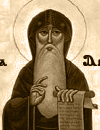
The Philokalia Volume 1
The Philokalia is a collection of spiritual texts that guide the reader on a spiritual path of inner work, contemplation, and the invocation of the name of Jesus, rooted in the sacramental and liturgical life of the Orthodox Church.
Evagrios the Solitary provides teachings on asceticism and stillness in the solitary life, emphasizing the importance of detachment from material things, simplicity in diet, and avoidance of worldly distractions to pursue the blessings of stillness. He highlights the need to resist temptations and thoughts inspired by demons, recognizing their influence on the intellect. Evagrios advises on fasting, vigilance, and taming passions like desire and anger through ascetic practices and acts of compassion. He warns against self-esteem and the dangers of seeking recognition from others, urging humility and sincerity in spiritual pursuits.
Text
Introduction to the Philokalia
Volume 1
The Philokalia is a collection of texts written between the fourth and the fifteenth centuries by
spiritual masters of the Orthodox Christian tradition. It was compiled in the eighteenth century by
two Greek monks, St Nikodimos of the Holy Mountain of Athos (1749-1809) and St Makarios of
Corinth (1731-1805), and was first published at Venice in 1782. A second edition was published
at Athens in 1893, and this included certain additional texts on prayer by Patriarch Kallistos not
found in the 1782 edition. A third edition, in five volumes, was also published at Athens during
the years 1957-1963 by the Astir Publishing Company. It is on the Astir edition that our English
translation is based. Thus our translation, which we likewise hope to publish in five volumes,
will reproduce all the texts included in the three Greek editions.
We depart notably from these editions in but four respects. First, we have not included the
introduction written by St Nikodimos, and we have rewritten the notes which he placed before
each text or series of texts written by a single author.
Second, we have used a more reliable version of a text if one is now available. Where that has
been the case, we signify it in the relevant introductory note.
Third, we have attributed to Evagrios the work On Prayer, which in the Greek editions is
attributed to St Neilos; the explanation for this change of attribution is in the note preceding
Evagrios' texts.
Fourth, we have placed in an appendix the text, attributed to St Antony the Great, which opens
the Greek editions; the reasons for this decision are likewise stated in the note introducing that
text. Where certain passages, or indeed entire sections, of individual texts attributed by St
Nikodimos to particular authors are now known or suspected to have been written by other
hands, we have
[VI] 12
Introduction to the Philokalia
Volume 1
indicated this either in the introductory notes to the texts in question or in footnotes. But in no case have we excised
any such passage or section on the grounds that it is not by the author to whom St Nikodimos has attributed it. The
distinction between genuine and spurious where all these writings are concerned must rest, not on the correctness of
the attribution of their authorship, but on whether or not they belong to the spiritual tradition which the collection as
a whole represents.
All the texts in the original Philokalia are in Greek, and all except two were first written in Greek, and even these
two (written originally in Latin) were translated into Greek in Byzantine times. But the influence of the work has by
no means been confined to the Greek-speaking world. It was Paisii Velichkovskii (1722-1794), a Russian monk
who visited Mount Athos and later settled in Moldavia, who first translated a selection of the texts into Slavonic,
published, with the title Dobrotolitblye, at Moscow in 1793 and reprinted at Moscow in 1822. This was the
translation carried by the pilgrim in The Way of a Pilgrims and indeed the impact of the Philokalia on Russian
spirituality and culture in the nineteenth century was immense, as the writings of Dostoievsky, an assiduous reader
of the book, alone sufficiently testify. A translation into Russian was made by Ignatii Brianchaninov (1807-1867)
and was published in 18'^7. Yet another Russian translation, still with the title Dobrotolubiye, was made by Bishop
Theophan the Recluse (1815-1894), who included in it several texts not in the original Greek edition, and
deliberately omitted or paraphrased certain passages in some of the texts of the Greek edition. Bishop Theophan's
translation was published at Moscow in five volumes at the expense of the Russian Monastery of St Panteleimon on
Mount Athos. The first volume of the series, originally issued in 1877, was reprinted in 1883, 1885, 1905 and 1913.
A photographic reprint of the 1883 edition was begun by the Monastery of the Holy Trinity, Jordanville, N.Y., in
1963. A Romanian translation, which also includes additional material, began to appear in 1946 under the editorship
of Father Dumitru Staniloae; in 1976 the fifth volume of this edition appeared, and it is planned to complete it in
eight volumes. A full French translation is in progress. Both the Romanian and the Flmch translations are based on
the original Greek.
The only previous translation into English of texts from the
[VI] 13
Introduction to the Philokalia
Volume 1
Philokalia is that made by E. Kadloubovsky and G. E. H. Palmer in two volumes with the titles Writings from the
Philokalia on Prayer of the Heart and Early Fathers from the Philokalia^ published in 1951 and 1954 respectively.
This translation was made, not from the Greek original, but from Theophan's Russian translation, and covers slightly
less than a third of the material of the Greek edition. It was because of this that the translators wrote in their
Introduction to the second of these two English volumes that 'the only final solution to the problem of making the
treasures contained in the Philokalia available to the West in a form as rich and as wisely balanced as the original is
for someone with the necessary qualities ... to undertake to translate the whole of the original Greek itself. We can
only hope that this work will one day be achieved: it might well be one of the greatest single contributions to
perpetuating in the West what is highest in the Christian tradition. ' The present translation is a direct consequence of
the hope expressed in that Introduction, written over twenty years ago.
What first determined the choice of texts made by St Nikodmios and St Makarios, and gives them their cohesion?
'Philokalia" itself means love of the beautiful, the exalted, the excellent, understood as the transcendent source of life
and the revelation of Truth. It is through such love that, as the subtitle of the original edition puts it, 'the intellect is
purified, illumined and made perfect'. The texts were collected with a view to this purification, illumination and
perfection. They show the way to awaken and develop attention and consciousness, to attain that state of
watchfulness which is the hallmark of sanctity. They describe the conditions most effective for learning what their
authors call the art of arts and the science of sciences, a learning which is not a matter of information or agility of
mind but of a radical change of will and heart leading man towards the highest possibilities open to him, shaping and
nourishing the unseen part of his being, and helping him to spiritual fulfillment and union with God. The Philokalia
is an itinerary through the labyrinth of time, a silent way of love and gnosis through the deserts and emptinesses of
life, especially of modem life, a vivifying and fadeless presence. It is an active force revealing a spiritual path and
inducing man to follow it. It is a summons to him to overcome his ignorance, to uncover the knowledge that lies
within, to rid himself of illusion,
' Faber and Faber. London.
[VI] 14
Introduction to the Philokalia
Volume 1
and to be receptive to the grace of the Holy Spirit who teaches all things and brings all things to remembrance.
The texts of the Philokalia are, then, guides to the practice of the contemplative life. They constitute, as St
Nikodnnos puts it in his introduction, 'a mystical school of inward prayer' where those who study may cultivate the
divine seed implanted in their hearts at baptism and so grow in spirit that they become "sons of God' (John 1:12),
attaining through such deification 'the measure of the stature of the fullness of Christ" (Eph. 4:13). The emphasis is
therefore on inner work, on the cleansing of 'the inside of the cup and plate, so that their outside may also be clean'
(Matt. 23:26). This does not mean that what one might call outer work - the keeping of the commandments and the
practice of the moral virtues - is of no importance. On the contrary, such work is a pre-condition of that purification
without which no real progress in inner work can be made. Indeed, in this respect outer and inner complement one
another. Atrophy or defeat follow only when outer work is practiced as an end in itself, and the one thing needful -
the inner practice of guarding the intellect and of pure prayer - is neglected. St Nikodimos himself remarks that such
neglect is only too common: many there are who wear their whole life away in outer work, with the result that grace
diminishes in them and they fail to realize the illumination of consciousness and purity of heart which are the goal of
the spiritual path that the Philokaha charts for us.
An advanced state which may be acquired through the pursuit of this path is described as hesychia, a word which not
only bears the sense of tranquility and silence (hence our translation: stillness) but also is linked through its Greek
root with the idea of being seated, fixed, and so of being concentrated. It is therefore fitting that from this word
should come the term hesychasm, frequently applied to the whole complex of theory and practice which constitutes
the path itself. But here a certain caution is needed. Some modem historians, prone to over-simplification and
schematization, have tended to speak of hesychasm as though it were a phenomenon of the later Byzantine world.
They speak of the hesychast movement, and by this they mean the spiritual revival which, centered on Mount Athos
in the thirteenth and fourteenth centuries, spread from there into neighboring lands such as Bulgaria, Serbia and
Russia. Yet hesychasm itself is far more than a local historical movement dating
[VI] 15
Introduction to the Philokalia
Volume 1
to the later Byzantine centuries. On the contrary it denotes the whole spiritual tradition going back to the earliest
times and delineated in the Philokalia. If evidence for this is needed, it may be found in the fact that one of the
central forms of the art and science which constitute hesychasm - namely, the invocation of the name of Jesus, or the
Jesus Prayer, to give it its traditional title - is already integral to the spiritual method described in many of the texts
included in this first volume, most if not all of which were written prior to the ninth century. Indeed, although the
Philokalia is concerned with many other matters, it would not be too much to say that it is the recurrent references to
the Jesus Prayer which more than anything else confer on it its inner unity.
It must be stressed, however, that this spiritual path known as hesychasm cannot be followed in a vacuum. Although
most of the texts in the Philokalia are not specifically doctrinal, they all presuppose doctrine even when they do not
state it. Moreover, this doctrine entails an ecclesiology. It entails a particular understanding of the Church and a view
of salvation inextricably bound up with its sacramental and liturgical life. This is to say that hesychasm is not
something that has developed independently of or alongside the sacramental and liturgical life of the Church. It is
part and parcel of it. It too is an ecclesial tradition. To attempt to practice it, therefore, apart from active participation
in this sacramental and liturgical life is to cut it off from its living roots. It is also to abuse the intention of its
exponents and teachers and so to act with a presumption that may well have consequences of a disastrous kind,
mental and physical.
There is a further point connected with this. The texts in the Philokalia were written by and for those actively living
not only within the sacramental and liturgical framework of the Orthodox Church, but also within that of the
Orthodox monastic tradition. They therefore presuppose conditions of life radically different from those in which
most readers of this English translation are likely to find themselves. Is this tantamount to saying that the counsels
they contam can be applied only within a monastic environment? Many hesychast writers affirm that this is not the
case, and St Nikodimos himself, in his introduction to the original Philokalia, goes out of his way to stress that
'unceasing prayer' may or, rather, should be practiced by all. Naturally, the monastic life provides conditions, such
as quietness, solitude and regularity, indispensable for that
[VI] 16
Introduction to the Philokalia
Volume 1
concentration without which one cannot advance far along the spiritual path. But, provided that the basic condition
of active participation in the sacramental and liturgical life of the Church is fulfilled, then this path is open to all to
follow, each to the best of his or her ability and whatever the circumstances under which he or she lives. Indeed, in
this respect the distinction between the monastic life and life 'in the world' is but relative: every human being, by
virtue of the fact that he or she is created in the image of God, is summoned to be perfect, is summoned to love God
with all his or her heart, soul and mind. In this sense all have the same vocation and all must follow the same
spiritual path. Some no doubt will follow it further than others: and again for some the intensity of the desire with
which they pursue it may well lead them to embrace a pattern of life more in harmony with its demands, and this
pattern may well be provided by the monastic life. But the path with its goal is one and the same whether followed
within or outside a monastic environment. What is essential is that one does not follow it in an arbitrary and
ignorant manner. Personal guidance from a qualified teacher should always be sought for. If such guidance is not to
be found, then active participation in the sacramental and liturgical life of the Church, always necessary, will have
an added importance in the overcoming of obstacles and dangers inherent in any quest of a spiritual nature. Certain
key words occur and recur in these hesychastic writings. We have listed the most important of them in a glossary,
specifying the English words we have used in translating them and the sense we attribute to them; and we have also
indicated where they first occur in the translation itself.^ But their real significance will be grasped only as the
reader penetrates ever more deeply into the meaning of the passages in which they are to be found - indeed, as he
penetrates ever more deeply into the theory and practice of the spiritual path they help to signpost.
Something similar applies with respect to the whole psychological understanding which these texts both presuppose
and elucidate. In effect, one is confronted with a psychology, or science of the soul, many of whose fundamental
features - particularly perhaps in relation to the role of the demons - are completely unrecognized by,
' Words listed in the Glossary are marked in the text with-an asterisk* ; see note on p. 20.
[VI] 17
Introduction to the Philokalia
Volume 1
not to say at odds with, the theories of most modem psychologists. The contemporary reader, influenced directly or
indirectly by these latter-day theories, may well be tempted to reject hesychastic psychology outright. But
alternatively he may be led first to question his own outlook and assumptions and then to modify or even abandon
them in the light of the understanding with which he is now confronted. In any case, how he reacts will depend very
largely on the degree to which he perceives the inner coherence and relevance of this understanding, not only on the
theoretical level but also in terms of his own experience. In this connection it should be remembered that, however
much the external appearances and conditions of the world may change, such changes can never uproot the
fundamental potentialities of the human state and of man's relationship with God: and as it is with these latter that
the teaching and method of the Philokalia are concerned, the counsels it enshrines are as valid and effective today as
they were at the times at which they were written.
This English translation of the Philokalia is produced under the auspices and with the financial assistance of a
charitable trust, the Elmg Trust. The work of initial translation has been done by a group of scholars and
collaborators, namely the Holy Transfiguration Monastery at Brookline, Massachusetts, Dr Constantine Cavamos of
Boston, Father Basil Osbome of Oxford, and Father Norman Russell of the London Oratory. But the final version of
the text has been prepared by and is the responsibility of the Editorial Committee set up by the Trustees of the Eling
Trust, and consisting of G. E. H. Palmer, Dr Philip Sherrard and Archimandrite Kallistos Ware. The task of checking
against the Greek text for consistency in interpretation in the English translation has been undertaken by the two last
named members of this Committee, while all three have cooperated in establishing the definitive version of the
translation itself. Although we have tried not to impose a uniformity of style, it is none the less inevitable that our
translation should display less variety than the original texts. These texts were written by authors who lived at
various times in a period that stretches over a thousand years and more, and who in addition came from many
differing cultural backgrounds. Our translation extends over something like ten years, and all those who contributed
to it share by and large in but a single culture. In spite of this we hope we have not suppressed
[VI] 18
Introduction to the Philokalia
Volume 1
entirely the distinctive flavor of the original texts. And we hope, too, that those who prepared the initial translations
will forgive us for the many changes made to their texts for the reasons we have stated. The fact that we have made
these changes in no way lessens our deep gratitude to them.
We would like to thank Father Palamas Koumantos of Simonopetra Monastery on Mount Athos for his assistance;
the Monks of the Serbian Monastery of Chilandan on Mount Athos for their generous hospitality on two prolonged
occasions; Mrs. Ian Busby for her invaluable work; and Miss Marguerite Langford for her assistance.
Finally, the Eling Trust and the Editorial Committee would also like to express their gratitude to the Ingram
Merrill Foundation of New York for a substantial grant provided to support this translation.
G.E.H. Palmer
Philip Sherrard
Archimandrite Kallistos Ware
Bussock Mayne
March 1977
Blank or non-referenced pages: [VI] 19, [VI] 20
[VI] 21
St Isaiah the SoHtary
(? d. 489/91)
(Volume l,pp. 21-28)
Inroductory Note
There is some uncertainty about the identity of the author of the Twenty-Seven Texts that follow. According to St
Nikodimos, St Isaiah the Solitary lived around the year 370 and was a contemporary Makarios the Great of Egypt.
Most historians today consider him to be later in date. He is now usually identified with a monk who lived initially
at Sketis in Egypt, and who then moved to Palestine at some date subsequent to 431, eventually dying in great old
age as a recluse near Gaza on 1 1 August 491 (according to others, 489). Whichever date is preferred, it is evident
that the author reflects the authentic spirituality of the Desert Fathers of Egypt and Palestine during the fourth and
fifth centuries. St Nikodimos commends in particular his advice on the rebuttal of demonic provocations and on the
need to be attentive to the conscience.
St Nikodimos here gives no more than short extracts from a much longer work, as yet untranslated into English.^
' Greek text edited by the monk Avgoustinos (Jerusalem, 1911; reprinted, Volos, 1962); French translation by DomHerve de Uroc, Abbe
Isaie.. Recueil ascetique, with an introduction by Dom L. Regnault (Collection Spiritualite Orientale, No. 7, 2nd edition, Abbaye de
Bellefontaine, 1976).
Contents
On Guarding the Intellect: 27 Texts VOLUME 1 : Page 22
[VI] 22
St Isaiah the Solitary
On Guarding the Intellect
Twenty- Seven Texts
There is among the passions an anger of the inteUect, and this anger is in accordance with nature. Without anger
a man cannot attain purity: he has to feel angry with all that is sown in him by the enemy. When Job felt this
anger he reviled his enemies, calling them "dishonorable men of no repute, lacking everything good, whom I
would not consider fit to live with the dogs that guard my flocks' (cf Job 30:1, 4. LXX). He who wishes to
acquire the anger that is in accordance with nature must uproot all self-will, until he establishes within himself
the state natural to the intellect.
If you find yourself hating your fellow men and resist this hatred, and you see that it grows weak and
withdraws, do not rejoice in your heart; for this withdrawal is a trick of the evil spirits. They are preparing a
second attack worse than the first; they have left their troops behind the city and ordered them to remain there.
If you go out to attack them, they will flee before you in weakness. But if your heart is then elated because you
have driven them away, and you leave the city, some of them will attack you from the rear while the rest will
stand their ground in front of you; and your wretched soul will be caught between them with no means of
escape. The city is prayer. Resistance is rebuttal through Christ Jesus. The foundation is mcensive power.
Let us stand firm in the fear of God, rigorously practicing the virtues and not giving our conscience cause to
stumble. In the fear of God let us keep our attention fixed within ourselves, until our conscience achieves its
freedom. Then there will be a union between it and us, and thereafter it will be our guardian, showing us each
thing that we must uproot. But if we do not obey our
[VI] 23
St Isaiah the Solitary
On Guarding the Intellect
Twenty- Seven Texts
conscience, it will abandon us and we shall fall into the hands of our enemies, who will never let us go. This is what
our Lord taught us when He said: 'Come to an agreement with your adversary quickly while you are with him in the
road, lest he hand you over to the judge, and the judge deliver you to the officer and you are cast into prison (Matt.
5:25). The conscience is called an 'adversary' because it opposes us when we wish to carry out the desires of our
flesh; and if we do not listen to our conscience, it delivers us into the hands of our enemies.
4. If God sees that the intellect has entirely submitted to Him and puts its hope in Him alone. He strengthens it,
saying: 'Have no fear Jacob my son, my little Israel" (Isa. 41:14. LXX), and: 'Have no fear: for I have delivered
you, I have called you by My name; you are Mine. If you pass through water, I shall be with you, and the rivers
will not drown you. If you go through fire, you will not be burnt, and the names will not consume you. For I am
the Lord your God, the Holy One of Israel, who saves you' (cf . Isa. 43:1-3. LXX).
When the intellect hears these words of reassurance, it says boldly to its enemies: 'Who would fight with me?
Let him stand against me. And who would accuse me? Let him draw near to me. Behold, the Lord is my helper;
who will harm me? Behold, all of you are like an old moth-eaten garment' (cf Isa. 50:8-9. LXX).
If your heart comes to feel a natural hatred for sin, it has defeated the causes of sin and freed itself from them.
Keep hell's torments in mind: but know that your Helper is at hand. Do nothing that will grieve Him, but say to
Him with tears: 'Be merciful and deliver me, Lord, for without Thy help I cannot escape from the hands of
my enemies. " Be attentive to your heart, and He will guard you from all evil.
The monk should shut all the gates of his soul, that is, the senses, so that he is not lured astray. When the
intellect sees that it is not dominated by anything, it prepares itself for immortality, gathering its senses together
and forming them into one body.
If your intellect is freed from all hope in things visible, this is a sign that sin has died in you.
If your intellect is freed, the breach between it and God is eliminated.
[VI] 24
St Isaiah the SoHtary
On Guarding the Intellect
Twenty- Seven Texts
10. If your intellect is freed from all its enemies and attains the Sabbath rest, it lives in another age, a new age in
which it contemplates things new and undecaying. For 'wherever the dead body is, there will the eagles be
gathered together' (Matt. 24: 28).
1 1 . The demons cunningly withdraw for a time in the hope that we will cease to guard our heart, thinking we have
now attained peace, then they suddenly attack our unhappy soul and seize it like a sparrow. Gaining possession
of it, they drag it 7down mercilessly into all kinds of sin, worse than those which we have already committed
and for which we have asked forgiveness. Let us stand, therefore, with fear of God and keep guard over our
heart, practicing the virtues which check the wickedness of our enemies.
12. Our teacher Jesus Christ, out of pity for mankind and knowing the utter mercilessness of the demons, severely
commands us: 'Be ready at every hour, for you do not know when the thief will come; do not let him come and
find you asleep' (cf Matt. 24:42-43). He also says: "Take heed, lest your hearts be overwhelmed with
debauchery and drunkenness and the cares of this life, and the hour come upon you unawares' (cf. Luke 21 :34).
Stand guard, then, over your heart and keep a watch on your senses; and if the remembrance of God dwells
peaceably within you, you will catch the thieves when they try to deprive you of it. When a man has an exact
knowledge about the nature of thoughts,* he recognizes those which are about to enter and defile him, troubling
the intellect with distractions and making it lazy. Those who recognize these evil thoughts for what they are
remain undisturbed and continue in prayer to God.
13. Unless a man hates all the activity of this world, he cannot worship God. What then is meant by the worship of
God? It means that we have nothing extraneous in our inteUect when we are praying to Him: neither sensual
pleasure as we bless Him, nor malice as we sing His praise, nor hatred as we exalt Him, nor jealousy to hinder
us as we speak to Him and call Him to mind. For all these things are full of darkness; they are a wall
imprisoning our wretched soul, and if the soul has them in itself it cannot worship God with purity. They
obstruct its ascent and prevent it from meeting God: they hinder it from blessing Him inwardly and praying to
Him with sweetness of heart, and so receiving His illumination. As a result the intellect is always shrouded in
darkness and cannot
[VI] 25
St Isaiah the SoHtary
On Guarding the Intellect
Twenty- Seven Texts
advance in holiness, because it does not make the effort to uproot these thoughts by means of spiritual knowledge.
14. When the intellect rescues the soul's senses from the desires of the flesh and imbues them with dispassion,* the
passions shamelessly attack the soul, trying to hold its senses fast in sin; but if the intellect then continually calls
upon God in secret. He, seeing all this, will send His help and destroy all the passions at once.
15. I entreat you not to leave your heart unguarded, so long as you are in the body. Just as a farmer cannot feel
confident about the crop growing in his fields, because he does not know what will happen to it before it is
stored away in his granary, so a man should not leave his heart unguarded so long as he still has breath in his
nostrils. Up to his last breath he cannot know what passion will attack him; so long as he breathes, therefore, he
must not leave his heart unguarded, but should at every moment pray to God for His help and mercy.
16. He who receives no help when, at war should feel no confidence when at peace.
17. When a man severs himself from evil, he gains an exact understanding of all the sins he has committed against
God; for he does not see his sins unless he severs himself from them with a feeling of revulsion. Those who
have reached this level pray to God with tears, and are filled with shame when they recall their evil love of the
passions. Let us therefore pursue the spiritual way with all our strength, and God in His great mercy will help
us. And if we have not guarded our hearts as our fathers guarded theirs, at least in obedience to God let us do all
we can to keep our bodies sinless, trusting that at this time of spiritual dearth He will grant mercy to us together
with His saints.
18. Once you have begun to seek God with true devotion and with all your heart, then you cannot possibly imagine
that you already conform to His will. So long as your conscience reproves you for anything that you have done
contrary to nature, you are not yet free: the reproof means that you are still under trial and have not yet been
acquitted. But if you find when you are praying that nothing at all accuses you of evil, then you are free and by
God's will have entered into His peace.
If you see growing within yourself a good crop, no longer choked by the tares of the evil one; if you find that the
demons have
[VI] 26
St Isaiah the SoHtary
On Guarding the Intellect
Twenty- Seven Texts
reluctantly withdrawn, convinced that it is no use making further attacks on your senses; if 'a cloud overshadows
your tent (cf Exod. 40:34), and 'the sun does not bum you by day, nor the moon by night' (Ps. 121:6); if you find
yourself equipped to pitch your tent and keep it as God wishes - if all this has happened, then you have gained the
victory with God's help, and henceforward He will Himself overshadow your tent, for it is His.
So long as the contest continues, a man is full of fear and trembling, wondering whether he will win today or be
defeated, whether he will win tomorrow or be defeated: the struggle and stress constrict his heart. But when he has
attained dispassion, the contest comes to an end; he receives the prize of victory and has no further anxiety about the
three that were divided, for now through God they have made peace with one another. These three are the soul, the
body and the spirit. When they become one through the energy of the Holy Spirit, they cannot again be separated.
Do not think, then, that you have died to sin, so long as you suffer violence, whether waking or sleeping, at the
hands of your opponents. For while a man is still competing in the arena, he cannot be sure of victory.
19. When the intellect grows strong, it makes ready to pursue the love which quenches all bodily passions and which
prevents anything contrary to nature from gaining control over the heart. Then the intellect, struggling against
what is contrary to nature, separates this from what is in accordance with nature.
20. Examine yourself daily in the sight of God, and discover which of the passions is in your heart. Cast it out, and
so escape His judgment.
21. Be attentive to your heart and watch your enemies, for they are cunning in their malice. In your heart be
persuaded of this: it is impossible for a man to achieve good through evil means. That is why our Savior told us
to be watchful, saying: 'Strait is the gate, and narrow is the way that leads to life, and few there are that find it
(Matt. 7:14).
22. Be attentive to yourself, so that nothing destructive can separate you from the love of God. Guard your heart,
and do not grow listless and say: 'How shall I guard it, since I am a sinner?' For when a man abandons his sins
and returns to God, his repentance regenerates him and renews him entirely.
23. Holy Scripture speaks everywhere about the guarding of the
[VI] 27
St Isaiah the Solitary
On Guarding the Intellect
Twenty- Seven Texts
heart, in both the Old and the New Testaments. David says in the Psalms: '0 sons of men, how long will you be
heavy of heart?' (Ps. 4:2. LXX), and again: 'Their heart is vain' (Ps. 5:9. LXX); and of those who think futile
thoughts, he says: 'For he has said in his heart, I shall not be moved' (Ps. 10:6), and: 'He has said in his heart, God
has forgotten' (Ps. 10:11).
A monk should consider the purpose of each text in Scripture, to whom it speaks and on what occasions. He
should persevere continually in the ascetic struggle and be on his guard against the provocations of the enemy. Like
a pilot steering a boat through the waves, he should hold to his course, guided by grace. Keeping his attention fixed
within himself, he should commune with God in stillness, guarding his thoughts from distraction and his intellect
from curiosity.
24. In storms and squalls we need a pilot, and in this present life we need prayer: for we are susceptible to the
provocations of our thoughts, both good and bad. If our thought is full of devotion and love of God, it rules over
the passions. As hesychasts, we should discriminate between virtue and vice with discretion and watchfulness:
and we should know which virtues to practice when in the presence of our brethren and elders and which to
pursue when alone. We should know which virtue comes first, and which second or third; which passions attack
the soul and which the body, and also which virtues concern the soul and which the body. We should know
which virtue pride uses in order to assault the intellect, and which virtue leads to vainglory, wrath or gluttony.
For we ought to purify our thoughts from 'all the self-esteem that exalts itself against the knowledge of God' (2
Cor. 10:5).
25. The first virtue is detachment, that is, death in relation to every person or thing. This produces the desire for
God, and this in turn gives rise to the anger that is in accordance with nature, and that flares up against all the
tricks of the enemy. Then the fear of God will establish itself within us, and through this fear love will be made
manifest.
26. At the time of prayer, we should expel from our heart the provocation of each evil thought, rebutting it in a spirit
of devotion so that we do not prove to be speaking to God with our lips, while pondering wicked thoughts in our
heart. God will not accept from
[VI] 28
St Isaiah the SoHtary
On Guarding the Intellect
Twenty- Seven Texts
the hesychast a prayer that is turbid and careless, for everywhere Scripture tells us to guard the soul's organs of
perception. If a monk submits his will to the law of God, then his intellect will govern in accordance with this law
all that is subordinate to itself. It will direct as it should all the soul's impulses, especially its mcensive power and
desire, for these are subordinate to it.
We have practiced virtue and done what is right, turning our desire towards God and His will, and directing our
incensive power, or wrath, against the devil and sin. What then do we still lack'? Inward meditation.
27. If some shameful thought is sown in your heart as you are sitting in your cell, watch out. Resist the evil, so that it
does not gain control over you. Make every effort to call God to mind, for He is looking at you, and whatever
you are thinking in your heart is plainly visible to Him. Say to your soul: 'If you are afraid of sinners like
yourself seeing your sins, how much more should you be afraid of God who notes everything?' As a result of
this warning the fear of God will be revealed in your soul, and if you cleave to Him you will not be shaken by
the passions: for it is written: 'They that trust in the Lord shall be as Mount Zion: he that dwells in Jerusalem
shall never be shaken' (Ps. 125:1. LXX). Whatever you are doing, remember that God sees all your thoughts,
and then you will never sin. To Him be glory through all the ages. Amen.
[VI] 29
Evagrios the Solitary
(345/6 - 399)
(I'olwne 1, pp. 29-71)
Introductory Note
Evagrios the Solitary, also known as Evagrios Pontikos, was bom in 345 or 346, probably at Ibora in Pontus,
although according to another opinion he was a native of Iberia (Georgia). A disciple of the Cappadocian Fathers, he
was ordained reader by St Basil the Great and deacon by St Gregory the Theologian (Gregory of Nazianzos), and he
accompanied the latter to the Council of Constantinople in 381 (the second Ecumenical Council). Evagrios was
never ordained priest. After a brief stay in Jerusalem, he went in 383 to Egypt, where he spent the remaining sixteen
years of his life. After two years at Nitria, where he became a monk, he moved to the more remote desert of Kellia,
dying there in 399. While in Egypt he had as his spiritual father the priest of Kellia, St Makarios of Alexandria, and
it is probable that he also knew St Makarios the Egyptian, the priest and spiritual father of Sketis. In the person of
these two saints, he came into contact with the first generation of the Desert Fathers and with their spirituality in its
purest form.
In the numerous writings of Evagrios there may be discerned two tendencies, the one 'speculative' and the other
'practical'. On the 'speculative' side he relies heavily upon Origen (c. 185-c. 254), borrowing from him in particular
certain theories about the pre-existence of human souls and the apokatastasis or final restoration of all things in
Christ. These theories were condemned at the fifth Ecumenical Council (553). On the 'practical' side he draws upon
the living experience of the Desert Fathers of Egypt, mainly Copts, among whom he spent the last years of his life.
He possessed to an exceptional degree the gifts of psychological insight and vivid description, together with the
ability to analyze and define with remarkable precision the various stages on the spiritual way. Here his teachings,
so far from being condemned, have exercised a decisive influence upon subsequent writers. His disciple St John
[VI] 30
Evagrios the Solitary
Introductory Note
Cassian, while abandoning the suspect theories that Evagrios derived from Origen, transmitted the 'practical'
aspect of Evagrios' teachings to the Latin West. In the Greek East the technical vocabulary devised by Evagrios
remained thereafter standard: it can be found, for example, in the writings of St Diadochos of Photiki, St John
Khmakos and St Maximos the Confessor, as also within the Syriac tradition, in the Mystic Treatises of St Isaac of
Nineveh. The works included by St Nikodimos in the Philokalia all belong to the'practical' side of Evagrios, and
contain little if any trace of suspect speculations.
Several of Evagrios' works have come down under the name of other authors. This is the case with the writing On
Prayer, which in the Greek Philokalia is ascribed to Neilos; but recent research has made it plain beyond any
reasonable doubt that this is a writing of Evagrios. '
' See the studies by I. Haushen', 'Le Traite de I'Oraison d'Evagre le Politique'. mReviie d'Ascetiqiie et lie Mystique, XV (1934), pp. 34-93, 113-
70; and Lei lefons d'lin contempj atif. Le Traite de I'Oraison d'Evagre Is f antique (Paris, 1960). The Eva-grian authorship of the work On Prayer
is accepted by a previous Enghsh translator, John Eudes Bamberger, in his introduction to Evagrius Ponticus; The Praktikos; Chapters on Prayer
(Cistercian Studies Series, No. 4, Spencer. Mass.. 1970 [i.e. 1972]).
Contents
Outline Teaching on Asceticism and
Stillness m the Solitary Life VOLUME 1: Page 31
Texts on Discrimination in respect
of Passions and Thoughts 38
Extracts from the Texts on Watchfulness 53
On Prayer- 153 Texts 55
[VI] 31
Evagrios the Solitary
Outline Teaching on Asceticism and Stillness in the Solitary Life
In Jeremiah it is said: 'And you shall not take a wife in this place, for thus says the Lord concerning the sons and
daughters bom in this place: . . . they shall die grievous deaths' (Jer. 16:1-4). This shows that, in the words of the
Apostle, 'He that is married cares for the things that are of the world, how he may please his wife', and he is
inwardly divided, and 'she that is married cares for the things of the world, how she may please her husband' (1 Cor.
7:32-34). It is clear that the statement in Jeremiah, 'they shall die grievous deaths', refers not only to the sons and
daughters bom as a result of marriage, but also to those bom in the heart, that is, to worldly thoughts and desires:
these too will die from the weak and sickly spirit of this world, and will have no place in heavenly life. On the other
hand, as the Apostle says, 'he that is unmarried cares for the things that belong to the Lord, how he may please the
Lord' (1 Cor. 7:32); and he produces the fruits of eternal life, which always keep their freshness.
Such is the solitary. He should therefore abstain from women and not beget a son or daughter in the place of
which Jeremiah speaks. He must be a soldier of Christ, detached from material things, free from cares and not
involved in any trade or commerce, for, as the Apostle says, 'In order to please the leader who has chosen him, the
soldier going to war does not entangle himself in the affairs of this world' (2 Tim. 2:4). Let the monk follow this
course, especially since he has renounced the materiality of this world in order to win the blessings of stillness. For
the practice of stillness is full of joy and beauty: its yoke is easy and its burden light.
Do you desire, then, to embrace this hfe of sohtude, and to seek out the blessings of stiUness? If so, abandon the
cares of the world, and the principalities and powers that lie behind them: free yourself
[VI] 32
Evagrios the Solitary
Outline Teaching on Asceticism and Stillness in the Solitary Life
from attachment to material things, from domination by passions and desires, so that as a stranger to all this you may
attain true stillness. For only by raising himself above these things can a man achieve the life of stillness.
Keep to a sparse and plain diet, not seeking a variety of tempting dishes. Should the thought come to you of
getting extravagant foods in order to give hospitality, dismiss it, do not be deceived by it: for in it the enemy lies in
ambush, waiting to tear you away from stillness. Remember how the Lord rebukes Martha (the soul that is over-
busy with such things) when He says: 'You are anxious and troubled about many things: one thing alone is needful'
(Luke 10:41-42) - to hear the divine word: after that, one should be content with anything that comes to hand. He
indicates all this by adding: 'Mary has chosen what is best, and it cannot be taken away from her' (Luke 10:42). You
also have the example of how the widow of Zarephath gave hospitality to the Prophet (cf 1 Kings 17:9-16). If you
have only bread, salt or water, you can still meet the dues of hospitality. Even if you do not have these, but make the
stranger welcome and say something helpful, you will not be failing in hospitality: for 'is not a word better than a
gift?' (Eccles. 18:17). This is the view you should take of hospitality. Be careful, then, and do not desire wealth for
giving to the poor. For this is another trick of the evil one, who often arouses self-esteem and fills your intellect with
worry and restlessness. Think of the widow mentioned in the Gospel by our Lord: with two mites she surpassed the
generous gifts of the wealthy. For He says: 'They cast into the treasury out of their abundance; but she . . . cast in all
her livelihood' (Mark 12:44).
With regard to clothes, be content with what is sufficient for the needs of the body. 'Cast your burden upon the
Lord' (Ps. 55:22) and He will provide for you, since 'He cares for you' (IPet. 5:7). If you need food or clothes, do not
be ashamed to accept what others offer you. To be ashamed to accept is a kind of pride. But if you have more than
you require, give to those in need. It is in this way that God wishes His children to manage their affairs. That is why,
writing to the Corinthians, the Apostle said about those who were in want:
'Your abundance should supply their want, so that their abundance likewise may supply your want: then there will
be equality, as it is written: "He that gathered much had nothing over; and he that
[VI] 33
Evagrios the Solitary
Outline Teaching on Asceticism and Stillness in the Solitary Life
gathered little had no lack'" (2 Cor. 8:14-15: Exod. 16:18). So if you have all you need for the moment, do not be
anxious about the future, whether it is one day ahead or a week or months. For when tomorrow comes, it will supply
what you need, if you seek above all else the kingdom of heaven and the righteousness of God: for the Lord says:
'Seek the kingdom of God and His righteousness, and all these things as well will be given to you' (cf. Matt. 6:33).
Do not have a servant, for if you do you will no longer have only yourself to provide for: and in that case the
enemy may trip you up through the servant and disturb your mind with worries about laying in extravagant foods.
Should you have the thought of getting a servant to allow your body a little ease, call to mind what is more
important - 1 mean spiritual peace, for spiritual peace is certainly more important than bodily ease. Even if you have
the idea that taking a servant would be for the servant's benefit, do not accept it. For this is not our work: it is the
work of others, of the holy Fathers who live in communities and not as solitaries. Think only of what is best for
yourself, and safeguard the way of stillness.
Do not develop a habit of associating with people who are materially minded and involved in worldly affairs. Live
alone, or else with brethren who are detached from material things and of one mind with yourself. For if one
associates with materially minded people involved in worldly affairs, one will certainly be affected by their way of
life and will be subject to social pressures, to vain talk and every other kind of evil: anger, sorrow, passion for
material things, fear of scandals. Do not get caught up in concern for your parents or affection for your relatives: on
the contrary, avoid meeting them frequently, in case they rob you of the stillness you have in your cell and involve
you in their own affairs. 'Let the dead bury their dead,' says the Lord: 'but come, follow me' (cf. Matt. 8:22).
If you find yourself growing strongly attached to your cell, leave it, do not cling to it, be ruthless. Do everything
possible to attain stillness and freedom from distraction, and struggle to live according to God's will, battling against
invisible enemies. If you cannot attain stillness where you now live, consider living in exile, and try and make up
your mind to go. Be like an astute business man: make stillness your criterion for testing the value of everything,
and choose always what contributes to it.
[VI] 34
Evagrios the Solitary
Outline Teaching on Asceticism and Stillness in the Solitary Life
Indeed, I urge you to welcome exile. It frees you from all the entanglements of your own locality, and allows you
to enjoy the blessings of stillness undistracted. Do not stay in a town, but persevere in the wilderness. "Lo,' says the
Psalm, 'then would I wander far off, and remain in the wilderness' (Ps. 55:7). If possible, do not visit a town at all.
For you will find there nothing of benefit, nothing useful, nothing profitable for your way of life. To quote the Psalm
again, 'I have seen violence and strife in the city' (Ps. 55:9). So seek out places that are free from distraction, and
solitary. Do not be afraid of the noises you may hear. Even if you should see some demonic fantasy, do not be
terrified or flee from the training ground so apt for your progress. Endure fearlessly, and you will see the great
things of God, His help. His care, and all the other assurances of salvation. For as the Psalm says, 'I waited for Him
who delivers me from distress of spirit and the tempest' (Ps. 55:8. LXX).
Do not let restless desire overcome your resolution: for 'restlessness of desire perverts the guileless intellect'
(Wisd. 4:12). Many temptations result from this. For fear that you may go wrong, stay rooted in your cell. If you
have friends, avoid constant meetings with them. For if you meet only on rare occasions, you will be of more help to
them. And if you find that harm comes through meeting them, do not see them at all. The friends that you do have
should be of benefit to you and contribute to your way of life. Avoid associating with crafty or aggressive people,
and do not live with anyone of that kind but shun their evil purposes; for they do not dwell close to God or abide
with Him. Let your friends be men of peace, spiritual brethren, holy fathers. It is of such that the Lord speaks when
he says: 'My mother and brethren and fathers are those who do the will of My Father who is in heaven' (cf Matt.
12:49-50). Do not pass your time with people engaged in worldly affairs or share their table, in case they involve
you in their illusions and draw you away from the science of stillness. For this is what they want to do. Do not listen
to their words or accept the thoughts of their hearts, for they are indeed harmful. Let the labor and longing of your
heart be for the faithful of the earth, to become like them in mourning. For 'my eyes will be on the faithful of the
land, that they may dwell with me' (Ps. 101:6). If someone who lives in accordance with the love of God comes to
you and invites you to eat, go if
[VI] 35
Evagrios the Solitary
Outline Teaching on Asceticism and Stillness in the Solitary Life
you wish, but return quickly to your cell. If possible, never sleep outside your cell, so that the gift of stillness may
always be with you. Then you will be unhindered on your chosen path.
Do not hanker after fine foods and deceitful pleasures. For 'she that indulges in pleasure is dead while still alive',
as the Apostle says (1 Tim. 5:6). Do not fill your belly with other people's food in case you develop a, longing for it,
and this longing makes you want to eat at their table. For it is said: 'Do not be deceived by the filling of the belly'
(Prov. 24: 1 5. LXX). If you find yourself continually invited outside your cell, decline the invitations. For continual
absence from your cell is harmful. It deprives you of the grace of stillness, darkens your mind, withers your longing
for God. If a jar of wine is left in the same place for a long time, the wine in it becomes clear, settled and fragrant.
But if it is moved about, the wine becomes turbid and dull, tainted throughout by the lees. So you, too, should stay in
the same place and you will find how greatly this benefits you. Do not have relationships with too many people, lest
your intellect becomes distracted and so disturbs the way of stillness.
Provide yourself with such work for your hands as can be done, if possible, both during the day and at night, so
that you are not a burden to anyone, and indeed can give to others, as Paul the Apostle advises (cf. 1 Thess. 2:9;
Eph. 4:28). In this manner you will overcome the demon of listlessness and drive away all the desires suggested by
the enemy; for the demon of listlessness takes advantage of idleness. 'Every idle man is full of desires' (Prov. 13:4.
LXX).
When buying or selling you can hardly avoid sin. So, in either case, be sure you lose a little in the transaction. Do
not haggle about the price from love of gain, and so indulge in actions harmful to the soul - quarrelling, lying,
shifting your ground and so on - thus bringing our way of life into disrepute. Understanding things in this manner,
be on your guard when buying and selling. If possible it is best to place such business in the hands of someone you
trust, so that, being thus relieved of the worry, you can pursue your calling with joy and hope.
In addition to all that I have said so far, you should consider now other lessons which the way of stillness teaches,
and do what I tell you. Sit in your cell, and concentrate your intellect; remember the day of death, visualize the
dying of your body, reflect on this
[VI] 36
Evagrios the Solitary
Outline Teaching on Asceticism and Stillness in the Solitary Life
calamity, experience the pain, reject the vanity of this world, its compromises and crazes, so that you may continue
in the way of stillness and not weaken. Call to mind, also, what is even now going on in hell. Think of the suffering,
the bitter silence, the terrible moaning, the great fear and agony, the dread of what is to come, the unceasing pain,
the endless weeping. Remember, too, the day of your resurrection and how you will stand before God. Imagine that
fearful and awesome judgment-seat. Picture all that awaits those who sin: their shame before God the Father and His
Anointed, before angels, archangels, principalities and all mankind: think of all the forms of punishment: the eternal
fire, the worm that does not die, the abyss of darkness, the gnashing of teeth, the terrors and the torments. Then
picture all the blessings that await the righteous: intimate communion with God the Father and His Anointed, with
angels, archangels, principalities and all the saints, the kingdom and its gifts, the gladness and the joy.
Picture both these states: lament and weep for the sentence passed on sinners, mourn while you are doing this,
frightened that you, too, may be among them. But rejoice and be glad at the blessings that await the righteous, and
aspire to enjoy them and to be delivered from the torments of hell. See to it that you never forget these things,
whether inside your cell or outside it. This will help you to escape thoughts that are defiling and harmful.
Fast before the Lord according to your strength, for to do this will purge you of your iniquities and sins; it exalts
the soul, sanctifies the mind, drives away the demons, and prepares you for God's presence. Having already eaten
once, try not to eat a second time the same day, in case you become extravagant and disturb your mind. In this way
you will have the means for helping others and for mortifying the passions of your body. But if there is a meeting of
the brethren, and you have to eat a second and a third time, do not be disgruntled and surly. On the contrary, do
gladly what you have to do, and when you have eaten a second or a third time, thank God that you have fulfilled the
law of love and that He himself is providing for you. Also, there are occasions when, because of a bodily sickness,
you have to eat a second and a third time or more often. Do not be sad about this; when you are ill you should
modify your ascetic labors for the time being, so that you may regain the strength to take them up once more.
[VI] 37
Evagrios the Solitary
Outline Teaching on Asceticism and Stillness in the Solitary Life
As far as abstinence from food is concerned, the divine Logos did not prohibit the eating of anything, but said:
'See, even as I have given you the green herb I have given you all things; eat, asking no questions; it is not what goes
into the mouth that defiles a man' (cf. Gen. 9:3; 1 Cor. 10:25; Matt. 15: 1 1). To abstain from food, then, should be a
matter of our own choice and an ascetic labour.
Gladly bear vigils, sleeping on the ground and all other hardships, looking to the glory that will be revealed to you
and to all the saints; 'for the sufferings of this present time', says the Apostle, 'are not worthy to be compared with
the glory which shall be revealed in us' (Rom. 8 : 18).
If you are disheartened, pray, as the Apostle says (cf. Jas. 5: 13). Pray with fear, trembling, effort, with inner
watchfulness and vigilance. To pray in this manner is especially necessary because the enemies are so malignant.
For it is just when they see us at prayer that they come and stand beside us, ready to attack, suggesting to our
intellect the very things we should not think about when praying; in this way they try to take our intellect captive
and to make our prayer and supplication vain and useless. For prayer is truly vain and useless when not performed
with fear and trembling, with inner watchfulness and vigilance. When someone approaches an earthly king, he
entreats him with fear, trembling and attention: so much the more, then, should we stand and pray in this manner
before God the Father, the Master of all, and before Christ the King of Kings. For it is He whom the whole spiritual
host and the choir of angels serve with fear and glorify with trembling; and they sing in unceasing praise to Him,
together with the Father who has no origin, and with the all-holy and coetemal Spirit, now and ever through all the
ages. Amen.
[VI] 38
Evagrios the Solitary
Texts on Discrimination in Respect of Passions and Thoughts
1. Of the demons opposing us in the practice of the ascetic life, there are three groups who fight in the front line:
those entrusted with the appetites of gluttony, those who suggest avaricious thoughts, and those who incite us to
seek the esteem of men. All the other demons follow behind and in their turn attack those already wounded by
the first three groups. For one does not fall into the power of the demon of unchastity, unless one has first fallen
because of gluttony: nor is one's anger aroused unless one is fighting for food or material possessions or the
esteem of men. And one does not escape the demon of dejection, unless one no longer experiences suffering
when deprived of these things. Nor will one escape pride, the first offspring of the devil, unless one has
banished avarice, the root of all evil, since poverty makes a man humble, according to Solomon (cf. Prov. 10:4.
LXX). In short, no one can fall into the power of any demon, unless he has been wounded by those of the front
line. That is why the devil suggested these three thoughts to the Savior: first he exhorted Him to turn stones into
bread; then he promised Him the whole world, if Christ would fall down and worship him: and thirdly he said
that, if our Lord would listen to him. He would be glorified and suffer nothing in falling from the pinnacle of
the temple. But our Lord, having shown Himself superior to these temptations, commanded the devil to 'get
behind Him'. In this way He teaches us that it is not possible to drive away the devil, unless we scornfully reject
these three thoughts (cf Matt. 4:1-10).
2. All thoughts inspired by the demons produce within us conceptions of sensory objects; and in this way the
intellect, with such conceptions imprinted on it, bears the forms of these objects within itself. So, by
recognizing the object presented to it, the
[VI] 39
Evagrios the SoHtary
Texts on Discrimination in Respect of Passions and Thoughts
intellect knows which demon is approaching. For example, if the face of a person who has done me harm or insulted
me appears in my mind, I recognize the demon of rancor approaching. If there is a suggestion of material things or
of esteem, again it will be clear which demon is troubling me. In the same way with other thoughts, we can infer
from the object appearing in the mind which demon is close at hand, suggesting that object to us. I do not say that all
thoughts of such things come from the demons; for when the intellect is activated by man it is its nature to bring
forth the images of past events. But all thoughts producing anger or desire in a way that is contrary to nature are
caused by demons. For through demonic agitation the intellect mentally commits adultery and becomes incensed.
Thus it cannot receive the vision of God, who sets us in order: for the divine splendor only appears to the intellect
during prayer, when the intellect is free from conceptions of sensory objects.
3. Man cannot drive away impassioned thoughts unless he watches over his desire and incensive power. He destroys
desire through fasting, vigils and sleeping on the ground, and he tames his incensive power through long-
suffering, forbearance, forgiveness and acts of compassion. For with these two passions are connected almost all
the demonic thoughts which lead the intellect to disaster and perdition. It is impossible to overcome these passions
unless we can rise above attachment to food and possessions, to self-esteem and even to our very body, because it
is through the body that the demons often attempt to attack us. It is essential, then, to imitate people who are in
danger at sea and throw things overboard because of the violence of the winds and the threatening waves. But here
we must be very careful in case we cast things overboard just to be seen doing so by men. For then we shall get
the reward we want; but we shall suffer another shipwreck, worse than the first, blown off our course by the
contrary wind of the demon of self-esteem. That is why our Lord, instructing the intellect, our helmsman, says in
the Gospels: 'Take heed that you do not give alms in front of others, to be seen by them; for unless you take heed,
you will have no reward from your Father in heaven.' Again, He says: 'When you pray, you must not be as the
hypocrites are: for they love to pray standing in synagogues and at street-comers, so as to be seen by men. Truly I
say to you, they get the reward they want. . . . Moreover when you fast, do not put on a gloomy face, like the
hypocrites:
[VI] 40
Evagrios the Solitary
Texts on Discrimination in Respect of Passions and Thoughts
for they disfigure their faces, so that they may be seen by men to be fasting. Truly I say to you, they get the reward
they want' (cf. Matt. 6: 1-18). Observe how the Physician of souls here corrects our incensive power through acts of
compassion, purifies the intellect through prayer, and through fasting withers desire. By means of these virtues the
new Adam is formed, made again according to the image of his Creator - an Adam in whom, thanks to dispassion,
there is 'neither male nor female' and, thanks to singleness of faith, there is 'neither Greek nor Jew, circumcision nor
uncircumcision, barbarian, Scythian, bond nor free; but Christ is all, and in all' (Gal. 3:28; Col. 3: 10:1 1).
4. We shall now enquire how, in the fantasies that occur during sleep, the demons imprint shapes and forms on our
intellect. Normally the intellect receives these shapes and forms either through the eyes when it is seeing, or
through the ears when it is hearing, or through some other sense, or else through the memory, which stirs up and
imprints on the intellect things which it has experienced through the body. Now it seems to me that in our sleep,
when the activity of our bodily senses is
Sermon Outline
- Introduction to the Philokalia
- The Spiritual Path of Hesychasm
- The Importance of Doctrine and Ecclesiology in Hesychasm
- The Application of Hesychasm in Everyday Life
- History and Compilation of the Philokalia
- Purpose and Scope of the Philokalia
- Definition and Characteristics of Hesychasm
- The Role of the Jesus Prayer in Hesychasm
- The Relationship between Hesychasm and the Sacramental and Liturgical Life of the Church
- The Need for Personal Guidance and Active Participation in the Church
- The Universality of the Spiritual Path and the Importance of Inner Work
Key Quotes
“The Philokalia is an itinerary through the labyrinth of time, a silent way of love and gnosis through the deserts and emptinesses of life, especially of modern life, a vivifying and fadeless presence.” — Desert Fathers
“The texts of the Philokalia are guides to the practice of the contemplative life, and they constitute a mystical school of inward prayer.” — Desert Fathers
“Hesychasm is not something that has developed independently of or alongside the sacramental and liturgical life of the Church. It is part and parcel of it.” — Desert Fathers
Application Points
- The principles of hesychasm can be applied in everyday life, but it is essential to have personal guidance and to participate actively in the sacramental and liturgical life of the Church.
- The Jesus Prayer is a central aspect of hesychasm, and it is considered a means of attaining spiritual purification, illumination, and perfection.
- Hesychasm is an ecclesial tradition that is deeply rooted in the sacramental and liturgical life of the Orthodox Church.