
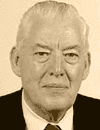
The Ancient Cross
Ian Paisley's sermon, 'The Ancient Cross,' explores the profound significance of the cross in understanding Jesus' identity and mission.
In this sermon, the speaker emphasizes the importance of directing our thoughts to the passion of Jesus Christ as we gather around the Lord's table. The reading from John's Gospel chapter 12 focuses on Jesus' statement that the hour has come for the Son of Man to be glorified. The speaker highlights the power of the cross and the significance of Jesus' death in fulfilling God's plan for salvation. The sermon also references the wedding feast at Cana, where Jesus performed his first miracle by turning water into wine, symbolizing his ability to meet the needs of humanity.
Full Transcript
I'd like to say how very delighted I am to be back with you in Greenville and of this opportunity of ministering to you from God's precious and holy word. I'd just like to mention some of the titles of those tapes. They're very timely.
The first one is The Death of the Pope. I don't know what pope that it's about because there's so many popes dying at the present time. You can hardly keep up with their rate of dying mortality.
Amen. I can say amen to that too. And then there is one on Pope John Paul the first giving some information that has been carefully concealed from the general public about this very interesting character who reigned for a very short time indeed.
And then there is another message, Was the Pope Poisoned? And I would commend that one to you. I was reading recently an extract from a long indictment of the Roman Curia by a Spanish newspaper in which they publicly accused the Curia of murdering the pope. The intrigues of the Vatican are still with us and will be with us to the end of time.
There's also a very important tape upon the new Pentecostalism and I'd like to commend that tape to you. It's a fully documented tape dealing with this new movement which I believe is the false power to give strength and motivation to the great ecumenical delusion of our day. And I have dealt with that matter very thoroughly from the Word of God and given many extracts from the leading propagators of that falsehood.
We also in our country have a great controversy raging at the present time on the support by the World Council of Churches of African terrorist organizations. And there is another tape fully documenting that matter as well. I would commend these messages to you.
I trust that there will be a blessing to you. We also have a message called the Who's Who in this age of apostasy. And it is important that we know who certain people are in our theological and religious denominations today.
And at the heart of that message has been printed in this little booklet here, Who's Who in the Age of Apostasy. And we deal with the fundamentalists, with the modernists, the evangelical, the orthodox and the heterodox, the neo-orthodox, the new evangelical, the apostate, the heretic, the pseudo-fundamentalist, the ecumenist, the biblicist, and the charismatic or new pentecostalist. I would commend that leaflet to you.
And pick up a copy as you're leaving. If you leave a gift for the printing cost, we will be grateful. Now I think those are all the announcements I have to make.
We're coming now to the reading of God's Holy Word. And could I remind you that this is the morning when we gather around the Lord's table. So we want to direct our thoughts appropriately to the passion of our Lord and Savior, Jesus Christ.
May the Lord bring us to the cross. May the shadow of Calvary fall across every heart. May the warmth that was generated there for sinners warm our cold hearts today.
And may we go away saying, did not our hearts burn within us? While He talked to us by the way and while He opened unto us the scriptures. Turning then to the twelfth chapter of John's gospel. John's gospel chapter 12.
I'm reading a few verses from verse 23. And Jesus answered them saying, The hour is come that the Son of Man should be glorified. Verily, verily, I say unto you, except a corn of wheat fall into the ground and die, it abideth alone.
But if it die, it bringeth forth much fruit. He that loveth his life shall lose it. And he that hateth his life in this world shall keep it unto life eternal.
If any man serve me, let him follow me. And where I am, there shall also my servant be. If any man serve me, him will my Father honor.
Now is my soul troubled. And what shall I say? Father, save me from this hour. But for this cause came I unto this hour.
Father, glorify Thy name. Then came there a voice from heaven saying, I have both glorified it and will glorify it again. The people therefore that stood by and heard it said that it thundered.
Others said an angel speak to him. Jesus answered and said, This voice came not because of me, but for your sake. Now is the judgment of this world.
Now shall the prince of this world be cast out. And if I, if I be lifted up from the earth, will draw all men unto me. This he said, signifying what death he should die.
And God shall add his blessing to this reading from the infallible book. Amen and amen. I want to draw your attention this morning to this most interesting discourse of the Lord Jesus Christ in this twelfth chapter of John's Gospel.
If you look with me for verse twenty-one, you will find that this discourse is a response to the coming of Philip to the Lord Jesus Christ. You see, certain Greeks, verse twenty, came up to worship at the feast. And when they came, they found Philip, which was of the city of Galilee.
They found a man who had some acquaintance with the Greek, because there was a strong Greek colony in this city of Bethsaida. And they said to him, Sir, we would see Jesus. Sir, we would see Jesus.
And as a result of that particular desire expressed, the Lord Jesus Christ made one of the most important statements of all his ministry. And the heart of this statement brings us to the very heart of the Gospel, that the only way to really and truly and seemingly see Jesus is to see him on the cross. There is no knowing of the Lord Jesus Christ apart from his cross.
And if we do not see him on the cross, we can never possibly see him at all. That is the great secret. Now, if you look at this twelfth chapter of John's Gospel with me, you will discover that it is a most interesting and a most instructive passage in this great book, the Gospel of John.
Could I say to you that those things coming just before the cross and those things coming immediately after the cross are of utmost importance? For to the understanding of the cross, we must know the things that immediately preceded it. And to a fuller understanding of its outcome, we must meditate and study those things that immediately followed it. Now, this twelfth chapter commences with the words, Then Jesus, six days before the Passover.
And of course, the Passover came on the seventh day. Could I suggest to you, when you are reading the Gospel of John, you should mark carefully John's calendar of events and the days which he mentions. At the beginning of John's Gospel, there is a week of days, seven days.
And here at the end, just before the cross, there is another week of days, another seven days. And he is starting with the first day of that last week, culminating in the seventh day of the feast. Could we turn just for a moment to the first chapters of John's Gospel, that I might draw your attention to those first seven days? Let me give you a hint that John's Gospel is parallel with Genesis.
Genesis starts off with the words, In the beginning, God. The modernists and the apostates go back millions and millions of years. I am glad my book goes back to the beginning.
You cannot get beyond that. It goes back to the beginning. In the beginning, God.
God makes no explanation when He steps into the pages of the book, you know. There is no definition for God. He draws aside the curtain.
He steps onto the great plane of His own divine revelation. And I know no other word so powerful as this, In the beginning, God. He is Himself the unbeginning beginning.
He is in Himself all power, all sovereignty, all might, and all glory. But John's Gospel starts off, In the beginning was the Word. And the God of the beginning is a God who reveals Himself.
And He reveals Himself in His Word. And thank God, Jesus Christ is the eternal Word of the eternal God. And He Himself is God.
So there are seven days at the beginning of Genesis, and there are seven days at the beginning of John's Gospel. And I would say to you, if you put the seven days of John's Gospel beside the seven days of Genesis, you'll find an interesting parallel for those that are spiritual to see, and you'll find something worthy of your meditation. But let me show you, in verse 29, He talks about the next day.
So the first day has relevance to the first part of the Gospel. And of course, the first day is talking about the light. And thank God, in the first day, God said, Let there be light, and there was light.
Verse 29, the next day. So that brings us to the second day. Then verse 35, the next day after, that brings us to the third day.
And then verse 43, the day following, that brings us to the fourth day. And then in chapter 2, verse 1, on the third day, the third day after the fourth day, brings us to the seventh day. And the seventh day was the day of the wedding.
And thank God, we're all histening towards that great seventh day today, the day of the marriage supper of the Lamb. But in John's Gospel, chapter 12, we start with this seventh day period. And notice how it starts.
It starts with an anointing. It starts with an anointing. Verse 7, Jesus Christ tells me in verse 7, why Mary anointed Him.
Against the day of my burying has she kept it. Now He didn't say, against the day of my death has she done this. But against the day of my burying.
You know, the burial of Christ is a divine truth not often emphasized. But when Paul summed up the Gospel, he said, The Gospel that I received from the Lord is this, that Christ died for our sins, according to the Gospel, and that He was buried. Because burial is the climax, the completion of death.
And the Lord Jesus Christ here is speaking of an anointing that was the climax of His death. He didn't suffer His Holy One to see corruption. Why? Because that body hanging upon the cross had paid out of its beams the blood of our redemption.
And the culmination of His death was His body laid out on the tombstone against the day of my burial. And the first thing that I have my attention called to in John's Gospel, chapter 12, is the fact that God raised Lazarus from the dead. Look at verse 9, Much people of the Jews therefore knew that He was there, and they came not for Jesus' sake only, but that they might see Lazarus also, whom He had raised from the dead.
So the first glory that has manifested before, He prays the prayer, Father, glorify Thy name. And the Father says, I have glorified it. In what way has He glorified it? He has glorified it as the name of the Son of God in the smashing of the tomb, in the raising of Lazarus from the dead.
And of course, Lazarus' raising was a climax of a series of three raisings. The Lord Jesus Christ three years of ministry. The first year of His ministry, He raised the daughter of Jairus from the dead.
She had just died. She was a child. The Lord raised her.
Second year of His ministry, He met a funeral procession coming from the village of Neme. A young man had died, and he was now being carried out to be buried. But no funeral procession can get past Jesus Christ.
And the funeral procession stopped, and the young man walked home from his own funeral. That was a wonderful day. I can see that old beetle-browed, twisted Jewish undertaker saying, I'll only get half pay for this one.
I'll not be able to charge the full amount. And then, in the third year of His ministry, a man four days in the grave. Did you notice the building up? Because in Scripture, the mighty power of God is climaxing in the cross.
There is no power beyond the power of the cross. At the cross, the power of omnipotence was released in the bloodstream from Emmanuel's being. And I know no power greater than the power of this cross.
That's why Paul said, the preaching of the cross is to them that perish foolishness. But unto us who are saved, it is the power, the dynamite of God. The dynamite of God.
It's building up. And he says, Lazarus, come forth. As the old Puritan said, it was a good job he said, Lazarus, come forth.
For if he had shouted, come forth, there would have been confusion in that graveyard as every tomb had opened and every dead man had been resurrected. There is a day coming when He will cry, come forth, without any limitation. And every man ever born who died shall come forth at the command of He who is the sovereign Lord of heaven and earth.
It's climaxing to the cross. You have the glory of the Son of God. I trust that today we all wonder at the glory of the Son of God.
For there was a day that I too was in a tomb. There was a day when I too lay down among the dead. There was a day when there wasn't any suggestion of life in my soul.
Dead in trespasses and in sin. Totally and utterly and hopelessly depraved. A dead soul.
Is there hope for a dead soul? Can these bones live? Lord God thou knowest. And one day I heard His voice. A dead man hearing a voice.
That's a miracle, sure. Salvation is a miracle. The supernatural putting forth of God's power in life.
And a quickening happened. An enlivening happened. A resurrection happened.
Every man that's saved has had a resurrection. And he's left the tomb. Praise God.
The trouble with some believers, they have left the tomb alright. But they haven't left the grave close to remember the second command of the Lord. Loose him and let him go.
Billy someday said it was a good thing that the Lord loosed him. Or Mary and Martha would have needed a promulgator to wheel him home. Because he was tied up in the grave close.
There's still a lot of Christians in the grave close. But the Lord says take every vestige of death off of them and let them walk home. It was a good thing to walk home from your own funeral.
It was a better thing to walk home from your own tomb. I'm sure Lazarus many a time stole out to that graveyard and looked at that tomb and said I lay there down among the dead. My body corrupted.
But Jesus came and stood here and he said come forth and I have come forth. Brother have you gone back to the pit from which you have been digged? Have you gone back to the rock from which you have been hewn? And have you said thank God one day he called me from that pit and set me free. That's what we should do today as we come to this table.
Wonder, admire and praise the glory of the Son of God. But look again. There is something else.
There's the glory in this passage of the Son of David. We're coming now to the next day. Note the days.
And on the next day, verse 12, much people that were come to the feast when they heard that Jesus was coming to Jerusalem, took branches of palm trees and went forth to meet him and cried, Hosanna, blessed is the King of Israel that cometh in the name of the Lord. And Jesus when he had found a young ass sat thereon as it is written, Fear not daughter of Zion, behold thy King cometh sitting on an ass's coat. These things understood not his disciples at the first, but when Jesus was glorified, then remembered they that these things were written of him, that they had done these things unto him.
But when Jesus was glorified, we have a prelude of his glory here. It's not the glory of the Son of Man, but it's the glory of the Son of David, King David's greater Son. Do you remember the promise given to David? That I will raise up of your seed a man to sit on the kingdom.
God has abrogated that promise. The Lord Jesus Christ one day is coming again and we had here a prelude to that coming. What rejoicing that day was in his presence as they took the palms in their hands and they cried, Hosanna, blessed is he that cometh in the name of the Lord.
And we would take up that blessed stream this morning. Did not Paul say, as I take of this bread and take of this cup, I do it until he comes. Jesus Christ, my brethren and sisters, is coming again.
What rejoicing in his presence when our banners grief and pain and the crooked ways shall be straightened and the dark ways shall be cleaved. Face to face shall I behold him. We can have a prelude offered at the table today.
Blessed is he that cometh in the name of the Lord. He is the Son of David. He shall reign until all enemies lick the dust at his feet and the last enemy that shall be destroyed is death.
We shall take up those palms of victory and we shall all join in the hallelujah chorus of the redeemed as the bouts of heaven re-echo with the songs of men. Saved out of darkness, out of sin, out of evil, out of hell. Then shall the kingdoms of this world become the kingdoms of our Lord and of his Christ.
And he shall reign. Let us get our eyes upon the glory of the Son of David. You come to Christ's glory as the Son of God before you come to his glory as the Son of David.
Because we can never know the glory of his coming until we have discovered the glory of his power in ourselves. But there is a final glory applicable to us especially. There came certain Greeks among them that came up to worship the feast.
The raising of Lazarus emphasizes the glory of the Son of God. The reception at Jerusalem emphasizes the glory of the Son of David. But the receiving of the Gentiles emphasizes the glory of the Son of Man.
Where did the Lord Jesus commence his ministry? He commenced it in Galilee described as Galilee of the Gentiles. It was a hint of a brighter and more glorious day for the Gentile nations of this world. In the Old Testament we have the limitation of divine revelation to the Abrahamic seed to the Jewish nation.
But all through the Old Testament there is a hint of a greater day coming when God's purpose and mind will be revealed to all the nations of the earth. And in the Abrahamic covenant he said, And in thee shall all nations of the earth be blessed. A greater day shall be coming.
Psalm 2, Ask of me and I will give thee the heathen for thine inheritance, and the uttermost parts of the earth for thy possession. Psalm 2 is one of the great prophetic psalms, the messianic psalm of the Christ in his glory. Galilee of the Gentiles.
It was there he commenced his gracious work. And now at the end a man called Philip, where did he come from? The He is bringing the Greeks with him. And the Lord has something to say to these Greeks.
What does he say? He says here, he says, Verily, verily, the hour has come that the Son of Man should be glorified. Notice the title, the Son of Man should be glorified. Do you see that word hour? And you are reading John's Gospel, Mark, every time it occurs.
It occurs seven times, in seven different sections of the book. It starts off with the first miracle. And could I tell you something, there is a difference between the miracles in John's Gospel and the miracles in all the other Gospels.
Because John's Gospel is the Gospel that reveals the Son of God, puts its emphasis on the full-orbed deity of the Lord Jesus Christ. You know, we have people come to us and they tell us, the Lord emptied Himself and He emptied Himself of His deity when He became man. What utter rubbish! God did not commit deicide when Jesus became incarnate.
He is God, just as much God in the bosom of the virgin as He was God in the bosom of the Father. We have a campaign to un-God the Lord Jesus Christ. A very dangerous campaign today.
Let me tell you, never you try to split up the person of the Son of God. He is one person. He is two distinct natures.
His Godhead is not humanized. His humanity is not deified. He is two distinct natures in one person forever.
And everything He did, as mediator, He did it as the God-man. And that is why His deity is often placed in relationship to His humanity. Now, we know that God is a spirit and God has not blood.
And yet the blood of Jesus Christ is called the blood of God. Why? Do you remember Paul called the elders of the church of Ephesus? Paul was a Presbyterian, you know. He believed in the eldership, the Presbyters.
And he called them together at Miletus and he said, The blood of God. Because one nature is often placed for the other nature in a descriptive way in the New Testament. It is a most interesting study.
He is the one person of Christ. The one person of Christ. And the miracles are peculiar in John's Gospel.
In fact, the word that is used is a different word than is used in the other Gospels. If you turn to John 20 and verse 30. John 20 and verse 30.
It says, And many other signs truly did Jesus in the presence of His disciples, which are not written in this book. That is the word, signs. They were signs of His deity.
You will find seven of them. Seven miracles in John's Gospel. Seven great signs.
But what were they done for? These are written that ye might believe that Jesus is the Christ, the Son of God. They attest His deity. And in the attestation of His deity, there is always glory.
You can never part God from glory. God and glory go together. And the first miracle He did, He did in the second chapter that is recorded in John's Gospel.
The second chapter of John's Gospel. Where He did His first miracle. He did His first sign.
What was it? It was a wonderful sign. It was actually a sign of blood. Of blood.
He turned the water into wine. You know the first things about the Lord's ministry are all a prelude to its end. He started His ministry in a baptism, which is a type of death.
Thank God He finished His ministry in the baptism of His death. I have a baptism to be baptized with and how am I straightened until it is accomplished. He said to John in the waters of Jordan, Thus it becometh us to fulfill all right.
To make a finish. To fulfill it all. And on the cross He cried, Bless God, it is finished.
So the first things He did were a prelude to the last things He was going to do. And it was a wedding feast and they ran out of the wine. And His mother came to Him and He said, Mine hour is not yet come.
The hour of His death when He was going to pour out His blood for the salvation of the lost. But what did He do? There were six water pots. Notice that word six.
Why were there only six water pots? Because six is the number of man. And He was dealing with man's need. Thank God Christ can meet man's need.
No matter who the man is, no matter what his need may be, there is a fullness in Jesus. To meet man's need. He said, Fill them to the brim.
I don't care what your need is. It may be an overflowing need. Praise God, He can meet our need.
And they drew out and the last wine was kept to the end. But this beginning of miracles, this beginning of signs, verse 11, did Jesus in Cana of Galilee market and manifested forth His glory. The glory of the Lamb.
And the glory of the Lamb in its first glimpse that the God of His glory was a glimpse of water turned to wine. An emblem of His precious blood shed for us. And someday beyond this scene of time, at the great marriage supper of the Lamb, He's going to show us His glory.
And all His disciples will believe on Him. The bride eyes not her garment, but her dear bridegroom's feet. I will not gaze at glory, but on my King of Greece.
Not at the crown He gifteth, but on the pierced hand. The Lamb is all the glory in Emmanuel's land. May we see the glory of the Son of God.
May we see the glory of the Son of David. May we see the glory of the Son of Man today. In Jesus' name, let us bow our heads.
Father, we thank Thee for a real sense of Thy holy presence. We thank Thee for the Lord Jesus Christ. We have seen His glory.
We believe on Him. If there be those with His Lord who have not believed on Him, may they believe on Him today. Lord Jesus, do the miracle.
Raise the dead. Make blind eyes see. For there's a wonder-working power in the blood of Calvary.
Bless us as we continue in our meditation. For Christ's sake. Amen.
Sermon Outline
-
I
- Introduction to the importance of the cross
- The significance of Jesus' death
- The necessity of understanding the cross
-
II
- The anointing of Jesus before His burial
- The raising of Lazarus as a demonstration of Jesus' power
- The implications of Jesus' miracles leading to the cross
-
III
- The glory of the Son of David
- The reception of Jesus in Jerusalem
- The prophetic significance of Jesus' entry
-
IV
- The call to the Gentiles
- The inclusive nature of the Gospel
- The fulfillment of God's promises to all nations
-
V
- The dual nature of Christ
- The importance of recognizing Christ's deity
- The unity of Christ's person and work
Key Quotes
“The only way to really and truly and seemingly see Jesus is to see him on the cross.” — Ian Paisley
“There is no power beyond the power of the cross.” — Ian Paisley
“Every man that's saved has had a resurrection.” — Ian Paisley
Application Points
- Reflect on the significance of Christ's sacrifice as you partake in communion.
- Recognize the power of the cross in your life and share that message with others.
- Embrace the inclusive nature of the Gospel and reach out to those who have yet to hear it.