
The Present Obligation of Primitive Practice. a Sin of the Church
The Christian Church must return to the practices of the Primitive Church, as established by the Apostles, in order to fulfill the will of our Lord and Saviour.
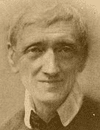
J.H. Newman reflects on the present state of the Christian Church compared to its primitive form, emphasizing the temptation to dismiss ancient principles as theoretical and impractical. Drawing parallels from the history of the Jewish Church, he highlights the importance of strict obedience to God's commands despite societal norms. Newman urges believers to look to Jesus and the Apostles as examples of unwavering obedience and emphasizes the need to maintain the discipline and teachings of the early Church, including the Apostolical Succession. He warns against neglecting practices like regular communion, stressing the significance of following God's will diligently to avoid spiritual decline.
Text
When we look around upon the present state of the Christian Church, and then turning to ecclesiastical history acquaint ourselves with its primitive form and condition, the difference between them so strongly acts upon the imagination, that we are tempted to think, that to vase our conduct now on the principle acknowledged then, is but theoretical and idle. We seem to perceive, as clear as day, that as a Primitive Church had its own particular discipline and political character, so have we ours: and that to attempt to revive what is past, is as absurd as to seek to raise what is literally dead. Perhaps we even go on to maintain, that the constitution of the Church, as well as its actual course of acting, is different from what it was; that Episcopacy now is in no sense what it used to be; that our Bishops are the same as the Primitive Bishops only in name; and that the notion of an Apostolical Succession is "a fond thing." I do not wish to undervalue the temptation, which leads to this view of Church matters; it is the temptation of sight to overcome faith, and of course not a slight one.
But the following reflection on the history of the Jewish Church may perhaps be considered to throw light upon our present duties.
1. Consider how exact are the injunctions of Moses to his people. He ends them thus: "These are the words of the covenant which the LORD commanded Moses to make with the children of Israel in the land of Moab, beside the covenant which He made with them in Horeb.....Keep therefore the words of this covenant, and do them, that ye may prosper in all that ye do.....Neither with you only do I make this covenant and this oath; but with him that standeth here this day before the LORD our GOD, and also with him that is not here with us this day." Deut. xxix.
2. Next, survey the history of the chosen people for the several first centuries after taking possession of Canaan. The exactness of Moses was unavailing. Can a greater contrast be conceived than the commands and promises of the Pentateuch, and the history of the Judges? "Every man did that which was right in his own eyes." Judges xvii. 6.
Samuel attempts a reformation on the basis of the Mosaic Law; but the effort ultimately fails, as being apparently against the stream of opinion and feeling then prevalent. The times do not allow of it. Again, contrast the opulent and luxurious age of Solomon, though the covenant was then openly acknowledged and outwardly accepted more fully than at any other time, with the vision of simple piety and plain straightforward obedience, which is the scope of the Mosaic Law. Lastly, contemplate the state of the Jews after their return from the captivity; when their external political relations were so new, the internal principle of their government so secular, GOD'S arm apparently so far removed. This state of things went on for centuries. Who would suppose that the Jewish Law was binding in all its primitive strictness at the age when CHRIST appeared? Who would not say that length of time had destroyed the obligation of a projected system, which had as yet never been realized?
Consider too the impossible nature (so to say) of some of its injunctions. An infidel historian somewhere asks scoffingly, whether "the ruinous law which require all the males of chosen people to go up to Jerusalem three times a-year, was every observed in its strictness." The same question may be asked concerning the observance of the Sabbatical year;-to which but a faint allusion, if that, is made in the books of Scripture subsequent to the Pentateuch.
3. And now, with these thoughts before us, reflect upon our SAVIOUR'S conduct. He set about to fulfill the Law in its strictness, just as if He had lived in the generation next to Moses. The practice of others, the course of the world, was nothing to Him; He received and He obeyed. It is not necessary to draw out the evidence of this in detail. Consider merely His emphatic words in the beginning of Matth. xxiii. concerning those, whom as individuals He was fearfully condemning. "The Scribes and Pharisees sit in Moses' seat; all therefore whatsoever they bid you observe, that observe and do."-Again reflect upon the praise bestowed upon Zacharias and his wife, that "they were both righteous before GOD, walking in all the commandments and ordinances of the LORD blameless."-And upon the conduct of the Apostles.
Surely these remarkable facts impress upon us the necessity of going to the Apostles, and not to the teachers and oracles of the present world, for the knowledge of our duty, as individuals and as members of the Christian Church. It is no argument against a practice being right, that it is neglected; rather, we are warned against going the broad way of the multitude of men.
Nor is there any doubt in our minds, as to the feelings of the Primitive Church regarding the doctrine of the Apostolical Succession? Did not the Apostles observe, even in an age of miracles, the ceremony of the Imposition of Hands? And are not we bound, not merely to acquiesce in, but zealously to maintain and inculcate the discipline which they established?
The only objection, which can be made to this view of our duty is, that the injunction to obey strictly is not precisely given to us, as it was in the instance of the Mosaic Law. But is not the real state of the case merely this; that the Gospel appeals rather to our love and faith, our divinely illumined reason, and the free principle of obedience, than to the mere letter of its injunctions? And does not the conduct of the Jews just prove to us that, though the commands of CHRIST were put before us ever so precisely, yet there would not be found in any extended course of history a more exact attention to them, than there is now; that the difficulty of resisting the influence, which the world's actual proceedings exert upon our imagination, would be just as great as we find it at present?
A SIN OF THE CHURCH.
Remember from whence thou art fallen, and repent, and do thy first works; or else I will come unto thee quickly, and will remove thy candlestick out of his place, except thou repent.
The following extract is from Bingham, Antiq. xv. 9.
In the primitive ages, it was both the rule and practice of all in general, both Clergy and Laity, to receive the Communion every Lord's day...... As often as they had met together for Divine Service on the Lord's day, they were obliged to receive the Eucharist under pain of Excommunication.....And if we run over the whole history of the three first ages, we shall find this to have been the Church's constant practice....We are assured farther, that in some places they received the communion every day.
Is there any one who will deny, that the Primitive Church is the best expounder of our SAVIOUR'S will as conveyed through his Apostles?
Can a learned Church, such as the English, plead ignorance of His will this ascertained?
Do we fulfil it?
Is not the regret and concern of pious and learned writers among us, such as Bingham, at our neglect of it, upon record?
And is it not written, "THAT SERVANT WHICH KNEW HIS LORD'S WILL, AND PREPARED NOT HIMSELF, NEITHER DID ACCORDING TO HIS WILL, SHALL BE BEATEN WITH MANY STRIPES?"
And, putting aside this disobedience, can we wonder, that faith and love wax cold, when we so seldom partake of the MEANS, mercifully vouchsafed us, of communion with our LORD and SAVIOUR?
Sermon Outline
- The Primitive Church and its Obligation
- The Conduct of Our Saviour
- The Discipline of the Primitive Church
- A Sin of the Church
- The neglect of the Primitive Church's practice of receiving the Communion regularly
- The regret and concern of pious and learned writers at our neglect of this practice
Key Quotes
“The Scribes and Pharisees sit in Moses' seat; all therefore whatsoever they bid you observe, that observe and do.” — J.H. Newman
“Remember from whence thou art fallen, and repent, and do thy first works; or else I will come unto thee quickly, and will remove thy candlestick out of his place, except thou repent.” — J.H. Newman
“THAT SERVANT WHICH KNEW HIS LORD'S WILL, AND PREPARED NOT HIMSELF, NEITHER DID ACCORDING TO HIS WILL, SHALL BE BEATEN WITH MANY STRIPES?” — J.H. Newman
Application Points
- We must go to the Apostles for guidance, rather than the teachers of the present world.
- We are bound to maintain and inculcate the discipline established by the Apostles.
- We must repent and return to the practice of receiving the Communion regularly, in order to fulfill the will of our Lord and Saviour.