
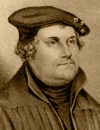
Small Catechism
Martin Luther's Small Catechism is a comprehensive guide to the Christian faith, covering the Ten Commandments, the Creed, the Lord's Prayer, Holy Baptism, Confession, and the Sacrament of the Altar.
Martin Luther presents Luther's Little Instruction Book, also known as The Small Catechism, which outlines the importance of understanding and following the Ten Commandments, the Creed, the Lord's Prayer, Holy Baptism, Confession, and the Sacrament of the Altar. Luther emphasizes the significance of fearing, loving, and trusting God above all else, seeking forgiveness, and living a righteous life in accordance with God's Word. He stresses the power of God's grace, the necessity of repentance, and the assurance of salvation through faith in Jesus Christ.
Text
Luther's Little Instruction Book
(The Small Catechism of Martin Luther)
I. The Ten Commandments: The Simple Way a Father Should Present
Them to His Household
A. The First Commandment
You must not have other gods.
Q. What does this mean?
A. We must fear, love, and trust God more than anything else.
B. The Second Commandment
You must not misuse your God's name.
Q. What does this mean?
A. We must fear and love God, so that we will not use His name
to curse, swear, cast a spell, lie or deceive, but will use it to
call upon Him, pray to Him, praise Him and thank Him in all times
of trouble.
C. The Third Commandment
You must keep the Sabbath holy.
Q. What does this mean?
A. We must fear and love God, so that we will not look down on
preaching or God's Word, but consider it holy, listen to it
willingly, and learn it.
D. The Fourth Commandment
You must honor your father and mother. [So that things will go
well for you and you will live long on earth].
Q. What does this mean?
A. We must fear and love God, so that we will neither look down
on our parents or superiors nor irritate them, but will honor
them, serve them, obey them, love them and value them.
E. The Fifth Commandment
You must not kill.
Q. What does this mean?
A. We must fear and love God, so that we will neither harm nor
hurt our neighbor's body, but help him and care for him when he is
ill.
F. The Sixth Commandment
You must not commit adultery.
Q. What does this mean?
A. We must fear and love God, so that our words and actions
will be clean and decent and so that everyone will love and honor
their spouses.
G. The Seventh Commandment
You must not steal.
Q. What does this mean?
A. We must fear and love God, so that we will neither take our
neighbor's money or property, nor acquire it by fraud or by
selling him poorly made products, but will help him improve and
protect his property and career.
H. The Eighth Commandment
You must not tell lies about your neighbor.
Q. What does this mean?
A. We must fear and love God, so that we will not deceive by
lying, betraying, slandering or ruining our neighbor's reputation,
but will defend him, say good things about him, and see the best
side of everything he does.
I. The Ninth Commandment
You must not desire your neighbor's house.
Q. What does this mean?
A. We must fear and love God, so that we will not attempt to
trick our neighbor out of his inheritance or house, take it by
pretending to have a right to it, etc. but help him to keep &
improve it.
J. The Tenth Commandment
You must not desire your neighbor's wife, servant, maid, animals
or anything that belongs to him.
Q. What does this mean?
A. We must fear and love God, so that we will not release his
cattle, take his employees from him or seduce his wife, but urge
they to stay and do what they ought to do.
K. The Conclusion to the Commandments
Q. What does God say to us about all these commandments?
A. This is what He says:
``I am the Lord Your God. I am a jealous God. I plague the
grandchildren and great-grandchildren of those who hate me with
their ancestor's sin. But I make whole those who love me for a
thousand generations.''
Q. What does it mean?
A. God threatens to punish everyone who breaks these commandments.
We should be afraid of His anger because of this and not violate
such commandments. But He promises grace and all good things to
those who keep such commandments. Because of this, we, too, should
love Him, trust Him, and willingly do what His commandments
require.
Part Two: The Creed
The Creed: The Simple Way a Father Should Present it to His Household
I. The First Article: On Creation
I believe in God the Almighty Father, Creator of Heaven and Earth.
Q. What does this mean?
A. I believe that God created me, along with all creatures. He gave to
me: body and soul, eyes, ears and all the other parts of my body,
my mind and all my senses and preserves them as well. He gives me
clothing and shoes, food and drink, house and land, wife and
children, fields, animals and all I own. Every day He abundantly
provides everything I need to nourish this body and life. He
protects me against all danger, shields and defends me from all
evil. He does all this because of His pure, fatherly and divine
goodness and His mercy, not because I've earned it or desrved it.
For all of this, I must thank Him, praise Him, serve Him and obey
Him. Yes, this is true!
II. The Second Article: On Redemption
And in Jesus Christ, His only Son, our Lord, Who was conceived by the
Holy Spirit, born of the Virgin Mary, suffered under Pontius Pilate,
was crucified, died and was buried, descended to Hell, on the third
day rose again from the dead, ascended to Heaven and sat down at the
right hand of God the Almighty Father. From there He will come to
judge the living and the dead.
Q. What does this mean?
A. I believe that Jesus Christ is truly God, born of the Father in
eternity and also truly man, born of the Virgin Mary. He is my
Lord! He redeemed me, a lost and condemned person, bought and won
me from all sins, death and the authority of the Devil. It did not
cost Him gold or silver, but His holy, precious blood, His innocent
body -- His death! Because of this, I am His very own, will live
under Him in His kingdom and serve Him righteously, innocently and
blessedly forever, just as He is risen from death, lives and reigns
forever. Yes, this is true.
III. The Third Article: On Becoming Holy
I believe in the Holy Spirit, the holy Christian Church, the community
of the saints, the forgiveness of sins, the resurrection of the body,
and an everlasting life. Amen.
Q. What does this mean?
A. I believe that I cannot come to my Lord Jesus Christ by my own
intellegence or power. But the Holy Spirit call me by the Gospel,
enlightened me with His gifts, made me holy and kept me in the true
faith, just as He calls, gathers together, enlightens and makes holy
the whole Church on earth and keeps it with Jesus in the one, true
faith. In this Church, He generously forgives each day every sin
committed by me and by every believer. On the last day, He will raise
me and all the dead from the grave. He will give eternal life to me
and to all who believe in Christ. Yes, this is true!
Part Three: The Lord's Prayer
The Our Father
The Simple Way a Father Should Present it to His Household
I. Introduction
Our Father, Who is in Heaven.
Q. What does this mean?
A. In this introduction, God invites us to believe that He is our real
Father and we are His real children, so that we will pray with
trust and complete confidence, in the same way beloved children
approach their beloved Father with their requests.
II. The First Request
May Your name be holy.
Q. What does this mean?
A. Of course, God's name is holy in and of itself, but by this
request, we pray that He will make it holy among us, too.
Q. How does this take place?
A. When God's Word is taught clearly and purely, and when we live holy
lives as God's children based upon it. Help us, Heavenly Father,
to do this! But anyone who teaches and lives by something other
than God's Word defiles God's name among us. Protect us from this,
Heavenly Father!
III. The Second Request
Your Kingdom come.
Q. What does this mean?
A. Truly God's Kingdom comes by itself, without our prayer. But we
pray in this request that it come to us as well.
Q. How does this happen?
A. When the Heavenly Father gives us His Holy Spirit, so that we
believe His holy Word by His grace and live godly lives here in
this age and there in eternal life.
IV. The Third Request
May Your will be accomplished, as it is Heaven, so may it be on Earth.
Q. What does this mean?
A. Truly, God's good and gracious will is accomplished without our
prayer. But we pray in this request that is be accomplished among
us as well.
Q. How does this happen?
A. When God destroys and interferes with every evil will and all evil
advice, which will not allow God's Kingdom to come, such as the
Devil's will, the world's will and will of our bodily desires. It
also happens when God strengthens us by faith and by His Word and
keeps living by them faithfully until the end of our lives. This
is His will, good and full of grace.
V. The Fourth Request
Give us our daily bread today.
Q. What does this mean?
A. Truly, God gives daily bread to evil people, even without our
prayer. But we pray in this request that He will help us realize
this and receive our daily bread with thanksgiving.
Q. What does ``Daily Bread'' mean?
A. Everything that nourishes our body and meets its needs, such as:
Food, drink, clothing, shoes, house, yard, fields, cattle, money,
possessions, a devout spouse, devout children, devout employees,
devout and faithful rulers, good government, good weather, peace,
health, discipline, honor, good friends, faithful neighbors and
other things like these.
VI. The Fifth Request
And forgive our guilt, as we forgive those guilty of sinning against
us.
Q. What does this mean?
A. We pray in this request that our Heavenly Father will neither pay
attention to our sins nor refuse requests such as these because of our
sins and because we are neither worthy nor deserve the things for
which we pray. Yet He wants to give them all to us by His grace,
because many times each day we sin and truly deserve only punishment.
Because God does this, we will, of course, want to forgive from our
hearts and willingly do good to those who sin against us.
VII. The Sixth Request
And lead us not into temptation.
Q. What does this mean?
A. God tempts no one, of course, but we pray in this request that God
will protect us and save us, so that the Devil, the world and our
bodily desires will neither deceive us nor seduce us into heresy,
despair or other serious shame or vice, and so that we will win and
be victorious in the end, even if they attack us.
VIII. The Seventh Request
But set us free from the Evil One.
Q. What does this mean?
A. We pray in this request, as a summary, that our Father in Heaven
will save us from every kind of evil that threatens body, soul,
property and honor. We pray that when at last our final hour has
come, He will grant us a blessed death, and, in His grace, bring us
to Himself from this valley of tears.
IX. Amen.
Q. What does this mean?
A. That I should be certain that such prayers are acceptable to the
Father in Heaven and will be granted, that He Himself has commanded
us to pray in this way and that He promises to answer us. Amen.
Amen. This means: Yes, yes it will happen this way.
Part Four: Holy Baptism
The Sacrament of Holy Baptism:
The Simple Way a Father Should Present it to His Household
I. Q. What is Baptism?
A. Baptism is not just plain water, but it is water contained
within God's command and united with God's Word.
Q. Which Word of God is this?
A. The one which our Lord Christ spoke in the last chapter of
Matthew:
``Go into all the world, teaching all heathen nations, and
baptizing them in the name of the Father, the Son and of the
Holy Spirit.''
II. Q. What does Baptism give? What good is it?
A. It gives the forgiveness of sins, redeems from death and the
Devil, gives eternal salvation to all who believe this, just
as God's words and promises declare.
Q. What are these words and promises of God?
A. Our Lord Christ spoke one of them in the last chapter of Mark:
``Whoever believes and is baptized will be saved; but whoever
does not believe will be damned.''
III. Q. How can water do such great things?
A. Water doesn't make these things happen, of course. It is God's
Word, which is with and in the water. Because, without God's
Word, the water is plain water and not baptism. But with God's
Word it is a Baptism, a grace-filled water of life, a bath of
new birth in the Holy Spirit, as St. Paul said to Titus in the
third chapter:
``Through this bath of rebirth and renewal of the Holy Spirit,
which He poured out on us abundantly through Jesus Christ, our
Savior, that we, justified by the same grace are made heirs
according to the hope of eternal life. This is a faithful
saying.''
IV. Q. What is the meaning of such a water Baptism?
A. It means that the old Adam in us should be drowned by daily
sorrow and repentance, and die with all sins and evil lusts,
and, in turn, a new person daily come forth and rise from
death again. He will live forever before God in righteousness
and purity.
Q. Where is this written?
A. St. Paul says to the Romans in chapter six:
``We are buried with Christ through Baptism into death, so
that, in the same way Christ is risen from the dead by the
glory of the Father, thus also must we walk in a new life.''
Part Five: Confession
How One Should Teach the Uneducated to Confess
I. Q. What is confession?
A. Confession has two parts:
First, a person admits his sin
Second, a person receives absolution or forgiveness from the
confessor, as if from God Himself, without doubting it, but
believing firmly that his sins are forgiven by God in Heaven
through it.
II. Q. Which sins should people confess?
A. When speaking to God, we should plead guilty to all sins, even
those we don't know about, just as we do in the ``Our
Father,'' but when speaking to the confessor, only the sins we
know about, which we know about and feel in our hearts.
Q. Which are these?
A. Consider here your place in life according to the Ten
Commandments. Are you a father? A mother? A son? A daughter?
A husband? A wife? A servant? Are you disobedient, unfaithful
or lazy? Have you hurt anyone with your words or actions? Have
you stolen, neglected your duty, let things go or injured
someone?
Part Six: The Sacrament of the Altar
The Sacrament of the Altar:
The Simple Way a Father Should Present it to his Household
I. Q. What is the Sacrament of the Altar?
A. It is the true body and blood of our Lord Jesus Christ under
bread and wine for us Christians to eat and to drink,
established by Christ Himself.
II. Q. Where is that written?
A. The holy apostles Matthew, Mark and Luke and St. Paul
write this:
``Our Lord Jesus Christ, in the night on which He was
betrayed, took bread, gave thanks, broke it, gave it to His
disciples and said: ``Take! Eat! This is My body, which is
given for you. Do this to remember Me!'' In the same way He
also took the cup after supper, gave thanks, gave it to
them, and said: ``Take and drink from it, all of you! This
cup is the New Testament in my blood, which is shed for you
to forgive sins. This do, as often as you drink it, to
remember Me!''
III. Q. What good does this eating and drinking do?
A. These words tell us: ``Given for you'' and ``Shed for you to
forgive sins.'' Namely, that the forgiveness of sins, life and
salvation are given to us through these words in the
sacrament. Because, where sins are forgiven, there is life and
salvation as well.
IV. Q. How can physical eating and drinking do such great things?
A. Of course, eating and drinking do not do these things. These
words, written here, do them: ``given for you'' and ``shed for
you to forgive sins.'' These words, along with physical eating
and drinking are the important part of the sacrament. Anyone
who believes these words has what they say and what they
record, namely, the forgiveness of sins.
V. Q. Who, then, receives such a sacrament in a worthy way?
A. Of course, fasting and other physical preparations are
excellent disciplines for the body. But anyone who believes
these words, ``Given for you,'' and ``Shed for you to forgive
sins,'' is really worthy and well prepared. But whoever
doubts or does not believe these words is not worthy and is
unprepared, because the words, ``for you'' demand a heart that
fully believes.
Morning Prayer
My Heavenly Father, I thank You, through Jesus Christ, Your
beloved Son, that You kept me safe from all evil and danger last
night. Save me, I pray, today as well, from every evil and sin, so
that all I do and the way that I live will please you. I put
myself in your care, body and soul and all that I have. Let Your
holy Angels be with me, so that the evil enemy will not gain power
over me. Amen.
Evening Prayer
My Heavenly Father, I thank You, through Jesus Christ, Your
beloved Son, that You have protected me, by Your grace. Forgive, I
pray, all my sins and the evil I have done. Protect me, by Your
grace, tonight. I put myself in your care, body and soul and all
that I have. Let Your holy angels be with me, so that the evil
enemy will not gain power over me. Amen.
Sermon Outline
- 'The Ninth Commandment: You must not desire your neighbor''s house'
- 'The First Commandment: You must not have other gods'
- 'The Second Commandment: You must not misuse your God''s name'
- 'The Third Commandment: You must keep the Sabbath holy'
- 'The Fourth Commandment: You must honor your father and mother'
- 'The Fifth Commandment: You must not kill'
- 'The Sixth Commandment: You must not commit adultery'
- 'The Seventh Commandment: You must not steal'
- 'The Eighth Commandment: You must not tell lies about your neighbor'
- 'The Tenth Commandment: You must not desire your neighbor''s wife, servant, maid, animals or anything that belongs to him'
Key Quotes
“I am the Lord Your God. I am a jealous God. I plague the grandchildren and great-grandchildren of those who hate me with their ancestor's sin. But I make whole those who love me for a thousand generations.” — Martin Luther
“I believe that Jesus Christ is truly God, born of the Father in eternity and also truly man, born of the Virgin Mary.” — Martin Luther
“I believe that I cannot come to my Lord Jesus Christ by my own intelligence or power. But the Holy Spirit calls me by the Gospel, enlightens me with His gifts, made me holy and kept me in the true faith,” — Martin Luther
Application Points
- We must fear, love, and trust God more than anything else.
- We must live holy lives as God's children based on His Word.
- We must forgive those who sin against us, just as God forgives us.