
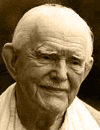
He Preached Victory, His Wife Wept
Norman Grubb reveals that true Christian victory comes from understanding that God is love and power, and that self must be rightly understood and placed in relationship to Christ who is the source of all grace and strength.
In this deeply personal and insightful sermon, Norman Grubb shares his journey from a young missionary struggling with inadequacy to a profound revelation of God's nature as love and power. He challenges believers to rethink their understanding of self and to embrace a Christ-centered life where victory is found not in self-improvement but in recognizing Christ as the source of all grace. Drawing from his missionary experiences and Scripture, Grubb offers a transformative perspective on Christian living that calls for faith, love, and power flowing from God alone.
Full Transcript
Regarding ourselves as a section of the living Church of Christ these days, He lives in all of us, and He can speak by any of us. Therefore, these sessions are not meant to be sessions when merely one man speaks and you all boil inside and don't like to say what you really think. They're meant to be times when you also can participate if you wish to participate.
So shall we all stand fast in the liberty wherewith Christ has made us free, and if any folks fear whether I'd like to ask a question on that point, I'd like to touch a little further on that point, all right? Very often it's that side word which is the most important of all. As you find in the Bible again and again, it's a side incidental word which is of greatest likeness. Therefore, let us these days get the sense that we're a company of the Spirit.
Not one or two having the Spirit to minister to others, but the Spirit ministering by all to all. Let us in that way flow together in fellowship, both in the meetings and out of the meetings. And many a time maybe we may get together in groups when we're sitting outside to carry on conversation about some point we want to emphasize, something in our own lives which can illustrate what's being said.
For that reason, I also don't like these illicit titles to which I have no right. I'm neither doctor, reverend, mister, anything. I'm just normal and the poor people in the Bible haven't even got two names.
They were just Peter, Paul, and Andrew. So I've only got one name, that's Norman. Don't see why I should be better than the Bible anyhow.
I fear at first, as I think I already observe, many of you will be thinking that I talk a strange language. The trouble is you spent 150 years or so changing the language and I can't catch up with you. It's my fault.
So it takes a little getting used to. I've only lived over here and been very happy in doing so for two years. So if you'll be patient and can continue along with us, it'll be a little more intelligible as time goes on, I hope.
Now, each of us can only share what we're given and in the way in which it is given. I've never been given to be a pastor. I've never had a church in a normal sense all my life.
I've never been to a seminary or a Bible school. I've had no background trainings of those kinds. God bless those who have, they just haven't come my way.
So I'm not speaking to you as one who has the privilege of being trained to speak. I can only speak according to the measure of faith and the gift of God as it is given to each of us. And the way God gave his gift to me was to call me from early days to be what was in those days a pioneer missionary.
I was a young soldier in World War I in the British Army, having been saved by grace just before the war, and being a witness for Jesus Christ in the army. And then I got the call to the Pioneer Mission field, and I had a period of just secular college training, and then went out in 1919. I was one of those who had the privilege, Father Ecker in our brother's prayer just now, but he's praying about those who penetrated these remote areas.
I had that great privilege of going where Christ had not been named, right into the exact center of Africa, into the forest which had first been discovered by the American explorer Stanley, but it never been entered and of course evangelized. It's a very different picture now, thank God. So my approach to the Christian ministry, if you can call it such, was of the very simplest kind, because I was dealing with the simplest people.
I'm not talking of missionary affairs, not that they aren't of tremendous interest and tremendous importance these days, but they aren't basic to our aim in these meetings, except in the way they may come in incidentally or perhaps towards the end. I'm rather seeking to share the way God has talked to me, led me, dealt with me, in and through that missionary ministry, even from early days in the mission field. I had a dissatisfaction of anything which would be or remain superficial.
Africans, anyhow primitive Africans, respond very easily to the gospel message, but we soon found that profession is different to possession, and I began to get deeply concerned. Is there a gospel? Is there a reality which can do the same kind of things in these very primitive African peoples, as I was trusting was being done in myself? Paul speaks of presenting every man perfect in Christ Jesus. Towards the end of the first chapter of the letter to the Colossians, that's the original aphristotic New Testament stanza.
What could that mean for this ministry to which I was called? What could it mean to myself? Had I got my own knots untied before I started untying other people's? And then as years gone by, I only actually remained on the high mission field ten years, up to 1931. And after that I was asked to come home to take on in the developing end of the mission to which we're called, which is worldwide, and I've been occupied to that end of the work ever since. And that of course has brought me into contact with many young lives.
We have about over 800 in the whole work now, it's carried all around the world. And so I then began to get an increasing concern about what those had who were passing through my hands as they were to go out, the younger generation, to Indonesia and India and Africa and Latin America and so forth. So in that sense I became an investigator.
And I trust an applicator, if there's such a word, of what one found to oneself. And it's really those investigations, discoveries, I trust applications, that I'm wanting to share with you these days. So again I want to make it plain that this is really not just like one set address and then another set address on another occasion.
It's those like those stories in serial magazines be continued in our next. They just go from one to the other. And those who can stay along with us can get more of the composite hold of what is on my heart to share, will understand better than those who can only come for one or two sessions, although one trusts the Spirit of God has something through every session.
But it is in that sense a just a continued talking together, examining together of the secret of life. I base all I say on the authority of the Scriptures, God's written word. Even the Scriptures could be a snare unless a letter introduces to the Spirit, because the letter can kill, whereas the Spirit gives life.
And the written word is only a means to the living word. But it is the means by which we are introduced to Him, the authority by which we shall find Him. So that is my source of authority in all I say.
If you have Bibles with you, and you care to follow just as you like, there is a quality in God's written word which sometimes kind of gets something to us which other just talks of men don't. But that's just as you like, but I shall often be referring to quoting from, reading from the Scriptures. Now I want to start off tonight, not intending to be too long, being the first night, with what I believe is the profoundest discovery, the profoundest revelation, which ever has been made to man, ever had to be made to man, ever could be made to man, because there's no profounder.
So we're starting right on the spot. And it has to be a revelation, because we are a deluded people. We live under a vast illusion, misunderstanding.
So it has to be a revelation. The problem we humans have and when this problem is solved, basically all our problems are solved, is the right understanding and right use of ourselves. The right understanding of self and its right use and right place.
That's the basic problem. Our difficulties are the misunderstanding and the misuse and the misrepresentation and misplacing of self. So we've got to discover where we have a misunderstanding concerning self, and then we've got to replace it by a true understanding of self.
And then we've got to discover where self fits into the whole picture. Then we fit into life. But by some way or other, down in the real experiences of life, I think I am truly saying God has got to take us all the hard way, because I don't think by any other way we can really have our illusions dissolved.
That's why the hard ways of life are the blessings of life. The prosperities of life are the dangers of life, the adversities are the blessings. Count your many adversities, name them one by one, and it will surprise you what the Lord has done.
That's the new version of the hymn. Very well. God had to take every one of his servants the hard way, and there was a supremist foundational blessing, whether it was Moses or Abraham or Jacob or Elijah or Jesus himself or Paul or Peter or any of them.
Right to history. Because they had to learn right down at the wharf of wolf experience what self is not and what self is. Then they found their key.
They had to find what self is not before they could find what self is. We can only share as we are given to see or as we're given to understand in other men's lives. Now the way I basically learned that lesson, and thank God it was revolutionary to me, a very big surprise, was when I was a young missionary.
That means I'd already gone through the early experiences of the operations of the grace of God in my life, or I shouldn't have been a missionary. Although unfortunately you can even have unregenerate missionaries. I'm sorry to say, but that isn't the normal standard for a missionary.
As I told you, I'd been brought to discover myself or to see myself as I am in or was in God's sight, a sinner needing a saviour when I was 19 years of age. Jesus had become my saviour and I went through phases of separation from the world in the elementary sense and became a zealous witness for Christ and the sole winner. And as I told you, I got a call.
So I'd been through those preliminary phases of God's dealings and arrived on the mission field. And there I got this basic revelation concerning self, his relationship to God. He came to me in this way.
He would not come to you in this way, although of course the principles behind are the same in every case. I very soon found I hadn't got what it took for my job. That's a very healthy experience we all have in different ways.
We haven't got what it takes to live the life we ought to live. And I found I hadn't. Of course I was conserved, well mainly conserved for ministry at that time.
I found when I arrived I hadn't got what I needed to be representative of Jesus Christ to these primitive people. Very supremely I hadn't got this love. If you have a kind of sentimental love six thousand miles away from people, no other thing to live with.
And I hadn't got, recognized I hadn't got this love which could flow over into, make the bridge between myself and the people to my God. So I needed love. And with that, I very soon found I needed other impartations of the grace of God.
Power. Again, any earnest follower of Jesus Christ finds that need. Probably all of us in our lives know that.
Need of power. I hadn't the sense of power that God could really do what I come that he should do in this corner. So I needed power.
Basically I needed faith. I don't mean the hidden mis-faith, which can believe everything today and nothing tomorrow. But the faith which believes everything every day, that one.
I hadn't got that one. Indeed, I don't think, I don't think I did believe, I didn't, of course, pretty obvious I didn't really believe that again that God would do what he sent me to do. Um, I remember how those, uh, needs stood out.
Um, before me. They did have a reflex action on my life. Most missionaries would tell you this.
Sometimes attitudes and habits which don't need to bother you too much at home, uh, come on you in the racing field. I found myself very irritable. My wife knew it.
I even would preach victory to the Africans and go back and make my wife cry in the hut where we lived. I've got over that one since then, but I still have other things to get over still. Um, but, uh, it had this action, I suppose, reflex action of irritability and criticism.
You compensate, you avoid your own troubles by seeing in the other fellow, of course. Missionaries, only missionaries do that, nobody else. Um, and, um, so I was in this condition.
Now, that's a very good condition to be in. A condition of adversity, I tell you, not prosperity, but adversity, a condition of need. It wasn't the condition that I was in which was the problem, it was my attitude towards the condition which was the problem.
Now, this is where I had to get the re-re-education, re-orientation I have out there. My concept, and deep down, it's the concept of the vast majority of God's people. It sticks right out in, in a diminished part of our hymnology, in a vast amount of our preaching.
My concept of Christian living and Christian service was that I should be improved as a servant of Jesus Christ, that I should be improved. I needed it. That God would depart to me, set these graces of which I read in God's word, love, faith, power, holiness, and put them into me, and make me holier, and more powerful, and more loving, and more believing.
That I would become somebody who represented Jesus Christ better, did his job better. Now, you see the subtlety. You see that although basically it was true that Jesus Christ had become the centre of my life, basically it was true.
Because that's what it is to be regenerated, as we shall see as we dig further into these things. Yet, in actual practice, my concept now of the Christian life was, if I wasn't in the centre, I was much nearer it, that I must be improved. Jesus Christ would be to me a kind of appendage which improved me.
That was my point. Jesus Christ would be an assistant, an assistant to me, not I to him. I would have love put into me.
I'd have power put into me. I'd have those. Certainly they came from him, but I'd have them.
And I'd become a better, more worthy, more credible servant of Jesus Christ. In other words, although it isn't exactly true to say self was basically a centre, that isn't true to say, because Christ had taken that place, but somehow in my way of working it out, self was much nearer the centre, and it was the new self, not the old. Now you watch.
Our problem isn't the old self, it's a new one. Our problem isn't trying to do bad, it's trying to do good. That's our problem.
It's the world's problem, to a point. The world is both good and evil. It's so much a problem that it is the only problem you have.
Every single strain, stress, frustration, difficulty, burden, discomfort, doubt, fear you got, every single one is because you've given self a place to which it's not entitled. Every single one. Because you're taking upon yourself what you have no business taking upon yourself, which you had made to take upon yourself.
That's what I say. If we find a solution, an understanding of our illusory concept of self, and have that replaced by the true concept of what self is and where it fits into the picture, we've got our key. Now this was the illusory concept of self I had.
Oh, and it's young servant of Jesus Christ, that I was to be the one to be made so-and-so and so-and-so, and better, and all the rest of it, to be an adequate agent of Jesus Christ. Do you know what I found from the Bible? The Bible, in a few phrases, knocked my whole foundation clean from under me. Thank God it did.
It took a little time to sink in. It may take a little time to sink in to you too, if it hasn't already. Some of you have seen these things.
The way the Bible knocked my foundation from under me was by the simplest and most, we might say, most famous and shortest statement in the whole Bible, when John in his letter twice over says, God is love. Now you say out of those three words, two are important, and one is unimportant. You say God and love are important.
It is a little less important. That's the word that's hit me. It wasn't God, it wasn't love that hit me.
It is love that hit me. And what hit me was this. It doesn't say God has love, but God is love.
Well I said, and suddenly I said to myself, there's a very big difference there. If you have a thing, it isn't you, it's just an element of some kind, a thing you've got, like you might have a pocket full of cash. It just isn't you.
Something you've got in your pocket, you can share it. It isn't you. It's just something you've got, which you can share with others.
It's detached from you. But the Bible doesn't say that. The Bible says God is love.
I suddenly said to myself, then love isn't a thing at all, it's a person. God is love, then. The only eternal, pure, self-giving love that is in the universe is one person only.
God is love. That finishes love. In other words, there is no other love in the universe, the pure self-giving love, except one person.
God is that love, period. So I said to myself, it isn't the thing that can be imparted to be at all, it's the thing he is. He's grabbed the lot and struck to it.
I'm getting shaken now. You see, I thought I could have love. God said, you're copy-sick, you'll never have love through eternity, so forget it.
You'll never have one outer of love through eternity, so don't try and make out you can, because you won't. Because I've grabbed the lot, and that finishes it. I started by being love, I end by being love, and that finishes you.
Goodbye. That's all. God is love.
You know, when you get on the track of a thing, other statements which always were there begin to fit. And I soon began to find other statements which said exactly the same in other words. For instance, the next thing I so much need was power.
I found a verse in the first chapter of the first Corinthian letter, which says this, that Christ is the power of God and the wisdom of God. Christ is the power. Now Christ has the power.
Christ is the power. So the power is a person. The only power there is in the universe is one person.
You know, the marvel is, one of the greatest allies to Christianity today is science. When I was a young man, we used to think science was an enemy to Christianity. Today it's our greatest ally.
It's science which has discovered everything is power. Science has blown materialism to pieces. And science says, you would think that's a material thing.
Not at all. It's just pure power. It's nothing but power.
I'm science's famous equation, EqMC2, that energy, that matter is pure energy, which in revolution is now science, of course. Exactly. And it says, by him all things consist.
Exactly. Exactly. By him all things stand together.
He is pure power. Basically, he's everything. Basically.
Everything is simply a manifestation of him. Look at the wonderful things he is. Christ is the power.
But get my point again. I wasn't thinking in scientific terms then, not that people are doing so now, but we amateurs can pick up little things here and there. But what got me then was, see this, Christ is the power.
The power is a person. So it's not a thing you can have. It's not a thing at all.
It isn't an element that can kind of be piped into you when you have power. So he cut me off love and cut me off power. Poor me, what's left? What I'm saying, well, God can pick it up.
May not quite convey to you what it did to me, but as a genius you see something profound, disturbing, profoundly revolutionary. There's no power in the universe except one person. Not a thing, a person.
He is the power. He is the love. If he's the love, there's none for me.
That's all about it. I even went further and this shook me in a healthy way. We have dimly seen this, of course, but my problem is, as I say, is a dim sight.
As I say, we have, speaking to us as those who are related to Jesus Christ, of course we have found Jesus Christ, but we haven't got the exact relationship clarified. And our frustrations are because we haven't got it clarified, because there's a mix between self and Christ. We haven't got the two in their right proportions and their right relationships.
That's exactly what I'm getting at. In this next one, I was taken straight on to the very basis of our living, our new living. Our new living, of course, is eternal life.
The Bible never did speak of a thing called Christianity. That immediately produces a rival in your mind. The opposite comes.
Christianity? Well, what about Islam? What about Hinduism? What about Shintoism? What about Confucianism? Whatever you like. In a moment you'll call it a religion, but there are other religions, which is right. The Bible doesn't present religion, it presents life.
You know that. But life's all we've got, isn't it? All we've got is life. The Bible calls it eternal life, usually.
And, of course, you know what I'm going to come to. As a believing and receiving Christian, of course, I took for granted that I received eternal life, as I hope all of us have. The gift of God's eternal life, of Jesus Christ our Lord.
And in a vague sense, I suppose, of course, I related to Jesus Christ. In a vague sense, I suppose, I guided as a kind of permanent continuous of my life now in relationship to Christ. That I should go on living and living with Christ now, so on.
But you know what I found in the Bible. The Bible didn't say, Jesus didn't say, I have life. He says, I am life.
That was it. He didn't say, life's a thing I have and communicate to you. He says, the only eternal life that is in the universe is one person only, and that's Jesus Christ, which is God, of course.
There's no other eternal life. So you will never have eternal life. It's not yours.
It's not available to you. It's not attainable by you. That impossible person's taken the lot.
I am the life. He that hath the Son hath life. John in his first letter says, I'm going to talk to you about that eternal life, which is with the Father, manifest unto us, which we've seen, touched, handled, which is Jesus Christ.
Same thought. Well now, the obvious question which followed on was, well, where do we put people coming at all then? If we can't have life and can't have love and can't have power, what's left? What are we here for? Of course, again, you know the answer before I give it. But I had to be taken first to a segment yet more absolute than all that, before the answer came clear.
And that was in the letter to the Colossians. The Colossians have got a lot in about this. That's in the third chapter and the eleventh verse, where right at the end, it's just one phrase, at the end of the eleventh verse, he's speaking about the new people, the new creation, we ourselves, the new man, in whom there's neither Greek nor Jew, separation or unseparation, so on.
Then he says, but Christ is all and in all. Christ is all. Christ is all.
Now Christ has all. Christ is all. So all is a person.
This is getting rather confusing, isn't it? All is one person. Christ is all. Of course, he added one very important phrase, and in all.
That's why I put my link. But Christ is all. Not he makes Norman Glove something.
No, no, not that. The selfish person hasn't left one thing for me. He's taken a lot.
Not one. He doesn't make me something. He is something.
But he may be in some relation to me. That's a different thing. Some things are too strong.
May I ask, can anything be stronger than the Bible? I remember being struck by this on previous occasions, although, you know, things don't always tie up when you just see them. It comes several times over, but the famous phrase is in the 15th of 1 Corinthians, 15th chapter, 28th verse, where he speaks about the end time, the consummation of eternity. And it speaks about where all things subdued under Jesus Christ.
And then shall the Son also himself be subject unto him that put all things unto him that God may be all in all. If God's all in all, what's left, may I ask you? Even elementary mathematics doesn't last much, does it? If God's all, what's left? Poor us, not much. All in all.
That's all. God is all in all. Well, it's so extreme that we'd better be liberals and not believe it, I think.
The Bible has the most extreme things, doesn't it? It's a book of extremes, my goodness. Now you see what I'm getting at. A tremendous interior revolution, which is that the only meaning to the existence of the creature is to contain the Creator.
Not to become something, but to contain someone. So the only function of the creature is the function of containment. Every other function is secondary.
The function of the creature, in fact, is the function of all levels of creation. It's the function of capacity to contain. Capacity to contain.
That's the most passive that there is of all functions, the capacity to contain. All other functions are secondary. All other functions are derivatives of that.
Now that's where we've gone wrong. We've made secondary functions primary. We've made activity primary, not receptivity.
We've made receptivity, it has its place, but it's not basic, permanent, the one basic function. Activity, we rush off, I think this, I will that, I feel that, I resent that, what shall I do with that? Activity's first. We may call in God alongside, do a little receptivity, for convenience's sake, on the fly.
That's not the point. That's where we go wrong. I'm saying very strict, strong things, that the only reason for the existence of the creature is to contain the Creator.
Sermon Outline
-
I
- Introduction to the living Church and participation
- Norman's background and missionary calling
- The challenge of superficial profession versus true possession
-
II
- The foundational problem: misunderstanding self
- The necessity of adversity for spiritual growth
- The reorientation from self-improvement to Christ-centeredness
-
III
- Revelation that God is love, not just has love
- The implications of God being love for Christian living
- Christ as the source of power and wisdom
-
IV
- Personal struggles and growth in missionary service
- The importance of faith, love, and power from God
- Invitation to embrace the true concept of self in Christ
Key Quotes
“God is love. It doesn't say God has love, but God is love.” — Norman Grubb
“Every single strain, stress, frustration, difficulty, burden, discomfort, doubt, fear you got, every single one is because you've given self a place to which it's not entitled.” — Norman Grubb
“The problem we humans have and when this problem is solved, basically all our problems are solved, is the right understanding and right use of ourselves.” — Norman Grubb
Application Points
- Recognize and reject the illusion of self as the center of your spiritual life and embrace Christ as the true center.
- View adversities as opportunities for spiritual growth and deeper understanding of God's work in your life.
- Depend daily on the love, power, and faith that come from God rather than your own efforts.