
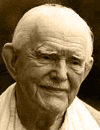
The Little Word That Undid Him
Norman Grubb teaches that true Christian life is not about self-improvement but about recognizing that God Himself lives and acts through us as one united person.
In this teaching sermon, Norman Grubb explores the profound biblical truth that the Christian life is not about self-improvement but about recognizing the unity between the believer and God. He reveals how God is not a giver of love or power as things but is love and power Himself, living through us. Grubb challenges common misconceptions about self-righteousness and self-development, inviting listeners to embrace their true identity in Christ and live naturally from that inward unity.
Full Transcript
Now we're continuing to dig in together to an understanding on the basis of the revelation of the word and the spirit, what a real person is, who am I, what a real person is. And we find that a real person is a human person, permanently aware of an inner unity, permanently aware of an inner unity, that you, I, are permanently one with Father, Son and Spirit, inwardly I know it, and I'm living from that inward fact as the basis of my living. So I'm living, a real human person, and yet I know it isn't really I, I've got a kind of permanent wink, it isn't I at all, it's He in me, He by me.
It's got to be something which is perfectly natural, spontaneous, normal, we can't live abnormal lives, we can't live put-on lives, we can't live lives where you try and get something. Life isn't getting, it's being, it isn't becoming, it's being. Being perfectly natural, this is true naturalness.
I appear just to be I, uh-uh, I'm not I. I'm a manifestation of the living person within me, Father, Son and Spirit, permanently joined to me, and I to Him in a unity. Just as branch and vine are one, just as head and body are one, which are the biblical illustrations. Now in order to know, um, how He and I fit in that unity, I have to know, uh, who I am and where I am and where I fit, because I am a permanent, eternally, to be a real person, really functioning.
It isn't I lose my personality, I, I, it's, I regain it to its full through eternity. So I've got to know how to be a real person, how to function as a real person for eternity, where I fit in this unity. Now we've had to go through certain, uh, processes of self-exposure, to find it, to find where we do fit.
The first, of course, we had to have exposed was our self-righteousness. We had to have that exposed as a false basis for life. Self-love, self-gratification, self-seeking, a basis of, of the satanic self.
The satanic is the self-righteous self. And the first step we took, took of the new birth, was the replacement of the self-righteous self by the Christ-righteous self. Replacing my, my false self-righteousness by His perfect righteousness.
So, when we receive Jesus Christ, we become in God's sight as if we never sinned. We are in God's sight as He is. The second false concept we have to remove after, after regeneration is our false idea of self-improvement.
Before we're saved, we have to discover the false self-righteousness. After we're saved, we've got to discover the false self-improvement. The wrong concept, which you picked up from, from before, that the independent man goes on becoming something.
Uh, you can't, you do become independent, uh, just yourself. Just yourself, that's all you can be. Uh, that's the danger of false psychology.
It can simply blow up, just yourself, just yourself. Now, what we have to learn, uh, relearn, as we said from the beginning, that there is in the universe only one person who is He, who is the I am, who is the self-giving one. The only one.
And the universe has infinite variety of means by which He manifests Himself. But He can't manifest Himself as a person through a thing, except in a very minor way. He manifests Himself as a person by persons.
So He has persons by whom He manifests Himself as a person. But, uh, only He is the self-giving one. The created persons by themselves can only be self-loving ones.
They can only be opposite to Him by themselves. Only when they're in the unity can they be expressions of their self-giving love. Without Him, they're just expressions of self-loving love.
So, what we have to learn is the human self is independent, can never be improved. It just is itself in response to what influences around it. It can never change.
Now, that's a radical, radical revelation. Because we built the idea that self should change. That we should improve.
You never improve. We've even got this kind of idea of building our own image. You can't build your own image.
All you can do is to accept yourself as yourself, and by yourself look at yourself as yourself, you simply have normal self-reactions. If you feel cold, you feel cold. If you feel hard, you feel hard.
If you feel unloving, you feel unloving. If you dislike a person, you dislike them. If you're worried, you're worried.
If you're depressed, you're depressed. If you're under the pull of lust, you're under the pull of lust. You can't change yourself.
You're wasting your time. Self never changes by itself. Self, apart from God, is only itself, and only responds as self does respond, following its own self-desires.
That's the reason there's that glorious great chapter in the Bible, in the process by which we recognize our union with God. It's put in Bible terms. Romans 6 is a chapter where in Christ's death we're cut off from the old indweller.
We've died in Christ to sin. Sin was the character of the old indweller, the spirit of sin, who motivates us to self-satisfaction. In Christ's death we're cut off from that.
In Christ's resurrection, the same self, represented in Christ, which is cut off from the old indweller, the same self receives a new indweller. It's just as the Jesus who died to sin, into that same body, which on our behalf separates the spirit of the bearer, receives in the resurrection the spirit of truth, his own spirit. That's why we said before, salvation for humanity is just change of God, not change of self.
It's just change of God, not change of self. Not change of vessel, change of the God in the vessel. You change from being a vessel to contain the God of wrath, through whom wrath comes, to the vessel who contains the God of the Lord Jesus Christ, who's the saviour of mercy, through whom mercy comes.
This doesn't change. It's this false idea we caught up in the fall of self-sufficiency, self-development, self-improvement. We got it from Satan.
Satan tried to be a thorny positive. He's only meant to be God's negative, and bear light. Instead of being God's negative, he tried to be his own light.
So Jesus said, if the light was within you, it's darkness. How great is that darkness? That's what Satan is. Now we caught that.
So we had to go through a new period of disillusionment after we saved. During that period, we got the idea, well, somehow I ought to be better. I'm a new person in Christ.
Now Christ said to me, he'll improve me. Surely I'll become patient and loving and powerful and pure and beautiful. You'll have to wait a long time, which you never will be.
Because you can't be. Because a vessel can't become what it contains, and a branch can't become a vine, and a body can't become a head. They fit together.
The body is the means by which the head expresses itself. The branch is the means by which the vine expresses itself. The cup is that which makes the living water available.
So this is, there's somewhere a crisis recognition there. There's a death there. There's a crisis recognition.
There's a crisis recognition when you discover your self-righteous self. You're lost. And then you're prepared that your great sin is your self-righteousness.
That's replaced by Christ and his righteousness. That was a crisis recognition. Crisis recognition is your guilt by which you could receive his righteousness.
It's a level of crisis recognition to come to see there's no such thing as human self-improvement. There's no such thing as human self-improvement. That you accept yourself as you are, and you'll never change.
All the men of the Bible went through a crisis when they sought by their own agency somehow that God would help them to do it. Moses sought God would help him to be the deliverer of Israel. And Abraham thought that somehow he by his physical body could produce a son.
The son of promise. And the disciples sought somehow by their dedication. Dedication isn't enough.
It's not my commitment to God does it? It's his commitment to me does it? That's the opposite way around. So my commitment, I never recommit myself. He's got me once for all.
What he's got he's grabbed, and poor me I'm caught. I recognize his commitment to me, not my commitment to him. That's no good.
So they had to learn their commitment, their dedication. It won't do. It still is somehow God will help me.
God won't help me. So all these men of the Bible had to go through the failing process as Christians. As dedicated to Christ.
I'm not talking about my own self-condition now. They had to crash again. Had to have great revelation.
Self isn't meant to change. Self is a container. You accept yourself as you are, and in yourself you just have normal self-responses.
So don't kick yourself around when you're fearful, or hurt, or worried, or feel cold, or feel tired. Don't kick yourself around and say, that's all I am. I can't be any different.
Now that's a pretty miserable condition if that's all you've got. If that's all you are, it's a pretty miserable condition. That's where the poor world is.
Many people in the world want to be better. And they can't make it work. They think, oh my God, maybe, but they don't become better.
And so they're fighting very against their hates, and their fears, and their lusts, and their depression. And they can't get out of them. They go to psychologists who can't help them.
Unless the psychologist can give them Christ. Because there's a new self. Not the human self improved, but another self in yourself.
If a psychologist gives you that, he gives you truth. But not all do. Thank God for some who do.
So I've got to have this second disillusionment. Then you're conditioned for the real reality. The real reality is, if you're redeemed, you're not yourself.
If you're a redeemed person, a unity has taken place within you, and you haven't discovered it yet. If you're a redeemed person, you received Jesus Christ, and he joined himself to you, and the Spirit witnessed to you, but because you couldn't take it at that time, all you took was he witnessed to you, and he forgave you, and cleansed you, and made you his child, and a child of God. He didn't witness to you through unity, because it was too far for you to take it.
You have to take unity until you know where you fit. So if you've got false ideas of yourself, you're not safe to take unity. You might misuse it.
It's only when you know where you fit that you don't improve. You're just the agency by which he expressed himself. But, get it clear, God must have a negative agency.
You don't lose yourself. Never talk about dying to self. Ridiculous.
God wants live selves, not dead selves. Never talk to us nonsense about dying to self. You die to the wrong concept of self.
Not to self, but to its wrong concept of self can be improved. Don't die to self. Die to its wrong concept.
To find the right concept of self, God must have a negative. A positive must have a negative. Light must have a non-light world to reflect its colour through.
I've told you this all the way through. You can't taste sweetness as far as I'm bitter. As I said to you last night, you can't go to bed in a soft mattress as far as I'm a hard bed set.
The thing only is real when it has its negative, which it utilises to manifest itself through. All life is that. You can't say yes without no.
You didn't come here just for saying yes. You came out here because you conquered five no's, that's why. Before you say yes, say no, I won't do this, I won't do that.
Yes, I'll do that. And your yes is only strong because you swallowed up five no's. You see, the positive always has a good belly full of negative, which it swallows up.
And that's why the Bible says, life swallows up death. Life doesn't destroy death. Life swallows up.
You can't know life except by contrast to death. Death's gone. It's disappeared.
It's swallowed up by life. Positive always swallows up negative. We're God's negative.
So we're essential to God. It essentially has a human self, but it's essential to understand how far the human self goes, which it doesn't improve. It doesn't become God.
It remains a self, and down here on earth it has negative reactions. Now, in the heavens, there won't be that. We should put out fear and jealousy and pride and hurt and lust.
It won't be there. So in that case, my negative self will just flow along with God's self as one, without the inner disturbance. But God wants disturbance.
Why? Disturbance is a trail of sin's face. If you didn't know the hard way, you'd know nothing. So you've got to be trained down here to be able to recognize Christ against appearances.
That's the value of appearances, to learn how to operate in the spirit against matter, and use matter as a means of expressing spirit. That's why it's so wrong to make so much of the body and healing. We're far too body-minded about healing.
What body and healing? We're spirit. What's body matter? Christ manifested through the body. What's a body? What's death? Nothing.
Death's finished. It's long ago. Life's such a tiny segment of eternity.
You've been alive about ten minutes when you think a thousand years is one day. Five minutes you've been alive, the whole world's only been about seven days alive. It's part of a vast eternity.
Don't kid yourself that death's nothing. It's going for a larger life. God is nothing.
If he's sick, what matters? He'll glorify Christ anyhow. Don't turn your mind on physical sickness. Turn your mind on spiritual healing.
I'm here because Christ lives in me. Christ has triumphed over me, whether by life or by death. Remember what Paul said? Christ magnified in me, whether by my body, whether by life or by death.
He didn't outrun death. He took it. As part of it, so you see, not to make too much of the human, except it's a necessary agency.
Now, as I say, when I can see it, I'm capable of seeing unity now because I know where I fit. So, of course, the truth isn't I'm just a poor... I'm not a poor. I'm a real human with real human reactions.
If that's all it is, that's a miserable business. Oh, no. I'm in unity.
I'm at the other end of Christ. Christ's the real person living here. And now my negative reactions become the opportunity by which he puts his positive self through.
I had learned that in Africa. I had a dedicated young missionary about God's grace. It cost me nothing to go and take Jesus to the Africans.
I loved the privilege of being able to take Jesus where he'd never been preached. That was a primitive day. It was 50 years ago.
We had to walk everywhere and all that kind of business and live in the African huts as they did it. But that made the real life, of course. And that was nothing.
But I deeply felt... I hadn't the love... I hadn't the love which identified myself with the people. I needed another quality of love. I needed faith that God could do something.
I needed power in something that was happening. I needed peace and love and deliverance from criticism of my fellow missionaries. I needed self-improvement.
I got the wrong idea. And I thought, well, here I'm a dedicated servant of Jesus Christ. Oh, sure.
God will improve me now. He put love into me. He put power into me.
He put peace and put holiness. I'm still waiting now. That's 50 years ago.
I can wait eternity because it can never happen. But I hadn't learned it then. I thought God could improve me and put love into me and power and peace.
I'd be something. Do you know what God said to me? One little word has changed my whole outlook and understanding. Simplest little word in the Bible.
He said, God is love. But when the Holy Spirit speaks to you, he speaks with the unexpected word. It wasn't the important word God or love that he spoke to me about.
It was the little word is. I suddenly saw something. I remember that time well enough.
I said, wait a minute. God is love. I've got it wrong.
I thought love was a thing God had. I thought God had love. It doesn't say God has love.
It says God is love. I thought love was a thing God had and put into me and I'd have love. When he suddenly said God is love, I stopped short.
I said, if God is love, love's a person. If God is love, love's not a thing at all. Love's a person.
That's the first startling concept I got of only one person in the universe. He doesn't give you a thing. He's just himself.
That's all he is. He doesn't give you love, give you peace. It isn't such things.
Giving love, giving peace, giving power. It isn't such things. He's the peace.
He's the power. He's the life. He's the all.
He lives his love life through you. He lives his power life through you. He is the power.
It doesn't make you powerful. I hadn't got that then. So when he stood, it was as if God stood in front of me and said, love isn't a thing I give you.
I am that love. My name always has been I am, not I have. So I said, well, yes, that's all right, but that doesn't help me.
What's the use of you saying you're love? I need the love. And then I needed power. And I found a scripture there, many scriptures like it, which says now Christ is the power of God.
Same thing. I thought power was something Christ had to put into atoms and put into people, a thing that came out from him. So Christ is the power.
I said that power is a person. If Christ is the power, the only power in the universe, especially atoms, only Christ in atomic form. Light's only Christ in light form.
There's only one power in the universe, one person expressed in different forms. I hadn't seen that then. And when I saw Christ is the power, it's as if Christ stood in front of me and said, power isn't a thing I give you.
I am that power. I said, how does that help me? I need the power. This all prepared me for something.
A little scripture, strictly at that time, really reminds my outlook. It's in Colossians 3 verse 11. It says this.
Now Christ is all. Christ is all. You don't believe that.
You believe it's Christ plus, plus, plus, plus, plus. Christ says, plus you. No, you're Christ, the human form.
That's all you are. It says, no, Christ plus, plus, plus. That's Christ only.
Christ is all. But I began to catch that. That wasn't the point.
It says this. Now Christ is all and in all. Oh, I said, I see it.
Christ is all and in all. I said, it isn't I, as a human, become something. I contain someone.
Christ is all and in all. And then I got that illustration, which is several times used in the New Testament, where we call vessels. That's a bit humiliating to be called just an old pot, but that's all you are.
You've got to discover you're a pot before you're a person. You've got to be a person, then cease being a person, become a pot, and then return to be a person later on. So you've got to go through a pot period before you get back to a person period.
And the idea of a pot, you see I've got it, a vessel. You see what I mean? A vessel doesn't become what it contains. A vessel's only function is to contain.
Now I saw it. It isn't that I, as a human, become loving, and become powerful, and become peaceful, and become pure. Oh, no.
I'm a human, and all those things can be pulled out to me in these directions. I just now become saying, well, I contain someone. Who is that? I contain someone.
A vessel contains something. I contain the living water. The vessel doesn't become the water.
I've got something again. I've got it. I began to see, then, that as I first accept myself again and again, you must accept yourself as a human, and you will never change.
Therefore, you don't kick yourself around when you feel cold, feel hard, a disliked person, worried, fearful, depressed, haven't got the power, haven't got the peace, don't love the Bible. Don't kick yourself around. Just say, I don't love the Bible.
I don't. I go to sleep and pray. I just say so.
Don't pretend to change. Don't try and change. Just accept what you are.
Now, when you do that, you've caught this business. Yes, but I'm the cup that contains the water. Or, if you like better, I'm the branch that contains the vine.
Now, you see, when I'm in that position, I don't shake myself. I say, yes, but you see, I contain the water. Or, if you like, I'm the branch that joins the vine.
The vine is here. Now, Christ is the life. Christ is the power.
Christ is the peace. Christ is the love. And I told you before, what controls you is what you believe in.
What you're believing in controls you. Now, while you believe you're hurt, you're held by your hurt. While you believe you're cold and hard and dull, you believe you're cold and hard and dull.
While you believe you're unloving, you believe you're unloving. Whatever your inner person, whatever you relate your inner self to, that holds you. And you contribute to it.
Now, alright, quite rightly, you are cold. You are hard. You are dull.
You are hurt. Alright, you believe that. That's a transfer of your faith.
Say, yes, as a human, that's so. But I'm no longer just a human. I'm joined to Christ.
My real humanity is joined to Jesus inside me. Christ is my life inside me. The real person is Christ within me.
Now, what do I do? By my inner self, I transfer my faith, my recognition, from the fact I'm hurt, I'm borrowed, I'm dull, I'm cold, I'm whatever you like. Sure I am. But I transfer my attitude from what I am in the human down here.
Say, I'm not really human. I'm really Christ in me. Christ, you're so and so.
Now, by the rule of faith, what you recognize and affirm becomes real to you. What you take, takes you. When you say, Christ, you're my peace.
Christ, you're the power. Christ, you're the peace. Christ, you're the purity.
Christ, you're the courage when I've got fear. You're the release when I've got worry. As you affirm Christ, what you take, takes you.
You find the awareness of Christ in taking on your worries, or his love, or his peace, or his power, flow, overflow. And you're conscious of Christ coming through you in peace, love, power, and so on and so forth. There's Christ magnified by you.
That's what the human is for. The human is in a permanent union with God, by which he has his negative, by which he expresses himself. He must have a human self.
But he must have a human self as a springboard by which the divine self expresses itself. Then the positive is expressed through the negative. Now, the important matter that follows on to that is this.
You live by an awareness. I mentioned this yesterday. You don't live by getting something and holding on to it and fighting for it.
You live by being. Being is easy. Life is easy.
When life isn't easy, you're off-beam. When I had to take on responsibility for the mission to which I belong 30 years ago, or over now, I had to take on responsibility, the Holy Spirit gave me one scripture. He said, Take my yoke upon you, yoke of service.
Learn of me, for I am meek and lowly of heart, for my yoke is easy and my burden is light. Well, that's a contradiction in terms. A yoke would be pulling a plough.
A yoke is pulling a plough. It's hard work. A burden is heavy to carry.
Yet here he says, Learn of me, my yoke is easy to pull, my burden is light to carry. Now, he says, Whenever you find your yoke difficult to pull, your burden heavy to carry, you're off-beam. Get on the beam again.
I don't mind being off-beam if I know where the beam is. Of course, the beam is, I'm not running this business. I'm not pulling that plough.
I'm an agency for which he's doing the pulling. I'm not carrying that burden. I'm just a human.
The burden appears on me. He's the burden bearer. It's on his shoulders.
So, you see, when I'm on the basis of self-reliance, self-improvement and so on, it's heavy and hard. When I say, No, no, no, no. That's not that.
That's that false concept gone. Myself is merely the agency in which he expresses himself then. Of course, the burden is light.
The yoke is easy. The burden is light. So, what I'm saying is this.
You can't be happy with a thing until it's part of you. You can't. You have to stop at getting a thing.
You people learn a profession. You're happy until it's got you. You're not happy if you're learning carpentry.
You're practicing how to use your tools and how to make a measurement. It's hard work. And you make mistakes and make slips.
You've got to go through it. The time comes when carpentry's got you. And you're happy as a carpenter.
I had to learn that over a year in learning a language. It was a missionary. When you start learning a language, Oh, for goodness sake, it goes in here and goes out there.
Oh, you'll never get this. It was a primitive language. We had to reduce it to writing.
There was no writing at all. We had to make the language then translate into it. I did the whole thing.
Well, nothing. I well remember beginning to get hold of it. Oh, nothing.
It was an easy language. Fortunately, I wasn't trying to get it. And after a few months, I suddenly thought I'd talked it.
Is it got me? I worked at it. Painful, hard work, getting at it, forgetting it, getting at it. Is it got me? Now I'm at home.
When a thing's got you, you're at ease and it's part of you. I went back to Africa 20 years after that. I got all that boost in it.
It was part of me. I could stop and talk to it now. It was easy to talk English.
It became part of me. So, you see, it's one thing getting something. It's another thing when it gets you.
Now, you see, this is what very easily salvation did for you. Thank God, easily, easily. You took Jesus.
No, Jesus took you. And you have precious young people praising Jesus last night. Jesus taken them.
It isn't they took him. I told you. When you took Jesus, you for the first step moved into spirit dimension, the real dimension.
God is eternal. He's eternal universal spirit. He's all.
All is there already. That's why Jesus could get greater than he liked when he liked because it's all there. And you began to move into reality when you leapt out of trusting things down here and trusting Jesus.
But that wasn't what got you. What got you was the principle of faith. What you take, takes you.
And like when you take food, it takes you. So when you took Jesus, that came into your spirit. Of course, it's taking you.
Now, you're at ease in it. If you're a saved person, you're at ease in being saved. You aren't anxious about it.
You're not trying to get saved. Not wondering if you are. Something happens which makes you happy.
Jesus has taken you. He does love you. You are a child of God.
So you see, you're not trying to get there. You become. You are being.
Life is easier as a being. Now, this is the fullness of life. The fullness of life is when the unity is equally true to you.
When you're as equally sure, certain, and know that you're one with Christ. Christ lives in you permanently as you're sure. He died for you and saved you.
Now, the whole Bible points to that being some form of second crisis. A second stage of faith. I should say, needn't be, because actually, he did unite himself to us when we got saved.
But very rarely do you know that. I'll give you the reason. You're not even safe from it because you've got a wrong idea of how you relate to him.
You've got to find out this right relationship yourself before you're safe in the relationship. So all the Bible points to, some say, when there's a second step of relating myself to a fact, the fact is, Christ is my life. Christ does live.
Christ is the real person living here. You've got to relate yourself to the facts of the Bible against any feelings or appearances. It may mean just something in your head.
You take it in your heart. And what you relate yourself to by law of faith relates itself to you. And you come at home to it.
I mean, a typical example of the Bible, of course, was that great Moses. He couldn't follow through because he was totally dedicated. When the point came, he hadn't the power.
You see, his concept was separation from God. Here, you see, he left the throne of Pharaohs, left everything to fulfill God's purpose. He saw the glory of being God's man and to redeem God's people out of Israel, Egypt, take them into the land and be in preparation for the world being blessed for the Savior.
He saw this and threw himself into this. But he still had this concept of separation. Here is Moses, and he was a very highly educated Moses.
And somehow God could do something by which he could be the deliverer. He hadn't got it. And when he moved off and began to do things to demonstrate he was the ruler and he got into trouble and murdered an Egyptian who was maltreating the Israelites and Pharaoh heard of it and sent his troops for him, Moses fled.
There was a gap. He hadn't got the power to be a deliverer. He had to go and hide.
It wasn't Pharaoh fled from Moses. It was Moses fled from Pharaoh at that time. He hadn't got it.
The reason he hadn't got it was because he hadn't got the humility. He thought to himself, here am I, servant of God. Here is God.
Somehow God will help me. God doesn't help people. Don't wish to have a mask of God to help you.
He will never help you. All he'll help you to be is to recognize you're just a silly human. That's all he'll help you to be.
He won't do a thing to help you. He'll help you to recognize you're just a human, but you'll recognize something else, which is he isn't human. Another point.
Now then, that's what happened to Moses. After 40 years, he saw a vision. If he hadn't been conditioned, he wouldn't see it.
You only see a vision if you're conditioned to it. He saw this curious bush which was burning in the wilderness, common wilderness bush, and it didn't go out. Why didn't it go out? He kept looking at it.
Why didn't it go out? If a thing burns, it goes out. As he drew near, a flame was coming out of the bush. A voice came from the flame.
The flame was God. The flame was God speaking. God said, take these shoes off your feet.
That's holy ground. He saw. He saw that God speaks through humans and burns up the human.
Your flesh, your self, becomes his fuel. He uses your fuel, your activities, your urges, to be the means by which he expresses himself. He expresses himself through you, and as he expresses himself through you, he refuels you as you keep going.
Ah, he saw the unity. He saw it was God, not Moses with God helping him. It was God, it was really God in Moses' form.
Moses was just a form by which God would express himself. Ah, he got it. He got the unity.
And then from then onwards, Moses could live in the fire. He went up Mount Sinai as part of that fire. Forty days up Mount Sinai in the fire.
The Israelites couldn't touch the fire. Because if you're still under self-fire, you can't touch God's fire. They won't meet.
So when you've still got the fire of self, I can't do things, you can't touch God's fire. They won't meet. You've got to discover that self-fire, the idea of self-improvement is a false thing.
You accept yourself. You are your real self, but you accept yourself just as the human agent, the negative agent. It isn't by your fires and energies.
You're just a negative agent. Then you're conditioned to unite to the fire, and the fire spreads through you. And so Moses lived in the fire, when children of Israel couldn't touch the fire in the wilderness.
And the very fire changed through his life. He had a veiled face that was so shining. Now that's what has to happen.
Now I just put it out to you. Somewhere along the line, somewhere along the line, there's something happens to you by which it's just a settled business. The awareness has become real to you, and you operate from the awareness, from the recognition, the awareness.
Now, the awareness doesn't come from you. It comes from Him. See, faith relates itself to a fact.
It's the fact that comes back and says, Here I am. It isn't the faith that brings the awareness, it's the fact that brings the awareness. What I mean is this.
You, my faith, sit in a chair. All right. You choose by your freedom to sit in a chair.
It's the chair that comes back and says, I'm holding you up, since you're holding it up. It says, Here I am. It makes you feel its solidity.
So it's the fact which makes you feel the awareness. The faith attaches itself to a fact. The fact comes back and says, Here I am.
I'm holding you up. I'm the food in you. I'm whatever it is.
So the awareness comes not from the faith, but from the fact. So therefore, it isn't faith that gets the awareness, it's the response of the fact. Therefore, in this condition, you don't get a consciousness of you by saying, Oh, it's hard to have a consciousness.
No, no, no, no, no. You accept the fact. If you see it.
If you see far enough, and you see that you're a necessary agent, God wants every bit of you, but in your humanity, down here on earth, you'll have ordinary necessary pressures, because through those pressures, his power will come. You accept yourself as you are. You get that.
But you say, I'm not myself. I'm not myself never again. I'm a unity forever.
And forever, it says, Living God, join yourself to me, and we're eternally one. We're as much eternally one as we are eternally saved. We're eternally one.
And within me, it isn't I, as Paul says, it is I, it isn't I, the real person living here is Christ. And that's where Paul, I told you yesterday, I think, made that remarkable statement, where he said, that old idea of self-improving I, the old false I, self-righteous I, that's been crucified with Christ. Now he says, I live.
Hey, stop. This is marvelous. You read in Galatians 2.20. Hey, stop.
No, no, no. It isn't I live, it's Christ lives. And the life I now live by the faith of the Son of God, who loved me, gave himself for me.
Now, you see, I told you yesterday, that's not Christ dying for him. Thank God he did. That's not Christ living near him.
That's not Christ in him. It's Christ. Is he? It's Christ.
Is he? Yes, I live. No, no. It's not I live, it's Christ living.
He was conscious, a real person living here through his Paul's form of Christ. So it was Christ in Paul's form, and you're Christ in Jane's form, and you're Christ in Bill's form, and you're Christ in Elizabeth's form. When you see it, you are Christ walking about in a human form.
And this is the unity. And then, when you've got unity, as I say, when you live by the faith and the sign of God, that's the other point that comes up. Now, you get this.
Some of you don't make it up. Praise God, it's happened to some of you. Somewhere along the line, there comes to you the inner confirmation, this is a fact.
Now, in my own case, it took about two years. Because I said to you, some things, when you relate yourself to them by faith, the response comes through pretty quickly. I want to get your attention on this, because it's important.
In some things in faith, you know what has happened. Mostly, when we took Jesus, at once, Jesus became real to me. When you sit in a chair, it becomes real to you.
The chair is holding you. You eat food, it fills in you. So lots of little things, very quickly, you get the fact, it makes itself aware to you.
Some things take longer. As I say, you don't learn a profession in a day. You don't become a practice doctor in a day.
It takes you several years before it settles into you, you know how to handle your medicines, you know how to handle your tools, you know how to fly your plane, you know how to teach your music, you know how to do things. That's taken a few years. So sometimes, for a thing to settle in until it becomes yours, it takes a few years, but you've got to keep grabbing it and taking it and grabbing it and taking it.
It's yours, but it hasn't yet got you. One has got you at home, hasn't it? So it's possible on this side, it was with me, my wife and I, so I needed this. We'd seen our human self, and we were vessels and didn't approve and contain Christ.
We hadn't got to settle as a Christ really fixed there. And so we went aside one night in a little village. We'd just visited the one convert in the village out in the bush, and we just had his cook house.
He put two little camp beds out. We didn't even get as far as our camp beds. We put little chairs out in the banana plantation.
We were there until about 4 a.m. We took about five hours of believing because we didn't know how to believe quick enough. We lost five hours of good sleep when we could have slept and believed in the moment. We had learned a little better since.
But we were learning, but we got old. And that evening we said, this is a fact. We wrote it in our Bible.
Christ does live in us. It may seem common to you, I'm not talking about constantly being without. I'm talking about a constantly permanent unity.
You're never you again. And you see, it's an easy cliche to say, oh, it's not I but Christ. I depend on Christ.
It's deeper than that. It isn't you depend on Christ. God wants you as a human.
You've got to know where you fit. So you're an active human, but you know where you fit it. So it didn't just depend on Christ.
It's Christ coming through your human agency, but you know where you fit. And then you know it isn't you but He. That's something deeper.
So in our case, if we did that, well, in my case, it was about two years after that. I'd done the thing. I'd made the thing.
It's Christ looking at me. I'd say, I'd clear my mind. It was a Bible.
I'd taken it in my heart. It wasn't that real to me. I went about my job and so on.
And two years afterwards, when I was talking to somebody, I think perhaps they saw something about me. They told me how they'd come into this union experience. And they spoke, I saw.
Oh, that's it. Now, inwardly I knew, as years ago, inwardly I knew I had come to a permanent word. It isn't I. Amazing.
To me, it's a permanent joke. Thank God it isn't we choose him, he chooses you. As much to me, he has pretty poor taste.
That's up to him. All right. We don't choose him, he chooses us.
All right then. And then he takes us over. And it becomes awareness to us.
Now that's where it becomes fixed. Well, now I must be stopping. I've had to say a bit of detail because I think a great many don't understand me but I can't help that.
The point is, don't invite me again because I only talk English. I think a good deal of what I say doesn't get over to you. I can't help that because it's too quick and too English but that's the real stuff here.
That's the real stuff here. Now, when you get this, when he gets you, you're spontaneously free. When this happens to you, and by whatever it means it may be, you've entered into eternal awareness, you're free because, you see, you forget awareness.
It's subconscious. I mentioned that before, I think, about salvation. You don't keep thinking you're saved.
If you're saved, you come to an inner awareness, you forget it and live. It's your subconscious joy underneath. Out you go, live your life, jump, throw yourself into life, behind it all is the fact you're God's son, God's child, and be forgiven and accepted.
At any moment, the joy may pop up, we may praise the Lord and witness, but it's a subconscious flow. Now, this is the same. When this is a fact with you, it's a subconscious flow.
It's just the underground fact you forget it and live. You don't live by remembering Christ, you live by forgetting him. You don't live by remembering God, you live by forgetting him.
Forgetting means he's real. See, you don't live in the sense that I'm your wife, I'm your husband, I'm your mother, I'm your father. You keep reminding I'm your mother, I'm your father, I'm your wife, I'm your brother.
Silly. You forget it, because you are husband and wife, you are brother. An awareness that you forget and are.
See? It's just the background. You are husband and wife, you are brother and sister, you are parents. You don't keep fussing, saying, don't forget I'm your parent, don't forget I'm your husband, or something.
Your wife will soon have a few things to say to you if you say that too often. Huh? Your mother. So you see, awareness that you forget and you are.
So the best way is to forget God and live when this has happened. Because you are he. Because you are he.
Now, when you see it, be yourself. You see, God is much commoner than we think. I told you before, I think, it's our guilt projecting an awful God.
That's why church is frightening me, because they make something big out of God instead of making little God. You go on Sunday, there's a beautiful choir hung up here, a ridiculous printed thing saying, hey, the freedom of the spirit, you're printed to sing this and pray that. Drop those printed lists out and just have the freedom of the spirit in churches.
That's going to change. And a clergyman who can't even wear decent dress, he has to wear a funny old robe, he has to stick a ridiculous tattoo on his head. What reverence? Who's reverence? We're all reverence, aren't we? We're a bunch of sillies, aren't we? You can stick other colours on, all sorts.
Stick degrees as if degrees mattered. We need a blow-up in our churches, but it gives a false reverence. It gives a false idea that God's out here somewhere.
No, God's a common person. Do you know how common God is? So common, he was Jesus Christ and they didn't know Jesus Christ was God. That's how common he was.
He was concealed in Jesus Christ. And they thought Jesus Christ was a wonderful person. Well, some didn't think that.
They thought he was a wonderful person, did some miracles. Who thought he was God? Well, I don't know. Thomas did after the first cross.
I don't know. Perhaps Mary and Martha did. I don't know.
Very few did. But you see how common God is? God is the presence of human beings. You are God in human form.
So God must be pretty common if he lives in you. I assure you that one. All right? Accept the common God and be free.
Be happy. You are. Throw yourself into things.
You see, don't be afraid to be yourself because the real self is he behind you. He'll show you when you deflect a bit. So life becomes potential.
You throw yourself in your job, throw yourself in your home, throw yourself into interests. Be that. Now, in the course of doing so, self keeps popping up because we're in this fallen world.
Self pops up and worry and doubt and question and hurt. All right. That's the time when that hurt is your springboard.
You say, yeah, I'm hurt. Of course I'm hurt. Wait a minute, God.
You solve that. Of course I'm worried. Wait a minute, God.
Here, you solve that. That's your springboard for reaffirmations of faith. So you don't kick yourself around because you're hurt or worried or self turns up.
You say, of course it is. Wait a minute, God. This is the point where you take over.
You transfer your awareness back to him. That's why the simplest word of life is recognition. You see, faith means you're related to a fact.
You commit yourself to a fact. Now, on earth, when facts are pretty plain, it doesn't take great effort to commit yourself to a chair. You trust, by faith, you commit yourself to a chair because the fact is pretty simple.
Now, when the fact is not quite so real to you, you sometimes say, I believe. You don't say, I believe it is so. You don't say, I believe that chair is holding me.
It just is holding me. So when you're really in faith, you don't say, I believe, I affirm. You recognize fact.
Now, that's what Paul meant when he said, he lives by the faith of the Son of God. You see, faith starts by an act of committal. Then it becomes a permanent recognition.
You live in recognition. And when you're sitting in a chair, you, your faith act of sitting in a chair, you don't keep believing. You are in a faith relationship with a chair.
The chair is holding you up. You forget that and occupy it in talk show or do whatever you're doing. You see, the background is a faith relationship which is spontaneous.
You just are in a faith relationship, chair holding you up, on you go doing a thing. Now, life in Christ is like that. It's spontaneous faith relationship.
When you get on living your life, it's Christ all the time. When yourself rises up, don't condemn yourself, but just transfer. Sometimes, we're a little slow at it.
Transfer back and Christ takes over. When you sin, you're forgiven. Now, we do slip.
We do slip into sins. As I say, we follow self too far and do something we shouldn't do. But that's what the precious blood is for.
That's why the great letter in the Bible on the union with life is 1 John, first letter of John. It's tossed prefaces by the cleansing of the blood all the time available. It talks about the union with God in this and this and this.
But the beginning of the letter is, wait a minute, if you, as you go along, you commit a sin, all right, there's a precious blood. In other words, when you do sin, don't commit the second sin. The first sin is, I lose my temper, I do something wrong.
All right, the second sin, I don't believe I'm cleansed. The blood was shed 2,000 years ago, which means it isn't there in God's sight, the sin isn't there in God's sight. If you keep remaining guilty of committing the second sin of unbelief, which is worse than the first sin, the first sin is that you commit.
The second sin is not believing you're forgiven. Get up and thank God it's gone, get up and praise God and go on. So if there's quick sinning, there's quick cleansing.
So get to the area where something does happen like that, and you move on in Christ. Well, now that's it for today. Now, there's yet a third grade, very important, that's where we begin to handle outside ourselves, begin to handle devil, evil, world affairs, where we become authoritative sons.
Now, that's another third grade, which I have an opportunity, I think, day or two, to start taking up with you, but I've sought to bring you to the consummation of this section, which is our maturity, where we become true sons in the unity.
Sermon Outline
-
I
- Understanding the real person as permanently united with Father, Son, and Spirit
- Rejecting self-righteousness and embracing Christ's righteousness
- Recognizing the impossibility of self-improvement apart from God
-
II
- The human self as a container for God's indwelling presence
- The necessity of crisis recognition of self and God’s role
- The falsehood of self-sufficiency and self-development
-
III
- God is love and power, not a giver of these as things but as a person
- The significance of the little word 'is' in understanding God's nature
- Christ as the power and life expressed through believers
-
IV
- Living in the reality of unity with Christ
- Accepting human reactions as opportunities for Christ's expression
- The importance of spiritual rather than physical focus in Christian life
Key Quotes
“God is love. But when the Holy Spirit speaks to you, he speaks with the unexpected word. It wasn't the important word God or love that he spoke to me about. It was the little word is.” — Norman Grubb
“You never improve. We've even got this kind of idea of building our own image. You can't build your own image. All you can do is to accept yourself as yourself.” — Norman Grubb
“It's just change of God, not change of self. Not change of vessel, change of the God in the vessel.” — Norman Grubb
Application Points
- Accept yourself as you are and allow Christ to live through your natural reactions rather than striving for self-improvement.
- Remember that God is love and power Himself, so rely on His presence within you instead of your own efforts.
- Use your struggles and negative feelings as opportunities for Christ’s life to be expressed through you.