
Contrast of Faith
The sermon contrasts the faith of two maritime disasters, the Athenia and the Titanic, and encourages listeners to learn from the wisdom of the oyster, which turns trouble into beauty through patience and trust in the Spirit of God.
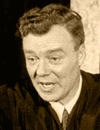
Peter Marshall contrasts two maritime disasters to illustrate the evolution of faith in society. He reflects on the survivors of the Athenia, who sang lighthearted songs in the face of danger, compared to the Titanic's orchestra, which played 'Nearer, My God, to Thee' as they faced their fate. This shift in attitude highlights a decline in deep faith and resilience over time. Marshall emphasizes the importance of being both a realist and an idealist, using the metaphor of an oyster that transforms pain into beauty. He encourages listeners to rely on the Spirit of God for strength and transformation in difficult times.
Full Transcript
At the beginning of the war there were two notable examples. You may remember the foundering of the Athenia and the loss of the city of Benares off the west coast of Africa. And at that time one of the popular songs was, as you may remember, the beer barrel polka.
And we read, incredible as it seems, we read of survivors struggling in the water, crouched, wet and shivering in lifeboats, singing together, roll out the barrel and we'll have a barrel of fun. One might wonder at the choice of a song, one might be aghast at the prospect of facing eternity to the strains of the beer barrel polka, but there is nevertheless something thrilling about the spirit that can sing at such a time, even although what they sing seems inane and strangely inappropriate. I have often thought what a startling contrast to another maritime disaster which some of you will remember.
In May 1912, when the Titanic went down, I was a very little boy then, but I can well remember the special editions of the papers and the magazines with their heavy black borders describing the loss of this magnificent new ship which men said could never sink. This floating palace was in collision with a floating mountain of ice, and icy knives ripped open a hull that was claimed to be unsinkable. And when the orchestra, which a few minutes before had been playing Strauss Waltzes in the ballroom, gathered on the boat deck, and when the male passengers stood alongside to the cry women and children first, loading lifeboats, as many as could be lowered away, they waited patiently, hoping that there might be a chance of rescue.
And then, when it appeared that none was likely, the orchestra began to play and they began to sing. But what did they sing? They sang, nearer my God to thee, nearer to thee, even though it be a cross that raises me, yet all my songs shall be nearer my God to thee, nearer to thee, nearer to thee. Now when you contrast that with roll out the barrel and will of a barrel of fun, you can see what has happened to a nation's faith.
You can see what has happened to the faith of people in 30 years, can't you? Facing eternity to the strains of the beer barrel poker, or lay that pistol down, or mere the jokes. What a commentary upon the faith of immortal souls. And yet the stoic has always inspired us.
Heroism in the face of difficulty has put backbone into many a man, so that if the oyster were to say I'll never give in, I'll fight it out on this line. Though I'm bleeding and sore, yet I will never surrender. I must remember that the darkest hour is just before the dawn.
I'll hang on. I say that's noble, it's thrilling, it's fine, it's magnificent, but it does not adequately deal with the problem. The grain of sand is still there.
As a matter of fact, the oyster does none of these things, because the oyster is at one of the same time a realist and an idealist. And you can be both, you must be both in times like these. You must be a realist and an idealist, and a Christian can be and must be both.
The oyster knows with the profound wisdom that God gives to the humblest of his creatures, that nothing is accomplished by rebellion against hard reality. The oyster knows that you can't deny a bleeding, stabbing pain in your side. You can't deny blood.
The oyster knows that no amount of stoicism can ever make life comfortable again once a grain of sand has entered your shell. So what does the oyster do? The oyster begins carefully and patiently with infinite skill to deposit upon the quartz a milky substance, which upon its sandy base is spun and wrapped in nature's magic to make of the grain of sand that for which divers are willing to risk their lives a pearl, a thing of beauty and hidden light, smooth and warm, wondrous beauty wrapped around trouble. Now let us then learn from the oyster, for life is a difficult game, and these are trying times.
We have not yet begun to pay the cost of the war. There may be some in this very place, some within sound of my voice, who will be called upon to make the supreme sacrifice. There may be some who will be called upon to make a great renunciation, to lay upon the altar of patriotism that which they cherish most.
There may be parents whose hearts have already begun to feel the pang of a separation that might last until the end of a trail, because blue stars are turning into gold. Troubles may come that we know not of. Pain may come to us and grief, for many horrible things are possible and many horrible things are yet to happen.
But if the blow should fall, it will not crush us nor lay us low. For remember, Ezekiel did not set himself upon his feet. He did not pull upon his own bootstraps to rise from dead horizontals.
No, the Spirit of God raised him up. The Spirit of God entered into him. The Spirit of God came to him and changed him.
So too may the Spirit of God come to you and to me. So too may the Spirit of God enter into your heart and mine. So too may you and I be changed, and God knows we need to be changed.
Sermon Outline
- The Contrast of Faith
- The Spirit of Faith
- The Oyster's Wisdom
- Lessons from the Oyster
- Turning Trouble into Beauty
- The Spirit of God
- Change and Transformation
Key Quotes
“You can see what has happened to a nation's faith. You can see what has happened to the faith of people in 30 years, can't you? Facing eternity to the strains of the beer barrel poker, or lay that pistol down, or mere the jokes.” — Peter Marshall
“The oyster knows with the profound wisdom that God gives to the humblest of his creatures, that nothing is accomplished by rebellion against hard reality.” — Peter Marshall
“So too may the Spirit of God come to you and to me. So too may the Spirit of God enter into your heart and mine. So too may you and I be changed, and God knows we need to be changed.” — Peter Marshall
Application Points
- We must face reality with courage and hope, trusting in the Spirit of God to guide us.
- We can turn our troubles into something beautiful by trusting in the Spirit of God and allowing Him to work in our lives.
- We must be both realists and idealists, balancing our understanding of the world with our faith in God's goodness and power.